WO2014027700A1 - 充電管理システム - Google Patents
充電管理システム Download PDFInfo
- Publication number
- WO2014027700A1 WO2014027700A1 PCT/JP2013/072115 JP2013072115W WO2014027700A1 WO 2014027700 A1 WO2014027700 A1 WO 2014027700A1 JP 2013072115 W JP2013072115 W JP 2013072115W WO 2014027700 A1 WO2014027700 A1 WO 2014027700A1
- Authority
- WO
- WIPO (PCT)
- Prior art keywords
- charging
- time
- time zone
- electric vehicle
- borrowing
- Prior art date
- Legal status (The legal status is an assumption and is not a legal conclusion. Google has not performed a legal analysis and makes no representation as to the accuracy of the status listed.)
- Ceased
Links
Images







Classifications
-
- B—PERFORMING OPERATIONS; TRANSPORTING
- B60—VEHICLES IN GENERAL
- B60L—PROPULSION OF ELECTRICALLY-PROPELLED VEHICLES; SUPPLYING ELECTRIC POWER FOR AUXILIARY EQUIPMENT OF ELECTRICALLY-PROPELLED VEHICLES; ELECTRODYNAMIC BRAKE SYSTEMS FOR VEHICLES IN GENERAL; MAGNETIC SUSPENSION OR LEVITATION FOR VEHICLES; MONITORING OPERATING VARIABLES OF ELECTRICALLY-PROPELLED VEHICLES; ELECTRIC SAFETY DEVICES FOR ELECTRICALLY-PROPELLED VEHICLES
- B60L50/00—Electric propulsion with power supplied within the vehicle
- B60L50/50—Electric propulsion with power supplied within the vehicle using propulsion power supplied by batteries or fuel cells
-
- B—PERFORMING OPERATIONS; TRANSPORTING
- B60—VEHICLES IN GENERAL
- B60L—PROPULSION OF ELECTRICALLY-PROPELLED VEHICLES; SUPPLYING ELECTRIC POWER FOR AUXILIARY EQUIPMENT OF ELECTRICALLY-PROPELLED VEHICLES; ELECTRODYNAMIC BRAKE SYSTEMS FOR VEHICLES IN GENERAL; MAGNETIC SUSPENSION OR LEVITATION FOR VEHICLES; MONITORING OPERATING VARIABLES OF ELECTRICALLY-PROPELLED VEHICLES; ELECTRIC SAFETY DEVICES FOR ELECTRICALLY-PROPELLED VEHICLES
- B60L53/00—Methods of charging batteries, specially adapted for electric vehicles; Charging stations or on-board charging equipment therefor; Exchange of energy storage elements in electric vehicles
-
- B—PERFORMING OPERATIONS; TRANSPORTING
- B60—VEHICLES IN GENERAL
- B60L—PROPULSION OF ELECTRICALLY-PROPELLED VEHICLES; SUPPLYING ELECTRIC POWER FOR AUXILIARY EQUIPMENT OF ELECTRICALLY-PROPELLED VEHICLES; ELECTRODYNAMIC BRAKE SYSTEMS FOR VEHICLES IN GENERAL; MAGNETIC SUSPENSION OR LEVITATION FOR VEHICLES; MONITORING OPERATING VARIABLES OF ELECTRICALLY-PROPELLED VEHICLES; ELECTRIC SAFETY DEVICES FOR ELECTRICALLY-PROPELLED VEHICLES
- B60L53/00—Methods of charging batteries, specially adapted for electric vehicles; Charging stations or on-board charging equipment therefor; Exchange of energy storage elements in electric vehicles
- B60L53/30—Constructional details of charging stations
-
- B—PERFORMING OPERATIONS; TRANSPORTING
- B60—VEHICLES IN GENERAL
- B60L—PROPULSION OF ELECTRICALLY-PROPELLED VEHICLES; SUPPLYING ELECTRIC POWER FOR AUXILIARY EQUIPMENT OF ELECTRICALLY-PROPELLED VEHICLES; ELECTRODYNAMIC BRAKE SYSTEMS FOR VEHICLES IN GENERAL; MAGNETIC SUSPENSION OR LEVITATION FOR VEHICLES; MONITORING OPERATING VARIABLES OF ELECTRICALLY-PROPELLED VEHICLES; ELECTRIC SAFETY DEVICES FOR ELECTRICALLY-PROPELLED VEHICLES
- B60L53/00—Methods of charging batteries, specially adapted for electric vehicles; Charging stations or on-board charging equipment therefor; Exchange of energy storage elements in electric vehicles
- B60L53/30—Constructional details of charging stations
- B60L53/305—Communication interfaces
-
- B—PERFORMING OPERATIONS; TRANSPORTING
- B60—VEHICLES IN GENERAL
- B60L—PROPULSION OF ELECTRICALLY-PROPELLED VEHICLES; SUPPLYING ELECTRIC POWER FOR AUXILIARY EQUIPMENT OF ELECTRICALLY-PROPELLED VEHICLES; ELECTRODYNAMIC BRAKE SYSTEMS FOR VEHICLES IN GENERAL; MAGNETIC SUSPENSION OR LEVITATION FOR VEHICLES; MONITORING OPERATING VARIABLES OF ELECTRICALLY-PROPELLED VEHICLES; ELECTRIC SAFETY DEVICES FOR ELECTRICALLY-PROPELLED VEHICLES
- B60L53/00—Methods of charging batteries, specially adapted for electric vehicles; Charging stations or on-board charging equipment therefor; Exchange of energy storage elements in electric vehicles
- B60L53/50—Charging stations characterised by energy-storage or power-generation means
- B60L53/53—Batteries
-
- G—PHYSICS
- G06—COMPUTING OR CALCULATING; COUNTING
- G06Q—INFORMATION AND COMMUNICATION TECHNOLOGY [ICT] SPECIALLY ADAPTED FOR ADMINISTRATIVE, COMMERCIAL, FINANCIAL, MANAGERIAL OR SUPERVISORY PURPOSES; SYSTEMS OR METHODS SPECIALLY ADAPTED FOR ADMINISTRATIVE, COMMERCIAL, FINANCIAL, MANAGERIAL OR SUPERVISORY PURPOSES, NOT OTHERWISE PROVIDED FOR
- G06Q10/00—Administration; Management
- G06Q10/02—Reservations, e.g. for tickets, services or events
-
- G—PHYSICS
- G06—COMPUTING OR CALCULATING; COUNTING
- G06Q—INFORMATION AND COMMUNICATION TECHNOLOGY [ICT] SPECIALLY ADAPTED FOR ADMINISTRATIVE, COMMERCIAL, FINANCIAL, MANAGERIAL OR SUPERVISORY PURPOSES; SYSTEMS OR METHODS SPECIALLY ADAPTED FOR ADMINISTRATIVE, COMMERCIAL, FINANCIAL, MANAGERIAL OR SUPERVISORY PURPOSES, NOT OTHERWISE PROVIDED FOR
- G06Q10/00—Administration; Management
- G06Q10/02—Reservations, e.g. for tickets, services or events
- G06Q10/021—Re-booking existing reservations
-
- G—PHYSICS
- G06—COMPUTING OR CALCULATING; COUNTING
- G06Q—INFORMATION AND COMMUNICATION TECHNOLOGY [ICT] SPECIALLY ADAPTED FOR ADMINISTRATIVE, COMMERCIAL, FINANCIAL, MANAGERIAL OR SUPERVISORY PURPOSES; SYSTEMS OR METHODS SPECIALLY ADAPTED FOR ADMINISTRATIVE, COMMERCIAL, FINANCIAL, MANAGERIAL OR SUPERVISORY PURPOSES, NOT OTHERWISE PROVIDED FOR
- G06Q10/00—Administration; Management
- G06Q10/06—Resources, workflows, human or project management; Enterprise or organisation planning; Enterprise or organisation modelling
- G06Q10/063—Operations research, analysis or management
- G06Q10/0631—Resource planning, allocation, distributing or scheduling for enterprises or organisations
-
- G—PHYSICS
- G06—COMPUTING OR CALCULATING; COUNTING
- G06Q—INFORMATION AND COMMUNICATION TECHNOLOGY [ICT] SPECIALLY ADAPTED FOR ADMINISTRATIVE, COMMERCIAL, FINANCIAL, MANAGERIAL OR SUPERVISORY PURPOSES; SYSTEMS OR METHODS SPECIALLY ADAPTED FOR ADMINISTRATIVE, COMMERCIAL, FINANCIAL, MANAGERIAL OR SUPERVISORY PURPOSES, NOT OTHERWISE PROVIDED FOR
- G06Q10/00—Administration; Management
- G06Q10/10—Office automation; Time management
- G06Q10/109—Time management, e.g. calendars, reminders, meetings or time accounting
-
- G—PHYSICS
- G06—COMPUTING OR CALCULATING; COUNTING
- G06Q—INFORMATION AND COMMUNICATION TECHNOLOGY [ICT] SPECIALLY ADAPTED FOR ADMINISTRATIVE, COMMERCIAL, FINANCIAL, MANAGERIAL OR SUPERVISORY PURPOSES; SYSTEMS OR METHODS SPECIALLY ADAPTED FOR ADMINISTRATIVE, COMMERCIAL, FINANCIAL, MANAGERIAL OR SUPERVISORY PURPOSES, NOT OTHERWISE PROVIDED FOR
- G06Q30/00—Commerce
- G06Q30/06—Buying, selling or leasing transactions
- G06Q30/0645—Rental transactions; Leasing transactions
-
- G—PHYSICS
- G07—CHECKING-DEVICES
- G07F—COIN-FREED OR LIKE APPARATUS
- G07F15/00—Coin-freed apparatus with meter-controlled dispensing of liquid, gas or electricity
- G07F15/003—Coin-freed apparatus with meter-controlled dispensing of liquid, gas or electricity for electricity
- G07F15/005—Coin-freed apparatus with meter-controlled dispensing of liquid, gas or electricity for electricity dispensed for the electrical charging of vehicles
-
- G—PHYSICS
- G08—SIGNALLING
- G08G—TRAFFIC CONTROL SYSTEMS
- G08G1/00—Traffic control systems for road vehicles
-
- H—ELECTRICITY
- H02—GENERATION; CONVERSION OR DISTRIBUTION OF ELECTRIC POWER
- H02J—ELECTRIC POWER NETWORKS; CIRCUIT ARRANGEMENTS OR SYSTEMS FOR SUPPLYING OR DISTRIBUTING ELECTRIC POWER; SYSTEMS FOR STORING ELECTRIC ENERGY
- H02J7/00—Circuit arrangements for charging or discharging batteries or for supplying loads from batteries
-
- H—ELECTRICITY
- H02—GENERATION; CONVERSION OR DISTRIBUTION OF ELECTRIC POWER
- H02J—ELECTRIC POWER NETWORKS; CIRCUIT ARRANGEMENTS OR SYSTEMS FOR SUPPLYING OR DISTRIBUTING ELECTRIC POWER; SYSTEMS FOR STORING ELECTRIC ENERGY
- H02J7/00—Circuit arrangements for charging or discharging batteries or for supplying loads from batteries
- H02J7/02—Circuit arrangements for charging or discharging batteries or for supplying loads from batteries for charging batteries from AC mains by converters
-
- H—ELECTRICITY
- H02—GENERATION; CONVERSION OR DISTRIBUTION OF ELECTRIC POWER
- H02J—ELECTRIC POWER NETWORKS; CIRCUIT ARRANGEMENTS OR SYSTEMS FOR SUPPLYING OR DISTRIBUTING ELECTRIC POWER; SYSTEMS FOR STORING ELECTRIC ENERGY
- H02J2105/00—Networks for supplying or distributing electric power characterised by their spatial reach or by the load
- H02J2105/30—Networks for supplying or distributing electric power characterised by their spatial reach or by the load the load networks being external to vehicles, i.e. exchanging power with vehicles
- H02J2105/33—Networks for supplying or distributing electric power characterised by their spatial reach or by the load the load networks being external to vehicles, i.e. exchanging power with vehicles exchanging power with road vehicles
- H02J2105/37—Networks for supplying or distributing electric power characterised by their spatial reach or by the load the load networks being external to vehicles, i.e. exchanging power with vehicles exchanging power with road vehicles exchanging power with electric vehicles [EV] or with hybrid electric vehicles [HEV]
-
- H—ELECTRICITY
- H02—GENERATION; CONVERSION OR DISTRIBUTION OF ELECTRIC POWER
- H02J—ELECTRIC POWER NETWORKS; CIRCUIT ARRANGEMENTS OR SYSTEMS FOR SUPPLYING OR DISTRIBUTING ELECTRIC POWER; SYSTEMS FOR STORING ELECTRIC ENERGY
- H02J7/00—Circuit arrangements for charging or discharging batteries or for supplying loads from batteries
- H02J7/80—Circuit arrangements for charging or discharging batteries or for supplying loads from batteries including monitoring or indicating arrangements
- H02J7/82—Control of state of charge [SOC]
-
- Y—GENERAL TAGGING OF NEW TECHNOLOGICAL DEVELOPMENTS; GENERAL TAGGING OF CROSS-SECTIONAL TECHNOLOGIES SPANNING OVER SEVERAL SECTIONS OF THE IPC; TECHNICAL SUBJECTS COVERED BY FORMER USPC CROSS-REFERENCE ART COLLECTIONS [XRACs] AND DIGESTS
- Y02—TECHNOLOGIES OR APPLICATIONS FOR MITIGATION OR ADAPTATION AGAINST CLIMATE CHANGE
- Y02T—CLIMATE CHANGE MITIGATION TECHNOLOGIES RELATED TO TRANSPORTATION
- Y02T10/00—Road transport of goods or passengers
- Y02T10/60—Other road transportation technologies with climate change mitigation effect
- Y02T10/70—Energy storage systems for electromobility, e.g. batteries
-
- Y—GENERAL TAGGING OF NEW TECHNOLOGICAL DEVELOPMENTS; GENERAL TAGGING OF CROSS-SECTIONAL TECHNOLOGIES SPANNING OVER SEVERAL SECTIONS OF THE IPC; TECHNICAL SUBJECTS COVERED BY FORMER USPC CROSS-REFERENCE ART COLLECTIONS [XRACs] AND DIGESTS
- Y02—TECHNOLOGIES OR APPLICATIONS FOR MITIGATION OR ADAPTATION AGAINST CLIMATE CHANGE
- Y02T—CLIMATE CHANGE MITIGATION TECHNOLOGIES RELATED TO TRANSPORTATION
- Y02T10/00—Road transport of goods or passengers
- Y02T10/60—Other road transportation technologies with climate change mitigation effect
- Y02T10/7072—Electromobility specific charging systems or methods for batteries, ultracapacitors, supercapacitors or double-layer capacitors
-
- Y—GENERAL TAGGING OF NEW TECHNOLOGICAL DEVELOPMENTS; GENERAL TAGGING OF CROSS-SECTIONAL TECHNOLOGIES SPANNING OVER SEVERAL SECTIONS OF THE IPC; TECHNICAL SUBJECTS COVERED BY FORMER USPC CROSS-REFERENCE ART COLLECTIONS [XRACs] AND DIGESTS
- Y02—TECHNOLOGIES OR APPLICATIONS FOR MITIGATION OR ADAPTATION AGAINST CLIMATE CHANGE
- Y02T—CLIMATE CHANGE MITIGATION TECHNOLOGIES RELATED TO TRANSPORTATION
- Y02T90/00—Enabling technologies or technologies with a potential or indirect contribution to GHG emissions mitigation
- Y02T90/10—Technologies relating to charging of electric vehicles
- Y02T90/12—Electric charging stations
-
- Y—GENERAL TAGGING OF NEW TECHNOLOGICAL DEVELOPMENTS; GENERAL TAGGING OF CROSS-SECTIONAL TECHNOLOGIES SPANNING OVER SEVERAL SECTIONS OF THE IPC; TECHNICAL SUBJECTS COVERED BY FORMER USPC CROSS-REFERENCE ART COLLECTIONS [XRACs] AND DIGESTS
- Y02—TECHNOLOGIES OR APPLICATIONS FOR MITIGATION OR ADAPTATION AGAINST CLIMATE CHANGE
- Y02T—CLIMATE CHANGE MITIGATION TECHNOLOGIES RELATED TO TRANSPORTATION
- Y02T90/00—Enabling technologies or technologies with a potential or indirect contribution to GHG emissions mitigation
- Y02T90/10—Technologies relating to charging of electric vehicles
- Y02T90/14—Plug-in electric vehicles
-
- Y—GENERAL TAGGING OF NEW TECHNOLOGICAL DEVELOPMENTS; GENERAL TAGGING OF CROSS-SECTIONAL TECHNOLOGIES SPANNING OVER SEVERAL SECTIONS OF THE IPC; TECHNICAL SUBJECTS COVERED BY FORMER USPC CROSS-REFERENCE ART COLLECTIONS [XRACs] AND DIGESTS
- Y02—TECHNOLOGIES OR APPLICATIONS FOR MITIGATION OR ADAPTATION AGAINST CLIMATE CHANGE
- Y02T—CLIMATE CHANGE MITIGATION TECHNOLOGIES RELATED TO TRANSPORTATION
- Y02T90/00—Enabling technologies or technologies with a potential or indirect contribution to GHG emissions mitigation
- Y02T90/10—Technologies relating to charging of electric vehicles
- Y02T90/16—Information or communication technologies improving the operation of electric vehicles
Definitions
- Embodiments of the present invention relate to a charge management system that manages charging of an electric vehicle.
- an electric vehicle (electric vehicle: hereinafter referred to as “EV”.
- the EV is not necessarily limited to a four-wheeled vehicle, but includes a two-wheeled vehicle, a three-wheeled vehicle, etc. Further, the EV is charged from the outside.
- a mobile device that uses the power stored in its own storage battery as an energy source such as a plug-in hybrid vehicle (Plug-in Hybrid Hybrid) (hereinafter EV is a typical device) Explain).
- the time required for charging the storage battery is longer than the time required for refueling the gasoline vehicle.
- the EV traveling distance is shorter than the gasoline vehicle traveling distance. For this reason, it has been necessary to frequently charge the EV for a long time.
- a battery charging system a vehicle management server, and a car sharing server that control a self-delivery vehicle mainly for delivery using a delivery plan and a charging state.
- a quick charger can be used as a method of shortening the charging time to the EV.
- the charging time to the EV can be shortened to about 30 minutes.
- the quick charger is expensive including the power supply equipment. For this reason, if the centralized operation of the quick charger is performed, the power system may be affected. Therefore, it is difficult to prepare a quick charger for any EV. Therefore, in order to increase the operating rate of the charger as a whole while paying attention to the cost, it is necessary to combine a quick charger and a regular charger with a large number of devices.
- a charger for normal charging In order to charge the EV, two types of chargers, that is, a charger for normal charging and a charger for quick charging can be used.
- functions that can be used for charging with a plurality of charging patterns for a certain resource will be described.
- the predetermined person is a person who needs to borrow a predetermined EV.
- the predetermined EV is an EV that cannot be used because the borrowing schedule is close to the previous schedule and normal charging is performed.
- the problem to be solved by the present invention is to provide a charge management system capable of improving the operation rate of resources by combining normal charging and rapid charging.
- the charging management system includes a first charging device that charges an electric vehicle for lending, and a first charging device that charges the electric vehicle in a shorter time than the first charging device.
- the second charging device, the rental time zone as a reserved time zone of the electric vehicle, and the second charging device can be used, and the electric vehicle can be rented in the rental time zone.
- the charging time zone for the electric vehicle by the charging device of 2 and the electric vehicle by the first charging device for enabling the rental of the electric vehicle in the rental time zone when the second charging device cannot be used It has a management unit that manages information indicating the transition of the amount of stored electric energy of the electric vehicle due to the charging time period and the rental and charging of the electric vehicle.
- the charging time zone when the second charging device cannot be used In the display device, a time zone that can be set as a new desired rental time zone for the electric vehicle based on the charging time zone for the electric vehicle by the first charging device in the zone and the rental time zone managed by the management unit A display control unit to be displayed, and an input unit that receives an input of a desired rental time zone of the electric vehicle in the time zone displayed by the display control unit.
- This charge management system has a first estimation unit that estimates the amount of electric power required to rent an electric vehicle for the desired rental time zone input by the input unit.
- charging by the first and second charging devices for enabling rental of the electric vehicle in the input desired rental time zone is performed based on the required power amount estimated by the first estimation unit.
- a second estimation unit for estimating a necessary time zone is provided.
- the charging management system is configured to perform charging for enabling the rental of an electric vehicle in the input desired rental time zone and the borrowed time zone reserved for rental based on information managed by the management unit. If it is possible in the time zone estimated by the above, it has a scheduling unit that sets the inputted desired rental time zone as a rentable time zone.
- FIG. 1 is a diagram illustrating a functional configuration example of the charge management system according to the present embodiment.
- FIG. 2 is a flowchart illustrating an example of a procedure for displaying a schedule screen for borrowing reservation.
- FIG. 3 is a diagram illustrating an example of a user use application screen.
- FIG. 4 is a diagram illustrating an example of a detailed information input screen.
- FIG. 5 is a diagram showing an example of a screen showing the recalculated schedule.
- FIG. 6 is a diagram illustrating an example of a resource schedule in a table format.
- FIG. 7 is a diagram illustrating an example of an initial display screen when rapid charging is possible.
- FIG. 8 is a diagram illustrating an example of an initial display screen when only normal charging can be performed.
- FIG. 1 is a diagram illustrating a functional configuration example of the charge management system according to the present embodiment.
- FIG. 2 is a flowchart illustrating an example of a procedure for displaying a schedule screen for borrowing reservation.
- FIG. 10A is a diagram illustrating information for confirming the required power amount in a table format.
- FIG. 10B is a diagram illustrating information for confirming the required power amount in a table format.
- FIG. 10C is a diagram illustrating information for confirming the required power amount in a table format.
- FIG. 11 is a diagram illustrating an example of a borrowing time display screen.
- FIG. 12 is a diagram illustrating an example of a screen for displaying a scheduleable time.
- FIG. 13 is a diagram illustrating an example of a new borrowing schedule in a table format.
- the present embodiment provides a charge management system having a scheduler that devise the display of resource free time and resource charging time. .
- the charge management system in the present embodiment firstly borrows display time for borrowing applicants of EV when using quick charging time for EV (lending to borrowing applicants) (Display time) expansion function. Secondly, the charge management system in the present embodiment has a function of reducing the charging time by charging only the necessary amount of electric power to the EV.
- This function is a function related to displaying a predetermined schedule for an EV borrowing application in a time zone in which the quick charger can be used. Actually, even if charging is performed for a long time with normal charging, the borrowing applicant is shown a free time when performing quick charging. When this function is used, the borrowing applicant need not be aware of the type of charger to be used. Moreover, the charger actually used after the borrowing application is determined on the charge management system side. In other words, the utilization rate of EV can be expected to improve by utilizing the quick charger.
- the function of charging only the necessary power amount to the EV will be described.
- the power consumption during the borrowing time of EV as a shared resource is often smaller than the case where the EV is continuously operated. For example, when an EV is used as a foot for shopping or moving to a movie, even if the borrowing time is applied for 3 hours, the borrower actually rides the EV for about 1 hour.
- the required amount of charge for the EV is determined based only on the EV borrowing time, it is estimated that the remaining battery capacity of the EV is required to be able to operate for 3 hours.
- the EV borrowing conditions are clarified, for example, if it is clarified that the purpose is shopping and the destination is a shopping mall, the EV battery charge remaining is the shopping mall that the EV borrowing applicant wants to go to It is enough if there is enough remaining battery power to go to and from.
- the estimated amount of charge must be charged for a certain period of time so that there is no problem even if it is used for various methods, for example, If the charging amount is smaller than the charging amount by the method, the charging time for EV can be reduced. By reducing the charging time, it is possible to increase the time during which EV can be lent to other users. For this reason, it becomes possible to improve the operation rate of EV.
- FIG. 1 is a diagram illustrating a functional configuration example of the charge management system according to the present embodiment.
- the charge management system in this embodiment includes a user interface (I / F) 1, a charge scheduler 2, and a resource management unit 3.
- the user I / F 1 includes a borrowing condition input unit 11, a quick charge schedule display unit 12, and a schedule possible range display unit 13.
- the borrowing condition input unit 11 accepts an operation for newly inputting or changing a borrowing condition at the time of borrowing reservation by a user who uses an EV as a shared resource.
- the borrowing condition input unit 11 stores the new input and changes of the borrowing condition in the application information DB (database) (D-1) 51.
- Devices that accept operations include a keyboard and a mouse not shown here.
- the quick charge schedule display unit 12 displays a charge schedule when it is assumed that quick charge is performed on a display device (not shown).
- the display device is, for example, a liquid crystal display.
- the schedulable range display unit 13 displays a time zone that can be set as an EV borrowing desired time zone on the display device as an EV borrowing schedulable range.
- the charge scheduler 2 includes a required charge amount estimation unit 21, a required charge time estimation unit 22, and a charge scheduling unit 23.
- the required charge amount estimation unit 21 estimates a required charge amount as power necessary for resource borrowing.
- the necessary charging time estimation unit 22 estimates a necessary charging time as a time required to charge the necessary charging amount estimated by the necessary charging amount estimation unit 21.
- the charging scheduling unit 23 manages the borrowing / charging schedule of the shared resource, and presents a borrowable EV candidate to the reservation applicant according to the borrowing reservation application. In addition, the charging scheduling unit 23 displays a resource borrowing / charging schedule in accordance with a browsing request from the reservation applicant.
- the resource management unit 3 includes an EV attribute acquisition / management unit 31, a charger attribute acquisition / management unit 32, and a schedule management unit 33.
- the EV attribute acquisition / management unit 31 acquires and manages EV attribute information based on vehicle management information from the outside.
- the charger attribute acquisition / management unit 32 acquires and manages charging station attribute information based on external charging station (charger) management information.
- the schedule management unit 33 manages an EV borrowing / charging schedule. In addition, the schedule management unit 33 manages information on users who borrow an EV.
- the user I / F 1 has an application information DB (D-1) 51.
- the required charge amount estimation unit 21 of the charge scheduler 2 has an overall required charge amount DB (D-3) 53 for each resource.
- the required charge time estimation unit 22 of the charge scheduler 2 includes a resource required charge time DB (D-4) 54 and a resource required charge time DB (D-5) 55 for rapid charging.
- the charge scheduling unit 23 of the charge scheduler 2 has a resource pre-required charge time DB (D-7) 57 and an overall resource required charge time DB (D-8) 58.
- the charge management system includes a resource borrowing schedule DB (D-2) 52 and a resource charging schedule DB (D-6) 56 separately from the user interface (I / F), the charge scheduler 2 and the resource management unit 3.
- the quick charger schedule DB (D-9) 59 is provided.
- the application information DB (D-1) 51 stores application information as information input when a user applies for resource borrowing.
- application information information for identifying a borrower such as a borrowing time zone and a user ID is essential.
- the application information includes information for estimating the resource power consumption after the start of borrowing as non-essential information. This information includes, for example, a destination, a purpose, the number of users, and the like.
- the resource borrowing schedule DB (D-2) 52 stores a resource borrowing schedule as information for recording when and who will borrow a resource.
- the total required charge amount DB (D-3) 53 for each resource stores the required charge estimation amount as the amount of power required when borrowing resources.
- the resource required charging time DB (D-4) 54 stores information on the time required to charge the required charging amount indicated by the total required charging amount DB (D-3) 53 for each resource by normal charging. This stored information is finally stored in the resource charge schedule DB (D-6) 56.
- the resource required charging time DB (D-5) 55 for quick charging includes information on the time required for charging the required charging amount indicated by the total required charging amount DB (D-3) 53 for each resource by rapid charging. Store. This stored information is finally stored in the quick charger schedule DB (D-9) 59.
- the resource charging schedule DB (D-6) 56 stores the charging time required for normal charging stored in the resource required charging time DB (D-4) 54 corresponding to each resource borrowing. Stores the scheduled information in the resource.
- the resource pre-required charge time DB (D-7) 57 stores the calculation result of the charge time that is considered necessary so that the schedule does not fail before the resource is borrowed.
- the failure of the schedule means, for example, a power shortage (a situation where the EV cannot be operated due to a decrease in the amount of charge of the battery) at any time after the target borrowing.
- the entire resource required charging time DB (D-8) 58 stores the calculation result of the charging time that needs to be scheduled for charging. This charging time does not matter whether resources are borrowed or not.
- the quick charger schedule DB (D-9) 59 is a charging time required for performing quick charging as a time indicated by information stored in the resource required charging time DB (D-5) 55 for quick charging. Stores information that is scheduled for a resource.
- FIG. 2 is a flowchart illustrating an example of a procedure for displaying a schedule screen for resource borrowing reservation.
- FIG. 3 is a diagram illustrating an example of a user use application screen.
- the borrowing condition input unit 11 of the user interface 1 receives an input of resource borrowing application conditions on the user use application screen shown in FIG. 3 (step S1).
- This user use application screen is an example of an initial screen that is first displayed when the user borrows resources.
- (Item 1) on the user use application screen indicates the use schedule of the borrowed EV. This item is an item for allowing the user to visually recognize the time when the EV is available and for the user to create an EV borrowing plan.
- (Item 2.) on the user usage application screen is an item for setting a display scale to be used as a scale indicated by (Item 1.).
- (Item 3.) on the user use application screen is an item for inputting a desired borrowing time zone of the resource. This borrowing desired time zone is the start date / time and end date / time of the desired use time.
- FIG. 4 is a diagram illustrating an example of a detailed information input screen.
- (Item 4.) on the user use application screen is an icon for the user to select in order to display the detailed information input screen shown in FIG.
- This detailed information input screen is a screen for inputting more detailed application conditions than the information input on the user use application screen shown in FIG.
- the input application conditions are stored in the application information DB (D-1) 51.
- the charging schedule is displayed at this time, the charging schedule with the same safety margin as that of the conventional car sharing system is displayed. That is, the charging time required to charge the amount of power necessary and sufficient for normal borrowing is shown.
- the charge time is the time when the quick charge is performed.
- the quick charging schedule display unit 12 displays this charging time as a charging time that is apparently shortened compared to the time when normal charging is performed.
- the time zone in which the quick charging can be performed refers to, for example, a time zone in which the quick charger is vacant, or a time zone in which the EV that has completed the latest quick charging has already left the place for the quick charging.
- the quick charge schedule display unit 12 uses a normal charger to statistically calculate the required charge amount (estimated required charge amount based on the user and borrowing conditions) during the time period when the quick charge cannot be performed.
- the amount of time required to supply the charge amount with a margin that is considered necessary is displayed as the required charge time.
- the quick charge schedule display unit 12 displays the time required to charge the electric power exceeding the required charge amount as a reservable charge time.
- the time zone in which quick charging cannot be performed refers to, for example, a time zone in which quick charging is performed and a time zone in which a space for performing quick charging is not yet occupied by another EV.
- the required charge amount estimation unit 21 needs to borrow for each EV based on the contents of the application information stored in the application information DB (D-1) 51.
- the required charge amount as the electric energy is estimated (step S2).
- the estimation model for estimating the required charge amount and the estimation accuracy of the required charge amount differ depending on the input information.
- the required charge amount estimation unit 21 stores information on the required charge amount estimated as described above in the overall required charge amount DB (D-3) 53 for each resource.
- the required charge time estimation unit 22 is based on the estimated value of the required charge amount as a value estimated by the required charge amount estimation unit 21 and stored in the overall required charge amount DB (D-3) 53 for each resource.
- the required charging time as the connection time between the charger and the EV necessary to satisfy the charging amount is estimated (step S3).
- ⁇ Charging time differs between when using a normal charger and when using a quick charger. For this reason, the required charging time estimation unit 22 estimates the required charging time when using a normal charger and the required charging time when using a quick charger, respectively. Further, when a charger capable of charging at a speed higher than that of the quick charger is introduced, the required charging time estimation unit 22 estimates the required charging time when this charger is used separately.
- the required charging time estimation unit 22 stores the estimation result of the required charging time when the normal charger is used in the resource required charging time DB (D-4) 54.
- the required charging time estimation unit 22 stores the estimation result of the required charging time when the quick charger is used in the resource required charging time DB (D-5) 55 for quick charging.
- the charge scheduling unit 23 sets the resource required charge time DB (D-4) 54, the resource required charge time DB for quick charge DB (D-5) 55, and the total required charge amount DB (D-3) 53 for each resource.
- the stored information and various schedule information stored in the resource borrowing schedule DB (D-2) 52, the resource charging schedule DB (D-6) 56, and the quick charger schedule DB (D-9) 59 are read (steps) S4).
- the charging scheduling unit 23 determines whether or not the resource borrowing time as the time indicated by the borrowing condition input in S1 is not overlapped with other already borrowed times. to decide.
- the charge scheduling unit 23 determines whether the battery remaining amount before borrowing the EV and the required charge amount estimated in step S2 are the same. Then, the time required to charge the necessary charge amount necessary for borrowing EV using a normal charger is calculated (total resource required charge time (D-8)).
- the charge scheduling unit 23 calculates the time required for charging so as not to run out of electricity at the time of subsequent borrowing by performing the requested borrowing (required resource pre-charge time (D ⁇ 7)).
- the charge scheduling unit 23 uses the borrowing time indicated by the borrowing condition input at S1 when the borrowing before EV is completed and the time required for charging to prevent the lack of electricity is described above. It is determined whether or not it is possible to cover the interval from the start of time. For this determination, the charging scheduling unit 23 determines whether the idle time between the requested borrowing time and the prior borrowing time is larger than the calculated D-8 and D-7.
- the charge scheduling unit 23 determines whether or not the borrowing of the EV in the application content is possible by performing the first and second processes.
- the charge scheduling unit 23 determines the remaining battery level before borrowing the EV, The difference from the required charge amount estimated in S2 is calculated. Based on this difference, the charging scheduling unit 23 calculates the time required to charge the necessary amount of charge required for borrowing by using the quick charger for how much time is charged. In other words, the charging scheduling unit 23 determines whether or not the calculated time can be covered between the end of the borrowing before the EV and the start of the borrowing time indicated by the borrowing condition input in S1. . By making this determination, the charging scheduling unit 23 determines whether or not the borrowing in the application content is possible.
- the charging scheduling unit 23 calculates the charging time when it is assumed that the quick charging is performed, and displays the charging time on the quick charging schedule display unit 12 (step S6). .
- the charge scheduling unit 23 determines the total required charge DB (D for each resource). -3) Based on the information stored in 53 and the resource required charging time DB (D-4) 54, a time zone in which charging can be scheduled is calculated. The charge scheduling unit 23 causes the user to display the calculated time zone information again by the schedulable range display unit 13.
- the case where the quick charger cannot be used at the requested borrowing time is, for example, that the quick charger is used for charging other EVs at the requested borrowing time or the This is a case where the EV that has been rapidly charged last time is stopped in a parking lot that can be used.
- step S7 By performing such a display, it is possible to prompt the user to try to change the application content (step S7).
- FIG. 5 is a diagram showing an example of a screen showing the recalculated schedule.
- the screen shown in FIG. 5 reflects the calculation results in S6 and S7. (Item 11.) on this screen shows a charging schedule when the quick charger is available.
- Charging period ( Requirement) the shortest charging time when the quick charger is used for each resource.
- the charging time for normal charging is divided into “charging period (required)” and “charging period (reservation possible)”.
- the time zone corresponding to the “charging period (reservation is possible)” is a time zone in which a borrowing reservation is possible.
- the schedule management unit 33 When the user approves the presented borrowing schedule, the schedule management unit 33 records and updates the resource borrowing schedule upon approval in the resource borrowing schedule DB (D-2) 52. Further, the schedule management unit 33 records and updates the charging schedule in the resource charging schedule DB (D-6) 56. The schedule management unit 33 records and updates the shortest charging schedule in the quick charger schedule DB (D-9) 59. If the borrowable schedule does not match the user's desired borrowing time and the user gives up EV borrowing, the schedule management unit 33 ends the operation without updating the various DBs (step S8).
- FIG. 6 is a diagram illustrating an example of a resource schedule in a table format.
- processing is performed using a resource utilization schedule display view that is a merge of the resource borrowing schedule DB (D-2) 52, the resource charging schedule DB (D-6) 56, and the quick charger schedule DB (D-9) 59 Is described.
- the user I / F 1 displays the charging time when sufficient charging is performed after another borrowing as “(b) charging time zone” to show the user.
- the user I / F 1 displays the charging time when using the quick charger as “(A) charging time zone” to the user. show.
- FIG. 7 is a diagram illustrating an example of an initial display screen when rapid charging is possible.
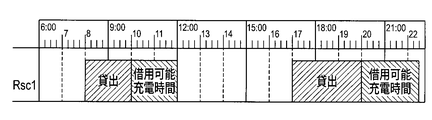
- NO In the schedule shown in FIG. No. 1 “8:00 to 10:00” and NO. 4 “17:00 to 20:00” is displayed. In this display, an interval between other determined borrowing times is open, and a sufficient charging time for performing full charging for the next lending can be taken. For this reason, the initial display screen displays the NO.
- the schedule shown in FIG. 6 As the quick charge time for enabling the lending by the lending time described above without causing a power shortage. No. 3 “10: 00-15: 00” and NO. 6 “20:00 to 20:30” is further displayed.
- the charging plan from the start time to the end time of the row whose record type is “charge (normal charge)” or “rapid charge” among the rows is the charge applied to the actual schedule.
- Information indicating whether it is a plan is set.
- NO. No. 2 from 10:00 to 12:00 as charging time by normal charging
- the charging plan applied to the actual schedule is from 20:00 to 22:30 as the charging time by the normal charging in the fifth row.
- FIG. 8 is a diagram illustrating an example of an initial display screen when only normal charging can be performed.
- NO. 2 “10:00 to 12:00” and NO. 5 “20:00 to 22:30” is displayed.
- An indispensable item is a desired use time consisting of a borrowing start time and a borrowing end time. Items include “destination”, “scheduled distance”, “purpose of use”, “number of passengers”, “load”, and the like.
- the higher the degree of clearness of the borrowing condition information the higher the accuracy of estimation of the charge amount necessary for borrowing the EV by the applicant, so the possibility that the charge amount can be reduced increases.
- the borrowable time as the time excluding other borrowing time and charging time is set as the resource. It is also possible to display with a string.
- the required charge amount estimation unit 21 of the charge scheduler 2 estimates the charge amount necessary for borrowing EVs according to the application conditions based on the contents of the application conditions input by the applicant. In order to estimate the charge amount, the required charge amount estimation unit 21 evaluates a plurality of required charge amounts depending on how much the required power amount is estimated based on the input information and the user's usage history. Determine which model to use.
- the required charge amount estimation unit 21 is considered to have the highest accuracy based on the estimated accuracy in each required charge amount evaluation model. Use the model to estimate the required charge. In this case, there is a possibility that logic 1-a and 1-b overlap or logic 1-a and 1-c overlap. However, the accuracy of the logic 1-a is lower than the accuracy of the logic 1-b and the logic 1-c. Therefore, the required charge amount estimation unit 21 estimates the required charge amount using the logic 1-b or the logic 1-c, and uses the estimated required charge amount information for each resource as a total required charge amount DB (D-3). 53.
- the required charge time estimation unit 22 of the charge scheduler 2 calculates the required charge amount of EV based on the information estimated by the required charge amount estimation unit 21 and stored in the total required charge amount DB (D-3) 53 for each resource. Estimate the required charging time as the time required for charging.
- the charging requirements are issued from the EV vehicle. Because of this and the electrical characteristics of the battery, the required charging time is a non-linear function with parameters such as vehicle type, remaining battery level, required charging amount, and temperature.
- the required charging time estimation unit 22 estimates the required charging time for normal charging as a first function, and stores information on the required charging time in the resource required charging time DB (D-4) 54. Further, as a second function, the required charge time estimation unit 22 estimates the required charge time due to the quick charge, and stores information on the required charge time in the resource required charge time DB (D-5) 55 for quick charge. .
- the required charging time estimation unit 22 is calculated assuming that the required charging time for normal charging is 2 hours and the required charging time for quick charging is 0.5 hours.
- the charge scheduling unit 23 of the charge scheduler 2 depends on the application contents based on the required charge time stored in the resource required charge time DB (D-4) 54 and the resource required charge time DB (D-5) 55 for quick charge. It is estimated whether charge scheduling is possible.
- FIG. 9 is a diagram illustrating an example of check points for indicating whether or not charging scheduling is possible.
- the following is an example of logic for determining whether or not charge scheduling is possible.
- the charging scheduling unit 23 confirms that the requested borrowing time does not overlap with another determined borrowing time. If the borrowing time does not overlap, the charging scheduling unit 23 calculates the total resource required charging time D-8 for satisfying the required charging amount based on the borrowing application content. The charging scheduling unit 23 checks whether or not EV charging is possible in the free time when the borrowing application content is approved.
- the charging scheduling unit 23 looks around the entire charging schedule including the borrowing before and after the requested borrowing.
- the charge scheduling unit 23 uses the normal or rapid charge in the idle time when it is assumed that the application has been accepted, and the resource pre-required charge time D ⁇ as the time for satisfying the charge amount so that the power amount is not insufficient at each borrowing 7 is calculated.
- the charging scheduling unit 23 confirms whether or not the resource is not used up due to the borrowing after the borrowing for which the resource is applied.
- the charging scheduling unit 23 accepts the EV borrowing application, determines that the EV can be used for borrowing in this application, and charges the EV for which the borrowing application has been made. Set the time.
- FIG. 10A, FIG. 10B, and FIG. 10C are diagrams showing information for confirming the required power amount in a table format.
- FIG. 10A, FIG. 10B, and FIG. 10C show confirmation of the required power amount in the logic 4-c described above. Details are illustrated below.
- (1) As a whole, the borrowed-empty status is entered as a schedule in the columns of the tables shown in FIGS. 10A, 10B, and 10C, and a numerical value to be calculated is necessary at each required row in each row of the status. enter. In the R-7 row of the C-1 column as the first column in which the status is entered, the initial holding power of the EV is entered as an initial value. In the R-7 row of the C-9 column as the final column, the finally required power is described as the final state.
- This configuration is a configuration that considers dividing the schedule by some time interval, for example, maintenance or borrowing interval, when the car rental facility is in operation for 24 hours and there is no suspension period.
- the R-1 line of the table shown in FIG. 10A indicates the EV use start time
- the R-2 line indicates the use end time.
- Information on the use start time and use end time is stored in the resource borrowing schedule DB (D-2) 52.
- Line R-3 in the table shown in FIG. 10A is a line indicating borrowing time. This borrowing time is a difference between the use end time described in the R-2 line and the use start time described in the R-1 line.
- Row R-4 in the table shown in FIG. 10A is a row indicating the borrowed power amount.
- This borrowing power amount is the amount of power held in the R-1 row of the C-1 column and the amount of charge described in the R-9 row of the C-2 column until the EV is borrowed.
- Charge amount in free time (charge amount available for free time) is added, and the power consumption until this borrowing is subtracted from the addition result as the power consumption amount described in line R-5. .
- the estimated power consumption described in the R-5 line of the table shown in FIG. 10A indicates the amount of power consumed by the EV during the target borrowing time, and is estimated separately.
- the remaining battery level at the end of borrowing indicated in line R-6 in the table shown in FIG. 10A is calculated from the borrowed power amount indicated in line R-4 in a certain column to line R-5 in the same column. This is a value obtained by subtracting the estimated power consumption described, and indicates the remaining battery level of the EV when a certain borrowing is completed.
- the holding power described in the R-7 line of the table shown in FIG. 10A indicates the initial battery remaining amount and the remaining battery amount that needs to remain at the end as described in (1). It is a thing.
- the idle time described in line R-8 of the table shown in FIG. 10A is the idle time between the end of one borrowing and the start of the next borrowing for EV. This idle time is obtained by subtracting the previous borrowing end time (line R-2) from the borrowing start time (line R-1) for the next borrowing.
- the available free time charge amount described in the R-9 row of the table shown in FIG. 10A indicates the amount of power that can be charged during the free time calculated in the R-8 row of the same column.
- this method varies depending on the specified charger and the specified battery. It is also conceivable to use a table in which the charge amount is calculated using parameters of the current charge amount, the charging time, and the temperature.
- the required battery level at the start of borrowing described in the R-10 line of the table shown in FIG. 10B is the calculation result of the remaining battery level so that there is no shortage of electricity from a certain borrowing to the final state. is there. This necessary battery remaining amount is calculated for each borrowing start time.
- W L of the formula (1) shows the required amount of charge to be satisfied in the final state.
- N of Formula (1) shows the number tied to borrowing used as the calculation object of the charge amount of a storage battery.
- L in Expression (1) indicates a number associated with the last borrowing to reach the final state.
- D i represents the estimated power consumption (row R-5) in the individual borrowed i.
- C i fall within the cumulative symbols of the formula (1) is idle time can charge amount before borrowing i (R-9 line) correspond.
- W L of the formula (1) since you want to check the required charge quantity on the "book B" on the C-5 column, W L of the formula (1) it is a zero as the value of (R-7 column, C-9 line) is there. Further, n in the equation (1) is a column number corresponding to the C-5 column, and L in the equation (1) is a column number corresponding to the C-7 column. In addition, the column that falls within the cumulative symbol of equation (1) is only the column C-7.
- the estimated power consumption (column C-7, row R-5) in column C-7 is 35. However, there is only 6.666667 ( ⁇ 6.67) that can be charged before that, and the available charge amount (C-6 column, R-9 row) is available. In addition, the value of max (35-6.67, 0) as the amount of charge required at the end of borrowing regarding “Reservation B” in the C-5 column is 28.33.
- formula (1) is derived from the logic that it is necessary to further charge the power corresponding to the difference from the front. ing.
- the required charge amount described in line R-11 as the eleventh line of the table shown in FIG. 10B is the battery remaining amount at the end of borrowing (R-6 line) as the battery remaining amount at the end of the previous borrowing.
- the required remaining battery level at the start of borrowing (R-10 line) as the amount of power required before this borrowing. If the remaining battery level at the start of borrowing (line R-10) is larger than the remaining battery level at the end of borrowing (line R-6), at least the difference needs to be charged.
- the resource pre-required charge time (D-7) described in the R-12 line as the 12th line of the table shown in FIG. 10B is for charging the required charge amount calculated in the R-11 line. It is time necessary for. In order to calculate the required charging time, it is conceivable to use the table described in (9) above. Here, it is assumed that the resource pre-required charging time (R-12 line) does not exceed the idle time (R-8 line).
- the charge margin described in the R-15 line as the 15th line of the table shown in FIG. 10C is the maximum possible charge amount (R-14 line) and the remaining battery capacity required at the start of borrowing (R-10). Shows the difference.
- This charging margin is an index indicating the charging time that can be changed. In addition, when this charge margin is negative, it is not a recommended charge schedule because power is consumed or borrowing is required during borrowing.
- the charging time is unknown before entering the initial screen. For this reason, the charging time displayed on this screen is long, and the borrowable time is short. If it is possible to secure the charging schedule at this point, the resource pre-required charging time (R-12 line) corresponding to the required required charging amount (R-11 line) is reflected. If quick charging is possible, the charging time is displayed short using the necessary charging time for rapid charging (line R-13). By this display, it is possible to finely adjust the desired time zone for the reservation.
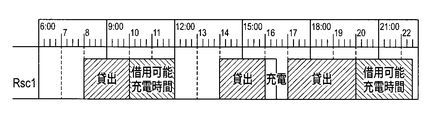
- FIG. 11 is a diagram illustrating an example of a borrowing time display screen.
- the quick charge schedule display unit 12 of the user I / F1 newly adds 14:00 to 16:00 as a desired borrowing time zone as compared with the initial display screen shown in FIG. 16:00 to 16:30 are newly displayed as the charging time by rapid charging.
- the display screen shown in FIG. 11 replaces the display of the charging time by rapid charging as the display shown at 10:00 to 10:30 and 20:00 to 20:30 shown in FIG.
- the quick charge schedule display unit 12 displays 10:00 to 12:00 and 20:00 to 22:30 as borrowable charge times.
- the desired borrowing time zone 14:00 to 16:00 can be finely adjusted so that part or all of these borrowable charging times overlap.
- FIG. 12 is a diagram illustrating an example of a screen for displaying a scheduleable time.
- the available borrowing time is displayed again on the display device by the schedulable range display unit 13 of the user I / F1.
- the contents of the application are grasped in the same way as when the charge schedule can be secured. Thereby, a required charge amount can be reduced compared with before the input with respect to an initial screen.
- the schedulable range display unit 13 of the user I / F 1 is charged by rapid charging as the time displayed as 10:00 to 10:30 and 20:00 to 20:30. The time was displayed.
- the quick charge schedule display unit 12 displays 10:00 to 12:00 and 20:00 to 22:30 on the display device as borrowable charge times. Therefore, 10:00 to 10:30 and 20:00 to 20:30 displayed as the charging time on the initial display screen shown in FIG. 7 can be designated as the borrowing time on the screen shown in FIG. Thereby, since the time zone which can be designated as borrowing time can be expanded, the possibility that a prior borrowing application can be performed increases.
- the schedule management unit 33 of the resource management unit 3 performs the resource borrowing schedule DB (D-2) 52, the resource charging schedule DB (D-6) 56, and the quick charger schedule DB (D -9) Update 59.
- FIG. 13 is a diagram illustrating an example of a new borrowing schedule in a table format.
- This screen is a screen for the borrowing schedule in the case where the borrowing time displayed on this screen is not changed in accordance with the screen shown in FIG.
- the NO. 4 to NO. No. 6 is NO. No. 7 to NO. No. 9 is changed, and the fixed borrowing time is NO. 4 is set as new information, and the normal charging time after borrowing is NO. No. 5 is set as new information and NO. No. 4 quick charge time after borrowing new NO. 6 is set as new information.
- information indicating whether or not the charging plan is a charging plan applied to the actual schedule is set for each column as in the schedule shown in FIG.
- NO. 2 from 10:00 to 12:00 as the charging time for normal charging in the row 2
- NO. 5 from 16:00 to 17:00 as the charging time for normal charging in the row 5
- the charging plan applied to the actual schedule is from 20:00 to 22:30 as the charging time by the normal charging in the column 8.
- 16:00 to 16:30 is displayed as the quick charging time. However, even if normal charging is started from 16:00, NO. In the table shown in FIG. No. 5 in the table shown in FIG. Since the next lending time shown in FIG. 7 does not overlap with 17:00 to 20:00, as described above, 16:00 to 17:00 by normal charging is the charging plan applied to the actual schedule.
- the charging schedule for each EV is calculated, and the most effective vehicle or the vehicle desired by the user is assigned.
- GUI Graphic User Interface
- the GUI for displaying the schedule includes variations such as displaying the borrowed time of individual cars or displaying the time that can be borrowed for any one of the vehicles.
- the maintenance time is shortened and the resource operation rate is reduced. Can be improved.
- the borrowable time can be expanded by displaying the borrowable charge time when the quick charge time is utilized.
- it can be prescribed
- the resource charging time is reduced by performing a charging schedule by rapid charging as necessary, so that the resource utilization rate is improved.
- the user can estimate the amount of power required for borrowing by inputting detailed information on the borrowing conditions, for example, the destination. By performing this estimation, it is possible to reduce the required amount of charge and the charging time after borrowing. Therefore, even when quick charging cannot be performed and only normal charging can be performed, the borrowing time zone can be flexibly designated. As a result, it is possible to increase the target of borrowable users and increase the resource utilization rate.
- SYMBOLS 1 ... User interface (I / F), 2 ... Charge scheduler, 3 ... Resource management part, 11 ... Borrowing condition input part, 12 ... Rapid charge schedule display part, 13 ... Scheduleable range display part, 21 ... Estimate required charge amount , 22 ... Required charging time estimation unit, 23 ... Charge scheduling unit, 31 ... EV attribute acquisition / management unit, 32 ... Charger attribute acquisition / management unit, 33 ... Schedule management unit.
Landscapes
- Engineering & Computer Science (AREA)
- Business, Economics & Management (AREA)
- Human Resources & Organizations (AREA)
- General Physics & Mathematics (AREA)
- Physics & Mathematics (AREA)
- Strategic Management (AREA)
- Power Engineering (AREA)
- Economics (AREA)
- Entrepreneurship & Innovation (AREA)
- Tourism & Hospitality (AREA)
- Marketing (AREA)
- General Business, Economics & Management (AREA)
- Theoretical Computer Science (AREA)
- Accounting & Taxation (AREA)
- Mechanical Engineering (AREA)
- Transportation (AREA)
- Operations Research (AREA)
- Quality & Reliability (AREA)
- Development Economics (AREA)
- Finance (AREA)
- Data Mining & Analysis (AREA)
- Educational Administration (AREA)
- Game Theory and Decision Science (AREA)
- Life Sciences & Earth Sciences (AREA)
- Sustainable Development (AREA)
- Sustainable Energy (AREA)
- Charge And Discharge Circuits For Batteries Or The Like (AREA)
- Management, Administration, Business Operations System, And Electronic Commerce (AREA)
- Electric Propulsion And Braking For Vehicles (AREA)
Abstract
実施形態によれば、充電管理システムは、貸出のための電気自動車への充電を行なう第1の充電装置と、第1の充電装置と比較して短い所要時間により電気自動車への充電を行なう第2の充電装置とを適用するための充電管理システムであって、第2の充電装置による電気自動車への充電を行なうと仮定した場合の充電時間帯に基づいて、電気自動車の新たな貸出希望時間帯として設定可能な時間帯を表示装置に表示させる表示制御部(13)と、貸出希望時間帯、および貸出予約済みの借用時間帯において電気自動車の貸出を可能とするための電気自動車への充電が可能であれば、貸出希望時間帯を貸出可能な時間帯として設定するスケジューリング部(23)とをもつ。
Description
本発明の実施形態は、電気自動車の充電を管理する充電管理システムに関する。
従来、電気自動車(Electric Vehicle:以下、「EV」と記す。ただし、本願ではEVは必ずしも四輪車には限られず、二輪車・三輪車等も含まれる。また、EVには、外部からの充電が可能なプラグインハイブリッド車(Plug-in Hybrid Vehicle)も該当する)の様に、自身に内蔵された蓄電池に蓄電された電力をエネルギー源として動く移動装置(以降では、EVを代表的な機器として説明する)がある。
この電気自動車における、蓄電池への充電に要する時間は、ガソリン車に対する給油に要する時間と比較して長い。
また、EVの走行可能距離はガソリン車の走行可能距離と比較して短い。このため、EVに対しては長時間の充電を頻繁に行なう必要があった。
また、EVへのフル充電の為には、6~8時間の充電が必要である。このため、EVをカーシェアリングやカーレンタルのために利用する場合、EVについての一回の利用の合間には、EVへの充電のための数時間以上の間隔が必要となる。また、EVは、カーシェアリングやカーレンタルとしての稼働率が低く、採算性が低かった。
また、他の背景技術としては、主に納品向けの自社配送車両を納品計画と充電状態を用いて制御するバッテリ充電システム、車両管理サーバ、カーシェアリングサーバが存在する。
EVへの充電時間を短縮する方法として、急速充電器の活用が考えられる。急速充電を行なうと、EVへの充電時間を30分程度にまで短縮することができる。しかし、急速充電器は供給電力設備も含め高価である。このため、急速充電器の集中運用を行うと電力系統に影響を及ぼす可能性がある。そのため、急速充電器をどのEVに対しても用意することは困難である。よって、コストに留意しつつ充電器全体としての稼働率を高めるために、急速充電器と、多くの数を揃えられる普通充電器とを組み合わせる必要がある。
EVへの充電を行なうためには、普通充電用の充電器と急速充電用の充電器とでなる2通りの充電器を使用する事ができる。ここでは、汎用的に、あるリソースに対する複数の充電パターンによる充電に対しても利用が可能な機能について説明する。
急速充電器による充電と普通充電器による充電とを上手くスケジューリングして、EVの稼働率を向上させるためには、性能の違う機械を並列稼働させる工場のライン生産効率向上アルゴリズムなど、各種適用可能なロジックが挙げられる。
しかし、カーシェア等の運用では、借用申請が不定期に発生し、計画的・効率的に申請者へのサービス提供時間は大きく変更できない。このため、最適化借用計画を立案するのは困難であり、基本的には予約制が採用される。
借用者が、事前に充電器の種類を指定することや、借用前の充電スケジュールを制御することは困難である。このため、所定の人が、高度な判断を行うこと無く、結果的に急速充電の利用を借用前の充電に対してスケジューリングさせ、借用を可能とさせるような仕組みが必要である。所定の人とは、所定のEVを借りる必要がある人である。所定のEVとは、借用スケジュールが前のスケジュールと近く、普通充電を行なっていたのでは利用できないEVである。
本発明が解決しようとする課題は、普通充電と急速充電とを組み合わせることによるリソースの稼働率を向上させることが可能になる充電管理システムを提供することにある。
実施形態によれば、充電管理システムは、貸出のための電気自動車への充電を行なう第1の充電装置と、第1の充電装置と比較して短い所要時間により電気自動車への充電を行なう第2の充電装置と、電気自動車の貸出予約済みの時間帯としての貸出時間帯、および、第2の充電装置を使用可能で、かつ、貸出時間帯における電気自動車の貸出を可能とするための第2の充電装置による電気自動車への充電時間帯、および、第2の充電装置を使用可能でなく、貸出時間帯における電気自動車の貸出を可能とするための第1の充電装置による電気自動車への充電時間帯、および電気自動車の貸出および電気自動車に対する充電による、電気自動車の蓄電電力量の推移を示す情報を管理する管理部をもつ。
この充電管理システムは、第2の充電装置を使用可能な時間帯では第2の充電装置による電気自動車への充電を行なうと仮定した場合の充電時間帯、第2の充電装置を使用可能でない時間帯における第1の充電装置による電気自動車への充電時間帯、および、管理部により管理される貸出時間帯に基づいて、電気自動車の新たな貸出希望時間帯として設定可能な時間帯を表示装置に表示させる表示制御部と、表示制御部により表示された時間帯における、電気自動車の貸出希望時間帯の入力を受け付ける入力部をもつ。
この充電管理システムは、入力部により入力された貸出希望時間帯について電気自動車を貸出すための必要電力量を推定する第1の推定部をもつ。
この充電管理システムは、第1の推定部により推定した必要電力量に基づいて、入力された貸出希望時間帯において電気自動車の貸出を可能とするための第1および第2の充電装置による充電が必要な時間帯を推定する第2の推定部をもつ。
この充電管理システムは、管理部により管理される情報に基づき、入力された貸出希望時間帯、および貸出予約済みの借用時間帯において電気自動車の貸出を可能とするための充電が第2の推定部により推定した時間帯において可能であれば、入力された貸出希望時間帯を貸出可能な時間帯として設定するスケジューリング部とをもつ。
以下、実施の形態について、図面を参照して説明する。
EVのカーシェア・カーレンタルなどのリソース共有システムにおけるEVの稼働率を向上させるために、本実施形態では、リソース空き時間、及びリソース充電時間の表示を工夫するスケジューラを有する充電管理システムを提供する。
EVのカーシェア・カーレンタルなどのリソース共有システムにおけるEVの稼働率を向上させるために、本実施形態では、リソース空き時間、及びリソース充電時間の表示を工夫するスケジューラを有する充電管理システムを提供する。
EVの稼働率を向上させるために、本実施形態における充電管理システムは、第1に、EVについての急速充電時間の活用をした場合のEVの借用申請者に対する借用表示時間(借用申請者に対する貸出表示時間)の拡大機能を有する。また本実施形態における充電管理システムは、第2に、必要な電力量のみをEVに充電することで充電時間を少なくする機能を有する。
まず、急速充電時間の活用をした場合の借用表示時間の拡大機能について説明する。この機能は、急速充電器が使用可能な時間帯におけるEVの借用申請に対する所定のスケジュールを表示する事に関わる機能である。実際には普通充電で長時間に充電を行なうとしても、借用申請者に対しては急速充電を行なう場合の空き時間が示される。この機能を用いると、借用申請者は使用する充電器の種別を意識する必要は無い。また、借用申請後において実際に使用する充電器は充電管理システム側で決定される。つまり、急速充電器を活用することによるEVの稼働率の向上が見込める。
次に、必要な電力量のみをEVに充電する機能について説明する。EVの利用形式によるが、共有リソースとしてのEVの借用時間における消費電力は、このEVを運用させ続けているケースに比べて少ない場合が多い。例えば、ショッピングや映画への移動の足としてEVを利用する場合、借用時間が3時間と申請されていても、借用者がEVに実際に乗っている時間は1時間程度である。
EVの借用時間だけに基づいてEVに対する必要充電量を判断すると、EVの電池残量としては、このEVが3時間運転可能な電池残量が必要だと推定することとなる。しかし、EVの借用条件を明確化する、例えば目的がショッピングであって目的地がショッピングモールであることを明確にすれば、EVの電池残量としては、EVの借用申請者が行きたいショッピングモールへの往復に必要な電池残量があれば十分となる。
もし、リソースを運用するための真に必要な充電量が推定でき、この推定した充電量の値が、従来の方式、例えば種々の用途に用いられても問題がないように必ず一定時間以上充電する方式による充電量より少なくなれば、EVに対する充電時間を減らすことができる。充電時間を減らすことにより、他のユーザに対してEVを貸出可能な時間を増やすことができる。このため、EVの稼働率を向上させることが可能となる。
また、上記の必要な充電量が推定出来れば、「EVの借用のために必要な充電時間」と、「その借用が終わった後の借用に必要な充電量」とを区別し、EVの借用予定の無い空き時間のうち、EVの借用のために必要な充電時間が確保可能な時間から先の時間を、EVを借用可能な時間区域として表示する機能を実装できる。
本実施形態では、これらの2種類の機能を実装することにより、既存のシステムのようにEVの借用時間を必ずしも長時間とする必要がなく、かつ、既に確保されている借用予約に影響を与えない範囲での柔軟な予約が可能になる。
図1は、本実施形態における充電管理システムの機能構成例を示す図である。
図1に示すように、本実施形態における充電管理システムは、ユーザインタフェース(I/F)1、充電スケジューラ2、リソース管理部3を有する。
ユーザI/F1は、借用条件入力部11、急速充電スケジュール表示部12、スケジュール可能範囲表示部13を有する。
図1に示すように、本実施形態における充電管理システムは、ユーザインタフェース(I/F)1、充電スケジューラ2、リソース管理部3を有する。
ユーザI/F1は、借用条件入力部11、急速充電スケジュール表示部12、スケジュール可能範囲表示部13を有する。
借用条件入力部11は、共有リソースとしてのEVを利用するユーザによる、借用予約の際の借用条件の新規入力や変更のための操作を受け付ける。借用条件入力部11は、借用条件の新規入力や変更の内容を申請情報DB(データベース)(D-1)51に格納する。操作を受け付ける装置は、ここでは図示していないキーボードやマウスが挙げられる。
それぞれのEVについて、急速充電スケジュール表示部12は、急速充電を行なうと仮定した際の充電スケジュールを、ここでは図示していない表示装置に表示する。表示装置は例えば液晶ディスプレイなどである。
スケジュール可能範囲表示部13は、EVの借用希望時間帯として設定が可能な時間帯をEVの借用スケジュール可能範囲として表示装置に表示する。
スケジュール可能範囲表示部13は、EVの借用希望時間帯として設定が可能な時間帯をEVの借用スケジュール可能範囲として表示装置に表示する。
充電スケジューラ2は、必要充電量推定部21、必要充電時間推定部22、充電スケジューリング部23を有する。
必要充電量推定部21は、リソース借用の際に必要となる電力としての必要充電量を推定する。
必要充電時間推定部22は、必要充電量推定部21により推定した必要充電量を充電するのに必要となる時間としての必要充電時間を推定する。
充電スケジューリング部23は、共有リソースの借用・充電スケジュールを管理し、借用予約申請に応じて、借用可能なEVの候補を予約申請者に提示する。また、充電スケジューリング部23は、リソースの借用・充電スケジュールを予約申請者からの閲覧要求にしたがって表示する。
必要充電量推定部21は、リソース借用の際に必要となる電力としての必要充電量を推定する。
必要充電時間推定部22は、必要充電量推定部21により推定した必要充電量を充電するのに必要となる時間としての必要充電時間を推定する。
充電スケジューリング部23は、共有リソースの借用・充電スケジュールを管理し、借用予約申請に応じて、借用可能なEVの候補を予約申請者に提示する。また、充電スケジューリング部23は、リソースの借用・充電スケジュールを予約申請者からの閲覧要求にしたがって表示する。
リソース管理部3は、EV属性取得・管理部31、充電器属性取得・管理部32、スケジュール管理部33を有する。
EV属性取得・管理部31は、外部からの車両管理情報に基づいて、EVの属性情報を取得して管理する。
充電器属性取得・管理部32は、外部からの充電スタンド(充電器)管理情報に基づいて充電スタンドの属性情報を取得して管理する。
スケジュール管理部33は、EVの借用・充電スケジュールを管理する。また、スケジュール管理部33は、EVを借用するユーザの情報を管理する。
EV属性取得・管理部31は、外部からの車両管理情報に基づいて、EVの属性情報を取得して管理する。
充電器属性取得・管理部32は、外部からの充電スタンド(充電器)管理情報に基づいて充電スタンドの属性情報を取得して管理する。
スケジュール管理部33は、EVの借用・充電スケジュールを管理する。また、スケジュール管理部33は、EVを借用するユーザの情報を管理する。
次に、各種のデータベース(DB)について説明する。
ユーザI/F1は、申請情報DB(D-1)51を有する。
充電スケジューラ2の必要充電量推定部21は、リソースごと全体必要充電量DB(D-3)53を有する。また、充電スケジューラ2の必要充電時間推定部22は、リソース必要充電時間DB(D-4)54、急速充電向けリソース必要充電時間DB(D-5)55を有する。また、充電スケジューラ2の充電スケジューリング部23は、リソース事前必要充電時間DB(D-7)57、リソース全体必要充電時間DB(D-8)58を有する。
ユーザI/F1は、申請情報DB(D-1)51を有する。
充電スケジューラ2の必要充電量推定部21は、リソースごと全体必要充電量DB(D-3)53を有する。また、充電スケジューラ2の必要充電時間推定部22は、リソース必要充電時間DB(D-4)54、急速充電向けリソース必要充電時間DB(D-5)55を有する。また、充電スケジューラ2の充電スケジューリング部23は、リソース事前必要充電時間DB(D-7)57、リソース全体必要充電時間DB(D-8)58を有する。
本実施形態における充電管理システムは、ユーザインタフェース(I/F)、充電スケジューラ2、リソース管理部3とは別に、リソース借用スケジュールDB(D-2)52、リソース充電スケジュールDB(D-6)56、急速充電器スケジュールDB(D-9)59を備える。
申請情報DB(D-1)51は、ユーザがリソース借用を申請する際に入力する情報としての申請情報を格納する。申請情報としては、借用時間帯とユーザID等の借用者を特定する情報は必須である。また、申請情報は、必須でない情報として、借用開始後のリソース電力消費量を推定するための情報を含む。この情報は、例えば目的地、目的、利用人数などである。
リソース借用スケジュールDB(D-2)52は、リソースを何時、誰が借用する予定かを記録する情報としてのリソース借用スケジュールを格納する。
リソースごと全体必要充電量DB(D-3)53は、リソースの借用の際に必要な電力量としての必要充電推定量を格納する。
リソースごと全体必要充電量DB(D-3)53は、リソースの借用の際に必要な電力量としての必要充電推定量を格納する。
リソース必要充電時間DB(D-4)54は、リソースごと全体必要充電量DB(D-3)53で示された必要充電量を普通充電で充電するために必要な時間の情報を格納する。この格納された情報は、最終的にはリソース充電スケジュールDB(D-6)56に格納される。
急速充電向けリソース必要充電時間DB(D-5)55は、リソースごと全体必要充電量DB(D-3)53で示された必要充電量を急速充電で充電するために必要な時間の情報を格納する。この格納された情報は、最終的には急速充電器スケジュールDB(D-9)59に格納される。
リソース充電スケジュールDB(D-6)56は、リソース借用一つ一つに対応した、リソース必要充電時間DB(D-4)54に格納された、普通充電を行なう際に必要である充電時間をリソースにスケジューリングした情報を格納する。
リソース事前必要充電時間DB(D-7)57は、リソース借用前に、スケジュールの破綻が発生しないために、必要であると考えられる充電時間の算出結果を格納する。スケジュールの破綻とは、例えば、対象とする借用の後、いずれかの時点で電欠(電池の充電量が減ってEVを動作させられない状況)を意味する。
リソース全体必要充電時間DB(D-8)58は、充電のためのスケジューリングが必要な充電時間の算出結果を格納する。この充電時間については、リソース借用後か否かは問われない。
急速充電器スケジュールDB(D-9)59は、急速充電向けリソース必要充電時間DB(D-5)55に格納された情報で示される時間としての、急速充電を行う際に必要である充電時間をリソースにスケジューリングした情報を格納する。
以下に、ユーザによるリソース借用予約実施時の処理手順を説明する。
図2は、リソースの借用予約のためのスケジュール画面表示のための手順の一例を示すフローチャートである。
図3は、ユーザ利用申請画面の一例を示す図である。
ユーザインタフェース1の借用条件入力部11は、図3に示したユーザ利用申請画面に対する、リソースの借用の申請条件の入力を受け付ける(ステップS1)。
このユーザ利用申請画面は、ユーザがリソース借用を行う際に、先ず表示される初期画面の例である。
図2は、リソースの借用予約のためのスケジュール画面表示のための手順の一例を示すフローチャートである。
図3は、ユーザ利用申請画面の一例を示す図である。
ユーザインタフェース1の借用条件入力部11は、図3に示したユーザ利用申請画面に対する、リソースの借用の申請条件の入力を受け付ける(ステップS1)。
このユーザ利用申請画面は、ユーザがリソース借用を行う際に、先ず表示される初期画面の例である。
ユーザ利用申請画面の(項目1.)は、借用するEVの利用予定を示す。この項目は、EVが空いている時間をユーザに視認させて、このユーザにEVの借用計画を作成してもらうための項目である。
ユーザ利用申請画面の(項目2.)は、(項目1.)で示すスケールとしての、利用予定の表示スケールを設定するための項目である。
ユーザ利用申請画面の(項目3.)は、リソースの借用希望時間帯を入力するための項目である。この借用希望時間帯は、利用希望時間の開始日時および終了日時である。
ユーザ利用申請画面の(項目2.)は、(項目1.)で示すスケールとしての、利用予定の表示スケールを設定するための項目である。
ユーザ利用申請画面の(項目3.)は、リソースの借用希望時間帯を入力するための項目である。この借用希望時間帯は、利用希望時間の開始日時および終了日時である。
図4は、詳細情報入力画面の一例を示す図である。
ユーザ利用申請画面の(項目4.)は、図4に示した詳細情報入力画面を表示させるためにユーザに選択させるためのアイコンである。
この詳細情報入力画面は、図3に示したユーザ利用申請画面で入力した情報より詳細な申請条件を入力するための画面である。入力された申請条件は、申請情報DB(D-1)51に格納される。
ユーザ利用申請画面の(項目4.)は、図4に示した詳細情報入力画面を表示させるためにユーザに選択させるためのアイコンである。
この詳細情報入力画面は、図3に示したユーザ利用申請画面で入力した情報より詳細な申請条件を入力するための画面である。入力された申請条件は、申請情報DB(D-1)51に格納される。
初期画面としてのユーザ利用申請画面が表示された時点では、EVの必要充電量が明確ではない。このため、取得可能な充電スケジュールは正確に表示できない。この時に充電スケジュールを表示する場合には、旧来のカーシェアシステムと同じ程度の安全マージンを確保した充電スケジュールが表示される。すなわち、通常の借用で必要十分とされる充電量の電力を充電するのに必要な充電時間を示す。
ここで、急速充電スケジュール表示部12は、EVへの急速充電が行える時間帯では、充電時間を、急速充電を行なった場合の時間とする。急速充電スケジュール表示部12は、この充電時間を、普通充電を行なった場合の時間と比較して、見かけ上は短縮された充電時間として表示する。急速充電が行える時間帯とは、例えば急速充電器が空いている時間帯、あるいは直近の急速充電が終わったEVが急速充電を行なうための場所から既に去っている時間帯を指す。
ここで、急速充電スケジュール表示部12は、急速充電が行えない時間帯については、ユーザ及び借用条件に基づき、普通充電器で、必要な充電量(推定された必要充電量に対し、統計的に必要と考えられるマージンを付加した充電量)を供給するのに必要な時間を必須充電時間として表示する。急速充電スケジュール表示部12は、この必要な充電量を超える電力を充電するのに必要な時間を予約可能充電時間として表示する。急速充電が行えない時間帯とは、例えば、急速充電を行なっている時間帯、および、急速充電を行なう為のスペースが別のEVにまだ占有されていない時間帯を指す。
借用可能な時間帯を増やしたければ、ユーザは、借用に関する詳細情報を出来る限り入力することが望ましい。この理由は、借用に関する情報が明確になる程、必要充電量の推定確度が上がり、充電のためのマージンを少なくすることができるからである。
ユーザが申請のための情報入力を行った後、必要充電量推定部21は、申請情報DB(D-1)51に格納された申請情報の内容に基づいて、EVごとについて、借用に必要な電力量としての必要充電量を推定する(ステップS2)。必要充電量の推定のための推定モデルや必要充電量の推定精度は、入力された情報によって異なる。
必要充電量推定部21は、上述のように推定した必要充電量の情報を、リソースごと全体必要充電量DB(D-3)53に格納する。
必要充電量推定部21は、上述のように推定した必要充電量の情報を、リソースごと全体必要充電量DB(D-3)53に格納する。
そして、必要充電時間推定部22は、必要充電量推定部21により推定されてリソースごと全体必要充電量DB(D-3)53に格納された値としての必要充電量の推定値に基づいて、その充電量を満たすのに必要な充電器とEVとの接続時間としての必要充電時間を推定する(ステップS3)。
充電時間は、普通充電器を使用する場合と急速充電器を使用する場合とで異なる。このため、必要充電時間推定部22は、普通充電器を使用する場合の必要充電時間と、急速充電器を使用する場合の必要充電時間とをそれぞれ推定する。また、急速充電器に比べて高速の充電が可能な充電器を導入した場合には、必要充電時間推定部22は、この充電器を使用した際の必要充電時間を別に推定する。
必要充電時間推定部22は、普通充電器を使用する場合の必要充電時間の推定結果をリソース必要充電時間DB(D-4)54に格納する。また、必要充電時間推定部22は、急速充電器を使用する場合の必要充電時間の推定結果を、急速充電向けリソース必要充電時間DB(D-5)55に格納する。
次に、充電スケジューリング部23は、リソース必要充電時間DB(D-4)54、急速充電向けリソース必要充電時間DB(D-5)55、リソースごと全体必要充電量DB(D-3)53に格納された情報、およびリソース借用スケジュールDB(D-2)52、リソース充電スケジュールDB(D-6)56、急速充電器スケジュールDB(D-9)59に格納された各種スケジュール情報を読み出す(ステップS4)。
充電スケジューリング部23は、これら読み出した情報に基づいて、S1で入力された借用条件で示される時間としてのリソースの借用時間が、既に確定済みの他の借用時間と重複していないか否かを判断する。
借用条件で示される借用時間が他の借用時間と重複していなければ、充電スケジューリング部23は、EVの借用前の電池残量と、ステップS2で推定された必要充電量との差に基づいて、EVの借用に必要な必要充電量を普通充電器を使用して充電するために必要な時間を算出する(リソース全体必要充電時間(D-8))。
また、充電スケジューリング部23は、第1の処理として、申請されている借用を行うことによって、その後の借用時に電欠にならないための充電に要する時間を算出する(リソース事前必要充電時間(D-7))。
次に、充電スケジューリング部23は、第2の処理として、前述した電欠にならないための充電に必要な時間が、EVの前の借用終了時と、S1で入力された借用条件で示される借用時間の開始時との間隔の間でまかなえるか否かを判断する。この判断の為に、充電スケジューリング部23は、申請された借用時間と事前の借用時間との間の空き時間が、算出済みのD-8及びD-7より大きいか否かを判断する。
充電スケジューリング部23は、これら第1および第2の処理を行なう事により、申請内容でのEVの借用の可不可を判断する。
申請内容での借用が行えない場合で、申請された借用時間において急速充電器が利用可能であれば(ステップS5のYES)、充電スケジューリング部23は、EVの借用前の電池残量と、ステップS2で推定された必要充電量との差を計算する。充電スケジューリング部23は、この差に基づいて、急速充電器を使用して、どのぐらいの時間について充電を行なえば借用に必要な必要充電量を充電するのに必要な時間を計算する。まつ、充電スケジューリング部23は、この計算した時間が、EVの前の借用終了時とS1で入力された借用条件で示される借用時間の開始時との間隔の間でまかなえるか否かを判断する。充電スケジューリング部23は、この判断を行なう事により、申請内容での借用の可不可を判断する。
申請内容での借用が可能であれば、充電スケジューリング部23は、急速充電を行なったと仮定した際の充電時間を計算して、この充電時間を急速充電スケジュール表示部12により表示する(ステップS6)。
申請内容での借用が行えない場合で、申請された借用時間において急速充電器が利用不可能である場合は(ステップS5のNO)、充電スケジューリング部23は、リソースごと全体必要充電量DB(D-3)53、及びリソース必要充電時間DB(D-4)54に格納された情報に基づいて、充電のスケジューリング可能な時間帯を計算する。充電スケジューリング部23は、この計算した時間帯の情報をスケジュール可能範囲表示部13により改めてユーザに表示させる。
申請された借用時間において急速充電器が利用不可能である場合とは、例えば、申請された借用時間において急速充電器が他のEVの充電に用いられる事が決定している、もしくは急速充電を行える駐車場に前回急速充電したEVが止まっている等となっている場合である。
このような表示を行なう事で、申請内容の変更の試行をユーザに促すことができる(ステップS7)。
図5は、再計算されたスケジュールを示す画面の一例を示す図である。
図5に示した画面は、S6,S7での計算結果が反映されている。この画面の(項目11.)では、急速充電器が利用可能である際の充電スケジュールが示される。ここでは、決定済みの借用を行なう為に急速充電器によるEVへの充電が必要か否かに関わらず、個々のリソースに対して急速充電器を用いた場合の最短充電時間を「充電期間(必須)」として示す事で、予約可能な充電スケジュールを最大限に空ける。
図5に示した画面は、S6,S7での計算結果が反映されている。この画面の(項目11.)では、急速充電器が利用可能である際の充電スケジュールが示される。ここでは、決定済みの借用を行なう為に急速充電器によるEVへの充電が必要か否かに関わらず、個々のリソースに対して急速充電器を用いた場合の最短充電時間を「充電期間(必須)」として示す事で、予約可能な充電スケジュールを最大限に空ける。
図5に示した画面の(項目12.)では、普通充電による充電時間を、「充電期間(必須)」と「充電期間(予約可)」とに分けられる。「充電期間(予約可)」に該当する時間帯は、借用の予約が可能な時間帯である。
ユーザが提示された借用スケジュールを承認した場合、スケジュール管理部33は、承認した際のリソース借用スケジュールをリソース借用スケジュールDB(D-2)52に記録して更新する。また、スケジュール管理部33は、充電スケジュールをリソース充電スケジュールDB(D-6)56に記録して更新する。また、スケジュール管理部33は、最短充電スケジュールを急速充電器スケジュールDB(D-9)59に記録して更新する。
また、借用可能スケジュールがユーザの希望借用時間と合わずに、このユーザがEVの借用を諦めた場合、スケジュール管理部33は、各種DBを更新せず、動作を終了する(ステップS8)。
また、借用可能スケジュールがユーザの希望借用時間と合わずに、このユーザがEVの借用を諦めた場合、スケジュール管理部33は、各種DBを更新せず、動作を終了する(ステップS8)。
以下に、実際のスケジュールに応じた動作について説明する。
ここでは、一台のEVを用いたカーレンタルシステムを想定し、記述の簡便化を図るため、リソース対象のEVは1台(Rsc1)であるとする。
ここでは、一台のEVを用いたカーレンタルシステムを想定し、記述の簡便化を図るため、リソース対象のEVは1台(Rsc1)であるとする。
図6は、リソーススケジュールの一例を表形式で示す図である。
ここでは、リソース借用スケジュールDB(D-2)52、リソース充電スケジュールDB(D-6)56、及び急速充電器スケジュールDB(D-9)59をマージした、リソース利用スケジュール表示ビューを用いて処理を記述する。
ここでは、リソース借用スケジュールDB(D-2)52、リソース充電スケジュールDB(D-6)56、及び急速充電器スケジュールDB(D-9)59をマージした、リソース利用スケジュール表示ビューを用いて処理を記述する。
まず事前条件を説明する。EVのリソース借用予約がすでに2件入っており、借用時間は、それぞれ8:00~10:00、17:00~20:00であるとする。また、両者の借用時間の間隔が開いているため、EVの実際の充電には普通充電器を用いているとする。
次に、借用条件の入力について説明する。ここでは、申請者が借用条件の入力を行う場合、まず現状の借用状態を申請者に提示すると仮定する。
通常のカーレンタルシステムなどでは、申請者にリソースの実際の借用状態を見せない場合が多い。これは、申請後のキャンセルや変更に基づいたリソース運用最適化を行わせるためである。今回はリソース借用状態を申請者に提示する形を考える。この借用状態の表示にあたり、ここでは図示していないログイン画面にて借用者が「ユーザID」を入力してログインを行なっているとする。
通常のカーレンタルシステムなどでは、申請者にリソースの実際の借用状態を見せない場合が多い。これは、申請後のキャンセルや変更に基づいたリソース運用最適化を行わせるためである。今回はリソース借用状態を申請者に提示する形を考える。この借用状態の表示にあたり、ここでは図示していないログイン画面にて借用者が「ユーザID」を入力してログインを行なっているとする。
この場合、ユーザI/F1がリソースの状態としてユーザに見せるものは、「(ア)他の申請者が借用している、またはメンテナンスにより利用できない時間帯」と、「(イ)充電している時間帯」と、「(ウ)充電も借用もしていない時間帯」である。
借用条件の入力前は申請内容が不明である。このため、ユーザI/F1は、他の借用後において十分な充電を行なう場合の充電時間を「(イ)充電している時間帯」として表示してユーザに見せる。また、他の借用後において急速充電器が使える場合は、ユーザI/F1は、この急速充電器を使った場合の充電時間を「(イ)充電している時間帯」として表示してユーザに見せる。
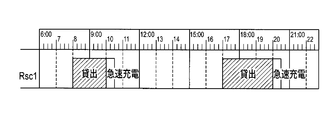
図7は、急速充電可能な場合の初期表示画面の一例を示す図である。
この初期表示画面では、貸出時間として、図6に示したスケジュール中のNO.1の「8:00~10:00」とNO.4の「17:00~20:00」が表示される。この表示では、決定済みの他の借用時間同士の間隔が開いており、次の貸出のためのフル充電を行なうための十分な充電時間をとることができる。このため、初期表示画面には、前述した貸出時間による貸出を電欠を起こすことなく可能とするための急速充電時間として、図6に示したスケジュール中のNO.3の「10:00~15:00」とNO.6の「20:00~20:30」がさらに表示される。
この初期表示画面では、貸出時間として、図6に示したスケジュール中のNO.1の「8:00~10:00」とNO.4の「17:00~20:00」が表示される。この表示では、決定済みの他の借用時間同士の間隔が開いており、次の貸出のためのフル充電を行なうための十分な充電時間をとることができる。このため、初期表示画面には、前述した貸出時間による貸出を電欠を起こすことなく可能とするための急速充電時間として、図6に示したスケジュール中のNO.3の「10:00~15:00」とNO.6の「20:00~20:30」がさらに表示される。
また、図7に示したスケジュールでは、各行のうち、記録種別が「充電(普通充電)」または「急速充電」である行の開始時刻から終了時刻までの充電計画が、実スケジュールに適用する充電計画であるか否かを示す情報が設定される。この例では、NO.2の行の普通充電による充電時間としての10:00~12:00、および、NO.5の行の普通充電による充電時間としての20:00~22:30が実スケジュールに適用する充電計画となる。
また、急速充電が可能でなければ、ユーザI/F1は、普通充電で行える充電スケジュールを表示する。
図8は、普通充電しか行えない場合の初期表示画面の一例を示す図である。
この画面では、貸出時間として、図6に示したスケジュール中のNO.1の「8:00~10:00」とNO.4の「17:00~20:00」が表示される。また、この表示とともに、前述した貸出時間による貸出において、電欠を起こすことなく可能とするための普通充電時間として、図6に示したスケジュール中のNO.2の「10:00~12:00」とNO.5の「20:00~22:30」が表示される。
図8は、普通充電しか行えない場合の初期表示画面の一例を示す図である。
この画面では、貸出時間として、図6に示したスケジュール中のNO.1の「8:00~10:00」とNO.4の「17:00~20:00」が表示される。また、この表示とともに、前述した貸出時間による貸出において、電欠を起こすことなく可能とするための普通充電時間として、図6に示したスケジュール中のNO.2の「10:00~12:00」とNO.5の「20:00~22:30」が表示される。
初期表示画面上では、申請者は、借用条件を入力することができる。必須な項目としては借用開始時刻と借用終了時刻とでなる利用希望時間が挙げられる。項目としては、そ「目的地」、「走行予定距離」、「利用目的」、「同乗者人数」、「荷重」なども挙げられる。借用条件の情報の明確の程度が高いほど、申請者によるEVの借用に必要な充電量の推定精度が上がるので、充電量を少なくさせられる可能性が大きくなる。ここでは、申請者は14:00-16:00の時間帯での借用を申請するものとする。
また、ユーザI/F1によりリソース借用状態を申請者に見せず、取得可能なスケジュールのみを表示させる場合でも、他の借用時間と充電時間とを除いた時間としての借用可能な時間をリソースとの紐付きで表示することも考えられる。
次に、必要充電量の推定について説明する。
充電スケジューラ2の必要充電量推定部21は、申請者により入力された申請条件の内容に基づいて、この申請条件に従ったEVの借用に必要な充電量を推定する。充電量の推定のためには、必要充電量推定部21は、入力された情報、ユーザの利用履歴に基づいて、どれぐらいの確度で必要電力量を推定するかによって、複数の必要充電量評価モデルのうち用いるモデルを判断する。
充電スケジューラ2の必要充電量推定部21は、申請者により入力された申請条件の内容に基づいて、この申請条件に従ったEVの借用に必要な充電量を推定する。充電量の推定のためには、必要充電量推定部21は、入力された情報、ユーザの利用履歴に基づいて、どれぐらいの確度で必要電力量を推定するかによって、複数の必要充電量評価モデルのうち用いるモデルを判断する。
次に、必要充電量の推定についての各種ロジックについて説明する。
(ロジック1-a)申請者がカーレンタルをあまり利用しておらず、かつ、申請内容が借用希望時間帯だけである場合は、必要充電量推定部21は、申請されている時間帯をフルに走行した場合の充電量を推定する。
(ロジック1-a)申請者がカーレンタルをあまり利用しておらず、かつ、申請内容が借用希望時間帯だけである場合は、必要充電量推定部21は、申請されている時間帯をフルに走行した場合の充電量を推定する。
(ロジック1-b)申請者がカーレンタルを頻繁に利用しており、借用時間と電力量とがいつも一定である場合は、必要充電量推定部21は、申請者が通常利用している電力量が必要充電量であると推定する。
(ロジック1-c)申請者によるカーレンタルの利用形態が借用ごとに一定していないが、目的がショッピングであり、目的地がショッピングモールである場合は、必要充電量推定部21は、ショッピングモールまでの経路をEVが走行するために必要な電力量を必要充電量として推定する。
また、同じ申請内容で複数の必要充電量評価モデルが適用可能である場合、必要充電量推定部21は、それぞれの必要充電量評価モデルでの推定確度に基づいて、最も確度が高いと考えられるモデルを必要充電量の推定に利用する。この場合はロジック1-aと1-bとが重なる、またはロジック1-aと1-cとが重なる可能性がある。しかし、ロジック1-aの確度はロジック1-bやロジック1-cの確度より低い。このため、必要充電量推定部21は、ロジック1-bあるいはロジック1-cにより必要充電量の推定を行ない、この推定した必要充電量の情報をリソースごと全体必要充電量DB(D-3)53に格納する。
次に、必要充電時間の推定について説明する。
充電スケジューラ2の必要充電時間推定部22は、必要充電量推定部21により推定されてリソースごと全体必要充電量DB(D-3)53に格納された情報に基づいて、EVの必要充電量を充電するために必要な時間としての必要充電時間を推定する。
充電スケジューラ2の必要充電時間推定部22は、必要充電量推定部21により推定されてリソースごと全体必要充電量DB(D-3)53に格納された情報に基づいて、EVの必要充電量を充電するために必要な時間としての必要充電時間を推定する。
CHAdeMO(登録商標)やCombined Charging Systemなどの充電器接続プロトコルを用いた場合、充電要件はEVの車両から発行される。このことやバッテリーの電気特性のため、必要充電時間は車種、電池残量、必要充電量、気温などをパラメータとする非線形な関数となる。必要充電時間を求める方法として、通常は車種ごと、温度帯ごとの電池残量・必要充電量に対応する必要充電時間が記載されるテーブルなどを予め作成し、このテーブルから必要充電時間を検索するなどの方法が考えられる。
必要充電時間推定部22は、第1の機能として、普通充電による必要充電時間を推定し、この必要充電時間の情報をリソース必要充電時間DB(D-4)54に格納する。また、必要充電時間推定部22は、第2の機能として、急速充電による必要充電時間を推定し、この必要充電時間の情報を急速充電向けリソース必要充電時間DB(D-5)55に格納する。ここでは、必要充電時間推定部22は、普通充電による必要充電時間が2時間であり、急速充電による必要充電時間が0.5時間であるとして算出されたとする。
次に、充電スケジューリングについて説明する。
充電スケジューラ2の充電スケジューリング部23は、リソース必要充電時間DB(D-4)54及び急速充電向けリソース必要充電時間DB(D-5)55に格納された必要充電時間に基づいて、申請内容による充電スケジューリングが可能か否かを推定する。
充電スケジューラ2の充電スケジューリング部23は、リソース必要充電時間DB(D-4)54及び急速充電向けリソース必要充電時間DB(D-5)55に格納された必要充電時間に基づいて、申請内容による充電スケジューリングが可能か否かを推定する。
スケジューリングが可能かどうかに関する観点は、以下の2つが挙げられる。
第1の観点として、EVを新規に借用する場合は、この借用の途中で電欠、つまりバッテリ切れが発生しないことが挙げられる。また、第2の観点として、EVの新規借用を行なうことで、その後の借用期間中に電欠が発生しないことが挙げられる。
図9は、充電スケジューリングが可能か否かを表すためのチェックポイントの一例を示す図である。
以下に、充電スケジューリングが可能か否かを判定するロジック例を示す。
まず、充電スケジューリング部23は、申請した借用時間と、決定済みの他の借用時間とが重なっていないことを確認する。
借用時間が重なっていなければ、充電スケジューリング部23は、借用申請内容に基づく必要充電量を満たすためのリソース全体必要充電時間D-8を算出する。充電スケジューリング部23は、その借用申請内容を承認した場合の空き時間でEVの充電が可能か否かを確認する。
第1の観点として、EVを新規に借用する場合は、この借用の途中で電欠、つまりバッテリ切れが発生しないことが挙げられる。また、第2の観点として、EVの新規借用を行なうことで、その後の借用期間中に電欠が発生しないことが挙げられる。
図9は、充電スケジューリングが可能か否かを表すためのチェックポイントの一例を示す図である。
以下に、充電スケジューリングが可能か否かを判定するロジック例を示す。
まず、充電スケジューリング部23は、申請した借用時間と、決定済みの他の借用時間とが重なっていないことを確認する。
借用時間が重なっていなければ、充電スケジューリング部23は、借用申請内容に基づく必要充電量を満たすためのリソース全体必要充電時間D-8を算出する。充電スケジューリング部23は、その借用申請内容を承認した場合の空き時間でEVの充電が可能か否かを確認する。
充電スケジューリング部23は、申請された借用の前後の借用を含めた、全体の充電スケジュールを見回す。充電スケジューリング部23は、申請を受け入れたと仮定した際の空き時間における通常または急速充電で、それぞれの借用時に電力量が不足しないための充電量を満たすための時間としてのリソース事前必要充電時間D-7を算出する。充電スケジューリング部23は、そのリソースが申請された借用以降の借用で電欠にならないか否かを確認する。
電力量が不足しないことを確認できれば、充電スケジューリング部23は、EVの借用申請を受け入れて、EVをこの申請での借用に供することが可能であると判断し、借用申請がなされたEVの充電時間を設定する。
図10A、図10B、図10Cは、必要電力量の確認のための情報を表形式で示す図である。
図10A、図10B、図10Cは、上述したロジック4-cにおける必要電力量の確認を示したものである。以下に詳細を例示する。
(1)全体として、図10A、図10B、図10Cに示した表の列にスケジュールとして借用-空きのステータスが入り、ステータスが入った列の各行のうち必要な個所には計算すべき数値が入る。ステータスが入る最初の列としてのC-1列のR-7行には、初期値としてEVの当初の保持電力が入る。また、最終の列としてのC-9列のR-7行には、最終状態として、最終的に必要な電力が記載されている。
図10A、図10B、図10Cは、上述したロジック4-cにおける必要電力量の確認を示したものである。以下に詳細を例示する。
(1)全体として、図10A、図10B、図10Cに示した表の列にスケジュールとして借用-空きのステータスが入り、ステータスが入った列の各行のうち必要な個所には計算すべき数値が入る。ステータスが入る最初の列としてのC-1列のR-7行には、初期値としてEVの当初の保持電力が入る。また、最終の列としてのC-9列のR-7行には、最終状態として、最終的に必要な電力が記載されている。
この構成は、カーレンタル施設が24時間稼働しているなどして休止期間がない場合、何らかの時間の区切り、例えばメンテナンスあるいは借用の区切りでスケジュールを区分することを考慮した構成である。
(2)図10Aに示した表のR-1行はEVの使用開始時刻を示し、R-2行は使用終了時刻を示す。使用開始時刻や使用終了時刻の情報は、リソース借用スケジュールDB(D-2)52に格納される。
(3)図10Aに示した表のR-3行は借用時間を示す行である。この借用時間は、R-2行に記載される使用終了時刻とR-1行に記載される使用開始時刻との差分である。
(3)図10Aに示した表のR-3行は借用時間を示す行である。この借用時間は、R-2行に記載される使用終了時刻とR-1行に記載される使用開始時刻との差分である。
(4)図10Aに示した表のR-4行は借用時電力量を示す行である。この借用時電力量は、C-1列のR-7行に記載される保持電力量と、C-2列のR-9行に記載される充電量としての、EVの借用に至るまでの空き時間における充電量(空き時間可能充電量)とを加算し、この加算結果に対し、R-5行に記載される電力消費量としての、この借用までにおける電力消費量を減算したものである。
(5)図10Aに示した表のR-5行に記載される推定電力消費量は、対象とする借用時間中にEVが消費する電力量を示し、別途推定される。
(6)図10Aに示した表のR-6行に記載される借用終了時電池残量は、ある列のR-4行に記載される借用時電力量から同じ列のR-5行に記載される推定電力消費量を減算したものであり、ある借用が終了した時のEVの電池残量を示す。
(6)図10Aに示した表のR-6行に記載される借用終了時電池残量は、ある列のR-4行に記載される借用時電力量から同じ列のR-5行に記載される推定電力消費量を減算したものであり、ある借用が終了した時のEVの電池残量を示す。
(7)図10Aに示した表のR-7行に記載される保持電力は、(1)でも説明したように、初期電池残量、及び終了時に残っている必要のある電池残量を示したものである。
(8)図10Aに示した表のR-8行に記載される空き時間は、EVについてのある借用の終了と次の借用の開始との間の空き時間である。この空き時間は、次の借用に関する借用開始時間(R-1行)から前の借用の借用終了時間(R-2行)を減じたものである。
(9)図10Aに示した表のR-9行に記載される空き時間可能充電量は、同じ列のR-8行で計算された空き時間の間に充電できる電力量を示す。この充電量を計算するための方式は色々考えられるが、この方式は、特定される充電器や特定される電池によって変わる。また、現充電量と充電時間と温度とのパラメータで充電量が算出されるテーブルを用いることも考えられる。
(10)図10Bに示した表のR-10行に記載される借用開始時必要電池残量は、ある借用から最終状態に至るまでに電欠が発生しないような電池残量の計算結果である。この必要電池残量は、それぞれの借用の借用開始時について計算される。
この必要電池残量は、以下の式で計算される。

ここで、式(1)のWLは、最終状態で満たすべき必要充電量を示す。式(1)のnは蓄電池の充電量の計算対象となる借用に紐付く番号を示す。式(1)のLは最終状態に至る最後の借用に紐付く番号を示す。式(1)のDiは個別の借用iにおける推定電力消費量(R-5行)を示す。式(1)の累積記号の中に入るCiは、借用iの前の空き時間可能充電量(R-9行)が対応する。
本実施形態では、C-5列にある「予約B」に関する必要充電量を確認したいため、式(1)のWLは、(R-7列,C-9行)の値としての0である。また、式(1)のnはC-5列に対応する列の番号であり、式(1)のLはC-7列に対応する列の番号となる。また、式(1)の累積記号の中に入る列はC-7の列のみである。
C-7の列の推定電力消費量(C-7列,R-5行)は35である。しかし、その前に充電できる、空き時間可能充電量(C-6列,R-9行)は6.666667(≒6.67)しか無い。また、C-5列にある「予約B」に関する借用終了時に必要な充電量としてのmax(35-6.67,0)の値は28.33である。
よって、C-5列の「予約B」における借用終了時に電池残量が「28.33」必要である。また、そこに推定電力消費量(C-5列,R-5行)としての「20」を電池残量の値に加算した値としての「48.33」は、C-5列の「予約B」における借用開始時に必要な電力量となる。
ある借用開始時の電池残量が、この借用のための必要充電量より少なければ電欠が発生する。このため、本実施形態では、その前の空き時間で充電しきれないのであれば、その差分に該当する電力を更に前から充電していく必要がある、という論理から式(1)を導出している。
(11)図10Bに示した表の11行目としてのR-11行に記載される必要充電量は、直前の借用終了時の電池残量としての借用終了時電池残量(R-6行)と、今回の借り出しの前に必要な電力量としての借用開始時必要電池残量(R-10行)との差分である。もし、借用終了時電池残量(R-6行)より借用開始時必要電池残量(R-10行)が大きければ、少なくともその差分についての充電を行う必要がある。
(12)図10Bに示した表の12行目としてのR-12行に記載されるリソース事前必要充電時間(D-7)は、R-11行で算出された必要充電量を充電するために必要な時間である。必要充電時間を算出するために、上述の(9)で説明したテーブルを利用することが考えられる。ここでリソース事前必要充電時間(R-12行)は空き時間(R-8行)を超えないとする。
(13)図10Cに示した表の13行目としてのR-13行に記載される急速充電向け必要充電時間は、必要充電量(R-11行)を急速充電器で充電するために必要な時間を示す。この時間を算出するために、例えば、上述の(9)で説明したテーブルが利用される。
(14)図10Cに示した表の14行目としてのR-14行に記載される可能最大充電量は、空き時間可能充電量(R-9行)で示される電力量の充電を行なった場合に蓄電池に蓄積される、予約借用開始時の充電量を示す。必要充電量(R-10行)と可能最大充電量(R-14)の差が大きいほど、充電スケジュールは余裕のあるスケジュールとなる。
(15)図10Cに示した表の15行目としてのR-15行に記載される充電余裕は、可能最大充電量(R-14行)と借用開始時必要電池残量(R-10)の差を示す。この充電余裕は、変更できる充電時間を示す指標である。また、この充電余裕がマイナスとなる場合は、借用中に電力切れとなるか充電が必要となるため、推奨される充電スケジュールとはいえない。
次に、借用時間の表示について説明する。
初期画面に対する入力前では充電時間が不明である。このため、この画面に表示される充電時間は多めとされており、借用可能な時間が短い時間となっていた。この時点において充電スケジュールの確保が可能であるのなら、明確になった必要充電量(R-11行)に応じたリソース事前必要充電時間(R-12行)を反映させる。更に急速充電が可能であるのなら、急速充電向け必要充電時間(R-13行)を用いて充電時間を短く表示させる。この表示により、予約の希望時間帯の微調整を可能とさせる。
初期画面に対する入力前では充電時間が不明である。このため、この画面に表示される充電時間は多めとされており、借用可能な時間が短い時間となっていた。この時点において充電スケジュールの確保が可能であるのなら、明確になった必要充電量(R-11行)に応じたリソース事前必要充電時間(R-12行)を反映させる。更に急速充電が可能であるのなら、急速充電向け必要充電時間(R-13行)を用いて充電時間を短く表示させる。この表示により、予約の希望時間帯の微調整を可能とさせる。
図11は、借用時間の表示画面の一例を示す図である。
図11に示した表示画面では、ユーザI/F1の急速充電スケジュール表示部12により、図7に示した初期表示画面と比較して、14:00~16:00が借用希望時間帯として新たに表示され、16:00~16:30が急速充電による充電時間として新たに表示される。
図11に示した表示画面では、ユーザI/F1の急速充電スケジュール表示部12により、図7に示した初期表示画面と比較して、14:00~16:00が借用希望時間帯として新たに表示され、16:00~16:30が急速充電による充電時間として新たに表示される。
また、図11に示した表示画面では、図7に示した10:00~10:30および20:00~20:30で表示されていた表示としての、急速充電による充電時間の表示に替えて、急速充電スケジュール表示部12により、10:00~12:00、および20:00~22:30が借用可能充電時間として表示される。
よって、充電時間として表示されていた10:00~10:30、および20:00~20:30も借用時間として指定する事ができる。これにより、図11に示したように、借用希望時間帯の14:00~16:00を、これらの借用可能充電時間に一部または全部が重複するように微調整することができる。
次に、スケジューリング可能時間の表示について説明する。
図12は、スケジューリング可能時間の表示画面の一例を示す図である。
借用希望時間帯による充電スケジュール確保が難しい場合、ユーザI/F1のスケジュール可能範囲表示部13により、借用可能時間を表示装置に再度表示させる。この表示にあたり、充電スケジュールの確保が可能である場合と同じく申請内容を把握されているの。これにより、初期画面に対する入力前と比較して必要充電量を減少させることができる。
図12は、スケジューリング可能時間の表示画面の一例を示す図である。
借用希望時間帯による充電スケジュール確保が難しい場合、ユーザI/F1のスケジュール可能範囲表示部13により、借用可能時間を表示装置に再度表示させる。この表示にあたり、充電スケジュールの確保が可能である場合と同じく申請内容を把握されているの。これにより、初期画面に対する入力前と比較して必要充電量を減少させることができる。
図7に示した初期表示画面では、ユーザI/F1のスケジュール可能範囲表示部13は、10:00~10:30および20:00~20:30として表示されていた時間としての急速充電による充電時間を表示していた。これに対し、図12に示した画面では、急速充電スケジュール表示部12は、10:00~12:00、および20:00~22:30を借用可能充電時間として表示装置に表示する。よって、図7に示した初期表示画面で充電時間として表示されていた10:00~10:30、および20:00~20:30を、図12に示した画面では借用時間として指定できる。これにより、借用時間として指定できる時間帯を拡大できるので、事前の借用申請を行える可能性が高くなる。
次に、スケジュールの確定について説明する。
ユーザがリソースの借用予約を確定したら、リソース管理部3のスケジュール管理部33は、リソース借用スケジュールDB(D-2)52、リソース充電スケジュールDB(D-6)56、急速充電器スケジュールDB(D-9)59を更新する。
ユーザがリソースの借用予約を確定したら、リソース管理部3のスケジュール管理部33は、リソース借用スケジュールDB(D-2)52、リソース充電スケジュールDB(D-6)56、急速充電器スケジュールDB(D-9)59を更新する。
図13は、新しい借用スケジュールの一例を表形式で示す図である。
この画面は、図11に示した画面に従って、この画面に表示された借用時間の変更が無く、リソースの借用予約が確定した場合の借用スケジュールの画面である。この借用スケジュールでは、図6に示したスケジュール中のNO.4からNO.6の情報がNO.7からNO.9の情報に変更となり、確定した借用時間がNO.4の新たな情報として設定され、この借用後の普通充電時間がNO.5の新たな情報として設定され、NO.4の借用後の急速充電時間が新たなNO.6の新たな情報として設定される。
この画面は、図11に示した画面に従って、この画面に表示された借用時間の変更が無く、リソースの借用予約が確定した場合の借用スケジュールの画面である。この借用スケジュールでは、図6に示したスケジュール中のNO.4からNO.6の情報がNO.7からNO.9の情報に変更となり、確定した借用時間がNO.4の新たな情報として設定され、この借用後の普通充電時間がNO.5の新たな情報として設定され、NO.4の借用後の急速充電時間が新たなNO.6の新たな情報として設定される。
また、図13に示したスケジュールでは、図7に示したスケジュールと同様に、充電計画が実スケジュールに適用される充電計画であるか否かを示す情報が各列について設定される。この例では、NO.2の列の普通充電による充電時間としての10:00~12:00、NO.5の列の普通充電による充電時間としての16:00~17:00、および、NO.8の列の普通充電による充電時間としての20:00~22:30が実スケジュールに適用される充電計画となる。
また、図11に示した画面としての借用時間の表示画面では、16:00~16:30は急速充電時間として表示されている。しかし、16:00から普通充電を開始しても、図13に示した表のNO.5に示すように17:00に充電が終了し、図13に示した表のNO.7に示す次の貸出時間としての17:00~20:00と重複しないので、前述したように、普通充電による16:00~17:00が実スケジュールに適用される充電計画となる。
また、複数のEVが同一拠点にある場合は、個々のEVについての充電スケジュールをそれぞれ計算し、最も有効な車輌あるいはユーザが希望している車輌を割り当てる等の対応がとられる。
また、スケジュールを表示するためのGUI(Graphical User Interface)は、個々の車の借用時間の表示、あるいは、どれか1台について借用できる時間の表示などのバリエーションが挙げられる。
本実施形態では、蓄電池で稼働することに起因する、充電に時間を要して、かつ、その時間が利用の仕方により変動するリソースを共有する場合に、メンテナンスの時間を短縮してリソース稼働率を向上させることができる。
具体的には、本実施形態では、急速充電時間を活用した場合の借用可能充電時間を表示させることで、借用可能な時間を拡大することができる。これにより、急速充電のような充電時間短縮に有効な、利用に制約があるツールを利用するか否かをシステム側で規定することができる。よって、ユーザは自分の希望するリソースの指定をして借用希望時間帯を設定するにあたり、充電の種別を意識する必要がなくなる。
また、急速充電を用いる事が出来る場合は、必要に応じて急速充電による充電スケジュールを行なうことでリソースの充電時間が減るので、リソースの稼働率が向上する。
また、本実施形態では、ユーザが借用条件の詳細情報、例えば目的地を入力することにより、借用に必要な電力量を推定することができる。この推定を行なうことにより、借用の事前事後の必要充電量および充電時間を減らすことができる。よって、急速充電が行えずに普通充電しか行えない場合でも柔軟に借用時間帯を指定できる。これにより、借用可能な利用者の対象を広げ、リソースの稼働率を上げることが可能となる。
これらの各実施形態によれば、普通充電と急速充電とを組み合わせることによるリソースの稼働率を向上させることが可能になる充電管理システムを提供することができる。
発明のいくつかの実施形態を説明したが、これらの実施形態は、例として提示したものであり、発明の範囲を限定することは意図していない。これら新規な実施形態は、その他の様々な形態で実施されることが可能であり、発明の要旨を逸脱しない範囲で、種々の省略、置き換え、変更を行うことができる。これら実施形態やその変形は、発明の範囲や要旨に含まれるとともに、特許請求の範囲に記載された発明とその均等の範囲に含まれる。
発明のいくつかの実施形態を説明したが、これらの実施形態は、例として提示したものであり、発明の範囲を限定することは意図していない。これら新規な実施形態は、その他の様々な形態で実施されることが可能であり、発明の要旨を逸脱しない範囲で、種々の省略、置き換え、変更を行うことができる。これら実施形態やその変形は、発明の範囲や要旨に含まれるとともに、特許請求の範囲に記載された発明とその均等の範囲に含まれる。
1…ユーザインタフェース(I/F)、2…充電スケジューラ、3…リソース管理部、11…借用条件入力部、12…急速充電スケジュール表示部、13…スケジュール可能範囲表示部、21…必要充電量推定部、22…必要充電時間推定部、23…充電スケジューリング部、31…EV属性取得・管理部、32…充電器属性取得・管理部、33…スケジュール管理部。
Claims (3)
- 貸出のための電気自動車への充電を行なう第1の充電装置と、前記第1の充電装置と比較して短い所要時間により前記電気自動車への充電を行なう第2の充電装置とを適用するための充電管理システムであって、
(a)前記電気自動車の貸出予約済みの時間帯としての貸出時間帯、
(b)前記第2の充電装置を使用可能で、前記貸出時間帯における前記電気自動車の貸出を可能とするための前記第2の充電装置による前記電気自動車への充電時間帯、
(c)前記第2の充電装置を使用可能でなく、前記貸出時間帯における前記電気自動車の貸出を可能とするための前記第1の充電装置による前記電気自動車への充電時間帯、および
(d)前記電気自動車の貸出および前記電気自動車に対する充電による、前記電気自動車の蓄電電力量の推移を示す情報
を管理する管理部(3)と、
(e)前記第2の充電装置を使用可能な時間帯で前記第2の充電装置により前記電気自動車への充電を行なうと仮定した場合の充電時間帯、
(f)前記第2の充電装置を使用可能でない時間帯における前記第1の充電装置による前記電気自動車への充電時間帯、および、
(g)前記管理部(3)により管理される前記貸出時間帯
に基づいた、前記電気自動車の新たな貸出希望時間帯として設定可能な時間帯を表示装置に表示させる表示部(13)と、
前記表示部(13)により表示された時間帯における、前記電気自動車の貸出希望時間帯の入力を受け付ける入力部(11)と、
前記入力部(11)により入力された貸出希望時間帯について前記電気自動車を貸出すために必要な電力量を推定する第1の推定部(21)と、
前記第1の推定部(21)により推定した電力量に基づいて、前記入力された貸出希望時間帯において前記電気自動車の貸出を可能とするための充電としての前記第1および第2の充電装置による充電が必要な時間帯を推定する第2の推定部(22)と、
前記管理部(3)により管理される情報に基づき、前記入力された貸出希望時間帯と前記貸出予約済みの借用時間帯とにおける前記電気自動車の貸出を可能とするための充電が、前記第2の推定部(22)により推定した時間帯において可能であれば、前記入力された貸出希望時間帯を、前記電気自動車を貸出可能な時間帯として設定するスケジューリング部(23)と
を備えたことを特徴とする充電管理システム。 - 前記スケジューリング部(23)は、
(a)前記電気自動車に対する前記第1の充電装置による充電を前記入力部(11)により入力された貸出希望時間帯の開始までに終了できる場合は、前記貸出希望時間帯を前記電気自動車を貸出可能な時間帯として設定した上で、前記貸出希望時間帯の開始までの所定の時間を、前記電気自動車に対する前記第1の充電装置による充電時間として設定し、
(b)前記電気自動車に対する前記第2の充電装置による充電を前記貸出希望時間帯の開始までに終了できるが、前記電気自動車に対する前記第1の充電装置による充電を前記貸出希望時間帯の開始までに終了できない場合は、前記貸出希望時間帯を前記電気自動車を貸出可能な時間帯として設定した上で、前記貸出希望時間帯の開始までの所定の時間を、前記電気自動車に対する前記第2の充電装置による充電時間として設定する
ことを特徴とする請求項1に記載の充電管理システム。 - 前記入力部(11)は、
前記電気自動車の使用目的を含む貸出申請情報の入力を受け付け、
前記第1の推定部(21)は、
前記入力部(11)により入力した情報に基づいて、前記貸出希望時間帯のうち前記電気自動車の実際の使用時間を推定して、この推定した時間を考慮して、前記電力量を推定する
ことを特徴とする請求項1に記載の充電管理システム。
Priority Applications (3)
| Application Number | Priority Date | Filing Date | Title |
|---|---|---|---|
| EP13829407.9A EP2897246A4 (en) | 2012-08-17 | 2013-08-19 | CARGO MANAGEMENT SYSTEM |
| CN201380044190.0A CN104584367B (zh) | 2012-08-17 | 2013-08-19 | 充电管理系统 |
| US14/622,335 US11104235B2 (en) | 2012-08-17 | 2015-02-13 | Charging management system |
Applications Claiming Priority (2)
| Application Number | Priority Date | Filing Date | Title |
|---|---|---|---|
| JP2012-180865 | 2012-08-17 | ||
| JP2012180865A JP5707369B2 (ja) | 2012-08-17 | 2012-08-17 | 充電管理システム |
Related Child Applications (1)
| Application Number | Title | Priority Date | Filing Date |
|---|---|---|---|
| US14/622,335 Continuation US11104235B2 (en) | 2012-08-17 | 2015-02-13 | Charging management system |
Publications (1)
| Publication Number | Publication Date |
|---|---|
| WO2014027700A1 true WO2014027700A1 (ja) | 2014-02-20 |
Family
ID=50101309
Family Applications (1)
| Application Number | Title | Priority Date | Filing Date |
|---|---|---|---|
| PCT/JP2013/072115 Ceased WO2014027700A1 (ja) | 2012-08-17 | 2013-08-19 | 充電管理システム |
Country Status (5)
| Country | Link |
|---|---|
| US (1) | US11104235B2 (ja) |
| EP (1) | EP2897246A4 (ja) |
| JP (1) | JP5707369B2 (ja) |
| CN (1) | CN104584367B (ja) |
| WO (1) | WO2014027700A1 (ja) |
Cited By (5)
| Publication number | Priority date | Publication date | Assignee | Title |
|---|---|---|---|---|
| JP2016206699A (ja) * | 2015-04-15 | 2016-12-08 | 日産自動車株式会社 | 車両管理システム及び車両管理方法 |
| CN108734948A (zh) * | 2017-04-13 | 2018-11-02 | 宁波轩悦行电动汽车服务有限公司 | 结合交通拥堵情况的电量匹配预约租车系统及方法 |
| JP2021067992A (ja) * | 2019-10-18 | 2021-04-30 | パーク二四株式会社 | 車両管理サーバ、およびコンピュータプログラム |
| CN113888807A (zh) * | 2020-07-02 | 2022-01-04 | 本田技研工业株式会社 | 车辆管理系统和车辆管理方法 |
| WO2023013153A1 (ja) * | 2021-08-06 | 2023-02-09 | パナソニックIpマネジメント株式会社 | 制御システム、制御方法、及び、プログラム |
Families Citing this family (20)
| Publication number | Priority date | Publication date | Assignee | Title |
|---|---|---|---|---|
| US20150197154A1 (en) * | 2010-12-24 | 2015-07-16 | Martin Kelly Jones | Selection of battery remediation type and/or battery remediation station based upon available time period at location |
| US11410225B2 (en) * | 2015-01-13 | 2022-08-09 | State Farm Mutual Automobile Insurance Company | System and method for a fast rental application |
| JP6409806B2 (ja) * | 2016-03-22 | 2018-10-24 | トヨタ自動車株式会社 | 表示装置 |
| CN105844762B (zh) * | 2016-06-15 | 2019-05-24 | 京东方科技集团股份有限公司 | 排号装置、排号系统及排号方法 |
| DE102016211335B4 (de) | 2016-06-24 | 2025-01-02 | Volkswagen Aktiengesellschaft | Verfahren, Adapter, Zusatzsteuergerät und Ladesystem für das elektrische Aufladen von Elektrofahrzeugen |
| CN108304949A (zh) * | 2017-01-11 | 2018-07-20 | 宁波轩悦行电动汽车服务有限公司 | 一种电动汽车分时租赁系统的预约租赁管理方法 |
| CN108734985A (zh) * | 2017-04-13 | 2018-11-02 | 宁波轩悦行电动汽车服务有限公司 | 电动汽车异常还车的处理方法 |
| CN109102693A (zh) * | 2017-06-20 | 2018-12-28 | 宁波轩悦行电动汽车服务有限公司 | 一种车辆状态及电量阈值监控方法 |
| JP6994436B2 (ja) * | 2018-07-02 | 2022-01-14 | 本田技研工業株式会社 | 貸出システム |
| CN110414829B (zh) * | 2019-07-24 | 2022-04-15 | 电子科技大学 | 一种基于冲突集的充电桩高效分配方法 |
| JP7355551B2 (ja) * | 2019-08-09 | 2023-10-03 | 本田技研工業株式会社 | 制御装置、制御方法、およびプログラム |
| US11515587B2 (en) * | 2019-10-10 | 2022-11-29 | Robert Bosch Gmbh | Physics-based control of battery temperature |
| DE102019216412A1 (de) * | 2019-10-24 | 2021-04-29 | Volkswagen Aktiengesellschaft | Elektrisches Ladeverfahren, Fahrzeug, Ladevorrichtung und System daraus |
| CN110979266B (zh) * | 2019-12-11 | 2021-07-30 | 夸蛾科技(上海)有限公司 | 基于电池自主装卸技术的电动汽车充换电系统及方法 |
| JP7310672B2 (ja) * | 2020-03-23 | 2023-07-19 | トヨタ自動車株式会社 | 情報提示システム |
| JP7470583B2 (ja) * | 2020-07-02 | 2024-04-18 | 本田技研工業株式会社 | 車両管理システム、及び車両管理方法 |
| JP7533383B2 (ja) * | 2021-07-05 | 2024-08-14 | トヨタ自動車株式会社 | 情報処理装置、情報処理方法、およびプログラム |
| JP7722281B2 (ja) * | 2022-07-05 | 2025-08-13 | トヨタ自動車株式会社 | 搬送システム、搬送制御方法、学習済みモデル、学習システム、学習方法、及びプログラム |
| US20240119514A1 (en) * | 2022-10-07 | 2024-04-11 | Ford Global Technologies, Llc | Peer-to-peer vehicle sharing system and method |
| JP2024165555A (ja) * | 2023-05-17 | 2024-11-28 | トヨタ自動車株式会社 | サーバ装置及びMaaS提供方法 |
Citations (6)
| Publication number | Priority date | Publication date | Assignee | Title |
|---|---|---|---|---|
| JP2009136109A (ja) * | 2007-11-30 | 2009-06-18 | Toyota Motor Corp | 充電制御装置および充電制御方法 |
| JP2010231258A (ja) * | 2009-03-25 | 2010-10-14 | Nec Corp | バッテリ充電システム、車両管理サーバ、カーシェアリングサーバ、管理方法、プログラム及び記録媒体 |
| WO2011118193A1 (ja) * | 2010-03-23 | 2011-09-29 | パナソニック株式会社 | 充電装置、充電システムおよび充電方法 |
| WO2011118187A1 (ja) * | 2010-03-23 | 2011-09-29 | パナソニック株式会社 | 充電制御装置、充電システムおよび充電制御方法 |
| JP2012005341A (ja) * | 2010-05-19 | 2012-01-05 | Hitachi Ltd | 充電装置、充電制御ユニット、充電制御方法及び充電受付方法 |
| JP2012050222A (ja) * | 2010-08-26 | 2012-03-08 | Mitsubishi Electric Corp | 自動車用充放電システム |
Family Cites Families (6)
| Publication number | Priority date | Publication date | Assignee | Title |
|---|---|---|---|---|
| CN1581191A (zh) * | 2004-05-14 | 2005-02-16 | 中华电信股份有限公司 | 电子化车辆租借管理系统 |
| WO2010150555A1 (ja) * | 2009-06-25 | 2010-12-29 | パナソニック株式会社 | 車両制御システム及び自動車 |
| JP5563574B2 (ja) * | 2009-07-15 | 2014-07-30 | パナソニック株式会社 | 電力制御システム、電力制御方法、電力制御装置及び電力制御プログラム |
| JP5685885B2 (ja) * | 2010-10-21 | 2015-03-18 | 株式会社デンソー | 車両用電池パック |
| EP2672604A4 (en) * | 2011-01-31 | 2017-01-04 | Nec Corporation | Electrical power management system and electrical power management method |
| JP5891306B2 (ja) * | 2012-08-07 | 2016-03-22 | 株式会社日立製作所 | 自律走行装置の利用支援ツール、運用管理センタ、運用システム及び自律走行装置 |
-
2012
- 2012-08-17 JP JP2012180865A patent/JP5707369B2/ja active Active
-
2013
- 2013-08-19 EP EP13829407.9A patent/EP2897246A4/en not_active Ceased
- 2013-08-19 WO PCT/JP2013/072115 patent/WO2014027700A1/ja not_active Ceased
- 2013-08-19 CN CN201380044190.0A patent/CN104584367B/zh active Active
-
2015
- 2015-02-13 US US14/622,335 patent/US11104235B2/en active Active
Patent Citations (6)
| Publication number | Priority date | Publication date | Assignee | Title |
|---|---|---|---|---|
| JP2009136109A (ja) * | 2007-11-30 | 2009-06-18 | Toyota Motor Corp | 充電制御装置および充電制御方法 |
| JP2010231258A (ja) * | 2009-03-25 | 2010-10-14 | Nec Corp | バッテリ充電システム、車両管理サーバ、カーシェアリングサーバ、管理方法、プログラム及び記録媒体 |
| WO2011118193A1 (ja) * | 2010-03-23 | 2011-09-29 | パナソニック株式会社 | 充電装置、充電システムおよび充電方法 |
| WO2011118187A1 (ja) * | 2010-03-23 | 2011-09-29 | パナソニック株式会社 | 充電制御装置、充電システムおよび充電制御方法 |
| JP2012005341A (ja) * | 2010-05-19 | 2012-01-05 | Hitachi Ltd | 充電装置、充電制御ユニット、充電制御方法及び充電受付方法 |
| JP2012050222A (ja) * | 2010-08-26 | 2012-03-08 | Mitsubishi Electric Corp | 自動車用充放電システム |
Non-Patent Citations (1)
| Title |
|---|
| See also references of EP2897246A4 * |
Cited By (8)
| Publication number | Priority date | Publication date | Assignee | Title |
|---|---|---|---|---|
| JP2016206699A (ja) * | 2015-04-15 | 2016-12-08 | 日産自動車株式会社 | 車両管理システム及び車両管理方法 |
| CN108734948A (zh) * | 2017-04-13 | 2018-11-02 | 宁波轩悦行电动汽车服务有限公司 | 结合交通拥堵情况的电量匹配预约租车系统及方法 |
| JP2021067992A (ja) * | 2019-10-18 | 2021-04-30 | パーク二四株式会社 | 車両管理サーバ、およびコンピュータプログラム |
| JP7389608B2 (ja) | 2019-10-18 | 2023-11-30 | パーク二四株式会社 | 車両管理サーバ、およびコンピュータプログラム |
| CN113888807A (zh) * | 2020-07-02 | 2022-01-04 | 本田技研工业株式会社 | 车辆管理系统和车辆管理方法 |
| CN113888807B (zh) * | 2020-07-02 | 2023-02-17 | 本田技研工业株式会社 | 车辆管理系统和车辆管理方法 |
| WO2023013153A1 (ja) * | 2021-08-06 | 2023-02-09 | パナソニックIpマネジメント株式会社 | 制御システム、制御方法、及び、プログラム |
| JP2023024026A (ja) * | 2021-08-06 | 2023-02-16 | パナソニックIpマネジメント株式会社 | 制御システム、及び、制御方法 |
Also Published As
| Publication number | Publication date |
|---|---|
| EP2897246A4 (en) | 2016-04-27 |
| CN104584367A (zh) | 2015-04-29 |
| EP2897246A1 (en) | 2015-07-22 |
| JP5707369B2 (ja) | 2015-04-30 |
| US11104235B2 (en) | 2021-08-31 |
| JP2014039409A (ja) | 2014-02-27 |
| CN104584367B (zh) | 2017-02-22 |
| US20150151642A1 (en) | 2015-06-04 |
Similar Documents
| Publication | Publication Date | Title |
|---|---|---|
| JP5707369B2 (ja) | 充電管理システム | |
| CN111095721B (zh) | 聚合能量资源 | |
| US11807122B2 (en) | Capacity control device and computer-readable medium | |
| Boyacı et al. | An integrated optimization-simulation framework for vehicle and personnel relocations of electric carsharing systems with reservations | |
| JP6583178B2 (ja) | カーシェアリングサービスの運用システム | |
| JP5931644B2 (ja) | 充電管理システム | |
| US11393335B2 (en) | Power transfer managing apparatus, and computer-readable storage medium | |
| JP6129701B2 (ja) | 充電管理装置、充電管理システムおよび充電管理方法 | |
| JP6183539B2 (ja) | 作業員管理装置、作業員管理システム及び作業員管理方法 | |
| JP6672589B2 (ja) | 消費電力量予測装置、消費電力量予測方法、サーバ装置 | |
| JP2020115707A (ja) | 制御装置及びプログラム | |
| JP2018173977A (ja) | 制御装置及び制御方法 | |
| WO2020115992A1 (ja) | 貸与情報生成装置、二次電池管理装置、ユーザ端末装置、コンピュータプログラム及び貸与情報生成方法 | |
| US12054072B2 (en) | Information processing system | |
| CN108357461A (zh) | 车辆控制装置以及车辆控制方法 | |
| CN112078431A (zh) | 一种车辆能耗预测和能源补充方法及相关设备 | |
| WO2015178158A1 (ja) | 車両管理装置 | |
| Eider et al. | Seamless electromobility | |
| WO2017154341A1 (ja) | カーシェアリングサービスの運用システム | |
| JP2016095750A (ja) | 共用車両管理装置及び共用車両管理方法 | |
| JP2020154429A (ja) | 電力量予測装置、電力量予測方法、および電力量予測プログラム | |
| US20220138635A1 (en) | Information processing device, information processing system, information processing method, and terminal device | |
| JP6579045B2 (ja) | カーシェアリングサービスの運用システム | |
| US20180211349A1 (en) | Mobile device identification system and method | |
| JP2023139890A (ja) | システム、プログラム及び方法 |
Legal Events
| Date | Code | Title | Description |
|---|---|---|---|
| 121 | Ep: the epo has been informed by wipo that ep was designated in this application |
Ref document number: 13829407 Country of ref document: EP Kind code of ref document: A1 |
|
| NENP | Non-entry into the national phase |
Ref country code: DE |
|
| WWE | Wipo information: entry into national phase |
Ref document number: 2013829407 Country of ref document: EP |