WO2014030586A1 - 硬化性含フッ素重合体、その製造方法及び含フッ素重合体硬化物 - Google Patents
硬化性含フッ素重合体、その製造方法及び含フッ素重合体硬化物 Download PDFInfo
- Publication number
- WO2014030586A1 WO2014030586A1 PCT/JP2013/071921 JP2013071921W WO2014030586A1 WO 2014030586 A1 WO2014030586 A1 WO 2014030586A1 JP 2013071921 W JP2013071921 W JP 2013071921W WO 2014030586 A1 WO2014030586 A1 WO 2014030586A1
- Authority
- WO
- WIPO (PCT)
- Prior art keywords
- structural unit
- curable
- iodine
- fluorinated polymer
- fluorodiene
- Prior art date
- Legal status (The legal status is an assumption and is not a legal conclusion. Google has not performed a legal analysis and makes no representation as to the accuracy of the status listed.)
- Ceased
Links
Classifications
-
- C—CHEMISTRY; METALLURGY
- C08—ORGANIC MACROMOLECULAR COMPOUNDS; THEIR PREPARATION OR CHEMICAL WORKING-UP; COMPOSITIONS BASED THEREON
- C08F—MACROMOLECULAR COMPOUNDS OBTAINED BY REACTIONS ONLY INVOLVING CARBON-TO-CARBON UNSATURATED BONDS
- C08F216/00—Copolymers of compounds having one or more unsaturated aliphatic radicals, each having only one carbon-to-carbon double bond, and at least one being terminated by an alcohol, ether, aldehydo, ketonic, acetal or ketal radical
- C08F216/12—Copolymers of compounds having one or more unsaturated aliphatic radicals, each having only one carbon-to-carbon double bond, and at least one being terminated by an alcohol, ether, aldehydo, ketonic, acetal or ketal radical by an ether radical
- C08F216/14—Monomers containing only one unsaturated aliphatic radical
- C08F216/1408—Monomers containing halogen
-
- C—CHEMISTRY; METALLURGY
- C08—ORGANIC MACROMOLECULAR COMPOUNDS; THEIR PREPARATION OR CHEMICAL WORKING-UP; COMPOSITIONS BASED THEREON
- C08J—WORKING-UP; GENERAL PROCESSES OF COMPOUNDING; AFTER-TREATMENT NOT COVERED BY SUBCLASSES C08B, C08C, C08F, C08G or C08H
- C08J3/00—Processes of treating or compounding macromolecular substances
- C08J3/24—Crosslinking, e.g. vulcanising, of macromolecules
-
- C—CHEMISTRY; METALLURGY
- C08—ORGANIC MACROMOLECULAR COMPOUNDS; THEIR PREPARATION OR CHEMICAL WORKING-UP; COMPOSITIONS BASED THEREON
- C08F—MACROMOLECULAR COMPOUNDS OBTAINED BY REACTIONS ONLY INVOLVING CARBON-TO-CARBON UNSATURATED BONDS
- C08F214/00—Copolymers of compounds having one or more unsaturated aliphatic radicals, each having only one carbon-to-carbon double bond, and at least one being terminated by a halogen
- C08F214/18—Monomers containing fluorine
- C08F214/26—Tetrafluoroethene
- C08F214/262—Tetrafluoroethene with fluorinated vinyl ethers
-
- C—CHEMISTRY; METALLURGY
- C08—ORGANIC MACROMOLECULAR COMPOUNDS; THEIR PREPARATION OR CHEMICAL WORKING-UP; COMPOSITIONS BASED THEREON
- C08F—MACROMOLECULAR COMPOUNDS OBTAINED BY REACTIONS ONLY INVOLVING CARBON-TO-CARBON UNSATURATED BONDS
- C08F299/00—Macromolecular compounds obtained by interreacting polymers involving only carbon-to-carbon unsaturated bond reactions, in the absence of non-macromolecular monomers
-
- C—CHEMISTRY; METALLURGY
- C08—ORGANIC MACROMOLECULAR COMPOUNDS; THEIR PREPARATION OR CHEMICAL WORKING-UP; COMPOSITIONS BASED THEREON
- C08F—MACROMOLECULAR COMPOUNDS OBTAINED BY REACTIONS ONLY INVOLVING CARBON-TO-CARBON UNSATURATED BONDS
- C08F8/00—Chemical modification by after-treatment
- C08F8/26—Removing halogen atoms or halogen-containing groups from the molecule
-
- C—CHEMISTRY; METALLURGY
- C08—ORGANIC MACROMOLECULAR COMPOUNDS; THEIR PREPARATION OR CHEMICAL WORKING-UP; COMPOSITIONS BASED THEREON
- C08K—Use of inorganic or non-macromolecular organic substances as compounding ingredients
- C08K5/00—Use of organic ingredients
- C08K5/04—Oxygen-containing compounds
- C08K5/14—Peroxides
-
- C—CHEMISTRY; METALLURGY
- C08—ORGANIC MACROMOLECULAR COMPOUNDS; THEIR PREPARATION OR CHEMICAL WORKING-UP; COMPOSITIONS BASED THEREON
- C08J—WORKING-UP; GENERAL PROCESSES OF COMPOUNDING; AFTER-TREATMENT NOT COVERED BY SUBCLASSES C08B, C08C, C08F, C08G or C08H
- C08J2327/00—Characterised by the use of homopolymers or copolymers of compounds having one or more unsaturated aliphatic radicals, each having only one carbon-to-carbon double bond, and at least one being terminated by a halogen; Derivatives of such polymers
- C08J2327/02—Characterised by the use of homopolymers or copolymers of compounds having one or more unsaturated aliphatic radicals, each having only one carbon-to-carbon double bond, and at least one being terminated by a halogen; Derivatives of such polymers not modified by chemical after-treatment
- C08J2327/12—Characterised by the use of homopolymers or copolymers of compounds having one or more unsaturated aliphatic radicals, each having only one carbon-to-carbon double bond, and at least one being terminated by a halogen; Derivatives of such polymers not modified by chemical after-treatment containing fluorine atoms
- C08J2327/14—Homopolymers or copolymers of vinyl fluoride
Definitions
- the present invention relates to a curable fluorinated polymer, a production method thereof, and a fluorinated polymer cured product obtained by curing the curable fluorinated polymer.
- Fluoroelastomers in which molecular chains having structural units based on fluoroethylene are crosslinked have good heat resistance, chemical resistance, and the like, and thus are used as various sealing materials such as O-rings and packings.
- a perfluoroelastomer in which a molecular chain having a structural unit based on tetrafluoroethylene (hereinafter referred to as TFE) and a structural unit based on perfluoroalkyl vinyl ether (hereinafter referred to as PAVE) is cross-linked is also suitable under severe conditions. Since it withstands, it is used as various sealing materials for semiconductor manufacturing equipment, chemical plant equipment and the like.
- the following method has been proposed as a method for crosslinking an uncrosslinked perfluoroelastomer.
- a pentafluorophenyl group is introduced into the molecular chain as a cross-linkable site, and a cross-linking agent is formed between the pentafluorophenyl group of the molecular chain and the pentafluorophenyl group of another molecular chain in the presence of crown ether.
- a method of crosslinking with a bisphenol compound see Patent Document 1).
- a bromine-containing fluoroolefin is copolymerized to introduce a bromine atom into the molecular chain as a crosslinkable site, and crosslinking aid is introduced between the bromine atom of the molecular chain and the bromine atom of another molecular chain in the presence of peroxide.
- a method of crosslinking with triallyl isocyanurate, which is an agent see Patent Document 4).
- the crosslinking reaction rate is slow and a large amount of crown ether compound needs to be added, and coloring and foaming occur. Insufficient.
- the perfluoroelastomer having a triazine ring at the crosslinking point obtained by the methods (2) and (3) is insufficient in chemical resistance (amine resistance).
- the perfluoroelastomer having an isocyanurate ring at the crosslinking point, obtained by the methods (4) and (5), is inferior in heat resistance as compared with a perfluoroelastomer having a triazine ring at the crosslinking point. Therefore, development of a perfluoroelastomer having further improved heat resistance while maintaining chemical resistance as a perfluoroelastomer is desired.
- curable composition is proposed as a sealing material of a light emitting element.
- a curable composition comprising a fluoropolymer having a structural unit based on fluoromonoene and a structural unit based on a non-cyclopolymerizable fluorodiene and having a mass average molecular weight of 3000 to 20000 (see Patent Document 7) .
- the curable composition of (6) Since the curable composition of (6) has a polymerizable double bond in the side chain as a crosslinkable site, it can be cured by heating or ultraviolet irradiation. Since the crosslinking point in the cured product does not have a structure such as a triazine ring or an isocyanurate ring, the cured product has good heat resistance and chemical resistance.
- the curable composition (6) has the following problems.
- An object of the present invention is to provide a curable fluorinated polymer having excellent curability and a fluorinated copolymer cured product having excellent heat resistance and chemical resistance and excellent properties as an elastomer.
- the curable fluorinated polymer of the present invention has a structural unit (A) based on fluoromonoene (a) and a structural unit (B) based on non-cyclopolymerizable fluorodiene (b).
- the content of heavy bonds is 0.01 to 0.5 mmol / g, and the intrinsic viscosity is 0.1 to 1 dL / g.
- the fluoromonoene (a) is TFE, hexafluoropropylene, vinylidene fluoride and CF 2 ⁇ CFO—R f1 (where R f1 is a fluoroalkyl group having 1 to 10 carbon atoms or an ether between carbon atoms and carbon atoms) A fluoroalkyl group having 2 to 10 carbon atoms having at least one ionic oxygen atom), and preferably at least two selected from the group consisting of:
- the fluoromonoene (a) is more preferably TFE and the CF 2 ⁇ CFO—R f1 .
- the curable fluorinated polymer of the present invention may further have a structural unit (C) based on one or more monomers (c) selected from the group consisting of propylene, ethylene and isobutylene.
- the content of the structural unit (A) is preferably 90 to 99.9 mol% with respect to the total number of moles of the structural unit (A) and the structural unit (B).
- the content of the structural unit (B) is preferably 0.1 to 10 mol% with respect to the total number of moles of the structural unit (A) and the structural unit (B).
- the structural unit (C) when the structural unit (C) is contained, the content thereof is 0.1 to 100 mol% with respect to the total number of moles of the structural unit (A) and the structural unit (B). preferable.
- the structural unit (B) having the polymerizable double bond is preferably present at the end of the molecular chain having the structural unit (A).
- the structural unit (B) having a polymerizable double bond is preferably present in an amount of 1.1 to 40 per one end of the molecular chain having the structural unit (A).
- the fluorodiene (b) is preferably at least one selected from the group consisting of the following formulas (b1) to (b5).
- Q f1 is a C 3-10 fluoroalkylene group or a C 3-10 fluoroalkylene group having at least one etheric oxygen atom between carbon atoms.
- Q f2 is a fluoroalkylene group having 1 to 10 carbon atoms or a fluoroalkylene group having 2 to 10 carbon atoms having at least one etheric oxygen atom between carbon atoms.
- Q f3 is a C 2-10 fluoroalkylene group, or a C 2-10 fluoroalkylene group having one or more etheric oxygen atoms between carbon atoms.
- Q f4 is a C 4-10 fluoroalkylene group or a C 4-10 fluoroalkylene group having at least one etheric oxygen atom between carbon atoms.
- Q f5 is a C 4-10 fluoroalkylene group or a C 3-10 fluoroalkylene group having one or more etheric oxygen atoms between carbon atoms.
- the iodine atom content of the curable fluorinated polymer of the present invention is preferably 0.1 to 20 ⁇ mol / g.
- the method for producing a curable fluorinated polymer of the present invention includes the following step ( ⁇ ) and step ( ⁇ ).
- ( ⁇ ) A step of radically copolymerizing the monomer component containing the fluoromonoene (a) in the presence of an iodine atom-containing chain transfer agent to obtain an iodine terminal polymer (X).
- ( ⁇ ) radical polymerization of the fluorodiene (b) in the presence of the iodine-terminated polymer (X), and a constituent unit based on the fluorodiene (b) at the end of the iodine-terminated polymer (X) ( A step of introducing B).
- the chain transfer agent having an iodine atom is preferably IR f2 I (where R f2 is a fluoroalkylene group having 3 to 12 carbon atoms).
- the monomer component preferably contains the fluoromonoene (a) and the fluorodiene (b).
- the fluorinated polymer cured product of the present invention is formed by curing the curable fluorinated polymer of the present invention in the presence of an organic peroxide.
- the fluorinated polymer cured product of the present invention is preferably obtained by curing the curable fluorinated polymer of the present invention in the presence of an organic peroxide and an acid acceptor.
- the fluorinated polymer cured product of the present invention is preferably a fluoroelastomer.
- the curable fluorinated polymer of the present invention is excellent in curability. According to the method for producing a curable fluorinated polymer of the present invention, the curable fluorinated polymer of the present invention can be easily produced.
- the fluorinated copolymer cured product of the present invention is excellent in heat resistance and chemical resistance, and exhibits excellent properties as an elastomer.
- the fluorodiene (b) represented by the formula (b1) is referred to as a fluorodiene (b1).
- the fluoromonoene in the present specification is a compound having one or more fluorine atoms and one polymerizable double bond.
- the fluorodiene is a compound having one or more fluorine atoms and two polymerizable double bonds.
- the fluoroalkylene group is a group in which one or more hydrogen atoms of the alkylene group are substituted with fluorine atoms.
- the fluoroalkylene group having one or more etheric oxygen atoms between carbon atoms and carbon atoms means one hydrogen atom of an alkylene group having one or more etheric oxygen atoms between carbon atoms and carbon atoms.
- the above is a group substituted with a fluorine atom.
- an oxafluoroalkylene group Also called an oxafluoroalkylene group.
- the perfluoroalkylene group in this specification is a group in which all hydrogen atoms of the alkylene group are substituted with fluorine atoms.
- the perfluoroalkylene group having one or more etheric oxygen atoms between carbon atoms and carbon atoms means all the hydrogen atoms of the alkylene group having one or more etheric oxygen atoms between carbon atoms and carbon atoms.
- a group substituted by a fluorine atom Such groups are also commonly referred to as oxaperfluoroalkylene groups.
- the characteristic as an elastomer means characteristics, such as a softness
- the fluoroelastomer and the perfluoroelastomer are in a crosslinked state.
- the uncrosslinked perfluoroelastomer may be referred to as an uncrosslinked perfluoroelastomer.
- the iodine-terminated polymer (X) refers to a polymer having an iodine atom at the end of a polymer chain.
- the curable fluorinated polymer of the present invention has a structural unit (A) based on fluoromonoene (a) and a structural unit (B) based on non-cyclopolymerizable fluorodiene (b). If necessary, it may have a structural unit (C) based on the monomer (c) described later, other structural units (D) other than the structural units (A) to (C), and the like.
- the structural unit (A) is a structural unit based on the fluoromonoene (a).
- the structural unit (A) is preferably the main component of the structural unit constituting the molecular chain of the curable fluorinated polymer.
- the curable fluorinated polymer has a molecular chain mainly composed of the structural unit (A), it exhibits excellent properties as an elastomer.
- fluoromonoene (a) examples include TFE, hexafluoropropylene, vinylidene fluoride, PAVE, chlorotrifluoroethylene (hereinafter referred to as CTFE), 1,2-difluoroethylene, monofluoroethylene, 2,2,2 , 3-tetrafluoro-1-propene and the like. Fluoromonoene (a) may be used in combination of two or more.
- TFE fluoromonoene
- hexafluoropropylene vinylidene fluoride
- CF 2 ⁇ CFO—R f1 (where R f1 is a C 1-10 fluoroalkyl group or carbon atom from the viewpoint of polymerizability) 2 or more selected from the group consisting of a C2-C10 fluoroalkyl group having at least one etheric oxygen atom between carbon atoms).
- R f1 is a C 1-10 fluoroalkyl group or carbon atom from the viewpoint of polymerizability
- a combination of TFE and CF 2 ⁇ CFO—R f1 is more preferable from the viewpoint of excellent heat resistance and chemical resistance.
- the molar ratio of the structural unit based on TFE and the structural unit based on CF 2 ⁇ CFO—R f1 is 30/70 to 70 / in terms of heat resistance and chemical resistance. 30 is preferable, and 50/50 to 70/30 is more preferable.
- CF 2 ⁇ CFO—R f1 is preferably the following from the viewpoint of availability of the monomer, and more preferably CF 2 ⁇ CFO—CF 3 .
- CF 2 CFO-CF 3
- CF 2 CFO—CF 2 CF 3
- CF 2 CFO—CF 2 CF 2 CF 3
- CF 2 CFO—CF 2 CF (CF 3 ) OCF 2 CF 2 CF 3
- CF 2 CFO—CF 2 CF 2 OCF 2 CF 3 .
- the content of the structural unit (A) is the same as that of the structural unit (A) from the viewpoint of the heat resistance and chemical resistance of the finally obtained cured product and the characteristics of the finally obtained cured product as an elastomer. It is preferably 90 to 99.9 mol%, more preferably 95 to 99.9 mol%, based on the total number of moles with the structural unit (B).
- the structural unit (B) is a structural unit based on the fluorodiene (b).
- the structural unit (B) is preferably present as a structural unit having a polymerizable double bond at the end of the molecular chain having the structural unit (A).
- the presence of the polymerizable double bond at the end of the molecular chain increases the molecular weight between cross-linking points in the cured product, so that the cured product can more fully exhibit the properties as an elastomer.
- the structural unit (B) having a polymerizable double bond should be present in a plurality per one end from the viewpoint of imparting good curability and exhibiting sufficient heat resistance and chemical resistance of the cured product.
- the average is preferably 1.1 to 40, and more preferably 1.1 to 20.
- the curable fluorinated polymer having a polymerizable double bond at the end of the molecular chain can be produced by a production method having a step ( ⁇ ) and a step ( ⁇ ) described later.
- the structural unit (B) exists as a structural unit having a polymerizable double bond at the end of the molecular chain having the structural unit (A), and has a structural unit (A) separately from the structural unit. It is also more preferable that it exists as a structural unit which introduces a branch point in the middle.
- the presence of a certain degree of branching point in the curable fluorinated polymer before curing results in 3 or more terminal polymerizable double bonds per molecule, and the efficiency of the curing reaction of the curable fluorinated polymer.
- the heat resistance and chemical resistance of the cured product are further improved.
- the structural unit (B) constituting the branch point may be present in one place in the curable fluorinated polymer, or may be present in two or more places.
- the curable fluorinated polymer having a branch point in advance can be produced by including a monomer that can be a branch point in the monomer component, for example, a non-cyclopolymerizable fluorodiene (b) in the step ( ⁇ ) described later. .
- a perfluorodiene composed of a carbon atom and a fluorine atom a perfluorodiene composed of a carbon atom, a fluorine atom and an oxygen atom; one or more fluorine atoms of the perfluorodiene are substituted with a hydrogen atom And fluorodiene.
- a perfluorodiene composed of a carbon atom, a fluorine atom and an oxygen atom is preferable from the viewpoint of the heat resistance and chemical resistance of the cured product.
- the number of atoms (total number of carbon atoms and oxygen atoms) of the connecting chain connecting two polymerizable double bonds in fluorodiene (b) is preferably 5 to 10, and more preferably 5 to 8. If the number of atoms in the linking chain is equal to or greater than the lower limit, the occurrence of intramolecular cyclization due to the reaction of two polymerizable double bonds in the molecule is suppressed, and at the end of the molecular chain of the curable fluorinated polymer. A polymerizable double bond tends to remain. Moreover, it becomes a branch point of the molecular chain of the curable fluorinated polymer.
- the number of atoms of the linking chain is not more than the upper limit, it becomes easy to introduce a plurality of polymerizable double bonds at the end of the molecular chain of the curable fluoropolymer, and the curing reaction of the curable fluoropolymer Increases efficiency.
- the fluorodiene (b) having a linking chain atom number of not more than the upper limit can be easily synthesized and purified to high purity.
- fluorodienes (b1) to (b5) are preferable from the viewpoint of copolymerization with the fluoromonoene (a).
- Q f1 is a C 3-10 fluoroalkylene group or a C 3-10 fluoroalkylene group having one or more etheric oxygen atoms between carbon atoms.
- the number of atoms of Q f1 (total of carbon atoms and oxygen atoms) is preferably 3 to 8, and more preferably 3 to 6.
- Q f2 is a fluoroalkylene group having 1 to 10 carbon atoms or a fluoroalkylene group having 2 to 10 carbon atoms having at least one etheric oxygen atom between carbon atoms.
- the number of atoms of Q f2 (the sum of carbon atoms and oxygen atoms) is preferably 1 to 6, and more preferably 1 to 4.
- Q f3 is a C 2-10 fluoroalkylene group, or a C 2-10 fluoroalkylene group having one or more etheric oxygen atoms between carbon atoms.
- the number of Q f3 atoms (total of carbon atoms and oxygen atoms) is preferably 2 to 7, and more preferably 2 to 5.
- Q f4 is a C 4-10 fluoroalkylene group or a C 4-10 fluoroalkylene group having at least one etheric oxygen atom between carbon atoms.
- the number of atoms of Q f4 (total of carbon atoms and oxygen atoms) is preferably 4 to 10, and more preferably 4 to 6.
- Q f5 is a C 4-10 fluoroalkylene group or a C 3-10 fluoroalkylene group having one or more etheric oxygen atoms between carbon atoms.
- the number of atoms of Q f5 (the total of carbon atoms and oxygen atoms) is preferably 4 to 10, and more preferably 4 to 6.
- the fluoroalkylene groups of Q f1 , Q f2 , Q f3 , Q f4 , and Q f5 may have a branched structure.
- fluorodiene (b1), fluorodiene (b11) and fluorodiene (b12) are preferable from the viewpoint that the availability of monomers is high, the double bonds are separated, and cyclopolymerization can be suppressed.
- Q f11 is a C 3-8 perfluoroalkylene group or a C 3-8 perfluoroalkylene group having at least one etheric oxygen atom between carbon atoms.
- Q f12 is a C 1-6 perfluoroalkylene group or a C 2-6 perfluoroalkylene group having at least one etheric oxygen atom between carbon atoms.
- fluorodiene (b11) examples include the following.
- CF 2 CFO (CF 2) 5
- OCF CF 2
- CF 2 CFO (CF 2) 6
- OCF CF 2
- CF 2 CFO (CF 2) 4 OCF (CF 3)
- CF 2 OCF CF 2 and so on.
- the fluorodiene (b2) the fluorodiene (b21) is preferable because the availability of the monomer is high, the double bonds are separated, and the cyclopolymerization can be suppressed.
- CH 2 CFCF 2 O—Q f21 —OCF 2 CF ⁇ CH 2 (b21).
- Q f21 is a C 1-8 perfluoroalkylene group or a C 2-8 perfluoroalkylene group having one or more etheric oxygen atoms between carbon atoms.
- fluorodiene (b21) examples include the following.
- the fluorodiene (b3) the fluorodiene (b31) is preferable because the availability of the monomer is high, the double bonds are separated, and the cyclopolymerization can be suppressed.
- CH 2 CFCF 2 O—Q f31 —OCF ⁇ CF 2 (b31).
- Q f31 is a C 1-6 perfluoroalkylene group or a C 2-6 perfluoroalkylene group having at least one etheric oxygen atom between carbon atoms.
- fluorodiene (b31) examples include the following.
- CH 2 CFCF 2 OCF (CF 3 ) CF 2 OCF (CF 3 )
- CF 2 OCF CF 2 and the like.
- fluorodienes (b41) and (b42) are preferable from the viewpoint that the availability of monomers is high, the double bonds are separated, and cyclopolymerization can be suppressed.
- Q f41 is a C 4-6 perfluoroalkylene group or a C 4-6 perfluoroalkylene group having one or more etheric oxygen atoms between carbon atoms.
- Q f42 is a C 2-6 perfluoroalkylene group or a C 2-6 perfluoroalkylene group having one or more etheric oxygen atoms between carbon atoms.
- fluorodienes (b51) and (b52) are preferable from the viewpoint that the availability of monomers is high, the double bonds are separated, and cyclopolymerization can be suppressed.
- Q f51 is a C 4-6 perfluoroalkylene group or a C 4-6 perfluoroalkylene group having one or more etheric oxygen atoms between carbon atoms.
- Q f52 is a C 3-6 perfluoroalkylene group, or a C 3-6 perfluoroalkylene group having one or more etheric oxygen atoms between carbon atoms.
- fluorodiene (b) As the fluorodiene (b), a cured product excellent in heat resistance is obtained in the synthesis of the curable fluorinated polymer in that it has an appropriate radical addition reactivity in which a polymerizable double bond tends to remain at the terminal.
- fluorodiene (b1) is more preferable, and fluorodiene (b11) is more preferable.
- Fluorodiene (b) may be used individually by 1 type, and may be used in combination of 2 or more type.
- the content of the structural unit (B) is the same as that of the structural unit (A) from the viewpoint of the heat resistance and chemical resistance of the finally obtained cured product and the characteristics of the finally obtained cured product as an elastomer.
- the amount is preferably 0.1 to 10 mol%, more preferably 0.5 to 5 mol%, based on the total number of moles with the structural unit (B).
- the structural unit (C) is a structural unit based on the monomer (c).
- the monomer (c) is at least one selected from the group consisting of propylene, ethylene and isobutylene.
- the structural unit (C) is preferably a component of the structural unit constituting the molecular chain of the curable fluorinated polymer.
- the content is determined from the viewpoint of the heat resistance and chemical resistance of the finally obtained cured product and the characteristics of the finally obtained cured product as an elastomer.
- the amount is preferably from 0.1 to 100 mol%, more preferably from 0.1 to 50 mol%, based on the total number of moles of the unit (A) and the structural unit (B).
- the structural unit (D) is a structural unit based on another monomer (d) excluding the fluoromonoene (a), the fluorodiene (b) and the monomer (c).
- a monomer containing bromine or iodine is preferable from the viewpoint that the crosslinkable site increases and the efficiency of the curing reaction of the curable fluorinated polymer can be increased.
- the following are mentioned as a monomer containing a bromine or an iodine.
- the content is determined from the viewpoint of the heat resistance and chemical resistance of the finally obtained cured product and the characteristics of the finally obtained cured product as an elastomer.
- the amount is preferably 0.01 to 5 mol%, more preferably 0.01 to 3 mol%, based on the total number of moles of the unit (A) and the structural unit (B).
- the structural unit (D) is a branch point. That is, both crosslinkable sites and branch points can be increased by copolymerization of monomers containing bromine or iodine.
- the curable fluorinated polymer has a polymerizable double bond derived from the fluorodiene (b).
- CF 2 ⁇ CFO (CF 2 ) 4 OCF ⁇ CF 2 hereinafter referred to as C4DVE
- the resulting curable fluorinated polymer has the following structural unit: Etc.
- the content of the polymerizable double bond in the curable fluorinated polymer is 0.01 to 0.5 mmol / g, preferably 0.03 to 0.3 mmol / g. If the content of the polymerizable double bond is not less than the lower limit, a cured reaction having excellent heat resistance and chemical resistance can be obtained sufficiently when the curable fluorinated polymer is cured. . If content of a polymerizable double bond is below an upper limit, the heat resistant fall by decomposition
- liquidity by gelatinization by the hardening reaction at the time of manufacture of a curable fluorine-containing polymer or high molecular weight can be suppressed.
- the number of polymerizable double bonds is small and the molecular weight between crosslinking points is large in the cured product, the cured product sufficiently exhibits the properties as an elastomer.
- the content of the polymerizable double bond is the formula described later from the area of the absorption peak derived from the polymerizable double bond and the molar absorption coefficient of the polymerizable double bond in the infrared absorption spectrum of the curable fluorinated polymer. It can be calculated by (1).
- the intrinsic viscosity of the curable fluorinated polymer is 0.1 to 1 dL / g, and preferably 0.2 to 0.8 dL / g. If the intrinsic viscosity is equal to or higher than the lower limit, the mass average molecular weight of the curable fluorinated polymer is sufficiently high, and the low molecular weight curable fluorinated polymer remaining in the cured product can be suppressed. An excellent cured product is obtained. If the intrinsic viscosity is less than or equal to the upper limit, the molecular weight is not too high, so that no gel content is generated in the polymer, and a polymer excellent in moldability into various shapes can be obtained.
- the fluidity of the curable fluorinated polymer When the intrinsic viscosity of the curable fluorinated polymer is relatively small, the fluidity becomes low, so that it can also be used as a sealing material for a light emitting element. Intrinsic viscosity is measured at 30 ° C. using an Ubbelohde viscometer.
- the iodine atom content of the curable fluorinated polymer of the present invention is preferably from 0.1 to 20 ⁇ mol / g, more preferably from 0.2 to 10 ⁇ mol / g. If the content of iodine atoms in the curable fluorinated polymer is not less than the lower limit, the number of crosslinkable sites increases, so that the efficiency of the curing reaction can be increased. If the content of iodine atoms in the curable fluorinated polymer is less than the upper limit, the amount of iodine atoms not used for curing can be suppressed, and the curability is excellent, and the cured product has heat resistance and chemical resistance. Excellent.
- the structural unit (A) based on the fluoromonoene (a) and the structural unit (B) based on the non-cyclopolymerizable fluorodiene (b) And has a polymerizable double bond content of 0.01 to 0.5 mmol / g and an intrinsic viscosity of 0.1 to 1 dL / g.
- the obtained cured product is excellent in heat resistance and chemical resistance and exhibits excellent properties as an elastomer.
- the method for producing a curable fluorinated polymer of the present invention includes the following step ( ⁇ ) and step ( ⁇ ).
- ( ⁇ ) A step of radical copolymerizing a monomer component containing a fluoromonoene (a) in the presence of an iodine atom-containing chain transfer agent to obtain an iodine terminal polymer (X).
- ( ⁇ ) Fluorodiene (b) is radically polymerized in the presence of iodine-terminated polymer (X), and a structural unit (B) based on fluorodiene (b) is introduced at the end of iodine-terminated polymer (X). Process.
- Step ( ⁇ ) is a step of obtaining a iodine-terminated polymer (X) by radical copolymerization of a monomer component containing fluoromonoene (a) in the presence of a chain transfer agent having an iodine atom.
- a monomer component containing fluoromonoene (a), optionally fluorodiene (b), monomer (c), other monomer (d), chain transfer agent having iodine atom if necessary
- radical copolymerization method examples include known polymerization methods such as an emulsion polymerization method, a solution polymerization method, a suspension polymerization method, and a bulk polymerization method.
- an emulsion polymerization method using a water-soluble radical polymerization initiator is preferred.
- the polymerization temperature is preferably 0 to 100 ° C.
- the monomer component includes fluoromonoene (a). Further, fluorodiene (b), monomer (c) and other monomer (d) may be included.
- fluoromonoene (a) include those described above as monomers constituting the structural unit (A), and two types selected from the group consisting of TFE, hexafluoropropylene, vinylidene fluoride, and CF 2 ⁇ CFO—R f1 The above is preferable, and a combination of TFE and CF 2 ⁇ CFO—R f1 is more preferable.
- C4DVE is preferred.
- a branch point is introduced into the resulting iodine-terminated polymer (X) by radical copolymerization of a monomer component containing a monomer containing bromine or iodine.
- the total content thereof constitutes the iodine-terminated polymer (X). 0.01 to 5 mol% is preferable, 0.01 to 3 mol% is more preferable, and 0.05 to 1 mol% is still more preferable with respect to the total number of moles of the unit (A) and the structural unit (C). .
- the iodine terminal polymer (X) When a branch point is introduced into the iodine terminal polymer (X), the iodine terminal polymer (X) has three or more iodine terminals in one molecule, and the linear iodine terminal polymer (X) In comparison, the efficiency of the curing reaction of the finally obtained curable fluoropolymer can be increased.
- chain transfer agent examples include known chain transfer agents having an iodine atom.
- IR f2 I is preferred from the viewpoint of reactivity with fluoromonoene (a) and fluorodiene (b).
- R f2 is a C 1-12 fluoroalkylene group or a C 2-12 fluoroalkylene group (oxafluoroalkylene group) having one or more etheric oxygen atoms between carbon atoms.
- R f2 is preferably a fluoroalkylene group having 3 to 12 carbon atoms or an oxafluoroalkylene group, and more preferably a perfluoroalkylene group having 3 to 12 carbon atoms.
- IR f2 I includes diiododifluoromethane, 1,2-diiodoperfluoroethane, 1,3-diiodoperfluoropropane, 1,4-diiodoperfluorobutane, 1,5-diiodoperfluoropentane, 1,6 -Diiodoperfluorohexane, 1,7-diiodoperfluoroheptane, 1,8-diiodoperfluorooctane and the like are preferable.
- 1,4-diiodoperfluorobutane and 1,6-diiodoperfluorohexane are particularly preferred.
- the chain transfer agent may be charged all at once in the initial stage of radical copolymerization or may be sequentially supplied. From the viewpoint of homogenizing the molecular weight of the iodine-terminated polymer (X), it is preferable to charge all at once in the initial stage.
- the amount of chain transfer agent used is preferably 0.01 to 5 mol%, more preferably 0.05 to 1 mol%, based on the total number of moles of all monomers in the monomer component.
- radical polymerization initiator examples include known radical polymerization initiators used in the production of fluoropolymers.
- the radical polymerization initiator may be appropriately selected according to the polymerization method. In the case of polymerization in an aqueous medium (emulsion polymerization method or the like), a water-soluble radical polymerization initiator is preferable. In the case of solution polymerization, an organic peroxide initiator or an azo initiator is preferable.
- water-soluble radical polymerization initiators include persulfates such as ammonium persulfate, organic initiators such as hydrogen peroxide, disuccinic acid peroxide, and azobisisobutylamidine dihydrochloride. Further, a redox initiator composed of a combination of persulfuric acid or hydrogen peroxide and a reducing agent such as sodium hydrogen sulfite, sodium thiosulfate, etc., and a further small amount of iron, ferrous salt, An inorganic initiator in which silver sulfate or the like coexists can also be used.
- persulfates such as ammonium persulfate
- organic initiators such as hydrogen peroxide, disuccinic acid peroxide, and azobisisobutylamidine dihydrochloride.
- a redox initiator composed of a combination of persulfuric acid or hydrogen peroxide and a reducing agent such as sodium hydrogen sulfite, sodium thi
- the radical polymerization initiator may be charged all at once at the initial stage of radical copolymerization or may be sequentially supplied. In view of the uniformity of the polymerization reaction and the controllability of the molecular weight distribution of the resulting iodine-terminated polymer (X), it is preferable to supply sequentially according to the progress of the polymerization reaction.
- the amount of the radical polymerization initiator is preferably 0.01 to 3% by mass and more preferably 0.1 to 1% by mass with respect to the total mass number of all monomers in the monomer component.
- a pH buffer may be used together with a chain transfer agent and a radical polymerization initiator.
- examples of the pH buffer include inorganic salts (disodium hydrogen phosphate, sodium dihydrogen phosphate, sodium hydrogen carbonate, hydrates thereof, and the like).
- the iodine atom content in the iodine terminal polymer (X) is preferably 0.001 to 0.1 mmol / g, more preferably 0.005 to 0.05 mmol / g.
- the structural unit (B) based on the fluorodiene (b) can be sufficiently introduced into the terminal of the iodine terminal polymer (X). If the content of iodine atoms is not more than the upper limit value, the molecular weight between cross-linking points in the cured product becomes large, so that the cured product can more fully exhibit the properties as an elastomer.
- Examples of the combination of the structural units in the iodine terminal polymer (X) include the following combinations.
- a combination of a structural unit based on vinylidene fluoride and a structural unit based on hexafluoropropylene A combination of a structural unit based on vinylidene fluoride, a structural unit based on TFE and a structural unit based on hexafluoropropylene, A combination of a structural unit based on vinylidene fluoride and a structural unit based on CTFE, A combination of a structural unit based on TFE and a structural unit based on propylene, A combination of a structural unit based on TFE, a structural unit based on propylene and a structural unit based on vinylidene fluoride, A combination of a structural unit based on TFE and a structural unit based on PAVE, A combination of a structural unit based on vinylidene fluoride, a structural unit based on vinylidene fluor
- step ( ⁇ ) the fluorodiene (b) is radically polymerized in the presence of the iodine-terminated polymer (X), and at the end of the iodine-terminated polymer (X), a structural unit based on the fluorodiene (b) ( This is a step of introducing B).
- step ( ⁇ ) the iodine-terminated polymer (X) is heated at the end of the iodine-terminated polymer (X) by heating the iodine-terminated polymer (X) and the fluorodiene (b) in the presence of a radical polymerization initiator as necessary. It is preferable to introduce the structural unit (B) based on the fluorodiene (b).
- fluorodiene (b) that undergoes an addition reaction at the end of the iodine-terminated polymer (X) include those described above as monomers constituting the structural unit (B), and fluorodienes (b1) to (b5) are preferred. , Fluorodiene (b1) is more preferred, and fluorodiene (b11) is more preferred.
- Fluorodiene (b) is a non-cyclopolymerizable fluorine-containing compound having two polymerizable double bonds in the molecule. That is, when producing a curable fluorinated polymer, one of the two polymerizable double bonds of fluorodiene (b) does not contribute to the addition reaction to the iodine-terminated polymer (X), and the reaction After that, it remains as a double bond. Specifically, after radicals generated by thermal decomposition of a radical polymerization initiator extract an iodine atom of an iodine terminal polymer (X), a radical is generated at the terminal of the iodine terminal polymer (X). The addition reaction of fluorodiene (b) occurs.
- one or more fluorodienes (b) are added to the terminal of the iodine-terminated polymer (X) according to the amount of fluorodiene (b) added. At that time, one of the two polymerizable double bonds of fluorodiene (b) reacts and the other remains as a double bond. Since the remaining double bond becomes a crosslinkable site, the curable fluoropolymer has a self-crosslinkability without adding a crosslinking aid or the like.
- the charged amount of the fluorodiene (b) is preferably 1 to 20% by mass, more preferably 3 to 10% by mass with respect to the mass number of the polymer (X) having an iodine terminal.
- the structural unit (B) based on the fluorodiene (b) can be sufficiently introduced into the terminal of the iodine terminal polymer (X). Therefore, the curing reaction of the resulting curable fluorine-containing polymer is sufficient, and the heat resistance of the cured product is sufficient.
- fluorodiene (b) When the charged amount of fluorodiene (b) is not more than the upper limit value, fluorodiene (b) is difficult to form a polymer by itself and does not remain in the curable fluorinated polymer. Therefore, a decrease in heat resistance of the cured product can be suppressed.
- the addition reaction of the fluorodiene (b) to the iodine terminal polymer (X) is preferably carried out in the presence of a solvent.
- a solvent a fluorine-containing solvent having a high affinity with the iodine terminal polymer (X) is preferable.
- fluorine-containing solvent examples include dichloropentafluoropropane (HCFC-225), CF 3 CH 2 CF 2 H (HFC-245fa), CF 3 CF 2 CH 2 CF 2 H (HFC-365mfc), perfluorohexane, perfluorooctane, perfluoro (2-butyl tetrahydrofuran), perfluoro (tributylamine), CF 3 CF 2 CF 2 CF 2 CF 2 CF 2 H, CF 3 CH 2 OCF 2 CF 2 H, CF 3 CH 2 OCH 2 CF 3, CF 3 CF etc. 2 OCF 2 CF 2 OCF 2 CF 3 and the like.
- the solvent is most preferably CF 3 CF 2 CF 2 CF 2 CF 2 CF 2 H. .
- the radical polymerization initiator used for the addition reaction of fluorodiene (b) various temperatures having a half-life of 10 hours (hereinafter referred to as a 10-hour half-life temperature) of 20 to 120 ° C. are used. An organic peroxide and an azo compound are mentioned.
- the concentration of the radical polymerization initiator in the reaction solution is preferably 0.1 to 5% by mass, more preferably 0.5 to 2% by mass.
- the reaction temperature is preferably determined by a balance between the 10-hour half-life temperature of the radical polymerization initiator and the addition rate of the fluorodiene (b).
- the reaction temperature is preferably 20 to 120 ° C, more preferably 40 to 90 ° C.
- fluoromonoene (a) and one double bond of fluorodiene (b) are copolymerized to form iodine-terminated polymer (X).
- Unit (B) is introduced. And since the other double bond in the structural unit (B) is easily copolymerized with a large amount of fluoromonoene (a), both of the double bonds of fluorodiene (b) are polymerized. The structural unit (B) is considered to form a branch point.
- step ( ⁇ ) only the fluorodiene (b) is used as a monomer.
- a monomer component containing fluoromonoene (a) is radically copolymerized in the presence of a chain transfer agent having an iodine atom, and an iodine terminal is obtained. Then, in order to introduce the structural unit (B) based on the fluorodiene (b) at the terminal of the iodine terminal polymer (X), the curable fluorine-containing polymer of the present invention is used. It can be easily manufactured.
- the cured fluoropolymer of the present invention is obtained by curing the curable fluoropolymer of the present invention in the presence of an organic peroxide.
- the fluorinated polymer cured product of the present invention is preferably a fluoroelastomer exhibiting properties as an elastomer, and more preferably a perfluoroelastomer.
- the curable fluorinated polymer of the present invention can be cured by blending an organic peroxide, if necessary, an acid acceptor and various fillers and heating. What mixed the said component with the curable fluorine-containing polymer is also called curable fluorine-containing polymer composition. Further, the curable fluorine-containing polymer can be cured alone or by ultraviolet irradiation. Here, the curing is considered to proceed by causing a reaction between the polymerizable double bonds (crosslinkable sites) derived from the structural unit (B).
- the organic peroxide only needs to generate radicals easily by heating.
- the organic peroxide preferably has a temperature at which the half-life is 1 minute (also referred to as a 1-minute half-life temperature) of 130 to 220 ° C.
- Examples of the organic peroxide include 1,1-di (t-hexylperoxy) -3,5,5-trimethylcyclohexane, 2,5-dimethylhexane-2,5-dihydroperoxide, di-t-butyl Peroxide, t-butylcumyl peroxide, dicumyl peroxide, ⁇ , ⁇ '-bis (t-butylperoxy) -p-diisopropylbenzene, 2,5-dimethyl-2,5-di (t-butylperoxy)- Xanthine, 2,5-dimethyl-2,5-di (t-butylperoxy) -hexyne-3, dibenzoyl peroxide,
- An organic peroxide may be used individually by 1 type, and may use 2 or more types together.
- the compounding amount of the organic peroxide is preferably 0.1 to 5% by mass, more preferably 0.2 to 4% by mass, and more preferably 0.5 to 3% by mass with respect to the mass number of the curable fluorinated polymer. Is more preferable. If the compounding amount of the organic peroxide is at least the lower limit value, the efficiency of the curing reaction is improved. If the blending amount of the organic peroxide is not more than the upper limit value, it is easy to suppress the amount of ineffective decomposition products that do not contribute to the radical reaction.
- the acid acceptor is a component that accelerates the curing reaction.
- examples of the acid acceptor include magnesium oxide, zinc oxide, calcium hydroxide, calcium oxide, lead oxide, dibasic lead phosphite, and hydrotalcite.
- magnesium oxide and zinc oxide are preferable, and magnesium oxide is more preferable.
- An acid acceptor may be used individually by 1 type, and may use 2 or more types together.
- the compounding amount of the acid acceptor is preferably 0.1 to 20% by mass, and more preferably 0.2 to 10% by mass with respect to the mass number of the curable fluorinated polymer. If the amount of the acid acceptor is at least the lower limit, the effect of the acid acceptor is likely to be obtained. If the amount of the acid acceptor is less than or equal to the upper limit, it is easy to suppress the physical properties such as the cured product becoming harder than necessary.
- the curable fluorinated polymer of the present invention is highly transparent and therefore easily transmits ultraviolet rays, and a polymerizable double bond (crosslinkable site) derived from the structural unit (B) causes a curing reaction when irradiated with ultraviolet rays.
- a polymerizable double bond (crosslinkable site) derived from the structural unit (B) causes a curing reaction when irradiated with ultraviolet rays.
- the blending method of the organic peroxide and the acid acceptor into the curable fluorinated polymer of the present invention is not particularly limited, and a known method can be adopted.
- a method of kneading a curable fluorinated polymer, an organic peroxide, an acid acceptor blended as necessary, other additives, and the like using a kneader such as a two roll, Banbury mixer, kneader or the like is preferable.
- distributed to the solvent is also employable.
- each component it is preferable to first knead a component that does not easily react or decompose due to heat generation with a curable fluorinated polymer, and then knead a component that easily reacts or a component that easily decomposes.
- the organic peroxide is preferably kneaded later.
- the kneader is preferably water-cooled and maintained in a temperature range of 20 to 120 ° C.
- a known molding method such as extrusion molding, injection molding, transfer molding, press molding or the like can be employed in both cases of curing with an organic peroxide and curing with ultraviolet irradiation.
- the heating temperature at the time of molding is preferably 130 to 220 ° C, more preferably 140 to 200 ° C, and particularly preferably 150 to 200 ° C.
- Fluoropolymer cured product (primary cured product) cured by heating under the above conditions is further heated in an oven or the like using electricity, hot air, steam or the like as necessary as the curing proceeds (hereinafter referred to as “cured”). Also referred to as secondary curing.).
- the heating temperature at the time of secondary curing is preferably 150 to 280 ° C, more preferably 180 to 260 ° C, and further preferably 200 to 250 ° C.
- the heating time in the secondary curing is preferably 1 to 48 hours, and more preferably 2 to 24 hours.
- the curable fluorinated polymer of the present invention can be used for applications such as rubber, resin, coating agent, paint, sealing material, etc., using its curability.
- the fluoropolymer cured product of the present invention is used as various rubber articles and cured resin articles in a wide range of fields such as transport machinery (automobiles, etc.), general equipment, electrical equipment, semiconductor manufacturing equipment, chemical plant equipment, and the like.
- rubber articles include sealing materials (O-rings, sheets, gaskets, oil seals, bearing seals, etc.), diaphragms, cushioning materials, anti-vibration materials, wire covering materials, industrial belts, tubes / hoses, sheets, etc. It is done.
- Examples of the cured resin article include a sealing material for a light emitting element (such as LED), a power semiconductor sealing material, a circuit board insulating material, a sealing material, and an adhesive.
- the curable fluorinated polymer of the present invention is cured in the presence of an organic peroxide. Excellent properties as an elastomer. Further, by changing the copolymer composition, molecular weight, introduction amount of polymerizable double bond, etc. in the curable fluorinated polymer of the present invention, the cured product exhibits a rubber property and is relatively hard and less stretched. Can be manufactured.
- the content of iodine atoms in the polymer was determined by the ICP (Inductively Coupled Plasma) emission method for a solution obtained by burning 2 mg of the polymer sample and absorbing the generated gas in a 0.02 mass% hydrazine aqueous solution ( Content of iodine atom was measured by a measuring apparatus; ELAN DRCII manufactured by PerkinElmer.
- TFE gas was injected when the internal pressure dropped to 0.89 MPa-G, and the internal pressure was increased to 0.91 MPa-G. This operation was repeated, and the polymerization reaction was continued while maintaining the internal pressure of the reactor at 0.89 to 0.91 MPa-G.
- the amount of TFE added reached 30 g, 8 g of 1,4-diiodoperfluorobutane was added by nitrogen back pressure. Thereafter, every time 80 g of TFE was added, 70.5 g of PMVE was added by nitrogen back pressure. PMVE intrusion was continued until 1120 g of TFE was added. The total amount of PMVE added from the start of polymerization was 987 g.
- the intrinsic viscosity of the iodine terminal polymer (X1) was 0.42 dL / g.
- the iodine atom content of the iodine terminal polymer (X1) was 9.4 ⁇ mol / g.
- Example 1 In a 50 mL two-necked flask, 2.0 g of the iodine terminal polymer (X1), 17.9 g of a fluorine-containing solvent (HFC-52-13p, AC-2000 manufactured by Asahi Glass Co., Ltd.) and 6.0 g of C4DVE were placed. . Next, 0.0264 g of an azo radical polymerization initiator (Wako Pure Chemical Industries, Ltd., V-601) was added. The flask was cooled to around 0 ° C. in an ice bath, and vacuum degassing was performed. Subsequently, the flask was heated to 70 ° C. and reacted for 14 hours.
- a fluorine-containing solvent HFC-52-13p, AC-2000 manufactured by Asahi Glass Co., Ltd.
- C4DVE 6.0 g of C4DVE
- the content of polymerizable double bonds in the curable fluorinated polymer (P11) was 0.059 mmol / g.
- the intrinsic viscosity of the curable fluorinated polymer (P11) was 0.45 dL / g, which was a value close to that of the iodine terminal polymer (X1).
- curable fluorinated polymer P11
- AC-2000 2,5-dimethyl-2,5-di (t-butylperoxy) hexane
- 0.011 g of perhexa 25B 0.035 g of magnesium oxide (manufactured by Kyowa Chemical Industry Co., Ltd., Kyowa Mag # 150) were added and stirred to obtain a dispersion of a curable fluorinated polymer composition.
- the dispersion is cast on a polytetrafluoroethylene (hereinafter referred to as PTFE) sheet, the solvent is removed by heating and drying, and then heated and pressed at 200 ° C. for 20 minutes, whereby a fluorine-containing film having a thickness of 1 mm is obtained.
- a cured copolymer film was produced.
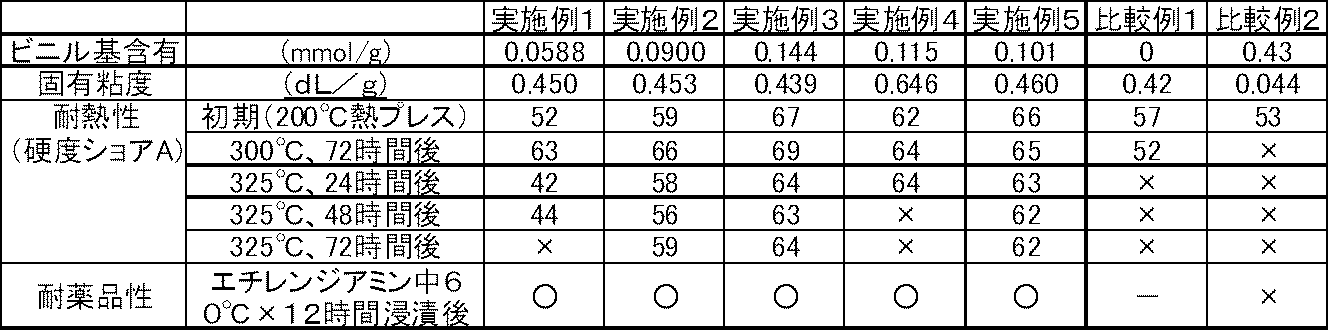
- three films were stacked and the hardness was measured at 25 ° C. with a thickness of 3 mm, it was A52 and was a flexible elastomer.
- the hardness after heating the cured product at 300 ° C. for 72 hours was A63, and no decrease in hardness was observed. Further, after heating at 325 ° C.
- Example 2 A 50 mL two-necked flask was charged with 2.0 g of iodine-terminated polymer (X1), 18.0 g of AC-2000, and 10.0 g of C4DVE. Next, 0.0307 g of V-601 was added. The flask was cooled to around 0 ° C. in an ice bath, and vacuum degassing was performed. Subsequently, the flask was heated to 70 ° C. and reacted for 14 hours. After the reaction, 20 g of AC-2000 was added to the reaction crude liquid, and the reaction crude liquid was dropped into 100 mL of methanol to obtain a precipitate. The precipitate was washed with AK-225 and dried under a nitrogen stream to obtain 1.55 g of a curable fluorinated polymer (P12).
- X1 iodine-terminated polymer
- AC-2000 iodine-terminated polymer
- C4DVE 10.0 g of C4DVE.
- the content of polymerizable double bonds in the curable fluorinated polymer (P12) was 0.090 mmol / g.
- the intrinsic viscosity of the curable fluorinated polymer (P12) was 0.45 dL / g, which was close to that of the iodine terminal polymer (X1).
- a fluorinated polymer cured product film was produced using the curable fluorinated polymer (P12).
- P12 curable fluorinated polymer
- A59 which was a flexible elastomer.
- the hardness after heating the cured product at 300 ° C. for 72 hours was A66. Further, even after heating at 325 ° C. for 72 hours, it was A59, indicating that it retains flexibility as an elastomer and has high heat resistance.
- the results are shown in Table 1. Moreover, although this hardened
- Example 3 A 50 mL 2-neck flask was charged with 2.0 g of iodine-terminated polymer (X1), 18.4 g of AC-2000, and 20.0 g of C4DVE. Next, 0.0461 g of V-601 was added. The flask was cooled to around 0 ° C. in an ice bath, and vacuum degassing was performed. Subsequently, the flask was heated to 70 ° C. and reacted for 14 hours. After the reaction, 20 g of AC-2000 was added to the reaction crude liquid, and the reaction crude liquid was dropped into 100 mL of methanol to obtain a precipitate. The precipitate was washed with AK-225 and dried under a nitrogen stream to obtain 1.97 g of a curable fluorinated polymer (P13).
- the content of the polymerizable double bond in the curable fluorinated polymer (P13) was 0.144 mmol / g.
- the intrinsic viscosity of the curable fluorinated polymer (P13) was 0.44 dL / g, which was close to that of the iodine terminal polymer (X1).
- the content of iodine atoms in the curable fluorinated polymer (P13) was 2.1 ⁇ mol / g, which was reduced compared to the iodine terminal polymer (X1).
- Example 4 A 50 mL two-necked flask was charged with 2.0 g of iodine-terminated polymer (X2), 17.9 g of AC-2000, and 40.0 g of C4DVE. Next, 0.0612 g of V-601 was added. The flask was cooled to around 0 ° C. in an ice bath, and vacuum degassing was performed. Next, the flask was heated to 70 ° C. and reacted for 15 hours. After the reaction, 20 g of AC-2000 was added to the reaction crude liquid, and the reaction crude liquid was dropped into 100 mL of methanol to obtain a precipitate. The precipitate was washed with AK-225 and dried under a nitrogen stream to obtain 1.75 g of a curable fluorinated polymer (P21).
- X2 iodine-terminated polymer
- AC-2000 iodine-terminated polymer
- C4DVE 40.0 g of C4DVE
- the content of the polymerizable double bond in the curable fluorinated polymer (P21) was 0.115 mmol / g.
- the intrinsic viscosity of the curable fluorinated polymer (P21) was 0.65 dL / g, which was close to that of the iodine terminal polymer (X2).
- the content of iodine atoms in the curable fluorinated polymer (P21) was 0.5 ⁇ mol / g, which was decreased as compared with the iodine terminal polymer (X2).
- a fluorinated polymer cured product film was produced using the curable fluorinated polymer (P21).
- P21 curable fluorinated polymer
- the hardness after heating the cured product at 300 ° C. for 72 hours was A64, and no decrease in hardness was observed.
- After heating at 325 ° C. for 24 hours it was A64, and the flexibility as an elastomer was retained, indicating that the heat resistance was high.
- the results are shown in Table 1. Moreover, although this hardened
- the content of the polymerizable double bond in the curable fluorinated polymer (P14) was 0.101 mmol / g.
- the intrinsic viscosity of the curable fluorinated polymer (P22) was 0.460 dL / g, which was close to that of the iodine terminal polymer (X1).
- the iodine atom content of the curable fluorinated polymer (P14) was 1.9 ⁇ mol / g, which was lower than that of the iodine terminal polymer (X1).
- a fluorinated polymer cured product film was produced using the curable fluorinated polymer (P14).
- the hardness was measured with a thickness of 3 mm, it was A66, which was a flexible elastomer.
- the hardness of the cured product measured after heating at 300 ° C. for 72 hours was A65, and no decrease in hardness was observed. Further, after heating at 325 ° C. for 72 hours, it was A62, and the flexibility as an elastomer was maintained, indicating that the heat resistance was high.
- the results are shown in Table 1. Moreover, although this hardened
- the fluoropolymer cured product of the present invention is excellent in heat resistance and chemical resistance, rubber articles (sealing materials (O-rings, sheets, gaskets, oil seals, bearing seals, etc.), diaphragms, cushioning materials, vibration-proof materials, Wire covering materials, industrial belts, tubes / hoses, sheets, etc.), cured resin articles (light emitting element sealing materials, power semiconductor sealing materials, circuit board insulating materials, sealing materials, adhesives, etc.) It is.
- the entire contents of the specification, claims, and abstract of Japanese Patent Application No. 2012-182281 filed on August 21, 2012 are incorporated herein as the disclosure of the specification of the present invention. Is.
Landscapes
- Chemical & Material Sciences (AREA)
- Health & Medical Sciences (AREA)
- Chemical Kinetics & Catalysis (AREA)
- Medicinal Chemistry (AREA)
- Polymers & Plastics (AREA)
- Organic Chemistry (AREA)
- General Chemical & Material Sciences (AREA)
- Addition Polymer Or Copolymer, Post-Treatments, Or Chemical Modifications (AREA)
- Processes Of Treating Macromolecular Substances (AREA)
- Graft Or Block Polymers (AREA)
Abstract
Description
(1)分子鎖に架橋性部位としてペンタフルオロフェニル基を導入し、分子鎖のペンタフルオロフェニル基と別の分子鎖のペンタフルオロフェニル基との間を、クラウンエーテルの存在下、架橋剤であるビスフェノール化合物で架橋する方法(特許文献1参照)。
(2)分子鎖に架橋性部位としてニトリル基を導入し、有機スズ化合物の存在下、分子鎖のニトリル基と別の分子鎖のニトリル基とでトリアジン環を形成させる方法(特許文献2参照)。
(3)前記(2)の方法において、架橋剤としてビスアミノフェニル化合物を添加して、トリアジン環の形成を促進する方法(特許文献3参照)。
(4)臭素含有フルオロオレフィンを共重合して、分子鎖に架橋性部位として臭素原子を導入し、分子鎖の臭素原子と別の分子鎖の臭素原子との間をペルオキシドの存在下、架橋助剤であるトリアリルイソシアヌレートで架橋する方法(特許文献4参照)。
(5)ジヨード化合物を連鎖移動剤として用いて、分子鎖末端に架橋性部位としてヨウ素原子を導入し、分子鎖末端のヨウ素原子と別の分子鎖末端のヨウ素原子との間をペルオキシドの存在下、架橋助剤であるトリアリルイソシアヌレートで架橋する方法(特許文献5、及び6参照)。
(2)及び(3)の方法で得られる、架橋点にトリアジン環を有するペルフルオロエラストマーは、耐薬品性(耐アミン性)が不充分である。
(4)及び(5)の方法で得られる、架橋点にイソシアヌレート環を有するペルフルオロエラストマーは、架橋点にトリアジン環を有するペルフルオロエラストマーに比べ、耐熱性が劣る。
よって、ペルフロオロエラストマーとしての耐薬品性を維持したまま、耐熱性がさらに向上したペルフロオロエラストマーの開発が望まれている。
(6)フルオロモノエンに基づく構成単位と、非環化重合性のフルオロジエンに基づく構成単位とを有し、質量平均分子量が3000~20000のフルオロポリマーを含む硬化性組成物(特許文献7参照)。
(I)架橋性部位である重合性二重結合を有する側鎖の数が多く、硬化物において架橋点間分子量が小さいため、硬化物は、エラストマーとしての特性を示さない。
(II)発光素子の封止材用途では、硬化前のフルオロポリマーには流動性が必要であるため、硬化前のフルオロポリマーの質量平均分子量が低い(固有粘度がおよそ0.05dL/g以下である)。そのため、硬化物に低分子量のフルオロポリマーが残存するため、硬化物の耐熱性や耐薬品性が、不充分である場合があった。
前記フルオロモノエン(a)は、TFE及び前記CF2=CFO-Rf1であることがより好ましい。
前記構成単位(A)の含有量は、前記構成単位(A)と前記構成単位(B)との合計モル数に対して、90~99.9モル%が好ましい。
また、前記構成単位(B)の含有量は、構成単位(A)と構成単位(B)との合計モル数に対して、0.1~10モル%が好ましい。
さらに、前記構成単位(C)を含有する場合には、その含有量は、前記構成単位(A)と前記構成単位(B)との合計モル数に対して、0.1~100モル%が好ましい。
本発明の硬化性含フッ素重合体は、前記構成単位(A)を有する分子鎖の末端に、前記重合性二重結合を有する前記構成単位(B)が存在することが好ましい。
前記重合性二重結合を有する構成単位(B)は、前記構成単位(A)を有する分子鎖の末端1箇所あたり、1.1~40個存在することが好ましい。
CF2=CFO-Qf1-OCF=CF2 ・・・(b1)、
CH2=CFCF2O-Qf2-OCF2CF=CH2 ・・・(b2)、
CH2=CFCF2O-Qf3-OCF=CF2 ・・・(b3)
CH2=CH-Qf4-CH=CH2 ・・・(b4)
CH2=CH-Qf5-OCF=CF2 ・・・(b5)
ただし、Qf1は、炭素数3~10のフルオロアルキレン基、又は炭素原子-炭素原子間にエーテル性酸素原子を1個以上有する炭素数3~10のフルオロアルキレン基である。
Qf2は、炭素数1~10のフルオロアルキレン基、又は炭素原子-炭素原子間にエーテル性酸素原子を1個以上有する炭素数2~10のフルオロアルキレン基である。
Qf3は、炭素数2~10のフルオロアルキレン基、又は炭素原子-炭素原子間にエーテル性酸素原子を1個以上有する炭素数2~10のフルオロアルキレン基である。
Qf4は、炭素数4~10のフルオロアルキレン基、又は炭素原子-炭素原子間にエーテル性酸素原子を1個以上有する炭素数4~10のフルオロアルキレン基である。
Qf5は、炭素数4~10のフルオロアルキレン基、又は炭素原子-炭素原子間にエーテル性酸素原子を1個以上有する炭素数3~10のフルオロアルキレン基である。
本発明の硬化性含フッ素重合体のヨウ素原子の含有量は、0.1~20μmol/gであることが好ましい。
(α)前記フルオロモノエン(a)を含むモノマー成分を、ヨウ素原子を有する連鎖移動剤の存在下にラジカル共重合して、ヨウ素末端の重合体(X)を得る工程。
(β)前記ヨウ素末端の重合体(X)の存在下に前記フルオロジエン(b)をラジカル重合し、前記ヨウ素末端の重合体(X)の末端に前記フルオロジエン(b)に基づく構成単位(B)を導入する工程。
前記モノマー成分は、前記フルオロモノエン(a)及び前記フルオロジエン(b)を含むことが好ましい。
本発明の含フッ素重合体硬化物は、本発明の硬化性含フッ素重合体を有機過酸化物及び受酸剤の存在下に硬化してなるものであることが好ましい。
本発明の含フッ素重合体硬化物は、フルオロエラストマーであることが好ましい。
本発明の硬化性含フッ素重合体の製造方法によれば、本発明の硬化性含フッ素重合体を簡便に製造できる。
本発明の含フッ素共重合体硬化物は、耐熱性及び耐薬品性に優れ、エラストマーとしての優れた特性を示す。
本明細書におけるフルオロモノエンとは、フッ素原子を1個以上有し、かつ重合性二重結合を1個有する化合物である。
本明細書におけるフルオロジエンとは、フッ素原子を1個以上有し、かつ重合性二重結合を2個有する化合物である。
本明細書におけるフルオロアルキレン基は、アルキレン基の水素原子の1個以上がフッ素原子に置換された基である。
本明細書における炭素原子-炭素原子間にエーテル性酸素原子を1個以上有するフルオロアルキレン基とは、炭素原子-炭素原子間にエーテル性酸素原子を1個以上有するアルキレン基の水素原子の1個以上がフッ素原子に置換された基である。オキサフルオロアルキレン基ともいう。
本明細書におけるペルフルオロアルキレン基とは、アルキレン基のすべての水素原子がフッ素原子に置換された基である。
本明細書における炭素原子-炭素原子間にエーテル性酸素原子を1個以上有するペルフルオロアルキレン基とは、炭素原子-炭素原子間にエーテル性酸素原子を1個以上有するアルキレン基のすべての水素原子がフッ素原子に置換された基である。かかる基は、一般に、オキサペルフルオロアルキレン基とも呼ばれる。
本明細書において、エラストマーとしての特性とは、常温での柔軟性、ゴム弾性、高い伸び等の特性をいう。
本明細書において、フルオロエラストマー及びペルフルオロエラストマーとは、架橋された状態のものをいう。また、未架橋状態のペルフルオロエラストマーは、未架橋ペルフルオロエラストマーという場合がある。
本明細書において、ヨウ素末端の重合体(X)とは、高分子鎖の末端にヨウ素原子を有する重合体をいう。
本発明の硬化性含フッ素重合体は、フルオロモノエン(a)に基づく構成単位(A)と、非環化重合性のフルオロジエン(b)に基づく構成単位(B)とを有する。必要に応じて、後述のモノマー(c)に基づく構成単位(C)、構成単位(A)~(C)を除く他の構成単位(D)等を有していてもよい。
構成単位(A)は、フルオロモノエン(a)に基づく構成単位である。
構成単位(A)は、硬化性含フッ素重合体の分子鎖を構成する構成単位の主成分であることが好ましい。硬化性含フッ素重合体が、構成単位(A)を主とする分子鎖を有することによって、エラストマーとしての優れた特性を充分に示す。
CF2=CFO-CF3、
CF2=CFO-CF2CF3、
CF2=CFO-CF2CF2CF3、
CF2=CFO-CF2CF(CF3)OCF2CF2CF3、
CF2=CFO-CF2CF2OCF2CF3。
構成単位(B)は、フルオロジエン(b)に基づく構成単位である。
構成単位(B)は、構成単位(A)を有する分子鎖の末端に、重合性二重結合を有する構成単位として存在することが好ましい。重合性二重結合が分子鎖の末端に存在することによって、硬化物において架橋点間分子量が大きくなるため、硬化物がエラストマーとしての特性をさらに充分に示すことができる。
前記重合性二重結合を有する構成単位(B)は、良好な硬化性を付与し、硬化物が充分な耐熱性及び耐薬品性を発現する点から、末端1箇所あたり、複数個存在することが好ましく、平均1.1~40個存在することがより好ましく、1.1~20個存在することがより好ましい。
分子鎖の末端に重合性二重結合を有する硬化性含フッ素重合体は、後述する工程(α)及び工程(β)を有する製造方法によって製造できる。
分岐点をあらかじめ有する硬化性含フッ素重合体は、後述する工程(α)において、モノマー成分に分岐点となり得るモノマー、たとえば、非環化重合性のフルオロジエン(b)を含ませることによって製造できる。
フルオロジエン(b)としては、硬化物の耐熱性及び耐薬品性の点から、炭素原子とフッ素原子と酸素原子から構成されるペルフルオロジエンが好ましい。
CF2=CFO-Qf1-OCF=CF2 ・・・(b1)、
CH2=CFCF2O-Qf2-OCF2CF=CH2 ・・・(b2)、
CH2=CFCF2O-Qf3-OCF=CF2 ・・・(b3)
CH2=CH-Qf4-CH=CH2 ・・・(b4)
CH2=CH-Qf5-OCF=CF2 ・・・(b5)
Qf2は、炭素数1~10のフルオロアルキレン基、又は炭素原子-炭素原子間にエーテル性酸素原子を1個以上有する炭素数2~10のフルオロアルキレン基である。Qf2の原子数(炭素原子と酸素原子の合計)は、1~6が好ましく、1~4がより好ましい。
Qf3は、炭素数2~10のフルオロアルキレン基、又は炭素原子-炭素原子間にエーテル性酸素原子を1個以上有する炭素数2~10のフルオロアルキレン基である。Qf3の原子数(炭素原子と酸素原子の合計)は、2~7が好ましく、2~5がより好ましい。
Qf4は、炭素数4~10のフルオロアルキレン基、又は炭素原子-炭素原子間にエーテル性酸素原子を1個以上有する炭素数4~10のフルオロアルキレン基である。Qf4の原子数(炭素原子と酸素原子の合計)は、4~10が好ましく、4~6がより好ましい。
Qf5は、炭素数4~10のフルオロアルキレン基、又は炭素原子-炭素原子間にエーテル性酸素原子を1個以上有する炭素数3~10のフルオロアルキレン基である。Qf5の原子数(炭素原子と酸素原子の合計)は、4~10が好ましく、4~6がより好ましい。
Qf1、Qf2、Qf3、Qf4、及びQf5のフルオロアルキレン基は、分岐構造を有してもよい。
CF2=CFO-Qf11-OCF=CF2 ・・・(b11)、
CF2=CFOCH2-Qf12-CH2OCF=CF2 ・・・(b12)。
Qf12は、炭素数1~6のペルフルオロアルキレン基、又は炭素原子-炭素原子間にエーテル性酸素原子を1個以上有する炭素数2~6のペルフルオロアルキレン基である。
CF2=CFO(CF2)4OCF=CF2、
CF2=CFO(CF2)5OCF=CF2、
CF2=CFO(CF2)6OCF=CF2、
CF2=CFO(CF2)4OCF(CF3)CF2OCF=CF2等。
CH2=CFCF2O-Qf21-OCF2CF=CH2 ・・・(b21)。
Qf21は、炭素数1~8のペルフルオロアルキレン基、又は炭素原子-炭素原子間にエーテル性酸素原子を1個以上有する炭素数2~8のペルフルオロアルキレン基である。
CH2=CFCF2O(CF2)2OCF2CF=CH2、
CH2=CFCF2O(CF2)3OCF2CF=CH2、
CH2=CFCF2O(CF2)4OCF2CF=CH2、
CH2=CFCF2O(CF2)2OCF(CF3)CF2OCF2CF=CH2等。
CH2=CFCF2O-Qf31-OCF=CF2 ・・・(b31)。
Qf31は、炭素数1~6のペルフルオロアルキレン基、又は炭素原子-炭素原子間にエーテル性酸素原子を1個以上有する炭素数2~6のペルフルオロアルキレン基である。
CH2=CFCF2OCF(CF3)CF2OCF=CF2、
CH2=CFCF2OCF(CF3)CF2OCF(CF3)CF2OCF=CF2等。
CH2=CH-Qf41-CH=CH2 ・・・(b41)。
CH2=CHCH2-Qf42-CH2CH=CH2 ・・・(b42)。
Qf41は、炭素数4~6のペルフルオロアルキレン基、又は炭素原子-炭素原子間にエーテル性酸素原子を1個以上有する炭素数4~6のペルフルオロアルキレン基である。
Qf42は、炭素数2~6のペルフルオロアルキレン基、又は炭素原子-炭素原子間にエーテル性酸素原子を1個以上有する炭素2~6のペルフルオロアルキレン基である。
CH2=CH(CF2)4CH=CH2、
CH2=CH(CF2)6CH=CH2、
CH2=CHCF(CF3)(CF2)2CF(CF3)CH=CH2。
フルオロジエン(b42)としては、
CH2=CHCH2(CF2)2CH2CH=CH2、
CH2=CHCH2(CF2)4CH2CH=CH2、
CH2=CHCH2(CF2)6CH2CH=CH2等。
CH2=CH-Qf51-OCF=CF2 ・・・(b51)
CH2=CHCH2-Qf52-OCF=CF2 ・・・(b52)
Qf51は、炭素数4~6のペルフルオロアルキレン基、又は炭素原子-炭素原子間にエーテル性酸素原子を1個以上有する炭素数4~6のペルフルオロアルキレン基である。
Qf52は、炭素数3~6のペルフルオロアルキレン基、又は炭素原子-炭素原子間にエーテル性酸素原子を1個以上有する炭素3~6のペルフルオロアルキレン基である。
CH2=CH(CF2)4OCF2=CF2、
CH2=CH(CF2)6OCF2=CF2、
CH2=CHCF(CF3)(CF2)3OCF=CF2等。
フルオロジエン(b)は、1種を単独で用いてもよく、2種以上を組み合わせて用いてもよい。
構成単位(C)は、モノマー(c)に基づく構成単位である。
モノマー(c)は、プロピレン、エチレン及びイソブチレンからなる群から選ばれる1種以上である。
構成単位(C)は、硬化性含フッ素重合体の分子鎖を構成する構成単位の一成分であることが好ましい。硬化性含フッ素重合体が、構成単位(A)及び構成単位(C)を有する分子鎖を有することによって、透明性の向上や、成形加工性の改良、軽量化が期待できる。
構成単位(D)は、フルオロモノエン(a)、フルオロジエン(b)及びモノマー(c)を除く他のモノマー(d)に基づく構成単位である。
臭素又はヨウ素を含有するモノマーとしては、下記のものが挙げられる。
CF2=CFBr、
CH2=CHCF2CF2Br、
CF2=CFOCF2CF2I、
CF2=CFOCF2CF2Br、
CF2=CFOCF2CF2CH2I、
CF2=CFOCF2CF2CH2Br、
CF2=CFOCF2CF(CF3)OCF2CF2CH2I、
CF2=CFOCF2CF(CF3)OCF2CF2CH2Br。
硬化性含フッ素重合体は、フルオロジエン(b)に由来する重合性二重結合を有する。たとえば、フルオロジエン(b)として、CF2=CFO(CF2)4OCF=CF2(以下、C4DVEと記す。)を用いた場合、得られる硬化性含フッ素重合体は、下式の構成単位等を有する。

重合性二重結合の含有量は、硬化性含フッ素重合体の赤外吸収スペクトルにおける、重合性二重結合に由来する吸収ピークの面積及び重合性二重結合のモル吸光係数から、後述する式(1)によって算出できる。
硬化性含フッ素重合体の固有粘度は、0.1~1dL/gであり、0.2~0.8dL/gが好ましい。固有粘度が下限値以上であれば、硬化性含フッ素重合体の質量平均分子量が充分に高くなり、硬化物に残存する低分子量の硬化性含フッ素重合体を抑制でき、その結果、耐熱性に優れる硬化物が得られる。固有粘度が上限値以下であれば、分子量が高すぎないため、ポリマー中のゲル分の発生がなく、様々な形状への成形加工性に優れた重合体が得られる。
硬化性含フッ素重合体の固有粘度が比較的小さい場合、流動性が低くなるため、発光素子の封止材として用いることもできる。
固有粘度は、ウベローデ型粘度計を用いて30℃にて測定する。
本発明の硬化性含フッ素重合体のヨウ素原子の含有量は、0.1~20μmol/gが好ましく、0.2~10μmol/gがより好ましい。硬化性含フッ素重合体のヨウ素原子の含有量が下限値以上であれば、架橋性部位が増えるため、硬化反応の効率を高めることができる。硬化性含フッ素重合体のヨウ素原子の含有量が上限値以下であれば、硬化に使用されなかったヨウ素原子の量を抑えることができ、硬化性に優れ、硬化物は耐熱性、耐薬品性に優れる。
以上説明した本発明の硬化性含フッ素重合体にあっては、フルオロモノエン(a)に基づく構成単位(A)と、非環化重合性のフルオロジエン(b)に基づく構成単位(B)とを有し、重合性二重結合の含有量が、0.01~0.5mmol/gであり、固有粘度が0.1~1dL/gであるため、硬化性に優れる。
得られる硬化物は、耐熱性及び耐薬品性に優れ、エラストマーとしての優れた特性を示す。
本発明の硬化性含フッ素重合体の製造方法は、下記の工程(α)及び工程(β)を有する。
(α)フルオロモノエン(a)を含むモノマー成分を、ヨウ素原子を有する連鎖移動剤の存在下にラジカル共重合して、ヨウ素末端の重合体(X)を得る工程。
(β)ヨウ素末端の重合体(X)の存在下にフルオロジエン(b)をラジカル重合し、ヨウ素末端の重合体(X)の末端にフルオロジエン(b)に基づく構成単位(B)を導入する工程。
工程(α)は、フルオロモノエン(a)を含むモノマー成分を、ヨウ素原子を有する連鎖移動剤の存在下にラジカル共重合して、ヨウ素末端の重合体(X)を得る工程である。
工程(α)において、フルオロモノエン(a)、必要に応じてフルオロジエン(b)、モノマー(c)、他のモノマー(d)を含むモノマー成分を、ヨウ素原子を有する連鎖移動剤、必要に応じてラジカル重合開始剤の存在下にラジカル共重合して、ヨウ素末端の重合体(X)を得ることが好ましい。
重合温度は、0~100℃が好ましい。
フルオロモノエン(a)としては、構成単位(A)を構成するモノマーとして上述したものが挙げられ、TFE、ヘキサフルオロプロピレン、フッ化ビニリデン及びCF2=CFO-Rf1からなる群から選ばれる2種以上が好ましく、TFEとCF2=CFO-Rf1との組み合わせがより好ましい。
フルオロジエン(b)を含むモノマー成分をラジカル共重合することによって、フルオロジエン(b)中の二重結合がいずれも重合し、得られるヨウ素末端の重合体(X)に分岐点が導入される。
Rf2は、炭素数1~12のフルオロアルキレン基、又は炭素原子-炭素原子間にエーテル性酸素原子を1個以上有する炭素数2~12のフルオロアルキレン基(オキサフロオロアルキレン基)である。Rf2は、炭素数3~12のフルオロアルキレン基又はオキサフルオロアルキレン基が好ましく、炭素数3~12のペルフルオロアルキレン基がより好ましい。
IRf2Iとしては、1,4-ジヨードペルフルオロブタン、1,6-ジヨードペルフルオロヘキサンが特に好ましい。
連鎖移動剤の使用量は、モノマー成分の全モノマーの合計モル数に対して、0.01~5モル%が好ましく、0.05~1モル%がより好ましい。
ラジカル重合開始剤の量は、モノマー成分の全モノマーの合計質量数に対して、0.01~3質量%が好ましく、0.1~1質量%がより好ましい。
pH緩衝剤としては、無機塩類(リン酸水素二ナトリウム、リン酸二水素ナトリウム、炭酸水素ナトリウム、これらの水和物等)等が挙げられる。
フッ化ビニリデンに基づく構成単位とヘキサフルオロプロピレンに基づく構成単位との組み合わせ、
フッ化ビニリデンに基づく構成単位とTFEに基づく構成単位とヘキサフルオロプロピレンに基づく構成単位との組み合わせ、
フッ化ビニリデンに基づく構成単位とCTFEに基づく構成単位との組み合わせ、
TFEに基づく構成単位とプロピレンに基づく構成単位との組み合わせ、
TFEに基づく構成単位とプロピレンに基づく構成単位とフッ化ビニリデンに基づく構成単位との組み合わせ、
TFEに基づく構成単位とPAVEに基づく構成単位との組み合わせ、
フッ化ビニリデンに基づく構成単位とTFEに基づく構成単位とPAVEに基づく構成単位との組み合わせ、
TFEに基づく構成単位とプロピレンに基づく構成単位とPAVEに基づく構成単位との組み合わせ。
これらの組み合わせの中でも、TFEに基づく構成単位とPAVEに基づく構成単位との組み合わせが耐熱性と耐薬品性を両立できる点で好ましい。
工程(β)は、ヨウ素末端の重合体(X)の存在下にフルオロジエン(b)をラジカル重合し、ヨウ素末端の重合体(X)の末端に、フルオロジエン(b)に基づく構成単位(B)を導入する工程である。
工程(β)において、必要に応じてラジカル重合開始剤の存在下に、ヨウ素末端の重合体(X)及びフルオロジエン(b)を加熱することによって、ヨウ素末端の重合体(X)の末端に、フルオロジエン(b)に基づく構成単位(B)を導入することが好ましい。
具体的には、ラジカル重合開始剤の加熱分解によって生じたラジカルが、ヨウ素末端の重合体(X)のヨウ素原子を引き抜くことによって、ヨウ素末端の重合体(X)の末端にラジカルが生成した後、フルオロジエン(b)の付加反応が生じる。ラジカル付加反応によって、フルオロジエン(b)の添加量に応じて、1つ又は複数のフルオロジエン(b)がヨウ素末端の重合体(X)の末端に付加する。その際、フルオロジエン(b)の2つの重合性二重結合のうちの1つが反応して、他方は二重結合のまま残存する。該残存した二重結合が架橋性部位となるため、硬化性含フッ素重合体は、架橋助剤等を添加しなくても自己架橋性を有する。
溶媒としては、ヨウ素末端の重合体(X)と親和性の高い含フッ素溶媒が好ましい。含フッ素溶媒としては、ジクロロペンタフルオロプロパン(HCFC-225)、CF3CH2CF2H(HFC-245fa)、CF3CF2CH2CF2H(HFC-365mfc)、ペルフルオロヘキサン、ペルフルオロオクタン、ペルフルオロ(2-ブチルテトラヒドロフラン)、ペルフルオロ(トリブチルアミン)、CF3CF2CF2CF2CF2CF2H、CF3CH2OCF2CF2H、CF3CH2OCH2CF3、CF3CF2OCF2CF2OCF2CF3等が挙げられる。ヨウ素末端の重合体(X)が、TFEに基づく構成単位及びPAVEに基づく構成単位を有する重合体である場合には、溶媒としてはCF3CF2CF2CF2CF2CF2Hが最も好ましい。
反応溶液中のラジカル重合開始剤の濃度は、0.1~5質量%が好ましく、0.5~2質量%がより好ましい。
反応温度は、ラジカル重合開始剤の10時間半減期温度及びフルオロジエン(b)の付加速度とのバランスにより決めることが好ましい。反応温度は、20~120℃が好ましく、40~90℃がより好ましい。
一方、工程(β)では、モノマーとしてフルオロジエン(b)のみを使用する。この場合、フルオロジエン(b)の一方の二重結合が反応し、重合体(X)の末端に構成単位(B)が導入されると、構成単位(B)中のもう一方の二重結合は、フルオロジエン(b)との重合性が高くないため、そのまま残存し、架橋性部位となるものと考えられる。
以上説明した本発明の硬化性含フッ素重合体の製造方法にあっては、フルオロモノエン(a)を含むモノマー成分を、ヨウ素原子を有する連鎖移動剤の存在下にラジカル共重合して、ヨウ素末端の重合体(X)を得、次いで、該ヨウ素末端の重合体(X)の末端にフルオロジエン(b)に基づく構成単位(B)を導入するため、本発明の硬化性含フッ素重合体を簡便に製造できる。
本発明の含フッ素重合体硬化物は、本発明の硬化性含フッ素重合体を、有機過酸化物の存在下に硬化してなるものである。本発明の含フッ素重合体硬化物は、エラストマーとしての特性を示すフルオロエラストマーであることが好ましく、ペルフルオロエラストマーであることがより好ましい。
本発明の硬化性含フッ素重合体に、有機過酸化物、必要に応じて受酸剤、各種のフィラーを配合し、加熱することによって、硬化できる。硬化性含フッ素重合体に前記成分を配合したものを硬化性含フッ素重合体組成物ともいう。
また、硬化性含フッ素重合体は、単体でも、紫外線照射によって硬化できる。ここで、硬化は、構成単位(B)に由来する重合性二重結合(架橋性部位)間にて反応が生起することによって進行すると考えられる。
有機過酸化物としては、半減期が1分となる温度(1分間半減期温度ともいう。)が130~220℃であるものが好ましい。有機過酸化物としては、1,1-ジ(t-ヘキシルペルオキシ)-3,5,5-トリメチルシクロへキサン、2,5-ジメチルへキサン-2,5-ジヒドロペルオキシド、ジ-t-ブチルペルオキシド、t-ブチルクミルペルオキシド、ジクミルペルオキシド、α,α’-ビス(t-ブチルペルオキシ)-p-ジイソプロピルベンゼン、2,5-ジメチル-2,5-ジ(t-ブチルペルオキシ)-へキサン、2,5-ジメチル-2,5-ジ(t-ブチルペルオキシ)-へキシン-3、ジベンゾイルペルオキシド、t-ブチルペルオキシベンゼン、2,5-ジメチル-2,5-ジ(ベンゾイルペルオキシ)へキサン、t-ブチルペルオキシマレイン酸、t-ヘキシルペルオキシイソプロピルモノカーボネート等が挙げられる。有機過酸化物としては、α,α’-ビス(t-ブチルペルオキシ)-p-ジイソプロピルベンゼンが特に好ましい。
有機過酸化物の配合量は、硬化性含フッ素重合体の質量数に対して、0.1~5質量%が好ましく、0.2~4質量%がより好ましく、0.5~3質量%がさらに好ましい。有機過酸化物の配合量が下限値以上であれば、硬化反応の効率が向上する。有機過酸化物の配合量が上限値以下であれば、ラジカル反応に寄与しない無効分解物の生成量を抑制しやすい。
受酸剤としては、酸化マグネシウム、酸化亜鉛、水酸化カルシウム、酸化カルシウム、酸化鉛、二塩基性亜リン酸鉛、ハイドロタルサイト等が挙げられる。受酸剤としては、酸化マグネシウム、酸化亜鉛が好ましく、酸化マグネシウムがより好ましい。受酸剤は、1種を単独で用いてもよく、2種以上を併用してもよい。
たとえば、有機過酸化物は後から混練することが好ましい。混練の際、硬化反応が進行しないようにする点から、混練機を水冷して20~120℃の温度範囲に維持することが好ましい。
成形時の加熱温度は、130~220℃が好ましく、140~200℃がより好ましく、150~200℃が特に好ましい。
二次硬化時の加熱温度としては、150~280℃が好ましく、180~260℃がより好ましく、200~250℃がさらに好ましい。
二次硬化における加熱時間は、1~48時間が好ましく、2~24時間がより好ましい。
本発明の硬化性含フッ素重合体は、その硬化性を用いて、ゴム、樹脂、コーティング剤、塗料、封止材等の用途に使用できる。
本発明の含フッ素重合体硬化物は、輸送機械(自動車等)、一般機器、電気機器、半導体製造装置、化学プラント装置等の幅広い分野において、各種のゴム物品や硬化樹脂物品として利用される。
ゴム物品としては、シール材(Oリング、シート、ガスケット、オイルシール、ベアリングシール等)、ダイヤフラム、緩衝材、防振材、電線被覆材、工業ベルト類、チューブ・ホース類、シート類等が挙げられる。
硬化樹脂物品としては、発光素子(LED等)の封止材、パワー半導体封止材、回路基板絶縁材、シール材、接着剤等が挙げられる。
以上説明した本発明の含フッ素共重合体硬化物にあっては、本発明の硬化性含フッ素重合体を有機過酸化物の存在下に硬化してなるものであるため、耐熱性及び耐薬品性に優れ、エラストマーとしての優れた特性を示す。
また、本発明の硬化性含フッ素重合体における共重合体組成、分子量、重合性二重結合の導入量等を変えることによって、硬化物がゴム物性を示すものから比較的硬く伸びの少ない樹脂特性を示すものまで製造できる。
ウベローデ型粘度計を用いて、30℃の高温水槽中で重合体の固有粘度を測定して分子量の目安とした。測定溶媒として、含フッ素溶媒(旭硝子社製、CT-solv100E)を用いた。
フィルム形状の重合体について、赤外吸収スペクトルを測定し、1843cm-1付近の吸収ピークの面積、C4DVEモノマーのビニル基のモル吸光係数:541.8(L/(mol・cm-2))から、下式(1)によって重合体のビニル基(CF2=CFO-)の含有量を算出した。
ε=A/(cl) ・・・(1)。
ただし、εは、モル吸光係数であり、Aは、1843cm-1付近の吸収ピークの面積(cm2)であり、cは、モル濃度(mol/L)であり、lは、フィルムの厚さ(cm)である。重合性二重結合の含有量(mmol/g)は密度2.0(g/L)を用いて換算した。
重合体中のヨウ素原子の含有量は、重合体サンプルの2mgを燃焼し、発生ガスを0.02質量%ヒドラジン水溶液に吸収させることによって得られた溶液について、ICP(Inductively Coupled Plasma)発光法(測定装置;パーキンエルマー社製ELAN DRCII)によってヨウ素原子の含有量を測定した。
JIS K6253(2006年)に準じ、タイプAデュロメーター硬度計を用いて、25℃で硬化物の硬度(ショアA)を測定した。
硬化物を熱風オーブン中、所定温度で所定時間加熱した後のデュロメーター硬度を25℃で測定し、その変化から、硬化物の耐熱性を評価した。硬度の変化が少ないものが耐熱性に優れる。流動、変形し、硬度を測定できない硬化物を×(不良)とした。
(耐薬品性)
硬化物を60℃で12時間、エチレンジアミンに浸漬し、その変化で耐薬品性を評価した。変化が少ないものが耐薬品性に優れる。着色、膨潤が見られない硬化物を○(良好)、黄色に着色した硬化物を×(不良)とした。
ヨウ素末端の重合体(X1)の合成:
アンカー型撹拌翼を備えた内容積20L(リットル)のステンレス鋼製耐圧反応器に、脱気したイオン交換水の8800g、CF3CF2OCF2CF2OCF2COONH4の220g、リン酸水素二ナトリウム・12水和物の0.64g及びC4DVEの9gを仕込み、気相を窒素置換した。375rpmの回転速度で撹拌しながら、CF2=CFO-CF3(以下、PMVEと記す。)の563g、及びTFEの115gを仕込み、内温を80℃まで昇温させた。内圧は0.90MPa-Gであった。さらに、過硫酸アンモニウムの2.5質量%水溶液の25mLを添加して重合を開始した。
次いで、ラテックスの5000gを撹拌しながら、ラテックスに96質量%硫酸の50gを添加して、ヨウ素末端の重合体(X1)を凝集させた。凝集物を分離した後、1回あたり5000gの超純水によって10回洗浄した。さらに、50℃で12時間、真空乾燥することによって白色のヨウ素末端の重合体(X1)を得た。
ヨウ素末端の重合体(X1)の固有粘度は、0.42dL/gであった。ヨウ素末端の重合体(X1)のヨウ素原子の含有量は、9.4μmol/gであった。
ヨウ素末端の重合体(X2)の合成:
C4DVEを用いないこと以外は、合成例1と同様にして、ヨウ素末端の重合体(X2)を得た。
ヨウ素末端の重合体(X2)の組成は、TFEに基づく構成単位/PMVEに基づく構成単位=69/31(モル比)であった。ヨウ素末端の重合体(X2)の固有粘度は、0.68dL/gであった。ヨウ素末端の重合体(X2)のヨウ素原子の含有量は、3.5μmol/gであった。
50mLの2口フラスコに、ヨウ素末端の重合体(X1)の2.0g、含フッ素溶媒(HFC-52-13p、旭硝子社製AC-2000)の17.9g及びC4DVEの6.0gを入れた。ついで、アゾ系ラジカル重合開始剤(和光純薬社製、V-601)の0.0264gを添加した。フラスコを氷浴中で0℃付近まで冷却して、減圧脱気操作を行った。次いで、フラスコを70℃まで昇温し、14時間反応させた。反応後、反応粗液にAC-2000の20gを加え、100mLのメタノール中に反応粗液を滴下させることによって析出物を得た。析出物を、含フッ素溶媒(HCFC-225、旭硝子社製AK-225)を用いて洗浄し、窒素流通下で乾燥させて、硬化性含フッ素重合体(P11)の1.50gを得た。
硬化性含フッ素重合体(P11)の固有粘度は、0.45dL/gであり、ヨウ素末端の重合体(X1)に近い値を示した。
硬化性含フッ素重合体(P11)の組成は、TFEに基づく構成単位/PMVEに基づく構成単位/C4DVEに基づく構成単位=76.0/24.0/1.1(モル比)であった。
また、該硬化物を、60℃で12時間、エチレンジアミンに浸漬したが、着色、膨潤は見られず、耐薬品性が高いことが示された。
50mLの2口フラスコに、ヨウ素末端の重合体(X1)の2.0g、AC-2000の18.0g及びC4DVEの10.0gを入れた。ついで、V-601の0.0307gを添加した。フラスコを氷浴中で0℃付近まで冷却して、減圧脱気操作を行った。次いで、フラスコを70℃まで昇温し、14時間反応させた。反応後、反応粗液にAC-2000の20gを加え、100mLのメタノール中に反応粗液を滴下させることによって析出物を得た。析出物を、AK-225を用いて洗浄し、窒素流通下で乾燥させて、硬化性含フッ素重合体(P12)の1.55gを得た。
硬化性含フッ素重合体(P12)の固有粘度は、0.45dL/gであり、ヨウ素末端の重合体(X1)に近い値を示した。
硬化性含フッ素重合体(P12)の組成は、TFEに基づく構成単位/PMVEに基づく構成単位/C4DVEに基づく構成単位=76.0/24.0/1.1(モル比)であった。
また、該硬化物を、60℃で12時間、エチレンジアミンに浸漬したが、着色、膨潤は見られず、耐薬品性が高いことが示された。
50mLの2口フラスコに、ヨウ素末端の重合体(X1)の2.0g、AC-2000の18.4g及びC4DVEの20.0gを入れた。ついで、V-601の0.0461gを添加した。フラスコを氷浴中で0℃付近まで冷却して、減圧脱気操作を行った。次いで、フラスコを70℃まで昇温し、14時間反応させた。反応後、反応粗液にAC-2000の20gを加え、100mLのメタノール中に反応粗液を滴下させることによって析出物を得た。析出物を、AK-225を用いて洗浄し、窒素流通下で乾燥させて、硬化性含フッ素重合体(P13)の1.97g得た。
硬化性含フッ素重合体(P13)の固有粘度は、0.44dL/gであり、ヨウ素末端の重合体(X1)に近い値を示した。
硬化性含フッ素重合体(P13)のヨウ素原子の含有量は、2.1μmol/gであり、ヨウ素末端の重合体(X1)に比べて減少していた。
硬化性含フッ素重合体(P13)の組成は、TFEに基づく構成単位/PMVEに基づく構成単位/C4DVEに基づく構成単位=76.0/24.0/1.8(モル比)であった。
また、該硬化物を、60℃で12時間、エチレンジアミンに浸漬したが、着色、膨潤は見られず、耐薬品性が高いことが示された。
50mLの2口フラスコに、ヨウ素末端の重合体(X2)の2.0g、AC-2000の17.9g及びC4DVEの40.0gを入れた。ついで、V-601の0.0612gを添加した。フラスコを氷浴中で0℃付近まで冷却して、減圧脱気操作を行った。次いで、フラスコを70℃まで昇温し、15時間反応させた。反応後、反応粗液にAC-2000の20gを加え、100mLのメタノール中に反応粗液を滴下させることによって析出物を得た。析出物を、AK-225を用いて洗浄し、窒素流通下で乾燥させて、硬化性含フッ素重合体(P21)の1.75gを得た。
硬化性含フッ素重合体(P21)の固有粘度は、0.65dL/gであり、ヨウ素末端の重合体(X2)に近い値を示した。
硬化性含フッ素重合体(P21)のヨウ素原子の含有量は、0.5μmol/gであり、ヨウ素末端の重合体(X2)に比べて減少していた。
硬化性含フッ素重合体(P21)の組成は、TFEに基づく構成単位/PMVEに基づく構成単位/C4DVEに基づく構成単位=69.0/31.0/1.5(モル比)であった。
また、該硬化物を、60℃で12時間、エチレンジアミンに浸漬したが、着色、膨潤は見られず、耐薬品性が高いことが示された。
ガラス容器中に、重合性二重結合を含有しないヨウ素末端の重合体(X2)の1.0g、AC-2000の19.6g、パーヘキサ25Bの0.011g、酸化マグネシウムの0.029g及びトリアリルシアヌレートの0.049gを加えて、撹拌することによって含フッ素重合体組成物の分散液を得た。該分散液をPTFEシート上に流延して、加熱乾燥によって溶媒を除去し、続いて200℃で20分間加熱プレスすることによって、厚さ1mmの含フッ素共重合体硬化物フィルムを作製した。該フィルムを3枚重ねて、厚さ3mmとして硬度を25℃で測定したところA57であり、柔軟なエラストマーであった。該硬化物を300℃で72時間加熱した後の硬度はA52であり、硬度の低下はわずかであったが、320℃で24時間加熱した後、硬化物は流動、変形し、硬度を測定できなかった。結果を表1に示す。
特許文献7の合成例4と同様な方法によって、TFEに基づく構成単位/C4DVEに基づく構成単位/CF2=CFO-CF2CF2CF3に基づく構成単位=65/10/25(モル比)からなる側鎖ビニル基含有含フッ素共重合体を得た。
質量平均分子量は、8,600であり、重合性二重結合の含有量は、0.430mmol/gであり、固有粘度は、0.044dL/gであった。
側鎖ビニル基含有含フッ素共重合体は、本発明の硬化性含フッ素重合体よりビニル基が多く、分子量が小さいものであった。
また、該硬化物を、60℃で12時間、エチレンジアミンに浸漬したところ、黄色に着色し、耐薬品性が低いことが示された。
50mLの2口フラスコに、ヨウ素末端の重合体(X1)の3.03g、AC-2000の30.4g及びCH2=CH(CF2)6CH=CH2(C6HDV)の18.0gを入れた。ついで、V-601の0.0848gを添加した。フラスコを氷浴中で0℃付近まで冷却して、減圧脱気操作を行った。フラスコを75℃まで昇温し、18時間反応させた。反応後、反応粗液にAC-2000の100gを加え、250mLのメタノール中に反応粗液を滴下させることによって析出物を得た。析出物を、AK-225を用いて洗浄し、窒素流通下で乾燥させて、硬化性含フッ素重合体(P14)の2.93gを得た。
硬化性含フッ素重合体(P22)の固有粘度は、0.460dL/gであり、ヨウ素末端の重合体(X1)に近い値を示した。
硬化性含フッ素重合体(P14)のヨウ素原子の含有量は、1.9μmol/gであり、ヨウ素末端の重合体(X1)に比べて減少していた。
硬化性含フッ素重合体(P22)の組成は、TFEに基づく構成単位/PMVEに基づく構成単位/C4DVEに基づく構成単位/C6HDVに基づく構成単位=76/24/0.05/0.05(モル比)であった。
また、該硬化物を、60℃で12時間、エチレンジアミンに浸漬したが、着色、膨潤は見られず、耐薬品性が高いことが示された。
なお、2012年8月21日に出願された日本特許出願2012-182281号の明細書、特許請求の範囲、及び要約書の全内容をここに引用し、本発明の明細書の開示として、取り入れるものである。
Claims (17)
- フルオロモノエン(a)に基づく構成単位(A)と、非環化重合性のフルオロジエン(b)に基づく構成単位(B)とを有し、
重合性二重結合の含有量が、0.01~0.5mmol/gであり、
固有粘度が0.1~1dL/gである、硬化性含フッ素重合体。 - 前記フルオロモノエン(a)が、テトラフルオロエチレン、ヘキサフルオロプロピレン、フッ化ビニリデン及びCF2=CFO-Rf1(ただし、Rf1は、炭素数1~10のフルオロアルキル基又は炭素原子-炭素原子間にエーテル性酸素原子を1個以上有する炭素数2~10のフルオロアルキル基である。)からなる群から選ばれる2種以上である、請求項1に記載の硬化性含フッ素重合体。
- さらに、プロピレン、エチレン及びイソブチレンからなる群から選ばれる1種以上のモノマー(c)に基づく構成単位(C)を有する、請求項1又は2に記載の硬化性含フッ素重合体。
- 前記構成単位(A)の含有量は、構成単位(A)と構成単位(B)との合計モル数に対して、90~99.9モル%である、請求項1~3のいずれか一項に記載の硬化性含フッ素重合体。
- 前記構成単位(B)の含有量は、構成単位(A)と構成単位(B)との合計モル数に対して、0.1~10モル%である、請求項1~4のいずれか一項に記載の硬化性含フッ素重合体。
- 前記構成単位(C)を含有し、その含有量が、構成単位(A)と構成単位(B)との合計モル数に対して0.1~100モル%である、請求項3~5のいずれか一項に記載の硬化性含フッ素重合体。
- 前記構成単位(A)を有する分子鎖の末端に、前記重合性二重結合を有する構成単位(B)が存在する、請求項1~6のいずれか一項に記載の硬化性含フッ素重合体。
- 前記重合性二重結合を有する構成単位(B)が、前記構成単位(A)を有する分子鎖の末端1箇所あたり、1.1~40個存在する、請求項7に記載の硬化性含フッ素重合体。
- 前記フルオロモノエン(a)が、テトラフルオロエチレン及び前記CF2=CFO-Rf1である、請求項1~8のいずれか一項に記載の硬化性含フッ素重合体。
- 前記フルオロジエン(b)が、下式(b1)~(b5)からなる群から選ばれる1種以上である、請求項1~9のいずれか一項に記載の硬化性含フッ素重合体。
CF2=CFO-Qf1-OCF=CF2 ・・・(b1)、
CH2=CFCF2O-Qf2-OCF2CF=CH2 ・・・(b2)、
CH2=CFCF2O-Qf3-OCF=CF2 ・・・(b3)
CH2=CH-Qf4-CH=CH2 ・・・(b4)
CH2=CH-Qf5-OCF=CF2 ・・・(b5)
ただし、Qf1、炭素数3~10のフルオロアルキレン基、又は炭素原子-炭素原子間にエーテル性酸素原子を1個以上有する炭素数3~10のフルオロアルキレン基である。
Qf2は、炭素数1~10のフルオロアルキレン基、又は炭素原子-炭素原子間にエーテル性酸素原子を1個以上有する炭素数2~10のフルオロアルキレン基である。
Qf3は、炭素数2~10のフルオロアルキレン基、又は炭素原子-炭素原子間にエーテル性酸素原子を1個以上有する炭素数2~10のフルオロアルキレン基である。
Qf4は、炭素数4~10のフルオロアルキレン基、又は炭素原子-炭素原子間にエーテル性酸素原子を1個以上有する炭素数4~10のフルオロアルキレン基である。
Qf5は、炭素数4~10のフルオロアルキレン基、又は炭素原子-炭素原子間にエーテル性酸素原子を1個以上有する炭素数3~10のフルオロアルキレン基である。 - ヨウ素原子の含有量が、0.1~20μmol/gである、請求項1~10のいずれか一項に記載の硬化性含フッ素重合体。
- 請求項1~11のいずれか一項に記載の硬化性含フッ素重合体を製造する方法であって、
下記の工程(α)及び工程(β)を有する、硬化性含フッ素重合体の製造方法。
(α)前記フルオロモノエン(a)を含むモノマー成分を、ヨウ素原子を有する連鎖移動剤の存在下にラジカル共重合して、ヨウ素末端の重合体(X)を得る工程。
(β)前記ヨウ素末端の重合体(X)の存在下に前記フルオロジエン(b)をラジカル重合し、前記ヨウ素末端の重合体(X)の末端に前記フルオロジエン(b)に基づく構成単位(B)を導入する工程。 - 前記ヨウ素原子を有する連鎖移動剤が、IRf2I(ただし、Rf2は、炭素数3~12のフルオロアルキレン基である。)である、請求項12に記載の硬化性含フッ素重合体の製造方法。
- 前記モノマー成分が、前記フルオロモノエン(a)及び前記フルオロジエン(b)を含む、請求項12又は13に記載の硬化性含フッ素重合体の製造方法。
- 請求項1~11のいずれか一項に記載の硬化性含フッ素重合体を、有機過酸化物の存在下に硬化してなる、含フッ素重合体硬化物。
- 請求項1~11のいずれか一項に記載の硬化性含フッ素重合体を、有機過酸化物及び受酸剤の存在下に硬化してなる、含フッ素重合体硬化物。
- フルオロエラストマーである、請求項15又は16に記載の含フッ素重合体硬化物。
Priority Applications (4)
| Application Number | Priority Date | Filing Date | Title |
|---|---|---|---|
| EP13831227.7A EP2889315A4 (en) | 2012-08-21 | 2013-08-14 | HARDENABLE FLUOROUS POLYMER, MANUFACTURING METHOD AND FLUOROUS HARDENED POLYMER PRODUCT |
| CN201380044011.3A CN104583253A (zh) | 2012-08-21 | 2013-08-14 | 固化性含氟聚合物、其制造方法以及含氟聚合物固化物 |
| JP2014531603A JPWO2014030586A1 (ja) | 2012-08-21 | 2013-08-14 | 硬化性含フッ素重合体、その製造方法及び含フッ素重合体硬化物 |
| US14/610,561 US20150141604A1 (en) | 2012-08-21 | 2015-01-30 | Curable fluorinated polymer, process for its production, and fluorinated polymer cured product |
Applications Claiming Priority (2)
| Application Number | Priority Date | Filing Date | Title |
|---|---|---|---|
| JP2012-182281 | 2012-08-21 | ||
| JP2012182281 | 2012-08-21 |
Related Child Applications (1)
| Application Number | Title | Priority Date | Filing Date |
|---|---|---|---|
| US14/610,561 Continuation US20150141604A1 (en) | 2012-08-21 | 2015-01-30 | Curable fluorinated polymer, process for its production, and fluorinated polymer cured product |
Publications (1)
| Publication Number | Publication Date |
|---|---|
| WO2014030586A1 true WO2014030586A1 (ja) | 2014-02-27 |
Family
ID=50149895
Family Applications (1)
| Application Number | Title | Priority Date | Filing Date |
|---|---|---|---|
| PCT/JP2013/071921 Ceased WO2014030586A1 (ja) | 2012-08-21 | 2013-08-14 | 硬化性含フッ素重合体、その製造方法及び含フッ素重合体硬化物 |
Country Status (6)
| Country | Link |
|---|---|
| US (1) | US20150141604A1 (ja) |
| EP (1) | EP2889315A4 (ja) |
| JP (1) | JPWO2014030586A1 (ja) |
| CN (1) | CN104583253A (ja) |
| TW (1) | TW201420613A (ja) |
| WO (1) | WO2014030586A1 (ja) |
Cited By (8)
| Publication number | Priority date | Publication date | Assignee | Title |
|---|---|---|---|---|
| WO2015088784A3 (en) * | 2013-12-11 | 2015-08-27 | 3M Innovative Properties Company | Highly fluorinated elastomers |
| KR20170003179A (ko) * | 2015-06-30 | 2017-01-09 | 주식회사 엘지화학 | 경화성 조성물 |
| JPWO2017057512A1 (ja) * | 2015-10-01 | 2018-07-26 | 旭硝子株式会社 | 含フッ素弾性共重合体、その製造方法、架橋ゴムおよびその製造方法 |
| WO2019073934A1 (ja) * | 2017-10-12 | 2019-04-18 | Agc株式会社 | 含フッ素弾性共重合体組成物、塗料、および塗装物品 |
| US10590224B2 (en) | 2015-07-13 | 2020-03-17 | 3M Innovative Properties Company | Fluorinated block copolymers |
| JPWO2021075431A1 (ja) * | 2019-10-17 | 2021-04-22 | ||
| US11261280B2 (en) | 2017-01-18 | 2022-03-01 | 3M Innovative Properties Company | Fluorinated block copolymers |
| US11267922B2 (en) | 2017-01-18 | 2022-03-08 | 3M Innovative Properties Company | Fluorinated block copolymers derived from nitrile cure-site monomers |
Families Citing this family (6)
| Publication number | Priority date | Publication date | Assignee | Title |
|---|---|---|---|---|
| WO2017018489A1 (ja) * | 2015-07-30 | 2017-02-02 | 旭硝子株式会社 | 含フッ素化合物、硬化性組成物および硬化物 |
| WO2017086465A1 (ja) * | 2015-11-20 | 2017-05-26 | 旭硝子株式会社 | ヨウ素原子含有量の低減された含フッ素化合物を製造する方法 |
| EP3728493A1 (en) * | 2017-12-18 | 2020-10-28 | 3M Innovative Properties Company | Fluorinated elastomers cured by actinic radiation and methods thereof |
| CN114014968B (zh) * | 2020-07-06 | 2023-08-11 | 旭化成株式会社 | 聚合物组合物和离子交换膜 |
| US11746169B2 (en) | 2020-07-06 | 2023-09-05 | Asahi Kasei Kabushiki Kaisha | Polymer composition and ion-exchange membrane |
| EP4253432B1 (en) * | 2020-11-25 | 2026-02-25 | Daikin Industries, Ltd. | Fluoropolymer, aqueous liquid dispersion, composition, and crosslinked product |
Citations (9)
| Publication number | Priority date | Publication date | Assignee | Title |
|---|---|---|---|---|
| US3580889A (en) | 1967-08-17 | 1971-05-25 | Du Pont | Vulcanization accelerators of polycyclic ethers for fluorinated polymers |
| US4035565A (en) | 1975-03-27 | 1977-07-12 | E. I. Du Pont De Nemours And Company | Fluoropolymer containing a small amount of bromine-containing olefin units |
| US4243770A (en) | 1977-04-08 | 1981-01-06 | Daikin Kogyo Co., Ltd. | Cross linkable fluorine-containing polymer and its production |
| US4394489A (en) | 1982-02-25 | 1983-07-19 | E. I. Du Pont De Nemours & Co. | Fluoroelastomer curatives |
| US4525539A (en) | 1982-12-02 | 1985-06-25 | E. I. Du Pont De Nemours And Company | Vulcanizable nitrile-containing perfluoroelastomer |
| WO1990014367A1 (en) | 1989-05-19 | 1990-11-29 | E.I. Du Pont De Nemours And Company | Preparation of bromo-containing perfluoropolymers having iodine curesites |
| WO2009096342A1 (ja) | 2008-01-28 | 2009-08-06 | Asahi Glass Company, Limited | 硬化性組成物、含フッ素硬化物、それらを用いた光学材料および発光素子 |
| WO2011096370A1 (ja) * | 2010-02-05 | 2011-08-11 | 旭硝子株式会社 | 含フッ素硬化性樹脂組成物 |
| WO2012073977A1 (ja) * | 2010-11-30 | 2012-06-07 | 旭硝子株式会社 | 架橋性フッ素ゴム組成物および架橋ゴム物品 |
Family Cites Families (4)
| Publication number | Priority date | Publication date | Assignee | Title |
|---|---|---|---|---|
| JP2005350490A (ja) * | 2004-06-08 | 2005-12-22 | Yunimatekku Kk | フッ素ゴム組成物 |
| JP5157902B2 (ja) * | 2006-06-12 | 2013-03-06 | 旭硝子株式会社 | 硬化性組成物および含フッ素硬化物 |
| JP2009117063A (ja) * | 2007-11-02 | 2009-05-28 | Nok Corp | 燃料電池セルシール用フッ素ゴム組成物 |
| JP5644504B2 (ja) * | 2009-01-16 | 2014-12-24 | 旭硝子株式会社 | 含フッ素弾性共重合体およびその製造方法、架橋ゴム物品 |
-
2013
- 2013-08-14 CN CN201380044011.3A patent/CN104583253A/zh active Pending
- 2013-08-14 EP EP13831227.7A patent/EP2889315A4/en not_active Withdrawn
- 2013-08-14 JP JP2014531603A patent/JPWO2014030586A1/ja active Pending
- 2013-08-14 WO PCT/JP2013/071921 patent/WO2014030586A1/ja not_active Ceased
- 2013-08-20 TW TW102129787A patent/TW201420613A/zh unknown
-
2015
- 2015-01-30 US US14/610,561 patent/US20150141604A1/en not_active Abandoned
Patent Citations (9)
| Publication number | Priority date | Publication date | Assignee | Title |
|---|---|---|---|---|
| US3580889A (en) | 1967-08-17 | 1971-05-25 | Du Pont | Vulcanization accelerators of polycyclic ethers for fluorinated polymers |
| US4035565A (en) | 1975-03-27 | 1977-07-12 | E. I. Du Pont De Nemours And Company | Fluoropolymer containing a small amount of bromine-containing olefin units |
| US4243770A (en) | 1977-04-08 | 1981-01-06 | Daikin Kogyo Co., Ltd. | Cross linkable fluorine-containing polymer and its production |
| US4394489A (en) | 1982-02-25 | 1983-07-19 | E. I. Du Pont De Nemours & Co. | Fluoroelastomer curatives |
| US4525539A (en) | 1982-12-02 | 1985-06-25 | E. I. Du Pont De Nemours And Company | Vulcanizable nitrile-containing perfluoroelastomer |
| WO1990014367A1 (en) | 1989-05-19 | 1990-11-29 | E.I. Du Pont De Nemours And Company | Preparation of bromo-containing perfluoropolymers having iodine curesites |
| WO2009096342A1 (ja) | 2008-01-28 | 2009-08-06 | Asahi Glass Company, Limited | 硬化性組成物、含フッ素硬化物、それらを用いた光学材料および発光素子 |
| WO2011096370A1 (ja) * | 2010-02-05 | 2011-08-11 | 旭硝子株式会社 | 含フッ素硬化性樹脂組成物 |
| WO2012073977A1 (ja) * | 2010-11-30 | 2012-06-07 | 旭硝子株式会社 | 架橋性フッ素ゴム組成物および架橋ゴム物品 |
Non-Patent Citations (1)
| Title |
|---|
| See also references of EP2889315A4 |
Cited By (16)
| Publication number | Priority date | Publication date | Assignee | Title |
|---|---|---|---|---|
| US11111326B2 (en) | 2013-12-11 | 2021-09-07 | 3M Innovative Properties Company | Highly fluorinated elastomers |
| WO2015088784A3 (en) * | 2013-12-11 | 2015-08-27 | 3M Innovative Properties Company | Highly fluorinated elastomers |
| KR20170003179A (ko) * | 2015-06-30 | 2017-01-09 | 주식회사 엘지화학 | 경화성 조성물 |
| KR101969339B1 (ko) * | 2015-06-30 | 2019-04-16 | 주식회사 엘지화학 | 경화성 조성물 |
| US10590224B2 (en) | 2015-07-13 | 2020-03-17 | 3M Innovative Properties Company | Fluorinated block copolymers |
| JPWO2017057512A1 (ja) * | 2015-10-01 | 2018-07-26 | 旭硝子株式会社 | 含フッ素弾性共重合体、その製造方法、架橋ゴムおよびその製造方法 |
| JP7125263B2 (ja) | 2015-10-01 | 2022-08-24 | Agc株式会社 | 含フッ素弾性共重合体、その製造方法、架橋ゴムおよびその製造方法 |
| US11267922B2 (en) | 2017-01-18 | 2022-03-08 | 3M Innovative Properties Company | Fluorinated block copolymers derived from nitrile cure-site monomers |
| US11261280B2 (en) | 2017-01-18 | 2022-03-01 | 3M Innovative Properties Company | Fluorinated block copolymers |
| US11332561B2 (en) | 2017-10-12 | 2022-05-17 | AGC Inc. | Fluorinated elastic copolymer composition, coating material, and coated article |
| JPWO2019073934A1 (ja) * | 2017-10-12 | 2020-11-19 | Agc株式会社 | 含フッ素弾性共重合体組成物、塗料、および塗装物品 |
| WO2019073934A1 (ja) * | 2017-10-12 | 2019-04-18 | Agc株式会社 | 含フッ素弾性共重合体組成物、塗料、および塗装物品 |
| WO2021075431A1 (ja) * | 2019-10-17 | 2021-04-22 | Agc株式会社 | パーフルオロエラストマー成形体及び保護部材 |
| JPWO2021075431A1 (ja) * | 2019-10-17 | 2021-04-22 | ||
| JP7719336B2 (ja) | 2019-10-17 | 2025-08-06 | Agc株式会社 | パーフルオロエラストマー成形体及び保護部材 |
| KR102933374B1 (ko) * | 2019-10-17 | 2026-03-03 | 에이지씨 가부시키가이샤 | 퍼플루오로 엘라스토머 성형체 및 보호 부재 |
Also Published As
| Publication number | Publication date |
|---|---|
| JPWO2014030586A1 (ja) | 2016-07-28 |
| EP2889315A1 (en) | 2015-07-01 |
| CN104583253A (zh) | 2015-04-29 |
| EP2889315A4 (en) | 2016-04-06 |
| TW201420613A (zh) | 2014-06-01 |
| US20150141604A1 (en) | 2015-05-21 |
Similar Documents
| Publication | Publication Date | Title |
|---|---|---|
| WO2014030586A1 (ja) | 硬化性含フッ素重合体、その製造方法及び含フッ素重合体硬化物 | |
| CN102300886B (zh) | 含氟弹性共聚物及其制造方法、交联橡胶制品 | |
| CN101981067B (zh) | 含氟弹性共聚物及制造方法 | |
| TWI650332B (zh) | 全氟彈性體、全氟彈性體組成物、交聯橡膠物品、及全氟彈性體之製造方法 | |
| US11732073B2 (en) | Fluorinated elastic copolymer, its composition and crosslinked rubber article | |
| US7884166B2 (en) | Elastic fluorocopolymer, its composition and crosslinked rubber | |
| CN1708519A (zh) | 制备氟化烯烃和烃类烯烃共聚物的无乳化剂的水乳液聚合 | |
| JP2018531316A (ja) | 非晶質フルオロポリマーとフルオロプラスチック粒子とを含む組成物及びその製造方法 | |
| WO2016072397A1 (ja) | 含フッ素エラストマー、含フッ素エラストマー組成物、含フッ素エラストマー架橋物品 | |
| JP5061510B2 (ja) | 含フッ素弾性共重合体組成物および架橋ゴム | |
| JP7623604B2 (ja) | フルオロポリマー、水性分散液、組成物および架橋物 | |
| JPWO2009069320A1 (ja) | フルオロエラストマーの製造法 | |
| CN108017746A (zh) | 一种低压缩永久变形的过氧化物硫化氟橡胶及其制备方法 | |
| JPWO2019009250A1 (ja) | 含フッ素弾性共重合体組成物および架橋ゴム物品 | |
| WO2017115812A1 (ja) | フルオロエラストマー組成物および架橋物の製造方法 | |
| JP4640021B2 (ja) | 含フッ素共重合体 | |
| JP7759004B2 (ja) | 含フッ素エラストマーの製造方法および含フッ素エラストマー | |
| WO2026063534A1 (ja) | 含フッ素エラストマー水性分散液の製造方法および含フッ素エラストマー | |
| JP5163287B2 (ja) | 含フッ素弾性共重合体、その製造方法および架橋ゴム | |
| JP2008308544A (ja) | 含フッ素共重合体 |
Legal Events
| Date | Code | Title | Description |
|---|---|---|---|
| 121 | Ep: the epo has been informed by wipo that ep was designated in this application |
Ref document number: 13831227 Country of ref document: EP Kind code of ref document: A1 |
|
| ENP | Entry into the national phase |
Ref document number: 2014531603 Country of ref document: JP Kind code of ref document: A |
|
| REEP | Request for entry into the european phase |
Ref document number: 2013831227 Country of ref document: EP |
|
| WWE | Wipo information: entry into national phase |
Ref document number: 2013831227 Country of ref document: EP |
|
| NENP | Non-entry into the national phase |
Ref country code: DE |