WO2014034092A1 - インデノアクリダン環構造を有する化合物および有機エレクトロルミネッセンス素子 - Google Patents
インデノアクリダン環構造を有する化合物および有機エレクトロルミネッセンス素子 Download PDFInfo
- Publication number
- WO2014034092A1 WO2014034092A1 PCT/JP2013/005042 JP2013005042W WO2014034092A1 WO 2014034092 A1 WO2014034092 A1 WO 2014034092A1 JP 2013005042 W JP2013005042 W JP 2013005042W WO 2014034092 A1 WO2014034092 A1 WO 2014034092A1
- Authority
- WO
- WIPO (PCT)
- Prior art keywords
- group
- substituted
- unsubstituted
- carbon atoms
- substituent
- Prior art date
- Legal status (The legal status is an assumption and is not a legal conclusion. Google has not performed a legal analysis and makes no representation as to the accuracy of the status listed.)
- Ceased
Links
- 0 C*N(c1c(C2(*)*)c(*)c3-c4c(*)c(*)c(*)c(*)c4C(*)(*)c3c1*)c1c2c(*)c(*N(C)*=C)c(C)c1* Chemical compound C*N(c1c(C2(*)*)c(*)c3-c4c(*)c(*)c(*)c(*)c4C(*)(*)c3c1*)c1c2c(*)c(*N(C)*=C)c(C)c1* 0.000 description 4
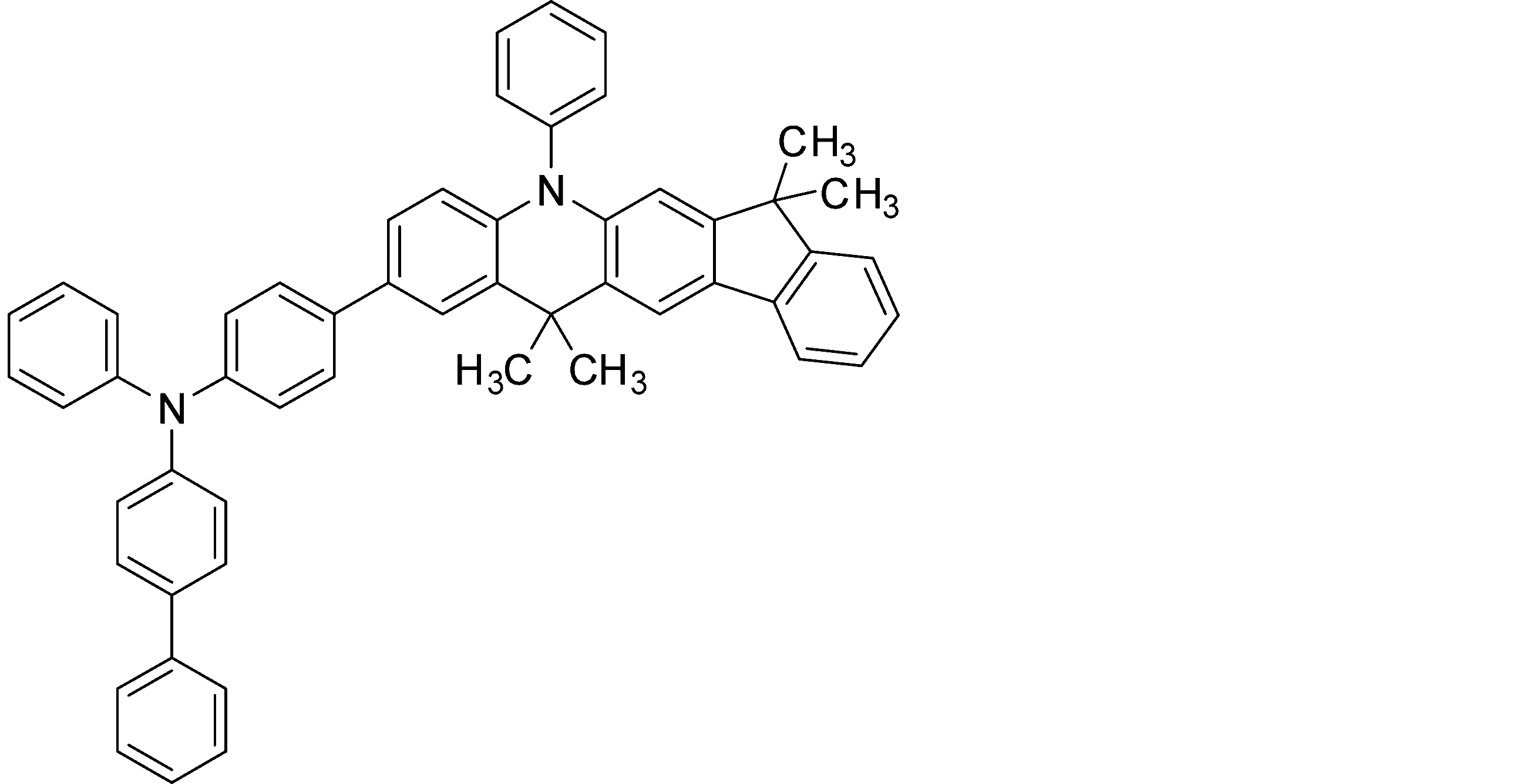
- MUZXCTQSVCJFFH-UHFFFAOYSA-N CC1(C)c2cc(-c(cc3)ccc3N(c(cc3)ccc3-c3ccccc3)c(cc3)ccc3-c3ccccc3)ccc2N(c(cc2)ccc2-c2ccccc2)c2ccccc12 Chemical compound CC1(C)c2cc(-c(cc3)ccc3N(c(cc3)ccc3-c3ccccc3)c(cc3)ccc3-c3ccccc3)ccc2N(c(cc2)ccc2-c2ccccc2)c2ccccc12 MUZXCTQSVCJFFH-UHFFFAOYSA-N 0.000 description 1
- LQYYDWJDEVKDGB-XPWSMXQVSA-N Cc(cc1)ccc1N(c1ccc(C)cc1)c1ccc(/C=C/c2ccc(/C=C/c(cc3)ccc3N(c3ccc(C)cc3)c3ccc(C)cc3)cc2)cc1 Chemical compound Cc(cc1)ccc1N(c1ccc(C)cc1)c1ccc(/C=C/c2ccc(/C=C/c(cc3)ccc3N(c3ccc(C)cc3)c3ccc(C)cc3)cc2)cc1 LQYYDWJDEVKDGB-XPWSMXQVSA-N 0.000 description 1
Images



Classifications
-
- C—CHEMISTRY; METALLURGY
- C07—ORGANIC CHEMISTRY
- C07D—HETEROCYCLIC COMPOUNDS
- C07D405/00—Heterocyclic compounds containing both one or more hetero rings having oxygen atoms as the only ring hetero atoms, and one or more rings having nitrogen as the only ring hetero atom
- C07D405/14—Heterocyclic compounds containing both one or more hetero rings having oxygen atoms as the only ring hetero atoms, and one or more rings having nitrogen as the only ring hetero atom containing three or more hetero rings
-
- C—CHEMISTRY; METALLURGY
- C07—ORGANIC CHEMISTRY
- C07D—HETEROCYCLIC COMPOUNDS
- C07D221/00—Heterocyclic compounds containing six-membered rings having one nitrogen atom as the only ring hetero atom, not provided for by groups C07D211/00 - C07D219/00
- C07D221/02—Heterocyclic compounds containing six-membered rings having one nitrogen atom as the only ring hetero atom, not provided for by groups C07D211/00 - C07D219/00 condensed with carbocyclic rings or ring systems
- C07D221/04—Ortho- or peri-condensed ring systems
- C07D221/18—Ring systems of four or more rings
-
- C—CHEMISTRY; METALLURGY
- C07—ORGANIC CHEMISTRY
- C07D—HETEROCYCLIC COMPOUNDS
- C07D401/00—Heterocyclic compounds containing two or more hetero rings, having nitrogen atoms as the only ring hetero atoms, at least one ring being a six-membered ring with only one nitrogen atom
- C07D401/02—Heterocyclic compounds containing two or more hetero rings, having nitrogen atoms as the only ring hetero atoms, at least one ring being a six-membered ring with only one nitrogen atom containing two hetero rings
- C07D401/04—Heterocyclic compounds containing two or more hetero rings, having nitrogen atoms as the only ring hetero atoms, at least one ring being a six-membered ring with only one nitrogen atom containing two hetero rings directly linked by a ring-member-to-ring-member bond
-
- C—CHEMISTRY; METALLURGY
- C07—ORGANIC CHEMISTRY
- C07D—HETEROCYCLIC COMPOUNDS
- C07D401/00—Heterocyclic compounds containing two or more hetero rings, having nitrogen atoms as the only ring hetero atoms, at least one ring being a six-membered ring with only one nitrogen atom
- C07D401/02—Heterocyclic compounds containing two or more hetero rings, having nitrogen atoms as the only ring hetero atoms, at least one ring being a six-membered ring with only one nitrogen atom containing two hetero rings
- C07D401/10—Heterocyclic compounds containing two or more hetero rings, having nitrogen atoms as the only ring hetero atoms, at least one ring being a six-membered ring with only one nitrogen atom containing two hetero rings linked by a carbon chain containing aromatic rings
-
- C—CHEMISTRY; METALLURGY
- C07—ORGANIC CHEMISTRY
- C07D—HETEROCYCLIC COMPOUNDS
- C07D409/00—Heterocyclic compounds containing two or more hetero rings, at least one ring having sulfur atoms as the only ring hetero atoms
- C07D409/02—Heterocyclic compounds containing two or more hetero rings, at least one ring having sulfur atoms as the only ring hetero atoms containing two hetero rings
- C07D409/12—Heterocyclic compounds containing two or more hetero rings, at least one ring having sulfur atoms as the only ring hetero atoms containing two hetero rings linked by a chain containing hetero atoms as chain links
-
- C—CHEMISTRY; METALLURGY
- C07—ORGANIC CHEMISTRY
- C07D—HETEROCYCLIC COMPOUNDS
- C07D409/00—Heterocyclic compounds containing two or more hetero rings, at least one ring having sulfur atoms as the only ring hetero atoms
- C07D409/14—Heterocyclic compounds containing two or more hetero rings, at least one ring having sulfur atoms as the only ring hetero atoms containing three or more hetero rings
-
- C—CHEMISTRY; METALLURGY
- C07—ORGANIC CHEMISTRY
- C07D—HETEROCYCLIC COMPOUNDS
- C07D495/00—Heterocyclic compounds containing in the condensed system at least one hetero ring having sulfur atoms as the only ring hetero atoms
- C07D495/02—Heterocyclic compounds containing in the condensed system at least one hetero ring having sulfur atoms as the only ring hetero atoms in which the condensed system contains two hetero rings
- C07D495/04—Ortho-condensed systems
-
- H—ELECTRICITY
- H10—SEMICONDUCTOR DEVICES; ELECTRIC SOLID-STATE DEVICES NOT OTHERWISE PROVIDED FOR
- H10K—ORGANIC ELECTRIC SOLID-STATE DEVICES
- H10K85/00—Organic materials used in the body or electrodes of devices covered by this subclass
- H10K85/60—Organic compounds having low molecular weight
- H10K85/615—Polycyclic condensed aromatic hydrocarbons, e.g. anthracene
-
- H—ELECTRICITY
- H10—SEMICONDUCTOR DEVICES; ELECTRIC SOLID-STATE DEVICES NOT OTHERWISE PROVIDED FOR
- H10K—ORGANIC ELECTRIC SOLID-STATE DEVICES
- H10K85/00—Organic materials used in the body or electrodes of devices covered by this subclass
- H10K85/60—Organic compounds having low molecular weight
- H10K85/615—Polycyclic condensed aromatic hydrocarbons, e.g. anthracene
- H10K85/622—Polycyclic condensed aromatic hydrocarbons, e.g. anthracene containing four rings, e.g. pyrene
-
- H—ELECTRICITY
- H10—SEMICONDUCTOR DEVICES; ELECTRIC SOLID-STATE DEVICES NOT OTHERWISE PROVIDED FOR
- H10K—ORGANIC ELECTRIC SOLID-STATE DEVICES
- H10K85/00—Organic materials used in the body or electrodes of devices covered by this subclass
- H10K85/60—Organic compounds having low molecular weight
- H10K85/631—Amine compounds having at least two aryl rest on at least one amine-nitrogen atom, e.g. triphenylamine
-
- H—ELECTRICITY
- H10—SEMICONDUCTOR DEVICES; ELECTRIC SOLID-STATE DEVICES NOT OTHERWISE PROVIDED FOR
- H10K—ORGANIC ELECTRIC SOLID-STATE DEVICES
- H10K85/00—Organic materials used in the body or electrodes of devices covered by this subclass
- H10K85/60—Organic compounds having low molecular weight
- H10K85/631—Amine compounds having at least two aryl rest on at least one amine-nitrogen atom, e.g. triphenylamine
- H10K85/633—Amine compounds having at least two aryl rest on at least one amine-nitrogen atom, e.g. triphenylamine comprising polycyclic condensed aromatic hydrocarbons as substituents on the nitrogen atom
-
- H—ELECTRICITY
- H10—SEMICONDUCTOR DEVICES; ELECTRIC SOLID-STATE DEVICES NOT OTHERWISE PROVIDED FOR
- H10K—ORGANIC ELECTRIC SOLID-STATE DEVICES
- H10K85/00—Organic materials used in the body or electrodes of devices covered by this subclass
- H10K85/60—Organic compounds having low molecular weight
- H10K85/631—Amine compounds having at least two aryl rest on at least one amine-nitrogen atom, e.g. triphenylamine
- H10K85/636—Amine compounds having at least two aryl rest on at least one amine-nitrogen atom, e.g. triphenylamine comprising heteroaromatic hydrocarbons as substituents on the nitrogen atom
-
- H—ELECTRICITY
- H10—SEMICONDUCTOR DEVICES; ELECTRIC SOLID-STATE DEVICES NOT OTHERWISE PROVIDED FOR
- H10K—ORGANIC ELECTRIC SOLID-STATE DEVICES
- H10K85/00—Organic materials used in the body or electrodes of devices covered by this subclass
- H10K85/60—Organic compounds having low molecular weight
- H10K85/649—Aromatic compounds comprising a hetero atom
- H10K85/657—Polycyclic condensed heteroaromatic hydrocarbons
-
- H—ELECTRICITY
- H10—SEMICONDUCTOR DEVICES; ELECTRIC SOLID-STATE DEVICES NOT OTHERWISE PROVIDED FOR
- H10K—ORGANIC ELECTRIC SOLID-STATE DEVICES
- H10K85/00—Organic materials used in the body or electrodes of devices covered by this subclass
- H10K85/60—Organic compounds having low molecular weight
- H10K85/649—Aromatic compounds comprising a hetero atom
- H10K85/657—Polycyclic condensed heteroaromatic hydrocarbons
- H10K85/6572—Polycyclic condensed heteroaromatic hydrocarbons comprising only nitrogen in the heteroaromatic polycondensed ring system, e.g. phenanthroline or carbazole
-
- H—ELECTRICITY
- H10—SEMICONDUCTOR DEVICES; ELECTRIC SOLID-STATE DEVICES NOT OTHERWISE PROVIDED FOR
- H10K—ORGANIC ELECTRIC SOLID-STATE DEVICES
- H10K85/00—Organic materials used in the body or electrodes of devices covered by this subclass
- H10K85/60—Organic compounds having low molecular weight
- H10K85/649—Aromatic compounds comprising a hetero atom
- H10K85/657—Polycyclic condensed heteroaromatic hydrocarbons
- H10K85/6574—Polycyclic condensed heteroaromatic hydrocarbons comprising only oxygen in the heteroaromatic polycondensed ring system, e.g. cumarine dyes
-
- H—ELECTRICITY
- H10—SEMICONDUCTOR DEVICES; ELECTRIC SOLID-STATE DEVICES NOT OTHERWISE PROVIDED FOR
- H10K—ORGANIC ELECTRIC SOLID-STATE DEVICES
- H10K85/00—Organic materials used in the body or electrodes of devices covered by this subclass
- H10K85/60—Organic compounds having low molecular weight
- H10K85/649—Aromatic compounds comprising a hetero atom
- H10K85/657—Polycyclic condensed heteroaromatic hydrocarbons
- H10K85/6576—Polycyclic condensed heteroaromatic hydrocarbons comprising only sulfur in the heteroaromatic polycondensed ring system, e.g. benzothiophene
-
- H—ELECTRICITY
- H10—SEMICONDUCTOR DEVICES; ELECTRIC SOLID-STATE DEVICES NOT OTHERWISE PROVIDED FOR
- H10K—ORGANIC ELECTRIC SOLID-STATE DEVICES
- H10K2102/00—Constructional details relating to the organic devices covered by this subclass
-
- H—ELECTRICITY
- H10—SEMICONDUCTOR DEVICES; ELECTRIC SOLID-STATE DEVICES NOT OTHERWISE PROVIDED FOR
- H10K—ORGANIC ELECTRIC SOLID-STATE DEVICES
- H10K2102/00—Constructional details relating to the organic devices covered by this subclass
- H10K2102/10—Transparent electrodes, e.g. using graphene
- H10K2102/101—Transparent electrodes, e.g. using graphene comprising transparent conductive oxides [TCO]
- H10K2102/103—Transparent electrodes, e.g. using graphene comprising transparent conductive oxides [TCO] comprising indium oxides, e.g. ITO
-
- H—ELECTRICITY
- H10—SEMICONDUCTOR DEVICES; ELECTRIC SOLID-STATE DEVICES NOT OTHERWISE PROVIDED FOR
- H10K—ORGANIC ELECTRIC SOLID-STATE DEVICES
- H10K50/00—Organic light-emitting devices
- H10K50/10—OLEDs or polymer light-emitting diodes [PLED]
- H10K50/11—OLEDs or polymer light-emitting diodes [PLED] characterised by the electroluminescent [EL] layers
-
- H—ELECTRICITY
- H10—SEMICONDUCTOR DEVICES; ELECTRIC SOLID-STATE DEVICES NOT OTHERWISE PROVIDED FOR
- H10K—ORGANIC ELECTRIC SOLID-STATE DEVICES
- H10K50/00—Organic light-emitting devices
- H10K50/10—OLEDs or polymer light-emitting diodes [PLED]
- H10K50/14—Carrier transporting layers
- H10K50/15—Hole transporting layers
-
- H—ELECTRICITY
- H10—SEMICONDUCTOR DEVICES; ELECTRIC SOLID-STATE DEVICES NOT OTHERWISE PROVIDED FOR
- H10K—ORGANIC ELECTRIC SOLID-STATE DEVICES
- H10K50/00—Organic light-emitting devices
- H10K50/10—OLEDs or polymer light-emitting diodes [PLED]
- H10K50/14—Carrier transporting layers
- H10K50/16—Electron transporting layers
-
- H—ELECTRICITY
- H10—SEMICONDUCTOR DEVICES; ELECTRIC SOLID-STATE DEVICES NOT OTHERWISE PROVIDED FOR
- H10K—ORGANIC ELECTRIC SOLID-STATE DEVICES
- H10K50/00—Organic light-emitting devices
- H10K50/10—OLEDs or polymer light-emitting diodes [PLED]
- H10K50/17—Carrier injection layers
-
- H—ELECTRICITY
- H10—SEMICONDUCTOR DEVICES; ELECTRIC SOLID-STATE DEVICES NOT OTHERWISE PROVIDED FOR
- H10K—ORGANIC ELECTRIC SOLID-STATE DEVICES
- H10K50/00—Organic light-emitting devices
- H10K50/10—OLEDs or polymer light-emitting diodes [PLED]
- H10K50/17—Carrier injection layers
- H10K50/171—Electron injection layers
-
- H—ELECTRICITY
- H10—SEMICONDUCTOR DEVICES; ELECTRIC SOLID-STATE DEVICES NOT OTHERWISE PROVIDED FOR
- H10K—ORGANIC ELECTRIC SOLID-STATE DEVICES
- H10K50/00—Organic light-emitting devices
- H10K50/10—OLEDs or polymer light-emitting diodes [PLED]
- H10K50/18—Carrier blocking layers
-
- H—ELECTRICITY
- H10—SEMICONDUCTOR DEVICES; ELECTRIC SOLID-STATE DEVICES NOT OTHERWISE PROVIDED FOR
- H10K—ORGANIC ELECTRIC SOLID-STATE DEVICES
- H10K50/00—Organic light-emitting devices
- H10K50/80—Constructional details
- H10K50/805—Electrodes
- H10K50/81—Anodes
-
- H—ELECTRICITY
- H10—SEMICONDUCTOR DEVICES; ELECTRIC SOLID-STATE DEVICES NOT OTHERWISE PROVIDED FOR
- H10K—ORGANIC ELECTRIC SOLID-STATE DEVICES
- H10K50/00—Organic light-emitting devices
- H10K50/80—Constructional details
- H10K50/805—Electrodes
- H10K50/82—Cathodes
Definitions
- the present invention relates to a compound suitable for an organic electroluminescence element, which is a self-luminous element suitable for various display devices, and to the element. Specifically, the present invention relates to a compound having an indenoacridan ring structure and the compound. The present invention relates to an organic electroluminescence device.
- organic electroluminescence elements are self-luminous elements, they have been actively researched because they are brighter and more visible than liquid crystal elements, and can display clearly.
- organic electroluminescence elements using organic materials practical by developing a laminated structure element that shares various roles with each material. They are composed of a phosphor capable of transporting electrons, tris (8-hydroxyquinoline) aluminum (hereinafter abbreviated as Alq 3 ) and an aromatic amine compound capable of transporting holes, Was injected into the phosphor layer to emit light, whereby high luminance of 1000 cd / m 2 or more was obtained at a voltage of 10 V or less (see, for example, Patent Document 1 and Patent Document 2).
- Non-Patent Document 2 An element utilizing light emission by thermally activated delayed fluorescence (TADF) has also been developed.
- TADF thermally activated delayed fluorescence
- the light emitting layer can also be prepared by doping a charge transporting compound generally called a host material with a phosphor or a phosphorescent light emitter.
- a charge transporting compound generally called a host material with a phosphor or a phosphorescent light emitter.
- the light injected from both electrodes recombines in the light emitting layer to obtain light emission.
- Improve the probability of recombination of holes and electrons by increasing the hole injection property and blocking the electron injected from the cathode, and further confine excitons generated in the light emitting layer
- high luminous efficiency can be obtained. Therefore, the role of the hole transport material is important, and there is a demand for a hole transport material that has high hole injectability, high hole mobility, high electron blocking properties, and high durability against electrons. ing.
- the heat resistance and amorphous nature of the material are important for the lifetime of the element.
- thermal decomposition occurs even at a low temperature due to heat generated when the element is driven, and the material is deteriorated.
- the thin film is crystallized even in a short time, and the element is deteriorated. For this reason, the material used is required to have high heat resistance and good amorphous properties.
- NPD N, N′-diphenyl-N, N′-di ( ⁇ -naphthyl) benzidine
- Amine derivatives have been known (see, for example, Patent Document 1 and Patent Document 2).
- NPD has a good hole transport capability, but its glass transition point (Tg), which is an index of heat resistance, is as low as 96 ° C., and device characteristics are degraded due to crystallization under high temperature conditions (for example, Non-patent document 4).
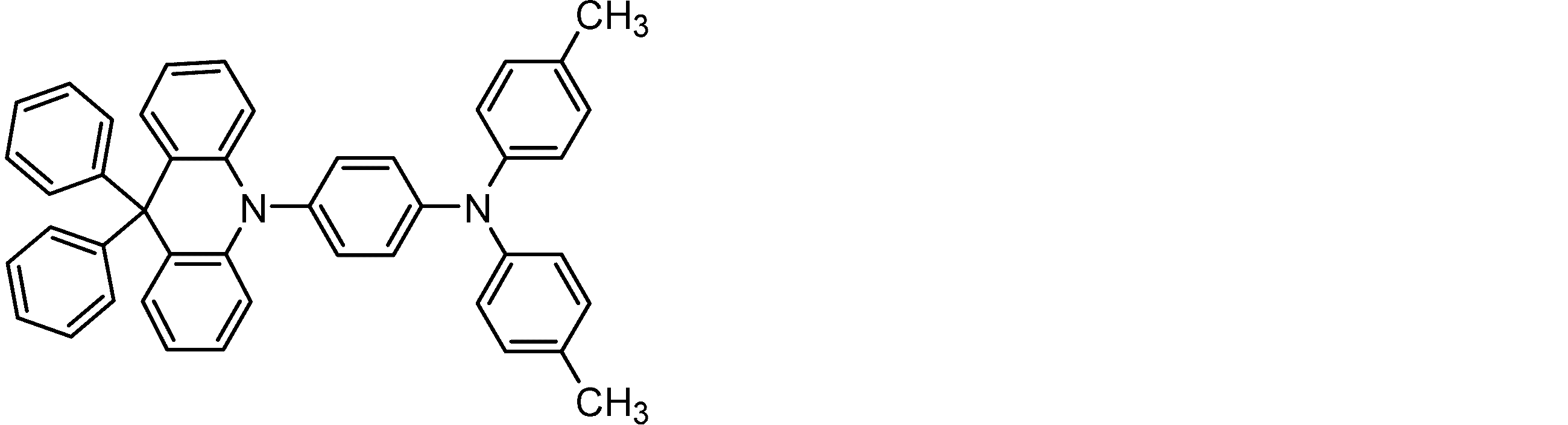
- arylamine compounds having a substituted acridan structure represented by the following formula have been proposed. (For example, see Patent Documents 3 to 5).
- JP-A-8-048656 Japanese Patent No. 3194657 WO2006 / 033563 publication WO2007 / 110228 publication WO 2010/147319
- the object of the present invention is as a highly efficient and durable organic electroluminescent device material, excellent in hole injection / transport performance, electron blocking ability, high stability in a thin film state, and heat resistance It is another object of the present invention to provide an organic compound having excellent characteristics and to provide an organic electroluminescence device having high luminous efficiency and durability using this compound.
- the physical characteristics that the organic compound to be provided by the present invention should have include (1) good hole injection characteristics, (2) high hole mobility, and (3) electron blocking ability. (4) The thin film state is stable, and (5) The heat resistance is excellent.
- the physical characteristics of the organic electroluminescent device to be provided by the present invention include (1) high luminous efficiency and power efficiency, (2) low emission start voltage, and (3) practical use. The drive voltage is low.
- the inventors of the present invention have an aromatic tertiary amine structure having a high hole injection / transport capability, and an indenoacridan ring structure has an electron blocking property.
- a compound having an indenoacridan ring structure is designed and chemically synthesized. As a result of prototyping an electroluminescence element and intensively evaluating the characteristics of the element, the present invention has been completed.
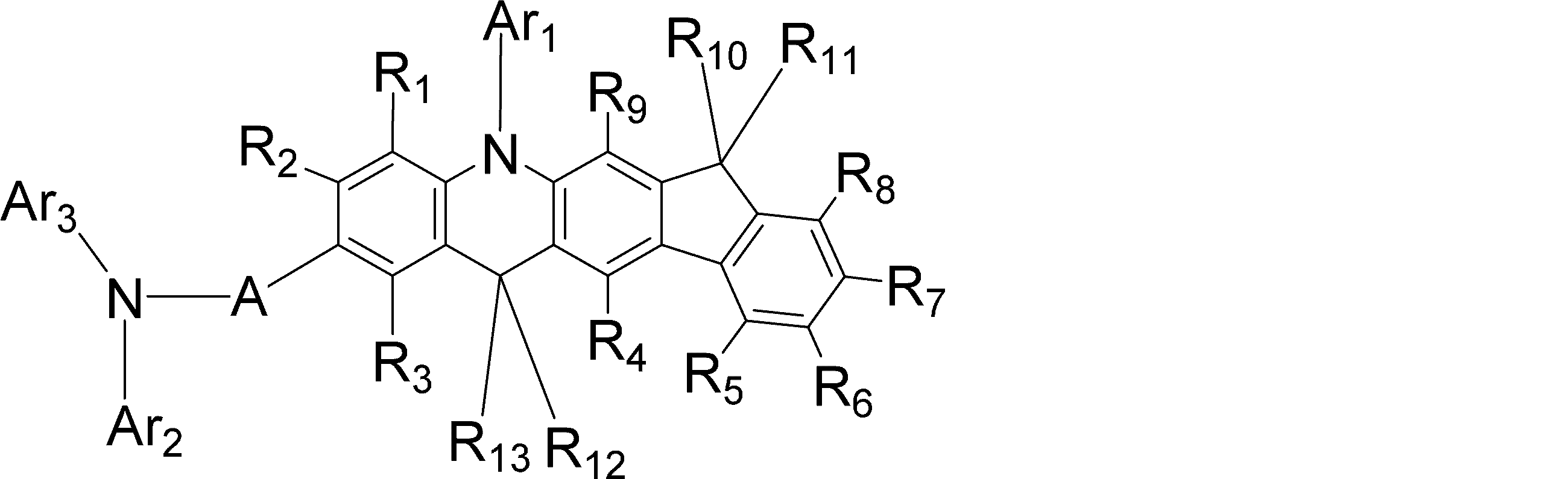
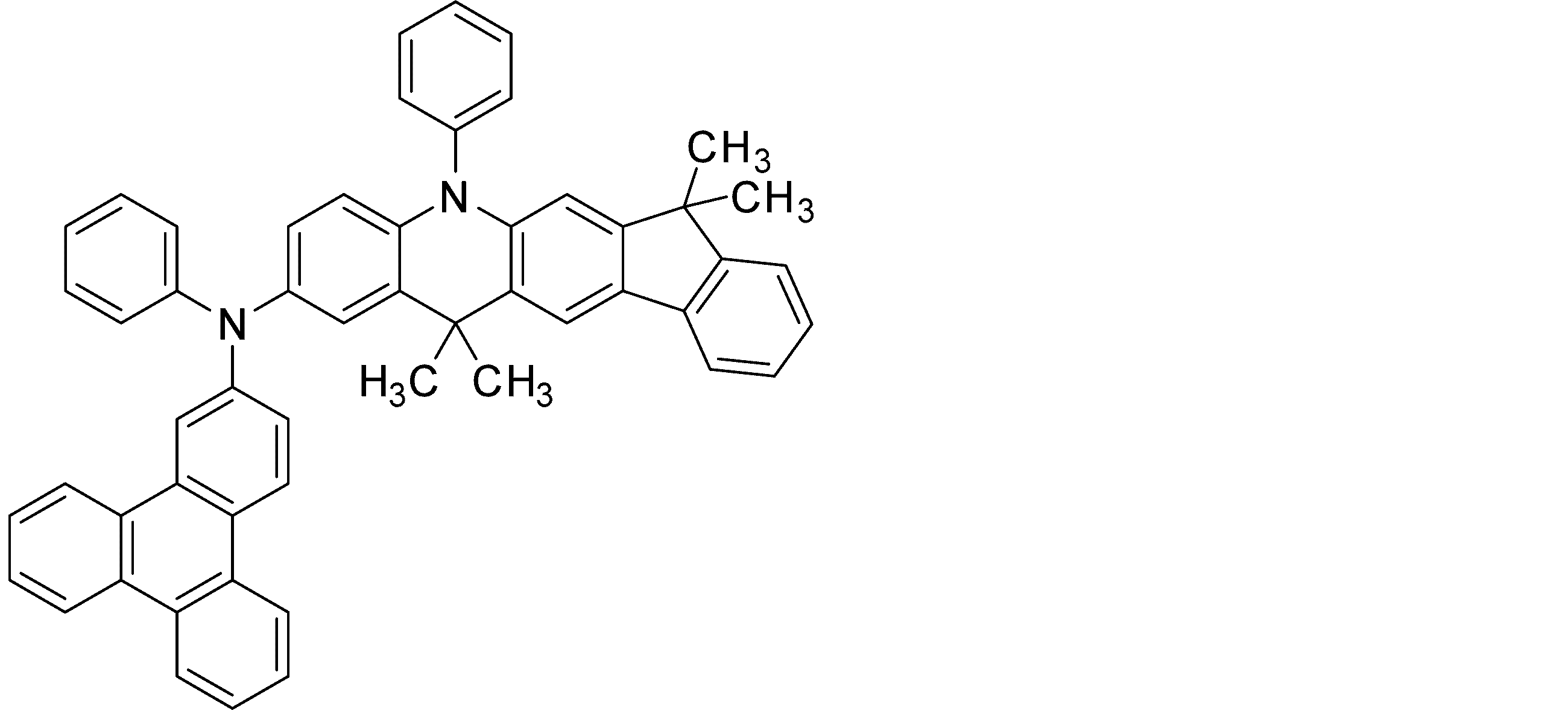
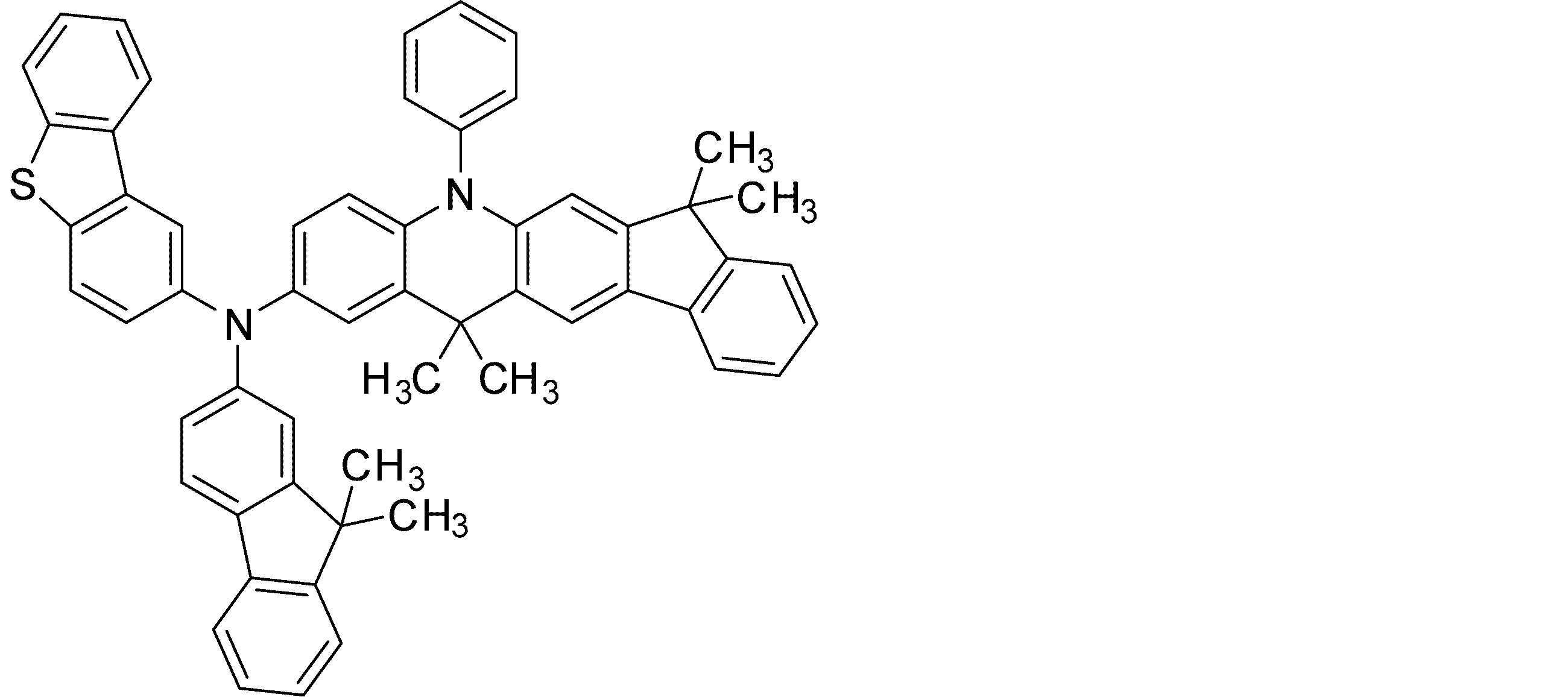
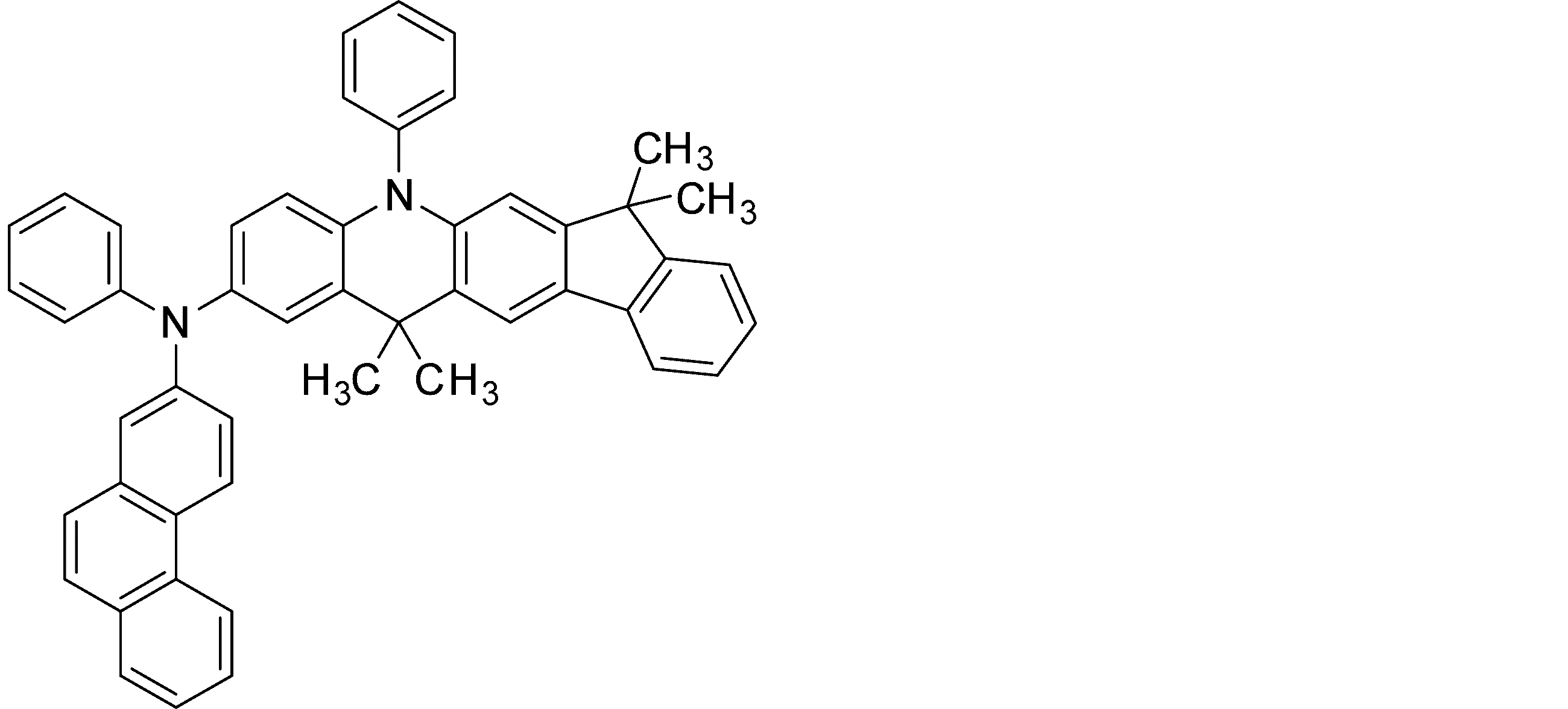
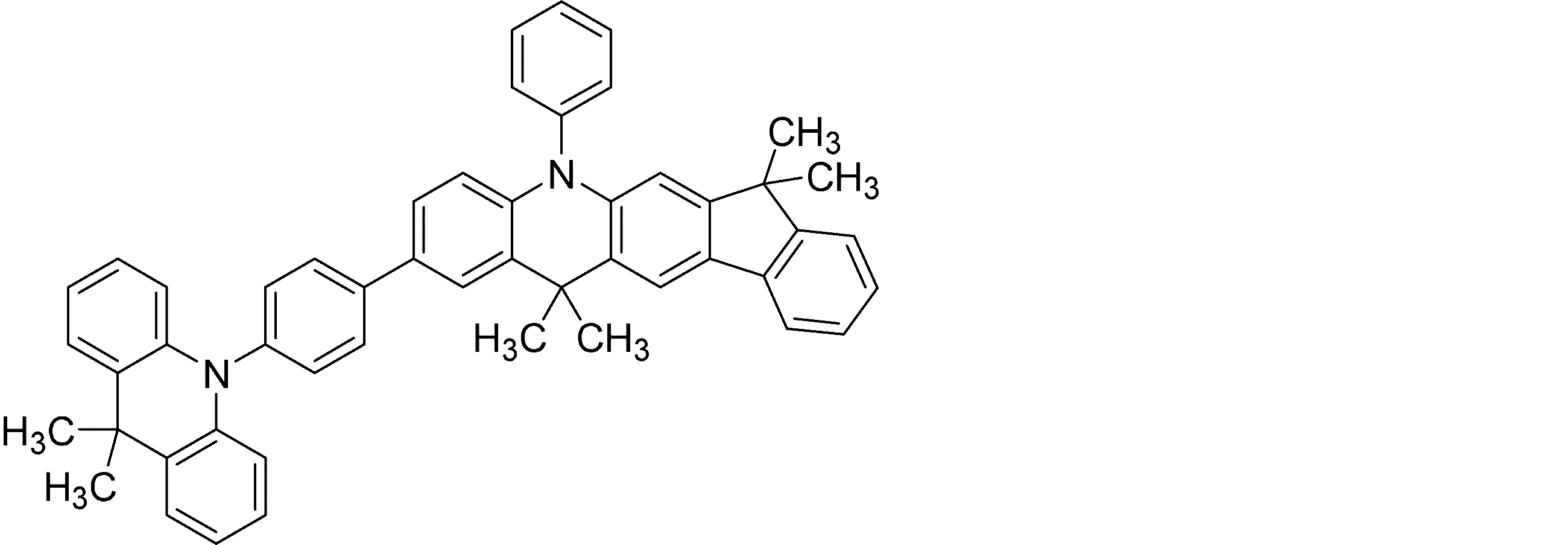
- the present invention is a compound having an indenoacridan ring structure represented by the following general formula (1).
- A represents a substituted or unsubstituted aromatic hydrocarbon, a substituted or unsubstituted aromatic heterocyclic ring or a substituted or unsubstituted condensed polycyclic aromatic divalent group or a single bond
- Ar 1 , Ar 2 , Ar 3 may be the same or different from each other, and represents a substituted or unsubstituted aromatic hydrocarbon group, a substituted or unsubstituted aromatic heterocyclic group or a substituted or unsubstituted condensed polycyclic aromatic group
- Ar 2 and Ar 3 may be bonded to each other via a single bond, a substituted or unsubstituted methylene group, an oxygen atom or a sulfur atom
- R 1 to R 9 may be the same or different from each other.
- the present invention is a compound having an indenoacridan ring structure described in the above 1) represented by the following general formula (1-1).
- A represents a substituted or unsubstituted aromatic hydrocarbon, a substituted or unsubstituted aromatic heterocyclic ring or a substituted or unsubstituted condensed polycyclic aromatic divalent group or a single bond
- Ar 1 , Ar 2 , Ar 3 may be the same or different from each other, and represents a substituted or unsubstituted aromatic hydrocarbon group, a substituted or unsubstituted aromatic heterocyclic group or a substituted or unsubstituted condensed polycyclic aromatic group
- Ar 2 and Ar 3 may be bonded to each other via a single bond, a substituted or unsubstituted methylene group, an oxygen atom or a sulfur atom
- R 1 to R 9 may be the same or different from each other.
- A is a substituted or unsubstituted aromatic hydrocarbon or a substituted or unsubstituted condensed polycyclic aromatic divalent group.
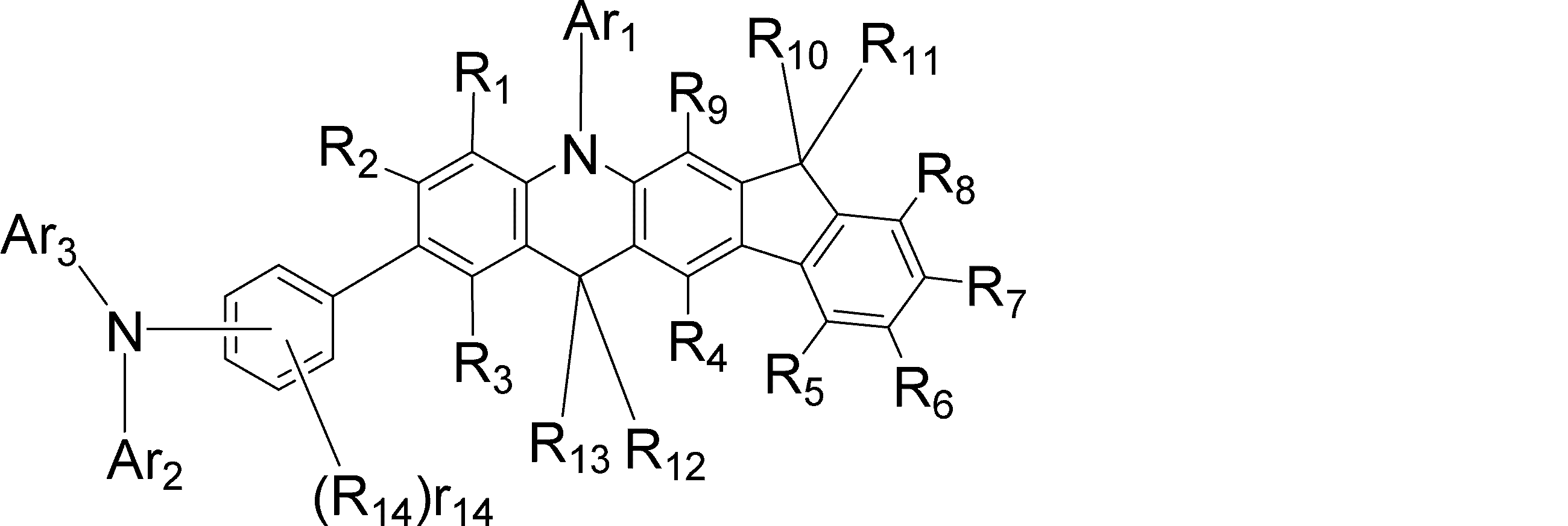
- the present invention also relates to a compound having an indenoacridan ring structure described in the above 3) represented by the following general formula (1-2).
- Ar 1 , Ar 2 and Ar 3 may be the same or different from each other, and are a substituted or unsubstituted aromatic hydrocarbon group, a substituted or unsubstituted aromatic heterocyclic group, or a substituted or unsubstituted condensed group.
- R 1 to R 9 May be the same or different from each other, and may be a hydrogen atom, a deuterium atom, a fluorine atom, a chlorine atom, a cyano group, a nitro group, or a linear or branched chain having 1 to 6 carbon atoms which may have a substituent.
- a branched alkyl group, an optionally substituted cycloalkyl group having 5 to 10 carbon atoms, an optionally substituted straight chain or branched chain having 2 to 6 carbon atoms No A kenyl group, a linear or branched alkyloxy group having 1 to 6 carbon atoms which may have a substituent, and a cycloalkyloxy group having 5 to 10 carbon atoms which may have a substituent a substituted or unsubstituted aromatic hydrocarbon group, a substituted or unsubstituted aromatic heterocyclic group, a substituted or unsubstituted condensed polycyclic aromatic group, or a substituted or unsubstituted aryloxy group, and R 10 R 11 , R 12 and R 13 may be bonded to each other via a single bond, a substituted or unsubstituted methylene group, an oxygen atom or a sulfur atom, and R 14 is a deuterium atom, a fluorine
- r 14 represents 0 or an integer of 1 to 4, and when r 14 is 0, it represents that it is not substituted with R 14 .
- R 14 is a linking group
- r 14 is 1, and the benzene ring to which R 14 is bonded and Ar 2 are a single bond, a substituted or unsubstituted methylene group, an oxygen atom or a sulfur atom. It is bonded to each other to form a ring.
- the present invention is a compound having an indenoacridan ring structure described in the above 3) represented by the following general formula (1-3).
- Ar 1 , Ar 2 and Ar 3 may be the same or different from each other, and are a substituted or unsubstituted aromatic hydrocarbon group, a substituted or unsubstituted aromatic heterocyclic group, or a substituted or unsubstituted condensed group.
- R 1 to R 9 May be the same or different from each other, and may be a hydrogen atom, a deuterium atom, a fluorine atom, a chlorine atom, a cyano group, a nitro group, or a linear or branched chain having 1 to 6 carbon atoms which may have a substituent.
- a branched alkyl group, an optionally substituted cycloalkyl group having 5 to 10 carbon atoms, an optionally substituted straight chain or branched chain having 2 to 6 carbon atoms No A kenyl group, a linear or branched alkyloxy group having 1 to 6 carbon atoms which may have a substituent, and a cycloalkyloxy group having 5 to 10 carbon atoms which may have a substituent a substituted or unsubstituted aromatic hydrocarbon group, a substituted or unsubstituted aromatic heterocyclic group, a substituted or unsubstituted condensed polycyclic aromatic group, or a substituted or unsubstituted aryloxy group, and R 10 R 11 , R 12 and R 13 may be bonded to each other via a single bond, a substituted or unsubstituted methylene group, an oxygen atom or a sulfur atom, and R 14 is a deuterium atom, a fluorine
- r 14 represents 0 or an integer of 1 to 4, and when r 14 is 0, it represents that it is not substituted with R 14 .
- R 14 is a linking group
- r 14 is 1, and the benzene ring to which R 14 is bonded and Ar 2 are a single bond, a substituted or unsubstituted methylene group, an oxygen atom or a sulfur atom. It is bonded to each other to form a ring.
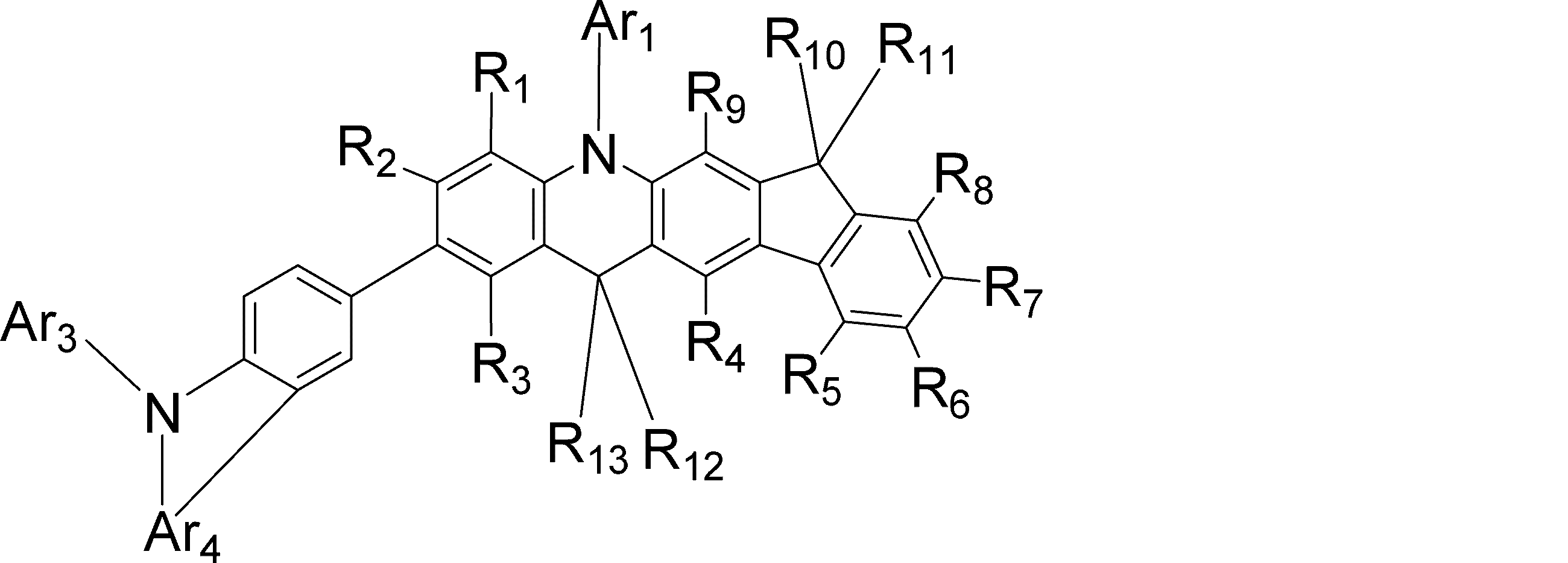
- the present invention is a compound having an indenoacridan ring structure described in the above 4) represented by the following general formula (1-4).
- Ar 1 and Ar 3 may be the same or different from each other, and are substituted or unsubstituted aromatic hydrocarbon groups, substituted or unsubstituted aromatic heterocyclic groups, or substituted or unsubstituted condensed polycyclic aromatics.
- Ar 4 represents a substituted or unsubstituted aromatic hydrocarbon group, a substituted or unsubstituted aromatic heterocyclic group, or a divalent group derived from a substituted or unsubstituted condensed polycyclic aromatic group.
- Ar 3 and Ar 4 may be bonded to each other via a single bond, a substituted or unsubstituted methylene group, an oxygen atom or a sulfur atom, and R 1 to R 9 may be the same or different from each other.
- the present invention is a compound having an indenoacridan ring structure described in the above 4) represented by the following general formula (1-4a).
- Ar 1 and Ar 3 may be the same or different from each other, and are substituted or unsubstituted aromatic hydrocarbon groups, substituted or unsubstituted aromatic heterocyclic groups, or substituted or unsubstituted condensed polycyclic aromatics.
- R 1 to R 9 may be the same or different from each other, and may be a hydrogen atom, a deuterium atom, a fluorine atom, a chlorine atom, a cyano group, a nitro group, or a carbon atom that may have a substituent.
- a linear or branched alkyl group having 1 to 6 carbon atoms, an optionally substituted cycloalkyl group having 5 to 10 carbon atoms, and an optionally substituted carbon atom having 2 to 6 carbon atoms A linear or branched alkenyl group, an optionally substituted linear or branched alkyloxy group having 1 to 6 carbon atoms, and an optionally substituted carbon atom 5 to 10 cycloalkyloxy A group, a substituted or unsubstituted aromatic hydrocarbon group, a substituted or unsubstituted aromatic heterocyclic group, a substituted or unsubstituted condensed polycyclic aromatic group, or a substituted or unsubstituted aryloxy group, which is a single bond May be bonded to each other via a substituted or unsubstituted methylene group, an oxygen atom or a sulfur atom, and R 10 to R 13 may be the same as or different from each other and have a substituent.
- An optionally substituted linear or branched alkyl group having 1 to 6 carbon atoms, an optionally substituted cycloalkyl group having 5 to 10 carbon atoms, and an optionally substituted carbon A linear or branched alkenyl group having 2 to 6 atoms, an optionally substituted linear or branched alkyloxy group having 1 to 6 carbon atoms, or a substituent.
- R 10 and R 11 , R 12 and R 13 may be bonded to each other via a single bond, a substituted or unsubstituted methylene group, an oxygen atom or a sulfur atom to form a ring.
- the present invention is a compound having an indenoacridan ring structure described in the above 4) represented by the following general formula (1-4b).
- Ar 1 and Ar 3 may be the same or different from each other, and are substituted or unsubstituted aromatic hydrocarbon groups, substituted or unsubstituted aromatic heterocyclic groups, or substituted or unsubstituted condensed polycyclic aromatics.
- R 1 to R 9 may be the same or different from each other, and may be a hydrogen atom, a deuterium atom, a fluorine atom, a chlorine atom, a cyano group, a nitro group, or a carbon atom that may have a substituent.
- a linear or branched alkyl group having 1 to 6 carbon atoms, an optionally substituted cycloalkyl group having 5 to 10 carbon atoms, and an optionally substituted carbon atom having 2 to 6 carbon atoms A linear or branched alkenyl group, an optionally substituted linear or branched alkyloxy group having 1 to 6 carbon atoms, and an optionally substituted carbon atom 5 to 10 cycloalkyloxy A group, a substituted or unsubstituted aromatic hydrocarbon group, a substituted or unsubstituted aromatic heterocyclic group, a substituted or unsubstituted condensed polycyclic aromatic group, or a substituted or unsubstituted aryloxy group, which is a single bond May be bonded to each other via a substituted or unsubstituted methylene group, an oxygen atom or a sulfur atom, and R 10 to R 13 may be the same as or different from each other and have a substituent.
- An optionally substituted linear or branched alkyl group having 1 to 6 carbon atoms, an optionally substituted cycloalkyl group having 5 to 10 carbon atoms, and an optionally substituted carbon A linear or branched alkenyl group having 2 to 6 atoms, an optionally substituted linear or branched alkyloxy group having 1 to 6 carbon atoms, or a substituent.
- R 10 and R 11 , R 12 and R 13 may be bonded to each other via a single bond, a substituted or unsubstituted methylene group, an oxygen atom or a sulfur atom to form a ring.
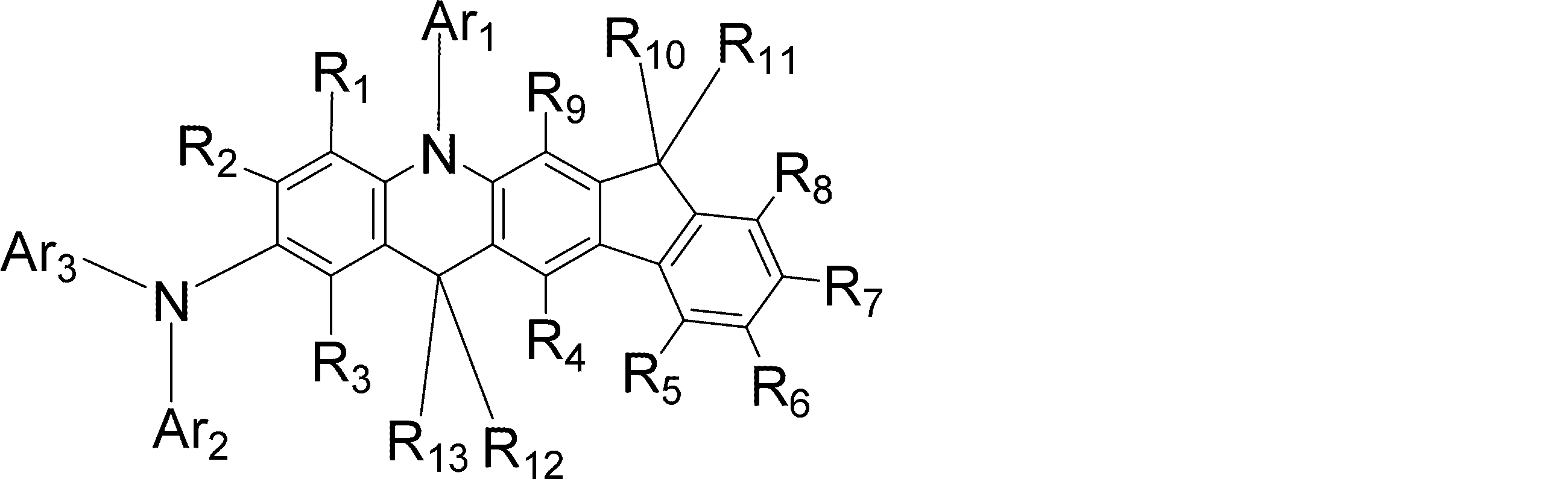
- the present invention is a compound having an indenoacridan ring structure described in the above 1) represented by the following general formula (1-5).
- Ar 1 , Ar 2 and Ar 3 may be the same or different from each other, and are a substituted or unsubstituted aromatic hydrocarbon group, a substituted or unsubstituted aromatic heterocyclic group, or a substituted or unsubstituted condensed group.
- R 1 to R 9 May be the same or different from each other, and may be a hydrogen atom, a deuterium atom, a fluorine atom, a chlorine atom, a cyano group, a nitro group or a linear or branched chain having 1 to 6 carbon atoms which may have a substituent.
- the present invention is a compound having an indenoacridan ring structure represented by the following general formula (1-6).
- Ar 1 , Ar 2 and Ar 3 may be the same or different from each other, and are a substituted or unsubstituted aromatic hydrocarbon group, a substituted or unsubstituted aromatic heterocyclic group, or a substituted or unsubstituted condensed group.
- R 1 to R 9 May be the same or different from each other, and may be a hydrogen atom, a deuterium atom, a fluorine atom, a chlorine atom, a cyano group, a nitro group or a linear or branched chain having 1 to 6 carbon atoms which may have a substituent.
- the compound having an indenoacridan ring structure described in 1) above is at least one organic layer. It is an organic electroluminescent element characterized by being used as a constituent material of a layer.
- this invention is an organic electroluminescent element of said 11) description whose said organic layer is a positive hole transport layer.
- this invention is an organic electroluminescent element of said 11) description whose said organic layer is an electron blocking layer.
- this invention is an organic electroluminescent element of the said 11) description whose said organic layer is a positive hole injection layer.
- this invention is an organic electroluminescent element of the said 11) description whose said organic layer is a light emitting layer.
- substituted or unsubstituted aromatic heterocyclic ring or substituted or unsubstituted condensed polycyclic aromatic divalent group represented by A in the general formula (1) “Aromatic hydrocarbon”, “Aromatic heterocycle” of “Substituted or unsubstituted aromatic hydrocarbon”, “Substituted or unsubstituted aromatic heterocycle” or “Substituted or unsubstituted condensed polycyclic aromatic”
- the “fused polycyclic aromatic specifically, benzene, biphenyl, terphenyl, tetrakisphenyl, styrene, naphthalene, anthracene, acenaphthalene, fluorene, phenanthrene, indane, pyrene, pyridine, pyrimidine, triazine, furan, Pyrrole, thiophene, quinoline, is
- a divalent group of a substituted or unsubstituted aromatic hydrocarbon “a divalent group of a substituted or unsubstituted aromatic heterocycle” represented by A in the general formula (1), or “substituted or unsubstituted "Substituted fused polycyclic aromatic divalent group” represents a divalent group formed by removing two hydrogen atoms from the above “aromatic hydrocarbon", “aromatic heterocycle” or “fused polycyclic aromatic”.
- the “aromatic heterocycle” in the “divalent group of a substituted or unsubstituted aromatic heterocycle” is a sulfur-containing aromatic heterocycle such as thiophene, benzothiophene, benzothiazole, dibenzothiophene, furan, Oxygen-containing aromatic heterocycles such as benzofuran, benzoxazole and dibenzofuran are preferred.
- a divalent group of a substituted or unsubstituted aromatic hydrocarbon” or “a substituted or unsubstituted divalent group of a condensed polycyclic aromatic” is preferable, particularly derived from benzene. Preferred is a divalent group.
- substituted or unsubstituted aromatic hydrocarbon substituted or unsubstituted aromatic heterocyclic ring or substituted or unsubstituted condensed polycyclic aromatic divalent group
- substituted or unsubstituted aromatic heterocyclic ring or substituted or unsubstituted condensed polycyclic aromatic divalent group represented by A in the general formula (1)
- the group may be further substituted by the above-exemplified substituents. These substituents may be bonded to each other via a single bond, a substituted or unsubstituted methylene group, an oxygen atom or a sulfur atom to form a ring.
- Specific examples of the “aromatic hydrocarbon group”, “aromatic heterocyclic group” or “condensed polycyclic aromatic group” in the condensed polycyclic aromatic group of are as follows: phenyl group, biphenylyl group, terphenylyl group, naphthyl Group, anthryl group, phenanthryl group, fluorenyl group, indenyl group, pyrenyl group, perylenyl group, fluoranthenyl group, triphenylenyl group, pyridyl group, furyl group, pyrrolyl group, thienyl group, quinolyl group, isoquinolyl group, benzofuranyl group, benzo Thienyl, ind
- aromatic heterocyclic groups in the “substituted or unsubstituted aromatic heterocyclic group” represented by Ar 1 , Ar 2, Ar 3 in the general formula (1), a thienyl group, benzothienyl Sulfur-containing aromatic heterocyclic groups such as a group, benzothiazolyl group and dibenzothienyl group, or oxygen-containing aromatic heterocyclic rings such as a furyl group, benzofuranyl group, benzoxazolyl group and dibenzofuranyl group are preferable.
- Ar 2 in the general formula (1) is preferably a phenyl group, a naphthyl group, a fluorenyl group, a thienyl group, a benzothienyl group, or a dibenzothienyl group, and particularly preferably a phenyl group or a fluorenyl group.
- the substituent may be further substituted by the above exemplified substituent.
- these substituents or these substituents and Ar 1 , Ar 2, Ar 3 are bonded to each other via a single bond, a substituted or unsubstituted methylene group, an oxygen atom or a sulfur atom to form a ring. May be.
- the divalent group is a divalent group derived from Ar 2 , specifically, 2 derived from the same group as that shown for Ar 2 in the general formula (1). Examples of the substituent that these groups may have can be the same as those described above with respect to Ar 2 . In addition, preferred embodiments can include those similar to those shown for Ar 2 above, and are bonded to each other via Ar 3 through a single bond, a substituted or unsubstituted methylene group, an oxygen atom or a sulfur atom. A ring may be formed.
- a linear or branched alkyl group having 1 to 6 carbon atoms which may have a substituent represented by R 1 to R 9 in the general formula (1), “having a substituent In the “cycloalkyl group having 5 to 10 carbon atoms” or “straight or branched alkenyl group having 2 to 6 carbon atoms which may have a substituent”.
- Examples of “straight or branched alkyl group of 6”, “cycloalkyl group of 5 to 10 carbon atoms” or “straight chain or branched alkenyl group of 2 to 6 carbon atoms” specifically include , Methyl group, ethyl group, n-propyl group, isopropyl group, n-butyl group, isobutyl group, tert-butyl group, n-pentyl group, isopentyl group, neopentyl group, n-hexyl group, cyclopentyl group, cyclo Hexyl group, 1-adamantyl, 2-adamantyl, vinyl group, allyl group, isopropenyl group include a 2-butenyl group, and the like. These groups may be bonded to each other through a single bond, a substituted or unsubstituted methylene group, an oxygen atom or a sulfur atom to form a ring.
- a linear or branched alkyl group having 1 to 6 carbon atoms having a substituent represented by R 1 to R 9 in formula (1), “5 to 10 carbon atoms having a substituent”
- Specific examples of the “substituent” in the “cycloalkyl group of” or “straight-chain or branched alkenyl group having 2 to 6 carbon atoms having a substituent” include a deuterium atom, a cyano group, and a nitro group; Halogen atoms such as fluorine atom, chlorine atom, bromine atom and iodine atom; linear or branched alkyloxy group having 1 to 6 carbon atoms such as methyloxy group, ethyloxy group and propyloxy group; Alkenyl groups; aryloxy groups such as phenyloxy groups and tolyloxy groups; arylalkyloxy groups such as benzyloxy groups and phenethyloxy groups; phenyl groups and bif
- a linear or branched alkyloxy group having 1 to 6 carbon atoms having a substituent represented by R 1 to R 9 in the general formula (1) or “a carbon atom having 5 to 5 carbon atoms having a substituent”
- Specific examples of the “substituent” in “10 cycloalkyloxy groups” include deuterium atom, cyano group, nitro group; halogen atom such as fluorine atom, chlorine atom, bromine atom, iodine atom; methyloxy group, ethyloxy
- a linear or branched alkyloxy group having 1 to 6 carbon atoms such as a propyloxy group; an alkenyl group such as an allyl group; an aryloxy group such as a phenyloxy group or a tolyloxy group; a benzyloxy group or a phenethyloxy group
- Arylalkyloxy groups such as groups; phenyl groups, biphenylyl groups,
- substituents may be further substituted by the substituents exemplified above.
- substituents may be bonded to each other via a single bond, a substituted or unsubstituted methylene group, an oxygen atom or a sulfur atom to form a ring.
- substituted or unsubstituted aromatic hydrocarbon group “substituted or unsubstituted aromatic heterocyclic group” represented by R 1 to R 9 in the general formula (1), or “substituted or unsubstituted condensed hydrocarbon group”
- phenanthryl group fluorenyl group, indenyl group, pyrenyl group, perylenyl group, fluoranthenyl group, triphenylenyl group, pyridyl group, furyl group, pyrrolyl group, thienyl group, quinolyl group, isoquinolyl group, benzofuranyl group, benzothienyl group, Indolyl, carbazolyl, benzoxazolyl, benzothiazolyl, quinoxalyl, benzimidazolyl, Zoriru group include dibenzofuranyl group, dibenzothienyl group, and carbolinyl group and the like.
- the “aromatic heterocyclic group” in the “substituted or unsubstituted aromatic heterocyclic group” represented by R 1 to R 9 in the general formula (1) is a thienyl group, a benzothienyl group, a benzothiazolyl group, a dibenzo Sulfur-containing aromatic heterocyclic groups such as thienyl groups are preferred.
- substituted aromatic hydrocarbon group “substituted aromatic heterocyclic group” or “substituted condensed polycyclic aromatic group” represented by R 1 to R 9 in the general formula (1), Specifically, deuterium atom, trifluoromethyl group, cyano group, nitro group; halogen atom such as fluorine atom, chlorine atom, bromine atom, iodine atom; methyl group, ethyl group, n-propyl group, isopropyl group, a linear or branched alkyl group having 1 to 6 carbon atoms such as n-butyl group, isobutyl group, tert-butyl group, n-pentyl group, isopentyl group, neopentyl group, n-hexyl group; methyloxy group A linear or branched alkyloxy group having 1 to 6 carbon atoms such as ethyloxy group
- substituents may be further substituted with the substituents exemplified above. These substituents may be bonded to each other via a single bond, a substituted or unsubstituted methylene group, an oxygen atom or a sulfur atom to form a ring.
- aryloxy group in the “substituted or unsubstituted aryloxy group” represented by R 1 to R 9 in the general formula (1) include a phenyloxy group, a biphenylyloxy group, a terphenyl group.
- examples thereof include a tolyloxy group, a naphthyloxy group, an anthryloxy group, a phenanthryloxy group, a fluorenyloxy group, an indenyloxy group, a pyrenyloxy group, and a perylenyloxy group.
- These groups may be bonded to each other through a single bond, a substituted or unsubstituted methylene group, an oxygen atom or a sulfur atom to form a ring.
- the "substituent" of the "substituted aryl group” represented by R 1 ⁇ R 9 in the general formula (1) specifically, a deuterium atom, a trifluoromethyl group, a cyano group, a nitro group, fluorine Halogen atoms such as atoms, chlorine atoms, bromine atoms, iodine atoms; methyl group, ethyl group, n-propyl group, isopropyl group, n-butyl group, isobutyl group, tert-butyl group, n-pentyl group, isopentyl group, Linear or branched alkyl group having 1 to 6 carbon atoms such as neopentyl group and n-hexyl group; linear or branched alkyl group having 1 to 6 carbon atoms such as methyloxy group, ethyloxy group and propyloxy group Alkyloxy groups; alkenyl groups such as
- substituents are further substituted by the substituents exemplified above. May be. These substituents may be bonded to each other via a single bond, a substituted or unsubstituted methylene group, an oxygen atom or a sulfur atom to form a ring.
- a linear or branched alkyl group having 1 to 6 carbon atoms which may have a substituent represented by R 10 to R 13 in the general formula (1), “having a substituent In the “cycloalkyl group having 5 to 10 carbon atoms” or “straight or branched alkenyl group having 2 to 6 carbon atoms which may have a substituent”.
- Examples of “straight or branched alkyl group of 6”, “cycloalkyl group of 5 to 10 carbon atoms” or “straight chain or branched alkenyl group of 2 to 6 carbon atoms” specifically include Methyl group, ethyl group, n-propyl group, isopropyl group, n-butyl group, isobutyl group, tert-butyl group, n-pentyl group, isopentyl group, neopentyl group, n-hexyl group, cyclopentyl group, Rohekishiru group, 1-adamantyl, 2-adamantyl, vinyl group, allyl group, isopropenyl group include a 2-butenyl group, and the like. These groups may be bonded to each other through a single bond, a substituted or unsubstituted methylene group, an oxygen atom or a sulfur atom to form a ring.
- a linear or branched alkyl group having 1 to 6 carbon atoms having a substituent represented by R 10 to R 13 in the general formula (1), “5 to 10 carbon atoms having a substituent”
- the “substituent” in the “cycloalkyl group of” or “straight-chain or branched alkenyl group having 2 to 6 carbon atoms” specifically, a deuterium atom, a cyano group, a nitro group; Halogen atoms such as fluorine atom, chlorine atom, bromine atom and iodine atom; linear or branched alkyloxy group having 1 to 6 carbon atoms such as methyloxy group, ethyloxy group and propyloxy group; Alkenyl group; aryloxy group such as phenyloxy group and tolyloxy group; arylalkyloxy group such as benzyloxy group and phenethyloxy group; phenyl group; Aromatic hydrocarbon groups or condensed
- These groups may be bonded to each other through a single bond, a substituted or unsubstituted methylene group, an oxygen atom or a sulfur atom to form a ring.
- a linear or branched alkyloxy group having 1 to 6 carbon atoms having a substituent represented by R 10 to R 13 in the general formula (1) or “a carbon atom having 5 to 5 carbon atoms having a substituent”
- Specific examples of the “substituent” in “10 cycloalkyloxy groups” include deuterium atom, cyano group, nitro group; halogen atom such as fluorine atom, chlorine atom, bromine atom, iodine atom; methyloxy group, ethyloxy
- a linear or branched alkyloxy group having 1 to 6 carbon atoms such as a propyloxy group; an alkenyl group such as an allyl group; an aryloxy group such as a phenyloxy group or a tolyloxy group; a benzyloxy group or a phenethyloxy group
- Arylalkyloxy groups such as a group; phenyl group, biphenylyl group
- substituents may be further substituted by the substituents exemplified above.
- substituents may be bonded to each other via a single bond, a substituted or unsubstituted methylene group, an oxygen atom or a sulfur atom to form a ring.
- aromatic hydrocarbon group aromatic heterocyclic group or “fused polycyclic aromatic group” in the “ring aromatic group”
- These groups may be bonded to each other through a single bond, a substituted or unsubstituted methylene group, an oxygen atom or a sulfur atom to form a ring.
- aromatic heterocyclic group in the “substituted or unsubstituted aromatic heterocyclic group” represented by R 10 to R 13 in the general formula (1) include thienyl group, benzothienyl group, benzothiazolyl group, dibenzo Sulfur-containing aromatic heterocyclic groups such as thienyl groups are preferred.
- substituted aromatic hydrocarbon group “substituted aromatic heterocyclic group” or “substituted condensed polycyclic aromatic group” represented by R 10 to R 13 in the general formula (1), Specifically, deuterium atom, trifluoromethyl group, cyano group, nitro group; halogen atom such as fluorine atom, chlorine atom, bromine atom, iodine atom; methyl group, ethyl group, n-propyl group, isopropyl group, a linear or branched alkyl group having 1 to 6 carbon atoms such as n-butyl group, isobutyl group, tert-butyl group, n-pentyl group, isopentyl group, neopentyl group, n-hexyl group; methyloxy group A linear or branched alkyloxy group having 1 to 6 carbon atoms such as ethyloxy group
- substituents may be further substituted by the above-exemplified substituents. These substituents may be bonded to each other via a single bond, a substituted or unsubstituted methylene group, an oxygen atom or a sulfur atom to form a ring.
- aryloxy group in the “substituted or unsubstituted aryloxy group” represented by R 10 to R 13 in the general formula (1) include a phenyloxy group, a biphenylyloxy group, a terphenyl group.
- examples thereof include a tolyloxy group, a naphthyloxy group, an anthryloxy group, a phenanthryloxy group, a fluorenyloxy group, an indenyloxy group, a pyrenyloxy group, and a perylenyloxy group.
- These groups may be bonded to each other through a single bond, a substituted or unsubstituted methylene group, an oxygen atom or a sulfur atom to form a ring.
- substituted aryloxy group represented by R 10 to R 13 in the general formula (1)
- substituents include deuterium atom, trifluoromethyl group, cyano group, nitro group; fluorine Halogen atoms such as atoms, chlorine atoms, bromine atoms, iodine atoms; methyl group, ethyl group, n-propyl group, isopropyl group, n-butyl group, isobutyl group, tert-butyl group, n-pentyl group, isopentyl group, Linear or branched alkyl group having 1 to 6 carbon atoms such as neopentyl group or n-hexyl group; linear or branched alkyl group having 1 to 6 carbon atoms such as methyloxy group, ethyloxy group or propyloxy group Alkyloxy groups; alkenyl groups such as allyl groups; a
- R 10 to R 13 in the general formula (1) are “an optionally substituted linear or branched alkyl group having 1 to 6 carbon atoms”, “substituted or unsubstituted aromatic group” Group hydrocarbon group "is preferred, methyl group and phenyl group are more preferred, and methyl group is particularly preferred.
- R 14 When there are a plurality of R 14 (when r 14 is 2 or more), a single bond, Alternatively, they may be bonded to each other via an unsubstituted methylene group, an oxygen atom or a sulfur atom to form a ring.
- Specific examples of the cycloalkyloxy group include those similar to those shown for R 1 to R 9 in the general formula (1), and the substituents that these groups may have Examples of the group include the same groups as those described above for R 1 to R 9 . Further, preferred embodiments can include those similar to those shown for R 1 to R 9 above.
- R 14 When there are a plurality of R 14 (when r 14 is 2 or more), a single bond, Alternatively, they may be bonded to each other via an unsubstituted methylene group, an oxygen atom or a sulfur atom to form a ring.
- R 14 When there are a plurality of R 14 (when r 14 is 2 or more), a single bond, Alternatively, they may be bonded to each other via an unsubstituted methylene group, an oxygen atom or a sulfur atom to form a ring.
- the “aryloxy group” in the “substituted or unsubstituted aryloxy group” represented by R 14 in the general formulas (1-2) and (1-3) is specifically the above general formula (1). ) it can be mentioned the same ones as those given for R 1 ⁇ R 9 in, even substituent which may be possessed by these groups, the same as those given for the above R 1 ⁇ R 9 I can give you. Further, preferred embodiments can include those similar to those shown for R 1 to R 9 above. When there are a plurality of R 14 (when r 14 is 2 or more), a single bond, Alternatively, they may be bonded to each other via an unsubstituted methylene group, an oxygen atom or a sulfur atom to form a ring.
- the compound represented by the general formula (1) of the present invention which has an indenoacridan ring structure, is a novel compound, and has an excellent electron blocking ability than a conventional hole transport material, and an excellent amorphous And a thin film state is stable.
- the compound having an indenoacridan ring structure represented by the general formula (1) of the present invention is a hole injection layer and / or a hole transport layer of an organic electroluminescence device (hereinafter abbreviated as an organic EL device). It can be used as a constituent material.
- an organic EL device By using a material with higher hole injection properties, higher mobility, higher electron blocking properties, and higher electron stability than conventional materials, it is possible to confine excitons generated in the light emitting layer.
- the probability of recombination of holes and electrons can be improved, high luminous efficiency can be obtained, the driving voltage is lowered, and the durability of the organic EL element is improved.
- the compound having an indenoacridan ring structure represented by the general formula (1) of the present invention can also be used as a constituent material of an electron blocking layer of an organic EL device.
- the driving voltage is lowered and current resistance is maintained while having high luminous efficiency. Is improved and the maximum light emission luminance of the organic EL element is improved.
- the compound having an indenoacridan ring structure represented by the general formula (1) of the present invention can also be used as a constituent material of a light emitting layer of an organic EL device.
- the material of the present invention which has excellent hole transportability compared to conventional materials and has a wide band gap, is used as a host material for the light-emitting layer, and supports a fluorescent or phosphorescent emitter called a dopant to emit light. By using it as a layer, it has the effect
- the organic EL device of the present invention has a higher hole mobility than that of a conventional hole transport material, an excellent electron blocking ability, an excellent amorphous property, and a stable thin film state. Since a compound having a clidan ring structure is used, high efficiency and high durability can be realized.
- the compound having an indenoacridan ring structure of the present invention is useful as a constituent material of a hole injection layer, a hole transport layer, an electron blocking layer or a light emitting layer of an organic EL device, and has an excellent electron blocking ability.
- the amorphous property is good, the thin film state is stable, and the heat resistance is excellent.
- the organic EL device of the present invention has high luminous efficiency and high power efficiency, which can reduce the practical driving voltage of the device. The emission start voltage can be lowered and the durability can be improved.
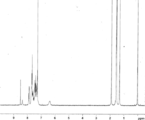
- FIG. 1 is a 1 H-NMR chart of the compound of Example 1 of the present invention (Compound 2).
- FIG. 3 is a 1 H-NMR chart of the compound of Example 2 of the present invention (Compound 3).
- FIG. 3 is a 1 H-NMR chart of the compound of Example 3 of the present invention (Compound 18).
- FIG. 4 is a 1 H-NMR chart of the compound of Example 4 of the present invention (Compound 19).
- FIG. 6 is a diagram showing EL element configurations of Examples 7 to 10 and Comparative Example 1.
- the compound having an indenoacridan ring structure of the present invention is a novel compound, and these compounds can be synthesized as follows, for example.
- methyl 2- (9,9 dimethylfluoren-2-yl) aminobenzoate is synthesized by reaction of methyl 2-aminobenzoate with 9,9-dimethyl-2-iodofluorene and reacted with methylmagnesium chloride.
- 2- ⁇ 2- (9,9-dimethylfluoren-2-yl) amino) phenyl ⁇ propan-2-ol and carrying out a cyclization reaction 7, 7, 13, 13- Tetramethyl-7,13-dihydro-5H-indeno [1,2-b] acridine can be synthesized.
- the indenoacrylic acid of the present invention is obtained by performing a cross-coupling reaction (for example, see Non-Patent Document 6) such as Suzuki coupling with various boronic acids or boronic esters (for example, see Non-Patent Document 5).
- a cross-coupling reaction for example, see Non-Patent Document 6
- Suzuki coupling with various boronic acids or boronic esters
- a compound having a dan ring structure can be synthesized.
- the compound having an acridan ring structure of the present invention can be synthesized as follows.
- the indenoacridan of the present invention is obtained by performing a cross-coupling reaction such as the Buchwald-Hartwig reaction between the bromo-substituted indenoacridan derivative substituted at the 5-position with an aryl group and various diarylamines.
- a compound having a ring structure can be synthesized.
- Tg glass transition point
- work function index of hole transportability
- the glass transition point (Tg) was determined with a high sensitivity differential scanning calorimeter (Bruker AXS, DSC3100SA) using powder.
- the work function was measured using an ionization potential measuring device (PYS-202, manufactured by Sumitomo Heavy Industries, Ltd.) after forming a 100 nm thin film on the ITO substrate.
- PYS-202 manufactured by Sumitomo Heavy Industries, Ltd.
- the structure of the organic EL device of the present invention includes an anode, a hole transport layer, an electron blocking layer, a light-emitting layer, an electron transport layer, and a cathode sequentially on the substrate, and between the anode and the hole transport layer. And those having an electron injection layer between the electron transport layer and the cathode.
- these multilayer structures several organic layers can be omitted.
- a structure having an anode, a hole transport layer, a light-emitting layer, an electron transport layer, and a cathode sequentially on a substrate can be used. .
- an electrode material having a large work function such as ITO or gold is used.
- a hole injection layer of the organic EL device of the present invention in addition to a compound having an indenoacridan ring structure represented by the general formula (1) of the present invention, a porphyrin compound typified by copper phthalocyanine, a starburst type Materials such as triphenylamine derivatives and various triphenylamine tetramers, acceptor heterocyclic compounds such as hexacyanoazatriphenylene, and coating polymer materials can be used. These materials can be formed into a thin film by a known method such as a spin coating method or an ink jet method in addition to a vapor deposition method.
- N, N′-diphenyl-N, N′-di (M-tolyl) benzidine (hereinafter abbreviated as TPD)
- NPD N, N′-diphenyl-N, N′-di ( ⁇ -naphthyl) benzidine
- NPD N, N, N ′
- Benzidine derivatives such as N′-tetrabiphenylylbenzidine, 1,1-bis [4- (di-4-tolylamino) phenyl] cyclohexane (hereinafter abbreviated as TAPC), various triphenylamine trimers and tetramers
- TAPC 1,1-bis [4- (di-4-tolylamino) phenyl] cyclohexane
- PEDOT poly (3,4-ethylenedioxythiophene)
- PSS poly (styrene sulfonate)
- a material that is usually used for the layer is further P-doped with trisbromophenylamine hexachloroantimony or the like, or a TPD structure having a partial structure. Molecular compounds and the like can be used.
- Compounds can be used. These may be formed alone, but may be used as a single layer formed by mixing with other materials, layers formed alone, mixed layers formed, or A stacked structure of layers formed by mixing with a layer formed alone may be used. These materials can be formed into a thin film by a known method such as a spin coating method or an ink jet method in addition to a vapor deposition method.
- the light emitting layer of the organic EL device of the present invention various metal complexes, anthracene derivatives, bisstyrylbenzene derivatives, pyrene derivatives, oxazole derivatives, polyparaphenylene vinylene derivatives, etc., in addition to metal complexes of quinolinol derivatives including Alq 3 can be used.
- the light emitting layer may be composed of a host material and a dopant material.
- the host material in addition to the compound having the indenoacridan ring structure represented by the general formula (1) of the present invention, In addition, thiazole derivatives, benzimidazole derivatives, polydialkylfluorene derivatives, and the like can be used.
- quinacridone coumarin, rubrene, perylene, and derivatives thereof
- benzopyran derivatives rhodamine derivatives, aminostyryl derivatives, and the like
- These may be formed alone, but may be used as a single layer formed by mixing with other materials, layers formed alone, mixed layers formed, or A stacked structure of layers formed by mixing with a layer formed alone may be used.
- a phosphorescent material can be used as the light emitting material.
- a phosphorescent emitter of a metal complex such as iridium or platinum can be used.
- Green phosphorescent emitters such as Ir (ppy) 3
- blue phosphorescent emitters such as FIrpic and FIr6, red phosphorescent emitters such as Btp 2 Ir (acac), and the like are used as host materials.
- carbazole derivatives such as 4,4′-di (N-carbazolyl) biphenyl (hereinafter abbreviated as CBP), TCTA, mCP, etc.
- a compound having the represented indenoacridan ring structure can be used as a hole injection / transport host material.
- a compound having the represented indenoacridan ring structure can be used.
- an electron transporting host material p-bis (triphenylsilyl) benzene (hereinafter abbreviated as UGH2) or 2,2 ′, 2 ′′-(1,3,5-phenylene) -tris (1-phenyl) -1H-benzimidazole) (hereinafter abbreviated as TPBI) can be used, and a high-performance organic electroluminescence device can be produced.
- the phosphorescent light-emitting material into the host material by co-evaporation in the range of 1 to 30 weight percent with respect to the entire light-emitting layer.
- Non-Patent Document 3 a material that emits delayed fluorescence such as CDCB derivatives such as PIC-TRZ, CC2TA, PXZ-TRZ, and 4CzIPN as the light emitting material (see, for example, Non-Patent Document 3).
- CDCB derivatives such as PIC-TRZ, CC2TA, PXZ-TRZ, and 4CzIPN
- These materials can be formed into a thin film by a known method such as a spin coating method or an ink jet method in addition to a vapor deposition method.
- phenanthroline derivatives such as bathocuproine (hereinafter abbreviated as BCP), aluminum (III) bis (2-methyl-8-quinolinato) -4-phenylphenolate (hereinafter referred to as “BCP”).
- BCP bathocuproine
- BCP aluminum (III) bis (2-methyl-8-quinolinato) -4-phenylphenolate
- BCP aluminum (III) bis (2-methyl-8-quinolinato) -4-phenylphenolate
- various rare earth complexes, triazole derivatives, triazine derivatives, oxadiazole derivatives, and the like can be used. These materials may also serve as the material for the electron transport layer.
- These may be formed alone, but may be used as a single layer formed by mixing with other materials, layers formed alone, mixed layers formed, or A stacked structure of layers formed by mixing with a layer formed alone may be used.
- These materials can be formed into a thin film by a known method such as a spin coating method or an ink jet method in addition to a vapor deposition method.
- various metal complexes triazole derivatives, triazine derivatives, oxadiazole derivatives, thiadiazole derivatives, carbodiimide derivatives, quinoxaline, in addition to metal complexes of quinolinol derivatives including Alq 3 and BAlq.
- Derivatives, phenanthroline derivatives, silole derivatives and the like can be used. These may be formed alone, but may be used as a single layer formed by mixing with other materials, layers formed alone, mixed layers formed, or A stacked structure of layers formed by mixing with a layer formed alone may be used. These materials can be formed into a thin film by a known method such as a spin coating method or an ink jet method in addition to a vapor deposition method.
- an alkali metal salt such as lithium fluoride and cesium fluoride
- an alkaline earth metal salt such as magnesium fluoride
- a metal oxide such as aluminum oxide
- an electrode material having a low work function such as aluminum or an alloy having a lower work function such as a magnesium silver alloy, a magnesium indium alloy, or an aluminum magnesium alloy is used as the electrode material.
- the organic layer was collected by cooling to room temperature and extracting with toluene.
- the organic layer was dehydrated with anhydrous magnesium sulfate and then concentrated under reduced pressure to obtain a crude product.
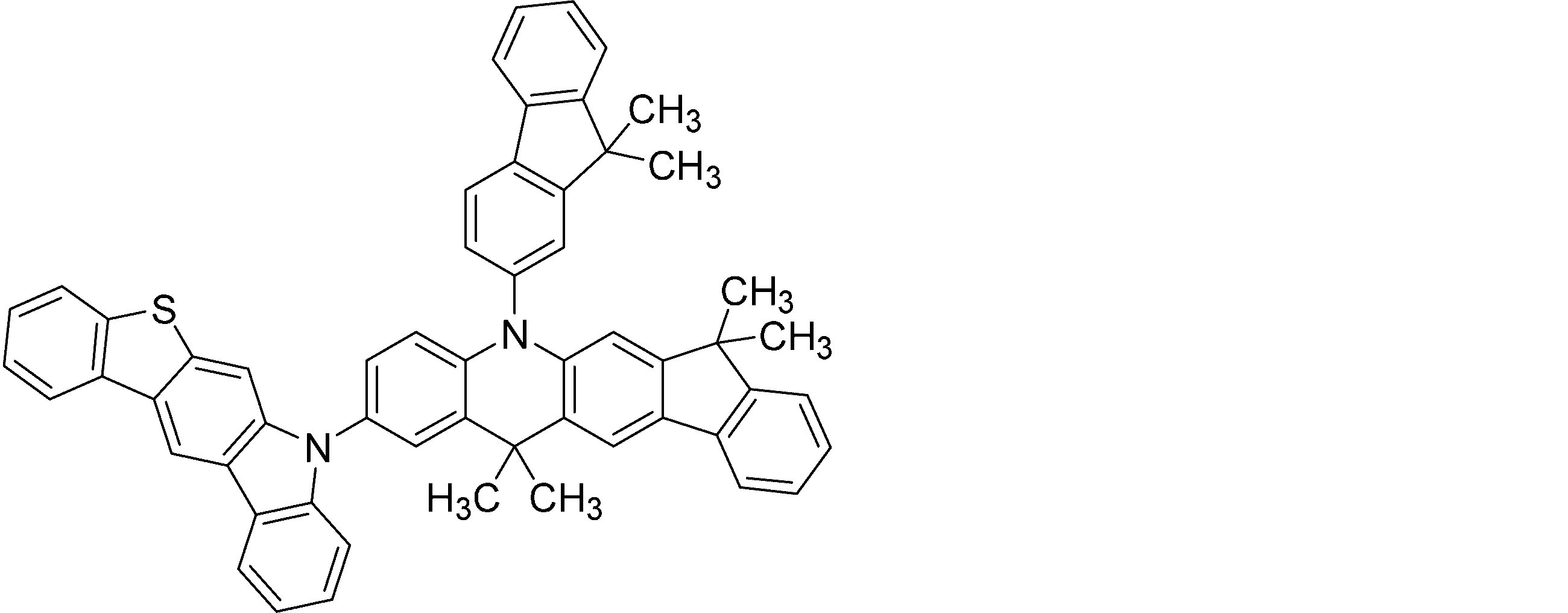
- the crude product was purified by column chromatography (carrier: silica gel, eluent: toluene / n-hexane), and 7,7,13,13-tetramethyl-5-phenyl-2- (9-phenyl-9H-carbazole- 10.2 g (64% yield) of white powder of 3-yl) -7,13-dihydro-5H-indeno [1,2-b] acridine (Compound 2) was obtained.
- Example 2 ⁇ 2- (3,3-Dimethyl-1-phenyl-1,3-dihydroindeno [2,1-b] carbazol-10-yl) -7,7,13,13-tetramethyl-5-phenyl- Synthesis of 7,13-dihydro-5H-indeno [1,2-b] acridine (Compound 3)> 2-Bromo-7,7,13,13-tetramethyl-5-phenyl-7,13-dihydro-5H-indeno [1,2-b] acridine 8.4 g, 3,3-synthesized in Example 1 7.
- the organic layer was dehydrated with anhydrous magnesium sulfate and then concentrated under reduced pressure to obtain a crude product.
- the crude product was purified by column chromatography (carrier: silica gel, eluent: methylene chloride / n-hexane) to give 2- (3,3-dimethyl-1-phenyl-1,3-dihydroindeno [2,1- b] carbazol-10-yl) -7,7,13,13-tetramethyl-5-phenyl-7,13-dihydro-5H-indeno [1,2-b] acridine white powder 8.6 g (yield) 65%) was obtained.
- Tetrakis (triphenylphosphine) palladium (1.0 g) was added to a reaction vessel purged with nitrogen, heated, and stirred at 72 ° C. for 4 hours. The organic layer was collected by cooling to room temperature and extracting with toluene. The organic layer was dehydrated with anhydrous magnesium sulfate and then concentrated under reduced pressure to obtain a crude product.
- Tetrakis (triphenylphosphine) palladium 0.7g was added and heated, and it stirred at 72 degreeC for 4 hours.
- the organic layer was collected by cooling to room temperature and extracting with toluene.
- the organic layer was dehydrated with anhydrous magnesium sulfate and then concentrated under reduced pressure to obtain a crude product.
- Example 5 About the compound of this invention, the glass transition point was calculated
- the compound of the present invention has a glass transition point of 100 ° C. or higher, which indicates that the thin film state is stable in the compound of the present invention.
- Example 6 Using the compound of the present invention, a deposited film having a thickness of 100 nm was formed on an ITO substrate, and the work function was measured with an ionization potential measuring device (PYS-202, manufactured by Sumitomo Heavy Industries, Ltd.). Work Function Compound of Invention Example 1 5.48 eV Inventive Example 2 Compound 5.50 eV Inventive Example 3 Compound 5.45 eV Inventive Example 4 Compound 5.41 eV
- the compound of the present invention exhibits a suitable energy level as compared with the work function 5.54 eV of general hole transport materials such as NPD and TPD, and has a good hole transport capability.
- the organic EL element has a hole injection layer 3, a hole transport layer 4, a light emitting layer 5, and an electron transport layer on a glass substrate 1 on which an ITO electrode is previously formed as a transparent anode 2. 6, an electron injection layer 7 and a cathode (aluminum electrode) 8 were deposited in this order.
- the glass substrate 1 on which ITO having a thickness of 150 nm was formed was washed with an organic solvent, and then the surface was washed by oxygen plasma treatment. Then, this glass substrate with an ITO electrode was mounted in a vacuum vapor deposition machine and the pressure was reduced to 0.001 Pa or less. Subsequently, a compound 41 having the following structural formula was formed to a thickness of 20 nm as the hole injection layer 3 so as to cover the transparent anode 2. On this hole injection layer 3, the compound (compound 2) of Example 1 of the present invention was formed as a hole transport layer 4 so as to have a film thickness of 40 nm.
- On this emitting layer 5 was formed to have the Alq 3 film thickness 30nm as an electron transport layer 6.
- lithium fluoride was formed as the electron injection layer 7 so as to have a film thickness of 0.5 nm.
- aluminum was deposited to a thickness of 150 nm to form the cathode 8.
- the characteristic measurement was performed at normal temperature in air
- Example 8 In Example 7, the compound (Compound 3) of Example 2 of the present invention was formed so as to have a film thickness of 40 nm in place of the compound (Compound 2) of Example 1 of the present invention as the material of the hole transport layer 4. An organic EL element was produced under the same conditions. About the produced organic EL element, the characteristic measurement was performed at normal temperature in air
- Example 9 In Example 7, the compound (Compound 18) of Example 3 of the present invention was formed so as to have a film thickness of 40 nm instead of the compound (Compound 2) of Example 1 of the present invention as the material of the hole transport layer 4.
- An organic EL element was produced under the same conditions. About the produced organic EL element, the characteristic measurement was performed at normal temperature in air
- Example 10 In Example 7, the compound (Compound 19) of Example 4 of the present invention was formed so as to have a film thickness of 40 nm instead of the compound (Compound 2) of Example 1 of the present invention as the material for the hole transport layer 4.
- An organic EL element was produced under the same conditions. About the produced organic EL element, the characteristic measurement was performed at normal temperature in air
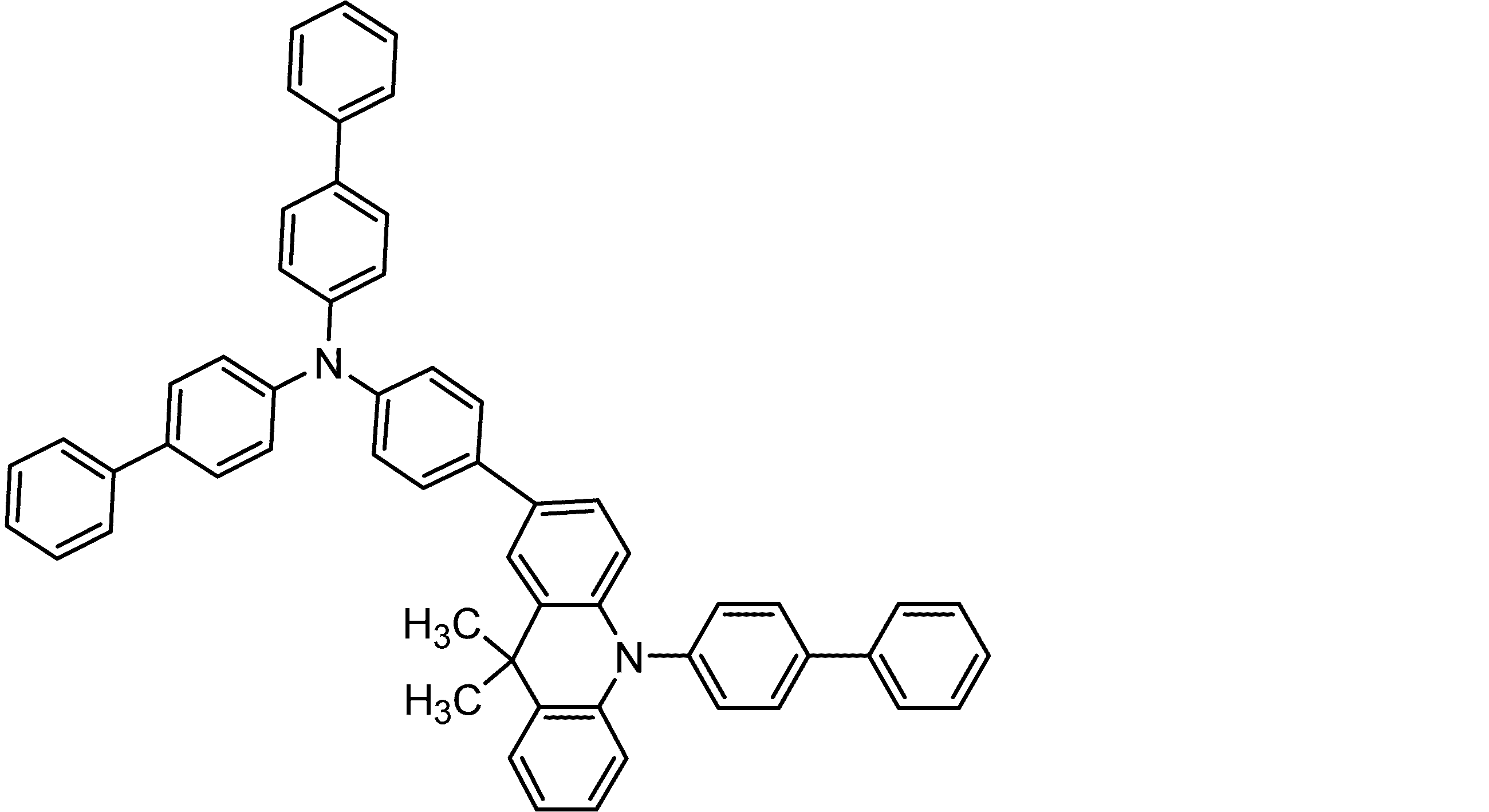
- Example 7 For comparison, in Example 7, except that the compound 44 of the following structural formula was formed to a film thickness of 40 nm instead of the compound of Example 1 of the present invention (Compound 2) as the material of the hole transport layer 4.
- An organic EL element was produced under the same conditions. About the produced organic EL element, the characteristic measurement was performed at normal temperature in air
- the driving voltage when a current density of 10 mA / cm 2 was passed was 5.17 V of the organic EL device using the compound 44, and the compounds of Examples 1 to 4 of the present invention were used. In the organic EL elements using 2, 3, 18, and 19, all voltages were lowered to 4.89 to 5.07 V. In addition, in terms of power efficiency, the organic EL device using the compounds 2, 3, 18, and 19 of Examples 1 to 4 of the present invention compared to 5.49 lm / W of the organic EL device using the compound 44, All were significantly improved from 6.09 to 6.45 lm / W.
- the organic EL device using the compound having an indenoacridan ring structure according to the present invention has improved power efficiency compared with the known organic EL device using the compound 44. It was also found that a decrease in practical driving voltage can be achieved.
- the compound having an indenoacridan ring structure of the present invention is excellent as a compound for an organic EL device because it has a high hole transport ability, an excellent electron blocking ability, an excellent amorphous property, and a stable thin film state. ing.
- an organic EL device using the compound, high luminous efficiency and power efficiency can be obtained, practical driving voltage can be lowered, and durability can be improved. For example, it has become possible to develop home appliances and lighting.
Landscapes
- Chemical & Material Sciences (AREA)
- Organic Chemistry (AREA)
- Engineering & Computer Science (AREA)
- Materials Engineering (AREA)
- Physics & Mathematics (AREA)
- Spectroscopy & Molecular Physics (AREA)
- Electroluminescent Light Sources (AREA)
- Plural Heterocyclic Compounds (AREA)
Abstract
Description
そして、熱活性化遅延蛍光(TADF)による発光を利用する素子も開発されている。2011年に九州大学の安達らは、熱活性化遅延蛍光材料を用いた素子によって5.3%の外部量子効率を実現させた(例えば、非特許文献3参照)。




そして、一般式(1)中のAで表される「置換もしくは無置換の芳香族炭化水素の2価基」、「置換もしくは無置換の芳香族複素環の2価基」または「置換もしくは無置換の縮合多環芳香族の2価基」は、上記「芳香族炭化水素」、「芳香族複素環」または「縮合多環芳香族」から水素原子を2個取り除いてできる2価基を表す。
ここで、「置換もしくは無置換の芳香族複素環の2価基」における「芳香族複素環」としては、チオフェン、ベンゾチオフェン、ベンゾチアゾール、ジベンゾチオフェンなどの含硫黄芳香族複素環または、フラン、ベンゾフラン、ベンゾオキサゾール、ジベンゾフランなどの含酸素芳香族複素環が好ましい。
一般式(1)中のAとしては、「置換もしくは無置換の芳香族炭化水素の2価基」または「置換もしくは無置換の縮合多環芳香族の2価基」が好ましく、特にベンゼンから誘導される2価基が好ましい。
また、これらの置換基同士が単結合、置換もしくは無置換のメチレン基、酸素原子または硫黄原子を介して互いに結合して環を形成していてもよい。
ここで、一般式(1)中のAr1、Ar2、Ar3で表される「置換もしくは無置換の芳香族複素環基」における「芳香族複素環基」としては、チエニル基、ベンゾチエニル基、ベンゾチアゾリル基、ジベンゾチエニル基などの含硫黄芳香族複素環基または、フリル基、ベンゾフラニル基、ベンゾオキサゾリル基、ジベンゾフラニル基などの含酸素芳香族複素環が好ましい。
一般式(1)中のAr2としては、フェニル基、ナフチル基、フルオレニル基、チエニル基、ベンゾチエニル基、ジベンゾチエニル基が好ましく、フェニル基、フルオレニル基が特に好ましい。
一般式(1)中のR1~R9で表される「置換もしくは無置換の芳香族複素環基」における「芳香族複素環基」としては、チエニル基、ベンゾチエニル基、ベンゾチアゾリル基、ジベンゾチエニル基などの含硫黄芳香族複素環基が好ましい。
一般式(1)中のR10~R13で表される「置換もしくは無置換の芳香族複素環基」における「芳香族複素環基」としては、チエニル基、ベンゾチエニル基、ベンゾチアゾリル基、ジベンゾチエニル基などの含硫黄芳香族複素環基が好ましい。
さらに、種々のボロン酸またはボロン酸エステル(例えば、非特許文献5参照)とのSuzukiカップリングなどのクロスカップリング反応(例えば、非特許文献6参照)を行うことによって、本発明のインデノアクリダン環構造を有する化合物を合成することができる。
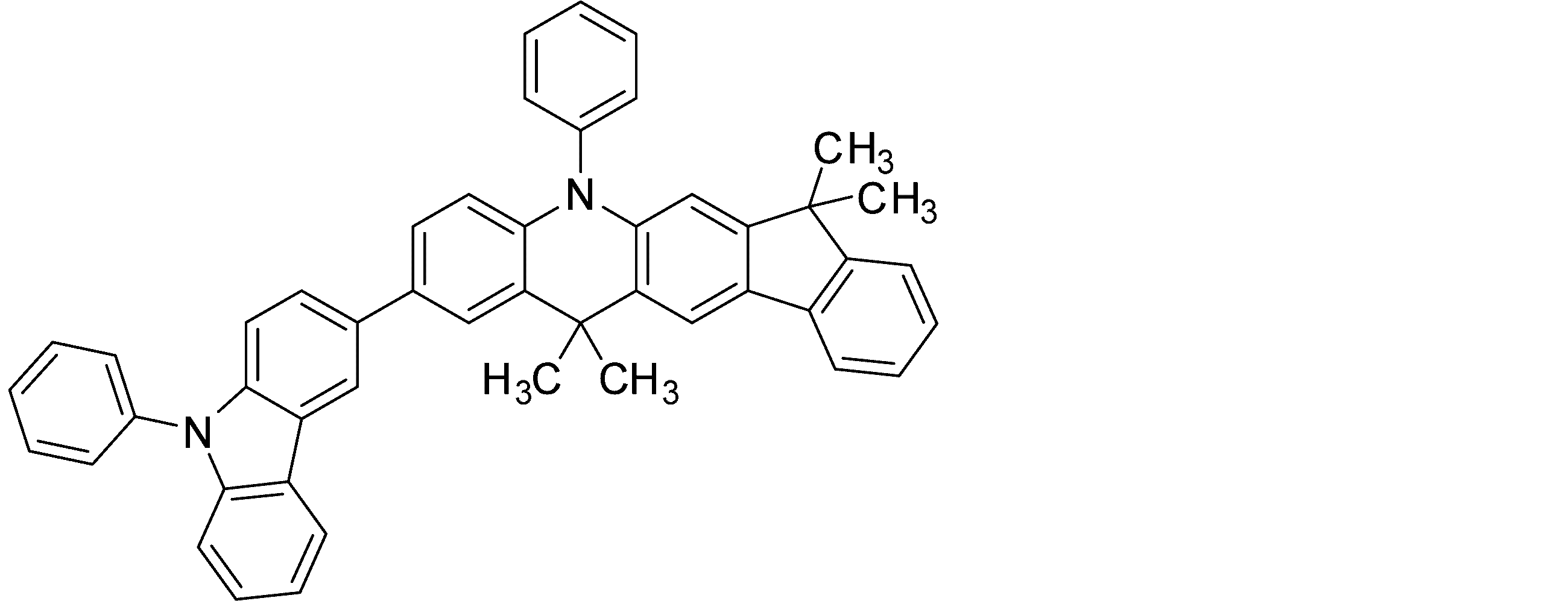

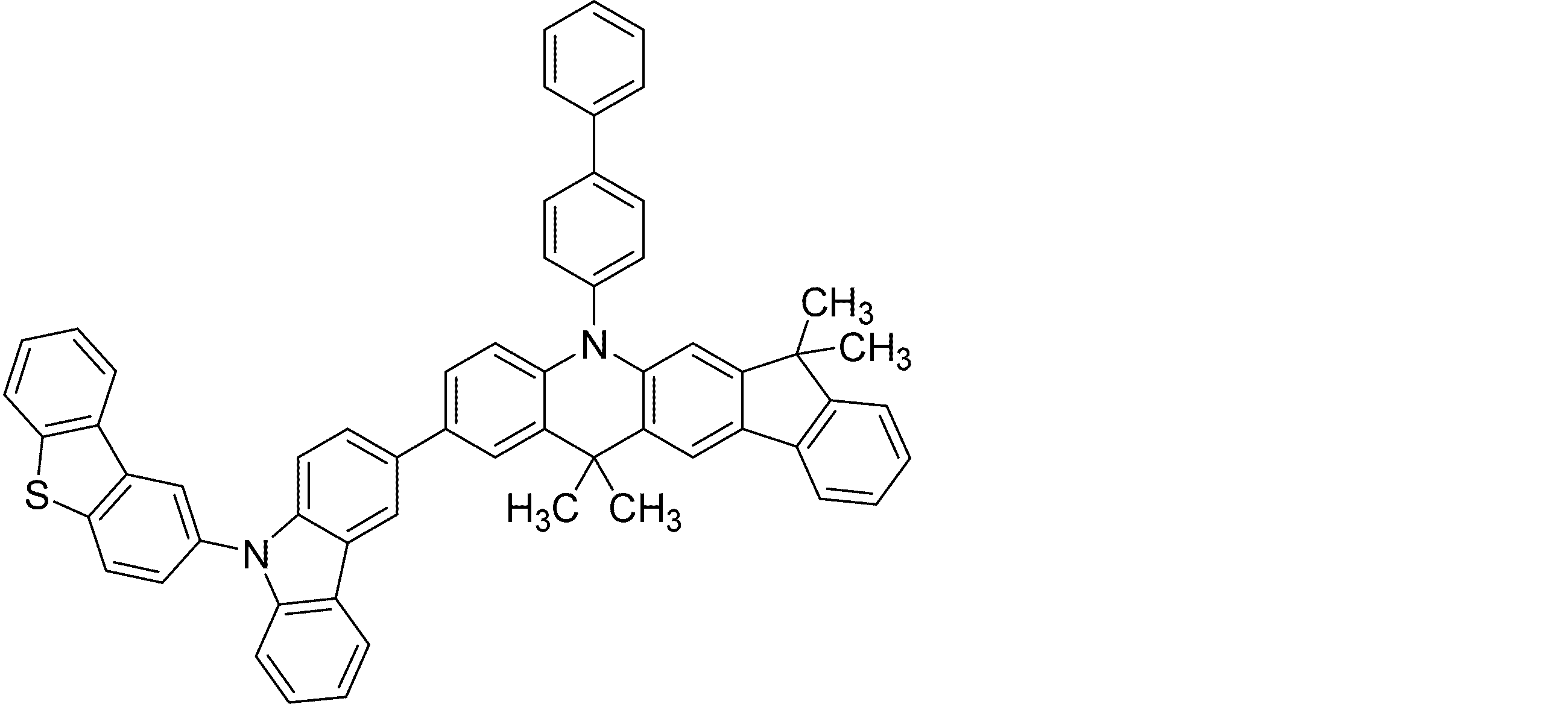


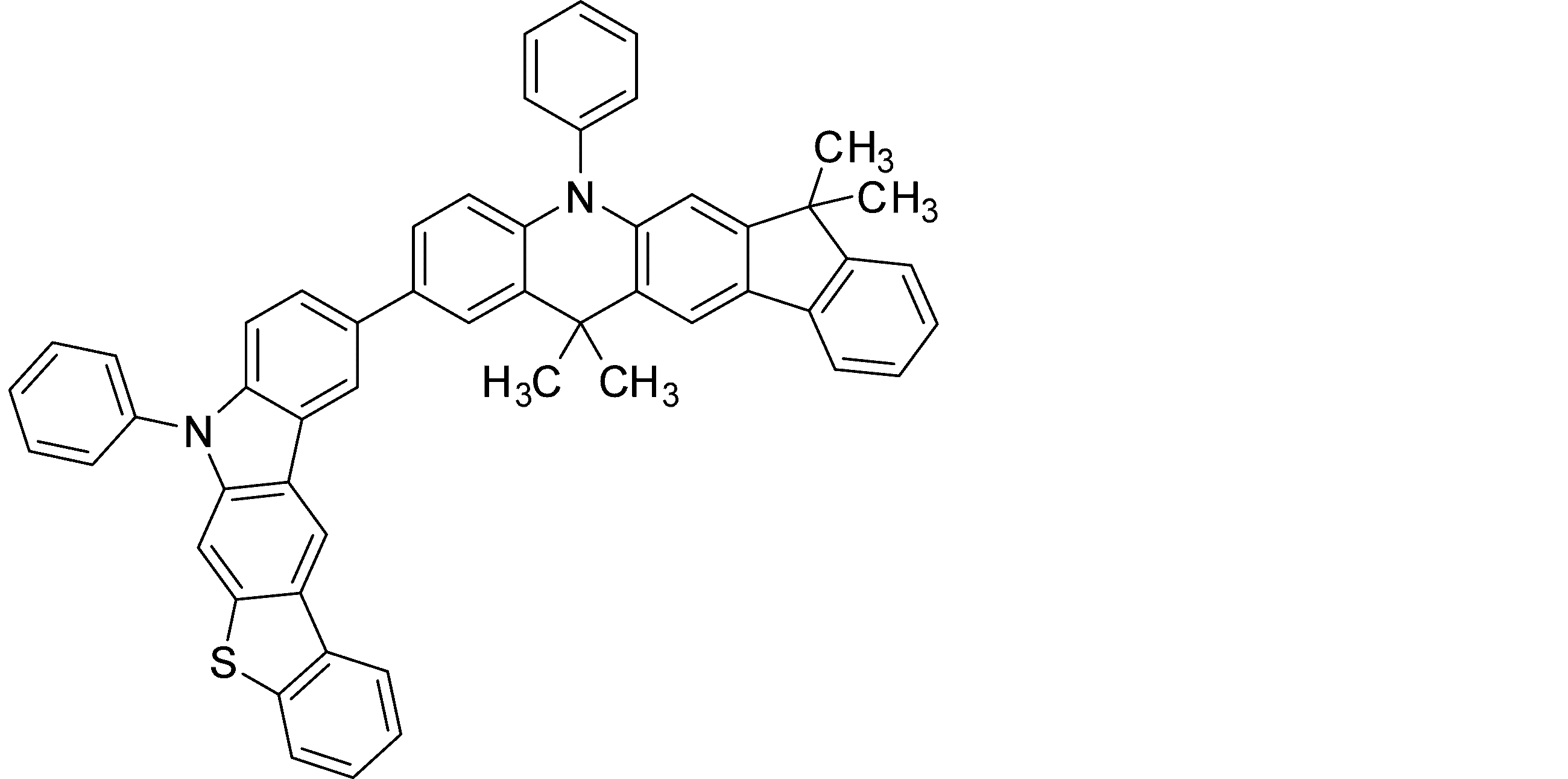
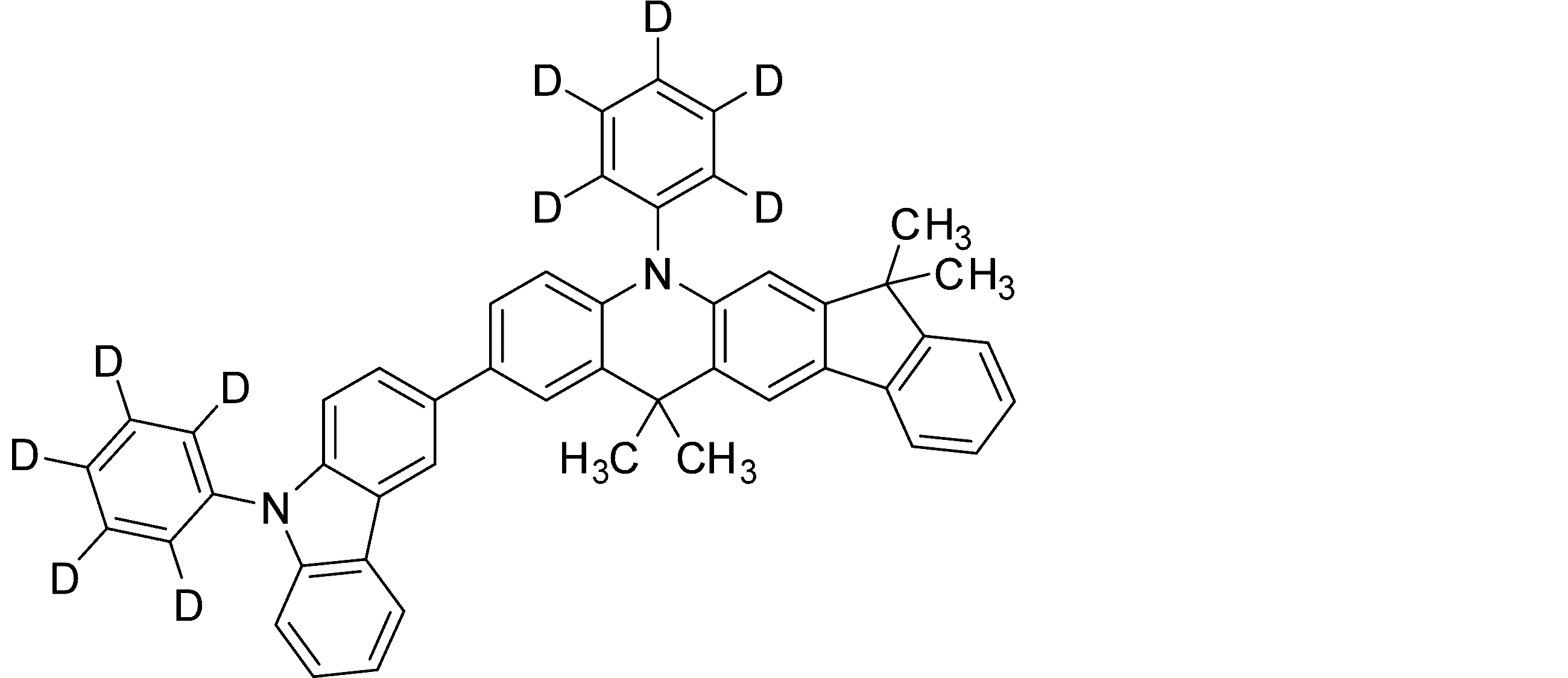
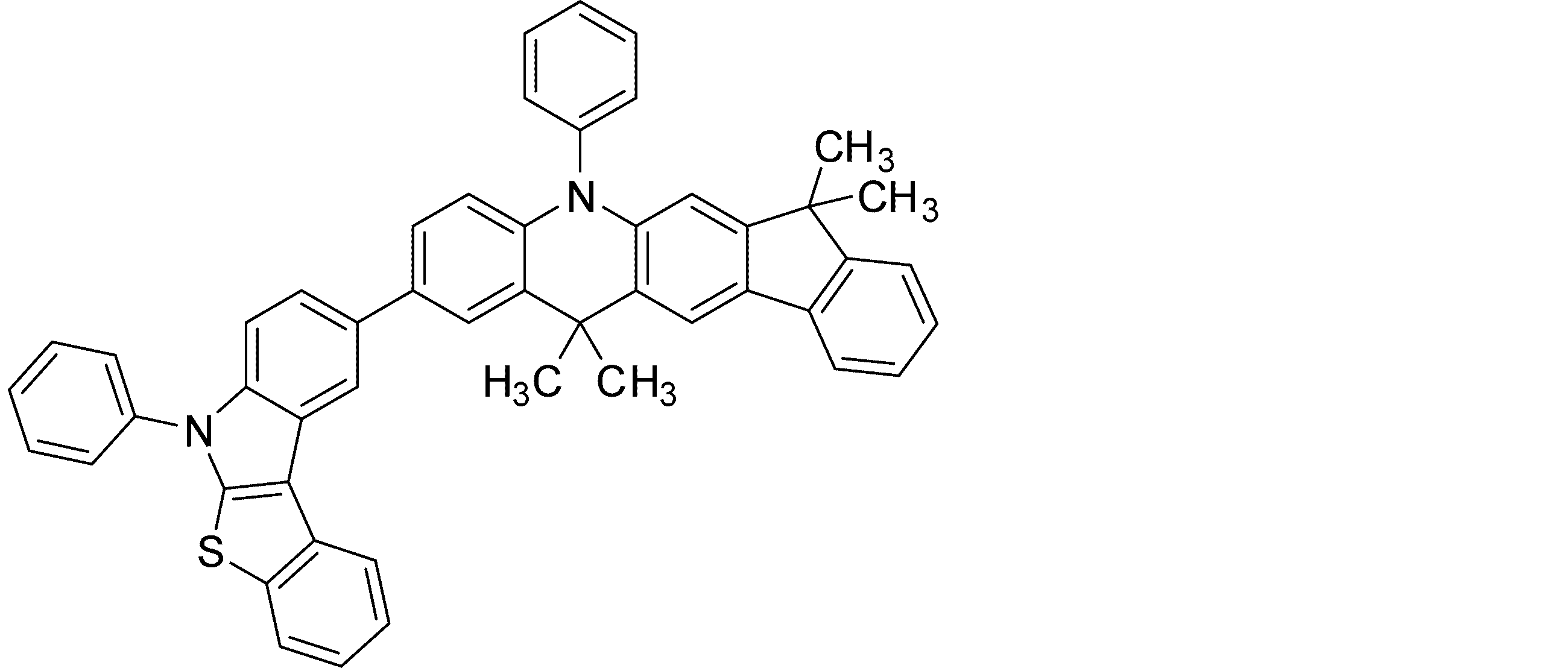


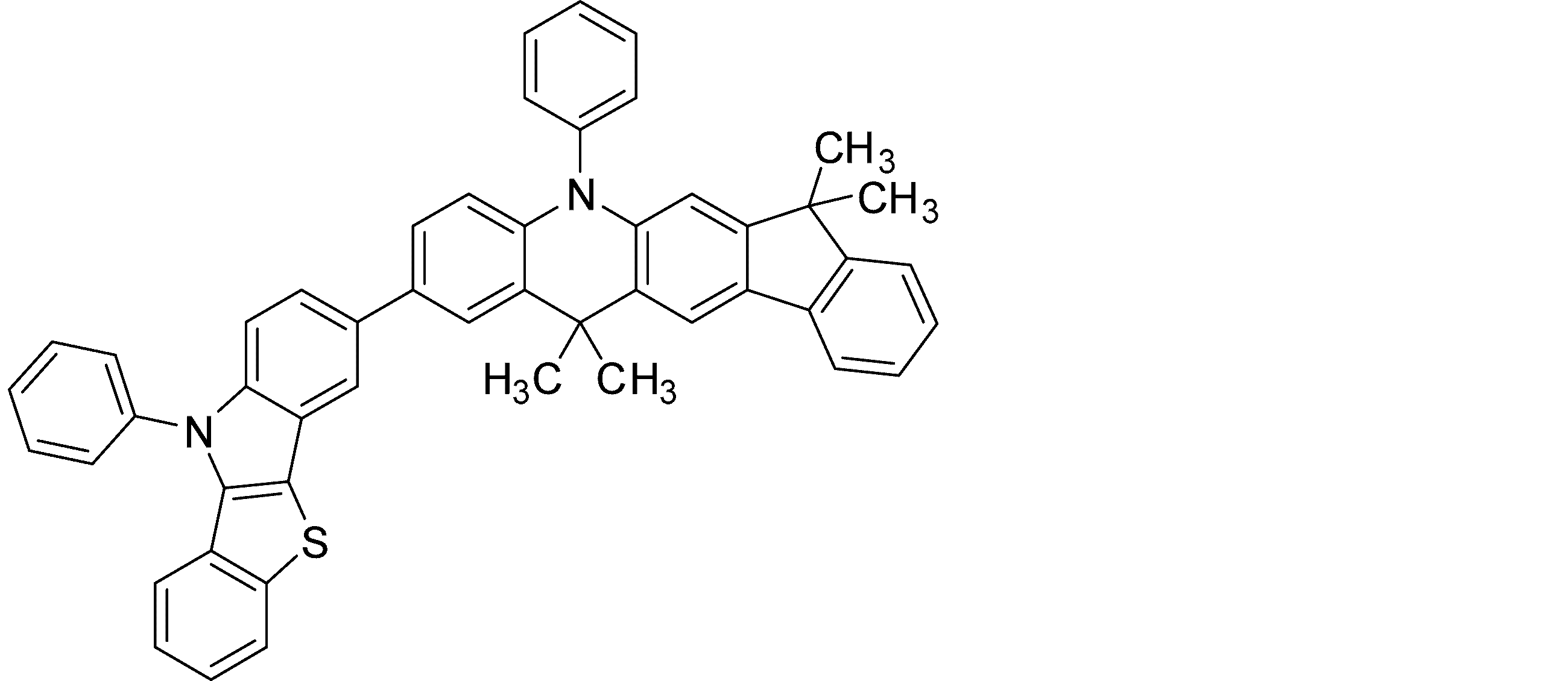
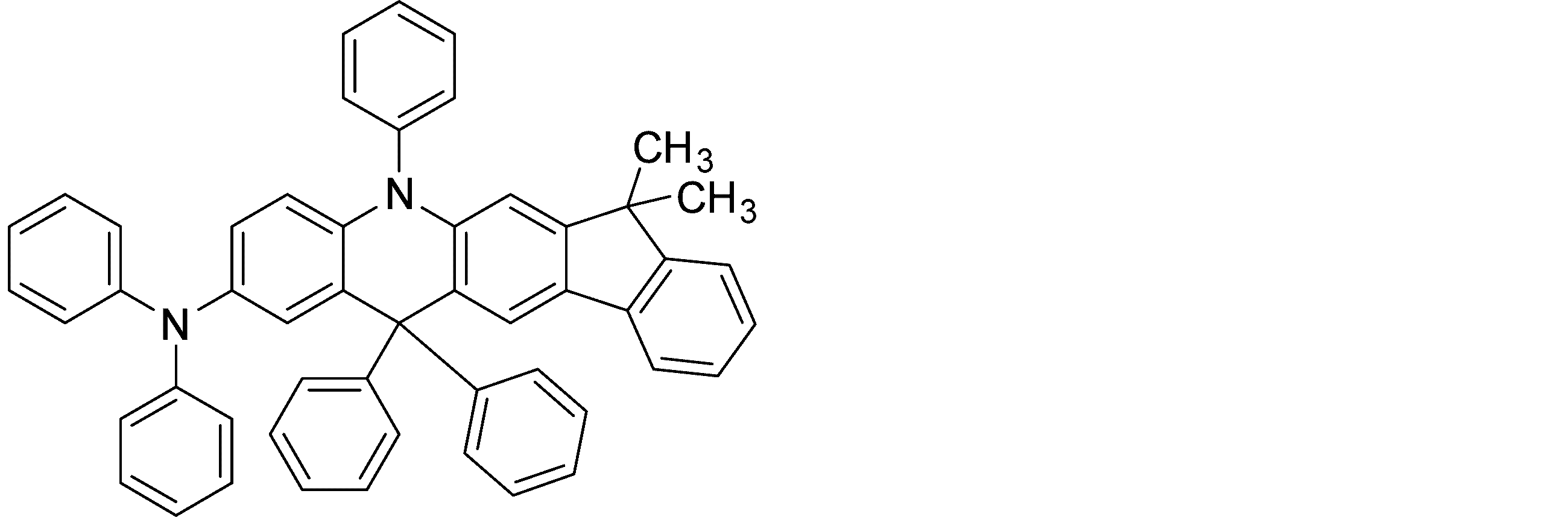


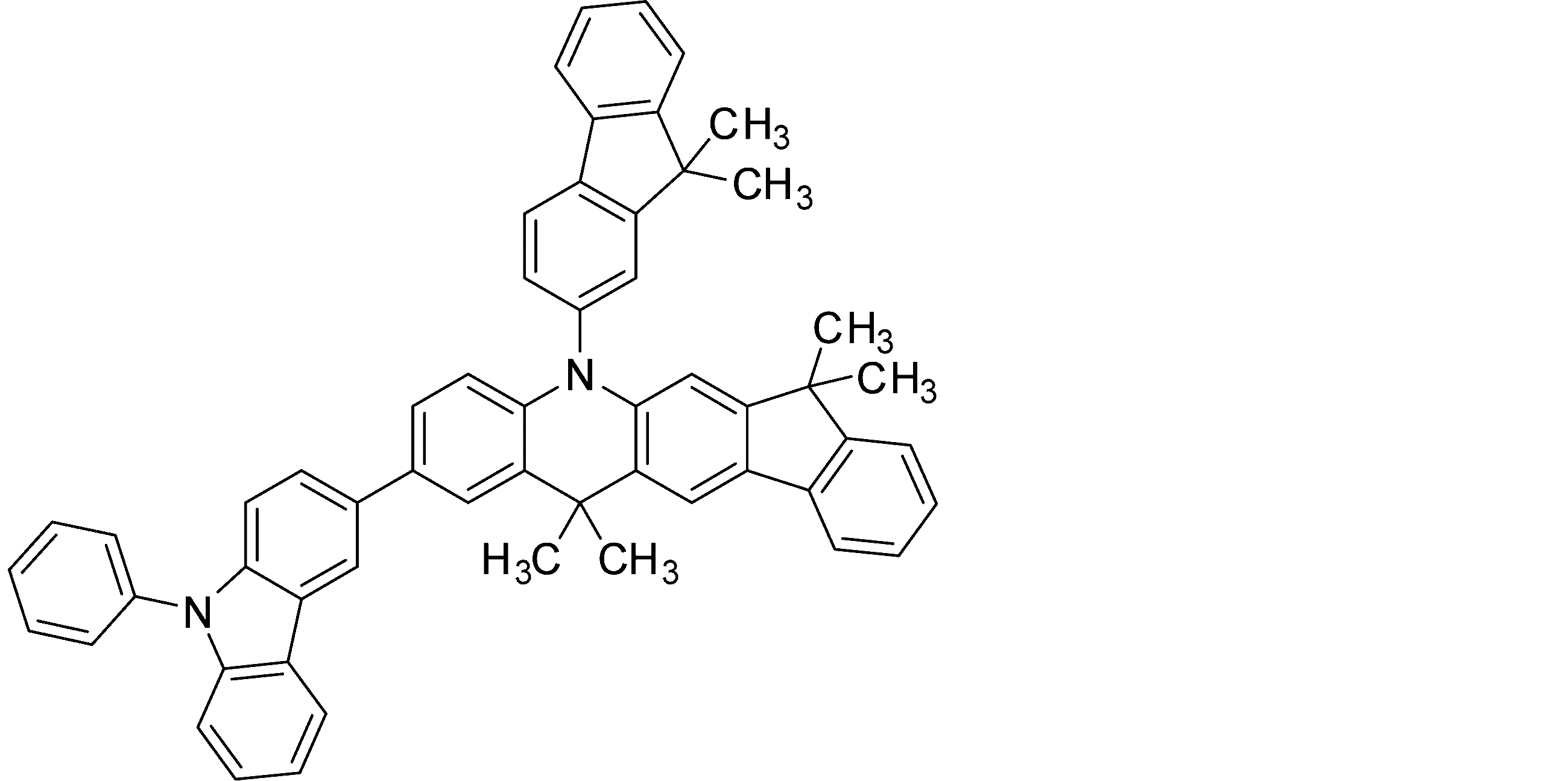


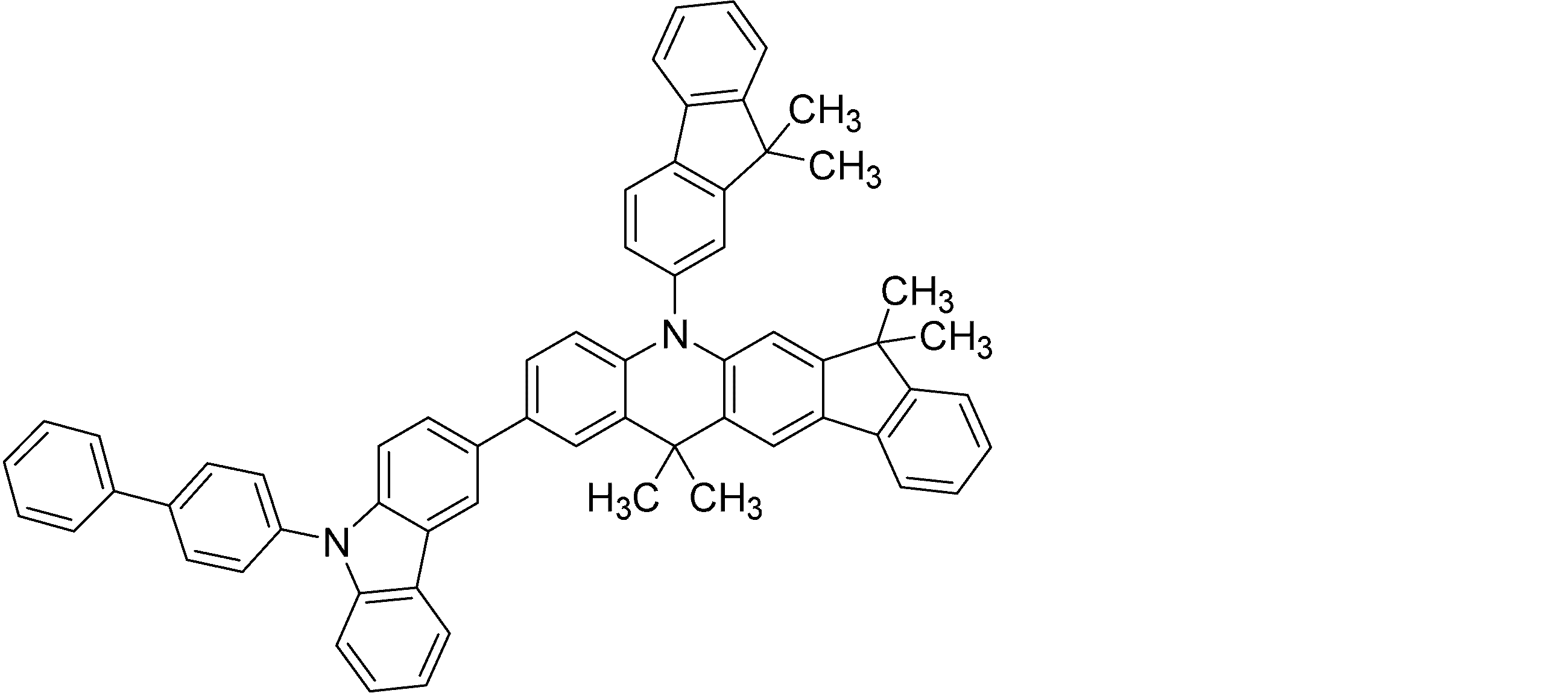



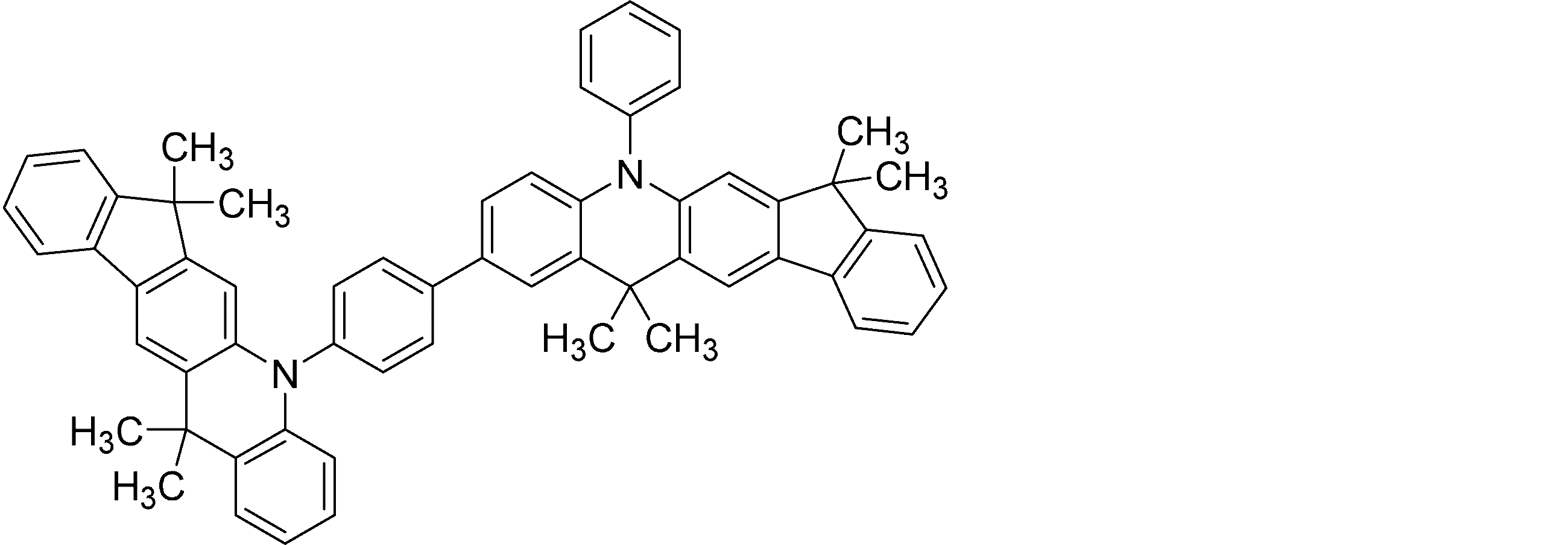
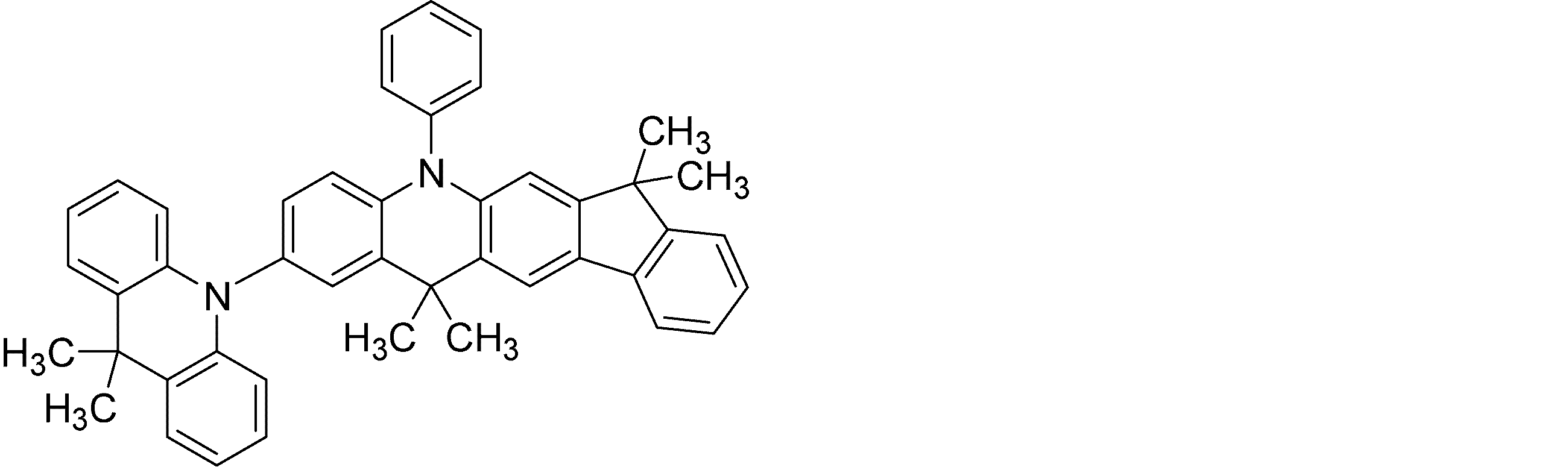

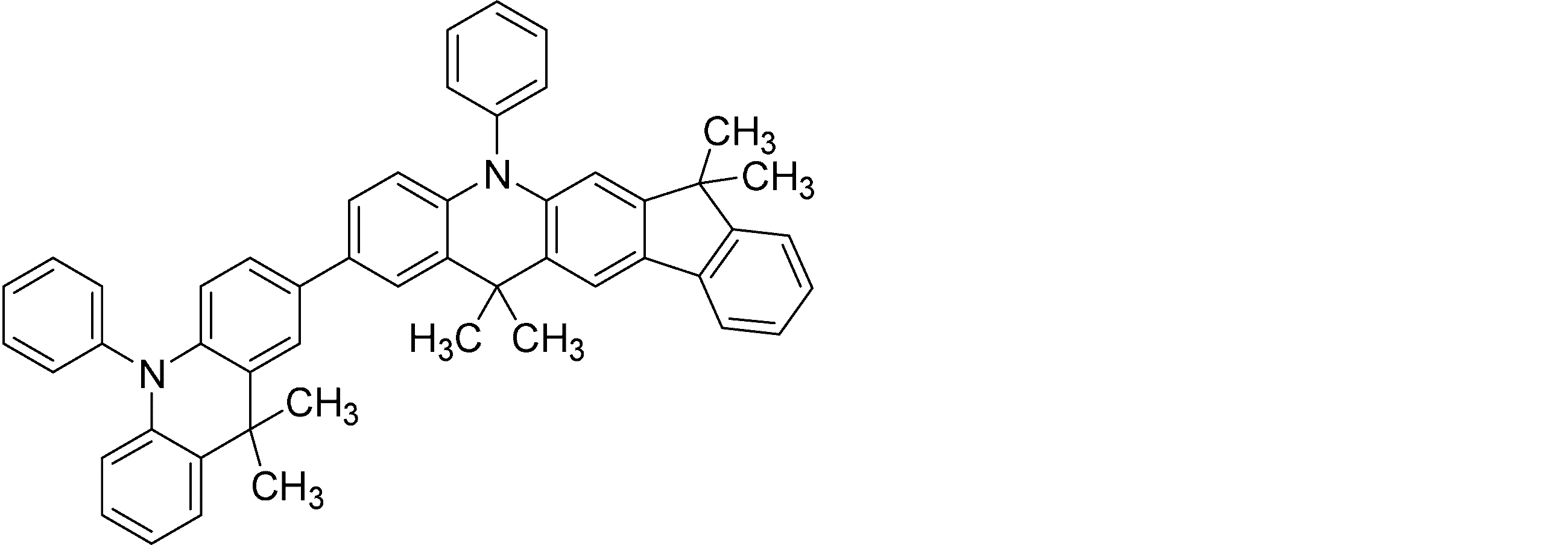
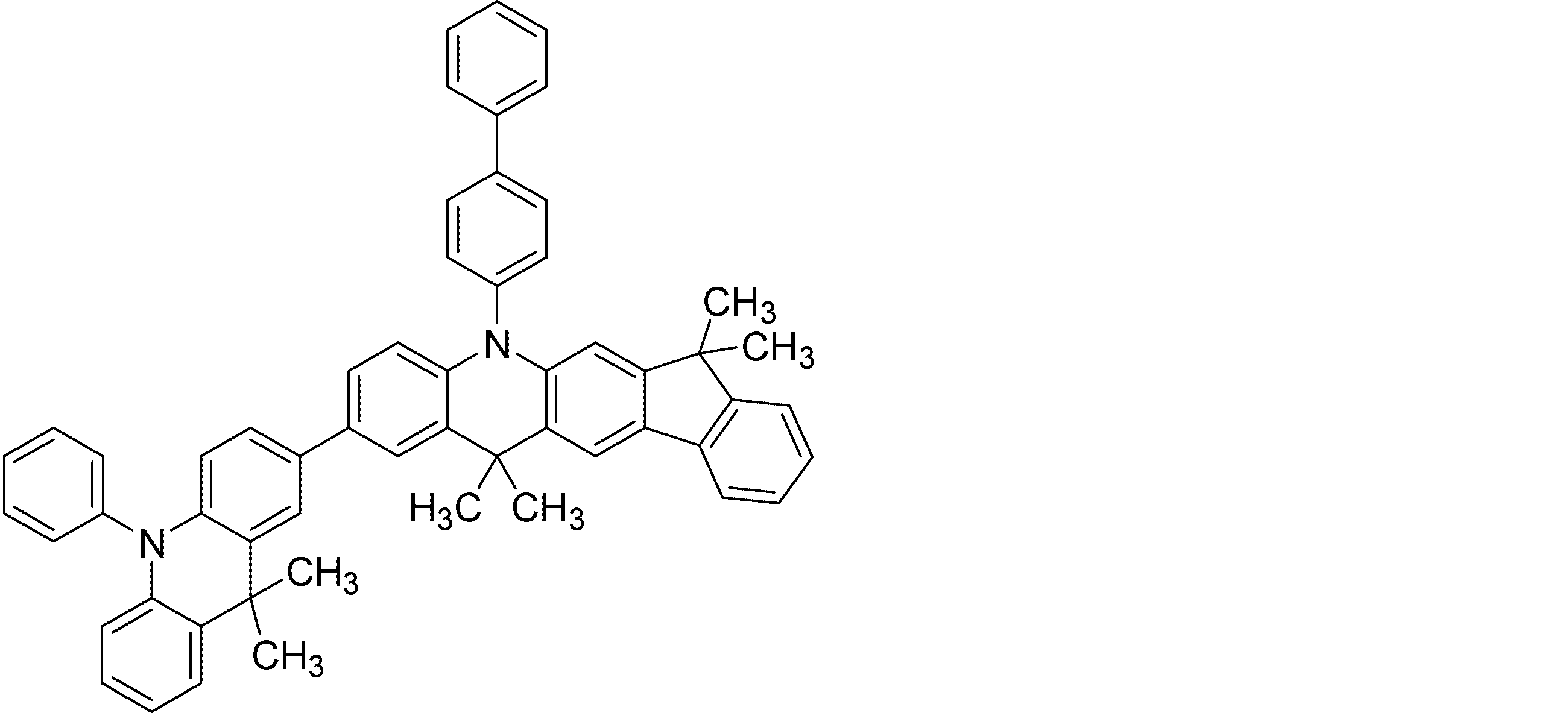
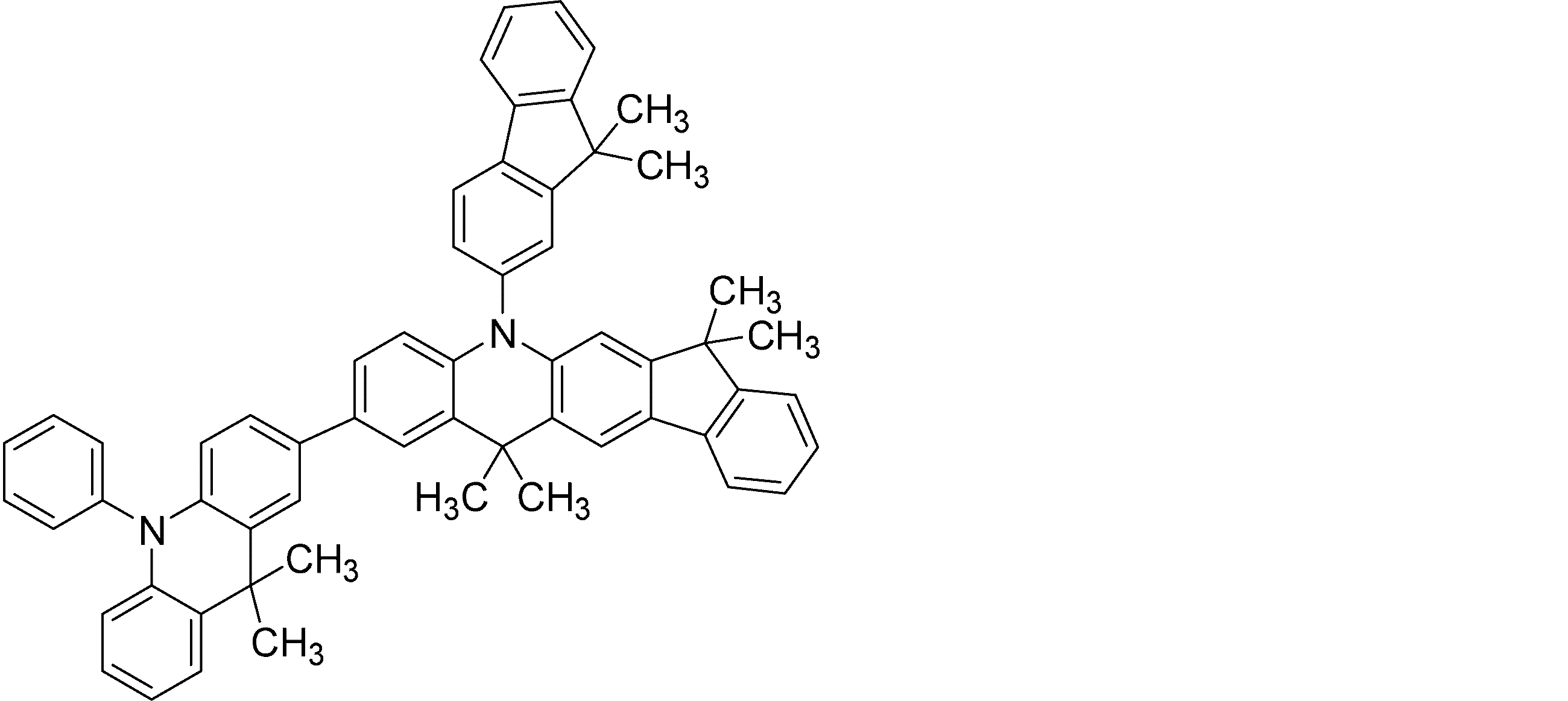
<7,7,13,13-テトラメチル-5-フェニル-2-(9-フェニル-9H-カルバゾール-3-イル)-7,13-ジヒドロ-5H-インデノ[1,2-b]アクリジン(化合物2)の合成>
窒素置換した反応容器に、2-アミノ安息香酸メチル35.4g、2-ヨード-9,9-ジメチル-9H-フルオレン50.0g、tert-ブトキシナトリウム22.51g、キシレン500mlを加え、1時間窒素ガスを通気した。トリス(ジベンジリデンアセトン)ジパラジウム(0)2.9g、トリ-tert-ブチルホスフィンのトルエン溶液(50%、w/v)3.8gを加えて加熱し、115℃で5時間撹拌した。室温まで冷却し、水、トルエンを加えた後、分液操作によって有機層を採取した。有機層を無水硫酸マグネシウムで脱水した後、減圧下で濃縮することによって粗製物を得た。粗製物をカラムクロマトグラフ(担体:シリカゲル、溶離液:トルエン/n-ヘキサン)によって精製し、2-{(9,9-ジメチル-9H-フルオレン-2-イル)アミノ} 安息香酸メチルの黄色粉体25.8g(収率48%)を得た。
<2-(3,3-ジメチル-1-フェニル-1,3-ジヒドロインデノ[2,1-b]カルバゾール-10-イル)-7,7,13,13-テトラメチル-5-フェニル-7,13-ジヒドロ-5H-インデノ[1,2-b]アクリジン(化合物3)の合成>
実施例1で合成した2-ブロモ-7,7,13,13-テトラメチル-5-フェニル-7,13-ジヒドロ-5H-インデノ[1,2-b]アクリジン8.4g、3,3-ジメチル-1-フェニル-10-(4,4,5,5-テトラメチル-1,3,2-ジオキサボロラン-2-イル)-1,3-ジヒドロインデノ[2,1-b]カルバゾール8.9g、2M炭酸カリウム水溶液26ml、トルエン67ml、エタノール17mlを窒素置換した反応容器に加え、1時間窒素ガスを通気した。テトラキス(トリフェニルホスフィン)パラジウム0.6gを加えて加熱し、72℃で5時間撹拌した。室温まで冷却して、トルエンによる抽出を行うことによって有機層を採取した。有機層を無水硫酸マグネシウムで脱水した後、減圧下で濃縮することによって粗製物を得た。粗製物をカラムクロマトグラフ(担体:シリカゲル、溶離液:メチレンクロライド/n-ヘキサン)によって精製し、2-(3,3-ジメチル-1-フェニル-1,3-ジヒドロインデノ[2,1-b]カルバゾール-10-イル)-7,7,13,13-テトラメチル-5-フェニル-7,13-ジヒドロ-5H-インデノ[1,2-b]アクリジンの白色粉体8.6g(収率65%)を得た。
<5-(ビフェニル-4-イル)-7,7,13,13-テトラメチル-2-(9-フェニル-9H-カルバゾール-3-イル)-7,13-ジヒドロ-5H-インデノ[1,2-b]アクリジン(化合物18)の合成>
実施例1と同様に合成した2-ブロモ-7,7,13,13-テトラメチル-5-(ビフェニル-4-イル)-7,13-ジヒドロ-5H-インデノ[1,2-b]アクリジン15.5g、9-フェニル-9H-カルバゾール-3-イルボロン酸8.4g、2M炭酸カリウム水溶液42ml、トルエン124ml、エタノール31mlを加え、1時間窒素ガスを通気した。テトラキス(トリフェニルホスフィン)パラジウム1.0gを窒素置換した反応容器に加えて加熱し、72℃で4時間撹拌した。室温まで冷却して、トルエンによる抽出を行うことによって有機層を採取した。有機層を無水硫酸マグネシウムで脱水した後、減圧下で濃縮することによって粗製物を得た。粗製物をカラムクロマトグラフ(担体:シリカゲル、溶離液:メチレンクロライド/n-ヘキサン)によって精製し、5-(ビフェニル-4-イル)-7,7,13,13-テトラメチル-2-(9-フェニル-9H-カルバゾール-3-イル)-7,13-ジヒドロ-5H-インデノ[1,2-b]アクリジンの白色粉体5.6g(収率28%)を得た。
<5-(9,9-ジメチル-9H-フルオレン-2-イル)-7,7,13,13-テトラメチル-2-(9-フェニル-9H-カルバゾール-3-イル)-7,13-ジヒドロ-5H-インデノ[1,2-b]アクリジン(化合物19)の合成>
実施例1と同様に合成した2-ブロモ-7,7,13,13-テトラメチル-5-(9,9-ジメチル-9H-フルオレン-2-イル)-7,13-ジヒドロ-5H-インデノ[1,2-b]アクリジン12.0g、9-フェニル-9H-カルバゾール-3-イルボロン酸6.1g、2M炭酸カリウム水溶液30ml、トルエン96ml、エタノール24mlを窒素置換した反応容器に加え、1時間窒素ガスを通気した。テトラキス(トリフェニルホスフィン)パラジウム0.7gを加えて加熱し、72℃で4時間撹拌した。室温まで冷却して、トルエンによる抽出を行うことによって有機層を採取した。有機層を無水硫酸マグネシウムで脱水した後、減圧下で濃縮することによって粗製物を得た。粗製物をカラムクロマトグラフ(担体:シリカゲル、溶離液:トルエン/n-ヘキサン)によって精製し、5-(9,9-ジメチル-9H-フルオレン-2-イル)-7,7,13,13-テトラメチル-2-(9-フェニル-9H-カルバゾール-3-イル)-7,13-ジヒドロ-5H-インデノ[1,2-b]アクリジンの白色粉体12.0g(収率79%)を得た。
本発明の化合物について、高感度示差走査熱量計(ブルカー・エイエックスエス製、DSC3100SA)によってガラス転移点を求めた。
ガラス転移点
本発明実施例1の化合物 140℃
本発明実施例2の化合物 187℃
本発明実施例3の化合物 155℃
本発明実施例4の化合物 164℃
本発明の化合物を用いて、ITO基板の上に膜厚100nmの蒸着膜を作製して、イオン化ポテンシャル測定装置(住友重機械工業製、PYS-202型)で仕事関数を測定した。
仕事関数
本発明実施例1の化合物 5.48eV
本発明実施例2の化合物 5.50eV
本発明実施例3の化合物 5.45eV
本発明実施例4の化合物 5.41eV
有機EL素子は、図5に示すような、ガラス基板1上に透明陽極2としてITO電極をあらかじめ形成したものの上に、正孔注入層3、正孔輸送層4、発光層5、電子輸送層6、電子注入層7、陰極(アルミニウム電極)8の順に蒸着して作製した。

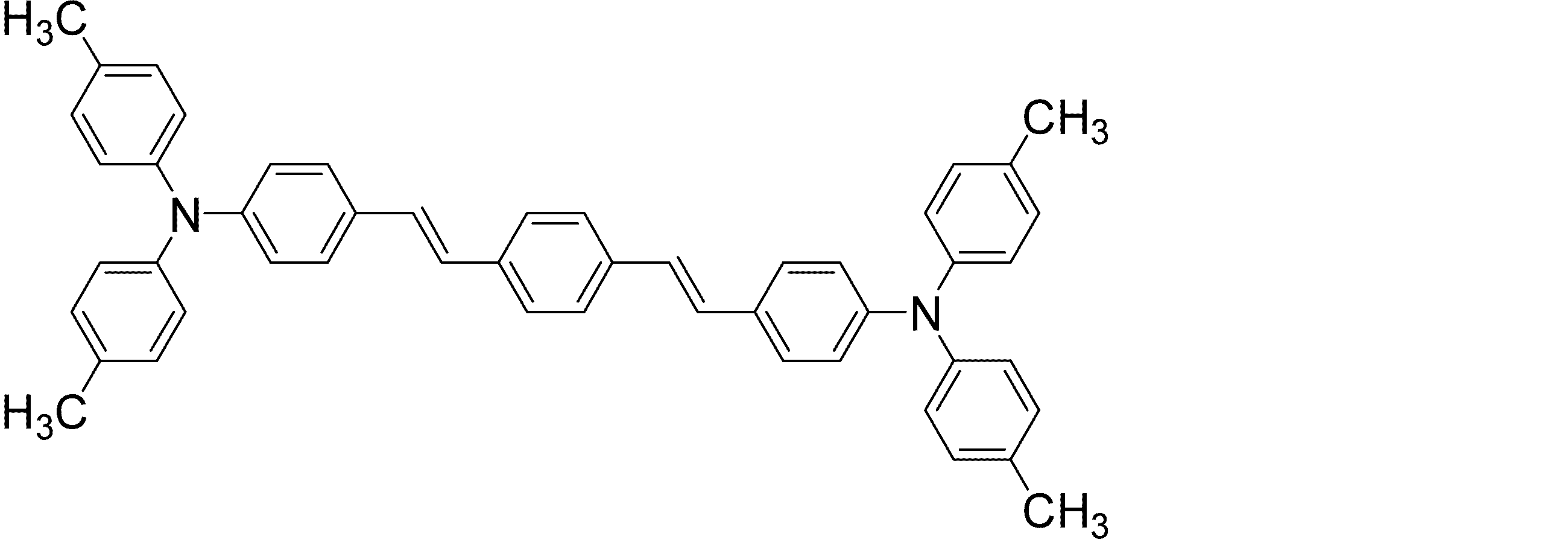

実施例7において、正孔輸送層4の材料として本発明実施例1の化合物(化合物2)に代えて本発明実施例2の化合物(化合物3)を膜厚40nmとなるように形成した以外は、同様の条件で有機EL素子を作製した。作製した有機EL素子について、大気中、常温で特性測定を行った。作製した有機EL素子に直流電圧を印加したときの発光特性の測定結果を表1にまとめて示した。
実施例7において、正孔輸送層4の材料として本発明実施例1の化合物(化合物2)に代えて本発明実施例3の化合物(化合物18)を膜厚40nmとなるように形成した以外は、同様の条件で有機EL素子を作製した。作製した有機EL素子について、大気中、常温で特性測定を行った。作製した有機EL素子に直流電圧を印加したときの発光特性の測定結果を表1にまとめて示した。
実施例7において、正孔輸送層4の材料として本発明実施例1の化合物(化合物2)に代えて本発明実施例4の化合物(化合物19)を膜厚40nmとなるように形成した以外は、同様の条件で有機EL素子を作製した。作製した有機EL素子について、大気中、常温で特性測定を行った。作製した有機EL素子に直流電圧を印加したときの発光特性の測定結果を表1にまとめて示した。
比較のために、実施例7において、正孔輸送層4の材料として本発明実施例1の化合物(化合物2)に代えて下記構造式の化合物44を膜厚40nmとなるように形成した以外は、同様の条件で有機EL素子を作製した。作製した有機EL素子について、大気中、常温で特性測定を行った。作製した有機EL素子に直流電圧を印加したときの発光特性の測定結果を表1にまとめて示した。


2 透明陽極
3 正孔注入層
4 正孔輸送層
5 発光層
6 電子輸送層
7 電子注入層
8 陰極
Claims (15)
- 下記一般式(1)で表される、インデノアクリダン環構造を有する化合物。
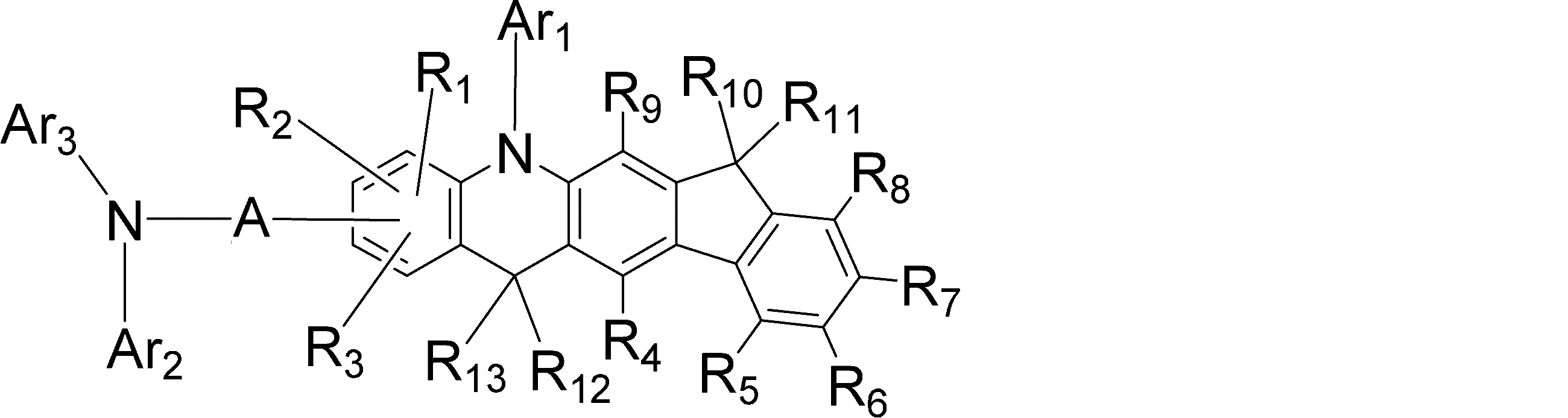
(式中、Aは置換もしくは無置換の芳香族炭化水素、置換もしくは無置換の芳香族複素環または置換もしくは無置換の縮合多環芳香族の2価基または単結合を表し、Ar1、Ar2、Ar3は相互に同一でも異なってもよく、置換もしくは無置換の芳香族炭化水素基、置換もしくは無置換の芳香族複素環基または置換もしくは無置換の縮合多環芳香族基を表し、Ar2とAr3は単結合、置換もしくは無置換のメチレン基、酸素原子または硫黄原子を介して互いに結合して環を形成してもよい。R1~R9は相互に同一でも異なってもよく、水素原子、重水素原子、フッ素原子、塩素原子、シアノ基、ニトロ基、置換基を有していてもよい炭素原子数1ないし6の直鎖状もしくは分岐状のアルキル基、置換基を有していてもよい炭素原子数5ないし10のシクロアルキル基、置換基を有していてもよい炭素原子数2ないし6の直鎖状もしくは分岐状のアルケニル基、置換基を有していてもよい炭素原子数1ないし6の直鎖状もしくは分岐状のアルキルオキシ基、置換基を有していてもよい炭素原子数5ないし10のシクロアルキルオキシ基、置換もしくは無置換の芳香族炭化水素基、置換もしくは無置換の芳香族複素環基、置換もしくは無置換の縮合多環芳香族基または置換もしくは無置換のアリールオキシ基であって、単結合、置換もしくは無置換のメチレン基、酸素原子または硫黄原子を介して互いに結合して環を形成してもよい。R10~R13は相互に同一でも異なってもよく、置換基を有していてもよい炭素原子数1ないし6の直鎖状もしくは分岐状のアルキル基、置換基を有していてもよい炭素原子数5ないし10のシクロアルキル基、置換基を有していてもよい炭素原子数2ないし6の直鎖状もしくは分岐状のアルケニル基、置換基を有していてもよい炭素原子数1ないし6の直鎖状もしくは分岐状のアルキルオキシ基、置換基を有していてもよい炭素原子数5ないし10のシクロアルキルオキシ基、置換もしくは無置換の芳香族炭化水素基、置換もしくは無置換の芳香族複素環基、置換もしくは無置換の縮合多環芳香族基または置換もしくは無置換のアリールオキシ基であって、R10とR11、R12とR13は単結合、置換もしくは無置換のメチレン基、酸素原子または硫黄原子を介して互いに結合して環を形成してもよい。ここで、Aが置換もしくは無置換の芳香族炭化水素、置換もしくは無置換の芳香族複素環または置換もしくは無置換の縮合多環芳香族の2価基である場合、AとAr2は単結合、置換もしくは無置換のメチレン基、酸素原子または硫黄原子を介して互いに結合して環を形成してもよい。) - 下記一般式(1-1)で表される、請求項1記載のインデノアクリダン環構造を有する化合物。
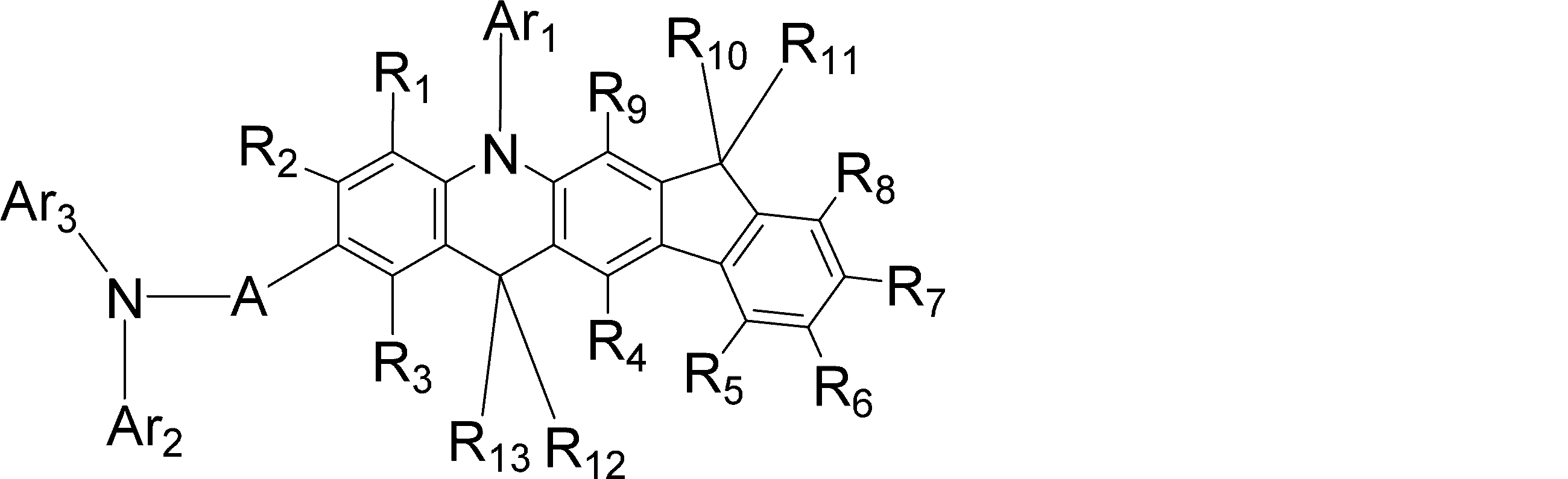
(式中、Aは置換もしくは無置換の芳香族炭化水素、置換もしくは無置換の芳香族複素環または置換もしくは無置換の縮合多環芳香族の2価基または単結合を表し、Ar1、Ar2、Ar3は相互に同一でも異なってもよく、置換もしくは無置換の芳香族炭化水素基、置換もしくは無置換の芳香族複素環基または置換もしくは無置換の縮合多環芳香族基を表し、Ar2とAr3は単結合、置換もしくは無置換のメチレン基、酸素原子または硫黄原子を介して互いに結合して環を形成してもよい。R1~R9は相互に同一でも異なってもよく、水素原子、重水素原子、フッ素原子、塩素原子、シアノ基、ニトロ基、置換基を有していてもよい炭素原子数1ないし6の直鎖状もしくは分岐状のアルキル基、置換基を有していてもよい炭素原子数5ないし10のシクロアルキル基、置換基を有していてもよい炭素原子数2ないし6の直鎖状もしくは分岐状のアルケニル基、置換基を有していてもよい炭素原子数1ないし6の直鎖状もしくは分岐状のアルキルオキシ基、置換基を有していてもよい炭素原子数5ないし10のシクロアルキルオキシ基、置換もしくは無置換の芳香族炭化水素基、置換もしくは無置換の芳香族複素環基、置換もしくは無置換の縮合多環芳香族基または置換もしくは無置換のアリールオキシ基であって、単結合、置換もしくは無置換のメチレン基、酸素原子または硫黄原子を介して互いに結合して環を形成してもよい。R10~R13は相互に同一でも異なってもよく、置換基を有していてもよい炭素原子数1ないし6の直鎖状もしくは分岐状のアルキル基、置換基を有していてもよい炭素原子数5ないし10のシクロアルキル基、置換基を有していてもよい炭素原子数2ないし6の直鎖状もしくは分岐状のアルケニル基、置換基を有していてもよい炭素原子数1ないし6の直鎖状もしくは分岐状のアルキルオキシ基、置換基を有していてもよい炭素原子数5ないし10のシクロアルキルオキシ基、置換もしくは無置換の芳香族炭化水素基、置換もしくは無置換の芳香族複素環基、置換もしくは無置換の縮合多環芳香族基または置換もしくは無置換のアリールオキシ基であって、R10とR11、R12とR13は単結合、置換もしくは無置換のメチレン基、酸素原子または硫黄原子を介して互いに結合して環を形成してもよい。ここで、Aが置換もしくは無置換の芳香族炭化水素、置換もしくは無置換の芳香族複素環または置換もしくは無置換の縮合多環芳香族の2価基である場合、AとAr2は単結合、置換もしくは無置換のメチレン基、酸素原子または硫黄原子を介して互いに結合して環を形成してもよい。) - 前記一般式(1)または(1-1)において、Aが置換もしくは無置換の芳香族炭化水素または置換もしくは無置換の縮合多環芳香族の2価基である、請求項1または請求項2に記載のインデノアクリダン環構造を有する化合物。
- 下記一般式(1-2)で表される、請求項3記載のインデノアクリダン環構造を有する化合物。

(式中、Ar1、Ar2、Ar3は相互に同一でも異なってもよく、置換もしくは無置換の芳香族炭化水素基、置換もしくは無置換の芳香族複素環基または置換もしくは無置換の縮合多環芳香族基を表し、Ar2とAr3は単結合、置換もしくは無置換のメチレン基、酸素原子または硫黄原子を介して互いに結合して環を形成してもよい。R1~R9は相互に同一でも異なってもよく、水素原子、重水素原子、フッ素原子、塩素原子、シアノ基、ニトロ基、置換基を有していてもよい炭素原子数1ないし6の直鎖状もしくは分岐状のアルキル基、置換基を有していてもよい炭素原子数5ないし10のシクロアルキル基、置換基を有していてもよい炭素原子数2ないし6の直鎖状もしくは分岐状のアルケニル基、置換基を有していてもよい炭素原子数1ないし6の直鎖状もしくは分岐状のアルキルオキシ基、置換基を有していてもよい炭素原子数5ないし10のシクロアルキルオキシ基、置換もしくは無置換の芳香族炭化水素基、置換もしくは無置換の芳香族複素環基、置換もしくは無置換の縮合多環芳香族基または置換もしくは無置換のアリールオキシ基であって、単結合、置換もしくは無置換のメチレン基、酸素原子または硫黄原子を介して互いに結合して環を形成してもよい。R10~R13は相互に同一でも異なってもよく、置換基を有していてもよい炭素原子数1ないし6の直鎖状もしくは分岐状のアルキル基、置換基を有していてもよい炭素原子数5ないし10のシクロアルキル基、置換基を有していてもよい炭素原子数2ないし6の直鎖状もしくは分岐状のアルケニル基、置換基を有していてもよい炭素原子数1ないし6の直鎖状もしくは分岐状のアルキルオキシ基、置換基を有していてもよい炭素原子数5ないし10のシクロアルキルオキシ基、置換もしくは無置換の芳香族炭化水素基、置換もしくは無置換の芳香族複素環基、置換もしくは無置換の縮合多環芳香族基または置換もしくは無置換のアリールオキシ基であって、R10とR11、R12とR13は単結合、置換もしくは無置換のメチレン基、酸素原子または硫黄原子を介して互いに結合して環を形成してもよい。R14は重水素原子、フッ素原子、塩素原子、シアノ基、ニトロ基、置換基を有していてもよい炭素原子数1ないし6の直鎖状もしくは分岐状のアルキル基、置換基を有していてもよい炭素原子数5ないし10のシクロアルキル基、置換基を有していてもよい炭素原子数2ないし6の直鎖状もしくは分岐状のアルケニル基、置換基を有していてもよい炭素原子数1ないし6の直鎖状もしくは分岐状のアルキルオキシ基、置換基を有していてもよい炭素原子数5ないし10のシクロアルキルオキシ基、置換もしくは無置換の芳香族炭化水素基、置換もしくは無置換の芳香族複素環基、置換もしくは無置換の縮合多環芳香族基、置換もしくは無置換のアリールオキシ基または連結基であって、これらの置換基が同一のベンゼン環に複数個結合している場合(r14が2以上のとき)は互いに環を形成していてもよい。r14は0または1~4の整数を表し、r14が0である場合はR14で置換されていないことを表す。ここで、R14が連結基である場合、r14は1であって、R14が結合しているベンゼン環とAr2は単結合、置換もしくは無置換のメチレン基、酸素原子または硫黄原子を介して互いに結合して環を形成していることを表す。) - 下記一般式(1-3)で表される、請求項3記載のインデノアクリダン環構造を有する化合物。
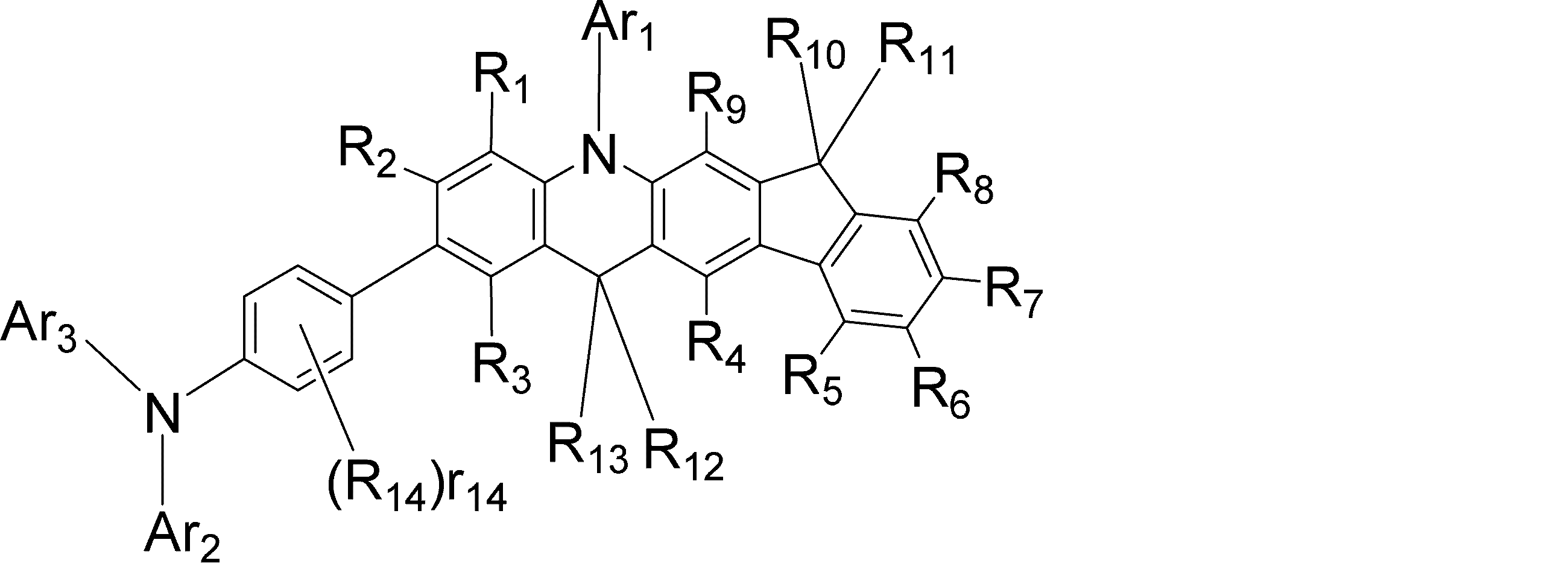
(式中、Ar1、Ar2、Ar3は相互に同一でも異なってもよく、置換もしくは無置換の芳香族炭化水素基、置換もしくは無置換の芳香族複素環基または置換もしくは無置換の縮合多環芳香族基を表し、Ar2とAr3は単結合、置換もしくは無置換のメチレン基、酸素原子または硫黄原子を介して互いに結合して環を形成してもよい。R1~R9は相互に同一でも異なってもよく、水素原子、重水素原子、フッ素原子、塩素原子、シアノ基、ニトロ基、置換基を有していてもよい炭素原子数1ないし6の直鎖状もしくは分岐状のアルキル基、置換基を有していてもよい炭素原子数5ないし10のシクロアルキル基、置換基を有していてもよい炭素原子数2ないし6の直鎖状もしくは分岐状のアルケニル基、置換基を有していてもよい炭素原子数1ないし6の直鎖状もしくは分岐状のアルキルオキシ基、置換基を有していてもよい炭素原子数5ないし10のシクロアルキルオキシ基、置換もしくは無置換の芳香族炭化水素基、置換もしくは無置換の芳香族複素環基、置換もしくは無置換の縮合多環芳香族基または置換もしくは無置換のアリールオキシ基であって、単結合、置換もしくは無置換のメチレン基、酸素原子または硫黄原子を介して互いに結合して環を形成してもよい。R10~R13は相互に同一でも異なってもよく、置換基を有していてもよい炭素原子数1ないし6の直鎖状もしくは分岐状のアルキル基、置換基を有していてもよい炭素原子数5ないし10のシクロアルキル基、置換基を有していてもよい炭素原子数2ないし6の直鎖状もしくは分岐状のアルケニル基、置換基を有していてもよい炭素原子数1ないし6の直鎖状もしくは分岐状のアルキルオキシ基、置換基を有していてもよい炭素原子数5ないし10のシクロアルキルオキシ基、置換もしくは無置換の芳香族炭化水素基、置換もしくは無置換の芳香族複素環基、置換もしくは無置換の縮合多環芳香族基または置換もしくは無置換のアリールオキシ基であって、R10とR11、R12とR13は単結合、置換もしくは無置換のメチレン基、酸素原子または硫黄原子を介して互いに結合して環を形成してもよい。R14は重水素原子、フッ素原子、塩素原子、シアノ基、ニトロ基、置換基を有していてもよい炭素原子数1ないし6の直鎖状もしくは分岐状のアルキル基、置換基を有していてもよい炭素原子数5ないし10のシクロアルキル基、置換基を有していてもよい炭素原子数2ないし6の直鎖状もしくは分岐状のアルケニル基、置換基を有していてもよい炭素原子数1ないし6の直鎖状もしくは分岐状のアルキルオキシ基、置換基を有していてもよい炭素原子数5ないし10のシクロアルキルオキシ基、置換もしくは無置換の芳香族炭化水素基、置換もしくは無置換の芳香族複素環基、置換もしくは無置換の縮合多環芳香族基、置換もしくは無置換のアリールオキシ基または連結基であって、これらの置換基が同一のベンゼン環に複数個結合している場合(r14が2以上のとき)は互いに環を形成していてもよい。r14は0または1~4の整数を表し、r14が0である場合はR14で置換されていないことを表す。ここで、R14が連結基である場合、r14は1であって、R14が結合しているベンゼン環とAr2は単結合、置換もしくは無置換のメチレン基、酸素原子または硫黄原子を介して互いに結合して環を形成していることを表す。) - 下記一般式(1-4)で表される、請求項4記載のインデノアクリダン環構造を有する化合物。
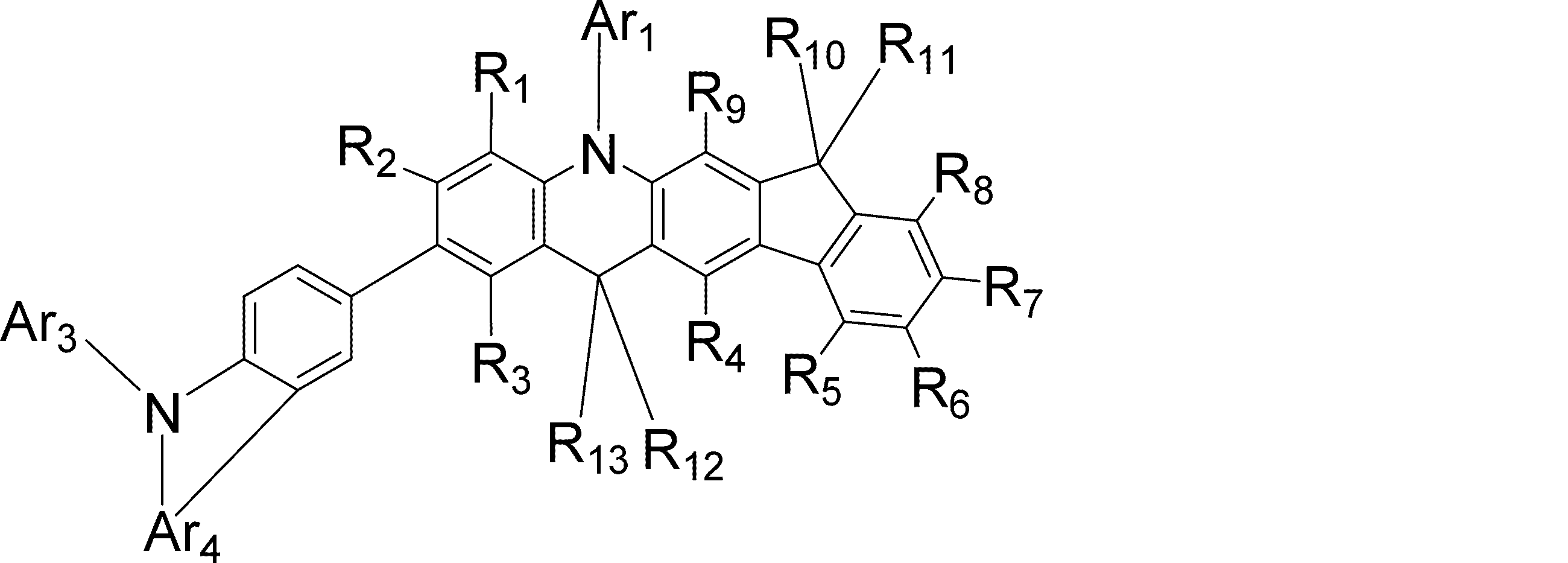
(式中、Ar1、Ar3は相互に同一でも異なってもよく、置換もしくは無置換の芳香族炭化水素基、置換もしくは無置換の芳香族複素環基または置換もしくは無置換の縮合多環芳香族基を表し、Ar4は置換もしくは無置換の芳香族炭化水素基、置換もしくは無置換の芳香族複素環基または置換もしくは無置換の縮合多環芳香族基から誘導される2価基を表し、Ar3とAr4は単結合、置換もしくは無置換のメチレン基、酸素原子または硫黄原子を介して互いに結合して環を形成してもよい。R1~R9は相互に同一でも異なってもよく、水素原子、重水素原子、フッ素原子、塩素原子、シアノ基、ニトロ基、置換基を有していてもよい炭素原子数1ないし6の直鎖状もしくは分岐状のアルキル基、置換基を有していてもよい炭素原子数5ないし10のシクロアルキル基、置換基を有していてもよい炭素原子数2ないし6の直鎖状もしくは分岐状のアルケニル基、置換基を有していてもよい炭素原子数1ないし6の直鎖状もしくは分岐状のアルキルオキシ基、置換基を有していてもよい炭素原子数5ないし10のシクロアルキルオキシ基、置換もしくは無置換の芳香族炭化水素基、置換もしくは無置換の芳香族複素環基、置換もしくは無置換の縮合多環芳香族基または置換もしくは無置換のアリールオキシ基であって、単結合、置換もしくは無置換のメチレン基、酸素原子または硫黄原子を介して互いに結合して環を形成してもよい。R10~R13は相互に同一でも異なってもよく、置換基を有していてもよい炭素原子数1ないし6の直鎖状もしくは分岐状のアルキル基、置換基を有していてもよい炭素原子数5ないし10のシクロアルキル基、置換基を有していてもよい炭素原子数2ないし6の直鎖状もしくは分岐状のアルケニル基、置換基を有していてもよい炭素原子数1ないし6の直鎖状もしくは分岐状のアルキルオキシ基、置換基を有していてもよい炭素原子数5ないし10のシクロアルキルオキシ基、置換もしくは無置換の芳香族炭化水素基、置換もしくは無置換の芳香族複素環基、置換もしくは無置換の縮合多環芳香族基または置換もしくは無置換のアリールオキシ基であって、R10とR11、R12とR13は単結合、置換もしくは無置換のメチレン基、酸素原子または硫黄原子を介して互いに結合して環を形成してもよい。) - 下記一般式(1-4a)で表される、請求項4記載のインデノアクリダン環構造を有する化合物。
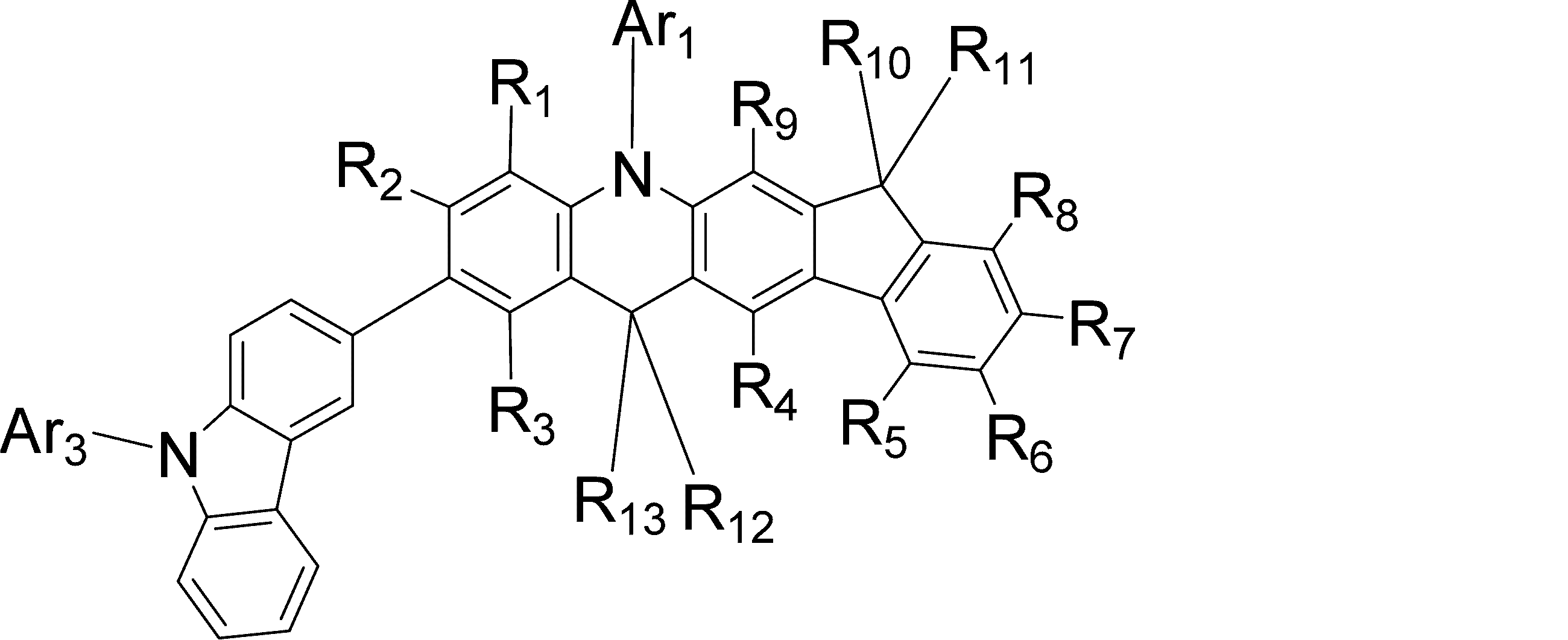
(式中、Ar1、Ar3は相互に同一でも異なってもよく、置換もしくは無置換の芳香族炭化水素基、置換もしくは無置換の芳香族複素環基または置換もしくは無置換の縮合多環芳香族基を表し、R1~R9は相互に同一でも異なってもよく、水素原子、重水素原子、フッ素原子、塩素原子、シアノ基、ニトロ基、置換基を有していてもよい炭素原子数1ないし6の直鎖状もしくは分岐状のアルキル基、置換基を有していてもよい炭素原子数5ないし10のシクロアルキル基、置換基を有していてもよい炭素原子数2ないし6の直鎖状もしくは分岐状のアルケニル基、置換基を有していてもよい炭素原子数1ないし6の直鎖状もしくは分岐状のアルキルオキシ基、置換基を有していてもよい炭素原子数5ないし10のシクロアルキルオキシ基、置換もしくは無置換の芳香族炭化水素基、置換もしくは無置換の芳香族複素環基、置換もしくは無置換の縮合多環芳香族基または置換もしくは無置換のアリールオキシ基であって、単結合、置換もしくは無置換のメチレン基、酸素原子または硫黄原子を介して互いに結合して環を形成してもよい。R10~R13は相互に同一でも異なってもよく、置換基を有していてもよい炭素原子数1ないし6の直鎖状もしくは分岐状のアルキル基、置換基を有していてもよい炭素原子数5ないし10のシクロアルキル基、置換基を有していてもよい炭素原子数2ないし6の直鎖状もしくは分岐状のアルケニル基、置換基を有していてもよい炭素原子数1ないし6の直鎖状もしくは分岐状のアルキルオキシ基、置換基を有していてもよい炭素原子数5ないし10のシクロアルキルオキシ基、置換もしくは無置換の芳香族炭化水素基、置換もしくは無置換の芳香族複素環基、置換もしくは無置換の縮合多環芳香族基または置換もしくは無置換のアリールオキシ基であって、R10とR11、R12とR13は単結合、置換もしくは無置換のメチレン基、酸素原子または硫黄原子を介して互いに結合して環を形成してもよい。) - 下記一般式(1-4b)で表される、請求項4記載のインデノアクリダン環構造を有する化合物。

(式中、Ar1、Ar3は相互に同一でも異なってもよく、置換もしくは無置換の芳香族炭化水素基、置換もしくは無置換の芳香族複素環基または置換もしくは無置換の縮合多環芳香族基を表し、R1~R9は相互に同一でも異なってもよく、水素原子、重水素原子、フッ素原子、塩素原子、シアノ基、ニトロ基、置換基を有していてもよい炭素原子数1ないし6の直鎖状もしくは分岐状のアルキル基、置換基を有していてもよい炭素原子数5ないし10のシクロアルキル基、置換基を有していてもよい炭素原子数2ないし6の直鎖状もしくは分岐状のアルケニル基、置換基を有していてもよい炭素原子数1ないし6の直鎖状もしくは分岐状のアルキルオキシ基、置換基を有していてもよい炭素原子数5ないし10のシクロアルキルオキシ基、置換もしくは無置換の芳香族炭化水素基、置換もしくは無置換の芳香族複素環基、置換もしくは無置換の縮合多環芳香族基または置換もしくは無置換のアリールオキシ基であって、単結合、置換もしくは無置換のメチレン基、酸素原子または硫黄原子を介して互いに結合して環を形成してもよい。R10~R13は相互に同一でも異なってもよく、置換基を有していてもよい炭素原子数1ないし6の直鎖状もしくは分岐状のアルキル基、置換基を有していてもよい炭素原子数5ないし10のシクロアルキル基、置換基を有していてもよい炭素原子数2ないし6の直鎖状もしくは分岐状のアルケニル基、置換基を有していてもよい炭素原子数1ないし6の直鎖状もしくは分岐状のアルキルオキシ基、置換基を有していてもよい炭素原子数5ないし10のシクロアルキルオキシ基、置換もしくは無置換の芳香族炭化水素基、置換もしくは無置換の芳香族複素環基、置換もしくは無置換の縮合多環芳香族基または置換もしくは無置換のアリールオキシ基であって、R10とR11、R12とR13は単結合、置換もしくは無置換のメチレン基、酸素原子または硫黄原子を介して互いに結合して環を形成してもよい。) - 下記一般式(1-5)で表される、請求項1記載のインデノアクリダン環構造を有する化合物。
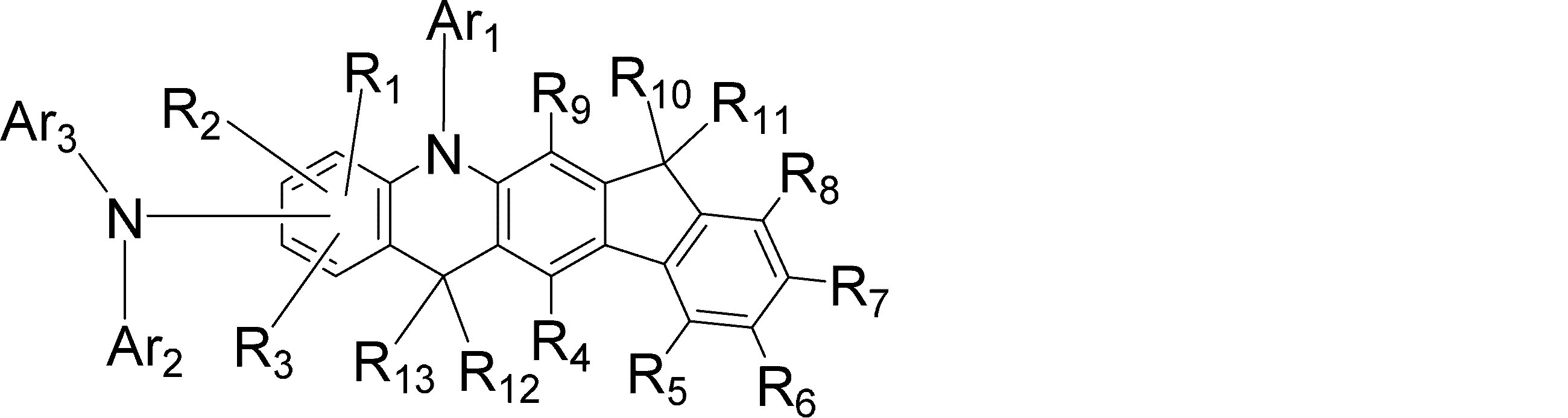
(式中、Ar1、Ar2、Ar3は相互に同一でも異なってもよく、置換もしくは無置換の芳香族炭化水素基、置換もしくは無置換の芳香族複素環基または置換もしくは無置換の縮合多環芳香族基を表し、Ar2とAr3は単結合、置換もしくは無置換のメチレン基、酸素原子または硫黄原子を介して互いに結合して環を形成してもよい。R1~R9は相互に同一でも異なってもよく、水素原子、重水素原子、フッ素原子、塩素原子、シアノ基、ニトロ基、置換基を有していてもよい炭素原子数1ないし6の直鎖状もしくは分岐状のアルキル基、置換基を有していてもよい炭素原子数5ないし10のシクロアルキル基、置換基を有していてもよい炭素原子数2ないし6の直鎖状もしくは分岐状のアルケニル基、置換基を有していてもよい炭素原子数1ないし6の直鎖状もしくは分岐状のアルキルオキシ基、置換基を有していてもよい炭素原子数5ないし10のシクロアルキルオキシ基、置換もしくは無置換の芳香族炭化水素基、置換もしくは無置換の芳香族複素環基、置換もしくは無置換の縮合多環芳香族基または置換もしくは無置換のアリールオキシ基であって、単結合、置換もしくは無置換のメチレン基、酸素原子または硫黄原子を介して互いに結合して環を形成してもよい。R10~R13は相互に同一でも異なってもよく、置換基を有していてもよい炭素原子数1ないし6の直鎖状もしくは分岐状のアルキル基、置換基を有していてもよい炭素原子数5ないし10のシクロアルキル基、置換基を有していてもよい炭素原子数2ないし6の直鎖状もしくは分岐状のアルケニル基、置換基を有していてもよい炭素原子数1ないし6の直鎖状もしくは分岐状のアルキルオキシ基、置換基を有していてもよい炭素原子数5ないし10のシクロアルキルオキシ基、置換もしくは無置換の芳香族炭化水素基、置換もしくは無置換の芳香族複素環基、置換もしくは無置換の縮合多環芳香族基または置換もしくは無置換のアリールオキシ基であって、R10とR11、R12とR13は単結合、置換もしくは無置換のメチレン基、酸素原子または硫黄原子を介して互いに結合して環を形成してもよい。) - 下記一般式(1-6)で表される、請求項9記載のインデノアクリダン環構造を有する化合物。
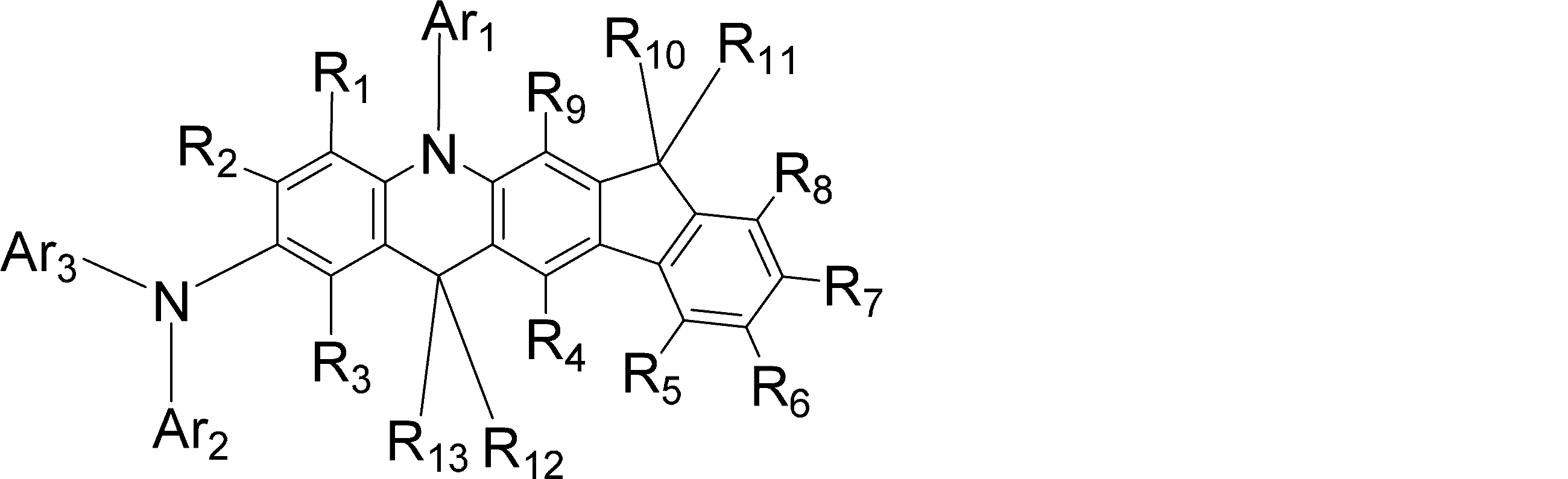
(式中、Ar1、Ar2、Ar3は相互に同一でも異なってもよく、置換もしくは無置換の芳香族炭化水素基、置換もしくは無置換の芳香族複素環基または置換もしくは無置換の縮合多環芳香族基を表し、Ar2とAr3は単結合、置換もしくは無置換のメチレン基、酸素原子または硫黄原子を介して互いに結合して環を形成してもよい。R1~R9は相互に同一でも異なってもよく、水素原子、重水素原子、フッ素原子、塩素原子、シアノ基、ニトロ基、置換基を有していてもよい炭素原子数1ないし6の直鎖状もしくは分岐状のアルキル基、置換基を有していてもよい炭素原子数5ないし10のシクロアルキル基、置換基を有していてもよい炭素原子数2ないし6の直鎖状もしくは分岐状のアルケニル基、置換基を有していてもよい炭素原子数1ないし6の直鎖状もしくは分岐状のアルキルオキシ基、置換基を有していてもよい炭素原子数5ないし10のシクロアルキルオキシ基、置換もしくは無置換の芳香族炭化水素基、置換もしくは無置換の芳香族複素環基、置換もしくは無置換の縮合多環芳香族基または置換もしくは無置換のアリールオキシ基であって、単結合、置換もしくは無置換のメチレン基、酸素原子または硫黄原子を介して互いに結合して環を形成してもよい。R10~R13は相互に同一でも異なってもよく、置換基を有していてもよい炭素原子数1ないし6の直鎖状もしくは分岐状のアルキル基、置換基を有していてもよい炭素原子数5ないし10のシクロアルキル基、置換基を有していてもよい炭素原子数2ないし6の直鎖状もしくは分岐状のアルケニル基、置換基を有していてもよい炭素原子数1ないし6の直鎖状もしくは分岐状のアルキルオキシ基、置換基を有していてもよい炭素原子数5ないし10のシクロアルキルオキシ基、置換もしくは無置換の芳香族炭化水素基、置換もしくは無置換の芳香族複素環基、置換もしくは無置換の縮合多環芳香族基または置換もしくは無置換のアリールオキシ基であって、R10とR11、R12とR13は単結合、置換もしくは無置換のメチレン基、酸素原子または硫黄原子を介して互いに結合して環を形成してもよい。) - 一対の電極とその間に挟まれた少なくとも一層の有機層を有する有機エレクトロルミネッセンス素子において、前記請求項1に記載のインデノアクリダン環構造を有する化合物が、少なくとも1つの有機層の構成材料として用いられていることを特徴とする有機エレクトロルミネッセンス素子。
- 前記した有機層が正孔輸送層である請求項11記載の有機エレクトロルミネッセンス素子。
- 前記した有機層が電子阻止層である請求項11記載の有機エレクトロルミネッセンス素子。
- 前記した有機層が正孔注入層である請求項11記載の有機エレクトロルミネッセンス素子。
- 前記した有機層が発光層である請求項11記載の有機エレクトロルミネッセンス素子。
Priority Applications (5)
| Application Number | Priority Date | Filing Date | Title |
|---|---|---|---|
| EP13832748.1A EP2894155B1 (en) | 2012-09-03 | 2013-08-27 | Compound having indeno acridan ring structure, and organic electroluminescence element |
| JP2014502944A JP5520423B1 (ja) | 2012-09-03 | 2013-08-27 | インデノアクリダン環構造を有する化合物および有機エレクトロルミネッセンス素子 |
| KR1020157004004A KR102058262B1 (ko) | 2012-09-03 | 2013-08-27 | 인데노 아크리단 환 구조를 가지는 화합물 및 유기 일렉트로루미네선스 소자 |
| US14/422,256 US20150249218A1 (en) | 2012-09-03 | 2013-08-27 | Compound having indenoacridan ring structure, and organic electroluminescent device |
| CN201380045980.0A CN104603122A (zh) | 2012-09-03 | 2013-08-27 | 具有茚并9,10-二氢吖啶环结构的化合物以及有机电致发光器件 |
Applications Claiming Priority (2)
| Application Number | Priority Date | Filing Date | Title |
|---|---|---|---|
| JP2012192845 | 2012-09-03 | ||
| JP2012-192845 | 2012-09-03 |
Publications (1)
| Publication Number | Publication Date |
|---|---|
| WO2014034092A1 true WO2014034092A1 (ja) | 2014-03-06 |
Family
ID=50182929
Family Applications (1)
| Application Number | Title | Priority Date | Filing Date |
|---|---|---|---|
| PCT/JP2013/005042 Ceased WO2014034092A1 (ja) | 2012-09-03 | 2013-08-27 | インデノアクリダン環構造を有する化合物および有機エレクトロルミネッセンス素子 |
Country Status (7)
| Country | Link |
|---|---|
| US (1) | US20150249218A1 (ja) |
| EP (1) | EP2894155B1 (ja) |
| JP (2) | JP5520423B1 (ja) |
| KR (1) | KR102058262B1 (ja) |
| CN (1) | CN104603122A (ja) |
| TW (2) | TWI629272B (ja) |
| WO (1) | WO2014034092A1 (ja) |
Cited By (2)
| Publication number | Priority date | Publication date | Assignee | Title |
|---|---|---|---|---|
| US20170271599A1 (en) * | 2014-08-20 | 2017-09-21 | Hodogaya Chemical Co., Ltd. | Organic electroluminescent device |
| US10388888B2 (en) | 2014-12-29 | 2019-08-20 | University Court Of The University Of St Andrews | Light emitting electrochemical cells and compounds |
Families Citing this family (11)
| Publication number | Priority date | Publication date | Assignee | Title |
|---|---|---|---|---|
| US20150249218A1 (en) * | 2012-09-03 | 2015-09-03 | Hodogaya Chemical Co., Ltd. | Compound having indenoacridan ring structure, and organic electroluminescent device |
| WO2014112360A1 (ja) * | 2013-01-17 | 2014-07-24 | 保土谷化学工業株式会社 | インデノアクリダン環構造を有する化合物および有機エレクトロルミネッセンス素子 |
| US10600983B2 (en) * | 2013-03-29 | 2020-03-24 | Kyulux, Inc. | Organic electroluminescent device comprising delayed fluorescent materials |
| JP5900541B2 (ja) | 2014-06-27 | 2016-04-06 | トヨタ自動車株式会社 | 捩り振動低減装置を備えたトルクコンバータ |
| CN104835916B (zh) * | 2015-04-11 | 2017-03-08 | 吉林大学 | 一种基于荧光掺杂发光层的有机电致发光器件 |
| JP6808329B2 (ja) * | 2016-02-25 | 2021-01-06 | 株式会社ジャパンディスプレイ | 有機エレクトロルミネッセンス表示装置用材料及び有機エレクトロルミネッセンス表示装置 |
| CN106397398A (zh) * | 2016-08-31 | 2017-02-15 | 北京绿人科技有限责任公司 | 一种有机化合物及其在有机电致发光器件中的应用 |
| CN106892915B (zh) * | 2017-02-23 | 2019-02-22 | 南京高光半导体材料有限公司 | 有机化合物、有机电致发光器件及其应用 |
| US10844043B2 (en) | 2018-04-24 | 2020-11-24 | Feng-wen Yen | Heteroaromatic compound and organic electroluminescence device using the same |
| CN108912138B (zh) * | 2018-07-23 | 2021-06-18 | 西安瑞联新材料股份有限公司 | 一种吖啶类衍生物杂环芳香族化合物及其在有机电致发光元件中的应用 |
| US20260040755A1 (en) * | 2022-07-28 | 2026-02-05 | China Petroleum & Chemical Corporation | Divalent metal complex, preparation method and use thereof, and organic optoelectronic device |
Citations (8)
| Publication number | Priority date | Publication date | Assignee | Title |
|---|---|---|---|---|
| JPH0848656A (ja) | 1994-02-08 | 1996-02-20 | Tdk Corp | 有機el素子用化合物および有機el素子 |
| JP3194657B2 (ja) | 1993-11-01 | 2001-07-30 | 松下電器産業株式会社 | 電界発光素子 |
| WO2006033563A1 (en) | 2004-09-24 | 2006-03-30 | Lg Chem. Ltd. | Organic light emitting device |
| WO2007110228A1 (de) | 2006-03-27 | 2007-10-04 | Novaled Ag | N-heterozyklische verbindungen und deren verwendung in elektronischen, optoelektronischen und elektroluminiszenten bauelementen. |
| WO2010147319A2 (ko) | 2009-06-19 | 2010-12-23 | 주식회사 두산 | 아크리딘 유도체 및 이를 포함하는 유기 전계 발광 소자 |
| KR20120084238A (ko) * | 2011-01-19 | 2012-07-27 | (주)씨에스엘쏠라 | 유기발광화합물 및 이를 이용한 유기 광소자 |
| KR20130029132A (ko) * | 2011-05-19 | 2013-03-22 | (주)씨에스엘쏠라 | 유기발광화합물 및 이를 이용한 유기 광소자 |
| KR20130064601A (ko) * | 2011-12-08 | 2013-06-18 | 주식회사 두산 | 신규 화합물 및 이를 포함하는 유기 전계 발광 소자 |
Family Cites Families (9)
| Publication number | Priority date | Publication date | Assignee | Title |
|---|---|---|---|---|
| US8095480B2 (en) * | 2007-07-31 | 2012-01-10 | Cornell Research Foundation, Inc. | System and method to enable training a machine learning network in the presence of weak or absent training exemplars |
| DE102009053836A1 (de) * | 2009-11-18 | 2011-05-26 | Merck Patent Gmbh | Materialien für organische Elektrolumineszenzvorrichtungen |
| KR20110088118A (ko) * | 2010-01-28 | 2011-08-03 | 다우어드밴스드디스플레이머티리얼 유한회사 | 신규한 유기 발광 화합물 및 이를 채용하고 있는 유기 전계 발광 소자 |
| KR20130112850A (ko) * | 2010-06-07 | 2013-10-14 | 호도가야 가가쿠 고교 가부시키가이샤 | 아크리단환 구조를 가지는 화합물 및 유기 일렉트로 루미네센스 소자 |
| CN106977448A (zh) * | 2010-07-30 | 2017-07-25 | 保土谷化学工业株式会社 | 具有茚并咔唑环结构的化合物和有机电致发光器件 |
| KR20130084093A (ko) * | 2012-01-16 | 2013-07-24 | 롬엔드하스전자재료코리아유한회사 | 신규한 유기 발광 화합물 및 이를 채용하고 있는 유기 전계 발광 소자 |
| WO2014017045A1 (ja) * | 2012-07-26 | 2014-01-30 | 保土谷化学工業株式会社 | アクリダン環構造を有する化合物および有機エレクトロルミネッセンス素子 |
| JP2015216135A (ja) * | 2012-08-10 | 2015-12-03 | 出光興産株式会社 | 有機エレクトロルミネッセンス素子、および電子機器 |
| US20150249218A1 (en) * | 2012-09-03 | 2015-09-03 | Hodogaya Chemical Co., Ltd. | Compound having indenoacridan ring structure, and organic electroluminescent device |
-
2013
- 2013-08-27 US US14/422,256 patent/US20150249218A1/en not_active Abandoned
- 2013-08-27 EP EP13832748.1A patent/EP2894155B1/en not_active Not-in-force
- 2013-08-27 CN CN201380045980.0A patent/CN104603122A/zh active Pending
- 2013-08-27 JP JP2014502944A patent/JP5520423B1/ja active Active
- 2013-08-27 KR KR1020157004004A patent/KR102058262B1/ko not_active Expired - Fee Related
- 2013-08-27 WO PCT/JP2013/005042 patent/WO2014034092A1/ja not_active Ceased
- 2013-09-02 TW TW106112844A patent/TWI629272B/zh not_active IP Right Cessation
- 2013-09-02 TW TW102131565A patent/TWI594987B/zh not_active IP Right Cessation
-
2014
- 2014-01-22 JP JP2014009663A patent/JP6223201B2/ja not_active Expired - Fee Related
Patent Citations (8)
| Publication number | Priority date | Publication date | Assignee | Title |
|---|---|---|---|---|
| JP3194657B2 (ja) | 1993-11-01 | 2001-07-30 | 松下電器産業株式会社 | 電界発光素子 |
| JPH0848656A (ja) | 1994-02-08 | 1996-02-20 | Tdk Corp | 有機el素子用化合物および有機el素子 |
| WO2006033563A1 (en) | 2004-09-24 | 2006-03-30 | Lg Chem. Ltd. | Organic light emitting device |
| WO2007110228A1 (de) | 2006-03-27 | 2007-10-04 | Novaled Ag | N-heterozyklische verbindungen und deren verwendung in elektronischen, optoelektronischen und elektroluminiszenten bauelementen. |
| WO2010147319A2 (ko) | 2009-06-19 | 2010-12-23 | 주식회사 두산 | 아크리딘 유도체 및 이를 포함하는 유기 전계 발광 소자 |
| KR20120084238A (ko) * | 2011-01-19 | 2012-07-27 | (주)씨에스엘쏠라 | 유기발광화합물 및 이를 이용한 유기 광소자 |
| KR20130029132A (ko) * | 2011-05-19 | 2013-03-22 | (주)씨에스엘쏠라 | 유기발광화합물 및 이를 이용한 유기 광소자 |
| KR20130064601A (ko) * | 2011-12-08 | 2013-06-18 | 주식회사 두산 | 신규 화합물 및 이를 포함하는 유기 전계 발광 소자 |
Non-Patent Citations (7)
| Title |
|---|
| 9TH LECTURE PREPRINTS, 2001, pages 23 - 31 |
| 9TH LECTURE PREPRINTS, 2001, pages 55 - 61 |
| APPL. PHYS. LET., vol. 98, 2011, pages 083302 |
| J. ORG. CHEM., vol. 60, 1995, pages 7508 |
| ORGANIC EL SYMPOSIUM, THE 3RD REGULAR PRESENTATION PREPRINTS, 2006, pages 13 - 14 |
| See also references of EP2894155A4 |
| SYNTH. COMMUN., vol. 11, 1981, pages 513 |
Cited By (4)
| Publication number | Priority date | Publication date | Assignee | Title |
|---|---|---|---|---|
| US20170271599A1 (en) * | 2014-08-20 | 2017-09-21 | Hodogaya Chemical Co., Ltd. | Organic electroluminescent device |
| EP3185324A4 (en) * | 2014-08-20 | 2018-01-10 | Hodogaya Chemical Co., Ltd. | Organic electroluminescent element |
| US10424742B2 (en) | 2014-08-20 | 2019-09-24 | Hodogaya Chemical Co., Ltd. | Organic electroluminescent device |
| US10388888B2 (en) | 2014-12-29 | 2019-08-20 | University Court Of The University Of St Andrews | Light emitting electrochemical cells and compounds |
Also Published As
| Publication number | Publication date |
|---|---|
| KR20150048723A (ko) | 2015-05-07 |
| JP5520423B1 (ja) | 2014-06-11 |
| TWI594987B (zh) | 2017-08-11 |
| CN104603122A (zh) | 2015-05-06 |
| JPWO2014034092A1 (ja) | 2016-08-08 |
| EP2894155A1 (en) | 2015-07-15 |
| TW201725201A (zh) | 2017-07-16 |
| EP2894155B1 (en) | 2018-11-14 |
| JP2014132002A (ja) | 2014-07-17 |
| TWI629272B (zh) | 2018-07-11 |
| TW201418222A (zh) | 2014-05-16 |
| KR102058262B1 (ko) | 2019-12-20 |
| EP2894155A4 (en) | 2016-01-20 |
| US20150249218A1 (en) | 2015-09-03 |
| JP6223201B2 (ja) | 2017-11-01 |
Similar Documents
| Publication | Publication Date | Title |
|---|---|---|
| JP6374905B2 (ja) | インデノカルバゾール環構造を有する化合物および有機エレクトロルミネッセンス素子 | |
| JP6223201B2 (ja) | インデノアクリダン環構造を有する化合物および有機エレクトロルミネッセンス素子 | |
| JP6735743B2 (ja) | アリールアミン化合物および有機エレクトロルミネッセンス素子 | |
| JP6294878B2 (ja) | インデノインドール誘導体および有機エレクトロルミネッセンス素子 | |
| JP2015155378A (ja) | トリフェニレン環構造を有する化合物および有機エレクトロルミネッセンス素子 | |
| JP6251675B2 (ja) | アクリダン環構造を有する化合物および有機エレクトロルミネッセンス素子 | |
| JP2011178742A (ja) | フェノキサジン環構造またはフェノチアジン環構造を有する化合物および有機エレクトロルミネッセンス素子 | |
| JP2014101374A (ja) | 新規なベンゾチエノインドール誘導体および該誘導体が使用されている有機エレクトロルミネッセンス素子 | |
| JPWO2012147330A1 (ja) | アクリダン環構造を有する化合物および有機エレクトロルミネッセンス素子 | |
| JP6389459B2 (ja) | ジカルバゾール誘導体及び有機エレクトロルミネッセンス素子 | |
| JPWO2018074529A1 (ja) | インデノカルバゾール化合物および有機エレクトロルミネッセンス素子 | |
| JP2016086147A (ja) | 有機エレクトロルミネッセンス素子 | |
| JP6370225B2 (ja) | インデノアクリダン環構造を有する化合物および有機エレクトロルミネッセンス素子 | |
| JP6173305B2 (ja) | アクリダン環構造を有する化合物および有機エレクトロルミネッセンス素子 | |
| JP2014224100A (ja) | ベンゾチエノアクリダン環構造またはベンゾフロアクリダン環構造を有する化合物および有機エレクトロルミネッセンス素子 | |
| JPWO2014083785A1 (ja) | フェナンスロアクリダン環構造を有する化合物および有機エレクトロルミネッセンス素子 | |
| JP5525665B1 (ja) | アクリダン環構造を有する化合物および有機エレクトロルミネッセンス素子 | |
| JP2014227405A (ja) | シクロペンタインドール環構造を有する化合物および有機エレクトロルミネッセンス素子 |
Legal Events
| Date | Code | Title | Description |
|---|---|---|---|
| ENP | Entry into the national phase |
Ref document number: 2014502944 Country of ref document: JP Kind code of ref document: A |
|
| 121 | Ep: the epo has been informed by wipo that ep was designated in this application |
Ref document number: 13832748 Country of ref document: EP Kind code of ref document: A1 |
|
| ENP | Entry into the national phase |
Ref document number: 20157004004 Country of ref document: KR Kind code of ref document: A |
|
| WWE | Wipo information: entry into national phase |
Ref document number: 14422256 Country of ref document: US |
|
| NENP | Non-entry into the national phase |
Ref country code: DE |