WO2014041052A1 - Kontinuierliches verfahren zur herstellung von ortho-substituierten anilinen in einem flussreaktor - Google Patents
Kontinuierliches verfahren zur herstellung von ortho-substituierten anilinen in einem flussreaktor Download PDFInfo
- Publication number
- WO2014041052A1 WO2014041052A1 PCT/EP2013/068878 EP2013068878W WO2014041052A1 WO 2014041052 A1 WO2014041052 A1 WO 2014041052A1 EP 2013068878 W EP2013068878 W EP 2013068878W WO 2014041052 A1 WO2014041052 A1 WO 2014041052A1
- Authority
- WO
- WIPO (PCT)
- Prior art keywords
- formula
- substituted
- alkyl
- group
- unsubstituted
- Prior art date
- Legal status (The legal status is an assumption and is not a legal conclusion. Google has not performed a legal analysis and makes no representation as to the accuracy of the status listed.)
- Ceased
Links
- 0 Cc1c(*)c(*)cc(N*)c1*#C Chemical compound Cc1c(*)c(*)cc(N*)c1*#C 0.000 description 5
Classifications
-
- C—CHEMISTRY; METALLURGY
- C07—ORGANIC CHEMISTRY
- C07C—ACYCLIC OR CARBOCYCLIC COMPOUNDS
- C07C319/00—Preparation of thiols, sulfides, hydropolysulfides or polysulfides
- C07C319/14—Preparation of thiols, sulfides, hydropolysulfides or polysulfides of sulfides
- C07C319/20—Preparation of thiols, sulfides, hydropolysulfides or polysulfides of sulfides by reactions not involving the formation of sulfide groups
-
- C—CHEMISTRY; METALLURGY
- C07—ORGANIC CHEMISTRY
- C07D—HETEROCYCLIC COMPOUNDS
- C07D209/00—Heterocyclic compounds containing five-membered rings, condensed with other rings, with one nitrogen atom as the only ring hetero atom
- C07D209/02—Heterocyclic compounds containing five-membered rings, condensed with other rings, with one nitrogen atom as the only ring hetero atom condensed with one carbocyclic ring
- C07D209/04—Indoles; Hydrogenated indoles
- C07D209/30—Indoles; Hydrogenated indoles with hetero atoms or with carbon atoms having three bonds to hetero atoms with at the most one bond to halogen, directly attached to carbon atoms of the hetero ring
- C07D209/32—Oxygen atoms
- C07D209/34—Oxygen atoms in position 2
-
- C—CHEMISTRY; METALLURGY
- C07—ORGANIC CHEMISTRY
- C07D—HETEROCYCLIC COMPOUNDS
- C07D251/00—Heterocyclic compounds containing 1,3,5-triazine rings
- C07D251/02—Heterocyclic compounds containing 1,3,5-triazine rings not condensed with other rings
- C07D251/12—Heterocyclic compounds containing 1,3,5-triazine rings not condensed with other rings having three double bonds between ring members or between ring members and non-ring members
- C07D251/14—Heterocyclic compounds containing 1,3,5-triazine rings not condensed with other rings having three double bonds between ring members or between ring members and non-ring members with hydrogen or carbon atoms directly attached to at least one ring carbon atom
- C07D251/16—Heterocyclic compounds containing 1,3,5-triazine rings not condensed with other rings having three double bonds between ring members or between ring members and non-ring members with hydrogen or carbon atoms directly attached to at least one ring carbon atom to only one ring carbon atom
-
- C—CHEMISTRY; METALLURGY
- C07—ORGANIC CHEMISTRY
- C07D—HETEROCYCLIC COMPOUNDS
- C07D251/00—Heterocyclic compounds containing 1,3,5-triazine rings
- C07D251/02—Heterocyclic compounds containing 1,3,5-triazine rings not condensed with other rings
- C07D251/12—Heterocyclic compounds containing 1,3,5-triazine rings not condensed with other rings having three double bonds between ring members or between ring members and non-ring members
- C07D251/14—Heterocyclic compounds containing 1,3,5-triazine rings not condensed with other rings having three double bonds between ring members or between ring members and non-ring members with hydrogen or carbon atoms directly attached to at least one ring carbon atom
- C07D251/16—Heterocyclic compounds containing 1,3,5-triazine rings not condensed with other rings having three double bonds between ring members or between ring members and non-ring members with hydrogen or carbon atoms directly attached to at least one ring carbon atom to only one ring carbon atom
- C07D251/20—Heterocyclic compounds containing 1,3,5-triazine rings not condensed with other rings having three double bonds between ring members or between ring members and non-ring members with hydrogen or carbon atoms directly attached to at least one ring carbon atom to only one ring carbon atom with no nitrogen atoms directly attached to a ring carbon atom
-
- C—CHEMISTRY; METALLURGY
- C07—ORGANIC CHEMISTRY
- C07D—HETEROCYCLIC COMPOUNDS
- C07D403/00—Heterocyclic compounds containing two or more hetero rings, having nitrogen atoms as the only ring hetero atoms, not provided for by group C07D401/00
- C07D403/02—Heterocyclic compounds containing two or more hetero rings, having nitrogen atoms as the only ring hetero atoms, not provided for by group C07D401/00 containing two hetero rings
- C07D403/04—Heterocyclic compounds containing two or more hetero rings, having nitrogen atoms as the only ring hetero atoms, not provided for by group C07D401/00 containing two hetero rings directly linked by a ring-member-to-ring-member bond
Definitions
- the invention relates to the field of chemical synthesis of biologically active compounds on an industrial scale, in particular the synthesis of ortho-substituted anilines as intermediates for the subsequent production of fine chemicals and agricultural ingredients, using a flow reactor for the continuous implementation of the synthesis.
- the selective exchange of hydrogen on an aromatic system with a substituted carbon atom is one of the fundamental implementations in organic chemistry and is thus known.
- the class of compounds that can be prepared include 2-oxindoles (dihydroindol-2-ones) and their precursors. Oxindoles and their precursors are versatile intermediates for drug syntheses (Bioorg.Med.Chem.Lett. 2006, 16, 2109, JP 2008-101014, WO 96/41799 A1).
- chlorinating agent e.g., tert-butyl hypochlorite, t-BuOCl
- C Tertiary amine base (e.g., triethylamine)
- the chlorinating agent of choice is the unstable and explosive tert-butyl hypochlorite, with the by-product of the chlorination giving the neutral tert-butyl alcohol.
- SO 2 Cl 2 sulfuryl chloride
- a second non-nucleophilic base such as "proton sponge” was used (Johnson, J. Org. Chem. 1990, 55, 1374, Warpehoski, Tetrahedron Lett., 1986, 27, 4103). Since both variants must be carried out at low temperatures, but this is not an advantageous solution to
- Amine base (C) occurs in the final step of the Gassman process (see Scheme 2) and serves to deprotonate the intermediate (2) to initiate the conversion of intermediate (2) to the ortho-substituted aniline (4).
- WO 2012/028162 A1 discloses an improved batch process for the preparation of compounds of the formula (4) likewise starting from a thioether and an aniline of the formula (Q), sulfonyl chloride (SO 2 Cl 2) likewise being used as the chlorinating agent.
- Chlorosulfonium intermediate of the formula (3) to eliminate, which would only lead to side reactions.
- US Pat. No. 3,972,894 discloses a further batch process developed by Gassmann in which firstly ortho-substituted anilines are prepared as intermediates for the preparation of oxindoles.
- starting materials for obtaining the ortho-substituted anilines N-haloanilines and ⁇ -thioesters or ⁇ -thioamides are used.
- an azasulfonium compound of the formula (2) is likewise formed as an intermediate, which also first in the
- Suitable bases are lower alkylamines, such as
- Ethylamine, diethylamine, triethylamine, tributylamine and aromatic amines such as e.g. Called pyridine.
- Chlorosulfonium intermediate (3) from a sulfoxide and Oxalyichlorid prepared and further reacted to the product of formula (4) (see Scheme 3).
- the tertiary amine base (C) is added in the method described by Wright et al. described in the final step (see Scheme 3).
- the chlorosulfonium intermediate (3) is also unstable.
- the sulfoxide must first be prepared and isolated for this reaction.
- the reaction must also proceed at low temperatures, namely at -78 ° C.
- the reaction must be carried out in stages in order to avoid a reaction between aniline and oxychloride.
- chlorinating agent e.g., tert-butyl hypochlorite, t-BuOCl
- C tertiary amine base (e.g., triethylamine)
- chlorination of compounds such as anilines has the problem of nuclear chlorination, i. the undesired chlorination of the aromatic
- N-chloroaniline can be converted into a ring-chlorinated aromatic at reaction temperatures above -65 ° C (see Scheme 4).
- the problem of nuclear chlorination can be determined according to Lengyel et al. illustrate the example of acetanilide.
- the probability of nuclear chlorination depends on whether the benzene nucleus is electron-rich or rather electron-deficient.
- acetanilide is significantly less electron-rich compared to N-chloroaniline and thus should be much less prone to nuclear chlorination, tert-butyl hypochlorite as the chlorinating agent already undergoes nuclear chlorination at a reaction temperature of 0 ° C. (Lengyel et al., Synth , 28 (10), 1891-1896).
- the sulfonium intermediates (2) or (3) can form the reactive by-product (5) in the presence of bases by elimination.
- By-product (5) may condense, for example, with an aniline.
- Pummerer oxidation of the R 2 -CH-R 3 radical irreversibly caused the secondary component (6) generated (see Scheme 4).
- other oxidation products (dimers) can form.
- a small volume compared to the batch reaction has to be brought to a low temperature, the further reaction being continuous, i. without interruption, can be performed.
- the benefits of using a flow reactor are, generally speaking, to improve productivity with simplified operation.
- aniline is chlorinated during the reaction because of its basic properties in the presence of a chlorinating agent.
- the chlorination produces HCl, in the presence of which at least part of the chlorinated aniline precipitates as a solid HCl salt.
- the main reason for this is the comparatively short residence time of the educts in the respective reactor section, which is provided for the course of the reaction in the flow reactor. Therefore, the setting of a chemical equilibrium in the respective section of a flow reactor not, or only very limited.
- the starting material When transferring the conditions established for the batch reaction to carrying out the same reaction in a flow reactor, the starting material precipitates as aniline-HCl salt. Due to this salt formation, a thick, i. high viscosity,
- Reaction mixture is either very difficult or impossible by the constituent of the flow reactor components.
- the reaction by salt formation, the starting material aniline is withdrawn, so that there is an excess of chlorinating agent in the next reaction section of the flow reactor. This excess increases the likelihood that unwanted side reactions take place, in particular the undesirable chlorination of the thioether also used as starting material.
- the object of the invention is to provide a modified process which enables the preparation of ortho-substituted anilines of the formula (4) starting from anilines of the formula (Q) on an industrial scale using a flow reactor.
- the object of the invention is to provide a continuous process for the preparation of ortho-substituted anilines of the formula (4) while avoiding viscous
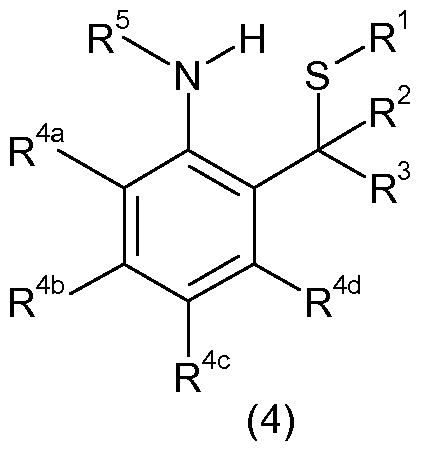
- the invention thus provides a process for the continuous preparation of compounds of the formula (4)
- R is (Ci-Ce) alkyl, substituted (Ci-Ce) alkyl, aryl or substituted aryl
- R 2 is an electron withdrawing or activating substituent selected from the group consisting of
- R 1 ' is defined as R 1 and R 1' is the same or different than R 1 ,
- R 1' is defined as R 1 , wherein R 1 '" is the same or different than R 1 and where n is 0, 1, or 2,
- R 3 is H, (Ci-C 6 ) alkyl, substituted (Ci-C 6 ) alkyl, aryl or substituted aryl,
- R 4a to R 4d are independently selected from the group
- (C3-C7) -cycloalkyl where the cycloalkyl is unsubstituted or substituted by one or more substituents selected from the group consisting of fluorine, chlorine, (Ci-C 4) - alkyl or (C3-C7) cycloalkyl or (Ci-C 4 ) Alkoxy group is substituted,
- (C 1 -C 6) -alkoxy where the alkoxy radical is unsubstituted or substituted by one or more substituents selected from the group consisting of fluorine, chlorine, (C 1 -C 4 ) -alkoxy or (C 3 -C 7) -cycloalkyl,
- (C 1 -C 4 ) -alkyl or (C 1 -C 4 ) -alkoxy group is substituted, CO-X, wherein X is OR 1 " , SR 1" or NR 2 ' R 2 " , wherein R 1" is defined as R 1 and R 1 "is the same or different than R 1 , and wherein R 2' and R 2 " are defined as R 3 , wherein R 2 ' and R 2" are each the same or different than R 3 , or R 2' and R 2 "form a ring,
- R 5 is H, (Ci-C 6 ) alkyl, substituted (Ci-C 6 ) alkyl, aryl or substituted aryl,
- R 4a to R 4d and R 5 are as defined for compounds of formula (4), and a thioether (W)
- R 1 , R 2 and R 3 are as defined for compounds of formula (4) can be used, wherein the starting materials of the formulas (Q) and (W) in the presence
- R 2 ' and R 2 " are each independently H, F, Cl, Br, I, CF 3 , CN, NO 2 or CO-X, where X is OR 1 " , SR 1" or NR 2 ' R 2 " , where R 1" as R 1 is defined and R 1 "is the same or different than R 1 , and wherein R 2 ' and R 2" are each independently H, (Ci-Ce) alkyl, substituted (Ci-Ce) alkyl, aryl or substituted Aryl stand.
- the radicals R 2 ' and R 2 " may alternatively form a ring.
- the nitrogen base which has already been added at the beginning of the reaction, and optionally optionally repeated during the course of the reaction, is characterized in that it has no the nitrogen-bonded hydrogen, ie no NH group having.
- Nitrogen bases which do not have an NH group can also be referred to as "amines without free NH.”
- a large group of nitrogen bases which do not have an NH group are tertiary amines which can be used for carrying out the process according to the invention Amines are also characterized by their basic properties.
- unsubstituted pyridines or substituted or unsubstituted quinolines are nitrogen bases, each also having no NH group and being suitable for carrying out the process according to the invention.
- the essence of the invention relates to the unexpected and at the same time very advantageous fact that the resulting in the presence of a chlorinating HCl salt of a nitrogen base without NH group, especially in the presence of a
- Chlorine take up resulting HCl without being self-chlorinated, while remaining dissolved in the solvent chosen for carrying out the reaction for the preparation of compounds of formula (4). Thus, it is achieved by adding one of the nitrogen bases mentioned that the starting material aniline does not precipitate out as insoluble HCl salt.
- the chlorinated amine can react in an undesirable side reaction with the thioether (W), so that the desired
- a tertiary amine is added.
- the tertiary amine is added alone to catalyze the conversion of compounds of formula (2) into the compounds of formula (4) by deprotonation.
- Reaction start in a reaction according to Scheme 2 lead to an undesired chlorination of the tertiary amine.
- the chloride salt of the tertiary amine formed by the chlorination is a non-inert, ie a reactive, species. These reactive species would be expected to cause undesirable side reactions such as the chlorination or amination of the thioether used as the starting material.
- the addition of a nitrogen base without NH group already at the beginning of the reaction is not yet known.
- the present process for the continuous production of an ortho-substituted aniline of the formula (4) in a flow reactor in the presence of a nitrogen base which does not have an NH group has the significant advantage that the HCl salt of the nitrogen base used in the organic solvent chosen for the reaction during the entire reaction, ie in the respective
- An essential aspect of the invention thus, in addition to the selection of a suitable nitrogen base, is the consideration and prior assessment of the solubility of the HCl base of the nitrogen base, i. the evaluation of the solubility of the salt, which forms from the respectively selected nitrogen base in the presence of the chlorinating agent used in the reaction. Solubility and miscibility of the educts are essential prerequisites for the reaction of the educts in a flow reactor, that this is based on a continuous reaction regime. Due to the solubility of the HCI salt of the nitrogen base, the aniline (Q), the chlorinating agent and the thioether (W) can be rapidly mixed together and / or sequentially and reacted directly to compounds of formula (4).
- the selective course of the reaction which also gives the product in high purity at the same time, is particularly surprising because the nitrogen base competes with the aniline for the chlorine atom during the chlorination.
- the chlorinated nitrogen base can react with thioether in an undesirable side reaction. In this unfavorable but probable case, the thioether would no longer be available as a reactant for the aniline. It can not be predicted, not even by a skilled person, whether, or to what extent, the addition of the tertiary amine (P), the selectivity of the reaction between the starting materials, ie between the aniline (Q) and the thioether (W), negatively affected after the previous addition of a chlorinating agent.
- the reaction temperature when carrying out the reaction in the flow reactor is preferably between -65 ° C and 0 ° C. It is particularly preferred if the reaction temperature between - 55 ° C and - 10 ° C. Most preferably, a reaction temperature is between -45 ° C and -20 ° C.
- a preferred group of nitrogen bases without NH group (P) forms the group of tertiary amines.
- Particularly preferred tertiary amines are trialkylamines whose alkyl radicals have a chain length of Ci - Cis.
- the alkyl groups of the tertiary amines can also be closed to a ring, so that cyclic tertiary amines are present.
- a preferred cyclic tertiary amine is piperidine.
- Substituted pyridine equivalent to a tertiary amine since a pyridine the same, or at least similar reactions are received, which typically also enters a tertiary amine.
- benzo-fused ring system of pyridine can be used.
- pyridines it is preferred if they are substituted to ensure their solubility at least by an alkyl, alkoxy, or halogen radical.
- Substituents of pyridine are particularly preferred alkyl radicals and alkoxy radicals having a chain length of C1-C18.
- other heteroaromatics are in principle also suitable for carrying out the process according to the invention. The basicity of this must be
- Heteroaromatic be equal to or higher than the basicity of aniline (Q).
- the said nitrogen bases without NH group may alternatively or in
- the base mixture may comprise a substituted pyridine and / or a benzo-fused ring system of pyridine.
- the pyridine substituents are preferably selected from the group consisting of alkyl, alkoxy or halogen radicals, with alkyl radicals and alkoxy radicals having a chain length of C1-C18 being particularly preferred.
- Particularly preferred tertiary amines are trialkylamines whose alkyl radicals have a chain length of Ci - Cis, wherein at least one of the radicals
- Chain length of at least C 4 - Cis has.
- the said minimum chain length of six carbon atoms in at least one of the three radicals of the trialkylamine ensures that the tertiary amine is sufficiently lipophilic to ensure the solubility of the tertiary amine in the chosen organic solvent. If the remaining two residues of the trialkylamine also have a minimum chain length of six carbon atoms, the lipophilicity of the amine is correspondingly higher. In this case, corresponding combinations of the chain lengths of all alkyl radicals to a total chain length of at least C 4 -Cis may be sufficient to ensure the solubility of the HCl salt.
- the alkyl radicals of the trialkylamine can each be unsubstituted or substituted.
- a particularly preferred trialkylamine for the present process is tributylamine.
- a most preferred pyridine is 2-methyl-5-ethyl-pyridine.
- a most preferred benzo-fused ring system of pyridine is substituted or unsubstituted quinoline, with unsubstituted quinoline being most preferred.
- the most preferred base mixture with three nitrogen bases includes tributylamine, an unsubstituted quinoline and 2-methyl-5-ethyl-pyridine.
- the solvent must be compatible with the chlorinating agent.
- nonpolar organic solvents such as
- Chloroalkanes for example dichloromethane and dichloroethane
- Aromatics for example benzene, toluene, xylene
- Haloaromatics for example chlorobenzene, dichlorobenzene
- polar organic solvents preferably ester solvents, such as (Ci-Ce) alkyl acetate (for example, methyl acetate, ethyl acetate, n-propyl acetate, iso-propyl acetate, 2 Methyl-prop-1-ylacetate, n-butylacetate, but-2-ylacetate, pentylacetates, hexylacetates and cyclalkylacetates, (Ci-Ce) alkyl and cycloalkylpropionates, (Ci-Ce) alkyl and cycloalkyl-n-butyrates, -iso-butyrates .
- (Ci-Ce) alkyl acetate for example, methyl acetate, ethyl acetate, n-propyl acetate, iso-propyl acetate, 2 Methyl-prop-1-ylacetate, n-butylacetate, but-2-yla
- Solvent comprises, suitable for carrying out the reaction according to the invention.
- Suitable chlorinating agents are all chlorinating agents which are soluble in the organic solvent and known to the person skilled in the art.
- Preferred chlorinating agents are tert-butyl hypochlorite and sulfuryl chloride, which are advantageously both liquid and also in one of the above
- Solvents are readily soluble.
- the two mentioned chlorinating agents can also be used together, i. in mixture with each other, are used.
- the chlorinating agent is sulfuryl chloride (SO 2 Cl 2).
- At least one of the two educts is present in a first mixing chamber prior to the combination of the two educts and before the addition of the chlorinating agent
- Reaction stages is an essential parameter in the process.
- Reaction stages defined by the various belonging to the flow reactor master chambers, mixing chambers and dwell lines, which are arranged according to the reaction sequence sequentially.
- the base is already added to the educts in or in the original chambers.
- reaction mixture can also be added again after combining the two starting materials dissolved in an organic solvent and after addition of the chlorinating agent, but before feeding the residence reactor belonging to the flow reactor with the reaction mixture.
- the multiple addition of the nitrogen base ensures that the
- the solubility of the reaction mixture in the residence of a flow reactor is particularly important for the applicability of the flow reactor. This is especially true for ensuring the operating requirements of the first dwelling section belonging to a flow reactor.
- reaction mixture after this, the first belonging to the flow reactor
- Solvent is present dissolved at the respective reaction temperature, is added again. The re-addition causes the viscosity of the reaction mixture, the
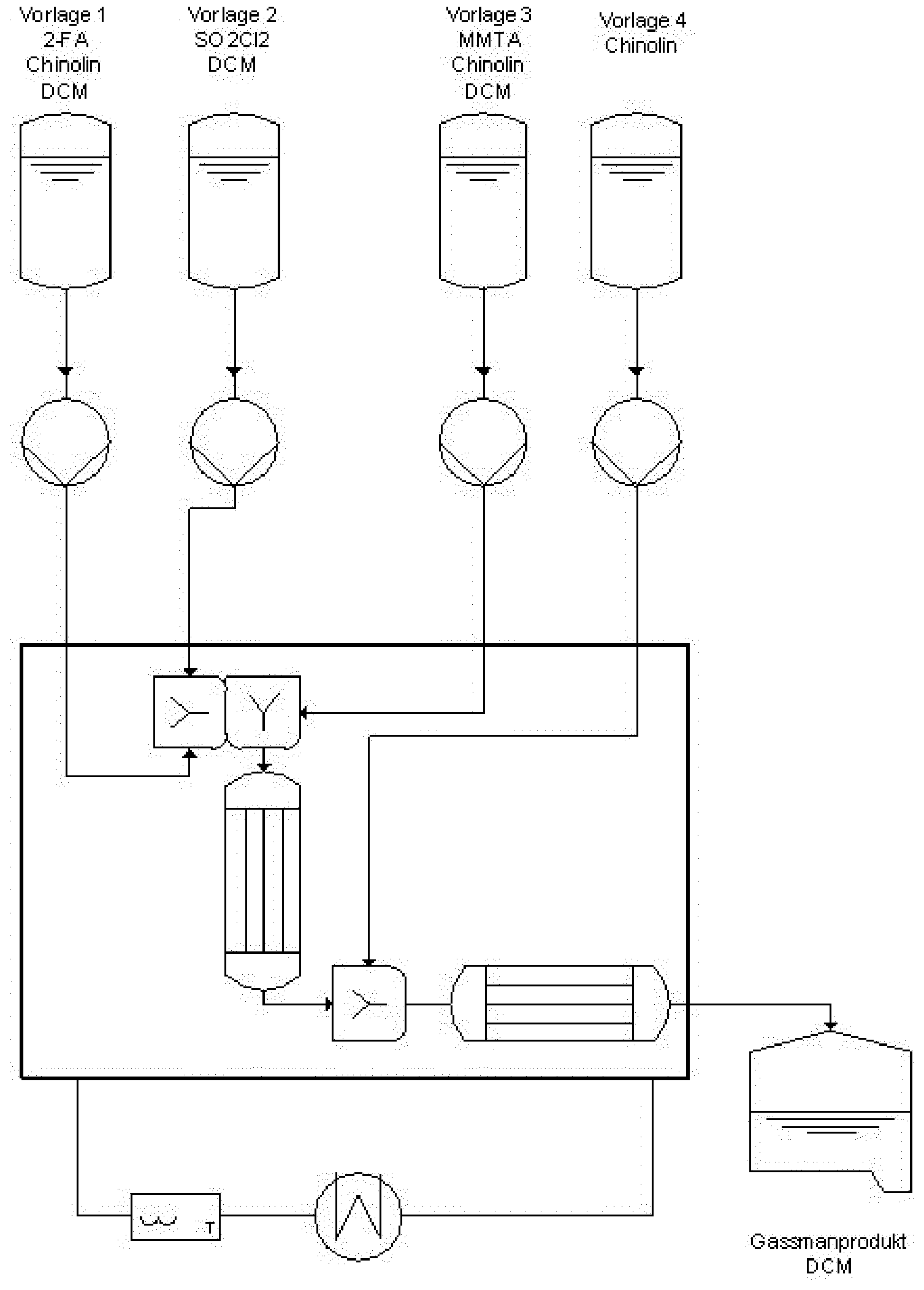
- a template mixture-2 (VG2), at least comprising:
- the template mixture-1 (VG1) and the template mixture-2 (VG2) are mixed in a first mixing chamber (M1) at a reaction temperature in the range between - 65 ° C and 0 ° C, and
- a second mixing chamber M2
- Nitrogen base corresponds, is mixed, and the mixture thus obtained subsequently again in a second residence element-2 (VW-2) of
- mixtures of an aniline (Q) and a nitrogen base without NH group, or of a thioether (W) and a nitrogen base without NH group are preferably beforehand with a solvent or a Diluted solvent mixture, wherein the mixture can be cooled by already pre-cooling the supply lines to the mixing chambers (M).
- the nitrogen base (amount Z ) with a solvent or alternatively with a solvent mixture can be prediluted and additionally pre-cooled by the supply lines to the mixing chambers (M) are pre-cooled.
- the chlorinating agent can with a solvent or a
- Solvent mixture are prediluted and can preferably be pre-cooled by the supply lines are precooled to the mixing chambers.
- the amounts of the two starting materials, i. of the aniline of the formula (Q) and the thioether of the formula (W), and the amounts of the chlorinating agent and the nitrogen base are each variable over a wide range.
- Up to 1 equivalent, preferably 0.5 to 1.0 equivalents, more preferably 0.7 to 1.0 equivalents, most preferably 0.8 to 0.95 equivalents of the chlorinating agent are containing with a mixture 1 equivalent of the aniline (Q) and up to 1 equivalent, preferably 0.1 to 0.9 equivalents, more preferably 0.2 to 0.5 equivalents, particularly preferably 0.25 to 0.35 equivalents of the nitrogen base (amount Z) mixed in a mixing chamber of a flow reactor.
- the mixture thus obtained is mixed directly with a mixture of one equivalent of the thioether (W) and up to 1 equivalent, preferably 0.1 to 0.9 equivalents, more preferably 0.5 to 0.8 equivalents, most preferably 0.65 to 0.75
- Equivalents of the nitrogen base (amount Z ') are mixed in each case in the mixing chamber of a flow reactor, wherein the total amount of amine ( ⁇ + ⁇ ') is greater than or equal to the equivalents of the chlorinating agent. After passing through a residence section, the mixture is reacted with up to 2 equivalents, preferably 0.5 to 1.8 equivalents, particularly preferably 1, 0 to 1, 6 equivalents, the nitrogen base (amount Z ") mixed.
- the aniline (Q) used in the process of the present invention has the following
- R 4a to R 4d are independently selected from the group
- Cydoalkylrest is unsubstituted or substituted by one or more substituents selected from the group consisting of fluorine, chlorine, (Ci-C 4) - alkyl or (C3-C7) cycloalkyl or (Ci-C 4 ) Alkoxy group is substituted,
- (C 1 -C 6) -alkoxy where the alkoxy radical is unsubstituted or substituted by one or more substituents selected from the group consisting of fluorine, chlorine, (C 1 -C 4 ) -alkoxy or (C 3 -C 7) -cycloalkyl,
- R 5 is H, (Ci-C 6 ) alkyl, substituted (Ci-C 6 ) alkyl, aryl or substituted aryl.
- aniline it is intended to mean one of the abovementioned compounds of the formula (Q)
- the aniline used in ortho position to the amino group has a hydrogen atom, ie the aniline used must be unsubstituted in the ortho position.
- the aromatic ring of the aniline may have up to four further substituents R 4a to R 4d .
- radicals R 4a to R 4d independently of one another each represent H, F, Cl, Br, I, CF 3 , CN, NO 2 or CO-X, where X is OR 1 " , SR 1" or NR 2 ' R 2 " , wherein R 1" is defined as R 1 and R 1 "is the same or different than R 1 , and wherein R 2' and R 2" are defined as R 2 , where R 2 ' and R 2 "are each the same or different than R 2 , or R 2' and R 2" form a ring.
- radical R 4a is fluorine. It is very particularly preferred if R 4a , ie the radical ortho to the amino group, is a fluorine, with the aromatic ring of the aniline not being otherwise substituted.
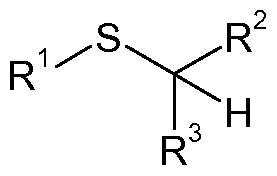
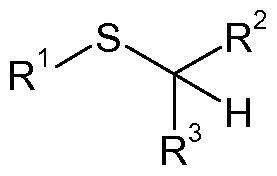
- Thioethers (W) used according to the invention have the following structure:
- R 1 is (Ci-Ce) alkyl, substituted (Ci-Ce) alkyl, aryl or substituted aryl
- R 2 is an electron-withdrawing or activating radical selected from the group consisting of
- R 1 ' is defined as R 1 and R 1' is the same or different than R 1 ,
- R 1 " as R 1 is defined and R 1" is the same or different than R 1 , and wherein R 2 ' and R 2 " are each independently H, (Ci-Ce)
- R 1' is defined as R 1 , wherein R 1 '" is the same or different than R 1 and where n is 0, 1, or 2,
- R 3 is H, (Ci-C 6 ) alkyl, substituted (Ci-C 6 ) alkyl, aryl or substituted aryl.
- radicals alkyl, alkoxy, haloalkyl, haloalkoxy, alkylamino and alkylthio and the corresponding unsaturated and / or substituted radicals in the carbon skeleton can each be straight-chain or branched. Unless specifically stated, these radicals are the lower carbon skeletons, e.g. with 1 to 6 C atoms, or in unsaturated groups having 2 to 6 C atoms, preferred.
- Cycloalkyl means a carbocyclic saturated ring system preferably having 3 to 8 carbon atoms, e.g. Cyclopropyl, cyclobutyl, cyclopentyl or cyclohexyl.
- Halogen is fluorine, chlorine, bromine or iodine.
- Haloalkoxy is, for example, OCF 3 , OCHF 2 , OCH 2 F, CF 3 CF 2 O, OCH 2 CF 3 and OCH 2 CH 2 Cl; the same applies to other halogen-substituted radicals.
- Aryl means a mono-, bi- or polycyclic aromatic system, for example phenyl, naphthyl, tetrahydronaphthyl, indenyl, indanyl, pentalenyl, fluorenyl and the like, preferably phenyl.
- a substituted alkyl is a (Ci-Ce) alkyl which is substituted by one or more radicals selected from the group consisting of (Ci-Ce) alkyl, (Ci-Ce) alkoxy, aryl, heteroaryl, and halogen.
- a substituted aryl represents a mono-, bi- or polycyclic aromatic system, for example phenyl, naphthyl, tetrahydronaphthyl, indenyl, indanyl, pentalenyl, fluorenyl and the like, preferably phenyl which is substituted by one or more substituents selected from the group consisting from (Ce-Ce) alkyl, (d-Ce) alkoxy, aryl, heteroaryl and halogen.
- a heterocyclic radical or ring may be saturated, unsaturated or heteroaromatic; it preferably contains one or more, in particular 1, 2 or 3 heteroatoms in the heterocyclic ring, preferably from the group N, O, and S; it is preferably an aliphatic heterocyclyl radical having 3 to 7 ring atoms or a heteroaromatic radical having 5 or 6 ring atoms.
- the heterocyclic radical may be e.g. a heteroaromatic radical or ring (heteroaryl), e.g.
- a mono-, bi- or polycyclic aromatic system in which at least one ring contains one or more heteroatoms for example pyridyl, pyrimidinyl, pyridazinyl, pyrazinyl, triazinyl, thienyl, thiazolyl, thiadiazolyl, oxazolyl, isoxazolyl, furyl,
- Pyrrolyl, pyrazolyl and imidazolyl or is a partially or completely hydrogenated radical such as oxiranyl, pyrrolidyl, piperidyl, piperazinyl, dioxolanyl, oxazolinyl, isoxazolinyl, oxazolidinyl, isoxazolidinyl, morpholinyl, tetrahydrofuryl.
- Substituents for a substituted heterocyclic radical are those mentioned below
- Hetero ring atoms which may exist in different oxidation states, e.g. at N and S, occur.
- Substituted radicals such as a substituted alkyl, aryl, phenyl, benzyl, heterocyclyl and heteroaryl radical, mean, for example, a substituted radical derived from the unsubstituted main body, where the substituents are, for example, one or more, preferably 1, 2 or 3 radicals from the Group halogen, alkoxy,
- radicals having C atoms those having 1 to 4 C atoms, in particular 1 or 2 C atoms, are preferred.
- substituents from the group halogen for example fluorine and chlorine, (C 1 -C 4 ) -alkyl,
- Such compounds contain one or more asymmetric carbon atoms, which are not specified separately in the general formulas.
- the possible defined by their specific spatial form possible stereoisomers, such as enantiomers, diastereomers can be obtained by conventional methods from mixtures of stereoisomers or by stereoselective reactions in combination with the use of
- anilines of the formula (Q) and thioethers of the formula (W) to be used according to the invention can be prepared by the processes known to the person skilled in the art.
- a further aspect of the invention relates to a multistage process for the preparation of compounds of the formula (1 -1), or of compounds of the formula (4-1), which each have herbicidal activity, starting from compounds of the formula (4), or Compounds of the formula (4 ' ).
- the multistage process is distinguished from the previously known processes for the preparation of N-alkyl-N- [2- (1, 3,5-triazin-2-ylcarbonyl) phenyl] alkanesulfonamides (4-1) and 2- (triazinylcarbonyl) sulfon- anilides (1 -1) characterized in that as starting materials, or as intermediates, the obtained by means of a continuous reaction in a flow reactor ortho-substituted anilines of formula (4), or
- OxindolENSen of formula (7-1) are used.
- An aspect of the invention thus also comprises the use of the ortho-substituted anilines of the formula (4) obtained in a flow reactor for the preparation of N-alkyl-N- [2- (1, 3,5-triazin-2-ylcarbonyl) phenyl] alkanesulfonamides of the formula (4-1).
- the use of a flow reactor has the advantage that the process for the preparation of compounds of the formula (4-1) can be carried out even more efficiently on an industrial scale in comparison to the previously known processes and at the same time high yields can be obtained.
- oxindoles of the formula (7-1) are prepared starting from compounds of the formula (4) in which R 2 is CO-X, where X is SR 1 " or NR 2 ' R 2" , where R 1 " as R 1 is defined and R 1 "is the same or different than R 1 , and wherein R 2 ' and R 2" are each independently H, (Ci-Ce) alkyl, substituted (Ci-Ce) alkyl, aryl or substituted Aryl or R 2 ' and R 2 "form a ring. Subsequently, the 3- (alkylsulfanyl) -1,3-dihydro-2H-indol-2-one of the formula (7-1) obtained according to the aforementioned procedure from a compound of the formula (4) or (4)
- R 1 is an unsubstituted (C 1 -C 6) alkyl, a substituted (C 1 -C 6) alkyl
- R 3 is hydrogen
- R 4a to R 4d are as defined for formula (4),
- R 5 is hydrogen, through
- R 4a to R 4d , R 3 and R 7 are as defined for formula (7-1),
- R to R are as defined for compounds of the formula (4) or of the formula (Q), and
- R and R are each independently for
- R to R are as defined for formula (4)
- R 3 is hydrogen
- R 5 is hydrogen, in a first step by
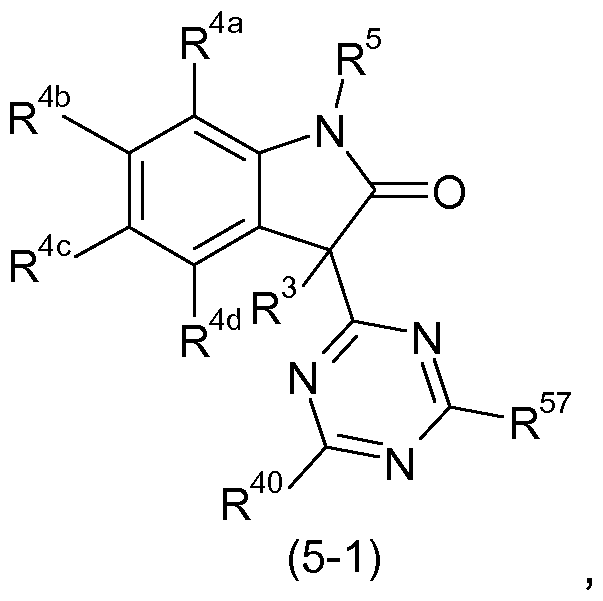
- R 4a to R 4d and R 40 and R 57 are as defined for the formula (4-1) and R 3 and R 7 are as defined for the formula (6-1), and the arylation products of the formula (5-1) in a second step
- R 4a to R 4d , R 20 and R 40 and R 57 are as defined in formula (4-1) and R 3 as defined for the formula (6-1), and the sulfonylation of the formula (2-1) in a third step by oxidative ring opening to a 2- (triazinylcarbonyl) sulfonanilide of the formula (1 -1)
- R 4a to R 4d , R and R and R 57 are as defined for formula (4-1), reacted, and the oxidation products of the formula (1 -1) in a fourth step
- R 4a to R 4d , R 20 and R 40 and R 57 are as defined for formula (4-1), reacted as alkylating reagent
- X-R 8 wherein X is chlorine, bromine, iodine or OSO 2 R 9 , wherein R 8 is as defined above for formula (4-1) and R 9 is as defined above R 1 , or (R 8 ) 2SO 4 , wherein R 8 is as defined above for formula (4-1) is used.
- Boiling the polar solvent corresponds is heated to reflux.
- sulfur-containing salts are particularly preferred for carrying out the reduction of sodium salts selected from the group consisting of
- Carbonates potassium carbonate and sodium carbonate and at least one of the two hydroxides: potassium hydroxide or sodium hydroxide used.
- a base mixture containing at least one imidazole base substituted in 1 position he follows.
- Particularly preferred imidazole bases for carrying out the sulfonylation are 1-methyl-1 H-imidazole, 1-butyl-1 H-imidazole or 1-benzyl-1 H-imidazole, which can be used individually or in admixture, the use of 1-methyl-1H-imidazole is very particularly preferred.
- the alkylation can be carried out with customary alkylating agents.
- dimethyl sulfate is preferably used.
- VO1 a solution of 7.5 parts by mass of 2-fluoroaniline (2-FA), 1, 66 parts by mass of quinoline (CL) and 90.84 parts by mass
- Vortempener cooled to the reaction temperature (-40 ° C) and in a first static mixing chamber (M1) with a volume of 0.3 cm 3 reacted.
- the delivery rate of the pumps is chosen so that a
- the reaction mixture leaves the first static mixing chamber (M1) and flows directly into a second static mixing chamber (M2) with 0.6 cm 3 volume.
- the reaction solution with the substrate stream brought to the reaction temperature consisting of methylmethylthioacetate, quinoline and dichloromethane from template 3 is reacted.
- the delivery rate of the pump was chosen so that a residence time of 0.22 seconds is reached and a stoichiometric ratio of methyl methylthioacetate to sulfuryl chloride of 1:05 is present.
- the reaction mixture leaves the second mixing chamber and flows into a first residence element (VW1) with a volume of 90.84 cm 3 and a residence time of 32.6 seconds.
- VW1 a first residence element
- the reaction mixture leaves the third mixing chamber and flows into a second residence element (VW2) with a volume of 5.7 cm 3 and a residence time of 2 seconds.
- VW2 second residence element
- the reaction mixture is then collected in a collecting vessel (SG 1).
- the reaction is monitored regularly by HPLC.
- the reaction mixture is passed at 0 ° C into a 0.4 N HCl.
- the pale yellow organic phase is separated from the aqueous phase.
- the organic phase is extracted with 0.4 N HCl so that the product 4 is present as a solution in dichloromethane.
- reaction solution is up to 26 mbar at 40 ° C
Landscapes
- Chemical & Material Sciences (AREA)
- Organic Chemistry (AREA)
- Chemical Kinetics & Catalysis (AREA)
- Organic Low-Molecular-Weight Compounds And Preparation Thereof (AREA)
- Agricultural Chemicals And Associated Chemicals (AREA)
Description




Claims






Priority Applications (10)
| Application Number | Priority Date | Filing Date | Title |
|---|---|---|---|
| MX2015003295A MX361396B (es) | 2012-09-17 | 2013-09-12 | Procedimiento continuo para la producción de anilinas sustituidas en orto en un reactor de flujo. |
| US14/427,471 US9527808B2 (en) | 2012-09-17 | 2013-09-12 | Continuous method for producing ortho-substituted anilines in a flow reactor |
| JP2015531554A JP6310918B2 (ja) | 2012-09-17 | 2013-09-12 | フローリアクターでのオルト置換されたアニリン類の連続製造方法 |
| CN201380059930.8A CN104797556B (zh) | 2012-09-17 | 2013-09-12 | 在连续反应器中制备邻位取代的苯胺的连续方法 |
| EP13762114.0A EP2895458B1 (de) | 2012-09-17 | 2013-09-12 | Kontinuierliches verfahren zur herstellung von ortho-substituierten anilinen in einem flussreaktor |
| DK13762114.0T DK2895458T3 (en) | 2012-09-17 | 2013-09-12 | CONTINUOUS PROCEDURE FOR MANUFACTURING ORTHO-SUBSTITUTED ANILINES IN A FLOW REACTOR |
| ES13762114.0T ES2593608T3 (es) | 2012-09-17 | 2013-09-12 | Procedimiento continuo para la producción de anilinas sustituidas en posición orto en un reactor de flujo |
| BR112015005454-4A BR112015005454B1 (pt) | 2012-09-17 | 2013-09-12 | Método contínuo para a produção de anilinas orto-substituídas em um reator de fluxo |
| KR1020157009760A KR102057717B1 (ko) | 2012-09-17 | 2013-09-12 | 유동반응기에서 오르토 치환된 아닐린의 연속 제조방법 |
| IL237602A IL237602A (en) | 2012-09-17 | 2015-03-08 | A continuous method for producing anilines is converted ortho in a flow reactor |
Applications Claiming Priority (2)
| Application Number | Priority Date | Filing Date | Title |
|---|---|---|---|
| EP12184687.7 | 2012-09-17 | ||
| EP12184687 | 2012-09-17 |
Publications (1)
| Publication Number | Publication Date |
|---|---|
| WO2014041052A1 true WO2014041052A1 (de) | 2014-03-20 |
Family
ID=47046344
Family Applications (1)
| Application Number | Title | Priority Date | Filing Date |
|---|---|---|---|
| PCT/EP2013/068878 Ceased WO2014041052A1 (de) | 2012-09-17 | 2013-09-12 | Kontinuierliches verfahren zur herstellung von ortho-substituierten anilinen in einem flussreaktor |
Country Status (12)
| Country | Link |
|---|---|
| US (1) | US9527808B2 (de) |
| EP (1) | EP2895458B1 (de) |
| JP (1) | JP6310918B2 (de) |
| KR (1) | KR102057717B1 (de) |
| CN (1) | CN104797556B (de) |
| BR (1) | BR112015005454B1 (de) |
| DK (1) | DK2895458T3 (de) |
| ES (1) | ES2593608T3 (de) |
| IL (1) | IL237602A (de) |
| MX (1) | MX361396B (de) |
| TW (1) | TWI609854B (de) |
| WO (1) | WO2014041052A1 (de) |
Cited By (1)
| Publication number | Priority date | Publication date | Assignee | Title |
|---|---|---|---|---|
| EP3360417A1 (de) | 2017-11-02 | 2018-08-15 | Bayer CropScience Aktiengesellschaft | Verwendung von sulfonylindol als herbizid |
Families Citing this family (1)
| Publication number | Priority date | Publication date | Assignee | Title |
|---|---|---|---|---|
| CN109689611B (zh) * | 2016-07-21 | 2021-09-28 | 株式会社钟化 | 有机化合物的制造方法 |
Citations (7)
| Publication number | Priority date | Publication date | Assignee | Title |
|---|---|---|---|---|
| US3972894A (en) | 1973-04-27 | 1976-08-03 | The Ohio State University Research Foundation | Synthesis of oxindoles from anilines and β-thio carboxylic esters or amides |
| WO1996041799A1 (de) | 1995-06-12 | 1996-12-27 | Hoechst Schering Agrevo Gmbh | Sulfonamide als herbizide und pflanzenwachstumsregulatoren |
| WO2006008159A1 (en) | 2004-07-23 | 2006-01-26 | Bayer Cropscience Ag | A use of sulfonanilides as agricultural and horticultural fungicide |
| WO2007031208A2 (en) | 2005-09-16 | 2007-03-22 | Bayer Cropscience Ag | A use of sulfonanilides as herbicide |
| JP2008101014A (ja) | 2007-11-22 | 2008-05-01 | Dainippon Printing Co Ltd | 2−オキシインドール誘導体の製造法 |
| WO2010127786A1 (de) | 2009-05-02 | 2010-11-11 | Bayer Cropscience Ag | Verfahren zur herstellung von oxindolen und ortho-substituierten anilinen und ihre verwendung als zwischenprodukte für synthesen |
| WO2012028162A1 (de) | 2010-09-01 | 2012-03-08 | Bayer Cropscience Ag | Verfahren zur herstellung von oxindolen und ortho-substituierten anilinen und ihre verwendung als zwischenprodukte für synthesen |
Family Cites Families (1)
| Publication number | Priority date | Publication date | Assignee | Title |
|---|---|---|---|---|
| JP5964320B2 (ja) * | 2010-12-21 | 2016-08-03 | バイエル・インテレクチュアル・プロパティ・ゲゼルシャフト・ミット・ベシュレンクテル・ハフツングBayer Intellectual Property GmbH | 2−(トリアジニルカルボニル)スルホンアニリド類の製造方法 |
-
2013
- 2013-09-12 BR BR112015005454-4A patent/BR112015005454B1/pt active IP Right Grant
- 2013-09-12 CN CN201380059930.8A patent/CN104797556B/zh active Active
- 2013-09-12 KR KR1020157009760A patent/KR102057717B1/ko active Active
- 2013-09-12 EP EP13762114.0A patent/EP2895458B1/de active Active
- 2013-09-12 DK DK13762114.0T patent/DK2895458T3/en active
- 2013-09-12 ES ES13762114.0T patent/ES2593608T3/es active Active
- 2013-09-12 MX MX2015003295A patent/MX361396B/es active IP Right Grant
- 2013-09-12 WO PCT/EP2013/068878 patent/WO2014041052A1/de not_active Ceased
- 2013-09-12 JP JP2015531554A patent/JP6310918B2/ja active Active
- 2013-09-12 US US14/427,471 patent/US9527808B2/en active Active
- 2013-09-16 TW TW102133427A patent/TWI609854B/zh active
-
2015
- 2015-03-08 IL IL237602A patent/IL237602A/en active IP Right Grant
Patent Citations (7)
| Publication number | Priority date | Publication date | Assignee | Title |
|---|---|---|---|---|
| US3972894A (en) | 1973-04-27 | 1976-08-03 | The Ohio State University Research Foundation | Synthesis of oxindoles from anilines and β-thio carboxylic esters or amides |
| WO1996041799A1 (de) | 1995-06-12 | 1996-12-27 | Hoechst Schering Agrevo Gmbh | Sulfonamide als herbizide und pflanzenwachstumsregulatoren |
| WO2006008159A1 (en) | 2004-07-23 | 2006-01-26 | Bayer Cropscience Ag | A use of sulfonanilides as agricultural and horticultural fungicide |
| WO2007031208A2 (en) | 2005-09-16 | 2007-03-22 | Bayer Cropscience Ag | A use of sulfonanilides as herbicide |
| JP2008101014A (ja) | 2007-11-22 | 2008-05-01 | Dainippon Printing Co Ltd | 2−オキシインドール誘導体の製造法 |
| WO2010127786A1 (de) | 2009-05-02 | 2010-11-11 | Bayer Cropscience Ag | Verfahren zur herstellung von oxindolen und ortho-substituierten anilinen und ihre verwendung als zwischenprodukte für synthesen |
| WO2012028162A1 (de) | 2010-09-01 | 2012-03-08 | Bayer Cropscience Ag | Verfahren zur herstellung von oxindolen und ortho-substituierten anilinen und ihre verwendung als zwischenprodukte für synthesen |
Non-Patent Citations (17)
| Title |
|---|
| BIOORG. MED. CHEM. LETT., vol. 16, 2006, pages 2109 |
| CLARK ET AL., SYNTHESIS, 1991, pages 871 - 878 |
| GASSMAN ET AL., J. AM. CHEM. SOC., vol. 96, no. 17, 1974, pages 5512 |
| GASSMAN ET AL., ORGANIC SYNTHESIS COLL., vol. 6, pages 601 |
| GASSMAN, J. AM. CHEM. SOC., vol. 96, no. 17, 1974, pages 5508 |
| JOHNSON, J. ORG. CHEM., vol. 55, 1990, pages 1374 |
| JONES ET AL., TETRAHEDRON LETT., vol. 35, 1994, pages 7673 - 7676 |
| KIKUGAWA ET AL., CHEM. LETTERS, 1987, pages 1771 - 1774 |
| LENGYEL ET AL., SYNTH. COMM., vol. 28, no. 10, 1998, pages 1891 - 1896 |
| ORGANIC SYNTHESIS COLL, vol. 56, pages 72 |
| W.C. SUMPTER: "Stolle Synthesis", CHEM. REV., vol. 37, 1945, pages 443 - 449 |
| WARPEHOSKI, TETRAHEDRON LETT., vol. 27, 1986, pages 4103 |
| WRIGHT ET AL., TETRAHEDRON LETT., vol. 37, 1996, pages 4631 |
| WRIGHT S W ET AL: "A Convenient Modification of the Gassman Oxindole Synthesis", TETRAHEDRON LETTERS, ELSEVIER, AMSTERDAM, NL, vol. 37, no. 27, 1 July 1996 (1996-07-01), pages 4631 - 4634, XP004028978, ISSN: 0040-4039, DOI: 10.1016/0040-4039(96)00920-3 * |
| YONEMITSU, CHEM. PHARM. BULL., vol. 29, 1981, pages 128 - 136 |
| ZARD ET AL., TETRAHEDRON LETT., vol. 35, 1994, pages 1719 - 1722 |
| ZARD ET AL., TETRAHEDRON LETT., vol. 35, 1994, pages 9553 - 9556 |
Cited By (1)
| Publication number | Priority date | Publication date | Assignee | Title |
|---|---|---|---|---|
| EP3360417A1 (de) | 2017-11-02 | 2018-08-15 | Bayer CropScience Aktiengesellschaft | Verwendung von sulfonylindol als herbizid |
Also Published As
| Publication number | Publication date |
|---|---|
| MX2015003295A (es) | 2015-07-14 |
| CN104797556A (zh) | 2015-07-22 |
| TWI609854B (zh) | 2018-01-01 |
| KR20150056626A (ko) | 2015-05-26 |
| DK2895458T3 (en) | 2016-10-03 |
| EP2895458A1 (de) | 2015-07-22 |
| BR112015005454B1 (pt) | 2020-06-02 |
| BR112015005454A8 (pt) | 2018-10-23 |
| JP6310918B2 (ja) | 2018-04-11 |
| TW201425287A (zh) | 2014-07-01 |
| CN104797556B (zh) | 2017-09-15 |
| EP2895458B1 (de) | 2016-08-17 |
| MX361396B (es) | 2018-12-05 |
| US9527808B2 (en) | 2016-12-27 |
| ES2593608T3 (es) | 2016-12-12 |
| JP2015533802A (ja) | 2015-11-26 |
| KR102057717B1 (ko) | 2019-12-19 |
| BR112015005454A2 (pt) | 2017-08-08 |
| IL237602A (en) | 2017-06-29 |
| US20150210637A1 (en) | 2015-07-30 |
| IL237602A0 (en) | 2015-04-30 |
Similar Documents
| Publication | Publication Date | Title |
|---|---|---|
| EP2200978A1 (de) | Verfahren zur herstelung von sulfonsäurediamiden | |
| DE69527716T2 (de) | Verfahren zur herstellung von aromatischen oder heteroaromatischen sulfonylhalogeniden | |
| EP2895458B1 (de) | Kontinuierliches verfahren zur herstellung von ortho-substituierten anilinen in einem flussreaktor | |
| EP1268446A1 (de) | Verfahren zur herstellung von unsymmetrischen 4,6-bis(aryloxy)pyrimidin-derivaten | |
| EP2655346B1 (de) | Verfahren zur herstellung von 2-(triazinylcarbonyl)sulfonaniliden | |
| EP2655361B1 (de) | Verfahren zur herstellung von triazinylsubstituierten oxindolen | |
| EP2424835B1 (de) | Verfahren zur herstellung von oxindolen und ortho-substituierten anilinen | |
| DE69603261T2 (de) | Verfahren zur herstellung von 1,2-benzisothiazolonen | |
| EP0548650B1 (de) | Verfahren zur Herstellung von substituierten 3-Alkoxy-acrylestern | |
| DE2425979A1 (de) | Verfahren zur herstellung von pyrazolen | |
| DE3107700A1 (de) | Verfahren zur herstellung von aromatischen sulfohalogeniden | |
| EP2029516B1 (de) | Verfahren zur herstellung von fluorierten molekülen | |
| DE69611380T2 (de) | Verfahren zur herstellung von dioxoazabiclohexanderivaten | |
| WO2012028162A1 (de) | Verfahren zur herstellung von oxindolen und ortho-substituierten anilinen und ihre verwendung als zwischenprodukte für synthesen | |
| DE68924506T2 (de) | Aminocarbonyl-substituierte Pyridinsulfinsäure oder deren Salze. | |
| DE19625831A1 (de) | 4-Jod-2-[N-(N-alkyl-aminocarbonyl)- aminosulfonyl)]-benzoesäuremethylester und -derivate und Verfahren zu deren Herstellung | |
| DE19540701A1 (de) | Verfahren zur Herstellung von Aminophenylsulfonylharnstoffen und Zwischenprodukte zu den Verfahren | |
| EP0358018A2 (de) | Verfahren zur Herstellung von Oxyguanidinen | |
| WO2016162299A1 (de) | Verfahren zur herstellung von acylsulfamoylbenzamiden | |
| DE3135367A1 (de) | "verfahren zur herstellung von nitrophenyl-(beta)-hydroxyaethylsulfid- und -(beta)-hydroxyaethylsulfon-derivaten" | |
| DE19826669B4 (de) | Verfahren zur Herstellung von Pyrazolen | |
| DE1618913C (de) | Verfahren zur Herstellung von Alkylthioaldoximen | |
| DE3516631A1 (de) | Verfahren zur herstellung von 3-methyl-1,3,5-triazintrionen | |
| EP0173311A1 (de) | Verfahren zur Herstellung von Sulfonyliso(thio)harnstoffen | |
| WO2019224139A1 (de) | Verfahren zur herstellung von halogenierten n-arylpyrazolen |
Legal Events
| Date | Code | Title | Description |
|---|---|---|---|
| 121 | Ep: the epo has been informed by wipo that ep was designated in this application |
Ref document number: 13762114 Country of ref document: EP Kind code of ref document: A1 |
|
| WWE | Wipo information: entry into national phase |
Ref document number: 237602 Country of ref document: IL |
|
| REEP | Request for entry into the european phase |
Ref document number: 2013762114 Country of ref document: EP |
|
| WWE | Wipo information: entry into national phase |
Ref document number: 2013762114 Country of ref document: EP |
|
| WWE | Wipo information: entry into national phase |
Ref document number: 14427471 Country of ref document: US |
|
| WWE | Wipo information: entry into national phase |
Ref document number: MX/A/2015/003295 Country of ref document: MX |
|
| ENP | Entry into the national phase |
Ref document number: 2015531554 Country of ref document: JP Kind code of ref document: A |
|
| NENP | Non-entry into the national phase |
Ref country code: DE |
|
| ENP | Entry into the national phase |
Ref document number: 20157009760 Country of ref document: KR Kind code of ref document: A |
|
| REG | Reference to national code |
Ref country code: BR Ref legal event code: B01A Ref document number: 112015005454 Country of ref document: BR |
|
| ENP | Entry into the national phase |
Ref document number: 112015005454 Country of ref document: BR Kind code of ref document: A2 Effective date: 20150311 |