WO2014061744A1 - アクリル樹脂フィルム、それを用いた積層体および太陽電池モジュール - Google Patents
アクリル樹脂フィルム、それを用いた積層体および太陽電池モジュール Download PDFInfo
- Publication number
- WO2014061744A1 WO2014061744A1 PCT/JP2013/078208 JP2013078208W WO2014061744A1 WO 2014061744 A1 WO2014061744 A1 WO 2014061744A1 JP 2013078208 W JP2013078208 W JP 2013078208W WO 2014061744 A1 WO2014061744 A1 WO 2014061744A1
- Authority
- WO
- WIPO (PCT)
- Prior art keywords
- polymer
- mass
- acrylic resin
- resin film
- monomer component
- Prior art date
- Legal status (The legal status is an assumption and is not a legal conclusion. Google has not performed a legal analysis and makes no representation as to the accuracy of the status listed.)
- Ceased
Links
Classifications
-
- C—CHEMISTRY; METALLURGY
- C08—ORGANIC MACROMOLECULAR COMPOUNDS; THEIR PREPARATION OR CHEMICAL WORKING-UP; COMPOSITIONS BASED THEREON
- C08J—WORKING-UP; GENERAL PROCESSES OF COMPOUNDING; AFTER-TREATMENT NOT COVERED BY SUBCLASSES C08B, C08C, C08F, C08G or C08H
- C08J5/00—Manufacture of articles or shaped materials containing macromolecular substances
- C08J5/18—Manufacture of films or sheets
-
- B—PERFORMING OPERATIONS; TRANSPORTING
- B32—LAYERED PRODUCTS
- B32B—LAYERED PRODUCTS, i.e. PRODUCTS BUILT-UP OF STRATA OF FLAT OR NON-FLAT, e.g. CELLULAR OR HONEYCOMB, FORM
- B32B27/00—Layered products comprising a layer of synthetic resin
- B32B27/06—Layered products comprising a layer of synthetic resin as the main or only constituent of a layer, which is next to another layer of the same or of a different material
- B32B27/08—Layered products comprising a layer of synthetic resin as the main or only constituent of a layer, which is next to another layer of the same or of a different material of synthetic resin
-
- B—PERFORMING OPERATIONS; TRANSPORTING
- B32—LAYERED PRODUCTS
- B32B—LAYERED PRODUCTS, i.e. PRODUCTS BUILT-UP OF STRATA OF FLAT OR NON-FLAT, e.g. CELLULAR OR HONEYCOMB, FORM
- B32B27/00—Layered products comprising a layer of synthetic resin
- B32B27/30—Layered products comprising a layer of synthetic resin comprising vinyl (co)polymers; comprising acrylic (co)polymers
- B32B27/306—Layered products comprising a layer of synthetic resin comprising vinyl (co)polymers; comprising acrylic (co)polymers comprising vinyl acetate or vinyl alcohol (co)polymers
-
- B—PERFORMING OPERATIONS; TRANSPORTING
- B32—LAYERED PRODUCTS
- B32B—LAYERED PRODUCTS, i.e. PRODUCTS BUILT-UP OF STRATA OF FLAT OR NON-FLAT, e.g. CELLULAR OR HONEYCOMB, FORM
- B32B27/00—Layered products comprising a layer of synthetic resin
- B32B27/30—Layered products comprising a layer of synthetic resin comprising vinyl (co)polymers; comprising acrylic (co)polymers
- B32B27/308—Layered products comprising a layer of synthetic resin comprising vinyl (co)polymers; comprising acrylic (co)polymers comprising acrylic (co)polymers
-
- C—CHEMISTRY; METALLURGY
- C08—ORGANIC MACROMOLECULAR COMPOUNDS; THEIR PREPARATION OR CHEMICAL WORKING-UP; COMPOSITIONS BASED THEREON
- C08F—MACROMOLECULAR COMPOUNDS OBTAINED BY REACTIONS ONLY INVOLVING CARBON-TO-CARBON UNSATURATED BONDS
- C08F220/00—Copolymers of compounds having one or more unsaturated aliphatic radicals, each having only one carbon-to-carbon double bond, and only one being terminated by only one carboxyl radical or a salt, anhydride ester, amide, imide or nitrile thereof
- C08F220/02—Monocarboxylic acids having less than ten carbon atoms; Derivatives thereof
- C08F220/10—Esters
-
- C—CHEMISTRY; METALLURGY
- C08—ORGANIC MACROMOLECULAR COMPOUNDS; THEIR PREPARATION OR CHEMICAL WORKING-UP; COMPOSITIONS BASED THEREON
- C08F—MACROMOLECULAR COMPOUNDS OBTAINED BY REACTIONS ONLY INVOLVING CARBON-TO-CARBON UNSATURATED BONDS
- C08F265/00—Macromolecular compounds obtained by polymerising monomers on to polymers of unsaturated monocarboxylic acids or derivatives thereof as defined in group C08F20/00
- C08F265/04—Macromolecular compounds obtained by polymerising monomers on to polymers of unsaturated monocarboxylic acids or derivatives thereof as defined in group C08F20/00 on to polymers of esters
- C08F265/06—Polymerisation of acrylate or methacrylate esters on to polymers thereof
-
- C—CHEMISTRY; METALLURGY
- C08—ORGANIC MACROMOLECULAR COMPOUNDS; THEIR PREPARATION OR CHEMICAL WORKING-UP; COMPOSITIONS BASED THEREON
- C08L—COMPOSITIONS OF MACROMOLECULAR COMPOUNDS
- C08L51/00—Compositions of graft polymers in which the grafted component is obtained by reactions only involving carbon-to-carbon unsaturated bonds; Compositions of derivatives of such polymers
- C08L51/04—Compositions of graft polymers in which the grafted component is obtained by reactions only involving carbon-to-carbon unsaturated bonds; Compositions of derivatives of such polymers grafted on to rubbers
-
- C—CHEMISTRY; METALLURGY
- C09—DYES; PAINTS; POLISHES; NATURAL RESINS; ADHESIVES; COMPOSITIONS NOT OTHERWISE PROVIDED FOR; APPLICATIONS OF MATERIALS NOT OTHERWISE PROVIDED FOR
- C09D—COATING COMPOSITIONS, e.g. PAINTS, VARNISHES OR LACQUERS; FILLING PASTES; CHEMICAL PAINT OR INK REMOVERS; INKS; CORRECTING FLUIDS; WOODSTAINS; PASTES OR SOLIDS FOR COLOURING OR PRINTING; USE OF MATERIALS THEREFOR
- C09D151/00—Coating compositions based on graft polymers in which the grafted component is obtained by reactions only involving carbon-to-carbon unsaturated bonds; Coating compositions based on derivatives of such polymers
- C09D151/04—Coating compositions based on graft polymers in which the grafted component is obtained by reactions only involving carbon-to-carbon unsaturated bonds; Coating compositions based on derivatives of such polymers grafted on to rubbers
-
- H—ELECTRICITY
- H10—SEMICONDUCTOR DEVICES; ELECTRIC SOLID-STATE DEVICES NOT OTHERWISE PROVIDED FOR
- H10F—INORGANIC SEMICONDUCTOR DEVICES SENSITIVE TO INFRARED RADIATION, LIGHT, ELECTROMAGNETIC RADIATION OF SHORTER WAVELENGTH OR CORPUSCULAR RADIATION
- H10F19/00—Integrated devices, or assemblies of multiple devices, comprising at least one photovoltaic cell covered by group H10F10/00, e.g. photovoltaic modules
- H10F19/80—Encapsulations or containers for integrated devices, or assemblies of multiple devices, having photovoltaic cells
- H10F19/804—Materials of encapsulations
-
- B—PERFORMING OPERATIONS; TRANSPORTING
- B32—LAYERED PRODUCTS
- B32B—LAYERED PRODUCTS, i.e. PRODUCTS BUILT-UP OF STRATA OF FLAT OR NON-FLAT, e.g. CELLULAR OR HONEYCOMB, FORM
- B32B2457/00—Electrical equipment
- B32B2457/12—Photovoltaic modules
-
- C—CHEMISTRY; METALLURGY
- C08—ORGANIC MACROMOLECULAR COMPOUNDS; THEIR PREPARATION OR CHEMICAL WORKING-UP; COMPOSITIONS BASED THEREON
- C08J—WORKING-UP; GENERAL PROCESSES OF COMPOUNDING; AFTER-TREATMENT NOT COVERED BY SUBCLASSES C08B, C08C, C08F, C08G or C08H
- C08J2333/00—Characterised by the use of homopolymers or copolymers of compounds having one or more unsaturated aliphatic radicals, each having only one carbon-to-carbon double bond, and only one being terminated by only one carboxyl radical, or of salts, anhydrides, esters, amides, imides, or nitriles thereof; Derivatives of such polymers
- C08J2333/04—Characterised by the use of homopolymers or copolymers of compounds having one or more unsaturated aliphatic radicals, each having only one carbon-to-carbon double bond, and only one being terminated by only one carboxyl radical, or of salts, anhydrides, esters, amides, imides, or nitriles thereof; Derivatives of such polymers esters
- C08J2333/06—Characterised by the use of homopolymers or copolymers of compounds having one or more unsaturated aliphatic radicals, each having only one carbon-to-carbon double bond, and only one being terminated by only one carboxyl radical, or of salts, anhydrides, esters, amides, imides, or nitriles thereof; Derivatives of such polymers esters of esters containing only carbon, hydrogen, and oxygen, the oxygen atom being present only as part of the carboxyl radical
- C08J2333/08—Homopolymers or copolymers of acrylic acid esters
-
- C—CHEMISTRY; METALLURGY
- C08—ORGANIC MACROMOLECULAR COMPOUNDS; THEIR PREPARATION OR CHEMICAL WORKING-UP; COMPOSITIONS BASED THEREON
- C08J—WORKING-UP; GENERAL PROCESSES OF COMPOUNDING; AFTER-TREATMENT NOT COVERED BY SUBCLASSES C08B, C08C, C08F, C08G or C08H
- C08J2433/00—Characterised by the use of homopolymers or copolymers of compounds having one or more unsaturated aliphatic radicals, each having only one carbon-to-carbon double bond, and only one being terminated by only one carboxyl radical, or of salts, anhydrides, esters, amides, imides, or nitriles thereof; Derivatives of such polymers
- C08J2433/04—Characterised by the use of homopolymers or copolymers of compounds having one or more unsaturated aliphatic radicals, each having only one carbon-to-carbon double bond, and only one being terminated by only one carboxyl radical, or of salts, anhydrides, esters, amides, imides, or nitriles thereof; Derivatives of such polymers esters
- C08J2433/06—Characterised by the use of homopolymers or copolymers of compounds having one or more unsaturated aliphatic radicals, each having only one carbon-to-carbon double bond, and only one being terminated by only one carboxyl radical, or of salts, anhydrides, esters, amides, imides, or nitriles thereof; Derivatives of such polymers esters of esters containing only carbon, hydrogen, and oxygen, the oxygen atom being present only as part of the carboxyl radical
- C08J2433/10—Homopolymers or copolymers of methacrylic acid esters
-
- Y—GENERAL TAGGING OF NEW TECHNOLOGICAL DEVELOPMENTS; GENERAL TAGGING OF CROSS-SECTIONAL TECHNOLOGIES SPANNING OVER SEVERAL SECTIONS OF THE IPC; TECHNICAL SUBJECTS COVERED BY FORMER USPC CROSS-REFERENCE ART COLLECTIONS [XRACs] AND DIGESTS
- Y02—TECHNOLOGIES OR APPLICATIONS FOR MITIGATION OR ADAPTATION AGAINST CLIMATE CHANGE
- Y02E—REDUCTION OF GREENHOUSE GAS [GHG] EMISSIONS, RELATED TO ENERGY GENERATION, TRANSMISSION OR DISTRIBUTION
- Y02E10/00—Energy generation through renewable energy sources
- Y02E10/50—Photovoltaic [PV] energy
Definitions
- the present invention relates to an acrylic resin film, and the acrylic resin film is excellent in adhesiveness with a polyolefin resin and can provide a laminate. Moreover, the acrylic resin film can be used as a surface protective material for a solar cell module, and a solar cell module using the acrylic resin film can be provided.
- EVA ethylene-vinyl acetate copolymer
- an adhesive layer a layer having adhesiveness (hereinafter referred to as an adhesive layer) can be provided on the film in order to develop adhesiveness, but it is not preferable in view of an increase in the steps for providing the adhesive layer and an environmental load.
- An object of the present invention is to provide an acrylic resin film excellent in flexibility and light transmittance and excellent in adhesion to a polyolefin resin, and a solar cell module using the film.
- the first gist of the present invention is an acrylic resin film containing a polymer (A) obtained by polymerizing a monomer component containing i-butyl methacrylate.
- the second gist of the present invention resides in the acrylic resin film according to the first gist wherein the thickness of the acrylic resin film is 10 to 500 ⁇ m.
- the 3rd summary of this invention exists in the acrylic resin film as described in the 1st or 2nd summary whose peeling strength when the following test piece is measured on the following conditions is 10 N / 15mm or more.
- 1st layer Acrylic resin film 2nd layer: Ethylene-vinyl acetate copolymer film 3rd layer: Support film was laminated in this order, and thermocompression bonded at 135 ° C. for 15 minutes under vacuum with a vacuum hot press device at atmospheric pressure. To obtain a laminate. -The said laminated body is cut
- a fourth aspect of the present invention is the acrylic resin film according to any one of the first to third aspects, wherein the structural unit derived from i-butyl methacrylate in the polymer (A) is 10 to 100% by mass. It is in.
- the fifth gist of the present invention is that the polymer (A) contains 15 to 60% by mass of the polymer (A1) not containing the acrylic rubber polymer (A2a) and / or the acrylic rubber polymer (A2a).
- the sixth gist of the present invention resides in the acrylic resin film according to the fifth gist, wherein the rubber-containing polymer (A2) is a polymer shown below.
- ⁇ Rubber-containing polymer (A2)> A rubber-containing polymer obtained by polymerizing a monomer component containing 10 to 100% by mass of a structural unit derived from i-butyl methacrylate in the presence of an acrylic rubber polymer (A2a) and having a weight satisfying the following: Coalescence.
- acrylic rubber polymer (A2a) 85 to 40% by mass of a polymer (A2b) obtained by polymerizing a monomer component containing 10 to 100% by mass of a structural unit derived from i-butyl methacrylate (however, the total of A2a and A2b is 100% by mass) )
- the seventh aspect of the present invention is the polymer composition according to any one of the fifth to sixth aspects, wherein the acrylic rubber polymer (A2a) is a polymer obtained by polymerizing the monomer components shown below. It is in an acrylic resin film.
- the total of alkyl acrylate and alkyl methacrylate when the above 1 to 4 are 100% by mass in total is 50 to 99.9% by mass
- the eighth gist of the present invention resides in the acrylic resin film according to any one of the first to seventh gist further containing a fluororesin (D).
- the ninth gist of the present invention is that the polymer (A) is 10 to 95% by mass, the fluororesin (D) is 90 to 5% by mass (the total of the polymer (A) and the fluororesin (D) is 100% by mass). ) In the acrylic resin film described in the eighth aspect.
- the tenth aspect of the present invention resides in the acrylic resin film according to any one of the first to ninth aspects, wherein a fluororesin layer containing a fluororesin (D) is laminated on at least one surface.
- the eleventh aspect of the present invention resides in the acrylic resin film according to any one of the eighth to tenth aspects, in which the fluororesin (D) is a vinylidene fluoride resin.
- the twelfth aspect of the present invention resides in the acrylic resin film according to any one of the first to eleventh aspects used for laminating on a thermoplastic resin sheet and / or a thermosetting resin sheet.
- a thirteenth aspect of the present invention is a laminate molding having at least two layers in which the acrylic resin film according to any one of the first to twelfth aspects and a thermoplastic resin sheet and / or a thermosetting sheet are laminated. Is in the body.
- thermoplastic resin sheet and / or the thermosetting resin sheet is a polyolefin resin.
- the fifteenth aspect of the present invention resides in the laminated molded article according to the fourteenth aspect, wherein the polyolefin resin is an ethylene-vinyl acetate copolymer.
- the sixteenth aspect of the present invention resides in the acrylic resin film described in any one of the first to twelfth aspects used as a solar cell surface protective material.
- the seventeenth aspect of the present invention resides in a solar cell module using the acrylic resin film described in any one of the first to twelfth and sixteenth aspects.
- An eighteenth aspect of the present invention is the solar cell module according to the seventeenth aspect, wherein the solar cell encapsulant used in the solar cell module is a thermoplastic resin and / or a thermosetting resin.
- thermoplastic resin and / or thermosetting resin is a polyolefin resin.
- the twentieth aspect of the present invention is the solar cell module according to the nineteenth aspect, in which the polyolefin resin is an ethylene-vinyl acetate copolymer.
- a twenty-first aspect of the present invention is a rubber-containing polymer obtained by polymerizing a monomer component containing 10 to 100% by mass of i-butyl methacrylate in the presence of the acrylic rubber polymer (A2a).
- the polymer satisfies the following.
- the ratio of the acrylic rubber polymer (A2a) is 15 to 60% by mass.
- the ratio of the polymer (A2b) obtained by polymerizing the monomer component containing 10 to 100% by mass of i-butyl methacrylate is 85 to 40% by mass (however, the total of A2a and A2b is 100% by mass) is there.
- a twenty-second aspect of the present invention is the polymer according to the twenty-first aspect, wherein the acrylic rubber polymer (A2a) is obtained by polymerizing the monomer components shown below.
- the total of alkyl acrylate and alkyl methacrylate when the above 1 to 4 are 100% by mass in total is 50 to 99.9% by mass
- an acrylic resin film excellent in flexibility and light transmittance and adhesiveness to a polyolefin resin, a laminate thereof, and a solar cell module using this film.
- the polymer (A) is a polymer obtained by polymerizing a monomer component containing i-butyl methacrylate. In addition, a polymer (A) does not contain the polyfunctional monomer mentioned later.
- the polymer (A) may be a thermoplastic polymer (A1) or a rubber-containing polymer (A2). They can also be used in combination.
- the polymer (A) is preferably a polymer obtained by polymerizing a monomer component containing 10 to 100% by mass of i-butyl methacrylate.
- thermoplastic polymer (A1) is a thermoplastic polymer obtained by polymerizing a monomer component containing i-butyl methacrylate (a total of 100% by mass of i-butyl methacrylate and other monomers). It is.
- (meth) acryl means “acryl” or “methacryl”.
- the content of i-butyl methacrylate in the monomer component forming the thermoplastic polymer (A1) is preferably 10 to 100% by mass.
- the adhesion of the acrylic resin film containing the thermoplastic polymer obtained by polymerizing the monomer component to the polyolefin resin is improved. It becomes good. If it is 10 mass% or more, it becomes possible to express adhesiveness with polyolefin resin, More preferably, it is 20 mass% or more, More preferably, it is 30 mass% or more, Most preferably, it is 40 mass% or more.
- the greater the amount of i-butyl methacrylate in the monomer that forms the thermoplastic polymer (A1) the smaller the content of the thermoplastic polymer (A1) in the acrylic resin composition described later. Adhesiveness can be expressed. Further, the content of i-butyl methacrylate in the thermoplastic polymer (A1) may be 100% by mass.
- the monomer component other than i-butyl methacrylate in the monomer forming the thermoplastic polymer (A1) may be any monomer having a double bond copolymerizable with i-butyl methacrylate. Any monomer can be used. Examples of other monomers having a copolymerizable double bond include, for example, alkyl acrylates in which the alkyl group is linear or branched, and specific examples include methyl acrylate, Examples include ethyl acrylate, propyl acrylate, n-butyl acrylate, 2-ethylhexyl acrylate, and n-octyl acrylate.
- alkyl methacrylate examples include those in which the alkyl group is linear or branched, and examples include methyl methacrylate, ethyl methacrylate, propyl methacrylate, and n-butyl methacrylate.
- Other monomers having a copolymerizable double bond include, for example, (meth) acrylic monomers such as lower alkoxy acrylate, cyanoethyl acrylate, acrylamide, and (meth) acrylic acid; styrene, Aromatic vinyl monomers such as alkyl-substituted styrene; and vinyl cyanide monomers such as acrylonitrile and methacrylonitrile.
- These monomers having a double bond copolymerizable with i-butyl methacrylate can be used alone or in admixture of two or more.
- the monomer component that forms the thermoplastic polymer (A1) may contain a chain transfer agent.
- the content is preferably 0 to 5% by mass based on the total of the monomer components.
- the chain transfer agent include alkyl mercaptans having 2 to 20 carbon atoms, mercapto acids, thiophenol and carbon tetrachloride. These can be used individually or in mixture of 2 or more types. An example is n-octyl mercaptan.
- thermoplastic polymer (A1) examples include a suspension polymerization method, an emulsion polymerization method, and a bulk polymerization method. Among them, the suspension polymerization method and the emulsion polymerization method are preferable because the thermoplastic polymer obtained is easy to handle.
- thermoplastic polymer (A1) As the polymerization initiator used when the monomer component is polymerized in order to obtain the thermoplastic polymer (A1), known ones can be used.
- the polymerization initiator include peroxides, azo initiators, and redox initiators in which a peroxide or azo initiator is combined with an oxidizing agent / reducing agent. These can be used alone or in admixture of two or more.
- redox initiators include sulfoxylate initiators in which ferrous sulfate, ethylenediaminetetraacetic acid disodium salt, Rongalite and hydroperoxide are combined.
- hydroperoxide include cumene hydroperoxide and t-butyl hydroperoxide.
- the molecular weight of the thermoplastic polymer (A1) is preferably 20,000 to 10,000,000, more preferably 50,000 to 7,000,000, still more preferably 80,000 to 5 in terms of mass average molecular weight. 1,000,000, particularly preferably 100,000 to 3,000,000. If the weight average molecular weight of the thermoplastic polymer (A1) is 20,000 or more, it becomes possible to obtain sufficient adhesion between the acrylic resin film containing the thermoplastic polymer (A1) and the sealing material, If it is 10,000,000 or less, the rubber-containing polymer (A2), the acrylic rubber-containing polymer (B), and the thermoplastic polymer (C), which will be described later, are excellent in compatibility and optical characteristics are good. Therefore, it is preferable.
- the content of the thermoplastic polymer (A1) in the acrylic resin film is not particularly limited, but 100% by mass of the acrylic resin constituting the acrylic resin film (thermoplastic polymer (A1), rubber-containing polymer (A2) described later) ), The total of the acrylic rubber-containing polymer (B) and the thermoplastic polymer (C) is 100% by mass), preferably the thermoplastic polymer (A1) is 0.3 to 90% by mass, more preferably It is 0.5 to 75% by mass, more preferably 1 to 60% by mass, and particularly preferably 1 to 50% by mass.
- the content of the thermoplastic polymer (A1) in the resin composition constituting the acrylic resin film 0.3 mass% or more, the adhesiveness between the obtained acrylic resin film and the polyolefin resin is expressed. Is possible. Moreover, it becomes possible to obtain the acrylic resin film which made adhesiveness and a softness
- the rubber-containing polymer (A2) is a rubber-containing polymer containing a polymer obtained by polymerizing a monomer component containing i-butyl methacrylate.
- the polymer forming the rubber-containing polymer (A2) preferably contains a polymer obtained by polymerizing a monomer component containing 10 to 100% by mass of i-butyl methacrylate.
- the content of i-butyl methacrylate in the monomer component forming the rubber-containing polymer (A2) is 10% by mass or more, it becomes possible to develop adhesion with a polyolefin resin, more preferably. It is 15% by mass or more, more preferably 20% by mass or more, and particularly preferably 25% by mass or more.
- the content of i-butyl methacrylate in the monomer component forming the rubber-containing polymer (A2) may be 100% by mass. As the amount of i-butyl methacrylate in the monomer component forming the rubber-containing polymer (A2) increases, sufficient adhesion to the polyolefin resin can be expressed.
- thermoplastic polymer (A2) As the monomer component other than i-butyl methacrylate in the monomer component forming the rubber-containing polymer (A2), those mentioned in the description of the thermoplastic polymer (A1) can be used. These can be used alone or in admixture of two or more.
- the rubber-containing polymer (A2) is an acrylic rubber polymer (A2a) obtained by polymerizing a monomer component (A2-a) containing at least an alkyl acrylate and a polyfunctional monomer. It is a polymer to contain. Further, a rubber-containing polymer obtained by polymerizing the monomer component (A2-b) containing an alkyl methacrylate in the presence of the acrylic rubber polymer (A2a) can also be used. In this case, i-butyl methacrylate is an acrylic rubber polymer (A2a) and a polymer (A2b) other than an acrylic rubber polymer obtained by polymerizing a monomer component (A2-b) containing an alkyl methacrylate. Either or both of them may be contained.
- the content of the rubber-containing polymer (A2) in the acrylic resin film is not particularly limited, but 100% by mass of the acrylic resin constituting the acrylic resin film (thermoplastic polymer (A1), rubber-containing polymer (A2), The total amount of acrylic rubber-containing polymer (B) and thermoplastic polymer (C) described later is 100% by mass), preferably the rubber-containing polymer (A2) is 20 to 100% by mass, more preferably 25 to It is 90% by mass, more preferably 30 to 85% by mass, particularly preferably 35 to 80% by mass.
- the content of the rubber-containing polymer (A2) 20% by mass or more in 100% by mass of the acrylic resin constituting the acrylic resin film, the adhesiveness between the obtained acrylic resin film and the polyolefin resin is expressed. Is possible. Further, from the viewpoint of flexibility of the acrylic resin film, only the rubber-containing polymer (A2) can be used.
- the acrylic rubber polymer (A2a) is 15 to 60% by mass, and the polymer (A2b) other than the acrylic rubber polymer is 85 to 40% by mass. It is preferable to use a rubber-containing polymer containing A2a and A2b (total of 100% by mass). More preferably, the acrylic rubber polymer (A2a) is 20 to 55% by mass, and the polymer (A2b) other than the acrylic rubber polymer is 80 to 45% by mass, and still more preferably, the acrylic rubber polymer (A2a). Is 25 to 45 mass%, and the polymer (A2b) other than the acrylic rubber polymer is 75 to 55 mass%.
- the acrylic rubber polymer (A2a) 15% by mass or more, flexibility can be imparted to the acrylic resin film, which is preferable. Moreover, it becomes possible to make into a thin film the acrylic resin film which consists only of a rubber containing polymer (A2) by setting it as 60 mass% or less.
- the acrylic rubber polymer (A2a) is a polymer obtained by polymerizing the monomer component (A2-a) described below.
- the monomer component (A2-a) contains an alkyl acrylate and a polyfunctional monomer as essential components.
- Examples of the alkyl acrylate in the monomer component (A2-a) constituting the acrylic rubber polymer (A2a) include those in which the alkyl group is linear or branched, and specific examples include: Examples include methyl acrylate, ethyl acrylate, propyl acrylate, n-butyl acrylate, 2-ethylhexyl acrylate, and n-octyl acrylate. These can be used alone or in admixture of two or more.
- the polyfunctional monomer in the monomer component (A2-a) constituting the acrylic rubber polymer (A2a) is a crosslinkable monomer having two or more copolymerizable double bonds in one molecule.
- a monomer is mentioned.
- Polyfunctional monomers include ethylene glycol di (meth) acrylate, 1,3-butylene glycol di (meth) acrylate, 1,4-butylene glycol di (meth) acrylate, di (meth) acrylic acid Alkylene glycol di (meth) acrylates such as propylene glycol; polyvinylbenzenes such as divinylbenzene and trivinylbenzene; and cyanurate monomers such as triallyl cyanurate and triallyl isocyanurate; ⁇ , ⁇ such as allyl methacrylate -Allyl, methallyl or crotyl esters of unsaturated carboxylic acids or dicarboxylic acids. These can be used alone or in admixture of two
- the monomer component (A2-a) constituting the acrylic rubber polymer (A2a) may contain a monomer other than the alkyl acrylate and the polyfunctional monomer.
- the monomer include alkyl methacrylate and other monomers having a double bond copolymerizable therewith.
- alkyl methacrylate include those in which the alkyl group is linear or branched, and examples include methyl methacrylate, ethyl methacrylate, propyl methacrylate, and n-butyl methacrylate.
- monomers having a copolymerizable double bond include, for example, (meth) acrylic monomers such as lower alkoxy acrylate, cyanoethyl acrylate, acrylamide, and (meth) acrylic acid; styrene, Aromatic vinyl monomers such as alkyl-substituted styrene; and vinyl cyanide monomers such as acrylonitrile and methacrylonitrile. These can be used alone or in admixture of two or more.
- the monomer component (A2-a) constituting the acrylic rubber polymer (A2a) can contain a chain transfer agent.
- a chain transfer agent what was mentioned in description of a thermoplastic polymer (A1) can be used. These can be used alone or in admixture of two or more.
- the content of alkyl acrylate in the monomer component (A2-a) constituting the acrylic rubber polymer (A2a) is preferably 40 to 99.9% by mass.
- the content of alkyl methacrylate in the monomer component (A2-a) is preferably 0 to 59.9% by mass.
- the total content of alkyl acrylate and alkyl methacrylate in the monomer component (A2a) constituting the acrylic rubber polymer (A2a) is preferably 50 to 99.9% by mass, more preferably Is 60 to 99.9% by mass.
- the content of the other monomer having a double bond copolymerizable with these in the monomer component (A2-a) constituting the acrylic rubber polymer (A2a) is preferably 0 to 49.9. % By mass.
- the content of the polyfunctional monomer in the monomer component (A2-a) constituting the acrylic rubber polymer (A2a) is preferably 0.1 to 10% by mass.
- the glass transition temperature (hereinafter referred to as Tg) of the acrylic rubber polymer (A2a) is preferably 10 ° C. or less, more preferably 0 ° C. or less, from the viewpoint of the flexibility of the rubber-containing polymer (A2).
- the acrylic rubber polymer (A2a) has a Tg of preferably ⁇ 100 ° C. or higher, more preferably ⁇ 80 ° C. or higher.
- Tg refers to a value calculated from the FOX equation using values described in a polymer handbook [Polymer HandBook (J. Brandrup, Interscience, 1989)].
- the acrylic rubber polymer (A2a) may be polymerized in two or more stages. At this time, the monomer components at each stage may be the same or different.
- the “different composition” as used with respect to a polymer refers to a polymer that differs in at least one of the types and contents of monomers that form the polymer.
- the polymer (A2b) is a polymer obtained by polymerizing the monomer component (A2-b) containing alkyl methacrylate in the presence of the acrylic rubber polymer (A2a) (however, the acrylic rubber polymer) (A2a) is excluded).
- the monomer component (A2-b) constituting the polymer (A2b) includes, in addition to alkyl methacrylate including i-butyl methacrylate, alkyl acrylate and other single units having a double bond copolymerizable therewith.
- a monomer and optionally a multifunctional monomer can be included.
- the monomer component (A2-b) constituting the polymer (A2b) can contain a chain transfer agent.
- a chain transfer agent Specifically, those mentioned in the description of the thermoplastic polymer (A1) and the acrylic rubber polymer (A2a) can be used. These can be used alone or in admixture of two or more.
- the content of alkyl methacrylate in the monomer component (A2-b) constituting the polymer (A2b) is preferably 9.9 to 100% by mass, more preferably 50 to 100% by mass, More preferably, it is 70 to 99% by mass.
- the content of alkyl acrylate in the monomer component (A2-b) constituting the polymer (A2b) is preferably 0 to 90% by mass.
- the content of the other monomer having a double bond copolymerizable with these in the monomer component (A2-b) constituting the polymer (A2b) is preferably 0 to 49% by mass.
- the content of the polyfunctional monomer in the monomer component (A2-b) constituting the polymer (A2b) is 0 to 10% by mass.
- the acrylic resin film can be thinned. By setting it as 85 mass% or less, it becomes possible to provide a softness
- the polymer (A2b) may be polymerized in two or more stages. At this time, the monomer components at each stage may be the same or different.
- the monomer component (A2-b-1) used first is an alkyl acrylate from the viewpoint of molding whitening resistance of the resulting acrylic resin film. 9.9 to 90% by mass, alkyl methacrylate 9.9 to 90% by mass, other monomers having a double bond copolymerizable therewith, 0 to 20% by mass, and polyfunctional monomer A monomer component containing 1 to 10% by mass is preferable.
- the Tg of the polymer (A2b1) obtained by polymerizing the monomer component (A2-b-1) used first is the acrylic rubber polymer (A2a) from the viewpoint of resistance to whitening of the acrylic resin film. It is preferable that it is higher than Tg.
- the monomer component (A2-by) used in the final y stage is selected from the viewpoint of the heat resistance of the resulting acrylic resin film. It is preferable to use 51 to 100% by mass of alkyl methacrylate, 0 to 20% by mass of alkyl acrylate, and 0 to 49% by mass of another monomer having a double bond copolymerizable therewith.
- the content of the polymer (A2b1) in the polymer (A2b) is preferably 5 to 50% by mass, more preferably 7% from the viewpoint of molding whitening resistance when the polymer (A2b) is 100% by mass. 5 to 40% by mass, more preferably 10 to 30% by mass.
- a monomer component (A2-b) is optionally added in the presence of a sequential multi-stage emulsion polymerization method and an acrylic rubber-like polymer (A2a).
- An emulsion suspension polymerization method in which after the successive multi-stage emulsion polymerization is performed, the monomer component (A2-b) is further converted into a suspension polymerization system at the time of polymerization.
- Examples of the method for producing the rubber-containing polymer (A2) by the sequential multistage emulsion polymerization method include, for example, a monomer component (A2-a), water and a surfactant for obtaining the acrylic rubber-like polymer (A2a).
- a monomer component (A2-a) a monomer component for obtaining the acrylic rubber-like polymer (A2a).
- the acrylic resin film obtained by using the rubber-containing polymer (A2) obtained by the above method is preferable in terms of the characteristic that the number of fish eyes in the film is small.
- the surfactant used when producing the rubber-containing polymer (A2) by the sequential multi-stage emulsion polymerization method include anionic, cationic and nonionic surfactants. These can be used alone or in admixture of two or more.
- anionic surfactants include rosin soap, potassium oleate, sodium stearate, sodium myristate, sodium N-lauroyl sarcosinate, dipotassium alkenyl succinate, and sulfate esters such as sodium lauryl sulfate.
- Salts Sodium dioctyl sulfosuccinate, sodium dodecylbenzenesulfonate, sodium alkyldiphenyl ether disulfonate, etc .; and phosphate esters such as polyoxyethylene alkylphenyl ether sodium phosphate, polyoxyethylene alkyl ether sodium phosphate Salt.
- anionic surfactants include Eleminol NC-718 manufactured by Sanyo Chemical Industries, Phosphanol LS-529, Phosphanol RS-610NA manufactured by Toho Chemical Co., Ltd. Phosphanol RS-620NA, Phosphanol RS-630NA, Phosphanol RS-640NA, Phosphanol RS-650NA and Phosphanol RS-660NA and Latemu P-0404, Latemu P-0405 manufactured by Kao Latemul P-0406 and Latemuru P-0407 (both are trade names).
- a method for preparing an emulsion by mixing the monomer component (A2-a), water and a surfactant for example, after the monomer component (A2-a) is charged in water, the surfactant is added.
- a method of charging; a method of charging the monomer component (A2-a) after charging the surfactant into water; and a method of charging water after charging the surfactant into the monomer component (A2-a) A method is mentioned.
- Examples of a mixing apparatus for preparing an emulsion by mixing the monomer component (A2-a) with water and a surfactant include a stirrer equipped with a stirring blade; a forced emulsification apparatus such as a homogenizer and a homomixer; And a membrane emulsifier.
- Examples of the emulsion include W / O type in which water droplets are dispersed in the oil of the monomer component (A2-a), and O / W type in which oil droplets of the monomer component (A2-a) are dispersed in water. Any of these dispersions can be used.
- the polymerization method of the acrylic rubber-like polymer (A2a) for example, a method of polymerizing the monomer component (A2-a) at once, the monomer component (A2-a) is divided into two or more, The method of superposing
- the monomer component (A2-a) is polymerized in multiple stages, the same monomer component may be polymerized in multiple stages, or different monomer components may be polymerized in multiple stages. Good.
- the latex of the rubber-containing polymer (A2) obtained by the above method can be treated using a filtration device provided with a filter medium as necessary.
- a filtration device provided with a filter medium as necessary.
- removal of the scale generated during the polymerization from the latex of the rubber-containing polymer (A2) is used for removing impurities mixed in from the polymerization raw material or during the polymerization.
- a filtering device in which the above filter medium is arranged for example, a GAF filter system of ISP Filters PTE Ltd.
- a cylindrical filter medium is arranged on the inner surface of a cylindrical filter chamber, Examples thereof include a centrifugal filter device in which a stirring blade is disposed in the filter medium, and a vibration filter device in which the filter medium performs horizontal circular motion and vertical amplitude motion with respect to the filter medium surface.
- the rubber-containing polymer (A2) can be obtained as a powder by recovering from the latex of the rubber-containing polymer (A2).
- Examples of the method for recovering the rubber-containing polymer (A2) from the latex of the rubber-containing polymer (A2) include a coagulation method by salting out or acid precipitation, a spray drying method, and a freeze drying method.
- the residual metal content in the finally obtained rubber-containing polymer (A2) is 800 ppm or less.
- the residual metal content is preferably as small as possible.
- a metal salt having a strong affinity with water such as calcium, magnesium, sodium, etc., preferably a calcium salt, is used as the metal salt in the salting-out treatment, the residual metal content in the rubber-containing polymer (A2) As much as possible, the whitening phenomenon when the acrylic resin film is immersed in boiling water can be easily suppressed.
- polymerization initiator used for polymerizing the monomer component (A2-a) and the monomer component (A2-b) in the rubber-containing polymer (A2) known ones can be used, and thermoplasticity What was mentioned in description of a polymer (A1) can be used. These can be used alone or in admixture of two or more.
- an emulsion prepared by mixing the monomer component (A2-a) with water and a surfactant is supplied to the reactor for polymerization,
- the aqueous solution in the polymerization vessel containing ferrous sulfate, disodium ethylenediaminetetraacetate and Rongalite is heated to the polymerization temperature.
- an emulsion prepared by mixing the monomer component (A2-a) with water and a surfactant is supplied to the reactor for polymerization, and then the monomer component (A2-b) is reacted sequentially.
- the polymerization temperature for obtaining the latex of the rubber-containing polymer (A2) varies depending on the type and amount of the polymerization initiator used, and examples thereof include 40 to 120 ° C.
- the acrylic resin film of the present invention and the acrylic resin constituting the film may further contain an acrylic rubber-containing polymer (B) that is a rubber-containing polymer other than the rubber-containing polymer (A2).
- This acrylic rubber-containing polymer (B) is distinguished from the rubber polymer (A2) because the polymer does not contain i-butyl methacrylate.
- the acrylic rubber-containing polymer (B) is an acrylic rubber polymer (Ba) obtained by polymerizing a monomer component (Ba) containing at least an alkyl acrylate and a polyfunctional monomer. ) In the presence of a monomer component (Bb) containing at least an alkyl methacrylate.
- thermoplastic polymer (A1) As the alkyl acrylate in the monomer component (Ba) constituting the acrylic rubber polymer (Ba), those mentioned in the description of the thermoplastic polymer (A1) can be used. These can be used alone or in admixture of two or more.
- the polyfunctional monomer in the monomer component (Ba) constituting the acrylic rubber polymer (Ba) can be used. . These can be used alone or in admixture of two or more.
- the monomer component (Ba) constituting the acrylic rubber polymer (Ba) may contain a monomer other than the alkyl acrylate and the polyfunctional monomer.
- the monomer include alkyl methacrylate and other monomers having a double bond copolymerizable therewith.
- alkyl methacrylate and the other monomer having a copolymerizable double bond those mentioned in the description of the acrylic rubber polymer (A2a) can be used. These can be used alone or in admixture of two or more.
- the monomer component (Ba) constituting the acrylic rubber polymer (Ba) can contain a chain transfer agent.
- a chain transfer agent what was mentioned in description of a thermoplastic polymer (A1) can be used. These can be used alone or in admixture of two or more.
- the content of alkyl acrylate in the monomer component (Ba) is preferably 40 to 99.9% by mass.
- the content of alkyl methacrylate in the monomer component (Ba) is preferably 0 to 59.9% by mass.
- the total content of alkyl acrylate and alkyl methacrylate in the monomer component (Ba) is preferably 50 to 99.9% by mass, more preferably 60 to 99.9% by mass. is there.
- the content of the other monomer having a double bond copolymerizable with these in the monomer component (Ba) is preferably 0 to 30% by mass.
- the content of the polyfunctional monomer in the monomer component (Ba) is preferably 0.1 to 10% by mass.
- the glass transition temperature (hereinafter referred to as Tg) of the acrylic rubber polymer (Ba) is preferably less than 25 ° C, more preferably 10 ° C or less, most preferably from the viewpoint of flexibility of the acrylic rubber-containing polymer (B). Preferably it is 0 degrees C or less.
- the acrylic rubber polymer (Ba) has a Tg of preferably ⁇ 100 ° C. or higher, more preferably ⁇ 80 ° C. or higher. In the present invention, Tg refers to a value calculated from the FOX equation using the values described in Polymer Handbook (Polymer Handbook (J. Brandrup, Interscience, 1989)).
- Content of monomer component (Ba) in acrylic rubber-containing polymer (B) is preferably 5 to 80% by mass, more preferably 20 to 70% by mass, from the viewpoints of film forming property, molding whitening resistance, heat resistance and flexibility.
- the acrylic rubber-containing polymer (B) is a polymer obtained by polymerizing a monomer component (Bb) containing an alkyl methacrylate as a main component in the presence of the acrylic rubber polymer (Ba) ( An acrylic rubber-containing polymer containing Bb).
- the monomer component (Bb) can contain an alkyl acrylate and other monomers having a double bond copolymerizable therewith.
- the monomer component (Bb) can contain a chain transfer agent.
- those mentioned in the description of the thermoplastic polymer (A1) and the acrylic rubber polymer (A2a) can be used. These can be used alone or in admixture of two or more.
- the content of alkyl methacrylate in the monomer component (Bb) is preferably 51 to 100% by mass.
- the content of alkyl acrylate in the monomer component (Bb) is preferably 0 to 20% by mass.
- the content of the other monomer having a double bond copolymerizable with these in the monomer component (Bb) is preferably 0 to 49% by mass.
- the content of the monomer component (Bb) (monomer component (Ba) + monomer component (Bb) + monomer component (Bc) 100 mass%) From the viewpoint of film properties, molding whitening resistance, heat resistance and flexibility, it is preferably 20 to 95% by mass, more preferably 30 to 80% by mass.
- Polymer (Bc) Before polymerizing the monomer component (Bb), 9.9 to 90% by weight of alkyl acrylate, 9.9 to 90% by weight of alkyl methacrylate, and other compounds having a double bond copolymerizable therewith
- the monomer component (Bc) containing 0 to 20% by mass of the monomer and 0.1 to 10% by mass of the polyfunctional monomer may be polymerized.
- the monomer component (Bc) can contain a chain transfer agent. Specifically, those mentioned in the description of the thermoplastic polymer (A1) can be used. These can be used alone or in admixture of two or more.
- the Tg of the polymer (Bc) obtained by polymerizing the monomer component (Bc) is higher than the Tg of the acrylic rubber polymer (Ba) in terms of the resistance to molding whitening of the acrylic resin film. Is preferred.
- the composition of the monomer component (Bc) is preferably different from the composition of the monomer component (Ba). By making the composition of the monomer component (Ba) and the monomer component (Bc) different, it is easy to improve the molding whitening resistance of the acrylic resin film.
- the Tg of the polymer alone obtained from the monomer component (Bc) is preferably 0 to 100 ° C. It is preferable that it is 0 degreeC or more from the point of heat resistance and a softness
- the content of the acrylic rubber-containing polymer (B) in the acrylic resin in the case of using the acrylic rubber-containing polymer (B) is not particularly limited, but is 100% by mass of the acrylic resin constituting the acrylic resin film (heat
- the total of the plastic polymer (A1), the rubber-containing polymer (A2), the acrylic rubber-containing polymer (B), and the thermoplastic polymer (C) described later is 100% by mass), preferably 0 to 99. It is 7% by mass, more preferably 20 to 99.5% by mass, still more preferably 40 to 99.0% by mass, and particularly preferably 60 to 99% by mass.
- ⁇ Method for Producing Acrylic Rubber-Containing Polymer (B)> As a method for producing the acrylic rubber-containing polymer (B), for example, in the presence of a sequential multi-stage emulsion polymerization method and an acrylic rubber-like polymer (Ba), a monomer component (Bc) ) Is successively subjected to multistage emulsion polymerization, and then the emulsion suspension polymerization method in which the monomer component (Bb) is converted to a suspension polymerization system during polymerization.
- Examples of the method for producing the acrylic rubber-containing polymer (B) by the sequential multistage emulsion polymerization method include, for example, a monomer component (Ba), water, and an interface for obtaining the acrylic rubber-like polymer (Ba). After the emulsion prepared by mixing the activator is supplied to the reactor for polymerization, the monomer component (Bc) and the monomer component (Bb) are respectively supplied to the reactor in order for polymerization. The method of doing is mentioned.
- the acrylic resin film obtained by using the acrylic rubber-containing polymer (B) obtained by the above method is preferable in terms of the characteristic that the number of fish eyes in the film is small.
- Examples of the surfactant used when the acrylic rubber-containing polymer (B) is produced by the sequential multi-stage emulsion polymerization method include anionic, cationic and nonionic surfactants. These can be used alone or in admixture of two or more.
- anionic surfactant those mentioned in the description of the method for producing the rubber-containing polymer (A2) are used.
- a method for preparing an emulsion by mixing the monomer component (Ba), water and a surfactant for example, after the monomer component (Ba) is charged in water, the surfactant is added.
- a method of charging; a method of charging a monomer component (Ba) after charging a surfactant into water; and a method of charging water after charging a surfactant into the monomer component (Ba) A method is mentioned.
- Examples of a mixing apparatus for preparing an emulsion by mixing the monomer component (Ba) with water and a surfactant include a stirrer equipped with a stirring blade; a forced emulsification apparatus such as a homogenizer and a homomixer; And a membrane emulsifier.
- Examples of the emulsion include W / O type in which water droplets are dispersed in the oil of the monomer component (Ba), and O / W type in which oil droplets of the monomer component (Ba) are dispersed in water. Any of these dispersions can be used.
- a method for polymerizing the acrylic rubbery polymer (Ba) for example, a method of polymerizing the monomer component (Ba) at once, the monomer component (Ba) is divided into two or more, The method of superposing
- the latex of the acrylic rubber-containing polymer (B) obtained by the above method can be treated using a filtration device provided with a filter medium as necessary.
- a filtration treatment and the filtration device those mentioned in the description of the method for producing the rubber-containing polymer (A2) are used.
- the acrylic rubber-containing polymer (B) can be obtained as a powder by collecting (collecting by solid-liquid separation) from the latex of the acrylic rubber-containing polymer (B).
- Examples of a method for recovering the acrylic rubber-containing polymer (B) from the latex of the acrylic rubber-containing polymer (B) include a salting out coagulation method by acid precipitation, a spray drying method, and a freeze drying method.
- the residual metal content in the finally obtained acrylic rubber-containing polymer (B) is determined. It is preferable to make it 800 ppm or less, and it is more preferable that the residual metal content is a trace amount.
- a metal salt having a strong affinity for water such as calcium, magnesium, sodium, or the like, preferably a calcium salt, is used as the metal salt in the salting-out treatment, the residual metal in the acrylic rubber-containing polymer (B) By reducing the content as much as possible, the whitening phenomenon when the acrylic resin film is immersed in boiling water can be easily suppressed.
- an emulsion prepared by mixing the monomer component (Ba) with water and a surfactant is supplied to a reactor and polymerized.
- the monomer component (Bc) and the monomer component (Bb) are respectively supplied to the reactor and polymerized in order, ferrous sulfate, ethylenediaminetetraacetic acid disodium salt and Rongalite
- ferrous sulfate, ethylenediaminetetraacetic acid disodium salt and Rongalite The aqueous solution in the polymerization vessel containing is heated to the polymerization temperature, and then the emulsion prepared by mixing the monomer component (Ba) with water and a surfactant is supplied to the reactor for polymerization.
- the polymerization temperature for obtaining the latex of the acrylic rubber-containing polymer (B) varies depending on the type and amount of the polymerization initiator used, and examples thereof include 40 to 120 ° C.
- the thermoplastic polymer (C) is a polymer mainly composed of alkyl methacrylate units (excluding i-butyl methacrylate).
- the acrylic resin film of the present invention and the acrylic resin composition constituting the film may contain a thermoplastic polymer (C). It becomes possible to provide heat resistance and a softness
- the polymer having an alkyl methacrylate unit as a main component from the viewpoint of heat resistance of the acrylic resin film, the alkyl methacrylate is 50 to 100% by mass, the alkyl acrylate is 0 to 50% by mass, and a double copolymerizable with these.
- a polymer obtained by polymerizing a monomer component containing 0 to 49% by mass of another monomer having a bond is preferable.
- these monomers specifically, those mentioned in the description of the thermoplastic polymer (A1) and the acrylic rubber polymer (A2a) can be used. These can be used alone or in admixture of two or more.
- the content of the alkyl methacrylate in the monomer component for producing the thermoplastic polymer (C) is preferably 50 to 100% by mass, more preferably 85 to 99%, from the viewpoint of heat resistance of the acrylic resin film. 9.9% by weight, most preferably 92-99.9% by weight.
- the content of alkyl acrylate is preferably 0 to 40% by mass, more preferably 0.1 to 15% by mass, and most preferably 0.1 to 8% by mass from the viewpoint of heat resistance of the acrylic resin film.
- the content of the other monomer having a double bond copolymerizable with these is preferably 0 to 49% by mass from the viewpoint of heat resistance of the acrylic resin film.
- Examples of the polymerization method of the thermoplastic polymer (C) include a suspension polymerization method, an emulsion polymerization method, and a bulk polymerization method.
- the acrylic resin film of the present invention can contain a fluororesin (D).
- a fluororesin (D) There is no restriction
- the fluororesin (D) include polyvinylidene fluoride, ethylene-tetrafluoroethylene copolymer, polychlorotrifluoroethylene, polytetrafluoroethylene, polyvinyl fluoride, tetrafluoroethylene-hexafluoropropylene copolymer.
- Tetrafluoroethylene-perfluoro (propyl vinyl ether) copolymer Tetrafluoroethylene-perfluoro (propyl vinyl ether) copolymer
- tetrafluoroethylene-vinylidene fluoride copolymer copolymer weight of vinylidene fluoride and acrylic monomers such as (meth) acrylic acid alkyl ester
- acrylic monomers such as (meth) acrylic acid alkyl ester
- acrylic monomers such as (meth) acrylic acid alkyl ester
- the vinylidene fluoride resin is not particularly limited as long as it is a vinyl monomer having a vinylidene fluoride monomer unit, and may be a homopolymer of vinylidene fluoride. It may be a copolymer with a monomer. Examples of other vinyl monomers copolymerizable with vinylidene fluoride include fluorinated vinyl monomers such as vinyl fluoride, ethylene tetrafluoride, ethylene trifluoride chloride, propylene hexafluoride, and styrene. , Vinyl monomers such as ethylene, butadiene, and propylene.
- the total of acrylic resin and fluororesin (D), such as a polymer (A), an acrylic rubber containing polymer (B), a thermoplastic polymer (C), is 100 mass%.
- the acrylic resin is preferably 10 to 95% by mass and the fluororesin (D) is preferably 90 to 5% by mass. More preferably, the acrylic resin is 15 to 70% by mass, the fluororesin (D) is 85 to 30% by mass, most preferably the acrylic resin is 20 to 50% by mass, and the fluororesin (D) is 80 to 50% by mass. Is preferred.
- desired toughness and chemical resistance can be imparted to the obtained film.
- a fluororesin (D) can also be laminated
- the laminated fluororesin layer may be a layer made of only the fluororesin (D), or may be a mixed resin layer of the fluororesin (D) and other resins.
- ⁇ Acrylic resin composition In the acrylic resin composition constituting the acrylic resin film of the present invention, a monomer component containing i-butyl methacrylate (a total of 100% by mass of i-butyl methacrylate and other monomers) is polymerized.
- the polymer (A) obtained in this way is used as an essential component.
- any 1 or more types of an acrylic rubber containing polymer (B), a thermoplastic polymer (C), and a fluororesin (D) can be contained as needed.
- Examples of the shape of the acrylic resin composition include a lump, a powder, and a pellet. Among these, pellets are preferable from the viewpoint of handleability of the acrylic resin composition.
- the acrylic resin composition if necessary, stabilizers, lubricants, processing aids, matting agents, light diffusing agents, plasticizers, impact aids, foaming agents, fillers, colorants, antibacterial agents, Various compounding agents such as fungicides, mold release agents, antistatic agents, light stabilizers, ultraviolet absorbers and the like can be contained.
- blend a ultraviolet absorber and a light stabilizer at the point which provides a weather resistance to the acrylic resin film for protecting the product which uses an acrylic resin film.
- blended in an acrylic resin composition 300 or more are preferable and 400 or more are more preferable.
- the molecular weight of the ultraviolet absorber is 300 or more, and it is easy to suppress the contamination of the mold used when producing the acrylic resin film.
- a benzotriazole type ultraviolet absorber and a triazine type ultraviolet absorber are mentioned, for example.
- benzotriazole ultraviolet absorbers include Tinuvin 234 manufactured by BASF and Adekastab LA-31 manufactured by ADEKA (both are trade names).
- triazine ultraviolet absorbers include Tinuvin 1577 manufactured by BASF and LA-F70 manufactured by ADEKA (both are trade names).
- the acrylic resin film of the present invention can be obtained by molding the acrylic resin composition.
- the thickness of the film is preferably from 10 to 500 ⁇ m, more preferably from 20 to 300 ⁇ m, and even more preferably from 30 to 200 ⁇ m, from the viewpoint of flexibility and handleability of the acrylic resin film.
- the total light transmittance measured in accordance with JIS K7361-1 is preferably 80% or more, more preferably 83% or more, and still more preferably 85% or more. . If the total light transmittance is 80% or more, the light necessary for power generation by sunlight is sufficiently transmitted, and can be used as a surface protective material for solar cells.
- the haze of the acrylic resin film is not particularly limited as long as the total light transmittance is 80% or more, but it is 50% from the viewpoint of the appearance of the solar cell when the acrylic resin film is used as a surface protective material. Or less, more preferably 40% or less, still more preferably 30% or less.
- Examples of the method for producing the acrylic resin film include a melt extrusion method such as a melt casting method, a T-die method, and an inflation method, and a calendar method, but the T-die method is preferable in terms of economy.
- the acrylic resin film can be formed into a roll-shaped article by forming the film with an extruder or the like and then winding the film on a tubular object such as a paper tube with a winder.
- uniaxial stretching machine direction or transverse direction (direction perpendicular to the machine direction)
- biaxial stretching simultaneous biaxial stretching
- the above-mentioned fluororesin (D) or a laminated film obtained by laminating the resin containing the fluororesin (D) (hereinafter simply referred to as “ Also referred to as “film”).
- the laminated fluororesin layer By using the laminated fluororesin layer on the surface, it becomes possible to improve weather resistance and chemical resistance.
- the thickness of the fluororesin layer is preferably 2 to 30 ⁇ m, more preferably 2 to 15 ⁇ m.
- a method of forming a laminated structure of an acrylic resin composition and a fluororesin resin (D) by a coextrusion molding method through a feed block die or a multi-manifold die, or an acrylic resin composition and a fluororesin There is a method in which (D) is formed into a film by a melt extrusion method using a T-die, and the two kinds of films are laminated by a thermal laminating method. Moreover, the extrusion lamination method etc. which make an acrylic resin composition into a film form, and laminate
- stacking an adhesive bond layer and / or an adhesive layer may be sufficient.
- a coextrusion molding method through a feed block die or a multi-manifold die as described above is particularly preferable.
- the resin composition constituting each layer in a molten state is extruded through a screen mesh of 200 mesh or more in order to remove nuclei and foreign matters that cause poor appearance, and is extruded while filtering. Is preferred.
- a fine structure can also be formed on the surface of the acrylic resin film.
- the method for forming a fine structure include a thermal transfer method and an etching method.
- the thermal transfer method in which a microstructure having a microstructure is formed on the surface of the acrylic resin film by pressing the heated mold on the surface of the acrylic resin film after heating the mold having a microstructure is improved in productivity and economy. From the viewpoint of sex.
- a mold having a fine structure is heated and pressed on an acrylic resin film cut out from a roll-shaped article to thermally transfer the fine structure with a single sheet, and a heated belt-like fine structure is used.
- a continuous shaping method in which an acrylic resin film unwound from a roll-shaped article is sandwiched and pressed using a nip roll, and the microstructure is thermally transferred onto the surface of the acrylic resin film.
- a method for producing a mold having the fine structure include a sand blast method, an etching method, and an electric discharge machining method.
- the acrylic resin film can be laminated not only on the films but also on another substrate.
- the shape of the substrate used for the production of the laminate is not particularly limited, and for example, a substrate such as a film, a sheet, a molded product having a three-dimensional shape, or the like can be used.
- a base material made of a known material can be used as a kind of the base material constituting the laminate with the acrylic resin film.
- a base material made of a known material examples include a polyolefin resin, a polystyrene resin, an ABS resin (acrylonitrile-butadiene).
- the acrylic resin film of the present invention has good adhesion to the polyolefin resin.
- the polyolefin resin include, for example, polyethylene, polypropylene, polybutene, polymethylpentene, ethylene-propylene copolymer, ethylene-propylene-butene copolymer, ethylene-vinyl acetate copolymer (EVA), and olefinic resin.
- EVA ethylene-vinyl acetate copolymer
- a thermoplastic elastomer etc. are mentioned. Especially, it is preferable that it is excellent in adhesiveness with EVA generally used for the sealing material of a photovoltaic cell.
- the method of laminating both is not particularly limited, but for a substrate that can be laminated by heat, for example, a known method such as thermal lamination, vacuum thermal lamination, etc. The method can be used. If a matte appearance is preferred, a thermal lamination method using embossed rolls or molds can also be used.
- a known molding method such as an insert molding method, an in-mold molding method, or a TOM molding method can be used. Also, lamination by coextrusion is possible.
- the substrates are laminated by interposing an adhesive layer with a general adhesive such as acrylic or urethane when laminating to other substrates. can do.
- a general adhesive such as acrylic or urethane
- Specific examples of substrates that are difficult to laminate by heat include, for example, wood veneers, wood plywood, particle boards, medium density fiber boards (MDF), and other water boards, such as wood fiber boards, iron, aluminum, etc.
- MDF medium density fiber boards
- the metal include glass.
- An intermediate layer may be provided between the acrylic resin film and the base material as necessary. Examples of the intermediate layer used as necessary include a printing layer, a plating layer, an adhesive layer, and a colored resin layer.
- the surface of the acrylic resin film can be subjected to a surface treatment as necessary in order to improve the adhesion with other base materials.
- the surface treatment include ultraviolet irradiation treatment, corona discharge treatment, ozone treatment, low temperature plasma treatment using oxygen gas, nitrogen gas, fluorine gas, etc., low pressure plasma treatment, plasma treatment such as atmospheric pressure plasma treatment, flame treatment, In addition, an oxidation treatment using a chemical or the like, an alkali saponification treatment, and the like can be given. Of these, corona discharge treatment and plasma treatment, which are highly effective in improving adhesion, are preferable. In the surface treatment, pretreatment can be performed as necessary.
- the plasma treatment referred to here is a solid dielectric placed on at least one opposing surface of a pair of electrodes in an environment filled with a certain pressure and a certain kind of atmospheric gas, and between the pair of electrodes. Plasma is generated by applying a pulsed electric field, and treatment is performed with the plasma thus generated.
- the treatment conditions for the plasma treatment can be appropriately selected depending on the shape and material of the substrate, and the pressure and the type of gas are not particularly limited. It is preferable to select the atmospheric pressure plasma treatment from the viewpoint of the safety of the treatment and the simplification of the apparatus.
- the acrylic resin film of the present invention or a laminate obtained by laminating an acrylic resin film can be used as a surface protective material for solar cells, and is also suitably used for applications in which an acrylic resin film is conventionally used.
- it can be used as an alternative to thick film coating by painting to give a sense of depth to the molded product, instrument panel, console box, meter cover, door lock pzel, steering wheel, power window switch base Automotive interior applications such as center clusters and dashboards; weatherstrips, bumpers, bumper guards, side mudguards, body panels, spoilers, front grills, strut mounts, wheel caps, center pillars, door mirrors, center ornaments, side moldings, door moldings, Automotive exterior applications such as wind molding, windows, head lamp covers, tail lamp covers, windshield parts; for front panels, emblems, mobile phones, etc.
- AV equipment and furniture products Display window use; Button use; Furniture exterior materials use; Wall interiors, ceilings, floors, etc .; Architectural interior materials such as walls, ceilings, floors; Surface decoration materials for furniture such as doors, handrails, sills, and duck; optical components such as various displays, lenses, mirrors, goggles, and window glass; interior and exterior of various vehicles other than automobiles such as trains, aircraft, and ships Applications: Various packaging containers such as bottles, cosmetic containers, accessory cases, etc .; Suitable for various uses such as miscellaneous goods such as prizes and accessory materials.
- the acrylic resin film of the present invention As a surface protective material, the surface protective material and the sealing material are not peeled off, and a solar cell module excellent in weather resistance and light transmittance can be obtained.
- the structure of the solar cell module is not particularly limited. For example, from the sunlight incident side, the acrylic resin film of the present invention, the encapsulant, the solar cell, the encapsulant, and the back sheet are laminated in this order as the surface protective material. The structure made is mentioned.
- a sealing material if it is excellent in adhesiveness with the acrylic resin film of this invention, a photovoltaic cell, a back sheet, etc., transparency, impact resistance, etc., a well-known sealing material should be selected. Can do.
- sealing materials include, for example, fluorine resins, ionomer resins, ethylene-vinyl acetate copolymers (EVA), ethylene- (meth) acrylic acid copolymers, polyethylene resins, polypropylene resins, polyethylene, and polypropylene.
- an unsaturated carboxylic acid such as acrylic acid, itaconic acid, maleic acid or fumaric acid
- an ethylene-vinyl acetate copolymer (EVA) from the viewpoint of availability and adhesion with the acrylic resin film of the present invention.
- the adhesion between the acrylic resin film and the sealing material is the peel strength between the acrylic resin film (first layer) and the sealing material (second layer and third layer) when the following test piece is measured under the following conditions. Is preferably 10 N / 15 mm or more, more preferably 12 N / 15 mm or more, and most preferably 15 N / 15 mm or more. If it is 10 N / 15 mm or more, even if the solar cell module using the acrylic resin film is exposed to the outdoors, it is preferable to prevent the acrylic resin film from peeling off and falling off.
- the solar battery cell is not particularly limited as long as it is a known solar battery cell.
- a single crystal silicon solar battery cell a polycrystalline silicon solar battery cell, an amorphous silicon solar battery cell, a microcrystalline silicon solar battery Battery cell, spherical silicon type solar cell, thin film crystalline silicon type solar cell, amorphous silicon germanium type solar cell, cadmium telluride type solar cell, gallium arsenide type solar cell, copper indium selenide type, etc.
- chalcopyrite solar cells organic thin film solar cells, dye-sensitized solar cells using I-III-VI group compounds composed of Cu, In, Ga, Al, Se, S, etc.
- a solar battery cell is mentioned.
- an insulating sheet can be used, and furthermore, it has heat resistance, weather resistance, water resistance, water vapor barrier property, oxygen barrier property, etc., excellent physical or chemical strength, From the viewpoint of protecting the battery cell, it is necessary to have excellent scratch resistance, shock absorption, and the like.
- a metal plate such as a glass plate or a stainless steel plate, a polyamide resin, a polyester resin, a polyethylene resin, a polypropylene resin, a polystyrene resin, a polycarbonate resin, an acetal resin, a cellulose resin,
- Various resin sheets such as (meth) acrylic resins and others can be used.
- the resin sheet for example, a biaxially stretched resin sheet having a thickness of about 10 to 500 ⁇ m can be used.
- an inorganic film can be formed on at least one surface of the resin sheet.
- the manufacturing method of a solar cell module is not specifically limited, It can manufacture by a well-known method.
- a manufacturing method for example, when using a vacuum laminator, a release sheet, an acrylic resin film of the present invention, a sealing material, a solar distant cell, a sealing material, a back sheet are sequentially laminated on the heater surface of the laminator, If necessary, other materials are arbitrarily laminated between the respective layers, and then the above laminated layers are integrated by vacuum suction or the like, using a normal molding method such as a lamination method, etc.
- a method of manufacturing a solar cell module by performing thermocompression bonding as integral molding may be mentioned.
- the present invention will be described by way of examples.
- i-BMA i-butyl methacrylate MMA: methyl methacrylate n-BA: n-butyl acrylate St: styrene 1,3-BD: butylene glycol dimethacrylate AMA: allyl methacrylate AIBN: 2,2′-azo Bisisobutyronitrile CHP: cumene hydroperoxide t-BH: t-butyl hydroperoxide n-OM: n-octyl mercaptan EDTA: disodium ethylenediaminetetraacetate SFS: sodium formaldehyde sulfoxylate (Longalite) RS610NA: Sodium polyoxyethylene alkyl ether phosphate (manufactured by Toho Chemical Co., Ltd., trade name: Phosphanol
- the chamber was evacuated for 10 minutes, and after confirming that the evacuation was sufficiently performed, it was thermocompression bonded at 135 ° C. for 15 minutes at atmospheric pressure under vacuum, and the release sheet was peeled off from the obtained laminate.
- stacked was obtained by remove
- thermoplastic polymer (A1-1) a latex of a thermoplastic polymer (A1-1) was obtained.
- the obtained latex of the thermoplastic polymer (A1-1) was dropped into 400 parts of 70 ° C. hot water containing 5 parts of calcium acetate, and then heated to 90 ° C. for coagulation.
- the obtained coagulated product was separated and washed, and then dried at 60 ° C. for 16 hours to obtain a powdery thermoplastic polymer (A1-1).
- the polymer (A1-1) had a weight average molecular weight (Mw) of 30,000 and a molecular weight distribution of 1.7.
- thermoplastic polymer (A1-2) had a mass average molecular weight (Mw) of 50,000 and a molecular weight distribution of 1.8.
- thermoplastic polymer (A1-3) A thermoplastic polymer (A1-3) was obtained in the same manner as in Preparation Example 2, except that 0.14 part of n-OM was added as a chain transfer agent during the polymerization.
- the polymer (A1-3) had a weight average molecular weight (Mw) of 160,000 and a molecular weight distribution of 2.0.
- thermoplastic polymer (A1-4) A thermoplastic polymer (A1-4) was obtained in the same manner as in Preparation Example 1, except that no chain transfer agent was added during the polymerization.
- the polymer (A1-4) had a weight average molecular weight (Mw) of 2,500,000 and a molecular weight distribution of 5.5.
- Preparation Example 5 Thermoplastic polymer (A1-5) The same procedure as in Preparation Example 2 was repeated except that 75 parts of i-BMA, 24 parts of MMA, 1 part of n-BA, and 0.08 part of n-OM were used at the time of polymerization. 5) was obtained.
- the polymer (A1-5) had a mass average molecular weight (Mw) of 220,000 and a molecular weight distribution of 2.2.
- Preparation Example 6 Thermoplastic polymer (A1-6) The same procedure as in Preparation Example 2 was repeated except that 50 parts of i-BMA, 49 parts of MMA, 1 part of n-BA and 0.08 part of n-OM were used at the time of polymerization. 6) was obtained.
- the polymer (A1-6) had a mass average molecular weight (Mw) of 220,000 and a molecular weight distribution of 2.1.
- Thermoplastic polymer (A1-7) The same procedure as in Preparation Example 2 was conducted except that 25 parts of i-BMA, 74 parts of MMA, 1 part of n-BA, and 0.08 part of n-OM were used at the time of polymerization. 7) was obtained.
- the polymer (A1-7) had a weight average molecular weight (Mw) of 210,000 and a molecular weight distribution of 2.2.
- Preparation Example 8 Production of rubber-containing polymer (A2-1) After charging 8.5 parts of ion-exchanged water into a vessel equipped with a stirrer and a cooler, 0.3 part of MMA, 4.5 parts of n-BA, , 3-BD 0.2 part, AMA 0.05 part, CHP 0.025 part monomer component (A2-a-1-1) was added and stirred and mixed. Next, 1.1 parts of RS610NA as an emulsifier was added to the vessel while stirring, and stirring was continued again for 20 minutes to prepare an emulsion containing the monomer component (A2-a-1-1).
- a monomer component (A2-a-2--) comprising 1.5 parts of MMA, 22.5 parts of n-BA, 1.0 part of 1,3-BD, 0.25 part of AMA, and 0.016 part of CHP is placed in a container. After adding 1) over 90 minutes, the reaction was continued for 60 minutes to obtain an acrylic rubber polymer (A2a-1). Here, the Tg of the acrylic rubber polymer (A2a-1) was ⁇ 47 ° C. Subsequently, a monomer component (A2-b-1-1) comprising 6.0 parts of MMA, 4.0 parts of n-BA, 0.015 part of AMA, and 0.013 part of CHP was dropped into the reaction vessel over 45 minutes.
- the reaction was continued for 60 minutes to form a polymer.
- the Tg of the polymer (A2b1-1) composed of the monomer component (A2-b-1-1) was 20 ° C.
- a monomer component (A2-b-2-1) consisting of 14.4 parts of MMA, 0.6 part of n-BA, 45 parts of i-BMA, 0.08 part of n-OM and 0.075 part of t-BH was added to 140 parts. After dropwise addition to the reaction vessel over a period of 60 minutes, the reaction was continued for 60 minutes to obtain a latex of an acrylic rubber-containing polymer (A2-1).
- the Tg of the polymer (A2b2-1) composed of the monomer component (A2-b-2-1) was 60 ° C.
- the latex of the rubber-containing polymer (A2-1) obtained was filtered using a vibration type filtration device in which a SUS mesh (average opening 62 ⁇ m) was attached to the filter medium, and then in an aqueous solution containing 3 parts of calcium acetate. After salting out, washing and collecting, and drying, a powdery rubber-containing polymer (A2-1) was obtained.
- the composition of the rubber-containing polymer (A2-1) is summarized in Table 1.
- a monomer component (A2-b-2-2) consisting of 29.4 parts of MMA, 0.6 part of n-BA, 30 parts of i-BMA, 0.22 part of n-OM and 0.075 part of t-BH was added to 140 parts. After dropwise addition to the reaction vessel over a period of 60 minutes, the reaction was continued for 60 minutes to obtain a latex of a rubber-containing polymer (A2-2).
- the Tg of the polymer (A2b2-2) composed of the monomer component (A2-b-2-2) was 73 ° C.
- the latex of the rubber-containing polymer (A2-2) obtained was filtered using a vibration type filtration device in which a SUS mesh (average opening 62 ⁇ m) was attached to the filter medium, and then in an aqueous solution containing 3 parts of calcium acetate. Salting out was carried out, and after washing with water and drying, a powdery rubber-containing polymer (A2-2) was obtained.
- the composition of the rubber-containing polymer (A2-2) is summarized in Table 1.
- the Tg of the polymer (A2b2-3) composed of the monomer component (A2-b-2-3) was 87 ° C.
- the latex of the rubber-containing polymer (A2-3) obtained was filtered using a vibration type filtration device in which a SUS mesh (average opening 62 ⁇ m) was attached to the filter medium, and then in an aqueous solution containing 3 parts of calcium acetate. Salting out, washing with water, and drying were carried out to obtain a powdery rubber-containing polymer (A2-3).
- the composition of the rubber-containing polymer (A2-3) is summarized in Table 1.
- an acrylic rubber polymer (A2a-4) comprising the monomer component (A2-a-4).
- the Tg of the acrylic rubber polymer (A2a-4) was ⁇ 36 ° C.
- 5 parts of ion-exchanged water and 0.12 part of SFS were added all at once, and 15 minutes later, MMA 35.6 parts, MA 1.9 parts, n-OM 0.15 parts, t-BH 0.06 parts, RS610NA 0.25 parts.
- the monomer component (A2-b-4) consisting of was dropped into the reaction vessel over 90 minutes, and then the reaction was continued for 60 minutes to obtain a latex of a rubber-containing polymer (A2-4).
- the Tg of the polymer (A2b-4) composed of the monomer component (A2-b-4) was 71 ° C.
- the latex of the rubber-containing polymer (A2-4) obtained was filtered using a vibration type filtration device in which a SUS mesh (average opening 62 ⁇ m) was attached to the filter medium, and then an aqueous solution containing 2.5 parts of calcium acetate. Salting out was carried out, and after washing with water and drying, a powdery rubber-containing polymer (A2-4) was obtained.
- the composition of the rubber-containing polymer (A2-4) is summarized in Table 1.
- Preparation Example 12 Production of acrylic rubber-containing polymer (B) After charging 8.5 parts of ion-exchanged water into a container equipped with a stirrer and a cooler, 0.3 part of MMA, 4.5 parts of n-BA, , 3-BD 0.2 part, AMA 0.05 part, CHP 0.025 part monomer component (Ba-1) was added and stirred and mixed. Next, 1.3 parts of RS610NA as an emulsifier was added to the vessel while stirring, and stirring was continued again for 20 minutes to prepare an emulsion containing the monomer component (Ba-1).
- a monomer component (Ba-2) comprising 1.5 parts of MMA, 22.5 parts of n-BA, 1.0 part of 1,3-BD, 0.25 part of AMA, and 0.016 part of CHP is placed in a container.
- a monomer component (Ba-2) comprising 1.5 parts of MMA, 22.5 parts of n-BA, 1.0 part of 1,3-BD, 0.25 part of AMA, and 0.016 part of CHP is placed in a container.
- Tg of the acrylic rubber polymer (Ba) was ⁇ 47 ° C.
- a monomer component (Bc) consisting of 6.0 parts of MMA, 4.0 parts of n-BA, 0.075 part of AMA, and 0.013 part of CHP was dropped into the reaction vessel over 45 minutes, and then 60 minutes. The reaction was continued to form an intermediate polymer.
- Tg of the polymer (Bc) composed of the monomer component (Bc) was 20 ° C.
- a monomer component (Bb) consisting of 55.2 parts of MMA, 4.8 parts of n-BA, 0.22 part of n-OM and 0.075 part of t-BH was dropped into the reaction vessel over 140 minutes. The reaction was continued for 60 minutes to obtain a latex of the acrylic rubber-containing polymer (B).
- the Tg of the polymer (Bb) composed of the monomer component (Bb) was 84 ° C.
- the resulting latex of the acrylic rubber-containing polymer (B) is filtered using a vibration type filtration device in which a SUS mesh (average opening 62 ⁇ m) is attached to the filter medium, and then in an aqueous solution containing 3 parts of calcium acetate. Salting out was carried out, followed by washing and recovery, followed by drying to obtain a powdery rubber-containing polymer (B).
- the composition of the acrylic rubber-containing polymer (B) is summarized in Table 2.
- Acrylic resin (A) comprising 5 parts of the thermoplastic polymer (A1-1) obtained in Preparation Example 1 and 95 parts of an acrylic rubber-containing polymer (B) was added with benzotriazole manufactured by ADEKA as an ultraviolet absorber.
- LA-31 (trade name), a UV absorber, LA-57 (trade name), a hindered amine light stabilizer manufactured by ADEKA, as a light stabilizer, and a hindered phenol-based oxidation, manufactured by BASF, as an antioxidant.
- An inhibitor, Irganox 1076 (trade name), was added in the amount shown in Table 3, and mixed using a Henschel mixer to obtain an acrylic resin composition.
- the film was formed under the conditions of a T-die temperature of 250 ° C. and a cooling roll temperature of 80 ° C., and the obtained acrylic resin film was wound around a paper tube with a winder to obtain a roll-shaped article of 125 ⁇ m thick acrylic resin film. .
- the total light transmittance was 92%, and it was confirmed that the light transmittance was also excellent.
- peeling strength was 15 N / 15mm and showed favorable adhesiveness. The results are shown in Table 3.
- Example 2 The same procedure as in Example 1 was conducted except that 10 parts of the thermoplastic polymer (A1-1) and 90 parts of the acrylic rubber-containing polymer (B) were used. The total light transmittance of the acrylic resin film was 89%, and the adhesion to EVA was 15 N / 15 mm, indicating good adhesion. The results are shown in Table 3.
- Example 3 The same procedure as in Example 1 was conducted except that 5 parts of the thermoplastic polymer (A1-2) and 95 parts of the acrylic rubber-containing polymer (B) were used. The total light transmittance of the acrylic resin film was 91%, and the adhesion with EVA was 15 N / 15 mm, indicating good adhesion. The results are shown in Table 3.
- Example 4 The same procedure as in Example 1 was conducted except that 10 parts of the thermoplastic polymer (A1-2) and 90 parts of the acrylic rubber-containing polymer (B) were used. The total light transmittance of the acrylic resin film was 89%, and the adhesion to EVA was 15 N / 15 mm, indicating good adhesion. The results are shown in Table 3.
- Example 5 The same procedure as in Example 1 was conducted except that 3 parts of the thermoplastic polymer (A1-3) and 97 parts of the acrylic rubber-containing polymer (B) were used. The total light transmittance of the acrylic resin film was 92%, and the adhesion to EVA was about 22 N / 15 mm, indicating good adhesion. The results are shown in Table 3.
- Example 6 The same procedure as in Example 1 was conducted except that 5 parts of the thermoplastic polymer (A1-3) and 95 parts of the acrylic rubber-containing polymer (B) were used. The total light transmittance of the acrylic resin film was 92%, and the adhesiveness with EVA was also a peel strength of 25 N / 15 mm, indicating good adhesiveness. The results are shown in Table 3.
- Example 7 The same procedure as in Example 1 was conducted except that 10 parts of the thermoplastic polymer (A1-3) and 90 parts of the acrylic rubber-containing polymer (B) were used.
- the total light transmittance of the acrylic resin film was 90%, and the adhesion to EVA was about 26 N / 15 mm, indicating good adhesion.
- the results are shown in Table 3.
- Example 8 The same procedure as in Example 1 was conducted except that 3 parts of the thermoplastic polymer (A1-4) and 97 parts of the acrylic rubber-containing polymer (B) were used. The total light transmittance of the acrylic resin film was 92%, and the adhesiveness with EVA also had a peel strength of 24 N / 15 mm, indicating good adhesiveness. The results are shown in Table 3.
- Example 9 The same procedure as in Example 1 was conducted except that 5 parts of the thermoplastic polymer (A1-4) and 95 parts of the acrylic rubber-containing polymer (B) were used. The total light transmittance of the acrylic resin film was 91%, and the adhesion with EVA was 30 N / 15 mm, indicating good adhesion. The results are shown in Table 3.
- Example 10 Polyvinylidene fluoride (manufactured by Arkema Co., Ltd., trade name: KYNAR720) as the acrylic resin composition pellets and fluororesin (D) used in Example 9 was dried at 80 ° C. overnight with a dehumidifying dryer.
- the dried acrylic resin composition pellets are supplied to a 40 mm ⁇ single screw extruder having a cylinder temperature of 230 to 260 ° C.
- the dried fluororesin (D) is supplied to a 30 mm ⁇ single screw extruder having a cylinder temperature of 230 to 250 ° C.
- Example 11 The same procedure as in Example 1 was conducted except that 10 parts of the thermoplastic polymer (A1-4) and 90 parts of the acrylic rubber-containing polymer (B) were used. The total light transmittance of the acrylic resin film was 90%, and the adhesive strength with EVA was 27 N / 15 mm, indicating good adhesiveness. The results are shown in Table 3.
- Example 12 The same procedure as in Example 1 was conducted, except that 7.5 parts of the thermoplastic polymer (A1-5) and 92.5 parts of the acrylic rubber-containing polymer (B) were used. The total light transmittance of the acrylic resin film was 92%, and the adhesiveness with EVA was also a peel strength of 18 N / 15 mm, indicating good adhesiveness. The results are shown in Table 3.
- Example 13 The same procedure as in Example 1 was conducted except that 15 parts of the thermoplastic polymer (A1-5) and 85 parts of the acrylic rubber-containing polymer (B) were used. The total light transmittance of the acrylic resin film was 92%, and the adhesiveness with EVA was 20 N / 15 mm, indicating good adhesiveness. The results are shown in Table 3.
- Example 14 The same procedure as in Example 1 was conducted except that 20 parts of the thermoplastic polymer (A1-6) and 80 parts of the acrylic rubber-containing polymer (B) were used.
- the total light transmittance of the acrylic resin film was 92%, and the adhesiveness with EVA was also a peel strength of 18 N / 15 mm, indicating good adhesiveness.
- the results are shown in Table 3.
- Example 15 The same procedure as in Example 1 was conducted except that 20 parts of the thermoplastic polymer (A1-7) and 80 parts of the acrylic rubber-containing polymer (B) were used. The total light transmittance of the acrylic resin film was 92%, and the adhesive strength with EVA was 10 N / 15 mm, indicating sufficient adhesiveness. The results are shown in Table 3.
- Example 1 The same procedure as in Example 1 was conducted except that only the acrylic rubber-containing polymer (B) was used. The total light transmittance of the acrylic resin film was 92%. As for the adhesiveness with EVA, the peel strength was 8 N / 15 mm, and sufficient adhesiveness could not be shown. The results are shown in Table 3.
- Example 16 To 100 parts of the rubber-containing polymer (A2-1) obtained in Preparation Example 8, LA-31 (trade name), a benzotriazole-based ultraviolet absorber manufactured by ADEKA, as an ultraviolet absorber, and ADEKA, a light stabilizer.
- Table 2 shows LA-57 (trade name) which is a hindered amine light stabilizer manufactured by BASF, and Irganox 1076 (trade name) which is a hindered phenol antioxidant made by BASF as an antioxidant. The mixture was added and mixed using a Henschel mixer to obtain an acrylic resin composition.
- This acrylic resin composition was supplied to a degassing twin-screw kneading extruder (trade name: TEM-35B, manufactured by Toshiba Machine Co., Ltd.) heated to 230 ° C., and kneaded to obtain a pellet of acrylic resin composition. Obtained.
- Example 17 The same operation as in Example 15 except that 100 parts of the rubber-containing polymer (A2-2) was used.
- the total light transmittance was 93%, and it was confirmed that the light transmittance was also excellent.
- peeling strength was 24 N / 15mm and showed favorable adhesiveness. The results are shown in Table 4.
- Example 18 Using the acrylic resin composition of Example 17 and polyvinylidene fluoride (trade name: KYNAR720, manufactured by Arkema Co., Ltd.) as the fluororesin (D), the acrylic resin layer was about 125 ⁇ m in the same manner as in Example 10, and the fluororesin A laminated film having a layer thickness of about 5 ⁇ m and a total thickness of about 130 ⁇ m was obtained. When the optical properties of the obtained laminated film were measured, the total light transmittance was 93%, and it was confirmed that the light transmittance was also excellent. Moreover, when the adhesiveness of an acrylic resin film and EVA was confirmed, peeling strength was 24 N / 15mm and showed favorable adhesiveness. The adhesion was evaluated by laminating the acrylic resin layer side of the laminated film and EVA. The results are shown in Table 4.
- Example 19 The same operation as in Example 15 except that 100 parts of the rubber-containing polymer (A2-3) was used.
- the total light transmittance was 93%, and it was confirmed that the light transmittance was also excellent.
- peeling strength was 17 N / 15mm and showed favorable adhesiveness. The results are shown in Table 4.
- A2-4 100 parts of rubber-containing polymer (A2-4), LA-31 (trade name), a benzotriazole-based ultraviolet absorber manufactured by ADEKA, as an ultraviolet absorber, and a hindered amine-based light stabilizer, manufactured by ADEKA, as a light stabilizer LA-57 (trade name) as a antioxidant and Irganox 1076 (trade name), a hindered phenolic antioxidant manufactured by BASF
- This acrylic resin composition was supplied to a degassing twin-screw kneading extruder (trade name: TEM-35B, manufactured by Toshiba Machine Co., Ltd.) heated to 230 ° C., and kneaded to obtain a pellet of acrylic resin composition. Obtained.
- a press molding machine (manufactured by Shoji Tekko Co., Ltd.) equipped with this polypropylene resin film and the acrylic resin film produced in Example 8 and sandwiched between mirror-polished stainless steel plates and equipped with heaters at the top and bottom Then, hot pressing is performed at 2 MPa for 5 minutes and then at 4 MPa for 5 minutes under the temperature conditions of 180 ° C. on the acrylic resin film side and 210 ° C. on the polypropylene resin film side, and finally pressurization and cooling at 25 ° C. and 4 MPa for 5 minutes. Then, the hot press work was carried out. After cooling, when the stainless steel plate was peeled off, a laminate in which an acrylic resin film and a polypropylene resin film were laminated was obtained.
- Example 21 The same procedure as in Example 20 was performed except that the acrylic resin film produced in Example 16 was used. After cooling, when the stainless steel plate was peeled off, a laminate in which an acrylic resin film and a polypropylene resin film were laminated was obtained.
- Example 3 The same procedure as in Example 20 was performed except that the acrylic resin film produced in Comparative Example 1 was used. When the stainless steel plate was peeled off after cooling, the acrylic resin film was stuck to the stainless steel plate, and the polypropylene resin and the acrylic resin could not be laminated.
- Example 22 Vacuum laminator with heaters on the top and bottom (manufactured by NPC, model: LM-50 ⁇ 50-S type), release sheet, acrylic resin film produced in Example 2, thermosetting from above EVA sheet (trade name “CIKcap® FLCE-51”, thickness 450 ⁇ m, manufactured by CI Kasei Co., Ltd.) as a conductive sealing material, and single crystal silicon wafer (produced by Jintec Co., Ltd., polycrystalline silicon as solar cell) ), Sealing material (same as above), polyethylene terephthalate film laminate (M-Packaging Co., Ltd.) as a support, and release sheet are stacked in this order and placed in a vacuum laminator chamber heated to 150 ° C.
- M-Packaging Co., Ltd. polyethylene terephthalate film laminate
- the chamber was evacuated for 10 minutes, and after confirming that the evacuation was sufficiently performed, it was thermocompression bonded at 150 ° C. for 30 minutes at atmospheric pressure under vacuum, and the release sheet was peeled off from the obtained laminate.
- a solar cell module using the acrylic resin film of the present invention was obtained.
- the obtained solar cell module was able to generate power without problems.
- Example 23 The same procedure as in Example 20 was performed except that the acrylic resin film produced in Example 16 was used. The obtained solar cell module was able to generate power without problems.
- an acrylic resin film having excellent light transmittance and excellent adhesion to a polyolefin resin, a laminate thereof, and a solar cell module using the film are provided. Can do.
Landscapes
- Chemical & Material Sciences (AREA)
- Chemical Kinetics & Catalysis (AREA)
- Organic Chemistry (AREA)
- Health & Medical Sciences (AREA)
- Medicinal Chemistry (AREA)
- Polymers & Plastics (AREA)
- Engineering & Computer Science (AREA)
- Materials Engineering (AREA)
- Manufacturing & Machinery (AREA)
- Life Sciences & Earth Sciences (AREA)
- Wood Science & Technology (AREA)
- Manufacture Of Macromolecular Shaped Articles (AREA)
- Laminated Bodies (AREA)
- Graft Or Block Polymers (AREA)
- Compositions Of Macromolecular Compounds (AREA)
- Addition Polymer Or Copolymer, Post-Treatments, Or Chemical Modifications (AREA)
- Photovoltaic Devices (AREA)
Abstract
Description
かかる太陽電池モジュールに使用される表面保護部材としてはガラス板を使用したものが一般的であるが、ここで使用されるガラス板には、保護部材としての強度を維持するために数mm程度の厚さが必要とされている。太陽電池モジュールから一般家庭に必要な電力を供給するためには、20m2以上の面積が必要とされることから、ガラス板の重量は100kg以上にも達する場合がある。また、一般家庭にて太陽電池モジュールを使用する場合は、太陽光を有効に活用できる屋根上に設置するのが一般的である。したがって、かかる重量物を屋根上に設置する際には、家屋の構造を補強するための施工が必要となり、設置コストの増加を招く場合があるという問題があった。また、上記ガラスは柔軟性に劣るため、柔軟性が要求される薄膜太陽電池の用途としては利用が制限されるという問題点があった。
この問題を解決する方法として、フィルムを用いる方法が検討されてきた。中でも、光の透過率に優れたアクリル樹脂フィルムまたはアクリル樹脂を含んだフィルムを用いることが検討されている(特許文献1)。しかしながら、例えば、特許文献1に記載のアクリル樹脂フィルムを用いた場合は、ポリオレフィン系樹脂であるエチレン-酢酸ビニル共重合体(以下、EVA)を主成分とする太陽電池セルの封止材との密着性が良好ではなく、フィルムが剥がれ易いという問題があった。また、密着性を発現させるためにフィルムに接着性を持つ層(以下、接着層)を設けることができるが、接着層を設けるための工程の増加や環境への負荷を考慮すると好ましくない。
本発明の課題とするところは、柔軟性および光の透過率に優れ且つポリオレフィン系樹脂との密着性にも優れたアクリル樹脂フィルムおよびそのフィルムを用いた太陽電池モジュールを提供することにある。
<試験片>
第1層:アクリル樹脂フィルム
第2層:エチレン-酢酸ビニル共重合体フィルム
第3層:支持体フィルム
の順に積層し、真空熱プレス装置で真空下大気圧にて15分間135℃で加熱圧着し、積層体を得る。
・前記積層体を15mm×150mmに切断する。
<試験条件>
試験片の第1層のみをチャックし、第2層および第3層をまとめてチャックし、剥離させた際の剥離強度を測定
・剥離角度:180°
・剥離速度:100ml/min
<ゴム含有重合体(A2)>
アクリル系ゴム重合体(A2a)の存在下、メタクリル酸i-ブチル由来の構造単位を10~100質量%含む単量体成分を重合して得られるゴム含有重合体であり、且つ以下を満たす重合体。
・アクリル系ゴム重合体(A2a)を15~60質量%
・メタクリル酸i-ブチル由来の構造単位を10~100質量%含む単量体成分を重合して得られる重合体(A2b)を85~40質量%(ただし、A2aとA2bの合計が100質量%)
<単量体成分>
1.アクリル酸アルキル40~99.9質量%
2.メタクリル酸アルキル0~59.9質量%
3.アクリル酸アルキルおよび/またはメタクリル酸アルキルと共重合可能な二重結合を有する他の単量体0~49.9質量%
4.1~3に記載の単量体と共重合可能な二重結合を1分子内に2個以上有する多官能性単量体0.1~10質量%
5.上記1~4を合計で100質量%とした際の、アクリル酸アルキルおよびメタクリル酸アルキルの合計が、50~99.9質量%
・アクリル系ゴム重合体(A2a)の比率が15~60質量%である。
・メタクリル酸i-ブチルを10~100質量%含む単量体成分を重合して得られる重合体(A2b)の比率が85~40質量%(ただし、A2aとA2bの合計が100質量%)である。
<単量体成分>
1.アクリル酸アルキル40~99.9質量%
2.メタクリル酸アルキル0~59.9質量%
3.アクリル酸アルキルおよび/またはメタクリル酸アルキルと共重合可能な二重結合を有する他の単量体0~49.9質量%
4.1~3に記載の単量体と共重合可能な二重結合を1分子内に2個以上有する多官能性単量体0.1~10質量%
5.上記1~4を合計で100質量%とした際の、アクリル酸アルキルおよびメタクリル酸アルキルの合計が、50~99.9質量%
重合体(A)は、メタクリル酸i-ブチルを含む単量体成分を重合して得られる重合体である。なお、重合体(A)は、後述する多官能性単量体を含まない。
また、重合体(A)は、熱可塑性重合体(A1)でもよいし、ゴム含有重合体(A2)であってもよい。また、それらを併用することもできる。
重合体(A)は、メタクリル酸i-ブチルを10~100質量%含む単量体成分を重合して得られる重合体であることが好ましい。
熱可塑性重合体(A1)は、メタクリル酸i-ブチルを含む単量体成分(メタクリル酸i-ブチルとそれ以外の単量体の合計が100質量%)を重合して得られる熱可塑性重合体である。
なお、本明細書において、「(メタ)アクリル」は「アクリル」又は「メタクリル」を示す。
熱可塑性重合体(A1)を形成する単量体成分中のメタクリル酸i-ブチルの含有量は、10~100質量%であることが好ましい。メタクリル酸i-ブチルの含有量を10~100質量%とすることで、その単量体成分を重合して得られる熱可塑性重合体を含有するアクリル樹脂フィルムの、ポリオレフィン系樹脂との密着性が良好となる。10質量%以上であればポリオレフィン系樹脂との密着性を発現させることが可能となり、より好ましくは20質量%以上、さらに好ましくは30質量%以上、特に好ましくは40質量%以上である。熱可塑性重合体(A1)を形成する単量体中のメタクリル酸i-ブチルの量が多いほど、後述するアクリル樹脂組成物中の熱可塑性重合体(A1)の含有量が少なくても十分な密着性を発現させることができる。また、熱可塑性重合体(A1)のメタクリル酸i-ブチルの含有量は100質量%であっても構わない。
共重合可能な二重結合を有する他の単量体としては、例えば、アクリル酸アルキルとしては、アルキル基が直鎖状又は分岐鎖状のものが挙げられ、具体例としては、アクリル酸メチル、アクリル酸エチル、アクリル酸プロピル、アクリル酸n-ブチル、アクリル酸2-エチルヘキシル及びアクリル酸n-オクチルが挙げられる。メタクリル酸アルキルとしては、アルキル基が直鎖状又は分岐鎖状のものが挙げられ、メタクリル酸メチル、メタクリル酸エチル、メタクリル酸プロピル及びメタクリル酸n-ブチルが挙げられる。その他の共重合可能な二重結合を有する他の単量体としては、例えば、アクリル酸低級アルコキシ、アクリル酸シアノエチル、アクリルアミド、(メタ)アクリル酸等の(メタ)アクリル系単量体;スチレン、アルキル置換スチレン等の芳香族ビニル単量体;及びアクリロニトリル、メタクリロニトリル等のシアン化ビニル単量体が挙げられる。これらのメタクリル酸i-ブチルと共重合可能な二重結合を有する単量体は単独で又は二種以上を混合して使用できる。
上記の連鎖移動剤としては、例えば、炭素数2~20のアルキルメルカプタン、メルカプト酸類、チオフェノール及び四塩化炭素が挙げられる。これらは単独又は二種以上を混合して使用できる。例えば、n-オクチルメルカプタンが挙げられる。
熱可塑性重合体(A1)の質量平均分子量が20,000以上であれば、熱可塑性重合体(A1)を含有したアクリル樹脂フィルムと封止材との十分な密着性を得ることが可能となり、10,000,000以下であれば、後述するゴム含有重合体(A2)、アクリル系ゴム含有重合体(B)、熱可塑性重合体(C)との相溶性に優れ、光学特性が良好となるため好ましい。
アクリル樹脂フィルムを構成する樹脂組成物中の熱可塑性重合体(A1)の含有量を0.3質量%以上とすることで、得られるアクリル樹脂フィルムとポリオレフィン系樹脂との密着性を発現させることが可能となる。
また、90質量%以下とすることで、密着性と柔軟性を両立したアクリル樹脂フィルムを得ることが可能となる。
ゴム含有重合体(A2)は、メタクリル酸i-ブチルを含む単量体成分を重合して得られる重合体を含有するゴム含有重合体である。
ゴム含有重合体(A2)を形成する重合体中には、メタクリル酸i-ブチルの量を10~100質量%を含む単量体成分を重合して得られる重合体を含有することが好ましい。このゴム含有重合体(A2)を含有することで、アクリル樹脂フィルムのポリオレフィン系樹脂との密着性が良好となるため好ましい。ゴム含有重合体(A2)を形成する単量体成分中のメタクリル酸i-ブチルの含有量が10質量%以上であればポリオレフィン系樹脂との密着性を発現させることが可能となり、より好ましくは15質量%以上、さらに好ましくは20質量%以上、特に好ましくは25質量%以上である。また、ゴム含有重合体(A2)を形成する単量体成分中のメタクリル酸i-ブチルの含有量は100質量%であっても構わない。
ゴム含有重合体(A2)を形成する単量体成分中のメタクリル酸i-ブチルの量が多いほど、ポリオレフィン系樹脂との十分な密着性を発現させることができる。
ゴム含有重合体(A2)を形成する単量体成分中の、メタクリル酸i-ブチル以外の単量体成分としては、熱可塑性重合体(A1)の説明において挙げたものを用いることができる。これらは単独で又は二種以上を混合して使用できる。
また、アクリル系ゴム重合体(A2a)の存在下に、メタクリル酸アルキルを含む単量体成分(A2-b)を重合して得られるゴム含有重合体とすることもできる。
この場合、メタクリル酸i-ブチルはアクリル系ゴム重合体(A2a)、メタクリル酸アルキルを含む単量体成分(A2-b)を重合して得られるアクリル系ゴム重合体以外の重合体(A2b)のどちらかもしくはどちらともに含有されていてもよい。
ゴム含有重合体(A2)の含有量をアクリル樹脂フィルムを構成するアクリル樹脂100質量%中に20質量%以上とすることで、得られるアクリル樹脂フィルムとポリオレフィン系樹脂との密着性を発現させることが可能となる。
また、アクリル樹脂フィルムの柔軟性の観点から、ゴム含有重合体(A2)のみとすることもできる。
アクリル系ゴム重合体(A2a)を15質量%以上とすることで、アクリル樹脂フィルムに柔軟性を付与することが可能となり好ましい。また、60質量%以下とすることで、ゴム含有重合体(A2)のみからなるアクリル樹脂フィルムを薄膜化することが可能となる。
アクリル系ゴム重合体(A2a)は以下に説明する単量体成分(A2-a)を重合して得られる重合体である。単量体成分(A2-a)はアクリル酸アルキルと多官能性単量体を必須成分として含む。
アクリル系ゴム重合体(A2a)を構成する単量体成分(A2-a)中の、アクリル酸アルキルとしては、アルキル基が直鎖状又は分岐鎖状のものが挙げられ、具体例としては、アクリル酸メチル、アクリル酸エチル、アクリル酸プロピル、アクリル酸n-ブチル、アクリル酸2-エチルヘキシル及びアクリル酸n-オクチルが挙げられる。これらは単独で又は二種以上を混合して使用できる。
メタクリル酸アルキルとしては、アルキル基が直鎖状又は分岐鎖状のものが挙げられ、メタクリル酸メチル、メタクリル酸エチル、メタクリル酸プロピル及びメタクリル酸n-ブチルが挙げられる。その他の共重合可能な二重結合を有する他の単量体としては、例えば、アクリル酸低級アルコキシ、アクリル酸シアノエチル、アクリルアミド、(メタ)アクリル酸等の(メタ)アクリル系単量体;スチレン、アルキル置換スチレン等の芳香族ビニル単量体;及びアクリロニトリル、メタクリロニトリル等のシアン化ビニル単量体が挙げられる。これらは単独で又は二種以上を混合して使用できる。
上記の連鎖移動剤としては、熱可塑性重合体(A1)の説明において挙げたものを用いることができる。これらは単独で又は二種以上を混合して使用できる。
単量体成分(A2-a)中のメタクリル酸アルキルの含有量は、好ましくは0~59.9質量%である。
また、アクリル系ゴム重合体(A2a)を構成する単量体成分(A2a)中のアクリル酸アルキルとメタクリル酸アルキルの含有量の合計が、好ましくは50~99.9質量%であり、より好ましくは60~99.9質量%である。
アクリル系ゴム重合体(A2a)を構成する単量体成分(A2-a)中のこれらと共重合可能な二重結合を有する他の単量体の含有量は、好ましくは0~49.9質量%である。
アクリル系ゴム重合体(A2a)を構成する単量体成分(A2-a)中の多官能性単量体の含有量は、好ましくは0.1~10質量%である。
なお、本発明において、Tgはポリマーハンドブック〔Polymer HandBook(J.Brandrup,Interscience,1989)〕に記載されている値を用いてFOXの式から算出した値をいう。
なお、重合体に関して言う「異なる組成」とは、重合体を形成する単量体の種類及び含有量のうちの少なくとも1つが異なるものをいう。
重合体(A2b)は、アクリル系ゴム重合体(A2a)の存在下に、メタクリル酸アルキルを含む単量体成分(A2-b)を重合して得られる重合体(ただし、アクリル系ゴム重合体(A2a)の部分は除く)である。
重合体(A2b)を構成する単量体成分(A2-b)は、メタクリル酸i-ブチルを含むメタクリル酸アルキル以外に、アクリル酸アルキル、これらと共重合可能な二重結合を有する他の単量体及び任意に多官能性単量体を含むことができる。また、重合体(A2b)を構成する単量体成分(A2-b)は、連鎖移動剤を含むことができる。具体的には、熱可塑性重合体(A1)及びアクリル系ゴム重合体(A2a)の説明において挙げたものを用いることができる。これらは単独で又は二種以上を混合して使用できる。
重合体(A2b)を構成する単量体成分(A2-b)中のアクリル酸アルキルの含有量は、好ましくは0~90質量%である。
重合体(A2b)を構成する単量体成分(A2-b)中のこれらと共重合可能な二重結合を有する他の単量体の含有量は、好ましくは0~49質量%である。
重合体(A2b)を構成する単量体成分(A2-b)中の多官能性単量体の含有量は、0~10質量%である。
重合体(A2b)の含有量((重合体(A2a)+重合体(A2b))=100質量%)は、製膜性、耐成形白化性、耐熱性及び柔軟性の点から、好ましくは40~85質量%、より好ましくは45~80質量%、さらに好ましくは50~75質量%である。
40質量%以上とすることで、アクリル樹脂フィルムを薄膜化することが可能となる。85質量%以下とすることで、アクリル樹脂フィルムに柔軟性を付与することが可能となる。
重合体(A2b)を2段階以上に分けて重合する場合の、最初に用いる単量体成分(A2-b-1)は、得られるアクリル樹脂フィルムの耐成形白化性の観点から、アクリル酸アルキル9.9~90質量%、メタクリル酸アルキル9.9~90質量%、これらと共重合可能な二重結合を有する他の単量体0~20質量%、及び多官能性単量体0.1~10質量%を含む単量体成分とすることが好ましい。
重合体(A2b)中の重合体(A2b1)の含有量は、重合体(A2b)を100質量%とした場合、耐成形白化性の観点から、好ましくは5~50質量%、より好ましくは7.5~40質量%、さらに好ましくは10~30質量%である。
ゴム含有重合体(A2)の製造法としては、例えば、逐次多段乳化重合法、及びアクリル系ゴム状重合体(A2a)の存在下に、必要に応じて単量体成分(A2-b)を逐次多段乳化重合させた後に、さらに単量体成分(A2-b)を重合させる際の重合時に懸濁重合系に転換させる乳化懸濁重合法が挙げられる。
ゴム含有重合体(A2)を逐次多段乳化重合法で製造する方法としては、例えば、アクリル系ゴム状重合体(A2a)を得るための単量体成分(A2-a)、水及び界面活性剤を混合して調製した乳化液を反応器に供給して重合した後に、単量体成分(A2-b)を順に反応器に供給して重合する方法が挙げられる。
上記の方法で得られたゴム含有重合体(A2)を用いて得られるアクリル樹脂フィルムは、フィルム中のフィッシュアイ数が少ないという特性の点で、好ましい。
ゴム含有重合体(A2)を逐次多段乳化重合法で製造する際に使用される界面活性剤としては、例えば、アニオン系、カチオン系及びノニオン系の界面活性剤が挙げられる。これらは単独で又は二種以上を混合して使用できる。
アニオン系の界面活性剤の市販品の具体例としては、三洋化成工業(株)製のエレミノールNC-718、東邦化学工業(株)製のフォスファノールLS-529、フォスファノールRS-610NA、フォスファノールRS-620NA、フォスファノールRS-630NA、フォスファノールRS-640NA、フォスファノールRS-650NA及びフォスファノールRS-660NA並びに花王(株)製のラテムルP-0404、ラテムルP-0405、ラテムルP-0406及びラテムルP-0407(いずれも商品名)が挙げられる。
単量体成分(A2-a)を水及び界面活性剤と混合して乳化液を調製するための混合装置としては、例えば、攪拌翼を備えた攪拌機;ホモジナイザー、ホモミキサー等の強制乳化装置;及び膜乳化装置が挙げられる。
なお、アクリル系ゴム状重合体(A2a)の重合方法としては、例えば単量体成分(A2-a)を一括で重合する方法、単量体成分(A2-a)を2以上に分けて、多段で重合する方法が挙げられる。多段で重合する場合の単量体成分(A2-a)は、同一成分の単量体成分を多段階で重合してもよいし、成分の異なる単量体成分を多段階で重合してもよい。
上記の濾材を配した濾過装置としては、例えば、袋状のメッシュフィルターを利用したISPフィルターズ・ピーテーイー・リミテッド社のGAFフィルターシステム、円筒型濾過室内の内側面に円筒型の濾材を配し、該濾材内に攪拌翼を配した遠心分離型濾過装置及び濾材が該濾材面に対して水平の円運動及び垂直の振幅運動をする振動型濾過装置が挙げられる。
ゴム含有重合体(A2)のラテックスからゴム含有重合体(A2)を回収する方法としては、例えば、塩析又は酸析による凝固方法、噴霧乾燥法及び凍結乾燥法が挙げられる。
上記の塩析処理における金属塩としてカルシウム、マグネシウム、ナトリウム等の水との親和性の強い金属塩、好ましくはカルシウム塩を使用する場合には、ゴム含有重合体(A2)中の残存金属含有量を極力少なくすることにより、アクリル樹脂フィルムを沸騰水中に浸漬する際の白化現象を容易に抑制できる。
ゴム含有重合体(A2)のラテックスを得るための重合温度としては用いる重合開始剤の種類や量によって異なるが、例えば40~120℃が挙げられる。
本発明のアクリル樹脂フィルムおよびフィルムを構成するアクリル樹脂には、ゴム含有重合体(A2)以外のゴム含有重合体であるアクリル系ゴム含有重合体(B)をさらに含有させることができる。このアクリル系ゴム含有重合体(B)は、重合体中にメタクリル酸i-ブチルを含まないため、ゴム重合体(A2)と区別される。
アクリル系ゴム含有重合体(B)を含有させることで、アクリル樹脂組成物をペレット状に成形する際のアクリル樹脂の取扱い性や、得られるアクリル樹脂フィルムに所望の柔軟性を付与することが可能となる。
アクリル系ゴム重合体(Ba)を構成する単量体成分(B-a)中の、アクリル酸アルキルとしては、熱可塑性重合体(A1)の説明において挙げたものを用いることができる。これらは単独で又は二種以上を混合して使用できる。
メタクリル酸アルキル、共重合可能な二重結合を有する他の単量体としては、アクリル系ゴム重合体(A2a)の説明において挙げたものを用いることができる。これらは単独で又は二種以上を混合して使用できる。
上記の連鎖移動剤としては、熱可塑性重合体(A1)の説明において挙げたものを用いることができる。これらは単独で又は二種以上を混合して使用できる。
単量体成分(B-a)中のメタクリル酸アルキルの含有量は、好ましくは0~59.9質量%である。
また、単量体成分(B-a)中のアクリル酸アルキルとメタクリル酸アルキルの含有量の合計が、好ましくは50~99.9質量%であり、より好ましくは60~99.9質量%である。
単量体成分(B-a)中のこれらと共重合可能な二重結合を有する他の単量体の含有量は、好ましくは0~30質量%である。
アクリル系ゴム含有重合体(B)は、アクリル系ゴム重合体(Ba)の存在下に、メタクリル酸アルキルを主成分として含む単量体成分(B-b)を重合して得られる重合体(Bb)を含有するアクリル系ゴム含有重合体である。
単量体成分(B-b)は、メタクリル酸アルキル以外に、アクリル酸アルキル、これらと共重合可能な二重結合を有する他の単量体を含むことができる。また、単量体成分(B-b)は、連鎖移動剤を含むことができる。具体的には、熱可塑性重合体(A1)及びアクリル系ゴム重合体(A2a)の説明において挙げたものを用いることができる。これらは単独で又は二種以上を混合して使用できる。
単量体成分(B-b)中のアクリル酸アルキルの含有量は、好ましくは0~20質量%である。
単量体成分(B-b)中のこれらと共重合可能な二重結合を有する他の単量体の含有量は、好ましくは0~49質量%である。
単量体成分(B-b)の含有量(単量体成分(B-a)+単量体成分(B-b)+単量体成分(B-c)=100質量%)は、製膜性、耐成形白化性、耐熱性及び柔軟性の点から、好ましくは20~95質量%、より好ましくは30~80質量%である。
単量体成分(B-b)を重合する前に、アクリル酸アルキル9.9~90質量%、メタクリル酸アルキル9.9~90質量%、これらと共重合可能な二重結合を有する他の単量体0~20質量%、及び多官能性単量体0.1~10質量%を含む単量体成分(B-c)を重合してもよい。また、単量体成分(B-c)は、連鎖移動剤を含むことができる。具体的には、熱可塑性重合体(A1)の説明において挙げたものを用いることができる。これらは単独で又は二種以上を混合して使用できる。
単量体成分(B-c)の組成としては、単量体成分(B-a)の組成と異なることが好ましい。単量体成分(B-a)と単量体成分(B-c)の組成を異ならせることで、アクリル樹脂フィルムの耐成形白化性を良好にすることが容易である。
単量体成分(B-c)の含有量(単量体成分(B-a)+単量体成分(B-b)+単量体成分(B-c)=100質量%)は、製膜性、耐成形白化性、耐熱性及び柔軟性の点から、好ましくは5~35質量%、より好ましくは5~20質量%である。
アクリル系ゴム含有重合体(B)を用いる場合の、アクリル樹脂中のアクリル系ゴム含有重合体(B)の含有量は、特に制限されないが、アクリル樹脂フィルムを構成するアクリル樹脂100質量%(熱可塑性重合体(A1)、ゴム含有重合体(A2)、アクリル系ゴム含有重合体(B)、後述する熱可塑性重合体(C)の合計が100質量%)中に、好ましくは0~99.7質量%、より好ましくは20~99.5質量%、さらに好ましくは40~99.0質量%であり、特に好ましくは60~99質量%である。
アクリル系ゴム含有重合体(B)の製造法としては、例えば、逐次多段乳化重合法、及びアクリル系ゴム状重合体(Ba)の存在下に、必要に応じて単量体成分(B-c)を逐次多段乳化重合させた後に、単量体成分(B-b)重合時に懸濁重合系に転換させる乳化懸濁重合法が挙げられる。
アクリル系ゴム含有重合体(B)を逐次多段乳化重合法で製造する方法としては、例えば、アクリル系ゴム状重合体(Ba)を得るための単量体成分(B-a)、水及び界面活性剤を混合して調製した乳化液を反応器に供給して重合した後に、単量体成分(B-c)及び単量体成分(B-b)をそれぞれ順に反応器に供給して重合する方法が挙げられる。
上記の方法で得られたアクリル系ゴム含有重合体(B)を用いて得られるアクリル樹脂フィルムは、フィルム中のフィッシュアイ数が少ないという特性の点で、好ましい。
アクリル系ゴム含有重合体(B)を逐次多段乳化重合法で製造する際に使用される界面活性剤としては、例えば、アニオン系、カチオン系及びノニオン系の界面活性剤が挙げられる。これらは単独で又は二種以上を混合して使用できる。
単量体成分(B-a)を水及び界面活性剤と混合して乳化液を調製するための混合装置としては、例えば、攪拌翼を備えた攪拌機;ホモジナイザー、ホモミキサー等の強制乳化装置;及び膜乳化装置が挙げられる。
なお、アクリル系ゴム状重合体(Ba)の重合方法としては、例えば単量体成分(B-a)を一括で重合する方法、単量体成分(B-a)を2以上に分けて、多段で重合する方法が挙げられる。多段で重合する場合の単量体成分(B-a)は、同一成分の単量体成分
を多段階で重合してもよいし、成分の異なる単量体成分を多段階で重合してもよい。
アクリル系ゴム含有重合体(B)のラテックスからアクリル系ゴム含有重合体(B)を回収する方法としては、例えば、塩析は酸析による凝固方法、噴霧乾燥法及び凍結乾燥法が挙げられる。
上記の塩析処理における金属塩としてカルシウム、マグネシウム、ナトリウム等の水との親和性の強い金属塩、好ましくはカルシウム塩を使用する場合には、アクリル系ゴム含有重合体(B)中の残存金属含有量を極力少なくすることにより、アクリル樹脂フィルムを沸騰水中に浸漬する際の白化現象を容易に抑制できる。
アクリル系ゴム含有重合体(B)のラテックスを得るための重合温度としては用いる重合開始剤の種類や量によって異なるが、例えば40~120℃が挙げられる。
熱可塑性重合体(C)は、メタクリル酸アルキル単位(メタクリル酸i-ブチルを除く)を主成分とする重合体である。
本発明のアクリル樹脂フィルムおよびフィルムを構成するアクリル樹脂組成物には、熱可塑性重合体(C)を含有しても良い。必要に応じて熱可塑性重合体(C)を含有することで、得られるアクリル樹脂フィルムに耐熱性や柔軟性を付与することが可能となる。
メタクリル酸アルキル単位を主成分とする重合体としては、アクリル樹脂フィルムの耐熱性の点で、メタクリル酸アルキル50~100質量%、アクリル酸アルキル0~50質量%及びこれらと共重合可能な二重結合を有する他の単量体0~49質量%を含有する単量体成分を重合して得られる重合体が好ましい。
これらの単量体は、具体的には熱可塑性重合体(A1)及びアクリル系ゴム重合体(A2a)の説明において挙げたものを用いることができる。これらは単独で又は二種以上を混合して使用できる。
アクリル酸アルキルの含有量は、アクリル樹脂フィルムの耐熱性の点から、好ましくは0~40質量%、より好ましくは0.1~15質量%、最も好ましくは0.1~8質量%である。
これらと共重合可能な二重結合を有する他の単量体の含有量は、アクリル樹脂フィルムの耐熱性の点で、好ましくは0~49質量%である。
熱可塑性重合体(C)の重合方法としては、例えば、懸濁重合法、乳化重合法及び塊状重合法が挙げられる。
本発明のアクリル樹脂フィルムには、フッ素樹脂(D)を含有することができる。フッ素樹脂(D)としては、特に制限は無く公知のものを用いることができる。
フッ素樹脂(D)としては、例えば、ポリフッ化ビニリデン、エチレン-テトラフルオロエチレン系共重合体、ポリクロロトリフルオロエチレン、ポリテトラフルオロエチレン、ポリフッ化ビニル、テトラフルオロエチレン-ヘキサフルオロプロピレン系共重合体、テトラフルオロエチレン-パーフルオロ(プロピルビニルエーテル)系共重合体、テトラフルオロエチレン-フッ化ビニリデン系共重合体、フッ化ビニリデンと(メタ)アクリル酸アルキルエステル等のアクリル系単量体との共重合体及びフッ化ビニリデン系共重合体を主成分とする他の混合樹脂等が挙げられる。これらは単独で、または二種以上を併用して使用することもできる。特に、アクリル樹脂との相溶性の観点からフッ化ビニリデン系樹脂が好ましい。
フッ化ビニリデン系樹脂は、フッ化ビニリデン単量体単位を有するビニル単量体であれば特に限定されず、フッ化ビニリデンの単独重合体であってもよく、フッ化ビニリデンと他のビニル化合物単量体との共重合体であってもよい。フッ化ビニリデンと共重合可能なほかのビニル単量体としては、例えば、フッ化ビニル、四フッ化エチレン、三フッ化塩化エチレン、六フッ化プロピレン等のフッ素化されたビニル単量体およびスチレン、エチレン、ブタジエン、プロピレン等のビニル単量体が挙げられる。
フッ素樹脂(D)の含有量としては、重合体(A)、アクリル系ゴム含有重合体(B)、熱可塑性重合体(C)等のアクリル樹脂とフッ素樹脂(D)の合計が100質量%とした際に、アクリル樹脂を10~95質量%、フッ素樹脂(D)を90~5質量%とすることが好ましい。より好ましくはアクリル樹脂を15~70質量%、フッ素樹脂(D)を85~30質量%、最も好ましくはアクリル樹脂を20~50質量%、フッ素樹脂(D)を80~50質量%とすることが好ましい。フッ素樹脂90~5質量%含有させることで、得られるフィルムに所望の靭性や耐薬品性を付与することが可能となる。
また、フッ素樹脂(D)を、本発明のアクリル樹脂フィルムの少なくとも片方の面に積層して使用することもできる。積層されたフッ素樹脂層は、フッ素樹脂(D)のみからなる層でもよく、フッ素樹脂(D)とその他の樹脂の混合樹脂層としてもよい。
本発明のアクリル樹脂フィルムを構成するアクリル樹脂組成物には、メタクリル酸i-ブチルを含む単量体成分(メタクリル酸i-ブチルとそれ以外の単量体の合計が100質量%)を重合して得られる重合体(A)が必須成分として用いられる。また、必要に応じてアクリル系ゴム含有重合体(B)、熱可塑性重合体(C)、フッ素樹脂(D)のいずれか1種以上を含有することができる。
アクリル樹脂組成物の形状としては、例えば、塊状物、粉体状物及びペレット状物が挙げられる。これらの中で、アクリル樹脂組成物の取扱い性の点で、ペレット状物が好ましい。
アクリル樹脂組成物中には、アクリル樹脂フィルムを使用した製品を保護するためのアクリル樹脂フィルムに耐候性を付与する点で、紫外線吸収剤および光安定剤を配合することが好ましい。
アクリル樹脂組成物中に配合される紫外線吸収剤の分子量としては300以上が好ましく、400以上がより好ましい。紫外線吸収剤の分子量が300以上で、アクリル樹脂フィルムを製造する際に使用される金型の汚れを抑制することが容易である。
紫外線吸収剤の種類としては、例えば、ベンゾトリアゾール系紫外線吸収剤及びトリアジン系紫外線吸収剤が挙げられる。
ベンゾトリアゾール系紫外線吸収剤の市販品としては、例えば、BASF社製のチヌビン234、ADEKA社製のアデカスタブLA-31(いずれも商品名)が挙げられる。
トリアジン系紫外線吸収剤の市販品としては、例えば、BASF社のチヌビン1577、ADEKA社製のLA-F70(いずれも商品名)が挙げられる。
本発明のアクリル樹脂フィルムは、前記アクリル樹脂組成物を成形して得ることができる。
フィルムの厚みとしては、アクリル樹脂フィルムの柔軟性や取り扱い性の点で、10~500μmが好ましく、20~300μmがより好ましく、30~200μmがさらに好ましい。
アクリル樹脂フィルムのヘーズとしては、全光線透過率が80%以上であれば特に制限はないが、アクリル樹脂フィルムを表面保護材として用いた場合の太陽電池の外観の美麗さの観点から、50%以下であることが好ましく、より好ましくは40%以下、さらに好ましくは30%以下である。
アクリル樹脂フィルムは押出機等で製膜した後、巻き取り機で紙管等の管状物に巻き取って、ロール状物品とすることができる。また、必要に応じて製膜工程中に、公知の延伸方法による一軸延伸(機械方向または横方向(機械方向に垂直な方向))、二軸延伸(逐次二軸延伸、同時二軸延伸)等の延伸工程を設けることができる。
積層フィルムの製造方法としては、特に制限は無く、公知の方法を用いて製造することができる。製造方法としては、例えば、フィードブロックダイ又はマルチマニホールドダイ等を介した共押出成形法でアクリル樹脂組成物とフッ素樹脂樹脂(D)の積層構造を形成する方法や、アクリル樹脂組成物とフッ素樹脂(D)を、それぞれTダイを用いた溶融押出し法等によりフィルム状に成形して、その2種のフィルムを熱ラミネート法により積層する方法がある。また、アクリル樹脂組成物をフィルム状にし、その後フッ素樹脂(D)を溶融押出し法により積層する押し出しラミネーション法等でもよい。この場合、アクリル樹脂組成物とフッ素樹脂(D)を入れ替えて製造しても良い。また、アクリル樹脂組成物とフッ素樹脂(D)をそれぞれフィルム状に成形した後、接着剤層および/もしくは粘着剤層を設けて積層する方法でもよい。
特に経済性、工程簡略化の観点から、共押出成形法によりアクリル樹脂組成物及びフッ素樹脂(D)の積層構造を形成することが好ましい。具体的には、例えば、上述したようなフィードブロックダイ又はマルチマニホールドダイを介した共押出成形法が特に好ましい。
また、溶融押出しをする場合は、外観不良の原因となる核や異物を取り除く為に、200メッシュ以上のスクリーンメッシュで溶融状態にある各々の層を構成する樹脂組成物を濾過しながら押出しすることが好ましい。
これらの中で、微細構造を有する金型を加熱した後に、アクリル樹脂フィルムの表面に、加熱された金型をプレスしてアクリル樹脂フィルムの表面に微細構造を形成する熱転写法が生産性や経済性の点で好ましい。
上記の微細構造を有する金型を作成する方法としては、例えば、サンドブラスト法、エッチング法及び放電加工法が挙げられる。
該アクリル樹脂フィルムは、そのフィルム同士を積層するだけでなく、他の基材に積層することもできる。積層体製造に使用する基材の形状としては、特に形状に制限されないが、例えば、フィルム、シート、三次元形状を有する成形品等といった形状の基材を用いることができる。
該アクリル樹脂フィルムを基材上に積層する場合、両者を積層する方法は、特に制限されないが、熱による積層が可能な基材に対しては、例えば、熱ラミネーション、真空熱ラミネーション等の公知の方法を用いることができる。艶消し状の外観が好まれる場合には、エンボス加工されたロールや金型を使用しての熱ラミネーション法を用いることもできる。三次元形状を有する基材上に積層成形する場合は、例えば、インサート成形法、インモールド成形法、TOM成形法等の公知の成形方法を用いることができる。また、共押出による積層も可能である。
アクリル樹脂フィルムと基材との間には、必要に応じて中間層を設けることもできる。必要に応じて用いる中間層としては、印刷層、メッキ層、接着層、着色樹脂層等が挙げられる。
また、ここで言うプラズマ処理とは、ある一定の圧力、ある種の雰囲気ガスを充填した環境下において、一対の電極の少なくとも一方の対向面に固体誘電体を設置し、この一対の電極間にパルス状の電界を印加させることによりプラズマを発生させ、このように発生したプラズマで処理することである。プラズマ処理の処理条件としては、基材の形状や材質により適宜選択することができ、圧力やガスの種類も特に制限させるものではない。処理の安全性や装置の簡易化の観点から大気圧プラズマ処理を選択することが好ましい。
本発明のアクリル樹脂フィルムを表面保護材として用いることで、表面保護材と封止材が剥がれることがなく、耐候性および光の透過率に優れた太陽電池モジュールを得ることができる。
太陽電池モジュールの構造としては、特に制限はないが、例えば、太陽光入射側から、表面保護材として本発明のアクリル樹脂フィルム、封止材、太陽電池セル、封止材およびバックシートの順に積層された構成が挙げられる。
封止材としては、本発明のアクリル樹脂フィルム、太陽電池セル、バックシート等との密着性、透明性、耐衝撃性等に優れているものであれば、公知の封止材を選択することができる。公知の封止材としては、例えば、フッ素系樹脂、アイオノマー樹脂、エチレン-酢酸ビニル共重合体(EVA)、エチレン-(メタ)アクリル酸共重合体、ポリエチレン樹脂、ポリプロピレン樹脂、ポリエチレンあるいはポリプロピレン等のポリオレフィン系樹脂をアクリル酸、イタコン酸、マレイン酸、フマル酸等の不飽和カルボン酸で編成した酸変性ポリオレフィン系樹脂、ポリビニルブチラール樹脂、シリコーン系樹脂、エポキシ系樹脂、(メタ)アクリル系樹脂、ポリウレタン系樹脂、その他の樹脂の1種ないし2種以上の混合物を使用することができる。中でも、入手の容易さや、本発明のアクリル樹脂フィルムとの密着性の観点からエチレン-酢酸ビニル共重合体(EVA)を用いることが好ましい。
アクリル樹脂フィルムと封止材との密着性は、下記試験片を下記条件で測定した際の、アクリル樹脂フィルム(第1層)と封止材(第2層及び第3層)との剥離強度が10N/15mm以上であることが好ましく、12N/15mm以上であることがより好ましく、15N/15mm以上が最も好ましい。10N/15mm以上であれば、該アクリル樹脂フィルムを用いた太陽電池モジュールを屋外に曝露しても、アクリル樹脂フィルムが剥がれて脱落することを抑制できるため好ましい。
<試験片>
第1層:アクリル樹脂フィルム
第2層:エチレン-酢酸ビニル共重合体フィルム
第3層:支持体フィルム
の順に積層し、真空熱プレス装置で真空下大気圧にて15分間135℃で加熱圧着し、積層体を得る。
・前記積層体を15mm×150mmに切断する。
<試験条件>
試験片の第1層のみをチャックし、第2層および第3層をまとめてチャックし、剥離させた際の剥離強度を測定
・剥離角度:180°
・剥離速度:100ml/min
なおチャックするとは、フィルム状の薄い試験片を挟み込み、固定することである。
以下、実施例によって本発明を説明する。
i-BMA: メタクリル酸i-ブチル
MMA: メタクリル酸メチル
n-BA: アクリル酸n-ブチル
St: スチレン
1,3-BD: ジメタクリル酸ブチレングリコール
AMA: メタクリル酸アリル
AIBN: 2,2’-アゾビスイソブチロニトリル
CHP: クメンハイドロパーオキサイド
t-BH: t-ブチルハイドロパーオキサイド
n-OM: n-オクチルメルカプタン
EDTA: エチレンジアミン四酢酸二ナトリウム
SFS: ソジウムホルムアルデヒドスルホキシレート(ロンガリット)
RS610NA:ポリオキシエチレンアルキルエーテルリン酸ナトリウム(東邦化学工業(株)製、商品名:フォスファノールRS610NA)
(1)質量平均分子量(Mw)及び分子量分布
重合体の質量平均分子量(Mw)及び数平均分子量を、重合体をテトラヒドロフランに溶解させたものを試料として、ゲルパーミエーションクロマトグラフィー(機種名「HLC-8200」、東ソー(株)製)、カラム(商品名「TSK-GEL SUPER MULTIPORE HZ-H」、東ソー(株)製、内径4.6mm×長さ15cm×2本)を用い、溶離液テトラヒドロフラン、測定温度40℃の条件で測定を行い、標準ポリスチレンによる検量線から求めた。
更に、下記式により分子量分布を算出した。
分子量分布=(質量平均分子量)/(数平均分子量)
アクリル樹脂フィルムの全光線透過率およびヘーズを以下の条件で測定した。
なお、全光線透過率はJIS K7361-1に準拠し、ヘーズはJIS K7136に準拠して、日本電色工業(株)製のNDH2000を用いて測定した。
上下にヒーターを有する真空ラミネーター((株)エヌ・ピー・シー製、型式:LM-50×50-S型)に、上から、離型シート、本発明のアクリル樹脂フィルム、熱硬化性の封止材としてEVAシート(シーアイ化成(株)製、商品名「CIKcap(R) FLCE-51」、厚み450μm)、支持体としてアクリル樹脂フィルム(三菱レイヨン(株)製、商品名:「アクリプレン HBX-N47」、厚み125μm)、離型シートの順で重ねた積層体を、135℃に加熱した真空ラミネーターのチャンバー内に設置した。設置後、10分間チャンバー内の真空引きを行い、十分に真空引きが行われたことを確認した後、真空下大気圧にて15分間135℃で加熱圧着し、得られた積層体から剥離シートを除くことで、アクリル樹脂フィルムと封止材とが積層された積層体を得た。ついで、この積層体を15mm×150mmに切断し、剥離角度180°、剥離速度100mm/minの条件で剥離強度を測定することで、密着性を判断した。
アクリル樹脂組成物のペレットを、300mm幅のTダイを取り付けた40mmφ(直径)のノンベントスクリュー型押出機(L/D=26)を用いてシリンダー温度200℃~240℃、Tダイ温度250℃及び冷却ロール温度80℃の条件でフィルム状に成形可能かどうかを以下の基準により評価した。
○:フィルム形状への成形が可能。
×:フィルム形状への成形が不可能。
温度計、窒素導入管、冷却管及び攪拌装置を備えたセパラブルフラスコ(容量5リットル)に、脱イオン水300部(3000グラム)、i-BMA98部、n-BA2部、連鎖移動剤としてn-OM1.0部、ドデシルベンゼンスルホン酸ナトリウム1.1部を投入し、このセパラブルフラスコに窒素気流を通じることにより、フラスコ内雰囲気の窒素置換を行なった。次いで、内温を60℃まで昇温させ、過硫酸カリウム0.15部、脱イオン水5部を加えた。その後、加熱攪拌を2時間継続して重合を終了し、熱可塑性重合体(A1-1)のラテックスを得た。
得られた熱可塑性重合体(A1-1)のラテックスを、酢酸カルシウム5部を含む70℃の温水400部中に滴下した後、90℃ まで昇温して凝析させた。得られた凝析物を分離洗浄後、60℃で16時間乾燥させて、粉末状の熱可塑性重合体(A1-1)を得た。
重合体(A1-1)の質量平均分子量(Mw)は30,000であり、分子量分布は1.7であった。
温度計、窒素導入管、冷却管及び攪拌装置を備えたセパラブルフラスコ(容量10リットル)に、脱イオン水260部、i-BMAを100質量部、開始剤としてAIBNを0.1部、連鎖移動剤としてn-OMを0.4部を仕込んだ。
この反応容器内の空気を十分に窒素ガスで置換し、その後撹拌しながら分散剤としてメタクリル酸メチル/メタクリル酸カリウム/メタクリル酸2-スルフォエチルナトリウム塩共重合体0.02部、硫酸ナトリウム0.3部を加え、80℃まで加熱し窒素ガス気流中で重合を進めた。重合発熱を観察した後、85℃に昇温して更に60分保持して重合を完了した。得られた重合体を、脱水、乾燥して熱可塑性重合体(A1-2)を得た。
重合体(A1-2)の質量平均分子量(Mw)は50,000であり、分子量分布は1.8であった。
重合時に連鎖移動剤として、n-OMを0.14部添加した以外は、調製例2と同様に行い、熱可塑性重合体(A1-3)を得た。
重合体(A1-3)の質量平均分子量(Mw)は160,000であり、分子量分布は2.0であった。
重合時に連鎖移動剤を添加しなかった以外は、調製例1と同様に行い、熱可塑性重合体(A1-4)を得た。重合体(A1-4)の質量平均分子量(Mw)は2,500,000であり、分子量分布は5.5であった
重合時に、i-BMAを75部、MMAを24部、n-BAを1部、n-OMを0.08部とした以外は、調製例2と同様に行い、熱可塑性重合体(A1-5)を得た。
重合体(A1-5)の質量平均分子量(Mw)は220,000であり、分子量分布は2.2であった。
重合時に、i-BMAを50部、MMAを49部、n-BAを1部、n-OMを0.08部とした以外は、調製例2と同様に行い、熱可塑性重合体(A1-6)を得た。
重合体(A1-6)の質量平均分子量(Mw)は220,000であり、分子量分布は2.1であった。
重合時に、i-BMAを25部、MMAを74部、n-BAを1部、n-OMを0.08部とした以外は、調製例2と同様に行い、熱可塑性重合体(A1-7)を得た。
重合体(A1-7)の質量平均分子量(Mw)は210,000であり、分子量分布は2.2であった。
攪拌機および冷却器を備えた容器にイオン交換水8.5部を仕込んだ後、MMA0.3部、n-BA4.5部、1,3-BD0.2部、AMA0.05部、CHP0.025部からなる単量体成分(A2-a-1-1)を投入し、攪拌混合した。次いで、乳化剤としてRS610NA1.1部を攪拌しながら上記容器に投入し、再度20分間攪拌を継続し、単量体成分(A2-a-1-1)を含有する乳化液を調製した。
次に、冷却器付き反応容器内にイオン交換水186.5部を投入し、これを70℃に昇温し、更に、イオン交換水5部にSFS0.20部、硫酸第一鉄0.0001部、EDTA0.0003部を加えて調製した混合物を一括投入した。次いで、窒素下で撹拌しながら、単量体成分(A2-a-1-1)を含有する乳化液を8分間かけて反応容器に滴下した後、15分間反応を継続させて単量体成分(A2-a-1-1)からなる重合体を得た。
続いて、容器内に、MMA1.5部、n-BA22.5部、1,3-BD1.0部、AMA0.25部、CHP0.016部からなる単量体成分(A2-a-2-1)を90分間かけて添加した後、60分間反応を継続させてアクリル系ゴム重合体(A2a-1)を得た。ここで、アクリル系ゴム重合体(A2a-1)のTgは-47℃であった。
続いて、MMA6.0部、n-BA4.0部、AMA0.015部、及びCHP0.013部からなる単量体成分(A2-b-1-1)を45分間かけて反応容器に滴下した後、60分間反応を継続させて重合体を形成させた。ここで、単量体成分(A2-b-1-1)から構成される重合体(A2b1-1)のTgは20℃であった。
次いで、MMA14.4部、n-BA0.6部、i-BMA45部、n-OM0.08部、及びt-BH0.075部からなる単量体成分(A2-b-2-1)を140分間かけて反応容器に滴下した後、60分間反応を継続させてアクリル系ゴム含有重合体(A2-1)のラテックスを得た。ここで、単量体成分(A2-b-2-1)から構成される重合体(A2b2-1)のTgは60℃であった。
得られたゴム含有重合体(A2-1)のラテックスを、濾材にSUS製のメッシュ(平均目開き62μm)を取り付けた振動型濾過装置を用い濾過した後、酢酸カルシウム3部を含む水溶液中で塩析させ、水洗回収後、乾燥し、粉体状のゴム含有重合体(A2-1)を得た。
ゴム含有重合体(A2-1)の組成については表1にまとめた。
アクリル系ゴム重合体(A2a-2)の調製は、調製例8と同様に行った。
続いて、MMA6.0部、n-BA4.0部、AMA0.075部、及びCHP0.013部からなる単量体成分(A2-b-1-2)を45分間かけて反応容器に滴下した後、60分間反応を継続させて中間重合体を形成させた。ここで、単量体成分(A2-b-1-2)から構成される重合体(A2b1-2)のTgは20℃であった。
次いで、MMA29.4部、n-BA0.6部、i-BMA30部、n-OM0.22部、及びt-BH0.075部からなる単量体成分(A2-b-2-2)を140分間かけて反応容器に滴下した後、60分間反応を継続させてゴム含有重合体(A2-2)のラテックスを得た。ここで、単量体成分(A2-b-2-2)から構成される重合体(A2b2-2)のTgは73℃であった。
得られたゴム含有重合体(A2-2)のラテックスを、濾材にSUS製のメッシュ(平均目開き62μm)を取り付けた振動型濾過装置を用い濾過した後、酢酸カルシウム3部を含む水溶液中で塩析させ、水洗回収後、乾燥し、粉体状のゴム含有重合体(A2-2)を得た。
ゴム含有重合体(A2-2)の組成については表1にまとめた。
アクリル系ゴム重合体(A2a-3)および単量体成分(A2-b-1-3)から構成される重合体(A2b1-3)の調製は、調製例9と同様に行った。
次いで、MMA44.4部、n-BA0.6部、i-BMA15部、n-OM0.22部、及びt-BH0.075部からなる単量体成分(A2-b-2-3)を140分間かけて反応容器に滴下した後、60分間反応を継続させてゴム含有重合体(A2-3)のラテックスを得た。ここで、単量体成分(A2-b-2-3)から構成される重合体(A2b2-3)のTgは87℃であった。
得られたゴム含有重合体(A2-3)のラテックスを、濾材にSUS製のメッシュ(平均目開き62μm)を取り付けた振動型濾過装置を用い濾過した後、酢酸カルシウム3部を含む水溶液中で塩析させ、水洗回収後、乾燥し、粉体状のゴム含有重合体(A2-3)を得た。
ゴム含有重合体(A2-3)の組成については表1にまとめた。
冷却器付き反応容器内に、イオン交換水300部、炭酸ナトリウム0.05部、RS610NA1.0部を投入し、これを70℃に昇温し、更に、イオン交換水5部にSFS0.48部、硫酸第一鉄0.00004部、EDTA0.00012部の混合物を一括投入した。次いで、窒素下で撹拌しながら、n-BA50.9部、St11.6部、AMA0.56部、RS610NA1.0部、t-BH0.19部からなる単量体成分(A2-a-4)を185分間かけて反応容器に滴下した後、120分間反応を継続させて単量体成分(A2-a-4)からなるアクリル系ゴム重合体(A2a-4)を得た。ここで、アクリル系ゴム重合体(A2a-4)のTgは-36℃であった。
次いで、イオン交換水5部、SFS0.12部を一括投入し、その15分後に、MMA35.6部、MA1.9部、n-OM0.15部、t-BH0.06部、RS610NA0.25部からなる単量体成分(A2-b-4)を90分間かけて反応容器に滴下した後、60分間反応を継続させてゴム含有重合体(A2-4)のラテックスを得た。ここで、単量体成分(A2-b-4)から構成される重合体(A2b-4)のTgは71℃であった。
得られたゴム含有重合体(A2-4)のラテックスを、濾材にSUS製のメッシュ(平均目開き62μm)を取り付けた振動型濾過装置を用い濾過した後、酢酸カルシウム2.5部を含む水溶液中で塩析させ、水洗回収後、乾燥し、粉体状のゴム含有重合体(A2-4)を得た。
ゴム含有重合体(A2-4)の組成については表1にまとめた。

攪拌機および冷却器を備えた容器にイオン交換水8.5部を仕込んだ後、MMA0.3部、n-BA4.5部、1,3-BD0.2部、AMA0.05部、CHP0.025部からなる単量体成分(B-a-1)を投入し、攪拌混合した。次いで、乳化剤としてRS610NA1.3部を攪拌しながら上記容器に投入し、再度20分間攪拌を継続し、単量体成分(B-a-1)を含有する乳化液を調製した。
アクリル系ゴム含有重合体(B)の組成については表2にまとめた。
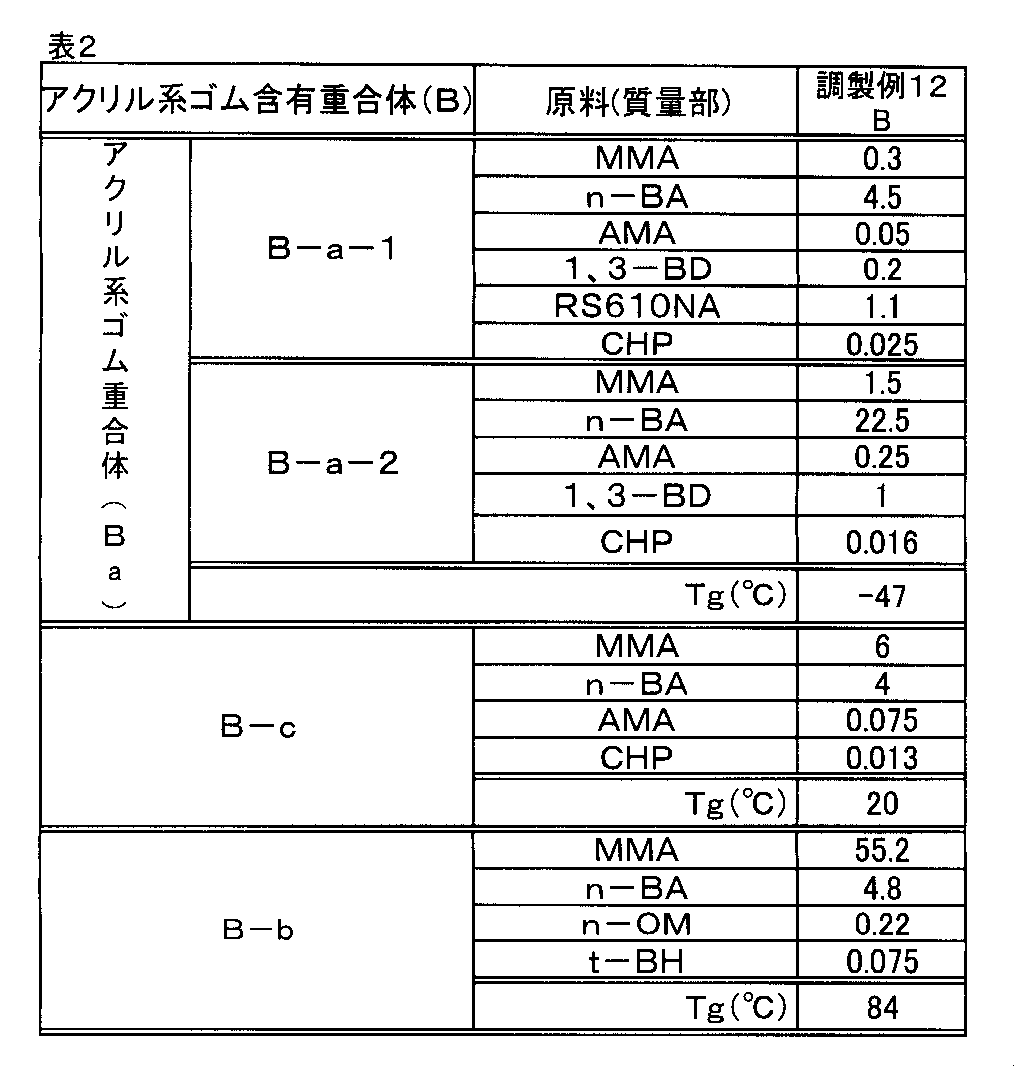
[実施例1]
調製例1で得られた熱可塑性重合体(A1-1)5部、アクリル系ゴム含有重合体(B)95部、からなるアクリル樹脂(A)に、紫外線吸収剤としてADEKA社製のベンゾトリアゾール系紫外線吸収剤であるLA-31(商品名)、光安定剤としてADEKA社製のヒンダードアミン系光安定剤であるLA-57(商品名)、抗酸化剤としてBASF社製のヒンダードフェノール系酸化防止剤であるイルガノックス1076(商品名)とを表3に示す配合量で添加し、ヘンシェルミキサーを用いて混合しアクリル樹脂組成物を得た。
乾燥させて得られたアクリル樹脂組成物のペレットを、300mm幅のTダイを取り付けた40mmφ(直径)のノンベントスクリュー型押出機(L/D=26)を用いてシリンダー温度200℃~240℃、Tダイ温度250℃及び冷却ロール温度80℃の条件で製膜し、得られたアクリル樹脂フィルムを巻き取り機で紙管に巻き取り、厚さ125μmのアクリル樹脂フィルムのロール状物品を得た。
得られたアクリル樹脂フィルムの光学特性を測定したところ、全光線透過率は92%であり、光の透過率にも優れていることが確認された。
また、アクリル樹脂フィルムとEVAとの密着性を確認したところ、剥離強度は15N/15mmであり、良好な密着性を示した。
結果を表3に示す。
熱可塑性重合体(A1-1)10部、アクリル系ゴム含有重合体(B)90部とした以外は、実施例1と同様に行った。
アクリル樹脂フィルムの全光線透過率は89%であり、EVAとの密着性についても、剥離強度が15N/15mmであり、良好な密着性を示した。
結果を表3に示す。
熱可塑性重合体(A1-2)5部、アクリル系ゴム含有重合体(B)95部とした以外は、実施例1と同様に行った。
アクリル樹脂フィルムの全光線透過率は91%であり、EVAとの密着性についても、剥離強度が15N/15mmであり、良好な密着性を示した。
結果を表3に示す。
熱可塑性重合体(A1-2)10部、アクリル系ゴム含有重合体(B)90部とした以外は、実施例1と同様に行った。
アクリル樹脂フィルムの全光線透過率は89%であり、EVAとの密着性についても、剥離強度が15N/15mmであり、良好な密着性を示した。
結果を表3に示す。
熱可塑性重合体(A1-3)3部、アクリル系ゴム含有重合体(B)97部とした以外は、実施例1と同様に行った。
アクリル樹脂フィルムの全光線透過率は92%であり、EVAとの密着性についても、剥離強度が22N/15mmであり、良好な密着性を示した。
結果を表3に示す。
熱可塑性重合体(A1-3)5部、アクリル系ゴム含有重合体(B)95部とした以外は、実施例1と同様に行った。
アクリル樹脂フィルムの全光線透過率は92%であり、EVAとの密着性についても、剥離強度が25N/15mmであり、良好な密着性を示した。
結果を表3に示す。
熱可塑性重合体(A1-3)10部、アクリル系ゴム含有重合体(B)90部とした以外は、実施例1と同様に行った。
アクリル樹脂フィルムの全光線透過率は90%であり、EVAとの密着性についても、剥離強度が26N/15mmであり、良好な密着性を示した。
結果を表3に示す。
熱可塑性重合体(A1-4)3部、アクリル系ゴム含有重合体(B)97部とした以外は、実施例1と同様に行った。
アクリル樹脂フィルムの全光線透過率は92%であり、EVAとの密着性についても、剥離強度が24N/15mmであり、良好な密着性を示した。
結果を表3に示す。
熱可塑性重合体(A1-4)5部、アクリル系ゴム含有重合体(B)95部とした以外は、実施例1と同様に行った。
アクリル樹脂フィルムの全光線透過率は91%であり、EVAとの密着性についても、剥離強度が30N/15mmであり、良好な密着性を示した。
結果を表3に示す。
実施例9で用いたアクリル樹脂組成物のペレットおよびフッ素樹脂(D)としてポリフッ化ビニリデン(アルケマ(株)製、商品名:KYNAR720)を除湿乾燥機にて80℃で一昼夜乾燥させた。
乾燥させたアクリル樹脂組成物のペレットをシリンダー温度230~260℃の40mmφの単軸押出機に供給し、乾燥させたフッ素樹脂(D)をシリンダー温度230~250℃の30mmφの単軸押出機に供給し、個別に溶融可塑化し、250℃に加熱したマルチマニホールドダイに供給し、アクリル樹脂側が80℃の第1冷却ロールと75℃の第2冷却ロールに接するようにフィルムを搬送し、アクリル樹脂層とフッ素樹脂層の2層構造からなる積層フィルムを得た。
この積層フィルムの断面を観察して厚みを測定したところ、アクリル樹脂層が約125μm、フッ素樹脂層が約5μm、総厚みが約130μmであった、
得られた積層フィルムの光学特性および密着性は実施例1と同様に行った。
積層フィルムの全光線透過率は91%であり、EVAとの密着性についても、剥離強度が30N/15mmであり、良好な密着性を示した。
なお、密着性は、積層フィルムのアクリル樹脂層側とEVAを積層し評価した。
熱可塑性重合体(A1-4)10部、アクリル系ゴム含有重合体(B)90部とした以外は、実施例1と同様に行った。
アクリル樹脂フィルムの全光線透過率は90%であり、EVAとの密着性についても、剥離強度が27N/15mmであり、良好な密着性を示した。
結果を表3に示す。
熱可塑性重合体(A1-5)7.5部、アクリル系ゴム含有重合体(B)92.5部とした以外は、実施例1と同様に行った。
アクリル樹脂フィルムの全光線透過率は92%であり、EVAとの密着性についても、剥離強度が18N/15mmであり、良好な密着性を示した。
結果を表3に示す。
熱可塑性重合体(A1-5)15部、アクリル系ゴム含有重合体(B)85部とした以外は、実施例1と同様に行った。
アクリル樹脂フィルムの全光線透過率は92%であり、EVAとの密着性についても、剥離強度が20N/15mmであり、良好な密着性を示した。
結果を表3に示す。
熱可塑性重合体(A1-6)20部、アクリル系ゴム含有重合体(B)80部とした以外は、実施例1と同様に行った。
アクリル樹脂フィルムの全光線透過率は92%であり、EVAとの密着性についても、剥離強度が18N/15mmであり、良好な密着性を示した。
結果を表3に示す。
熱可塑性重合体(A1-7)20部、アクリル系ゴム含有重合体(B)80部とした以外は、実施例1と同様に行った。
アクリル樹脂フィルムの全光線透過率は92%であり、EVAとの密着性についても、剥離強度が10N/15mmであり、十分な密着性を示した。
結果を表3に示す。
アクリル系ゴム含有重合体(B)のみとした以外は、実施例1と同様に行った。
アクリル樹脂フィルムの全光線透過率は92%であった。EVAとの密着性については、剥離強度が8N/15mmであり、十分な密着性を示すことができなかった。
結果を表3に示す。

調製例8で得られたゴム含有重合体(A2-1)100部に、紫外線吸収剤としてADEKA社製のベンゾトリアゾール系紫外線吸収剤であるLA-31(商品名)、光安定剤としてADEKA社製のヒンダードアミン系光安定剤であるLA-57(商品名)、抗酸化剤としてBASF社製のヒンダードフェノール系酸化防止剤であるイルガノックス1076(商品名)とを表2に示す配合量で添加し、ヘンシェルミキサーを用いて混合しアクリル樹脂組成物を得た。
このアクリル樹脂組成物を230℃に加熱した脱気式2軸混練押出機(東芝機械(株)製、商品名:TEM-35B)に供給し、混練してアクリル樹脂組成物のペレット状物を得た。
得られたアクリル樹脂組成物のペレットを、300mm幅のTダイを取り付けた40mmφ(直径)のノンベントスクリュー型押出機(L/D=26)を用いてシリンダー温度200℃~240℃、Tダイ温度250℃及び冷却ロール温度80℃の条件で製膜し、得られたアクリル樹脂フィルムを巻き取り機で紙管に巻き取り、厚さ125μmのアクリル樹脂フィルムのロール状物品を得た。
得られたアクリル樹脂フィルムの光学特性を測定したところ、全光線透過率は93%であり、光の透過率にも優れていることが確認された。
また、アクリル樹脂フィルムとEVAとの密着性を確認したところ、剥離強度は26N/15mmであり、良好な密着性を示した。
結果を表4に示す。
ゴム含有重合体(A2-2)100部を用いた以外は、実施例15と同様に行った。
得られたアクリル樹脂フィルムの光学特性を測定したところ、全光線透過率は93%であり、光の透過率にも優れていることが確認された。
また、アクリル樹脂フィルムとEVAとの密着性を確認したところ、剥離強度は24N/15mmであり、良好な密着性を示した。
結果を表4に示す。
実施例17のアクリル樹脂組成物と、フッ素樹脂(D)としてポリフッ化ビニリデン(アルケマ(株)製、商品名:KYNAR720)を用いて、実施例10と同様にアクリル樹脂層が約125μm、フッ素樹脂層が約5μm、総厚みが約130μmの積層フィルムを得た。
得られた積層フィルムの光学特性を測定したところ、全光線透過率は93%であり、光の透過率にも優れていることが確認された。
また、アクリル樹脂フィルムとEVAとの密着性を確認したところ、剥離強度は24N/15mmであり、良好な密着性を示した。
なお、密着性は、積層フィルムのアクリル樹脂層側とEVAを積層し評価した。
結果を表4に示す。
ゴム含有重合体(A2-3)100部を用いた以外は、実施例15と同様に行った。
得られたアクリル樹脂フィルムの光学特性を測定したところ、全光線透過率は93%であり、光の透過率にも優れていることが確認された。
また、アクリル樹脂フィルムとEVAとの密着性を確認したところ、剥離強度は17N/15mmであり、良好な密着性を示した。
結果を表4に示す。
ゴム含有重合体(A2-4)100部に、紫外線吸収剤としてADEKA社製のベンゾトリアゾール系紫外線吸収剤であるLA-31(商品名)、光安定剤としてADEKA社製のヒンダードアミン系光安定剤であるLA-57(商品名)、抗酸化剤としてBASF社製のヒンダードフェノール系酸化防止剤であるイルガノックス1076(商品名)とを表4に示す配合量で添加し、ヘンシェルミキサーを用いて混合しアクリル樹脂組成物を得た。
このアクリル樹脂組成物を230℃に加熱した脱気式2軸混練押出機(東芝機械(株)製、商品名:TEM-35B)に供給し、混練してアクリル樹脂組成物のペレット状物を得た。
得られたアクリル樹脂組成物のペレットを、300mm幅のTダイを取り付けた40mmφ(直径)のノンベントスクリュー型押出機(L/D=26)を用いてシリンダー温度200℃~240℃、Tダイ温度250℃及び冷却ロール温度80℃の条件で製膜したところ、フィルム形状の薄膜を調製することができず、続く評価も実施することが不可能であった。
結果を表4に示す。

[実施例20]
ポリオレフィン系樹脂として、ポリプロピレン樹脂(日本ポリプロ(株)製、商品名「ノバテックPP FY4」)を、80℃で12時間乾燥させ、Tダイを取り付けた単軸押出機(L/D=30、ジー・エム・エンジニアリング社製)にて、スクリュー回転数:20rpm、シリンダー温度:200℃、Tダイ温度:210℃の条件でフィルム厚:500μm、フィルム巾:10cmになるように製膜した。
このポリプロピレン樹脂からなるフィルムと、実施例8で製造したアクリル樹脂フィルムとを重ね合わせ、鏡面に研磨されたステンレス板で挟みこみ、上下にヒーターを備えたプレス成形機(庄司鉄工(株)製)にて、アクリル樹脂フィルム側を180℃、ポリプロピレン樹脂フィルム側を210℃の温度条件で、2MPaで5分間、続いて4MPaで5分間熱プレスし、最後に25℃、4MPaで5分間加圧冷却して熱プレス作業を実施した。
冷却後、ステンレス板を剥離したところ、アクリル樹脂フィルムとポリプロピレン樹脂フィルムとが積層された積層体が得られた。
実施例16で製造したアクリル樹脂フィルムを使用した以外は実施例20と同様の方法で行った。
冷却後、ステンレス板を剥離したところ、アクリル樹脂フィルムとポリプロピレン樹脂フィルムとが積層された積層体が得られた。
比較例1で製造したアクリル樹脂フィルムを使用した以外は実施例20と同様の方法で行った。
冷却後、ステンレス板を剥離したところ、アクリル樹脂フィルムがステンレス板に張り付いた状態となり、ポリプロピレン樹脂とアクリル樹脂を積層することができなかった。
[実施例22]
上下にヒーターを有する真空ラミネーター((株)エヌ・ピー・シー製、型式:LM-50×50-S型)に、上から、離型シート、実施例2で製造したアクリル樹脂フィルム、熱硬化性の封止材としてEVAシート(シーアイ化成(株)製、商品名「CIKcap(R) FLCE-51」、厚み450μm)、太陽電池セルとして単結晶シリコンウエハー(ジンテック(株)製、多結晶シリコン)、封止材(同上)、支持体としてポリエチレンテレフタラートフィルム積層体((株)エムエーパッケージング(製))、離型シートの順で重ね、150℃に加熱した真空ラミネーターのチャンバー内に設置した。
設置後、10分間チャンバー内の真空引きを行い、十分に真空引きが行われたことを確認した後、真空下大気圧にて30分間150℃で加熱圧着し、得られた積層体から剥離シートを除くことで、本発明のアクリル樹脂フィルムを用いた太陽電池モジュールが得られた。
得られた太陽電池モジュールは、問題なく発電可能であった。
実施例16で製造したアクリル樹脂フィルムを使用した以外は実施例20と同様の方法で行った。
得られた太陽電池モジュールは、問題なく発電可能であった。
Claims (16)
- メタクリル酸i-ブチルを含む単量体成分を重合して得られる重合体(A)を含有するアクリル樹脂フィルム。
- アクリル樹脂フィルムの厚みが10~500μmである請求項1に記載のアクリル樹脂フィルム。
- 下記試験片を下記条件で測定した際の剥離強度が、10N/15mm以上である請求項1又は2に記載のアクリル樹脂フィルム。
<試験片>
第1層:アクリル樹脂フィルム
第2層:エチレン-酢酸ビニル共重合体フィルム
第3層:支持体フィルム
の順に積層し、真空熱プレス装置で真空下大気圧にて15分間135℃で加熱圧着し、積層体を得る。
・前記積層体を15mm×150mmに切断する。
<試験条件>
試験片の第1層のみをチャックし、第2層および第3層をまとめてチャックし、剥離させた際の剥離強度を測定
・剥離角度:180°
・剥離速度:100ml/min - 重合体(A)中のメタクリル酸i-ブチル由来の構造単位が10~100質量%である請求項1~3のいずれか一項に記載のアクリル樹脂フィルム。
- 重合体(A)が、アクリル系ゴム重合体(A2a)を含有しない重合体(A1)および/またはアクリル系ゴム重合体(A2a)を15~60質量%含有するゴム含有重合体(A2)である請求項1~4のいずれか一項に記載のアクリル樹脂フィルム。
- ゴム含有重合体(A2)が以下に示す重合体である請求項5に記載のアクリル樹脂フィルム。
<ゴム含有重合体(A2)>
アクリル系ゴム重合体(A2a)の存在下、メタクリル酸i-ブチル由来の構造単位を10~100質量%含む単量体成分を重合して得られるゴム含有重合体であり、且つ以下を満たす重合体。
・アクリル系ゴム重合体(A2a)を15~60質量%
・メタクリル酸i-ブチル由来の構造単位を10~100質量%含む単量体成分を重合して得られる重合体(A2b)を85~40質量%(ただし、A2aとA2bの合計が100質量%) - 前記アクリル系ゴム重合体(A2a)が以下に示す単量体成分を重合して得られる重合体である請求項5~6のいずれか一項に記載のアクリル樹脂フィルム。
<単量体成分>
1.アクリル酸アルキル40~99.9質量%
2.メタクリル酸アルキル0~59.9質量%
3.アクリル酸アルキルおよび/またはメタクリル酸アルキルと共重合可能な二重結合を有する他の単量体0~49.9質量%
4.1~3に記載の単量体と共重合可能な二重結合を1分子内に2個以上有する単量体0.1~10質量%
5.上記1~4を合計で100質量%とした際の、アクリル酸アルキルおよびメタクリル酸アルキルの合計が、50~99.9質量% - さらにフッ素樹脂(D)を含有する請求項1~7のいずれか一項に記載のアクリル樹脂フィルム。
- 重合体(A)を10~95質量%、フッ素樹脂(D)を90~5質量%(重合体(A)とフッ素樹脂(D)の合計が100質量%)含有する請求項8に記載のアクリル樹脂フィルム。
- 少なくとも片方の面にフッ素樹脂(D)を含有するフッ素樹脂層を積層してなる請求項1~9のいずれか一項に記載のアクリル樹脂フィルム。
- 請求項1~10のいずれか1項に記載のアクリル樹脂フィルムと熱可塑性樹脂シートおよび/または熱硬化性シートとが積層された少なくとも2層を有する積層成形体。
- 熱可塑性樹脂シートおよび/または熱硬化性シートが、エチレン-酢酸ビニル共重合体である請求項11に記載の積層成形体。
- 太陽電池表面保護材として用いられる請求項1~10のいずれか1項に記載のアクリル樹脂フィルム。
- 請求項1~10、13のいずれか1項に記載のアクリル樹脂フィルムを用いた太陽電池モジュール。
- アクリル系ゴム重合体(A2a)の存在下、メタクリル酸i-ブチルを10~100質量%含む単量体成分を重合して得られるゴム含有重合体であり、且つ以下を満たす重合体。
・アクリル系ゴム重合体(A2a)の比率が15~60質量%である。
・メタクリル酸i-ブチルを10~100質量%含む単量体成分を重合して得られる重合体(A2b)の比率が85~40質量%(ただし、A2aとA2bの合計が100質量%)である。 - 前記アクリル系ゴム重合体(A2a)が、以下に示す単量体成分を重合して得られる請求項15に記載の重合体。
<単量体成分>
1.アクリル酸アルキル40~99.9質量%
2.メタクリル酸アルキル0~59.9質量%
3.アクリル酸アルキルおよび/またはメタクリル酸アルキルと共重合可能な二重結合を有する他の単量体0~49.9質量%
4.1~3に記載の単量体と共重合可能な二重結合を1分子内に2個以上有する多官能性単量体0.1~10質量%
5.上記1~4を合計で100質量%とした際の、アクリル酸アルキルおよびメタクリル酸アルキルの合計が、50~99.9質量%
Priority Applications (4)
| Application Number | Priority Date | Filing Date | Title |
|---|---|---|---|
| US14/435,522 US20150368414A1 (en) | 2012-10-17 | 2013-10-17 | Acrylic resin film, and laminate and solar cell module each of which uses same |
| JP2013552651A JP6249161B2 (ja) | 2012-10-17 | 2013-10-17 | アクリル樹脂フィルム、それを用いた積層体および太陽電池モジュール |
| CN201380053771.0A CN104736578B (zh) | 2012-10-17 | 2013-10-17 | 丙烯酸树脂膜、使用该丙烯酸树脂膜的层叠体及太阳能电池模块 |
| EP13847646.0A EP2910582B1 (en) | 2012-10-17 | 2013-10-17 | Acrylic resin film, and laminate and solar cell module each of which uses same |
Applications Claiming Priority (2)
| Application Number | Priority Date | Filing Date | Title |
|---|---|---|---|
| JP2012-230033 | 2012-10-17 | ||
| JP2012230033 | 2012-10-17 |
Publications (1)
| Publication Number | Publication Date |
|---|---|
| WO2014061744A1 true WO2014061744A1 (ja) | 2014-04-24 |
Family
ID=50488304
Family Applications (1)
| Application Number | Title | Priority Date | Filing Date |
|---|---|---|---|
| PCT/JP2013/078208 Ceased WO2014061744A1 (ja) | 2012-10-17 | 2013-10-17 | アクリル樹脂フィルム、それを用いた積層体および太陽電池モジュール |
Country Status (6)
| Country | Link |
|---|---|
| US (1) | US20150368414A1 (ja) |
| EP (1) | EP2910582B1 (ja) |
| JP (1) | JP6249161B2 (ja) |
| CN (1) | CN104736578B (ja) |
| TW (1) | TWI612064B (ja) |
| WO (1) | WO2014061744A1 (ja) |
Cited By (5)
| Publication number | Priority date | Publication date | Assignee | Title |
|---|---|---|---|---|
| JP2020526615A (ja) * | 2017-07-12 | 2020-08-31 | アルケマ フランス | 多段階ポリマーと(メタ)アクリルポリマーを含む組成物、その調製方法及びその使用 |
| JP2021017551A (ja) * | 2019-07-19 | 2021-02-15 | 日本ゼオン株式会社 | 保存安定性に優れるアクリルゴムシート |
| JP2021017550A (ja) * | 2019-07-19 | 2021-02-15 | 日本ゼオン株式会社 | 保存安定性に優れるアクリルゴムシート |
| WO2021246513A1 (ja) * | 2020-06-05 | 2021-12-09 | 日本ゼオン株式会社 | ロール加工性とバンバリー加工性に優れるアクリルゴムシート |
| JPWO2021261214A1 (ja) * | 2020-06-23 | 2021-12-30 |
Families Citing this family (3)
| Publication number | Priority date | Publication date | Assignee | Title |
|---|---|---|---|---|
| JP6366639B2 (ja) * | 2016-05-31 | 2018-08-01 | 住友化学株式会社 | 透明粘着剤付き樹脂積層体及びそれを含む表示装置 |
| JP7198508B2 (ja) * | 2017-08-30 | 2023-01-04 | ユニチカ株式会社 | 離型シート |
| KR102888667B1 (ko) * | 2020-06-12 | 2025-11-19 | 다이니폰 인사츠 가부시키가이샤 | 열전사 시트, 변소색 인화물 및 변소색 인화물의 제조 방법 |
Citations (7)
| Publication number | Priority date | Publication date | Assignee | Title |
|---|---|---|---|---|
| JPH05213663A (ja) * | 1992-01-31 | 1993-08-24 | Nippon Shokubai Co Ltd | 無機質焼結体製造用バインダー |
| JPH05238808A (ja) * | 1992-02-26 | 1993-09-17 | Nippon Shokubai Co Ltd | 無機質焼結体製造用バインダー |
| JPH10167836A (ja) * | 1996-12-17 | 1998-06-23 | Mitsubishi Chem Corp | セラミック成形用バインダー樹脂 |
| JP2004217686A (ja) * | 2003-01-09 | 2004-08-05 | Fujikura Kasei Co Ltd | セラミック成形用バインダー樹脂およびセラミックシート |
| JP2004227843A (ja) | 2003-01-21 | 2004-08-12 | Mitsubishi Rayon Co Ltd | 色素増感型太陽電池保護用アクリル樹脂フィルム |
| JP2007066874A (ja) * | 2005-08-02 | 2007-03-15 | Ngk Spark Plug Co Ltd | 色素増感型太陽電池 |
| JP2009091540A (ja) * | 2007-06-29 | 2009-04-30 | Mitsubishi Rayon Co Ltd | グラフト共重合体、樹脂組成物及びその成形品 |
Family Cites Families (13)
| Publication number | Priority date | Publication date | Assignee | Title |
|---|---|---|---|---|
| JPH06255050A (ja) * | 1993-03-04 | 1994-09-13 | Central Glass Co Ltd | 透明樹脂積層体 |
| US6414236B1 (en) * | 1999-06-30 | 2002-07-02 | Canon Kabushiki Kaisha | Solar cell module |
| US7851694B2 (en) * | 2006-07-21 | 2010-12-14 | E. I. Du Pont De Nemours And Company | Embossed high modulus encapsulant sheets for solar cells |
| WO2009017118A1 (ja) * | 2007-07-31 | 2009-02-05 | Techno Polymer Co., Ltd. | 積層体 |
| EP2219577B1 (en) * | 2007-12-13 | 2014-07-30 | The Procter & Gamble Company | Absorbent article with composite sheet comprising elastic material |
| JP5681488B2 (ja) * | 2008-06-10 | 2015-03-11 | 株式会社カネカ | フッ素樹脂フィルム及びそれを含む成形品 |
| DE102008043713A1 (de) * | 2008-11-13 | 2010-05-20 | Evonik Röhm Gmbh | Herstellung von Solarzellenmodulen |
| KR20100069950A (ko) * | 2008-12-17 | 2010-06-25 | 에스에스씨피 주식회사 | 태양전지용 전극, 그 제조방법 및 태양전지 |
| CN102369657B (zh) * | 2009-03-03 | 2015-02-11 | 阿科玛法国公司 | 具有丙烯酸背板的光伏打模块 |
| KR20120135211A (ko) * | 2009-12-24 | 2012-12-12 | 파낙쿠 고교 가부시키가이샤 | 폐기 광 디스크 및/또는 회수 광 디스크로부터의 폴리카보네이트 수지의 회수 방법, 그리고 난연성 폴리카보네이트 수지 조성물, 사출 성형체 및 광학 성형품 |
| US20120080065A1 (en) * | 2010-09-30 | 2012-04-05 | Miasole | Thin Film Photovoltaic Modules with Structural Bonds |
| JPWO2012066848A1 (ja) * | 2010-11-18 | 2014-05-12 | 積水化学工業株式会社 | フレキシブル太陽電池モジュールの製造方法 |
| TWI494392B (zh) * | 2011-09-30 | 2015-08-01 | Eternal Materials Co Ltd | 用於太陽能電池模組之薄板 |
-
2013
- 2013-10-17 US US14/435,522 patent/US20150368414A1/en not_active Abandoned
- 2013-10-17 WO PCT/JP2013/078208 patent/WO2014061744A1/ja not_active Ceased
- 2013-10-17 TW TW102137413A patent/TWI612064B/zh not_active IP Right Cessation
- 2013-10-17 JP JP2013552651A patent/JP6249161B2/ja active Active
- 2013-10-17 EP EP13847646.0A patent/EP2910582B1/en not_active Not-in-force
- 2013-10-17 CN CN201380053771.0A patent/CN104736578B/zh not_active Expired - Fee Related
Patent Citations (7)
| Publication number | Priority date | Publication date | Assignee | Title |
|---|---|---|---|---|
| JPH05213663A (ja) * | 1992-01-31 | 1993-08-24 | Nippon Shokubai Co Ltd | 無機質焼結体製造用バインダー |
| JPH05238808A (ja) * | 1992-02-26 | 1993-09-17 | Nippon Shokubai Co Ltd | 無機質焼結体製造用バインダー |
| JPH10167836A (ja) * | 1996-12-17 | 1998-06-23 | Mitsubishi Chem Corp | セラミック成形用バインダー樹脂 |
| JP2004217686A (ja) * | 2003-01-09 | 2004-08-05 | Fujikura Kasei Co Ltd | セラミック成形用バインダー樹脂およびセラミックシート |
| JP2004227843A (ja) | 2003-01-21 | 2004-08-12 | Mitsubishi Rayon Co Ltd | 色素増感型太陽電池保護用アクリル樹脂フィルム |
| JP2007066874A (ja) * | 2005-08-02 | 2007-03-15 | Ngk Spark Plug Co Ltd | 色素増感型太陽電池 |
| JP2009091540A (ja) * | 2007-06-29 | 2009-04-30 | Mitsubishi Rayon Co Ltd | グラフト共重合体、樹脂組成物及びその成形品 |
Non-Patent Citations (2)
| Title |
|---|
| J. BRANDRUP: "Polymer HandBook", 1989, INTERSCIENCE |
| See also references of EP2910582A4 |
Cited By (9)
| Publication number | Priority date | Publication date | Assignee | Title |
|---|---|---|---|---|
| JP2020526615A (ja) * | 2017-07-12 | 2020-08-31 | アルケマ フランス | 多段階ポリマーと(メタ)アクリルポリマーを含む組成物、その調製方法及びその使用 |
| JP2021017551A (ja) * | 2019-07-19 | 2021-02-15 | 日本ゼオン株式会社 | 保存安定性に優れるアクリルゴムシート |
| JP2021017550A (ja) * | 2019-07-19 | 2021-02-15 | 日本ゼオン株式会社 | 保存安定性に優れるアクリルゴムシート |
| WO2021246513A1 (ja) * | 2020-06-05 | 2021-12-09 | 日本ゼオン株式会社 | ロール加工性とバンバリー加工性に優れるアクリルゴムシート |
| JPWO2021246513A1 (ja) * | 2020-06-05 | 2021-12-09 | ||
| JP7806690B2 (ja) | 2020-06-05 | 2026-01-27 | 日本ゼオン株式会社 | ロール加工性とバンバリー加工性に優れるアクリルゴムシート |
| JPWO2021261214A1 (ja) * | 2020-06-23 | 2021-12-30 | ||
| WO2021261214A1 (ja) * | 2020-06-23 | 2021-12-30 | 日本ゼオン株式会社 | バンバリー加工性に優れるアクリルゴムベール |
| JP7816146B2 (ja) | 2020-06-23 | 2026-02-18 | 日本ゼオン株式会社 | バンバリー加工性に優れるアクリルゴムベール |
Also Published As
| Publication number | Publication date |
|---|---|
| CN104736578B (zh) | 2017-03-15 |
| TW201422646A (zh) | 2014-06-16 |
| EP2910582A1 (en) | 2015-08-26 |
| JPWO2014061744A1 (ja) | 2016-09-05 |
| EP2910582A4 (en) | 2016-06-01 |
| JP6249161B2 (ja) | 2017-12-20 |
| CN104736578A (zh) | 2015-06-24 |
| TWI612064B (zh) | 2018-01-21 |
| EP2910582B1 (en) | 2019-01-09 |
| US20150368414A1 (en) | 2015-12-24 |
Similar Documents
| Publication | Publication Date | Title |
|---|---|---|
| JP6249161B2 (ja) | アクリル樹脂フィルム、それを用いた積層体および太陽電池モジュール | |
| CN102892816B (zh) | 膜、其制造方法、层叠膜或片、以及层叠体 | |
| JP5681488B2 (ja) | フッ素樹脂フィルム及びそれを含む成形品 | |
| JP6337776B2 (ja) | フッ化ビニリデン系樹脂を含むフィルム、及び積層フィルム、並びに積層体 | |
| KR102092732B1 (ko) | 아크릴 수지 조성물 및 그의 제조 방법, 및 아크릴 수지 필름 | |
| WO2013039119A1 (ja) | 積層フィルム及び積層成形品 | |
| CN107075220B (zh) | 消光用热塑性树脂组合物、氟系消光膜及氟系消光层叠膜 | |
| CN106660346B (zh) | 用于装饰层压板(hpl)的三层紫外线防护膜 | |
| JPWO2016024592A1 (ja) | 積層フィルム、積層成形品及びその製造方法 | |
| WO2018174260A1 (ja) | 樹脂組成物、フッ素系フィルム、フッ素系積層フィルム及び積層成形体 | |
| JP2014061705A (ja) | 樹脂積層透明フィルム及び積層成形品 | |
| KR20120115342A (ko) | 아크릴 수지 조성물 및 아크릴 수지 성형체 | |
| JP2018171935A (ja) | 積層フィルム、保護フィルム、メラミン化粧板表面保護用フィルム、及びメラミン化粧板 | |
| JP2017206671A (ja) | フィルム、積層フィルム及び積層成形品 | |
| EP4275864A2 (en) | Laminate film, method for manufacturing same, and melamine decorative panel | |
| KR102374802B1 (ko) | 적층 필름 및 적층 성형품 | |
| JP2015160874A (ja) | 艶消しフィルム用樹脂組成物、艶消しフィルム、艶消し積層フィルム、艶消し加飾フィルム、積層シート、及び積層成形品 | |
| JP2005186572A (ja) | アクリル樹脂積層フィルム及びその積層成形品 | |
| JP2005212217A (ja) | アクリル樹脂積層フィルム及びその積層成形品 | |
| JP2024178685A (ja) | メラミン化粧板表面保護用フィルム及びメラミン化粧板 | |
| JP2007138001A (ja) | 艶消し熱可塑性樹脂フィルム、艶消し熱可塑性樹脂フィルム積層フィルム又はシート及び艶消し熱可塑性樹脂積層体の製造方法 |
Legal Events
| Date | Code | Title | Description |
|---|---|---|---|
| ENP | Entry into the national phase |
Ref document number: 2013552651 Country of ref document: JP Kind code of ref document: A |
|
| 121 | Ep: the epo has been informed by wipo that ep was designated in this application |
Ref document number: 13847646 Country of ref document: EP Kind code of ref document: A1 |
|
| WWE | Wipo information: entry into national phase |
Ref document number: 14435522 Country of ref document: US |
|
| NENP | Non-entry into the national phase |
Ref country code: DE |
|
| WWE | Wipo information: entry into national phase |
Ref document number: 2013847646 Country of ref document: EP |