WO2014073675A1 - 濃厚流動食 - Google Patents
濃厚流動食 Download PDFInfo
- Publication number
- WO2014073675A1 WO2014073675A1 PCT/JP2013/080357 JP2013080357W WO2014073675A1 WO 2014073675 A1 WO2014073675 A1 WO 2014073675A1 JP 2013080357 W JP2013080357 W JP 2013080357W WO 2014073675 A1 WO2014073675 A1 WO 2014073675A1
- Authority
- WO
- WIPO (PCT)
- Prior art keywords
- liquid food
- concentrated liquid
- viscosity
- tube
- mass
- Prior art date
- Legal status (The legal status is an assumption and is not a legal conclusion. Google has not performed a legal analysis and makes no representation as to the accuracy of the status listed.)
- Ceased
Links
Classifications
-
- A—HUMAN NECESSITIES
- A61—MEDICAL OR VETERINARY SCIENCE; HYGIENE
- A61K—PREPARATIONS FOR MEDICAL, DENTAL OR TOILETRY PURPOSES
- A61K9/00—Medicinal preparations characterised by special physical form
- A61K9/0012—Galenical forms characterised by the site of application
- A61K9/0019—Injectable compositions; Intramuscular, intravenous, arterial, subcutaneous administration; Compositions to be administered through the skin in an invasive manner
- A61K9/0029—Parenteral nutrition; Parenteral nutrition compositions as drug carriers
-
- A—HUMAN NECESSITIES
- A23—FOODS OR FOODSTUFFS; TREATMENT THEREOF, NOT COVERED BY OTHER CLASSES
- A23L—FOODS, FOODSTUFFS OR NON-ALCOHOLIC BEVERAGES, NOT OTHERWISE PROVIDED FOR; PREPARATION OR TREATMENT THEREOF
- A23L29/00—Foods or foodstuffs containing additives; Preparation or treatment thereof
- A23L29/20—Foods or foodstuffs containing additives; Preparation or treatment thereof containing gelling or thickening agents
- A23L29/206—Foods or foodstuffs containing additives; Preparation or treatment thereof containing gelling or thickening agents of vegetable origin
- A23L29/256—Foods or foodstuffs containing additives; Preparation or treatment thereof containing gelling or thickening agents of vegetable origin from seaweeds, e.g. alginates, agar or carrageenan
-
- A—HUMAN NECESSITIES
- A23—FOODS OR FOODSTUFFS; TREATMENT THEREOF, NOT COVERED BY OTHER CLASSES
- A23L—FOODS, FOODSTUFFS OR NON-ALCOHOLIC BEVERAGES, NOT OTHERWISE PROVIDED FOR; PREPARATION OR TREATMENT THEREOF
- A23L33/00—Modifying nutritive qualities of foods; Dietetic products; Preparation or treatment thereof
- A23L33/10—Modifying nutritive qualities of foods; Dietetic products; Preparation or treatment thereof using additives
- A23L33/16—Inorganic salts, minerals or trace elements
- A23L33/165—Complexes or chelates
-
- A—HUMAN NECESSITIES
- A23—FOODS OR FOODSTUFFS; TREATMENT THEREOF, NOT COVERED BY OTHER CLASSES
- A23L—FOODS, FOODSTUFFS OR NON-ALCOHOLIC BEVERAGES, NOT OTHERWISE PROVIDED FOR; PREPARATION OR TREATMENT THEREOF
- A23L33/00—Modifying nutritive qualities of foods; Dietetic products; Preparation or treatment thereof
- A23L33/40—Complete food formulations for specific consumer groups or specific purposes, e.g. infant formula
-
- A—HUMAN NECESSITIES
- A61—MEDICAL OR VETERINARY SCIENCE; HYGIENE
- A61K—PREPARATIONS FOR MEDICAL, DENTAL OR TOILETRY PURPOSES
- A61K47/00—Medicinal preparations characterised by the non-active ingredients used, e.g. carriers or inert additives; Targeting or modifying agents chemically bound to the active ingredient
- A61K47/06—Organic compounds, e.g. natural or synthetic hydrocarbons, polyolefins, mineral oil, petrolatum or ozokerite
- A61K47/08—Organic compounds, e.g. natural or synthetic hydrocarbons, polyolefins, mineral oil, petrolatum or ozokerite containing oxygen, e.g. ethers, acetals, ketones, quinones, aldehydes, peroxides
- A61K47/12—Carboxylic acids; Salts or anhydrides thereof
-
- A—HUMAN NECESSITIES
- A61—MEDICAL OR VETERINARY SCIENCE; HYGIENE
- A61K—PREPARATIONS FOR MEDICAL, DENTAL OR TOILETRY PURPOSES
- A61K47/00—Medicinal preparations characterised by the non-active ingredients used, e.g. carriers or inert additives; Targeting or modifying agents chemically bound to the active ingredient
- A61K47/30—Macromolecular organic or inorganic compounds, e.g. inorganic polyphosphates
- A61K47/36—Polysaccharides; Derivatives thereof, e.g. gums, starch, alginate, dextrin, hyaluronic acid, chitosan, inulin, agar or pectin
-
- A—HUMAN NECESSITIES
- A61—MEDICAL OR VETERINARY SCIENCE; HYGIENE
- A61P—SPECIFIC THERAPEUTIC ACTIVITY OF CHEMICAL COMPOUNDS OR MEDICINAL PREPARATIONS
- A61P3/00—Drugs for disorders of the metabolism
- A61P3/02—Nutrients, e.g. vitamins, minerals
-
- A—HUMAN NECESSITIES
- A23—FOODS OR FOODSTUFFS; TREATMENT THEREOF, NOT COVERED BY OTHER CLASSES
- A23V—INDEXING SCHEME RELATING TO FOODS, FOODSTUFFS OR NON-ALCOHOLIC BEVERAGES AND LACTIC OR PROPIONIC ACID BACTERIA USED IN FOODSTUFFS OR FOOD PREPARATION
- A23V2002/00—Food compositions, function of food ingredients or processes for food or foodstuffs
-
- A—HUMAN NECESSITIES
- A23—FOODS OR FOODSTUFFS; TREATMENT THEREOF, NOT COVERED BY OTHER CLASSES
- A23V—INDEXING SCHEME RELATING TO FOODS, FOODSTUFFS OR NON-ALCOHOLIC BEVERAGES AND LACTIC OR PROPIONIC ACID BACTERIA USED IN FOODSTUFFS OR FOOD PREPARATION
- A23V2200/00—Function of food ingredients
Definitions
- the present invention relates to a concentrated liquid food.
- nasal or oral tube feeding, and gastrostomy or enteral tube feeding are used for elderly people or patients who have difficulty in taking food orally.
- Nasal or oral tube feeding is via a tube inserted through the nose or mouth to reach any part of the esophagus, stomach, duodenum, or jejunum. This is a method in which nutrition such as liquid food is continuously administered through a tube in which an outer cage is constructed surgically or endoscopically in the esophagus or jejunum (mostly the stomach).
- the function of the cardia in the upper stomach is often significantly reduced, so if the liquid food is a low-viscosity liquid, the liquid food in the stomach is the gastroesophageal It may cause backflow. In order to prevent this, since it is necessary to keep the ingestor's sitting position for a long time, the burden on the caregiver and the cared person is large. On the other hand, when the liquid food is in the form of gel, high viscosity liquid or paste, gastroesophageal reflux is suppressed, but in order to administer this via a tube, it is necessary to continue to apply high pressure for a long time. Yes, in this case too, the caregiver is burdensome.
- Patent Document 1 when a calcium ion supply agent is mixed with an enteral nutrient and the obtained mixture is administered by tube, before or after tube administration of the mixture, There has been proposed a method for reducing or preventing vomiting, characterized by administering a solution containing one or more selected from kappa carrageenan, iota carrageenan, sodium alginate and alginic acid.
- an object of the present invention is to provide a concentrated liquid food that is easy to administer and hardly causes gastroesophageal reflux.
- the inventors of the present invention have intensively studied a means for solving the problem of providing a concentrated liquid food that is easy to administer and hardly causes gastroesophageal reflux.
- the present inventors have devised that the problem can be solved if a concentrated liquid food that is highly viscous or gelled in the stomach after administration (when in contact with gastric juice) can be prepared.
- a concentrated liquid food that is highly viscous or gelled in the stomach after administration (when in contact with gastric juice) can be prepared.
- 0.1 to 3% by mass of alginic acid and / or its sodium salt, calcium and 1 part by mass of calcium is 0.1 to 3% by mass.
- Concentrated liquid food containing 5 parts by mass of a chelating agent is a low-viscosity liquid with high fluidity at the time of administration, but is highly viscous or gelled in a gastric environment of pH 2.0 or lower.
- the present invention has been completed by finding out that the above-mentioned problems can be solved by a headline.
- the present invention includes the following aspects.
- Item 1 0.1 to 1.0% by weight of alginic acid and / or its sodium salt, A concentrated liquid food containing 0.1 to 3.5 parts by mass of a chelating agent with respect to 1 part by mass of calcium and calcium.
- Item 2. Item 2. The concentrated liquid food according to Item 1, wherein the tube fluidity measured by the tube fluidity measurement method described later is 400 ml / hour or more. ⁇ Method for measuring tube fluidity> Place 80 ml of sample in a 100 ml plastic bottle with an open top. A silicone flexible tube having an inner diameter of 4 mm and a length of 1000 mm is connected to the bottom of the plastic bottle.
- the plastic bottle is placed so that the bottom surface is 600 mm above the tip of the tube so that the sample flows out through the tube only by gravity.
- the flow rate A (ml) of the sample flowing out for 10 minutes is measured with a graduated cylinder, and A ⁇ 6 (ml / hour) is defined as the tube fluidity of the concentrated liquid food.
- Item 3. The concentrated liquid food according to item 1 or 2, wherein the viscosity after introduction into the artificial gastric juice, measured according to a method for measuring the viscosity after introduction into the artificial gastric fluid described later, is 1500 mPa ⁇ s or more.
- ⁇ Measurement method of viscosity after injection into artificial gastric juice Place 80 ml of sample in a 100 ml plastic bottle with an open top. A silicone flexible tube having an inner diameter of 4 mm and a length of 1000 mm and a governor are connected to the bottom of the plastic bottle. The outflow rate was adjusted to 300 ml / hour by a governor, and the total amount of the sample was transferred through a tube to 20 ml of artificial gastric juice (0.7% hydrochloric acid and 0.2% saline solution, maintained at 37 ° C. in a constant temperature bath). Drop directly into a 100 ml beaker containing pH 1.2).
- the viscosity at 1.0 s ⁇ 1 of this mixture is measured using a fluid rheometer under the following viscosity measurement conditions.
- ⁇ Viscosity measurement conditions> Geometry: Cone plate type plunger with a diameter of 50 mm, gap 0.051 mm Measurement temperature: 20 ° C Strain rate: 1.0 s -1 Item 4.
- the ratio of the amount of alginic acid and / or sodium salt thereof having a guluronic acid / mannuronic acid ratio (G / M ratio) of 1.5 or less to the total amount of alginic acid and / or sodium salt thereof is 40 to 95% by mass. 4.
- the concentrated liquid food according to any one of items 1 to 3. Item 5.
- the ratio of the amount of alginic acid and / or its sodium salt with a weight average molecular weight ( ⁇ M w >) of 2.0 ⁇ 10 5 g / mol or less to the total amount of alginic acid and / or its sodium salt is 30% by mass or more. 5.
- Item 6. The concentrated liquid food according to any one of Items 1 to 5, wherein the chelating agent is citrate.
- the concentrated liquid food of the present invention is a low-viscosity liquid with high fluidity at the time of administration, but becomes highly viscous or gelled in a gastric environment having a pH of 2.0 or less. Thereby, according to this invention, the concentrated liquid food which administration is easy and the gastroesophageal reflux was suppressed is provided.
- the concentrated liquid food of the present invention is 0.1 to 1.0% by weight of alginic acid and / or its sodium salt, It contains 0.1 to 3.5 parts by mass of a chelating agent with respect to 1 part by mass of calcium and calcium.
- rich liquid food includes not only concentrated liquid food (food) but also nutrient (medicine).
- Alginic acid and / or sodium salt thereof used in the present invention is a substance widely used as a thickener for food additives.
- Alginic acid is a linear acidic polysaccharide composed of uronic acid, and is a copolymer composed of ⁇ -L-guluronic acid (G) and ⁇ -D-mannuronic acid (M).
- G ⁇ -L-guluronic acid
- M ⁇ -D-mannuronic acid
- Alginic acid and / or its sodium salt is commercially available.
- sodium alginate examples include Sun Support P-70, P-71, P-72, P-81, and P-82 (trade names, Saneigen FFI Co., Ltd.).
- An example of alginic acid is Sun Support P-90 (trade name, Saneigen FFI Co., Ltd.).
- alginic acid and / or its sodium salt with various G / M ratios can be used as alginic acid and / or its sodium salt.
- the alginic acid and / or its sodium salt used in the present invention may be a single type or a combination of two or more types.
- the alginic acid and / or its sodium salt used in the present invention can be a combination of two or more alginic acids and / or their sodium salts having different G / M ratios.
- the ratio of the amount of alginic acid and / or its sodium salt having a G / M ratio of 0.5 to 1.5 to the total amount of alginic acid and / or its sodium salt used in the present invention is preferably 40 to 95 mass. %, More preferably 50 to 90% by mass, still more preferably 60 to 80% by mass.
- the concentrated liquid food of the present invention has a low viscosity at the time of administration (that is, until it comes into contact with gastric juice) and a viscosity in the stomach (that is, after contact with gastric juice). Tend to be high.
- the term “upon administration” can thus mean until contact with gastric juice.
- the term “in the stomach” can thus mean after contact with gastric juice.
- the alginic acid and / or its sodium salt used in the present invention can be a combination of two or more kinds of alginic acid and / or its sodium salt having different weight average molecular weights.
- the ratio of the amount of alginic acid and / or sodium salt thereof having a weight average molecular weight of 2.0 ⁇ 10 5 g / mol or less to the total amount of alginic acid and / or sodium salt thereof is preferably 30% by mass or more, more preferably 30%. It is preferably -95% by mass, more preferably 40-90% by mass, particularly preferably 50-85% by mass.
- the concentrated liquid food of the present invention tends to have a low viscosity at the time of administration and a high viscosity in the stomach.
- the alginic acid and / or its sodium salt is preferably a mixture of alginic acid and its sodium salt.
- the content of alginic acid and / or its sodium salt in the concentrated liquid food of the present invention is preferably 0.1 to 1.0% by mass, more preferably 0.15 to 0.8% by mass, and still more preferably 0.2. Is 0.5% by mass.
- the content of sodium alginate is strictly represented by the content as alginic acid. In practice, however, the content of sodium alginate can be used as an approximation of this content. If the content is too low, the thick liquid food may not be highly viscous or gelled in the stomach. On the other hand, if the content is too high, the viscosity of the concentrated liquid food at the time of administration may be low. May be too high.
- Calcium used in the present invention is not particularly limited, and can be, for example, a salt or an ion.
- the concentrated liquid food of the present invention actually contains a source of calcium.
- Specific examples of calcium sources include calcium chloride, calcium sulfate, calcium citrate, calcium gluconate, calcined (sea urchin, shell, bone, reef coral, milky, eggshell) calcium, unfired ( Shell, bone, coral, nacre, eggshell) selected from calcium, calcium carbonate, calcium lactate, calcium monohydrogen phosphate, calcium dihydrogen phosphate, calcium trihydrogen phosphate, calcium ethylenediaminetetraacetate and their hydrates
- calcium chloride, calcium sulfate, calcium citrate, calcium carbonate, calcium lactate and calcium monohydrogen phosphate can be used.
- One calcium source may be used, or a combination of two or more calcium sources may be used. Moreover, calcium may be contained in the nutrient component demonstrated below.
- the content of calcium in the concentrated liquid food of the present invention can be appropriately set based on the recommended amount, guide amount, target amount or upper limit amount described in “Japanese dietary intake standards [2010 edition]”. is there. However, if the content is too low, thickening or gelling of the concentrated liquid food in the stomach may be insufficient. On the other hand, if the content is too high, the viscosity during administration of the concentrated liquid food may be insufficient. May be too high.
- the calcium content is preferably 0.01 to 0.25% by mass, more preferably 0.02 to 0.20% by mass, and still more preferably 0.05 to 0.15% by mass. %.
- calcium is preferably 0.05 to 1.0 part by mass, more preferably 0.08 to 0.8 part by mass, preferably 1 part by mass of alginic acid and / or its sodium salt. More preferably, the content is 0.1 to 0.5 parts by mass. If this ratio is too small, the thick liquid food may become too viscous or gelled in the stomach, whereas if this ratio is too large, the viscosity at the time of administration of the concentrated liquid food will be too high. There is a case.
- Chelating agent for example, phosphate, condensed phosphate, malate, succinate, tartrate, glutamate, ethylenediaminetetraacetate, gluconate, citric acid, citric acid
- a salt for example, a salt, phytic acid and phytate
- the concentrated liquid food of the present invention preferably contains a chelating agent in an amount of 0.005 to 0.15% by mass, more preferably 0.01 to 0.1% by mass, still more preferably 0.02 to 0.08% by mass. To do. If the content is too low, the viscosity at the time of administration of the concentrated liquid food may be too high. On the other hand, if the content is too high, the thick liquid food may not be highly viscous or gelled. In addition, components (eg, protein, lipid) in the concentrated liquid food may become unstable, and aggregation or precipitation may occur.
- a chelating agent in an amount of 0.005 to 0.15% by mass, more preferably 0.01 to 0.1% by mass, still more preferably 0.02 to 0.08% by mass.
- the concentrated liquid food of the present invention is 0.1 to 3.5 parts by mass, preferably 0.2 to 3.0 parts by mass, with respect to 1 part by mass of calcium contained in calcium chloride (anhydrous) to which a chelating agent is added. Part, more preferably 0.35 to 1.5 parts by weight. If the ratio is too small, the viscosity at the time of administration of the concentrated liquid food may be too high. On the other hand, if the ratio is too large, the viscosity of the concentrated liquid food in the stomach or gelation is insufficient. There is a case.
- the chelating agent is preferably 0.04 to 0.6 parts by mass, more preferably 0.05 to 0.5 parts by mass, preferably 1 part by mass of alginic acid and / or a salt thereof. More preferably, the content is 0.06 to 0.4 parts by mass. If the content is too low, the viscosity at the time of administration of the concentrated liquid food may be too high. On the other hand, if the content is too high, the thick liquid food is not highly viscous or gelled in the stomach. It may be enough.
- Nutritional component The concentrated liquid food of the present invention preferably has one or more nutritional components selected from the group consisting of proteins, lipids, carbohydrates, minerals, vitamins, etc., having a caloric value of 1 kcal / mL or more. Including.
- Proteins can be those conventionally used in foods. Specific examples include skim milk powder, skim soy milk powder, casein, whey protein, whole milk protein, soy protein, wheat protein, and degradation products of these proteins. Milk proteins such as whey protein and whole milk protein often form salts with calcium. Such calcium can also serve as calcium as an essential component of the concentrated liquid food of the present invention.
- the content of the protein of the present invention is preferably 0.5 to 20.0% by mass, more preferably 1.0 to 15.0% by mass.
- the lipid can be a lipid that is commonly utilized for food. Specifically, for example, vegetable oils such as soybean oil, cottonseed oil, safflower oil, corn oil, rice oil, coconut oil, perilla oil, sesame oil, linseed oil, palm oil, and rapeseed oil; sardine oil and cod liver oil And long chain fatty acid triglycerides (LCT) as essential fatty acid sources, medium chain fatty acid triglycerides (MCT), and the like. Among them, preferred is, for example, medium chain fatty acid triglyceride (MCT) usually having 8 to 10 carbon atoms. By using medium chain fatty acid triglycerides (MCT), lipid absorbability is increased.
- the lipid content in the nutritional component of the present invention is preferably 0.5 to 20.0% by mass, more preferably 1.0 to 15.0% by mass.
- Carbohydrates can be carbohydrates that are commonly used for food. Specifically, for example, normal sugars such as monosaccharides such as glucose and fructose, and disaccharides such as maltose and sucrose; sugar alcohols such as xylitol, sorbitol, glycerin, and erythritol; dextrin, and And polysaccharides such as cyclodextrin; and oligosaccharides such as fructooligosaccharide, galactooligosaccharide, and lactosucrose.
- dextrin is preferable from the viewpoint of low influence on taste.
- the carbohydrate content in the concentrated liquid food of the present invention is preferably 0.5 to 30.0% by mass, more preferably 1.0 to 20.0% by mass.
- Examples of minerals other than calcium include sodium, potassium, magnesium, iron, copper, and zinc.
- Minerals can be in the form of salts that are treated as food additives.
- the amount of minerals in the concentrated liquid food of the present invention can be appropriately set based on the recommended amount, guide amount, target amount or upper limit amount described in “Japanese dietary intake standards [2010 edition]”. is there. Below, the normal content rate set in this way is described.
- the content of sodium can be 6,000 to 20,000 mg / L.
- the potassium content can be 2,000 to 3,500 mg / L.
- the magnesium content can be 260-650 mg / L.
- the iron content can be 10-40 mg / L.
- the copper content can be 1.6-9 mg / L.
- the zinc content can be 7-30 mg / L.
- vitamins examples include vitamin A, vitamin B1, vitamin B2, vitamin B6, vitamin B12, vitamin C, vitamin D, vitamin E, vitamin K, niacin, biotin, pantothenic acid, and folic acid.
- the amount of vitamins in the concentrated liquid food of the present invention can be appropriately set based on the recommended amount, guide amount, target amount or upper limit amount described in “Japanese dietary intake standards [2010 edition]”. is there. Below, the normal content rate set in this way is described.
- the amount of vitamin A can be 0.54 to 1.5 mg / L.
- the content of vitamin B1 can be 0.8 to 1.0 mg / L.
- the content of vitamin B2 can be 1 to 100 mg / L.
- the content of vitamin B6 can be 1.0 to 1,000 mg / L.
- the content of vitamin B12 can be 2.4 to 100 mg / L.
- the content of vitamin C can be 100 to 1,000 mg / L.
- the content of vitamin D can be 0.0025 to 0.05 mg / L.
- the content of vitamin E can be 8 to 600 mg / L.
- the content of vitamin K can be 0.055 to 30 mg / L.
- the amount of niacin can be 13-30 mg / L.
- the biotin content can be 0.030 to 0.1 mg / L.
- the content of pantothenic acid can be 5 to 100 mg / L.
- the content of folic acid is 0.2 to 1.0 mg / L.
- the concentrated liquid food of this invention may contain polysaccharides other than alginic acid and / or its sodium salt.
- polysaccharides preferably include soybean polysaccharides and iota carrageenan from the viewpoint of lowering the viscosity at the time of administration (until contact with gastric juice).
- preferred examples include deacylated gellan gum, low methoxyl pectin, and kappa carrageenan.
- the methyl esterification degree of the low methoxyl pectin (may be abbreviated as ⁇ ME>) is 50% or less, preferably 0% or more and less than 40%, more preferably 5% or more and less than 15%.
- the molecular weight of the low methoxyl pectin is preferably 250,000 g / mol or less, more preferably 80,000 g / mol or less.
- the content ratio of such polysaccharide is 0.1-50 with respect to 1 part by mass of alginic acid and / or its sodium salt. 0.0 parts by mass, preferably 0.2-25.0 parts by mass, more preferably 0.25-20.0 parts by mass.
- the concentrated liquid food of the present invention can further contain additives or the like normally contained in the concentrated liquid food as long as the effects of the present invention are exhibited.
- the concentrated liquid food of the present invention is liquid, and the tube fluidity measured by the tube fluidity measurement method described later is preferably 400 to 5000 ml / hour, more preferably 600 to 4000 ml / hour. is there.
- ⁇ Method for measuring tube fluidity> Place 80 ml of sample in a 100 ml plastic bottle with an open top. A silicone flexible tube having an inner diameter of 4 mm and a length of 1000 mm is connected to the bottom of the plastic bottle. The plastic bottle is placed so that the bottom surface is 600 mm above the tip of the tube so that the sample flows out through the tube only by gravity.
- the flow rate A (ml) of the sample flowing out for 10 minutes is measured with a graduated cylinder, and A ⁇ 6 (ml / hour) is taken as the tube fluidity (tube flow rate) of the concentrated liquid food.
- the plastic bottle and silicone flexible tube used for the tube fluidity measurement are usually a plastic bottle and silicone flexible tube used for oral tube feeding.
- the concentrated liquid food of the present invention that satisfies the above preferred conditions is easy to administer by tube.
- Viscosity before injection into artificial gastric juice The viscosity before injection into the concentrated liquid diet artificial gastric juice of the present invention is as follows: Fluid Rheometer ARES LS-1 (trade name) (manufactured by TA Instruments) or this Using a fluid rheometer from which similar measurement results can be obtained, measurement can be performed under the following measurement conditions.
- the viscosity before injection into the artificial gastric juice can be considered to be the same as the viscosity at the time of administration.
- the viscosity before charging into the artificial gastric fluid is preferably 0.1 to 200 mPa ⁇ s, more preferably 1 to 100 mPa ⁇ s or less.
- Fluid rheometer ARES LS-1 (trade name) (manufactured by TA Instruments) or a fluid rheometer that gives the same measurement results
- the concentrated liquid food of the present invention that satisfies the above preferred conditions is easy to administer by tube.
- Viscosity after Injection into Artificial Gastric Fluid The aspect of the concentrated liquid food of the present invention in the stomach is presumed by injecting the concentrated liquid food into the artificial gastric fluid.
- the concentrated liquid food of the present invention may be a gel after being put into the artificial gastric juice, or may be a highly viscous solution, dispersion or paste.
- the concentrated liquid food of the present invention after the injection into the artificial gastric fluid can measure the viscosity according to the method for measuring the viscosity after the injection into the artificial gastric fluid described later, and the viscosity measured by the measurement method is preferably 1,500. 20,000 mPa ⁇ s, more preferably 2,000 to 10,000 mPa ⁇ s.
- ⁇ Measurement method of viscosity after injection into artificial gastric juice Place 80 ml of sample in a 100 ml plastic bottle with an open top. A silicone flexible tube having an inner diameter of 4 mm and a length of 1000 mm and a governor are connected to the bottom of the plastic bottle. The outflow rate was adjusted to 300 ml / hour by a governor, and the total amount of the sample was transferred through a tube to 20 ml of artificial gastric juice (0.7% hydrochloric acid and 0.2% saline solution, maintained at 37 ° C. in a constant temperature bath). Drop directly into a 100 ml beaker containing pH 1.2).
- the viscosity at 1.0 s ⁇ 1 of this mixture is measured using a fluid rheometer under the following viscosity measurement conditions.
- “Drip” in the measurement method means that the concentrated liquid food is introduced into the artificial gastric juice from the tube tip via the air in a state where the tube tip and the artificial gastric juice are not in contact with each other.
- the plastic bottle and silicone flexible tube used in the viscosity measurement method are usually a plastic bottle and silicone flexible tube used in oral tube feeding.
- the concentrated liquid food of the present invention is sufficiently thickened or gelled in the stomach. That is, it is considered that the concentrated liquid food of the present invention that satisfies the above-mentioned preferable conditions hardly causes gastroesophageal reflux.
- pH of the concentrated liquid food in the present invention is usually 4.0 to 9.0, preferably 4.5 to 8.5, more preferably 5.0 to 8.0. If the pH is too low, the viscosity at the time of administration of the concentrated liquid food may be too high, while if the pH is too high, the taste of the concentrated liquid food may be deteriorated. Adjustment of pH can be performed using pH adjusters, such as an organic acid and / or its salt, an inorganic acid, and / or its salt, as needed.
- pH adjuster examples include organic acids such as phytic acid, citric acid, lactic acid, gluconic acid, adipic acid, tartaric acid, and malic acid, or salts thereof, sodium carbonate, sodium bicarbonate, sodium hydroxide, and the like. Can do. Citrate and the like that can act as a chelating agent can also serve as a chelating agent as an essential component of the concentrated liquid food of the present invention.
- the concentrated liquid food of the present invention can be produced by mixing each component by any method as long as alginic acid and / or its sodium salt and calcium are not contacted in the absence of a chelating agent. Specifically, for example, an aqueous solution or aqueous dispersion of a nutrient component (which may contain calcium), a calcium source, and a chelating agent is prepared, and alginic acid and / or a sodium salt thereof is added and mixed thereto.
- the concentrated liquid food of the present invention can be obtained.
- the obtained concentrated liquid food of the present invention is sterilized by retort sterilization under conditions such as 105 to 121 ° C. and 5 to 60 minutes after filling the container, if desired.
- the concentrated liquid food of the present invention can be administered by the nasal or oral tube feeding method, or the gastrostomy or enteral tube feeding method, as with the conventional liquid liquid food.
- the concentrated liquid food of the present invention has low viscosity at the time of administration (until contact with gastric juice) and high tube fluidity, so even in a thin tube, administration by weak pressurization of 100 Pa or less, Alternatively, administration without applying pressure, that is, administration by gravity alone (administration by natural dripping) is possible. Therefore, it can be conveniently administered by a nasal or oral tube feeding method with less burden on the intake person, or a gastrostomy or enteral tube feeding method.
- the gastrostoma and intestinal fistula can be constructed, for example, by percutaneous endoscopic gastrostomy (PEG) and percutaneous endoscopic gastrostomy (PEJ), respectively.
- PEG percutaneous endoscopic gastrostomy
- PEJ percutaneous endoscopic gastrostomy
- the concentrated liquid food of the present invention is highly viscous or gelled in the stomach (after contact with gastric juice), it is difficult for gastroesophageal reflux to occur, and it is necessary to maintain the sitting position of the intake person for a long time. There is no.
- sodium alginate having a G / M ratio of 1.5 or less is referred to as sodium guluronic acid low content alginate (sometimes abbreviated as low GA), while alginic acid having a G / M ratio of 1.5 or more.
- Sodium is referred to as high guluronic acid sodium alginate (sometimes abbreviated as high GA).
- sodium alginate having a weight average molecular weight of less than 2.0 ⁇ 10 5 g / mol is referred to as low molecular weight sodium alginate (sometimes abbreviated as low MwA), while the weight average molecular weight is 2.0 ⁇ 10 5.
- Sodium alginate that is greater than or equal to g / mol is referred to as high molecular weight sodium alginate (sometimes abbreviated as high MwA).
- G / M ratio measurement method The G / M ratio of sodium alginate and alginic acid is derived from protons bonded to the 1-position carbon of guluronic acid observed by 1 H-NMR. A value obtained by dividing the peak area of 5.15 ppm by the peak area of 4.60 to 4.75 ppm derived from the proton bonded to the 1st carbon of mannuronic acid.
- the sample preparation method and 1 H-NMR measurement method are described below. Sodium alginate and alginic acid samples were dissolved in heavy water and then lyophilized. This operation was repeated three times to remove exchangeable protons, followed by further drying under reduced pressure for 24 hours.
- the sample dried under reduced pressure was dissolved in heavy water so as to be about 2% by mass, and sodium trimethylsilylpropionate (TSP) was added as an internal standard.
- TSP sodium trimethylsilylpropionate
- NMR measurement apparatus ECA600 JEOL Ltd.
- Weight average molecular weight measurement method of sodium alginate ( ⁇ M w>) ( ⁇ M w>) is a sodium alginate dilute solution was separated by size separation chromatography, refractive and multi-angle light scattering detector Measurement was performed by the following method using a rate detector.
- ⁇ M w > 1.5 g of sodium alginate was added by adding 1.5 g of dry weight sodium alginate to 100 g of ion-exchanged water and using a polytron stirrer to stir at a rotation speed of 26,000 rpm for 1 minute. A dispersion was prepared. This dispersion was diluted 30-fold with 0.5 M NaNO 3 aqueous solution and stirred for 1 minute at a rotational speed of 26,000 rpm using a polytron stirrer to prepare a 0.05 mass% sodium alginate dispersion. .
- the dispersion was filtered using a PTFE membrane filter with a pore size of 0.45 ⁇ m to remove insoluble matter, and then subjected to gel filtration chromatography under the following conditions to obtain a multi-angle light scattering detector and a refractive index detector.
- the weight average molecular weight: ⁇ M w > (g / mol) was calculated from the measured value using ASTRA Version 4.9 (Wyatt Technology) software. [Measurement conditions for gel filtration chromatography] Column: OHpak SB-806M HQ (Showa Denko) Column temperature: 25 ° C Flow rate: 0.5 ml / min Elution solvent: 0.5M NaNO 3 Sample solution injection volume: 100 ⁇ l.
- Sun Support TM P-70, P-71, and P-72 are classified as low guluronic acid sodium alginate (low GA), while Sun Support TM P-81 and P-82 are classified as It was classified into sodium alginate with a high content of guluronic acid (high GA).
- Sun Support TM P-70 and Sun Support TM P-81 are classified as low molecular weight sodium alginate (low MwA), while Sun Support TM P-71, P-72, and P-82 are classified as high Classified as molecular weight sodium alginate (high MwA).
- Experimental example 1 A concentrated liquid food prepared as described in (1-1) below using sodium alginate or other polysaccharides was added to the concentrated fluid before and after injection into the artificial gastric juice using the method described in (1-2) below. The viscosity of the food and the tube fluidity before injection into the artificial gastric juice were tested.
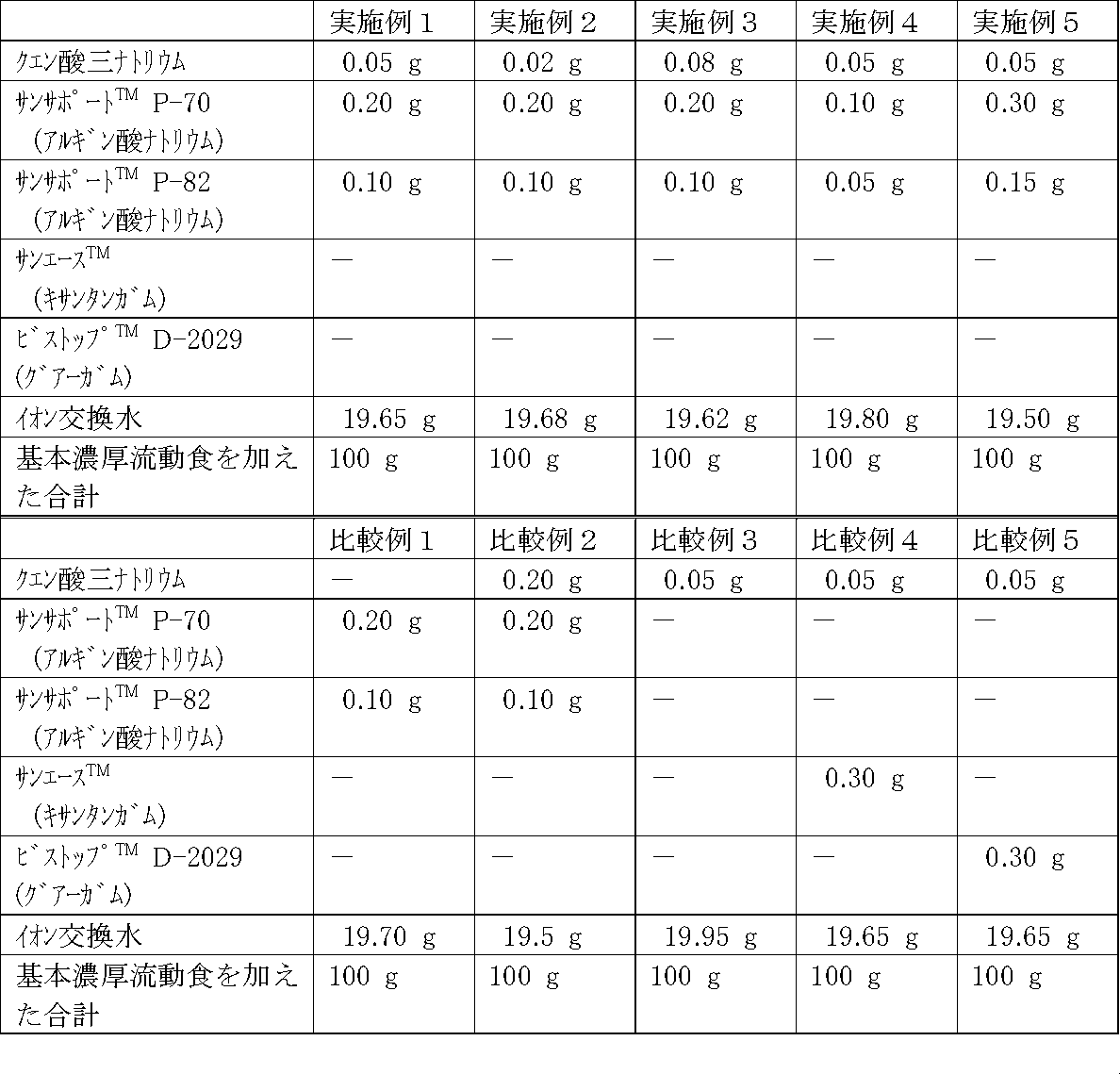
- (1-1) Preparation of concentrated liquid food First, a basic concentrated liquid food having the composition shown in Table 2 was prepared. The pH of the basic concentrated liquid food was 6.8. Next, trisodium citrate was added to 80 g of the basic concentrated liquid food so as to have the content shown in Table 3, and dissolved by stirring for 1 minute at 500 rpm using a propeller stirrer.
- Table 3 shows Sun Support TM P-70 and Sun Support TM P-81, which are sodium alginate, Sunace TM , which is xanthan gum, and Bistop TM D-2029, which is guar gum (both from Saneigen FFI Co., Ltd.).
- 20 g of the aqueous solution contained in the amount described in 1 above was added, and the mixture was stirred uniformly at 500 rpm for 10 minutes using a propeller stirrer, and 100 g of each of the concentrated liquid foods of Examples 1 to 5 and Comparative Examples 1 to 5 was mixed. Prepared.
- viscosity in particular shows the viscosity at 1.0 s -1, unless otherwise specified
- the fluids rheometer ARES LS-1 (TA Instruments Inc.) was measured under the conditions shown in (1-2-1).
- Tube flowability 80 ml of the concentrated liquid food prepared in (1-1) above is placed in a 100 ml plastic bottle having an open part at the top, and the inner diameter of the plastic bottle is 4 mm long. A 1000 mm silicone flexible tube was connected. The bottom of the plastic bottle was installed 600 mm above the tip of the tube so that the concentrated liquid food flowed out through the tube. At this time, the concentrated liquid food flows out through the tube only by gravity.
- the flow rate A (ml) of the sample that flowed out for 10 minutes was measured with a graduated cylinder, and A ⁇ 6 (ml / hour) was defined as the tube fluidity of the concentrated liquid food.
- Each of the concentrated liquid foods of Examples 1 to 5 had a viscosity of 200 mPa ⁇ s or less and a tube fluidity of 400 ml / hour or more before being put into the artificial gastric juice.
- the viscosity after introduction into the artificial gastric juice was 1500 mP ⁇ s or more.
- the administration rate can be easily reduced by using a governor. From these results, it is suggested that the concentrated liquid food of the present invention reduces the burden on the caregiver and the cared person at the time of administration to the stomach, and the viscosity becomes sufficiently high in the stomach to prevent gastroesophageal reflux. It is considered possible.
- the concentrated liquid food of Comparative Example 1 not containing trisodium citrate, which is a chelating agent was too viscous to flow in a tube having an inner diameter of 4 mm only by gravity.
- the concentrated liquid food of Comparative Example 2 containing 0.2% trisodium citrate showed precipitation of aggregates before injection into the artificial gastric fluid, and the tube fluidity was low.
- Experimental example 2 A concentrated liquid food prepared as described in (2-1) below using various sodium alginate having different G / M ratios and average molecular weights to artificial gastric juice by the method described in (2-2) below. The viscosity of the concentrated liquid food before and after the injection and the tube fluidity before the injection into the artificial gastric juice were tested.
- Table 6 shows the viscosity of each concentrated liquid food before and after its introduction into the artificial gastric juice, the ratio of both (increase rate of viscosity), and tube fluidity.
- Table 6 the test results of the concentrated liquid food of Example 1 in Experimental Example 1 are also shown for comparison.
- Example 1 and Examples 6 to 14 the viscosity before injection into the artificial gastric fluid is 200 mPa ⁇ s or less, and the viscosity after injection into the artificial gastric fluid is 1500 mPa ⁇ s or more.
- the magnification was 10 times or more.
- the tube fluidity is 400 ml / hour or more, and it is considered that the caregiver can easily take the concentrated liquid food of the present invention by the caregiver.
- Example 1 examples 6 to 10 and Example 14 in which the G / M ratio is a sodium alginate having a ratio of 1.5 or less and the low GA content is 50 mass% to 83.3 mass%,
- the viscosity after the injection into the artificial gastric juice increased to 2000 mPa ⁇ s or more, and the increase rate of the viscosity before and after the injection into the artificial gastric juice showed a high value of 20 times or more. From this, it became clear that when the low GA and high GA are blended in a well-balanced manner, the rate of increase in viscosity is improved.
- the abundance ratio of sodium alginate having a weight average molecular weight of 2.0 ⁇ 10 5 g / mol or less the one having a low Mw ratio of 50.0% by mass or more is better for artificial gastric juice.
- the viscosity ratio before and after the addition of was shown to be higher, and it became clear that the rate of increase in viscosity was improved when a low MwA and a high MwA were blended in a well-balanced manner.
- Experimental example 3 A concentrated liquid food prepared as described in the following (3-1) using sodium alginate in combination with other polysaccharides was concentrated by the method described in the following (3-2). The viscosity of the liquid food and the tube fluidity before injection into the artificial gastric juice were tested.
- Table 9 shows the viscosity of each concentrated liquid food before and after its introduction into the artificial gastric juice, the ratio of both (increase rate of viscosity), and tube fluidity.
- Table 9 the test results of the concentrated liquid food of Example 1 in Experimental Example 1 are also shown for comparison.
- the viscosity before injection into the artificial gastric fluid is 200 mPa ⁇ s or less
- the viscosity after injection into the artificial gastric fluid is 2000 mPa ⁇ s or more
- the increase rate of the viscosity is 30 times or more.
- the tube fluidity is 400 ml / hour or more, and it is considered that the caregiver can easily take the concentrated liquid food of the present invention to the care recipient.
- Viscosity before introduction into artificial gastric juice compared with Example 1 in Example 15 in which alginic acid was used in combination with sodium alginate, Example 16 in which deacyl gellan gum was used in combination, and Example 18 to 21 in which rhomethoxyl pectin was used in combination. was slightly increased, but sufficient tube fluidity was maintained.
- the viscosities after charging the artificial gastric juices of Examples 18 to 21 were significantly higher than those of Example 1, and the rate of increase in viscosity was higher than that of Example 1. From these results, it was shown that the combined use of alginic acid, deacylated gellan gum, and low methoxyl pectin improves the thickening effect of the concentrated liquid food of the present invention in the stomach.
- Examples 20 and 21 in combination with low methoxyl pectin having a methyl esterification degree ( ⁇ ME>) of 15% or less and a weight average molecular weight ( ⁇ M w >) of 80,000 g / mol or less The increase rate was 40 times or more, and a higher combined effect was observed. Further, in Examples 22 and 23 in which high methoxyl pectin was used in combination, the viscosity after being introduced into the gastric juice was lower than that in Example 1, and the effect of increasing the viscosity by the combined use was not observed.
- Example 17 in which soybean polysaccharide was used in combination, the viscosity before injection into the artificial gastric juice decreased, and as a result, the rate of increase in viscosity before and after injection into the artificial gastric juice was higher than in Example 1. From this result, it was shown that when soybean polysaccharide is used in combination, the fluidity at the time of administration of the concentrated liquid food of the present invention is improved.
- a concentrated liquid food that is easy to administer and that suppresses gastroesophageal reflux is provided.
Landscapes
- Health & Medical Sciences (AREA)
- Chemical & Material Sciences (AREA)
- Life Sciences & Earth Sciences (AREA)
- Engineering & Computer Science (AREA)
- Nutrition Science (AREA)
- Polymers & Plastics (AREA)
- Food Science & Technology (AREA)
- Medicinal Chemistry (AREA)
- General Health & Medical Sciences (AREA)
- Public Health (AREA)
- Veterinary Medicine (AREA)
- Animal Behavior & Ethology (AREA)
- Pharmacology & Pharmacy (AREA)
- Mycology (AREA)
- Epidemiology (AREA)
- Inorganic Chemistry (AREA)
- General Chemical & Material Sciences (AREA)
- Chemical Kinetics & Catalysis (AREA)
- Bioinformatics & Cheminformatics (AREA)
- Pediatric Medicine (AREA)
- Dispersion Chemistry (AREA)
- Oil, Petroleum & Natural Gas (AREA)
- Dermatology (AREA)
- Diabetes (AREA)
- Organic Chemistry (AREA)
- Obesity (AREA)
- Hematology (AREA)
- Nuclear Medicine, Radiotherapy & Molecular Imaging (AREA)
- Medicinal Preparation (AREA)
- Pharmaceuticals Containing Other Organic And Inorganic Compounds (AREA)
- Coloring Foods And Improving Nutritive Qualities (AREA)
Abstract
Description
経管栄養法が適用される高齢者又は患者などは胃上部の噴門の機能が著しく低下していることが多いので、流動食が低粘度の液状である場合、胃内の流動食が胃食道逆流を起こしてしまうことがある。これを防止するためには、摂取者の座位を長時間保つ必要があるので、介護者及び被介護者の負担が大きい。
一方、流動食がゲル状、高粘度の液状もしくはペースト状である場合、胃食道逆流は抑制されるが、これをチューブを介して投与するためには、長時間、高い圧力を加え続ける必要があり、この場合も、介護者の負担が大きい。
従って、本発明は、投与が容易であり、かつ胃食道逆流が生じにくい濃厚流動食を提供することを目的とする。
そして、このような濃厚流動食を提供すべく、研究を行った結果、0.1~1.0質量%のアルギン酸及び/又はそのナトリウム塩、カルシウム及びカルシウム1質量部に対し0.1~3.5質量部のキレート剤を含有する、濃厚流動食が、投与時は流動性の高い低粘度の液状であるが、pH2.0以下の胃内環境においては高粘度化又はゲル化することを見出し、このことにより、前記課題を解決できることを見出して、本発明を完成させた。
0.1~1.0質量%のアルギン酸及び/又はそのナトリウム塩、
カルシウム及び
カルシウム1質量部に対し0.1~3.5質量部のキレート剤
を含有する濃厚流動食。
項2.
後記の経管流動性測定方法で測定した経管流動性が、400ml/時間以上である項1に記載の濃厚流動食。
<経管流動性測定方法>
上方に開放部を有する100ml容のプラスチックボトルに試料80mlを入れる。
前記プラスチックボトルの底部に内径4mm、長さ1000mmのシリコーン製フレキシブルチューブを接続する。
前記プラスチックボトルの底面がチューブの先端より600mm上方になるように設置して、試料が重力のみによってチューブを通じて外部へ流出するようにする。
10分間に外部へ流れ出た試料の流量A(ml)をメスシリンダーで計測し、A×6(ml/時間)を濃厚流動食の経管流動性とする。
項3.
後記の人工胃液への投入後の粘度の測定方法に従って測定した、人工胃液への投入後の粘度が、1500mPa・s以上であることを特徴とする項1又は2に記載の濃厚流動食。
<人工胃液への投入後の粘度の測定方法>
上方に開放部を有する100ml容のプラスチックボトルに試料80mlを入れる。
当該プラスチックボトルの底部に内径4mm、長さ1000mmのシリコーン製フレキシブルチューブと調速器を接続する。
調速器によって流出速度を300ml/時間に調整して、試料の全量を、チューブを通じて、恒温水槽で37℃に保温した20mlの人工胃液(0.7%塩酸及び0.2%食塩の水溶液、pH1.2)が入った100ml容のビーカーへ直接滴下する。
この混合物の1.0s-1における粘度を、フルイドレオメーターを用いて次の粘度測定条件で測定する。
<粘度測定条件>
ジオメトリー:直径50mmのコーンプレート型プランジャー、ギャップ=0.051mm
測定温度:20℃
歪速度:1.0s-1
項4.
アルギン酸及び/又はそのナトリウム塩の全体量に対する、グルロン酸/マンヌロン酸比(G/M比)が1.5以下であるアルギン酸及び/又はそのナトリウム塩の量の割合が、40~95質量%である項1~3のいずれか1項に記載の濃厚流動食。
項5.
アルギン酸及び/又はそのナトリウム塩の全体量に対する、重量平均分子量(<Mw>)2.0×105g/mol以下のアルギン酸及び/又はそのナトリウム塩の量の割合が、30質量%以上である項1~4のいずれか1項に記載の濃厚流動食。
項6.
キレート剤が、クエン酸塩である項1~5のいずれか1項に記載の濃厚流動食。
項7.
アルギン酸及び/又はそのナトリウム塩以外の多糖類を更に含有する項1~6のいずれか1項に記載の濃厚流動食。
項8.
経鼻又は経口経管栄養法、或いは経胃瘻又は経腸瘻経管栄養法による投与用である、項1~7のいずれか1項に記載の濃厚流動食。
これにより、本発明によれば、投与が容易であり、かつ胃食道逆流が抑制された濃厚流動食が提供される。
0.1~1.0質量%のアルギン酸及び/又はそのナトリウム塩、
カルシウム及び
カルシウム1質量部に対し0.1~3.5質量部のキレート剤
を含有する。
本発明で用いられる「アルギン酸及び/又はそのナトリウム塩」は、食品添加物の増粘剤として汎用されている物質である。アルギン酸はウロン酸から構成される直鎖状の酸性多糖類であり、α-L-グルロン酸(G)とβ-D-マンヌロン酸(M)とからなる共重合体である。本明細書中、α-L-グルロン酸(G)のβ-D-マンヌロン酸(M)に対するモル比をG/M比と称する場合がある。
本発明で用いられるアルギン酸及び/又はそのナトリウム塩の全体量に対する、G/M比が0.5~1.5であるアルギン酸及び/又はそのナトリウム塩の量の割合は、好ましくは40~95質量%、より好ましくは50~90質量%、更に好ましくは60~80質量%である。
当該割合がこのような値である場合、本発明の濃厚流動食は、投与時(すなわち、胃液に接触するまで)の粘度が低く、かつ胃内(すなわち、胃液に接触した後)での粘度が高い傾向がある。
本明細書中、このように、用語「投与時」は、胃液に接触するまで、を意味し得る。
本明細書中、このように、用語「胃内」は、胃液に接触した後、を意味し得る。
アルギン酸及び/又はそのナトリウム塩の全体量に対する、重量平均分子量2.0×105g/mol以下のアルギン酸及び/又はそのナトリウム塩の量の割合は、好ましくは30質量%以上、より好ましくは30~95質量%、更に好ましくは40~90質量%、特に好ましくは50~85質量%である。
当該割合がこのような値である場合、本発明の濃厚流動食は、投与時の粘度が低く、かつ胃内での粘度が高い傾向がある。
なお、本発明において、アルギン酸ナトリウムの含有率は、厳密にはアルギン酸としての含有率によって表わされる。但し、実際には、アルギン酸ナトリウムの含有率を、この含有率の近似値として使用できる。
当該含有率が低すぎると、胃内での濃厚流動食の高粘度化又はゲル化が不十分である場合があり、一方、当該含有率が高すぎると、濃厚流動食の投与時の粘度が高くなりすぎる場合がある。
本発明で用いられる「カルシウム」の形態は、特に限定されず、例えば、塩又はイオンであることができる。
本発明の濃厚流動食は、実際には、カルシウムの供給源を含有する。
カルシウムの供給源として、具体的には、例えば、塩化カルシウム、硫酸カルシウム、クエン酸カルシウム、グルコン酸カルシウム、焼成(うに殻、貝殻、骨、造礁サンゴ、乳性、卵殻)カルシウム、未焼成(貝殻、骨、サンゴ、真珠層、卵殻)カルシウム、炭酸カルシウム、乳酸カルシウム、リン酸一水素カルシウム、リン酸二水素カルシウム、リン酸三水素カルシウム、エチレンジアミン四酢酸カルシウム及びそれらの水和物から選択される1種以上、好ましくは、塩化カルシウム、硫酸カルシウム、クエン酸カルシウム、炭酸カルシウム、乳酸カルシウム及びリン酸一水素カルシウムから選択される1種以上を用いることができる。
また、カルシウムは、後記で説明する栄養成分に含有されるものであってもよい。
本発明の濃厚流動食における、カルシウムの含有率は「日本人の食事摂取基準[2010年度版]」に記載の推奨量、目安量、目標量又は上限量を目安に適宜設定することが可能である。
但し、当該含有率が低すぎると胃内での濃厚流動食の高粘度化又はゲル化が不十分になる場合があり、一方、当該含有率が高すぎると、濃厚流動食の投与時の粘度が高くなりすぎる場合がある。
この比が小さすぎると胃内での濃厚流動食の高粘度化又はゲル化が不十分になる場合があり、一方、この比が大きすぎると、濃厚流動食の投与時の粘度が高くなりすぎる場合がある。
本発明では「キレート剤」として、例えば、リン酸塩、縮合リン酸塩、リンゴ酸塩、コハク酸塩、酒石酸塩、グルタミン酸塩、エチレンジアミン四酢酸塩、グルコン酸塩、クエン酸、クエン酸塩、フィチン酸及びフィチン酸塩からなる群より選ばれる1種以上を用いることができる。
より具体的には、例えば、リン酸二水素ナトリウム、リン酸水素二ナトリウム、リン酸三ナトリウム、リン酸二水素カリウム、リン酸水素二カリウム、リン酸三カリウム、リン酸二水素カルシウム、リン酸水素二カルシウム、リン酸三カルシウム、リン酸三マグネシウム、ピロリン酸四ナトリウム、ピロリン酸二水素二ナトリウム、ピロリン酸四カリウム、ピロリン酸二水素カルシウム、ポリリン酸ナトリウム、ポリリン酸カリウム、メタリン酸ナトリウム、メタリン酸カリウム、リンゴ酸ナトリウム、コハク酸一ナトリウム、コハク酸二ナトリウム、酒石酸ナトリウム、酒石酸水素カリウム、グルタミン酸ナトリウム、グルタミン酸カリウム、グルタミン酸カルシウム、グルタミン酸マグネシウム、エチレンジアミン四酢酸カルシウム二ナトリウム、エチレンジアミン四酢酸二ナトリウム、グルコン酸ナトリウム、グルコン酸カリウム、グルコン酸カルシウム、グルコン酸鉄、グルコン酸銅、クエン酸三ナトリウム、クエン酸三カリウム、クエン酸カルシウム、クエン酸鉄及びクエン酸鉄ナトリウムからなる群より選ばれる1種以上を用いることができる。なかでも、好ましくは、例えば、クエン酸塩であり、より好ましくは、例えば、クエン酸三ナトリウム、及びクエン酸三カリウムからなる群より選ばれる1種以上である。
当該含有率が低すぎると、濃厚流動食の投与時の粘度が高くなりすぎる場合があり、一方、当該含有率が高すぎると、濃厚流動食の高粘度化又はゲル化が不十分になる場合や、濃厚流動食中の成分(例、タンパク質、脂質)が不安定になり、凝集又は沈殿などが生じる場合がある。
当該比が小さすぎると、濃厚流動食の投与時の粘度が高くなりすぎる場合があり、一方、当該比が大きすぎると、胃内での濃厚流動食の高粘度化又はゲル化が不十分になる場合がある。
当該含有率が低すぎると、濃厚流動食の投与時の粘度が高くなりすぎる場合があり、一方、当該含有率が高すぎると、胃内での濃厚流動食の高粘度化又はゲル化が不十分になる場合がある。
本発明の濃厚流動食は、好ましくは、カロリー値が1kcal/mL以上であって、かつタンパク質、脂質、炭水化物、ミネラル、及びビタミンなどからなる群より選択される1種以上の栄養成分を含む。
本発明のタンパク質の含有率として、好ましくは0.5~20.0質量%、より好ましくは1.0~15.0質量%である。
本発明の栄養成分中の脂質の含有率として、好ましくは0.5~20.0質量%、より好ましくは1.0~15.0質量%である。
本発明の濃厚流動食中の炭水化物の含有率として、好ましくは0.5~30.0質量%、より好ましくは1.0~20.0質量%である。
本発明の濃厚流動食中のミネラルの量は「日本人の食事摂取基準[2010年度版]」に記載の推奨量、目安量、目標量又は上限量を目安に、適宜設定することが可能である。以下に、このようにして設定される通常の含有率を記載する。ナトリウムの含有率は6,000~20,000mg/Lであることができる。カリウムの含有率は2,000~3,500mg/Lであることができる。マグネシウムの含有率は260~650mg/Lであることができる。鉄の含有率は10~40mg/Lであることができる。銅の含有率は1.6~9mg/Lであることができる。亜鉛の含有率は7~30mg/Lであることができる。
ビタミンとしては、例えば、ビタミンA、ビタミンB1、ビタミンB2、ビタミンB6、ビタミンB12、ビタミンC、ビタミンD、ビタミンE、ビタミンK、ナイアシン、ビオチン、パントテン酸、及び葉酸等が挙げられる。
本発明の濃厚流動食中のビタミンの量は「日本人の食事摂取基準[2010年度版]」に記載の推奨量、目安量、目標量又は上限量を目安に、適宜設定することが可能である。以下に、このようにして設定される通常の含有率を記載する。ビタミンAの量は0.54~1.5mg/Lであることができる。ビタミンB1の含有率は0.8~1.0mg/Lであることができる。ビタミンB2の含有率は1~100mg/Lであることができる。ビタミンB6の含有率は1.0~1,000mg/Lであることができる。ビタミンB12の含有率は2.4~100mg/Lであることができる。ビタミンCの含有率は100~1,000mg/Lであることができる。ビタミンDの含有率は0.0025~0.05mg/Lであることができる。ビタミンEの含有率は8~600mg/Lであることができる。ビタミンKの含有率は0.055~30mg/Lであることができる。ナイアシンの量は13~30mg/Lであることができる。ビオチンの含有率は0.030~0.1mg/Lであることができる。パントテン酸の含有率は5~100mg/Lであることができる。葉酸の含有率は0.2~1.0mg/Lである。
本発明の濃厚流動食がアルギン酸及び/又はそのナトリウム塩以外の多糖類を含有する場合、かかる多糖類の含有比は、アルギン酸及び/又はそのナトリウム塩1質量部に対して、0.1~50.0質量部、好ましくは0.2~25.0質量部、更に好ましくは0.25~20.0質量部である。
本発明の濃厚流動食は、液状であり、後記の経管流動性測定方法で測定した経管流動性が、好ましくは400~5000ml/時間、より好ましくは600~4000ml/時間である。
<経管流動性測定方法>
上方に開放部を有する100ml容のプラスチックボトルに試料80mlを入れる。
前記プラスチックボトルの底部に内径4mm、長さ1000mmのシリコーン製フレキシブルチューブを接続する。
前記プラスチックボトルの底面がチューブの先端より600mm上方になるように設置して、試料が重力のみによってチューブを通じて外部へ流出するようにする。
10分間に外部へ流れ出た試料の流量A(ml)をメスシリンダーで計測し、A×6(ml/時間)を濃厚流動食の経管流動性(経管流速)とする。
当該経管流動性測定に用いられるプラスチックボトル、及びシリコーン製フレキシブルチューブは、通常、経口経管栄養法に用いられるプラスチックボトル、及びシリコーン製フレキシブルチューブである。
本発明の濃厚流動食人工胃液への投入前の粘度は、フルイドレオメーター(Fluid Rheometer) ARES LS-1(商品名)(TAインスツルメント社製)又はこれと同様の測定結果が得られるフルイドレオメーターを用いて、後記の測定条件で測定できる。この人工胃液への投入前の粘度は、すなわち投与時の粘度と同様である考えることができる。この人工胃液への投入前の粘度は、好ましくは0.1~200mPa・s、より好ましくは1~100mPa・s以下である。
<粘度の測定条件>
フルイドレオメーター: ARES LS-1(商品名)(TAインスツルメント社製)又はこれと同様の測定結果が得られるフルイドレオメーター
ジオメトリー:直径50mmのコーンプレート型プランジャー、ギャップ=0.051mm
測定温度:20℃
歪速度:1.0s-1
本発明の濃厚流動食の胃内での様態は当該濃厚流動食を人工胃液に投入することによって推察される。本発明の濃厚流動食は、人工胃液への投入後においてゲルであってもよく、高粘度化した溶液、分散液もしくはペースト状であってもよい。人工胃液への投入後の本発明の濃厚流動食は、後記の人工胃液への投入後の粘度の測定方法に従って、その粘度を測定でき、当該測定方法により測定した粘度は、好ましくは1,500~20,000mPa・s、より好ましくは2,000~10,000mPa・sである。
<人工胃液への投入後の粘度の測定方法>
上方に開放部を有する100ml容のプラスチックボトルに試料80mlを入れる。
当該プラスチックボトルの底部に内径4mm、長さ1000mmのシリコーン製フレキシブルチューブと調速器を接続する。
調速器によって流出速度を300ml/時間に調整して、試料の全量を、チューブを通じて、恒温水槽で37℃に保温した20mlの人工胃液(0.7%塩酸及び0.2%食塩の水溶液、pH1.2)が入った100ml容のビーカーへ直接滴下する。
この混合物の1.0s-1における粘度を、フルイドレオメーターを用いて次の粘度測定条件で測定する。
なお、当該測定方法における「滴下」とはチューブ先端と人工胃液が接触しない状態で濃厚流動食がチューブ先端より空中を経由して人工胃液に投入されることを意味する。
当該粘度測定方法に用いられるプラスチックボトル、及びシリコーン製フレキシブルチューブは、通常、経口経管栄養法に用いられるプラスチックボトル、及びシリコーン製フレキシブルチューブである。
<粘度測定条件>
前記「6.粘度(人工胃液への投入前の粘度)」における粘度の測定条件と同じ条件
本発明における濃厚流動食のpHは、通常4.0~9.0、好ましくは4.5~8.5、より好ましくは5.0~8.0である。
pHが低すぎると、濃厚流動食の投与時の粘度が高くなりすぎる場合があり、一方、pHが高すぎると、濃厚流動食の味質が悪くなる場合がある。
pHの調整は、必要に応じて、例えば、有機酸及び/又はその塩、無機酸及び/又はその塩等のpH調整剤を用いて行うことができる。pH調整剤としては、例えば、フィチン酸、クエン酸、乳酸、グルコン酸、アジピン酸、酒石酸、及びリンゴ酸等の有機酸又はその塩、炭酸ナトリウム、炭酸水素ナトリウム、並びに水酸化ナトリウム等を挙げることができる。キレート剤として作用し得るクエン酸塩等は、本発明の濃厚流動食の必須成分としてのキレート剤を兼ねることができる。
本発明の濃厚流動食は、アルギン酸及び/又はそのナトリウム塩とカルシウムとが、キレート剤非存在下で接触しない限り、任意の方法で各成分を混合することにより、製造できる。
具体的には、例えば、栄養成分(カルシウムを含有してもよい)、カルシウム源、及びキレート剤の水溶液又は水分散液を調製し、これにアルギン酸及び/又はそのナトリウム塩を添加及び混合して、本発明の濃厚流動食を得ることができる。
得られた本発明の濃厚流動食は、所望により、例えば、容器充填後の105~121℃、5~60分間等の条件のレトルト殺菌処理により殺菌される。
本発明の濃厚流動食は、従来の液状の流動食と同様に、経鼻又は経口経管栄養法、或いは経胃瘻又は経腸瘻経管栄養法により、投与できる。
特に、本発明の濃厚流動食は、投与時(胃液に接触するまで)は、低粘度であり、かつ高い経管流動性を有するので、細いチューブにおいても、100Pa以下の弱い加圧による投与、又は加圧無しでの投与、すなわち重力のみによる投与(自然滴下による投与)が可能である。従って、摂取者の負担の少ない経鼻又は経口経管栄養法、或いは経胃瘻又は経腸瘻経管栄養法によって、簡便に投与できる。ここで、胃瘻及び腸瘻は、例えば、それぞれ経皮内視鏡的胃瘻造設術(PEG)及び経皮内視鏡的腸瘻造設術(PEJ)で造設されたものであることができる。
これに加えて、本発明の濃厚流動食は、胃内(胃液に接触した後)においては、高粘度化又はゲル化するので、胃食道逆流を生じにくく、摂取者の座位を長時間保つ必要が無い。
後記の方法で測定した、これらのアルギン酸及びアルギン酸ナトリウムのG/M比及び重量平均分子量<Mw>(g/mol)を表1に示す。
以後、G/M比が1.5以下であるアルギン酸ナトリウムをグルロン酸低含有率アルギン酸ナトリウム(低GAと略記する場合がある)と称し、一方、G/M比が1.5以上であるアルギン酸ナトリウムをグルロン酸高含有率アルギン酸ナトリウム(高GAと略記する場合がある)と称する。
また、重量平均分子量が2.0×10⁵g/mol未満であるアルギン酸ナトリウムを低分子量アルギン酸ナトリウム(低MwAと略記する場合がある)と称し、一方、重量平均分子量が2.0×105g/mol以上であるアルギン酸ナトリウムを高分子量アルギン酸ナトリウム(高MwAと略記する場合がある)と称する。
アルギン酸ナトリウム及びアルギン酸のG/M比は、1H-NMRで測定した際に観測されるグルロン酸の1位炭素に結合したプロトンに由来する5.00~5.15ppmのピーク面積をマンヌロン酸の1位の炭素に結合したプロトンに由来する4.60~4.75ppmのピーク面積で除した値とした。
試料の調製方法と1H-NMR測定方法を以下に記載する。
アルギン酸ナトリウム及びアルギン酸試料を重水に溶解した後に凍結乾燥をした。この操作を3回繰り返し、交換可能なプロトンを除いた後、更に24時間減圧乾燥した。減圧乾燥された試料を約2質量%になるように重水に溶解し、内部標準としてトリメチルシリルプロピオン酸ナトリウム(TSP)を添加した。1H-NMRの測定にはNMR測定装置ECA600(日本電子社)を用い、以下条件で測定した。
フィールド磁場強度:14.096T
周波数:600MHz
パルス角度:45°
パルス時間:6.75マイクロ秒
リラクゼーション時間:5秒
積算回数:128回
測定温度:70℃
アルギン酸ナトリウムの重量平均分子量(<Mw>)は、アルギン酸ナトリウム希薄溶液をサイズ分離クロマトグラフィーで分離し、多角度光散乱検出器と屈折率検出器を用いて、以下の方法で測定した。
乾燥重量1.5gのアルギン酸ナトリウムを100gのイオン交換水に添加し、ポリトロン式攪拌機を使用して、回転速度26,000rpmで1分間攪拌することによって分散させて、1.5重量%のアルギン酸ナトリウム分散液を調製した。この分散液を0.5MのNaNO3水溶液で30倍希釈し、ポリトロン式攪拌機を使用して、回転速度26,000rpmで1分間攪拌することによって0.05質量%のアルギン酸ナトリウム分散液を調製した。当該分散液を、孔径0.45μmのPTFEメンブランフィルターを用いてろ過することによって不溶物を除去した後、以下の条件でゲルろ過クロマトグラフィーに供し、多角度光散乱検出器及び屈折率検出器の測定値からASTRA Version 4.9(ワイアットテクノロジー社)ソフトウェアを用いて重量平均分子量:<Mw>(g/mol)を算出した。
[ゲル濾過クロマトグラフィーの測定条件]
カラム: OHpak SB-806M HQ (昭和電工社)
カラム温度:25℃
流速:0.5 ml/min
溶出溶媒:0.5 M NaNO3
試料液注入量:100μl。

また、サンサポートTM P-70、及びサンサポートTM P-81を、低分子量アルギン酸ナトリウム(低MwA)に分類し、一方、サンサポートTM P-71、P-72、及びP-82を、高分子量アルギン酸ナトリウム(高MwA)に分類した。
アルギン酸ナトリウム又はその他の多糖類を用いて、後記(1-1)に記載するように調製した濃厚流動食を、後記(1-2)に記載の方法で、人工胃液への投入前後の濃厚流動食の粘度及び人工胃液への投入前の経管流動性について試験した。
(1-1)濃厚流動食の調製
まず、表2に記載の組成の基本濃厚流動食を調製した。基本濃厚流動食のpHは6.8であった。
次に、この基本濃厚流動食80gにクエン酸三ナトリウムを表3に記載の含有量になるように添加し、プロペラ攪拌機を用いて500rpmで1分間撹拌して溶解した。更にアルギン酸ナトリウムであるサンサポートTM P-70及びサンサポートTM P-81、キサンタンガムであるサンエースTM 、グアーガムであるビストップTM D-2029(いずれも三栄源エフ・エフ・アイ株式会社)を表3に記載の分量で含有する水溶液20gを添加し、プロペラ攪拌機を用いて500rpmで10分間撹拌して均一に混合し、それぞれ100gの、実施例1~5及び比較例1~5の濃厚流動食を調製した。
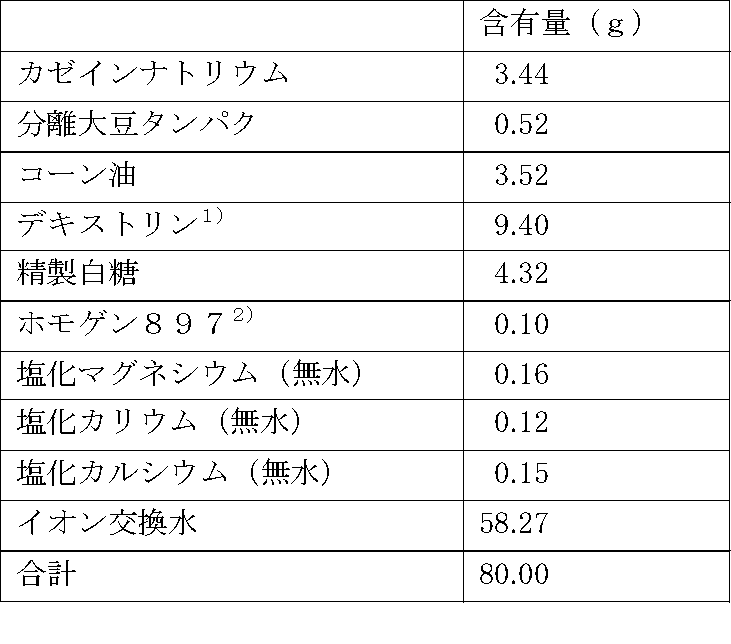
2)乳化剤製剤(三栄源エフ・エフ・アイ株式会社)
グリセリン脂肪酸エステル 30質量%
ショ糖脂肪酸エステル 20質量%
グルコース 50質量%
(1-2-1)人工胃液への投入前の粘度
フルイドレオメーター(Fluid Rheometer) ARES LS-1(商品名)(TAインスツルメント社製)を用いて、前記(1-1)で調製した濃厚流動食の1.0s-1における粘度を次の測定条件で測定した。
<粘度の測定条件>
ジオメトリー:直径50mmのコーンプレート型プランジャー、
ギャップ=0.051mm
測定温度:20℃
歪速度:1.0s-1
上方に開放部を有する100ml容のプラスチックボトルに濃厚流動食80mlを入れ、当該プラスチックボトルの底部に内径4mm、長さ1000mmのシリコーン製フレキシブルチューブと調速器を接続し、濃厚流動食がチューブを通じて、全量を恒温水槽で37℃に保温した20mlの人工胃液(0.7%塩酸及び0.2%食塩の水溶液、pH1.2)が入った100ml容のビーカーに直接滴下した(このときチューブの先端は、人工胃液の液面より50mm以上上方になるように設置されており、チューブ先端と人工胃液は接触していない)。このとき調速器によって流出速度を300ml/時間に調節した。
この濃厚流動食の1.0s-1における粘度(以降、「粘度」は特に断りのない限り1.0s-1における粘度を示す)をフルイドレオメーターARES LS-1(TAインスツルメント社製)を用いて(1-2-1)で示した条件で測定した。
上方に開放部を有する100ml容のプラスチックボトルに、前記(1-1)で調製した濃厚流動食80mlを入れ、当該プラスチックボトルの底部に内径4mm、長さ1000mmのシリコーン製フレキシブルチューブを接続した。当該プラスチックボトルの底面がチューブの先端より600mm上方になるように設置し、濃厚流動食がチューブを通じて外部へ流出するようにした。このとき濃厚流動食は、重力のみによってチューブを通じて外部へ流出することになる。10分間に外部へ流れ出た試料の流量A(ml)をメスシリンダーで計測し、A×6(ml/時間)を濃厚流動食の経管流動性とした。
各濃厚流動食の、人工胃液への投入前後の粘度、投入後の粘度/投入前の粘度の比(粘度の増加率)、及び経管流動性を表4に示す。
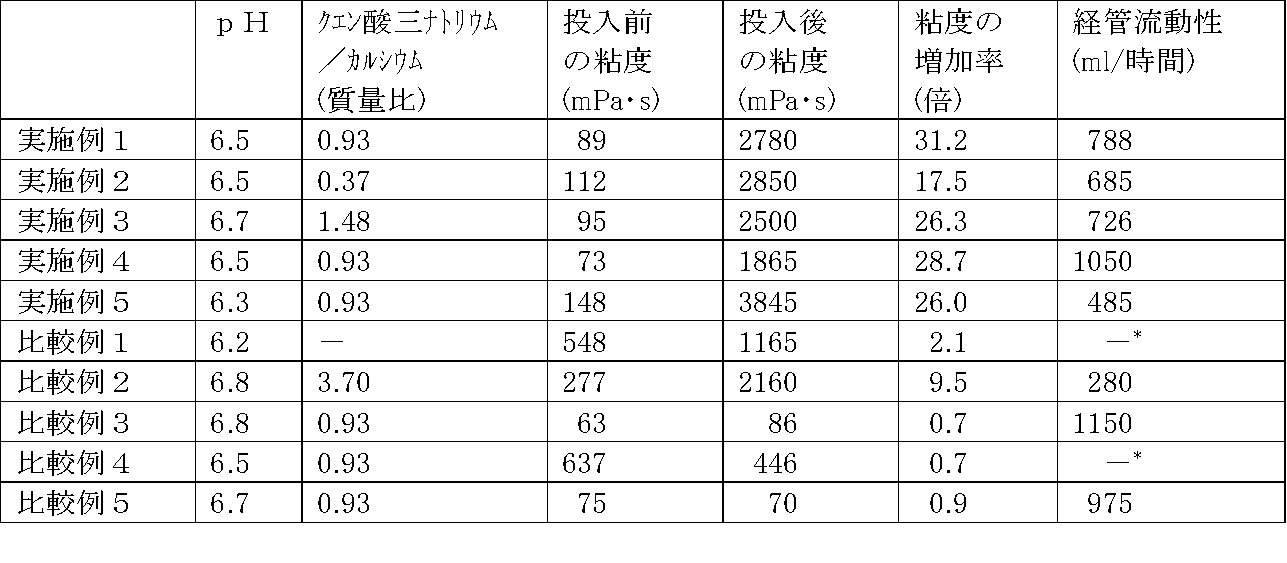
また、人工胃液への投入後の粘度は、いずれも1500mP・s以上であった。
この結果は、本発明の濃厚流動食は胃への投与時には低粘度であり、内径4mmのチューブを通した場合においても重力のみで流動(流出)させることが可能であること、濃厚流動食の1回標準投与量である200~400mlを30~60分間以内に投与できることを示している。
なお、投与速度が高すぎても下痢や嘔吐し易くなるなどの問題があるが、投与速度は、調速器の使用などによって、容易に低下させることができる。
これらの結果から、本発明の濃厚流動食は、胃への投与時の介護者や被介護者の負担を減じることが示唆され、かつ胃内では十分に高粘度になって胃食道逆流を防ぐことができると考えられる。
一方、キレート剤であるクエン酸三ナトリウムを含有しない比較例1の濃厚流動食は、粘度が高すぎ、重力のみでは内径4mmのチューブ内で流動することができなかった。
また、0.2%のクエン酸三ナトリウムを含有する比較例2の濃厚流動食は、人工胃液への投入前に凝集物の沈殿が見られ、経管流動性も低かった。
アルギン酸ナトリウムもその他の多糖類も添加しない比較例3では、人工胃液への投入後の粘度が、胃食道逆流の防止にとって十分に高くならなかった。
アルギン酸ナトリウムの代わりにキサンタンガム又はグアーガムを添加した比較例4及び5では、人工胃液への投入後の粘度が投入前の粘度よりも低かった。比較例4では、人工胃液への投入前の粘度が高すぎ、十分な経管流動性を示さなかった。また、比較例5では、人工胃液への投入後の粘度が不十分だった。
G/M比及び平均分子量が異なる種々のアルギン酸ナトリウムを用いて、後記(2-1)に記載するように調製した濃厚流動食を、後記(2-2)に記載の方法で、人工胃液への投入前後の濃厚流動食の粘度及び人工胃液への投入前の経管流動性について試験した。
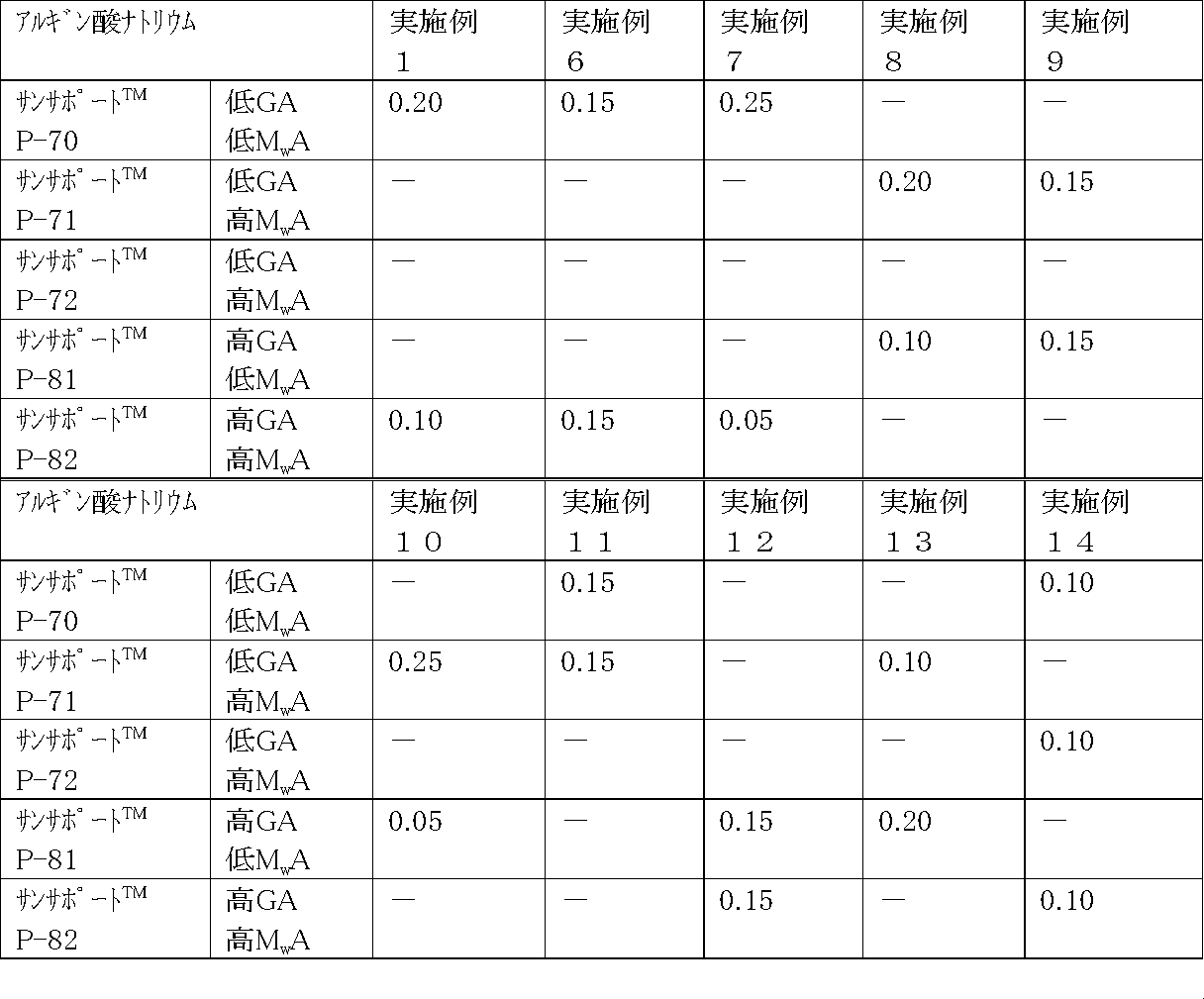
表2に記載の組成である基本濃厚流動食80gに0.05gのクエン酸三ナトリウムを直接添加し、プロペラ攪拌機を用いて500rpmで1分間撹拌して溶解した。更にアルギン酸ナトリウムであるサンサポートTM P-70、P-71、P-72、P-81、P-82(いずれも三栄源エフ・エフ・アイ株式会社)を表5に記載の分量で含有する水溶液20gを別途調製して添加混合し、プロペラ攪拌機を用いて500rpmで10分間撹拌して均一に混合し、実施例6~14の各濃厚流動食を調製した。これら濃厚流動食のクエン酸三ナトリウム/カルシウム(質量比)は、実施例1の濃厚流動食と同じである。なお、表5には、実施例1の濃厚流動食の組成も併記している。
調製した濃厚流動食の、人工胃液への投入前後の濃厚流動食の粘度及び人工胃液への投入前の経管流動性を、前記(1-2)と同様の方法で測定した。
各濃厚流動食の、人工胃液への投入前後の粘度及び両者の比(粘度の増加率)、及び経管流動性を表6に示す。なお、表6には、比較のため、実験例1における実施例1の濃厚流動食の試験結果も併記している。
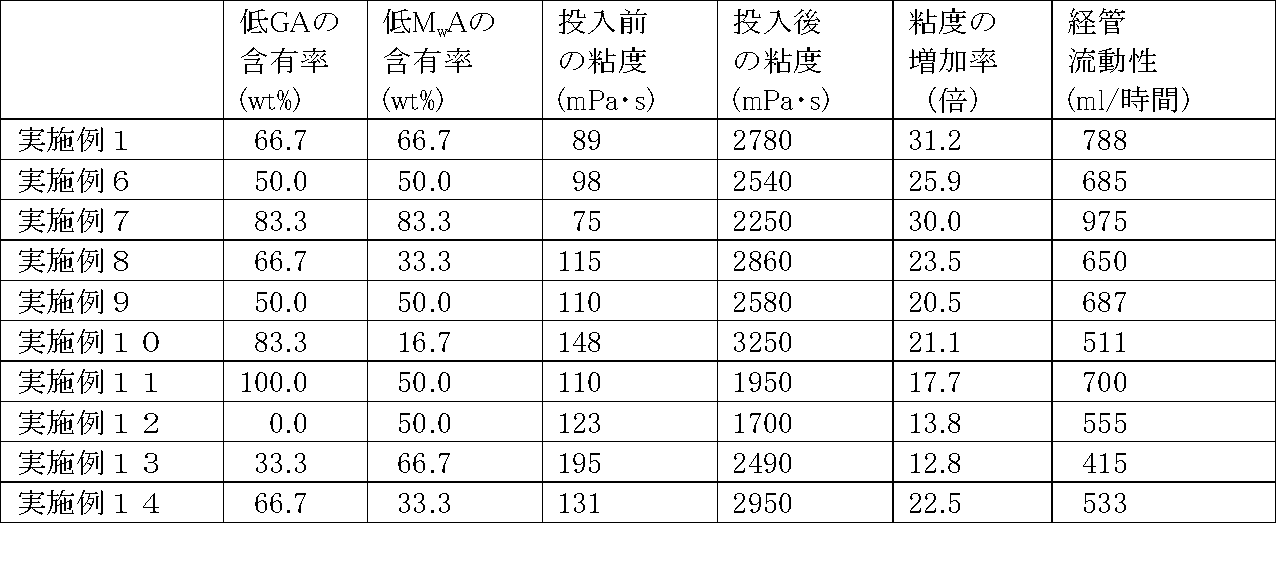
また、全ての実施例において経管流動性も400ml/時間以上であり、本発明の濃厚流動食は介護者が被介護者に容易に摂取させることが可能であると考えられる。
中でもG/M比が1.5以下のアルギン酸ナトリウムの含有比である、低GA含有率が50質量%~83.3質量%の実施例1、実施例6~10及び実施例14においては、人工胃液への投入後の粘度は2000mPa・s以上に上昇し、人工胃液への投入前後の粘度の増加率が20倍以上という高い値を示した。このことから低GAと高GAをバランスよく配合すると粘度の増加率が向上することが明らかになった。
また、同じ低GA含有率である場合、重量平均分子量2.0×10⁵g/mol以下のアルギン酸ナトリウムの存在比である、低Mw比が50.0質量%以上であるもののほうが人工胃液への投入前後の粘度倍率がより高くなる傾向を示し、低MwAと高MwAのバランスよく配合すると粘度の増加率が向上することが明らかになった。
アルギン酸ナトリウムにその他の多糖類を併用して、後記(3-1)に記載するように調製した濃厚流動食を、後記(3-2)に記載の方法で、人工胃液への投入前後の濃厚流動食の粘度及び人工胃液への投入前の経管流動性について試験した。
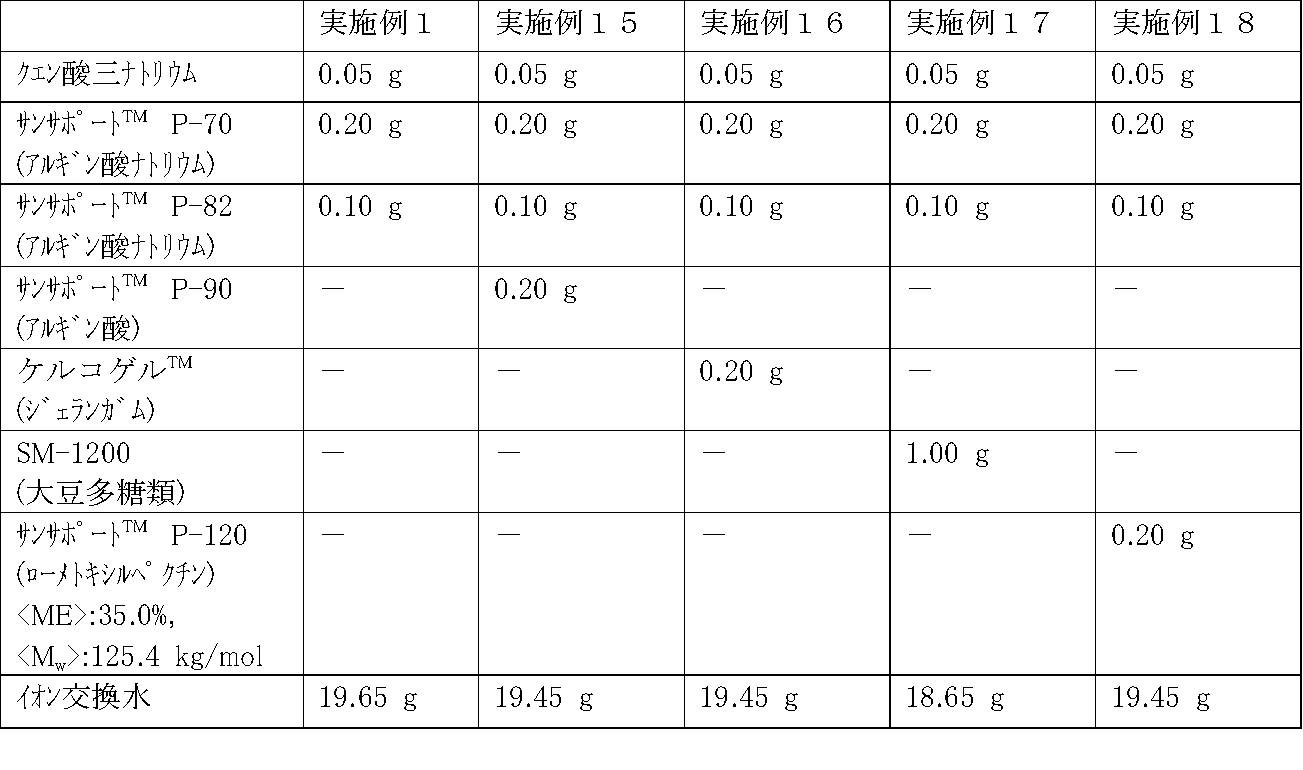
表2に記載の組成である基本濃厚流動食80gに0.05gのクエン酸三ナトリウムを添加し、プロペラ攪拌機を用いて500rpmで1分間撹拌して溶解した。更にアルギン酸ナトリウムであるサンサポートTM P-70、P-82、アルギン酸であるサンサポートTM P-90、脱アシル型ジェランガムであるケルコゲルTM、大豆多糖類であるSM-1200、ローメトキシルペクチンであるサンサポートTM P-120、P-130、P-140、P-150、P-160、及びP-170、並びにハイメトキシルペクチンであるサンサポートTM P-170(いずれも三栄源エフ・エフ・アイ株式会社。「ケルコゲル」はCPケルコ社の商標。)を表7及び8に記載の分量で含有する水溶液20gを添加し、プロペラ攪拌機を用いて500rpmで10分間撹拌して均一に混合し、実施例15~23の各濃厚流動食を調製した。これら濃厚流動食のクエン酸三ナトリウム/カルシウム(質量比)は、実施例1の濃厚流動食と同じである。なお、表7には、実施例1の濃厚流動食の組成も併記している。
尚、ジェランガムは85℃15分間加熱して溶解させ、他の多糖類に関しては常温のイオン交換水に溶解したものを用いた。

調製した濃厚流動食の、人工胃液への投入前後の濃厚流動食の粘度及び人工胃液への投入前の経管流動性を、前記(1-2)と同様の方法で測定した。
各濃厚流動食の、人工胃液への投入前後の粘度及び両者の比(粘度の増加率)、及び経管流動性を表9に示す。なお、表9には、比較のため、実験例1における実施例1の濃厚流動食の試験結果も併記している。
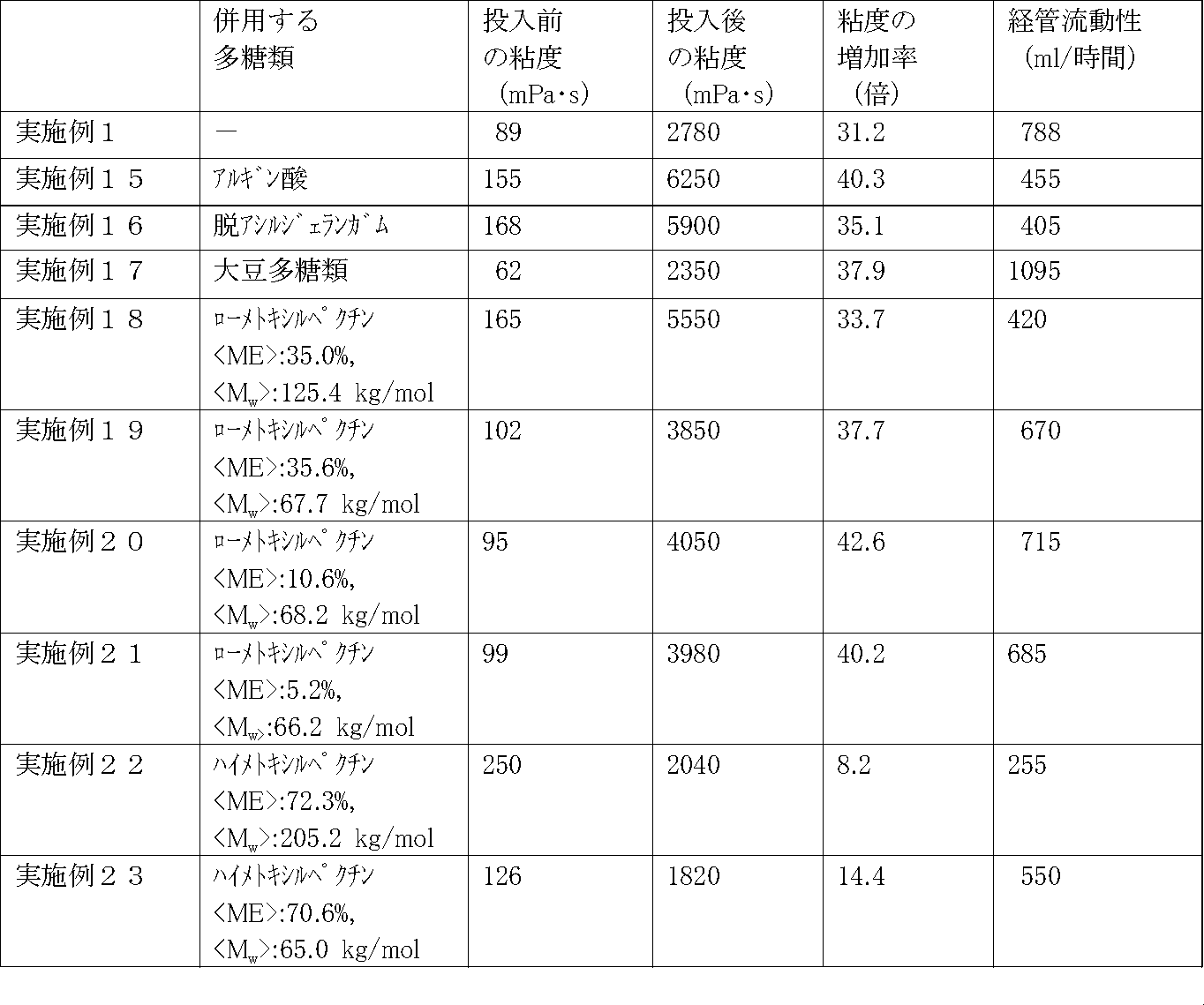
また、これらの実施例において経管流動性も400ml/時間以上であり、本発明の濃厚流動食は介護者が被介護者に容易に摂取させることができると考えられる。
アルギン酸ナトリウムにアルギン酸を併用した実施例15、脱アシルジェランガムを併用した実施例16及びローメトキシルペクチンを併用した実施例18乃至21は、いずれも実施例1に比べて人工胃液への投入前の粘度はわずかに増加したが、十分な経管流動性を保っていた。また、実施例18乃至21の人工胃液への投入後の粘度は実施例1と比較して大幅に上昇しており、粘度の増加率も実施例1に比べて高くなった。これらの結果から、アルギン酸、脱アシルジェランガム、ローメトキシルペクチンを併用することにより、本発明の濃厚流動食の胃内での増粘の増加効果が向上することが示された。また、メチルエステル化度(<ME>)が15%以下であり重量平均分子量(<Mw>)が80,000g/mol以下であるローメトキシルペクチンを併用した実施例20および21は、粘度の増加率が40倍以上となり、より高い併用効果がみられた。また、ハイメトキシルペクチンを併用した実施例22および23は、いずれも胃液に投入後の粘度が実施例1よりも低くなり、併用による粘度増加の効果が見られなかった。
一方、大豆多糖類を併用した実施例17は、人工胃液への投入前の粘度が減少し、これによって人工胃液への投入前後の粘度増加率は実施例1に比べて高くなった。この結果から、大豆多糖類を併用すると本発明の濃厚流動食の投与時における流動性が向上することが示された。
Claims (8)
- 0.1~1.0質量%のアルギン酸及び/又はそのナトリウム塩、
カルシウム及び
カルシウム1質量部に対し0.1~3.5質量部のキレート剤
を含有する濃厚流動食。 - 後記の経管流動性測定方法で測定した経管流動性が、400ml/時間以上である請求項1に記載の濃厚流動食。
<経管流動性測定方法>
上方に開放部を有する100ml容のプラスチックボトルに試料80mlを入れる。
前記プラスチックボトルの底部に内径4mm、長さ1000mmのシリコーン製フレキシブルチューブを接続する。
前記プラスチックボトルの底面がチューブの先端より600mm上方になるように設置して、試料が重力のみによってチューブを通じて外部へ流出するようにする。
10分間に外部へ流れ出た試料の流量A(ml)をメスシリンダーで計測し、A×6(ml/時間)を濃厚流動食の経管流動性とする。 - 後記の人工胃液への投入後の粘度の測定方法に従って測定した、人工胃液への投入後の粘度が、1500mPa・s以上であることを特徴とする請求項1又は2に記載の濃厚流動食。
<人工胃液への投入後の粘度の測定方法>
上方に開放部を有する100ml容のプラスチックボトルに試料80mlを入れる。
当該プラスチックボトルの底部に内径4mm、長さ1000mmのシリコーン製フレキシブルチューブと調速器を接続する。
調速器によって流出速度を300ml/時間に調整して、試料の全量を、チューブを通じて、恒温水槽で37℃に保温した20mlの人工胃液(0.7%塩酸及び0.2%食塩の水溶液、pH1.2)が入った100ml容のビーカーへ直接滴下する。
この混合物の1.0s-1における粘度を、フルイドレオメーターを用いて次の粘度測定条件で測定する。
<粘度測定条件>
ジオメトリー:直径50mmのコーンプレート型プランジャー、ギャップ=0.051mm
測定温度:20℃
歪速度:1.0s-1 - アルギン酸及び/又はそのナトリウム塩の全体量に対する、グルロン酸/マンヌロン酸比(G/M比)が1.5以下であるアルギン酸及び/又はそのナトリウム塩の量の割合が、40~95質量%である請求項1~3のいずれか1項に記載の濃厚流動食。
- アルギン酸及び/又はそのナトリウム塩の全体量に対する、重量平均分子量(<Mw>)2.0×105g/mol以下のアルギン酸及び/又はそのナトリウム塩の量の割合が、30質量%以上である請求項1~4のいずれか1項に記載の濃厚流動食。
- キレート剤が、クエン酸塩である請求項1~5のいずれか1項に記載の濃厚流動食。
- アルギン酸及び/又はそのナトリウム塩以外の多糖類を更に含有する請求項1~6のいずれか1項に記載の濃厚流動食。
- 経鼻又は経口経管栄養法、或いは経胃瘻又は経腸瘻経管栄養法による投与用である、請求項1~7のいずれか1項に記載の濃厚流動食。
Priority Applications (4)
| Application Number | Priority Date | Filing Date | Title |
|---|---|---|---|
| EP13853360.9A EP2918176B1 (en) | 2012-11-08 | 2013-11-08 | Thick liquid diet |
| ES13853360T ES2878009T3 (es) | 2012-11-08 | 2013-11-08 | Dieta líquida espesa |
| JP2014545785A JP6289377B2 (ja) | 2012-11-08 | 2013-11-08 | 濃厚流動食 |
| US14/440,938 US10357451B2 (en) | 2012-11-08 | 2013-11-08 | Enteral nutrition |
Applications Claiming Priority (2)
| Application Number | Priority Date | Filing Date | Title |
|---|---|---|---|
| JP2012-246087 | 2012-11-08 | ||
| JP2012246087 | 2012-11-08 |
Publications (1)
| Publication Number | Publication Date |
|---|---|
| WO2014073675A1 true WO2014073675A1 (ja) | 2014-05-15 |
Family
ID=50684766
Family Applications (1)
| Application Number | Title | Priority Date | Filing Date |
|---|---|---|---|
| PCT/JP2013/080357 Ceased WO2014073675A1 (ja) | 2012-11-08 | 2013-11-08 | 濃厚流動食 |
Country Status (5)
| Country | Link |
|---|---|
| US (1) | US10357451B2 (ja) |
| EP (1) | EP2918176B1 (ja) |
| JP (1) | JP6289377B2 (ja) |
| ES (1) | ES2878009T3 (ja) |
| WO (1) | WO2014073675A1 (ja) |
Cited By (4)
| Publication number | Priority date | Publication date | Assignee | Title |
|---|---|---|---|---|
| WO2015159990A1 (ja) * | 2014-04-17 | 2015-10-22 | 三栄源エフ・エフ・アイ株式会社 | 濃厚流動食 |
| JP2015188364A (ja) * | 2014-03-28 | 2015-11-02 | 味の素株式会社 | 栄養組成物 |
| JP2017171592A (ja) * | 2016-03-22 | 2017-09-28 | テルモ株式会社 | 液状栄養組成物 |
| JP2017171593A (ja) * | 2016-03-22 | 2017-09-28 | テルモ株式会社 | 液状栄養組成物 |
Families Citing this family (1)
| Publication number | Priority date | Publication date | Assignee | Title |
|---|---|---|---|---|
| CN110074388A (zh) * | 2019-04-28 | 2019-08-02 | 健康元药业集团股份有限公司 | 食品组合物及其制备方法和应用、营养食品 |
Citations (3)
| Publication number | Priority date | Publication date | Assignee | Title |
|---|---|---|---|---|
| JPH03500170A (ja) * | 1987-09-04 | 1991-01-17 | バイオコンパテイブルズ・リミテツド | 包帯 |
| JP2009291175A (ja) * | 2008-06-09 | 2009-12-17 | Sanei Gen Ffi Inc | 酸性濃厚流動食用ゲル化剤及びゲル状酸性濃厚流動食の製造方法 |
| JP2010254598A (ja) | 2009-04-23 | 2010-11-11 | Q P Corp | 嘔吐軽減又は防止方法、及び経腸栄養剤セット |
Family Cites Families (5)
| Publication number | Priority date | Publication date | Assignee | Title |
|---|---|---|---|---|
| US4744986A (en) * | 1986-03-07 | 1988-05-17 | Rorer Pharmaceutical Corporation | Process for the preparation of a viscosity-stable antacid composition |
| US20050202079A1 (en) * | 2004-03-15 | 2005-09-15 | Mylan Pharmaceuticals Inc. | Novel orally administrable formulation of nitrofurantoin and a method for preparing said formulation |
| WO2009086685A1 (zh) * | 2007-12-29 | 2009-07-16 | Dalian Yaweite Bioengineering Co., Ltd. | 低分子量海藻酸及其盐、应用、制法及药物组合物、食品 |
| EP3461473B1 (en) * | 2009-12-18 | 2021-09-22 | Kaneka Corporation | Liquid food composition being semisolidified in the acidic region |
| WO2011152706A1 (en) * | 2010-06-04 | 2011-12-08 | N.V. Nutricia | Pre-thickened compact liquid nutritional composition for dysphagia patients |
-
2013
- 2013-11-08 EP EP13853360.9A patent/EP2918176B1/en active Active
- 2013-11-08 US US14/440,938 patent/US10357451B2/en active Active
- 2013-11-08 WO PCT/JP2013/080357 patent/WO2014073675A1/ja not_active Ceased
- 2013-11-08 ES ES13853360T patent/ES2878009T3/es active Active
- 2013-11-08 JP JP2014545785A patent/JP6289377B2/ja active Active
Patent Citations (3)
| Publication number | Priority date | Publication date | Assignee | Title |
|---|---|---|---|---|
| JPH03500170A (ja) * | 1987-09-04 | 1991-01-17 | バイオコンパテイブルズ・リミテツド | 包帯 |
| JP2009291175A (ja) * | 2008-06-09 | 2009-12-17 | Sanei Gen Ffi Inc | 酸性濃厚流動食用ゲル化剤及びゲル状酸性濃厚流動食の製造方法 |
| JP2010254598A (ja) | 2009-04-23 | 2010-11-11 | Q P Corp | 嘔吐軽減又は防止方法、及び経腸栄養剤セット |
Non-Patent Citations (3)
| Title |
|---|
| DIETARY REFERENCE INTAKES FOR JAPANESE, 2010 |
| SAKIE NODA ET AL.: "Calcium Sonzaika ni Okeru Sodium Arginate no Gel-ka ni Oyobosu Mannuronic Acid/Guluronic Acid Hi no Eikyo", DAI 55 KAI RHEOROGY TORONKAI KOEN YOSHISHU, 2007, pages 198 - 199, XP008179137 * |
| SHOZO MIYAZAKI: "Ion Otosei Intelligent Tato no Inai Gel-ka Kino o Fuyo shita Shokuhin Tenkabutsu no Kaihatsu", THE JAPAN FOOD CHEMICAL RESEARCH FOUNDATION, DAI 10 KAI KENKYU SEIKA HOKOKUSHO, 2004, pages 104 - 108, XP008179138 * |
Cited By (6)
| Publication number | Priority date | Publication date | Assignee | Title |
|---|---|---|---|---|
| JP2015188364A (ja) * | 2014-03-28 | 2015-11-02 | 味の素株式会社 | 栄養組成物 |
| WO2015159990A1 (ja) * | 2014-04-17 | 2015-10-22 | 三栄源エフ・エフ・アイ株式会社 | 濃厚流動食 |
| EP3132693A4 (en) * | 2014-04-17 | 2018-01-03 | San-Ei Gen F.F.I., INC. | Concentrated liquid food |
| US10980268B2 (en) | 2014-04-17 | 2021-04-20 | San-Ei Gen F.F.I., Inc. | Concentrated liquid food |
| JP2017171592A (ja) * | 2016-03-22 | 2017-09-28 | テルモ株式会社 | 液状栄養組成物 |
| JP2017171593A (ja) * | 2016-03-22 | 2017-09-28 | テルモ株式会社 | 液状栄養組成物 |
Also Published As
| Publication number | Publication date |
|---|---|
| ES2878009T3 (es) | 2021-11-18 |
| EP2918176B1 (en) | 2021-03-31 |
| US10357451B2 (en) | 2019-07-23 |
| JPWO2014073675A1 (ja) | 2016-09-08 |
| EP2918176A4 (en) | 2016-07-20 |
| JP6289377B2 (ja) | 2018-03-07 |
| EP2918176A1 (en) | 2015-09-16 |
| US20150290123A1 (en) | 2015-10-15 |
Similar Documents
| Publication | Publication Date | Title |
|---|---|---|
| TWI584741B (zh) | Emulsified food composition, use of enteral nutrition for use in the manufacture of swallowing disorders, and nutritional supplementation | |
| JP5274889B2 (ja) | 経管投与用ゲル状酸性濃厚流動食又は栄養剤 | |
| JP6615750B2 (ja) | 濃厚流動食 | |
| JP6289377B2 (ja) | 濃厚流動食 | |
| EP3461473B1 (en) | Liquid food composition being semisolidified in the acidic region | |
| JP5026347B2 (ja) | 酸性濃厚流動食用ゲル化剤及びゲル状酸性濃厚流動食の製造方法 | |
| JP6378889B2 (ja) | 濃厚流動食 | |
| CN101039656B (zh) | 经肠营养剂 | |
| JP2004524366A (ja) | 繊維を含む経腸栄養用組成物 | |
| CN115697083B (zh) | 流食 | |
| CN104394844B (zh) | 胃瘘用半固态化营养剂 | |
| WO2017217326A1 (ja) | 下痢防止用栄養組成物 | |
| JP2025027869A (ja) | たんぱく質胃排出調整用組成物、流動性栄養組成物、及び組成物 | |
| HK40007833A (en) | Emulsified food product composition | |
| HK1134247A1 (en) | Gel type enteric nutrient | |
| WO2013125067A1 (ja) | 胃瘻用半固形栄養剤 |
Legal Events
| Date | Code | Title | Description |
|---|---|---|---|
| 121 | Ep: the epo has been informed by wipo that ep was designated in this application |
Ref document number: 13853360 Country of ref document: EP Kind code of ref document: A1 |
|
| ENP | Entry into the national phase |
Ref document number: 2014545785 Country of ref document: JP Kind code of ref document: A |
|
| NENP | Non-entry into the national phase |
Ref country code: DE |
|
| WWE | Wipo information: entry into national phase |
Ref document number: 2013853360 Country of ref document: EP |
|
| WWE | Wipo information: entry into national phase |
Ref document number: 14440938 Country of ref document: US |