WO2014080891A1 - 電気デバイス用負極、及びこれを用いた電気デバイス - Google Patents
電気デバイス用負極、及びこれを用いた電気デバイス Download PDFInfo
- Publication number
- WO2014080891A1 WO2014080891A1 PCT/JP2013/081129 JP2013081129W WO2014080891A1 WO 2014080891 A1 WO2014080891 A1 WO 2014080891A1 JP 2013081129 W JP2013081129 W JP 2013081129W WO 2014080891 A1 WO2014080891 A1 WO 2014080891A1
- Authority
- WO
- WIPO (PCT)
- Prior art keywords
- negative electrode
- active material
- alloy
- electrode active
- cycle
- Prior art date
- Legal status (The legal status is an assumption and is not a legal conclusion. Google has not performed a legal analysis and makes no representation as to the accuracy of the status listed.)
- Ceased
Links
Images


Classifications
-
- H—ELECTRICITY
- H01—ELECTRIC ELEMENTS
- H01M—PROCESSES OR MEANS, e.g. BATTERIES, FOR THE DIRECT CONVERSION OF CHEMICAL ENERGY INTO ELECTRICAL ENERGY
- H01M4/00—Electrodes
- H01M4/02—Electrodes composed of, or comprising, active material
- H01M4/13—Electrodes for accumulators with non-aqueous electrolyte, e.g. for lithium-accumulators; Processes of manufacture thereof
- H01M4/134—Electrodes based on metals, Si or alloys
-
- H—ELECTRICITY
- H01—ELECTRIC ELEMENTS
- H01M—PROCESSES OR MEANS, e.g. BATTERIES, FOR THE DIRECT CONVERSION OF CHEMICAL ENERGY INTO ELECTRICAL ENERGY
- H01M10/00—Secondary cells; Manufacture thereof
- H01M10/05—Accumulators with non-aqueous electrolyte
- H01M10/052—Li-accumulators
-
- H—ELECTRICITY
- H01—ELECTRIC ELEMENTS
- H01M—PROCESSES OR MEANS, e.g. BATTERIES, FOR THE DIRECT CONVERSION OF CHEMICAL ENERGY INTO ELECTRICAL ENERGY
- H01M4/00—Electrodes
- H01M4/02—Electrodes composed of, or comprising, active material
- H01M4/36—Selection of substances as active materials, active masses, active liquids
- H01M4/38—Selection of substances as active materials, active masses, active liquids of elements or alloys
-
- H—ELECTRICITY
- H01—ELECTRIC ELEMENTS
- H01M—PROCESSES OR MEANS, e.g. BATTERIES, FOR THE DIRECT CONVERSION OF CHEMICAL ENERGY INTO ELECTRICAL ENERGY
- H01M4/00—Electrodes
- H01M4/02—Electrodes composed of, or comprising, active material
- H01M4/36—Selection of substances as active materials, active masses, active liquids
- H01M4/38—Selection of substances as active materials, active masses, active liquids of elements or alloys
- H01M4/386—Silicon or alloys based on silicon
-
- H—ELECTRICITY
- H01—ELECTRIC ELEMENTS
- H01M—PROCESSES OR MEANS, e.g. BATTERIES, FOR THE DIRECT CONVERSION OF CHEMICAL ENERGY INTO ELECTRICAL ENERGY
- H01M4/00—Electrodes
- H01M4/02—Electrodes composed of, or comprising, active material
- H01M4/36—Selection of substances as active materials, active masses, active liquids
- H01M4/38—Selection of substances as active materials, active masses, active liquids of elements or alloys
- H01M4/387—Tin or alloys based on tin
-
- H—ELECTRICITY
- H01—ELECTRIC ELEMENTS
- H01M—PROCESSES OR MEANS, e.g. BATTERIES, FOR THE DIRECT CONVERSION OF CHEMICAL ENERGY INTO ELECTRICAL ENERGY
- H01M4/00—Electrodes
- H01M4/02—Electrodes composed of, or comprising, active material
- H01M4/62—Selection of inactive substances as ingredients for active masses, e.g. binders, fillers
- H01M4/624—Electric conductive fillers
-
- H—ELECTRICITY
- H01—ELECTRIC ELEMENTS
- H01M—PROCESSES OR MEANS, e.g. BATTERIES, FOR THE DIRECT CONVERSION OF CHEMICAL ENERGY INTO ELECTRICAL ENERGY
- H01M2220/00—Batteries for particular applications
- H01M2220/20—Batteries in motive systems, e.g. vehicle, ship, plane
-
- H—ELECTRICITY
- H01—ELECTRIC ELEMENTS
- H01M—PROCESSES OR MEANS, e.g. BATTERIES, FOR THE DIRECT CONVERSION OF CHEMICAL ENERGY INTO ELECTRICAL ENERGY
- H01M4/00—Electrodes
- H01M4/02—Electrodes composed of, or comprising, active material
- H01M4/36—Selection of substances as active materials, active masses, active liquids
- H01M4/38—Selection of substances as active materials, active masses, active liquids of elements or alloys
- H01M4/42—Alloys based on zinc
-
- H—ELECTRICITY
- H01—ELECTRIC ELEMENTS
- H01M—PROCESSES OR MEANS, e.g. BATTERIES, FOR THE DIRECT CONVERSION OF CHEMICAL ENERGY INTO ELECTRICAL ENERGY
- H01M4/00—Electrodes
- H01M4/02—Electrodes composed of, or comprising, active material
- H01M4/62—Selection of inactive substances as ingredients for active masses, e.g. binders, fillers
- H01M4/624—Electric conductive fillers
- H01M4/625—Carbon or graphite
-
- H—ELECTRICITY
- H01—ELECTRIC ELEMENTS
- H01M—PROCESSES OR MEANS, e.g. BATTERIES, FOR THE DIRECT CONVERSION OF CHEMICAL ENERGY INTO ELECTRICAL ENERGY
- H01M4/00—Electrodes
- H01M4/02—Electrodes composed of, or comprising, active material
- H01M4/64—Carriers or collectors
- H01M4/66—Selection of materials
-
- H—ELECTRICITY
- H01—ELECTRIC ELEMENTS
- H01M—PROCESSES OR MEANS, e.g. BATTERIES, FOR THE DIRECT CONVERSION OF CHEMICAL ENERGY INTO ELECTRICAL ENERGY
- H01M4/00—Electrodes
- H01M4/02—Electrodes composed of, or comprising, active material
- H01M4/64—Carriers or collectors
- H01M4/66—Selection of materials
- H01M4/661—Metal or alloys, e.g. alloy coatings
-
- Y—GENERAL TAGGING OF NEW TECHNOLOGICAL DEVELOPMENTS; GENERAL TAGGING OF CROSS-SECTIONAL TECHNOLOGIES SPANNING OVER SEVERAL SECTIONS OF THE IPC; TECHNICAL SUBJECTS COVERED BY FORMER USPC CROSS-REFERENCE ART COLLECTIONS [XRACs] AND DIGESTS
- Y02—TECHNOLOGIES OR APPLICATIONS FOR MITIGATION OR ADAPTATION AGAINST CLIMATE CHANGE
- Y02E—REDUCTION OF GREENHOUSE GAS [GHG] EMISSIONS, RELATED TO ENERGY GENERATION, TRANSMISSION OR DISTRIBUTION
- Y02E60/00—Enabling technologies; Technologies with a potential or indirect contribution to GHG emissions mitigation
- Y02E60/10—Energy storage using batteries
-
- Y—GENERAL TAGGING OF NEW TECHNOLOGICAL DEVELOPMENTS; GENERAL TAGGING OF CROSS-SECTIONAL TECHNOLOGIES SPANNING OVER SEVERAL SECTIONS OF THE IPC; TECHNICAL SUBJECTS COVERED BY FORMER USPC CROSS-REFERENCE ART COLLECTIONS [XRACs] AND DIGESTS
- Y02—TECHNOLOGIES OR APPLICATIONS FOR MITIGATION OR ADAPTATION AGAINST CLIMATE CHANGE
- Y02T—CLIMATE CHANGE MITIGATION TECHNOLOGIES RELATED TO TRANSPORTATION
- Y02T10/00—Road transport of goods or passengers
- Y02T10/60—Other road transportation technologies with climate change mitigation effect
- Y02T10/70—Energy storage systems for electromobility, e.g. batteries
Definitions
- the present invention relates to a negative electrode for an electric device and an electric device using the same.
- the negative electrode for an electric device and the electric device using the same according to the present invention are used as, for example, a driving power source or an auxiliary power source for a motor of a vehicle such as an electric vehicle, a fuel cell vehicle, and a hybrid electric vehicle as a secondary battery or a capacitor. It is done.
- lithium ion secondary batteries As a secondary battery for driving a motor, it is required to have extremely high output characteristics and high energy as compared with a consumer lithium ion secondary battery used for a mobile phone, a notebook personal computer or the like. Therefore, lithium ion secondary batteries having the highest theoretical energy among all the batteries are attracting attention, and are currently being developed rapidly.
- a lithium ion secondary battery includes a positive electrode in which a positive electrode active material or the like is applied to both surfaces of a positive electrode current collector using a binder, and a negative electrode in which a negative electrode active material or the like is applied to both surfaces of a negative electrode current collector using a binder.
- a positive electrode in which a positive electrode active material or the like is applied to both surfaces of a positive electrode current collector using a binder
- a negative electrode in which a negative electrode active material or the like is applied to both surfaces of a negative electrode current collector using a binder.
- it has the structure connected through an electrolyte layer and accommodated in a battery case.
- a battery using a material that is alloyed with Li for the negative electrode is expected as a negative electrode material for vehicle use because the energy density is improved as compared with a conventional carbon / graphite negative electrode material.
- a lithium ion secondary battery using a material that is alloyed with Li for the negative electrode has a large expansion and contraction in the negative electrode during charge and discharge.
- the volume expansion is about 1.2 times in graphite materials
- Si materials when Si and Li are alloyed, transition from the amorphous state to the crystalline state causes a large volume change. (Approximately 4 times), there was a problem of reducing the cycle life of the electrode.
- the capacity and the cycle durability are in a trade-off relationship, and there is a problem that it is difficult to improve the high cycle durability while exhibiting a high capacity.
- a negative electrode active material for a lithium ion secondary battery including an amorphous alloy having the formula: Si x M y Al z has been proposed (see, for example, Patent Document 1).
- M represents Mn, Mo, Nb, W, Ta, Fe, Cu, It is a metal composed of at least one of Ti, V, Cr, Ni, Co, Zr and Y.
- paragraph “0018” describes that, by minimizing the content of metal M, a good cycle life is exhibited in addition to high capacity.
- an object of the present invention is to provide a negative electrode for an electric device such as a Li ion secondary battery that maintains a high cycle characteristic and has a high initial capacity and a well-balanced characteristic.
- the present inventors apply a ternary Si—Ti—M alloy as the negative electrode active material, and set the elongation of the electrode layer (negative electrode active material layer) within a predetermined range.
- the present inventors have found that the problem can be solved and have arrived at the present invention based on such knowledge.
- FIG. 1 is a schematic cross-sectional view schematically showing an outline of a laminated flat non-bipolar lithium ion secondary battery which is a typical embodiment of an electric device according to the present invention.
- FIG. 1 is a perspective view schematically showing the appearance of a stacked flat lithium ion secondary battery that is a representative embodiment of an electric device according to the present invention.
- FIG. 4 is a ternary composition diagram plotting and showing the alloy components formed in Reference Example A together with the composition range of the Si—Ti—Ge alloy constituting the negative electrode active material included in the negative electrode for an electrical device of the present invention.
- FIG. 1 is a schematic cross-sectional view schematically showing an outline of a laminated flat non-bipolar lithium ion secondary battery which is a typical embodiment of an electric device according to the present invention.
- FIG. 1 is a perspective view schematically showing the appearance of a stacked flat lithium ion secondary battery that is a representative embodiment of an electric device according to the present invention.
- FIG. 4
- FIG. 3 is a ternary composition diagram showing a preferred composition range of a Si—Ti—Ge alloy constituting the negative electrode active material of the negative electrode for an electric device of the present invention.
- FIG. 3 is a ternary composition diagram showing a more preferable composition range of a Si—Ti—Ge based alloy constituting a negative electrode active material included in a negative electrode for an electric device of the present invention.
- FIG. 3 is a ternary composition diagram showing a more preferable composition range of a Si—Ti—Ge based alloy constituting a negative electrode active material included in a negative electrode for an electric device of the present invention.
- FIG. 3 is a ternary composition diagram showing a more preferable composition range of a Si—Ti—Ge based alloy constituting a negative electrode active material included in a negative electrode for an electric device of the present invention.
- FIG. 3 is a ternary composition diagram showing an even more preferable composition range of a Si—Ti—Ge based alloy constituting the negative electrode active material included in the negative electrode for an electric device of the present invention.
- FIG. 3 is a ternary composition diagram plotting and showing the alloy components formed in Reference Example B together with the composition range of the Si—Ti—Sn alloy constituting the negative electrode active material included in the negative electrode for an electrical device of the present invention.
- FIG. 3 is a ternary composition diagram showing a preferred composition range of a Si—Ti—Sn based alloy constituting a negative electrode active material included in a negative electrode for an electric device of the present invention.
- FIG. 3 is a ternary composition diagram showing a more preferable composition range of a Si—Ti—Sn based alloy constituting the negative electrode active material included in the negative electrode for an electric device of the present invention.
- FIG. 3 is a ternary composition diagram showing a more preferable composition range of a Si—Ti—Sn based alloy constituting the negative electrode active material included in the negative electrode for an electric device of the present invention.
- Reference Example B it is a diagram showing the influence of the negative electrode active material alloy composition on the initial discharge capacity of the batteries obtained in Reference Examples 19 to 44 and Comparative Reference Examples 14 to 27.
- Reference Example B it is a diagram showing the influence of the negative electrode active material alloy composition on the discharge capacity retention ratio at the 50th cycle of the batteries obtained in Reference Examples 19 to 44 and Comparative Reference Examples 14 to 27.
- Reference Example B it is a diagram showing the influence of the negative electrode active material alloy composition on the discharge capacity retention ratio at the 100th cycle of the batteries obtained in Reference Examples 19 to 44 and Comparative Reference Examples 14 to 27.
- Reference Example C the discharge capacity (mAhg) of the first cycle of the batteries using the negative electrodes in Reference Examples 45 to 56 and Reference Comparative Examples 28 to 40 is plotted according to the color of the capacity (with light and shade).
- 2 is a composition diagram of a ternary alloy of Si—Ti—Zn system.
- FIG. 2 is a composition diagram of a Si—Ti—Zn ternary alloy plotted with light and shade.
- the composition range of the Si—Ti—Zn ternary alloy in FIG. 15 is color-coded for the composition ranges of the Si—Ti—Zn alloy samples in Reference Examples 45 to 56 and Reference Comparative Examples 28 to 40. It is the enclosed drawing (with light and shade).
- the composition diagram of the Si—Ti—Zn ternary alloy in FIG. 15 shows the preferred composition range among the Si—Ti—Zn alloy samples of Reference Examples 45 to 56 and Reference Comparative Examples 28 to 40. It is a drawing surrounded by color (with shading).
- the composition diagram of the Si—Ti—Zn ternary alloy in FIG. 16 shows a more preferable composition range among the Si—Ti—Zn alloy samples of Reference Examples 45 to 56 and Reference Comparative Examples 28 to 40. It is a drawing surrounded by color-coded (with shading). In the figure, 0.38 ⁇ Si (wt% / 100) ⁇ 0.72, 0.08 ⁇ Ti (wt% / 100) ⁇ 0.42, and 0.12 ⁇ Zn (wt% / 100). ⁇ 0.39.
- the composition diagram of the Si—Ti—Zn ternary alloy shown in FIG. 16 shows a particularly preferable composition range among the Si—Ti—Zn alloy samples of Reference Examples 45 to 56 and Reference Comparative Examples 28 to 40. It is a drawing surrounded by color-coded (with shading). In the figure, 0.38 ⁇ Si (wt% / 100) ⁇ 0.61, 0.19 ⁇ Ti (wt% / 100) ⁇ 0.42, and 0.12 ⁇ Zn (wt% / 100). ⁇ 0.35.
- the composition diagram of the Si—Ti—Zn ternary alloy shown in FIG. 16 shows a particularly preferable composition range among the Si—Ti—Zn alloy samples of Reference Examples 45 to 56 and Reference Comparative Examples 28 to 40. It is a drawing surrounded by color-coded (with shading).
- the negative electrode for an electric device of the present invention has a current collector and an electrode layer containing a negative electrode active material, a conductive additive and a binder disposed on the surface of the current collector.
- the negative electrode active material includes an alloy represented by the following formula (1) (hereinafter also simply referred to as “alloy” or “Si alloy”), and the elongation ( ⁇ ) in the electrode layer is 1.29 ⁇ ⁇ It is characterized by being in the range of 1.70%.
- M is at least one metal selected from the group consisting of Ge, Sn, Zn, and combinations thereof.
- A is an inevitable impurity.
- the elongation of the electrode layer was set within a predetermined range.
- electrode components other than the active material can follow the volume change due to the expansion / contraction of the negative electrode active material due to charge / discharge, and the entire electrode The volume change of can be suppressed.
- the negative electrode according to the present invention has a high initial capacity, and has a useful effect of having a high capacity and a high cycle durability, particularly a high discharge capacity improvement rate.
- the “electrode layer” means a mixture layer containing a negative electrode active material, a conductive additive, and a binder, but may be referred to as a “negative electrode active material layer” in the description of this specification.
- the electrode layer on the positive electrode side may be referred to as a “positive electrode active material layer”.
- the voltage of the cell is large. High energy density and high power density can be achieved. Therefore, the lithium ion secondary battery using the negative electrode for the lithium ion secondary battery of the present embodiment is excellent as a vehicle driving power source or an auxiliary power source. As a result, it can be suitably used as a lithium ion secondary battery for a vehicle driving power source or the like.
- the present invention can be sufficiently applied to lithium ion secondary batteries for portable devices such as mobile phones.
- the lithium ion secondary battery that is the subject of the present embodiment only needs to use the negative electrode for the lithium ion secondary battery of the present embodiment described below. It should not be restricted.
- the lithium ion secondary battery when distinguished by form / structure, it can be applied to any conventionally known form / structure such as a stacked (flat) battery or a wound (cylindrical) battery. Is.
- a stacked (flat) battery structure By adopting a stacked (flat) battery structure, long-term reliability can be secured by a sealing technique such as simple thermocompression bonding, which is advantageous in terms of cost and workability.
- a solution electrolyte type battery using a solution electrolyte such as a nonaqueous electrolyte solution for the electrolyte layer, a polymer battery using a polymer electrolyte for the electrolyte layer, etc. It can be applied to any conventionally known electrolyte layer type.
- the polymer battery is further divided into a gel electrolyte type battery using a polymer gel electrolyte (also simply referred to as a gel electrolyte) and a solid polymer (all solid) type battery using a polymer solid electrolyte (also simply referred to as a polymer electrolyte). It is done.
- the non-bipolar (internal parallel connection type) lithium ion secondary battery using the negative electrode for the lithium ion secondary battery of this embodiment will be described very simply with reference to the drawings.
- the technical scope of the lithium ion secondary battery of the present embodiment should not be limited to these.
- FIG. 1 schematically shows the overall structure of a flat (stacked) lithium ion secondary battery (hereinafter also simply referred to as “stacked battery”), which is a typical embodiment of the electrical device of the present invention.
- stacked battery a flat (stacked) lithium ion secondary battery
- the stacked battery 10 of the present embodiment has a structure in which a substantially rectangular power generation element 21 in which a charge / discharge reaction actually proceeds is sealed inside a laminate sheet 29 that is an exterior body.
- the positive electrode in which the positive electrode active material layer 13 is disposed on both surfaces of the positive electrode current collector 11, the electrolyte layer 17, and the negative electrode active material layer 15 is disposed on both surfaces of the negative electrode current collector 12. It has a configuration in which a negative electrode is laminated. Specifically, the negative electrode, the electrolyte layer, and the positive electrode are laminated in this order so that one positive electrode active material layer 13 and the negative electrode active material layer 15 adjacent thereto face each other with the electrolyte layer 17 therebetween. .
- the adjacent positive electrode, electrolyte layer, and negative electrode constitute one unit cell layer 19. Therefore, it can be said that the stacked battery 10 shown in FIG. 1 has a configuration in which a plurality of single battery layers 19 are stacked and electrically connected in parallel.
- the positive electrode current collector 13 on the outermost layer located on both outermost layers of the power generating element 21 is provided with the positive electrode active material layer 13 only on one side, but the active material layer may be provided on both sides. . That is, instead of using a current collector dedicated to the outermost layer provided with an active material layer only on one side, a current collector having an active material layer on both sides may be used as it is as an outermost current collector.
- the outermost negative electrode current collector is positioned on both outermost layers of the power generation element 21, and one side of the outermost negative electrode current collector or A negative electrode active material layer may be disposed on both sides.
- the positive electrode current collector 11 and the negative electrode current collector 12 are attached to a positive electrode current collector plate 25 and a negative electrode current collector plate 27 that are electrically connected to the respective electrodes (positive electrode and negative electrode), and are sandwiched between end portions of the laminate sheet 29. Thus, it has a structure led out of the laminate sheet 29.
- the positive electrode current collector plate 25 and the negative electrode current collector plate 27 are ultrasonically welded to the positive electrode current collector 11 and the negative electrode current collector 12 of each electrode via a positive electrode lead and a negative electrode lead (not shown), respectively, as necessary. Or resistance welding or the like.
- the lithium ion secondary battery described above includes a ternary Si—Ti—M alloy as the negative electrode active material, and the negative electrode active material layer has an elongation ( ⁇ ) of 1.29 ⁇ ⁇ 1. Characterized by a negative electrode in the range of 70%.
- main components of the battery including the negative electrode will be described.
- the active material layer 13 or 15 contains an active material, and further contains other additives as necessary.
- the positive electrode active material layer 13 includes a positive electrode active material.
- Positive electrode active material examples include lithium-transition metal composite oxides, lithium-transition metal phosphate compounds, lithium-transition metal sulfate compounds, solid solution systems, ternary systems, NiMn systems, NiCo systems, and spinel Mn systems. It is done.
- lithium-transition metal composite oxide examples include LiMn 2 O 4 , LiCoO 2 , LiNiO 2 , Li (Ni, Mn, Co) O 2 , Li (Li, Ni, Mn, Co) O 2 , LiFePO 4 and Examples include those in which some of these transition metals are substituted with other elements.
- Examples of the ternary system include nickel / cobalt / manganese (composite) cathode materials.
- NiMn system examples include LiNi 0.5 Mn 1.5 O 4 .
- NiCo system examples include Li (NiCo) O 2 .
- Examples of the spinel Mn system include LiMn 2 O 4 .
- two or more positive electrode active materials may be used in combination.
- a lithium-transition metal composite oxide is used as the positive electrode active material.
- positive electrode active materials other than those described above may be used.
- the optimum particle size may be blended and used for expressing each unique effect. It is not always necessary to make the particle diameter uniform.
- the average particle diameter of the positive electrode active material contained in the positive electrode active material layer 13 is not particularly limited, but is preferably 1 to 30 ⁇ m and more preferably 5 to 20 ⁇ m from the viewpoint of increasing the output.
- the “particle diameter” refers to the outline of the active material particles (observation surface) observed using an observation means such as a scanning electron microscope (SEM) or a transmission electron microscope (TEM). It means the maximum distance among any two points.
- the value of “average particle diameter” is the value of particles observed in several to several tens of fields using observation means such as a scanning electron microscope (SEM) or a transmission electron microscope (TEM). The value calculated as the average value of the particle diameter shall be adopted.
- the particle diameters and average particle diameters of other components can be defined in the same manner.
- the positive electrode active material layer includes a binder. Although it does not specifically limit as a binder used for a positive electrode active material layer, for example, the following materials are mentioned. Polyethylene, polypropylene, polyethylene terephthalate (PET), polyether nitrile (PEN), polyacrylonitrile, polyimide, polyamide, polyamideimide, cellulose, carboxymethylcellulose (CMC), ethylene-vinyl acetate copolymer, polyvinyl chloride, styrene / butadiene Rubber (SBR), isoprene rubber, butadiene rubber, ethylene / propylene rubber, ethylene / propylene / diene copolymer, styrene / butadiene / styrene block copolymer and hydrogenated product thereof, styrene / isoprene / styrene block copolymer and Thermoplastic polymers such as hydrogenated products,
- polyvinylidene fluoride, polyimide, styrene / butadiene rubber, carboxymethyl cellulose, polypropylene, polytetrafluoroethylene, polyacrylonitrile, polyamide, and polyamideimide are more preferable.
- These suitable binders are excellent in heat resistance, have a very wide potential window, are stable at both the positive electrode potential and the negative electrode potential, and can be used for the positive electrode active material layer. These binders may be used alone or in combination of two.
- the content of the binder contained in the positive electrode active material layer is not particularly limited as long as it is an amount capable of binding the positive electrode active material, but preferably 0.5% with respect to the positive electrode active material layer. -15% by mass, more preferably 1-10% by mass.
- Examples of other additives that can be included in the positive electrode active material layer include a conductive additive, an electrolyte salt (lithium salt), and an ion conductive polymer.
- the positive electrode active material layer includes a conductive additive.
- the positive electrode conductive assistant here refers to an additive blended to improve the conductivity of the positive electrode active material layer.
- Examples of the conductive aid include carbon black such as short chain carbon black (short chain acetylene black, etc.), long chain carbon black (long chain acetylene black), ketjen black (furnace black), channel black, thermal black, etc.
- Carbon powders such as graphite (graphite) such as natural graphite and artificial graphite; carbon fibers such as vapor phase method carbon fiber or liquid phase method carbon fiber (carbon nanotube (CNT), graphite fiber, etc.), carbon nanofiber (carbon fiber) ); Carbon materials such as vulcan, black pearl, carbon nanohorn, carbon nanoballoon, hard carbon, fullerene, and expanded graphite are mentioned, but it goes without saying.
- the carbon fiber is CNT or carbon fiber (graphite, hard carbon, etc. (changes depending on the combustion temperature during synthesis)), and these can be synthesized by a liquid phase method or a gas phase method.
- the positive electrode active material layer contains a conductive additive, a three-dimensional electron (conductive) network inside the positive electrode active material layer is effectively formed, which can contribute to the improvement of the output characteristics of the battery.
- the content of the conductive additive mixed into the positive electrode active material layer is in the range of 1% by mass or more, more preferably 3% by mass or more, and still more preferably 5% by mass or more with respect to the total amount of the positive electrode active material layer. is there.
- the content of the conductive additive mixed into the positive electrode active material layer is 15% by mass or less, more preferably 10% by mass or less, and further preferably 7% by mass or less with respect to the total amount of the positive electrode active material layer. It is a range.
- the conductive binder having the functions of the conductive assistant and the binder may be used in place of the conductive assistant and the binder, or may be used in combination with one or both of the conductive assistant and the binder.
- Commercially available TAB-2 (manufactured by Hosen Co., Ltd.) can be used as the conductive binder.
- the positive electrode (positive electrode active material layer) can be applied by any one of a kneading method, a sputtering method, a vapor deposition method, a CVD method, a PVD method, an ion plating method, and a thermal spraying method in addition to a method of applying (coating) a normal slurry Can also be formed.
- the negative electrode active material layer 15 includes a ternary Si—Ti—M alloy as the negative electrode active material, and the negative electrode active material layer has an elongation ( ⁇ ) in the range of 1.29 ⁇ ⁇ 1.70%. It is characterized by being.
- ⁇ elongation
- a good negative electrode for a lithium ion secondary battery having high capacity and high cycle durability is obtained.
- a lithium ion secondary battery having good battery characteristics with high capacity and excellent cycle durability, particularly excellent discharge capacity improvement rate can be obtained.
- the ternary Si—Ti—M alloy used as the negative electrode active material is represented by the following chemical formula (1).
- M is at least one metal selected from the group consisting of Ge, Sn, Zn, and combinations thereof.
- A is an inevitable impurity.
- x, y, z, and a represent mass% values, where 0 ⁇ x ⁇ 100, 0 ⁇ y ⁇ 100, 0 ⁇ z ⁇ 100, and 0 ⁇ a ⁇ 0.5.
- X + y + z + a 100.
- the “inevitable impurity” means an Si alloy that is present in a raw material or inevitably mixed in a manufacturing process. The inevitable impurities are originally unnecessary impurities, but are a very small amount and do not affect the characteristics of the Si alloy.
- the first additive element Ti and the second additive element M are used as the negative electrode active material.
- the selection it is possible to improve the cycle life by suppressing the amorphous-crystal phase transition during Li alloying. This also makes the capacity higher than that of a conventional negative electrode active material, for example, a carbon-based negative electrode active material.
- the amorphous-crystal phase transition is suppressed because, in the Si material, when Si and Li are alloyed, the amorphous state transitions to the crystalline state, causing a large volume change (about 4 times). For this reason, the particles themselves are broken and the function as the active material is lost. Therefore, by suppressing the amorphous-crystal phase transition, it is possible to suppress the collapse of the particles themselves, maintain the function as the active material (high capacity), and improve the cycle life.
- a Si alloy negative electrode active material having a high capacity and high cycle durability can be provided.
- M is at least one metal selected from the group consisting of Ge, Sn, Zn, and combinations thereof. Therefore, hereinafter, the Si alloys of Si x Ti y Ge z A a , Si x Ti y Sn z A a , and Si x Ti y Zn z A a will be described.
- the Si x Ti y Ge z A a is selected from the first additive element Ti and the second additive element Ge, so that the amorphous-crystalline phase is formed during the Li alloying.
- the cycle life can be improved by suppressing the transition. This also makes the capacity higher than that of a conventional negative electrode active material, for example, a carbon-based negative electrode active material.
- x is 17 or more and less than 90
- y is more than 10 and less than 83
- z is more than 0 and less than 73.
- the x is 17 to 77, the y is 20 to 80, and the z is 3 to 63 as shown by the shaded portion in FIG. It is preferable to be in the range. Further, as shown in the shaded portion of FIG. 5, more preferably, y is set to a range of 68 or less. Then, as shown in the shaded portion of FIG. 6, it is more preferable that x is in the range of 50 or less. Further, as shown in the shaded portion of FIG. 7, most preferably, the y is further set to a range of 51% or more.
- A is an impurity (unavoidable impurity) other than the above three components derived from the raw materials and the manufacturing method.
- the a is 0 ⁇ a ⁇ 0.5, and preferably 0 ⁇ a ⁇ 0.1.
- Si alloy represented by Si x Ti y Sn z A a Si alloy represented by Si x Ti y Sn z A a
- the Si x Ti y Sn z A a is selected from the first additive element Ti and the second additive element Sn, so that an amorphous-crystalline phase is formed during Li alloying.
- the cycle life can be improved by suppressing the transition. This also makes the capacity higher than that of a conventional negative electrode active material, for example, a carbon-based negative electrode active material.
- x, y, and z are the following formulas (1) or (2):
- the titanium content is in the range of 7% by mass or more. That is, as indicated by reference C in FIG. 9, the first region has a silicon (Si) content of 35% to 78% by mass, tin (Sn) of 7% to 30% by mass, and 7% by mass or more. A region containing 37 mass% or less of titanium (Ti) is preferable. Moreover, as shown by the code
- the discharge capacity retention rate after 50 cycles can be 45% or more.
- the first region includes 35 mass% to 68 mass% Si, 7 mass% to 30 mass% Sn.
- the region containing Ti of 18% by mass or more and 37% by mass or less is preferable.
- the second region includes 39% by mass to 52% by mass Si, 30% by mass to 51% by mass Sn, and 7% by mass to 20% by mass Ti. It is desirable that the region includes That is, the x, y, and z are represented by the following formula (5) or (6):
- the negative electrode active material of the present embodiment includes an alloy containing the components in the region indicated by symbol G in FIG. 11 and the balance being inevitable impurities.
- symbol G is an area
- a is 0 ⁇ a ⁇ 0.5, and preferably 0 ⁇ a ⁇ 0.1.
- the Si x Ti y Zn z A a is selected from the first additive element Ti and the second additive element Zn.
- the cycle life can be improved by suppressing the transition. This also makes the capacity higher than that of a conventional negative electrode active material, for example, a carbon-based negative electrode active material.
- the x, y, and z are represented by the following formula (8):
- the composition ratio of the Si—Ti—Zn alloy is within the range surrounded by the thick solid line in FIG. 17 (inside the triangle), the composition ratio is extremely high, which cannot be achieved with existing carbon-based negative electrode active materials. Capacitance can be realized. Similarly, a higher capacity (initial capacity of 690 mAh / g or more) can be realized than the existing Sn-based alloy negative electrode active material.
- the x, y, and z are represented by the following formula (9):
- the Si alloy negative electrode active material having good characteristics is obtained.
- a higher capacity (initial capacity of 690 mAh / g or more) can be realized than the existing Sn-based alloy negative electrode active material.
- the cycle durability that is in a trade-off relationship with the increase in capacity, when compared with the Sn-based negative electrode active material having a high capacity but poor cycle durability and the multi-component alloy negative electrode active material described in Patent Document 1, Can realize extremely excellent cycle durability. Specifically, a high discharge capacity retention ratio of 87% or more at the 50th cycle can be realized. Thereby, an excellent Si alloy negative electrode active material can be provided (see Table 3 and FIGS. 15, 16, and 18).
- the x, y, and z are represented by the following formula (10):
- the Si alloy negative electrode having better characteristics An active material can be provided. Specifically, even when the composition ratio of the Si—Ti—Zn alloy is within the range surrounded by the thick solid line in FIG. 19 (inside the hexagon), it is remarkably impossible with the existing carbon-based negative electrode active material. High capacity can be realized. Similarly, a higher capacity (initial capacity of 690 mAh / g or more) can be realized than the existing Sn-based alloy negative electrode active material.
- the x, y, and z are represented by the following formula (11):
- the Si alloy negative electrode having particularly good characteristics when the composition ratio of the first additive element Ti and the second additive element Zn, and further the high-capacity element Si is within the appropriate range specified above.
- An active material can be provided. Specifically, even when the composition ratio of the Si—Ti—Zn alloy is within the range surrounded by the thick solid line in FIG. 20 (the inside of the small hexagon), it is not possible with the existing carbon-based negative electrode active material. High capacity can be realized. Similarly, a higher capacity (initial capacity of 690 mAh / g or more) can be realized than the existing Sn-based alloy negative electrode active material.
- the x, y, and z are represented by the following formula (12):
- the Si alloy negative electrode having the best characteristics when the composition ratio of the first additive element Ti and the second additive element Zn, and further the high-capacity element Si is within the appropriate range specified above.
- An active material can be provided. Specifically, when the composition ratio of the Si—Ti—Zn alloy is within the range surrounded by the thick solid line in FIG. 21 (the inside of the small square), it is remarkably impossible with existing carbon-based negative electrode active materials. High capacity can be realized. Similarly, higher capacity (initial capacity of 1129 mAh / g or more) can be realized even when compared with existing Sn-based alloy negative electrode active materials.
- the initial capacity (discharge capacity at the first cycle) is much higher than the existing carbon-based negative electrode active material (theoretical capacity 372 mAh / g).
- the capacity is higher than that of the Sn-based negative electrode active material (theoretical capacity is about 600 to 700 mAh / g).
- the cycle characteristics are very poor and sufficient when compared with the discharge capacity retention ratio (about 60%) of the 50th cycle of the Sn-based negative electrode active material that can be increased in capacity to about 600 to 700 mAh / g. There wasn't. That is, the balance between the increase in capacity and the cycle durability, which are in a trade-off relationship, is poor and cannot be put into practical use.
- the negative electrode active material using the ternary alloy represented by Si x Ti y Zn z (A a ) of the present embodiment has a high discharge capacity maintenance ratio at the 50th cycle as high cycle characteristics (FIG. 16). reference). Furthermore, the initial capacity (the discharge capacity at the first cycle) is much higher than that of the existing carbon-based negative electrode active material, and is equal to or higher than that of the existing Sn-based negative electrode active material (see FIG. 15).
- the negative electrode active material shown can be provided. That is, both the characteristics of high capacity and cycle durability, which could not be realized due to a trade-off relationship with existing carbon-based and Sn-based negative electrode active materials and ternary and quaternary alloys described in Patent Document 1,
- the present inventors have found a negative electrode active material using an alloy that can be formed in a high-dimensional and well-balanced manner. Specifically, it has been found that the intended purpose can be achieved by selecting two types of Ti and Zn from the group consisting of one or more additive element species in which there are very various combinations. It is. As a result, it is excellent in that a lithium ion secondary battery having a high capacity and good cycle durability can be provided.
- the range of x in the formula (2) which is the mass% value of Si in the alloy having the composition formula Si x Ti y Zn z A a , is preferably 38. ⁇ x ⁇ 100, more preferably 38 ⁇ x ⁇ 72, still more preferably 38 ⁇ x ⁇ 61, and particularly preferably 47 ⁇ x ⁇ 53 (see Table 3, FIGS. 17 to 21). .
- a negative electrode which maintains a high cycle characteristic (particularly, a high discharge capacity maintenance ratio at the 50th cycle) and a high initial capacity in a well-balanced manner.
- a range of 38 ⁇ x ⁇ 72 is desirable.
- the composition ratio of Ti, which is the first additive element and Zn, which is the second additive element described later is appropriate, good characteristics (high capacity that is in a trade-off relationship with existing alloy-based negative electrode active materials) And a Si alloy negative electrode active material having characteristics excellent in both cycle durability) (see Reference Examples 45 to 56 of Reference Example C in Table 3 and FIG. 19).
- the mass% value (x value) of the high-capacity element Si in the alloy is a negative electrode active material that maintains a high cycle characteristic (higher discharge capacity retention ratio) while maintaining a high initial capacity in a well-balanced manner. From the viewpoint of providing, it can be said that the range of 38 ⁇ x ⁇ 61 is more desirable.
- a Si alloy negative electrode active material having better characteristics can be provided (Table 3 and FIG. (Internal reference surrounded by 20 thick solid lines).
- a negative electrode active material that maintains a particularly high cycle characteristic (particularly a high discharge capacity retention ratio) and a high initial capacity in a well-balanced manner. From the viewpoint of providing, it can be said that the range of 47 ⁇ x ⁇ 53 is particularly desirable.
- a high-performance Si alloy negative electrode active material having the best characteristics can be provided (Table 1). 3 and the internal reference surrounded by the thick solid line in FIG. 21).
- the particularly preferable range of 47 ⁇ x ⁇ 53 is particularly excellent in that a high capacity (1129 mAh / g or more) and a particularly high discharge capacity maintenance rate (95% or more) in the 50th cycle can be maintained. (Internal reference enclosed in thick solid line in Table 3 and FIG. 21).
- the Si material (x value) having the initial capacity of 3200 mAh / g, the first additive element Ti (y value), and the second additive element Zn (z value) can be in an optimal range (see the range surrounded by the thick solid line in FIGS. 17 to 21). Therefore, it is excellent in that the most favorable characteristics can be expressed and the increase in capacity at the vehicle application level can be stably and safely maintained over a long period of time.
- the content ratio of the high capacity Si material having an initial capacity of 3200 mAh / g, the first additive element Ti, and the second additive element Zn can be an optimum range (see the range surrounded by the thick solid line in FIGS. 17 to 21). Therefore, when alloying Si and Li, the amorphous-crystal phase transition can be remarkably suppressed, and the cycle life can be greatly improved. That is, it is possible to achieve a discharge capacity maintenance ratio of 87% or more, particularly 90% or more, especially 96% or more in the 50th cycle.
- Patent Document 1 it is disclosed in the above-mentioned embodiment of Patent Document 1 that the degradation of cycle characteristics due to a considerable capacity reduction is already exhibited in only about 5 to 6 cycles. That is, in the example of Patent Document 1, the discharge capacity maintenance rate at the 5th to 6th cycles has already been reduced to 90 to 95%, and the discharge capacity maintenance rate at the 50th cycle has been reduced to almost 50 to 0%. It will be.
- the combination of the first additive element Ti and the second additive element Zn to the high-capacity Si material is in a mutually complementary relationship, so to speak, many trials and errors, and various additions (metal or nonmetal). It can be selected through undue experimentation with combinations of elements.
- the range of y in the formula (3) which is the mass% value of Ti in the alloy having the composition formula Si x Ti y Zn z A a , is preferably 0. ⁇ Y ⁇ 62, more preferably 0 ⁇ y ⁇ 42, still more preferably 8 ⁇ y ⁇ 42, particularly preferably 19 ⁇ y ⁇ 42, and most preferably 19 ⁇ y ⁇ 21. .
- the numerical value of the mass percentage (y value) of the first additive element Ti in the alloy is in the range of 0 ⁇ y ⁇ 62, the high capacity Si is obtained due to the characteristics of Ti (and the synergistic characteristics with Zn).
- the amorphous-crystal phase transition of the material can be effectively suppressed.
- an effect excellent in cycle life (cycle durability), in particular, a high discharge capacity retention rate (87% or more) at the 50th cycle can be expressed (see Table 3 and FIG. 17).
- the content x value of the high-capacity Si material can be kept above a certain value (38 ⁇ x ⁇ 100), and a much higher capacity that cannot be realized with existing carbon-based negative electrode active materials can be achieved. realizable.
- an alloy having the same or higher capacity (initial capacity of 690 mAh / g or more) can be obtained even when compared with an existing Sn-based alloy negative electrode active material (see Table 3 and FIG. 17).
- the mass% value (y value) of the first additive element Ti in the alloy is preferably a good balance between the characteristics with a high initial capacity while maintaining a high cycle characteristic (particularly a high discharge capacity retention rate at the 50th cycle). From the viewpoint of providing the negative electrode active material shown, a range of 0 ⁇ y ⁇ 42 is desirable. When the content ratio of the first additive element Ti having an effect of suppressing the amorphous-crystal phase transition and improving the cycle life is appropriate at the time of forming the Li alloy, an Si alloy negative electrode active material having good characteristics is obtained. (See Table 3 and the composition range surrounded by the thick solid line in FIG. 18).
- the cycle durability is far superior to Sn-based negative electrode active materials and multi-component alloy negative electrode active materials described in Patent Document 1.
- a Si alloy negative electrode active material realizing a discharge capacity retention rate of 87% or more can be provided (see Table 3 and FIG. 18).
- the mass% value (y value) of the first additive element Ti in the alloy shows a high balance of the characteristics with high initial capacity while maintaining high cycle characteristics (high discharge capacity retention ratio at the 50th cycle). From the viewpoint of providing the negative electrode active material, it can be said that the range of 8 ⁇ y ⁇ 42 is desirable.
- the content ratio of the first additive element Ti having an effect of suppressing the amorphous-crystal phase transition and improving the cycle life is appropriate at the time of forming the Li alloy, an Si alloy negative electrode active material having good characteristics is obtained. (See Table 3 and FIG. 19).
- the capacity is increased and it is markedly superior to the Sn-based negative electrode active material and the multi-component alloy negative electrode active material described in Patent Document 1.
- the mass% value (y value) of the first additive element Ti in the alloy while maintaining higher cycle characteristics (high discharge capacity retention rate at the 50th cycle), the characteristics of the initial capacity are also very high. From the viewpoint of providing a negative electrode active material that is well-balanced, a range of 19 ⁇ y ⁇ 42 is desirable.
- the content ratio of the first additive element Ti which has the effect of suppressing the amorphous-crystal phase transition and improving the cycle life, is more appropriate when forming the Li alloy, the Si alloy negative electrode active material having even better characteristics can be obtained. Substances can be provided (see Table 3 and FIG. 20).
- the mass% value (y value) of the first additive element Ti in the alloy is preferably the highest balance between the characteristics with high initial capacity while maintaining higher cycle characteristics (high discharge capacity retention rate at the 50th cycle).
- the range of 19 ⁇ y ⁇ 21 is desirable from the viewpoint of providing a well-shown negative electrode active material.
- the Si alloy negative electrode active material having the best characteristics is most suitable. Substances can be provided (see Table 3 and FIG. 21).
- the negative electrode active material (negative electrode) is excellent in that it can exhibit the best characteristics and can maintain a high capacity at the vehicle application level stably and safely over a long period of time.
- the inclusion of a high-capacity Si material having an initial capacity of about 3200 mAh / g and the first additive element Ti (and also the second additive element Zn) The ratio (balance) can be in an optimum range (see the range surrounded by the thick solid line in FIGS. 18 to 21). Therefore, when alloying Si and Li, the amorphous-crystal phase transition can be remarkably suppressed, and the cycle life can be greatly improved.
- Patent Document 1 it is disclosed in the above-mentioned embodiment of Patent Document 1 that the degradation of cycle characteristics due to a considerable capacity reduction is already exhibited in only about 5 to 6 cycles. That is, in the example of Patent Document 1, the discharge capacity maintenance rate at the 5th to 6th cycles has already been reduced to 90 to 95%, and the discharge capacity maintenance rate at the 50th cycle has been reduced to almost 50 to 0%. It will be.
- the first additive element Ti and the combination of the second additive element Zn, which is a mutually complementary relationship
- the high-capacity Si material a number of trials and errors, and various additions ( It can be selected through undue experimentation with combinations of elements (metal or non-metal) (only one combination).
- the range of z in the formula (4) which is the mass% value of Zn in the alloy having the composition formula Si x Ti y Zn z A a , is preferably 0. ⁇ Z ⁇ 62, more preferably 0 ⁇ z ⁇ 39, still more preferably 12 ⁇ z ⁇ 39, particularly preferably 12 ⁇ z ⁇ 35, and particularly preferably 26 ⁇ z ⁇ 35. . This is because, when the concentration of the first additive element in the alloy increases, the capacity as an electrode does not decrease, and the mass% value (z value) of the second additive element species Zn is in the range of 0 ⁇ z ⁇ 62.
- the amorphous-crystal phase transition of the high-capacity Si material can be effectively suppressed.
- an effect excellent in cycle life (cycle durability), in particular, a high discharge capacity retention rate (87% or more) at the 50th cycle can be expressed (see Table 3 and FIG. 17).
- the content x value of the high-capacity Si material can be maintained at a certain value (38 ⁇ x ⁇ 100), and the capacity can be significantly increased as compared with existing carbon-based negative electrode active materials.
- An alloy having a high capacity equal to or higher than that of the negative electrode active material can be obtained (see FIG. 17).
- the high discharge capacity maintenance ratio at the 50th cycle cannot be sufficiently maintained (see Comparative Reference Examples 28 to 40 in FIG. 3 and FIG. 16), and the major problem is that the cycle characteristics rapidly deteriorate (deteriorate). Arise.
- z ⁇ 62 the characteristics as the negative electrode active material can be sufficiently exhibited, which can contribute to the development of high capacity and cycle durability.
- the mass% value (z value) of the second additive element Zn in the alloy preferably maintains a high cycle characteristic (particularly, a high discharge capacity retention rate at the 50th cycle) and a high initial capacity characteristic in a well-balanced manner.
- a range of 0 ⁇ z ⁇ 39 is desirable.
- the capacity of the first additive element Ti which suppresses the amorphous-crystal phase transition and improves the cycle life, and the negative electrode active material (negative electrode) does not decrease even when the concentration of the first additive element increases. Selection of the second additive element Zn is extremely important and useful in the present embodiment.
- first and second additive elements With such first and second additive elements, a known ternary alloy, a quaternary or higher alloy such as Patent Document 1, and a binary alloy such as a Si—Ti alloy or a Si—Zn alloy can be used. It was found that there was a significant difference in action and effect. When the content ratio of the second additive element Zn (and the first additive element Ti mutually complementary to Zn) is appropriate, a Si alloy negative electrode active material having good characteristics is obtained (Table 3 and FIG. 18). (See composition range surrounded by thick solid line).
- the mass% value (z value) of the second additive element Zn in the alloy balances the characteristics with high initial capacity while maintaining high cycle characteristics due to the synergistic effect (mutual complementary characteristics) with the first additive element Ti.
- z value mass% value
- the mass% value (z value) of the second additive element Zn in the alloy balances the characteristics with high initial capacity while maintaining high cycle characteristics due to the synergistic effect (mutual complementary characteristics) with the first additive element Ti.
- a range of 12 ⁇ z ⁇ 39 is desirable.
- Good when the content ratio of the second additive element Zn is appropriate, which can achieve the effect of suppressing the amorphous-crystal phase transition and improving the cycle life by synergistic effect (mutual complementarity) with Ti during Li alloying This is because a Si alloy negative electrode active material having excellent characteristics can be provided.
- the capacity is increased by synergistic properties with Ti and compared with the Sn-based negative electrode active material and the multi-component alloy negative electrode active material described in Patent Document 1. Even in this case, it is possible to provide a Si alloy negative electrode active material that realizes remarkably excellent cycle durability.
- the mass% value (z value) of the second additive element Zn in the alloy has a very high initial capacity while maintaining a higher cycle characteristic (high discharge capacity retention rate at the 50th cycle). From the viewpoint of providing a negative electrode active material that is well-balanced, a range of 12 ⁇ z ⁇ 35 is desirable.
- the content ratio of the second additive element Zn which can exhibit the effect of suppressing the amorphous-crystal phase transition and improving the cycle life due to the synergistic effect (mutual complementary characteristics) with Ti, is more appropriate during Li alloying This is because a Si alloy negative electrode active material having even better characteristics can be provided.
- the effect of suppressing the amorphous-crystal phase transition and improving the cycle life is more effective when alloying due to the synergistic effect (mutual complementarity) with Ti. Can be expressed.
- it is possible to maintain a higher discharge capacity maintenance rate of 90% or more at the 50th cycle see Table 3 and FIG. 20.
- a composition range in which a high capacity and a high discharge capacity retention ratio of 90% or more at the 50th cycle can be realized is particularly, the Zn content is 12%).
- ⁇ z ⁇ 35) is selected (small hexagons surrounded by thick solid lines in FIG. 20).
- the mass% value (z value) of the second additive element Zn in the alloy is preferably the highest balance between the characteristics with high initial capacity while maintaining higher cycle characteristics (high discharge capacity retention rate at the 50th cycle).
- the range of 26 ⁇ z ⁇ 35 is desirable from the viewpoint of providing a well-shown negative electrode active material.
- the effect of suppressing the amorphous-crystal phase transition and improving the cycle life is more effective when alloying due to the synergistic effect (mutual complementarity) with Ti. Can be expressed.
- an even higher discharge capacity retention rate of 96% or more at the 50th cycle can be maintained (see Table 3 and FIG. 21).
- a composition range (particularly Zn content) in which a further higher capacity and a high discharge capacity retention rate of 96% or more at the 50th cycle were realized. Is selected (26 ⁇ z ⁇ 35) (a square surrounded by a thick solid line in FIG. 21).
- the content ratio (balance) of the high-capacity Si material having an initial capacity of 3200 mAh / g and the first additive element Ti and the further second additive element Zn. Can be the optimum range (see the range surrounded by the thick solid line in FIGS. 19 to 21). Therefore, even if the Ti concentration that can suppress the phase transition of amorphous-crystal, which is a characteristic of Zn (synergistic effect with Ti; mutual complementarity characteristics), increases the capacity as the negative electrode active material (negative electrode). Therefore, the cycle life (particularly the discharge capacity maintenance rate) can be significantly improved.
- the negative electrode active material (negative electrode) is excellent in that it can exhibit the best characteristics and can maintain a high capacity at the vehicle application level stably and safely over a long period of time.
- the content ratio (balance) of the high-capacity Si material having an initial capacity of 3200 mAh / g and the first additive element Ti and the second additive element Zn is optimal. It can be a range (see the range surrounded by the thick solid line in FIGS. 18 to 21).
- the amorphous-crystal phase transition can be remarkably suppressed, and the cycle life (especially the discharge capacity retention rate at the 50th cycle) can be greatly improved. That is, the discharge capacity maintenance rate at the 50th cycle can be 87% or more, particularly 90% or more, and particularly 96% or more.
- the discharge capacity maintenance rate at the 50th cycle can be 87% or more, particularly 90% or more, and particularly 96% or more.
- the above-described effects of the present embodiment are effectively expressed. Needless to say, it is included in the technical scope (right range) of the present invention as long as it can be performed.
- Patent Document 1 it is disclosed in the above-mentioned embodiment of Patent Document 1 that the degradation of cycle characteristics due to a considerable capacity reduction is already exhibited in only about 5 to 6 cycles. That is, in the example of Patent Document 1, the discharge capacity maintenance rate at the 5th to 6th cycles has already been reduced to 90 to 95%, and the discharge capacity maintenance rate at the 50th cycle has been reduced to almost 50 to 0%. It will be.
- the combination of the first additive element Ti and the second additive element Zn to the high-capacity Si material is in a mutually complementary relationship, so to speak, many trials and errors, and various additions (metal or nonmetal). It can be selected through an excessive experiment with combinations of elemental species (only one combination).
- the reduction of the discharge capacity maintenance ratio at the 50th cycle can be greatly reduced by further making the Zn content within the optimum range shown above. That is, when Si and Li are alloyed, the crystal is crystallized from an amorphous state by a particularly remarkable synergistic effect (effect) due to the optimum range of the second additive element Zn (and the first additive element Ti mutually complementary to Zn). The transition to the state can be suppressed, and a large volume change can be prevented. Furthermore, it is excellent also in that the high cycle durability of the electrode can be improved while showing a high capacity.
- Mass% value of A in the alloy The range of a in the formula (5), which is the mass% value of A in the alloy having the composition formula Si x Ti y Zn z A a , is 0 ⁇ a ⁇ 0.5, preferably 0 ⁇ x ⁇ 0.1.
- A is present in the raw material in the Si alloy or is inevitably mixed in the manufacturing process, and is originally unnecessary, but it is a trace amount and affects the characteristics of the Si alloy. Therefore, it is allowed to be contained in the alloy.
- the average particle diameter of the Si alloy is not particularly limited as long as it is approximately the same as the average particle diameter of the negative electrode active material contained in the existing negative electrode active material layer 15. From the viewpoint of higher output, it is preferably in the range of 1 to 20 ⁇ m. However, it is not limited at all to the above range, and it goes without saying that it may be outside the above range as long as the effects of the present embodiment can be effectively expressed.
- the shape of the Si alloy is not particularly limited, and may be spherical, elliptical, cylindrical, polygonal, flaky, indeterminate, or the like.
- a mechanical alloy method, an arc plasma melting method, or the like can be used as a method for producing a particle form of an alloy having the composition formula Si x Ti y M z A a .
- a slurry in the method of manufacturing in the form of the above particles, can be prepared by adding a binder, a conductive additive and a viscosity adjusting solvent to the particles, and a slurry electrode can be formed using the slurry. Therefore, it is excellent in that it is easy to mass-produce (mass production) and to be practically used as an actual battery electrode.
- the negative electrode active material layer may include other negative electrode active materials.
- the negative electrode active material other than the predetermined alloy include carbon-based materials such as carbon such as natural graphite, artificial graphite, carbon black, activated carbon, carbon fiber, coke, soft carbon, or hard carbon; pure metals such as Si and Sn An alloy-based active material that deviates from the above predetermined composition ratio; or TiO, Ti 2 O 3 , TiO 2 , or metal oxide such as SiO 2 , SiO, SnO 2 ; Li 4/3 Ti 5/3 O 4 or Li 7 Composite oxide of lithium and transition metal such as MnN; Li—Pb alloy, Li—Al alloy, Li, etc.
- the content of the predetermined Si alloy in the total amount of 100% by mass of the negative electrode active material is: Preferably, it is 50 to 100% by mass, more preferably 80 to 100% by mass, still more preferably 90 to 100% by mass, particularly preferably 95 to 100% by mass, and most preferably 100% by mass. is there.
- the negative electrode active material further includes a carbon-based material in addition to the ternary Si-Ti-M Si alloy.
- the carbon-based material used in the present embodiment is not particularly limited, but is not particularly limited, but graphite (graphite) which is a highly crystalline carbon such as natural graphite and artificial graphite; low crystalline carbon such as soft carbon and hard carbon Carbon black such as ketjen black, acetylene black, channel black, lamp black, oil furnace black, and thermal black; carbon materials such as fullerene, carbon nanotube, carbon nanofiber, carbon nanohorn, and carbon fibril. Of these, graphite is preferably used.
- the negative electrode active material is mixed with the carbon material together with the Si alloy, so that it is possible to maintain a high cycle characteristic and to have a high initial capacity and a well-balanced characteristic.
- the Si alloy can be more uniformly in the negative electrode active material layer by mixing the Si alloy with a carbon-based material. As a result, all the Si alloys in the negative electrode active material layer exhibit the same reactivity, and the cycle characteristics can be further improved.
- the initial capacity can be reduced by reducing the content of the Si alloy in the negative electrode active material layer.
- the carbon-based material itself has reactivity with Li ions, the degree of decrease in the initial capacity is relatively small. That is, when the Si alloy and the carbon-based material are used in combination, the effect of improving the cycle characteristics is greater than the effect of reducing the initial capacity.
- the carbon-based material is unlikely to change in volume when reacting with Li ions as compared with the Si alloy. Therefore, when the Si alloy and the carbon-based material are used in combination, even if the volume change of the Si alloy is large, the negative electrode active material as a whole is affected by the volume change of the negative electrode active material associated with the Li reaction. Can be made relatively minor.
- the effect in the case of using such a Si alloy and a carbon-based material together is that the larger the carbon-based material content (the smaller the Si-alloy content), the higher the cycle characteristics. Can be understood (see Table 7 and FIG. 26).
- the Si alloy and the carbon-based material in combination the amount of electricity consumed (Wh) can be improved.
- the carbon-based material has a relatively low potential compared to the Si alloy.
- the Si alloy and the carbon-based material are used in combination, the relatively high potential of the Si alloy can be reduced.
- power consumption (Wh) can be improved.
- Such actions and effects in the case of using a Si alloy and a carbon-based material in combination are particularly advantageous when used for, for example, a vehicle, among electrical devices.
- the shape of the carbon-based material is not particularly limited, and may be spherical, elliptical, cylindrical, polygonal, scaly, indefinite, or the like.
- the average particle size of the carbon-based material is not particularly limited, but is preferably 5 to 25 ⁇ m, and more preferably 5 to 10 ⁇ m.
- the average particle diameter of the carbon-based material may be the same as or different from the average particle diameter of the Si alloy. preferable.
- the average particle size of the alloy is more preferably smaller than the average particle size of the carbonaceous material.
- the ratio of the average particle size of the carbon-based material to the average particle size of the Si-alloy is Is preferably 1/250 to less than 1, more preferably 1/100 to 1/4.
- the mixing ratio in the case where the Si alloy and the carbon-based material as the negative electrode active material are used in combination is not particularly limited, and can be appropriately selected according to a desired application.
- the Si alloy content in the negative electrode active material is preferably 3 to 70% by mass.
- the content ratio of the Si alloy in the negative electrode active material in the case where the Si alloy and the carbon-based material are used in combination is more preferably 30 to 50% by mass.
- the content ratio of the Si alloy in the negative electrode active material when the Si alloy and the carbon-based material are used in combination is more preferably 50 to 70% by mass.
- the content of the Si alloy in the negative electrode active material is preferably 3% by mass or more because a high initial capacity can be obtained.
- the content of the Si alloy is 70% by mass or less, it is preferable because high cycle characteristics can be obtained.
- the negative electrode active material is not particularly limited, and can be produced by a known method.
- the negative electrode active material layer may use the above-described Si alloy manufacturing method. Specifically, after manufacturing a particle-form Si alloy using a mechanical alloy method, an arc plasma melting method, etc., a carbon-based material (when Si alloy and carbon-based material are used in combination), a binder, a conductive auxiliary agent And a mucus adjusting agent are added to prepare a slurry, and the slurry electrode can be formed using the slurry.
- a negative electrode active material in which the Si alloy has a desired content is manufactured by appropriately changing the amount of the Si alloy in the particle form and the amount of the carbon-based material. can do.
- the negative electrode active material includes the above-described ternary Si—Ti—M alloy, and the negative electrode active material layer has an elongation ( ⁇ ) in the range of 1.29 ⁇ ⁇ 1.70%. It is characterized by being.
- the negative electrode active material is expanded and contracted by charge and discharge.
- the constituent elements of the electrode (negative electrode active material layer) other than the active material can follow the volume change. As a result, the volume change of the entire electrode (negative electrode active material layer) can be suppressed, and the improvement rate of the discharge capacity can be significantly increased.
- the lithium ion secondary battery having high battery capacity and excellent cycle characteristics, particularly excellent battery capacity improvement rate. It becomes a battery.
- FIG. 2 when the above-described ternary Si—Ti—M alloy is applied and the elongation ( ⁇ ) of the negative electrode active material layer is 1.29 or less and 1.70% or more, FIG. As shown in FIG. 2, the improvement rate of the discharge capacity becomes insufficient.
- high capacity (3200 mAh / g) pure Si is applied instead of the ternary Si—Ti—M alloy, the elongation ( ⁇ ) of the negative electrode active material layer is adjusted within the above range.
- the improvement rate of the discharge capacity is remarkably reduced (see Comparative Examples 1-4 and 1-5 in FIG. 23).
- the elongation ( ⁇ ) of the negative electrode active material layer is preferably 1.40 ⁇ ⁇ ⁇ 1.70%, more preferably 1.40 ⁇ after applying the ternary Si—Ti—M alloy described above. ⁇ ⁇ 1.66%, more preferably 1.40 ⁇ ⁇ ⁇ 1.57%, particularly preferably 1.47 ⁇ ⁇ ⁇ 1.57%, and particularly preferably 1.53 ⁇ ⁇ ⁇ 1.57%. It is a range. As the elongation ( ⁇ ) of the negative electrode active material layer is adjusted to a more preferable range as described above, a higher discharge capacity improvement rate can be achieved (see FIG. 23).
- the elongation ( ⁇ ) of the negative electrode active material layer can be measured by a value measured according to the tensile test method of JIS K 7163 (1994).
- the means for adjusting the elongation ( ⁇ ) of the negative electrode active material layer within the above range is not particularly limited, and may contribute to the elongation ( ⁇ ) of the negative electrode active material layer among the components in the negative electrode active material layer.
- the type and content of the conductive auxiliary agent, binder and the like can be adjusted as appropriate.
- there is a range that is generally optimized for the mixing ratio range of each component in the negative electrode active material layer, and the mixing ratio (content) of the conductive additive, binder, etc. is changed until this optimal range is changed. (Varying) may impair battery performance. Therefore, the optimum range of the mixing ratio of each component in the negative electrode active material layer is adjusted by changing the type of conductive assistant, binder, etc.
- short-chain when the ternary Si-Ti-M-based alloy active material undergoes volume change (expansion and shrinkage) within a predetermined range due to charge / discharge.
- the conductive support agent in the form of fibers or fibers can ensure the conductivity by following the volume change in a predetermined range of the alloy active material.
- the above-described short-chain or fibrous conductive assistant in contact with the plurality of alloy active material particles in a tangled state, and is stretched linearly.
- a three-dimensional electron (conductive) network is formed in a state where there is a sufficient allowance compared to the state.
- the elongation ( ⁇ ) of the negative electrode active material layer is in the above range.
- the balloon-like or scaly conductive aid becomes the alloy active material. It is difficult to follow the volume change in the predetermined range, and it becomes difficult to ensure conductivity.
- the above-described balloon-like or scaly conductive assistant is in contact with the surface of the plurality of alloy active material particles.
- the surface area of the alloy active material particles is increased, gaps are formed between the conductive aid particles on the surface of the alloy active material particles, and the conductive aid particles are formed on the surface of the volume-expanded alloy active material particles. It is carried in a dispersed state. As a result, it cannot be said that a three-dimensional electron (conductive) network by balloon-like or scaly conductive assistants can be maintained, leading to a significant reduction in the discharge capacity improvement rate (Comparative Example 1 in FIG. 23). -2, 1-3).
- the elongation ( ⁇ ) of the negative electrode active material layer is larger than the above range (Comparative Example). 1-1).
- the long-chain conductive assistant when the alloy active material is contracted, the long-chain conductive assistant is in a state of being entangled with a plurality of volume-expanded alloy active material particles. Therefore, the volume expansion of the alloy active material particles is hindered by the conductive additive entangled with the alloy active material particles during charging (further, the binding force of the binder, etc.).
- the binder also follows the volume change of a predetermined range of the alloy active material.
- it can be said that it is desirable to use one that can secure the binding force. That is, it can be said that a preferable binder has an elastic modulus (stretchability) that can follow a volume change in a predetermined range of the alloy active material and can maintain the binding force.
- the negative electrode active material layer containing the ternary Si—Ti—M alloy active material includes a conductive additive.
- the conductive auxiliary agent refers to an additive blended to improve the conductivity of the negative electrode active material layer. This is because, in the case of using existing carbon (carbon material) capable of inserting and removing Li as the negative electrode active material, a conductive auxiliary agent is not particularly required, but a ternary Si—Ti—M alloy When the conductive material does not have sufficient conductivity like an active material, a conductive aid is necessary.
- Such conductive assistants include carbon black such as short chain carbon black (short chain acetylene black, etc.), long chain carbon black (long chain acetylene black), ketjen black (furnace black), channel black, thermal black, etc.
- Carbon powders such as graphite (graphite) such as natural graphite and artificial graphite; carbon fibers such as vapor phase method carbon fiber or liquid phase method carbon fiber (carbon nanotube (CNT), graphite fiber, etc.), carbon nanofiber (carbon fiber) ); Carbon materials such as vulcan, black pearl, carbon nanohorn, carbon nanoballoon, hard carbon, fullerene, and expanded graphite are mentioned, but it goes without saying.
- the carbon fiber is CNT or carbon fiber (graphite, hard carbon, etc.
- the negative electrode active material layer containing the ternary Si—Ti—M alloy active material described above contains a conductive additive, so that a three-dimensional electron (conductive) network inside the negative electrode active material layer is effective. And can contribute to the improvement of the output characteristics of the battery.
- the volume change within a predetermined range of the ternary Si—Ti—M alloy active material is reduced. It is particularly desirable to use an elongated or fiber-shaped conductive aid that can follow and ensure conductivity. From this point of view, the above-mentioned short chain or fibrous conductive assistant is desirable as the conductive assistant that can be used to adjust the elongation ( ⁇ ) of the negative electrode active material layer within the above range.
- short chain carbon black short chain acetylene black, etc.
- vapor grown carbon fiber or liquid phase carbon fiber carbon nanotube (CNT), graphite fiber, etc.
- carbon fiber such as carbon nanofiber (carbon fiber)
- the carbon fiber is also CNT or carbon fiber (graphite, hard carbon, etc. (changes depending on the combustion temperature during synthesis)), and these can be synthesized by a liquid phase method or a gas phase method.
- a binder in order to adjust the elongation ( ⁇ ) of the negative electrode active material layer within the above range, a binder may be combined in addition to the conductive aid.
- materials other than those exemplified above as long as the elongation ( ⁇ ) of the negative electrode active material layer can be within the above range.
- a conductive auxiliary agent and a binder for example, the above-described short chain or fibrous conductive auxiliary agent and a binder having a predetermined elastic modulus (greater than 1 GPa and less than 7.4 GPa) described below are used. It is desirable to combine them.
- the content of the conductive additive mixed into the negative electrode active material layer is as follows. When a ternary Si-Ti-M alloy active material is used, the conductive auxiliary mixed into the positive electrode active material layer It is desirable that the content be the same as the content of. That is, the content of the conductive additive mixed into the negative electrode active material layer is also preferably 1 to 10% by mass, more preferably 2 to 8% by mass, particularly preferably relative to the total amount of the electrode constituting material on the negative electrode side. Is preferably in the range of 3 to 7% by mass.
- the above-described ternary Si—Ti—M alloy active material is used for the negative electrode active material, so that the electrode resistance is reduced by blending a conductive assistant with a low electronic conductivity in the same manner as the positive electrode active material. This is because it can be reduced.
- carbon materials such as graphite (graphite), soft carbon, and hard carbon, in which the negative electrode active material itself has excellent electronic conductivity
- the content of the conductive auxiliary agent in the negative electrode active material layer is It is sufficient to be within the above range, but any material that can achieve the purpose of adding the conductive additive even if outside the above range is included in the scope of the present embodiment.
- the conductive binder having the functions of the conductive assistant and the binder may be used in place of the conductive assistant and the binder, or may be used in combination with one or both of the conductive assistant and the binder.
- Commercially available TAB-2 (manufactured by Hosen Co., Ltd.) can be used as the conductive binder.
- the negative electrode active material layer 15 includes a binder.
- the binder for the negative electrode is added for the purpose of maintaining the electrode structure by binding the active materials or the active material and the current collector. Although it does not specifically limit as a binder used for a negative electrode active material layer, For example, the following materials are mentioned.
- Polyethylene polypropylene, polyethylene terephthalate (PET), polyether nitrile (PEN), polyacrylonitrile, polyimide, polyamide, polyamideimide, cellulose, carboxymethylcellulose (CMC), ethylene-vinyl acetate copolymer, polyvinyl chloride, styrene / butadiene Rubber (SBR), isoprene rubber, butadiene rubber, ethylene / propylene rubber, ethylene / propylene / diene copolymer, styrene / butadiene / styrene block copolymer and hydrogenated product thereof, styrene / isoprene / styrene block copolymer and Thermoplastic polymers such as hydrogenated products, polyvinylidene fluoride (PVdF), polytetrafluoroethylene (PTFE), tetrafluoroethylene hexafluoropropylene Copolymer (
- polyvinylidene fluoride, polyimide, styrene / butadiene rubber, carboxymethyl cellulose, polypropylene, polytetrafluoroethylene, polyacrylonitrile, polyamide, and polyamideimide are more preferable.
- These suitable binders are excellent in heat resistance, have a very wide potential window, are stable at both the positive electrode potential and the negative electrode potential, and can be used for the negative electrode active material layer.
- a binder having a relatively strong binding force such as polyamide can favorably hold the Si alloy on the carbon-based material.
- the binder used in the negative electrode active material layer has an elastic modulus (stretchability) that can follow a predetermined range of volume change of the ternary Si—Ti—M alloy active material, It is particularly desirable to use one that can ensure the binding force.
- the alloy active material expands when Li enters Si during charging.
- the binder that is sandwiched between the expanded active material particles is compressed, but it is necessary to have an elastic modulus that can resist the compression force.
- the binder present at the position where the expanded active material particles are connected is stretched, but in this case as well, it is necessary to maintain elasticity.
- the binder stretched during contraction does not return to its original state, and therefore does not function as a binder. Accordingly, if the elastic modulus of the binder exceeds 1 GPa on the lower limit side specified below, the binder is compressed and damaged with respect to the expansion of the alloy active material, and the binder is stretched so as not to impair the elasticity. An improvement rate can be expressed. If the E elastic modulus of the binder is less than 7.4 GPa on the upper limit side defined below, the binder is not too hard and Li can be easily inserted into Si during charging.
- the volume can be changed (expanded / shrinked) to an optimum range without hindering insertion / extraction of Li to / from the negative electrode active material during charging / discharging.
- the volume can be changed (expanded / shrinked) to an optimum range without hindering insertion / extraction of Li to / from the negative electrode active material during charging / discharging.
- it is possible to suppress the reaction of Li ions with the negative electrode active material (Si), and a high discharge capacity improvement rate can be exhibited.
- polyamide, polyimide, or polyamideimide having the above elastic modulus may be used alone or in combination of two.
- the E elastic modulus (stretchability) of the binder that can follow the volume change in a predetermined range of the ternary Si—Ti—M alloy active material is as follows. I will explain.
- the negative electrode binder described above includes a resin having an E elastic modulus of more than 1.00 GPa and less than 7.40 GPa. Even if the E elastic modulus of the binder is 1.00 GPa or less or 7.40 or more, the binder cannot follow the volume change of the Si alloy, and a sufficient discharge capacity can be achieved. It is because there is a possibility that it cannot be done. That is, the binder has a function of adhering the Si alloy, but when the E elastic modulus of the binder is 1.00 GPa or less, the binder is soft, so that it can withstand the pressure applied to the binder during the expansion of the Si alloy. I can't.
- the resin having the E elastic modulus in the predetermined range is preferably one or more selected from the group consisting of polyimide, polyamideimide, and polyamide, and particularly preferably polyimide.
- the value measured according to the tensile test method of JISK7163 (1994) shall be employ
- the value of the E elastic modulus of the binder depends on the material of the binder, the concentration of the slurry (solid-liquid ratio), the degree of crosslinking, and the thermal history such as the drying temperature, drying speed and drying time. In the present embodiment, by adjusting these, the E elastic modulus of the binder can be adjusted to the desired range described above.
- the resin having the predetermined E elastic modulus occupying 100% by mass of the total amount of the binder.
- the content of is preferably 50 to 100% by mass, more preferably 80 to 100% by mass, still more preferably 90 to 100% by mass, particularly preferably 95 to 100% by mass, and most preferably. Is 100% by mass.
- the amount of the binder contained in the negative electrode active material layer is particularly limited as long as it can bind a negative electrode active material containing a ternary Si—Ti—M alloy having a large volume change. However, it is preferably 0.5 to 15% by mass, more preferably 1 to 10% by mass with respect to the active material layer.
- Examples of other additives that can be included in the positive electrode active material layer 13 and the negative electrode active material layer 15 include an electrolyte salt (lithium salt) and an ion conductive polymer.
- electrolyte salt examples include Li (C 2 F 5 SO 2 ) 2 N, LiPF 6 , LiBF 4 , LiClO 4 , LiAsF 6 , LiCF 3 SO 3 and the like.
- Non conductive polymer examples include polyethylene oxide (PEO) -based and polypropylene oxide (PPO) -based polymers.
- composition ratio of components contained in each active material layer The compounding ratio of the components contained in the positive electrode active material layer and the negative electrode active material layer is not particularly limited.
- the mixing ratio can be adjusted by appropriately referring to known knowledge about non-aqueous solvent secondary batteries.
- each active material layer There is no particular limitation on the thickness of each active material layer (active material layer on one side of the current collector), and conventionally known knowledge about the battery can be referred to as appropriate.
- the thickness of each active material layer is usually about 1 to 500 ⁇ m, preferably 2 to 100 ⁇ m, taking into consideration the intended use of the battery (emphasis on output, energy, etc.) and ion conductivity.
- the positive electrode current collector 11 is made of a conductive material.
- the size of the current collector is determined according to the intended use of the battery. For example, if it is used for a large battery that requires a high energy density, a current collector having a large area is used.
- the thickness of the current collector is usually about 1 to 100 ⁇ m.
- the shape of the current collector is not particularly limited. In the laminated battery 10 shown in FIG. 1, in addition to the current collector foil, a mesh shape (such as an expanded grid) can be used.
- a mesh shape such as an expanded grid
- a metal or a resin in which a conductive filler is added to a conductive polymer material or a non-conductive polymer material can be employed.
- the metal include aluminum, nickel, iron, stainless steel, titanium, and copper.
- a clad material of nickel and aluminum, a clad material of copper and aluminum, or a plating material of a combination of these metals can be preferably used.
- covered on the metal surface may be sufficient.
- aluminum, stainless steel, copper, and nickel are preferable from the viewpoints of electronic conductivity, battery operating potential, and adhesion of the negative electrode active material by sputtering to the current collector.
- examples of the conductive polymer material include polyaniline, polypyrrole, polythiophene, polyacetylene, polyparaphenylene, polyphenylene vinylene, polyacrylonitrile, and polyoxadiazole. Since such a conductive polymer material has sufficient conductivity without adding a conductive filler, it is advantageous in terms of facilitating the manufacturing process or reducing the weight of the current collector.
- Non-conductive polymer materials include, for example, polyethylene (PE; high density polyethylene (HDPE), low density polyethylene (LDPE), etc.), polypropylene (PP), polyethylene terephthalate (PET), polyether nitrile (PEN), polyimide (PI), polyamideimide (PAI), polyamide (PA), polytetrafluoroethylene (PTFE), styrene-butadiene rubber (SBR), polyacrylonitrile (PAN), polymethyl acrylate (PMA), polymethyl methacrylate (PMMA) , Polyvinyl chloride (PVC), polyvinylidene fluoride (PVdF), or polystyrene (PS).
- PE polyethylene
- HDPE high density polyethylene
- LDPE low density polyethylene
- PP polypropylene
- PET polyethylene terephthalate
- PEN polyether nitrile
- PI polyimide
- PAI polyamideimide
- PA polyamide
- PTFE polytetraflu
- a conductive filler may be added to the conductive polymer material or the non-conductive polymer material as necessary.
- a conductive filler is inevitably necessary to impart conductivity to the resin.
- the conductive filler can be used without particular limitation as long as it is a substance having conductivity.
- metals, conductive carbon, etc. are mentioned as a material excellent in electroconductivity, electric potential resistance, or lithium ion barrier
- the metal is not particularly limited, but at least one metal selected from the group consisting of Ni, Ti, Al, Cu, Pt, Fe, Cr, Sn, Zn, In, Sb, and K, or these metals It is preferable to contain an alloy or metal oxide containing. Moreover, there is no restriction
- the amount of the conductive filler added is not particularly limited as long as it is an amount capable of imparting sufficient conductivity to the current collector, and is generally about 5 to 35% by mass.
- the negative electrode current collector 12 is made of a conductive material.
- the size of the current collector is determined according to the intended use of the battery. For example, if it is used for a large battery that requires a high energy density, a current collector having a large area is used.
- the shape of the current collector is not particularly limited.
- a mesh shape expansion grid or the like
- a metal or a resin in which a conductive filler is added to a conductive polymer material or a non-conductive polymer material can be employed.
- examples of the metal include copper, aluminum, nickel, iron, stainless steel, titanium, and alloys thereof.
- a clad material of nickel and aluminum, a clad material of copper and aluminum, or a plating material of a combination of these metals can be used.
- covered on the metal surface may be sufficient. From the viewpoints of electron conductivity, battery operating potential, and adhesion of the negative electrode active material by sputtering to the current collector, copper can be preferably used as described later.
- examples of the conductive polymer material include polyaniline, polypyrrole, polythiophene, polyacetylene, polyparaphenylene, polyphenylene vinylene, polyacrylonitrile, and polyoxadiazole. Since such a conductive polymer material has sufficient conductivity without adding a conductive filler, it is advantageous in terms of facilitating the manufacturing process or reducing the weight of the current collector.
- Non-conductive polymer materials include, for example, polyethylene (PE; high density polyethylene (HDPE), low density polyethylene (LDPE), etc.), polypropylene (PP), polyethylene terephthalate (PET), polyether nitrile (PEN), polyimide (PI), polyamideimide (PAI), polyamide (PA), polytetrafluoroethylene (PTFE), styrene-butadiene rubber (SBR), polyacrylonitrile (PAN), polymethyl acrylate (PMA), polymethyl methacrylate (PMMA) , Polyvinyl chloride (PVC), polyvinylidene fluoride (PVdF), or polystyrene (PS).
- PE polyethylene
- HDPE high density polyethylene
- LDPE low density polyethylene
- PP polypropylene
- PET polyethylene terephthalate
- PEN polyether nitrile
- PI polyimide
- PAI polyamideimide
- PA polyamide
- PTFE polytetraflu
- a conductive filler may be added to the conductive polymer material or the non-conductive polymer material as necessary.
- a conductive filler is inevitably necessary to impart conductivity to the resin.
- the conductive filler can be used without particular limitation as long as it has a conductivity.
- metals, conductive carbon, etc. are mentioned as a material excellent in electroconductivity, electric potential resistance, or lithium ion barrier
- the metal is not particularly limited, but at least one metal selected from the group consisting of Ni, Ti, Al, Cu, Pt, Fe, Cr, Sn, Zn, In, Sb, and K, or these metals It is preferable to contain an alloy or metal oxide containing.
- it includes at least one selected from the group consisting of acetylene black, vulcan, black pearl, carbon nanofiber, ketjen black, carbon nanotube, carbon nanohorn, carbon nanoballoon, and fullerene.
- the amount of the conductive filler added is not particularly limited as long as it is an amount capable of imparting sufficient conductivity to the current collector, and is generally about 5 to 35% by mass.
- the negative electrode of this embodiment is characterized in that the elastic elongation in the planar direction of the current collector is 1.30% or more.
- the elastic elongation (%) of the current collector is the ratio (%) of the size of the elastic elongation up to the proportional limit in the tensile direction to the original size.
- the negative electrode of the present embodiment can obtain a high initial discharge capacity similar to that of the Si negative electrode, and at the same time, amorphous when Si and Li are alloyed. -The effect of suppressing the phase transition of the crystal and improving the cycle life can be obtained.
- the negative electrode when a battery is manufactured using a negative electrode in which a negative electrode active material layer having the above specific ternary Si alloy together with a binder and a conductive auxiliary agent is applied on the negative electrode current collector, the negative electrode accompanies charging / discharging of the battery.
- the active material may expand and contract. Along with this, the volume of the negative electrode active material layer changes, and stress acts on the current collector that is in close contact with the negative electrode active material layer. At this time, if the current collector cannot follow the volume change of the negative electrode active material layer, the current collector is plastically deformed, and the current collector is wrinkled.
- the negative electrode active material layer is distorted, and the distance between the electrodes and the positive electrode becomes non-uniform, so that Li reactivity may be reduced or electrode concentration may occur. Furthermore, there is a possibility that the current collector is cracked or broken due to plastic deformation of the current collector, or that the negative electrode active material layer is directly broken. As a result, the discharge capacity of the battery is reduced.
- the negative electrode of the present embodiment solves such a problem, and by using a negative electrode having an elastic elongation of 1.30% or more, the negative electrode active material layer due to expansion / contraction of the negative electrode active material due to charge / discharge is used.
- the current collector can elastically follow the volume change. Therefore, wrinkles that can be caused by stress acting on the current collector that is in close contact with the negative electrode active material layer can be suppressed, so that distortion of the negative electrode active material layer or breakage of the negative electrode active material layer or current collector can be prevented. Can be prevented.
- the distance between the electrodes and the positive electrode is kept uniform. Furthermore, side reactions are less likely to occur. Therefore, a high discharge capacity can be obtained. Furthermore, even if charging / discharging is repeated, plastic deformation of the current collector hardly occurs, so that cycle durability can be improved.
- the current collector has an elastic elongation of 1.30% or more, even if the elasticity of the negative electrode active material layer is lost due to expansion / contraction of the negative electrode active material due to charge / discharge, Since the negative electrode active material layer adheres and elastically deforms, a decrease in capacity and cycle durability can be minimized.
- the elastic elongation of the current collector used in the negative electrode of this embodiment is preferably 1.40% or more. If the elastic elongation of the current collector is 1.40% or more, it is easier to follow in view of the degree of volume change accompanying charging / discharging of the negative electrode active material used in the present embodiment. Therefore, the improvement rate of the discharge capacity is high, and the cycle characteristics can be further improved. Further, when the elastic elongation of the current collector is 1.50% or more, a higher effect can be obtained when the negative electrode active material of the present embodiment is used.
- the upper limit value of the elastic elongation is not particularly limited.
- the negative electrode active material used in the present embodiment has a large volume change due to charge / discharge compared with a carbon material such as graphite, but using the current collector as described above can suppress plastic deformation of the current collector. It is possible to suppress the distortion of the negative electrode active material layer and the decrease in the discharge capacity due to this.
- the volume change associated with charge / discharge is even greater, so even using the current collector as described above, the volume change of the negative electrode active material layer cannot be sufficiently followed. It may be difficult to prevent a decrease in capacity.
- the elastic elongation of the current collector may be 1.30% or more, and a battery having excellent discharge capacity and cycle characteristics can be obtained (see FIG. 25). ).
- the elastic elongation (%) of the current collector is a value measured according to the tensile test method of JIS K 6251 (2010).
- the elastic elongation (%) of the current collector is a value measured at 25 ° C.
- the current collector in the present embodiment preferably has a tensile strength of 150 N / mm 2 or more. If the tensile strength is 150 N / mm 2 or more, the effect of preventing breakage of the current collector is high.
- the value measured according to the tensile test method of JISK6251 (2010) shall be used for the tensile strength (N / mm ⁇ 2 >) of a collector.
- the tensile strength (N / mm 2 ) of the current collector is a value when measured at 25 ° C.
- the material constituting the current collector is not particularly limited as described above, preferably copper, aluminum, nickel, iron, stainless steel. Metals such as titanium and cobalt, or alloys of these metals can be used.
- a metal foil using copper, nickel, stainless steel, or an alloy obtained by adding another metal to these metals has mechanical strength, adhesion to the active material layer, chemical stability, and battery reaction. It is preferable from the viewpoint of electrochemical stability at electric potential, conductivity, cost and the like. In particular, copper or a copper alloy is particularly preferable for the reason of the standard redox potential.
- the copper foil a rolled copper foil (a copper foil obtained by a rolling method) or an electrolytic copper foil (a copper foil obtained by an electrolytic method) can be used.
- the copper alloy foil either an electrolytic copper alloy foil or a rolled copper alloy foil can be used.
- an alloy obtained by adding an element such as Zr, Cr, Zn, or Sn to copper can be preferably used.
- Such an alloy has a higher elastic modulus than pure copper, and easily follows the volume change of the negative electrode active material layer, so that plastic deformation hardly occurs. For this reason, the current collector is unlikely to be wrinkled or broken.
- an alloy obtained by adding an element such as Zr, Cr, Zn, or Sn to copper can improve heat resistance as compared with pure copper. In particular, if the alloy has a softening point higher than the heat treatment temperature (about 300 ° C.) when the slurry containing the negative electrode active material is applied on the current collector and dried in the negative electrode manufacturing process, the elasticity is maintained after the heat treatment.
- an alloy added with Cr, Zn, and Sn is preferable for the reason of maintaining elasticity after the heat treatment.
- These alloy elements may be used alone or in combination of two or more.
- the total content of these alloy elements is, for example, 0.01 to 0.9% by mass, preferably 0.03 to 0.9% by mass, and more preferably 0.3 to 0.9% by mass. % By mass. If the content of the alloy element is 0.03% by mass or more, it is suitable for the reason of maintaining elasticity after the heat treatment.
- the method for obtaining a current collector having an elastic elongation of 1.30% or more is not particularly limited.
- the current collector of the present embodiment is made of a metal foil, the mechanical characteristics can be changed by heating, cooling, pressure, and impurity element addition. In addition, you may use the commercially available metal foil which has said elongation.
- the thickness of the current collector of the negative electrode is not particularly limited, but in the negative electrode of this embodiment, it is preferably 5 to 15 ⁇ m, and more preferably 5 to 10 ⁇ m. A thickness of the negative electrode current collector of 5 ⁇ m or more is preferable because sufficient mechanical strength can be obtained. In addition, if the thickness of the negative electrode current collector is 15 ⁇ m or less, it is preferable in terms of thinning the battery.
- the current collector for the bipolar electrode may be the same as the current collector for the negative electrode. In particular, it is desirable to use one having resistance to the positive electrode potential and the negative electrode potential.
- a liquid electrolyte or a polymer electrolyte can be used as the electrolyte constituting the electrolyte layer 17.
- the liquid electrolyte has a form in which a lithium salt as a supporting salt is dissolved in an organic solvent as a plasticizer.
- organic solvent examples include carbonates such as ethylene carbonate (EC), propylene carbonate (PC), diethyl carbonate (DEC), and dimethyl carbonate (DMC).
- the supporting salt lithium salt
- a compound that can be added to the active material layer of the electrode such as LiBETI, can be similarly employed.
- polymer electrolytes are classified into gel electrolytes containing an electrolytic solution and intrinsic polymer electrolytes not containing an electrolytic solution.
- the gel electrolyte has a configuration in which the above liquid electrolyte (electrolytic solution) is injected into a matrix polymer made of an ion conductive polymer.
- the ion conductive polymer used as the matrix polymer include polyethylene oxide (PEO), polypropylene oxide (PPO), and copolymers thereof.
- electrolyte salts such as lithium salts can be well dissolved.
- the ratio of the liquid electrolyte (electrolytic solution) in the gel electrolyte is not particularly limited, but is preferably about several mass% to 98 mass% from the viewpoint of ionic conductivity.
- the gel electrolyte having a large amount of electrolytic solution having a ratio of the electrolytic solution of 70% by mass or more is particularly effective.
- a separator may be used for the electrolyte layer.
- the separator include a microporous film made of polyolefin such as polyethylene and polypropylene, a porous flat plate, and a non-woven fabric.
- the intrinsic polymer electrolyte has a structure in which a supporting salt (lithium salt) is dissolved in the above matrix polymer, and does not contain an organic solvent that is a plasticizer. Therefore, when the electrolyte layer is composed of an intrinsic polymer electrolyte, there is no fear of liquid leakage from the battery, and the reliability of the battery can be improved.
- a supporting salt lithium salt
- the matrix polymer of the gel electrolyte or the intrinsic polymer electrolyte can express excellent mechanical strength by forming a crosslinked structure.
- thermal polymerization, ultraviolet polymerization, radiation polymerization, electron beam polymerization, etc. are performed on a polymerizable polymer (for example, PEO or PPO) for forming a polymer electrolyte using an appropriate polymerization initiator.
- a polymerization treatment may be performed.
- a current collecting plate may be used for the purpose of taking out the current outside the battery.
- the current collector plate is electrically connected to the current collector and the lead, and is taken out of the laminate sheet that is a battery exterior material.
- the material constituting the current collector plate is not particularly limited, and a known highly conductive material conventionally used as a current collector plate for a lithium ion secondary battery can be used.
- a constituent material of the current collector plate for example, metal materials such as aluminum, copper, titanium, nickel, stainless steel (SUS), and alloys thereof are preferable, and aluminum is more preferable from the viewpoint of light weight, corrosion resistance, and high conductivity. Copper or the like is preferable. Note that the same material may be used for the positive electrode current collector plate and the negative electrode current collector plate, or different materials may be used.
- ⁇ Use positive terminal lead and negative terminal lead as required.
- a terminal lead used in a known lithium ion secondary battery can be used.
- the part taken out from the battery outer packaging material 29 has a heat insulating property so as not to affect the product (for example, automobile parts, particularly electronic devices) by contacting with peripheral devices or wiring and causing leakage. It is preferable to coat with a heat shrinkable tube or the like.
- Battery exterior materials As the battery exterior material 29, a known metal can case can be used, and a bag-like case using a laminate film containing aluminum that can cover the power generation element can be used.
- a laminate film having a three-layer structure in which PP, aluminum, and nylon are laminated in this order can be used as the laminate film, but the laminate film is not limited thereto.
- a laminate film is desirable from the viewpoint that it is excellent in high output and cooling performance, and can be suitably used for a battery for large equipment for EV and HEV.
- said lithium ion secondary battery can be manufactured with a conventionally well-known manufacturing method.
- FIG. 2 is a perspective view showing the appearance of a stacked flat lithium ion secondary battery.
- the stacked flat lithium ion secondary battery 50 has a rectangular flat shape, and a positive current collector 58 for taking out power from both sides thereof, a negative current collector, and the like.
- the electric plate 59 is pulled out.
- the power generation element 57 is wrapped by the battery outer packaging material 52 of the lithium ion secondary battery 50, and the periphery thereof is heat-sealed.
- the power generation element 57 pulls out the positive electrode current collector plate 58 and the negative electrode current collector plate 59 to the outside. Sealed.
- the power generation element 57 corresponds to the power generation element 21 of the lithium ion secondary battery (stacked battery) 10 shown in FIG.
- the power generation element 57 is formed by laminating a plurality of single battery layers (single cells) 19 including a positive electrode (positive electrode active material layer) 13, an electrolyte layer 17, and a negative electrode (negative electrode active material layer) 15.
- the lithium ion secondary battery is not limited to a laminated flat shape (laminate cell).
- a cylindrical shape coin cell
- a prismatic shape square cell
- it may be a cylindrical cell, and is not particularly limited.
- the cylindrical or prismatic shape is not particularly limited, for example, a laminate film or a conventional cylindrical can (metal can) may be used as the exterior material.
- the power generation element is covered with an aluminum laminate film. With this configuration, weight reduction can be achieved.
- the removal of the positive electrode current collector plate 58 and the negative electrode current collector plate 59 shown in FIG. 2 is not particularly limited.
- the positive electrode current collector plate 58 and the negative electrode current collector plate 59 may be drawn from the same side, or the positive electrode current collector plate 58 and the negative electrode current collector plate 59 may be divided into a plurality of parts and taken out from each side. It is not limited to the one shown in FIG.
- a terminal instead of the current collector plate, for example, a terminal may be formed using a cylindrical can (metal can).
- the negative electrode and the lithium ion secondary battery using the negative electrode active material for the lithium ion secondary battery of the present embodiment are large vehicles such as electric vehicles, hybrid electric vehicles, fuel cell vehicles, and hybrid fuel cell vehicles. It can be suitably used as a capacity power source. That is, it can be suitably used for a vehicle driving power source and an auxiliary power source that require high volume energy density and high volume output density.
- the lithium ion battery is exemplified as the electric device.
- the present invention is not limited to this, and can be applied to other types of secondary batteries and further to primary batteries. It can also be applied to capacitors as well as batteries.
- Target manufactured by Kojundo Chemical Laboratory Co., Ltd., purity: 4N
- Si 50.8 mm diameter, 3 mm thickness (with 2 mm thick oxygen-free copper backing plate)
- Ti 50.8 mm diameter, 5 mm thickness Ge: 50.8 mm diameter, 3 mm thickness (with an oxygen-free copper backing plate having a thickness of 2 mm).
- the sputtering time is fixed to 10 minutes, and the power of the DC power source is changed within the above range, whereby an amorphous alloy is formed on the Ni substrate.
- a thin film was formed, and negative electrode samples provided with alloy thin films having various compositions were obtained.
- the component compositions of these alloy thin films are shown in Table 1 and FIGS.
- the obtained alloy thin film was analyzed by the following analysis method and analyzer.
- ethylene carbonate (EC) and diethyl carbonate (DEC) 1 in a mixed nonaqueous solvent were mixed at a volume ratio, the concentration of LiPF 6 a (lithium hexafluorophosphate) 1M What was dissolved so that it might become was used.
- LiPF 6 a lithium hexafluorophosphate
- discharge capacity (mAh / g) is per pure Si or alloy weight, and when Li reacts with Si—Ti—M alloy (Si—M alloy, pure Si or Si—Ti alloy). Indicates capacity.
- initial capacity in this specification corresponds to “discharge capacity (mAh / g)” of the initial cycle (first cycle).
- discharge capacity maintenance rate (%) at the 50th cycle or the 100th cycle represents an index of “how much capacity is maintained from the initial capacity”.
- the calculation formula of the discharge capacity retention rate (%) is as follows.
- a battery of a reference example including a negative electrode active material having an alloy including Si of 17% or more and less than 90%, Ti of more than 10% and less than 83%, and Ge of more than 0% and less than 73% is 749 mAh. It was found to have an initial capacity of at least / g. And it turned out that the battery of these reference examples shows the high discharge capacity maintenance factor of 83% or more in 50th cycle, and 40% or more also in 100th cycle. Furthermore, from the viewpoint of further improving the capacity and cycle durability, the negative electrode active material includes 17% or more and less than 90% Si, more than 10% and less than 83% Ti, and more than 0% and less than 73% Ge.
- the battery of the comparative reference example was found to have a significant decrease in the discharge capacity retention rate even though the discharge capacity at the first cycle was larger than the battery of the example. Thus, it was confirmed that the battery provided with the negative electrode active material of the reference example is excellent in capacity and cycle durability.
- the component compositions of these alloy thin films are shown in Table 2 and FIG.
- the obtained alloy thin film was analyzed by the same analysis method and analysis apparatus as in Reference Example A.
- FIG. 12 shows the relationship between the discharge capacity at the first cycle and the alloy composition.
- FIGS. 13 and 14 show the relationship between the discharge capacity retention ratio and the alloy composition at the 50th and 100th cycles, respectively.
- the discharge capacity indicates a value calculated per alloy weight.
- the battery of the reference example of Table 2-1 has an initial capacity of at least 1000 mAh / g and exhibits a discharge capacity maintenance rate of 91% or more after 50 cycles and 43% or more after 100 cycles. Was confirmed.
- DC power supply Si (185 W), Ti (50 to 200 W), Zn (30 to 90 W).
- the DC power source 2 (Si target): 185 W
- the DC power source 1 (Ti target): 150 W
- the DC power source 3 (Zn target): 60 W.
- the initial capacity (the discharge capacity at the first cycle) is remarkably high that cannot be realized with the existing carbon-based negative electrode active material (carbon / graphite-based negative electrode material). It was confirmed that high capacity could be realized. Similarly, it was confirmed that a higher capacity (initial capacity of 690 mAh / g or more) than that of the existing Sn-based alloy negative electrode active material can be realized. Furthermore, the cycle durability, which is in a trade-off relationship with the increase in capacity, is also compared with the existing Sn-based negative electrode active material having a high capacity but inferior in cycle durability and the multi-component alloy negative electrode active material described in Patent Document 1. However, it has been confirmed that the cycle durability can be remarkably improved.
- the cycle durability with a high discharge capacity maintenance rate at the 50th cycle of 87% or more, preferably 90% or more, more preferably 96% or more can be realized. Therefore, the batteries of Reference Examples 45 to 56 have a higher discharge capacity maintenance ratio at the 50th cycle than the batteries of Comparative Reference Examples 28 to 40, and the high capacity is more efficiently suppressed by suppressing the decrease in the high initial capacity. I found that it was maintained.
- FIG. 22 shows a dQ / dV curve with respect to voltage (V) in the discharge process of the initial cycle.
- a sharp peak peaking downward in the vicinity of 0.4 V of Comparative Reference Example 34 indicates a change due to the decomposition of the electrolytic solution.
- the downwardly convex gentle peaks in the vicinity of 0.35 V, 0.2 V, and 0.05 V are changed from the amorphous state to the crystallized state, respectively.
- Comparative Reference Example 37 Si—Ti binary alloy thin film was 2 respectively.
- a downward and sharp peak indicating a change due to the decomposition of the electrolytic solution was confirmed.
- there was no gentle downward peak that showed a change from the amorphous state to the crystallized state and it was confirmed that the crystallization of the Li—Si alloy could be suppressed.
- Table 3 the Si—Ti binary alloy thin film of Comparative Reference Example 37 could not be suppressed until the discharge capacity retention rate (%) decreased (deteriorated) after 50 cycles.
- the ternary alloy of this example exhibits high cycle characteristics, in particular, high discharge capacity maintenance ratio at the 50th cycle, and high discharge capacity at the first cycle and high balance characteristics.
- the mechanism (action mechanism) can be estimated (estimated) as follows.
- the selection of the first additive element Ti and the second additive element species M is extremely useful and effective during Li alloying.
- the first and second additive elements it is possible to provide a Si alloy-based negative electrode active material having high capacity and high cycle durability by suppressing the amorphous-crystal phase transition during Li alloying.
- a lithium ion secondary battery with high capacity and good cycle durability can be provided.
- the reference batteries of Comparative Reference Examples 28 to 40 can achieve a high capacity, but for the cycle durability that is in a trade-off relationship with the high capacity, the discharge capacity maintenance rate is 47 to It was found that 85% was not sufficient. From this, it was found that the reference battery could not sufficiently suppress the decrease (deterioration) in cycle durability. In other words, it has been confirmed that no Si metal or binary alloy can be obtained in a balance between high capacity and cycle durability in a trade-off relationship.
- Example 1 Si 42 Ti 7 Sn 51 (corresponding to Reference Example 22) of the above-mentioned Si alloy was used as the negative electrode active material, and the elongation of the negative electrode active material layer was changed (specifically, the conductive assistant).
- the performance of the negative electrode for electric devices (having a negative electrode active material layer in which the type of the agent and the like was changed) was evaluated.
- Si 42 Ti 7 Sn 51 other alloys used in the present invention (Si x Ti y Ge z A a , Si x Ti y Zn z A a , and Si x Ti y Sn z A a , Si 42 Ti 7 Sn 51 except one) also Si 42 Ti 7 Sn 51 following examples 1-4 are the same as or similar to results with the obtained. This is because, as shown in Reference Examples A to C, the other alloys used in the present invention have the same characteristics as Si 42 Ti 7 Sn 51 . That is, when an alloy having the same characteristics is used, the same result can be obtained even if the type of the alloy is changed.
- Example 1-1 Manufacture of Si alloy
- the Si alloy was manufactured by a mechanical alloy method (or arc plasma melting method). Specifically, using a planetary ball mill device P-6 manufactured by Fricht, Germany, zirconia pulverized balls and raw material powders of each alloy were charged into a zirconia pulverized pot and alloyed at 600 rpm for 48 hours.
- the obtained negative electrode slurry was uniformly applied to both surfaces of a negative electrode current collector made of a 10 ⁇ m thick copper foil (elastic elongation 1.4%) so that the thickness of the negative electrode active material layer was 30 ⁇ m. And dried in vacuum for 24 hours to obtain a negative electrode.
- the positive electrode active material Li 1.85 Ni 0.18 Co 0.10 Mn 0.87 O 3 was prepared by the method described in Example 1 (paragraph 0046) of Japanese Patent Laid-Open No. 2012-185913. did. Further, acetylene black was used as the conductive auxiliary agent, and polyvinylidene fluoride (PVdF) was used as the binder.
- the obtained positive electrode slurry was uniformly applied to both surfaces of a positive electrode current collector made of an aluminum foil having a thickness of 20 ⁇ m so that the thickness of the positive electrode active material layer was 30 ⁇ m, and dried to obtain a positive electrode. It was.
- the positive electrode produced above and the negative electrode were made to face each other, and a separator (polypropylene microporous film, film thickness: 20 ⁇ m) was disposed therebetween.
- a separator polypropylene microporous film, film thickness: 20 ⁇ m
- the laminate of the negative electrode, the separator, and the positive electrode was disposed on the bottom side of a coin cell (CR2032, material: stainless steel (SUS316)).
- a gasket is attached, the following electrolyte is injected with a syringe, a spring and a spacer are stacked, the upper side of the coin cell is overlapped and sealed by caulking.
- a lithium ion secondary battery was obtained.
- lithium (LiPF 6) was used as the concentration was such that 1 mol / L.
- Example 1-2 A negative electrode and a battery were produced in the same manner as in Example 1-1, except that the conductive aid for the negative electrode was changed to carbon nanotubes, which are liquid-phase carbon fibers.
- Example 1-3 A negative electrode and a battery were produced in the same manner as in Example 1-1 except that the conductive additive for the negative electrode was changed to graphite fiber, which is a vapor grown carbon fiber.
- Example 1-1 A negative electrode and a battery were produced in the same manner as in Example 1-1, except that the conductive aid for the negative electrode was changed to long-chain acetylene black, which is a long-chain carbon black.
- Example 1-2 A negative electrode and a battery were produced in the same manner as in Example 1-1, except that the conductive aid for the negative electrode was changed to artificial graphite.
- Example 1-3 A negative electrode and a battery were produced in the same manner as in Example 1-1, except that the conductive aid for the negative electrode was changed to ketjen black.
- Example 1-4 The same method as in Example 1-1, except that the negative electrode conductive assistant was changed to graphite fiber, which is a vapor grown carbon fiber, and the negative electrode active material was changed to pure Si (purity 99.999%). A negative electrode and a battery were prepared.
- Example 1-5 A negative electrode and a battery were produced in the same manner as in Example 1-1 except that the negative electrode active material was changed to pure Si (purity 99.999%) and the negative electrode binder was changed to PVdF.
- the elongation (%) of the negative electrode active material layer was measured by the following method. Specifically, the elongation (%) of the negative electrode active material layer was measured by a value measured according to the tensile test method of JIS K 7163 (1994). In addition, also about each lithium ion secondary battery produced by the following examples and comparative examples, the elongation (%) of the negative electrode active material layer was measured similarly to the above.
- the negative electrode active material layer The elongation can be set within a predetermined range. It has been found that the discharge capacity improvement rate can be improved by setting the elongation ( ⁇ ) of the negative electrode active material layer in the range of 1.29 ⁇ ⁇ 1.70%.
- the elongation ( ⁇ ) is 1.40 ⁇ ⁇ ⁇ 1.70%, preferably 1.40 ⁇ ⁇ ⁇ 1.66%, more preferably 1.40 ⁇ ⁇ ⁇ 1.57%, still more preferably 1.47 ⁇ .
- ⁇ ⁇ 1.57% particularly preferably 1.53 ⁇ ⁇ ⁇ 1.57%, the discharge capacity improvement rate can be further improved. For comparison, see Examples 1-1 to 1-3 and Comparative Examples 1-1 to 1-3).
- Example 2 an electric device having a negative electrode active material layer using Si 42 Ti 7 Sn 51 (corresponding to Reference Example 22) of the Si alloy as a negative electrode active material together with various binders. Performance evaluation was performed on the negative electrode for use.
- Example 2-1 Manufacture of Si alloy
- the Si alloy was manufactured by a mechanical alloy method (or arc plasma melting method). Specifically, using a planetary ball mill device P-6 manufactured by Fricht, Germany, zirconia pulverized balls and raw material powders of each alloy were charged into a zirconia pulverized pot and alloyed at 600 rpm for 48 hours.
- the obtained negative electrode slurry was uniformly applied to both sides of a negative electrode current collector made of 10 ⁇ m copper foil (elastic elongation 1.4%) so that the thickness of the negative electrode active material layer was 30 ⁇ m, and vacuum was applied.
- the anode was dried for 24 hours to obtain a negative electrode.
- the positive electrode active material Li 1.85 Ni 0.18 Co 0.10 Mn 0.87 O 3 was prepared by the method described in Example 1 (paragraph 0046) of Japanese Patent Laid-Open No. 2012-185913. did. Further, acetylene black was used as the conductive auxiliary agent, and polyvinylidene fluoride (PVdF) was used as the binder.
- the obtained positive electrode slurry was uniformly applied to both surfaces of a positive electrode current collector made of an aluminum foil having a thickness of 20 ⁇ m so that the thickness of the positive electrode active material layer was 30 ⁇ m, and dried to obtain a positive electrode. It was.
- the positive electrode produced above and the negative electrode were made to face each other, and a separator (polypropylene microporous film, film thickness: 20 ⁇ m) was disposed therebetween.
- a separator polypropylene microporous film, film thickness: 20 ⁇ m
- the laminate of the negative electrode, the separator, and the positive electrode was disposed on the bottom side of a coin cell (CR2032, material: stainless steel (SUS316)).
- a gasket is attached, the following electrolyte is injected with a syringe, a spring and a spacer are stacked, the upper side of the coin cell is overlapped, and sealed by caulking.
- a lithium ion secondary battery was obtained.
- lithium (LiPF 6) was used as the concentration was such that 1 mol / L.
- Example 2-2 A negative electrode and a battery were produced in the same manner as in Example 2-1, except that polyimide (E elastic modulus 2.10 GPa) was used instead of polyamideimide (E elastic modulus 2.00 GPa) as a binder. .
- Example 2-3 A negative electrode and a battery were produced in the same manner as in Example 2-1, except that polyimide (E elastic modulus 3.30 GPa) was used instead of polyamideimide (E elastic modulus 2.00 GPa) as the binder. .
- Example 2-4 A negative electrode and a battery were produced in the same manner as in Example 2-1, except that polyimide (E elastic modulus 3.73 GPa) was used instead of polyamideimide (E elastic modulus 2.00 GPa) as a binder. .
- Example 2-5 A negative electrode and a battery were produced in the same manner as in Example 2-1, except that polyimide (E elastic modulus 7.00 GPa) was used instead of polyamideimide (E elastic modulus 2.00 GPa) as a binder. .
- Example 2-1 A negative electrode was produced in the same manner as in Example 2-1, except that polyvinylidene fluoride (PVdF) (E elastic modulus 1.00 GPa) was used instead of polyamideimide (E elastic modulus 2.00 GPa) as the binder. And batteries were made.
- PVdF polyvinylidene fluoride
- E elastic modulus 1.00 GPa polyvinylidene fluoride
- polyamideimide E elastic modulus 2.00 GPa
- Example 2-2 A negative electrode and a battery were produced in the same manner as in Example 2-1, except that polyimide (E elastic modulus 7.40 GPa) was used instead of polyamideimide (E elastic modulus 2.00 GPa) as the binder. .
- Example 2-3 A negative electrode and a battery were produced in the same manner as in Example 2-4, except that pure Si was used instead of the Si alloy as the negative electrode active material.
- Comparative Example 2-4 A negative electrode and a battery were produced in the same manner as in Comparative Example 2-1, except that pure Si was used instead of the Si alloy as the negative electrode active material.
- Example 3 for the electric device in which Si 42 Ti 7 Sn 51 (corresponding to Reference Example 22) is used as the negative electrode active material among the Si alloys, and the type (elastic elongation) of the current collector is changed.
- the performance evaluation about the negative electrode was performed.
- Example 3-1 Manufacture of Si alloy
- the Si alloy was manufactured by a mechanical alloy method (or an arc plasma melting method). Specifically, using a planetary ball mill device P-6 manufactured by Fricht, Germany, zirconia pulverized balls and raw material powders of each alloy were charged into a zirconia pulverized pot and alloyed at 600 rpm for 48 hours.
- a negative electrode active material slurry was prepared by mixing 80 parts by mass of a negative electrode active material, 5 parts by mass of a conductive additive, and 15 parts by mass of a binder material in N-methyl-2-pyrrolidone (NMP) as a solvent.
- NMP N-methyl-2-pyrrolidone
- the Si alloy powder produced above Si 42 Ti 7 Sn 51 , average particle diameter of primary particles 0.3 ⁇ m
- short-chain acetylene black was used as the short-chain carbon black for the conductive assistant
- polyimide E elastic modulus 2.1 GPa
- a copper alloy foil (copper alloy 1: Cu added with about 0.3% by mass of Cr, Sn, and Zn, respectively) having an elastic elongation of 1.43% and a tensile strength of 580 N / mm 2 and a thickness of 10 ⁇ m was prepared.
- the elastic elongation (%) and tensile strength (N / mm 2 ) of the current collector were measured using a digital material tester 5565 type manufactured by INSTRON at a test speed of 10 mm / min and between chucks of 50 mm. did.
- the sample used was a current collector foil formed into a wedge shape having a total length of 70 mm and a parallel part width of 5 mm.
- the obtained negative electrode active material slurry was applied on both sides of the copper alloy foil (copper alloy 1) so that the thickness after drying was 50 ⁇ m, respectively, and dried in vacuum for 24 hours to obtain a negative electrode. It was.
- Example 3-2 Other than using a copper alloy foil (copper alloy 2: Cu added with about 0.3% by mass of Zr) having a thickness of 10 ⁇ m and an elastic elongation of 1.53% and a tensile strength of 450 N / mm 2 as the negative electrode current collector Produced a negative electrode in the same manner as in Example 3-1.
- copper alloy foil copper alloy 2: Cu added with about 0.3% by mass of Zr
- Example 3-3 Other than using a copper alloy foil (copper alloy 3: Cu added with about 0.1% by mass of Zr) having a thickness of 10 ⁇ m and an elastic elongation of 1.39% and a tensile strength of 420 N / mm 2 as the negative electrode current collector Produced a negative electrode in the same manner as in Example 3-1.
- copper alloy foil copper alloy 3: Cu added with about 0.1% by mass of Zr
- Example 3-1 Example except that a 10 ⁇ m thick copper foil (tough pitch copper: Cu purity of 99.9% by mass or more) having an elastic elongation of 1.28% and a tensile strength of 139 N / mm 2 was used as the negative electrode current collector A negative electrode was produced in the same manner as in 3-1.
- Comparative Example 3-2 A negative electrode was produced in the same manner as in Comparative Example 3-1, except that 80 parts by mass of silicon (pure Si) powder (purity: 99.999% by mass, primary particle average particle size: 45 ⁇ m) was used as the negative electrode active material. .
- Comparative Example 3-3 A negative electrode was produced in the same manner as in Comparative Example 3-2 except that polyvinylidene fluoride (PVdF) was used as the binder material.
- PVdF polyvinylidene fluoride
- Li 1.85 Ni 0.18 Co 0.10 Mn 0.87 O 3 which is a positive electrode active material was produced by the method described in Example 1 (paragraph 0046) of JP2012-185913. Then, 90 parts by mass of the positive electrode active material, 5 parts by mass of acetylene black as a conductive auxiliary agent, and 5 parts by mass of polyvinylidene fluoride (PVdF) as a binder are mixed, and N-methyl-2-pyrrolidone (NMP) is mixed. ) To obtain a positive electrode slurry.
- PVdF polyvinylidene fluoride
- the obtained positive electrode slurry was uniformly applied to both surfaces of a positive electrode current collector made of an aluminum foil having a thickness of 20 ⁇ m so that the thickness of the positive electrode active material layer was 30 ⁇ m, and dried to obtain a positive electrode. It was.
- the positive electrode produced above and the negative electrode were made to face each other, and a separator (polypropylene microporous film, film thickness: 20 ⁇ m) was disposed therebetween.
- a separator polypropylene microporous film, film thickness: 20 ⁇ m
- the laminate of the negative electrode, the separator, and the positive electrode was disposed on the bottom side of a coin cell (CR2032, material: stainless steel (SUS316)).
- a gasket is attached, the following electrolyte is injected with a syringe, a spring and a spacer are stacked, the upper side of the coin cell is overlapped, and sealed by caulking.
- a lithium ion secondary battery was obtained.
- lithium (LiPF 6) was used as the concentration was such that 1 mol / L.
- discharge capacity retention rate (%) is as follows.
- the volume change due to the expansion / contraction of the negative electrode active material accompanying the charge / discharge of the battery is larger than that in the case of the Si alloy. Therefore, since the volume change of the negative electrode active material layer is larger, it is considered that the decrease in capacity due to the fact that the current collector cannot follow the volume change of the negative electrode active material layer is larger.
- the discharge capacity retention rate is lower.
- the elastic modulus (1.0 GPa) of PVdF which is the binder used in Comparative Example 3-3
- the elasticity of the polyimide used in Examples 3-1 to 3-3 and Comparative Examples 3-1 and 3-2 This is considered to be because the binder cannot follow the expansion / contraction of the active material due to charge / discharge, and the volume change of the negative electrode active material layer becomes large because it is smaller than the rate (3.73 GPa).
- the capacity decrease due to the current collector being unable to follow the volume change of the negative electrode active material layer is further increased.
- Example 4 a negative electrode for an electric device including a negative electrode active material mixed with graphite using Si 42 Ti 7 Sn 51 (corresponding to Reference Example 22) among the above-described Si alloys. The performance evaluation was performed.
- Example 4-1 Manufacture of Si alloy
- the Si alloy was manufactured by a mechanical alloy method (or arc plasma melting method). Specifically, using a planetary ball mill apparatus PP-6 manufactured by Fricht, Germany, zirconia pulverized balls and raw material powders of each alloy were charged into a zirconia pulverized pot and alloyed at 600 rpm for 48 hours.
- the obtained negative electrode slurry was uniformly applied to both surfaces of a negative electrode current collector made of a 10 ⁇ m thick copper foil (elastic elongation 1.4%) so that the thickness of the negative electrode active material layer was 30 ⁇ m. And dried in vacuum for 24 hours to obtain a negative electrode.
- the content rate of Si alloy in a negative electrode active material is 3%.
- Li 1.85 Ni 0.18 Co 0.10 Mn 0.87 O 3 which is a positive electrode active material was produced by the method described in Example 1 (paragraph 0046) of JP2012-185913. Then, 90 parts by mass of this positive electrode active material, 5 parts by mass of acetylene black as a conductive auxiliary agent, and 5 parts by mass of polyvinylidene fluoride as a binder are mixed and dispersed in N-methylpyrrolidone to obtain a positive electrode slurry. It was.
- the obtained positive electrode slurry was uniformly applied to both surfaces of a positive electrode current collector made of an aluminum foil having a thickness of 20 ⁇ m so that the thickness of the positive electrode active material layer was 30 ⁇ m, and dried to obtain a positive electrode. It was.
- the positive electrode produced above and the negative electrode were made to face each other, and a separator (polypropylene microporous film, film thickness: 20 ⁇ m) was disposed therebetween.
- a separator polypropylene microporous film, film thickness: 20 ⁇ m
- the laminate of the negative electrode, the separator, and the positive electrode was disposed on the bottom side of a coin cell (CR2032, material: stainless steel (SUS316)).
- a gasket is attached, the following electrolyte is injected with a syringe, a spring and a spacer are stacked, and the upper side of the coin cell is overlapped and sealed by caulking.
- a lithium ion secondary battery was obtained.
- lithium (LiPF 6) was used as the concentration was such that 1 mol / L.
- Example 4-2 A negative electrode and a battery were produced in the same manner as in Example 4-1, except that the Si alloy was changed to 4.6 parts by mass and the graphite was changed to 87.4 parts by mass. In addition, the content rate of Si alloy in a negative electrode active material is 5%.
- Example 4-3 A negative electrode and a battery were produced in the same manner as in Example 4-1, except that the Si alloy was changed to 6.4 parts by mass and the graphite was changed to 85.5 parts by mass. In addition, the content rate of Si alloy in a negative electrode active material is 7%.
- Example 4-4 A negative electrode and a battery were produced in the same manner as in Example 4-1, except that the Si alloy was changed to 9.2 parts by mass and the graphite was changed to 82.8 parts by mass. In addition, the content rate of Si alloy in a negative electrode active material is 10%.
- Example 4-5 A negative electrode and a battery were produced in the same manner as in Example 4-1, except that the Si alloy was changed to 11.0 parts by mass and the graphite was changed to 80.96 parts by mass. In addition, the content rate of Si alloy in a negative electrode active material is 12%.
- Example 4-6 A negative electrode and a battery were produced in the same manner as in Example 4-1, except that the Si alloy was changed to 13.8 parts by mass and the graphite was changed to 78.2 parts by mass. In addition, the content rate of Si alloy in a negative electrode active material is 15%.
- Example 4-7 A negative electrode and a battery were produced in the same manner as in Example 4-1, except that the Si alloy was changed to 18.4 parts by mass and the graphite was changed to 73.6 parts by mass. In addition, the content rate of Si alloy in a negative electrode active material is 20%.
- Example 4-8 A negative electrode and a battery were produced in the same manner as in Example 4-1, except that the Si alloy was changed to 23.0 parts by mass and the graphite was changed to 69.0 parts by mass. In addition, the content rate of Si alloy in a negative electrode active material is 25%.
- Example 4-9 A negative electrode and a battery were produced in the same manner as in Example 4-1, except that the Si alloy was changed to 27.6 parts by mass and the graphite was changed to 64.4 parts by mass. In addition, the content rate of Si alloy in a negative electrode active material is 30%.
- Example 4-10 A negative electrode and a battery were produced in the same manner as in Example 4-1, except that the Si alloy was changed to 36.8 parts by mass and the graphite was changed to 55.2 parts by mass. In addition, the content rate of Si alloy in a negative electrode active material is 40%.
- Example 4-11 A negative electrode and a battery were produced in the same manner as in Example 4-1, except that the Si alloy was changed to 46.0 parts by mass and the graphite was changed to 46.0 parts by mass. In addition, the content rate of Si alloy in a negative electrode active material is 50%.
- Example 4-12 A negative electrode and a battery were produced in the same manner as in Example 4-1, except that the Si alloy was changed to 55.2 parts by mass and the graphite was changed to 36.8 parts by mass. In addition, the content rate of Si alloy in a negative electrode active material is 60%.
- Example 4-13 A negative electrode and a battery were produced in the same manner as in Example 4-1, except that the Si alloy was changed to 64.4 parts by mass and the graphite was changed to 27.6 parts by mass. In addition, the content rate of Si alloy in a negative electrode active material is 70%.
- the batteries using the negative electrode active material obtained by mixing the Si alloy and graphite in Examples 4-1 to 4-13 maintained high cycle characteristics and had an initial capacity. It is understood that it exhibits high and well-balanced characteristics.
- Lithium ion secondary battery (stacked battery), 11 positive electrode current collector, 12 negative electrode current collector, 13 positive electrode active material layer, 15 negative electrode active material layer, 17 electrolyte layer, 19 cell layer, 21, 57 power generation element, 25, 58 positive current collector, 27, 59 negative electrode current collector plate, 29, 52 Battery exterior material (laminate film).
Landscapes
- Chemical & Material Sciences (AREA)
- Chemical Kinetics & Catalysis (AREA)
- Electrochemistry (AREA)
- General Chemical & Material Sciences (AREA)
- Engineering & Computer Science (AREA)
- Materials Engineering (AREA)
- Manufacturing & Machinery (AREA)
- Battery Electrode And Active Subsutance (AREA)
Abstract
Description


図1は、本発明の電気デバイスの代表的な一実施形態である、扁平型(積層型)のリチウムイオン二次電池(以下、単に「積層型電池」ともいう)の全体構造を模式的に表した断面概略図である。
活物質層13または15は活物質を含み、必要に応じてその他の添加剤をさらに含む。
正極活物質層13は、正極活物質を含む。
正極活物質としては、例えば、リチウム-遷移金属複合酸化物、リチウム-遷移金属リン酸化合物、リチウム-遷移金属硫酸化合物、固溶体系、3元系、NiMn系、NiCo系、スピネルMn系などが挙げられる。
正極活物質層は、バインダを含む。正極活物質層に用いられるバインダとしては、特に限定されないが、例えば、以下の材料が挙げられる。ポリエチレン、ポリプロピレン、ポリエチレンテレフタレート(PET)、ポリエーテルニトリル(PEN)、ポリアクリロニトリル、ポリイミド、ポリアミド、ポリアミドイミド、セルロース、カルボキシメチルセルロース(CMC)、エチレン-酢酸ビニル共重合体、ポリ塩化ビニル、スチレン・ブタジエンゴム(SBR)、イソプレンゴム、ブタジエンゴム、エチレン・プロピレンゴム、エチレン・プロピレン・ジエン共重合体、スチレン・ブタジエン・スチレンブロック共重合体およびその水素添加物、スチレン・イソプレン・スチレンブロック共重合体およびその水素添加物などの熱可塑性高分子、ポリフッ化ビニリデン(PVdF)、ポリテトラフルオロエチレン(PTFE)、テトラフルオロエチレン・ヘキサフルオロプロピレン共重合体(FEP)、テトラフルオロエチレン・パーフルオロアルキルビニルエーテル共重合体(PFA)、エチレン・テトラフルオロエチレン共重合体(ETFE)、ポリクロロトリフルオロエチレン(PCTFE)、エチレン・クロロトリフルオロエチレン共重合体(ECTFE)、ポリフッ化ビニル(PVF)等のフッ素樹脂、ビニリデンフルオライド-ヘキサフルオロプロピレン系フッ素ゴム(VDF-HFP系フッ素ゴム)、ビニリデンフルオライド-ヘキサフルオロプロピレン-テトラフルオロエチレン系フッ素ゴム(VDF-HFP-TFE系フッ素ゴム)、ビニリデンフルオライド-ペンタフルオロプロピレン系フッ素ゴム(VDF-PFP系フッ素ゴム)、ビニリデンフルオライド-ペンタフルオロプロピレン-テトラフルオロエチレン系フッ素ゴム(VDF-PFP-TFE系フッ素ゴム)、ビニリデンフルオライド-パーフルオロメチルビニルエーテル-テトラフルオロエチレン系フッ素ゴム(VDF-PFMVE-TFE系フッ素ゴム)、ビニリデンフルオライド-クロロトリフルオロエチレン系フッ素ゴム(VDF-CTFE系フッ素ゴム)等のビニリデンフルオライド系フッ素ゴム、エポキシ樹脂等が挙げられる。中でも、ポリフッ化ビニリデン、ポリイミド、スチレン・ブタジエンゴム、カルボキシメチルセルロース、ポリプロピレン、ポリテトラフルオロエチレン、ポリアクリロニトリル、ポリアミド、ポリアミドイミドであることがより好ましい。これらの好適なバインダは、耐熱性に優れ、さらに電位窓が非常に広く正極電位、負極電位双方に安定であり正極活物質層に使用が可能となる。これらのバインダは、1種単独で用いてもよいし、2種併用してもよい。
正極活物質層は、導電助剤を含む。ここでいう正極用導電助剤とは、正極活物質層の導電性を向上させるために配合される添加物をいう。この導電助剤としては、短鎖状カーボンブラック(短鎖状アセチレンブラック等)、長鎖状カーボンブラック(長鎖状アセチレンブラック)ケッチェンブラック(ファーネスブラック)、チャネルブラック、サーマルブラック等のカーボンブラック、天然黒鉛、人造黒鉛等の黒鉛(グラファイト)等のカーボン粉末;気相法炭素繊維又は液相法炭素繊維(カーボンナノチューブ(CNT)、黒鉛ファイバー等)、カーボンナノファイバなどの炭素繊維(カーボンファイバ);バルカン、ブラックパール、カーボンナノホーン、カーボンナノバルーン、ハードカーボン、フラーレン、膨張黒鉛などの炭素材料が挙げられるが、これらに限定されないことはいうまでもない。尚、上記炭素繊維はCNTや炭素ファイバー(黒鉛状、ハードカーボン状等(合成時の燃焼温度によって変化))であるが、これらは液相法でも気相法でも合成可能である。正極活物質層が導電助剤を含むことで、正極活物質層の内部における3次元の電子(導電性)ネットワークが効果的に形成され、電池の出力特性の向上に寄与しうる。
正極(正極活物質層)は、通常のスラリーを塗布(コーティング)する方法のほか、混練法、スパッタ法、蒸着法、CVD法、PVD法、イオンプレーティング法および溶射法のいずれかの方法によっても形成することができる。
負極活物質層15は、負極活物質として3元系のSi-Ti-M系の合金を含み、さらに負極活物質層の伸び(δ)が1.29<δ<1.70%の範囲であることを特徴とする。本実施形態の負極活物質層を適用することで、高容量・高サイクル耐久性を有する良好なリチウムイオン二次電池用負極となる。また、本実施形態の負極活物質層を有する負極を用いることで、高容量でサイクル耐久性、特に放電容量向上率に優れる良好な電池特性を有するリチウムイオン二次電池となる。
本実施形態において、負極活物質として用いられる3元系のSi-Ti-M系の合金は、下記化学式(1)で表される。

上記SixTiyGezAaは、上述のように、第1添加元素であるTiと、第2添加元素であるGeを選択したことによって、Li合金化の際に、アモルファス-結晶の相転移を抑制してサイクル寿命を向上させることができる。また、これによって、従来の負極活物質、例えば炭素系負極活物質よりも高容量のものとなる。
上記SixTiySnzAaは、上述のように、第1添加元素であるTiと、第2添加元素であるSnを選択したことによって、Li合金化の際に、アモルファス-結晶の相転移を抑制してサイクル寿命を向上させることができる。また、これによって、従来の負極活物質、例えば炭素系負極活物質よりも高容量のものとなる。



上記SixTiyZnzAaは、上述のように、第1添加元素であるTiと、第2添加元素であるZnを選択したことによって、Li合金化の際に、アモルファス-結晶の相転移を抑制してサイクル寿命を向上させることができる。また、これによって、従来の負極活物質、例えば炭素系負極活物質よりも高容量のものとなる。





上記組成式SixTiyZnzAaを有する合金の合計の質量%値である、式中(1)のx+y+z+a=100である(ここで、x、y、z、及びaは質量%値を表す)。即ち、Si-Ti-Zn系の3元系の合金からなるものでなければならない。言い換えれば、2元系の合金、他の組成の3元系の合金、あるいは別の金属を添加した4元系以上の合金は含まれないものと言える。但し、上述の不可避不純物Aについては含まれていてもよい。なお、本実施形態の負極活物質層15には、少なくとも1種の組成式SixTiyZnzAaを有する合金が含まれていればよく、2種以上の組成の異なる当該合金を併用して用いてもよい。
上記組成式SixTiyZnzAaを有する合金中のSiの質量%値である、式中(2)のxの範囲は、好ましくは38≦x<100であり、より好ましくは38≦x≦72であり、さらに好ましくは38≦x≦61であり、特に好ましくは47≦x≦53である(表3、図17~図21参照)。これは、合金中の高容量元素Siの質量パーセント値(x値)の数値が高いほど高容量化でき、38≦x<100の範囲であれば、既存のカーボン系負極活物質では実現不可能な格段に高い高容量(690mAh/g以上)を実現できるためである。同様に、既存のSn系負極活物質と同等以上の高容量の合金を得ることができるためである(図17及び18参照)。さらに38≦x<100の範囲であれば、50サイクル目の放電容量維持率(サイクル耐久性)にも優れるためである(表3、図16~18参照)。一方、組成式SixTiyZnzで表される3元系の合金に比して高容量元素Siへの添加金属元素(Ti、Zn)のいずれか一方を含まない2元系の合金(y=0のSi-Zn合金やz=0のSi-Ti系合金)では、高いサイクル特性を維持することができない。特に、50サイクル目の高い放電容量維持率を十分に維持することができず(表3の参考例28~36及び図16参照)、サイクル特性が急激に低下(劣化)するという大きな問題が生じる。また、x=100の場合(Siへの添加金属元素Ti、Znを全く含まないpure Siの場合)、高容量化とサイクル耐久性はトレードオフの関係であり、高容量を示しつつ高サイクル耐久性を向上させることはできないことがわかる。即ち、高容量元素であるSiのみであるため、最も高容量である反面、充放電に伴いSiの膨脹収縮現象により、負極活物質としての劣化が顕著であり、最も悪く格段に低い放電容量維持率(僅か47%)しか得られないことがわかる(表3の参考例34及び図16参照)。
上記組成式SixTiyZnzAaを有する合金中のTiの質量%値である、式中(3)のyの範囲は、好ましくは0<y<62であり、より好ましくは0<y≦42であり、さらに好ましくは8≦y≦42であり、特に好ましくは19≦y≦42であり、中でも好ましくは19≦y≦21である。これは、合金中の第1添加元素Tiの質量パーセント値(y値)の数値が0<y<62の範囲であれば、Tiの持つ特性(更にZnとの相乗特性)により、高容量Si材料のアモルファス-結晶の相転移を効果的に抑制することができる。その結果、サイクル寿命(サイクル耐久性)、特に50サイクル目での高い放電容量維持率(87%以上)に優れた効果を発現することができる(表3、図17参照)。また、高容量Si材料の含有量x値の数値を一定以上(38≦x<100)に保持し得ることができ、既存のカーボン系負極活物質では実現不可能な格段に高い高容量化を実現できる。同様に既存のSn系合金負極活物質と比較しても同様以上の高容量(初期容量690mAh/g以上)の合金を得ることができる(表3及び図17参照)。一方、組成式SixTiyZnz(Aa)で表される3元系の合金に対して高容量元素Siへの添加金属元素(Ti、Zn)のいずれか一方を含まない2元系の合金(特に、y=0のSi-Zn合金)では、本実施形態に比して高いサイクル特性を維持することができない。特に、50サイクル目の高い放電容量維持率を十分に維持することができず(表3の比較参考例28~40及び図16参照)、サイクル特性が急激に低下(劣化)するという大きな問題が生じる。また、y<62であれば、負極活物質としての特性を十分に発現することができることから、高い容量およびサイクル耐久性の発現に貢献しうる。
上記組成式SixTiyZnzAaを有する合金中のZnの質量%値である、式中(4)のzの範囲は、好ましくは0<z<62であり、より好ましくは0<z≦39であり、さらに好ましくは12≦z≦39であり、特に好ましくは12≦z≦35であり、中でも好ましくは26≦z≦35である。これは、合金中の第1添加元素濃度が増加しても電極としての容量が減少しない第2添加元素種Znの質量%値(z値)の数値が0<z<62の範囲であれば、Tiの持つ特性とZnとの相乗特性により、高容量Si材料のアモルファス-結晶の相転移を効果的に抑制することができる。その結果、サイクル寿命(サイクル耐久性)、特に50サイクル目での高い放電容量維持率(87%以上)に優れた効果を発現することができる(表3、図17参照)。また、高容量Si材料の含有量x値の数値を一定以上(38≦x<100)に保持し得ることができ、既存のカーボン系負極活物質に比して格段に高容量化でき、Sn系負極活物質と同等以上の高容量の合金を得ることができる(図17参照)。一方、組成式SixTiyZnz(Aa)で表される3元系の合金のSiへの添加金属元素(Ti、Zn)のいずれか一方を含まない2元系の合金(特に、z=0のSi-Ti合金)では、本実施形態に比して高いサイクル特性を維持することができない。特に、50サイクル目の高い放電容量維持率を十分に維持することができず(表3の比較参考例28~40及び図16参照)、サイクル特性が急激に低下(劣化)するという大きな問題が生じる。また、z<62であれば、負極活物質としての特性を十分に発現することができることから、高い容量およびサイクル耐久性の発現に貢献しうる。
上記組成式SixTiyZnzAaを有する合金中のAの質量%値である、式中(5)のaの範囲は、0≦a<0.5であり、好ましくは0<x<0.1である。Aは、上述のように、Si合金において、原料中に存在したり、製造工程において不可避的に混入するものであり、本来は不要なものであるが、微量であり、Si合金の特性に影響を及ぼさないため、合金中に含有されることが許容される。
上記Si合金の平均粒子径は、既存の負極活物質層15に含まれる負極活物質の平均粒子径と同程度であればよく、特に制限されない。高出力化の観点からは、好ましくは1~20μmの範囲であればよい。ただし、上記範囲に何ら制限されるものではなく、本実施形態の作用効果を有効に発現できるものであれば、上記範囲を外れていてもよいことは言うまでもない。なお、Si合金の形状としては、特に制限はなく、球状、楕円状、円柱状、多角柱状、鱗片状、不定形などでありうる。
本形態に係る組成式SixTiyMzAaを有する合金の製造方法としては、特に制限されるものではなく、従来公知の各種の製造を利用して製造することができる。即ち、作製方法による合金状態・特性の違いはほとんどないので、ありとあらゆる作製方法が適用できる。
本実施形態の一態様としては、負極活物質として、上記3元系のSi-Ti-M系のSi合金に加えて、更に炭素系材料を含むものである。
また、炭素系材料の平均粒子径としては、特に制限されないが、5~25μmであることが好ましく、5~10μmであることがより好ましい。この際、上述のSi合金との平均粒子径との対比については、炭素系材料の平均粒子径は、Si合金の平均粒子径と同一であっても、異なっていてもよいが、異なることが好ましい。特に、前記合金の平均粒子径が、前記炭素系材料の平均粒子径よりも小さいことがより好ましい。炭素系材料の平均粒子径が合金の平均粒子径よりも相対的に大きいと、均一に炭素系材料の粒子が配置され、当該炭素系材料の粒子間にSi合金が配置した構成を有するため、負極活物質層内においてSi合金が均一に配置されうる。
負極活物質は、特に制限されず、公知の方法によって製造することができる。通常、負極活物質層は、上記Si合金の製造方法が用いられうる。具体的には、メカニカルアロイ法、アークプラズマ溶融法等を利用して、粒子形態のSi合金を製造した後、炭素系材料(Si合金および炭素系材料を併用する場合)、バインダ、導電助剤、および粘液調整剤を加えてスラリーを調製し、該スラリーを用いてスラリー電極を形成することができる。この際、Si合金および炭素系材料を併用する場合には、粒子形態のSi合金の量および炭素系材料の量を適宜変更することで、Si合金が所望の含有量となる負極活物質を製造することができる。
本実施形態では、負極活物質として上記した3元系のSi-Ti-M系の合金を含み、負極活物質層の伸び(δ)が、1.29<δ<1.70%の範囲であることを特徴とする。上記した3元系のSi-Ti-M系の合金を適用した上で負極活物質層の伸び(δ)を1.29%超にすることで、充放電による負極活物質の膨張・収縮による体積変化に対し、活物質以外の電極(負極活物質層)の構成要素が追従することができる。その結果、電極(負極活物質層)全体の体積変化を抑制することができ、放電容量の向上率を大幅に高めることができる。また、上記した3元系のSi-Ti-M系の合金を適用した上で負極活物質層の伸び(δ)を1.70%未満にすることで、負極活物質層の伸びが充放電に伴う負極活物質へのリチウムイオンの反応(挿入・脱離)を阻害するのを抑制することができる。その結果、高容量・高サイクル耐久性を有する良好なリチウムイオン二次電池用負極となる。また、本実施形態の負極活物質層を用いてなるリチウムイオン二次電池用負極を用いることで、高容量でサイクル耐久性、特に放電容量向上率に優れる良好な電池特性を有するリチウムイオン二次電池となる。即ち、上記した3元系のSi-Ti-M系の合金を適用した上で負極活物質層の伸び(δ)が、1.29以下、および1.70%以上の場合には、図23に示すように、放電容量の向上率が不十分となる。また3元系のSi-Ti-M系の合金に代えて、高容量(3200mAh/g)の純Siを適用した場合には、負極活物質層の伸び(δ)を上記範囲内に調整しても、純Siの持つ大きな体積変化(約4倍)により、放電容量の向上率が著しく低下する(図23の比較例1-4、1-5参照)。
上記した3元系のSi-Ti-M系の合金活物質を含む負極活物質層は、導電助剤を含む。ここで、導電助剤とは、負極活物質層の導電性を向上させるために配合される添加物をいう。これは、負極活物質にLiの挿入・脱離が可能な既存のカーボン(炭素材料)を用いる場合には、導電助剤は特に必要ないが、3元系のSi-Ti-M系の合金活物質のように十分な導電性を有しない場合には、導電助剤が必要である。かかる導電助剤としては、短鎖状カーボンブラック(短鎖状アセチレンブラック等)、長鎖状カーボンブラック(長鎖状アセチレンブラック)ケッチェンブラック(ファーネスブラック)、チャネルブラック、サーマルブラック等のカーボンブラック、天然黒鉛、人造黒鉛等の黒鉛(グラファイト)等のカーボン粉末;気相法炭素繊維又は液相法炭素繊維(カーボンナノチューブ(CNT)、黒鉛ファイバー等)、カーボンナノファイバなどの炭素繊維(カーボンファイバ);バルカン、ブラックパール、カーボンナノホーン、カーボンナノバルーン、ハードカーボン、フラーレン、膨張黒鉛などの炭素材料が挙げられるが、これらに限定されないことはいうまでもない。尚、上記炭素繊維はCNTや炭素ファイバー(黒鉛状、ハードカーボン状等(合成時の燃焼温度によって変化))であるが、これらは液相法でも気相法でも合成可能である。上記した3元系のSi-Ti-M系の合金活物質を含む負極活物質層が導電助剤を含むことで、当該負極活物質層の内部における3次元の電子(導電性)ネットワークが効果的に形成され、電池の出力特性の向上に寄与しうる。
負極活物質層15は、バインダを含む。負極用のバインダは、活物質同士または活物質と集電体とを結着させて電極構造を維持する目的で添加される。負極活物質層に用いられるバインダとしては、特に限定されないが、例えば、以下の材料が挙げられる。ポリエチレン、ポリプロピレン、ポリエチレンテレフタレート(PET)、ポリエーテルニトリル(PEN)、ポリアクリロニトリル、ポリイミド、ポリアミド、ポリアミドイミド、セルロース、カルボキシメチルセルロース(CMC)、エチレン-酢酸ビニル共重合体、ポリ塩化ビニル、スチレン・ブタジエンゴム(SBR)、イソプレンゴム、ブタジエンゴム、エチレン・プロピレンゴム、エチレン・プロピレン・ジエン共重合体、スチレン・ブタジエン・スチレンブロック共重合体およびその水素添加物、スチレン・イソプレン・スチレンブロック共重合体およびその水素添加物などの熱可塑性高分子、ポリフッ化ビニリデン(PVdF)、ポリテトラフルオロエチレン(PTFE)、テトラフルオロエチレン・ヘキサフルオロプロピレン共重合体(FEP)、テトラフルオロエチレン・パーフルオロアルキルビニルエーテル共重合体(PFA)、エチレン・テトラフルオロエチレン共重合体(ETFE)、ポリクロロトリフルオロエチレン(PCTFE)、エチレン・クロロトリフルオロエチレン共重合体(ECTFE)、ポリフッ化ビニル(PVF)等のフッ素樹脂、ビニリデンフルオライド-ヘキサフルオロプロピレン系フッ素ゴム(VDF-HFP系フッ素ゴム)、ビニリデンフルオライド-ヘキサフルオロプロピレン-テトラフルオロエチレン系フッ素ゴム(VDF-HFP-TFE系フッ素ゴム)、ビニリデンフルオライド-ペンタフルオロプロピレン系フッ素ゴム(VDF-PFP系フッ素ゴム)、ビニリデンフルオライド-ペンタフルオロプロピレン-テトラフルオロエチレン系フッ素ゴム(VDF-PFP-TFE系フッ素ゴム)、ビニリデンフルオライド-パーフルオロメチルビニルエーテル-テトラフルオロエチレン系フッ素ゴム(VDF-PFMVE-TFE系フッ素ゴム)、ビニリデンフルオライド-クロロトリフルオロエチレン系フッ素ゴム(VDF-CTFE系フッ素ゴム)等のビニリデンフルオライド系フッ素ゴム、エポキシ樹脂等が挙げられる。中でも、ポリフッ化ビニリデン、ポリイミド、スチレン・ブタジエンゴム、カルボキシメチルセルロース、ポリプロピレン、ポリテトラフルオロエチレン、ポリアクリロニトリル、ポリアミド、ポリアミドイミドであることがより好ましい。これらの好適なバインダは、耐熱性に優れ、さらに電位窓が非常に広く正極電位、負極電位双方に安定であり負極活物質層に使用が可能となる。また、ポリアミドのような相対的に結着力が強いバインダは、Si合金を炭素系材料に好適に保持することができる。更に負極活物質層に用いられるバインダとしては、上記したように3元系のSi-Ti-M系の合金活物質の所定範囲の体積変化に追従し得る弾性率(伸縮性)を有し、その結着力を確保することができるものを用いるのが特に望ましい。充電時にSiの中にLiが入っていくことで合金活物質が膨張する。その場合に膨張した活物質粒子間に挟まれて存在するバインダは圧縮されるが、その圧縮力に抗することができる弾性率を有する必要がある。逆に膨張した活物質粒子間を繋ぎとめる位置に存在するバインダは引き伸ばされるが、この場合にも弾性を保持する必要がある。引き伸ばされすぎて弾性体として機能しなくなった場合には、収縮時に引き伸ばされたバインダが元に戻らなくなるため、バインダとして機能しなくなる。従って、バインダの弾性率が以下に規定する下限側の1GPa超であれば、合金活物質の膨張に対してバインダが圧縮されて損傷したり、引き伸ばされて弾性を損なうことなく、高い放電容量の向上率を発現することができる。またバインダのE弾性率が以下に規定する上限側の7.4GPa未満であれば、バインダが硬すぎることもなく、充電時にSiの中にLiが容易に挿入することができる。即ち、バインダの弾性率が高すぎなければ、充放電電時に伴う負極活物質へのLiの挿入・脱離を阻害することなく最適な範囲まで体積変化(膨張収縮)することができる。その結果、負極活物質(Si)へのLiイオンの反応を阻害するのを抑制することができ、高い放電容量の向上率を発現することができる。かかる観点から、上記弾性率を有する、ポリアミド、ポリイミド、ポリアミドイミドを用いるのが好ましい。これらのバインダは、1種単独で用いてもよいし、2種併用してもよい。特に、上記したように3元系のSi-Ti-M系の合金活物質の所定範囲の体積変化に追従し得るバインダのE弾性率(伸縮性)については、以下に説明する好適な態様にて、説明する。
以下に、正極及び負極活物質層13、15に共通する要件につき、説明する。
電解質塩(リチウム塩)としては、Li(C2F5SO2)2N、LiPF6、LiBF4、LiClO4、LiAsF6、LiCF3SO3等が挙げられる。
イオン伝導性ポリマーとしては、例えば、ポリエチレンオキシド(PEO)系およびポリプロピレンオキシド(PPO)系のポリマーが挙げられる。
正極活物質層および負極活物質層中に含まれる成分の配合比は、特に限定されない。配合比は、非水溶媒系二次電池についての公知の知見を適宜参照することにより、調整されうる。
各活物質層(集電体片面の活物質層)の厚さについても特に制限はなく、電池についての従来公知の知見が適宜参照されうる。一例を挙げると、各活物質層の厚さは、電池の使用目的(出力重視、エネルギー重視など)、イオン伝導性を考慮し、通常1~500μm程度、好ましくは2~100μmである。
(正極集電体)
正極集電体11は導電性材料から構成される。集電体の大きさは、電池の使用用途に応じて決定される。例えば、高エネルギー密度が要求される大型の電池に用いられるのであれば、面積の大きな集電体が用いられる。集電体の厚さについても特に制限はない。集電体の厚さは、通常は1~100μm程度である。集電体の形状についても特に制限されない。図1に示す積層型電池10では、集電箔のほか、網目形状(エキスパンドグリッド等)等を用いることができる。なお、負極活物質をスパッタ法等により薄膜合金を負極集電体12上に直接形成する場合には、集電箔を用いるのが望ましい。
負極集電体12は導電性材料から構成される。集電体の大きさは、電池の使用用途に応じて決定される。例えば、高エネルギー密度が要求される大型の電池に用いられるのであれば、面積の大きな集電体が用いられる。
電解質層17を構成する電解質としては、液体電解質またはポリマー電解質が用いられうる。
電池外部に電流を取り出す目的で、集電板を用いてもよい。集電板は集電体やリードに電気的に接続され、電池外装材であるラミネートシートの外部に取り出される。
電池外装材29としては、公知の金属缶ケースを用いることができるほか、発電要素を覆うことができる、アルミニウムを含むラミネートフィルムを用いた袋状のケースが用いられうる。該ラミネートフィルムには、例えば、PP、アルミニウム、ナイロンをこの順に積層してなる3層構造のラミネートフィルム等を用いることができるが、これらに何ら制限されるものではない。高出力化や冷却性能に優れ、EV、HEV用の大型機器用電池に好適に利用することができるという観点から、ラミネートフィルムが望ましい。
図2は、積層型の扁平なリチウムイオン二次電池の外観を表した斜視図である。
[1]負極の作製
スパッタ装置として、独立制御方式の3元DCマグネトロンスパッタ装置(大和機器工業株式会社製、コンビナトリアルスパッタコーティング装置、ガン-サンプル間距離:約100mm)を使用し、厚さ20μmのニッケル箔から成る基板(集電体)上に、下記の条件のもとで、各組成を有する負極活物質合金の薄膜をそれぞれ成膜することによって、都合31種の負極サンプルを得た(参考例1~18および参考比較例1~13)。
Si:50.8mm径、3mm厚さ(厚さ2mmの無酸素銅製バッキングプレート付)
Ti:50.8mm径、5mm厚さ
Ge:50.8mm径、3mm厚さ(厚さ2mmの無酸素銅製バッキングプレート付)。
ベース圧力:~7×10⁻⁶Pa
スパッタガス種:Ar(99.9999%以上)
スパッタガス導入量:10sccm
スパッタ圧力:30mTorr
DC電源:Si(185W)、Ti(0~150W)、Ge(0~120W)
プレスパッタ時間:1min.
スパッタ時間:10min.
基板温度:室温(25℃)。
組成分析:SEM・EDX分析(JEOL社)、EPMA分析(JEOL社)
膜厚測定(スパッタレート算出のため):膜厚計(東京インスツルメンツ)
膜状態分析:ラマン分光測定(ブルカー社)。
上記により得られた各負極サンプルとリチウム箔(本城金属株式会社製、直径15mm、厚さ200μm)から成る対極とをセパレータ(セルガード社製セルガード2400)を介して対向させたのち、電解液を注入することによってCR2032型コインセルをそれぞれ作製した。
上記により得られたそれぞれの電池に対して下記の充放電試験を実施した。

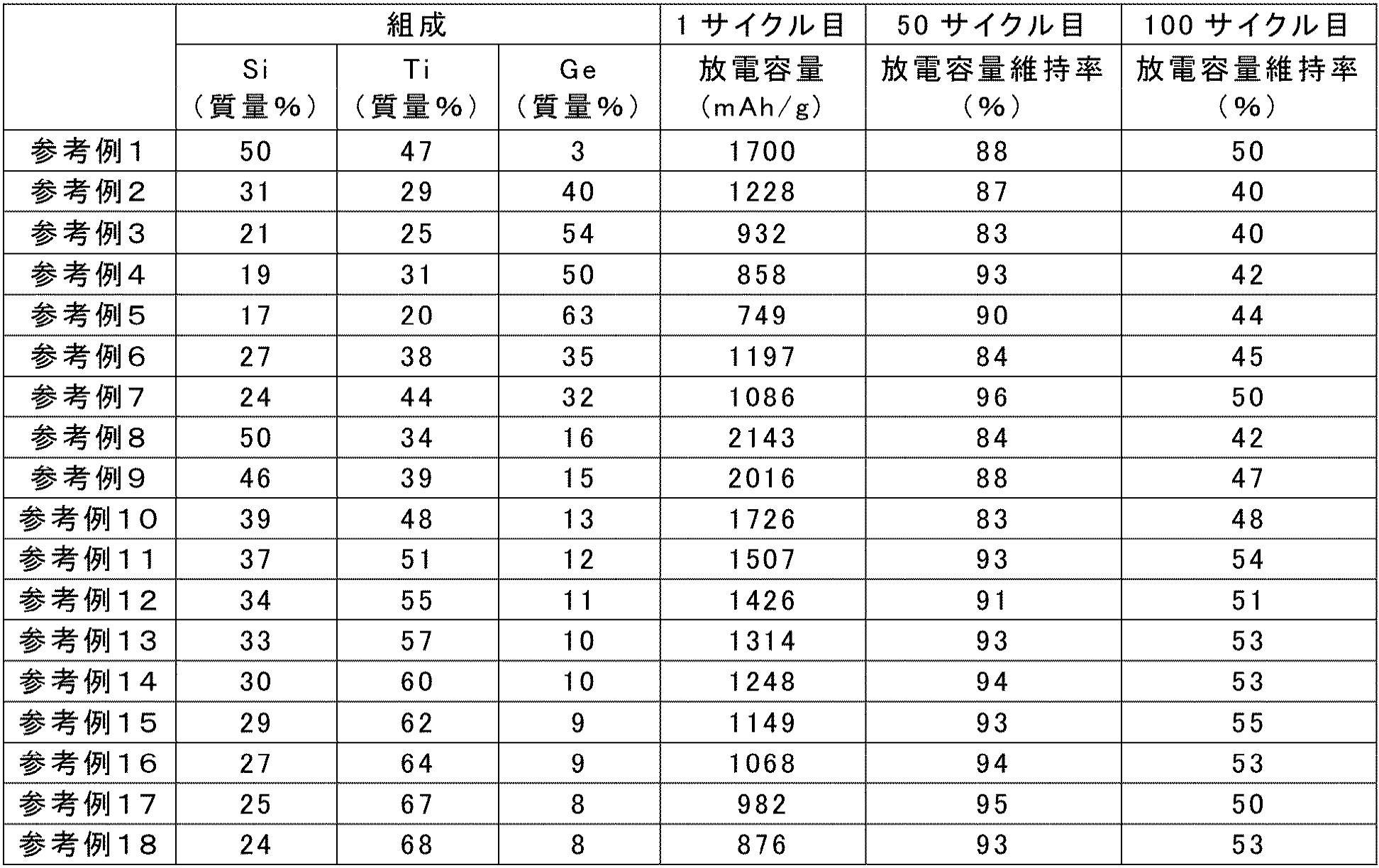

[1]負極の作製
参考例Aの(1)におけるターゲットの「Ge:50.8mm径、3mm厚さ(厚さ2mmの無酸素銅製バッキングプレート付)」を「Sn:50.8mm径、5mm厚さ」に変更し、(2)におけるDC電源の「Ge(0~120W)」を「Sn(0~40W)」に変更したことを除いては、参考例Aと同様の方法で、都合40種の負極サンプルを作製した(参考例19~44および参考比較例14~27)。
参考例Aと同様の方法でCR2032型コインセルを作製した。
参考例Aと同様の方法で電池の充放電試験を行った。この結果を表2に併せて示す。また、図12では1サイクル目の放電容量と合金組成の関係を示す。さらに、図13及び14では50サイクル及び100サイクル目の放電容量維持率と合金組成の関係をそれぞれ示す。なお、放電容量は、合金重量当りで算出した値を示している。
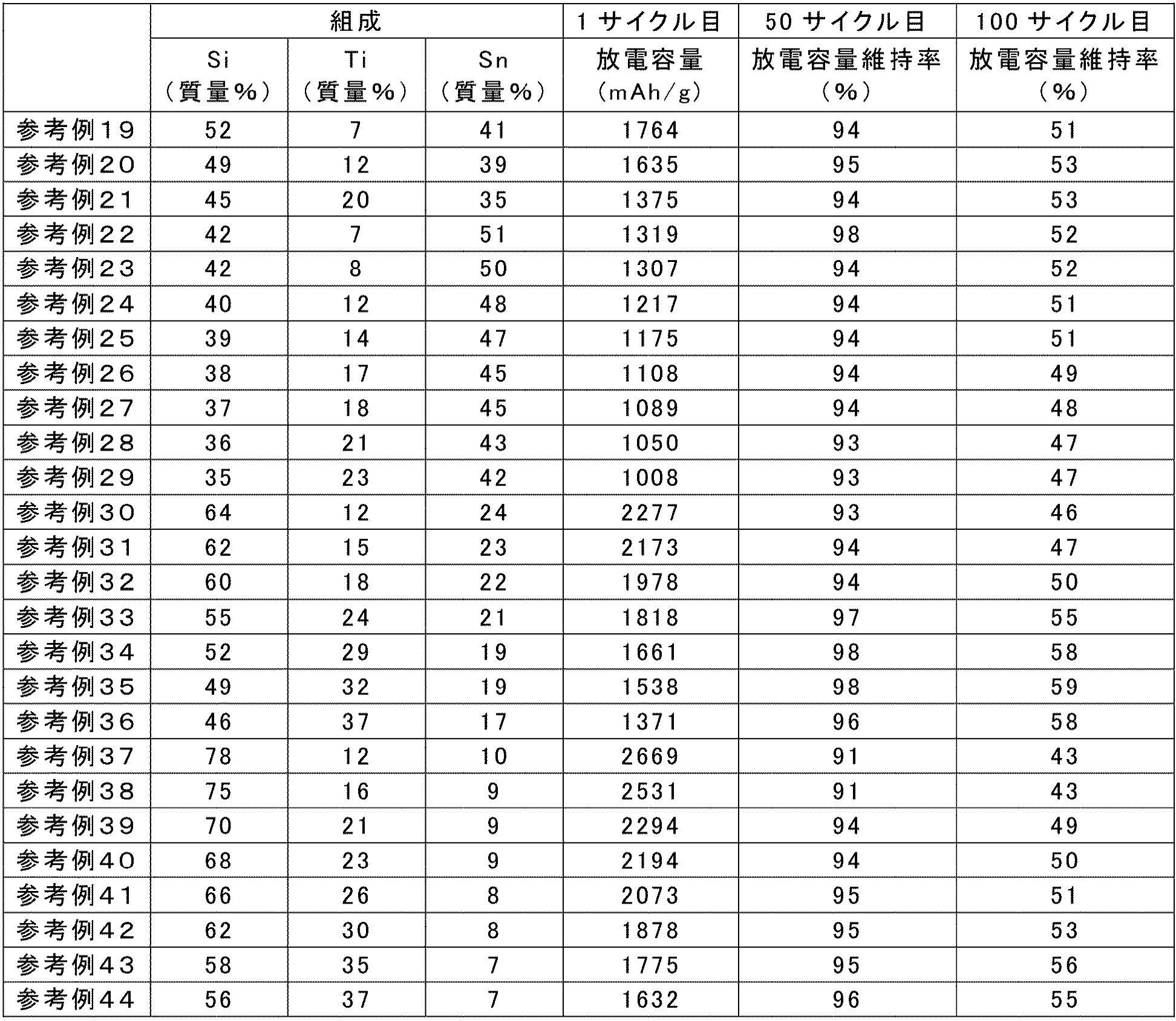

[1]負極の作製
参考例Aにおける(1)および(2)のDC電源の条件を下記のように変更したことを除いては、参考例Aと同様の方法で、都合40種の負極サンプルを作製した(参考例45~56および参考比較例28~40)。
Si(純度:4N):直径2インチ、厚さ3mm(厚さ2mmの無酸素銅製バッキングプレート付)
Ti(純度:5N):直径2インチ、厚さ5mm
Zn(純度:4N):直径2インチ、厚さ5mm。
DC電源:Si(185W)、Ti(50~200W)、Zn(30~90W)。
参考例Aと同様の方法でCR2032型コインセルを作製した。
50サイクル目の放電容量維持率を下記数式により算出したことを除いては、参考例1と同様の方法で電池の充放電試験を行った。この結果を表3に併せて示す。


参考例48および参考比較例34、37の評価用電極を用いた評価用セル(CR2032型コインセル)につき、[3]と同様の充放電条件で初期サイクルを実施した。初期サイクルの放電過程での電圧(V)に対するdQ/dV曲線を図22に示す。
[Si合金の製造]
Si合金は、メカニカルアロイ法(または、アークプラズマ溶融法)により製造した。具体的には、ドイツ フリッチュ社製遊星ボールミル装置P-6を用いて、ジルコニア製粉砕ポットにジルコニア製粉砕ボールと各合金の各原料粉末を投入し、600rpm、48hかけて合金化させた。
負極活物質90質量部と、導電助剤5質量部と、バインダ5質量部とを混合し、N-メチル-2-ピロリドン(NMP)に分散させて負極スラリーを得た。ここで、負極活物質には、上記で製造したSi合金(Si42Ti7Sn51、平均粒子径0.3μm)を用いた。また導電助剤には短鎖状カーボンブラックとして短鎖状アセチレンブラックを用い、バインダにはポリイミド(E弾性率2.1GPa)を用いた。次いで、得られた負極スラリーを、厚さ10μmの銅箔(弾性伸び1.4%)よりなる負極集電体の両面にそれぞれ負極活物質層の厚さが30μmとなるように均一に塗布し、真空中で24時間乾燥させて、負極を得た。
正極活物質90質量部と、導電助剤5質量部と、バインダ5質量部とを混合し、NMPに分散させて正極スラリーを得た。ここで、正極活物質には、Li1.85Ni0.18Co0.10Mn0.87O3を、特開2012-185913号公報の実施例1(段落0046)に記載の手法により作製した。また導電助剤にはアセチレンブラックを用い、バインダにはポリフッ化ビニリデン(PVdF)を用いた。次いで、得られた正極スラリーを、厚さ20μmのアルミニウム箔よりなる正極集電体の両面にそれぞれ正極活物質層の厚さが30μmとなるように均一に塗布し、乾燥させて、正極を得た。
上記で作製した正極と、負極とを対向させ、この間にセパレータ(ポリプロピレン製の微多孔膜、膜厚20μm)を配置した。次いで、負極、セパレータ、および正極の積層体をコインセル(CR2032、材質:ステンレス鋼(SUS316))の底部側に配置した。さらに、正極と負極との間の絶縁性を保つためガスケットを装着し、下記電解液をシリンジにより注入し、スプリング及びスペーサを積層し、コインセルの上部側を重ねあわせ、かしこめることにより密閉して、リチウムイオン二次電池を得た。
負極の導電助剤を液相法炭素繊維であるカーボンナノチューブに変更したことを除いては、実施例1-1と同様の方法で負極および電池を作製した。
負極の導電助剤を気相法炭素繊維である黒鉛ファイバーに変更したことを除いては、実施例1-1と同様の方法で負極および電池を作製した。
負極の導電助剤を長鎖状カーボンブラックである長鎖状アセチレンブラックに変更したことを除いては、実施例1-1と同様の方法で負極および電池を作製した。
負極の導電助剤を人造黒鉛に変更したことを除いては、実施例1-1と同様の方法で負極および電池を作製した。
負極の導電助剤をケッチェンブラックに変更したことを除いては、実施例1-1と同様の方法で負極および電池を作製した。
負極の導電助剤を気相法炭素繊維である黒鉛ファイバーに変更し、負極活物質を純Si(純度99.999%)に変更したことを除いては、実施例1-1と同様の方法で負極および電池を作製した。
負極活物質を純Si(純度99.999%)に変更し、負極のバインダをPVdFに変更したことを除いては、実施例1-1と同様の方法で負極および電池を作製した。
上記で作製した各リチウムイオン二次電池について以下の方法で負極活物質層の伸び(%)の測定を行った。詳しくは、JIS K 7163(1994年)の引張試験方法に準じて測定した値により、負極活物質層の伸び(%)を測定した。なお、以下の実施例及び比較例で作製した各リチウムイオン二次電池についても上記と同様にして負極活物質層の伸び(%)の測定を行った。
[サイクル特性の評価]
上記で作製した各リチウムイオン二次電池について以下の方法でサイクル特性評価を行った。各電池について、30℃の雰囲気下、定電流方式(CC、電流:0.1C)で2.0Vまで充電し、10分間休止させた後、定電流(CC、電流:0.1C)で0.01Vまで放電し、放電後10分間休止させた。この充放電過程を1サイクルとし、100サイクルの充放電試験を行い、1サイクル目の放電容量に対する100サイクル目の放電容量の割合(放電容量維持率[%])を求めた。比較例1-1の放電容量維持率を100として、他の実施例及び比較例の放電容量維持率の割合を放電容量向上率(%)とした。得られた結果を下記の表4および図23に示す。

[Si合金の製造]
Si合金は、メカニカルアロイ法(または、アークプラズマ溶融法)により製造した。具体的には、ドイツ フリッチュ社製遊星ボールミル装置P-6を用いて、ジルコニア製粉砕ポットにジルコニア製粉砕ボールと各合金の各原料粉末を投入し、600rpm、48hかけて合金化させた。
負極活物質80質量部と、導電助剤5質量部と、バインダ15質量部とを混合し、N-メチル-2-ピロリドン(NMP)に分散させて負極スラリーを得た。ここで、負極活物質には、上記で製造したSi合金(Si42Ti7Sn51、平均粒子径0.3μm)を用いた。また導電助剤には短鎖状カーボンブラックとして短鎖状アセチレンブラックを用い、バインダにはポリアミドイミド(E弾性率2.00GPa)を用いた。次いで、得られた負極スラリーを、10μmの銅箔(弾性伸び1.4%)よりなる負極集電体の両面にそれぞれ負極活物質層の厚さが30μmとなるように均一に塗布し、真空中で24時間乾燥させて、負極を得た。
正極活物質90質量部と、導電助剤5質量部と、バインダ5質量部とを混合し、NMPに分散させて正極スラリーを得た。ここで、正極活物質には、Li1.85Ni0.18Co0.10Mn0.87O3を、特開2012-185913号公報の実施例1(段落0046)に記載の手法により作製した。また導電助剤にはアセチレンブラックを用い、バインダにはポリフッ化ビニリデン(PVdF)を用いた。次いで、得られた正極スラリーを、厚さ20μmのアルミニウム箔よりなる正極集電体の両面にそれぞれ正極活物質層の厚さが30μmとなるように均一に塗布し、乾燥させて、正極を得た。
上記で作製した正極と、負極とを対向させ、この間にセパレータ(ポリプロピレン製の微多孔膜、膜厚20μm)を配置した。次いで、負極、セパレータ、および正極の積層体をコインセル(CR2032、材質:ステンレス鋼(SUS316))の底部側に配置した。さらに、正極と負極との間の絶縁性を保つためガスケットを装着し、下記電解液をシリンジにより注入し、スプリングおよびスペーサを積層し、コインセルの上部側を重ねあわせ、かしこめることにより密閉して、リチウムイオン二次電池を得た。
バインダとして、ポリアミドイミド(E弾性率2.00GPa)に代えてポリイミド(E弾性率2.10GPa)を用いたことを除いては、実施例2-1と同様の方法で負極および電池を作製した。
バインダとして、ポリアミドイミド(E弾性率2.00GPa)に代えてポリイミド(E弾性率3.30GPa)を用いたことを除いては、実施例2-1と同様の方法で負極および電池を作製した。
バインダとして、ポリアミドイミド(E弾性率2.00GPa)に代えてポリイミド(E弾性率3.73GPa)を用いたことを除いては、実施例2-1と同様の方法で負極および電池を作製した。
バインダとして、ポリアミドイミド(E弾性率2.00GPa)に代えてポリイミド(E弾性率7.00GPa)を用いたことを除いては、実施例2-1と同様の方法で負極および電池を作製した。
バインダとして、ポリアミドイミド(E弾性率2.00GPa)に代えてポリフッ化ビニリデン(PVdF)(E弾性率1.00GPa)を用いたことを除いては、実施例2-1と同様の方法で負極および電池を作製した。
バインダとして、ポリアミドイミド(E弾性率2.00GPa)に代えてポリイミド(E弾性率7.40GPa)を用いたことを除いては、実施例2-1と同様の方法で負極および電池を作製した。
負極活物質として、Si合金に代えて純Siを用いたことを除いては、実施例2-4と同様の方法で負極および電池を作製した。
負極活物質として、Si合金に代えて純Siを用いたことを除いては、比較例2-1と同様の方法で負極および電池を作製した。
[放電容量の評価]
上記で作製した各リチウムイオン二次電池について以下の方法でサイクル特性評価を行った。各電池について、30℃の雰囲気下、定電流方式(CC、電流:0.1C)で2.0Vまで充電し、10分間休止させた後、定電流(CC、電流:0.1C)で0.01Vまで放電し、放電後10分間休止させた。この充放電過程を1サイクルとし、50サイクルの充放電試験を行い、1サイクル目の放電容量に対する50サイクル目の放電容量の割合(放電容量維持率[%])を求めた。得られた放電容量維持率の結果を、比較例2-1の放電容量維持率を100としたときの相対値(放電容量維持率の向上率)として、下記の表5および図24に示す。
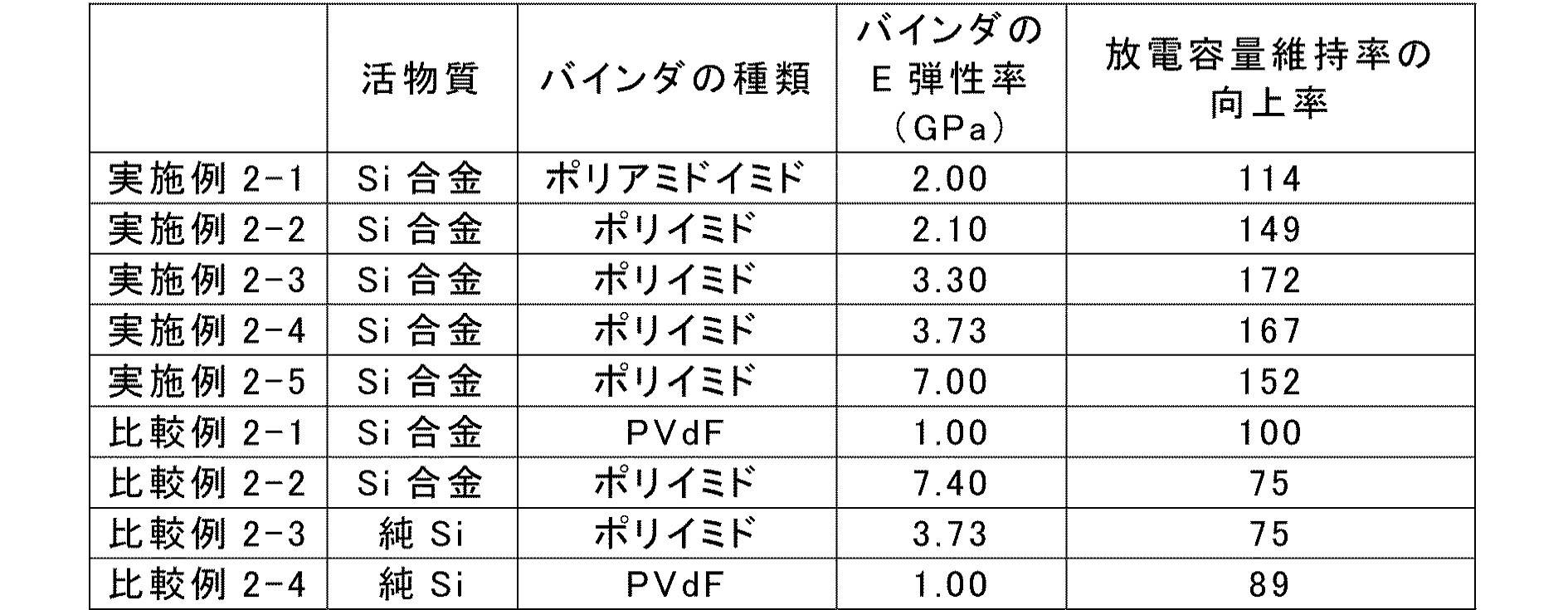
[Si合金の製造]
上記Si合金は、メカニカルアロイ法(または、アークプラズマ溶融法)により製造した。具体的には、ドイツ フリッチュ社製遊星ボールミル装置P-6を用いて、ジルコニア製粉砕ポットにジルコニア製粉砕ボールと各合金の各原料粉末を投入し、600rpm、48hかけて合金化させた。
負極活物質80質量部、導電助剤5質量部、およびバインダ材料15質量部を溶媒としてのN-メチル-2-ピロリドン(NMP)中で混合し、負極活物質スラリーを調製した。ここで、負極活物質には、上記で製造したSi合金粉末(Si42Ti7Sn51、一次粒子の平均粒子径0.3μm)を用いた。また、導電助剤には、短鎖状カーボンブラックとして短鎖状アセチレンブラックを用い、バインダにはポリイミド(E弾性率2.1GPa)を用いた。
負極集電体として、弾性伸び1.53%、引張強度450N/mm2である厚さ10μmの銅合金箔(銅合金2:Zrが約0.3質量%添加されたCu)を用いた以外は、実施例3-1と同様の方法で負極を作製した。
負極集電体として、弾性伸び1.39%、引張強度420N/mm2である厚さ10μmの銅合金箔(銅合金3:Zrが約0.1質量%添加されたCu)を用いた以外は、実施例3-1と同様の方法で負極を作製した。
負極集電体として、弾性伸び1.28%、引張強度139N/mm2である厚さ10μmの銅箔(タフピッチ銅:Cuの純度が99.9質量%以上)を用いた以外は、実施例3-1と同様の方法で負極を作製した。
負極活物質としてケイ素(純Si)粉末(純度:99.999質量%、一次粒子の平均粒子径45μm)80質量部を用いた以外は、比較例3-1と同様の方法で負極を作製した。
バインダ材料としてポリフッ化ビニリデン(PVdF)を用いたことを除いては、比較例3-2と同様の方法で負極を作製した。
正極活物質であるLi1.85Ni0.18Co0.10Mn0.87O3を、特開2012-185913号公報の実施例1(段落0046)に記載の手法により作製した。そして、この正極活物質90質量部と、導電助剤であるアセチレンブラック5質量部と、バインダであるポリフッ化ビニリデン(PVdF)5質量部と、を混合し、N-メチル-2-ピロリドン(NMP)に分散させて正極スラリーを得た。次いで、得られた正極スラリーを、厚さ20μmのアルミニウム箔よりなる正極集電体の両面にそれぞれ正極活物質層の厚さが30μmとなるように均一に塗布し、乾燥させて、正極を得た。
上記で作製した正極と、負極とを対向させ、この間にセパレータ(ポリプロピレン製の微多孔膜、膜厚20μm)を配置した。次いで、負極、セパレータ、および正極の積層体をコインセル(CR2032、材質:ステンレス鋼(SUS316))の底部側に配置した。さらに、正極と負極との間の絶縁性を保つためガスケットを装着し、下記電解液をシリンジにより注入し、スプリングおよびスペーサを積層し、コインセルの上部側を重ねあわせ、かしこめることにより密閉して、リチウムイオン二次電池を得た。
参考例Aと同様の方法で電池の充放電試験を行った。


[Si合金の製造]
Si合金は、メカニカルアロイ法(または、アークプラズマ溶融法)により製造した。具体的には、ドイツ フリッチュ社製遊星ボールミル装置PP-6を用いて、ジルコニア製粉砕ポットにジルコニア製粉砕ボールと各合金の各原料粉末を投入し、600rpm、48hかけて合金化させた。
負極活物質である上記で製造したSi合金(Si42Ti7Sn51、平均粒子径0.3μm)2.76質量部および黒鉛(天然黒鉛;平均粒子径22μm)89.24質量部と、導電助剤である短鎖状アセチレンブラック4質量部と、バインダであるポリイミド(E弾性率2.1GPa)4質量部と、を混合し、N-メチルピロリドンに分散させて負極スラリーを得た。次いで、得られた負極スラリーを、厚さ10μmの銅箔(弾性伸び1.4%)よりなる負極集電体の両面にそれぞれ負極活物質層の厚さが30μmとなるように均一に塗布し、真空中で24時間乾燥させて、負極を得た。なお、負極活物質中のSi合金の含有率は、3%である。
正極活物質であるLi1.85Ni0.18Co0.10Mn0.87O3を、特開2012-185913号公報の実施例1(段落0046)に記載の手法により作製した。そして、この正極活物質90質量部と、導電助剤であるアセチレンブラック5質量部と、バインダであるポリフッ化ビニリデン5質量部と、を混合し、N-メチルピロリドンに分散させて正極スラリーを得た。次いで、得られた正極スラリーを、厚さ20μmのアルミニウム箔よりなる正極集電体の両面にそれぞれ正極活物質層の厚さが30μmとなるように均一に塗布し、乾燥させて、正極を得た。
上記で作製した正極と、負極とを対向させ、この間にセパレータ(ポリプロピレン製の微多孔膜、膜厚20μm)を配置した。次いで、負極、セパレータ、および正極の積層体をコインセル(CR2032、材質:ステンレス鋼(SUS316))の底部側に配置した。さらに、正極と負極との間の絶縁性を保つためガスケットを装着し、下記電解液をシリンジにより注入し、スプリング及びスペーサを積層し、コインセルの上部側を重ねあわせ、かしめることにより密閉して、リチウムイオン二次電池を得た。
Si合金を4.6質量部に変更し、黒鉛を87.4質量部に変更したことを除いては、実施例4-1と同様の方法で負極および電池を作製した。なお、負極活物質中のSi合金の含有率は、5%である。
Si合金を6.4質量部に変更し、黒鉛を85.5質量部に変更したことを除いては、実施例4-1と同様の方法で負極および電池を作製した。なお、負極活物質中のSi合金の含有率は、7%である。
Si合金を9.2質量部に変更し、黒鉛を82.8質量部に変更したことを除いては、実施例4-1と同様の方法で負極および電池を作製した。なお、負極活物質中のSi合金の含有率は、10%である。
Si合金を11.0質量部に変更し、黒鉛を80.96質量部に変更したことを除いては、実施例4-1と同様の方法で負極および電池を作製した。なお、負極活物質中のSi合金の含有率は、12%である。
Si合金を13.8質量部に変更し、黒鉛を78.2質量部に変更したことを除いては、実施例4-1と同様の方法で負極および電池を作製した。なお、負極活物質中のSi合金の含有率は、15%である。
Si合金を18.4質量部に変更し、黒鉛を73.6質量部に変更したことを除いては、実施例4-1と同様の方法で負極および電池を作製した。なお、負極活物質中のSi合金の含有率は、20%である。
Si合金を23.0質量部に変更し、黒鉛を69.0質量部に変更したことを除いては、実施例4-1と同様の方法で負極および電池を作製した。なお、負極活物質中のSi合金の含有率は、25%である。
Si合金を27.6質量部に変更し、黒鉛を64.4質量部に変更したことを除いては、実施例4-1と同様の方法で負極および電池を作製した。なお、負極活物質中のSi合金の含有率は、30%である。
Si合金を36.8質量部に変更し、黒鉛を55.2質量部に変更したことを除いては、実施例4-1と同様の方法で負極および電池を作製した。なお、負極活物質中のSi合金の含有率は、40%である。
Si合金を46.0質量部に変更し、黒鉛を46.0質量部に変更したことを除いては、実施例4-1と同様の方法で負極および電池を作製した。なお、負極活物質中のSi合金の含有率は、50%である。
Si合金を55.2質量部に変更し、黒鉛を36.8質量部に変更したことを除いては、実施例4-1と同様の方法で負極および電池を作製した。なお、負極活物質中のSi合金の含有率は、60%である。
Si合金を64.4質量部に変更し、黒鉛を27.6質量部に変更したことを除いては、実施例4-1と同様の方法で負極および電池を作製した。なお、負極活物質中のSi合金の含有率は、70%である。
[サイクル特性の評価]
上記で作製した各リチウムイオン二次電池について以下の方法でサイクル特性評価を行った。各電池について、30℃の雰囲気下、定電流方式(CC、電流:0.1C)で2.0Vまで充電し、10分間休止させた後、定電流(CC、電流:0.1C)で0.01Vまで放電し、放電後10分間休止させた。この充放電過程を1サイクルとし、100サイクルの充放電試験を行い、1サイクル目の放電容量に対する100サイクル目の放電容量の割合(放電容量維持率[%])を求めた。得られた結果を下記の表7および図26に示す。
上記で作製した各リチウムイオン二次電池について以下の方法でサイクル特性評価を行った。各電池について、まず初期充放電として正極の理論容量に対して0.2C相当の電流で、定電流充電後、4.2Vの定電圧充電を合計10時間行い、その後0.2Cの放電電流にて2.7Vまで定電流放電を行った。このときの充放電曲線から電池のエネルギーを算出し、電池質量で除して電池のエネルギー密度を算出した。得られた結果を下記の表7および図26に示す。

11 正極集電体、
12 負極集電体、
13 正極活物質層、
15 負極活物質層、
17 電解質層、
19 単電池層、
21、57 発電要素、
25、58 正極集電板、
27、59 負極集電板、
29、52 電池外装材(ラミネートフィルム)。
Claims (24)
- 集電体と、前記集電体の表面に配置された負極活物質、導電助剤、およびバインダを含む電極層と、を有する電気デバイス用負極であって、
前記負極活物質が、下記式(1):

Mは、Ge、Sn、Zn、およびこれらの組み合わせからなる群から選択される少なくとも1つの金属であり、
前記Aは、不可避不純物であり、
x、y、z、およびaは、質量%の値を表し、この際、0<x<100、0<y<100、0<z<100、および0≦a<0.5であり、x+y+z+a=100である。)で表される合金を含み、
かつ、電極層における伸び(δ)が、1.29<δ<1.70%であることを特徴とする電気デバイス用負極。 - 前記δが、1.40≦δ<1.70%であることを特徴とする請求項1に記載の電気デバイス用負極。
- 前記δが、1.40≦δ≦1.66%であることを特徴とする請求項1または2に記載の電気デバイス用負極。
- 前記δが、1.40≦δ≦1.57%であることを特徴とする請求項1~3のいずれか1項に記載の電気デバイス用負極。
- 前記δが、1.47≦δ≦1.57%であることを特徴とする請求項1~4のいずれか1項に記載の電気デバイス用負極。
- 前記δが、1.53≦δ≦1.57%であることを特徴とする請求項1~5のいずれか1項に記載の電気デバイス用負極。
- 前記バインダが、1.00GPa超7.40GPa未満のE弾性率を有する樹脂を含むことを特徴とする請求項1~6のいずれか1項に記載の電気デバイス用負極。
- 前記集電体の弾性伸びが、1.30%以上であることを特徴とする請求項1~7のいずれか1項に記載の電気デバイス用負極。
- 前記負極活物質が、前記式(1)で表される合金と、炭素系材料とが混合されてなることを特徴とする請求項1~8のいずれか1項に記載の電気デバイス用負極。
- 前記Mが、Geであり、
前記xが17以上90未満であり、前記yが10超83未満であり、zが0超73未満である、請求項1~9のいずれか1項に記載の電気デバイス用負極。 - 前記xが77以下であり、前記yが20以上であり、前記zが3以上63以下である、請求項10に記載の電気デバイス用負極。
- 前記yが68以下である、請求項11に記載の電気デバイス用負極。
- 前記xが50以下である、請求項12に記載の電気デバイス用負極。
- 前記xが46以下であり、前記yが51以上、前記zが32以下である、請求項13に記載の電気デバイス用負極。
- 前記MがSnであり、
前記x、y、およびzが、下記数式(1)または(2):

- 前記MがSnであり、
前記x、y、およびzが、下記数式(3)または(4):

- 前記MがSnであり、
前記x、y、およびzが、下記数式(5)または(6):

- 前記MがSnであり、
前記x、y、およびzが、下記数式(7):

- 前記MがZnであり、
前記x、y、およびzが、下記数式(8):

- 前記x、y、およびzが、下記数式(9):

- 前記x、y、およびzが、下記数式(10):

- 前記x、y、およびzが、下記数式(11):

- 前記x、y、およびzが、下記数式(12):

- 請求項1~23のいずれか1項に記載の電気デバイス用負極を含む、電気デバイス。
Priority Applications (6)
| Application Number | Priority Date | Filing Date | Title |
|---|---|---|---|
| JP2014548569A JP6032288B2 (ja) | 2012-11-22 | 2013-11-19 | 電気デバイス用負極、及びこれを用いた電気デバイス |
| EP13856088.3A EP2924771B1 (en) | 2012-11-22 | 2013-11-19 | Negative electrode for electrical device and electrical device provided with same |
| KR1020157012648A KR101826400B1 (ko) | 2012-11-22 | 2013-11-19 | 전기 디바이스용 부극, 및 이것을 사용한 전기 디바이스 |
| US14/443,852 US20150303464A1 (en) | 2012-11-22 | 2013-11-19 | Negative electrode for electrical device, and electrical device using the same |
| KR1020177008440A KR101837361B1 (ko) | 2012-11-22 | 2013-11-19 | 전기 디바이스용 부극, 및 이것을 사용한 전기 디바이스 |
| CN201380061226.6A CN104854735B (zh) | 2012-11-22 | 2013-11-19 | 电气设备用负极、及使用其的电气设备 |
Applications Claiming Priority (2)
| Application Number | Priority Date | Filing Date | Title |
|---|---|---|---|
| JP2012-256941 | 2012-11-22 | ||
| JP2012256941 | 2012-11-22 |
Publications (1)
| Publication Number | Publication Date |
|---|---|
| WO2014080891A1 true WO2014080891A1 (ja) | 2014-05-30 |
Family
ID=50776072
Family Applications (1)
| Application Number | Title | Priority Date | Filing Date |
|---|---|---|---|
| PCT/JP2013/081129 Ceased WO2014080891A1 (ja) | 2012-11-22 | 2013-11-19 | 電気デバイス用負極、及びこれを用いた電気デバイス |
Country Status (6)
| Country | Link |
|---|---|
| US (1) | US20150303464A1 (ja) |
| EP (1) | EP2924771B1 (ja) |
| JP (1) | JP6032288B2 (ja) |
| KR (2) | KR101826400B1 (ja) |
| CN (1) | CN104854735B (ja) |
| WO (1) | WO2014080891A1 (ja) |
Cited By (1)
| Publication number | Priority date | Publication date | Assignee | Title |
|---|---|---|---|---|
| JP2023503203A (ja) * | 2020-10-15 | 2023-01-27 | 寧徳新能源科技有限公司 | 電気化学装置及び電子装置 |
Families Citing this family (9)
| Publication number | Priority date | Publication date | Assignee | Title |
|---|---|---|---|---|
| JP5751448B2 (ja) | 2011-05-25 | 2015-07-22 | 日産自動車株式会社 | リチウムイオン二次電池用負極活物質 |
| WO2014080895A1 (ja) | 2012-11-22 | 2014-05-30 | 日産自動車株式会社 | 電気デバイス用負極、及びこれを用いた電気デバイス |
| WO2014080886A1 (ja) | 2012-11-22 | 2014-05-30 | 日産自動車株式会社 | 電気デバイス用負極、及びこれを用いた電気デバイス |
| CN105934847B (zh) | 2014-01-24 | 2019-11-05 | 日产自动车株式会社 | 电器件 |
| WO2015111189A1 (ja) | 2014-01-24 | 2015-07-30 | 日産自動車株式会社 | 電気デバイス |
| JP7145600B2 (ja) * | 2017-10-10 | 2022-10-03 | 日産自動車株式会社 | 非水電解質二次電池用電極 |
| FR3084528B1 (fr) * | 2018-07-27 | 2022-11-18 | Arkema France | Anode pour batterie li-ion |
| JP6962287B2 (ja) | 2018-07-30 | 2021-11-05 | トヨタ自動車株式会社 | 全固体電池及びその製造方法 |
| JP7383501B2 (ja) * | 2020-01-16 | 2023-11-20 | パナソニックホールディングス株式会社 | 蓄電装置及び蓄電モジュール |
Citations (15)
| Publication number | Priority date | Publication date | Assignee | Title |
|---|---|---|---|---|
| WO2004004031A1 (ja) * | 2002-06-26 | 2004-01-08 | Sanyo Electric Co., Ltd. | リチウム二次電池用負極及びリチウム二次電池 |
| JP2004228059A (ja) * | 2002-11-29 | 2004-08-12 | Mitsui Mining & Smelting Co Ltd | 非水電解液二次電池用負極及びその製造方法並びに非水電解液二次電池 |
| JP2004349016A (ja) * | 2003-05-20 | 2004-12-09 | Matsushita Electric Ind Co Ltd | 非水電解質二次電池の充放電方法 |
| JP2007149604A (ja) * | 2005-11-30 | 2007-06-14 | Sanyo Electric Co Ltd | リチウム二次電池用負極及びリチウム二次電池 |
| JP2007305424A (ja) * | 2006-05-11 | 2007-11-22 | Sony Corp | 負極活物質およびそれを用いた電池 |
| JP2009517850A (ja) | 2005-12-01 | 2009-04-30 | スリーエム イノベイティブ プロパティズ カンパニー | ケイ素含有量が高いアモルファス合金に基づく電極組成物 |
| JP2009224239A (ja) * | 2008-03-18 | 2009-10-01 | Nissan Motor Co Ltd | 電池用電極 |
| JP2010135336A (ja) * | 2003-03-26 | 2010-06-17 | Canon Inc | リチウム二次電池用の電極材料、該電極材料を有する電極構造体、及び該電極構造体を有する二次電池 |
| WO2010150513A1 (ja) * | 2009-06-23 | 2010-12-29 | キヤノン株式会社 | 電極構造体及び蓄電デバイス |
| JP2011048969A (ja) * | 2009-08-26 | 2011-03-10 | Toyobo Co Ltd | リチウムイオン二次電池用負極及びこれを用いた二次電池 |
| WO2011065503A1 (ja) * | 2009-11-27 | 2011-06-03 | 日産自動車株式会社 | 電気デバイス用Si合金負極活物質 |
| JP2012109122A (ja) * | 2010-11-17 | 2012-06-07 | Mitsui Mining & Smelting Co Ltd | リチウムイオン二次電池負極集電体用の銅箔、リチウムイオン二次電池負極材及びリチウムイオン二次電池負極集電体選定方法。 |
| JP2012185913A (ja) | 2011-03-03 | 2012-09-27 | Nissan Motor Co Ltd | リチウムイオン二次電池用正極活物質、リチウムイオン二次電池用正極及びリチウムイオン二次電池 |
| WO2012161190A1 (ja) * | 2011-05-25 | 2012-11-29 | 日産自動車株式会社 | 電気デバイス用負極活物質、電気デバイス用負極及び電気デバイス |
| WO2013099441A1 (ja) * | 2011-12-27 | 2013-07-04 | 日産自動車株式会社 | 電気デバイス用負極活物質 |
Family Cites Families (7)
| Publication number | Priority date | Publication date | Assignee | Title |
|---|---|---|---|---|
| JP2001196052A (ja) * | 2000-01-12 | 2001-07-19 | Sony Corp | 負極及び非水電解質電池 |
| JP4225727B2 (ja) * | 2001-12-28 | 2009-02-18 | 三洋電機株式会社 | リチウム二次電池用負極及びリチウム二次電池 |
| JP4385589B2 (ja) * | 2002-11-26 | 2009-12-16 | 昭和電工株式会社 | 負極材料及びそれを用いた二次電池 |
| JP4954717B2 (ja) * | 2005-01-14 | 2012-06-20 | パナソニック株式会社 | リチウムイオン二次電池用負極およびその製造方法ならびにリチウムイオン二次電池およびその製造方法 |
| JP2010205609A (ja) * | 2009-03-04 | 2010-09-16 | Nissan Motor Co Ltd | 電極およびこれを用いた電池 |
| US9876221B2 (en) * | 2010-05-14 | 2018-01-23 | Samsung Sdi Co., Ltd. | Negative active material for rechargeable lithium battery and rechargeable lithium battery including same |
| WO2012091060A1 (ja) * | 2010-12-27 | 2012-07-05 | 古河電気工業株式会社 | リチウムイオン二次電池、その二次電池用電極、その二次電池の電極用電解銅箔 |
-
2013
- 2013-11-19 CN CN201380061226.6A patent/CN104854735B/zh active Active
- 2013-11-19 WO PCT/JP2013/081129 patent/WO2014080891A1/ja not_active Ceased
- 2013-11-19 KR KR1020157012648A patent/KR101826400B1/ko not_active Expired - Fee Related
- 2013-11-19 KR KR1020177008440A patent/KR101837361B1/ko not_active Expired - Fee Related
- 2013-11-19 JP JP2014548569A patent/JP6032288B2/ja active Active
- 2013-11-19 EP EP13856088.3A patent/EP2924771B1/en active Active
- 2013-11-19 US US14/443,852 patent/US20150303464A1/en not_active Abandoned
Patent Citations (15)
| Publication number | Priority date | Publication date | Assignee | Title |
|---|---|---|---|---|
| WO2004004031A1 (ja) * | 2002-06-26 | 2004-01-08 | Sanyo Electric Co., Ltd. | リチウム二次電池用負極及びリチウム二次電池 |
| JP2004228059A (ja) * | 2002-11-29 | 2004-08-12 | Mitsui Mining & Smelting Co Ltd | 非水電解液二次電池用負極及びその製造方法並びに非水電解液二次電池 |
| JP2010135336A (ja) * | 2003-03-26 | 2010-06-17 | Canon Inc | リチウム二次電池用の電極材料、該電極材料を有する電極構造体、及び該電極構造体を有する二次電池 |
| JP2004349016A (ja) * | 2003-05-20 | 2004-12-09 | Matsushita Electric Ind Co Ltd | 非水電解質二次電池の充放電方法 |
| JP2007149604A (ja) * | 2005-11-30 | 2007-06-14 | Sanyo Electric Co Ltd | リチウム二次電池用負極及びリチウム二次電池 |
| JP2009517850A (ja) | 2005-12-01 | 2009-04-30 | スリーエム イノベイティブ プロパティズ カンパニー | ケイ素含有量が高いアモルファス合金に基づく電極組成物 |
| JP2007305424A (ja) * | 2006-05-11 | 2007-11-22 | Sony Corp | 負極活物質およびそれを用いた電池 |
| JP2009224239A (ja) * | 2008-03-18 | 2009-10-01 | Nissan Motor Co Ltd | 電池用電極 |
| WO2010150513A1 (ja) * | 2009-06-23 | 2010-12-29 | キヤノン株式会社 | 電極構造体及び蓄電デバイス |
| JP2011048969A (ja) * | 2009-08-26 | 2011-03-10 | Toyobo Co Ltd | リチウムイオン二次電池用負極及びこれを用いた二次電池 |
| WO2011065503A1 (ja) * | 2009-11-27 | 2011-06-03 | 日産自動車株式会社 | 電気デバイス用Si合金負極活物質 |
| JP2012109122A (ja) * | 2010-11-17 | 2012-06-07 | Mitsui Mining & Smelting Co Ltd | リチウムイオン二次電池負極集電体用の銅箔、リチウムイオン二次電池負極材及びリチウムイオン二次電池負極集電体選定方法。 |
| JP2012185913A (ja) | 2011-03-03 | 2012-09-27 | Nissan Motor Co Ltd | リチウムイオン二次電池用正極活物質、リチウムイオン二次電池用正極及びリチウムイオン二次電池 |
| WO2012161190A1 (ja) * | 2011-05-25 | 2012-11-29 | 日産自動車株式会社 | 電気デバイス用負極活物質、電気デバイス用負極及び電気デバイス |
| WO2013099441A1 (ja) * | 2011-12-27 | 2013-07-04 | 日産自動車株式会社 | 電気デバイス用負極活物質 |
Non-Patent Citations (1)
| Title |
|---|
| See also references of EP2924771A4 |
Cited By (3)
| Publication number | Priority date | Publication date | Assignee | Title |
|---|---|---|---|---|
| JP2023503203A (ja) * | 2020-10-15 | 2023-01-27 | 寧徳新能源科技有限公司 | 電気化学装置及び電子装置 |
| JP7431846B2 (ja) | 2020-10-15 | 2024-02-15 | 寧徳新能源科技有限公司 | 電気化学装置及び電子装置 |
| US12148876B2 (en) | 2020-10-15 | 2024-11-19 | Ningde Amperex Technology Limited | Electrochemical apparatus and electronic apparatus |
Also Published As
| Publication number | Publication date |
|---|---|
| EP2924771A4 (en) | 2015-10-28 |
| CN104854735A (zh) | 2015-08-19 |
| JPWO2014080891A1 (ja) | 2017-01-05 |
| KR20150070322A (ko) | 2015-06-24 |
| JP6032288B2 (ja) | 2016-11-24 |
| KR20170038192A (ko) | 2017-04-06 |
| KR101826400B1 (ko) | 2018-02-06 |
| US20150303464A1 (en) | 2015-10-22 |
| EP2924771A1 (en) | 2015-09-30 |
| CN104854735B (zh) | 2018-05-08 |
| KR101837361B1 (ko) | 2018-03-09 |
| EP2924771B1 (en) | 2018-08-29 |
Similar Documents
| Publication | Publication Date | Title |
|---|---|---|
| JP6123807B2 (ja) | リチウムイオン二次電池用負極、及びこれを用いたリチウムイオン二次電池 | |
| JP6020591B2 (ja) | リチウムイオン二次電池用負極、及びこれを用いたリチウムイオン二次電池 | |
| JP5387690B2 (ja) | 電気デバイス用Si合金負極活物質 | |
| JP6040996B2 (ja) | リチウムイオン二次電池用負極、及びこれを用いたリチウムイオン二次電池 | |
| JP5333605B2 (ja) | 電気デバイス用Si合金負極活物質 | |
| JP6032288B2 (ja) | 電気デバイス用負極、及びこれを用いた電気デバイス | |
| JP6040995B2 (ja) | リチウムイオン二次電池用負極、及びこれを用いたリチウムイオン二次電池 | |
| JP6024760B2 (ja) | リチウムイオン二次電池用負極、及びこれを用いたリチウムイオン二次電池 | |
| JP6052299B2 (ja) | 電気デバイス用負極、及びこれを用いた電気デバイス | |
| JP6040997B2 (ja) | リチウムイオン二次電池用負極、及びこれを用いたリチウムイオン二次電池 | |
| JP6028811B2 (ja) | リチウムイオン二次電池用負極、及びこれを用いたリチウムイオン二次電池 | |
| JP6015769B2 (ja) | リチウムイオン二次電池用負極、及びこれを用いたリチウムイオン二次電池 | |
| JP6052298B2 (ja) | 電気デバイス用負極、及びこれを用いた電気デバイス | |
| WO2014080900A1 (ja) | 電気デバイス用負極、及びこれを用いた電気デバイス | |
| WO2014080898A1 (ja) | 電気デバイス用負極、及びこれを用いた電気デバイス | |
| WO2014080903A1 (ja) | 電気デバイス用負極、及びこれを用いた電気デバイス | |
| WO2014080902A1 (ja) | 電気デバイス用負極、及びこれを用いた電気デバイス |
Legal Events
| Date | Code | Title | Description |
|---|---|---|---|
| 121 | Ep: the epo has been informed by wipo that ep was designated in this application |
Ref document number: 13856088 Country of ref document: EP Kind code of ref document: A1 |
|
| DPE1 | Request for preliminary examination filed after expiration of 19th month from priority date (pct application filed from 20040101) | ||
| ENP | Entry into the national phase |
Ref document number: 20157012648 Country of ref document: KR Kind code of ref document: A |
|
| WWE | Wipo information: entry into national phase |
Ref document number: 2013856088 Country of ref document: EP |
|
| WWE | Wipo information: entry into national phase |
Ref document number: 14443852 Country of ref document: US |
|
| ENP | Entry into the national phase |
Ref document number: 2014548569 Country of ref document: JP Kind code of ref document: A |
|
| NENP | Non-entry into the national phase |
Ref country code: DE |