WO2014084281A1 - ポリアクリル酸(塩)系吸水性樹脂の製造方法 - Google Patents
ポリアクリル酸(塩)系吸水性樹脂の製造方法 Download PDFInfo
- Publication number
- WO2014084281A1 WO2014084281A1 PCT/JP2013/081968 JP2013081968W WO2014084281A1 WO 2014084281 A1 WO2014084281 A1 WO 2014084281A1 JP 2013081968 W JP2013081968 W JP 2013081968W WO 2014084281 A1 WO2014084281 A1 WO 2014084281A1
- Authority
- WO
- WIPO (PCT)
- Prior art keywords
- roll
- water
- roll mill
- pulverization
- dry polymer
- Prior art date
- Legal status (The legal status is an assumption and is not a legal conclusion. Google has not performed a legal analysis and makes no representation as to the accuracy of the status listed.)
- Ceased
Links
Images


Classifications
-
- C—CHEMISTRY; METALLURGY
- C08—ORGANIC MACROMOLECULAR COMPOUNDS; THEIR PREPARATION OR CHEMICAL WORKING-UP; COMPOSITIONS BASED THEREON
- C08F—MACROMOLECULAR COMPOUNDS OBTAINED BY REACTIONS ONLY INVOLVING CARBON-TO-CARBON UNSATURATED BONDS
- C08F22/00—Homopolymers and copolymers of compounds having one or more unsaturated aliphatic radicals each having only one carbon-to-carbon double bond, and at least one being terminated by a carboxyl radical and containing at least one other carboxyl radical in the molecule; Salts, anhydrides, esters, amides, imides or nitriles thereof
- C08F22/02—Acids; Metal salts or ammonium salts thereof, e.g. maleic acid or itaconic acid
-
- C—CHEMISTRY; METALLURGY
- C08—ORGANIC MACROMOLECULAR COMPOUNDS; THEIR PREPARATION OR CHEMICAL WORKING-UP; COMPOSITIONS BASED THEREON
- C08J—WORKING-UP; GENERAL PROCESSES OF COMPOUNDING; AFTER-TREATMENT NOT COVERED BY SUBCLASSES C08B, C08C, C08F, C08G or C08H
- C08J3/00—Processes of treating or compounding macromolecular substances
- C08J3/24—Crosslinking, e.g. vulcanising, of macromolecules
- C08J3/245—Differential crosslinking of one polymer with one crosslinking type, e.g. surface crosslinking
-
- C—CHEMISTRY; METALLURGY
- C08—ORGANIC MACROMOLECULAR COMPOUNDS; THEIR PREPARATION OR CHEMICAL WORKING-UP; COMPOSITIONS BASED THEREON
- C08J—WORKING-UP; GENERAL PROCESSES OF COMPOUNDING; AFTER-TREATMENT NOT COVERED BY SUBCLASSES C08B, C08C, C08F, C08G or C08H
- C08J2333/00—Characterised by the use of homopolymers or copolymers of compounds having one or more unsaturated aliphatic radicals, each having only one carbon-to-carbon double bond, and only one being terminated by only one carboxyl radical, or of salts, anhydrides, esters, amides, imides, or nitriles thereof; Derivatives of such polymers
- C08J2333/02—Homopolymers or copolymers of acids; Metal or ammonium salts thereof
Definitions
- the present invention relates to a method for producing a polyacrylic acid (salt) water-absorbing resin. More specifically, the present invention relates to a method for producing a water-absorbent resin used in absorbent articles for sanitary products such as paper diapers and sanitary napkins, and produces a polyacrylic acid (salt) water-absorbing resin having excellent performance at a low cost. It is about how to do.
- Water-absorbing resins have been developed in recent years as highly water-absorbing substances, and are mainly disposable as absorbent materials such as sanitary products such as paper diapers and sanitary napkins, water retention agents for agriculture and horticulture, and industrial water-stopping agents. Widely used in applications.
- the water-absorbing resin includes a wide variety of water-absorbing resins, and many monomers and hydrophilic polymers exist as raw materials. Among them, polyacrylic acid (salt) -based water-absorbing resins using acrylic acid and / or a salt thereof as a monomer are industrially produced in the largest quantities due to their high water absorption performance.
- Such a water-absorbing resin is produced through a polymerization process, a drying process, a pulverization process, a classification process, a surface crosslinking process, and the like (Patent Documents 1 to 3, Non-Patent Document 1).
- water-absorbing resins are also required to have many functions. Specifically, the gel strength, water-soluble component (Patent Document 4), water absorption speed, water absorption capacity under pressure (Patent Document 5), liquid permeability, particle size distribution, urine resistance
- properties of the water-absorbing resin are required, such as properties, antibacterial properties, impact resistance, powder flowability, deodorant properties, coloring resistance, and low dust.
- Patent Documents 1 to 23 and Non-Patent Document 1 have been made in addition to Patent Documents 1 to 23 and Non-Patent Document 1, such as surface cross-linking techniques, additives, and changes in manufacturing processes.
- surface cross-linking techniques for example, 50% by weight or more
- liquid permeability has been seen as a more important factor.
- improvement methods and improvement techniques for under-load liquid permeability and under-no-load liquid permeability such as SFC (Saline Flow Conductivity / Patent Document 6) and GBP (Gel Bed Permeability / Patent Documents 7 to 9) have been proposed. Yes.
- Patent Document 10 impact resistance
- FSR / Vortex water absorption speed
- DA60 core absorption amount
- Patent Document 13 a technique of adding gypsum before or during polymerization
- Patent Document 14 a technique of adding a spacer
- Patent Document 15 a nitrogen-containing polymer having a protonizable nitrogen atom
- Patent Document 16 a technique using a polyamine and a polyvalent metal ion or polyvalent anion
- Patent Document 17 a water-absorbing resin having a pH of less than 6
- Patent Document 18 a technique of adding gypsum before or during polymerization
- a technique using polyamines with a soluble content of 3% by weight or more and a technique (Patent Documents 19 to 21) for defining the wicking index (WI) and gel strength are known.
- polymerization is also known.
- Techniques for removing static electricity (Patent Document 26), techniques using a tapping material (Patent Document 27), and techniques for controlling the tension of the screen mesh (Patent Document 28) are techniques for improving liquid permeability.
- the liquid permeability tends to decrease as the particle size of the water-absorbent resin decreases.
- the liquid permeability decreases as the content of particles (fine powder) having a particle diameter of less than 150 ⁇ m increases.
- Patent Documents 30 and 31 a technique for controlling the particle diameter in a polymerization process such as reverse phase suspension polymerization (Patent Documents 30 and 31), and a technique for controlling the particle diameter in a pulverization process (gel grinding process) of a hydrogel crosslinked polymer ( Patent Documents 32 to 34), technology for controlling particle diameter and the like in the classification process (Patent Documents 26 to 28, 35 to 40), granulation during the surface cross-linking process (large particles by bonding fine powders or fine powders to target particles) Have been proposed (Patent Documents 41 and 42) and a technique (Patent Document 43) for removing fine powders by airflow in the cooling step after surface crosslinking.
- Non-Patent Document 44 a technique of pulverizing after cooling the dry polymer
- Patent Document 45 a technique of pulverizing by heating or keeping the pulverizer
- Patent Document 45 a dry polymer having a high water content
- Patent Document 46 a technique using a three-stage roll mill (Patent Document 47) between the drying step and the pulverizing step
- Patent Document 48 a technique using a three-stage roll mill
- Patent Document 48 for controlling the holding time
- Patent Documents 25 and 49 a technique for controlling the ratio at which the pulverized product is returned to the pulverization process
- Non-Patent Document 1 a method of making the rotational speeds of two rolls non-uniform in the pulverization by a roll mill is also known (Non-Patent Document 1 (particularly FIG. 3.8)).
- Patent Documents 50 to 52 there is a technique for removing undried substances in a dry polymer before pulverization (Patent Documents 50 to 52), and a technique for installing a magnetic separator between the upper and lower stages of a roll mill (Patent Document 53). Proposed.
- Patent Documents 1 to 53 Non-Patent Document 1, etc., many surface cross-linking techniques, additives, and manufacturing process changes have been proposed in order to improve the properties of the water-absorbent resin.
- the present invention is a method for improving and stabilizing the physical properties (for example, liquid permeability) of a water-absorbent resin by a simple method without the need for changing raw materials or expensive capital investment in order to improve the above-mentioned problems.
- the purpose is to provide.
- an object is to provide a method useful in the production of a large-scale water-absorbent resin.
- the inventors of the present invention have studied the pulverization process. In mass production of water-absorbent resins, particularly in continuous production of 1 (t / hr) or more, the difference in pulverization from the lab scale, and further the physical properties of the obtained water-absorbent resin. Deterioration was seen.
- the present inventors have found that in the pulverization using the conventional roll mill, the wear on a part of the roll is excessive, and the pulverization load is concentrated on the part, and this is the cause. Thus, it is considered that the productivity and physical properties of the water absorbent resin were reduced. Then, it discovered that the said subject could be solved by disperse
- the invention of the present application includes a polymerization step of an acrylic acid (salt) monomer aqueous solution, a drying step of a hydrogel crosslinked polymer obtained in the polymerization step, and a drying step obtained in the drying step.
- a method for producing a polyacrylic acid (salt) -based water-absorbing resin comprising a polymer pulverization step and a classification step after the drying step or after the pulverization step, wherein the polymer is dried on a roll mill used in the pulverization step. Is provided, a dry polymer is dispersed and supplied in the roll axis direction of the roll mill.
- the invention of the present application includes a polymerization step of an acrylic acid (salt) monomer aqueous solution, a drying step of a hydrogel crosslinked polymer obtained in the polymerization step, and a drying step obtained in the drying step.
- a method for producing a polyacrylic acid (salt) -based water-absorbing resin comprising a polymer pulverization step and a classification step after a drying step or a pulverization step in order, per roll mill used in the pulverization step Conditions in which the roll clearance change width is 100 ⁇ m or less and / or the roll clearance change rate is 50% or less in the pulverization step in which the treatment amount is 100 (kg / hr) or more and the total pulverization time is 30 days or more. And providing a method for producing a polyacrylic acid (salt) water-absorbing resin, wherein the dried polymer is pulverized.
- the roll clearance change width and the roll clearance change rate are defined by the following equations.
- the invention of the present application includes a polymerization step of an acrylic acid (salt) monomer aqueous solution, a drying step of a hydrogel crosslinked polymer obtained in the polymerization step, and a drying step obtained in the drying step.
- a method for producing a polyacrylic acid (salt) -based water-absorbing resin comprising a polymer pulverization step and a classification step after a drying step or a pulverization step in order, per roll mill used in the pulverization step Conditions in which the roll clearance change width is 300 ⁇ m or less and / or the roll clearance change rate is 90% or less in the pulverization step in which the treatment amount is 100 (kg / hr) or more and the total pulverization time is 200 days or more. And providing a method for producing a polyacrylic acid (salt) water-absorbing resin, wherein the dried polymer is pulverized.
- the roll clearance change width and the roll clearance change rate are defined by the following equations.
- the invention of the present application includes a polymerization step of an acrylic acid (salt) monomer aqueous solution, a drying step of a hydrogel crosslinked polymer obtained in the polymerization step, and a drying step obtained in the drying step.
- a method for producing a polyacrylic acid (salt) water-absorbing resin comprising a polymer pulverization step and a classification step after the drying step or after the pulverization step, wherein the water content of the dry polymer is 3.0 to 15% by weight and at least a pair of rolls of the roll mill used in the pulverization step is composed of a low-speed roll and a high-speed roll rotating in opposite directions, and the peripheral speed ratio is 1: 1.05 to 1:10.
- a method for producing a polyacrylic acid (salt) water-absorbing resin is provided.
- the invention of the present application includes a polymerization step of an acrylic acid (salt) monomer aqueous solution, a drying step of a hydrogel crosslinked polymer obtained in the polymerization step, and a drying step obtained in the drying step.
- a method for producing a polyacrylic acid (salt) -based water-absorbent resin comprising a polymer pulverization step and a classification step after the drying step or after the pulverization step, on the roll surface of the roll mill used in the pulverization step,
- a polyacrylic acid (salt) system having grooves with a concavo-convex pattern arranged in a striped pattern, the grooves being inclined with respect to the rotation axis of the roll, and the inclination directions of the grooves of the two rolls being the same direction
- a method for producing a water absorbent resin is provided.
- the dependent claims 2 to 16 of the present application or the preferred embodiments of the present application are not limited to the first method described above, and can be applied to any of the second to fifth methods.
- the above first to fifth methods are preferably carried out at the same time, preferably two or more, more preferably three or more, still more preferably four or more, and particularly preferably all five.
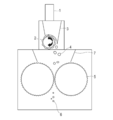
- FIG. 1 is a cross-sectional view of a roll mill suitable for the present invention.
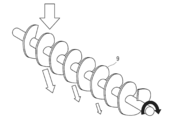
- FIG. 2 is a schematic view of a screw-type feeder, which is a roll mill dispersion mechanism suitable for the present invention, as viewed from above.
- FIG. 3 is a schematic view of a storage container (with an extraction feeder) having a slit-like hole at the bottom, which is a roll mill dispersion mechanism suitable for the present invention, as viewed from above.
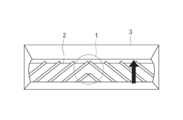
- FIG. 4 is a cross-sectional view when a mountain-shaped dispersion plate, which is an embodiment of a roll mill dispersion mechanism suitable for the present invention, is cut parallel to the roll axis.
- FIG. 5 is a schematic diagram showing one mode of a rotating part of a rotary disperser suitable for the present invention and the movement of a dry polymer (see arrows).
- FIG. 6 is a schematic view showing another embodiment of the rotating part of the rotary disperser suitable for the present invention and the movement of the dry polymer (see arrow).
- the water-absorbing resin such as liquid permeability
- Physical properties do not deteriorate. Furthermore, even during long-term production, there is little change in physical properties, and stable production becomes possible.
- the production method according to the present invention makes it easy to control the particle size, particularly the particle size distribution, and improves the properties of the water-absorbent resin such as liquid permeability. Furthermore, stable operation is possible and the life of the roll mill can be extended.
- Water absorbent resin The “water-absorbing resin” in the present invention means a water-swellable, water-insoluble polymer gelling agent and has the following physical properties. That is, as “water swellability”, CRC (water absorption capacity under no pressure) specified by ERT441.2-02 (2002) is 5 (g / g) or more, and “water insoluble” is ERT470.2- It means a polymer gelling agent having an Ext (water-soluble content) specified in 02 (2002) of 50% by weight or less.
- CRC water absorption capacity under no pressure
- the water-absorbing resin can be designed as appropriate according to its use and is not particularly limited, but is preferably a hydrophilic cross-linked polymer obtained by cross-linking an unsaturated monomer having a carboxyl group.
- the water-absorbent resin of the present invention is not limited to a form in which the total amount (100% by weight) is a polymer, and as a component other than the water-absorbent resin, additives and the like within the range satisfying the above physical properties (CRC, Ext)
- a water absorbent resin composition containing The water-absorbing resin of the present invention is not limited to the final product, but is an intermediate in the manufacturing process of the water-absorbing resin (for example, water-containing gel after polymerization, dried polymer after drying, water-absorbing resin powder before surface crosslinking, etc. ), which are collectively referred to as “water absorbent resin”.
- the shape of the water-absorbing resin includes a sheet shape, a fiber shape, a film shape, a particle shape, a gel shape, and the like.
- a particulate water-absorbing resin is preferable.
- polyacrylic acid (salt) in the present invention optionally contains a graft component, and contains, as a repeating unit, acrylic acid and / or a salt thereof (hereinafter referred to as “acrylic acid (salt)”) as a main component. It means a polymer.
- the acrylic acid (salt) content (usage amount) is usually 50 to 100 mol% with respect to the entire monomer (excluding the internal crosslinking agent) used in the polymerization, It is preferably 70 to 100 mol%, more preferably 90 to 100 mol%, and still more preferably substantially 100 mol%.
- the polyacrylic acid salt as a polymer preferably contains a monovalent salt, more preferably an alkali metal salt or an ammonium salt.
- EDANA European Disposables and Nonwovens Associations
- ERT is an abbreviation for a method for measuring water-absorbent resin of the European standard (almost world standard) (EDANA Recommended Test Methods).
- the physical properties of the water-absorbent resin are measured according to the original ERT (revised in 2002 / known literature).
- CRC is an abbreviation for Centrifugation Retention Capacity (centrifuge retention capacity) and means water absorption capacity without pressure (sometimes referred to as “water absorption capacity”). Specifically, 0.2 g of the water-absorbent resin in the non-woven bag was immersed in a large excess of 0.9 wt% sodium chloride aqueous solution for 30 minutes to freely swell, and then drained with a centrifuge (250 G). The water absorption ratio (unit: g / g) after
- Ext is an abbreviation for Extractables and means a water-soluble component (water-soluble component amount). Specifically, for 1.0 g of water-absorbing resin, a value obtained by measuring the amount of dissolved polymer after stirring for 16 hours at 500 rpm with respect to 200 ml of 0.9 wt% aqueous sodium chloride solution (unit: wt%) ).
- “Residual Monomers” (ERT410.2-02) “Residual Monomers” means the amount of monomer (monomer) remaining in the water-absorbent resin (hereinafter referred to as “residual monomer”). Specifically, with respect to 1.0 g of the water-absorbing resin, the amount of residual monomer dissolved after stirring for 1 hour at 500 rpm with respect to 200 ml of 0.9 wt% sodium chloride aqueous solution was measured by high performance liquid chromatography (HPLC). Value (unit: ppm).
- PSD is an abbreviation for Particle Size Distribution and means a particle size distribution measured by sieving classification.
- the weight average particle size (D50) and the particle size distribution width are described in US Pat. No. 7,638,570, columns 27 to 28, “(3) Mass-Average Particle Diameter (D50) and Logical Standard Deviation ( ⁇ )”. It measured by the method similar to "Part Particle Diameter Distribution.”
- “Moisture Content” (ERT430.2-02) “Moisture Content” means the water content of the water-absorbent resin. Specifically, it is a value (unit:% by weight) calculated from a loss on drying when 4.0 g of the water absorbent resin is dried at 105 ° C. for 3 hours. In the present invention, the measurement was performed by changing the water-absorbing resin to 1.0 g and the drying temperature to 180 ° C.
- AAP is an abbreviation for Absorption against Pressure, which means water absorption capacity under pressure. Specifically, 0.9 g of water-absorbing resin was swollen under a load of 2.06 kPa (21 g / cm 2 , 0.3 psi) for 1 hour against a large excess of 0.9 wt% sodium chloride aqueous solution. The water absorption ratio (unit: g / g) after In the present invention, the load condition was changed to 4.83 kPa (49 g / cm 2 , 0.7 psi).
- Flow Rate (ERT450.2-02): The flow rate of the water-absorbing resin.
- Density (ERT460.2-02): means the bulk specific gravity of the water-absorbent resin.
- liquid permeability of the water-absorbent resin in the present invention means the flowability of the liquid passing between the particles of the swollen gel under load or no load.
- SFC There are Saline Flow Conductivity / saline flow conductivity
- GBP Gel Bed Permeability / gel bed permeability
- SFC saline flow inductivity
- GBP gel bed permeability
- Water absorption speed The “water absorption rate” of the water-absorbent resin in the present invention means an absorption rate when the water-absorbent resin absorbs an aqueous liquid, and typical measurement methods include FSR (Free Swell Rate) and Vortex. There is.
- FSR Free Well Rate
- Free Well Rate a rate (unit: g / g / s) when 1.0 g of water-absorbing resin absorbs 20 g of 0.9 wt% sodium chloride aqueous solution
- Vortex Is the speed (unit: seconds) when 2.0 g of the water-absorbing resin absorbs 50 ml of a 0.9 wt% sodium chloride aqueous solution being stirred. A specific measurement method will be described in the examples described later.
- X to Y indicating a range means “X or more and Y or less”.
- t (ton) as a unit of weight means “Metric ton”
- ppm means “weight ppm” or “mass ppm”.
- weight and “mass”, “part by weight” and “part by mass”, “% by weight” and “% by mass” are treated as synonyms.
- ⁇ acid (salt) means “ ⁇ acid and / or salt thereof”
- (meth) acryl means “acryl and / or methacryl”.
- acrylic acid In the present invention, known acrylic acid can be used, and such acrylic acid usually contains a trace component such as a polymerization inhibitor and impurities.
- a polymerization inhibitor phenols are preferable, and methoxyphenols are more preferable.
- the content in the monomer aqueous solution is preferably 1 to 200 ppm, more preferably 10 to 160 ppm from the viewpoint of polymerizability and the color tone of the water absorbent resin.
- impurities for example, US Patent Application Publication No. 2008/0161512 is referred to.
- the water absorbent resin obtained in the present invention is polyacrylic acid (salt) obtained by crosslinking and polymerizing acrylic acid (salt).
- the polyacrylic acid salt is obtained by neutralizing acrylic acid with a basic composition (neutralization step) and then cross-linking, or forming a hydrogel cross-linked polymer obtained by cross-linking acrylic acid with a basic composition. It is obtained by neutralizing with (after neutralization).
- the “basic composition” means a composition containing a basic compound.
- Examples of the basic compound include an alkali metal carbonate (hydrogen) salt, an alkali metal hydroxide, ammonia, an organic amine, and the like.
- an alkali metal carbonate (hydrogen) salt such as sodium hydroxide, potassium hydroxide and lithium hydroxide are preferred, and sodium hydroxide is particularly preferred.
- a base containing a polycation such as a polyvalent metal hydroxide or carbonate (hydrogen) salt in a very small amount (for example, more than 0 mol% and 5 mol% or less with respect to acrylic acid).
- the neutral composition may or may not be neutralized.
- the neutralization step of the present invention includes neutralization of acrylic acid as a monomer or neutralization (post-neutralization step) of a hydrogel crosslinked polymer obtained by crosslinking polymerization of acrylic acid. Regardless of the difference in neutralization, the neutralization step can be applied either continuously or batchwise, but is preferably continuous. Regarding the neutralization conditions such as the apparatus, the basic composition, the temperature condition, and the residence time, the contents disclosed in US Patent Application Publication Nos. 2011/0021725 and 2008/0194863 are preferably applied.
- the neutralization rate in the present invention is preferably 10 to 90 mol%, more preferably 40 to 85 mol%, and further preferably 50 to 80 mol% with respect to the acid group in the monomer aqueous solution or polymer. Preferably, 60 to 75 mol% is particularly preferable.
- the neutralization rate is less than 10 mol%, the water absorption capacity under no pressure (CRC) may be remarkably lowered.
- the neutralization ratio exceeds 90 mol%, the water absorption capacity under pressure (AAP) is high. A water absorbent resin may not be obtained, which is not preferable.
- neutralization is performed after polymerization using unneutralized or low-neutralized acrylic acid, the same applies to the neutralization rate of the water absorbent resin of the final product.
- the internal cross-linking agent used in the present invention is a compound having two or more substituents capable of reacting with acrylic acid, and examples thereof include the cross-linking agent described in the 14th column of US Pat. No. 6,241,928. Of these, one or more are used.
- the compound having two or more polymerizable unsaturated groups further a compound having thermal decomposability at the drying temperature described below, particularly (poly) alkylene glycol Crosslinkers having two or more polymerizable unsaturated groups (preferably allyl groups, (meth) acrylate groups, especially acrylate groups) having structural units, such as di (meth) having (poly) alkylene glycol structural units It is preferable to use acrylate or tri (meth) acrylate during the polymerization.
- the alkylene glycol structural unit include polyethylene glycol having an n number (the number of repeating units) of 1 to 100, preferably 6 to 50.
- the amount of the internal cross-linking agent used is preferably 0.005 to 2 mol%, more preferably 0.01 to 1 mol%, still more preferably 0.05 to 0.5 mol%, based on the monomer. By setting the amount of the internal cross-linking agent used within the above range, desired water absorption characteristics can be obtained.
- a method of crosslinking by adding an internal crosslinking agent before polymerization in addition to the method of crosslinking by adding an internal crosslinking agent before polymerization, a method of crosslinking by adding an internal crosslinking agent during or after polymerization, a method of radical crosslinking with a radical polymerization initiator, an electron beam It is also possible to employ a method such as a method of carrying out radiation cross-linking by, for example, a method in which a predetermined amount of an internal cross-linking agent is added to the monomer in advance for polymerization, and a cross-linking reaction is performed simultaneously with polymerization.
- the following substances may be added in addition to the substances described above when preparing the monomer aqueous solution.
- the water-soluble resin or water-absorbent More than 0% by weight, preferably 50% by weight or less, more preferably 20% by weight or less, various foaming agents (for example, carbonates, azo compounds, bubbles, etc.), surfactants, chelates
- An agent, a chain transfer agent, etc. may be added in an amount exceeding 0% by weight, preferably 5% by weight or less, more preferably 1% by weight or less.
- the use of the water-soluble resin or water-absorbing resin gives a graft polymer or a water-absorbing resin composition (for example, starch-acrylic acid polymer, PVA-acrylic acid polymer, etc.).
- the water absorbent resin composition is also collectively referred to as a polyacrylic acid (salt) -based water absorbent resin.
- a monomer aqueous solution is prepared by mixing the above-described substances.
- the concentration of the monomer component in the aqueous monomer solution is not particularly limited, but is preferably 10 to 80% by weight, more preferably 20 to 75% by weight from the viewpoint of the properties of the water-absorbent resin. More preferably, it is 30 to 70% by weight.
- a solvent other than water can be used together as necessary, and in that case, the type of solvent used is particularly limited. is not.
- the “monomer component concentration” is a value determined by the following formula, and the aqueous monomer solution does not include a graft component, a water-absorbing resin, or a hydrophobic solvent in reverse phase suspension polymerization.
- the polymerization initiator used in the present invention is not particularly limited because it is appropriately selected depending on the polymerization form and the like.
- the thermal decomposition type polymerization initiator, the photodecomposition type polymerization initiator or the decomposition of these polymerization initiators is used.
- examples thereof include a redox polymerization initiator combined with a promoting reducing agent.
- one or more of the polymerization initiators exemplified in the fifth column of US Pat. No. 7,265,190 are used. From the viewpoint of easy handling and physical properties of the water-absorbent resin, it is preferable to use a peroxide or an azo compound, and further a peroxide, particularly a persulfate.
- the amount of the polymerization initiator used is preferably 0.001 to 1 mol%, more preferably 0.001 to 0.5 mol%, based on the monomer.
- the amount of the reducing agent used is preferably 0.0001 to 0.02 mol% with respect to the monomer.
- the polymerization reaction may be carried out by irradiating active energy rays such as radiation, electron beam, ultraviolet rays, etc., and these active energy rays and the polymerization initiator may be used in combination.
- active energy rays such as radiation, electron beam, ultraviolet rays, etc.
- the polymerization method applied in the present invention is not particularly limited, but from the viewpoint of water absorption characteristics and ease of polymerization control, spray droplet polymerization, aqueous solution polymerization, and reverse phase suspension polymerization are preferred, and aqueous solution polymerization and reverse phase suspension are preferred. Polymerization is more preferable, and aqueous solution polymerization is still more preferable. Among them, continuous aqueous solution polymerization is particularly preferable, and either continuous belt polymerization or continuous kneader polymerization may be used.
- continuous belt polymerization is disclosed in U.S. Pat. Nos. 4,893,999 and 6,241,928 and U.S. Patent Application Publication No. 2005/215734
- continuous kneader polymerization is disclosed in U.S. Pat. Nos. 6,987,151 and 6,710,141. , Respectively.
- High temperature initiation polymerization means that the temperature of the monomer aqueous solution is preferably 30 ° C. or higher, more preferably 35 ° C. or higher, further preferably 40 ° C. or higher, particularly preferably 50 ° C. or higher (the upper limit is the boiling point).
- the “high concentration polymerization” means that the concentration of the monomer component in the aqueous monomer solution is preferably 30% by weight or more, more preferably 35% by weight or more, and still more preferably 38% by weight. As mentioned above, it refers to a polymerization method in which polymerization is carried out particularly preferably at 40% by weight or more (the upper limit is a saturated concentration). These polymerization methods can also be used in combination.
- the solid content concentration may be increased during the polymerization by the above polymerization method.
- the solid content increase degree is defined by the following equation.
- the solid content concentration of the monomer aqueous solution is a value obtained by the following formula, and the components in the polymerization system include the monomer aqueous solution, the graft component, the water-absorbing resin, and other solids (for example, water-insoluble fine particles, etc. And does not include the hydrophobic solvent in reverse phase suspension polymerization.
- a preferable degree of solid content increase is 1% by weight or more, more preferably 2% by weight or more.
- these polymerization methods can be carried out in an air atmosphere, it is preferred to carry out in an inert gas atmosphere such as nitrogen or argon from the viewpoint of color tone.
- the oxygen concentration is preferably controlled to 1% by volume or less.
- it can also be set as foaming polymerization which superpose
- the dissolved oxygen in the monomer or the monomer aqueous solution is sufficiently substituted with an inert gas (for example, the dissolved oxygen is less than 1 (mg / l)).
- the gel pulverization method disclosed in US Patent Application Publication No. 2013/0026412 is preferably applied.
- This step is a step of obtaining a dry polymer by drying the particulate hydrogel obtained in the polymerization step and / or the gel grinding step to a desired resin solid content.
- the resin solid content is determined from loss on drying (weight change when 1 g of water-absorbing resin is heated at 180 ° C. for 3 hours), and is preferably 80% by weight or more, more preferably 85 to 99% by weight, and 90 to 90%. 98% by weight is more preferable, and 92 to 97% by weight is particularly preferable.
- the drying step of the present invention although not particularly limited, for example, heat drying, hot air drying, vacuum drying, fluidized bed drying, infrared drying, microwave drying, drum dryer drying, drying by azeotropic dehydration with a hydrophobic organic solvent.
- various drying methods such as high-humidity drying using high-temperature steam are applied.
- hot air drying is preferable because of high efficiency, and band drying (continuous ventilation belt type drying) in which hot air drying is performed on a belt is particularly preferable.
- the hot air temperature is preferably 100 to 250 ° C., more preferably 120 to 220 ° C., and still more preferably 150 to 210 ° C. from the viewpoint of color tone and drying efficiency.
- band drying as other conditions, for example, conditions described in US Patent Application Publication Nos. 2008/0124749, 2012/0157644, 2012/0157648, 2012/0329953, etc. Is referenced.
- the water absorption capacity (CRC), water-soluble component (Ext), and color tone of the resulting water-absorbent resin are set within a desired range (see [3] below). be able to.
- the dry polymer is preferably cooled after drying from the viewpoint of pulverization efficiency in the pulverization step.
- the cooling temperature (the temperature of the dried polymer after cooling) is preferably less than the drying temperature, more preferably 20 to 120 ° C., further preferably 30 to 100 ° C., particularly preferably 35 to 90 ° C., most preferably. Is 40-80 ° C. It is subjected to the following pulverization step within the temperature range.
- the dried polymer obtained in the drying step is pulverized (pulverization step) and adjusted to a predetermined range of particle size (classification step).
- This is a step of obtaining a resin powder (a powdery water absorbent resin before surface cross-linking is referred to as “water absorbent resin powder” for convenience).
- the embodiment (first method) according to the present invention is obtained by a polymerization step of an acrylic acid (salt) monomer aqueous solution, a drying step of a hydrogel crosslinked polymer obtained in the polymerization step, and a drying step.
- a method for producing a polyacrylic acid (salt) -based water-absorbent resin comprising a drying polymer pulverization step and a classification step after the drying step or after the pulverization step, wherein the dry weight is applied to the roll mill used in the pulverization step.
- This is a method for producing a polyacrylic acid (salt) water-absorbing resin, in which a dry polymer is dispersed and supplied in the roll axial direction of the roll mill when supplying the coalesced.
- the pulverization apparatus used in the pulverization step of the present invention comprises a pipe or conveyor for supplying the dry polymer to the roll mill, means for dispersing the dry polymer in the roll axis direction of the roll mill, and a roll mill. These are arranged in the vertical direction in this order.
- the “vertical direction” is a concept that can include not only the vertical direction but also an oblique direction.
- the roll mill in the present invention refers to a pulverizer having a rotating roll, preferably a plurality of rotating rolls, more preferably two pairs of rotating rolls, and pulverizes the water-absorbent resin by compression, shear or compaction between the rolls.
- a rotating roll a roll having a smooth surface without teeth can be used, but a roll having teeth (also referred to as a groove) is preferably used.
- the same diameter or different diameters may be used, and the rotational speed and the peripheral speed may be the same or different.
- the roll mill is essential, but in addition to the pulverizer, for example, a high speed rotary pulverizer such as a hammer mill, a screw mill, a pin mill, a vibration mill, a knuckle type pulverizer, a cylindrical mixer, a rotating mixer A crusher or the like having a large number of pins attached to the shaft can be used together as necessary.
- a high speed rotary pulverizer such as a hammer mill, a screw mill, a pin mill, a vibration mill, a knuckle type pulverizer, a cylindrical mixer, a rotating mixer A crusher or the like having a large number of pins attached to the shaft can be used together as necessary.
- “combined use” may be a roll mill and other pulverizers used in series, or a dry polymer may be branched and a roll mill and other pulverizers used in parallel.
- the roll mill is preferably used after the other pulverizer, and in the case
- the dry polymer is preferably the main component, more preferably 70% by weight or more, more preferably 90% by weight or more (upper limit: 100% by weight) is pulverized by a roll mill.
- the dry polymer obtained at the said drying process is supplied to a roll mill using 1 or several piping or a conveyor.
- the supply may be performed at a single location or multiple locations.
- the power unit is not installed on the pipe used in the pulverization step. Therefore, the dry polymer moves (drops, in particular, free fall) in the pipe by gravity, It is preferable to use a form supplied to a roll mill.
- the shape of the cross section of the pipe is not particularly limited, but a circular shape with little dead space is preferable.
- the pipe diameter (inner width in the case of a square pipe) that does not hinder the movement (dropping, especially free fall) of the dried polymer is sufficient, preferably 50 cm or less, more preferably less than 50 cm, and still more preferably. Is 5 to 40 cm.
- the conveyor refers to a mechanical conveyor, specifically, a belt conveyor, a screw conveyor, or the like.
- dispensersing and supplying the dry polymer in the roll axial direction means supplying the dry polymer from a plurality of locations aligned in the axial direction of the roll, or wide in the axial direction of the roll as viewed from above, It is narrow in the direction perpendicular to the axis, meaning that dry polymer is fed.
- the “dispersion” may be carried out periodically (in minutes or seconds, or less) or continuously, but preferably continuously.
- the dry polymer when supplied to the pulverizer, it is supplied directly from the pipe to the roll, or to the central portion of the rotary roll. Due to the residence of the dried polymer, it was such that it naturally spread in the axial direction of the roll.
- the present invention is characterized in that a dry polymer is supplied in the roll axis direction in advance.
- the means for dispersing the dry polymer in the roll axis direction of the roll mill is not particularly limited, but the following means may be mentioned.
- a mechanical dispersion means for example, a dispersion roll (also known as a roll type disperser) installed in parallel with the roll axis, in particular, a screw type (spiral type) feeder (see FIGS. 2 and 5) or a pin type rotary blade is used. Vibrating and rotating dispersers (see FIGS. 2, 5 and 6) such as feeders (see FIG. 6), vibrating feeders or swinging feeders (“pendulum conveyors or piping” moving along the axial direction of the roll mill) ) Is applicable.
- the supply of the dry polymer is carried out periodically (in minutes or seconds, or less). Moreover, about the period, it determines suitably within the range with which supply to a roll mill becomes uniform, Preferably it is less than 1 minute, More preferably, it is less than 10 second.
- a means for supplying from a plurality of places for example, a branched pipe, a dispersion plate, particularly a plurality of dispersion plates is applicable.
- a storage container in particular, a hopper having a width approximately equal to that of the roll at the lower portion, and a hopper having a slit or a plurality of holes parallel to the axial direction of the roll mill, is applicable (a slit-like hole is formed in the bottom portion shown in FIG. 3).
- Open storage container see withdrawal feeder.
- a knocker is installed in the hopper so that a bridge is not formed in the dry polymer in the hopper, and / or the atmospheric temperature and / or the atmospheric relative humidity in the hopper is a pulverization step described later. It is preferable to set the range of the atmospheric temperature and relative humidity.
- a means for dispersing and dispersing the dry polymer with an air stream is applicable.
- a rotary type disperser preferably a roll type disperser, particularly preferably a screw feeder (see FIGS. 2 and 5)
- a pin type rotary blade installed in parallel with the roll axis.
- a feeder having a feeder see FIG. 6
- a vibration feeder or a swinging feeder a dispersion plate, or a dispersion means for airflow is preferable.
- a dispersion means using power that is, a rotation installed parallel to the roll axis
- a disperser (screw feeder), a vibration feeder or a swing feeder is more preferable, and a rotary disperser (particularly a screw feeder) installed in parallel with the roll axis is more preferable.
- the rotary disperser (especially screw feeder) is not particularly limited.
- the dry polymer has a structure for moving both ends of the roll mill 5 in the roll axis direction. Specifically, it is preferable to have twists in opposite directions at both ends with respect to the central portion in the axial direction of the rotary disperser.
- the dispersion mechanism of the roll mill using the mountain-shaped dispersion plate as represented by FIG. 4 is also preferably used.
- the dry polymer supply pipe 1 is connected to the central portion of the mountain-shaped dispersion plate 8 (the center of the plurality of dispersion plates when there are a plurality of mountain-shaped dispersion plates as shown in FIG. 4). It is preferable to install and supply the dry polymer from the supply pipe 1.
- dispersing means particularly mechanical dispersion, further dispersion using a rotary disperser because the supply of the dried polymer to the roll mill can be made uniform and uneven wear of the roll can be prevented.
- examples of the rotary disperser include a rotary blade type and a rotary roll type disperser (having a groove).
- shape of the rotary blade is a spiral shape
- shape of the groove is a spiral shape, a transverse groove, or the like.
- the rotary disperser installed in parallel with the roll axis is as long as the roll (preferably 0.5 times or more, more preferably 0.8 times or more, and still more preferably 0.8 times). 9 times or more, particularly preferably 1.0 times).
- the roll mill used in the pulverization step of the present invention is not particularly limited, but preferably has a concavo-convex pattern on the roll surface.
- the pair of rolls may be the same shape (uneven pattern, diameter) or different shape, but preferably the same shape (including a symmetrical relationship) is used.
- the “concave / convex pattern” refers to the concavity and convexity on the roll surface.
- the grooves (sometimes referred to as “folds”) are arranged in a striped pattern, triangular or quadrangular protrusions.
- the projections are placed at intervals, and the projections are placed on the apexes of a triangle or a quadrangle.
- the grooves are arranged in a striped pattern.
- grooves vertical groove structure, a device having the structure is called a roll granulator
- a roll granulator extending on the circumference of the roll (perpendicular to the rotation axis).
- Some have a groove (transverse groove structure) that crosses the roll in the axial direction, but a pair of rolls combines a longitudinal groove roll and a transverse groove roll, and the groove is inclined with respect to the rotation axis of the roll. The thing which was done is mentioned. Among them, from the viewpoint of grinding efficiency, it is preferable that the groove is inclined with respect to the rotation axis of the roll.
- the specific inclination angle is preferably 1 to 89 °, more preferably 1 to 45 °, and still more preferably 1 to 45 °. 30 °, particularly preferably 2 to 15 °.
- the inclination angle may be in the plus direction or the minus direction with respect to the rotation axis of the roll.
- channel of two rolls is the same direction, and it is more preferable to arrange
- the direction in which the inclination of the grooves of the two rolls is the same means a state in which the grooves on the surface of the two pairs of rolls draw a spiral in the same direction when viewed from the roll axis direction. From the end toward the opposite roll end, it means that the grooves on the surface of the pair of two rolls both have a groove that draws a clockwise or counterclockwise spiral.
- the shape, interval, and height of the uneven pattern can be appropriately determined and are not particularly limited, but the interval and height are preferably in the range of 0.1 to 10 mm.
- the present invention includes a polymerization step of an acrylic acid (salt) monomer aqueous solution, a drying step of a hydrogel crosslinked polymer obtained in the polymerization step, and a dry weight obtained in the drying step.
- a method for producing a polyacrylic acid (salt) water-absorbing resin comprising a coalescence pulverization step and a classification step after the drying step or after the pulverization step, wherein stripes are formed on the roll surface of the roll mill used in the pulverization step.
- Polyacrylic acid (salt) -based water-absorbing having grooves with concave and convex patterns arranged in a pattern, the grooves being inclined with respect to the rotation axis of the roll, and the inclination directions of the grooves of the two rolls being the same direction
- a method for producing a functional resin is provided.
- the inclination angle of the groove with respect to the rotation axis of the roll of the roll and “the inclination of the groove of the two rolls are in the same direction” are simultaneously satisfied.
- the pair of rolls may rotate in opposite directions, or may rotate at a peripheral speed ratio defined by the fourth method.
- any one or more of the first to third methods can be applied simultaneously.
- the groove described above preferably has a sharp inclination angle so as to exhibit the function as a rotary blade, if necessary.
- the sharp inclination angle means that the slope of the groove is steep. That is, the angle formed by the slope of the groove and the roll surface (portion between the groove) is small. In this case, the inclination angle of only one or both ends of the groove may be sharpened. Further, in the case where the rotation directions of the pair of rolls are opposite and non-constant, the dry polymer is pulverized between the slope of the groove of one roll and the slope of the groove of the other roll.
- the combination of sharp angle and non-sharp angle is (1) sharp angle-sharp angle, (2) sharp angle-non-sharp angle, and (3) non-sharp angle.
- non-sharp angles There are three types of non-sharp angles. Among them, for the pulverization of the dry polymer having a water content defined in the present invention, the method of pulverizing the dry polymer so as to sandwich the sharp polymer between the pair of rolls of the above (1) is more preferable.
- the length of the roll (roll length) in the roll mill used in the present invention is preferably 50 cm or more, more preferably 60 cm or more, and still more preferably 70 cm from the viewpoint of the effect of the present invention (more exhibited on a large scale). As described above, it is particularly preferably 1 m or more. Moreover, although it does not specifically limit as an upper limit of roll length, Preferably it is 5 m or less, More preferably, it is 3 m or less.
- the pipe diameter of the pipe for supplying the dried polymer to the roll mill (of the square pipe)
- the roll length is preferably longer than the inner width) or the width of the conveyor.
- the roll length is preferably 2 to 100 times the pipe diameter (inner width in the case of a square pipe) or the conveyor width of the pipe for supplying the dried polymer to the roll mill.
- the apparatus used in the pulverization step includes a pipe for supplying the dry polymer to the roll mill, and the roll length of the roll mill is 2 to 100 times the diameter of the pipe. Is preferred.
- the “feed width ratio” in the present invention refers to a value defined by the following formula, and means the supply range width of the dry polymer relative to the roll length. As the value increases, the dry polymer is supplied to the roll mill over a wide range in the roll axis direction, indicating that uneven wear and the like are small.
- the feed width ratio is preferably 50 to 100%, more preferably 60 to 100%, still more preferably 70 to 100%, particularly preferably 80 to 99%, and most preferably 90 to 99%.
- the feed width ratio can be controlled by the dispersing means.
- the dry polymer is supplied over a wide range to the roll mill in the roll axis direction, so that the roll mill wear is uniform and roll clearance even after wear. It becomes possible to continue the pulverization by fine adjustment. Furthermore, the replacement frequency of the roll mill can be reduced.
- the dry polymer may pass without being pulverized from the side of the roll, so the gap between the inner wall surface of the pulverizer and the roll is sufficiently small.
- the feed width ratio is preferably 99% or less.
- the logarithmic standard deviation ( ⁇ ) of the particle size distribution of the pulverized product obtained is small (sharp particle size distribution), and the physical properties are stable even during long-term operation.
- the roll By the manufacturing method according to the present invention, it is possible to suppress the deviation of the supply position of the dry polymer supplied to the roll mill.
- the roll can be divided into three equal parts in the roll axis direction, and evaluation can be made by the ratio of the portion with the largest supply amount and the portion with the smallest supply amount of the dry polymer.
- the ratio is preferably 1.0 to 10 times, more preferably 1.0 to 5 times, still more preferably 1.0 to 3 times, particularly preferably 1.0 to 2 times, and most preferably 1.0 to 1.5 times. The closer the ratio is to 1.0, the smaller the unevenness with respect to the supply position of the dry polymer and the uniform supply.
- the dry polymer when supplied to the pulverizer, it is supplied directly from the pipe to the roll or to one place, or directly to the center of the rotating roll.
- the amount supplied was 0 or very small. Therefore, the feed distribution of the roll mill specified in the present invention is infinite or several thousand times (up to several tens of thousands times).
- the pulverizing apparatus in the pulverizing step of the present invention is usually a roll mill having a pair of two rolls. Although it can be used as a single-stage roll mill having only the pair of roll mills or a multi-stage roll mill having a plurality of pairs, a multi-stage roll mill is preferred from the viewpoint of improving the physical properties of the water absorbent resin and improving the durability of the roll mill.
- the number of stages is preferably 2 to 10 stages, more preferably 2 to 5 stages. In the case of multiple stages, depending on the number of stages, it can be branched into a plurality of series.
- the dispersing means when installed in a multi-stage roll mill, it is installed in the upper part of the first-stage roll mill from the top. You may install in the place of.
- the gap (roll clearance) between the rolls of the pair of roll mills is appropriately determined according to the target particle size, but is preferably 0.1 to 10 mm, more preferably 0.15 to 5 mm, and further The thickness is preferably 0.2 to 1.5 mm, particularly preferably 0.3 to 1.2 mm.
- the roll clearance in the one-stage roll mill or the minimum roll clearance in the multi-stage roll mill is a condition that greatly affects the particle size of the water absorbent resin powder.
- the minimum roll clearance in the roll mill is collectively referred to as “minimum roll clearance”.
- the minimum roll clearance is preferably 100 to 1000 ⁇ m (0.1 to 1 mm), more preferably 150 to 700 ⁇ m (0.15 to 0.7 mm), still more preferably 200 to 500 ⁇ m (0.2 to 0.5 mm).
- the minimum roll clearance is less than 100 ⁇ m, readjustment of the roll clearance becomes difficult, and the roll life may be shortened.
- the ratio of the minimum value of the roll clearance to the weight average particle diameter (D50) of the pulverized product (Gap / D50) is preferable. Is 0.35 to 2.2 times, more preferably 0.4 to 2.2 times, still more preferably 0.5 to 2.0 times, and particularly preferably 0.8 to 1.9 times.
- the relationship between the minimum value of the roll clearance and the weight average particle size (D50) of the pulverized product is determined according to the particle size of the dried polymer supplied to the roll mill (if a multi-stage roll mill is used, it is pulverized by the previous roll. It is influenced by the peripheral speed ratio of the roll, the uneven pattern on the roll surface, and the like.
- the measurement of the roll clearance is not particularly limited, but is preferably a method using an optical sensor or a clearance gauge (JIS B 7524 (2008)), more preferably a method using a clearance gauge (JIS B 7524 (2008)). Is adopted. Even if the roll clearance is measured with the roll mill fixed with a fixture, the actual measurement value may change in the roll rotation direction due to the unevenness of the roll surface. In that case, the roll may be appropriately rotated and measured, and the average value may be adopted.
- the measurement value at the location showing the maximum roll clearance value is taken as the roll clearance of the roll mill.
- the adjustment can be performed at a position showing the maximum roll clearance value.
- Roll clearance change width, roll clearance change rate (especially the second and third methods)
- the roll clearance change width and the roll clearance change rate are controlled within the following ranges.
- the “roll clearance change width” in the present invention is a value defined by the following formula, and indicates the difference between the maximum width and the minimum width of the clearance between a pair of rolls.
- the “roll clearance change rate” is a value defined by the following formula, and indicates the ratio of the difference between the maximum width and the minimum width of the clearance between a pair of rolls to the maximum width.
- the roll clearance variation width is preferably 100 ⁇ m or less, more preferably 80 ⁇ m or less, still more preferably 60 ⁇ m or less, even more preferably 40 ⁇ m or less, particularly preferably 30 ⁇ m or less, and most preferably 20 ⁇ m or less (any The lower limit is 0 ⁇ m).
- the roll clearance change rate (%) is preferably 50% or less, more preferably 40% or less, still more preferably 30% or less, still more preferably 20% or less, particularly preferably 10% or less, and most preferably 5%. % (Both lower limit values are 0%).
- the roll clearance change width is 100 ⁇ m or less, and / or Or it is preferable to grind
- the roll mill at the start of operation is usually immediately after maintenance, and preferably satisfies the roll clearance change range and / or roll clearance change rate within the above range.
- the total processing time is preferably 30 days (synonymous with a total of 720 hours) or more at a processing time described later, particularly a processing amount of 100 (kg / hr) or more per roll mill. More preferably, the roll clearance change width and / or roll clearance change rate when 92 days or more have passed (upper limit is less than 200 days) also satisfies the above range.
- the “processing time of 30 days” means a total of 720 hours of operation, and if there is a stop time during one day or a certain period, the stop time is excluded. Therefore, the actual operation time (hr) ⁇ 24 hours is converted as one day.
- the total clearance (total crushing time) is preferably 200 days or longer, more preferably 300 days or longer.
- / or the roll clearance change rate preferably satisfies the following range.
- the roll clearance change width in the long-term operation is preferably 300 ⁇ m or less, more preferably 200 ⁇ m or less, still more preferably 150 ⁇ m or less, even more preferably 100 ⁇ m or less, particularly preferably 50 ⁇ m or less, and most preferably. Is 30 ⁇ m or less (both lower limit values are 0 ⁇ m).
- the rate of change in roll clearance in the long-term operation is preferably 90% or less, more preferably 70% or less, still more preferably 50% or less, still more preferably 40% or less, particularly preferably 30% or less, most preferably. 20% or less (both lower limit values are 0%).
- the roll clearance change width is 300 ⁇ m or less, and It is preferable to pulverize the dry polymer under the condition that the roll clearance change rate is 90% or less.
- the particle size of the pulverized product can be easily adjusted.
- a method of controlling the roll clearance change width and the roll clearance change rate to a certain value or less for example, there is a method of selecting a material that is difficult to wear, increasing the replacement frequency, or reducing the processing amount per unit time.
- a method of supplying a dry polymer by dispersing in the roll axis direction is employed.
- the present invention includes a polymerization step of an acrylic acid (salt) monomer aqueous solution, a drying step of a hydrogel crosslinked polymer obtained in the polymerization step, and a dry weight obtained in the drying step.
- a method for producing a polyacrylic acid (salt) water-absorbing resin which sequentially includes a coalescence pulverization step and a drying step or a classification step after the pulverization step, and is a process per roll mill used in the pulverization step.
- the roll clearance change width is 100 ⁇ m or less and / or the roll clearance change rate is 50% or less.
- a method for producing a polyacrylic acid (salt) -based water-absorbing resin by pulverizing a dry polymer is provided.
- the roll clearance change width and the roll clearance change rate are defined by the above formula.
- the invention of the present application includes a polymerization step of an acrylic acid (salt) monomer aqueous solution, a drying step of a hydrogel crosslinked polymer obtained in the polymerization step, and a dry weight obtained in the drying step.
- a method for producing a polyacrylic acid (salt) water-absorbing resin which sequentially includes a coalescence pulverization step and a drying step or a classification step after the pulverization step, and is a process per roll mill used in the pulverization step.
- the roll clearance change width is 300 ⁇ m or less and / or the roll clearance change rate is 90% or less.
- a method for producing a polyacrylic acid (salt) -based water-absorbing resin by pulverizing a dry polymer is provided.
- the roll clearance change width and the roll clearance change rate are defined by the above formula.
- the present invention (second and third methods) is preferably achieved by using the first method (dispersing machine).
- the supply location of the dry polymer is changed every time it is operated or worn (for example, by supplying the dry polymer to the center, right end, and left end of the roll mill every 30 days.
- the first method is preferable from the viewpoint of improving the physical properties of the resulting water-absorbent resin.
- the roll replacement frequency is not particularly limited because it is affected by the properties of the dry polymer and the pulverization conditions, but the total operation time is preferably one year or more (total 24 hours ⁇ 365 days).
- the particle size of the pulverized product can be adjusted by adjusting the roll clearance until the roll is replaced. Even during long-term operation (preferably continuous operation), the particle size may change over time, so the roll clearance may be adjusted while checking the particle size.
- the roll replacement frequency in the present invention is influenced by the operation time, the properties of the dried polymer, and the pulverization conditions, but it is preferable that replacement is not necessary for one year or more. As described above, by appropriately setting the roll clearance, the roll clearance can be readjusted without being affected by the uneven wear of the roll, and the period until roll replacement, that is, the life of the roll can be extended. it can. In addition, the roll in which the concavo-convex pattern is worn out after use can be reused by digging the concavo-convex pattern again.
- the pair of rolls can be set at non-constant speed with the rotation direction being inwardly reversed.
- inner rotation refers to a rotation type in which two rolls bite a dry polymer from top to bottom.
- the rotation speed of the roll is preferably 10 to 10,000 rpm, more preferably 50 to 5000 rpm, and still more preferably 100 to 2000 rpm.
- the peripheral speed of the roll is preferably 0.5 to 50 (m / s), more preferably 0.7 to 30 (m / s), and still more preferably 1 to 20 (m / s).
- the peripheral speed of the two rolls may be constant or non-constant, but from the viewpoint of achieving the present invention. It is preferable that the speed is not constant.
- the rotational speed and the peripheral speed may be set as appropriate so that the pair of rolls have non-constant speeds.
- the peripheral speed of the low-speed roll is preferably within the above range, more preferably 0.5 to 20. (M / s), more preferably 0.7 to 15 (m / s), and particularly preferably 1 to 10 (m / s).
- the peripheral speed ratio between the low speed roll and the high speed roll is preferably 1: 1.05 to 1:10. That is, at least a pair of rolls of the roll mill includes a low-speed roll and a high-speed roll rotating in opposite directions, and the peripheral speed ratio is 1: 1.05 to 1:10.
- the above form is particularly preferably applied when the moisture content of the dry polymer is 3.0 to 15% by weight. That is, the moisture content of the dry polymer is 3.0 to 15% by weight, and at least a pair of rolls of the roll mill used in the pulverization step is composed of a low-speed roll and a high-speed roll that rotate in opposite directions.
- the peripheral speed ratio is preferably 1: 1.05 to 1:10.
- the peripheral speed ratio between the low-speed roll and the high-speed roll is more preferably 1: 1.1 to 1: 9, further preferably 1: 1.5 to 1: 8, and particularly preferably 1: 2 to 1: 5.
- the preferable water content before roll mill pulverization is in the range described later.
- the present invention includes a polymerization step of an acrylic acid (salt) monomer aqueous solution, a drying step of a hydrogel crosslinked polymer obtained in the polymerization step, and a dry weight obtained in the drying step.
- a method for producing a polyacrylic acid (salt) -based water-absorbing resin comprising a coalescence pulverization step and a drying step or a classification step after the pulverization step, wherein the water content of the dry polymer is 3.0 to 15
- at least a pair of rolls of the roll mill used in the pulverization step is composed of a low-speed roll and a high-speed roll rotating in opposite directions, and the peripheral speed ratio is 1: 1.05 to 1:10.
- a method for producing a polyacrylic acid (salt) water-absorbing resin is provided.
- the roll of the roll mill used in the present invention is preferably centrifugal chilled cast iron from the viewpoint of durability in long-term operation, and further, as its material, iron (Fe), carbon (C), manganese (Mn), chromium An alloy containing (Cr), nickel (Ni), molybdenum (Mo), or the like may be used.
- the roll mill used in the present invention is preferably heated (controlled to a predetermined temperature) from the viewpoint of preventing adhesion.
- the heating temperature (roll mill wall surface and roll surface temperature) is preferably 30 to 100 ° C., more preferably 35 to 90 ° C., and still more preferably 40 to 80 ° C.
- a method of controlling the roll mill to a predetermined temperature a method of heating the roll mill from the outside, a continuous supply of a dry polymer heated to a predetermined temperature, a conduction heat transfer from the dry polymer and frictional heat and grinding heat.
- the method etc. which heat are mentioned,
- the method of heat-retaining or heating the roll mill apparatus (the whole apparatus) or the roll inside or surface of a roll mill is preferable.
- the gas is preferably an inert gas such as nitrogen or air.
- the pulverizing apparatus essentially including a roll mill used in the present invention is usually covered with a casing. Therefore, the gas in the casing is referred to as an atmosphere of the pulverization process, and is preferably controlled as described below.
- the atmospheric temperature of the pulverization process is preferably 30 to 100 ° C., more preferably 35 to 90 ° C., and still more preferably 40 to 80 ° C.
- the said atmospheric temperature is adjusted by heating the said roll mill or blowing in heated gas.
- the heating gas may be directly heated using a heat source, or may be indirect heating heated by passing through a heated apparatus. Excessive heating of a roll mill or gas is not preferable because it may make it difficult to pulverize the dried polymer.
- the relative humidity of the atmosphere in the pulverization step is preferably 50% RH (relative humidity) or less, more preferably 45% RH or less, still more preferably 40% RH or less, and particularly preferably 35% RH or less.
- the lower limit of the relative humidity is not particularly limited, but is preferably 1% RH or more from the viewpoint of cost performance.
- the preferable temperature range and relative humidity of the said gas are the same as the preferable range of the atmospheric temperature and relative humidity in the said roll mill.
- the atmospheric pressure in the pulverization step of the present invention may be any of normal pressure, pressurization, and reduced pressure, but is preferably in a reduced pressure state.
- the pressure may be slightly reduced, and the pressure is preferably reduced by 0.01 to 30 kPa, more preferably 0.05 to 10 kPa with respect to the atmospheric pressure.
- a form in which the powder is pulverized under reduced pressure and / or air flow (under the condition that the gas phase part flows from the inlet to the outlet of the roll mill) can be mentioned.
- preferable airflow conditions are as described in the atmosphere in the pulverizer.
- the production method according to the present invention is preferably applied to continuous pulverization on a large scale, particularly continuous pulverization with a dry polymer throughput of 100 (kg / hr) or more and 24 hours or more.
- the amount of continuous pulverization of the dry polymer is preferably 200 (kg / hr) or more, more preferably 500 (kg / hr) or more, and still more preferably 1000 (kg / hr) or more.
- the upper limit of the processing amount is about 20 (t / hr) for ease of driving.
- the treatment time for continuous grinding is preferably 24 hours or more, more preferably 5 days or more, still more preferably 10 days or more, and particularly preferably 30 days or more.
- the total treatment time (total grinding time) by continuous grinding or intermittent grinding is preferably 30 days or more, more preferably 60 days or more, still more preferably 90 days or more, particularly preferably 200 days or more, and most preferably. More than one year.
- the upper limit is not particularly limited as long as it is a period until roll replacement, but for example, 5 years, and preferably 4 years.
- the entire amount of the dried polymer obtained in the drying step may be pulverized as it is with a roll mill, but depending on the shape of the dried polymer, before pulverizing with a roll mill, another step, for example, You may use for a grinding
- the “coarse pulverization step” refers to a step of pulverizing primary particles
- the “coarse pulverization step” refers to a step of loosening the aggregated particles. Therefore, when the dried polymer is aggregated in a plate shape or block shape by band drying or the like, the dried polymer may be coarsely pulverized or crushed in advance in order to efficiently perform pulverization with a roll mill. it can.
- the dried polymer obtained in the drying step is subjected to a classification step before being pulverized by a roll mill, and the passing / non-passing matter of a sieve having a predetermined opening is previously separated.
- the opening of the sieve (specified in JIS Z8801-1 (2000)) is preferably 1 to 100 mm, more preferably 2 to 80 mm, and still more preferably 5 to 50 mm.
- the non-passing matter separated by the sieve may be removed from the manufacturing process of the water absorbent resin, but from the viewpoint of yield and productivity.
- After pulverizing by a pulverization method other than a roll mill it is preferable to re-dry as necessary, and then to be mixed with the pulverized product discharged from the roll mill. That is, it includes a classification step of classifying the dried polymer obtained in the drying step before pulverizing with a roll mill, separating the non-passed product of the sieve used in the classification step, and the separated non-passed product is other than the roll mill It is preferably pulverized by a pulverization method.
- Examples of the pulverization method other than the roll mill include a knife mill, a hammer mill, a pin mill, a screw mill, a vibration mill, a gyle crusher, a cone crusher, a knuckle type pulverizer, and a cylindrical mixer, and among them, a pin mill is particularly preferable.
- the passing material separated by the sieve (for example, the passing material having a mesh size of 10 to 30 mm) may be pulverized by a roll mill.
- the passing material of the sieve (a particle size of less than 850 ⁇ m is dried).
- the polymer) can be subjected to pulverization, granulation or fine powder recovery by a pulverization method other than a roll mill, but is preferably mixed with the water absorbent resin powder as it is and used as the water absorbent resin.
- the non-passing product of the sieve (a dry polymer having a particle size of 850 ⁇ m or more) may be pulverized with a roll mill.
- the water content (specified by the method described in Examples) of the dry polymer of the present invention is, for example, 1 to 20% by weight, 2 to 15% by weight, or 3 to 10% by weight.
- the water content of the dry polymer of the present invention is preferably 3.0 to 15% by weight, more preferably 3.5 to 12% by weight, and still more preferably 4.0 to 9.0% by weight immediately before pulverization with a roll mill. %.
- a moisture content may differ with the average value of the dried polymer whole after drying obtained through a drying process, and the dried polymer pulverized by the roll mill by the classification before the said grinding
- the particle size of the dry polymer of the present invention is 0.5 to 50 mm, more preferably 0.7 to 10 mm, and the weight average particle size (D50) before pulverization with a roll mill. More preferably, it is 1.0 to 5.0 mm.
- the property of a dry polymer is greatly dependent on a gel grinding
- the classification step is performed after the drying step or the pulverization step.
- “after the drying step or after the pulverization step” and “performing the classification step after the drying step or after the pulverization step” means performing the classification step after at least one of the drying step and the pulverization step.
- a mode in which a polymerization step ⁇ a drying step ⁇ a pulverization step ⁇ a classification step is sequentially performed (b) a mode in which a polymerization step ⁇ a drying step ⁇ a classification step ⁇ a pulverization step is sequentially performed; and (c ) It includes a mode in which a polymerization step ⁇ a drying step ⁇ a classification step ⁇ a pulverization step ⁇ a classification step.
- the forms (a) and (c) are preferred.
- the classification method in the present invention is not particularly limited, and examples thereof include sieve classification using JIS standard sieve (JIS Z8801-1 (2000)) or its equivalent, airflow classification, etc. Among them, sieve classification is particularly preferable. . In addition, the classification methods disclosed in Patent Documents 26 to 28 and 35 to 40 are also applied as appropriate.
- classification method can be applied to either classification before roll mill pulverization or classification after roll mill pulverization.
- the particle size adjustment of the water-absorbent resin of the present invention is not limited to the pulverization step and the classification step, but a polymerization step (especially reverse phase suspension polymerization or spray droplet polymerization) and other steps (for example, granulation step, fine powder) (Recovery step) is also performed as appropriate.
- a polymerization step especially reverse phase suspension polymerization or spray droplet polymerization
- other steps for example, granulation step, fine powder
- the roll mill is preferably periodically cleaned and particularly preferably dry-cleaned from the viewpoint of stabilization of physical properties.
- the dry cleaning is not particularly limited, but preferably includes brushing, vacuum and the like.
- the sieve classification is also periodically cleaned, and it is particularly preferable that the screen is cleaned with water (washed with water).
- the water washing is performed according to the description in paragraphs [0036] to [0086] of Japanese Patent Application No. 2011-200221. The description is that of the present invention.
- a pressurized water flow with an ultra-high pressure (gauge pressure of 500 (kg / cm 2 ) or more) can be used, but from the viewpoint of washing efficiency, preferably a gauge pressure of 1 to 400 (kg / cm 2 ), More preferably a pressurized water flow with a gauge pressure of 5 to 200 (kg / cm 2 ).
- cleaning cycle there is no particular limitation on the cleaning cycle, and for example, every 12 hours, every 24 hours, every 5 days, every 10 days, every 30 days, every 45 days, every 60 days, or 75 Every day, every 120 days, every 150 days, etc., can be selected as appropriate.
- the upper limit of the cleaning cycle corresponds to a large-scale maintenance of the manufacturing apparatus performed once a year, but every 300 days, 200 days, etc. Just choose.
- the weight average particle size (D50) is preferably 200 to 600 ⁇ m, more preferably 200 to 550 ⁇ m, still more preferably 250 to 500 ⁇ m, and particularly preferably 300 to 500 ⁇ m.
- the proportion of particles having a particle diameter of less than 150 ⁇ m is preferably 0 to 30% by weight, more preferably 0 to 25% by weight, still more preferably 0 to 20% by weight, and more preferably 0 to 15% by weight of the entire water-supplying resin powder.
- the ratio of particles having a particle diameter of 850 ⁇ m or more is particularly preferably 0 to 8% by weight, more preferably 0 to 5% by weight, still more preferably 0 to 4% by weight, and particularly preferably 0 to 3% by weight.
- the logarithmic standard deviation ( ⁇ ) of the particle size distribution is preferably 0.20 to 0.62, more preferably 0.25 to 0.60, and still more preferably 0.27 to 0.58. Note that these particle sizes are measured using a standard sieve according to the measurement methods disclosed in US Patent Application Publication No. 2006/0204755 and EDANA ERT420.2-02.
- the weight average particle size (D50) is preferably 200 to 600 ⁇ m, more preferably 200 to 550 ⁇ m, still more preferably 250 to 500 ⁇ m, and particularly preferably 350 to 450 ⁇ m.
- the proportion of particles having a particle size of less than 150 ⁇ m is preferably 0 to 10% by weight, more preferably 0 to 5% by weight, still more preferably 0 to 1% by weight, and the proportion of particles having a particle size of 850 ⁇ m or more is 0 to 5% by weight. %, More preferably 0 to 3% by weight, and still more preferably 0 to 1% by weight.
- the logarithmic standard deviation ( ⁇ ) of the particle size distribution is preferably 0.20 to 0.50, more preferably 0.25 to 0.40, and still more preferably 0.27 to 0.35. Note that these particle sizes are measured using a standard sieve according to the measurement methods disclosed in US Patent Application Publication No. 2006/0204755 and EDANA ERT420.2-02.
- the above-mentioned particle size is applied not only to the water-absorbing resin after surface crosslinking (hereinafter sometimes referred to as “water-absorbing resin particles” for convenience) but also to the water-absorbing resin as a final product. Therefore, it is preferable that the water-absorbent resin particles are subjected to surface cross-linking treatment so as to maintain the particle size in the above range.
- the present invention is a highly liquid-permeable (especially SFC) water-absorbing resin whose particle size distribution is important (preferable SFC range is described in (3-3) below), and a high water-absorption rate (especially FSR) at which fine powder is likely to be generated in the pulverization step
- SFC range is described in (3-3) below
- FSR water-absorption rate
- the water-absorbent resin is particularly suitable. That is, the production method of the present invention is preferably applied to the production of a water absorbent resin having both high liquid permeability and high water absorption speed.
- the water-absorbent resin powder preferable in the present invention has a saline flow conductivity (SFC) of 10 ( ⁇ 10 ⁇ 7 ⁇ cm 3 ⁇ s ⁇ g ⁇ 1 ) or more and a water absorption rate (FSR) of 0.20. (G / g / s) or more, more preferably 0.36 (g / g / s) or more. Further, it is preferable that the following (3-3) and (3-7) are satisfied.
- SFC saline flow conductivity
- FSR water absorption rate
- This step is a step of providing a portion having a higher cross-linking density in the surface layer of the water-absorbent resin powder obtained through the above-described steps (portion of several tens of micrometers from the surface of the water-absorbent resin powder). It comprises a mixing step of mixing the water-absorbent resin powder and the surface cross-linking agent solution to obtain a mixture, a heat treatment step for heat-treating the mixture, and a cooling step for cooling if necessary.
- a water-absorbing resin (water-absorbing resin particles) surface-crosslinked by radical cross-linking or surface polymerization on the surface of the water-absorbing resin powder, a cross-linking reaction with a surface cross-linking agent, or the like is obtained.
- surface cross-linking agent Although it does not specifically limit as a surface crosslinking agent which can be used by this invention, various organic or inorganic surface crosslinking agents are mentioned, Among these, from a viewpoint of the physical property of a water absorbing resin, and the handleability of a surface crosslinking agent.
- An organic surface crosslinking agent that reacts with a carboxyl group to form a covalent bond is preferred. More specifically, one or more surface cross-linking agents described in the ninth and tenth columns of US Pat. No. 7,183,456, and optionally a hydrophilic organic solvent can be applied to the present invention.
- the total amount of the surface crosslinking agent used is preferably 0.01 to 10 parts by weight, more preferably 0.01 to 5 parts by weight with respect to 100 parts by weight of the water-absorbent resin powder.
- water when adding the surface cross-linking agent, and the surface cross-linking agent is preferably added as an aqueous solution.
- the amount of water used is preferably 0.1 to 20 parts by weight and more preferably 0.5 to 10 parts by weight with respect to 100 parts by weight of the water absorbent resin powder.
- the amount used when a hydrophilic organic solvent is used is preferably within 10 parts by weight, more preferably within 5 parts by weight with respect to 100 parts by weight of the water-absorbent resin powder.
- the additive used in the “rewetting (other name; re-humidification) step” described later is mixed with the surface cross-linking agent (aqueous solution) within 5 parts by weight or separately. You may add during this process.
- the addition / mixing method of the surface cross-linking agent solution in the surface cross-linking step of the present invention is not particularly limited, but after preparing the surface cross-linking agent, water as a solvent and optionally a hydrophilic organic solvent, or a mixture thereof, It is preferable to add or mix the water-absorbent resin powder by spraying or dropping, and more preferably adding and mixing by spraying.
- the mixing device used for mixing the surface cross-linking agent solution and the water-absorbent resin powder is not particularly limited, but preferably a high-speed stirring type mixer, more preferably a high-speed stirring type continuous mixer.
- Heat treatment process The water-absorbent resin powder to which the above-described surface cross-linking agent solution has been added and mixed is subjected to heat treatment, and then subjected to cooling treatment as necessary.
- a known dryer can be used for heating, but a paddle dryer is preferable.
- the heating temperature is preferably 80 to 250 ° C, more preferably 100 to 220 ° C.
- Rehumidification step involves adding the following polyvalent metal salt compound, polycationic polymer, chelating agent, inorganic reducing agent, hydroxycarboxylic acid compound to the water-absorbent resin particles obtained in the surface cross-linking step.
- the above-mentioned additive is preferably added as an aqueous solution or a slurry solution. Therefore, the water-absorbing resin is swollen again with water, and this step is referred to as a “rehumidification step”.
- the moisture content (3-4) described later is controlled, particularly 2 to 9% by weight.
- a polyvalent metal salt and / or a cationic polymer may be added from the viewpoint of improving the water absorption rate (Vortex), liquid permeability (SFC), fluidity at the time of moisture absorption, etc. preferable.
- polyvalent metal salt and / or cationic polymer described in “[6] Polyvalent metal salt and / or cationic polymer” of WO 2011/040530 pamphlet, and the amount used thereof are the present invention. Applies to
- a chelating agent in the present invention, can be further added from the viewpoint of preventing coloring and deterioration of the resulting water-absorbent resin.
- the chelating agent for example, the chelating agent described in “[2] Chelating agent” of WO 2011/040530 pamphlet and the amount used thereof can be applied to the present invention.
- an inorganic reducing agent can be further added from the viewpoint of preventing coloring and deterioration of the resulting water-absorbent resin and reducing the residual monomer.
- the inorganic reducing agent for example, the inorganic reducing agent described in “[3] Inorganic reducing agent” in WO 2011/040530 pamphlet and the amount of use thereof can be applied to the present invention.
- ⁇ -hydroxycarboxylic acid compound In the present invention, from the viewpoint of preventing coloring of the resulting water-absorbent resin, an ⁇ -hydroxycarboxylic acid compound can be further added.
- the “ ⁇ -hydroxycarboxylic acid compound” is a carboxylic acid having a hydroxyl group in the molecule or a salt thereof, and is a hydroxycarboxylic acid having a hydroxyl group at the ⁇ -position.
- ⁇ -hydroxycarboxylic acid compound for example, the ⁇ -hydroxycarboxylic acid compound described in “[6] ⁇ -hydroxycarboxylic acid compound” of WO 2011/040530 pamphlet, and the amount used thereof are included in the present invention. Applicable.
- a water-insoluble powder particularly a water-insoluble inorganic powder may be used for liquid permeability and anti-caking property.
- silica (SiO 2 ) alumina, titanium oxide, clay, kaolin, and the like can be given.
- Additives other than the above-mentioned additives can be added to impart various functions to the water-absorbent resin.
- Specific examples of such additives include surfactants, compounds having phosphorus atoms, oxidizing agents, organic reducing agents, and described in “[5] Water-insoluble inorganic fine particles” of WO 2011/040530. Examples include water-insoluble inorganic fine particles, organic powders such as metal soaps, deodorants, antibacterial agents, pulp and thermoplastic fibers.
- the surfactant disclosed in US Patent Application Publication No. 2005/0209352 is preferably applied as the surfactant.
- the amount of these additives used is appropriately determined according to the application and is not particularly limited, but is preferably 0 to 3% by weight, more preferably 0 to 1% by weight.
- a granulation step, a sizing step, a fine powder removal step, a fine powder reuse step, and the like can be provided as necessary.
- the sizing process includes a fine powder removing process after the surface cross-linking process and a process of classifying and crushing when the water-absorbing resin aggregates and exceeds a desired size.
- the fine powder recycling step includes a step of adding the fine powder as it is or making it into a large hydrogel in the fine powder granulation step and adding it in any step of the production process of the water absorbent resin.
- the water-absorbing resin according to the present invention comprises the following (3-1) to (3) when the water-absorbing resin is used in sanitary goods, particularly paper diapers. It is desired to control at least one of (3-11), preferably two or more, more preferably three or more physical properties including the absorption capacity under load (AAP), to a desired range. When these physical properties do not satisfy the following ranges, the effects of the present invention cannot be obtained sufficiently, and there is a possibility that sufficient performance will not be exhibited with high-concentration paper diapers.
- the shape of the water-absorbent resin obtained by the production method according to the present invention is not particularly limited, but a particulate form is particularly preferable.
- the physical properties of the particulate water-absorbing resin which is a preferred embodiment will be described.
- the following physical property is prescribed
- the water absorption capacity (CRC) of the water absorbent resin of the present invention under no pressure is preferably 5 (g / g) or more, more preferably 15 (g / g) or more, and further preferably 25 (g / g) or more. .
- an upper limit is not specifically limited, From a viewpoint of balance with other physical properties, Preferably it is 70 (g / g) or less, More preferably, it is 50 (g / g) or less, More preferably, it is 40 (g / g) or less. is there.
- CRC When the CRC is less than 5 (g / g), the absorbed amount is small and it is not suitable as an absorbent material for sanitary articles such as paper diapers. In addition, when the CRC exceeds 70 (g / g), the speed of absorbing body fluids such as urine and blood decreases, so that it is not suitable for use in high water absorption type paper diapers.
- CRC can be controlled by an internal crosslinking agent, a surface crosslinking agent, or the like.
- the water absorption capacity (AAP) under pressure of the water absorbent resin of the present invention is preferably 20 (g / g) or more, more preferably 21 (g / g) or more, still more preferably 22 (g / g) or more, particularly preferably. Is 23 (g / g) or more.
- an upper limit is not specifically limited, From a viewpoint of balance with other physical properties, Preferably it is 30 (g / g) or less.
- AAP When the AAP is less than 20 (g / g), the amount of liquid returned when pressure is applied to the absorber (usually referred to as “Re-Wet”) is increased, and sanitary goods such as paper diapers. Not suitable as an absorber.
- AAP can be controlled by particle size, surface cross-linking agent, and the like.
- the physiological saline flow conductivity (SFC) of the water-absorbent resin of the present invention is preferably 10 ( ⁇ 10 ⁇ 7 ⁇ s ⁇ cm 3 ⁇ g ⁇ 1 ) or more, more preferably 50 ( ⁇ 10 ⁇ 7 ⁇ s ⁇ ). cm 3 ⁇ g ⁇ 1 ) or more, more preferably 60 ( ⁇ 10 ⁇ 7 ⁇ s ⁇ cm 3 ⁇ g ⁇ 1 ) or more, particularly preferably 70 ( ⁇ 10 ⁇ 7 ⁇ s ⁇ cm 3 ⁇ g ⁇ 1 ) or more. And most preferably 80 ( ⁇ 10 ⁇ 7 ⁇ s ⁇ cm 3 ⁇ g ⁇ 1 ) or more.
- the upper limit is not particularly limited, but is preferably 3000 ( ⁇ 10 ⁇ 7 ⁇ s ⁇ cm 3 ⁇ g ⁇ 1 ) or less, more preferably 2000 ( ⁇ 10 ⁇ 7 ⁇ s ⁇ cm 3 ⁇ g ⁇ 1 ) or less. .
- the SFC When the SFC is less than 10 ( ⁇ 10 ⁇ 7 ⁇ s ⁇ cm 3 ⁇ g ⁇ 1 ), the liquid permeability of body fluids such as urine and blood is low, and the amount of water-absorbing resin used in the absorber is large Not suitable for use on paper diapers. In addition, when the SFC exceeds 3000 ( ⁇ 10 ⁇ 7 ⁇ s ⁇ cm 3 ⁇ g ⁇ 1 ), body fluids such as urine and blood may not be sufficiently absorbed and liquid leakage may occur. Not suitable for use in etc. SFC can be controlled by particle size, surface cross-linking agent, polyvalent metal salt, cationic polymer, and the like.
- the water content of the water-absorbent resin of the present invention is preferably more than 0% by weight and 15% by weight or less, more preferably 1 to 13% by weight, still more preferably 2 to 10% by weight, Preferably, it is 2 to 9% by weight.
- a water-absorbing resin excellent in powder characteristics for example, fluidity, transportability, damage resistance, etc.
- the residual monomer of the water-absorbent resin of the present invention is preferably 0 to 500 ppm, more preferably 0 to 400 ppm, and still more preferably 0 to 300 ppm.
- the residual monomer within the above range, a water-absorbing resin that can reduce irritation to the skin and the like can be obtained.
- the water-soluble content (Ext) of the water-absorbent resin of the present invention is preferably 35% by weight or less, more preferably 25% by weight or less, and still more preferably 15% by weight or less.
- the water-soluble component can be controlled with an internal crosslinking agent or the like.
- the water absorption rate (FSR) of the water absorbent resin of the present invention is preferably 0.10 (g / g / s) or more, more preferably 0.15 (g / g / s) or more, and further preferably 0.20 (g / g / s). g / g / s) or more, particularly preferably 0.25 (g / g / s) or more, and most preferably 0.36 (g / g / s) or more.
- an upper limit is not specifically limited, Preferably it is 5.0 (g / g / s) or less, More preferably, it is 4.0 (g / g / s) or less.
- the FSR is less than 0.10 (g / g / s)
- body fluids such as urine and blood may not be sufficiently absorbed and liquid leakage may occur, which is not suitable for use in paper diapers.
- the FSR can be controlled by foam polymerization, particle size, and the like.
- particle size (particle size distribution / weight average particle size (D50) and logarithmic standard deviation ( ⁇ ) of particle size distribution) of the water absorbent resin of the present invention is the same as the particle size in the above range. Be controlled.
- the initial color tone (specified by Hunter Lab color system) of the water-absorbent resin of the present invention is preferably 88 or more, more preferably 89 or more, and still more preferably 90 or more as the L value.
- the upper limit is 100, but as long as at least 88 is indicated, there is no problem with the initial color tone.
- the a value is preferably -3 to 3, more preferably -2 to 2, and still more preferably -1 to 1.
- the b value is preferably 0 to 12, more preferably 0 to 10, and still more preferably 0 to 9.
- the whiteness increases as the L value approaches 100, and the a value and the b value become substantially white with low coloration as the value approaches 0.
- the color tone with time (specified by Hunter Lab color system) of the water-absorbent resin of the present invention is preferably 80 or more, more preferably 81 or more, still more preferably 82 or more, particularly preferably L value. 83 or more.
- the upper limit is 100, but if it shows at least 80, the problem due to the color tone with time does not occur.
- the a value is preferably -3 to 3, more preferably -2 to 2, and still more preferably -1 to 1.
- the b value is preferably 0 to 15, more preferably 0 to 12, and still more preferably 0 to 10.
- the whiteness increases as the L value approaches 100, and the a value and the b value become substantially white with low coloration as the value approaches 0.
- the internal cell ratio (specified in the examples) of the water-absorbent resin of the present invention is preferably 1.0 to 4.0%, more preferably 1.2 to 3.8%, Preferably it is 1.4 to 3.6%.
- the internal bubble ratio is less than 1.0%, the effect of improving the water absorption rate (FSR) is reduced, which is not preferable.
- the said internal bubble rate exceeds 4.0%, since liquid permeability (SFC) falls with a fall of damage resistance, it is unpreferable.
- the water-absorbing resin of the present invention is not particularly limited, but is preferably used for absorbent articles for sanitary products such as paper diapers, sanitary napkins and incontinence pads. Can be done. In particular, it can be used as an absorber for high-concentration paper diapers (a large amount of water-absorbing resin used per paper diaper), which has been a problem with odor, coloring and the like derived from raw materials. Furthermore, a remarkable effect can be expected when used in the upper layer of the absorber.
- an absorbent material such as pulp fiber can also be used as the absorber.
- the content (core concentration) of the water-absorbent resin in the absorbent body is preferably 30 to 100% by weight, more preferably 40 to 100% by weight, still more preferably 50 to 100% by weight, and still more preferably 60%. -100% by weight, particularly preferably 70-100% by weight, most preferably 75-95% by weight.
- the absorbent article can maintain a clean white state. Furthermore, since the diffusibility of body fluids such as urine and blood is excellent, the amount of absorption can be improved by efficient liquid distribution.
- the physical properties described in the claims and examples of the present invention were determined in accordance with the physical property measuring methods specified below. Unless otherwise noted, the electrical equipment used in the examples uses a power supply of 200 V or 100 V, and the physical properties of the water-absorbent resin of the present invention are room temperature (20-25 ° C.) and relative humidity 50% RH. Measured under conditions. In the present embodiment, “liter” may be described as “l” or “L”, and “wt%” may be described as “wt%” for convenience. Moreover, it measured by ERT (EDANA method) unless otherwise specified.
- AAP water absorption capacity under pressure
- SFC Saline flow conductivity
- a laboratory level pulverizer specifically, a laboratory pulverizer or Using a personal mill (manufactured by Shibata Kagaku Co., Ltd.)
- measuring the water content of a powder pulverized until particles with a particle size of 850 ⁇ m or more become less than 10% by weight particularly the weight average particle size (D50) is 350 to 450 ⁇ m). It can also be used.
- solid content concentration was defined by “100-water content” (weight%).
- FSR Water absorption rate
- (H) Roll clearance In this invention, the roll clearance was measured according to JIS using the clearance gauge prescribed
- the said clearance gauge is a clearance gauge which can be measured per 10 micrometers, Comprising: Leaf width; 12.7mm, leaf shape; A, leaf length; 100mm or 150mm.
- the “thickness, width, length, warp tolerance”, “material, surface roughness”, “measurement temperature”, etc. of the leaf conform to JIS standards.
- a gap gauge such as JIS 100A12 or 150A12 is preferably used.
- A10, A13, A19, A25, etc., a JIS standard product or its equivalent is appropriately selected according to the roll clearance and roll diameter. And can be measured.
- the monomer aqueous solution (1) was continuously supplied (liquid feeding) to the polymerization apparatus using a liquid feeding pump. At that time, nitrogen gas was continuously blown from the middle of the liquid feeding pipe so that the concentration of dissolved oxygen in the aqueous monomer solution (1) was 0.5 ppm (0.5 mg / l) or less. Subsequently, the monomer aqueous solution (1) was heated to 95 ° C., and then sodium persulfate was continuously mixed (line mixing) as a polymerization initiator. The amount of sodium persulfate added was 0.12 g (0.05 mol%) with respect to 1 mol of the monomer.
- the liquid supplied to the polymerization apparatus was polymerized while boiling on a flat steel belt.
- the polymerization time was about 3 minutes.
- a sheet-like hydrogel crosslinked polymer (hydrogel) (1) was obtained.
- the polymerization apparatus was a flat steel belt polymerization apparatus having weirs at both ends, and the flat steel belt was covered with polytetrafluoroethylene (PFA).
- the sheet-like hydrogel (1) (surface temperature of about 80 ° C.) is cut at equal intervals in the direction perpendicular to the traveling direction of the flat steel belt, and then continuously on a meat chopper having a hole diameter of 22 mm. Supplied and finely divided (gel grinding). In that case, 7 weight part of 80 degreeC warm water was added with respect to 100 weight part of hydrous gel (1).
- a particulate hydrogel (1) having a weight average particle size (D50) of 1.1 mm, a logarithmic standard deviation ( ⁇ ) of 1.7 and a solid content of 49% by weight was obtained.
- the particulate hydrous gel (1) was continuously loaded on a perforated plate of a continuous aeration belt dryer using a traverse feeder, and then dried by aerated hot air at 170 ° C. for 38 minutes.
- the continuous ventilating belt dryer has a structure having seven drying chambers of the same size. Hot air is directed upward at a wind speed of 1.6 (m / s) in the first chamber, and the wind speeds in the second to sixth chambers. The air was controlled to flow downward at 1.0 (m / s). Further, in the seventh chamber at the end of the dryer, the dry polymer was forcibly cooled by passing hot air of 60 ° C., and the temperature was set to 100 ° C. or lower. The dew point of the hot air was 71 ° C.
- the dried polymer was agglomerated loosely at the outlet of the dryer to form a block, but it was fluid by unraveling using a crusher with a large number of pins attached to the rotating shaft (coarse crushing). Obtained as a dry polymer (1).
- the weight average particle size (D50) of the dried polymer (1) was 2.6 mm, the logarithmic standard deviation ( ⁇ ) of the particle size distribution was 0.80, and the solid content was 95% by weight.
- the dry polymer (1) was transported using a bucket conveyor and charged into a hopper.
- the hopper and the transportation pipe were heated with a steam tress, and the temperature of the dry polymer (1) in the hopper was about 60 ° C.
- the hopper was allowed to stay for an average of about 15 minutes.
- the specifications and operating conditions of the above roll mill are as follows: roll length: 60 cm, roll diameter: 30 cm, roll material: centrifugal chilled cast iron, roll mill inner wall surface: SUS304 buff finish, roll surface: 3 ° angle with roll axis of rotation.
- the groove has an inclination, the inclination of the groove is the same direction for the pair of rolls, and the operating conditions are as follows: roll rotation speed: 220 rpm and 500 rpm (the pair of rolls are non-constant, the peripheral speed ratio is 1: 2.27), Roll clearance: 0.4 mm, roll mill temperature: about 60 ° C., atmospheric temperature in roll mill: about 60 ° C., atmospheric dew point in roll mill: about 11 ° C.
- the roll clearance change width was substantially 0 ⁇ m (less than 10 ⁇ m), and the roll clearance change rate was also substantially 0%.
- the flow rate (supply amount) of the dry polymer (1) in each part obtained by dividing the roll length into three equal parts was measured. As a result, it was 100% by weight at the center. That is, the entire amount of the dry polymer (1) is charged into the center of the roll mill.
- the feed width ratio was 30%.
- the comparative pulverized product (a1) was obtained by the above operation.
- the obtained comparative pulverized product (a1) was sampled and the particle size was measured. The results are shown in Table 1.
- the particles present between the sieve having an aperture of 850 ⁇ m and the sieve having an aperture of 150 ⁇ m are compared to the water absorbent resin powder (1), and the particles passing through the sieve having an opening of 150 ⁇ m are compared to the water absorbent resin fine powder (1).
- the particle diameter distribution of the obtained comparative water absorbent resin powder (1) was measured, it contained 1.3% by weight of particles of less than 150 ⁇ m.
- a comparative surface cross-linking agent solution (1) composed of 0.5 parts by weight of ethylene carbonate and 3 parts by weight of industrial pure water is prepared with respect to 100 parts by weight of the comparative water absorbent resin powder (1), followed by high speed mixing.
- the spray was added in a machine (turbulizer / 1000 rpm; manufactured by Hosokawa Micron). Then, it transferred to the paddle dryer and heat-processed for 35 minutes at 198 degreeC (heat-medium temperature).
- the comparative water absorbent resin powder (1) after the surface treatment was classified with a classifier (2) equipped with a JIS standard sieve having an opening of 850 ⁇ m, and pulverized with a flash mill until the entire amount passed.
- a comparative water absorbent resin (p1) having a particle size of less than 850 ⁇ m was obtained.
- Table 1 shows the physical properties of the comparative water absorbent resin (p1).
- Example 1 In Comparative Example 1, the same operation as in Comparative Example 1 was carried out except that the rotary disperser of the screw feeder shown in FIGS. 1 and 2 was used at the inlet (directly above) of the roll mill, and the pulverized product (A1) and A water absorbent resin (P1) was obtained. Table 1 shows the particle size of the pulverized product (A1) and the physical properties of the water absorbent resin (P1).
- mold disperser can move a dry polymer (1) to a both-ends direction from the center part of a roll mill by rotating a blade
- the flow rate (supply amount) of the dry polymer (1) in each part obtained by dividing the roll length into three equal parts was measured.
- the center part was 40% by weight and both end parts were 30% by weight. That is, the dry polymer (1) is charged into the entire roll mill.
- the length of the screw feeder type disperser was 90% of the roll length, and the feed width ratio was 95%.
- the portion with the largest supply amount of the dry polymer was 1.3 times the smallest portion.
- Example 2 In Comparative Example 1, the slit-type disperser shown in FIG. 3 is used at the inlet (directly above) of the roll mill, and the amount of storage in the hopper is increased so that the entire slit is covered with the dry polymer (1), and then pulverization is started. Except having done, operation similar to the comparative example 1 was performed, and the ground material (A2) and the water absorbing resin (P2) were obtained. Table 1 shows the particle size of the pulverized product (A2) and the physical properties of the water absorbent resin (P2).
- the slit-type disperser is composed of a slit having substantially the same length as the roll length, a roll feeder for extracting the dried polymer from the slit, and a hopper provided with a knocker.
- the flow rate (supply amount) of the dry polymer (1) in each part obtained by dividing the roll length into three equal parts was measured.
- the central part and both end parts were almost the same amount. That is, since the dry polymer (1) is charged uniformly over the entire roll mill, when the roll is divided into three equal parts in the roll axis direction, the portion with the largest supply amount of the dry polymer is the most. It was 1.0 times the small part.
- the dry polymer (1) falls from the slit type disperser with a width of approximately the roll length, the feed width ratio is approximately 100%.
- bridges were sometimes seen in the hopper during the operation period, but the bridges were eliminated by knockers.
- Example 3 In Comparative Example 1, the same operation as in Comparative Example 1 was performed except that three mountain-shaped dispersion plates (angle 60 °) were installed at the entrance (directly above) of the roll mill, and the pulverized product (A3) and the water absorbent resin ( P3) was obtained. Table 1 shows the particle size of the obtained pulverized product (A3) and the physical properties of the water absorbent resin (P3).
- the said mountain-shaped dispersion plate has a function which divides the falling dry polymer (1) into the left and right two directions of the mountain.
- one mountain-shaped dispersion plate was installed in the first stage from the top, and two in the second stage. Therefore, when the flow rate (supply amount) of the dry polymer (1) in each part obtained by dividing the roll length into three parts is measured for the dry polymer (1) put into the roll mill, the central part is 50% by weight. And both ends were 25% by weight. That is, when the roll was divided into three equal parts in the roll axis direction, the portion with the largest supply amount of the dry polymer was twice the smallest portion. The feed width ratio was 90%.
- Comparative Example 2 In Comparative Example 1, the same operation as in Comparative Example 1 was performed except that the diameter of the stainless pipe was changed to 20 cm to obtain a comparative pulverized product (a2) and a comparative water absorbent resin (p2). Table 1 shows the particle size of the obtained comparative pulverized product (a2) and the physical properties of the comparative water absorbent resin (p2).
- the flow rate (supply amount) of the dry polymer (1) in each part obtained by dividing the roll length into three equal parts was measured. As a result, it was 94% by weight at the center and 3% by weight at both ends. That is, when the roll was divided into three equal parts in the roll axis direction, the portion with the largest supply amount of the dry polymer was 31 times the smallest portion.
- the feed width ratio was 50%.
- Example 4 In Example 1, except having added the following (fine powder reuse process), operation similar to Example 1 was performed and the ground material (A4) and the water absorbing resin (P4) were obtained. Table 1 shows the particle size of the obtained pulverized product (A4) and the physical properties of the water absorbent resin (P4).
- Comparative Example 3 In Comparative Example 1, the same operation as in Comparative Example 1 was performed except that the above (fine powder recycling step) was added, to obtain a comparative pulverized product (a3) and a comparative water absorbent resin (p3). Table 1 shows the particle size of the obtained comparative pulverized product (a3) and the physical properties of the water absorbent resin (p3).
- Example 5 In Example 4, two roll mills are directly connected vertically to the lower part of the roll mill (first stage) so as to be parallel to the first stage roll mill (referred to as the second stage roll mill and the third stage roll mill from the top).
- the pulverized product (A5) and the water absorbent resin (P5) were obtained in the same manner as in Example 1 except that the specifications were changed to the following conditions.
- Table 1 shows the particle size of the pulverized product (A5) and the physical properties of the water absorbent resin (P5).
- a disperser is not installed between the first-stage roll mill and the second-stage roll mill, but between the second-stage roll mill and the third-stage roll mill. Since the second-stage roll mill pulverized product was discharged with a roll width, it was supplied to the second-stage roll mill and the third-stage roll mill with the same width.
- the first-stage roll mill has a roll clearance of 0.7 mm
- the second-stage roll mill has a roll clearance of 0.4 mm
- the third-stage roll mill has a roll Clearance: 0.2 mm.
- Example 5 a comparative pulverized product (a4) and a comparative water absorbent resin (p4) were obtained by performing the same operation as in Example 5 except that the rotary (screw type feeder) disperser was not used. .
- Table 1 shows the particle size of the obtained comparative pulverized product (a4) and the physical properties of the water absorbent resin (p4).
- Example 6 In Example 5, except having added the following (classification process before grinding
- Each component obtained by the classification operation was handled as follows. That is, coarse particles having a particle diameter of 10 mm or more were pulverized by a pin mill (manufactured by Hosokawa Micron Corporation) and supplied again to the classifier (0).
- particles having a particle diameter of 850 ⁇ m or more and less than 10 mm are described in the above (storage process), and particles having a particle diameter of 150 ⁇ m or more and less than 850 ⁇ m are not subjected to the above-described (storage process), (pulverization process), and (classification process).
- surface cross-linking step water-absorbent resin fine powder having a particle diameter of less than 150 ⁇ m was transferred to (fine powder recycling step).
- the pulverized product obtained in each of Examples 1 to 6 and Comparative Examples 1 to 4 has a water content of 5% by weight, and the dry polymer (1) and It was the same.
- Example 4 From the comparison between Example 4 and Comparative Example 3, it can be seen that the physical property difference of the resulting water-absorbent resin becomes more prominent when a fine powder recycling process for the purpose of yield improvement is installed.
- Example 4 From the comparison with Example 4 and Example 6, by separating the coarse dry polymer and the dry polymer having a desired particle size in advance by installing a classification step before the pulverization step, the amount of fine powder It can be seen that the reduction can be achieved.
- Example 7 In Example 5 above, an aqueous monomer solution was prepared according to Example 2 of US Patent Application Publication No. 2012/258851, and the same operation as in Example 5 was performed, except that foam polymerization was performed containing bubbles. To obtain a water absorbent resin (P7).
- the obtained water-absorbing resin (P7) is porous and has a high water absorption rate. Its physical properties are CRC: 27.1 (g / g), AAP: 22.8 (g / g), SFC: 109 ( ⁇ 10 ⁇ 7 ⁇ s ⁇ cm 3 ⁇ g ⁇ 1 ), FSR: 0.36 (g / g / s), and internal cell ratio: 3.6%.
- the amount of fine powder after pulverization (the amount of fine powder removed by classification and recycled) was 16% by weight based on the production amount.
- Example 7 a comparative water absorbent resin (p4) was obtained in the same manner as in Example 7 except that the disperser was not used in the pulverization step.
- the properties of the water-absorbing resin (p4) obtained were as follows: CRC: 26.6 (g / g), AAP: 22.5 (g / g), SFC: 96 ( ⁇ 10 ⁇ 7 ⁇ s ⁇ cm 3 ⁇ g -1 ), FSR: 0.38 (g / g / s), and internal cell ratio: 3.4%.
- the amount of fine powder after pulverization was 20% by weight with respect to the production amount.
- Example 7 In Example 7 and Comparative Example 5, a porous water-absorbing resin was produced, but it can be seen that the difference in the amount of fine powder and physical properties becomes more prominent depending on whether or not a disperser is used. In Comparative Examples 1 to 5, the amount of fine powder was large, and clogging was likely to occur in the classification process.
- Example 8 It operated continuously for 92 days on the conditions of Example 5, and the water absorbing resin (P8) was obtained. Regarding the third-stage roll mill used in the pulverization step, the roll clearance change rate was 5% and the roll clearance change width was 10 ⁇ m, but the physical properties of the water absorbent resin (P8) were stable.
- Comparative Example 6 Under the conditions of Comparative Example 4, it was continuously operated for 92 days to obtain a comparative water absorbent resin (p6). Regarding the third-stage roll mill used in the pulverization step, the roll clearance change rate was 38% and the roll clearance change range was expanded to 120 ⁇ m. Furthermore, the tendency for the physical properties (weight average particle diameter, SFC, FSR) of the water absorbent resin (p6) to gradually change was confirmed.
- Example 9 After operating continuously for 150 days under the conditions of Example 5, the roll clearance of the third-stage roll mill expanded by continuous operation was adjusted. The adjustment was performed by returning the portion showing the maximum clearance to the initial clearance (0.2 mm). Thereafter, the system was further operated for 150 days to obtain a water absorbent resin (P9).
- the physical properties of the water absorbent resin (P9) were stable.
- Comparative Example 7 After operating continuously for 150 days under the conditions of Comparative Example 4, the roll clearance of the third-stage roll mill was adjusted. The adjustment was performed by returning the portion showing the maximum clearance to the initial clearance (0.2 mm). Thereafter, the system was further operated continuously for 150 days to obtain a comparative water absorbent resin (p7).
- Examples 8 and 9 are examples of the second method (Example 8) and the third method (Example 9) of the present application in addition to the first method of the present application.
- Each component obtained by the classification operation was handled as follows. That is, coarse particles having a particle diameter of 10 mm or more were pulverized by a pin mill (manufactured by Hosokawa Micron Corporation) and supplied again to the classifier (0). Further, particles having a particle diameter of 850 ⁇ m or more and less than 10 mm are described later (storage process), and particles having a particle diameter of 150 ⁇ m or more and less than 850 ⁇ m are not subjected to the following (storage process), (pulverization process), (classification process). Directly (surface cross-linking step), water-absorbent resin fine powder having a particle diameter of less than 150 ⁇ m was transferred to (fine powder recycling step).
- the particles having a particle diameter of 850 ⁇ m or more and less than 10 mm (referred to as dry polymer (2); D50 2.8 mm) obtained in the classification step before pulverization were transported using a bucket conveyor and put into a hopper.
- the hopper and the transportation pipe were heated with steam tress, and the temperature of the dry polymer (2) in the hopper was about 60 ° C.
- the hopper was allowed to stay for an average of 15 minutes.
- Example 10 (Crushing process) The dry polymer (2) obtained in Production Example 2 was extracted from the bottom of the hopper at 600 (kg / hr) using a quantitative feeder. Thereafter, the dry polymer (2) was put into a two-stage roll mill and pulverized.
- a screw type feeder disperser is installed as a rotary disperser shown in FIGS. 1 and 2 at the inlet (directly above) of the uppermost roll mill, and is dried by the disperser.
- the polymer (2) was dispersed and charged into a two-stage roll mill. By this operation, a pulverized product (G10) was obtained.
- roll length 60 cm
- roll diameter 30 cm
- roll material centrifugal chilled cast iron
- roll mill inner wall surface SUS304 buff finish
- roll surface a groove forming an angle of 3 ° with the rotation axis of the roll
- roll rotation speeds 400 rpm and 600 rpm (the pair of rolls are non-constant speed and the roll size is the same, so the peripheral speed ratio is 1: 1.5.
- First stage, 2 Same as step), roll clearance: 700 ⁇ m (first step), 200 ⁇ m (second step), roll mill temperature: about 60 ° C., atmosphere temperature in roll mill: about 60 ° C., atmosphere dew point in roll mill: about 11 ° C. (Relative humidity 7% RH), temperature of dry polymer (2): 60 ° C., degree of vacuum inside roll mill and peripheral piping: 0.1 kPa.
- a classification device (1) (a classification device composed of a metal sieve having an opening of 850 ⁇ m / 150 ⁇ m in order from the top / made by MINOX; sieve diameter 600 mm) And then continuously classified.
- a treating agent comprising 0.3 part by weight of aluminum sulfate, 1 part by weight of water and 0.03 part by weight of propylene glycol was added to 100 parts by weight of the surface-crosslinked water-absorbing resin (S10).
- the water-absorbent resin after the rehumidification step was classified with a classifier (2) equipped with a JIS standard sieve having an opening of 850 ⁇ m, and pulverized with a flash mill until the entire amount passed.
- a water absorbent resin (P10) having a particle size of less than 850 ⁇ m was obtained.
- the physical properties of the water-absorbent resin in each step were stabilized by continuing the above series of continuous production for one day or longer.
- Table 2 shows the physical properties of the pulverized product (G10) after stable operation
- Table 3 shows the physical properties of the water absorbent resin (P10).
- Example 11 and 12 Except having changed the operating condition of the roll mill as described in Table 2, the same operation as in Example 10 was performed to obtain a pulverized product (G11, G12) and a water absorbent resin (P11, P12).
- Table 2 shows the physical properties of the pulverized products (G11, G12) after stable operation
- Table 3 shows the physical properties of the water absorbent resins (P11, P12).
- Example 13 to 15 A pulverized product (G13 to 15) and a water absorbent resin (P13 to 15) were obtained in the same manner as in Example 10 except that the operating conditions of the roll mill were changed as shown in Table 2.
- the dry polymer tended to be deposited on the roll and stopped before stable operation.
- Table 2 shows the physical properties of the pulverized product (G13 to 15) after stable operation, and
- Table 3 shows the physical properties of the water absorbent resin (P13 to 15).
- Example 14 although the roll mill vibration was slightly large, a series of continuous production could be continued intermittently. When about 6 months have passed, due to uneven wear of the rolls, the rolls contact each other due to vibration during operation at the part showing the minimum clearance of the rolls, making it impossible to readjust to narrow the roll clearance and to replace the rolls. It was.
- the reference example 1 and the example 14 are comparative examples for the fourth method of the present application. That is, as specified by the fourth method, the moisture content of the dry polymer is 3.0 to 15% by weight, and at least a pair of rolls of the roll mill used in the pulverization step rotate in directions opposite to each other. It can be seen that a low speed roll and a high speed roll are preferable, and the peripheral speed ratio is preferably 1: 1.05 to 1:10.
- Example 16 In Example 11, except having changed into the dry polymer (3) obtained by manufacture example 3, operation similar to Example 11 was performed and the ground material (G16) and the water absorbing resin (P16) were obtained. .
- Table 2 shows the physical properties of the pulverized product (G16) after stable operation, and Table 3 shows the physical properties of the water absorbent resin (P16).
- Example 13 (peripheral speed ratio 1: 1), Example 10 (peripheral speed ratio 1: 1.5), and Example 11 (peripheral speed) differing in the rotational speed of the low-speed roll and the accompanying peripheral speed ratio Comparing the ratio 1: 2.5)
- the weight average particle diameter (D50) of the pulverized product was as follows: pulverized product (G11) ⁇ ground product (G10) ⁇ ground product (G13).
- the water absorption rate (FSR) of the water absorbent resin (P13) was very poor.
- Example 14 When Example 14 and Example 10 in which the roll clearance was narrowed from Example 13 were compared, the weight average particle diameter D50 of the pulverized product was almost the same, but the proportion of fine powder contained was higher than that of the pulverized product (G14) ( It can be seen that G10) is less.
- the fine powder in the pulverized product the cost for granulating the fine powder and the drying cost thereof can be reduced, and the water absorption performance (particularly liquid permeability) of the water absorbent resin (P10) obtained is the water absorbent resin (P14). It became comparatively preferable.
- Example 14 as a result of narrowing the roll clearance, it was difficult to readjust the roll clearance even with slight uneven wear, and the life of the roll was shorter than in Examples 10-12.
- the pulverized product (G12) of Example 12 (circumferential speed ratio 1: 5) can be pulverized more finely with the same amount of fine powder as the pulverized product (G10) of Example 10 (circumferential speed ratio 1: 1.5).
- the water absorption rate (FSR) of the water absorbent resin (G12) could be improved.
- Example 15 in which the peripheral speed ratio was the same as in Reference Example 1 and the speeds of the high-speed roll and the low-speed roll were increased, but the pulverization capability was increased, but the pulverized product (G15) had a slightly smaller weight average particle diameter D50. Compared with the pulverized product (G11) of No. 11, the amount of fine powder was increased, and the liquid permeability (SFC) of the water absorbent resin (P15) was also inferior to that of the water absorbent resin (P11).
- SFC liquid permeability
- Example 11 and Example 16 in which the moisture content of the dry polymer was reduced to 2% by weight were compared, the pulverized product (G16) had an increased amount of fine powder compared to the pulverized product (G11) of Example 11. Further, the liquid permeability (SFC) of the water absorbent resin (P16) was inferior to that of the water absorbent resin (P11).
- Comparative Example 8 In Comparative Example 1, the same operation as in Comparative Example 1 was performed except that the groove forming an angle of 3 ° with the rotation axis of the roll was changed to a groove forming an angle of 0 ° with the rotation axis of the roll, and a comparative pulverized product ( a8) and a comparative water absorbent resin (p8) were obtained. The obtained comparative pulverized product (a8) was sampled and the particle size was measured. The results are shown in Table 4.
- Comparative Example 9 In Comparative Example 1, the same operation as in Comparative Example 1 was performed except that the groove forming an angle of 3 ° with the rotation axis of the roll was changed to a groove forming an angle of 90 ° with the rotation axis of the roll. a9) and a comparative water absorbent resin (p9) were obtained. The obtained comparative pulverized product (a9) was sampled and the particle size was measured. The results are shown in Table 4. In addition, since the biting of the dry polymer (1) into the roll mill was poor and a part of the dry polymer (1) remained on the roll mill, an operation for removing it was necessary.
- Example 17 In Example 1, the same operation as in Example 1 was performed except that the groove forming an angle of 3 ° with the rotation axis of the roll was changed to a groove forming an angle of 0 ° with the rotation axis of the roll.
- the pulverized product (A17) and the water absorbent resin (P17) were obtained.
- the obtained pulverized product (A17) was sampled and the particle size was measured. The results are shown in Table 4.
- Example 18 In Example 1, the same operation as in Example 1 was performed except that the groove forming an angle of 3 ° with the rotation axis of the roll was changed to a groove forming an angle of 90 ° with the rotation axis of the roll, and the pulverized product (A18 ) And a water absorbent resin (P18). The obtained pulverized product (A18) was sampled and the particle size was measured. The results are shown in Table 4. In addition, since the biting of the dry polymer (1) into the roll mill was poor and a part of the dry polymer (1) remained on the roll mill, an operation for removing it was necessary.
- the method for producing a polyacrylic acid (salt) water-absorbent resin according to the present invention can be applied to the production of water-absorbent resins, particularly to mass production.
- the polyacrylic acid (salt) water-absorbing resin obtained by the present invention is suitable for use as an absorbent material for sanitary goods such as paper diapers.
Landscapes
- Chemical & Material Sciences (AREA)
- Health & Medical Sciences (AREA)
- Chemical Kinetics & Catalysis (AREA)
- Medicinal Chemistry (AREA)
- Polymers & Plastics (AREA)
- Organic Chemistry (AREA)
- Addition Polymer Or Copolymer, Post-Treatments, Or Chemical Modifications (AREA)
- Processes Of Treating Macromolecular Substances (AREA)
Abstract
Description




(1-1)「吸水性樹脂」
本発明における「吸水性樹脂」とは、水膨潤性水不溶性の高分子ゲル化剤を意味し、以下の物性を有するものをいう。即ち、「水膨潤性」として、ERT441.2-02(2002)で規定されるCRC(無加圧下吸水倍率)が5(g/g)以上、かつ、「水不溶性」として、ERT470.2-02(2002)で規定されるExt(水可溶分)が50重量%以下である高分子ゲル化剤を意味する。
本発明における「ポリアクリル酸(塩)」とは、グラフト成分を任意に含み、繰り返し単位として、アクリル酸及び/又はその塩(以下、「アクリル酸(塩)」と称する)を主成分として含む重合体を意味する。
「EDANA」は、欧州不織布工業会(European Disposables and Nonwovens Associations)の略称であり、「ERT」は、欧州標準(ほぼ世界標準)の吸水性樹脂の測定方法(EDANA Recommended Test Methods)の略称である。本発明では、特に断りのない限り、ERT原本(2002年改定/公知文献)に準拠して、吸水性樹脂の物性を測定する。
「CRC」は、Centrifuge Retention Capacity(遠心分離機保持容量)の略称であり、無加圧下吸水倍率(「吸水倍率」と称することもある)を意味する。具体的には、不織布袋中の吸水性樹脂0.2gについて、大過剰の0.9重量%塩化ナトリウム水溶液に対して、30分間浸漬し自由膨潤させた後、遠心分離機(250G)で水切りした後の吸水倍率(単位;g/g)である。
「Ext」は、Extractablesの略称であり、水可溶分(水可溶成分量)を意味する。具体的には、吸水性樹脂1.0gについて、0.9重量%塩化ナトリウム水溶液200mlに対して、500rpmで16時間攪拌した後の溶解したポリマー量をpH滴定で測定した値(単位;重量%)である。
「Residual Monomers」は、吸水性樹脂中に残存する単量体(モノマー)量(以下、「残存モノマー」と称する)を意味する。具体的には、吸水性樹脂1.0gについて、0.9重量%塩化ナトリウム水溶液200mlに対して、500rpmで1時間攪拌した後の溶解した残存モノマー量を高速液体クロマトグラフィー(HPLC)で測定した値(単位;ppm)である。
「PSD」は、Particle Size Disributionの略称であり、篩分級により測定される粒度分布を意味する。なお、重量平均粒子径(D50)及び粒子径分布幅は、米国特許第7638570号明細書カラム27~28に記載された「(3) Mass-Average Particle Diameter (D50) and Logarithmic Standard Deviation (σζ) of Particle Diameter Distribution」と同様の方法で測定した。
「Moisture Content」は、吸水性樹脂の含水率を意味する。具体的には、吸水性樹脂4.0gについて、105℃で3時間乾燥した際の乾燥減量から算出した値(単位;重量%)である。なお、本発明では、吸水性樹脂を1.0g、乾燥温度を180℃に変更して測定した。
「AAP」は、Absorption Against Pressureの略称であり、加圧下吸水倍率を意味する。具体的には、吸水性樹脂0.9gについて、大過剰の0.9重量%塩化ナトリウム水溶液に対して、1時間、2.06kPa(21g/cm2、0.3psi)の荷重下で膨潤させた後の吸水倍率(単位;g/g)である。なお、本発明では、荷重条件を4.83kPa(49g/cm2、0.7psi)に変更して測定した。
「pH」(ERT400.2-02):吸水性樹脂のpHを意味する。
本発明における吸水性樹脂の「通液性」とは、荷重下又は無荷重下での膨潤ゲルの粒子間を通過する液の流れ性のことを意味し、代表的な測定方法として、SFC(Saline Flow Conductivity/生理食塩水流れ誘導性)や、GBP(Gel Bed Permeability/ゲル床透過性)がある。
本発明における吸水性樹脂の「吸水速度」とは、当該吸水性樹脂が水性液を吸収する際の吸収速度のことを意味し、代表的な測定方法として、FSR(Free Swell Rate)や、Vortexがある。
本明細書において、範囲を示す「X~Y」は「X以上Y以下」であることを意味する。また、特に注釈のない限り、重量の単位である「t(トン)」は「Metric ton(メトリック トン)」を意味し、「ppm」は「重量ppm」又は「質量ppm」を意味する。更に、「重量」と「質量」、「重量部」と「質量部」、「重量%」と「質量%」はそれぞれ同義語として扱う。また、「~酸(塩)」は「~酸及び/又はその塩」、「(メタ)アクリル」は「アクリル及び/又はメタクリル」をそれぞれ意味する。
(2-1)単量体水溶液の調製工程
本工程は、アクリル酸(塩)を主成分として含む水溶液(単量体水溶液)を調製する工程である。なお、単量体水溶液の代わりに、吸水物性を下げない程度に単量体のスラリーを用いてもよいが、便宜上、単量体水溶液として説明する。
本発明では公知のアクリル酸が使用でき、このようなアクリル酸には通常重合禁止剤や不純物等の微量成分が含まれている。重合禁止剤としてはフェノール類が好ましく、メトキシフェノール類がより好ましい。また、その単量体水溶液中の含有量は、重合性や吸水性樹脂の色調の観点から、好ましくは1~200ppm、より好ましくは10~160ppmである。不純物としては、例えば、米国特許出願公開第2008/0161512号明細書が参照される。
本発明において、アクリル酸(塩)と共に他の単量体を併用することもできる。当該他の単量体としては、水溶性又は疎水性の不飽和単量体が挙げられ、より具体的には、米国特許出願公開第2005/215734号の段落[0035]に記載された単量体(ただし、アクリル酸を除く)が挙げられる。なお、本発明の吸水性樹脂には、上記水溶性又は疎水性の不飽和単量体を共重合成分とするものも含まれる。
本発明で得られる吸水性樹脂は、アクリル酸(塩)を架橋重合したポリアクリル酸(塩)である。当該ポリアクリル酸塩は、アクリル酸を塩基性組成物で中和(中和工程)した後に架橋重合する、または、アクリル酸を架橋重合して得られる含水ゲル状架橋重合体を塩基性組成物で中和(後中和)することによって得られる。なお、本発明において「塩基性組成物」とは、塩基性化合物を含有する組成物を意味する。
本発明の中和工程として、単量体としてのアクリル酸に対する中和、又は、アクリル酸を架橋重合して得られる含水ゲル状架橋重合体に対する中和(後中和工程)が含まれる。中和工程は前記中和の違いに関わらず連続式でもバッチ式でも適用することができるが、好ましくは連続式である。装置、塩基性組成物、温度条件、滞留時間等の中和条件については、米国特許出願公開第2011/0021725号や同第2008/0194863号に開示された内容が好ましく適用される。
本発明で使用される内部架橋剤としては、アクリル酸と反応しうる置換基を2個以上もつ化合物であり、例えば米国特許第6241928号の第14カラムに記載の架橋剤が挙げられる。これらのうち、1種又は2種以上が用いられる。なお、得られる吸水性樹脂の吸水特性等を考慮して、2個以上の重合性不飽和基を有する化合物、更には後述の乾燥温度程度で熱分解性をもつ化合物、特に(ポリ)アルキレングリコール構造単位を有する2個以上の重合性不飽和基(好ましくは、アリル基、(メタ)アクリレート基、特にアクリレート基)を有する架橋剤、例えば、(ポリ)アルキレングリコール構造単位を有するジ(メタ)アクリレート又はトリ(メタ)アクリレートを重合時に用いることが好ましい。アルキレングリコール構造単位としてはn数(繰り返し単位数)が1~100、好ましくは6~50のポリエチレングリコールが例示される。
本発明においては、単量体水溶液を調製する際に、上述した物質以外に下記の物質を添加してもよい。下記物質を添加する場合、具体的には、吸水性樹脂の諸物性を改善することを目的として、単量体水溶液中の単量体濃度を100重量%としたときに、水溶性樹脂又は吸水性樹脂を0重量%を超えて好ましくは50重量%以下、より好ましくは20重量%以下を添加したり、各種の発泡剤(例えば、炭酸塩、アゾ化合物、気泡等)、界面活性剤、キレート剤、連鎖移動剤等を0重量%を超えて好ましくは5重量%以下、より好ましくは1重量%以下を添加したりすることもできる。これらの物質は単量体水溶液に添加する形態のみならず、重合途中に添加してもよい。
本工程において、上述した各物質を混合することで単量体水溶液を調製する。その際、単量体水溶液中の単量体成分の濃度としては特に限定されないが、吸水性樹脂の物性の観点から10~80重量%とすることが好ましく、20~75重量%がより好ましく、30~70重量%が更に好ましい。

本工程は、上記単量体調製工程で得られたアクリル酸(塩)系単量体水溶液を重合させて含水ゲル状架橋重合体(以下、「含水ゲル」と称する)を得る工程である。
本発明で使用される重合開始剤は、重合形態等によって適宜選択されるため、特に限定されないが、例えば、熱分解型重合開始剤、光分解型重合開始剤又はこれらの重合開始剤の分解を促進する還元剤を併用したレドックス系重合開始剤等が挙げられる。具体的には、米国特許第7265190号の第5カラムに例示された重合開始剤のうち1種又は2種以上が用いられる。なお、取扱いのしやすさや、吸水性樹脂の物性面から、過酸化物又はアゾ化合物、更には過酸化物、特に過硫酸塩を用いることが好ましい。
本発明で適用される重合方法は、特に限定されないが吸水特性や重合制御の容易性等の観点から、噴霧液滴重合、水溶液重合、逆相懸濁重合が好ましく、水溶液重合、逆相懸濁重合がより好ましく、水溶液重合が更に好ましい。中でも、連続水溶液重合が特に好ましく、連続ベルト重合でも連続ニーダー重合の何れでもよい。


本工程は、上記重合工程で得られた含水ゲルを例えば、ニーダー、ミートチョッパー、カッターミル等のゲル粉砕機でゲル粉砕し、粒子状の含水ゲル(以下、「粒子状含水ゲル」と称する)を得る工程である。なお、上記重合工程がニーダー重合の場合、重合工程とゲル粉砕工程が同時に実施されている。
本工程は、上記重合工程及び/又はゲル粉砕工程で得られた粒子状含水ゲルを所望する樹脂固形分まで乾燥させて乾燥重合体を得る工程である。なお、当該樹脂固形分は、乾燥減量(吸水性樹脂1gを180℃で3時間加熱した際の重量変化)から求められ、80重量%以上が好ましく、85~99重量%がより好ましく、90~98重量%が更に好ましく、92~97重量%が特に好ましい。
本工程は、上記乾燥工程で得られた乾燥重合体について、粉砕(粉砕工程)及び所定範囲の粒度への調整(分級工程)を行うことにより、吸水性樹脂粉末(表面架橋を施す前の、粉末状の吸水性樹脂を便宜上「吸水性樹脂粉末」と称する)を得る工程である。
本発明の粉砕工程において使用される粉砕装置は、乾燥重合体をロールミルに供給するための配管又はコンベア、当該乾燥重合体をロールミルのロール軸方向に分散させる手段、及びロールミルから構成されており、これらはこの順に上下方向に配置されている。なお、当該「上下方向」は鉛直方向に限らず、斜め方向も含み得る概念である。
本発明において、上記乾燥工程で得られる乾燥重合体は、1つ又は複数の配管又はコンベアを用いて、ロールミルに供給される。当該供給は、一箇所でもよく、複数箇所でもよい。その際、生産コストの観点から、粉砕工程で使用される上記配管に対して動力装置の設置は行わず、したがって、乾燥重合体は重力によって当該配管内を移動(落下、特に自由落下)し、ロールミルに供給される形態とすることが好ましい。
本発明(第1の方法)では、粉砕工程で用いられるロールミルに乾燥重合体を供給する際、当該ロールミルのロール軸方向に乾燥重合体を分散させて供給することを必須とする。
本発明の粉砕工程で使用されるロールミルは特に限定されないが、ロール表面に凹凸パターンを有するものが好ましい。また、一対のロールは同一形状(凹凸パターン、直径)でも異形状でもよいが、好ましくは同一形状(対称関係を含む)のロールが使用される。
上記「凹凸パターン」とは、ロール表面上の凹凸を指し、具体的には、溝(「襞(ひだ)」と称する場合もある)が縞模様状に並んだもの、三角形や四角形の突起物を敷き詰めたもの、突起物が間隔を置いて設置され、その際三角形や四角形の頂点上に突起物を設置したもの等が挙げられる。中でも粉砕効率の観点から、本発明では溝が縞模様状に並んだものが好ましい。
上述した溝は、必要に応じて、回転刃としての機能を発揮するよう、傾斜角を鋭利とすることが好ましい。なお、「傾斜角が鋭利」とは、溝の斜面が急であることを意味する。即ち、溝の斜面とロール表面(溝と溝との間の部分)とが成す角が小さいことをいう。この場合、溝の両端、又は片方のみの傾斜角を鋭利にしてもよい。また、一対のロールにおいて、回転方向が逆向きで非等速である場合、一方のロールの溝の斜面と、他方のロールの溝の斜面とで、乾燥重合体を挟み込むようにして粉砕する。また、上記溝の断面の形状が非対称である場合、鋭利角と非鋭利角との組み合わせとして、(1)鋭利角-鋭利角、(2)鋭利角-非鋭利角、(3)非鋭利角-非鋭利角の3通りある。中でも、本発明で規定する含水率を有する乾燥重合体の粉砕に対しては、上記(1)の一対のロール間の鋭利な角同士で乾燥重合体を挟み込むように粉砕する方法がより好ましい。
本発明で使用されるロールミルにおけるロールの長さ(ロール長)は、本発明の効果の観点(大スケールでより発揮される)から、好ましくは50cm以上、より好ましくは60cm以上、更に好ましくは70cm以上、特に好ましくは1m以上である。また、ロール長の上限としては特に限定されないが、好ましくは5m以下、より好ましくは3m以下である。
本発明における「フィード幅比」とは、下記式で規定される値を指し、ロール長に対する乾燥重合体の供給範囲幅を意味する。当該値が大きくなるほど、乾燥重合体がロールミルに対し、ロール軸方向に広範囲にわたって供給されていることとなり、偏磨耗等が小さいことを示す。

本発明に係る製造方法によって、ロールミルに供給される乾燥重合体の供給位置の偏りを抑えることができる。その偏りの程度を示す指標として、ロールをロール軸方向に3等分し、乾燥重合体の供給量が最も多い部分と最も少ない部分との比率で評価することができる。当該比率は、好ましくは1.0~10倍、より好ましくは1.0~5倍、更に好ましくは1.0~3倍、特に好ましくは1.0~2倍、最も好ましくは1.0~1.5倍である。当該比率が1.0に近づくほど、乾燥重合体の供給位置に対するムラが小さくなり、均等に供給されることとなる。その結果として、安定した粉砕が可能となり、所望する粉砕物の粒度分布が得られる。更に、ロールミルの磨耗が均一であり、磨耗後であってもロールクリアランスの微調整で粉砕を継続することが可能となる。更にロールミルの交換頻度を削減することもできる。
本発明の粉砕工程における粉砕装置は、通常、2つのロールを一対とするロールミルである。当該一対のロールミルのみを有する単段ロールミル、又は、複数の対を有する多段ロールミルとして、使用することができるが、吸水性樹脂の物性向上やロールミルの耐久性向上の観点から、多段ロールミルが好ましい。この場合、段数として、好ましくは2~10段、より好ましくは2~5段である。なお、多段とする場合、段数によっては複数系列に分岐させることもできる。
本発明において、上記一対のロールミルのロール間の隙間(ロールクリアランス)は、目的とする粒度に合わせて適宜決定されるが、好ましくは0.1~10mm、より好ましくは0.15~5mm、更に好ましくは0.2~1.5mm、特に好ましくは0.3~1.2mmである。なお、上記ロールミルを多段で使用する場合には、上段から下段にかけて順次狭まるように選択することが好ましい。
本発明において上記第1の方法(分散方法)の達成手段の一例として、ロールクリアランス変化幅、ロールクリアランス変化率が下記の範囲内に制御される。


本発明に係る製造方法(第1~5の方法)によって、ロールの偏摩耗を低減することができ、その結果として、ロールの交換頻度の低減が図れる。なお、ロールの交換頻度としては、乾燥重合体の性状や粉砕条件にも影響されるため特に限定されないが、延べ運転時間が1年以上(延べ24時間×365日)であることが好ましい。
本発明におけるロールの交換頻度は、運転時間や乾燥重合体の性状、粉砕条件にも影響されるが、1年以上交換が必要とならないことが好ましい。上述したように、ロールクリアランスを適切に設定することで、ロールの偏摩耗の影響を受けずにロールクリアランスを再調整することができ、ロール交換までの期間、即ち、ロールの寿命を延ばすことができる。なお、使用後に凹凸パターンが擦り減ったロールは、再度、凹凸パターンを掘り直すことで再使用することができる。
本発明の粉砕工程において使用される2つのロールを一対としたロールミルにおいて、一対のロールは、回転方向が内回りに逆向きで非等速とすることができる。なお、「内回り」とは2つのロールが上から下に向かって乾燥重合体を噛み込む回転形式をいう。
本発明で使用されるロールミルのロールは、長期運転における耐久性の観点から、遠心チルド鋳鉄であることが好ましく、更にその材質として、鉄(Fe)に炭素(C)、マンガン(Mn)、クロム(Cr)、ニッケル(Ni)、モリブデン(Mo)等を含有した合金であってもよい。
本発明で使用されるロールミルは、付着防止の観点から、加熱(所定温度に制御)されていることが好ましい。当該加熱温度(ロールミルの壁面及びロール表面の温度)としては、好ましくは30~100℃、より好ましくは35~90℃、更に好ましくは40~80℃である。なお、ロールミルを所定温度に制御する方法として、ロールミルを外部から加熱する方法、所定温度に加熱された乾燥重合体を連続供給することで乾燥重合体からの伝導伝熱及び摩擦熱や粉砕熱で加熱する方法等が挙げられるが、ロールミル装置(装置全体)又はロールミルのロール内部若しくは表面を保温又は加熱する方法が好ましい。この場合、加熱した液体(例えば温水)や気体をロール内部に導入するか、加熱及び/又は乾燥された気体をロールミルに吹き込むことが好ましい。当該気体は、窒素等の不活性ガスや空気が好ましい。
本発明において使用されるロールミルを必須に含む粉砕装置は、通常、ケーシングで覆われている。そこで、ケーシング内の気体を粉砕工程の雰囲気と称し、後述のように制御されることが好ましい。
本発明の粉砕工程での雰囲気圧力は、常圧、加圧、減圧のいずれでもよいが、好ましくは減圧状態とする。この場合、微減圧でもよく、大気圧に対して好ましくは0.01~30kPa、より好ましくは0.05~10kPa低下させる。
本発明に係る製造方法は、大スケールでの連続粉砕、特に乾燥重合体の処理量が100(kg/hr)以上でかつ24時間以上での連続粉砕に好ましく適用される。上記乾燥重合体の連続粉砕の処理量としては、好ましくは200(kg/hr)以上、より好ましくは500(kg/hr)以上、更に好ましくは1000(kg/hr)以上である。なお、処理量の上限としては、運転のしやすさから20(t/hr)程度である。
本発明において、乾燥工程で得られた乾燥重合体は、そのまま全量をロールミルで粉砕してもよいが、乾燥重合体の形状に応じて、ロールミルで粉砕する前に、別の工程、例えば、粗粉砕工程や粗解砕工程に供してもよく、更に分級工程に供してもよい。
本発明の乾燥重合体の含水率(実施例に記載の方法で規定)は、例えば、1~20重量%、2~15重量%、3~10重量%である。また、本発明の乾燥重合体の含水率は、ロールミルによる粉砕直前で好ましくは3.0~15重量%、より好ましくは3.5~12重量%、更に好ましくは4.0~9.0重量%である。なお、乾燥工程を経て得られる乾燥後の乾燥重合体全体の平均値と、上記粉砕前の分級によりロールミル粉砕される乾燥重合体とでは、含水率が異なる場合がある。また、本発明の乾燥重合体の粒度(実施例に記載の方法で規定)は、ロールミルによる粉砕前で重量平均粒子径(D50)が0.5~50mm、より好ましくは0.7~10mm、さらに好ましくは1.0~5.0mmである。なお、乾燥重合体の性状は、ゲル粉砕工程や乾燥工程に大きく依存するため、その他の性状については適宜、後述のゲル粉砕工程や乾燥工程の記載が参照される。
本発明では、分級工程を、乾燥工程後又は粉砕工程後に行う。ここで、「乾燥工程後又は粉砕工程後の分級工程」および「分級工程を、乾燥工程後又は粉砕工程後に行う」とは、乾燥工程および粉砕工程の少なくとも一方の工程の後に分級工程を行うことを意味し、具体的には、(a)重合工程→乾燥工程→粉砕工程→分級工程を順次行う形態;(b)重合工程→乾燥工程→分級工程→粉砕工程を順次行う形態;および(c)重合工程→乾燥工程→分級工程→粉砕工程→分級工程を順次行う形態を包含する。好ましくは、(a)および(c)の形態が好ましい。
本発明において、上記ロールミルは、物性の安定化の観点から、定期的に洗浄されることが好ましく、乾式洗浄されることが特に好ましい。当該乾式洗浄としては、特に限定されないが、好ましくはブラッシング、バキューム等が挙げられる。
本発明における粉砕物の粒度として、重量平均粒子径(D50)は200~600μmが好ましく、200~550μmがより好ましく、250~500μmが更に好ましく、300~500μmが特に好ましい。また、粒子径150μm未満の粒子の割合は、給水性樹脂粉末全体の0~30重量%が好ましく、0~25重量%がより好ましく、0~20重量%が更に好ましく、0~15重量%が特に好ましく、粒子径850μm以上の粒子の割合は0~8重量%が好ましく、0~5重量%がより好ましく、0~4重量%が更に好ましく、0~3重量%が特に好ましい。更に、粒子径分布の対数標準偏差(σζ)は0.20~0.62が好ましく、0.25~0.60がより好ましく、0.27~0.58が更に好ましい。なお、これらの粒度は、米国特許出願公開第2006/0204755号やEDANA ERT420.2-02に開示されている測定方法に準じて、標準篩を用いて測定される。
本発明における吸水性樹脂粉末の粒度として、重量平均粒子径(D50)は200~600μmが好ましく、200~550μmがより好ましく、250~500μmが更に好ましく、350~450μmが特に好ましい。また、粒子径150μm未満の粒子の割合は0~10重量%が好ましく、0~5重量%がより好ましく、0~1重量%が更に好ましく、粒子径850μm以上の粒子の割合は0~5重量%が好ましく、0~3重量%がより好ましく、0~1重量%が更に好ましい。更に、粒子径分布の対数標準偏差(σζ)は0.20~0.50が好ましく、0.25~0.40がより好ましく、0.27~0.35が更に好ましい。なお、これらの粒度は、米国特許出願公開第2006/0204755号やEDANA ERT420.2-02に開示されている測定方法に準じて、標準篩を用いて測定される。
本発明は、粒度分布が重要な高通液性(特にSFC)の吸水性樹脂(好ましいSFCの範囲は後述(3-3))、及び粉砕工程で微粉が発生しやすい高吸水速度(特にFSR)の吸水性樹脂(好ましいFSRの範囲は後述(3-7))の製造に特に好適である。つまり、本発明の製造方法は、高通液性と高吸水速度を兼ね備えた吸水性樹脂の製造に好ましく適用される。したがって、本発明で好ましい吸水性樹脂粉末は、生理食塩水流れ誘導性(SFC)が10(×10-7・cm3・s・g-1)以上、及び吸水速度(FSR)が0.20(g/g/s)以上、より好ましくは0.36(g/g/s)以上である。また、下記(3-3)及び(3-7)を満たすことが好ましい。
本工程は、上述した工程を経て得られる吸水性樹脂粉末の表面層(吸水性樹脂粉末の表面から数10μmの部分)に、更に架橋密度の高い部分を設ける工程であり、吸水性樹脂粉末と表面架橋剤溶液とを混合して混合物を得る混合工程、当該混合物を加熱処理する加熱処理工程、必要により冷却する冷却工程から構成される。
本発明で使用され得る表面架橋剤としては、特に限定されないが、例えば、種々の有機又は無機の表面架橋剤が挙げられ、これらの中でも吸水性樹脂の物性や表面架橋剤の取扱性の観点から、カルボキシル基と反応して共有結合を形成する有機表面架橋剤が好ましく挙げられる。より具体的には、米国特許第7183456号の第9、10カラムに記載の1つ又は2つ以上の表面架橋剤、及び必要により親水性有機溶媒を本発明に適用できる。トータルの表面架橋剤の使用量は、吸水性樹脂粉末100重量部に対し0.01~10重量部が好ましく、0.01~5重量部がより好ましい。また、表面架橋剤を添加する際水を使用することが好ましく、表面架橋剤は水溶液として添加されることが好ましい。水の使用量は、吸水性樹脂粉末100重量部に対し0.1~20重量部が好ましく、0.5~10重量部がより好ましい。必要により親水性有機溶媒を用いる場合の使用量は吸水性樹脂粉末100重量部に対し10重量部以内が好ましく、5重量部以内がより好ましい。以上の表面架橋剤(水溶液)に加え、後述の「再湿潤(別称;再加湿)工程」で用いる添加剤をそれぞれ5重量部以内の範囲で表面架橋剤(水溶液)と混合して、又は別途本工程中に添加してもよい。
本発明の表面架橋工程での表面架橋剤溶液の添加・混合方法は、特に限定されないが、表面架橋剤、溶媒としての水及び必要により親水性有機溶媒、又はこれらの混合物を予め用意した後、吸水性樹脂粉末に対して、噴霧又は滴下して添加・混合することが好ましく、噴霧して添加・混合することがより好ましい。
上述した表面架橋剤溶液を添加・混合された吸水性樹脂粉末は加熱処理され、その後、必要に応じて冷却処理される。加熱には公知の乾燥機が適用できるが、好ましくはパドルドライヤーである。加熱温度は80~250℃が好ましく、100~220℃がより好ましい。
本工程は、上記表面架橋工程で得られた吸水性樹脂粒子に、下記の多価金属塩化合物、ポリカチオン性ポリマー、キレート剤、無機還元剤、ヒドロキシカルボン酸化合物からなる群から選ばれる少なくとも1種の添加剤を添加する工程である。
本発明において、得られる吸水性樹脂の吸水速度(Vortex)向上、通液性(SFC)向上や吸湿時の流動性等の観点から、多価金属塩及び/又はカチオン性ポリマーを添加することが好ましい。
本発明において、得られる吸水性樹脂の着色防止や劣化防止の観点から、キレート剤を更に添加することができる。
本発明において、得られる吸水性樹脂の着色防止や劣化防止、残存モノマー低減の観点から、無機還元剤を更に添加することができる。
本発明において、得られる吸水性樹脂の着色防止の観点から、α-ヒドロキシカルボン酸化合物を更に添加することができる。なお、「α-ヒドロキシカルボン酸化合物」とは、分子内にヒドロキシル基を有するカルボン酸又はその塩のことで、α位にヒドロキシル基を有するヒドロキシカルボン酸である。
通液性やAnti-Caking性のために、水不溶性粉末、特に水不溶性無機粉末を使用してよい。代表的には、シリカ(SiO2)、アルミナ、酸化チタン、粘土、カオリン等が挙げられる。
上述した添加剤以外の添加剤を、吸水性樹脂に種々の機能を付与させるため、添加することができる。かような添加剤として具体的には、界面活性剤、リン原子を有する化合物、酸化剤、有機還元剤、国際公開第2011/040530号パンフレットの「〔5〕水不溶性無機微粒子」に記載された水不溶性無機微粒子、金属石鹸等の有機粉末、消臭剤、抗菌剤、パルプや熱可塑性繊維等が挙げられる。なお、上記界面活性剤は、米国特許出願公開第2005/0209352号に開示された界面活性剤が好ましく適用される。
上述した工程以外に、造粒工程、整粒工程、微粉除去工程、微粉の再利用工程等を必要に応じて設けることができる。また、輸送工程、貯蔵工程、梱包工程、保管工程等の1種又は2種以上の工程を更に含んでもよい。ここで整粒工程とは、表面架橋工程以降の微粉除去工程や吸水性樹脂が凝集し、所望の大きさを超えた場合に分級、粉砕を行う工程を含む。また、微粉の再利用工程は微粉をそのまま、又は微粉造粒工程で大きな含水ゲルにして、吸水性樹脂の製造工程のいずれかの工程で添加する工程を含む。
本発明に係る吸水性樹脂は、当該吸水性樹脂を衛生用品、特に紙オムツに使用する場合には、下記の(3-1)~(3-11)の少なくとも1つ以上、好ましくは加圧下吸水倍率(AAP)を含めた2つ以上、より好ましくは3つ以上の物性を、所望する範囲に制御することが望まれる。これらの物性が下記の範囲を満たさない場合、本発明の効果が十分に得られず、高濃度紙オムツで十分な性能を発揮しない虞がある。
本発明の吸水性樹脂の無加圧下吸水倍率(CRC)は、好ましくは5(g/g)以上、より好ましくは15(g/g)以上、更に好ましくは25(g/g)以上である。上限値は特に限定されないが、他の物性とのバランスの観点から、好ましくは70(g/g)以下、より好ましくは50(g/g)以下、更に好ましくは40(g/g)以下である。
本発明の吸水性樹脂の加圧下吸水倍率(AAP)は、好ましくは20(g/g)以上、より好ましくは21(g/g)以上、更に好ましくは22(g/g)以上、特に好ましくは23(g/g)以上である。上限値は特に限定されないが、他の物性とのバランスの観点から、好ましくは30(g/g)以下である。
本発明の吸水性樹脂の生理食塩水流れ誘導性(SFC)は、好ましくは10(×10-7・s・cm3・g-1)以上、より好ましくは50(×10-7・s・cm3・g-1)以上、更に好ましくは60(×10-7・s・cm3・g-1)以上、特に好ましくは70(×10-7・s・cm3・g-1)以上、最も好ましくは80(×10-7・s・cm3・g-1)以上である。上限値は特に限定されないが、好ましくは3000(×10-7・s・cm3・g-1)以下、より好ましくは2000(×10-7・s・cm3・g-1)以下である。
本発明の吸水性樹脂の含水率は、好ましくは0重量%を超えて15重量%以下、より好ましくは1~13重量%、更に好ましくは2~10重量%、特に好ましくは2~9重量%である。当該含水率を上記範囲に制御することで、粉体特性(例えば、流動性、搬送性、耐ダメージ性等)に優れた吸水性樹脂を得ることができる。
本発明の吸水性樹脂の残存モノマーは、安全性の観点から、好ましくは0~500ppm、より好ましくは0~400ppm、更に好ましくは0~300ppmである。当該残存モノマーを上記範囲に制御することで、皮膚等への刺激が軽減される吸水性樹脂を得ることができる。
本発明の吸水性樹脂の水可溶分(Ext)は、好ましくは35重量%以下、より好ましくは25重量%以下、更に好ましくは15重量%以下である。
本発明の吸水性樹脂の吸水速度(FSR)は、好ましくは0.10(g/g/s)以上、より好ましくは0.15(g/g/s)以上、更に好ましくは0.20(g/g/s)以上、特に好ましくは0.25(g/g/s)以上、最も好ましくは0.36(g/g/s)以上である。上限値は特に限定されないが、好ましくは5.0(g/g/s)以下、より好ましくは4.0(g/g/s)以下である。
本発明の吸水性樹脂の粒度(粒子径分布・重量平均粒子径(D50)及び粒子径分布の対数標準偏差(σζ))は、前記範囲の粒度と同様となるように制御される。
本発明の吸水性樹脂の初期色調(ハンターLab表色系で規定)は、L値として好ましくは88以上、より好ましくは89以上、更に好ましくは90以上である。上限値は100であるが、少なくとも88を示せば初期色調による問題は発生しない。また、a値として好ましくは-3~3、より好ましくは-2~2、更に好ましくは-1~1である。更に、b値としては好ましくは0~12、より好ましくは0~10、更に好ましくは0~9である。なお、上記L値は100に近づくほど白色度が増し、a値及びb値は0に近づくほど低着色で実質的に白色となる。
本発明の吸水性樹脂の経時色調(ハンターLab表色系で規定)は、L値として好ましくは80以上、より好ましくは81以上、更に好ましくは82以上、特に好ましくは83以上である。上限値は100であるが、少なくとも80を示せば経時色調による問題は発生しない。また、a値として好ましくは-3~3、より好ましくは-2~2、更に好ましくは-1~1である。更に、b値としては好ましくは0~15、より好ましくは0~12、更に好ましくは0~10である。なお、上記L値は100に近づくほど白色度が増し、a値及びb値は0に近づくほど低着色で実質的に白色となる。
本発明の吸水性樹脂の内部気泡率(実施例で規定)は、好ましくは1.0~4.0%、より好ましくは1.2~3.8%、更に好ましくは1.4~3.6%である。上記内部気泡率が1.0%未満の場合、吸水速度(FSR)向上効果が小さくなるため、好ましくない。また、上記内部気泡率が4.0%を超える場合、耐ダメージ性の低下に伴って通液性(SFC)が低下するため、好ましくない。
本発明の吸水性樹脂の用途としては特に限定されないが、好ましくは紙オムツ、生理用ナプキン、失禁パッド等の衛生用品の吸収体に使用され得る。特に、原料由来の臭気、着色等が問題となっていた高濃度紙オムツ(紙オムツ1枚あたりの吸水性樹脂の使用量が多いもの)の吸収体として使用することができる。更に、上記吸収体の上層部に使用される場合に、顕著な効果が期待できる。
(a)粒度(粒子径分布・重量平均粒子径(D50)・粒子径分布の対数標準偏差(σζ))
本発明の吸水性樹脂のふるい粒度分布(PSD)、重量平均粒子径(D50)および粒子径分布幅は米国特許第7638570号明細書第27、28カラムに記載された「(3) Mass-Average Particle Diameter (D50) and Logarithmic Standard Deviation (σζ) of Particle Diameter Distribution」と同様の方法で測定した。
本発明の吸水性樹脂について、EDANA法(ERT442.1-02)に準じて、CRC(無加圧下吸水倍率)を測定した。
本発明の吸水性樹脂について、EDANA法(ERT442.2-02)に準じて、AAP(加圧下吸水倍率)を測定した。なお、荷重条件を4.83kPa(0.7psi)に変更した。
本発明の吸水性樹脂について、米国特許第5669894号明細書(特許文献29)の記載に準じて、SFC(生理食塩水流れ誘導性)を測定した。
本発明の吸水性樹脂について、EDANA法(ERT430.2-02)に準じて、含水率を測定した。なお、試料量を1g、乾燥温度を180℃に変更した。
本発明の吸水性樹脂について、米国特許出願公開第2010/0184594号の記載に準じて、FSR(吸水速度)を測定した。
本発明の吸水性樹脂について、米国特許出願公開第2012/0258851号の記載に準じて、内部気泡率を測定した。
本発明において、ロールクリアランスは、JIS B 7524(2008)で規定される隙間ゲージを用いて、JISに準じて測定した。当該隙間ゲージは、10μm単位で測定できる隙間ゲージであって、リーフ幅;12.7mm、リーフ形状;A、リーフ長;100mm又は150mmであった。なお、当該リーフの“厚さ、幅、長さ、反りの許容差”や“材質、表面粗さ”、“測定温度”等については、JIS規格に準ずる。中でも、JIS 100A12、又は150A12等の隙間ゲージが好ましく使用されるが、上記以外に、A10、A13、A19、A25等、ロールクリアランスやロール径に応じて、JIS規格品又はその相当品を適宜選択して、測定することができる。
(重合工程)
先ず、単量体水溶液(1)として、中和率73モル%、単量体濃度43重量%のアクリル酸部分中和ナトリウム塩水溶液を作製した。その際、内部架橋剤として、0.09モル%(対単量体)のポリエチレングリコールジアクリレート(平均分子量523)と、キレート剤として、100ppm(対単量体)のジエチレントリアミン5酢酸・4ナトリウムとを当該単量体水溶液(1)に添加した。
次に、上記シート状の含水ゲル(1)(表面温度約80℃)を、上記平面スチールベルトの進行方向に対して垂直方向に等間隔に切断した後、孔径22mmのミートチョッパーに連続的に供給して、細分化(ゲル粉砕)した。その際、含水ゲル(1)100重量部に対して、80℃の温水を7重量部添加した。当該操作によって、重量平均粒子径(D50)が1.1mm、粒子径分布の対数標準偏差(σζ)が1.7、固形分が49重量%である粒子状含水ゲル(1)を得た。
続いて、上記粒子状含水ゲル(1)を、連続通気ベルト式乾燥機の多孔板上にトラバースフィーダーを用いて連続的に積載した後、170℃の熱風を38分間通気させて乾燥した。
上記乾燥重合体(1)を、バケットコンベアを用いて輸送し、ホッパーに投入した。当該ホッパーや輸送配管は蒸気トレスで加温されており、ホッパー内の乾燥重合体(1)の温度は約60℃であった。当該ホッパーにおいて、平均15分間程度、滞留させた。
(粉砕工程)
製造例1で得られた乾燥重合体(1)をホッパー底部から定量フィーダーを用いて、600(kg/hr)で抜き出した。その後、管径10cmのステンレスパイプ中を落下させて、乾燥重合体(1)をロールミル中央部に投入して粉砕した。
続いて、比較粉砕物(a1)全量を、分級装置(1)(目開きが上から順に850μm/150μmの金属篩で構成される分級装置/MINOX製;篩直径600mm)に連続的に供給して分級した。
次に、比較吸水性樹脂粉末(1)100重量部に対して、エチレンカーボネート0.5重量部、工業用純水3重量部からなる比較表面架橋剤溶液(1)を作成した後、高速混合機(タービュライザー/1000rpm;ホソカワミクロン社製)中で噴霧添加した。その後、パドルドライヤーに移送し、198℃(熱媒温度)で35分間の熱処理を行った。
上記冷却の際、表面架橋された比較吸水性樹脂粉末(1)100重量部に対して、硫酸アルミニウム0.3重量部、水1重量部及びプロピレングリコール0.03重量部からなる処理剤を添加した。
続いて、目開き850μmのJIS標準篩を備えた分級装置(2)で上記表面処理後の比較吸水性樹脂粉末(1)を分級し、その全量が通過するまでフラッシュミルで粉砕した。以上の操作により、粒子径が850μm未満の比較吸水性樹脂(p1)を得た。比較吸水性樹脂(p1)の物性を表1に示す。
比較例1において、図1及び図2に示すスクリュー型フィーダーの回転式分散機をロールミルの入口(直上)に用いた以外は、比較例1と同様の操作を行って、粉砕物(A1)及び吸水性樹脂(P1)を得た。得られた粉砕物(A1)の粒度及び吸水性樹脂(P1)の物性を表1に示した。
比較例1において、図3に示すスリット型分散機をロールミルの入口(直上)に用い、スリット全体が乾燥重合体(1)に覆われる程度にホッパー内の貯蔵量を増加させた後に粉砕を開始した以外は、比較例1と同様の操作を行って、粉砕物(A2)及び吸水性樹脂(P2)を得た。得られた粉砕物(A2)の粒度及び吸水性樹脂(P2)の物性を表1に示した。
比較例1において、3つの山型分散板(角度60°)をロールミルの入口(直上)に設置した以外は、比較例1と同様の操作を行って、粉砕物(A3)及び吸水性樹脂(P3)を得た。得られた粉砕物(A3)の粒度及び吸水性樹脂(P3)の物性を表1に示した。
比較例1において、ステンレスパイプの管径を20cmとした以外は、比較例1と同様の操作を行って、比較粉砕物(a2)及び比較吸水性樹脂(p2)を得た。得られた比較粉砕物(a2)の粒度及び比較吸水性樹脂(p2)の物性を表1に示した。
実施例1において、下記(微粉再利用工程)を追加した以外は、実施例1と同様の操作を行って、粉砕物(A4)及び吸水性樹脂(P4)を得た。得られた粉砕物(A4)の粒度及び吸水性樹脂(P4)の物性を表1に示した。
分級工程で得られた吸水性樹脂微粉(4)100重量部に対して、工業用純水120重量部を表面架橋工程とは異なる高速混合機(タービュライザー/1000rpm;ホソカワミクロン社製)中で噴霧添加し、微粉造粒を行った。当該操作で得られた吸水性樹脂微粉(4)由来の造粒ゲルを、前述のゲル粉砕工程で得られる粒子状含水ゲル(1)に添加した後は、前述と同様の乾燥操作等を行った。
比較例1において、上記(微粉再利用工程)を追加した以外は、比較例1と同様の操作を行って、比較粉砕物(a3)及び比較吸水性樹脂(p3)を得た。得られた比較粉砕物(a3)の粒度及び吸水性樹脂(p3)の物性を表1に示した。
実施例4において、ロールミル(1段目)の下部に、1段目のロールミルと平行となるように、ロールミル2基を上下に直結(上から2段目のロールミル、3段目のロールミルと称する)し、仕様を以下の条件に変更した以外は、実施例1と同様の操作を行って、粉砕物(A5)及び吸水性樹脂(P5)を得た。得られた粉砕物(A5)の粒度及び吸水性樹脂(P5)の物性を表1に示した。
実施例5において、回転式(スクリュー型フィーダー)分散機を使用しなかった以外は、実施例5と同様の操作を行って、比較粉砕物(a4)及び比較吸水性樹脂(p4)を得た。得られた比較粉砕物(a4)の粒度及び吸水性樹脂(p4)の物性を表1に示した。
実施例5において、下記(粉砕前分級工程)を追加した以外は、実施例5と同様の操作を行って、粉砕物(A6)及び吸水性樹脂(P6)を得た。得られた粉砕物(A6)の粒度及び吸水性樹脂(P6)の物性を表1に示した。
前述の乾燥工程において、乾燥機出口において緩く凝集しブロック状となっていた乾燥重合体を、回転軸に多数のピンが取り付けられた解砕機を用いて解した。その後、目開きが10mm、850μm、150μmの篩を有する分級装置(0)に供給して、連続的に分級した。
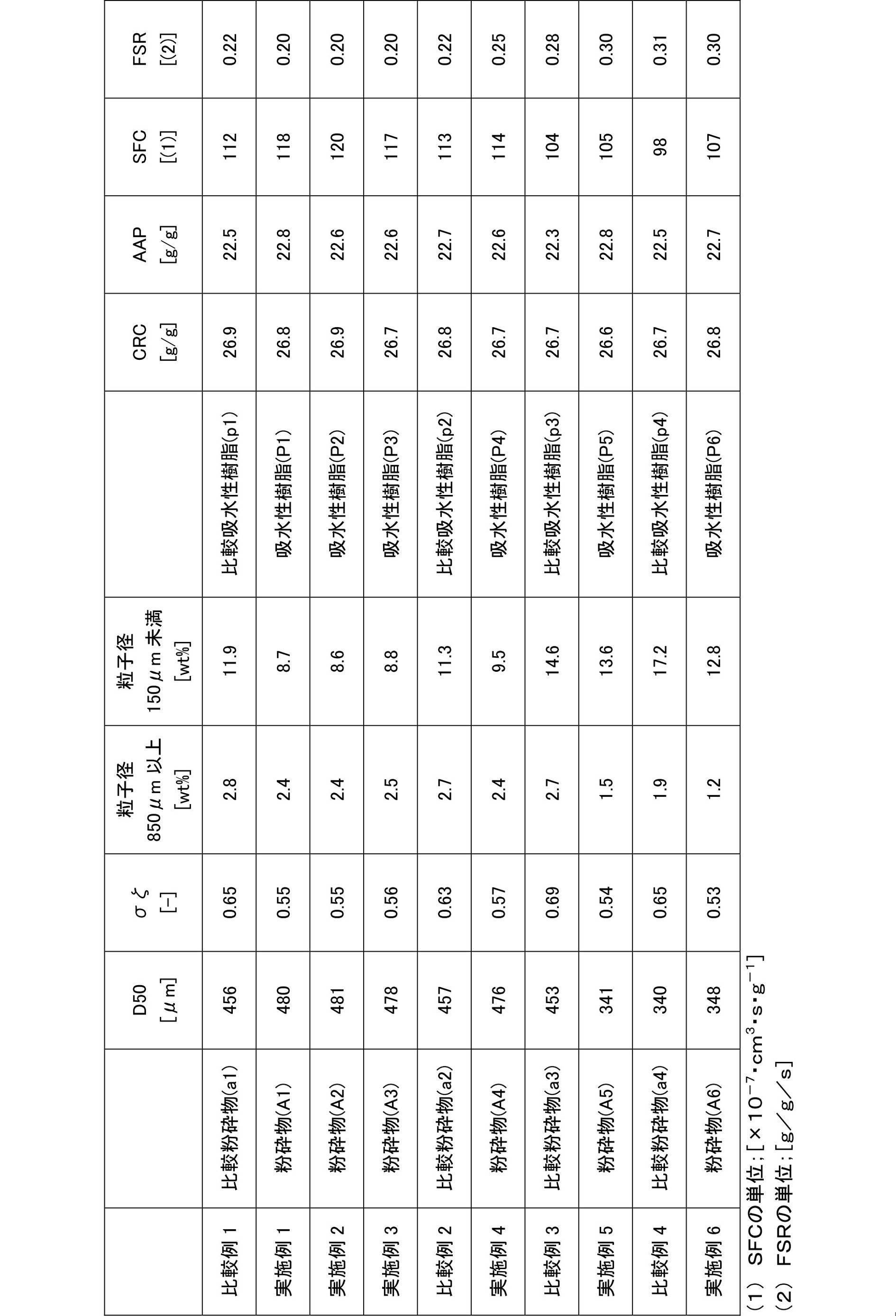
実施例1~3と比較例1~2との対比から、乾燥重合体をロールミルに投入する際に分散機を使用すること(第1の方法)によって、粉砕工程で発生する微粉(粒子径150μm未満の粒子)の割合が低減し、粒子径分布の対数標準偏差(σζ)が改善し、更に得られる吸水性樹脂の通液性(SFC)が向上することが分かる。
上記実施例5において、単量体水溶液を米国特許出願公開第2012/258851号の実施例2に準じて作製し、気泡を含有させた発泡重合を行った以外は、実施例5と同様の操作を行って、吸水性樹脂(P7)を得た。
実施例7において、粉砕工程で分散機を使用しなかった以外は、実施例7と同様の操作を行って、比較吸水性樹脂(p4)を得た。得られた吸水性樹脂(p4)の物性は、CRC:26.6(g/g)、AAP:22.5(g/g)、SFC:96(×10-7・s・cm3・g-1)、FSR:0.38(g/g/s)、内部気泡率:3.4%であった。また、粉砕後の微粉量(分級によって除去され、リサイクルされた微粉量)は生産量に対して20重量%であった。
実施例7及び比較例5では、多孔質の吸水性樹脂を製造したが、分散機の使用の有無によって、微粉量及び物性の差異がより顕著となることが分かる。なお、比較例1~5では微粉量が多く、分級工程での目詰まりが発生し易い状態であった。
実施例5の条件で、92日間連続して稼働し、吸水性樹脂(P8)を得た。粉砕工程で使用した3段目のロールミルについて、ロールクリアランス変化率は5%、ロールクリアランス変化幅は10μmであったが、吸水性樹脂(P8)の物性は安定していた。
比較例4の条件で、92日間連続して稼働し、比較吸水性樹脂(p6)を得た。粉砕工程で使用した3段目のロールミルについて、ロールクリアランス変化率は38%、ロールクリアランス変化幅は120μmに拡大していた。更に、吸水性樹脂(p6)の物性(重量平均粒子径、SFC、FSR)が徐々に変化していく傾向が確認された。
実施例5の条件で、150日間連続して稼働した後、連続運転により拡大した3段目のロールミルのロールクリアランスを調整した。当該調整は、最大クリアランスを示した部分を稼働当初のクリアランス(0.2mm)に戻すことで実施した。その後、更に150日間連続して稼働し、吸水性樹脂(P9)を得た。
比較例4の条件で、150日間連続して稼働した後、3段目のロールミルのロールクリアランスを調整した。当該調整は、最大クリアランスを示した部分を稼働当初のクリアランス(0.2mm)に戻すことで実施した。その後、更に150日間連続して稼働し、比較吸水性樹脂(p7)を得た。
実施例8~9及び比較例6~7の対比から、分散機を使用しなければ、ロールミルの中央部に乾燥重合体が集合し、そのため長時間の稼働でロールの中央部が擦り減り、その結果として物性が低下することが分かる。
(粉砕前分級工程)
上記製造例1の乾燥工程で得られた乾燥重合体(1)について、目開きが10mm、850μm及び150μmのJIS標準篩を有する分級装置(0)に供給して、連続的に分級した。
上記粉砕前分級工程で得られた、粒子径が850μm以上10mm未満の粒子(乾燥重合体(2)と称する;D50 2.8mm)は、バケットコンベアを用いて輸送し、ホッパーに投入した。当該ホッパーや輸送配管は蒸気トレスで加温されており、ホッパー内の乾燥重合体(2)の温度は約60℃であった。当該ホッパーにおいて、平均15分間、滞留させた。
(粉砕工程)
製造例2で得られた乾燥重合体(2)をホッパー底部から定量フィーダーを用いて、600(kg/hr)で抜き出した。その後、当該乾燥重合体(2)は、2段ロールミルに投入して粉砕した。なお、当該2段ロールミルは、その最上段のロールミルの入口(真上)に図1及び図2に示す回転式分散機として、スクリュー型フィーダー分散機が設置されており、当該分散機によって、乾燥重合体(2)は分散されて2段ロールミルに投入された。当該操作によって、粉砕物(G10)を得た。
続いて、上記粉砕工程で得られた粉砕物(G10)全量について、分級装置(1)(目開きが上から順に850μm/150μmの金属篩で構成される分級装置/MINOX製;篩直径600mm)を用いて連続的に分級した。
上記分級工程で得られた吸水性樹脂微粉(F10)100重量部に対して、工業用純水120重量部を下記表面架橋工程とは異なる高速混合機(タービュライザー/1000rpm;ホソカワミクロン社製)を用いて噴霧添加し、微粉の造粒を行った。当該造粒操作で得られた吸水性樹脂微粉(F10)由来の造粒ゲルは、上述した粒子状含水ゲル(1)に添加して回収した。
上記分級工程で得られた吸水性樹脂粉末(B10)100重量部に対して、エチレンカーボネート0.5重量部及び工業用純水3重量部からなる表面架橋剤溶液を作成した後、高速混合機(タービュライザー/1000rpm;ホソカワミクロン社製)を用いて噴霧添加した。その後、パドルドライヤーに移送し、198℃(熱媒温度)で30~40分間熱処理を行った。なお、吸水性樹脂(P10)の吸水倍率(CRC)が27g/gになるように、熱処理時間の微調整を繰り返した。
上記冷却の際、表面架橋された吸水性樹脂(S10)100重量部に対して、硫酸アルミニウム0.3重量部、水1重量部及びプロピレングリコール0.03重量部からなる処理剤を添加した。
続いて、目開き850μmのJIS標準篩を備えた分級装置(2)で上記再加湿工程後の吸水性樹脂を分級し、その全量が通過するまでフラッシュミルで粉砕した。以上の操作により、粒子径が850μm未満の吸水性樹脂(P10)を得た。
ロールミルの運転条件を表2の記載通りに変更した以外は、実施例10と同様の操作を行って、粉砕物(G11、G12)及び吸水性樹脂(P11、P12)を得た。安定稼働後の、粉砕物(G11、G12)の物性を表2に、吸水性樹脂(P11、P12)の物性を表3にそれぞれ示した。
ロールミルの運転条件を表2の記載通りに変更した以外は、実施例10と同様の操作を行って、粉砕物(G13~15)及び吸水性樹脂(P13~15)を得た。なお、参考例1においては、ロール上に乾燥重合体が堆積する傾向にあり、安定稼働する前に停止した。安定稼働後の、粉砕物(G13~15)の物性を表2に、吸水性樹脂(P13~15)の物性を表3にそれぞれ示した。
上記製造例1において、粒子状含水ゲル(1)の乾燥機への供給量を製造例1の1/2に変更して得られた乾燥重合体(重合平均粒子径(D50);2.4mm、粒子径分布の対数標準偏差(σζ);0.85、含水率;2.0重量%)について、製造例2と同様の操作を行って、乾燥重合体(3)を得た。
実施例11において、製造例3で得られた乾燥重合体(3)に変更した以外は、実施例11と同様の操作を行って、粉砕物(G16)及び吸水性樹脂(P16)を得た。安定稼働後の、粉砕物(G16)の物性を表2に、吸水性樹脂(P16)の物性を表3にそれぞれ示した。
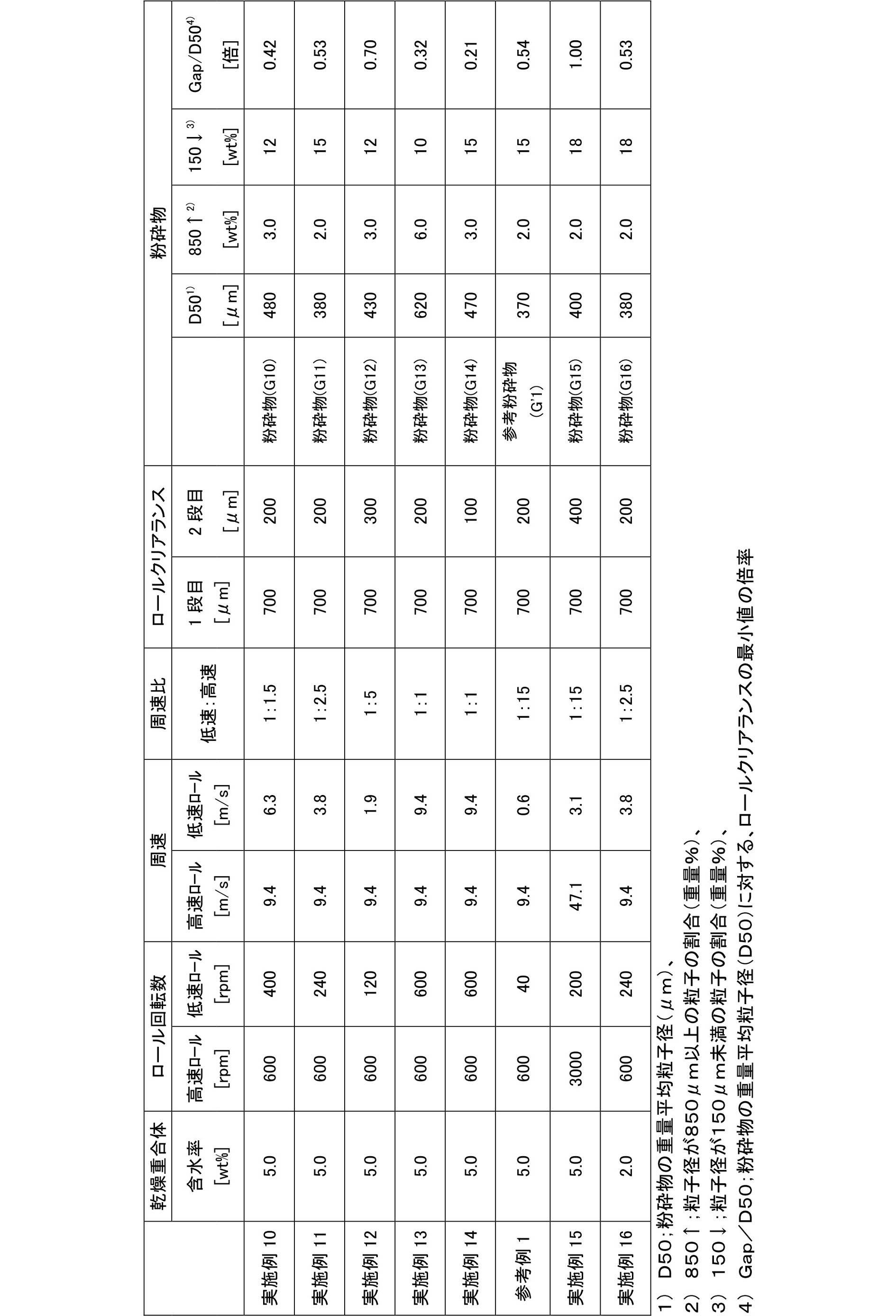

低速ロールの回転数と、それに付随して周速比が異なる実施例13(周速比1:1)、実施例10(周速比1:1.5)、及び、実施例11(周速比1:2.5)を比較すると、粉砕物の重量平均粒子径(D50)は、粉砕物(G11)<粉砕物(G10)<粉砕物(G13)となった。その結果、吸水性樹脂(P13)の吸水速度(FSR)は非常に劣ったものとなった。
比較例1において、ロールの回転軸と3°の角度をなす溝を、ロールの回転軸と0°の角度をなす溝に変更した以外は比較例1と同様の操作を行い、比較粉砕物(a8)及び比較吸水性樹脂(p8)を得た。得られた比較粉砕物(a8)をサンプリングし、粒度を測定した。結果を表4に示す。
比較例1において、ロールの回転軸と3°の角度をなす溝を、ロールの回転軸と90°の角度をなす溝に変更した以外は比較例1と同様の操作を行い、比較粉砕物(a9)及び比較吸水性樹脂(p9)を得た。得られた比較粉砕物(a9)をサンプリングし、粒度を測定した。結果を表4に示す。なお、乾燥重合体(1)のロールミルへの噛み込みが悪く、乾燥重合体(1)の一部がロールミル上に残存したため、取り除く操作が必要になった。
実施例1において、ロールの回転軸と3°の角度をなす溝を、ロールの回転軸と90°の角度をなす溝に変更した以外は実施例1と同様の操作を行い、粉砕物(A18)及び吸水性樹脂(P18)を得た。得られた粉砕物(A18)をサンプリングし、粒度を測定した。結果を表4に示す。なお、乾燥重合体(1)のロールミルへの噛み込みが悪く、乾燥重合体(1)の一部がロールミル上に残存したため、取り除く操作が必要になった。

比較例1と比較例8、9、及び実施例1と実施例17、18との対比から、ロールの溝の傾斜角が、粉砕物の粒子径に影響することが分かる。具体的には、ロールの回転軸との傾斜角が0°のときは、粒子径が150μm未満の吸水性樹脂微粉の発生が多くなり、当該傾斜角が90°のときは、乾燥重合体のロールミルへの噛み込み(巻き込まれ易さ)が悪く、重量平均粒子径(D50)が大きい値となった。粉砕物の重量平均粒子径(D50)を、例えば、520μmから実施例1の480μm程度にまで狭めるには、ロールクリアランスを更に狭くする必要がある。以上の知見から、本願第5の方法が好ましいことが分かる。
2 スクリューフィーダー、
2’ スリット型分散機、
3 ホッパー、
4 乾燥重合体、
5 ロールミルのロール、
6 粉砕物、
7 案内板
8 山型の分散版、
9 スクリュー型フィーダーの回転部、
10 ピン型の回転羽根を有するフィーダー。
Claims (16)
- アクリル酸(塩)系単量体水溶液の重合工程と、重合工程で得られる含水ゲル状架橋重合体の乾燥工程と、乾燥工程で得られる乾燥重合体の粉砕工程と、乾燥工程後又は粉砕工程後の分級工程とを順次含む、ポリアクリル酸(塩)系吸水性樹脂の製造方法であって、
上記粉砕工程において用いられるロールミルに乾燥重合体を供給する際、当該ロールミルのロール軸方向に、乾燥重合体を分散させて供給することを特徴とする、ポリアクリル酸(塩)系吸水性樹脂の製造方法。 - 上記乾燥工程で得られる乾燥重合体を上記ロールミルで粉砕する前に分級する分級工程を含み、当該分級工程において用いられる篩の非通過物を分離し、当該分離された非通過物がロールミル以外の粉砕方法で粉砕される、請求項1に記載の製造方法。
- 上記乾燥重合体の含水率が、上記ロールミルによる粉砕直前で3.0~15重量%である、請求項1又は2に記載の製造方法。
- 上記乾燥重合体を、機械的分散手段により分散させる、請求項1~3の何れか1項に記載の製造方法。
- 上記ロールミルにおいて、ロール軸方向にロールを3等分した際、上記乾燥重合体の供給量が最も多い部分が最も少ない部分の1.0~10倍である、
及び/又は
上記乾燥重合体をフィード幅比80~99%の範囲内で、上記ロールミルに供給する、請求項1~4の何れか1項に記載の製造方法。
但し、上記フィード幅比は、下記式により規定される。

- 上記粉砕工程において使用される装置が、上記乾燥重合体を上記ロールミルに供給するための配管を含み、
当該ロールミルのロール長が、当該配管の径の2~100倍である、請求項1~5の何れか1項に記載の製造方法。 - 上記ロールミルがロール表面に、溝が縞模様状に並んだ凹凸パターンを有し、かつ、当該溝がロールの回転軸に対して1~89°傾斜している、請求項1~6の何れか1項に記載の製造方法。
- 上記ロールミルの少なくとも一対のロールが、互いに逆方向に回転する低速ロールと高速ロールからなり、その周速比が1:1.05~1:10である、請求項1~7の何れか1項に記載の製造方法。
- 上記低速ロールの周速が0.7~15(m/s)である、請求項8に記載の製造方法。
- 上記ロールミルにおける最小のロールクリアランスが100~1000μmであり、
上記粉砕工程で得られる粉砕物の重量平均粒子径(D50)が、ロールクリアランスの最小値に対して、0.5~2.0倍となるように粉砕する、請求項1~9に記載の製造方法。 - 上記粉砕工程の雰囲気温度が30~100℃であり、かつ、雰囲気の相対湿度が50%RH以下である、請求項1~10の何れか1項に記載の製造方法。
- 上記粉砕工程が減圧下及び/又は気流下で行われる、請求項1~11の何れか1項に記載の製造方法。
- 上記粉砕工程において用いられるロールミル1基当たりの処理量が100(kg/hr)以上であり、かつ、総粉砕時間が30日間以上である粉砕工程において、
ロールクリアランス変化幅が100μm以下、及び/又は、ロールクリアランス変化率が50%以下の条件で、上記乾燥重合体を粉砕する、請求項1~12の何れか1項に記載の製造方法。
但し、上記ロールクリアランス変化幅及びロールクリアランス変化率は、下記式により規定される。


- 上記粉砕工程において用いられるロールミル1基当たりの処理量が100(kg/hr)以上であり、かつ、総粉砕時間が200日間以上である粉砕工程において、
ロールクリアランス変化幅が300μm以下、及び/又は、ロールクリアランス変化率が90%以下の条件で、上記乾燥重合体を粉砕する、請求項1~12の何れか1項に記載の製造方法。
但し、上記ロールクリアランス変化幅及びロールクリアランス変化率は、下記式により規定される。


- 得られる吸水性樹脂の重量平均粒子径(D50)が200~600μmである、請求項1~14の何れか1項に記載の製造方法。
- 得られる吸水性樹脂の吸水速度(FSR)が0.20(g/g/s)以上、かつ、生理食塩水流れ誘導性(SFC)が10(×10-7・cm3・s・g-1)以上である、請求項1~15の何れか1項に記載の製造方法。
Priority Applications (5)
| Application Number | Priority Date | Filing Date | Title |
|---|---|---|---|
| US14/647,311 US9550843B2 (en) | 2012-11-27 | 2013-11-27 | Method for producing polyacrylic acid (salt)-based water absorbent resin |
| CN201380061983.3A CN104822735B (zh) | 2012-11-27 | 2013-11-27 | 聚丙烯酸(盐)系吸水性树脂的制造方法 |
| KR1020157013240A KR20150090067A (ko) | 2012-11-27 | 2013-11-27 | 폴리아크릴산(염)계 흡수성 수지의 제조 방법 |
| JP2014549879A JP5883948B2 (ja) | 2012-11-27 | 2013-11-27 | ポリアクリル酸(塩)系吸水性樹脂の製造方法 |
| EP13857778.8A EP2927264B1 (en) | 2012-11-27 | 2013-11-27 | Method for producing polyacrylic acid (salt)-based water-absorbing resin |
Applications Claiming Priority (4)
| Application Number | Priority Date | Filing Date | Title |
|---|---|---|---|
| JP2012-258644 | 2012-11-27 | ||
| JP2012258644 | 2012-11-27 | ||
| JP2013-178034 | 2013-08-29 | ||
| JP2013178034 | 2013-08-29 |
Publications (1)
| Publication Number | Publication Date |
|---|---|
| WO2014084281A1 true WO2014084281A1 (ja) | 2014-06-05 |
Family
ID=50827913
Family Applications (1)
| Application Number | Title | Priority Date | Filing Date |
|---|---|---|---|
| PCT/JP2013/081968 Ceased WO2014084281A1 (ja) | 2012-11-27 | 2013-11-27 | ポリアクリル酸(塩)系吸水性樹脂の製造方法 |
Country Status (6)
| Country | Link |
|---|---|
| US (1) | US9550843B2 (ja) |
| EP (1) | EP2927264B1 (ja) |
| JP (1) | JP5883948B2 (ja) |
| KR (1) | KR20150090067A (ja) |
| CN (1) | CN104822735B (ja) |
| WO (1) | WO2014084281A1 (ja) |
Cited By (6)
| Publication number | Priority date | Publication date | Assignee | Title |
|---|---|---|---|---|
| US9751995B2 (en) | 2014-08-04 | 2017-09-05 | Lg Chem, Ltd. | Superabsorbent polymer and a preparation method thereof |
| JP2019523795A (ja) * | 2016-05-31 | 2019-08-29 | ビーエーエスエフ ソシエタス・ヨーロピアBasf Se | 水性ポリマーゲルを乾燥し、乾燥されたポリマーゲルを破砕して乾燥されたポリマー粒子を得るためのベルト乾燥機装置、および水性ポリマーゲルを乾燥し、乾燥されたポリマーゲルを破砕して乾燥されたポリマー粒子を得るための方法 |
| JP2021514417A (ja) * | 2018-02-22 | 2021-06-10 | ビーエイエスエフ・ソシエタス・エウロパエアBasf Se | 超吸収体粒子を製造する方法 |
| JP2022523396A (ja) * | 2019-03-01 | 2022-04-22 | ビーエーエスエフ ソシエタス・ヨーロピア | 超吸収性ポリマー粒子を製造する方法 |
| JP2023099531A (ja) * | 2018-12-26 | 2023-07-13 | Sdpグローバル株式会社 | 吸水性樹脂粒子の製造方法 |
| JP2024501989A (ja) * | 2021-07-12 | 2024-01-17 | エルジー・ケム・リミテッド | 高吸水性樹脂用ロール粉砕機およびこれを利用した高吸水性樹脂の製造方法 |
Families Citing this family (11)
| Publication number | Priority date | Publication date | Assignee | Title |
|---|---|---|---|---|
| US11931928B2 (en) * | 2016-12-29 | 2024-03-19 | Evonik Superabsorber Llc | Continuous strand superabsorbent polymerization |
| KR102555380B1 (ko) * | 2018-01-19 | 2023-07-12 | 주식회사 엘지화학 | 고흡수성 수지 및 이의 제조 방법 |
| US12036637B2 (en) | 2018-04-24 | 2024-07-16 | Cold Jet, Llc | Particle blast apparatus |
| JP6982281B2 (ja) * | 2018-09-10 | 2021-12-17 | 宇部興産株式会社 | 検査方法および検査装置 |
| KR102566284B1 (ko) | 2018-11-14 | 2023-08-10 | 주식회사 엘지화학 | 고흡수성 수지의 제조 방법 |
| WO2020149651A1 (ko) * | 2019-01-16 | 2020-07-23 | 주식회사 엘지화학 | 고흡수성 수지의 제조 방법 |
| US12491662B2 (en) | 2019-10-18 | 2025-12-09 | Lg Chem, Ltd. | Minute cutting apparatus for super absorbent polymer hydrogel using pump |
| US20230372896A1 (en) * | 2020-09-25 | 2023-11-23 | Nippon Shokubai Co., Ltd. | Method for producing water-absorbing resin powder |
| JP2022082314A (ja) * | 2020-11-20 | 2022-06-01 | 住友重機械エンバイロメント株式会社 | 破砕装置及び破砕方法 |
| US12533656B2 (en) | 2024-05-02 | 2026-01-27 | Lg Chem, Ltd. | Super absorbent polymer |
| US12605694B2 (en) * | 2024-05-03 | 2026-04-21 | Lg Chem, Ltd. | Super absorbent polymer |
Citations (68)
| Publication number | Priority date | Publication date | Assignee | Title |
|---|---|---|---|---|
| USRE32649E (en) | 1985-06-18 | 1988-04-19 | The Procter & Gamble Company | Hydrogel-forming polymer compositions for use in absorbent structures |
| EP0271828A2 (de) * | 1986-12-17 | 1988-06-22 | Gebrueder Buehler Ag Maschinenfabrik | Walzwerk und Verfahren zum Zuführen von körnigem Gut |
| US4893999A (en) | 1985-12-18 | 1990-01-16 | Chemische Fabrik Stockhausen Gmbh | Apparatus for the continuous production of polymers and copolymers of water-soluble monomers |
| US4973632A (en) | 1988-06-28 | 1990-11-27 | Nippon Shokubai Kagaku Kogyo Co., Ltd. | Production process for water-absorbent resin |
| EP0450922A2 (en) | 1990-04-02 | 1991-10-09 | Nippon Shokubai Kagaku Kogyo Co. Ltd. | Method for production of fluid stable aggregate |
| US5149335A (en) | 1990-02-23 | 1992-09-22 | Kimberly-Clark Corporation | Absorbent structure |
| US5244735A (en) | 1988-06-28 | 1993-09-14 | Nippon Shokubai Kagaku Kabushiki Kaisha | Water-absorbent resin and production process |
| US5250640A (en) | 1991-04-10 | 1993-10-05 | Nippon Shokubai Co., Ltd. | Method for production of particulate hydrogel polymer and absorbent resin |
| US5275773A (en) | 1991-02-01 | 1994-01-04 | Nippon Shokubai Co., Ltd. | Method for production of particulate hydrated gel polymer and absorbent resin |
| US5562646A (en) | 1994-03-29 | 1996-10-08 | The Proctor & Gamble Company | Absorbent members for body fluids having good wet integrity and relatively high concentrations of hydrogel-forming absorbent polymer having high porosity |
| EP0948997A2 (en) * | 1998-04-07 | 1999-10-13 | Nippon Shokubai Co., Ltd. | Manufacturing method of absorbent resin |
| US6071976A (en) | 1995-12-27 | 2000-06-06 | Nippon Shokubai Co., Ltd. | Water absorbing agent, manufacturing method thereof, and manufacturing machine thereof |
| US6164455A (en) | 1997-01-27 | 2000-12-26 | Nippon Shokubai Co., Ltd. | Process for classifying particulate hydrophilic polymer and sieving device |
| US6241928B1 (en) | 1998-04-28 | 2001-06-05 | Nippon Shokubai Co., Ltd. | Method for production of shaped hydrogel of absorbent resin |
| US20010011123A1 (en) | 2000-01-20 | 2001-08-02 | Hiroyuki Kakita | Process for transporting, storing, and producing a particulate water-absorbent resin |
| US20010025093A1 (en) | 2000-02-29 | 2001-09-27 | Kunihiko Ishizaki | Water-absorbent resin powder and production process therefor |
| US6414214B1 (en) | 1999-10-04 | 2002-07-02 | Basf Aktiengesellschaft | Mechanically stable hydrogel-forming polymers |
| US20020128618A1 (en) | 2000-12-29 | 2002-09-12 | Basf Aktiengesellschaft | Hydrogels |
| US20030020199A1 (en) | 2001-07-03 | 2003-01-30 | Katsuhiro Kajikawa | Continuous production process for water-absorbent resin powder and powder surface detector used therefor |
| US20030087983A1 (en) | 2001-07-06 | 2003-05-08 | Katsuhiro Kajikawa | Water-absorbent resin powder and its production process and uses |
| US6641064B1 (en) | 1998-10-27 | 2003-11-04 | Basf Aktiengesellschaft | Complete drying method for hydrogels |
| US20030224163A1 (en) | 2002-05-30 | 2003-12-04 | Yorimichi Dairoku | Production process for particulate water-absorbent resin |
| US6710141B1 (en) | 1999-11-20 | 2004-03-23 | Basf Aktiengesellschaft | Method for continuously producing cross-linked fine-particle geleous polymerizates |
| US20040110006A1 (en) | 2002-12-06 | 2004-06-10 | Kunihiko Ishizaki | Process for continuous production of water-absorbent resin product |
| US20040181031A1 (en) | 2003-03-14 | 2004-09-16 | Nippon Shokubai Co., Ltd. | Surface crosslinking treatment method of water-absorbing resin powder |
| US20040214946A1 (en) | 2003-04-25 | 2004-10-28 | Smith Scott J. | Superabsorbent polymer with high permeability |
| US20050027268A1 (en) | 2003-07-31 | 2005-02-03 | Kimberly-Clark Worldwide, Inc. | Absorbent materials and absorbent articles incorporating such absorbent materials |
| US20050096435A1 (en) | 2003-10-31 | 2005-05-05 | Smith Scott J. | Superabsorbent polymer with high permeability |
| US20050209352A1 (en) | 2004-02-05 | 2005-09-22 | Yorimichi Dairoku | Particulate water absorbent agent and production method thereof, and water absorbent article |
| US20050215734A1 (en) | 2004-03-24 | 2005-09-29 | Yorimichi Dairoku | Method for continuous production of water-absorbent resin |
| US20050245684A1 (en) | 2002-08-26 | 2005-11-03 | Thomas Daniel | Water absorbing agent and method for the production thereof |
| US20050256469A1 (en) | 2003-04-25 | 2005-11-17 | Kimberly-Clark Worldwide Inc. | Absorbent structure with superabsorbent material |
| US6987151B2 (en) | 2001-09-12 | 2006-01-17 | Dow Global Technologies Inc. | Continuous polymerization process for the manufacture of superabsorbent polymers |
| US20060204755A1 (en) | 2003-02-10 | 2006-09-14 | Kazushi Torii | Walter-absorbing agent |
| US7183456B2 (en) | 2000-09-20 | 2007-02-27 | Nippon Shokubai Co., Ltd. | Water-absorbent resin and production process therefor |
| US7265190B2 (en) | 2002-11-07 | 2007-09-04 | Nippon Shokubai Co., Ltd. | Process and apparatus for production of water-absorbent resin |
| US20070293617A1 (en) | 2004-11-30 | 2007-12-20 | Basf Aktiengesellschaft | Insoluble Metal Sulfates in Water Absorbing Polymeric Particles |
| US20080114129A1 (en) | 2005-02-01 | 2008-05-15 | Basf Aktiengesellschaft | Polyamine-Coated Superabsorbent Polymers |
| US20080125533A1 (en) | 2004-10-20 | 2008-05-29 | Basf Aktiengesellschaft | Fine-Grained Water-Absorbent Particles With a High Fluid Transport and Absorption Capacity |
| US20080124749A1 (en) | 2006-09-14 | 2008-05-29 | Farnam W Edward | Device and method for measuring properties of a sample |
| US20080161512A1 (en) | 2005-04-07 | 2008-07-03 | Takaaki Kawano | Production Process of Polyacrylic Acid (Salt) Water-Absorbent Resin |
| US20080194402A1 (en) | 2005-01-13 | 2008-08-14 | Archer-Daniels-Midland Company | Process for Particle Size Reduction of Glass-Like Polysaccharides |
| US20080194863A1 (en) | 2005-09-07 | 2008-08-14 | Basf Se | Neutralization Process |
| US20080202987A1 (en) | 2005-01-13 | 2008-08-28 | Basf Aktiengesellschaft | Method for Grading a Particulate Water-Absorbing Resin |
| US20080221237A1 (en) | 2005-02-01 | 2008-09-11 | Basf Aktiengesellschaft | Polyamine-Coated Superabsorbent Polymers |
| US20080287631A1 (en) | 2005-11-16 | 2008-11-20 | Basf Se | Process for Preparing Water-Absorbing Polymer Particles |
| US20090194462A1 (en) | 2006-09-25 | 2009-08-06 | Mitsubishi Chemical Corporation | Method for Grading Water-Absorbent Polymer Particles |
| US20090204087A1 (en) | 2006-08-31 | 2009-08-13 | Basf Se | Superabsorbent Polymers Having Superior Gel Integrity, Absorption Capacity, and Permeability |
| US20090261023A1 (en) | 2006-09-25 | 2009-10-22 | Basf Se | Method for the Classification of Water Absorbent Polymer Particles |
| US20090266747A1 (en) | 2006-09-25 | 2009-10-29 | Basf Se | Method for Grading Water-Absorbent Polymer Particles |
| US20100010461A1 (en) | 2006-08-31 | 2010-01-14 | Basf Se | Polyamine Coated Superabsorbent Polymers Having Transient Hydrophobicity |
| US20100041550A1 (en) | 2007-01-29 | 2010-02-18 | Basf Se A German Corporation | Method for Producing White and Color-Stable Water-Absorbing Polymer Particles Having High Absorbency and High Saline Flow Conductivity |
| US20100063469A1 (en) | 2006-08-31 | 2010-03-11 | Basf Se | Polyamine-Coated Superabsorbent Polymers |
| US20100101982A1 (en) | 2007-03-26 | 2010-04-29 | Intrexon Corporation | Classification method of particulate water absorbent resin |
| US20100184594A1 (en) | 2007-07-27 | 2010-07-22 | Ulrich Riegel | Water-Absorbing Polymeric Particles and Method for the Production Thereof |
| WO2010114058A1 (ja) | 2009-03-31 | 2010-10-07 | 株式会社日本触媒 | 粒子状吸水性樹脂の製造方法 |
| US20110021725A1 (en) | 2008-03-31 | 2011-01-27 | Nippon Shokubai Co., Ltd. | Production method and production apparatus of particulate water absorbing agent containing water absorbent resin as main component |
| US20110042612A1 (en) | 2007-01-29 | 2011-02-24 | Ulrich Riegel | Method for Producing White and Color-Stable Water-Absorbing Polymer Particles Having High Absorbency and High Saline Flow Conductivity |
| WO2011034146A1 (ja) * | 2009-09-16 | 2011-03-24 | 株式会社日本触媒 | 吸水性樹脂粉末の製造方法 |
| WO2011040530A1 (ja) | 2009-09-30 | 2011-04-07 | 株式会社日本触媒 | 粒子状吸水剤及びその製造方法 |
| US20110166300A1 (en) | 2008-09-16 | 2011-07-07 | Nippon Shokubai Co. Ltd | Water-absorbent resin manufacturing method and liquid permeability improvement method |
| JP2011200221A (ja) | 2010-01-21 | 2011-10-13 | Camasone Co Ltd | 代謝性症候群に対して適用するための特殊なデンプン食品を製造するための方法およびこれにより製造される生産物 |
| US20120157648A1 (en) | 2009-08-28 | 2012-06-21 | Nippon Shokubai Co.,Ltd. | Production method for water-absorbent resin |
| US20120258851A1 (en) | 2009-12-24 | 2012-10-11 | Nippon Shokubai Co., Ltd | Water-absorbable polyacrylic acid resin powder, and process for production thereof |
| WO2012152647A1 (de) | 2011-05-06 | 2012-11-15 | Basf Se | Verfahren zur herstellung wasserabsorbierender polymerpartikel |
| US20120329953A1 (en) | 2010-03-08 | 2012-12-27 | Nippon Shokubai Co., Ltd. | Drying method for granular water-containing gel-like cross-linked polymer |
| US20130026412A1 (en) | 2010-04-07 | 2013-01-31 | Nippon Shokubai Co. Ltd | Method for producing water absorbent polyacrylic acid (salt) resin powder, and water absorbent polyacrylic acid (salt) resin powder |
| US20130066019A1 (en) | 2010-03-17 | 2013-03-14 | Nippon Shokubai Co., Ltd. | Method of producing water absorbent resin |
Family Cites Families (3)
| Publication number | Priority date | Publication date | Assignee | Title |
|---|---|---|---|---|
| CN2326331Y (zh) | 1998-03-17 | 1999-06-30 | 河北赞皇机械厂 | 一种面粉机喂料装置 |
| US20120189793A1 (en) * | 2009-09-30 | 2012-07-26 | Adeka Corporation | Polyester resin composition, polyester fiber, polyester resin molded article, and process for production of nucleating agent for polyester resin |
| CN102917800B (zh) | 2010-05-28 | 2014-09-24 | Lg化学株式会社 | 用于高吸水性聚合物的粉碎机和使用所述粉碎机制备高吸水性聚合物的方法 |
-
2013
- 2013-11-27 JP JP2014549879A patent/JP5883948B2/ja active Active
- 2013-11-27 KR KR1020157013240A patent/KR20150090067A/ko not_active Ceased
- 2013-11-27 US US14/647,311 patent/US9550843B2/en active Active
- 2013-11-27 CN CN201380061983.3A patent/CN104822735B/zh active Active
- 2013-11-27 EP EP13857778.8A patent/EP2927264B1/en active Active
- 2013-11-27 WO PCT/JP2013/081968 patent/WO2014084281A1/ja not_active Ceased
Patent Citations (87)
| Publication number | Priority date | Publication date | Assignee | Title |
|---|---|---|---|---|
| USRE32649E (en) | 1985-06-18 | 1988-04-19 | The Procter & Gamble Company | Hydrogel-forming polymer compositions for use in absorbent structures |
| US4893999A (en) | 1985-12-18 | 1990-01-16 | Chemische Fabrik Stockhausen Gmbh | Apparatus for the continuous production of polymers and copolymers of water-soluble monomers |
| EP0271828A2 (de) * | 1986-12-17 | 1988-06-22 | Gebrueder Buehler Ag Maschinenfabrik | Walzwerk und Verfahren zum Zuführen von körnigem Gut |
| DE3642974A1 (de) * | 1986-12-17 | 1988-06-30 | Buehler Ag Geb | Walzwerk und verfahren zum zufuehren von koernigem gut |
| JPS63162048A (ja) * | 1986-12-17 | 1988-07-05 | ゲブリユーダー・ビユーラー・アクチエンゲゼルシヤフト | ロール製粉機と粒状材料を供給するための方法 |
| US4905917A (en) * | 1986-12-17 | 1990-03-06 | Gebrueder Buehler Ag | Roll mill and method for feeding particulate material |
| US4973632A (en) | 1988-06-28 | 1990-11-27 | Nippon Shokubai Kagaku Kogyo Co., Ltd. | Production process for water-absorbent resin |
| US5244735A (en) | 1988-06-28 | 1993-09-14 | Nippon Shokubai Kagaku Kabushiki Kaisha | Water-absorbent resin and production process |
| US5149335A (en) | 1990-02-23 | 1992-09-22 | Kimberly-Clark Corporation | Absorbent structure |
| EP0450922A2 (en) | 1990-04-02 | 1991-10-09 | Nippon Shokubai Kagaku Kogyo Co. Ltd. | Method for production of fluid stable aggregate |
| US5275773A (en) | 1991-02-01 | 1994-01-04 | Nippon Shokubai Co., Ltd. | Method for production of particulate hydrated gel polymer and absorbent resin |
| US5250640A (en) | 1991-04-10 | 1993-10-05 | Nippon Shokubai Co., Ltd. | Method for production of particulate hydrogel polymer and absorbent resin |
| US5562646A (en) | 1994-03-29 | 1996-10-08 | The Proctor & Gamble Company | Absorbent members for body fluids having good wet integrity and relatively high concentrations of hydrogel-forming absorbent polymer having high porosity |
| US5669894A (en) | 1994-03-29 | 1997-09-23 | The Procter & Gamble Company | Absorbent members for body fluids having good wet integrity and relatively high concentrations of hydrogel-forming absorbent polymer |
| US6071976A (en) | 1995-12-27 | 2000-06-06 | Nippon Shokubai Co., Ltd. | Water absorbing agent, manufacturing method thereof, and manufacturing machine thereof |
| US6164455A (en) | 1997-01-27 | 2000-12-26 | Nippon Shokubai Co., Ltd. | Process for classifying particulate hydrophilic polymer and sieving device |
| US6291636B1 (en) | 1998-04-07 | 2001-09-18 | Nippon Shokubai Co., Ltd. | Manufacturing method of absorbent resin |
| JPH11292919A (ja) * | 1998-04-07 | 1999-10-26 | Nippon Shokubai Co Ltd | 吸水性樹脂の製造方法 |
| EP0948997A2 (en) * | 1998-04-07 | 1999-10-13 | Nippon Shokubai Co., Ltd. | Manufacturing method of absorbent resin |
| US6241928B1 (en) | 1998-04-28 | 2001-06-05 | Nippon Shokubai Co., Ltd. | Method for production of shaped hydrogel of absorbent resin |
| US6641064B1 (en) | 1998-10-27 | 2003-11-04 | Basf Aktiengesellschaft | Complete drying method for hydrogels |
| US6414214B1 (en) | 1999-10-04 | 2002-07-02 | Basf Aktiengesellschaft | Mechanically stable hydrogel-forming polymers |
| US6710141B1 (en) | 1999-11-20 | 2004-03-23 | Basf Aktiengesellschaft | Method for continuously producing cross-linked fine-particle geleous polymerizates |
| US20010011123A1 (en) | 2000-01-20 | 2001-08-02 | Hiroyuki Kakita | Process for transporting, storing, and producing a particulate water-absorbent resin |
| US20010025093A1 (en) | 2000-02-29 | 2001-09-27 | Kunihiko Ishizaki | Water-absorbent resin powder and production process therefor |
| US7183456B2 (en) | 2000-09-20 | 2007-02-27 | Nippon Shokubai Co., Ltd. | Water-absorbent resin and production process therefor |
| US20020128618A1 (en) | 2000-12-29 | 2002-09-12 | Basf Aktiengesellschaft | Hydrogels |
| US6849665B2 (en) | 2000-12-29 | 2005-02-01 | Basf Aktiengesellschaft | Absorbent compositions |
| US20030020199A1 (en) | 2001-07-03 | 2003-01-30 | Katsuhiro Kajikawa | Continuous production process for water-absorbent resin powder and powder surface detector used therefor |
| US20030087983A1 (en) | 2001-07-06 | 2003-05-08 | Katsuhiro Kajikawa | Water-absorbent resin powder and its production process and uses |
| US6987151B2 (en) | 2001-09-12 | 2006-01-17 | Dow Global Technologies Inc. | Continuous polymerization process for the manufacture of superabsorbent polymers |
| US20030224163A1 (en) | 2002-05-30 | 2003-12-04 | Yorimichi Dairoku | Production process for particulate water-absorbent resin |
| US20050245684A1 (en) | 2002-08-26 | 2005-11-03 | Thomas Daniel | Water absorbing agent and method for the production thereof |
| US7265190B2 (en) | 2002-11-07 | 2007-09-04 | Nippon Shokubai Co., Ltd. | Process and apparatus for production of water-absorbent resin |
| US20040110006A1 (en) | 2002-12-06 | 2004-06-10 | Kunihiko Ishizaki | Process for continuous production of water-absorbent resin product |
| US7638570B2 (en) | 2003-02-10 | 2009-12-29 | Nippon Shokubai Co., Ltd. | Water-absorbing agent |
| US20060204755A1 (en) | 2003-02-10 | 2006-09-14 | Kazushi Torii | Walter-absorbing agent |
| US20040181031A1 (en) | 2003-03-14 | 2004-09-16 | Nippon Shokubai Co., Ltd. | Surface crosslinking treatment method of water-absorbing resin powder |
| US20050256469A1 (en) | 2003-04-25 | 2005-11-17 | Kimberly-Clark Worldwide Inc. | Absorbent structure with superabsorbent material |
| US20040214946A1 (en) | 2003-04-25 | 2004-10-28 | Smith Scott J. | Superabsorbent polymer with high permeability |
| US20050027268A1 (en) | 2003-07-31 | 2005-02-03 | Kimberly-Clark Worldwide, Inc. | Absorbent materials and absorbent articles incorporating such absorbent materials |
| US20050096435A1 (en) | 2003-10-31 | 2005-05-05 | Smith Scott J. | Superabsorbent polymer with high permeability |
| US20050209352A1 (en) | 2004-02-05 | 2005-09-22 | Yorimichi Dairoku | Particulate water absorbent agent and production method thereof, and water absorbent article |
| US20050215734A1 (en) | 2004-03-24 | 2005-09-29 | Yorimichi Dairoku | Method for continuous production of water-absorbent resin |
| US20080125533A1 (en) | 2004-10-20 | 2008-05-29 | Basf Aktiengesellschaft | Fine-Grained Water-Absorbent Particles With a High Fluid Transport and Absorption Capacity |
| US20070293617A1 (en) | 2004-11-30 | 2007-12-20 | Basf Aktiengesellschaft | Insoluble Metal Sulfates in Water Absorbing Polymeric Particles |
| US20080194402A1 (en) | 2005-01-13 | 2008-08-14 | Archer-Daniels-Midland Company | Process for Particle Size Reduction of Glass-Like Polysaccharides |
| US20080202987A1 (en) | 2005-01-13 | 2008-08-28 | Basf Aktiengesellschaft | Method for Grading a Particulate Water-Absorbing Resin |
| US20080114129A1 (en) | 2005-02-01 | 2008-05-15 | Basf Aktiengesellschaft | Polyamine-Coated Superabsorbent Polymers |
| US20080221237A1 (en) | 2005-02-01 | 2008-09-11 | Basf Aktiengesellschaft | Polyamine-Coated Superabsorbent Polymers |
| US20080161512A1 (en) | 2005-04-07 | 2008-07-03 | Takaaki Kawano | Production Process of Polyacrylic Acid (Salt) Water-Absorbent Resin |
| US20080194863A1 (en) | 2005-09-07 | 2008-08-14 | Basf Se | Neutralization Process |
| US20080287631A1 (en) | 2005-11-16 | 2008-11-20 | Basf Se | Process for Preparing Water-Absorbing Polymer Particles |
| US20090204087A1 (en) | 2006-08-31 | 2009-08-13 | Basf Se | Superabsorbent Polymers Having Superior Gel Integrity, Absorption Capacity, and Permeability |
| US20100063469A1 (en) | 2006-08-31 | 2010-03-11 | Basf Se | Polyamine-Coated Superabsorbent Polymers |
| US20100010461A1 (en) | 2006-08-31 | 2010-01-14 | Basf Se | Polyamine Coated Superabsorbent Polymers Having Transient Hydrophobicity |
| US20080124749A1 (en) | 2006-09-14 | 2008-05-29 | Farnam W Edward | Device and method for measuring properties of a sample |
| US20090194462A1 (en) | 2006-09-25 | 2009-08-06 | Mitsubishi Chemical Corporation | Method for Grading Water-Absorbent Polymer Particles |
| US20090261023A1 (en) | 2006-09-25 | 2009-10-22 | Basf Se | Method for the Classification of Water Absorbent Polymer Particles |
| US20090266747A1 (en) | 2006-09-25 | 2009-10-29 | Basf Se | Method for Grading Water-Absorbent Polymer Particles |
| US20100041550A1 (en) | 2007-01-29 | 2010-02-18 | Basf Se A German Corporation | Method for Producing White and Color-Stable Water-Absorbing Polymer Particles Having High Absorbency and High Saline Flow Conductivity |
| US20110042612A1 (en) | 2007-01-29 | 2011-02-24 | Ulrich Riegel | Method for Producing White and Color-Stable Water-Absorbing Polymer Particles Having High Absorbency and High Saline Flow Conductivity |
| US20100101982A1 (en) | 2007-03-26 | 2010-04-29 | Intrexon Corporation | Classification method of particulate water absorbent resin |
| US20100184594A1 (en) | 2007-07-27 | 2010-07-22 | Ulrich Riegel | Water-Absorbing Polymeric Particles and Method for the Production Thereof |
| US20110021725A1 (en) | 2008-03-31 | 2011-01-27 | Nippon Shokubai Co., Ltd. | Production method and production apparatus of particulate water absorbing agent containing water absorbent resin as main component |
| US20110166300A1 (en) | 2008-09-16 | 2011-07-07 | Nippon Shokubai Co. Ltd | Water-absorbent resin manufacturing method and liquid permeability improvement method |
| CN102378778A (zh) * | 2009-03-31 | 2012-03-14 | 株式会社日本触媒 | 颗粒状吸水性树脂的制造方法 |
| WO2010114058A1 (ja) | 2009-03-31 | 2010-10-07 | 株式会社日本触媒 | 粒子状吸水性樹脂の製造方法 |
| US20120016084A1 (en) | 2009-03-31 | 2012-01-19 | Nippon Shokubai Co., Ltd, | Method for Producing Particulate Water-Absorbent Resin |
| EP2415822A1 (en) * | 2009-03-31 | 2012-02-08 | Nippon Shokubai Co., Ltd. | Process for producing particulate water-absorbing resin |
| US20120157644A1 (en) | 2009-08-28 | 2012-06-21 | Nippon Shokubai Co., Ltd. | Production method for water-absorbent resin |
| US20120157648A1 (en) | 2009-08-28 | 2012-06-21 | Nippon Shokubai Co.,Ltd. | Production method for water-absorbent resin |
| US20120220745A1 (en) | 2009-09-16 | 2012-08-30 | Nippon Shokubal Co., Ltd. | Production method for water-absorbing resin powder |
| WO2011034146A1 (ja) * | 2009-09-16 | 2011-03-24 | 株式会社日本触媒 | 吸水性樹脂粉末の製造方法 |
| CN102498134A (zh) * | 2009-09-16 | 2012-06-13 | 株式会社日本触媒 | 吸水性树脂粉末的制造方法 |
| US20120220733A1 (en) | 2009-09-16 | 2012-08-30 | Sayaka Machida | Production method for water-absorbing resin powder |
| CN102498135A (zh) * | 2009-09-16 | 2012-06-13 | 株式会社日本触媒 | 吸水性树脂粉末的制造方法 |
| EP2479196A1 (en) * | 2009-09-16 | 2012-07-25 | Nippon Shokubai Co., Ltd. | Method for producing water absorbent resin powder |
| EP2479195A1 (en) * | 2009-09-16 | 2012-07-25 | Nippon Shokubai Co., Ltd. | Method for producing water absorbent resin powder |
| WO2011040530A1 (ja) | 2009-09-30 | 2011-04-07 | 株式会社日本触媒 | 粒子状吸水剤及びその製造方法 |
| US20120258851A1 (en) | 2009-12-24 | 2012-10-11 | Nippon Shokubai Co., Ltd | Water-absorbable polyacrylic acid resin powder, and process for production thereof |
| JP2011200221A (ja) | 2010-01-21 | 2011-10-13 | Camasone Co Ltd | 代謝性症候群に対して適用するための特殊なデンプン食品を製造するための方法およびこれにより製造される生産物 |
| US20120329953A1 (en) | 2010-03-08 | 2012-12-27 | Nippon Shokubai Co., Ltd. | Drying method for granular water-containing gel-like cross-linked polymer |
| US20130066019A1 (en) | 2010-03-17 | 2013-03-14 | Nippon Shokubai Co., Ltd. | Method of producing water absorbent resin |
| US20130123435A1 (en) | 2010-03-17 | 2013-05-16 | Nippon Shokubai Co., Ltd. | Method of producing absorbent resin |
| US20130026412A1 (en) | 2010-04-07 | 2013-01-31 | Nippon Shokubai Co. Ltd | Method for producing water absorbent polyacrylic acid (salt) resin powder, and water absorbent polyacrylic acid (salt) resin powder |
| WO2012152647A1 (de) | 2011-05-06 | 2012-11-15 | Basf Se | Verfahren zur herstellung wasserabsorbierender polymerpartikel |
Non-Patent Citations (2)
| Title |
|---|
| JIS B 7524, 2008 |
| JIS Z8801-1, 2000 |
Cited By (12)
| Publication number | Priority date | Publication date | Assignee | Title |
|---|---|---|---|---|
| US9751995B2 (en) | 2014-08-04 | 2017-09-05 | Lg Chem, Ltd. | Superabsorbent polymer and a preparation method thereof |
| KR101790241B1 (ko) * | 2014-08-04 | 2017-10-26 | 주식회사 엘지화학 | 고흡수성 수지 및 이의 제조 방법 |
| JP2019523795A (ja) * | 2016-05-31 | 2019-08-29 | ビーエーエスエフ ソシエタス・ヨーロピアBasf Se | 水性ポリマーゲルを乾燥し、乾燥されたポリマーゲルを破砕して乾燥されたポリマー粒子を得るためのベルト乾燥機装置、および水性ポリマーゲルを乾燥し、乾燥されたポリマーゲルを破砕して乾燥されたポリマー粒子を得るための方法 |
| JP7021116B2 (ja) | 2016-05-31 | 2022-02-16 | ビーエーエスエフ ソシエタス・ヨーロピア | 水性ポリマーゲルを乾燥し、乾燥されたポリマーゲルを破砕して乾燥されたポリマー粒子を得るためのベルト乾燥機装置、および水性ポリマーゲルを乾燥し、乾燥されたポリマーゲルを破砕して乾燥されたポリマー粒子を得るための方法 |
| US11826723B2 (en) | 2016-05-31 | 2023-11-28 | Basf Se | Belt drier arrangement for drying an aqueous polymer gel and for comminuting the dried polymer gel to give dried polymer particles and process for drying an aqueous polymer gel and for comminuting the dried polymer gel to give dried polymer particles |
| JP2021514417A (ja) * | 2018-02-22 | 2021-06-10 | ビーエイエスエフ・ソシエタス・エウロパエアBasf Se | 超吸収体粒子を製造する方法 |
| JP7337823B2 (ja) | 2018-02-22 | 2023-09-04 | ビーエーエスエフ ソシエタス・ヨーロピア | 超吸収体粒子を製造する方法 |
| JP2023099531A (ja) * | 2018-12-26 | 2023-07-13 | Sdpグローバル株式会社 | 吸水性樹脂粒子の製造方法 |
| JP2022523396A (ja) * | 2019-03-01 | 2022-04-22 | ビーエーエスエフ ソシエタス・ヨーロピア | 超吸収性ポリマー粒子を製造する方法 |
| US12037429B2 (en) | 2019-03-01 | 2024-07-16 | Basf Se | Process for producing superabsorbent polymer particles |
| JP7556635B2 (ja) | 2019-03-01 | 2024-09-26 | ベーアーエスエフ・エスエー | 超吸収性ポリマー粒子を製造する方法 |
| JP2024501989A (ja) * | 2021-07-12 | 2024-01-17 | エルジー・ケム・リミテッド | 高吸水性樹脂用ロール粉砕機およびこれを利用した高吸水性樹脂の製造方法 |
Also Published As
| Publication number | Publication date |
|---|---|
| EP2927264A1 (en) | 2015-10-07 |
| EP2927264B1 (en) | 2020-04-08 |
| KR20150090067A (ko) | 2015-08-05 |
| EP2927264A4 (en) | 2016-06-29 |
| US20150322180A1 (en) | 2015-11-12 |
| US9550843B2 (en) | 2017-01-24 |
| JP5883948B2 (ja) | 2016-03-15 |
| JPWO2014084281A1 (ja) | 2017-01-05 |
| CN104822735A (zh) | 2015-08-05 |
| CN104822735B (zh) | 2018-08-21 |
Similar Documents
| Publication | Publication Date | Title |
|---|---|---|
| JP5883948B2 (ja) | ポリアクリル酸(塩)系吸水性樹脂の製造方法 | |
| JP5718816B2 (ja) | 吸水性樹脂粉末の製造方法 | |
| CN102124039B (zh) | 吸水性树脂的制造方法和通液性提高方法 | |
| CN102482435B (zh) | 吸水性树脂的制造方法 | |
| CN109608661B (zh) | 凝胶粉碎装置、及聚丙烯酸(盐)系吸水性树脂粉末的制造方法、以及吸水性树脂粉末 | |
| CN104603159B (zh) | 制备吸水性聚合物颗粒的方法 | |
| WO2018092864A1 (ja) | 吸水性樹脂粉末の製造方法及びその製造装置 | |
| JP6577572B2 (ja) | ポリアクリル酸(塩)系吸水性樹脂を主成分とする粒子状吸水剤の製造方法 | |
| WO2011111857A1 (ja) | 吸水性樹脂の製造方法 | |
| JP2015048386A (ja) | 吸水性樹脂の微粉砕方法及び耐塩性に優れた吸水性樹脂 | |
| US11680142B2 (en) | Process for producing superabsorbent polymer particles | |
| JP4351111B2 (ja) | 含水重合体の解砕方法および吸水性樹脂の製造方法 | |
| JP6362284B2 (ja) | 耐塩性に優れた吸水性樹脂粒子 | |
| EP3464427B1 (de) | Verfahren zur herstellung von superabsorbern |
Legal Events
| Date | Code | Title | Description |
|---|---|---|---|
| 121 | Ep: the epo has been informed by wipo that ep was designated in this application |
Ref document number: 13857778 Country of ref document: EP Kind code of ref document: A1 |
|
| ENP | Entry into the national phase |
Ref document number: 2014549879 Country of ref document: JP Kind code of ref document: A |
|
| ENP | Entry into the national phase |
Ref document number: 20157013240 Country of ref document: KR Kind code of ref document: A |
|
| WWE | Wipo information: entry into national phase |
Ref document number: 14647311 Country of ref document: US |
|
| NENP | Non-entry into the national phase |
Ref country code: DE |
|
| WWE | Wipo information: entry into national phase |
Ref document number: 2013857778 Country of ref document: EP |