WO2014084743A1 - Dendritic core compounds - Google Patents

Dendritic core compounds Download PDF

Info

Publication number
WO2014084743A1
WO2014084743A1 PCT/NZ2013/000215 NZ2013000215W WO2014084743A1 WO 2014084743 A1 WO2014084743 A1 WO 2014084743A1 NZ 2013000215 W NZ2013000215 W NZ 2013000215W WO 2014084743 A1 WO2014084743 A1 WO 2014084743A1
Authority
WO
WIPO (PCT)
Prior art keywords
radical
formula
compound
integer
iii
Prior art date
Legal status (The legal status is an assumption and is not a legal conclusion. Google has not performed a legal analysis and makes no representation as to the accuracy of the status listed.)
Ceased
Application number
PCT/NZ2013/000215
Other languages
French (fr)
Inventor
Peter Charles Tyler
Olga Vladimirovna Zubkova
Current Assignee (The listed assignees may be inaccurate. Google has not performed a legal analysis and makes no representation or warranty as to the accuracy of the list.)
Callaghan Innovation Research Ltd
Original Assignee
Callaghan Innovation Research Ltd
Priority date (The priority date is an assumption and is not a legal conclusion. Google has not performed a legal analysis and makes no representation as to the accuracy of the date listed.)
Filing date
Publication date
Application filed by Callaghan Innovation Research Ltd filed Critical Callaghan Innovation Research Ltd
Priority to US14/646,807 priority Critical patent/US9828341B2/en
Priority to JP2015545415A priority patent/JP6445453B2/en
Priority to EP13857846.3A priority patent/EP2925722A4/en
Priority to CN201380062114.2A priority patent/CN104981455B/en
Publication of WO2014084743A1 publication Critical patent/WO2014084743A1/en
Anticipated expiration legal-status Critical
Ceased legal-status Critical Current

Links

Classifications

    • CCHEMISTRY; METALLURGY
    • C07ORGANIC CHEMISTRY
    • C07DHETEROCYCLIC COMPOUNDS
    • C07D207/00Heterocyclic compounds containing five-membered rings not condensed with other rings, with one nitrogen atom as the only ring hetero atom
    • C07D207/02Heterocyclic compounds containing five-membered rings not condensed with other rings, with one nitrogen atom as the only ring hetero atom with only hydrogen or carbon atoms directly attached to the ring nitrogen atom
    • C07D207/30Heterocyclic compounds containing five-membered rings not condensed with other rings, with one nitrogen atom as the only ring hetero atom with only hydrogen or carbon atoms directly attached to the ring nitrogen atom having two double bonds between ring members or between ring members and non-ring members
    • C07D207/34Heterocyclic compounds containing five-membered rings not condensed with other rings, with one nitrogen atom as the only ring hetero atom with only hydrogen or carbon atoms directly attached to the ring nitrogen atom having two double bonds between ring members or between ring members and non-ring members with hetero atoms or with carbon atoms having three bonds to hetero atoms with at the most one bond to halogen, e.g. ester or nitrile radicals, directly attached to ring carbon atoms
    • C07D207/36Oxygen or sulfur atoms
    • C07D207/402,5-Pyrrolidine-diones
    • CCHEMISTRY; METALLURGY
    • C07ORGANIC CHEMISTRY
    • C07DHETEROCYCLIC COMPOUNDS
    • C07D207/00Heterocyclic compounds containing five-membered rings not condensed with other rings, with one nitrogen atom as the only ring hetero atom
    • C07D207/46Heterocyclic compounds containing five-membered rings not condensed with other rings, with one nitrogen atom as the only ring hetero atom with hetero atoms directly attached to the ring nitrogen atom
    • CCHEMISTRY; METALLURGY
    • C07ORGANIC CHEMISTRY
    • C07CACYCLIC OR CARBOCYCLIC COMPOUNDS
    • C07C233/00Carboxylic acid amides
    • C07C233/01Carboxylic acid amides having carbon atoms of carboxamide groups bound to hydrogen atoms or to acyclic carbon atoms
    • C07C233/45Carboxylic acid amides having carbon atoms of carboxamide groups bound to hydrogen atoms or to acyclic carbon atoms having the nitrogen atom of at least one of the carboxamide groups bound to a carbon atom of a hydrocarbon radical substituted by carboxyl groups
    • C07C233/46Carboxylic acid amides having carbon atoms of carboxamide groups bound to hydrogen atoms or to acyclic carbon atoms having the nitrogen atom of at least one of the carboxamide groups bound to a carbon atom of a hydrocarbon radical substituted by carboxyl groups with the substituted hydrocarbon radical bound to the nitrogen atom of the carboxamide group by an acyclic carbon atom
    • C07C233/47Carboxylic acid amides having carbon atoms of carboxamide groups bound to hydrogen atoms or to acyclic carbon atoms having the nitrogen atom of at least one of the carboxamide groups bound to a carbon atom of a hydrocarbon radical substituted by carboxyl groups with the substituted hydrocarbon radical bound to the nitrogen atom of the carboxamide group by an acyclic carbon atom having the carbon atom of the carboxamide group bound to a hydrogen atom or to a carbon atom of an acyclic saturated carbon skeleton
    • CCHEMISTRY; METALLURGY
    • C07ORGANIC CHEMISTRY
    • C07CACYCLIC OR CARBOCYCLIC COMPOUNDS
    • C07C235/00Carboxylic acid amides, the carbon skeleton of the acid part being further substituted by oxygen atoms
    • C07C235/02Carboxylic acid amides, the carbon skeleton of the acid part being further substituted by oxygen atoms having carbon atoms of carboxamide groups bound to acyclic carbon atoms and singly-bound oxygen atoms bound to the same carbon skeleton
    • C07C235/04Carboxylic acid amides, the carbon skeleton of the acid part being further substituted by oxygen atoms having carbon atoms of carboxamide groups bound to acyclic carbon atoms and singly-bound oxygen atoms bound to the same carbon skeleton the carbon skeleton being acyclic and saturated
    • C07C235/08Carboxylic acid amides, the carbon skeleton of the acid part being further substituted by oxygen atoms having carbon atoms of carboxamide groups bound to acyclic carbon atoms and singly-bound oxygen atoms bound to the same carbon skeleton the carbon skeleton being acyclic and saturated having the nitrogen atom of at least one of the carboxamide groups bound to an acyclic carbon atom of a hydrocarbon radical substituted by singly-bound oxygen atoms
    • CCHEMISTRY; METALLURGY
    • C07ORGANIC CHEMISTRY
    • C07CACYCLIC OR CARBOCYCLIC COMPOUNDS
    • C07C235/00Carboxylic acid amides, the carbon skeleton of the acid part being further substituted by oxygen atoms
    • C07C235/02Carboxylic acid amides, the carbon skeleton of the acid part being further substituted by oxygen atoms having carbon atoms of carboxamide groups bound to acyclic carbon atoms and singly-bound oxygen atoms bound to the same carbon skeleton
    • C07C235/04Carboxylic acid amides, the carbon skeleton of the acid part being further substituted by oxygen atoms having carbon atoms of carboxamide groups bound to acyclic carbon atoms and singly-bound oxygen atoms bound to the same carbon skeleton the carbon skeleton being acyclic and saturated
    • C07C235/12Carboxylic acid amides, the carbon skeleton of the acid part being further substituted by oxygen atoms having carbon atoms of carboxamide groups bound to acyclic carbon atoms and singly-bound oxygen atoms bound to the same carbon skeleton the carbon skeleton being acyclic and saturated having the nitrogen atom of at least one of the carboxamide groups bound to an acyclic carbon atom of a hydrocarbon radical substituted by carboxyl groups
    • CCHEMISTRY; METALLURGY
    • C07ORGANIC CHEMISTRY
    • C07CACYCLIC OR CARBOCYCLIC COMPOUNDS
    • C07C235/00Carboxylic acid amides, the carbon skeleton of the acid part being further substituted by oxygen atoms
    • C07C235/02Carboxylic acid amides, the carbon skeleton of the acid part being further substituted by oxygen atoms having carbon atoms of carboxamide groups bound to acyclic carbon atoms and singly-bound oxygen atoms bound to the same carbon skeleton
    • C07C235/32Carboxylic acid amides, the carbon skeleton of the acid part being further substituted by oxygen atoms having carbon atoms of carboxamide groups bound to acyclic carbon atoms and singly-bound oxygen atoms bound to the same carbon skeleton the carbon skeleton containing six-membered aromatic rings
    • C07C235/34Carboxylic acid amides, the carbon skeleton of the acid part being further substituted by oxygen atoms having carbon atoms of carboxamide groups bound to acyclic carbon atoms and singly-bound oxygen atoms bound to the same carbon skeleton the carbon skeleton containing six-membered aromatic rings having the nitrogen atoms of the carboxamide groups bound to hydrogen atoms or to acyclic carbon atoms
    • CCHEMISTRY; METALLURGY
    • C07ORGANIC CHEMISTRY
    • C07CACYCLIC OR CARBOCYCLIC COMPOUNDS
    • C07C237/00Carboxylic acid amides, the carbon skeleton of the acid part being further substituted by amino groups
    • C07C237/02Carboxylic acid amides, the carbon skeleton of the acid part being further substituted by amino groups having the carbon atoms of the carboxamide groups bound to acyclic carbon atoms of the carbon skeleton
    • C07C237/22Carboxylic acid amides, the carbon skeleton of the acid part being further substituted by amino groups having the carbon atoms of the carboxamide groups bound to acyclic carbon atoms of the carbon skeleton having nitrogen atoms of amino groups bound to the carbon skeleton of the acid part, further acylated
    • CCHEMISTRY; METALLURGY
    • C07ORGANIC CHEMISTRY
    • C07CACYCLIC OR CARBOCYCLIC COMPOUNDS
    • C07C271/00Derivatives of carbamic acids, i.e. compounds containing any of the groups, the nitrogen atom not being part of nitro or nitroso groups
    • C07C271/06Esters of carbamic acids
    • C07C271/08Esters of carbamic acids having oxygen atoms of carbamate groups bound to acyclic carbon atoms
    • C07C271/10Esters of carbamic acids having oxygen atoms of carbamate groups bound to acyclic carbon atoms with the nitrogen atoms of the carbamate groups bound to hydrogen atoms or to acyclic carbon atoms
    • C07C271/18Esters of carbamic acids having oxygen atoms of carbamate groups bound to acyclic carbon atoms with the nitrogen atoms of the carbamate groups bound to hydrogen atoms or to acyclic carbon atoms to carbon atoms of hydrocarbon radicals substituted by doubly-bound oxygen atoms

Definitions

  • TECHNICAL FIELD This invention relates generally to compounds that are intermediates for the preparation of dendrimer compounds, the use of these compounds for preparing dendrimers and processes for preparing the compounds.
  • dendritic compounds have found application in a wide range of areas, such as pharmaceuticals, drug delivery, gene delivery, sensor technologies (cation photodetection and fluorescence signal quenching), in the synthesis of monodisperse metallic nanoparticles, in environmental remediation, as blood substitutes usually in the oxygen-carrying sense (oxygen therapeutics) and plasma substitutes (volume expenders).
  • Dendritic structures tend to be complex. However, for some applications, such as pharmaceuticals, it is desirable to employ compounds that are discrete, well-characterised, single entities. This can be an issue in the dendrimer space, so it is desirable to use intermediates and processes which produce such single entities. There is therefore a need for simple dendritic cores that can be used to prepare dendritic compounds for use in certain applications.
  • Newkome et al. (Macromolecules, 1993, 26, 2394-2396) have described the synthesis of a dodecaacid dendritic core, starting from the tetraacid compound (structure shown in Scheme 1 , below) and coupling this with a branched amine. This produced a compound with twelve terminal acids (attachment points), which was further elaborated (through five generations) to produce dendrimers having up to 972 terminal acids.
  • Hukkamaki et al. Hukkamaki, J.; Pakkanen, T.T. Journal of Molecular Catalysis A: Chemical 2001 , 174, 205-21.
  • the tetraamine core was further elaborated by reaction with acrylonitrile to produce a (two generation) dendrimer having eight terminal amine groups.
  • the invention provides a compound of formula (I)
  • Y is O
  • R 1 and R 2 are absent;
  • A, E, D and X are all CH 2 ; or A, D and X are all CH 2 and E is (CH 2 CH 2 0)t CH2 wherein indicates a point of attachment of E to its adjacent carbonyl group;
  • t is an integer from 1 to 10; or wherein:
  • Y is C
  • R 1 and R 2 are both H;
  • A, E, B and D are CH 2 and X is O; or wherein:
  • Y is C
  • R and R 2 are both H
  • Y is C
  • X is O
  • B is (CH 2 ) P ;
  • A, E and D are all CH 2 ;
  • R is H, NHZ or Ci -6 alkyl and R 2 is a radical of formula (i) or a radical of formula (ii)
  • Z is H, acyl, C(0)(CH 2 )wN(H)G, * CH 3 * C(0)- where * C denotes 3 C or 14 C, 5-TAMRA (4- carboxytetramethylrhodamine), Fluorescein (resorcinolphthalein), Alexa Fluor 350 (7-amino-4- methyl-6-sulfocoumarin-3-acetic acid), BODIPY (4,4-difluoro-4-bora-3a,4a-diaza-s-indacene) or Alkyne MegaStokes dye 608 (1- ⁇ 3- ⁇ [4-(2-cyclooctyn-1-ylmethyl)benzoyl]amino ⁇ propyl ⁇ -4- ⁇ 2-[4- (dimethylamino)phenyl]ethenyl ⁇ pyridinium hexafluorophosphate);
  • w is an integer from 1 to 11 ;
  • G is H, acyl, Boc (t-butoxycarbonyl), Troc (2,2,2-trichloroethyloxycarbonyl), Fmoc (9- fluorenylmethoxycarbonyl), Cbz (benzyloxycarbonyl), * CH 3 * CO- where * C denotes 13 C or 14 C, 5- TAMRA (4-carboxytetramethylrhodamine), Fluorescein (resorcinolphthalein), Alexa Fluor 350 (7-amino-4-methyl-6-sulfocoumarin-3-acetic acid), BODIPY (4,4-difluoro-4-bora-3a,4a-diaza-s- indacene) or Alkyne MegaStokes dye 608 (1- ⁇ 3- ⁇ [4-(2-cyclooctyn-1- ylmethyl)benzoyl]amino ⁇ propyl ⁇ -4- ⁇ 2-[4-(dimethylamino)phenyl]ethenyl ⁇
  • Y is C
  • X is O
  • B is (CH 2 ) P ;
  • A, E and D are all CH 2 ;
  • R and R 2 are a radical of formula (i) or a radical of formula (ii)
  • R 3 is a radical of formula (iii) or a radical of formula (iv)
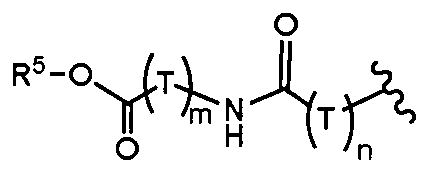
  • each T is independently selected from the group consisting of (CH 2 CH 2 0) X CH 2 CH 2 and CH 2 ; each x is independently an integer from 1 to 12; m is an integer from 1 to 11 , provided that when T is (CH 2 CH 2 0)xCH2CH 2 then m is 1 ; n is an integer from 1 to 11 , provided that when T is (CH 2 CH 2 0)xCH 2 CH 2 then n is 1 ; p is an integer from 1 to 5;
  • R 5 is H, ; and M is sodium or ammonium.
  • each T is CH 2 .
  • At least one T is CH 2 .
  • At least one T is (CH 2 CH 2 0)xCH 2 CH 2 .
  • each T is CH 2 and m is an integer from 3 to 10, e.g. an integer from 4 to 9, e.g. an integer from 5 to 8, e.g. an integer from 6 to 7. Most preferably m is 7.
  • each T is CH 2 and n is an integer from 3 to 10, e.g. an integer from 4 to 9, e.g. an integer from 5 to 8, e.g. an integer from 6 to 7. Most preferably n is 7.
  • At least one T is CH 2 and m is an integer from 3 to 10, e.g. an integer from 4 to 9, e.g. an integer from 5 to 8, e.g. an integer from 6 to 7. Most preferably m is 7.
  • at least one T is CH 2 and n is an integer from 3 to 10, e.g. an integer from 4 to 9, e.g. an integer from 5 to 8, e.g. an integer from 6 to 7.
  • Most n is 7.
  • at least one T is (CH2CH 2 0)xCH 2 CH 2 and x is an integer from 2 to 10, e.g. an integer from 2 to 9, e.g. an integer from 2 to 8, e.g. an integer from 2 to 7, e.g. an integer from 2 to 6, e.g. an integer from 2 to 5, e.g. an integer from 2 to 4.
  • Most x is 3.
  • Y is O.
  • it is preferred that Y is C.
  • R 3 is a radical of formula (iii) (iii)
  • R 3 is a radical of formula (iv) ( iv )
  • one T is (CH 2 CH 2 0)xCH 2 CH 2 and one T is CH 2 .
  • (T) m is (CH 2 CH20)xCH2CH 2 and (T) n is (CH 2 ) n .
  • (T) thread is (CH 2 CH20)xCH 2 CH2 and (T) m is (CH 2 ) m .
  • R 3 is a radical of formula (iv) wherein each T is (CH 2 CH 2 0)xCH 2 CH2, wherein each x in each radical of formula (iv) is independently selected.
  • R 1 and R 2 are both a radical of formula (i) (i)
  • R 1 and R 2 are both a radical of formula (ii)
  • one T is (CH 2 CH 2 0)xCH2CH 2 and one T is CH 2 and, in R 2 , one T is (CH 2 CH20) X CH 2 CH2 and one T is CH 2 .
  • (T) m is (CH 2 CH 2 0) X CH 2 CH 2 and (T) thread is (CH 2 ) n .
  • (T) n is (CH 2 CH20)xCH2CH2 and (T) m is (CH 2 ) m .
  • each T is (CH 2 CH 2 0) x CH 2 CH 2 , wherein each x in each radical of formula (ii) is independently selected.
  • R is H or Ci -6 alkyl, e.g. CH 3 or CH 2 CH 3 .
  • R 1 is NH 2 .
  • R is NHZ, more preferably where Z is C(0)(CH 2 ) w N(H)G, e.g. where G is Troc (2,2,2-trichloroethyloxycarbonyl), Fmoc (fluorenylmethyloxycarbonyl) or Cbz (benzyloxycarbonyl).
  • G is Troc (2,2,2-trichloroethyloxycarbonyl), Fmoc (fluorenylmethyloxycarbonyl) or Cbz (benzyloxycarbonyl).
  • w is 7.
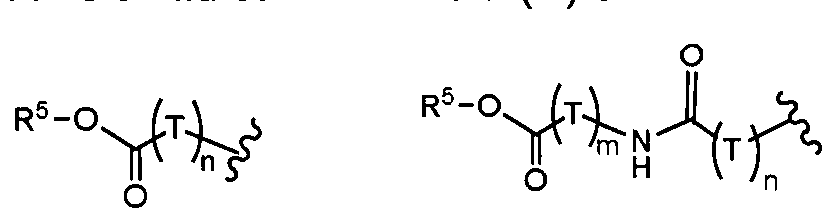
  • R 5 is selected from the group consisting of
  • R is H.
  • R is
  • Y is O; B is O; R 1 and R 2 are absent; and either A, E, D and X are all CH 2 or A, and X are all CH 2 and E is (CH 2 CH 2 0) t CH 2 ; and t is an integer from 1 to 10, preferably integer from 1 to 2.
  • Y is C; R 1 and R 2 are both H; A, E, B and D are CH 2 and X is O.
  • Y is C; A is (CH 2 ) U ; R 1 and R 2 are both H; B, X, D and E are all absent; and u is an integer from 1 to 10.
  • Y is C; X is O; A, E and D are all CH 2 ; B is (CH 2 ) P ;
  • R 1 is H, NHZ or d -6 alkyl
  • R 2 is a radical of formula (i) or a radical of formula (ii) (i)
  • Z is H, acyl, C(0)(CH 2 )wN(l-l)G, * CH 3 * CO- where * C denotes 13 C or 14 C, 5-TAMRA (4- carboxytetramethylrhodamine), Fluorescein (resorcinolphthalein), Alexa Fluor 350 (7-amino-4- methyl-6-sulfocoumarin-3-acetic acid), BODIPY (4,4-difluoro-4-bora-3a,4a-diaza-s-indacene) or Alkyne MegaStokes dye 608 (1- ⁇ 3- ⁇ [4-(2-cyclooctyn-1-ylmethyl)benzoyl]amino ⁇ propyl ⁇ -4- ⁇ 2-[4- (dimethylamino)phenyl]ethenyl ⁇ pyridinium hexafluorophosphate);
  • w is an integer from 1 to 1 1 ;
  • G is H, acyl, (t-butoxycarbonyl), Troc (2,2,2-trichloroethyloxycarbonyl), Fmoc (9- fluorenylmethoxycarbonyl), Cbz (carboxybenzyl), * * CH 3 * CO- where * C denotes 13 C or 14 C, 5- TAMRA (4-carboxytetramethylrhodamine), Fluorescein (resorcinolphthalein), Alexa Fluor 350 (7-amino-4-methyl-6-sulfocoumarin-3-acetic acid), BODIPY (4,4-difluoro-4-bora-3a,4a-diaza-s- indacene) or Alkyne MegaStokes dye 608 (1- ⁇ 3- ⁇ [4-(2-cyclooctyn-1- ylmethyl)benzoyl]amino ⁇ propyl ⁇ -4- ⁇ 2-[4-(dimethylamino)phenyl]ethenyl ⁇ pyr
  • R 2 is a radical of formula (ii) and R is H, NHZ or Ci -6 alkyl. It is further preferred that, in R 2 , one T is (CH 2 CH 2 0) X CH2CH 2 and one T is CH 2 . It is further preferred that, in R 2 , (T) m is (CH 2 CH 2 0) x CH 2 CH 2 and (T) choir is (CH 2 ) n . Alternatively it is preferred that, in R 2 , (T) n is (CH 2 CH 2 0) x CH 2 CH 2 and (T) m is (CH 2 ) m .
  • each T is (CH 2 CH 2 0) x CH 2 CH 2 , wherein each x in each radical of formula (ii) is independently selected.
  • Y is C;
  • X is O;
  • A, E and D are all CH 2 ;
  • B is (CH 2 ) P ;
  • R 1 and R 2 both the same, are a radical of formula (i) or a radical of formula (ii)
  • Y is C;
  • X is is (CH 2 ) P ;
  • R 1 and R 2 both the same, are a
  • R 3 is a radical of formula (iii)
  • Y is C; X is O; A, E and D are all CH 2 ; B is (CH 2 ) P ; R 1 and R 2 , both the
  • R 3 is a radical of formula (iv) ( iv ) ; and p is 1.
  • Y is C; R 1 and R 2 are both H; A, E, B and D are CH 2 ; X is O; and R 3 is a radical of
  • Y i and R 2 are both H; A, E, B and D are CH 2 ; X is O; and R 3 is a
  • Y is C; X is O; A, E and D are all CH 2 ; B is (CH 2 ) P ; R 1 is H; R 2 is a radical of formula (i) ; R 3 is a radical of formula (iii)
  • B is (CH 2 ) P ;
  • R 1 is H;
  • R 2 is a radical
  • R 3 is a radical of formula (iv)
  • Y is C; X is O; A, E and D are all CH 2 ; B is (CH 2 ) P ; R 1 is H; R 2 is a radical
  • R 3 is a radical of formula (iii)
  • pref D are all CH 2 ; B is (CH 2 ) P ; R is H; R 2 is a radical
  • Y is C;
  • A is (CH 2 ) U ;
  • R 1 and R 2 are both H;
  • B, X, D and E are all absent;
  • u is an integer
  • R 3 is a radical of formula (iii) (iii) Alternatively preferably Y is C; A is (CH 2 ) U ; R 1 and R 2 are both H; B, X, D and E are all absent; u
  • Y is O; B is O; R 1 and R 2 are absent; and either A, E, D and X are all CH 2 or A, D and X are all CH 2 and E is (CH 2 CH 2 0) t CH 2 ; t is an integer from 1 to 10, preferably an integer
  • R 3 is a radical of formula (iii)
  • Y is O; B is O; R 1 and R 2 are absent; and either A, E, D and X are all CH 2 or A, D and X are all CH 2 and E is (CH 2 CH 2 0) t CH 2 ; t is an integer from 1 to 2; and R 3 is a
  • p is 1 .
  • t is an integer from 1 to 2.
  • M is sodium.
  • the compound of formula (I) is selected from the group consisting of:
  • the invention provides a compound selected from the group consisting of:
  • the invention provides the use of a compound of formula (I) as defined above for preparing a dendritic compound.
  • the invention provides a method of preparing a dendritic compound, including the step of contacting a compound of formula (I) with a glycoside compound that contains a free amino group.
  • any of the sub-scopes disclosed herein e.g. with respect to A, B, D, E, G, X, R 1 , R 2 , R 3 , R 4 , R 5 , n, m, p t, u, w, x, T, Y and Z may be combined with any of the other sub-scopes disclosed herein to produce further sub-scopes.
  • CrC 6 alkyl means any saturated hydrocarbon radical having up to 6 carbon atoms and is intended to include both straight- and branched-chain alkyl groups.
  • alkyl groups include: methyl group, ethyl group, n-propyl group, / ' so-propyl group, n-butyl group, iso- butyl group, sec-butyl group, f-butyl group, n-pentyl group, 1 ,1-dimethylpropyl group, 1 ,2- dimethylpropyl group, 2,2-dimethylpropyl group, 1-ethylpropyl group, 2-ethylpropyl group, n- hexyl group and 1-methyl-2-ethylpropyl group.
  • the compounds of the invention are simple, easy to use "star burst PET-PEG" dendritic cores. They are useful for the preparation of dendrimers, thereby providing a facile route to well- defined cluster molecules, e.g. pharmaceutical cluster molecules, as single compounds.
  • the compounds of the invention are two-, three- or four-directional short-armed and long-armed dendritic cores. Some compounds of the invention are "pre-activated” (e.g. those where R 5 is a succinimidyl group) so that they can be used, without coupling reagents, for synthesising dendritic compounds.
  • the dendritic core "arms” can be elongated in a controlled manner with suitable linkers, such as 6-8-carbon linkers or PEG linkers (one or two generations), making the "arms” shorter or longer as desired.
  • the linkers are flexible and the tetrahedral model of the core is stable.
  • Compounds of the invention that are succinimidyl esters are, advantageously, crystalline compounds. They are therefore stable and can be easily stored.
  • the compounds of the invention can be purified by flash chromatography. Because of their simplicity of design, the compounds provide a novel approach to reaching larger sized dendrimers, but employing fewer "arms” (2-4 "arms” instead of 32-64), thus simplifying the dendrimer product.
  • Dendritic cores with long carbon or PEG chains can be considered to be mimics of carbohydrate chains, but they avoid the costs and synthetic challenges associated with preparing linear oligosaccharides.
  • the invention relates to:
  • Y is O
  • R 1 and R 2 are absent;
  • A, E, D and X are all CH 2 ; or A, D and X are all CH 2 and E is (CH 2 CH 2 0)t # CH2 wherein * indicates a point of attachment of E to its adjacent carbonyl group;
  • t is an integer from 1 to 10; or wherein:
  • Y is C
  • R 1 and R 2 are both H;
  • A, E, B and D are CH 2 and X is O; or wherein:
  • Y is C
  • R 1 and R 2 are both H
  • u is an integer from 1 to 10; or wherein:
  • Y is C
  • X is O
  • B is (CH 2 ) P ;
  • A, E and D are all CH 2 ;
  • R 1 is H, NHZ or Ci -6 alkyl and R 2 is a radical of formula (i) or a radical of formula (ii)
  • Z is H, acyl, C(0)(CH 2 ) w N(H)G ) * CH 3 * C(0)- where * C denotes 13 C or 14 C, 4- carboxytetramethylrhodamine, resorcinolphthalein, 7-amino-4-methyl-6-sulfocoumarin-3- acetic acid, 4,4-difluoro-4-bora-3a,4a-diaza-s-indacene or 1- ⁇ 3- ⁇ [4-(2-cyclooctyn-1- ylmethyl)benzoyl]amino ⁇ propyl ⁇ -4- ⁇ 2-[4-(dimethylamino)phenyl]ethenyl ⁇ pyridinium hexafluorophosphate; w is an integer from 1 to 11 ;
  • G is H, acyl, t-butoxycarbonyl, 2,2,2-trichloroethyloxycarbonyl, 9- fluorenylmethoxycarbonyl, benzyloxycarbonyl, * CH 3 * CO- where * C denotes 13 C or 1 C, 4- carboxytetramethylrhodamine, resorcinolphthalein, 7-amino-4-methyl-6-sulfocoumarin-3- acetic acid, 4,4-difluoro-4-bora-3a,4a-diaza-s-indacene or 1- ⁇ 3- ⁇ [4-(2-cyclooctyn-1- ylmethyl)benzoyl]amino ⁇ propyl ⁇ -4- ⁇ 2-[4-(dimethylamino)phenyl]ethenyl ⁇ pyridinium hexafluorophosphate; or wherein:
  • Y is C
  • X is O
  • B is (CH 2 ) P ;
  • A, E and D are all CH 2 ;
  • R 1 and R 2 are a radical of formula (i) or a radical of formula (ii)
  • R 3 is a radical of formula (iii) or a radical of formula (iv)
  • each T is independently selected from the group consisting of (CH 2 CH 2 0) X CH 2 CH 2 and CH 2 ; each x is independently an integer from 1 to 12; m is an integer from 1 to 11 , provided that when T is (CH 2 CH20) X CH 2 CH 2 then m is 1 ; n is an integer from 1 to 11 , provided that when T is (CH 2 CH 2 0)xCH 2 CH 2 then n is 1 ; p is an integer from 1 to 5;
  • M is sodium or ammonium.
  • each T is CH 2 .
  • at least one T is 4.
  • m is an integer from 5 to 8. 5.
  • n is an integer from 5 to
  • R 1 is H, NHZ or C 1-6 alkyl
  • R 2 is a radical of formula i) or a radical of formula (ii)
  • Z is H, acyl, C(OXCH 2 )wNH(G), *CH 3 *CO- where *C denotes 13 C or 14 C, 4- carboxytetramethylrhodamine, resorcinolphthalein, 7-amino-4-methyl-6- sulfocoumarin-3-acetic acid, 4,4-difluoro-4-bora-3a,4a-diaza-s-indacene or 1- ⁇ 3- ⁇ [4-(2-cyclooctyn-1-ylmethyl)benzoyl]amino ⁇ propyl ⁇ -4- ⁇ 2-[4- (dimethylamino)phenyl]ethenyl ⁇ pyridinium hexafluorophosphate;
  • w is an integer from 1 to 1 1 ;
  • G is H, acyl, t-butoxycarbonyl, 2,2,2-trichloroethyloxycarbonyl, 9- fluorenylmethoxycarbonyl, benzyloxycarbonyl, *CH 3 *CO- where *C denotes 13 C or 14 C, 4-carboxytetramethylrhodamine, resorcinolphthalein, 7-amino-4-methyl-6- sulfocoumarin-3-acetic acid, 4,4-difluoro-4-bora-3a,4a-diaza-s-indacene or 1- ⁇ 3- ⁇ [4-(2-cyclooctyn-1-ylmethyl)benzoyl]amino ⁇ propyl ⁇ -4- ⁇ 2-[4- (dimethylamino)phenyl]ethenyl ⁇ pyridinium hexafluorophosphate.
  • R 3 is a radical of formula (iii)
  • Y is C; X is O; A, E and D are all CH 2 ; B is (CH 2 ) P ; R 1 and R 2 , both the same, are a radical of formul
  • Y is C; R 1 and R 2 are both H; A, E, B and D are CH 2 ; X is O; and R 3 is a radical of formula (iii)
  • Y is C; R 1 and R 2 are both H; A, E, B and D are CH 2 ; X is O; and R 3 is a radical of formula (iv)
  • R 3 is a radical of formula (iii)
  • R 3 is a radical of formula (iv) and p is 1.
  • Y is C; X (CH 2 ) P ; R 1 is H; R 2 is a radical of formula (ii)
  • R 3 is a radical of formula (Hi)
  • R 3 is a radical of formula (iv) and p is 1.
  • Y is C; A is (CH 2 ) U ; R 1 and R 2 are both H; B, X, D and E are all absent; u is an integer from 1 to 10; a 3 is a radical of formula (iii)
  • Y is C; A is (CH 2 ) U ; R 1 and R 2 are both H; B, X, D and E are all absent; u is an integer from 1 to 10; a 3 is a radical of formula (iv)
  • Y is O; B is O; R 1 and R 2 are absent; and either A, E, D and X are all CH 2 or A, D and X are all CH 2 and E is (CH 2 CH 2 0)tCH2; t is an integer from 1 to 2; and R 3 is a radical of formula (iii)
  • Y is O; B is O; R 1 and R 2 are absent; and either A, E, D and X are all CH 2 or A, D and X are all CH 2 and E is (CH 2 CH 2 0) t CH 2 ; t is an integer from 1 to 2; and R 3 is a radical of formula (iv
  • the compounds of the invention may be prepared by a variety of different methods. The following are representative non-limiting general methods for synthesising compounds of the invention.
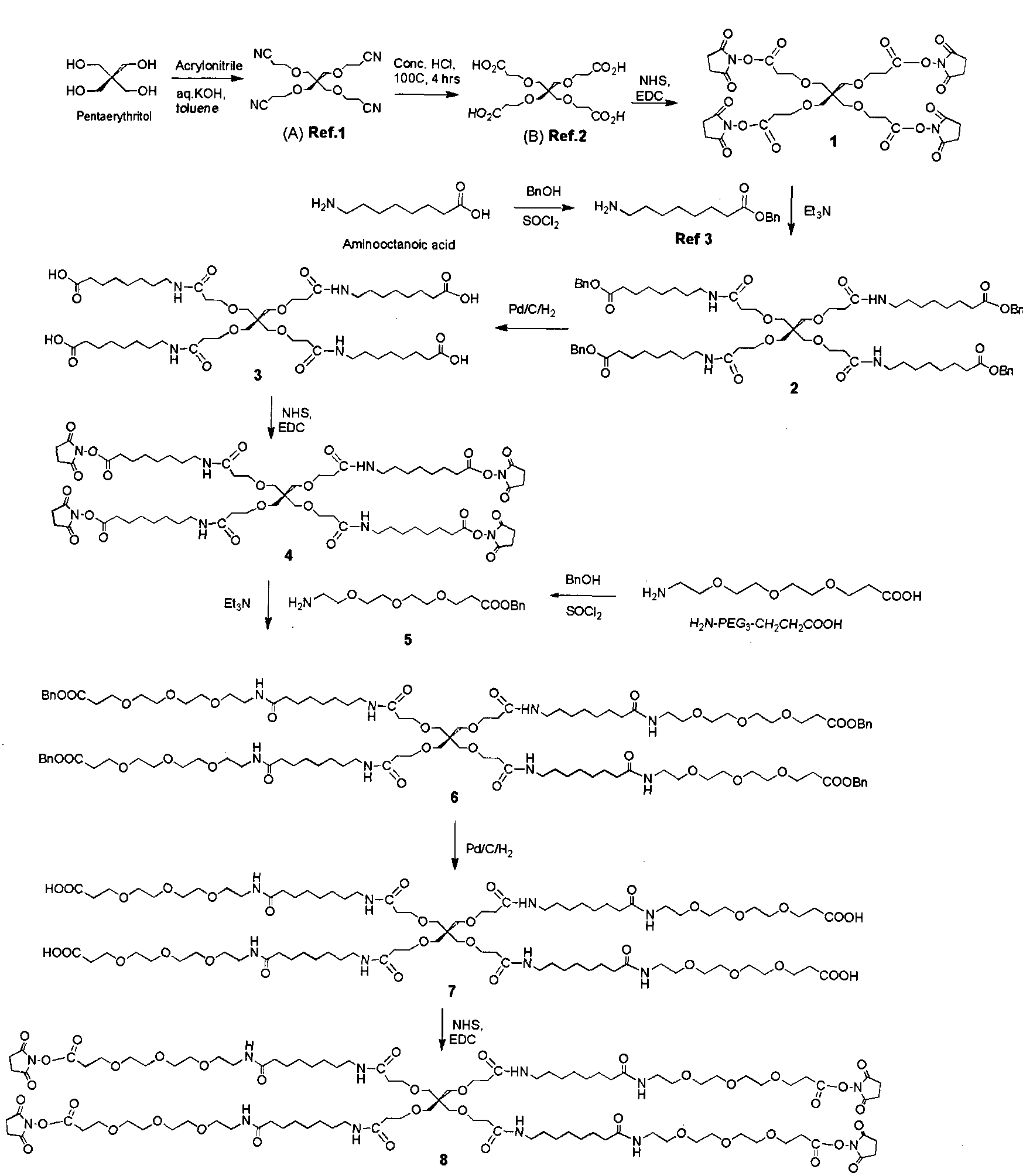
  • Tetrameric dendritic core compounds of the invention (where R 1 and R 2 are both a radical of formula (i) or a radical of formula (ii)) are prepared from compound 1 , which is synthesised in three steps from pentaerythritol (Scheme 1 ).
  • Compound 1 is then converted to compounds of formula (I) via reaction with a suitable amino- substituted carboxylic acid, such as 3-aminopropanoic acid, 4-aminobutanoic acid, 5- aminopentanoic acid, 6-aminohexanoic acid, 7-aminoheptanoic acid, 8-aminooctanoic acid, 9- aminononanoic acid, 10-aminodecanoic acid, 11 -aminoundecanoic acid or 12-aminododecanoic acid (Scheme 2).
  • a suitable amino- substituted carboxylic acid such as 3-aminopropanoic acid, 4-aminobutanoic acid, 5- aminopentanoic acid, 6-aminohexanoic acid, 7-aminoheptanoic acid, 8-aminooctanoic acid, 9- aminononanoic acid, 10-aminodecanoic acid, 11 -aminoundecan
  • "Dimeric" dendritic core compounds of the invention where Y is C and R 1 and R 2 are both H are prepared from 3,3'-(propane-1 ,3-diylbis(oxy)dipropanoic acid, using a suitable amino- substituted carboxylic acid, such as 3-aminopropanoic acid, 4-aminobutanoic acid, 5- aminopentanoic acid, 6-aminohexanoic acid, 7-aminoheptanoic acid, 8-aminooctanoic acid, 9- aminononanoic acid, 10-aminodecanoic acid, 11-aminoundecanoic acid or 12-aminododecanoic acid (Scheme 3).
  • Scheme 3 Scheme 3
  • n is an integer from 1 to 11
  • n 1 to 11
  • n 1 to 11
  • “Dimeric” dendritic core compounds of the invention where Y is O and E is (CH2CH 2 0) t CH2 are prepared as shown in Scheme 5.
  • Suitable starting materials include, for example, 3,6,9- trioxaundecanedioic acid, 3,6,9,12-tetraoxatetradecanedioic acid or 3,6,9,12,15- pentaoxaheptadecanedioic acid.
  • Trimeric dendritic core compounds of the invention where Y is C and R 1 is NHZ are prepared from 2-amino-2-hydroxymethyl-propane-1 ,3-diol, as shown in Scheme 6.
  • R 1 is NH 2
  • trimeric dendritic core compounds where R 1 is NH 2 can be used to further elaborate the substitution at the R 1 position.
  • such compounds can be linked to radio- or fluorescent labels or the amino functionality can be converted to other functional groups.
  • Trimeric dendritic core compounds of the invention where Y is C and R 1 is H, CH 3 or CH 2 CH 3 are prepared from 2-hydroxymethyl-propane-1 ,3-diol, 1 ,1 ,1-tris(hydroxymethyl)ethane or 1 ,1 ,1- tris(hydroxymethyl)propane, respectively (Scheme 7).
  • T (CH 2 CH 2 0) x -CH 2 CH 2 or (C H 2 )
  • n is an integer from 1 to 11
  • n 1 to 11
  • the compounds of the invention are useful for the preparation of dendritic compounds.
  • the compounds of the invention allow for facile synthesis of dendrimers.
  • the coupling procedure is simple and requires a suitable solvent (DMF, DMSO, water, for example), a small amount of base, e.g. triethylamine, and any glycoside with a free amino group (at least about 2 equivalents of glycoside, e.g. about 2.2 equivalents of glycoside are used for coupling with dimeric compounds of the invention, at least about 3 equivalents of glycoside, e.g. about 3.3 equivalents of glycoside are used for coupling with trimeric compounds of the invention and at least about 4 equivalents of glycoside e.g. about 4.4 equivalents of glycoside are used for coupling with tetrameric compounds of the invention).
  • a suitable solvent e.g. triethylamine
  • any glycoside with a free amino group at least about 2 equivalents of glycoside, e.g. about 2.2 equivalents of glycoside are
  • Tetranitrile precursor (Ref.1 , Hukkamaki, J.; Pakkanen, T.T. Journal of Molecular Catalysis A: Chemical 2001 , 174, 205-211 ) is prepared via Michael-type addition of acrylonitrile to pentaerythritol.
  • Acidic hydrolysis of tetranitrile (Ref. 2, Newcombe, G. R.; Mishra, A; Moorfield, C. N. J. Org. Chem. 2002, 67, 3957-3960) furnishes the tetraacid. Tetraacid (1.0 g, 2.35 mmol) is dissolved in dry DMF (15 mL).
  • N-Hydroxysuccinimide (1 .62 g, 14.14 mmol) and 1 -ethyl-3-[3- dimethylaminopropyl]carbodiimide hydrochloride (EDC, 2.71 g, 14.14 mmol) are added to the reaction mixture at room temperature and stirring continued for 24 hrs.
  • the mixture is diluted with DCM and washed with water, then with diluted HCI and water, dried over magnesium sulfate and concentrated.
  • Aminooctanoic acid is treated with benzyl alcohol in the presence of thionyl chloride (Ref. 3, Patel, R. P; Price, S. J. Org Chem. 1965, 30 (10), 3575-3576) to give a tetra benzyl ester (2 g, 8.12 mmol).
  • This and tetra-succinimidyl ester (1, 1.1 g, 1.35 mmol) are dissolved in a mixture of dry THF (55 mL) and dry DMF (3 mL) and treated with triethylamine (1.5 mL, 10.83 mmol).
  • Tetra benzyl ester (2, 0.595 g, 441 ⁇ ) is dissolved in dry THF (16 mL). Water (4 mL) and glacial acetic acid (5 drops) are added. The reaction mixture is treated with palladium hydroxide on carbon (20% Pd, 1 g) and stirred for 3 hours under hydrogen at ambient temperature and pressure. The catalyst is filtered off and washed with 50% aqueous EtOH. The solution is concentrated to dryness to give a "long-armed" tetraacid (3, 0.42 g, 429 pmol, 97%). The product is used in the next step without further purification.
  • the benzyl ester 5 (65 mg, 210 ⁇ ) and tetra-succinimidyl ester (4, 58 mg, 42.1 ⁇ ) are dissolved in dry DMF (2 mL) and treated with triethylamine (47 pL, 336 pmol). After stirring for 24 hrs the mixture is diluted with ethyl acetate and washed with water twice, dried over magnesium sulfate and concentrated. The residue is dissolved in hot EtOAc, the crystals are filtered off and discharged.
  • Dodecanedioic acid (1.0 g, 4.34 mmol) is dissolved in dry DMF (10 mL).
  • N-Hydroxysuccinimide (1.51 g, 13.0 mmol, 3 eq.)
  • 1-ethyl-3-[3-dimethylaminopropyl]carbodiimide hydrochloride EDC, 2.55 g, 13.0 mmol, 3 eq.
  • /V,/V-diisopropylethylamine (1.53 mL, 8.68 mmol
  • Di-succinimidyl ester (9, 500 mg, 1 .18 mmol) and an amino benzyl ester (881 mg, 3.53 mmol, 3 eq.) are dissolved in dry DMF (8 ml.) and treated with triethylamine (0.66 ml_, 4.71 mmol, 4 eq.). After stirring for 24 hrs the mixture is concentrated. The residue is dissolved in hot MeOH, a few drop of chloroform added, the crystals are filtered off and dried to afford the di-benzyl ester (10, 0.75 g, 1 .1 mmol, 92%).
  • 3,6,9-Trioxaundecanedioic acid 500 mg, 2.25 mmol is dissolved in dry DMF (10 ml_).
  • N- Hydroxysuccinimide (785 mg, 6.75 mmol, 3 eq.)
  • 1 -ethyl-3-[3-dimethylaminopropyl]carbodiimide hydrochloride EDC, 1 .32 g, 6.75 mmol, 3 eq.
  • A/,/V-diisopropylethylamine (2.38 ml_, 13.5 mmol) followed by benzyl 8-aminooctanate (1.68 g, 6.75 mmol, 3 eq.) are added to the reaction mixture at room temperature and stirring continued for 4 hrs.
  • the invention relates to compounds that are useful for the preparation of dendrimer compounds, the use of these compounds for preparing dendrimers and processes for preparing the compounds.

Landscapes

  • Chemical & Material Sciences (AREA)
  • Organic Chemistry (AREA)
  • Pharmaceuticals Containing Other Organic And Inorganic Compounds (AREA)
  • Organic Low-Molecular-Weight Compounds And Preparation Thereof (AREA)
  • Pyrrole Compounds (AREA)

Abstract

The invention relates to compounds that are useful for the preparation of dendrimer compounds, the use of these compounds for preparing dendrimers and processes for preparing the compounds.

Description

DENDRITIC CORE COMPOUNDS
TECHNICAL FIELD This invention relates generally to compounds that are intermediates for the preparation of dendrimer compounds, the use of these compounds for preparing dendrimers and processes for preparing the compounds.
BACKGROUND
Interest in dendritic compounds has grown in recent times, and dendrimers have found application in a wide range of areas, such as pharmaceuticals, drug delivery, gene delivery, sensor technologies (cation photodetection and fluorescence signal quenching), in the synthesis of monodisperse metallic nanoparticles, in environmental remediation, as blood substitutes usually in the oxygen-carrying sense (oxygen therapeutics) and plasma substitutes (volume expenders).
Dendritic structures tend to be complex. However, for some applications, such as pharmaceuticals, it is desirable to employ compounds that are discrete, well-characterised, single entities. This can be an issue in the dendrimer space, so it is desirable to use intermediates and processes which produce such single entities. There is therefore a need for simple dendritic cores that can be used to prepare dendritic compounds for use in certain applications. Newkome et al. (Macromolecules, 1993, 26, 2394-2396) have described the synthesis of a dodecaacid dendritic core, starting from the tetraacid compound (structure shown in Scheme 1 , below) and coupling this with a branched amine. This produced a compound with twelve terminal acids (attachment points), which was further elaborated (through five generations) to produce dendrimers having up to 972 terminal acids.
Newkome et al. {J. Org. Chem. 2002, 67, 3957-3960) have also reported the synthesis of a tetraamine (amine terminated) dendritic core, starting from the tetraacid compound. The tetraamine core was further elaborated by reaction with excess acrylonitrile to generate an octanitrile as an oily product.
Hukkamaki et al. (Hukkamaki, J.; Pakkanen, T.T. Journal of Molecular Catalysis A: Chemical 2001 , 174, 205-21.) have also described the synthesis of the same amine terminated dendritic core. The tetraamine core was further elaborated by reaction with acrylonitrile to produce a (two generation) dendrimer having eight terminal amine groups.
For the synthesis of simple, well-defined dendritic molecules as single compounds, it would be desirable to employ a simple, stable dendritic core as an intermediate which could provide a route to the synthesis of, for example, dendrimers having pharmaceutical uses.
It is therefore an object of the present invention to provide intermediate compounds for the preparation of dendritic compounds, or to at least provide a useful choice.
SUMMARY OF INVENTION
In a first aspect, the invention provides a compound of formula (I)
Figure imgf000003_0001
wherein:
Y is O;
B is O;
R1 and R2 are absent; and
either A, E, D and X are all CH2; or A, D and X are all CH2 and E is (CH2CH20)t CH2 wherein indicates a point of attachment of E to its adjacent carbonyl group;
t is an integer from 1 to 10; or wherein:
Y is C;
R1 and R2 are both H; and
A, E, B and D are CH2 and X is O; or wherein:
Y is C;
Figure imgf000003_0002
R and R2 are both H;
B, X, D and E are all absent; and u is an integer from 1 to 10; or wherein:
Y is C;
X is O;
B is (CH2)P;
A, E and D are all CH2; and
R is H, NHZ or Ci-6alkyl and R2 is a radical of formula (i) or a radical of formula (ii)
Figure imgf000004_0001
Z is H, acyl, C(0)(CH2)wN(H)G, *CH3 *C(0)- where *C denotes 3C or 14C, 5-TAMRA (4- carboxytetramethylrhodamine), Fluorescein (resorcinolphthalein), Alexa Fluor 350 (7-amino-4- methyl-6-sulfocoumarin-3-acetic acid), BODIPY (4,4-difluoro-4-bora-3a,4a-diaza-s-indacene) or Alkyne MegaStokes dye 608 (1-{3-{[4-(2-cyclooctyn-1-ylmethyl)benzoyl]amino}propyl}-4-{2-[4- (dimethylamino)phenyl]ethenyl}pyridinium hexafluorophosphate);
w is an integer from 1 to 11 ;
G is H, acyl, Boc (t-butoxycarbonyl), Troc (2,2,2-trichloroethyloxycarbonyl), Fmoc (9- fluorenylmethoxycarbonyl), Cbz (benzyloxycarbonyl),*CH3 *CO- where *C denotes 13C or 14C, 5- TAMRA (4-carboxytetramethylrhodamine), Fluorescein (resorcinolphthalein), Alexa Fluor 350 (7-amino-4-methyl-6-sulfocoumarin-3-acetic acid), BODIPY (4,4-difluoro-4-bora-3a,4a-diaza-s- indacene) or Alkyne MegaStokes dye 608 (1-{3-{[4-(2-cyclooctyn-1- ylmethyl)benzoyl]amino}propyl}-4-{2-[4-(dimethylamino)phenyl]ethenyl}pyridinium
hexafluorophosphate); or wherein:
Y is C;
X is O;
B is (CH2)P;
A, E and D are all CH2; and
R and R2, both the same, are a radical of formula (i) or a radical of formula (ii)
Figure imgf000004_0002
R3 is a radical of formula (iii) or a radical of formula (iv)
Figure imgf000005_0001
(iii) (iv) each T is independently selected from the group consisting of (CH2CH20)XCH2CH2 and CH2; each x is independently an integer from 1 to 12; m is an integer from 1 to 11 , provided that when T is (CH2CH20)xCH2CH2 then m is 1 ; n is an integer from 1 to 11 , provided that when T is (CH2CH20)xCH2CH2 then n is 1 ; p is an integer from 1 to 5;
R5 is H,
Figure imgf000005_0002
; and M is sodium or ammonium.
Preferably each T is CH2.
Alternatively preferably at least one T is CH2.
Alternatively preferably at least one T is (CH2CH20)xCH2CH2.
More preferably each T is CH2 and m is an integer from 3 to 10, e.g. an integer from 4 to 9, e.g. an integer from 5 to 8, e.g. an integer from 6 to 7. Most preferably m is 7. Preferably each T is CH2 and n is an integer from 3 to 10, e.g. an integer from 4 to 9, e.g. an integer from 5 to 8, e.g. an integer from 6 to 7. Most preferably n is 7.
Alternatively preferably at least one T is CH2 and m is an integer from 3 to 10, e.g. an integer from 4 to 9, e.g. an integer from 5 to 8, e.g. an integer from 6 to 7. Most preferably m is 7. Preferably at least one T is CH2 and n is an integer from 3 to 10, e.g. an integer from 4 to 9, e.g. an integer from 5 to 8, e.g. an integer from 6 to 7. Most preferably n is 7. Alternatively preferably at least one T is (CH2CH20)xCH2CH2 and x is an integer from 2 to 10, e.g. an integer from 2 to 9, e.g. an integer from 2 to 8, e.g. an integer from 2 to 7, e.g. an integer from 2 to 6, e.g. an integer from 2 to 5, e.g. an integer from 2 to 4. Most preferably x is 3. Preferably Y is O. Alternatively, it is preferred that Y is C.
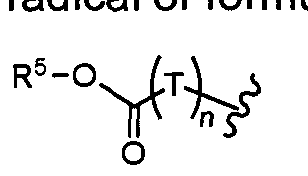
R5-0 '.V o TV
Preferably R3 is a radical of formula (iii) (iii)
Figure imgf000006_0001
Alternatively it is preferred that R3 is a radical of formula (iv) (iv)
It is further preferred that, in R3, one T is (CH2CH20)xCH2CH2 and one T is CH2.
It is further preferred that, in R3, (T)m is (CH2CH20)xCH2CH2 and (T)n is (CH2)n. Alternatively it is preferred that, in R3, (T)„ is (CH2CH20)xCH2CH2 and (T)m is (CH2)m.
Alternatively preferably R3 is a radical of formula (iv) wherein each T is (CH2CH20)xCH2CH2, wherein each x in each radical of formula (iv) is independently selected.
Figure imgf000006_0002
Preferably R1 and R2 are both a radical of formula (i) (i)
Alternatively it is preferred that R1 and R2 are both a radical of formula (ii)
Figure imgf000006_0003
It is further preferred that, in R1, one T is (CH2CH20)xCH2CH2 and one T is CH2 and, in R2, one T is (CH2CH20)XCH2CH2 and one T is CH2. It is further preferred that, in both R1 and R2, (T)m is (CH2CH20)XCH2CH2 and (T)„ is (CH2)n. Alternatively it is preferred that, in both R1 and R2, (T)n is (CH2CH20)xCH2CH2 and (T)m is (CH2)m. Alternatively it is preferred that, in both R1 and R2, each T is (CH2CH20)xCH2CH2, wherein each x in each radical of formula (ii) is independently selected.
Alternatively it is preferred that R is H or Ci-6alkyl, e.g. CH3 or CH2CH3. Alternatively it is preferred that R1 is NH2. Alternatively it is preferred that R is NHZ, more preferably where Z is C(0)(CH2)wN(H)G, e.g. where G is Troc (2,2,2-trichloroethyloxycarbonyl), Fmoc (fluorenylmethyloxycarbonyl) or Cbz (benzyloxycarbonyl). Preferably w is 7.
Preferably R5 is selected from the group consisting of
Figure imgf000007_0001
Alternatively preferably R is H. Alternatively preferably R is
Figure imgf000007_0002
Preferably Y is O; B is O; R1 and R2 are absent; and either A, E, D and X are all CH2 or A, and X are all CH2 and E is (CH2CH20)tCH2; and t is an integer from 1 to 10, preferably integer from 1 to 2.
Alternatively it is preferred that Y is C; R1 and R2 are both H; A, E, B and D are CH2 and X is O.
Alternatively it is preferred that Y is C; A is (CH2)U; R1 and R2 are both H; B, X, D and E are all absent; and u is an integer from 1 to 10.
Alternatively it is preferred that:
Y is C; X is O; A, E and D are all CH2; B is (CH2)P;
R1 is H, NHZ or d-6alkyl;
Figure imgf000008_0001
R2 is a radical of formula (i) or a radical of formula (ii) (i)
Figure imgf000008_0002
Z is H, acyl, C(0)(CH2)wN(l-l)G, *CH3 *CO- where *C denotes 13C or 14C, 5-TAMRA (4- carboxytetramethylrhodamine), Fluorescein (resorcinolphthalein), Alexa Fluor 350 (7-amino-4- methyl-6-sulfocoumarin-3-acetic acid), BODIPY (4,4-difluoro-4-bora-3a,4a-diaza-s-indacene) or Alkyne MegaStokes dye 608 (1-{3-{[4-(2-cyclooctyn-1-ylmethyl)benzoyl]amino}propyl}-4-{2-[4- (dimethylamino)phenyl]ethenyl}pyridinium hexafluorophosphate);
w is an integer from 1 to 1 1 ;
G is H, acyl, (t-butoxycarbonyl), Troc (2,2,2-trichloroethyloxycarbonyl), Fmoc (9- fluorenylmethoxycarbonyl), Cbz (carboxybenzyl),* *CH3 *CO- where *C denotes 13C or 14C, 5- TAMRA (4-carboxytetramethylrhodamine), Fluorescein (resorcinolphthalein), Alexa Fluor 350 (7-amino-4-methyl-6-sulfocoumarin-3-acetic acid), BODIPY (4,4-difluoro-4-bora-3a,4a-diaza-s- indacene) or Alkyne MegaStokes dye 608 (1-{3-{[4-(2-cyclooctyn-1- ylmethyl)benzoyl]amino}propyl}-4-{2-[4-(dimethylamino)phenyl]ethenyl}pyridinium
hexafluorophosphate).
Figure imgf000008_0003
Preferably R2 is a radical of formula (ii) and R is H, NHZ or Ci-6alkyl. It is further preferred that, in R2, one T is (CH2CH20)XCH2CH2 and one T is CH2. It is further preferred that, in R2, (T)m is (CH2CH20)xCH2CH2 and (T)„ is (CH2)n. Alternatively it is preferred that, in R2, (T)n is (CH2CH20)xCH2CH2 and (T)m is (CH2)m. Alternatively it is preferred that, in R2, each T is (CH2CH20)xCH2CH2, wherein each x in each radical of formula (ii) is independently selected. Alternatively it is preferred that Y is C; X is O; A, E and D are all CH2; B is (CH2)P; R1 and R2, both the same, are a radical of formula (i) or a radical of formula (ii)
Figure imgf000009_0001
(i) (ii)
Preferably, Y is C; X is is (CH2)P; R1 and R2, both the same, are a
Figure imgf000009_0002
radical of formula (i) ; R3 is a radical of formula (iii)
Figure imgf000009_0003
; and p is 1.
Alternatively preferably Y is C; X is O; A, E and D are all CH2; B is (CH2)P; R1 and R2, both the
Figure imgf000009_0004
same, are a radical of formula (ii) (") ; R3 is a radical of
Figure imgf000009_0005
formula (iv) (iv) ; and p is 1. Preferably Y is C; R1 and R2 are both H; A, E, B and D are CH2; X is O; and R3 is a radical of
RS"W o
formula (iii) ('»>
Alternatively preferably Y i and R2 are both H; A, E, B and D are CH2; X is O; and R3 is a
radical of formula (iv)
Figure imgf000009_0006
Preferably Y is C; X is O; A, E and D are all CH2; B is (CH2)P; R1 is H; R2 is a radical of formula (i) ; R3 is a radical of formula (iii)
Figure imgf000010_0001
('") ; and p is 1.
Alternatively pref all CH2; B is (CH2)P; R1 is H; R2 is a radical
Figure imgf000010_0002
of formula (ii) (ii) R3 is a radical of formula (iv)
Figure imgf000010_0003
(iv) ; and p is 1.
Alternatively preferably Y is C; X is O; A, E and D are all CH2; B is (CH2)P; R1 is H; R2 is a radical
Figure imgf000010_0004
of formula (ii) ; R3 is a radical of formula (iii)
and p is 1.
Alternatively pref D are all CH2; B is (CH2)P; R is H; R2 is a radical
Figure imgf000010_0005
of formula (i) (i) and R3 is a radical of formula
Figure imgf000010_0006
(iv) ; and p is 1.
Preferably Y is C; A is (CH2)U; R1 and R2 are both H; B, X, D and E are all absent; u is an integer
Figure imgf000010_0007
from 1 to 10; and R3 is a radical of formula (iii) (iii) Alternatively preferably Y is C; A is (CH2)U; R1 and R2 are both H; B, X, D and E are all absent; u
Figure imgf000011_0001
is an integer from 1 to 10; and R3 is a radical of formula (iv) (iv) Preferably Y is O; B is O; R1 and R2 are absent; and either A, E, D and X are all CH2 or A, D and X are all CH2 and E is (CH2CH20)tCH2; t is an integer from 1 to 10, preferably an integer
Figure imgf000011_0002
from 1 to 2; and R3 is a radical of formula (iii)
Alternatively preferably Y is O; B is O; R1 and R2 are absent; and either A, E, D and X are all CH2 or A, D and X are all CH2 and E is (CH2CH20)tCH2; t is an integer from 1 to 2; and R3 is a
Figure imgf000011_0003
radical of formula (iv) (IV) Preferably p is 1 . Preferably t is an integer from 1 to 2. Preferably M is sodium.
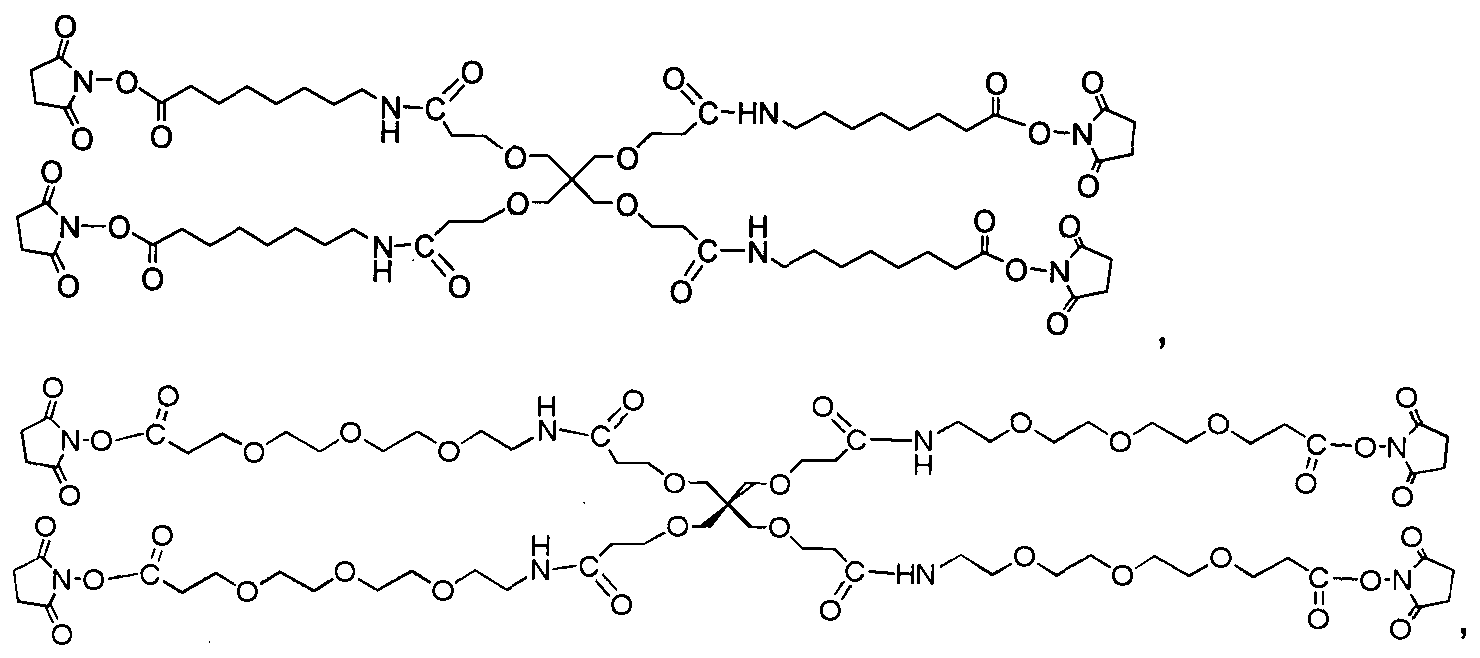
Preferably the compound of formula (I) is selected from the group consisting of:
Figure imgf000011_0004
Figure imgf000012_0001
11
Figure imgf000013_0001

5
Figure imgf000014_0001
Figure imgf000015_0001
Figure imgf000015_0002
Figure imgf000016_0001

Figure imgf000017_0001
Figure imgf000018_0001

Figure imgf000019_0001
In another aspect, the invention provides a compound selected from the group consisting of:
Figure imgf000019_0002
In another aspect, the invention provides the use of a compound of formula (I) as defined above for preparing a dendritic compound.
In still another aspect, the invention provides a method of preparing a dendritic compound, including the step of contacting a compound of formula (I) with a glycoside compound that contains a free amino group.
It will be appreciated that any of the sub-scopes disclosed herein, e.g. with respect to A, B, D, E, G, X, R1, R2, R3, R4, R5, n, m, p t, u, w, x, T, Y and Z may be combined with any of the other sub-scopes disclosed herein to produce further sub-scopes. DETAILED DESCRIPTION
Definitions The term "CrC6alkyl" means any saturated hydrocarbon radical having up to 6 carbon atoms and is intended to include both straight- and branched-chain alkyl groups. Examples of alkyl groups include: methyl group, ethyl group, n-propyl group, /'so-propyl group, n-butyl group, iso- butyl group, sec-butyl group, f-butyl group, n-pentyl group, 1 ,1-dimethylpropyl group, 1 ,2- dimethylpropyl group, 2,2-dimethylpropyl group, 1-ethylpropyl group, 2-ethylpropyl group, n- hexyl group and 1-methyl-2-ethylpropyl group.
The term "acyl" means C(=0)R' group, where R' is a CrC30alkyl group, where Ci-C30alkyl means any saturated hydrocarbon radical having up to 30 carbon atoms, and is intended to include straight chain alkyl groups. Examples include acetyl group.
Compounds of the Invention
The compounds of the invention are simple, easy to use "star burst PET-PEG" dendritic cores. They are useful for the preparation of dendrimers, thereby providing a facile route to well- defined cluster molecules, e.g. pharmaceutical cluster molecules, as single compounds. The compounds of the invention are two-, three- or four-directional short-armed and long-armed dendritic cores. Some compounds of the invention are "pre-activated" (e.g. those where R5 is a succinimidyl group) so that they can be used, without coupling reagents, for synthesising dendritic compounds. The dendritic core "arms" can be elongated in a controlled manner with suitable linkers, such as 6-8-carbon linkers or PEG linkers (one or two generations), making the "arms" shorter or longer as desired. The linkers are flexible and the tetrahedral model of the core is stable. Compounds of the invention that are succinimidyl esters are, advantageously, crystalline compounds. They are therefore stable and can be easily stored. Conveniently, the compounds of the invention can be purified by flash chromatography. Because of their simplicity of design, the compounds provide a novel approach to reaching larger sized dendrimers, but employing fewer "arms" (2-4 "arms" instead of 32-64), thus simplifying the dendrimer product. Dendritic cores with long carbon or PEG chains can be considered to be mimics of carbohydrate chains, but they avoid the costs and synthetic challenges associated with preparing linear oligosaccharides. The invention relates to:
1. A compound of formula (I)
Figure imgf000021_0001
wherein:
Y is O;
B is O;
R1 and R2 are absent; and
either A, E, D and X are all CH2; or A, D and X are all CH2 and E is (CH2CH20)t#CH2 wherein * indicates a point of attachment of E to its adjacent carbonyl group;
t is an integer from 1 to 10; or wherein:
Y is C;
R1 and R2 are both H; and
A, E, B and D are CH2 and X is O; or wherein:
Y is C;
A is (CH2)U
R1 and R2 are both H;
B, X, D and E are all absent; and
u is an integer from 1 to 10; or wherein:
Y is C;
X is O;
B is (CH2)P;
A, E and D are all CH2; and
R1 is H, NHZ or Ci-6alkyl and R2 is a radical of formula (i) or a radical of formula (ii)
Figure imgf000022_0001
Z is H, acyl, C(0)(CH2)wN(H)G) *CH3 *C(0)- where *C denotes 13C or 14C, 4- carboxytetramethylrhodamine, resorcinolphthalein, 7-amino-4-methyl-6-sulfocoumarin-3- acetic acid, 4,4-difluoro-4-bora-3a,4a-diaza-s-indacene or 1-{3-{[4-(2-cyclooctyn-1- ylmethyl)benzoyl]amino}propyl}-4-{2-[4-(dimethylamino)phenyl]ethenyl}pyridinium hexafluorophosphate; w is an integer from 1 to 11 ;
G is H, acyl, t-butoxycarbonyl, 2,2,2-trichloroethyloxycarbonyl, 9- fluorenylmethoxycarbonyl, benzyloxycarbonyl,*CH3 *CO- where *C denotes 13C or 1 C, 4- carboxytetramethylrhodamine, resorcinolphthalein, 7-amino-4-methyl-6-sulfocoumarin-3- acetic acid, 4,4-difluoro-4-bora-3a,4a-diaza-s-indacene or 1-{3-{[4-(2-cyclooctyn-1- ylmethyl)benzoyl]amino}propyl}-4-{2-[4-(dimethylamino)phenyl]ethenyl}pyridinium hexafluorophosphate; or wherein:
Y is C;
X is O;
B is (CH2)P;
A, E and D are all CH2; and
R1 and R2, both the same, are a radical of formula (i) or a radical of formula (ii)
Figure imgf000022_0002
R3 is a radical of formula (iii) or a radical of formula (iv)
Figure imgf000022_0003
(iii) (iv) each T is independently selected from the group consisting of (CH2CH20)XCH2CH2 and CH2; each x is independently an integer from 1 to 12; m is an integer from 1 to 11 , provided that when T is (CH2CH20)XCH2CH2 then m is 1 ; n is an integer from 1 to 11 , provided that when T is (CH2CH20)xCH2CH2 then n is 1 ; p is an integer from 1 to 5;
Figure imgf000023_0001
M is sodium or ammonium.
2. A compound as described in the above paragraph 1 wherein each T is CH2. 3. A compound as described in the above paragraph 1 wherein at least one T is
Figure imgf000023_0002
4. A compound as described in the above paragraph 1 wherein m is an integer from 5 to 8. 5. A compound as described in the above paragraph 1 or 2 wherein n is an integer from 5 to
6. A compound as described in any one of the above paragraphs 1 to 5 wherein Y is C. 7. A compound as described in any one of the above paragraphs 1 to 6 wherein R3 is a radical of formula (iii)
Figure imgf000023_0003
8. A compound as described in any one of the above paragraphs 1 to 6 wherein R3 is a radical of formula (iv)
Figure imgf000024_0001
(iv)
A compound as described in any one of the above paragraphs 1 to 8 wherein R1 and R2 are both a radical of formula (i)
Figure imgf000024_0002
A compound as described in any one of the above paragraphs 1 to 8 wherein R1 and R2 are both a radical of formula (ii)
Figure imgf000024_0003
A compound as described in any one of the above paragraphs 1 to 8 wherein R is H Ci-6alkyl.
A compound as described in any one of the above paragraphs 1 to 8 wherein R1 is NH2. pound as described in any one of the above paragraphs 1 to 12 wherein R5
Figure imgf000024_0004
A compound as described in any one of the above paragraphs 1 to 5, 7 to 8 or 13 wherein Y is O; B is O; R1 and R2 are absent; and either A, E, D and X are all CH2 or A, D and X are all CH2 and E is (CH2CH20)tCH2; and t is an integer from 1 to 10.
A compound as described in any one of the above paragraphs 1 to 8 or 13 wherein Y is C; R1 and R2 are both H; A, E, B and D are CH2 and X is O.
A compound as described in any one of the above paragraphs 1 to 8 or 13 wherein Y is C; A is (CH2)U; R1 and R2 are both H; B, X, D and E are all absent; and u is an integer from 1 to 10. A compound as described in any one of the above paragraphs 1 to 8 or 13 wherein Y is C; X is O; A, E and D are all CH2; B is (CH2)P;
R1 is H, NHZ or C1-6alkyl;
R2 is a radical of formula i) or a radical of formula (ii)
Figure imgf000025_0001
0) (ii)
Z is H, acyl, C(OXCH2)wNH(G), *CH3*CO- where *C denotes 13C or 14C, 4- carboxytetramethylrhodamine, resorcinolphthalein, 7-amino-4-methyl-6- sulfocoumarin-3-acetic acid, 4,4-difluoro-4-bora-3a,4a-diaza-s-indacene or 1-{3- {[4-(2-cyclooctyn-1-ylmethyl)benzoyl]amino}propyl}-4-{2-[4- (dimethylamino)phenyl]ethenyl}pyridinium hexafluorophosphate;
w is an integer from 1 to 1 1 ;
G is H, acyl, t-butoxycarbonyl, 2,2,2-trichloroethyloxycarbonyl, 9- fluorenylmethoxycarbonyl, benzyloxycarbonyl, *CH3*CO- where *C denotes 13C or 14C, 4-carboxytetramethylrhodamine, resorcinolphthalein, 7-amino-4-methyl-6- sulfocoumarin-3-acetic acid, 4,4-difluoro-4-bora-3a,4a-diaza-s-indacene or 1-{3- {[4-(2-cyclooctyn-1-ylmethyl)benzoyl]amino}propyl}-4-{2-[4- (dimethylamino)phenyl]ethenyl}pyridinium hexafluorophosphate. A compound as described in any one of the above paragraphs 1 to 9 or 13 wherein, Y is C; X is O; A, E and D are all CH2; B is (CH2)P; R1 and R2, both the same, are a radical of formula (i)
Figure imgf000025_0002
(i)
R3 is a radical of formula (iii)
RS-W o
; and and p is 1. A compound as described in any one of the above paragraphs 1 to 8 or 10 or 13 wherein
Y is C; X is O; A, E and D are all CH2; B is (CH2)P; R1 and R2, both the same, are a radical of formul
and R3 i
Figure imgf000026_0001
(iv)
and p is 1. A compound as described in any one of the above paragraphs 1 to 8 or 13 or 15 wherein
Y is C; R1 and R2 are both H; A, E, B and D are CH2; X is O; and R3 is a radical of formula (iii)
R5"° o TV
(iii) A compound as described in any one of the above paragraphs 1 to 8 or 13 or 15 wherein
Y is C; R1 and R2 are both H; A, E, B and D are CH2; X is O; and R3 is a radical of formula (iv)
Figure imgf000026_0002
(iv)
A compound as described in any one of the above paragraphs 1 to 8 or 13 or 17 wherein
Y is C; X B is (CH2)P; R1 is H; R2 is a radical of formula (i)
Figure imgf000026_0003
(i)
R3 is a radical of formula (iii)
Figure imgf000026_0004
(iii)
and p is 1. A compound as described in any one of the above paragraphs 1 to 8 or 13 or 17 wherein Y is C; X (CH2)P; R1 is H; R2 is a radical of formula (ii)
Figure imgf000027_0001
(ii)
R3 is a radical of formula (iv)
Figure imgf000027_0002
and p is 1.
A compound as described in any one of the above paragraphs 1 to 8 or 13 or 17 wherein
Y is C; X (CH2)P; R1 is H; R2 is a radical of formula (ii)
Figure imgf000027_0003
(ii)
R3 is a radical of formula (Hi)
Figure imgf000027_0004
(iii)
and p is 1.
A compound as described in any one of the above paragraphs 1 to 8 or 13 or 17 wherein
Y is C; X B is (CH2)P; R is H; R2 is a radical of formula (i)
Figure imgf000027_0005
(i)
and R3 is a radical of formula (iv)
Figure imgf000027_0006
and p is 1. A compound as described in any one of the above paragraphs 1 to 8 or 13 or 16 wherein
Y is C; A is (CH2)U; R1 and R2 are both H; B, X, D and E are all absent; u is an integer from 1 to 10; a 3 is a radical of formula (iii)
Figure imgf000028_0001
(iii) A compound as described in any one of the above paragraphs 1 to 8 or 13 or 16 wherein
Y is C; A is (CH2)U; R1 and R2 are both H; B, X, D and E are all absent; u is an integer from 1 to 10; a 3 is a radical of formula (iv)
Figure imgf000028_0002
(iv) A compound as described in any one of the above paragraphs 1 to 8 or 13 or 14 wherein
Y is O; B is O; R1 and R2 are absent; and either A, E, D and X are all CH2 or A, D and X are all CH2 and E is (CH2CH20)tCH2; t is an integer from 1 to 2; and R3 is a radical of formula (iii)
Figure imgf000028_0003
(iii) A compound as described in any one of the above paragraphs 1 to 8 or 13 or 14 wherein
Y is O; B is O; R1 and R2 are absent; and either A, E, D and X are all CH2 or A, D and X are all CH2 and E is (CH2CH20)tCH2; t is an integer from 1 to 2; and R3 is a radical of formula (iv
Figure imgf000028_0004
(iv) A compound as described in any one of the above paragraphs 1 to 10, 17 to 19 or 22 to 25 wherein p is . A compound as described in any one of the above paragraphs 1 to 30 wherein M is sodium. A compound as described in the above paragraph 1 , selected from the group consisting of:
Figure imgf000029_0001
Figure imgf000029_0002
Figure imgf000030_0001
Figure imgf000031_0001
30
Figure imgf000032_0001
Figure imgf000033_0001
Figure imgf000033_0002
Figure imgf000033_0003
Figure imgf000033_0004
32
Figure imgf000034_0001
Figure imgf000034_0002
Figure imgf000034_0003
Figure imgf000034_0004
Figure imgf000035_0001
Figure imgf000036_0001
Figure imgf000036_0002
33. A compound selected from the group consisting of:
Figure imgf000036_0003
Synthesis of the Compounds of the Invention
The compounds of the invention may be prepared by a variety of different methods. The following are representative non-limiting general methods for synthesising compounds of the invention.
Those skilled in the art will realise that Schemes 2 to 7 below show compounds of the invention where R5 is succinimidyl group. However, compounds of the invention where R5 is other than succinimidyl can be prepared analogously. For example, compounds where R5 is H can be prepared by treatment of the OBn precursors (e.g. Schemes 2-7, below) with palladium on carbon or palladium hydroxide on carbon or platinum on carbon catalysts in solvents such as aqueous THF, methanol, ethanol, ethyl acetate, stirred under a hydrogen atmosphere at ambient temperature and pressure or at 5-50 psi, preferably at 5-25 psi. "Tetrameric" dendritic core compounds of the invention (where R1 and R2 are both a radical of formula (i) or a radical of formula (ii)) are prepared from compound 1 , which is synthesised in three steps from pentaerythritol (Scheme 1 ).
Scheme 1
Figure imgf000037_0001
(Ref.1 , Hukkamaki, J.; Pakkanen, T.T. Journal of Molecular Catalysis A: Chemical 2001 , 174, 205-21 1 ; Ref. 2, Newcombe, G. R.; Mishra, A; Moorfield, C. N. J. Org. Chem. 2002, 67, 3957- 3960).
Compound 1 is then converted to compounds of formula (I) via reaction with a suitable amino- substituted carboxylic acid, such as 3-aminopropanoic acid, 4-aminobutanoic acid, 5- aminopentanoic acid, 6-aminohexanoic acid, 7-aminoheptanoic acid, 8-aminooctanoic acid, 9- aminononanoic acid, 10-aminodecanoic acid, 11 -aminoundecanoic acid or 12-aminododecanoic acid (Scheme 2). cheme 2
Figure imgf000038_0001
"Dimeric" dendritic core compounds of the invention where Y is C and R1 and R2 are both H are prepared from 3,3'-(propane-1 ,3-diylbis(oxy)dipropanoic acid, using a suitable amino- substituted carboxylic acid, such as 3-aminopropanoic acid, 4-aminobutanoic acid, 5- aminopentanoic acid, 6-aminohexanoic acid, 7-aminoheptanoic acid, 8-aminooctanoic acid, 9- aminononanoic acid, 10-aminodecanoic acid, 11-aminoundecanoic acid or 12-aminododecanoic acid (Scheme 3). Scheme 3
Figure imgf000039_0001
'-(propane-1 ,3-diylbis(oxy))dipropanoic acid
Figure imgf000039_0002
H2N jj^ BnOH o
SOCI, "Π OBn
n is an integer from 1 to 11
Figure imgf000039_0003
Η,Ν BnOH
H rSc H2N"(T Bn
'2 )rf ^O
m is an integer from 1 to 11
Figure imgf000039_0004
1. Pd/C
2. EDC, NHS
Figure imgf000039_0005
"Dimeric" dendritic core compounds of the invention where Y is C; A is (CH2)U; and R1 and R2 are both H are prepared from a suitable diacid, as shown in Scheme 4. Scheme 4
Figure imgf000040_0001
Diacid
H2N_ _ II
where T = (CH2CH20)x-CH2CH2 (CH2) θη' ^OBn
Et3N
an integer from 1 to 11
Figure imgf000040_0002
H2 )m^OBn
m is an integer from 1 to 11
Figure imgf000040_0003
"Dimeric" dendritic core compounds of the invention where Y is O and E is (CH2CH20)tCH2 are prepared as shown in Scheme 5. Suitable starting materials include, for example, 3,6,9- trioxaundecanedioic acid, 3,6,9,12-tetraoxatetradecanedioic acid or 3,6,9,12,15- pentaoxaheptadecanedioic acid. Scheme 5
Figure imgf000041_0001
"Trimeric" dendritic core compounds of the invention where Y is C and R1 is NHZ are prepared from 2-amino-2-hydroxymethyl-propane-1 ,3-diol, as shown in Scheme 6. Those skilled in the art will appreciate that trimeric dendritic core compounds where R1 is NH2 can be used to further elaborate the substitution at the R1 position. For example, such compounds can be linked to radio- or fluorescent labels or the amino functionality can be converted to other functional groups.
Scheme 6
Figure imgf000042_0001
"Trimeric" dendritic core compounds of the invention where Y is C and R1 is H, CH3 or CH2CH3 are prepared from 2-hydroxymethyl-propane-1 ,3-diol, 1 ,1 ,1-tris(hydroxymethyl)ethane or 1 ,1 ,1- tris(hydroxymethyl)propane, respectively (Scheme 7).
Scheme 7
Figure imgf000042_0002
where T = (CH2CH20)x-CH2CH2 or (CH2)
1. NH2(CH2)mC02Bn
2. Pd(OH)2/C
n is an integer from 1 to 11
3. EDC, NHS
m is an integer from 1 to 11
Figure imgf000042_0003
Use of the Compounds of the Invention for Preparing Dendrimers
The compounds of the invention are useful for the preparation of dendritic compounds. Conveniently, the compounds of the invention allow for facile synthesis of dendrimers. Advantageously, with some compounds of the invention there is no need to use coupling reagents and then to remove an excess of reagents from the dendritic products. The coupling procedure is simple and requires a suitable solvent (DMF, DMSO, water, for example), a small amount of base, e.g. triethylamine, and any glycoside with a free amino group (at least about 2 equivalents of glycoside, e.g. about 2.2 equivalents of glycoside are used for coupling with dimeric compounds of the invention, at least about 3 equivalents of glycoside, e.g. about 3.3 equivalents of glycoside are used for coupling with trimeric compounds of the invention and at least about 4 equivalents of glycoside e.g. about 4.4 equivalents of glycoside are used for coupling with tetrameric compounds of the invention).
Using this method, it is possible to attach a variety of carbohydrate fragments (e.g. heparan sulfates, sulfated monosaccharides, oligosaccharides, amino acids, radioligands, imaging agents, fluorescent probes, antibiotics, cytostatic drugs (chemotherapy), veterinary pharmaceuticals, proton and pH sensors, metal ions and ferrocene) with various linkers to the dendritic cores. By way of example, Scheme 8 shows how a "star burst PET-PEG" dendritic cluster glycomimetic of heparan sulfate can be synthesised from a dendritic core of the present invention. This heparan sulfate mimetic is useful as an inhibitor of Alzheimer's β-secretase.
cheme 8
Figure imgf000044_0001
Those skilled in the art will appreciated that, using the tetrameric compounds of the invention, it is possible to achieve dendrimers that are a similar size to 16-mer and 32-mer ball-clusters, but which have fewer copies of glycosides attached. Typically, when the use of 16-, 32- and 64- mer dendritic cores is reported, the dendrimer products are described as mixtures with only partial capping of attachment points due to electrostatic repulsion and steric crowding effects. Using the compounds of the invention, with fewer linkers, the glycosides are well separated in space so the capping leads to fully substituted dendrimers. This is advantageous, for example, in the field of pharmaceuticals where it is desirable to produce discrete, well- characterised chemical compounds, rather than mixtures. ABBREVIATIONS
NMR Nuclear magnetic resonance
HRMS High resolution mass spectrometry
DCM Dichloro methane
DMF N,N-Dimethylformamide
EtOH Ethanol
eOH Methanol
THF Tetrahydrofuran
EtOAc Ethyl acetate
RT Room temperature
TAMRA 4-Carboxytetramethylrhodamine N-succinimidyl ester
BODIPY 4,4-Difluoro-4-bora-3a,4a-diaza-s-indacene
EDC 1 -Ethyl-3-[3-dimethylaminopropyl]carbodiimide hydrochloride
NHS N-Hydroxysuccinimide
EXAMPLES
The following examples further illustrate the invention. It is to be appreciated that the invention is not limited to the examples.
Example 1: Synthesis of Compounds of the Invention
cheme 9
Figure imgf000046_0001
Preparation of 1
Tetranitrile precursor (Ref.1 , Hukkamaki, J.; Pakkanen, T.T. Journal of Molecular Catalysis A: Chemical 2001 , 174, 205-211 ) is prepared via Michael-type addition of acrylonitrile to pentaerythritol. Acidic hydrolysis of tetranitrile (Ref. 2, Newcombe, G. R.; Mishra, A; Moorfield, C. N. J. Org. Chem. 2002, 67, 3957-3960) furnishes the tetraacid. Tetraacid (1.0 g, 2.35 mmol) is dissolved in dry DMF (15 mL). N-Hydroxysuccinimide (1 .62 g, 14.14 mmol) and 1 -ethyl-3-[3- dimethylaminopropyl]carbodiimide hydrochloride (EDC, 2.71 g, 14.14 mmol) are added to the reaction mixture at room temperature and stirring continued for 24 hrs. The mixture is diluted with DCM and washed with water, then with diluted HCI and water, dried over magnesium sulfate and concentrated. The residue is purified by flash chromatography on silica gel eluting with EtOAc followed by EtOAc:MeOH, 19:1→ 9:1 → 7:1→ 4:1 to give the tetra-succinimidyl ester (1 , 1.2 g, 1.48 mmol, 63%). Rf = 0.25 (Ethyl Acetate :MeOH, 9:1 ). 13C-N R (125MHz, DMSO-D6) δ 170.7, 170.1 , 68.7, 65.5, 44.9, 31.5, 25.7. HRMS calcd for C33H4oN402oNa (M+Naf m/z 835.2134, found 835.2128.
Preparation of 2
Aminooctanoic acid is treated with benzyl alcohol in the presence of thionyl chloride (Ref. 3, Patel, R. P; Price, S. J. Org Chem. 1965, 30 (10), 3575-3576) to give a tetra benzyl ester (2 g, 8.12 mmol). This and tetra-succinimidyl ester (1, 1.1 g, 1.35 mmol) are dissolved in a mixture of dry THF (55 mL) and dry DMF (3 mL) and treated with triethylamine (1.5 mL, 10.83 mmol). After stirring for 24 hrs the mixture is diluted with ethyl acetate and washed with water twice, dried over magnesium sulfate and concentrated. The residue is dissolved in hot EtOAc, the crystals are filtered off and discharged. The mother liquor is concentrated and the residue is purified by flash chromatography on silica gel eluting with Chloroform : EtOAc : MeOH, 5:2:0.5 to afford the tetra-benzyl ester (2, 1.7 g, 1.26 mmol, 93%). Rf = 0.3 (Chloroform : Ethyl Acetate : MeOH, 5:2:1 ). 13C-NMR (125MHz, CDCI3) δ 173.5, 171.2, 136.1 , 128.5, 128.2, 128.1 , 69.1 , 67.4, 66.1 , 45.3, 39.5, 36.9, 34.2, 29.6, 29.4, 28.9, 26.7, 26.6, 24.8. HRMS calcd for C77Hii2N40i6Na (M+Naf m/z 1371.7971 , found 1371.7977. Preparation of 3
Tetra benzyl ester (2, 0.595 g, 441 μηιοΙ) is dissolved in dry THF (16 mL). Water (4 mL) and glacial acetic acid (5 drops) are added. The reaction mixture is treated with palladium hydroxide on carbon (20% Pd, 1 g) and stirred for 3 hours under hydrogen at ambient temperature and pressure. The catalyst is filtered off and washed with 50% aqueous EtOH. The solution is concentrated to dryness to give a "long-armed" tetraacid (3, 0.42 g, 429 pmol, 97%). The product is used in the next step without further purification. Rf = 0.0 (base line, Chloroform : Ethyl Acetate : MeOH, 5:2:1 ). 13C-NMR (125MHz, DMSO-D6) δ 174.5, 169.9, 68.8, 67.3, 45.0, 39.0, 38.4, 36.1 , 33.8, 29.1 , 28.5, 38.4, 26.3, 25.2, 24.5. HRMS calcd for C49H87N4Oi6 (M-HV m/z 987.6117, found 987.6110.
Preparation of 4
"Long-armed" tetraacid (3, 424 mg, 429 mol) is dissolved in dry DMF (7 mL). N-
Hydroxysuccinimide (296 mg, 2.57 mmol) and 1-ethyl-3-[3-dimethylaminopropyl]carbodiimide hydrochloride (EDC, 493 mg, 2.57 mmol) are added to the reaction mixture at room temperature and stirring continued for 24 hrs. The mixture is diluted with DCM and washed with water, then with diluted HCI and water, dried over magnesium sulfate and concentrated. The residue is purified by flash chromatography on silica gel eluting with Chloroform : Ethyl Acetate : MeOH, 5:2:0.5→ 5:4: 1 to give the "long-armed" tetra-succinimidyl ester (4, 415 mg, 301 μιηοΙ, 70.3 %). Rf = 0.25 (DCM:MeOH, 9: 1 ). 3C-NMR (125MHz, CDCI3) δ 171.5, 169.4, 168.6, 68.9, 67.4, 45.3, 39.4, 36.7, 30.8, 29.5, 29.4, 28.6, 28.5, 26.6, 25.5, 25.4, 24.4. HRMS calcd for
Figure imgf000048_0001
(M+Na)+ m/z 1399.6748, found 1399.6737.
Preparation of 5
H2N(PEG)3CH2CH2COOH (or PEG aminoacid) (1 .0 g, 4.52 mmol) is dissolved in benzyl alcohol (30 mL, 287 mmol) and cooled to 0°C. Thionyl chloride (6 mL, 82.2 mmol) is added slowly dropwise. The reaction mixture is stirred at 0°C for 15 min followed by heating at 100°C for 5 hours. Then this is diluted with diethyl ether and the oily residue is collected and purified by flash chromatography on silica gel eluting with Dichloro methane: MeOH, 9:1 → 1 :1 to afford the benzyl ester (5, 1 .2 g, 3.9 mmol, 85%). Rf = 0.15 (Dichloromethane: MeOH, 9:1 ). 13C-NMR (125MHz, CDCI3) 6 171 .6, 135.8, 128.5, 128.2, 128.1 , 70.2, 70.14, 70.13, 69.9, 66.7, 66.4, 66.3, 50.0, 39.7, 35.0. HRMS calcd for Ci6H26N05 (M+H)+ m/z 312.181 1 , found 312.1806.
Preparation of 6
The benzyl ester 5 (65 mg, 210 μιηοΙ) and tetra-succinimidyl ester (4, 58 mg, 42.1 μηιοΙ) are dissolved in dry DMF (2 mL) and treated with triethylamine (47 pL, 336 pmol). After stirring for 24 hrs the mixture is diluted with ethyl acetate and washed with water twice, dried over magnesium sulfate and concentrated. The residue is dissolved in hot EtOAc, the crystals are filtered off and discharged. The mother liquor is concentrated and the residue is purified by flash chromatography on silica gel eluting with Chloroform : EtOAc : MeOH, 5:2:0.5 to afford the tetra-benzyl ester (6, 71 mg, 32.8 μηιοΙ, 78%). Rf = 0.3 (Chloroform : Ethyl Acetate : MeOH, 5:2: 1 ). 13C-NMR (125MHz, CDCI3) δ 173.2, 171 .3, 135.8, 128.5, 128.2, 128.1 , 70.5, 704, 70.2, 69.9, 69.2, 67.5, 66.5, 66.3, 45.3, 39.4, 39.1 , 36.9, 36.5, 35.1 , 29.6, 29.1 , 29.0, 26.7, 25.5.
Preparation of 7
Tetra benzyl ester (6, 16 mg, 7.21 μιτιοΙ) is dissolved in dry THF (4 mL). Water (1 mL) and glacial acetic acid (2 drops) are added. The reaction mixture is treated with palladium hydroxide on carbon (20% Pd, 20 mg) and stirred for 3 hours under hydrogen at ambient temperature and pressure. The catalyst is filtered off and washed with 50% aqueous EtOH. The solution is concentrated to dryness to give a "long-armed" PEG tetraacid (7, 13 mg, 7.21 pmol, 97%). The product is used in the next step without further purification. Rf = 0.0 (base line, Chloroform : Ethyl Acetate : MeOH, 5:2: 1 ). 13C-NMR (125MHz, MeOD) δ 176.7, 174.2, 71 .4, 71 .3, 71 .2, 70.6, 68.8, 67.8, 62.8, 48.5, 40.6, 40.3, 37.8, 37.1 , 35.8, 30.4, 30.2, 30.1 , 30.0, 27.9, 26.9. Preparation of 8
"Long-armed" PEG tetraacid (7, 13 mg, 7.21 pmol) is dissolved in dry DMF (1 mL). N- Hydroxysuccinimide (5.1 mg, 43.2 μιηοΙ), DIPEA (7.6 μί, 43.2 μmol) and -ethyl-3-[3- dimethylaminopropyl]carbodiimide hydrochloride (EDC, 8.3 mg, 43.2 μιηοΙ) are added to the reaction mixture at room temperature and stirring continued for 24 hrs. The mixture is diluted with DCM and washed with water, then with diluted HCI and water, dried over magnesium sulfate and concentrated. The residue is purified by flash chromatography on silica gel eluting with Chloroform : Ethyl Acetate : MeOH, 5:2:0.5→ 5:4:1 to give the "long-armed" PEG tetra- succinimidyl ester (8, 15 mg, 6.85 μιηοΙ, 94 %). Rf = 0.25 (DCM:MeOH, 9:1 ).
Scheme 10
Figure imgf000049_0001
Pd(OH)2/C/H2
Figure imgf000049_0002
Preparation of 9
Dodecanedioic acid (1.0 g, 4.34 mmol) is dissolved in dry DMF (10 mL). N-Hydroxysuccinimide (1.51 g, 13.0 mmol, 3 eq.) and 1-ethyl-3-[3-dimethylaminopropyl]carbodiimide hydrochloride (EDC, 2.55 g, 13.0 mmol, 3 eq.) and /V,/V-diisopropylethylamine (1.53 mL, 8.68 mmol) are added to the reaction mixture at room temperature and stirring continued for 24 hrs. The mixture is diluted with DCM and washed with water, then with diluted HCI and water, dried over magnesium sulfate and concentrated. The residue is re-crystalized from hot EtOAc to give the di-succinimidyl ester (9, 1.84 g, 4.2 mmol, 98%). 13C-NMR (125MHz, DMSO-D6) δ 170.2, 168.9, 30.2, 28.7, 28.4, 27.9, 25.4, 24.2. HRMS calcd for CzoHzsNsOsNa (M+Na)+ m/z 447.1743, found 447.1743. Preparation of 10
Di-succinimidyl ester (9, 500 mg, 1 .18 mmol) and an amino benzyl ester (881 mg, 3.53 mmol, 3 eq.) are dissolved in dry DMF (8 ml.) and treated with triethylamine (0.66 ml_, 4.71 mmol, 4 eq.). After stirring for 24 hrs the mixture is concentrated. The residue is dissolved in hot MeOH, a few drop of chloroform added, the crystals are filtered off and dried to afford the di-benzyl ester (10, 0.75 g, 1 .1 mmol, 92%). 13C-NMR (125MHz, MeOD) δ 176.2, 175.5, 137.4, 129.8, 129.4, 129.4, 67.5, 40.6, 37.6, 35.5, 30.7, 30.6, 30.5, 30.2, 30.1 , 27.9, 27.2, 26.1. HRMS calcd for C42H64N206Na (M+Na)+ m/z 715.4662, found 715.4664. Scheme 11
HO^O^O^O^OH
Figure imgf000050_0001
Preparation of 14
3,6,9-Trioxaundecanedioic acid (500 mg, 2.25 mmol) is dissolved in dry DMF (10 ml_). N- Hydroxysuccinimide (785 mg, 6.75 mmol, 3 eq.), 1 -ethyl-3-[3-dimethylaminopropyl]carbodiimide hydrochloride (EDC, 1 .32 g, 6.75 mmol, 3 eq.) and A/,/V-diisopropylethylamine (2.38 ml_, 13.5 mmol) followed by benzyl 8-aminooctanate (1.68 g, 6.75 mmol, 3 eq.) are added to the reaction mixture at room temperature and stirring continued for 4 hrs. The mixture is diluted with DCM and washed with water, then with diluted HCI and water, dried over magnesium sulfate and concentrated. The residue is dissolved in hot EtOAc, the crystals are filtered off and discharged. The mother liquor is concentrated and the residue is purified by flash chromatography on silica gel eluting with Chloroform : EtOAc : MeOH, 5:2:0.3 to afford the di-benzyl ester (14, 1 .1 g, 1 .61 mmol, 71 %). 13C-NMR (125MHz, CDCI3) δ 173.4, 169.9, 136.1 , 128.4, 128.3, 128.1 , 127.8, 127.7, 65.9, 63.9, 60.3, 39.5, 36.8, 31 .9, 30.9, 29.3, 28.8, 26.6, 25.3, 24.7, 24.4, 21 .2, 20.9. HRMS calcd for CaBHseNzOgNa (M+Na)+ m/z 707.3884, found 707.3876. Preparation of 15
Di-benzyl ester (14, 204 mg, 297 pmol) is dissolved in dry THF (8 ml_). Water (2 mL) and glacial acetic acid (3 drops) are added. The reaction mixture is treated with palladium hydroxide on carbon (20% Pd, 0.5 g) and stirred for 3 hours under hydrogen at ambient temperature and pressure. The catalyst is filtered off and washed with 50% aqueous EtOH. The solution is concentrated to dryness to give a "long-armed" diacid (15, 150 mg, 297 μιηοΙ, 99.8%). The product is used in the next step without further purification. Rf = 0.0 (base line, Chloroform : Ethyl Acetate : MeOH, 5:2:1 ). 13C-NMR (125MHz, MeOD) δ 178.1 , 175.3, 172.9, 72.3, 71.7, 71.6, 40.4, 35.5, 30.9, 30.6, 30.5, 28.3, 26.5. HRMS calcd for C24H44N209Na (M+Na)+ m/z 527.2945, found 527.2943.
Preparation of 16
"Long-armed" diacid (15, 150 mg, 297 pmol) is dissolved in dry DMF (4 mL). N- Hydroxysuccinimide (104 mg, 892 μητιοΙ), 1-ethyl-3-[3-dimethylaminopropyl]carbodiimide hydrochloride (EDC, 174 mg, 892 μιηοΙ) and Λ/,/V-diisopropylethylamine (0.157 mL, 892 pmol) are added to the reaction mixture at room temperature and stirring continued for 24 hrs. The mixture is diluted with DCM and washed with water, then with diluted HCI and water, dried over magnesium sulfate and concentrated. The residue is purified by flash chromatography on silica gel eluting with Chloroform:Ethyl Acetate : MeOH, 5:2:0.5→ 5:4:1 to give the "long-armed" di- succinimidyl ester (16, 188 mg, 269 pmol, 90 %). Rf = 0.25 (DCM:MeOH, 9:1 ). 13C-NMR (125MHz, CDCI3) δ 170.9, 169.9, 169.5, 168.5, 70.7, 70.6, 70.5, 70.4, 70.0, 38.7, 31.4, 30.7, 29.4, 28.6, 28.5, 28.4, 26.5, 25.5, 24.4. HRMS calcd for C32H5oN4013 a (M+Naf m/z 721.3272, found 721.3259. Although the invention has been described by way of example, it should be appreciated that variations and modifications may be made without departing from the scope of the invention. Furthermore, where known equivalents exist to specific features, such equivalents are incorporated as if specifically referred to in the specification. INDUSTRIAL APPLICABILITY
The invention relates to compounds that are useful for the preparation of dendrimer compounds, the use of these compounds for preparing dendrimers and processes for preparing the compounds.

Claims

1. A compound of formula (I)
Figure imgf000052_0001
wherein:
Y is O;
B is O;
R1 and R2 are absent; and
either A, E, D and X are all CH2; or A, D and X are all CH2 and E is (CH2CH20)t CH2 wherein # indicates a point of attachment of E to its adjacent carbonyl group;
t is an integer from 1 to 10; or wherein:
Y is C;
R1 and R2 are both H; and
A, E, B and D are CH2 and X is O; or wherein:
Y is C;
A is (CH2)U
R and R2 are both H;
B, X, D and E are all absent; and
u is an integer from 1 to 10; or wherein:
Y is C;
X is O;
B is (CH2)P;
A, E and D are all CH2; and
R1 is H, NHZ or Ci-6alkyl and R2 is a radical of formula (i) or a radical of formula (ii)
Figure imgf000053_0001
(■) (ii)
Z is H, acyl, C(OXCH2)wN(H)G, *CH3 *C(0)- where *C denotes 13C or 14C, 4- carboxytetramethylrhodamine, resorcinolphthalein, 7-amino-4-methyl-6-sulfocoumarin-3- acetic acid, 4,4-difluoro-4-bora-3a,4a-diaza-s-indacene or 1-{3-{[4-(2-cyclooctyn-1- ylmethyl)benzoyl]amino}propyl}-4-{2-[4-(dimethylamino)phenyl]ethenyl}pyridinium hexafluorophosphate;
w is an integer from 1 to 1 1 ;
G is H, acyl, t-butoxycarbonyl, 2,2,2-trichloroethyloxycarbonyl, 9- fluorenylmethoxycarbonyl, benzyloxycarbonyl,*CH3 *CO- where *C denotes 13C or 14C, 4- carboxytetramethylrhodamine, resorcinolphthalein, 7-amino-4-methyl-6-sulfocoumarin-3- acetic acid, 4,4-difluoro-4-bora-3a,4a-diaza-s-indacene or 1-{3-{[4-(2-cyclooctyn-1- ylmethyl)benzoyl]amino}propyl}-4-{2-[4-(dimethylamino)phenyl]ethenyl}pyridinium hexafluorophosphate; or wherein:
Y is C;
X is O;
B is (CH2)P;
A, E and D are all CH2; and
and R2, both the same, are a radical of formula (i) or a radical of formula (ii)
Figure imgf000053_0002
(i) (ii) ;
R3 is a radical of formula (iii) or a radical of formula (iv)
Figure imgf000053_0003
(iii) (iv) each T is independently selected from the group consisting of (CH2CH20)XCH2CH2 and CH2; each x is independently an integer from 1 to 12; m is an integer from 1 to 11 , provided that when T is (CH2CH20)XCH2CH2 then m is 1 ; n is an integer from 1 to 11 , provided that when T is (CH2CH20)XCH2CH2 then n is 1 ; p is an integer from 1 to 5;
Figure imgf000054_0001
M is sodium or ammonium.
2. A compound as claimed in claim 1 wherein each T is CH2.
3. A compound as claimed in claim 1 wherein at least one T is (CH2CH20)XCH2CH2.
4. A compound as claimed in any one of claims 1 to 3 wherein Y is C.
5. A compound as claimed in any one of claims 1 to 4 wherein R3 is a radical of formula (iii)
R5-V o V
(iii)
6. A compound as claimed in any one of claims 1 to 4 wherein R3 is a radical of formula (iv)
Figure imgf000054_0002
(iv)
7. A compound as claimed in any one of claims 1 to 6 wherein R1 and R2 are both a radical of formul
Figure imgf000054_0003
(i)
8. A compound as claimed in any one of claims 1 to 6 wherein R1 and R2 are both a radical of formula (ii)
Figure imgf000055_0001
9. A compound as claimed in any one of claims 1 to 8 wherein R5
Figure imgf000055_0002
10. A compound as claimed in any one of claims 1 to 3, 5 to 6 or claim 9 wherein Y is O; B is O; R1 and R2 are absent; and either A, E, D and X are all CH2 or A, D and X are all CH2 and E is (CH2CH20)tCH2; and t is an integer from 1 to 10.
11. A compound as claimed in any one of claims 1 to 6 or claim 9 wherein Y is C; R1 and R2 are both H; A, E, B and D are CH2 and X is O.
12. A compound as claimed in any one of claims 1 to 6 or claim 9 wherein Y is C; A is (CH2)U;
R1 and R2 are both H; B, X, D and E are all absent; and u is an integer from 1 to 10.
13. A compound as claimed in any one of claims 1 to 6 or claim 9 wherein:
Y is C; X is O; A, E and D are all CH2; B is (CH2)P;
R1 is H, NHZ or C1-6alkyl;
R2 is a radical of formula (i) or a radical of formula (ii)
Figure imgf000055_0003
Z is H, acyl, C(0)(CH2)wNHG, *CH3 *C(0)- where *C denotes 13C or 14C, 4- carboxytetramethylrhodamine, resorcinolphthalein, 7-amino-4-methyl-6- sulfocoumarin-3-acetic acid, 4,4-difluoro-4-bora-3a,4a-diaza-s-indacene or 1-{3- {[4-(2-cyclooctyn-1-ylmethyl)benzoyl]amino}propyl}-4-{2-[4- (dimethylamino)phenyl]ethenyl}pyridinium hexafluorophosphate;
w is an integer from 1 to 11 ;
G is H, acyl, t-butoxycarbonyl, 2,2,2-trichloroethyloxycarbonyl, 9- fluorenylmethoxycarbonyl, benzyloxycarbonyl, *CH3 *CO- where *C denotes 13C or 4C, 4-carboxytetramethylrhodamine, resorcinolphthalein, 7-amino-4-methyl-6- sulfocoumarin-3-acetic acid, 4,4-difluoro-4-bora-3a,4a-diaza-s-indacene or 1-{3- {[4-(2-cyclooctyn-1-ylmethyl)benzoyl]amino}propyl}-4-{2-[4- (dimethylamino)phenyl]ethenyl}pyridinium hexafluorophosphate.
14. A compound as claimed in any one of claims 1 to 7 or claim 9 wherein Y is C; X is O; A, E and D 1 and R2, both the same, are a radical of formula (i)
Figure imgf000056_0001
(i)
R3 is a radical of formula (iii) o
; and and p is 1.
15. A compound as claimed in any one of claims 1 to 6 or claim 8 or claim 9 wherein Y is C; X is O; A, E and D are all CH2; B is (CH2)P; R1 and R2, both the same, are a radical of formul
Figure imgf000056_0002
(ii)
and R3 is a radical of formula (iv)
Figure imgf000056_0003
(iv)
and p is 1.
16. A compound as claimed in any one of claims 1 to 6 or claim 9 or claim 11 wherein Y is C;
R1 and 2 are both H; A, E, B and D are CH2; X is O; and R3 is a radical of formula (iii)
Figure imgf000056_0004
(iii)
17. A compound as claimed in any one of claims 1 to 6 or claim 9 or claim 11 wherein Y is C;
R1 and R2 are both H; A, E, B and D are CH2; X is O; and R3 is a radical of formula (iv)
Figure imgf000057_0001
18. A compound as claimed in any one of claims 1 to 6 or claim 9 or claim 13 wherein Y is C;
X is O; (CH2)P; R1 is H; R2 is a radical of formula (i)
Figure imgf000057_0002
(i)
R3 is a radical of formula (iii)
Figure imgf000057_0003
(iii)
and p is 1.
A compound as claimed in any one of claims 1 to 6 or claim 9 or claim 13 wherein Y is C; X is O; R1 is H; R2 is a radical of formula (ii)
Figure imgf000057_0004
(ii)
R3 is a radical of formula (iv)
Figure imgf000057_0005
(iv)
and p is 1.
20. A compound as claimed in any one of claims 1 to 6 or claim 9 or claim 13 wherein Y is C;
X is O; A, E and D are all CH2; B is (CH2)P; R is H; R2 is a radical of formula (ii)
Figure imgf000057_0006
(ii)
R3 is a radical of formula (iii)
R5-C
O
(iii) and p is 1.
A compound as claimed in any one of claims 1 to 6 or claim 9 or claim 13 wherein Y is C; X is O; (CH2)P; R1 is H; R2 is a radical of formula (i)
Figure imgf000058_0001
0)
and R3 is a radical of formula (iv)
Figure imgf000058_0002
and p is 1. 22. A compound as claimed in any one of claims 1 to 6 or claim 9 or claim 12 wherein Y is C;
A is (CH2)U; R1 and R2 are both H; B, X, D and E are all absent; u is an integer from 1 to 10; an 3 is a radical of formula (iii)
Figure imgf000058_0003
(iii) 23. A compound as claimed in any one of claims 1 to 6 or claim 9 or claim 12 wherein Y is C;
A is (CH2)U; R1 and R2 are both H; B, X, D and E are all absent; u is an integer from 1 to 10; an 3 is a radical of formula (iv)
Figure imgf000058_0004
(iv) 24. A compound as claimed in any one of claims 1 to 6 or claim 9 or claim 10 wherein Y is O;
B is O; R1 and R2 are absent; and either A, E, D and X are all CH2 or A, D and X are all CH2 and E is (CH2CH20)tCH2; t is an integer from 1 to 10; and R3 is a radical of formula (iii)
Figure imgf000058_0005
(iii)
5. A compound as claimed in any one of claims 1 to 6 or claim 9 or claim 10 wherein Y is O; B is O; R1 and R2 are absent; and either A, E, D and X are all CH2 or A, D and X are all CH2 and E is (CH2CH20)tCI-l2; t is an integer from 1 to 10; and R3 is a radical of formula (iv)
Figure imgf000059_0001
(iv)
A compound as claimed in claim 1 , selected from the group consisting of:
Figure imgf000059_0002
Figure imgf000060_0001
59
Figure imgf000061_0001
Figure imgf000061_0002
Figure imgf000062_0001
61
Figure imgf000063_0001
Figure imgf000063_0002
Figure imgf000063_0003
Figure imgf000064_0001
Figure imgf000064_0002
63
Figure imgf000065_0001
64
Figure imgf000066_0001
(CH2)7 o (CH2) 0 O O H O O (CH2)
Figure imgf000066_0002
27. A compound selected from the group consisting of:
Figure imgf000067_0001
PCT/NZ2013/000215 2012-11-28 2013-11-28 Dendritic core compounds Ceased WO2014084743A1 (en)

Priority Applications (4)

Application Number Priority Date Filing Date Title
US14/646,807 US9828341B2 (en) 2012-11-28 2013-11-28 Dendritic core compounds
JP2015545415A JP6445453B2 (en) 2012-11-28 2013-11-28 Dendritic core compound
EP13857846.3A EP2925722A4 (en) 2012-11-28 2013-11-28 COMPOUNDS AT DENDRITIC
CN201380062114.2A CN104981455B (en) 2012-11-28 2013-11-28 dendritic core compound

Applications Claiming Priority (2)

Application Number Priority Date Filing Date Title
NZ603908 2012-11-28
NZ60390812 2012-11-28

Publications (1)

Publication Number Publication Date
WO2014084743A1 true WO2014084743A1 (en) 2014-06-05

Family

ID=50828252

Family Applications (1)

Application Number Title Priority Date Filing Date
PCT/NZ2013/000215 Ceased WO2014084743A1 (en) 2012-11-28 2013-11-28 Dendritic core compounds

Country Status (5)

Country Link
US (1) US9828341B2 (en)
EP (1) EP2925722A4 (en)
JP (1) JP6445453B2 (en)
CN (1) CN104981455B (en)
WO (1) WO2014084743A1 (en)

Cited By (1)

* Cited by examiner, † Cited by third party
Publication number Priority date Publication date Assignee Title
WO2017203437A1 (en) 2016-05-23 2017-11-30 Ineb - Instituto Nacional De Engenharia Biomédica Biodegradable dendritic structure, methods and uses thereof

Families Citing this family (2)

* Cited by examiner, † Cited by third party
Publication number Priority date Publication date Assignee Title
CN108623451B (en) 2017-06-30 2022-09-02 北京键凯科技股份有限公司 Multi-arm single molecular weight polyethylene glycol and active derivative thereof, and preparation and application thereof
WO2021125980A1 (en) * 2019-12-20 2021-06-24 Victoria Link Limited A cathode

Citations (5)

* Cited by examiner, † Cited by third party
Publication number Priority date Publication date Assignee Title
US5104815A (en) * 1988-10-11 1992-04-14 Abbott Laboratories Assay for cobalamins
JPH11152256A (en) * 1997-09-04 1999-06-08 Ricoh Co Ltd New dicarboxylic acid compounds
US6030640A (en) * 1996-08-29 2000-02-29 Director-General Of Agency Of Industrial Science And Technology Oligoglycine compound, fibrous microtube of oligoglycine compound and process of producing fibrous microtube
EP0891875B1 (en) * 1997-07-18 2003-10-01 Ricoh Company, Ltd. Reversible thermosensitive recording medium, method of producing the medium, information recording devices using the medium, and image formation and erasing method using the medium
US20100272660A1 (en) * 2007-10-04 2010-10-28 Gerard Malle Cosmetic or pharmaceutical composition comprising a polycondensate, the said polycondensate and method of cosmetic treatment

Family Cites Families (8)

* Cited by examiner, † Cited by third party
Publication number Priority date Publication date Assignee Title
US20030097019A1 (en) * 1992-04-21 2003-05-22 George R. Newkome T-butyl cascade polymers
IT1271624B (en) 1994-03-21 1997-06-04 Lifegroup Spa GLUCOSIDIC DERIVATIVES OF N-ACYL ALCHYLAMINES CAPABLE OF EXERCISING EFFECT OR NEUROPROTECTIVE USABLE IN ACUTE AND CHRONIC PATHOLOGIES OF THE CENTRAL NERVOUS SYSTEM RELATED TO EXCITOTOXICITY
JP3635310B2 (en) * 1997-07-18 2005-04-06 株式会社リコー Thermoreversible recording medium, card, label, disk cartridge, disk, manufacturing method thereof, and image processing method
US7368512B2 (en) * 1997-09-23 2008-05-06 University Of South Florida Detection and functionalization of dendrimers
US6518242B1 (en) * 1998-02-20 2003-02-11 Theravance, Inc. Derivatives of glycopeptide antibacterial agents
KR100383080B1 (en) * 2000-09-05 2003-05-12 주식회사 포스코 Substrate with controlled amine density and regular spacing and method for preparing the same
WO2004032862A2 (en) * 2002-10-09 2004-04-22 Insert Therapeutics, Inc. Cyclodextrin-based materials, compositions and uses related thereto
BRPI1007457A2 (en) * 2009-01-28 2015-08-25 Smartcells Inc Conjugate, extended release formulation, and pump distribution system.

Patent Citations (5)

* Cited by examiner, † Cited by third party
Publication number Priority date Publication date Assignee Title
US5104815A (en) * 1988-10-11 1992-04-14 Abbott Laboratories Assay for cobalamins
US6030640A (en) * 1996-08-29 2000-02-29 Director-General Of Agency Of Industrial Science And Technology Oligoglycine compound, fibrous microtube of oligoglycine compound and process of producing fibrous microtube
EP0891875B1 (en) * 1997-07-18 2003-10-01 Ricoh Company, Ltd. Reversible thermosensitive recording medium, method of producing the medium, information recording devices using the medium, and image formation and erasing method using the medium
JPH11152256A (en) * 1997-09-04 1999-06-08 Ricoh Co Ltd New dicarboxylic acid compounds
US20100272660A1 (en) * 2007-10-04 2010-10-28 Gerard Malle Cosmetic or pharmaceutical composition comprising a polycondensate, the said polycondensate and method of cosmetic treatment

Non-Patent Citations (6)

* Cited by examiner, † Cited by third party
Title
DATABASE CAPLUS Database accession no. 1998:176160 *
DATABASE CAPLUS Database accession no. 1999:370092 *
DATABASE CAPLUS Database accession no. 2009:427447 *
DESARAJU, P. ET AL.: "Synthesis and iron complexation studies of bis-hydroxamic acids", J. COORDINATION CHEM., vol. 14, 1986, pages 241 - 248, XP008179219 *
MASAKI KOGISO ET AL.: "Dicarboxylic oligopeptide bolaamphiphiles: Proton-triggered self-assembly of microtubes with loose solid surfaces", LANGMUIR, vol. 14, 1998, pages 4978 - 4986, XP055253159 *
TOSHIMI SHIMIZU.: "Organic supramolecular self-assembled materials stabilized by multiple hydrogen bonds", TRANSACTIONS OF THE MATERIALS RESEARCH SOCIETY OF JAPAN, vol. 24, no. 3, 1999, pages 431 - 436, XP008179216 *

Cited By (2)

* Cited by examiner, † Cited by third party
Publication number Priority date Publication date Assignee Title
WO2017203437A1 (en) 2016-05-23 2017-11-30 Ineb - Instituto Nacional De Engenharia Biomédica Biodegradable dendritic structure, methods and uses thereof
US10858484B2 (en) 2016-05-23 2020-12-08 Ineb—Instituto Nacional De Engenharia Biomedica Biodegradable dendritic structure, methods and uses thereof

Also Published As

Publication number Publication date
CN104981455B (en) 2019-04-19
EP2925722A1 (en) 2015-10-07
EP2925722A4 (en) 2016-07-06
JP2016506382A (en) 2016-03-03
CN104981455A (en) 2015-10-14
US20150291522A1 (en) 2015-10-15
US9828341B2 (en) 2017-11-28
JP6445453B2 (en) 2018-12-26

Similar Documents

Publication Publication Date Title
CN107915770B (en) Antibody drug conjugate intermediate and preparation method thereof
JP6283774B1 (en) New diphenylmethane protective agent
CN109384715B (en) Preparation method of small molecule inhibitor of prostate specific membrane antigen
JP2018511653A (en) Process for producing regipassvir and derivatives thereof, and intermediate compound for producing regipassvir
CN114409890A (en) Amino-functionalized polyethylene glycol derivative and preparation method thereof
EP2925722A1 (en) Dendritic core compounds
CN102060723B (en) Preparation method of cationic liposome nanoparticles of amino acid
ES2456866T3 (en) Procedure for obtaining 3,3-diphenylpropylamines
Haridas et al. Designer peptide dendrimers using click reaction
WO2019189867A1 (en) Use of bis-iminobiotin compound for drug delivery purposes
CN101402662B (en) Preparation method of nelarabine
JP5612467B2 (en) Method for preparing a hydrolyzable linker based on Fmoc
ES2708176T3 (en) I proceed for the preparation of lacosamide
JP2000212185A (en) Production of para-boronophenylalanine derivative
JP2007523889A (en) Inositol molecular transporter and method for producing the same
CN116568694B (en) Iodotyrosine derivatives and methods for preparing iodotyrosine derivatives
CN105330558A (en) Compound and method for producing same, as well as method for producing oseltamivir phosphate
CN115353476B (en) A method for synthesizing maleimide-amide-oligoethylene glycol-propionic acid
KR102394709B1 (en) Novel pseudoceramide compound and Manufacturing method thereof
CN111943893B (en) Synthesis method of 4, 7-diazaspiro [2,5] octane compound
Laing et al. Optimized method for the synthesis and purification of adenosine–Folic acid conjugates for use as transcription initiators in the preparation of modified RNA
CN105669686A (en) 6-(tert-butoxycarbonyl) octahydro-furo [2,3-c] pyridine-4-carboxylic acid synthetic method
CN103351403A (en) Synthetic method of phosphatidylserine
Gellerman et al. Phenols-useful templates for the synthesis of bi-functional orthogonally protected dendron building blocks via solid phase Mitsunobu reaction
CN101768188A (en) Synthetic method of maleimide phosphatidyl ethanolamine

Legal Events

Date Code Title Description
121 Ep: the epo has been informed by wipo that ep was designated in this application

Ref document number: 13857846

Country of ref document: EP

Kind code of ref document: A1

WWE Wipo information: entry into national phase

Ref document number: 14646807

Country of ref document: US

ENP Entry into the national phase

Ref document number: 2015545415

Country of ref document: JP

Kind code of ref document: A

NENP Non-entry into the national phase

Ref country code: DE

WWE Wipo information: entry into national phase

Ref document number: 2013857846

Country of ref document: EP