WO2014091994A1 - 掘削用分散液及びこれを用いた採掘方法 - Google Patents
掘削用分散液及びこれを用いた採掘方法 Download PDFInfo
- Publication number
- WO2014091994A1 WO2014091994A1 PCT/JP2013/082663 JP2013082663W WO2014091994A1 WO 2014091994 A1 WO2014091994 A1 WO 2014091994A1 JP 2013082663 W JP2013082663 W JP 2013082663W WO 2014091994 A1 WO2014091994 A1 WO 2014091994A1
- Authority
- WO
- WIPO (PCT)
- Prior art keywords
- acid
- resin material
- well
- dispersion
- hydrolyzable resin
- Prior art date
- Legal status (The legal status is an assumption and is not a legal conclusion. Google has not performed a legal analysis and makes no representation as to the accuracy of the status listed.)
- Ceased
Links
Classifications
-
- C—CHEMISTRY; METALLURGY
- C09—DYES; PAINTS; POLISHES; NATURAL RESINS; ADHESIVES; COMPOSITIONS NOT OTHERWISE PROVIDED FOR; APPLICATIONS OF MATERIALS NOT OTHERWISE PROVIDED FOR
- C09K—MATERIALS FOR MISCELLANEOUS APPLICATIONS, NOT PROVIDED FOR ELSEWHERE
- C09K8/00—Compositions for drilling of boreholes or wells; Compositions for treating boreholes or wells, e.g. for completion or for remedial operations
- C09K8/02—Well-drilling compositions
- C09K8/04—Aqueous well-drilling compositions
- C09K8/06—Clay-free compositions
- C09K8/12—Clay-free compositions containing synthetic organic macromolecular compounds or their precursors
-
- C—CHEMISTRY; METALLURGY
- C09—DYES; PAINTS; POLISHES; NATURAL RESINS; ADHESIVES; COMPOSITIONS NOT OTHERWISE PROVIDED FOR; APPLICATIONS OF MATERIALS NOT OTHERWISE PROVIDED FOR
- C09K—MATERIALS FOR MISCELLANEOUS APPLICATIONS, NOT PROVIDED FOR ELSEWHERE
- C09K8/00—Compositions for drilling of boreholes or wells; Compositions for treating boreholes or wells, e.g. for completion or for remedial operations
- C09K8/02—Well-drilling compositions
- C09K8/03—Specific additives for general use in well-drilling compositions
- C09K8/035—Organic additives
-
- C—CHEMISTRY; METALLURGY
- C09—DYES; PAINTS; POLISHES; NATURAL RESINS; ADHESIVES; COMPOSITIONS NOT OTHERWISE PROVIDED FOR; APPLICATIONS OF MATERIALS NOT OTHERWISE PROVIDED FOR
- C09K—MATERIALS FOR MISCELLANEOUS APPLICATIONS, NOT PROVIDED FOR ELSEWHERE
- C09K8/00—Compositions for drilling of boreholes or wells; Compositions for treating boreholes or wells, e.g. for completion or for remedial operations
- C09K8/60—Compositions for stimulating production by acting on the underground formation
- C09K8/62—Compositions for forming crevices or fractures
- C09K8/66—Compositions based on water or polar solvents
- C09K8/68—Compositions based on water or polar solvents containing organic compounds
-
- C—CHEMISTRY; METALLURGY
- C09—DYES; PAINTS; POLISHES; NATURAL RESINS; ADHESIVES; COMPOSITIONS NOT OTHERWISE PROVIDED FOR; APPLICATIONS OF MATERIALS NOT OTHERWISE PROVIDED FOR
- C09K—MATERIALS FOR MISCELLANEOUS APPLICATIONS, NOT PROVIDED FOR ELSEWHERE
- C09K8/00—Compositions for drilling of boreholes or wells; Compositions for treating boreholes or wells, e.g. for completion or for remedial operations
- C09K8/60—Compositions for stimulating production by acting on the underground formation
- C09K8/84—Compositions based on water or polar solvents
- C09K8/86—Compositions based on water or polar solvents containing organic compounds
- C09K8/88—Compositions based on water or polar solvents containing organic compounds macromolecular compounds
- C09K8/885—Compositions based on water or polar solvents containing organic compounds macromolecular compounds obtained otherwise than by reactions only involving carbon-to-carbon unsaturated bonds
-
- E—FIXED CONSTRUCTIONS
- E21—EARTH OR ROCK DRILLING; MINING
- E21B—EARTH OR ROCK DRILLING; OBTAINING OIL, GAS, WATER, SOLUBLE OR MELTABLE MATERIALS OR A SLURRY OF MINERALS FROM WELLS
- E21B21/00—Methods or apparatus for flushing boreholes, e.g. by use of exhaust air from motor
- E21B21/003—Means for stopping loss of drilling fluid
-
- E—FIXED CONSTRUCTIONS
- E21—EARTH OR ROCK DRILLING; MINING
- E21B—EARTH OR ROCK DRILLING; OBTAINING OIL, GAS, WATER, SOLUBLE OR MELTABLE MATERIALS OR A SLURRY OF MINERALS FROM WELLS
- E21B43/00—Methods or apparatus for obtaining oil, gas, water, soluble or meltable materials or a slurry of minerals from wells
- E21B43/25—Methods for stimulating production
- E21B43/26—Methods for stimulating production by forming crevices or fractures
-
- E—FIXED CONSTRUCTIONS
- E21—EARTH OR ROCK DRILLING; MINING
- E21B—EARTH OR ROCK DRILLING; OBTAINING OIL, GAS, WATER, SOLUBLE OR MELTABLE MATERIALS OR A SLURRY OF MINERALS FROM WELLS
- E21B43/00—Methods or apparatus for obtaining oil, gas, water, soluble or meltable materials or a slurry of minerals from wells
- E21B43/25—Methods for stimulating production
- E21B43/26—Methods for stimulating production by forming crevices or fractures
- E21B43/267—Methods for stimulating production by forming crevices or fractures reinforcing fractures by propping
-
- C—CHEMISTRY; METALLURGY
- C09—DYES; PAINTS; POLISHES; NATURAL RESINS; ADHESIVES; COMPOSITIONS NOT OTHERWISE PROVIDED FOR; APPLICATIONS OF MATERIALS NOT OTHERWISE PROVIDED FOR
- C09K—MATERIALS FOR MISCELLANEOUS APPLICATIONS, NOT PROVIDED FOR ELSEWHERE
- C09K2208/00—Aspects relating to compositions of drilling or well treatment fluids
- C09K2208/26—Gel breakers other than bacteria or enzymes
Definitions
- the present invention uses a dispersion for excavation used when collecting underground resources such as oil and natural gas by a well drilling method such as a rotary drilling method and a riserless drilling method or a hydraulic fracturing method, and the like. It relates to underground resource mining methods.
- a well is formed by drilling with a drill while recirculating mud water, and a filter cake called a mud wall is used on the wall surface of the well, using a finishing fluid that contains a water loss prevention agent. Is formed. This cake keeps the well wall stable and prevents collapse, and reduces friction with the fluid flowing through the well.
- the hydraulic fracturing method pressurizes the fluid filling the well at high pressure, thereby generating a crack (fracture) in the vicinity of the well, improving the permeability (fluidity of fluid flow) in the vicinity of the well, It expands the effective cross section of resources such as oil and gas into the well, and increases the productivity of the well.
- the water loss preventing agent is mainly used as the water loss preventing agent to be blended in the above-described finishing fluid.
- the use of such a water-dissipating agent requires the problem that acid treatment is required to remove it, and the granules enter the cracks of the formation, especially the formation, and inhibit the inflow of gas, etc. That is, there is a problem that the production is hindered by being rooted in the strata from which resources are to be mined.
- the fluid used in the hydraulic fracturing method includes fracturing fluids and sealing materials. Fracturing fluids are used to permeate near the wells by high-pressure pressurization. Used to block the flow path.
- a viscous fluid such as gel-like gasoline was used in the past, but recently, a shale gas produced from a shale layer that exists in a relatively shallow place is used.
- a shale gas produced from a shale layer that exists in a relatively shallow place is used.
- an aqueous dispersion in which a polymer is dissolved or dispersed in water has been adopted in consideration of the influence on the environment.
- Polylactic acid is known as such a polymer (see Patent Document 1).
- polylactic acid is a substance exhibiting hydrolyzability and biodegradability, and even if it remains in the ground, it does not adversely affect the environment because it is degraded by moisture and enzymes in the ground.
- water used as a dispersion medium has little influence on the environment as compared with gasoline.
- polylactic acid penetrates into the vicinity of the well, but this polylactic acid is hydrolyzed. As a result, the form of the resin is lost, and a space (that is, a crack) is generated in the portion where the polylactic acid has permeated.
- polylactic acid also functions as a water loss preventing agent. That is, when a filter cake is provided in a well using a finishing fluid containing polylactic acid as a water loss inhibitor, water contained as a dispersion medium in various fluids used in the subsequent mining process It is possible to suppress excessive penetration. Therefore, there is an advantage of suppressing the environmental change to the formation to the minimum. Moreover, since it decomposes in the ground, no acid treatment is required.
- lactic acid which is a degradation product of polylactic acid, is a kind of organic acid. After polylactic acid is decomposed, lactic acid is released, and it also has a function of promoting porosity of the shale layer by acid erosion of the shale layer. .
- polylactic acid hydrolyzes relatively quickly at temperatures of 100 ° C. or higher, the hydrolysis rate is slow at less than 100 ° C., and therefore, it is applied to collection of shale gas and the like produced from places with low underground temperatures. In some cases, the efficiency is poor and improvements are required.
- polyglycolic acid instead of polylactic acid (see Patent Document 2).
- Polyglycolic acid is also known as a biodegradable resin, and is more hydrolyzable than polylactic acid.
- the hydrolysis rate at a temperature of about 80 ° C. is considerably faster than polylactic acid.
- the hydrolysis rate is very slow, especially at temperatures of 80 ° C. or lower, or even 60 ° C. or lower.
- polyglycolic acid has a problem that it is considerably more expensive than polylactic acid.
- an object of the present invention is to exhibit high hydrolyzability even at a low temperature of 80 ° C. or lower, further 60 ° C. or lower, and further, an inexpensive hydrolyzable resin material is dispersed in an aqueous medium
- An object of the present invention is to provide a dispersion liquid for excavation that is used for excavation of underground resources by a hydraulic fracturing method as a drilling method, a fracturing fluid or a sealing material.
- Another object of the present invention is to provide a mining method using the above excavation dispersion.
- a drilling dispersion liquid in which polyoxalate is dispersed in an aqueous medium as a hydrolyzable resin material.
- the dispersion according to claim 1 in the natural resource mining method of mining natural resources in the ground from a well formed by excavation, the dispersion according to claim 1 is injected into the basement, and a heat of 40 ° C. or higher is obtained.
- a mining method including a step of hydrolyzing a hydrolyzable resin material in water.
- polyoxalate particularly polyethylene oxalate used as a hydrolyzable resin material dispersed in an aqueous medium is considerably less expensive than polyglycolic acid.
- the hydrolyzability is very high, and as shown in the examples described later, the hydrolyzability is remarkably high even in a low temperature region of 60 ° C. or lower (for example, a temperature around 50 ° C.).
- the excavation dispersion liquid of the present invention is a fracturing fluid used for sampling shale gas that is often produced in a region close to the ground surface where the underground temperature is around 50 ° C. It can be used effectively as a water loss prevention agent in sealants and finishing fluids, especially in such a low temperature region, since microorganisms are not deactivated, polyoxalate as a biodegradable resin. The function is fully exhibited, which is a great advantage of the present invention.
- this dispersion for excavation when this dispersion is used as a fracturing fluid, when this dispersion is filled in a well and pressurized, the hydrolyzable resin material penetrates into the vicinity of the well. Even when the underground temperature is low, the hydrolyzable resin material hydrolyzes in a short time, so that a space (crack) with a pillar structure can be generated in the portion where the resin material has penetrated, for example, shale gas Etc. can increase the production efficiency of drilling.
- the hydrolyzable resin material in the dispersion liquid can block the flow path in the well, that is, can function as a sealant for sealing the well, but then hydrolyzes. In addition, problems such as clogging due to settling of the sealing material can be avoided, and production efficiency can be increased.
- a gelling agent such as chitosan that dissolves at low pH
- gelation is caused in the well by the acid generated by hydrolysis of the hydrolyzable resin material.
- High viscosity can be achieved, so that the penetration of liquid into the vicinity of the well can be effectively performed by fluid injection, and at the same time, the gel is decomposed (lower viscosity) by the acid generated by further hydrolysis. And the subsequent recovery of the fracturing fluid can be effectively performed.
- a filter cake of a solid content such as calcium carbonate formed on the wall surface of the well is made of a hydrolyzable resin material. Since it can be made to decompose with the acid produced
- the hydrolyzable resin material (solid content) itself in this dispersion also has a function as a water loss preventing agent, the water drainage from the well (ground) is formed by the filter cake formed by this solid content. Penetration of water into the inside) can be prevented. Since the cake is hydrolyzed after a predetermined period, it can be recovered without any special acid treatment.
- the dispersion for excavation of the present invention is a dispersion in which a hydrolyzable resin material is dispersed in an aqueous medium, and this is blended to perform well drilling or hydraulic fracturing as necessary. These additives are appropriately blended.
- polyoxalate is used as the hydrolyzable resin material.
- a substance in which oxalic acid is polymerized as at least one monomer is called polyoxalate.
- Polyoxalate is a polyester derived from oxalic acid and a polyhydric alcohol, and is generally obtained by polymerization by transesterification of a dialkyl oxalate and a polyhydric alcohol.
- the acid released from such polyoxalate has a pH (25 ° C.) of 3 or less in an aqueous dispersion with a concentration of 0.005 g / ml and is hydrolyzed to release oxalic acid when mixed with water. To do.
- This oxalic acid serves as a hydrolysis catalyst and further hydrolysis proceeds, and as a result, it exhibits significantly higher hydrolyzability than polylactic acid and polyglycolic acid, and is also shown in the examples described later. As shown, it exhibits extremely high hydrolyzability even in a low temperature region of 80 ° C. or lower, and further 60 ° C. or lower.
- polyhydric alcohols to be reacted with oxalic acid are ethylene glycol, propylene glycol, butanediol, hexanediol, octanediol, dodecanediol, neopentyl glycol, glycerin, pentaerythritol, sorbitan, bishydroxyethyl terephthalate.
- Bisphenol A polyethylene glycol, cyclohexanedimethanol and the like.
- this polyoxalate may be a known plasticizer, heat stabilizer, light stabilizer, antioxidant, ultraviolet absorber, flame retardant, colorant, pigment, filler, filler, mold release agent, Additives such as antistatic agents, fragrances, lubricants, foaming agents, antibacterial / antifungal agents, and nucleating agents may be blended.
- Such a polyoxalate may be a copolymer in which two or more polyhydric alcohols are used as long as its high hydrolyzability is not impaired, and a carboxylic acid component other than oxalic acid Or lactone may be used as a small amount of a copolymer component.
- carboxylic acid used as a copolymerization component Succinic acid; Adipic acid; Sebacic acid; Glutaric acid; Dicarboxylic acids such as decanedicarboxylic acid, cyclohexanedicarboxylic acid, terephthalic acid, isophthalic acid, anthracene dicarboxylic acid and carboxylic acid esters thereof; Glycolic acid, L-lactic acid, D-lactic acid, hydroxypropionic acid, hydroxybutyric acid, hydroxyvaleric acid, hydroxycaproic acid, mandelic acid, Hydroxycarboxylic acids such as hydroxybenzoic acid;
- lactones include glycolide, caprolactone, butyrolactone, valerolactone, poropiolactone, and undecalactone.
- polyoxalate homopolymers or copolymers can be blended with each other.
- the most preferred polyoxalate is polyethylene oxalate formed from oxalic acid and ethylene glycol.
- polyoxalate described above should have an appropriate molecular weight in terms of penetrating into the ground when used as a fracturing fluid and functioning as a sealant, for example, Polyethylene oxalate generally has a weight average molecular weight in the range of 5,000 to 1,000,000, particularly 10,000 to 500,000.
- Such a polyoxalate is formed as a hydrolyzable resin material into a form of pellets, granules, crushed material obtained by breaking a film, fiber, etc. by a known molding means and dispersed in water.
- the hydrolysis rate of the polyoxalate described above is not impaired, specifically, the hydrolysis rate at 55 ° C. measured by the method shown in Examples described later is 40% or more.
- the hydrolysis rate at 55 ° C. measured by the method shown in Examples described later is 40% or more.
- the hydrolyzable resin material in the form of a blend with other inexpensive hydrolyzable resins. You can also plan.
- examples of such other hydrolyzable resins include polylactic acid, polyhydroxyalkanoate, polycaprolactone, polybutylene succinate, cellulose acetate, thermoplastic starch, and the like. Although it can be used in the form of a blend, polylactic acid is most suitable from the viewpoint of cost.
- a water-absorbing polymer such as polyvinyl alcohol or CMC is blended to suppress hydrolysis at room temperature and increase its stability.
- the handleability as a fluid (fracturing fluid or sealing material) for the hydraulic crushing method can also be improved.
- the hydrolyzable resin material composed of the above-mentioned polyoxalate is usually present in the aqueous dispersion in an amount of 0.01 to 20% by weight, particularly 0.01 to 10% by weight, which facilitates hydraulic crushing. It is suitable for carrying out and promptly forming cracks with such a hydrolyzable resin material.
- blended with a well drilling method or a hydraulic crushing method can be mix
- water-soluble polysaccharides such as guar gum and xanthone are added as thickeners or gelling agents, and sand is added as proppant (supporting agent).
- the cracks generated by crushing can be held so as not to close.
- a surfactant for dispersing the hydrolyzable resin material can be blended, and furthermore, an appropriate amount of acid or acid can be added to appropriately promote the hydrolysis of the hydrolyzable resin material. Alkaline and enzyme can be added.
- the hydrolyzable resin material is dispersed in the aqueous dispersion in the amount described above and the amount of the hydrolyzable resin material (polyoxalate) such as hydrolyzability is not impaired. What is necessary is just to mix
- the excavation dispersion liquid in which the above-mentioned hydrolyzable resin material is dispersed is pressed into the basement, and the hydrolyzable resin in the dispersion liquid is hydrolyzed at a temperature of 40 ° C. or higher. Therefore, for example, the target underground resource can be excavated by hydraulic fracturing using as a fracturing fluid.
- a well is formed by excavating the formation where the target underground resource exists to form a pit, and then excavating in the horizontal direction to form a horizontal hole. Fracturing is performed by filling the well formed in this way with the above-described drilling dispersion liquid containing proppant and pressurizing the well. That is, by this pressurization, the hydrolyzable resin material and the proppant penetrate into the vicinity of the horizontal hole, and the hydrolyzable resin material is hydrolyzed and disappears to form a pillar structure. After the remaining dispersion is sucked, recovery of underground resources such as gas and oil is started.
- the hydrolyzable resin material When hydraulic fracturing is performed using the dispersion liquid for excavation as a fracturing fluid of the present invention, the hydrolyzable resin material is rapidly decomposed even at a temperature of about 60 ° C. or lower, so that it is efficiently performed in a short time.
- the use in a temperature range where the enzyme is not deactivated can sufficiently exhibit the biodegradability of the hydrolyzable resin material.
- the hydrolyzable resin material used in the dispersion of the present invention can be used as, for example, proppant (support material).
- the proppant When the molecular weight of the hydrolyzable resin material is adjusted as appropriate and formed into a size capable of functioning as a proppant, and the proppant is formed from the hydrolyzable resin material, the proppant was formed in the vicinity of the well. Enter the crack and maintain the crack while mining resources. After mining is completed, it can be hydrolyzed and easily recovered.
- the hydrolyzable resin material is also used as a plug, a sealing material, and a breakdown material. When excavating with a drill while refluxing muddy water, it can be used as a water loss preventing agent in the finishing fluid, and the acid treatment in the subsequent step is not necessary. In addition, there is no clogging and production trouble does not occur. Even if the hydrolyzable resin material penetrates a wider area than necessary and remains without being hydrolyzed, there is no possibility of adversely affecting the environment.
- the invention is illustrated by the following examples.
- the various measurements performed in the experimental examples are based on the following methods.
- PEOx polyethylene oxalate
- the temperature was raised stepwise to an internal temperature of 170 to 190 ° C., and after a reaction for 7 hours at a reduced pressure of 0.1 to 0.2 kPa, the viscosity increased and was taken out.
- the polymer taken out was granulated with a crusher, vacuum dried at 110 ° C. for 4 hours and crystallized to obtain PEOx pellets.
- the obtained polymer had a weight average molecular weight of 70,000, a melting point of 180 ° C., and a glass transition temperature of 35 ° C.
- polylactic acid (PLA) pellets were supplied to a twin screw extruder (ULT Nano05-20AG manufactured by Technobel) and melted at 205 ° C. to produce pellets, which were used as samples of hydrolyzable resin materials. .
- Polylactic acid used was Natureworks 4032D.
- As the dispersion medium hydrolyzability was evaluated using distilled water and a guar gum aqueous solution (a guar gum 0.7 wt% aqueous solution).
- Example 1-6 Comparative Examples 1-5>
- the hydrolyzable resin material pellets the PEOx pellets prepared above were dispersed in a dispersion medium having the temperature (decomposition temperature) shown in Table 1, the hydrolysis test was performed, and the decomposition rate was measured (experiment). Examples 1-6). The results are shown in Table 1.
- the PLA pellet prepared above instead of the above PEOx pellet, it was dispersed in a dispersion medium having the temperature shown in Table 1 as in the above experimental example, a hydrolysis test was performed, and the decomposition rate was measured ( Comparative Examples 1-5). The results are shown in Table 1.
- Example 7 As the hydrolyzable resin material, crystal powder obtained by freeze-pulverizing the previously prepared PEOx pellets and PLA pellets was used. To the 25 ml vial, 18 mg of the above PEOx crystal powder or PLA crystal powder and 10 ml of distilled water were added. The vial was placed in an oven at 50 ° C. or 70 ° C. and stored in a stationary state. Three days later, the liquid was filtered to collect the powder, and after drying, the weight was measured and the decomposition rate was calculated. The results are shown in Table 2 below.
- Example 8 Gelation test using aqueous acid solution; A 5% aqueous solution was prepared for each of oxalic acid (Ox), glycolic acid (Gly), and lactic acid (LA). Into a 25 ml vial, put 5 ml of the above acid aqueous solution and 0.2 g of chitosan (gelling agent), put it in an oven at 70 ° C., and store it in a stationary state. After 1 hour, 12 hours and 24 hours, Sex was judged.
- Ox oxalic acid
- Gly glycolic acid
- LA lactic acid
- the aqueous solutions of glycolic acid and lactic acid both depended on time and gelled and lost fluidity.
- the aqueous solution of oxalic acid once gelled at 70 ° C. and lost fluidity but showed a unique property change that fluidity returned after 24 hours. Therefore, when a dispersion liquid containing a hydrolyzable resin that releases oxalic acid by hydrolysis and a gelling agent is used as a fracturing fluid, it breaks and cracks when the liquid gels. Then, it is understood that the fluidity is recovered as time passes, so that the fracturing fluid can be recovered without using a gel breaker.
- PLA does not exhibit hydrolyzability at 70 ° C., so lactic acid is not released, and therefore the pH of the liquid does not decrease.
- the gelling agent chitosan does not dissolve, and the liquid does not Does not gel.
- PEOx is hydrolyzed at 70 ° C. and releases oxalic acid, it can be seen that it exhibits the same behavior as an aqueous oxalic acid solution. That is, it is understood that the excavation dispersion liquid of the present invention containing PEOx can be used as a fracturing fluid that can be gelled at a low temperature and does not require a gel breaker.
Landscapes
- Engineering & Computer Science (AREA)
- Life Sciences & Earth Sciences (AREA)
- Chemical & Material Sciences (AREA)
- General Life Sciences & Earth Sciences (AREA)
- Geology (AREA)
- Mining & Mineral Resources (AREA)
- Organic Chemistry (AREA)
- Materials Engineering (AREA)
- Geochemistry & Mineralogy (AREA)
- Physics & Mathematics (AREA)
- Fluid Mechanics (AREA)
- Environmental & Geological Engineering (AREA)
- Chemical Kinetics & Catalysis (AREA)
- Mechanical Engineering (AREA)
- Biological Depolymerization Polymers (AREA)
- Compositions Of Macromolecular Compounds (AREA)
Abstract
Description
ロータリー式掘削法では、泥水を還流しながらドリルにより掘削して坑井が形成され、仕上げ流体として、逸水防止剤が配合されているものを用い、坑井の壁面に泥壁と呼ばれるフィルターケーキが形成される。このケーキにより、坑壁を安定的に保って崩壊を防いだり、坑井を流れる流体との摩擦軽減がなされる。
また水圧破砕法は、坑井内を満たした流体を高圧で加圧することにより、坑井近傍に亀裂(フラクチュア)を生成せしめ、坑井近傍の浸透率(流体の流れ易さ)を改善し、坑井へのオイルやガスなどの資源の有効な流入断面を拡大し、坑井の生産性を拡大するというものである。
また水圧破砕法で用いられる流体には、フラクチュアリング流体や目止材があり、フラクチュアリング流体は、高圧加圧により坑井近傍に浸透させるために使用され、目止材は、坑井中の流路を遮断するために使用される。このような水圧破砕法で用いられる流体としては、古くはジェル状のガソリンのような粘性流体が採用されていたが、最近では、比較的浅いところに存在する頁岩層から産出するシェールガスなどの開発に伴い、環境に対する影響を考慮し、水にポリマーを溶解乃至分散させた水性分散液が採用されるようになってきた。このようなポリマーとしては、ポリ乳酸が知られている(特許文献1参照)。
また、フラクチュアリング流体として、このようなポリ乳酸の水性分散液を坑井中に満たし、これを加圧したとき、ポリ乳酸が坑井近傍に浸透していくが、このポリ乳酸は加水分解して樹脂の形態を失っていくこととなり、このポリ乳酸が浸透していた部分に空間(即ち、亀裂)が生成し、従って、坑井への資源の流入空間を増大することが可能となるわけである。
さらに、ポリ乳酸は、逸水防止剤としても機能する。即ち、ポリ乳酸が逸水防止剤として配合された仕上げ流体を用いて、坑井にフィルターケーキを設けた場合、その後の採掘過程で使用される各種流体に分散媒として含まれる水が、地中へ過度に浸透することを抑制することができる。そのため、地層に与える環境変化を最小限に抑制するという利点がある。また、地中で分解するため酸処理も不要となる。
加えるに、ポリ乳酸の分解物である乳酸は有機酸の一種であり、ポリ乳酸が分解後、乳酸が放出され、シェール層を酸浸食することで、シェール層の多孔化を促進する機能もある。
ポリグリコール酸も生分解性樹脂として知られており、しかも、ポリ乳酸に比して加水分解性が高く、例えば80℃程度の温度での加水分解速度がポリ乳酸に比してかなり速く、ポリ乳酸の代替えとして効果的である。しかし、特に80℃以下、さらには60℃以下の温度では、その加水分解速度は非常に遅い。また、ポリグリコール酸は、ポリ乳酸に比してかなり高コストであるという問題もある。
本発明の他の目的は、上記掘削用分散液を用いた採掘方法を提供することにある。
本発明によれば、また、掘削により形成された坑井から地中の天然資源を採掘する天然資源の採掘方法において、請求項1に記載の分散液を地下に圧入し、40℃以上の熱水中で加水分解性樹脂材料の加水分解を行う工程を含む、採掘方法が提供される。
(1)前記採掘用分散液の坑井内への圧入により、前記坑井周囲に亀裂を発生させること、
(2)更に、前記加水分解性樹脂材料により、前記坑井の目止めを行うこと、
(3)前記採掘用分散液にゲル化剤を配合しておき、前記加水分解性樹脂材料の加水分解により放出された酸によって坑井内にゲルを生成させ、さらに該ゲルを分解すること、
が好ましい。
また、この分散液中の加水分解性樹脂材料は、坑井中の流路を遮断し、即ち、坑井の目止めを行うための目止材としても機能させ得るが、その後に加水分解するため、目止材の沈降による目詰まりなどの問題も回避でき、生産効率を高めることができる。
本発明においては、この加水分解性樹脂材料として、ポリオキサレートが使用される。少なくとも一つのモノマーとしてシュウ酸が重合されているものをポリオキサレートと呼ぶ。
ポリオキサレートは、シュウ酸と多価アルコールとから誘導されるポリエステルであり、一般的には、シュウ酸ジアルキルと多価アルコールとのエステル交換による重合によって得られる。
このようなポリオキサレートから放出される酸は、0.005g/ml濃度の水分散液でのpH(25℃)が3以下であり、水と混合したときに加水分解してシュウ酸を放出する。このシュウ酸が加水分解触媒となってさらに加水分解が進行していくこととなり、これによって、ポリ乳酸やポリグリコール酸と比較して、著しく高い加水分解性を示し、後述する実施例にも示されているように、80℃以下、さらには60℃以下の低温領域でも極めて高い加水分解性を示す。
このポリオキサレートには、必要に応じて、公知の可塑剤、熱安定剤、光安定剤、酸化防止剤、紫外線吸収剤、難燃剤、着色剤、顔料、フィラー、充填剤、離型剤、帯電防止剤、香料、滑剤、発泡剤、抗菌・抗カビ剤、核形成剤などの添加剤が配合されていてもよい。
共重合成分として使用されるカルボン酸としては、
コハク酸;
アジピン酸;
セバシン酸;
グルタル酸;
デカンジカルボン酸、シクロヘキヘキサンジカルボン酸、テレフタル
酸、イソフタル酸、アントラセンジカルボン酸などのジカルボン酸やそ
のカルボン酸エステル;
グリコール酸、L-乳酸、D-乳酸、ヒドロキシプロピオン酸、ヒド
ロキシ酪酸、ヒドロキシ吉草酸、ヒドロキシカプロン酸、マンデル酸、
ヒドロキシ安息香酸などのヒドロキシカルボン酸;
等が挙げられ、また、ラクトン類としては、グリコリド、カプロラクトン、ブチロラクトン、バレロラクトン、ポロピオラクトン、ウンデカラクトンなどが挙げられる。
このような他の加水分解性樹脂の例としては、ポリ乳酸、ポリヒドロキシアルカノエート、ポリカプロラクトン、ポリブチレンサクシネート、酢酸セルロース、熱可塑性デンプンなどを例示することができ、これらは共重合体やブレンド物の形で使用することもできるが、特にコストの点からポリ乳酸が最適である。
本発明において、上述した加水分解性樹脂材料が分散された水分散液には、坑井掘削法や水圧破砕法で配合される公知の添加剤を配合することができる。
例えば、水圧破砕法の場合、増粘剤もしくはゲル化剤としてグアガムやキサトンなどの水溶性多糖類(ゲル化剤)を、また、プロパント(支持剤)として砂を配合しておくことにより、水圧破砕で生成した亀裂が閉塞しないように保持しておくことができる。
また、加水分解性樹脂材料を分散させるための界面活性剤を配合しておくこともできるし、さらには、加水分解性樹脂材料の加水分解を適度に促進させるために、適度の量の酸やアルカリ、酵素を添加しておくこともできる。
本発明においては、上述した加水分解性樹脂材料が分散されている掘削用分散液は、これを地下に圧入し、40℃以上の温度で該分散液中の加水分解性樹脂を加水分解することができるため、例えばフラクチュアリング流体として用いての水圧破砕により、目的とする地下資源の掘削を行うことができる。
このようにして形成された坑井に、上述したプロパントを含む掘削用分散液を充満させ、加圧することによりフラクチュアリングを行う。即ち、この加圧により、水平穴の近傍に加水分解性樹脂材料とプロパントが浸透していき、該加水分解性樹脂材料が加水分解して消滅し、ピラー構造を形成することとなる。残存する分散液を吸引後、ガスやオイルなどの地下資源の回収が開始される。
仮に加水分解性樹脂材料が必要以上に広範囲の領域に浸透し且つ加水分解せずに残存したとしても、環境に悪影響を与えるおそれはない。
尚、実験例で行った各種測定は、以下の方法による。
装置:セイコーインスツルメント株式会社製DSC6220
(示差走査熱量測定)
試料調整:試料量5~10mg
測定条件:窒素雰囲気下、10℃/minの昇温速度で0~250℃の範囲
で測定。
装置:ゲル浸透クロマトグラフGPC
検出器:示差屈折率検出器RI(Waters製RI-2414型、感度512)
カラム:昭和電工製Shodex HFIP-LG(1本)、HFIP-806M(2本)
溶媒:ヘキサフルオロイソプロパノール
(5mM トリフルオロ酢酸ナトリウム添加)
流速:0.5mL/min
カラム温度:40℃
試料調製:試料約1.5mgに溶媒5mLを加え、室温で緩やかに攪拌した
(試料濃度約0.03%)。目視で溶解していることを確認した
後、0.45μmフィルターにて濾過した(秤量から繰り返し2
回行った)。全ての試料について、調製開始から約1時間以内に
測定を行った。
マントルヒーター、攪拌装置、窒素導入管、冷却管を取り付けた1Lのセパラブルフラスコに、
シュウ酸ジメチル 472g(4mol)
エチレングリコール 297g(4.8mol)
テトラブチルチタネート 0.42g
を入れ、窒素気流下フラスコ内温度を120℃からメタノールを留去しながら180℃まで加熱し7時間反応させた。最終的に270mlのメタノールを留去した。
その後、内温170~190℃に段階的に昇温し、0.1~0.2kPaの減圧度で7時間反応後、粘度が上がり取り出した。
取り出したポリマーをクラッシャーで造粒し、110℃で4時間真空乾燥処理し結晶化させてPEOxペレットを得た。
得られたポリマーは重量平均分子量70,000、融点180℃、ガラス転移温度35℃であった。
比較試験のため、ポリ乳酸(PLA)を、二軸押出機(テクノベル社製ULT Nano05-20AG)に供給して205℃で溶融させペレットを作製し、これを加水分解性樹脂材料の試料とした。ポリ乳酸はNatureworks社4032Dを用いた。
25mlのバイアル瓶に、上記で作製されたペレット一粒と分散媒10mlとを加え、各温度で静置保管した。4日後にペレットを取りだし、60℃の真空乾燥機で4時間乾燥させ、重量を測定し、分解率を測定した。分解率は下記式で算出した。
分解率=(初期重量-分解後重量)/初期重量×100
分解率が40%以下を×、40%を越えたものを○と判定した。
尚、分散媒としては、蒸留水及びグアガム水溶液(グアガム0.7wt%水溶液)を用いて、加水分解性の評価を行った。
加水分解性樹脂材料のペレットとして、上記で調製されたPEOxペレットを、表1に示す温度(分解温度)の分散媒に分散させ、上記の加水分解試験を行い、その分解率を測定した(実験例1~6)。その結果を表1に示す。
また、上記のPEOxペレットの代わりに上記で調製されたPLAペレットを用い、上記実験例と同様、表1に示す温度の分散媒に分散させ、加水分解試験を行い、その分解率を測定した(比較例1~5)。その結果を表1に示す。

加水分解性樹脂材料として、先に調製されたPEOxペレット及びPLAペレットを凍結粉砕して得られた結晶粉末を用いた。
25mlのバイアル瓶に、上記のPEOx結晶粉末或いはPLA結晶粉末18mg、蒸留水10mlを加えた。そのバイアル瓶を、50℃或いは70℃のオーブンに入れ静置状態で保管した。3日後に液をろ過して粉末を回収し、乾燥後重量を測定し、分解率を計算した。その結果は、以下の表2のとおりである。

このことから、本発明の掘削分散液中のPEOxは、目止材として効果的に機能し、これで坑井内を目止めした後、時間とともに加水分解し、坑井内の圧力で容易に崩壊することが判る。また、このPEOxは、坑井の周囲に形成された亀裂を保持する支持材としても使用でき、資源の採掘後は、速やかに加水分解して坑井内の水とともに容易に回収される。
酸水溶液を用いたゲル化試験;
シュウ酸(Ox)、グリコール酸(Gly)、乳酸(LA)のそれぞれについて、5%水溶液を調製した。
25mlのバイアル瓶に、上記の酸水溶液5ml、キトサン(ゲル化剤)0.2gを投入し、70℃のオーブンに入れ静置保管し、1時間後、12時間後及び24時間後について、流動性を判定した。
水溶液がゲル化し流動性を失った液を○、水溶液は流動性を示すが粘度が水より高くなった場合を△、水溶液の粘度が水と同等な場合を×として判定した。その結果を表3に示した。

一方、シュウ酸の水溶液は70℃下で一度ゲル化し流動性を失うが、24時間後に流動性が戻るという特異な性状変化を示した。このことから、加水分解によりシュウ酸を放出する加水分解性樹脂とゲル化剤とを含む分散液をフラクチュアリング流体として使用した場合には、該液がゲル化する段階でフラクチャリングして亀裂を発生させれば、その後は、時間の経過とともに流動性が回復するため、ゲルブレーカーを使用せずにフラクチャリング流体を回収可能となることが判る。
上記の実験結果を踏まえて、ポリマーを用いてのゲル化試験を行った。
即ち、先に調製された結晶化PEOxペレット或いはPLAペレット1gを、水5ml及びキトサン0.2gと共に、25mlのバイアル瓶に入れ、これを、70℃のオーブンに入れ静置保管し、1時間後、6時間後及び12時間後について、上記と同様にして、流動性を判定した。その結果を表4に示した。
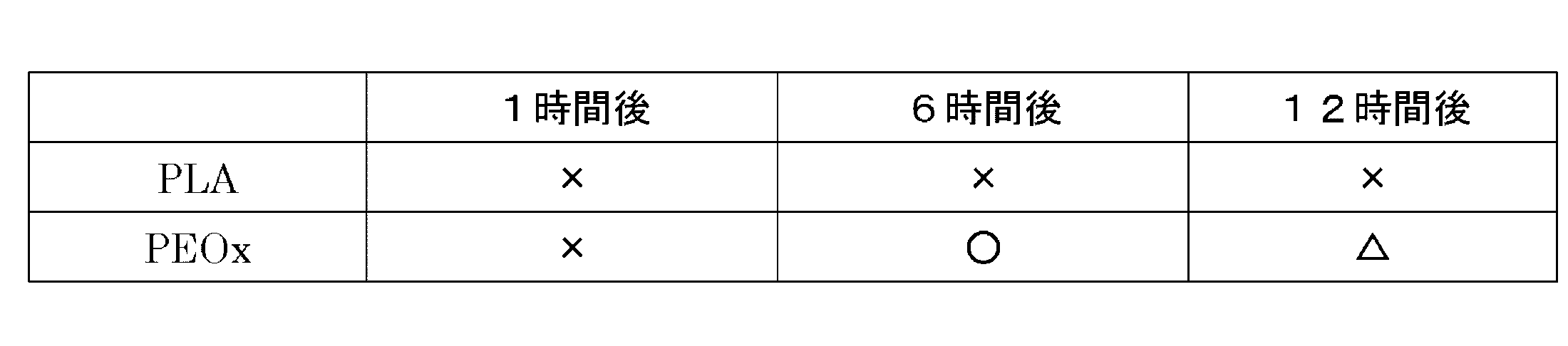
一方、PEOxは70℃で加水分解し、シュウ酸を放出するため、シュウ酸水溶液と同様な挙動を示していることが判る。即ち、PEOxを含む本発明の掘削用分散液は、低温域でゲル化可能で、かつゲルブレーカーが不要のフラクチャリング流体として使用し得ることが理解される。
Claims (5)
- 加水分解性樹脂材料としてポリオキサレートが水性媒体中に分散していることを特徴とする掘削用分散液。
- 掘削により形成された坑井から地中の天然資源を採掘する天然資源の採掘方法において、請求項1に記載の分散液を地下に圧入し、40℃以上の熱水中で加水分解性樹脂材料の加水分解を行う工程を含む、採掘方法。
- 前記採掘用分散液の坑井内への圧入により、前記坑井周囲に亀裂を発生する請求項2に記載の採掘方法。
- 前記加水分解性樹脂材料により、前記坑井の目止めを行う請求項3に記載の採掘方法。
- 前記採掘用分散液にゲル化剤を配合しておき、前記加水分解性樹脂材料の加水分解により放出された酸によって坑井内にゲルを生成させ、さらに該ゲルを分解する請求項3に記載の採掘方法。
Priority Applications (8)
| Application Number | Priority Date | Filing Date | Title |
|---|---|---|---|
| AU2013358185A AU2013358185B2 (en) | 2012-12-12 | 2013-12-05 | Dispersion solution for drilling and method of extraction using the dispersion solution |
| PL13862821T PL2933305T3 (pl) | 2012-12-12 | 2013-12-05 | Roztwór dyspersji do wiercenia i metoda ekstrakcji za pomocą roztworu dyspersji |
| US14/649,971 US20150315891A1 (en) | 2012-12-12 | 2013-12-05 | Dispersion solution for drilling and method of extraction using the dispersion solution |
| RU2015128010A RU2607564C1 (ru) | 2012-12-12 | 2013-12-05 | Дисперсионная жидкость для бурения и способ добычи полезных ископаемых с помощью дисперсионной жидкости |
| CN201380065248.XA CN104884566B (zh) | 2012-12-12 | 2013-12-05 | 挖掘用分散液以及使用该分散液的采掘方法 |
| CA2892493A CA2892493C (en) | 2012-12-12 | 2013-12-05 | Dispersion solution for drilling and method of extraction using the dispersion solution |
| EP13862821.9A EP2933305B1 (en) | 2012-12-12 | 2013-12-05 | Fluid dispersion for drilling, and mining method using same |
| US15/208,164 US10246625B2 (en) | 2012-12-12 | 2016-07-12 | Dispersion solution for drilling and method of extraction using the dispersion solution |
Applications Claiming Priority (4)
| Application Number | Priority Date | Filing Date | Title |
|---|---|---|---|
| JP2012271084 | 2012-12-12 | ||
| JP2012-271084 | 2012-12-12 | ||
| JP2013-160064 | 2013-08-01 | ||
| JP2013160064A JP6183039B2 (ja) | 2012-12-12 | 2013-08-01 | 掘削用分散液及びこれを用いた採掘方法 |
Related Child Applications (2)
| Application Number | Title | Priority Date | Filing Date |
|---|---|---|---|
| US14/649,971 A-371-Of-International US20150315891A1 (en) | 2012-12-12 | 2013-12-05 | Dispersion solution for drilling and method of extraction using the dispersion solution |
| US15/208,164 Division US10246625B2 (en) | 2012-12-12 | 2016-07-12 | Dispersion solution for drilling and method of extraction using the dispersion solution |
Publications (1)
| Publication Number | Publication Date |
|---|---|
| WO2014091994A1 true WO2014091994A1 (ja) | 2014-06-19 |
Family
ID=50934286
Family Applications (1)
| Application Number | Title | Priority Date | Filing Date |
|---|---|---|---|
| PCT/JP2013/082663 Ceased WO2014091994A1 (ja) | 2012-12-12 | 2013-12-05 | 掘削用分散液及びこれを用いた採掘方法 |
Country Status (9)
| Country | Link |
|---|---|
| US (2) | US20150315891A1 (ja) |
| EP (1) | EP2933305B1 (ja) |
| JP (1) | JP6183039B2 (ja) |
| CN (1) | CN104884566B (ja) |
| AU (1) | AU2013358185B2 (ja) |
| CA (1) | CA2892493C (ja) |
| PL (1) | PL2933305T3 (ja) |
| RU (1) | RU2607564C1 (ja) |
| WO (1) | WO2014091994A1 (ja) |
Cited By (3)
| Publication number | Priority date | Publication date | Assignee | Title |
|---|---|---|---|---|
| WO2015137057A1 (ja) * | 2014-03-11 | 2015-09-17 | 東洋製罐グループホールディングス株式会社 | 水中投下用樹脂成型体 |
| WO2016080142A1 (ja) * | 2014-11-19 | 2016-05-26 | 東洋製罐グループホールディングス株式会社 | 地下資源の採掘方法及び該方法に用いる加水分解性ブロッキング剤 |
| WO2016098642A1 (ja) * | 2014-12-15 | 2016-06-23 | 東洋製罐グループホールディングス株式会社 | ポリオキサレート共重合体 |
Families Citing this family (6)
| Publication number | Priority date | Publication date | Assignee | Title |
|---|---|---|---|---|
| CA2935016C (en) | 2013-12-24 | 2019-11-05 | Toyo Seikan Group Holdings, Ltd. | Polyoxalates and a process for the production thereof |
| JP2016060900A (ja) * | 2014-09-22 | 2016-04-25 | 株式会社クレハ | 反応性金属及び分解性樹脂組成物を含有する坑井掘削用組成物、坑井掘削用成形品、及び坑井掘削方法 |
| US11104840B2 (en) | 2015-02-12 | 2021-08-31 | Toyo Seikan Group Holdings, Ltd. | Method of extracting underground resources by using hydrolysable particles |
| JP2016147972A (ja) * | 2015-02-12 | 2016-08-18 | 東洋製罐グループホールディングス株式会社 | ポリオキサレート粒子 |
| JP7415333B2 (ja) * | 2019-05-16 | 2024-01-17 | 東洋製罐グループホールディングス株式会社 | 加水分解性樹脂の有機溶媒分散体 |
| US12139668B2 (en) * | 2023-04-05 | 2024-11-12 | Halliburton Energy Services, Inc. | Liquid suspension composition for wellbore operations, and methods of making and using same |
Citations (6)
| Publication number | Priority date | Publication date | Assignee | Title |
|---|---|---|---|---|
| WO2010055903A1 (ja) * | 2008-11-13 | 2010-05-20 | 東洋製罐株式会社 | 生分解性樹脂組成物 |
| US7833950B2 (en) | 2005-06-20 | 2010-11-16 | Schlumberger Technology Corporation | Degradable fiber systems for stimulation |
| WO2012050187A1 (ja) | 2010-10-14 | 2012-04-19 | 株式会社クレハ | 石油掘削補助用分散液 |
| WO2012121294A1 (ja) * | 2011-03-08 | 2012-09-13 | 株式会社クレハ | 坑井掘削用ポリグリコール酸樹脂粒状体組成物及びその製造方法 |
| WO2013161754A1 (ja) * | 2012-04-27 | 2013-10-31 | 株式会社クレハ | 坑井処理流体用ポリグリコール酸樹脂短繊維 |
| WO2013161755A1 (ja) * | 2012-04-27 | 2013-10-31 | 株式会社クレハ | ポリグリコール酸樹脂短繊維及び坑井処理流体 |
Family Cites Families (26)
| Publication number | Priority date | Publication date | Assignee | Title |
|---|---|---|---|---|
| GB8522844D0 (en) | 1985-09-16 | 1985-10-23 | Albright & Wilson | Dispersible active sizing compositions |
| SU1467076A1 (ru) * | 1987-05-25 | 1989-03-23 | Ростовский государственный университет им.М.А.Суслова | Полимерный буровой раствор |
| JPH02286781A (ja) * | 1989-04-28 | 1990-11-26 | Dainippon Ink & Chem Inc | 逸泥防止剤、その製造方法及び逸泥防止工法 |
| TW370540B (en) | 1995-06-20 | 1999-09-21 | Kureha Chemical Ind Co Ltd | Polyethyleneoxalate, molded goods thereof and preparation thereof |
| US6235825B1 (en) | 1998-03-05 | 2001-05-22 | Mitsui Chemicals, Inc. | Polylactic acid resin composition and film therefrom |
| US6372844B1 (en) | 1999-03-31 | 2002-04-16 | Mitsui Chemicals, Inc. | Resin composition |
| GB2393722A (en) * | 2001-02-13 | 2004-04-07 | Schlumberger Holdings | Cleavable surfactants which may be useful in viscoelastic compositions for oil-field applications |
| AU2002327694A1 (en) | 2001-09-26 | 2003-04-07 | Claude E. Cooke Jr. | Method and materials for hydraulic fracturing of wells |
| JP2004051942A (ja) | 2002-05-29 | 2004-02-19 | Daicel Chem Ind Ltd | 分散体及びそれを用いた成形体の製造方法 |
| US7398826B2 (en) | 2003-11-14 | 2008-07-15 | Schlumberger Technology Corporation | Well treatment with dissolvable polymer |
| JP2005097590A (ja) * | 2003-08-28 | 2005-04-14 | Ube Ind Ltd | ポリオキサレート組成物及びそれから得られる成形物 |
| GB2412391A (en) * | 2004-03-27 | 2005-09-28 | Cleansorb Ltd | Process for disruption of filter cakes |
| US7268100B2 (en) | 2004-11-29 | 2007-09-11 | Clearwater International, Llc | Shale inhibition additive for oil/gas down hole fluids and methods for making and using same |
| US7267170B2 (en) | 2005-01-31 | 2007-09-11 | Halliburton Energy Services, Inc. | Self-degrading fibers and associated methods of use and manufacture |
| PL2080787T3 (pl) | 2006-09-26 | 2016-05-31 | Toyo Seikan Group Holdings Ltd | Łatwo degradowalna kompozycja żywicy i biodegradowalny pojemnik, w którym jest stosowana |
| US9040468B2 (en) * | 2007-07-25 | 2015-05-26 | Schlumberger Technology Corporation | Hydrolyzable particle compositions, treatment fluids and methods |
| WO2009100908A1 (en) * | 2008-02-13 | 2009-08-20 | Jotun A/S | Antifouling composition |
| WO2009119336A1 (ja) | 2008-03-25 | 2009-10-01 | 東レ株式会社 | ポリ乳酸系組成物およびそれからなるフィルム |
| EP2348122B1 (en) * | 2008-10-27 | 2016-04-13 | Toyo Seikan Kaisha, Ltd. | Method for producing oligomer and/or monomer by degrading biodegradable resin |
| US8016040B2 (en) | 2008-11-26 | 2011-09-13 | Schlumberger Technology Corporation | Fluid loss control |
| BR112013000272A2 (pt) | 2010-07-05 | 2016-05-24 | Reluceo Inc | polímeros superabsorventes degradáveis |
| US10066148B2 (en) | 2010-09-30 | 2018-09-04 | M-I L.L.C. | Viscosified fluid loss control agent utilizing chelates |
| JP5829393B2 (ja) | 2010-10-05 | 2015-12-09 | 東洋製罐株式会社 | 生分解性樹脂組成物 |
| JP5286505B2 (ja) * | 2011-01-19 | 2013-09-11 | 東洋製罐株式会社 | 生分解性樹脂組成物 |
| RU2621104C2 (ru) | 2011-12-16 | 2017-05-31 | НЕЙЧЕРВОРКС ЭлЭлСи | Полилактидные волокна |
| CA2972651C (en) * | 2013-09-27 | 2019-09-17 | Toyo Seikan Group Holdings, Ltd. | Method for degrading biodegradable resin |
-
2013
- 2013-08-01 JP JP2013160064A patent/JP6183039B2/ja active Active
- 2013-12-05 US US14/649,971 patent/US20150315891A1/en not_active Abandoned
- 2013-12-05 WO PCT/JP2013/082663 patent/WO2014091994A1/ja not_active Ceased
- 2013-12-05 PL PL13862821T patent/PL2933305T3/pl unknown
- 2013-12-05 EP EP13862821.9A patent/EP2933305B1/en not_active Not-in-force
- 2013-12-05 CN CN201380065248.XA patent/CN104884566B/zh not_active Expired - Fee Related
- 2013-12-05 RU RU2015128010A patent/RU2607564C1/ru not_active IP Right Cessation
- 2013-12-05 AU AU2013358185A patent/AU2013358185B2/en not_active Ceased
- 2013-12-05 CA CA2892493A patent/CA2892493C/en not_active Expired - Fee Related
-
2016
- 2016-07-12 US US15/208,164 patent/US10246625B2/en active Active
Patent Citations (6)
| Publication number | Priority date | Publication date | Assignee | Title |
|---|---|---|---|---|
| US7833950B2 (en) | 2005-06-20 | 2010-11-16 | Schlumberger Technology Corporation | Degradable fiber systems for stimulation |
| WO2010055903A1 (ja) * | 2008-11-13 | 2010-05-20 | 東洋製罐株式会社 | 生分解性樹脂組成物 |
| WO2012050187A1 (ja) | 2010-10-14 | 2012-04-19 | 株式会社クレハ | 石油掘削補助用分散液 |
| WO2012121294A1 (ja) * | 2011-03-08 | 2012-09-13 | 株式会社クレハ | 坑井掘削用ポリグリコール酸樹脂粒状体組成物及びその製造方法 |
| WO2013161754A1 (ja) * | 2012-04-27 | 2013-10-31 | 株式会社クレハ | 坑井処理流体用ポリグリコール酸樹脂短繊維 |
| WO2013161755A1 (ja) * | 2012-04-27 | 2013-10-31 | 株式会社クレハ | ポリグリコール酸樹脂短繊維及び坑井処理流体 |
Non-Patent Citations (1)
| Title |
|---|
| See also references of EP2933305A4 |
Cited By (14)
| Publication number | Priority date | Publication date | Assignee | Title |
|---|---|---|---|---|
| WO2015137057A1 (ja) * | 2014-03-11 | 2015-09-17 | 東洋製罐グループホールディングス株式会社 | 水中投下用樹脂成型体 |
| AU2015351297B2 (en) * | 2014-11-19 | 2018-11-08 | Toyo Seikan Group Holdings, Ltd. | Method of extracting underground resources and hydrolysis-blocking agent for use in the method |
| WO2016080142A1 (ja) * | 2014-11-19 | 2016-05-26 | 東洋製罐グループホールディングス株式会社 | 地下資源の採掘方法及び該方法に用いる加水分解性ブロッキング剤 |
| JP2016098503A (ja) * | 2014-11-19 | 2016-05-30 | 東洋製罐グループホールディングス株式会社 | 水圧破砕法を利用しての地下資源の採掘方法及び水圧破砕に用いる流体に添加される加水分解性ブロッキング剤 |
| US10487620B2 (en) | 2014-11-19 | 2019-11-26 | Toyo Seikan Group Holdings, Ltd. | Method of extracting underground resources and hydrolysis-blocking agent for use in the method |
| CN107002482B (zh) * | 2014-11-19 | 2019-08-02 | 东洋制罐集团控股株式会社 | 地下资源的开采方法和用于该方法的水解性阻断剂 |
| CN107002482A (zh) * | 2014-11-19 | 2017-08-01 | 东洋制罐集团控股株式会社 | 地下资源的开采方法和用于该方法的水解性阻断剂 |
| CN107108865A (zh) * | 2014-12-15 | 2017-08-29 | 东洋制罐集团控股株式会社 | 聚草酸酯共聚物 |
| AU2015364898B2 (en) * | 2014-12-15 | 2018-11-01 | Toyo Seikan Group Holdings, Ltd. | Polyoxalate copolymer |
| AU2015364898B9 (en) * | 2014-12-15 | 2018-12-06 | Toyo Seikan Group Holdings, Ltd. | Polyoxalate copolymer |
| RU2675812C1 (ru) * | 2014-12-15 | 2018-12-25 | Тойо Сейкан Груп Холдингз, Лтд. | Полиоксалатный сополимер |
| CN107108865B (zh) * | 2014-12-15 | 2019-07-26 | 东洋制罐集团控股株式会社 | 聚草酸酯共聚物 |
| JP2016113541A (ja) * | 2014-12-15 | 2016-06-23 | 東洋製罐グループホールディングス株式会社 | ポリオキサレート共重合体 |
| WO2016098642A1 (ja) * | 2014-12-15 | 2016-06-23 | 東洋製罐グループホールディングス株式会社 | ポリオキサレート共重合体 |
Also Published As
| Publication number | Publication date |
|---|---|
| EP2933305A1 (en) | 2015-10-21 |
| CA2892493C (en) | 2019-05-07 |
| CN104884566A (zh) | 2015-09-02 |
| US20160319177A1 (en) | 2016-11-03 |
| CA2892493A1 (en) | 2014-06-19 |
| AU2013358185A1 (en) | 2015-06-18 |
| US20150315891A1 (en) | 2015-11-05 |
| EP2933305A4 (en) | 2016-08-31 |
| JP2014134091A (ja) | 2014-07-24 |
| EP2933305B1 (en) | 2019-07-24 |
| PL2933305T3 (pl) | 2020-01-31 |
| AU2013358185B2 (en) | 2015-11-26 |
| US10246625B2 (en) | 2019-04-02 |
| RU2607564C1 (ru) | 2017-01-10 |
| JP6183039B2 (ja) | 2017-08-23 |
| CN104884566B (zh) | 2017-09-01 |
Similar Documents
| Publication | Publication Date | Title |
|---|---|---|
| JP6183039B2 (ja) | 掘削用分散液及びこれを用いた採掘方法 | |
| JP6221475B2 (ja) | 掘削用分散液、及び、それを用いた掘削方法 | |
| CA2892496C (en) | Dispersion solution for drilling and method of extracting underground resources using the dispersion solution | |
| CN104919022B (zh) | 坑井处理液材料以及含有该坑井处理液材料的坑井处理液 | |
| CA2868977A1 (en) | Polyglycolic acid resin short fibers and well treatment fluid | |
| JP2016147971A (ja) | 加水分解性粒子 | |
| CN104619773B (zh) | 水性分散液及压裂操作用添加剂 | |
| RU2675812C1 (ru) | Полиоксалатный сополимер | |
| JP6343924B2 (ja) | 掘削用分散液及び該分散液を用いた掘削方法 | |
| JPWO2015182622A1 (ja) | エステル樹脂の分解方法 | |
| CN106103596A (zh) | 水中投入用树脂成型体 |
Legal Events
| Date | Code | Title | Description |
|---|---|---|---|
| 121 | Ep: the epo has been informed by wipo that ep was designated in this application |
Ref document number: 13862821 Country of ref document: EP Kind code of ref document: A1 |
|
| ENP | Entry into the national phase |
Ref document number: 2892493 Country of ref document: CA |
|
| WWE | Wipo information: entry into national phase |
Ref document number: 2013862821 Country of ref document: EP |
|
| WWE | Wipo information: entry into national phase |
Ref document number: 14649971 Country of ref document: US |
|
| NENP | Non-entry into the national phase |
Ref country code: DE |
|
| ENP | Entry into the national phase |
Ref document number: 2013358185 Country of ref document: AU Date of ref document: 20131205 Kind code of ref document: A |
|
| ENP | Entry into the national phase |
Ref document number: 2015128010 Country of ref document: RU Kind code of ref document: A |