WO2014097698A1 - タングステン微粉の製造方法 - Google Patents
タングステン微粉の製造方法 Download PDFInfo
- Publication number
- WO2014097698A1 WO2014097698A1 PCT/JP2013/075496 JP2013075496W WO2014097698A1 WO 2014097698 A1 WO2014097698 A1 WO 2014097698A1 JP 2013075496 W JP2013075496 W JP 2013075496W WO 2014097698 A1 WO2014097698 A1 WO 2014097698A1
- Authority
- WO
- WIPO (PCT)
- Prior art keywords
- powder
- tungsten
- average particle
- fine powder
- tungsten powder
- Prior art date
- Legal status (The legal status is an assumption and is not a legal conclusion. Google has not performed a legal analysis and makes no representation as to the accuracy of the status listed.)
- Ceased
Links
Images

Classifications
-
- C—CHEMISTRY; METALLURGY
- C22—METALLURGY; FERROUS OR NON-FERROUS ALLOYS; TREATMENT OF ALLOYS OR NON-FERROUS METALS
- C22C—ALLOYS
- C22C27/00—Alloys based on rhenium or a refractory metal not mentioned in groups C22C14/00 or C22C16/00
- C22C27/04—Alloys based on tungsten or molybdenum
-
- B—PERFORMING OPERATIONS; TRANSPORTING
- B22—CASTING; POWDER METALLURGY
- B22F—WORKING METALLIC POWDER; MANUFACTURE OF ARTICLES FROM METALLIC POWDER; MAKING METALLIC POWDER; APPARATUS OR DEVICES SPECIALLY ADAPTED FOR METALLIC POWDER
- B22F1/00—Metallic powder; Treatment of metallic powder, e.g. to facilitate working or to improve properties
- B22F1/16—Metallic particles coated with a non-metal
-
- B—PERFORMING OPERATIONS; TRANSPORTING
- B22—CASTING; POWDER METALLURGY
- B22F—WORKING METALLIC POWDER; MANUFACTURE OF ARTICLES FROM METALLIC POWDER; MAKING METALLIC POWDER; APPARATUS OR DEVICES SPECIALLY ADAPTED FOR METALLIC POWDER
- B22F9/00—Making metallic powder or suspensions thereof
- B22F9/02—Making metallic powder or suspensions thereof using physical processes
- B22F9/04—Making metallic powder or suspensions thereof using physical processes starting from solid material, e.g. by crushing, grinding or milling
-
- C—CHEMISTRY; METALLURGY
- C23—COATING METALLIC MATERIAL; COATING MATERIAL WITH METALLIC MATERIAL; CHEMICAL SURFACE TREATMENT; DIFFUSION TREATMENT OF METALLIC MATERIAL; COATING BY VACUUM EVAPORATION, BY SPUTTERING, BY ION IMPLANTATION OR BY CHEMICAL VAPOUR DEPOSITION, IN GENERAL; INHIBITING CORROSION OF METALLIC MATERIAL OR INCRUSTATION IN GENERAL
- C23C—COATING METALLIC MATERIAL; COATING MATERIAL WITH METALLIC MATERIAL; SURFACE TREATMENT OF METALLIC MATERIAL BY DIFFUSION INTO THE SURFACE, BY CHEMICAL CONVERSION OR SUBSTITUTION; COATING BY VACUUM EVAPORATION, BY SPUTTERING, BY ION IMPLANTATION OR BY CHEMICAL VAPOUR DEPOSITION, IN GENERAL
- C23C8/00—Solid state diffusion of only non-metal elements into metallic material surfaces; Chemical surface treatment of metallic material by reaction of the surface with a reactive gas, leaving reaction products of surface material in the coating, e.g. conversion coatings, passivation of metals
- C23C8/02—Pretreatment of the material to be coated
-
- C—CHEMISTRY; METALLURGY
- C23—COATING METALLIC MATERIAL; COATING MATERIAL WITH METALLIC MATERIAL; CHEMICAL SURFACE TREATMENT; DIFFUSION TREATMENT OF METALLIC MATERIAL; COATING BY VACUUM EVAPORATION, BY SPUTTERING, BY ION IMPLANTATION OR BY CHEMICAL VAPOUR DEPOSITION, IN GENERAL; INHIBITING CORROSION OF METALLIC MATERIAL OR INCRUSTATION IN GENERAL
- C23C—COATING METALLIC MATERIAL; COATING MATERIAL WITH METALLIC MATERIAL; SURFACE TREATMENT OF METALLIC MATERIAL BY DIFFUSION INTO THE SURFACE, BY CHEMICAL CONVERSION OR SUBSTITUTION; COATING BY VACUUM EVAPORATION, BY SPUTTERING, BY ION IMPLANTATION OR BY CHEMICAL VAPOUR DEPOSITION, IN GENERAL
- C23C8/00—Solid state diffusion of only non-metal elements into metallic material surfaces; Chemical surface treatment of metallic material by reaction of the surface with a reactive gas, leaving reaction products of surface material in the coating, e.g. conversion coatings, passivation of metals
- C23C8/40—Solid state diffusion of only non-metal elements into metallic material surfaces; Chemical surface treatment of metallic material by reaction of the surface with a reactive gas, leaving reaction products of surface material in the coating, e.g. conversion coatings, passivation of metals using liquids, e.g. salt baths, liquid suspensions
- C23C8/42—Solid state diffusion of only non-metal elements into metallic material surfaces; Chemical surface treatment of metallic material by reaction of the surface with a reactive gas, leaving reaction products of surface material in the coating, e.g. conversion coatings, passivation of metals using liquids, e.g. salt baths, liquid suspensions only one element being applied
-
- C—CHEMISTRY; METALLURGY
- C25—ELECTROLYTIC OR ELECTROPHORETIC PROCESSES; APPARATUS THEREFOR
- C25D—PROCESSES FOR THE ELECTROLYTIC OR ELECTROPHORETIC PRODUCTION OF COATINGS; ELECTROFORMING; APPARATUS THEREFOR
- C25D5/00—Electroplating characterised by the process; Pretreatment or after-treatment of workpieces
- C25D5/34—Pretreatment of metallic surfaces to be electroplated
-
- C—CHEMISTRY; METALLURGY
- C25—ELECTROLYTIC OR ELECTROPHORETIC PROCESSES; APPARATUS THEREFOR
- C25D—PROCESSES FOR THE ELECTROLYTIC OR ELECTROPHORETIC PRODUCTION OF COATINGS; ELECTROFORMING; APPARATUS THEREFOR
- C25D7/00—Electroplating characterised by the article coated
- C25D7/006—Nanoparticles
-
- H—ELECTRICITY
- H01—ELECTRIC ELEMENTS
- H01G—CAPACITORS; CAPACITORS, RECTIFIERS, DETECTORS, SWITCHING DEVICES, LIGHT-SENSITIVE OR TEMPERATURE-SENSITIVE DEVICES OF THE ELECTROLYTIC TYPE
- H01G9/00—Electrolytic capacitors, rectifiers, detectors, switching devices, light-sensitive or temperature-sensitive devices; Processes of their manufacture
- H01G9/004—Details
- H01G9/04—Electrodes or formation of dielectric layers thereon
- H01G9/048—Electrodes or formation of dielectric layers thereon characterised by their structure
- H01G9/052—Sintered electrodes
- H01G9/0525—Powder therefor
-
- B—PERFORMING OPERATIONS; TRANSPORTING
- B22—CASTING; POWDER METALLURGY
- B22F—WORKING METALLIC POWDER; MANUFACTURE OF ARTICLES FROM METALLIC POWDER; MAKING METALLIC POWDER; APPARATUS OR DEVICES SPECIALLY ADAPTED FOR METALLIC POWDER
- B22F2998/00—Supplementary information concerning processes or compositions relating to powder metallurgy
- B22F2998/10—Processes characterised by the sequence of their steps
-
- B—PERFORMING OPERATIONS; TRANSPORTING
- B22—CASTING; POWDER METALLURGY
- B22F—WORKING METALLIC POWDER; MANUFACTURE OF ARTICLES FROM METALLIC POWDER; MAKING METALLIC POWDER; APPARATUS OR DEVICES SPECIALLY ADAPTED FOR METALLIC POWDER
- B22F2999/00—Aspects linked to processes or compositions used in powder metallurgy
-
- H—ELECTRICITY
- H01—ELECTRIC ELEMENTS
- H01G—CAPACITORS; CAPACITORS, RECTIFIERS, DETECTORS, SWITCHING DEVICES, LIGHT-SENSITIVE OR TEMPERATURE-SENSITIVE DEVICES OF THE ELECTROLYTIC TYPE
- H01G9/00—Electrolytic capacitors, rectifiers, detectors, switching devices, light-sensitive or temperature-sensitive devices; Processes of their manufacture
- H01G9/004—Details
- H01G9/04—Electrodes or formation of dielectric layers thereon
- H01G9/048—Electrodes or formation of dielectric layers thereon characterised by their structure
- H01G9/052—Sintered electrodes
Definitions
- the present invention relates to a method for producing tungsten fine powder. More specifically, the present invention relates to a method for obtaining tungsten powder having a finer particle size and a large BET specific surface area, which is useful for an electrolytic capacitor, in a high yield, and a method for producing tungsten fine powder using the method.
- capacitors used in these electronic devices are smaller and lighter, with larger capacitance and lower ESR (equivalent series resistance). ) Is required.
- an anode body of a capacitor made of a sintered body of valve action metal powder such as tantalum capable of anodization is anodized, and a dielectric layer made of these metal oxides is formed on the surface.
- An electrolytic capacitor has been proposed.
- Electrolytic capacitors that use tungsten as the valve metal and have a sintered body of tungsten powder as the anode body have the same volume of anode body using tantalum powder of the same particle size, compared to electrolytic capacitors that can be obtained with the same conversion voltage.
- the leakage current (LC) is large and it has not been put to practical use as an electrolytic capacitor.
- a capacitor using an alloy of tungsten and another metal has been studied.
- the leakage current is somewhat improved, it has not been sufficient (Japanese Patent Laid-Open No. 2004-349658: Patent Documents). 1).
- Patent Document 2 Japanese Patent Laid-Open No. 2003-272959 discloses a capacitor using a tungsten foil electrode on which a dielectric layer selected from WO 3 , W 2 N, and WN 2 is formed. This is not a solution for the leakage current.
- Patent Document 3 International Publication No. 2004/055843: US Pat. No. 7,154,743 discloses an electrolytic capacitor using an anode selected from tantalum, niobium, titanium, and tungsten. There is no description of specific examples using tungsten.
- Patent Document 4 International Publication No. 2012/086272 discloses an electrolytic capacitor in which a sintered body of tungsten powder containing silicon that solves the problem of leakage current is used as an anode. A technique for containing silicon using commercially available tungsten powder or tungsten powder reduced with hydrogen or the like is described.
- the anode body for electrolytic capacitors sintered after forming the tungsten powder if the volume is the same, the anode body having a larger capacity can be produced as the particle diameter of the tungsten powder is smaller.
- Tungsten powder can be produced by treating tungsten oxide, halide, ammonium salt or the like with a reducing agent such as hydrogen.
- a reducing agent such as hydrogen.
- the reduction rate is increased, there is a problem that a composite oxide is generated. Therefore, in order to produce a finer powder, the reduction rate must be slowed, resulting in a reduction in production efficiency and an increase in cost.
- a material having a wide explosion range, such as hydrogen gas must be handled by a complicated process having an expensive control device.
- An object of the present invention is to solve the problems in the prior art as described above.
- a tungsten powder having a small particle size and a large BET specific surface area which is a raw material for a capacitor having a tungsten as an anode (hereinafter referred to as a tungsten capacitor), is high It aims at providing the processing method of the tungsten fine powder obtained with a yield, and the manufacturing method of the tungsten fine powder using the method.
- the present inventor classifies currently available tungsten powder into fine powder having a relatively small average particle diameter and coarse powder having a relatively large average particle diameter.
- the present inventors have found that a suitable tungsten fine powder can be obtained with a tungsten capacitor. That is, this invention relates to the manufacturing method of the following tungsten fine powder, and the fine powdering method of tungsten powder.
- An oxidation treatment step for forming a film, an alkali treatment step for chemically removing the oxide film formed by the oxidation treatment step and the natural oxide film formed in a fine powder having a relatively small average particle diameter with an alkaline aqueous solution A method for atomizing tungsten powder containing [2] The raw material tungsten powder is classified into a fine powder having a relatively small average particle diameter and a coarse powder having a relatively large average particle diameter.
- [4] The method for pulverizing tungsten powder according to any one of items 1 to 3, wherein the classification step is performed by water tank classification.
- [5] The method for pulverizing tungsten powder as described in any one of [1] to [4] above, wherein the oxidation treatment is a treatment of electrolytic oxidation while stirring the tungsten powder in an electrolytic solution.
- the electrolytic solution is an aqueous solution of persulfuric acid or mineral acid.
- the method for micronizing tungsten powder according to [6] wherein the mineral acid is selected from phosphoric acid, nitric acid, hydrochloric acid, boric acid and sulfuric acid.
- a method for producing a tungsten fine powder characterized in that a tungsten powder having a BET specific surface area of 3 to 15 m 2 / g is obtained by a process including the method according to any one of items 1 to 12 above.
- Tungsten characterized by obtaining tungsten powder having an average particle size of 0.04 to 0.4 ⁇ m and a BET specific surface area of 5 to 15 m 2 / g by the process including the method according to any one of items 1 to 12 above. Production method of fine powder.
- a tungsten powder having a fine particle size and a large BET specific surface area suitable for an electrolytic capacitor can be obtained from a tungsten powder currently available on the market or a tungsten powder that can be produced by a known method. Can be manufactured at a rate.
- the tungsten fine powder obtained by the present invention has a fine particle size and a large BET specific surface area, so that the capacity of the obtained capacitor is increased.
- the average particle size of the raw material tungsten powder is originally Larger coarse powders have smaller particle sizes due to pulverization and become suitable tungsten fine powders for electric field capacitors. Originally, fine powders with smaller average particle diameters are mostly converted to tungsten oxide by oxidation treatment, and most of them are alkali-treated. Will disappear.
- a spherical powder having a particle size of 0.5 ⁇ m is pulverized to a particle size of 0.3 ⁇ m by a method that does not classify, if tungsten of 0.1 ⁇ m disappears from the surface by oxidation treatment, the raw material tungsten powder The fine powder having a particle size of 0.2 ⁇ m or less present at the same time becomes tungsten oxide as a whole during the oxidation treatment and disappears completely during the alkali treatment. Further, even with a spherical powder having a particle size of 0.5 ⁇ m, the mass reduction rate is 78% by mass in calculation.
- the actual powder is not spherical, and the mass reduction rate differs depending on the size of the particle size, so it does not become such a large mass reduction rate, but the average particle size that does not undergo oxidation treatment from the raw material tungsten powder by the classification process By taking out fine powder having a small size, unnecessary mass reduction can be prevented. Producing tungsten fine powder in a high yield by such a method is advantageous in terms of cost.
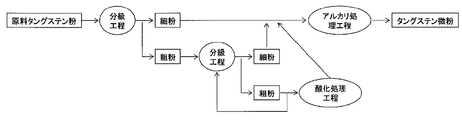
- the manufacturing method of the tungsten fine powder of a 1st embodiment concerning the present invention is shown.
- the manufacturing method of the tungsten fine powder of 2nd Embodiment which concerns on this invention is shown.
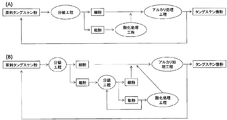
- the manufacturing method (A) and (B) of the tungsten fine powder of 3rd Embodiment which concerns on this invention is shown.
- the raw material tungsten powder to be pulverized in the present invention preferably has an average particle size in the range of 0.1 to 10 ⁇ m.
- the average particle diameter means a particle diameter value (D 50 ; ⁇ m) corresponding to a cumulative volume% of 50 volume%.
- a method for obtaining the raw material tungsten powder in addition to commercially available products, those produced by known methods, for example, a method of pulverizing tungsten trioxide powder in a hydrogen atmosphere, or tungstic acid or tungsten halide with hydrogen, sodium, etc. It can obtain by selecting suitably the method etc. which reduce by.
- tungsten powder having a small particle diameter since it is difficult to obtain a raw material tungsten powder having a small particle diameter by these methods, as described later, a tungsten powder which has been subjected to an oxidation treatment and an alkali treatment as a pretreatment is used as the raw material tungsten powder, or according to the present invention. You may use the tungsten powder obtained by applying the method as raw material tungsten powder. By using the tungsten powder subjected to the pulverization treatment as the raw material tungsten powder, a tungsten powder having a smaller particle diameter can be obtained. For example, when application of the method of the present invention is repeated, tungsten powder having an average particle size of 0.04 ⁇ m or less can be obtained.
- the particle size of the powder When the dielectric layer is formed by anodic oxidation, there is a lower limit to the particle size of the powder that can be preferably used for the capacitor.
- the lower limit value of the particle size of tungsten powder used for the capacitor is at least twice the thickness of the dielectric layer to be formed. For example, when the rated voltage is 1.6 V, it is 0.04 ⁇ m or more. When the particle size is less than this, when anodization is performed, a sufficient conductive tungsten portion does not remain, making it difficult to form an anode of the electrolytic capacitor.
- the particle size of the tungsten powder when used for a high-capacitance capacitor with a low rated voltage, is preferably 0.04 to 0.4 ⁇ m, more preferably 0.08 to 0.2 ⁇ m.
- the raw material tungsten powder used in the method of the present invention may contain impurities as long as the capacitor characteristics do not deteriorate, or elements such as silicon, nitrogen, carbon, boron, phosphorus, oxygen, etc. for improving the capacitor characteristics. It may be processed to include. However, the processing of the particle surface such as silicidation, nitridation, carbonization, or boride treatment, which will be described later, is preferably performed in a step after applying the present invention.
- the raw material tungsten powder is classified into a fine powder having a relatively small average particle diameter and a coarse powder having a relatively large average particle diameter.
- the classification method include dry classification, wet classification, and sieving classification.
- sedimentation classification which is a kind of wet classification, and more specifically, for example, water tank classification, which is a kind of sedimentation classification.
- a liquid medium is first added to the raw material tungsten powder.
- the raw material tungsten powder is present in an aggregated state in the liquid medium, it is stirred and dispersed with a homogenizer or the like so that it is as close to the primary particles as possible.
- a homogenizer or the like so that it is as close to the primary particles as possible.
- particles having a relatively small particle size in the raw material tungsten float, and particles having a relatively large particle size settle.
- the particles contained in the floating portion are fine powder, and the particles contained in the remaining sedimented portion are coarse powder.
- the fine powder and the coarse powder may be separated in a state including the liquid medium around the floating part and the settled part.
- the amount of fine powder obtained by classification can be artificially adjusted by the standing time after stirring and the amount of the liquid medium around the floating part sucked up during fine powder collection.
- the liquid medium for example, water, ethanol, and a mixture of water and ethanol are preferable because the raw material tungsten powder is well dispersed and can be easily removed from the particles.
- the amount of liquid medium relative to the tungsten powder, the stirring speed of the homogenizer, the stirring time, and the standing time are determined based on preliminary experiments in consideration of the average particle size and distribution of the raw material tungsten powder, the amount of fine powder, and the average particle size of the fine powder. Although it is determined, the amount of the liquid medium is larger than that of dipping the raw material tungsten powder.
- the ratio of the fine powder to the raw material tungsten powder is usually 3% by mass or more and less than 30% by mass, preferably 5% by mass or more and less than 20% by mass. If it is 30% by mass or more, the average particle size of the final produced fine powder is not sufficiently small and requires the same treatment multiple times. Therefore, it is advantageous in terms of cost to use one less than 30% by mass. . Moreover, since the mass reduction
- the coarse powder obtained by classification is oxidized.
- the oxidation treatment can be performed by electrolytic oxidation, chemical oxidation, or both.
- Electrolytic oxidation As the electrolytic solution, a mineral acid, a mineral acid salt, an organic acid, an organic acid salt, or the like having water solubility is effective. However, the mineral acid is easy to wash after oxidation.
- An aqueous solution is preferred. Examples of mineral acids include phosphoric acid, nitric acid, hydrochloric acid, sulfuric acid, boric acid and the like, but phosphoric acid or boric acid aqueous solution is preferable in that a relatively defective oxide film is easily obtained and easily removed by an alkaline aqueous solution later. preferable.
- the concentration of the mineral acid aqueous solution is preferably 0.1 to 5% by mass. When the concentration becomes high, cleaning of tungsten powder, which is a subsequent process, becomes troublesome.
- the raw material tungsten powder is put into a metal container containing an electrolytic solution, and a predetermined voltage is applied under stirring with the metal stirring rod as the anode and the container as the cathode, preferably at room temperature.
- the boiling point of the aqueous solution more preferably 30 to 80 ° C., is preferably applied for 10 minutes to 100 hours, more preferably 1 to 10 hours for oxidation. At this time, it is carried out while replenishing the solvent component disappearing by evaporation if necessary.
- the voltage to be applied may be set according to the desired degree of pulverization. When the applied voltage is further increased, the amount of oxide film is increased and the particle diameter can be further reduced. The specific voltage is obtained by a preliminary experiment.
- the applied voltage is preferably 100 V or less, more preferably 50 V or less.
- the operation of removing the liquid by decantation or the like is repeated, and the tungsten powder is washed with a solvent such as water.
- the tungsten powder in this state changes from black to yellowish blue.
- the raw material tungsten powder is dispersed by stirring or the like in an oxidizing agent aqueous solution, and the surface is oxidized by holding for a predetermined time.
- a device such as a homogenizer capable of strong stirring.
- oxidation proceeds faster when oxidized at a high temperature.
- the oxidizing agent include manganese (VII) compounds such as permanganate; chromium (VI) compounds such as chromium trioxide, chromate and dichromate; perchloric acid, chlorous acid and hypochlorous acid.
- Halic acid compounds such as acids and their salts; peroxides such as hydrogen peroxide, diethyl peroxide, sodium peroxide, lithium peroxide and peracetic acid; peroxo acids such as persulfates and their salts .
- peroxides such as hydrogen peroxide, diethyl peroxide, sodium peroxide, lithium peroxide and peracetic acid
- peroxo acids such as persulfates and their salts .
- hydrogen peroxide, potassium persulfate, and ammonium persulfate are preferable because they are easy to handle, stable as an oxidizing agent, and easily soluble in water.
- the concentration of the oxidant in the aqueous solution is in a range from about 1% by mass to the saturation solubility of the oxidant. The oxidant concentration is appropriately determined by preliminary experiments.
- the oxidation time is 1 to 1000 hours, preferably 1 to 100 hours, and the oxidation temperature is from room temperature to the boiling point of the solvent, preferably 50 ° C. to the boiling point of the solution.
- the tungsten powder is separated from the oxidation reaction solution by an operation such as decantation, and then washed by repeating a series of operations such as adding to a solvent, stirring, standing, and decantation. In the tungsten powder in this state, the black color of the raw material is changed to yellowish blue, and it can be visually confirmed that the surface is oxidized.
- the solvent used in each step of the present invention is not limited to water and is selected from a mixed aqueous solution with a water-soluble organic solvent (for example, ethanol, methanol, etc.) from the viewpoint of powder dispersibility and decantation time. May be.
- a water-soluble organic solvent for example, ethanol, methanol, etc.
- the alkali treatment may be performed by mixing fine powder and coarse powder, or may be performed separately with fine powder and coarse powder. Moreover, when a plurality of batches are performed and a plurality of fine powder and coarse powder aggregates are present, one or more fine powder aggregates may be mixed with one or more coarse powder aggregates. In this case, the fine powder and the coarse powder may be in different batches.
- the alkaline solution for example, a sodium hydroxide aqueous solution, a potassium hydroxide aqueous solution, an aqueous ammonia or the like is used, and a sodium hydroxide aqueous solution or a potassium hydroxide aqueous solution is preferable.
- an alkaline aqueous solution is added to the tungsten powder whose surface has been oxidized, and the mixture is stirred and allowed to stand. After removing the liquid by decantation, a solvent such as water is added, and the mixture is stirred and left to stand. Repeat a series of operations to be performed several times. By these operations, the tungsten powder becomes black, and the oxide formed on the surface is removed. Thereafter, it is dried with a vacuum dryer (for example, a temperature of 50 to 180 ° C. under a reduced pressure of 10 4 to 10 2 Pa), and cooled to room temperature. Next, by gradually putting air so as not to ignite and taking it out into the air, tungsten fine powder having a smaller particle diameter than the raw tungsten powder can be obtained.
- a vacuum dryer for example, a temperature of 50 to 180 ° C. under a reduced pressure of 10 4 to 10 2 Pa
- the mass reduction rate of the raw material tungsten powder having an average particle size of 0.55 ⁇ m exceeds 25 mass%.
- the method of the present invention it is possible to produce tungsten powder having an average particle size of 0.1 to 0.45 ⁇ m with a mass reduction rate of 5 to 20% by mass in one treatment.
- the coarse powder obtained by classification is used.
- An oxide film is formed on the particle surface, and the oxide film and the natural oxide film formed in the fine powder having a relatively small average particle diameter obtained in the classification step are removed with an alkaline aqueous solution to obtain tungsten fine powder.
- the raw material tungsten powder is classified into a fine powder having a relatively small average particle diameter and a coarse powder having a relatively large average particle diameter.
- the third embodiment of the present invention is a method of the present invention in which a classification process, an oxidation process for coarse powder, an oxide film formed by the oxidation process, and an alkali process for a natural oxide film of fine powder are sequentially performed.
- the aspect which performs classification, the oxidation of a coarse powder, and the alkali treatment of an oxide film 1 or more times to make tungsten powder fine is included.
- (A) is an aspect which performs classification, oxidation of coarse powder, and alkali treatment of an oxide film at least once for the embodiment of FIG. 1, and
- (B) is classification, oxidation of coarse powder and oxidation for the embodiment of FIG. In this mode, the alkali treatment of the oxide film is performed once or more.
- the tungsten fine powder produced by the method of the present invention may be directly sintered to form a sintered body, or the granulated aggregated powder of about 10 to 300 ⁇ m may be sintered to form a sintered body. Granulated ones are easier to handle and easier to keep ESR low. Further, the tungsten powder produced by the method of the present invention is subjected to silicidation, nitridation, carbonization, or boride treatment, and a part of the tungsten particle surface is tungsten silicide, tungsten nitride, tungsten carbide, and boride. A tungsten powder containing at least one selected from tungsten may be used.
- An electrolytic capacitor is manufactured by using such a sintered body as one electrode (anode) and a dielectric interposed between the counter electrode (cathode).
- the particle diameter, specific surface area and tap density of the tungsten powder were measured by the following methods.
- Particle size using Microtrac Inc. HRA9320-X100, the particle size distribution measured by a laser diffraction scattering method, the cumulative volume percent particle diameter value corresponding to 50 vol% (D 50; [mu] m) Average particle diameter ( d).
- Specific surface area (m 2 / g) Measured by BET method using Macsorb HM model-1208 (Mountech).
- Tap density 200 g of sample powder was put into a 100 mL graduated cylinder of 28 mm ⁇ , and the volume when the graduated cylinder was dropped 100 times from a height of 10 mm was measured.
- Example 1 500 g of raw material tungsten powder (BET specific surface area 3.0 m 2 / g) obtained by hydrogen reduction of tungsten trioxide powder and having an average particle size of 0.55 ⁇ m and a distribution of 0.05 to 20 ⁇ m was prepared. The mixture was placed in a container (diameter: 110 mm, height: 250 mm) together with 600 g of water and stirred at 25 ° C. for 17 hours at a rotation speed of 1800 times / minute using a homogenizer NS-51 manufactured by Microtech Nichion. After standing for 2 minutes, 150 ml of the liquid in the floating portion was extracted with a syringe, and a classification step was performed to separate this portion as a fine powder.
- BET specific surface area 3.0 m 2 / g obtained by hydrogen reduction of tungsten trioxide powder and having an average particle size of 0.55 ⁇ m and a distribution of 0.05 to 20 ⁇ m was prepared.
- the mixture was placed in a container (diameter
- the coarse powder obtained by the classification process was similarly subjected to a reclassification process for separating fine powder.
- the fine powders obtained in the classification step and the reclassification step were mixed, dried at 125 ° C., and crushed with a mortar.
- the mass was 94 g and the BET specific surface area was 5.7 m 2 / g.
- 400 ml of water and 80 g of ammonium persulfate were added to the coarse powder obtained by the reclassification step.
- the homogenizer treatment was again performed for 10 hours, and an oxidation treatment process was performed on the tungsten surface.
- the liquid was allowed to stand for 24 hours, and then the supernatant was removed. Further, 2000 ml of water was added and stirred for 30 minutes.
- the final processed product was vacuum-dried at 125 ° C. and then taken out and crushed in a mortar.
- the produced tungsten fine powder has a mass of 455 g, an average particle size of 0.21 ⁇ m, a particle size distribution of 0.05 to 20 ⁇ m, a tap density of 3.3 g / cm 3 , a BET specific surface area of 6.4 m 2 / g, and an oxygen content of 6500 mass. ppm.
- Comparative Example 1 In Example 1, a tungsten fine powder was produced in the same manner except that the classification process was not performed on the raw material tungsten powder. The obtained tungsten fine powder had a mass of 370 g, an average particle size of 0.39 ⁇ m, and a BET specific surface area of 4.4 m 2 / g. The results of Example 1 and Comparative Example 1 are shown in Table 1. Table 1 shows that in Example 1 in which the classification process was performed, tungsten fine powder having a smaller average particle diameter and a larger BET specific surface area can be obtained in a higher yield than Comparative Example 1 in which the classification process was not performed.
- Example 1 In Example 1, the same operation was performed except that the standing time of the classification step was 20 seconds (Example 2), 25 minutes (Example 3), and 2 hours (Example 4), and tungsten fine powder was produced. did. Acquisition amount (g) of fine powder obtained by classification and BET specific surface area (m 2 / g), acquisition amount of fine powder finally obtained (g), average particle diameter ( ⁇ m), BET specific surface area (m 2 / g) and yields are shown in Table 2.
- Example 5 Fine powder was obtained by the same classification process as in Example 1 except that a mixed solvent of 500 g of water and 100 g of ethanol was used instead of 600 g of water initially added to the raw material tungsten powder in Example 1. The total mass of the fine powder was 106 g, and the BET specific surface area was 5.5 m 2 / g. Subsequently, when surface oxidation is performed, the type of oxidizing agent is changed from ammonium persulfate to potassium persulfate, and two platinum electrodes are placed in the container solution at a distance of 15 V between the electrodes.
- Fine powder was obtained in the same manner as in Example 1 except that it was applied (a bag-like gauze was put on the cathode side electrode so that no powder other than the solution was in contact).
- the produced tungsten fine powder has 418 g, an average particle size of 0.12 ⁇ m, a particle size distribution of 0.03 to 19 ⁇ m, a tap density of 2.7 g / cm 3 , a BET specific surface area of 10.2 m 2 / g, and an oxygen content of 8700 mass ppm. there were.
- Example 5 In Example 5, operation was performed in the same manner except that the classification step was not performed from the raw material tungsten powder, and tungsten fine powder was created. The obtained tungsten fine powder had a mass of 305 g, an average particle size of 0.16 ⁇ m, and a BET specific surface area of 8 m 2 / g. The results of Example 5 and Comparative Example 2 are shown in Table 3.
Landscapes
- Chemical & Material Sciences (AREA)
- Engineering & Computer Science (AREA)
- Materials Engineering (AREA)
- Metallurgy (AREA)
- Organic Chemistry (AREA)
- Chemical Kinetics & Catalysis (AREA)
- Mechanical Engineering (AREA)
- Power Engineering (AREA)
- Electrochemistry (AREA)
- Microelectronics & Electronic Packaging (AREA)
- Nanotechnology (AREA)
- Powder Metallurgy (AREA)
- Manufacture Of Metal Powder And Suspensions Thereof (AREA)
Abstract
Description
このようなコンデンサとしては、陽極酸化が可能なタンタルなどの弁作用金属粉末の焼結体からなるコンデンサの陽極体を陽極酸化して、その表面にこれらの金属酸化物からなる誘電体層を形成した電解コンデンサが提案されている。
また、特許文献3(国際公開第2004/055843号:米国特許第7154743号)には、タンタル、ニオブ、チタン、タングステンから選択される陽極を用いた電解コンデンサを開示しているが、明細書中にタングステンを用いた具体例の記載はない。
すなわち、本発明は下記のタングステン微粉の製造方法、及びタングステン粉の微粉化方法に関する。
[2]原料タングステン粉を、平均粒子径が相対的に小さい細粉と平均粒子径が相対的に大きい粗粉に分級し、前記粗粉をさらに相対的に小さい細粉と平均粒子径が相対的に大きい粗粉に分級する工程を1回以上繰り返す分級工程、前記分級工程で得られた粗粉の粒子表面に酸化膜を形成させる酸化処理工程、前記酸化処理工程により形成された酸化膜及び前記複数回の分級工程で得られた平均粒子径が相対的に小さい細粉に形成されている自然酸化膜をアルカリ水溶液で除去するアルカリ処理工程を含むタングステン粉の微粉化方法。
[3]前項1または2に記載のタングステン微粉化方法により得られたタングステン微粉に対し、さらに前項1または2に記載のタングステン微粉化方法により微粉化する工程を1回以上行うタングステン粉の微粉化方法。
[4]前記分級工程を水簸分級により行う前項1~3のいずれかに記載のタングステン粉の微粉化方法。
[5]前記酸化処理が、電解液中でタングステン粉を撹拌しながら電解酸化する処理である前項1~4のいずれかに記載のタングステン粉の微粉化方法。
[6]前記電解液が過硫酸または鉱酸の水溶液である前項5に記載のタングステン粉の微粉化方法。
[7]前記鉱酸が、リン酸、硝酸、塩酸、ホウ酸及び硫酸から選択される前項6に記載のタングステン粉の微粉化方法。
[8]前記鉱酸が、リン酸またはホウ酸である前項7に記載のタングステン粉の微粉化方法。
[9]前記酸化処理が、酸化剤を含有する水溶液中にタングステン粉を分散させて酸化する処理である前項1~5のいずれかに記載のタングステン粉の微粉化方法。
[10]前記酸化剤が、マンガン(VII)化合物、クロム(VI)化合物、ハロゲン酸化合物、ペルオキソ酸及びその塩、過酸化物、並びに過硫酸化合物から選択される前項9に記載のタングステン粉の微粉化方法。
[11]前記酸化剤が過酸化水素、過硫酸カリウム、過硫酸アンモニウムから選択される前項10に記載のタングステン粉の微粉化方法。
[12]前記アルカリ水溶液が水酸化ナトリウム水溶液、または水酸化カリウム水溶液である前項1~11のいずれかに記載のタングステン粉の微粉化方法。
[13]前項1~12のいずれかに記載の方法を含む工程により平均粒子径0.04~0.5μmのタングステン粉を得ることを特徴とするタングステン微粉の製造方法。
[14]前項1~12のいずれかに記載の方法を含む工程によりBET比表面積3~15m2/gのタングステン粉を得ることを特徴とするタングステン微粉の製造方法。
[15]前項1~12のいずれかに記載の方法を含む工程により、平均粒子径0.04~0.4μm、BET比表面積5~15m2/gのタングステン粉を得ることを特徴とするタングステン微粉の製造方法。
本発明により得られるタングステン微粉は、細かな粒径を有し、BET比表面積が大きいので得られるコンデンサの容量が大きくなる。
本発明で微粉化の対象となる原料タングステン粉は、平均粒径が0.1~10μmの範囲のものが好ましい。ただし、本明細書では、平均粒径は累積体積%が50体積%に相当する粒径値(D50;μm)を意味する。
原料タングステン粉を得る方法としては、市販品の他、公知の方法により製造されるもの、例えば、三酸化タングステン粉を水素雰囲気下で粉砕する方法、あるいはタングステン酸やハロゲン化タングステンを水素やナトリウム等で還元する方法等を適宜選択することによって得ることができる。また、タングステン含有鉱物から直接または複数の工程を経て、還元条件を選択することによって得たものでもよい。
ただし、これらの方法では粒子径の小さい原料タングステン粉を得ることが難しいので、後述するように酸化処理、及びアルカリ処理を前処理として行ったタングステン粉を原料タングステン粉として用いるか、あるいは本発明の方法を適用して得たタングステン粉を原料タングステン粉として用いてもよい。これら微粉化処理を行ったタングステン粉を原料タングステン粉として用いることにより、さらに粒子径の小さいタングステン粉が得られる。例えば、本発明の方法の適用を繰り返すと、平均粒径0.04μm以下のタングステン粉を得ることもできる。
特に、定格電圧が低い高容量のコンデンサに用いる場合、タングステン粉の粒子径を0.04~0.4μmとすることが好ましく、0.08~0.2μmとすることがさらに好ましい。
本発明では、まず、原料タングステン粉を平均粒子径が相対的に小さい細粉と平均粒子径が相対的に大きい粗粉に分級する。
分級方法としては、乾式分級、湿式分級、ふるい分け分級等が挙げられる。好ましくは湿式分級の一種である沈降分級であり、より具体的には、例えば、沈降分級の一種である水簸分級が挙げられる。
液体媒体としては、原料タングステン粉の分散が良好で、さらに粒子からの除去が簡易であることから、例えば、水、エタノール、水とエタノールの混合物が好ましい。
タングステン粉に対する液体媒体の量、ホモジナイザーの撹拌速度、撹拌時間、静置時間は、原料のタングステン粉の平均粒径と分布、細粉の量、細粉の平均粒径を考慮して予備実験から決定されるが、液体媒体の量は、原料タングステン粉を浸すよりも多い量とする。
細粉の原料タングステン粉に対する割合は、通常3質量%以上30質量%未満、好ましくは5質量%以上20質量%未満である。30質量%以上になると、最終的な作製細粉の平均粒径が十分小さくならず複数回の同処理を必要とするので、30質量%未満のものを用いた方がコスト的に有利である。また、3質量%未満であると最終的な細粉作製時の質量減少率が大きくなるので、3質量%以上のものを用いることが好ましい。
原料タングステン粉の分級後、分級により得られた粗粉に酸化処理を施す。酸化処理は電解酸化または化学酸化、もしくはその両方により行うことができる。
電解液としては、鉱酸、鉱酸の塩、有機酸、有機酸の塩等、水溶性を有するものが有効であるが、酸化後の洗浄が容易であることから鉱酸水溶液が好ましい。鉱酸としては、リン酸、硝酸、塩酸、硫酸、ホウ酸等が挙げられるが、比較的欠陥のある酸化膜が得られやすく後のアルカリ水溶液で除去されやすい点でリン酸またはホウ酸水溶液が好ましい。鉱酸水溶液の濃度としては0.1~5質量%が好ましい。濃度が濃くなると、後工程であるタングステン粉の洗浄が面倒になる。
なお、印加する電圧は、所望する微粉化の程度に応じて設定すればよい。印加電圧をより高くすると、酸化膜量が増加し、粒子径をより小さくすることができる。具体的電圧は予備実験で求められる。ただし、高電圧での電解酸化は時間がかかるので、印加電圧を好ましくは100V以下、より好ましくは50V以下とする。
電解酸化終了後は、液をデカンテーション等で除去する操作を繰り返し、タングステン粉を水等の溶媒で洗浄する。この状態のタングステン粉は黒色から黄色がかった青色に変色する。
原料のタングステン粉を、酸化剤水溶液中で撹拌等をすることにより分散させ、所定時間保持することにより表面を酸化する。良好な分散状態を保ち、表面を早く酸化させるために、強い撹拌のできるホモジナイザー等の装置を使用することが好ましい。また、高温で酸化させると早く酸化が進む。
酸化剤としては、例えば、過マンガン酸塩等のマンガン(VII)化合物;三酸化クロム、クロム酸塩、二クロム酸塩等のクロム(VI)化合物;過塩素酸、亜塩素酸、次亜塩素酸及びそれらの塩等のハロゲン酸化合物;過酸化水素、過酸化ジエチル、過酸化ナトリウム、過酸化リチウム、過酢酸等の過酸化物;過硫酸塩等のペルオキソ酸及びそれらの塩等が挙げられる。特に、扱い易さと酸化剤としての安定性、水に易溶性であることから、過酸化水素、過硫酸カリウム、過硫酸アンモニウムが好ましい。
水溶液中の酸化剤濃度は、1質量%程度から酸化剤の飽和溶解度となる範囲である。酸化剤濃度は予備的な実験により適宜決められる。
酸化反応後、タングステン粉末を酸化反応溶液からデカンテーション等の操作で分取し、溶媒に投入、撹拌、静置、デカンテーションの一連の操作を繰り返して洗浄する。この状態のタングステン粉は原料の黒色が黄色がかった青色に変色しており、表面が酸化されたことを目視でも確認できる。
なお、本発明の各工程で用いる溶媒は、粉体の分散性やデカンテーションにかかる時間などから、水だけでなく、水溶性有機溶媒(例えば、エタノール、メタノール等)との混合水溶液を選択してもよい。
分級により得られた細粉は、液体媒体に長時間触れさせてホモジナイザー処理を行うと、表面が薄く自然酸化されて薄青色になる場合がある。この自然酸化膜は、粗粉に形成した酸化膜と同様に除去する工程が必要である。ただし、自然酸化による被膜は酸化剤や電解酸化による酸化物の厚さと比較して極薄いので、酸化膜の除去による質量減少及び収率の低下はごくわずかになることが予想される。
自然酸化膜が形成された細粉及び酸化処理を施した粗粉はアルカリ水溶液で処理し、形成された酸化膜を少なくとも化学的に除去する。好ましくは、細粉及び粗粉の分散性を向上させるために、強い撹拌ができるホモジナイザー等の装置により撹拌しながらアルカリ処理を行う。
アルカリ溶液としては、例えば水酸化ナトリウム水溶液、水酸化カリウム水溶液、アンモニア水等が用いられ、水酸化ナトリウム水溶液、水酸化カリウム水溶液が好ましい。
具体的には、表面が酸化されたタングステン粉にアルカリ水溶液を加え、撹拌した後に静置し、デカンテーションで液を除去した後に、水等の溶媒を投入し、撹拌した後に静置し、デカンテーションする一連の操作を数回繰り返す。これらの操作によりタングステン粉は黒色となり、表面に形成された酸化物は除去される。その後、真空乾燥機(例えば、104~102Paの減圧下、50~180℃の温度)で乾燥し、室温まで冷却する。次に、発火しないように徐々に空気を入れ、空気中に取り出すことにより、原料タングステン粉に比べて粒径が小さいタングステン微粉を得ることができる。
図1に示すように、本発明の第1実施形態では、平均粒子径が相対的に小さい細粉と平均粒子径が相対的に大きい粗粉に分級した後、分級で得られた粗粉の粒子表面に酸化膜を形成させ、その酸化膜及び前記分級工程で得られた平均粒子径が相対的に小さい細粉に形成されている自然酸化膜をアルカリ水溶液で除去してタングステン微粉を得る。
[第2実施形態]
図2に示すように、本発明の第2実施形態は、原料タングステン粉を、平均粒子径が相対的に小さい細粉と平均粒子径が相対的に大きい粗粉に分級した後、前記粗粉をさらに相対的に小さい細粉と平均粒子径が相対的に大きい粗粉に分級する工程を1回以上複数回繰り返して、最終回の分級で得られた粗粉の粒子表面に酸化膜を形成させ、その酸化膜及び前記複数回の分級工程で得られた平均粒子径が相対的に小さい細粉に形成されている自然酸化膜をアルカリ水溶液で除去してタングステン微粉を得る態様を含む。
[第3実施形態]
図3に示すように、本発明の第3実施形態は、分級工程、粗粉に対する酸化処理、酸化処理により形成した酸化膜と細粉の自然酸化膜に対するアルカリ処理を順に行う本発明の方法で得られたタングステン微粉について、さらに分級、粗粉の酸化及び酸化膜のアルカリ処理を1回以上行ってタングステン粉を微粉化する態様を含む。(A)は図1の実施形態について、分級、粗粉の酸化及び酸化膜のアルカリ処理を1回以上行う態様であり、(B)は図2の実施形態について、分級、粗粉の酸化及び酸化膜のアルカリ処理を1回以上行う態様である。
さらに、本発明の方法で製造されたタングステン粉に、ケイ化、窒化、炭化、あるいはホウ化処理をして、タングステン粒子表面の一部を、ケイ化タングステン、窒化タングステン、炭化タングステン、及びホウ化タングステンから選択される少なくとも1つを含有するタングステン粉としてもよい。また、これら処理を造粒粉あるいは焼結体となった段階で適用することもできる。
このような焼結体を一方の電極(陽極)とし、対電極(陰極)との間に介在する誘電体とにより電解コンデンサが作製される。
本発明において、タングステン粉の粒子径、比表面積及びタップ密度は以下の方法で測定した。
粒子径:マイクロトラック社製HRA9320-X100を用い、粒度分布をレーザー回折散乱法で測定し、その累積体積%が、50体積%に相当する粒径値(D50;μm)を平均粒子径(d)とした。
比表面積(m2/g):Macsorb HM model-1208(Mountech社)を用いBET法で測定した。
タップ密度:28mmφの100mLメスシリンダーに200gの試料粉を入れ、メスシリンダーを高さ10mmから100回落下させた時の体積を測定した。
三酸化タングステン粉を水素還元して得た、平均粒径0.55μmで分布が0.05~20μmの原料タングステン粉(BET比表面積3.0m2/g)を500g用意した。水600gと共に容器(直径110mm、高さ250mm)に入れ、(株)マイクロテック・ニチオン社製のホモジナイザーNS-51を使用して1800回/分の回転数で25℃で17時間撹拌した。2分間静置後、浮遊部の液150mlを注射器で抜き取り、この部分を細粉として分離する分級工程を施した。
分級工程により得られた粗粉に対し、同様に細粉を分離する再分級工程を施した。分級工程及び再分級工程により得られた細粉を混合し、125℃で乾燥後、瑪瑙鉢で解砕したところ、質量は94gで、BET比表面積は5.7m2/gであった。
次に再分級工程により得られた粗粉に水400mlと過硫酸アンモニウム80gを加えた。再度ホモジナイザー処理を10時間行いタングステン表面に酸化処理工程を施した。液を24時間静置した後に上澄みを除去し、さらに水2000mlを加えて30分撹拌した。この加水・撹拌・静置・上澄み除去の操作を計5回行った。最後の上澄みのpHは3であった。
続いて、分級工程及び再分級工程により得られた細粉の混合物と酸化処理を施した粗粉を混合し、1N水酸化ナトリウム水溶液700mlを加え、31時間撹拌した。24時間後、上澄みを除去し、水2000mlを加えて30分撹拌し、静置した。この加水・撹拌・静置・上澄み除去の操作を計7回行った。最後の上澄みのpHは7であった。最終処理物を125℃で真空乾燥した後に取り出し、瑪瑙鉢で解砕した。作製したタングステン微粉の質量は455gであり、平均粒径0.21μm、粒度分布0.05~20μm、タップ密度3.3g/cm3、BET比表面積6.4m2/g、酸素含有量6500質量ppmであった。
実施例1において、原料タングステン粉に対して分級工程を行わなかったこと以外は同様に操作を行い、タングステン微粉を作製した。得られたタングステン微粉の質量は370g、平均粒径は0.39μm、BET比表面積は4.4m2/gであった。
実施例1及び比較例1の結果を表1に示す。

実施例1において、分級工程の静置時間を20秒(実施例2)、25分(実施例3)、2時間(実施例4)としたこと以外は同様に操作を行い、タングステン微粉を作製した。分級により得られた細粉の取得量(g)とBET比表面積(m2/g)、最終的に得られた微粉の取得量(g)、平均粒径(μm)、BET比表面積(m2/g)及び収率を表2に示す。
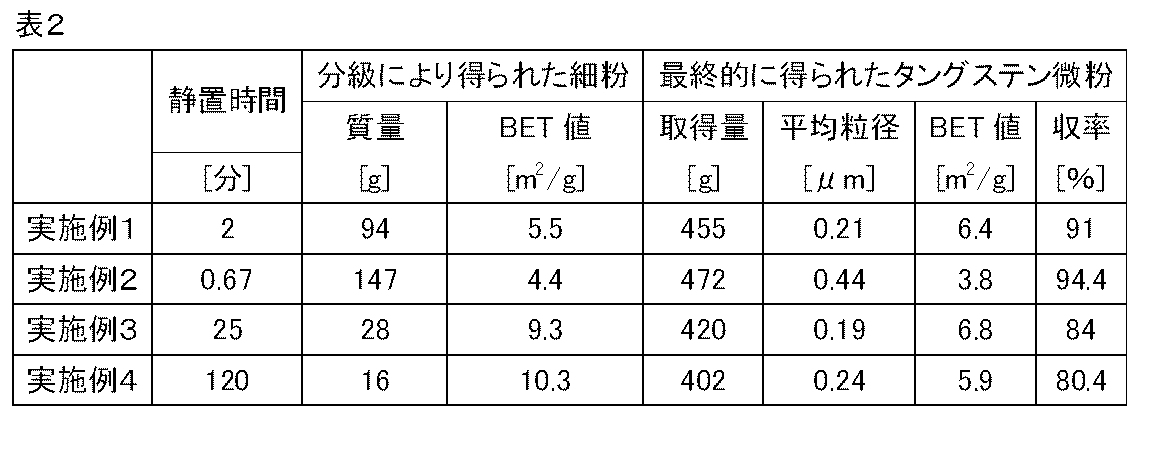
撹拌後の静置時間が短いほど分級される細粉の割合が多くなり、微粉収率は高くなる。より細かい平均粒径、より大きなBET値を有する微粉を得るためには、原料タングステン粉によって適切な静置時間が異なるため、予備実験により検討する必要がある。
実施例1で最初に原料タングステン粉に加える水600gの代わりに水500gとエタノール100gの混合溶媒を用いた以外は実施例1と同様の分級工程により細粉を得た。細粉の総質量は106gで、BET比表面積は5.5m2/gであった。続いて、表面酸化を行うときに酸化剤の種類を過硫酸アンモニウムから過硫酸カリウムに変更し、さらに容器の溶液中に白金の電極を2本離れた位置に設置して電極間に15Vの電圧を印加した(陰極側の電極には、袋状にしたガーゼを履かせて溶液以外の粉が接触しないようにした)以外は実施例1と同様にして細粉を得た。作製したタングステン微粉は418gあり、平均粒径0.12μm、粒度分布0.03~19μm、タップ密度2.7g/cm3、BET比表面積、10.2m2/g、酸素含有量8700質量ppmであった。
実施例5において、原料タングステン粉から分級工程を行わなかったこと以外は同様に操作を行い、タングステン微粉を作成した。得られたタングステン微粉の質量は305g、平均粒径は0.16μm、BET比表面積は8m2/gであった。
実施例5及び比較例2の結果を表3に示す。
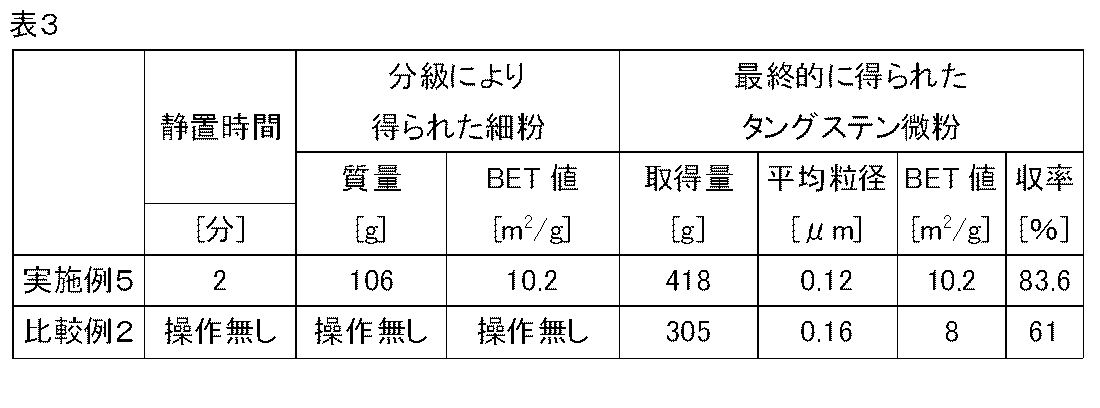
分級工程の際の溶媒を水とアルコールの混合溶媒にした場合、溶媒が水単独の場合溶離も細粉が溶媒中で浮遊しやすくなる。その影響により、分級される細粉の割合はやや多くなり、微粉収率は低下する傾向がある。より細かい平均粒径、より大きなBET値を有する微粉を得るためには、原料タングステン粉によって適切な溶媒が異なるため、予備実験により検討する必要がある。
Claims (15)
- 原料タングステン粉を平均粒子径が相対的に小さい細粉と平均粒子径が相対的に大きい粗粉に分級する分級工程、前記平均粒子径が相対的に大きい粗粉の粒子表面に酸化膜を形成させる酸化処理工程、前記酸化処理工程により形成された酸化膜及び前記平均粒子径が相対的に小さい細粉に形成されている自然酸化膜をアルカリ水溶液で化学的に除去するアルカリ処理工程を含むタングステン粉の微粉化方法。
- 原料タングステン粉を、平均粒子径が相対的に小さい細粉と平均粒子径が相対的に大きい粗粉に分級し、前記粗粉をさらに相対的に小さい細粉と平均粒子径が相対的に大きい粗粉に分級する工程を1回以上繰り返す分級工程、前記分級工程で得られた粗粉の粒子表面に酸化膜を形成させる酸化処理工程、前記酸化処理工程により形成された酸化膜及び前記複数回の分級工程で得られた平均粒子径が相対的に小さい細粉に形成されている自然酸化膜をアルカリ水溶液で除去するアルカリ処理工程を含むタングステン粉の微粉化方法。
- 請求項1または2に記載のタングステン微粉化方法により得られたタングステン微粉に対し、さらに請求項1または2に記載のタングステン微粉化方法により微粉化する工程を1回以上行うタングステン粉の微粉化方法。
- 前記分級工程を水簸分級により行う請求項1~3のいずれかに記載のタングステン粉の微粉化方法。
- 前記酸化処理が、電解液中でタングステン粉を撹拌しながら電解酸化する処理である請求項1~4のいずれかに記載のタングステン粉の微粉化方法。
- 前記電解液が過硫酸または鉱酸の水溶液である請求項5に記載のタングステン粉の微粉化方法。
- 前記鉱酸が、リン酸、硝酸、塩酸、ホウ酸及び硫酸から選択される請求項6に記載のタングステン粉の微粉化方法。
- 前記鉱酸が、リン酸またはホウ酸である請求項7に記載のタングステン粉の微粉化方法。
- 前記酸化処理が、酸化剤を含有する水溶液中にタングステン粉を分散させて酸化する処理である請求項1~5のいずれかに記載のタングステン粉の微粉化方法。
- 前記酸化剤が、マンガン(VII)化合物、クロム(VI)化合物、ハロゲン酸化合物、ペルオキソ酸及びその塩、過酸化物、並びに過硫酸化合物から選択される請求項9に記載のタングステン粉の微粉化方法。
- 前記酸化剤が過酸化水素、過硫酸カリウム、過硫酸アンモニウムから選択される請求項10に記載のタングステン粉の微粉化方法。
- 前記アルカリ水溶液が水酸化ナトリウム水溶液、または水酸化カリウム水溶液である請求項1~11のいずれかに記載のタングステン粉の微粉化方法。
- 請求項1~12のいずれかに記載の方法を含む工程により平均粒子径0.04~0.5μmのタングステン粉を得ることを特徴とするタングステン微粉の製造方法。
- 請求項1~12のいずれかに記載の方法を含む工程によりBET比表面積3~15m2/gのタングステン粉を得ることを特徴とするタングステン微粉の製造方法。
- 請求項1~12のいずれかに記載の方法を含む工程により、平均粒子径0.04~0.4μm、BET比表面積5~15m2/gのタングステン粉を得ることを特徴とするタングステン微粉の製造方法。
Priority Applications (3)
| Application Number | Priority Date | Filing Date | Title |
|---|---|---|---|
| US14/652,163 US9789538B2 (en) | 2012-12-17 | 2013-09-20 | Method for producing ultrafine tungsten powder |
| JP2014552963A JP5779728B2 (ja) | 2012-12-17 | 2013-09-20 | タングステン微粉の製造方法 |
| EP13865497.5A EP2933040A4 (en) | 2012-12-17 | 2013-09-20 | METHOD FOR PRODUCING A FINE TREATMENT OF TUNGSTEN |
Applications Claiming Priority (2)
| Application Number | Priority Date | Filing Date | Title |
|---|---|---|---|
| JP2012274532 | 2012-12-17 | ||
| JP2012-274532 | 2012-12-17 |
Publications (1)
| Publication Number | Publication Date |
|---|---|
| WO2014097698A1 true WO2014097698A1 (ja) | 2014-06-26 |
Family
ID=50978048
Family Applications (1)
| Application Number | Title | Priority Date | Filing Date |
|---|---|---|---|
| PCT/JP2013/075496 Ceased WO2014097698A1 (ja) | 2012-12-17 | 2013-09-20 | タングステン微粉の製造方法 |
Country Status (4)
| Country | Link |
|---|---|
| US (1) | US9789538B2 (ja) |
| EP (1) | EP2933040A4 (ja) |
| JP (1) | JP5779728B2 (ja) |
| WO (1) | WO2014097698A1 (ja) |
Cited By (2)
| Publication number | Priority date | Publication date | Assignee | Title |
|---|---|---|---|---|
| WO2017026247A1 (ja) * | 2015-08-12 | 2017-02-16 | 株式会社村田製作所 | コンデンサおよびその製造方法 |
| US12145857B2 (en) | 2018-08-17 | 2024-11-19 | Central Glass Company, Limited | Method for producing tungsten hexafluoride |
Families Citing this family (7)
| Publication number | Priority date | Publication date | Assignee | Title |
|---|---|---|---|---|
| KR102077191B1 (ko) * | 2018-02-12 | 2020-02-13 | 목포대학교산학협력단 | 고분자 용액법에 의한 In2O3 첨가 텅스텐 산화물 분말 합성 방법 및 그 합성방법에 의해 합성된 텅스텐 산화물 분말 |
| CN110983381B (zh) * | 2019-12-26 | 2021-02-09 | 有研亿金新材料有限公司 | 一种电解钨酸铵溶液制备超细钨粉的方法 |
| CN114078608A (zh) * | 2020-08-18 | 2022-02-22 | 成都虹波实业股份有限公司 | 一种生产高温导体浆料用钨粉的方法 |
| CN116568429A (zh) * | 2020-12-21 | 2023-08-08 | 联合材料公司 | 含钨粉末 |
| RU2759551C1 (ru) * | 2021-04-05 | 2021-11-15 | Общество с ограниченной ответственностью "Вириал" (ООО "Вириал") | Способ получения гидрированного порошка пластичного металла или сплава |
| WO2023062130A1 (de) | 2021-10-14 | 2023-04-20 | H. C. Starck Tungsten GmbH | Verfahren zur herstellung eines wolframmetall-pulvers mit grosser spezifischer oberfläche |
| CN119328151A (zh) * | 2024-11-18 | 2025-01-21 | 西安建筑科技大学 | 一种用于制备球形钼粉的高能球磨微氧化-氨剥离方法 |
Citations (8)
| Publication number | Priority date | Publication date | Assignee | Title |
|---|---|---|---|---|
| JPS5211752A (en) * | 1975-07-17 | 1977-01-28 | Toshiba Corp | Method of manufacturing cathodes for electron tubes |
| JPS5959808A (ja) * | 1982-09-29 | 1984-04-05 | Tokyo Tungsten Co Ltd | タングステン粗粒粉の製造方法 |
| JP2003272959A (ja) | 2002-03-15 | 2003-09-26 | Sanyo Electric Co Ltd | コンデンサ |
| WO2004055843A1 (ja) | 2002-12-13 | 2004-07-01 | Sanyo Electric Co.,Ltd. | 固体電解コンデンサ及びその製造方法 |
| JP2004349658A (ja) | 2002-07-26 | 2004-12-09 | Sanyo Electric Co Ltd | 電解コンデンサ |
| WO2012086272A1 (ja) | 2010-12-24 | 2012-06-28 | 昭和電工株式会社 | タングステン粉、コンデンサの陽極体及び電解コンデンサ |
| WO2013073253A1 (ja) * | 2011-11-15 | 2013-05-23 | 昭和電工株式会社 | タングステン細粉の製造方法 |
| WO2013080617A1 (ja) * | 2011-11-29 | 2013-06-06 | 昭和電工株式会社 | タングステン細粉の製造方法 |
Family Cites Families (6)
| Publication number | Priority date | Publication date | Assignee | Title |
|---|---|---|---|---|
| US4731111A (en) * | 1987-03-16 | 1988-03-15 | Gte Products Corporation | Hydrometallurical process for producing finely divided spherical refractory metal based powders |
| CZ303685B6 (cs) * | 1998-05-06 | 2013-03-06 | H. C. Starck Inc. | Práskový niob ve forme aglomerovaných primárních cástic, anoda kondenzátoru z tohoto práskového niobu a kondenzátor |
| DE102004023068B4 (de) * | 2004-05-11 | 2008-06-19 | H.C. Starck Gmbh | Wolframsäure und Verfahren zu deren Herstellung |
| JP4921806B2 (ja) * | 2006-02-13 | 2012-04-25 | 住友金属鉱山株式会社 | タングステン超微粉及びその製造方法 |
| JP4797099B2 (ja) * | 2009-10-01 | 2011-10-19 | Jx日鉱日石金属株式会社 | 高純度タングステン粉末の製造方法 |
| CN101983804B (zh) * | 2010-12-03 | 2012-07-04 | 中南大学 | 近球形钨粉的制备方法 |
-
2013
- 2013-09-20 WO PCT/JP2013/075496 patent/WO2014097698A1/ja not_active Ceased
- 2013-09-20 EP EP13865497.5A patent/EP2933040A4/en not_active Withdrawn
- 2013-09-20 JP JP2014552963A patent/JP5779728B2/ja not_active Expired - Fee Related
- 2013-09-20 US US14/652,163 patent/US9789538B2/en not_active Expired - Fee Related
Patent Citations (9)
| Publication number | Priority date | Publication date | Assignee | Title |
|---|---|---|---|---|
| JPS5211752A (en) * | 1975-07-17 | 1977-01-28 | Toshiba Corp | Method of manufacturing cathodes for electron tubes |
| JPS5959808A (ja) * | 1982-09-29 | 1984-04-05 | Tokyo Tungsten Co Ltd | タングステン粗粒粉の製造方法 |
| JP2003272959A (ja) | 2002-03-15 | 2003-09-26 | Sanyo Electric Co Ltd | コンデンサ |
| JP2004349658A (ja) | 2002-07-26 | 2004-12-09 | Sanyo Electric Co Ltd | 電解コンデンサ |
| WO2004055843A1 (ja) | 2002-12-13 | 2004-07-01 | Sanyo Electric Co.,Ltd. | 固体電解コンデンサ及びその製造方法 |
| US7154743B2 (en) | 2002-12-13 | 2006-12-26 | Sanyo Electric Co., Ltd. | Solid electrolytic capacitor and method for manufacturing same |
| WO2012086272A1 (ja) | 2010-12-24 | 2012-06-28 | 昭和電工株式会社 | タングステン粉、コンデンサの陽極体及び電解コンデンサ |
| WO2013073253A1 (ja) * | 2011-11-15 | 2013-05-23 | 昭和電工株式会社 | タングステン細粉の製造方法 |
| WO2013080617A1 (ja) * | 2011-11-29 | 2013-06-06 | 昭和電工株式会社 | タングステン細粉の製造方法 |
Non-Patent Citations (1)
| Title |
|---|
| See also references of EP2933040A4 |
Cited By (5)
| Publication number | Priority date | Publication date | Assignee | Title |
|---|---|---|---|---|
| WO2017026247A1 (ja) * | 2015-08-12 | 2017-02-16 | 株式会社村田製作所 | コンデンサおよびその製造方法 |
| CN107851515A (zh) * | 2015-08-12 | 2018-03-27 | 株式会社村田制作所 | 电容器及其制造方法 |
| JPWO2017026247A1 (ja) * | 2015-08-12 | 2018-05-24 | 株式会社村田製作所 | コンデンサおよびその製造方法 |
| CN107851515B (zh) * | 2015-08-12 | 2019-09-24 | 株式会社村田制作所 | 电容器及其制造方法 |
| US12145857B2 (en) | 2018-08-17 | 2024-11-19 | Central Glass Company, Limited | Method for producing tungsten hexafluoride |
Also Published As
| Publication number | Publication date |
|---|---|
| US20150321254A1 (en) | 2015-11-12 |
| US9789538B2 (en) | 2017-10-17 |
| JPWO2014097698A1 (ja) | 2017-01-12 |
| EP2933040A1 (en) | 2015-10-21 |
| JP5779728B2 (ja) | 2015-09-16 |
| EP2933040A4 (en) | 2016-08-17 |
Similar Documents
| Publication | Publication Date | Title |
|---|---|---|
| JP5779728B2 (ja) | タングステン微粉の製造方法 | |
| JP5731558B2 (ja) | 電解コンデンサ用タングステン細粉 | |
| JP2010174377A (ja) | 窒素化ニオブ粉末及びニオブ電解キャパシター | |
| JP5731559B2 (ja) | 電解コンデンサ用タングステン細粉 | |
| WO2015096048A1 (zh) | 一种改善了电性能的电容器级高比容钽粉及其制备方法 | |
| JP6412501B2 (ja) | ニオブ造粒粉末の製造方法 | |
| WO2015093154A1 (ja) | タングステン粉、コンデンサの陽極体、及び電解コンデンサ | |
| JP6258222B2 (ja) | ニオブコンデンサ陽極用化成体及びその製造方法 | |
| US9691553B2 (en) | Production method for tungsten anode body | |
| JP5844953B2 (ja) | タングステンコンデンサ用陽極体 | |
| JP5750201B1 (ja) | タングステン粉、コンデンサの陽極体、及び電解コンデンサ | |
| JP2014105365A (ja) | ニッケルナノ粒子とその製造方法およびニッケルペースト | |
| WO2013172453A1 (ja) | コンデンサ素子の製造方法 | |
| JP2010265549A (ja) | コンデンサ用ニオブ粉 | |
| WO2015098284A1 (ja) | タングステンコンデンサ用陽極体の製造方法 |
Legal Events
| Date | Code | Title | Description |
|---|---|---|---|
| 121 | Ep: the epo has been informed by wipo that ep was designated in this application |
Ref document number: 13865497 Country of ref document: EP Kind code of ref document: A1 |
|
| ENP | Entry into the national phase |
Ref document number: 2014552963 Country of ref document: JP Kind code of ref document: A |
|
| WWE | Wipo information: entry into national phase |
Ref document number: 14652163 Country of ref document: US |
|
| NENP | Non-entry into the national phase |
Ref country code: DE |
|
| WWE | Wipo information: entry into national phase |
Ref document number: 2013865497 Country of ref document: EP |