WO2014102817A1 - Substituted phthalazin-1 (2h)-one derivatives as selective inhibitors of poly (adp-ribose) polymerase-1 - Google Patents

Substituted phthalazin-1 (2h)-one derivatives as selective inhibitors of poly (adp-ribose) polymerase-1 Download PDF

Info

Publication number
WO2014102817A1
WO2014102817A1 PCT/IN2013/000794 IN2013000794W WO2014102817A1 WO 2014102817 A1 WO2014102817 A1 WO 2014102817A1 IN 2013000794 W IN2013000794 W IN 2013000794W WO 2014102817 A1 WO2014102817 A1 WO 2014102817A1
Authority
WO
WIPO (PCT)
Prior art keywords
groups
alkyl
compound
heterocyclyl
phthalazin
Prior art date
Legal status (The legal status is an assumption and is not a legal conclusion. Google has not performed a legal analysis and makes no representation as to the accuracy of the status listed.)
Ceased
Application number
PCT/IN2013/000794
Other languages
French (fr)
Inventor
Brijesh K. Srivastava
Ranjit C. Desai
Pankaj R Patel
Current Assignee (The listed assignees may be inaccurate. Google has not performed a legal analysis and makes no representation or warranty as to the accuracy of the list.)
Zydus Lifesciences Ltd
Original Assignee
Cadila Healthcare Ltd
Priority date (The priority date is an assumption and is not a legal conclusion. Google has not performed a legal analysis and makes no representation as to the accuracy of the date listed.)
Filing date
Publication date
Family has litigation
First worldwide family litigation filed litigation Critical https://patents.darts-ip.com/?family=54198806&utm_source=google_patent&utm_medium=platform_link&utm_campaign=public_patent_search&patent=WO2014102817(A1) "Global patent litigation dataset” by Darts-ip is licensed under a Creative Commons Attribution 4.0 International License.
Priority to ES13828996.2T priority Critical patent/ES2614885T3/en
Priority to KR1020157017355A priority patent/KR101652654B1/en
Priority to EA201591239A priority patent/EA201591239A1/en
Priority to AU2013368842A priority patent/AU2013368842B2/en
Priority to EP13828996.2A priority patent/EP2938598B1/en
Priority to MX2015006780A priority patent/MX2015006780A/en
Application filed by Cadila Healthcare Ltd filed Critical Cadila Healthcare Ltd
Priority to BR112015012425A priority patent/BR112015012425A2/en
Priority to NZ708255A priority patent/NZ708255A/en
Priority to MA38080A priority patent/MA38080A1/en
Priority to CA2890309A priority patent/CA2890309A1/en
Priority to HK15111208.8A priority patent/HK1210466B/en
Priority to SG11201503670YA priority patent/SG11201503670YA/en
Priority to US14/647,088 priority patent/US9598418B2/en
Priority to JP2015550210A priority patent/JP5930452B2/en
Priority to CN201380069025.0A priority patent/CN104918917A/en
Priority to AP2015008439A priority patent/AP2015008439A0/en
Priority to DK13828996.2T priority patent/DK2938598T3/en
Publication of WO2014102817A1 publication Critical patent/WO2014102817A1/en
Priority to ZA2015/03218A priority patent/ZA201503218B/en
Priority to IL238714A priority patent/IL238714A0/en
Priority to PH12015501199A priority patent/PH12015501199B1/en
Anticipated expiration legal-status Critical
Ceased legal-status Critical Current

Links

Classifications

    • CCHEMISTRY; METALLURGY
    • C07ORGANIC CHEMISTRY
    • C07DHETEROCYCLIC COMPOUNDS
    • C07D487/00Heterocyclic compounds containing nitrogen atoms as the only ring hetero atoms in the condensed system, not provided for by groups C07D451/00 - C07D477/00
    • C07D487/02Heterocyclic compounds containing nitrogen atoms as the only ring hetero atoms in the condensed system, not provided for by groups C07D451/00 - C07D477/00 in which the condensed system contains two hetero rings
    • C07D487/04Ortho-condensed systems
    • AHUMAN NECESSITIES
    • A61MEDICAL OR VETERINARY SCIENCE; HYGIENE
    • A61PSPECIFIC THERAPEUTIC ACTIVITY OF CHEMICAL COMPOUNDS OR MEDICINAL PREPARATIONS
    • A61P35/00Antineoplastic agents
    • AHUMAN NECESSITIES
    • A61MEDICAL OR VETERINARY SCIENCE; HYGIENE
    • A61PSPECIFIC THERAPEUTIC ACTIVITY OF CHEMICAL COMPOUNDS OR MEDICINAL PREPARATIONS
    • A61P43/00Drugs for specific purposes, not provided for in groups A61P1/00-A61P41/00
    • CCHEMISTRY; METALLURGY
    • C07ORGANIC CHEMISTRY
    • C07DHETEROCYCLIC COMPOUNDS
    • C07D237/00Heterocyclic compounds containing 1,2-diazine or hydrogenated 1,2-diazine rings
    • C07D237/26Heterocyclic compounds containing 1,2-diazine or hydrogenated 1,2-diazine rings condensed with carbocyclic rings or ring systems
    • C07D237/30Phthalazines
    • C07D237/32Phthalazines with oxygen atoms directly attached to carbon atoms of the nitrogen-containing ring
    • CCHEMISTRY; METALLURGY
    • C07ORGANIC CHEMISTRY
    • C07DHETEROCYCLIC COMPOUNDS
    • C07D403/00Heterocyclic compounds containing two or more hetero rings, having nitrogen atoms as the only ring hetero atoms, not provided for by group C07D401/00
    • C07D403/02Heterocyclic compounds containing two or more hetero rings, having nitrogen atoms as the only ring hetero atoms, not provided for by group C07D401/00 containing two hetero rings
    • C07D403/10Heterocyclic compounds containing two or more hetero rings, having nitrogen atoms as the only ring hetero atoms, not provided for by group C07D401/00 containing two hetero rings linked by a carbon chain containing aromatic rings
    • CCHEMISTRY; METALLURGY
    • C07ORGANIC CHEMISTRY
    • C07DHETEROCYCLIC COMPOUNDS
    • C07D491/00Heterocyclic compounds containing in the condensed ring system both one or more rings having oxygen atoms as the only ring hetero atoms and one or more rings having nitrogen atoms as the only ring hetero atoms, not provided for by groups C07D451/00 - C07D459/00, C07D463/00, C07D477/00 or C07D489/00
    • C07D491/02Heterocyclic compounds containing in the condensed ring system both one or more rings having oxygen atoms as the only ring hetero atoms and one or more rings having nitrogen atoms as the only ring hetero atoms, not provided for by groups C07D451/00 - C07D459/00, C07D463/00, C07D477/00 or C07D489/00 in which the condensed system contains two hetero rings
    • C07D491/04Ortho-condensed systems
    • C07D491/044Ortho-condensed systems with only one oxygen atom as ring hetero atom in the oxygen-containing ring
    • C07D491/048Ortho-condensed systems with only one oxygen atom as ring hetero atom in the oxygen-containing ring the oxygen-containing ring being five-membered
    • CCHEMISTRY; METALLURGY
    • C07ORGANIC CHEMISTRY
    • C07DHETEROCYCLIC COMPOUNDS
    • C07D495/00Heterocyclic compounds containing in the condensed system at least one hetero ring having sulfur atoms as the only ring hetero atoms
    • C07D495/02Heterocyclic compounds containing in the condensed system at least one hetero ring having sulfur atoms as the only ring hetero atoms in which the condensed system contains two hetero rings
    • C07D495/04Ortho-condensed systems
    • CCHEMISTRY; METALLURGY
    • C07ORGANIC CHEMISTRY
    • C07DHETEROCYCLIC COMPOUNDS
    • C07D498/00Heterocyclic compounds containing in the condensed system at least one hetero ring having nitrogen and oxygen atoms as the only ring hetero atoms
    • C07D498/02Heterocyclic compounds containing in the condensed system at least one hetero ring having nitrogen and oxygen atoms as the only ring hetero atoms in which the condensed system contains two hetero rings
    • C07D498/04Ortho-condensed systems
    • CCHEMISTRY; METALLURGY
    • C07ORGANIC CHEMISTRY
    • C07DHETEROCYCLIC COMPOUNDS
    • C07D513/00Heterocyclic compounds containing in the condensed system at least one hetero ring having nitrogen and sulfur atoms as the only ring hetero atoms, not provided for in groups C07D463/00, C07D477/00 or C07D499/00 - C07D507/00
    • C07D513/02Heterocyclic compounds containing in the condensed system at least one hetero ring having nitrogen and sulfur atoms as the only ring hetero atoms, not provided for in groups C07D463/00, C07D477/00 or C07D499/00 - C07D507/00 in which the condensed system contains two hetero rings
    • C07D513/04Ortho-condensed systems

Definitions

  • the present invention relates to novel compounds of general formula (1), their stereoisomers, regioisomers, tautomeric forms and novel intermediates involved in their synthesis, their pharmaceutically acceptable salts, pharmaceutically acceptable solvates and pharmaceutical compositions containing them.
  • the present invention also relates to processes for preparing the novel compounds of general formula (I), their stereoisomers, regioisomers, their tautomeric forms, their pharmaceutically acceptable salts, pharmaceutically acceptable solvates, pharmaceutical compositions containing them, and novel intermediates involved in their synthesis.
  • the present invention is further directed to compounds which cause selective
  • PARP-1 Poly (ADP-ribose) polymerase- 1
  • PARP-1 is a nuclear protein whose zinc finger DNA binding domain localizes PARP- 1 to the site of DNA damage.
  • This NAD dependent enzyme catalyzes poly (ADP-ribosylation) of proteins, involved in the detection and repair of DNA damage. It plays a frontal role in the decision of a cell to live or to die in a stress situation [Senthil kumar B., Rajmohan, et al, Mol. Cell. Biol.
  • the primary structure of the enzyme is highly, conserved in eukaryotes with human enzyme having 92% homology with mouse enzyme at the level of amino acid sequence and a 50 amino acid block showing 100% homology between vertebrates [Virag Laszlo and Szabo Csaba, Pharmacol. Reviews 2002, 54(i), 375-429].
  • Studies on the molecular mechanism of PARP-1 suggests that, it is involved in various DNA related functions including gene amplifications, cell division, differentiation, apoptosis, DNA base excision repair and also effects on telomere length and chromosome stability [d'Add di Fagogna et al., Nature Gen. 1999, 23(70), 76-80].
  • PARP- 1 modulates DNA repair and other processes and can produce long chains of poly (ADP-ribose) within the cell nucleus which is central to its activity [Althaus, F. R.; Richter, C. Mol. Biol, Biochem. Biophys. 1987, 37, 1- 237].
  • Different studies on knock out mouse models report that the deletion of PARP- 1 impairs DNA repair but is not embryonically lethal.
  • Double knock out PARP- 1 and PARP-2 mice die during early embryogenesis, which shows that PARP-2 as the closest homolog of PARP-1 (62% identical in its catalytic domain to PARP-1 ) & plays a major role in the DNA repair during the absence of PARP-1 enzyme [Ratnam Kapil and Law Jenifer A. Clin.
  • PARP inhibitors could be used not only as chemo/radiotherapy sensitizers, but also as single agents to selectively kill cancers which are due to defect in DNA repair, specifically cancers with mutations in the breast cancer-associated gene (BRCA1 and BRCA2).
  • PARP becomes activated in response to oxidative DNA damage and depletes cellular energy pools, thus leading to cellular dysfunction in various tissues.
  • the activation of PARP may also induce various cell death processes and promotes an inflammatory response associated with multiple organ failure.
  • PARP poly (ADP-ribose) polymerase
  • Novel compounds which are selective PARP-1 inhibitors, their preparation and their use in medicine have also been reported in WO 2002036576, WO 2006039545, WO 2007062413, WO 2004080976, WO 2009093032, WO 2008047082, WO 2001042219, WO 2005066163, WO 2006106326, WO 2008146035, WO 2006021801 , US 20090192156, WO 2012019427, WO 2012071684, WO 2012019426, WO 2012072033, which are incorporated as references in their entirety.
  • X is selected from NH, S and O.
  • Y is selected from CH or N.
  • a and B together represent an optionally substituted, fused aromatic ring
  • R is selected from the group consisting of H, optionally substituted Ci -2 o alkyl, Ci_ 2 o aryl, C(3 -2 o) heterocyclyl, thioamido, ester, acyl, and sulfonyl groups;
  • R Y is selected from H, hydroxyl, amino; R and R Y may together form a spiro C3.7 cycloalkyl or heterocyclyl group;
  • R C1 and R C2 are independently selected from the group consisting of H and C1-4 alkyl;
  • R 1 is selected from H and halo And Het is selected from
  • Y l is selected from CH and N
  • Y 2 is selected from CH and N
  • Y 3 is selected from CH, CF and N
  • w can be N
  • WO 2012 019426 discloses PARP inhibitors of the following general formula (I)
  • a and B are connected together to the carbon atoms to form a cycloalkyl group, heterocyclic group, aryl or heteroaryl group,
  • Each of the ring atoms D or E is independently selected from C or N atoms; when n is 1 , D and E are connected to one another to accomplish 6 ⁇ 10-membered ring X; This specification is incorporated as reference in its entirety.
  • WO 2012 072033 discloses compounds of formula I or II, their isomers, salts, solvates, chemically protected form, and prodrugs:
  • New Gen Therapeutics, Inc has published a patent WO 2012166983 and disclosed tricyclic inhibitors of poly(ADP-ribose)polymerase.
  • Novel compounds having PARP inhibitory activity has been disclosed by Santen Pharmaceutical Co. Ltd. in a patent WO 2013/008872 and the following formula has been disclosed.
  • AstraZeneca AB has published a patent US 8475842 for immediate release pharmaceutical formation of 4-[3-4(cyclopropanecarbonyl-piperazine-l -carbonyl)-4- fluoro-benzyl]-2H-phthalazin-l -one.
  • the present invention describes novel compounds useful as poly (ADP-ribose) polymerase- 1 inhibitors.
  • the compounds are defined by the general formula (I) below.
  • the compounds of the present invention acts by inhibiting PARP l enzyme to prevent the process of DNA repair and induce cell mediated apoptosis.
  • PARP- 1 deficient or inhibited cells are more sensitive to DNA damaging agents ( ⁇ radiation, topoisomerase inhibitors, and alkylating agents).
  • the compounds of the present invention are selective inhibitors of the poly (ADP-ribose) polymerase-! .
  • the main object of the present invention is to provide novel compounds of general formula (I), their stereoisomers, tautomeric forms, their regioisomers, novel intermediates involved in their synthesis, their pharmaceutically acceptable salts, their pharmaceutically acceptable solvates and pharmaceutical compositions containing them or their mixtures and their use in medicine.
  • Another object of the present invention is provided a process for the preparation of novel compounds of general formula (I), their stereoisomers, regioisomers and their tautomeric forms, novel intermediates involved in their synthesis, pharmaceutically acceptable salts, pharmaceutically acceptable solvates and pharmaceutical compositions containing them.
  • Another object of the present invention is to provide a method of treatment of diseases which can be treated or whose symptoms can be reversed with by administering a therapeutically effective & non-toxic amount of the compound of formula (I) or their pharmaceutically acceptable compositions to the mammals.
  • 'A' and 'B' may be independently selected from hydrogen, alkyl or connected together to the carbon atoms to form a cycioalkyi , heterocyclyl , aryl or heteroaryl groups, wherein each of the said cycioalkyi, heterocyclyl, aryl or heteroaryl groups are further substituted independently by one or more substituent groups selected from alkyl , halogen, hydroxyl , alkoxy , cycioalkyi , heterocyclyl , aryl , heteroaryl , -C(0)OR 5 , -OC(0)R 5 , -0(CH 2 ) P C(0)OR 5 , -C(0)R 5 , -NHC(0)R 5 , - NR 6 R 7 , -OC(0)NR 6 R 7 or -C(0)NR 6 R 7 groups.
  • R 2 is selected from substituent groups consisting of hydrogen atom, hydroxyl, alkyl, cycioalkyi, oxo, C(0)OR 5 , -C(0)R 5 , or -C(0)NR 6 R 7 , wherein said alkyl or cycioalkyi group may be further substituted by one or more substituents groups selected from halogen, hydroxyl, alkyl or alkoxy.
  • R 3 and R 4 are each independently selected from the groups such as hydrogen atom, alkyl , hydroxyl, alkoxy, cycioalkyi, - C(0)OR 5 , -OC(0)R s , -0(CH 2 ) p C(0)OR 5 , - C(0)R 5 , -NHC(0)R 5 , -NR 6 R 7 , -OC(0)NR 6 R 7 or -C(0)NR 6 R 7 alternatively, R 3 and R 4 together form an oxo group;
  • Each of ring atoms 'D' and ⁇ ' is independently selected from C or N atoms;
  • 'D' and ⁇ ' are connected to one another to form 5 membered ring 'X', wherein 'X' is selected from the groups such as cycioalkyi, heterocyclyl, heteroaryl, wherein the cycioalkyi, heterocyclyl or heteroaryl groups is further substituted with one or more substituents selected from alkyl, halogen, hydroxyl, alkoxy, cycioalkyi, heterocyclyl, aryl or heteroaryl, benzyl, oxo, OR 5 , -C(0)OR 5 , -OC(0)R 5 , -0(CH 2 ) p C(0)OR 5 , C(0)R 5 , S(0) n R 5 , -NHC(0)R 5 , NR 6 R 7 , -OC(0)NR 6 R 7 or -C(ONR 6 R 7 , wherein the alkyl , cycioalkyi, heterocyclyl, aryl
  • Each of R 6 or R 7 at each occurrence are independently selected from the groups consisting of hydrogen atom, alkyl, cycloalkyl, heterocyclyl, aryl or heteroaryl groups; wherein said alkyl, cycloalkyl, heterocyclyl, aryl or heteroaryl groups are each independently further substituted by one or more substituents selected from alkyl, halogen, hydroxyl, alkoxy, cycloalkyl, heterocyclyl, aryl, heteroaryl, carboxylic acid or carboxylic acid ester substituents;
  • R 6 and R 7 are joined together with nitrogen atom to form a heterocyclic ring; wherein said heterocyclic ring contains one or more heteroatoms selected from N, O, S(0)n, furthermore the stated heterocyclic ring is further substituted with one or more substituents selected from alkyl, halogen, hydroxyl, alkoxy, cycloalkyl, heterocyclyl, aryl, heteroaryl, carboxylic acid or carboxylic acid ester substituted substituents;
  • n 0, 1 or 2 and p is 0, 1 or 2.
  • substituents wherever applicable and where substituents are not specifically mentioned includes, but are not limited to the following radicals, alone or in combination with other radicals, hydroxyl, oxo, halo, thio, nitro, amino, alkyl, alkoxy, haloalkyl or haloalkoxy groups.
  • the groups representing the above may further be selected from those described hereinafter.
  • the "aryl” may be selected from phenyl, naphthyl, tetrahydronaphthyl, indenyl, dihydroindenyl, biphenyl groups and each of these groups may be optionally substituted with one or more substituents selected from hydrogen, halogen, alkyl, alkoxy, hydroxyl, haloalkyl, haloalkoxy, cyano, thioalkyl, cycloalkyl groups;
  • Heteroaryl or “heteroaromatic” is selected from suitable single or fused mono, bi or tricyclic aromatic heterocyclic radicals containing one or more hetero atoms selected from O, N or S, more preferably the groups are selected from pyridyl, thienyl, furyl, pyrrolyl, indolinyl, indolyl, pyridofuranyl, pyridothienyl, thienopyrimidyl, quinolinyl, pyrimidinyl, pyrazolyl, quinazolinyl, pyridazinyl, purinyl groups, each of these groups may be further optionally substituted with one or more substituents selected from hydrogen, halogen, alkyl, alkoxy, hydroxyl, haloalkyl, haloalkoxy, aryl, aralkyl, cyano, alkylthio, thioalkyl groups;
  • Heterocyclyl may be selected from suitable saturated, partially saturated or unsaturated aromatic or non-aromatic mono, bi or tricyclic radicals, containing one or more heteroatoms selected from nitrogen, sulfur and oxygen, more preferably selected from aziridinyl, azetidinyl, pyrrolidinyl, imidazolidinyl, piperidinyl, piperazinyl, 2- oxopiperidinyl, 4-oxopiperidinyI, 2-oxopiperazinyl, 3-oxopiperazinyl, morpholinyl, thiomorpholinyl, 2-oxomorpholinyI, azepinyl, diazepinyl, oxapinyl, thiazepinyl, oxazolidinyl, thiazo!idinyl, dihydrothiophene, dihydropyran, dihydrofuran, dihydrothiazole, benzopyranyl, benzopyranonyl, benzopyr
  • radicals described above may be selected from:
  • alkyl used either alone or in combination with other radicals, denotes a linear or branched radical containing one to six carbons, selected from methyl, ethyl, ⁇ -propyl, wo-propyl, «-butyl, sec-butyl, ier/-butyl, amyl, f-amyl, «-pentyI, w-hexyl, and the like;
  • alkoxy used either alone or in combination with other radicals, is selected from groups containing an alkyl radical, as defined above, attached directly to an oxygen atom, more preferably groups selected from methoxy, ethoxy, «-propoxy, « ⁇ -propoxy, n-butoxy, /-butoxy, wo-butoxy, pentyloxy, hexyloxy, and the like;
  • haloalkyl is selected from an alkyl radical, as defined above, suitably substituted with one or more halogens; such as fluoromethyl, difiuoromethyl, trifluoromethyl, fluoroethyl, difluoroethyl, trifluoroethyl, mono or polyhalo substituted methyl, ethyl, propyl, butyl, pentyl or hexyl groups;
  • Haloalkoxy is selected from suitable haloalkyl, as defined above, directly attached to an oxygen atom, more preferably groups selected from fluoromethoxy, chloromethoxy, fluoroethoxy, chloroethoxy and the like;
  • alkylthio denotes a straight or branched or cyclic monovalent substituent comprising an alkyl group as defined above, linked through a divalent sulfur atom having a free valence bond from the sulfur atom, more preferably the groups may be selected from methylthio, ethylthio, propylthio;
  • aralkyl represents an aryl group as defined above attached to an alkyl group as described above;
  • Heteroaralkyl and “heterocyclyclakyl” represents heteroaryl and heterocyclyl groups respectively as defined above attached to an alkyl group as defined above.
  • the compounds of formula (I) may optionally be converted to their suitable pharmaceutically acceptable salts by processes as are known in the art.
  • the novel compounds of the present invention can further be , formulated into suitable pharmaceutically acceptable compositions by combining with suitable excipients by techniques and processes and concentrations as are well known.
  • the compounds of the present invention modulate PARP- 1 receptor and are useful as a therapeutic target for many diseases and especially for the treatment of cancer.
  • the compounds prepared according to present invention include, but are not limited to:
  • Example 1 4-(3-(5-benzyloctahydropyrrolo[3,4-c]pyrrole-2-carbonyl)-4- fluorobenzyl)phthalazin-l (2H)-one;
  • Example 2 2-benzyl-5-(2-fluoro-5-((4-oxo-3,4-dihydrophthalazin- l -yl)methyl) benzoyl)tetrahydropyrrolo[3,4-c]pyrrole- l ,3(2H,3aH)-dione;
  • Example 3 4-(4-fluoro-3-( l ,4,5,6-tetrahydropyrrolo[3,4-c]pyrazole-5-carbonyl) benzyl)phthalazin-l (2H)-one;
  • Example 4 4-(3-(5-(cyclopropanecarbonyl)octahydropyrrolo[3,4-c]pyrrole-2- carbonyl)-4-fluorobenzyl)phthalazin-l (2H)-one;
  • Example 5 4-(3-(l-(cyclopropylmethyl)- 1,4,5, 6-tetrahydropyrrolo[3,4-c]pyrazoIe-5- carbonyl)-4-fluorobenzyl)phthalazin- 1 (2H)-one;
  • Example 6 4-(3-(5-(cyclopropylmethyl)octahydropyrroIo[3,4-c]pyrrole-2-carbonyl)- 4-fluorobenzyl)phthalazin-l (2H)-one;
  • Example 7 4-(4-fluoro-3-(5-(2,2,2-trifluoroethyl)octahydropyrrolo[3,4-c]pyrrole-2- carbonyI)benzyl)phthalazin- 1 (2H)-one;
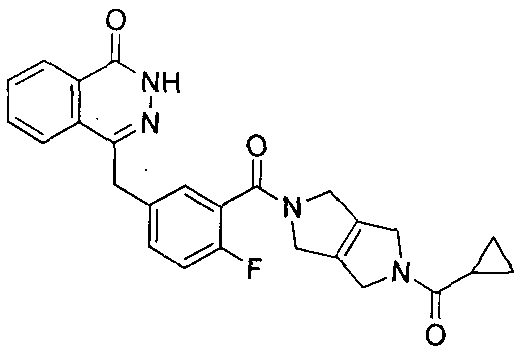
  • Example 8 4-(3-(5-(cyclopropylmethyl)- 1 ,2,3,4,5,6-hexahydropyrrolo[3,4-c]pyrrole-
  • Example 9 4 ⁇ (3-(5-benzyloctahydropyrrolo[3,4-c]pyrrole-2-carbonyl)-4- fluorobenzyl)phthalazin-l(2H)-one hydrochloride;
  • Example 10 4-(4-fluoro-3-(5-(2-((3-fluorophenyl)thio)-2-methylpropanoyl) octahydropyrrolo[3,4-c]pyrrole-2-carbonyl)benzyl)phthalazin- l (2H)-one;
  • Example 1 1 2-benzyl-5-(2-fluoro-5-((4-oxo-3,4-dihydrophthalazin- l -y!methyl) benzoyl)tetrahydropyrrolo[3,4-c]pyrrole- l ,3(2H,3aH)-dione;
  • Example 12 4-(3-(l -(cyclopropanecarbonyl)-l ,4,5,6-tetrahydropyrrolo[3,4-c] pyrazole-5-carbonyl)-4-fluorobenzyl)phthalazin-l (2H)-one;
  • Example 1 3 tert-butyl 5-(2-fluoro-5-((4-oxo-3,4-dihydrophthalazin-l -yl)methyl) benzoyl) hexahydropyrrolo[3,4-c]pyrrole-2( 1 H)-carboxylate;
  • Example 14 4-(4-fluoro-3-(hexahydro-l H-furo[3,4-c]pyrrole-5-carbonyl) benzyl)phthalazin- 1 (2H)-one;
  • Example 15 4-(4-fluoro-3-(octahydropyrrolo[3,4-c]pyrrole-2-carbonyl) benzyl) phthalazin-l(2H)-one;
  • Example 16 4-(4-fluoro-3-(5-(methylsulfonyl)octahydropyrrolo[3,4-c]pyrrole-2- carbonyl)benzyl) phthalazin-1 (2H)-one;
  • Example 17 4-(4-fluoro-3-( l -(methylsulfonyl)-l,4,5,6-tetrahydropyrrolo[3,4-c] pyrazole-5-carbonyl)benzyl)phthalazin-l (2H)-one;
  • Example 18 4-(3-(5-benzoyloctahydropyrrolo[3,4-c]pyrrole-2-carbonyl)-4- fluorobenzyl)phthalazin-l (2H)-one;
  • Example 19 4-(3-(5-(2,4-difluorobenzyl)octahydropyrrolo[3,4-c]pyrrole-2-carbonyl)- 4-fluorobenzyl) phthalazin-1 (2H)-one;
  • Example 20 4-(3-(5,6-dihydro-4H-furo[3,4-c]pyrrole-5-carbonyl)-4-fluorobenzyl) phthalazin- l (2H)-one;
  • Example 21 4-(4-fluoro-3-(5-methyloctahydropyrrolo[3,4-c]pyrrole-2-carbonyl) benzyl)phthalazin-l(2H)-one;
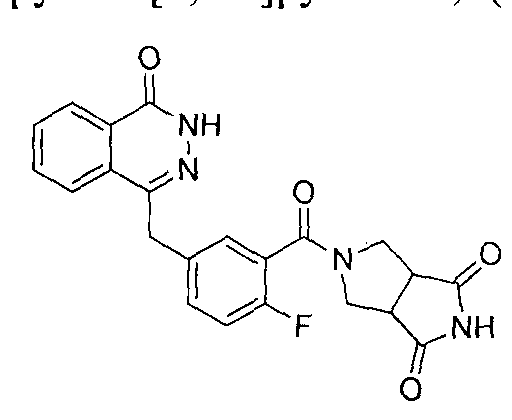
  • Example 22 5-(2-fluoro-5-((4-oxo-3,4-dihydrophthalazin-l -yl)methyl)benzoyl) tetrahydropyrrolo[3,4-c]pyrrole-l ,3(2H,3aH)-dione;
  • Example 23 4-(4-fluoro-3-(octahydrocyclopenta[c]pyrrole-2-carbonyl)benzyl) phthalazin- 1 (2H)-one;
  • Example 24 4-(4-fluoro-3-(5-(4-fluorobenzyl)octahydropyrrolo[3,4-c]pyrrole-2- carbonyl)benzyl) phthalazin- l (2H)-one;
  • Example 25 4-(4-fluoro-3-(5-(2-fluorobenzyl)octahydropyrrolo[3,4-c]pyrrole-2- carbonyl)benzyl) phthalazin- l (2H)-one;
  • Example 26 4-(4-fluoro-3-(5-(2-4-(4-fluoro-3-(5-((6-methoxypyridin-2-yl)methyl) octahydropyrrolo [3,4-c]pyrrole-2-carbonyl)benzyl)phthalazin-l(2H)-one;
  • Example 27 5-(2-fluoro-5-((4-oxo-3,4-dihydrophthalazin-l -yl)methyl)benzoyl)-2- methyl tetrahydropyrrolo[3,4-c]pyrrole-l,3(2H,3aH)-dione;
  • Example 28 4-(4-fluoro-3-( l -methyl- 1 , 4,5,6-tetrahydropyrrolo[3,4-c]pyrazole-5- carbonyI)benzyl)phthalazin-l (2H)-one compound with 4-(4-fluoro-3-(2-methyl- 2,4,5,6-tetrahydropyrrolo[3,4-c]pyrazole-5-carbonyl)benzyl)phthalazin-l (2H)-one ( 1 :3);
  • Example 29 4-(3-(2,2-dioxido-3,4,5,6-tetrahydro- l H-thieno[3,4-c]pyrrole-5- carbonyl)-4-fluorobenzyl) phthalazin- 1 (2H)-one;
  • Example 30 4-(3-(5,6-dihydro-4H-thieno[3,4-c]pyrroIe-5-carbonyl)-4-fluorobenzyl) phthalazin- 1 (2H)-one;
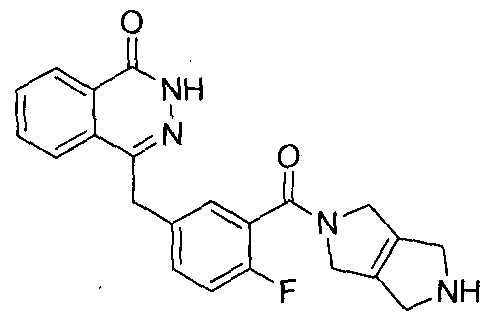
  • Example 31 4-(4-fluoro-3-( 1 , 2,3,4, 5,6-hexahydropyrrolo[3,4-c]pyrrole-2-carbonyI) benzyl)phthalazin- 1 (2H)-one;
  • Example 32 4-(4-fluoro-3-(5-phenyloctahydropyrrolo[3,4-c]pyrrole-2-carbonyl) benzyl)phthalazin- l (2H)-one;
  • Example 33 4-(4-fluoro-3-(5-methyl- 1 ,2,3,4,5, 6-hexahydropyrrolo[3,4-c]pyrrole-2- carbonyl)benzyl) phthalazin- l (2H)-one;
  • Example 34 4-(3-((3a ,8bR)-decahydropyrrolo[3,4-a]pyrrolizine-2-carbonyl)-4- fluorobenzyl)phthalazin- 1 (2H)-one;
  • Example 35 4-(4-fluoro-3-(2-methyl-2,4,5,6-tetrahydropyrrolo[3,4-c]pyrazole-5- carbonyl)benzyl)phthalazin- 1 (2H)-one;
  • Example 36 4-(4-fluoro-3-( 1 -methyl-2,4,5,6-tetrahydropyrrolo[3,4-c]pyrazole-5- carbonyl)benzyl) phthalazin- 1 (2H)-one;
  • Example 37 2-((5-(2-fluoro-5-((4-oxo-3,4-dihydrophthalazin- l -yl)methyl) benzoyl) .
  • Example 38 4-(3-(5-(difluoromethyl)octahydropyrrolo[3,4-c]pyrrole-2-carbonyl)-4- fluorobenzyl) phthalazin- l (2H)-one;
  • Example 39 4-(4-fluoro-3-((3aR,6aS)-5-oxooctahydrocyclopenta[c]pyrrole-2- carbony l)benzyl) phthalazin- 1 (2H)-one;
  • Example 40 Mixture of 1 & 2 Ethyl 4-(3-(2,4,5,6-tetrahydropyrrolo[3,4-c]pyrazole-5- carbonyl)-4-fluorobenzyl)phthalazin- 1 (2H)-one;
  • Example 41 4-(3-(2-ethyl-2,4,5,6-tetrahydropyrrolo[3,4-c]pyrazole-5-carbonyl)-4- fluorobenzyl)phthalazin-l (2H)-one;
  • Example 42 4-(3-( l -ethyl- l ,4,5,6-tetrahydropyrrolo[3,4-c]pyrazole-5-carbonyl)-4- fluorobenzyl)phthalazin-l (2H)-one;
  • Example 43 4-(4-fluoro-3-(l -isopropyl-l ,4,5,6-tetrahydropyrrolo[3,4-c]pyrazole-5- carbonyl)benzyl) phthalazin- l (2H)-one;
  • Example 44 Mixture of ( 1 & 2 isopropyl ) 4-(4-fluoro-3-(l ,4,5,6-tetrahydropyrrolo
  • Example 45 4-(4-fluoro-3-(2-isopropyl-2,4,5,6-tetrahydropyrrolo[3,4-c]pyrazole-5- carbonyl)benzy 1) phthalazin- 1 (2H)-one;
  • Example 46 4-(3-((3a ?,6aiS)-5,5-difluorooctahydrocyclopenta[c]pyrrole-2-carbonyl)- 4-fluorobenzyl)phthalazin-l (2H)-one;
  • Example 47 4-(4-fluoro-3-(5-(2-methoxyethyl)octahydropyrroIo[3,4-c]pyrrole-2- carbonyl)benzyl) phthalazin-1 (2H)-one;
  • Example 48 N-((3aR,6aS)-2-(2-fluoro-5-((4-oxo-3,4-dihydrophthalazin- 1 -y l)m eth l) benzoyl)octahydrocyclopenta[c]pyrrol-5-yl)cyclopropanecarboxamide;
  • Example 50 4-(4-fluoro-3-(l -methyl-2,4,5,6-tetrahydropyrrolo[3,4-c]pyrazole-5- carbonyl)benzyl) phthalazin- l (2H)-one hydrobromide;
  • Example 5 1 4-(4-fluoro-3-( l -methyI-2,4,5,6-tetrahydropyrrolo[3,4-c]pyrazole-5- carbonyI)benzyl) phthalazin- l (2H)-one hydrochloride;
  • Example 52 4-(4-fluoro-3-( l -methyl- 1 ,4, 5,6-tetrahydropyrrolo[3,4-c]pyrazole-5- carbonyl)benzyI) phthalazin- l (2H)-one sulfate;
  • Example 53 4-(4-fluoro-3-(l -methyl- l ,4,5,6-tetrahydropyrrolo[3,4-c]pyrazole-5- carbonyI)benzyl) phthalazin-1 (2H)-one 4-methylbenzenesulfonate;
  • Example 53 4-(4-fluoro-3-( l -methyl- 1 ,4, 5,6-tetrahydropyrrolo[3,4-c]pyrazole-5- carbonyl)benzyl) phthalazin- l (2H)-one benzenesulfonate;
  • Example 54 5-(2-fluoro-5-((4-oxo-3,4-dihydrophthalazin- l -yl)methyl)benzoyl)-2- isopropyl-2,4,5,6-tetrahydropyrrolo[3,4-c]pyrazol-2-ium hydrogensulfate;
  • Example 55 4-(3-(l-cyclopropyl- l ,4,5,6-tetrahydropyrrolo [3,4-c]pyrazole-5- carbonyl)-4-fluorobenzyl) phthalazin- 1 (2H)-one;
  • Suitable groups and substituents on the groups may be selected from those described anywhere in the specification.
  • the compounds of the present invention may be prepared using the methods described below, together with conventional techniques known to those skilled in the art of organic synthesis, or variations thereon as appreciated by those skilled in the art. Referred methods include, but are not limited to those described below, where all symbols are as defined earlier.
  • Compounds of the general formula (I) can be synthesized by coupling the compounds of the general formula (III) with the compounds of the general formula (II), using suitable coupling agents such as 0-(Benzotriazol-l -yl)-N,N,N',N'- tetramethyluronium-tetrafluoroborate(TBTU),dimethylaminopyridine(DMAP), dicyclohexylcarbodiimide (DCC), hydroxybenzotriazole (HOBt.H 2 0), and l -Ethyl-3- (3-dimethylaminopropyl) carbodiimide hydrochloride (EDC.
  • suitable coupling agents such as 0-(Benzotriazol-l -yl)-N,N,N',N'- tetramethyluronium-tetrafluoroborate(TBTU),dimethylaminopyridine(DMAP), dicyclohexylcarbodiimide (DCC),
  • HC1 & the like in the presence of organic bases such as DIPEA, TEA, pyridine, & the like in the solvents such as tetrahydrofuran, dimethyl formamide, dichloromethane, chloroform & the like or their suitable mixtures at ambient temperature.
  • organic bases such as DIPEA, TEA, pyridine, & the like in the solvents such as tetrahydrofuran, dimethyl formamide, dichloromethane, chloroform & the like or their suitable mixtures at ambient temperature.
  • reaction mixture was diluted with ethyl acetate.
  • the organic layer was washed with water, dried over anhydrous Na 2 S0 4 and solvents were evaporated on a rotatory evaporator under reduced pressure to crude solid which was purified by the flash column chromatography using eluent chloroform : methanol (97 : 3) to afford 4-(3-(5-benzyloctahydropyrrolo[3,4-c]pyrrole-2-carbonyl)-4-fluorobenzyl) phthalazin- l (2H)-one as white solid ( 1.19 g, 74 %).
  • MMS Methyl Methane Sulphonate
  • the compounds were tested for PARP- 1 inhibitory activity by using HT universal colorimetric PARP assay kit obtained from Trevigen, following manufacturer's protocol.
  • mice Female athymic nude mice were used for antitumor in vivo studies.
  • SW620 colorectal tumor cells (1 x 10 7 cells per animal) were implanted s.c. into one flank of each mouse.
  • Tumor growths were measured using two-dimensional caliper measurements. Tumor volume was calculated using the equation a 2 x b / 2, where a is the smallest measurement and b is the largest.
  • RTV median relative tumor volumes
  • TTD tumor growth delay
  • PARP 1 IC 50 are estimation as calculated from a 4 point dose response curve
  • Table 2 In vivo antitumor efficacy of compounds in combination with temozolomide (T Z) in an SW620 tumor model b .
  • mice were orally dosed once daily for 5 consecutive days. The compounds were administered 45 min before TMZ.

Landscapes

  • Chemical & Material Sciences (AREA)
  • Organic Chemistry (AREA)
  • Health & Medical Sciences (AREA)
  • Life Sciences & Earth Sciences (AREA)
  • Veterinary Medicine (AREA)
  • Public Health (AREA)
  • General Health & Medical Sciences (AREA)
  • Medicinal Chemistry (AREA)
  • Animal Behavior & Ethology (AREA)
  • Pharmacology & Pharmacy (AREA)
  • General Chemical & Material Sciences (AREA)
  • Nuclear Medicine, Radiotherapy & Molecular Imaging (AREA)
  • Chemical Kinetics & Catalysis (AREA)
  • Engineering & Computer Science (AREA)
  • Bioinformatics & Cheminformatics (AREA)
  • Pharmaceuticals Containing Other Organic And Inorganic Compounds (AREA)
  • Epidemiology (AREA)
  • Plural Heterocyclic Compounds (AREA)
  • Heterocyclic Carbon Compounds Containing A Hetero Ring Having Oxygen Or Sulfur (AREA)
  • Nitrogen Condensed Heterocyclic Rings (AREA)
  • Organic Low-Molecular-Weight Compounds And Preparation Thereof (AREA)
  • Pyridine Compounds (AREA)
  • Nitrogen And Oxygen Or Sulfur-Condensed Heterocyclic Ring Systems (AREA)

Abstract

The present invention relates to novel compounds of general formula (I), their stereoisomers, regioisomers, tautomeric forms and novel intermediates involved in their synthesis, their pharmaceutically acceptable salts, pharmaceutically acceptable solvates and pharmaceutical compositions containing them. The present invention also relates to a process of preparing novel compounds of general formula (I), their stereoisomers, regioisomers, their tautomeric forms, their pharmaceutically acceptable salts, pharmaceutically acceptable solvates, pharmaceutical compositions containing them, and novel intermediates involved in their synthesis. The compounds of formula (I) are useful as PARP-1 inhibitors for the treatment of, e.g. cancer.

Description

SUBSTITUTED PHTHALAZIN-1 (2H)-ONE DERIVATIVES AS SELECTIVE INHIBITORS OF POLY (ADP-RIBOSE) POLYMERASE-1
FIELD OF THE INVENTION
The present invention relates to novel compounds of general formula (1), their stereoisomers, regioisomers, tautomeric forms and novel intermediates involved in their synthesis, their pharmaceutically acceptable salts, pharmaceutically acceptable solvates and pharmaceutical compositions containing them. The present invention also relates to processes for preparing the novel compounds of general formula (I), their stereoisomers, regioisomers, their tautomeric forms, their pharmaceutically acceptable salts, pharmaceutically acceptable solvates, pharmaceutical compositions containing them, and novel intermediates involved in their synthesis.
Figure imgf000003_0001
The present invention is further directed to compounds which cause selective
inhibition of the poly (ADP-ribose) polymerase- 1.
BACKGROUND & PRIOR ART
Exploitation of synthetic lethal relationship is a trustworthy therapeutic strategy to target genetic differences between tumor and normal cells which eventually provide large therapeutic window for the treatment of cancer. Poly (ADP-ribose) polymerase- 1 (PARP- 1, 1 13 kDa) is a prototype member of the 17 member PARP protein superfamily. PARP-1 is a nuclear protein whose zinc finger DNA binding domain localizes PARP- 1 to the site of DNA damage. This NAD dependent enzyme catalyzes poly (ADP-ribosylation) of proteins, involved in the detection and repair of DNA damage. It plays a frontal role in the decision of a cell to live or to die in a stress situation [Senthil kumar B., Rajmohan, et al, Mol. Cell. Biol. 2009, 29(15), 41 16- 4129]. The primary structure of the enzyme is highly, conserved in eukaryotes with human enzyme having 92% homology with mouse enzyme at the level of amino acid sequence and a 50 amino acid block showing 100% homology between vertebrates [Virag Laszlo and Szabo Csaba, Pharmacol. Reviews 2002, 54(i), 375-429]. Studies on the molecular mechanism of PARP-1 suggests that, it is involved in various DNA related functions including gene amplifications, cell division, differentiation, apoptosis, DNA base excision repair and also effects on telomere length and chromosome stability [d'Add di Fagogna et al., Nature Gen. 1999, 23(70), 76-80]. It has been reported that PARP- 1 modulates DNA repair and other processes and can produce long chains of poly (ADP-ribose) within the cell nucleus which is central to its activity [Althaus, F. R.; Richter, C. Mol. Biol, Biochem. Biophys. 1987, 37, 1- 237]. Different studies on knock out mouse models, report that the deletion of PARP- 1 impairs DNA repair but is not embryonically lethal. Double knock out PARP- 1 and PARP-2 mice die during early embryogenesis, which shows that PARP-2 as the closest homolog of PARP-1 (62% identical in its catalytic domain to PARP-1 ) & plays a major role in the DNA repair during the absence of PARP-1 enzyme [Ratnam Kapil and Law Jenifer A. Clin. Cancer Res. 2007, \ 1(5), 1383- 1388]. A group of scientists from Newcastle University and University of Konstanz, in British Journal of Cancer 2009, 101(2), 256 - 26, claims to be the first to directly compare PARP-1 polymorphisms, cellular levels of PARP- 1 protein and PARP activity in a systematic way and reveals that PARP activity depends on other factors beside the level of protein and the active site SNP.
In a recent review from Free Radical Biology & Medicine 2009, 47, 13-26 suggests that PARP inhibitors could be used not only as chemo/radiotherapy sensitizers, but also as single agents to selectively kill cancers which are due to defect in DNA repair, specifically cancers with mutations in the breast cancer-associated gene (BRCA1 and BRCA2). PARP becomes activated in response to oxidative DNA damage and depletes cellular energy pools, thus leading to cellular dysfunction in various tissues. The activation of PARP may also induce various cell death processes and promotes an inflammatory response associated with multiple organ failure.
Recently some of the investigators have demonstrated in Biochem. Pharmacol. 2009, 77, 1348-1357 that PARP inhibitors combined with DNA-damage inducing cytostatic agents like taxol can lead to effective tumor therapy through activation of Pl-3-kinase- Akt pathway.
The American Society of Clinical Oncology held its Annual Meeting in Orlando, Florida (May 29-June 2, 2009) and as reported in Eur. J. Cancer 2009, 45, 1897 - 1901 that two drugs Olaparib and BS1-201 from a new class of targeted agents called poly (ADP-ribose) polymerase (PARP) inhibitors have demonstrated significant activity against hard-to treat breast cancers, according to findings from two separate phase 11 trials.
Several small molecules that specifically target PARP-1 enzyme as an inhibitor are being investigated and among them BSI 201 (BiPar) is in Phase ill clinical trial and AG 14699 (Cancer Res. UK), AZD 2281 (KuDOS), ABT 888 (Abbott) are in Phase II clinical trial, with promising initial results. However, special attention must be paid to the possibility that enhanced therapeutic efficacy might be accompanied by increased off-target effects because of effect on DNA-repair mechanism in normal tissues. Recent findings have thrust poly(ADP-ribose) polymerases (PARPs) into the limelight as potential chemotherapeutic targets as described in Nature Reviews Cancer 4 March 2010, 1-9. Crystal Structure of the Catalytic Domain of Human PARP2 in Complex with PARP Inhibitor ABT-888 repoted by [Herwig Schuler et al, Pharmacol. Biochemistry 2010, 49, 1056-1058]
Novel compounds which are selective PARP-1 inhibitors, their preparation and their use in medicine have also been reported in WO 2002036576, WO 2006039545, WO 2007062413, WO 2004080976, WO 2009093032, WO 2008047082, WO 2001042219, WO 2005066163, WO 2006106326, WO 2008146035, WO 2006021801 , US 20090192156, WO 2012019427, WO 2012071684, WO 2012019426, WO 2012072033, which are incorporated as references in their entirety. Synthesis of pthalazinone derivatives of the following general formula and having the potential to inhibit PARP for the treatment of cancer or for potentiating tumor cells for the treatment with ionizing radiation or chemotherapeutic agents has been disclosed in US 2009/0192156 A l and WO 2009/093032 A l .
Figure imgf000006_0001
Synthesis of thiophene carboxamide class of compounds as the combination of CH and PARP inhibitors for the treatment of cancer is disclosed in WO 2008146035 Al and WO 2005066163 A2. Representative compounds have the following general formula,
Figure imgf000006_0002
Wherein X is selected from NH, S and O. Y is selected from CH or N.
Crystalline form and improved method for the synthesis of particular pthalazinone derivatives and use of the crystalline form as PARP-1 inhibitor has been reported in WO 2008047082. Representative compounds have the following structure:
Figure imgf000006_0003
Synthesis of 4-heteroaryl methyl substituted pthalazinone derivatives has been disclosed in WO 2006021801 A l and WO 2004080976 A l for use in treating cancer or other diseases ameliorated by the inhibition of PARP.
Figure imgf000006_0004
wherein, A and B together represent an optionally substituted, fused aromatic ring; X can be NRX or CRXRY; If X= NRX then n is 1 or 2 and if X= CRXRY then n is 1 ; R is selected from the group consisting of H, optionally substituted Ci-2o alkyl, Ci_2o aryl, C(3-2o) heterocyclyl, thioamido, ester, acyl, and sulfonyl groups; RY is selected from H, hydroxyl, amino; R and RY may together form a spiro C3.7 cycloalkyl or heterocyclyl group; RC1 and RC2 are independently selected from the group consisting of H and C1-4 alkyl; R1 is selected from H and halo And Het is selected from
Figure imgf000007_0001
where Yl is selected from CH and N, Y2 is selected from CH and N, Y3 is selected from CH, CF and N, w can be N; and
Figure imgf000007_0002
wherein Q is O or S.
Optimization of Phenyl-Substituted Benzimidazole Carboxamide Poly(ADP-Ribose) 5-Benzamidoisoquinolin-l-ones and 5-((o-Carboxyalkyi)isoquinolin-l-ones as Isoform-Selective Inhibitors of Poly(ADP-ribose) Polymerase 2 (PARP-2) has been described in J. Med. Chem. 2011, 54, 2049-2059 by Peter T. Sunderland et. al.
Tumor Growth Inhibition by Olaparib in BRCA2 Germ line-Mutated Patient-Derived Ovarian Cancer Tissue Xenografts has been recently published in Clin Cancer Res 2011, 1 7, 783-791.
Simultaneous determination of ABT-888, a poly (ADP-ribose) polymerase inhibitor, and its metabolite in human plasma by liquid chromatography/tandem mass spectrometry has been described in Journal of Chromatography B, 2011, 878, 333- 339.
"Evolution of Poly(ADP-ribose)Polymerase-l(PARP-l) inhibitors, From Concept to Clinic" a review article by Dana V. Ferraris has been published in J. Med. Chem. 2010, 53, 4561-4584, which describes in details of the efforts by different pharmaceutical industries and academic institutions in the development of the PARP 1 inhibitors. "Development of substituted6-[4-fluoro-3-(piperazin-l -ylcarbonyl)benzyl]-4,5- dimethylpyridazin-3-(2H)-ones as potent poly(ADP-ribose)polymerase -l (PARP- l ) inhibitors active in BRCA deficient cells " artcle has been published by Federica Ferrigno et al. in Bioorg. Med Chem. Lett. 2010, 20, 1 100-1 105.
'Polymerase Inhibitors: Identification of (S)-2-(2-Fluoro-4-(pyrrolidin-2-yl)phenyl)- l H-benzimidazole-4-carboxamide (A-966492), a ighly Potent and Efficacious Inhibitor' has been des 2010, 53, 3142-3153.
Figure imgf000008_0001
Design, synthesis of Quinoline-8-carboxamides, a new class of Poly (adenosine- diphosphate-ribose) polymerase- 1 (PARP-1) Inhibitor has been described in J. Med. Chem. 2009, 52, 868-877. Synthesis of 2-[(/?)-2-methylpyrrolidin-2-yl]-lH- benzimidazole-4-carboxamide as a Poly (ADP-ribose) Polymerase (PARP) Inhibitor has been disclosed in J. Med. Chem. 2009, 52, 514-523.
Figure imgf000008_0002
Synthesis of aminoethyl pyrroio dihydroisoquinolinones as novel poly (ADP-ribose) polymerase- 1 inhibitors has been described in Bioorg. Med. Chem. Lett. 2009, 19, 4042-4045. Representative compounds have the following general formula.
Figure imgf000008_0003
Synthesis of isoquinolinone-based tetracycles as poly (ADP-ribose) polymerase- 1 (PARP- l) inhibitors inhibitors has been described in Bioorg. Med. Chem. Lett. 2009, 19, 7537-7541. Representative compounds have the following general formula.
Figure imgf000009_0001
Identification of substituted pyrazolo[ l ,5-a]quinazolin-5(4H)-one as potent poly(ADP-ribose)polymerase-l (PARP- l ) inhibitors has been described in Bioorg. Med. Chem. Lett. 2009, 19, 4196-4200. Representative compounds have the following general formula
Figure imgf000009_0002
Synthesis of novel tricyclic quinoxalinone as the inhibitors of poly (ADP-ribose) polymerase- l (PARP-l ) has been stated in Bioorg. Med. Chem. Lett. 2009, 19, 4050- 4054. Representative compounds have the following general formula.
Figure imgf000009_0003
Identification of ring-fused pyrazolo pyridin-2-ones as novel poly (ADP-ribose) polymerase-l inhibitors has been published in Bioorg. Med. Chem. Lett. 2008, 18, 126-5129. This describes compounds of the following general formula.
Figure imgf000010_0001
Discovery of Orally Active and Brain-Penetrable Quinoxalinone Inhibitors of Poly (ADP-ribose) polymerase has been disclosed in J. Med. Chem. 2004, 47, 415 1 -4154 and describes compounds of the following general formula.
Figure imgf000010_0002
Discovery of potent Poly(ADP-ribose) Polymerase- 1 Inhibitors from the modification of Indeno[l ,2-c]isoquinolinone and the described compounds of the following general formula 1 has been reported in J. Med. Chem. 2005, 48, 5100-5103.
Figure imgf000010_0003
WO 2012 019426 discloses PARP inhibitors of the following general formula (I)
Figure imgf000010_0004
wherein: A and B are connected together to the carbon atoms to form a cycloalkyl group, heterocyclic group, aryl or heteroaryl group, Each of the ring atoms D or E is independently selected from C or N atoms; when n is 1 , D and E are connected to one another to accomplish 6 ~ 10-membered ring X; This specification is incorporated as reference in its entirety.
WO 2012 072033 discloses compounds of formula I or II, their isomers, salts, solvates, chemically protected form, and prodrugs:
Figure imgf000011_0001
II
wherein the substituents are as defined in the specification which is incorporated in entirety as reference.
New Gen Therapeutics, Inc has published a patent WO 2012166983 and disclosed tricyclic inhibitors of poly(ADP-ribose)polymerase.
Substituted 4-(4-fluoro-3-(piperazine-l -carbonyl)benzyl)phthalazin-l (2H)-one derivatives as Poly (ADP-ribose) polymerase- 1 inhibitors has been published in WO 2012014221 by Cadila Healthcare Ltd. and discloses the following general structure
Figure imgf000011_0002
Shanghai Institute of Materia Medica, Chinese Academy of Science disclosed 2- Arylbenzofuran-7-formamide compounds preparation method and use thereof in patent WO 20131 17120 and mentions the following formula:
Figure imgf000012_0001
(I)
Merck disclosed tetrahydro-quinazolinone derivatives as tankyrase and PARP inhibitors in patent WO 2013/1 17288 and mentions the following general structure
Figure imgf000012_0002
Novel compounds having PARP inhibitory activity has been disclosed by Santen Pharmaceutical Co. Ltd. in a patent WO 2013/008872 and the following formula has been disclosed.
Figure imgf000012_0003
(I)
Fused tetra or penta- cyclic pyridophthalazinones as PARP inhibitors have been reported by Belgena, Ltd. in a patent WO 2013097226.
AstraZeneca AB has published a patent US 8475842 for immediate release pharmaceutical formation of 4-[3-4(cyclopropanecarbonyl-piperazine-l -carbonyl)-4- fluoro-benzyl]-2H-phthalazin-l -one.
BioMarin recently published a patent US 2013/0053365 and disclosed the formula (M)
Figure imgf000013_0001
formula (M)
Though several compounds have been reported in the literature as PARP-I inhibitors, very few have actually shown actual clinical benefits and none have been approved so far. Looking at the large unmet medical needs, there appears a need for developing further compounds which have better safety and efficacy profile. We herein disclose a new series of compounds which shows potential as PARP-I inhibitors.
SUMMARY OF THE INVENTION
The present invention describes novel compounds useful as poly (ADP-ribose) polymerase- 1 inhibitors. The compounds are defined by the general formula (I) below.
Figure imgf000013_0002
(I)
The compounds of the present invention acts by inhibiting PARP l enzyme to prevent the process of DNA repair and induce cell mediated apoptosis. As a result of compromised repair, PARP- 1 deficient or inhibited cells are more sensitive to DNA damaging agents (γ radiation, topoisomerase inhibitors, and alkylating agents).The compounds of the present invention are selective inhibitors of the poly (ADP-ribose) polymerase-! .
u OBJECTS OF THE INVENTION
The main object of the present invention is to provide novel compounds of general formula (I), their stereoisomers, tautomeric forms, their regioisomers, novel intermediates involved in their synthesis, their pharmaceutically acceptable salts, their pharmaceutically acceptable solvates and pharmaceutical compositions containing them or their mixtures and their use in medicine.
Figure imgf000014_0001
(I)
Another object of the present invention is provided a process for the preparation of novel compounds of general formula (I), their stereoisomers, regioisomers and their tautomeric forms, novel intermediates involved in their synthesis, pharmaceutically acceptable salts, pharmaceutically acceptable solvates and pharmaceutical compositions containing them.
Another object of the present invention is to provide a method of treatment of diseases which can be treated or whose symptoms can be reversed with by administering a therapeutically effective & non-toxic amount of the compound of formula (I) or their pharmaceutically acceptable compositions to the mammals.
DETAILED DESCRIPTION OF THE INVENTION
The compounds of the present invention are defined by the general formula (I) below:
Figure imgf000014_0002
(I) wherein 'A' and 'B' may be independently selected from hydrogen, alkyl or connected together to the carbon atoms to form a cycioalkyi , heterocyclyl , aryl or heteroaryl groups, wherein each of the said cycioalkyi, heterocyclyl, aryl or heteroaryl groups are further substituted independently by one or more substituent groups selected from alkyl , halogen, hydroxyl , alkoxy , cycioalkyi , heterocyclyl , aryl , heteroaryl , -C(0)OR5, -OC(0)R5, -0(CH2)PC(0)OR5, -C(0)R5, -NHC(0)R5, - NR6R7, -OC(0)NR6R7 or -C(0)NR6R7 groups.
R1 at each occurrence is independently selected from H, halogen, or the groups selected from (Ci -C i 2)alkyl, haloalkyl, cycioalkyi, alkylthio or the group (OS02) alkyl, wherein each of these groups may be further substituted by suitable substituents selected from those disclosed hereinafter below; m = 1 -4;
L= -O, -S, -NH;
R2 is selected from substituent groups consisting of hydrogen atom, hydroxyl, alkyl, cycioalkyi, oxo, C(0)OR5, -C(0)R5, or -C(0)NR6R7, wherein said alkyl or cycioalkyi group may be further substituted by one or more substituents groups selected from halogen, hydroxyl, alkyl or alkoxy.
R3 and R4 are each independently selected from the groups such as hydrogen atom, alkyl , hydroxyl, alkoxy, cycioalkyi, - C(0)OR5, -OC(0)Rs, -0(CH2)pC(0)OR5, - C(0)R5, -NHC(0)R5, -NR6R7, -OC(0)NR6R7 or -C(0)NR6R7 alternatively, R3 and R4 together form an oxo group;
Each of ring atoms 'D' and Έ' is independently selected from C or N atoms;
'D' and Έ' are connected to one another to form 5 membered ring 'X', wherein 'X' is selected from the groups such as cycioalkyi, heterocyclyl, heteroaryl, wherein the cycioalkyi, heterocyclyl or heteroaryl groups is further substituted with one or more substituents selected from alkyl, halogen, hydroxyl, alkoxy, cycioalkyi, heterocyclyl, aryl or heteroaryl, benzyl, oxo, OR5, -C(0)OR5, -OC(0)R5, -0(CH2)pC(0)OR5, C(0)R5, S(0)nR5, -NHC(0)R5, NR6R7, -OC(0)NR6R7 or -C(ONR6R7, wherein the alkyl , cycioalkyi, heterocyclyl, aryl, heteroaryl or benzyl are each independently substituted further with one or more substituents selected from alkyl, halogen, hydroxyl, alkoxy, cycioalkyi, heterocyclyl, aryl, heteroaryl, oxo,- C(0)OR5, - OC(0)R5, 0(CH2)pC(0)OR5, -C(0)R5, -S(0)nR5„ -NHC(0)R5, NR6R7, - OC(0)NR6R7 or -C(0)NR6R7 substituents; R5 at each occurrence is independently selected from hydrogen atom, alkyl, cycloalkyl, heterocyclyl, aryl or heteroaryl groups; wherein said alkyl, cycloalkyl, heterocyclyl, aryl or heteroaryl groups are each independently substituted by one or more substituents selected from alkyl, halogen, hydroxyl, alkoxy, cycloalkyl, heterocyclyl, aryl, heteroaryl, carboxylic acid or carboxylic acid ester substituents. Each of R6 or R7 at each occurrence are independently selected from the groups consisting of hydrogen atom, alkyl, cycloalkyl, heterocyclyl, aryl or heteroaryl groups; wherein said alkyl, cycloalkyl, heterocyclyl, aryl or heteroaryl groups are each independently further substituted by one or more substituents selected from alkyl, halogen, hydroxyl, alkoxy, cycloalkyl, heterocyclyl, aryl, heteroaryl, carboxylic acid or carboxylic acid ester substituents;
Alternatively, R6 and R7 are joined together with nitrogen atom to form a heterocyclic ring; wherein said heterocyclic ring contains one or more heteroatoms selected from N, O, S(0)n, furthermore the stated heterocyclic ring is further substituted with one or more substituents selected from alkyl, halogen, hydroxyl, alkoxy, cycloalkyl, heterocyclyl, aryl, heteroaryl, carboxylic acid or carboxylic acid ester substituted substituents;
n is 0, 1 or 2 and p is 0, 1 or 2.
Suitable substituents wherever applicable and where substituents are not specifically mentioned includes, but are not limited to the following radicals, alone or in combination with other radicals, hydroxyl, oxo, halo, thio, nitro, amino, alkyl, alkoxy, haloalkyl or haloalkoxy groups.
The preferred heterocycles representing
Figure imgf000016_0001
may be selected from the following bicyclic rings mentioned below
Figure imgf000017_0001
In another preferred embodiment, the groups representing the above may further be selected from those described hereinafter.
The "aryl" may be selected from phenyl, naphthyl, tetrahydronaphthyl, indenyl, dihydroindenyl, biphenyl groups and each of these groups may be optionally substituted with one or more substituents selected from hydrogen, halogen, alkyl, alkoxy, hydroxyl, haloalkyl, haloalkoxy, cyano, thioalkyl, cycloalkyl groups;
"Heteroaryl" or "heteroaromatic" is selected from suitable single or fused mono, bi or tricyclic aromatic heterocyclic radicals containing one or more hetero atoms selected from O, N or S, more preferably the groups are selected from pyridyl, thienyl, furyl, pyrrolyl, indolinyl, indolyl, pyridofuranyl, pyridothienyl, thienopyrimidyl, quinolinyl, pyrimidinyl, pyrazolyl, quinazolinyl, pyridazinyl, purinyl groups, each of these groups may be further optionally substituted with one or more substituents selected from hydrogen, halogen, alkyl, alkoxy, hydroxyl, haloalkyl, haloalkoxy, aryl, aralkyl, cyano, alkylthio, thioalkyl groups;
"Heterocyclyl" may be selected from suitable saturated, partially saturated or unsaturated aromatic or non-aromatic mono, bi or tricyclic radicals, containing one or more heteroatoms selected from nitrogen, sulfur and oxygen, more preferably selected from aziridinyl, azetidinyl, pyrrolidinyl, imidazolidinyl, piperidinyl, piperazinyl, 2- oxopiperidinyl, 4-oxopiperidinyI, 2-oxopiperazinyl, 3-oxopiperazinyl, morpholinyl, thiomorpholinyl, 2-oxomorpholinyI, azepinyl, diazepinyl, oxapinyl, thiazepinyl, oxazolidinyl, thiazo!idinyl, dihydrothiophene, dihydropyran, dihydrofuran, dihydrothiazole, benzopyranyl, benzopyranonyl, benzodihydrofuranyi, benzodihydrothienyl, pyrazolopyrimidonyl, azaquinazolinoyl, thienopyrimidonyl, quinazolonyl, pyrimidonyl, benzoxazinyl, benzoxazinonyl, benzothiazinyl, benzothiazinonyl, thienopiperidinyl groups, each of these groups may be optionally substituted with one or more substituents selected from hydrogen, halogen, alkyl, alkoxy, hydroxy!, haloalkyl, haloalkoxy, aryl, aralkyl, cyano, alkylthio, thioalkyl groups;
In a further embodiment the groups, radicals described above may be selected from:
- the term"alkyl" used either alone or in combination with other radicals, denotes a linear or branched radical containing one to six carbons, selected from methyl, ethyl, ^-propyl, wo-propyl, «-butyl, sec-butyl, ier/-butyl, amyl, f-amyl, «-pentyI, w-hexyl, and the like;
- the term"alkoxy" used either alone or in combination with other radicals, is selected from groups containing an alkyl radical, as defined above, attached directly to an oxygen atom, more preferably groups selected from methoxy, ethoxy, «-propoxy, «ο-propoxy, n-butoxy, /-butoxy, wo-butoxy, pentyloxy, hexyloxy, and the like;
- the term"haloalkyl" is selected from an alkyl radical, as defined above, suitably substituted with one or more halogens; such as fluoromethyl, difiuoromethyl, trifluoromethyl, fluoroethyl, difluoroethyl, trifluoroethyl, mono or polyhalo substituted methyl, ethyl, propyl, butyl, pentyl or hexyl groups;
- "Haloalkoxy" is selected from suitable haloalkyl, as defined above, directly attached to an oxygen atom, more preferably groups selected from fluoromethoxy, chloromethoxy, fluoroethoxy, chloroethoxy and the like;
- the term"a!kylthio" used either alone or in combination with other radicals, denotes a straight or branched or cyclic monovalent substituent comprising an alkyl group as defined above, linked through a divalent sulfur atom having a free valence bond from the sulfur atom, more preferably the groups may be selected from methylthio, ethylthio, propylthio;
- the term "aralkyl" represents an aryl group as defined above attached to an alkyl group as described above;
- "Heteroaralkyl" and "heterocyclyclakyl" represents heteroaryl and heterocyclyl groups respectively as defined above attached to an alkyl group as defined above. The compounds of formula (I) may optionally be converted to their suitable pharmaceutically acceptable salts by processes as are known in the art. The novel compounds of the present invention can further be , formulated into suitable pharmaceutically acceptable compositions by combining with suitable excipients by techniques and processes and concentrations as are well known.
The compounds of the present invention modulate PARP- 1 receptor and are useful as a therapeutic target for many diseases and especially for the treatment of cancer. The compounds prepared according to present invention include, but are not limited to:
Example 1 : 4-(3-(5-benzyloctahydropyrrolo[3,4-c]pyrrole-2-carbonyl)-4- fluorobenzyl)phthalazin-l (2H)-one;
Example 2: 2-benzyl-5-(2-fluoro-5-((4-oxo-3,4-dihydrophthalazin- l -yl)methyl) benzoyl)tetrahydropyrrolo[3,4-c]pyrrole- l ,3(2H,3aH)-dione;
Example 3: 4-(4-fluoro-3-( l ,4,5,6-tetrahydropyrrolo[3,4-c]pyrazole-5-carbonyl) benzyl)phthalazin-l (2H)-one;
Example 4: 4-(3-(5-(cyclopropanecarbonyl)octahydropyrrolo[3,4-c]pyrrole-2- carbonyl)-4-fluorobenzyl)phthalazin-l (2H)-one;
Example 5: 4-(3-(l-(cyclopropylmethyl)- 1,4,5, 6-tetrahydropyrrolo[3,4-c]pyrazoIe-5- carbonyl)-4-fluorobenzyl)phthalazin- 1 (2H)-one;
Example 6: 4-(3-(5-(cyclopropylmethyl)octahydropyrroIo[3,4-c]pyrrole-2-carbonyl)- 4-fluorobenzyl)phthalazin-l (2H)-one;
Example 7: 4-(4-fluoro-3-(5-(2,2,2-trifluoroethyl)octahydropyrrolo[3,4-c]pyrrole-2- carbonyI)benzyl)phthalazin- 1 (2H)-one;
Example 8: 4-(3-(5-(cyclopropylmethyl)- 1 ,2,3,4,5,6-hexahydropyrrolo[3,4-c]pyrrole-
2-carbonyl)-4-fluorobenzyl)phthalazin- l (2H)-one;
Example 9: 4^(3-(5-benzyloctahydropyrrolo[3,4-c]pyrrole-2-carbonyl)-4- fluorobenzyl)phthalazin-l(2H)-one hydrochloride;
Example 10: 4-(4-fluoro-3-(5-(2-((3-fluorophenyl)thio)-2-methylpropanoyl) octahydropyrrolo[3,4-c]pyrrole-2-carbonyl)benzyl)phthalazin- l (2H)-one;
Example 1 1 : 2-benzyl-5-(2-fluoro-5-((4-oxo-3,4-dihydrophthalazin- l -y!)methyl) benzoyl)tetrahydropyrrolo[3,4-c]pyrrole- l ,3(2H,3aH)-dione; Example 12: 4-(3-(l -(cyclopropanecarbonyl)-l ,4,5,6-tetrahydropyrrolo[3,4-c] pyrazole-5-carbonyl)-4-fluorobenzyl)phthalazin-l (2H)-one;
Example 1 3: tert-butyl 5-(2-fluoro-5-((4-oxo-3,4-dihydrophthalazin-l -yl)methyl) benzoyl) hexahydropyrrolo[3,4-c]pyrrole-2( 1 H)-carboxylate;
Example 14: 4-(4-fluoro-3-(hexahydro-l H-furo[3,4-c]pyrrole-5-carbonyl) benzyl)phthalazin- 1 (2H)-one;
Example 15: 4-(4-fluoro-3-(octahydropyrrolo[3,4-c]pyrrole-2-carbonyl) benzyl) phthalazin-l(2H)-one;
Example 16: 4-(4-fluoro-3-(5-(methylsulfonyl)octahydropyrrolo[3,4-c]pyrrole-2- carbonyl)benzyl) phthalazin-1 (2H)-one;
Example 17: 4-(4-fluoro-3-( l -(methylsulfonyl)-l,4,5,6-tetrahydropyrrolo[3,4-c] pyrazole-5-carbonyl)benzyl)phthalazin-l (2H)-one;
Example 18: 4-(3-(5-benzoyloctahydropyrrolo[3,4-c]pyrrole-2-carbonyl)-4- fluorobenzyl)phthalazin-l (2H)-one;
Example 19: 4-(3-(5-(2,4-difluorobenzyl)octahydropyrrolo[3,4-c]pyrrole-2-carbonyl)- 4-fluorobenzyl) phthalazin-1 (2H)-one;
Example 20: 4-(3-(5,6-dihydro-4H-furo[3,4-c]pyrrole-5-carbonyl)-4-fluorobenzyl) phthalazin- l (2H)-one;
Example 21 : 4-(4-fluoro-3-(5-methyloctahydropyrrolo[3,4-c]pyrrole-2-carbonyl) benzyl)phthalazin-l(2H)-one;
Example 22: 5-(2-fluoro-5-((4-oxo-3,4-dihydrophthalazin-l -yl)methyl)benzoyl) tetrahydropyrrolo[3,4-c]pyrrole-l ,3(2H,3aH)-dione;
Example 23: 4-(4-fluoro-3-(octahydrocyclopenta[c]pyrrole-2-carbonyl)benzyl) phthalazin- 1 (2H)-one;
Example 24: 4-(4-fluoro-3-(5-(4-fluorobenzyl)octahydropyrrolo[3,4-c]pyrrole-2- carbonyl)benzyl) phthalazin- l (2H)-one;
Example 25: 4-(4-fluoro-3-(5-(2-fluorobenzyl)octahydropyrrolo[3,4-c]pyrrole-2- carbonyl)benzyl) phthalazin- l (2H)-one;
Example 26: 4-(4-fluoro-3-(5-(2-4-(4-fluoro-3-(5-((6-methoxypyridin-2-yl)methyl) octahydropyrrolo [3,4-c]pyrrole-2-carbonyl)benzyl)phthalazin-l(2H)-one;
Example 27: 5-(2-fluoro-5-((4-oxo-3,4-dihydrophthalazin-l -yl)methyl)benzoyl)-2- methyl tetrahydropyrrolo[3,4-c]pyrrole-l,3(2H,3aH)-dione; Example 28: 4-(4-fluoro-3-( l -methyl- 1 , 4,5,6-tetrahydropyrrolo[3,4-c]pyrazole-5- carbonyI)benzyl)phthalazin-l (2H)-one compound with 4-(4-fluoro-3-(2-methyl- 2,4,5,6-tetrahydropyrrolo[3,4-c]pyrazole-5-carbonyl)benzyl)phthalazin-l (2H)-one ( 1 :3);
Example 29: 4-(3-(2,2-dioxido-3,4,5,6-tetrahydro- l H-thieno[3,4-c]pyrrole-5- carbonyl)-4-fluorobenzyl) phthalazin- 1 (2H)-one;
Example 30: 4-(3-(5,6-dihydro-4H-thieno[3,4-c]pyrroIe-5-carbonyl)-4-fluorobenzyl) phthalazin- 1 (2H)-one;
Example 31 : 4-(4-fluoro-3-( 1 , 2,3,4, 5,6-hexahydropyrrolo[3,4-c]pyrrole-2-carbonyI) benzyl)phthalazin- 1 (2H)-one;
Example 32: 4-(4-fluoro-3-(5-phenyloctahydropyrrolo[3,4-c]pyrrole-2-carbonyl) benzyl)phthalazin- l (2H)-one;
Example 33: 4-(4-fluoro-3-(5-methyl- 1 ,2,3,4,5, 6-hexahydropyrrolo[3,4-c]pyrrole-2- carbonyl)benzyl) phthalazin- l (2H)-one;
Example 34: 4-(3-((3a ,8bR)-decahydropyrrolo[3,4-a]pyrrolizine-2-carbonyl)-4- fluorobenzyl)phthalazin- 1 (2H)-one;
Example 35: 4-(4-fluoro-3-(2-methyl-2,4,5,6-tetrahydropyrrolo[3,4-c]pyrazole-5- carbonyl)benzyl)phthalazin- 1 (2H)-one;
Example 36: 4-(4-fluoro-3-( 1 -methyl-2,4,5,6-tetrahydropyrrolo[3,4-c]pyrazole-5- carbonyl)benzyl) phthalazin- 1 (2H)-one;
Example 37: 2-((5-(2-fluoro-5-((4-oxo-3,4-dihydrophthalazin- l -yl)methyl) benzoyl) . hexahydropyrrolo [3,4-c]pyrrol-2( l H)-yl)methyI)-6-methoxypyridine-l -oxide;
Example 38: 4-(3-(5-(difluoromethyl)octahydropyrrolo[3,4-c]pyrrole-2-carbonyl)-4- fluorobenzyl) phthalazin- l (2H)-one;
Example 39: 4-(4-fluoro-3-((3aR,6aS)-5-oxooctahydrocyclopenta[c]pyrrole-2- carbony l)benzyl) phthalazin- 1 (2H)-one;
Example 40: Mixture of 1 & 2 Ethyl 4-(3-(2,4,5,6-tetrahydropyrrolo[3,4-c]pyrazole-5- carbonyl)-4-fluorobenzyl)phthalazin- 1 (2H)-one;
Example 41 : 4-(3-(2-ethyl-2,4,5,6-tetrahydropyrrolo[3,4-c]pyrazole-5-carbonyl)-4- fluorobenzyl)phthalazin-l (2H)-one;
Example 42: 4-(3-( l -ethyl- l ,4,5,6-tetrahydropyrrolo[3,4-c]pyrazole-5-carbonyl)-4- fluorobenzyl)phthalazin-l (2H)-one; Example 43: 4-(4-fluoro-3-(l -isopropyl-l ,4,5,6-tetrahydropyrrolo[3,4-c]pyrazole-5- carbonyl)benzyl) phthalazin- l (2H)-one;
Example 44: Mixture of ( 1 & 2 isopropyl ) 4-(4-fluoro-3-(l ,4,5,6-tetrahydropyrrolo
[3,4-c]pyrazole-5-carbonyl)benzyl)phthalazin- 1 (2H)-one;
Example 45: 4-(4-fluoro-3-(2-isopropyl-2,4,5,6-tetrahydropyrrolo[3,4-c]pyrazole-5- carbonyl)benzy 1) phthalazin- 1 (2H)-one;
Example 46: 4-(3-((3a ?,6aiS)-5,5-difluorooctahydrocyclopenta[c]pyrrole-2-carbonyl)- 4-fluorobenzyl)phthalazin-l (2H)-one;
Example 47: 4-(4-fluoro-3-(5-(2-methoxyethyl)octahydropyrroIo[3,4-c]pyrrole-2- carbonyl)benzyl) phthalazin-1 (2H)-one;
Example 48: N-((3aR,6aS)-2-(2-fluoro-5-((4-oxo-3,4-dihydrophthalazin- 1 -y l)m eth l) benzoyl)octahydrocyclopenta[c]pyrrol-5-yl)cyclopropanecarboxamide;
Example 50: 4-(4-fluoro-3-(l -methyl-2,4,5,6-tetrahydropyrrolo[3,4-c]pyrazole-5- carbonyl)benzyl) phthalazin- l (2H)-one hydrobromide;
Example 5 1 : 4-(4-fluoro-3-( l -methyI-2,4,5,6-tetrahydropyrrolo[3,4-c]pyrazole-5- carbonyI)benzyl) phthalazin- l (2H)-one hydrochloride;
Example 52: 4-(4-fluoro-3-( l -methyl- 1 ,4, 5,6-tetrahydropyrrolo[3,4-c]pyrazole-5- carbonyl)benzyI) phthalazin- l (2H)-one sulfate;
Example 53: 4-(4-fluoro-3-(l -methyl- l ,4,5,6-tetrahydropyrrolo[3,4-c]pyrazole-5- carbonyI)benzyl) phthalazin-1 (2H)-one 4-methylbenzenesulfonate;
Example 53: 4-(4-fluoro-3-( l -methyl- 1 ,4, 5,6-tetrahydropyrrolo[3,4-c]pyrazole-5- carbonyl)benzyl) phthalazin- l (2H)-one benzenesulfonate;
Example 54: 5-(2-fluoro-5-((4-oxo-3,4-dihydrophthalazin- l -yl)methyl)benzoyl)-2- isopropyl-2,4,5,6-tetrahydropyrrolo[3,4-c]pyrazol-2-ium hydrogensulfate;
Example 55: 4-(3-(l-cyclopropyl- l ,4,5,6-tetrahydropyrrolo [3,4-c]pyrazole-5- carbonyl)-4-fluorobenzyl) phthalazin- 1 (2H)-one;
Suitable groups and substituents on the groups may be selected from those described anywhere in the specification.
The compounds of the present invention may be prepared using the methods described below, together with conventional techniques known to those skilled in the art of organic synthesis, or variations thereon as appreciated by those skilled in the art. Referred methods include, but are not limited to those described below, where all symbols are as defined earlier.
The compounds of the present invention can be prepared according to the following schemes 1
Scheme 1:
Figure imgf000023_0001
(II) (III) (I) a Reagents and conditions: , DMF, TBTU, triethylamine, 0-27 °C, 2-6 h
Synthesis of compound of general formula (I)
General process of preparation:
The Compounds of the general formula (II) can be synthesized by processes reported for e.g. in J. Med. Chem. 2008, 51, 6581 -6591 with suitable modifications/alterations as required which are within the skills of a skilled person.
Compounds of the general formula (I) can be synthesized by coupling the compounds of the general formula (III) with the compounds of the general formula (II), using suitable coupling agents such as 0-(Benzotriazol-l -yl)-N,N,N',N'- tetramethyluronium-tetrafluoroborate(TBTU),dimethylaminopyridine(DMAP), dicyclohexylcarbodiimide (DCC), hydroxybenzotriazole (HOBt.H20), and l -Ethyl-3- (3-dimethylaminopropyl) carbodiimide hydrochloride (EDC. HC1) & the like in the presence of organic bases such as DIPEA, TEA, pyridine, & the like in the solvents such as tetrahydrofuran, dimethyl formamide, dichloromethane, chloroform & the like or their suitable mixtures at ambient temperature.
The invention is further exemplified by the following non-limiting examples which are provided for exemplifying the invention and should not be construed as limiting the scope of the invention in any ways. t will be appreciated that the other embodiments which are not exemplified can be easily practiced by a skilled person using his routine skills after reading the specific examples provided below. Such changes/alterafions/modifications etc. which may be required to practice the full scope of the invention as described and claimed in the present invention are well within the scope of a person skilled in the art.
Unless otherwise specified, 1 H NMR spectral data given in the examples are recorded using a 400 MHz spectrometer (Bruker Topspin 2.0) and reported in δ scale. Tetra methyl si lane is used as the internal standard.
Example 1
Synthesis of 4-(3-(5-benzyloctahydropyrrolo[3,4-c]pyrrole-2-carbonyl)-4- fluorobenzyl)phthalazin-l (2H)-one.
Figure imgf000024_0001
To a solution of 2-fluoro-5-((4-oxo-3,4-dihydrophthalazin-l -yl)methyl)benzoic acid (1 g, 3.35 mmol) in dry DMF ( 15 mL) was added TBTU (1.292 g, 4.02 mmol) at room temperature under atmosphere of nitrogen. To this 2- benzyloctahydropyrrolo[3,4-c]pyrrole (0.678 g, 3.35 mmol) and DIPEA (1 .32 mL, 6.71 mmol) were added. The reaction mixture was stirred at room temperature for 2 h. The progress of reaction was checked by TLC by using mobile phase 5 % methanol in chloroform. The reaction mixture was diluted with ethyl acetate. The organic layer was washed with water, dried over anhydrous Na2S04 and solvents were evaporated on a rotatory evaporator under reduced pressure to crude solid which was purified by the flash column chromatography using eluent chloroform : methanol (97 : 3) to afford 4-(3-(5-benzyloctahydropyrrolo[3,4-c]pyrrole-2-carbonyl)-4-fluorobenzyl) phthalazin- l (2H)-one as white solid ( 1.19 g, 74 %).
'H-NMR (400 MHz, DMSO-i¼) 5 12.59 (s, 1 H), 8.25 (dd, J = 7.6 Hz & 0.6 Hz, 1 H), 7.94 (d, J = 7.6 Hz, 1 H), 7.86 - 7.80 (m, 2H), 7.35 (m, 1 H), 7.32 (dd, 1 H), 5.29 - 7.24 (m, 4H), 7.23 - 7.20 (m, 2H), 4.32 (s, 2H ), 3.63 (m, 1 H), 3.47 (m, 1 H), 3.46 (m, 2H), 3.36 (m, 1 H), 2.9 (dd, 1 H), 2.60 - 2.8 (m, 3H), 2.51 - 2.49 (m, 2H), 2.1 (m, I H). Example 2 2-benzyl-5-(2-fluoro-5-((4-oxo-3,4-dihydrophthalazin- l-yl)methyl)bi
tetrahydropyrrolo[3,4-c]pyrrole-l ,3(2H,3aH)-dione.
Figure imgf000025_0001
Ή-NMR (400 MHz, DMSO- 0 δ 12.59 (s, I H), 8.25 (d, J = 7.6 Hz, I H), 7.80- 7.89(m, 3H), 7.41 - 7.43 (in, I H), 7.13 - 7.40 (m, 7H), 4.55 (s, 2H ), 4.26 (s, 2H), 4.15-4.17 (brd, I H), 3.50-3.62 (m, 4H), 3.37-3.40 (brd, I H).
Example 3
4-(4-fluoro-3-( l ,4,5,6-tetrahydropyrrolo[3,4-c]pyrazole-5-carbonyl)benzyl) phthalazin- 1 (2H)-one.
Figure imgf000025_0002
Ή-NMR (400 MHz, DMSO-dfe) δ 12.74 (s, I H), 12.58 (s, I H), 8.25 (d, J = 7.6 Hz, I H), 7.97 (dd, J = 8 & 3.6 Hz, I H), 7.80 - 7.90 (m, 2H), 7.42-7.59 (m, 3H), 7.25 (t, J = 9 Hz, 1 H), 4.56 (s, 2H ), 4.35 (s, 2H ), 4.25-4.29 (brd, 2H ).
Example 4
4-(3-(5-(cyclopropanecarbonyl) octahydropyrrolo [3,4-c]pyrrole-2-carbonyl)-4- fluorobenzyl)phthalazin- 1 (2H)-one.
Figure imgf000025_0003
Ή-NMR (400 MHz, D SO-<¾) 5 12.59 (s, I H), 8.24 (d, J = 1.2 Hz, I H), 7.96 (dd, J = 8 & 4.8 Hz, I H), 7.82 - 7.90 (m, 2H), 7.40 (dd, J= 6.8 & 5.2 Hz, 2H), 7.23 (dd, J= 9.6 & 3.6 Hz, 2H), 4.32 (s, 2H ), 3.89-3.90 (brt, 1 H), 3.70-3.80 (m, 1 H), 3.50-3.60 (m, I H), 3.40-3.49 (m, 2H), 3.22-3.26 (m, 2H), 3.1 1 - 3.1 6 (m, 2H), 2.90-3.0 (m, I H), 1.17- 1 .25 (m, 1 H), 0.69-0.72 (brt, 4H).
Example 5
4-(3-(l -(cyclopropylmethyl)-l ,4,5,6-tetrahydropyrrolo[3,4-c]pyrazole-5-carbonyl)-4- fluorobenzyl)phthalazin- 1 (2H)-one
Figure imgf000026_0001
I H NMR (400 MHz, DMSO-d6): δ 12.77 (brs, I H), 8.30 (d, J= 7.6 Hz, I H), 8.03 (dd, J= 7.6 & 4.8 Hz, I H), 7.83-7.91 (m, 2H), 7.46-7.58 (m, 3H), 7.24-7.29 (brt, I H), 4.57 (s, 2H), 4.37 (s, 2H), 4.25-4.29 (brd, 2H), 4.0 (d, J= 7.2 Hz, 2H), 1 .12-1.19 (m, I H), 0.35-0.47 (m, 4H).
Example 6
4-(3-(5-(cyclopropylmethyl)octahydropyrrolo[3,4-c]pyrrole-2-carbonyI)-4- fliiorobenzy phthalazin- 1 (2H)-one
Figure imgf000026_0002
1 H NMR (400 MHz, CDC13): δ 1 0.30 (s, 1 H), 8.44-8.47 (m, 1 H), 7.70-7.79 (m, 3H), 7.35 (dd, J= 6.4 & 2.4 Hz, 1 H), 7.26-7.31 (m, 1 H), 7.0-7.05 (brt, 1 H), 4.27 (s, 2H ), 3.75-3.76 (brd, 2H), 3.45-3.47 (m, 1 H), 2.88-3.24 (m, 4H), 2.36-2.52 (m, 5H), 0.98 (brs, I H), 0.56-0.58 (brd, 2H), 0.19-0.58 (brd, 2H).
Example 7
4-(4-fluoro-3-(5-(2,2,2-trifluoroethyI)octahydropyrrolo[3,4-c]pyrrole-2-carbonyl) benzyl)phthalazin- 1 (2H)-one
Figure imgf000026_0003
IH NMR (400 MHz, In CDC13): δ 10.28 (s, IH), 8.45-8.47 (m, IH), 7.70-7.77 (m, 3H), 7.36 (dd, J=6.4 & 2.4, IH), 7.26-7.29 (m, IH), 6.99-7.Ό4 (m, IH), 4.27 (s, 2H ), 3.86-3.91 (m, IH), 3.61-3.65 (m, IH), 3.48-3.53 (m, IH), 3.15-3.19 (m, IH), 3.0-3.07 (m, 1 H), 2.86-2.99 (m, 1 H), 2.69-2.82 (m, 3H), 2.50-2.53 (m, IH)
Example 8
4-(3-(5-(cyclopropylmethyl)-l, 2,3,4,5, 6-hexahydropyrrolo[3,4-c]pyrrole-2-carbonyl)- 4-fluorobenzyl)phthalazin- 1 (2H)-one
Figure imgf000027_0001
IH NMR (400 MHz, DMSO-d6): δ 12.59 (s, IH), 8.27 - 8.25 (m, IH), 7.97 (d, J = 7.6 Hz, IH), 7.91 - 7.87 (m, IH), 7.83 (dd, J = 7.6 Hz & 1.2 Hz, IH), 7.42 (dd, J = 10.4 Hz & 5.2 Hz, 2H), 7.26 - 7.22 (m, 1 H), 4.32 (s, 2H ), 4.23 (s, 2H), 3.92 (s, 2H), 3.78-3.46 (m, 3H), 3.42 (s, IH), 2.69 - 2.66 (m, IH), 1.0-0.7 (m, IH), 0.5-0.035 (m, 2H), 0.2 (m, 2H).
Example 9
4-(3-(5-benzyloctahydropyrroIo[3,4-c]pyrrole-2-carbonyl)-4-fluorobenzyl)phthalazin- l(2H)-one hydrochloride
Figure imgf000027_0002
IH NMR (400 MHz, DMSO-d6): δ 12.62 (s, IH), 10.81 (s, IH), 8.26 (m, IH), 8.32
- 7.98 (m, IH), 7.87 - 7.61 (m, IH), 7.59 (dd, IH), 7.53 (dd, IH), 7.44 (m, 4H), 7.38
- 7.35 (m, 1 H ), 7.27 - 7.19 (m, 1 H), 4.39 - 4.31 (m, 4H), 3.72 (d, 1 H), 3.28 (m, 1 H), 3.16 (m, 2H), 2.99 - 2.89 (m, 2H), 2.73 - 2.49 (m, 2H).
ExamplelO
4-(4-fluoro-3-(5-(2-((3-fluorophenyl)thio)-2-methylpropanoyl)octahydropyrrolo[3,4- c]pyrrole-2-carbonyl)benzyI)phthalazin-l(2H)-one
Figure imgf000028_0001
1H NMR (400 MHz, DMSO-d6): δ 12.58 (s, IH), 8.25 (d, J = 6.4 Hz, IH), 7.90 (d, IH), 7.88 (t, IH), 7.82 (t, IH), 7.37 (d, J = 6.4 Hz, IH), 7.34 (m, 2H), 7.19 (t, 2H), 7.1 (m, 2H), 4.45 (d, 2H), 4.39 (t, 4H ), 4.30 (s, 2H), 3.43 - 3.36 (m, 3H), 3.17 (d, 2H), 1.4 (s, 6H).
Example 11
2-benzyl-5-(2-fluoro-5-((4-oxo-3,4-dihydrophthalazin-l-yl)methyl)benzoyl) tetrahydropyrrolo[3,4-c]pyrrole-l,3(2H,3aH)-dione
Figure imgf000028_0002
Ή NMR (400 MHz, DMSO-d6): δ 12.59 (s, IH), 8.25 (dd, J = 7.6 Hz & 0.6 Hz, IH), 7.94 (d, J = 7.6 Hz, IH), 7.86 - 7.80 (m, 2H), 7.35 (m, 1 H), 7.32 (dd, IH), 5.29 - 7.24 (m, 4H), 7.23 - 7.20 (m, 2H), 4.32 (s, 2H ), 3.63 (m, IH), 3.47 (m, IH), 3.46 (m, 2H), 3.36 (m, lH),2.9(dd, IH), 2.60-2.8 (m, 3H), 2.51 -2.49 (m, 2H), 2.1 (m, IH) Example 12
4-(3-(l-(cyclopropanecarbonyl)-l,4,5,6-tetrahydropyrrolo[3,4-c]pyrazoIe-5-carbonyl) -4-fluorobenzyl)phthalazin- 1 (2H)-one
Figure imgf000028_0003
IH NMR (400 MHz, DMSO-d6): δ 12.57-12.60 (brd, IH), 8.26 (d, J= 7.6 Hz, IH), 7.97 (d, J= 7.6 Hz, IH), 7.69-7.92 (m, 3H), 7.45-7.49 (m, 2H), 7.25-7.30(brt, H), 4.80(brs, 2H), 4.37 (brs, 2H), 4.34 (s, 2H), 4.28(brs,lH), 2.97-3.0 (m, IH), 1.07-1.23 (m, 4H). Example 13
tert-butyl 5-(2-fluoro-5-((4-oxo-3,4-dihydrophthalazin- l -yl)methyl)benzoyl) hexahydropyrrolo[3,4-c]pyrrole-2( 1 H)-carboxylate
Figure imgf000029_0001
I H NMR (400 MHz, DMSO-d6): δ 12.59 (s, 1 H), 8.25 (t, J = 8 Hz, 1 H), 7.97 (d, J = 8 Hz, 1 H), 7.82 - 7.88 (m, 2H), 7.39 - 7.41 (m, 2H), 7.21 - 7.23 (brt, 1 H), 4.32 (s, 2H ), 3.68 (brs, I H), 3.50 (brd, 2H), 3.39-3.41 (brd, 2H), 3.00-3.03 (brt, 2H), 2.81 -2.89 (brd, 2H), 1.39 (s, 9H).
Example 14
4-(4-fluoro-3-(hexahydro- l H-furo[3,4-c]pyrroIe-5-carbonyl)benzyl)phthalazin- l (2H)- one
Figure imgf000029_0002
1 H NMR (400 MHz, DMSO-d6): δ 12.59 (s, I H), 8.26 (dd, J= 7.6 & 0.8 Hz, I H), 7.97 (d, J= 8 Hz, I H), 7.80-7.89 (m, 2H), 7.39-7.43 (m, 1 H), 8.35 (dd, J= 6.4& 2 Hz, I H), 7.19-7.23 (brt, I H), 4.32 (s, 2H), 3.74-3.78 (m, IH), 3.64-3.69 (m, 2H), 3.33- 3.55 (m, 4H), 3.01 -3.02 (m, 2H), 2.91 -3.07 (m, 2H).
Example 15
4-(4-fluoro-3-(octahydropyrrolo[3,4-c]pyrrole-2-carbonyl)benzyl)phthalazin- l (2H)- one
Figure imgf000029_0003
lHNMR (400 MHz, DMSO-d6): δ 12.60 (s, IH), 8.26 (dd, J = 7.6& 0.8 Hz, IH), 7.96 (d, J = 7.6 Hz, IH), 7.82 - 7.88 (m, 2H), 7.32 - 7.34 (m, IH), 7.18 - 7.23 (m, IH), 4.32 (s, 2H ), 3.67-3.72 (m, IH), 3.30-3.40 (m, 2H),2.77-2.96 (m, 2H), 2.58- 2.73 (m, 4H), 2.41-2.44 (m, IH).
Example 16
4-(4-fluoro-3-(5-(methylsulfonyI)octahydropyrrolo[3,4-c]pyrrole-2-carbonyl)benzyl) phthalazin-l(2H)-one
Figure imgf000030_0001
IH NMR (400 MHz, DMSO-d6): δ 12.58 (s, IH), 8.26 (dd, J = 8 & 1.2 Hz, IH), 7.96 (d, J = 8 Hz, IH), 7.82-7.89 (m, 2H), 7.39-7.41 (brd, 2H), 7.19-7.24 (m,lH), 4.32 (s, 2H ), 3.69-3.74 (m, IH), 3.39-3.50 (m, 5H), 2.98-3.15 (m, 4H), 2.91 (s, 3H).
Example 17
4-(4-fluoro-3-( 1 -(methylsulfonyl)- 1 ,4,5,6-tetrahydropyrrolo[3,4-c]pyrazole-5- carbonyl)benzyl)phthalazin- -one
Figure imgf000030_0002
IH NMR (400 MHz, DMSO-d6): δ 12.59 (brd, IH), 8.26 (d, J= 7.6 Hz, IH), 7.97 (d, J= 8 Hz, IH), 7.72-7.90 (m, 3H), 7.47-7.50 (m, 2H), 7.29-7.30(m, IH), 4.81 (brs, IH), 4.58 (brs, 2H), 4.34 (brs, IH), 3.52-3.57(brd, 3H).
Example 18
4-(3 -(5 -benzoy loctahydropyrro lo[3 ,4-c] pyrro le-2-carbony l)-4-fluorobenzy 1) phthalazin-l(2H)-one
Figure imgf000031_0001
IH NMR (400 MHz, DMSO-d6): δ 12.59 (s, IH), 8.25 (d, J = 7.2 Hz, IH), 7.80 - 7.96 (m, 3H), 7.23-7.50 (m, 7H), 7.21-7.23 (m,lH), 4.30- 4.33 (brd, 2H ), 3.38-3.75 (m, 5H).
Example 19
4-(3-(5-(2,4-difluorobenzyl)octahydropyrrolo[3,4-c]pyrrole-2-carbonyl)-4- fluorobenzyl)phthalazin-l -one
Figure imgf000031_0002
IH NMR (400 MHz, CDCI3): δ 12.59 (s, IH), 8.44-8.46 (m, IH), 7.69-7.78 (m, 3H), 7.31-7.37 (m, 2H), 7.26-7.29 (m, IH), 6.99-7.04 (brt, IH), 6.75-6.86 (m, 2H), 4.27 (s, 2H), 3.83-3.88 (m, IH), 3.60-3.66 (m, 4H), 3.14-3.18 (m, IH), 2.51-2.88 (m, 5H), 2.33-2.35 (m, IH).
Example 20
4-(3-(5,6-dihydro-4H-furo[3,4-c]pyrrole-5-carbonyl)-4-fluorobenzyl)phthalazin- l(2H)-one
Figure imgf000031_0003
1 H NMR (400 MHz, DMSO-d6): δ 12.59 (s, 1 H), 8.26 (dd, J = 7.6 Hz & 1.2 Hz, IH), 7.97 (d, J = 7.6 Hz, IH), 7.91 - 7.87 (m, IH), 7.85 - 7.81 (m, IH), 7.53 (d, J = 1.2 Hz, IH), 7.46- 7.42 (m, 2H), 7.41- 7.40 (d, J= 1.2 Hz, IH ), 7.28 - 7.23 (m, IH), 4.56 (s, 2H), 4.34 (s, 2H), 4.26 (s, 2H). Example 21
4-(4-fluoro-3-(5-methyloctahydropyrrolo[3,4-c]pyrrole-2-carbonyl)benzyl)phthalazin- l(2H)-one
Figure imgf000032_0001
IH NMR (400 MHz, CDC13): 59.90 (s, IH), 8.44-8.47 (m, IH), 7.70-7.79 (m, 3H), 7.27-7.52 (m, 2H), 6.99-7.04 (brq, IH), 4.26 (s, 2H ), 3.85-3.90 (m, IH), 3.62-3.64 (m, IH), 3.44-3.51 (m, IH), 3.19-3.21 (m, IH), 2.73-2.97 (m, 4H).
Example 22
5-(2-fIuoro-5-((4-oxo-3,4-dihydrophthaIazin-l- yl)methyl)benzoyl)tetrahydropyrrolo[3,4-c]pyrrole-l,3(2H,3aH)-dione
Figure imgf000032_0002
IH NMR (400 MHz, DMSO-d6): δ 12.58 (s, IH), 11.4 (s, IH), 8.26 (dd, J = 7.6 Hz & 0.8 Hz, IH), 7.87-7.96 (m, 2H), 7.80-7.85 (m, IH), 7.41-7.43 (m, IH), 7.37 (dd, J = 6.4 Hz & 2.4 Hz, IH), 7.20- 7.24 (brt, IH), 4.31 (s, 2H ), 4.09-4.12 (brd, IH), 3.38- 3.58 (m,5H).
Example 23
4-(4-fIuoro-3-(octahydrocyclopenta[c]pyrrole-2-carbonyl)benzyl)phthalazin-l(2H)- one
Figure imgf000032_0003
IH NMR (400 MHz, CDCI3): δ 10.04 (s, IH), 8.44-8.46 (m, IH), 7.70-7.77 (m, 3H), 7.24-7.33 (brt, IH), 7.01-7.03 (m, IH), 6.99-7.03 (brt, IH), 4.26 (s, 2H), 3.79-3.84 (m, IH), 3.43-3.49 (m, 2H), 3.0-3.04 (m, IH), 2.60-2.72 (m, 2H), 1.49-1.88 (m, 6H). Example 24
4-(4-fluoro-3-(5-(4-fluorobenzyl)octahydropyrrolo[3,4-c]pyrrole-2-carbonyl)benzyl) phthalazin-l(2H)-one
Figure imgf000033_0001
1 H NMR (400 MHz, CDCI3): δ 10.18 (s, IH), 8.44-8.46 (m, IH), 7.69-7.76 (m, 3H), 7.33-7.35 (m, IH), 7.25-7.34 (m, 3H), 6.96-7.04 (m, 3H), 4.27 (s, 2H ), 3.83-3.88 (m, IH), 3.45-3.64 (m, 4H), 3.13-3.17 (m, IH), 2.80-2.90 (m, 2H), 2.62-2.63 (m, IH), 2.49-2.52 (m, 2H), 2.28-2.31 (m, IH).
Example 25
4-(4-fluoro-3-(5-(2-fluorobenzyl)octahydropyrrolo[3,4-c]pyrrole-2-carbonyl)benzyl) phthalazin-l(2H)-one
Figure imgf000033_0002
IH NMR (400 MHz, CDC13): δ 10.09 (s, IH), 8.44-8.46 (m, IH), 7.69-7.76 (m, 3H), 7.34-7.37 (m, 2H), 7.21-7.28 (m, 2H), 6.99-7.12 (m, 3H), 4.26 (s, 2H ), 3.84-3.89 (m, IH), 3.59-3.65 (m, 3H), 3.45-3.50 (m, IH), 3.14-3.18 (m, IH), 2.8-2.9 (m, 2H), 2.67- 2.69 (m, IH), 2.53-2.61 (m, 2H), 2.33-2.36 (m, IH).
Example 26
4-(4-fluoro-3-(5-(2-4-(4-fluoro-3-(5-((6-methoxypyridin-2-yl)methyl)
octahydropyrrolo[3,4-c]pyrrole-2-carbonyl)benzyl)phthalazin-l(2H)-one
Figure imgf000034_0001
I H NMR (400 MHz, CDC13): 5 10.19 (s, I H), 8.43-8.46 (m, I H), 7.69-7.76 (m, 3H), 7.51 -7.55 (m, 1 H), 7.34-7.36 (m, 1 H), 7.26-7.28 (m, 1 H), 7.0-7.04 (brt, 1 H), 6.95 (d, J = 6.8 Hz, 1 H), 6.60 (d, J = 8.4 Hz, I H), 4.26 (s, 2H ), 3.91 (s, 3H), 3.85-3.91 (m, I H), 3.18-3.22 (m, I H), 2.60-2.79 (m, 5H), 2.08-2.44 (m, I H).
Example 27
5-(2-fluoro-5-((4-oxo-3,4-dihydrophthalazin-l -yl)methyl)benzoyl)-2-methyl tetrahydropyrrolo[3,4-c]pyrrole-l ,3(2H,3aH)-dione
Figure imgf000034_0002
I H NMR (400 MHz, DMSO-d6): δ 10.17 (s, 1 H), 8.45-8.47 (m, I H), 7.74 - 7.82 (m, 2H), 7.69-7.71 (m, 1 H), 7.26-7.34 (m, 2H), 7.02- 7.06 (m, 1 H), 4.45-4.49 (brd, 1 H ), 4.26 (s, 2H), 3.58-3.69 (m, 2H), 3.36-3.46 (m, 2H), 3.0 (s, 3H).
Example 28
Mixture of 4-(4-fluoro-3-( 1 -methyl- 1 ,4,5, 6-tetrahydropyrrolo[3,4-c]pyrazole-5- carbonyl)benzyl)phthalazin- l(2H)-one compound with 4-(4-fluoro-3-(2-methyl- 2,4,5,6-tetrahydropyrrolo[3,4-c]pyrazole-5-carbonyl)benzyI)phthalazin- l(2H)-one (1 :3)
Figure imgf000034_0003
I H NMR (400 MHz, DMSO-d6): δ 12.59 (s, I H), 8.24-8.27 (m, I H), 7.96-7.99 (m, I H), 7.81 -7.90 (m, 2H), 7.43-7.56 (m, 3H), 7.23-7.27 (m, I H), 4.54 (s, 2H), 4.33 (s, 2H), 4.23-4.27 (brd, 2H), 3.82 (s, 3H). Example 29
4-(3-(2,2-dioxido-3,4,5,6-tetrahydro-l H-thieno[3,4-c]pyrrole-5-carbonyl)-4- fluorobenzyl)phthalazin-l (2H -one
Figure imgf000035_0001
1 H NMR (400 MHz, DMSO-d6): δ 12.58 (s, 1 H), 8.27 (d, J = 7.6 Hz, 1 H), 7.98 (d, J = 8 Hz, I H), 7.91 (dd, J = 14 Hz & 6.8 Hz, 1 H), 7.85 - 7.81 (m, 1H), 7.45 - 7.44 (m, 2H), 7.28 - 7.23 (m, 1 H), 4.35 - 4.32 (d, 4H ), 4.06 (s, 2H), 4.007 (s, 2H), 3.88 (s, 2H).
Example 30
4-(3-(5,6-dihydro-4H-thieno[3,4-c]pyrrole-5-carbonyl)-4-fluorobenzyl)phthalazin- l (2H)-one
Figure imgf000035_0002
1 H NMR (400 MHz, DMSO-d6): 5 12.58 (s, 1 H), 8.26 (dd, J = 8 Hz & 1 .2 Hz, 1 H), 7.97 (d, J = 7.6 Hz, I H), 7.91 - 7.87 (m, I H), 7.85 - 7.81 (m, I H), 7.46 - 7.43 (m, 2H), 7.29 - 7.23 (m, 2H), 7.16 (m, 1 H ), 4.59 (s, 2H), 4.34 (s, 2H), 4.29 (s, 2H). Example 31
4-(4-fluoro-3-( l ,2,3,4,5,6-hexahydropyrrolo[3,4-c]pyrrole-2-carbonyl)benzyl) phthalazin- 1 (2H)-one
Figure imgf000035_0003
I H NMR (400 MHz, DMSO-d6): δ 12.59 (s, I H), 8.26 (m, J = 7.6Hz & 1.2 Hz, I H), 7.96 (d, J = 7.6 Hz, 1 H), 7.90 - 7.84 (m, 1 H), 7.82 - 7.80 (m, 1 H), 7.44 - 7.40 (m, 2H), 7.22 - 7.21 (m, I H), 4.32 (s, 2H ), 4.26 - 4.19 (d, 2H), 3.96 - 3.87 (d, 2H), 3.63 - 3.59 (d, 2H), 3.58 - 3.48 (d, 2H).
Example 32
4-(4-fluoro-3-(5-phenyloctahydropyrrolo[3,4-c]pyrroIe-2-carbonyl)benzyl)phthalazin- l(2H)-one
Figure imgf000036_0001
I H NMR (400 MHz, DMSO-d6): δ 12.58 (s, I H), 8.25 (dd, J=7.6 & 1 .2 Hz, I H), 7.95 (d, J=7.6 Hz, I H), 7.80-7.85 (m, 2H), 7.36-7.42 (m, 2H), 7.14-7.23 (m, 3H), 6.62 (t, J=7.6 Hz, I H), 6.52 (d, J=8 Hz, 2H), 4.31 (s, 2H ), 3.74-3.79 (m, I H), 3.42-3.48 (m, 3H), 3.32-3.36 (m, I H), 3.18-3.22 (m, I H), 2.96-3.10 (m, 4H)
Example 33
4-(4-fluoro-3-(5-methyl- l ,2,3,4,5,6-hexahydropyrrolo[3,4-c]pyrrole-2-carbonyl) benzyl) phthalazin-l (2H)-one
Figure imgf000036_0002
I H NMR (400 MHz, DMSO-d6): δ 12.59 (s, I H), 8.26 (dd, J = 8 Hz & 0.8 Hz, I H), 7.96 (d, J = 7.6 Hz, I H), 7.90 - 7.86 (m, I H), 7.84 - 7.80 (m, I H), 7.43 - 7.40 (m, 2H), 7.25 - 7.21 (m, IH), 4.32 (s, 2H ), 4.19 (s, 2H), 3.58 (s, 2H), 3.43 (s, 2H), 2.42 (s, 3H).
Example 34
4-(3-((3ai?,8bi?)-decahydropyrrolo[3,4-a]pyrrolizine-2-carbonyl)-4-fluorobenzyl) phthalazin- 1 (2H)-one
Figure imgf000037_0001
I H NMR (400 MHz, DMSO-d6): 5 10.5 - 10.2 (d, I H), 8.44 - 8.46 (m, I H), 7.71 - 7.77 (m, 3H), 7.41 - 7.38 (m, I H), 7.24 (d, J = 2.4 Hz, I H), 7.02 - 6.99 (m, I H), 4.24 (s, 2H), 3.89 - 0.88 (m, 15H ).
Example 35
4-(4-fluoro-3-(2-methyl-2,4,5,6-tetrahydropyrrolo[3,4-c]pyrazole-5-carbonyl)benzyl) phthalazin- 1 (2H)-one
Figure imgf000037_0002
I H NMR (400 MHz, CDCI3): δ 10.02 (s, I H), 8.44-8.46 (m, I H), 7.69-7.79 (m, 3H), 7.29-7.40 (m, 2H), 7.04-7.17 (m, 2H), 4.73-4.77 (brd, 2H), 4.37-4.39 (brd, 2H), 4.28 (s, 2H), 3.89-3.90 (brd, 2H).
Example 36
4-(4-fluoro-3-( l -methyl-2,4,5,6-tetrahydropyrrolo[3,4-c]pyrazole-5-carbonyl)benzyl) phthalazin- 1 (2H)-one
Figure imgf000037_0003
1 H NMR (400 MHz, CDC13): δ 9.98 (s, 1 H), 8.44-8.47 (m, 1 H), 7.70-7.80 (m, 3H), 7.31-7.40 (m, 2H), 7.06-7.30 (m, 2H), 4.72-4.78 (brd, 2H), 4.37-4.44 (brd, 2H), 4.28- 4.29 (brd, 2H), 3.73-3.85 (brd, 3H).
Example 37
2-((5-(2-fluoro-5-((4-oxo-3,4-dihydrophthaIazin- l -yl)methyl)benzoyl)
hexahydropyrrolo[3,4-c]pyrro]-2( l H)-yl)methyl)-6-methoxypyridine-l -oxide
Figure imgf000038_0001
IH NMR (400 MHz, DMSO-d6): δ 12.70 (s, IH), 8.26 (d, J = 8.8 Hz, IH), 8.83-8.91 (m, 3H), 7.67-7.70 (m, IH), 7.41-7.45 (m, IH), 7.28-7.30 (m, IH), 7.16-7.23 (m, IH), 6.82 (d, J = 8 Hz, IH), 4.40-4.41 (brd, 2H ), 4.31 (s, 2H), 3.82 (s, 3H), 3.70-3.73 (brd, IH), 3.37-3.47 (m,3H), 3.12-3.25 (m,3H), 2.99-3.02 (brd, IH).
Example 38
4-(3-(5-(difluoromethy])octahydropyrrolo[3,4-c]pyrrole-2-carbonyl)-4-fluorobenzyl) phthalazin- 1 (2H)-one
Figure imgf000038_0002
IH NMR (400 MHz, CDC13): δ 10.25 (s, 1 H), 8.45-8.47 (m, IH), 8.21-8.24 (m, IH), 7.71-7.79 (m, 3H), 7.30-7.32 (m, IH), 7.26-7.29 (m, IH), 7.01-7.05 (m, IH), 4.27 (s, 2H ), 3.87-3.93 (m, IH), 3.73-3.82 (m, IH), 3.56-3.70 (m, IH), 3.46-3.50 (m, IH), 3.30-3.34 (m, IH), 3.18-3.23 (m, IH), 2.92-2.95 (m, IH).
Example 39
4-(4-fluoro-3-((3aR,6aS)-5-oxoocta ydrocyclopenta[c]pyrrole-2-carbonyl)benzyl) phthalazin- 1 (2H)-one
Figure imgf000038_0003
IH NMR (400 MHz, CDC13): δ 10.63 (s, IH), 8.47-8.49 (m, IH), 7.72-7,81 (m, 3H), 7.37-7.39 (m, IH), 7.30-7.33 (m, IH), 7.02-7.04 (brt, IH), 4.30 (s, 2H), 3.95-4.00 (m, I H), 3.55-3.65 (m, 2H), 3.1 8-3.22 (m, I H), 2.94-3.10 (m, 2H), 2.44-2.61 (m, 2H), 2.22-2.28 (m, I H), 2.08-2.18 (m, I H).
Example 40
Mixture of 1 & 2 Ethyl 4-(3-(2,4,5,6-tetrahydropyrrolo[3,4-c]pyrazole-5-carbonyl)-4- fluorobenzyl)phthaIazin-l (2H)-one
Figure imgf000039_0001
I H NMR (400 MHz, DMSO-d6): δ 12.60 (s, I H), 8.25 (t, I H), 7.99 (dd, J = 7.6 Hz & 4 Hz, I H), 7.91 - 7.87 (m, I H), 7.85 - 7.81 (m, 1 H), 7.61 - 7.42 (m, 3H), 7.28 - 7.23 (m, 1 H), 5.3 1 (s, 1 H ), 4.55 (d, 1 H), 4.52 - 4.43 (d, 2H), 4.34 (s, 2H), 4.28 - 4.20 (t, 2H), 4.14 - 4.08 (m, 2H), 3.39 - 3.35 (m, 2H), 1.67 - 1.10 (m, 6H).
Example 41
4-(3-(2-ethyl-2,4,5,6-tetrahydropyrrolo[3,4-c]pyrazole-5-carbonyl)-4-fluorobenzyl) phthalazin- 1 (2H)-one
Figure imgf000039_0002
1 H NMR (400 MHz, DMSO-d6): 5 12.59 (s, 1 H), 8.26 (d, J = 8 Hz, 1 H), 7.98 (d, J = 7.6 Hz, I H), 7.88 (d, J = 8 Hz, 1 H), 7.84 (d, J = 7.6 Hz, 1 H), 7.61 (s, 1 H), 7.46 (d, J = 5.6 Hz, 2H), 5.25 (m, I H ), 4.55 (s, 2H), 4.33 (s, 2H), 4.26 (d, 2H), 4.10 (q, 2H), 1.36 - 1.32 (m, 3H).
Example 42
4-(3-(l-ethyl-l ,4,5,6-tetrahydropyrrolo[3,4-c]pyrazole-5-carbonyl)-4-fluorobenzyl) phthalazin- 1 (2H)-one
Figure imgf000040_0001
IH NMR (400 MHz, DMSO-d6): δ 10.37 - 10.34 (d, 2H), 8.47 - 8.45 (dd, 1 H), 7.82 - 7.22 (m, 3H), 7.41 - 7.33 (m, 2H), 7.20 (s, I H), 7.13 - 6.99 (m, I H), 4.82 (s, I H), 4.72 (s, I H ), 4.46 (s, IH), 4.37 (s, I H), 4.37 - 4.31 (d, 2H), 4.15 (q, 2H), 1 .48 (t,2 H), 1.37 (t, I H).
Example 43
4-(4-fluoro-3-(l-isopropyl-l ,4,5,6-tetrahydropyrrolo[3,4-c]pyrazoIe-5-carbonyl) benzyl)phthalazin- 1 (2H)-one
Figure imgf000040_0002
I H NMR (400 MHz, DMSO-d6): δ 12.56 (s, I H), 8.24 (d, J = 7.6 Hz, 1 H), 7.95 (t, 1 H), 7.87 (t, 1 H), 7.81 (t, 1 H), 7.46 - 7.42 (m, 2H), 7.27 - 7.22 (m, 1 H), 7.15 (s, 1 H), 4.74 (s, 1 H), 4.48 (s, 1 H ), 4.45 (m, 1 H), 4.32 (s, 2H), 4.30 - 4.26 (m, 1 H), 4.1 (s, I H), 1 .37 (d, 3H), 1.23 (t, 3H).
Example 44
Mixture of (1 & 2 isopropyl ) 4-(4-fluoro-3-(l ,4,5,6-tetrahydropyrrolo[3,4-c]pyrazole- 5-carbony l)benzy l)phthalazin- 1 (2H)-one
Figure imgf000040_0003
IH NMR (400 MHz, DMSO-d6): δ 12.58 (s, 1 H), 8.26 (d, J = 7.6 Hz, 1 H), 7.98 (d, J = 8 Hz, 1 H), 7.91 - 7.81 (m, 2H), 7.48 - 7.42 (m, 2H), 7.29 - 7.23 (m, IH), 7.17 (s, IH), 4.55 (s, IH), 4.49 -4.44 (m, IH), 4.33 (s, 2H), 4.29 (s, lH),4.24(s, IH), 1.40 (dd,5H), 1.25 (t, IH).
Example 45
4-(4-fluoro-3-(2-isopropyl-2,4,5,6-tetrahydropyrrolo[3,4-c]pyrazole-5- carbonyl)benzyl) phthalazin-l(2H)-one
Figure imgf000041_0001
1 H NMR (400 MHz, DMSO-d6): δ 12.57 (s, 1 H), 8.26 (d, J = 7.6 Hz & 1.2 Hz, 1 H), 7.98 (t, IH), 7.91 -7.87 (m, IH), 7.85-7.81 (m, IH), 7.64-7.50 (d, IH), 7.46- 7.42 (m, 2H), 7.27 (t, IH), 4.55 (s, 2H), 4.49 - 4.46 (m, 1 H ), 4.33 (s, 2H), 4.29 (s, 1 H), 4.24 (s, 1 H), 1.40 - 1.38 (dd, 6H).
Example 46
4-(3-((3aR,6a5)-5,5-difluorooctahydrocyclopenta[c]pyrrole-2-carbonyl)-4- fluorobenzyl)phthalazin-l (2H)-one
Figure imgf000041_0002
1 H NMR (400 MHz, CDCI3): δ 10.07 (s, IH), 8.45-8.47 (m, IH), 7.70-7.79 (m, 3H), 7.35-7.37 (m, IH), 7.24-7.31 (m, IH), 7.01-7.05 (brt, IH), 4.27 (s, 2H), 3.82-3.87 (m, IH), 3.65-3.70 (m, IH), 3.51-3.56 (m, IH), 3.18-3.22 (m, IH), 2.80-2.94 (m, 2H), 2.26-2.45 (m, 2H), 1.87-2.08 (m, 2H).
Example 47
4-(4-fluoro-3-(5-(2-methoxyethyl)octahydropyrrolo[3,4-c]pyrrole-2-carbony])benzyI) phthalazin- 1 (2H)-one
Figure imgf000042_0001
IH NMR (400 MHz, CDCI3): δ 10.25 (s, IH), 8.44-8.47 (m, IH), 7.71-7.79 (m, 3H), 7.34-7.36 (m, IH), 7.26-7.30 (m, IH), 6.99-7.04 (brt, IH), 4.27 (s, 2H ), 3.64-3.79 (m, 2H), 3.50-3.53 (m, 2H), 3.42-3.47 (m, IH), 3.36 (s, 3H), 3.16-3.18 (brd, IH), 2.80- 2.97 (m, 2H), 2.64-2.68 (m, 2H), 2.41-2.42 (brd, IH).
Example 48
N-((3ai?,6atS)-2-(2-fluoro-5-((4-oxo-3,4-dihydrophthalazin-l-yl)methyl)benzoyl) octahydrocyclopenta[c]pyr de
Figure imgf000042_0002
IH NMR (400 MHz, CDC 13): δ 10.38 (s, IH), 8.44-8.46 (m, IH), 7.72-7.78 (m, 3H), 7.42-7.44 (m, IH), 7.26-7.29 (m, IH), 6.98-7.03 (brt, IH), 5.57 (brd, IH), 4.40-4.42 (m, IH), 4.27 (s, 2H), 3.79-3.85 (m, IH), 3.48-3.60 (m, 2H), 3.06-3.10 (m, IH), 2.78- 2.85 (m, 2H), 1.90-2.00 (m, IH), 1.70-1.88 (m, IH), 1.00-1.03 (m, 2H), 0.83-0.90 (m, IH), 0.73-0.75 (m, 2H)
Example 50
4-(4-fluoro-3-(l-methyl-2,4,5,6-tetrahydropyrrolo[3,4-c]pyrazole-5-carbonyl)benzyl) phthalazin-l(2H)-one hydrobromide
Figure imgf000042_0003
IH NMR (400 MHz, DMSO-d6): δ 12.59 (d, J = 3.6 Hz, IH), 8.26(d, J = 7.6 Hz, 1 H), 8.005 - 7.92 (m, 1 H), 7.911 - 7.87 (m, 1 H), 7.85 - 7.81 (m, 1 H), 7.48 - 7.43 (m, 2H), 7.30 - 7.25 (m, IH), 7.15 (brs, IH), 4.69 (s, IH), 4.53 (s, IH ), 4.42 (s, IH), 4.34 (s, 2H), 4.21 (s, IH), 3.78 - 3.66 (brd, 3H).
Example 51
4-(4-fluoro-3-(l-methyl-2,4,5,6-tetrahydropyrrolo[3,4-c]pyrazole-5-carbonyl)benzyl) phthalazin- 1 (2H)-one hydrochloride
Figure imgf000043_0001
lHNMR (400 MHz, DMSO-d6): δ 12.59-12.59 (d, J = 3.6Hz, IH), 8.26 (d, J = 7.6Hz, IH), 7.98 (t, J = 8Hz, IH), 7.89 (t, J = 3.4Hz, IH), 7.83 (t, J = 7.4Hz, IH), 7.43-7.48 (m, 2H), 7.26-7.28 (m, IH), 7.15-7.27 (brd, IH), 4.53-4.69 (brd, 2H), 4.34 (s, 2H), 4.21-4.42 (brd, 2H), 3.66-3.78 (brd, 3H).
Example 52
4-(4-fluoro-3-(l -methyl- l,4,5,6-tetrahydropyrrolo[3,4-c]pyrazole-5-carbonyl)benzyl) phthalazin- l(2H)-one sulfate
Figure imgf000043_0002
lH MR(400MHzDMSO-d6):512.59-12.58 (d, J = 3.2Hz, IH), 8.26 (d, J = 8Hz, IH), 7.97 (m, IH), 7.89 (m, IH), 7.84 (m, IH), 7.48-7.43 (m, 2H), 7.15 (s, H), 4.53 (s, 1H),4.41 (s, 1H),4.34 (s, 2H),4.21 (s, IH), 3.78 (s, 3H), 3.73 (m, IH).
Example 53
4-(4-fluoro-3-(l -methyl- l,4,5,6-tetrahydropyrrolo[3,4-c]pyrazole-5-carbonyl)benzyl) phthalazin-1 (2H)-one 4-methylbenzenesulfonate
Figure imgf000043_0003
IH NMR (400 MHz, DMSO-d6): δ 12.59-12.58 (d, J = 3.2Hz, IH), 8.26 (d, J = 7.6Hz, IH), 7.98 (m, IH), 7.904 (m, IH), 7.87-7.81 (m, IH), 7.48-7.43 (m, 4H), 7.3- 7.28 (m, IH), 7.11 (m, 2H), 4.69 (s, I H), 4.53 (s, 1 H), 4.4t (s, IH), 4.21 (s, IH), 3.72 (s, 3H), 2.28 (s, 3H)
Example 54
4-(4-fluoro-3-(l-methyl-l,4,5,6-tetrahydropyrrolo[3,4-c]pyrazole-5-carbonyl)benzyl) phthalazin-l(2H)-orte benzenesulfonate
Figure imgf000044_0001
IH NMR (400 MHz, DMSO-d6): δ 12.59-12.59 (d, J = 3.2Hz, IH), 8.26 (d, J = 8Hz, IH), 7.87-7.92 (m, IH), 7.83 (t, J = 7.6Hz, IH), 7.58-7.61 (m, 2H), 7.43-7.48 (m, 2H), 7.15-7.34 (m, 7H), 4.53-4.69 (brd, 2H), 4.34 (s, 2H), 4.21-4.41 (brd, 2H), 3.66-3.78 (brd, 3H).
Example 55
5-(2-fluoro-5-((4-oxo-3,4-dihydrophthaIazin-l-yl)methyl)benzoyl)-2-isopropyl- 2,4,5, 6-tetrahydropyrrolo[3,4-c]pyrazol-2-iLim hydrogensulfate
Figure imgf000044_0002
IH NMR (400 MHz, DMSO-d6): δ 12.58 (s, lH), 8.26 (dd, J = 8 Hz & 1.2 Hz, IH), 7.98 (dd, J = 7.6 Hz & 2.4 Hz, 1 H), 7.91 - 7.87 (m, 1 H), 7.85 - 7.81 (m, 1 H), 7.64 - 7.51 (brd, 1 H), 7.47 - 7.42 (m, 2H), 7.28 - 7.23 (m, 1 H), 4.55 (s, 2H), 4.51 - 4.45 (m, 1 H ), 4.33 (s, 2H), 4.29 - 4.24 (brd, 2H), 1.40 - 1.38 (brd, 4H).
Example 56
4-(3-(l-cyclopropyl-l,4,5,6-tetrahydropyrrolo [3,4-c]pyrazole-5-carbonyI)-4- fluorobenzyl)phthalazin-l(2H)-one
Figure imgf000045_0001
Ή NMR (400 MHz, DMSO-i¾): S 12.58 (d, J = 2.4 Hz, lH), 8.24(d, J = 7.6 Hz, lH), 7.98 -
7.37 (m, 1H), 7.89-7.85 (m, !H),7.81 (t, 1H), 7.47 - 7.39 (m, 2H), 7.28 - 7.22 (m, 1H), 7.14
(d, iH), 4.70 (s, 1H), 4.48 (s, 1H ), 4.42 (s, 1H), 4.32 (s, 2H), 4.16 (s, 1H), 3.57 - 3.44 (m, 1 H), 0.98- 0.82 (m, 4H).
The following compounds can be synthesized following the same procedure as described for example 1 and are considered to be encompassed within the scope of the present invention.
4-(4-fluoro-3-( 1 -propyl- 1 ,4,5,6-tetrahydropyrrolo[3,4-c]pyrazole-5-carbonyl)benzyl) phthalazin-l(2H)-one
Figure imgf000045_0002
2-(cyclopropanecarbonyl)-5-(2-fluoro-5-((4-oxo-3,4-dihydrophthalazin-l-yl)methyl) benzoyl)tetrahydropyrrolo[3,4-c]pyrrole-l,3(2H,3aH)-dione
Figure imgf000045_0003
5-(cyclopropanecarbonyl)-2-(2-fluoro-5-((4-oxo-3,4-dihydrophthalazin-l-yl)methyl) benzoyl)tetrahydropyrrolo[3,4-c]pyrrole-l,3(2H,3aH)-dione
Figure imgf000046_0001
4-(4-fluoro-3-(2-(trifluoromethyl)-5,6-dihydro-4H-pyrro!o[3,4-d]oxazoIe-5-carbonyl) benzyl)phthalazin- 1 (2H)-one
Figure imgf000046_0002
4-(3-(2-(cyclopropanecarbonyl)-5,6-dihydro-4H-pyrrolo[3,4-d]oxazole-5-carbonyl)-4- fluprobenzyl)phthalazin-l (2H)-one
Figure imgf000046_0003
4-(4-fIuoro-3-(2-(trifluoromethyl)-4,5,6,6a-tetrahydro-3aH-pyrroio[3,4-d]thiazole-5- carbonyl)benzyl)phthalazin- 1 (2H)-one
Figure imgf000046_0004
5-(2-fluoro-5-((4-oxo-3,4-dihydrophthalazin-l -yl)methyl)benzoyl)dihydro- l H- furo[3,4-c]pyrrole-4,6(5H,6aH)-dione
Figure imgf000046_0005
5-(cyclopropanecarbonyl)-2-(2-fIuoro-5-((4-oxo-3,4-dihydrophthalazin-l -yl)methyl) benzoyl)pyrrolo[3,4-c]pyrrol - 1 ,3(2H,5H)-dione
Figure imgf000047_0001
4-(3-(5-benzyl-l,2,3,4,5,6-hexahydropyrrolo[3,4-c]pyrrole-2-carbonyl)-4- fluorobenzyl)phthalazin-l (2 -one
Figure imgf000047_0002
5-(cyclopropylmethyl)-2-(2-fluoro-5-((4-oxo-3,4-dihydrophthalazin- l - yl)methyl)benzoyl)pyrrolo[ -c]pyrrole-l ,3(2H,5H)-dione
Figure imgf000047_0003
4-(3-(5-(cyclopropanecarbonyl)-l ,2,3,4,5,6-hexahydropyrrolo[3,4-c]pyrrole-2- carbonyl)-4-fluorobenzyl)phthalazin-l (2H)-one
Figure imgf000047_0004
2-(cyclopropylmethyl)-5-(2-fIuoro-5-((4-oxo-3,4-dihydrophthalazin- l -yl)methyl) benzoyl)tetrahydropyrrolo[3, -c]pyrrole- 1 ,3(2H,3aH)-dione
Figure imgf000047_0005
Biological activity- In vitro study
In vitro study
Potentiation of cell killing activity of Methyl Methane Sulphonate (MMS) by selected compounds according to present invention was evaluated in MCF-7 cell line obtained from National Centre for Cell Science, Pune, by using MTT assay according to general protocol described in Methods in Molecular Biology, Volume-43, In vitro Toxicity Testing Protocol, Chapter-6, page: 137-149. Compounds were tested for PARP 1 activity based on percent cell survival of MCF-7 cells with alkylating agent MMS.
The compounds were tested for PARP- 1 inhibitory activity by using HT universal colorimetric PARP assay kit obtained from Trevigen, following manufacturer's protocol.
The results of the compounds are provided in Table 1 .
Result of Table 1 shows that the compounds are found to possess PARP 1 inhibitory activity, thus have potential to be developed as compounds for therapeutic use.
In vivo study
On basis of the in vitro data, the ability of selected compounds to potentiate the antitumor activity of the methylating chemotherapeutic agent, temozolomide, was evaluated in an SW 620 tumor model.
Animals bearing SW 620 xenograft tumors were treated with the compounds in combination with TMZ (50 mg/ g, po) once daily for 5 consecutive days, after which the tumors were left to grow out. A considerable inhibition of tumor volumes as compared with that of the TMZ alone group was observed for the TMZ plus compounds combinations (mean values given as relative tumor volumes (RTV) [table 2]. The compounds did not exacerbate the systemic toxicity of TMZ, with a maximum mean body weight loss of 9- 10% on day 6 with full recovery of body weight within 3 days and with no mortalities, which indicates that the combination therapy was well tolerated by compounds under the dosing regimen.
Female athymic nude mice were used for antitumor in vivo studies. SW620 colorectal tumor cells (1 x 10⁷ cells per animal) were implanted s.c. into one flank of each mouse. When tumors were palpable ( 10-12 days after implantation), animals were treated (n= 6-8/group) with five daily doses of temozolomide administered per os as a suspension in 0.5% methyl cellulose at 50 mg/kg either alone or in combination with a five daily per os administrations of PARP inhibitor at different doses. Tumor growths were measured using two-dimensional caliper measurements. Tumor volume was calculated using the equation a2 x b / 2, where a is the smallest measurement and b is the largest. Data are presented as median relative tumor volumes (RTV), defined as the calculated tumor volume divided by the calculated tumor volume on the initial day of treatment (day 0). Thus, on day 0, the RTV value is 1 and RTV4 is when the tumor is four times as large as its initial value. Control animals were treated with vehicle ( 15 tween 80 in methyl cellulose) alone tumor growth delay (TGD) = Time to RTV4 in treated group - time to RTV4 control.
Table 1: ln-Vitro PARP-1 activity
Figure imgf000049_0001
PARP 1 IC50 are estimation as calculated from a 4 point dose response curve
Table 2: In vivo antitumor efficacy of compounds in combination with temozolomide (T Z) in an SW620 tumor model b.
Figure imgf000050_0001
Mice were orally dosed once daily for 5 consecutive days. The compounds were administered 45 min before TMZ.

Claims

We Claim:
1. Compound having the structure of general formula (I)
Figure imgf000051_0001
(I) wherein 'A' and 'B' is independently selected from hydrogen, alkyl or connected together to the carbon atoms to form a cycloalkyl, heterocyclyl, aryl or heteroaryl groups, R1 at each occurrence is independently selected from H, halogen, or the groups selected from (Ci-C]2)alkyl, haloalkyl, cycloalkyl, alkylthio or the group (OS02) alkyl, wherein each of these groups are further optionally substituted with suitable substituents;
m = 1-4; L= -O, -S, -NH;
R2 is selected from substituent groups consisting of hydrogen atom, hydroxyl, alkyl, cycloalkyl, oxo, C(0)OR5, -C(0)R5, or -C(0)NR6R7, wherein said alkyl and cycloalkyl groups are further substituted by one or more substituents selected from halogen, hydroxyl, alkyl or alkoxy groups;
R3 and R4 are each independently selected from hydrogen atom, alkyl, hydroxyl, alkoxy, cycloalkyl, - C(0)OR5, -OC(0)R5, -0(CH2)pC(0)OR5, -C(0)R5, - NHC(0)R5, -NR6R7, -OC(0)NR6R7 or -C(0)NR6R7 or alternatively, R3 and R4 together forms an oxo group;
Each of ring atoms ' D' and 'E' is independently selected from C or N atoms; 'D' and Έ' are connected to one another to form 5 membered ring 'X', wherein 'X' is selected from cycloalkyl, heterocyclyl, heteroaryl,' wherein the cycloalkyl, heterocyclyl, heteroaryl is further substituted with one or more suitable substituents;
R5 at each occurrence is independently selected from hydrogen atom, optionally substituted groups selected from alkyl, cycloalkyl, heterocyclyl, aryl or heteroaryl groups; Each of R6 or R7 at each occurrence are independently selected from H, optionally substituted groups selected from hydrogen atom, alkyl, cycloalkyl, heterocyclyl, aryl or heteroaryl. Alternatively, R6 and R7 are joined together with nitrogen atom to form a heterocyclyl ring; wherein said heterocyclyl ring contains one or more heteroatoms selected from N, O, S(0)n, n is 0, 1 or 2 and p is 0, 1 or 2.
The compound as claimed in claim 1 , wherein heterocycles representing
Figure imgf000052_0001
is selected from the following bicyclic rings mentioned below
Figure imgf000052_0002
Figure imgf000052_0003
The compound as claimed in claim 1 wherein the substituents on the ring formed by A & B taken together is independently selected from one or more substituent groups selected from alkyl, halogen, hydroxyl, alkoxy, cycloalkyl, heterocyclyl, aryl, heteroaryl, -C(0)OR5, -OC(0)R5, -0(CH2)PC(0)OR5, -C(0)R5, - NHC(0)Rs, -NR6R7, -OC(0)NR6R7 or -C(0)NR6R7 wherein each of R5, R6 & R7 are as defined in claim 1 .
The compound as claimed in claim 1 , wherein the substituents on R1 is selected from hydroxyl, oxo, halo, thio, nitro, amino, alkyl, alkoxy, haloalkyl or haloalkoxy groups alone or in combination with other radicals.
5. The compound as claimed in claim 1 wherein the substituents on R5 is selected from alkyl, halogen, hydroxyl, alkoxy, cycloalkyi, heterocyclyl, aryl, heteroaryl, carboxylic acid or carboxylic acid ester substituents.
6. The compound as claimed in claim 1 wherein the substituents on R6 & R? at each occurrence is independently selected from alkyl, halogen, hydroxyl, alkoxy, cycloalkyi, heterocyclyl, aryl, heteroaryl, carboxylic acid or carboxylic acid ester substituents.
7. The compound as claimed in claim 1 , wherein the substituents on ring X is selected from halogen, hydroxyl, oxo, optionally substituted groups selected from alkyl, alkoxy, cycloalkyi, heterocyclyl, aryl, heteroaryl, benzyl, OR5, -
C(0)OR5, -OC(0)R5, -0(CH2)pC(0)OR5, C(0)R5, S(0)nR5, -NHC(0)R5, NR6R7, -OC(0)NR6R7 or -C(ONR6R7, wherein each of R5, R6 & R7 are as defined in claim 1 and wherein the alkyl, cycloalkyi, heterocyclyl, aryl, heteroaryl or benzyl group are each independently substituted further with one or more substituents selected from alkyl, halogen, hydroxyl, alkoxy, cycloalkyi, heterocyclyl, aryl, heteroaryl, oxo,- C(0)OR5, -OC(0)R5, 0(CH2)PC(0)OR5, -C(0)R5, -S(0)nR5„ - NHC(0)R5, NR6R7, -OC(0)NR6R7 or -C(0)NR6R7 groups.
8. The compound as claimed in claim 1 , wherein "aryl" groups is selected from phenyl, naphthyl, tetrahydronaphthyl, indenyl, dihydroindenyl, biphenyl groups. 9. The compound as claimed in claim 1 , wherein the substituents on aryl groups are independently selected from hydrogen, halogen, alkyl, alkoxy, hydroxyl, haloalkyl, haloalkoxy, cyano, thioalkyl, cycloalkyi groups.
10. The compound as claimed in claim 1 , wherein the heteroaryl or heteroaromatic group is selected from pyridyl, thienyl, furyl, pyrrolyl, indolinyl, indolyl, pyridofuranyl, pyridothienyl, thienopyrimidyl, quinolinyl, pyrimidinyl, pyrazolyl, quinazolinyl, pyridazinyl, purinyl groups.
1 1. The compound as claimed in claim 1, where in the substitution on heteroaryl or heteroaromatic group is selected from hydrogen, halogen, alkyl, alkoxy, hydroxyl, haloalkyl, haloalkoxy, aryl, aralkyl, cyano, alkylthio, thioalkyl groups. 12. The compound as claimed in claim 1 , wherein the heterocyclyl group is selected from aziridinyl, azetidinyl, pyrrolidinyl, imidazolidinyl, piperidinyl, piperazinyl, 2-oxopiperidinyl, 4-oxopiperidinyl, 2-oxopiperazinyl, 3-oxopiperazinyl, morpholinyl, thiomorpholinyl, 2-oxomorpholinyl, azepinyl, diazepinyl, oxapinyl, thiazepinyl, oxazolidinyl, thiazolidinyl, dihydrothiophene, dihydropyran, dihydrofuran, dihydrothiazole, benzopyranyl, benzopyranonyl, benzodihydrofuranyl, benzodihydrothienyl, pyrazolopyrimidonyl, azaquinazolinoyl, thienopyrimidonyi, quinazolonyl, pyrimidonyl, benzoxazinyl, benzoxazinonyl, benzothiazinyl, benzothiazinonyl, thienopiperidinyl, groups.
13. The compound as claimed in claim 1 , wherein the substitiients on heterocyclyl group is selected from hydrogen, halogen, alkyl, alkoxy, hydroxyl, haloalkyl, haloalkoxy, aryl, aralkyl, cyano, alkylthio, thioalkyl groups.
14. A compound as claimed in claim 1 selected from the group comprising of:
Figure imgf000054_0001
Figure imgf000055_0001
Figure imgf000056_0001
Figure imgf000057_0001
Figure imgf000058_0001
Figure imgf000059_0001
8. The compound as claimed in any preceding claim preferably selected from the group comprising of:
Figure imgf000059_0002
Figure imgf000060_0001
Figure imgf000061_0001
Figure imgf000062_0001
Figure imgf000063_0001
15. A pharmaceutical composition comprising a therapeutically effective amount of a compound of Formula (I) as claimed in any of the preceding claims and optionally one or more pharmaceutically acceptable carriers, diluents or excipients.
16. A method of treating diseases medicated by the PARP- 1 protein which comprising administering to a patient in need thereof an effective amount of a compound of Formula (I) as claimed in any of the preceding claims or its suitable pharmaceutical composition.
17. A pharmaceutical composition comprising compound of formula (1) along with suitable excipients suitable for the treatment of diseases through the inhibition of poly (ADP-ribose) polymerase- 1 .
18. A medicine for the treatment of diseases medicated by the PARP- 1 protein which comprises administering a therapeutically effective amount of compound of Formula (I) or its pharmaceutical composition as defined in any of the preceding claims to a patient or subject in need thereof.
19. The use of the compound of formula (1) or its pharmaceutical composition as claimed in any of the preceding claims for the manufacture of a medicament for the inhibition of poly (ADP-ribose) polymerase- 1.
PCT/IN2013/000794 2012-12-31 2013-12-23 Substituted phthalazin-1 (2h)-one derivatives as selective inhibitors of poly (adp-ribose) polymerase-1 Ceased WO2014102817A1 (en)

Priority Applications (20)

Application Number Priority Date Filing Date Title
DK13828996.2T DK2938598T3 (en) 2012-12-31 2013-12-23 Substituted phthalazine-1 (2H) -one derivatives as selective inhibitors of poly (adp-ribose) polymerase-1
CA2890309A CA2890309A1 (en) 2012-12-31 2013-12-23 Substituted phthalazin-1 (2h)-one derivatives as selective inhibitors of poly (adp-ribose) polymerase-1
EA201591239A EA201591239A1 (en) 2012-12-31 2013-12-23 SUBSTITUTED PHTHALAZIN-1 (2H) -ONEAL DERIVATIVES AS SELECTIVE POLYMERASE INHIBITORS (ADP-RIBOSE) POLYMERASE-1
AU2013368842A AU2013368842B2 (en) 2012-12-31 2013-12-23 Substituted phthalazin-1 (2H)-one derivatives as selective inhibitors of poly (ADP-ribose) polymerase-1
EP13828996.2A EP2938598B1 (en) 2012-12-31 2013-12-23 Substituted phthalazin-1(2h)-one derivatives as selective inhibitors of poly (adp-ribose) polymerase-1
MX2015006780A MX2015006780A (en) 2012-12-31 2013-12-23 Substituted phthalazin-1 (2h)-one derivatives as selective inhibitors of poly (adp-ribose) polymerase-1.
KR1020157017355A KR101652654B1 (en) 2012-12-31 2013-12-23 Substituted phthalazin-1 (2h)-one derivatives as selective inhibitors of poly (adp-ribose) polymerase-1
BR112015012425A BR112015012425A2 (en) 2012-12-31 2013-12-23 compound, pharmaceutical composition, method and medicament for the treatment of diseases medicated by parp-1 protein and use of the compound
NZ708255A NZ708255A (en) 2012-12-31 2013-12-23 Substituted phthalazin-1 (2h)-one derivatives as selective inhibitors of poly (adp-ribose) polymerase-1
MA38080A MA38080A1 (en) 2012-12-31 2013-12-23 Substituted Phthalazin-1 (2h) -one Derivatives as Selective Inhibitors of Poly (adp-Ribose) Polymerase-1
HK15111208.8A HK1210466B (en) 2012-12-31 2013-12-23 Substituted phthalazin-1 (2h)-one derivatives as selective inhibitors of poly (adp-ribose) polymerase-1
ES13828996.2T ES2614885T3 (en) 2012-12-31 2013-12-23 Substituted derivatives of phthalazin 1 (2H) one as selective inhibitors of poly (ADP ribose) polymerase 1
AP2015008439A AP2015008439A0 (en) 2012-12-31 2013-12-23 Substituted phthalazin-1(2H)-one derivatives as selective inhibitors of poly (adp-ribose) polymerase-1
US14/647,088 US9598418B2 (en) 2012-12-31 2013-12-23 Substituted phthalazin-1 (2H)-one derivatives as selective inhibitors of poly (ADP-ribose) polymerase-1
JP2015550210A JP5930452B2 (en) 2012-12-31 2013-12-23 Substituted phthalazin-1 (2H) -one derivatives
CN201380069025.0A CN104918917A (en) 2012-12-31 2013-12-23 Substituted phthalazin-1 (2h)-one derivatives as selective inhibitors of poly (adp-ribose) polymerase-1
SG11201503670YA SG11201503670YA (en) 2012-12-31 2013-12-23 Substituted phthalazin-1 (2h)-one derivatives as selective inhibitors of poly (adp-ribose) polymerase-1
ZA2015/03218A ZA201503218B (en) 2012-12-31 2015-05-08 Substituted phthalazin-1(2h)-one derivatives as selective inhibitors of poly(adp-ribose)polymerase-1
IL238714A IL238714A0 (en) 2012-12-31 2015-05-10 Substituted phthalazin-1 (2h)-one derivatives as selective inhibitors of poly (adp-ribose)polymerase-1
PH12015501199A PH12015501199B1 (en) 2012-12-31 2015-05-28 Substituted phthalazin-1 (2h)-one derivatives as selective inhibitors of poly (adp-ribose) polymerase-1

Applications Claiming Priority (2)

Application Number Priority Date Filing Date Title
IN3742/MUM/2012 2012-12-31
IN3742MU2012 2012-12-31

Publications (1)

Publication Number Publication Date
WO2014102817A1 true WO2014102817A1 (en) 2014-07-03

Family

ID=54198806

Family Applications (1)

Application Number Title Priority Date Filing Date
PCT/IN2013/000794 Ceased WO2014102817A1 (en) 2012-12-31 2013-12-23 Substituted phthalazin-1 (2h)-one derivatives as selective inhibitors of poly (adp-ribose) polymerase-1

Country Status (29)

Country Link
US (1) US9598418B2 (en)
EP (1) EP2938598B1 (en)
JP (1) JP5930452B2 (en)
KR (1) KR101652654B1 (en)
CN (1) CN104918917A (en)
AP (1) AP2015008439A0 (en)
AR (1) AR094299A1 (en)
AU (1) AU2013368842B2 (en)
BR (1) BR112015012425A2 (en)
CA (1) CA2890309A1 (en)
CL (1) CL2015001655A1 (en)
CO (1) CO7400872A2 (en)
DK (1) DK2938598T3 (en)
EA (1) EA201591239A1 (en)
ES (1) ES2614885T3 (en)
GE (1) GEP201706691B (en)
HR (1) HRP20170219T1 (en)
HU (1) HUE030613T2 (en)
IL (1) IL238714A0 (en)
MA (1) MA38080A1 (en)
MX (1) MX2015006780A (en)
NZ (1) NZ708255A (en)
PH (1) PH12015501199B1 (en)
PL (1) PL2938598T3 (en)
PT (1) PT2938598T (en)
SG (1) SG11201503670YA (en)
TW (1) TWI553005B (en)
WO (1) WO2014102817A1 (en)
ZA (1) ZA201503218B (en)

Cited By (22)

* Cited by examiner, † Cited by third party
Publication number Priority date Publication date Assignee Title
WO2017101796A1 (en) * 2015-12-16 2017-06-22 四川科伦博泰生物医药股份有限公司 Phthalazinone derivative, and preparation method and use thereof
WO2017223516A1 (en) * 2016-06-24 2017-12-28 The Regents Of The University Of California Phthalazine derivatives as inhibitors of parp1, parp2 and/or tubulin useful for the treatment of cancer
CN107922415A (en) * 2015-09-24 2018-04-17 豪夫迈·罗氏有限公司 New Bicyclic Compounds as Dual ATX/CA Inhibitors
JP2018528245A (en) * 2015-09-24 2018-09-27 エフ.ホフマン−ラ ロシュ アーゲーF. Hoffmann−La Roche Aktiengesellschaft Bicyclic compounds as ATX inhibitors
CN109251204A (en) * 2017-07-13 2019-01-22 中国药科大学 PARP inhibitor, its preparation method and medical usage containing phthalazines -1 (2H) -one structure
US10208052B1 (en) 2017-03-20 2019-02-19 Forma Therapeutics, Inc. Compositions for activating pyruvate kinase
US10562886B2 (en) 2015-05-21 2020-02-18 The Regents Of The University Of California Anti-cancer compounds
US10675274B2 (en) 2018-09-19 2020-06-09 Forma Therapeutics, Inc. Activating pyruvate kinase R
US10787459B2 (en) 2015-09-24 2020-09-29 Hoffmann-La Roche Inc. Bicyclic compounds as ATX inhibitors
US10849881B2 (en) 2013-11-26 2020-12-01 Hoffmann-La Roche Inc. Octahydro-cyclobuta[1,2-c;3,4-c′]dipyrrol-2-yl
US10882857B2 (en) 2017-03-16 2021-01-05 Hoffmann-La Roche Inc. Bicyclic compounds as ATX inhibitors
US10889588B2 (en) 2015-09-24 2021-01-12 Hoffmann-La Roche Inc. Bicyclic compounds as dual ATX/CA inhibitors
US10913745B2 (en) 2013-03-12 2021-02-09 Hoffmann-La Roche Inc. Octahydro-pyrrolo[3,4-c]-pyrrole derivatives and analogs thereof as autotaxin inhibitors
US11001588B2 (en) 2018-09-19 2021-05-11 Forma Therapeutics, Inc. Activating pyruvate kinase R and mutants thereof
US11059794B2 (en) 2017-03-16 2021-07-13 Hoffmann-La Roche Inc. Heterocyclic compounds useful as dual ATX/CA inhibitors
US11098048B2 (en) 2014-03-26 2021-08-24 Hoffmann-La Roche Inc. Bicyclic compounds as autotaxin (ATX) and lysophosphatidic acid (LPA) production inhibitors
US11352330B2 (en) 2015-09-04 2022-06-07 Hoffmann-La Roche Inc. Phenoxymethyl derivatives
WO2022192745A1 (en) * 2021-03-11 2022-09-15 Mirati Therapeutics, Inc. Mta-cooperative prmt5 inhibitors
WO2023288002A1 (en) * 2021-07-16 2023-01-19 Oregon Health & Science University Phthalazinone-based parp-1 inhibitors
WO2023174250A1 (en) * 2022-03-15 2023-09-21 Beigene , Ltd. 4- (aminomethyl) -6- (1-methyl-1h-pyrazol-4-yl) isoquinolin-1 (2h) -one derivatives as mta-cooperative inhibitors of prmt5
US12128035B2 (en) 2021-03-19 2024-10-29 Novo Nordisk Health Care Ag Activating pyruvate kinase R
US12161634B2 (en) 2019-09-19 2024-12-10 Novo Nordisk Health Care Ag Pyruvate kinase R (PKR) activating compositions

Families Citing this family (5)

* Cited by examiner, † Cited by third party
Publication number Priority date Publication date Assignee Title
CN107428762B (en) * 2015-10-30 2020-03-10 四川科伦博泰生物医药股份有限公司 Phthaloazinone derivative, its preparation method and use
CN108164468B (en) * 2018-02-09 2021-02-02 上海卫岑医药科技有限公司 PARP inhibitor, pharmaceutical composition, preparation method and application thereof
CN115515939B (en) * 2020-05-08 2024-12-13 谛希诺生物科技有限公司 Novel phthalazine derivatives having the activity of inhibiting ectonucleotide pyrophosphatase-phosphodiesterase and their uses
WO2024046420A1 (en) * 2022-08-31 2024-03-07 江苏恒瑞医药股份有限公司 Fused bicyclic compound, and preparation method therefor and use thereof in medicine
CN116874496B (en) * 2023-07-10 2025-07-25 东南大学 Tricyclic compound and preparation method, pharmaceutical composition and application thereof

Citations (29)

* Cited by examiner, † Cited by third party
Publication number Priority date Publication date Assignee Title
WO2001042219A2 (en) 1999-12-07 2001-06-14 Inotek Corporation Novel substituted phenanthridinones and methods of use thereof
WO2002036576A1 (en) 2000-10-30 2002-05-10 Kudos Pharmaceuticals Limited Phthalazinone derivatives
WO2004080976A1 (en) 2003-03-12 2004-09-23 Kudos Pharmaceuticals Limited Phthalazinone derivatives
US20050059663A1 (en) * 2003-03-12 2005-03-17 Kudos Pharmaceuticals Limited Phthalazinone derivatives
WO2005066163A2 (en) 2004-01-05 2005-07-21 Astrazeneca Ab Thiophene derivatives as chk 1 inihibitors
WO2006021801A1 (en) 2004-08-26 2006-03-02 Kudos Pharmaceuticals Limited 4-heteroarylmethyl substituted phthalazinone derivatives
WO2006039545A2 (en) 2004-09-30 2006-04-13 Maxim Pharmaceuticals, Inc. Use of parp-1 inhibitors for protecting tumorcidal lymphocytes from apoptosis
WO2006106326A1 (en) 2005-04-06 2006-10-12 Astrazeneca Ab Substituted heterocycles and their use as chk1, pdk1 and pak inhibitors
WO2007062413A2 (en) 2005-11-25 2007-05-31 University Of Medicine And Dentistry Of New Jersey Use of parp-1 inhibitors
WO2007138351A2 (en) * 2006-05-31 2007-12-06 Istituto Di Ricerche Di Biologia Molecolare P. Angeletti Spa Pyridinone and pyridazinone derivatives as inhibitors of poly(adp-ribose)polymerase (parp)
WO2008047082A2 (en) 2006-10-17 2008-04-24 Kudos Pharmaceuticals Limited Polymorphic form of 4-[3-(4-cyclopropanecarbonyl-piperazine-1-carbonyl)-4-fluoro-benzyl]-2h-phthalazin-1-one
WO2008083027A1 (en) * 2006-12-28 2008-07-10 Abbott Laboratories Inhibitors of poly(adp-ribose)polymerase
US20080269234A1 (en) * 2006-12-28 2008-10-30 Abbott Laboratories Inhibitors of poly(adp-ribose)polymerase
WO2008146035A1 (en) 2007-05-25 2008-12-04 Astrazeneca Ab Combination of chk and parp inhibitors for the treatment of cancers
WO2009004356A1 (en) * 2007-07-05 2009-01-08 Astrazeneca Ab Phthalazinone derivatives as inhibitors of parp-1
WO2009063244A1 (en) * 2007-11-15 2009-05-22 Istituto Di Ricerche Di Biologia Molecolare P. Angeletti S.P.A. Pyridazinone derivatives as parp inhibitors
WO2009093032A1 (en) 2008-01-23 2009-07-30 Astrazeneca Ab Phthalazinone derivatives
WO2012014221A1 (en) 2010-07-27 2012-02-02 Cadila Healthcare Limited Substituted 4-(4-fluoro-3-(piperazine-1- carbonyl)benzyl)phthalazin-1(2h)-one derivatives as poly (adp-ribose) polymerase- 1 inhibitors
WO2012019426A1 (en) 2010-08-09 2012-02-16 上海恒瑞医药有限公司 Phthalazinone derivative, and preparation method and pharmaceutical use thereof
WO2012019427A1 (en) 2010-08-09 2012-02-16 上海恒瑞医药有限公司 Phthalazinone ketone derivative, preparation method thereof, and pharmaceutical use thereof
WO2012071684A1 (en) 2010-12-02 2012-06-07 Shanghai De Novo Pharmatech Co Ltd. Heterocyclic derivates,preparation processes and medical uses thereof
WO2012072033A1 (en) 2010-12-03 2012-06-07 苏州科瑞戈医药科技有限公司 Substituted 2,3-phthalazinone compounds and use thereof
WO2012166983A1 (en) 2011-05-31 2012-12-06 Newgen Therapeutics, Inc. Tricyclic inhibitors of poly(adp-ribose)polymerase
WO2013008872A1 (en) 2011-07-13 2013-01-17 参天製薬株式会社 Novel compound having parp inhibitory activity
US20130053365A1 (en) 2011-08-30 2013-02-28 Biomarin Pharmaceutical, Inc. Dihydropyridophthalazinone inhibitors of poly(adp-ribose)polymerase (parp)
US8475842B2 (en) 2008-10-07 2013-07-02 Astrazeneca Ab Immediate release pharmaceutical formulation of 4-[3-(4-cyclopropanecarbonyl-piperazine-1-carbonyl)-4-fluoro-benzyl]-2H-phthalazin-1-one
WO2013097226A1 (en) 2011-12-31 2013-07-04 Beigene, Ltd. Fused tetra or penta-cyclic pyridophthalazinones as parp inhibitors
WO2013117288A1 (en) 2012-02-09 2013-08-15 Merck Patent Gmbh Tetrahydro-quinazolinone derivatives as tank and parp inhibitors
WO2013117120A1 (en) 2012-02-09 2013-08-15 中国科学院上海药物研究所 2-arylbenzofuran-7-formamide compounds, preparation method and use thereof

Family Cites Families (1)

* Cited by examiner, † Cited by third party
Publication number Priority date Publication date Assignee Title
CN102372698A (en) * 2010-08-10 2012-03-14 江苏恒瑞医药股份有限公司 Phthalazinone derivative and its preparation method and use in medicine

Patent Citations (30)

* Cited by examiner, † Cited by third party
Publication number Priority date Publication date Assignee Title
WO2001042219A2 (en) 1999-12-07 2001-06-14 Inotek Corporation Novel substituted phenanthridinones and methods of use thereof
WO2002036576A1 (en) 2000-10-30 2002-05-10 Kudos Pharmaceuticals Limited Phthalazinone derivatives
WO2004080976A1 (en) 2003-03-12 2004-09-23 Kudos Pharmaceuticals Limited Phthalazinone derivatives
US20050059663A1 (en) * 2003-03-12 2005-03-17 Kudos Pharmaceuticals Limited Phthalazinone derivatives
WO2005066163A2 (en) 2004-01-05 2005-07-21 Astrazeneca Ab Thiophene derivatives as chk 1 inihibitors
WO2006021801A1 (en) 2004-08-26 2006-03-02 Kudos Pharmaceuticals Limited 4-heteroarylmethyl substituted phthalazinone derivatives
WO2006039545A2 (en) 2004-09-30 2006-04-13 Maxim Pharmaceuticals, Inc. Use of parp-1 inhibitors for protecting tumorcidal lymphocytes from apoptosis
WO2006106326A1 (en) 2005-04-06 2006-10-12 Astrazeneca Ab Substituted heterocycles and their use as chk1, pdk1 and pak inhibitors
WO2007062413A2 (en) 2005-11-25 2007-05-31 University Of Medicine And Dentistry Of New Jersey Use of parp-1 inhibitors
WO2007138351A2 (en) * 2006-05-31 2007-12-06 Istituto Di Ricerche Di Biologia Molecolare P. Angeletti Spa Pyridinone and pyridazinone derivatives as inhibitors of poly(adp-ribose)polymerase (parp)
WO2008047082A2 (en) 2006-10-17 2008-04-24 Kudos Pharmaceuticals Limited Polymorphic form of 4-[3-(4-cyclopropanecarbonyl-piperazine-1-carbonyl)-4-fluoro-benzyl]-2h-phthalazin-1-one
WO2008083027A1 (en) * 2006-12-28 2008-07-10 Abbott Laboratories Inhibitors of poly(adp-ribose)polymerase
US20080269234A1 (en) * 2006-12-28 2008-10-30 Abbott Laboratories Inhibitors of poly(adp-ribose)polymerase
WO2008146035A1 (en) 2007-05-25 2008-12-04 Astrazeneca Ab Combination of chk and parp inhibitors for the treatment of cancers
WO2009004356A1 (en) * 2007-07-05 2009-01-08 Astrazeneca Ab Phthalazinone derivatives as inhibitors of parp-1
WO2009063244A1 (en) * 2007-11-15 2009-05-22 Istituto Di Ricerche Di Biologia Molecolare P. Angeletti S.P.A. Pyridazinone derivatives as parp inhibitors
WO2009093032A1 (en) 2008-01-23 2009-07-30 Astrazeneca Ab Phthalazinone derivatives
US20090192156A1 (en) 2008-01-23 2009-07-30 Keith Allan Menear Phthalazinone derivatives
US8475842B2 (en) 2008-10-07 2013-07-02 Astrazeneca Ab Immediate release pharmaceutical formulation of 4-[3-(4-cyclopropanecarbonyl-piperazine-1-carbonyl)-4-fluoro-benzyl]-2H-phthalazin-1-one
WO2012014221A1 (en) 2010-07-27 2012-02-02 Cadila Healthcare Limited Substituted 4-(4-fluoro-3-(piperazine-1- carbonyl)benzyl)phthalazin-1(2h)-one derivatives as poly (adp-ribose) polymerase- 1 inhibitors
WO2012019426A1 (en) 2010-08-09 2012-02-16 上海恒瑞医药有限公司 Phthalazinone derivative, and preparation method and pharmaceutical use thereof
WO2012019427A1 (en) 2010-08-09 2012-02-16 上海恒瑞医药有限公司 Phthalazinone ketone derivative, preparation method thereof, and pharmaceutical use thereof
WO2012071684A1 (en) 2010-12-02 2012-06-07 Shanghai De Novo Pharmatech Co Ltd. Heterocyclic derivates,preparation processes and medical uses thereof
WO2012072033A1 (en) 2010-12-03 2012-06-07 苏州科瑞戈医药科技有限公司 Substituted 2,3-phthalazinone compounds and use thereof
WO2012166983A1 (en) 2011-05-31 2012-12-06 Newgen Therapeutics, Inc. Tricyclic inhibitors of poly(adp-ribose)polymerase
WO2013008872A1 (en) 2011-07-13 2013-01-17 参天製薬株式会社 Novel compound having parp inhibitory activity
US20130053365A1 (en) 2011-08-30 2013-02-28 Biomarin Pharmaceutical, Inc. Dihydropyridophthalazinone inhibitors of poly(adp-ribose)polymerase (parp)
WO2013097226A1 (en) 2011-12-31 2013-07-04 Beigene, Ltd. Fused tetra or penta-cyclic pyridophthalazinones as parp inhibitors
WO2013117288A1 (en) 2012-02-09 2013-08-15 Merck Patent Gmbh Tetrahydro-quinazolinone derivatives as tank and parp inhibitors
WO2013117120A1 (en) 2012-02-09 2013-08-15 中国科学院上海药物研究所 2-arylbenzofuran-7-formamide compounds, preparation method and use thereof

Non-Patent Citations (27)

* Cited by examiner, † Cited by third party
Title
ALTHAUS, F. R.; RICHTER, C., MOL. BIOL., BIOCHEM. BIOPHYS., vol. 37, 1987, pages 1 - 237
BIOCHEM. PHARMACOL., vol. 77, 2009, pages 1348 - 1357
BIOORG. MED. CHEM. LETT., vol. 19, 2009, pages 4042 - 4045
BIOORG. MED. CHEM. LETT., vol. 19, 2009, pages 4050 - 4054
BIOORG. MED. CHEM. LETT., vol. 19, 2009, pages 4196 - 4200
BIOORG. MED. CHEM. LETT., vol. 19, 2009, pages 7537 - 7541
BIOORG. MED. CHEM.. LETT., vol. 18, 2008, pages 5126 - 5129
CLIN CANCER RES, vol. 17, 2011, pages 783 - 791
D'ADD DI FAGOGNA ET AL., NATURE GEN, vol. 23, no. 10, 1999, pages 76 - 80
EUR. J. CANCER, vol. 45, 2009, pages 1897 - 1901
FEDERICA FERRIGNO ET AL., BIOORG. MED. CHEM. LETT., vol. 20, 2010, pages 1100 - 1105
FREE RADICAL BIOLOGY & MEDICINE, vol. 47, 2009, pages 13 - 26
HERWIG SCHULER ET AL., PHARMACOL. BIOCHEMISTRY, vol. 49, 2010, pages 1056 - 1058
J MED. CHEM., vol. 53, 2010, pages 4561 - 4584
J. MED. CHEM., vol. 47, 2004, pages 4151 - 4154
J. MED. CHEM., vol. 48, 2005, pages 5100 - 5103
J. MED. CHEM., vol. 51, 2008, pages 6581 - 6591
J. MED. CHEM., vol. 52, 2009, pages 868 - 877
J. MED. CHEM., vol. 53, 2010, pages 3142 - 3153
J.MED. CHEM., vol. 52, 2009, pages 514 - 523
JOURNAL OF CHROMATOGRAPHY B, vol. 878, 2011, pages 333 - 339
KONSTANZ, BRITISH JOURNAL OF, vol. 101, no. 2, 2009, pages 256 - 26
NATURE REVIEWS CANCER, 4 March 2010 (2010-03-04), pages 1 - 9
PETER T. SUNDERLAND, J. MED. CHEM., vol. 54, 2011, pages 2049 - 2059
RATNAM KAPIL; LAW JENIFER A., CLIN. CANCER RES., vol. 17, no. 5, 2007, pages 1383 - 1388
SENTHIL KUMAR B.; RAJMOHAN ET AL., MOL. CELL. BIOL., vol. 29, no. 15, 2009, pages 4116 - 4129
VIRAG LASZLO; SZABO CSABA, PHARMACOL. REVIEWS, vol. 54, no. 3, 2002, pages 375 - 429

Cited By (42)

* Cited by examiner, † Cited by third party
Publication number Priority date Publication date Assignee Title
US10913745B2 (en) 2013-03-12 2021-02-09 Hoffmann-La Roche Inc. Octahydro-pyrrolo[3,4-c]-pyrrole derivatives and analogs thereof as autotaxin inhibitors
US10849881B2 (en) 2013-11-26 2020-12-01 Hoffmann-La Roche Inc. Octahydro-cyclobuta[1,2-c;3,4-c′]dipyrrol-2-yl
US11098048B2 (en) 2014-03-26 2021-08-24 Hoffmann-La Roche Inc. Bicyclic compounds as autotaxin (ATX) and lysophosphatidic acid (LPA) production inhibitors
US11708352B2 (en) 2015-05-21 2023-07-25 The Regents Of The University Of California Anti-cancer compounds
US11149025B2 (en) 2015-05-21 2021-10-19 The Regents Of The University Of California Anti-cancer compounds
US10562886B2 (en) 2015-05-21 2020-02-18 The Regents Of The University Of California Anti-cancer compounds
US11352330B2 (en) 2015-09-04 2022-06-07 Hoffmann-La Roche Inc. Phenoxymethyl derivatives
JP2018528245A (en) * 2015-09-24 2018-09-27 エフ.ホフマン−ラ ロシュ アーゲーF. Hoffmann−La Roche Aktiengesellschaft Bicyclic compounds as ATX inhibitors
JP2018528227A (en) * 2015-09-24 2018-09-27 エフ.ホフマン−ラ ロシュ アーゲーF. Hoffmann−La Roche Aktiengesellschaft Novel bicyclic compounds as dual ATX / CA inhibitors
US10787459B2 (en) 2015-09-24 2020-09-29 Hoffmann-La Roche Inc. Bicyclic compounds as ATX inhibitors
CN107922415A (en) * 2015-09-24 2018-04-17 豪夫迈·罗氏有限公司 New Bicyclic Compounds as Dual ATX/CA Inhibitors
US10889588B2 (en) 2015-09-24 2021-01-12 Hoffmann-La Roche Inc. Bicyclic compounds as dual ATX/CA inhibitors
WO2017101796A1 (en) * 2015-12-16 2017-06-22 四川科伦博泰生物医药股份有限公司 Phthalazinone derivative, and preparation method and use thereof
CN107207504A (en) * 2015-12-16 2017-09-26 四川科伦博泰生物医药股份有限公司 Phthalazinone derivatives, preparation method and the usage
US12145925B2 (en) 2016-06-24 2024-11-19 Atlasmedx, Inc. Phthalazine derivatives as inhibitors of PARP1, PARP2, and/or tubulin useful for the treatment of cancer
US10640493B2 (en) 2016-06-24 2020-05-05 The Regents Of The University Of California Phthalazine derivatives as inhibitors of PARP1, PARP2, and/or tubulin useful for the treatment of cancer
WO2017223516A1 (en) * 2016-06-24 2017-12-28 The Regents Of The University Of California Phthalazine derivatives as inhibitors of parp1, parp2 and/or tubulin useful for the treatment of cancer
US11072600B2 (en) 2016-06-24 2021-07-27 The Regents Of The University Of California Phthalazine derivatives as inhibitors of PARP1, PARP2, and/or tubulin useful for the treatment of cancer
US11059794B2 (en) 2017-03-16 2021-07-13 Hoffmann-La Roche Inc. Heterocyclic compounds useful as dual ATX/CA inhibitors
US10882857B2 (en) 2017-03-16 2021-01-05 Hoffmann-La Roche Inc. Bicyclic compounds as ATX inhibitors
US11673888B2 (en) 2017-03-16 2023-06-13 Hoffmann-La Roche Inc. Bicyclic compounds as ATX inhibitors
US11649242B2 (en) 2017-03-20 2023-05-16 Forma Therapeutics, Inc. Pyrrolopyrrole compositions as pyruvate kinase (PKR) activators
US12071440B2 (en) 2017-03-20 2024-08-27 Novo Nordisk Health Care Ag Pyrrolopyrrole compositions as pyruvate kinase (PKR) activators
US10836771B2 (en) 2017-03-20 2020-11-17 Forma Therapeutics, Inc. Compositions for activating pyruvate kinase
US11014927B2 (en) 2017-03-20 2021-05-25 Forma Therapeutics, Inc. Pyrrolopyrrole compositions as pyruvate kinase (PKR) activators
US10472371B2 (en) 2017-03-20 2019-11-12 Forma Therapeutics, Inc. Compositions for activating pyruvate kinase
US11396513B2 (en) 2017-03-20 2022-07-26 Forma Therapeutics, Inc. Compositions for activating pyruvate kinase
US10208052B1 (en) 2017-03-20 2019-02-19 Forma Therapeutics, Inc. Compositions for activating pyruvate kinase
CN109251204A (en) * 2017-07-13 2019-01-22 中国药科大学 PARP inhibitor, its preparation method and medical usage containing phthalazines -1 (2H) -one structure
US10675274B2 (en) 2018-09-19 2020-06-09 Forma Therapeutics, Inc. Activating pyruvate kinase R
US11844787B2 (en) 2018-09-19 2023-12-19 Novo Nordisk Health Care Ag Activating pyruvate kinase R
US11980611B2 (en) 2018-09-19 2024-05-14 Novo Nordisk Health Care Ag Treating sickle cell disease with a pyruvate kinase R activating compound
US12053458B2 (en) 2018-09-19 2024-08-06 Novo Nordisk Health Care Ag Treating sickle cell disease with a pyruvate kinase R activating compound
US11071725B2 (en) 2018-09-19 2021-07-27 Forma Therapeutics, Inc. Activating pyruvate kinase R
US12122778B2 (en) 2018-09-19 2024-10-22 Novo Nordisk Health Care Ag Activating pyruvate kinase R
US11001588B2 (en) 2018-09-19 2021-05-11 Forma Therapeutics, Inc. Activating pyruvate kinase R and mutants thereof
US12161634B2 (en) 2019-09-19 2024-12-10 Novo Nordisk Health Care Ag Pyruvate kinase R (PKR) activating compositions
WO2022192745A1 (en) * 2021-03-11 2022-09-15 Mirati Therapeutics, Inc. Mta-cooperative prmt5 inhibitors
US12128035B2 (en) 2021-03-19 2024-10-29 Novo Nordisk Health Care Ag Activating pyruvate kinase R
WO2023288002A1 (en) * 2021-07-16 2023-01-19 Oregon Health & Science University Phthalazinone-based parp-1 inhibitors
EP4370125A4 (en) * 2021-07-16 2025-10-01 Univ Oregon Health & Science PHTHALAZINONE-BASED PARP-1 INHIBITORS
WO2023174250A1 (en) * 2022-03-15 2023-09-21 Beigene , Ltd. 4- (aminomethyl) -6- (1-methyl-1h-pyrazol-4-yl) isoquinolin-1 (2h) -one derivatives as mta-cooperative inhibitors of prmt5

Also Published As

Publication number Publication date
PL2938598T3 (en) 2017-05-31
CN104918917A (en) 2015-09-16
GEP201706691B (en) 2017-06-26
MA38080A1 (en) 2018-02-28
MX2015006780A (en) 2015-08-06
AU2013368842B2 (en) 2015-11-12
KR20150091137A (en) 2015-08-07
TWI553005B (en) 2016-10-11
PH12015501199A1 (en) 2015-08-17
ZA201503218B (en) 2016-01-27
BR112015012425A2 (en) 2017-07-11
AP2015008439A0 (en) 2015-05-31
CO7400872A2 (en) 2015-09-30
JP5930452B2 (en) 2016-06-08
NZ708255A (en) 2016-08-26
US20150291603A1 (en) 2015-10-15
EP2938598A1 (en) 2015-11-04
AR094299A1 (en) 2015-07-22
KR101652654B1 (en) 2016-08-30
CL2015001655A1 (en) 2015-10-02
HK1210466A1 (en) 2016-04-22
SG11201503670YA (en) 2015-07-30
PT2938598T (en) 2017-02-07
IL238714A0 (en) 2015-07-01
HRP20170219T1 (en) 2017-04-07
ES2614885T3 (en) 2017-06-02
EP2938598B1 (en) 2016-12-21
TW201441219A (en) 2014-11-01
AU2013368842A1 (en) 2015-05-21
US9598418B2 (en) 2017-03-21
PH12015501199B1 (en) 2018-01-17
HUE030613T2 (en) 2017-05-29
EA201591239A1 (en) 2015-10-30
JP2016504347A (en) 2016-02-12
CA2890309A1 (en) 2014-07-03
DK2938598T3 (en) 2017-02-13

Similar Documents

Publication Publication Date Title
EP2938598B1 (en) Substituted phthalazin-1(2h)-one derivatives as selective inhibitors of poly (adp-ribose) polymerase-1
CN109328187B (en) Novel compound with FGFR (FGFR) inhibitory activity as well as preparation and application thereof
JP6832430B2 (en) Inhibitors of cell metabolism
EP3423435B1 (en) Substituted indole mcl-1 inhibitors
EP1942900B1 (en) Use of pyrazolo [1,5-a] pyrimidine derivatives for inhibiting kinases methods for inhibiting protein kinases
US20240208912A1 (en) MTA-Cooperative PRMT5 Inhibitors
EP2598491B1 (en) Substituted 4-(4-fluoro-3-(piperazine-1- carbonyl)benzyl)phthalazin-1(2h)-one derivatives as poly (adp-ribose) polymerase- 1 inhibitors
CN113166156B (en) Tyrosine kinase inhibitors, compositions and methods
KR20080074963A (en) Imidazopyrazine as a Protein Kinase Inhibitor
WO2023091726A1 (en) Inhibitors of cyclin‑dependent kinase 12 (cdk12)
KR20210153051A (en) macrocyclic compounds
CN104744446A (en) Hetero-aromatic compound and application thereof in medicine
WO2022204452A1 (en) Tead inhibitors and uses thereof
JP2009511484A (en) Pyrazolopyrimidines as protein kinase inhibitors
CN111153891B (en) Substituted benzimidazole PI3K alpha/mTOR double-target inhibitor and pharmaceutical composition and application thereof
CN104640862B (en) Novel heteroaryl and heterocycle compounds, composition and methods thereof
OA17331A (en) Substituted phthalazin-1 (2H)-one derivatives as selective inhibitors of poly (ADPribose) polymerase-1.
HK1210466B (en) Substituted phthalazin-1 (2h)-one derivatives as selective inhibitors of poly (adp-ribose) polymerase-1
KR20230171440A (en) pharmaceutical compound
HK40051544A (en) Tyrosine kinase inhibitors, compositions and methods there of
HK1221421A1 (en) Antiproliferative compounds

Legal Events

Date Code Title Description
121 Ep: the epo has been informed by wipo that ep was designated in this application

Ref document number: 13828996

Country of ref document: EP

Kind code of ref document: A1

DPE2 Request for preliminary examination filed before expiration of 19th month from priority date (pct application filed from 20040101)
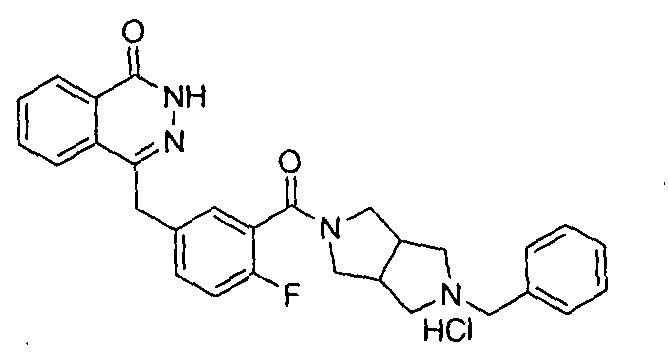
ENP Entry into the national phase

Ref document number: 2890309

Country of ref document: CA

WWE Wipo information: entry into national phase

Ref document number: 38080

Country of ref document: MA

WWE Wipo information: entry into national phase

Ref document number: 238714

Country of ref document: IL

ENP Entry into the national phase

Ref document number: 2013368842

Country of ref document: AU

Date of ref document: 20131223

Kind code of ref document: A

WWE Wipo information: entry into national phase

Ref document number: 14647088

Country of ref document: US

WWE Wipo information: entry into national phase

Ref document number: 12015501199

Country of ref document: PH

Ref document number: MX/A/2015/006780

Country of ref document: MX

WWE Wipo information: entry into national phase

Ref document number: 15127891

Country of ref document: CO

REG Reference to national code

Ref country code: BR

Ref legal event code: B01A

Ref document number: 112015012425

Country of ref document: BR

WWE Wipo information: entry into national phase

Ref document number: IDP00201503558

Country of ref document: ID

ENP Entry into the national phase

Ref document number: 20157017355

Country of ref document: KR

Kind code of ref document: A

Ref document number: 2015550210

Country of ref document: JP

Kind code of ref document: A

REEP Request for entry into the european phase

Ref document number: 2013828996

Country of ref document: EP

WWE Wipo information: entry into national phase

Ref document number: 2013828996

Country of ref document: EP

NENP Non-entry into the national phase

Ref country code: DE

WWE Wipo information: entry into national phase

Ref document number: DZP2015000447

Country of ref document: DZ

WWE Wipo information: entry into national phase

Ref document number: 201591239

Country of ref document: EA

WWE Wipo information: entry into national phase

Ref document number: 13901

Country of ref document: GE

ENP Entry into the national phase

Ref document number: 112015012425

Country of ref document: BR

Kind code of ref document: A2

Effective date: 20150528