WO2014103321A1 - Pdk4阻害剤及びその利用 - Google Patents
Pdk4阻害剤及びその利用 Download PDFInfo
- Publication number
- WO2014103321A1 WO2014103321A1 PCT/JP2013/007649 JP2013007649W WO2014103321A1 WO 2014103321 A1 WO2014103321 A1 WO 2014103321A1 JP 2013007649 W JP2013007649 W JP 2013007649W WO 2014103321 A1 WO2014103321 A1 WO 2014103321A1
- Authority
- WO
- WIPO (PCT)
- Prior art keywords
- group
- optionally substituted
- alkyl
- methyl
- hydrogen atom
- Prior art date
- Legal status (The legal status is an assumption and is not a legal conclusion. Google has not performed a legal analysis and makes no representation as to the accuracy of the status listed.)
- Ceased
Links
- 0 *c(c(*)c1*)c(*)c(C(C(*)=C2*)=O)c1C2=O Chemical compound *c(c(*)c1*)c(*)c(C(C(*)=C2*)=O)c1C2=O 0.000 description 9
- BREXQMSUFPYLTQ-UHFFFAOYSA-N CC(c(cc1)cc2c1c(OC)c(C)cc2OC)=O Chemical compound CC(c(cc1)cc2c1c(OC)c(C)cc2OC)=O BREXQMSUFPYLTQ-UHFFFAOYSA-N 0.000 description 1
- PKHWHJKCWWXTMU-UHFFFAOYSA-N CC(c(cc1)cc2c1c(OC)c(C)cc2OC)O Chemical compound CC(c(cc1)cc2c1c(OC)c(C)cc2OC)O PKHWHJKCWWXTMU-UHFFFAOYSA-N 0.000 description 1
- DNZMIIUCALSUCH-UHFFFAOYSA-N CCc(cc1)cc2c1c(OC)c(C)cc2OC Chemical compound CCc(cc1)cc2c1c(OC)c(C)cc2OC DNZMIIUCALSUCH-UHFFFAOYSA-N 0.000 description 1
- BEEIPOSHXVPILA-UHFFFAOYSA-N Cc(cc(c(CC1)c2CC1C(OC)=O)OC)c2OC Chemical compound Cc(cc(c(CC1)c2CC1C(OC)=O)OC)c2OC BEEIPOSHXVPILA-UHFFFAOYSA-N 0.000 description 1
Images

Classifications
-
- C—CHEMISTRY; METALLURGY
- C07—ORGANIC CHEMISTRY
- C07C—ACYCLIC OR CARBOCYCLIC COMPOUNDS
- C07C69/00—Esters of carboxylic acids; Esters of carbonic or haloformic acids
- C07C69/95—Esters of quinone carboxylic acids
-
- A—HUMAN NECESSITIES
- A61—MEDICAL OR VETERINARY SCIENCE; HYGIENE
- A61K—PREPARATIONS FOR MEDICAL, DENTAL OR TOILETRY PURPOSES
- A61K31/00—Medicinal preparations containing organic active ingredients
- A61K31/185—Acids; Anhydrides, halides or salts thereof, e.g. sulfur acids, imidic, hydrazonic or hydroximic acids
- A61K31/19—Carboxylic acids, e.g. valproic acid
- A61K31/195—Carboxylic acids, e.g. valproic acid having an amino group
- A61K31/197—Carboxylic acids, e.g. valproic acid having an amino group the amino and the carboxyl groups being attached to the same acyclic carbon chain, e.g. gamma-aminobutyric acid [GABA], beta-alanine, epsilon-aminocaproic acid or pantothenic acid
- A61K31/198—Alpha-amino acids, e.g. alanine or edetic acid [EDTA]
-
- A—HUMAN NECESSITIES
- A61—MEDICAL OR VETERINARY SCIENCE; HYGIENE
- A61K—PREPARATIONS FOR MEDICAL, DENTAL OR TOILETRY PURPOSES
- A61K31/00—Medicinal preparations containing organic active ingredients
- A61K31/12—Ketones
- A61K31/122—Ketones having the oxygen directly attached to a ring, e.g. quinones, vitamin K1, anthralin
-
- A—HUMAN NECESSITIES
- A61—MEDICAL OR VETERINARY SCIENCE; HYGIENE
- A61K—PREPARATIONS FOR MEDICAL, DENTAL OR TOILETRY PURPOSES
- A61K31/00—Medicinal preparations containing organic active ingredients
- A61K31/13—Amines
- A61K31/135—Amines having aromatic rings, e.g. ketamine, nortriptyline
- A61K31/136—Amines having aromatic rings, e.g. ketamine, nortriptyline having the amino group directly attached to the aromatic ring, e.g. benzeneamine
-
- A—HUMAN NECESSITIES
- A61—MEDICAL OR VETERINARY SCIENCE; HYGIENE
- A61K—PREPARATIONS FOR MEDICAL, DENTAL OR TOILETRY PURPOSES
- A61K31/00—Medicinal preparations containing organic active ingredients
- A61K31/16—Amides, e.g. hydroxamic acids
- A61K31/165—Amides, e.g. hydroxamic acids having aromatic rings, e.g. colchicine, atenolol, progabide
- A61K31/166—Amides, e.g. hydroxamic acids having aromatic rings, e.g. colchicine, atenolol, progabide having the carbon of a carboxamide group directly attached to the aromatic ring, e.g. procainamide, procarbazine, metoclopramide, labetalol
-
- A—HUMAN NECESSITIES
- A61—MEDICAL OR VETERINARY SCIENCE; HYGIENE
- A61K—PREPARATIONS FOR MEDICAL, DENTAL OR TOILETRY PURPOSES
- A61K31/00—Medicinal preparations containing organic active ingredients
- A61K31/185—Acids; Anhydrides, halides or salts thereof, e.g. sulfur acids, imidic, hydrazonic or hydroximic acids
- A61K31/19—Carboxylic acids, e.g. valproic acid
- A61K31/192—Carboxylic acids, e.g. valproic acid having aromatic groups, e.g. sulindac, 2-aryl-propionic acids, ethacrynic acid
-
- A—HUMAN NECESSITIES
- A61—MEDICAL OR VETERINARY SCIENCE; HYGIENE
- A61K—PREPARATIONS FOR MEDICAL, DENTAL OR TOILETRY PURPOSES
- A61K31/00—Medicinal preparations containing organic active ingredients
- A61K31/21—Esters, e.g. nitroglycerine, selenocyanates
- A61K31/215—Esters, e.g. nitroglycerine, selenocyanates of carboxylic acids
- A61K31/216—Esters, e.g. nitroglycerine, selenocyanates of carboxylic acids of acids having aromatic rings, e.g. benactizyne, clofibrate
-
- A—HUMAN NECESSITIES
- A61—MEDICAL OR VETERINARY SCIENCE; HYGIENE
- A61K—PREPARATIONS FOR MEDICAL, DENTAL OR TOILETRY PURPOSES
- A61K31/00—Medicinal preparations containing organic active ingredients
- A61K31/21—Esters, e.g. nitroglycerine, selenocyanates
- A61K31/215—Esters, e.g. nitroglycerine, selenocyanates of carboxylic acids
- A61K31/235—Esters, e.g. nitroglycerine, selenocyanates of carboxylic acids having an aromatic ring attached to a carboxyl group
-
- A—HUMAN NECESSITIES
- A61—MEDICAL OR VETERINARY SCIENCE; HYGIENE
- A61K—PREPARATIONS FOR MEDICAL, DENTAL OR TOILETRY PURPOSES
- A61K31/00—Medicinal preparations containing organic active ingredients
- A61K31/33—Heterocyclic compounds
- A61K31/335—Heterocyclic compounds having oxygen as the only ring hetero atom, e.g. fungichromin
- A61K31/365—Lactones
- A61K31/366—Lactones having six-membered rings, e.g. delta-lactones
- A61K31/37—Coumarins, e.g. psoralen
-
- A—HUMAN NECESSITIES
- A61—MEDICAL OR VETERINARY SCIENCE; HYGIENE
- A61K—PREPARATIONS FOR MEDICAL, DENTAL OR TOILETRY PURPOSES
- A61K31/00—Medicinal preparations containing organic active ingredients
- A61K31/33—Heterocyclic compounds
- A61K31/395—Heterocyclic compounds having nitrogen as a ring hetero atom, e.g. guanethidine or rifamycins
- A61K31/435—Heterocyclic compounds having nitrogen as a ring hetero atom, e.g. guanethidine or rifamycins having six-membered rings with one nitrogen as the only ring hetero atom
- A61K31/47—Quinolines; Isoquinolines
-
- A—HUMAN NECESSITIES
- A61—MEDICAL OR VETERINARY SCIENCE; HYGIENE
- A61K—PREPARATIONS FOR MEDICAL, DENTAL OR TOILETRY PURPOSES
- A61K8/00—Cosmetics or similar toiletry preparations
- A61K8/18—Cosmetics or similar toiletry preparations characterised by the composition
- A61K8/30—Cosmetics or similar toiletry preparations characterised by the composition containing organic compounds
- A61K8/33—Cosmetics or similar toiletry preparations characterised by the composition containing organic compounds containing oxygen
- A61K8/35—Ketones, e.g. benzophenone
- A61K8/355—Quinones
-
- A—HUMAN NECESSITIES
- A61—MEDICAL OR VETERINARY SCIENCE; HYGIENE
- A61K—PREPARATIONS FOR MEDICAL, DENTAL OR TOILETRY PURPOSES
- A61K8/00—Cosmetics or similar toiletry preparations
- A61K8/18—Cosmetics or similar toiletry preparations characterised by the composition
- A61K8/30—Cosmetics or similar toiletry preparations characterised by the composition containing organic compounds
- A61K8/33—Cosmetics or similar toiletry preparations characterised by the composition containing organic compounds containing oxygen
- A61K8/36—Carboxylic acids; Salts or anhydrides thereof
- A61K8/368—Carboxylic acids; Salts or anhydrides thereof with carboxyl groups directly bound to carbon atoms of aromatic rings
-
- A—HUMAN NECESSITIES
- A61—MEDICAL OR VETERINARY SCIENCE; HYGIENE
- A61K—PREPARATIONS FOR MEDICAL, DENTAL OR TOILETRY PURPOSES
- A61K8/00—Cosmetics or similar toiletry preparations
- A61K8/18—Cosmetics or similar toiletry preparations characterised by the composition
- A61K8/30—Cosmetics or similar toiletry preparations characterised by the composition containing organic compounds
- A61K8/33—Cosmetics or similar toiletry preparations characterised by the composition containing organic compounds containing oxygen
- A61K8/37—Esters of carboxylic acids
-
- A—HUMAN NECESSITIES
- A61—MEDICAL OR VETERINARY SCIENCE; HYGIENE
- A61K—PREPARATIONS FOR MEDICAL, DENTAL OR TOILETRY PURPOSES
- A61K8/00—Cosmetics or similar toiletry preparations
- A61K8/18—Cosmetics or similar toiletry preparations characterised by the composition
- A61K8/30—Cosmetics or similar toiletry preparations characterised by the composition containing organic compounds
- A61K8/40—Cosmetics or similar toiletry preparations characterised by the composition containing organic compounds containing nitrogen
-
- A—HUMAN NECESSITIES
- A61—MEDICAL OR VETERINARY SCIENCE; HYGIENE
- A61K—PREPARATIONS FOR MEDICAL, DENTAL OR TOILETRY PURPOSES
- A61K8/00—Cosmetics or similar toiletry preparations
- A61K8/18—Cosmetics or similar toiletry preparations characterised by the composition
- A61K8/30—Cosmetics or similar toiletry preparations characterised by the composition containing organic compounds
- A61K8/40—Cosmetics or similar toiletry preparations characterised by the composition containing organic compounds containing nitrogen
- A61K8/42—Amides
-
- A—HUMAN NECESSITIES
- A61—MEDICAL OR VETERINARY SCIENCE; HYGIENE
- A61P—SPECIFIC THERAPEUTIC ACTIVITY OF CHEMICAL COMPOUNDS OR MEDICINAL PREPARATIONS
- A61P1/00—Drugs for disorders of the alimentary tract or the digestive system
- A61P1/14—Prodigestives, e.g. acids, enzymes, appetite stimulants, antidyspeptics, tonics, antiflatulents
-
- A—HUMAN NECESSITIES
- A61—MEDICAL OR VETERINARY SCIENCE; HYGIENE
- A61P—SPECIFIC THERAPEUTIC ACTIVITY OF CHEMICAL COMPOUNDS OR MEDICINAL PREPARATIONS
- A61P13/00—Drugs for disorders of the urinary system
- A61P13/02—Drugs for disorders of the urinary system of urine or of the urinary tract, e.g. urine acidifiers
-
- A—HUMAN NECESSITIES
- A61—MEDICAL OR VETERINARY SCIENCE; HYGIENE
- A61P—SPECIFIC THERAPEUTIC ACTIVITY OF CHEMICAL COMPOUNDS OR MEDICINAL PREPARATIONS
- A61P3/00—Drugs for disorders of the metabolism
- A61P3/08—Drugs for disorders of the metabolism for glucose homeostasis
- A61P3/10—Drugs for disorders of the metabolism for glucose homeostasis for hyperglycaemia, e.g. antidiabetics
-
- A—HUMAN NECESSITIES
- A61—MEDICAL OR VETERINARY SCIENCE; HYGIENE
- A61P—SPECIFIC THERAPEUTIC ACTIVITY OF CHEMICAL COMPOUNDS OR MEDICINAL PREPARATIONS
- A61P31/00—Antiinfectives, i.e. antibiotics, antiseptics, chemotherapeutics
- A61P31/12—Antivirals
- A61P31/14—Antivirals for RNA viruses
- A61P31/16—Antivirals for RNA viruses for influenza or rhinoviruses
-
- A—HUMAN NECESSITIES
- A61—MEDICAL OR VETERINARY SCIENCE; HYGIENE
- A61P—SPECIFIC THERAPEUTIC ACTIVITY OF CHEMICAL COMPOUNDS OR MEDICINAL PREPARATIONS
- A61P35/00—Antineoplastic agents
-
- A—HUMAN NECESSITIES
- A61—MEDICAL OR VETERINARY SCIENCE; HYGIENE
- A61P—SPECIFIC THERAPEUTIC ACTIVITY OF CHEMICAL COMPOUNDS OR MEDICINAL PREPARATIONS
- A61P43/00—Drugs for specific purposes, not provided for in groups A61P1/00-A61P41/00
-
- A—HUMAN NECESSITIES
- A61—MEDICAL OR VETERINARY SCIENCE; HYGIENE
- A61Q—SPECIFIC USE OF COSMETICS OR SIMILAR TOILETRY PREPARATIONS
- A61Q19/00—Preparations for care of the skin
-
- A—HUMAN NECESSITIES
- A61—MEDICAL OR VETERINARY SCIENCE; HYGIENE
- A61Q—SPECIFIC USE OF COSMETICS OR SIMILAR TOILETRY PREPARATIONS
- A61Q19/00—Preparations for care of the skin
- A61Q19/08—Anti-ageing preparations
-
- C—CHEMISTRY; METALLURGY
- C07—ORGANIC CHEMISTRY
- C07C—ACYCLIC OR CARBOCYCLIC COMPOUNDS
- C07C235/00—Carboxylic acid amides, the carbon skeleton of the acid part being further substituted by oxygen atoms
- C07C235/42—Carboxylic acid amides, the carbon skeleton of the acid part being further substituted by oxygen atoms having carbon atoms of carboxamide groups bound to carbon atoms of six-membered aromatic rings and singly-bound oxygen atoms bound to the same carbon skeleton
- C07C235/66—Carboxylic acid amides, the carbon skeleton of the acid part being further substituted by oxygen atoms having carbon atoms of carboxamide groups bound to carbon atoms of six-membered aromatic rings and singly-bound oxygen atoms bound to the same carbon skeleton with carbon atoms of carboxamide groups bound to carbon atoms of six-membered aromatic rings being part of condensed ring systems and singly-bound oxygen atoms, bound to the same carbon skeleton
-
- C—CHEMISTRY; METALLURGY
- C07—ORGANIC CHEMISTRY
- C07C—ACYCLIC OR CARBOCYCLIC COMPOUNDS
- C07C235/00—Carboxylic acid amides, the carbon skeleton of the acid part being further substituted by oxygen atoms
- C07C235/70—Carboxylic acid amides, the carbon skeleton of the acid part being further substituted by oxygen atoms having carbon atoms of carboxamide groups and doubly-bound oxygen atoms bound to the same carbon skeleton
- C07C235/84—Carboxylic acid amides, the carbon skeleton of the acid part being further substituted by oxygen atoms having carbon atoms of carboxamide groups and doubly-bound oxygen atoms bound to the same carbon skeleton with the carbon atom of at least one of the carboxamide groups bound to a carbon atom of a six-membered aromatic ring
-
- C—CHEMISTRY; METALLURGY
- C07—ORGANIC CHEMISTRY
- C07C—ACYCLIC OR CARBOCYCLIC COMPOUNDS
- C07C251/00—Compounds containing nitrogen atoms doubly-bound to a carbon skeleton
- C07C251/32—Oximes
-
- C—CHEMISTRY; METALLURGY
- C07—ORGANIC CHEMISTRY
- C07C—ACYCLIC OR CARBOCYCLIC COMPOUNDS
- C07C251/00—Compounds containing nitrogen atoms doubly-bound to a carbon skeleton
- C07C251/32—Oximes
- C07C251/34—Oximes with oxygen atoms of oxyimino groups bound to hydrogen atoms or to carbon atoms of unsubstituted hydrocarbon radicals
- C07C251/36—Oximes with oxygen atoms of oxyimino groups bound to hydrogen atoms or to carbon atoms of unsubstituted hydrocarbon radicals with the carbon atoms of the oxyimino groups bound to hydrogen atoms or to acyclic carbon atoms
- C07C251/40—Oximes with oxygen atoms of oxyimino groups bound to hydrogen atoms or to carbon atoms of unsubstituted hydrocarbon radicals with the carbon atoms of the oxyimino groups bound to hydrogen atoms or to acyclic carbon atoms to carbon atoms of an unsaturated carbon skeleton
-
- C—CHEMISTRY; METALLURGY
- C07—ORGANIC CHEMISTRY
- C07C—ACYCLIC OR CARBOCYCLIC COMPOUNDS
- C07C50/00—Quinones
- C07C50/38—Quinones containing —CHO or non—quinoid keto groups
-
- C—CHEMISTRY; METALLURGY
- C07—ORGANIC CHEMISTRY
- C07C—ACYCLIC OR CARBOCYCLIC COMPOUNDS
- C07C66/00—Quinone carboxylic acids
-
- C—CHEMISTRY; METALLURGY
- C07—ORGANIC CHEMISTRY
- C07D—HETEROCYCLIC COMPOUNDS
- C07D493/00—Heterocyclic compounds containing oxygen atoms as the only ring hetero atoms in the condensed system
- C07D493/12—Heterocyclic compounds containing oxygen atoms as the only ring hetero atoms in the condensed system in which the condensed system contains three hetero rings
- C07D493/20—Spiro-condensed systems
-
- A—HUMAN NECESSITIES
- A61—MEDICAL OR VETERINARY SCIENCE; HYGIENE
- A61K—PREPARATIONS FOR MEDICAL, DENTAL OR TOILETRY PURPOSES
- A61K2800/00—Properties of cosmetic compositions or active ingredients thereof or formulation aids used therein and process related aspects
- A61K2800/74—Biological properties of particular ingredients
- A61K2800/78—Enzyme modulators, e.g. Enzyme agonists
- A61K2800/782—Enzyme inhibitors; Enzyme antagonists
Definitions
- the present invention provides a novel PDK4 inhibitor as an active ingredient, a therapeutic agent or preventive agent for severe influenza caused by improved mitochondrial function, an anorexia remedy, a therapeutic agent for diseases such as cancer or diabetes, and a cosmetic product by improving metabolism. To do.
- Non-Patent Document 1 Non-Patent Document 1
- PDH Pyruvate dehydrogenase
- PDK Pyruvate dehydrogenase
- ATP adenosine triphosphate
- the compounds of the present invention were found.
- the compound of the present invention was confirmed to have an action of suppressing anorexia, weight loss, etc., and death, and the present invention was completed.
- the PDK4 inhibitor of the present invention is considered to be useful for the treatment of a disease having a mutation in the CPT or mitochondrial ATP-producing enzyme group.
- PDK4 of the present invention Inhibitors are also considered useful in the treatment of these diseases.
- an object of the present invention is to provide a therapeutic or prophylactic agent for severe influenza. Another object of the present invention is to provide a novel PDK4 inhibitor. Furthermore, an object of the present invention is to provide a novel PDK4 inhibitor as an active ingredient, an improvement in mitochondrial function and anorexia, a therapeutic agent for diseases such as cancer or diabetes, and a cosmetic product by improving metabolism.
- a pyruvate dehydrogenase kinase inhibitor comprising as an active ingredient a compound represented by the following general formula (I) or an ester derivative thereof, or a pharmacologically acceptable salt thereof:
- ring A represents a 6-membered hydrocarbon ring having aromaticity which may be substituted with 2 to 4 substituents;
- the substituents of ring A are the same or different and are a hydroxyl group, an oxo group, an optionally substituted amino group, a halogen atom, an optionally substituted C1-6 alkyl group, or an optionally substituted group.
- R 2 and R 3 are the same or different and are each represented by a hydrogen atom, a carboxyl group, an optionally substituted C1-6 alkyl group, a C6-10 aryl group, or —C ( ⁇ R 9 ) —R 10 .
- R 9 is an oxygen atom, sulfur atom, ⁇ N—R 11 group (where R 11 is a hydroxyl group, a C1-6 alkyl group, a C6-10 aryl group, a C1-6 alkoxy group, a C2-6 group) An alkenyloxy group, a C6-10 aryloxy group) or a ⁇ CH—R 12 group (wherein R 12 is a formyl group, a carboxyl group, a C1-6 alkyl group, a C6-10 aryl group, a C1— 6 represents an alkoxycarbonyl group, an aminocarbonyl group, or a C1-6 alkylaminocarbonyl group, R 10 represents a hydrogen atom, an amino group, a C1-6 alkyl group, a C6-10 aryl group, a C1-6 alkoxy group, an optionally substituted C1-6 alkylamino group, or an optionally substituted C1-6 6 represents an alkoxycarbonyl C1-6 al
- R 5 and R 8 are the same or different and are a hydroxyl group, an amino group, an optionally substituted C1-6 alkoxy group, an optionally substituted C2-40 alkenyloxy group, or a C2-7 alkanoyloxy group.
- R 6 and R 7 are a hydrogen atom, a hydroxyl group, an optionally substituted amino group, a halogen atom, an optionally substituted C1-6 alkyl group, an optionally substituted C2-40 alkenyl group, a substituted A C1-6 alkoxy group which may be
- the substituent in the case where it may be substituted is a group selected from the following: hydroxyl group, carboxyl group, amino group, halogen atom, C1-6 alkyl group, C2-6 alkenyl group, C2-7 alkanoyl group, C1-6 alkoxycarbonyl group
- the substituent in the case where it may be substituted is a group selected from the following: hydroxyl group, carboxyl group, amino group, halogen atom, C1-6 alkyl group, C2-6 alkenyl group, C2-7 alkanoyl group, C1-6 alkoxy group, C1-6 alkoxycarbonyl group, C6-10 aryl group,
- R 1 and R 4 are the same or different and each represents a hydrogen atom, an optionally substituted C1-6 alkyl group, or an optionally substituted C6-10 aryl group; Either one of R 2 and R 3 represents a hydrogen atom, an optionally substituted C1-6 alkyl group, or an optionally substituted C6-10 aryl group; The other represents a group represented by —C ( ⁇ R 9 ) —R 10 ;
- R 9 is an oxygen atom, sulfur atom, ⁇ N—R 11 group (where R 11 is a C1-6 alkyl group, a C6-10 aryl group, a hydroxyl group, a C1-6 alkoxy group, C2-20)
- R 1 and R 4 are the same or different and each represents a hydrogen atom or an optionally substituted C1-6 alkyl group;
- One of R 2 and R 3 represents a hydrogen atom or an optionally substituted C1-6 alkyl group;
- the other represents a group represented by —C ( ⁇ R 9 ) —R 10 ;
- R 9 represents an oxygen atom or a ⁇ N—R 11 group (where R 11 represents a C1-6 alkoxy group, a C2-6 alkenyloxy group, a C6-10 aryloxy group),
- R 10 represents a hydrogen atom, an optionally substituted C1-6 alkyl group, an optionally substituted C6-10 aryl group, an optionally substituted C1-6 alkoxy group, or an optionally substituted C6.
- the group represented by —C ( ⁇ R 9 ) —R 10 is not a carboxyl group, a methylcarbonyl group, or a methoxycarbonyl group
- R 5 and R 8 both represent a C1-6 alkoxy group
- R 6 and R 7 represent a hydrogen atom or an optionally substituted C1-6 alkyl group
- the substituent which may be substituted is a group selected from the following: a hydroxyl group, a carboxyl group, an amino group, a halogen atom, a C1-6 alkyl which may be substituted with a hydroxyl group Group, C2-6 alkenyl group, C2-7 alkanoyl group, C1-6 alkoxy group, C6-10 aryl group, Compound or ester derivative thereof, or pharmacologically acceptable salt thereof.
- a pyruvate dehydrogenase inhibitor comprising the compound according to (3) or (4) or an ester derivative thereof, or a pharmacologically acceptable salt thereof as an active ingredient.
- Treatment or prevention of a disease or disorder associated with the onset or aggravation of pyruvate dehydrogenase kinase comprising the pyruvate dehydrogenase kinase inhibitor according to (1), (2) or (5) as an active ingredient Pharmaceutical composition for.
- the pharmaceutical composition according to (7), wherein the disease or disorder related to the onset or exacerbation of pyruvate dehydrogenase kinase is aggravation after influenza infection.
- the pharmaceutical composition according to (7), wherein the disease or disorder related to onset or exacerbation of pyruvate dehydrogenase kinase is anorexia.
- the pharmaceutical composition according to (7), wherein the disease or disorder related to the onset or exacerbation of pyruvate dehydrogenase kinase is diabetes.
- the pharmaceutical composition according to (7), wherein the disease or disorder related to the onset or aggravation of pyruvate dehydrogenase kinase is cancer.
- a cosmetic composition comprising the pyruvate dehydrogenase kinase inhibitor according to (1), (2), or (5).
- aromatic 6-membered hydrocarbon ring refers to a benzene ring or p-benzoquinone (2,5-cyclohexadiene substituted at the 1-position and 4-position with an oxo group).
- C1-6 alkyl group means a linear or branched saturated hydrocarbon group having 1 to 6 carbon atoms, such as a methyl group, an ethyl group, an n-propyl group, Examples include i-propyl group, n-butyl group, sec-butyl group, t-butyl group, isobutyl group, pentyl group, isopentyl group, 2,3-dimethylpropyl group, hexyl group, and cyclohexyl group.
- C1-5 alkyl group more preferably methyl group, ethyl group, n-propyl group, i-propyl group, n-butyl group, sec-butyl group, t-butyl group, isobutyl group, pentyl group, An isopentyl group or a 2,3-dimethylpropyl group. More preferred is a C1-3 alkyl group, for example, a methyl group, an ethyl group, an n-propyl group, and an i-propyl group, and most preferred is a methyl group or an ethyl group.
- the “C2-40 alkenyl group” means removal of one hydrogen atom from any carbon atom of a linear or branched unsaturated hydrocarbon having one or more carbon-carbon double bonds. A monovalent group having 2 to 40 carbon atoms.
- the “C2-6 alkenyl group” is formed by removing one hydrogen atom from any carbon atom of a linear or branched unsaturated hydrocarbon having one or more carbon-carbon double bonds. A monovalent group having 2 to 6 carbon atoms.
- Examples of the C2-6 alkenyl group or C2-40 alkenyl group include a vinyl group, a propenyl group, an isopropenyl group, a 1-butenyl group, a 2-butenyl group, a 3-butenyl group, a 1-methyl-1-propenyl group, 2-methyl-1-propenyl group, 1-methyl-2-propenyl group, 2-methyl-2-propenyl group, 1-methylidene-1-propane group, 1-pentenyl group, 1-pentenyl group, 3-pentenyl group 4-pentenyl group, 1-methyl-1-butenyl group, 1-methyl-2-butenyl group, 1-methyl-3-butenyl group, 1-methylidenebutyl group, 2-methyl-1-butenyl group, 2-methyl -2-butenyl group, 2-methyl-3-butenyl group, 2-methylidenebutyl group, 3-methyl-1-butenyl group, 3-methyl-2-butenyl group, 3-methyl
- examples of the C2-40 alkenyl group include 1-heptenyl group, 2-heptenyl group, 3-heptenyl group, 4-heptenyl group, 5-heptenyl group, 7-heptenyl group, 1-methyl-1-hexenyl group.
- the “C1-6 alkoxy group” means a group ((C1-6 alkyl group) -O— group) bonded to the C1-6 alkyl group via an oxygen atom.
- the base part may be linear or branched.
- the C1-6 alkoxy group means that the alkyl group moiety has 1 to 6 carbon atoms. Examples of the alkoxy group include a methoxy group, an ethoxy group, a 1-propyloxy group, a 2-propyloxy group, a 2-methyl-1-propyloxy group, a 2-methyl-2-propyloxy group, and 2,2-dimethyl.
- -1-propyloxy group 1-butyloxy group, 2-butyloxy group, 2-methyl-1-butyloxy group, 3-methyl-1-butyloxy group, 2-methyl-2-butyloxy group, 3-methyl-2-butyloxy group, 1-pentyloxy group, 2-pentyloxy group, 3-pentyloxy group, 2-methyl-1-pentyloxy group, 3-methyl-1-pentyloxy group, 2-methyl-2-pentyloxy group 3-methyl-2-pentyloxy group, 1-hexyloxy group, 2-hexyloxy group, 3-hexyloxy group and the like.
- the C1-6 alkoxy group is preferably a C1-5 alkoxy group, more preferably a methoxy group, ethoxy group, n-propyloxy group, i-propyloxy group, n-butyloxy group, sec-butyloxy group, t -Butyloxy group, isobutyloxy group, pentyloxy group, isopentyloxy group, and 2,3-dimethylpropyloxy group, more preferably C1-3 alkoxy groups (methoxy group, ethoxy group, and propyloxy group) And more preferably a methoxy group or an ethoxy group.
- C2-6 alkenyloxy group refers to a group ((C2-6 alkenyl group) -O— group) bonded to the C2-6 alkenyl group via an oxygen atom,
- the alkenyl group moiety may be linear or branched.
- Examples of the C2-6 alkenyloxy group include vinyloxy group, propenyloxy group, isopropenyloxy group, 1-butenyloxy group, 2-butenyloxy group, 3-butenyloxy group, 1-methyl-1-propenyloxy group, 2- Methyl-1-propenyloxy group, 1-methyl-2-propenyloxy group, 2-methyl-2-propenyloxy group, 1-methylidene-1-propaneoxy group, 1-pentenyloxy group, 1-pentenyloxy group, 3-pentenyloxy group, 4-pentenyloxy group, 1-methyl-1-butenyloxy group, 1-methyl-2-butenyloxy group, 1-methyl-3-butenyloxy group, 1-methylidenebutyloxy group, 2-methyl -1-butenyloxy, 2-methyl-2-butenyloxy, 2-methyl-3-butenyloxy group, 1-methylidenebutyloxy group, 2-methyl -1-butenyloxy, 2-methyl-2-buteny
- C1-6 alkoxycarbonyl group means a group ((C1-6 alkyl group) —O—C ( ⁇ O) — group) bonded to the alkoxy group via a carbonyl group.
- the alkyl group moiety may be linear or branched.
- the C1-6 alkoxycarbonyl group means that the alkyl group moiety has 1 to 6 carbon atoms.
- the C1-6 alkoxycarbonyl group includes, for example, a methoxycarbonyl group, an ethoxycarbonyl group, a 1-propyloxycarbonyl group, a 2-propyloxycarbonyl group, a 2-methyl-1-propyloxycarbonyl group, 2-methyl-2-propyloxycarbonyl group, 2,2-dimethyl-1-propyloxycarbonyl group, 1-butyloxycarbonyl group, 2-butyloxycarbonyl group, 2-methyl-1-butyloxycarbonyl group, 3 -Methyl-1-butyloxycarbonyl group, 2-methyl-2-butyloxycarbonyl group, 3-methyl-2-butyloxycarbonyl group, 1-pentyloxycarbonyl group, 2-pentyloxycarbonyl group, 3-pentyloxy Carbonyl group, 2-methyl-1- Nethyloxycarbonyl group, 3-methyl-1-pentyloxycarbonyl group, 2-methyl-2-pentyloxycarbonyl group
- the C1-6 alkoxy group is preferably a C1-5 alkoxy group, more preferably a methoxy group, ethoxy group, n-propyloxycarbonyl group, i-propyloxycarbonyl group, n-butyloxycarbonyl group, sec- A butyloxycarbonyl group, a t-butyloxycarbonyl group, an isobutyloxycarbonyl group, a pentyloxycarbonyl group, an isopentyloxycarbonyl group, and a 2,3-dimethylpropyloxycarbonyl group, and more preferably a C1-3 alkoxycarbonyl group Groups (methoxycarbonyl group, ethoxycarbonyl group and propyloxycarbonyl group), and more preferably a methoxycarbonyl group or an ethoxycarbonyl group.
- C2-7 alkanoyl group refers to a group ((C1-6 alkyl group) -C ( ⁇ O) -group) bonded to the C1-6 alkyl group via an oxo group.
- the alkyl group moiety may be linear or branched.
- Examples of the C2-7 alkanoyl group include acetyl group, propionyl group, butyryl group, isobutyryl group, valeryl group, isovaleryl group, pivaloyl group, valeryl group, isovaleryl group, hexanoyl group and heptanoyl group.
- the “C2-7 alkanoyloxy group” means a group ((C1-6 alkyl group) —C ( ⁇ O) —O bonded to the C1-6 alkyl group via an oxo group and an oxygen atom. -Group), and the alkyl group moiety may be linear or branched.
- Examples of the C2-7 alkanoyloxy group include acetyloxy group, propionyloxy group, butyryloxy group, isobutyryloxy group, valeryloxy group, isovaleryloxy group, pivaloyloxy group, valeryloxy group, isovaleryloxy group, hexa Including noyloxy and heptanoyloxy groups.
- the “C6-10 aryl group” is an aromatic hydrocarbon group having 6 to 10 carbon atoms, and includes benzene and naphthalene.
- the “C6-10 aryloxy group” refers to a group ((C6-10 aryl group) -O— group) bonded to the C6-10 aryl group through an oxygen atom, including a benzyloxy group and Includes naphthyloxy group.
- C1-6 alkylamino group means a group ((C1-6 alkyl group) -NH— group) bonded to the C1-6 alkyl group via a nitrogen atom.
- the C1-6 alkyl group moiety contained in the group is the same as defined above for the C1-6 alkyl group.
- examples of such groups include a methylamino group, an ethylamino group, an n-propylamino group, an i-propylamino group, an n-butylamino group, a sec-butylamino group, a t-butylamino group, and an isobutylamino group.
- it is a C1-3 alkylamino group, for example, a methylamino group, an ethylamino group, an n-propylamino group, and an i-propylamino group, and most preferably a methylamino group or an ethylamino group. It is.
- C1-6 alkylaminocarbonyl group is a group ((C1-6 alkyl group) -NH—C ( ⁇ O) bonded to the C1-6 alkyl group via a nitrogen atom and a carbonyl group.
- the C1-6 alkyl group moiety contained in the group is the same as the definition of the C1-6 alkyl group. Examples of such groups include methylaminocarbonyl group, ethylaminocarbonyl group, n-propylaminocarbonyl group, i-propylaminocarbonyl group, n-butylaminocarbonyl group, sec-butylaminocarbonyl group, t-butyl.
- Examples thereof include aminocarbonyl group, isobutylaminocarbonyl group, pentylaminocarbonyl group, isopentylaminocarbonyl group, 2,3-dimethylpropylaminocarbonyl group, hexylaminocarbonyl group, and cyclohexylaminocarbonyl group.
- 5-alkylaminocarbonyl group more preferably methylaminocarbonyl group, ethylaminocarbonyl group, n-propylaminocarbonyl group, i-propylaminocarbonyl group, n-butylaminocarbonyl group , Sec- butylamino group, t- butyl aminocarbonyl group, isobutylamino group, pentyl aminocarbonyl group, isopentyl aminocarbonyl group, or a 2,3-dimethyl-propylamino group.
- C1-3 alkylaminocarbonyl group for example, methylaminocarbonyl group, ethylaminocarbonyl group, n-propylaminocarbonyl group, and i-propylaminocarbonyl group, and most preferred is methylaminocarbonyl group.
- C1-6 alkoxycarbonyl C1-6 alkylamino group is a group represented by (C1-6 alkyl group) —O—C ( ⁇ O) — (C1-6 alkylene) —NH—.
- the C1-6 alkyl group moiety contained in the group is the same as defined above for the C1-6 alkyl group.
- the C1-6 alkylene moiety contained in the group is a divalent group obtained by removing one hydrogen atom from the C1-6 alkyl group.
- Examples of such groups include methoxycarbonylmethyleneaminocarbonylmethyleneamino group, ethoxycarbonylmethyleneamino group, 1-propyloxycarbonylmethyleneamino group, 2-propyloxycarbonylmethyleneamino group, 2-methyl-1-propyloxy Carbonylmethyleneamino group, 2-methyl-2-propyloxycarbonylmethyleneamino group, 2,2-dimethyl-1-propyloxycarbonylmethyleneamino group, 1-butyloxycarbonylmethyleneamino group, 2-butyloxycarbonylmethyleneamino group 2-methyl-1-butyloxycarbonylmethyleneamino group, 3-methyl-1-butyloxycarbonylmethyleneamino group, 2-methyl-2-butyloxycarbonylmethyleneamino group, 3-methyl- -Butyloxycarbonylmethyleneamino group, 1-pentyloxycarbonylmethyleneamino group, 2-pentyloxycarbonyl
- the C1-6 alkoxycarbonyl C1-6 alkylamino group is preferably a C1-5 alkoxycarbonyl C1-5 alkylamino group, and more preferably a C1-4 alkoxycarbonyl C1-3 alkylamino group.
- the oxo group is a group represented by ⁇ O.
- Halogen atom means a fluorine atom, a chlorine atom, a bromine atom and an iodine atom, preferably a fluorine atom, a chlorine atom and a bromine atom, more preferably a fluorine atom or a chlorine atom.
- the “formyl group” is a group represented by —C ( ⁇ O) —H.
- the “carboxyl group” is a group represented by —C ( ⁇ O) —OH.
- the “aminocarbonyl group” refers to an NH 2 —C ( ⁇ O) — group.
- the “pharmacologically acceptable salt” is a salt formed by combining the compound of the present invention with an inorganic or organic base or acid, and is a salt that can be administered to the body as a medicine. That is.
- Such salts are described, for example, by Berge et al. Pharm. Sci. 66: 1-19 (1977) and the like.
- the salt include alkali metal and alkaline earth metal salts such as lithium, sodium, potassium, magnesium, and calcium; ammonia, methylamine, dimethylamine, trimethylamine, and the like when an acidic group such as a carboxylic acid group is present.
- amines such as dicyclohexylamine, tris (hydroxymethyl) aminomethane, N, N-bis (hydroxyethyl) piperazine, 2-amino-2-methyl-1-propanol, ethanolamine, N-methylglucamine, L-glucamine, etc. Salts; or salts with basic amino acids such as lysine, ⁇ -hydroxylysine, arginine can be formed.
- salts of mineral acids such as hydrochloric acid, hydrobromic acid, sulfuric acid, nitric acid, phosphoric acid; methanesulfonic acid, benzenesulfonic acid, paratoluenesulfonic acid, acetic acid, propionate, tartaric acid , Fumaric acid, maleic acid, malic acid, oxalic acid, succinic acid, citric acid, benzoic acid, mandelic acid, cinnamic acid, lactic acid, glycolic acid, glucuronic acid, ascorbic acid, nicotinic acid, salicylic acid and other organic acids Salts; or salts with acidic amino acids such as aspartic acid and glutamic acid.
- the hydrate or solvate of the compound represented by the general formula (I) and the hydrate or solvate of the pharmacologically acceptable salt of the compound represented by the general formula (I) are also included in the present invention. Included in the compound.
- the “compound represented by the general formula (I)” means the pharmacology of the compound represented by the general formula (I) even when it is not explicitly specified unless it is clearly not suitable. Also included are pharmaceutically acceptable salts, hydrates and solvates, as well as hydrates or solvates of pharmacologically acceptable salts of the compounds of general formula (I).
- the compound of the present invention has an asymmetric carbon, an optical isomer exists.
- the compound of the present invention may be either a dextrorotatory (+) or levorotatory ( ⁇ ) compound, or a mixture of these isomers such as a racemate.
- the compound represented by the general formula (1) in the present invention includes any tautomer or geometric isomer (for example, E-form, Z-form, etc.) unless otherwise specified.
- the compounds of the present invention include pharmacologically acceptable esters of these compounds in addition to the above compounds.
- the “pharmacologically acceptable ester” is a compound containing a group that is metabolized in vivo to give the compound of the present invention, and is an ester that can be administered into the body as a medicine.
- the ester includes not only an ester-bonded compound but also an amide-bonded compound. Esters may be degraded by in vivo esterases to give active compounds.
- ester substituted or unsubstituted lower alkyl ester, lower alkenyl ester, lower alkylamino lower alkyl ester, acylamino lower alkyl ester, acyloxy lower alkyl ester, aryl ester, aryl lower alkyl ester, amide
- alkylamides and hydroxide amides include alkylamides and hydroxide amides.
- the ester is preferably a propionate or an acyl ester.
- the compound represented by the formula (I) of the present invention includes a compound represented by the following general formula:
- R 13 represents an optionally substituted C1-6 alkyl group
- R 14 and R 15 are the same or different and each represents an optionally substituted C1-6 alkyl group
- R 16 , R 17 and R 18 are the same or different and each represents a hydroxyl group or a C1-6 alkoxycarbonyl group.
- R 1 and R 4 are the same or different and represent hydrogen atoms.
- R 1 and R 4 are preferably the following groups: (1-1) R 1 and R 4 are the same or different and each is a hydrogen atom, a hydroxyl group, an optionally substituted C1-6 alkyl group, an optionally substituted C2-6 alkenyl group, or a substituted group. Optionally a C6-10 aryl group; (1-2) R 1 and R 4 are the same or different, and are the same or different, and are a hydrogen atom, a hydroxyl group, an optionally substituted C1-6 alkyl group, or an optionally substituted C6-10.
- R 1 and R 4 are the same or different and each represents a hydrogen atom, a hydroxyl group, or an optionally substituted C1-6 alkyl group;
- R 1 and R 4 are the same or different and are a hydrogen atom or a hydroxyl group;
- (1-5) R 1 and R 4 are the same or different and each represents a hydrogen atom or an optionally substituted C1-6 alkyl group;
- (1-6) R 1 and R 4 are the same or different and are a hydrogen atom or a C1-6 alkyl group;
- R 1 and R 4 are both hydrogen atoms.
- R 2 and R 3 are the same or different and are a hydrogen atom, a carboxyl group, an optionally substituted C1-6 alkyl group, or a C6-10 aryl.
- a group represented by —C ( ⁇ R 9 ) —R 10 or one of R 2 and R 3 is a group represented by the following general formula (wherein ring A, The definitions of the groups represented by R 1 , R 2 and R 4 are the same as the definitions of ring A, R 1 , R 2 and R 4 in general formula (I), respectively:
- the other represents a hydrogen atom, a carboxyl group, an optionally substituted C1-6 alkyl group, a C6-10 aryl group, or a group represented by —C ( ⁇ R 9 ) —R 10 ,
- R 2 and R 3 together form a benzene ring or tetrahydrofuran together with the carbon atom to which they are bonded (the
- R 2 and R 3 represent a hydrogen atom, a hydroxyl group, or an optionally substituted C1-6 alkyl group, and the other one is —C ( ⁇ R 9 ).
- a group represented by —R 10 (provided that a group represented by —C ( ⁇ R 9 ) —R 10 is not a carboxyl group, a methylcarbonyl group, or a methoxycarbonyl group);
- R 9 is an oxygen atom, a sulfur atom, ⁇ N—R 11 group (where R 11 is a hydroxyl group, a C1-6 alkyl group, a C6— 10 aryl group, C1-6 alkoxy group, C2-6 alkenyloxy group, C6-10 aryloxy group) or ⁇ CH—R 12 group (where R 12 is a formyl group, carboxyl group, C1 Represents a 6 to 6 alkyl group, a C6 to 10 aryl group, a C1 to 6 alkoxycarbonyl group, an aminocarbonyl group, or a C1 to 6 alkylaminocarbonyl group, wherein R 9 is preferably the following group: (3-1) an oxygen atom, ⁇ N—R 11 group (where R 11 represents a hydroxyl group, a C1-6 alkoxy group, a C2-6 alkenyloxy group, a C6-10 aryloxy group), or
- R 10 is a hydrogen atom, an amino group, an optionally substituted C1-6 alkyl group, an optionally substituted C6-10 aryl group, An optionally substituted C1-6 alkoxy group, an optionally substituted C6 to C10 aryloxy group, an optionally substituted C1-6 alkylamino group, or an optionally substituted C1-6 alkoxycarbonyl C1-6 alkylamino group.
- R 10 is preferably the following group: (4-1) a hydrogen atom, an amino group, a C1-6 alkyl group, a C1-6 alkoxy group, a C1-6 alkylamino group, or a C1-6 alkoxycarbonyl C1-6 alkylamino group; (4-2) a hydrogen atom, a C1-6 alkyl group, a C1-6 alkoxy group, a C1-6 alkylamino group, or a C1-6 alkoxycarbonyl C1-6 alkylamino group; (4-3) a hydrogen atom, a C1-4 alkyl group, a C1-4 alkoxy group, a C1-4 alkylamino group, or a C1-4 alkoxycarbonyl C1-4 alkylamino group; (4-4) a hydrogen atom, a C1-4 alkyl group, or a C1-4 alkoxy group; (4-5) a hydrogen atom, an amino group, an optionally substituted C1-6 alkyl group, an optionally substituted C1-6 alkoxy group, an an
- (4-10) a hydrogen atom, a C1-4 alkylamino group optionally substituted with 1 to 2 substituents, or a C1-4 alkoxycarbonyl C1 optionally substituted with 1 to 2 substituents -4 alkylamino group (wherein the substituent is selected from a carboxyl group, a C1-6 alkoxy group, a C6 aryl group).
- the groups represented by R are the groups (1-1) to (1-7), (2-1) to (2-8), ( Combinations of groups selected from (3-1) to (3-5) and (4-1) to (4-10), or (1-1) to (1-4), (2-1 ) To (2-4), (3-1) to (3-4), and combinations of groups selected from (4-1) to (4-4), respectively.
- R combinations include the following combinations: (1-2), (2-2), (3-2), and (4-2); (1-4), (2 -3), (3-3), and (4-3); (1-3), (2-4), (3-3), and (4-3); (1-3), (2 -3), (3-4), and (4-3); (1-3), (2-3), (3-3), and (4-4); (1-3), (2 -3), (3-3), and (4-3); (1-4), (2-4), (3-4), and (4-4).
- the compound represented by the general formula (I) of the present invention is a compound represented by the following general formula (II).
- R 1 to R 4 are as defined in the general formula (I), R 5 and R 8 are the same or different and are a hydroxyl group, an optionally substituted amino group, an optionally substituted C1-6 alkoxy group, an optionally substituted C2-40 alkenyloxy group, or C2-7 represents an alkanoyloxy group, R 6 and R 7 are a hydrogen atom, a hydroxyl group, an optionally substituted amino group, a halogen atom, an optionally substituted C1-6 alkyl group, an optionally substituted C2-40 alkenyl group, a substituted A C1-6 alkoxy group which may be
- the substituent in the case where it may be substituted is a group selected from the following: hydroxyl group, carboxyl group, amino group, halogen atom, C1-6 alkyl group, C2-6 alkenyl group, A C2-7 alkanoyl group, a C1-6 alkoxycarbonyl group;
- R 5 and R 8 are preferably the same or different and R 5 and R 8 are a hydroxyl group, an amino group, an optionally substituted C1-6 alkoxy group, or a C2-7 alkanoyloxy group. More preferably, it is an optionally substituted C1-4 alkoxy group, and more preferably a C1-3 alkoxy group (more preferably, both R 5 and R 8 are C1-3 alkoxy groups).
- R 6 and R 7 are preferably R 6 and R 7 which are the same or different and each represents a hydrogen atom, an optionally substituted amino group, or an optionally substituted C1-6 alkyl group. More preferably a hydrogen atom, an optionally substituted amino group, or an optionally substituted C1-4 alkyl group, still more preferably a hydrogen atom, an optionally substituted amino group, or , A C1-3 alkyl group.
- the compound represented by the general formula (II) is preferably the following compound: (II-1) R 1 and R 4 are the above (1-1), R 2 and R 3 are the above (2-1), R 5 and R 8 are the same or different and are a hydroxyl group, an amino group, an optionally substituted C1-6 alkoxy group, or a C2-7 alkanoyloxy group, and Compounds in which R 6 and R 7 are the same or different and are a hydrogen atom, an optionally substituted amino group, or an optionally substituted C1-6 alkyl group; (II-2) R 1 and R 4 are the above (1-2), R 2 and R 3 are the above (2-2), R 5 and R 8 are the same or different and are a hydroxyl group, an amino group, an optionally substituted C1-6 alkoxy group, or a C2-7 alkanoyloxy group, and Compounds in which R 6 and R 7 are the same or different and are a hydrogen atom, an optionally substituted amino group, or an optionally substituted C
- the compound represented by the general formula (I) of the present invention is a compound represented by the following general formula (III).
- R 1 to R 4 are as defined in the general formula (I)
- R 6 and R 7 are a hydrogen atom, a hydroxyl group, an optionally substituted amino group, a halogen atom, an optionally substituted C1-6 alkyl group, an optionally substituted C2-40 alkenyl group, a substituted A C1-6 alkoxy group which may be
- the substituent in the case where it may be substituted is a group selected from the following: hydroxyl group, carboxyl group, amino group, halogen atom, C1-6 alkyl group, C2-6 alkenyl group, A C2-7 alkanoyl group, a C1-6 alkoxycarbonyl group;
- the compound represented by the general formula (III) is preferably the following compound: (III-1) R 1 and R 4 are the above (1-1), R 2 and R 3 are the above (2-1), and Compounds in which R 6 and R 7 are the same or different and are a hydrogen atom, an optionally substituted amino group, or an optionally substituted C1-6 alkyl group; (III-2) R 1 and R 4 are the above (1-2), R 2 and R 3 are the above (2-2), and Compounds in which R 6 and R 7 are the same or different and are a hydrogen atom, an optionally substituted amino group, or an optionally substituted C1-6 alkyl group; (III-3) R 1 and R 4 are the above (1-3), R 2 and R 3 are the above (2-3), and Compounds in which R 6 and R 7 are the same or different and each is a hydrogen atom, an optionally substituted amino group, or a C1-3 alkyl group; (III-4) R 1 and R 4 are the above (1-4), R 2 and R 3 are the above (2-4),
- the compound represented by the general formula (I) of the present invention is a compound represented by the following general formula (IV) or (V).
- R 1 to R 4 are as defined in the general formula (I), and R 13 represents an optionally substituted C 1-6 alkyl group.
- R 13 is preferably a C1-6 alkyl group which may be substituted with a carboxyl group, and more preferably a C1-4 alkyl group which may be substituted with a carboxyl group.
- the compound represented by the general formula (IV) or (V) is preferably the following compound: (IV-1) R 1 and R 4 are the above (1-1), R 2 and R 3 are the above (2-1), and A compound wherein R 13 is a C1-6 alkyl group optionally substituted with a carboxyl group; (IV-2) R 1 and R 4 are the above (1-2), R 2 and R 3 are the above (2-2), and A compound wherein R 13 is a C1-6 alkyl group optionally substituted with a carboxyl group; (IV-3) R 1 and R 4 are the above (1-3), R 2 and R 3 are the above (2-3), and A compound wherein R 13 is a C1-6 alkyl group optionally substituted with a carboxyl group; (IV-4) R 1 and R 4 are the above (1-4), R 2 and R 3 are the above (2-4), and A compound in which R 13 is a C1-4 alkyl group which may be substituted with a carboxyl group.
- the compound represented by the general formula (I) of the present invention is a compound represented by the following general formula (VI).
- a compound represented by the following general formula (VI ') is particularly preferable.
- R 1 to R 4 represent the above general formula (I
- R 14 and R 15 are the same or different and each represents an optionally substituted C1-6 alkyl group.
- R 14 is preferably a C1-6 alkyl group, more preferably a C1-4 alkyl group, still more preferably a C1-3 alkyl group.
- R 15 is preferably a C1-6 alkyl group optionally substituted with a carboxyl group, and more preferably a C1-4 alkyl group optionally substituted with a carboxyl group (for example, substituted with a carboxyl group). More preferably a C1-3 alkyl group optionally substituted with a carboxyl group (for example, a C1-3 alkyl group substituted with a carboxyl group).
- the compound represented by the general formula (VI) is preferably the following compound: (IV-1) R 1 and R 4 are the above (1-1), R 2 and R 3 are the above (2-1), R 14 is a C1-6 alkyl group, and A compound wherein R 15 is a C1-6 alkyl group optionally substituted with a carboxyl group; (IV-2) R 1 and R 4 are the above (1-2), R 2 and R 3 are the above (2-2), R 14 is a C1-6 alkyl group, and A compound wherein R 15 is a C1-6 alkyl group optionally substituted with a carboxyl group; (IV-3) R 1 and R 4 are the above (1-3), R 2 and R 3 are the above (2-3), R 14 is a C1-4 alkyl group, and The compound wherein R 15 is a C1-4 alkyl group optionally substituted with a carboxyl group; (IV-4) R 1 and R 4 are the above (1-4), R 2 and R 3 are the above (2-4), R 14 is a C1-3 alkyl group, and
- a compound represented by the following general formula (VII ') is particularly preferable.
- R 1 to R 4 are each represented by the above general formula (I R 16 , R 17 and R 18 are the same or different and each represents a hydroxyl group or a C1-6 alkoxycarbonyl group.
- R 16 , R 17 , and R 18 are preferably R 16 is a hydroxyl group, R 17 is a hydroxyl group, and R 18 is a C1-6 alkoxycarbonyl group.
- R 16 is a hydroxyl group
- R 17 is a hydroxyl group
- R 18 is a C1-4 alkoxycarbonyl group
- R 16 is a hydroxyl group
- R 17 is a hydroxyl group
- R 18 is a C1-3 alkoxycarbonyl group.
- the compound represented by the general formula (VII) is preferably the following compound: (IV-1) R 1 and R 4 are the above (1-1), R 2 and R 3 are the above (2-1), R 16 is a hydroxyl group, R 17 is a hydroxyl group, and The compound wherein R 18 is a C1-6 alkoxycarbonyl group; (IV-2) R 1 and R 4 are the above (1-2), R 2 and R 3 are the above (2-2), R 16 is a hydroxyl group, R 17 is a hydroxyl group, and The compound wherein R 18 is a C1-6 alkoxycarbonyl group; (IV-3) R 1 and R 4 are the above (1-3), R 2 and R 3 are the above (2-3), R 16 is a hydroxyl group, R 17 is a hydroxyl group, and The compound wherein R 18 is a C1-4 alkoxycarbonyl group; (IV-4) R 1 and R 4 are the above (1-4), R 2 and R 3 are the above (2-4), R 16 is a hydroxyl group, R 17
- a preferred embodiment of the compound of the present invention is a compound in which R 1 to R 8 are the following groups in the general formula (II).
- a preferred embodiment is a compound in which R 1 to R 4 , R 6 and R 7 are the following groups in the general formula (III).
- the pyruvate dehydrogenase inhibitor is not particularly limited as long as it is an agent used for the purpose of inhibiting pyruvate dehydrogenase.
- the pyruvate dehydrogenase inhibitor of the present invention is provided as a pharmaceutical composition.
- the pyruvate dehydrogenase inhibitor of the present invention may be a pharmaceutical composition intended to be administered to a subject for the purpose of inhibiting pyruvate dehydrogenase or as a mechanism of action.
- Such a pharmaceutical composition can be for the treatment or prevention of a disease or disorder in which pyruvate dehydrogenase is associated with or contributes to the onset or exacerbation.
- the pyruvate dehydrogenase inhibitor of the present invention may be a pharmaceutical composition for treating or preventing a disease or disorder related to or contributing to the onset or exacerbation of pyruvate dehydrogenase.
- a disease or disorder related to or contributing to the onset or exacerbation of pyruvate dehydrogenase include, for example, severe post-influenza infection, loss of appetite, mitochondrial disease, diseases or disorders associated with decreased ATP acidity, diabetes, or cancer. Can be mentioned.
- influenza severity is used in distinction from influenza infection.
- the severity of influenza does not include infection by influenza virus itself, but means a symptom, disorder, or disease caused secondary by infection with influenza virus.
- Symptoms, disorders, or illnesses secondary to infection by influenza virus include, for example, multiple organ failure (MOF), influenza encephalopathy (IAE), weight loss, and the like. And anorexia. Therefore, the treatment or prevention of severe influenza in this specification includes multiple organ failure (MOF) associated with influenza virus infection, influenza encephalopathy (IAE), weight loss, and / or appetite. Includes treatment or prevention of poorness.
- the mitochondrial disease is a disease or disorder based on having a mutation in the mitochondrial ATP synthase group, and includes, for example, pyruvate dehydrogenase deficiency, MELAS and the like.
- the disease or disorder accompanied by a decrease in ATP acidity include a disease or disorder based on mutation of carnitine palmitoyltransferase.
- the present invention also relates to a pharmaceutical composition containing a compound represented by the general formula (I) as an active ingredient.
- the type of pharmaceutical composition is not particularly limited, and dosage forms include tablets, capsules, granules, powders, syrups, suspensions, suppositories, ointments, creams, gels, patches, inhalants, An injection agent etc. are mentioned.
- These preparations can be prepared according to a conventional method. In the case of a liquid preparation, it may be dissolved or suspended in water or other appropriate solvent at the time of use. Tablets and granules may be coated by a known method.
- injection it is prepared by dissolving the compound of the present invention in water, but it may be dissolved in physiological saline or glucose solution as necessary, and a buffer or preservative may be added. Good. It is provided in any dosage form for oral or parenteral administration.
- a pharmaceutical composition for oral administration in the form of granules, fine granules, powders, hard capsules, soft capsules, syrups, emulsions, suspensions or liquids, for intravenous administration, for intramuscular administration
- it can be prepared as a pharmaceutical composition for parenteral administration in the form of injections, drops, transdermal absorbents, transmucosal absorbents, nasal drops, inhalants, suppositories, etc. for subcutaneous administration.
- Injections, infusions, and the like can be prepared as powdered dosage forms such as freeze-dried forms, and can be used by dissolving in an appropriate aqueous medium such as physiological saline at the time of use.
- the compound represented by the general formula (I) of the present invention exhibits a novel enzyme inhibitory activity and a medicinal effect in an animal model, the treatment or treatment of a disease or disorder related to or contributing to the onset or exacerbation of pyruvate dehydrogenase or Useful in prevention.
- the compound represented by the general formula (I) of the present invention is the first compound that inhibits PDK4 in the order of nM, and is administered in vivo more than 100 times lower than the existing drug dichloroacetic acid. Since it shows a strong effect in an amount, it can provide a more effective therapeutic agent or preventive agent for a disease or disorder related to or contributing to the onset or exacerbation of pyruvate dehydrogenase.
- the compound represented by the general formula (I) of the present invention when administered to an influenza-infected mouse model, it was confirmed that the mouse had an effect of protecting the mouse from weight loss and death. It is effective in preventing and treating the seriousness of the disease.
- the influenza-infected mouse model to which the compound represented by the general formula (I) of the present invention was administered recovered the level of food intake and water intake to a level close to that of non-infected mice, and the ATP level and the like from biochemical analysis. Since it has been observed to improve, it is effective in the treatment or prevention of diseases or disorders that depend on reduced ATP levels.
- the compound represented by the general formula (I) of the present invention has been confirmed to have an effect in a disease expected by inhibiting PDK4, in addition to preventing the seriousness due to influenza infection, and the treatment or prevention of such a disease. It is effective for. Further, the compound represented by the general formula (I) of the present invention has been recognized as a cosmetic product due to the improvement of cell metabolism accompanying activation of mitochondrial function, and is also useful as a cosmetic product.
- the compound of the present invention can be synthesized by the following method.
- intermediate (IM) A is dissolved in triethylsilane, and trifluoroacetic acid is added to the solution for reaction. After completion of the reaction, triethylsilane and trifluoroacetic acid are distilled off under reduced pressure, and the resulting residue is purified by flash chromatography to give compound 4.
- the compound of the present invention can also be synthesized by the following method.
- compound (IIb) (R 9 ⁇ O, R 10 ⁇ OH) is dissolved in dichloromethane at room temperature under N 2 atmosphere, and a primary or secondary amine compound (R (R ′) NH), diisopropylethylamine, Add hexafluorophosphoric acid (benzenetriazol-1-yloxy) tripyridinophosphonium (PyBOP), and after stirring, stop the reaction with 10% aqueous methanol, extract the mixed solution with chloroform, dry, concentrate, and flash chromatography. By carrying out purification, amide compound (IIb) (R 9 ⁇ O, R 10 ⁇ NR (R ′)) can be obtained.
- the compound represented by the general formula (I) of the present invention has an inhibitory activity against PDK, particularly PDK4, PDK inhibitors (for example, PDK4 inhibitors) and PDK (especially PDK4) can develop or aggravate. It can be used as a pharmaceutical composition or a cosmetic composition for the treatment or prevention of the relevant disease or disorder.
- a disease or disorder associated with the onset or aggravation of PDK (particularly PDK4) refers to a disease or disorder that develops or aggravates due to increased expression or increased activity of PDK (particularly PDK4). This includes, for example, severe illness after an influenza infection, loss of appetite, mitochondrial disease, or diseases or disorders with reduced ATP production, diabetes, and cancer.
- Severity after influenza infection is a disease, disorder, or symptom caused by influenza infection, including multiple organ failure (MOF), influenza encephalopathy (Influenza-associated encephalopathy: IAE) .
- MOF multiple organ failure
- IAE influenza encephalopathy
- the severity after influenza infection in the present invention includes any disease, disorder, or symptom that is caused by influenza infection and PDK4 expression induction by such a mechanism.
- the discovery of the present inventors has revealed that PDK4 phosphorylates PDH and decreases the activity of PDH, thereby causing ATP depletion due to an acute decrease in mitochondrial function. Therefore, the PDK4 inhibitor of the present invention can be used as a therapeutic or prophylactic agent for a disease or symptom based on a decrease in mitochondrial function, or a disease or symptom based on a decrease in ATP. Specifically, the PDK4 inhibitor of the present invention can be used as a therapeutic or prophylactic agent for mitochondrial diseases or diseases or disorders associated with a decrease in ATP production.
- the mitochondrial disease is a disease, disorder or symptom based on having a mutation in the mitochondrial ATP synthase group, and includes, for example, pyruvate dehydrogenase deficiency, MELAS and the like.
- a disease or disorder accompanied by a decrease in ATP acidity a disease, disorder or symptom based on a mutation in carnitine palmitoyltransferase can be mentioned.
- the present invention relates to the development or exacerbation of PDK (particularly PDK4), comprising administering an effective amount of the compound represented by the above general formula (I) to a patient in need thereof.
- the present invention relates to a method for treating or preventing a related disease or disorder.
- the present invention relates to a compound represented by the above general formula (I) for use in the treatment or prevention of a disease or disorder in which PDK (particularly PDK4) is associated with onset or exacerbation.
- the pharmaceutical composition of the present invention can be formulated by a conventional method using a normal pharmaceutically acceptable carrier.
- a solid preparation for oral administration add excipients to the active ingredient and, if necessary, binders, disintegrants, lubricants, etc., and then add solvents, granules, powders, capsules, etc. by conventional methods.
- a pH adjuster, a buffer, a stabilizer, a solubilizing agent, etc. may be added to the main drug as necessary to obtain a subcutaneous or intravenous injection by a conventional method.
- the pharmaceutical composition of the present invention can be used in oral dosage forms or parenteral dosage forms such as injections and drops.
- this compound When this compound is administered to mammals or the like, it may be administered orally as tablets, powders, granules, syrups, etc., or may be administered parenterally as injections or drops.
- the dosage can be appropriately set depending on the degree of symptoms, age, weight, sex, administration route, dosage form, reactivity to drugs, disease type, etc. For example, it is usually 50 to 500 mg per day per day for an adult. Administer in several divided doses.
- PDK4 enzyme inhibitory activity Measurement of PDK4 / PDK2 inhibitory activity by off-chip mobility shift assay: Compound solution (5 ⁇ L), 4 ⁇ substrate / ATP / metal mixture (5 ⁇ L), and 2 ⁇ recombinant human PDK4 (5 ⁇ L) were added to 384 well micro plate. After reacting at room temperature for 5 hours, a reaction stop solution (60 ⁇ L) was added. The substrate peptide (S) and phosphorylated peptide (P) were quantified using LabChip 3000, and the inhibitory activity was calculated from the ratio (P / P + S).
- Test Example 2 Effect of the compound of the present invention in a mouse model of influenza infection Mice, Influenza Virus, and Reagents 5 week old C57BL / 6J mice (Japan SLC) were purchased, and anesthesia (ketaral 62.5 mg / kg and ceractar 12.5 ⁇ g / kg) was obtained at 6 weeks (16.4-18.1 g). kg mixture) was intramuscularly infected with Influenza A / Puerto Rico 8/34 strain (influenza A / PR8 / 8/34 strain) at 10 PFU / 20 ⁇ l / mouse.
- the physiological saline (Otsuka Pharmaceutical) used when diluting the virus was administered intranasally at 20 ⁇ l / mouse.
- the compound of the present invention was mixed with physiological saline at a dose of 0.93-0.8 mg / kg / day so that DMSO as a solvent was 5%, and intraperitoneally administered twice a day from the day after infection. went.
- the experiment was performed using 10 mice (5 cages) in each group, a non-infected group (control), a group in which a KIS compound was administered to an infected mouse, and a group in which 5% DMSO in physiological saline was administered to an infected mouse ( Control).
Landscapes
- Health & Medical Sciences (AREA)
- Chemical & Material Sciences (AREA)
- Life Sciences & Earth Sciences (AREA)
- Organic Chemistry (AREA)
- General Health & Medical Sciences (AREA)
- Veterinary Medicine (AREA)
- Public Health (AREA)
- Animal Behavior & Ethology (AREA)
- Epidemiology (AREA)
- Pharmacology & Pharmacy (AREA)
- Medicinal Chemistry (AREA)
- Emergency Medicine (AREA)
- Birds (AREA)
- Chemical Kinetics & Catalysis (AREA)
- General Chemical & Material Sciences (AREA)
- Nuclear Medicine, Radiotherapy & Molecular Imaging (AREA)
- Bioinformatics & Cheminformatics (AREA)
- Engineering & Computer Science (AREA)
- Dermatology (AREA)
- Diabetes (AREA)
- Virology (AREA)
- Gerontology & Geriatric Medicine (AREA)
- Molecular Biology (AREA)
- Hematology (AREA)
- Obesity (AREA)
- Endocrinology (AREA)
- Urology & Nephrology (AREA)
- Nutrition Science (AREA)
- Pulmonology (AREA)
- Communicable Diseases (AREA)
- Oncology (AREA)
- Pharmaceuticals Containing Other Organic And Inorganic Compounds (AREA)
- Heterocyclic Carbon Compounds Containing A Hetero Ring Having Oxygen Or Sulfur (AREA)
- Acyclic And Carbocyclic Compounds In Medicinal Compositions (AREA)
- Organic Low-Molecular-Weight Compounds And Preparation Thereof (AREA)
Abstract
Description
(1)下記一般式(I)で表わされる化合物又はそのエステル誘導体、あるいはそれらの薬理学的に許容される塩を有効成分として含有する、ピルビン酸デヒドロゲナーゼキナーゼ阻害剤、

ここで、環Aの置換基は、同一又は異なって、水酸基、オキソ基、置換されていてもよいアミノ基、ハロゲン原子、置換されていてもよいC1~6アルキル基、置換されていてもよいC2~40アルケニル基、置換されていてもよいC1~6アルコキシ基、置換されていてもよいC2~6アルケニルオキシ基、置換されていてもよいC1~6アルコキシカルボニル基、及び、置換されていてもよいC2~7アルカノイルオキシ基から選択される基を示し、あるいは、環Aの2つの置換基が結合して、置換されていてもよいジヒドロピランを形成してもよく(該ジヒドロピランはオキソ基で置換されていてもよいテトラヒドロフランと縮合していてもよい)、
R1及びR4は、同一又は異なって、水素原子、水酸基、置換されていてもよいC1~6アルキル基、置換されていてもよいC2~6アルケニル基、置換されていてもよいC6~10アリール基、置換されていてもよいC1~6アルコキシ基、又は、置換されていてもよいC2~7アルカノイルオキシ基を示し、
R2及びR3は、同一又は異なって、水素原子、カルボキシル基、置換されていてもよいC1~6アルキル基、置換されていてもよいC6~10アリール基、又は、-C(=R9)-R10で表わされる基を示す、
ここで、R9は、酸素原子、硫黄原子、=N-R11基(ここで、R11は、水酸基、置換されていてもよいC1~6アルキル基、置換されていてもよいC6~10アリール基、置換されていてもよいC1~6アルコキシ基、置換されていてもよいC2~6アルケニルオキシ基、置換されていてもよいC6~10アリールオキシ基を示す)、又は、=CH-R12基(ここで、R12は、ホルミル基、カルボキシル基、置換されていてもよいC1~6アルキル基、置換されていてもよいC6~10アリール基、置換されていてもよいC1~6アルコキシカルボニル基、アミノカルボニル基、又は、置換されていてもよいC1~6アルキルアミノカルボニル基を示し、
R10は、水素原子、アミノ基、置換されていてもよいC1~6アルキル基、置換されていてもよいC6~10アリール基、置換されていてもよいC1~6アルコキシ基、置換されていてもよいC6~C10アリールオキシ基、置換されていてもよいC1~6アルキルアミノ基、又は置換されていてもよいC1~6アルコキシカルボニルC1~6アルキルアミノ基を示すか、あるいは、
R2及びR3のいずれか一方は、以下の一般式で表わされる基(式中、環A、R1、R2及びR4で表わされる基の定義は、それぞれ、一般式(I)における環A、R1、R2及びR4の定義と同様である):

R2とR3が一緒になって、それらが結合する炭素原子と共にベンゼン環又はテトラヒドロフランを構成し、ここで、該テトラヒドロフランは、置換されていてもよい3環性縮合複素環とスピロ結合していてもよく、
(2)下記一般式(II)又は(III)で表わされる化合物又はそのエステル誘導体、あるいはそれらの薬理学的に許容される塩を有効成分として含有する、(1)に記載のピルビン酸デヒドロゲナーゼキナーゼ阻害剤、


R2及びR3は、同一又は異なって、水素原子、カルボキシル基、置換されていてもよいC1~6アルキル基、C6~10アリール基、又は、-C(=R9)-R10で表わされる基を示す、
ここで、R9は、酸素原子、硫黄原子、=N-R11基(ここで、R11は、水酸基、C1~6アルキル基、C6~10アリール基、C1~6アルコキシ基、C2~6アルケニルオキシ基、C6~10アリールオキシ基を示す)、又は、=CH-R12基(ここで、R12は、ホルミル基、カルボキシル基、C1~6アルキル基、C6~10アリール基、C1~6アルコキシカルボニル基、アミノカルボニル基、又は、C1~6アルキルアミノカルボニル基を示し、
R10は、水素原子、アミノ基、C1~6アルキル基、C6~10アリール基、C1~6アルコキシ基、置換されていてもよいC1~6アルキルアミノ基、又は置換されていてもよいC1~6アルコキシカルボニルC1~6アルキルアミノ基を示すか、あるいは、
R2及びR3のいずれか一方は、以下の一般式で表わされる基(式中、環A、R1、R2及びR4で表わされる基の定義は、それぞれ、一般式(I)における環A、R1、R2及びR4の定義と同様である):

R2とR3が一緒になって、それらが結合する炭素原子と共にベンゼン環又はテトラヒドロフランを構成し、ここで、該テトラヒドロフランは、置換されていてもよい3環性縮合複素環とスピロ結合していてもよく、
R5及びR8は、同一又は異なって、水酸基、アミノ基、置換されていてもよいC1~6アルコキシ基、置換されていてもよいC2~40アルケニルオキシ基、又は、C2~7アルカノイルオキシ基を示し、
R6及びR7は、水素原子、水酸基、置換されていてもよいアミノ基、ハロゲン原子、置換されていてもよいC1~6アルキル基、置換されていてもよいC2~40アルケニル基、置換されていてもよいC1~6アルコキシ基を示し、
ここで、前記において、置換されていてもよい場合の置換基は、以下から選択される基である:水酸基、カルボキシル基、アミノ基、ハロゲン原子、C1~6アルキル基、C2~6アルケニル基、C2~7アルカノイル基、C1~6アルコキシカルボニル基
ここで、前記において、置換されていてもよい場合の置換基は、以下から選択される基である:水酸基、カルボキシル基、アミノ基、ハロゲン原子、水酸基で置換されていてもよいC1~6アルキル基、C2~6アルケニル基、C2~7アルカノイル基、C1~6アルコキシ基、C1~6アルコキシカルボニル基、C6~10アリール基、C6~10アリールC1~6アルキル基]。
(3)下記一般式(II)又は(III)で表わされる化合物又はそのエステル誘導体、あるいはそれらの薬理学的に許容される塩:


R1及びR4は、同一又は異なって、水素原子、置換されていてもよいC1~6アルキル基、又は、置換されていてもよいC6~10アリール基を示し、
R2及びR3のうちどちらか一方は、水素原子、置換されていてもよいC1~6アルキル基、又は、置換されていてもよいC6~10アリール基を示し、
残りの一方は、-C(=R9)-R10で表わされる基を示し、
ここで、R9は、酸素原子、硫黄原子、=N-R11基(ここで、R11は、C1~6アルキル基、C6~10アリール基、水酸基、C1~6アルコキシ基、C2~20アルケニルオキシ基、C6~10アリールオキシ基を示す)、又は、=CH-R12基(ここで、R12は、C1~6アルキル基、C6~10アリール基、ホルミル基、カルボキシル基、C1~6アルコキシカルボニル基、アミノカルボニル基、又は、C1~6アルキルアミノカルボニル基を示し、
R10は、水素原子、アミノ基、置換されていてもよいC1~6アルキル基、置換されていてもよいC6~10アリール基、置換されていてもよいC1~6アルコキシ基、置換されていてもよいC6~10アリールオキシ基、置換されていてもよいC1~6アルキルアミノ基、又は置換されていてもよいC1~6アルコキシカルボニルC1~6アルキルアミノ基を示し、
ただし、-C(=R9)-R10で表わされる基は、カルボキシル基、メチルカルボニル基、及びメトキシカルボニル基ではなく、
R5及びR8は、共に、C1~6アルコキシ基を示し、
R6及びR7は、水素原子、置換されていてもよいC1~6アルキル基、置換されていてもよいアミノ基を示し、
ここで、前記において、置換されていてもよい場合の置換基は、以下から選択される基である:水酸基、カルボキシル基、アミノ基、ハロゲン原子、水酸基で置換されていてもよいC1~6アルキル基、C2~6アルケニル基、C2~7アルカノイル基、C1~6アルコキシ基、C1~6アルコキシカルボニル基、C6~10アリール基、C6~10アリールC1~6アルキル基]。
(4)(3)に記載の化合物又はそのエステル誘導体、あるいはそれらの薬理学的に許容される塩であって:
R1及びR4は、同一又は異なって、水素原子、又は置換されていてもよいC1~6アルキル基を示し、
R2及びR3のうちどちらか一方は、水素原子、又は置換されていてもよいC1~6アルキル基を示し、
残りの一方は、-C(=R9)-R10で表わされる基を示し、
ここで、R9は、酸素原子、又は=N-R11基(ここで、R11は、C1~6アルコキシ基、C2~6アルケニルオキシ基、C6~10アリールオキシ基を示す)を示し、
R10は、水素原子、置換されていてもよいC1~6アルキル基、置換されていてもよいC6~10アリール基、置換されていてもよいC1~6アルコキシ基、置換されていてもよいC6~10アリールオキシ基、置換されていてもよいC1~6アルキルアミノ基、又は置換されていてもよいC1~6アルコキシカルボニルC1~6アルキルアミノ基を示し、
ただし、-C(=R9)-R10で表わされる基は、カルボキシル基、メチルカルボニル基、及びメトキシカルボニル基ではなく、
R5及びR8は、共に、C1~6アルコキシ基を示し、
R6及びR7は、水素原子、又は置換されていてもよいC1~6アルキル基を示し、
ここで、前記において、置換されていてもよい場合の置換基は、以下から選択される基である:水酸基、カルボキシル基、アミノ基、ハロゲン原子、水酸基で置換されていてもよいC1~6アルキル基、C2~6アルケニル基、C2~7アルカノイル基、C1~6アルコキシ基、C6~10アリール基である、
化合物又はそのエステル誘導体、あるいはそれらの薬理学的に許容される塩。
(5)(3)又は(4)に記載の化合物又はそのエステル誘導体、あるいはそれらの薬理学的に許容される塩を有効成分として含有する、ピルビン酸デヒドロゲナーゼ阻害剤。
(6)ピルビン酸デヒドロゲナーゼキナーゼ4阻害剤である、(1)、(2)、又は(5)に記載のピルビン酸デヒドロゲナーゼキナーゼ阻害剤。
(7)(1)、(2)、又は(5)に記載のピルビン酸デヒドロゲナーゼキナーゼ阻害剤を有効成分として含有する、ピルビン酸デヒドロゲナーゼキナーゼが発症又は増悪化に関係する疾患又は障害の治療又は予防のための医薬組成物。
(8)ピルビン酸デヒドロゲナーゼキナーゼが発症又は増悪化に関係する疾患又は障害が、インフルエンザ感染後の重症化である、(7)に記載の医薬組成物。
(9)ピルビン酸デヒドロゲナーゼキナーゼが発症又は増悪化に関係する疾患又は障害が、食欲不振である、(7)に記載の医薬組成物。
(10)ピルビン酸デヒドロゲナーゼキナーゼが発症又は増悪化に関係する疾患又は障害が、ミトコンドリア病、又は、ATP産生の低下を伴う疾患又は障害である、請求項7に記載の医薬組成物。
(11)ピルビン酸デヒドロゲナーゼキナーゼが発症又は増悪化に関係する疾患又は障害が、糖尿病である、(7)に記載の医薬組成物。
(12)ピルビン酸デヒドロゲナーゼキナーゼが発症又は増悪化に関係する疾患又は障害が、癌である、(7)に記載の医薬組成物。
(13)(1)、(2)、又は(5)に記載のピルビン酸デヒドロゲナーゼキナーゼ阻害剤を含有する、化粧品組成物。


(1-1)R1及びR4が、同一又は異なって、水素原子、水酸基、置換されていてもよいC1~6アルキル基、置換されていてもよいC2~6アルケニル基、又は、置換されていてもよいC6~10アリール基である;
(1-2)R1及びR4が、同一又は異なって、同一又は異なって、水素原子、水酸基、置換されていてもよいC1~6アルキル基、又は、置換されていてもよいC6~10アリール基である
(1-3)R1及びR4が、同一又は異なって、水素原子、水酸基、又は、置換されていてもよいC1~6アルキル基である;
(1-4)R1及びR4が、同一又は異なって、水素原子又は水酸基である;
(1-5)R1及びR4が、同一又は異なって、水素原子、又は置換されていてもよいC1~6アルキル基である;
(1-6)R1及びR4が、同一又は異なって、水素原子、又はC1~6アルキル基である;あるいは、
(1-7)R1及びR4が、共に水素原子である。

(2-1)R2及びR3のうちどちらか一方は、水素原子、水酸基、置換されていてもよいC1~6アルキル基、又は、置換されていてもよいC6~10アリール基を示し、残りの一方は、カルボキシル基、C1~6アルキル基、又は、-C(=R9)-R10で表わされる基を示す;
(2-2)R2及びR3のうちどちらか一方は、水素原子、水酸基、又は、置換されていてもよいC1~6アルキル基を示し、残りの一方は、カルボキシル基、又は、-C(=R9)-R10で表わされる基を示す;
(2-3)R2が、水素原子、水酸基、又は、置換されていてもよいC1~6アルキル基を示し、かつ、R3が、カルボキシル基、又は、-C(=R9)-R10で表わされる基を示す;
(2-4)R2が、水素原子、又は、水酸基を示し、かつ、R3が、カルボキシル基、又は、-C(=R9)-R10で表わされる基を示す;
(2-5)R2及びR3のうちどちらか一方は、水素原子、水酸基、置換されていてもよいC1~6アルキル基、又は、置換されていてもよいC6~10アリール基を示し、残りの一方は、-C(=R9)-R10で表わされる基を示す(ただし、-C(=R9)-R10で表わされる基は、カルボキシル基、メチルカルボニル基、及びメトキシカルボニル基ではない);
(2-6)R2及びR3のうちどちらか一方は、水素原子、水酸基、又は、置換されていてもよいC1~6アルキル基を示し、残りの一方は、-C(=R9)-R10で表わされる基(ただし、-C(=R9)-R10で表わされる基は、カルボキシル基、メチルカルボニル基、及びメトキシカルボニル基ではない)を示す;
(2-7)R2が、水素原子、又はC1~6アルキル基を示し、かつ、R3が、-C(=R9)-R10で表わされる基を示す(ただし、-C(=R9)-R10で表わされる基は、カルボキシル基、メチルカルボニル基、及びメトキシカルボニル基ではない);
(2-8)R2が、水素原子を示し、かつ、R3が、-C(=R9)-R10で表わされる基を示す(ただし、-C(=R9)-R10で表わされる基は、カルボキシル基、メチルカルボニル基、及びメトキシカルボニル基ではない);あるいは、
(2-9)R2が、水素原子を示し、かつ、R3が、ホルミル基、2-カルボキシエチルアミノカルボニル基、t-ブトキシカルボニルメチルアミノカルボニル基、メトキシカルボニル基、(2-プロペニルオキシ)イミノメチル基、1-(t-ブトキシカルボニル)-2-(t-ブトキシ)エチルアミノカルボニル基、1-カルボニル-2-ヒドロキシエチルアミノカルボニル基、又は1-(t-ブトキシカルボニル)-2-フェニルエチルアミノカルボニル基を示す。
(3-1)酸素原子、=N-R11基(ここで、R11は、水酸基、C1~6アルコキシ基、C2~6アルケニルオキシ基、C6~10アリールオキシ基を示す)、又は、=CH-R12基(ここで、R12は、ホルミル基、カルボキシル基、C1~6アルコキシカルボニル基、アミノカルボニル基、又は、C1~6アルキルアミノカルボニル基を示す);
(3-2)酸素原子、又は、=N-R11基(ここで、R11は、水酸基、C1~6アルコキシ基、C2~6アルケニルオキシ基、C6~10アリールオキシ基を示す);
(3-3)酸素原子、又は、=N-R11基(ここで、R11は、水酸基、C1~4アルコキシ基、又は、C2~4アルケニルオキシ基を示す);
(3-4)酸素原子、又は、=N-R11基(ここで、R11は、C2~4アルケニルオキシ基を示す);あるいは、
(3-5)酸素原子。
(4-1)水素原子、アミノ基、C1~6アルキル基、C1~6アルコキシ基、C1~6アルキルアミノ基、又はC1~6アルコキシカルボニルC1~6アルキルアミノ基;
(4-2)水素原子、C1~6アルキル基、C1~6アルコキシ基、C1~6アルキルアミノ基、又はC1~6アルコキシカルボニルC1~6アルキルアミノ基;
(4-3)水素原子、C1~4アルキル基、C1~4アルコキシ基、C1~4アルキルアミノ基、又はC1~4アルコキシカルボニルC1~4アルキルアミノ基;
(4-4)水素原子、C1~4アルキル基、又は、C1~4アルコキシ基;
(4-5)水素原子、アミノ基、置換されていてもよいC1~6アルキル基、置換されていてもよいC1~6アルコキシ基、置換されていてもよいC1~6アルキルアミノ基、又は置換されていてもよいC1~6アルコキシカルボニルC1~6アルキルアミノ基;
(4-6)水素原子、1~3個の置換基で置換されていてもよいC1~6アルキル基、1~3個の置換基で置換されていてもよいC1~6アルコキシ基、1~3個の置換基で置換されていてもよいC1~6アルキルアミノ基、又は1~3個の置換基で置換されていてもよいC1~6アルコキシカルボニルC1~6アルキルアミノ基;
(4-7)水素原子、1~3個の置換基で置換されていてもよいC1~4アルキル基、1~3個の置換基で置換されていてもよいC1~4アルコキシ基、1~3個の置換基で置換されていてもよいC1~4アルキルアミノ基、又は1~3個の置換基で置換されていてもよいC1~4アルコキシカルボニルC1~4アルキルアミノ基;
(4-8)水素原子、1~2個の置換基で置換されていてもよいC1~6アルキルアミノ基、又は1~2個の置換基で置換されていてもよいC1~6アルコキシカルボニルC1~6アルキルアミノ基;
(4-9)水素原子、1~2個の置換基で置換されていてもよいC1~4アルキルアミノ基、又は1~2個の置換基で置換されていてもよいC1~4アルコキシカルボニルC1~4アルキルアミノ基(ここで、置換基は、水酸基、カルボキシル基、C1~6アルコキシ基、C6~10アリール基から選択される)。
(4-10)水素原子、1~2個の置換基で置換されていてもよいC1~4アルキルアミノ基、又1~2個の置換基で置換されていてもよいC1~4アルコキシカルボニルC1~4アルキルアミノ基(ここで、置換基は、カルボキシル基、C1~6アルコキシ基、C6アリール基から選択される)。

R5及びR8は、同一又は異なって、水酸基、置換されていてもよいアミノ基、置換されていてもよいC1~6アルコキシ基、置換されていてもよいC2~40アルケニルオキシ基、又は、C2~7アルカノイルオキシ基を示し、
R6及びR7は、水素原子、水酸基、置換されていてもよいアミノ基、ハロゲン原子、置換されていてもよいC1~6アルキル基、置換されていてもよいC2~40アルケニル基、置換されていてもよいC1~6アルコキシ基を示し、
ここで、前記において、置換されていてもよい場合の置換基は、以下から選択される基である:水酸基、カルボキシル基、アミノ基、ハロゲン原子、C1~6アルキル基、C2~6アルケニル基、C2~7アルカノイル基、C1~6アルコキシカルボニル基。
(II-1)R1及びR4が、前記(1-1)であり、
R2及びR3が、前記(2-1)であり、
R5及びR8が、同一又は異なって、水酸基、アミノ基、置換されていてもよいC1~6アルコキシ基、又は、C2~7アルカノイルオキシ基であり、かつ、
R6及びR7が、同一又は異なって、水素原子、置換されていてもよいアミノ基、又は、置換されていてもよいC1~6アルキル基である化合物;
(II-2)R1及びR4が、前記(1-2)であり、
R2及びR3が、前記(2-2)であり、
R5及びR8が、同一又は異なって、水酸基、アミノ基、置換されていてもよいC1~6アルコキシ基、又は、C2~7アルカノイルオキシ基であり、かつ、
R6及びR7が、同一又は異なって、水素原子、置換されていてもよいアミノ基、又は、置換されていてもよいC1~6アルキル基である化合物;
(II-3)R1及びR4が、前記(1-3)であり、
R2及びR3が、前記(2-3)であり、
R5及びR8が、同一又は異なって、置換されていてもよいC1~4アルコキシ基であり、かつ、
R6及びR7が、同一又は異なって、水素原子、置換されていてもよいアミノ基、又は、C1~3アルキル基である化合物;
(II-4)R1及びR4が、前記(1-4)であり、
R2及びR3が、前記(2-4)であり、
R5及びR8が、同一又は異なって、C1~3アルコキシ基であり、かつ、
R6及びR7が、同一又は異なって、水素原子、置換されていてもよいアミノ基、又は、C1~3アルキル基である化合物;
(II-5)R1及びR4が、前記(1-5)であり、
R2及びR3が、前記(2-5)であり、
R9が、前記(3-4)であり、R10が、前記(4-5)であり、
R5及びR8が、同一又は異なって、C1~6アルコキシ基であり、かつ、
R6及びR7が、同一又は異なって、水素原子、置換されていてもよいアミノ基、又は、C1~6アルキル基である化合物;
(II-6)R1及びR4が、前記(1-6)であり、
R2及びR3が、前記(2-8)であり、
R9が、前記(3-4)であり、R10が、前記(4-6)であり、
R5及びR8が、同一又は異なって、C1~3アルコキシ基であり、かつ、
R6及びR7が、同一又は異なって、水素原子、又は、C1~6アルキル基である化合物;
(II-7)R1及びR4が、前記(1-7)であり、
R2及びR3が、前記(2-9)であり、
R9が、前記(3-5)であり、R10が、前記(4-10)であり、
R5及びR8が、同一又は異なって、C1~3アルコキシ基であり、かつ、
R6及びR7が、同一又は異なって、水素原子、又は、C1~3アルキル基である化合物。

R6及びR7は、水素原子、水酸基、置換されていてもよいアミノ基、ハロゲン原子、置換されていてもよいC1~6アルキル基、置換されていてもよいC2~40アルケニル基、置換されていてもよいC1~6アルコキシ基を示し、
ここで、前記において、置換されていてもよい場合の置換基は、以下から選択される基である:水酸基、カルボキシル基、アミノ基、ハロゲン原子、C1~6アルキル基、C2~6アルケニル基、C2~7アルカノイル基、C1~6アルコキシカルボニル基。
(III-1)R1及びR4が、前記(1-1)であり、
R2及びR3が、前記(2-1)であり、かつ、
R6及びR7が、同一又は異なって、水素原子、置換されていてもよいアミノ基、又は、置換されていてもよいC1~6アルキル基である化合物;
(III-2)R1及びR4が、前記(1-2)であり、
R2及びR3が、前記(2-2)であり、かつ、
R6及びR7が、同一又は異なって、水素原子、置換されていてもよいアミノ基、又は、置換されていてもよいC1~6アルキル基である化合物;
(III-3)R1及びR4が、前記(1-3)であり、
R2及びR3が、前記(2-3)であり、かつ、
R6及びR7が、同一又は異なって、水素原子、置換されていてもよいアミノ基、又は、C1~3アルキル基である化合物;
(III-4)R1及びR4が、前記(1-4)であり、
R2及びR3が、前記(2-4)であり、かつ、
R6及びR7が、同一又は異なって、水素原子、置換されていてもよいアミノ基、又は、C1~3アルキル基である化合物;
(III-5)R1及びR4が、前記(1-5)であり、
R2及びR3が、前記(2-5)であり、
R9が、前記(3-4)であり、R10が、前記(4-5)であり、
R5及びR8が、同一又は異なって、C1~6アルコキシ基であり、かつ、
R6及びR7が、同一又は異なって、水素原子、置換されていてもよいアミノ基、又は、C1~6アルキル基である化合物;
(III-6)R1及びR4が、前記(1-6)であり、
R2及びR3が、前記(2-8)であり、
R9が、前記(3-4)であり、R10が、前記(4-6)であり、
R5及びR8が、同一又は異なって、C1~3アルコキシ基であり、かつ、
R6及びR7が、同一又は異なって、水素原子、又は、C1~6アルキル基である化合物;
(III-7)R1及びR4が、前記(1-7)であり、
R2及びR3が、前記(2-9)であり、
R9が、前記(3-5)であり、R10が、前記(4-10)であり、
R5及びR8が、同一又は異なって、C1~3アルコキシ基であり、かつ、
R6及びR7が、同一又は異なって、水素原子、又は、C1~3アルキル基である化合物。


(IV-1)R1及びR4が、前記(1-1)であり、
R2及びR3が、前記(2-1)であり、かつ、
R13が、カルボキシル基で置換されていてもよいC1~6アルキル基である化合物;
(IV-2)R1及びR4が、前記(1-2)であり、
R2及びR3が、前記(2-2)であり、かつ、
R13が、カルボキシル基で置換されていてもよいC1~6アルキル基である化合物;
(IV-3)R1及びR4が、前記(1-3)であり、
R2及びR3が、前記(2-3)であり、かつ、
R13が、カルボキシル基で置換されていてもよいC1~6アルキル基である化合物;
(IV-4)R1及びR4が、前記(1-4)であり、
R2及びR3が、前記(2-4)であり、かつ、
R13が、カルボキシル基で置換されていてもよいC1~4アルキル基である化合物。


(IV-1)R1及びR4が、前記(1-1)であり、
R2及びR3が、前記(2-1)であり、
R14が、C1~6アルキル基であり、かつ、
R15が、カルボキシル基で置換されていてもよいC1~6アルキル基である化合物;
(IV-2)R1及びR4が、前記(1-2)であり、
R2及びR3が、前記(2-2)であり、
R14が、C1~6アルキル基であり、かつ、
R15が、カルボキシル基で置換されていてもよいC1~6アルキル基である化合物;
(IV-3)R1及びR4が、前記(1-3)であり、
R2及びR3が、前記(2-3)であり、
R14が、C1~4アルキル基であり、かつ、
R15が、カルボキシル基で置換されていてもよいC1~4アルキル基である化合物;
(IV-4)R1及びR4が、前記(1-4)であり、
R2及びR3が、前記(2-4)であり、
R14が、C1~3アルキル基であり、かつ、
R15が、カルボキシル基で置換されていてもよいC1~3アルキル基である化合物。


(IV-1)R1及びR4が、前記(1-1)であり、
R2及びR3が、前記(2-1)であり、
R16が水酸基であり、
R17が水酸基であり、かつ、
R18がC1~6アルコキシカルボニル基である化合物;
(IV-2)R1及びR4が、前記(1-2)であり、
R2及びR3が、前記(2-2)であり、
R16が水酸基であり、
R17が水酸基であり、かつ、
R18がC1~6アルコキシカルボニル基である化合物;
(IV-3)R1及びR4が、前記(1-3)であり、
R2及びR3が、前記(2-3)であり、
R16が水酸基であり、
R17が水酸基であり、かつ、
R18がC1~4アルコキシカルボニル基である化合物;
(IV-4)R1及びR4が、前記(1-4)であり、
R2及びR3が、前記(2-4)であり、
R16が水酸基であり、
R17が水酸基であり、かつ、
R18がC1~3アルコキシカルボニル基である化合物。


更にN2雰囲気下、室温で化合物(IIb)(R9=O、R10=OH)をジクロロメタンに溶解し、第一級もしくは第二級アミン化合物(R(R‘)NH)、ジイソプロピルエチルアミン、ヘキサフルオロリン酸(ベンゼントリアゾール-1-イルオキシ)トリピリジノホスホニウム(PyBOP)を加え、撹拌後、10%メタノール水溶液で反応を停止させ、混合溶液をクロロホルムで抽出し、乾燥、濃縮、フラッシュクロマトグラフィー精製を行うことでアミド化合物(IIb)(R9=O、R10=NR(R’))を得ることができる。
更にN2雰囲気下、室温でアルコール化合物(II)(R3=CH2OH)をジクロロメタンに溶解し、活性二酸化マンガン粉末を加え、撹拌後、ろ過、濃縮することでアルデヒド化合物(II)(R3=CHO)を得ることができる。
更に室温で1,4-ナフトキノンアルデヒド誘導体(III)(R3=CHO)のジクロロメタン溶液にO-置換ヒドロキリシルアミンを加え撹拌する。反応終了後、溶液に水を加え、生じた混合液をクロロホルムで抽出し、乾燥、濃縮、フラッシュクロマトグラフィー精製を行うことでオキシム誘導体(III)(R3=CHN-O-R)を得ることができる。

HRMS(FAB)m/z [M+H]+(294.1103 calcd forC15H18O6)

13C-NMR(125MHz,CDCl3)δ(ppm)

1H-NMR(500MHz,CDCl3)δ(ppm):2.34(s,3H),2.77(dd,J=10.9,17.2Hz,1H),2.85(ddd,J=1.7,4.6,17.2Hz,1H),2.97(dd,J=10.3,16.0,1H),3.04(m,1H),3.36(ddd,J=1.7,3.5,16.0Hz,1H),3.69(s,3H),3.71(s,3H),3.86(s,3H),6.67(s,1H)
13C-NMR(125MHz,CDCl3)δ(ppm):17.2,26.5,39.5,42.3,52.3,56.3,60.4,112.8,120.2,136.7,138.9,149.1,156.7,173.9,194.7
HRMS(FAB)m/z [M+H]+ calcd forC15H18O5 278.1154 ;
1H-NMR(500MHz,CDCl3)δ(ppm):2.34(d,J=5.2Hz,3H),2.80(m,1H),2.87(m,1H),3.02(m,1H),3.10(m,1H),3.40(m,1H),3.71(s,3H),3.87(s,3H),6.68(d,J=5.2Hz,1H)
13C-NMR(125MHz,CDCl3)δ(ppm)

13C-NMR(125MHz,CDCl3)δ(ppm):16.3,22.8,25.4,26.4,39.6,51.9,55.5,60.0,109.7,123.3,127.9,129.5,149.9,153.2,176.4
HRMS(EI)m/z 264.1355 [M]+(264.1362 calcd for C15H20O4)

HRMS(EI)m/z 260.1056 [M]+(260.1049 calcd for C15H16O4)

HRMS(EI)m/z 230.0575 [M]+(230.0579 calcd for C13H10O4)

13C-NMR(125MHz,CDCl3)δ(ppm)

13C-NMR(125MHz,CDCl3)δ(ppm)

13C-NMR(125MHz,CDCl3)δ(ppm):16.3,52.4,56.5,61.6,109.3,109.4,115.8,116.7,126.9,129.5,130.4,149.1,151.9,155.2,167.3
HRMS(EI)m/z [M]+(276.2845 calcd for C15H16O5)

13C-NMR(125MHz,CDCl3)δ(ppm):16.4,21.0,52.5,56.5,61.8,111.9,118.3,120.6,123.3,127.8,128.0,130.6,147.1,148.5,151.0,166.6,170.2
HRMS(EI)m/z [M]+(318.3212 calcd for C17H18O6)

13C-NMR(125MHz,CDCl3)δ(ppm):16.3,21.1,53.1,126.0,126.3,130.2,134.2,125.8,137.2,147.6,149.6,164.6,169.3,183.1,184.1
HRMS(EI)m/z [M]+(288.2522 calcd for C15H12O6)

HRMS(EI)m/z 246.0526 [M]+(246.0528 calcd for C13H10O5)

13C-NMR(125MHz,CDCl3)δ(ppm):

13C-NMR(125MHz,CDCl3)δ(ppm)
HRMS(EI)m/z [M]+(232.0372 calcd for C12H8O5)

HRMS(EI)m/z [M]+(232.0372 calcd for C12H8O5)

13C-NMR(125MHz,DMSO)δ(ppm):16.2,55.8,61.0,108.5,121.6,123.4,124.6,126.0,126.5,129.2,129.9,146.0,151.6,167.4
HRMS(EI)m/z [M]+(246.0892 calcd for C14H14O4)


13C-NMR(125MHz,CDCl3)δ(ppm):16.8,55.9,61.5,108.2,122.8,123.4,124.5,129.9,130.7,131.7,133.0,147.3,152.7,192.5
HRMS(EI)m/z [M]+(230.0943 calcd for C14H14O3)

13C-NMR(125MHz,CDCl3)δ(ppm):16.8,55.9,61.5,108.2,122.8,123.4,124.5,129.9,130.7,131.7,133.0,147.3,152.7,192.5
HRMS(EI)m/z [M]+(230.0943 calcd for C14H14O3)

13C-NMR(125MHz,CDCl3)δ(ppm):16.7,127.6,128.4,133.0,125.6,126.2,139.7,148.9,183.9,185.0,190.9(x2)
HRMS(EI)m/z 200.0473 [M]+(200.0473 calcd for C12H8O3)

13C-NMR(125MHz,CDCl3)δ(ppm):16.6,75.9,118.6,125.0,127.2,131.2,132.5,132.7,133.7,135.8,137.6,147.1,148.6,184.6,185.1
HRMS(EI)m/z 255.0892 [M]+(255.2686 calcd for C15H13NO3)


13C-NMR(125MHz,CDCl3)δ(ppm)
HRMS(EI)m/z [M]+(232.0372 calcd for C12H8O5)


13C-NMR(125MHz,CDCl3)δ(ppm):16.6,25.4,69.8,123.1,127.1,130.6,131.3,132.4,135.7,148.4,152.3,185.2,185.4
HRMS(EI)m/z [M]+(232.0372 calcd for C12H8O5)


13C-NMR(125MHz,CDCl3)δ(ppm):16.6,28.2(x3),42.8,55.7,61.5,82.6,107.7,121.8,122.3,124.5,124.9,128.5,129.9,130.2,147.0,152.3,167.6,169.5
HRMS(FAB)m/z 359.1734 [M]+(359.1733 calcd for C20H25NO5)

13C-NMR(125MHz,CDCl3)δ(ppm):16.6,28.2(x3),42.8,83.0,124.3,127.3,132.4,132.7,134.1,136.1,138.6,148.7,165.5,169.0,184.2,185.0
HRMS(FAB)m/z 330.1346 [M+H]+(330.1341 calcd for C18H20NO5)

13C-NMR(125MHz,CDCl3)δ(ppm):16.6,28.2(x3),42.8,83.0,124.3,127.3,132.4,132.7,134.1,136.1,138.6,148.7,165.5,169.0,184.2,185.0
HRMS(FAB)m/z 274.0722 [M+H]+(274.0715 calcd for C14H12NO5)

13C-NMR(125MHz,CDCl3)δ(ppm):
HRMS(ESI)m/z 468.2354 [M+Na]+(468.2362 calcd for C25H35N1Na1O6)

13C-NMR(125MHz,CDCl3)δ(ppm):16.5,27.4(x3),28.1(x3),53.9,62.1,73.3,82.3,124.5,127.1,132.3,132.5,133.8,135.9,138.9,148.5,165.2,169.3,184.1,184.9

13C-NMR(125MHz,DMSO)δ(ppm):16.0,55.9,61.0,124.6,126.4,131.8,132.6,133.5,135.5,148.4,165.0,171.6,184.2,184.6
HRMS(ESI)m/z 302.0666 [M-H]-(302.0664 calcd for C15H12N1O6)

13C-NMR(125MHz,CDCl3)δ(ppm):16.6,28.7(x3),38.2,54.1,55.7,61.4,82.7,107.7,121.9,122.3,124.5,124.7,127.1,128.4,128.5(x2),129.8(x2),130.1,1303,136.5,147.0,152.3,167.0,171.0
HRMS(ESI)m/z 472.2093 [M+Na]+(472.2010 calcd for C27H31N1Na1O5)
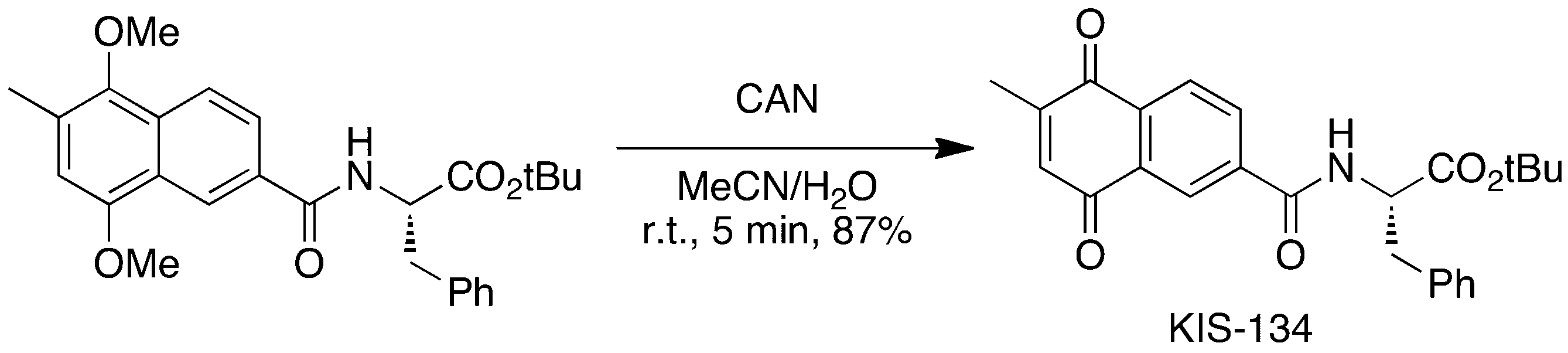
13C-NMR(125MHz,CDCl3)δ(ppm):16.6,28.1(x3),38.1,48.7,54.3,83.1,125.4,127.3,128.7(x2),129.7(x2),132.5(x2),134.0,136.1(x2),138.9,148.6,165.0,170.6,184.1,185.0
HRMS(ESI)m/z 442.1628 [M+Na]+(442.1630 calcd for C25H25N1Na1O5)

13C-NMR(125MHz,CDCl3)δ(ppm):16.6,37.6,54.0,124.6,127.2,127.4,128.8(x2),129.4(x2),132.2,133.0,134.0,135.9,136.0,138.2,148.9,166.0,174.7,184.5,184.8
Off-chip mobility shift assayによるPDK4/PDK2阻害活性の測定:
384 well micro plateに化合物溶液(5μL)、4×substrate/ATP/metal mixture(5μL)、2×recombinant human PDK4(5μL)を加えた。5時間室温にて反応させた後、反応停止液(60μL)を加えた。LabChip3000を用いて基質ペプチド(S)とリン酸化ペプチド(P)を定量し、その比(P/P+S)より、阻害活性を算出した。


1.マウス、インフルエンザウイルス、及び試薬
5週齢のC57BL/6Jマウス(日本SLC)を購入し、6週目(16.4-18.1g)に麻酔(ケタラール62.5mg/kgとセラクタール12.5μg/kgの混合)を筋肉注射後、Influenza A/Puerto Rico8/34株(influenza A/PR8/8/34株)を10PFU/20μl/mouseで経鼻感染させた。非感染群(コントロール)として、ウイルスを希釈する際に用いた生理食塩水(大塚製薬)を20μl/mouseで経鼻で投与した。本発明の化合物は、0.93-0.8mg/kg/day投与量で、溶媒としてのDMSOが5%になるように生理食塩水に混ぜ、腹腔内投与を、感染翌日から1日2回行った。実験は、各群10匹(1ケージ5匹)のマウスを用いて、非感染群(コントロール)、感染マウスにKIS化合物を投与した群、感染マウスに生理食塩水中5%DMSOを投薬した群(コントロール)について行った。
Claims (13)
- 下記一般式(I)で表わされる化合物又はそのエステル誘導体、あるいはそれらの薬理学的に許容される塩を有効成分として含有する、ピルビン酸デヒドロゲナーゼキナーゼ阻害剤、

ここで、環Aの置換基は、同一又は異なって、水酸基、オキソ基、置換されていてもよいアミノ基、ハロゲン原子、置換されていてもよいC1~6アルキル基、置換されていてもよいC2~40アルケニル基、置換されていてもよいC1~6アルコキシ基、置換されていてもよいC2~6アルケニルオキシ基、置換されていてもよいC1~6アルコキシカルボニル基、及び、置換されていてもよいC2~7アルカノイルオキシ基から選択される基を示し、あるいは、環Aの2つの置換基が結合して、置換されていてもよいジヒドロピランを形成してもよく(該ジヒドロピランはオキソ基で置換されていてもよいテトラヒドロフランと縮合していてもよい)、
R1及びR4は、同一又は異なって、水素原子、水酸基、置換されていてもよいC1~6アルキル基、置換されていてもよいC2~6アルケニル基、置換されていてもよいC6~10アリール基、置換されていてもよいC1~6アルコキシ基、又は、置換されていてもよいC2~7アルカノイルオキシ基を示し、
R2及びR3は、同一又は異なって、水素原子、カルボキシル基、置換されていてもよいC1~6アルキル基、置換されていてもよいC6~10アリール基、又は、-C(=R9)-R10で表わされる基を示す、
ここで、R9は、酸素原子、硫黄原子、=N-R11基(ここで、R11は、水酸基、置換されていてもよいC1~6アルキル基、置換されていてもよいC6~10アリール基、置換されていてもよいC1~6アルコキシ基、置換されていてもよいC2~6アルケニルオキシ基、置換されていてもよいC6~10アリールオキシ基を示す)、又は、=CH-R12基(ここで、R12は、ホルミル基、カルボキシル基、置換されていてもよいC1~6アルキル基、置換されていてもよいC6~10アリール基、置換されていてもよいC1~6アルコキシカルボニル基、アミノカルボニル基、又は、置換されていてもよいC1~6アルキルアミノカルボニル基を示し、
R10は、水素原子、アミノ基、置換されていてもよいC1~6アルキル基、置換されていてもよいC6~10アリール基、置換されていてもよいC1~6アルコキシ基、置換されていてもよいC6~C10アリールオキシ基、置換されていてもよいC1~6アルキルアミノ基、又は置換されていてもよいC1~6アルコキシカルボニルC1~6アルキルアミノ基を示すか、あるいは、
R2及びR3のいずれか一方は、以下の一般式で表わされる基(式中、環A、R1、R2及びR4で表わされる基の定義は、それぞれ、一般式(I)における環A、R1、R2及びR4の定義と同様である):

R2とR3が一緒になって、それらが結合する炭素原子と共にベンゼン環又はテトラヒドロフランを構成し、ここで、該テトラヒドロフランは、置換されていてもよい3環性縮合複素環とスピロ結合していてもよく、
ここで、前記において、置換されていてもよい場合の置換基は、以下から選択される基である:水酸基、カルボキシル基、アミノ基、ハロゲン原子、水酸基で置換されていてもよいC1~6アルキル基、C2~6アルケニル基、C2~7アルカノイル基、C1~6アルコキシ基、C1~6アルコキシカルボニル基、C6~10アリール基、C6~10アリールC1~6アルキル基]。 - 下記一般式(II)又は(III)で表わされる化合物又はそのエステル誘導体、あるいはそれらの薬理学的に許容される塩を有効成分として含有する、請求項1に記載のピルビン酸デヒドロゲナーゼキナーゼ阻害剤、


R2及びR3は、同一又は異なって、水素原子、カルボキシル基、置換されていてもよいC1~6アルキル基、C6~10アリール基、又は、-C(=R9)-R10で表わされる基を示す、
ここで、R9は、酸素原子、硫黄原子、=N-R11基(ここで、R11は、水酸基、C1~6アルキル基、C6~10アリール基、C1~6アルコキシ基、C2~6アルケニルオキシ基、C6~10アリールオキシ基を示す)、又は、=CH-R12基(ここで、R12は、ホルミル基、カルボキシル基、C1~6アルキル基、C6~10アリール基、C1~6アルコキシカルボニル基、アミノカルボニル基、又は、C1~6アルキルアミノカルボニル基を示し、
R10は、水素原子、アミノ基、C1~6アルキル基、C6~10アリール基、C1~6アルコキシ基、置換されていてもよいC1~6アルキルアミノ基、又は置換されていてもよいC1~6アルコキシカルボニルC1~6アルキルアミノ基を示すか、あるいは、
R2及びR3のいずれか一方は、以下の一般式で表わされる基(式中、環A、R1、R2及びR4で表わされる基の定義は、それぞれ、一般式(I)における環A、R1、R2及びR4の定義と同様である):

R2とR3が一緒になって、それらが結合する炭素原子と共にベンゼン環又はテトラヒドロフランを構成し、ここで、該テトラヒドロフランは、置換されていてもよい3環性縮合複素環とスピロ結合していてもよく、
R5及びR8は、同一又は異なって、水酸基、アミノ基、置換されていてもよいC1~6アルコキシ基、置換されていてもよいC2~40アルケニルオキシ基、又は、C2~7アルカノイルオキシ基を示し、
R6及びR7は、水素原子、水酸基、置換されていてもよいアミノ基、ハロゲン原子、置換されていてもよいC1~6アルキル基、置換されていてもよいC2~40アルケニル基、置換されていてもよいC1~6アルコキシ基を示し、
ここで、前記において、置換されていてもよい場合の置換基は、以下から選択される基である:水酸基、カルボキシル基、アミノ基、ハロゲン原子、C1~6アルキル基、C2~6アルケニル基、C2~7アルカノイル基、C1~6アルコキシカルボニル基
ここで、前記において、置換されていてもよい場合の置換基は、以下から選択される基である:水酸基、カルボキシル基、アミノ基、ハロゲン原子、水酸基で置換されていてもよいC1~6アルキル基、C2~6アルケニル基、C2~7アルカノイル基、C1~6アルコキシ基、C1~6アルコキシカルボニル基、C6~10アリール基、C6~10アリールC1~6アルキル基]。 - 下記一般式(II)又は(III)で表わされる化合物又はそのエステル誘導体、あるいはそれらの薬理学的に許容される塩:


R1及びR4は、同一又は異なって、水素原子、置換されていてもよいC1~6アルキル基、又は、置換されていてもよいC6~10アリール基を示し、
R2及びR3のうちどちらか一方は、水素原子、置換されていてもよいC1~6アルキル基、又は、置換されていてもよいC6~10アリール基を示し、
残りの一方は、-C(=R9)-R10で表わされる基を示し、
ここで、R9は、酸素原子、硫黄原子、=N-R11基(ここで、R11は、C1~6アルキル基、C6~10アリール基、水酸基、C1~6アルコキシ基、C2~20アルケニルオキシ基、C6~10アリールオキシ基を示す)、又は、=CH-R12基(ここで、R12は、C1~6アルキル基、C6~10アリール基、ホルミル基、カルボキシル基、C1~6アルコキシカルボニル基、アミノカルボニル基、又は、C1~6アルキルアミノカルボニル基を示し、
R10は、水素原子、アミノ基、置換されていてもよいC1~6アルキル基、置換されていてもよいC6~10アリール基、置換されていてもよいC1~6アルコキシ基、置換されていてもよいC6~10アリールオキシ基、置換されていてもよいC1~6アルキルアミノ基、又は置換されていてもよいC1~6アルコキシカルボニルC1~6アルキルアミノ基を示し、
ただし、-C(=R9)-R10で表わされる基は、カルボキシル基、メチルカルボニル基、及びメトキシカルボニル基ではなく、
R5及びR8は、共に、C1~6アルコキシ基を示し、
R6及びR7は、水素原子、置換されていてもよいC1~6アルキル基、置換されていてもよいアミノ基を示し、
ここで、前記において、置換されていてもよい場合の置換基は、以下から選択される基である:水酸基、カルボキシル基、アミノ基、ハロゲン原子、水酸基で置換されていてもよいC1~6アルキル基、C2~6アルケニル基、C2~7アルカノイル基、C1~6アルコキシ基、C1~6アルコキシカルボニル基、C6~10アリール基、C6~10アリールC1~6アルキル基]。 - 請求項3に記載の化合物又はそのエステル誘導体、あるいはそれらの薬理学的に許容される塩であって:
R1及びR4は、同一又は異なって、水素原子、又は置換されていてもよいC1~6アルキル基を示し、
R2及びR3のうちどちらか一方は、水素原子、又は置換されていてもよいC1~6アルキル基を示し、
残りの一方は、-C(=R9)-R10で表わされる基を示し、
ここで、R9は、酸素原子、又は=N-R11基(ここで、R11は、C1~6アルコキシ基、C2~6アルケニルオキシ基、C6~10アリールオキシ基を示す)(を示し、
R10は、水素原子、置換されていてもよいC1~6アルキル基、置換されていてもよいC6~10アリール基、置換されていてもよいC1~6アルコキシ基、置換されていてもよいC6~10アリールオキシ基、置換されていてもよいC1~6アルキルアミノ基、又は置換されていてもよいC1~6アルコキシカルボニルC1~6アルキルアミノ基を示し、
ただし、-C(=R9)-R10で表わされる基は、カルボキシル基、メチルカルボニル基、及びメトキシカルボニル基ではなく、
R5及びR8は、共に、C1~6アルコキシ基を示し、
R6及びR7は、水素原子、又は置換されていてもよいC1~6アルキル基を示し、
ここで、前記において、置換されていてもよい場合の置換基は、以下から選択される基である:水酸基、カルボキシル基、アミノ基、ハロゲン原子、水酸基で置換されていてもよいC1~6アルキル基、C2~6アルケニル基、C2~7アルカノイル基、C1~6アルコキシ基、C1~6アルコキシカルボニル基、C6~10アリール基である、
化合物又はそのエステル誘導体、あるいはそれらの薬理学的に許容される塩。 - 請求項3又は請求項4に記載の化合物又はそのエステル誘導体、あるいはそれらの薬理学的に許容される塩を有効成分として含有する、ピルビン酸デヒドロゲナーゼ阻害剤。
- ピルビン酸デヒドロゲナーゼキナーゼ4阻害剤である、請求項1、請求項2、又は請求項5に記載のピルビン酸デヒドロゲナーゼキナーゼ阻害剤。
- 請求項1、請求項2、又は請求項5に記載のピルビン酸デヒドロゲナーゼキナーゼ阻害剤を有効成分として含有する、ピルビン酸デヒドロゲナーゼキナーゼが発症又は増悪化に関係する疾患又は障害の治療又は予防のための医薬組成物。
- ピルビン酸デヒドロゲナーゼキナーゼが発症又は増悪化に関係する疾患又は障害が、インフルエンザ感染後の重症化である、請求項7に記載の医薬組成物。
- ピルビン酸デヒドロゲナーゼキナーゼが発症又は増悪化に関係する疾患又は障害が、食欲不振である、請求項7に記載の医薬組成物。
- ピルビン酸デヒドロゲナーゼキナーゼが発症又は増悪化に関係する疾患又は障害が、ミトコンドリア病、又は、ATP産生の低下を伴う疾患又は障害である、請求項7に記載の医薬組成物。
- ピルビン酸デヒドロゲナーゼキナーゼが発症又は増悪化に関係する疾患又は障害が、糖尿病である、請求項7に記載の医薬組成物。
- ピルビン酸デヒドロゲナーゼキナーゼが発症又は増悪化に関係する疾患又は障害が、癌である、請求項7に記載の医薬組成物。
- 請求項1、請求項2、又は請求項5に記載のピルビン酸デヒドロゲナーゼキナーゼ阻害剤を含有する、化粧品組成物。
Priority Applications (3)
| Application Number | Priority Date | Filing Date | Title |
|---|---|---|---|
| JP2014554151A JPWO2014103321A1 (ja) | 2012-12-26 | 2013-12-26 | Pdk4阻害剤及びその利用 |
| US14/655,631 US20150344404A1 (en) | 2012-12-26 | 2013-12-26 | Pdk4 inhibitor and use thereof |
| EP13869345.2A EP2939668A4 (en) | 2012-12-26 | 2013-12-26 | PDK4-HEMMER AND USE THEREOF |
Applications Claiming Priority (2)
| Application Number | Priority Date | Filing Date | Title |
|---|---|---|---|
| US201261745819P | 2012-12-26 | 2012-12-26 | |
| US61/745,819 | 2012-12-26 |
Publications (1)
| Publication Number | Publication Date |
|---|---|
| WO2014103321A1 true WO2014103321A1 (ja) | 2014-07-03 |
Family
ID=51020436
Family Applications (1)
| Application Number | Title | Priority Date | Filing Date |
|---|---|---|---|
| PCT/JP2013/007649 Ceased WO2014103321A1 (ja) | 2012-12-26 | 2013-12-26 | Pdk4阻害剤及びその利用 |
Country Status (4)
| Country | Link |
|---|---|
| US (1) | US20150344404A1 (ja) |
| EP (1) | EP2939668A4 (ja) |
| JP (1) | JPWO2014103321A1 (ja) |
| WO (1) | WO2014103321A1 (ja) |
Cited By (4)
| Publication number | Priority date | Publication date | Assignee | Title |
|---|---|---|---|---|
| JP2019513716A (ja) * | 2016-03-29 | 2019-05-30 | メルク パテント ゲゼルシャフト ミット ベシュレンクテル ハフツングMerck Patent Gesellschaft mit beschraenkter Haftung | ピルバートデヒドロゲナーゼキナーゼのインヒビターとしてのn1−(3,3,3−トリフルオロ−2−ヒドロキシ−2−メチルプロピオニル)−ピペリジン誘導体 |
| JP2019519576A (ja) * | 2016-06-28 | 2019-07-11 | ブリストル−マイヤーズ スクイブ カンパニーBristol−Myers Squibb Company | ミエロペルオキシダーゼのマクロ環阻害剤 |
| CN112409372A (zh) * | 2020-11-05 | 2021-02-26 | 哈药慈航制药股份有限公司 | 玉红霉素类似物、制备方法及其应用 |
| KR102934648B1 (ko) | 2024-11-01 | 2026-03-06 | 주식회사 중헌제약 | 피부 미백용 조성물 |
Families Citing this family (3)
| Publication number | Priority date | Publication date | Assignee | Title |
|---|---|---|---|---|
| KR102742339B1 (ko) | 2017-04-21 | 2024-12-13 | 유니버시티 오브 타스마니아 | 치료 화합물 및 방법 |
| CN110790657B (zh) * | 2019-10-22 | 2021-06-08 | 上海交通大学 | 7-甲基胡桃醌的合成方法 |
| US20220378721A1 (en) * | 2019-10-24 | 2022-12-01 | Xavier University Of Louisiana | Protein kinase inhibitors and use thereof for treatment of neurodegenerative diseases |
Citations (2)
| Publication number | Priority date | Publication date | Assignee | Title |
|---|---|---|---|---|
| WO2006137190A1 (ja) * | 2005-06-21 | 2006-12-28 | Kyoto University | 光機能性核酸及びその製造方法、並びにメチル化判定方法 |
| WO2007111324A1 (ja) * | 2006-03-29 | 2007-10-04 | Kyoto University | 遺伝子中の5-メチルシトシン検出方法および検出キット |
Family Cites Families (7)
| Publication number | Priority date | Publication date | Assignee | Title |
|---|---|---|---|---|
| WO2000066528A2 (en) * | 1999-04-30 | 2000-11-09 | Slil Biomedical Corporation | Quinones for treatment of diseases |
| US20050222258A1 (en) * | 2003-02-21 | 2005-10-06 | Feixin Wang | Pharmaceuticals comprising shikonins as active constituent |
| EP2046313A4 (en) * | 2006-07-10 | 2012-01-25 | Glucox Biotech Ab | USE OF NAPHTHOCHINONES IN THE TREATMENT AND CONTROL OF DIABETES, INSULIN RESISTANCE AND HYPERGLYCEMIA |
| US20090318552A1 (en) * | 2006-12-12 | 2009-12-24 | Ji Ho Park | Pharmaceutical composition comprising shikonin derivatives from lithospermum erythrorhizo dor treating or preventing diabetes mellitus and the use thereof |
| WO2008117523A1 (ja) * | 2007-03-23 | 2008-10-02 | Nippon Soda Co., Ltd. | 抗ウイルス剤 |
| US20140031432A1 (en) * | 2010-08-06 | 2014-01-30 | Ampere Life Sciences, Inc. | Treatment of mitochondrial diseases with vitamin k |
| JPWO2013153821A1 (ja) * | 2012-04-12 | 2015-12-17 | 学校法人北里研究所 | Pdk4阻害剤及びその利用 |
-
2013
- 2013-12-26 US US14/655,631 patent/US20150344404A1/en not_active Abandoned
- 2013-12-26 EP EP13869345.2A patent/EP2939668A4/en not_active Withdrawn
- 2013-12-26 WO PCT/JP2013/007649 patent/WO2014103321A1/ja not_active Ceased
- 2013-12-26 JP JP2014554151A patent/JPWO2014103321A1/ja active Pending
Patent Citations (2)
| Publication number | Priority date | Publication date | Assignee | Title |
|---|---|---|---|---|
| WO2006137190A1 (ja) * | 2005-06-21 | 2006-12-28 | Kyoto University | 光機能性核酸及びその製造方法、並びにメチル化判定方法 |
| WO2007111324A1 (ja) * | 2006-03-29 | 2007-10-04 | Kyoto University | 遺伝子中の5-メチルシトシン検出方法および検出キット |
Non-Patent Citations (14)
| Title |
|---|
| BERGE ET AL., J. PHARM. SCI., vol. 66, 1977, pages 1 - 19 |
| BIOCHEM. J., vol. 423, 2009, pages 243 - 252 |
| CHEMICAL ABSTRACTS, 15 April 2012, Columbus, Ohio, US; abstract no. 1368585-98-1, "Chemical Catalog, Otava Chemicals" XP055270645 * |
| CHEMICAL ABSTRACTS, 16 April 2012, Columbus, Ohio, US; abstract no. 1368910-17-1, "Chemical Catalog, Otava Chemicals" XP055270643 * |
| HUM MUTAT, vol. 29, 2008, pages 718 - 27 |
| INT. J. CANCER, vol. 128, 2011, pages 1001 - 1008 |
| J. ANTIBIOTICS, vol. 62, 2009, pages 17 - 26 |
| J. BIOL CHEM., vol. 283, 2008, pages 25305 - 25315 |
| JOSEPH ESPINAL ET AL.: "Inhibition of Pyruvate Dehydrogenase Kinase by Halogenated Acetophenones", DRUG DEVELOPMENT RESEARCH, vol. 35, 1995, pages 130 - 136, XP000611456 * |
| JOSEPH J. BATENBURG ET AL.: "Regulation of Pyruvate Dehydrogenase by Fatty Acid in Isolated Rat Liver Mitochondria", THE JOURNAL OF BIOLOGICAL CHEMISTRY, vol. 251, no. 5, 10 March 1976 (1976-03-10), pages 1364 - 1370, XP055267380 * |
| JUNJIAN WANG ET AL.: "Kaempferol is an estrogen-related receptor a and y inverse agonist", FEBS LETTERS, vol. 583, 2009, pages 643 - 647, XP025947014 * |
| MOL CELL BIOCHEM, vol. 299, 2007, pages 85 - 92 |
| See also references of EP2939668A4 |
| WILLIAM R. MANN ET AL.: "Diverse mechanisms of inhibition of pyruvate dehydrogenase kinase by structurally distinct inhibitors", BIOCHIMICA ET BIOPHYSICA ACTA, vol. 1480, 2000, pages 283 - 292, XP027287959 * |
Cited By (6)
| Publication number | Priority date | Publication date | Assignee | Title |
|---|---|---|---|---|
| JP2019513716A (ja) * | 2016-03-29 | 2019-05-30 | メルク パテント ゲゼルシャフト ミット ベシュレンクテル ハフツングMerck Patent Gesellschaft mit beschraenkter Haftung | ピルバートデヒドロゲナーゼキナーゼのインヒビターとしてのn1−(3,3,3−トリフルオロ−2−ヒドロキシ−2−メチルプロピオニル)−ピペリジン誘導体 |
| JP2019519576A (ja) * | 2016-06-28 | 2019-07-11 | ブリストル−マイヤーズ スクイブ カンパニーBristol−Myers Squibb Company | ミエロペルオキシダーゼのマクロ環阻害剤 |
| CN112409372A (zh) * | 2020-11-05 | 2021-02-26 | 哈药慈航制药股份有限公司 | 玉红霉素类似物、制备方法及其应用 |
| CN112409372B (zh) * | 2020-11-05 | 2023-08-15 | 哈药慈航制药股份有限公司 | 玉红霉素类似物、制备方法及其应用 |
| KR102934648B1 (ko) | 2024-11-01 | 2026-03-06 | 주식회사 중헌제약 | 피부 미백용 조성물 |
| WO2026095445A1 (ko) * | 2024-11-01 | 2026-05-07 | 주식회사 중헌제약 | 피부 미백용 조성물 |
Also Published As
| Publication number | Publication date |
|---|---|
| US20150344404A1 (en) | 2015-12-03 |
| EP2939668A4 (en) | 2016-07-06 |
| EP2939668A1 (en) | 2015-11-04 |
| JPWO2014103321A1 (ja) | 2017-01-12 |
Similar Documents
| Publication | Publication Date | Title |
|---|---|---|
| JPWO2014103321A1 (ja) | Pdk4阻害剤及びその利用 | |
| JP2020128441A (ja) | インフルエンザウイルスの複製の阻害剤 | |
| TW201932113A (zh) | 經取代之多環性吡啶酮衍生物及含有其前體之醫藥組合物 | |
| Cihan-Üstündağ et al. | Superior inhibition of influenza virus hemagglutinin-mediated fusion by indole-substituted spirothiazolidinones | |
| JP2013508327A (ja) | シクロペンタンカルボキサミド誘導体、このような化合物を含む薬物及びそれらの使用 | |
| GB2440034A (en) | Beta-Diketones and their use against conditions modulated by the TRPV1 receptor | |
| AU2020213346B2 (en) | Phenylallyl cyclohexenone derivatives and their preparation method and application | |
| CN110105348A (zh) | 新型迈克尔受体类肠病毒71型抑制剂的制备及用途 | |
| JP2018188452A (ja) | Fasn阻害剤としてのピペラジン誘導体 | |
| JP5833143B2 (ja) | フェニル−イソオキサゾール誘導体およびその製造方法 | |
| JP2024178473A (ja) | ウイルス増殖阻害活性を有する二環性含窒素複素環誘導体およびそれらを含有する医薬組成物 | |
| US20020123527A1 (en) | HIV integrase inhibitors | |
| US8765941B2 (en) | Aniline derivative having anti-RNA viral activity | |
| WO2008062830A1 (en) | Spiroquinone compound and pharmaceutical composition | |
| US20240368065A1 (en) | Citraconic acid and derivatives thereof for use as a medicament | |
| AU2009211300A1 (en) | Phenyl-prenyl derivatives, of marine and synthetic origin, for the treatment of cognitive, neurodegenerative or neuronal diseases or disorders | |
| CA2838680A1 (en) | 2-phenylindane-1,3-dione derivatives as antiviral agents | |
| WO2025039722A1 (zh) | 萘醌类化合物及其制备方法、药物组合物和应用 | |
| AU2007280400A1 (en) | Phenyl-prenyl-ether derivatives for the treatment of cognitive, neurodegenerative or neuronal diseases or disorders | |
| JP2008201756A (ja) | トリプトファン誘導体、その製造方法及びそれを有効成分とするインドールアミン酸素添加酵素阻害剤 | |
| JP2015160831A (ja) | 新規pdk4阻害剤を有効成分として含有する心不全の治療薬及び予防薬 | |
| KR20070085263A (ko) | 에스테르 유도체 및 그의 약학적 용도 | |
| TW201438717A (zh) | 預防或治療蕭格倫徵候群之方法 | |
| CN114907288B (zh) | 硝基苯类化合物在制备铜绿假单胞菌群体感应抑制剂中的应用 | |
| RU2756587C9 (ru) | Производные 2-ацетамидо-6-гидрокси-бензотиофена и их фармацевтически приемлемые соли, обладающие противовирусной активностью |
Legal Events
| Date | Code | Title | Description |
|---|---|---|---|
| 121 | Ep: the epo has been informed by wipo that ep was designated in this application |
Ref document number: 13869345 Country of ref document: EP Kind code of ref document: A1 |
|
| DPE1 | Request for preliminary examination filed after expiration of 19th month from priority date (pct application filed from 20040101) | ||
| ENP | Entry into the national phase |
Ref document number: 2014554151 Country of ref document: JP Kind code of ref document: A |
|
| WWE | Wipo information: entry into national phase |
Ref document number: 14655631 Country of ref document: US |
|
| NENP | Non-entry into the national phase |
Ref country code: DE |
|
| REEP | Request for entry into the european phase |
Ref document number: 2013869345 Country of ref document: EP |
|
| WWE | Wipo information: entry into national phase |
Ref document number: 2013869345 Country of ref document: EP |