WO2014103876A1 - 建設車両用空気入りタイヤ用ゴム組成物 - Google Patents
建設車両用空気入りタイヤ用ゴム組成物 Download PDFInfo
- Publication number
- WO2014103876A1 WO2014103876A1 PCT/JP2013/084096 JP2013084096W WO2014103876A1 WO 2014103876 A1 WO2014103876 A1 WO 2014103876A1 JP 2013084096 W JP2013084096 W JP 2013084096W WO 2014103876 A1 WO2014103876 A1 WO 2014103876A1
- Authority
- WO
- WIPO (PCT)
- Prior art keywords
- weight
- rubber
- sulfur
- parts
- rubber composition
- Prior art date
- Legal status (The legal status is an assumption and is not a legal conclusion. Google has not performed a legal analysis and makes no representation as to the accuracy of the status listed.)
- Ceased
Links
Images
Classifications
-
- B—PERFORMING OPERATIONS; TRANSPORTING
- B60—VEHICLES IN GENERAL
- B60C—VEHICLE TYRES; TYRE INFLATION; TYRE CHANGING; CONNECTING VALVES TO INFLATABLE ELASTIC BODIES IN GENERAL; DEVICES OR ARRANGEMENTS RELATED TO TYRES
- B60C1/00—Tyres characterised by the chemical composition or the physical arrangement or mixture of the composition
-
- C—CHEMISTRY; METALLURGY
- C08—ORGANIC MACROMOLECULAR COMPOUNDS; THEIR PREPARATION OR CHEMICAL WORKING-UP; COMPOSITIONS BASED THEREON
- C08K—Use of inorganic or non-macromolecular organic substances as compounding ingredients
- C08K3/00—Use of inorganic substances as compounding ingredients
- C08K3/02—Elements
- C08K3/04—Carbon
-
- B—PERFORMING OPERATIONS; TRANSPORTING
- B60—VEHICLES IN GENERAL
- B60C—VEHICLE TYRES; TYRE INFLATION; TYRE CHANGING; CONNECTING VALVES TO INFLATABLE ELASTIC BODIES IN GENERAL; DEVICES OR ARRANGEMENTS RELATED TO TYRES
- B60C1/00—Tyres characterised by the chemical composition or the physical arrangement or mixture of the composition
- B60C1/0016—Compositions of the tread
-
- C—CHEMISTRY; METALLURGY
- C08—ORGANIC MACROMOLECULAR COMPOUNDS; THEIR PREPARATION OR CHEMICAL WORKING-UP; COMPOSITIONS BASED THEREON
- C08K—Use of inorganic or non-macromolecular organic substances as compounding ingredients
- C08K3/00—Use of inorganic substances as compounding ingredients
- C08K3/02—Elements
- C08K3/06—Sulfur
-
- C—CHEMISTRY; METALLURGY
- C08—ORGANIC MACROMOLECULAR COMPOUNDS; THEIR PREPARATION OR CHEMICAL WORKING-UP; COMPOSITIONS BASED THEREON
- C08K—Use of inorganic or non-macromolecular organic substances as compounding ingredients
- C08K3/00—Use of inorganic substances as compounding ingredients
- C08K3/34—Silicon-containing compounds
- C08K3/36—Silica
-
- C—CHEMISTRY; METALLURGY
- C08—ORGANIC MACROMOLECULAR COMPOUNDS; THEIR PREPARATION OR CHEMICAL WORKING-UP; COMPOSITIONS BASED THEREON
- C08K—Use of inorganic or non-macromolecular organic substances as compounding ingredients
- C08K5/00—Use of organic ingredients
- C08K5/54—Silicon-containing compounds
- C08K5/548—Silicon-containing compounds containing sulfur
-
- C—CHEMISTRY; METALLURGY
- C08—ORGANIC MACROMOLECULAR COMPOUNDS; THEIR PREPARATION OR CHEMICAL WORKING-UP; COMPOSITIONS BASED THEREON
- C08L—COMPOSITIONS OF MACROMOLECULAR COMPOUNDS
- C08L7/00—Compositions of natural rubber
-
- C—CHEMISTRY; METALLURGY
- C08—ORGANIC MACROMOLECULAR COMPOUNDS; THEIR PREPARATION OR CHEMICAL WORKING-UP; COMPOSITIONS BASED THEREON
- C08L—COMPOSITIONS OF MACROMOLECULAR COMPOUNDS
- C08L9/00—Compositions of homopolymers or copolymers of conjugated diene hydrocarbons
-
- B—PERFORMING OPERATIONS; TRANSPORTING
- B29—WORKING OF PLASTICS; WORKING OF SUBSTANCES IN A PLASTIC STATE IN GENERAL
- B29D—PRODUCING PARTICULAR ARTICLES FROM PLASTICS OR FROM SUBSTANCES IN A PLASTIC STATE
- B29D30/00—Producing pneumatic or solid tyres or parts thereof
- B29D30/06—Pneumatic tyres or parts thereof (e.g. produced by casting, moulding, compression moulding, injection moulding, centrifugal casting)
- B29D30/52—Unvulcanised treads, e.g. on used tyres; Retreading
- B29D30/58—Applying bands of rubber treads, i.e. applying camel backs
- B29D30/60—Applying bands of rubber treads, i.e. applying camel backs by winding narrow strips
Definitions
- the present invention relates to a rubber composition for a pneumatic tire for construction vehicles that is improved in low heat build-up, cut resistance and molding processability.
- Cut resistance is a characteristic that makes it difficult for the tire to be damaged when it touches or collides with an obstacle or an external object.
- Heat generation is the ability to heat the energy applied to the tire by such physical impact. Instead, it is a characteristic that reduces the impact by heating the rubber. For this reason, in order to make the cut resistance of a tire excellent, it is requested
- the rubber has a low heat generation property, so that the cut resistance and the low heat generation property are in a trade-off relationship.
- the pneumatic tires for construction vehicles described above are very difficult to form because the tire size is quite large.
- a tire tread portion of such a large tire is formed, a green tire cannot be formed by integrally extruding and winding a rubber portion forming the tread portion like a small tire.
- a tread portion of a large tire is formed by laminating a plurality of rubber sheets having a thickness smaller than that of the designed tread portion or winding a rubber strip in a spiral shape.
- a softener or the like to the rubber composition constituting the rubber sheet and the rubber strip. is there.
- compounding agents such as softeners have the property of increasing the heat buildup of the rubber composition, it has been difficult to achieve both moldability and low heat buildup in large tires.
- Patent Document 1 proposes blending natural rubber with silica, carbon black, silane coupling agent, sulfur and sulfenamide accelerator at a specific ratio in order to reduce rolling resistance of large vehicle tires. .
- this rubber composition does not necessarily have sufficient effects of improving cut resistance and molding processability. For this reason, the further improvement was calculated
- An object of the present invention is to provide a rubber composition for a pneumatic tire for a construction vehicle in which low heat build-up, cut resistance and molding processability are improved to the conventional level or more.
- the rubber composition for a pneumatic tire for construction vehicles comprises carbon black for 100 parts by weight of diene rubber containing 80 to 100% by weight of natural rubber and 20 to 0% by weight of isoprene rubber.
- a rubber composition containing 20 to 40 parts by weight, 15 to 30 parts by weight of silica, 2.0 to 3.5 parts by weight of sulfur, and a sulfur-containing silane coupling agent, the sulfur and sulfur-containing silane cups The total sulfur in the ring agent is 2.3 to 4.0 parts by weight.
- the rubber composition for a pneumatic tire for construction vehicles comprises a diene rubber containing natural rubber as a main component, a predetermined amount of carbon black, silica, sulfur and a sulfur-containing silane coupling agent, and sulfur and Since the total amount of sulfur in the sulfur-containing silane coupling agent is limited, the cut resistance can be improved to a conventional level while reducing the heat build-up of the rubber composition. Furthermore, molding processability can be maintained and improved while reducing the amount of oil, softener and the like.
- the pneumatic tire for construction vehicles of the present invention has a tread portion in which rubber sheets having an arbitrary width formed of the rubber composition described above are laminated.
- This pneumatic tire for construction vehicles can suppress heat generation and prevent a failure due to tire overheating. At the same time, the tire durability is improved because the cut resistance is improved to a level higher than the conventional level.
- this pneumatic tire for construction vehicles uses a rubber composition that is excellent in molding processability such as sheet lamination, it is necessary to stabilize and efficiently produce a high-quality tire as described above. Can do.
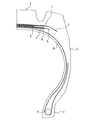
- FIG. 1 is a half meridian sectional view showing an example of an embodiment of a pneumatic tire for construction vehicles.
- FIG. 1 is an explanatory view illustrating an embodiment of a pneumatic tire for construction vehicles using the rubber composition of the present invention.
- the pneumatic tire for construction vehicles includes a tread portion 1, a sidewall portion 2, and a bead portion 3.
- a carcass layer 4 including a plurality of reinforcing cords extending in the tire radial direction is mounted between the pair of left and right bead portions 3, 3, and an end portion of the carcass layer 4 is folded around the bead core 5 from the inside to the outside of the tire. It is.
- a plurality of belt layers 6 are embedded on the outer peripheral side of the carcass layer 4 in the tread portion 1. These belt layers 6 include a plurality of reinforcing cords inclined with respect to the tire circumferential direction, and are arranged so that the reinforcing cords cross each other between the layers. Further, a plurality of belt protective layers 7 are embedded on the outer peripheral side of the belt layer 6. While the belt layer 6 reinforces the tread portion 1, the belt protective layer 7 is disposed for the purpose of protecting the belt layer 6. These belt protective layers 7 include a plurality of reinforcing cords inclined with respect to the tire circumferential direction, and are arranged so that the reinforcing cords cross each other between the layers.
- the rubber composition for a pneumatic tire for construction vehicles of the present invention is used for a pneumatic tire for construction vehicles.
- it is suitable as a material for forming the tread portion 1 of a pneumatic tire for construction vehicles.
- it is preferable to form the tread portion of the pneumatic tire for construction vehicles by laminating rubber sheets having an arbitrary width formed of the rubber composition for pneumatic tires for construction vehicles.
- the rubber component is a diene rubber, and is made of natural rubber or natural rubber and isoprene rubber.
- the diene rubber By composing the diene rubber with natural rubber or isoprene rubber, the rubber strength, crack resistance and set resistance of the rubber composition can be ensured at a high level.
- the content of the natural rubber is 80 to 100% by weight, preferably 90 to 100% by weight, in 100% by weight of the diene rubber. If the content of natural rubber is less than 80% by weight, cut resistance may not be sufficiently improved.
- the content of the isoprene rubber is 20 to 0% by weight, preferably 10 to 0% by weight, in 100% by weight of the diene rubber. If the content of isoprene rubber exceeds 20% by weight, the cut resistance may not be sufficiently improved.
- the diene rubber is 100% by weight of natural rubber, or the total of natural rubber and isoprene rubber is 100% by weight.
- diene rubbers other than natural rubber and isoprene rubber may be contained as a diluting material or masterbatch base rubber. Is not excluded, and can be contained within the range not impairing the object of the present invention.
- diene rubbers include butadiene rubber, styrene-butadiene rubber, acrylonitrile-butadiene rubber, and butyl rubber.
- the rubber composition for a pneumatic tire for construction vehicles of the present invention 20 to 40 parts by weight, preferably 25 to 35 parts by weight of carbon black is blended with 100 parts by weight of the diene rubber.
- carbon black By blending carbon black, the strength of the rubber composition can be increased and the cut resistance can be increased.
- the blending amount of carbon black is less than 20 parts by weight, the rubber strength and cut resistance of the rubber composition are deteriorated.
- the compounding amount of carbon black exceeds 40 parts by weight, the exothermic property of the rubber composition increases, and the cut resistance deteriorates.
- the carbon black used in the present invention has a nitrogen adsorption specific surface area of preferably 70 to 145 m 2 / g, more preferably 85 to 125 m 2 / g. If the nitrogen adsorption specific surface area is less than 70 m 2 / g, mechanical properties such as rubber strength of the rubber composition may be lowered, and cut resistance may be deteriorated. If the nitrogen adsorption specific surface area exceeds 145 m 2 / g, the exothermicity may increase.
- the nitrogen adsorption specific surface area of carbon black is measured according to JIS K6217-2.
- silica is blended in an amount of 15 to 30 parts by weight, preferably 15 parts by weight or more and less than 30 parts by weight, more preferably 20 to 28 parts by weight, based on 100 parts by weight of the diene rubber.
- the exothermic property of the rubber composition can be reduced.
- the compounding amount of silica is less than 15 parts by weight, the exothermic property of the rubber composition increases.
- the amount of silica exceeds 30 parts by weight, molding processability such as sheet lamination of the rubber composition is deteriorated.
- the total of carbon black and silica is preferably 45 to 70 parts by weight, more preferably 50 to 65 parts by weight with respect to 100 parts by weight of the diene rubber. If the total amount of carbon black and silica is less than 45 parts by weight, the mechanical strength of the rubber is lowered, and the cut resistance may be deteriorated. On the other hand, if the total amount of carbon black and silica exceeds 70 parts by weight, the exothermic property may deteriorate.
- silica usually used in a rubber composition for tires, for example, wet method silica, dry method silica, or surface-treated silica can be used.
- Silica can be used by appropriately selecting from commercially available products.
- the silica obtained by the normal manufacturing method can be used.
- the nitrogen adsorption specific surface area of silica is not particularly limited, but is preferably 110 to 200 m 2 / g, more preferably 150 to 180 m 2 / g. If the nitrogen adsorption specific surface area of silica is less than 110 m 2 / g, the mechanical strength of the rubber is lowered and the cut resistance is deteriorated, which is not preferable. On the other hand, if the nitrogen adsorption specific surface area of silica exceeds 200 m 2 / g, the heat build-up becomes large, which is not preferable.
- the nitrogen adsorption specific surface area of silica is determined according to JIS K6217-2.
- the rubber composition for a pneumatic tire for construction vehicles of the present invention contains a sulfur-containing silane coupling agent together with silica.
- a sulfur-containing silane coupling agent By blending a sulfur-containing silane coupling agent, the dispersibility of silica can be improved, the low heat build-up of the rubber composition can be further reduced, and the molding processability such as sheet lamination can be improved.
- the sulfur-containing silane coupling agent is not particularly limited, and examples thereof include bis- (3-triethoxysilylpropyl) tetrasulfide, bis (3-triethoxysilylpropyl) disulfide, and 3-trimethoxysilylpropylbenzoate. Examples thereof include thiazole tetrasulfide, ⁇ -mercaptopropyltriethoxysilane, 3-octanoylthiopropyltriethoxysilane and the like. Of these, bis- (3-triethoxysilylpropyl) tetrasulfide and bis (3-triethoxysilylpropyl) disulfide are preferable.
- the sum of the sulfur contained in the sulfur-containing silane coupling agent and the sulfur compounded for vulcanization is in the range of 2.3 to 4.0 parts by weight with respect to 100 parts by weight of the diene rubber.
- the blending amount of the sulfur-containing silane coupling agent is not limited as long as the sum of sulfur and vulcanizing sulfur is within the above range, but preferably 5 to 20% by weight based on the blending amount of silica.
- the content is preferably 8 to 12% by weight.
- the sulfur-containing silane coupling agent is less than 5% by weight of the amount of silica, the effect of improving the dispersibility of silica cannot be sufficiently obtained.
- the sulfur-containing silane coupling agent exceeds 20% by weight of the silica amount, the silane coupling agents are condensed with each other, and a desired effect cannot be obtained.
- fillers other than carbon black and silica can be blended.
- examples of other fillers include clay, mica, talc, calcium carbonate, aluminum hydroxide, aluminum oxide, and titanium oxide. Of these, aluminum hydroxide, aluminum oxide, and titanium oxide are preferable.
- sulfur is used as a vulcanizing agent in an amount of 2.0 to 3.5 parts by weight, preferably 2.5 to 3.0 parts by weight based on 100 parts by weight of the diene rubber. Part mix.
- amount of sulfur is less than 2.0 parts by weight, the cut resistance is deteriorated.
- compounding quantity of sulfur exceeds 3.5 weight part, heat aging resistance will worsen.
- the total amount of sulfur and sulfur in the sulfur-containing silane coupling agent is 2.3 to 4.0 parts by weight, preferably 2.4 to 3.4 parts by weight, per 100 parts by weight of the diene rubber.
- the total amount of sulfur is the sum of the amount of net sulfur contained in the vulcanizing agent and the amount of net sulfur contained in the sulfur-containing silane coupling agent. Refers to the amount of sulfur used. For example, when the vulcanizing agent contains sulfur and oil, the net amount of sulfur excluding the oil is used.
- the rubber composition for a pneumatic tire for construction vehicles of the present invention has excellent molding processability such as sheet lamination, the composition of components that increase heat generation such as various oils and plasticizers is reduced or not blended. be able to.
- the rubber composition for pneumatic tires for construction vehicles preferably does not contain various oils and plasticizers.
- the rubber composition for pneumatic tires for construction vehicles includes various additives generally used in tire rubber compositions such as a vulcanization or crosslinking agent, a vulcanization accelerator, and an anti-aging agent.
- the additive can be blended within a range that does not inhibit the above, and such an additive can be kneaded by a general method to obtain a rubber composition, which can be used for vulcanization or crosslinking.
- a conventional general amount can be used.
- the rubber composition for a pneumatic tire for construction vehicles of the present invention can be produced by mixing the above-described components using a normal rubber kneading machine, for example, a Banbury mixer, a kneader, a roll or the like.
- the pneumatic tire using the rubber composition for a pneumatic tire for construction vehicles according to the present invention has low heat generation and suppresses an increase in tire temperature when traveling or when it contacts or collides with an external object. Failure can be reduced. Moreover, it is excellent in cut resistance and can improve tire durability in a quarry or construction work site. Moreover, since the rubber composition excellent in moldability is used, the above-described high quality tire can be efficiently produced while stabilizing the quality.
- a pneumatic tire for a construction vehicle refers to a large tire that is mounted on a large vehicle on which a load of 2 to 100 tons is applied.
- the pneumatic tire for construction vehicles of the present invention has a tread portion in which rubber sheets having an arbitrary width formed from the rubber composition for pneumatic tires for construction vehicles described above are laminated. That is, a rubber sheet having a thickness smaller than the thickness designed as a rubber layer forming the tread portion, and having a width corresponding to the width of the tread portion or a width narrower than the width of the tread portion, It is preferable to form a pneumatic tire for construction vehicles by molding the rubber composition for pneumatic tires for construction vehicles of the invention and winding the resulting rubber sheet around the tread portion of the green tire and laminating it.
- a rubber strip that is thinner and narrower than the value designed as the rubber layer forming the tread portion is molded with the rubber composition for a pneumatic tire for construction vehicles of the present invention, and the resulting rubber strip is It is preferable to form a pneumatic tire for construction vehicles by spirally winding around the tread portion of the green tire and laminating in a radial direction.
- Such a rubber sheet and rubber strip are molded with the rubber composition of the present invention and are excellent in molding processability such as sheet lamination, so that a high-quality tire can be produced stably and efficiently.
- Examples 1 and 2 and Comparative Examples 1 to 5 Seven kinds of rubber compositions for pneumatic tires for construction vehicles (Examples 1 and 2 and Comparative Examples 1 to 5) having the composition shown in Table 1 and the composition shown in Table 1 as sulfur, vulcanized
- the components excluding the accelerator were prepared by adding sulfur and a vulcanization accelerator to the master batch which was kneaded for 5 minutes at 160 ° C. for 5 minutes with a 1.8 L closed mixer and kneaded with an open roll.
- the total sulfur in the sulfur and the sulfur-containing silane coupling agent is shown in the “total sulfur content” column of Table 1.
- the amount of the common compounding agent described in Table 2 was expressed in parts by weight with respect to 100 parts by weight (net amount of rubber) of the diene rubber described in Table 1.
- a rubber sheet having a width of 30 mm and a thickness of 3 mm was extrusion-molded using the obtained seven types of rubber compositions for pneumatic tires for construction vehicles. Using the obtained rubber sheet, a sheet stackability test was performed by the following method as moldability.
- a pneumatic tire for construction vehicles having a tire size of 2700R49 was molded.
- a rubber sheet having a width of 30 mm and a thickness of 3 mm was extruded using the seven types of rubber compositions for pneumatic tires for construction vehicles described above.
- a green tire was formed by winding the obtained rubber sheet around the tread part a plurality of times, and this was vulcanized to produce a pneumatic tire for construction vehicles.
- Exothermic property Using the obtained pneumatic tire for construction vehicles, the internal temperature of the tread after running for a certain time (5 mm on the overhead cover) was measured and indexed. The obtained results are shown in the column of “exothermic property” as an index with the value of Comparative Example 1 being 100. The larger the exothermic index, the better the low exothermicity, which means that the increase in tire temperature is suppressed.
- Cut resistance The obtained pneumatic tire for construction vehicles was mounted on a large dump truck, and the size and number of cut scratches when the vehicle was run off-road for 1500 hours were visually determined. The obtained results are shown in the “Cut resistance” column as an index with the value of Comparative Example 1 as 100. The larger the index of cut resistance, the better the cut resistance and the better the tire durability.
- NR natural rubber
- STR20 Carbon black Show black N234 manufactured by Cabot Japan Silica: 1165MP manufactured by Dexa Coupling agent: sulfur-containing silane coupling agent (sulfur content 22.5% by weight), Dexa Si69 ⁇ Oil: Extract No. 4 S manufactured by Showa Shell Sekiyu KK ⁇ Sulfur: Fine powder sulfur with Jinhua seal oil manufactured by Tsurumi Chemical Co., Ltd. (sulfur content 95.24% by weight)
- Zinc oxide 3 types of zinc oxide manufactured by Shodo Chemical Industry Co., Ltd.
- Stearic acid Bead stearic acid manufactured by NOF Corporation
- Anti-aging agent Antigen 6C manufactured by Sumitomo Chemical Co., Ltd.
- Vulcanization accelerator SANTOCURE CBS manufactured by FLEXSYS
- the rubber composition for pneumatic tires for construction vehicles of Examples 1 and 2 and the pneumatic tire for construction vehicles molded using these rubber compositions have molding processability, low heat build-up, It was confirmed that the balance of cut resistance was improved more than the conventional level.
- the rubber composition of Comparative Example 2 was blended with oil in the rubber composition of Comparative Example 1, so that the molding processability was improved, but the heat generation was increased and the cut resistance was increased. Decreases.
- the compounding amount of carbon black is more than 40 parts by weight, the compounding amount of silica is less than 15 parts by weight, and the sulfur-containing silane coupling agent is not compounded. Cutability deteriorates.
Landscapes
- Chemical & Material Sciences (AREA)
- Health & Medical Sciences (AREA)
- Chemical Kinetics & Catalysis (AREA)
- Medicinal Chemistry (AREA)
- Polymers & Plastics (AREA)
- Organic Chemistry (AREA)
- Engineering & Computer Science (AREA)
- Mechanical Engineering (AREA)
- Compositions Of Macromolecular Compounds (AREA)
- Tires In General (AREA)
- Tyre Moulding (AREA)
Abstract
低発熱性、耐カット性及び成形加工性を従来レベル以上に改良するようにした建設車両用空気入りタイヤ用ゴム組成物を提供する。このゴム組成物は、天然ゴムを80~100重量%、イソプレンゴムを20~0重量%含むジエン系ゴム100重量部に対し、カーボンブラックを20~40重量部、シリカを15~30重量部、硫黄を2.0~3.5重量部、及び硫黄含有シランカップリング剤を配合したゴム組成物であって、前記硫黄及び硫黄含有シランカップリング剤中の硫黄の合計が2.3~4.0重量部であることを特徴とする。
Description
本発明は、低発熱性、耐カット性及び成形加工性を改良するようにした建設車両用空気入りタイヤ用ゴム組成物に関する。
採石場や大規模な建設作業場で稼働する大型ダンプなどの建設車両は、重荷重積載の状態で長時間稼働する。このような建設車両に装着される重荷重用大型タイヤは、耐カット性に優れることと共に、発熱性を抑えタイヤが過熱状態になるのを抑制することによりタイヤ故障を防ぐことが要求されている。耐カット性は、タイヤが障害物や外部の物体に接触又は衝突したときタイヤの損傷を起き難くする特性であり、発熱性は、このような物理的な衝撃によりタイヤに負荷されたエネルギーを熱に換えてゴムを発熱させて衝撃を緩和する特性である。このためタイヤの耐カット性を優れたものにするためにはゴムの発熱性が大きいことが求められる。一方、タイヤの過熱及びこれに伴う故障を防ぐためにはゴムの発熱性が小さいことが求められるので、耐カット性と低発熱性とはトレードオフの関係にある。
一方、上述した建設車両用空気入りタイヤは、タイヤサイズがかなり大きいため、タイヤ成形が非常に困難である。例えばこのような大型タイヤのタイヤトレッド部を成形するとき、小型タイヤのようにトレッド部を形成するゴム部分を一体に押出し成形して巻き付けてグリーンタイヤを成形することができない。このため通常、設計されたトレッド部の厚さより厚さが薄いゴムシートを複数枚積層したり、ゴムストリップをらせん状に巻き重ねたりすることにより、大型タイヤのトレッド部が成形される。ここでゴムシートを積層したり、ゴムストリップを巻き重ねたりする成形方法では、良好な成形加工性を確保するため、ゴムシート及びゴムストリップを構成するゴム組成物に軟化剤等を配合する必要がある。しかしながら、軟化剤等の配合剤は、ゴム組成物の発熱性を大きくする性質があるため、大型タイヤにおける成形加工性と低発熱性とを両立することは困難であった。
特許文献1は、大型車両タイヤの転がり抵抗を小さくするため、天然ゴムに、シリカ、カーボンブラック、シランカップリング剤、硫黄及びスルフェンアミド促進剤を特定の割合で配合することを提案している。しかし、このゴム組成物では、耐カット性及び成形加工性を改良する効果が必ずしも十分ではなかった。このため低発熱性と、耐カット性及び成形加工性とを両立するように更なる改良が求められていた。
本発明の目的は、低発熱性、耐カット性及び成形加工性を従来レベル以上に改良するようにした建設車両用空気入りタイヤ用ゴム組成物を提供することにある。
上記目的を達成する本発明の建設車両用空気入りタイヤ用ゴム組成物は、天然ゴムを80~100重量%、イソプレンゴムを20~0重量%含むジエン系ゴム100重量部に対し、カーボンブラックを20~40重量部、シリカを15~30重量部、硫黄を2.0~3.5重量部、及び硫黄含有シランカップリング剤を配合したゴム組成物であって、前記硫黄及び硫黄含有シランカップリング剤中の硫黄の合計が2.3~4.0重量部であることを特徴とする。
本発明の建設車両用空気入りタイヤ用ゴム組成物は、天然ゴムを主成分にするジエン系ゴムに、所定量のカーボンブラック、シリカ、硫黄及び硫黄含有シランカップリング剤を配合し、かつ硫黄及び硫黄含有シランカップリング剤中の硫黄の合計を限定したので、ゴム組成物の発熱性を小さくしながら、耐カット性を従来レベル以上に改良することができる。さらにオイルや軟化剤等の配合量を削減しながら、成形加工性を維持・向上することができる。
本発明の建設車両用空気入りタイヤは、上述したゴム組成物で形成した任意の幅のゴムシートを積層したトレッド部を有する。この建設車両用空気入りタイヤは、発熱性を抑制し、タイヤ過熱に伴う故障を防ぐことができる。また同時に耐カット性を従来レベル以上に改良したのでタイヤ耐久性が向上する。またこの建設車両用空気入りタイヤは、シート積層性などの成形加工性に優れたゴム組成物を使用するため、上記の通り品質が高いタイヤを、その品質を安定させて効率的に生産することができる。
図1は、本発明のゴム組成物を使用した建設車両用空気入りタイヤの実施形態を例示する説明図である。
図1において、建設車両用空気入りタイヤは、トレッド部1、サイドウォール部2、ビード部3からなる。左右一対のビード部3,3間にはタイヤ径方向に延びる複数本の補強コードを含むカーカス層4が装架され、そのカーカス層4の端部がビードコア5の廻りにタイヤ内側から外側に折り返されている。
トレッド部1におけるカーカス層4の外周側には複数層のベルト層6が埋設されている。これらベルト層6はタイヤ周方向に対して傾斜する複数本の補強コードを含み、かつ層間で補強コードが互いに交差するように配置されている。更に、ベルト層6の外周側には複数層のベルト保護層7が埋設されている。ベルト層6がトレッド部1を補強するのに対して、ベルト保護層7はベルト層6を保護する目的で配設されている。これらベルト保護層7はタイヤ周方向に対して傾斜する複数本の補強コードを含み、かつ層間で補強コードが互いに交差するように配置されている。
本発明の建設車両用空気入りタイヤ用ゴム組成物は、建設車両用空気入りタイヤに使用される。特に建設車両用空気入りタイヤのトレッド部1を形成する材料として好適である。とりわけ建設車両用空気入りタイヤ用ゴム組成物で形成した任意の幅のゴムシートを積層することにより、建設車両用空気入りタイヤのトレッド部を形成することが好ましい。
本発明の建設車両用空気入りタイヤ用ゴム組成物において、ゴム成分はジエン系ゴムであり、天然ゴム、又は天然ゴム及びイソプレンゴムからなる。ジエン系ゴムを天然ゴム、イソプレンゴムで組成することにより、ゴム組成物のゴム強度、耐クラック性及び耐セット性を高いレベルで確保することができる。
天然ゴムの含有量は、ジエン系ゴム100重量%中、80~100重量%、好ましくは90~100重量%である。天然ゴムの含有量が、80重量%未満であると耐カット性を十分に改良することができない虞がある。イソプレンゴムの含有量は、ジエン系ゴム100重量%中、20~0重量%、好ましくは10~0重量%である。イソプレンゴムの含有量が20重量%を超えると耐カット性を十分に改良することができない虞がある。
本発明において、ジエン系ゴムは、天然ゴムを100重量%、又は天然ゴム及びイソプレンゴムの合計を100重量%にする。なお、ゴム組成物に対し各種配合剤を添加するとき、希釈材料やマスターバッチのベースゴムとして、天然ゴム、イソプレンゴム以外の他のジエン系ゴムを含有する場合があるが、そのような配合剤の使用を排除するものではなく、本発明の目的を阻害しない範囲で含有することができる。他のジエン系ゴムとしては、例えばブタジエンゴム、スチレン-ブタジエンゴム、アクリロニトリル-ブタジエンゴム、ブチルゴム等が挙げられる。
本発明の建設車両用空気入りタイヤ用ゴム組成物は、ジエン系ゴム100重量部に対し、カーボンブラックを20~40重量部、好ましくは25~35重量部配合する。カーボンブラックを配合することにより、ゴム組成物の強度を高くし耐カット性を高くすることができる。カーボンブラックの配合量が20重量部未満であると、ゴム組成物のゴム強度及び耐カット性が悪化する。カーボンブラックの配合量が40重量部を超えると、ゴム組成物の発熱性が大きくなり、また耐カット性が却って悪化する。
本発明で使用するカーボンブラックは、窒素吸着比表面積が好ましくは70~145m2/g、より好ましくは85~125m2/gであるとよい。窒素吸着比表面積が70m2/g未満であると、ゴム組成物のゴム強度などの機械的特性が低下し耐カット性が悪化する虞がある。窒素吸着比表面積が145m2/gを超えると、発熱性が大きくなる虞がある。カーボンブラックの窒素吸着比表面積は、JIS K6217-2に準拠して、測定するものとする。
本発明において、シリカを、ジエン系ゴム100重量部に対し15~30重量部、好ましくは15重量部以上30重量部未満、より好ましくは20~28重量部配合する。シリカを配合することにより、ゴム組成物の発熱性を小さくすることができる。シリカの配合量が15重量部未満であると、ゴム組成物の発熱性が大きくなる。シリカの配合量が30重量部を超えると、ゴム組成物のシート積層性などの成形加工性が悪化する。
本発明において、カーボンブラック及びシリカの合計は、ジエン系ゴム100重量部に対し好ましくは45~70重量部、より好ましくは50~65重量部であるとよい。カーボンブラック及びシリカの合計量が、45重量部未満であるとゴムの機械的強度が低下し、耐カットが悪くなる虞がある。またカーボンブラック及びシリカの合計量が、70重量部を超えると発熱性が悪化する虞がある。
シリカとしては、タイヤ用ゴム組成物に通常使用されるシリカ、例えば湿式法シリカ、乾式法シリカあるいは表面処理シリカなどを使用することができる。シリカは、市販されているものの中から適宜選択して使用することができる。また通常の製造方法により得られたシリカを使用することができる。
シリカの窒素吸着比表面積は、特に限定されるものではないが、好ましくは110~200m2/g、より好ましくは150~180m2/gであるとよい。シリカの窒素吸着比表面積が110m2/g未満であるとゴムの機械的強度が低下し、耐カットが悪化し好ましくない。またシリカの窒素吸着比表面積が200m2/gを超えると、発熱性が大きくなり好ましくない。なおシリカの窒素吸着比表面積はJIS K6217-2に準拠して求めるものとする。
本発明の建設車両用空気入りタイヤ用ゴム組成物は、シリカと共に硫黄含有シランカップリング剤を配合する。硫黄含有シランカップリング剤を配合することにより、シリカの分散性を改良し、ゴム組成物の低発熱性をより小さくすると共に、シート積層性などの成形加工性を改良することができる。
硫黄含有シランカップリング剤としては、特に制限されるものではないが、例えばビス-(3-トリエトキシシリルプロピル)テトラスルフィド、ビス(3-トリエトキシシリルプロピル)ジスルフィド、3-トリメトキシシリルプロピルベンゾチアゾールテトラスルフィド、γ-メルカプトプロピルトリエトキシシラン、3-オクタノイルチオプロピルトリエトキシシラン等を例示することができる。なかでもビス-(3-トリエトキシシリルプロピル)テトラスルフィド、ビス(3-トリエトキシシリルプロピル)ジスルフィドが好ましい。
本発明では、硫黄含有シランカップリング剤が含有する硫黄と、加硫用に配合する硫黄の合計が、ジエン系ゴム100重量部に対し、2.3~4.0重量部の範囲にすることが必要である。硫黄含有シランカップリング剤の配合量は、硫黄として加硫用硫黄との合計が、上記範囲内である限り制限されるものではないが、好ましくはシリカ配合量に対し5~20重量%、より好ましくは8~12重量%であるとよい。硫黄含有シランカップリング剤がシリカ量の5重量%未満であると、シリカの分散性を向上する効果が十分に得られない。硫黄含有シランカップリング剤がシリカ量の20重量%を超えると、シランカップリング剤同士が縮合してしまい、所望の効果を得ることができなくなる。
本発明では、カーボンブラック、シリカ以外の他の充填剤を配合することができる。他の充填剤としては、例えばクレー、マイカ、タルク、炭酸カルシウム、水酸化アルミニウム、酸化アルミニウム、酸化チタン等を例示することができる。なかでも水酸化アルミニウム、酸化アルミニウム、酸化チタンが好ましい。他の充填剤を配合することによりゴム組成物の機械的特性をより一層改良することができ、タイヤにしたときの低発熱性、耐カット性及び加工性のバランスを改良することができる。
本発明の建設車両用空気入りタイヤ用ゴム組成物は、加硫剤として硫黄を、ジエン系ゴム100重量部に対し2.0~3.5重量部、好ましくは2.5~3.0重量部配合する。硫黄の配合量が2.0重量部未満であると、耐カットが悪くなる。また硫黄の配合量が3.5重量部を超えると、耐熱老化性が悪くなる。
本発明では、硫黄及び硫黄含有シランカップリング剤中の硫黄の合計を、ジエン系ゴム100重量部に対し2.3~4.0重量部、好ましくは2.4~3.4重量部にする。ここで硫黄の合計とは、加硫剤中に含まれる正味の硫黄の量と、硫黄含有シランカップリング剤中に含まれる正味の硫黄の量との合計であり、加硫に伴う化学結合に用いられる硫黄の量をいう。例えば加硫剤が硫黄及びオイルを含むときは、オイルを除いた硫黄の正味量を用いるものとする。
硫黄及び硫黄含有シランカップリング剤中の硫黄の合計が2.3重量部未満であると、発熱性、耐カットが悪くなる。また硫黄及び硫黄含有シランカップリング剤中の硫黄の合計が4.0重量部を超えると、耐熱老化性が悪くなる。
本発明の建設車両用空気入りタイヤ用ゴム組成物は、シート積層性などの成形加工性が優れるため、各種オイル、可塑剤などの発熱性を大きくする成分の配合を削減又は配合しないようにすることができる。建設車両用空気入りタイヤ用ゴム組成物は、好ましくは各種オイル、可塑剤を配合しないのが好ましい。
建設車両用空気入りタイヤ用ゴム組成物には、加硫又は架橋剤、加硫促進剤、老化防止剤などのタイヤ用ゴム組成物に一般的に使用される各種添加剤を、本発明の目的を阻害しない範囲内で配合することができ、かかる添加剤は一般的な方法で混練してゴム組成物とし、加硫又は架橋するのに使用することができる。これらの添加剤の配合量は本発明の目的に反しない限り、従来の一般的な配合量とすることができる。本発明の建設車両用空気入りタイヤ用ゴム組成物は、通常のゴム用混練機械、例えば、バンバリーミキサー、ニーダー、ロール等を使用して、上記各成分を混合することによって製造することができる。
本発明の建設車両用空気入りタイヤ用ゴム組成物を使用した空気入りタイヤは、走行時及び外部物体に接触又は衝突したとき発熱性が小さくタイヤ温度の上昇を抑制するので、タイヤ過熱に伴うタイヤ故障を低減することができる。また、耐カット性に優れ、採石場や建設作業場におけるタイヤ耐久性を改良することができる。また成形加工性に優れたゴム組成物を使用するため、上述した品質が高いタイヤを、その品質を安定させて効率的に生産することができる。なお建設車両用空気入りタイヤは、1本あたり2トンから100トンの荷重がかかる大型車両に装着される大型タイヤをいうものとする。
本発明の建設車両用空気入りタイヤは、上述した建設車両用空気入りタイヤ用ゴム組成物で形成した任意の幅のゴムシートを積層したトレッド部を有する。すなわち、トレッド部を形成するゴム層として設計された厚さよりも薄い肉厚のゴムシートであって、トレッド部の幅に相当する幅、又はトレッド部の幅より狭い幅を有するゴムシートを、本発明の建設車両用空気入りタイヤ用ゴム組成物で成形し、得られたゴムシートをグリーンタイヤのトレッド部に複数回巻回し積層することにより建設車両用空気入りタイヤを成形することが好ましい。またはトレッド部を形成するゴム層として設計された値よりも厚さが薄く、幅が狭いゴムストリップを、本発明の建設車両用空気入りタイヤ用ゴム組成物で成形し、得られたゴムストリップをグリーンタイヤのトレッド部にらせん状に巻回し、径方向に積層することにより建設車両用空気入りタイヤを成形することが好ましい。
このようなゴムシート及びゴムストリップは、本発明のゴム組成物で成形され、シート積層性などの成形加工性に優れるため、品質が高いタイヤを、安定的かつ効率的に生産することができる。
以下、実施例によって本発明をさらに説明するが、本発明の範囲はこれらの実施例に限定されるものではない。
表2に示す配合剤を共通配合とし、表1に示す配合からなる7種類の建設車両用空気入りタイヤ用ゴム組成物(実施例1~2、比較例1~5)を、硫黄、加硫促進剤を除く成分を1.8Lの密閉型ミキサーで160℃、5分間混練し放出したマスターバッチに、硫黄、加硫促進剤を加えてオープンロールで混練することにより調製した。硫黄及び硫黄含有シランカップリング剤中の硫黄の合計を、表1の「全硫黄分」の欄に示した。なお、表2に記載した共通配合剤の量は、表1に記載したジエン系ゴム100重量部(正味のゴム量)に対する重量部で表わした。
得られた7種類の建設車両用空気入りタイヤ用ゴム組成物を使用して、幅30mm、厚さ3mmのゴムシートを押出成形した。得られたゴムシートを使用して、成形加工性として、以下の方法でシート積層性の試験を行った。
成形加工性(シート積層性)
得られたゴムシートを使用して、実機にてストリップワインド押出を実施した。120秒押出を実施し、そのリボン幅の変動をデータロガで記録した。また、リボン肌、エッジの凸凹を目視にて判定し、それらを指数化した。得られた結果は、比較例1の値を100とする指数として「成形加工性」の欄に示した。成形加工性の指数が大きいほどシート積層性が優れることを意味する。
得られたゴムシートを使用して、実機にてストリップワインド押出を実施した。120秒押出を実施し、そのリボン幅の変動をデータロガで記録した。また、リボン肌、エッジの凸凹を目視にて判定し、それらを指数化した。得られた結果は、比較例1の値を100とする指数として「成形加工性」の欄に示した。成形加工性の指数が大きいほどシート積層性が優れることを意味する。
次にタイヤサイズ2700R49の建設車両用空気入りタイヤを成形した。上述した7種類の建設車両用空気入りタイヤ用ゴム組成物を使用して、幅30mm、厚さ3mmのゴムシートを押出成形した。得られたゴムシートをトレッド部に複数回巻き付けることによりグリーンタイヤを成形し、これを加硫して建設車両用空気入りタイヤを製造した。
製造された建設車両用空気入りタイヤを使用し、以下の方法で発熱性及び耐カット性の試験を行った。
発熱性
得られた建設車両用空気入りタイヤを使用して、一定時間走行後のトレッド内部温度(オーバーヘッドカバー上5mm)を測定、指数化した。得られた結果は、比較例1の値を100とする指数として「発熱性」の欄に示した。発熱性の指数が大きいほど低発熱性が優れ、タイヤ温度の上昇を抑制することを意味する。
得られた建設車両用空気入りタイヤを使用して、一定時間走行後のトレッド内部温度(オーバーヘッドカバー上5mm)を測定、指数化した。得られた結果は、比較例1の値を100とする指数として「発熱性」の欄に示した。発熱性の指数が大きいほど低発熱性が優れ、タイヤ温度の上昇を抑制することを意味する。
耐カット性
得られた建設車両用空気入りタイヤを大型ダンプに装着して、オフロードを1500時間走行した時のカットキズの大小・数を目視で判定した。得られた結果は、比較例1の値を100とする指数として「耐カット性」の欄に示した。耐カット性の指数が大きいほど耐カット性が優れ、タイヤ耐久性が優れることを意味する。
得られた建設車両用空気入りタイヤを大型ダンプに装着して、オフロードを1500時間走行した時のカットキズの大小・数を目視で判定した。得られた結果は、比較例1の値を100とする指数として「耐カット性」の欄に示した。耐カット性の指数が大きいほど耐カット性が優れ、タイヤ耐久性が優れることを意味する。

なお、表1において使用した原材料の種類を下記に示す。
・NR:天然ゴム、STR20
・カーボンブラック:キャボットジャパン社製ショウブラックN234
・シリカ:デクサ社製1165MP
・カップリング剤:硫黄含有シランカップリング剤(硫黄の含有量22.5重量%)、デクサ社製Si69
・オイル:昭和シェル石油社製エキストラクト4号S
・硫黄:鶴見化学工業社製金華印油入微粉硫黄(硫黄の含有量95.24重量%)
・NR:天然ゴム、STR20
・カーボンブラック:キャボットジャパン社製ショウブラックN234
・シリカ:デクサ社製1165MP
・カップリング剤:硫黄含有シランカップリング剤(硫黄の含有量22.5重量%)、デクサ社製Si69
・オイル:昭和シェル石油社製エキストラクト4号S
・硫黄:鶴見化学工業社製金華印油入微粉硫黄(硫黄の含有量95.24重量%)

なお、表2において使用した原材料の種類を下記に示す。
・酸化亜鉛:正同化学工業社製酸化亜鉛3種
・ステアリン酸:日油社製ビーズステアリン酸
・老化防止剤:住友化学社製アンチゲン6C
・加硫促進剤:FLEXSYS社製SANTOCURE CBS
・酸化亜鉛:正同化学工業社製酸化亜鉛3種
・ステアリン酸:日油社製ビーズステアリン酸
・老化防止剤:住友化学社製アンチゲン6C
・加硫促進剤:FLEXSYS社製SANTOCURE CBS
表1から明らかなように実施例1,2の建設車両用空気入りタイヤ用ゴム組成物及びこれらゴム組成物を使用して成形した建設車両用空気入りタイヤは、成形加工性、低発熱性及び耐カット性のバランスが従来レベル以上に向上することが確認された。
また表1から明らかなように、比較例2のゴム組成物は、比較例1のゴム組成物にオイルを配合したので、成形加工性が改良されるが、発熱性が大きくなり、耐カット性が低下する。
比較例3のゴム組成物は、カーボンブラックの配合量が40重量部を超え、シリカの配合量が15重量部未満、しかも硫黄含有シランカップリング剤を配合していないので、成形加工性及び耐カット性が悪化する。
比較例4のゴム組成物は、カーボンブラックの配合量が40重量部を超え、シリカの配合量が15重量部未満なので、耐カット性が悪化する。
比較例5のゴム組成物は、シリカの配合量が30重量部を超えるので、成形加工性が悪化する。
1 トレッド部
2 サイドウォール部
3 ビード部
4 カーカス層
5 ビードコア
6 ベルト層
7 ベルト保護層
2 サイドウォール部
3 ビード部
4 カーカス層
5 ビードコア
6 ベルト層
7 ベルト保護層
Claims (2)
- 天然ゴムを80~100重量%、イソプレンゴムを20~0重量%含むジエン系ゴム100重量部に対し、カーボンブラックを20~40重量部、シリカを15~30重量部、硫黄を2.0~3.5重量部、及び硫黄含有シランカップリング剤を配合したゴム組成物であって、前記硫黄及び硫黄含有シランカップリング剤中の硫黄の合計が2.3~4.0重量部であることを特徴とする建設車両用空気入りタイヤ用ゴム組成物。
- 請求項1に記載の建設車両用空気入りタイヤ用ゴム組成物で形成した任意の幅のゴムシートを積層したトレッド部を有する建設車両用空気入りタイヤ。
Priority Applications (3)
| Application Number | Priority Date | Filing Date | Title |
|---|---|---|---|
| US14/655,887 US9878580B2 (en) | 2012-12-28 | 2013-12-19 | Rubber composition for pneumatic tires for construction vehicles |
| EP13868957.5A EP2940071B1 (en) | 2012-12-28 | 2013-12-19 | Rubber composition for pneumatic tires for construction vehicles |
| CN201380071938.6A CN104968723B (zh) | 2012-12-28 | 2013-12-19 | 工程车辆用充气轮胎用橡胶组合物 |
Applications Claiming Priority (2)
| Application Number | Priority Date | Filing Date | Title |
|---|---|---|---|
| JP2012286852A JP5573938B2 (ja) | 2012-12-28 | 2012-12-28 | 建設車両用空気入りタイヤ用ゴム組成物 |
| JP2012-286852 | 2012-12-28 |
Publications (1)
| Publication Number | Publication Date |
|---|---|
| WO2014103876A1 true WO2014103876A1 (ja) | 2014-07-03 |
Family
ID=51020963
Family Applications (1)
| Application Number | Title | Priority Date | Filing Date |
|---|---|---|---|
| PCT/JP2013/084096 Ceased WO2014103876A1 (ja) | 2012-12-28 | 2013-12-19 | 建設車両用空気入りタイヤ用ゴム組成物 |
Country Status (5)
| Country | Link |
|---|---|
| US (1) | US9878580B2 (ja) |
| EP (1) | EP2940071B1 (ja) |
| JP (1) | JP5573938B2 (ja) |
| CN (1) | CN104968723B (ja) |
| WO (1) | WO2014103876A1 (ja) |
Cited By (2)
| Publication number | Priority date | Publication date | Assignee | Title |
|---|---|---|---|---|
| CN104356443A (zh) * | 2014-11-28 | 2015-02-18 | 山东阳谷华泰化工股份有限公司 | 一种用于轮胎胎面高耐磨补强材料及其制备方法 |
| WO2016186006A1 (ja) * | 2015-05-18 | 2016-11-24 | 横浜ゴム株式会社 | タイヤ用ゴム組成物 |
Families Citing this family (12)
| Publication number | Priority date | Publication date | Assignee | Title |
|---|---|---|---|---|
| US20160053094A1 (en) * | 2013-03-29 | 2016-02-25 | The Yokohama Rubber Co., Ltd. | Rubber Composition for Heavy-Load Pneumatic Tire |
| JP6471558B2 (ja) * | 2015-03-18 | 2019-02-20 | 横浜ゴム株式会社 | 建設車両用空気入りタイヤ |
| JP2019501998A (ja) * | 2015-12-15 | 2019-01-24 | コロンビアン ケミカルズ カンパニー | 硫黄供与体を含むカーボンブラック組成物 |
| WO2019213226A1 (en) | 2018-05-04 | 2019-11-07 | Bridgestone Americas Tire Operations, Llc | Tire tread rubber composition |
| WO2019213233A1 (en) | 2018-05-04 | 2019-11-07 | Bridgestone Americas Tire Operations, Llc | Tire tread rubber composition |
| US12103334B2 (en) | 2018-05-04 | 2024-10-01 | Bridgestone Americas Tire Operations, Llc | Tire tread rubber composition |
| JP2021523260A (ja) | 2018-05-04 | 2021-09-02 | ブリヂストン アメリカズ タイヤ オペレーションズ、 エルエルシー | タイヤトレッドゴム組成物 |
| WO2020243308A1 (en) | 2019-05-29 | 2020-12-03 | Bridgestone Americas Tire Operations, Llc | Tire tread rubber composition and related methods |
| WO2020243304A1 (en) | 2019-05-29 | 2020-12-03 | Bridgestone Americas Tire Operations, Llc | Tire tread rubber composition and related methods |
| WO2020243311A1 (en) | 2019-05-29 | 2020-12-03 | Bridgestone Americas Tire Operations, Llc | Tire tread rubber composition and related methods |
| JP7406363B2 (ja) * | 2019-12-18 | 2023-12-27 | 株式会社ブリヂストン | ゴム組成物及びタイヤ |
| CN116948276B (zh) * | 2023-09-20 | 2024-01-02 | 河北华密新材科技股份有限公司 | 一种硅橡胶密封圈及其制备方法 |
Citations (9)
| Publication number | Priority date | Publication date | Assignee | Title |
|---|---|---|---|---|
| JPS6451448A (en) * | 1987-08-21 | 1989-02-27 | Bridgestone Corp | Large pneumatic tire |
| JPH0192247A (ja) * | 1987-10-03 | 1989-04-11 | Bridgestone Corp | ゴム組成物 |
| JPH09150606A (ja) * | 1995-11-29 | 1997-06-10 | Toyo Tire & Rubber Co Ltd | 低燃費、低発熱性に優れた大型タイヤ |
| JPH09268237A (ja) * | 1996-01-31 | 1997-10-14 | Bridgestone Corp | 重荷重用空気入りタイヤ |
| JPH1087881A (ja) * | 1996-09-17 | 1998-04-07 | Yokohama Rubber Co Ltd:The | 重荷重用空気入りタイヤ |
| JPH10219034A (ja) * | 1996-01-31 | 1998-08-18 | Bridgestone Corp | 重荷重用空気入りタイヤ |
| JP2007216829A (ja) * | 2006-02-16 | 2007-08-30 | Bridgestone Corp | 建設車両用タイヤ及びその製造方法 |
| WO2010077232A1 (en) | 2008-12-29 | 2010-07-08 | Societe De Technologie Michelin | Heavy vehicle treads/undertread |
| JP2012177085A (ja) * | 2011-02-02 | 2012-09-13 | Sumitomo Rubber Ind Ltd | ゴム組成物及び空気入りタイヤ |
Family Cites Families (12)
| Publication number | Priority date | Publication date | Assignee | Title |
|---|---|---|---|---|
| AU700540B2 (en) | 1996-01-31 | 1999-01-07 | Bridgestone Corporation | Pneumatic tire for heavy loads |
| JP3369883B2 (ja) * | 1996-08-26 | 2003-01-20 | 株式会社ブリヂストン | ゴム組成物および空気入りタイヤ |
| US8193265B2 (en) * | 2002-06-20 | 2012-06-05 | Bridgestone Corporation | Rubber composition and tires made by using the same |
| JP2006028245A (ja) * | 2004-07-13 | 2006-02-02 | Yokohama Rubber Co Ltd:The | ゴム組成物及び空気入りタイヤ |
| WO2006052035A1 (ja) * | 2004-12-21 | 2006-05-18 | Ube Industries, Ltd. | ゴム組成物 |
| EP2141199B1 (en) * | 2006-07-06 | 2011-11-02 | Sumitomo Rubber Industries, Ltd. | Rubber composition and tire using same |
| JP5507033B2 (ja) * | 2007-01-17 | 2014-05-28 | 株式会社ブリヂストン | 空気入りタイヤ |
| US20100224301A1 (en) * | 2007-05-22 | 2010-09-09 | Shuichi Sakamoto | Rubber composition and pneumatic tire using the same |
| CN101440176A (zh) * | 2008-12-24 | 2009-05-27 | 昊华南方(桂林)橡胶有限责任公司 | 巨型工程轮胎胎面胶及使用该胎面胶的巨型工程轮胎 |
| JP2011140613A (ja) * | 2009-12-09 | 2011-07-21 | Sumitomo Rubber Ind Ltd | タイヤ用ゴム組成物及び空気入りタイヤ |
| CN101735487B (zh) * | 2009-12-30 | 2011-06-15 | 中国化工橡胶桂林有限公司 | 环保耐热型工程胎胎面胶 |
| CN101735492A (zh) * | 2010-01-22 | 2010-06-16 | 中国化工橡胶桂林有限公司 | 工程轮胎胎面胶 |
-
2012
- 2012-12-28 JP JP2012286852A patent/JP5573938B2/ja active Active
-
2013
- 2013-12-19 WO PCT/JP2013/084096 patent/WO2014103876A1/ja not_active Ceased
- 2013-12-19 CN CN201380071938.6A patent/CN104968723B/zh active Active
- 2013-12-19 US US14/655,887 patent/US9878580B2/en active Active
- 2013-12-19 EP EP13868957.5A patent/EP2940071B1/en active Active
Patent Citations (9)
| Publication number | Priority date | Publication date | Assignee | Title |
|---|---|---|---|---|
| JPS6451448A (en) * | 1987-08-21 | 1989-02-27 | Bridgestone Corp | Large pneumatic tire |
| JPH0192247A (ja) * | 1987-10-03 | 1989-04-11 | Bridgestone Corp | ゴム組成物 |
| JPH09150606A (ja) * | 1995-11-29 | 1997-06-10 | Toyo Tire & Rubber Co Ltd | 低燃費、低発熱性に優れた大型タイヤ |
| JPH09268237A (ja) * | 1996-01-31 | 1997-10-14 | Bridgestone Corp | 重荷重用空気入りタイヤ |
| JPH10219034A (ja) * | 1996-01-31 | 1998-08-18 | Bridgestone Corp | 重荷重用空気入りタイヤ |
| JPH1087881A (ja) * | 1996-09-17 | 1998-04-07 | Yokohama Rubber Co Ltd:The | 重荷重用空気入りタイヤ |
| JP2007216829A (ja) * | 2006-02-16 | 2007-08-30 | Bridgestone Corp | 建設車両用タイヤ及びその製造方法 |
| WO2010077232A1 (en) | 2008-12-29 | 2010-07-08 | Societe De Technologie Michelin | Heavy vehicle treads/undertread |
| JP2012177085A (ja) * | 2011-02-02 | 2012-09-13 | Sumitomo Rubber Ind Ltd | ゴム組成物及び空気入りタイヤ |
Non-Patent Citations (1)
| Title |
|---|
| See also references of EP2940071A4 |
Cited By (7)
| Publication number | Priority date | Publication date | Assignee | Title |
|---|---|---|---|---|
| CN104356443A (zh) * | 2014-11-28 | 2015-02-18 | 山东阳谷华泰化工股份有限公司 | 一种用于轮胎胎面高耐磨补强材料及其制备方法 |
| WO2016186006A1 (ja) * | 2015-05-18 | 2016-11-24 | 横浜ゴム株式会社 | タイヤ用ゴム組成物 |
| JPWO2016186006A1 (ja) * | 2015-05-18 | 2017-09-14 | 横浜ゴム株式会社 | タイヤ用ゴム組成物 |
| CN107531944A (zh) * | 2015-05-18 | 2018-01-02 | 横滨橡胶株式会社 | 轮胎用橡胶组合物 |
| RU2681903C1 (ru) * | 2015-05-18 | 2019-03-13 | Дзе Йокогама Раббер Ко., Лтд. | Каучуковая композиция для шины |
| CN107531944B (zh) * | 2015-05-18 | 2020-08-04 | 横滨橡胶株式会社 | 轮胎用橡胶组合物 |
| US10752055B2 (en) | 2015-05-18 | 2020-08-25 | The Yokohama Rubber Co., Ltd. | Rubber composition for tire |
Also Published As
| Publication number | Publication date |
|---|---|
| JP2014129436A (ja) | 2014-07-10 |
| EP2940071B1 (en) | 2017-09-06 |
| EP2940071A4 (en) | 2016-07-20 |
| US9878580B2 (en) | 2018-01-30 |
| US20150336423A1 (en) | 2015-11-26 |
| JP5573938B2 (ja) | 2014-08-20 |
| CN104968723A (zh) | 2015-10-07 |
| CN104968723B (zh) | 2017-11-14 |
| EP2940071A1 (en) | 2015-11-04 |
Similar Documents
| Publication | Publication Date | Title |
|---|---|---|
| JP5573938B2 (ja) | 建設車両用空気入りタイヤ用ゴム組成物 | |
| JP4628888B2 (ja) | タイヤ | |
| JP5768901B2 (ja) | 空気入りタイヤ | |
| JP6897206B2 (ja) | 重荷重用空気入りタイヤ | |
| EP3184325B1 (en) | Pneumatic tire for heavy load | |
| JP6248621B2 (ja) | ゴム組成物およびこれを用いる空気入りタイヤ | |
| JP2008075066A (ja) | サイドウォール用ゴム組成物およびクリンチエイペックス用ゴム組成物、ならびにそれらを用いたタイヤ | |
| JP5712185B2 (ja) | インナーライナージョイントストリップ用ゴム組成物及び空気入りタイヤ | |
| JP6471558B2 (ja) | 建設車両用空気入りタイヤ | |
| EP2019123A1 (en) | Rubber composition for bead apex and tire obtained with the same | |
| JP5017703B2 (ja) | ビードエイペックスおよびタイヤ | |
| JP2011099057A (ja) | キャップトレッド用ゴム組成物及びスタッドレスタイヤ | |
| JP5242645B2 (ja) | タイヤ | |
| JP6610168B2 (ja) | 重荷重用タイヤ用ゴム組成物 | |
| JP5648450B2 (ja) | 重荷重用タイヤキャップトレッド用ゴム組成物およびそれを用いた空気入りタイヤ | |
| JP5095297B2 (ja) | スタッドレスタイヤおよびスタッドレスタイヤの製造方法 | |
| JP4467605B2 (ja) | ゴム組成物、クリンチおよびタイヤ | |
| JP2020078962A (ja) | 空気入りタイヤ | |
| JP5395851B2 (ja) | サイドウォール用ゴム組成物およびクリンチエイペックス用ゴム組成物、ならびにそれらを用いたタイヤ | |
| JP5212782B2 (ja) | サイド部補強ゴム組成物およびランフラットタイヤ | |
| JP2010285084A (ja) | 二輪車用タイヤ | |
| JP6424895B2 (ja) | タイヤ用ゴム組成物 | |
| JP7598024B2 (ja) | 重荷重用タイヤ | |
| JP2010132718A (ja) | タイヤトレッド用ゴム組成物およびそれを用いたタイヤ | |
| JP2004306730A (ja) | 空気入りタイヤ |
Legal Events
| Date | Code | Title | Description |
|---|---|---|---|
| 121 | Ep: the epo has been informed by wipo that ep was designated in this application |
Ref document number: 13868957 Country of ref document: EP Kind code of ref document: A1 |
|
| WWE | Wipo information: entry into national phase |
Ref document number: 14655887 Country of ref document: US |
|
| NENP | Non-entry into the national phase |
Ref country code: DE |
|
| REEP | Request for entry into the european phase |
Ref document number: 2013868957 Country of ref document: EP |
|
| WWE | Wipo information: entry into national phase |
Ref document number: 2013868957 Country of ref document: EP |