WO2014104197A1 - Piège à insectes volants - Google Patents
Piège à insectes volants Download PDFInfo
- Publication number
- WO2014104197A1 WO2014104197A1 PCT/JP2013/084897 JP2013084897W WO2014104197A1 WO 2014104197 A1 WO2014104197 A1 WO 2014104197A1 JP 2013084897 W JP2013084897 W JP 2013084897W WO 2014104197 A1 WO2014104197 A1 WO 2014104197A1
- Authority
- WO
- WIPO (PCT)
- Prior art keywords
- flying insect
- flying
- insect trap
- main body
- adhesive sheet
- Prior art date
- Legal status (The legal status is an assumption and is not a legal conclusion. Google has not performed a legal analysis and makes no representation as to the accuracy of the status listed.)
- Ceased
Links
Images


Classifications
-
- A—HUMAN NECESSITIES
- A01—AGRICULTURE; FORESTRY; ANIMAL HUSBANDRY; HUNTING; TRAPPING; FISHING
- A01M—CATCHING, TRAPPING OR SCARING OF ANIMALS; APPARATUS FOR THE DESTRUCTION OF NOXIOUS ANIMALS OR NOXIOUS PLANTS
- A01M1/00—Stationary means for catching or killing insects
- A01M1/14—Catching by adhesive surfaces
- A01M1/145—Attracting and catching insects using combined illumination or colours and adhesive surfaces
-
- A—HUMAN NECESSITIES
- A01—AGRICULTURE; FORESTRY; ANIMAL HUSBANDRY; HUNTING; TRAPPING; FISHING
- A01M—CATCHING, TRAPPING OR SCARING OF ANIMALS; APPARATUS FOR THE DESTRUCTION OF NOXIOUS ANIMALS OR NOXIOUS PLANTS
- A01M1/00—Stationary means for catching or killing insects
- A01M1/02—Stationary means for catching or killing insects with devices or substances, e.g. food, pheronones attracting the insects
-
- A—HUMAN NECESSITIES
- A01—AGRICULTURE; FORESTRY; ANIMAL HUSBANDRY; HUNTING; TRAPPING; FISHING
- A01M—CATCHING, TRAPPING OR SCARING OF ANIMALS; APPARATUS FOR THE DESTRUCTION OF NOXIOUS ANIMALS OR NOXIOUS PLANTS
- A01M1/00—Stationary means for catching or killing insects
- A01M1/10—Catching insects by using Traps
- A01M1/106—Catching insects by using Traps for flying insects
-
- A—HUMAN NECESSITIES
- A01—AGRICULTURE; FORESTRY; ANIMAL HUSBANDRY; HUNTING; TRAPPING; FISHING
- A01M—CATCHING, TRAPPING OR SCARING OF ANIMALS; APPARATUS FOR THE DESTRUCTION OF NOXIOUS ANIMALS OR NOXIOUS PLANTS
- A01M1/00—Stationary means for catching or killing insects
- A01M1/14—Catching by adhesive surfaces
- A01M1/16—Fly papers or ribbons
Definitions
- the present invention relates to a flying insect trap that attracts and captures flying insects.
- flying insect traps that attract and capture flying insects have been proposed.
- an insect trap for flying insects in which an entrance for insects is provided on the lid and a water-soluble attractant and oil / fat as a capture agent are housed inside (see, for example, Patent Document 1).
- the flying insect trap of Patent Document 1 attracts insects into the trap using an attractant, and suffocates and kills the attracted insect's body by collecting oils and fats.
- Patent Document 2 there was a flying pest trap that sticks and captures flying pests on a long substrate to which tackiness has been imparted (see, for example, Patent Document 2).
- the flying insect trap of Patent Document 2 is used in a state where a long base is supported by a support member.
- the attracting agent is held on the support member, and when the flying pest is attracted by the attracting agent and approaches the support member, the flying pest body adheres to the adhesive portion of the base and is captured. .
- Patent Document 3 there was an insect trap that accommodated a sheet body coated with an insect trapping adhesive on the container body and provided with an insect attracting part for attracting insects (see, for example, Patent Document 3).
- the insect trap of Patent Document 3 is configured such that the insect attracting portion is configured as an insect attracting color portion, and the insect attracting color portion is formed in a blue polka dot pattern, thereby obtaining a high insect attracting effect.
- the flying insect trap of Patent Document 1 has a structural problem that liquid spills or leaks easily because liquid attractors and trapping agents are used. Moreover, since the fats and oils which are a capture agent are not essentially an insecticidal component, an insect may survive in a trap. In this case, since the inside of the trap is in a humid environment, there is a possibility that a new larva will be generated.
- the area of the opening through which the insect is attracted is large, and the opening is oriented in a direction perpendicular to the attracting mat for capturing the insect. Furthermore, each opening is provided in parallel upward so as to be separated from the attracting mat. With such a structure, even if an insect is attracted into the trap, it can easily escape. Moreover, such an insect trap is not easy to assemble, and it is difficult to simplify the packaging form (package) as a product.
- Patent Document 3 there are some cases where insects are considered to be attracted, but any color combination is particularly effective for attracting flying insects. However, it cannot be said that it has been fully studied so far.
- the characteristic configuration of the flying insect trap according to the present invention for solving the above problems is as follows: A flying insect trap that attracts and captures flying insects, An adhesive sheet to which the flying insects adhere; A main body on which the adhesive sheet is installed; A cover part mounted so as to cover the adhesive sheet; An intrusion opening through which the flying insect is provided in the cover part; With When the cover portion is mounted on the main body, an internal space for accommodating the adhesive sheet is formed between the main body and the cover portion, and the internal space is inhabited by the flying insects through the entry port.
- the pressure-sensitive adhesive sheet comprises a PCCS hue circle, a background region colored with hue numbers n 1 [n 1 : 4 (reddish orange) to 6 (yellowish orange)], hue numbers (n 2 +2) to ( n 2 +4) [n 2 ⁇ n 1 : 6 (yellowish orange) to 10 (yellowish green)] is provided with a sea-island pattern composed of a plurality of island-shaped portions.
- the flying insect trap of this configuration when the cover portion is attached to the main body, an internal space that accommodates the adhesive sheet is formed between the main body and the cover portion, and the internal space flies through the entry port. It communicates with the external environment where insects live. For this reason, when the flying insect is attracted to the vicinity of the flying insect trap, the attracted flying insect easily enters the internal space and can be captured with high probability.
- the flying insects were colored with hue numbers n 1 [n 1 : 4 (reddish orange) to 6 (yellowish orange)] in the PCCS hue ring.
- the flying insect trap of this configuration can be a useful product because a high synergistic effect is obtained by combining the attracting function and the capturing function with respect to the flying insect.
- the pressure-sensitive adhesive sheet preferably has a sea-island pattern consisting of a background region colored with hue numbers 4 to 5 and a plurality of islands colored with hue numbers 7 to 9 in the PCCS hue ring.
- the island-shaped portion is preferably configured as a circular portion or an elliptical portion having an average diameter of 3 to 20 mm.
- the island-shaped part of the sea-island pattern provided in the adhesive sheet is configured as a circular part or an elliptical part with an average diameter of 3 to 20 mm, so that the flying insect recognizes the sea-island pattern.
- the flying insects that are approaching the flying insect trap can be attracted to the internal space efficiently and captured.
- the flying insect trap of the present invention In the sea-island pattern, it is preferable that eight or more island-shaped portions are provided in the background region.
- a plurality of the entrances are provided in a form that is line symmetric about a perpendicular bisector with respect to the width of the cover portion.
- the intrusion openings are provided with a relatively large opening area. As a result, it can be applied to various flying insects.
- the intrusion port has a concentric shape around the intersection of the perpendicular bisector with respect to the width of the cover portion and the perpendicular bisector with respect to the length of the cover portion. Since a plurality of entrances are provided, the entrances can be provided evenly over the entire surface of the cover part, and as a result, it can be applied to various flying insects.
- an opening area per one of the entry ports is 2 to 12 cm 2 .
- the opening area per opening is 2 to 12 cm 2 , it can be applied to flying insects such as flies and flies.
- the cover part When the cover part is mounted on the main body, it is preferable to include a support part that supports the cover part in a state of being bent in a direction away from the main body.
- the attractant preferably further contains at least one selected from the group consisting of fish sauce and isopropyl alcohol as a flying insect attracting component.
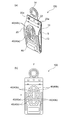
- the cover unit 20 is attached to the main body 10 so as to cover the adhesive sheet 30 installed on the main body 10.
- the cover unit 20 is provided with an entry port 40 for a flying insect to enter.
- the intrusion port 40 can be configured in various shapes and arrangements, in the present embodiment, as shown in FIG. 1B, the vertical bisector y with respect to the width of the cover portion 20 and the length of the cover portion 20. A plurality of concentric circles are provided around the intersection with the perpendicular bisector x.
- the entrance 40 is comprised by the 9 opening part in total of the one curved opening part 40b arrange
- the opening area is set to 2 to 12 cm 2 , preferably 2 to 8 cm 2 , more preferably 2 to 5 cm 2 .
- the cover portion 20 is provided with a pressing portion 50 that fixes the adhesive sheet 30 installed on the main body 10 when the cover portion 20 is attached to the main body 10.
- the function of the holding part 50 will be described in the next item “Assembly of the flying insect trap”.
- the cover unit 20 is provided with a storage unit 60 for storing an attractant that attracts flying insects. The attractant stored in the storage unit 60 will be described in detail in the item “attractant” described later.
- the constituent material of the main body 10 and the cover part 20 is excellent in moldability and does not allow the flying insect attracting component contained in the attracting agent described later to permeate.
- a material include resin materials such as polyester, polyethylene terephthalate, polybutylene terephthalate, polycarbonate, and polystyrene.
- the flying insect trap 100 Since the flying insect trap 100 is usually sold in a compact or thin packaging form (package), it is necessary to assemble the flying insect trap 100 by taking it out of the package.
- the assembly work of the flying insect trap 100 is performed according to the procedure shown in FIGS.
- the flying insect trap 100 before use is in a state in which the cover portion 20 is deployed with respect to the main body 10. Specifically, as shown in FIG. 2 (a), the main body 10 and the cover part 20 are hinge-connected at their end parts in a state of being juxtaposed in the length direction.
- the adhesive sheet 30 is installed on the planar portion 11 of the main body 10 before assembly.
- the pressure-sensitive adhesive sheet 30 has a placement surface that contacts the planar portion 11 (the back surface in FIG.
- the cover 20 is turned in the direction of the main body 10 and folded.
- the main body 10 can be rotated in the direction of the cover unit 20 so that the attractant does not spill.
- the convex part 12a provided in the main body side joint part 12 of the main body 10 is inserted into the concave part 22a provided in the cover side joint part 22 of the cover part 20, The end portion of the cover portion 20 and the end portion of the main body 10 are joined together and joined.
- the pressing part 50 provided in the cover part 20 presses the surface of the adhesive sheet 30 installed in the main body 10, and the position of the adhesive sheet 30 is fixed. Therefore, the flying insect trap 100 can be used in a standing state.
- the surface of the pressure-sensitive adhesive sheet 30 with which the pressing portion 50 comes into contact may be a non-adhesive surface to which no pressure-sensitive adhesive is applied in consideration of usability.
- the support portion 13 is preferably provided so as to be positioned closer to the cover side joining portion 22 than the center in the length direction of the cover portion 20.
- the support portion 13 is provided in this way, for example, when the flying insect trap 100 is used in a standing posture, the top of the curved surface of the cover portion 20 is positioned above the flying insect trap 100. Since it is conspicuous, flying insects can easily enter the internal space S.
- the size of the internal space S is designed so that the lateral width is 6 to 15 cm, the length is 10 to 20 cm, and the height is maximum (distance from the adhesive sheet 30 to the entry port 40) is 1.5 to 4 cm.
- the adhesive sheet 30 not only adheres to and captures the flying insect body, but also has a function of attracting the flying insect to the internal space S of the flying insect trap 100.
- the present inventors have made various studies on the attracting ability of flying insects, and found that by attaching a sea-island pattern colored with a specific color combination to the adhesive sheet 30, it is possible to effectively attract flying insects.
- the flying insect has a background region P colored in the PCCS hue ring, with a hue number n 1 [n 1 : 4 (reddish orange) to 6 (yellowish orange)], A sea-island pattern consisting of a plurality of island-like portions Q colored with hue numbers (n 2 +2) to (n 2 +4) [n 2 ⁇ n 1 : 6 (yellowish orange) to 10 (yellowish green)] It has now been found as a new finding that it is attracted effectively.
- the "n 2 ⁇ n 1” when the value of n 1 is determined, it is meant that substitutes the value of the n 1 to n 2.
- the PCCS hue circle is based on four primary colors of 2 (red), 8 (yellow), 12 (green), and 18 (blue), and includes the four primary colors and 20 intermediate colors that interpolate the four primary colors.
- a PCCS hue ring in which the background region is colored with hue numbers 4 to 5 and the island-like region is colored with hue numbers 7 to 9 is particularly preferable.
- the flying insect trap 100 of this embodiment is a combination of an attracting function and a capturing function for flying insects, and has a high synergistic effect.
- the island portion Q is preferably configured as a circular portion or an elliptical portion having an average diameter of 3 to 20 mm.
- the “circular portion” does not need to strictly define the shape, and may be visually circular. Accordingly, not only a geometrically perfect circular shape but also a substantially circular shape is included.
- the “elliptical portion” includes not only a geometrically perfect elliptical shape but also a substantially elliptical shape.
- the average diameter is the average length of the major axis and the minor axis.
- Such a sea-island pattern makes it easy for a flying insect to recognize. Therefore, when a flying insect approaches the flying insect trap 100, the flying insect can visually recognize the sea-island pattern through the intrusion opening 40. As a result, flying insects are efficiently attracted to the internal space S and can be captured by the adhesive sheet 30.
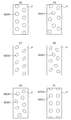
- FIG. 3 is an image diagram illustrating a sea-island pattern that can be attached to the pressure-sensitive adhesive sheet 30.
- FIG. 3A shows a sea-island pattern having the most typical pattern, in which four circular island-shaped portions Q1 are arranged in two rows with respect to a vertically long rectangular background region P. The circular island portions Q1 constituting each row are displaced in the horizontal direction, but the horizontal directions may be matched.
- FIG. 3B eight circular island portions Q1 are randomly arranged with respect to a vertically long rectangular background region P.
- FIG. 3 (c) four oval island-shaped portions Q2 are arranged in two rows with respect to a vertically long rectangular background region P.
- the elliptical island portions Q2 constituting each row are displaced in the horizontal direction, but the horizontal directions may be matched. Further, the major axis direction of the elliptical island-shaped portion Q2 may be different for each column.
- FIG. 3D eight elliptical island portions Q2 are randomly arranged with respect to the vertically long rectangular background region P.
- FIG. 3 (e) four circular island portions Q1 and four elliptical island portions Q2 are randomly arranged with respect to a vertically long rectangular background region P.
- the number of circular islands Q1 may be different from the number of elliptical islands Q2.
- FIG. 3D eight elliptical island portions Q2 are randomly arranged with respect to the vertically long rectangular background region P.
- FIG. 3 (e) four circular island portions Q1 and four elliptical island portions Q2 are randomly arranged with respect to a vertically long rectangular background region P.
- the number of circular islands Q1 may be different from the number of elliptical islands Q
- the flying insects that enter the internal space S from the entrance 40 of the flying insect trap 100 and are attracted to the sea-island pattern of the adhesive sheet 30 are captured by adhering to the adhesive of the adhesive sheet 30.
- the pressure-sensitive adhesive is not particularly limited as long as the sea-island pattern of the pressure-sensitive adhesive sheet 30 can be visually recognized from the pressure-sensitive adhesive side (that is, as long as it has a certain degree of transparency).
- An agent, a silicone-based pressure-sensitive adhesive, or the like can be used.
- the rubber adhesive includes natural rubber adhesive, styrene / butadiene rubber adhesive, recycled rubber adhesive, polyisobutylene / butylene rubber adhesive, block copolymer adhesive, and the like. These pressure-sensitive adhesives can be used alone or in combination. Furthermore, it is also possible to add a softener, an anti-aging agent, a cross-linking agent and the like to the pressure-sensitive adhesive as necessary.
- the flying insect trap 100 of the present embodiment can attract flying insects that have entered the internal space S due to the sea-island pattern of the adhesive sheet 30, but the flying insect that inhabits the outside of the flying insect trap 100. In order to bring an insect closer to the flying insect trap 100, it is effective to use an attractant together. Since the flying insect trap 100 is provided with the storage unit 60 in the cover unit 20, if the attracting agent for attracting flying insects is stored in the storing unit 60, the attracting agent diffuses into the internal space S. Furthermore, it volatilizes from the entrance 40 to the external environment. As a result, it becomes possible to attract flying insects synergistically with the sea-island pattern of the adhesive sheet 30.
- attractants that can be used in the flying insect trap 100 of the present invention will be described.
- the gel attractant is obtained by gelling a liquid material containing a flying insect attracting component, which is an active ingredient, with a gelling agent.
- a flying insect attracting component include acetic acid, fruit vinegar, grain vinegar, fruit, alcoholic beverages, sugars, and flavors thereof. These flying insect attracting components are particularly effective components for the fly.
- acetic acid include ordinary synthetic vinegar.
- fruit vinegar include balsamic vinegar, wine vinegar, sudachi vinegar and the like.
- grain vinegar include black vinegar and rice vinegar.
- fruit vinegar and cereal vinegar these flavors may be used, and by doing so, the amount used can be reduced and the unstable supply of natural raw materials can be eliminated.
- fruits include apples, bananas, melons, oranges, mangos, kiwis and the like.
- liquor include beer, whiskey, Shaoxing liquor, Japanese sake, shochu, and rum.
- saccharide include starch, brown sugar, glucose, sucrose, triwarm sugar, liquid sugar, dextrin, maltose, fructose, arabinose and the like.
- the flavor include beer flavor, balsamic vinegar flavor, and apple flavor.
- fish soy and isopropyl alcohol are also effective ingredients as flying insect attracting ingredients, and these are particularly effective against flies and are effective alone, but are also used in combination with other attractants. In some cases, it is synergistic.
- the flying insect attracting components described above can be used alone or in combination.
- perfume ingredients include propylene glycol monoacetate, propionaldehyde propylene glycol acetal, 2-methylbutyl acetate, phenylacetic acid, isobutyl acetate, 2-methylbutanol, diethyl succinate, methionol, octanoic acid, 4-methoxymethylphenol, isoamyl alcohol, Benzaldehyde, 2-methylbutyric acid, isovaleraldehyde propylene glycol acetal, 2-ethylhexanoic acid, acetaldehyde propylene glycol acetal, methyl thiobutyrate, methional, benzoic acid, hexanal, 2,3,5-trimethylpyrazine, 2,3-pentane Dione, dimethyl sulfide, tetramethylpyrazine, 2-tridecanone, 2-nonan
- flying insect attracting ingredients include lactic acid products, fruit processed products, vegetable extracts, seafood, processed seafood products, seafood extracts, meat, processed meat products, food extracts, etc. It is also possible to add those used as insect-attracting ingredients.
- lactic acid products include lactic acid bacteria beverages such as Calpis (registered trademark) and Yakult (registered trademark), yogurt, and cheese.
- processed fruit products include fruit juice, fruit jelly, and dried fruit.
- vegetable extracts include onion flavor and cabbage flavor.
- seafood include mackerel, bonito, sardines, tuna and squid.
- processed seafood include cutlet beetles, sababushi, dried fish, fish meal, processed fish eggs, and the like.
- Examples of fish and shellfish extracts include cutlet savory flavor, mackerel flavor, shrimp flavor, crab flavor, and the like.
- Examples of meat include beef, pork and chicken.
- Examples of processed meat products include ham, sausage, bacon, and yakiniku.
- Examples of the food extract include beef extract, pork extract, chicken extract, beef flavor, pork flavor, chicken flavor, animal fats and the like. The above-mentioned additional components can be used alone or in combination.
- Examples of the gelling agent that gels the liquid material containing the flying insect attracting component include water-soluble polysaccharides and / or water-absorbing resins.
- water-soluble polysaccharides include guar gum, xanthan gum, lambda carrageenan, julan gum, gum arabic, locust bean gum, and sodium alginate. Of these, guar gum, xanthan gum, and lambda carrageenan are preferably used because they have an attractive effect and are easy to produce.
- Water-absorbing resins include isobutylene-maleic anhydride copolymer, polyacrylate polymer, starch-polyacrylate polymer, PVA-polyacrylate polymer, PVA polymer, carboxymethylcellulose polymer, etc. Can be mentioned.
- the above gelling agents can be used alone or in combination.
- the gelling agent is preferably used in a state dissolved in water as a solvent.
- Insecticidal components include natural pyrethrin, allethrin, flamethrin, praretrin, resmethrin, phthalthrin, transfluthrin, phenothrin, pyrethroid insecticides such as ciphenothrin, permethrin, etofenprox, organosilicon insecticides such as silafluophene, dinotefuran, Neonicotinoid insecticides such as imidacloprid, clothianidin and thiamethoxam, organophosphorus insecticides such as fenitrothion, diazinon, marathon and prothiophos, oxadiazole insecticides such as methoxadiazone, pyrazole insecticides such as fipronil, pyriproxyfen And insect growth control agents such as hydroprene.
- These insecticidal components include natural pyrethrin, allethrin, flamethrin, praretrin,
- the typical composition of the gel-like attractant is 1.0 to 5.0% by mass of acetic acid, vinegar flavors (such as balsamic vinegar flavor) and fruit and / or liquor flavors (based on the total amount of the attractant). Apple flavors, beer flavors, etc.) 0.05 to 4.0% by weight, brown sugar 10 to 30% by weight, xanthan gum 1.0 to 5.0% by weight, and water.
- the gel attractant prepared with such a mixing ratio exhibits a high attracting effect on flying insects.
- capacitance of the accommodating part 60 about 10 g is suitable for the mass (usage amount) of a gel attractant.
- the opening of the storage section 60 is covered with a nonwoven fabric or a perforated filter as necessary, and the gel attractant is dissipated to the outside of the storage section 60. And the volatilization amount of the flying insect attracting component in the gel attractant is adjusted.
- FIG. 4 is an explanatory diagram of a usage state of the flying insect trap 200 according to another embodiment.
- FIG. 4A is a perspective view of the flying insect trap 200.
- FIG. 4B is a front view of the flying insect trap 200.
- the flying insect trap 200 according to the present embodiment assumes a fly as a flying insect to be captured.
- the flying insect trap 200 includes a main body 10 and a cover portion 20 attached to the main body 10.
- the sheet 30 is installed, the shape and arrangement of the entrance 40 provided in the cover unit 20 are different from those of the flying insect capturing apparatus 100. Since flies have a larger body length than the fly, it is particularly effective to increase the size of the entrance 40.
- a plurality of intrusion ports 40 are provided in a form that is line symmetric with respect to a perpendicular bisector y with respect to the width of the cover portion 20.
- FIG. 4B a plurality of intrusion ports 40 are provided in a form that is line symmetric with respect to a perpendicular bisector y with respect to the width of the cover portion 20.
- the entrance 40 is constituted by eleven elongated openings 40c arranged vertically and horizontally, and the opening area per piece is set to 3 to 6 cm 2 .
- the elongated opening 40c has a relatively large opening area, it is possible to effectively attract and capture flies.
- the arrangement of the elongated openings 40c it is advantageous to provide them in parallel along the length direction of the cover portion 20 as shown in FIG. It is also possible to provide it obliquely with respect to the vertical direction or in a random direction.
- a fly insect capture test using the flying insect trap of the present invention was carried out on a fly fly, a kind of the fly, as a flying insect.
- flying insect traps (Examples 1 to 7) provided with the adhesive sheet having the color combination of the present invention and flying insects provided with the adhesive sheet not having the color combination of the present invention
- a trap (Comparative Examples 1 to 3) was prepared.
- This flying insect trap has an internal space with a width of about 11 cm, a length of about 18 cm, and a maximum height of about 2 cm. The size of the entrance is 2-12 cm 2 .
- Each flying insect trap was provided with an attractant containing the flying insect attracting components shown in Table 1, and subjected to the fly fly trapping test.
- Each flying insect trap was installed at the center of the floor of the test chamber (length 1.8m x width 1.8m x height 1.8m), and 100 flying flies were released in the chamber. . After 24 hours, the number of fruit fly trapped on the adhesive sheet was counted. The same capture test was repeated three times to determine the average number of captures. The test results are shown in Table 1.
- the number of flying fly was 23 or more, and sufficient trapping performance was shown.
- the background region is colored with hue number 4 (reddish orange) and the island-shaped part is colored with hue number 7 (reddish yellow) or hue number 8 (yellow) (Examples 1 and 2).
- the number of traped flies was over 40, indicating excellent capture performance.
- the use of the pressure-sensitive adhesive sheet having the color combination of the present invention in a flying insect trap can effectively attract the fruit fly, which is a kind of fruit fly.
- the trapping number of the fruit fly was 20 or less, and the trapping performance was not sufficient. Even if the flying insect trap of the comparative example is provided with an attractant containing a flying insect attracting component (Comparative Examples 1 to 3), an adhesive sheet that does not have the color combination of the present invention is used. Therefore, the capture performance was inferior to that of Examples 1-7.
- a fly trapping test was carried out using the flying insect trap of the present invention on a fly, which is a type of fly as a flying insect.
- flying insect traps Examples 8 to 17
- flying insects provided with the adhesive sheet not having the color combination of the present invention
- a trap Comparative Examples 4 to 7
- This flying insect trap has an internal space with a width of about 11 cm, a length of about 18 cm, and a maximum height of about 2 cm. The size of the entrance is 2-12 cm 2 .
- Each flying insect trap was provided with an attractant containing the flying insect attracting components shown in Table 2 (except for Example 13 and Comparative Example 7), and subjected to a fly trapping test.
- Each flying insect trap was installed in the center of the floor of the test chamber (length 1.8 m x width 1.8 m x height 1.8 m), and 100 house flies were released in the chamber. After 24 hours, the number of houseflies captured on the adhesive sheet was counted. The same capture test was repeated twice to determine the average capture number. The test results are shown in Table 2.
- the number of house fly captured was 23 or more, and sufficient trapping performance was shown.
- the background region is colored with hue number 4 (reddish orange) or hue number 5 (orange)
- the island-shaped part is colored with hue number 8 (yellow) (Examples 10, 11, 14 to In No. 17)
- the number of house flies reached 40 or more, indicating excellent capture performance.
- the number of house flies was 20 or less, and the trapping performance was not sufficient.
- the flying insect trap of the comparative example is provided with an attractant containing a flying insect attracting component (Comparative Examples 4 to 6), but uses an adhesive sheet that does not have the color combination of the present invention. Therefore, the capture performance was inferior to that of Examples 8 to 17.
- the flying insect trap of the present invention is used for capturing flying insects such as flies and flies, but can also be used for capturing other flying insects such as chironomids and bees. is there.
Landscapes
- Life Sciences & Earth Sciences (AREA)
- Pest Control & Pesticides (AREA)
- Engineering & Computer Science (AREA)
- Insects & Arthropods (AREA)
- Wood Science & Technology (AREA)
- Zoology (AREA)
- Environmental Sciences (AREA)
- Catching Or Destruction (AREA)
Abstract
Priority Applications (7)
| Application Number | Priority Date | Filing Date | Title |
|---|---|---|---|
| JP2014554549A JP6029690B2 (ja) | 2012-12-28 | 2013-12-26 | 飛翔昆虫捕獲器 |
| AU2013367072A AU2013367072B2 (en) | 2012-12-28 | 2013-12-26 | Flying insect trap |
| EP13867305.8A EP2939537B1 (fr) | 2012-12-28 | 2013-12-26 | Piège à insectes volants |
| HK15112768.8A HK1211792B (en) | 2012-12-28 | 2013-12-26 | Flying insect trap |
| CN201380061510.3A CN104837338B (zh) | 2012-12-28 | 2013-12-26 | 飞翔昆虫捕捉器 |
| KR1020157013950A KR101958896B1 (ko) | 2012-12-28 | 2013-12-26 | 비상 곤충 포획기 |
| KR1020177020997A KR20170089985A (ko) | 2012-12-28 | 2013-12-26 | 비상 곤충 포획기 |
Applications Claiming Priority (2)
| Application Number | Priority Date | Filing Date | Title |
|---|---|---|---|
| JP2012286415 | 2012-12-28 | ||
| JP2012-286415 | 2012-12-28 |
Publications (1)
| Publication Number | Publication Date |
|---|---|
| WO2014104197A1 true WO2014104197A1 (fr) | 2014-07-03 |
Family
ID=51021271
Family Applications (1)
| Application Number | Title | Priority Date | Filing Date |
|---|---|---|---|
| PCT/JP2013/084897 Ceased WO2014104197A1 (fr) | 2012-12-28 | 2013-12-26 | Piège à insectes volants |
Country Status (7)
| Country | Link |
|---|---|
| EP (1) | EP2939537B1 (fr) |
| JP (1) | JP6029690B2 (fr) |
| KR (2) | KR20170089985A (fr) |
| CN (1) | CN104837338B (fr) |
| AU (1) | AU2013367072B2 (fr) |
| TW (1) | TWI540960B (fr) |
| WO (1) | WO2014104197A1 (fr) |
Cited By (7)
| Publication number | Priority date | Publication date | Assignee | Title |
|---|---|---|---|---|
| US20180310543A1 (en) * | 2017-05-01 | 2018-11-01 | Pelsis Limited | Pest trap |
| JP2019135996A (ja) * | 2018-02-13 | 2019-08-22 | 大協技研工業株式会社 | 害虫捕獲用粘着シート |
| US11484022B2 (en) | 2019-10-15 | 2022-11-01 | S. C. Johnson & Son, Inc. | Insect trap device |
| WO2023074772A1 (fr) * | 2021-10-29 | 2023-05-04 | アース製薬株式会社 | Récipient de type suspendu |
| JP2023161749A (ja) * | 2022-04-26 | 2023-11-08 | みのる産業株式会社 | 捕虫器 |
| WO2024154689A1 (fr) * | 2023-01-16 | 2024-07-25 | アース製薬株式会社 | Promoteur d'alimentation pour insectes volants, insecticide pour insectes volants et procédé de promotion d'alimentation pour insectes volants |
| US12290060B2 (en) | 2019-10-15 | 2025-05-06 | S. C. Johnson & Son, Inc. | Insect trap device |
Families Citing this family (6)
| Publication number | Priority date | Publication date | Assignee | Title |
|---|---|---|---|---|
| EP3566574B1 (fr) * | 2017-01-10 | 2022-05-04 | Seoul Viosys Co., Ltd. | Piège à insectes de type adhésif |
| KR102514066B1 (ko) * | 2017-06-09 | 2023-03-27 | 서울바이오시스 주식회사 | 포충기 |
| FR3071999B1 (fr) * | 2017-10-10 | 2019-10-18 | Les Opies | Piege a mouche de l’olive |
| JP7237448B2 (ja) * | 2017-11-17 | 2023-03-13 | 大日本除蟲菊株式会社 | 飛翔害虫捕獲器 |
| TWI663913B (zh) * | 2018-04-25 | 2019-07-01 | Chaoyang University Of Technology | 捕蟲裝置 |
| CN112293379B (zh) * | 2020-11-25 | 2022-07-19 | 中国热带农业科学院环境与植物保护研究所 | 一种可重复利用的诱虫板及其应用 |
Citations (8)
| Publication number | Priority date | Publication date | Assignee | Title |
|---|---|---|---|---|
| JP2000060404A (ja) * | 1998-08-20 | 2000-02-29 | Mark:Kk | 害虫捕獲装置 |
| JP2002084958A (ja) * | 2000-09-12 | 2002-03-26 | Nichiban Co Ltd | 飛翔害虫捕獲用粘着シート |
| JP2002253101A (ja) | 2001-03-01 | 2002-09-10 | Hakugen:Kk | 虫捕獲用粘着剤及び虫捕獲器 |
| JP2002253102A (ja) * | 2001-02-28 | 2002-09-10 | Hakugen:Kk | 虫捕獲用粘着剤及び虫捕獲器 |
| JP2002272344A (ja) | 2001-03-15 | 2002-09-24 | Fumakilla Ltd | 飛翔昆虫用捕獲器 |
| JP2003079301A (ja) | 2001-06-29 | 2003-03-18 | Earth Chem Corp Ltd | 飛翔害虫用捕獲器 |
| JP2007110985A (ja) * | 2005-10-21 | 2007-05-10 | Sanix Inc | 捕虫器 |
| JP2009240247A (ja) * | 2008-03-31 | 2009-10-22 | Seiki Uchiyama | 捕虫シート |
Family Cites Families (14)
| Publication number | Priority date | Publication date | Assignee | Title |
|---|---|---|---|---|
| DE374805C (de) * | 1923-05-01 | Friedrich Harbach | Insektenfaenger mit Leuchtfarbenanstrich | |
| JPH1132648A (ja) * | 1997-07-17 | 1999-02-09 | Nitto Denko Corp | 飛翔害虫誘引捕獲粘着シ−ト材 |
| JP2001352889A (ja) * | 2000-06-16 | 2001-12-25 | Shimada Shoji Kk | 飛翔昆虫捕獲器 |
| US6618983B1 (en) * | 2000-10-25 | 2003-09-16 | Rockwell Laboratories, Ltd. | Insect baiting and trapping station |
| DE10320488A1 (de) * | 2003-05-08 | 2004-12-02 | Ecs Environment Care Systems Gmbh | Insektenfalle mit transparenter Klebefolie |
| ATE382259T1 (de) * | 2005-08-11 | 2008-01-15 | Igu Trust | Vorrichtung zum anlocken von insekten |
| KR20080010869A (ko) * | 2006-07-28 | 2008-01-31 | 김재석 | 모기캡쳐 |
| US20100024278A1 (en) * | 2007-02-07 | 2010-02-04 | Westham Ltd. | Methods and devices for attracting and trapping insects |
| MY190616A (en) * | 2007-05-21 | 2022-04-27 | Fumakilla Ltd | Flying insect trapping apparatus |
| CN201365474Y (zh) * | 2009-02-02 | 2009-12-23 | 谢国南 | 捕虫装置 |
| GB2477806A (en) * | 2010-02-16 | 2011-08-17 | Tony Flackett | Portable fly trap |
| KR101353151B1 (ko) * | 2010-05-19 | 2014-01-22 | 다이니혼 죠츄기쿠 가부시키가이샤 | 비상 해충 유인제, 비상 해충 유인 장치 및, 비상 해충 유인 방법 |
| CN202085620U (zh) * | 2010-12-31 | 2011-12-28 | 漳州市中海高科生物科技有限公司 | 带黄光led灯的新型粘虫板 |
| CN102499204A (zh) * | 2011-11-10 | 2012-06-20 | 中国林业科学研究院资源昆虫研究所 | 白蜡虫寄生蜂的诱捕方法 |
-
2013
- 2013-12-25 TW TW102148305A patent/TWI540960B/zh not_active IP Right Cessation
- 2013-12-26 KR KR1020177020997A patent/KR20170089985A/ko not_active Abandoned
- 2013-12-26 AU AU2013367072A patent/AU2013367072B2/en not_active Ceased
- 2013-12-26 EP EP13867305.8A patent/EP2939537B1/fr active Active
- 2013-12-26 CN CN201380061510.3A patent/CN104837338B/zh not_active Expired - Fee Related
- 2013-12-26 KR KR1020157013950A patent/KR101958896B1/ko not_active Expired - Fee Related
- 2013-12-26 WO PCT/JP2013/084897 patent/WO2014104197A1/fr not_active Ceased
- 2013-12-26 JP JP2014554549A patent/JP6029690B2/ja active Active
Patent Citations (8)
| Publication number | Priority date | Publication date | Assignee | Title |
|---|---|---|---|---|
| JP2000060404A (ja) * | 1998-08-20 | 2000-02-29 | Mark:Kk | 害虫捕獲装置 |
| JP2002084958A (ja) * | 2000-09-12 | 2002-03-26 | Nichiban Co Ltd | 飛翔害虫捕獲用粘着シート |
| JP2002253102A (ja) * | 2001-02-28 | 2002-09-10 | Hakugen:Kk | 虫捕獲用粘着剤及び虫捕獲器 |
| JP2002253101A (ja) | 2001-03-01 | 2002-09-10 | Hakugen:Kk | 虫捕獲用粘着剤及び虫捕獲器 |
| JP2002272344A (ja) | 2001-03-15 | 2002-09-24 | Fumakilla Ltd | 飛翔昆虫用捕獲器 |
| JP2003079301A (ja) | 2001-06-29 | 2003-03-18 | Earth Chem Corp Ltd | 飛翔害虫用捕獲器 |
| JP2007110985A (ja) * | 2005-10-21 | 2007-05-10 | Sanix Inc | 捕虫器 |
| JP2009240247A (ja) * | 2008-03-31 | 2009-10-22 | Seiki Uchiyama | 捕虫シート |
Cited By (10)
| Publication number | Priority date | Publication date | Assignee | Title |
|---|---|---|---|---|
| US20180310543A1 (en) * | 2017-05-01 | 2018-11-01 | Pelsis Limited | Pest trap |
| US11369104B2 (en) * | 2017-05-01 | 2022-06-28 | Pelsis Limited | Pest trap |
| JP2019135996A (ja) * | 2018-02-13 | 2019-08-22 | 大協技研工業株式会社 | 害虫捕獲用粘着シート |
| JP7338831B2 (ja) | 2018-02-13 | 2023-09-05 | 大協技研工業株式会社 | 害虫捕獲用粘着シート |
| US11484022B2 (en) | 2019-10-15 | 2022-11-01 | S. C. Johnson & Son, Inc. | Insect trap device |
| US12102078B2 (en) | 2019-10-15 | 2024-10-01 | S. C. Johnson & Son, Inc. | Insect trap device |
| US12290060B2 (en) | 2019-10-15 | 2025-05-06 | S. C. Johnson & Son, Inc. | Insect trap device |
| WO2023074772A1 (fr) * | 2021-10-29 | 2023-05-04 | アース製薬株式会社 | Récipient de type suspendu |
| JP2023161749A (ja) * | 2022-04-26 | 2023-11-08 | みのる産業株式会社 | 捕虫器 |
| WO2024154689A1 (fr) * | 2023-01-16 | 2024-07-25 | アース製薬株式会社 | Promoteur d'alimentation pour insectes volants, insecticide pour insectes volants et procédé de promotion d'alimentation pour insectes volants |
Also Published As
| Publication number | Publication date |
|---|---|
| HK1211792A1 (en) | 2016-06-03 |
| AU2013367072B2 (en) | 2016-04-14 |
| EP2939537B1 (fr) | 2020-04-01 |
| CN104837338B (zh) | 2017-07-07 |
| KR20170089985A (ko) | 2017-08-04 |
| TW201438573A (zh) | 2014-10-16 |
| EP2939537A1 (fr) | 2015-11-04 |
| EP2939537A4 (fr) | 2016-09-07 |
| KR20150073212A (ko) | 2015-06-30 |
| TWI540960B (zh) | 2016-07-11 |
| KR101958896B1 (ko) | 2019-03-15 |
| JP6029690B2 (ja) | 2016-11-24 |
| JPWO2014104197A1 (ja) | 2017-01-19 |
| CN104837338A (zh) | 2015-08-12 |
Similar Documents
| Publication | Publication Date | Title |
|---|---|---|
| JP6029690B2 (ja) | 飛翔昆虫捕獲器 | |
| CN102246798B (zh) | 飞翔害虫的引诱或引诱防除的制剂、装置及方法 | |
| CN102578063B (zh) | 飞翔害虫捕捉装置 | |
| JP5341133B2 (ja) | 飛翔害虫誘引剤、飛翔害虫誘引装置、及び飛翔害虫誘引方法 | |
| JP2022105635A (ja) | 飛翔害虫捕獲器 | |
| EP2944191B1 (fr) | Piège d'insecte nuisible volant | |
| JP4680574B2 (ja) | ゲル状飛翔昆虫誘引組成物 | |
| WO2010001935A1 (fr) | Matériau de capture d'insectes nuisibles volants, procédé de capture d'insectes nuisibles volants et dispositif de capture | |
| JP2018102262A (ja) | 飛翔害虫捕獲器 | |
| CN100433974C (zh) | 飞翔昆虫捕获器 | |
| JP4970186B2 (ja) | ゴキブリ用定着材 | |
| JP2019037181A (ja) | シロアリ駆除用装置及びシロアリを駆除する方法 | |
| JP2006131614A (ja) | 害虫の誘引方法 | |
| HK1211792B (en) | Flying insect trap | |
| JP2021078518A (ja) | 飛翔害虫捕獲器 | |
| JP2002017232A (ja) | ねずみの捕獲誘引材及びねずみの誘引捕獲方法 | |
| JP5773656B2 (ja) | 飛翔害虫捕獲具 | |
| JP2004315508A (ja) | 害虫の誘引、摂食向上方法 | |
| JP2002087914A (ja) | 害虫誘引剤及び誘引毒餌剤 | |
| WO2005089543A1 (fr) | Méthode d’amélioration de l’attraction et de l'ingestion pour insecte nuisible | |
| JP2002370912A (ja) | ダンゴムシ用誘引剤 | |
| HK1088186B (en) | Flying pest capture tool | |
| JP2011101613A (ja) | 飛翔害虫捕獲具 |
Legal Events
| Date | Code | Title | Description |
|---|---|---|---|
| 121 | Ep: the epo has been informed by wipo that ep was designated in this application |
Ref document number: 13867305 Country of ref document: EP Kind code of ref document: A1 |
|
| ENP | Entry into the national phase |
Ref document number: 20157013950 Country of ref document: KR Kind code of ref document: A |
|
| ENP | Entry into the national phase |
Ref document number: 2014554549 Country of ref document: JP Kind code of ref document: A |
|
| ENP | Entry into the national phase |
Ref document number: 2013367072 Country of ref document: AU Date of ref document: 20131226 Kind code of ref document: A |
|
| NENP | Non-entry into the national phase |
Ref country code: DE |
|
| WWE | Wipo information: entry into national phase |
Ref document number: IDP00201504414 Country of ref document: ID |
|
| WWE | Wipo information: entry into national phase |
Ref document number: 2013867305 Country of ref document: EP |