WO2014104220A1 - 包装体 - Google Patents
包装体 Download PDFInfo
- Publication number
- WO2014104220A1 WO2014104220A1 PCT/JP2013/084950 JP2013084950W WO2014104220A1 WO 2014104220 A1 WO2014104220 A1 WO 2014104220A1 JP 2013084950 W JP2013084950 W JP 2013084950W WO 2014104220 A1 WO2014104220 A1 WO 2014104220A1
- Authority
- WO
- WIPO (PCT)
- Prior art keywords
- patch
- package
- layer
- drug
- packaging container
- Prior art date
- Legal status (The legal status is an assumption and is not a legal conclusion. Google has not performed a legal analysis and makes no representation as to the accuracy of the status listed.)
- Ceased
Links
Images




Classifications
-
- B—PERFORMING OPERATIONS; TRANSPORTING
- B65—CONVEYING; PACKING; STORING; HANDLING THIN OR FILAMENTARY MATERIAL
- B65D—CONTAINERS FOR STORAGE OR TRANSPORT OF ARTICLES OR MATERIALS, e.g. BAGS, BARRELS, BOTTLES, BOXES, CANS, CARTONS, CRATES, DRUMS, JARS, TANKS, HOPPERS, FORWARDING CONTAINERS; ACCESSORIES, CLOSURES, OR FITTINGS THEREFOR; PACKAGING ELEMENTS; PACKAGES
- B65D81/00—Containers, packaging elements, or packages, for contents presenting particular transport or storage problems, or adapted to be used for non-packaging purposes after removal of contents
- B65D81/24—Adaptations for preventing deterioration or decay of contents; Applications to the container or packaging material of food preservatives, fungicides, pesticides or animal repellants
-
- A—HUMAN NECESSITIES
- A61—MEDICAL OR VETERINARY SCIENCE; HYGIENE
- A61J—CONTAINERS SPECIALLY ADAPTED FOR MEDICAL OR PHARMACEUTICAL PURPOSES; DEVICES OR METHODS SPECIALLY ADAPTED FOR BRINGING PHARMACEUTICAL PRODUCTS INTO PARTICULAR PHYSICAL OR ADMINISTERING FORMS; DEVICES FOR ADMINISTERING FOOD OR MEDICINES ORALLY; BABY COMFORTERS; DEVICES FOR RECEIVING SPITTLE
- A61J1/00—Containers specially adapted for medical or pharmaceutical purposes
-
- A—HUMAN NECESSITIES
- A61—MEDICAL OR VETERINARY SCIENCE; HYGIENE
- A61K—PREPARATIONS FOR MEDICAL, DENTAL OR TOILETRY PURPOSES
- A61K31/00—Medicinal preparations containing organic active ingredients
- A61K31/21—Esters, e.g. nitroglycerine, selenocyanates
- A61K31/27—Esters, e.g. nitroglycerine, selenocyanates of carbamic or thiocarbamic acids, meprobamate, carbachol, neostigmine
-
- A—HUMAN NECESSITIES
- A61—MEDICAL OR VETERINARY SCIENCE; HYGIENE
- A61K—PREPARATIONS FOR MEDICAL, DENTAL OR TOILETRY PURPOSES
- A61K31/00—Medicinal preparations containing organic active ingredients
- A61K31/33—Heterocyclic compounds
- A61K31/395—Heterocyclic compounds having nitrogen as a ring hetero atom, e.g. guanethidine or rifamycins
- A61K31/435—Heterocyclic compounds having nitrogen as a ring hetero atom, e.g. guanethidine or rifamycins having six-membered rings with one nitrogen as the only ring hetero atom
- A61K31/465—Nicotine; Derivatives thereof
-
- A—HUMAN NECESSITIES
- A61—MEDICAL OR VETERINARY SCIENCE; HYGIENE
- A61K—PREPARATIONS FOR MEDICAL, DENTAL OR TOILETRY PURPOSES
- A61K9/00—Medicinal preparations characterised by special physical form
- A61K9/70—Web, sheet or filament bases ; Films; Fibres of the matrix type containing drug
- A61K9/7023—Transdermal patches and similar drug-containing composite devices, e.g. cataplasms
- A61K9/703—Transdermal patches and similar drug-containing composite devices, e.g. cataplasms characterised by shape or structure; Details concerning release liner or backing; Refillable patches; User-activated patches
- A61K9/7038—Transdermal patches of the drug-in-adhesive type, i.e. comprising drug in the skin-adhesive layer
-
- A—HUMAN NECESSITIES
- A61—MEDICAL OR VETERINARY SCIENCE; HYGIENE
- A61K—PREPARATIONS FOR MEDICAL, DENTAL OR TOILETRY PURPOSES
- A61K9/00—Medicinal preparations characterised by special physical form
- A61K9/70—Web, sheet or filament bases ; Films; Fibres of the matrix type containing drug
- A61K9/7023—Transdermal patches and similar drug-containing composite devices, e.g. cataplasms
- A61K9/703—Transdermal patches and similar drug-containing composite devices, e.g. cataplasms characterised by shape or structure; Details concerning release liner or backing; Refillable patches; User-activated patches
- A61K9/7038—Transdermal patches of the drug-in-adhesive type, i.e. comprising drug in the skin-adhesive layer
- A61K9/7046—Transdermal patches of the drug-in-adhesive type, i.e. comprising drug in the skin-adhesive layer the adhesive comprising macromolecular compounds
- A61K9/7053—Transdermal patches of the drug-in-adhesive type, i.e. comprising drug in the skin-adhesive layer the adhesive comprising macromolecular compounds obtained by reactions only involving carbon to carbon unsaturated bonds, e.g. polyvinyl, polyisobutylene, polystyrene
- A61K9/7061—Polyacrylates
-
- A—HUMAN NECESSITIES
- A61—MEDICAL OR VETERINARY SCIENCE; HYGIENE
- A61P—SPECIFIC THERAPEUTIC ACTIVITY OF CHEMICAL COMPOUNDS OR MEDICINAL PREPARATIONS
- A61P25/00—Drugs for disorders of the nervous system
- A61P25/28—Drugs for disorders of the nervous system for treating neurodegenerative disorders of the central nervous system, e.g. nootropic agents, cognition enhancers, drugs for treating Alzheimer's disease or other forms of dementia
-
- A—HUMAN NECESSITIES
- A61—MEDICAL OR VETERINARY SCIENCE; HYGIENE
- A61P—SPECIFIC THERAPEUTIC ACTIVITY OF CHEMICAL COMPOUNDS OR MEDICINAL PREPARATIONS
- A61P25/00—Drugs for disorders of the nervous system
- A61P25/30—Drugs for disorders of the nervous system for treating abuse or dependence
- A61P25/34—Tobacco-abuse
-
- A—HUMAN NECESSITIES
- A61—MEDICAL OR VETERINARY SCIENCE; HYGIENE
- A61P—SPECIFIC THERAPEUTIC ACTIVITY OF CHEMICAL COMPOUNDS OR MEDICINAL PREPARATIONS
- A61P43/00—Drugs for specific purposes, not provided for in groups A61P1/00-A61P41/00
Definitions
- the present invention relates to a package.
- a patch generally has a pressure-sensitive adhesive layer containing a drug, and is a preparation that is used by being attached to the skin or the like.
- the patch is stored in a sealed state in a packaging container in order to prevent denaturation of the drug in the patch.
- drugs that cause denaturation of the drug in the patch, and examples thereof include oxygen and light.
- Patent Document 1 As another method for preventing denaturation of the drug in the patch due to oxygen, a method of setting the oxygen gas concentration in the packaging container to 3.0% by volume or less has been proposed (Patent Document 1).
- rivastigmine is known as an agent for suppressing the progression of symptoms of Alzheimer's dementia.
- Preparations containing rivastigmine are prepared as various dosage forms such as a rivastigmine-containing patch.
- the rivastigmine-containing patch is commercially available, for example, under the trade name “Ixeron (registered trademark)”.
- rivastigmine contained in the rivastigmine-containing patch may be denatured by oxygen, light, etc. during storage of the patch, a method for preserving the patch to prevent rivastigmine degeneration has been studied.
- a storage method for example, there is a method (Patent Document 2) in which a rivastigmine-containing patch is enclosed in a packaging container composed of a multilayer film composed of a polyacrylonitrile layer and an aluminum layer.
- JP 2012-51875 A Japanese Patent No. 5093545
- Patent Document 1 describes a method of mainly encapsulating an oxygen scavenger together with a patch as a method for reducing the oxygen gas concentration in the packaging container to 3.0% by volume or less.
- the agent may be bulky and the space in the package may become large.
- the present invention has been made in order to solve the above-described problems, and an object of the present invention is to provide a method for preventing a drug in a patch enclosed in a packaging container from being denatured by oxygen.
- Another object of the present invention is to provide a method for preventing the modification of rivastigmine in a rivastigmine-containing patch encapsulated in a packaging container.
- the present inventors have found that the above problems can be solved by setting the oxygen gas amount and the oxygen gas concentration in the packaging container within the predetermined ranges, and have completed the present invention.
- the present inventors have found that the above-mentioned problems can be solved by using a packaging container composed of a multilayer film including a predetermined layer as a storage container for a rivastigmine-containing patch, and completed the present invention. It was.
- the present invention provides the following.
- a package comprising a packaging container and a drug-containing patch encapsulated in the packaging container, A package in which the amount of oxygen gas in the package is 20 ⁇ L or less and the oxygen gas concentration is 17.0 to 25.0% by volume.
- the drug-containing patch includes a support and a pressure-sensitive adhesive layer located on the support, and the pressure-sensitive adhesive layer includes an acrylic pressure-sensitive adhesive substantially free from a carboxyl group (1 ) To (4).
- a packaging body comprising a packaging container and a patch enclosed in the packaging container,
- the patch comprises a support and an adhesive layer located on the support and containing a drug,
- the drug includes at least rivastigmine and / or a pharmaceutically acceptable salt thereof
- the said packaging container is a package body comprised from the multilayer film by which the polyacrylonitrile layer, the aluminum layer, and the polyethylene terephthalate layer were laminated
- the multilayer film is a multilayer film in which a polyacrylonitrile layer, an aluminum layer, and a polyethylene terephthalate layer are laminated in this order.
- the polyacrylonitrile layer has a thickness of 10 to 50 ⁇ m
- the aluminum layer has a thickness of 1 to 15 ⁇ m
- the polyethylene terephthalate layer has a thickness of 5 to 20 ⁇ m.
- a method for preventing denaturation of a drug in a patch enclosed in a packaging container due to oxygen is provided.
- a method for preventing the modification of rivastigmine in the rivastigmine-containing patch encapsulated in a packaging container is provided.
- a packaging container and a drug-containing patch sealed in the packaging container are provided, the amount of oxygen gas in the package is 20 ⁇ L or less, and the oxygen gas concentration is A package is provided that is 17.0-25.0% by volume.
- the “packaging body” refers to a packaging container in which a drug-containing patch is enclosed.
- the “drug-containing patch” is also simply referred to as “patch”.
- the “packaging container” encloses a patch and can also be called a “packaging bag”.
- each structure of the 1st package of this invention is demonstrated.
- the amount of oxygen gas in the package is adjusted to 20 ⁇ L or less, and the oxygen gas concentration is adjusted to 17.0 to 25.0% by volume.
- the oxygen gas concentration is adjusted to 17.0 to 25.0% by volume.
- Japanese Patent Application Laid-Open No. 2012-51875 describes a method of reducing the oxygen gas concentration in the packaging container to 3.0% by volume or less by a method such as decompression.
- the oxygen gas concentration in the body is a value close to the proportion of oxygen in the atmosphere (about 20% by volume). For this reason, it is essential to use an oxygen scavenger or the like in order to make the amount of oxygen gas in the package be 3.0% by volume or less.
- decompression or the like in JP 2012-51875 A is an auxiliary means for reducing the amount of oxygen scavenger and the like to efficiently reduce the amount of oxygen gas in the package to 3.0% by volume or less.
- the present invention is not intended to sufficiently reduce the total amount of gas in the package including oxygen gas as in the present invention.
- substitution with an inert gas such as nitrogen substitution or argon substitution has been performed, but when oxygen is substituted with a specific element, although the oxygen gas concentration is lowered, the total amount of air in the packaging container is equal to or higher than that before the replacement, so that the volume of the resulting package is increased (in this case, the oxygen gas concentration in the package is 1.0 to It is considered to be about 5.0% by volume). For this reason, the patch is twisted or bent in the package, and the preservability of the patch is lacking. In addition, replacement with an inert gas is laborious and expensive.
- the amount of oxygen gas is as small as 20 ⁇ L or less at the stage of encapsulating the patch in the packaging container, the stability of the drug in the patch is hardly impaired during storage of the patch. Further, the oxygen gas concentration in the packaging container is 17.0 to 25.0% by volume, and the total amount of gas in the packaging container is small, so the bulk of the package is not large.
- the amount of oxygen gas in the package is 20 ⁇ L or less, preferably 15 ⁇ L or less, more preferably 10 ⁇ L or less in order to reduce the influence of oxygen on the drug in the patch. Moreover, although the amount of oxygen gas in the package is preferably zero, complete removal is difficult, so that the allowable amount is 0.01 ⁇ L or more, preferably 0.1 ⁇ L or more.
- the amount of oxygen gas in the package may be 4 ⁇ L / mg or less, preferably 0.002 to 3 ⁇ L / mg per drug amount in the patch in order to reduce the influence of oxygen on the drug in the patch.
- the oxygen gas concentration in the package may be a concentration close to the proportion of oxygen in the atmosphere (about 20% by volume), and is 17.0-25.0% by volume, preferably 18.0-24.0% by volume. .
- a method for adjusting the oxygen gas amount and oxygen gas concentration in the package to the above ranges a method of physically reducing the gas amount in the package can be used. Examples of such a method include a method using reduced pressure or pressing, and specifically, a method using a vacuum pump, a compressor, or the like. According to these methods, the oxygen gas concentration in the packaging container can be reduced to the total amount of gas in the packaging container while maintaining a state close to the proportion of oxygen in the atmosphere (about 20% by volume). The oxygen gas amount and oxygen gas concentration can be realized.
- the total gas amount in the package of the present invention may be 0.5 to 180 ⁇ L, preferably 5.0 to 120 ⁇ L, and more preferably 10 to 100 ⁇ L.
- the package of the present invention is lower than the total amount of gas in the conventional package.
- the packaging container After putting the patch in the packaging container and adjusting the oxygen gas amount and oxygen gas concentration in the packaging container to the above ranges, the packaging container is sealed by a method such as heat sealing or sealing with an adhesive.
- a package can be obtained.
- the package of the present invention preferably includes a separate oxygen scavenger from the patch because the oxygen gas amount and oxygen gas concentration in the package are sufficiently reduced even if the oxygen scavenger is not enclosed. Absent.
- the package of the present invention may be composed of a packaging container and a drug-containing patch encapsulated in the packaging container.
- the oxygen gas concentration in the packaging container is specified by an oxygen gas concentration meter.
- the amount of oxygen gas in the packaging container is specified based on the total gas amount and oxygen gas concentration in the package.
- the packaging container is not particularly limited as long as it can seal a gas, and may be a container that is usually used as a packaging container for patches such as tapes and poultices.
- the form of the patch enclosed in the packaging container of the present invention is not particularly limited, and a known patch having a drug-containing layer can be applied.
- a known patch having a drug-containing layer can be applied.
- it may be a patch comprising a pressure-sensitive adhesive layer containing a drug (sheet-form preparation or the like) or a patch comprising a support and a pressure-sensitive adhesive layer (usually containing a drug) located on the support. Good.
- a patch comprising a support and an adhesive layer located on the support is preferred.
- the patch may be one obtained by laminating a known skin adhesive layer (such as polyisobutylene), a release controlling film, or a release liner (such as an oxygen-impermeable liner) on the pressure-sensitive adhesive layer.
- the pressure-sensitive adhesive contained in the pressure-sensitive adhesive layer constituting the patch is not particularly limited as long as it is generally used in patches applied to the skin.
- Acrylic pressure-sensitive adhesive, rubber pressure-sensitive adhesive, or silicone One or more of the adhesives may be used.
- acrylic pressure-sensitive adhesives are preferable in that strength and the like are not lost even in a low-pressure environment where the total amount of gas in the package is low.
- an acrylic pressure-sensitive adhesive that does not substantially contain a carboxyl group is preferable in that it has low reactivity with a drug, can suppress a decrease in transdermal absorbability of the drug, and is hardly affected by oxygen.
- “Substantially free of carboxyl groups” means not only those that do not contain any carboxyl groups, but also those in which all carboxyl groups are converted into substituents such as ester bonds by design. For example, the case where a very small part of ester bond or the like is converted to a free carboxyl group by hydrolysis or the case where a free carboxyl group is contained as an impurity derived from the raw material is included.
- the acrylic pressure-sensitive adhesive which does not substantially contain a carboxyl group is not particularly limited, but for example, pressure-sensitive adhesives described in JP-A-2005-325101, Patent 3809462 and the like can be used. Of these, the acrylic pressure-sensitive adhesive described in JP-A-2005-325101 can be used particularly preferably.
- the carboxyl group and the hydroxy group are substantially reduced in that the reactivity with the drug is lower, the decrease in the transdermal absorbability of the drug can be further suppressed, and it is less susceptible to the influence of oxygen.
- An acrylic pressure-sensitive adhesive containing no group is particularly preferable.
- the drug contained in the patch is not particularly limited, but it can be preferably used even if it is susceptible to oxygen denaturation.
- examples of such drugs include nicotine (a smoking cessation aid), rivastigmine (a therapeutic agent for Alzheimer-type dementia), or a pharmacologically acceptable salt thereof.
- the amount of the drug in the patch is appropriately adjusted according to the pharmacological effect to be obtained.
- the patch may contain other components as necessary.
- such components include tackifiers (rosin esters, etc.), plasticizers, preservatives, pH adjusters, chelating agents, percutaneous absorption accelerators, excipients, fragrances, colorants, fatty acids, fats and oils, and the like. It is done.
- the package of the present invention is excellent in the stability of the drug in the patch even if no antioxidant is blended in the patch, but if necessary, an antioxidant such as dibutylhydroxytoluene is used. You may mix
- the method for preparing the patch is not particularly limited, and the patch can be prepared by a known patch preparing method.
- each component is uniformly dissolved in a solution, and a coating machine is used to apply and dry the obtained solution to obtain a patch, or the components constituting the adhesive layer are uniformly stirred.
- a package provided with a packaging container and the patch enclosed with this packaging container is provided.
- “packaging body” refers to a packaging container in which a patch is enclosed.
- the “patch” in the present invention is also referred to as “rivastigmine-containing patch”.
- the “packaging container” encloses the patch inside and can also be called a “packaging bag”.
- the packaging container in the present invention includes a polyacrylonitrile layer (hereinafter, polyacrylonitrile layer is also referred to as “PAN”), an aluminum layer (hereinafter, aluminum layer is also referred to as “AL”), and a polyethylene terephthalate layer (hereinafter, polyethylene).
- PAN polyacrylonitrile layer
- AL aluminum layer
- PET polyethylene terephthalate layer
- a polyacrylonitrile layer, an aluminum layer, and a polyethylene terephthalate layer indicate a layer containing polyacrylonitrile, aluminum, and polyethylene terephthalate as main components, respectively.
- each layer contains 50% by mass or more of polyacrylonitrile, aluminum, or polyethylene terephthalate.
- the polyacrylonitrile in the polyacrylonitrile layer is preferably 90% by mass or more, and more preferably, the polyacrylonitrile layer is made of polyacrylonitrile.
- Aluminum in the aluminum layer is preferably 90% by mass or more, and more preferably, the aluminum layer is made of aluminum.
- the polyethylene terephthalate in the polyethylene terephthalate layer is preferably 90% by mass or more, and more preferably, the polyethylene terephthalate layer is made of polyethylene terephthalate.
- Other components may be appropriately blended in each layer.
- a packaging container composed of a multilayer film composed of PAN and AL for example, refer to Japanese Patent No. 5093545
- PE polyethylene layer
- a packaging container composed of a multilayer film not containing PAN has been used.
- the present inventors use rivastigmine in a patch by using a packaging container composed of a multilayer film in which at least PAN, AL, and PET are laminated, as compared with a packaging container that has been conventionally used. It was found that the denaturation of can be further suppressed.
- the packaging container in the present invention is not particularly limited as long as it is composed of a multilayer film in which at least PAN, AL and PET are laminated.
- PAN can prevent rivastigmine from adsorbing to the packaging container while further enhancing the effect of suppressing the modification of rivastigmine, it is enclosed in the innermost layer of the packaging container (that is, in the multilayer film constituting the packaging container). It is preferable that the layer is in direct contact with the applied patch. Moreover, PAN functions well as a sealant layer for packaging containers. AL has a function of blocking the transmission of light and oxygen into the package, but from the viewpoint of preventing rivastigmine from adsorbing to the packaging container, it is not in direct contact with the patch, that is, it is not the innermost layer of the packaging container. It is preferable.
- the packaging container in the present invention is preferably composed of a multilayer film in which PAN, AL, and PET are laminated in this order from the innermost layer.
- PAN, AL, and PET are laminated in this order, between and / or outside of each layer of PAN, AL, and PET, in the range that does not impair the object of the present invention.
- a layer may be provided.
- the packaging container is composed of a multilayer film in which a known sealant layer / PAN / antioxidant layer / AL / PET / a known surface base material are laminated in this order in order from the innermost layer. Also good.
- the multilayer film may contain a plurality of PAN, AL, and PET.
- the multilayer film may have a configuration of PAN / AL / PAN (PET) / PET (PAN), PAN / PET / AL / PAN (PET), or the like in order from the innermost layer.
- Other layers may be provided between and / or outside the layers as long as the object of the present invention is not impaired.
- the thicknesses of PAN, AL, and PET constituting the multilayer film are not particularly limited, but PAN thickness is 10 to 50 ⁇ m (preferably 20 to 40 ⁇ m), AL thickness is 1 to 15 ⁇ m (preferably 5 to 9 ⁇ m), PET The thickness may be in the range of 5 to 20 ⁇ m (preferably 10 to 13 ⁇ m).
- the layer ratio of PAN, AL, and PET is not particularly limited, but it is preferable to adjust the PAN to be thicker because the effect of suppressing the modification of rivastigmine can be further enhanced.
- the layer ratio is 1: It may be 0.1 to 0.3: 0.3 to 0.5.
- the total thickness of each layer of PAN, AL, and PET may be adjusted so as to be in the above range.
- the thickness of each layer which comprises a multilayer film is specified by a conventionally well-known means, and the average value of the value obtained should just be adjusted in said range.
- the multilayer film may contain layers other than PAN, AL, and PET (for example, a polyethylene layer, a paper layer, a known oxygen absorbing layer, a known moisture absorbing layer, etc.).
- the thickness of these layers can be appropriately adjusted according to the effect to be obtained.
- the production method of the multilayer film is not particularly limited, and a known lamination method such as a dry lamination method, an extrusion lamination method, a wet lamination method, or the like can be applied.
- the method for producing the packaging container from the multilayer film is not particularly limited, and a known method such as sealing by heat sealing can be applied.
- the patch of the present invention comprises a support and an adhesive layer located on the support and containing an adhesive and rivastigmine.
- the patch may be one obtained by laminating a known skin adhesive layer (such as polyisobutylene), a release controlling film, or a release liner (such as an oxygen-impermeable liner) on the pressure-sensitive adhesive layer.
- rivastigmine As rivastigmine in the present invention, a free form of rivastigmine showing an acetylcholinesterase inhibitory action and / or a pharmaceutically acceptable salt thereof can be used.
- the rivastigmine salt include rivastigmine hydrochloride and rivastigmine tartrate.
- the free form of rivastigmine is preferable in terms of good skin permeability.
- the content of rivastigmine in the pressure-sensitive adhesive layer can be appropriately adjusted according to the therapeutic effect to be obtained, and is not particularly limited.
- rivastigmine may be contained in the pressure-sensitive adhesive layer in an amount of 0.1% by mass or more, preferably 1% by mass or more, and more preferably 10% by mass or more.
- rivastigmine may be contained in the pressure-sensitive adhesive layer in an amount of 40% by mass or less, preferably less than 30% by mass, more preferably 25% by mass or less, and most preferably 20% by mass or less.
- the pressure-sensitive adhesive contained in the pressure-sensitive adhesive layer is not particularly limited as long as it is generally used in patches applied to the skin, among acrylic pressure-sensitive adhesives, rubber-based pressure-sensitive adhesives, and silicon-based pressure-sensitive adhesives. 1 or more types may be sufficient.
- acrylic pressure-sensitive adhesives are preferred in that they hardly reduce the transdermal absorbability of rivastigmine.
- an acrylic that does not substantially contain a carboxyl group (carboxy group) in that it has low reactivity with rivastigmine can suppress the decrease in transdermal absorbability of rivastigmine, and is hardly affected by oxygen.
- System adhesives are preferred. “Substantially free of carboxyl groups” means not only those that do not contain any carboxyl groups, but also those in which all carboxyl groups are converted into substituents such as ester bonds by design. For example, the case where a very small part of ester bond or the like is converted to a free carboxyl group by hydrolysis or the case where a free carboxyl group is contained as an impurity derived from the raw material is included.
- the acrylic pressure-sensitive adhesive which does not substantially contain a carboxyl group is not particularly limited, but for example, pressure-sensitive adhesives described in JP-A-2005-325101, Patent 3809462 and the like can be used. Of these, the acrylic pressure-sensitive adhesive described in JP-A-2005-325101 can be used particularly preferably.
- the acrylic pressure-sensitive adhesive in the present invention the reactivity with rivastigmine is lower, the decrease in transdermal absorbability of rivastigmine can be further suppressed, and it substantially contains a carboxyl group in that it is less susceptible to oxygen.
- acrylic adhesives especially preferred are acrylic adhesives.
- an acrylic pressure-sensitive adhesive that does not substantially contain a carboxyl group and a hydroxy group is particularly preferable.
- components other than the above may be contained as necessary.
- examples of such components include tackifiers, plasticizers, preservatives, pH adjusters, chelating agents, transdermal absorption accelerators, excipients, fragrances, colorants, fatty acids, fats and oils, and the like.
- an antioxidant (dibutylhydroxytoluene, vitamin E, butylhydroxyanisole, propyl gallate, etc.) is generally used in the patch to prevent oxidation of the drug in the patch.
- the rivastigmine in the patch is excellent in stability even if it is not blended, but an antioxidant may be blended in the patch as necessary.
- the method for preparing the patch is not particularly limited, and the patch can be prepared by a known patch preparing method.
- the component which comprises an adhesive layer is stirred uniformly, the method of obtaining a patch, after coating and drying the obtained composition on the support body surface using a coating machine, etc. are mentioned.
- the package of the present invention is obtained by enclosing a patch in a packaging container by sealing.
- the patch may be put in the packaging container and then sealed after adjusting the amount of oxygen gas etc. in the packaging container, or the patch may be put in the packaging container and sealed as it is .
- known methods such as heat sealing and sealing with an adhesive can be applied.
- the package of the present invention is made of an antioxidant or oxygen scavenger (iron powder, zinc powder, hydrosulfite, ascorbic acid-based agent, polyhydric alcohol-based agent, activated carbon-based agent, etc.) separately or integrally with the patch.
- the package of the present invention may be composed of a packaging container and a patch encapsulated in the packaging container. However, it is not excluded from the scope of the present invention to enclose an antioxidant and / or oxygen scavenger and perform inert gas replacement.
- the package of the present invention has good drug stability in a patch without encapsulating an antioxidant or oxygen scavenger together with the patch or performing inert gas replacement, etc. .
- Drug stability in patches is determined by detection of drug related substances by HPLC.
- a drug-related substance is a substance that is produced when a drug is denatured by oxygen or the like, and is a substance in which the original drug efficacy is reduced or a substance that does not have drug efficacy. Therefore, the lower the amount of the related substance detected, the higher the drug stability.
- the drug stability in the patch can also be specified by the change in color tone of the patch over time.
- the color tone of the patch is specified using a color difference meter.
- the package of the present invention has good drug stability because denaturation of rivastigmine in the patch is suppressed without encapsulating an antioxidant or oxygen scavenger together with the patch, or inert gas replacement, etc. It is.
- “denaturation of rivastigmine” means that rivastigmine is decomposed or the like, whereby the amount of rivastigmine is decreased or a degradation product or a related substance of rivastigmine is increased.
- Whether the denaturation of rivastigmine in the patch is suppressed is specified by detecting rivastigmine or a rivastigmine-related substance in the patch by HPLC or the like.
- the related substance of rivastigmine is a substance that is produced by denaturation of rivastigmine with oxygen or light, etc., and is a substance in which the original medicinal effect of rivastigmine is reduced or a substance that does not have the original medicinal effect of rivastigmine. Therefore, it shows that the drug stability of rivastigmine is so high that the quantity of the related substance detected from a patch is low.
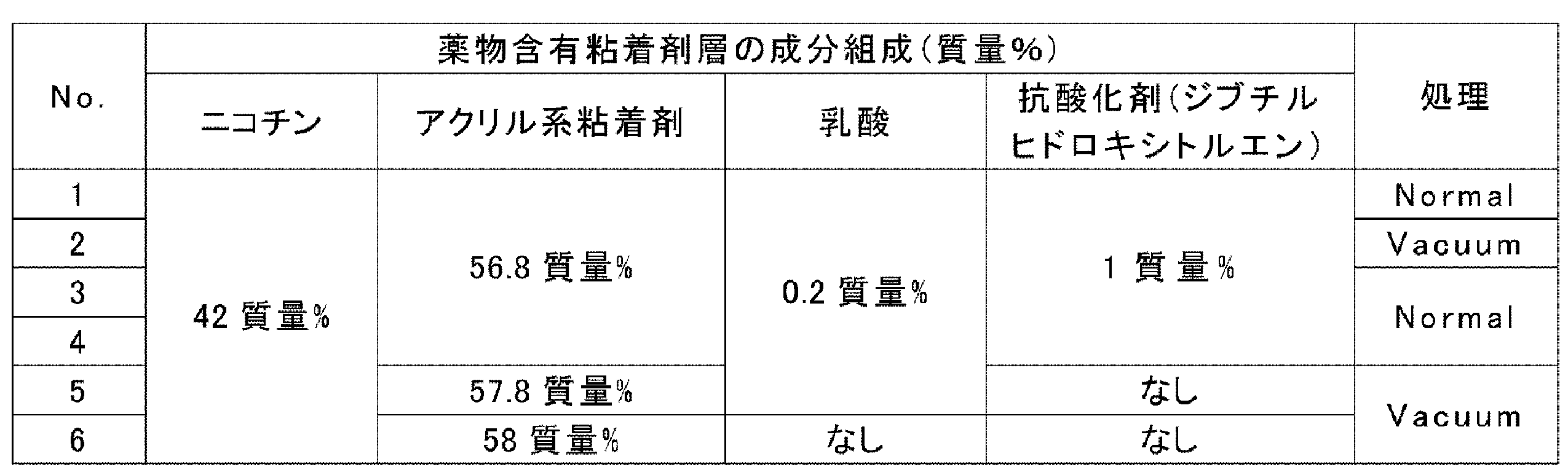
- Example 1 Evaluation of stability of nicotine in nicotine-containing patch in package> A composition in which an acrylic pressure-sensitive adhesive and nicotine, etc. were blended in the proportions described in “Table 1” was prepared, and this was coated on a support (using a PET film) and dried (60 ° C., 15 minutes) to produce a drug. A containing pressure-sensitive adhesive layer was prepared. A release controlling film and a skin adhesive layer made of polyisobutylene were laminated on the drug-containing pressure-sensitive adhesive layer, and a release liner was laminated on the skin adhesive layer to obtain a patch. In addition, antioxidants were blended in the proportions shown in “Table 1” in some formulations.
- the acrylic pressure-sensitive adhesive used in this example was the pressure-sensitive adhesive described in JP-A-2005-325101 (specifically, the solution obtained in Preparation Example 3 of copolymer (A), The adhesive obtained by mixing the solution obtained in Preparation Example 3 of the copolymer (B) at a mass ratio of 100: 5 (copolymer (A): copolymer (B)). is there.
- each of the obtained patches was individually put in a polyacrylonitrile / aluminum / polyethylene terephthalate laminated bag (corresponding to a packaging container in the present invention, hereinafter referred to as “PAN / Al / PET bag”).
- PAN / Al / PET bag a polyacrylonitrile / aluminum / polyethylene terephthalate laminated bag
- any of the following treatments was performed.
- the package obtained through the treatment (2) corresponds to the package of the present invention.
- (1) Put the patch in a bag and seal it as it is ("Normal" in Table 1).
- sealing is performed using a vacuum pump with the oxygen gas concentration in the bag being 20.6% by volume and the oxygen gas amount being 7 ⁇ L (“Vacuum” in Table 1). .
- the sealed patch was stored at 60 ° C. (humidity 75%).
- the content of nicotine related substances in the patch at the time of storage start, 0.5 months after the start of storage, 1 month after the start of storage, 1.5 months after the start of storage, and 2 months after the start of storage Measured by HPLC (UV254 nm).
- HPLC UV254 nm
- FIG. 1A the related substance A corresponds to a peak detected at 1.95 minutes by HPLC.
- the related substance B corresponds to a peak detected at 20.16 minutes in HPLC. Nicotine is detected in 15.4 minutes on HPLC.
- the production of nicotine-related substances was suppressed in the patch in the package in which the oxygen gas amount and oxygen gas concentration were adjusted within the scope of the present invention (No. 2, 5 and 6). That is, in the package of the present invention, it can be seen that nicotine denaturation is suppressed and drug stability is high.
- Example 2 Evaluation of color tone of nicotine-containing patch in package> A patch was obtained in the same manner as in Example 1 except that a composition blended in the ratio described in “Table 2” was prepared.
- Each obtained patch was put individually in a PAN / Al / PET bag.
- any of the following treatments was performed. (1) Put the patch in a bag and seal it as it is ("Normal” in Table 2). (2) After putting the patch into a bag, sealing is performed using a vacuum pump with an oxygen gas concentration in the bag of 20.6% by volume and an oxygen gas amount of 7 ⁇ L (in Table 2, “Vacuum”). .
- the sealed patch was stored at 60 ° C. (humidity 75%).
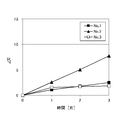
- the color tone of the patch was measured according to the following method at the start of storage, 1 month after the start of storage, 2 months after the start of storage, and 3 months after the start of storage. The evaluation results are shown in FIG.
- the color tone of the patch was specified by “a-scale” indicating the degree of red-green, “b-scale” indicating the degree of blue-yellow, and “L-scale” indicating the degree of white-black.
- ⁇ E (( ⁇ a) 2 + ( ⁇ b) 2 + ( ⁇ L) 2 ) 1/2 )
- the packaging body in which the amount of oxygen gas and the concentration of oxygen gas were adjusted within the range of the present invention was suppressed from changing in color tone over time (No. 3). That is, in the package of the present invention, it can be seen that the patch has high stability without using an antioxidant.
- Example 3 Stability evaluation of rivastigmine in a rivastigmine-containing patch in a package>
- a composition was prepared by blending 84 parts by mass of an acrylic pressure-sensitive adhesive and 16 parts by mass of rivastigmine, and this was coated and dried (60 ° C., 15 minutes) on a support (using a PET film) to obtain a patch. .
- the acrylic pressure-sensitive adhesive used in this example was the pressure-sensitive adhesive described in JP-A-2005-325101 (specifically, the solution obtained in Preparation Example 3 of copolymer (A), The adhesive obtained by mixing the solution obtained in Preparation Example 3 of the copolymer (B) at a mass ratio of 100: 5 (copolymer (A): copolymer (B)). is there.
- Each obtained patch was put individually in a PAN / Al / PET bag.
- any of the following treatments was performed. (1) Put the patch in a bag and seal it as it is ("Normal” in Table 3). (2) After putting the patch in the bag, sealing is performed using a vacuum pump with the oxygen gas concentration in the bag being 18.8% by volume and the oxygen gas amount being 4 ⁇ L (“Vacuum” in Table 3). .
- the sealed patch was stored at 60 ° C. (humidity 75%).
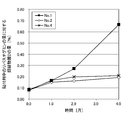
- the content of rivastigmine-related substance in the patch at the time of storage start, 1 month after the start of storage, 2 months after the start of storage, 3 months after the start of storage, and 4 months after the start of storage was measured by HPLC (UV215 nm) Measured with The evaluation results are shown in FIG.
- the related substance C corresponds to a peak detected at 20.4 minutes in HPLC.
- the related substance D corresponds to a peak detected at 72.3 minutes in HPLC. Rivastigmine is detected by HPLC at 10.2 minutes.
- the production of rivastigmine-related substances was suppressed in the patch in the package in which the amount of oxygen gas and the concentration of oxygen gas were adjusted within the scope of the present invention (No. 2 to 4). . That is, in the package of the present invention, it can be seen that rivastigmine denaturation is suppressed and stability is high.
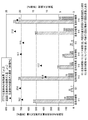
- Example 4 Examination of oxygen gas amount and oxygen gas concentration in package-1> No. 1 prepared in Example 1. 1 and no. The total gas amount, oxygen gas amount, and oxygen gas concentration in the package were measured for the package 2 and the conventional package (in which the nicotine-containing patch was encapsulated). The measurement results are shown in FIG.
- each package (the part on which the adhesive sheet was pasted) was pierced with a microsyringe in a water bath. After that, the syringe was pulled to extract the air in the package, and the scale of the syringe when the syringe stopped moving was specified as the total amount of gas in the package.
- the oxygen gas concentration in the package was measured by piercing each package with a needle type micro oxygen gas concentration meter (trade name “Microx TX3”, manufactured by Taitec Corporation). The oxygen gas amount in the package was calculated from the oxygen gas concentration and the total gas amount.
- Example 5 Study of oxygen gas amount and oxygen gas concentration in package-2>
- the total gas amount, oxygen gas amount, and oxygen gas concentration in the package were measured in the same manner as in Example 4. .
- the measurement results are shown in FIG. In FIG. 5, “Conventional formulation 5-1” and “* 1” are Nos. Prepared in Example 1, respectively. 1 and no. It is the same as the package of 2.
- “Conventional Formulation 5-4” and “* 2” are Nos. Prepared in Example 3, respectively. 1 and no. It is the same as the package of 2.
- an antioxidant is blended in the patch.
- the present invention has a lower amount of oxygen gas in the package than conventional preparations, and can more effectively suppress the denaturation of the patch drug by oxygen without using an oxygen scavenger or an antioxidant. It was considered.
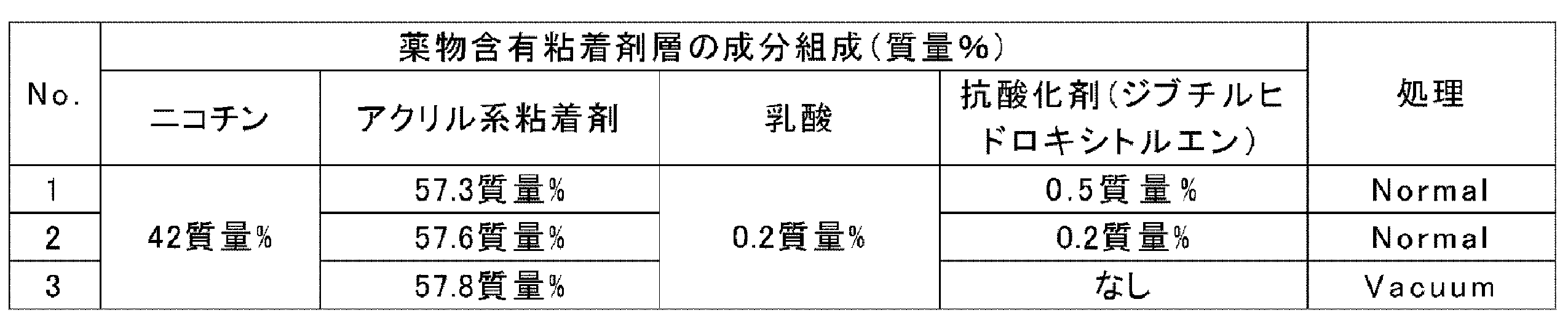
- Example 6 Stability evaluation of rivastigmine in rivastigmine-containing patch in package-I> A composition in which an acrylic pressure-sensitive adhesive and rivastigmine were blended in the proportions shown in Table 4 was prepared, and this was coated and dried (60 ° C., 15 minutes) on a support to obtain a rivastigmine-containing patch. A PET film was used as the support.
- the acrylic pressure-sensitive adhesive used in this example was prepared as follows. That is, the copolymer (A) solution obtained by the synthesis method shown below and the copolymer (B) solution were mixed at a mass ratio of 100: 5 (copolymer (A): copolymer (B )) To obtain an acrylic pressure-sensitive adhesive.
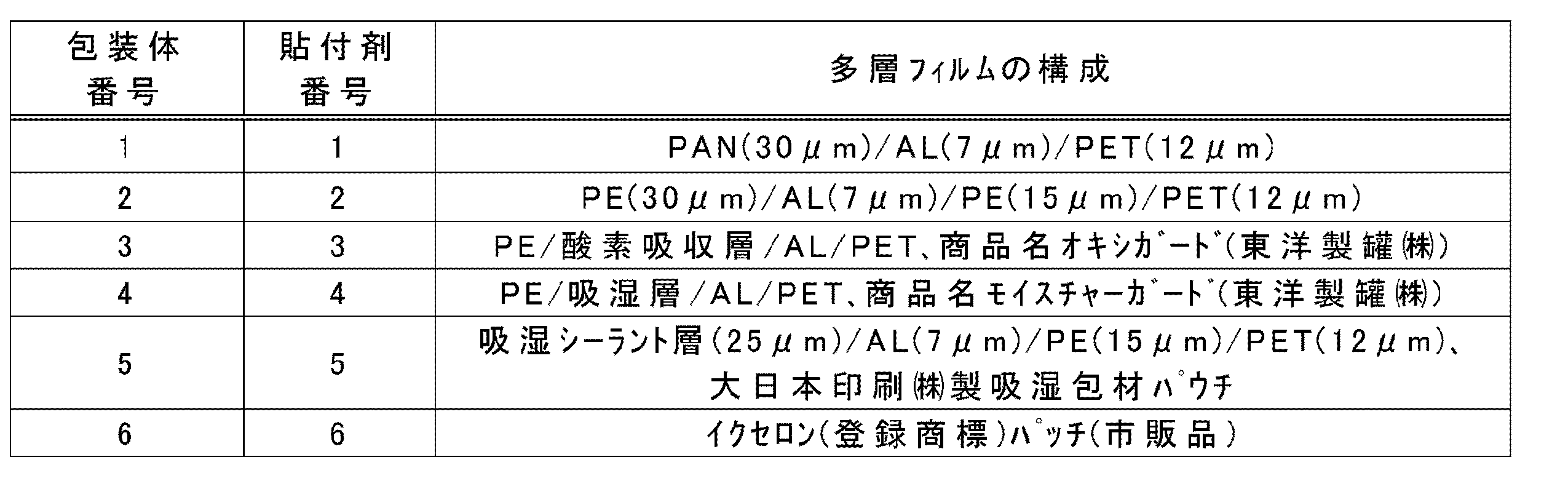
- each obtained patch was individually put into a packaging container made of each multilayer film having the structure shown in Table 5, and sealed as it was to obtain a package.
- “the configuration of the multilayer film” described in Table 5 indicates the stacking order of each layer, and the leftmost layer is the innermost layer of the packaging container (that is, the patch encapsulated in the packaging container) Layer).
- the package number “1” in Table 5 indicates that a multilayer film in which the innermost layer is PAN, then AL is laminated, then PET is laminated, and PET is the outermost layer is used.
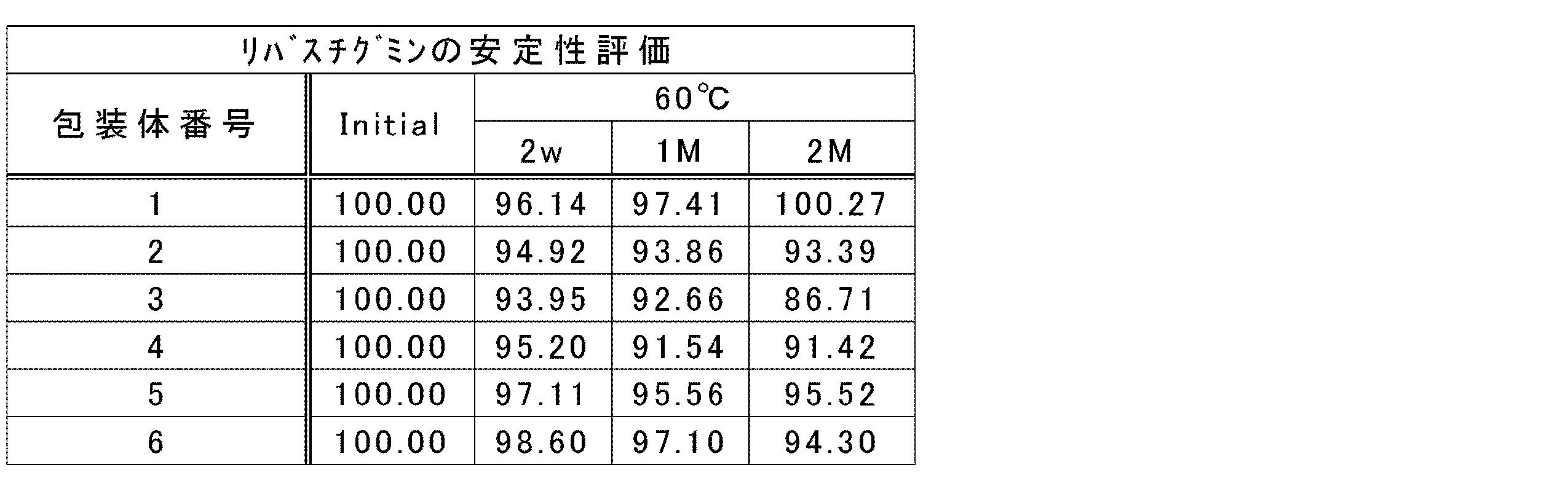
- the packaging body (packaging body number 1) of the present invention has little change in the rivastigmine content in the patch from the storage start point even after long-term storage, and denaturation of rivastigmine is suppressed. It was.
- the package numbers 2 to 5 that did not contain PAN, AL, and PET in the multilayer film structure the rivastigmine content in the patch decreased due to long-term storage, and rivastigmine degeneration was observed.
- Example 7 Stability evaluation of rivastigmine in a rivastigmine-containing patch in a package-II>
- two rivastigmine-containing patches were prepared.
- Each obtained patch was individually put into a packaging container composed of each multilayer film having the configuration shown in Table 7, and sealed as it was to obtain a package.
- the structure of a multilayer film described in Table 7 shows the lamination
- Each package was stored at 60 ° C. or 40 ° C. (humidity 75%).
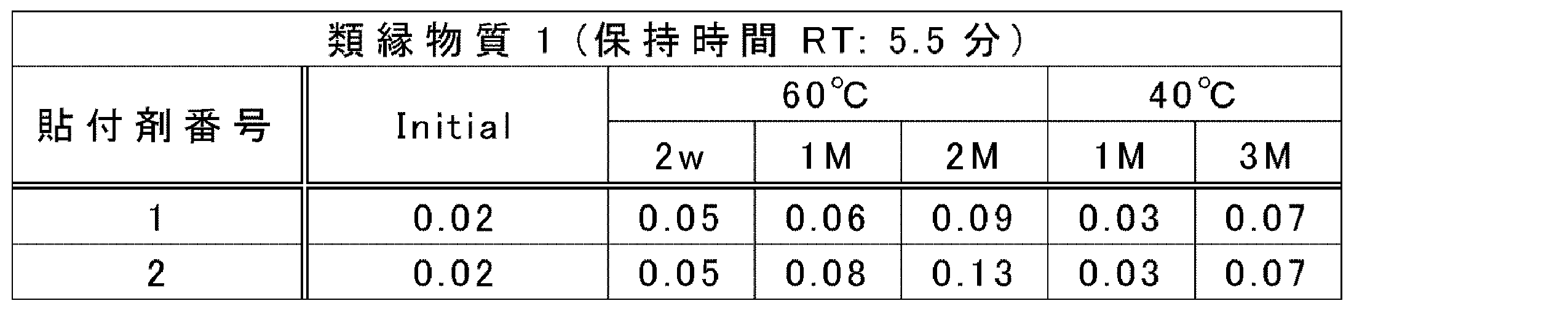
- the results are shown in Tables 8-10.
- it shows that the drug stability of the rivastigmine in a patch is so high that the quantity of the detected rivastigmine related substance is low.
- Rivastigmine is detected by HPLC (UV254 nm) with a retention time of 10.2 minutes.
- the package of the present invention (Package No. 1) has suppressed the generation of rivastigmine-related substances in the patch even after long-term storage, and suppressed the modification of rivastigmine. It was.
- Package No. 2 which does not contain PAN, AL and PET in the structure of the multilayer film, the amount of rivastigmine related substances in the patch increased due to long-term storage, and rivastigmine was denatured. Such denaturation was particularly noticeable in storage at high temperatures (60 ° C.).
Landscapes
- Health & Medical Sciences (AREA)
- Engineering & Computer Science (AREA)
- Bioinformatics & Cheminformatics (AREA)
- General Health & Medical Sciences (AREA)
- Veterinary Medicine (AREA)
- Public Health (AREA)
- Pharmacology & Pharmacy (AREA)
- Life Sciences & Earth Sciences (AREA)
- Animal Behavior & Ethology (AREA)
- Chemical & Material Sciences (AREA)
- Medicinal Chemistry (AREA)
- Epidemiology (AREA)
- Dermatology (AREA)
- General Chemical & Material Sciences (AREA)
- Chemical Kinetics & Catalysis (AREA)
- Biomedical Technology (AREA)
- Organic Chemistry (AREA)
- Neurology (AREA)
- Neurosurgery (AREA)
- Nuclear Medicine, Radiotherapy & Molecular Imaging (AREA)
- Emergency Medicine (AREA)
- Addiction (AREA)
- Psychiatry (AREA)
- Food Science & Technology (AREA)
- Mechanical Engineering (AREA)
- Hospice & Palliative Care (AREA)
- Medicinal Preparation (AREA)
- Pharmaceuticals Containing Other Organic And Inorganic Compounds (AREA)
- Medical Preparation Storing Or Oral Administration Devices (AREA)
- Acyclic And Carbocyclic Compounds In Medicinal Compositions (AREA)
Abstract
Description
前記包装体内の酸素ガス量は20μL以下であり、かつ、酸素ガス濃度は17.0~25.0体積%である包装体。
前記貼付剤は、支持体と、前記支持体上に位置し薬物を含有する粘着剤層とを備え、
前記薬物は、リバスチグミン及び/又はその薬学的に許容できる塩を少なくとも含み、
前記包装容器は、ポリアクリロニトリル層と、アルミニウム層と、ポリエチレンテレフタレート層とが少なくとも積層された多層フィルムから構成される、包装体。
本発明の第1の実施形態においては、包装容器と、該包装容器内に封入された薬物含有貼付剤とを備え、該包装体内の酸素ガス量は20μL以下であり、かつ、酸素ガス濃度は17.0~25.0体積%である包装体を提供する。なお、本発明において「包装体」とは、内部に薬物含有貼付剤が封入された状態の包装容器を指す。また、「薬物含有貼付剤」を単に「貼付剤」とも言う。また、本発明において「包装容器」とは貼付剤を封入させるものであり、「包装袋」とも呼ばれうるものである。以下、本発明の第1の包装体の各構成について説明する。
本発明においては、包装体内の酸素ガス量は20μL以下に調整され、かつ、酸素ガス濃度は17.0~25.0体積%に調整される。本発明者らによる検討の結果、このような酸素ガス量及び酸素ガス濃度であれば、包装容器内に封入された貼付剤中の薬物の安定性を害しにくいことが見出された。
包装容器としては、気体を密封できるものであれば特に限定されず、テープ剤、パップ剤等の貼付剤の包装容器として通常使用されるものであってもよい。
本発明の包装容器内に封入される貼付剤の形態は特に限定されず、薬物を含む層を有する公知の貼付剤を適用できる。例えば、薬物を含む粘着剤層からなる貼付剤(シート状製剤等)や、支持体と、該支持体上に位置する粘着剤層(通常、薬物を含む)とを備える貼付剤であってもよい。これらのうち、支持体と、上記支持体上に位置する粘着剤層とを備える貼付剤が好ましい。また、貼付剤は、公知の皮膚接着層(ポリイソブチレン等)や放出制御膜、剥離ライナー(酸素不透過性ライナー等)を粘着剤層に積層させたものであってもよい。
貼付剤の調製方法は特に限定されず、公知の貼付剤の調製方法によって調製できる。例えば、各成分を、溶解液中に均一に溶解させ、塗工機を用いて、得られた溶液を塗工乾燥して貼付剤を得る方法や、粘着剤層を構成する成分を均一に攪拌し、得られた組成物を、塗工機を用いて支持体表面上に塗工乾燥した後に貼付剤を得る方法等が挙げられる。
本発明の第2の実施形態においては、包装容器と、該包装容器内に封入された貼付剤と、を備える包装体を提供する。なお、本発明において「包装体」とは、内部に貼付剤が封入された状態の包装容器を指す。また、本発明における「貼付剤」は、「リバスチグミン含有貼付剤」とも言う。また、本発明において「包装容器」とは、貼付剤をその内部に封入させるものであり、「包装袋」とも呼ばれうるものである。以下、本発明の第2の包装体の各構成について説明する。
本発明における包装容器は、ポリアクリロニトリル層(以下、ポリアクリロニトリル層を「PAN」とも言う。)と、アルミニウム層(以下、アルミニウム層を「AL」とも言う。)と、ポリエチレンテレフタレート層(以下、ポリエチレンテレフタレート層を「PET」とも言う。)と、が少なくとも積層された多層フィルムから構成される。なお、ポリアクリロニトリル層、アルミニウム層、及びポリエチレンテレフタレート層とは、それぞれ、ポリアクリロニトリル、アルミニウム、及びポリエチレンテレフタレートを主成分として含む層を指す。本発明において、「主成分として含む」とは、各層中にポリアクリロニトリル、アルミニウム、又はポリエチレンテレフタレートが50質量%以上含まれることを指す。ポリアクリロニトリル層中のポリアクリロニトリルは、好ましくは90質量%以上であり、さらに好ましくは、ポリアクリロニトリル層はポリアクリロニトリルからなるものである。アルミニウム層中のアルミニウムは、好ましくは90質量%以上であり、さらに好ましくは、アルミニウム層はアルミニウムからなるものである。ポリエチレンテレフタレート層中のポリエチレンテレフタレートは、好ましくは90質量%以上であり、さらに好ましくは、ポリエチレンテレフタレート層はポリエチレンテレフタレートからなるものである。各層には、その他の成分を適宜配合してもよい。
本発明の貼付剤は、支持体と、該支持体上に位置し、粘着剤及びリバスチグミンを含む粘着剤層とを備える。貼付剤は、公知の皮膚接着層(ポリイソブチレン等)や放出制御膜、剥離ライナー(酸素不透過性ライナー等)を粘着剤層に積層させたものであってもよい。
本発明におけるリバスチグミンとしては、アセチルコリンエステラーゼ阻害作用を示すリバスチグミンの遊離体及び/又はその薬学的に許容できる塩を使用できる。リバスチグミンの塩としては、リバスチグミン塩酸塩、リバスチグミン酒石酸塩等が挙げられる。上記のうち、皮膚透過性が良好である点でリバスチグミンの遊離体が好ましい。
粘着剤層に含まれる粘着剤としては、皮膚に適用される貼付剤において一般的に使用されるものであれば特に限定されず、アクリル系粘着剤、ゴム系粘着剤又はシリコン系粘着剤のうち1種以上であってもよい。
貼付剤の調製方法は特に限定されず、公知の貼付剤の調製方法によって調製できる。例えば、粘着剤層を構成する成分を均一に撹拌し、得られた組成物を、塗工機を用いて支持体表面上に塗工乾燥した後に貼付剤を得る方法等が挙げられる。
本発明の包装体は、包装容器内に貼付剤を、シーリングによって封入することで得られる。封入の際には、包装容器内に貼付剤を入れ、次いで包装容器内の酸素ガス量等を調整した後にシーリングしてもよいが、包装容器内に貼付剤を入れてそのままシーリングしてもよい。シーリングとしては、ヒートシール、接着剤によるシール等の公知の方法を適用できる。
本発明の包装体は、従来のように、抗酸化剤や脱酸素剤を貼付剤と共に封入したり、不活性ガス置換等をしたりしなくとも、貼付剤中の薬物安定性が良好である。貼付剤中の薬物安定性は、HPLCによる薬物の類縁物質の検出によって特定される。薬物の類縁物質は、薬物が酸素によって変性等することで生じる物質であり、薬物本来の薬効が低下した物質又は薬効を有さない物質である。そのため、検出される類縁物質の量が低いほど、薬物安定性が高いことを示す。
本発明の包装体は、抗酸化剤や脱酸素剤を貼付剤と共に封入したり、不活性ガス置換等をしたりしなくとも、貼付剤中のリバスチグミンの変性が抑制され、薬物安定性が良好である。本発明において、「リバスチグミンの変性」とは、リバスチグミンが分解等することで、リバスチグミン量が減少したり、リバスチグミンの分解物や類縁物質等が増加することを指す。貼付剤中のリバスチグミンの変性が抑制されているかどうかは、HPLC等によって、貼付剤中のリバスチグミン又はリバスチグミンの類縁物質等を検出することによって特定される。リバスチグミンの類縁物質は、リバスチグミンが酸素や光によって変性等することで生じる物質であり、リバスチグミン本来の薬効が低下した物質、又は、リバスチグミン本来の薬効を有さない物質である。そのため、貼付剤中から検出される類縁物質の量が低いほど、リバスチグミンの薬物安定性が高いことを示す。
アクリル系粘着剤及びニコチン等を、「表1」記載の割合で配合した組成物を作製し、これを支持体(PETフィルムを使用)上に塗工乾燥(60℃、15分)し、薬物含有粘着剤層を調製した。薬物含有粘着剤層の上に、放出制御膜と、ポリイソブチレンからなる皮膚接着層とを積層し、さらに、皮膚接着層の上に剥離ライナーを積層し、貼付剤を得た。また、一部の処方には「表1」に示す割合で抗酸化剤を配合した。
(1)貼付剤を袋に入れてそのままシーリングをする(表1中「Normal」)。
(2)貼付剤を袋に入れた後、真空ポンプを使用して袋内の酸素ガス濃度を20.6体積%、かつ、酸素ガス量を7μLにしてシーリングする(表1中「Vacuum」)。
「表2」記載の割合で配合した組成物を作製した以外は実施例1と同様にして貼付剤を得た。
(1)貼付剤を袋に入れてそのままシーリングをする(表2中「Normal」)。
(2)貼付剤を袋に入れた後、真空ポンプを使用して袋内の酸素ガス濃度を20.6体積%、かつ、酸素ガス量を7μLにしてシーリングする(表2中「Vacuum」)。
貼付剤の色度(これは、薬物含有粘着剤層の色度と同視できる)を、色彩色差計を用いて測定し、貼付剤の色調変化を下記のように算出した。
ΔE(=((Δa)2+(Δb)2+(ΔL)2)1/2)
アクリル系粘着剤84質量部とリバスチグミン16質量部という配合で組成物を作製し、これを支持体(PETフィルムを使用)上に塗工乾燥(60℃、15分)し、貼付剤を得た。
(1)貼付剤を袋に入れてそのままシーリングをする(表3中「Normal」)。
(2)貼付剤を袋に入れた後、真空ポンプを使用して袋内の酸素ガス濃度を18.8体積%、かつ、酸素ガス量を4μLにしてシーリングする(表3中「Vacuum」)。

実施例1で調製したNo.1及びNo.2の包装体及び従来の包装体(ニコチン含有貼付剤を封入したもの)について、包装体内の総気体量、酸素ガス量、及び酸素ガス濃度を測定した。その測定結果を図4に示す。
本発明の包装体及び従来の包装体(ニコチン含有貼付剤又はリバスチグミン含有貼付剤を封入したもの)について、包装体内の総気体量、酸素ガス量、及び酸素ガス濃度を実施例4同様に測定した。その測定結果を図5に示す。なお、図5中、「従来の製剤5-1」及び「※1」は、それぞれ、実施例1で調製したNo.1及びNo.2の包装体と同様のものである。また、「従来の製剤5-4」及び「※2」は、それぞれ、実施例3で調製したNo.1及びNo.2の包装体と同様のものである。また、従来の製剤5-2、5-3、5-5、5-6には、抗酸化剤が貼付剤中に配合されていた。
アクリル系粘着剤及びリバスチグミンを、表4記載の割合で配合した組成物を作製し、これを支持体上に塗工乾燥(60℃、15分)し、リバスチグミン含有貼付剤を得た。なお、支持体としてPETフィルムを使用した。
アクリル酸2-エチルヘキシル200質量部、アクリル酸ブチル100質量部、ジアセトンアクリルアミド50質量部、及び酢酸エチル300質量部を加えて混合した。この混合物を、撹拌装置及び還流冷却装置を備えるセパラブルフラスコに供給し、撹拌及び窒素置換しながら、75℃に昇温した。過酸化ベンゾイル2質量部を酢酸エチル20質量部に溶解した溶液を5分割し、その1部をセパラブルフラスコに添加して、重合を開始した。残りの4部を、反応開始後2時間目から1時間間隔で1部ずつ添加し、添加を終了した後、さらに2時間反応させた。なお、粘度調節のため、反応開始後、2時間ごとに酢酸エチルを50質量部ずつ4回添加した。反応終了後、冷却し、次いで酢酸エチルを添加することで、固形分濃度30質量%の共重合体(A)を得た。
アクリル酸エチル660質量部、ジアセトンアクリルアミド70質量部、分子量調節剤としてドデシルメルカプタン40質量部及び酢酸エチル400質量部を加えて混合した。この混合物を、撹拌装置及び還流冷却装置を備えるセパラブルフラスコに供給し、撹拌及び窒素置換しながら、70℃に昇温した。アゾビスイソブチロニトリル5質量部を酢酸エチル100質量部に溶解した溶液を5分割し、その1部をセパラブルフラスコに添加して、重合を開始した。残りの4部を、反応開始後2時間目から1時間間隔で1部ずつ添加し、添加を終了した後、さらに2時間反応させた。なお、粘度調節のため、反応開始後、2時間ごとに酢酸エチルを50質量部ずつ3回添加した。その後、アジピン酸ジヒドラジド40質量部を、精製水40質量部、メタノール1600質量部、酢酸エチル260質量部の混合液に溶解したものを添加し、さらに濃塩酸5質量部を加えた後、70℃に昇温した。反応終了後、冷却し、精製水で3回洗浄した後、生成物を酢酸エチル700質量部、アセトン1400質量部、メタノール400質量部の混合溶媒に溶解させることで、固形分濃度30質量%の共重合体(B)を得た。

実施例6と同様にして、リバスチグミン含有貼付剤を2枚調製した。得られた各貼付剤を、表7に示す構成を有する各多層フィルムからなる包装容器に個別に入れ、そのままシーリングし、包装体を得た。なお、表7に記載される「多層フィルムの構成」とは、表5同様、各層の積層順序を示し、最も左側に示された層が包装容器の最内層である。



Claims (11)
- 包装容器と、前記包装容器内に封入された薬物含有貼付剤と、を備える包装体であって、
前記包装体内の酸素ガス量は20μL以下であり、かつ、酸素ガス濃度は17.0~25.0体積%である包装体。 - 前記包装体は、前記薬物含有貼付剤と別体の脱酸素剤を含まない請求項1に記載の包装体。
- 前記酸素ガス量は、前記薬物含有貼付剤中の薬物量あたり4μL/mg以下である請求項1又は2に記載の包装体。
- 前記薬物はニコチン、リバスチグミン又はこれらの薬理学的に許容しうる塩のいずれかである請求項1から3のいずれか1項に記載の包装体。
- 前記薬物含有貼付剤は、支持体と、前記支持体上に位置する粘着剤層とを備え、前記粘着剤層は、実質的にカルボキシル基を含まないアクリル系粘着剤を含む請求項1から4のいずれか1項に記載の包装体。
- 包装容器と、前記包装容器内に封入された貼付剤と、を備える包装体であって、
前記貼付剤は、支持体と、前記支持体上に位置し薬物を含有する粘着剤層とを備え、
前記薬物は、リバスチグミン及び/又はその薬学的に許容できる塩を少なくとも含み、
前記包装容器は、ポリアクリロニトリル層と、アルミニウム層と、ポリエチレンテレフタレート層とが少なくとも積層された多層フィルムから構成される、包装体。 - 前記包装容器の最内層は、ポリアクリロニトリル層である、請求項6に記載の包装体。
- 前記多層フィルムは、ポリアクリロニトリル層と、アルミニウム層と、ポリエチレンテレフタレート層と、がこの順で積層された多層フィルムである請求項7に記載の包装体。
- 前記ポリアクリロニトリル層は厚さ10~50μmであり、前記アルミニウム層は厚さ1~15μmであり、前記ポリエチレンテレフタレート層は厚さ5~20μmである、請求項6から8のいずれか1項に記載の包装体。
- 前記包装体は、脱酸素剤及び抗酸化剤のうちいずれか1つ以上を含まない、請求項6から9のいずれか1項に記載の包装体。
- 前記粘着剤層は、アクリル系粘着剤を含む、請求項6から10のいずれか1項に記載の包装体。
Priority Applications (3)
| Application Number | Priority Date | Filing Date | Title |
|---|---|---|---|
| JP2014554558A JP6287863B2 (ja) | 2012-12-28 | 2013-12-26 | 包装体 |
| EP13867096.3A EP2939667A4 (en) | 2012-12-28 | 2013-12-26 | PACKAGING |
| US14/758,329 US20150329264A1 (en) | 2012-12-28 | 2013-12-26 | Packaging |
Applications Claiming Priority (4)
| Application Number | Priority Date | Filing Date | Title |
|---|---|---|---|
| JP2012288950 | 2012-12-28 | ||
| JP2012-288950 | 2012-12-28 | ||
| JP2013169987 | 2013-08-19 | ||
| JP2013-169987 | 2013-08-19 |
Publications (1)
| Publication Number | Publication Date |
|---|---|
| WO2014104220A1 true WO2014104220A1 (ja) | 2014-07-03 |
Family
ID=51021294
Family Applications (1)
| Application Number | Title | Priority Date | Filing Date |
|---|---|---|---|
| PCT/JP2013/084950 Ceased WO2014104220A1 (ja) | 2012-12-28 | 2013-12-26 | 包装体 |
Country Status (5)
| Country | Link |
|---|---|
| US (1) | US20150329264A1 (ja) |
| EP (1) | EP2939667A4 (ja) |
| JP (1) | JP6287863B2 (ja) |
| TW (1) | TW201438766A (ja) |
| WO (1) | WO2014104220A1 (ja) |
Cited By (1)
| Publication number | Priority date | Publication date | Assignee | Title |
|---|---|---|---|---|
| JP2019107220A (ja) * | 2017-12-18 | 2019-07-04 | ニプロ株式会社 | 貼付剤用包装袋及び貼付剤製品 |
Families Citing this family (2)
| Publication number | Priority date | Publication date | Assignee | Title |
|---|---|---|---|---|
| DK3656551T3 (da) * | 2015-12-29 | 2023-06-06 | Danapak Flexibles As | Fremgangsmåde til tilvejebringelse af en kemisk resistent film samt en derved opnåelig film |
| ES2923891T3 (es) | 2018-08-08 | 2022-10-03 | Danapak Flexibles As | Películas y láminas mejoradas para usarse en el envase de compuestos reactivos |
Citations (6)
| Publication number | Priority date | Publication date | Assignee | Title |
|---|---|---|---|---|
| JP2005325101A (ja) | 2004-04-13 | 2005-11-24 | Kosumedei:Kk | 架橋型皮膚用粘着剤 |
| JP3809462B2 (ja) | 2003-06-24 | 2006-08-16 | 埼玉第一製薬株式会社 | 医療用経皮吸収テープ製剤用非水性粘着剤並びに医療用経皮吸収テープ製剤およびその製造法 |
| JP2006346888A (ja) * | 2005-06-13 | 2006-12-28 | Kyodo Printing Co Ltd | 選択吸湿フィルム及び多層フィルム |
| JP2009039210A (ja) * | 2007-08-07 | 2009-02-26 | Hosokawa Yoko Co Ltd | 医療用容器包装袋、およびこれを用いた医療用容器の収容方法、薬剤混注済み医療用容器包装体、薬剤未混注の医療用容器包装体の製造方法、ならびに薬剤未混注の医療用容器包装体 |
| JP2012051875A (ja) | 2010-08-03 | 2012-03-15 | Hisamitsu Pharmaceut Co Inc | 経皮・経粘膜吸収製剤の保存方法及び経皮・経粘膜吸収製剤包装体 |
| JP5093545B1 (ja) | 2012-02-28 | 2012-12-12 | ニチバン株式会社 | 貼付剤 |
Family Cites Families (4)
| Publication number | Priority date | Publication date | Assignee | Title |
|---|---|---|---|---|
| JP2003231533A (ja) * | 2002-02-05 | 2003-08-19 | Showa Highpolymer Co Ltd | ポリアクリロニトリル樹脂フィルムへの接着性が良好なプラスチックジッパーテープ及びそれを用いた包装袋 |
| JP5000932B2 (ja) * | 2005-06-21 | 2012-08-15 | 日東電工株式会社 | ニコチン含有経皮吸収製剤 |
| CA2646365C (en) * | 2007-12-14 | 2016-03-22 | Nitto Denko Corporation | Patch package structure |
| JP5725940B2 (ja) * | 2011-04-01 | 2015-05-27 | 日東電工株式会社 | ニコチン含有貼付製剤 |
-
2013
- 2013-12-26 EP EP13867096.3A patent/EP2939667A4/en not_active Withdrawn
- 2013-12-26 WO PCT/JP2013/084950 patent/WO2014104220A1/ja not_active Ceased
- 2013-12-26 JP JP2014554558A patent/JP6287863B2/ja active Active
- 2013-12-26 US US14/758,329 patent/US20150329264A1/en not_active Abandoned
- 2013-12-27 TW TW102148749A patent/TW201438766A/zh unknown
Patent Citations (6)
| Publication number | Priority date | Publication date | Assignee | Title |
|---|---|---|---|---|
| JP3809462B2 (ja) | 2003-06-24 | 2006-08-16 | 埼玉第一製薬株式会社 | 医療用経皮吸収テープ製剤用非水性粘着剤並びに医療用経皮吸収テープ製剤およびその製造法 |
| JP2005325101A (ja) | 2004-04-13 | 2005-11-24 | Kosumedei:Kk | 架橋型皮膚用粘着剤 |
| JP2006346888A (ja) * | 2005-06-13 | 2006-12-28 | Kyodo Printing Co Ltd | 選択吸湿フィルム及び多層フィルム |
| JP2009039210A (ja) * | 2007-08-07 | 2009-02-26 | Hosokawa Yoko Co Ltd | 医療用容器包装袋、およびこれを用いた医療用容器の収容方法、薬剤混注済み医療用容器包装体、薬剤未混注の医療用容器包装体の製造方法、ならびに薬剤未混注の医療用容器包装体 |
| JP2012051875A (ja) | 2010-08-03 | 2012-03-15 | Hisamitsu Pharmaceut Co Inc | 経皮・経粘膜吸収製剤の保存方法及び経皮・経粘膜吸収製剤包装体 |
| JP5093545B1 (ja) | 2012-02-28 | 2012-12-12 | ニチバン株式会社 | 貼付剤 |
Non-Patent Citations (1)
| Title |
|---|
| See also references of EP2939667A4 |
Cited By (1)
| Publication number | Priority date | Publication date | Assignee | Title |
|---|---|---|---|---|
| JP2019107220A (ja) * | 2017-12-18 | 2019-07-04 | ニプロ株式会社 | 貼付剤用包装袋及び貼付剤製品 |
Also Published As
| Publication number | Publication date |
|---|---|
| EP2939667A1 (en) | 2015-11-04 |
| TW201438766A (zh) | 2014-10-16 |
| JP6287863B2 (ja) | 2018-03-07 |
| US20150329264A1 (en) | 2015-11-19 |
| JPWO2014104220A1 (ja) | 2017-01-19 |
| EP2939667A4 (en) | 2016-06-15 |
Similar Documents
| Publication | Publication Date | Title |
|---|---|---|
| JP6083734B2 (ja) | リバスチグミンまたはその誘導体を投与するための経皮治療システム | |
| RU2553350C2 (ru) | Трансдермальные пластыри | |
| US9585862B2 (en) | Patch containing rivastigmine | |
| JP6043296B2 (ja) | 有効成分を投与するための経皮治療システム | |
| US9849095B2 (en) | Ropinirole-containing adhesive patch | |
| US9155710B2 (en) | Ropinirole-containing patch and package thereof | |
| JP6453481B2 (ja) | 貼付剤 | |
| JP2015166399A (ja) | ロピニロール含有貼付剤及びその包装体 | |
| KR101942677B1 (ko) | 첩부제 | |
| CN102014884A (zh) | 用于施用芬太尼或其类似物的透皮治疗系统 | |
| JP6287863B2 (ja) | 包装体 | |
| JP2012051875A (ja) | 経皮・経粘膜吸収製剤の保存方法及び経皮・経粘膜吸収製剤包装体 | |
| JP2016013993A (ja) | 貼付剤および貼付製剤 | |
| JP2019107220A (ja) | 貼付剤用包装袋及び貼付剤製品 | |
| JP2020518553A (ja) | ニコチン含有透明経皮吸収治療システム | |
| JP2006298774A (ja) | 経皮吸収型フリーラジカル抑制製剤 | |
| WO2016052522A1 (ja) | 経皮投与製剤及び包装体 | |
| JP6292768B2 (ja) | 貼付剤及び貼付剤製品の製造方法 | |
| WO2017094337A1 (ja) | 貼付剤 | |
| JP2009522243A (ja) | 経皮デバイス中のテストステロンの安定化 | |
| US10149834B2 (en) | Ropinirole-containing adhesive patch | |
| JP6220893B2 (ja) | クロニジン含有貼付剤 | |
| JPH0840910A (ja) | 安定なエストラジオール含有貼付剤の製造法 | |
| Reddy | Formulation and Evaluation of Transdermal Patches of Metoprolol Tartrate Using Conjugated Polymers | |
| HK1186099B (en) | Transdermal patch |
Legal Events
| Date | Code | Title | Description |
|---|---|---|---|
| 121 | Ep: the epo has been informed by wipo that ep was designated in this application |
Ref document number: 13867096 Country of ref document: EP Kind code of ref document: A1 |
|
| ENP | Entry into the national phase |
Ref document number: 2014554558 Country of ref document: JP Kind code of ref document: A |
|
| NENP | Non-entry into the national phase |
Ref country code: DE |
|
| WWE | Wipo information: entry into national phase |
Ref document number: 14758329 Country of ref document: US |
|
| WWE | Wipo information: entry into national phase |
Ref document number: 2013867096 Country of ref document: EP |