WO2014106922A1 - コーティング組成物、その製造方法及びコーティング物品 - Google Patents
コーティング組成物、その製造方法及びコーティング物品 Download PDFInfo
- Publication number
- WO2014106922A1 WO2014106922A1 PCT/JP2013/082358 JP2013082358W WO2014106922A1 WO 2014106922 A1 WO2014106922 A1 WO 2014106922A1 JP 2013082358 W JP2013082358 W JP 2013082358W WO 2014106922 A1 WO2014106922 A1 WO 2014106922A1
- Authority
- WO
- WIPO (PCT)
- Prior art keywords
- fine particles
- coating composition
- flat
- hydrophobic
- coating film
- Prior art date
- Legal status (The legal status is an assumption and is not a legal conclusion. Google has not performed a legal analysis and makes no representation as to the accuracy of the status listed.)
- Ceased
Links
Images


Classifications
-
- C—CHEMISTRY; METALLURGY
- C09—DYES; PAINTS; POLISHES; NATURAL RESINS; ADHESIVES; COMPOSITIONS NOT OTHERWISE PROVIDED FOR; APPLICATIONS OF MATERIALS NOT OTHERWISE PROVIDED FOR
- C09D—COATING COMPOSITIONS, e.g. PAINTS, VARNISHES OR LACQUERS; FILLING PASTES; CHEMICAL PAINT OR INK REMOVERS; INKS; CORRECTING FLUIDS; WOODSTAINS; PASTES OR SOLIDS FOR COLOURING OR PRINTING; USE OF MATERIALS THEREFOR
- C09D7/00—Features of coating compositions, not provided for in group C09D5/00; Processes for incorporating ingredients in coating compositions
- C09D7/40—Additives
- C09D7/60—Additives non-macromolecular
- C09D7/61—Additives non-macromolecular inorganic
-
- C—CHEMISTRY; METALLURGY
- C08—ORGANIC MACROMOLECULAR COMPOUNDS; THEIR PREPARATION OR CHEMICAL WORKING-UP; COMPOSITIONS BASED THEREON
- C08K—Use of inorganic or non-macromolecular organic substances as compounding ingredients
- C08K3/00—Use of inorganic substances as compounding ingredients
- C08K3/34—Silicon-containing compounds
-
- C—CHEMISTRY; METALLURGY
- C08—ORGANIC MACROMOLECULAR COMPOUNDS; THEIR PREPARATION OR CHEMICAL WORKING-UP; COMPOSITIONS BASED THEREON
- C08K—Use of inorganic or non-macromolecular organic substances as compounding ingredients
- C08K3/00—Use of inorganic substances as compounding ingredients
- C08K3/34—Silicon-containing compounds
- C08K3/36—Silica
-
- C—CHEMISTRY; METALLURGY
- C09—DYES; PAINTS; POLISHES; NATURAL RESINS; ADHESIVES; COMPOSITIONS NOT OTHERWISE PROVIDED FOR; APPLICATIONS OF MATERIALS NOT OTHERWISE PROVIDED FOR
- C09D—COATING COMPOSITIONS, e.g. PAINTS, VARNISHES OR LACQUERS; FILLING PASTES; CHEMICAL PAINT OR INK REMOVERS; INKS; CORRECTING FLUIDS; WOODSTAINS; PASTES OR SOLIDS FOR COLOURING OR PRINTING; USE OF MATERIALS THEREFOR
- C09D127/00—Coating compositions based on homopolymers or copolymers of compounds having one or more unsaturated aliphatic radicals, each having only one carbon-to-carbon double bond, and at least one being terminated by a halogen; Coating compositions based on derivatives of such polymers
- C09D127/02—Coating compositions based on homopolymers or copolymers of compounds having one or more unsaturated aliphatic radicals, each having only one carbon-to-carbon double bond, and at least one being terminated by a halogen; Coating compositions based on derivatives of such polymers not modified by chemical after-treatment
- C09D127/12—Coating compositions based on homopolymers or copolymers of compounds having one or more unsaturated aliphatic radicals, each having only one carbon-to-carbon double bond, and at least one being terminated by a halogen; Coating compositions based on derivatives of such polymers not modified by chemical after-treatment containing fluorine atoms
-
- C—CHEMISTRY; METALLURGY
- C09—DYES; PAINTS; POLISHES; NATURAL RESINS; ADHESIVES; COMPOSITIONS NOT OTHERWISE PROVIDED FOR; APPLICATIONS OF MATERIALS NOT OTHERWISE PROVIDED FOR
- C09D—COATING COMPOSITIONS, e.g. PAINTS, VARNISHES OR LACQUERS; FILLING PASTES; CHEMICAL PAINT OR INK REMOVERS; INKS; CORRECTING FLUIDS; WOODSTAINS; PASTES OR SOLIDS FOR COLOURING OR PRINTING; USE OF MATERIALS THEREFOR
- C09D201/00—Coating compositions based on unspecified macromolecular compounds
-
- C—CHEMISTRY; METALLURGY
- C09—DYES; PAINTS; POLISHES; NATURAL RESINS; ADHESIVES; COMPOSITIONS NOT OTHERWISE PROVIDED FOR; APPLICATIONS OF MATERIALS NOT OTHERWISE PROVIDED FOR
- C09D—COATING COMPOSITIONS, e.g. PAINTS, VARNISHES OR LACQUERS; FILLING PASTES; CHEMICAL PAINT OR INK REMOVERS; INKS; CORRECTING FLUIDS; WOODSTAINS; PASTES OR SOLIDS FOR COLOURING OR PRINTING; USE OF MATERIALS THEREFOR
- C09D5/00—Coating compositions, e.g. paints, varnishes or lacquers, characterised by their physical nature or the effects produced; Filling pastes
- C09D5/16—Antifouling paints; Underwater paints
- C09D5/1681—Antifouling coatings characterised by surface structure, e.g. for roughness effect giving superhydrophobic coatings or Lotus effect
-
- C—CHEMISTRY; METALLURGY
- C09—DYES; PAINTS; POLISHES; NATURAL RESINS; ADHESIVES; COMPOSITIONS NOT OTHERWISE PROVIDED FOR; APPLICATIONS OF MATERIALS NOT OTHERWISE PROVIDED FOR
- C09D—COATING COMPOSITIONS, e.g. PAINTS, VARNISHES OR LACQUERS; FILLING PASTES; CHEMICAL PAINT OR INK REMOVERS; INKS; CORRECTING FLUIDS; WOODSTAINS; PASTES OR SOLIDS FOR COLOURING OR PRINTING; USE OF MATERIALS THEREFOR
- C09D7/00—Features of coating compositions, not provided for in group C09D5/00; Processes for incorporating ingredients in coating compositions
- C09D7/40—Additives
- C09D7/70—Additives characterised by shape, e.g. fibres, flakes or microspheres
-
- C—CHEMISTRY; METALLURGY
- C08—ORGANIC MACROMOLECULAR COMPOUNDS; THEIR PREPARATION OR CHEMICAL WORKING-UP; COMPOSITIONS BASED THEREON
- C08K—Use of inorganic or non-macromolecular organic substances as compounding ingredients
- C08K2201/00—Specific properties of additives
- C08K2201/002—Physical properties
- C08K2201/005—Additives being defined by their particle size in general
-
- C—CHEMISTRY; METALLURGY
- C08—ORGANIC MACROMOLECULAR COMPOUNDS; THEIR PREPARATION OR CHEMICAL WORKING-UP; COMPOSITIONS BASED THEREON
- C08K—Use of inorganic or non-macromolecular organic substances as compounding ingredients
- C08K2201/00—Specific properties of additives
- C08K2201/016—Additives defined by their aspect ratio
Definitions
- the present invention relates to a coating composition capable of imparting high water repellency and oil repellency, a method for producing the same, and a coated article.
- Patent Document 1 discloses a coating liquid in which hydrophobic fine particles having an average primary particle diameter of 100 nm or less are dispersed in an organic solvent containing a hydrophobic solvent in an amount of 65% by mass or more based on the total organic solvent. It is described that the coating film formed in this manner exhibits a contact angle of 140 degrees or more with respect to water. Further, Patent Document 2 discloses the root mean square roughness of a surface obtained by coating a coating composition containing alcohol, alkoxysilane, perfluoroalkylsilane, silica fine particles, a catalyst for promoting hydrolysis reaction of alkoxysilane and water. A coating film having a thickness (RMS) value of 100 nm or more is disclosed, and it is described that the coating film exhibits a contact angle of 150 degrees or more with water and a contact angle of 130 degrees or more with oil. ing.
- RMS thickness
- Patent Document 1 Although a super water-repellent coating film can be easily formed, this coating film has a problem that its oil repellency is insufficient.
- Patent Document 2 since a hydrolysis reaction is used, it takes a long time to prepare a coating solution, and a sufficient contact angle cannot be obtained when the number of coatings is small, which increases the number of steps. There was a problem.
- the coating films of Patent Documents 1 and 2 have a problem that cracks are likely to occur during drying.
- the present invention has been made to solve the above-described problems, and can provide a coating film that can provide high water repellency and oil repellency and has few cracks without requiring a complicated operation. The purpose is to provide.
- the present invention is a coating composition characterized in that hydrophobic fine particles and flat fine particles having a card house-like aggregated structure are dispersed in a binder resin dissolved in a solvent.
- a coating composition that can provide a high water repellency and oil repellency and can form a coating film with few cracks without requiring a complicated operation.
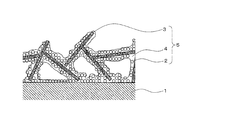
- FIG. 1 is a schematic cross-sectional view of a coated article provided with a coating film according to Embodiment 1.
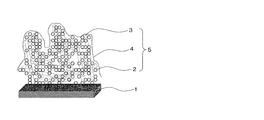
- FIG. 1 is a schematic top view of a coated article provided with a coating film according to Embodiment 1.
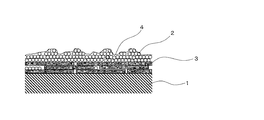
- FIG. 1 is a schematic perspective view of a coated article provided with a coating film according to Embodiment 1.
- FIG. It is a schematic cross section of the coating article provided with the coating film formed from the coating composition which does not contain flat microparticles. It is a schematic cross section of the coating article provided with the coating film formed from the coating composition containing the flat fine particle of a non-aggregated state.
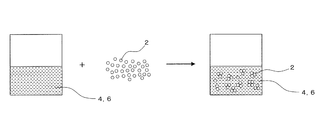
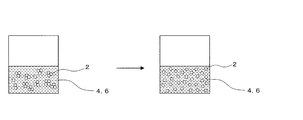
- It is a schematic diagram for demonstrating the manufacturing process of the coating composition of this invention.
- It is a schematic diagram for demonstrating the manufacturing process of the coating composition of this invention.
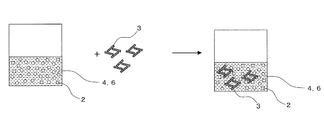
- It is a schematic diagram for demonstrating the manufacturing process of the coating composition of this invention.
- FIG. 1 is a schematic cross-sectional view of a coated article provided with a coating film according to Embodiment 1 of the present invention.
- FIG. 2 is a schematic top view of a coated article provided with the coating film according to Embodiment 1 of the present invention.
- FIG. 3 is a schematic perspective view of a coated article provided with the coating film according to Embodiment 1 of the present invention.
- a coating film 5 composed of hydrophobic fine particles 2, flat fine particles 3 and a binder resin 4 is provided on the upper surface of the substrate 1.
- the mass ratio of the hydrophobic fine particles 2 to the binder resin 4 (the mass of the hydrophobic fine particles 2 / the mass of the binder resin 4) is usually 0.5 or more, preferably 0.5 or more and 12 or less, more preferably. 2 or more and 8 or less. Due to the presence of the hydrophobic fine particles 2, minute irregularities are formed on the surface of the coating film 5.
- the water repellency of the coating film 5 can be increased by the minute uneven structure on the surface.
- the mass ratio of the hydrophobic fine particles 2 to the binder resin 4 is less than 0.5, a fine uneven structure is not formed on the entire surface of the coating film 5, and the coating film 5 having a desired water repellency cannot be obtained. This is not preferable.
- the flat fine particles 3 in the coating film 5 are characterized in that the table surface and the end surface of the flat fine particles 3 are in contact with each other to form a card house-like aggregated structure. Due to this card house-like aggregation structure, irregularities are formed on the surface of the coating film 5. Due to the surface irregularities, minute irregularities formed by the hydrophobic fine particles 2 are combined, and the ratio of the liquid-gas contact area at the interface between the liquid and the surface in the Cassie formula increases, so that the surface tension is higher than that of water. Super liquid repellency can be expressed even with a small liquid. On the other hand, when the flat fine particles 3 do not form a card house-like aggregated structure, the surface uneven structure as shown in FIG. This surface uneven structure is similar to the surface uneven structure formed when the flat fine particles 3 are not included (see FIG. 5).
- the mass ratio of the hydrophobic fine particles 2 to the flat fine particles 3 (the mass of the hydrophobic fine particles 2 / the mass of the flat fine particles 3) is 0.5 or more, preferably 0.5 or more and 5 or less, more preferably. Is 1 or more and 2 or less. Due to the presence of the hydrophobic fine particles 2, minute irregularities are formed on the surface of the flat fine particles 3. The fine concavo-convex structure on the surface can improve the oil repellency of the coating film 5 of the hydrophobic fine particles 2. If the mass ratio of the hydrophobic fine particles 2 to the flat fine particles 3 is less than 0.5, the surface of the flat fine particles 3 cannot be completely covered with the hydrophobic fine particles 2, and the coating film 5 has a desired oil repellency.
- the hydrophobic fine particles 2 when the mass ratio of the hydrophobic fine particles 2 to the flat fine particles 3 exceeds 5, the hydrophobic fine particles 2 not only cover the surface of the flat fine particles 3, but the uneven structure of the flat fine particles 3 is caused by the hydrophobic fine particles. Since it may be buried and desired oil repellency may not be imparted to the coating film 5, it is not preferable.
- the mass ratio of the flat fine particles 3 to the binder resin 4 (the mass of the flat fine particles 3 / the mass of the binder resin 4) is 0.25 or more, preferably 0.25 or more and 12 or less, more preferably 0. .5 or more and 8 or less. Due to the presence of the flat fine particles 3, irregularities are formed on the surface of the coating film 5. Due to the uneven structure on the surface, the water repellency of the coating film 5 can be increased. When the mass ratio of the flat fine particles 3 to the binder resin 4 is less than 0.25, the flat fine particles 3 cannot be dispersed throughout the coating film 5, and the coating film 5 having a desired water repellency is obtained. Since it may not be, it is not preferable.
- the mass ratio of the flat fine particles 3 to the binder resin 4 exceeds 12, the amount of the binder resin 4 is too small, so that the coating film 5 having a desired strength cannot be obtained. Since it may peel off, it is not preferable.
- the average particle diameter of the primary particles or secondary particles of the hydrophobic fine particles 2 is preferably 100 nm or less, more preferably 5 nm or more and 100 nm or less, and most preferably 10 nm or more and 50 nm or less. If the average particle size of the primary particles or secondary particles of the hydrophobic fine particles 2 exceeds 100 nm, the unevenness on the surface of the coating film 5 becomes too large, and the ratio of the liquid-gas contact area on the surface of the coating film 5 is not reduced. The coating film 5 having the desired water repellency may not be obtained, which is not preferable.
- the average particle size of the primary particles or secondary particles of the hydrophobic fine particles 2 is less than 5 nm, the hydrophobic fine particles 2 tend to aggregate, the fluidity of the coating composition is lowered, and the substrate 1 is coated. Since it may become difficult to apply
- the average particle size of primary particles or secondary particles of the hydrophobic fine particles 2 is a value measured by a dynamic light scattering method.
- the method for hydrophobizing the surface of the fine particle is not particularly limited as long as it can impart hydrophobicity to the surface of the fine particle, and is appropriately adopted.
- the surface contains fluorine or an alkyl group.
- the method for containing fluorine or an alkyl group on the surface of the fine particles include a method using an organometallic compound such as a silylating agent, a silane coupling agent, and alkylaluminum.
- the silylating agent is a compound in which an alkyl group, an allyl group, a fluoroalkyl group containing fluorine, or the like is bonded to a hydrolyzable silyl group having affinity or reactivity with an inorganic material.
- Examples of the hydrolyzable group bonded to silicon include an alkoxy group, a halogen, an acetoxy group, and the like. Usually, an alkoxy group such as a methoxy group and an ethoxy group, and chlorine are preferably used.
- a trimethylsilylating agent, alkylsilanes, arylsilanes, fluoroalkylsilanes and the like can be mentioned.
- the hydrophobic fine particles 2 are preferably silica having a hydrophobic surface.
- silica means not only those that exist strictly in the state of SiO 2 but also silicon oxide.
- examples of the silica having a hydrophobic surface include those obtained by hydrophobizing the surface of silica.
- the hydrophobic fine particles 2 may be made by hydrophobizing hydrophilic silica to make the surface hydrophobic.
- hydrophobic fine particles 2 used in the coating composition of the present invention the trade name “Aerosil 200” (manufactured by Nippon Aerosil Co., Ltd.), the trade name “Aerosil 300” (manufactured by Nippon Aerosil Co., Ltd.), the trade name “Aerosil 380” ( Nippon Aerosil Co., Ltd.), trade name "Aerosil 90G” (Nihon Aerosil Co., Ltd.), trade name "Aerosil OX50” (Nihon Aerosil Co., Ltd.), trade name “Aerosil R972” (Nihon Aerosil Co., Ltd.), product The name “Aerosil 972 ⁇ ” (manufactured by Nippon Aerosil Co., Ltd.), the product name “Aerosil R972CF” (manufactured by Nippon Aerosil Co., Ltd.), the product name “Aerosil R974” (manufactured
- the flat fine particles 3 are fine particles having a plate shape, a scale shape, a strip shape, a disc shape, or the like, and preferably have an aspect ratio of 10 or more between the table surface and the end surface of the fine particles.
- the aspect ratio of the flat fine particles 3 is less than 10, it approaches a shape such as a rod shape or a needle shape, and it becomes difficult to form a card house-like aggregated structure, so that the coating film 5 having a desired water repellency cannot be obtained. This is not preferable.
- the average particle diameter of the primary particles of the flat fine particles 3 is preferably 100 nm to 100 ⁇ m, more preferably 100 nm to 10 ⁇ m, and most preferably 200 nm to 3 ⁇ m.
- the particle diameter of the flat fine particles 3 is the length in the long side direction. If the average particle size of the primary particles of the flat fine particles 3 is less than 100 nm, the uneven structure necessary for improving the water repellency may not be obtained. In addition, when the average particle size of the primary particles of the flat fine particles 3 exceeds 100 ⁇ m, the interval between the flat fine particles 3 becomes too larger than the droplets, so that the coating film 5 having a desired water repellency cannot be obtained. This is not preferable.
- the average particle size of the primary particles of the flat fine particles 3 is a value measured by a dynamic light scattering method. Further, the average particle size of the aggregated state of the flat fine particles 3 is preferably 125 nm to 200 ⁇ m, more preferably 10 ⁇ m to 100 ⁇ m. When the average particle size of the aggregated state of the flat fine particles 3 is less than 125 nm, the difference from the fine uneven structure formed by the hydrophobic fine particles 2 is small, and therefore the effect of improving water repellency by combining the uneven structures is obtained. Since it may not be, it is not preferable.
- the flat fine particles 3 forming the card house structure include smectite, tobermorite, bentonite, kaolin, mica, boehmite, aluminum, alumina, silica, calcium silicate, calcium carbonate, silicate mineral, alumina, silica, calcium carbonate, and nitride.
- examples thereof include boron, graphene, titanium oxide, a hydroxide compound, a carbonate compound, a phosphate compound, a silicate compound, and a titanate compound.
- the binder resin 4 is not particularly limited as long as it is a solvent-soluble type, and those known in the technical field can be used.
- the binder resin 4 preferably used in the present invention include polyvinylidene fluoride (PVDF) and a fluoroolefin copolymer.
- PVDF polyvinylidene fluoride
- the monomer component that gives the fluoroolefin copolymer include chlorotrifluoroethylene, tetrafluoroethylene, and vinyl esters having various substituents.
- a polar organic solvent or a nonpolar organic solvent can be used.
- an organic solvent preferably used in the present invention a fluorine-based solvent, a chlorine-based solvent, an aromatic hydrocarbon-based solvent such as toluene or xylene, an aliphatic hydrocarbon-based solvent, an ester-based solvent such as ethyl acetate or butyl acetate, Examples thereof include ketone solvents such as methyl isobutyl ketone and acetone, and ether solvents.
- known additives such as a dispersant, a leveling agent, an evaporation inhibitor, and an adhesion improver may be added as long as the effects of the present invention are not impaired.
- the coating film 5 can be formed by applying and drying the coating composition described above on the substrate 1.
- a coating method of a coating composition A well-known method can be used in the said technical field.
- the coating method include spray coating and dip coating.
- the drying conditions may be appropriately adjusted according to the composition of the coating composition, and are not particularly limited.
- the substrate 1 on which the coating film 5 is formed is not particularly limited, and can be appropriately selected according to the type of product in which the water-repellent member is used.
- Examples of the substrate 1 include a metal substrate such as an aluminum substrate and a stainless steel substrate, a glass substrate, a plastic substrate, and the like.
- the coating composition of the present invention is a flat composition in which a solvent 6, a binder resin 4 and hydrophobic fine particles 2 are mixed and subjected to dispersion treatment to obtain a dispersion, and then a card house-like aggregate structure is formed in the dispersion. It is obtained by a production method including adding fine particles 3.
- FIG. 6 is a schematic diagram for explaining the state of a mixed liquid obtained by mixing the binder resin 4 dissolved in the solvent 6 and the hydrophobic fine particles 2. In this mixed liquid, most of the hydrophobic fine particles 2 are dispersed in the form of secondary particles.
- FIG. 7 is a schematic diagram for explaining the state of a dispersion obtained by subjecting the mixed liquid shown in FIG. 6 to a dispersion treatment.
- the hydrophobic fine particles 2 are uniformly dispersed in the form of primary particles.
- FIG. 8 is a schematic view for explaining the state of the coating composition obtained by adding the flat fine particles 3 having a card house-like aggregated structure to the dispersion shown in FIG.
- the cavitation action is a phenomenon in which a portion having a low local pressure in the liquid flowing at high speed is vaporized to generate bubbles.
- Cavitation can be caused, for example, by placing the hydrophobic fine particles 2 in an organic solvent and dispersing them by applying a pressure of about 10 MPa to 400 MPa using a high-pressure wet atomizer.
- the flat fine particles 3 having a card house-like aggregated structure in an organic solvent by a method that does not apply a strong shearing force.
- Such dispersion can be achieved, for example, by adding the flat fine particles 3 having a card house-like aggregated structure to an organic solvent and then dispersing them using a shaker or the like.
- a strong shearing force is applied, the card house-like aggregate structure is destroyed and the desired water repellency cannot be obtained.
- super oil repellency refers to a property in which a contact angle with respect to a droplet having a surface tension smaller than that of water is 150 ° or more.
- 2 ⁇ L of a wetting reagent was dropped onto the coating film in the atmosphere (about 25 ° C.), and the static contact angle of the water droplet was measured.
- the super oil repellency was evaluated based on the following evaluation criteria.
- ⁇ A contact angle with respect to a liquid having a surface tension of 48 mN / m or more is 150 degrees or more.
- X A contact angle with respect to a liquid having a surface tension of less than 48 mN / m is less than 150 degrees.
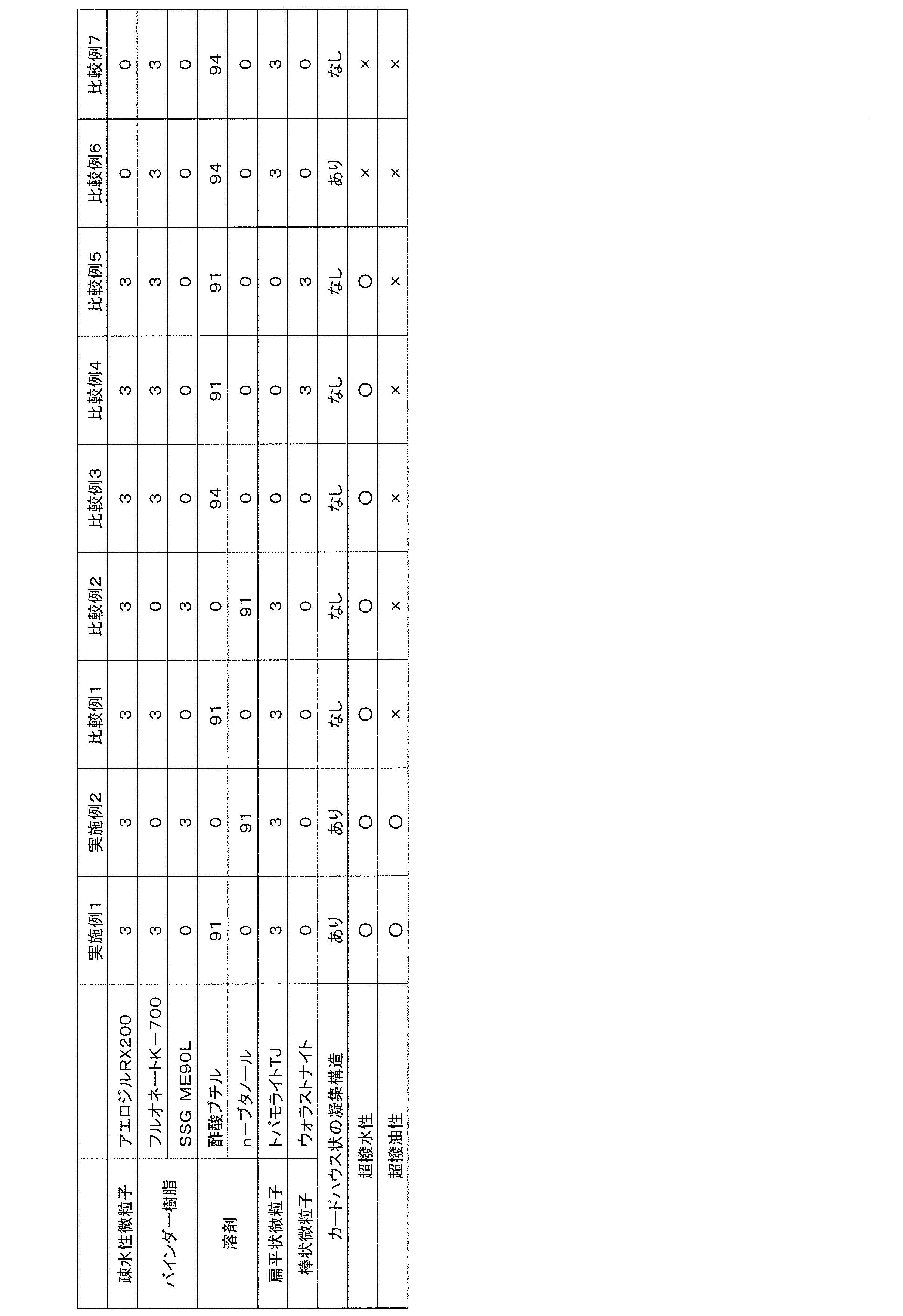
- Example 1 Hydrophobic silica with a hydrophobic surface and an average primary particle size of about 12 nm (trade name “Aerosil RX200”, manufactured by Nippon Aerosil Co., Ltd.) and a binder resin (trade name “Fluonate K-700”, large (Nippon Ink Co., Ltd.) 3.0 parts by weight is added to 91.0 parts by weight of butyl acetate, and after mixing and dispersing using a wet atomizer, the average primary particle size is 1 ⁇ m, 3.0 parts by mass of flat fine particles (trade name “Tobermorite TJ”, manufactured by Nippon Insulation Co., Ltd.) having an average particle size of 17 ⁇ m were added and shaken to obtain a coating composition. The obtained coating composition was applied to a glass plate and dried to prepare an evaluation member provided with a coating film.
- a binder resin trade name “Fluonate K-700”, large (Nippon Ink Co., Ltd.
- Example 2 Hydrophobic silica with a hydrophobic surface and an average primary particle size of about 12 nm (trade name “Aerosil RX200”, manufactured by Nippon Aerosil Co., Ltd.) 3.0 parts by mass and binder resin (trade name “SSG ME90L”, Nitto Bo Medical Co.
- Example 1 A coating composition was prepared in the same manner as in Example 1 except that the dispersion treatment was performed using a wet atomizer instead of shaking and stirring. In the coating composition, the card house-like aggregated structure of flat fine particles was destroyed by the dispersion treatment. A member for evaluation was produced in the same manner as in Example 1 using the obtained coating composition.
- Example 2 A coating composition was prepared in the same manner as in Example 2 except that the dispersion treatment was performed using a wet atomizer instead of shaking and stirring. In the coating composition, the card house-like aggregated structure of flat fine particles was destroyed by the dispersion treatment. A member for evaluation was produced in the same manner as in Example 1 using the obtained coating composition.
- Hydrophobic silica having a hydrophobic surface and an average primary particle size of about 12 nm (trade name “Aerosil RX200”, 3.0 parts by mass (made by Nippon Aerosil Co., Ltd.) and a binder resin (trade name “Fluonate K-700”), 3.0 parts by mass of Dainippon Ink Co., Ltd.) was added to 94.0 parts by mass of butyl acetate and mixed and dispersed using a wet atomizer to obtain a coating composition.
- a member for evaluation was produced in the same manner as in Example 1 using the product.
- Comparative Example 5 A coating composition was prepared in the same manner as in Comparative Example 4 except that the dispersion treatment was performed using a wet atomizer instead of shaking and stirring, and an evaluation member was prepared.
- [Comparative Example 6] 3.0 parts by mass of flat fine particles (trade name “Tobermorite TJ”, manufactured by Nippon Insulation Co., Ltd.) having an average primary particle size of 1 ⁇ m and an aggregated average particle size of 17 ⁇ m, and a binder resin (trade name “Fluonate K-700”) “Dainippon Ink Co., Ltd.) 3.0 parts by mass was added to 94.0 parts by mass of butyl acetate, and the mixture was shaken and stirred to obtain a coating composition. A member for evaluation was produced in the same manner as in Example 1 using the obtained coating composition.
- Comparative Example 7 A coating composition was prepared in the same manner as in Comparative Example 6 except that the dispersion treatment was performed using a wet atomizer instead of shaking and stirring. In the coating composition, the card house-like aggregated structure of flat fine particles was destroyed by the dispersion treatment. A member for evaluation was produced in the same manner as in Example 1 using the obtained coating composition.
- Table 1 shows the evaluation results of Examples 1-2 and Comparative Examples 1-7.
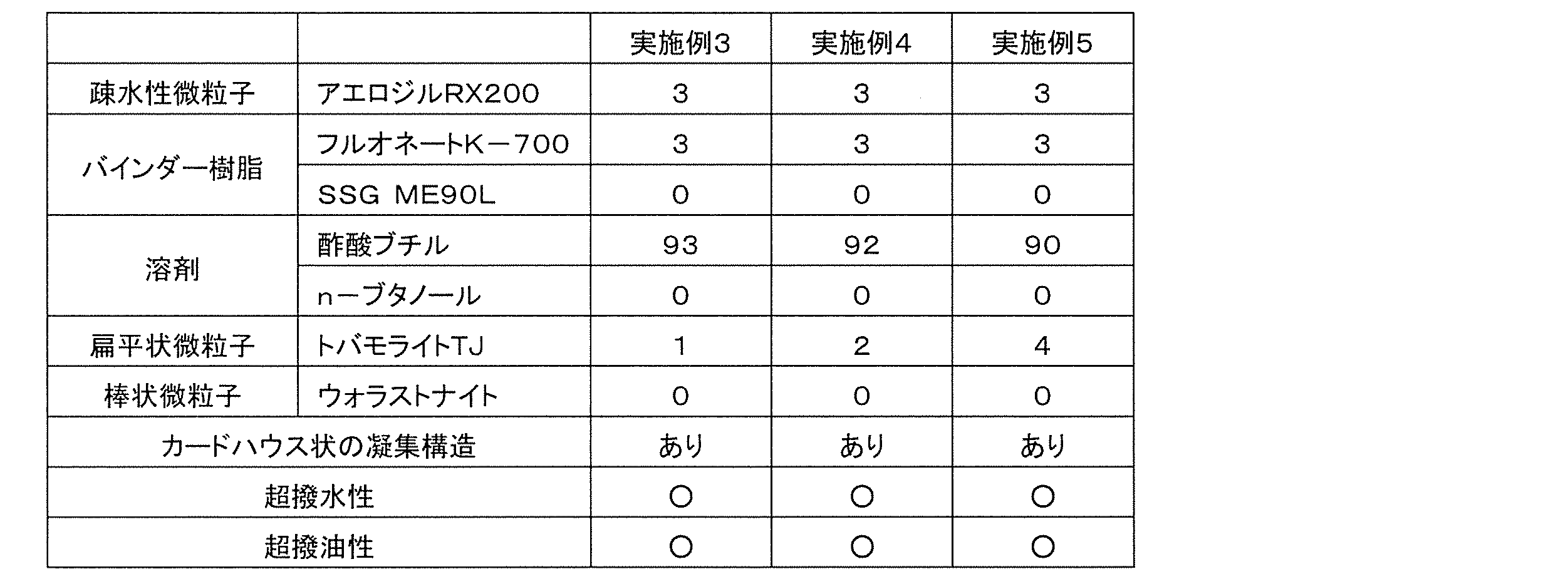
- Examples 3 to 5 Except for changing the blending amount of flat fine particles (trade name “Tobermorite TJ”, manufactured by Nippon Insulation Co., Ltd.) having an average primary particle size of 1 ⁇ m and an average particle size of 17 ⁇ m in an aggregated state as shown in Table 2.
- a coating composition was prepared in the same manner as in Example 1 to prepare an evaluation member. The evaluation results are shown in Table 2.
- the number of cracks per square centimeter that can be observed from optical microscope images was evaluated on the surfaces of the evaluation members obtained in Examples 1 and 6 and Comparative Examples 3 and 4. The results are shown in Table 3.
- the number of occurrences of cracks is the total number of branch chains of cracks.
- the concavo-convex structure is compounded and has both super water repellency and super oil repellency at the same time.
- a coating composition capable of forming a coating film can be provided.
Landscapes
- Chemical & Material Sciences (AREA)
- Organic Chemistry (AREA)
- Life Sciences & Earth Sciences (AREA)
- Engineering & Computer Science (AREA)
- Materials Engineering (AREA)
- Wood Science & Technology (AREA)
- Medicinal Chemistry (AREA)
- Health & Medical Sciences (AREA)
- Chemical Kinetics & Catalysis (AREA)
- Polymers & Plastics (AREA)
- Crystallography & Structural Chemistry (AREA)
- Inorganic Chemistry (AREA)
- Paints Or Removers (AREA)
- Application Of Or Painting With Fluid Materials (AREA)
Abstract
Description
また、特許文献2には、アルコール、アルコキシシラン、パーフルオロアルキルシラン、シリカ微粒子、アルコキシシランの加水分解反応を促進する触媒及び水を含むコーティング組成物をコーティングすることで得られる表面の二乗平均粗さ(RMS)値が100nm以上であるコーティング膜が開示されており、このコーティング膜は、水に対して150度以上の接触角及び油に対して130度以上の接触角を示すことが記載されている。
また、特許文献2では、加水分解反応を利用しているため、コーティング液の調製に時間がかかること、コーティング回数が少ない場合には十分な接触角が得られないため、工程数が多くなるという問題があった。
更に、特許文献1及び2のコーティング膜では、乾燥時にクラックが発生しやすいという問題があった。
本発明は、上記問題点を解決すべくなされたものであり、煩雑な作業を必要とせずに、高い撥水性及び撥油性を付与でき且つクラックの少ないコーティング膜を形成することのできるコーティング組成物を提供することを目的とする。
図1は、本発明の実施の形態1に係るコーティング膜を備えたコーティング物品の模式断面図である。図2は、本発明の実施の形態1に係るコーティング膜を備えたコーティング物品の模式上面図である。図3は、本発明の実施の形態1に係るコーティング膜を備えたコーティング物品の模式斜視図である。これらの図では、基材1の上面に、疎水性微粒子2、扁平状微粒子3及びバインダー樹脂4からなるコーティング膜5が設けられている。
また、扁平状微粒子3の凝集状態の平均粒径が、好ましくは125nm以上200μm以下、より好ましくは10μm以上100μm以下である。扁平状微粒子3の凝集状態の平均粒径が125nm未満であると、疎水性微粒子2によって形成される微細凹凸構造との差が小さくなるために凹凸構造の組み合わせによる撥水性の向上効果が得られない場合があるので好ましくない。また、扁平状微粒子3の凝集状態の平均粒径が200μmを超えると、バインダー樹脂4との密着性が低下し、外部からの刺激によって、コーティング膜5の表面形状が変化してしまい、撥水性が損なわれる場合があるので好ましくない。
超撥水性の評価のために、以下のようにして初期水滴接触角の測定を行った。ここでの「超撥水性」とは、水に対する接触角が150度以上を示す性質のことである。
協和界面科学製のDM301型接触角計を用い、大気中(約25℃)で2μLの水滴をコーティング膜に滴下して、水滴の静的接触角を測定した。超撥水性の評価は、下記評価基準に基づいて評価を行った。
○:超撥水性の基準となる水に対する接触角が150度以上を示すもの
×:超撥水性の基準となる水に対する接触角が150度未満を示すもの
超撥油性の評価のために、以下のようにして初期水滴接触角の測定を行った。ここでの、「超撥油性」とは、水よりも表面張力の小さな液滴に対する接触角が150度以上を示す性質のことである。
協和界面科学製のDM301型接触角計を用い、大気中(約25℃)で2μLのぬれ試薬をコーティング膜に滴下して、水滴の静的接触角を測定した。超撥油性の評価は、下記評価基準に基づいて評価を行った。
○:表面張力が48mN/m以上の液体に対する接触角が150度以上を示すもの
×:48mN/m未満の液体に対する接触角が150度未満を示すもの
表面が疎水性で、平均一次粒子径が約12nmの疎水性シリカ(商品名「アエロジルRX200」、日本アエロジル株式会社製)3.0質量部及びバインダー樹脂(商品名「フルオネートK-700」、大日本インキ社製)3.0質量部を、酢酸ブチル91.0質量部に添加し、湿式微粒化装置を用いて混合及び分散処理を行った後、平均一次粒子径が1μmで、凝集状態の平均粒子径が17μmの扁平状微粒子(商品名「トバモライトTJ」、日本インシュレーション社製)3.0質量部を添加し、振盪撹拌して、コーティング組成物を得た。得られたコーティング組成物を、ガラス板上に塗布・乾燥してコーティング膜を備えた評価用部材を作製した。
表面が疎水性で、平均一次粒子径が約12nmの疎水性シリカ(商品名「アエロジルRX200」、日本アエロジル株式会社製)3.0質量部及びバインダー樹脂(商品名「SSG ME90L」、ニットーボーメディカル社製)3.0質量部を、ブタノール91.0質量部に添加し、湿式微粒化装置を用いて混合及び分散処理を行った後、平均一次粒子径が1μmで、凝集状態の平均粒子径が17μmの扁平状微粒子(商品名「トバモライトTJ」、日本インシュレーション社製)3.0質量部を添加し、振盪撹拌して、コーティング組成物を得た。得られたコーティング組成物を用いて実施例1と同様に評価用部材を作製した。
振盪撹拌の代わりに湿式微粒化装置を用いて分散処理を行った以外は実施例1と同様にしてコーティング組成物を調製した。なお、コーティング組成物では、分散処理により扁平状微粒子のカードハウス状の凝集構造が破壊されていた。得られたコーティング組成物を用いて実施例1と同様に評価用部材を作製した。
振盪撹拌の代わりに湿式微粒化装置を用いて分散処理を行った以外は実施例2と同様にしてコーティング組成物を調製した。なお、コーティング組成物では、分散処理により扁平状微粒子のカードハウス状の凝集構造が破壊されていた。得られたコーティング組成物を用いて実施例1と同様に評価用部材を作製した。
表面が疎水性で、平均一次粒子径が約12nmの疎水性シリカ(商品名「アエロジルRX200」、(日本アエロジル株式会社製)3.0質量部及びバインダー樹脂(商品名「フルオネートK-700」、大日本インキ社製)3.0質量部を、酢酸ブチル94.0質量部に添加し、湿式微粒化装置を用いて混合及び分散処理を行い、コーティング組成物を得た。得られたコーティング組成物を用いて実施例1と同様に評価用部材を作製した。
表面が疎水性で、平均一次粒子径が約12nmの疎水性シリカ(商品名「アエロジルRX200」、日本アエロジル株式会社製)3.0質量部及びバインダー樹脂(商品名「フルオネートK-700」、大日本インキ社製)3.0質量部を、酢酸ブチル91.0質量部に添加し、湿式微粒化装置を用いて混合及び分散処理を行った後、棒状微粒子(商品名「ウォラストナイト」、原田産業社製)3.0質量部を添加し、振盪撹拌して、コーティング組成物を得た。得られたコーティング組成物を用いて実施例1と同様に評価用部材を作製した。
振盪撹拌の代わりに湿式微粒化装置を用いて分散処理を行った以外は比較例4と同様にしてコーティング組成物を調製し、評価用部材を作製した。
平均一次粒子径が1μmで、凝集状態の平均粒子径が17μmの扁平状微粒子(商品名「トバモライトTJ」、日本インシュレーション社製)3.0質量部及びバインダー樹脂(商品名「フルオネートK-700」、大日本インキ社製)3.0質量部を、酢酸ブチル94.0質量部に添加し、振盪撹拌して、コーティング組成物を得た。得られたコーティング組成物を用いて実施例1と同様に評価用部材を作製した。
振盪撹拌の代わりに湿式微粒化装置を用いて分散処理を行った以外は比較例6と同様にしてコーティング組成物を調製した。なお、コーティング組成物では、分散処理により扁平状微粒子のカードハウス状の凝集構造が破壊されていた。得られたコーティング組成物を用いて実施例1と同様に評価用部材を作製した。
平均一次粒子径が1μmで、凝集状態の平均粒子径が17μmの扁平状微粒子(商品名「トバモライトTJ」、日本インシュレーション社製)の配合量を表2に示すように変化させた以外は実施例1と同様にしてコーティング組成物を調製し、評価用部材を作製した。その評価結果を表2に示す。

Claims (10)
- 溶剤に溶解したバインダー樹脂中に、疎水性微粒子と、カードハウス状の凝集構造を形成した扁平状微粒子とが分散されていることを特徴とするコーティング組成物。
- 前記扁平状微粒子の卓面と端面とのアスペクト比が10以上であることを特徴とする請求項1に記載のコーティング組成物。
- 前記扁平状微粒子の平均一次粒子径が、100nm以上100μm以下であることを特徴とする請求項1又は2に記載のコーティング組成物。
- 前記疎水性微粒子が、100nm以下の平均一次粒子径を有する疎水性シリカであることを特徴とする請求項1~3のいずれか一項に記載のコーティング組成物。
- 前記扁平状微粒子の凝集状態の平均粒子径が125nm以上200μm以下であることを特徴とする請求項1~4のいずれか一項に記載のコーティング組成物。
- 前記バインダー樹脂に対する前記疎水性微粒子の質量比が、0.5以上12以下であることを特徴とする請求項1~5のいずれか一項に記載のコーティング組成物。
- 前記扁平状微粒子に対する前記疎水性微粒子の質量比は、0.5以上5以下であることを特徴とする請求項1~6のいずれか一項に記載のコーティング組成物。
- 前記バインダー樹脂に対する前記扁平状微粒子の質量比が、0.25以上12以下であることを特徴とする請求項1~7のいずれか一項に記載のコーティング組成物。
- 溶剤、バインダー樹脂及び疎水性微粒子を混合し、分散処理を施して分散液を得ることと、
該分散液に、カードハウス状の凝集構造を形成した扁平状微粒子を添加することと
を含むことを特徴とするコーティング組成物の製造方法。 - 請求項1~8のいずれか一項に記載のコーティング組成物を塗布・乾燥して得られるコーティング膜を備えたことを特徴とするコーティング物品。
Priority Applications (5)
| Application Number | Priority Date | Filing Date | Title |
|---|---|---|---|
| CA2895091A CA2895091C (en) | 2013-01-07 | 2013-12-02 | Coating composition, method for producing same, and coated article |
| EP13870048.9A EP2942380B1 (en) | 2013-01-07 | 2013-12-02 | Coating composition, method for producing same, and coated article |
| JP2014555444A JP5940174B2 (ja) | 2013-01-07 | 2013-12-02 | コーティング組成物、その製造方法及びコーティング物品 |
| CN201380069647.3A CN104903415B (zh) | 2013-01-07 | 2013-12-02 | 涂覆组合物、其制造方法及涂覆物品 |
| US14/652,931 US9528020B2 (en) | 2013-01-07 | 2013-12-02 | Coating composition, method for producing same, and coated article |
Applications Claiming Priority (2)
| Application Number | Priority Date | Filing Date | Title |
|---|---|---|---|
| JP2013000654 | 2013-01-07 | ||
| JP2013-000654 | 2013-01-07 |
Publications (1)
| Publication Number | Publication Date |
|---|---|
| WO2014106922A1 true WO2014106922A1 (ja) | 2014-07-10 |
Family
ID=51062244
Family Applications (1)
| Application Number | Title | Priority Date | Filing Date |
|---|---|---|---|
| PCT/JP2013/082358 Ceased WO2014106922A1 (ja) | 2013-01-07 | 2013-12-02 | コーティング組成物、その製造方法及びコーティング物品 |
Country Status (6)
| Country | Link |
|---|---|
| US (1) | US9528020B2 (ja) |
| EP (1) | EP2942380B1 (ja) |
| JP (1) | JP5940174B2 (ja) |
| CN (1) | CN104903415B (ja) |
| CA (1) | CA2895091C (ja) |
| WO (1) | WO2014106922A1 (ja) |
Cited By (11)
| Publication number | Priority date | Publication date | Assignee | Title |
|---|---|---|---|---|
| WO2016125409A1 (ja) * | 2015-02-05 | 2016-08-11 | 三菱電機株式会社 | コーティング材、その製造方法、および、表面構造 |
| EP3076381A3 (de) * | 2015-03-30 | 2016-11-09 | Fritz Lange GmbH | Hinweisschild mit antiklebefolie sowie verfahren zu dessen herstellung |
| EP3075790A3 (de) * | 2015-03-30 | 2016-11-09 | Fritz Lange GmbH | Schutzlackierung mit antiaufklebereffekt sowie verfahren zum aufbringen einer schutzlackierung |
| WO2016181676A1 (ja) * | 2015-05-14 | 2016-11-17 | 三菱電機株式会社 | コーティング組成物、その製造方法、コーティング膜、換気扇及び空気調和機 |
| JP2017061080A (ja) * | 2015-09-25 | 2017-03-30 | Jx金属株式会社 | 表面処理金属箔、積層体、プリント配線板、半導体パッケージ、電子機器及びプリント配線板の製造方法 |
| JP2017132055A (ja) * | 2016-01-25 | 2017-08-03 | フタムラ化学株式会社 | 撥水構造体及びその製造方法 |
| TWI710625B (zh) * | 2018-06-18 | 2020-11-21 | 美商慧盛材料美國責任有限公司 | 鎢化學機械研磨組合物 |
| JP2021059487A (ja) * | 2019-10-09 | 2021-04-15 | Dic株式会社 | 防蝕剤、防蝕塗料、積層体、積層体の製造方法、及び基材の防蝕方法 |
| JPWO2019244752A1 (ja) * | 2018-06-20 | 2021-07-08 | 凸版印刷株式会社 | 撥液性構造体及びその製造方法並びに包装材及び剥離シート |
| JPWO2021182044A1 (ja) * | 2020-03-12 | 2021-09-16 | ||
| JPWO2021182043A1 (ja) * | 2020-03-12 | 2021-09-16 |
Families Citing this family (4)
| Publication number | Priority date | Publication date | Assignee | Title |
|---|---|---|---|---|
| WO2014145530A1 (en) | 2013-03-15 | 2014-09-18 | Matthew Hale | Aspiration-free well plate apparatus and methods |
| JP2018092836A (ja) * | 2016-12-06 | 2018-06-14 | 矢崎総業株式会社 | 端子付き電線、端子付き電線の製造方法、及び、ワイヤハーネス |
| CN110691822B (zh) * | 2017-06-02 | 2021-06-15 | 三菱电机株式会社 | 涂料膜、涂料组合物及具有该涂料膜的物品 |
| JP7358968B2 (ja) * | 2019-12-19 | 2023-10-11 | 凸版印刷株式会社 | 撥液性構造体及びその製造方法並びに包装材及び剥離シート |
Citations (8)
| Publication number | Priority date | Publication date | Assignee | Title |
|---|---|---|---|---|
| JP2002121489A (ja) * | 2000-10-13 | 2002-04-23 | Dynic Corp | 撥水性塗料及び撥水性フィルム |
| WO2008120695A1 (ja) * | 2007-03-30 | 2008-10-09 | Kazufumi Ogawa | 撥水撥油防汚性反射板およびその製造方法ならびにそれを用いたトンネル、道路標識、表示板、乗り物および建物 |
| WO2008143064A1 (ja) * | 2007-05-14 | 2008-11-27 | Kazufumi Ogawa | 撥水撥油防汚性表面を有する部材とその撥水撥油防汚性表面の製造方法 |
| JP2009138033A (ja) * | 2007-12-03 | 2009-06-25 | Car Mate Mfg Co Ltd | 車両用ホイールコーティング組成物及びホイール |
| JP2010089373A (ja) | 2008-10-08 | 2010-04-22 | Snt Co | 撥水・撥油性コーティング物品およびその製造 |
| JP2010155727A (ja) | 2008-12-26 | 2010-07-15 | Car Mate Mfg Co Ltd | コーティング膜形成方法およびコーティング液 |
| JP2011140625A (ja) * | 2009-12-10 | 2011-07-21 | Snt Co | 撥油性コーティング物品およびその製造方法 |
| JP2013000654A (ja) | 2011-06-16 | 2013-01-07 | Sefutekku:Kk | フィルタ固定機構 |
Family Cites Families (9)
| Publication number | Priority date | Publication date | Assignee | Title |
|---|---|---|---|---|
| AU633316B2 (en) | 1989-04-28 | 1993-01-28 | Asahi Glass Company Limited | Water and oil repellant composition |
| DE3922178A1 (de) | 1989-07-06 | 1991-01-17 | Merck Patent Gmbh | Plaettchenfoermige substrate |
| DE4120921A1 (de) | 1991-06-25 | 1993-01-07 | Merck Patent Gmbh | Oberflaechenmodifizierte plaettchenfoermige substrate mit verbessertem absetz- und aufruehrverhalten |
| EP0905204B1 (de) | 1997-09-26 | 2002-11-20 | MERCK PATENT GmbH | Oberflächenmodifizierte plättchenförmige Substrate |
| TW587096B (en) | 2000-08-11 | 2004-05-11 | Nihon Parkerizing | Greases component containing in aqueous composition for forming protective membranes |
| DE10134477A1 (de) * | 2001-07-16 | 2003-02-06 | Creavis Tech & Innovation Gmbh | Selbstreinigende Oberflächen durch hydrophobe Strukturen und Verfahren zu deren Herstellung |
| JP2006143866A (ja) | 2004-11-19 | 2006-06-08 | Kansai Paint Co Ltd | 撥水剤、その撥水剤を用いた撥水性被膜形成方法及びその撥水性被膜形成物 |
| US20100004373A1 (en) * | 2008-07-02 | 2010-01-07 | Jingxu Zhu | Compositions and processes for producing durable hydrophobic and/or olephobic surfaces |
| CN101823722A (zh) | 2010-05-10 | 2010-09-08 | 内蒙古大学 | 一种由钙基膨润土制备膨润土无机凝胶的方法 |
-
2013
- 2013-12-02 WO PCT/JP2013/082358 patent/WO2014106922A1/ja not_active Ceased
- 2013-12-02 EP EP13870048.9A patent/EP2942380B1/en active Active
- 2013-12-02 CA CA2895091A patent/CA2895091C/en active Active
- 2013-12-02 CN CN201380069647.3A patent/CN104903415B/zh active Active
- 2013-12-02 US US14/652,931 patent/US9528020B2/en active Active
- 2013-12-02 JP JP2014555444A patent/JP5940174B2/ja active Active
Patent Citations (8)
| Publication number | Priority date | Publication date | Assignee | Title |
|---|---|---|---|---|
| JP2002121489A (ja) * | 2000-10-13 | 2002-04-23 | Dynic Corp | 撥水性塗料及び撥水性フィルム |
| WO2008120695A1 (ja) * | 2007-03-30 | 2008-10-09 | Kazufumi Ogawa | 撥水撥油防汚性反射板およびその製造方法ならびにそれを用いたトンネル、道路標識、表示板、乗り物および建物 |
| WO2008143064A1 (ja) * | 2007-05-14 | 2008-11-27 | Kazufumi Ogawa | 撥水撥油防汚性表面を有する部材とその撥水撥油防汚性表面の製造方法 |
| JP2009138033A (ja) * | 2007-12-03 | 2009-06-25 | Car Mate Mfg Co Ltd | 車両用ホイールコーティング組成物及びホイール |
| JP2010089373A (ja) | 2008-10-08 | 2010-04-22 | Snt Co | 撥水・撥油性コーティング物品およびその製造 |
| JP2010155727A (ja) | 2008-12-26 | 2010-07-15 | Car Mate Mfg Co Ltd | コーティング膜形成方法およびコーティング液 |
| JP2011140625A (ja) * | 2009-12-10 | 2011-07-21 | Snt Co | 撥油性コーティング物品およびその製造方法 |
| JP2013000654A (ja) | 2011-06-16 | 2013-01-07 | Sefutekku:Kk | フィルタ固定機構 |
Non-Patent Citations (1)
| Title |
|---|
| See also references of EP2942380A4 |
Cited By (21)
| Publication number | Priority date | Publication date | Assignee | Title |
|---|---|---|---|---|
| JPWO2016125409A1 (ja) * | 2015-02-05 | 2017-07-20 | 三菱電機株式会社 | コーティング材、その製造方法、および、表面構造 |
| WO2016125409A1 (ja) * | 2015-02-05 | 2016-08-11 | 三菱電機株式会社 | コーティング材、その製造方法、および、表面構造 |
| EP3076381A3 (de) * | 2015-03-30 | 2016-11-09 | Fritz Lange GmbH | Hinweisschild mit antiklebefolie sowie verfahren zu dessen herstellung |
| EP3075790A3 (de) * | 2015-03-30 | 2016-11-09 | Fritz Lange GmbH | Schutzlackierung mit antiaufklebereffekt sowie verfahren zum aufbringen einer schutzlackierung |
| EP3369786A1 (de) * | 2015-03-30 | 2018-09-05 | Fritz Lange GmbH | Schutzlackierung mit antiaufklebereffekt sowie verfahren zum aufbringen einer schutzlackierung |
| US10793748B2 (en) | 2015-05-14 | 2020-10-06 | Mitsubishi Electric Corporation | Coating composition, method for producing same, coating film, exhaust fan and air conditioner |
| JPWO2016181676A1 (ja) * | 2015-05-14 | 2017-09-28 | 三菱電機株式会社 | コーティング組成物、その製造方法、コーティング膜、換気扇及び空気調和機 |
| CN107614637A (zh) * | 2015-05-14 | 2018-01-19 | 三菱电机株式会社 | 涂覆组合物、涂覆组合物的制造方法、涂覆膜、换气扇及空气调节机 |
| WO2016181676A1 (ja) * | 2015-05-14 | 2016-11-17 | 三菱電機株式会社 | コーティング組成物、その製造方法、コーティング膜、換気扇及び空気調和機 |
| JP2017061080A (ja) * | 2015-09-25 | 2017-03-30 | Jx金属株式会社 | 表面処理金属箔、積層体、プリント配線板、半導体パッケージ、電子機器及びプリント配線板の製造方法 |
| JP2017132055A (ja) * | 2016-01-25 | 2017-08-03 | フタムラ化学株式会社 | 撥水構造体及びその製造方法 |
| TWI710625B (zh) * | 2018-06-18 | 2020-11-21 | 美商慧盛材料美國責任有限公司 | 鎢化學機械研磨組合物 |
| JP7388351B2 (ja) | 2018-06-20 | 2023-11-29 | Toppanホールディングス株式会社 | 撥液性構造体及びその製造方法並びに包装材及び剥離シート |
| JPWO2019244752A1 (ja) * | 2018-06-20 | 2021-07-08 | 凸版印刷株式会社 | 撥液性構造体及びその製造方法並びに包装材及び剥離シート |
| US11969977B2 (en) | 2018-06-20 | 2024-04-30 | Toppan Printing Co., Ltd. | Liquid-repellent structure, production method thereof, wrapping material, and separation sheet |
| JP2021059487A (ja) * | 2019-10-09 | 2021-04-15 | Dic株式会社 | 防蝕剤、防蝕塗料、積層体、積層体の製造方法、及び基材の防蝕方法 |
| JP7565738B2 (ja) | 2019-10-09 | 2024-10-11 | Dic株式会社 | 防蝕剤、防蝕塗料、積層体、積層体の製造方法、及び基材の防蝕方法 |
| JPWO2021182043A1 (ja) * | 2020-03-12 | 2021-09-16 | ||
| JPWO2021182044A1 (ja) * | 2020-03-12 | 2021-09-16 | ||
| JP7746983B2 (ja) | 2020-03-12 | 2025-10-01 | Toppanホールディングス株式会社 | 撥液性構造体、撥液性構造体の製造方法、及び包装材 |
| JP7746982B2 (ja) | 2020-03-12 | 2025-10-01 | Toppanホールディングス株式会社 | 撥液性構造体、撥液性構造体の製造方法、及び包装材 |
Also Published As
| Publication number | Publication date |
|---|---|
| US20150337156A1 (en) | 2015-11-26 |
| JPWO2014106922A1 (ja) | 2017-01-19 |
| CN104903415A (zh) | 2015-09-09 |
| EP2942380A1 (en) | 2015-11-11 |
| EP2942380A4 (en) | 2016-08-31 |
| CA2895091A1 (en) | 2014-07-10 |
| JP5940174B2 (ja) | 2016-06-29 |
| CN104903415B (zh) | 2017-02-15 |
| CA2895091C (en) | 2017-07-04 |
| US9528020B2 (en) | 2016-12-27 |
| EP2942380B1 (en) | 2018-01-31 |
Similar Documents
| Publication | Publication Date | Title |
|---|---|---|
| JP5940174B2 (ja) | コーティング組成物、その製造方法及びコーティング物品 | |
| JP5680900B2 (ja) | 撥油性コーティング物品およびその製造方法 | |
| JP5677144B2 (ja) | 撥水性部材及びその製造方法、並びに空調機室外機 | |
| CN106085070B (zh) | 一种低表面能微纳米涂层材料及其制备方法 | |
| EP3134466B1 (en) | Fluid control films with hydrophilic surfaces, methods of making same, and processes for cleaning structured surfaces | |
| JP5114355B2 (ja) | 撥水・撥油性コーティング物品およびその製造 | |
| CN100537674C (zh) | 微结构材料的制作方法与该方法所制得的涂料 | |
| JP5771795B2 (ja) | 消泡剤 | |
| JP2009029690A (ja) | 超疎水性のセルフクリーニング粉体ならびにその製造方法 | |
| WO2018150455A1 (ja) | 撥水性被膜及びそれが形成された製品 | |
| CN106905807A (zh) | 透明疏水疏油功能涂料及其形成的透明疏水疏油功能涂层 | |
| WO2010106581A1 (ja) | コーティング組成物およびそのコーティング方法 | |
| US20170121442A1 (en) | Method for Obtaining a Hybrid Latex and Use Thereof in Hydrophobic and Superhydrophobic Coatings | |
| TWI752094B (zh) | 塗覆劑組成物 | |
| CN103408990A (zh) | 一种纳米微粒超疏水自洁墙面漆及其制备方法 | |
| JP2010235930A (ja) | 水中油型シリコーンエマルジョン組成物 | |
| JP4854599B2 (ja) | コーティング方法及び物品 | |
| Yang et al. | Preparation and performance study of superhydrophobic layer based on fluffy ZnO rods/PDMS | |
| TW201934488A (zh) | 疏水性微粒子及撥水劑組合物 | |
| CN113543964B (zh) | 层叠膜 | |
| JP6794151B2 (ja) | コーティング膜、コーティング膜の製造方法、及びコーティング組成物 | |
| TW201837121A (zh) | 組成物及包含其的膜、撥水膜與物品 | |
| JP5579034B2 (ja) | 防汚性部材の製造方法 | |
| JP2022118409A (ja) | 中空粒子、断熱塗料及び断熱塗膜 | |
| JP7855094B2 (ja) | 抗ウイルス性コーティング膜、抗ウイルス性コーティング膜の製造方法及びコーティング物品 |
Legal Events
| Date | Code | Title | Description |
|---|---|---|---|
| 121 | Ep: the epo has been informed by wipo that ep was designated in this application |
Ref document number: 13870048 Country of ref document: EP Kind code of ref document: A1 |
|
| ENP | Entry into the national phase |
Ref document number: 2014555444 Country of ref document: JP Kind code of ref document: A |
|
| ENP | Entry into the national phase |
Ref document number: 2895091 Country of ref document: CA |
|
| WWE | Wipo information: entry into national phase |
Ref document number: 14652931 Country of ref document: US |
|
| NENP | Non-entry into the national phase |
Ref country code: DE |
|
| WWE | Wipo information: entry into national phase |
Ref document number: 2013870048 Country of ref document: EP |