WO2014107803A1 - Gem-difluorinated c-glycoside compounds as anti-cancer agents - Google Patents

Gem-difluorinated c-glycoside compounds as anti-cancer agents Download PDF

Info

Publication number
WO2014107803A1
WO2014107803A1 PCT/CA2014/000029 CA2014000029W WO2014107803A1 WO 2014107803 A1 WO2014107803 A1 WO 2014107803A1 CA 2014000029 W CA2014000029 W CA 2014000029W WO 2014107803 A1 WO2014107803 A1 WO 2014107803A1
Authority
WO
WIPO (PCT)
Prior art keywords
cancer
group
compound
formula
hydrogen atom
Prior art date
Legal status (The legal status is an assumption and is not a legal conclusion. Google has not performed a legal analysis and makes no representation as to the accuracy of the status listed.)
Ceased
Application number
PCT/CA2014/000029
Other languages
French (fr)
Inventor
Steve N. Slilaty
Current Assignee (The listed assignees may be inaccurate. Google has not performed a legal analysis and makes no representation or warranty as to the accuracy of the list.)
Advanomics Corp
Original Assignee
Advanomics Corp
Priority date (The priority date is an assumption and is not a legal conclusion. Google has not performed a legal analysis and makes no representation as to the accuracy of the date listed.)
Filing date
Publication date
Application filed by Advanomics Corp filed Critical Advanomics Corp
Priority to CN201480015506.8A priority Critical patent/CN105246899A/en
Priority to US14/760,021 priority patent/US10272065B2/en
Priority to EP14738145.3A priority patent/EP2943497A4/en
Priority to EP18204825.6A priority patent/EP3530663B1/en
Priority to CA2897768A priority patent/CA2897768C/en
Priority to KR1020157022179A priority patent/KR20150108391A/en
Priority to JP2015551941A priority patent/JP2016504394A/en
Publication of WO2014107803A1 publication Critical patent/WO2014107803A1/en
Anticipated expiration legal-status Critical
Ceased legal-status Critical Current

Links

Classifications

    • AHUMAN NECESSITIES
    • A61MEDICAL OR VETERINARY SCIENCE; HYGIENE
    • A61KPREPARATIONS FOR MEDICAL, DENTAL OR TOILETRY PURPOSES
    • A61K31/00Medicinal preparations containing organic active ingredients
    • A61K31/33Heterocyclic compounds
    • A61K31/335Heterocyclic compounds having oxygen as the only ring hetero atom, e.g. fungichromin
    • A61K31/365Lactones
    • AHUMAN NECESSITIES
    • A61MEDICAL OR VETERINARY SCIENCE; HYGIENE
    • A61KPREPARATIONS FOR MEDICAL, DENTAL OR TOILETRY PURPOSES
    • A61K31/00Medicinal preparations containing organic active ingredients
    • A61K31/33Heterocyclic compounds
    • A61K31/335Heterocyclic compounds having oxygen as the only ring hetero atom, e.g. fungichromin
    • A61K31/35Heterocyclic compounds having oxygen as the only ring hetero atom, e.g. fungichromin having six-membered rings with one oxygen as the only ring hetero atom
    • A61K31/351Heterocyclic compounds having oxygen as the only ring hetero atom, e.g. fungichromin having six-membered rings with one oxygen as the only ring hetero atom not condensed with another ring
    • AHUMAN NECESSITIES
    • A61MEDICAL OR VETERINARY SCIENCE; HYGIENE
    • A61KPREPARATIONS FOR MEDICAL, DENTAL OR TOILETRY PURPOSES
    • A61K45/00Medicinal preparations containing active ingredients not provided for in groups A61K31/00 - A61K41/00
    • A61K45/06Mixtures of active ingredients without chemical characterisation, e.g. antiphlogistics and cardiaca
    • AHUMAN NECESSITIES
    • A61MEDICAL OR VETERINARY SCIENCE; HYGIENE
    • A61PSPECIFIC THERAPEUTIC ACTIVITY OF CHEMICAL COMPOUNDS OR MEDICINAL PREPARATIONS
    • A61P35/00Antineoplastic agents
    • AHUMAN NECESSITIES
    • A61MEDICAL OR VETERINARY SCIENCE; HYGIENE
    • A61PSPECIFIC THERAPEUTIC ACTIVITY OF CHEMICAL COMPOUNDS OR MEDICINAL PREPARATIONS
    • A61P35/00Antineoplastic agents
    • A61P35/02Antineoplastic agents specific for leukemia
    • CCHEMISTRY; METALLURGY
    • C07ORGANIC CHEMISTRY
    • C07DHETEROCYCLIC COMPOUNDS
    • C07D309/00Heterocyclic compounds containing six-membered rings having one oxygen atom as the only ring hetero atom, not condensed with other rings
    • C07D309/02Heterocyclic compounds containing six-membered rings having one oxygen atom as the only ring hetero atom, not condensed with other rings having no double bonds between ring members or between ring members and non-ring members
    • C07D309/08Heterocyclic compounds containing six-membered rings having one oxygen atom as the only ring hetero atom, not condensed with other rings having no double bonds between ring members or between ring members and non-ring members with hetero atoms or with carbon atoms having three bonds to hetero atoms with at the most one bond to halogen, e.g. ester or nitrile radicals, directly attached to ring carbon atoms
    • C07D309/10Oxygen atoms
    • CCHEMISTRY; METALLURGY
    • C07ORGANIC CHEMISTRY
    • C07DHETEROCYCLIC COMPOUNDS
    • C07D493/00Heterocyclic compounds containing oxygen atoms as the only ring hetero atoms in the condensed system
    • C07D493/02Heterocyclic compounds containing oxygen atoms as the only ring hetero atoms in the condensed system in which the condensed system contains two hetero rings
    • C07D493/04Ortho-condensed systems
    • CCHEMISTRY; METALLURGY
    • C07ORGANIC CHEMISTRY
    • C07DHETEROCYCLIC COMPOUNDS
    • C07D519/00Heterocyclic compounds containing more than one system of two or more relevant hetero rings condensed among themselves or condensed with a common carbocyclic ring system not provided for in groups C07D453/00 or C07D455/00
    • YGENERAL TAGGING OF NEW TECHNOLOGICAL DEVELOPMENTS; GENERAL TAGGING OF CROSS-SECTIONAL TECHNOLOGIES SPANNING OVER SEVERAL SECTIONS OF THE IPC; TECHNICAL SUBJECTS COVERED BY FORMER USPC CROSS-REFERENCE ART COLLECTIONS [XRACs] AND DIGESTS
    • Y02TECHNOLOGIES OR APPLICATIONS FOR MITIGATION OR ADAPTATION AGAINST CLIMATE CHANGE
    • Y02PCLIMATE CHANGE MITIGATION TECHNOLOGIES IN THE PRODUCTION OR PROCESSING OF GOODS
    • Y02P20/00Technologies relating to chemical industry
    • Y02P20/50Improvements relating to the production of bulk chemicals
    • Y02P20/55Design of synthesis routes, e.g. reducing the use of auxiliary or protecting groups

Definitions

  • the subject matter disclosed generally relates to novel chemical compounds and methods. More particularly, the invention provides novel derivatives of podophyllotoxin with a gem-difluoronated compound, having improved conformational and chemical stability, and having improved cytotoxicity, and methods of synthesizing and using such compounds. Preferred compounds are useful for the treatment of abnormal cell growth, such as cancers.
  • Podophyllotoxin 1 is a lignan isolated from the roots of two plants Podophyllum peltatum (North America) and Podophyllum emodi (Asia). It has strong antimitotic activity by inhibiting polymerization of tubulin. Too toxic to be used in chemotherapy, it has given rise to many antitumoral compounds after structural modifications. Among them, glycosylated derivatives, compounds which are usually less toxic and more water-soluble, have emerged. For example, etoposide 2 is used in the treatment of small-cell lung cancer, bladder and testicular cancer, lymphomas, acute leukemias, and Kaposi sarcomas.
  • Nitrogen-containing derivatives of podophyllotoxin such as GL-331, NPF 6 or TOP-53 7 also show very interesting activities.
  • Nitrogen-containing compounds of podophyllotoxin, with an amine function substituted with a gem-difluorinated glycoside have been reported in US patent no. 8,236,935. These compounds, 8 and 9, have significant cytotoxicity and the presence of a glycoside moiety improves the solubility of these compounds in aqueous medium and the gem-difluoromethylene group not only mimics the oxygen atom, but also prevents the hydrolysis of the glycoside moiety from the core structure, thus improving the pharmacological activity of these molecules.
  • this class of molecules exists as an anomeric mixture with unstable conformations which may suffer from degradation driven by ring- opening process, thus resulting in loss of biological activities, and potentially poor pharmacokinetics properties.
  • the present invention describes a novel class of derivatives of podophyllotoxin with a gem-difluoronated and a fixed glycoside ring.
  • the novel class of compounds of the present invention also unexpectedly exhibits significantly improved cytotoxicity against several cancer cell-lines, especially against those that are drug-resistant.
  • the present invention also describes novel synthetic methods and processes to synthesize these novel compounds, which are not accessible previously via published procedures. Such compounds could be used as chemotherapy agents in the treatment of different types of cancer, either alone or associated with other treatments such as chemotherapies.
  • R may be a hydrogen atom or a group chosen from a linear or branched alkyl, benzyl, acetyl, or benzoyl group
  • R 1 and R 2 are identical or different, and are a hydrogen atom or a protective group for a hydroxyl group chosen from a linear or branched alkyl, benzyl, benzoyl, acetyl, or pivaloyl group, or an acetal group of the CR'R" type, where R' and R" are identical or different and are a hydrogen atom or a group chosen from a linear or branched alkyl, aryl, or alkyl-aryl group,
  • R 3 may be a hydrogen atom or a group chosen from a linear or branched alkyl, benzyl, benzoyl, acetyl, or pivaloyl group,
  • R 4 represents OR'", NGR'GR", N 3 , or a phthalimide, where R'" may be a hydrogen atom or a protective group for a hydroxyl group chosen from a linear or branched alkyl, benzyl, benzoyl, acetyl, or pivaloyl group, and GR' and GR" are identical or different, and are a hydrogen atom or a group chosen from a linear or branched alkyl, benzyl, benzyol, acetyl, alkyloxycarbonyl, allyloxycarbonyl, or benzyloxycarbonyl group,
  • R 5 may be a hydrogen atom or a group chosen from a linear or branched alkyl, acetyl, benzyl, PO 3 H, or PO 3 Na group.
  • R 4 , R 5 are as defined above,
  • R 6 may be a hydrogen atom or a group chosen from an alkyi, an aryl, an alkyl- aryl, a heteroaryl, or an alkyl-heteroaryl group.
  • R 5 may be a hydrogen atom, or a group chosen from an alkyi, -P0 3 H or -PO 3 Na.
  • R 5 may be as defined in Formula I to III
  • Ft 1 , R 2 , R 3 , R 4 are as defined in Formula I,
  • R may be a C1-C12 alkyl
  • said compound of formula IV may be obtained by epimerization and then by substituting the alcohol function in position 4 of podophyllotoxin or demethylated podophyllotoxin by an azido group subsequently reduced into an amine group.
  • R may be a group chosen from methyl, ethyl, butyl, or isopropyl group.
  • the use may be in combination with radiotherapy.
  • the use may be in combination with one or more other anti-cancer agents.
  • the cancer may be chosen from a bladder cancer, a brain cancer, a breast cancer, an uterus cancer, a chronic lymphoid leukemia, a colon cancer, an esophagus cancer, a liver cancer, a testicular cancer, a lymphoblastic leukemia, a follicular lymphomas, a melanomas, a malignant homeopathies, a myelomas, an ovarian cancer, a non-small-cell lung cancer, a prostate cancer, a small-cell lung cancer, an acute leukemia, a Kaposi sarcoma, and a lymphoid malignancy.
  • a method of treating a patient afflicted with cancer by administering to the patient a therapeutically effective amount of a compound of the present invention.
  • a method of treating a patient afflicted with cancer by administering to the patient a therapeutically effective amount of a compound of the present invention in combination with radiotherapy.
  • a method of treating a patient afflicted with cancer by administering to the patient a therapeutically effective amount of a compound of the present invention in combination with one or more other anti-cancer agents.
  • the cancer may be chosen from a cancer of bladder, a cancer of brain, a cancer of breast, a cancer of uterus, a chronic lymphoid leukemia, a colon cancer, an esophagus cancer, a liver cancer, a lymphoblastic leukemia, a follicular lymphomas, a melanomas, a malignant homeopathies, a myelomas, an ovarian cancer, a non-small-cell lung cancer, a prostate cancer, a small-cell lung cancer, and a lymphoid malignancy.
  • alkyi by itself or as part of another substituent, means, unless otherwise stated, a straight (i.e. unbranched) or branched chain, or cyclic hydrocarbon radical, or combination thereof, which may be fully saturated, mono- or polyunsaturated and can include di-and multivalent radicals, having the number of carbon atoms designated (i.e. C Cio means one to ten carbons).
  • saturated hydrocarbon radicals include, but are not limited to, groups such as methyl, ethyl, n-propyl, isopropyl, n-butyl, t-butyl, isobutyl, sec- butyl, cyclohexyl, (cyclohexyl)methyl, cyclopropylmethyl, homologs and isomers of, for example, n-pentyl, n-hexyl, n-heptyl, n-octyl, and the like.
  • An unsaturated alkyi group is one having one or more double bonds or triple bonds. Examples of unsaturated alkyi groups include, but are not limited to, vinyl, 2-propenyl, crotyl,
  • Alkyi groups which are limited to hydrocarbon groups are termed "homoalkyl”.
  • Fluoroalkyl means alkyi as defined above wherein one or more hydrogen atoms are replaced by fluoro atoms.
  • Alkylene by itself or as part of another substituent means a divalent radical derived from an alkyi, as exemplified, but not limited, by
  • alkyi (or alkylene) group has from 1 to 24 carbon atoms, with those groups having 10 or fewer carbon atoms being preferred in the present invention.
  • a "lower alkyi” or “lower alkylene” is a shorter chain alkyi or alkylene group, generally having eight or fewer carbon atoms.
  • Alkynyl means carbon chains which contain at least one carbon-carbon triple bond, and which may be linear or branched or combinations thereof. Examples of alkynyl include ethynyl, propargyl, 3-methyl-1 -pentynyl, 2- heptynyl and the like.
  • Cycloalkyl means mono- or bicyclic saturated carbocyclic rings, each of which having from 3 to 10 carbon atoms.
  • a "fused analog" of cycloalkyl means a monocyclic rings fused to an aryl or heteroaryl group in which the point of attachment is on the non-aromatic portion. Examples of cycloalkyl and fused analogs thereof include cyclopropyl, cyclobutyl, cyclopentyl, cyclohexyl, cycloheptyl, tetrahydronaphthyl, decahydronaphthyl, indanyl, and the like.
  • Alkoxy means alkoxy groups of a straight or branched chain having the indicated number of carbon atoms.
  • Ci -6 alkoxy for example, includes methoxy, ethoxy, propoxy, isopropoxy, and the like.
  • Heteroalkyl by itself or in combination with another term, means, unless otherwise stated, a stable straight or branched chain, or cyclic hydrocarbon radical, or combinations thereof, consisting of at least one carbon atoms and at least one heteroatom selected from the group consisting of O, N, P, Si and S, and wherein the nitrogen, phosphorus, and sulfur atoms may optionally be oxidized and the nitrogen heteroatom may optionally be quaternized.
  • the heteroatom(s) O, N, P and S and Si may be placed at any interior position of the heteroalkyl group or at the position at which alkyl group is attached to the remainder of the molecule.
  • heteroalkylene by itself or as part of another substituent means a divalent radical derived from heteroalkyl, as exemplified, but not limited by, -CH 2 -CH 2 -S -CH 2 -CH 2 - and -CH 2 -S-CH 2 -CH 2 -NH- CH 2 -.
  • heteroatoms can also occupy either or both of the chain termini (e.g., alkyleneoxo, alkylenedioxo, alkyleneamino, alkylenediamino, and the like). Still further, for alkylene and heteroalkylene linking groups, no orientation of the linking group is implied by the direction in which the formula of the linking group is written. For example, the formula - C(0)OR'- represents both -C(0)OR'- and -R'OC(O)-.
  • heteroalkyi groups include those groups that are attached to the remainder of the molecule through a heteroatom, such as -C(0)R', -C(0)NR', - NR'R", -OR', -SR ⁇ and/or -S0 2 R'.
  • heteroalkyi is recited, followed by recitations of specific heteroalkyi groups, such as -NR'R” or the like, it will be understood that the terms heteroalkyi and -NR'R" are not redundant or mutually exclusive. Rather, the specific heteroalkyi groups are recited to add clarity. Thus, the term “heteroalkyi” should not be interpreted herein as excluding specific heteroalkyi groups, such as -NR'R” or the like.
  • Cycloalkoxy means cycloalkyi as defined above bonded to an oxygen atom, such as cyclopropyloxy.
  • Fluoroalkoxy means alkoxy as defined above wherein one or more hydrogen atoms are replaced by fluoro atoms.
  • Aryl means mono- or bicyclic aromatic rings containing only carbon atoms.
  • a "fused analog" of aryl means an aryl group fused to a monocyclic cycloalkyi or monocyclic heterocyclyl group in which the point of attachment is on the aromatic portion. Examples of aryl and fused analogs thereof include phenyl, naphthyl, indanyl, indenyl, tetrahydronaphthyl, 2,3- dihydrobenzofuranyl, dihydrobenzopyranyl, 1 ,4-benzodioxanyl, and the like.
  • Heteroaryl means a mono- or bicyclic aromatic ring containing at least one heteroatom selected from N, O and S, with each ring containing 5 to 6 atoms.
  • a "fused analog" of heteroaryl means a heteroaryl group fused to a monocyclic cycloalkyi or monocyclic heterocyclyl group in which the point of attachment is on the aromatic portion.
  • heteroaryl examples include pyrrolyl, isoxazolyl, isothiazolyl, pyrazolyl, pyridyl, oxazolyl, oxadiazolyl, thiadiazolyl, thiazolyl, imidazolyl, triazolyl, tetrazolyl, furanyl, triazinyl, thienyl, pyrimidyl, pyridazinyl, pyrazinyl, benzoxazolyl, benzothiazolyl, benzimidazolyl, benzofuranyl, benzothiophenyl, furo(2,3-b)pyridyl, quinolyl, indolyl, isoquinolyl, and the like.
  • alkyl groups, cycloalkyi, alkynyl, alkenyl, aryl groups and heteroaryl groups referred to in the definitions are unsubstituted or are substituted by at least one substituent selected from the group consisting of substituents.
  • the said substituents are selected from the group consisting of halogen atoms, alkyl groups having from 1 to 4 carbon atoms, alkoxy groups having from 1 to 4 carbon atoms, haloalkyl groups having from 1 to 4 carbon atoms, haloalkoxy groups having from 1 to 4 carbon atoms, cyano groups, alkynyl groups having from 2 to 6 carbon atoms, alkanoyl groups having from 1 to 5 carbon atoms, cycloalkyi groups having from 3 to 7 ring atoms, heteroaryl groups, aryl groups, aralkoxy groups having from 7 to 10 carbon atoms, arylcarbonyl groups, two adjacent-x groups are optionally joined together to form an alkylene or an alkenylene chain having 3 or 4 carbon atoms, aminocarbonyl groups, alkenyl groups having from 2 to 5 carbon atoms, alkylthio groups having from 1 to 4 carbon atoms, aminosulfinyl groups, aminos
  • Heterocyclyl means mono- or bicyclic saturated rings containing at least one heteroatom selected from N, S and O, each of said ring having from 3 to 10 atoms in which the point of attachment may be carbon or nitrogen.
  • a "fused analog" of heterocyclyl means a monocyclic heterocycle fused to an aryl or heteroaryl group in which the point of attachment is on the non- aromatic portion.
  • heterocyclyl and fused analogs thereof include pyrrolidinyl, piperidinyl, piperazinyl, imidazolidinyl, 2,3-dihydrofuro(2,3-b)pyridyl, benzoxazinyl, tetrahydrohydroquinolinyl, tetrahydroisoquinolinyl, dihydroindolyl, and the like.
  • the term also includes partially unsaturated monocyclic rings that are not aromatic, such as 2- or 4-pyridones attached through the nitrogen or N- substituted-(1 H,3H)-pyrimidine-2,4-diones (N-substituted uracils).
  • halo or halogen
  • haloalkyl by themselves or as part of another substituent, mean, unless otherwise stated, a fluorine, chlorine, bromine, or iodine atom.
  • terms such as “haloalkyl,” are meant to include monohaloalkyl and polyhaloalkyl.
  • halo(CrC 4 )alkyl is meant to include, but not be limited to, trifluoromethyl, 2,2,2-trifluoroethyl, 4- chlorobutyl, 3-bromopropyl, and the like.
  • salts refers to salts prepared from pharmaceutically acceptable non-toxic bases or acids including inorganic or organic bases and inorganic or organic acids.
  • Salts derived from inorganic bases include aluminum, ammonium, calcium, copper, ferric, ferrous, lithium, magnesium, manganic salts, manganous, potassium, sodium, zinc, and the like. Particularly preferred are the ammonium, calcium, magnesium, potassium, and sodium salts.
  • Salts derived from pharmaceutically acceptable organic non-toxic bases include salts of primary, secondary, and tertiary amines, substituted amines including naturally occurring substituted amines, cyclic amines, and basic ion exchange resins, such as arginine, betaine, caffeine, choline, ⁇ , ⁇ '-dibenzyl ethylenediamine, diethylamine, 2-diethylaminoethanol, 2- dimethylaminoethanol, ethanolamine, ethylenediamine, N-ethyl-morpholine, N- ethylpiperidine, glucamine, glucosamine, histidine, hydramine, isopropylamine, lysine, methylglucamine, morpholine, piperazine, piperidine, polyamine resins, procaine, purines, theobromine, triethylamine, trimethylamine, tripropylamine, tromethamine, and the like.
  • basic ion exchange resins such as
  • salts may be prepared from pharmaceutically acceptable non-toxic acids, including inorganic and organic acids.
  • acids include acetic, benzenesulfonic, benzoic, camphorsulfonic, citric, ethanesulfonic, fumaric, gluconic, glutamic, hydrobromic, hydrochloric, isethionic, lactic, maleic, malic, mandelic, methanesulfonic, mucic, nitric, pamoic, pantothenic, phosphoric, succinic, sulfuric, tartaric, p-toluenesulfonic acid, and the like.
  • Particularly preferred are citric, hydrobromic, hydrochloric, maleic, phosphoric, sulfuric, and tartaric acids.
  • Fig. 1 illustrates the inhibition of human topoisomerase II DNA decatenation in the absence of BSA
  • Fig. 2 illustrates the inhibition of human topoisomerase II DNA decatenation in the presence of BSA
  • Fig. 3A illustrates the time-dependent growth of MCF-7/mdr cancer cells treated with 0.4% DMSO
  • Fig. 3B illustrates the cell growth of MCF-7/mdr cancer cells upon treatment with etoposide
  • Fig. 3C illustrates the cell growth of MCF-7/mdr cancer cells upon treatment with the compound of Example 1 ;
  • Fig. 3D illustrates the cell growth of MCF-7/mdr cancer cells upon treatment with the compound of Example 2.
  • Fig. 4A illustrates time-dependent growth of H69AR cancer cells treated with 0.4% DMSO
  • Fig. 4B illustrates cell growth of H69AR cancer cells upon treatment with etoposide
  • Fig. 4C illustrates cell growth of H69AR cancer cells upon treatment with the compound of Example 1 ;
  • Fig. 5A illustrates time-dependent growth of MES-SA/Dx5 cancer cells treated with 0.4% DMSO
  • Fig. 5B illustrates cell growth of MES-SA/Dx5 cancer cells upon treatment with etoposide
  • Fig. 5C illustrates cell growth of MES-SA/Dx5 cancer cells upon treatment with the compound of Example 1 ;
  • R is a hydrogen atom or a group chosen from a linear or branched alkyl, benzyl, acetyl, or benzoyl group,
  • R 1 and R 2 are identical or different, and are a hydrogen atom or a protective group for a hydroxyl group chosen from a linear or branched alkyl, benzyl, benzoyl, acetyl, or pivaloyl group, or an acetal group of the CR'R" type, where R' and R" are identical or different and are a hydrogen atom or a group chosen from a linear or branched alkyl, aryl, or alkyl-aryl group, R 3 is a hydrogen atom or a group chosen from a linear or branched alkyl, benzyl, benzoyl, acetyl, or pivaloyl group,
  • R 4 represents OR'", NGR'GR", N 3 , or a phthalimide, where R'" is a hydrogen atom or a protective group for a hydroxyl group chosen from a linear or branched alkyl, benzyl, benzoyl, acetyl, or pivaloyl group, and GR' and GR" are identical or different, and are a hydrogen atom or a group chosen from a linear or branched alkyl, benzyl, benzyol, acetyl, alkyloxycarbonyl, allyloxycarbonyl, or benzyloxycarbonyl group,
  • R 5 is a hydrogen atom or a group chosen from a linear or branched alkyl, acetyl, benzyl, PO 3 H, or PO 3 Na group.
  • the invention also includes derivatives in the state of a base, of a mineral or organic acid addition salt or a hydrate or a pharmaceutically acceptable solvate of the compound of formula (I).
  • R 4 , R 5 are as defined above in Formula I,
  • R 6 is a hydrogen atom or a group chosen from an alkyl, an aryl, an alkyl-aryl, a heteroaryl, or an alkyl-heteroaryl group.
  • the invention also includes derivatives in the state of a base, of a mineral or organic acid addition salt or a hydrate or a pharmaceutically acceptable solvate of the compound of formula (II).
  • R 5 is a hydrogen atom, or a group chosen from an alkyl, -P0 3 H or - PO 3 Na.
  • the alkyl group may be linear or branched alkyl groups having 1 to 10 carbon atoms.
  • the alkyl group may be substituted with one or more halogen atom(s), alkyloxy, alkylthio, -OC(0)alkyl -OC(0)Oalkyl, - OC(0)aryl and 0(0)Oaryl.
  • the aryl group means mono- or bicyclic aromatic rings containing only carbon atoms.
  • the heteroaryl means a mono- or bicyclic aromatic ring containing at least one heteroatom selected from N, O and S, with each ring containing 5 to 6 atoms.
  • Compounds of the Formula I may be separated into diastereoisomeric pairs of enantiomers by, for example, fractional crystallization from a suitable solvent, for example MeOH or EtOAc or a mixture thereof.
  • the pair of enantiomers thus obtained may be separated into individual stereoisomers by conventional means, for example by the use of an optically active amine or acid as a resolving agent or on a chiral HPLC column.
  • One or more than one of the protons in compounds of Formula I to III can be replaced with deuterium atom(s), thus providing deuterated analogs that may have improved pharmacological activities.
  • a method for the preparation of the compounds of the present invention comprises a coupling step between a compound of Formula IV:
  • R 5 is as defined in Formula I to III
  • R 1 , R 2 , R 3 , R 4 are as defined in Formula I,
  • R is a C1-C12 alkyl
  • the compound of formula IV is obtained by epimerization and then by substituting the alcohol function in position 4 of podophyllotoxin or demethylated podophyllotoxin by an azido group subsequently reduced into an amine group.
  • the present invention relates to the use of at least one compound of general formula I to III as defined above for preparing drugs/compositions for treating cancers such as for example a bladder cancer, a brain cancer, a breast cancer, a uterus cancer, a chronic lymphoid leukemia, a colon cancer, a esophagus cancer, a liver cancer, a testicular cancer, a lymphoblastic leukemia, a follicular lymphomas, a melanomas, a malignant homeopathies, a myelomas, an ovarian cancer, a non-small-cell lung cancer, a prostate cancer, a small-cell lung cancer, an acute leukemia, a Kaposi sarcoma, and a lymphoid malignancy, etc.
  • cancers such as for example a bladder cancer, a brain cancer, a breast cancer, a uterus cancer, a chronic lymphoid leukemia, a colon cancer, a esophagus cancer
  • Another object of the invention relates to a composition comprising at least one compound of formula I to III as defined above.
  • composition according to the invention may comprise compounds of formula I to III as defined above, alone or in a mixture and in any proportions.
  • compositions according to the present invention for administration via an oral, sublingual, inhalation, subcutaneous, intramuscular, intravenous, transdermal, local or rectal route, the active ingredients may be administered as unit administration forms, in a mixture with standard pharmaceutically acceptable supports/carriers.
  • suitable unit administration forms include oral forms such as tablets, gelatin capsules, powders, granules and oral solutions or suspensions, topical administration forms, implants, subcutaneous, intramuscular, intravenous, intranasal or intraocular administration forms and rectal administration forms.
  • non-toxic and pharmaceutically acceptable excipients such as distilled water, glucose, starch lactose, talc, vegetable oils, ethylene glycol, etc., may be added.
  • compositions may also contain preservatives.
  • compositions [0081] Other active ingredients may be added into the compositions.
  • compositions may vary depending on the applications, the age, and the weight of the patient, if necessary.
  • R is a group chosen from methyl, ethyl, butyl, or isopropyl group.
  • a method of treating a patient afflicted with cancer by administering to the patient a therapeutically effective amount of a compound of the present invention.
  • the method may be effected in combination with radiotherapy, chemotherapy, and/or with one or more other anti-cancer agents.
  • Non-limiting examples of other anti-cancer agents include but are not limited to, angiogenesis inhibitors, antiproliferative agents, other kinase inhibitors, other receptor tyrosine kinase inhibitors, aurora kinase inhibitors, pololike kinase inhibitors, bcr-abl kinase inhibitors, growth factor inhibitors, antimitotic agents, alkylating agents, antimetabolites, platinum containing agents, growth factor inhibitors, ionizing radiation, cell cycle inhibitors, topoisomerase inhibitors, biologic response modifiers, immunomodulators, immunologicals, antibodies, hormonal therapies, retinoids/deltoids plant alkaloids, proteasome inhibitors, HSP-90 inhibitors, histone deacetylase inhibitors (HDAC) inhibitors, purine analogs, pyrimidine analogs, MEK inhibitors, CDK inhibitors, ErbB2 receptor inhibitors, mTOR inhibitors, Bel inhibitors, Mcl inhibitors and combinations thereof as well as other anti-cancer
  • Angiogenesis inhibitors include, but are not limited to, EGFR inhibitors, PDGFR inhibitors, VEGFR inhibitors, TIE2 inhibitors, IGFIR inhibitors, matrix metalloproteinase 2 (MMP-2) inhibitors, matrix metalloproteinase 9 (MMP- 9) inhibitors, thrombospondin analogs such as thrombospondin- 1 and N-Ac-Sar- Gly-Val-D-allolle-Thr-Nva-He-Arg-Pro- NHCH 2 CH 3 or a salt thereof and analogues of N-Ac-Sar-Gly-Val-D-allolle-Thr-Nva-lle-Arg- PrO-NHCH 2 CH 3 such as N-Ac-GlyVal-D-alle-Ser-Gln-lle-Arg-ProNHCH 2 CH 3 or a salt thereof.
  • Examples of EGFR inhibitors include, but are not limited to, Iressa (gefitinib),Tarceva (erlotinib or OSI-774), lcotinib, Erbitux (cetuximab), EMD- 7200, ABX-EGF, HR3, IgA antibodies, TP-38 (IVAX), EGFR fusion protein, EGF- vaccine, anti-EGFr immunoliposomes and Tykerb (lapatinib).
  • PDGFR inhibitors include, but are not limited to, CP- 673,451 and CP- 868596.
  • VEGFR inhibitors include, but are not limited to, Avastin (bevacizumab), Sutent (sunitinib, SU1 1248), Nexavar (sorafenib, BAY43- 9006), regorafenib, CP-547,632, axitinib (AG 13736), Apatinib, cabozantinib, Zactima (vandetanib, ZD-6474), AEE788, AZD-2171 , VEGF trap, Vatalanib (PTK-787, ZK-222584), Macugen, M862, Pazopanib (GW786034), BC-00016, ABT-869 and angiozyme.
  • thrombospondin analogs include, but are not limited to, ABT- 510.
  • BCL inhibitors include, but not limited to, obatoclax and navitoclax, ABT199.
  • aurora kinase inhibitors include, but are not limited to, VX-680, AZD- 1152 and MLN-8054.
  • Example of polo-like kinase inhibitors include, but are not limited to, BI-2536.
  • Examples of bcr-abl kinase inhibitors include, but are not limited to, Gleevec (imatinib), ponatinib nilotinib and Dasatinib (BMS354825).
  • platinum containing agents includes, but are not limited to, cisplatin, Paraplatin (carboplatin), eptaplatin, lobaplatin, nedaplatin, Eloxatin (oxaliplatin) or satraplatin.
  • mTOR inhibitors includes, but are not limited to, CCI- 779, rapamycin, temsirolimus, everolimus, RAD001 , INK-128 and ridaforolimus.
  • HSP-90 inhibitors includes, but are not limited to, geldanamycin, radicicol, 17-AAG, KOS-953, 17-DMAG, CNF-101 , CNF-1010, 17- AAG-nab, NCS-683664, Mycograb, CNF-2024, PU3, PU24FC1 , VER49009, IPI- 504, SNX-2112 and STA-9090.
  • HDAC histone deacetylase inhibitors
  • SAHA Suberoyianilide hydroxamic acid
  • MS-275 valproic acid
  • TSA valproic acid
  • LAQ-824 Trapoxin, tubacin, tubastatin, ACY-1215 and Depsipeptide.
  • Examples of MEK inhibitors include, but are not limited to, PD325901 , ARRY-142886, ARRY-438162 and PD98059.
  • CDK inhibitors include, but are not limited to, flavopyridol, MCS-5A, CVT-2584, seliciclib (CYC-202, R-roscovitine), ZK- 304709, PHA-690509, BMI-1040, GPC-286199, BMS-387,032, PD0332991 and AZD-5438.
  • Exambles of ErbB2 receptor inhibitors include, but are not limited to, CP-724-714, CI-1033, (canertinib), Herceptin (trastuzumab), Omitarg (2C4, petuzumab), TAK-165, GW- 572016 (lonafarnib), GW-282974, EKB-569, PI-166, dHER2 (HER2 Vaccine), APC8024 (HER2 Vaccine), anti-HER/2neu bispecific antibody, B7.her2lgG3, AS HER2 trifunctional bispecfic antibodies, mAB AR-209 and mAB 2B-1.
  • alkylating agents include, but are not limited to, nitrogen mustard N- oxide, cyclophosphamide, ifosfamide, trofosfamide, Chlorambucil, melphalan, busulfan, mitobronitol, carboquone, thiotepa, ranimustine, nimustine, temozolomide, AMD-473, altretamine, AP-5280, apaziquone, brostallicin, bendamustine, carmustine, estramustine, fotemustine, glufosfamide, KW-2170, mafosfamide, and mitolactol, carmustine (BCNU), lomustine (CCNU), Busulfan, Treosulfan, Decarbazine and Temozolomide.
  • antimetabolites include but are not limited to, methotrexate, 6- mercaptopurine riboside, mercaptopurine, uracil analogues such as 5-fluorouracil (5-FU) alone or in combination with leucovorin, tegafur, UFT, doxifluridine, carmofur, cytarabine, cytarabine, enocitabine, S-l, Alimta (premetrexed disodium, LY231514, MTA), Gemzar (gemcitabine), fludarabine, 5- azacitidine, capecitabine, cladribine, clofarabine, decitabine, eflornithine, ethnylcytidine, cytosine arabinoside, hydroxyurea, TS-I, melphalan, nelarabine, nolatrexed, ocfosate, disodium premetrexed,
  • 5-FU 5-
  • topoisomerase inhibiting agents include, but are not limited to, one or more agents selected from the group consisting of aclarubicin, amonafide, belotecan, camptothecin, 10-hydroxycamptothecin, 9- aminocamptothecin, diflomotecan, irinotecan HCL (Camptosar), edotecarin, epirubicin (Ellence), etoposide, exatecan, gimatecan, lurtotecan, orathecin (Supergen), BN-80915, mitoxantrone, pirarbucin, pixantrone, rubitecan, sobuzoxane, SN-38, tafluposide and topotecan.
  • antibodies include, but are not limited to, Rituximab, Cetuximab, Bevacizumab, Trastuzimab, specific CD40 antibodies and specific IGFIR antibodies.
  • hormonal therapies include, but are not limited to, exemestane (Aromasin), leuprolide acetate, anastrozole (Arimidex), fosrelin (Zoladex), goserelin, doxercalciferol, fadrozole, formestane, tamoxifen citrate (tamoxifen), Casodex, Abarelix, Trelstar, finasteride, fulvestrant, toremifene, raloxifene, lasofoxifene, letrozole, flutamide, bicalutamide, megesterol, mifepristone, nilutamide, dexamethasone, predisone and other glucocorticoids.
  • retinoids/deltoids include, but are not limited to, seocalcitol (EB 1089, CB 1093), lexacalcitrol (KH 1060), fenretinide, Aliretinoin, Bexarotene and LGD-1550.
  • Examples of plant alkaloids include, but are not limited to, vincristine, vinblastine, vindesine and vinorelbine.
  • Examples of proteasome inhibitors include, but are not limited to, bortezomib (Velcade), MGI 32, NPI-0052 and PR-171.
  • immunologicals include, but are not limited to, interferons and numerous other immune enhancing agents.
  • Interferons include interferon alpha, interferon alpha-2a, interferon, alpha-2b, interferon beta, interferon gamma- 1a, interferon gamma- 1 b (Actimmune), or interferon gamma- nl and combinations thereof.
  • agents include filgrastim, lentinan, sizofilan, TheraCys, ubenimex, WF-10, aldesleukin, alemtuzumab, BAM-002, decarbazine, daclizumab, denileukin, gemtuzumab ozogamicin, ibritumomab, imiquimod, lenograstim, lentinan, melanoma vaccine (Corixa), molgramostim, OncoVAC- CL, sargaramostim, tasonermin, tecleukin, thymalasin, tositumomab, Virulizin, Z-100, epratuzumab, mitumomab, oregovomab, pemtumomab (Y-muHMFGI), Provenge (Dendreon), CTLA4 (cytotoxic lymphocyte antigen 4) antibodies and agents capable of blocking CTLA4 such as MDX-010
  • Examples of biological response modifiers are agents that modify defense mechanisms of living organisms or biological responses, such as survival, growth, or differentiation of tissue cells to direct them to have anti-tumor activity.
  • Such agents include krestin, lentinan, sizofrran, picibanil and ubenimex.
  • pyrimidine analogs include, but are not limited to, 5- Fluorouracil, Floxuridine, Doxifluridine, Ratitrexed, cytarabine (ara C), Cytosine arabinoside, Fludarabine, and Gemcitabine.
  • purine analogs include, but are not limited to, Mercaptopurine and thioguanine.
  • immunomodulators include but not limited to, thalidomide and lenalidomide.
  • antimitotic agents include, but are not limited to, paclitaxel, docetaxel, ABRAXANE, epothilone D (KOS-862) and ZK-EPO.
  • cancers that may be treated with the present invention include a bladder cancer, a brain cancer, a breast cancer, a uterus cancer, a chronic lymphoid leukemia, a colon cancer, a esophagus cancer, a liver cancer, a testicular cancer, a lymphoblastic leukemia, a follicular lymphomas, a melanomas, a malignant homeopathies, a myelomas, an ovarian cancer, a non-small-cell lung cancer, a prostate cancer, a small-cell lung cancer, an acute leukemia, a Kaposi sarcoma, and a lymphoid malignancy.
  • DBU means 1 ,8-diazabicyclo[5.4.0]undec-7-ene
  • DIBAL means diisobutylaluminum hydride
  • DIEA means diisopropylethylamine
  • DMAP means N,N-dimethylaminopyridine
  • DME means 1 ,2-dimethoxyethane
  • DMF means ⁇ , ⁇ -dimethylformamide
  • dmpe means 1 ,2-bis(dimethylphosphino)ethane
  • DMSO means dimethylsulfoxide
  • dppb means 1 ,4-bis(diphenylphosphino)butane
  • dppe means 1 ,2-bis(diphenylphosphino)ethane
  • dppf means 1 ,1 '- bis(diphenylphosphino)ferrocene
  • dppm means 1 ,1 '- bis(diphenylphosphino)methane
  • DIAD
  • Step 3 (3R,4S,5R,6R)-3,4,5-tris(benzyloxy)-6- ((benzyloxy)methyl)tetrahydro-2H-pyran-2-one
  • Step 4 ethyl 2,2-difluoro-2-((3R,4S,5R,6R)-3,4,5- tris(benzyloxy)-6-((benzyloxy)methyl)-2-hydroxytetrahydro-2H-pyran-2-yl)acetate
  • Step 5 ethyl 2,2-difluoro-2-((3R,4S,5R,6R)-3,4,5- tris(benzyloxy)-6-((benzyloxy)methyl)-2-chlorotetrahydro-2H-pyran-2-yl)acetate
  • Thionyl chloride (2.25 mL, 30.85 mmol, 1.5 equiv) is then added dropwise and maintained the temperature not over 5°C. After addition, the solution is stirred for 10 min and ice-bath is removed. The solution is allowed to warm to room temperature (about 20 min). TLC indicated that starting material is consumed. A solution of HCI (1.0 N, 150 mL) is added. DCM is added (380 mL). The layers are separated.
  • Step 6 ethyl 2,2-difluoro-2-((3R,4S,5R,6R)-3,4,5- tris(benzyloxy)-6- ((benzyloxy)methyl)tetrahydro-2H-pyran-2-yl)acetate
  • Step 9 2,2-difluoro-2-((2R,3R,4S,5R,6R)-3,4,5- tris(benzyloxy)-6-(benzyloxymethyl)tetrahydro-2H-pyran-2-yl)ethane-1 , 1 -diol
  • the suspension is stirred at 0°C and allowed to warm to room temperature gradually. The mixture is stirred at room temperature for 40 hrs. TLC indicated that starting material is consumed.
  • a solution of saturated NaHC0 3 (20 mL) is added dropwise and H20 (10 mL).
  • DCM (20 mL) is added. The mixture is stirred at room temperature for 30 min. The layers are separated. The aqueous phase is extracted with DCM (3x30 mL). The combined organic solution is passed through a pad of celite®, eluted with DCM (30 mL).
  • Step 11 (5R,5aR,8aS,9S)-9-((2,2-difluoro-2- ((2R,3R,4S,5S,6R)-3,4 ) 5-trihydroxy-6- (hydroxymethyl)tetrahydro-2H-pyran-2- yl)ethyl)amino)-5-(4-hydroxy-3,5- dimethoxyphenyl)-5,5a,8a,9- tetrahydrofuro[3',4':6,7]naphtho[2,3-d][1 ,3]dioxol-6(8H)- one
  • Step l 1 -ethoxy-2,2-difluoro-2-((2R,3R,4S,5R,6R)-3,4,5- tris(benzyloxy)-6-((benzyloxy)methyl)tetrahydro-2H-pyran-2-yl)ethanol
  • Step 2 (5R,5aR,8aS,9S)-9-azido-5-(4-(benzyloxy)-3,5- dimethoxyphenyl)-5,5a,8a,9-tetrahydrofuro[3',4':6,7]naphtho[2,3-d][1 ,3]dioxol-
  • Step 3 (5R,5aR,8aS,9S)-9-amino-5-(4-(benzyloxy)-3,5- dimethoxypheny -S.Sa.Sa ⁇ -tetrahydrofuro ⁇ ' ⁇ 'ieyinaphtho ⁇ .S-dltl .Sldioxol-
  • Step 4 (5R,5aR,8aS,9S)-5-(4-(benzyloxy)-3,5- dimethoxyphenyl)-9-((2,2-difluoro-2-((2R,3R,4S,5R,6R)-3,4 1 5-tris(benzyloxy)-6- ((benzyloxy)methyl)tetrahydro-2H-pyran-2-yl)ethyl)amino)-5,5a,8a,9- tetrahydrofuro[3',4':6,7]naphtho[2,3-d][1 ,3]dioxol-6(8H)-one
  • Step 5 (5R,5aR,8aS,9S)-9-((2,2-difluoro-2- ((2R,3R,4S,5S,6R)-3,4,5-trihydroxy-6-(hydroxymethyl)tetrahydro-2H-pyran-2- yl)ethyl)amino)-5-(4-hydroxy-3,5-dimethoxyphenyl)-5,5a,8a,9- tetrahydrofuroIS' ⁇ ' ⁇ Jjnaphtho ⁇ .S-dlfl . ⁇ dioxol-eiSHJ-one
  • Step 1 ((5R,5aR,8aS,9S)-9-((2,2-difluoro-2- ((2R,3R,4S,5R,6R)-3,4,5-tris(benzyloxy)-6- ((benzyloxy)methyl)tetrahydro-2H- pyran-2-yl)ethyl)amino)-5-(3,4,5-trimethoxyphenyl)- 5,5a,8a,9- tetrahydrofuro[3' ) 4 l :6,7]naphtho[2,3-d][1 ,3]dioxol-6(8H)-one
  • Step 2 (5R,5aR,8aS,9S)-9-((2,2-difluoro-2- ((2R,3R,4S,5S,6R)-3,4 I 5-trihydroxy-6- (hydroxymethyl)tetrahydro-2H-pyran-2- yl)ethyl)amino)-5-(3,4,5-trimethoxyphenyl)- 5,5a,8a,9- tetrahydrofuro ⁇ ' ⁇ 'ie. ⁇ naphtho ⁇ .S-dltl .Sldioxol-eieHJ-one
  • 100 mM stock solutions of compounds are prepared by dissolving the solid samples in 100% DMSO.
  • the 10 mM stock solutions are prepared by 10-fold dilution of the 100 mM solutions with DMSO. Two-fold serial dilutions are performed in a V-shape 96-well plate.
  • a negative control is the assay reaction with 20 mM EDTA.
  • a positive control is the assay without any inhibitor.
  • the background fluorescence of compounds is measured using the same compound concentrations with DNA and fluorescence dye.
  • the human topo II DNA decatenation assay kit 96-Well Human Topo II DNA Decatenation Assay Kit Plus (from MoBiTec®, Catalog No. HDD96KE), is used for measurement of the inhibition.
  • each reaction mixture is 50 ⁇ .
  • 1 ⁇ of inhibitor and 24 ⁇ of premix are mixed.
  • the reaction is initiated with 25 ⁇ of 20 mM MgCI 2 .
  • the premix is prepared by mixing 870 ⁇ of H 2 O, 300 ⁇ of 10x assay buffer, 300 ⁇ of 20 ⁇ g/ml concatenated DNA, 30 ⁇ of 100 mM ATP and 1.5 ⁇ of 10 U/ ⁇ human topoisomerase II alpha enzyme (topo II).
  • the reaction mixture is incubated at room temperature for 60 min. Then 0.2 M EDTA (5 ⁇ ) is added to stop the reaction.
  • the final concentrations for the human topo II assay are 50 mM Tris-HCI, pH 8.0, 125 mM NaCI, 0.5 mM EDTA, 10 mM MgCI 2 , 2 ⁇ g/ml concatenated DNA, 1 mM ATP and 5 U/ml human topo II alpha enzyme.
  • the sample (50 ⁇ ) is load onto a TDD filter plate on a vacuum manifold. Then a vacuum (80 kPa or 600 mmHg) is applied until the solution went through the filter. The filter is rinsed with 150 ⁇ of the Rinse Buffer (10 mM Tris-HCI, pH 7.5, 10 mM NaCI). Finally the 1x fluorescence dye (50 ⁇ ) is added and the fluorescence intensity at 535 nm using the excitation wavelength at 485 nm is measured.
  • a negative control is the assay reaction with 20 mM EDTA.
  • a positive control is the assay without any inhibitor.
  • the background fluorescence of compounds is measured using the same compound concentrations with DNA and fluorescence dye.
  • the human topo II DNA decatenation assay kit 96-Well Human Topo II DNA Decatenation Assay Kit Plus (from MoBiTec®, Catalog No. HDD96KE), is used for measurement of the inhibition.
  • the total volume of each reaction mixture is 50 ⁇ .
  • 1 ⁇ of inhibitor and 24 ⁇ of premix are mixed.
  • the reaction is initiated with 25 ⁇ of 20 mM MgCI 2 .
  • the premix is prepared by mixing 810 ⁇ of H 2 O, 300 ⁇ of 10x assay buffer, 300 ⁇ of 20 ⁇ g/ml concatenated DNA, 30 ⁇ of 100 mM ATP and 30 ⁇ of 500 U/ ml human topoisomerase II alpha enzyme (topo II) in a enzyme dilution buffer containing 0.5 mg/ml BSA.
  • the reaction mixture is incubated at room temperature for 40 min.
  • 0.2 M EDTA (5 ⁇ ) is added to stop the reaction.
  • the final concentrations for the human topo II assay are 50 mM Tris-HCI, pH 8.0, 125 mM NaCI, 0.5 mM EDTA, 10 mM MgCI 2 , 2 ⁇ / ⁇ ⁇ ⁇ concatenated DNA, 1 mM ATP, 5 U/ml human topo II alpha enzyme and 5 ⁇ g/ml BSA.
  • the sample (50 ⁇ ) is loaded onto a TDD filter plate on a vacuum manifold. Then a vacuum (80 kPa or 600 mmHg) is applied until the solution went through the filter. The filter is rinsed with 150 ⁇ of the Rinse Buffer (10 mM Tris-HCI, pH 7.5, 10 mM NaCI). Finally the 1 x fluorescence dye (50 ⁇ ) is added and the fluorescence intensity at 535 nm using the excitation wavelength at 485 nm is measured.
  • MCF-7/mdr Human breast carcinoma cell line with multiple-drug resistance
  • MCF7/mdr cells are cultured in 37 C CO2 incubator in RPMI1640 media with 10% FBS, with addition of glutamine (2 mM), penicillin (100 I.U.) and streptomycin (100 ⁇ g/ml) and HEPES (10 mM) are added to the media.
  • Cells are thawed and kept in 0.8 ⁇ Doxorubicin (from Sigma- Aldrich® Canada, catalog number D1515) for a week prior to the study. During the course of study, there is no Doxorubicin in the culture media.
  • MCF-7/mdr cells are plated at -18000 cells/well in 12-well tissue culture plates on Day -1 . Twenty-four (24) hours post-plating (DO), cells are treated with 0.4% DMSO, or test articles (Example 1 , Example 2 and etoposide) at 3, 6, 9, 12, and 24 ⁇ . The final concentration of DMSO is 0.4% for all wells treated with test articles.
  • H69AR Human lung carcinoma cell line with multiple-drug resistance
  • H69AR cells are cultured in 37 C CO 2 incubator in RPMI1640 media with 20% FBS, with addition of glutamine (2 mM), penicillin (100 I.U.) and streptomycin (100 ⁇ g/ml) and HEPES (10 mM) are added to the media.
  • Cells are thawed and kept in increasing concentration of 0.1 -0.5 ⁇ Doxorubicin (from Sigma-Aldrich® Canada, catalog number D1515) for about one week prior to the study. During the course of study, there is no Doxorubicin in the culture media.
  • H69AR cells are plated at -50000 cells/well in 12-well tissue culture plates on Day -1 . Twenty-four (24) hours post-plating (DO), cells are treated with 0.4% DMSO, or test articles (Example 1 and etoposide) at 3, 6, 9, 12, and 24 ⁇ . The final concentration of DMSO is 0.4% for all wells treated with test articles. [00200] At 0 (Day 0), 24 (Day 1 ), 48 (Day 2), 72 (Day 3), 96 (Day 4) and 120 (Day 5) hours post-treatment, one plate is retrieved and study terminated for time course analysis. Culture media are gently aspirated and cells washed once with 2 ml sterile PBS.
  • Trypsin-0.25% EDTA (0.4 ml) is used to detach cells from the plate and 1 ml media is added to inactivate trypsin. Cells are transferred to 1.5 ml Eppendorf® tubes and spun at 2500 rpm for 2 minutes to collect cell pellets. Cell pellets are resuspended in 50 ⁇ of PBS. Cells (20 ⁇ ) are mixed with 0.4% trypan blue staining solution (20 ⁇ ) for cell counting using a hemocytometer.
  • MES-SA/Dx5 Human uterine sarcoma cell line with multiple-drug resistance
  • MES-SA/Dx5 Human uterine sarcoma cell line with multiple-drug resistance
  • McCoy 5A media with 10% FBS, with addition of glutamine (2 mM), penicillin (100 I.U.) and streptomycin (100 ⁇ g/ml).
  • MES-SA/Dx5 cells are plated at -300000 cells/well in 12-well tissue culture plates on Day -1. Twenty-four (24) hours post-plating (DO), cells are treated with 0.4% DMSO, or test articles (Example 1 and etoposide) at 3, 6, 9, 12, and 24 ⁇ . The final concentration of DMSO is 0.4% for all wells treated with test articles.

Landscapes

  • Chemical & Material Sciences (AREA)
  • Health & Medical Sciences (AREA)
  • Organic Chemistry (AREA)
  • Veterinary Medicine (AREA)
  • Medicinal Chemistry (AREA)
  • Pharmacology & Pharmacy (AREA)
  • Life Sciences & Earth Sciences (AREA)
  • Animal Behavior & Ethology (AREA)
  • General Health & Medical Sciences (AREA)
  • Public Health (AREA)
  • Epidemiology (AREA)
  • Chemical Kinetics & Catalysis (AREA)
  • General Chemical & Material Sciences (AREA)
  • Nuclear Medicine, Radiotherapy & Molecular Imaging (AREA)
  • Hematology (AREA)
  • Oncology (AREA)
  • Pharmaceuticals Containing Other Organic And Inorganic Compounds (AREA)
  • Saccharide Compounds (AREA)
  • Heterocyclic Carbon Compounds Containing A Hetero Ring Having Oxygen Or Sulfur (AREA)
  • Medicines That Contain Protein Lipid Enzymes And Other Medicines (AREA)

Abstract

The present document describes a synthesis of a class of gem-difluorinated C-glycoside compounds derived from podophyllotoxin, which may be used, but not exclusively, in oncology for the treatment of cancer. More particularly, the podophyllotoxin gem-difluorinated C-glycoconjugated derivatives display improved conformational and chemical stability, and improved cytotoxicity exhibited against drug-resistant cancer cell lines.

Description

GEM-DIFLUORINATED C-GLYCOSIDE COMPOUNDS AS ANTI-CANCER AGENTS
CROSS-REFERENCE TO RELATED APPLICATIONS
[0001] This application claims priority of US provisional patent application 61/752,075, filed on January 14, 2013, the specification of which is hereby incorporated by reference.
BACKGROUND
(a) Field
[0002] The subject matter disclosed generally relates to novel chemical compounds and methods. More particularly, the invention provides novel derivatives of podophyllotoxin with a gem-difluoronated compound, having improved conformational and chemical stability, and having improved cytotoxicity, and methods of synthesizing and using such compounds. Preferred compounds are useful for the treatment of abnormal cell growth, such as cancers.
(b) Related Prior Art
[0003] Podophyllotoxin 1 is a lignan isolated from the roots of two plants Podophyllum peltatum (North America) and Podophyllum emodi (Asia). It has strong antimitotic activity by inhibiting polymerization of tubulin. Too toxic to be used in chemotherapy, it has given rise to many antitumoral compounds after structural modifications. Among them, glycosylated derivatives, compounds which are usually less toxic and more water-soluble, have emerged. For example, etoposide 2 is used in the treatment of small-cell lung cancer, bladder and testicular cancer, lymphomas, acute leukemias, and Kaposi sarcomas.
Figure imgf000003_0001
004] Nitrogen-containing derivatives of podophyllotoxin such as GL-331, NPF 6 or TOP-53 7 also show very interesting activities.
Figure imgf000003_0002
[0005] These molecules derived from the demethylepipodophyllotoxin structure, such as compound 2, 3 and 4, are inhibitors of topoisomerase II, an enzyme which catalyzes nicking and then reformation of the two DNA strands.
[0006] Nitrogen-containing compounds of podophyllotoxin, with an amine function substituted with a gem-difluorinated glycoside have been reported in US patent no. 8,236,935. These compounds, 8 and 9, have significant cytotoxicity and the presence of a glycoside moiety improves the solubility of these compounds in aqueous medium and the gem-difluoromethylene group not only mimics the oxygen atom, but also prevents the hydrolysis of the glycoside moiety from the core structure, thus improving the pharmacological activity of these molecules. However, this class of molecules exists as an anomeric mixture with unstable conformations which may suffer from degradation driven by ring- opening process, thus resulting in loss of biological activities, and potentially poor pharmacokinetics properties.
Figure imgf000004_0001
[0007] Therefore, there is a need for derivatives of podophyllotoxin with a gem-difluoronated compound having improved conformational stability.
[0008] Furthermore, there is a need for derivatives of podophyllotoxin with a gem-difluoronated compound having improved chemical stability.
[0009] Furthermore, there is a need for derivatives of podophyllotoxin with a gem-difluoronated compound having improved cytotoxicity against cancer cells. [0010] Also, there is a need for novel synthetic methods and processes to synthesize derivatives of podophyllotoxin with a gem-difluoronated compound.
SUMMARY
[0011] The present invention describes a novel class of derivatives of podophyllotoxin with a gem-difluoronated and a fixed glycoside ring. In addition to the improved conformational and chemical stabilities, the novel class of compounds of the present invention also unexpectedly exhibits significantly improved cytotoxicity against several cancer cell-lines, especially against those that are drug-resistant. The present invention also describes novel synthetic methods and processes to synthesize these novel compounds, which are not accessible previously via published procedures. Such compounds could be used as chemotherapy agents in the treatment of different types of cancer, either alone or associated with other treatments such as chemotherapies.
[0012] According to an embodiment, there is provided a compound of Formula I:
Figure imgf000005_0001
(I)
or a pharmaceutically acceptable salt, hydrate or solvate thereof, wherein:
R may be a hydrogen atom or a group chosen from a linear or branched alkyl, benzyl, acetyl, or benzoyl group, R1 and R2, are identical or different, and are a hydrogen atom or a protective group for a hydroxyl group chosen from a linear or branched alkyl, benzyl, benzoyl, acetyl, or pivaloyl group, or an acetal group of the CR'R" type, where R' and R" are identical or different and are a hydrogen atom or a group chosen from a linear or branched alkyl, aryl, or alkyl-aryl group,
R3 may be a hydrogen atom or a group chosen from a linear or branched alkyl, benzyl, benzoyl, acetyl, or pivaloyl group,
R4 represents OR'", NGR'GR", N3, or a phthalimide, where R'" may be a hydrogen atom or a protective group for a hydroxyl group chosen from a linear or branched alkyl, benzyl, benzoyl, acetyl, or pivaloyl group, and GR' and GR" are identical or different, and are a hydrogen atom or a group chosen from a linear or branched alkyl, benzyl, benzyol, acetyl, alkyloxycarbonyl, allyloxycarbonyl, or benzyloxycarbonyl group,
R5 may be a hydrogen atom or a group chosen from a linear or branched alkyl, acetyl, benzyl, PO3H, or PO3Na group.
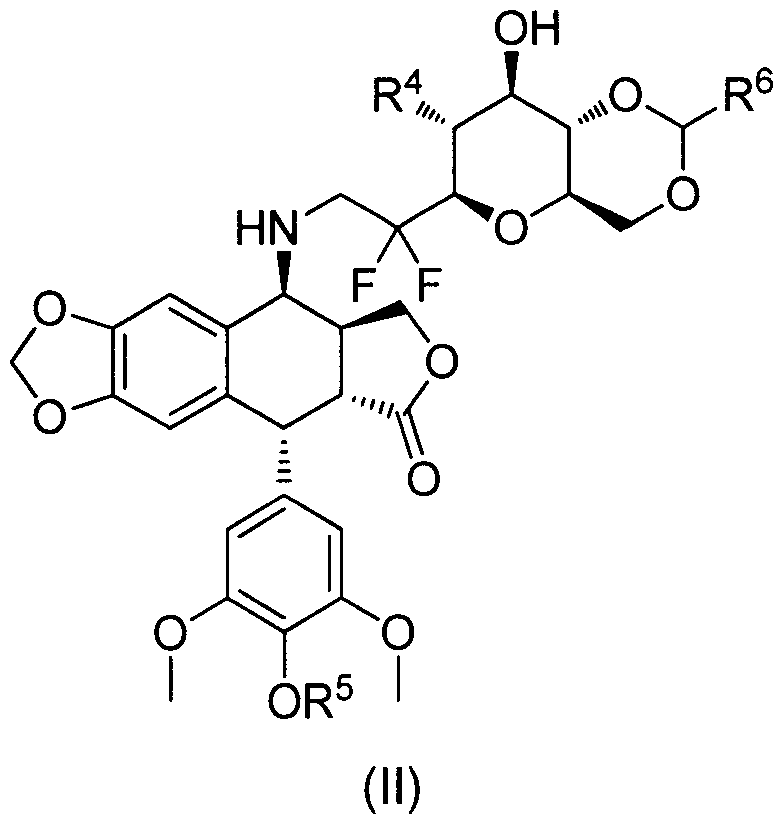
[0013] According to another embodiment, there is provided a compound of Formula II:
Figure imgf000006_0001
or a pharmaceutically acceptable salt, hydrate or solvate thereof, wherein:
R4, R5 are as defined above,
R6 may be a hydrogen atom or a group chosen from an alkyi, an aryl, an alkyl- aryl, a heteroaryl, or an alkyl-heteroaryl group.
[0014] According to another embodiment, there is provided a compound of Formula III:
Figure imgf000007_0001
or a pharmaceutically acceptable salt, hydrate or solvate thereof, wherein:
R5 may be a hydrogen atom, or a group chosen from an alkyi, -P03H or -PO3Na.
[0015] The compound is:
(5R,5aR,8aS,9S)-9-((2!2-difluoro-2-((2R,3R,4S,5S,6R)-3,4,5-trihydroxy-6- (hydroxymethyl)tetrahydro-2H-pyran-2-yl)ethyl)amino)-5-(4-hydroxy-3,5- dimethoxyphenyl)-5,5a,8a,9-tetrahydrofuro[3',4':6,7]naphtho[2,3-d][1 ,3]dioxol- 6(8H)-one.
[0016] The compound is:
(5R,5aR,8aS,9S)-9-((2)2-difluoro-2-((2R,3R,4S,5S,6R)-3,4,5-trihydroxy-6- (hydroxymethyl)tetrahydro-2H-pyran-2-yl)ethyl)amino)-5-(3,4,5- trimethoxyphenyl)-5)5a,8a,9-tetrahydrofuro[3',4':6,7]naphtho[2,3-d][1 ,3]dioxol- 6(8H)-one. [0017] According to another embodiment, there is provided a method for preparing a compound of the present invention comprising a coupling step between a compound of Formula IV:
Figure imgf000008_0001
Formula IV
wherein R5 may be as defined in Formula I to III
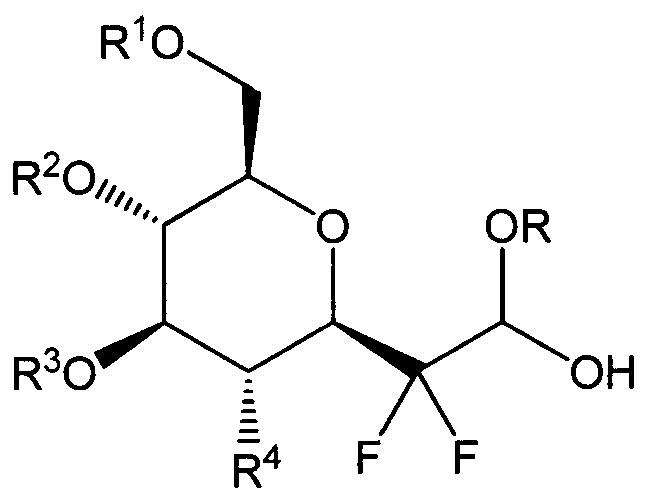
and a compound of Formula V:
Figure imgf000008_0002
Formula V
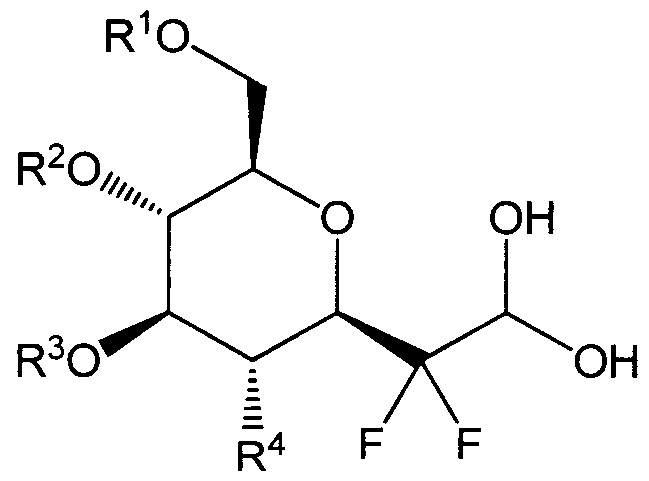
or a compound of Formula VI:
Figure imgf000009_0001
Formula VI
wherein
Ft1, R2, R3, R4 are as defined in Formula I,
R may be a C1-C12 alkyl, and
wherein said compound of formula IV may be obtained by epimerization and then by substituting the alcohol function in position 4 of podophyllotoxin or demethylated podophyllotoxin by an azido group subsequently reduced into an amine group.
[0018] According to another embodiment, there is provided a compound of formula (VII) or (VIII):
Figure imgf000009_0002
wherein R may be a group chosen from methyl, ethyl, butyl, or isopropyl group.
[0019] According to another embodiment, there is provided a use of least one compound according to the present invention for preparing medicament for the treatment of cancer. [0020] According to another embodiment, there is provided a use of at least one compound according to the present invention for the treatment of cancer.
[0021 ] The use may be in combination with radiotherapy.
[0022] The use may be in combination with one or more other anti-cancer agents.
[0023] The cancer may be chosen from a bladder cancer, a brain cancer, a breast cancer, an uterus cancer, a chronic lymphoid leukemia, a colon cancer, an esophagus cancer, a liver cancer, a testicular cancer, a lymphoblastic leukemia, a follicular lymphomas, a melanomas, a malignant homeopathies, a myelomas, an ovarian cancer, a non-small-cell lung cancer, a prostate cancer, a small-cell lung cancer, an acute leukemia, a Kaposi sarcoma, and a lymphoid malignancy.
[0024] According to another embodiment, there is provided a method of treating a patient afflicted with cancer by administering to the patient a therapeutically effective amount of a compound of the present invention.
[0025] According to another embodiment, there is provided a method of treating a patient afflicted with cancer by administering to the patient a therapeutically effective amount of a compound of the present invention in combination with radiotherapy.
[0026] According to another embodiment, there is provided a method of treating a patient afflicted with cancer by administering to the patient a therapeutically effective amount of a compound of the present invention in combination with one or more other anti-cancer agents.
[0027] The cancer may be chosen from a cancer of bladder, a cancer of brain, a cancer of breast, a cancer of uterus, a chronic lymphoid leukemia, a colon cancer, an esophagus cancer, a liver cancer, a lymphoblastic leukemia, a follicular lymphomas, a melanomas, a malignant homeopathies, a myelomas, an ovarian cancer, a non-small-cell lung cancer, a prostate cancer, a small-cell lung cancer, and a lymphoid malignancy.
[0028] The following terms are defined below.
[0029] The term "alkyi," by itself or as part of another substituent, means, unless otherwise stated, a straight (i.e. unbranched) or branched chain, or cyclic hydrocarbon radical, or combination thereof, which may be fully saturated, mono- or polyunsaturated and can include di-and multivalent radicals, having the number of carbon atoms designated (i.e. C Cio means one to ten carbons). Examples of saturated hydrocarbon radicals include, but are not limited to, groups such as methyl, ethyl, n-propyl, isopropyl, n-butyl, t-butyl, isobutyl, sec- butyl, cyclohexyl, (cyclohexyl)methyl, cyclopropylmethyl, homologs and isomers of, for example, n-pentyl, n-hexyl, n-heptyl, n-octyl, and the like. An unsaturated alkyi group is one having one or more double bonds or triple bonds. Examples of unsaturated alkyi groups include, but are not limited to, vinyl, 2-propenyl, crotyl,
2- isopentenyl, 2-(butadienyl), 2,4-pentadienyl, 3-(1 ,4-pentadienyl), ethynyl, 1 -and
3- propynyl, 3-butynyl, and the higher homologs and isomers. Alkyi groups which are limited to hydrocarbon groups are termed "homoalkyl".
[0030] The term "Fluoroalkyl" means alkyi as defined above wherein one or more hydrogen atoms are replaced by fluoro atoms.
[0031] The term "Alkylene" by itself or as part of another substituent means a divalent radical derived from an alkyi, as exemplified, but not limited, by
Figure imgf000011_0001
-CH2CH2CH(CH2CH2CH3)CH2-. Typically, an alkyi (or alkylene) group has from 1 to 24 carbon atoms, with those groups having 10 or fewer carbon atoms being preferred in the present invention. A "lower alkyi" or "lower alkylene" is a shorter chain alkyi or alkylene group, generally having eight or fewer carbon atoms. [0032] The term "Alkynyl" means carbon chains which contain at least one carbon-carbon triple bond, and which may be linear or branched or combinations thereof. Examples of alkynyl include ethynyl, propargyl, 3-methyl-1 -pentynyl, 2- heptynyl and the like.
[0033] The term "Cycloalkyl" means mono- or bicyclic saturated carbocyclic rings, each of which having from 3 to 10 carbon atoms. A "fused analog" of cycloalkyl means a monocyclic rings fused to an aryl or heteroaryl group in which the point of attachment is on the non-aromatic portion. Examples of cycloalkyl and fused analogs thereof include cyclopropyl, cyclobutyl, cyclopentyl, cyclohexyl, cycloheptyl, tetrahydronaphthyl, decahydronaphthyl, indanyl, and the like.
[0034] The term "Alkoxy" means alkoxy groups of a straight or branched chain having the indicated number of carbon atoms. Ci-6alkoxy, for example, includes methoxy, ethoxy, propoxy, isopropoxy, and the like.
[0035] The term "Heteroalkyl," by itself or in combination with another term, means, unless otherwise stated, a stable straight or branched chain, or cyclic hydrocarbon radical, or combinations thereof, consisting of at least one carbon atoms and at least one heteroatom selected from the group consisting of O, N, P, Si and S, and wherein the nitrogen, phosphorus, and sulfur atoms may optionally be oxidized and the nitrogen heteroatom may optionally be quaternized. The heteroatom(s) O, N, P and S and Si may be placed at any interior position of the heteroalkyl group or at the position at which alkyl group is attached to the remainder of the molecule. Examples include, but are not limited to,-CH2-CH2-0-CH3, -CH2-CH2-NH-CH3, -CH2-CH2-N(CH3)-CH3, -CH2-S-CH2- CH3, -CH2-CH2, -S(0)-CH3, -CH2-CH2-S(0) 2-CH3, -CH=CH-0-CH3, -Si(CH3)3, - CH2-CH=N-OCH3, -CH=CH-N(CH3)-CH3, -0-CH3,-0-CH2-CH3, and -CN. Up to two or three heteroatoms may be consecutive, such as, for example, -CH2-NH- OCH3 and -CH2-0-Si(CH3)3. Similarly, the term "heteroalkylene" by itself or as part of another substituent means a divalent radical derived from heteroalkyl, as exemplified, but not limited by, -CH2 -CH2-S -CH2-CH2- and -CH2-S-CH2-CH2-NH- CH2-. For heteroalkylene groups, heteroatoms can also occupy either or both of the chain termini (e.g., alkyleneoxo, alkylenedioxo, alkyleneamino, alkylenediamino, and the like). Still further, for alkylene and heteroalkylene linking groups, no orientation of the linking group is implied by the direction in which the formula of the linking group is written. For example, the formula - C(0)OR'- represents both -C(0)OR'- and -R'OC(O)-. As described above, heteroalkyi groups, as used herein, include those groups that are attached to the remainder of the molecule through a heteroatom, such as -C(0)R', -C(0)NR', - NR'R", -OR', -SR\ and/or -S02R'. Where "heteroalkyi" is recited, followed by recitations of specific heteroalkyi groups, such as -NR'R" or the like, it will be understood that the terms heteroalkyi and -NR'R" are not redundant or mutually exclusive. Rather, the specific heteroalkyi groups are recited to add clarity. Thus, the term "heteroalkyi" should not be interpreted herein as excluding specific heteroalkyi groups, such as -NR'R" or the like.
[0036] The term "Cycloalkoxy" means cycloalkyi as defined above bonded to an oxygen atom, such as cyclopropyloxy.
[0037] The term "Fluoroalkoxy" means alkoxy as defined above wherein one or more hydrogen atoms are replaced by fluoro atoms.
[0038] The term "Aryl" means mono- or bicyclic aromatic rings containing only carbon atoms. A "fused analog" of aryl means an aryl group fused to a monocyclic cycloalkyi or monocyclic heterocyclyl group in which the point of attachment is on the aromatic portion. Examples of aryl and fused analogs thereof include phenyl, naphthyl, indanyl, indenyl, tetrahydronaphthyl, 2,3- dihydrobenzofuranyl, dihydrobenzopyranyl, 1 ,4-benzodioxanyl, and the like.
[0039] The term "Heteroaryl" means a mono- or bicyclic aromatic ring containing at least one heteroatom selected from N, O and S, with each ring containing 5 to 6 atoms. A "fused analog" of heteroaryl means a heteroaryl group fused to a monocyclic cycloalkyi or monocyclic heterocyclyl group in which the point of attachment is on the aromatic portion. Examples of heteroaryl include pyrrolyl, isoxazolyl, isothiazolyl, pyrazolyl, pyridyl, oxazolyl, oxadiazolyl, thiadiazolyl, thiazolyl, imidazolyl, triazolyl, tetrazolyl, furanyl, triazinyl, thienyl, pyrimidyl, pyridazinyl, pyrazinyl, benzoxazolyl, benzothiazolyl, benzimidazolyl, benzofuranyl, benzothiophenyl, furo(2,3-b)pyridyl, quinolyl, indolyl, isoquinolyl, and the like.
[0040] The said alkyl groups, cycloalkyi, alkynyl, alkenyl, aryl groups and heteroaryl groups referred to in the definitions are unsubstituted or are substituted by at least one substituent selected from the group consisting of substituents.
[0041] The said substituents are selected from the group consisting of halogen atoms, alkyl groups having from 1 to 4 carbon atoms, alkoxy groups having from 1 to 4 carbon atoms, haloalkyl groups having from 1 to 4 carbon atoms, haloalkoxy groups having from 1 to 4 carbon atoms, cyano groups, alkynyl groups having from 2 to 6 carbon atoms, alkanoyl groups having from 1 to 5 carbon atoms, cycloalkyi groups having from 3 to 7 ring atoms, heteroaryl groups, aryl groups, aralkoxy groups having from 7 to 10 carbon atoms, arylcarbonyl groups, two adjacent-x groups are optionally joined together to form an alkylene or an alkenylene chain having 3 or 4 carbon atoms, aminocarbonyl groups, alkenyl groups having from 2 to 5 carbon atoms, alkylthio groups having from 1 to 4 carbon atoms, aminosulfinyl groups, aminosulfonyl groups, hydroxy groups, hydroxyalkyl groups having from 1 to 4 carbon atoms, nitro groups, amino groups, carboxy groups, alkoxycarbonyl groups having from 2 to 5 carbon atoms, alkoxyalkyl groups having from 1 to 4 carbon atoms, alkylsulfonyl groups having from 1 to 4 carbon atoms, alkanoylamino groups having from 1 to 4 carbon atoms, alkanoyl(alkyl)amino groups having from 1 to 6 carbon atoms, alkanoylaminoalkyl groups having from 1 to 6 carbon atoms in both the alkanoyl and alkyl part, alkanoyl(alkyl)aminoalkyl groups having from 1 to 6 carbon atoms in both the alkanoyl and each alkyl part, alkylsulfonylamino groups having from 1 to 4 carbon atoms, mono-or di-alkylaminocarbonyl groups having from 1 to 6 carbon atoms, mono-or di-alkylaminosulfinyl groups having from 1 to 6 carbon atoms, mono-or di alkylaminosulfonyl groups having from 1 to 6 carbon atoms, aminoalkyl groups having from 1 to 4 carbon atoms, mono-or di-alkylamino groups having from 1 to 6 carbon atoms, mono-or di-alkylaminoalkyl groups having from 1 to 6 carbon atoms in each alkyl part, aralkyl groups having from 7 to 10 carbon atoms, heteroarylalkyl groups having from 1 to 4 carbon atoms in the alkyl part, heteroarylalkoxy groups having from 1 to 4 carbon atoms in the alkoxy part and alkylsulfonylamino groups having from 1 to 4 carbon atoms;
[0042] The term "Heterocyclyl" means mono- or bicyclic saturated rings containing at least one heteroatom selected from N, S and O, each of said ring having from 3 to 10 atoms in which the point of attachment may be carbon or nitrogen. A "fused analog" of heterocyclyl means a monocyclic heterocycle fused to an aryl or heteroaryl group in which the point of attachment is on the non- aromatic portion. Examples of "heterocyclyl" and fused analogs thereof include pyrrolidinyl, piperidinyl, piperazinyl, imidazolidinyl, 2,3-dihydrofuro(2,3-b)pyridyl, benzoxazinyl, tetrahydrohydroquinolinyl, tetrahydroisoquinolinyl, dihydroindolyl, and the like. The term also includes partially unsaturated monocyclic rings that are not aromatic, such as 2- or 4-pyridones attached through the nitrogen or N- substituted-(1 H,3H)-pyrimidine-2,4-diones (N-substituted uracils).
[0043] The term "halo" or "halogen," by themselves or as part of another substituent, mean, unless otherwise stated, a fluorine, chlorine, bromine, or iodine atom. Additionally, terms such as "haloalkyl," are meant to include monohaloalkyl and polyhaloalkyl. For example, the term "halo(CrC4)alkyl" is meant to include, but not be limited to, trifluoromethyl, 2,2,2-trifluoroethyl, 4- chlorobutyl, 3-bromopropyl, and the like.
[0044] The term "pharmaceutically acceptable salts" refers to salts prepared from pharmaceutically acceptable non-toxic bases or acids including inorganic or organic bases and inorganic or organic acids. Salts derived from inorganic bases include aluminum, ammonium, calcium, copper, ferric, ferrous, lithium, magnesium, manganic salts, manganous, potassium, sodium, zinc, and the like. Particularly preferred are the ammonium, calcium, magnesium, potassium, and sodium salts. Salts derived from pharmaceutically acceptable organic non-toxic bases include salts of primary, secondary, and tertiary amines, substituted amines including naturally occurring substituted amines, cyclic amines, and basic ion exchange resins, such as arginine, betaine, caffeine, choline, Ν,Ν'-dibenzyl ethylenediamine, diethylamine, 2-diethylaminoethanol, 2- dimethylaminoethanol, ethanolamine, ethylenediamine, N-ethyl-morpholine, N- ethylpiperidine, glucamine, glucosamine, histidine, hydramine, isopropylamine, lysine, methylglucamine, morpholine, piperazine, piperidine, polyamine resins, procaine, purines, theobromine, triethylamine, trimethylamine, tripropylamine, tromethamine, and the like. When the compound of the present invention is alkaline, salts may be prepared from pharmaceutically acceptable non-toxic acids, including inorganic and organic acids. Such acids include acetic, benzenesulfonic, benzoic, camphorsulfonic, citric, ethanesulfonic, fumaric, gluconic, glutamic, hydrobromic, hydrochloric, isethionic, lactic, maleic, malic, mandelic, methanesulfonic, mucic, nitric, pamoic, pantothenic, phosphoric, succinic, sulfuric, tartaric, p-toluenesulfonic acid, and the like. Particularly preferred are citric, hydrobromic, hydrochloric, maleic, phosphoric, sulfuric, and tartaric acids.
[0045] Features and advantages of the subject matter hereof will become more apparent in light of the following detailed description of selected embodiments, as illustrated in the accompanying figures. As will be realized, the subject matter disclosed and claimed is capable of modifications in various respects, all without departing from the scope of the claims. Accordingly, the drawings and the description are to be regarded as illustrative in nature, and not as restrictive and the full scope of the subject matter is set forth in the claims. BRIEF DESCRIPTION OF THE DRAWINGS
[0046] Further features and advantages of the present disclosure will become apparent from the following detailed description, taken in combination with the appended drawings, in which:
[0047] Fig. 1 illustrates the inhibition of human topoisomerase II DNA decatenation in the absence of BSA;
[0048] Fig. 2 illustrates the inhibition of human topoisomerase II DNA decatenation in the presence of BSA;
[0049] Fig. 3A illustrates the time-dependent growth of MCF-7/mdr cancer cells treated with 0.4% DMSO;
[0050] Fig. 3B illustrates the cell growth of MCF-7/mdr cancer cells upon treatment with etoposide;
[0051] Fig. 3C illustrates the cell growth of MCF-7/mdr cancer cells upon treatment with the compound of Example 1 ;
[0052] Fig. 3D illustrates the cell growth of MCF-7/mdr cancer cells upon treatment with the compound of Example 2.
[0053] Fig. 4A illustrates time-dependent growth of H69AR cancer cells treated with 0.4% DMSO;
[0054] Fig. 4B illustrates cell growth of H69AR cancer cells upon treatment with etoposide;
[0055] Fig. 4C illustrates cell growth of H69AR cancer cells upon treatment with the compound of Example 1 ;
[0056] Fig. 5A illustrates time-dependent growth of MES-SA/Dx5 cancer cells treated with 0.4% DMSO;
[0057] Fig. 5B illustrates cell growth of MES-SA/Dx5 cancer cells upon treatment with etoposide; [0058] Fig. 5C illustrates cell growth of MES-SA/Dx5 cancer cells upon treatment with the compound of Example 1 ;
[0059] It will be noted that throughout the appended drawings, like features are identified by like reference numerals.
DETAILED DESCRIPTION
[0060] In embodiments there is disclosed compounds of Formula I, and tautomers and pharmaceutically acceptable salts and solvate thereof:
Figure imgf000018_0001
(I)
or a pharmaceutically acceptable salt, hydrate or solvate thereof, wherein:
R is a hydrogen atom or a group chosen from a linear or branched alkyl, benzyl, acetyl, or benzoyl group,
R1 and R2, are identical or different, and are a hydrogen atom or a protective group for a hydroxyl group chosen from a linear or branched alkyl, benzyl, benzoyl, acetyl, or pivaloyl group, or an acetal group of the CR'R" type, where R' and R" are identical or different and are a hydrogen atom or a group chosen from a linear or branched alkyl, aryl, or alkyl-aryl group, R3 is a hydrogen atom or a group chosen from a linear or branched alkyl, benzyl, benzoyl, acetyl, or pivaloyl group,
R4 represents OR'", NGR'GR", N3, or a phthalimide, where R'" is a hydrogen atom or a protective group for a hydroxyl group chosen from a linear or branched alkyl, benzyl, benzoyl, acetyl, or pivaloyl group, and GR' and GR" are identical or different, and are a hydrogen atom or a group chosen from a linear or branched alkyl, benzyl, benzyol, acetyl, alkyloxycarbonyl, allyloxycarbonyl, or benzyloxycarbonyl group,
R5 is a hydrogen atom or a group chosen from a linear or branched alkyl, acetyl, benzyl, PO3H, or PO3Na group.
[0061] According to an embodiment, the invention also includes derivatives in the state of a base, of a mineral or organic acid addition salt or a hydrate or a pharmaceutically acceptable solvate of the compound of formula (I).
[0062] According to another embodiment, there is disclosed a compound of Formula II:
Figure imgf000019_0001
or a pharmaceutically acceptable salt, hydrate or solvate thereof, wherein: R4, R5 are as defined above in Formula I,
R6 is a hydrogen atom or a group chosen from an alkyl, an aryl, an alkyl-aryl, a heteroaryl, or an alkyl-heteroaryl group.
[0063] According to an embodiment, the invention also includes derivatives in the state of a base, of a mineral or organic acid addition salt or a hydrate or a pharmaceutically acceptable solvate of the compound of formula (II).
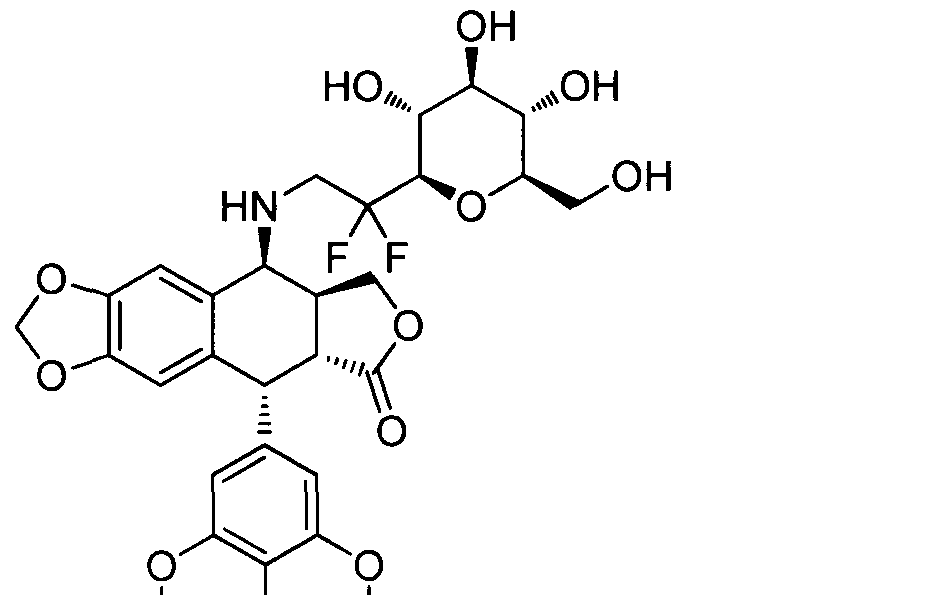
[0064] According to another embodiment, there is disclosed a compound of Formula III:
Figure imgf000020_0001
or a pharmaceutically acceptable salt, hydrate or solvate thereof, wherein:
R5 is a hydrogen atom, or a group chosen from an alkyl, -P03H or - PO3Na.
[0065] According to another embodiment, there is disclosed a compound of formula (III) which is:
(5R,5aR,8aS,9S)-9-((2,2-difluoro-2-((2R,3RI4S,5S,6R)-3,4,5- trihydroxy-6-(hydroxymethyl)tetrahydro-2H-pyran-2-yl)ethyl)amino)- 5-(4-hydroxy-3,5-dimethoxyphenyl)-5,5a,8a,9- tetrahydrofuro[3',4':6,7]naphtho[2,3-d][1 ,3]dioxol-6(8H)-one. [0066] According to another embodiment, there is disclosed a compound of formula (III) which is:
(5R,5aR,8aS,9S)-9-((2)2-difluoro-2-((2R,3R,4S,5S>6R)-3,4,5- trihydroxy-6-(hydroxymethyl)tetrahydro-2H-pyran-2-yl)ethyl)amino)-
5-(3,4,5-trimethoxyphenyl)-5,5a,8a,9- tetrahydrofuro^'^'ie.yinaphtho^^-dltl .aidioxol-eieiHJ-one.
[0067] In Formulae I to III, the alkyl group may be linear or branched alkyl groups having 1 to 10 carbon atoms. The alkyl group may be substituted with one or more halogen atom(s), alkyloxy, alkylthio, -OC(0)alkyl -OC(0)Oalkyl, - OC(0)aryl and 0(0)Oaryl. The aryl group means mono- or bicyclic aromatic rings containing only carbon atoms. The heteroaryl means a mono- or bicyclic aromatic ring containing at least one heteroatom selected from N, O and S, with each ring containing 5 to 6 atoms.
[0068] The compounds of general Formulae I to III as defined above, i.e. including their derivatives in the state of a base, of a mineral or organic acid addition salt, of a hydrate or of a possibly pharmaceutically acceptable solvate may appear as different galenic forms adapted to their use, for example injectable solutions or suspensions.
[0069] Compounds of the Formula I may be separated into diastereoisomeric pairs of enantiomers by, for example, fractional crystallization from a suitable solvent, for example MeOH or EtOAc or a mixture thereof. The pair of enantiomers thus obtained may be separated into individual stereoisomers by conventional means, for example by the use of an optically active amine or acid as a resolving agent or on a chiral HPLC column.
[0070] One or more than one of the protons in compounds of Formula I to III can be replaced with deuterium atom(s), thus providing deuterated analogs that may have improved pharmacological activities. [0071] According to another embodiment, there is disclosed a method for the preparation of the compounds of the present invention. The method comprises a coupling step between a compound of Formula IV:
Figure imgf000022_0001
Formula IV
wherein R5 is as defined in Formula I to III
and a compound of Formula V:
Figure imgf000022_0002
Formula V
or a compound of Formula VI:
Figure imgf000023_0001
Formula VI
R1, R2, R3, R4 are as defined in Formula I,
R is a C1-C12 alkyl, and
the compound of formula IV is obtained by epimerization and then by substituting the alcohol function in position 4 of podophyllotoxin or demethylated podophyllotoxin by an azido group subsequently reduced into an amine group.
The compound of Formula V is obtained via the following scheme:
Figure imgf000023_0002
Formula V
The compound of Formula VI is obtained via the following scheme:
Figure imgf000024_0001
Formula VI
[0074] According to another of its aspects, the present invention relates to the use of at least one compound of general formula I to III as defined above for preparing drugs/compositions for treating cancers such as for example a bladder cancer, a brain cancer, a breast cancer, a uterus cancer, a chronic lymphoid leukemia, a colon cancer, a esophagus cancer, a liver cancer, a testicular cancer, a lymphoblastic leukemia, a follicular lymphomas, a melanomas, a malignant homeopathies, a myelomas, an ovarian cancer, a non-small-cell lung cancer, a prostate cancer, a small-cell lung cancer, an acute leukemia, a Kaposi sarcoma, and a lymphoid malignancy, etc.
[0075] Another object of the invention relates to a composition comprising at least one compound of formula I to III as defined above.
[0076] Of course, the composition according to the invention may comprise compounds of formula I to III as defined above, alone or in a mixture and in any proportions.
[0077] In pharmaceutical compositions according to the present invention for administration via an oral, sublingual, inhalation, subcutaneous, intramuscular, intravenous, transdermal, local or rectal route, the active ingredients may be administered as unit administration forms, in a mixture with standard pharmaceutically acceptable supports/carriers. [0078] The suitable unit administration forms include oral forms such as tablets, gelatin capsules, powders, granules and oral solutions or suspensions, topical administration forms, implants, subcutaneous, intramuscular, intravenous, intranasal or intraocular administration forms and rectal administration forms.
[0079] In addition, non-toxic and pharmaceutically acceptable excipients, such as distilled water, glucose, starch lactose, talc, vegetable oils, ethylene glycol, etc., may be added.
[0080] Compositions may also contain preservatives.
[0081] Other active ingredients may be added into the compositions.
[0082] The amount of a compound according to the invention and of other possible active ingredients in such compositions may vary depending on the applications, the age, and the weight of the patient, if necessary.
[0083] According to another embodiment, there is disclosed a compound of formula (VII) or (VIII):
Figure imgf000025_0001
wherein R is a group chosen from methyl, ethyl, butyl, or isopropyl group.
[0084] According to another embodiment, there is disclosed the use of a compound of the present invention for the preparation of medicaments for the treatment of cancer. [0085] According to another embodiment, there is disclosed the use of a compound of the present invention for the treatment of cancer.
[0086] According to another embodiment, there is disclosed a method of treating a patient afflicted with cancer by administering to the patient a therapeutically effective amount of a compound of the present invention. The method may be effected in combination with radiotherapy, chemotherapy, and/or with one or more other anti-cancer agents.
[0087] Non-limiting examples of other anti-cancer agents include but are not limited to, angiogenesis inhibitors, antiproliferative agents, other kinase inhibitors, other receptor tyrosine kinase inhibitors, aurora kinase inhibitors, pololike kinase inhibitors, bcr-abl kinase inhibitors, growth factor inhibitors, antimitotic agents, alkylating agents, antimetabolites, platinum containing agents, growth factor inhibitors, ionizing radiation, cell cycle inhibitors, topoisomerase inhibitors, biologic response modifiers, immunomodulators, immunologicals, antibodies, hormonal therapies, retinoids/deltoids plant alkaloids, proteasome inhibitors, HSP-90 inhibitors, histone deacetylase inhibitors (HDAC) inhibitors, purine analogs, pyrimidine analogs, MEK inhibitors, CDK inhibitors, ErbB2 receptor inhibitors, mTOR inhibitors, Bel inhibitors, Mcl inhibitors and combinations thereof as well as other antitumor agents.
[0088] Angiogenesis inhibitors include, but are not limited to, EGFR inhibitors, PDGFR inhibitors, VEGFR inhibitors, TIE2 inhibitors, IGFIR inhibitors, matrix metalloproteinase 2 (MMP-2) inhibitors, matrix metalloproteinase 9 (MMP- 9) inhibitors, thrombospondin analogs such as thrombospondin- 1 and N-Ac-Sar- Gly-Val-D-allolle-Thr-Nva-He-Arg-Pro- NHCH2CH3 or a salt thereof and analogues of N-Ac-Sar-Gly-Val-D-allolle-Thr-Nva-lle-Arg- PrO-NHCH2CH3 such as N-Ac-GlyVal-D-alle-Ser-Gln-lle-Arg-ProNHCH2CH3 or a salt thereof.
[0089] Examples of EGFR inhibitors include, but are not limited to, Iressa (gefitinib),Tarceva (erlotinib or OSI-774), lcotinib, Erbitux (cetuximab), EMD- 7200, ABX-EGF, HR3, IgA antibodies, TP-38 (IVAX), EGFR fusion protein, EGF- vaccine, anti-EGFr immunoliposomes and Tykerb (lapatinib).
[0090] Examples of PDGFR inhibitors include, but are not limited to, CP- 673,451 and CP- 868596.
[0091] Examples of VEGFR inhibitors include, but are not limited to, Avastin (bevacizumab), Sutent (sunitinib, SU1 1248), Nexavar (sorafenib, BAY43- 9006), regorafenib, CP-547,632, axitinib (AG 13736), Apatinib, cabozantinib, Zactima (vandetanib, ZD-6474), AEE788, AZD-2171 , VEGF trap, Vatalanib (PTK-787, ZK-222584), Macugen, M862, Pazopanib (GW786034), BC-00016, ABT-869 and angiozyme.
[0092] Examples of thrombospondin analogs include, but are not limited to, ABT- 510.
[0093] Examples of BCL inhibitors include, but not limited to, obatoclax and navitoclax, ABT199.
[0094] Examples of aurora kinase inhibitors include, but are not limited to, VX-680, AZD- 1152 and MLN-8054. Example of polo-like kinase inhibitors include, but are not limited to, BI-2536.
[0095] Examples of bcr-abl kinase inhibitors include, but are not limited to, Gleevec (imatinib), ponatinib nilotinib and Dasatinib (BMS354825).
[0096] Examples of platinum containing agents includes, but are not limited to, cisplatin, Paraplatin (carboplatin), eptaplatin, lobaplatin, nedaplatin, Eloxatin (oxaliplatin) or satraplatin.
[0097] Examples of mTOR inhibitors includes, but are not limited to, CCI- 779, rapamycin, temsirolimus, everolimus, RAD001 , INK-128 and ridaforolimus.
[0098] Examples of HSP-90 inhibitors includes, but are not limited to, geldanamycin, radicicol, 17-AAG, KOS-953, 17-DMAG, CNF-101 , CNF-1010, 17- AAG-nab, NCS-683664, Mycograb, CNF-2024, PU3, PU24FC1 , VER49009, IPI- 504, SNX-2112 and STA-9090.
[0099] Examples of histone deacetylase inhibitors (HDAC) includes, but are not limited to, Suberoyianilide hydroxamic acid (SAHA), MS-275, valproic acid, TSA, LAQ-824, Trapoxin, tubacin, tubastatin, ACY-1215 and Depsipeptide.
[00100] Examples of MEK inhibitors include, but are not limited to, PD325901 , ARRY-142886, ARRY-438162 and PD98059.
[00101] Examples of CDK inhibitors include, but are not limited to, flavopyridol, MCS-5A, CVT-2584, seliciclib (CYC-202, R-roscovitine), ZK- 304709, PHA-690509, BMI-1040, GPC-286199, BMS-387,032, PD0332991 and AZD-5438.
[00102] Exambles of ErbB2 receptor inhibitors include, but are not limited to, CP-724-714, CI-1033, (canertinib), Herceptin (trastuzumab), Omitarg (2C4, petuzumab), TAK-165, GW- 572016 (lonafarnib), GW-282974, EKB-569, PI-166, dHER2 (HER2 Vaccine), APC8024 (HER2 Vaccine), anti-HER/2neu bispecific antibody, B7.her2lgG3, AS HER2 trifunctional bispecfic antibodies, mAB AR-209 and mAB 2B-1.
[00103] Examples of alkylating agents include, but are not limited to, nitrogen mustard N- oxide, cyclophosphamide, ifosfamide, trofosfamide, Chlorambucil, melphalan, busulfan, mitobronitol, carboquone, thiotepa, ranimustine, nimustine, temozolomide, AMD-473, altretamine, AP-5280, apaziquone, brostallicin, bendamustine, carmustine, estramustine, fotemustine, glufosfamide, KW-2170, mafosfamide, and mitolactol, carmustine (BCNU), lomustine (CCNU), Busulfan, Treosulfan, Decarbazine and Temozolomide.
[00104] Examples of antimetabolites include but are not limited to, methotrexate, 6- mercaptopurine riboside, mercaptopurine, uracil analogues such as 5-fluorouracil (5-FU) alone or in combination with leucovorin, tegafur, UFT, doxifluridine, carmofur, cytarabine, cytarabine, enocitabine, S-l, Alimta (premetrexed disodium, LY231514, MTA), Gemzar (gemcitabine), fludarabine, 5- azacitidine, capecitabine, cladribine, clofarabine, decitabine, eflornithine, ethnylcytidine, cytosine arabinoside, hydroxyurea, TS-I, melphalan, nelarabine, nolatrexed, ocfosate, disodium premetrexed, pentostatin, pelitrexol, raltitrexed, triapine, trimetrexate, vidarabine, vincristine, vinorelbine, mycophenolic acid, tiazofurin, Ribavirin, EICAR, hydroxyurea and deferoxamine.
[00105] Examples of topoisomerase inhibiting agents include, but are not limited to, one or more agents selected from the group consisting of aclarubicin, amonafide, belotecan, camptothecin, 10-hydroxycamptothecin, 9- aminocamptothecin, diflomotecan, irinotecan HCL (Camptosar), edotecarin, epirubicin (Ellence), etoposide, exatecan, gimatecan, lurtotecan, orathecin (Supergen), BN-80915, mitoxantrone, pirarbucin, pixantrone, rubitecan, sobuzoxane, SN-38, tafluposide and topotecan.
[00106] Examples of antibodies include, but are not limited to, Rituximab, Cetuximab, Bevacizumab, Trastuzimab, specific CD40 antibodies and specific IGFIR antibodies.
[00107] Examples of hormonal therapies include, but are not limited to, exemestane (Aromasin), leuprolide acetate, anastrozole (Arimidex), fosrelin (Zoladex), goserelin, doxercalciferol, fadrozole, formestane, tamoxifen citrate (tamoxifen), Casodex, Abarelix, Trelstar, finasteride, fulvestrant, toremifene, raloxifene, lasofoxifene, letrozole, flutamide, bicalutamide, megesterol, mifepristone, nilutamide, dexamethasone, predisone and other glucocorticoids.
[00108] Examples of retinoids/deltoids include, but are not limited to, seocalcitol (EB 1089, CB 1093), lexacalcitrol (KH 1060), fenretinide, Aliretinoin, Bexarotene and LGD-1550.
[00109] Examples of plant alkaloids include, but are not limited to, vincristine, vinblastine, vindesine and vinorelbine. [00110] Examples of proteasome inhibitors include, but are not limited to, bortezomib (Velcade), MGI 32, NPI-0052 and PR-171.
[00111] Examples of immunologicals include, but are not limited to, interferons and numerous other immune enhancing agents. Interferons include interferon alpha, interferon alpha-2a, interferon, alpha-2b, interferon beta, interferon gamma- 1a, interferon gamma- 1 b (Actimmune), or interferon gamma- nl and combinations thereof. Other agents include filgrastim, lentinan, sizofilan, TheraCys, ubenimex, WF-10, aldesleukin, alemtuzumab, BAM-002, decarbazine, daclizumab, denileukin, gemtuzumab ozogamicin, ibritumomab, imiquimod, lenograstim, lentinan, melanoma vaccine (Corixa), molgramostim, OncoVAC- CL, sargaramostim, tasonermin, tecleukin, thymalasin, tositumomab, Virulizin, Z-100, epratuzumab, mitumomab, oregovomab, pemtumomab (Y-muHMFGI), Provenge (Dendreon), CTLA4 (cytotoxic lymphocyte antigen 4) antibodies and agents capable of blocking CTLA4 such as MDX-010.
[00112] Examples of biological response modifiers are agents that modify defense mechanisms of living organisms or biological responses, such as survival, growth, or differentiation of tissue cells to direct them to have anti-tumor activity. Such agents include krestin, lentinan, sizofrran, picibanil and ubenimex.
[00113] Examples of pyrimidine analogs include, but are not limited to, 5- Fluorouracil, Floxuridine, Doxifluridine, Ratitrexed, cytarabine (ara C), Cytosine arabinoside, Fludarabine, and Gemcitabine.
[00114] Examples of purine analogs include, but are not limited to, Mercaptopurine and thioguanine.
[00115] Examples of immunomodulators include but not limited to, thalidomide and lenalidomide.
[00116] Examples of antimitotic agents include, but are not limited to, paclitaxel, docetaxel, ABRAXANE, epothilone D (KOS-862) and ZK-EPO. [00117] Non-limiting examples of cancers that may be treated with the present invention include a bladder cancer, a brain cancer, a breast cancer, a uterus cancer, a chronic lymphoid leukemia, a colon cancer, a esophagus cancer, a liver cancer, a testicular cancer, a lymphoblastic leukemia, a follicular lymphomas, a melanomas, a malignant homeopathies, a myelomas, an ovarian cancer, a non-small-cell lung cancer, a prostate cancer, a small-cell lung cancer, an acute leukemia, a Kaposi sarcoma, and a lymphoid malignancy.
SYNTHESIS
[00118] Compounds of the present invention may be made by synthetic chemical processes, examples of which are shown herein below. It is meant to be understood that the order of the steps in the processes may be varied, that reagents, solvents and reaction conditions may be substituted for those specifically mentioned, and that vulnerable moieties may be protected and deprotected, as necessary.
[00119] The encountered abbreviations are thus defined as:
eq.: equivalent g: gram Hz: Hertz
mg: milligram MHz: megahertz min: minute
ml_: milliliter mmol: millimole μητιοΙ: micromole
nmol: nanomole app: apparent
[00120] s for singlet, bs for broad singlet, d for doublet, t for triplet, q for quartet, m for multiplet or massive, dd for doublet of doublet.
[00121] DBU means 1 ,8-diazabicyclo[5.4.0]undec-7-ene; DIBAL means diisobutylaluminum hydride; DIEA means diisopropylethylamine; DMAP means N,N-dimethylaminopyridine; DME means 1 ,2-dimethoxyethane; DMF means Ν,Ν-dimethylformamide; dmpe means 1 ,2-bis(dimethylphosphino)ethane; DMSO means dimethylsulfoxide; dppb means 1 ,4-bis(diphenylphosphino)butane; dppe means 1 ,2-bis(diphenylphosphino)ethane; dppf means 1 ,1 '- bis(diphenylphosphino)ferrocene; dppm means 1 ,1 '- bis(diphenylphosphino)methane; DIAD means diisopropylazodicarboxylate; EDCI means 1 -(3-dimethylaminopropyl)-3-ethylcarbodiimide; HATU means 2-(7-Aza- 1 H-benzotriazole-1 -yl)-1 ,1 ,3,3-tetramethyluronium hexafluorophosphate; HMPA means hexamethylphosphorarnide; IPA means isopropyl alcohol; LDA means lithium diisopropylamide; LHMDS means lithium bis(hexamethyldisilylamide); LAH means lithium aluminum hydride; NCS means N-chlorosuccinimide; PyBOP means benzotriazol-1 -yloxytripyrrolidinophosphonium hexafluorophosphate; TDA-I means tris(2-(2- methoxyethoxy)ethyl)amine; DCM means dichloromethame; TEA means triethylamine; TFA means trifluoroacetic acid; THF means tetrahydrofuran; NCS means N-chlorosuccinimide; NMM means N- methylmorpholine; NMP means N- methylpyrrolidine; PPh3 means triphenylphosphine, RBF means round-bottom flask.
[00122] The characteristics of the apparatuses used for carrying out analyses of all the compounds described in the present application are indicated below:
[00123] The 1H, 13C, 19F NMR spectra are recorded on Bruker Corporation™ spectrometers. In 1H and 13C NMR, tetramethylsilane is used as an internal reference. In 19F NMR, the external reference is fluorotrichloromethane CFCI3. The chemical displacements are expressed in parts per million (ppm), the coupling constants J in Hertz (Hz).
[00124] The present invention will be more readily understood by referring to the following examples which are given to illustrate the invention rather than to limit its scope. EXAMPLE 1
Preparation of (5R,5aR,8aS,9S)-9-((2,2-difluoro-2-((2R,3R,4S,5S,6R)-3,4,5- trihydroxy-6-(hydroxymethyl)tetrahydro-2H-pyran-2-yl)ethyl)amino)-5-(4- hydroxy-3,5-dimethoxyphenyl)-5,5a,8a,9- tetrahydrofuro[3',4':6,7]naphtho[2,3-d][1 ,3]dioxol-6(8H)-one
Figure imgf000033_0001
Method A
[00125] Step 1 2R,3R,4S,5R)-3,4,5-tris(benzyloxy)-2- (benzyloxymethyl)-6-methoxytetrahydro-2H-pyran
Figure imgf000033_0002
[00126] To a solution of (2R,3S,4S,5R)-2-(hydroxymethyl)-6- methoxytetrahydro-2H-pyran-3,4,5-triol (10 g, 51 .5 mmol, 1 .0 equiv) and tetrabutylammonium iodide (0.95 g, 2.575 mmol, 5 mol%) in DMF (anhydrous, 500 mL) is added sodium hydride (12.4 g, 60 wt% in oil, 309 mmol, 6.0 equiv) portionwise at 0°C under nitrogen (be careful, the addition time is about 2 hrs). After addition of NaH, the mixture is stirred at 0°C for 30 min and at room temperature for 60 min. Benzyl bromide (36.75 mL, 309 mmol, 6.0 equiv) is added by addition funnel. The mixture is then stirred at room temperature for 20 hrs. The reaction is quenched by addition of MeOH (30 mL) slowly (be careful, H2 generated) at 0°C. A saturated solution of NH4CI (200 mL) and H20 (600 mL) are then added. The aqueous phase is extracted with ether (3x500 mL). The combined ethereal solution is washed with brine (200 mL), dried over anhydrous Na2S04, concentrated to give 40 g of crude (2R,3R,4S,5R)-3,4,5-tris(benzyloxy)- 2-(benzyloxymethyl)-6-methoxytetrahydro-2H-pyran as a pale yellow oil which is submitted for next reaction without further purification.
[00127] LC-MS: 577.3 (M+Na+, ESI)
[00128] Step 2 (3R,4S,5R,6R)-3,4,5-tris(benzyloxy)-6- ((benzyloxy)methyl)tetrahydro-2H-pyran-2-ol
Figure imgf000034_0001
[00129] To a solution of the crude (2R,3R,4S,5R)-3,4,5-tris(benzyloxy)-2- (benzyloxymethyl)-6-methoxytetrahydro-2H-pyran (10 g of crude) in AcOH (100 mL) is added a solution of H2S0 (3.0 M, 15 mL). The solution is heated to 1 10 °C (oil bath) and stirred at this temperature for 1 .0 h. TLC indicated that starting material is consumed. Hexane (60 mL) is added. The pale yellow mixture is allowed to cool to room temperature. H20 (50 mL) is added when the solution is cooled to about 40 - 50°C. A white solid is precipitated, and it is stirred at room temperature for 30 min, then filtered, eluted with Hexane (30 mL) and H20 (200 mL) to afford 3.28 g (47%) of the title compound as a white solid.
[00130] LC-MS: 563.3 (M+Na+, ESI).
[00131] Step 3 (3R,4S,5R,6R)-3,4,5-tris(benzyloxy)-6- ((benzyloxy)methyl)tetrahydro-2H-pyran-2-one
Figure imgf000035_0001
[00132] To a solution of (3R,4S,5R,6R)-3,4,5-tris(benzyloxy)-6- (benzyloxymethyl)tetrahydro-2H-pyran-2-ol (18 g, 33.3 mmol, 1.0 equiv) in DMSO (120 mL) is added acetic anhydride (80 mL) under nitrogen. The solution is stirred at room temperature overnight (about 18 hrs). After TLC indicated that starting material is consumed, H20 (200 mL) is added, followed by addition of Na2C03 (20 g) carefully at 0° C and H20 (200 mL). The aqueous phase is extracted with ether (3x250 mL). The combined ethereal solution is washed with H20 (2x100 mL), saturated NaHC03 (100 mL) and brine (100 mL), dried over anhydrous Na2S04, concentrated to give the residue which is purified by CombiFlash® (120 g silicagel, EtOAc/Hex=0-30%) to give 16.37 g (91 %) of the title compound as a colorless sticky oil.
[00133] LC-MS: 561.3 (M+Na+, ESI).
[00134] Step 4 ethyl 2,2-difluoro-2-((3R,4S,5R,6R)-3,4,5- tris(benzyloxy)-6-((benzyloxy)methyl)-2-hydroxytetrahydro-2H-pyran-2-yl)acetate
Figure imgf000035_0002
[00135] To a suspension of Zn/Cu couple (16.15 g, 0.247 mol, 7.0 equiv) in THF (dry, 200 mL) is added a solution of (3R,4S,5R,6R)-3,4,5-tris(benzyloxy)-6- (benzyloxymethyl)tetrahydro-2H-pyran-2-one (19 g, 35.275 mmol, 1.0 equiv) and ethyl bromodlfluoroacetate (14.5 mL, 0.106 mol, 3.0 equiv) in THF (dry, 200 mL) dropwise at reflux under nitrogen. After addition, the mixture is refluxed for 3 hrs. LC-MS indicated desired product observed and no starting material left. The mixture is cooled to room temperature and a solution of HCI (1.0 M, 400 mL) is added. DCM (200 mL) is then added. The layers are separated and the aqueous phase is extracted with DCM (2x150 mL). The combined organic phase is dried over anhydrous Na2S04, concentrated to give the residue which is purified by CombiFlash® (120 g silicagel, EtOAc/Hex=0-30%) to afford 17.8 g (76%) of the title compound as a colorless sticky oil.
[00136] LC-MS: 685.3 (M+Na+, ESI).
[00137] Step 5 ethyl 2,2-difluoro-2-((3R,4S,5R,6R)-3,4,5- tris(benzyloxy)-6-((benzyloxy)methyl)-2-chlorotetrahydro-2H-pyran-2-yl)acetate
Figure imgf000036_0001
[00138] To a solution of ethyl 2,2-difluoro-2-((3R,4S,5R,6R)-3,4,5- tris(benzyloxy)-6-(benzyloxymethyl)-2-hydroxytetrahydro-2H-pyran-2-yl)acetate (13.63 g, 20.567 mmol, 1.0 equiv) in DCM (dry, 170 mL) is added pyridine (2.5 mL, 30.85 mmol, 1.5 equiv) under N2. The solution is cooled to 0°C with an external ice-bath. Thionyl chloride (2.25 mL, 30.85 mmol, 1.5 equiv) is then added dropwise and maintained the temperature not over 5°C. After addition, the solution is stirred for 10 min and ice-bath is removed. The solution is allowed to warm to room temperature (about 20 min). TLC indicated that starting material is consumed. A solution of HCI (1.0 N, 150 mL) is added. DCM is added (380 mL). The layers are separated. The organic layer is washed with a saturated solution of NaHC03 (150 mL), H20 (150 mL) and dried over anhydrous Na2S04) concentrated to give the yellow oil which is purified by CombiFlash® (120 g silicagel, EtOAc/Hex=0-25%) to afford 8.34 g (59%) of the title compound as a colorless sticky oil. [00139] LC-MS: 703 (M+Na+, ESI)
[00140] Step 6 ethyl 2,2-difluoro-2-((3R,4S,5R,6R)-3,4,5- tris(benzyloxy)-6- ((benzyloxy)methyl)tetrahydro-2H-pyran-2-yl)acetate
Figure imgf000037_0001
[00141] To a solution of ethyl 2,2-difluoro-2-((3R,4S,5R,6R)-3,4,5- tris(benzyloxy)-6-(benzyloxymethyl)-2-chlorotetrahydro-2H-pyran-2-yl)acetate (7.21 g, 10.585 mmol, 1 .0 equiv) in toluene (dry, 60 mL) is added tributyltin hydride (4.27 mL, 15.88 mmol, 1 .5 equiv) and (E)-1 ,1 '-(diazene-1 ,2- diyl)dicyclohexanecarbonitrile (129 mg, 0.529 mmol, 5 mol%) under N2. The solution is heated to reflux and refluxed for 1 h. LC-MS indicated that starting material is consumed. It is concentrated to give the residue which is purified by CombiFlash® (120 g silicagel, EtOAc/Hex=0-25%) to afford 6.13 g (90%) of the title compound as a colorless sticky oil.
[00142] 9FNMR (CDCI3, 376 MHz): -1 15.84 (dd, JF-H 12.05, JF-F 260.1 1 ), - 1 18.84 (dd, JF-H 9.79, JF-F 258.60)
[00143] LC-MS: 669.3 (M+Na+, ESI)
[00144] Step 7 2,2-difluoro-2-((2R,3R,4S,5R,6R)-3,4,5- tris(benzyloxy)-6-(benzyloxymethyl)tetrahydro-2H-pyran-2-yl)acetic acid
Figure imgf000037_0002
[00145] To a solution of (2R,3RI4S)5R,6R)-3>4,5-tris(benzyloxy)-2- (benzyloxymethyl)-6-(2-(ethylperoxy)-1 ,1 -difluoroethyl)tetrahydro-2H-pyran (5 g, 7.73 mmol, 1 .0 equiv) in EtOH (150 mL) is added a solution of LiOH (2.0 M, 8.0 mL, 7.8 mL, 15.46 mmol, 2.0 equiv) at room temperature under nitrogen. The mixture is stirred at room temperature overnight (18 hrs). TLC indicated that starting material is consumed. The mixture is concentrated to give the residue which is dissolved in DCM (100 mL). A solution of HCI (1 .0 N, 50 mL) is added and stirred for 10 min. The layers are separated, and aqueous phase is extracted with DCM (3x100 mL). The combined organic phase is dried over anhydrous sodium sulfate and concentrated to afford 4.66 g (97%) of the title compound as a colorless sticky oil.
[00146] 19FNMR (CDCI3, 376 MHz): -1 15.00 (dd, JF-H 9.0, JF-F 261 .62), - 1 18.88 (dd, JF-H 1 1.67, JF.F 261 .24)
[00147] LC-MS: 641 .3 (M+Na+, ESI)
[00148] Step 8 2,2-difluoro-2-((2R,3R,4S,5R,6R)-3,4I5- tris(benzyloxy)-6-(benzyloxymethyl)tetrahydro-2H-pyran-2-yl)ethanol
Figure imgf000038_0001
[00149] To a solution of 2,2-difluoro-2-((3R,4S,5R,6R)-3,4,5-tris(benzyloxy)- 6-(benzyloxymethyl)tetrahydro-2H-pyran-2-yl)acetic acid (1.54 g, 2.49 mmol, 1 .0 equiv) in THF (dry, 5 mL) is added a solution of BH3 SMe2 (2.0 M, 0.6 mL, 5.0 mmol, 2.0 equiv) at 0°C and it is stirred and allowed to warm to RT overnight. TLC indicated that no reaction. The solution is heated to reflux for 3 hrs. TLC indicated that starting material is not consumed. BH3 SMe2 (2.0 mL) is added. The solution is refluxed overnight. TLC indicated that starting material is consumed. The solution is cooled to RT and is quenched by addition of a solution of HCI (1.0 M, 10 mL), saturated NH4CI (20 mL), H20 (20 mL). The mixture is stirred at room temperature for 10 min, extracted with EtOAc (4x50 mL). The combined organic solution is washed with brine (50 mL), dried over anhydrous Na2S04, concentrated to give residue which is purified by CombiFlash® (40 g silicagel, EtOAc/Hexane=0-40%) to afford 1.44 g (95.7%) of the title compound as a colorless oil.
[00150] LC-MS: 627.3 (M+Na+, ESI)
[00151] Step 9 2,2-difluoro-2-((2R,3R,4S,5R,6R)-3,4,5- tris(benzyloxy)-6-(benzyloxymethyl)tetrahydro-2H-pyran-2-yl)ethane-1 , 1 -diol
Figure imgf000039_0001
[00152] To a solution of 2,2-difluoro-2-((2R,3R,4S,5R,6R)-3,4,5- tris(benzyloxy)-6-(benzyloxymethyl)tetrahydro-2H-pyran-2-yl)ethanol (1.44 g, 2.38 mmol, 1.0 equiv) in DMSO (dry, 12 mL) is added IBX (1.39 g, 4.76 mmol, 2.0 equiv). The mixture is stirred at room temperature and became clear solution after stirring about 30 min. The solution is stirred at room temperature for 24 hrs. TLC indicated that reaction is not completed, but desired product observed. H20 (10 mL) is added. The mixture is stirred at room temperature for 20 min. H2O (100 mL) is added, and the aqueous phase is extracted with EtOAc (4x80 mL). The combined organic solution is washed with H20 (2x50 mL), brine (50 mL), dried over anhydrous Na2S04, concentrated to give residue which is purified by CombiFlash® (50 g silicagel, EtOAc/Hexane=0-50%) to afford 560 mg (38%) of the title compound and recovered 267 mg of the starting material as a colorless oil.
[00153] LC-MS: 643.3 (M+Na+, ESI) [00154] Step 10 (5R,5aR,8aS,9S)-9-((2,2-difluoro-2- ((2R,3R,4S,5R)6R)-3,4,5-tris(benzyloxy)-6- ((benzyloxy)methyl)tetrahydro-2H- pyran-2-yl)ethyl)amino)-5-(4-hydroxy-3,5- dimethoxyphenyl)-5,5a,8a,9- tetrahydrofuro[3',4':6,7]naphtho[2,3-d][1 ,3]dioxol-6(8H)- one
Figure imgf000040_0001
[00155] To a suspension of (5R,5aR,8aS,9S)-9-amino-5-(4-hydroxy-3,5- dimethoxyphenyl)-5,5a,8a,9-tetrahydrofuro[3',4':6,7]naphtho[2,3-d][1 ,3]dioxol- 6(8H)-one (45 mg, 0.1 13 mmol, 1 .0 equiv. prepared according to US patent no. 8,236,935) and sodium cyanoborohydride (15 mg, 0.237 mmol, 2.1 equiv) in DCM (dry, 2.0 mL) is added TFA (108 μΙ_, 1 .45 mmol, 12.85 equiv) by syringe dropwise at 0°C under nitrogen. A solution of 2,2-difluoro-2-((2R,3R,4S,5R,6R)- 3,4,5-tris(benzyloxy)-6-(benzyloxymethyl)tetrahydro-2H-pyran-2-yl)ethane-1 , 1 - diol (140 mg, 0.225 mmol, 2.0 equiv) in DCM (3.0 mL) is then added dropwise. The suspension is stirred at 0°C and allowed to warm to room temperature gradually. The mixture is stirred at room temperature for 40 hrs. TLC indicated that starting material is consumed. A solution of saturated NaHC03 (20 mL) is added dropwise and H20 (10 mL). DCM (20 mL) is added. The mixture is stirred at room temperature for 30 min. The layers are separated. The aqueous phase is extracted with DCM (3x30 mL). The combined organic solution is passed through a pad of celite®, eluted with DCM (30 mL). The combined organic solution is dried over anhydrous Na2S04, concentrated to give residue which is purified by CombiFlash® (12 g silicagel, EtOAc/Hexane=0-60%) to afford 56 mg (50%) of the title compound as a white solid.
[00156] MS: 986.0 (M++H, El)
[00157] Step 11 (5R,5aR,8aS,9S)-9-((2,2-difluoro-2- ((2R,3R,4S,5S,6R)-3,4)5-trihydroxy-6- (hydroxymethyl)tetrahydro-2H-pyran-2- yl)ethyl)amino)-5-(4-hydroxy-3,5- dimethoxyphenyl)-5,5a,8a,9- tetrahydrofuro[3',4':6,7]naphtho[2,3-d][1 ,3]dioxol-6(8H)- one
Figure imgf000041_0001
[00158] To a solution of the product of Step10 (88 mg, 89 μηιοΙ, 1.0 equiv) in MeOH (5.0 mL) is added a Pd-C (10% on activated carbon, 90 mg) in one portion. The mixture is sonicated under H2 balloon for 4 hrs. LC-MS indicated that starting material is not consumed and Pd-C (30 mg) is added. The mixture is sonicated for another 2 hrs. The mixture is filtered through a pad of celite® to remove the catalyst, eluted with MeOH (20 mL). The combined methanol solution is concentrated to give the crude which is purified by CombiFlash® (10 g silicagel column, drying loading, MeOH/DCM = 0- 20%) to give 32 mg (57%) of the title compound as a white solid.
[00159] LC-MS: 626.3 (M++H, ESI). Method B
[00160] Step l 1 -ethoxy-2,2-difluoro-2-((2R,3R,4S,5R,6R)-3,4,5- tris(benzyloxy)-6-((benzyloxy)methyl)tetrahydro-2H-pyran-2-yl)ethanol
Figure imgf000042_0001
[00161] To a solution of ethyl 2,2-difluoro-2-((2R,3R,4S,5R,6R)-3,4,5- tris(benzyloxy)-6-(benzyloxymethyl)tetrahydro-2H-pyran-2-yl)acetate (200 mg, 0.309 mmol, 1.0 equiv) in toluene (dry, 8 mL) is added a solution of diisobutylaluminium hydride (1.0 M in toluene, 0.464 mL, 0.464 mmol, 1.5 equiv) dropwise at -78°C under nitrogen. The mixture is stirred at this temperature for 1 hr and is quenched by addition of EtOH (anhydrous 3.0 mL) dropwise at -78 °C. The solution is allowed to warm to room temperature and a solution of Rochelle's solution (20 wt%, 20 mL) is added. The mixture is vigorously stirred for 1 hr. EtOAc (25 mL) is added. The layers are separated. The aqueous phase is extracted with EtOAc (3x25 mL). The combined organic phase is washed with brine (30 mL), dried over anhydrous Na2SO4, concentrated to give 200 mg (yield 100%) of the crude l -ethoxy^-difluoro^-^R.SR^S.SR.eR^SAS- tris(benzyloxy)-6-(benzyloxymethyl)tetrahydro-2H-pyran-2-yl)ethanol as a colorless sticky oil. It is employed for the next reaction without further purification.
[00162] MS: 671.3 (M++Na, ESI).
[00163] Step 2 (5R,5aR,8aS,9S)-9-azido-5-(4-(benzyloxy)-3,5- dimethoxyphenyl)-5,5a,8a,9-tetrahydrofuro[3',4':6,7]naphtho[2,3-d][1 ,3]dioxol-
6(8H)-one
Figure imgf000043_0001
[00164] A mixture of (5R,5aR)8aS,9S)-9-azido-5-(4-hydroxy-3(5- dimethoxyphenyl)-5,5a,8a,9-tetrahydrofuro[3',4':6,7]naphtho[2,3-d][1 ,3]dioxol- 6(8H)-one (0.5 g, 1 .18 mmol), benzyl bromide (0.26 g, 1 .52 mmol) and K2C03 (0.42 g, 3.04 mmol) in 20 mL of MeCN is heated to reflux overnight. The mixture is diluted with EtOAc and filtered through a silica gel pad. The solvent is evaporated and the residue is purified by combiflash® (0-60%EtOAc/hexane) to afford the desired (0.47 g, 78%).
[00165] MS (+ESI): m/e (M+H+) = 516.2.
[00166] Step 3 (5R,5aR,8aS,9S)-9-amino-5-(4-(benzyloxy)-3,5- dimethoxypheny -S.Sa.Sa^-tetrahydrofuro^'^'ieyinaphtho^.S-dltl .Sldioxol-
6(8H)-one
Figure imgf000044_0001
[00167] A mixture of (5R,5aR,8aS,9S)-9-azido-5-(4-(benzyloxy)-3,5- dimethoxypheny -S^a.Sa.g-tetrahydrofurotS'^'iejlnaphtho^.S-dlCI .Sldioxol- 6(8H)-one (0.47 g, 0.91 mmol) and PPh3 (0.252 g, 0.96 mmol) in 20 mL of THF/water (10:1 ) is heated to reflux overnight. The solvent is evaporated and the residue is purified by combiflash® (0-60%EtOAc/hexane) to afford the desired (0.38 g, 85%). 1H NMR (CDCI3) 400 MHz): 7.40 (d, 2H), 7.26-7.36 (m, 3H), 6.80 (s, 1 H), 6.51 , (s, 1 H), 6.31 (s, 2H), 5.97 (d, 2H), 4.96 (s, 2H), 4.57 (d, 1 H), 4.3-4.35 (m, 2H), 4.21 (d, 1 H), 3.71 (s, 6 H), 3.30 (dd, 1 H), 2.78-2.90 (m, 1 H).
[00168] Step 4 (5R,5aR,8aS,9S)-5-(4-(benzyloxy)-3,5- dimethoxyphenyl)-9-((2,2-difluoro-2-((2R,3R,4S,5R,6R)-3,415-tris(benzyloxy)-6- ((benzyloxy)methyl)tetrahydro-2H-pyran-2-yl)ethyl)amino)-5,5a,8a,9- tetrahydrofuro[3',4':6,7]naphtho[2,3-d][1 ,3]dioxol-6(8H)-one
Figure imgf000044_0002
[00169] The 2-neck-RBF (25 mL) is equipped with Dean-Stark trap and condenser under nitrogen. 1 -ethoxy-2,2-difluoro-2-((2R,3R,4S,5R,6R)-3,4,5- tris(benzyloxy)-6-(benzyloxymethyl)tetrahydro-2H-pyran-2-yl)ethanol (200 mg, 0.308 mmol, 1.0 equiv) and (5R,5aR,8aS,9S)-9-amino-5-(4-(benzyloxy)-3,5- dimethoxyphenyl)-5I5a,8a,9-tetrahydrofuro[3',4':6,7]naphtho[2,3-d][1 ,3]dioxol- 6(8H)-one (151 mg, 0.308 mmol, 1.0 equiv) and 4-methylbenzenesulfonic acid monohydrate (12 mg, 0.031 mmol, 20 mol%) are added. After addition of toluene (dry, 8.0 mL), the mixture is heated to reflux for 18 hrs. The mixture is then concentrated to remove the solvent to give a yellow foam solid (MS: 1073.5). THF (dry, 8 mL) is added. Followed by addition of AcOH (80 pL, 1.4 mmol, 4.5 equiv) and sodium cyanoboronhydride (80 mg, 1.27 mmol, 4.1 equiv) at 0°C under N2. The clear yellow solution is stirred at 0°C for 60 min and is then stirred at room temperature for 2 hr. A saturated solution of NaHCO3 (20 mL) is added. The mixture is extracted with DCM (5x25 mL). The combined organic solution is dried over anhydrous Na2SO4, concentrated to give residue which is purified by CombiFlash® (12 g silicagel, EtOAc/Hexane=0-50%) to afford 190 mg (57%) of title compound as a white solid.
[00170] MS: 1075.5
[00171] Step 5 (5R,5aR,8aS,9S)-9-((2,2-difluoro-2- ((2R,3R,4S,5S,6R)-3,4,5-trihydroxy-6-(hydroxymethyl)tetrahydro-2H-pyran-2- yl)ethyl)amino)-5-(4-hydroxy-3,5-dimethoxyphenyl)-5,5a,8a,9- tetrahydrofuroIS'^'^Jjnaphtho^.S-dlfl .^dioxol-eiSHJ-one
Figure imgf000046_0001
[00172] To a solution of the product of Step 2 (190 mg, 0.177 mmol, 1 .0 equiv) in MeOH (10 mL) is added Pd-C (105 mg, 10 wt% on the activated carbon). The mixture is then sonicated under H2 balloon for 3.5 hrs. The mixture is passed through a pad of celite® and eluted with MeOH (15 mL). The combined methanol solution is concentred to dryness which is purified by CombiFlash® (12 g silicagel, MeOH/DCM=0-20%) to afford 88 mg (yield 79.7%) of title compound as a white solid.
[00173] MS: 626.3 (M++Na, ESI)
EXAMPLE 2
Preparation of (5R,5aR,8aS,9S)-9-((2,2-difluoro-2-((2R,3R,4S,5S,6R)-3,4,5- trihydroxy-6-(hydroxymethyl)tetrahydro-2H-pyran-2-yl)ethyl)amino)-5-(3,4,5- trimethoxypheny -S^a^a^-tetrahydrofurotS'^'ie^naphtho^^- d][1 ,3]dioxol-6(8H)-one
Figure imgf000047_0001
' OMe 1 (Adva-27af)
[00174] Step 1 ((5R,5aR,8aS,9S)-9-((2,2-difluoro-2- ((2R,3R,4S,5R,6R)-3,4,5-tris(benzyloxy)-6- ((benzyloxy)methyl)tetrahydro-2H- pyran-2-yl)ethyl)amino)-5-(3,4,5-trimethoxyphenyl)- 5,5a,8a,9- tetrahydrofuro[3')4l:6,7]naphtho[2,3-d][1 ,3]dioxol-6(8H)-one
Figure imgf000047_0002
[00175] The RBF (25 ml_), condenser and Dean-Stark trap are dried in oven and cooled to room temperature under nitrogen. 2,2-difluoro-2- ((2R,3R,4S,5R,6R)-3,4,5-tris(benzyloxy)-6-(benzyloxymethyl)tetrahydro-2H- pyran-2-yl)ethane-1 ,1 -diol (120 mg, 0.193 mmol, 1 .0 equiv) and using (SR.SaR.SaS.QSJ-Q-amino-S-iS^.S-trimethoxypheny -S.Sa.Sa.Q- tetrahydrofuro^^^yinaphtho^^-dHl ^ldioxol-eieHJ-one (80 mg, 0.193 mmol, 1 .0 equiv, prepared according to US patent no. 8,236,935) and 4- methylbenzenesulfonic acid (5 mg, 19 pmmol, 10 mol%) are added. After addition of toluene (dry, 5.0 mL), the mixture is heated to reflux (oil bath 130 - 132°C) overnight (16 hrs). TLC indicated that reaction is almost completed (aldehyde hydrate as reference). The mixture is concentrated to remove the solvent to give the yellow solid. THF (dry, 5 mL) is added. Followed by addition of AcOH (45 pL) and sodium cyanoboronhydride (45 mg, 0.716 mmol. 3.7 equiv) at 0 °C under N2. The clear solution is formed after addition of NaBH3CN, and stirred at 0 °C for 45 min. The mixture is then stirred at room temperature for 2 hr. Additional AcOH (50 pL) and NaBH3CN (50 mg) are added. It is stirred at room temperature overnight. H2O (30 mL) and saturated NaHCO3 (20 mL) are added, and the aqueous phase is extracted with DCM (5x25 mL). The combined organic solution is dried over anhydrous Na2SO4, concentrated to give residue which is purified by CombiFlash® (12 g silicagel, EtOAc/Hexane=0-50%) to afford 157 mg (81 %) of title compound as a white solid.
[00176] LC-MS: 1000 (M++H), 1022 (M++Na+)
[00177] Step 2 (5R,5aR,8aS,9S)-9-((2,2-difluoro-2- ((2R,3R,4S,5S,6R)-3,4I5-trihydroxy-6- (hydroxymethyl)tetrahydro-2H-pyran-2- yl)ethyl)amino)-5-(3,4,5-trimethoxyphenyl)- 5,5a,8a,9- tetrahydrofuro^'^'ie.^naphtho^.S-dltl .Sldioxol-eieHJ-one
Figure imgf000049_0001
[00178] To a solution of the product of Step 1 (157 mg, 157 pmmol, 1 .0 equiv) in MeOH/THF (6.0/2.0 ml_) is added a Pd-C (10% Pd on activated carbon, 80 mg) in one portion. The mixture is stirred at room temperature under H2 balloon for 40 hrs. LC-MS indicated that starting material is not consumed although desired product is observed. Additional Pd-C catalyst (100 mg) is added. It is stirred at room temperature for 4 days. It is filtered through a pad of celite® to remove the catalyst, eluted with MeOH (10 ml_). The combined methanol solution is concentrated to give the crude which is purified by CombiFlash® (12 g silicagel column, MeOH/DCM = 0- 20%) to give 57.7 mg (57%) of the title compound as a white solid.
[00179] LC-MS: 640.3 (M++H, ESI)
EXAMPLE 3
BIOCHEMICAL EVALUATION OF COMPOUNDS OF EXAMPLES 1 & 2 3.1 - Human topoisomerase II DNA decatenation assays
( 1 ). Assay protocols Sample preparation
[00180] 100 mM stock solutions of compounds are prepared by dissolving the solid samples in 100% DMSO. The 10 mM stock solutions are prepared by 10-fold dilution of the 100 mM solutions with DMSO. Two-fold serial dilutions are performed in a V-shape 96-well plate.
[00181] The serial dilution solutions of samples are used as 50x solution in the assay. The final compound concentrations in the assay are in the range of 200 μΜ to 0.391 μΜ.
(2). Human topoisomerase II DNA decatenation assay in the absence of BSA
[00182] A negative control is the assay reaction with 20 mM EDTA. A positive control is the assay without any inhibitor. The background fluorescence of compounds is measured using the same compound concentrations with DNA and fluorescence dye.
[00183] The human topo II DNA decatenation assay kit, 96-Well Human Topo II DNA Decatenation Assay Kit Plus (from MoBiTec®, Catalog No. HDD96KE), is used for measurement of the inhibition.
[00184] The total volume of each reaction mixture is 50 μΙ. In a V-bottom assay plate, 1μΙ of inhibitor and 24 μΙ of premix are mixed. The reaction is initiated with 25 μΙ of 20 mM MgCI2. The premix is prepared by mixing 870 μΙ of H2O, 300 μΙ of 10x assay buffer, 300 μΙ of 20 μg/ml concatenated DNA, 30 μΙ of 100 mM ATP and 1.5 μΙ of 10 U/μΙ human topoisomerase II alpha enzyme (topo II). The reaction mixture is incubated at room temperature for 60 min. Then 0.2 M EDTA (5μΙ) is added to stop the reaction.
[00185] The final concentrations for the human topo II assay are 50 mM Tris-HCI, pH 8.0, 125 mM NaCI, 0.5 mM EDTA, 10 mM MgCI2, 2 μg/ml concatenated DNA, 1 mM ATP and 5 U/ml human topo II alpha enzyme.
[00186] The sample (50 μΙ) is load onto a TDD filter plate on a vacuum manifold. Then a vacuum (80 kPa or 600 mmHg) is applied until the solution went through the filter. The filter is rinsed with 150 μΙ of the Rinse Buffer (10 mM Tris-HCI, pH 7.5, 10 mM NaCI). Finally the 1x fluorescence dye (50 μΙ) is added and the fluorescence intensity at 535 nm using the excitation wavelength at 485 nm is measured.
Results:
[00187] The results of the assay are presented in Fig. 1. Compounds: Adva-27afh = Example 1 ; Adva-27af = Example 2.
(3). Human topoisomerase II DNA decatenation assay in the presence of BSA
[00188] A negative control is the assay reaction with 20 mM EDTA. A positive control is the assay without any inhibitor. The background fluorescence of compounds is measured using the same compound concentrations with DNA and fluorescence dye.
[00189] The human topo II DNA decatenation assay kit, 96-Well Human Topo II DNA Decatenation Assay Kit Plus (from MoBiTec®, Catalog No. HDD96KE), is used for measurement of the inhibition.
[00190] The total volume of each reaction mixture is 50 μΙ. In a V-bottom assay plate, 1 μΙ of inhibitor and 24 μΙ of premix are mixed. The reaction is initiated with 25 μΙ of 20 mM MgCI2. The premix is prepared by mixing 810 μΙ of H2O, 300 μΙ of 10x assay buffer, 300 μΙ of 20 μg/ml concatenated DNA, 30 μΙ of 100 mM ATP and 30 μΙ of 500 U/ ml human topoisomerase II alpha enzyme (topo II) in a enzyme dilution buffer containing 0.5 mg/ml BSA. The reaction mixture is incubated at room temperature for 40 min. Then 0.2 M EDTA (5 μΙ) is added to stop the reaction.
[00191] The final concentrations for the human topo II assay are 50 mM Tris-HCI, pH 8.0, 125 mM NaCI, 0.5 mM EDTA, 10 mM MgCI2, 2 μς/ιηΙ concatenated DNA, 1 mM ATP, 5 U/ml human topo II alpha enzyme and 5 μg/ml BSA.
[00192] The sample (50 μΙ) is loaded onto a TDD filter plate on a vacuum manifold. Then a vacuum (80 kPa or 600 mmHg) is applied until the solution went through the filter. The filter is rinsed with 150 μΙ of the Rinse Buffer (10 mM Tris-HCI, pH 7.5, 10 mM NaCI). Finally the 1 x fluorescence dye (50 μΙ) is added and the fluorescence intensity at 535 nm using the excitation wavelength at 485 nm is measured.
Results:
[00193] The results of the assay are presented in Fig. 2. Compounds: Adva-27afh = Example 1 ; Adva-27af = Example 2.
3.2 - In vitro Evaluation of the time dependence of growth inhibitory activity in a human breast cancer cell line with multidrug resistance (MCF-7/mdr)
(1) . Cell Culture
[00194] Human breast carcinoma cell line with multiple-drug resistance (MCF-7/mdr) is provided from sponsor. MCF7/mdr cells are cultured in 37 C CO2 incubator in RPMI1640 media with 10% FBS, with addition of glutamine (2 mM), penicillin (100 I.U.) and streptomycin (100 μg/ml) and HEPES (10 mM) are added to the media. Cells are thawed and kept in 0.8 μΜ Doxorubicin (from Sigma- Aldrich® Canada, catalog number D1515) for a week prior to the study. During the course of study, there is no Doxorubicin in the culture media.
(2) . Growth Inhibition Analysis.
[00195] MCF-7/mdr cells are plated at -18000 cells/well in 12-well tissue culture plates on Day -1 . Twenty-four (24) hours post-plating (DO), cells are treated with 0.4% DMSO, or test articles (Example 1 , Example 2 and etoposide) at 3, 6, 9, 12, and 24 μΜ. The final concentration of DMSO is 0.4% for all wells treated with test articles.
[00196] At 0 (Day 0), 24 (Day 1 ), 48 (Day 2), 72 (Day 3), 96 (Day 4) and 120 (Day 5) hours post-treatment, one plate is retrieved and study terminated for time course analysis. Culture media are gently aspirated and cells washed once with 2 ml sterile PBS. Trypsin-0.25% EDTA (0.4 ml) is used to detach cells from the plate and 1 ml media is added to inactivate trypsin. Cells are transferred to 1 .5 ml Eppendorf® tubes and spun at 2500 rpm for 2 minutes to collect cell pellets. Cell pellets are resuspended in 50 μΙ of PBS. Cells (20 μΙ) are mixed with 0.4% trypan blue staining solution (20 μΙ) for cell counting using a hemocytometer.
(3). Results:
[00197] The results showing the time-dependent growth of MCF-7/mdr cancer cells treated with the different compounds, or not are found in Fig. 3A-D. Compounds: Adva-27afh = Example 1 . Adva-27af = Example 2.
3.3 - In vitro Evaluation of the time dependence of growth inhibitory activity of in a human lung carcinoma cell line with multidrug resistance (H69AR)
(1) . Cell Culture
[00198] Human lung carcinoma cell line with multiple-drug resistance (H69AR) is purchased from American Tissue Culture Collection via® Cedarlane® (Burlington, Ontario, Canada). H69AR cells are cultured in 37 C CO2 incubator in RPMI1640 media with 20% FBS, with addition of glutamine (2 mM), penicillin (100 I.U.) and streptomycin (100 μg/ml) and HEPES (10 mM) are added to the media. Cells are thawed and kept in increasing concentration of 0.1 -0.5 μΜ Doxorubicin (from Sigma-Aldrich® Canada, catalog number D1515) for about one week prior to the study. During the course of study, there is no Doxorubicin in the culture media.
(2) . Growth Inhibition Analysis.
[00199] H69AR cells are plated at -50000 cells/well in 12-well tissue culture plates on Day -1 . Twenty-four (24) hours post-plating (DO), cells are treated with 0.4% DMSO, or test articles (Example 1 and etoposide) at 3, 6, 9, 12, and 24 μΜ. The final concentration of DMSO is 0.4% for all wells treated with test articles. [00200] At 0 (Day 0), 24 (Day 1 ), 48 (Day 2), 72 (Day 3), 96 (Day 4) and 120 (Day 5) hours post-treatment, one plate is retrieved and study terminated for time course analysis. Culture media are gently aspirated and cells washed once with 2 ml sterile PBS. Trypsin-0.25% EDTA (0.4 ml) is used to detach cells from the plate and 1 ml media is added to inactivate trypsin. Cells are transferred to 1.5 ml Eppendorf® tubes and spun at 2500 rpm for 2 minutes to collect cell pellets. Cell pellets are resuspended in 50 μΙ of PBS. Cells (20 μΙ) are mixed with 0.4% trypan blue staining solution (20 μΙ) for cell counting using a hemocytometer.
(3). Results:
[00201] The results showing the time-dependent growth of H69AR cancer cells treated with the different compounds, or not are found in Fig. 4A-C. Compounds: Adva-27afh = Example 1.
3.4 - In vitro Evaluation of the time dependence of growth inhibitory activity of in a human uterine sarcoma cancer cell line with multidrug resistance (MES-SA/DX5)
(1) . Cell Culture
[00202] Human uterine sarcoma cell line with multiple-drug resistance (MES-SA/Dx5) is purchased from American Tissue Culture Collection® via Cedarlane® (Burlington, Ontario, Canada) (cat. CRL-1977). MES-SA/Dx5 cells are cultured in 37°C CO2 incubator in McCoy 5A media with 10% FBS, with addition of glutamine (2 mM), penicillin (100 I.U.) and streptomycin (100 μg/ml).
(2) . Growth Inhibition Analysis.
[00203] MES-SA/Dx5 cells are plated at -300000 cells/well in 12-well tissue culture plates on Day -1. Twenty-four (24) hours post-plating (DO), cells are treated with 0.4% DMSO, or test articles (Example 1 and etoposide) at 3, 6, 9, 12, and 24 μΜ. The final concentration of DMSO is 0.4% for all wells treated with test articles.
[00204] At 0 (Day 0), 24 (Day 1 ), 48 (Day 2), 72 (Day 3), 96 (Day 4) and 120 (Day 5) hours post-treatment, one plate is retrieved and study terminated for time course analysis. Culture media are gently aspirated and cells washed once with 2 ml sterile PBS. Trypsin-0.25% EDTA (0.4 ml) is used to detach cells from the plate and 1 ml media is added to inactivate trypsin. Cells are transferred to 1.5 ml Eppendorf® tubes and spun at 2500 rpm for 2 minutes to collect cell pellets. Cell pellets are resuspended in 50 μΙ of PBS. Cells (20 μΙ) are mixed with 0.4% trypan blue staining solution (20 μΙ) for cell counting using a hemocytometer.
(3). Results:
[00205] The results showing the time-dependent growth of MES-SA/Dx5 cancer cells treated with the different compounds, or not are found in Fig. 5A-C. Compounds: Adva-27afh = Example 1.
[00206] While preferred embodiments have been described above and illustrated in the accompanying drawings, it will be evident to those skilled in the art that modifications may be made without departing from this disclosure. Such modifications are considered as possible variants comprised in the scope of the disclosure.

Claims

CLAIMS:
1. A compound of Formula I:
Figure imgf000056_0001
(I)
or a pharmaceutically acceptable salt, hydrate or solvate thereof, wherein:
R is a hydrogen atom or a group chosen from a linear or branched alkyl, benzyl, acetyl, or benzoyl group,
R1 and R2, are identical or different, and are a hydrogen atom or a protective group for a hydroxyl group chosen from a linear or branched alkyl, benzyl, benzoyl, acetyl, or pivaloyi group, or an acetal group of the CR'R" type, where R' and R" are identical or different and are a hydrogen atom or a group chosen from a linear or branched alkyl, aryl, or alkyl-aryl group,
R3 is a hydrogen atom or a group chosen from a linear or branched alkyl, benzyl, benzoyl, acetyl, or pivaloyi group,
R4 represents OR"', NGR'GR", N3, or a phthalimide, where R'" is a hydrogen atom or a protective group for a hydroxyl group chosen from a linear or branched alkyl, benzyl, benzoyl, acetyl, or pivaloyi group, and GR' and GR" are identical or different, and are a hydrogen atom or a group chosen from a linear or branched alkyl, benzyl, benzyol, acetyl, alkyloxycarbonyl, allyloxycarbonyl, or benzyloxycarbonyl group, R5 is a hydrogen atom or a group chosen from a linear or branched alkyl, acetyl, benzyl, P03H, or P03Na group.
2. A compound of Formula II:
Figure imgf000057_0001
or a pharmaceutically acceptable salt, hydrate or solvate thereof, wherein:
R4, R5 are as defined in claim 1 ,
R6 is a hydrogen atom or a group chosen from an alkyl, an aryl, an alkyl-aryl, a heteroaryl, or an alkyl-heteroaryl group.
3. A compound of Formula III:
Figure imgf000058_0001
or a pharmaceutically acceptable salt, hydrate or solvate thereof, wherein: R5 is a hydrogen atom, or a group chosen from an alkyl, -P03H or -POaNa.
4. The compound of claim 3, wherein said compound is:
(5R,5aR,8aS,9S)-9-((2,2-difluoro-2-((2R,3R,4S,5S,6R)-3,4,5-trihydroxy-6- (hydroxymethyl)tetrahydro-2H-pyran-2-yl)ethyl)amino)-5-(4-hydroxy-3,5- dimethoxyphenyl)-5,5a,8a,9-tetrahydrofuro[3',4':6,7]naphtho[2,3-d][1 ,3]dioxol- 6(8H)-one.
5. The compound of claim 3, wherein said compound is:
(5R,5aR,8aS,9S)-9-((2,2-difluoro-2-((2R!3R,4S,5S,6R)-3,4,5-trihydroxy-6- (hydroxymethyl)tetrahydro-2H-pyran-2-yl)ethyl)amino)-5-(3,4,5- trimethoxyphenyl)-5,5a,8a,9-tetrahydrofuro[3',4':6,7]naphtho[2,3-d][1 ,3]dioxol- 6(8H)-one.
6. A method for preparing a compound according to any one of claims 1 to 5 comprising a coupling step between a compound of Formula IV:
Figure imgf000059_0001
Formula IV
wherein R5 is as defined in Formula I to III
and a compound of Formula V:
Figure imgf000059_0002
Formula V
or a compound of Formula VI:
Figure imgf000059_0003
wherein
R1, R2, R3, R4 are as defined in Formula I in claim 1 ,
R is a C1-C12 alkyl, and
wherein said compound of formula IV is obtained by epimerization and then by substituting an alcohol function in position 4 of podophyllotoxin or demethylated podophyllotoxin by an azido group subsequently reduced into an amine group.
7. A compound of formula (VII) or (VIII):
Figure imgf000060_0001
wherein R is a group chosen from a methyl, ethyl, butyl, or isopropyl group.
8. The use of at least one compound according to any one of claims 1 to 5 for preparing a medicament for the treatment of cancer.
9. The use of at least one compound according to any one of claims 1 to 5 for the treatment of cancer.
10. The use of claim 9, wherein said use is in combination with radiotherapy.
11. The use of claim 9, wherein said use is in combination with one or more other anti-cancer agents.
12. The use of any one of claims 8 - 11 , wherein said cancer is chosen from a bladder cancer, a brain cancer, a breast cancer, an uterus cancer, a chronic lymphoid leukemia, a colon cancer, an esophagus cancer, a liver cancer, a testicular cancer, a lymphoblastic leukemia, a follicular lymphomas, a melanomas, a malignant homeopathies, a myelomas, an ovarian cancer, a non- small-cell lung cancer, a prostate cancer, a small-cell lung cancer, an acute leukemia, a Kaposi sarcoma, and a lymphoid malignancy.
13. A method of treating a patient afflicted with cancer which comprises administering to the patient a therapeutically effective amount of a compound of any one of claims 1 to 5.
14. A method of treating a patient afflicted with cancer which comprises administering to the patient a therapeutically effective amount of a compound of any one of claims 1 to 5 in combination with radiotherapy.
15. A method of treating a patient afflicted with cancer which comprises administering to the patient a therapeutically effective amount of a compound of any one of claims 1 to 5 in combination with one or more other anti-cancer agents.
16. The method of any one of claims 13 - 15, wherein said cancer is chosen from a bladder cancer, a brain cancer, a breast cancer, an uterus cancer, a chronic lymphoid leukemia, a colon cancer, an esophagus cancer, a liver cancer, a testicular cancer, a lymphoblastic leukemia, a follicular lymphomas, a melanomas, a malignant homeopathies, a myelomas, an ovarian cancer, a non- small-cell lung cancer, a prostate cancer, a small-cell lung cancer, an acute leukemia, a Kaposi sarcoma, and a lymphoid malignancy.
PCT/CA2014/000029 2013-01-14 2014-01-13 Gem-difluorinated c-glycoside compounds as anti-cancer agents Ceased WO2014107803A1 (en)

Priority Applications (7)

Application Number Priority Date Filing Date Title
CN201480015506.8A CN105246899A (en) 2013-01-14 2014-01-13 Novel organic electroluminescent compounds and organic electroluminescent device comprising the same
US14/760,021 US10272065B2 (en) 2013-01-14 2014-01-13 Gem-difluorinated C-glycoside compounds as anti-cancer agents
EP14738145.3A EP2943497A4 (en) 2013-01-14 2014-01-13 Gem-difluorinated c-glycoside compounds as anti-cancer agents
EP18204825.6A EP3530663B1 (en) 2013-01-14 2014-01-13 Process for preparing gem-difluorinated c-glycoside compounds
CA2897768A CA2897768C (en) 2013-01-14 2014-01-13 Gem-difluorinated c-glycoside compounds as anti-cancer agents
KR1020157022179A KR20150108391A (en) 2013-01-14 2014-01-13 Gem-difluorinated c-glycoside compounds as anti-cancer agents
JP2015551941A JP2016504394A (en) 2013-01-14 2014-01-13 Gem-difluorinated C-glycoside compounds as anticancer agents

Applications Claiming Priority (2)

Application Number Priority Date Filing Date Title
US201361752075P 2013-01-14 2013-01-14
US61/752,075 2013-01-14

Related Child Applications (1)

Application Number Title Priority Date Filing Date
EP18204825.6A Previously-Filed-Application EP3530663B1 (en) 2013-01-14 2014-01-13 Process for preparing gem-difluorinated c-glycoside compounds

Publications (1)

Publication Number Publication Date
WO2014107803A1 true WO2014107803A1 (en) 2014-07-17

Family

ID=51166456

Family Applications (1)

Application Number Title Priority Date Filing Date
PCT/CA2014/000029 Ceased WO2014107803A1 (en) 2013-01-14 2014-01-13 Gem-difluorinated c-glycoside compounds as anti-cancer agents

Country Status (7)

Country Link
US (1) US10272065B2 (en)
EP (2) EP3530663B1 (en)
JP (1) JP2016504394A (en)
KR (1) KR20150108391A (en)
CN (1) CN105246899A (en)
CA (1) CA2897768C (en)
WO (1) WO2014107803A1 (en)

Families Citing this family (1)

* Cited by examiner, † Cited by third party
Publication number Priority date Publication date Assignee Title
CN112961135B (en) * 2021-02-05 2021-11-26 安庆奇创药业有限公司 Method for continuously synthesizing benzyl substituted gluconolactone by adopting microchannel reaction device

Citations (2)

* Cited by examiner, † Cited by third party
Publication number Priority date Publication date Assignee Title
CA2650384A1 (en) * 2006-04-25 2007-11-08 Institut National Des Sciences Appliquees De Rouen (Insa) Novel gem-difluorinated c-glycoside compounds derived from podophyllotoxin, their preparation and their applications
CA2822097A1 (en) * 2010-12-22 2012-06-28 Tfchem Derivatives of glyco-cf2-serine and glyco-cf2-threonine

Family Cites Families (3)

* Cited by examiner, † Cited by third party
Publication number Priority date Publication date Assignee Title
US5036055A (en) * 1989-06-07 1991-07-30 Bristol-Myers Company Acylated derivatives of etoposide
CN1235897C (en) * 2000-06-26 2006-01-11 国家医药管理局上海医药工业研究院 4-beta-amino-saccharidoid side chain-4-dehydro-4'-demethylpodoph-yllotoxin derivative with antineoplastic activity and its synthesizing process
US8378195B2 (en) * 2010-04-16 2013-02-19 Andrew Jay Willoughby Chord teaching apparatus

Patent Citations (2)

* Cited by examiner, † Cited by third party
Publication number Priority date Publication date Assignee Title
CA2650384A1 (en) * 2006-04-25 2007-11-08 Institut National Des Sciences Appliquees De Rouen (Insa) Novel gem-difluorinated c-glycoside compounds derived from podophyllotoxin, their preparation and their applications
CA2822097A1 (en) * 2010-12-22 2012-06-28 Tfchem Derivatives of glyco-cf2-serine and glyco-cf2-threonine

Non-Patent Citations (2)

* Cited by examiner, † Cited by third party
Title
A.MERZ,OLTKI ET AL.: "« Adva-27a, a novel podophyllotoxin derivative found to be effective against multidrug- resistant human cancer cells »", ANTICANCER RES, vol. 32, no. 10, 2012, pages 4423 - 4432, XP055268394 *
See also references of EP2943497A4 *

Also Published As

Publication number Publication date
CN105246899A (en) 2016-01-13
JP2016504394A (en) 2016-02-12
EP2943497A1 (en) 2015-11-18
KR20150108391A (en) 2015-09-25
EP3530663A1 (en) 2019-08-28
US20150353573A1 (en) 2015-12-10
US10272065B2 (en) 2019-04-30
EP3530663B1 (en) 2021-08-11
EP2943497A4 (en) 2017-05-03
CA2897768C (en) 2021-06-01
CA2897768A1 (en) 2014-07-17

Similar Documents

Publication Publication Date Title
JP6272773B2 (en) Heterocyclic amide compounds for HDAC6 inhibitors and antitumor agents
JP5985658B2 (en) Cyclic molecules as breton tyrosine kinase inhibitors
WO2013185202A1 (en) Apoptosis inducers
KR20230044320A (en) Treatment of b-cell malignancies by a combination jak and pi3k inhibitor
US9226923B2 (en) Spirocyclic molecules as protein kinase inhibitors
JP2022527306A (en) Macrocycle as a STING agonist
CN113710671B (en) Cyclic molecules as inhibitors of bruton's tyrosine kinase
US8946445B2 (en) Heterocyclic molecules as apoptosis inducers
EP3530663B1 (en) Process for preparing gem-difluorinated c-glycoside compounds
HK40056349B (en) Cyclic molecules as bruton's tyrosine kinase inhibitor
NZ787908A (en) Modulators of the integrated stress pathway
HK1233180B (en) Treatment of b-cell malignancies by a combination jak and pi3k inhibitor
HK1233180A1 (en) Treatment of b-cell malignancies by a combination jak and pi3k inhibitor

Legal Events

Date Code Title Description
121 Ep: the epo has been informed by wipo that ep was designated in this application

Ref document number: 14738145

Country of ref document: EP

Kind code of ref document: A1

ENP Entry into the national phase

Ref document number: 2897768

Country of ref document: CA

WWE Wipo information: entry into national phase

Ref document number: 14760021

Country of ref document: US

ENP Entry into the national phase

Ref document number: 2015551941

Country of ref document: JP

Kind code of ref document: A

NENP Non-entry into the national phase

Ref country code: DE

WWE Wipo information: entry into national phase

Ref document number: 2014738145

Country of ref document: EP

ENP Entry into the national phase

Ref document number: 20157022179

Country of ref document: KR

Kind code of ref document: A