WO2014109413A1 - マイクロカプセル蓄熱材、その製造方法およびその使用 - Google Patents
マイクロカプセル蓄熱材、その製造方法およびその使用 Download PDFInfo
- Publication number
- WO2014109413A1 WO2014109413A1 PCT/JP2014/050865 JP2014050865W WO2014109413A1 WO 2014109413 A1 WO2014109413 A1 WO 2014109413A1 JP 2014050865 W JP2014050865 W JP 2014050865W WO 2014109413 A1 WO2014109413 A1 WO 2014109413A1
- Authority
- WO
- WIPO (PCT)
- Prior art keywords
- heat storage
- storage material
- microcapsule
- monomer
- vinyl
- Prior art date
- Legal status (The legal status is an assumption and is not a legal conclusion. Google has not performed a legal analysis and makes no representation as to the accuracy of the status listed.)
- Ceased
Links
Images


Classifications
-
- C—CHEMISTRY; METALLURGY
- C09—DYES; PAINTS; POLISHES; NATURAL RESINS; ADHESIVES; COMPOSITIONS NOT OTHERWISE PROVIDED FOR; APPLICATIONS OF MATERIALS NOT OTHERWISE PROVIDED FOR
- C09K—MATERIALS FOR MISCELLANEOUS APPLICATIONS, NOT PROVIDED FOR ELSEWHERE
- C09K5/00—Heat-transfer, heat-exchange or heat-storage materials, e.g. refrigerants; Materials for the production of heat or cold by chemical reactions other than by combustion
- C09K5/02—Materials undergoing a change of physical state when used
- C09K5/06—Materials undergoing a change of physical state when used the change of state being from liquid to solid or vice versa
- C09K5/063—Materials absorbing or liberating heat during crystallisation; Heat storage materials
-
- B—PERFORMING OPERATIONS; TRANSPORTING
- B01—PHYSICAL OR CHEMICAL PROCESSES OR APPARATUS IN GENERAL
- B01J—CHEMICAL OR PHYSICAL PROCESSES, e.g. CATALYSIS OR COLLOID CHEMISTRY; THEIR RELEVANT APPARATUS
- B01J13/00—Colloid chemistry, e.g. the production of colloidal materials or their solutions, not otherwise provided for; Making microcapsules or microballoons
- B01J13/02—Making microcapsules or microballoons
- B01J13/06—Making microcapsules or microballoons by phase separation
- B01J13/14—Polymerisation; cross-linking
-
- B—PERFORMING OPERATIONS; TRANSPORTING
- B01—PHYSICAL OR CHEMICAL PROCESSES OR APPARATUS IN GENERAL
- B01J—CHEMICAL OR PHYSICAL PROCESSES, e.g. CATALYSIS OR COLLOID CHEMISTRY; THEIR RELEVANT APPARATUS
- B01J13/00—Colloid chemistry, e.g. the production of colloidal materials or their solutions, not otherwise provided for; Making microcapsules or microballoons
- B01J13/02—Making microcapsules or microballoons
- B01J13/06—Making microcapsules or microballoons by phase separation
- B01J13/14—Polymerisation; cross-linking
- B01J13/18—In situ polymerisation with all reactants being present in the same phase
-
- C—CHEMISTRY; METALLURGY
- C08—ORGANIC MACROMOLECULAR COMPOUNDS; THEIR PREPARATION OR CHEMICAL WORKING-UP; COMPOSITIONS BASED THEREON
- C08F—MACROMOLECULAR COMPOUNDS OBTAINED BY REACTIONS ONLY INVOLVING CARBON-TO-CARBON UNSATURATED BONDS
- C08F2/00—Processes of polymerisation
- C08F2/12—Polymerisation in non-solvents
- C08F2/16—Aqueous medium
- C08F2/22—Emulsion polymerisation
-
- C—CHEMISTRY; METALLURGY
- C08—ORGANIC MACROMOLECULAR COMPOUNDS; THEIR PREPARATION OR CHEMICAL WORKING-UP; COMPOSITIONS BASED THEREON
- C08F—MACROMOLECULAR COMPOUNDS OBTAINED BY REACTIONS ONLY INVOLVING CARBON-TO-CARBON UNSATURATED BONDS
- C08F2/00—Processes of polymerisation
- C08F2/44—Polymerisation in the presence of compounding ingredients, e.g. plasticisers, dyestuffs, fillers
-
- F—MECHANICAL ENGINEERING; LIGHTING; HEATING; WEAPONS; BLASTING
- F28—HEAT EXCHANGE IN GENERAL
- F28D—HEAT-EXCHANGE APPARATUS, NOT PROVIDED FOR IN ANOTHER SUBCLASS, IN WHICH THE HEAT-EXCHANGE MEDIA DO NOT COME INTO DIRECT CONTACT
- F28D20/00—Heat storage plants or apparatus in general; Regenerative heat-exchange apparatus not covered by groups F28D17/00 or F28D19/00
- F28D20/02—Heat storage plants or apparatus in general; Regenerative heat-exchange apparatus not covered by groups F28D17/00 or F28D19/00 using latent heat
- F28D20/023—Heat storage plants or apparatus in general; Regenerative heat-exchange apparatus not covered by groups F28D17/00 or F28D19/00 using latent heat the latent heat storage material being enclosed in granular particles or dispersed in a porous, fibrous or cellular structure
-
- Y—GENERAL TAGGING OF NEW TECHNOLOGICAL DEVELOPMENTS; GENERAL TAGGING OF CROSS-SECTIONAL TECHNOLOGIES SPANNING OVER SEVERAL SECTIONS OF THE IPC; TECHNICAL SUBJECTS COVERED BY FORMER USPC CROSS-REFERENCE ART COLLECTIONS [XRACs] AND DIGESTS
- Y02—TECHNOLOGIES OR APPLICATIONS FOR MITIGATION OR ADAPTATION AGAINST CLIMATE CHANGE
- Y02E—REDUCTION OF GREENHOUSE GAS [GHG] EMISSIONS, RELATED TO ENERGY GENERATION, TRANSMISSION OR DISTRIBUTION
- Y02E60/00—Enabling technologies; Technologies with a potential or indirect contribution to GHG emissions mitigation
- Y02E60/14—Thermal energy storage
Definitions
- the present invention relates to a microcapsule heat storage material in which the core material is an organic latent heat storage material that does not contain a vinyl group such as n-paraffin, and the shell material is a cross-linked product of a copolymer of two or more vinyl monomers, It relates to a manufacturing method and its use.
- a microcapsule heat storage material in which the core material is an n-paraffin-based latent heat storage material and the shell material is a copolymer of a cross-linked vinyl monomer, it exhibits endothermic behavior during combustion, that is, TG-
- the present invention relates to a microcapsule heat storage material exhibiting an endothermic peak on a DTA characteristic curve, a method for producing the same, and use thereof in residential building materials.
- the present invention also relates to a method for producing a microcapsule heat storage material in emulsion polymerization, suspension polymerization, etc., and a drying step, which are particularly effective for uniformly and effectively expressing the effects of the microcapsule heat storage material. .
- Patent Document 1 discloses a lipophilic substance (eg, branched or linear C 10 -C 40 -hydrocarbon, cyclic hydrocarbon) having a solid / liquid phase transition within a specific temperature range as a nuclear material, and a shell.
- a lipophilic substance eg, branched or linear C 10 -C 40 -hydrocarbon, cyclic hydrocarbon
- alkyl ester of specific carbon number such as acrylic acid (monomer I); bifunctional or polyfunctional monomer (polyvinyl monomer such as monomer II, DVB, EGDMA, TMPT); and other monomer (monomer III such as styrene)
- monomer II monomer II, DVB, EGDMA, TMPT
- monomer III monomer III such as styrene
- Patent Document 2 discloses a microcapsule that is used as a heat storage material and has excellent heat storage performance, and uses a phase change material that stores or dissipates latent heat in accordance with a phase change as a core material (for example, a wax such as an aliphatic hydrocarbon).
- the core material is a microcapsule covered with a capsule wall of a thermoplastic resin obtained by polymerizing a polymerizable monomer (for example, MMA) and trimethylolpropane trimethacrylate (TMPT) as a cross-linking agent,
- a polymerizable monomer for example, MMA
- TMPT trimethylolpropane trimethacrylate
- Disclosed is a single-hole microcapsule in which a core substance is housed in a capsule wall made of a continuous coating.
- the dispersion method of the oil phase is high-speed stirring using a homogenizer, and the particle size of the microcapsules is as large as 20 to 30 ⁇ m, and although there is no disclosure of the particle size distribution, it is presumed to be wide from the dispersion method.
- Patent Document 3 discloses a polymerization monomer solution composed of a radically polymerizable monomer (for example, MMA), an aliphatic hydrocarbon, a polymerization initiator, and a bifunctional crosslinkable vinyl monomer, and dispersion stability of the same components as in Patent Document 2.
- a heat storage microcapsule obtained by stirring an aqueous dispersion medium to which an agent is added at high speed with a homogenizer, dispersing and mixing, and polymerizing the obtained suspension dispersion at 80 ° C. for a predetermined time. It is disclosed that microcapsules having high heat storage performance can be obtained because the capsule wall of the shell material is difficult to break and the core material is difficult to leak out.
- Patent Document 4 discloses a heat storage capsule that is tough enough to be destroyed even when used as a heat transport medium, and a method for manufacturing the same.
- a heat storage capsule comprising a layer composed of coalescence is disclosed.
- Patent Document 5 includes a porous fine particle body, a latent heat storage material held in the pores of the porous fine particle body, and a film forming material that covers the porous fine particle body, and the latent heat storage material may leak out.
- Patent document 6 is an application of the original company which the applicant of the present application succeeded. Disclosed is an emulsification apparatus that can easily control a particle size and a particle size distribution in an emulsifier, can be easily maintained, and can secure a sufficient production amount suitable for industrial production.
- an emulsification method comprising an incorporated cylindrical channel, and a predetermined number of wire meshes arranged at predetermined intervals in the cylindrical channel, and an emulsifying device therefor. Furthermore, the microcapsule manufactured using the emulsion obtained by the said emulsification apparatus is also disclosed. However, there is no specific disclosure about the core-shell structure microcapsule in which the core material is a latent heat storage material containing no vinyl group and the shell material is a polymer of a vinyl monomer as in the present application.
- Patent Document 7 discloses a microcapsule particle for a heat storage material that is less likely to cause leakage of the heat storage material even when exposed to a high temperature environment for a long time, and is encapsulated in a capsule wall made of a crosslinkable resin.
- the crosslinkable resin is composed of a polymerizable monomer containing a polyfunctional polymerizable monomer
- the heat storage material has a number average molecular weight (Mn).
- Mn number average molecular weight
- Disclosed is a microcapsule particle for a heat storage material, which is a polyfunctional fatty acid ester of 1300 to 4,000, the content of which is 30 to 100 parts by weight with respect to 100 parts by weight of the resin.
- the volume average particle size (Dv) of the particles is 3 to 50 ⁇ m, and the particle size distribution which is the ratio of Dv to the number average particle size (Dn) is 1 to 1.8.
- dispersion processing for forming droplets is performed using an apparatus capable of strong stirring, such as an in-line type emulsifier / disperser, high-speed emulsifier / disperser (TK homomixer), and CV value display.
- TK homomixer high-speed emulsifier / disperser
- CV value display CV value display
- Patent Document 8 discloses a microcapsule dispersion having a low content of microcapsules having a diameter of ⁇ 4 ⁇ m, and includes acrylic acid or methacrylic acid ester, a polyfunctional monomer, another monomer, a lipophilic substance, and inorganic solid particles. Disclosed are microcapsules containing a lipophilic substance as a core material and a polymer as a shell material, a production method thereof, and a gypsum board containing the same, obtained by radical polymerization of an oil-in-water emulsion.
- these known technologies only propose each element technology individually, and do not propose a comprehensive solution of all the element technologies.
- microcapsule heat storage material that easily achieves both heat storage and flame retardancy of the home building material when used in residential building materials.
- the present inventors consider that the microcapsules exhibiting endothermic characteristics in the temperature rising process of 200 to 500 ° C. assuming a fire will solve the above problems, but related prior art documents disclosing them Has not yet been found.
- the present inventors have conducted intensive studies, and as a result, control of the chemical structure and cross-linking structure of the vinyl monomer copolymer constituting the shell.
- the specific emulsification treatment process and the specific drying process It was found that the above functions and the functions can be expressed more effectively by incorporating them into the manufacturing process, and the present invention was completed.
- the first of the present invention is a vinyl monomer cross-linking copolymerization reaction in an O / W type dispersion containing a latent heat storage material not containing a vinyl group and at least two kinds of vinyl monomer groups containing a vinyl monomer having cross-linking ability.
- the material that constitutes the core (hereinafter referred to as the core material) is a latent heat storage material that does not include the vinyl group, and the material that constitutes the shell (hereinafter referred to as the shell material) includes the vinyl monomer group.
- a microcapsule heat storage material having a core-shell structure which is a cross-linked copolymer, wherein the latent heat storage material not containing a vinyl group is an n-paraffin latent heat storage material, and the vinyl monomer groups are different from each other.
- a microcap comprising at least one vinyl monomer having a functional group and at least one vinyl monomer having an electron-donating group It relates to a cell heat storage material.
- the vinyl monomer having an electron-withdrawing group is an acrylonitrile monomer or an acrylic monomer (a polyfunctional acrylate containing a plurality of vinyl groups having cross-linking ability).
- the vinyl monomer having an electron-donating group includes a styrene monomer, and the present invention relates to the first microcapsule heat storage material of the present invention.
- the third of the present invention is obtained from (A) an acrylonitrile monomer, (B) a styrene monomer, and (C) a (meth) acrylate monomer containing a plurality of vinyl groups in the crosslinked copolymer constituting the shell material. It is a crosslinkable copolymer, and the monomers are 100% by mass in total, (A) mass% ⁇ 8, (A) mass% ⁇ (B) mass%, (C) mass% ⁇ 25 and the volatile organic compound (VOC: volatile substance at 100 ° C.
- ⁇ 2 hrs) is 7.0 mg / g or less
- the microcapsule heat storage according to the first or second aspect of the present invention Regarding materials.
- a core material formed through a vinyl monomer copolymerization reaction in an O / W type dispersion liquid containing a latent heat storage material not containing a vinyl group and at least two kinds of vinyl monomer groups.
- the composition of the crosslinked copolymer constituting the shell material is (A) Acrylonitrile monomer 5 to 45% by mass, (B) Styrenic monomer 20 to 80% by mass, (C) 10 to 65% by mass of a polyfunctional (meth) acrylate monomer containing a plurality of vinyl groups, and (100% by mass of the components (A), (B) and (C) are combined).
- the present invention relates to the microcapsule heat storage material according to the first or second aspect of the present invention, which has an endothermic peak on a TG-DTA temperature rising characteristic curve in a temperature rising process of 200 to 500 ° C.
- the fifth aspect of the present invention is that, on the TG-DTA characteristic curve in the temperature rising process at 200 ° C. to 500 ° C., the total endothermic amount of the total endothermic peak is larger than the total amount of the exothermic amount of the total exothermic peak.
- the present invention relates to the microcapsule heat storage material according to the fourth aspect of the present invention.
- the core material when the total mass of the core material and the shell material is 100% by mass, the core material is 20% by mass to 80% by mass and the shell material is 80% by mass to 20% by mass. % Of the microcapsule heat storage material according to the fourth or fifth aspect of the present invention.
- the CV value represented by the following formula (1) which is an index of the particle size distribution of the microcapsule heat storage material, is 30% or less.
- the microcapsule heat storage material according to any one of the above.
- CV value (standard deviation of droplet diameter distribution / volume average particle diameter) ⁇ 100 Formula (1)
- An eighth aspect of the present invention is the first to sixth aspects of the present invention, wherein the CV value represented by the following formula (1), which is an index of the particle size distribution of the microcapsule heat storage material, is 20% or less.
- the microcapsule heat storage material according to any one of the above.
- a ninth aspect of the present invention relates to the microcapsule heat storage material according to any one of the first, second, fourth to eighth aspects, which is obtained through a drying process by spray drying.
- the tenth aspect of the present invention relates to the microcapsule heat storage material according to the third aspect of the present invention, which is obtained through a drying step by spray drying.
- the O / W type dispersion is successively and sequentially passed through a plurality of reticulates arranged at regular intervals along the flow path before the cross-linking copolymerization reaction.
- the present invention relates to the microcapsule heat storage material according to any one of the first, second, fourth and ninth aspects of the present invention.
- the O / W type dispersion is obtained via a step of emulsifying using a homogenizer before the cross-linking copolymerization reaction. It relates to a capsule heat storage material.
- a thirteenth aspect of the present invention relates to the use of the microcapsule heat storage material according to any one of the first to tenth aspects of the present invention as a housing building material.
- a vinyl monomer cross-linking copolymerization reaction in an O / W type dispersion containing a latent heat storage material not containing a vinyl group and at least two types of vinyl monomers containing a vinyl monomer having cross-linking ability In a method for producing a microcapsule having a core-shell structure in which a core material is a latent heat storage material containing no vinyl group, and a shell material is a cross-linked copolymer containing the vinyl monomer group.
- the vinyl monomer includes at least one vinyl monomer having an electron-withdrawing group, and at least one vinyl monomer having an electron-donating group, and the O / W dispersion is used before the polymerization reaction.
- the vinyl monomer in the O / W type dispersion is acrylonitrile and / or methacrylonitrile as a vinyl monomer having an electron-withdrawing group, and styrene as a vinyl monomer having an electron-donating group.
- the present invention relates to a method for producing a microcapsule according to the fourteenth aspect of the present invention.
- the sixteenth aspect of the present invention relates to the method for producing a microcapsule according to the fourteenth or fifteenth aspect of the present invention, wherein the core material is a C 8 to C 40 hydrocarbon.
- the CV value of the microcapsule represented by the following formula (1) is 30% or less.
- the present invention relates to a capsule manufacturing method.
- the crosslinked vinyl monomer copolymer is a shell material and the n-paraffin-based latent heat storage material is a core material.
- the monomer composition in 100% by mass of the crosslinked vinyl monomer copolymer constituting the shell material is (A) Acrylonitrile monomer 5 to 45% by mass, (B) Styrenic monomer 20 to 80% by mass, (C) 10 to 65% by weight of a polyfunctional acrylate monomer containing a plurality of vinyl groups,
- the present invention relates to a method for manufacturing a heat storage material.
- the microcapsule heat storage material according to the eighteenth aspect of the present invention is characterized by further spray-drying the O / W dispersion obtained by the suspension polymerization with a spray dryer. Regarding the method.
- a volatile organic compound can be obtained by using n-paraffin having excellent stability as a core material and a specific copolymer or cross-linked copolymer made of a commercially available vinyl monomer group as a shell material.
- a microcapsule heat storage material in which various functions such as heat loss and endothermic behavior at the time of temperature rise are well-balanced.
- the CV value standard deviation of droplet diameter distribution / volume average particle diameter
- the function can be further enhanced by focusing on the control of the value obtained by the formula of x100.
- microcapsule heat storage material in which various functions according to the present invention are expressed are, in particular, gypsum board, fiber-reinforced gypsum panel, cement-based wood chip board, wood-based cement board, lightweight cellular concrete, earth wall board, calcium silicate board, soft
- a microcapsule heat storage material that can be both flame retardant and heat storage when used in building materials such as fiber plates, wood heat insulation materials, construction material boards, interior materials, painted walls, heat insulation materials, heat insulation materials, wallpaper, etc. Can be used as
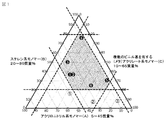
- FIG. 1 shows the endothermic behavior of a microcapsule having a shell material composed of an acrylonitrile monomer (A), a styrene monomer (B), and an acrylate monomer (C) having a plurality of vinyl groups according to the present invention.
- FIG. 2 is a perspective view of parts obtained by disassembling the emulsification apparatus for manufacturing the microcapsules of the present invention.
- FIG. 3 is a perspective view of the spacer c that holds the mesh body in the emulsifying device and determines the interval.
- FIG. 4 is a sectional view of the emulsification apparatus.
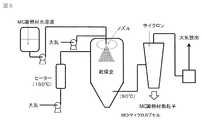
- FIG. 5 is a flowchart showing an example of a microcapsule heat storage material production line according to the present invention including a spray drying process.
- the latent heat storage material according to the present invention is a phase change material capable of storing / dissipating latent heat with a phase change between a liquid and a solid.
- the ratio of the latent heat storage material in the microcapsule heat storage material of the present invention is preferably in the range of 20 to 90% by mass, and more preferably in the range of 35 to 75% by mass. If the ratio of the latent heat storage material is less than 20% by mass, the amount of latent heat stored in the latent heat storage material is not sufficient, and the function as the heat storage material cannot be exhibited sufficiently, which is not preferable.
- the volume of the latent heat storage material may exceed the volume of the microcapsule due to volume expansion when the phase changes from solid to liquid. This is not preferable because it causes leakage (bleed out).
- the latent heat storage material used in the present invention is low in corrosivity, has no defects in stability and durability, such as modification and deterioration associated with repeated heat storage and release cycles, and has a melting point of ⁇ 20 ° C. or higher and 120 ° C. or lower. Organic compounds can be used.
- Preferred latent heat storage materials include aliphatic hydrocarbons (hereinafter referred to as paraffin compounds), aromatic hydrocarbons, fatty acids, alcohols and the like.
- Particularly preferred latent heat storage materials include n-paraffins from the viewpoint of the latent heat of fusion and the stability of the melting and solidification behavior.
- n-paraffins from the viewpoint of the latent heat of fusion and the stability of the melting and solidification behavior.
- the number of carbon atoms of the present invention n- paraffins, preferably in the range of C 8 ⁇ C 40, more preferably in the range of C 14 ⁇ C 20, and the main component two or more carbon atoms You may mix and use the paraffin to make.
- those containing n-paraffin having an even number of carbon atoms in the range of C 14 to C 20 as the main component are preferable from the viewpoint of the temperature causing the phase transition temperature and the magnitude of latent heat.
- the building materials sector consisting mainly of C 15 ⁇ C 18 having a phase transition temperature to a temperature range suitable for the living environment (about 10 ⁇ 28 ° C.), Air conditioning in the field, which the C 14 ⁇ C 18 having a phase transition temperature to a temperature range suitable for air conditioning applications mainly in the wet ice field, phase to a temperature zone with a demand for cold storage applications (-12 ⁇ 18 °C) Mainly composed of C 12 to C 16 having a transition temperature, C 14 to C 18 having a phase transition temperature in a temperature zone (about 6 to 28 ° C.) in demand for constant temperature transport in the constant temperature transport material field.
- the main component is preferably C 16 to C 20 having a phase change temperature in a temperature range (about 18 to 37 ° C.) required for clothing.
- the latent heat amount of the latent heat storage material is preferably 100 J / g or more, and particularly preferably 150 to 250 J / g so that the microcapsule heat storage material containing the material exhibits a sufficient function.
- the latent heat storage material used in the present invention includes additives usually used such as antioxidants and ultraviolet absorbers, supercooling inhibitors, specific gravity adjusting agents, pigments and dyes, as long as the object of the present invention is not impaired. Additives such as coloring agents and fragrances may be added.
- the vinyl monomer in the O / W type dispersion used for the polymerization reaction according to the present invention includes a vinyl monomer having an electron withdrawing group and a vinyl monomer having an electron donating group.
- vinyl monomers having an electron-withdrawing group include alkyl esters of acrylic acid or methacrylic acid (the alkyl group usually has 1 to 32 carbon atoms), particularly methyl acrylate, ethyl acrylate, n-propyl acrylate, acrylic acid Isopropyl, n-butyl acrylate, isobutyl acrylate, t-butyl acrylate and corresponding methacrylic ester, acrylonitrile or methacrylonitrile, acrylic acid, methacrylic acid, itaconic acid, maleic acid, maleic anhydride, 2-hydroxyethyl Examples include acrylate and 2-hydroxyethyl methacrylate, acrylamide and methacrylamide, N-methylol acrylamide and N-methylol meth
- Examples of the vinyl monomer having an electron donating group include styrene, ⁇ -methylstyrene, p-chlorostyrene, butadiene, isoprene, isobutyl vinyl ether, vinyl acetate, vinyl propionate, 4-vinylpyridine, N-vinylpyrrolidone and the like.
- a vinyl monomer having an electron-withdrawing substituent is an e-value that represents the electron density of a double bond involved in a polymerization reaction in a vinyl compound (these values are expressed by Takayuki Otsu, “Chemical Synthesis of Polymers”) Graph 15) described in 1968 (published by Chemical Dojin, Inc.) is a positive one, and usually has a nonpolar (hydrophobic) substituent.
- the vinyl monomer having an electron-donating substituent has a negative e value, and usually has a polar (hydrophilic) substituent.
- the electron-withdrawing group and the electron-donating group are attracted to each other to form a charge transfer complex, and alternate copolymerization can be performed.
- the compatibility with the core material Adjustment is made to relatively reduce the amount of vinyl monomer having high properties.
- the molar ratio is adjusted in the range of 20:80 to 80:20. In the range which deviates from this, the effect that both a nonpolar group and a polar group exist may not be acquired.
- Illustrated are combinations of vinyl monomers, which are known to produce alternating copolymerization, and the difference in e-value is 1.0 or more, preferably 1.30 or more, more preferably , A combination of vinyl monomer compounds of 1.50 or more.
- vinylidene cyanide 2.58), etc.
- a particularly preferable combination is a combination using an acrylonitrile monomer and a styrene monomer in consideration of reactivity as a vinyl monomer compound and alternating copolymerization reactivity in addition to the difference in e value. It is.
- An acrylonitrile-based monomer is a compound having a structure represented by the general formula (1), and two or more of these may be used.
- Preferable specific examples include allylonitrile, methacrylonitrile, ⁇ -ethylacrylonitrile, ⁇ -isopropylacrylonitrile from the viewpoint of reactivity with a styrene monomer and a polyfunctional acrylate monomer having a plurality of vinyl groups. More preferably, acrylonitrile or methacrylonitrile is methacrylonitrile having a boiling point of 90 ° C. and higher than 77 ° C. of acrylonitrile in consideration of safety of handling.
- R1 is a hydrogen atom or an arbitrary substituent. A hydrogen atom or an alkyl group having 1 to 3 carbon atoms is preferable.
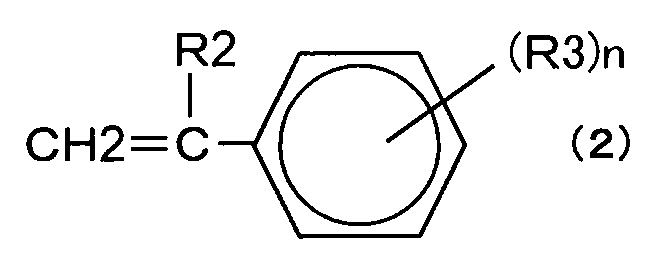
- styrene-type monomer it is a compound shown by General formula (2), These may use 2 or more types.
- Preferable specific examples include styrene, o-, m- or p-methylstyrene, ⁇ -methylstyrene, p- from the viewpoint of reactivity with an acrylonitrile monomer and a polyfunctional acrylate monomer having a plurality of vinyl groups.
- Monofunctional styrenic monomers such as methoxystyrene, p-tert-butylstyrene, p-phenylstyrene, o-, m- or p-chlorostyrene, o-, m- or p-ethylstyrene, divinylbenzene, divinylnaphthalene And other polyfunctional styrene monomers. More preferably, the monofunctional styrene monomer is styrene, and the polyfunctional styrene monomer is divinylbenzene.
- R 2 and R 3 are each independently a hydrogen atom or an arbitrary substituent. Preferably, they are a hydrogen atom, an alkyl group having 1 to 3 carbon atoms, and a vinyl group, and R3 may be different.
- a compound (a cross-linking agent having a plurality of vinyl groups) containing two or more vinyl groups is included in the microcapsule for the purpose of further mechanical strength, heat resistance, and prevention of leakage of the latent heat storage material. The polymerization reaction is performed.
- the thing well-known as an organic peroxide crosslinking agent can be used in the rubber
- an organic peroxide crosslinking agent can be used in the rubber
- it is a polyfunctional acrylate monomer containing a plurality of vinyl groups.
- ester compounds obtained by the reaction of a diol such as ethylene glycol, a triol such as glycerin, a polyhydric alcohol such as pentaerythritol, and acrylic acid or methacrylic acid, such as ethylene glycol dimethacrylate (EGDMA), Diethylene glycol dimethacrylate (DEGDMA) and triethylene glycol dimethacrylate (TEGDMA) are preferred.
- methacrylate monomers containing a plurality of vinyl groups represented by the following formula (3) methacrylate monomers containing a plurality of vinyl groups represented by the following formula (3), and a plurality of vinyls represented by the following formula (4)
- a methacrylate monomer containing a group for example, dimethylolpropane dimethacrylate (DMPDMA) or trimethylolpropane trimethacrylate (TMPT) is preferred.
- DMPDMA dimethylolpropane dimethacrylate
- TMPT trimethylolpropane trimethacrylate
- the reason why the above-mentioned polyfunctional acrylate monomer is preferably used is not clear, but the inventors have generally determined that the e-value of the double bond involved in the crosslinking reaction in these compounds is usually an electron-withdrawing property constituting the shell material. It is assumed that it is negative in the same manner as the vinyl monomer having a group, and is uniformly arranged in the vinyl monomer having an electron donating group constituting the shell material.
- the (A) acrylonitrile monomer and the (B) styrene monomer each have a relationship between a vinyl monomer having an electron-withdrawing group and a vinyl monomer having an electron-donating group.
- the electron-withdrawing group and the electron-donating group Can attract each other to form a charge transfer complex and carry out alternating copolymerization.
- the probability that the nonpolar group and the polar group are localized is small.
- the chemical structure of the shell material is made hydrophobic and hydrophilic, and the shape of the microcapsule can be spherical, pseudo-spherical or flat, and the core material can penetrate or leak. Then, local penetration or leakage can be suppressed.
- the difference between acrylonitrile and styrene is 2.00, and the difference between methacrylonitrile and styrene is 1.80, which is preferable because it is considered that a charge transfer complex is easily formed.
- the shell material of the microcapsule heat storage material according to the present invention is 100% by mass, combining (A) an acrylonitrile monomer, (B) a styrene monomer, and (C) a (meth) acrylate monomer containing a plurality of vinyl groups.
- the resulting crosslinkable copolymer % By mass of (A) ⁇ 8 % By mass of (A) ⁇ % by mass of (B) % By mass of (C) ⁇ 25
- the value of the volatile organic compound (VOC: volatile substance at 100 ° C. ⁇ 2 hrs) by a predetermined measuring method is reduced to 7.0 mg / g or less, and 5.0 mg / g or less by combination.
- the microcapsule heat storage material can be obtained.
- these microcapsule heat storage materials are used in residential building materials, the volatilization of organic compounds is small and the safety is extremely high.
- the present inventors include 8% by mass or more of an acrylonitrile-based monomer having a greatly different polarity (high hydrophilicity) from the viewpoint of preventing leakage of n-paraffin of the core material, and crosslinking. It is thought that it originates in containing 25 mass% or more of the (meth) acrylate type monomer containing the some vinyl group which bears reaction.
- the hydrophilicity of the shell surface layer in contact with the aqueous phase is increased and a smooth surface is formed by containing 8% by mass or more of the acrylic monomer.
- % By mass of (A) ⁇ 25 By doing, heating loss can be made 3.0% or less.
- the shell material of the microcapsule heat storage material according to the present invention includes (A) 5-45% by mass of acrylonitrile monomer, (B) 20-80% by mass of styrene monomer, and (C) containing a plurality of vinyl groups (meth).
- a crosslinkable copolymer obtained by combining 10 to 65% by mass of the acrylate monomer and the components (A), (B), and (C) is 100% by mass
- TG is heated in the temperature rising process of 200 to 500 ° C.
- -A microcapsule heat storage material showing an endothermic peak on the DTA characteristic curve can be obtained.
- Composition of the inner region of the microcapsule constituting the shell according to the present invention comprising the acrylonitrile monomer (A), the styrene monomer (B), and the polyfunctional (meth) acrylate monomer (C) having a plurality of vinyl groups 1 is represented by a three-component composition diagram, it becomes a shaded region in FIG.
- the white numbers in FIG. 1 correspond to the numbers of examples described later, and the circled numbers correspond to the numbers of comparative examples described later.
- the present inventors have formed an endothermic mechanism at the time of thermal decomposition of an acrylonitrile-based (homo) polymer, an acrylonitrile-based monomer and a styrene-based monomer. It is presumed to be due to the interaction between the alternating copolymer structure, the crosslink density by the (meth) acrylate monomer having a plurality of vinyl groups, and the synergistic action of each monomer.
- the endothermic behavior of the microcapsule according to the present invention basically depends on the composition of vinyl monomers constituting the shell, the n-paraffin-based heat storage material as the core material and the shell material as the shell material.
- the shell material is 20% by mass to 80% by mass (the core material is 80% by mass to 20% by mass) with respect to the mass ratio with vinyl monomers (the total is 100% by mass). %),
- the shell material is more preferably 40% by mass to 60% by mass (the core material is 60% by mass to 40% by mass), and the shell material is 60% by mass to 80% by mass (the core material is 40% by mass to 20% by mass). % By mass) is particularly preferred.
- the shell material is less than 20% by mass and the core material exceeds 80% by mass, it becomes difficult to show the endothermic behavior of the microcapsule, and when the core material is less than 20% by mass and the shell material exceeds 80% by mass, It may be difficult to perform the function.
- the crosslinkable copolymer used for the shell material of the present invention is a pyrolysis of an acrylonitrile-based (homo) polymer between 200 ° C. and 500 ° C. in addition to an exothermic peak caused by melting of the polymer. An endothermic peak presumed to be caused by this is observed, and the sum of the endothermic peaks is larger than the sum of the exothermic peaks. Its absolute value varies depending on the composition, but is about 1 to 8 KJ / kg.
- the polymerization initiator used in the polymerization reaction according to the present invention is not particularly limited, but normal peroxy compounds and azo compounds can be used as radical polymerization initiators for radically proceeding polymerization.
- Preferred radical initiators include t-butylperoxyneodecanoate, t-amylperoxypivalate, dilauroyl peroxide, t-amylperoxy-2-ethylhexanoate, 2,2′-azobis- (2,4 -Dimethylvaleronitrile), 2,2'-azobis- (2-methylbutyronitrile), dibenzoyl peroxide, t-butyl-per-2-ethylhexanoate, di-t-butyl peroxide, t-butylhydro Examples include peroxide, 2,5-dimethyl-2,5-di- (t-butylperoxy) hexane and cumene hydroperoxide.
- More preferred radical polymerization initiators are di- (3,5,5-trimethylhexanoyl) -peroxide, 4,4′-azobisisobutyronitrile, t-butylperoxypivalate, dimethyl-2,2-azo. Bisisobutyrate and 1,1,3,3, -tetramethyl butyl peroxy-2-ethylhexanoate. They have a half-life of 10 hours in the temperature range 30-100.degree.
- the chain transfer agent used for the polymerization reaction according to the present invention is not particularly limited, but preferably (1) a mercaptan (for example, octyl mercaptan, n- or tert-dodecyl mercaptan), thiosalicylic acid, mercaptoacetic acid, and mercapto Examples include mercaptans such as ethanol, (2) halogenated compounds, and (3) ⁇ -methylstyrene dimers. Among these, mercaptans are more preferable.
- the polymerization reaction is carried out using an O / W emulsion containing the latent heat storage material containing no vinyl group and a vinyl monomer as a raw material.
- the O / W type emulsion is an emulsion in which an oil phase (an organic compound not containing a vinyl group and a vinyl monomer) is a dispersed phase and an aqueous phase containing a dispersant is a continuous phase.
- a polymerization reaction is carried out using this O / W type emulsion as a raw material. Initiators and the like necessary for the polymerization reaction may coexist when the O / W emulsion is formed, or may be added after the O / W emulsion is formed and before the polymerization reaction is started. Good.
- the dispersion stabilizer in an O / W type dispersion liquid used for the polymerization reaction based on this invention Preferably partially saponified polyvinyl acetate, a cellulose derivative, polyvinylpyrrolidone, etc. are mentioned. . Among these, partially saponified polyvinyl acetate is more preferable.
- a known suspension polymerization apparatus can be used, but the O / W type dispersion liquid is arranged at a predetermined interval provided along the flow path before the start of the polymerization reaction. It is preferable to carry out an emulsification treatment in a step of sequentially passing the plurality of nets successively.
- an O / W type dispersion composed of a predetermined composition passes through the flow path at a linear velocity in the range of 0.1 to 50 cm / sec.
- reticulated bodies are arranged at predetermined intervals at a plurality of locations, and the supplied emulsified raw material sequentially passes through the reticulated bodies, and in the meantime, the dispersed phase of the O / W type dispersion liquid is refined.
- the CV value of the dispersed phase droplets is 50% or less, and a value approximate to this value is held as the CV value of the microcapsule after the polymerization reaction.
- the inventors consider that the CV value is 30% or less based on the results of Examples as a standard for the uniform function expression of the microcapsules, but this value can be obtained by ordinary batch-type emulsification. Have difficulty.
- the function expression of the microcapsules according to the present invention greatly depends on the composition of the shell material and / or the CV value, and if the average particle diameter is in the range of 5 ⁇ m to 500 ⁇ m, the effects of the present invention can be sufficiently obtained. be able to.
- the mechanism of emulsification by this method, the action and effect of the network, etc. are not yet clear, but the fluid that has once reached the network is divided into a number of droplets by the numerous networks of the network until it reaches the next network During this period, the generated droplets are stabilized, and as a result, the particle diameter of the dispersed phase droplets is considered to be uniform.
- the dispersed phase droplet has a core-shell structure, and a latent heat storage material is disposed in the core and a vinyl monomer is disposed in the shell.
- the vinyl monomer has a so-called hydrophilic group that forms a micelle on the surface of the sphere and arranges it to perform a surfactant-like function.
- the interval between the mesh bodies is related to the fluid flow velocity in the flow path, the fluid viscosity, and the like, but specifically, it is usually preferably 5 mm to 200 mm. More preferably, it is 10 mm to 100 mm.
- the spacing between these mesh bodies is ensured by inserting the spacer c into the cylindrical passage.
- a longer interval is adopted at a higher flow rate, and a shorter interval is adopted when the fluid viscosity is higher.
- the mesh body is provided at a plurality of locations along the flow path, but preferably 30 to 200 locations.
- the opening degree of the network is preferably 35 to 4000, more preferably 150 to 3000 mesh as the number of meshes according to ASTM standard.
- FIG. 2 is an exploded view of the emulsifying device
- FIG. 3 is a perspective view of the spacer
- FIG. 4 is a sectional view of the entire emulsifying device.
- the present inventors have found that the supercooling phenomenon is extremely effectively suppressed when the CV value of the produced emulsion is 20% or less under the execution of this step. This is probably due to the uniform heat transfer process to n-paraffin, which is the heat storage material in the microcapsule.
- the microcapsule heat storage material obtained by the suspension polymerization apparatus represented by the above can be used after being separated by a solid-liquid separation method such as a known filtration method or a centrifugal separation method.
- a solid-liquid separation method such as a known filtration method or a centrifugal separation method.
- VOC volatile organic compound
- a spray dryer is a widely used spray dryer. For example, the principles and specifications are disclosed and explained on the Okawara Kako Co., Ltd. website.
- the spray drier is prepared by adding a suspension containing the microcapsule heat storage material after suspension polymerization or a suspension obtained by suspending the microcapsule heat storage material after separation in an aqueous solvent.
- a nozzle nozzle spraying method
- a high-speed rotating disk centrifugal spraying method
- hot air is continuously contacted (sprayed) little by little and dried instantaneously and continuously. Therefore, the heat history of the core material n-paraffin by heat drying after solid-liquid separation is small (compared with bulk batch processing) and the contact surface area with the heat medium can be increased, so that water and various additives can be removed (coagulated).
- Crushing of aggregates) and removal of n-paraffin adhering to the surface of the shell material that is, reduction of volatile organic compounds (VOC)
- VOC volatile organic compounds
- the secondary agglomeration state can be arbitrarily suppressed and controlled by adjusting the nozzle diameter and the high-speed rotating disk channel system (good handling when incorporated in housing materials such as gypsum board).
- the manufactured microcapsule heat storage material includes gypsum board, fiber reinforced gypsum panel, cement-based wood chip board, wood-based cement board, lightweight cellular concrete, earth wall board, calcium silicate board, soft fiber plate It can be used as an excellent heat storage material in building materials such as wood heat insulating materials, construction material boards, interior materials, painted walls, heat insulating materials, heat insulating materials, and wallpaper.
- microcapsule heat storage material As the various chemicals used in the examples, commercially available products were used as they were.
- ⁇ (B) component styrene monomer > Styrene (manufactured by Kishida Chemical Co., Ltd., reagent special grade) was used.
- ⁇ (C) component polyfunctional (meth) acrylate monomer containing a plurality of vinyl groups Ethylene glycol dimethacrylate (EGDMA) (manufactured by Tokyo Chemical Industry) and trimethylolpropane trimethacrylate (TMPT) (manufactured by Tokyo Chemical Industry) were used.
- Ethylene glycol dimethacrylate (EGDMA) manufactured by Tokyo Chemical Industry
- TMPT trimethylolpropane trimethacrylate
- paraffin TS-8 (chemical name: n-octadecane) manufactured by JX Nippon Oil & Energy is used as a latent heat storage material and predetermined vinyl monomers (types and compositions are shown in Tables 1 to 4), 1.4 parts by weight perocta O (POO, 1,1,3,3-tetramethylbutylperoxy-2-ethylhexanoate) manufactured by NOF Corporation as an initiator and thiocalcol 20 manufactured by Kao Corporation as a chain transfer agent (Chemical name: n-dodecyl mercaptan, also expressed as “DM”).
- DM chain transfer agent
- a dispersion obtained by mixing 3.0 parts by weight of an oil phase mixture with an aqueous dispersant solution (PVA217EE made by Kuraray, 2 parts by weight) was used. Emulsification was carried out by introducing the oil phase mixture into the emulsifier at a flow rate of 30 g / min and the dispersed aqueous solution at a flow rate of 60 g / min with individual plunger pumps to obtain an O / W emulsion. Diluted with distilled water to obtain an O / W emulsion having an oil phase concentration of 20% by weight, and used as a polymerization raw material.
- PVA217EE aqueous dispersant solution
- the internal pressure of the polymerization tank was returned to normal pressure with nitrogen, and the pressure was increased to 0.3 MPa with nitrogen. With the stirrer rotated, the temperature inside the polymerization tank was raised to 110 ° C. to initiate polymerization. The polymerization was completed in 2 hours, and the polymerization tank internal temperature was cooled to room temperature. A slurry containing heat storage microcapsules having a microcapsule concentration of about 20% by weight was obtained. The polymerization solution was filtered using a filter paper to isolate the heat storage microcapsule, which was dried at 80 ° C. under atmospheric pressure to obtain a microcapsule powder. ⁇ Characteristic measurement of microcapsule heat storage material> (1) The particle size and CV value were measured by the following methods.
- the number of measured particles is 100,000.
- the volume average particle diameter of the droplet was 10 ⁇ m, and the CV value was 25%.
- the CV value used as an index of droplet diameter distribution was calculated by the following formula (1).
- CV value standard deviation of droplet size distribution / volume average particle size ⁇ 100 Formula (1)
- the volume average particle diameter and the CV value were measured by the same method.
- VOC was measured by the following method.
- a sample was weighed in 0.1 g in a petri dish, placed in a microchamber, subjected to a diffusion test under conditions of 100 ° C. ⁇ 2 hr ⁇ 25 ° C. ⁇ 22 hr, and the generated gas was collected with a TenaxTA collection tube.
- the emitted gas collection tube (TenaxTA tube) and the microchamber were subjected to solvent extraction with hexane, and the gas generated by GC / MS was quantified.
- Heat loss was measured by the following method. 1-2 g of the dried microcapsule was weighed into an aluminum cup, and this was kept under vacuum at 80 ° C. for 5 hours, and the loss on heating was measured.
- the endothermic characteristics of the microcapsules were measured by the following method. About 10 mg of each microcapsule heat storage material was weighed in an aluminum pan and analyzed with a differential heat / heat quantity simultaneous measurement device DTG-60 manufactured by Shimadzu Corporation. The measurement conditions were that the temperature was increased from room temperature to 600 ° C. at a temperature increase rate of 50 ° C./min, and held at 600 ° C. for 10 minutes. The following two points were analyzed for the characteristic curve in the range of ⁇ 500 ° C. corresponding to the temperature rise temperature range during combustion. 1) The peak temperature and calorific value of the endothermic peak and exothermic peak that appeared were read. 2) Heat balance.
- AN acrylonitrile
- MAN methacrylonitrile
- ST styrene
- EGDMA ethylene glycol dimethacrylate
- TMPT trimethylolpropane trimethacrylate.
- microcapsule heat storage material suspension aqueous solution (about 18% by mass of microcell heat storage material particles: 82% by mass of an aqueous solvent) obtained by the above ⁇ Measurement of endothermic characteristics of microcapsules> with the composition listed in Example 1 in Table 1. ), And then re-dispersed in water and spray-dried using a spray dryer. Visually and with a scanning electron microscope (SEM), it is confirmed that particles in a crushed state without secondary aggregation are obtained. did. An outline of a production line including a spray dryer process is shown in FIG. Moreover, the amount of volatile organic chemicals (VOC) measured according to the VOC measurement method in Example 1 (2) can be obtained by setting the outlet temperature to 90 ° C.
- VOC volatile organic chemicals
- microcapsule heat storage material III [Examples 20 to 29, Comparative Example 20] The liquid mixture obtained by the formulation shown in Table 3 was converted into an O / W emulsion according to Treatment I, and a polymerization reaction was performed.
- MMA represents methyl methacrylate
- AN represents acrylonitrile
- MAN represents methacrylonitrile
- ST represents styrene
- EGDMA represents ethylene glycol dimethacrylate
- DVB represents divinylbenzene
- TMPT trimethylolpropane trimethacrylate.
- the cross-linked copolymer composition of the vinyl monomer constituting the shell is within the scope of the present invention, and by performing the treatment I according to the present invention, the CV value becomes 30% or less, the VOC characteristics, and the heating It can be seen that a microcapsule heat storage material having excellent characteristics in terms of both weight reduction can be obtained.
- the average particle size of these microcapsule heat storage materials was in the range of 5 to 20 ⁇ m.
- Manufacture of microcapsule heat storage materials IV [Examples 30 to 31, Comparative Example 20]
- the liquid mixture obtained by the formulation shown in Table 4 was converted into an O / W emulsion according to Treatment I, and a polymerization reaction was performed.
- the microcapsule heat storage material obtained by the method of the present invention has a uniform particle size distribution because the core material is a latent heat storage material and the shell material is a crosslinked multi-component copolymer, which is narrower than the conventional product. Stabilization and efficiency improvement of the heat storage effect of the core material is achieved. Further, if styrene-acrylonitrile or methacrylonitrile-based copolymer is selected as the shell material, the heat storage material of the core material is less leached and durability can be secured.
- the microcapsule heat storage material according to the present invention exhibits an endothermic behavior in a temperature rising process of 200 to 500 ° C., and in a heat storage structure material of a housing building material, a microcapsule heat storage material having n-paraffin as a core material.
- a microcapsule heat storage material having n-paraffin as a core material.
- Various structural members such as residential building materials that are required to have heat storage properties and flame retardancy can be produced while taking advantage of the features.
Landscapes
- Chemical & Material Sciences (AREA)
- Organic Chemistry (AREA)
- Chemical Kinetics & Catalysis (AREA)
- Engineering & Computer Science (AREA)
- Dispersion Chemistry (AREA)
- Physics & Mathematics (AREA)
- Thermal Sciences (AREA)
- Health & Medical Sciences (AREA)
- Polymers & Plastics (AREA)
- Medicinal Chemistry (AREA)
- Combustion & Propulsion (AREA)
- Materials Engineering (AREA)
- Mechanical Engineering (AREA)
- General Engineering & Computer Science (AREA)
- Manufacturing Of Micro-Capsules (AREA)
- Polymerisation Methods In General (AREA)
- Addition Polymer Or Copolymer, Post-Treatments, Or Chemical Modifications (AREA)
Abstract
Description
さらに詳しくは、コア材がn−パラフィン系の潜熱蓄熱物質であり、シェル材が架橋ビニルモノマーの共重合体であるマイクロカプセル蓄熱材において、燃焼時に吸熱挙動を示す、すなわち昇温過程においてTG−DTA特性曲線上に吸熱ピークを示すマイクロカプセル蓄熱材、その製造方法およびその住宅建材中での使用に関する。
また、本発明は、上記マイクロカプセル蓄熱材の有する効果を、均一かつ効果的に発現させることに特に有効である、乳化重合、懸濁重合等におけるマイクロカプセル蓄熱材の製造方法、および乾燥工程に関する。
特許文献1は、核材料として、特定の温度範囲内に固/液相転移を有する親油性物質(例えば、分枝状または線状C10~C40−炭化水素、環状炭化水素)、および殻材として、アクリル酸等の特定炭素数のアルキルエステル(モノマーI);二官能性または多官能性モノマー(モノマーII,DVB、EGDMA、TMPT等ポリビニルモノマー);およびその他のモノマー(モノマーIII,例えばスチレン)を含むモノマー混合物に開始剤を溶解させてラジカル重合により得られるポリマーを有するマイクロカプセルの潜熱蓄熱材料としての使用、ならびにこれらの製造方法等に関して開示する。得られたマイクロカプセルの粒径は、1~30μmの記載はあるが、粒径分布に関する記載はなく、ホモジナイザー撹拌機による乳化方法から推測するに、狭い粒径分布のマイクロカプセルは得られていない。
特許文献2は、蓄熱材として用いられ、蓄熱性能に優れたマイクロカプセルを開示し、相変化に伴って潜熱を蓄熱または放熱する相変化物質を芯物質(例えば脂肪族炭化水素等のワックス)とし、該芯物質が重合性モノマー(例えば、MMA)、架橋剤としてトリメチロールプロパントリメタクリレート(TMPT)を重合してなる熱可塑性樹脂のカプセル壁で覆われたマイクロカプセルであり、該マイクロカプセルが、連続した被膜よりなるカプセル壁に芯物質が収納された単孔マイクロカプセルを開示する。しかし、油相の分散方法はホモジナイザーを用いる高速撹拌で、当該マイクロカプセルの粒径は、20~30μmと大きく、粒径分布の開示はないが分散方法から推して広いものと推定される。
特許文献3は、特許文献2と同様の成分の、ラジカル重合性モノマー(例えば、MMA)、脂肪族炭化水素、重合開始剤、2官能性架橋性ビニルモノマーからなる重合用モノマー溶液、及び分散安定剤を添加した水性分散媒体をホモジナイザーで高速撹拌、分散混合し、得られた懸濁分散液を80℃で所定時間重合し得られた蓄熱マイクロカプセルを開示する。殻材のカプセル壁が破壊し難く、芯物質が外へ漏出し難いので、高い蓄熱性能を有するマイクロカプセルが得られる旨開示する。しかし、マイクロカプセルの粒径は10~60μmと大きく、ホモジナイザーによる分散であるから、製法から推して粒径分布も広いものと推測される。
特許文献4は、熱輸送媒体として用いられる場合にも破壊され難い程度に強靭な蓄熱カプセル、その製造方法を開示する。シェル及び中空部分からなる中空カプセルの中空部分に蓄熱材料が内包された蓄熱カプセルであって、シェルが架橋性モノマーの重合体若しくは共重合体、又は架橋性モノマーと単官能性モノマーとの共重合体で構成される層を含む蓄熱カプセルを開示する。しかし、分散安定剤の水溶液、および蓄熱材料及びモノマー混合物の分散方法はホモジイザーや膜乳化法など機械的せん断力による分散法など公知の方法を採用できる旨開示し、得られたマイクロカプセルの粒径分布は広いものと推定される。
特許文献5は、多孔質微粒子体と、多孔質微粒子体の細孔内に保持された潜熱蓄熱物質と、多孔質微粒子体を被覆する皮膜形成物質とからなり、潜熱蓄熱物質が漏出することがなく、安価で生産性や蓄熱効率に優れた粒子状蓄熱材の製造方法を開示し、潜熱蓄熱物質として、C8~C40のノルマルパラフィンが好ましい旨開示する。
特許文献6は、本願出願人が合併承継したもとの企業の出願である。乳化機において、粒径及び粒径分布制御が容易で、メンテナンスが簡易で工業生産に適した十分な生産量が確保できる乳化装置を開示する。乳化剤の存在下に、相互に実質的に不溶性の複数の液体を、一定間隔を保持して配置されてなる複数の網状体を連続して順次通過させることにより乳化させる方法で、当該網状体が組込まれた筒型流路を具備し、該筒型流路内には所定間隔で所定枚数の金網が配置されてなる乳化方法およびそのための乳化装置を開示する。さらに、前記乳化装置により得られた乳化液を用いて製造されるマイクロカプセルも開示する。しかし、本願のような、コア材がビニル基を含まない潜熱蓄熱物質、シェル材がビニルモノマーの重合体からなるコア−シェル構造のマイクロカプセルについての具体的開示はない。
特許文献7は、高温環境下に長時間曝されても蓄熱材の漏洩が生じ難く、耐熱性に優れる蓄熱材用マイクロカプセル粒子を開示し、架橋性樹脂からなるカプセル壁と、それに内包された蓄熱材とから構成される蓄熱材用マイクロカプセル粒子で、前記架橋性樹脂が、多官能重合性単量体を含む重合性単量体から構成され、蓄熱材が、数平均分子量(Mn)が1300~4,000の多官能性脂肪酸エステルであり、その含有量が前記樹脂100重量部に対して30~100重量部である蓄熱材用マイクロカプセル粒子を開示する。当該粒子の体積平均粒径(Dv)は3~50μmで、Dvと個数平均粒径(Dn)の比である粒径分布が1~1.8である旨開示する。しかし、液滴形成のための分散処理は、インライン型乳化分散機、高速乳化・分散機(T.K.ホモミキサー)等強撹拌が可能な装置を用いて行う旨開示し、CV値表示で30%以下の狭い粒径分布のマイクロカプセル粒子が得られる旨の開示はない。
特許文献8は、直径が≦4μmのマイクロカプセルの含有割合の低いマイクロカプセル分散液を開示し、アクリル酸またはメタクリル酸エステル、多官能性モノマー、他のモノマー、親油性物質および無機固体粒子を含む水中油エマルションのラジカル重合により得られる、コア材料として親油性物質と、シェル材としてポリマーを含むマイクロカプセル、その製法、及びこれを含有する石膏ボードを開示する。
しかし乍、上述の通り、これら公知技術は、各要素技術を個別に提案するにとどまり、すべての要素技術の総合的な解決を提案するものではない。特に、住宅建材中での使用において、当該住宅建材の蓄熱性と難燃性の両立を容易にもたらすマイクロカプセル蓄熱材に関する提案は無い。本発明者らは、火災時を想定した200~500℃の昇温過程で、吸熱特性を示すマイクロカプセルが、上記課題を解決するものと考えているが、それらを開示する先行する関連技術文献は未だ見出されていない。
本発明の第二は、シェル材を構成する架橋共重合体において、電子吸引性基を有するビニルモノマーが、アクリロニトリル系モノマー、アクリル系モノマー(架橋能を有する複数のビニル基を含む多官能性アクリレート系モノマーを含む。)のいずれか、電子供与性基を有するビニルモノマーがスチレン系モノマーを含むことを特徴とする本発明第一のマイクロカプセル蓄熱材に関する。
本発明の第三は、シェル材を構成する架橋共重合体において、(A)アクリロニトリル系モノマー、(B)スチレン系モノマー、(C)複数のビニル基を含む(メタ)アクリレート系モノマーから得られる架橋性共重合体であり、前記モノマー類は合計して100質量%とし、(A)の質量%≧8,(A)の質量%≧(B)の質量%,(C)の質量%≧25であり、かつ、揮発性有機化合物(VOC:100℃×2hrsにおける揮発性物質)が7.0mg/g以下であることを特徴とする、本発明第一または第二に記載のマイクロカプセル蓄熱材に関する。
本発明の第四は、ビニル基を含まない潜熱蓄熱物質と、少なくとも2種以上のビニルモノマー群とを含むO/W型分散液中のビニルモノマー共重合反応を経由してなる、コア材が前記ビニル基を含まない潜熱蓄熱物質であり、シェル材が前記ビニルモノマー群を含んでなる架橋共重合体である、コア—シェル構造を有するマイクロカプセル蓄熱材において、ビニル基を含まない潜熱蓄熱物質がn−パラフィン系潜熱蓄熱材であり、シェル材を構成する架橋共重合体の組成が、
(A)アクリロニトリル系モノマー 5~45質量%、
(B)スチレン系モノマー 20~80質量%、
(C)複数のビニル基を含む多官能性(メタ)アクリレート系モノマー 10~65質量%、((A)、(B)および(C)成分を合わせて100質量%とする。)である、200~500℃の昇温過程のTG−DTA昇温特性曲線上に吸熱ピークを有することを特徴とする本発明第一または第二に記載のマイクロカプセル蓄熱材に関する。
本発明の第五は、前記200℃~500℃の昇温過程のTG−DTA特性曲線上において、全吸熱ピークの吸熱量の総和が全発熱ピークの発熱量の総和よりも大であることを特徴とする本発明第四に記載のマイクロカプセル蓄熱材に関する。
本発明の第六は、マイクロカプセル蓄熱材において、コア材とシェル材の総質量を100質量%としたときに、コア材が20質量%~80質量%、シェル材が80質量%~20質量%である本発明第四または第五に記載のマイクロカプセル蓄熱材に関する。
本発明の第七は、マイクロカプセル蓄熱材の粒径分布の指標である、下記式(1)で表されるCV値が30%以下であることを特徴とする本発明第一ないし第六の何れかに記載のマイクロカプセル蓄熱材に関する。
CV値=(液滴径分布の標準偏差/体積平均粒径)×100 式(1)
本発明の第八は、マイクロカプセル蓄熱材の粒径分布の指標である、下記式(1)で表されるCV値が20%以下であることを特徴とする本発明第一ないし第六の何れかに記載のマイクロカプセル蓄熱材に関する。
CV値=(液滴径分布の標準偏差/体積平均粒径)×100 式(1)
本発明の第九は、スプレードライによる乾燥工程を経由して得られることを特徴とする、請求項第一、第二、第四ないし第八のいずれかに記載のマイクロカプセル蓄熱材に関する。
本発明の第十は、スプレードライによる乾燥工程を経由して得られることを特徴とする、本発明第三に記載のマイクロカプセル蓄熱材に関する。
本発明の第十一は、O/W型分散液が架橋共重合反応前に、流路に沿って設けられた一定間隔を保持して配置されてなる複数の網状体を連続して順次通過させて乳化処理される工程を経由して得られること特徴とする、請求項請求項本発明第一、第二、第四ないし第九のいずれかに記載のマイクロカプセル蓄熱材に関する。
本発明の第十二は、O/W型分散液が架橋共重合反応前に、ホモジナイザーを用いて乳化処理される工程を経由して得られること特徴とする、本発明第三に記載のマイクロカプセル蓄熱材に関する。
本発明の第十三は、本発明第一ないし第十のいずれかに記載のマイクロカプセル蓄熱材の住宅建材用としての使用に関する。
本発明の第十四は、ビニル基を含まない潜熱蓄熱物質と、架橋能を有するビニルモノマーを含む少なくとも2種のビニルモノマーとを含むO/W型分散液中のビニルモノマー架橋共重合反応を経由してなり、コア材が前記ビニル基を含まない潜熱蓄熱物質であり、シェル材が前記ビニルモノマー群を含んでなる架橋共重合体であるコア—シェル構造を有するマイクロカプセルを製造する方法において、前記ビニルモノマーが互いに異なる、電子吸引性基を有するビニルモノマー少なくとも1種と、電子供与性基を有するビニルモノマー少なくとも1種を含み、かつ、前記O/W型分散液が、前記重合反応前に、流路に沿って設けられた一定間隔を保持して配置されてなる複数の網状体を連続して順次通過させて乳化処理される工程を含むことを特徴とする、マイクロカプセルの製造方法に関する。
本発明の第十五は、前記O/W型分散液中のビニルモノマーが、電子吸引性換基を有するビニルモノマーとしてアクリロニトリルおよび/またはメタクリロニトリル、電子供与性基を有するビニルモノマーとしてスチレンを含むことを特徴とする本発明第十四に記載のマイクロカプセルの製造方法に関する。
本発明の第十六は、コア材がC8~C40の炭化水素であることを特徴とする、本発明第十四または第十五に記載のマイクロカプセルの製造方法に関する。
本発明の第十七は、下記式(1)で表されるマイクロカプセルのCV値が30%以下であることを特徴とする、本発明第十四ないし第十六の何れかに記載のマイクロカプセルの製造方法に関する。
CV値=(液滴径分布の標準偏差/体積平均粒径)×100 式(1)
本発明の第十八は、O/W型分散液の懸濁重合による、架橋ビニルモノマー共重合体をシェル材、n−パラフィン系潜熱蓄熱材をコア材とするマイクロカプセル蓄熱材の製造方法において、シェル材を構成する架橋ビニルモノマー共重合体100質量%中のモノマー組成が、
(A)アクリロニトリル系モノマー 5~45質量%、
(B)スチレン系モノマー 20~80質量%、
(C)複数のビニル基を含む多官能性アクリレート系モノマー 10~65重量%、
((A)、(B)および(C)成分を合わせて100質量%とする。)の範囲にあることを特徴とする、本発明第十五ないし第十七のいずれかに記載のマイクロカプセル蓄熱材の製造方法に関する。
本発明の第十九は、さらに、前記懸濁重合によって得られるO/W型分散液を、スプレードライヤーにて噴霧乾燥することを特徴とする、本発明第十八のマイクロカプセル蓄熱材の製造方法に関する。
図2は本発明のマイクロカプセルの製造を行なうための乳化装置を分解した部品の斜視図である。
図3は上記乳化装置に網状体を保持し、間隔を決定するスペーサーcの斜視図である。
図4は上記乳化装置の断面図である。
図5はスプレードライ処理工程を含む、本発明に係るマイクロカプセル蓄熱材製造ラインの例を示すフローチャートである。
本発明に使用する潜熱蓄熱物質としては、腐食性が低く、蓄熱放熱サイクルの繰り返しに伴う変性、劣化といった安定性や耐久性に対する欠点を持たず、融点は−20℃以上、120℃以下とされている有機化合物が使用できる。好ましい潜熱蓄熱物質としては脂肪族炭化水素(以下、パラフィン化合物という)、芳香族炭化水素、脂肪酸、アルコール等が挙げられる。特に好ましい潜熱蓄熱物質は、融解潜熱の大きさ、融解固化の挙動の安定性の観点から、n−パラフィンが挙げられる。
本発明に係るn−パラフィンの炭素数に特に制限はないが、好ましくはC8~C40の範囲、さらに好ましくはC14~C20の範囲であり、2種以上の炭素数を主成分とするパラフィンを混合して用いてもよい。これらの中でも、C14~C20の範囲の偶数炭素数のn−パラフィンを主成分とするものが、相転移温度を生じる温度と潜熱の大きさの観点から、好ましい。
マイクロカプセル蓄熱材の使用分野の観点からは、住宅建材分野では、住環境に適した温度帯(約10~28℃)に相転移温度を持つC15~C18を主成分とするもの、エアコン分野では、エアコン用途に適した温度帯に相転移温度を持つC14~C18を主成分とするもの、保冷剤分野では、保冷用途として需要のある温度帯(−12~18℃)に相転移温度を持つC12~C16を主成分とするもの、定温輸送材分野では定温輸送用途として需要のある温度帯(約6~28℃)に相転移温度を持つC14~C18を主成分とするもの、衣類分野では、衣料用途として求められる温度帯(約18~37℃)に相変化温度を持つC16~C20を主成分とするものが好ましい。
上記潜熱蓄熱物質の潜熱量は、当該物質を含むマイクロカプセル蓄熱材が十分な機能を発揮するために、100J/g以上であることが好ましく、150~250J/gであることが特に好ましい。
さらに、本発明に使用する潜熱蓄熱物質には、本発明の目的を損なわない範囲において、酸化防止剤、紫外線吸収剤等の通常用いられる添加剤、過冷却防止剤、比重調整剤、顔料や染料などの着色剤、芳香剤等の添加剤を添加してもよい。
本発明に係る、重合反応に供される、O/W型分散液中のビニルモノマーは、電子吸引性基を有するビニルモノマーと電子供与性基を有するビニルモノマー物を含む。電子吸引性基を有するビニルモノマーとしては、アクリル酸またはメタクリル酸のアルキルエステル(アルキル基の炭素数は通常1~32)、特に、アクリル酸メチル、アクリル酸エチル、アクリル酸n−プロピル、アクリル酸イソプロピル、アクリル酸n−ブチル、アクリル酸イソブチル、アクリル酸t−ブチルおよび相当するメタクリル酸エステル、アクリロニトリルまたはメタクリロニトリル、アクリル酸、メタクリル酸、イタコン酸、マレイン酸、無水マレイン酸、2−ヒドロキシエチルアクリレート及び2−ヒドロキシエチルメタクリレート、アクリルアミド及びメタクリルアミド、N−メチロールアクリルアミド及びN−メチロールメタクリルアミド、メチルビニルケトン、ビニリデンシアニド等が挙げられる。電子供与性基を有するビニルモノマーとして、スチレン、α−メチルスチレン、p−クロルスチレン、ブタジエン、イソプレン、イソブチルビニルエーテル、酢酸ビニル、プロピオン酸ビニル、4−ビニルピリジン、N−ビニルピロリドン等が挙げられる。
電子吸引性置換基を有するビニルモノマーとは、ビニル化合物中の重合反応に関与する二重結合の電子密度を表すe値(これらの値は、大津隆行著「高分子合成の化学」(化学モノグラフ15)1968年(株)化学同人発行等に記載されている。)が正のものであり、通常、非極性(疎水性)の置換基を有する。電子供与性換基を有するビニルモノマーとは、e値が負のものであり、通常、極性(親水性)の置換基を有する。
上記のビニルモノマー化合物を組み合わせは、電子吸引性基と電子供与性基が互いに引き付け合い電荷移動錯体を形成し、交互共重合を行うことが可能であるので、本発明に係るシェルを構成する重合体では、非極性基と極性基とが、局在する確率が小さい。その結果、シェル化学構造の疎水性と親水性の均質化が行われ、マイクロカプセルの形状の観点では、好ましいしい形状とされる、球状、擬球状、扁平状形状等を得ることができ、コア材の浸透あるいは漏洩の観点では、局所的な浸透あるいは漏洩を抑制できる。
両者の配合比は、両ビニルモノマー重合体の中間的性質を求めるのであれば、等モルを基準に配合する。コア材のマイクロカプセル外への浸透促進を優先する場合は、両者のうち、コア材との親和性が大きいビニルモノマーを相対的に増量し、漏洩防止を優先する場合は、コア材との親和性が大きいビニルモノマーを相対的に減量する調整を行う。通常は、モル比20:80~80:20の範囲で調整する。これを逸脱する範囲では、非極性基と極性基の両者が存在する効果が得られないことがある。
ビニルモノマーの組み合わせを例示するが、これらは、交互共重合を生成することが知られている組み合わせであり、e値の差が1.0以上の、好ましくは、1.30以上、さらに好ましくは、1.50以上の、ビニルモノマー化合物の組み合わせである。すなわち、電子吸引性置換基を有するビニルモノマー化合物としては、塩化ビニル(e値=0.16)、メタクリル酸メチル(e値=0.40)、アクリル酸メチル(e値=0.60)、メチルビニルケトン(e値=0.68)、アクリロニトリル(e値=1.20)、メタクリロニトリル(e値=1.00)、アクリルアミド(e値=1.30)、無水マレイン酸(e値=2.25)、ビニリデンシアニド(e値=2.58)等から選択し、電子供与性置換基を有するビニルモノマー化合物としては、α—メチルスチレン(e値=−1.27)、スチレン(e値=−0.80)、イソプレン(e値=−0.55)、酢酸ビニル(e値=−0.88)、イソブチレン(e値=−1.20)から選択する(出典:大津隆行著「高分子合成の化学」および高分子学会編「基礎高分子科学」、並びにそれら文献に基づく推定値を含む)。なお、後述する複数のビニル基を含む多官能性アクリレート系モノマーもこれらに含まれる。
上記の組み合わせの中で、特に好ましい組み合わせは、e値の差の大きさに加えてビニルモノマー化合物としての反応性と交互共重合反応性まで考慮して、アクリロニトリル系モノマーとスチレン系モノマーを用いる組み合わせである。
アクリロニトリル系モノマーとは、一般式(1)で示される構造を有する化合物であり、これらは2種以上使用してもよい。好ましい具体例としては、スチレン系モノマー、複数のビニル基を有する多官能性アクリレート系モノマーとの反応性の観点から、アリロニトリル、メタクリロニトリル、α−エチルアクリロニトリル、α−イソプロピルアクリロニトリルを挙げることができ、さらに好ましくは、アクリロニトリルまたはメタクロニトリル、取り扱いの安全性まで考慮すれば、常圧における沸点が90℃とアクリロニトリルの77℃より高いメタクリロニトリルである。

スチレン系モノマーとしては、一般式(2)で示される化合物であり、これらは2種以上を使用してもよい。好ましい具体例としては、アクリロニトリル系モノマー、複数のビニル基を有する多官能性アクリレート系モノマーとの反応性の観点から、スチレン、o−、m−またはp−メチルスチレン、α−メチルスチレン、p−メトキシスチレン、p−tert−ブチルスチレン、p−フェニルスチレン、o−、m−またはp−クロロスチレン、o−、m−またはp−エチルスチレン等の単官能性スチレン系モノマー、ジビニルベンゼン、ジビニルナフタレン等の多官能性スチレン系モノマーを挙げることができる。さらに好ましくは、単官能性スチレン系モノマーとしてはスチレン、多官能性スチレン系モノマーではジビニルベンゼンである。
本発明においては、マイクロカプセルに、さらなる、機械的強度、耐熱性、そして、潜熱蓄熱物質の漏洩防止を目的として、2以上のビニル基を含む化合物(複数のビニル基を有する架橋剤)を含ませて、重合反応を行う。2以上のビニル基を含む化合物には、制限はなく、例えば、ゴム加工分野で、有機過酸化物架橋剤として公知のものを使用することができる。
例えば、複数のビニル基を含む多官能性アクリレート系モノマーである。これらは、エチレングリコール等のジオール、グリセリン等のトリオール、ペンタエリスリトール等の多価アルコールと、アクリル酸またはメタクリル酸との反応で得られるエステル系化合物であり、例えば、エチレングリコールジメタクリレート(EGDMA)、ジエチレングリコールジメタクリレート(DEGDMA)、トリエチレングリコールジメタクリレート(TEGDMA)が好ましい。これらエステル系化合物は2種以上使用してもよい。
これらの中でも、アクリロニトリル系モノマー、スチレン系モノマーとの反応性の観点から、下式(3)で表される複数のビニル基を含むメタクリレート系モノマー、下式(4)で表される複数のビニル基を含むメタクリレート系モノマー、例えばジメチロールプロパンジメタクリレート(DMPDMA)、トリメチロ−ルプロパントリメタクリレート(TMPT)が好ましい。
上記多官能性アクリレート系モノマーが好ましく用いられる理由は明らかではないが、発明者らは、これら化合物中の架橋反応に関与する二重結合のe値が、通常、シェル材を構成する電子吸引性基を有するビニルモノマー同様に負であり、シェル材を構成する電子供与性基を有するビニルモノマー中に、均一に配置されるためと想定している。


具体的に、両者の関係をe値で示せば、例えば、アクリロニトリル(e値=1.20)、メタクリロニトリル(e値=1.00)、α—メチルスチレン(e値=−1.27)、スチレン(e値=−0.80)、(出典:大津隆行著「高分子合成の化学」および高分子学会編「基礎高分子科学」、並びにそれら文献に基づく推定値を含む)であり、アクリロニトリルとスチレンの差は2.00、メタクリロニトリルとスチレンの差は、1.80に及び、電荷移動錯体を形成し易くなると考えられるので好ましい。
本発明に係るマイクロカプセル蓄熱材のシェル材を、(A)アクリロニトリル系モノマー、(B)スチレン系モノマー、(C)複数のビニル基を含む(メタ)アクリレート系モノマーを合わせて、100質量%として得られる架橋性共重合体とし、
(A)の質量%≧8
(A)の質量%≧(B)の質量%
(C)の質量%≧ 25
とすることで、所定の測定方法による揮発性有機化合物(VOC:100℃×2hrsに於ける揮発性物質)の値が低減し、7.0mg/g以下、組み合わせにより、5.0mg/g以下のマイクロカプセル蓄熱材を得ることができる。これらマイクロカプセル蓄熱材は、住宅建材において使用した場合に、有機化合物の揮散が小さく、極めて安全性が高いものである。この理由は明らかではないが、本発明者らは、コア材のn−パラフィンの漏洩防止の観点から、極性が大きく異なる(親水性の高い)アクリロニトリル系モノマーを8質量%以上含むこと、および架橋反応を担う複数のビニル基を含む(メタ)アクリレート系モノマー25質量%以上を含むことに起因していると考えている。また、微視的表面形状の観点からは、アクリル系モノマーを8質量%以上含むことにより、水相に接するシェル表面層の親水性が高まり、平滑な表面が形成されていると考えている。
さらに、
(A)の質量%≧25
とすることで、加熱減量を3.0%以下とすることができる。これらマイクロカプセル蓄熱材は、住宅建材において使用した場合に、蓄熱材等の漏洩が小さく、極めて安全性が高いものである。この理由は明らかではないが、本発明者らは、コア材のn−パラフィンの漏洩防止の観点から、極性が大きく異なるアクリロニトリル系モノマーを25質量%以上含むことが関係していると考えている。
また、本発明に係るマイクロカプセル蓄熱材のシェル材を、(A)アクリロニトリル系モノマー5~45質量%(B)スチレン系モノマー20~80質量%、(C)複数のビニル基を含む(メタ)アクリレート系モノマー10~65質量%、(A)、(B)、および(C)成分を合わせて、100質量%として得られる架橋性共重合体とすると、200~500℃の昇温過程でTG−DTA特性曲線上に吸熱ピークを示す、マイクロカプセル蓄熱材を得ることができる。
本発明に係る、アクリロニトリル系モノマー(A)、スチレン系モノマー(B)、複数のビニル基を有する多官能性(メタ)アクリレート系モノマー(C)からなるシェルを構成するマイクロカプセルの内領域の組成の概要を、三成分系組成図で示すと、図1中の影付き領域となる。なお、図1中の白抜き数字は、後述する実施例の番号に対応し、丸数字は、後述する比較例の番号に対応する。当該領域で、優れた特性が得られる理由は明らかではないが、本発明者らは、アクリロニトリル系(単独)重合体が有する熱分解時の吸熱機構、アクリロニトリル系モノマーとスチレン系モノマーとで形成される交互共重合体構造、複数のビニル基を有する(メタ)アクリレート系モノマーによる架橋密度等の相互作用や各モノマー類の相乗作用によるものと推測している。
このように、本発明に係るマイクロカプセルの吸熱挙動は、基本的に、シェルを構成するビニルモノマー類の組成に依存しているので、コア材としてのn−パラフィン系蓄熱材とシェル材としてのビニルモノマー類との質量比(両者合わせて100質量%とする。)において、本発明の効果を得るためには、シェル材が20質量%~80質量%(コア材が80質量%~20質量%)が好ましく、シェル材が40質量%~60質量%(コア材が60質量%~40質量%)がさらに好ましく、シェル材が60質量%~80質量%(コア材が40質量%~20質量%)が特に好ましい。シェル材が20質量%未満でコア材が80質量%を超えると、マイクロカプセルの吸熱挙動を示し難くなり、コア材が20質量%未満でシェル材が80質量%を超えると、蓄熱材としての機能を発揮し難くなることがある。(図1参照)
本発明のシェル材に用いる架橋性共重合体は、TG−DTA測定において、ポリマーの融解に起因する発熱ピークの他に、200℃~500℃の間にアクリロニトリル系(単独)重合体の熱分解に起因すると推測される吸熱ピークが観察され、その吸熱ピークの総和が発熱ピークの総和よりも大きいのが特徴である。その絶対値は組成によって異なるが、1~8KJ/kg程度である。
本発明に係る、重合反応に供される重合開始剤は、特に制限はないが、ラジカル的に進行する重合のためのラジカル重合開始剤として、通常のペルオキシ化合物およびアゾ化合物が使用できる。
好ましいラジカル開始剤としては、t−ブチルペルオキシネオデカノアート、t−アミルペルオキシピバラート、ジラウロイルペルオキシド、t−アミルペルオキシ−2−エチルヘキサノアート、2,2’−アゾビス−(2,4−ジメチルバレロニトリル)、2,2’−アゾビス−(2−メチルブチロニトリル)、ジベンゾイルペルオキシド、t−ブチル−ペル−2−エチルヘキサノアート、ジ−t−ブチルペルオキシド、t−ブチルヒドロペルオキシド、2,5−ジメチル−2,5−ジ−(t−ブチルペルオキシ)ヘキサンおよびクメンヒドロペルオキシドが挙げられる。
さらに好ましいラジカル重合開始剤は、ジ−(3,5,5−トリメチルヘキサノイル)−ペルオキシド、4,4’−アゾビスイソブチロニトリル、t−ブチルペルオキシピバラート、ジメチル−2,2−アゾビスイソブチラートおよび1,1,3,3,−テトラメチル ブチルパーオキシ−2−エチルヘキサノエートである。これらは、半減期10時間を温度範囲30~100℃において有する。
本発明に係る、重合反応に供される連鎖移動剤は、特に制限はないが、好ましくは(1)メルカプタン(例えばオクチルメルカプタン、n−もしくはtert−ドデシルメルカプタン)、チオサリシル酸、メルカプト酢酸、およびメルカプトエタノール等のメルカプタン類、(2)ハロゲン化化合物、および(3)α−メチルスチレンダイマーが挙げられる。中でも、メルカプタン類がさらに好ましい。
本発明においては、前記ビニル基を含まない潜熱蓄熱物質とビニルモノマーとを含むO/W型乳化液を原料として重合反応を行う。O/W型乳化液とは、油相(ビニル基を含まない有機化合物とビニルモノマー)が分散相で分散剤を含む水相が連続相である乳化液である。本発明は、このO/W型乳化液を原料として重合反応を行う。重合反応に必要な開始剤等は、O/W型乳化液が形成されるときに共存していてもよく、O/W型乳化液が形成された後、重合反応開始前に添加してもよい。
本発明に係る、重合反応に供される、O/W型分散液中の分散安定剤には、特に制限はないが、好ましくは部分ケン化ポリ酢酸ビニル、セルロース誘導体、ポリビニルピロリドンなどが挙げられる。中でも、部分ケン化ポリ酢酸ビニルがさらに好ましい。
本発明においては、公知の懸濁重合装置を使用することができるが、O/W型分散液を、重合反応開始前に、流路に沿って設けられた一定間隔を保持して配置されてなる複数の網状体を連続して順次通過させる工程で乳化処理することが好ましい。このO/W型分散液を重合反応に用いることにより、形状の整った均一性の高いコアシュル構造のマイクロカプセルを得ることができ、本発明に係るマイクロカプセル蓄熱材の機能の発揮の効率化と均一化が達成できる。
例えば、所定の配合で構成されるO/W型分散液は、線速度0.1~50cm/secの範囲で流路内を通過する。流路内には、複数箇所に、所定間隔をもって網状体が配置され、供給された乳化原料は該複数の網状体を順次通過し、その間にO/W型分散液の分散相の微細化が進行、安定、均一化し、分散相液滴のCV値は50%以下となり、この値に近似した値が、重合反応後のマイクロカプセルのCV値として保持される。発明者らは、マイクロカプセルの好ましい機能発現性の均一の目安として、実施例の結果に基づき、CV値は30%以下と考えているが、この値は、通常のバッチ式乳化で得ることは困難である。
また、本発明に係るマイクロカプセルの機能発現は、シェル材の組成、および/または、CV値に大きく依存し、平均粒径が5μmから500μmの範囲であれば、本発明の効果を十分に得ることができる。
この方法による乳化の機構、網状体の作用効果等はいまだ明らかではないが、一旦網状体に達した流体が、網状体の多数の網目により分割されて小滴となり、次の網状体に達するまでの間に当該生成した小滴は安定化し、その結果として分散相液滴の粒子径が均一化されるものと考えられる。また、分散相液滴は、コアシェル構造となり、コアに潜熱蓄熱物質、シェルにビニルモノマーを配置する。
これらの過程で、ビニルモノマーは、いわゆる、親水性基が球の表面にミセルを形成して配列し界面活性剤様の機能を果たすと考えられるが、この機能の発現には、本発明に係るビニルモノマーの組み合わせ(疎水性と親水性の組み合わせ)が、貢献していると考えられる。
網状体の間隔は、流路内の流体流速、流体粘度等にも関係するが、具体的には、通常は5mm~200mmが好ましい。さらに好ましくは10mmから100mmである。これら網状体の間隔はスペーサーcを円筒通路内に挿入して確保する。ここで、より高速の流速ではより長い間隔を採用し、また流体粘度がより高粘度では、反対に、より短い間隔を採用するようにするのが好ましい。さらに、網状体の配設箇所は、流路に沿って複数個所とすることが肝要であるが、好ましくは30~200までの箇所である。網状体の開口度はASTM規格によるメッシュ数として、好ましくは35から4000、より好ましくは150メッシュ~3000メッシュである。
上記乳化装置の分解図を図2に、スペーサーの斜視図を図3に、乳化装置全体の断面図を図4に示す。
また、本発明者らは、本工程の実施下に、生成エマルジョンのCV値が20%以下となると、過冷却現象が、極めて効果的に抑制されることを見出した。マイクロカプセル中の蓄熱材であるn−パラフィンへの伝熱過程の均一化によるものと思われる。
本発明においては、上記に代表される懸濁重合装置によって得られるマイクロカプセル蓄熱材を、公知のろ過法、遠心分離法等の固液分離方法で分離して使用することができるが、スプレードライヤーにて噴霧乾燥することで、本発明の蓄熱材の効果に加え、揮発性有機化合物(VOC)を低減し、マイクロカプセル粒子の2次凝集の制御を行うことが可能で、例えば、住宅建材中に均一に分散させての使用を容易にすることができる。
スプレードライヤーは、広く用いられている噴霧乾燥器である。例えば、その原理、仕様は、大川原化工機(株)ホームページに公開、解説されている。本発明においては、スプレードライヤーを、懸濁重合後のマイクロカプセル蓄熱材を含む懸濁液、または、分離後のマイクロカプセル蓄熱材を水系溶媒に懸濁させた懸濁液を、ドライヤー本体内のノズル(ノズル噴霧方式)または高速回転円盤(遠心噴霧方式)を用いて、少量ずつ、連続して熱風を接触させ(噴霧し)、瞬間的かつ連続的に乾燥させる。
したがって、(バルク一括処理に比べて)固液分離後の加熱乾燥によるコア材のn−パラフィンの熱履歴が少なく、熱媒との接触表面積が大きく取れるので、水や各種添加剤の除去(凝集体の解砕)、シェル材表面に付着したn−パラフィン除去(すなわち、揮発性有機化合物(VOC)の低減)を行うことができる。また、ノズル径、高速回転円盤チャンネル系の調整により、2次凝集の状態を任意に抑制、制御することもできる(石膏ボード等の住宅資材に組み込む際のハンドリング性が良好)。
本発明によれば、製造されたマイクロカプセル蓄熱材は、石膏ボード、繊維強化石膏パネル、セメント系木質チップボード、木質系セメント板、軽量気泡コンクリート、土壁ボード、ケイ酸カルシウムボード、軟質繊維版、木質断熱材、造作材ボード、内装材、塗り壁、断熱材、遮熱材、壁紙等、建築材料中において優れた蓄熱材として使用することができる。
<マイクロカプセル蓄熱材の主構成材>
実施例において使用された各種化学品は、市販品をそのまま使用した。
<n−パラフィン系蓄熱材>
JX日鉱日石エネルギー社製「TS−8(商品名)」(n−オクタデカン)「TS−6(商品名)」(n−ヘキサデカン)、を用いた。
<(A)成分 アクリロニトリル系モノマー>
メタクリロニトリル(和光純薬工業製、和光特級)を用いた。
<(B)成分 スチレン系モノマー>
スチレン(キシダ化学製、試薬特級)を用いた。
<(C)成分 複数のビニル基を含む多官能性(メタ)アクリレート系モノマー>
エチレングリコールジメタアクリレート(EGDMA)(東京化成工業製)、トリメチロールプロパントリメタクリレート(TMPT)(東京化成工業製)を用いた。
<O/W型乳化液の重合反応前の調合と処理I>
内径20mm、長さ約500mmの円筒型ケーシングa内に3000メッシュの主金網からなる金網bと長さ(l)10mm、内径(d2)15mmのスペーサーcから成るユニットを30組挿入して乳化装置とした。(なお、図4においては、網状体数が10個の場合を示した。)
O/W型分散液には、潜熱蓄熱物質としてJX日鉱日石エネルギー社製パラフィンTS−8(化学品名:n−オクタデカン)と所定のビニルモノマー(種類・組成を表1~4に示す)、開始剤として日油社製パーオクタO(POO,1,1,3,3,−テトラメチルブチルパーオキシ−2−エチルヘキサノエート)1.4重量部、および連鎖移動剤として花王社製チオカルコール20(化学名:n−ドデシルメルカプタン、“DM”とも表記)。3.0重量部の油相混合物に、分散剤水溶液(クラレ製PVA217EE、2重量部)を混合して得た分散体を使用した。それぞれ個別のプランジャーポンプにより油相混合物を30g/分、分散時水溶液を60g/分の流量にて乳化装置に導入することにより乳化を実施し、O/W型乳化液を得た。蒸留水で希釈し、油相の濃度が20重量%であるO/W型乳化液とし、重合原料に供した。
<O/W型乳化液の重合反応前の調合と処理II>
上記処理Iに代えて、ホモジナイザーを用いて3000rpmで分散させ、5分間の分散により、O/W型乳化液とし、重合原料に供した。
<重合反応の実施>
撹拌機、圧力計、および温度計を備えた容器(重合槽)に、上記O/W型乳化液60gと蒸留水40gを投入し、重合器内を減圧して容器内の脱酸素を行い、窒素により重合槽内圧を常圧に戻して、窒素で0.3MPaまで加圧した。撹拌機を回転させた状態で、重合槽内温を110℃まで昇温し、重合を開始した。2時間で重合を終了し、重合槽内温を室温まで冷却した。マイクロカプセル濃度約20重量%の蓄熱マイクロカプセルを含むスラリーを得た。重合液を濾紙を用いて濾過し、蓄熱マイクロカプセルを単離し、これを80℃、大気圧下にて乾燥し、マイクロカプセルの粉末が得られた。
<マイクロカプセル蓄熱材の特性測定>
(1)粒径、CV値を以下の方法で測定した。
コールターカウンター(ベックマンコールター社製、マルチサイザー4)にて上記にて得られたスラリーの体積平均径(以下「体積平均粒径」という。)および液滴径分布(=スラリー中のマイクロカプセルの粒径分布)を測定した。なお測定粒子数は10万個である。その結果、液滴の体積平均粒径10μm、CV値は25%であった。液滴径分布の指標に使用したCV値は下記の式(1)にて算出した。
CV値=液滴径分布の標準偏差/体積平均粒径×100 ・・・ 式(1)
以下の実施例、比較例においても同様の方法にて体積平均粒径およびCV値を測定した。
(2)VOCを以下の方法で測定した。
試料をシャーレに0.1g量り取り、マイクロチャンバーに入れ、100℃×2hr→25℃×22hrの条件で放散試験を行ない、発生するガスをTenaxTA捕集管にて捕集した。放散ガス捕集管(TenaxTA管)及びマイクロチャンバーをヘキサンにより溶媒抽出し、GC/MSにて発生したガスの定量を行なった。
(3)加熱減量を以下の方法で測定した。
乾燥したマイクロカプセルを、アルミカップに1~2g秤量し、これを80℃にて5時間真空下に保持し、加熱減量を測定した。
(4)マイクロカプセルの吸熱特性を以下の方法で測定した。
各マイクロカプセル蓄熱材をアルミ製パンに約10mg秤量し、島津製作所製、示差熱・熱量同時測定装置DTG−60にて分析を行った。測定条件は、室温より50℃/分の昇温速度で600℃まで昇温し、600℃で10分間保持した。
燃焼時の昇温温度範囲に対応する~500℃の範囲の特性曲線につき、以下の2点を解析した。
1)出現する吸熱ピーク、発熱ピークの、ピーク温度と熱量を読み取った。
2)熱収支。発熱ピーク面積量と吸熱ピーク面積量の和を熱収支とした。
[マイクロカプセル蓄熱材の製造I]
[実施例1~6、比較例1~3]
表1に示す配合で得た混合液を、処理Iに従ってO/W型乳化液とし、重合反応を行った。なお、表中、MANはメタクリロニトリル、STはスチレン、EGDMAは、エチレングリコールジメタクリレートを表す。
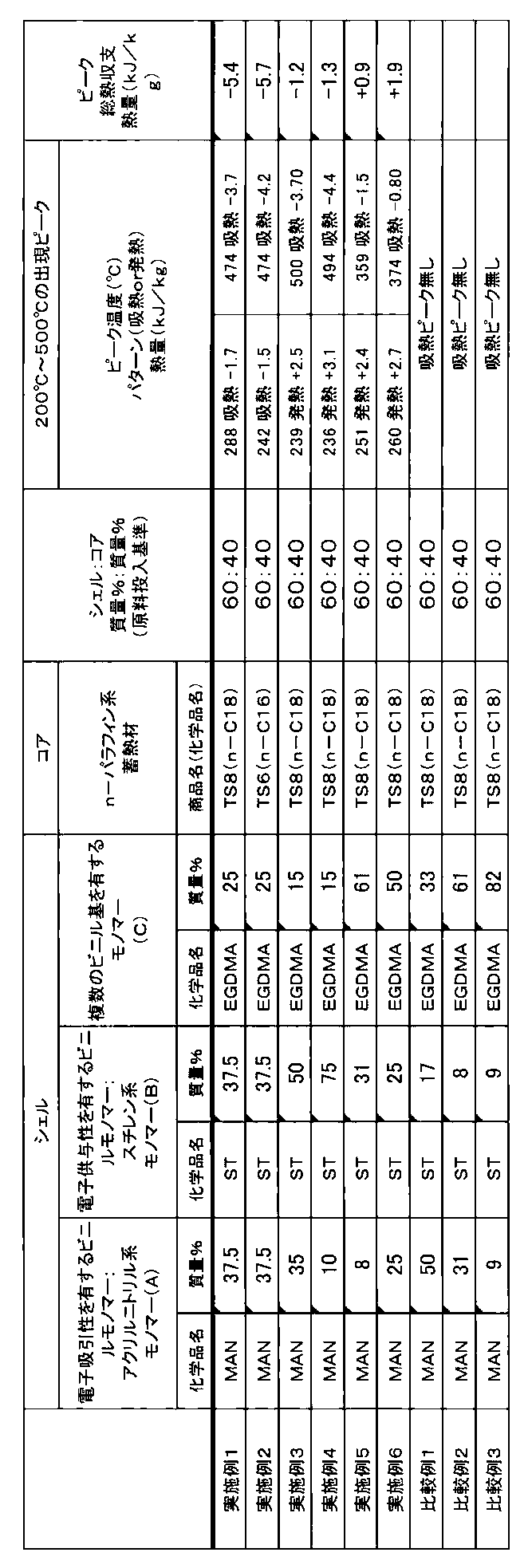
表1の結果より、シェルを構成するビニルモノマーの架橋共重合体組成を本発明の範囲内とすることで、200~500℃の昇温過程で、TG−DTA特性曲線上に、吸熱ピークが出現することが分かる。
[マイクロカプセル蓄熱材の製造II]
[実施例10~16、比較例10~11]
表2に示す配合で得た混合液を、実施例10~15は処理Iに従って、実施例16は処理IIに従って、O/W型乳化液とし、重合反応を行った。なお、表中、ANはアクリロニトリル、MANはメタクリロニトリル、STはスチレン、EGDMAはエチレングリコールジメタクリレート、TMPTは、トリメチロールプロパントリメタクリレートを表す。

表2の結果より、シェルを構成するビニルモノマーの架橋共重合体組成を本発明の範囲内とすることで、VOCの値が小さいマイクロカプセル蓄熱材が得られることが分かる。なお、これらのマイクロカプセル蓄熱材の平均粒径は、5~20μmの範囲にあった。また、実施例16のCV値は35%であった。
また、表1中の実施例1に掲げる組成で、上記<マイクロカプセルの吸熱特性の測定>で得られるマイクロカプセル蓄熱材懸濁水溶液(マイクロセル蓄熱材粒子約18質量%:水系溶媒82質量%)を濾過後、水に再分散させ、スプレードライヤーを用いて噴霧乾燥し、目視、および、走査電子顕微鏡(SEM)観察で、2次凝集のない、解砕状態の粒子が得られることを確認した。スプレードライヤー処理を含む製造ラインの概要を図5に示す。
また、実施例1(2)VOC測定方法にしたがって測定する、揮発性有機化学物質(VOC)量は、図5に示すホッパーで出口温度を90℃にすれば(当該温度を図中に一例として示した。)、表2に掲げる実施例3のマイクロカプセル蓄熱材の1.9mg/gに対し、0.5mg/gまで低下し、住宅資材中の蓄熱材として使用する際等の安全性を高め得ることを確認した。なお、本発明に係るマイクロカプセル蓄熱材のスプレードライ乾燥に当たっては、当該温度を135℃まで上昇させても支障は無く、より効果的に、VOC量を低下させることができる。
[マイクロカプセル蓄熱材の製造III]
[実施例20~29、比較例20]
表3に示す配合で得た混合液を、処理Iに従ってO/W型乳化液とし、重合反応を行った。なお、表中、MMAはメタクリル酸メチル、ANはアクリロニトリル、MANはメタクリロニトリル、STはスチレン、EGDMAは、エチレングリコールジメタクリレート、DVBは、ジビニルベンゼン、TMPTは、トリメチロールプロパントリメタクリレート、を表す。なお、比較例20は、処理IIを行った後に重合反応を実施した。

表3の結果より、シェルを構成するビニルモノマーの架橋共重合体組成を本発明の範囲内とし、本発明に係る処理Iを行うことで、CV値が30%以下となり、VOC特性と、加熱減量の両面で優れた特性を有するマイクロカプセル蓄熱材が得られることが分かる。なお、これらのマイクロカプセル蓄熱材の平均粒径は、5~20μmの範囲にあった。
[マイクロカプセル蓄熱材の製造IV]
[実施例30~31、比較例20]
表4に示す配合で得た混合液を、処理Iに従ってO/W型乳化液とし、重合反応を行った。STはスチレン、EGDMAは、エチレングリコールジメタクリレート、TMPTは、トリメチロールプロパントリメタクリレートを表す。なお、比較例20は、処理Iの代わりに処理IIを行った後に重合反応に処した。

表4の結果より、本発明に係る処理Iを行うことで、CV値が30%以下となり、VOC特性の面で優れた特性を有するマイクロカプセル蓄熱材が得られることが分かる。なお、これらのマイクロカプセル蓄熱材の平均粒径は、5~20μmの範囲にあった。
また、本発明に係るマイクロカプセル蓄熱材は、200~500℃の昇温過程で吸熱挙動を示すものであり、住宅建材の蓄熱構造材において、n−パラフィンをコア材とするマイクロカプセル蓄熱材の特長を生かしたまま、蓄熱性と同時に難燃性を要求される住宅建材等、各種構造部材を製造することができる。さらに、VOC値の低いマイクロカプセル蓄熱材を製造することが可能であり、またマイクロカプセル粒子の2次凝集を制御できるので、建材に適用する際にハンドリング性の良好な材料が得られる。
b 金網(網状体)
c スペーサー
2a 止め具
Claims (19)
- ビニル基を含まない潜熱蓄熱物質と、架橋能を有するビニルモノマーを含む少なくとも2種以上のビニルモノマー群を含むO/W型分散液中のビニルモノマー架橋共重合反応を経由してなる、
コアを構成する材料(以下、コア材という)が前記ビニル基を含まない潜熱蓄熱物質であり、
シェルを構成する材料(以下、シェル材という)が前記ビニルモノマー群を含んでなる架橋共重合体である、
コア—シェル構造を有するマイクロカプセル蓄熱材において、
ビニル基を含まない潜熱蓄熱物質がn−パラフィン系潜熱蓄熱材であり、
前記ビニルモノマー群が、互いに異なる、
電子吸引性基を有するビニルモノマーを少なくとも1種、
電子供与性基を有するビニルモノマーを少なくとも1種、
を含むことを特徴とするマイクロカプセル蓄熱材。 - シェル材を構成する架橋共重合体において、
電子吸引性基を有するビニルモノマーが、アクリロニトリル系モノマー、アクリル系モノマー(架橋能を有する複数のビニル基を含む多官能性アクリレート系モノマーを含む。)のいずれか、
電子供与性基を有するビニルモノマーがスチレン系モノマー、
を含むことを特徴とする請求項1に記載のマイクロカプセル蓄熱材。 - シェル材を構成する架橋共重合体において、
(A)アクリロニトリル系モノマー、(B)スチレン系モノマー、(C)複数のビニル基を含む(メタ)アクリレート系モノマーから得られる架橋性共重合体であり、前記モノマー類は合計して100質量%とし、
(A)の質量%≧8
(A)の質量%≧(B)の質量%
(C)の質量%≧ 25
であり、かつ、
揮発性有機化合物(VOC:100℃×2hrsにおける揮発性物質)が7.0mg/g以下であることを特徴とする、請求項1ないし請求項2に記載のマイクロカプセル蓄熱材。 - ビニル基を含まない潜熱蓄熱物質と、少なくとも2種以上のビニルモノマー群とを含むO/W型分散液中のビニルモノマー共重合反応を経由してなる、
コア材が前記ビニル基を含まない潜熱蓄熱物質であり、
シェル材が前記ビニルモノマー群を含んでなる架橋共重合体である、
コア—シェル構造を有するマイクロカプセル蓄熱材において、
ビニル基を含まない潜熱蓄熱物質がn−パラフィン系潜熱蓄熱材であり、
シェル材を構成する架橋共重合体の組成が、
(A)アクリロニトリル系モノマー 5~45質量%、
(B)スチレン系モノマー 20~80質量%、
(C)複数のビニル基を含む多官能性(メタ)アクリレート系モノマー 10~65質量%、
((A)、(B)および(C)成分を合わせて100質量%とする。)
である、
200~500℃の昇温過程のTG−DTA昇温特性曲線上に吸熱ピークを有することを特徴とする請求項1または2に記載のマイクロカプセル蓄熱材。 - 前記200℃~500℃の昇温過程のTG−DTA特性曲線上において、全吸熱ピークの吸熱量の総和が全発熱ピークの発熱量の総和よりも大であることを特徴とする請求項4に記載のマイクロカプセル蓄熱材。
- マイクロカプセル蓄熱材において、コア材とシェル材の総質量を100質量%としたときに、コア材が20質量%~80質量%、シェル材が80質量%~20質量%である請求項4ないし5に記載のマイクロカプセル蓄熱材。
- マイクロカプセル蓄熱材の粒径分布の指標である、下記式(1)で表されるCV値が30%以下であることを特徴とする請求項1ないし6の何れかに記載のマイクロカプセル蓄熱材。
CV値=(液滴径分布の標準偏差/体積平均粒径)×100 式(1) - マイクロカプセル蓄熱材の粒径分布の指標である、下記式(1)で表されるCV値が20%以下であることを特徴とする請求項1ないし6の何れかに記載のマイクロカプセル蓄熱材。
CV値=(液滴径分布の標準偏差/体積平均粒径)×100 式(1) - スプレードライによる乾燥工程を経由して得られることを特徴とする、請求項1、2、4ないし8のいずれかに記載のマイクロカプセル蓄熱材。
- スプレードライによる乾燥工程を経由して得られることを特徴とする、請求項3に記載のマイクロカプセル蓄熱材。
- O/W型分散液が架橋共重合反応前に、流路に沿って設けられた一定間隔を保持して配置されてなる複数の網状体を連続して順次通過させて乳化処理される工程を経由して得られること特徴とする、請求項1ないし9のいずれかに記載のマイクロカプセル蓄熱材。
- O/W型分散液が架橋共重合反応前に、ホモジナイザーを用いて乳化処理される工程を経由して得られること特徴とする、請求項3に記載のマイクロカプセル蓄熱材。
- 請求項1ないし10のいずれかに記載のマイクロカプセル蓄熱材の住宅建材用としての使用。
- ビニル基を含まない潜熱蓄熱物質と、架橋能を有するビニルモノマーを含む少なくとも2種のビニルモノマーとを含むO/W型分散液中のビニルモノマー架橋共重合反応を経由してなり、
コア材が前記ビニル基を含まない潜熱蓄熱物質であり、
シェル材が前記ビニルモノマー群を含んでなる架橋共重合体であるコア—シェル構造を有するマイクロカプセルを製造する方法において、 前記ビニルモノマーが互いに異なる、
電子吸引性基を有するビニルモノマー少なくとも1種と、
電子供与性基を有するビニルモノマー少なくとも1種を含み、かつ、
前記O/W型分散液が、
前記重合反応前に、流路に沿って設けられた一定間隔を保持して配置されてなる複数の網状体を連続して順次通過させて乳化処理される工程を含むことを特徴とする、マイクロカプセルの製造方法。 - 前記O/W型分散液中のビニルモノマーが、電子吸引性換基を有するビニルモノマーとしてアクリロニトリルおよび/またはメタクリロニトリル、電子供与性基を有するビニルモノマーとしてスチレンを含むことを特徴とする請求項14に記載のマイクロカプセルの製造方法。
- コア材がC8~C40の炭化水素であることを特徴とする、請求項14または15に記載のマイクロカプセルの製造方法。
- 下記式(1)で表されるマイクロカプセルのCV値が30%以下であることを特徴とする、請求項14ないし16の何れかに記載のマイクロカプセルの製造方法。
CV値=(液滴径分布の標準偏差/体積平均粒径)×100 式(1) - O/W型分散液の懸濁重合による、架橋ビニルモノマー共重合体をシェル材、n−パラフィン系潜熱蓄熱材をコア材とするマイクロカプセル蓄熱材の製造方法において、
シェル材を構成する架橋ビニルモノマー共重合体100質量%中のモノマー組成が、
(A)アクリロニトリル系モノマー 5~45質量%、
(B)スチレン系モノマー 20~80質量%、
(C)複数のビニル基を含む多官能性アクリレート系モノマー 10~65重量%、
((A)、(B)および(C)成分を合わせて100質量%とする。)
の範囲にあることを特徴とする、請求項15ないし17のいずれかに記載のマイクロカプセル蓄熱材の製造方法。 - さらに、前記懸濁重合によって得られるO/W型分散液を、スプレードライヤーにて噴霧乾燥することを特徴とする、請求項18のマイクロカプセル蓄熱材の製造方法。
Priority Applications (5)
| Application Number | Priority Date | Filing Date | Title |
|---|---|---|---|
| CA2897716A CA2897716A1 (en) | 2013-01-10 | 2014-01-10 | Microcapsule heat storage material, method of producing the same, and use of the same |
| EP14737586.9A EP2944679A4 (en) | 2013-01-10 | 2014-01-10 | MICROCAPED HEAT STORAGE MATERIAL, MANUFACTURING METHOD AND USE THEREOF |
| CN201480004499.1A CN104937066A (zh) | 2013-01-10 | 2014-01-10 | 微胶囊蓄热材料、其制造方法和其使用 |
| JP2014524171A JP5651272B1 (ja) | 2013-01-10 | 2014-01-10 | マイクロカプセル蓄熱材、その製造方法およびその使用 |
| US14/760,055 US20150353803A1 (en) | 2013-01-10 | 2014-01-10 | Microcapsule Heat Storage Material, Method of Producing the Same, and Use of the Same |
Applications Claiming Priority (6)
| Application Number | Priority Date | Filing Date | Title |
|---|---|---|---|
| JP2013002832 | 2013-01-10 | ||
| JP2013-002832 | 2013-01-10 | ||
| JP2013100361 | 2013-05-10 | ||
| JP2013-100361 | 2013-05-10 | ||
| JP2013115602 | 2013-05-31 | ||
| JP2013-115602 | 2013-05-31 |
Publications (1)
| Publication Number | Publication Date |
|---|---|
| WO2014109413A1 true WO2014109413A1 (ja) | 2014-07-17 |
Family
ID=51167057
Family Applications (1)
| Application Number | Title | Priority Date | Filing Date |
|---|---|---|---|
| PCT/JP2014/050865 Ceased WO2014109413A1 (ja) | 2013-01-10 | 2014-01-10 | マイクロカプセル蓄熱材、その製造方法およびその使用 |
Country Status (7)
| Country | Link |
|---|---|
| US (1) | US20150353803A1 (ja) |
| EP (1) | EP2944679A4 (ja) |
| JP (1) | JP5651272B1 (ja) |
| CN (1) | CN104937066A (ja) |
| CA (1) | CA2897716A1 (ja) |
| TW (1) | TW201434530A (ja) |
| WO (1) | WO2014109413A1 (ja) |
Cited By (4)
| Publication number | Priority date | Publication date | Assignee | Title |
|---|---|---|---|---|
| JP2018016690A (ja) * | 2016-07-26 | 2018-02-01 | Jsr株式会社 | 組成物、成形体及び建築材料 |
| JP2018034092A (ja) * | 2016-08-30 | 2018-03-08 | 住友電気工業株式会社 | マイクロカプセルおよびそれを用いたセラミックスの製造方法 |
| CN108348886A (zh) * | 2015-09-16 | 2018-07-31 | 卡莉西亚公司 | 通过双乳化制备微胶囊的方法 |
| JP2022086517A (ja) * | 2020-11-30 | 2022-06-09 | サイデン化学株式会社 | 蓄熱マイクロカプセル、蓄熱マイクロカプセル分散体、及び蓄熱マイクロカプセルの製造方法 |
Families Citing this family (9)
| Publication number | Priority date | Publication date | Assignee | Title |
|---|---|---|---|---|
| JP6007113B2 (ja) * | 2013-01-10 | 2016-10-12 | Jxエネルギー株式会社 | マイクロカプセルの製造方法およびマイクロカプセル |
| KR101666401B1 (ko) * | 2015-09-25 | 2016-10-14 | 한국과학기술연구원 | 이중 코팅된 열에너지 저장 캡슐 및 이의 제조방법 |
| CN107418519B (zh) * | 2017-05-16 | 2020-04-24 | 中国科学院过程工程研究所 | 一种窄粒径分布的有机相变材料微胶囊及其制备方法 |
| CN113727849B (zh) * | 2019-04-25 | 2023-06-30 | 富士胶片株式会社 | 蓄热部件 |
| CN112048143B (zh) * | 2019-06-06 | 2023-04-11 | 青岛海尔特种电冰柜有限公司 | 一种冷藏装置用包装材料及其包装装置和包装方法 |
| JPWO2021131404A1 (ja) * | 2019-12-27 | 2021-07-01 | ||
| CN111247999A (zh) * | 2020-02-20 | 2020-06-09 | 宁夏新起点现代农业装备科技有限公司 | 蓄热块、其制备方法及蓄热温室大棚 |
| CN114790089B (zh) * | 2022-06-15 | 2023-08-25 | 中国石油大学(华东) | 一种广范围温度调节储热微胶囊的制备方法及装置 |
| CN116020366B (zh) * | 2022-11-14 | 2023-09-05 | 武汉中科先进材料科技有限公司 | 一种热固自成膜相变微胶囊及其制备方法 |
Citations (11)
| Publication number | Priority date | Publication date | Assignee | Title |
|---|---|---|---|---|
| JPS62225241A (ja) * | 1985-11-29 | 1987-10-03 | Nok Corp | 蓄熱材封入マイクロカプセルの製造法 |
| JP2002516913A (ja) | 1997-11-11 | 2002-06-11 | ビーエーエスエフ アクチェンゲゼルシャフト | 潜熱蓄熱材料としてのマイクロカプセルの使用 |
| JP2004203978A (ja) | 2002-12-24 | 2004-07-22 | Sekisui Chem Co Ltd | 蓄熱マイクロカプセル |
| JP2004277646A (ja) | 2003-03-18 | 2004-10-07 | Sekisui Chem Co Ltd | 蓄熱マイクロカプセル |
| JP2004300424A (ja) * | 2003-03-14 | 2004-10-28 | Dainichiseika Color & Chem Mfg Co Ltd | 蓄熱材、その製造方法、加温あるいは冷却システムおよび蓄熱性物品、および共重合体 |
| JP2006257415A (ja) | 2005-02-17 | 2006-09-28 | Kobe Univ | 蓄熱カプセル及びその利用 |
| JP2008144054A (ja) | 2006-12-11 | 2008-06-26 | Enex Co Ltd | 粒子状蓄熱材及びその製造方法 |
| JP2009083289A (ja) * | 2007-09-28 | 2009-04-23 | Nisshin Steel Co Ltd | 蓄熱性を有する塗装鋼板 |
| JP2009090191A (ja) | 2007-10-05 | 2009-04-30 | Nippon Oil Corp | 乳化液の粒径および粒径分布を制御する方法およびこの方法に使用する装置 |
| JP2010150329A (ja) | 2008-12-24 | 2010-07-08 | Nippon Zeon Co Ltd | 蓄熱材用マイクロカプセル粒子 |
| JP2012011384A (ja) | 2001-12-20 | 2012-01-19 | Basf Se | コア材料としての1種以上の親油性物質とカプセルシェルとしてのポリマーを含むマイクロカプセル、その製法、その使用およびこれを含有する石膏ボード |
Family Cites Families (12)
| Publication number | Priority date | Publication date | Assignee | Title |
|---|---|---|---|---|
| EP1654056A4 (en) * | 2003-07-03 | 2007-08-08 | Lg Chemical Ltd | METHOD FOR THE PRODUCTION OF MICRO-CAPSULES BY MINI-EMULSION POLYMERIZATION |
| ES2393725T3 (es) * | 2004-08-10 | 2012-12-27 | Basf Se | Preparación de microcápsulas de partícula gruesa |
| CN1314480C (zh) * | 2005-03-29 | 2007-05-09 | 东华大学 | 溶液沉淀法制备相变储能微胶囊 |
| US20100022697A1 (en) * | 2006-03-23 | 2010-01-28 | Unversidad De Castilla-La Mancha | Process for microencapsulation of phase change materials, microcapsules obtained and uses thereof |
| WO2007117041A1 (ja) * | 2006-04-10 | 2007-10-18 | Nippon Oil Corporation | 連続乳化方法およびそのための乳化装置 |
| JP5324757B2 (ja) * | 2007-06-04 | 2013-10-23 | 松本油脂製薬株式会社 | 蓄熱マイクロカプセル、その製造方法および用途 |
| WO2009044925A1 (ja) * | 2007-10-04 | 2009-04-09 | Nippon Oil Corporation | アンチブロッキング剤マスターバッチおよびそれを用いたポリオレフィン系樹脂フィルム |
| AU2010261875B2 (en) * | 2009-06-15 | 2016-02-11 | Basf Se | Microcapsules having highly branched polymers as cross-linking agents |
| CN102471404B (zh) * | 2009-07-10 | 2015-01-21 | 巴斯夫欧洲公司 | 以多乙烯基单体为交联剂的微胶囊 |
| CN102311720A (zh) * | 2010-07-02 | 2012-01-11 | 中国科学院大连化学物理研究所 | 一种相变储能胶囊及其制备方法 |
| US9181466B2 (en) * | 2011-02-16 | 2015-11-10 | Basf Se | Microcapsules with a paraffin composition as capsule core |
| CN102417552A (zh) * | 2011-09-22 | 2012-04-18 | 中国科学院过程工程研究所 | 一种尺寸均一可控的聚合物纳微球产品及其制备方法 |
-
2014
- 2014-01-10 CN CN201480004499.1A patent/CN104937066A/zh active Pending
- 2014-01-10 EP EP14737586.9A patent/EP2944679A4/en not_active Withdrawn
- 2014-01-10 WO PCT/JP2014/050865 patent/WO2014109413A1/ja not_active Ceased
- 2014-01-10 US US14/760,055 patent/US20150353803A1/en not_active Abandoned
- 2014-01-10 TW TW103101012A patent/TW201434530A/zh unknown
- 2014-01-10 JP JP2014524171A patent/JP5651272B1/ja not_active Expired - Fee Related
- 2014-01-10 CA CA2897716A patent/CA2897716A1/en not_active Abandoned
Patent Citations (11)
| Publication number | Priority date | Publication date | Assignee | Title |
|---|---|---|---|---|
| JPS62225241A (ja) * | 1985-11-29 | 1987-10-03 | Nok Corp | 蓄熱材封入マイクロカプセルの製造法 |
| JP2002516913A (ja) | 1997-11-11 | 2002-06-11 | ビーエーエスエフ アクチェンゲゼルシャフト | 潜熱蓄熱材料としてのマイクロカプセルの使用 |
| JP2012011384A (ja) | 2001-12-20 | 2012-01-19 | Basf Se | コア材料としての1種以上の親油性物質とカプセルシェルとしてのポリマーを含むマイクロカプセル、その製法、その使用およびこれを含有する石膏ボード |
| JP2004203978A (ja) | 2002-12-24 | 2004-07-22 | Sekisui Chem Co Ltd | 蓄熱マイクロカプセル |
| JP2004300424A (ja) * | 2003-03-14 | 2004-10-28 | Dainichiseika Color & Chem Mfg Co Ltd | 蓄熱材、その製造方法、加温あるいは冷却システムおよび蓄熱性物品、および共重合体 |
| JP2004277646A (ja) | 2003-03-18 | 2004-10-07 | Sekisui Chem Co Ltd | 蓄熱マイクロカプセル |
| JP2006257415A (ja) | 2005-02-17 | 2006-09-28 | Kobe Univ | 蓄熱カプセル及びその利用 |
| JP2008144054A (ja) | 2006-12-11 | 2008-06-26 | Enex Co Ltd | 粒子状蓄熱材及びその製造方法 |
| JP2009083289A (ja) * | 2007-09-28 | 2009-04-23 | Nisshin Steel Co Ltd | 蓄熱性を有する塗装鋼板 |
| JP2009090191A (ja) | 2007-10-05 | 2009-04-30 | Nippon Oil Corp | 乳化液の粒径および粒径分布を制御する方法およびこの方法に使用する装置 |
| JP2010150329A (ja) | 2008-12-24 | 2010-07-08 | Nippon Zeon Co Ltd | 蓄熱材用マイクロカプセル粒子 |
Non-Patent Citations (3)
| Title |
|---|
| See also references of EP2944679A4 * |
| TAKAYUKI OTSU: "Kisokobunshikagaku", article "Kobunshigosei no kagaku" |
| TAKAYUKI OTSU: "Kobunshigosei no kagaku", 1968, KAGAKU-DOJIN PUBLISHING CO., INC. |
Cited By (5)
| Publication number | Priority date | Publication date | Assignee | Title |
|---|---|---|---|---|
| CN108348886A (zh) * | 2015-09-16 | 2018-07-31 | 卡莉西亚公司 | 通过双乳化制备微胶囊的方法 |
| JP2018535829A (ja) * | 2015-09-16 | 2018-12-06 | カリクシア | ダブルエマルジョンによってマイクロカプセルを作製するための方法 |
| JP2018016690A (ja) * | 2016-07-26 | 2018-02-01 | Jsr株式会社 | 組成物、成形体及び建築材料 |
| JP2018034092A (ja) * | 2016-08-30 | 2018-03-08 | 住友電気工業株式会社 | マイクロカプセルおよびそれを用いたセラミックスの製造方法 |
| JP2022086517A (ja) * | 2020-11-30 | 2022-06-09 | サイデン化学株式会社 | 蓄熱マイクロカプセル、蓄熱マイクロカプセル分散体、及び蓄熱マイクロカプセルの製造方法 |
Also Published As
| Publication number | Publication date |
|---|---|
| EP2944679A4 (en) | 2016-09-21 |
| US20150353803A1 (en) | 2015-12-10 |
| EP2944679A1 (en) | 2015-11-18 |
| JPWO2014109413A1 (ja) | 2017-01-19 |
| CA2897716A1 (en) | 2014-07-17 |
| CN104937066A (zh) | 2015-09-23 |
| JP5651272B1 (ja) | 2015-01-07 |
| TW201434530A (zh) | 2014-09-16 |
Similar Documents
| Publication | Publication Date | Title |
|---|---|---|
| JP5651272B1 (ja) | マイクロカプセル蓄熱材、その製造方法およびその使用 | |
| JP7468529B2 (ja) | 中空樹脂粒子の製造方法 | |
| JP2023072023A (ja) | ラテックスの製造方法及び中空樹脂粒子の製造方法 | |
| BR112020004306B1 (pt) | Microesferas termicamente expansíveis processo de fabricação das microesferas, processo de preparação de microesferas expandidas e microesferas expandidas | |
| CN102439050B (zh) | 单孔中空聚合物微粒的制造方法 | |
| JP7294345B2 (ja) | 樹脂組成物及びその成形体 | |
| Chaiyasat et al. | Preparation of poly (divinylbenzene) microencapsulated octadecane by microsuspension polymerization: oil droplets generated by phase inversion emulsification | |
| JP5831175B2 (ja) | 発泡性複合樹脂粒子及び複合樹脂発泡粒子成形体 | |
| JP5442592B2 (ja) | コアシェル粒子 | |
| CN101312782A (zh) | 热膨胀性微球、其制造方法以及用途 | |
| JP6007113B2 (ja) | マイクロカプセルの製造方法およびマイクロカプセル | |
| KR20140008383A (ko) | 캡슐 코어로서 파라핀 조성물을 가지는 마이크로캡슐 | |
| JP7673740B2 (ja) | 中空樹脂粒子の製造方法 | |
| WO2011122229A1 (ja) | 熱膨張性マイクロカプセル、熱膨張性マイクロカプセルの製造方法、発泡性マスターバッチ及び発泡成形体 | |
| JP4742161B2 (ja) | 単孔中空ポリマー微粒子の製造方法 | |
| KR20140125800A (ko) | 열팽창성 미소구, 그 제조방법 및 용도 | |
| TW201012856A (en) | Method for producing single-hole hollow polymer microparticles | |
| JP4788943B2 (ja) | 多孔性単分散粒子およびその製造方法 | |
| KR20150018560A (ko) | 혼합염 현탁 중합방법 및 그로부터 제조된 수지 및 촉매 | |
| TW201518493A (zh) | 蓄熱材含有建材 | |
| JP2019073582A (ja) | 有機微粒子及びその製造方法 | |
| JP2007075698A (ja) | 中空樹脂粒子 | |
| JP6991473B2 (ja) | ピッカリング粒子及びその製造方法、並びに気体内包粒子 | |
| Delaittre | Nitroxide-mediated polymerization in dispersed media | |
| JP2006326501A (ja) | 中空マイクロカプセル及びその製造方法 |
Legal Events
| Date | Code | Title | Description |
|---|---|---|---|
| ENP | Entry into the national phase |
Ref document number: 2014524171 Country of ref document: JP Kind code of ref document: A |
|
| 121 | Ep: the epo has been informed by wipo that ep was designated in this application |
Ref document number: 14737586 Country of ref document: EP Kind code of ref document: A1 |
|
| REEP | Request for entry into the european phase |
Ref document number: 2014737586 Country of ref document: EP |
|
| WWE | Wipo information: entry into national phase |
Ref document number: 2014737586 Country of ref document: EP |
|
| ENP | Entry into the national phase |
Ref document number: 2897716 Country of ref document: CA |
|
| WWE | Wipo information: entry into national phase |
Ref document number: 14760055 Country of ref document: US |
|
| NENP | Non-entry into the national phase |
Ref country code: DE |