WO2014115452A1 - モータ用ボビン - Google Patents
モータ用ボビン Download PDFInfo
- Publication number
- WO2014115452A1 WO2014115452A1 PCT/JP2013/084123 JP2013084123W WO2014115452A1 WO 2014115452 A1 WO2014115452 A1 WO 2014115452A1 JP 2013084123 W JP2013084123 W JP 2013084123W WO 2014115452 A1 WO2014115452 A1 WO 2014115452A1
- Authority
- WO
- WIPO (PCT)
- Prior art keywords
- aramid
- paper
- motor
- bobbin
- resin
- Prior art date
- Legal status (The legal status is an assumption and is not a legal conclusion. Google has not performed a legal analysis and makes no representation as to the accuracy of the status listed.)
- Ceased
Links
Images


Classifications
-
- H—ELECTRICITY
- H02—GENERATION; CONVERSION OR DISTRIBUTION OF ELECTRIC POWER
- H02K—DYNAMO-ELECTRIC MACHINES
- H02K3/00—Details of windings
- H02K3/32—Windings characterised by the shape, form or construction of the insulation
- H02K3/34—Windings characterised by the shape, form or construction of the insulation between conductors or between conductor and core, e.g. slot insulation
- H02K3/345—Windings characterised by the shape, form or construction of the insulation between conductors or between conductor and core, e.g. slot insulation between conductor and core, e.g. slot insulation
-
- H—ELECTRICITY
- H02—GENERATION; CONVERSION OR DISTRIBUTION OF ELECTRIC POWER
- H02K—DYNAMO-ELECTRIC MACHINES
- H02K3/00—Details of windings
- H02K3/30—Windings characterised by the insulating material
-
- B—PERFORMING OPERATIONS; TRANSPORTING
- B33—ADDITIVE MANUFACTURING TECHNOLOGY
- B33Y—ADDITIVE MANUFACTURING, i.e. MANUFACTURING OF THREE-DIMENSIONAL [3D] OBJECTS BY ADDITIVE DEPOSITION, ADDITIVE AGGLOMERATION OR ADDITIVE LAYERING, e.g. BY 3D PRINTING, STEREOLITHOGRAPHY OR SELECTIVE LASER SINTERING
- B33Y80/00—Products made by additive manufacturing
-
- H—ELECTRICITY
- H02—GENERATION; CONVERSION OR DISTRIBUTION OF ELECTRIC POWER
- H02K—DYNAMO-ELECTRIC MACHINES
- H02K3/00—Details of windings
- H02K3/46—Fastening of windings on the stator or rotor structure
- H02K3/52—Fastening salient pole windings or connections thereto
-
- H—ELECTRICITY
- H02—GENERATION; CONVERSION OR DISTRIBUTION OF ELECTRIC POWER
- H02K—DYNAMO-ELECTRIC MACHINES
- H02K3/00—Details of windings
- H02K3/46—Fastening of windings on the stator or rotor structure
- H02K3/52—Fastening salient pole windings or connections thereto
- H02K3/521—Fastening salient pole windings or connections thereto applicable to stators only
- H02K3/522—Fastening salient pole windings or connections thereto applicable to stators only for generally annular cores with salient poles
-
- B—PERFORMING OPERATIONS; TRANSPORTING
- B29—WORKING OF PLASTICS; WORKING OF SUBSTANCES IN A PLASTIC STATE IN GENERAL
- B29C—SHAPING OR JOINING OF PLASTICS; SHAPING OF MATERIAL IN A PLASTIC STATE, NOT OTHERWISE PROVIDED FOR; AFTER-TREATMENT OF THE SHAPED PRODUCTS, e.g. REPAIRING
- B29C70/00—Shaping composites, i.e. plastics material comprising reinforcements, fillers or preformed parts, e.g. inserts
- B29C70/68—Shaping composites, i.e. plastics material comprising reinforcements, fillers or preformed parts, e.g. inserts by incorporating or moulding on preformed parts, e.g. inserts or layers, e.g. foam blocks
-
- B—PERFORMING OPERATIONS; TRANSPORTING
- B29—WORKING OF PLASTICS; WORKING OF SUBSTANCES IN A PLASTIC STATE IN GENERAL
- B29K—INDEXING SCHEME ASSOCIATED WITH SUBCLASSES B29B, B29C OR B29D, RELATING TO MOULDING MATERIALS OR TO MATERIALS FOR MOULDS, REINFORCEMENTS, FILLERS OR PREFORMED PARTS, e.g. INSERTS
- B29K2277/00—Use of PA, i.e. polyamides, e.g. polyesteramides or derivatives thereof, as reinforcement
- B29K2277/10—Aromatic polyamides [Polyaramides] or derivatives thereof
-
- B—PERFORMING OPERATIONS; TRANSPORTING
- B29—WORKING OF PLASTICS; WORKING OF SUBSTANCES IN A PLASTIC STATE IN GENERAL
- B29K—INDEXING SCHEME ASSOCIATED WITH SUBCLASSES B29B, B29C OR B29D, RELATING TO MOULDING MATERIALS OR TO MATERIALS FOR MOULDS, REINFORCEMENTS, FILLERS OR PREFORMED PARTS, e.g. INSERTS
- B29K2995/00—Properties of moulding materials, reinforcements, fillers, preformed parts or moulds
- B29K2995/0003—Properties of moulding materials, reinforcements, fillers, preformed parts or moulds having particular electrical or magnetic properties, e.g. piezoelectric
- B29K2995/0007—Insulating
-
- B—PERFORMING OPERATIONS; TRANSPORTING
- B29—WORKING OF PLASTICS; WORKING OF SUBSTANCES IN A PLASTIC STATE IN GENERAL
- B29L—INDEXING SCHEME ASSOCIATED WITH SUBCLASS B29C, RELATING TO PARTICULAR ARTICLES
- B29L2031/00—Other particular articles
- B29L2031/34—Electrical apparatus, e.g. sparking plugs or parts thereof
- B29L2031/3406—Components, e.g. resistors
-
- H—ELECTRICITY
- H02—GENERATION; CONVERSION OR DISTRIBUTION OF ELECTRIC POWER
- H02K—DYNAMO-ELECTRIC MACHINES
- H02K2203/00—Specific aspects not provided for in the other groups of this subclass relating to the windings
- H02K2203/12—Machines characterised by the bobbins for supporting the windings
Definitions
- the present invention relates to a motor bobbin, and more specifically, a motor fitted in a core material such as a magnetic core winding in a state where a winding is wound in a motor stator constituting a motor generator of a hybrid car or an electric vehicle, for example.
- a motor stator constituting a motor generator of a hybrid car or an electric vehicle, for example.
- a hybrid car or an electric vehicle is equipped with a motor generator that selectively functions as an electric motor and a generator.
- a motor generator includes, for example, a cylindrical rotor fixed to an output shaft that is rotatably supported around an axis, and a motor stator having an inner peripheral surface with a predetermined gap from the outer peripheral surface of the rotor. And a motor housing that houses the motor stator.
- a motor stator constituting such a motor generator is generally composed of a core material and a winding, and in order to insulate between the core material and the winding, the winding is wound around a bobbin for a motor. The bobbin around which the winding is wound is inserted into the core material.
- such a motor bobbin is generally made of a synthetic resin.
- a synthetic resin for example, polyphenylene sulfide or the like is used (for example, Japanese Patent Application Laid-Open No. 2005-102454 and Japanese Patent Application Laid-Open No. 2005-102454). (See 2002-142399).
- the thickness of the bobbin is limited to about 0.6 mm, and in recent years, motor generators and the like are becoming more efficient, more output and more compact. Is not necessarily enough.
- An object of the present invention is to provide a motor bobbin that can withstand high efficiency and high output of a motor generator or the like.
- the present invention provides a motor bobbin around which a winding is wound,
- the insulating paper and the resin molding are composed of the insulating paper and the resin molding, and the insulating paper and the resin molding are connected and fixed without using an adhesive, and the surface of the insulating paper that is in contact with the resin molding is an aramid fibrid.
- the present invention provides the motor bobbin according to the first aspect, comprising a bobbin body part, at least part of which is the insulating paper.
- This invention provides the bobbin for motors as described in 1st aspect provided with a pair of resin molding connected to the both ends of the said bobbin body part.
- the present invention provides the motor bobbin according to the first aspect, wherein the surface treatment is a plasma surface treatment.
- the present invention provides the motor bobbin according to the first aspect, wherein the surface where the insulating paper and the resin molded body are in contact is impregnated with the resin molded body.
- the present invention provides the motor bobbin according to the first aspect, wherein the resin molded body has a winding positioning groove.
- the present invention provides the method for manufacturing a motor bobbin according to the first aspect, wherein adhesion to insulating paper is simultaneously performed when molding a resin molding.
- the present invention provides a motor using a stator in which a core material is incorporated and a winding is wound around the motor bobbin according to any one of the first to sixth aspects. To do.
- the present invention provides a motor generator using a stator in which a core material is incorporated and a winding is wound around the motor bobbin according to any one of the first to sixth aspects. provide.
- the present invention provides a generator using a stator in which a core material is incorporated and a winding is wound around a motor bobbin according to any one of the first to sixth aspects. provide.
- FIG. 2 is a perspective view of a folded insulating paper constituting the motor bobbin of FIG. 1.
- the perspective view of the resin molding which comprises the bobbin for motors of FIG. The perspective view which shows arrangement
- FIG. 1 is a perspective view of a motor bobbin 1 according to a preferred embodiment of the present invention.
- the motor bobbin 1 includes a bobbin body 2 having a U-shaped cross section and a pair of resin molded bodies 4 attached to both ends of the bobbin body 2.
- FIG. 2 which is a perspective view of the bobbin body 2
- the bobbin body 2 is formed in a U-shaped cross-section by bending both side edges of a rectangular insulating paper in a substantially right angle in the same direction.
- the resin molded body 4 includes a rectangular parallelepiped body portion 10 and a pair of flange portions 12 and 12 provided at both ends of the body portion 10. It has.
- the main body 10 and the pair of flanges 12 and 12 are integrally formed.
- Each flange portion 12 has the same shape, and the tip side portion of the flange portion 12 is a protruding portion 12 a protruding from the main body portion 10.
- the resin molded body 4 has a substantially U-shaped cross-sectional shape.
- the resin molded body 4 has a rectangular cross section surrounded by three sides by the inner side surface 12b of the protruding portion 12a of each flange portion 12 and the side surface 10a of the main body portion 10 in the protruding direction of the protruding portion 12a. is doing.
- the distance between the inner side surfaces 12 b of the protruding portions 12 a of the pair of flange portions 12 is substantially equal to the width of the central portion 6 of the bobbin body 2.
- Both ends of the bobbin body 2 in the longitudinal direction are connected to the respective resin molded bodies 4.
- the bobbin body 2 having a U-shaped cross section has the outer surface 6a of the central portion 6 joined to the side surface 10a of the main body 10 of the resin molded body 4 at both ends, and the outer surface 8a of each bent portion 8 is
- the resin molded body 4 is connected and fixed to each resin molded body 4 by joining to the inner side surface 12b of the protruding portion 12a of the resin molded body 4.
- the bobbin body 2 is connected to each resin molded body 4 without using an adhesive at a joint portion with each resin molded body 4.
- the surface of the bobbin body 2 joined to the resin molded body 4 is composed of aramid paper made of aramid fibrids and aramid short fibers.
- the insulating paper can be obtained by surface-treating a surface made of aramid paper by melting and extruding a resin on aramid paper made of aramid fibrids and short aramid fibers and heat-sealing.
- a large number of winding positioning grooves 14 extending in the horizontal direction are formed on the entire side surface 10b of the resin molded body 4 facing outward. ing. As shown in FIG.
- the protrusion 16 is formed on the back surface 10 c of the main body portion 10 of one resin molded body 4, and the main body portion 10 of the other resin molded body 4.
- a recess 18 is formed in the back surface 10c.
- the protrusions 16 and the recesses 18 are arranged as shown in FIG. 4, and the pair of motor bobbins 1 are separated from each other, and the motor bobbin is disposed on the stator core disposed between the pair of motor bobbins. It is used when 1 is connected.
- aramid means a linear polymer compound (aromatic polyamide) in which 60% or more of amide bonds are directly bonded to an aromatic ring.
- aromatic polyamide examples include polymetaphenylene isophthalamide and copolymers thereof, polyparaphenylene terephthalamide and copolymers thereof, poly (paraphenylene) -copoly (3,4'-diphenyl ether) terephthalamide, and the like.
- These aramids are industrially produced by, for example, conventionally known interfacial polymerization methods, solution polymerization methods and the like using isophthalic acid chloride and metaphenylenediamine, and can be obtained as commercial products. Is not to be done.
- polymetaphenylene isophthalamide is preferably used in that it has excellent molding processability, thermal adhesiveness, flame retardancy, heat resistance, and the like.
- aramid fibrids are film-form aramid particles having paper-making properties and are also called aramid pulp (see Japanese Patent Publication No. 35-11851, Japanese Patent Publication No. 37-5732, etc.).
- Aramid fibrids are widely known to be used as a papermaking raw material after being disaggregated and beaten in the same manner as ordinary wood pulp, and can be subjected to so-called beating treatment for the purpose of maintaining quality suitable for papermaking. This beating process can be performed by a paper refiner, a beater, or other papermaking raw material processing equipment that exerts a mechanical cutting action.
- the shape change of the fibrid can be monitored by the freeness test method stipulated in Japanese Industrial Standard P8121.
- the freeness of the aramid fibrid after the beating treatment is preferably in the range of 10 cm 3 to 300 cm 3 (Canadian Freeness (JISP8121)). If the fibrid has a freeness greater than this range, the strength of the aramid paper formed therefrom may be reduced. On the other hand, if it is desired to obtain a freeness smaller than 10 cm 3 , the utilization efficiency of the mechanical power to be input becomes small, the processing amount per unit time is often reduced, and further, the fibrid is miniaturized. Since it proceeds too much, the so-called binder function is likely to be lowered. Therefore, even when trying to obtain a freeness smaller than 10 cm 3 in this way, no particular advantage is recognized.
- the aramid short fiber is obtained by cutting a fiber made of aramid.
- aramid a fiber made of aramid.
- examples of such a fiber include “Teijin Conex (registered trademark)” by Teijin Limited and “Nomex (registered trademark)” by DuPont.
- the length of the aramid short fibers can be selected from the range of generally 1 mm or more and less than 50 mm, preferably 2 to 10 mm. When the length of the short fiber is smaller than 1 mm, the mechanical properties of the sheet material are deteriorated. On the other hand, when the length is 50 mm or more, “entanglement”, “binding”, etc. are likely to occur in the production of aramid paper by the wet method. Prone to defects.
- the aramid paper is a sheet-like material mainly composed of the aramid fibrids and short aramid fibers, and generally has a thickness in the range of 20 ⁇ m to 1000 ⁇ m. Further, aramid paper generally has a basis weight in the range of 10 g / m 2 to 1000 g / m 2 .
- the mixing ratio of the aramid fibrid and the aramid short fiber can be arbitrary, but the ratio (mass ratio) of the aramid fibrid / aramid short fiber is preferably 1/9 to 9/1, more Although it is preferably 2/8 to 8/2, it is not limited to this range.
- Aramid paper is generally produced by a method of mixing the above-mentioned aramid fibrid and aramid short fibers and then forming a sheet. Specifically, for example, after dry blending the aramid fibrid and the aramid short fiber, a method of forming a sheet using an air flow, after the aramid fibrid and the aramid short fiber are dispersed and mixed in a liquid medium, the liquid permeation is performed. For example, a so-called wet papermaking method using water as a medium is preferably selected. .
- a single or mixed aqueous slurry containing at least aramid fibrids and short aramid fibers is fed to a paper machine and dispersed, and then dewatered, squeezed and dried to be wound up as a sheet.
- the method is common.
- As the paper machine a long paper machine, a circular paper machine, a slanted paper machine, and a combination paper machine combining these are used.
- a composite sheet composed of a plurality of paper layers can be obtained by forming and combining slurry having different blending ratios.
- Additives such as a dispersibility improver, an antifoaming agent, and a paper strength enhancer are used as necessary during papermaking.
- the aramid paper obtained as described above can be improved in density and mechanical strength by hot pressing at high temperature and high pressure between a pair of rolls. Examples of the hot pressure conditions include, but are not limited to, when using a metal roll, a temperature of 100 to 400 ° C. and a linear pressure of 50 to 400 kg / cm.
- a plurality of aramid papers can be laminated during hot pressing. The above hot pressing can be performed a plurality of times in an arbitrary order.
- the insulating paper is composed of aramid paper composed of aramid fibrids and aramid short fibers at least on the side bonded to the resin molding of the insulating paper, and the resin is melt extruded on the aramid paper. Insulating paper obtained by surface-treating heat-sealing insulating paper corresponds to this.
- the resin polymers such as polyethylene terephthalate, polyethylene naphthalate, polyimide, polytetrafluoroethylene, polyphenylene sulfide, polyamide, semi-aromatic polyamide, phenoxy, or Brent of these polymers, alloys are preferably used. It is not limited to these.
- the number of layers of the aramid paper layer and the resin layer can be appropriately selected according to the use and purpose of the laminate, but at least one of the surface layers is an aramid paper layer, because the slipperiness is good.
- the above-described bobbin can be easily inserted between the core material and the winding of the motor stator, that is, between the slots provided in the core material, which is preferable.
- it comprises an aromatic polyamide resin as described in JP-A-2006-321183 and an epoxy group-containing phenoxy resin having an epoxy group in the molecule, and the ratio of the epoxy group-containing phenoxy resin is 30 to 50 mass.
- the thickness of the laminate can be appropriately selected according to the use and purpose of the laminate, and any thickness can be selected as long as there is no problem in workability such as bending or winding. In general, a thickness in the range of 50 ⁇ m to 1000 ⁇ m is preferable from the viewpoint of workability, but is not limited thereto.
- Examples of the surface treatment in the present invention include plasma surface treatment, corona surface treatment, and surface treatment by liquid immersion.
- the surface treatment as described above, the surface energy of the insulating paper is improved, and the interfacial energy with the resin molded body is reduced. As a result, the adhesion to the resin molded body is improved.
- Plasma surface treatment is particularly preferred because of the simplicity of the treatment.
- the plasma surface treatment in the present invention means that the substrate to be treated is exposed to a discharge that starts and continues by applying a high voltage of direct current or alternating current between electrodes, for example, corona discharge under atmospheric pressure or glow discharge in vacuum.
- a high voltage of direct current or alternating current between electrodes for example, corona discharge under atmospheric pressure or glow discharge in vacuum.
- processing in a vacuum with a wide selection of processing gas is preferable.
- process gas He, Ne, Ar, nitrogen, oxygen, a carbon dioxide gas, air, water vapor
- the treatment pressure is not particularly limited, but glow discharge treatment in which discharge is sustained in a pressure range of 0.1 Pa to 1330 Pa, so-called low temperature plasma treatment is preferable in terms of treatment efficiency. More preferably, it is in the range of 1 Pa to 266 Pa.
- the composition ratio X (O / C) of oxygen atoms (O) and carbon atoms (C) on the aramid paper surface is in the range of 120% or more and 250% or less of the theoretical value. As a result, the desired good heat-fusibility can be obtained.
- the composition ratio X (O / C) is the ratio of the number of atoms between the number of carbon atoms (C) and the number of oxygen atoms (O) measured on the aramid paper surface by XPS (X-ray electron light spectroscopy). (Measured value).
- the theoretical value means the value of the atomic ratio calculated from the repeating unit of the high molecular chemical structural formula in the resin composition constituting the resin.
- the surface of the aramid paper obtained by the above-described method is subjected to a low-temperature plasma treatment using a low-temperature plasma treatment machine. The method of doing is mentioned. Thereby, the aramid paper excellent in heat-fusibility can be obtained.
- the processing intensity (output) of the low temperature plasma processing is set to 30 W ⁇ min / m 2 to 1500 W ⁇ min / A range of m 2 is preferable.
- the range of the composition ratio X (O / C) described above on the surface of the aramid paper can be obtained.
- the intensity of the low-temperature plasma treatment is lower than the above range, the above-described composition ratio X becomes small, and when the intensity of the low-temperature plasma treatment is higher than the above-mentioned range, the above-mentioned composition ratio X becomes large, and both of them have good heat fusion. Wearability cannot be obtained. More preferably, it is in the range of 130 W ⁇ min / m 2 to 1200 W ⁇ min / m 2 .
- the resin molding refers to, for example, PPS resin (polyphenylene sulfide resin), acrylonitrile / butadiene / styrene copolymer resin, polyimide resin, polyethylene terephthalate resin, polyacetal resin, polyamide 6 containing an amide bond.
- PPS resin polyphenylene sulfide resin
- acrylonitrile / butadiene / styrene copolymer resin polyimide resin
- polyethylene terephthalate resin polyacetal resin
- polyamide 6 containing an amide bond polyamide 6 containing an amide bond.
- Examples of such mixtures include, but are not limited to, DuPont's Zytel (registered trademark) HTN51G, 52G.
- Method for manufacturing motor bobbin By placing the insulating paper that has been subjected to the plasma surface treatment in advance in the mold so that at least a part of the plasma surface treatment is in contact with the melted part of the resin molded body, the molten polymer is subjected to at least the plasma surface treatment of the insulating paper.
- the surface portion can be impregnated.
- the motor bobbin of the present invention can be used as a motor, a motor generator, a generator, or the like by incorporating a core material and winding a winding as a stator.
- the present invention will be described with reference to examples. These examples are for explaining the contents of the present invention by way of examples, and are not intended to limit the contents of the present invention in any way.
- Measurement of basis weight and thickness It carried out according to JIS C2300-2.
- Calculation of density It calculated with basic weight ⁇ thickness.
- Adhesiveness The adhesion part of an insulating paper and a resin molding was observed visually.
- Appearance of insulating paper portion The degree of warpage due to heat at the time of molding the insulating paper portion was visually determined.
- a polymetaphenylene isophthalamide fibrid was manufactured using a pulp particle manufacturing apparatus (wet precipitator) composed of a combination of a stator and a rotor described in JP-A-52-15621. This was processed with a disaggregator and a beater to adjust the length weighted average fiber length to 0.9 mm. The freeness of the obtained aramid fibrid was 90 cm 3 . Meanwhile, a DuPont meta-aramid fiber (Nomex (registered trademark), single yarn fineness 2 denier) was cut into a length of 6 mm (hereinafter referred to as “aramid short fiber”).
- aramid short fiber a DuPont meta-aramid fiber
- Examples 1 and 2 Manufacture of plasma-treated insulating paper
- the insulating paper shown in Table 1 is passed through the internal electrode type low-temperature plasma treatment machine described in FIG. 1 of Japanese Patent No. 4607826, and a low-temperature plasma treatment is performed on the surface of one side at a treatment strength of 650 W ⁇ min / m 2 . did.
- the composition ratio X (O / C) of the number of oxygen atoms (O) and carbon atoms (C) on the surface of the insulating paper was 206% of the theoretical value of the number ratio of atoms.
- Insertion molding was carried out under the conditions shown in Table 1 using the above plasma-treated insulating paper and polyphenylene sulfide (Fortron (registered trademark) 1140A64) manufactured by Polyplastics Co., Ltd. as a polymer to obtain a motor bobbin. .
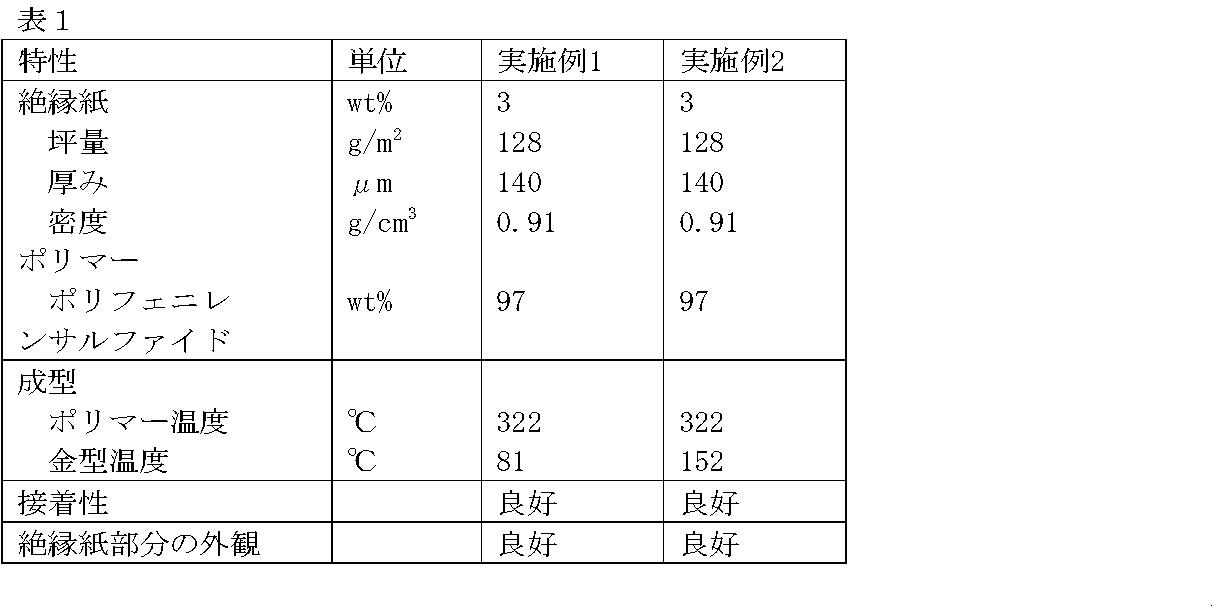
- Table 1 shows the main characteristic values of the motor bobbin thus obtained.
- the bobbin for a motor of the embodiment has a small thickness because the bobbin body portion is made of insulating paper, and high efficiency can be expected by increasing the winding area of the winding, and the coupling and fixing between the insulating paper and the resin molded body is sufficient.
- the insulation paper does not warp, it has high adhesion to the core material, so it can be expected that the dielectric breakdown voltage is sufficiently high, and furthermore, the heat resistance of the aramid paper and polymer used is high, Since it is considered that it can sufficiently withstand the heat generation of the winding, it is useful as a motor bobbin that can withstand high efficiency and high output of a motor generator or the like.
- the film is usually stretched in most cases, and when it is connected and fixed to the bobbin body portion of insulating paper at the same time as the production of the resin molded body of the motor bobbin by the melt injection molding method, it relaxes and shrinks due to heat. In some cases, the insulating paper may be deformed.
Landscapes
- Engineering & Computer Science (AREA)
- Power Engineering (AREA)
- Chemical & Material Sciences (AREA)
- Manufacturing & Machinery (AREA)
- Materials Engineering (AREA)
- Insulation, Fastening Of Motor, Generator Windings (AREA)
- Composite Materials (AREA)
- Mechanical Engineering (AREA)
Abstract
Description
しかしながら、このような合成樹脂でボビンが構成される場合、そのボビンの厚みは0.6mm程度が下限とされており、近年のモータジェネレータなどの益々の高効率化、大出力化及びコンパクト化には必ずしも十分な対応ができていない。高効率及び大出力が要求されるモータジェネレータ用ボビンには、
1)薄いこと(低厚み)、
2)巻き線とコア材の地絡を防ぐこと(高耐電圧、耐部分放電)
3)巻き線の発熱に耐えること(耐熱性)、
4)機械的強度を有すること
の4つの特性を同時に満たすことが必要とされている。特に、低厚みは薄ければその分、巻き線を増量でき、線積率を増加させ、大出力化が可能という意味で、極めて重要であると考えられる。
第1の態様において、本発明は、巻線が巻回されるモータ用ボビンであって、
絶縁紙と樹脂成型体とからなり、前記絶縁紙と樹脂成型体とは、接着剤を用いることなく連結固定され、前記樹脂成型体と当接している前記絶縁紙の面は、アラミドファイブリッドとアラミド短繊維からなるアラミド紙で構成され、前記絶縁紙は、アラミドファイブリッドとアラミド短繊維からなるアラミド紙上に樹脂を溶融押出して熱融着し、アラミド紙で構成された面を表面処理することで得られ、アラミド紙上に樹脂成形体の溶融した部分を接触させてなる前記モータ用ボビンを提供する。
第2の態様において、本発明は、少なくともその一部が前記絶縁紙であるボビンボディ部を備えた第1の態様に記載のモータ用ボビンを提供する。
第3の態様において、本発明は、前記ボビンボディ部の両端に連結された一対の樹脂成型体を備えた第1の態様に記載のモータ用ボビンを提供する。
第4の態様において、本発明は、前記表面処理がプラズマ表面処理である、第1の態様に記載のモータ用ボビンを提供する。
第5の態様において、本発明は、絶縁紙と樹脂成型体が接する面に樹脂成型体が含浸している、第1の態様に記載のモータ用ボビンを提供する。
第6の態様において、本発明は、樹脂成型体に巻き線の位置決め用の溝がある、第1の態様に記載のモータ用ボビンを提供する。
第7の態様において、本発明は、樹脂成型体を成型するときに絶縁紙との接着を同時に行う、第1の態様に記載のモータ用ボビンの製造方法を提供する。
第8の態様において、本発明は、コア材が組み込まれた、第1~第6のいずれかの態様に記載のモータ用ボビンに巻き線を巻回したステーターを使用している、モータを提供する。
第9の態様において、本発明は、コア材が組み込まれた、第1~第6のいずれかの態様に記載のモータ用ボビンに巻き線を巻回したステーターを使用している、モータジェネレータを提供する。
第10の態様において、本発明は、コア材が組み込まれた、第1~第6のいずれかの態様に記載のモータ用ボビンに巻き線を巻回したステーターを使用している、発電機を提供する。
モータ用ボビン1は、断面コ字状のボビンボディ2と、ボビンボディ2の両端に取付けられた一対の樹脂成型体4とを備えている。
ボビンボディ2の斜視図である図2に示されているように、ボビンボディ2は、長方形の絶縁紙の両側縁部を同一方向に向けて略直角に折り曲げることによって断面コ字状に成形され、中央部分6と、両側縁の一対の折曲部8、8とを備えている。
樹脂成型体4の斜視図である図3に示されているように、樹脂成型体4は、直方体状の本体部10と、本体部10の両端に設けられた一対の庇部12、12とを備えている。本実施態様のモータ用ボビン1では、本体部10と一対の庇部12、12とは一体的に形成されている。各庇部12は同一形状を有し、庇部12の先端側部分は、本体部10から突出する突出部12aとされている。この結果、樹脂成型体4は、略コ字状の断面形状を有している。そして、樹脂成型体4は、各庇部12の突出部12aの内側面12bと突出部12aの突出方向の本体部10の側面10aとで、三方を囲まれた断面が矩形状の空間を形成している。一対の庇部12の突出部12aの内側面12bの間隔は、ボビンボディ2の中央部分6の幅と略等しい。
ボビンボディ2は、各樹脂成型体4との接合部において接着剤を介することなく、各樹脂成型体4と連結されている。さらに、樹脂成型体4と接合しているボビンボディ2の面は、アラミドファイブリッドとアラミド短繊維からなるアラミド紙で構成されている。さらに、絶縁紙は、アラミドファイブリッドとアラミド短繊維からなるアラミド紙上に樹脂を溶融押出して熱融着し、アラミド紙で構成された面を表面処理することで得られる。
本実施態様のモータ用ボビン1では、各樹脂成型体4の本体部10の外方を向いた側面10bの全体には、水平方向に延びる巻線の位置決め用の溝14が多数本、形成されている。
図4に示されているように、本実施態様のモータ用ボビン1では、一方の樹脂成型体4の本体部10の裏面10cには突起16が、他方の樹脂成型体4の本体部10の裏面10cには凹部18が形成されている。これら突起16および凹部18は、図4に示されているような配置で、一対のモータ用ボビン1を離間して配置し、この一対のモータ用ボビンの間に配置されたステータコアにモータ用ボビン1を連結する際に使用されるものである。
本発明において、アラミドとは、アミド結合の60%以上が芳香環に直接結合した線状高分子化合物(芳香族ポリアミド)を意味する。このようなアラミドとしては、例えばポリメタフェニレンイソフタルアミドおよびその共重合体、ポリパラフェニレンテレフタルアミドおよびその共重合体、ポリ(パラフェニレン)-コポリ(3,4’-ジフェニルエーテル)テレフタールアミドなどが挙げられる。これらのアラミドは、例えばイソフタル酸塩化物およびメタフェニレンジアミンを用いた従来既知の界面重合法、溶液重合法等により工業的に製造されており、市販品として入手することができるが、これに限定されるものではない。これらのアラミドの中で、ポリメタフェニレンイソフタルアミドが、良好な成型加工性、熱接着性、難燃性、耐熱性などの特性を備えている点で好ましく用いられる。
本発明において、アラミドファイブリッドとは、抄紙性を有するフィルム状のアラミド粒子であり、アラミドパルプとも呼ばれる(特公昭35-11851号公報、特公昭37-5732号公報等参照)。
アラミドファイブリッドは、通常の木材パルプと同様に、離解、叩解処理を施し抄紙原料として用いることが広く知られており、抄紙に適した品質を保つ目的でいわゆる叩解処理を施すことができる。この叩解処理は、デイスクリファイナー、ビーター、その他の機械的切断作用を及ぼす抄紙原料処理機器によって実施することが出来る。この操作において、ファイブリッドの形態変化は、日本工業規格P8121に規定の濾水度試験方法(フリーネス)でモニターすることができる。本発明において、叩解処理を施した後のアラミドファイブリッドの濾水度は、10cm3~300cm3(カナディアンフリーネス(JISP8121))の範囲内にあることが好ましい。この範囲より大きな濾水度のファイブリッドでは、それから成形されるアラミド紙の強度が低下する可能性がある。一方、10cm3よりも小さな濾水度を得ようとすると、投入する機械動力の利用効率が小さくなり、また、単位時間当たりの処理量が少なくなることが多く、さらに、ファイブリッドの微細化が進行しすぎるためいわゆるバインダー機能の低下を招きやすい。したがって、このように10cm3よりも小さい濾水度を得ようとしても、格段の利点が認められない。
アラミド短繊維は、アラミドを材料とする繊維を切断したものであり、そのような繊維としては、例えば帝人(株)の「テイジンコーネックス(登録商標)」、デュポン社の「ノーメックス(登録商標)」などの商品名で入手することができるものが挙げられるが、これらに限定されるものではない。
アラミド短繊維の長さは、一般に1mm以上50mm未満、好ましくは2~10mmの範囲内から選ぶことができる。短繊維の長さが1mmよりも小さいと、シート材料の力学特性が低下し、他方、50mm以上のものは、湿式法でのアラミド紙の製造にあたり「からみ」、「結束」などが発生しやすく欠陥の原因となりやすい。
本発明において、アラミド紙とは、前記のアラミドファイブリッド及びアラミド短繊維から主として構成されるシート状物であり、一般に20μm~1000μmの範囲内の厚さを有している。さらに、アラミド紙は、一般に10g/m2~1000g/m2の範囲内の坪量を有している。ここで、アラミドファイブリッドとアラミド短繊維の混合割合は任意とすることができるが、アラミドファイブリッド/アラミド短繊維の割合(質量比)を1/9~9/1とするのが好ましく、より好ましくは2/8~8/2であるが、この範囲に限定されるものではない。
アラミド紙は、一般に、前述したアラミドファイブリッドとアラミド短繊維とを混合した後シート化する方法により製造される。具体的には、例えば上記アラミドファイブリッド及びアラミド短繊維を乾式ブレンドした後に、気流を利用してシートを形成する方法、アラミドファイブリッド及びアラミド短繊維を液体媒体中で分散混合した後、液体透過性の支持体、例えば網またはベルト上に吐出してシート化し、液体を除いて乾燥する方法などが適用できるが、これらのなかでも水を媒体として使用する、いわゆる湿式抄造法が好ましく選択される。
湿式抄造法では、少なくともアラミドファイブリッド、アラミド短繊維を含有する単一または混合物の水性スラリーを、抄紙機に送液し分散した後、脱水、搾水および乾燥操作することによって、シートとして巻き取る方法が一般的である。抄紙機としては長網抄紙機、円網抄紙機、傾斜型抄紙機およびこれらを組み合わせたコンビネーション抄紙機などが利用される。コンビネーション抄紙機での製造の場合、配合比率の異なるスラリーをシート成形し合一することで複数の紙層からなる複合体シートを得ることができる。抄造の際に必要に応じて分散性向上剤、消泡剤、紙力増強剤などの添加剤が使用される。
上記のようにして得られたアラミド紙は、一対のロール間にて高温高圧で熱圧することにより、密度、機械強度を向上することができる。熱圧の条件は、たとえば金属製ロール使用の場合、温度100~400℃、線圧50~400kg/cmの範囲内を例示することができるが、これらに限定されるものではない。熱圧の際に複数のアラミド紙を積層することもできる。上記の熱圧加工を任意の順に複数回行うこともできる。
本発明において、絶縁紙は、少なくとも前記絶縁紙の樹脂成型体と接着している側の面がアラミドファイブリッドとアラミド短繊維からなるアラミド紙で構成されており、アラミド紙上に樹脂を溶融押出して熱融着した絶縁紙を表面処理した絶縁紙がこれに該当する。前記樹脂としては、ポリエチレンテレフタレート、ポリエチレンナフタレート、ポリイミド、ポリテトラフルオロエチレン、ポリフェニレンサルファイド、ポリアミド、半芳香族ポリアミド、フェノキシなどのポリマー、あるいはそれらのポリマーのブレント、アロイなどが好ましく使用されるが、これらに限定されるものではない。
アラミド紙の層と樹脂の層の積層の層数は積層体の用途、目的に応じて適宜選択できるが、少なくとも片方の表層はアラミド紙の層であることが、すべり性が良好となるため、モータにおいてたとえばモータステータのコア材と巻線との間、すなわちコア材に設けたスロットの間に上記のようなボビンを挿入しやすくなるという効果があり、好ましい。例えば、特開2006-321183号公報に記載されているような芳香族ポリアミド樹脂と分子内にエポキシ基を有するエポキシ基含有フェノキシ樹脂とからなり、前記エポキシ基含有フェノキシ樹脂の比率が30~50質量%であるポリマーとアラミド紙の2層積層シート、アラミド紙と前記ポリマーとアラミド紙の3層の積層シートが挙げられるが、これらに限定されるものではない。
積層体の厚みは、積層体の用途及び目的に応じて適宜選択でき、折り曲げ、巻きつけなどの加工性に問題がなければ、任意の厚みを選択することができる。一般には、加工性の観点から50μm~1000μmの範囲内の厚みが好ましいが、これに限定されるものではない。
本発明における表面処理とは、プラズマ表面処理、コロナ表面処理、液体浸漬による表面処理などがあげられる。これらのような表面処理を実施することにより、絶縁紙の表面の表面エネルギーの向上、樹脂成型体との界面エネルギーの低下の結果、樹脂成型体との接着性が向上する。処理の簡便さから特にプラズマ表面処理が好ましい。
本発明におけるプラズマ表面処理とは、電極間に直流または交流の高電圧を印加することによって開始持続する放電、例えば大気圧下でのコロナ放電あるいは真空でのグロー放電などに処理基材を曝すことによって成される処理をいう。このとき、特に限定されないが、処理ガスの選択が広い真空での処理が好ましい。処理ガスとしては、特に限定されないが、He、Ne、Ar、窒素、酸素、炭酸ガス、空気、水蒸気等が単独あるいは混合した状態で使用される。なかでもAr、炭酸ガスが放電開始効率の点から好ましい。処理圧力は特に限定されないが、0.1Pa~1330Paの圧力範囲で持続放電するグロー放電処理、いわゆる低温プラズマ処理が処理効率の点で好ましい。さらに好ましくは、1Pa~266Paの範囲である。
本発明において、より具体的には、アラミド紙表面における酸素原子(O)と炭素原子(C)との組成比X(O/C)が、理論値の120%以上、250%以下の範囲にあることにより、目的とする良好な熱融着性を得ることができる。ここで、組成比X(O/C)とは、アラミド紙表面をXPS(X線電子光分光法)で測定した炭素原子数(C)と、酸素原子数(O)との原子数の比(測定値)をいう。また、その理論値とは、樹脂を構成する樹脂組成における、高分子化学構造式の反復単位から算出される原子数比率の値をいう。
例えば、ノーメックス(登録商標)紙の場合、主成分であるポリメタフェニレンイソフタルアミドは、C/O/N=14/2/2となり、炭素原子数(C)と酸素原子数(O)との組成比X(O/C)の理論値は、炭素(C)基準にすると、2/14=0.143である。通常は、表面に炭化水素系のものが微量付着しているため実測値は理論値よりも小さいとされる。前記組成比X(O/C)が、理論値の120%以上、250%以下の範囲、つまり20%~150%の範囲で理論値よりも大きい値であれば、良好な熱融着性を得ることができた。より好ましくは150%以上、230%以下の範囲である。組成比Xが、理論値の120%未満であれば、良好な熱融着性が得られない。また、理論値の250%を越えた場合でも、やはり良好な熱融着性が得られない。
また、前記組成比X(O/C)が前述した範囲内であるアラミド紙を得る方法としては、前述の方法によって得られたアラミド紙に対し、低温プラズマ処理機により、その表面を低温プラズマ処理する方法などが挙げられる。これにより、熱融着性に優れたアラミド紙を得ることができる。
このとき、内部電極方式のプラズマ処理機を採用してアラミド紙に対する低温プラズマ処理を行う場合にあっては、低温プラズマ処理の処理強度(出力)を、30W・min/m2~1500W・min/m2の範囲とすることが好ましい。これにより、アラミド紙の表面における前述した組成比X(O/C)の範囲を得ることができる。低温プラズマ処理の強度が上記範囲より低い場合、上記した組成比Xが小さくなり、低温プラズマ処理の強度が上記範囲より高い場合には、上記した組成比Xが大きくなり、いずれも良好なる熱融着性が得られなくなる。更に好ましくは、130W・min/m2~1200W・min/m2の範囲である。
本発明において、樹脂成型体とは、例えばPPS樹脂(ポリフェニレンサルファイド樹脂)、アクリルニトリル・ブタジエン・スチレン共重合体樹脂、ポリイミド系樹脂、ポリエチレンテレフタレート系樹脂、ポリアセタール系樹脂、アミド結合を含有するポリアミド6、ポリアミド66、ポリアミド612、ポリアミド11、ポリアミド12、共重合ポリアミド、ポリアミドMXD6、ポリアミド46、メトキシメチル化ポリアミド、半芳香族ポリアミドなどのポリマー、あるいは特開2006-321951号公報に示されるようなポリアミド樹脂組成物を含有するポリマーあるいはそれらの混合物または前記ポリマーとガラス繊維などの無機物との混合物を溶融させた状態で所望の金型に挿入し、冷却後型から外すという溶融射出成型法により作製された成型体を表す。特に半芳香族ポリアミドとガラス繊維の混合物の成型体が、耐熱性が高いため好ましい。このような混合物の例として、デュポン社のザイテル(登録商標)HTN51G、52Gなどが挙げられるが、これらに限定されるものではない。
樹脂成型体が巻き線と接する部分に巻き線の位置決め用の溝を成型することにより、巻き線の位置が安定し、精度の高い整列巻きが可能となり、モータジェネレータなどの効率が向上するという効果があり、好ましい。
上記金型内に予め前記プラズマ表面処理した絶縁紙を少なくともプラズマ表面処理した一部分が樹脂成形体の溶融した部分と接触するように配置することで、溶融したポリマーが絶縁紙の少なくともプラズマ表面処理した表面の部分に含浸させることができる。樹脂成型体の部分と絶縁紙が連結固定したモータ用ボビンをこのようにして作製することにより、接着剤を使用する必要もなく、樹脂成型体作製時に同時に連結固定することができる。また、ボディ部分にアラミド紙を使用することで、ボディ部分を薄くすることができ、線積率や熱伝導性を向上させることができる。本発明のモータ用ボビンは、コア材を組み込み、巻き線を巻回してステーターとして、モータ、モータジェネレータ、発電機などとして使用できる。
以下、本発明について実施例を挙げて説明する。なお、これらの実施例は、本発明の内容を、例を挙げては説明するためのものであり、本発明の内容を何ら限定するものではない。
(1)坪量、厚みの測定
JIS C2300-2に準じて実施した。
(2)密度の計算
坪量÷厚みで計算した。
(3)接着性
絶縁紙と樹脂成型体の接着部分を目視により観察した。
(4)絶縁紙部分の外観
絶縁紙の部分の成型時の熱による反りの度合いを目視により判定した。
(原料調製)
特開昭52-15621号公報に記載の、ステーターとローターの組み合わせで構成されるパルプ粒子の製造装置(湿式沈殿機)を用いて、ポリメタフェニレンイソフタルアミドのファイブリッドを製造した。これを、離解機、叩解機で処理し長さ加重平均繊維長を0.9mmに調節した。得られたアラミドファイブリッドの濾水度は90cm3であった。
一方、デュポン社製メタアラミド繊維(ノーメックス(登録商標)、単糸繊度2デニール)を、長さ6mmに切断(以下「アラミド短繊維」と記載)した。
(アラミド紙の製造)
調製したアラミドファイブリッドとアラミド短繊維をおのおの水中で分散しスラリーを作成した。これらのスラリーを、ファイブリッドとアラミド短繊維とが1/1の配合比率(重量比)となるように混合し、タッピー式手抄き機(断面積625cm2)にてシート状物を作製した。次いで、これを金属製カレンダーロールにより温度330℃、線圧300kg/cmで熱圧加工し、表1、並びに表2に示すアラミド紙を得た。
(絶縁紙の製造)
特開2006-321183号公報の段落[0024]に記載の方法で、前記アラミド紙とエポキシ基含有フェノキシ樹脂が50重量%含有されている半芳香族ポリアミド樹脂組成物(特開2006-321183号公報の配合例6)を用いて、アラミド紙を外側に配置したアラミド紙/樹脂組成物/アラミド紙(重量比で37/54/37)の3層構造よりなるアラミド紙を含む表1の実施例1及び2、並びに表2の比較例1及び2に示す絶縁紙を得た。
(プラズマ表面処理された絶縁紙の製造)
表1に示す絶縁紙を、特許第4607826号公報の図1に記載の内部電極方式の低温プラズマ処理機に通し、任意の片側表面に処理強度650W・min/m2にて低温プラズマ処理を施した。このとき、絶縁紙表面の、酸素原子(O)と炭素原子(C)との原子数の組成比X(O/C)は、原子数比率の理論値の206%であった。
上記プラズマ表面処理された絶縁紙とポリマーとしてポリプラスチックス社製ポリフェニレンサルファイド(フォートロン(登録商標)1140A64))を用いて、表1に示す条件で挿入成型を実施し、モータ用ボビンを得た。このようにして得られたモータ用ボビンの主要特性値を表1に示す。
実施例のモータ用ボビンは、ボビンボディ部は絶縁紙よりなるため、厚みが小さく、巻き線の高線積化による高効率化が期待でき、絶縁紙と樹脂成型体間の連結固定も十分であり、さらに絶縁紙に反りも発生していないので、コア材との密着性も高いため、絶縁破壊電圧も十分に高いことが期待でき、さらに使用したアラミド紙とポリマーの耐熱性が高いため、巻き線の発熱にも十分に耐え得ると考えられることから、モータジェネレータなどの高効率化・大出力化に耐えうるモータ用ボビンとして有用である。
(絶縁紙の製造)
前記アラミド紙と東レ社製ポリエチレンテレフタレートフィルム(S28♯16、厚み16μm)を接着剤で貼り合わせ、アラミド紙を外側に配置したアラミド紙/ポリエチレンテレフタレートフィルム/アラミド紙(重量比で37/24/37)の3層構造よりなるアラミド紙を含む表2の比較例3~6に示す絶縁紙を得た。
表2の比較例5及び6に示す絶縁紙を、特許第4607826号公報の図1に記載の内部電極方式の低温プラズマ処理機に通し、任意の片側表面に処理強度650W・min/m2にて低温プラズマ処理を施した。このとき、絶縁紙表面の、酸素原子(O)と炭素原子(C)との原子数の組成比X(O/C)は、原子数比率の理論値の206%であった。
上記絶縁紙とポリマーとしてポリプラスチックス社製ポリフェニレンサルファイド(フォートロン(登録商標)1140A64))を用いて、表2に示す条件で挿入成型を実施し、モータ用ボビンを得た。このようにして得られたモータ用ボビンの主要特性値を表2に示す。
比較例1~4のモータ用ボビンは、絶縁紙に樹脂が含浸していない部分があり、目視で絶縁紙と樹脂成型体の間に隙間がある部分が確認できた。これは、モータなどに使用したときに部分放電発生や、隙間の部分は厚くなるので巻き線の線積率減少による効率の低下、コアに嵌入するときの障害の原因などを招くと考えられることから、モータジェネレータなどの高効率化・大出力化に耐え得るモータ用ボビンとしては適さないと考えられる。また、比較例3~6のモータ用ボビンは、アラミド紙とフィルムを積層しているため、フィルムの部分が収縮したことにより反りが発生した。反りは、コア材との密着性を低下させ、絶縁破壊電圧が下がる可能性がある。さらに、反りが大きいとコアに嵌入するときの障害の原因などを招くと考えられることから、モータジェネレータなどの高効率化・大出力化に耐えうるモータ用ボビンとしては適さないと考えられる。
このようにフィルムは、通常延伸されている場合がほとんどで、溶融射出成型法でモータ用ボビンの樹脂成形体の製造と同時に絶縁紙のボビンボディ部と連結固定する場合、熱により緩和、収縮し、絶縁紙の変形の原因となる場合がある。
2:ボビンボディ
4:樹脂成型体
6:中央部分
8:折曲部
10:本体部
12:庇部
12a:突出部
14:溝
16:突起
18:凹部
Claims (10)
- 巻線が巻回されるモータ用ボビンであって、
絶縁紙と樹脂成型体とからなり、
前記絶縁紙と樹脂成型体とは、接着剤を用いることなく連結固定され、
前記樹脂成型体と当接している前記絶縁紙の面は、アラミドファイブリッドとアラミド短繊維からなるアラミド紙で構成され、
前記絶縁紙は、アラミドファイブリッドとアラミド短繊維からなるアラミド紙上に樹脂を溶融押出して熱融着し、アラミド紙で構成された面を表面処理することで得られ、
アラミド紙上に樹脂成形体の溶融した部分を接触させてなる前記モータ用ボビン。 - 少なくともその一部が前記絶縁紙であるボビンボディ部を備えた請求項1に記載のモータ用ボビン。
- 前記ボビンボディ部の両端に連結された一対の樹脂成型体を備えた請求項1に記載のモータ用ボビン。
- 前記表面処理がプラズマ表面処理である、請求項1に記載のモータ用ボビン。
- 絶縁紙と樹脂成型体が接する面に樹脂成型体が含浸している、請求項1に記載のモータ用ボビン。
- 樹脂成型体に巻き線の位置決め用の溝がある、請求項3に記載のモータ用ボビン。
- 樹脂成型体を成型するときに絶縁紙との接着を同時に行う、請求項1に記載のモータ用ボビンの製造方法。
- コア材が組み込まれた、請求項1~6のいずれかに記載のモータ用ボビンに巻き線を巻回したステーターを使用している、モータ。
- コア材が組み込まれた、請求項1~6のいずれかに記載のモータ用ボビンに巻き線を巻回したステーターを使用している、モータジェネレータ。
- コア材が組み込まれた、請求項1~6のいずれかに記載のモータ用ボビンに巻き線を巻回したステーターを使用している、発電機。
Priority Applications (4)
| Application Number | Priority Date | Filing Date | Title |
|---|---|---|---|
| KR1020157019587A KR102046681B1 (ko) | 2013-01-24 | 2013-12-19 | 모터용 보빈 |
| EP13872732.6A EP2950425B1 (en) | 2013-01-24 | 2013-12-19 | Motor bobbin |
| CN201380071367.6A CN104937820B (zh) | 2013-01-24 | 2013-12-19 | 发动机用线圈骨架 |
| US14/437,078 US9812916B2 (en) | 2013-01-24 | 2013-12-19 | Motor bobbin |
Applications Claiming Priority (2)
| Application Number | Priority Date | Filing Date | Title |
|---|---|---|---|
| JP2013011012A JP6119076B2 (ja) | 2013-01-24 | 2013-01-24 | モータ用ボビン |
| JP2013-011012 | 2013-01-24 |
Publications (1)
| Publication Number | Publication Date |
|---|---|
| WO2014115452A1 true WO2014115452A1 (ja) | 2014-07-31 |
Family
ID=51227252
Family Applications (1)
| Application Number | Title | Priority Date | Filing Date |
|---|---|---|---|
| PCT/JP2013/084123 Ceased WO2014115452A1 (ja) | 2013-01-24 | 2013-12-19 | モータ用ボビン |
Country Status (7)
| Country | Link |
|---|---|
| US (1) | US9812916B2 (ja) |
| EP (1) | EP2950425B1 (ja) |
| JP (1) | JP6119076B2 (ja) |
| KR (1) | KR102046681B1 (ja) |
| CN (1) | CN104937820B (ja) |
| TW (1) | TWI621322B (ja) |
| WO (1) | WO2014115452A1 (ja) |
Families Citing this family (5)
| Publication number | Priority date | Publication date | Assignee | Title |
|---|---|---|---|---|
| JP6533651B2 (ja) * | 2014-09-04 | 2019-06-19 | 日東シンコー株式会社 | モータ用絶縁シート |
| TWI558067B (zh) * | 2015-09-18 | 2016-11-11 | 財團法人工業技術研究院 | 一種電機繞線框架結構 |
| JP6757627B2 (ja) | 2016-08-30 | 2020-09-23 | シスメックス株式会社 | 支持体、体液収集セットおよび体液収集方法 |
| KR102448234B1 (ko) * | 2016-11-08 | 2022-09-28 | 듀폰 테이진 어드밴스드 페이퍼 가부시끼가이샤 | 절연 부재 및 그의 제조 방법 |
| TWI770390B (zh) * | 2019-06-13 | 2022-07-11 | 鼎赫生物科技股份有限公司 | 一種猴頭菇固態培養萃取物用於製備延緩老化之組合物的用途 |
Citations (9)
| Publication number | Priority date | Publication date | Assignee | Title |
|---|---|---|---|---|
| JPS5215621A (en) | 1975-07-25 | 1977-02-05 | Teijin Ltd | Apparatus for producing pulp particles |
| JP2002142399A (ja) | 2000-10-31 | 2002-05-17 | Tokyo Parts Ind Co Ltd | モータ用コイルボビン、同ボビンを用いたモータ用ステータおよび同ステータを備えたモータ |
| JP2005102454A (ja) | 2003-09-26 | 2005-04-14 | Yaskawa Electric Corp | モータステータ用平角線巻回ボビン |
| JP2006321951A (ja) | 2005-05-20 | 2006-11-30 | Nitto Shinko Kk | 樹脂組成物 |
| JP2006321183A (ja) | 2005-05-20 | 2006-11-30 | Nitto Shinko Kk | 積層シート |
| JP2009130942A (ja) * | 2007-11-19 | 2009-06-11 | Aisin Seiki Co Ltd | 回転機器 |
| JP4607826B2 (ja) | 2006-06-28 | 2011-01-05 | 河村産業株式会社 | アラミド−ポリエステル積層体 |
| JP2012044780A (ja) * | 2010-08-19 | 2012-03-01 | Kawamura Sangyo Kk | 電気機器用ボビン及びその製造方法 |
| JP2012180619A (ja) * | 2011-03-02 | 2012-09-20 | Du Pont Teijin Advanced Paper Kk | 耐熱性電気絶縁シート材料及びその製造方法 |
Family Cites Families (11)
| Publication number | Priority date | Publication date | Assignee | Title |
|---|---|---|---|---|
| JP2000333388A (ja) * | 1999-05-21 | 2000-11-30 | Matsushita Electric Ind Co Ltd | 固定子 |
| US20060068670A1 (en) * | 2004-09-30 | 2006-03-30 | Anderson David W | Electrical insulation laminates and electrical devices containing such laminates |
| JPWO2007043224A1 (ja) * | 2005-10-12 | 2009-04-16 | パナソニック株式会社 | 固定子及びこれを適用したモータ、及びこの固定子の製造方法 |
| JP2009213311A (ja) * | 2008-03-05 | 2009-09-17 | Taisei Plas Co Ltd | 回転電機の固定子用ボビンとその製造方法 |
| JP4875662B2 (ja) * | 2008-05-19 | 2012-02-15 | 三菱電機株式会社 | 回転電機の固定子 |
| JP5603029B2 (ja) | 2009-06-22 | 2014-10-08 | 河村産業株式会社 | 電動機用絶縁シートおよびその製造方法 |
| WO2011136144A1 (ja) | 2010-04-28 | 2011-11-03 | 河村産業株式会社 | 電気機器用ボビンおよびその製造方法 |
| JP2011234537A (ja) * | 2010-04-28 | 2011-11-17 | Kawamura Sangyo Co Ltd | 回転電機用ボビン、回転電機及び回転電機用ボビンの製造方法 |
| JP5441846B2 (ja) * | 2010-07-20 | 2014-03-12 | 本田技研工業株式会社 | 電動機の突極集中巻きコイル及びその製造方法 |
| JP5751927B2 (ja) * | 2011-05-13 | 2015-07-22 | 三菱電機株式会社 | 回転電機およびそれに用いられるステータの製造方法 |
| CN202634095U (zh) * | 2012-05-16 | 2012-12-26 | 盟立自动化科技(上海)有限公司 | 马达定子的绝缘套件 |
-
2013
- 2013-01-24 JP JP2013011012A patent/JP6119076B2/ja not_active Expired - Fee Related
- 2013-12-19 EP EP13872732.6A patent/EP2950425B1/en active Active
- 2013-12-19 WO PCT/JP2013/084123 patent/WO2014115452A1/ja not_active Ceased
- 2013-12-19 CN CN201380071367.6A patent/CN104937820B/zh not_active Expired - Fee Related
- 2013-12-19 KR KR1020157019587A patent/KR102046681B1/ko not_active Expired - Fee Related
- 2013-12-19 US US14/437,078 patent/US9812916B2/en not_active Expired - Fee Related
- 2013-12-26 TW TW102148387A patent/TWI621322B/zh not_active IP Right Cessation
Patent Citations (9)
| Publication number | Priority date | Publication date | Assignee | Title |
|---|---|---|---|---|
| JPS5215621A (en) | 1975-07-25 | 1977-02-05 | Teijin Ltd | Apparatus for producing pulp particles |
| JP2002142399A (ja) | 2000-10-31 | 2002-05-17 | Tokyo Parts Ind Co Ltd | モータ用コイルボビン、同ボビンを用いたモータ用ステータおよび同ステータを備えたモータ |
| JP2005102454A (ja) | 2003-09-26 | 2005-04-14 | Yaskawa Electric Corp | モータステータ用平角線巻回ボビン |
| JP2006321951A (ja) | 2005-05-20 | 2006-11-30 | Nitto Shinko Kk | 樹脂組成物 |
| JP2006321183A (ja) | 2005-05-20 | 2006-11-30 | Nitto Shinko Kk | 積層シート |
| JP4607826B2 (ja) | 2006-06-28 | 2011-01-05 | 河村産業株式会社 | アラミド−ポリエステル積層体 |
| JP2009130942A (ja) * | 2007-11-19 | 2009-06-11 | Aisin Seiki Co Ltd | 回転機器 |
| JP2012044780A (ja) * | 2010-08-19 | 2012-03-01 | Kawamura Sangyo Kk | 電気機器用ボビン及びその製造方法 |
| JP2012180619A (ja) * | 2011-03-02 | 2012-09-20 | Du Pont Teijin Advanced Paper Kk | 耐熱性電気絶縁シート材料及びその製造方法 |
Non-Patent Citations (1)
| Title |
|---|
| See also references of EP2950425A4 * |
Also Published As
| Publication number | Publication date |
|---|---|
| CN104937820B (zh) | 2018-01-23 |
| TWI621322B (zh) | 2018-04-11 |
| TW201434243A (zh) | 2014-09-01 |
| EP2950425A4 (en) | 2016-10-05 |
| US9812916B2 (en) | 2017-11-07 |
| CN104937820A (zh) | 2015-09-23 |
| JP2014143845A (ja) | 2014-08-07 |
| EP2950425B1 (en) | 2020-05-06 |
| KR20150108835A (ko) | 2015-09-30 |
| US20150288238A1 (en) | 2015-10-08 |
| EP2950425A1 (en) | 2015-12-02 |
| JP6119076B2 (ja) | 2017-04-26 |
| KR102046681B1 (ko) | 2019-11-19 |
Similar Documents
| Publication | Publication Date | Title |
|---|---|---|
| JP6085870B2 (ja) | モータ用ボビン | |
| JP6533029B2 (ja) | モータ用ボビン及びその製造方法 | |
| TWI737838B (zh) | 絕緣部件及其製造方法 | |
| JP6119076B2 (ja) | モータ用ボビン | |
| CN113615050B (zh) | 环状层叠芯材及环状层叠芯材的制造方法 | |
| WO2013065467A1 (ja) | アラミド-ポリオレフィン積層体 | |
| JP6863711B2 (ja) | スロットライナー及びその製造方法 | |
| JP2018068104A (ja) | モータ用ボビン及びその製造方法 |
Legal Events
| Date | Code | Title | Description |
|---|---|---|---|
| 121 | Ep: the epo has been informed by wipo that ep was designated in this application |
Ref document number: 13872732 Country of ref document: EP Kind code of ref document: A1 |
|
| WWE | Wipo information: entry into national phase |
Ref document number: 14437078 Country of ref document: US |
|
| WWE | Wipo information: entry into national phase |
Ref document number: 2013872732 Country of ref document: EP |
|
| ENP | Entry into the national phase |
Ref document number: 20157019587 Country of ref document: KR Kind code of ref document: A |
|
| NENP | Non-entry into the national phase |
Ref country code: DE |