WO2014115602A1 - 時計用の潤滑油組成物および時計 - Google Patents
時計用の潤滑油組成物および時計 Download PDFInfo
- Publication number
- WO2014115602A1 WO2014115602A1 PCT/JP2014/050453 JP2014050453W WO2014115602A1 WO 2014115602 A1 WO2014115602 A1 WO 2014115602A1 JP 2014050453 W JP2014050453 W JP 2014050453W WO 2014115602 A1 WO2014115602 A1 WO 2014115602A1
- Authority
- WO
- WIPO (PCT)
- Prior art keywords
- lubricating oil
- oil composition
- group
- carbon atoms
- timepiece
- Prior art date
- Legal status (The legal status is an assumption and is not a legal conclusion. Google has not performed a legal analysis and makes no representation as to the accuracy of the status listed.)
- Ceased
Links
- 0 C=*(c1ccccc1)c1ccccc1 Chemical compound C=*(c1ccccc1)c1ccccc1 0.000 description 1
Images


Classifications
-
- C—CHEMISTRY; METALLURGY
- C10—PETROLEUM, GAS OR COKE INDUSTRIES; TECHNICAL GASES CONTAINING CARBON MONOXIDE; FUELS; LUBRICANTS; PEAT
- C10M—LUBRICATING COMPOSITIONS; USE OF CHEMICAL SUBSTANCES EITHER ALONE OR AS LUBRICATING INGREDIENTS IN A LUBRICATING COMPOSITION
- C10M169/00—Lubricating compositions characterised by containing as components a mixture of at least two types of ingredient selected from base-materials, thickeners or additives, covered by the preceding groups, each of these compounds being essential
- C10M169/04—Mixtures of base-materials and additives
- C10M169/044—Mixtures of base-materials and additives the additives being a mixture of non-macromolecular and macromolecular compounds
-
- C—CHEMISTRY; METALLURGY
- C10—PETROLEUM, GAS OR COKE INDUSTRIES; TECHNICAL GASES CONTAINING CARBON MONOXIDE; FUELS; LUBRICANTS; PEAT
- C10M—LUBRICATING COMPOSITIONS; USE OF CHEMICAL SUBSTANCES EITHER ALONE OR AS LUBRICATING INGREDIENTS IN A LUBRICATING COMPOSITION
- C10M141/00—Lubricating compositions characterised by the additive being a mixture of two or more compounds covered by more than one of the main groups C10M125/00 - C10M139/00, each of these compounds being essential
- C10M141/10—Lubricating compositions characterised by the additive being a mixture of two or more compounds covered by more than one of the main groups C10M125/00 - C10M139/00, each of these compounds being essential at least one of them being an organic phosphorus-containing compound
-
- C—CHEMISTRY; METALLURGY
- C10—PETROLEUM, GAS OR COKE INDUSTRIES; TECHNICAL GASES CONTAINING CARBON MONOXIDE; FUELS; LUBRICANTS; PEAT
- C10M—LUBRICATING COMPOSITIONS; USE OF CHEMICAL SUBSTANCES EITHER ALONE OR AS LUBRICATING INGREDIENTS IN A LUBRICATING COMPOSITION
- C10M169/00—Lubricating compositions characterised by containing as components a mixture of at least two types of ingredient selected from base-materials, thickeners or additives, covered by the preceding groups, each of these compounds being essential
- C10M169/04—Mixtures of base-materials and additives
-
- C—CHEMISTRY; METALLURGY
- C10—PETROLEUM, GAS OR COKE INDUSTRIES; TECHNICAL GASES CONTAINING CARBON MONOXIDE; FUELS; LUBRICANTS; PEAT
- C10M—LUBRICATING COMPOSITIONS; USE OF CHEMICAL SUBSTANCES EITHER ALONE OR AS LUBRICATING INGREDIENTS IN A LUBRICATING COMPOSITION
- C10M2201/00—Inorganic compounds or elements as ingredients in lubricant compositions
- C10M2201/04—Elements
- C10M2201/041—Carbon; Graphite; Carbon black
-
- C—CHEMISTRY; METALLURGY
- C10—PETROLEUM, GAS OR COKE INDUSTRIES; TECHNICAL GASES CONTAINING CARBON MONOXIDE; FUELS; LUBRICANTS; PEAT
- C10M—LUBRICATING COMPOSITIONS; USE OF CHEMICAL SUBSTANCES EITHER ALONE OR AS LUBRICATING INGREDIENTS IN A LUBRICATING COMPOSITION
- C10M2201/00—Inorganic compounds or elements as ingredients in lubricant compositions
- C10M2201/06—Metal compounds
- C10M2201/065—Sulfides; Selenides; Tellurides
- C10M2201/066—Molybdenum sulfide
-
- C—CHEMISTRY; METALLURGY
- C10—PETROLEUM, GAS OR COKE INDUSTRIES; TECHNICAL GASES CONTAINING CARBON MONOXIDE; FUELS; LUBRICANTS; PEAT
- C10M—LUBRICATING COMPOSITIONS; USE OF CHEMICAL SUBSTANCES EITHER ALONE OR AS LUBRICATING INGREDIENTS IN A LUBRICATING COMPOSITION
- C10M2205/00—Organic macromolecular hydrocarbon compounds or fractions, whether or not modified by oxidation as ingredients in lubricant compositions
- C10M2205/02—Organic macromolecular hydrocarbon compounds or fractions, whether or not modified by oxidation as ingredients in lubricant compositions containing acyclic monomers
- C10M2205/026—Butene
-
- C—CHEMISTRY; METALLURGY
- C10—PETROLEUM, GAS OR COKE INDUSTRIES; TECHNICAL GASES CONTAINING CARBON MONOXIDE; FUELS; LUBRICANTS; PEAT
- C10M—LUBRICATING COMPOSITIONS; USE OF CHEMICAL SUBSTANCES EITHER ALONE OR AS LUBRICATING INGREDIENTS IN A LUBRICATING COMPOSITION
- C10M2205/00—Organic macromolecular hydrocarbon compounds or fractions, whether or not modified by oxidation as ingredients in lubricant compositions
- C10M2205/02—Organic macromolecular hydrocarbon compounds or fractions, whether or not modified by oxidation as ingredients in lubricant compositions containing acyclic monomers
- C10M2205/028—Organic macromolecular hydrocarbon compounds or fractions, whether or not modified by oxidation as ingredients in lubricant compositions containing acyclic monomers containing aliphatic monomers having more than four carbon atoms
- C10M2205/0285—Organic macromolecular hydrocarbon compounds or fractions, whether or not modified by oxidation as ingredients in lubricant compositions containing acyclic monomers containing aliphatic monomers having more than four carbon atoms used as base material
-
- C—CHEMISTRY; METALLURGY
- C10—PETROLEUM, GAS OR COKE INDUSTRIES; TECHNICAL GASES CONTAINING CARBON MONOXIDE; FUELS; LUBRICANTS; PEAT
- C10M—LUBRICATING COMPOSITIONS; USE OF CHEMICAL SUBSTANCES EITHER ALONE OR AS LUBRICATING INGREDIENTS IN A LUBRICATING COMPOSITION
- C10M2205/00—Organic macromolecular hydrocarbon compounds or fractions, whether or not modified by oxidation as ingredients in lubricant compositions
- C10M2205/04—Organic macromolecular hydrocarbon compounds or fractions, whether or not modified by oxidation as ingredients in lubricant compositions containing aromatic monomers, e.g. styrene
- C10M2205/046—Organic macromolecular hydrocarbon compounds or fractions, whether or not modified by oxidation as ingredients in lubricant compositions containing aromatic monomers, e.g. styrene used as thickening agents
-
- C—CHEMISTRY; METALLURGY
- C10—PETROLEUM, GAS OR COKE INDUSTRIES; TECHNICAL GASES CONTAINING CARBON MONOXIDE; FUELS; LUBRICANTS; PEAT
- C10M—LUBRICATING COMPOSITIONS; USE OF CHEMICAL SUBSTANCES EITHER ALONE OR AS LUBRICATING INGREDIENTS IN A LUBRICATING COMPOSITION
- C10M2207/00—Organic non-macromolecular hydrocarbon compounds containing hydrogen, carbon and oxygen as ingredients in lubricant compositions
- C10M2207/04—Ethers; Acetals; Ortho-esters; Ortho-carbonates
- C10M2207/0406—Ethers; Acetals; Ortho-esters; Ortho-carbonates used as base material
-
- C—CHEMISTRY; METALLURGY
- C10—PETROLEUM, GAS OR COKE INDUSTRIES; TECHNICAL GASES CONTAINING CARBON MONOXIDE; FUELS; LUBRICANTS; PEAT
- C10M—LUBRICATING COMPOSITIONS; USE OF CHEMICAL SUBSTANCES EITHER ALONE OR AS LUBRICATING INGREDIENTS IN A LUBRICATING COMPOSITION
- C10M2207/00—Organic non-macromolecular hydrocarbon compounds containing hydrogen, carbon and oxygen as ingredients in lubricant compositions
- C10M2207/28—Esters
- C10M2207/283—Esters of polyhydroxy compounds
- C10M2207/2835—Esters of polyhydroxy compounds used as base material
-
- C—CHEMISTRY; METALLURGY
- C10—PETROLEUM, GAS OR COKE INDUSTRIES; TECHNICAL GASES CONTAINING CARBON MONOXIDE; FUELS; LUBRICANTS; PEAT
- C10M—LUBRICATING COMPOSITIONS; USE OF CHEMICAL SUBSTANCES EITHER ALONE OR AS LUBRICATING INGREDIENTS IN A LUBRICATING COMPOSITION
- C10M2209/00—Organic macromolecular compounds containing oxygen as ingredients in lubricant compositions
- C10M2209/02—Macromolecular compounds obtained by reactions only involving carbon-to-carbon unsaturated bonds
- C10M2209/06—Macromolecular compounds obtained by reactions only involving carbon-to-carbon unsaturated bonds containing monomers having an unsaturated radical bound to an acyloxy radical of saturated carboxylic or carbonic acid
- C10M2209/062—Vinyl esters of saturated carboxylic or carbonic acids, e.g. vinyl acetate
-
- C—CHEMISTRY; METALLURGY
- C10—PETROLEUM, GAS OR COKE INDUSTRIES; TECHNICAL GASES CONTAINING CARBON MONOXIDE; FUELS; LUBRICANTS; PEAT
- C10M—LUBRICATING COMPOSITIONS; USE OF CHEMICAL SUBSTANCES EITHER ALONE OR AS LUBRICATING INGREDIENTS IN A LUBRICATING COMPOSITION
- C10M2209/00—Organic macromolecular compounds containing oxygen as ingredients in lubricant compositions
- C10M2209/02—Macromolecular compounds obtained by reactions only involving carbon-to-carbon unsaturated bonds
- C10M2209/08—Macromolecular compounds obtained by reactions only involving carbon-to-carbon unsaturated bonds containing monomers having an unsaturated radical bound to a carboxyl radical, e.g. acrylate type
- C10M2209/084—Acrylate; Methacrylate
-
- C—CHEMISTRY; METALLURGY
- C10—PETROLEUM, GAS OR COKE INDUSTRIES; TECHNICAL GASES CONTAINING CARBON MONOXIDE; FUELS; LUBRICANTS; PEAT
- C10M—LUBRICATING COMPOSITIONS; USE OF CHEMICAL SUBSTANCES EITHER ALONE OR AS LUBRICATING INGREDIENTS IN A LUBRICATING COMPOSITION
- C10M2209/00—Organic macromolecular compounds containing oxygen as ingredients in lubricant compositions
- C10M2209/02—Macromolecular compounds obtained by reactions only involving carbon-to-carbon unsaturated bonds
- C10M2209/08—Macromolecular compounds obtained by reactions only involving carbon-to-carbon unsaturated bonds containing monomers having an unsaturated radical bound to a carboxyl radical, e.g. acrylate type
- C10M2209/086—Macromolecular compounds obtained by reactions only involving carbon-to-carbon unsaturated bonds containing monomers having an unsaturated radical bound to a carboxyl radical, e.g. acrylate type polycarboxylic, e.g. maleic acid
- C10M2209/0866—Macromolecular compounds obtained by reactions only involving carbon-to-carbon unsaturated bonds containing monomers having an unsaturated radical bound to a carboxyl radical, e.g. acrylate type polycarboxylic, e.g. maleic acid used as thickening agents
-
- C—CHEMISTRY; METALLURGY
- C10—PETROLEUM, GAS OR COKE INDUSTRIES; TECHNICAL GASES CONTAINING CARBON MONOXIDE; FUELS; LUBRICANTS; PEAT
- C10M—LUBRICATING COMPOSITIONS; USE OF CHEMICAL SUBSTANCES EITHER ALONE OR AS LUBRICATING INGREDIENTS IN A LUBRICATING COMPOSITION
- C10M2209/00—Organic macromolecular compounds containing oxygen as ingredients in lubricant compositions
- C10M2209/10—Macromolecular compoundss obtained otherwise than by reactions only involving carbon-to-carbon unsaturated bonds
- C10M2209/102—Polyesters
- C10M2209/1026—Polyesters use as thickening agent
-
- C—CHEMISTRY; METALLURGY
- C10—PETROLEUM, GAS OR COKE INDUSTRIES; TECHNICAL GASES CONTAINING CARBON MONOXIDE; FUELS; LUBRICANTS; PEAT
- C10M—LUBRICATING COMPOSITIONS; USE OF CHEMICAL SUBSTANCES EITHER ALONE OR AS LUBRICATING INGREDIENTS IN A LUBRICATING COMPOSITION
- C10M2209/00—Organic macromolecular compounds containing oxygen as ingredients in lubricant compositions
- C10M2209/10—Macromolecular compoundss obtained otherwise than by reactions only involving carbon-to-carbon unsaturated bonds
- C10M2209/103—Polyethers, i.e. containing di- or higher polyoxyalkylene groups
- C10M2209/108—Polyethers, i.e. containing di- or higher polyoxyalkylene groups etherified
- C10M2209/1085—Polyethers, i.e. containing di- or higher polyoxyalkylene groups etherified used as base material
-
- C—CHEMISTRY; METALLURGY
- C10—PETROLEUM, GAS OR COKE INDUSTRIES; TECHNICAL GASES CONTAINING CARBON MONOXIDE; FUELS; LUBRICANTS; PEAT
- C10M—LUBRICATING COMPOSITIONS; USE OF CHEMICAL SUBSTANCES EITHER ALONE OR AS LUBRICATING INGREDIENTS IN A LUBRICATING COMPOSITION
- C10M2213/00—Organic macromolecular compounds containing halogen as ingredients in lubricant compositions
- C10M2213/06—Perfluoro polymers
- C10M2213/062—Polytetrafluoroethylene [PTFE]
-
- C—CHEMISTRY; METALLURGY
- C10—PETROLEUM, GAS OR COKE INDUSTRIES; TECHNICAL GASES CONTAINING CARBON MONOXIDE; FUELS; LUBRICANTS; PEAT
- C10M—LUBRICATING COMPOSITIONS; USE OF CHEMICAL SUBSTANCES EITHER ALONE OR AS LUBRICATING INGREDIENTS IN A LUBRICATING COMPOSITION
- C10M2215/00—Organic non-macromolecular compounds containing nitrogen as ingredients in lubricant Compositions
- C10M2215/02—Amines, e.g. polyalkylene polyamines; Quaternary amines
- C10M2215/06—Amines, e.g. polyalkylene polyamines; Quaternary amines having amino groups bound to carbon atoms of six-membered aromatic rings
- C10M2215/064—Di- and triaryl amines
-
- C—CHEMISTRY; METALLURGY
- C10—PETROLEUM, GAS OR COKE INDUSTRIES; TECHNICAL GASES CONTAINING CARBON MONOXIDE; FUELS; LUBRICANTS; PEAT
- C10M—LUBRICATING COMPOSITIONS; USE OF CHEMICAL SUBSTANCES EITHER ALONE OR AS LUBRICATING INGREDIENTS IN A LUBRICATING COMPOSITION
- C10M2215/00—Organic non-macromolecular compounds containing nitrogen as ingredients in lubricant Compositions
- C10M2215/22—Heterocyclic nitrogen compounds
- C10M2215/221—Six-membered rings containing nitrogen and carbon only
-
- C—CHEMISTRY; METALLURGY
- C10—PETROLEUM, GAS OR COKE INDUSTRIES; TECHNICAL GASES CONTAINING CARBON MONOXIDE; FUELS; LUBRICANTS; PEAT
- C10M—LUBRICATING COMPOSITIONS; USE OF CHEMICAL SUBSTANCES EITHER ALONE OR AS LUBRICATING INGREDIENTS IN A LUBRICATING COMPOSITION
- C10M2215/00—Organic non-macromolecular compounds containing nitrogen as ingredients in lubricant Compositions
- C10M2215/22—Heterocyclic nitrogen compounds
- C10M2215/223—Five-membered rings containing nitrogen and carbon only
-
- C—CHEMISTRY; METALLURGY
- C10—PETROLEUM, GAS OR COKE INDUSTRIES; TECHNICAL GASES CONTAINING CARBON MONOXIDE; FUELS; LUBRICANTS; PEAT
- C10M—LUBRICATING COMPOSITIONS; USE OF CHEMICAL SUBSTANCES EITHER ALONE OR AS LUBRICATING INGREDIENTS IN A LUBRICATING COMPOSITION
- C10M2223/00—Organic non-macromolecular compounds containing phosphorus as ingredients in lubricant compositions
- C10M2223/02—Organic non-macromolecular compounds containing phosphorus as ingredients in lubricant compositions having no phosphorus-to-carbon bonds
- C10M2223/04—Phosphate esters
-
- C—CHEMISTRY; METALLURGY
- C10—PETROLEUM, GAS OR COKE INDUSTRIES; TECHNICAL GASES CONTAINING CARBON MONOXIDE; FUELS; LUBRICANTS; PEAT
- C10M—LUBRICATING COMPOSITIONS; USE OF CHEMICAL SUBSTANCES EITHER ALONE OR AS LUBRICATING INGREDIENTS IN A LUBRICATING COMPOSITION
- C10M2223/00—Organic non-macromolecular compounds containing phosphorus as ingredients in lubricant compositions
- C10M2223/02—Organic non-macromolecular compounds containing phosphorus as ingredients in lubricant compositions having no phosphorus-to-carbon bonds
- C10M2223/04—Phosphate esters
- C10M2223/041—Triaryl phosphates
-
- C—CHEMISTRY; METALLURGY
- C10—PETROLEUM, GAS OR COKE INDUSTRIES; TECHNICAL GASES CONTAINING CARBON MONOXIDE; FUELS; LUBRICANTS; PEAT
- C10M—LUBRICATING COMPOSITIONS; USE OF CHEMICAL SUBSTANCES EITHER ALONE OR AS LUBRICATING INGREDIENTS IN A LUBRICATING COMPOSITION
- C10M2223/00—Organic non-macromolecular compounds containing phosphorus as ingredients in lubricant compositions
- C10M2223/02—Organic non-macromolecular compounds containing phosphorus as ingredients in lubricant compositions having no phosphorus-to-carbon bonds
- C10M2223/049—Phosphite
-
- C—CHEMISTRY; METALLURGY
- C10—PETROLEUM, GAS OR COKE INDUSTRIES; TECHNICAL GASES CONTAINING CARBON MONOXIDE; FUELS; LUBRICANTS; PEAT
- C10N—INDEXING SCHEME ASSOCIATED WITH SUBCLASS C10M RELATING TO LUBRICATING COMPOSITIONS
- C10N2020/00—Specified physical or chemical properties or characteristics, i.e. function, of component of lubricating compositions
- C10N2020/01—Physico-chemical properties
- C10N2020/04—Molecular weight; Molecular weight distribution
-
- C—CHEMISTRY; METALLURGY
- C10—PETROLEUM, GAS OR COKE INDUSTRIES; TECHNICAL GASES CONTAINING CARBON MONOXIDE; FUELS; LUBRICANTS; PEAT
- C10N—INDEXING SCHEME ASSOCIATED WITH SUBCLASS C10M RELATING TO LUBRICATING COMPOSITIONS
- C10N2020/00—Specified physical or chemical properties or characteristics, i.e. function, of component of lubricating compositions
- C10N2020/01—Physico-chemical properties
- C10N2020/055—Particles related characteristics
- C10N2020/06—Particles of special shape or size
-
- C—CHEMISTRY; METALLURGY
- C10—PETROLEUM, GAS OR COKE INDUSTRIES; TECHNICAL GASES CONTAINING CARBON MONOXIDE; FUELS; LUBRICANTS; PEAT
- C10N—INDEXING SCHEME ASSOCIATED WITH SUBCLASS C10M RELATING TO LUBRICATING COMPOSITIONS
- C10N2030/00—Specified physical or chemical properties which is improved by the additive characterising the lubricating composition, e.g. multifunctional additives
- C10N2030/06—Oiliness; Film-strength; Anti-wear; Resistance to extreme pressure
-
- C—CHEMISTRY; METALLURGY
- C10—PETROLEUM, GAS OR COKE INDUSTRIES; TECHNICAL GASES CONTAINING CARBON MONOXIDE; FUELS; LUBRICANTS; PEAT
- C10N—INDEXING SCHEME ASSOCIATED WITH SUBCLASS C10M RELATING TO LUBRICATING COMPOSITIONS
- C10N2040/00—Specified use or application for which the lubricating composition is intended
- C10N2040/06—Instruments or other precision apparatus, e.g. damping fluids
Definitions
- the present invention relates to a lubricating oil composition for a watch and a watch. More particularly, the present invention relates to a lubricating oil composition for a watch including a lubricant component containing a base oil, an antiwear agent and an antioxidant, and a watch having the lubricating oil composition attached to a sliding portion. .
- a mechanical timepiece is a timepiece that operates using a spring housed in a barrel as a drive source
- an electronic timepiece is a timepiece that operates using the power of electricity.
- Both mechanical and electronic timepieces display time by combining a wheel train portion in which gears for driving the hour hand, the minute hand, and the second hand are assembled, and a sliding portion such as a lever.
- Patent Document 1 contains at least 0.1 to 20% by weight of a viscosity index improver and 0.1 to 8% by weight of an antiwear agent in addition to a base oil composed of a polyol ester.
- a lubricating oil composition comprising at least 0.1 to 15% by weight of a viscosity index improver in addition to a base oil comprising a paraffinic hydrocarbon oil having 25 or more carbon atoms, And at least an antiwear agent and an antioxidant in addition to the base oil composed of ether oil, and the antiwear agent is a neutral phosphate ester and / or a neutral phosphite ester,
- a lubricating oil composition having an agent content of 0.1 to 8% by weight is disclosed.
- the conventional lubricating oil composition as described above is poured into the sliding portion and the watch is operated, precipitates such as wear powder and rust are generated in the sliding portion where a large pressure is applied during sliding. It is easy and the sliding part may turn brown. Thus, the conventional lubricating oil composition has room for improvement in durability.
- a sliding part to which a large pressure is applied during sliding there is a sliding part of an electronic timepiece having a design such as a large number of motors in addition to a sliding part of a mechanical timepiece.
- the lubricating oil composition for a watch according to the present invention is at least one selected from polyol ester (A-1), paraffinic hydrocarbon oil (A-2) having 25 or more carbon atoms, and ether oil (A-3).
- a total oil value of the composition is 0.8 mgKOH / g or less, and the antiwear agent (B) is 0.1 to 15 per 100 parts by mass of the lubricant component (A).
- the antioxidant (C) is contained in an amount of 0.01 to 3 parts by mass with respect to 100 parts by mass of the lubricant component (A), and the antioxidant (C)
- R c11 and R c12 each independently represents a linear or branched alkyl group having 1 to 10 carbon atoms, and p and q each independently represent 0 to Represents an integer of 5. However, p and q do not represent 0 at the same time.
- R c21 and R c22 each independently represents an aliphatic hydrocarbon group having 1 to 10 carbon atoms, and R c23 represents a divalent fatty acid having 1 to 10 carbon atoms. Represents a hydrocarbon group.
- the lubricating oil composition for a watch according to the present invention suppresses the generation of precipitates such as wear powder and rust even when the watch is operated using a sliding portion where a large pressure is applied during sliding. Discoloration of moving parts is unlikely to occur. That is, according to the lubricating oil composition for a timepiece according to the present invention, even a mechanical type timepiece in which a high pressure is applied to the sliding portion can be lubricated well.
- FIG. 1 is a view for illustrating a sliding portion after a timepiece operation test is performed on Example 1-6-1.
- FIG. 2 is a diagram for illustrating a sliding portion after a timepiece operation test is performed on Comparative Example 1-2.
- the lubricating oil composition for a watch according to the present invention is at least one selected from polyol ester (A-1), paraffinic hydrocarbon oil (A-2) having 25 or more carbon atoms, and ether oil (A-3).
- the total oil value of the lubricating oil composition is 0.8 mgKOH / g or less, preferably 0.2 mgKOH / g or less.
- the total acid value of the lubricating oil composition is usually 0.8 mgKOH / g or less, preferably 0.2 mgKOH / g or less.
- the total acid value is a value measured according to JIS K2501-5.
- the term “lubricant component” is used to collectively refer to the above base oil and solid lubricant.
- the base oil (A1) can be used as the lubricant component (A)
- the solid lubricant (A2) can be used together with the base oil (A1). That is, in the present invention, the “lubricant component” is the base oil (A1) itself or a combination of the base oil (A1) and the solid lubricant (A2).
- the content of the base oil (A1) is usually 30% by mass or more, preferably 40% by mass or more with respect to 100% by mass of the lubricant component (A).
- the total of the base oil (A1) and the solid lubricant (A2) is 100% by mass of the lubricant component (A).
- the content of the base oil (A1) exceeds 70% by mass, preferably 80% by mass or more, more preferably 90% by mass with respect to 100% by mass of the lubricant component (A). % Or more, particularly preferably 100% by mass.
- the above-described lubricating oil composition By using the base oil (A1) as the lubricant component (A) within the above range and using the antiwear agent (B) and the antioxidant (C) together with such a lubricant component (A), the above-described lubricating oil composition
- the object exhibits excellent wear resistance and durability.
- the lubricating oil composition of the first aspect can be suitably used particularly for lubrication of sliding parts such as a train wheel part of a timepiece.
- the solid lubricant (A2) is used together with the base oil (A1) as the lubricant component (A).
- the content of the base oil (A1) is 30 to 70% by mass and the content of the solid lubricant (A2) is 70 to 30% by mass with respect to 100% by mass of the lubricant component (A), preferably the base oil
- the content of (A1) is 40 to 60% by mass
- the content of solid lubricant (A2) is 60 to 40% by mass
- more preferably the content of base oil (A1) is 40 to 52% by mass
- solid The content of the lubricant (A2) is 60 to 48% by mass.
- the lubricating oil composition has the above-described excellent wear resistance and durability, and functions well as a lubricant particularly in places where high pressure is applied.
- the lubricating oil composition according to the second aspect can be suitably used particularly for lubrication of sliding parts such as a mainspring housed in a barrel having a timepiece.
- the lubricating oil composition of the second aspect preferably does not contain a thickener from the viewpoint of low temperature characteristics.
- the thickener is a component known as a basic component of grease.
- the lubricating oil composition of the second aspect can have a fluidity comparable to that of a conventional grease containing a base oil, a thickener, and an additive at room temperature, but unlike the conventional grease, the thickener Need not be included. Therefore, the lubricating oil composition of the second aspect does not solidify even in a low temperature environment (for example, ⁇ 30 ° C.). That is, the lubricating oil composition of the second aspect can be used for the same applications as conventional greases and is excellent in low temperature characteristics.
- the base oil (A1) used in the present invention is at least one selected from polyol ester (A-1), paraffinic hydrocarbon oil (A-2) having 25 or more carbon atoms, and ether oil (A-3). .
- polyol ester (A-1) is an ester having a structure obtained by reacting a polyol having two or more hydroxyl groups in one molecule with one or more kinds of monobasic acids or acid chlorides. It is.
- polyol examples include neopentyl glycol, trimethylolpropane, pentaerythritol, dipentaerythritol and the like.
- monobasic acids include saturated aliphatic carboxylic acids such as acetic acid, propionic acid, butyric acid, isobutyric acid, valeric acid, pivalic acid, heptanoic acid, octanoic acid, nonanoic acid, decanoic acid, lauric acid, myristic acid, and palmitic acid.
- saturated aliphatic carboxylic acids such as acetic acid, propionic acid, butyric acid, isobutyric acid, valeric acid, pivalic acid, heptanoic acid, octanoic acid, nonanoic acid, decanoic acid, lauric acid, myristic acid, and palmitic acid.
- Unsaturated fatty carboxylic acids such as stearic acid, acrylic acid, propiolic acid, crotonic acid and oleic acid; benzoic acid, toluic acid, naphthoic acid, cinnamic acid, cyclohexanecarboxylic acid, nicotinic acid, isonicotinic acid, 2- Examples thereof include cyclic carboxylic acids such as fluoric acid, 1-piolcarboxylic acid, monoethyl malonate, and ethyl hydrogen phthalate.
- Examples of the acid chloride include salts such as the monobasic acid chloride.
- These products include, for example, neopentyl glycol / caprylic acid capric acid mixed ester, trimethylolpropane / valeric acid heptanoic acid mixed ester, trimethylolpropane / decanoic acid octanoic acid mixed ester, nonanoic acid trimethylolpropane, pentaerythritol, Examples include heptanoic acid capric acid mixed ester.
- the polyol ester (A-1) is preferably a polyol ester having 3 or less hydroxyl groups, and more preferably a complete ester having no hydroxyl groups at the branch ends.
- the kinematic viscosity of the polyol ester (A-1) is preferably 3000 cSt or less at ⁇ 30 ° C., and more preferably 1500 cSt or less at ⁇ 30 ° C.
- Paraffin hydrocarbon oil (A-2) The paraffinic hydrocarbon oil (A-2) is an ⁇ -olefin polymer having 25 or more carbon atoms, preferably 30 to 50 carbon atoms.
- the number of carbon atoms of the paraffinic hydrocarbon oil (A-2) can be obtained by measuring the number average molecular weight by gel permeation chromatography (GPC) and calculating from the measured value.
- the ⁇ -olefin polymer having 25 or more carbon atoms is one or more polymers or copolymers selected from ethylene and ⁇ -olefins having 3 to 18 carbon atoms, and has 25 or more carbon atoms.
- the kinematic viscosity of the paraffinic hydrocarbon oil (A-2) is preferably 3000 cSt or less at ⁇ 30 ° C., and more preferably 1500 cSt or less at ⁇ 30 ° C.
- paraffinic hydrocarbon oil examples include products manufactured by Chevron Phillips, ExxonMobil Chemical, Ineos Olomers, Chemtura, or Idemitsu Kosan Co., Ltd. .
- Ether oil (A-3) is preferably an ether oil represented by the following general formula (a-3). Such an ether oil is excellent in moisture absorption resistance because it does not have a hydroxyl group at the molecular end.
- R a31 — (— O—R a33 —) n —R a32 (a-3)
- R a31 and R a32 are each independently an alkyl group having 1 to 18 carbon atoms or a monovalent aromatic hydrocarbon group having 6 to 18 carbon atoms.
- alkyl group having 1 to 18 carbon atoms examples include methyl, ethyl, n-propyl, isopropyl, n-butyl, isobutyl, sec-butyl, t-butyl, n-pentyl, and isopentyl.
- t-pentyl group neopentyl group, n-hexyl group, isohexyl group, heptyl group, octyl group, nonyl group, decyl group, undecyl group, dodecyl group, tridecyl group, tetradecyl group, pentadecyl group, hexadecyl group, heptadecyl group And octadecyl group.
- Examples of the monovalent aromatic hydrocarbon group having 6 to 18 carbon atoms include phenyl group, tolyl group, xylyl group, benzyl group, phenethyl group, 1-phenylethyl group, 1-methyl-1-phenylethyl group and the like. Can be mentioned.
- R a33 is an alkylene group having 1 to 18 carbon atoms or a divalent aromatic hydrocarbon group having 6 to 18 carbon atoms.
- alkylene group having 1 to 18 carbon atoms examples include a methylene group, an ethylene group, a propylene group, and a butylene group.
- Examples of the divalent aromatic hydrocarbon group having 6 to 18 carbon atoms include a phenylene group and a 1,2-naphthylene group.
- N is an integer from 1 to 5.
- the base oil (A1) used in the present invention may be a single polyol ester (A-1) or a combination of two or more.
- the polyol ester (A-1) and the paraffinic hydrocarbon oil (A-2) having 25 or more carbon atoms may be used alone or in combination of two or more.
- the polyol ester (A-1), the paraffinic hydrocarbon oil (A-2) having 25 or more carbon atoms and the ether oil (A-3) may be used alone or in combination of two or more. .
- a paraffinic hydrocarbon oil (A-2) having 25 or more carbon atoms is more preferable. Used. The compatibility becomes higher in the order of paraffinic hydrocarbon oil (A-2), ether oil (A-3), and polyol ester (A-1). Depending on the components used in the lubricating oil composition, these base oils May be mixed as appropriate to control the solubility of the above components and the low-temperature operability of the lubricating oil composition.
- Solid lubricant (A2) is a substance that can reduce sliding resistance in a solid state. Since the solid lubricant (A2) is, for example, in the form of powder, the composition can be solidified even when the lubricating oil composition containing the solid lubricant (A2) is placed in a low temperature environment (eg, ⁇ 30 ° C.). Is prevented and has a certain fluidity.
- the lubricating oil composition containing the base oil (A1) and the solid lubricant (A2) can be used for applications where conventional grease has been applied not only at room temperature but also at low temperatures.
- the lubricating oil composition can be preferably applied to a sliding portion in a timepiece (eg, a mainspring in a barrel).
- solid lubricant (A2) examples include transition metal sulfides such as molybdenum disulfide and tungsten disulfide; organic molybdenum compounds; polytetrafluoroethylene (PTFE), tetrafluoroethylene / perfluoroalkyl vinyl ether copolymer (PFA) ), Fluorocarbon resins such as tetrafluoroethylene / hexafluoropropylene copolymer (FEP), tetrafluoroethylene / ethylene copolymer (ETFE), polyvinylidene fluoride (PVDF), polychlorotrifluoroethylene (PCTFE); Examples thereof include inorganic solid lubricants such as graphite, hexagonal boron nitride, synthetic mica, and talc.
- transition metal sulfides such as molybdenum disulfide and tungsten disulfide
- organic molybdenum compounds examples include polytetrafluoroethylene
- fluorine-based resins, transition metal sulfides and graphite are preferable, PTFE, molybdenum disulfide and graphite are more preferable, and PTFE is particularly preferable in terms of a balance between color tone and lubrication characteristics.
- the average particle size of the solid lubricant (A2) is preferably 5 ⁇ m or less, more preferably 0.1 to 5 ⁇ m. When the average particle size is in the above range, it is preferable from the viewpoint of dispersibility, non-sedimentability, and lubricating properties of the solid lubricant (A2).
- the average particle diameter can be measured by, for example, a laser diffraction particle size distribution measuring device.
- the antioxidant (C) used in the present invention is an amine-based antioxidant, and is represented by the diphenylamine derivative (C-1) represented by the following general formula (c-1) and the following general formula (c-2).
- a hindered amine compound (C-2) is an amine-based antioxidant, and is represented by the diphenylamine derivative (C-1) represented by the following general formula (c-1) and the following general formula (c-2).
- the sliding part of a mechanical watch there are places where a high pressure of 3800 N / mm 2 or more is applied, and when a conventional lubricating oil composition is used for this sliding part, precipitates such as wear powder and rust are generated.
- the sliding part may turn brownish brown. This is considered to be due to the fact that conventional lubricating oil compositions are manufactured in conformity with quartz type watches having low pressure resistance.
- quartz timepiece whose material is phosphor bronze or the like, it is considered that the material is a ferrous material in a mechanical timepiece.
- the durability of the timepiece lubricating oil composition can be improved.
- the lubricating oil composition even when a watch is operated using the above lubricating oil composition on a sliding part where a large pressure is applied during sliding, the generation of precipitates such as wear powder and rust is suppressed, and the sliding part is also discolored. It becomes difficult to happen.
- the lubricating oil composition even a mechanical timepiece in which a high pressure is applied to the sliding portion can be well lubricated.
- an antioxidant generally has a function of detoxifying active species generated in a lubricating oil composition during sliding, but when a diphenylamine derivative (C-1) and a hindered amine compound (C-2) are combined. This is considered to be because even if there is an active species generated in the sliding portion where a large pressure is applied during sliding, it can be rendered harmless over a long period of time.
- R c11 and R c12 each independently represents a linear or branched alkyl group having 1 to 10 carbon atoms.
- Examples of the linear or branched alkyl group having 1 to 10 carbon atoms include methyl group, ethyl group, n-propyl group, n-butyl group, n-pentyl group, n-hexyl group, n-heptyl group, n-octyl group, n-nonyl group, n-decyl group, isopropyl group, sec-butyl group, isobutyl group, t-butyl group, isopentyl group, t-pentyl group, neopentyl group, isohexyl group, 2-ethylhexyl group, Examples include 2,4,4-trimethylpentyl group and 1,1,3,3-tetramethylbutyl group.
- P and q each independently represents an integer of 0 to 5, preferably an integer of 0 to 3. However, p and q do not represent 0 at the same time.
- the diphenylamine derivative is, for example, a compound for introducing a diphenylamine and a linear or branched alkyl group having 1 to 10 carbon atoms as a substituent (ethylene, propylene, 1-butene, 1-pentene, 1-hexene). 1-heptene, 1-octene, 1-nonene, 1-decene, 2-butene, 2-methylpropene, 3-methyl-1-butene, 2-methyl-1-butene, 4-methyl-1-pentene, And a compound having a double bond such as 2-ethyl-1-hexene and 2,4,4-trimethylpentene).
- R c21 and R c22 each independently represents an aliphatic hydrocarbon group having 1 to 10 carbon atoms.
- the aliphatic hydrocarbon group having 1 to 10 carbon atoms may be a linear, branched or cyclic aliphatic hydrocarbon group, or a saturated or unsaturated aliphatic hydrocarbon group.
- aliphatic hydrocarbon group having 1 to 10 carbon atoms include methyl group, ethyl group, n-propyl group, n-butyl group, n-pentyl group, n-hexyl group, heptyl group, and octyl group.
- An alkyl group is preferably used. Of these, a linear or branched alkyl group having 5 to 10 carbon atoms is more preferable from the viewpoint of improving durability.
- R c23 represents a divalent aliphatic hydrocarbon group having 1 to 10 carbon atoms.
- Examples of the divalent aliphatic hydrocarbon group having 1 to 10 carbon atoms include a methylene group, 1,2-ethylene group, 1,3-propylene group, 1,4-butylene group, 1,5-pentylene group, , 6-hexylene group, 1,7-heptylene group, 1,8-octylene group, 1,9-nonylene group, 1,10-decylene group, 3-methyl-1,5-pentylene group, etc.
- a chain or branched alkylene group is preferably used. Of these, a divalent linear or branched alkylene group having 5 to 10 carbon atoms is more preferable from the viewpoint of improving durability.
- the total number of carbon atoms of R c21 , R c22 and R c23 is more preferably 16 to 30 among the above.
- a diphenylamine derivative (C-1) and a hindered amine compound (C-2) may be used alone or in combination of two or more.
- the antioxidant (C) is contained in a total amount of 0.01 to 3 parts by mass with respect to 100 parts by mass of the lubricant component (A).
- the diphenylamine derivative (C-1) and the hindered amine compound (C-2) are preferably contained in an amount of 0.01 to 1.5 parts by mass with respect to 100 parts by mass of the lubricant component (A). From the viewpoint of improving durability, it is preferably contained in the above proportion.
- the timepiece lubricating oil composition according to the present invention may further contain other antioxidant (C ′).
- antioxidants (C ′) examples include phenolic antioxidants.
- examples of the phenolic antioxidants include 2,6-di-t-butyl-p-cresol, 2,4,6- Examples include tri-t-butylphenol and 4,4′-methylenebis (2,6-di-t-butylphenol.
- antioxidants (C ′) may be used alone or in combination of two or more.
- the other antioxidant (C ′) is preferably contained in an amount of 0.01 to 3 parts by mass with respect to 100 parts by mass of the lubricant component (A).
- the antiwear agent (B) used in the present invention is at least one selected from neutral phosphates and neutral phosphites.
- Neutral phosphate esters include tricresyl phosphate, trixylenyl phosphate, trioctyl phosphate, trimethylol propane phosphate, triphenyl phosphate, tris (nonylphenyl) phosphate, triethyl phosphate, tris ( Tridecyl) phosphate, tetraphenyldipropylene glycol diphosphate, tetraphenyltetra (tridecyl) pentaerythritol tetraphosphate, tetra (tridecyl) -4,4′-isopropylidenediphenyl phosphate, bis (tridecyl) pentaerythritol diphosphate Fate, bis (nonylphenyl) pentaerythritol diphosphate, tristearyl phosphate, distearyl pentaerythritol diphosphate Examples thereof include phosphate, tris (2,
- Neutral phosphites include trioleyl phosphite, trioctyl phosphite, trimethylolpropane phosphite, triphenyl phosphite, tris (nonylphenyl) phosphite, triethyl phosphite, tris (tridecyl) phosphite, tetra Phenyldipropylene glycol diphosphite, tetraphenyltetra (tridecyl) pentaerythritol tetraphosphite, tetra (tridecyl) -4,4'-isopropylidene diphenylphosphite, bis (tridecyl) pentaerythritol diphosphite, bis (nonylphenyl) ) Pentaerythritol diphosphite, tristearyl phosphite, disteary
- the neutral phosphite ester (B-2) represented is also preferably used.
- the lubricating oil composition is applied to the sliding portion where a large pressure is applied during sliding. Even when the timepiece is operated, the generation of precipitates such as wear powder and rust is further suppressed, discoloration of the sliding portion is less likely to occur, and wear resistance and extreme pressure can be improved.
- R b11 to R b14 each independently represents an aliphatic hydrocarbon group having 10 to 16 carbon atoms.
- the aliphatic hydrocarbon group having 10 to 16 carbon atoms may be a linear, branched or cyclic aliphatic hydrocarbon group, or a saturated or unsaturated aliphatic hydrocarbon group.
- Specific examples of the aliphatic hydrocarbon group having 10 to 16 carbon atoms include linear alkyl groups such as a decyl group, an undecyl group, a dodecyl group, a tridecyl group, a tetradecyl group, a pentadecyl group, and a hexadecyl group (cetyl group). Groups are preferably used.
- R b15 to R b18 each independently represents a linear or branched alkyl group having 1 to 6 carbon atoms.
- Examples of the linear or branched alkyl group having 1 to 6 carbon atoms include methyl group, ethyl group, n-propyl group, n-butyl group, n-pentyl group, n-hexyl group, isopropyl group, sec- Examples thereof include a butyl group, an isobutyl group, a t-butyl group, an isopentyl group, a t-pentyl group, a neopentyl group, and an isohexyl group.
- the neutral phosphate ester (B-1) has a specific substituent in R b15 to R b18 , even when a lubricating oil composition is used for a sliding portion where a large pressure is applied during sliding, Abrasion resistance and extreme pressure can be improved. This is considered to be because when the specific substituents are present in R b15 to R b18 , the film of the lubricating oil composition adhered to the sliding portion becomes strong.
- R b15 and R b17 are linear alkyl groups having 1 to 6 carbon atoms, preferably 1 to 3 carbon atoms, and R b16 and R b18 are components having 3 to 6 carbon atoms, preferably 3 to 4 carbon atoms. If it is a branched alkyl group, the effect of improving the above-mentioned wear resistance and extreme pressure property is further enhanced.
- R b191 and R b192 each independently represent a hydrogen atom or a linear or branched alkyl group having 1 to 5 carbon atoms.
- linear or branched alkyl group having 1 to 5 carbon atoms examples include methyl group, ethyl group, n-propyl group, n-butyl group, n-pentyl group, isopropyl group, sec-butyl group, isobutyl group , T-butyl group, isopentyl group, t-pentyl group and neopentyl group.
- R b191 and R b192 are 1 to 5. Therefore, for example, when R b191 is a hydrogen atom, R b192 is a linear or branched alkyl group having 1 to 5 carbon atoms, and when R b191 is a methyl group, R b192 is 1 carbon atom. When R b191 is an ethyl group, R b192 is a linear or branched alkyl group having 2 to 3 carbon atoms.
- R b191 is a hydrogen atom and R b192 is a linear or branched alkyl group having 1 to 5 carbon atoms because the film of the lubricating oil composition becomes stronger.
- R b21 to R b24 each independently represents an aliphatic hydrocarbon group having 10 to 16 carbon atoms.
- the aliphatic hydrocarbon group having 10 to 16 carbon atoms may be a linear, branched or cyclic aliphatic hydrocarbon group, or a saturated or unsaturated aliphatic hydrocarbon group.
- Specific examples of the aliphatic hydrocarbon group having 10 to 16 carbon atoms include linear alkyl groups such as a decyl group, an undecyl group, a dodecyl group, a tridecyl group, a tetradecyl group, a pentadecyl group, and a hexadecyl group (cetyl group). Groups are preferably used.
- R b25 ⁇ R b28 each independently represent a linear or branched alkyl group having 1 to 6 carbon atoms.
- Examples of the linear or branched alkyl group having 1 to 6 carbon atoms include methyl group, ethyl group, n-propyl group, n-butyl group, n-pentyl group, n-hexyl group, isopropyl group, sec- Examples thereof include a butyl group, an isobutyl group, a t-butyl group, an isopentyl group, a t-pentyl group, a neopentyl group, and an isohexyl group.
- Neutral phosphite (B-2) because it has a specific substituent in R b25 ⁇ R b28, even when using a lubricating oil composition to the sliding portion with a large pressure is applied during sliding Abrasion resistance and extreme pressure can be improved. This is because, if has a specific substituent in R b25 ⁇ R b28, film of the lubricating oil composition adhered to the sliding portion is believed to be due to become stronger.
- R b25 and R b27 are ⁇ 1 -C 6, preferably straight-chain alkyl group of 1 to 3, the number R b26 and R b28 are 3 to 6 carbon atoms, preferably 3-4 min If it is a branched alkyl group, the effect of improving the above-mentioned wear resistance and extreme pressure property is further enhanced.
- R b291 and R b292 each independently represent a hydrogen atom or a linear or branched alkyl group having 1 to 5 carbon atoms.
- linear or branched alkyl group having 1 to 5 carbon atoms examples include methyl group, ethyl group, n-propyl group, n-butyl group, n-pentyl group, isopropyl group, sec-butyl group, isobutyl group , T-butyl group, isopentyl group, t-pentyl group and neopentyl group.
- the total number of carbon atoms of R b291 and R b292 is 1 to 5.
- R b291 is a hydrogen atom
- R b292 is a linear or branched alkyl group having 1 to 5 carbon atoms
- R b291 is a methyl group
- R b292 is 1 carbon atom.
- R b291 is an ethyl group
- R b292 is a linear or branched alkyl group having 2 to 3 carbon atoms.
- R b291 is a hydrogen atom and R b292 is a linear or branched alkyl group having 1 to 5 carbon atoms because the film of the lubricating oil composition becomes stronger.
- the neutral phosphite (B-2) is more preferably used.
- the antiwear agent (B) used in the present invention may be a neutral phosphate ester or a combination of two or more. The same applies to neutral phosphites. Moreover, you may use neutral phosphate ester and neutral phosphite ester 1 type or in combination of 2 or more types, respectively.
- the antiwear agent (B) is contained in an amount of 0.1 to 15 parts by mass, preferably 0.1 to 8 parts by mass with respect to 100 parts by mass of the lubricant component (A). From the viewpoint of improving wear resistance and extreme pressure, it is preferably contained in the above-mentioned proportion.
- the timepiece lubricating oil composition according to the present invention may further contain a viscosity index improver (D).
- a viscosity index improver D
- the timepiece can be operated more normally.
- viscosity index improver (D) conventionally known ones can be used, such as polyacrylate, polymethacrylate, polyisobutylene, polyalkylstyrene, polyester, isobutylene fumarate, styrene maleate ester, vinyl acetate fumarate ester, Examples thereof include ⁇ -olefin copolymers, polybutadiene / styrene copolymers, polymethyl methacrylate / vinyl pyrrolidone copolymers, and ethylene / alkyl acrylate copolymers.
- polyacrylate and polymethacrylate polymers of acrylic acid and methacrylic acid and polymers of alkyl esters having 1 to 10 carbon atoms can be used.
- polymethacrylate obtained by polymerizing methyl methacrylate is preferable.
- the polyisobutylene preferably has a number average molecular weight (Mn) measured by GPC of 3000 to 80000, more preferably 3000 to 50000 from the viewpoint of lubricity.
- polyalkyl styrene examples include mono-alkyl styrene having a substituent having 1 to 18 carbon atoms, such as poly ⁇ -methyl styrene, poly ⁇ -methyl styrene, poly ⁇ -ethyl styrene, and poly ⁇ -ethyl styrene. And the like.
- polyesters examples include polyhydric alcohols having 1 to 10 carbon atoms such as ethylene glycol, propylene glycol, neopentyl glycol, dipentaerythritol, oxalic acid, malonic acid, succinic acid, glutaric acid, adipic acid, fumaric acid, Examples thereof include polyesters obtained from polybasic acids such as phthalic acid.
- ⁇ -olefin copolymer examples include an ethylene / propylene copolymer composed of a repeating structural unit derived from ethylene and a repeating structural unit derived from isopropylene, and similarly ethylene, propylene, butylene. And reaction products obtained by copolymerizing ⁇ -olefins having 2 to 18 carbon atoms such as butadiene.
- the viscosity index improver (D) may be used alone or in combination of two or more.
- the viscosity index improver (D) is preferably contained in an amount of 0.1 to 8 parts by mass with respect to 100 parts by mass of the lubricant component (A). From the viewpoint of improving lubricity, it is preferably contained in the above proportion.
- the timepiece lubricating oil composition according to the present invention may further include a metal deactivator (E).
- a metal deactivator (E) When the metal deactivator (E) is contained, metal corrosion can be further suppressed.
- the metal deactivator (E) is preferably benzotriazole or a derivative thereof from the viewpoint of suppressing metal corrosion.
- benzotriazole derivative examples include 2- (2′-hydroxy-5′-methylphenyl) benzotriazole, 2- [2′-hydroxy-3 ′, 5′-bis ( ⁇ , ⁇ -dimethylbenzyl). ) Phenyl] -benzotriazole, 2- (2′-hydroxy-3 ′, 5′-di-t-butyl-phenyl) -benzotriazole, a structure represented by the following formula, wherein R, R ′ and R ′′ are carbon atoms
- Examples of the compound having an alkyl group of 1 to 18 include 1- (N, N-bis (2-ethylhexyl) aminomethyl) benzotriazole.
- the metal deactivator (E) may be used alone or in combination of two or more.
- the metal deactivator (E) is preferably contained in an amount of 0.01 to 3 parts by mass with respect to 100 parts by mass of the lubricant component (A). From the viewpoint of preventing corrosion, it is preferably contained in the above proportion.
- the above-described lubricating oil composition for a timepiece adheres to a sliding portion such as a train wheel or a mainspring housed in a barrel.
- a timepiece having a sliding portion to which a large pressure is applied during sliding is preferable.
- Examples of such a sliding portion include a sliding portion of an electronic timepiece having a design such as a large number of motors in addition to a sliding portion of a mechanical timepiece.
- the present invention relates to the following.
- a lubricant comprising at least one base oil (A1) selected from polyol ester (A-1), paraffinic hydrocarbon oil (A-2) having 25 or more carbon atoms, and ether oil (A-3)
- a lubricating oil composition comprising a component (A), at least one antiwear agent (B) selected from neutral phosphates and neutral phosphites, and an antioxidant (C),
- the total acid value of the composition is 0.8 mg KOH / g or less
- the antiwear agent (B) is contained in an amount of 0.1 to 15 parts by mass with respect to 100 parts by mass of the lubricant component (A), and the antioxidant (C) is contained with respect to 100 parts by mass of the lubricant component (A).
- the antioxidant (C) includes a diphenylamine derivative (C-1) represented by the following general formula (c-1) and a hindered amine compound (C-2) represented by the following general formula (c-2).
- C-1 diphenylamine derivative
- C-2 hindered amine compound
- R c11 and R c12 each independently represents a linear or branched alkyl group having 1 to 10 carbon atoms, and p and q each independently represent 0 to Represents an integer of 5. However, p and q do not represent 0 at the same time.
- R c21 and R c22 each independently represents an aliphatic hydrocarbon group having 1 to 10 carbon atoms
- R c23 represents a divalent fatty acid having 1 to 10 carbon atoms. Represents a hydrocarbon group.
- R a31 and R a32 are each independently a monovalent aromatic hydrocarbon group of the alkyl group carbon atoms or 6 to 18 carbon atoms 1 ⁇ 18, R a33 Is an alkylene group having 1 to 18 carbon atoms or a divalent aromatic hydrocarbon group having 6 to 18 carbon atoms, and n is an integer of 1 to 5.
- the neutral phosphate ester is a neutral phosphate ester (B-1) represented by the following general formula (b-1), and the neutral phosphite ester is represented by the following general formula (b-2).
- the lubricating oil composition for timepieces according to any one of [1] to [3], which is a neutral phosphite ester (B-2).
- R b11 ⁇ R b14 each independently represent an aliphatic hydrocarbon group having a carbon number of 10 ⁇ 16, R b15 ⁇ R b18 each independently represent a carbon atom 1 Represents a linear or branched alkyl group having 6 to 6; R b191 and R b192 each independently represents a hydrogen atom or a linear or branched alkyl group having 1 to 5 carbon atoms ; And the total number of carbon atoms of R b192 is 1 to 5.
- R b21 ⁇ R b24 each independently represent an aliphatic hydrocarbon group having a carbon number of 10 ⁇ 16
- R b25 ⁇ R b28 each independently represent a carbon atom 1
- R b291 and R b292 each independently represent a hydrogen atom or a linear or branched alkyl group having 1 to 5 carbon atoms
- R b291 And the total number of carbon atoms of R b292 is 1 to 5.
- neutral phosphate ester (B-1) or neutral phosphite ester (B-2) is used, the timepiece is operated using the above lubricating oil composition on the sliding portion where a large pressure is applied during sliding. Also when it is made, generation
- the content of the base oil (a1) is 30 to 70% by mass and the content of the solid lubricant (a2) is 70 to 30% by mass with respect to 100% by mass of the lubricant component (A).
- the viscosity index improver (D) is selected from polyacrylate, polymethacrylate, polyisobutylene, polyalkylstyrene, polyester, isobutylene fumarate, styrene maleate ester, vinyl acetate fumarate ester and ⁇ -olefin copolymer.
- the timepiece can be operated more normally.
- metal corrosion can be further suppressed.
- the above-mentioned lubricating oil composition for the watch adheres to it, so that precipitates such as wear powder and rust are generated during operation. And is less likely to discolor the sliding part, and can operate stably over a long period of time.
- part means “part by mass” unless otherwise specified.
- Example 1-1-1 Using 1-decene trimer as the paraffinic hydrocarbon oil (A-2) of the base oil (A1), 100 parts of this base oil, 5 parts of tricresyl phosphate as the antiwear agent (B), As a diphenylamine derivative (C-1) of the antioxidant (C), 0.5 part of a reaction product of diphenylamine and 2,4,4-trimethylpentene (trade name: Irganox L57, manufactured by Ciba Specialty Chemicals Co., Ltd.) Addition of 0.5 part of bis (2,2,6,6-tetramethyl-1- (octyloxy) piperidin-4-yl) decanedioate as a hindered amine compound (C-2) A product was prepared.
- the base oil had a kinematic viscosity at ⁇ 30 ° C. of less than 2000 cSt and 30 carbon atoms.
- Example 1-1-2 A timepiece lubricating oil composition was prepared in the same manner as in Example 1-1-1, except that the amount of the antiwear agent (B) was 0.1 part.
- Example 1-1-3 A timepiece lubricating oil composition was prepared in the same manner as in Example 1-1-1, except that the amount of the antiwear agent (B) was 8 parts.
- Example 1-1-4 Lubricating watches as in Example 1-1-1, except that the amount of diphenylamine derivative (C-1) was 0.01 part and the amount of hindered amine compound (C-2) was 0.01 part. An oil composition was prepared.
- Example 1-1-5 Lubricating watches as in Example 1-1-1, except that the amount of diphenylamine derivative (C-1) was 1.5 parts and the amount of hindered amine compound (C-2) was 1.5 parts. An oil composition was prepared.
- Examples 1-3-1 to 1-3-4 As a diphenylamine derivative (C-1), the compound of Table 2 was used instead of the reaction product of diphenylamine and 2,4,4-trimethylpentene. A lubricating oil composition was prepared.
- Example 1-4-1 As an antiwear agent (B), neutral phosphate ester (B-1) 4,4′-butylidenebis (3-methyl-6-tert-butylphenyl ditridecyl phosphate) is used instead of tricresyl phosphate.
- B-1 neutral phosphate ester
- B-1 4,4′-butylidenebis (3-methyl-6-tert-butylphenyl ditridecyl phosphate) is used instead of tricresyl phosphate.
- a watch lubricating oil composition was prepared in the same manner as in Example 1-1-1 except that it was used.
- Example 1-4-2 A timepiece lubricating oil composition was prepared in the same manner as in Example 1-4-1, except that the amount of the neutral phosphate ester (B-1) was 0.1 part.
- Example 1-4-3 A timepiece lubricating oil composition was prepared in the same manner as in Example 1-4-1, except that the amount of the neutral phosphate ester (B-1) was 8 parts.
- Example 1-6-1 1-decene trimer is used as the paraffinic hydrocarbon oil (A-2) of the base oil (A1), 100 parts of this base oil, 5 parts of trioleyl phosphite as the antiwear agent (B), and oxidation.
- the base oil had a kinematic viscosity at ⁇ 30 ° C. of less than 2000 cSt and 30 carbon atoms.
- Example 1-6-2 A timepiece lubricating oil composition was prepared in the same manner as in Example 1-6-1 except that the amount of the antiwear agent (B) was 0.1 part.
- Example 1-6-3 A watch lubricating oil composition was prepared in the same manner as in Example 1-6-1 except that the amount of the antiwear agent (B) was 8 parts.
- Example 1-6-4 Lubricating watches as in Example 1-6-1 except that the amount of diphenylamine derivative (C-1) was 0.01 part and the amount of hindered amine compound (C-2) was 0.01 part. An oil composition was prepared.
- Example 1-6-5 Lubricating watches in the same manner as in Example 1-6-1 except that the amount of diphenylamine derivative (C-1) was 1.5 parts and the amount of hindered amine compound (C-2) was 1.5 parts. An oil composition was prepared.
- Example 1-8-1 to 1-8-4 As a diphenylamine derivative (C-1), the compound shown in Table 5 was used instead of the reaction product of diphenylamine and 2,4,4-trimethylpentene. A lubricating oil composition was prepared.
- Example 1-9-1 instead of trioleyl phosphite as an antiwear agent (B), neutral phosphite (B-2) 4,4′-butylidenebis (3-methyl-6-tert-butylphenyl ditridecyl phosphite) A watch lubricating oil composition was prepared in the same manner as in Example 1-6-1 except that it was used.
- Example 1-9-2 A watch lubricating oil composition was prepared in the same manner as in Example 1-9-1 except that the amount of neutral phosphite (B-2) was 0.1 part.
- Example 1-9-3 A timepiece lubricating oil composition was prepared in the same manner as in Example 1-9-1 except that the amount of neutral phosphite (B-2) was 8 parts.
- Example 1-11 A timepiece lubricating oil composition using the viscosity index improver (D) was further prepared for the timepiece lubricating oil composition of Example 1-1-1.
- 1-decene trimer is used as the paraffinic hydrocarbon oil (A-2) of the base oil (A1), and tricresylphosphine as an antiwear agent (B) is added to 100 parts of the base oil.
- Reaction product of diphenylamine and 2,4,4-trimethylpentene as diphenylamine derivative (C-1) of antioxidant (C) (trade name: Irganox L57, manufactured by Ciba Specialty Chemicals Co., Ltd.) 0.5 parts and 0.5 parts of bis (2,2,6,6-tetramethyl-1- (octyloxy) piperidin-4-yl) decanedioate as hindered amine compound (C-2), improving viscosity index
- an agent (D) 5 parts of polyisobutylene was added to prepare a lubricating oil composition for watches.
- the base oil had a kinematic viscosity at ⁇ 30 ° C. of less than 2000 cSt and 30 carbon atoms.
- the polyisobutylene had a number average molecular weight of 3700 as measured by GPC.
- Example 1-12 A timepiece lubricating oil composition using the viscosity index improver (D) was further prepared for the timepiece lubricating oil composition of Example 1-6-1.
- 1-decene trimer is used as the paraffinic hydrocarbon oil (A-2) of the base oil (A1), and trioleyl phosphite as the antiwear agent (B) is added to 100 parts of the base oil.
- C-1 of antioxidant C
- C-2 trade name: Irganox L57, manufactured by Ciba Specialty Chemicals Co., Ltd.
- 0 0.5 part and 0.5 part of bis (2,2,6,6-tetramethyl-1- (octyloxy) piperidin-4-yl) decandioate as the hindered amine compound (C-2), a viscosity index improver As (D)
- D viscosity index improver As
- the base oil had a kinematic viscosity at ⁇ 30 ° C. of less than 2000 cSt and 30 carbon atoms.
- the polyisobutylene had a number average molecular weight of 3700 as measured by GPC.
- Example 1-13 A watch lubricating oil composition using a metal deactivator (E) was further prepared for the watch lubricating oil composition of Example 1-1-1.
- 1-decene trimer is used as the paraffinic hydrocarbon oil (A-2) of the base oil (A1), and tricresylphosphine as an antiwear agent (B) is added to 100 parts of the base oil.
- Reaction product of diphenylamine and 2,4,4-trimethylpentene as diphenylamine derivative (C-1) of antioxidant (C) (trade name: Irganox L57, manufactured by Ciba Specialty Chemicals Co., Ltd.) 0.5 part and 0.5 part of bis (2,2,6,6-tetramethyl-1- (octyloxy) piperidin-4-yl) decandioate as the hindered amine compound (C-2), metal inertness
- an agent (E) 0.05 part of benzotriazole was added to prepare a lubricating oil composition for watches.
- the base oil had a kinematic viscosity at ⁇ 30 ° C. of less than 2000 cSt and 30 carbon atoms.
- Example 1-14 A watch lubricating oil composition using the metal deactivator (E) was further prepared for the watch lubricating oil composition of Example 1-6-1.
- 1-decene trimer is used as the paraffinic hydrocarbon oil (A-2) of the base oil (A1), and trioleyl phosphite as the antiwear agent (B) is added to 100 parts of the base oil.
- C-1 of antioxidant C
- C-2 trade name: Irganox L57, manufactured by Ciba Specialty Chemicals Co., Ltd.
- 0 0.5 part and 0.5 part of bis (2,2,6,6-tetramethyl-1- (octyloxy) piperidin-4-yl) decandioate as the hindered amine compound (C-2)
- a metal deactivator As (E) 0.05 part of benzotriazole was added to prepare a lubricating oil composition for watches.
- the base oil had a kinematic viscosity at ⁇ 30 ° C. of less than 2000 cSt and 30 carbon atoms.
- Examples 2-1-1 to 2-1-5 instead of 1-decene trimer as paraffinic hydrocarbon oil (A-2) of base oil (A1), neopentyl glycol / caprylic acid capric acid mixed ester ( ⁇ 30 ° C.) as polyol ester (A-1)
- a watch lubricating oil composition was prepared in the same manner as in Examples 1-1-1 to 1-1-5, respectively, except that the kinematic viscosity was less than 2000 cSt.
- Examples 2-2-1 to 2-2-6 instead of 1-decene trimer as paraffinic hydrocarbon oil (A-2) of base oil (A1), neopentyl glycol / caprylic acid capric acid mixed ester ( ⁇ 30 ° C.) as polyol ester (A-1)
- a watch lubricating oil composition was prepared in the same manner as in Examples 1-2-1 to 1-2-6, respectively, except that the kinematic viscosity was less than 2000 cSt.
- Examples 2-3-1 to 2-3-4 instead of 1-decene trimer as paraffinic hydrocarbon oil (A-2) of base oil (A1), neopentyl glycol / caprylic acid capric acid mixed ester ( ⁇ 30 ° C.) as polyol ester (A-1)
- a watch lubricating oil composition was prepared in the same manner as in Examples 1-3-1 to 1-3-4, respectively, except that the kinematic viscosity was less than 2000 cSt.
- Example 2-4-1 to 2-4-3 Instead of 1-decene trimer as paraffinic hydrocarbon oil (A-2) of base oil (A1), neopentyl glycol / caprylic acid capric acid mixed ester ( ⁇ 30 ° C.) as polyol ester (A-1)
- a watch lubricating oil composition was prepared in the same manner as in Examples 1-4-1 to 1-4-3, respectively, except that the kinematic viscosity was less than 2000 cSt.
- Examples 2-5-1 to 2-5-6 instead of 1-decene trimer as paraffinic hydrocarbon oil (A-2) of base oil (A1), neopentyl glycol / caprylic acid capric acid mixed ester ( ⁇ 30 ° C.) as polyol ester (A-1)
- a watch lubricating oil composition was prepared in the same manner as in Examples 1-5-1 to 1-5-6, respectively, except that the kinematic viscosity was less than 2000 cSt.
- Examples 2-6-1 to 2-6-5 instead of 1-decene trimer as paraffinic hydrocarbon oil (A-2) of base oil (A1), neopentyl glycol / caprylic acid capric acid mixed ester ( ⁇ 30 ° C.) as polyol ester (A-1)
- a watch lubricating oil composition was prepared in the same manner as in Examples 1-6-1 to 1-6-5, respectively, except that the kinematic viscosity was less than 2000 cSt.
- Examples 2-7-1 to 2-7-6 instead of 1-decene trimer as paraffinic hydrocarbon oil (A-2) of base oil (A1), neopentyl glycol / caprylic acid capric acid mixed ester ( ⁇ 30 ° C.) as polyol ester (A-1)
- a watch lubricating oil composition was prepared in the same manner as in Examples 1-7-1 to 1-7-6, respectively, except that the kinematic viscosity was less than 2000 cSt.
- Examples 2-8-1 to 2-8-4 Instead of 1-decene trimer as paraffinic hydrocarbon oil (A-2) of base oil (A1), neopentyl glycol / caprylic acid capric acid mixed ester ( ⁇ 30 ° C.) as polyol ester (A-1)
- a lubricating oil composition for a watch was prepared in the same manner as in Examples 1-8-1 to 1-8-4, respectively, except that the kinematic viscosity was less than 2000 cSt.
- Examples 2-9-1 to 2-9-3 Instead of 1-decene trimer as paraffinic hydrocarbon oil (A-2) of base oil (A1), neopentyl glycol / caprylic acid capric acid mixed ester ( ⁇ 30 ° C.) as polyol ester (A-1) in the same manner as in Examples 1-9-1 to 1-9-3, a lubricating oil composition for a watch was prepared.
- Examples 2-10-1 to 2-10-6 instead of 1-decene trimer as paraffinic hydrocarbon oil (A-2) of base oil (A1), neopentyl glycol / caprylic acid capric acid mixed ester ( ⁇ 30 ° C.) as polyol ester (A-1)
- Example 2-11 A timepiece lubricating oil composition using the viscosity index improver (D) was further prepared for the timepiece lubricating oil composition of Example 2-1-1.
- A-1 polyol ester of the base oil
- B antiwear agent
- C-1 diphenylamine derivative
- antioxidant C
- the polyisobutylene had a number average molecular weight of 3700 measured by GPC.
- Example 2-12 A watch lubricating oil composition using the viscosity index improver (D) was further prepared for the watch lubricating oil composition of Example 2-6-1.
- trioleyl phosphite as antiwear agent (B), and reaction product of diphenylamine and 2,4,4-trimethylpentene as diphenylamine derivative (C-1) of antioxidant (C) (trade name: Irga Nox L57, 0.5 part by Ciba Specialty Chemicals) and bis (2,2,6,6-tetramethyl-1- (octyloxy) piperidine-4-decanedioic acid as the hindered amine compound (C-2) Yl) 0.5 part and 5 parts of polyisobutylene as viscosity index improver (D) are added to prepare a lubricating oil composition for watches. It was.
- the polyisobutylene had a number average molecular weight of 3700 measured by GPC.
- Example 2-13 A watch lubricating oil composition using the metal deactivator (E) was further prepared for the watch lubricating oil composition of Example 2-1-1.
- A-1 polyol ester of the base oil
- B antiwear agent
- C-1 diphenylamine derivative
- antioxidant C
- Example 2-14 A watch lubricating oil composition using a metal deactivator (E) was further prepared for the watch lubricating oil composition of Example 2-6-1.
- trioleyl phosphite as antiwear agent (B)
- reaction product of diphenylamine and 2,4,4-trimethylpentene as diphenylamine derivative (C-1) of antioxidant (C)
- C diphenylamine derivative
- C-1 of antioxidant C
- C-2 trade name: Irga Nox L57, 0.5 part by Ciba Specialty Chemicals
- bis (2,2,6,6-tetramethyl-1- (octyloxy) piperidine-4-decanedioic acid as the hindered amine compound (C-2)
- Yl 0.5 part and 0.05 part of benzotriazole as metal deactivator (E)
- E metal deactivator
- Examples 3-1-1 to 3-1-5 instead of 1-decene trimer as paraffinic hydrocarbon oil (A-2) of base oil (A1), alkyl-substituted diphenyl ether (trade name Moresco High Lube LB32, Co., Ltd.) as ether oil (A-3)
- a watch lubricating oil composition was prepared in the same manner as in Examples 1-1-1 to 1-1-5, respectively, except that (Matsumura Petroleum Institute) was used.
- Examples 3-2-1 to 3-2-6 instead of 1-decene trimer as paraffinic hydrocarbon oil (A-2) of base oil (A1), alkyl-substituted diphenyl ether (trade name Moresco High Lube LB32, Co., Ltd.) as ether oil (A-3)
- a watch lubricating oil composition was prepared in the same manner as in Examples 1-2-1 to 1-2-6, respectively.
- Examples 3-3-1 to 3-3-4 instead of 1-decene trimer as paraffinic hydrocarbon oil (A-2) of base oil (A1), alkyl-substituted diphenyl ether (trade name Moresco High Lube LB32, Co., Ltd.) as ether oil (A-3)
- a watch lubricating oil composition was prepared in the same manner as in Examples 1-3-1 to 1-3-4, respectively.
- Examples 3-4-1 to 3-4-3 instead of 1-decene trimer as paraffinic hydrocarbon oil (A-2) of base oil (A1), alkyl-substituted diphenyl ether (trade name Moresco High Lube LB32, Co., Ltd.) as ether oil (A-3) A watch lubricating oil composition was prepared in the same manner as in Examples 1-4-1 to 1-4-3, respectively.
- Examples 3-5-1 to 3-5-6 instead of 1-decene trimer as paraffinic hydrocarbon oil (A-2) of base oil (A1), alkyl-substituted diphenyl ether (trade name Moresco High Lube LB32, Co., Ltd.) as ether oil (A-3)
- a watch lubricating oil composition was prepared in the same manner as in Examples 1-5-1 to 1-5-6, respectively, except that (Matsumura Petroleum Institute) was used.
- Examples 3-6-1 to 3-6-5 instead of 1-decene trimer as paraffinic hydrocarbon oil (A-2) of base oil (A1), alkyl-substituted diphenyl ether (trade name Moresco High Lube LB32, Co., Ltd.) as ether oil (A-3) A watch lubricating oil composition was prepared in the same manner as in Examples 1-6-1 to 1-6-5, respectively.
- Examples 3-7-1 to 3-7-6 instead of 1-decene trimer as paraffinic hydrocarbon oil (A-2) of base oil (A1), alkyl-substituted diphenyl ether (trade name Moresco High Lube LB32, Co., Ltd.) as ether oil (A-3)
- a watch lubricating oil composition was prepared in the same manner as in Examples 1-7-1 to 1-7-6, respectively, except that (Matsumura Petroleum Institute) was used.
- Examples 3-8-1 to 3-8-4 instead of 1-decene trimer as paraffinic hydrocarbon oil (A-2) of base oil (A1), alkyl-substituted diphenyl ether (trade name Moresco High Lube LB32, Co., Ltd.) as ether oil (A-3)
- a watch lubricating oil composition was prepared in the same manner as in Examples 1-8-1 to 1-8-4, respectively, except that (Matsumura Petroleum Institute) was used.
- Examples 3-9-1 to 3-9-3 instead of 1-decene trimer as paraffinic hydrocarbon oil (A-2) of base oil (A1), alkyl-substituted diphenyl ether (trade name Moresco High Lube LB32, Co., Ltd.) as ether oil (A-3)
- a watch lubricating oil composition was prepared in the same manner as in Examples 1-9-1 to 1-9-3, respectively, except that (Matsumura Petroleum Institute) was used.
- Examples 3-10-1 to 3-10-6 instead of 1-decene trimer as paraffinic hydrocarbon oil (A-2) of base oil (A1), alkyl-substituted diphenyl ether (trade name Moresco High Lube LB32, Co., Ltd.) as ether oil (A-3)
- a watch lubricating oil composition was prepared in the same manner as in Examples 1-10-1 to 1-10-6, respectively, except that (Matsumura Petroleum Institute) was used.
- Example 3-11 A timepiece lubricating oil composition using the viscosity index improver (D) was further prepared for the timepiece lubricating oil composition of Example 3-1-1.
- alkyl-substituted diphenyl ether (trade name: Moresco High Lube LB32, manufactured by Matsumura Oil Research Co., Ltd.) is used as the ether oil (A-3) of the base oil (A1).
- the polyisobutylene had a number average molecular weight of 3700 measured by GPC.
- Example 3-12 A watch lubricating oil composition using the viscosity index improver (D) was further prepared for the watch lubricating oil composition of Example 3-6-1.
- alkyl-substituted diphenyl ether (trade name: Moresco High Lube LB32, manufactured by Matsumura Oil Research Co., Ltd.) is used as the ether oil (A-3) of the base oil (A1).
- 0.5 part and 5 parts of polyisobutylene as a viscosity index improver (D) were added to prepare a lubricating oil composition for watches.
- the polyisobutylene had a number average molecular weight of 3700 measured by GPC.
- Example 3-13 A watch lubricating oil composition using a metal deactivator (E) was further prepared for the watch lubricating oil composition of Example 3-1-1.
- alkyl-substituted diphenyl ether (trade name: Moresco High Lube LB32, manufactured by Matsumura Oil Research Co., Ltd.) is used as the ether oil (A-3) of the base oil (A1).
- Example 3-14 A watch lubricating oil composition using the metal deactivator (E) was further prepared for the watch lubricating oil composition of Example 3-6-1.
- alkyl-substituted diphenyl ether (trade name: Moresco High Lube LB32, manufactured by Matsumura Oil Research Co., Ltd.) is used as the ether oil (A-3) of the base oil (A1).
- 0.5 part and 0.05 part of benzotriazole as metal deactivator (E) were added to prepare a lubricating oil composition for watches.
- the total acid value of the lubricating oil compositions produced in the above Examples and Comparative Examples was 0.2 mgKOH / g or less. About the evaluation result in the said Example and a comparative example, the difference between samples was not seen.
- the antiwear agent (B) used in Examples 1-1-1, 1-6-1, and 1-11 to 1-14 is the other antiwear agent exemplified in the above ⁇ Antiwear Agent (B)>. Also implemented when changed to wear agent (B) (neutral phosphate ester and neutral phosphite other than neutral phosphate ester (B-1) and neutral phosphite ester (B-2)) Evaluation results similar to those of Examples 1-1-1, 1-6-1, and 1-11 to 1-14 were obtained. Further, the base oil (A-2) used in Examples 1-1-1, 1-6-1, 1-11 to 1-14 is the base oil (A-2) of ⁇ Base oil (A1) >>.
- Example 1-1-1, 1-6-1, 1-11 to 1-14 The same evaluation results as in Examples 1-1-1, 1-6-1, 1-11 to 1-14 are obtained.
- the obtained base oil (A-1) used in Examples 2-1-1, 2-6-1, 2-11 to 2-14 was used as the base oil (A- In the case of changing to the other base oil (A-1) exemplified in the description of 1), the same evaluation results as in Examples 2-1-1, 2-6-1, 2-11 to 2-14
- the base oil (A-3) used in Examples 3-1-1, 3-6-1, 3-11 to 3-14 was used as the base oil (A -3) When changed to the other base oil (A-3) exemplified in the explanation , Same evaluation results as in Example 3-1-1,3-6-1,3-11 ⁇ 3-14 were obtained.
- Example 1-6-1 and Comparative Example 1-2 the timepiece operation test (1) (continuous operation for 1000 hours at room temperature, and a pressure of 7465 N / m 2 was applied during operation in FIGS. 1 and 2, respectively. Location) The state of the rear sliding part.
- Example 1-6-1 there was no change in color after the test and no trace of scraping was observed.
- Comparative Example 1-2 precipitates such as wear powder and rust are generated on the sliding portion, and the color changes to brown.
- Example 4-1-1 As lubricant component (A), 70% by mass of 1-decene trimer as paraffinic hydrocarbon oil (A-2) of base oil (A1), polytetrafluoroethylene (manufactured by Shamrock, average particle size) A lubricant component composed of 30% by mass) was used.
- tricresyl phosphate as the antiwear agent (B), diphenylamine and 2,4,4-trimethyl as the diphenylamine derivative (C-1) of the antioxidant (C) Reaction product with pentene (trade name: Irganox L57, manufactured by Ciba Specialty Chemicals Co., Ltd.) and bis (2,2,6,6-tetramethyl) decanedioate as the hindered amine compound (C-2)
- a lubricating oil composition for a watch was prepared by adding 0.5 part of -1- (octyloxy) piperidin-4-yl) and 1.1 parts of benzotriazole as a metal deactivator (E).
- the base oil had a kinematic viscosity at ⁇ 30 ° C. of less than 2000 cSt and 30 carbon atoms. For this reason, the lubricating oil composition obtained by adding the respective components to the base oil has fluidity even at ⁇ 30 ° C.
- a lubricating oil composition for a watch was prepared in the same manner as in Example 4-1-1 except that the formulation composition was changed as shown in Table 17 to Table 19 in Example 4-1-1.
- the total acid value of the lubricating oil compositions produced in the above examples was 0.2 mg KOH / g or less. About the evaluation result in the said Example, the difference between samples was not seen.
Landscapes
- Chemical & Material Sciences (AREA)
- Chemical Kinetics & Catalysis (AREA)
- General Chemical & Material Sciences (AREA)
- Oil, Petroleum & Natural Gas (AREA)
- Organic Chemistry (AREA)
- Lubricants (AREA)
Abstract
Description


本発明に係る時計用の潤滑油組成物は、ポリオールエステル(A-1)、炭素原子数25以上のパラフィン系炭化水素油(A-2)およびエーテル油(A-3)から選ばれる少なくとも一種の基油(A1)を含む潤滑剤成分(A)と、中性リン酸エステルおよび中性亜リン酸エステルから選ばれる少なくとも一種の耐摩耗剤(B)と、酸化防止剤(C)とを含む潤滑油組成物であって、該組成物の全酸価は0.8mgKOH/g以下であり、好ましくは0.2mgKOH/g以下である。
本発明において「潤滑剤成分」とは、上述の基油と固体潤滑剤とを総称する意味で用いる。本発明では、潤滑剤成分(A)として、少なくとも基油(A1)を用い、また基油(A1)とともに固体潤滑剤(A2)を用いることができる。すなわち、本発明において「潤滑剤成分」とは、基油(A1)そのもの、または基油(A1)と固体潤滑剤(A2)との組合わせである。
本発明に用いる基油(A1)は、ポリオールエステル(A-1)、炭素原子数25以上のパラフィン系炭化水素油(A-2)およびエーテル油(A-3)から選ばれる少なくとも一種である。
ポリオールエステル(A-1)は、具体的には、1分子中に2個以上の水酸基を有するポリオールに、1種ないし複数種の一塩基酸や酸塩化物を反応させて得られる構造のエステルである。
パラフィン系炭化水素油(A-2)は、炭素原子数が25以上、好ましくは30~50のα-オレフィン重合体からなる。ここで、パラフィン系炭化水素油(A-2)の炭素原子数は、ゲルパーミエーションクロマトグラフィー(GPC)により数平均分子量を測定し、その測定値から計算して求めることができる。
エーテル油(A-3)としては、下記一般式(a-3)で表わされるエーテル油が好ましい。このようなエーテル油は、分子末端に水酸基を有しないので、耐吸湿性に優れている。
式(a-3)中、Ra31およびRa32は、それぞれ独立に、炭素原子数1~18のアルキル基または炭素原子数6~18の1価の芳香族炭化水素基である。
固体潤滑剤(A2)とは、固体状態にて摺動抵抗を低減することが可能な物質である。固体潤滑剤(A2)は例えば粉末状であるため、固体潤滑剤(A2)を含む潤滑油組成物が低温環境下(例えば-30℃)に置かれた場合でも該組成物は固化することが防止され、一定の流動性を有する。
本発明に用いる酸化防止剤(C)は、アミン系酸化防止剤であり、下記一般式(c-1)で表わされるジフェニルアミン誘導体(C-1)および下記一般式(c-2)で表わされるヒンダードアミン化合物(C-2)を含む。

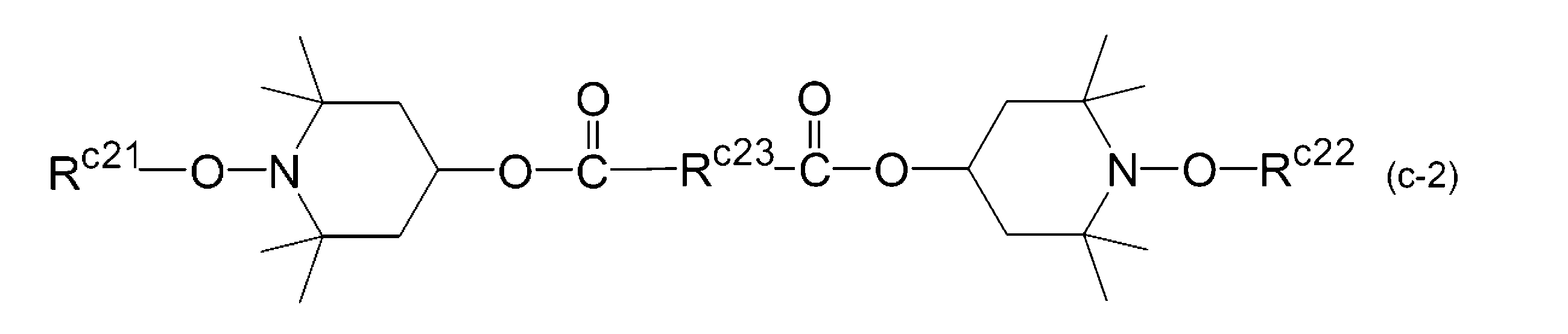
本発明に係る時計用の潤滑油組成物は、その他の酸化防止剤(C')をさらに含んでいてもよい。
本発明に用いる耐摩耗剤(B)は、中性リン酸エステルおよび中性亜リン酸エステルから選ばれる少なくとも一種である。


本発明に係る時計用の潤滑油組成物は、粘度指数向上剤(D)をさらに含んでいてもよい。粘度指数向上剤(D)を含んでいると、時計をより正常に動作させることができる。
本発明に係る時計用の潤滑油組成物は、金属不活性剤(E)をさらに含んでいてもよい。金属不活性剤(E)を含んでいると、金属の腐食をより抑えることができる。
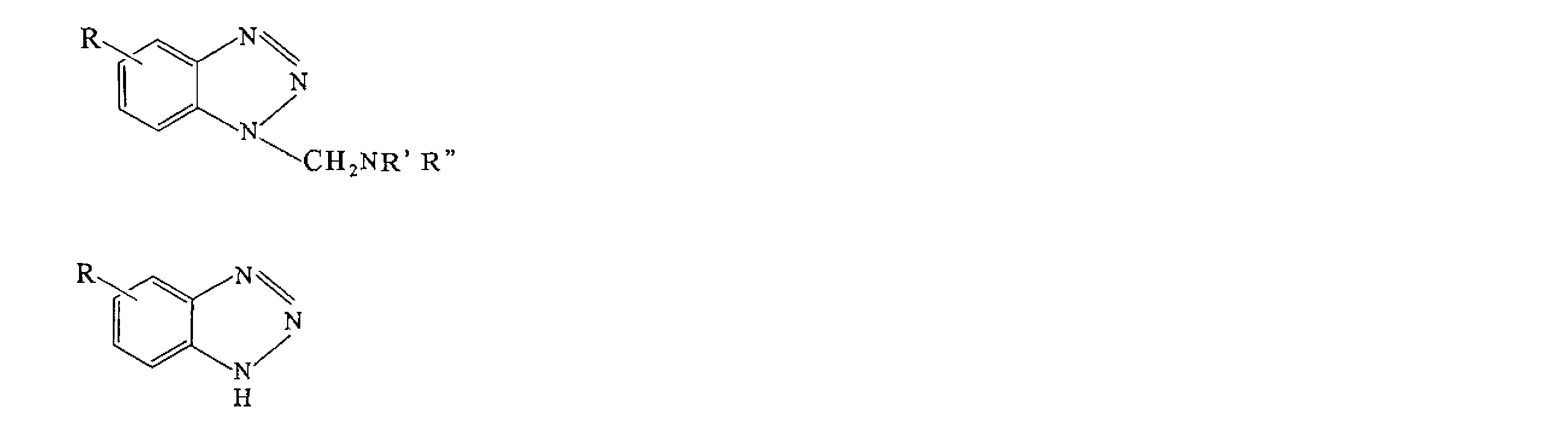
本発明に係る時計は、上述した時計用の潤滑油組成物が、たとえば輪列部や、香箱に収納されるぜんまい等の摺動部に付着している。摺動時に大きな圧力がかかる摺動部を有している時計であることが好ましい。このような摺動部としては、機械式時計の摺動部の他、モーター数が多い等のデザインを有する電子式時計の摺動部がある。本発明に係る時計は、摺動時に大きな圧力がかかる摺動部を有していても、上述した時計用の潤滑油組成物が付着しているため、動作時に摩耗粉や錆のような析出物の生成が抑えられ、摺動部の変色も起こり難く、長期に渡って安定して動作できる。
該組成物の全酸価は0.8mgKOH/g以下であり、
耐摩耗剤(B)は潤滑剤成分(A)100質量部に対して0.1~15質量部の量で含まれ、酸化防止剤(C)は潤滑剤成分(A)100質量部に対して0.01~3質量部の量で含まれており、
酸化防止剤(C)として、下記一般式(c-1)で表わされるジフェニルアミン誘導体(C-1)および下記一般式(c-2)で表わされるヒンダードアミン化合物(C-2)を含むことを特徴とする時計用の潤滑油組成物。

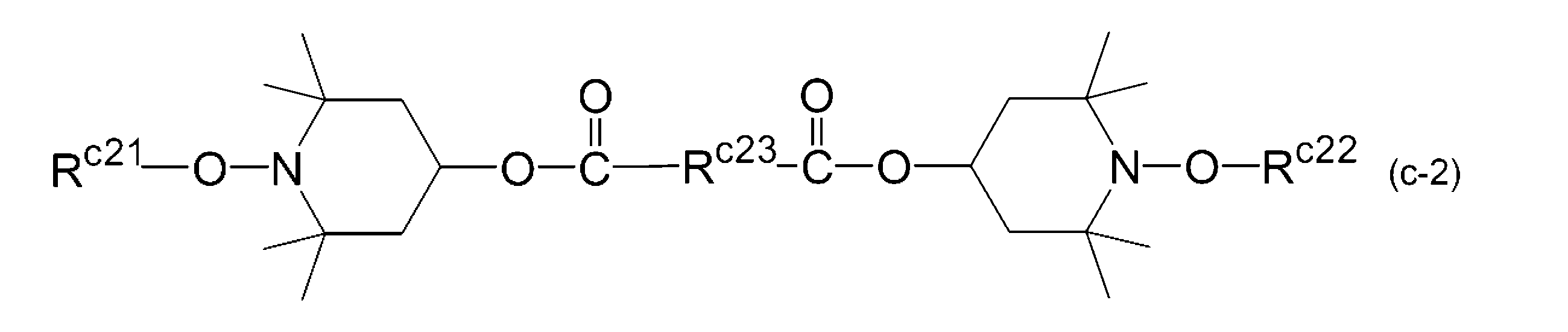
上記時計用の潤滑油組成物は、摺動時に大きな圧力がかかる摺動部に用いて時計を動作させた場合も、摩耗粉や錆のような析出物の生成が抑えられ、摺動部の変色も起こり難い。すなわち、上記潤滑油組成物によれば摺動部に高圧がかかる機械式時計などであっても良好に潤滑できる。
(式(a-3)中、Ra31およびRa32は、それぞれ独立に、炭素原子数1~18のアルキル基または炭素原子数6~18の1価の芳香族炭化水素基であり、Ra33は、炭素原子数1~18のアルキレン基または炭素原子数6~18の2価の芳香族炭化水素基であり、nは、1~5の整数である。)
[4] 中性リン酸エステルが下記一般式(b-1)で表わされる中性リン酸エステル(B-1)であり、中性亜リン酸エステルが下記一般式(b-2)で表わされる中性亜リン酸エステル(B-2)であることを特徴とする[1]~[3]のいずれかに記載の時計用の潤滑油組成物。
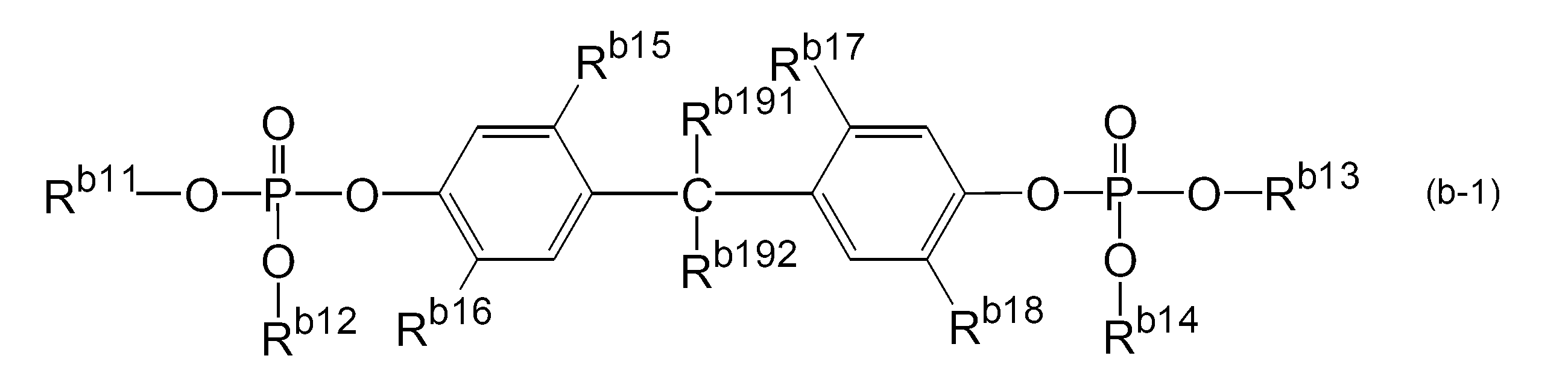
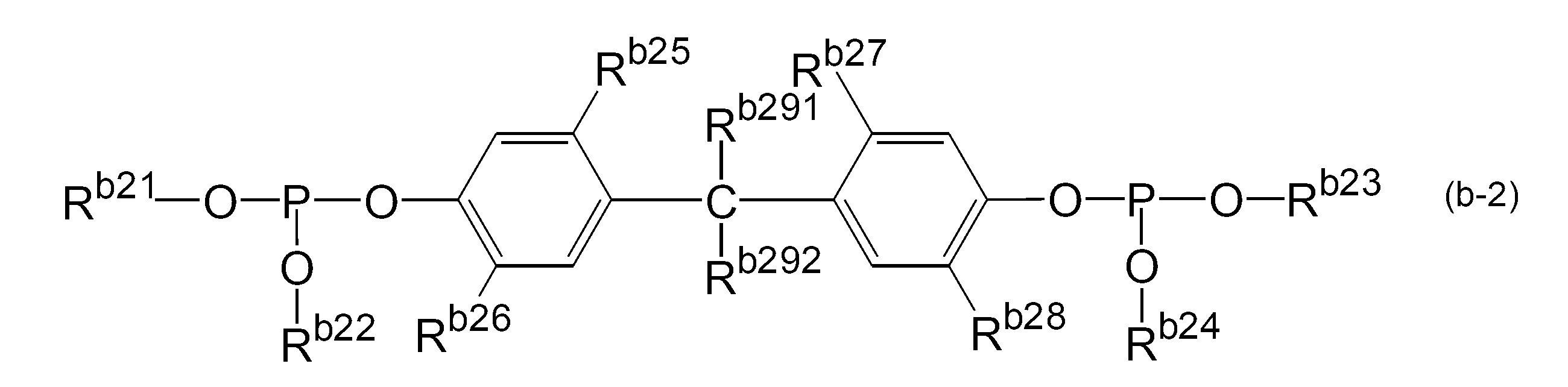
中性リン酸エステル(B-1)や中性亜リン酸エステル(B-2)を用いた場合は、摺動時に大きな圧力がかかる摺動部に上記潤滑油組成物を用いて時計を動作させた場合も、摩耗粉や錆のような析出物の生成がさらに抑えられ、摺動部の変色もさらに起こり難くなり、耐摩耗性および極圧性が改善できる。
以下の具体例では、潤滑剤成分(A)として基油(A1)を用いた。
基油(A1)のパラフィン系炭化水素油(A-2)として1-デセンの3量体を用い、この基油100部に、耐摩耗剤(B)としてトリクレジルフォスフェート5部と、酸化防止剤(C)のジフェニルアミン誘導体(C-1)としてジフェニルアミンと2,4,4-トリメチルペンテンとの反応生成物(商品名 イルガノックスL57、チバスペシャリティケミカルズ(株)製)0.5部およびヒンダードアミン化合物(C-2)としてデカン二酸ビス(2,2,6,6-テトラメチル-1-(オクチルオキシ)ピペリジン-4-イル)0.5部とを加え、時計用の潤滑油組成物を調製した。
耐摩耗剤(B)の量を0.1部としたほかは、実施例1-1-1と同様にして時計用の潤滑油組成物を調製した。
耐摩耗剤(B)の量を8部としたほかは、実施例1-1-1と同様にして時計用の潤滑油組成物を調製した。
ジフェニルアミン誘導体(C-1)の量を0.01部とし、ヒンダードアミン化合物(C-2)の量を0.01部としたほかは、実施例1-1-1と同様にして時計用の潤滑油組成物を調製した。
ジフェニルアミン誘導体(C-1)の量を1.5部とし、ヒンダードアミン化合物(C-2)の量を1.5部としたほかは、実施例1-1-1と同様にして時計用の潤滑油組成物を調製した。
ヒンダードアミン化合物(C-2)としてデカン二酸ビス(2,2,6,6-テトラメチル-1-(オクチルオキシ)ピペリジン-4-イル)(Rc21、Rc22=n-オクチル基、Rc23=1,8-オクチレン基)の代わりに、表1の化合物を用いたほかは、実施例1-1-1と同様にして時計用の潤滑油組成物を調製した。
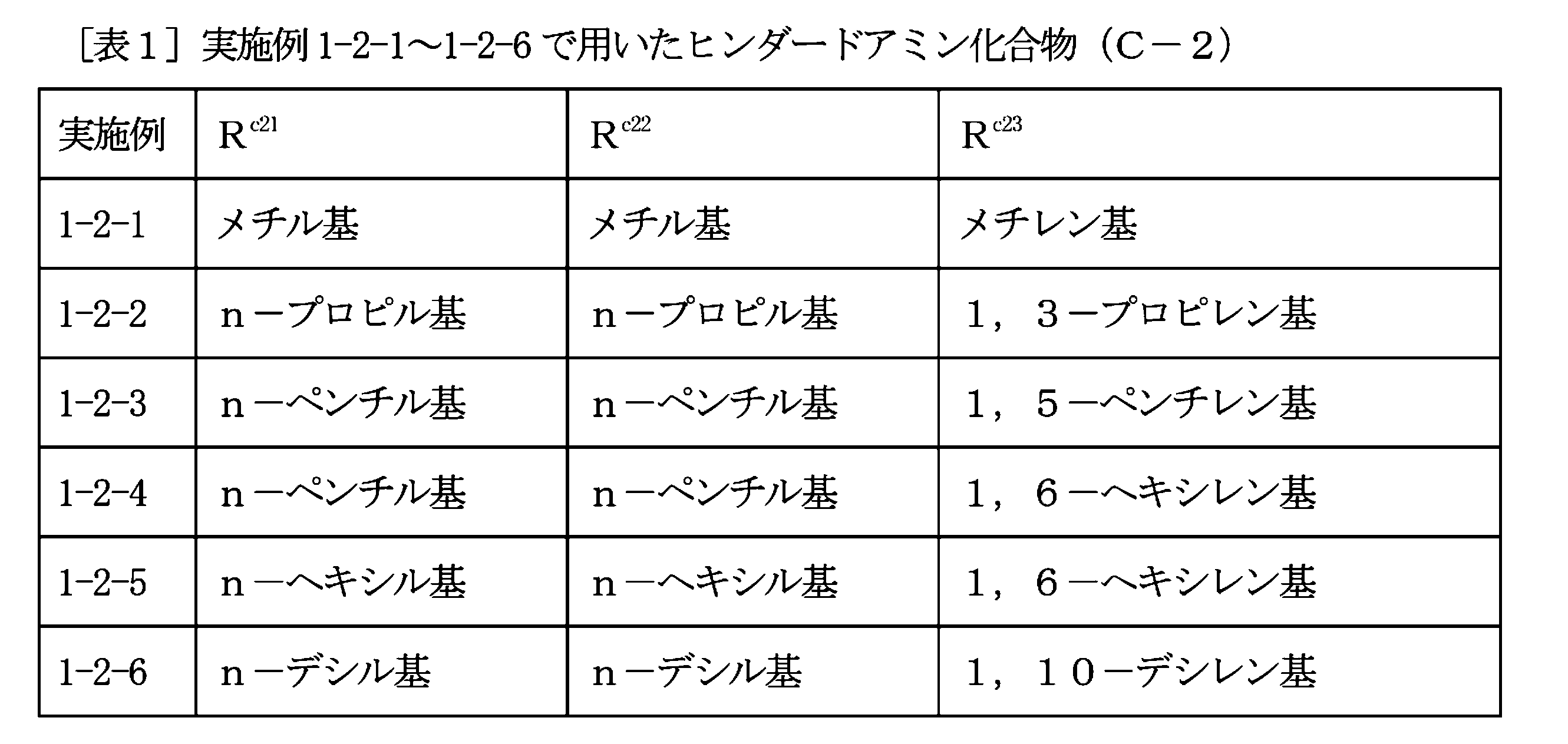
ジフェニルアミン誘導体(C-1)としてジフェニルアミンと2,4,4-トリメチルペンテンとの反応生成物の代わりに、表2の化合物を用いたほかは、実施例1-1-1と同様にして時計用の潤滑油組成物を調製した。
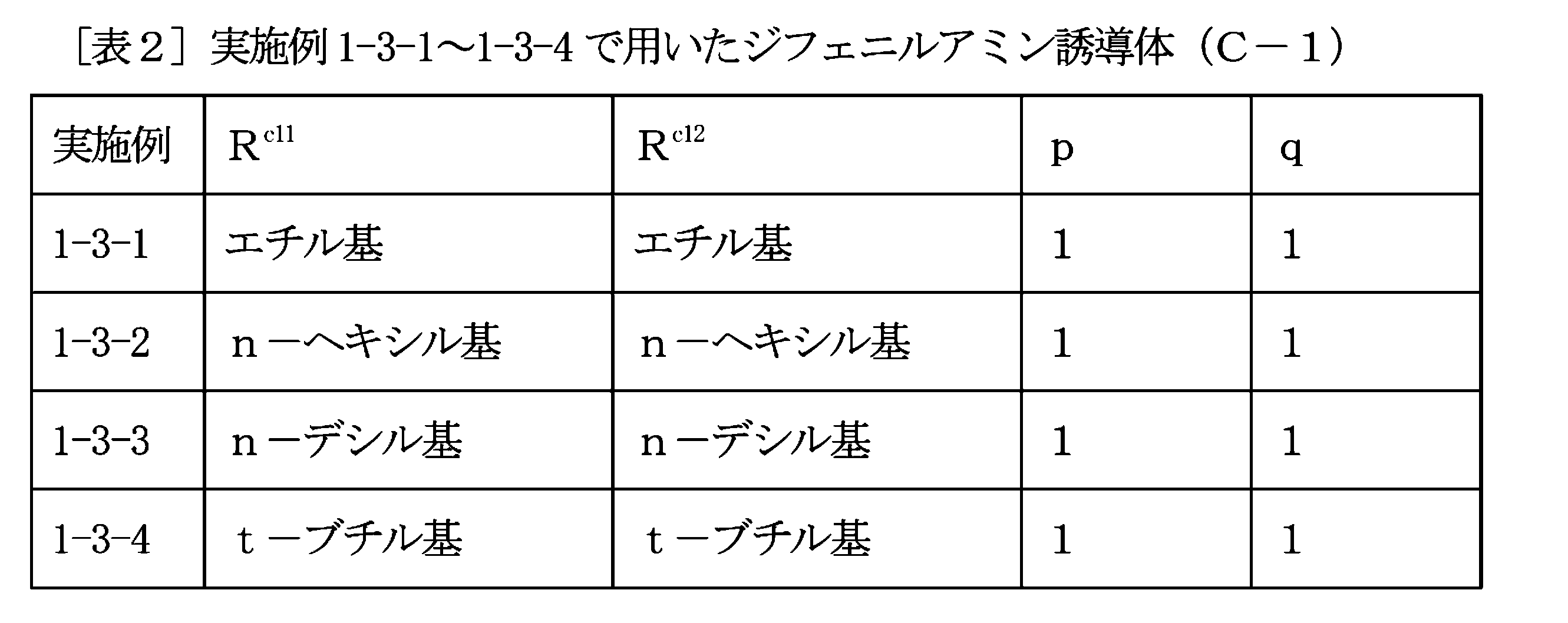
耐摩耗剤(B)としてトリクレジルファオスフェートの代わりに、中性リン酸エステル(B-1)の4,4'-ブチリデンビス(3-メチル-6-t-ブチルフェニル ジトリデシルフォスフェート)を用いたほかは、実施例1-1-1と同様にして時計用の潤滑油組成物を調製した。
中性リン酸エステル(B-1)の量を0.1部としたほかは、実施例1-4-1と同様にして時計用の潤滑油組成物を調製した。
中性リン酸エステル(B-1)の量を8部としたほかは、実施例1-4-1と同様にして時計用の潤滑油組成物を調製した。
中性リン酸エステル(B-1)として4,4'-ブチリデンビス(3-メチル-6-t-ブチルフェニル ジトリデシルフォスフェート)(Rb11~Rb14=トリデシル基、Rb15、Rb17=メチル基、Rb16、Rb18=t-ブチル基、Rb191=水素原子、Rb192=n-プロピル基)の代わりに、表3の化合物を用いたほかは、実施例1-4-1と同様にして時計用の潤滑油組成物を調製した。

基油(A1)のパラフィン系炭化水素油(A-2)として1-デセンの3量体を用い、この基油100部に、耐摩耗剤(B)としてトリオレイルフォスファイト5部と、酸化防止剤(C)のジフェニルアミン誘導体(C-1)としてジフェニルアミンと2,4,4-トリメチルペンテンとの反応生成物(商品名 イルガノックスL57、チバスペシャリティケミカルズ(株)製)0.5部およびヒンダードアミン化合物(C-2)としてデカン二酸ビス(2,2,6,6-テトラメチル-1-(オクチルオキシ)ピペリジン-4-イル)0.5部とを加え、時計用の潤滑油組成物を調製した。
耐摩耗剤(B)の量を0.1部としたほかは、実施例1-6-1と同様にして時計用の潤滑油組成物を調製した。
耐摩耗剤(B)の量を8部としたほかは、実施例1-6-1と同様にして時計用の潤滑油組成物を調製した。
ジフェニルアミン誘導体(C-1)の量を0.01部とし、ヒンダードアミン化合物(C-2)の量を0.01部としたほかは、実施例1-6-1と同様にして時計用の潤滑油組成物を調製した。
ジフェニルアミン誘導体(C-1)の量を1.5部とし、ヒンダードアミン化合物(C-2)の量を1.5部としたほかは、実施例1-6-1と同様にして時計用の潤滑油組成物を調製した。
ヒンダードアミン化合物(C-2)としてデカン二酸ビス(2,2,6,6-テトラメチル-1-(オクチルオキシ)ピペリジン-4-イル)(Rc21、Rc22=n-オクチル基、Rc23=1,8-オクチレン基)の代わりに、表4の化合物を用いたほかは、実施例1-6-1と同様にして時計用の潤滑油組成物を調製した。
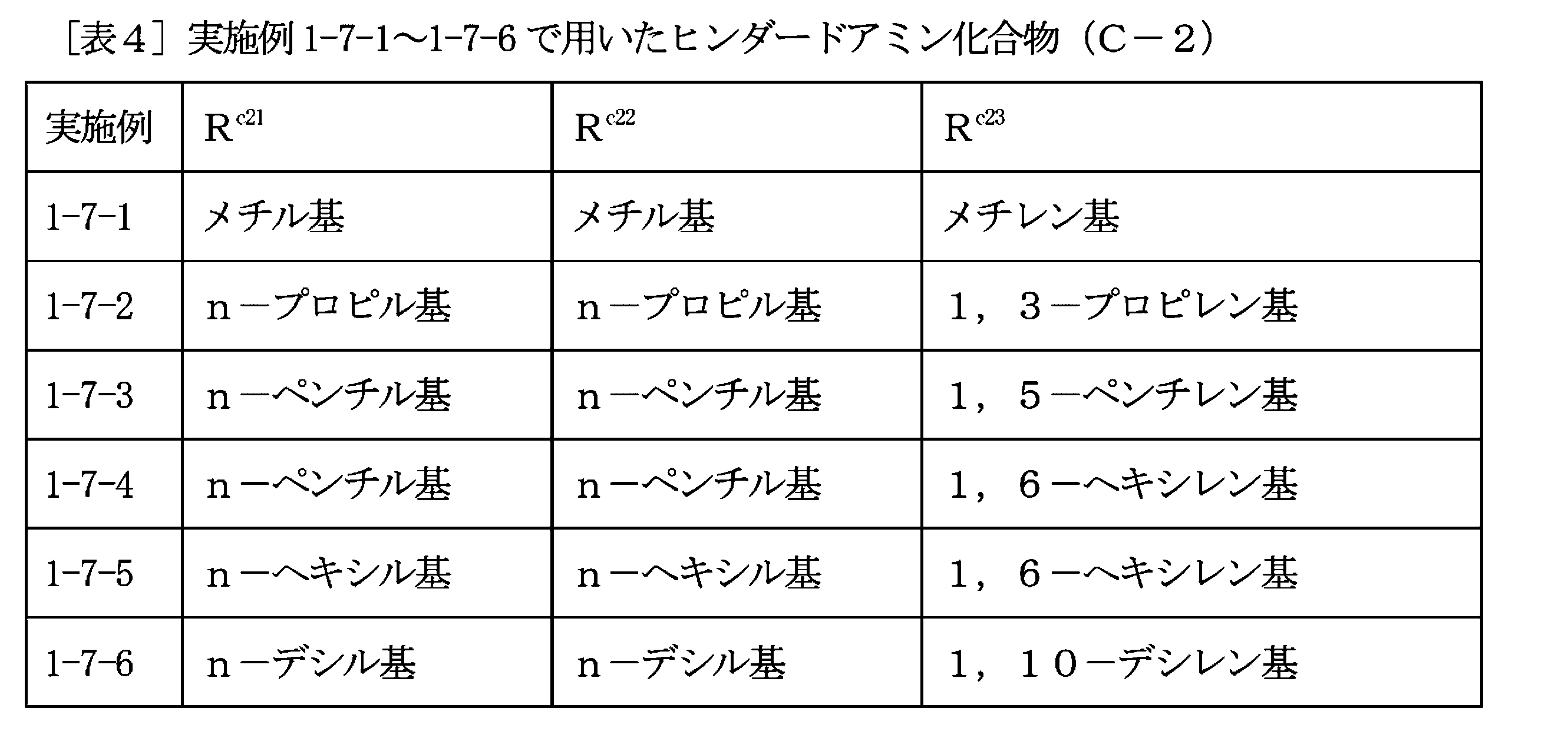
ジフェニルアミン誘導体(C-1)としてジフェニルアミンと2,4,4-トリメチルペンテンとの反応生成物の代わりに、表5の化合物を用いたほかは、実施例1-6-1と同様にして時計用の潤滑油組成物を調製した。
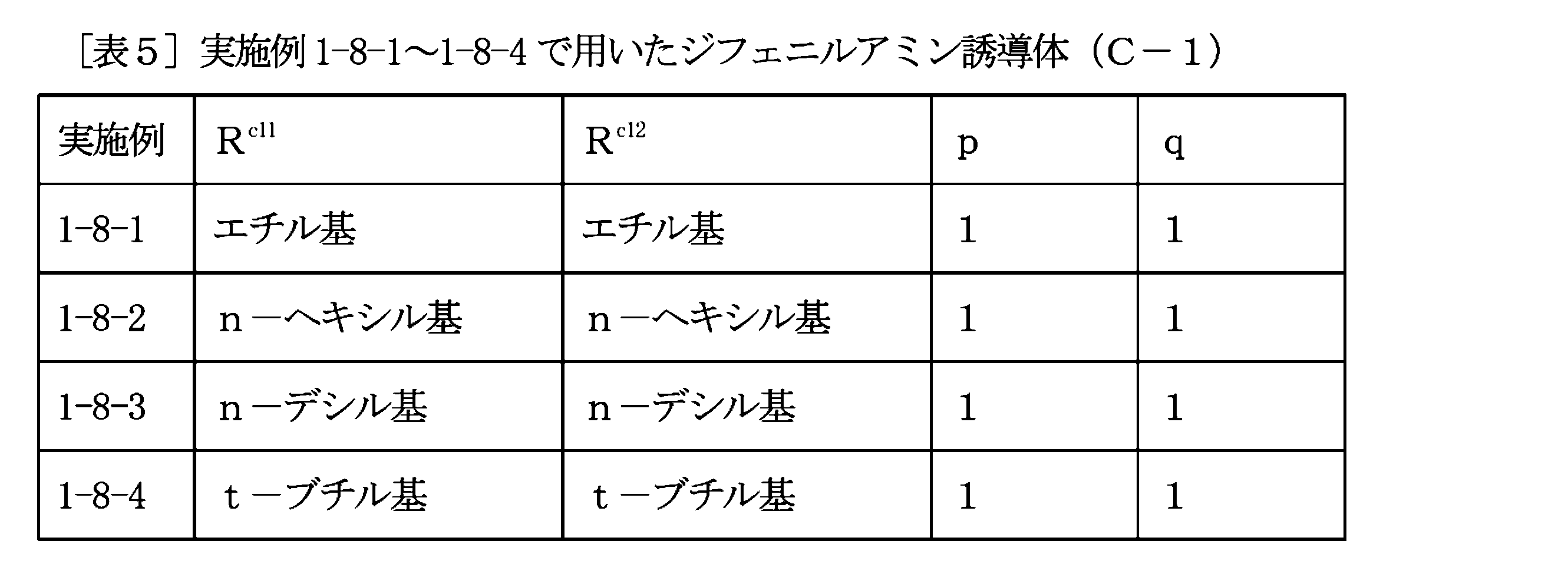
耐摩耗剤(B)としてトリオレイルフォスファイトの代わりに、中性亜リン酸エステル(B-2)の4,4'-ブチリデンビス(3-メチル-6-t-ブチルフェニル ジトリデシルフォスファイト)を用いたほかは、実施例1-6-1と同様にして時計用の潤滑油組成物を調製した。
中性亜リン酸エステル(B-2)の量を0.1部としたほかは、実施例1-9-1と同様にして時計用の潤滑油組成物を調製した。
中性亜リン酸エステル(B-2)の量を8部としたほかは、実施例1-9-1と同様にして時計用の潤滑油組成物を調製した。
中性亜リン酸エステル(B-2)として4,4'-ブチリデンビス(3-メチル-6-t-ブチルフェニル ジトリデシルフォスファイト)(Rb21~Rb24=トリデシル基、Rb25、Rb27=メチル基、Rb26、Rb28=t-ブチル基、Rb291=水素原子、Rb292=n-プロピル基)の代わりに、表6の化合物を用いたほかは、実施例1-9-1と同様にして時計用の潤滑油組成物を調製した。

実施例1-1-1の時計用の潤滑油組成物に対して、さらに粘度指数向上剤(D)を用いた時計用の潤滑油組成物を調製した。
実施例1-6-1の時計用の潤滑油組成物に対して、さらに粘度指数向上剤(D)を用いた時計用の潤滑油組成物を調製した。
実施例1-1-1の時計用の潤滑油組成物に対して、さらに金属不活性剤(E)を用いた時計用の潤滑油組成物を調製した。
実施例1-6-1の時計用の潤滑油組成物に対して、さらに金属不活性剤(E)を用いた時計用の潤滑油組成物を調製した。
基油(A1)のパラフィン系炭化水素油(A-2)として1-デセンの3量体の代わりに、ポリオールエステル(A-1)としてネオペンチルグリコール・カプリル酸カプリン酸混合エステル(-30℃での動粘度=2000cSt未満)を用いたほかは、それぞれ実施例1-1-1~1-1-5と同様にして時計用の潤滑油組成物を調製した。
基油(A1)のパラフィン系炭化水素油(A-2)として1-デセンの3量体の代わりに、ポリオールエステル(A-1)としてネオペンチルグリコール・カプリル酸カプリン酸混合エステル(-30℃での動粘度=2000cSt未満)を用いたほかは、それぞれ実施例1-2-1~1-2-6と同様にして時計用の潤滑油組成物を調製した。
基油(A1)のパラフィン系炭化水素油(A-2)として1-デセンの3量体の代わりに、ポリオールエステル(A-1)としてネオペンチルグリコール・カプリル酸カプリン酸混合エステル(-30℃での動粘度=2000cSt未満)を用いたほかは、それぞれ実施例1-3-1~1-3-4と同様にして時計用の潤滑油組成物を調製した。
基油(A1)のパラフィン系炭化水素油(A-2)として1-デセンの3量体の代わりに、ポリオールエステル(A-1)としてネオペンチルグリコール・カプリル酸カプリン酸混合エステル(-30℃での動粘度=2000cSt未満)を用いたほかは、それぞれ実施例1-4-1~1-4-3と同様にして時計用の潤滑油組成物を調製した。
基油(A1)のパラフィン系炭化水素油(A-2)として1-デセンの3量体の代わりに、ポリオールエステル(A-1)としてネオペンチルグリコール・カプリル酸カプリン酸混合エステル(-30℃での動粘度=2000cSt未満)を用いたほかは、それぞれ実施例1-5-1~1-5-6と同様にして時計用の潤滑油組成物を調製した。
基油(A1)のパラフィン系炭化水素油(A-2)として1-デセンの3量体の代わりに、ポリオールエステル(A-1)としてネオペンチルグリコール・カプリル酸カプリン酸混合エステル(-30℃での動粘度=2000cSt未満)を用いたほかは、それぞれ実施例1-6-1~1-6-5と同様にして時計用の潤滑油組成物を調製した。
基油(A1)のパラフィン系炭化水素油(A-2)として1-デセンの3量体の代わりに、ポリオールエステル(A-1)としてネオペンチルグリコール・カプリル酸カプリン酸混合エステル(-30℃での動粘度=2000cSt未満)を用いたほかは、それぞれ実施例1-7-1~1-7-6と同様にして時計用の潤滑油組成物を調製した。
基油(A1)のパラフィン系炭化水素油(A-2)として1-デセンの3量体の代わりに、ポリオールエステル(A-1)としてネオペンチルグリコール・カプリル酸カプリン酸混合エステル(-30℃での動粘度=2000cSt未満)を用いたほかは、それぞれ実施例1-8-1~1-8-4と同様にして時計用の潤滑油組成物を調製した。
基油(A1)のパラフィン系炭化水素油(A-2)として1-デセンの3量体の代わりに、ポリオールエステル(A-1)としてネオペンチルグリコール・カプリル酸カプリン酸混合エステル(-30℃での動粘度=2000cSt未満)を用いたほかは、それぞれ実施例1-9-1~1-9-3と同様にして時計用の潤滑油組成物を調製した。
基油(A1)のパラフィン系炭化水素油(A-2)として1-デセンの3量体の代わりに、ポリオールエステル(A-1)としてネオペンチルグリコール・カプリル酸カプリン酸混合エステル(-30℃での動粘度=2000cSt未満)を用いたほかは、それぞれ実施例1-10-1~1-10-6と同様にして時計用の潤滑油組成物を調製した。
実施例2-1-1の時計用の潤滑油組成物に対して、さらに粘度指数向上剤(D)を用いた時計用の潤滑油組成物を調製した。
実施例2-6-1の時計用の潤滑油組成物に対して、さらに粘度指数向上剤(D)を用いた時計用の潤滑油組成物を調製した。
実施例2-1-1の時計用の潤滑油組成物に対して、さらに金属不活性剤(E)を用いた時計用の潤滑油組成物を調製した。
実施例2-6-1の時計用の潤滑油組成物に対して、さらに金属不活性剤(E)を用いた時計用の潤滑油組成物を調製した。
基油(A1)のパラフィン系炭化水素油(A-2)として1-デセンの3量体の代わりに、エーテル油(A-3)としてアルキル置換ジフェニルエーテル(商品名 モレスコハイルーブLB32、(株)松村石油研究所製)を用いたほかは、それぞれ実施例1-1-1~1-1-5と同様にして時計用の潤滑油組成物を調製した。
基油(A1)のパラフィン系炭化水素油(A-2)として1-デセンの3量体の代わりに、エーテル油(A-3)としてアルキル置換ジフェニルエーテル(商品名 モレスコハイルーブLB32、(株)松村石油研究所製)を用いたほかは、それぞれ実施例1-2-1~1-2-6と同様にして時計用の潤滑油組成物を調製した。
基油(A1)のパラフィン系炭化水素油(A-2)として1-デセンの3量体の代わりに、エーテル油(A-3)としてアルキル置換ジフェニルエーテル(商品名 モレスコハイルーブLB32、(株)松村石油研究所製)を用いたほかは、それぞれ実施例1-3-1~1-3-4と同様にして時計用の潤滑油組成物を調製した。
基油(A1)のパラフィン系炭化水素油(A-2)として1-デセンの3量体の代わりに、エーテル油(A-3)としてアルキル置換ジフェニルエーテル(商品名 モレスコハイルーブLB32、(株)松村石油研究所製)を用いたほかは、それぞれ実施例1-4-1~1-4-3と同様にして時計用の潤滑油組成物を調製した。
基油(A1)のパラフィン系炭化水素油(A-2)として1-デセンの3量体の代わりに、エーテル油(A-3)としてアルキル置換ジフェニルエーテル(商品名 モレスコハイルーブLB32、(株)松村石油研究所製)を用いたほかは、それぞれ実施例1-5-1~1-5-6と同様にして時計用の潤滑油組成物を調製した。
基油(A1)のパラフィン系炭化水素油(A-2)として1-デセンの3量体の代わりに、エーテル油(A-3)としてアルキル置換ジフェニルエーテル(商品名 モレスコハイルーブLB32、(株)松村石油研究所製)を用いたほかは、それぞれ実施例1-6-1~1-6-5と同様にして時計用の潤滑油組成物を調製した。
基油(A1)のパラフィン系炭化水素油(A-2)として1-デセンの3量体の代わりに、エーテル油(A-3)としてアルキル置換ジフェニルエーテル(商品名 モレスコハイルーブLB32、(株)松村石油研究所製)を用いたほかは、それぞれ実施例1-7-1~1-7-6と同様にして時計用の潤滑油組成物を調製した。
基油(A1)のパラフィン系炭化水素油(A-2)として1-デセンの3量体の代わりに、エーテル油(A-3)としてアルキル置換ジフェニルエーテル(商品名 モレスコハイルーブLB32、(株)松村石油研究所製)を用いたほかは、それぞれ実施例1-8-1~1-8-4と同様にして時計用の潤滑油組成物を調製した。
基油(A1)のパラフィン系炭化水素油(A-2)として1-デセンの3量体の代わりに、エーテル油(A-3)としてアルキル置換ジフェニルエーテル(商品名 モレスコハイルーブLB32、(株)松村石油研究所製)を用いたほかは、それぞれ実施例1-9-1~1-9-3と同様にして時計用の潤滑油組成物を調製した。
基油(A1)のパラフィン系炭化水素油(A-2)として1-デセンの3量体の代わりに、エーテル油(A-3)としてアルキル置換ジフェニルエーテル(商品名 モレスコハイルーブLB32、(株)松村石油研究所製)を用いたほかは、それぞれ実施例1-10-1~1-10-6と同様にして時計用の潤滑油組成物を調製した。
実施例3-1-1の時計用の潤滑油組成物に対して、さらに粘度指数向上剤(D)を用いた時計用の潤滑油組成物を調製した。
実施例3-6-1の時計用の潤滑油組成物に対して、さらに粘度指数向上剤(D)を用いた時計用の潤滑油組成物を調製した。
実施例3-1-1の時計用の潤滑油組成物に対して、さらに金属不活性剤(E)を用いた時計用の潤滑油組成物を調製した。
実施例3-6-1の時計用の潤滑油組成物に対して、さらに金属不活性剤(E)を用いた時計用の潤滑油組成物を調製した。
酸化防止剤(C)のジフェニルアミン誘導体(C-1)としてジフェニルアミンと2,4,4-トリメチルペンテンとの反応生成物(商品名 イルガノックスL57、チバスペシャリティケミカルズ(株)製)0.5部およびヒンダードアミン化合物(C-2)としてデカン二酸ビス(2,2,6,6-テトラメチル-1-(オクチルオキシ)ピペリジン-4-イル)0.5部の代わりに、ジフェニルアミン誘導体(C-1)としてジフェニルアミンと2,4,4-トリメチルペンテンとの反応生成物(商品名 イルガノックスL57、チバスペシャリティケミカルズ(株)製)1部のみを用いたほかは、実施例1-1-1と同様にして時計用の潤滑油組成物を調製した。
酸化防止剤(C)のジフェニルアミン誘導体(C-1)としてジフェニルアミンと2,4,4-トリメチルペンテンとの反応生成物(商品名 イルガノックスL57、チバスペシャリティケミカルズ(株)製)0.5部およびヒンダードアミン化合物(C-2)としてデカン二酸ビス(2,2,6,6-テトラメチル-1-(オクチルオキシ)ピペリジン-4-イル)0.5部の代わりに、ジフェニルアミン誘導体(C-1)としてジフェニルアミンと2,4,4-トリメチルペンテンとの反応生成物(商品名 イルガノックスL57、チバスペシャリティケミカルズ(株)製)1部のみを用いたほかは、実施例1-6-1と同様にして時計用の潤滑油組成物を調製した。
基油(A1)のパラフィン系炭化水素油(A-2)として1-デセンの3量体の代わりに、ポリオールエステル(A-1)としてネオペンチルグリコール・カプリル酸カプリン酸混合エステル(-30℃での動粘度=2000cSt未満)を用いたほかは、比較例1-1と同様にして時計用の潤滑油組成物を調製した。
基油(A1)のパラフィン系炭化水素油(A-2)として1-デセンの3量体の代わりに、ポリオールエステル(A-1)としてネオペンチルグリコール・カプリル酸カプリン酸混合エステル(-30℃での動粘度=2000cSt未満)を用いたほかは、比較例1-2と同様にして時計用の潤滑油組成物を調製した。
基油(A1)のパラフィン系炭化水素油(A-2)として1-デセンの3量体の代わりに、エーテル油(A-3)としてアルキル置換ジフェニルエーテル(商品名 モレスコハイルーブLB32、(株)松村石油研究所製)を用いたほかは、比較例1-1と同様にして時計用の潤滑油組成物を調製した。
基油(A1)のパラフィン系炭化水素油(A-2)として1-デセンの3量体の代わりに、エーテル油(A-3)としてアルキル置換ジフェニルエーテル(商品名 モレスコハイルーブLB32、(株)松村石油研究所製)を用いたほかは、比較例1-2と同様にして時計用の潤滑油組成物を調製した。
[時計動作試験(1)]
機械式時計であるシチズン時計(株)製の時計ムーブメントTM(No.9015)について、摺動部である輪列部(Fe系合金製)に調製した時計用の潤滑油組成物を付着させた。-30℃、-10℃、常温(25℃)、80℃、45℃湿度95%の条件でそれぞれ1000時間連続動作をさせ、試験前後の摺動部を観察した。具体的には、摺動部として、動作中に8700N/m2、7960N/m2および7465N/m2の圧力がかかっていた箇所についてそれぞれ観察した。いずれの条件での試験もサンプル数20個で実施した。
機械式時計であるシチズン時計(株)製の時計ムーブメントTM(No.9015)について、摺動部である輪列部(Fe系合金製)に調製した時計用の潤滑油組成物を付着させた。常温にて64倍の速度で20年分の針回し耐久試験を行い、試験前後の摺動部を観察した。具体的には、摺動部として、動作中に8700N/m2、7960N/m2および7465N/m2の圧力がかかっていた箇所についてそれぞれ観察した。サンプル数20個で実施した。
機械式時計であるシチズン時計(株)製の時計ムーブメントTM(No.9015)について、摺動部である輪列部(Cu系合金製)に調製した時計用の潤滑油組成物を付着させた。常温にて1000時間連続動作をさせ、動作前後の摺動部を観察した。具体的には、摺動部として、動作中に8700N/m2、7960N/m2および7465N/m2の圧力がかかっていた箇所についてそれぞれ観察した。サンプル数20個で実施した。
4A:8700N/m2、7960N/m2および7465N/m2の圧力がかかった箇所すべてにおいて、試験後の色の変化はなく削れた跡もみられなかった。
上述のようにして作製した潤滑油組成物について時計動作試験1の評価結果を以下の表に示す。

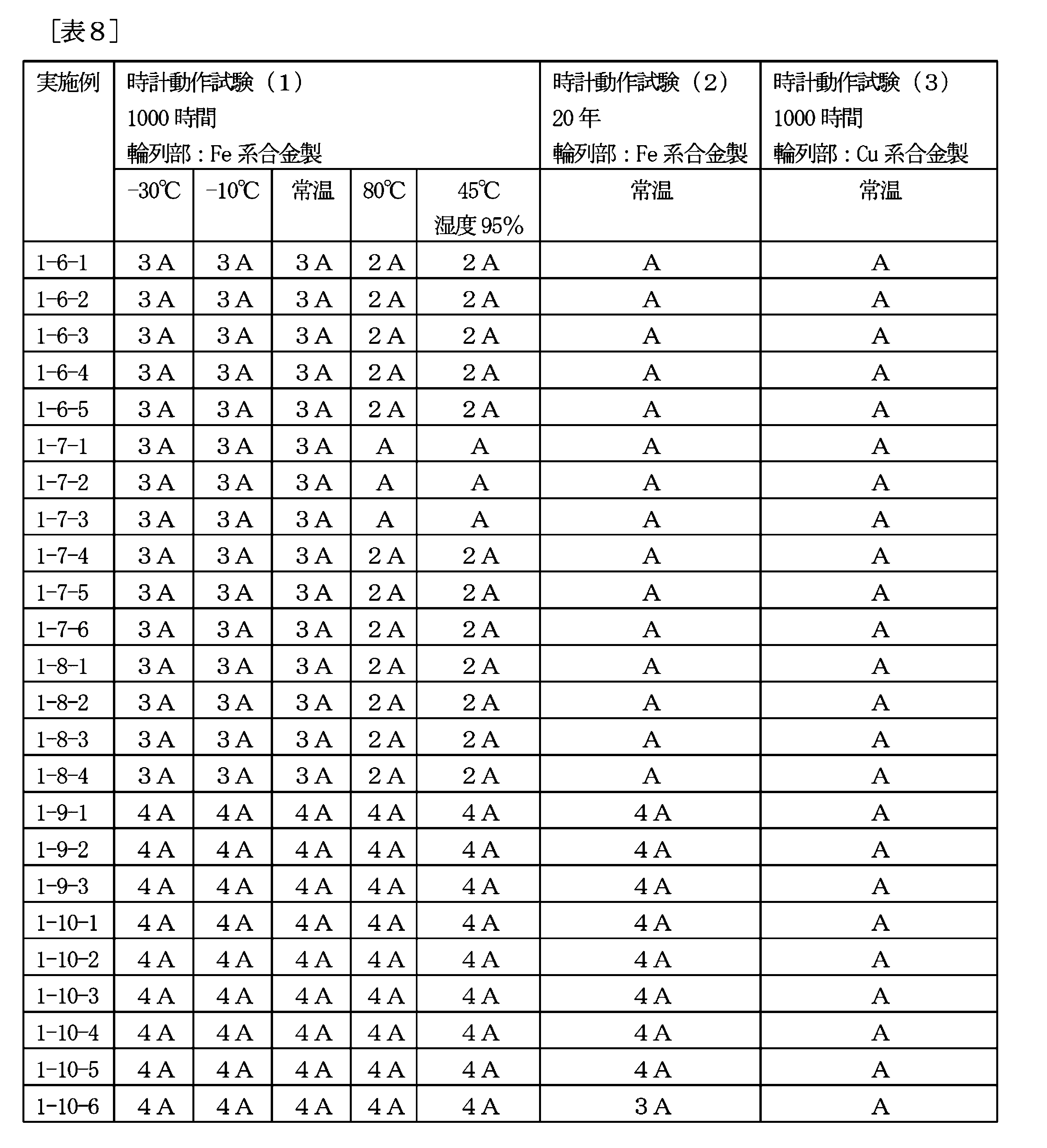


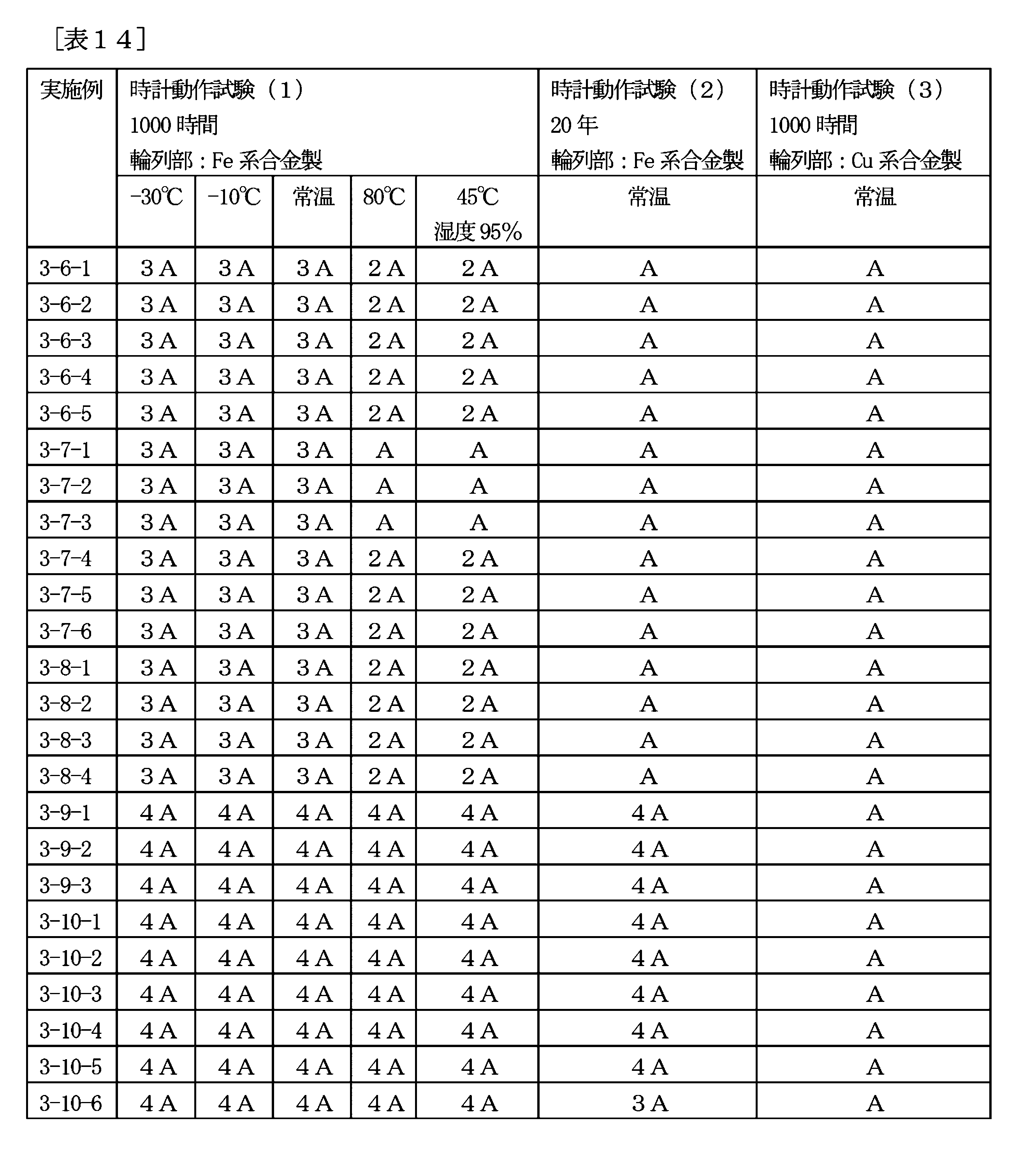

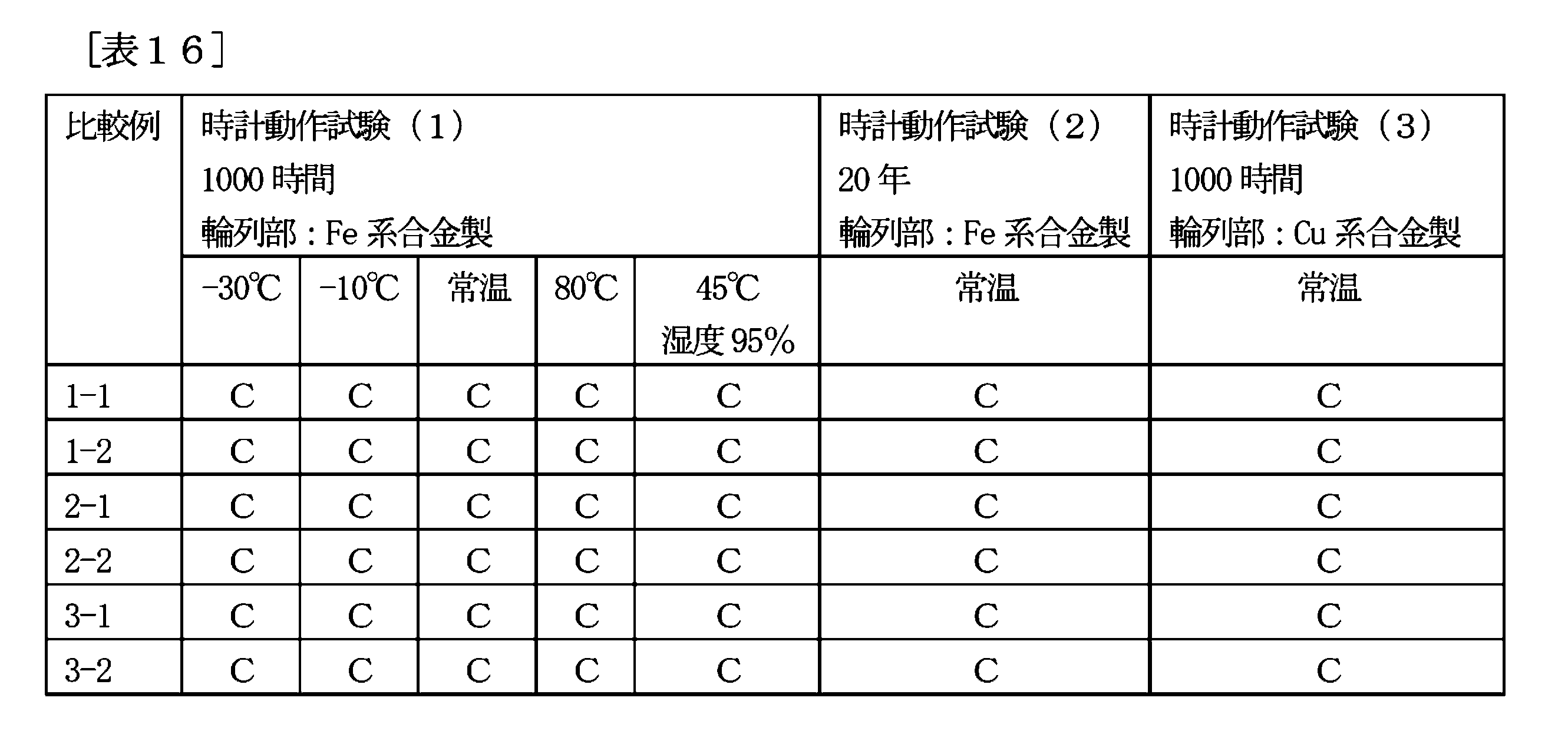
以下の具体例では、潤滑剤成分(A)として基油(A1)とともに固体潤滑剤(A2)を用いた。
潤滑剤成分(A)として、基油(A1)のパラフィン系炭化水素油(A-2)として1-デセンの3量体を70質量%と、ポリテトラフルオロエチレン(シャムロック社製、平均粒子径1μm以下)を30質量%とからなる潤滑剤成分を用いた。この潤滑剤成分100部に、耐摩耗剤(B)としてトリクレジルフォスフェート5.4部と、酸化防止剤(C)のジフェニルアミン誘導体(C-1)としてジフェニルアミンと2,4,4-トリメチルペンテンとの反応生成物(商品名 イルガノックスL57、チバスペシャリティケミカルズ(株)製)1.1部、およびヒンダードアミン化合物(C-2)としてデカン二酸ビス(2,2,6,6-テトラメチル-1-(オクチルオキシ)ピペリジン-4-イル)0.5部と、金属不活性剤(E)としてベンゾトリアゾール1.1部とを加え、時計用の潤滑油組成物を調製した。
実施例4-1-1において、配合組成を表17~表19のとおりに変更したこと以外は実施例4-1-1と同様にして、時計用の潤滑油組成物を調製した。
[時計動作試験(4)]
機械式時計であるシチズン時計(株)製の時計ムーブメントTM(No.82)について、摺動部である香箱内のぜんまいに、上記調製した時計用の潤滑油組成物または万能機械用グリース「オアルーブG-1/3」(日本オアルーブ社製)を付着させた。-30℃、常温(25℃)の条件でそれぞれ1000時間連続動作をさせ、試験中の出力をトルク測定器を用いて測定し、また試験前後の摺動部を観察した。いずれの条件での試験もサンプル数20個で実施した。
機械式時計であるシチズン時計(株)製の時計ムーブメントTM(No.82)について、摺動部である香箱内のぜんまいに、上記調製した時計用の潤滑油組成物を付着させた。常温にて64倍の速度で20年分の針回し耐久試験を行い、試験前後の摺動部を観察した。サンプル数20個で実施した。
時計動作試験(4)において、常温(25℃)で、上記ぜんまいの潤滑剤として万能機械用グリース「オアルーブG-1/3」(日本オアルーブ社製)を使用した場合に比べて、出力が30%以上向上した場合を「4A」、20%以上30%未満向上した場合を「3A」、10%以上20%未満向上した場合を「2A」、0%を超えて10%未満向上した場合を「A」と評価した。ここで、「オアルーブG-1/3」を使用した場合にぜんまい巻き上げ時の力に対する発生したトルクの損失割合を基準として、実施例の潤滑油組成物を使用した場合にこの損失割合が低減された割合を出力向上割合とした。
上述のようにして作製した潤滑油組成物について、配合組成および時計動作試験(4)、(5)の評価結果を以下の表に示す。
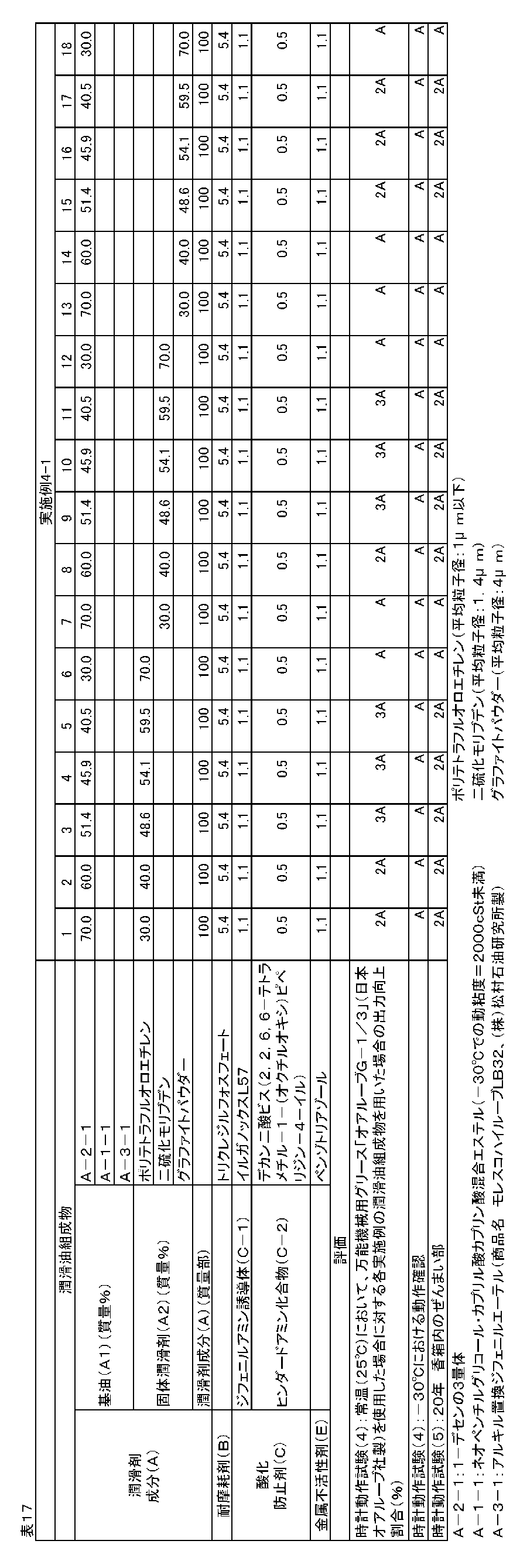
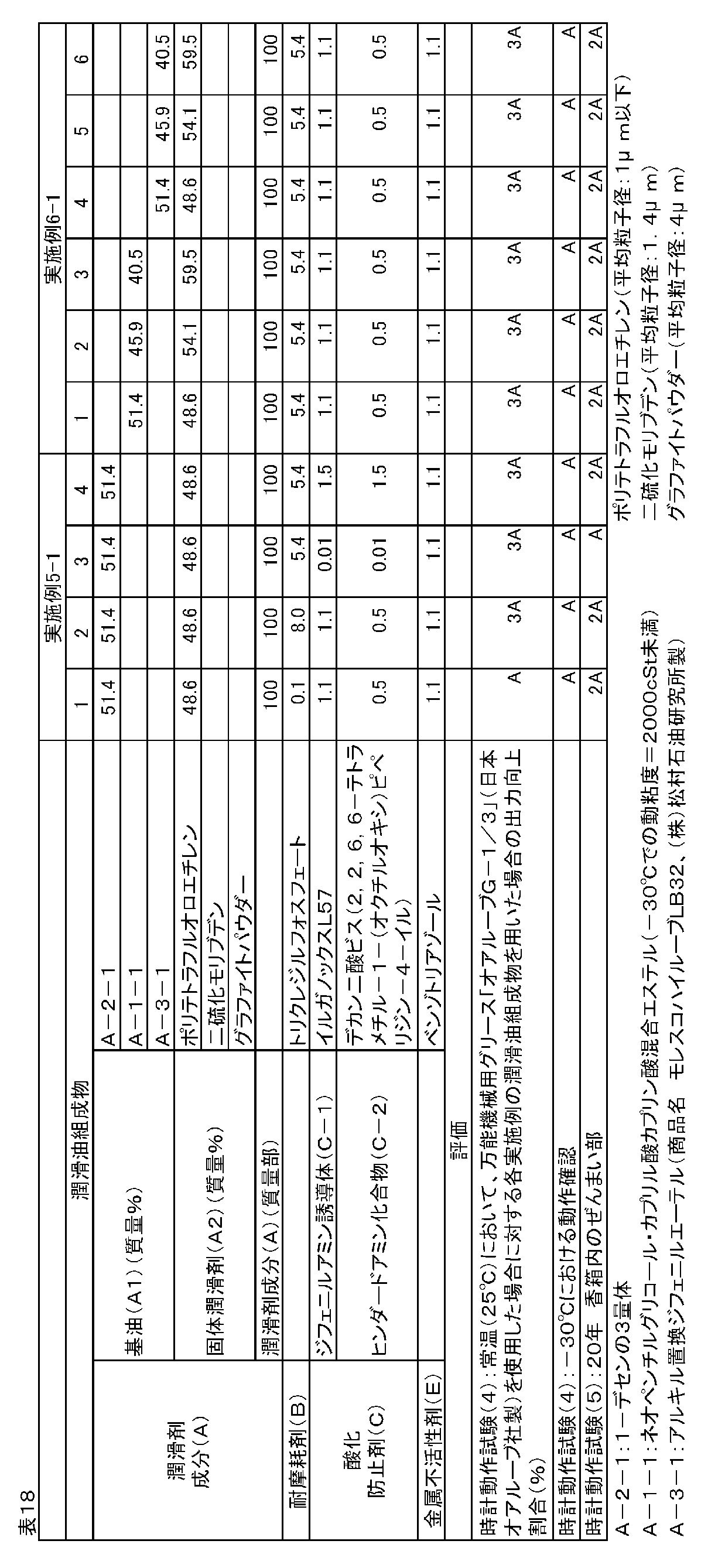
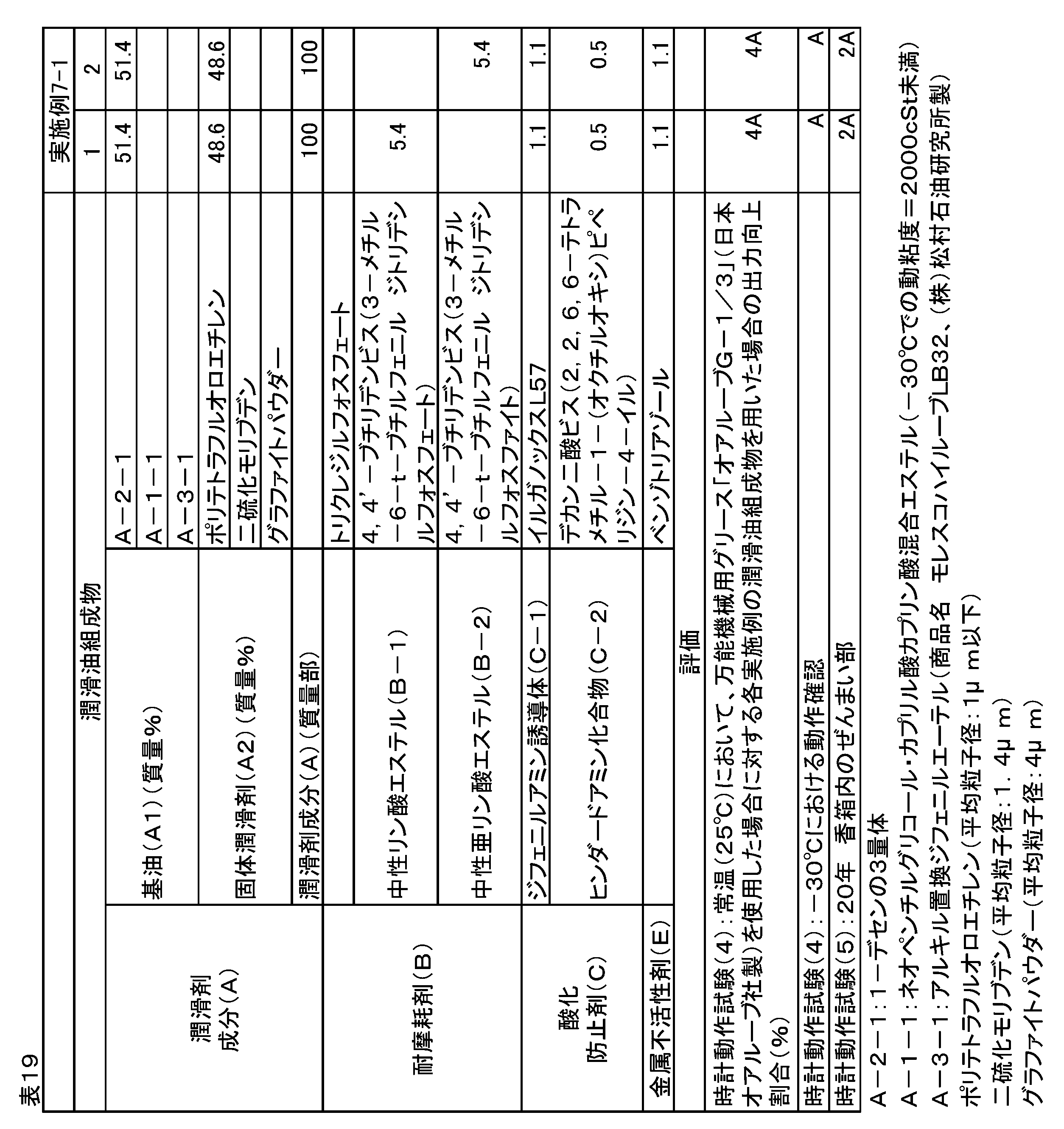
Claims (13)
- ポリオールエステル(A-1)、炭素原子数25以上のパラフィン系炭化水素油(A-2)およびエーテル油(A-3)から選ばれる少なくとも一種の基油(A1)を含む潤滑剤成分(A)と、中性リン酸エステルおよび中性亜リン酸エステルから選ばれる少なくとも一種の耐摩耗剤(B)と、酸化防止剤(C)とを含む潤滑油組成物であって、
該組成物の全酸価は0.8mgKOH/g以下であり、
耐摩耗剤(B)は潤滑剤成分(A)100質量部に対して0.1~15質量部の量で含まれ、酸化防止剤(C)は潤滑剤成分(A)100質量部に対して0.01~3質量部の量で含まれており、
酸化防止剤(C)として、下記一般式(c-1)で表わされるジフェニルアミン誘導体(C-1)および下記一般式(c-2)で表わされるヒンダードアミン化合物(C-2)を含む
ことを特徴とする時計用の潤滑油組成物。


- ポリオールエステル(A-1)が、分子末端に水酸基を全く有しないポリオールエステルであることを特徴とする請求項1に記載の時計用の潤滑油組成物。
- エーテル油(A-3)が、下記一般式(a-3)で表わされることを特徴とする請求項1または2に記載の時計用の潤滑油組成物。
Ra31-(-O-Ra33-)n-Ra32 (a-3)
(式(a-3)中、Ra31およびRa32は、それぞれ独立に、炭素原子数1~18のアルキル基または炭素原子数6~18の1価の芳香族炭化水素基であり、Ra33は、炭素原子数1~18のアルキレン基または炭素原子数6~18の2価の芳香族炭化水素基であり、nは、1~5の整数である。) - 中性リン酸エステルが下記一般式(b-1)で表わされる中性リン酸エステル(B-1)であり、中性亜リン酸エステルが下記一般式(b-2)で表わされる中性亜リン酸エステル(B-2)であることを特徴とする請求項1~3のいずれか1項に記載の時計用の潤滑油組成物。
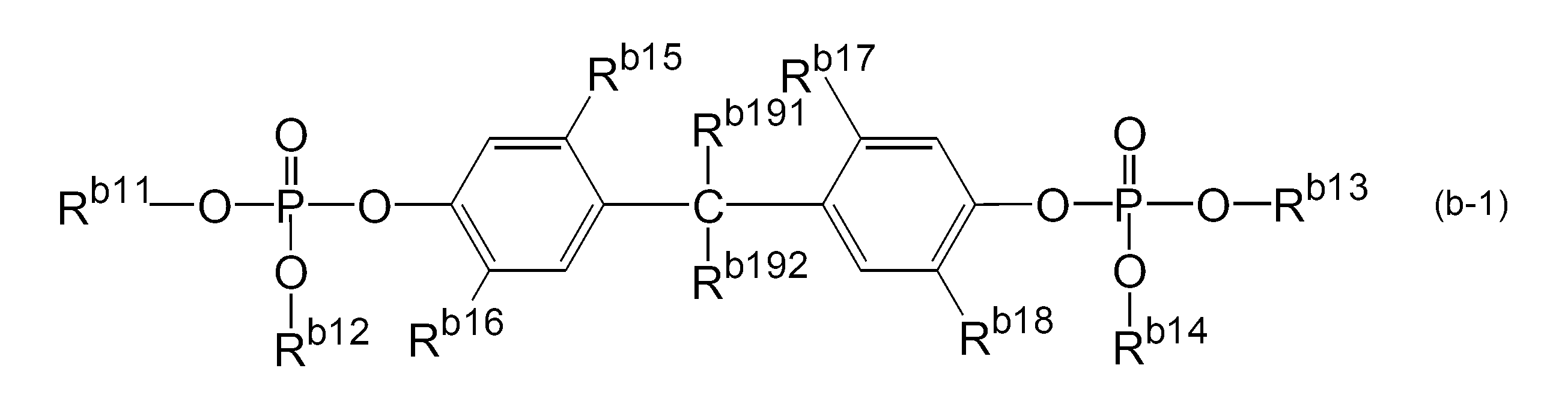
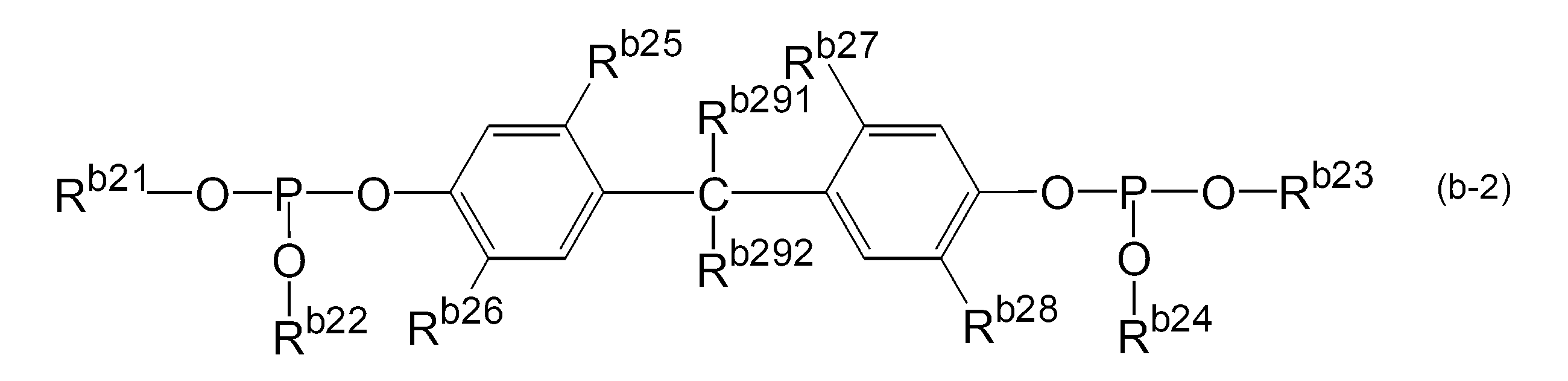
- 潤滑剤成分(A)の30質量%以上が基油(A1)であることを特徴とする請求項1~4のいずれか1項に記載の時計用の潤滑油組成物。
- 潤滑剤成分(A)が、基油(A1)のみからなることを特徴とする請求項5に記載の時計用の潤滑油組成物。
- 潤滑剤成分(A)が、基油(A1)と固体潤滑剤(A2)とからなることを特徴とする請求項5に記載の時計用の潤滑油組成物。
- 潤滑剤成分(A)100質量%に対して、基油(a1)の含有量が30~70質量%であり、固体潤滑剤(a2)の含有量が70~30質量%であることを特徴とする請求項7に記載の時計用の潤滑油組成物。
- 粘度指数向上剤(D)をさらに含むことを特徴とする請求項1~8のいずれか1項に記載の時計用の潤滑油組成物。
- 粘度指数向上剤(D)が、ポリアクリレート、ポリメタクリレート、ポリイソブチレン、ポリアルキルスチレン、ポリエステル、イソブチレンフマレート、スチレンマレエートエステル、酢酸ビニルフマレートエステルおよびα-オレフィン共重合体から選ばれる少なくとも一種であることを特徴とする請求項9に記載の時計用の潤滑油組成物。
- 金属不活性剤(E)をさらに含むことを特徴とする請求項1~10のいずれか1項に記載の時計用の潤滑油組成物。
- 金属不活性剤(E)が、ベンゾトリアゾールまたはその誘導体であることを特徴とする請求項11に記載の時計用の潤滑油組成物。
- 請求項1~12のいずれか1項に記載の時計用の潤滑油組成物が摺動部に付着している時計。
Priority Applications (4)
| Application Number | Priority Date | Filing Date | Title |
|---|---|---|---|
| US14/759,814 US9777242B2 (en) | 2013-01-22 | 2014-01-14 | Lubricating oil composition for timepiece and timepiece |
| CN201480005556.8A CN104937083B (zh) | 2013-01-22 | 2014-01-14 | 钟表用润滑油组合物和钟表 |
| JP2014558531A JP6041223B2 (ja) | 2013-01-22 | 2014-01-14 | 時計用の潤滑油組成物および時計 |
| EP14743825.3A EP2949734B1 (en) | 2013-01-22 | 2014-01-14 | Clock lubricating-oil composition and clock |
Applications Claiming Priority (2)
| Application Number | Priority Date | Filing Date | Title |
|---|---|---|---|
| JP2013009329 | 2013-01-22 | ||
| JP2013-009329 | 2013-01-22 |
Publications (1)
| Publication Number | Publication Date |
|---|---|
| WO2014115602A1 true WO2014115602A1 (ja) | 2014-07-31 |
Family
ID=51227394
Family Applications (1)
| Application Number | Title | Priority Date | Filing Date |
|---|---|---|---|
| PCT/JP2014/050453 Ceased WO2014115602A1 (ja) | 2013-01-22 | 2014-01-14 | 時計用の潤滑油組成物および時計 |
Country Status (5)
| Country | Link |
|---|---|
| US (1) | US9777242B2 (ja) |
| EP (1) | EP2949734B1 (ja) |
| JP (1) | JP6041223B2 (ja) |
| CN (1) | CN104937083B (ja) |
| WO (1) | WO2014115602A1 (ja) |
Cited By (10)
| Publication number | Priority date | Publication date | Assignee | Title |
|---|---|---|---|---|
| JP2016180069A (ja) * | 2015-03-24 | 2016-10-13 | 出光興産株式会社 | ハイブリッド自動車の内燃機関用潤滑油組成物 |
| US9783758B2 (en) | 2013-01-22 | 2017-10-10 | Citizen Watch Co., Ltd. | Lubricating oil composition for timepiece and timepiece |
| WO2018173555A1 (ja) * | 2017-03-24 | 2018-09-27 | シチズン時計株式会社 | 時計用の潤滑剤組成物、時計潤滑用の処理液および時計 |
| WO2020100430A1 (ja) * | 2018-11-16 | 2020-05-22 | シチズン時計株式会社 | 時計バンド用潤滑組成物、時計バンドの製造方法および時計バンド |
| JP2021036031A (ja) * | 2019-08-21 | 2021-03-04 | シチズン時計株式会社 | 精密機器用グリース組成物およびこれを用いた時計 |
| JP2022045469A (ja) * | 2020-09-09 | 2022-03-22 | シチズン時計株式会社 | 難燃性工業油組成物 |
| JP2023066059A (ja) * | 2021-10-28 | 2023-05-15 | シチズン時計株式会社 | 工業油組成物 |
| WO2023189696A1 (ja) * | 2022-03-31 | 2023-10-05 | 出光興産株式会社 | 潤滑油組成物 |
| WO2026034202A1 (ja) * | 2024-08-09 | 2026-02-12 | シチズン時計株式会社 | 時計用潤滑組成物およびこれを用いた時計 |
| WO2026034201A1 (ja) * | 2024-08-09 | 2026-02-12 | シチズン時計株式会社 | 時計用グリース組成物およびこれを用いた時計 |
Families Citing this family (6)
| Publication number | Priority date | Publication date | Assignee | Title |
|---|---|---|---|---|
| US9822323B2 (en) | 2015-11-13 | 2017-11-21 | Exxonmobil Research And Engineering Company | Low viscosity low volatility lubricating oil base stocks and processes for preparing same |
| SG11201802293PA (en) | 2015-11-13 | 2018-05-30 | Exxonmobil Res & Eng Co | Low viscosity low volatility lubricating oil base stocks and processes for preparing same |
| CN108239569B (zh) * | 2016-12-27 | 2021-12-28 | 西铁城时计株式会社 | 装饰品用润滑处理剂、钟表的制造方法以及钟表 |
| MX2023002594A (es) * | 2020-09-09 | 2023-03-16 | Citizen Watch Co Ltd | Composicion de aceite industrial. |
| JP7403420B2 (ja) * | 2020-09-09 | 2023-12-22 | シチズン時計株式会社 | 香箱用潤滑組成物 |
| US12384980B2 (en) * | 2023-05-02 | 2025-08-12 | ExxonMobil Technology and Engineering Company | Internal combustion engine lubricant |
Citations (5)
| Publication number | Priority date | Publication date | Assignee | Title |
|---|---|---|---|---|
| US3174931A (en) * | 1961-12-05 | 1965-03-23 | Sinclair Research Inc | Grease compositions |
| US3239464A (en) * | 1961-09-05 | 1966-03-08 | Sinclair Research Inc | Extreme pressure lubricant |
| EP0612837A1 (en) * | 1993-01-06 | 1994-08-31 | Akzo Nobel N.V. | Polyphenylene ether lubricant containing hydrocarbyl bis(dihydrocarbylphosphate) compound |
| WO2001059043A1 (en) | 2000-02-09 | 2001-08-16 | Citizen Watch Co., Ltd. | Lubricating oil compositions and watch containing the same |
| WO2008109523A1 (en) * | 2007-03-06 | 2008-09-12 | R.T. Vanderbilt Company, Inc. | Lubricant antioxidant compositions containing a metal compound and a hindered amine |
Family Cites Families (8)
| Publication number | Priority date | Publication date | Assignee | Title |
|---|---|---|---|---|
| US5073278A (en) | 1988-07-18 | 1991-12-17 | Ciba-Geigy Corporation | Lubricant composition |
| US5560849A (en) * | 1994-12-23 | 1996-10-01 | Fmc Corporation | Synthetic ester lubricant having improved antiwear properties |
| JP2003192919A (ja) * | 2001-10-17 | 2003-07-09 | Asahi Denka Kogyo Kk | 難燃性合成樹脂組成物 |
| WO2004018594A1 (ja) * | 2002-08-21 | 2004-03-04 | Citizen Watch Co., Ltd. | 精密機器用グリース組成物およびこれを用いた時計 |
| CN1333054C (zh) | 2004-06-29 | 2007-08-22 | 中国石油化工股份有限公司 | 润滑油复合稳定剂及稳定的加氢润滑油组合物 |
| JP5568018B2 (ja) * | 2008-12-26 | 2014-08-06 | シチズン電子株式会社 | 潤滑用キットおよび該潤滑用キットを用いた小型電子機器 |
| JP5395453B2 (ja) * | 2009-02-16 | 2014-01-22 | Jx日鉱日石エネルギー株式会社 | 無段変速機油組成物 |
| JP6041224B2 (ja) | 2013-01-22 | 2016-12-07 | シチズン時計株式会社 | 時計用の潤滑油組成物および時計 |
-
2014
- 2014-01-14 JP JP2014558531A patent/JP6041223B2/ja active Active
- 2014-01-14 EP EP14743825.3A patent/EP2949734B1/en active Active
- 2014-01-14 US US14/759,814 patent/US9777242B2/en active Active
- 2014-01-14 WO PCT/JP2014/050453 patent/WO2014115602A1/ja not_active Ceased
- 2014-01-14 CN CN201480005556.8A patent/CN104937083B/zh active Active
Patent Citations (5)
| Publication number | Priority date | Publication date | Assignee | Title |
|---|---|---|---|---|
| US3239464A (en) * | 1961-09-05 | 1966-03-08 | Sinclair Research Inc | Extreme pressure lubricant |
| US3174931A (en) * | 1961-12-05 | 1965-03-23 | Sinclair Research Inc | Grease compositions |
| EP0612837A1 (en) * | 1993-01-06 | 1994-08-31 | Akzo Nobel N.V. | Polyphenylene ether lubricant containing hydrocarbyl bis(dihydrocarbylphosphate) compound |
| WO2001059043A1 (en) | 2000-02-09 | 2001-08-16 | Citizen Watch Co., Ltd. | Lubricating oil compositions and watch containing the same |
| WO2008109523A1 (en) * | 2007-03-06 | 2008-09-12 | R.T. Vanderbilt Company, Inc. | Lubricant antioxidant compositions containing a metal compound and a hindered amine |
Non-Patent Citations (1)
| Title |
|---|
| See also references of EP2949734A4 |
Cited By (14)
| Publication number | Priority date | Publication date | Assignee | Title |
|---|---|---|---|---|
| US9783758B2 (en) | 2013-01-22 | 2017-10-10 | Citizen Watch Co., Ltd. | Lubricating oil composition for timepiece and timepiece |
| JP2016180069A (ja) * | 2015-03-24 | 2016-10-13 | 出光興産株式会社 | ハイブリッド自動車の内燃機関用潤滑油組成物 |
| JP7175262B2 (ja) | 2017-03-24 | 2022-11-18 | シチズン時計株式会社 | 時計用の潤滑剤組成物が付着した時計 |
| WO2018173555A1 (ja) * | 2017-03-24 | 2018-09-27 | シチズン時計株式会社 | 時計用の潤滑剤組成物、時計潤滑用の処理液および時計 |
| JPWO2018173555A1 (ja) * | 2017-03-24 | 2020-01-23 | シチズン時計株式会社 | 時計用の潤滑剤組成物、時計潤滑用の処理液および時計 |
| WO2020100430A1 (ja) * | 2018-11-16 | 2020-05-22 | シチズン時計株式会社 | 時計バンド用潤滑組成物、時計バンドの製造方法および時計バンド |
| JP2021036031A (ja) * | 2019-08-21 | 2021-03-04 | シチズン時計株式会社 | 精密機器用グリース組成物およびこれを用いた時計 |
| JP2022045469A (ja) * | 2020-09-09 | 2022-03-22 | シチズン時計株式会社 | 難燃性工業油組成物 |
| JP7465768B2 (ja) | 2020-09-09 | 2024-04-11 | シチズン時計株式会社 | 難燃性工業油組成物 |
| JP2023066059A (ja) * | 2021-10-28 | 2023-05-15 | シチズン時計株式会社 | 工業油組成物 |
| JP7621926B2 (ja) | 2021-10-28 | 2025-01-27 | シチズン時計株式会社 | 工業油組成物 |
| WO2023189696A1 (ja) * | 2022-03-31 | 2023-10-05 | 出光興産株式会社 | 潤滑油組成物 |
| WO2026034202A1 (ja) * | 2024-08-09 | 2026-02-12 | シチズン時計株式会社 | 時計用潤滑組成物およびこれを用いた時計 |
| WO2026034201A1 (ja) * | 2024-08-09 | 2026-02-12 | シチズン時計株式会社 | 時計用グリース組成物およびこれを用いた時計 |
Also Published As
| Publication number | Publication date |
|---|---|
| JPWO2014115602A1 (ja) | 2017-01-26 |
| CN104937083A (zh) | 2015-09-23 |
| JP6041223B2 (ja) | 2016-12-07 |
| EP2949734A4 (en) | 2016-07-20 |
| CN104937083B (zh) | 2017-10-10 |
| US20150337233A1 (en) | 2015-11-26 |
| EP2949734B1 (en) | 2017-06-28 |
| US9777242B2 (en) | 2017-10-03 |
| EP2949734A1 (en) | 2015-12-02 |
Similar Documents
| Publication | Publication Date | Title |
|---|---|---|
| JP6041223B2 (ja) | 時計用の潤滑油組成物および時計 | |
| JP6041224B2 (ja) | 時計用の潤滑油組成物および時計 | |
| JP5204360B2 (ja) | 潤滑油組成物およびそれを用いた時計 | |
| JP5284372B2 (ja) | 等速ジョイントに使用されるグリース組成物 | |
| JP5568018B2 (ja) | 潤滑用キットおよび該潤滑用キットを用いた小型電子機器 | |
| JP6255265B2 (ja) | 油圧作動油組成物 | |
| CN101952401B (zh) | 润滑脂组合物以及轴承 | |
| JPWO2007116642A1 (ja) | 伝動要素用半固体状潤滑剤組成物およびこれを備えた機械システム | |
| CN112410100B (zh) | 精密仪器用润滑脂组合物和使用该润滑脂组合物的钟表 | |
| CN105838484A (zh) | 高温链条油组合物及其制备方法 | |
| JP6235864B2 (ja) | 潤滑油組成物 | |
| WO2010128658A1 (ja) | 生分解性潤滑油組成物 | |
| WO2010079744A1 (ja) | 潤滑油組成物 | |
| WO2013031894A1 (ja) | 生分解性潤滑油組成物 | |
| CA3192341A1 (en) | Industrial oil composition | |
| JP2015172165A (ja) | 農業機械用潤滑油組成物 | |
| Canter | Growth likely but future still uncertain for environmentally friendly additives | |
| JP2017186539A (ja) | 潤滑油組成物 | |
| JP2020016551A (ja) | 潤滑油組成物の給油状態を検査する検査方法 | |
| JP2021024923A (ja) | フッ素グリース組成物 | |
| Giner | Tribological and Rheological Characteristics of Water Based Lubricants for Advanced Bearing Applications | |
| JP6680612B2 (ja) | 相対運動する二つの金属表面を馴染ませるのに好適な潤滑油組成物 | |
| CN109072112A (zh) | 润滑油基油及润滑油组合物 | |
| WO2026034202A1 (ja) | 時計用潤滑組成物およびこれを用いた時計 | |
| WO2012108251A1 (ja) | 軸受用潤滑剤およびその利用 |
Legal Events
| Date | Code | Title | Description |
|---|---|---|---|
| 121 | Ep: the epo has been informed by wipo that ep was designated in this application |
Ref document number: 14743825 Country of ref document: EP Kind code of ref document: A1 |
|
| ENP | Entry into the national phase |
Ref document number: 2014558531 Country of ref document: JP Kind code of ref document: A |
|
| WWE | Wipo information: entry into national phase |
Ref document number: 14759814 Country of ref document: US |
|
| NENP | Non-entry into the national phase |
Ref country code: DE |
|
| REEP | Request for entry into the european phase |
Ref document number: 2014743825 Country of ref document: EP |
|
| WWE | Wipo information: entry into national phase |
Ref document number: 2014743825 Country of ref document: EP |