WO2014118633A2 - Carbon capture solvents and methods for using such solvents - Google Patents
Carbon capture solvents and methods for using such solvents Download PDFInfo
- Publication number
- WO2014118633A2 WO2014118633A2 PCT/IB2014/000419 IB2014000419W WO2014118633A2 WO 2014118633 A2 WO2014118633 A2 WO 2014118633A2 IB 2014000419 W IB2014000419 W IB 2014000419W WO 2014118633 A2 WO2014118633 A2 WO 2014118633A2
- Authority
- WO
- WIPO (PCT)
- Prior art keywords
- solvent
- weight percentage
- glycol
- group
- alkanolamine
- Prior art date
- Legal status (The legal status is an assumption and is not a legal conclusion. Google has not performed a legal analysis and makes no representation as to the accuracy of the status listed.)
- Ceased
Links
Classifications
-
- B—PERFORMING OPERATIONS; TRANSPORTING
- B01—PHYSICAL OR CHEMICAL PROCESSES OR APPARATUS IN GENERAL
- B01D—SEPARATION
- B01D53/00—Separation of gases or vapours; Recovering vapours of volatile solvents from gases; Chemical or biological purification of waste gases, e.g. engine exhaust gases, smoke, fumes, flue gases, aerosols
- B01D53/14—Separation of gases or vapours; Recovering vapours of volatile solvents from gases; Chemical or biological purification of waste gases, e.g. engine exhaust gases, smoke, fumes, flue gases, aerosols by absorption
- B01D53/1493—Selection of liquid materials for use as absorbents
-
- B—PERFORMING OPERATIONS; TRANSPORTING
- B01—PHYSICAL OR CHEMICAL PROCESSES OR APPARATUS IN GENERAL
- B01D—SEPARATION
- B01D53/00—Separation of gases or vapours; Recovering vapours of volatile solvents from gases; Chemical or biological purification of waste gases, e.g. engine exhaust gases, smoke, fumes, flue gases, aerosols
- B01D53/14—Separation of gases or vapours; Recovering vapours of volatile solvents from gases; Chemical or biological purification of waste gases, e.g. engine exhaust gases, smoke, fumes, flue gases, aerosols by absorption
- B01D53/1425—Regeneration of liquid absorbents
-
- B—PERFORMING OPERATIONS; TRANSPORTING
- B01—PHYSICAL OR CHEMICAL PROCESSES OR APPARATUS IN GENERAL
- B01D—SEPARATION
- B01D53/00—Separation of gases or vapours; Recovering vapours of volatile solvents from gases; Chemical or biological purification of waste gases, e.g. engine exhaust gases, smoke, fumes, flue gases, aerosols
- B01D53/14—Separation of gases or vapours; Recovering vapours of volatile solvents from gases; Chemical or biological purification of waste gases, e.g. engine exhaust gases, smoke, fumes, flue gases, aerosols by absorption
- B01D53/1456—Removing acid components
- B01D53/1475—Removing carbon dioxide
-
- B—PERFORMING OPERATIONS; TRANSPORTING
- B01—PHYSICAL OR CHEMICAL PROCESSES OR APPARATUS IN GENERAL
- B01D—SEPARATION
- B01D2251/00—Reactants
- B01D2251/30—Alkali metal compounds
- B01D2251/306—Alkali metal compounds of potassium
-
- B—PERFORMING OPERATIONS; TRANSPORTING
- B01—PHYSICAL OR CHEMICAL PROCESSES OR APPARATUS IN GENERAL
- B01D—SEPARATION
- B01D2251/00—Reactants
- B01D2251/60—Inorganic bases or salts
- B01D2251/606—Carbonates
-
- B—PERFORMING OPERATIONS; TRANSPORTING
- B01—PHYSICAL OR CHEMICAL PROCESSES OR APPARATUS IN GENERAL
- B01D—SEPARATION
- B01D2252/00—Absorbents, i.e. solvents and liquid materials for gas absorption
- B01D2252/10—Inorganic absorbents
- B01D2252/103—Water
-
- B—PERFORMING OPERATIONS; TRANSPORTING
- B01—PHYSICAL OR CHEMICAL PROCESSES OR APPARATUS IN GENERAL
- B01D—SEPARATION
- B01D2252/00—Absorbents, i.e. solvents and liquid materials for gas absorption
- B01D2252/20—Organic absorbents
- B01D2252/202—Alcohols or their derivatives
- B01D2252/2023—Glycols, diols or their derivatives
- B01D2252/2026—Polyethylene glycol, ethers or esters thereof, e.g. Selexol
-
- B—PERFORMING OPERATIONS; TRANSPORTING
- B01—PHYSICAL OR CHEMICAL PROCESSES OR APPARATUS IN GENERAL
- B01D—SEPARATION
- B01D2252/00—Absorbents, i.e. solvents and liquid materials for gas absorption
- B01D2252/20—Organic absorbents
- B01D2252/204—Amines
- B01D2252/20405—Monoamines
-
- B—PERFORMING OPERATIONS; TRANSPORTING
- B01—PHYSICAL OR CHEMICAL PROCESSES OR APPARATUS IN GENERAL
- B01D—SEPARATION
- B01D2252/00—Absorbents, i.e. solvents and liquid materials for gas absorption
- B01D2252/20—Organic absorbents
- B01D2252/204—Amines
- B01D2252/2041—Diamines
-
- B—PERFORMING OPERATIONS; TRANSPORTING
- B01—PHYSICAL OR CHEMICAL PROCESSES OR APPARATUS IN GENERAL
- B01D—SEPARATION
- B01D2252/00—Absorbents, i.e. solvents and liquid materials for gas absorption
- B01D2252/20—Organic absorbents
- B01D2252/204—Amines
- B01D2252/20426—Secondary amines
-
- B—PERFORMING OPERATIONS; TRANSPORTING
- B01—PHYSICAL OR CHEMICAL PROCESSES OR APPARATUS IN GENERAL
- B01D—SEPARATION
- B01D2252/00—Absorbents, i.e. solvents and liquid materials for gas absorption
- B01D2252/20—Organic absorbents
- B01D2252/204—Amines
- B01D2252/20431—Tertiary amines
-
- B—PERFORMING OPERATIONS; TRANSPORTING
- B01—PHYSICAL OR CHEMICAL PROCESSES OR APPARATUS IN GENERAL
- B01D—SEPARATION
- B01D2252/00—Absorbents, i.e. solvents and liquid materials for gas absorption
- B01D2252/20—Organic absorbents
- B01D2252/204—Amines
- B01D2252/20436—Cyclic amines
- B01D2252/20447—Cyclic amines containing a piperazine-ring
-
- B—PERFORMING OPERATIONS; TRANSPORTING
- B01—PHYSICAL OR CHEMICAL PROCESSES OR APPARATUS IN GENERAL
- B01D—SEPARATION
- B01D2252/00—Absorbents, i.e. solvents and liquid materials for gas absorption
- B01D2252/20—Organic absorbents
- B01D2252/204—Amines
- B01D2252/20478—Alkanolamines
-
- B—PERFORMING OPERATIONS; TRANSPORTING
- B01—PHYSICAL OR CHEMICAL PROCESSES OR APPARATUS IN GENERAL
- B01D—SEPARATION
- B01D2252/00—Absorbents, i.e. solvents and liquid materials for gas absorption
- B01D2252/20—Organic absorbents
- B01D2252/204—Amines
- B01D2252/20478—Alkanolamines
- B01D2252/20489—Alkanolamines with two or more hydroxyl groups
-
- B—PERFORMING OPERATIONS; TRANSPORTING
- B01—PHYSICAL OR CHEMICAL PROCESSES OR APPARATUS IN GENERAL
- B01D—SEPARATION
- B01D2252/00—Absorbents, i.e. solvents and liquid materials for gas absorption
- B01D2252/20—Organic absorbents
- B01D2252/205—Other organic compounds not covered by B01D2252/00 - B01D2252/20494
- B01D2252/2056—Sulfur compounds, e.g. Sulfolane, thiols
-
- B—PERFORMING OPERATIONS; TRANSPORTING
- B01—PHYSICAL OR CHEMICAL PROCESSES OR APPARATUS IN GENERAL
- B01D—SEPARATION
- B01D2252/00—Absorbents, i.e. solvents and liquid materials for gas absorption
- B01D2252/50—Combinations of absorbents
- B01D2252/504—Mixtures of two or more absorbents
-
- B—PERFORMING OPERATIONS; TRANSPORTING
- B01—PHYSICAL OR CHEMICAL PROCESSES OR APPARATUS IN GENERAL
- B01D—SEPARATION
- B01D2252/00—Absorbents, i.e. solvents and liquid materials for gas absorption
- B01D2252/60—Additives
- B01D2252/602—Activators, promoting agents, catalytic agents or enzymes
-
- B—PERFORMING OPERATIONS; TRANSPORTING
- B01—PHYSICAL OR CHEMICAL PROCESSES OR APPARATUS IN GENERAL
- B01D—SEPARATION
- B01D2257/00—Components to be removed
- B01D2257/30—Sulfur compounds
- B01D2257/304—Hydrogen sulfide
-
- B—PERFORMING OPERATIONS; TRANSPORTING
- B01—PHYSICAL OR CHEMICAL PROCESSES OR APPARATUS IN GENERAL
- B01D—SEPARATION
- B01D2258/00—Sources of waste gases
- B01D2258/02—Other waste gases
- B01D2258/0283—Flue gases
-
- F—MECHANICAL ENGINEERING; LIGHTING; HEATING; WEAPONS; BLASTING
- F23—COMBUSTION APPARATUS; COMBUSTION PROCESSES
- F23J—REMOVAL OR TREATMENT OF COMBUSTION PRODUCTS OR COMBUSTION RESIDUES; FLUES
- F23J2215/00—Preventing emissions
- F23J2215/50—Carbon dioxide
-
- F—MECHANICAL ENGINEERING; LIGHTING; HEATING; WEAPONS; BLASTING
- F23—COMBUSTION APPARATUS; COMBUSTION PROCESSES
- F23J—REMOVAL OR TREATMENT OF COMBUSTION PRODUCTS OR COMBUSTION RESIDUES; FLUES
- F23J2219/00—Treatment devices
- F23J2219/40—Sorption with wet devices, e.g. scrubbers
-
- Y—GENERAL TAGGING OF NEW TECHNOLOGICAL DEVELOPMENTS; GENERAL TAGGING OF CROSS-SECTIONAL TECHNOLOGIES SPANNING OVER SEVERAL SECTIONS OF THE IPC; TECHNICAL SUBJECTS COVERED BY FORMER USPC CROSS-REFERENCE ART COLLECTIONS [XRACs] AND DIGESTS
- Y02—TECHNOLOGIES OR APPLICATIONS FOR MITIGATION OR ADAPTATION AGAINST CLIMATE CHANGE
- Y02C—CAPTURE, STORAGE, SEQUESTRATION OR DISPOSAL OF GREENHOUSE GASES [GHG]
- Y02C20/00—Capture or disposal of greenhouse gases
- Y02C20/40—Capture or disposal of greenhouse gases of CO2
-
- Y—GENERAL TAGGING OF NEW TECHNOLOGICAL DEVELOPMENTS; GENERAL TAGGING OF CROSS-SECTIONAL TECHNOLOGIES SPANNING OVER SEVERAL SECTIONS OF THE IPC; TECHNICAL SUBJECTS COVERED BY FORMER USPC CROSS-REFERENCE ART COLLECTIONS [XRACs] AND DIGESTS
- Y02—TECHNOLOGIES OR APPLICATIONS FOR MITIGATION OR ADAPTATION AGAINST CLIMATE CHANGE
- Y02E—REDUCTION OF GREENHOUSE GAS [GHG] EMISSIONS, RELATED TO ENERGY GENERATION, TRANSMISSION OR DISTRIBUTION
- Y02E20/00—Combustion technologies with mitigation potential
- Y02E20/16—Combined cycle power plant [CCPP], or combined cycle gas turbine [CCGT]
- Y02E20/18—Integrated gasification combined cycle [IGCC], e.g. combined with carbon capture and storage [CCS]
Definitions
- This disclosure relates to a method for the preparation of solvents and methods for treatment of industrial effluent gases, and, more specifically, this disclosure relates to solvents and process for using these solvents to aid in the removal of carbon dioxide (C0 2 ) from other sources such as power plants or industrial utility.
- C0 2 carbon dioxide
- This disclosure is directed towards a solvent for recovery of carbon dioxide from gaseous mixture having an alkanolamine, reactive amines acting as promoter or activators, and a carbonate buffer.
- One specific solvent contains less than about 75% by weight of dissolving medium water and glycol (e.g., polyethylene glycol) and has a single liquid phase.
- Another specific solvent contains less than about 75% by weight of dissolving medium water and glycol (e.g., polyethylene glycol) and has a single liquid phase.
- Another specific solvent contains less than about 75 %> by weight of dissolving medium water and sulfolane and has a single liquid phase.
- FIG. 1 is a schematic picture of the reaction
- FIG. 2 is a perspective view of one illustrative embodiment.
- FIG. 3 shows a viscosity plot of one exemplary solvent.
- solvent can refer to a single solvent or a mixture of solvents.
- This disclosure includes several aspects and provides methods and solvents that, when used alone or in combination, may significantly reduce or eliminate carbon dioxide (C0 2 ) emissions from industrial plants that burn solid fuels, particularly coal-fired power plants.
- C0 2 carbon dioxide
- This disclosure is directed to C0 2 capture/sequestration from flue gases C0 2 emissions should also be applicable to C0 2 capture from gas and oil fired boilers, combined cycle power plants, coal gasification, and hydrogen plants, biogas plants.
- the vapor and liquid phases are contact in a small cross-section.
- the absorption step involves removal of acid gases and other components from the gas phase by transport into the liquid phase.
- the gas-liquid interface separates the phases.
- An absorbing gas dissolves into the liquid at the interface, then diffuses across a thin layer of liquid (termed the diffusion layer) of one specific solvent.
- the gas meets the reactive absorbent component in one specific solvent, reacts with it, and generates heat and reaction products such as carbonate. Reaction products can diffuse into the bulk liquid while the liberated heat of reaction heats the liquid.
- tertiary amine/hindered amine there is a mixture of tertiary amine/hindered amine, reactive amines (e.g, a polyamine activator), carbonate buffer, a dissolving medium of water and physical polyethylene glycol as to solvent system remain as a single liquid phase in removing acidic gases from gaseous mixture.
- one specific solvent for absorbing C0 2 includes alkanolamines, which can be any one of compounds represented by following formulae (I) to (III) or a mixture thereof:
- reactive amines can be any one of nitrogen containing compounds represented by following formulae (IV) to (XIII) or mixture thereof.
- Reactive amines may be nitrogen-containing compound having a secondary nitrogen in a ring or a nitrogen-containing compound having a tertiary nitrogen in a ring.
- reactive amines can be a nitrogen-containing compound having secondary and tertiary nitrogen in a ring.
- reactive amines can be a nitrogen-containing compound having a nitrogen in a substituent group branching from the ring.
- reactive amines can be nitrogen-containing compound may be a nitrogen-containing compound having a primary nitrogen in a substituent group branching from the ring.
- reactive amines can be a nitrogen-containing compound having three nitrogen atoms or more in a molecule thereof.
- reactive amines can be a nitrogen-containing compound having in a molecule thereof all of primary, secondary, and tertiary nitrogens.
- the second compound component may be any one of nitrogen- containing compounds represented by following formulae (XIV) to (XIX) or a mixture thereof:
- the reactive amine may be a nitrogen-containing compound represented by following formula (XX):
- the reactive amine may be piperazine, N-2-Hydroethyl
- Piperazine 2-aminomethyl piperazine or mixture thereof.
- one of one specific solvent components can be represented by polyethylene glycol (PEG) represented by the following formulae (XXI) and / or physical pressure driven solvent or mixture thereof:
- Glycols suitable with specific embodiments include monoethylene glycol (EG), Diethylene Glycol (DEG), Triethylene Glycol, Tetraethylene Glycol, Methoxytriglycol (MTG).
- Other physical solvent used as a solvent component are Sulfolane, N-Methyl-2-Pyrrolidone (NMP).
- alkanolamines may be contained in an amount in a range from equal to or larger than 10 wt % to equal to or less than 40 wt %
- reactive amines may in an amount in a range from equal to or larger than 6 wt % to equal to or less than 40 wt %
- a total amount of the alkanolamine and reactive amines may be more than 20 wt % to equal to or less than 80 wt %.
- the alkanolamine may be represented by the formula (I), where
- each of R and R is H.
- the alkanolamine may be represented by the formula (I), where x is 2 to 4 and y is 4 to 8.
- the alkanolamine may be represented by the formula (I), where x is 2 to 4, y is 4 to 8, and R 2 is CH 3 , C 2 H 5 , C 3 H 7 , or C 4 3 ⁇ 4.
- the alkanoamine may be represented by the formula (I), where x is 2, y is 4, R 1 is CH 3 , and R 2 is C 2 H 4 OH.
- An absorbent liquid for absorbing C0 2 or H 2 S or both from gas includes a cyclic amine compound having one nitrogen in a ring.
- the cyclic amine having one nitrogen in a ring may be a cyclic amine having one nitrogen in a 5-membered ring, 6-membered ring, or 7-membered ring.
- the cyclic amine having one nitrogen in a 5-membered ring, 6- membered ring, or 7-membered ring may be pyrrolidine (PR), piperidine (PZ), or hexamethyleneimine (HMI).
- PR pyrrolidine
- PZ piperidine
- HMI hexamethyleneimine
- the cyclic amine compound having one nitrogen in a ring may be a nitrogen containing compound having a primary nitrogen in a substituent group branching from the ring.
- the nitrogen-containing compound having a primary nitrogen in a substituent group branching from the ring may be aminomethylpiperidine or aminoethylpiperidine.
- the cyclic amine compound having one nitrogen in a ring may be a nitrogen-containing compound having a hydroxyl group in a 5-membered ring, 6-membered ring, or 7-membered ring.
- the nitrogen-containing compound having a hydroxyl group in a 5-membered ring, 6-membered ring, or 7-membered ring may be piperidinol (PDN).
- An absorbent liquid includes a mixture of one specific solvent, and an alkanolamine.
- the alkanolamine may be monoethanolamine (MEA), ethylaminoethanol (EAE), triethanolamine, N-methyldiethanolamine (MDEA), diisopropanolamine, diglycolamine, or a mixture thereof.
- An process for removing C0 2 or H 2 S or both a includes an absorption tower that allows gas containing C0 2 or H 2 S or both and an absorbent liquid to be in contact with each other to remove C0 2 or H 2 S or both from the gas; and a regeneration tower that regenerates a solution which has absorbed the C0 2 or H 2 S or both, the absorption tower reusing the solution regenerated at the regeneration tower by removing the C0 2 or H 2 S or both from the solution.
- one specific solvent for recovery of carbon dioxide from gaseous mixture includes hindered amine, reactive amine, Polyethylene glycol, and a alkali carbonate buffer.
- the remaining solvent may be water.
- Reactive amines may be a piperazine and its derivative such as piperazine, 2- aminomethyl piperazine, aminoethylpiperazine, hydroxyethylpiperazine, 3-(3- pyrrolidyl)piperidine, 2-(3-pyrrolidyl)piperazine, 3-(3-piperidyl)-piperidine, 3-(2- piperazinyl)piperidine, or 2-(2-piperazinyl)piperazine, 2-aminomethyl piperazine.
- the reactive amine may be ethylenediamine, dimethyl ethylenediamine, pyrazolidine, imidazolidine, 2-(2- pyrrolidyl)-pyrrolidine, 2-(2-imidazolidyl) imidazolidine or mixture thereof.
- One example includes a solvent having hindered amine, mixture of active amine piperazine and N-2 Hydroethyl Piperazine, a carbonate buffer, polyethylene glycol, and water.
- One embodiment may include a solvent with poly ethylene glycol, any of a class of organic compounds belonging to the alcohol family; in the molecule of a glycol, two hydroxyl (OH) groups are attached to different carbon atoms.
- the term is often applied to the simplest member of the class, ethylene glycol.
- Ethylene glycol also called 1 ,2-ethanediol, molecular formula HOCH 2 CH 2 OH, is a colourless, oily liquid possessing a sweet taste and mild odor. It can be produced commercially from ethylene oxide, which is obtained from ethylene.
- propylene glycol also called 1,2-propanediol, resembles ethylene glycol in its physical properties.
- glycols include 1,3-butanediol, 1,4-butanediol, 2-ethyl-l ,3-hexanediol, and 2- methyl-2 -propyl- 1,3 -propanediol, methoxytri glycol and others and are suitable herewith.
- Hindered amine / tertiary amine may be N-methyldiethanolamine (MDEA), 2-(2-aminoethoxy)ethanol, Aminoethylethanolamine (AEEA), 2-amino-2methyl-l-proponal (AMP), 2-(ethyamino)-ethanol (EAE), 2-(methylamino)-ethanol (MAE), 2-(diethylamino)-ethanol (DEAE), , diisopropanolamine (DIPA), methylaminopropylamine (MAPA), 3-aminopropanol (AP), 2,2- dimethyl- 1,3 -prop anediamine (DMPDA), 3-amino-l-cyclohexylaminopropane (ACHP), diglycolamine (DGA), l-amino-2-propanol (MIPA), 2-methyl
- One specific solvent may contain a carbonate buffer.
- the pH may range for a carbonate buffer may be between 8.0 and 9.0.
- Carbonate in one specific solvent increases the pH of one specific solvent. This high pH allows for increased carbon dioxide capture in the form of bicarbonate salts. The carbonate can be regenerated when one specific solvent is heated. In some instances percarbonate may contribute to the buffer system.
- Suitable carbonate buffer salts are described herein.
- the amount of carbonate buffer salt used in the buffer system is an amount that is sufficient, when used with the remaining components, to raise salivary pH to a pH of about 7.8 or more, about 8.5 or more, and about 9 or more (e.g., about 9-11), irrespective of the starting pH.
- the carbonate salt is selected from the group consisting of sodium carbonate, potassium carbonate, calcium carbonate, ammonium carbonate, and magnesium carbonate.
- the bicarbonate salt is selected from the group consisting of sodium bicarbonate, potassium bicarbonate, calcium bicarbonate, ammonium bicarbonate, and magnesium bicarbonate.
- the binary buffer system comprises sodium carbonate and sodium bicarbonate.
- the sodium bicarbonate is dessicant-coated sodium bicarbonate.
- the amount of carbonate buffer and reactive amine piperazine in the solution is limited by the solubility of both components in water, thus resulting in solid solubility limit for aqueous solutions.
- the solubility of potassium carbonate buffer in a C0 2 rich solution is 3.6 m and the solubility of piperazine in water is approximately 2 m.
- the resulting lower concentration can result in slow reaction rate and low solution capacity.
- Reactive amines such as piperazine and C0 2 react, it undergoes equilibrium reaction to form piperazine carbamate and piperazine dicarbamate and some free and bound piperazine. Because of the addition of carbonate buffer salt; which react with free and bound piperazine in reacting more C0 2 to form piperazine carbamate and piperazine dicarbamate.
- the ratio of equivalents of carbonate salt to equivalents of reactive amine can be between 0.3 - 3.0.
- concentrations of the reactiveamine and carbonate salt can be between 3.0 - 8.0 equivalents/Kg H 2 0 or 4.0 and 6.0 equivalents/Kg H 2 0.
- the amount of piperazine and carbonate buffer salt can be adjusted based on the solubility in water and polyethylene glycol.
- one specific solvent and method of use for the removal of C0 2 from flue gas, natural gas, hydrogen gas, synthesis gas, and other process and waste gas streams may contain a carbonate buffer, a reactive amine, a hindered amine, and a polyethylene glycol, resulting in the solution pH between (10 - 13.5) in absence of C0 2 .
- This chemical solvent is designed to increase the rate of C0 2 removal to improve the efficiency of a removal process.
- Piperazine is freely soluble in water and solubility in ethylene glycol up to a about 20 wt%.
- Carbonate buffer salt solubility in water is 112 g/100 mL at 20 °C,
- the temperature of the solution when contacting with the gaseous stream may be between approximately30 C - 125 C.
- piperazine derivative (K PZ ) may be at least 25 m /mol-s at 25 C, or at least 50 m /mol-s at 25 C.
- one specific solvent has a reactive amine in concentration between about 6 wt% and 40 wt%.
- one specific solvent has a alkanolamine in a concentration between about 10wt% and 40 wt%.
- one specific solvent has a carbonate buffer has concentration between about 0.15wt% - 10 wt%.
- one specific solvent has a solute concentration between about 2 wt% - 40 wt%.
- one specific solvent has a tertiary balance to keep one specific solvent or solvent system as a single liquid phase.
- the solvent the alkanolamine has a weight percentage between 25 wt% and 40 wt% and is selected from group comprising N-methyldiethanolamine (MDEA), 2-amino-2methyl-l-proponal (AMP);
- the reactive amines have a weight percentage between 10 wt% and 25 wt% and is selected from group comprising comprising piperazine, N aminoethylpiperazine (AEP); and
- the glycol has a weight percentage between 10 wt% and 25 wt%.
- the solvent the alkanolamine has a weight percentage between 30 wt% and 40 wt% and is selected from group comprising N-methyldiethanolamine (MDEA), 2-amino-2methyl-l-proponal (AMP);
- the reactive amines have a weight percentage between 10 wt% and 18 wt% and is selected from group comprising comprising piperazine, N aminoethylpiperazine (AEP); and
- the glycol has a weight percentage between 15 wt% and 20 wt%.
- the solvent the alkanolamine has a weight percentage between 32 wt% and 35 wt% and is selected from group comprising N-methyldiethanolamine (MDEA), 2-amino-2methyl-l-proponal (AMP);
- the reactive amines have a weight percentage between 11 wt% and 15 wt% and is selected from group comprising comprising piperazine, N aminoethylpiperazine (AEP); and
- the glycol has a weight percentage between 18 wt% and 20 wt%.
- the solvent the alkanolamine has a weight percentage between 25 wt% and 40 wt%; the reactive amines have a weight percentage between 10 wt% and 25 wt%; and the glycol has a weight percentage between 10 wt% and 25 wt%.
- the solvent the alkanolamine has a weight percentage between 30 wt% and 40 wt%; the reactive amines have a weight percentage between 10 wt% and 18 wt%; and the glycol has a weight percentage between 15 wt% and 20 wt%.
- the solvent the alkanolamine has a weight percentage between 32 wt% and 35 wt%; the reactive amines have a weight percentage between 11 wt% and 15 wt%; and the glycol has a weight percentage between 18 wt% and 20 wt%.
- the solvent the alkanolamine has a weight percentage between 25 wt% and 40 wt%; the reactive amines have a weight percentage between 10 wt% and 25 wt%; and the sulfolane has a weight percentage between 10 wt% and 25 wt%.
- the solvent the alkanolamine has a weight percentage between 30 wt% and 40 wt%; the reactive amines have a weight percentage between 10 wt% and 18 wt%; and the sulfolane has a weight percentage between 15 wt% and 20 wt%.
- the solvent the alkanolamine has a weight percentage between 32 wt% and 35 wt%; the reactive amines have a weight percentage between 11 wt% and 15 wt%; and the sulfolane has a weight percentage between 18 wt% and 20 wt%.
- a method of removing C0 2 from a gaseous stream including: contacting a gaseous stream with a solution wherein the solution is formed by combining: alkanolamines, a reactive amine , an carbonate salt, poly ethylene glycol and water; whereby the contact removes C0 2 from the gaseous stream; and regenerating the solution.
- concentrations may be limited by the solubility of the components at a temperature and contact of the exhaust gaseous stream with one specific solvent removes C0 2 from the gaseous stream; and regenerating the solution.
- the regenerating may include heating C0 2 -rich solution, which may occur at a temperature of approximately 90 C - 130 C, approximately 110 C.
- An additive such as an antifoaming agent, an antioxidant, a corrosion inhibitor (e.g. vanadium oxide or a chromate), a flocculation aid, or a mixture of two or more additives may be included as part of the solution.
- the method of removing C0 2 from a gaseous stream may further include applying a water wash system, wherein the water wash system collects the volatile alkanolamine and reactive amine from treated gaseous stream.
- the regeneration of the solution may occur in a vacuum stripper column, and the solution may be returned to contact with the gaseous stream after regeneration.
- gaseous stream may be from a coal-fired power plant, or it may be flue gas, natural gas, hydrogen gas, synthesis gas or a waste gas stream.
- Fig. 2 is a schematic diagram of an apparatus for removing acidic gases especially C0 2 .
- gas is allowed to enter to an absorption tower 1 through a C0 2 - containing gas-feed.
- the gas placed in the absorption tower 1 is brought into contact in a counter flow with a C0 2 absorbent liquid fed from 3, and C0 2 is absorb and removed from the gas by the absorbing liquid, and the resultant gas is discharge from the top as treated gas.
- the absorbent liquid fed to the absorption tower 1 absorb C0 2 , and is led to heat exchanger and heated and led to a regeneration tower 4.
- the absorbent liquid flows through a packed portion towards the lower portion of the tower.
- C0 2 is removed to regenerate the absorbent liquid.
- the regenerated absorbent liquid is led by a pump to the heat exchanger and fed back to the absorption tower 1 through an absorbent liquid feed inlet line 3.
- the C0 2 removed from the absorbent liquid is brought into contact with a reflux water, and cooled by a regeneration tower reflux condenser and, in a reflux drum, the C0 2 separated from the reflux water formed by condensing water vapor accompanying the C0 2 , and led to a C0 2 recovery step.
- the reflux water is fed by a reflux water pump to the regenerator tower 4.
- One specific solvent loaded with C0 2 in the absorber may be heated up to stripper temperature for the regeneration of C0 2 .
- One specific solvent stream can be pre -heated in the lean-rich cross heat exchanger and then additional heat may be used to maintain the temperature of one specific solvent in the stripper.
- the contributing factors to the sensible heat are solvent flow, specific heat capacity of one specific solvent and the temperature increase.
- the only parameter that can be varied is one specific solvent flow which further depends on the concentration of one specific solvent and one specific solvent loadings. This can be decreased by circulating less solvent and maintaining the same C0 2 production rate. This is checked by means of comparing the Net Capacity of a solvent which is defined as the difference in the loading at the absorption and desorption conditions.
- the stripping heat consists of the following: a strip
- the densities of were measured using a 25 x 10 m' (at 298 K) Gay-Lussac pycnometer. For each run, the pycnometer containing the solvent solution was put in a constant temperature bath. The bath temperature was controlled within ⁇ 0.1 K of the desired temperature level using a circulator temperature controller. Once the solution reached the desired temperature, it was weighed to within ⁇ 0.0001 g with an analytical balance. Each reported density data is the average of at least three measurements. Viscosity measurement
- the viscosities of solutions were measured using Cannon Fenske Viscometer. For each viscosity measurement, the temperature was controlled within ⁇ 0.1 K of the desired level with a circulator temperature controller. The viscometers containing samples were immersed in a thermostatic bath and allowed to equilibrate to the set point temperature for at least 15 min. Later, the efflux time of samples was measured manually with a digital stopwatch having an accuracy of 0.01 s. The efflux time is measured by allowing meniscus to pass between two specific marks. The kinematic viscosity was obtained by multiplying efflux time in seconds with the respective viscometer constant. The dynamic viscosity of the samples is calculated by multiplying the kinematic viscosity values with their corresponding density values. Each viscosity data is the average of at least three measurements.
- FIG. 3 describes viscosity in mPa.sec and density in kg/m 3 (on Y-axis) w.r.t. temperature °C (on X-axis) for the solvent Si. It is observed that viscosity and density decreases with the increase in temperature.
- VLE of Si These measurements can determine the relationship between partial pressure of C0 2 and the subsequent loading of the solvent at different temperatures. This data can be used to do a first assessment of the solvent performance.
Landscapes
- Chemical & Material Sciences (AREA)
- Engineering & Computer Science (AREA)
- Analytical Chemistry (AREA)
- General Chemical & Material Sciences (AREA)
- Oil, Petroleum & Natural Gas (AREA)
- Chemical Kinetics & Catalysis (AREA)
- Gas Separation By Absorption (AREA)
- Treating Waste Gases (AREA)
Abstract
A solvent for recovery of carbon dioxide from gaseous mixture, having alkanolamine, reactive amines acting as promoter or activators, glycol, and a carbonate buffer. A solvent for recovery of carbon dioxide from gaseous mixture, having alkanolamine, reactive amines acting as promoter or activators, sulfolane, and a carbonate buffer. One specific solvent contains less than about 75% by weight of water and has a single liquid phase.
Description
CARBON CAPTURE SOLVENTS AND METHODS FOR USING SUCH SOLVENTS
STATEMENT OF RELATED APPLICATIONS
This patent application claims the benefit of U.S. provisional patent application No. 61/759,191 having a filing date of January 31, 2013, which is incorporated herein in its entirety by this reference.
BACKGROUND
This disclosure relates to a method for the preparation of solvents and methods for treatment of industrial effluent gases, and, more specifically, this disclosure relates to solvents and process for using these solvents to aid in the removal of carbon dioxide (C02) from other sources such as power plants or industrial utility.
SUMMARY
This disclosure is directed towards a solvent for recovery of carbon dioxide from gaseous mixture having an alkanolamine, reactive amines acting as promoter or activators, and a carbonate buffer. One specific solvent contains less than about 75% by weight of dissolving medium water and glycol (e.g., polyethylene glycol) and has a single liquid phase. Another specific solvent contains less than about 75% by weight of dissolving medium water and glycol (e.g., polyethylene glycol) and has a single liquid phase. Another specific solvent contains less than about 75 %> by weight of dissolving medium water and sulfolane and has a single liquid phase.
Additional features of the disclosure will become apparent to those skilled in the art upon consideration of the following detailed description of illustrative embodiments exemplifying the best mode of carrying out the disclosure as presently perceived.
BRIEF DESCRIPTION OF THE DRAWINGS
The detailed description particularly refers to the accompanying figures in which:
FIG. 1 is a schematic picture of the reaction; and
FIG. 2 is a perspective view of one illustrative embodiment.
FIG. 3 shows a viscosity plot of one exemplary solvent. DEFINITIONS
As used herein, the term "solvent" can refer to a single solvent or a mixture of solvents. DETAILED DESCRIPTION
This disclosure includes several aspects and provides methods and solvents that, when used alone or in combination, may significantly reduce or eliminate carbon dioxide (C02) emissions from industrial plants that burn solid fuels, particularly coal-fired power plants. This disclosure is directed to C02 capture/sequestration from flue gases C02 emissions should also be applicable to C02 capture from gas and oil fired boilers, combined cycle power plants, coal gasification, and hydrogen plants, biogas plants.
As shown in FIG. 1, the vapor and liquid phases are contact in a small cross-section. In treating the emissions, the absorption step involves removal of acid gases and other components from the gas phase by transport into the liquid phase. The gas-liquid interface separates the phases. An absorbing gas dissolves into the liquid at the interface, then diffuses across a thin layer of liquid (termed the diffusion layer) of one specific solvent. As it diffuses, the gas meets the reactive absorbent component in one specific solvent, reacts with it, and generates heat and reaction products such as carbonate. Reaction products can diffuse into the bulk liquid while the liberated heat of reaction heats the liquid. In one example, there is a mixture of tertiary amine/hindered amine, reactive amines (e.g, a polyamine activator), carbonate buffer, a dissolving medium of water and physical polyethylene glycol as to solvent system remain as a single liquid phase in removing acidic gases from gaseous mixture.
In embodiment, one specific solvent for absorbing C02 includes alkanolamines, which can be any one of compounds represented by following formulae (I) to (III) or a mixture thereof:

H:rogif H-'i;o sitaiis sig compound (!)

Ni rogeis-coBti amg eof& ouad (II)

com o nd (iil)
in the formulae (I) to (III): x and y respectively satisfy relationship: 1 less than or equal to 5 and 2. less than or equal to 10; and R1, R2, R3, and R4 represent— QHjOkNi (where i=0 to 10, j=l to 21, k=0 to 5, and 1=0 to 5).
In one illustrative solvent, reactive amines can be any one of nitrogen containing compounds represented by following formulae (IV) to (XIII) or mixture thereof. Reactive amines may be nitrogen-containing compound having a secondary nitrogen in a ring or a nitrogen-containing compound having a tertiary nitrogen in a ring.
In another illustrative solvent, reactive amines can be a nitrogen-containing compound having secondary and tertiary nitrogen in a ring.
In another illustrative solvent, reactive amines can be a nitrogen-containing compound having a nitrogen in a substituent group branching from the ring.
In another illustrative solvent, reactive amines can be nitrogen-containing compound may be a nitrogen-containing compound having a primary nitrogen in a substituent group branching from the ring.
In another illustrative solvent, reactive amines can be a nitrogen-containing compound having three nitrogen atoms or more in a molecule thereof.
In another illustrative solvent, reactive amines can be a nitrogen-containing compound having in a molecule thereof all of primary, secondary, and tertiary nitrogens.
— x — — ¾:— κ— ;r

in the formulae (IV) to (V): R5 and R6 represent -- CiHjOkNi (where i=0 to 10, j=0 to 26, k=0 to 5, and 1=0 to 5); and R7 and R8 represent -- CiHjOkNi (where i=l to 10, j=0 to 26, k=0 to 5, and 1=0 to 5),


Nsfc'o tin- o uiiS ig compound (VIII)
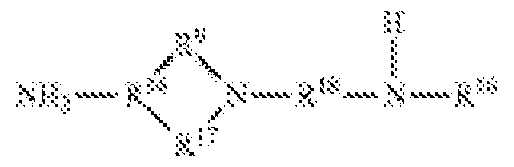
in the formula (VIII): R9 represents ~ QHjOkNi (where i=0 to 10, j=0 to 26, k=0 to 5, and 1=0 to 5); and R13, R14, R15 and R16 represent -- CiHjOkNi (where i=l to 10, j=0 to 26, k=0 to 5, and 1=0 to 5),

Nitro cK-conSasniKg com omsd (DC) in the formula (IX): R9 and R18 represent -CiHjOkNi (where i=0 to 10, j=0 to 26, k=0 to 5, and 1=0 to 5); and R10, R15 and R17 represent -QHjOkNi (where i=l to 10, j=0 to 26, k=0 to 5, and 1=0 to 5),


5, and 1= =00 ttoo 5); and R14, R17 and R20 represent --CiHjOkNi (where i=l to 10, j=0 to 26, k=0 to 5 and 1=0 to 5),

in the formula (XII): R9 and R21 represent -CiHjOkNi (where i=0 to 10, j=0 to 26, k=0 to 5, and 1=0 to 5); and R14, R16 and R17 represent -CiHjOk i (where i=l to 10, j=0 to 26, k=0 to 5, and 1=0 to 5),
·*.·.:· : .■· ··:· :·. e«a¾jw¾iw
in the formula (XIII): R9 and R18 represent -CiHjOkNi (where i=0 to 10, j=0 to 26, k=0 to 5, and 1=0 to 5); and R14, R16 and R17 represent -CiHjOk i (where i=l to 10, j=0 to 26, k=0 to 5, and 1=0 to 5).
In one specific solvent, the second compound component may be any one of nitrogen- containing compounds represented by following formulae (XIV) to (XIX) or a mixture thereof:

in the formula (XIV): R22 represents -CiHjOkNi (where i=0 to 10, j=0 to 26, k=0 to 5, and 1=0 to 5); and R23 and R24 represent -CiHjOkNi (where i=l to 10, j=0 to 26, k=0 to 5, and 1=0 to 5),

■ 'i -ogfeR- iJstaasijsg eosnposiad (XV) in the formula (XV): R25 represents - HjOkNi (where i=0 to 10, j=0 to 26, k=0 to 5, and 1=0 to 5); and R23 and R26 represent -CiHjOkNi (where i=l to 10, j=0 to 26, k=0 to 5, and 1=0 to

in the formula (XVI): R23, R27 and R28 represent --CiHjOkN! (where i=l to 10, j=0 to 26, k=0 to 5, and 1=0 to 5),
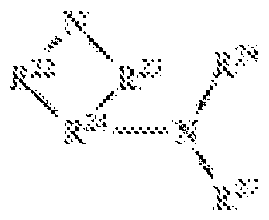
:^ί- ί:··ί:··:!ϊ:¾:-:^·χ ..·:"¾¾ν·::;::·; -NY:.: : in the formula (XVII): R22 represents -OToW (where i=0 to 10, j=0 to 26, k=0 to 5, and 1=0 to 5); and R23, R24, R27 and R29 represent -CiHjOkNi (where i=l to 10, j=0 to 26, k=0 to 5, and 1=0 to 5),
^ -*>1S , xrrr i 2<i itmgea-co t ii iig compound. ( VIII.) in the formula (XVIII): R25 represents -QHjOkNi (where i=0 to 10, j=0 to 26, k=0 to 5, and 1=0 to 5); and R23, R26 and R29 represent -QHjOkNi (where i=l to 10, j=0 to 26, k=0 to 5, and 1=0 to 5),
 in the formula (XIX): R , R , R and R2y represent --CiHjOkNi (where i=l to 10, j=0 to 26, k=0 to 5, and 1=0 to 5)
In one specific solvent, the reactive amine may be a nitrogen-containing compound represented by following formula (XX):

in the formula (XX): R , R , Rjj and RJ4 represent -QHjOkNi (where i=l to 10, j=0 to 26, k=0 to 5, and 1=0 to 5), and R31 represents -QHjOkNi (where i=0 to 10, j=0 to 26, k=0 to 5, and 1=0 to 5).
In one specific solvent, the reactive amine may be piperazine, N-2-Hydroethyl
Piperazine, 2-aminomethyl piperazine or mixture thereof.

Piperazine

N-2-Hydroethyl Piperazine

In one illustative solvent, one of one specific solvent components can be represented by polyethylene glycol (PEG) represented by the following formulae (XXI) and / or physical pressure driven solvent or mixture thereof:
Polyethylene Glycol (C2nH4n+20n+i)
H-(0-CH2-CH2)n-OH
where, n=integer
Glycols suitable with specific embodiments include monoethylene glycol (EG), Diethylene Glycol (DEG), Triethylene Glycol, Tetraethylene Glycol, Methoxytriglycol (MTG). Other physical solvent used as a solvent component are Sulfolane, N-Methyl-2-Pyrrolidone (NMP).
In one specific solvent, alkanolamines may be contained in an amount in a range from equal to or larger than 10 wt % to equal to or less than 40 wt %, reactive amines may in an amount in a range from equal to or larger than 6 wt % to equal to or less than 40 wt %, and a total amount of the alkanolamine and reactive amines may be more than 20 wt % to equal to or less than 80 wt %.
In one specific solvent, the alkanolamine may be represented by the formula (I), where
1 2
each of R and R is H.
In one specific solvent, the alkanolamine may be represented by the formula (I), where x is 2 to 4 and y is 4 to 8.
In one specific solvent, alkanolamines may be represented by the formula (I), where R1 is H and R is -CmHnOoNp (where m=l to 5, n=l to 11, o=0 to 5, and p=0 to 5).
In one specific solvent, the alkanolamine may be represented by the formula (I), where x is 2 to 4, y is 4 to 8, and R2 is CH3, C2H5, C3H7, or C4¾.
In one specific solvent, the alkanolamine may be represented by the formula (I), where Rl and R represent -CmHnOoNp (where m=l to 5, n=l to 11, o=0 to 5, and p=0 to 5).
In one specific solvent, the alkanoamine may be represented by the formula (I), where x is 2, y is 4, R1 is CH3, and R2 is C2H4OH.
An absorbent liquid for absorbing C02 or H2S or both from gas according to certain embodiments includes a cyclic amine compound having one nitrogen in a ring. In one specific solvent, the cyclic amine having one nitrogen in a ring may be a cyclic amine having one nitrogen in a 5-membered ring, 6-membered ring, or 7-membered ring.
In one specific solvent, the cyclic amine having one nitrogen in a 5-membered ring, 6- membered ring, or 7-membered ring may be pyrrolidine (PR), piperidine (PZ), or hexamethyleneimine (HMI).
In one specific solvent, the cyclic amine compound having one nitrogen in a ring may be a nitrogen containing compound having a primary nitrogen in a substituent group branching from the ring.
In one specific solvent, the nitrogen-containing compound having a primary nitrogen in a substituent group branching from the ring may be aminomethylpiperidine or aminoethylpiperidine.
In one specific solvent, the cyclic amine compound having one nitrogen in a ring may be a nitrogen-containing compound having a hydroxyl group in a 5-membered ring, 6-membered ring, or 7-membered ring.
In one specific solvent, the nitrogen-containing compound having a hydroxyl group in a 5-membered ring, 6-membered ring, or 7-membered ring may be piperidinol (PDN).
An absorbent liquid includes a mixture of one specific solvent, and an alkanolamine. In one specific solvent, the alkanolamine may be monoethanolamine (MEA), ethylaminoethanol (EAE), triethanolamine, N-methyldiethanolamine (MDEA), diisopropanolamine, diglycolamine, or a mixture thereof.
An process for removing C02 or H2S or both a includes an absorption tower that allows gas containing C02 or H2S or both and an absorbent liquid to be in contact with each other to remove C02 or H2S or both from the gas; and a regeneration tower that regenerates a solution which has absorbed the C02 or H2S or both, the absorption tower reusing the solution regenerated at the regeneration tower by removing the C02 or H2S or both from the solution.
In one embodiment, one specific solvent for recovery of carbon dioxide from gaseous mixture includes hindered amine, reactive amine, Polyethylene glycol, and a alkali carbonate buffer. The remaining solvent may be water.
Reactive amines may be a piperazine and its derivative such as piperazine, 2- aminomethyl piperazine, aminoethylpiperazine, hydroxyethylpiperazine, 3-(3- pyrrolidyl)piperidine, 2-(3-pyrrolidyl)piperazine, 3-(3-piperidyl)-piperidine, 3-(2- piperazinyl)piperidine, or 2-(2-piperazinyl)piperazine, 2-aminomethyl piperazine. The reactive amine may be ethylenediamine, dimethyl ethylenediamine, pyrazolidine, imidazolidine, 2-(2- pyrrolidyl)-pyrrolidine, 2-(2-imidazolidyl) imidazolidine or mixture thereof. One example includes a solvent having hindered amine, mixture of active amine piperazine and N-2 Hydroethyl Piperazine, a carbonate buffer, polyethylene glycol, and water.
One embodiment may include a solvent with poly ethylene glycol, any of a class of organic compounds belonging to the alcohol family; in the molecule of a glycol, two hydroxyl (OH) groups are attached to different carbon atoms. The term is often applied to the simplest member of the class, ethylene glycol. Ethylene glycol, also called 1 ,2-ethanediol, molecular formula HOCH2CH2OH, is a colourless, oily liquid possessing a sweet taste and mild odor. It can be produced commercially from ethylene oxide, which is obtained from ethylene. Further, propylene glycol, also called 1,2-propanediol, resembles ethylene glycol in its physical properties. Other glycols include 1,3-butanediol, 1,4-butanediol, 2-ethyl-l ,3-hexanediol, and 2- methyl-2 -propyl- 1,3 -propanediol, methoxytri glycol and others and are suitable herewith.
One specific solvent may contain hindered or tertiary amines that act as high C02 loading carrier as the base solvent to increase the capacity of the CO2 capture solvent. Hindered amine / tertiary amine may be N-methyldiethanolamine (MDEA), 2-(2-aminoethoxy)ethanol, Aminoethylethanolamine (AEEA), 2-amino-2methyl-l-proponal (AMP), 2-(ethyamino)-ethanol (EAE), 2-(methylamino)-ethanol (MAE), 2-(diethylamino)-ethanol (DEAE), , diisopropanolamine (DIPA), methylaminopropylamine (MAPA), 3-aminopropanol (AP), 2,2- dimethyl- 1,3 -prop anediamine (DMPDA), 3-amino-l-cyclohexylaminopropane (ACHP), diglycolamine (DGA), l-amino-2-propanol (MIPA), 2-methyl-methanolamine (MMEA); Di ethyl ethanol amine (DEEA)
One specific solvent may contain a carbonate buffer. The pH may range for a carbonate buffer may be between 8.0 and 9.0. Carbonate in one specific solvent increases the pH of one specific solvent. This high pH allows for increased carbon dioxide capture in the form of
bicarbonate salts. The carbonate can be regenerated when one specific solvent is heated. In some instances percarbonate may contribute to the buffer system.
Suitable carbonate buffer salts are described herein. The amount of carbonate buffer salt used in the buffer system is an amount that is sufficient, when used with the remaining components, to raise salivary pH to a pH of about 7.8 or more, about 8.5 or more, and about 9 or more (e.g., about 9-11), irrespective of the starting pH.
In another embodiment, the carbonate salt is selected from the group consisting of sodium carbonate, potassium carbonate, calcium carbonate, ammonium carbonate, and magnesium carbonate. In yet another embodiment, the bicarbonate salt is selected from the group consisting of sodium bicarbonate, potassium bicarbonate, calcium bicarbonate, ammonium bicarbonate, and magnesium bicarbonate. In one embodiment, the binary buffer system comprises sodium carbonate and sodium bicarbonate. In another embodiment, the sodium bicarbonate is dessicant-coated sodium bicarbonate.
The amount of carbonate buffer and reactive amine piperazine in the solution is limited by the solubility of both components in water, thus resulting in solid solubility limit for aqueous solutions. At 25 C, the solubility of potassium carbonate buffer in a C02 rich solution is 3.6 m and the solubility of piperazine in water is approximately 2 m. With the solid solubility limitation, the resulting lower concentration can result in slow reaction rate and low solution capacity. By combining piperazine and carbonate buffer solubility in polyethylene glycol and aqueous solutions, the resultant solubility increases.
Reactive amines such as piperazine and C02 react, it undergoes equilibrium reaction to form piperazine carbamate and piperazine dicarbamate and some free and bound piperazine. Because of the addition of carbonate buffer salt; which react with free and bound piperazine in reacting more C02 to form piperazine carbamate and piperazine dicarbamate.
The ratio of equivalents of carbonate salt to equivalents of reactive amine can be between 0.3 - 3.0. The concentrations of the reactiveamine and carbonate salt can be between 3.0 - 8.0 equivalents/Kg H20 or 4.0 and 6.0 equivalents/Kg H20. The amount of piperazine and carbonate buffer salt can be adjusted based on the solubility in water and polyethylene glycol.
In one example, one specific solvent and method of use for the removal of C02 from flue gas, natural gas, hydrogen gas, synthesis gas, and other process and waste gas streams. One
specific solvent may contain a carbonate buffer, a reactive amine, a hindered amine, and a polyethylene glycol, resulting in the solution pH between (10 - 13.5) in absence of C02. The reactive amine 6 wt% to 40 wt% with the total concentration limited by the solid solubility of the reactive amine in aqueous and polyethylene glycol solution or of the carbonate buffer salt from 0.15 wt% - 10 wt% with total concentration limited by the solid solubility in aqueous solution. This chemical solvent is designed to increase the rate of C02 removal to improve the efficiency of a removal process.
Piperazine is freely soluble in water and solubility in ethylene glycol up to a about 20 wt%. Carbonate buffer salt solubility in water is 112 g/100 mL at 20 °C,
The temperature of the solution when contacting with the gaseous stream may be between approximately30 C - 125 C. The rate constant for the reaction of C02 with the
3 3
piperazine derivative (KPZ) may be at least 25 m /mol-s at 25 C, or at least 50 m /mol-s at 25 C.
In one embodiment, one specific solvent has a reactive amine in concentration between about 6 wt% and 40 wt%.
In yet another embodiment, one specific solvent has a alkanolamine in a concentration between about 10wt% and 40 wt%.
In yet another embodiment, one specific solvent has a carbonate buffer has concentration between about 0.15wt% - 10 wt%.
In yet another embodiment, one specific solvent has a solute concentration between about 2 wt% - 40 wt%.
In yet another embodiment, one specific solvent has a tertiary balance to keep one specific solvent or solvent system as a single liquid phase.
In yet another embodiment, the solvent the alkanolamine has a weight percentage between 25 wt% and 40 wt% and is selected from group comprising N-methyldiethanolamine (MDEA), 2-amino-2methyl-l-proponal (AMP); the reactive amines have a weight percentage between 10 wt% and 25 wt% and is selected from group comprising comprising piperazine, N aminoethylpiperazine (AEP); and the glycol has a weight percentage between 10 wt% and 25 wt%.
In yet another embodiment, the solvent the alkanolamine has a weight percentage between 30 wt% and 40 wt% and is selected from group comprising N-methyldiethanolamine
(MDEA), 2-amino-2methyl-l-proponal (AMP); the reactive amines have a weight percentage between 10 wt% and 18 wt% and is selected from group comprising comprising piperazine, N aminoethylpiperazine (AEP); and the glycol has a weight percentage between 15 wt% and 20 wt%.
In yet another embodiment, the solvent the alkanolamine has a weight percentage between 32 wt% and 35 wt% and is selected from group comprising N-methyldiethanolamine (MDEA), 2-amino-2methyl-l-proponal (AMP); the reactive amines have a weight percentage between 11 wt% and 15 wt% and is selected from group comprising comprising piperazine, N aminoethylpiperazine (AEP); and the glycol has a weight percentage between 18 wt% and 20 wt%.
In yet another embodiment, the solvent the alkanolamine has a weight percentage between 25 wt% and 40 wt%; the reactive amines have a weight percentage between 10 wt% and 25 wt%; and the glycol has a weight percentage between 10 wt% and 25 wt%.
In yet another embodiment, the solvent the alkanolamine has a weight percentage between 30 wt% and 40 wt%; the reactive amines have a weight percentage between 10 wt% and 18 wt%; and the glycol has a weight percentage between 15 wt% and 20 wt%.
In yet another embodiment, the solvent the alkanolamine has a weight percentage between 32 wt% and 35 wt%; the reactive amines have a weight percentage between 11 wt% and 15 wt%; and the glycol has a weight percentage between 18 wt% and 20 wt%.
In yet another embodiment, the solvent the alkanolamine has a weight percentage between 25 wt% and 40 wt%; the reactive amines have a weight percentage between 10 wt% and 25 wt%; and the sulfolane has a weight percentage between 10 wt% and 25 wt%.
In yet another embodiment, the solvent the alkanolamine has a weight percentage between 30 wt% and 40 wt%; the reactive amines have a weight percentage between 10 wt% and 18 wt%; and the sulfolane has a weight percentage between 15 wt% and 20 wt%.
In yet another embodiment, the solvent the alkanolamine has a weight percentage between 32 wt% and 35 wt%; the reactive amines have a weight percentage between 11 wt% and 15 wt%; and the sulfolane has a weight percentage between 18 wt% and 20 wt%.
In another embodiment, a method of removing C02 from a gaseous stream including: contacting a gaseous stream with a solution wherein the solution is formed by combining:
alkanolamines, a reactive amine , an carbonate salt, poly ethylene glycol and water; whereby the contact removes C02 from the gaseous stream; and regenerating the solution. The concentrations may be limited by the solubility of the components at a temperature and contact of the exhaust gaseous stream with one specific solvent removes C02 from the gaseous stream; and regenerating the solution.
The regenerating may include heating C02-rich solution, which may occur at a temperature of approximately 90 C - 130 C, approximately 110 C. An additive such as an antifoaming agent, an antioxidant, a corrosion inhibitor (e.g. vanadium oxide or a chromate), a flocculation aid, or a mixture of two or more additives may be included as part of the solution.
In another embodiment, the method of removing C02 from a gaseous stream may further include applying a water wash system, wherein the water wash system collects the volatile alkanolamine and reactive amine from treated gaseous stream. The regeneration of the solution may occur in a vacuum stripper column, and the solution may be returned to contact with the gaseous stream after regeneration.
Other components of a gaseous stream, such as COS may also be removed by the method of this disclosure. The gaseous stream may be from a coal-fired power plant, or it may be flue gas, natural gas, hydrogen gas, synthesis gas or a waste gas stream.
Fig. 2 is a schematic diagram of an apparatus for removing acidic gases especially C02. As shown in Fig. 2, gas is allowed to enter to an absorption tower 1 through a C02 - containing gas-feed. In a packed portion, the gas placed in the absorption tower 1 is brought into contact in a counter flow with a C02 absorbent liquid fed from 3, and C02 is absorb and removed from the gas by the absorbing liquid, and the resultant gas is discharge from the top as treated gas. The absorbent liquid fed to the absorption tower 1 absorb C02, and is led to heat exchanger and heated and led to a regeneration tower 4. In the regeneration tower 4, the absorbent liquid flows through a packed portion towards the lower portion of the tower. During this time, C02 is removed to regenerate the absorbent liquid. The regenerated absorbent liquid is led by a pump to the heat exchanger and fed back to the absorption tower 1 through an absorbent liquid feed inlet line 3.
On the other hand, in the upper portion of the regeneration tower 4, the C02 removed from the absorbent liquid is brought into contact with a reflux water, and cooled by a
regeneration tower reflux condenser and, in a reflux drum, the C02 separated from the reflux water formed by condensing water vapor accompanying the C02, and led to a C02 recovery step. The reflux water is fed by a reflux water pump to the regenerator tower 4. This embodiment briefly describes an overview of the C02 capture process description.
Illustrative Examples and Proposed Theory
Heat to produce steam to maintain driving force for C02, For the C02, to be transferred from the liquid to the gas phase there needs to be driving force on the basis of partial pressure. Thus, steam acts in such a way as to provide this driving force so that the mass transfer of C02 from the liquid to the gas phase is enhanced. This also has energy associated with it, which contributes to the overall reboiler duty. This can be obtained by finding out the amount of water associated with the pure C02 steam produced as this energy in the form of water is lost and needs to be provided by the reboiler. The stripping heat consists of the following:
QT ~ Qsens ~*~ Qdes ~*~ Qstrip
Sensible heat of C02 rich solvent to raise the stripper temperature
One specific solvent loaded with C02 in the absorber may be heated up to stripper temperature for the regeneration of C02. One specific solvent stream can be pre -heated in the lean-rich cross heat exchanger and then additional heat may be used to maintain the temperature of one specific solvent in the stripper.
SCPAT
Qsens
rich lean ' amine
The contributing factors to the sensible heat are solvent flow, specific heat capacity of one specific solvent and the temperature increase. Thus, the only parameter that can be varied is one specific solvent flow which further depends on the concentration of one specific solvent and one specific solvent loadings. This can be decreased by circulating less solvent and maintaining the same C02 production rate. This is checked by means of comparing the Net Capacity of a solvent which is defined as the difference in the loading at the absorption and desorption conditions.
Heat of Desorption of C02
The C02 which is reversibly bound to one specific solvent needs to be regenerated. The heat of desorption is equivalent to the heat of absorption.
Heat to produce steam to maintain driving force for C02
For the C02 to be transferred from the liquid to the gas phase there needs to be driving force in the basis of the partial pressure. Thus steam acts in such a way as to provide the driving force so that the mass transfer of C02 from the liquid to the gas phase is enhanced. This also has energy associated with it, which contributes to the overall reboiler duty. This can be obtained by finding out the amount of water associated with the pure C02 steam produced as this energy in the form of water is lost and needs to be provided by the rebuilder. The stripping heat consists of the following: a strip

Where Η^ζα stands for heat of vaporization if water and PC*02 is the partial pressure of
C02 that would be equilibrium with the rich solution at the bottom of the absorber. Thus, finding EXAMPLES
The disclosure will be further described in connection with the following examples, which are set forth for purposes of illustration only.

Table 1
As the rate activator for the C02 absorption is piperazine and its derivative, the limitation with piperazine is its high volatility. It has highest reaction kinetics among its derivatives. It is white crystals which need more water to foam a clear solutions or need Polyethylene glycol to solubilize it. But because of the high volatility the loss of the piperazine is high and to minimize the volatility loss in the solvent, piperazine component is partly or completely replaced by rate activator such as N-2-hydroethyl piperazine whose vapor pressure is 99.7% less than piperazine.

Example 2
Below is the composition and characteristics of another exemplary solvent. Density measurement
The densities of were measured using a 25 x 10 m' (at 298 K) Gay-Lussac pycnometer. For each run, the pycnometer containing the solvent solution was put in a constant temperature bath. The bath temperature was controlled within ± 0.1 K of the desired temperature level using a circulator temperature controller. Once the solution reached the desired temperature, it was weighed to within ± 0.0001 g with an analytical balance. Each reported density data is the average of at least three measurements.
Viscosity measurement
The viscosities of solutions were measured using Cannon Fenske Viscometer. For each viscosity measurement, the temperature was controlled within ± 0.1 K of the desired level with a circulator temperature controller. The viscometers containing samples were immersed in a thermostatic bath and allowed to equilibrate to the set point temperature for at least 15 min. Later, the efflux time of samples was measured manually with a digital stopwatch having an accuracy of 0.01 s. The efflux time is measured by allowing meniscus to pass between two specific marks. The kinematic viscosity was obtained by multiplying efflux time in seconds with the respective viscometer constant. The dynamic viscosity of the samples is calculated by multiplying the kinematic viscosity values with their corresponding density values. Each viscosity data is the average of at least three measurements.

Density and viscosity of SI:

FIG. 3 describes viscosity in mPa.sec and density in kg/m3 (on Y-axis) w.r.t. temperature °C (on X-axis) for the solvent Si. It is observed that viscosity and density decreases with the increase in temperature.
VLE of Si
These measurements can determine the relationship between partial pressure of C02 and the subsequent loading of the solvent at different temperatures. This data can be used to do a first assessment of the solvent performance.


Kinetics Experiments Resu ts
Mass%
MDEA 25
Ethylene Glycol 20
Piperazine 15
K2C03 5
35
Rate v/s C02 partial pressure
1.2GE-G5
" l.OOE-05
J. 8.00E-06
6.00E-06
4.00E-06
¾ 2.00E-06
O.OOE-i-00
5 10 15 20
C02 partial pressure (kPa)
T = 40 C

Specific rate of absorption increases with CO2 partial pressure.
Below is the composition and characteristics of another exemplary solvent. VLE data for solvent S2
(MDEA + PZ + Tetrahydrothiophenedioxide (SULFOLANE) + water (and K2C03)) (48+2+10+40 wt%, respectively)

496.29 0.934 856.09 1.020 1082.87 0.996
622.43 0.997 955.89 1.087 1127.33 1.062
756.84 1.032 1355.41 1.120
955.89 1.110
VLE data for (MDEA + PZ + SULFOLANE + (H20 and K2C03)) (45+5+10+40 wt%, respectively)

VLE data for (MDEA + PZ + SULFOLANE + water(and K2C03)) (42+8+10+40wt%, respectively)
T=313K T=323K T=333K
 aco2 PcoJ Pa aco2
1.24 0.236 5.38 0.321 16.80 0.264
16.18 0.503 49.49 0.567 65.72 0.455
94.38 0.750 101.33 0.671 174.93 0.615
192.78 0.855 145.10 0.738 326.32 0.805
223.33 0.895 274.27 0.848 497.35 0.898
465.28 1.004 332.93 0.860 670.47 0.936
599.69 1.082 545.93 0.973 833.25 0.997
777.53 1.144 779.60 1.075 1095.73 1.069
976.05 1.169 984.32 1.130 1164.45 1.091
1013.27 1.182
Claims
1. A solvent for recovery of carbon dioxide from gaseous mixture, comprising:
(a) an alkanolamine,
(b) reactive amines,
(c) a carbonate buffer,
wherein one specific solvent contains less than about 75% by weight of water and has a single liquid phase.
2. The solvent as claimed in Claim 1, further comprising a glycol.
3. The solvent as claimed in Claim 2, wherein the glycol is poly ethylene glycol.
4. The solvent as claimed in Claim 1, further comprising a sulfolane.
5. The solvent as claimed in Claim 2, wherein the glycol is selected from the group consisting of monoethylene glycol (EG), Diethylene Glycol (DEG), Triethylene Glycol, Tetraethylene Glycol, Methoxytriglycol (MTG). Other physical solvent used as a solvent component are Sulfolane, N-Methyl-2-Pyrrolidone (NMP).
6. The solvent as claimed in Claim 1 or 3, the solvent is 41ess than about 30% by weight of water.
7. The solvent as claimed in Claim 1 or 3, wherein the carbonate buffer is a potassium carbonate buffer.
8. The solvent as claimed in Claim 1, wherein the promoter is 2% and 30% wt percent.
9. The solvent as claimed in Claim 1 or 3, wherein the alkanolamine is comprises at least one amine of the formula (I), (II), (III) where x and y respectively satisfy relationship: 1 less than or equal to 5 and 2. less than or equal to 10; and R1, R2, R3, and R4 represent— QHjOkNi (where i=0 to 10, j=l to 21, k=0 to 5, and 1=0 to 5).

10. The solvent as claimed in Claim 1 or 3, wherein the alkanolamine is selected from group comprising N-methyldiethanolamine (MDEA), 2-(2-aminoethoxy)ethanol,
Aminoethylethanolamine (AEEA), 2-amino-2methyl-l-proponal (AMP), 2-(ethyamino)-ethanol (EAE), 2-(methylamino)-ethanol (MAE), 2-(diethylamino)-ethanol (DEAE), diisopropanolamine (DIP A), methylaminopropylamine (MAP A), 3-aminopropanol (AP), 2,2-dimethyl-l,3- propanedi amine (DMPDA), 3-amino-l-cyclohexylaminopropane (ACHP), diglycolamine (DGA), l-amino-2-propanol (MIPA), 2-methyl-methanolamine (MMEA), diethyl ethanol amine or any combinations thereof at concentration ranging from about 20 wt % to about 45 wt %. The solvent as claimed in claim 1 , wherein the reactive amine is selected from group comprising piperazine, N-aminoethylpiperazine (AEP), N-methylpiperazine, 2-methylpiperazine, 1- ethylpiperazine, l-(2-hydroxyethyl) piperazine, 2,5-dimethylpiperazine , l-Amino-4-Methyl Piperazine and any combinations thereof.
11. The solvent as claimed in Claim 1 , wherein the reactive amine is greater than 6% by weight and buffers the solution to a pH of between about 12 and 14 in the absence of C02.
12. The solvent as claimed in Claim 1, wherein
(a) the alkanolamine has a weight percentage between 25 wt% and 40 wt%_selected from group comprising N-methyldiethanolamine (MDEA),2-amino-2methyl-l- proponal (AMP),
(b) reactive amines have a weight percentage between 10 wt% and_25 wt%, selected from group comprising comprising piperazine, N aminoethylpiperazine (AEP),
(c) glycol has a weight percentage between 10 wt% and_20 wt%.
13. The solvent as claimed in Claim 1, wherein
(a) the alkanolamine has a weight percentage between 30 wt% and 40 wt%_selected from group comprising N-methyldiethanolamine (MDEA),2-amino-2methyl-l- proponal (AMP)
(b) the reactive amines have a weight percentage between 10 wt% and 18 wt%, selected from group comprising comprising piperazine, N aminoethylpiperazine (AEP)
(c) the glycol has a weight percentage between 15 wt% and 20 wt%
14. The solvent as claimed in Claim 13, wherein the glycol is poly ethylene glycol.
15. The solvent as claimed in Claim 3, wherein
(a) the alkanolamine has a weight percentage between 25 wt% and 40 wt%_selected from group comprising N-methyldiethanolamine (MDEA), 2-amino-2methyl-l- proponal (AMP),
(b) reactive amines have a weight percentage between 10 wt% and_25 wt%, selected from group comprising piperazine, N aminoethylpiperazine (AEP),
(c) the sulfolane has a weight percentage between 10 wt% and_20 wt%.
16. The solvent as claimed in Claim 1, wherein
(a) the alkanolamine has a weight percentage between 32 wt% and 35 wt%_selected from group comprising N-methyldiethanolamine (MDEA),2-amino-2methyl-l- proponal (AMP),
(b) reactive amines have a weight percentage between 11 wt% and 15 wt%, selected from group comprising comprising piperazine, N aminoethylpiperazine (AEP),
(c) poly ethylene glycol has a weight percentage between 18 wt% and 20 wt%.
17. A method for removing C02 from a stream, comprising the steps of:
(a) contacting the stream with a solvent having an alkanolamine, rate activator amines, glycol or sulfanone, and a carbonate buffer;
(b) allowing one specific solvent to absorb C02 at a temperature ;
(c) regenerating one specific solvent from heating one specific solvent greater than 80.
18. The method as claimed in Claim 17, wherein the stream has a temperature between 40 C to 65 C.
19. The method as claimed in Claim 17, wherein the alkanolamine compounds of the formula (I) include monoethanolamine (MEA), methyldiethanolamine (MDEA), diethanolamine (DEA), triethanolamine (TEA), diisopropanolamine (DIP A), 2-amino-l-propanol (AP), 2-amino- 2-methylpropanol (AMP), ethyldiethanolamine (EDEA), 2-methylaminoethanol (MEA), 2- ethylaminoethanol (EAE), 2-n-propylaminoethanol, 2-nbutylaminoethanol (n-BAE), 2-n pentylaminoethanol, 2-isobutylaminoethanol (IBAE), 2-dimethylaminoethanol (DMAE) and 2- diethylaminoethanol (DEAE), alkanolamine compounds of the formula (II) include 2,3- diaminopropionic acid (DAP A) and glycine and alkanoamine compounds of the formula (III) include 1,2 ethylenediamine.
20. The solvent as claimed in Claim 17, wherein
(a) the alkanolamine has a weight percentage between 32 wt% and 35 wt%_selected from group comprising N-methyldiethanolamine (MDEA),2-amino-2methyl-l- proponal (AMP),
(b) reactive amines have a weight percentage between 11 wt% and 15 wt%, selected from group comprising comprising piperazine, N aminoethylpiperazine (AEP),
(c) the glycol has a weight percentage between 18 wt% and 20 wt%.
21. The solvent as claimed in Claim 17, wherein
(a) the alkanolamine has a weight percentage between 25 wt% and 40 wt%_selected from group comprising N-methyldiethanolamine (MDEA), 2-amino-2methyl-l- proponal (AMP),
(b) reactive amines have a weight percentage between 10 wt% and_25 wt%, selected from group comprising piperazine, N aminoethylpiperazine (AEP),
(c) the sulfolane has a weight percentage between 10 wt% and_20 wt%.
22. A method for removing C02 from a stream, comprising the steps of: (a) contacting the stream with a solvent having components amine, glycol, reactive amine, and a carbonate buffer, wherein the solvent contains less than about 75% by weight of water, (a) allowing the solvent to absorb C02 at a temperature, and (b) regenerating the solvent from heating the solvent greater than 80 C, wherein the stream has a temperature between 40 C to 65 C, and the regeneration is under a pressure between about 0.01 and 30 bar.
23. The method as claimed in claim 21, wherein the amine is hindered amine.
Priority Applications (6)
| Application Number | Priority Date | Filing Date | Title |
|---|---|---|---|
| ES14746742T ES3014995T3 (en) | 2013-01-31 | 2014-01-31 | Carbon capture solvents and methods for using such solvents |
| EP24164162.0A EP4427835A1 (en) | 2013-01-31 | 2014-01-31 | Carbon capture solvents and methods for using such solvents |
| FIEP14746742.7T FI2950910T3 (en) | 2013-01-31 | 2014-01-31 | CARBON-CAPTURING SOLVENTS AND METHODS FOR USING SUCH SOLVENTS |
| DK14746742.7T DK2950910T3 (en) | 2013-01-31 | 2014-01-31 | CARBON CAPTURE SOLVENTS AND METHODS FOR USING SUCH SOLVENTS |
| US14/765,935 US10239014B2 (en) | 2013-01-31 | 2014-01-31 | Carbon capture solvents and methods for using such solvents |
| EP14746742.7A EP2950910B1 (en) | 2013-01-31 | 2014-01-31 | Carbon capture solvents and methods for using such solvents |
Applications Claiming Priority (2)
| Application Number | Priority Date | Filing Date | Title |
|---|---|---|---|
| US201361759191P | 2013-01-31 | 2013-01-31 | |
| US61/759,191 | 2013-01-31 |
Publications (2)
| Publication Number | Publication Date |
|---|---|
| WO2014118633A2 true WO2014118633A2 (en) | 2014-08-07 |
| WO2014118633A3 WO2014118633A3 (en) | 2015-02-19 |
Family
ID=51263076
Family Applications (1)
| Application Number | Title | Priority Date | Filing Date |
|---|---|---|---|
| PCT/IB2014/000419 Ceased WO2014118633A2 (en) | 2013-01-31 | 2014-01-31 | Carbon capture solvents and methods for using such solvents |
Country Status (6)
| Country | Link |
|---|---|
| US (1) | US10239014B2 (en) |
| EP (2) | EP4427835A1 (en) |
| DK (1) | DK2950910T3 (en) |
| ES (1) | ES3014995T3 (en) |
| FI (1) | FI2950910T3 (en) |
| WO (1) | WO2014118633A2 (en) |
Cited By (15)
| Publication number | Priority date | Publication date | Assignee | Title |
|---|---|---|---|---|
| WO2015011566A3 (en) * | 2013-07-23 | 2015-08-13 | Carbon Clean Solutions Pvt. Ltd | Split line system, method and process for co2 recovery |
| WO2016027164A1 (en) * | 2014-08-22 | 2016-02-25 | Carbon Clean Solutions Limited | Carbon capture solvents having alcohols and amines and methods for using such solvents |
| WO2016116815A1 (en) * | 2015-01-22 | 2016-07-28 | Carbon Clean Solutions Limited | Solvent and method for removing acid gases from a gaseous mixture |
| WO2016123386A1 (en) * | 2015-01-28 | 2016-08-04 | Fluor Technologies Corporation | Methods and systems for improving the energy efficiency of carbon dioxide capture |
| CN109420409A (en) * | 2017-08-22 | 2019-03-05 | 中国石油化工股份有限公司 | It is selectively removed from air-flow containing H2S and CO2Sour gas absorbent and method |
| CN109529550A (en) * | 2018-10-22 | 2019-03-29 | 昆明理工大学 | A kind of absorbing liquid of phase transformation capture sulfur dioxide |
| US10376829B2 (en) | 2017-06-13 | 2019-08-13 | Fluor Technologies Corporation | Methods and systems for improving the energy efficiency of carbon dioxide capture |
| WO2020002892A1 (en) * | 2018-06-26 | 2020-01-02 | Carbon Clean Solutions Limited | Solvent and process for removing carbon dioxide from a gaseous mixture having high carbon dioxide partial pressures |
| WO2020008169A1 (en) * | 2018-07-02 | 2020-01-09 | Carbon Clean Solutions Limited | A method and a system for the removal of carbon dioxide from solvents |
| EP3620225A1 (en) | 2018-08-29 | 2020-03-11 | INDIAN OIL CORPORATION Ltd. | Process for co2 capture from gaseous streams |
| EP3964279A1 (en) | 2020-09-07 | 2022-03-09 | Indian Oil Corporation Limited | Solvent composition for co2 capture and a process mediated thereof |
| CN115475486A (en) * | 2022-10-20 | 2022-12-16 | 华北电力大学(保定) | A kind of anti-oxidative degradation phase change absorbent, its carbon dioxide capture method and application |
| US11850552B2 (en) | 2018-06-26 | 2023-12-26 | Carbon Clean Solutions Limited | System and process of capturing carbon dioxide from flue gases |
| CN117339348A (en) * | 2023-10-18 | 2024-01-05 | 河北科技大学 | A liquid-liquid phase change absorbent and its application in capturing carbon dioxide |
| NL2036288B1 (en) * | 2023-11-17 | 2025-05-27 | Opure B V | Process and apparatus for the purification of biogas |
Families Citing this family (7)
| Publication number | Priority date | Publication date | Assignee | Title |
|---|---|---|---|---|
| CN102959202B (en) * | 2010-07-02 | 2016-08-03 | 埃克森美孚上游研究公司 | Integrated system, method of power generation and combined cycle power generation system |
| WO2020262779A1 (en) * | 2019-06-27 | 2020-12-30 | 한국에너지기술연구원 | Biogas purification system and method for producing clean fuel |
| FR3104452B1 (en) * | 2019-12-13 | 2022-09-09 | Ifp Energies Now | METHOD FOR THE REGENERATION OF AN AQUEOUS SOLUTION OF MEG CONTAINING SALTS WITH TREATMENT OF THE PURGE |
| CA3235954A1 (en) | 2021-10-26 | 2023-05-04 | Frederick De Meyer | Method for the purification of a gas mixture comprising carbon dioxide and optionally hydrogen sulfide |
| EP4706801A1 (en) * | 2023-05-03 | 2026-03-11 | Panasia Co., Ltd. | Absorbent for capturing carbon dioxide |
| CN119056200B (en) * | 2023-06-02 | 2025-09-19 | 中国石油化工股份有限公司 | Absorption liquid for capturing carbon dioxide, application of absorption liquid and method for capturing carbon dioxide |
| CN119059961A (en) * | 2024-08-26 | 2024-12-03 | 大连理工大学 | A cyclic fatty polyamine compound, a preparation method and application thereof, and a cyclic fatty polyamine combined solution |
Citations (1)
| Publication number | Priority date | Publication date | Assignee | Title |
|---|---|---|---|---|
| US6436174B1 (en) | 1998-06-29 | 2002-08-20 | Basf Aktiengesellschaft | Method for removing acid gas components from gases |
Family Cites Families (9)
| Publication number | Priority date | Publication date | Assignee | Title |
|---|---|---|---|---|
| DE10139453A1 (en) * | 2001-08-10 | 2003-02-20 | Basf Ag | Acid content removed from gaseous flow by aqueous absorbent containing methyl-diethanolamine and piperazine |
| WO2006089423A1 (en) * | 2005-02-24 | 2006-08-31 | Co2 Solution Inc. | An improved co2 absorption solution |
| US7846407B2 (en) * | 2006-04-07 | 2010-12-07 | Liang Hu | Self-concentrating absorbent for acid gas separation |
| CN101612510B (en) * | 2008-06-25 | 2011-10-05 | 中国科学院大连化学物理研究所 | A Microchannel Absorber for Absorbing CO2 |
| US7842126B1 (en) * | 2008-09-30 | 2010-11-30 | The United States Of America As Represented By The United States Department Of Energy | CO2 separation from low-temperature flue gases |
| US8541622B2 (en) * | 2009-06-30 | 2013-09-24 | Nalco Company | Acid gas scrubbing composition |
| US8318114B2 (en) * | 2010-04-16 | 2012-11-27 | Nalco Company | Composition for treating acid gas |
| ES2896399T3 (en) * | 2010-09-20 | 2022-02-24 | Carbon Clean Solutions Ltd | Solvent composition for carbon dioxide recovery |
| CN103429318A (en) * | 2011-02-03 | 2013-12-04 | 二氧化碳处理公司 | CO2 treatment for enhanced catalysis using enzyme particles sized according to reactive liquid film thickness |
-
2014
- 2014-01-31 EP EP24164162.0A patent/EP4427835A1/en active Pending
- 2014-01-31 DK DK14746742.7T patent/DK2950910T3/en active
- 2014-01-31 ES ES14746742T patent/ES3014995T3/en active Active
- 2014-01-31 WO PCT/IB2014/000419 patent/WO2014118633A2/en not_active Ceased
- 2014-01-31 FI FIEP14746742.7T patent/FI2950910T3/en active
- 2014-01-31 US US14/765,935 patent/US10239014B2/en active Active
- 2014-01-31 EP EP14746742.7A patent/EP2950910B1/en active Active
Patent Citations (1)
| Publication number | Priority date | Publication date | Assignee | Title |
|---|---|---|---|---|
| US6436174B1 (en) | 1998-06-29 | 2002-08-20 | Basf Aktiengesellschaft | Method for removing acid gas components from gases |
Cited By (30)
| Publication number | Priority date | Publication date | Assignee | Title |
|---|---|---|---|---|
| WO2015011566A3 (en) * | 2013-07-23 | 2015-08-13 | Carbon Clean Solutions Pvt. Ltd | Split line system, method and process for co2 recovery |
| WO2016027164A1 (en) * | 2014-08-22 | 2016-02-25 | Carbon Clean Solutions Limited | Carbon capture solvents having alcohols and amines and methods for using such solvents |
| CN107106967A (en) * | 2014-08-22 | 2017-08-29 | 碳清洁解决方案有限公司 | Carbon capture solvent with alkohol and amine and the method using this solvent |
| EP3673974A1 (en) * | 2014-08-22 | 2020-07-01 | Carbon Clean Solutions Limited | Carbon capture solvents having alcohols and amines and methods for using such solvents |
| WO2016116815A1 (en) * | 2015-01-22 | 2016-07-28 | Carbon Clean Solutions Limited | Solvent and method for removing acid gases from a gaseous mixture |
| WO2016123386A1 (en) * | 2015-01-28 | 2016-08-04 | Fluor Technologies Corporation | Methods and systems for improving the energy efficiency of carbon dioxide capture |
| US10005027B2 (en) | 2015-01-28 | 2018-06-26 | Fluor Technologies Corporaticn | Methods and systems for improving the energy efficiency of carbon dioxide capture |
| EP3250311A4 (en) * | 2015-01-28 | 2019-02-13 | Fluor Technologies Corporation | METHODS AND SYSTEMS FOR ENHANCING THE ENERGY EFFICIENCY OF CARBON DIOXIDE CAPTURE |
| US11179671B2 (en) | 2015-01-28 | 2021-11-23 | Fluor Technologies Corporation | Methods and systems for improving the energy efficiency of carbon dioxide capture |
| US10639584B2 (en) | 2017-06-13 | 2020-05-05 | Fluor Technologies Corporation | Methods and systems for improving the energy efficiency of carbon dioxide capture |
| US10376829B2 (en) | 2017-06-13 | 2019-08-13 | Fluor Technologies Corporation | Methods and systems for improving the energy efficiency of carbon dioxide capture |
| CN109420409A (en) * | 2017-08-22 | 2019-03-05 | 中国石油化工股份有限公司 | It is selectively removed from air-flow containing H2S and CO2Sour gas absorbent and method |
| CN109420409B (en) * | 2017-08-22 | 2021-08-06 | 中国石油化工股份有限公司 | Absorbent and method for selective removal of acid gas containing H2S and CO2 from gas stream |
| US12059649B2 (en) | 2018-06-26 | 2024-08-13 | Carbon Clean Solutions Limited | Solvent and process for removing carbon dioxide from a gaseous mixture having high carbon dioxide partial pressures |
| WO2020002892A1 (en) * | 2018-06-26 | 2020-01-02 | Carbon Clean Solutions Limited | Solvent and process for removing carbon dioxide from a gaseous mixture having high carbon dioxide partial pressures |
| CN112351831A (en) * | 2018-06-26 | 2021-02-09 | 碳清洁解决方案有限公司 | Solvent and process for removing carbon dioxide from gas mixtures having a high partial pressure of carbon dioxide |
| US12138588B2 (en) | 2018-06-26 | 2024-11-12 | Carbon Clean Solutions Limited | System and process of capturing carbon dioxide from flue gases |
| AU2019295364B2 (en) * | 2018-06-26 | 2024-10-31 | Carbon Clean Solutions Limited | Solvent and process for removing carbon dioxide from a gaseous mixture having high carbon dioxide partial pressures |
| US11850552B2 (en) | 2018-06-26 | 2023-12-26 | Carbon Clean Solutions Limited | System and process of capturing carbon dioxide from flue gases |
| US12134067B2 (en) | 2018-07-02 | 2024-11-05 | Carbon Clean Solutions Limited | Method and a system for the removal of carbon dioxide from solvents |
| WO2020008169A1 (en) * | 2018-07-02 | 2020-01-09 | Carbon Clean Solutions Limited | A method and a system for the removal of carbon dioxide from solvents |
| US11607646B2 (en) | 2018-08-29 | 2023-03-21 | Indian Oil Corporation Limited | Process for CO2 capture from gaseous streams |
| EP3620225A1 (en) | 2018-08-29 | 2020-03-11 | INDIAN OIL CORPORATION Ltd. | Process for co2 capture from gaseous streams |
| CN109529550A (en) * | 2018-10-22 | 2019-03-29 | 昆明理工大学 | A kind of absorbing liquid of phase transformation capture sulfur dioxide |
| EP3964279A1 (en) | 2020-09-07 | 2022-03-09 | Indian Oil Corporation Limited | Solvent composition for co2 capture and a process mediated thereof |
| US11786860B2 (en) | 2020-09-07 | 2023-10-17 | Indian Oil Corporation Limited | Solvent composition for CO2 capture and a process mediated thereof |
| CN115475486A (en) * | 2022-10-20 | 2022-12-16 | 华北电力大学(保定) | A kind of anti-oxidative degradation phase change absorbent, its carbon dioxide capture method and application |
| CN117339348A (en) * | 2023-10-18 | 2024-01-05 | 河北科技大学 | A liquid-liquid phase change absorbent and its application in capturing carbon dioxide |
| NL2036288B1 (en) * | 2023-11-17 | 2025-05-27 | Opure B V | Process and apparatus for the purification of biogas |
| EP4570356A1 (en) * | 2023-11-17 | 2025-06-18 | Opure B.V. | Process and apparatus for the purification of biogas |
Also Published As
| Publication number | Publication date |
|---|---|
| EP4427835A1 (en) | 2024-09-11 |
| EP2950910A4 (en) | 2017-01-18 |
| FI2950910T3 (en) | 2025-03-06 |
| EP2950910A2 (en) | 2015-12-09 |
| WO2014118633A3 (en) | 2015-02-19 |
| US10239014B2 (en) | 2019-03-26 |
| ES3014995T3 (en) | 2025-04-28 |
| EP2950910B1 (en) | 2024-12-11 |
| DK2950910T3 (en) | 2025-03-03 |
| US20160193563A1 (en) | 2016-07-07 |
Similar Documents
| Publication | Publication Date | Title |
|---|---|---|
| US10239014B2 (en) | Carbon capture solvents and methods for using such solvents | |
| JP5713997B2 (en) | Acid gas absorbent, acid gas removal device, and acid gas removal method | |
| JP4913390B2 (en) | Gas deoxidation method with partially regenerated absorbent solution | |
| JP5878539B2 (en) | Method of scrubbing CO2 with alkanolamine | |
| AU2010283753B2 (en) | Absorbent composition and process for removing CO2 and/or H2S from a gas comprising CO2 and /or H2S | |
| JP4796155B2 (en) | Method of deoxidizing gas with absorbing solution, accompanied by fractional regeneration by heating | |
| CA2870164C (en) | Aqueous alkanolamine solution and process for the removal of h2s from gaseous mixtures | |
| RU2423170C2 (en) | Absorbent liquid, device and method of removing co2 or h2s from gas using absorbent liquid | |
| US20100011958A1 (en) | Method of Deacidizing a Gas with a Fractional Regeneration Absorbent Solution with Control of the Water Content of the Solution | |
| EA024196B1 (en) | Acid gas absorbent composition | |
| CA2963598C (en) | Aqueous solution of 2-dimethylamino-2-hydroxymethyl-1, 3-propanediol useful for acid gas removal from gaseous mixtures | |
| CA2820678A1 (en) | Solvent composition for carbon dioxide recovery | |
| JP2016533886A (en) | Gas sweetening solvent containing quaternary ammonium salt | |
| WO2013016063A1 (en) | Aminopyridine derivatives for removal of hydrogen sulfide from a gas mixture | |
| JP2016536115A (en) | Hybrid solvent formulation for total organic sulfur removal and total acid gas removal | |
| JP2019202298A (en) | Acidic gas absorbent, acidic gas removal method and acidic gas removal device | |
| WO2013144730A2 (en) | Carbon capture solvents and methods for using such solvents | |
| JP2014097498A (en) | Acid gas absorbent, acid gas removal device and acid gas removal method | |
| KR20170067788A (en) | Process for the removal of acid gases from gaseous mixtures using an aqueous solution of 2-dimethylamino-2-hydroxymethyl-1,3-propanediol | |
| JP2022119073A (en) | Acid gas absorbent, acid gas removal method and acid gas removal device | |
| JP5039276B2 (en) | Absorbing liquid, apparatus and method for removing CO2 or H2S in gas using absorbing liquid | |
| JP5627534B2 (en) | Absorbing liquid, apparatus and method for removing CO2 or H2S in gas using absorbing liquid | |
| JP5174216B2 (en) | Absorbing liquid, CO2 or H2S removing apparatus and method using absorbing liquid |
Legal Events
| Date | Code | Title | Description |
|---|---|---|---|
| WWE | Wipo information: entry into national phase |
Ref document number: 14765935 Country of ref document: US |
|
| WWE | Wipo information: entry into national phase |
Ref document number: 2014746742 Country of ref document: EP |
|
| 121 | Ep: the epo has been informed by wipo that ep was designated in this application |
Ref document number: 14746742 Country of ref document: EP Kind code of ref document: A2 |