WO2014121327A1 - Radical orbital switching - Google Patents

Radical orbital switching Download PDF

Info

Publication number
WO2014121327A1
WO2014121327A1 PCT/AU2014/000085 AU2014000085W WO2014121327A1 WO 2014121327 A1 WO2014121327 A1 WO 2014121327A1 AU 2014000085 W AU2014000085 W AU 2014000085W WO 2014121327 A1 WO2014121327 A1 WO 2014121327A1
Authority
WO
WIPO (PCT)
Prior art keywords
radical
rad
neg
anion
group
Prior art date
Legal status (The legal status is an assumption and is not a legal conclusion. Google has not performed a legal analysis and makes no representation as to the accuracy of the status listed.)
Ceased
Application number
PCT/AU2014/000085
Other languages
French (fr)
Inventor
Michelle Louise COOTE
Ganna GRYN'OVA
Current Assignee (The listed assignees may be inaccurate. Google has not performed a legal analysis and makes no representation or warranty as to the accuracy of the list.)
Australian National University
Original Assignee
Australian National University
Priority date (The priority date is an assumption and is not a legal conclusion. Google has not performed a legal analysis and makes no representation as to the accuracy of the date listed.)
Filing date
Publication date
Priority claimed from AU2013900371A external-priority patent/AU2013900371A0/en
Application filed by Australian National University filed Critical Australian National University
Priority to AU2014214532A priority Critical patent/AU2014214532B2/en
Priority to CN201480019844.9A priority patent/CN105209410A/en
Priority to EP14748562.7A priority patent/EP2953916A4/en
Priority to US14/765,967 priority patent/US20160075732A1/en
Priority to CA2900272A priority patent/CA2900272A1/en
Priority to JP2015555501A priority patent/JP2016508488A/en
Publication of WO2014121327A1 publication Critical patent/WO2014121327A1/en
Anticipated expiration legal-status Critical
Ceased legal-status Critical Current

Links

Classifications

    • CCHEMISTRY; METALLURGY
    • C07ORGANIC CHEMISTRY
    • C07HSUGARS; DERIVATIVES THEREOF; NUCLEOSIDES; NUCLEOTIDES; NUCLEIC ACIDS
    • C07H19/00Compounds containing a hetero ring sharing one ring hetero atom with a saccharide radical; Nucleosides; Mononucleotides; Anhydro-derivatives thereof
    • C07H19/02Compounds containing a hetero ring sharing one ring hetero atom with a saccharide radical; Nucleosides; Mononucleotides; Anhydro-derivatives thereof sharing nitrogen
    • C07H19/04Heterocyclic radicals containing only nitrogen atoms as ring hetero atom
    • C07H19/16Purine radicals
    • C07H19/20Purine radicals with the saccharide radical esterified by phosphoric or polyphosphoric acids
    • C07H19/207Purine radicals with the saccharide radical esterified by phosphoric or polyphosphoric acids the phosphoric or polyphosphoric acids being esterified by a further hydroxylic compound, e.g. flavine adenine dinucleotide or nicotinamide-adenine dinucleotide
    • AHUMAN NECESSITIES
    • A61MEDICAL OR VETERINARY SCIENCE; HYGIENE
    • A61PSPECIFIC THERAPEUTIC ACTIVITY OF CHEMICAL COMPOUNDS OR MEDICINAL PREPARATIONS
    • A61P39/00General protective or antinoxious agents
    • A61P39/06Free radical scavengers or antioxidants
    • AHUMAN NECESSITIES
    • A61MEDICAL OR VETERINARY SCIENCE; HYGIENE
    • A61PSPECIFIC THERAPEUTIC ACTIVITY OF CHEMICAL COMPOUNDS OR MEDICINAL PREPARATIONS
    • A61P43/00Drugs for specific purposes, not provided for in groups A61P1/00-A61P41/00
    • CCHEMISTRY; METALLURGY
    • C07ORGANIC CHEMISTRY
    • C07DHETEROCYCLIC COMPOUNDS
    • C07D207/00Heterocyclic compounds containing five-membered rings not condensed with other rings, with one nitrogen atom as the only ring hetero atom
    • C07D207/46Heterocyclic compounds containing five-membered rings not condensed with other rings, with one nitrogen atom as the only ring hetero atom with hetero atoms directly attached to the ring nitrogen atom
    • CCHEMISTRY; METALLURGY
    • C07ORGANIC CHEMISTRY
    • C07DHETEROCYCLIC COMPOUNDS
    • C07D209/00Heterocyclic compounds containing five-membered rings, condensed with other rings, with one nitrogen atom as the only ring hetero atom
    • C07D209/02Heterocyclic compounds containing five-membered rings, condensed with other rings, with one nitrogen atom as the only ring hetero atom condensed with one carbocyclic ring
    • C07D209/44Iso-indoles; Hydrogenated iso-indoles
    • C07D209/46Iso-indoles; Hydrogenated iso-indoles with an oxygen atom in position 1
    • CCHEMISTRY; METALLURGY
    • C07ORGANIC CHEMISTRY
    • C07DHETEROCYCLIC COMPOUNDS
    • C07D211/00Heterocyclic compounds containing hydrogenated pyridine rings, not condensed with other rings
    • C07D211/92Heterocyclic compounds containing hydrogenated pyridine rings, not condensed with other rings with a hetero atom directly attached to the ring nitrogen atom
    • C07D211/94Oxygen atom, e.g. piperidine N-oxide
    • CCHEMISTRY; METALLURGY
    • C07ORGANIC CHEMISTRY
    • C07DHETEROCYCLIC COMPOUNDS
    • C07D211/00Heterocyclic compounds containing hydrogenated pyridine rings, not condensed with other rings
    • C07D211/92Heterocyclic compounds containing hydrogenated pyridine rings, not condensed with other rings with a hetero atom directly attached to the ring nitrogen atom
    • C07D211/96Sulfur atom
    • CCHEMISTRY; METALLURGY
    • C07ORGANIC CHEMISTRY
    • C07DHETEROCYCLIC COMPOUNDS
    • C07D221/00Heterocyclic compounds containing six-membered rings having one nitrogen atom as the only ring hetero atom, not provided for by groups C07D211/00 - C07D219/00
    • C07D221/02Heterocyclic compounds containing six-membered rings having one nitrogen atom as the only ring hetero atom, not provided for by groups C07D211/00 - C07D219/00 condensed with carbocyclic rings or ring systems
    • C07D221/04Ortho- or peri-condensed ring systems
    • C07D221/06Ring systems of three rings
    • C07D221/10Aza-phenanthrenes
    • C07D221/12Phenanthridines
    • CCHEMISTRY; METALLURGY
    • C07ORGANIC CHEMISTRY
    • C07FACYCLIC, CARBOCYCLIC OR HETEROCYCLIC COMPOUNDS CONTAINING ELEMENTS OTHER THAN CARBON, HYDROGEN, HALOGEN, OXYGEN, NITROGEN, SULFUR, SELENIUM OR TELLURIUM
    • C07F9/00Compounds containing elements of Groups 5 or 15 of the Periodic Table
    • C07F9/02Phosphorus compounds
    • C07F9/06Phosphorus compounds without P—C bonds
    • C07F9/08Esters of oxyacids of phosphorus
    • C07F9/09Esters of phosphoric acids
    • C07F9/091Esters of phosphoric acids with hydroxyalkyl compounds with further substituents on alkyl
    • CCHEMISTRY; METALLURGY
    • C07ORGANIC CHEMISTRY
    • C07FACYCLIC, CARBOCYCLIC OR HETEROCYCLIC COMPOUNDS CONTAINING ELEMENTS OTHER THAN CARBON, HYDROGEN, HALOGEN, OXYGEN, NITROGEN, SULFUR, SELENIUM OR TELLURIUM
    • C07F9/00Compounds containing elements of Groups 5 or 15 of the Periodic Table
    • C07F9/02Phosphorus compounds
    • C07F9/28Phosphorus compounds with one or more P—C bonds
    • C07F9/38Phosphonic acids [RP(=O)(OH)2]; Thiophosphonic acids ; [RP(=X1)(X2H)2(X1, X2 are each independently O, S or Se)]
    • C07F9/3804Phosphonic acids [RP(=O)(OH)2]; Thiophosphonic acids ; [RP(=X1)(X2H)2(X1, X2 are each independently O, S or Se)] not used, see subgroups
    • C07F9/3808Acyclic saturated acids which can have further substituents on alkyl
    • CCHEMISTRY; METALLURGY
    • C07ORGANIC CHEMISTRY
    • C07FACYCLIC, CARBOCYCLIC OR HETEROCYCLIC COMPOUNDS CONTAINING ELEMENTS OTHER THAN CARBON, HYDROGEN, HALOGEN, OXYGEN, NITROGEN, SULFUR, SELENIUM OR TELLURIUM
    • C07F9/00Compounds containing elements of Groups 5 or 15 of the Periodic Table
    • C07F9/02Phosphorus compounds
    • C07F9/28Phosphorus compounds with one or more P—C bonds
    • C07F9/50Organo-phosphines
    • C07F9/53Organo-phosphine oxides; Organo-phosphine thioxides
    • C07F9/5325Aromatic phosphine oxides or thioxides (P-C aromatic linkage)
    • CCHEMISTRY; METALLURGY
    • C07ORGANIC CHEMISTRY
    • C07FACYCLIC, CARBOCYCLIC OR HETEROCYCLIC COMPOUNDS CONTAINING ELEMENTS OTHER THAN CARBON, HYDROGEN, HALOGEN, OXYGEN, NITROGEN, SULFUR, SELENIUM OR TELLURIUM
    • C07F9/00Compounds containing elements of Groups 5 or 15 of the Periodic Table
    • C07F9/02Phosphorus compounds
    • C07F9/547Heterocyclic compounds, e.g. containing phosphorus as a ring hetero atom
    • C07F9/553Heterocyclic compounds, e.g. containing phosphorus as a ring hetero atom having one nitrogen atom as the only ring hetero atom
    • C07F9/572Five-membered rings
    • CCHEMISTRY; METALLURGY
    • C07ORGANIC CHEMISTRY
    • C07FACYCLIC, CARBOCYCLIC OR HETEROCYCLIC COMPOUNDS CONTAINING ELEMENTS OTHER THAN CARBON, HYDROGEN, HALOGEN, OXYGEN, NITROGEN, SULFUR, SELENIUM OR TELLURIUM
    • C07F9/00Compounds containing elements of Groups 5 or 15 of the Periodic Table
    • C07F9/02Phosphorus compounds
    • C07F9/547Heterocyclic compounds, e.g. containing phosphorus as a ring hetero atom
    • C07F9/553Heterocyclic compounds, e.g. containing phosphorus as a ring hetero atom having one nitrogen atom as the only ring hetero atom
    • C07F9/576Six-membered rings
    • C07F9/59Hydrogenated pyridine rings
    • CCHEMISTRY; METALLURGY
    • C07ORGANIC CHEMISTRY
    • C07FACYCLIC, CARBOCYCLIC OR HETEROCYCLIC COMPOUNDS CONTAINING ELEMENTS OTHER THAN CARBON, HYDROGEN, HALOGEN, OXYGEN, NITROGEN, SULFUR, SELENIUM OR TELLURIUM
    • C07F9/00Compounds containing elements of Groups 5 or 15 of the Periodic Table
    • C07F9/02Phosphorus compounds
    • C07F9/547Heterocyclic compounds, e.g. containing phosphorus as a ring hetero atom
    • C07F9/6561Heterocyclic compounds, e.g. containing phosphorus as a ring hetero atom containing systems of two or more relevant hetero rings condensed among themselves or condensed with a common carbocyclic ring or ring system, with or without other non-condensed hetero rings
    • C07F9/65616Heterocyclic compounds, e.g. containing phosphorus as a ring hetero atom containing systems of two or more relevant hetero rings condensed among themselves or condensed with a common carbocyclic ring or ring system, with or without other non-condensed hetero rings containing the ring system having three or more than three double bonds between ring members or between ring members and non-ring members, e.g. purine or analogs
    • CCHEMISTRY; METALLURGY
    • C07ORGANIC CHEMISTRY
    • C07FACYCLIC, CARBOCYCLIC OR HETEROCYCLIC COMPOUNDS CONTAINING ELEMENTS OTHER THAN CARBON, HYDROGEN, HALOGEN, OXYGEN, NITROGEN, SULFUR, SELENIUM OR TELLURIUM
    • C07F9/00Compounds containing elements of Groups 5 or 15 of the Periodic Table
    • C07F9/02Phosphorus compounds
    • C07F9/547Heterocyclic compounds, e.g. containing phosphorus as a ring hetero atom
    • C07F9/6564Heterocyclic compounds, e.g. containing phosphorus as a ring hetero atom having phosphorus atoms, with or without nitrogen, oxygen, sulfur, selenium or tellurium atoms, as ring hetero atoms
    • C07F9/6568Heterocyclic compounds, e.g. containing phosphorus as a ring hetero atom having phosphorus atoms, with or without nitrogen, oxygen, sulfur, selenium or tellurium atoms, as ring hetero atoms having phosphorus atoms as the only ring hetero atoms
    • C07F9/65685Heterocyclic compounds, e.g. containing phosphorus as a ring hetero atom having phosphorus atoms, with or without nitrogen, oxygen, sulfur, selenium or tellurium atoms, as ring hetero atoms having phosphorus atoms as the only ring hetero atoms the ring phosphorus atom being part of a phosphine oxide or thioxide

Definitions

  • the present invention relates to orbital switching in radicals; in particular to the application of controlled and reversible switching of the Singly Occupied Molecular Orbital (SOMO) from a high energy level (e.g. the Highest Occupied Molecular Orbital (HOMO)) to a lower energy level by direct physical or chemical means.
  • SOMO Singly Occupied Molecular Orbital
  • HOMO Highest Occupied Molecular Orbital
  • the molecular orbital (MO) accommodating the unpaired electron (the singly-occupied molecular orbital, or SOMO) is usually energetically the highest-occupied molecular orbital (HOMO).
  • These 'converted' species include a radical nitronyl nitroxide ( ⁇ ) bonded to a tetrathiafulvalene (TTF) (Sugawara; Chem. Soc. Rev. 40, 3105; 2011).
  • RAD is a group comprising a radical
  • NEG is a group comprising an anion, which is capable of bonding to a proton or other cation
  • L links NEG and RAD; the radical of RAD is not ⁇ -conjugated to the anion of NEG; and wherein the lowest Singly-Occupied Molecular Orbital (SOMO) of RAD is lower in energy than a Doubly-Occupied Molecular Orbital (DOMO) of NEG; and wherein the SOMO of RAD is higher in energy than the DOMOs of NEG when the anion of NEG is bonded to a proton or other cation.
  • SOMO Singly-Occupied Molecular Orbital
  • DOMO Doubly-Occupied Molecular Orbital
  • protons or other cations
  • the addition of protons (or other cations) to the structure of Formula (I) causes the radical to be 'activated' and so to become more reactive (activating the radical for reaction, for example for use in radical-based chemistry).
  • Reversing the above process, i.e. removing protons or other cations stabilises the structure of Formula (I), and if suitably stabilised will have reduced reactivity, and any bond formed between the radical of Formula (I) and another moiety can be more easily broken (e.g. by homolytic cleavage), releasing both the structure of Formula (I) and any moiety it had previously been bonded to; or at least the process and/or conditions of removing the structure of Formula (I) from a bonded moiety can be made more moderate (e.g. by using lower temperatures).
  • the structure of Formula (I) can be used in chemical synthesis and/or in physical or chemical analysis or in sensors, by reversibly switching the levels of the molecular orbitals of the Structure of Formula (I), to take advantage of the switchable reactivity of the radical of RAD in the system of the invention.
  • RAD is a group comprising a radical
  • NEG is a group comprising an anion, which is capable of bonding to a proton or other cation; L links NEG and RAD; the radical of RAD is not ⁇ -conjugated to the anion of NEG; and wherein, the lowest Singly-Occupied Molecular Orbital (SOMO) of RAD is lower in energy than in the corresponding structure of Formula (I) when the anion of NEG is bonded to a proton or other cation.
  • SOMO Molecular Orbital
  • RAD is a group comprising a radical
  • NEG comprises a negative point charge, which is capable of being neutralised
  • L links NEG and RAD; the radical of RAD is not ⁇ -conjugated to the negative point charge of NEG; and wherein, the lowest Singly-Occupied Molecular Orbital (SOMO) of RAD is lower in energy than in the corresponding structure of Formula (I) when the negative point charge of NEG is neutralized.
  • SOMO Singly-Occupied Molecular Orbital
  • the ability to directly and reversibly switch/tune the energy levels of the orbitals of the radical in the structure of Formula (I) allows user control of the chemistry of structure of Formula (I).
  • NEG is not a chemical group but rather is a functional physical equivalent, which provides the same function as the anion of NEG. That is, the functional physical equivalent comprises a negative point charge, wherein that negative point charge is capable of being neutralized, and wherein the energy level of the unpaired electron of RAD is lowered when the functional physical equivalent of NEG together with RAD-L forms the (corresponding) structure of Formula (I), and wherein the energy level of the unpaired electron of RAD is the highest energy level when the functional physical equivalent is electrically neutralized.
  • NEG is a surface or structure capable of bearing and/or carrying a negative point charge, and where the negative point charge is capable of being neutralised.
  • a structure of Formula (I), wherein the surface or structure capable of bearing and/or carrying a negative point charge is metallic or non-metallic.
  • a structure of Formula (I), wherein the surface or structure capable of bearing and/or carrying a negative point charge comprises graphene.
  • the negative point charge is a group comprising an anion, which is capable of being neutralised by bonding to a proton or other cation.
  • a radical protecting group having the structure of Formula (I); wherein the radical of RAD is capable of forming a bond to a radical to be protected to give the protected radical; and wherein the bond to the radical to be protected is weakened when the negative point charge of NEG is not neutralised.
  • a process of deprotecting a radical protected with the radical protecting group as defined previously comprising the removal the negative point charge; allowing the negative point charge to dissipate; or inverting the negative point charge to a positive point charge.
  • a positive point charge could for example be used to have substantially the opposite effect as a negative point charge, e.g. to destabilise the radical of RAD, and/or to deprotect a radical protected by a structure of Formula (I).
  • NEG comprises an anion
  • references to the following aspects and embodiments where NEG comprises an anion also includes within its meaning a NEG that comprises a negative point charge, where this takes the form of a physical functional equivalent (as detailed hereinabove in the fourth aspect of the invention).
  • references to the anion of NEG bonding to a proton or other cation encompasses within its meaning neutralisation of the negative point charge (as detailed herein above).
  • the removal of a proton or other cation from an anion of NEG encompasses within its meaning the removal of the cause of neutralisation (i.e.
  • RAD is a group comprising a radical
  • NEG is a group comprising an anion, which is capable of bonding to a proton or other cation
  • L links NEG and RAD; the radical of RAD is not ⁇ -conjugated to the anion of NEG; and wherein the lowest Singly-Occupied Molecular Orbital (SOMO) of RAD is lower in energy than a Doubly-Occupied Molecular Orbital (DOMO) of NEG; and wherein the SOMO of RAD is higher in energy than the DOMOs of NEG when the anion of NEG is bonded to a proton or other cation; and wherein the radical of RAD is capable of forming a bond to a radical to be protected when the anion of NEG is bonded to a proton or other cation; and wherein the radical to be protected is de-protectable when the anion of NEG is not bonded to a proton or other cation.
  • SOMO Singly-Occupied Molecular Orbital
  • DOMO Doubly-Occupied Molecular Orbital
  • protons or other cations
  • the addition of protons (or other cations) to the structure of Formula (I) causes the radical to be 'activated' and so to become more reactive and so that it can form a bond to the radical to be protected.
  • Reversing the above process, i.e. removing protons or other cations stabilises the structure of Formula (I), and if suitably stabilised, the bond formed between the radical to be protected and the structure of Formula (I) breaks (i.e. by homolytic cleavage), releasing both the radical to be protected and the structure of Formula (I); or at least the process and/or conditions of removing the structure of Formula (I) from the structure to be protected can be made more moderate (e.g. using lower temperatures).
  • a portion of a structure can be protected with the structure of Formula (I) e.g. R-RAD-L-NEG (where the 'R-RAD' bond comprises the radical electron of RAD and the radical election of R), while various other reactions are conducted on the unprotected portions of that structure.
  • the structure of Formula (I) can be selectively released (e.g. by increasing the pH) from that structure, allowing that portion which had been protected to be unprotected e.g. to give R « and RAD-L-NEG (where NEG is not bonded to a proton or other cation).
  • the radical to be protected once deprotected, is free to participate in further reactions. 5
  • the skilled person will be aware of those reactions, typically being radical type reactions.
  • each protecting group of the invention could be used on the same structure to be protected, whereby each protecting group is deprotected under different reaction conditions, for example each responsive in a certain pH range or in the presence i o of different cations, or to progressively harsher deprotecting conditions such as increasing temperature. It is also possible that more than one protecting group can be removed (from a structure to be protected) under the same conditions.
  • the two resulting radicals on the same structure can be arranged such that they can recombine.
  • the two resultant radicals could be arranged such that the i s cyclization of the structure bearing these radicals occurs when they are deprotected (e.g. an intramolecular Wurtz reaction).
  • radical protecting group as defined previously to protect a radical, wherein the anion of NEG is bonded to a proton or other cation.
  • a process of deprotecting a radical protected with the radical protecting group as defined previously by increasing 25 the pH of the reaction medium to remove the proton bonded to the anion of NEG.
  • a process of deprotecting a radical protected with the radical protecting group as defined previously by the addition of anions to the reaction medium, the added anions forming a precipitate with cations present in the reaction medium, thereby removing those cations from bonding with the anions of NEG.
  • reaction medium such that protons or other cations in the reaction medium are bonded to the anion of NEG.
  • the radical reaction is selected from the group comprising: radical coupling; Wurtz reaction; nitroxide mediated polymerization; nitroxide radical coupling; double bond addition; cyclization reactions; atom abstraction; and oxidation.
  • a process as defined previously wherein the polymerization is conducted in the temperature range of up to 120 °C. Preferably, in the temperature range 25 to 80 °C According to an embodiment of the invention, there is provided a process as defined previously, wherein the reaction medium is buffered.
  • the cation is a metal ion or metal containing ionic species or is an ammonium or phosphonium ion.
  • the senor comprises a profluorescent probe.
  • profluorescent probe comprises a nitroxide and a fluorophore (i.e. a fluorescent group), wherein the RAD group of the structure of Formula (I) comprises the nitroxide, and wherein the nitroxide radical quenches the fluorescence of the fluorophore.
  • a fluorophore i.e. a fluorescent group
  • the RAD group of the structure of Formula (I) comprises the nitroxide
  • the nitroxide radical quenches the fluorescence of the fluorophore.
  • the skilled person is aware of suitable fluorophore groups. When the nitroxide is engaged in a bond and thus the profluorescent probe is in a closed-shell state, the fluorescence is not quenched.
  • the fluorophore of the profluorescent probe can be part of the RAD or NEG group and/or part of L of the structure of Formula (I).
  • the senor is useful in determining pH; medical imaging; degree of oxidation or reduction; detecting and quantifying free radical species that may be present.
  • the sensor is useful in determining pH.
  • the sensor is a nitroxide profluorescent probe and when the anion of NEG is protonated (or bonded to another cation) the radical of RAD will be destabilised and will react with a suitable in situ species, such that the radical of RAD bonds to that species. In doing so the fluorescence of the corresponding fluorophore group is no longer quenched and fluorescence is therefore detectable. Calibration of the fluorescent response to change in pH (or other cation concentration) gives a sensor to measure pH (or other cation concentration).
  • a process of monitoring the pH of a medium by measuring the concentration of one or more of the protected radical, the radical to be protected, or the radical protecting group as defined previously; or one or more products resulting from those species.
  • the senor is useful in medical imaging; measuring degree of oxidation or reduction; detecting and quantifying free radical species that may be present; detecting anions, wherein the sensor is turned on by the addition of protons (or other cations), or turned off by the removal of protons (or other cations), and wherein this process can be reversible.
  • a process as defined previously wherein the sensor is useful in detecting oxidative stress in a cell.
  • a process as defined previously wherein the sensor is useful in detecting oxidative stress in non-biological systems, such as in machinery (e.g. aircraft parts), or similar object subjected to oxidative stress.
  • a process as defined previously wherein one or more of the above defined profluorescent probes are used to detect oxidative stress in polymers.
  • a profluorescent probe in radical form
  • the radical form of the profluorescent probe can be released in response to a change in pH.
  • a paint incorporating one or more of the above defined profluorescent probes, or a polymer as defined above which comprises the profluorescent probes.
  • an anion sensor which results from a structure of Formula (I) forming, where the anion to be detected constitutes the anion of NEG, L is a through space interaction from NEG to RAD.
  • the anion sensor may for example comprise a profluorescent probe which could be located on the RAD group.
  • the anion concentration (of the anion to be detected) increases, statistically the formation of the structure of Formula (I) will also increase (that is RAD and NEG are more likely to become close enough to form a structure of Formula (I)).
  • the radical of RAD is stabilised by the proximate anion.
  • the radical to be protected or the RAD-L-NEG group, is an industrial antioxidant, inclusive of light stabilisers.
  • the radical to be protected is a biologically active antioxidant.
  • radical to be protected and/or the radical protecting group as defined previously as a radical scavenger.
  • a process as defined previously wherein one or more of the radical to be protected or the radical protecting group; a resultant metabolite thereof; or a resultant product thereof is biologically active.
  • a process as defined previously wherein biologically active species is released in the body.
  • the biologically active species is selected from the group: nitric oxide; nitrogen dioxide; a structure comprising a nitric oxide and/or nitrogen dioxide radical; or non-steroidal anti-inflammatory drug (NSAID).
  • NSAID non-steroidal anti-inflammatory drug
  • a process of oxidation of a structure of Formula (1) as defined previously, to remove an electron to give a biradical species wherein the reaction is conducted in vacuum, gas phase, a low polarity solvent or in the solid state.
  • a process wherein one or more of the processes as defined previously are used.
  • a process as defined previously wherein the species to be oxidised in claim 53 and the species to be oxidized in claim 54 are interconvertible by the introduction or removal of a negative point charge.
  • the species to be oxidised to a biradical species as defined previously and the species to be oxidised to remove an unpaired electron as defined previously are interconvertible by the addition or removal of protons or other cations.
  • This aspect of the invention allows for the screening of candidate structures by various methods of calculations inclusive of single-reference Hartree-Fock (HF), Density
  • DFT Functional Theory
  • MP2, CC post-HF ab initio
  • MCSCF multi-reference methods
  • radical stability can be assessed. For example, this may be measured in terms of bond dissociation energy of RAD-R where R is a leaving group R « , such as methyl ('CF ⁇ ). Calculations can be performed on a single molecule, part of a molecule, complex or could be done on a composite structure incorporating one or more elements which when taken together make up the structure of Formula (I).
  • a method of stabilising a radical bearing structure comprising the introduction of negative point charge to that structure, wherein the resultant structure formed is Formula (I):
  • a seventh aspect of the invention there is provided a method of stabilising a radical bearing structure, comprising the incorporation of an anion into that structure, wherein the resultant structure formed is Formula (I):
  • RAD is a group comprising the radical
  • NEG is a group comprising the anion, which is capable of bonding to a proton or other cation
  • an orbital switching structure of the invention is obtained.
  • This might be for example used to make a superior agent for use in radical polymerization reactions, such as in nitroxide mediated polymerization.
  • Such reagent could be designed to have lower activation thresholds.
  • a known structure could be modified to include a radical in an arrangement such that an orbital switching structure of the invention is obtained.
  • This might be for example used to make an acid group present in the structure more acidic, or to make superior agent for use in radical polymerization reactions, such as in nitroxide mediated polymerization.
  • Such reagent could be designed to have lower activation thresholds.
  • a ninth aspect of the invention there is provided a method of lowering the energy level of the Singly-Occupied Molecular Orbital of RAD, by the removal of the cause of neutralisation from a point charge of NEG that has been neutralised, in a structure of Formula (I): RAD-L-NEG (I) wherein RAD, NEG and L are defined in accordance with the third aspects of the invention.
  • this method could be employed were it is desirable to switch the orbitals from the 'converted' electronic configuration to the 'normal' accumulated-type configuration.
  • This may for example be used to activate a structure of Formula (I) to a more reactive state.
  • the stabilised radical of Formula (I) is in solution but substantively inactive under the reaction conditions, treatment with proton acid could protonate the anion of NEG causing the orbitals to revert to the more normal imposed electronic configuration.
  • the radical is thus destabilised, and is so more reactive, and for example could be used to react with other radicals in solution or to cap or protect a reactive group.
  • the resultant structure according to the method as defined previously.
  • a method of modifying a biological macromolecule comprising the incorporation of a radical into that biological macromolecule, wherein the resultant structure formed is Formula (I):
  • RAD is a group comprising the radical
  • NEG is a group comprising an anion, which is capable of bonding to a 10 proton or other cation
  • L links NEG and RAD; the radical of RAD is not ⁇ -conjugated to the anion of NEG; and wherein after the modification, the lowest Singly-Occupied Molecular Orbital (SOMO) of RAD is lower in energy than in the corresponding structure of Formula (I) when the anion i s of NEG is bonded to a proton or other cation.
  • SOMO Singly-Occupied Molecular Orbital
  • RAD is a group comprising the radical
  • NEG is a group comprising an anion, which is capable of bonding to a 25 proton or other cation
  • L links NEG and RAD; the radical of RAD is not ⁇ -conjugated to the anion of NEG; and wherein after the modification, the lowest Singly-Occupied Molecular Orbital (SOMO) of RAD is lower in energy than a Doubly-Occupied Molecular Orbital (DOMO) of NEG; and wherein the SOMO of RAD is higher in energy than the DOMOs of NEG when the anion of NEG is bonded to a proton or other cation.
  • SOMO Singly-Occupied Molecular Orbital
  • radical of RAD is released in situ (in the body in situ would be understood to be in vivo).
  • an Activating Enzyme might release the radical from the radical precursor in situ.
  • RAD is a group comprising a radical
  • NEG is a group comprising the anion, which is capable of bonding to a proton or other cation
  • L links NEG and RAD; the radical of RAD is not ⁇ -conjugated to the anion of NEG; and wherein after the modification, the lowest Singly-Occupied Molecular Orbital (SOMO) of RAD is lower in energy than in the corresponding structure of Formula (I) when the anion of NEG is bonded to a proton or other cation.
  • SOMO Singly-Occupied Molecular Orbital
  • RAD is a group comprising a radical
  • NEG is a group comprising the anion, which is capable of bonding to a proton or other cation
  • the radical of RAD is not ⁇ -conjugated to the anion of NEG; and wherein after the modification, the lowest Singly-Occupied Molecular Orbital (SOMO) of RAD is lower in energy than a Doubly-Occupied Molecular Orbital (DOMO) of NEG; and wherein the SOMO of RAD is higher in energy than the DOMOs of NEG when the anion of NEG is bonded to a proton or other cation.
  • SOMO Singly-Occupied Molecular Orbital
  • SOMO Doubly-Occupied Molecular Orbital
  • a method of modifying a biological macromolecule comprising the incorporation of a radical and an anion into that biological macromolecule, wherein the resultant structure formed is Formula (I): RAD-L-NEG
  • RAD is a group comprising the radical
  • NEG is a group comprising the anion, which is capable of bonding to a proton or other cation
  • L links NEG and RAD; the radical of RAD is not ⁇ -conjugated to the anion of NEG; and wherein after the modification, the lowest Singly-Occupied Molecular Orbital (SOMO) of RAD is lower in energy than in the corresponding structure of Formula (I) when the anion of NEG is bonded to a proton or other cation.
  • SOMO Singly-Occupied Molecular Orbital
  • RAD is a group comprising the radical
  • NEG is a group comprising the anion, which is capable of bonding to a proton or other cation
  • the radical of RAD is not ⁇ -conjugated to the anion of NEG; and wherein after the modification, the lowest Singly-Occupied Molecular Orbital (SOMO) of RAD is lower in energy than a Doubly-Occupied Molecular Orbital (DOMO) of NEG; and wherein the SOMO of RAD is higher in energy than the DOMOs of NEG when the anion of NEG is bonded to a proton ⁇ other cation.
  • SOMO Singly-Occupied Molecular Orbital
  • RAD Doubly-Occupied Molecular Orbital
  • SOMO of RAD is higher in energy than the DOMOs of NEG when the anion of NEG is bonded to a proton ⁇ other cation.
  • RAD is a group comprising a radical
  • NEG is a group comprising an anion, which is capable of bonding to a proton or other cation
  • RAD is a group comprising a radical
  • NEG is a group comprising an anion, which is capable of bonding to a proton or other cation
  • L links NEG and RAD; the radical of RAD is not ⁇ -conjugated to the anion of NEG; and wherein after modification, the lowest Singly-Occupied Molecular Orbital (SOMO) of RAD is lower in energy than a Doubly-Occupied Molecular Orbital (DOMO) of NEG; and wherein the SOMO of RAD is higher in energy than the DOMOs of NEG when the anion of NEG is bonded to a proton or other cation.
  • SOMO Singly-Occupied Molecular Orbital
  • a new bond could be formed within the structure of the biological macromolecule such that two formerly distant parts of the biological macromolecule are brought closer together (or to tether an Activating Enzyme (or fragment thereof) to part of the enzyme to be activated) to give a structure of Formula (I).
  • a part or sub-unit of the biological macromolecule could be removed or substituted such that two formerly distant parts of the biological macromolecule are brought closer together (i.e. to brought into closer proximity) to give a structure of Formula (I).
  • transformations could be chemically or biologically driven.
  • the skilled person will be aware of ways in which this could be done.
  • a method of modifying a biological macromolecule such that the resultant biological macromolecule will form a complex with a substrate, wherein that resultant substrate-complex formed is Formula (I):
  • RAD is a group comprising a radical
  • NEG is a group comprising an anion, which is capable of bonding to a proton or other cation
  • RAD is a group comprising a radical
  • NEG is a group comprising an anion, which is capable of bonding to a proton or other cation; 5 L links NEG and RAD; the radical of RAD is not ⁇ -conjugated to the anion of NEG; and wherein after modification, the lowest Singly-Occupied Molecular Orbital (SOMO) of RAD is lower in energy than a Doubly-Occupied Molecular Orbital (DOMO) of NEG; and wherein the SOMO of RAD is higher in energy than the DOMOs of NEG when the anion of NEG is bonded to a proton or other cation.
  • SOMO Singly-Occupied Molecular Orbital
  • DOMO Doubly-Occupied Molecular Orbital
  • the modification of a biological macromolecule such as an enzyme
  • a biological macromolecule such as an enzyme
  • the resultant biological macromolecule will form a complex with a substrate
  • that resultant substrate-complex formed is Formula (I).
  • the biological macromolecule may contain one of the RAD/NEG groups and the substrate may contain the other RAD NEG group.
  • the Linker may be the body of the biological macromolecule or simply one or more hydrogen bonds (or a combination of the biological macromolecule, substrate and hydrogen bonds). It may however, be that it is the substrate that brings the units of RAD and NEG (of the modified biological macromolecule) together in space to form the structure of Formula (I) i.e. when the substrate is bound.
  • the biological macromolecule could be structurally changed by chemical reaction (addition, substitution, elimination, removal, rearrangement or some other modification) such that the group to be added is added to the biological macromolecule.
  • a sub-unit of the biological unit could be swap for a new sub-unit bearing the required group. The skilled person will be aware of ways in which this could be done.
  • Biologically driven transformations are also envisioned, in which the
  • RAD-L-NEG (I) wherein: RAD is a group comprising a radical;
  • NEG is a group comprising an anion, which is capable of bonding to a proton or other cation
  • L links NEG and RAD; the radical of RAD is not ⁇ -conjugated to the anion of NEG; and wherein after the modification, the lowest Singly-Occupied Molecular Orbital (SOMO) of RAD is lower in energy than in the corresponding structure of Formula (I) when the anion of NEG is bonded to a proton or other cation.
  • SOMO Singly-Occupied Molecular Orbital
  • a method of modifying a substrate such that the resultant modified substrate will form a complex with a biological macromolecule, wherein that resultant substrate-complex formed is
  • RAD is a group comprising a radical
  • NEG is a group comprising an anion, which is capable of bonding to a proton or other cation
  • the radical of RAD is not ⁇ -conjugated to the anion of NEG; and wherein after modification, the lowest Singly-Occupied Molecular Orbital (SOMO) of RAD is lower in energy than a Doubly-Occupied Molecular Orbital (DOMO) of NEG; and wherein the SOMO of RAD is higher in energy than the DOMOs of NEG when the anion of NEG is bonded to a proton or other cation.
  • SOMO Singly-Occupied Molecular Orbital
  • SOMO Doubly-Occupied Molecular Orbital
  • a substrate i.e. one that is involved in a biological process
  • that resultant substrate- complex formed is Formula (I).
  • the substrate may contain one of the RAD/NEG groups and the biological macromolecule may contain the other RAD/NEG group.
  • the Linker may be the body of the biological macromolecule or simply one or more hydrogen bonds (or a combination of the biological macromolecule, substrate and hydrogen bonds). It may however, be that it is the modified substrate that brings the units of RAD and NEG together in space to form the structure of Formula (I) i.e. when the substrate is bound.
  • the substrate could be structurally changed by chemical reaction (addition, substitution, elimination, removal, rearrangement or some other modification) such that the group to be added is added to the substrate.
  • chemical reaction addition, substitution, elimination, removal, rearrangement or some other modification
  • the modification is brought about for example by an enzyme. Again, the skilled person will be aware of ways in which this could be done.
  • a method of modifying a biological macromolecule and a substrate such that the resultant modified biological macromolecule and substrate will form a complex, wherein that resultant substrate-complex formed is Formula (I):
  • RAD is a group comprising a radical
  • NEG is a group comprising an anion, which is capable of bonding to a proton or other cation
  • L links NEG and RAD; the radical of RAD is not ⁇ -conjugated to the anion of NEG; and wherein after the modification, the lowest Singly-Occupied Molecular Orbital (SOMO) of RAD is lower in energy than in the corresponding structure of Formula (I) when the anion of NEG is bonded to a proton or other cation.
  • SOMO Singly-Occupied Molecular Orbital
  • a method of modifying a biological macromolecule and a substrate such that the resultant modified biological macromolecule and substrate will form a complex, wherein that resultant substrate-complex formed is Formula (I):
  • RAD is a group comprising a radical
  • NEG is a group comprising an anion, which is capable of bonding to a proton or other cation
  • the radical of RAD is not ⁇ -conjugated to the anion of NEG; and wherein after modification, the lowest Singly-Occupied Molecular Orbital (SOMO) of RAD is lower in energy than a Doubly-Occupied Molecular Orbital (DOMO) of NEG; and wherein the SOMO of RAD is higher in energy than the DOMOs of NEG when the anion of NEG is bonded to a proton or other cation.
  • SOMO Singly-Occupied Molecular Orbital
  • SOMO Doubly-Occupied Molecular Orbital
  • the modification of a substrate i.e. one that is involved in a biological process
  • a biological macromolecule such that a biological macromolecule will form a complex with that substrate, wherein that resultant substrate-complex formed is Formula (I).
  • the substrate may contain one of the RAD NEG groups and the biological macromolecule (so modified) may contain the other RAD/NEG group.
  • the Linker may be the body of the biological macromolecule or simply one or more hydrogen bonds (or a combination of the biological macromolecule, substrate and hydrogen bonds). It may however, be that it is the modified substrate that brings the units of RAD and NEG together in space to form the structure of Formula (I) i.e. when the substrate is bound.
  • the biological macromolecule and or substrate could be structurally changed by chemical reaction (addition, substitution, elimination, removal, rearrangement or some other modification) such that the group to be added is added to the biological macromolecule or substrate.
  • a sub-unit of the biological unit could be swapped for a new sub-unit bearing the required group.
  • F ogically driven transformations are also envisioned, in which the modification to the biological macromolecule or substrate is brought about for example by an enzyme. Again, the skilled person will be aware of ways in which this could be done.
  • a method of modifying a biological macromolecule or substrate as defined previously wherein that modification changes the stability of the radical to alter the reactivity of the modified enzyme.
  • the stability of the radical of RAD is changed such that (i) an Activating Enzyme (such as Pyruvate Formate Lyase Activating Enzyme (PFL-AE)) will act on the radical precursor to form the radical of RAD in situ, or such that the radical of RAD is formed more or less readily in situ, or that the Activating Enzyme cannot form the radical of RAD in situ; (ii) the radical of RAD will not participate in one or more further biochemical reactions (i.e.
  • an Activating Enzyme such as Pyruvate Formate Lyase Activating Enzyme (PFL-AE)
  • PFL-AE Pyruvate Formate Lyase Activating Enzyme
  • the stability of the radical of RAD can be altered by changing the spatial arrangement (e.g. separation) of the anion of NEG to the radical of RAD in three dimensional space.
  • the anion of NEG can be arranged in three dimensional space (e.g. by the placement of this on residues proximate to RAD) such that the stabilising effect on the radical is altered.
  • An optimum or desired through- space distance might first be estimated through calculations. Further calculations could be used to determine which residues could be modified to give the calculated separation. Without being bound by theory, the stabilising through-space effect appears to be dependent on an inverse of the distance between the anion of NEG and the radical of RAD.
  • a modification could be used to stop the activity of an enzyme which relies on the formation of a structure of Formula (I).
  • this modification could be used to turn off the activity of an enzyme.
  • Such a modification of the biological macromolecule or substrate could be the removal of one or more of the radical of RAD or the anion of NEG, or wherein the said modification prevents the radical of RAD and the anion of NEG from acting through-space together to provide the orbital conversion, i.e. give SOMO ⁇ HOMO configuration as defined previously.
  • the G734 glycine residue could be altered to prevent hydrogen abstraction (by the wild type Pyruvate Formate Lyase Activating Enzyme (PFL-AE)) to give the radical of RAD, or for example any anions on NEG could be changed to be non-anionic.
  • the carboxylic group of the aspartate on D16 on the wild type of PFL-AE could be replaced with a non-anionic group.
  • PFL can be useful in the catalyses of the condensation of CoA and pyruvate to form acetyl-CoA and formate (e.g. see Fig. 13).
  • a modified biological macromolecule and/or modified substrate as defined previously.
  • a method of medical treatment of a medical condition comprising the administration of a therapeutically effective amount of a compound comprising a structure of Formula (I), as defined previously.
  • a compound comprising a structure of Formula (I), as defined previously, for use in therapy.
  • a twenty ninth aspect of the invention there is provided a method, use, process, structure, protecting group, metabolite, biological macromolecule or substrate as defined previously, substantially as hereinbefore described with reference to any one of the examples or the description.
  • radical stability can be assessed. For example, this may be measured in terms of bond dissociation energy of RAD-R where R is a leaving group R*, such as methyl (*CH 3 ).
  • a captodative effect i.e. simultaneous resonance with a lone-pair donor and a ⁇ -acceptor, as for example on the backbone of a protein or a peptide.
  • RAD comprises a steric and/or electronically stabilised radical.
  • RAD is electronically and/or sterically stabilised by groups which are proximate to that radical.
  • RAD comprises an electronically stabilised radical.
  • RAD comprises a radical selected from the group:
  • DNA/RNA-base based radical or is an amino acid based radical.
  • the DNA/RNA-base is selected from guanine (G) adenine (A), cytosine (C), thymine (T) or uracil (U).
  • RAD comprises a radical group selected from the group comprising 2,2 ⁇ 6,6'-tetramethylpiperidine-N-oxy] (TEMPO),
  • TIPNO 2,2,5,5-tetramethyl-4-phenyl-3-azahexane-3-oxyl
  • SG 1 guanine-based or glycyl-based radical.
  • NEG comprises a sterically and/or electronically destabilised anion
  • a method, use, process, structure or protecting group as defined previously, wherein the anion of NEG is destabilised by an electron rich group (e.g. a carbonyl group) which is proximate to the anion of NEG, in particular where that anion is a carboxylate group, for example in a structure comprising the group -CO-C0 2 " .
  • an electron rich group e.g. a carbonyl group
  • NEG comprises an electronically destabilised anion
  • NEG comprises an anion selected from the group comprising
  • NEG comprises an anion which is a carboxylate group
  • carboxylate group is a constituent part of an amino acid residue.
  • amino acid residues e.g. residue based on any one of: alanine, arginine, asparagine, aspartate, cysteine, glutamine, glutamate, glycine, histidine, isoleucine, leucine, lysine, methionine, phenylalanine, proline, serine, threonine, tryptophan, tyrosine and valine; or a modified or unnatural amino acid).
  • NEG comprises an anion which is a carboxylate group, and wherein that carboxylate group is a constituent part of an amino acid residue, wherein that residue is an aspartate, or the anion of NEG comprises a pyruvate structure.
  • NEG comprises an anion which is a phosphate, and wherein that phosphate is a mono, di or triphosphate.
  • a method, use, process, structure or protecting group as define ⁇ previously wherein L is comprised of two or more portions, and wherein at least two of said portions are non-covalently bonded together.
  • non-covalent bonding is hydrogen bonding or electrostatic bonding.
  • the one or more portions comprise one or more DNA/RNA-bases, amino acids, peptides, cofactors, enzymes, enzyme fragments, activating enzymes, biological macromolecules or enzyme substrates, wherein said portions are naturally occurring, modified from those naturally occurring, or are synthetic.
  • L is comprised of two or more portions, and wherein at least two of said portions bond to one or more metal centres.
  • Alkali metal cations for example including lithium, sodium and potassium.
  • Transitional metals for example including those which are mono-, di- or tri-cationic.
  • L comprises one or more polymeric portions.
  • L comprises one or more of: a bond, a hydrogen bond; a non-covalent bond; an electrostatic bond; metal bonding; alkyl, cyclic alkyl, aryl, alkene, alkyne, heterocyclic, heteroaromatic, sugar, metal complex, or is a through-space interaction.
  • the separation of an atom bearing the anion of NEG and an atom bearing the radical of RAD is sufficient to allow the formation of a structure of Formula (I). That is, at this separation, the lowest Singly-Occupied Molecular Orbital (SOMO) of RAD is lower in energy than a Doubly-Occupied Molecular Orbital (DOMO) of NEG; and wherein the SOMO of RAD is higher in energy than the DOMOs of NEG when the anion of NEG is bonded to a proton or other cation.
  • SOMO Singly-Occupied Molecular Orbital
  • DOMO Doubly-Occupied Molecular Orbital
  • L is selected from the group comprising: a bond; phenyl; biphenyl; Ci to C 20 alkyl, C 3 to C 20 cycloalkyl, RNA-based sugar; DNA-based sugar.
  • a method, use, process, structure or protecting group as defined previously, wherein an atom bearing the negative charge of the anion of NEG and an atom bearing the unpaired electron of the radical of RAD are separated by a through-space distance of about 15 A or less.
  • a method, use, process, structure or protecting group as defined previously, wherein an atom bearing the negative charge of the anion of NEG and an atom bearing the unpaired electron of the radical of RAD are separated by a through-space distance of about 10 A or less.
  • a method, use, process, structure or protecting group as defined previously, wherein an atom bearing the negative charge of the anion of NEG and an atom bearing the unpaired electron of the radical of RAD are separated by a through-space distance of about 5 A or less.
  • a method, use, process, structure or protecting group as defined previously, wherein an atom bearing the negative charge of the anion of NEG and an atom bearing the unpaired electron of the radical of RAD are separated by a through-space distance of about 5 to 15 A.
  • a method, use, process, structure or protecting group as defined previously, wherein an atom bearing the negative charge of the anion of NEG and an atom bearing the unpaired electron of the radical of RAD are separated by a through-space distance of about 5 to 10 A.
  • a method, use, process, structure or protecting group as defined previously, wherein an atom bearing the negative charge of the anion of NEG and an atom bearing the unpaired electron of the radical of RAD are separated by a through-space distance of about 10 to 15 A.
  • a method, use, process, structure or protecting group as defined previously, wherein an atom bearing the negative charge of the anion of NEG and an atom bearing the unpaired electron of the radical of RAD are separated by a through-space distance of about 5 to 7 A.
  • the Formula (I) comprises an ionic resin, wherein the resin may comprise negative or positively charged groups.
  • the anion of NEG is a neutral functional equivalent, which provides the same function as the anion of NEG.
  • the neutral functional equivalent could comprise an electron lone pair, wherein that lone pair is capable of bonding to a proton or other cation; and wherein the lowest Singly-Occupied Molecular Orbital (SOMO) of RAD is lower in energy than a Doubly- Occupied Molecular Orbital (DOMO) of the neutral functional equivalent of NEG; and wherein the SOMO of RAD is higher in energy than the DOMOs of the neutral functional equivalent of NEG when the lone pair of the neutral functional equivalent of NEG is bonded to a proton or other cation.
  • SOMO Singly-Occupied Molecular Orbital
  • RAD Doubly- Occupied Molecular Orbital
  • the neutral functional equivalent of NEG could be selected from the group: carbenes, stable carbenes (e.g. N-heterocyclic carbenes and diaminocarbenes), phosphines or amines.
  • carbenes stable carbenes (e.g. N-heterocyclic carbenes and diaminocarbenes), phosphines or amines.
  • the neutral functional equivalent is reacted with a proton (or other cation) the resultant group is positively charged.
  • Such deactivation of the lone pair(s) can have an effect the stability of the radical.
  • strong bases such as LDA (lithium diisopropylamide) are required to deprotonate stable carbenes, and these stable carbenes are known to reversibly coordinate to alkali metals such as lithium, sodium and potassium.
  • the anion of NEG is not a chemical group but rather is a functional physical equivalent, which provides the same function as the anion of NEG.
  • the functional physical equivalent comprises a negative point charge, wherein that negative point charge is capable of being neutralized, and wherein the energy level of the unpaired electron of RAD is lowered when the functional physical equivalent of NEG together with RAD-L forms the (corresponding) structure of Formula (I), and wherein the energy level of the unpaired electron of RAD is the highest energy level when the functional physical equivalent is electrically
  • the negative point charge could be simply electronically neutralized.
  • an electrode could comprise the negative point charge, and wherein a surface could comprise a plurality of such electrodes. Where the electrode comprises a negative point charge, that point charge could be neutralized by turning off the electrode or by reversing the polarity of the electrode.
  • an electrode could be used to manipulate the nature of such a negative point charge.
  • the effect of the negative point charge may be tuned by the
  • UV, IR, ESR and Mass Spectra will be different in the SOMO ⁇ HOMO and SOMOHOMO forms of the structure of Formula (I). Such differences could be used in the quantification of such species, detection of orbital conversion in them, and/or could be used to alter the range in which a functional group is normally detectable into a more useful detectable range.
  • a method, use, process, structure or protecting group as defined previously wherein the structure of Formula (I) is selected from the group comprising the intermediates and/or products of the oxidative degradation of lipids, phospholipids, wherein such species comprise a structure selected from:
  • Fig. 1 is a schematic summary of the chemical aspects and molecular orbitals considered in the present invention.
  • Fig. 2 shows distonic radical anions with the orbital conversion.
  • Fig. 3 shows pH-switching of radical stability.
  • Fig. 4 shows the assessment of the ⁇ -assistance effect.
  • Fig. 5 shows experimental evidence of the BDE-switching by pH-induced orbital conversion.
  • Fig. 6 shows SOMO-HOMO conversion in various substrates.
  • Fig. 7 shows a SEC traces of PMA-Br ( ⁇ ), PMA-Br with HOOC-TEMPO.
  • Fig. 8 shows a SEC traces of PMA-Br ( ⁇ ), PMA-Br with HOOC.
  • Fig. 9 shows a Gaussian simulation of PMA-Br with HOOC-TEMPO.
  • Fig. 10 shows SEC traces of purified PMA-ON-COOH.
  • Fig. 1 1 shows a Gaussian simulation of PMA-ON-COOH for 6 hours.
  • Fig. 12 shows a Gaussian simulation of PMA-ON-COOH for 20 hours.
  • Fig. 13 shows a proposed mechanism for PFL (activated by PFL-EA) in the catalytic condensation of CoA and pyruvate to from acetyl-CoA and formate; (b) shows a summary of the overall transformation.
  • Fig. 14 shows an exemplary schematic potential energy profile of reactions with and without switching in the transition states and products.
  • Fig. 15 plots the pH switch in solution (various solvents) versus the pH switch in the gas phase.
  • Fig. 16 shows proof of pH switching in low polarity solution.
  • Fig. 17 shows a repeat of the experiment as detailed in Fig. 16 except that a base 1 ,8- diazabicylo[5.4.0]undec-7-ene (DBU, 33nM) was included.
  • DBU diazabicylo[5.4.0]undec-7-ene
  • Fig. 18 shows pH switching in aqueous solution.
  • Fig. 1 shows a schematic summary of the chemical aspects and molecular orbitals considered in the present invention.
  • a molecule in which an acid group (COOH) is linked to a group X by a linker, and group X is bonded to a group R.
  • the acid group broadly conforms to the NEG group of the invention
  • the linker structure broadly conforms to the L group of the invention
  • the X group (when in the unbound state, i.e. ⁇ ) corresponds to the group RAD.
  • R-X COO " can dissociate to give the radicals R « and ⁇ COO " , this is because the radical formed «X COO " is stabilised by the orbital 'conversion', i.e. wherein the singly-occupied molecular orbital is not the highest-occupied molecular orbital (i.e. SOMO ⁇ HOMO).
  • a representation of the molecular orbitals is shown next to the ⁇ COO " species, together with an energy level diagram of the orbitals.
  • orbital diagram of ⁇ COO " it can be seen that there is an unfilled orbital (i.e. shown as ⁇ ) which is not the highest orbital, in disconformity with the established accumulated principle.
  • Fig. 2 shows distonic radical anions - the new class of species with the SOMO-HOMO conversion. Shown are M06-2X/6-31+G(d) optimized geometries, spin density plots (for open-shell species only) and dipole moments ( ⁇ , in Debye), along with the
  • Calculated relative energies (E r , in kJ mol "1 ) are given for the oxidation products of distonic radical anions only. See Example 1 to Example 4 for the orbital plots and configurations, and see Example 6 for the detailed description of the oxidation products.
  • Fig. 3 shows pH-switching of radical stability
  • a Two resonance forms of an aminoxyl radical
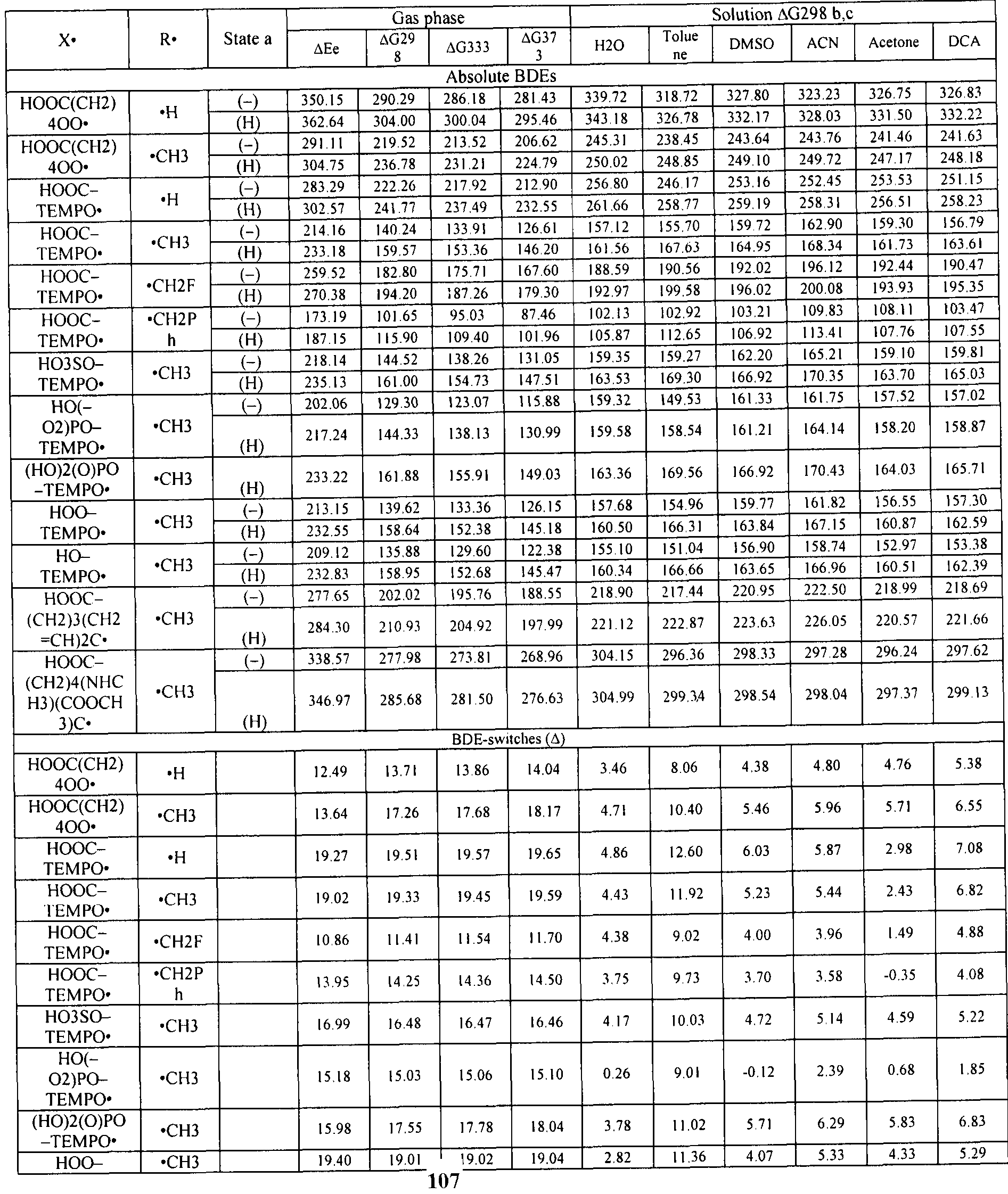
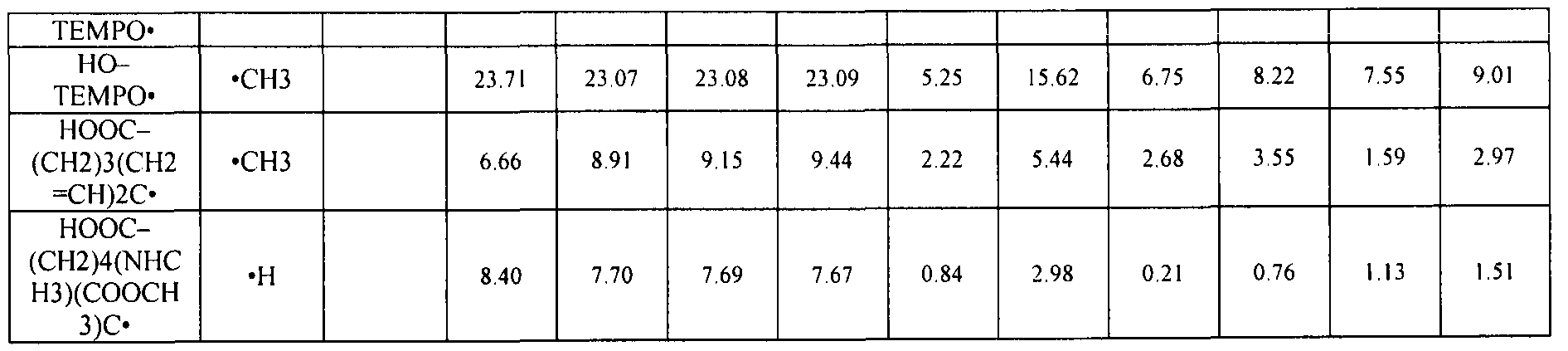
  • b Switching of aminoxyl stability by pH-induced polar effects (the underlined numbers are the distances between the two coloured atoms in the M06-2X/6-31 +G(d) optimized geometries, A), c, Structures, M06-2X/6-31+G(d) spin density plots (for open- shell species only) and dipole moments ( ⁇ , in Debye), as well as MCSCF(9,5)/6-31 +G(d) molecular orbital configurations of the reference radicals in protonated and deprotonated forms, d-e, Energy decomposition of the calculated BDE-switches (G4(MP2)-6X for acyclic series and ONIOM approximation for the cyclic series, gas phase, kJ mol "1 ) in the pairs of homologue series of trial and reference radicals, plotted against the number of methylene units
  • Fig. 4 shows assessment of the ⁇ -assistance effect, a, M06-2X/6-31+G(d) optimized geometries and BDE-switches (in electronic energy terms, kJ mol "1 ) of non-substituted TEMPO (— ), carboxy-TEMPO homologues in extended chain ⁇ ) and lowest energy (® ) conformations, and the corresponding non-bonded TEMPO... CH 3 COOH complex ( ⁇ ).
  • Fig. 5 shows Experimental proof of the BDE-switching by pH-induced orbital conversion
  • Optimized COO-H bond lengths in the dimer are equal to 1.33 A for A and 1.33 A for B. c and d, Calculated BDE- switches (gas-phase, 25 °C) plotted against experimentally measured GPA-switches for carboxy-TEMPO vs. its alkoxyamines (O ), carboxy-PROXYL vs. its alkoxyamines ( ⁇ ), carboxy-PROXYL vs. carboxy-TEMPO ( ⁇ ) and different combinations of alkoxyamines (O , only one example is shown), for details see Examples).
  • Fig. 6 shows SOMO-HOMO conversion in various substrates.
  • Calculated BDE-switches italics, in electronic energy terms, kJ mol "1 ) in TEMPO-CH 3 substituted with different anionic groups (a, using G3(MP2,CC)(+) method) and in model DNA 22 and RNA 23 sugar and base (guanine) moieties (b, using ONIOM approximation to the G3(MP2)RAD energies at the MP2/6-31 1+G(3df,2p) level of theory); see Table 14 and Table 15 for details.
  • Fig. 7 shows a SEC traces of PMA-Br ( ⁇ ), PMA-Br with HOOC-TEMPO reaction in Toluene with CuBr /PMDETA for 30 min ( ⁇ ), and 20 h ( ⁇ ) at R.T.
  • Fig. 8 shows a SEC traces of PMA-Br ( ⁇ ), PMA-Br with HOOC-TEMPO reaction in DMSO with CuBr /Me 6 TREN for 30 min ( ⁇ ) and 20 h ( ⁇ ) at R.T.
  • Fig. 9 shows a Gaussian simulation of PMA-Br with HOOC-TEMPO reaction in DMSO with CuBr /Me 6 TREN (-) and LMD simulation (--). It showed 27.3 % of coupling product.
  • Fig. 10 shows a SEC traces of purified PMA-ON-COOH kept in THF overnight ( ⁇ ), PMA-ON-COOH in DMSO with Me 6 TREN for 6 h (#)and 20 h ( ⁇ ) at R.T.
  • Fig. 13 shows (a) a proposed mechanism for the condensation of CoA and pyruvate to acetyl-CoA and formate, an important reaction in the anaerobic glucose metabolism of bacteria. The process shown occurs via a radical mechanism - homolytic cleavage of the C1 -C2 bond in pyruvate.
  • PFL-AE a 28 kDa monomeric enzyme, a member of the radical S-adenosylmethionine family
  • PFL-AE a 28 kDa monomeric enzyme, a member of the radical S-adenosylmethionine family
  • the active site of PFL-AE contains a [4Fe-4S]+ cluster which reduces G734 on PFL via an S- adenosylmethionine (AdoMet) cofactor.
  • AdoMet S- adenosylmethionine
  • the carboxylate group of pyruvate (e.g. corresponding to the anion of NEG) can stabilise the radical on G734 (e.g. corresponding to the radical of RAD) to give a structure of Formula (I), where the radical and anion are sufficiently close (i.e. proximate) to have a through-space interaction to give the SOMO ⁇ HOMO configuration.
  • the carboxylic group e.g.
  • AS is change of entropy
  • ⁇ ⁇ is change of electronic energy
  • ⁇ ( ⁇ ⁇ + ZPVE) is change of electronic energy corrected for zero-point vibration (enthalpy at 0 K)
  • is change of enthalpy (previous term including thermal correction, or enthalpy at a given temperature)
  • AG is a change of Gibbs free energy (energy including thermal and entropic contributions at a given temperature)
  • denotes activation (kinetic) parameters
  • rxn denotes reaction
  • the activation barrier AG ⁇ of such reaction can be affected by the switching. In this example, it is larger in the case of non-switched species compared to the switched species forming in the reaction.
  • Fig. 15 plots the pH switch in solution (various solvents) versus the pH switch in the gas phase for a big test set of species.
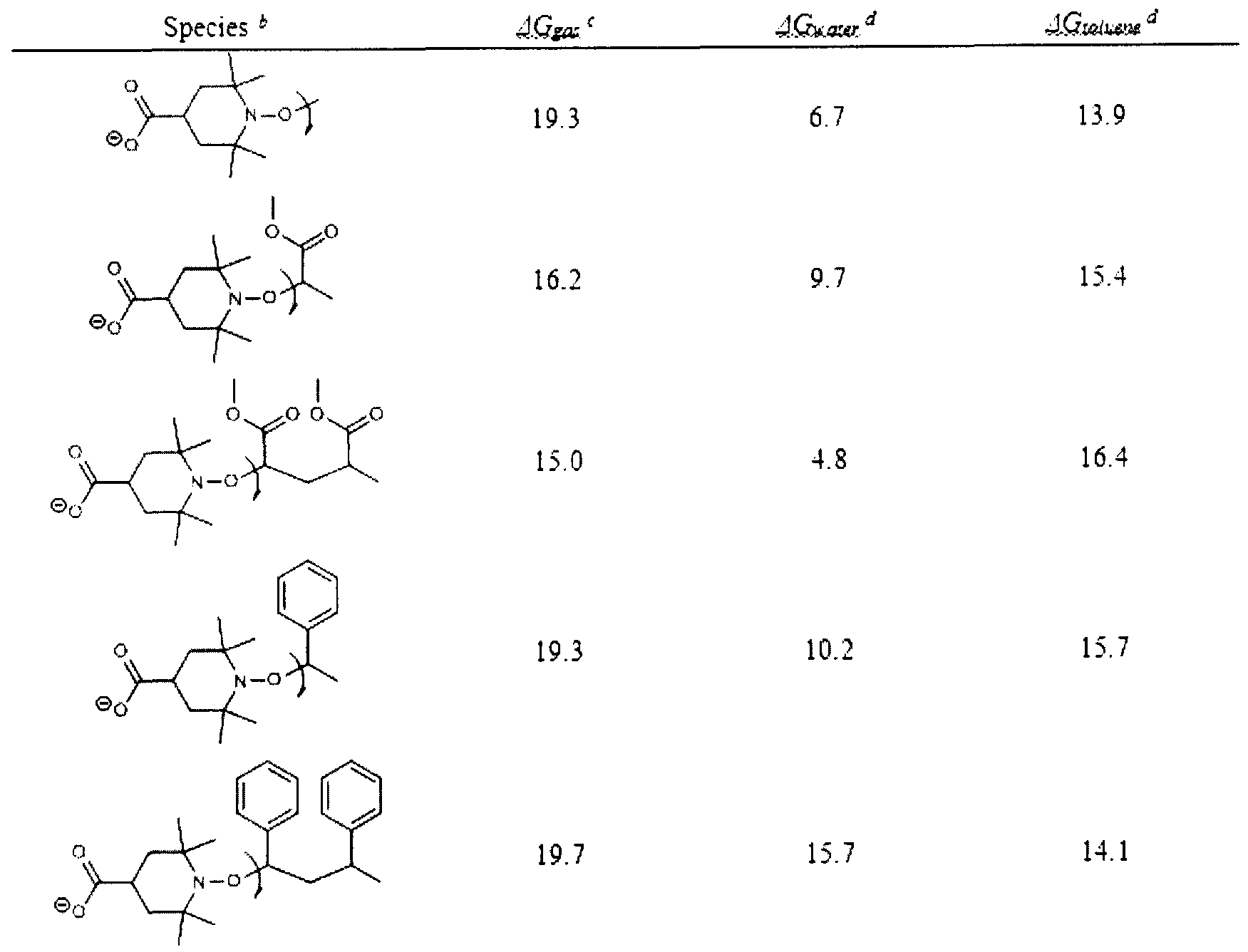
  • the pH switches were obtained using accurate quantum chemistry. Details of the species represented in this figure are provided in Table 21. These quantum chemical calculations reveal that the presence of polar solvents reduces the underlying stabilizing effect substantially, which is consistent with its electrostatic origin. Nonetheless they show clearly that substantial pH switches are retained in low polarity solvents, and that the switches in polar solvents, while smaller, do remain synthetically useful for some combinations of leaving groups where solvent interactions help to favour dissociation in deprotonated versus protonated form.
  • Fig. 16 shows proof of pH switching in low polarity solution (in this case bulk styrene monomer).
  • the plot shows the molecular weight distribution of a polymeric alkoxyamine comprising a polystyryl chain bound to a 4-carboxy-TEMPO nitroxide (1 1.6mg/mL) as it is heated to 100°C in the presence of a free-radical initiator tert-butyl hydroperoxide (BHP) and styrene monomer but no base.
  • BHP free-radical initiator tert-butyl hydroperoxide
  • Fig. 17 shows an exact repeat of the experiment as detailed in Fig. 16 except that a base l ,8-diazabicylo[5.4.0]undec-7-ene (DBU, 33nM) was included to deprotonate the carboxylic acid of the 4-carboxy-TEMPO.
  • DBU base l ,8-diazabicylo[5.4.0]undec-7-ene
  • Fig. 18 shows proof of pH switching in aqueous solution.
  • a standard potentiometric titration was used to measure the pKa of 4-carboxy-TEMPO nitroxide and various non-radical forms of it (i.e. alkoxyamines and hydroxyl amine) to show that formation of the radical leads to increased acidity of the carboxylic acid group.
  • the hydroxylamine has a pH switch of 1.5 pKa units in a 75% ethanol / 25% water solvent.
  • the pKa switch corresponds directly to a switch on radical stability of 1.5 orders of magnitude.
  • a pKa switches of 0.5 unit were determined for 4-carboxy-TEMPO with a benzyl leaving group.
  • the smaller switch for this leaving group is due to the differing solute-solvent interactions which are less favourable for dissociation of the deprotonated alkoxyamine versus protonated.
  • the present invention provides a way in which the electronic configuration of the structure of Formula (I) can be switched between the SOMO ⁇ HOMO and
  • the present invention allows the molecular orbitals in the structure of Formula (I) to be 'switched' from one electronic configuration to another physically different configuration, and this being brought about by the simple addition or removal of protons or other cations.
  • This change in electronic configuration fundamentally changes the nature of the chemistry of the resultant species.
  • Direct access to the 'switching' of molecular orbitals in this way by direct chemical means has hitherto been unknown. This work has been published in Nature Chemistry ( Gryn'ova G., Marshall D., Blanksby, SJ, Coote M.L. Nature Chem.(2013), 5, 474-481) and is incorporated herein by reference.
  • composition of Formula (I) that can be modified comprise:
  • the magnitude of that energy difference can be manipulated by the arrangement of the various groups in Formula (I). For example, this can be changed by changing the RAD, L and NEG groups, in terms of the stability of those groups, their connectivity and their spatial arrangement in three dimensional space. In that way the difference between energy states when the
  • SOMO HOMO as compared to the state where SOMO ⁇ HOMO can be manipulated, and so the resultant chemical properties of the 'normal' and 'converted' species can be changed.
  • the resultant chemical properties of the 'normal' and 'converted' species can be tuned to be sensitive to the reaction conditions or environment in which they are to be used.
  • weakly acidic NEG groups (or strongly basic groups) will tend to bond protons (and by extension other cations) more strongly, whereas more acidic NEG groups (or weakly basic groups) will tend to bond protons (and other cations) more weakly.
  • the nature of the anion of NEG can allow access to the control of the 'switch' that causes the interconversion of the 'normal' and 'converted' arrangements. Therefore, the anion can be selected to be responsive to certain reaction conditions, or could be tailored to bind more selectively to one cation in preference to another. This could be for example used to allow the switching from the 'normal' electronic configuration to the 'converted' electronic configuration to occur in a certain pH range.
  • reaction conditions like the polarity of the solvent will affect how strongly the anion of NEG will bond to protons and/or other cations (such as metal ions and quaternary amines).
  • reaction conditions in combination with the nature of the anion of NEG, could be used to moderate the reactivity of the structure of Formula (I). In particular these could be used to control the switching between SOMO ⁇ HOMO and SOMOHOMO states.
  • the radical of RAD can be more or less stable, and this stability can be used to affect the magnitude of the energy difference between the SOMO orbitals in the 'normal' and 'converted' configurations.
  • the invention also provides access to the manipulation of the acidity of the anion of NEG through the control of nature of the radical.
  • radical can be used to influence the acidity of the anion of NEG (for example where the anion is a carboxylic acid).
  • the stability of the resultant radical of RAD is found to affect the acidity of the (acidic) anion of NEG.
  • the radical of RAD is stabilised, there is a greater propensity for the protons associated with the anion of NEG to then dissociate.
  • the radical of RAD is less stabilised by the structure of Formula (I), the protons associated with the anion of NEG are less likely to dissociate.
  • the anion of NEG i.e. the conjugate base of the acid
  • the p a of the protonated anion of NEG i.e. the conjugate acid of NEG will correspondingly be higher in the same fashion.
  • the NEG group in Formula (I) is more acidic in nature as compared to the corresponding structure where the radical is not present, and the more stable the resulting radical the more acidic the resultant anion of NEG will be.
  • the binding properties of the anion of NEG can be manipulated by the nature (and/or inclusion) of the radical of RAD.
  • the inclusion of a radical into an acid bearing structure could be used for the purpose of increasing that acid's acidity, where the other requirements of the structure of Formula (I) are satisfied.
  • linker L allows further manipulation of the structure of Formula (I).
  • L could be a group selected to provide certain physical properties to the structure of Formula (I), for example to give the resulting structure a certain solubility profile (e.g. increased solubility in non-polar solvents by the inclusion of fatty acid chains).
  • L can be used to define the spatial arrangement of RAD and NEG in Formula (I), both in terms of connectivity and in terms of a three dimensional spatial arrangement.
  • the radical of RAD and the anion (i.e. the negative charge) of NEG engage in a long range interaction which provides the effect which stabilises the radical of RAD, and so gives the SOMO ⁇ HOMO electronic configuration.
  • L could be space i.e. having a through-space interaction between RAD and NEG causing orbital conversion and related effect on RAD stability does not require a chemical link between RAD and NEG.
  • L can be used to stabilise (or destabilise) the radical of RAD and/or to destabilise (or stabilise) the anion of NEG.
  • the magnitude of the difference between the energy states of SOMOHOMO and SOMO ⁇ HOMO can be further manipulated.
  • That stabilisation (or destabilisation) of the radical of RAD and/or the destabilisation (or stabilisation) of the anion of NEG could be brought about by steric or electronic effects.
  • Various groups could be introduced into L which could be situated proximate (i.e. close enough to have an effect) to RAD and NEG. These groups can be selected to have a steric and/or an electronic impact on the RAD and/or NEG groups.
  • one or more steric groups could be used to sterically protect a group, or these could be used to 'twist' a group into an unfavourable position destabilising the RAD and/or NEG groups, or bring two mutually incompatible groups into closer proximity.
  • Electronic effects that could be used include delocalisation, ⁇ -conjugation, ⁇ -assistance, hyper-conjugation, aromaticity and long range polar effects. Application of these means would be appreciated by the skilled person.
  • this radical is less likely to participate in bond forming reactions, and by extension, is more likely to (homolytically) cleave from bonds which it is participating in.
  • the stabilised SOMO ⁇ HOMO radical structure can be made less stable by the addition of protons or other cations to the anion of NEG. These cations switch the orbitals from SOMO ⁇ HOMO to the more 'normal' (but less stable)
  • SOMO HOMO arrangement. In that way the radical becomes destabilised and so more reactive, and thereby is activated to participate in bond forming reactions, and so could be 'activated' to react with a structure to be protected.
  • protons or other cations
  • the addition of protons (or other cations) to the structure of Formula (I) causes the radical to be 'activated' and so to become more reactive and so that it can form a bond to a radical to be protected.
  • Reversing the above process, i.e. removing protons or other cations stabilises the structure of Formula (I), and if suitably stabilised the stabilised radical can dissociate from the radical structure (i.e. by homolytic cleavage); or at least the process and/or conditions of removing the structure of Formula (I) from the structure to be protected can be made more moderate (e.g. using lower temperatures).
  • a portion of a structure can be protected with the structure of Formula (I) e.g. R-RAD-L-NEG, while various other reactions are conducted on the unprotected portions of that structure.
  • the structure of Formula (I) can be selectively released (e.g. by increasing the pH) from that structure, allowing that portion which had been protected to be unprotected e.g. to give R » and RAD-L-NEG (where NEG bonds to a proton or other cation).
  • the radical to be protected once deprotected, is free to participate in further reactions.
  • the skilled person will be aware of those reactions, typically being radical type reactions.
  • a radical of Formula (I), in which the SOMO is lower in energy than one or more DOMOs is said to be SOMO-HOMO converted.
  • bond energies that a radical of Formula (I) forms with other radicals e.g. Rv
  • a compound of Formula (I), where NEG is protonated or bonded to a different cation can be used to "protect" R « and prevent it from undergoing other types of radical reactions through covalently bonding to RAD-L-NEG (where NEG is bonded to a proton or other cation) to give R-RAD-L-NEG (where NEG is bonded to a proton or other cation).
  • R « and RAD-L-NEG one simply removes the added protons (or cations) from NEG group.
  • each protecting group of the invention could be used on the same structure to be protected, whereby each protecting group is deprotected under different reaction conditions, for example each responsive in a certain pH range or other cation concentration range, or to progressively harsher deprotecting conditions such as increasing temperature. It is also possible that more than one protecting group can be removed (from a structure to be protected) under the same conditions.
  • the two resulting radicals on the same structure can be arranged such that they can recombine.
  • the two resultant radicals could be arranged such that the cyclization of the structure bearing these radicals occurs when they are deprotected (e.g. an intramolecular Wurtz reaction).
  • the present invention provides new SOMO-HOMO converted compounds with an alternative source of high-energy HOMO(s) that enables the switching between the 'regular' and 'converted' orbital configurations.
  • NEG in the structure of Formula (I) provides high energy HOMO(s) but restores up (i.e. regular) configuration upon protonation to the conjugate acid form.
  • the manifestation of this unique electronic structure is not limited to the redox behaviour and that an unprecedented long-range interaction between an unpaired electron and a negative charge results in a dramatic increase in the stability of the radical and acidity of the conjugate acid.
  • the acid-base motif provides an exceptional instrument for switching the orbital configuration, and thus the radical stability, by pH. It is contemplated that such switching has potential applications in biological and industrial fields.
  • Radical stability Having designed free radicals with pH-controlled SOMO-HOMO energy-level conversion, there was explored their stability in the switched and non- switched forms.
  • a representative practical measure of radical stability is its bond dissociation free energy (BDFE) with simple carbon-centred radicals such as methyl, •CH 3 . Therefore calculated were the methyl BDFEs of the carboxy- aminoxyl and peroxyl radicals in their neutral and deprotonated forms in the gas phase at 25 °C and found that deprotonation of the carboxylic group (and thus switching from regular to converted orbital configuration) weakens their bonds with »CH 3 .
  • BDFE bond dissociation free energy
  • Radical stability is influenced by polar effects, which, at long range, act primarily through-space rather than through-bond.
  • the stability of the aminoxyl radical is affected by resonance between its two forms I and II (see Fig. 3a).
  • pH-switchable nitroxide mediated polymerization (NMP) in agent 8 employs polar effects by introducing several basic groups (see Fig. 3b), which upon protonation destabilize II and thus the radical overall. This results in slower decomposition of the corresponding alkoxyamines, indicating an increased strength of their NO-R bonds.
  • the magnitude of this pH switch ( ⁇ 15 fold) is significantly smaller than the pH effects observed in the SOMO-HOMO converted species (> 2000 fold), despite the fact that the charge in 4 is more distant from the radical centre than in 8 (see Fig. 3b).
  • carboxylate anion is expected to stabilize II in the trial aminoxyl, and possibly act in a similar way in the peroxyl radical. Therefore, to determine whether this standard polar effect could account for the observed BDFE-switching, there was employed the procedure used to study the effect of amino group protonation on the COOH pK a in the homologue series + R 3 (CH 2 ) n COOH via comparison to a reference system CR 3 (CH 2 ) n COOH that is structurally similar but lacks a polar contribution.
  • ⁇ -assistance represents another possible type of through-bond interaction between the remote negative charge and radical centre.
  • the calculated absolute methyl BDEs of the deprotonated alkoxyamines follow the Mr dependence (see Fig. 4b).
  • We also constructed a complex of TEMPO and acetic acid 16, structurally resembling the n 4 extended chain conformer 15, but clearly free of any through-bond interaction. Its calculated absolute BDE also sits on the Mr line (see Fig.
  • SOMO-HOMO conversion was also investigated in the deprotonated nucleic acid radicals, say for example formed as a result of oxidative damage via hydrogen atom abstraction by, for example, hydroxyl radical.
  • thermochemical parameters e.g., BDE- and GPA-switches
  • their relative differences e.g., BDE- and GPA-switches
  • Alkoxyamines were synthesized from aminoxyl radical precursors by a standard literature procedure. Equimolar mixtures of aminoxyl radical and alkoxyamine were prepared pairwise in methanol to a final concentration of ca. 10 ⁇ . Proton-bound dimers were generated by negative ion electrospray ionization upon infusion of these methanolic solutions at a rate of 5 iL min "1 into the ion source of a Waters QuattroMicro (Manchester, UK) triple quadrupole mass spectrometer. The mass spectrometer was operated in the negative ion mode, and controlled by Micromass MassLynx software (Version 4.1 ).
  • the capillary voltage was set to -3.0 kV, cone voltage -20 V, source temperature 80 °C and desolvation temperature 1 10 °C, to optimize the production of desired proton-bound cluster ions.
  • Nitrogen was used as the drying gas, at a flow rate of 300 L h "1 while collision-induced dissociation (CID) experiments used laboratory frame energies of 5-25 V as required and argon as the collision gas (3.0 ⁇
  • MCSCF orbital plots were built using MacMolPlt v.7.4.2; optimized MCSCF and MRPT2 configurations for the two trial species are shown in Example 2.
  • CASSCF(7,8)/STO-3G as implemented in Gaussian 09.
  • the active space included four occupied orbitals (SOMO and three orbitals of the carboxylate, described above) and four corresponding virtual orbitals; orbitals were built using GaussView 5.0. Obtained results again confirmed converted configuration to be the dominant one for the trial compounds (see Example 3).
  • Example 1 Single-reference molecular orbitals of the trial distonic radical anions.
  • Example 2 j MCSCF and MRFT2 molecular orbttals of u- rrial distontc radfeai mio .
  • Plots of MCSO (9,5V&31 +0( ⁇ optimized ' motemiar or ltals an#
  • Example 6 Properties of the one-electron oxidation open- and closed-shell products.
  • standard G3(MP2) methods approximate CCSD(T) calculations with a large triple- ⁇ basis from calculations with a double- ⁇ basis set via basis set corrections carried out at the R(0)MP2 (in G3(MP2)-RAD) and UMP2 (in G3(MP2,CC) levels.
  • URCCSD(T) energies calculated using the Molpro code
  • HHC high level correction
  • PROXYL- 120.501 2 1 .61 1 16.684 13.885 49.812
  • the inventions has shown that orbital conversion results in an increased radical stability, e.g. if such converted radical is a product of some chemical reaction, the Gibbs free energy (AG ⁇ ) of this reaction is lower than the Gibbs free energy of an identical reaction but involving formation of the radical species in their regular orbital configuration.
  • AG ⁇ Gibbs free energy
  • Fig. 14 shows that the AG ⁇ and the the AGTM are both lower for the switched species than for the non-switched species. Where AG ⁇ is smaller the reaction will be quicker. Where AG rxn is lower (i.e. more exothermic) the reaction will favour products over reagents where these two species are in equilibrium.
  • Table 3 shows that ionic bonding of a cation (e.g. lithium, sodium and potassium) stabilizes the negative charge of NEG (in a structure corresponding to Formula (I)), to the extent that the SOMO of RAD is higher in energy than the DOMOs of NEG when the anion of NEG is bonded to that cation. That is, this shows that the orbital conversion in a structure corresponding to Formula (I) can be switched off by the addition of cations to the anion of NEG.
  • Table 4 Calculated BDE-switches in the gas phase and in solvents of different polarity.
  • the calculations in Table 4 indicate that in polar solvents such as water orbital switching is quenched, whereas in less polar solvents like toluene it is preserved.
  • the polarity of the solvent can therefore be used to control orbital switching of the invention.
  • the polarity of a solvent can be changed by changing the constituents of the solvent, e.g. adding or removing different solvents or adding or removing polar components e.g. ammonium salts or ionic liquids.
  • B3LYP results are off by 10s of kJ mol " 1 compared to the composite methods.
  • BDEs of all the protonated species are generally independent on the separation (n) between the radical and carboxylic moieties; the same is largely true for the deprotonated reference alkoxyl radicals, whereas BDEs of the SOMO-HOMO converted species in the deprotonated state increase slowly with separation.
  • Example 8 thus confirming the primarily through-space nature of the orbital conversion switching effect and only a very minor contribution from the through-bond ⁇ -assistance.
  • Optimized M06-2X/6-31 +G(d) geometries of the lowest energy c, and extended chain, d (top), conformers of the aminoxyl homologue with n 4, as well as the supermolecule of TEMPO and acetic acid, d (bottom); shown are the radical species and the corresponding methyl ethers in the deprotonated and protonated forms of the carboxylic group.
  • Example 8 BDEs of the aminoxyl homologues. Calculated M06-2X/6-31 +G(d) bond dissociation electronic energies of the aminoxyl homologues series: extended chain conformers (o), lowest gas-phase energy conformer of n-4 ( ⁇ ) and supermolecule consisting of TEMPO and acetic acid (0).
  • Example 10 Test set. Aminoxyls and alkoxyamines, studies in the mass-spec experiments. HO
  • the kinetic method relationship relies on: ( ) the absence of reverse activation barriers; ( ) the absence of any isomer forms of the cluster; (Hi) a negligible entropy difference for the competitive dissociation channels (i. e. , A(A ac idG) simplifies to A(A ac jdH)).
  • Assumptions ( ) and ( ) are generally considered as robust for dissociation of simple proton bound dimers and for the systems studied here only simple dimer dissociation was observed suggesting (Hi) also holds for the experiments.
  • Ion abundance ratios (Ii :I 2 ), obtained from the collision-induced dissociation of proton-bound dimers at a collision energy of 10 V (in the laboratory frame) in a triple quadrupole mass spectrometer using argon as the target gas. Reported ratios are the average of at least 200 cumulative scans and include replicate infusions of samples solutions. A ratio greater than unity implies A ac idHi > A ac jdH 2 . Ratios of primary importance are those comparing aminoxyl radicals (A & E) to alkoxyamines. Selected additional ratios are reported between alkoxyamines pairs as a cross-reference for internal consistency.
  • Equation 1 and kj are dissociation rate constants; ⁇ ( ⁇ 5) is the difference in entropy between the competing dissociation pathways; R is the universal gas constant, and T e ff ⁇ s the effective temperature parameter.
  • the latter is an empirical scaling factor that accounts for the non-Boltzmann energy distribution within the activated dimer population and is not a true temperature.
  • Example 1 1 Determination of the effective temperature. Effective temperature dependence on collision energy in the centre of mass frame for the described instrument setup, using multiple benzoic acids as reference compounds.
  • ⁇ R A + R B ) 2 and RA and RB are the molecular radii of cyclohexyl radical and dioxygen taken as 1 .74 A and 2.90 A, respectively, kg is the Boltzmann constant, T is absolute temperature and ⁇ is the reduced mass f mA*mB ⁇ Table 13 Methyl BDEs of TEMPO with various anionic groups. Calculated bond dissociation electronic and free energies (in the gas phase at 25°C, kJ mol-1) for the species in Fig. 6.
  • Protonaiion of the two phosphate groups is denoted as ( ⁇ - ⁇ ) tor deproionated and (1:1) ibr protonated: state:; i; two-layer ONiOM appj3 ⁇ 4 imation to the CB(MP2)-RA D energies using ti3 ⁇ 4MP2/6 ⁇ 1 1 - ⁇ -0:(3di;2p) method.
  • the radical has been partially activated.
  • the activated radical is in equilibrium with the (deactivated form, i.e. SOMO ⁇ HOMO) allowing for the PMA radicals to combine.
  • the deactivated (i.e. deprotonated) radical coupled to PMA dissociates into the stabilised radical and the PMA radical.
  • the PMA radical so deprotected is free to react, in this case with a further PMA radical to give PMA-PMA.
  • the PMA radicals react with each other.
  • Open-shell triplet - -669.71 1 (adiabatic) 0.37505 671 .334 669.528 670.265 670.:
  • Tl diagnostics from CCSD(T)/6-31+G(d) calculations; b Dispersion correction to B3LYP, calculated using DFT-D3 procedure with BJ damping; c Calculated using 6- 31+G(d) basis set; d Calculated using GTMP2Large basis set; e Alpha and beta exchange contributions to the HF/CBS energies.
  • Table 18 Cyclic homologues series. All values, except for Tl diagnostics, are in Hartrees.
  • Homologues are named as follows: first letter denotes alkoxyl (O) and aminoxyl (N) species, second state denotes anionic (A) and protonated (H) carboxylic group, number corresponds to n in Example 7a, R denotes radical species and M - the corresponding methyl ethers.

Landscapes

  • Chemical & Material Sciences (AREA)
  • Organic Chemistry (AREA)
  • Health & Medical Sciences (AREA)
  • Life Sciences & Earth Sciences (AREA)
  • General Health & Medical Sciences (AREA)
  • Biochemistry (AREA)
  • Molecular Biology (AREA)
  • Engineering & Computer Science (AREA)
  • Biotechnology (AREA)
  • Genetics & Genomics (AREA)
  • General Chemical & Material Sciences (AREA)
  • Public Health (AREA)
  • Veterinary Medicine (AREA)
  • Medicinal Chemistry (AREA)
  • Nuclear Medicine, Radiotherapy & Molecular Imaging (AREA)
  • Pharmacology & Pharmacy (AREA)
  • Animal Behavior & Ethology (AREA)
  • Chemical Kinetics & Catalysis (AREA)
  • Toxicology (AREA)
  • Bioinformatics & Cheminformatics (AREA)
  • Pharmaceuticals Containing Other Organic And Inorganic Compounds (AREA)
  • Pyridine Compounds (AREA)
  • Organic Low-Molecular-Weight Compounds And Preparation Thereof (AREA)
  • Nitrogen Condensed Heterocyclic Rings (AREA)

Abstract

Described herein are distonic radical anion species of formula (I): RAD-L-NEG; wherein RAD is a group comprising a radical; NEG is a group comprising an anion, which is capable of bonding to a proton or other cation; L is a linker that links NEG to RAD; and the radical of RAD is not π-conjugated to the anion of NEG.

Description

Radical Orbital Switching
Technical Field
The present invention relates to orbital switching in radicals; in particular to the application of controlled and reversible switching of the Singly Occupied Molecular Orbital (SOMO) from a high energy level (e.g. the Highest Occupied Molecular Orbital (HOMO)) to a lower energy level by direct physical or chemical means.
Background of the invention
It is well known that in open-shell species, e.g. radicals, the molecular orbital (MO) accommodating the unpaired electron (the singly-occupied molecular orbital, or SOMO) is usually energetically the highest-occupied molecular orbital (HOMO).
That is, the electronic configuration of an atom or a molecule usually conforms to the aufbau principle, which literally means a 'building-up' principle: 'a maximum of two electrons are put into orbitals in the order of increasing orbital energy'.
However, there are a limited number of open-shell molecules which do not conform to this 'normal' aufbau principle of molecular orbital occupation.
These 'converted' species include a radical nitronyl nitroxide (ΝΝ·) bonded to a tetrathiafulvalene (TTF) (Sugawara; Chem. Soc. Rev. 40, 3105; 2011).
However, in these compounds the control of the energetic ordering of the molecular orbitals by any simple and direct physical or chemical means is unknown. However, it is possible in those cases to remove one or more electrons from doubly-occupied molecular orbitals with energies higher than that of a SOMO by electrochemical processes, but this alters the number of electrons in the system, rather than reordering the energy levels of the existing electrons in the system, by direct physical or chemical means. Even then, there is no way to change these 'converted' (i.e. SOMO≠HOMO) species into the more 'normal' aufbau species, and as such the more regular molecular orbital configurations (e.g. SOMO=HOMO) by any simple and direct physical or chemical means.
Summary of the Invention
According to a first aspect of the invention, there is provided a structure of Formula (I): RAD-L-NEG
(I) wherein:
RAD is a group comprising a radical;
NEG is a group comprising an anion, which is capable of bonding to a proton or other cation;
L links NEG and RAD; the radical of RAD is not π-conjugated to the anion of NEG; and wherein the lowest Singly-Occupied Molecular Orbital (SOMO) of RAD is lower in energy than a Doubly-Occupied Molecular Orbital (DOMO) of NEG; and wherein the SOMO of RAD is higher in energy than the DOMOs of NEG when the anion of NEG is bonded to a proton or other cation.
A radical of Formula (I) which has the 'normal' SOMO=HOMO arrangement can be switched to the 'converted' arrangement configuration (i.e. SOMO≠HOMO), by the simple removal of protons (or cations) from the anion of the NEG group.
The addition of protons (or other cations) to the structure of Formula (I) causes the radical to be 'activated' and so to become more reactive (activating the radical for reaction, for example for use in radical-based chemistry). Reversing the above process, i.e. removing protons or other cations stabilises the structure of Formula (I), and if suitably stabilised will have reduced reactivity, and any bond formed between the radical of Formula (I) and another moiety can be more easily broken (e.g. by homolytic cleavage), releasing both the structure of Formula (I) and any moiety it had previously been bonded to; or at least the process and/or conditions of removing the structure of Formula (I) from a bonded moiety can be made more moderate (e.g. by using lower temperatures).
In that way, the structure of Formula (I) can be used in chemical synthesis and/or in physical or chemical analysis or in sensors, by reversibly switching the levels of the molecular orbitals of the Structure of Formula (I), to take advantage of the switchable reactivity of the radical of RAD in the system of the invention. According to a second aspect of the invention, there is provided a structure of Formula (I):
RAD-L-NEG
(I) wherein:
RAD is a group comprising a radical;
NEG is a group comprising an anion, which is capable of bonding to a proton or other cation; L links NEG and RAD; the radical of RAD is not π-conjugated to the anion of NEG; and wherein, the lowest Singly-Occupied Molecular Orbital (SOMO) of RAD is lower in energy than in the corresponding structure of Formula (I) when the anion of NEG is bonded to a proton or other cation. As with the first aspect of the invention, the ability to directly and reversibly switch/tune the energy levels of the orbitals of the radical in the structure of Formula (I) allows access to the control over the chemistry of structure of Formula (I).
According to a third aspect of the invention there is provided a structure of Formula (I):
RAD-L-NEG
(I) wherein:
RAD is a group comprising a radical;
NEG comprises a negative point charge, which is capable of being neutralised;
L links NEG and RAD; the radical of RAD is not π-conjugated to the negative point charge of NEG; and wherein, the lowest Singly-Occupied Molecular Orbital (SOMO) of RAD is lower in energy than in the corresponding structure of Formula (I) when the negative point charge of NEG is neutralized.
As with the previous aspects of the invention, the ability to directly and reversibly switch/tune the energy levels of the orbitals of the radical in the structure of Formula (I) allows user control of the chemistry of structure of Formula (I).
According to the third aspect of the invention, NEG is not a chemical group but rather is a functional physical equivalent, which provides the same function as the anion of NEG. That is, the functional physical equivalent comprises a negative point charge, wherein that negative point charge is capable of being neutralized, and wherein the energy level of the unpaired electron of RAD is lowered when the functional physical equivalent of NEG together with RAD-L forms the (corresponding) structure of Formula (I), and wherein the energy level of the unpaired electron of RAD is the highest energy level when the functional physical equivalent is electrically neutralized.
According to an embodiment of the third aspect of the invention, there is provided a structure of Formula (I), wherein NEG is a surface or structure capable of bearing and/or carrying a negative point charge, and where the negative point charge is capable of being neutralised.
According to an embodiment of the third aspect of the invention, there is provided a structure of Formula (I), wherein the negative point charge is selected from the group comprising an electron, an electric charge, a negative potential, or a negative coulombic charge; and where the negative point charge is capable of being neutralised by the substantial removal, dissipation or inversion of that charge.
According to an embodiment of the third aspect of the invention, there is provided a structure of Formula (I), wherein the surface or structure capable of bearing and/or carrying a negative point charge is an electrode.
According to an embodiment of the third aspect of the invention, there is provided a structure of Formula (I), wherein the surface or structure capable of bearing and/or carrying a negative point charge is metallic or non-metallic. According to an embodiment of the third aspect of the invention, there is provided a structure of Formula (I), wherein the surface or structure capable of bearing and/or carrying a negative point charge comprises graphene.
According to an embodiment of the third aspect of the invention, there is provided a structure of Formula (I), wherein the negative point charge is a group comprising an anion, which is capable of being neutralised by bonding to a proton or other cation.
Accordingly to an embodiment of the third aspect of the invention, there is provided a radical protecting group having the structure of Formula (I); wherein the radical of RAD is capable of forming a bond to a radical to be protected to give the protected radical; and wherein the bond to the radical to be protected is weakened when the negative point charge of NEG is not neutralised.
Accordingly to an embodiment of the third aspect of the invention, there is provided a structure of Formula (I); wherein the radical of RAD is capable of forming a bond to a radical to be protected to give the protected radical; and wherein the radical to be protected is de-protectable when the negative point charge of NEG is not neutralised.
Accordingly to an embodiment of the third aspect of the invention, there is provided a use of the radical protecting group as defined previously to protect a radical, wherein the negative point charge is neutralised.
Accordingly to an embodiment of the third aspect of the invention, there is provided a process of deprotecting a radical protected with a radical protecting group as defined previously, by the removal of the cause of neutralisation from a negative point charge that has been neutralised.
Accordingly to an embodiment of the third aspect of the invention, there is provided a process of deprotecting a radical protected with the radical protecting group as defined previously, comprising the removal the negative point charge; allowing the negative point charge to dissipate; or inverting the negative point charge to a positive point charge.
A positive point charge could for example be used to have substantially the opposite effect as a negative point charge, e.g. to destabilise the radical of RAD, and/or to deprotect a radical protected by a structure of Formula (I).
Accordingly to an embodiment of the third aspect of the invention, there is provided a process of protecting a radical by reacting that radical with the radical protecting group as defined previously, wherein the negative point charge is neutralised. Accordingly to an embodiment of the third aspect of the invention, there is provided a process of activating the radical protecting group as defined above, by neutralising the negative point charge.
When the negative point charge of NEG is neutralized the lowest Singly-Occupied Molecular Orbital (SOMO) of RAD is higher in energy than in the corresponding structure of Formula (I) when the negative point charge of NEG is not neutralized.
The present invention will be detailed hereafter primarily in respect of the first, second and fourth aspects of the invention. However, it should be understood that (where chemically and physically reasonable) references to the following aspects and embodiments where NEG comprises an anion, also includes within its meaning a NEG that comprises a negative point charge, where this takes the form of a physical functional equivalent (as detailed hereinabove in the fourth aspect of the invention). Likewise, in those situations, references to the anion of NEG bonding to a proton or other cation encompasses within its meaning neutralisation of the negative point charge (as detailed herein above). Likewise, the removal of a proton or other cation from an anion of NEG encompasses within its meaning the removal of the cause of neutralisation (i.e.
de-neutralisation), thereby giving/regenerating the negative point charge.
According to a fourth aspect of the invention, there is provided a radical protecting group having the structure of Formula (I):
RAD-L-NEG
(I) wherein:
RAD is a group comprising a radical;
NEG is a group comprising an anion, which is capable of bonding to a proton or other cation;
L links NEG and RAD; the radical of RAD is not π-conjugated to the anion of NEG; and wherein the lowest Singly-Occupied Molecular Orbital (SOMO) of RAD is lower in energy than a Doubly-Occupied Molecular Orbital (DOMO) of NEG; and wherein the SOMO of RAD is higher in energy than the DOMOs of NEG when the anion of NEG is bonded to a proton or other cation; and wherein the radical of RAD is capable of forming a bond to a radical to be protected when the anion of NEG is bonded to a proton or other cation; and wherein the radical to be protected is de-protectable when the anion of NEG is not bonded to a proton or other cation.
A radical of Formula (I) which has the 'normal' SOMO=HOMO arrangement and where that radical is bound to a radical to be protected, could be released from that radical to be protected by causing the 'normal' SOMO=HOMO configuration to be switched to the 'converted' arrangement configuration (i.e. SOMO≠HOMO), by the simple removal of protons (or cations) from the anion of the NEG group.
The addition of protons (or other cations) to the structure of Formula (I) causes the radical to be 'activated' and so to become more reactive and so that it can form a bond to the radical to be protected. Reversing the above process, i.e. removing protons or other cations stabilises the structure of Formula (I), and if suitably stabilised, the bond formed between the radical to be protected and the structure of Formula (I) breaks (i.e. by homolytic cleavage), releasing both the radical to be protected and the structure of Formula (I); or at least the process and/or conditions of removing the structure of Formula (I) from the structure to be protected can be made more moderate (e.g. using lower temperatures).
When the anion of NEG is bonded to a proton or other cation the lowest Singly-Occupied Molecular Orbital (SOMO) of RAD is higher in energy than in the corresponding structure when the anion of NEG is not bonded to a proton or other cation.
In that way, the structure of Formula (I) can be used as a (reversible) protecting group in chemical synthesis and/or analysis, as indicated in this aspect of the invention.
For example, a portion of a structure can be protected with the structure of Formula (I) e.g. R-RAD-L-NEG (where the 'R-RAD' bond comprises the radical electron of RAD and the radical election of R), while various other reactions are conducted on the unprotected portions of that structure. When required, the structure of Formula (I) can be selectively released (e.g. by increasing the pH) from that structure, allowing that portion which had been protected to be unprotected e.g. to give R« and RAD-L-NEG (where NEG is not bonded to a proton or other cation).
The radical to be protected, once deprotected, is free to participate in further reactions. 5 The skilled person will be aware of those reactions, typically being radical type reactions.
In view of the tunability and adaptability of the structure of Formula (I), it is possible for example that more than one protecting group of the invention could be used on the same structure to be protected, whereby each protecting group is deprotected under different reaction conditions, for example each responsive in a certain pH range or in the presence i o of different cations, or to progressively harsher deprotecting conditions such as increasing temperature. It is also possible that more than one protecting group can be removed (from a structure to be protected) under the same conditions. When two radical protecting groups are removed, the two resulting radicals on the same structure can be arranged such that they can recombine. The two resultant radicals could be arranged such that the i s cyclization of the structure bearing these radicals occurs when they are deprotected (e.g. an intramolecular Wurtz reaction).
According to an embodiment of the invention, there is provided a use of the radical protecting group as defined previously to protect a radical, wherein the anion of NEG is bonded to a proton or other cation.
20 According to an embodiment of the invention, there is provided a process of deprotecting a radical protected with a radical protecting group as defined previously, by the removal of the proton or other cation bonded to the anion of NEG.
According to an embodiment of the invention, there is provided a process of deprotecting a radical protected with the radical protecting group as defined previously, by increasing 25 the pH of the reaction medium to remove the proton bonded to the anion of NEG.
According to an embodiment of the invention, there is provided a process of deprotecting a radical protected with the radical protecting group as defined previously, by the addition of a metal chelate to the reaction medium to remove metal cation bonded to the anion of NEG.
30 According to an embodiment of the invention, there is provided a process of deprotecting a radical protected with the radical protecting group as defined previously, by the addition of anions to the reaction medium, the added anions forming a precipitate with cations present in the reaction medium, thereby removing those cations from bonding with the anions of NEG.
According to an embodiment of the invention, there is provided a process of protecting a 5 radical by reacting that radical with the radical protecting group as defined previously, wherein the anion of NEG is bonded to a proton or other cation.
According to an embodiment of the invention, there is provided a process of activating the radical protecting group as defined previously, by the addition of protons or other cations to the reaction medium, wherein the anion of NEG bonds to added protons or i o other cations.
According to an embodiment of the invention, there is provided a process of activating the radical protecting group as defined previously, by decreasing the pH of the reaction medium, to protonate the anion of NEG.
According to an embodiment of the invention, there is provided a process of deprotecting i s a radical protected with the radical protecting group as defined previously, by increasing the polarity of the reaction medium, such that the protons or other cations bonded to the anion of NEG dissociate from that anion.
According to an embodiment of the invention, there is provided a process of activating the radical protecting group as defined previously, by decreasing the polarity of the
0 reaction medium, such that protons or other cations in the reaction medium are bonded to the anion of NEG.
The strong stabilizing effects of charges on radical stability, as demonstrated using accurate quantum chemistry calculations, has been validated experimentally in the gas phase using mass spectrometry, as detailed herein. The pH switch can reveal itself as a5 reduction in bond dissociation energy (and hence increased tendency of R-X COO" to dissociate into R» + ·Χ COO" versus dissociation corresponding protonated compound
R-X COOH into R» + ·Χ COOH). Or, completely equivalently, it can reveal itself as an increased acidity of the remote carboxylic acid group in the radical form ·Χ
COOH versus the parent non-radical R-X-— COOH (i.e., R-X COOH -> R-X-—0 COO" + H+ is less favoured than ·Χ-— COOH -> ·Χ COO" + H+). Both
manifestations of this pH switch have been exploited in the experimental verification in solution, in addition to using first principles quantum chemical calculations to calculate directly the effects of solvent on the switch. The results from each of these approaches are detailed with reference to Fig. 15, Fig. 16, Fig. 17, Fig. 18 and with reference to Table 21
According to an embodiment of the invention, there is provided a process wherein one or more of the processes as defined previously are used.
According to an embodiment of the invention, there is provided a process as defined previously wherein the deprotected radical species reacts with itself, or with one or more reagents in the reaction medium.
According to an embodiment of the invention, there is provided a process as defined previously, wherein the radical reaction is selected from the group comprising: radical coupling; Wurtz reaction; nitroxide mediated polymerization; nitroxide radical coupling; double bond addition; cyclization reactions; atom abstraction; and oxidation.
According to an embodiment of the invention, there is provided a process as defined previously wherein the deprotected radical participates in a polymerization reaction.
According to an embodiment of the invention, there is provided a process as defined previously, wherein the chain extending polymer radical is capped with the radical protecting group as defined previously.
According to an embodiment of the invention, there is provided a process as defined previously, wherein the capped radical is deprotected, allowing further polymerization of that deprotected radical.
According to an embodiment of the invention, there is provided a process as defined previously wherein the polymer substrate prior to capping is different from the polymer substrate after deprotection.
According to an embodiment of the invention, there is provided a process wherein one or more of the processes as defined previously are used.
According to an embodiment of the invention, there is provided a process as defined previously wherein the polymerization reaction is a block co-polymerization.
According to an embodiment of the invention, there is provided a process as defined previously wherein the polymerization is conducted in the temperature range of up to 120 °C. Preferably, in the temperature range 25 to 80 °C According to an embodiment of the invention, there is provided a process as defined previously, wherein the reaction medium is buffered.
According to an embodiment of the invention, there is provided a process as defined previously, wherein the cation is a metal ion or metal containing ionic species or is an ammonium or phosphonium ion.
According to an embodiment of the invention, there is provided a process as defined previously, wherein the protected radical, the radical to be protected, or the radical protecting group as defined previously are detectable by a sensor.
According to an embodiment of the invention, there is provided a process as defined previously, wherein the sensor comprises a profluorescent probe.
According to the above embodiment, there is provided a process wherein the
profluorescent probe comprises a nitroxide and a fluorophore (i.e. a fluorescent group), wherein the RAD group of the structure of Formula (I) comprises the nitroxide, and wherein the nitroxide radical quenches the fluorescence of the fluorophore. The skilled person is aware of suitable fluorophore groups. When the nitroxide is engaged in a bond and thus the profluorescent probe is in a closed-shell state, the fluorescence is not quenched. The fluorophore of the profluorescent probe can be part of the RAD or NEG group and/or part of L of the structure of Formula (I).
According to an embodiment of the invention, there is provided a process as defined previously, wherein the sensor is useful in determining pH; medical imaging; degree of oxidation or reduction; detecting and quantifying free radical species that may be present.
According to an embodiment of the invention, there is provided a process as defined previously, wherein the sensor is useful in determining pH. For example, when the sensor is a nitroxide profluorescent probe and when the anion of NEG is protonated (or bonded to another cation) the radical of RAD will be destabilised and will react with a suitable in situ species, such that the radical of RAD bonds to that species. In doing so the fluorescence of the corresponding fluorophore group is no longer quenched and fluorescence is therefore detectable. Calibration of the fluorescent response to change in pH (or other cation concentration) gives a sensor to measure pH (or other cation concentration). The opposite process is also possible wherein the removal of protons (or other cations) leads to removal of these from bonding to the anion of NEG, this stabilises the radical of RAD causing its release through a homolytic cleavage of its bond with R in R-RAD-L-NEG and quenching of the fluorophore group.
According to an embodiment of the invention, there is provided a process of monitoring the pH of a medium by measuring the concentration of one or more of the protected radical, the radical to be protected, or the radical protecting group as defined previously; or one or more products resulting from those species.
According to an embodiment of the invention, there is provided a process as defined previously, wherein the sensor is useful in medical imaging; measuring degree of oxidation or reduction; detecting and quantifying free radical species that may be present; detecting anions, wherein the sensor is turned on by the addition of protons (or other cations), or turned off by the removal of protons (or other cations), and wherein this process can be reversible.
According to an embodiment of the invention, there is provided a process as defined previously, wherein the sensor is useful in detecting oxidative stress in a cell. According to an embodiment of the invention, there is provided a process as defined previously, wherein the sensor is useful in detecting oxidative stress in non-biological systems, such as in machinery (e.g. aircraft parts), or similar object subjected to oxidative stress.
According to an embodiment of the invention, there is provided a process as defined previously, wherein one or more of the above defined profluorescent probes are used to detect oxidative stress in polymers. For example, when a polymer starts to degrade via radical mechanisms, a profluorescent probe (in radical form) can trap the forming radical species, and the fluorescence will occur. The radical form of the profluorescent probe can be released in response to a change in pH.
According to an embodiment of the invention, there is provided a paint incorporating one or more of the above defined profluorescent probes, or a polymer as defined above which comprises the profluorescent probes.
According to an embodiment of the invention, there is provided an anion sensor which results from a structure of Formula (I) forming, where the anion to be detected constitutes the anion of NEG, L is a through space interaction from NEG to RAD. The anion sensor may for example comprise a profluorescent probe which could be located on the RAD group. In this example, as the anion concentration (of the anion to be detected) increases, statistically the formation of the structure of Formula (I) will also increase (that is RAD and NEG are more likely to become close enough to form a structure of Formula (I)). When a structure of Formula (I) is formed the radical of RAD is stabilised by the proximate anion. This can result in the radical of RAD disassociating from a protected group. When the radical of RAD is disassociated from the protected group (to give a non- bonded radical), the profluorescene of the fluorophore group on RAD would be quenched. Suitable calibration would be needed to index the fluorescence to the concentration of anions to be detected. A related process could also be used wherein suitable anions are trapped within a semipermeable membrane together with a RAD group (e.g. which has a fluorophore group) to form a probe; and where the concentration of those anions within the semipermeable membrane is altered by osmotic processes and in so doing the profluorescent response of the probe is likewise changed (in the manner explained above). When such a profluorescent probe is at equilibrium with the medium being measured there will be no further change in the fluorescence of the probe. Again, a simple calibration would be needed to determine the response of the probe under the conditions to be measured. The skilled person would be aware of how such a calibration could be done.
According to an embodiment of the invention, there is provided a process as defined previously, wherein the radical to be protected, or the RAD-L-NEG group, is an antioxidant.
According to an embodiment of the invention, there is provided a process as defined previously, wherein the radical to be protected, or the RAD-L-NEG group, is an industrial antioxidant, inclusive of light stabilisers.
According to an embodiment of the invention, there is provided a process as defined previously, wherein the radical to be protected is a biologically active antioxidant.
According to an embodiment of the invention, there is provided a use of the radical to be protected and/or the radical protecting group as defined previously, as a radical scavenger.
According to an embodiment of the invention, there is provided a process as defined previously, wherein one or more of the radical to be protected or the radical protecting group; a resultant metabolite thereof; or a resultant product thereof is biologically active. According to an embodiment of the invention, there is provided a process as defined previously wherein biologically active species is released in the body.
According to an embodiment of the invention, there is provided a process as defined previously, wherein biologically active species is released in the body in response to a change in physiological conditions, and in particular as the result of increase in pH.
According to an embodiment of the invention, there is provided a process as defined
previously, wherein the biologically active species is selected from the group: nitric oxide; nitrogen dioxide; a structure comprising a nitric oxide and/or nitrogen dioxide radical; or non-steroidal anti-inflammatory drug (NSAID).
According to an embodiment of the invention, there is provided a process of oxidation of a structure of Formula (I) as defined previously, by the removal of an electron to give a biradical species.
According to an embodiment of the invention, there is provided a process of oxidation of Formula (I) as defined previously, wherein the negative point charge has been neutralised, and wherein oxidation removes an unpaired electron.
According to an embodiment of the invention, there is provided a process of oxidation of a structure of Formula (1) as defined previously, to remove an electron to give a biradical species, wherein the reaction is conducted in vacuum, gas phase, a low polarity solvent or in the solid state.
According to an embodiment of the invention, there is provided a process of oxidation of Formula (I), as defined previously, wherein NEG is bonded to a proton or other cation, and wherein oxidation removes an unpaired electron.
According to an embodiment of the invention, there is provided a process wherein one or more of the processes as defined previously are used. According to an embodiment of the invention, there is provided a process as defined previously, wherein the species to be oxidised in claim 53 and the species to be oxidized in claim 54 are interconvertible by the introduction or removal of a negative point charge.
According to an embodiment of the invention, there is provided a process as defined previously, wherein the species to be oxidised to a biradical species as defined previously and the species to be oxidised to remove an unpaired electron as defined previously are interconvertible by the addition or removal of protons or other cations.
According to an embodiment of the invention, there is provided a process as defined previously, for use in molecular electronic applications, inclusive of solar cells.
According to a fifth aspect of the invention, there is provided a use of computational means to identify a structure of Formula (I):
RAD-L-NEG
(I)
wherein RAD, NEG and L are defined in accordance with anyone of the previous aspects of the invention.
This aspect of the invention allows for the screening of candidate structures by various methods of calculations inclusive of single-reference Hartree-Fock (HF), Density
Functional Theory (DFT) and post-HF ab initio (e.g., MP2, CC) methods, including their combinations (high-level composite methods of G3 and G4 families) and multi-reference methods (e.g. MCSCF, MRPT2, CASSCF). These various methods would be readily appreciated by the skilled person.
The use of calculations in this aspect of the invention allows for structures demonstrating the properties of the orbital switching of the invention to be identified and/or designed. Such calculations could include a determination of the stabilisation of the radical in the SOMO≠HOMO state and the acidity of the anion of NEG.
The skilled person is aware of the various ways in which radical stability can be assessed. For example, this may be measured in terms of bond dissociation energy of RAD-R where R is a leaving group R«, such as methyl ('CF^). Calculations can be performed on a single molecule, part of a molecule, complex or could be done on a composite structure incorporating one or more elements which when taken together make up the structure of Formula (I).
According to an embodiment of the invention, there is provided the resultant structure according to the method as defined previously.
According to a sixth aspect of the invention, there is provided a method of stabilising a radical bearing structure, comprising the introduction of negative point charge to that structure, wherein the resultant structure formed is Formula (I):
RAD-L-NEG
(I) wherein RAD, NEG and L are defined in accordance with the third aspects of the invention.
According to a seventh aspect of the invention, there is provided a method of stabilising a radical bearing structure, comprising the incorporation of an anion into that structure, wherein the resultant structure formed is Formula (I):
RAD-L-NEG (I) wherein:
RAD is a group comprising the radical;
NEG is a group comprising the anion, which is capable of bonding to a proton or other cation;
L links NEG and RAD; the radical of RAD is not π-conjugated to the anion of NEG; and wherein RAD, NEG and L are defined in accordance with anyone of the previous aspects of the invention. According to this aspect of the invention there is provided a method in which an anion is incorporated into a structure such that the structure formed is of Formula (I).
For example an existing structure could be modified to include an anion in an
arrangement such that an orbital switching structure of the invention is obtained. This might be for example used to make a superior agent for use in radical polymerization reactions, such as in nitroxide mediated polymerization. Such reagent could be designed to have lower activation thresholds.
According to an embodiment of the invention, there is provided the resultant structure according to the method as defined previously.
According to an eighth aspect of the invention, there is provided a method of decreasing the pKa of a conjugate acid bearing structure, comprising the incorporation of a radical into that structure, wherein the resultant structure is Formula (I):
RAD-L-NEG (I)
wherein RAD, NEG and L are defined in accordance with anyone of the previous aspects of the invention.
According to this aspect of the invention there is provided a method in which a radical is incorporated into a structure such that the structure formed is of Formula (I).
For example a known structure could be modified to include a radical in an arrangement such that an orbital switching structure of the invention is obtained. This might be for example used to make an acid group present in the structure more acidic, or to make superior agent for use in radical polymerization reactions, such as in nitroxide mediated polymerization. Such reagent could be designed to have lower activation thresholds.
According to an embodiment of the invention, there is provided the resultant structure according to the method as defined previously.
According to a ninth aspect of the invention, there is provided a method of lowering the energy level of the Singly-Occupied Molecular Orbital of RAD, by the removal of the cause of neutralisation from a point charge of NEG that has been neutralised, in a structure of Formula (I): RAD-L-NEG (I) wherein RAD, NEG and L are defined in accordance with the third aspects of the invention.
According to a tenth aspect of the invention, there is provided a method of raising the energy level of a Doubly-Occupied Molecular Orbitals of NEG above the energy level of the Singly-Occupied Molecular Orbital of RAD, by the removal of protons and/or other cations from the anion of NEG, in a structure of Formula (I):
RAD-L-NEG (I)
wherein RAD, NEG and L are defined in accordance with anyone of the previous aspects of the invention.
The use of this method could be employed were it is desirable to switch the orbitals from the 'converted' electronic configuration to the 'normal' aufbau-type configuration. This may for example be used to activate a structure of Formula (I) to a more reactive state. For example, where the stabilised radical of Formula (I) is in solution but substantively inactive under the reaction conditions, treatment with proton acid could protonate the anion of NEG causing the orbitals to revert to the more normal aufbau electronic configuration. The radical is thus destabilised, and is so more reactive, and for example could be used to react with other radicals in solution or to cap or protect a reactive group.
Equally, it is contemplated that the reverse of this process is within the scope of the invention, wherein the protons and/or other cations are removed from the anion of NEG of the structure of Formula (I), with the purpose of switching the orbitals from the 'normal' aufbau-type configuration to the 'converted' configuration, and as such, this reverse process is considered to be within the scope of the above aspect of the invention. In that way for example, a group capped or protected with the structure of Formula (I) can be deprotected.
According to an embodiment of the invention, there is provided the resultant structure according to the method as defined previously. According to a eleventh aspect of the invention, there is provided a method of modifying a biological macromolecule comprising the incorporation of a radical into that biological macromolecule, wherein the resultant structure formed is Formula (I):
5 RAD-L-NEG
(I) wherein:
RAD is a group comprising the radical;
NEG is a group comprising an anion, which is capable of bonding to a 10 proton or other cation;
L links NEG and RAD; the radical of RAD is not π-conjugated to the anion of NEG; and wherein after the modification, the lowest Singly-Occupied Molecular Orbital (SOMO) of RAD is lower in energy than in the corresponding structure of Formula (I) when the anion i s of NEG is bonded to a proton or other cation.
According to a twelfth aspect of the invention, there is provided a method of modifying a biological macromolecule comprising the incorporation of a radical into that biological macromolecule, wherein the resultant structure formed is Formula (I):
20 RAD-L-NEG
(I)
wherein:
RAD is a group comprising the radical;
NEG is a group comprising an anion, which is capable of bonding to a 25 proton or other cation;
L links NEG and RAD; the radical of RAD is not π-conjugated to the anion of NEG; and wherein after the modification, the lowest Singly-Occupied Molecular Orbital (SOMO) of RAD is lower in energy than a Doubly-Occupied Molecular Orbital (DOMO) of NEG; and wherein the SOMO of RAD is higher in energy than the DOMOs of NEG when the anion of NEG is bonded to a proton or other cation.
According to this aspect of the invention there is provided the modification of a biological macromolecule (such as an enzyme) to provide a structure of Formula (I). In this method the biological macromolecule could be structurally changed by chemical reaction
(addition, substitution, elimination, removal, rearrangement or some other modification) such that the group to be added is added to the biological macromolecule. Also for example, a sub-unit of the biological unit could be swapped for a new sub-unit bearing the required group. The skilled person will be aware of ways in which this could be done. Biologically driven transformations are also envisioned, in which the modification is brought about for example by an enzyme. Again, the skilled person will be aware of ways in which this could be done. Considered within the meaning of the radical of RAD is a radical precursor, such that the radical precursor is added to the biological
macromolecule, and wherein the radical of RAD is released in situ (in the body in situ would be understood to be in vivo). For example an Activating Enzyme might release the radical from the radical precursor in situ.
According to a thirteenth aspect of the invention, there is provided a biological
macromolecule comprising the incorporation of an anion into a biological macromolecule, wherein the resultant structure formed is Formula (I):
RAD-L-NEG (I) wherein:
RAD is a group comprising a radical;
NEG is a group comprising the anion, which is capable of bonding to a proton or other cation;
L links NEG and RAD; the radical of RAD is not π-conjugated to the anion of NEG; and wherein after the modification, the lowest Singly-Occupied Molecular Orbital (SOMO) of RAD is lower in energy than in the corresponding structure of Formula (I) when the anion of NEG is bonded to a proton or other cation.
According to a fourteenth aspect of the invention, there is provided a method of modifying a biological macromolecule comprising the incorporation of an anion into a biological macromolecule, wherein the resultant structure formed is Formula (I):
RAD-L-NEG (I)
wherein:
RAD is a group comprising a radical;
NEG is a group comprising the anion, which is capable of bonding to a proton or other cation;
L links NEG and RAD;
the radical of RAD is not π-conjugated to the anion of NEG; and wherein after the modification, the lowest Singly-Occupied Molecular Orbital (SOMO) of RAD is lower in energy than a Doubly-Occupied Molecular Orbital (DOMO) of NEG; and wherein the SOMO of RAD is higher in energy than the DOMOs of NEG when the anion of NEG is bonded to a proton or other cation.
According to this aspect of the invention there is provided the modification of a biological macromolecule (such as an enzyme) to provide a structure of Formula (I). In this method the biological macromolecule could be structurally changed by chemical reaction
(addition, substitution, elimination, removal, rearrangement or some other modification) such that the group to be added is added to the biological macromolecule. Also for example, a sub-unit of the biological unit could be swap for a new sub-unit bearing the required group. The skilled person will be aware of ways in which this could be done. Biologically driven transformations are also envisioned, in which the modification is brought about for example by an enzyme. Again, the skilled person will be aware of ways in which this could be done.
According to a fifteen aspect of the invention, there is provided a method of modifying a biological macromolecule comprising the incorporation of a radical and an anion into that biological macromolecule, wherein the resultant structure formed is Formula (I): RAD-L-NEG
(I) wherein:
RAD is a group comprising the radical;
NEG is a group comprising the anion, which is capable of bonding to a proton or other cation;
L links NEG and RAD; the radical of RAD is not π-conjugated to the anion of NEG; and wherein after the modification, the lowest Singly-Occupied Molecular Orbital (SOMO) of RAD is lower in energy than in the corresponding structure of Formula (I) when the anion of NEG is bonded to a proton or other cation.
According to an sixteenth aspect of the invention, there is provided a method of modifying a biological macromolecule comprising the incorporation of a radical and an anion into that biological macromolecule, wherein the resultant structure formed is Formula (I):
RAD-L-NEG (I)
wherein:
RAD is a group comprising the radical;
NEG is a group comprising the anion, which is capable of bonding to a proton or other cation;
L links NEG and RAD;
the radical of RAD is not π-conjugated to the anion of NEG; and wherein after the modification, the lowest Singly-Occupied Molecular Orbital (SOMO) of RAD is lower in energy than a Doubly-Occupied Molecular Orbital (DOMO) of NEG; and wherein the SOMO of RAD is higher in energy than the DOMOs of NEG when the anion of NEG is bonded to a proton ο·· other cation. According to this aspect of the invention there is provided the modification of a biological macromolecule (such as an enzyme) to provide a structure of Formula (I). In this method the biological macromolecule could be structurally changed by chemical reaction
(addition, substitution, elimination, removal, rearrangement or some other modification) such that the groups to be added are added to the biological macromolecule. Also for example, a sub-unit of the biological unit could be swap for a new sub-unit bearing the required group. The skilled person will be aware of ways in which this could be done. Biologically driven transformations are also envisioned, in which the modification is brought about for example by an enzyme. Again, the skilled person will be aware of ways in which this could be done.
According to a seventeenth aspect of the invention, there is provided a method of
modifying a biological macromolecule, wherein the resultant structure formed is Formula (I):
RAD-L-NEG
(I) wherein:
RAD is a group comprising a radical;
NEG is a group comprising an anion, which is capable of bonding to a proton or other cation;
L links NEG and RAD; the radical of RAD is not π-conjugated to the anion of NEG; and wherein after the modification, the lowest Singly-Occupied Molecular Orbital (SOMO) of RAD is lower in energy than in the corresponding structure of Formula (I) when the anion of NEG is bonded to a proton or other cation. According to a eighteenth aspect of the invention, there is provided a method of modifying a biological macromolecule, wherein the resultant structure formed is Formula (I):
RAD-L-NEG (I)
wherein:
RAD is a group comprising a radical;
NEG is a group comprising an anion, which is capable of bonding to a proton or other cation;
L links NEG and RAD; the radical of RAD is not π-conjugated to the anion of NEG; and wherein after modification, the lowest Singly-Occupied Molecular Orbital (SOMO) of RAD is lower in energy than a Doubly-Occupied Molecular Orbital (DOMO) of NEG; and wherein the SOMO of RAD is higher in energy than the DOMOs of NEG when the anion of NEG is bonded to a proton or other cation.
According to this aspect of the invention there is provided the modification of a biological macromolecule (such as an enzyme) to provide a structure of Formula (I). In this method the biological macromolecule could be structurally changed by chemical reaction
(addition, substitution, elimination, removal, rearrangement or some other modification) such that the existing structure of the biological macromolecule is modified. For example a new bond could be formed within the structure of the biological macromolecule such that two formerly distant parts of the biological macromolecule are brought closer together (or to tether an Activating Enzyme (or fragment thereof) to part of the enzyme to be activated) to give a structure of Formula (I). In the same way a part or sub-unit of the biological macromolecule could be removed or substituted such that two formerly distant parts of the biological macromolecule are brought closer together (i.e. to brought into closer proximity) to give a structure of Formula (I). The skilled person will be aware of ways in which this could be done. These transformations could be chemically or biologically driven. The skilled person will be aware of ways in which this could be done.
According to a nineteenth aspect of the invention, there is provided a method of modifying a biological macromolecule, such that the resultant biological macromolecule will form a complex with a substrate, wherein that resultant substrate-complex formed is Formula (I):
RAD-L-NEG
5 (I) wherein:
RAD is a group comprising a radical;
NEG is a group comprising an anion, which is capable of bonding to a proton or other cation;
10 L links NEG and RAD; the radical of RAD is not π-conjugated to the anion of NEG; and wherein after the modification, the lowest Singly-Occupied Molecular Orbital (SOMO) of RAD is lower in energy than in the corresponding structure of Formula (I) when the anion of NEG is bonded to a proton or other cation. i s According to a twentieth aspect of the invention, there is provided a method of modifying a biological macromolecule, such that the resultant biological macromolecule will form a complex with a substrate, wherein that resultant substrate-complex formed is Formula (I):
RAD-L-NEG 0 (I) wherein:
RAD is a group comprising a radical;
NEG is a group comprising an anion, which is capable of bonding to a proton or other cation; 5 L links NEG and RAD; the radical of RAD is not π-conjugated to the anion of NEG; and wherein after modification, the lowest Singly-Occupied Molecular Orbital (SOMO) of RAD is lower in energy than a Doubly-Occupied Molecular Orbital (DOMO) of NEG; and wherein the SOMO of RAD is higher in energy than the DOMOs of NEG when the anion of NEG is bonded to a proton or other cation.
According to this aspect of the invention there is provided the modification of a biological macromolecule (such as an enzyme) such that the resultant biological macromolecule will form a complex with a substrate, wherein that resultant substrate-complex formed is Formula (I). In this way, it is the combination in three dimensional space of the biological macromolecule and the substrate that forms the structure of Formula (I). For example, the biological macromolecule (so modified) may contain one of the RAD/NEG groups and the substrate may contain the other RAD NEG group. The Linker may be the body of the biological macromolecule or simply one or more hydrogen bonds (or a combination of the biological macromolecule, substrate and hydrogen bonds). It may however, be that it is the substrate that brings the units of RAD and NEG (of the modified biological macromolecule) together in space to form the structure of Formula (I) i.e. when the substrate is bound.
In this method the biological macromolecule could be structurally changed by chemical reaction (addition, substitution, elimination, removal, rearrangement or some other modification) such that the group to be added is added to the biological macromolecule. Also for example, a sub-unit of the biological unit could be swap for a new sub-unit bearing the required group. The skilled person will be aware of ways in which this could be done. Biologically driven transformations are also envisioned, in which the
modification is brought about for example by an enzyme. Again, the skilled person will be aware of ways in which this could be done.
According to a twenty first aspect of the invention, there is provided a method of modifying a substrate, such that the resultant modified substrate will form a complex with a biological macromolecule, wherein that resultant substrate-complex formed is Formula (I):
RAD-L-NEG (I) wherein: RAD is a group comprising a radical;
NEG is a group comprising an anion, which is capable of bonding to a proton or other cation;
L links NEG and RAD; the radical of RAD is not π-conjugated to the anion of NEG; and wherein after the modification, the lowest Singly-Occupied Molecular Orbital (SOMO) of RAD is lower in energy than in the corresponding structure of Formula (I) when the anion of NEG is bonded to a proton or other cation.
According to a twenty second aspect of the invention, there is provided a method of modifying a substrate, such that the resultant modified substrate will form a complex with a biological macromolecule, wherein that resultant substrate-complex formed is
Formula (I):
RAD-L-NEG (I)
wherein:
RAD is a group comprising a radical;
NEG is a group comprising an anion, which is capable of bonding to a proton or other cation;
L links NEG and RAD;
the radical of RAD is not π-conjugated to the anion of NEG; and wherein after modification, the lowest Singly-Occupied Molecular Orbital (SOMO) of RAD is lower in energy than a Doubly-Occupied Molecular Orbital (DOMO) of NEG; and wherein the SOMO of RAD is higher in energy than the DOMOs of NEG when the anion of NEG is bonded to a proton or other cation.
According to this aspect of the invention there is provided the modification of a substrate (i.e. one that is involved in a biological process) such that a biological macromolecule will form a complex with that modified substrate, wherein that resultant substrate- complex formed is Formula (I). In this way, it is the combination in three dimensional space of the biological macromolecule and the substrate that forms the structure of Formula (I). For example, the substrate (so modified) may contain one of the RAD/NEG groups and the biological macromolecule may contain the other RAD/NEG group. The Linker may be the body of the biological macromolecule or simply one or more hydrogen bonds (or a combination of the biological macromolecule, substrate and hydrogen bonds). It may however, be that it is the modified substrate that brings the units of RAD and NEG together in space to form the structure of Formula (I) i.e. when the substrate is bound.
In this method the substrate could be structurally changed by chemical reaction (addition, substitution, elimination, removal, rearrangement or some other modification) such that the group to be added is added to the substrate. The skilled person will be aware of ways in which this could be done. Biologically driven transformations are also envisioned, in which the modification is brought about for example by an enzyme. Again, the skilled person will be aware of ways in which this could be done.
According to a twenty third aspect of the invention, there is provided a method of modifying a biological macromolecule and a substrate, such that the resultant modified biological macromolecule and substrate will form a complex, wherein that resultant substrate-complex formed is Formula (I):
RAD-L-NEG (I) wherein:
RAD is a group comprising a radical;
NEG is a group comprising an anion, which is capable of bonding to a proton or other cation;
L links NEG and RAD; the radical of RAD is not π-conjugated to the anion of NEG; and wherein after the modification, the lowest Singly-Occupied Molecular Orbital (SOMO) of RAD is lower in energy than in the corresponding structure of Formula (I) when the anion of NEG is bonded to a proton or other cation.
According to a twenty fourth aspect of the invention, there is provided a method of modifying a biological macromolecule and a substrate, such that the resultant modified biological macromolecule and substrate will form a complex, wherein that resultant substrate-complex formed is Formula (I):
RAD-L-NEG (I)
wherein:
RAD is a group comprising a radical;
NEG is a group comprising an anion, which is capable of bonding to a proton or other cation;
L links NEG and RAD;
the radical of RAD is not π-conjugated to the anion of NEG; and wherein after modification, the lowest Singly-Occupied Molecular Orbital (SOMO) of RAD is lower in energy than a Doubly-Occupied Molecular Orbital (DOMO) of NEG; and wherein the SOMO of RAD is higher in energy than the DOMOs of NEG when the anion of NEG is bonded to a proton or other cation.
According to this aspect of the invention there is provided the modification of a substrate (i.e. one that is involved in a biological process) and a biological macromolecule such that a biological macromolecule will form a complex with that substrate, wherein that resultant substrate-complex formed is Formula (I). In this way, it is the combination in three dimensional space of the biological macromolecule and the substrate that forms the structure of Formula (I). For example, the substrate (so modified) may contain one of the RAD NEG groups and the biological macromolecule (so modified) may contain the other RAD/NEG group. The Linker may be the body of the biological macromolecule or simply one or more hydrogen bonds (or a combination of the biological macromolecule, substrate and hydrogen bonds). It may however, be that it is the modified substrate that brings the units of RAD and NEG together in space to form the structure of Formula (I) i.e. when the substrate is bound.
In this method the biological macromolecule and or substrate could be structurally changed by chemical reaction (addition, substitution, elimination, removal, rearrangement or some other modification) such that the group to be added is added to the biological macromolecule or substrate. Also for example, a sub-unit of the biological unit could be swapped for a new sub-unit bearing the required group. The skilled person will be aware of ways in which this could be done. F ogically driven transformations are also envisioned, in which the modification to the biological macromolecule or substrate is brought about for example by an enzyme. Again, the skilled person will be aware of ways in which this could be done.
According to an embodiment of the invention, there is provided a method of modifying a biological macromolecule as defined previously, wherein that modification is to the active site of that biological macromolecule.
According to an embodiment of the invention, there is provided a method of modifying a biological macromolecule or substrate as defined previously, wherein that modification changes the stability of the radical to alter the reactivity of the modified enzyme. For example the stability of the radical of RAD is changed such that (i) an Activating Enzyme (such as Pyruvate Formate Lyase Activating Enzyme (PFL-AE)) will act on the radical precursor to form the radical of RAD in situ, or such that the radical of RAD is formed more or less readily in situ, or that the Activating Enzyme cannot form the radical of RAD in situ; (ii) the radical of RAD will not participate in one or more further biochemical reactions (i.e. the enzyme is turned off in part, or turned off completely); (iii) the radical of RAD will participate in one or more further biochemical reaction (i.e. the enzyme is not fully turned off). In these examples, the stability of the radical of RAD can be altered by changing the spatial arrangement (e.g. separation) of the anion of NEG to the radical of RAD in three dimensional space. The anion of NEG can be arranged in three dimensional space (e.g. by the placement of this on residues proximate to RAD) such that the stabilising effect on the radical is altered. An optimum or desired through- space distance might first be estimated through calculations. Further calculations could be used to determine which residues could be modified to give the calculated separation. Without being bound by theory, the stabilising through-space effect appears to be dependent on an inverse of the distance between the anion of NEG and the radical of RAD.
According to an embodiment of the invention, there is provided a method of modifying a biological macromolecule or substrate as defined previously, wherein that modification destroys or prevents the formation of a structure of Formula (I). Such a modification could be used to stop the activity of an enzyme which relies on the formation of a structure of Formula (I). For example, this modification could be used to turn off the activity of an enzyme. Such a modification of the biological macromolecule or substrate could be the removal of one or more of the radical of RAD or the anion of NEG, or wherein the said modification prevents the radical of RAD and the anion of NEG from acting through-space together to provide the orbital conversion, i.e. give SOMO≠HOMO configuration as defined previously. For example, in the wild type of Pyruvate Formate Lyase (PFL) the G734 glycine residue could be altered to prevent hydrogen abstraction (by the wild type Pyruvate Formate Lyase Activating Enzyme (PFL-AE)) to give the radical of RAD, or for example any anions on NEG could be changed to be non-anionic. For example, the carboxylic group of the aspartate on D16 on the wild type of PFL-AE could be replaced with a non-anionic group.
PFL can be useful in the catalyses of the condensation of CoA and pyruvate to form acetyl-CoA and formate (e.g. see Fig. 13).
The reversal of the above process (i.e. to add a radical, radical precursor, or anion or anion precursor) could also be conducted, according to the aspects of the invention defined hereinabove, for example to restore the activity of PFL which has been turned off.
According to an embodiment of the invention, there is provided a modified biological macromolecule, and/or modified substrate as defined previously.
According to an embodiment of the invention, there is provided use of a modified biological macromolecule, and/or modified substrate as defined previously.
According to a twenty fifth aspect of the invention, there is provided a method of medical treatment of a medical condition, the method comprising the administration of a therapeutically effective amount of a compound comprising a structure of Formula (I), as defined previously.
According to a twenty sixth aspect of the invention, there is provided a compound comprising a structure of Formula (I), as defined previously, for use in therapy.
According to a twenty seventh aspect of the invention, there is provided a use of a compound comprising a structure of Formula (I), as defined previously, for the manufacture of a medicament for the treatment and/or prevention of a medical condition.
According to an embodiment of the invention, there is provided the resultant structure according to the method as defined previously. According to a twenty eighth aspect of the invention, there is provided a use of a compound comprising a structure of Formula (I), as defined previously, for the treatment of a medical condition.
According to a twenty ninth aspect of the invention, there is provided a method, use, process, structure, protecting group, metabolite, biological macromolecule or substrate as defined previously, substantially as hereinbefore described with reference to any one of the examples or the description.
According to an embodiment of the invention, there is provided a method, use, process, structure or protecting group as defined previously, wherein the radical of RAD is stabilised.
The skilled person is aware of the various ways in which radical stability can be assessed. For example, this may be measured in terms of bond dissociation energy of RAD-R where R is a leaving group R*, such as methyl (*CH3).
According to an embodiment of the invention, there is provided a method, use, process, structure or protecting group as defined previously, wherein the radical of RAD is delocalised.
According to an embodiment of the invention, there is provided a method, use, process, structure or protecting group as defined previously, wherein the radical of RAD is stabilised by a captodative effect (i.e. simultaneous resonance with a lone-pair donor and a π-acceptor, as for example on the backbone of a protein or a peptide).
According to an embodiment of the invention, there is provided a method, use, process, structure or protecting group as defined previously, wherein the radical of RAD is in conjugation with L.
According to an embodiment of the invention, there is provided a method, use, process, structure or protecting group as defined previously, wherein RAD comprises a steric and/or electronically stabilised radical.
According to an embodiment of the invention, there is provided a method, use, process, structure or protecting group as defined previously, wherein the radical of RAD is electronically and/or sterically stabilised by groups which are proximate to that radical. According to an embodiment of the invention, there is provided a method, use, process, structure or protecting group as defined previously, wherein RAD comprises an electronically stabilised radical.
According to an embodiment of the invention, there is provided a method, use, process, structure or protecting group as defined previously, wherein RAD comprises a radical selected from the group:
Figure imgf000034_0001
DNA/RNA-base based radical, or is an amino acid based radical.
According to an embodiment of the invention, there is provided a method, use, process, structure or protecting group as defined previously, wherein the DNA/RNA-base is selected from guanine (G) adenine (A), cytosine (C), thymine (T) or uracil (U).
According to an embodiment of the invention, there is provided a method, use, process, structure or protecting group as defined previously, wherein RAD comprises a radical group selected from the group comprising 2,2\6,6'-tetramethylpiperidine-N-oxy] (TEMPO),
2,2',5,5'-tetramethylpyrrolidine-N-oxyl (PROXYL),
2,2,5,5-tetramethyl-4-phenyl-3-azahexane-3-oxyl (TIPNO),
N,N-( 1 , 1 -dimethylethyl- 1 )-( 1 -diethyl-phosphono-2,2-dimethyl-propyl- 1 )-N-oxyl (SG 1 ), guanine-based or glycyl-based radical. According to an embodiment of the invention, there is provided a method, use, process, structure or protecting group as defined previously, wherein the anion of NEG is destabilised.
According to an embodiment of the invention, there is provided a method, use, process, structure or protecting group as defined previously, wherein the negative charge of the anion of NEG is not delocalised to any groups outside of that anion.
According to an embodiment of the invention, there is provided a method, use, process, structure or protecting group as defined previously, wherein anion of NEG is not in π- conjugation with L.
According to an embodiment of the invention, there is provided a method, use, process, structure or protecting group as defined previously, wherein NEG comprises a sterically and/or electronically destabilised anion.
According to an embodiment of the invention, there is provided a method, use, process, structure or protecting group as defined previously, wherein anion of NEG is electronically and/or sterically destabilised by groups which are proximate to that anion.
According to an embodiment of the invention, there is provided a method, use, process, structure or protecting group as defined previously, wherein the anion of NEG is destabilised by an electron rich group (e.g. a carbonyl group) which is proximate to the anion of NEG, in particular where that anion is a carboxylate group, for example in a structure comprising the group -CO-C02 ".
According to an embodiment of the invention, there is provided a method, use, process, structure or protecting group as defined previously, wherein NEG comprises an electronically destabilised anion.
According to an embodiment of the invention, there is provided a method, use, process, structure or protecting group as defined previously, wherein NEG comprises an anion selected from the group comprising
Figure imgf000036_0001
According to an embodiment of the invention, there is provided a method, use, process, structure or protecting group as defined previously, wherein NEG comprises an anion which is a carboxylate group, and wherein that carboxylate group is a constituent part of an amino acid residue. The skilled person is aware of such amino acid residues (e.g. residue based on any one of: alanine, arginine, asparagine, aspartate, cysteine, glutamine, glutamate, glycine, histidine, isoleucine, leucine, lysine, methionine, phenylalanine, proline, serine, threonine, tryptophan, tyrosine and valine; or a modified or unnatural amino acid).
According to an embodiment of the invention, there is provided a method, use, process, structure or protecting group as defined previously, wherein NEG comprises an anion which is a carboxylate group, and wherein that carboxylate group is a constituent part of an amino acid residue, wherein that residue is an aspartate, or the anion of NEG comprises a pyruvate structure.
According to an embodiment of the invention, there is provided a method, use, process, structure or protecting group as defined previously, wherein NEG comprises an anion which is a phosphate, and wherein that phosphate is a mono, di or triphosphate.
According to an embodiment of the invention, there is provided a method, use, process, structure or protecting group as defined previously, wherein L comprises conjugation to RAD.
According to an embodiment of the invention, there is provided a method, use, process, structure or protecting group as defined previously, wherein L does not comprise π- conjugation to NEG.
According to an embodiment of the invention, there is provided a method, use, process, structure or protecting group as define^ previously, wherein L is comprised of two or more portions, and wherein at least two of said portions are non-covalently bonded together.
According to an embodiment of the invention, there is provided a method, use, process, structure or protecting group as defined previously, wherein the non-covalent bonding is hydrogen bonding or electrostatic bonding.
According to an embodiment of the invention, there is provided a method, use, process, structure or protecting group as defined previously, wherein the one or more portions comprise one or more DNA/RNA-bases, amino acids, peptides, cofactors, enzymes, enzyme fragments, activating enzymes, biological macromolecules or enzyme substrates, wherein said portions are naturally occurring, modified from those naturally occurring, or are synthetic.
According to an embodiment of the invention, there is provided a method, use, process, structure or protecting group as defined previously, wherein L is comprised of two or more portions, and wherein at least two of said portions bond to one or more metal centres.
According to an embodiment of the invention, there is provided a method, use, process, structure or protecting group as defined previously, wherein the metal centre is selected from the group comprising alkali metal cations and transition metal cations.
Alkali metal cations for example including lithium, sodium and potassium.
Transitional metals for example including those which are mono-, di- or tri-cationic.
According to an embodiment of the invention, there is provided a method, use, process, structure or protecting group as defined previously, wherein L links more than one NEG and/or RAD groups.
According to an embodiment of the invention, there is provided a method, use, process, structure or protecting group as defined previously, wherein L comprises one or more polymeric portions.
According to an embodiment of the invention, there is provided a method, use, process, structure or protecting group as defined previously, wherein L comprises one or more of: a bond, a hydrogen bond; a non-covalent bond; an electrostatic bond; metal bonding; alkyl, cyclic alkyl, aryl, alkene, alkyne, heterocyclic, heteroaromatic, sugar, metal complex, or is a through-space interaction.
According to an embodiment of the invention when L is a through-space interaction, the separation of an atom bearing the anion of NEG and an atom bearing the radical of RAD is sufficient to allow the formation of a structure of Formula (I). That is, at this separation, the lowest Singly-Occupied Molecular Orbital (SOMO) of RAD is lower in energy than a Doubly-Occupied Molecular Orbital (DOMO) of NEG; and wherein the SOMO of RAD is higher in energy than the DOMOs of NEG when the anion of NEG is bonded to a proton or other cation.
According to an embodiment of the invention, there is provided a method, use, process, structure or protecting group as defined previously, wherein L is selected from the group comprising: a bond; phenyl; biphenyl; Ci to C20 alkyl, C3 to C20 cycloalkyl, RNA-based sugar; DNA-based sugar.
According to an embodiment of the invention, there is provided a method, use, process, structure or protecting group as defined previously, wherein an atom bearing the negative charge of the anion of NEG and an atom bearing the unpaired electron of the radical of RAD are separated by a through-space distance of about 15 A or less.
According to an embodiment of the invention, there is provided a method, use, process, structure or protecting group as defined previously, wherein an atom bearing the negative charge of the anion of NEG and an atom bearing the unpaired electron of the radical of RAD are separated by a through-space distance of about 10 A or less.
According to an embodiment of the invention, there is provided a method, use, process, structure or protecting group as defined previously, wherein an atom bearing the negative charge of the anion of NEG and an atom bearing the unpaired electron of the radical of RAD are separated by a through-space distance of about 5 A or less.
According to an embodiment of the invention, there is provided a method, use, process, structure or protecting group as defined previously, wherein an atom bearing the negative charge of the anion of NEG and an atom bearing the unpaired electron of the radical of RAD are separated by a through-space distance of about 5 to 15 A.
According to an embodiment of the invention, there is provided a method, use, process, structure or protecting group as defined previously, wherein an atom bearing the negative charge of the anion of NEG and an atom bearing the unpaired electron of the radical of RAD are separated by a through-space distance of about 5 to 10 A.
According to an embodiment of the invention, there is provided a method, use, process, structure or protecting group as defined previously, wherein an atom bearing the negative charge of the anion of NEG and an atom bearing the unpaired electron of the radical of RAD are separated by a through-space distance of about 10 to 15 A.
According to an embodiment of the invention, there is provided a method, use, process, structure or protecting group as defined previously, wherein an atom bearing the negative charge of the anion of NEG and an atom bearing the unpaired electron of the radical of RAD are separated by a through-space distance of about 5 to 7 A.
According to an embodiment of the invention, there is provided a method, use, process, structure or protecting group as defined previously, wherein the Formula (I) comprises an ionic resin, wherein the resin may comprise negative or positively charged groups.
According to an embodiment of the invention, there is provided a method, use, process, structure or protecting group as defined previously, but wherein the anion of NEG is a neutral functional equivalent, which provides the same function as the anion of NEG. For example, the neutral functional equivalent could comprise an electron lone pair, wherein that lone pair is capable of bonding to a proton or other cation; and wherein the lowest Singly-Occupied Molecular Orbital (SOMO) of RAD is lower in energy than a Doubly- Occupied Molecular Orbital (DOMO) of the neutral functional equivalent of NEG; and wherein the SOMO of RAD is higher in energy than the DOMOs of the neutral functional equivalent of NEG when the lone pair of the neutral functional equivalent of NEG is bonded to a proton or other cation.
For example, the neutral functional equivalent of NEG could be selected from the group: carbenes, stable carbenes (e.g. N-heterocyclic carbenes and diaminocarbenes), phosphines or amines. When the neutral functional equivalent is reacted with a proton (or other cation) the resultant group is positively charged. Such deactivation of the lone pair(s) can have an effect the stability of the radical.
Such neutral functional equivalents (of the anion of NEG) offer SOMO≠HOMO to SOMO=HOMO switching under quite different reaction conditions than the anion of NEG. For example, strong bases such as LDA (lithium diisopropylamide) are required to deprotonate stable carbenes, and these stable carbenes are known to reversibly coordinate to alkali metals such as lithium, sodium and potassium.
According to an embodiment of the invention, there is provided a method, use, process, structure or protecting group as defined previously, wherein the anion of NEG is not a chemical group but rather is a functional physical equivalent, which provides the same function as the anion of NEG. That is, the functional physical equivalent comprises a negative point charge, wherein that negative point charge is capable of being neutralized, and wherein the energy level of the unpaired electron of RAD is lowered when the functional physical equivalent of NEG together with RAD-L forms the (corresponding) structure of Formula (I), and wherein the energy level of the unpaired electron of RAD is the highest energy level when the functional physical equivalent is electrically
neutralized.
The negative point charge could be simply electronically neutralized. For example, an electrode could comprise the negative point charge, and wherein a surface could comprise a plurality of such electrodes. Where the electrode comprises a negative point charge, that point charge could be neutralized by turning off the electrode or by reversing the polarity of the electrode. The skilled person would appreciate the ways in which an electrode could be used to manipulate the nature of such a negative point charge.
Also, for example the effect of the negative point charge may be tuned by the
modification of the proximity of the point charge to RAD through space.
It is also conceived that the UV, IR, ESR and Mass Spectra will be different in the SOMO≠HOMO and SOMOHOMO forms of the structure of Formula (I). Such differences could be used in the quantification of such species, detection of orbital conversion in them, and/or could be used to alter the range in which a functional group is normally detectable into a more useful detectable range.
According to an embodiment of the invention, there is provided a method, use, process, structure or protecting group as defined previously, wherein the structure of Formula (I) is selected from the group comprising:
Figure imgf000041_0001
According to an embodiment of the invention, there is provided a method, use, process, structure or protecting group as defined previously, wherein the structure of Formula (I) is selected from the group comprising intermediates and/or products of the oxidative degradation of lipids, phospholipids, amino acids, peptides, nucleic acids or nucleotides.
According to an embodiment of the invention, there is provided a method, use, process, structure or protecting group as defined previously, wherein the structure of Formula (I) is selected from the group comprising the intermediates and/or products of the oxidative degradation of lipids, phospholipids, wherein such species comprise a structure selected from:
00Θ 00' 000
Figure imgf000042_0001
Brief Description of the Drawings
A preferred embodiment of the present invention will now be described, by way of an example only, with reference to the accompanying drawings wherein:
Fig. 1 is a schematic summary of the chemical aspects and molecular orbitals considered in the present invention. Fig. 2 shows distonic radical anions with the orbital conversion.
Fig. 3 shows pH-switching of radical stability.
Fig. 4 shows the assessment of the σ-assistance effect.
Fig. 5 shows experimental evidence of the BDE-switching by pH-induced orbital conversion. Fig. 6 shows SOMO-HOMO conversion in various substrates.
Fig. 7 shows a SEC traces of PMA-Br (■), PMA-Br with HOOC-TEMPO.
Fig. 8 shows a SEC traces of PMA-Br (■), PMA-Br with HOOC.
Fig. 9 shows a Gaussian simulation of PMA-Br with HOOC-TEMPO. Fig. 10 shows SEC traces of purified PMA-ON-COOH.
Fig. 1 1 shows a Gaussian simulation of PMA-ON-COOH for 6 hours.
Fig. 12 shows a Gaussian simulation of PMA-ON-COOH for 20 hours.
Fig. 13 (a) shows a proposed mechanism for PFL (activated by PFL-EA) in the catalytic condensation of CoA and pyruvate to from acetyl-CoA and formate; (b) shows a summary of the overall transformation.
Fig. 14 shows an exemplary schematic potential energy profile of reactions with and without switching in the transition states and products.
Fig. 15 plots the pH switch in solution (various solvents) versus the pH switch in the gas phase.
Fig. 16 shows proof of pH switching in low polarity solution.
Fig. 17 shows a repeat of the experiment as detailed in Fig. 16 except that a base 1 ,8- diazabicylo[5.4.0]undec-7-ene (DBU, 33nM) was included.
Fig. 18 shows pH switching in aqueous solution.
Detailed Description
Fig. 1 shows a schematic summary of the chemical aspects and molecular orbitals considered in the present invention. Starting in the bottom left corner of the figure there is shown a molecule in which an acid group (COOH) is linked to a group X by a linker, and group X is bonded to a group R. The acid group broadly conforms to the NEG group of the invention, the linker structure broadly conforms to the L group of the invention and the X group (when in the unbound state, i.e. ·Χ) corresponds to the group RAD.
It can be seen that when the molecule in the bottom left corner is protonated the molecule does not readily dissociate into the radical shown as ·Χ COOH. This is because the radical is not stable and would not readily dissociate. However, when a proton is removed from the acid a new species can form i.e. R-X COO" . However, by contrast,
R-X COO" can dissociate to give the radicals R« and ·Χ COO", this is because the radical formed «X COO" is stabilised by the orbital 'conversion', i.e. wherein the singly-occupied molecular orbital is not the highest-occupied molecular orbital (i.e. SOMO≠HOMO). In that regard, a representation of the molecular orbitals is shown next to the ·Χ COO" species, together with an energy level diagram of the orbitals. In that orbital diagram of ·Χ COO" it can be seen that there is an unfilled orbital (i.e. shown as†) which is not the highest orbital, in disconformity with the established aufbau principle. If a proton is then added to ·Χ COO" species, a new species ·Χ COOH is formed. Again, a representation of the molecular orbitals is shown next to that species together with an energy level diagram of the orbitals. In this case it can be seen that an unfilled orbital (i.e. shown as†) has become the HOMO, and this is caused by the addition of a proton. That is, the proton has acted to change the electronic stricture of the species and hence it's chemistry.
Fig. 2 shows distonic radical anions - the new class of species with the SOMO-HOMO conversion. Shown are M06-2X/6-31+G(d) optimized geometries, spin density plots (for open-shell species only) and dipole moments (μ, in Debye), along with the
MCSCF(9,5)/6-31 +G(d) molecular orbital configurations of the investigated carboxy- aminoxyl (a) and peroxyl (b) radicals in the switched (deprotonated) and non-switched (protonated) forms, as well as the closed-shell (♦) and triplet biradical (■) products of their one-electron oxidation (c and d). Calculated relative energies (Er, in kJ mol"1) are given for the oxidation products of distonic radical anions only. See Example 1 to Example 4 for the orbital plots and configurations, and see Example 6 for the detailed description of the oxidation products.
Fig. 3 shows pH-switching of radical stability, a, Two resonance forms of an aminoxyl radical, b, Switching of aminoxyl stability by pH-induced polar effects (the underlined numbers are the distances between the two coloured atoms in the M06-2X/6-31 +G(d) optimized geometries, A), c, Structures, M06-2X/6-31+G(d) spin density plots (for open- shell species only) and dipole moments (μ, in Debye), as well as MCSCF(9,5)/6-31 +G(d) molecular orbital configurations of the reference radicals in protonated and deprotonated forms, d-e, Energy decomposition of the calculated BDE-switches (G4(MP2)-6X for acyclic series and ONIOM approximation for the cyclic series, gas phase, kJ mol"1) in the pairs of homologue series of trial and reference radicals, plotted against the number of methylene units n and inverse of distance r between the radical centre and the carboxylic carbon; "Correlation" is the difference between total and Hartree-Fock energies,
"Hartree" is the sum of Coulomb, kinetic and potential energy contributions to the HF energy, "Exchange" is the sum of alpha and beta exchange contributions to the HF energy. Fig. 4 shows assessment of the σ-assistance effect, a, M06-2X/6-31+G(d) optimized geometries and BDE-switches (in electronic energy terms, kJ mol"1) of non-substituted TEMPO (— ), carboxy-TEMPO homologues in extended chain < ) and lowest energy (® ) conformations, and the corresponding non-bonded TEMPO... CH3COOH complex (· ). b, Calculated methyl BDEs (kJ mol"1) of the species in a and full carboxy- TEMPO homologue series (extended chain conformers with n=0-\ 0).
Fig. 5 shows Experimental proof of the BDE-switching by pH-induced orbital conversion, a, Thermocycle relating the difference in the bond dissociation energies (BDE) of the switched and non-switched aminoxyl radicals with the difference between their GPAs and the GPAs of the corresponding alkoxyamines; all reported quantities are in enthalpic terms, b, M06-2X/6-31 +G(d) optimized geometry and spin density plot, as well as the CID negative-ion mass spectrum of the [AHB]~ dimer (A = carboxy-TEMPO 4 and B = carboxy-TEMPO-methyl 17) at the collision energy of 10 units. Optimized COO-H bond lengths in the dimer are equal to 1.33 A for A and 1.33 A for B. c and d, Calculated BDE- switches (gas-phase, 25 °C) plotted against experimentally measured GPA-switches for carboxy-TEMPO vs. its alkoxyamines (O ), carboxy-PROXYL vs. its alkoxyamines ( ^), carboxy-PROXYL vs. carboxy-TEMPO (· ) and different combinations of alkoxyamines (O , only one example is shown), for details see Examples).
Fig. 6 shows SOMO-HOMO conversion in various substrates. Calculated BDE-switches (italics, in electronic energy terms, kJ mol"1) in TEMPO-CH3 substituted with different anionic groups (a, using G3(MP2,CC)(+) method) and in model DNA 22 and RNA 23 sugar and base (guanine) moieties (b, using ONIOM approximation to the G3(MP2)RAD energies at the MP2/6-31 1+G(3df,2p) level of theory); see Table 14 and Table 15 for details.
Fig. 7 shows a SEC traces of PMA-Br (■), PMA-Br with HOOC-TEMPO reaction in Toluene with CuBr /PMDETA for 30 min (♦), and 20 h (·) at R.T.
Fig. 8 shows a SEC traces of PMA-Br (■), PMA-Br with HOOC-TEMPO reaction in DMSO with CuBr /Me6TREN for 30 min (♦) and 20 h (·) at R.T.
Fig. 9 shows a Gaussian simulation of PMA-Br with HOOC-TEMPO reaction in DMSO with CuBr /Me6TREN (-) and LMD simulation (--). It showed 27.3 % of coupling product. Simulation: peak 1 : Mp=4454 PDI=1.05. (PDI used here is lower than the linear PMA-Br 1.06 to make a better fitting), peak 1 : Mp=8941 PDI=1.02. Fig. 10 shows a SEC traces of purified PMA-ON-COOH kept in THF overnight (♦), PMA-ON-COOH in DMSO with Me6TREN for 6 h (#)and 20 h (■) at R.T.
Fig. 1 1 shows a Gaussian simulation of PMA-ON-COOH in DMSO with Me6TREN for 6 h (-) and LMD simulation (--). It showed 27.2 % of coupling product. Simulation: peak 1 : Mp=451 1 PDI=1.05. (PDI used here is lower than the linear PMA-Br 1.06 to make a better fitting), peak 1 : Mp=9088 PDI=1.02
Fig. 12 shows a Gaussian simulation of PMA-ON-COOH in DMSO with Me6TREN for 20 h (-) and LMD simulation (--). It showed 33.3 % of coupling product. Simulation: peak 1 : Mp=451 1 PDI=1.05. (PDI used here is lower than the linear PMA-Br 1.06 to make a better fitting), peak 1 : Mp=9088 PDI=1.02.
Fig. 13 shows (a) a proposed mechanism for the condensation of CoA and pyruvate to acetyl-CoA and formate, an important reaction in the anaerobic glucose metabolism of bacteria. The process shown occurs via a radical mechanism - homolytic cleavage of the C1 -C2 bond in pyruvate. Without being bound by theory, it is proposed that before PFL can begin catalysis, it must be activated by PFL-AE (a 28 kDa monomeric enzyme, a member of the radical S-adenosylmethionine family), it is thought that the active site of PFL-AE contains a [4Fe-4S]+ cluster which reduces G734 on PFL via an S- adenosylmethionine (AdoMet) cofactor. It is thought that the PFL-AE stereospecifically abstracts H from PFL G734's Ca to form a glycyl radical (the active form of PFL) which can then react with pyruvate via active site cysteine residues C419 and C418. It is thought that then the pyruvate reacts to form an acetyl-enzyme intermediate, releasing pyruvate; the acetyl-enzyme intermediate is then attached by CoA to give acetyl-CoA. It is thought that the carboxylate group of pyruvate (e.g. corresponding to the anion of NEG) can stabilise the radical on G734 (e.g. corresponding to the radical of RAD) to give a structure of Formula (I), where the radical and anion are sufficiently close (i.e. proximate) to have a through-space interaction to give the SOMO≠HOMO configuration. Alternatively, or in addition, it is also thought that the carboxylic group (e.g. corresponding to the anion of NEG) of the aspartate residue of the D16 group of PFL-AE (not shown in Fig. 13) can stabilise the radical on G734 (e.g. corresponding to the radical of RAD) to give a structure of Formula (I), where the radical and anion have a through-space interaction to give the SOMO≠HOMO configuration; (b) shows the overall reaction of the catalytic system shown in (a), where CoA and pyruvate are converted to Acetyl-CoA and formate. Fig. 14 shows an exemplary schematic potential energy profile of reactions with and without switching in the transition states and products, wherein AS is change of entropy; ΔΕβ is change of electronic energy; Δ(Εε + ZPVE) is change of electronic energy corrected for zero-point vibration (enthalpy at 0 K); ΔΗ is change of enthalpy (previous term including thermal correction, or enthalpy at a given temperature); AG is a change of Gibbs free energy (energy including thermal and entropic contributions at a given temperature);† denotes activation (kinetic) parameters, and rxn denotes reaction
(thermodynamic) parameters. Depending on whether the species with orbital conversion are reactants or products of the reaction and whether its transition state has an early or a late character the activation barrier AG of such reaction can be affected by the switching. In this example, it is larger in the case of non-switched species compared to the switched species forming in the reaction.
Fig. 15 plots the pH switch in solution (various solvents) versus the pH switch in the gas phase for a big test set of species. The pH switches were obtained using accurate quantum chemistry. Details of the species represented in this figure are provided in Table 21. These quantum chemical calculations reveal that the presence of polar solvents reduces the underlying stabilizing effect substantially, which is consistent with its electrostatic origin. Nonetheless they show clearly that substantial pH switches are retained in low polarity solvents, and that the switches in polar solvents, while smaller, do remain synthetically useful for some combinations of leaving groups where solvent interactions help to favour dissociation in deprotonated versus protonated form.
Fig. 16 shows proof of pH switching in low polarity solution (in this case bulk styrene monomer). The plot shows the molecular weight distribution of a polymeric alkoxyamine comprising a polystyryl chain bound to a 4-carboxy-TEMPO nitroxide (1 1.6mg/mL) as it is heated to 100°C in the presence of a free-radical initiator tert-butyl hydroperoxide (BHP) and styrene monomer but no base. Experiments were run under nitrogen. Under those conditions the carboxylic acid remains protonated. It is clear that the original alkoxyamine remains stable at that temperature (i.e. the original peak is unchanged), while an independent new conventional free-radical polymerization (producing the second higher molecular weight peak that grows with time) takes place.
Fig. 17 shows an exact repeat of the experiment as detailed in Fig. 16 except that a base l ,8-diazabicylo[5.4.0]undec-7-ene (DBU, 33nM) was included to deprotonate the carboxylic acid of the 4-carboxy-TEMPO. It is clear that this system behaves very differently. Instead of the original polvmer remaining intact and a new independent polymer growing, the entire molecular weight distribution of the polymer shifts to increasingly higher molecular weight. This is indicative of the original alkoxyamine undergoing dissociation so that the resulting free styryl radical can add to monomer and grow, and evidence that the deprotonation triggers dissociation.
Fig. 18 shows proof of pH switching in aqueous solution. In this case, a standard potentiometric titration was used to measure the pKa of 4-carboxy-TEMPO nitroxide and various non-radical forms of it (i.e. alkoxyamines and hydroxyl amine) to show that formation of the radical leads to increased acidity of the carboxylic acid group. In the example shown, the hydroxylamine has a pH switch of 1.5 pKa units in a 75% ethanol / 25% water solvent. The pKa switch corresponds directly to a switch on radical stability of 1.5 orders of magnitude. In another example not shown but carried out under identical conditions, a pKa switches of 0.5 unit were determined for 4-carboxy-TEMPO with a benzyl leaving group. The smaller switch for this leaving group is due to the differing solute-solvent interactions which are less favourable for dissociation of the deprotonated alkoxyamine versus protonated.
It has been surprisingly found that a structure comprising Formula (I) as defined above, has very different chemical properties depending on whether the anion of NEG is protonated (or bonded to a cation) or not.
It has been surprisingly found that when the anion of NEG is not bonded to a proton or other cation, the singly-occupied molecular orbital, that is, the molecular orbital containing the radical, is not the highest-occupied molecular orbital (i.e. the
SOMO≠HOMO). This means that the singly-occupied molecular orbital is lower in energy than one or more of the fully-occupied molecular orbitals.
As mentioned above, this electronic arrangement runs contrary to the established aufbau principle of molecular orbital filling, where it is usual for the SOMO to be the highest- occupied molecular orbital i.e. SOMO=HOMO.
However, in the present invention, it has also been found that when the anion of NEG in the structure of Formula (I) is bonded to a proton or other cation, the molecular orbitals can be changed to the more conventional electronic ordering in accordance with the aufbau principle, and as such, the SOMO becomes the highest-occupied molecular orbital i.e. SOMO=HOMO. In this way, the present invention provides a way in which the electronic configuration of the structure of Formula (I) can be switched between the SOMO≠HOMO and
SOMO=HOMO configurations. Importantly, this switching of the orbitals can be achieved by simple chemical means, and is reversible.
The changing of these orbital configurations in this way has a profound effect on the chemical properties of the resultant species.
In the SOMO=HOMO arrangement, the reactivity of that species will be dominated by radical reactions, whereas in the SOMO≠HOMO arrangement reaction involving the radical will be suppressed, if not substantially quenched.
In that way, the present invention allows the molecular orbitals in the structure of Formula (I) to be 'switched' from one electronic configuration to another physically different configuration, and this being brought about by the simple addition or removal of protons or other cations. This change in electronic configuration fundamentally changes the nature of the chemistry of the resultant species. Direct access to the 'switching' of molecular orbitals in this way by direct chemical means has hitherto been unknown. This work has been published in Nature Chemistry ( Gryn'ova G., Marshall D., Blanksby, SJ, Coote M.L. Nature Chem.(2013), 5, 474-481) and is incorporated herein by reference.
The present invention provides for the structure of Formula (I) to be tailored in various ways to allow modification of the resultant reactivity of the 'normal' (SOMO=HOMO) and 'converted' (SOMO≠HOMO) electronic configurations.
The properties of Formula (I) that can be modified comprise:
(i) Energy differences in SOMO≠HOMO and SOMO=HOMO configurations
The energy difference between states when the SOMO=HOMO as compared to the state where SOMO≠HOMO, is indicative of the difference in the reactivity of the two species having those states.
The larger the magnitude of that energy difference, the greater the expected difference in the chemical properties of those switchable species. The magnitude of that energy difference can be manipulated by the arrangement of the various groups in Formula (I). For example, this can be changed by changing the RAD, L and NEG groups, in terms of the stability of those groups, their connectivity and their spatial arrangement in three dimensional space. In that way the difference between energy states when the
SOMO=HOMO as compared to the state where SOMO≠HOMO can be manipulated, and so the resultant chemical properties of the 'normal' and 'converted' species can be changed. The resultant chemical properties of the 'normal' and 'converted' species can be tuned to be sensitive to the reaction conditions or environment in which they are to be used.
(ii) Binding of the anion of NEG to protons and cations
The binding nature of the anion of NEG to protons (and to other cations) also allows further manipulation of the properties of the structure of Formula (I). The various classes of anions will be known to the skilled person.
For example, weakly acidic NEG groups (or strongly basic groups) will tend to bond protons (and by extension other cations) more strongly, whereas more acidic NEG groups (or weakly basic groups) will tend to bond protons (and other cations) more weakly.
As mentioned above, when the anion of NEG is not bonded to a proton or bonded to a cation then electronic structure of Formula (I) will be in the 'converted' arrangement (i.e. SOMO≠HOMO); whereas when the anion of NEG is bonded to a proton or other cation, the electronic configuration is in the more 'normal' aufbau electronic configuration (i.e. SOMOHOMO).
In that way the chemical properties of the 'normal' and 'converted' species can be tuned to be sensitive to the reaction conditions in which they are to be used.
More specifically, the nature of the anion of NEG can allow access to the control of the 'switch' that causes the interconversion of the 'normal' and 'converted' arrangements. Therefore, the anion can be selected to be responsive to certain reaction conditions, or could be tailored to bind more selectively to one cation in preference to another. This could be for example used to allow the switching from the 'normal' electronic configuration to the 'converted' electronic configuration to occur in a certain pH range.
Therefore, the anions of NEG that bond strongly to protons or other cations will offer different reaction profiles to those that do not bond strongly, allowing the anions to be tuned to suit the reaction conditions. In addition, reaction conditions like the polarity of the solvent will affect how strongly the anion of NEG will bond to protons and/or other cations (such as metal ions and quaternary amines). These reaction conditions, in combination with the nature of the anion of NEG, could be used to moderate the reactivity of the structure of Formula (I). In particular these could be used to control the switching between SOMO≠HOMO and SOMOHOMO states.
(Hi) RAD and the acidity of the anion of NEG
The structure of Formula (I) offers the nature of the radical of RAD to be tuned. Various radical types are known, and the stability of these groups varies. The various classes of radicals will be known to the skilled person.
The radical of RAD can be more or less stable, and this stability can be used to affect the magnitude of the energy difference between the SOMO orbitals in the 'normal' and 'converted' configurations.
Moreover, the invention also provides access to the manipulation of the acidity of the anion of NEG through the control of nature of the radical.
It has been surprisingly found that the nature of the radical can be used to influence the acidity of the anion of NEG (for example where the anion is a carboxylic acid).
In the 'converted' electronic arrangement, the stability of the resultant radical of RAD is found to affect the acidity of the (acidic) anion of NEG. As the radical of RAD is stabilised, there is a greater propensity for the protons associated with the anion of NEG to then dissociate. Where the radical of RAD is less stabilised by the structure of Formula (I), the protons associated with the anion of NEG are less likely to dissociate.
That is, the anion of NEG (i.e. the conjugate base of the acid) has a pKb which is lower than the corresponding structure where the radical is not present, because it is involved in bond forming. The p a of the protonated anion of NEG (i.e. the conjugate acid of NEG) will correspondingly be higher in the same fashion.
Accordingly, the NEG group in Formula (I) is more acidic in nature as compared to the corresponding structure where the radical is not present, and the more stable the resulting radical the more acidic the resultant anion of NEG will be.
In that way, the binding properties of the anion of NEG can be manipulated by the nature (and/or inclusion) of the radical of RAD. For example, the inclusion of a radical into an acid bearing structure could be used for the purpose of increasing that acid's acidity, where the other requirements of the structure of Formula (I) are satisfied.
(iv) Linker L
The nature of the linker L allows further manipulation of the structure of Formula (I).
For example L could be a group selected to provide certain physical properties to the structure of Formula (I), for example to give the resulting structure a certain solubility profile (e.g. increased solubility in non-polar solvents by the inclusion of fatty acid chains).
In addition, the nature of L can be used to affect the electronic properties of the structure of Formula (I)
L can be used to define the spatial arrangement of RAD and NEG in Formula (I), both in terms of connectivity and in terms of a three dimensional spatial arrangement.
This spatial arrangement of groups RAD and NEG can be used to change the magnitude of the difference between the energy states of SOMO=HOMO as compared to the SOMO≠HOMO for the radical of RAD. Without being bound by theory, it is believed that the radical of RAD and the anion (i.e. the negative charge) of NEG engage in a long range interaction which provides the effect which stabilises the radical of RAD, and so gives the SOMO≠HOMO electronic configuration. As such, as long as the radical of RAD and the anion (i.e. the negative charge) of NEG engage in that long range interaction, L could be space i.e. having a through-space interaction between RAD and NEG causing orbital conversion and related effect on RAD stability does not require a chemical link between RAD and NEG. In such situations, there may exist an equilibrium between the species, where RAD and NEG form the structure of Formula (I) and where these are not sufficiently close to form the structure of Formula (I). Such an equilibrium could be altered by changing the concentration of RAD or NEG, or how closely these two associate (e.g. changing the polarity of the medium which they are in). For example, where RAD and NEG are hydrophilic, these will tend to associate in non-polar solvents. Hydrogen bonding or other non-covalent means may be used to promote the association of RAD and NEG together, thereby bring these statistically into closer association, leading to an increase formation of the structure of Formula (I). Moreover, the nature of L can be used to stabilise (or destabilise) the radical of RAD and/or to destabilise (or stabilise) the anion of NEG. In that way the magnitude of the difference between the energy states of SOMOHOMO and SOMO≠HOMO can be further manipulated. Without being bound by theory, it is thought that stabilising the radical of RAD, and destabilising the anion of NEG can be employed to give the largest difference between the energy states of SOMO=HOMO and SOMO≠HOMO for the radical of RAD.
That stabilisation (or destabilisation) of the radical of RAD and/or the destabilisation (or stabilisation) of the anion of NEG could be brought about by steric or electronic effects.
Various groups could be introduced into L which could be situated proximate (i.e. close enough to have an effect) to RAD and NEG. These groups can be selected to have a steric and/or an electronic impact on the RAD and/or NEG groups. For example, one or more steric groups could be used to sterically protect a group, or these could be used to 'twist' a group into an unfavourable position destabilising the RAD and/or NEG groups, or bring two mutually incompatible groups into closer proximity. Electronic effects that could be used include delocalisation, π-conjugation, σ-assistance, hyper-conjugation, aromaticity and long range polar effects. Application of these means would be appreciated by the skilled person.
(v) Reactivity of the Radical of RAD
Due to the resultant extra stability of the 'converted' radical, this radical is less likely to participate in bond forming reactions, and by extension, is more likely to (homolytically) cleave from bonds which it is participating in.
Accordingly, a radical of Formula (I) which has the 'normal' SOMO=HOMO
arrangement and where that radical is bound to a radical to be protected, and could be released from that radical to be protected by causing the 'normal' SOMO=HOMO configuration to be switched to the 'converted' configuration (i.e. SOMO≠HOMO), by the simple removal of protons (or cations) from the anion of the NEG group.
In the reverse fashion, the stabilised SOMO≠HOMO radical structure can be made less stable by the addition of protons or other cations to the anion of NEG. These cations switch the orbitals from SOMO≠HOMO to the more 'normal' (but less stable)
SOMO=HOMO arrangement. In that way the radical becomes destabilised and so more reactive, and thereby is activated to participate in bond forming reactions, and so could be 'activated' to react with a structure to be protected.
It can be seen that the addition of protons (or other cations) to the structure of Formula (I) causes the radical to be 'activated' and so to become more reactive and so that it can form a bond to a radical to be protected. Reversing the above process, i.e. removing protons or other cations stabilises the structure of Formula (I), and if suitably stabilised the stabilised radical can dissociate from the radical structure (i.e. by homolytic cleavage); or at least the process and/or conditions of removing the structure of Formula (I) from the structure to be protected can be made more moderate (e.g. using lower temperatures).
In that way, the structure of Formula (I) can be used as a (reversible) protecting group in chemical synthesis and/or analysis, as indicated in the aspects of the invention.
For example, a portion of a structure can be protected with the structure of Formula (I) e.g. R-RAD-L-NEG, while various other reactions are conducted on the unprotected portions of that structure. When required, the structure of Formula (I) can be selectively released (e.g. by increasing the pH) from that structure, allowing that portion which had been protected to be unprotected e.g. to give R» and RAD-L-NEG (where NEG bonds to a proton or other cation).
The radical to be protected, once deprotected, is free to participate in further reactions. The skilled person will be aware of those reactions, typically being radical type reactions.
A radical of Formula (I), in which the SOMO is lower in energy than one or more DOMOs is said to be SOMO-HOMO converted. This radical can be switched between its SOMO-HOMO converted form (SOMO≠HOMO) and the "normal" orbital configuration (i.e., in which the SOMO is higher in energy than all DOMOs and is thus the highest occupied molecular orbital or HOMO, SOMO=HOMO) by the addition of protons (or other cations) to the NEG group. In its SOMO-HOMO converted form (SOMO≠HOMO), the radical is more stable (and less reactive) than its non-SOMO-HOMO converted form (SOMO=HOMO). Thus, it is possible to switch the stability and reactivity of the radical by switching the orbital arrangement, which, as mentioned above, can be achieved by, for example, the addition of protons (or other cations) to the NEG group.
This switching of radical stability (i.e. from SOMO≠HOMO to SOMO=HOMO) can be seen in the bond energies that a radical of Formula (I) forms with other radicals, e.g. Rv The energy required to homolytically cleave the compound R-RAD-L-NEG into R« and RAD-L-NEG can be changed by switching between the SOMO-HOMO converted form (SOMO≠HOMO) of RAD-L-NEG and the normal form (SOMO=HOMO; where NEG is bonded to a proton or other cation).
In the SOMO-HOMO converted form (SOMO≠HOMO), the homolytic bond cleavage of R-RAD-L-NEG into the radicals RAD-L-NEG and R» will be more readily achieved.
In its non-SOMO-HOMO converted form (SOMO=HOMO) the radical of Formula (I) where NEG is protonated (or bonded to a cation) will more readily trap a radical species R» to form the compound R-RAD-L-NEG (where NEG is bonded to a proton or cation).
These switchable changes in bond dissociation energies are directly related to the equilibrium constants between R-RAD-L-NEG and the dissociated products R» and RAD-L-NEG. They also affect the dissociation rates in the same direction. Thus, the rate and extent of dissociation of R-RAD-L-NEG into R» and RAD-L-NEG can be enhanced by removing a proton or other cation from NEG so that RAD-L-NEG exists in its SOMO- HOMO converted form (SOMO-HOMO). To reverse this process and cause
RAD-L-NEG to trap R» one can simply protonate (or add another cation) to NEG to form its non-SOMO-HOMO converted form (SOMO=HOMO) that is less stable (hence more reactive) as a radical.
Thus, in its non-SOMO-HOMO converted form (SOMO=HOMO) a compound of Formula (I), where NEG is protonated or bonded to a different cation, can be used to "protect" R« and prevent it from undergoing other types of radical reactions through covalently bonding to RAD-L-NEG (where NEG is bonded to a proton or other cation) to give R-RAD-L-NEG (where NEG is bonded to a proton or other cation). To release R« and RAD-L-NEG one simply removes the added protons (or cations) from NEG group.
For any given combination of R» and RAD-L-NEG the extent of dissociation of
R-RAD-L-NEG also depends on the temperature and the ability of other functional groups in R» and RAD to stabilize the respective radicals. When these are controlled for, switching between the non-SOMO-HOMO converted (SOMO=HOMO) and SOMO- HOMO-converted form (SOMO≠HOMO) allows a given equilibrium constant for dissociation of R-RAD-L-NEG to R« and RAD-L-NEG to be significantly increased. This also means that the temperature required to dissociate R-RAD-L-NEG can be lowered compared with corresponding non-SOMO-HOMO converted compounds. In view of the tunability and adaptability of the structure of Formula (I), it is possible for example that more than one protecting group of the invention could be used on the same structure to be protected, whereby each protecting group is deprotected under different reaction conditions, for example each responsive in a certain pH range or other cation concentration range, or to progressively harsher deprotecting conditions such as increasing temperature. It is also possible that more than one protecting group can be removed (from a structure to be protected) under the same conditions. When two radical protecting groups are removed, the two resulting radicals on the same structure can be arranged such that they can recombine. The two resultant radicals could be arranged such that the cyclization of the structure bearing these radicals occurs when they are deprotected (e.g. an intramolecular Wurtz reaction).
Examples
The invention will be discussed with reference to calculations, methods and experimental data presented below. The calculations (in part) have been published in Nature Chemistry (Gryn'ova G., Marshall D., Blanksby, SJ, Coote M.L. Nature Chem.{2QU), 5, 474-481 ) and is incorporated herein by reference.
The present invention provides new SOMO-HOMO converted compounds with an alternative source of high-energy HOMO(s) that enables the switching between the 'regular' and 'converted' orbital configurations.
Using in part quantum chemistry and gas-phase thermochemical measurements it has been shown that NEG in the structure of Formula (I) provides high energy HOMO(s) but restores aufbau (i.e. regular) configuration upon protonation to the conjugate acid form. Moreover, it has been shown that the manifestation of this unique electronic structure is not limited to the redox behaviour and that an unprecedented long-range interaction between an unpaired electron and a negative charge results in a dramatic increase in the stability of the radical and acidity of the conjugate acid. The acid-base motif provides an exceptional instrument for switching the orbital configuration, and thus the radical stability, by pH. It is contemplated that such switching has potential applications in biological and industrial fields.
Orbital conversion. To test whether distonic radical anions containing a stabilized radical, ηοη-π-π-conjugated with a negatively charged functional group, display pH- switchable SOMO-HOMO conversion, there was considered two distinct types of stable radical species - cyclic sterically-hindered aminoxyls (as also known as 'nitroxides', RiR2NO) and acyclic primary peroxyls (RCH20O). To each species there was introduced a remote carboxylic acid group that was sufficiently separated from the radical centre to eliminate any possibility of π-conjugation, thereby securing only long-range interactions between the investigated radical and donor moieties. It was found that, according to the single- and multireference ab initio and DFT calculations, that the carboxylate anion provides higher-energy doubly-occupied molecular orbitals, and upon its protonation the regular orbital configuration is restored (e.g., see SOMO is HOMO, Fig. 2a-b, and Example 1 to Example 4).
To further confirm of their unusual electronic structure, there was investigated the gas- phase oxidation of the distonic radical anions (see Fig. 2c-d). While COOH-TEMPO (4- carboxy-2,2',6,6'-tetramethylpiperidine-iV-oxyl radical) 5 is easily and reversibly oxidized into a stable closed-shell oxoammonium cation, its SOMO-HOMO converted analogue COO~-TEMPO 4 instead favours removal of an electron from its doubly- occupied HOMO resulting in a neutral biradical (triplet ground state, see Example 6), rather than a closed-shell zwitterion (see Fig. 2c). That comparison of the ionization energies (IEs) of the electrons in the SOMO and HOMO is not rigorously representative of the intrinsic energies of these orbitals. If we consider the reverse process - reduction of the neutral triplet - in which an electron is put in the lower of the two singly-occupied orbitals, Coulombic repulsion between the electrons in the resulting doubly-occupied MO would result in these electrons having a lower IE than the unpaired electron. In fact, we were unable to compare the biradical oxidation product of 6 (Fig. 2d) with a
corresponding closed-shell zwitterion, because localization of the positive charge on oxygen leads to a strongly disfavoured electronic structure, which upon geometry relaxation undergoes rapid decomposition (see Example 6).
Radical stability. Having designed free radicals with pH-controlled SOMO-HOMO energy-level conversion, there was explored their stability in the switched and non- switched forms. A representative practical measure of radical stability is its bond dissociation free energy (BDFE) with simple carbon-centred radicals such as methyl, •CH3. Therefore calculated were the methyl BDFEs of the carboxy- aminoxyl and peroxyl radicals in their neutral and deprotonated forms in the gas phase at 25 °C and found that deprotonation of the carboxylic group (and thus switching from regular to converted orbital configuration) weakens their bonds with »CH3. The magnitude of this BDFE- switch, which was defined for a radical COOH-Χ· as [BDFE(COOH-X-R) - BDFE(COCT-X-R)], is ca. 20 kJ mol"1 for the aminoxyl and 15 kJ mol"' for the peroxyl (or approx. 3.5 and 2.0 orders of magnitude in Keq, see Table 6). Thus, SOMO-HOMO conversion in the deprotonated radicals boosts their stability - an unexpected finding considering the spatial separation and the absence of any obvious π-conjugation interaction between the anionic and radical moieties. In this regard, the calculations confirm that there is no spin density on the remote anion (see Example 2a and Example 2b).
Radical stability is influenced by polar effects, which, at long range, act primarily through-space rather than through-bond. For example, the stability of the aminoxyl radical is affected by resonance between its two forms I and II (see Fig. 3a). It is noted that pH-switchable nitroxide mediated polymerization (NMP) in agent 8 employs polar effects by introducing several basic groups (see Fig. 3b), which upon protonation destabilize II and thus the radical overall. This results in slower decomposition of the corresponding alkoxyamines, indicating an increased strength of their NO-R bonds. However, the magnitude of this pH switch (< 15 fold) is significantly smaller than the pH effects observed in the SOMO-HOMO converted species (> 2000 fold), despite the fact that the charge in 4 is more distant from the radical centre than in 8 (see Fig. 3b).
Nevertheless, deprotonation of COOH group resulting in an electron-donating
carboxylate anion is expected to stabilize II in the trial aminoxyl, and possibly act in a similar way in the peroxyl radical. Therefore, to determine whether this standard polar effect could account for the observed BDFE-switching, there was employed the procedure used to study the effect of amino group protonation on the COOH pKa in the homologue series + R3(CH2)nCOOH via comparison to a reference system CR3 (CH2)nCOOH that is structurally similar but lacks a polar contribution. There was chosen an alkoxyl radical as the reference system for both the aminoxyl (RiR2NO» is substituted by R|R2CHO», 9) and the peroxyl (RCH20», 11, instead of RCH200») distonic radical anions and confirmed the absence of the orbital conversion in either COOH protonation state using the same multireference methodology as above (See Fig. 3c and Example 5). Then were calculated the gas- phase BDE-switches (in electronic energy terms to avoid complications from thermal or entropic contributions) for these four homologue series (see Fig. 3d and Fig. 3e, respectively, and Table 7 and Table 8). Although the chosen theoretical methods include implicit dispersion, there have been additionally evaluated its contribution to the BDE-switches using standard dispersion corrections for DFT. In all cases conformations of the (CH2)n chains were kept anti (extended chains) to eliminate the effects of hyperconjugation and hydrogen bonding, except where such conformations were not local
Figure imgf000059_0001
Example 8).
5 There was found that all of the radicals exhibit some degree of pH-switching, reflecting a modest polar effect on radical stability, however the switch is significantly larger in the corresponding SOMO-HOMO converted systems (by 10- 15 kJ mol" 1 at 5 A separation). In these latter species the BDE-switch at 5 A separation between the radical and the carboxylate group exceeds 20 kJ mol" 1 , and linearly decays with Mr, as could indeed be lo expected for a polar effect. However, the energy breakdown reveals significant
contributions of correlation and Hartree components to the magnitude of the BDE-switch, which also depend linearly on Mr, non-surprisingly considering that the molecular Hamiltonian operator contains 1/r two-electron terms. In the reference non-SOMO- HOMO converted alkoxyl analogues of the aminoxyl radicals, correlation and Hartree i s components are virtually zero, and the pH-switch arises almost exclusively from the Hartree-Fock exchange, which is similar in magnitude to that in the switched series and also decays as 1/r, thus providing a measure of the polar effect contribution (see Example 3e, right). The situation is somewhat complicated in the case of acyclic alkoxyl series (see Example 3d, right) due to the conformational changes around R1CH2-CH2O bonds and the related hyperconjugation of the radical centre with the C-H bonds (see Example 7), but it is clear that past 5 A separation the BDE-switch does not exceed 5 kJ mol"1. There was noted that the dispersion contribution is negligible in all series (see Table 9).
Finally, σ-assistance represents another possible type of through-bond interaction between the remote negative charge and radical centre. To assess its contribution to the pH- switching, we compared carboxy-TEMPO n=4 homologue 15 in the extended-chain conformation to its lowest gas-phase energy conformer 14, in which the anion is closer to the radical moiety (see Fig. 4a). The calculated absolute methyl BDEs of the deprotonated alkoxyamines follow the Mr dependence (see Fig. 4b). We also constructed a complex of TEMPO and acetic acid 16, structurally resembling the n=4 extended chain conformer 15, but clearly free of any through-bond interaction. Its calculated absolute BDE also sits on the Mr line (see Fig. 4b), and the BDE-switch is only 1.4 kJ mol"1 lower than that of the corresponding chemically bonded system. These observations confirm the primarily through-space nature of the orbital conversion effect on the radical stability and reveal only a minor contribution from σ-assistance. However, σ-assistance might be contributing to the observed oscillations of the BDE-switch (and in particular its exchange component) in Fig. 3d and affecting the electronic configuration of the biradical oxidation products (see Example 6).
Experimental verification. The pH-induced orbital switching affects both the stability of the radical moiety and the acidity of the carboxylic acid group. This is demonstrated by a simple thermocycle that relates the difference in the gas-phase enthalpy of deprotonation {i.e., the gas phase acidities, or GPAs) of carboxy-aminoxyl and its alkoxyamine to the difference in the gas-phase BDEs of the same alkoxyamine in its protonated and deprotonated forms (Fig. 5a and Example 9). Hence the values of the GPA-switches, determined using the kinetic method, represent the direct measures of the BDE-switches that were predicted theoretically. To measure the GPA difference, there was synthesized a dimer complex [A~H+B~] using negative ion electrospray ionization and subjected to collision-induced dissociation in a tandem mass spectrometer. If AH is more acidic than BH, the dissociation equilibrium favours the A" + BH product channel, and thus by comparing the abundances of the A" and B~ product ions there can be determined the GPA-switch for this pair. To assess the BDE-switch in the carboxy aminoxyl, there was prepared a proton-bound dimer where A is that aminoxyl and B is its alkoxyamine. This is illustrated for the carboxy-TEMPO 4 and its methyl alkoxyamine 17 in Fig. 5b, from which it can be seen that 4 is more acidic 17 (positive GPA-switch), in agreement with the calculations (positive BDE-switch).
These experiments for the benzyl and fluoromethyl alkoxyamines of carboxy-TEMPO and carboxy-PROXYL (3-carboxy-2,2',5,5'-tetramethylpyrrolidine-N-oxyl radical) were repeated, and in all cases the aminoxyl radical is more acidic than the analogous alkoxyamine, which confirms that BDE-switch is due to an effect acting on the radical and is relatively independent on the nature of the leaving R-group. Further, according to the results carboxy-PROXYL is more acidic than carboxy-TEMPO, in agreement with their experimental pKa values. There was also studied various combinations of alkoxyamines primarily for benchmarking purposes (see Example 10 and Table 1 1). There is an excellent agreement between experimental and theoretical results for the full set of dimers (see Fig. 5c), with a mean absolute deviation of only 1.7 kJ mol"1. In order to obtain the absolute GPAs, there was performed similar experiments on the dimers containing the aminoxyl or alkoxyamine of interest and a reference acid with known GPA, benzoic acid. In this manner there was obtained GPAs of 141 1 kJ mol" 1 for carboxy-TEMPO 4 and 1430 kJ mol"1 for its methyl alkoxyamine 17, which are (/') in exceptional agreement with the theoretical calculations (1414 kJ mol'1 and 1432 kJ mol" 1 respectively at 25 °C) and (//') consistent with the GPA-switch of 13.7 kJ mol' 1 determined from direct examination of a dimer formed from this pair (see Fig. 5c).
Due to the transient nature of peroxyl radicals these experiments cannot be applied to verify the calculations on the carboxy peroxyls, because their absolute BDEs are significantly higher and competitive dissociation processes may affect the results.
Nevertheless, their increased stability in the deprotonated form was confirmed indirectly, by considering their formation via oxygen addition to the corresponding carbon-centred radicals (that are not stable enough to sustain orbital conversion themselves). According to the calculations, addition of oxygen to the OOC-(CH2)3CH2 # radical is more exoergic (by 20 kJ mol"1 in the gas phase at 25 °C) than to HOOC-(CH2)3CH2 «, because as shown above distonic peroxyl radical anion is stabilized by the SOMO-HOMO conversion. Experimentally rate constants of oxygen addition to substrates of a similar chemical nature are equal to 1.8 x 10"'° cm3 mol"1 s"1 (representing a reaction efficiency of 30% at 34 °C) for 4-carboxycyclohexyl and 1.3 x 10"" cm3 mol"1 s"1 (or 3% at 25 °C) for regular cyclohexyl radicals (see Examples). Considering that oxygen addition is a fast process with an early transition state, this about 15-fold difference in reactivity indicates substantial stabilization of the anionic (versus neutral) radical product.
The GPA experiments indicate that the effect of the R-group on this BDE-switch is mild (see Example 4c), further confirming that it originates primarily as an effect on the stability of X· (rather than X-R). There was also explored the effect of other anionic groups, such as thiocarboxylate, phosphate, sulfate and alkoxide, using TEMPO 13 as a (substrate (18-21 in Fig. 6a). In all cases there is a significant BDE switch, and hence orbital conversion is not limited to only the carboxylate donor unit.
SOMO-HOMO conversion was also investigated in the deprotonated nucleic acid radicals, say for example formed as a result of oxidative damage via hydrogen atom abstraction by, for example, hydroxyl radical.
While abstraction from the sugar moiety yields relatively unstable carbon-centred radicals, not expected to undergo orbital rearrangement, abstraction from the base leads to stable delocalized radical with a potential for SOMO-HOMO conversion (Fig. 6b).
According to the calculated BDEs, the calculations show that both the model DNA 22 and RNA 23 radicals - abstraction from the 4th position of the sugar ring is not affected by the protonation state of the phosphate groups, whereas deprotonation increases the vulnerability of the base moiety by over 35 kJ mol"1. Furthermore, upon vertical ionization regular sugar-derived radicals form closed-shell zwitterions (i.e. from removal of an electron from the singly-occupied molecular orbital, i.e. SOMO=HOMO), whereas converted base-derived radicals favour biradical species (i.e. removal of an electron from a doubly occupied molecular orbital, i.e. the SOMO≠HOMO), similarly to the carboxy- aminoxyl radicals (see Example 12). Indeed, the radicals formed by H-abstraction from the base nitrogen atoms are among the major detected products in the model experimental and computational studies.
Examples and Methods
Theoretical Procedures. All ab initio and density functional theory calculations were performed using Gaussian 09, QChem 3.2, Molpro 2009.1 and GAMESS 2010 software packages. Geometries of all species, with the exception of the products of vertical oxidation, were fully optimized using M06-2X/6-31 +G(d) and, selectively, BMK/6- 31 +G(2df,p) methods, and the frequencies were calculated at the same levels and scaled by recommended scale factors. For the homologue series, (CH2)n chains were kept in the extended conformations, while full conformational searches at a resolution of 60° were performed for all other species in the present work. Accurate electronic energies were calculated using a variety of methods ranging from DFT and MP2 to high-level composite G3(MP2)RAD, G3(MP2,CC) and G4(MP2)-6X procedures. Calculations on radicals were performed with an unrestricted wave function except in cases designated with an "R" prefix where a restricted open-shell wave function was used. For large systems (over 15- 20 heavy atoms), where high-level composite calculations were not feasible
computationally, double-layer ONIOM-type procedure was applied instead and the MP2/6-31 1 +G(3df,2p) method was used for the full system. Reported thermochemical values (gas-phase bond dissociation energies, acidities and relative ionisation energies) were calculated in conjunction with the gas-phase entropies and thermal corrections at 25 °C, obtained using standard textbook formulas for the statistical thermodynamics of an ideal gas under the harmonic oscillator approximation in conjunction with the optimized geometries and scaled frequencies. Described methodologies have been extensively tested against experimental data and shown to deliver results to within the chemical accuracy (ca. 5 kJ moF1 for bond dissociation energies and 0.050 V for redox potentials). It should be emphasized that in the majority of cases studied here both the absolute values of the aforementioned thermochemical parameters and, more importantly, their relative differences (e.g., BDE- and GPA-switches) vary within only a small range of 7 kJ mol"1 depending on the theoretical method without affecting the reactivity trends and the conclusions.
Ordering and occupation of molecular orbitals of the various radical species were evaluated at a range of theoretical levels, including single-reference HF, DFT and MP2 calculations with different basis sets, as well as multireference MCSCF and MRPT2 simulations (as implemented in GAMESS) using 6-31+G(d) basis on a (9,5) active space constructed of occupied orbitals only, and CASSCF/STO-3G method (as implemented in Gaussian 09) on a (7,8) active space containing both occupied and virtual molecular orbitals. The adopted approaches were found to accurately describe the orbital configuration in several earlier studies of different SOMO-HOMO converted radicals. It was found that orbital arrangements obtained using single-reference methods are strongly dependent on the method, basis set, type of wave function and even software code.
Nonetheless, the two conceptually different multireference approaches that were used both confirm the predicted SOMO-HOMO energy-level conversion in the trial carboxy aminoxyl and peroxyl radicals, as well as its absence in their protonated forms and in the reference alkoxyl species. The detailed description of the theoretical procedures and expanded set of results are given in the examples.
Experimental Procedures. Alkoxyamines were synthesized from aminoxyl radical precursors by a standard literature procedure. Equimolar mixtures of aminoxyl radical and alkoxyamine were prepared pairwise in methanol to a final concentration of ca. 10 μΜ. Proton-bound dimers were generated by negative ion electrospray ionization upon infusion of these methanolic solutions at a rate of 5 iL min"1 into the ion source of a Waters QuattroMicro (Manchester, UK) triple quadrupole mass spectrometer. The mass spectrometer was operated in the negative ion mode, and controlled by Micromass MassLynx software (Version 4.1 ). The capillary voltage was set to -3.0 kV, cone voltage -20 V, source temperature 80 °C and desolvation temperature 1 10 °C, to optimize the production of desired proton-bound cluster ions. Nitrogen was used as the drying gas, at a flow rate of 300 L h"1 while collision-induced dissociation (CID) experiments used laboratory frame energies of 5-25 V as required and argon as the collision gas (3.0 ±
0.1 mTorr). All mass spectra and ion abundance ratios reported here are the averages of at least 200 cumulative scans. The kinetic method was used for the determination of relative and absolute gas phase deprotonation enthalpies based on the relative ion abundances resulting from competitive dissociation of a mass-selected cluster ion.
Orbital Configurations
Methodology. In order to determine the orbital configurations of the trial carboxy- aminoxyl and -peroxyl distonic radical anions, first used was unrestricted single-reference ab initio and DFT methods. Specifically, there was matched the alpha and beta-spin electrons by both their energies and shapes: whenever there is an occupied beta orbital that matches an occupied alpha orbital, they form a doubly-occupied molecular orbital, whereas one occupied alpha orbital that matches a low-lying unoccupied beta orbital corresponds to the radical's SOMO. This procedure performed using UHF and UMP2 wave function-based methods, as well as UM06-2X density functional theory, with basis sets ranging from STO-3G to 6-31 1+G(3df,2p) in conjunction with the geometries optimized at the same theoretical level. In all cases there was observed conversion of the orbital configuration resulting in a number of doubly occupied molecular orbitals having higher energy than the singly-occupied one, and selected examples are given in Example
1. Spin densities were plotted using GaussView 5.0 and orbital plots were built using IQmol 2.1 visualization packages. Furthermore, it was confirmed that this orbital rearrangement in the trial species using two different multireference methods. Firstly, there was applied the MCSCF method in conjunction with the 6-31+G(d) basis set using GAMESS software package. The active space was chosen to include the 5 highest occupied orbitals containing 9 electrons in order to model the possible configurations in the ground rather than in the excited states. These orbitals were chosen to represent the unpaired electron, the oxygen lone pairs on the radical moiety and the three doubly occupied orbitals corresponding to the three- centred π-bond of the carboxylate ion and the lone pairs on its two oxygen atoms. These MCSCF simulations were followed by the MRPT2 calculations on the same active space. MCSCF orbital plots were built using MacMolPlt v.7.4.2; optimized MCSCF and MRPT2 configurations for the two trial species are shown in Example 2. Secondly, there was characterized the orbital configurations in the trial compounds using somewhat different complete active space methodology, CASSCF(7,8)/STO-3G as implemented in Gaussian 09. In this case the active space included four occupied orbitals (SOMO and three orbitals of the carboxylate, described above) and four corresponding virtual orbitals; orbitals were built using GaussView 5.0. Obtained results again confirmed converted configuration to be the dominant one for the trial compounds (see Example 3).
There was then applied the same multireference procedures to characterize the orbital space in the protonated analogues of the trial carboxy- peroxyl and aminoxyl radicals (Example 4) and in the protonated and deprotonated forms of the reference alkoxyl radicals (orbital shapes are principally similar to those in Example 2 to Example 4, therefore shown are only the eigenvalues of different configurations, Example 5). The active space was constructed in a similar way as above, except that for the protonated species one of the oxygen lone-pair orbitals on the carboxylic moiety involved instead the O-H σ-bonding orbital.
Example 1 | Single-reference molecular orbitals of the trial distonic radical anions.
UHF/STO-3G (left) and UM06-2X/6-31+G(d) (right) spin densities (transparent surfaces) and alpha and beta molecular orbitals (solid surfaces) of the trial carboxy- peroxyl (top) and aminoxyl (bottom) radicals. Numbers in bold are orbital numbers (in the order of increasing energy) and numbers in italics are the orbital energies. Numbers corresponding to the singly-occupied molecular orbitals are underlined. JHF/STO-3G
Figure imgf000066_0001
Example 2 j MCSCF and MRFT2 molecular orbttals of u- rrial distontc radfeai mio . Plots of MCSO (9,5V&31 +0(φ optimized' motemiar or ltals an#
MCSCF(9,5.)6-31 +<}(*¾ and MRPT29;5)/6~31+0{dj optimised orbital conRguraiorss fat the trial carboxy- peroxyl (left} and -aminoxy 1: (right) radicals.
Figure imgf000067_0001
Example ?> j CASSC #i..0iec«lar «ri?itat§ of the trial ^istotuc nu!k l salons.
CASSCF(7,B)ST0-3'O optimized molecular orbiials and the main configurations with their eigenvalues shown in bold font for the triai carboxy peroxyi (lert and ammoxyl (right) radicals.
Figure imgf000067_0002
Example 4 | Mltirefe:r*»Ci; molecular orbhals of the trial proested radka&FFlois of the: optimized CSC1¾9 J)6~3 i -Of d molecular orbital s. CSCF(9:5) 6- 1 ~G{<i) and M PT2(9.5->'6-31+Ofd) orbital configurations, as well as€ASSCF S T()~ G ■ a optimized molecular orbital plots and the main configurations with their eigenvalues shown in bold font for the: protonaed ar oxy peroxvi (top) and -ammoxyl (bottom) radicals. Grbita!s were bullr using aeMo!Pli v.1.42 and GaussVkw 5,0 packages.
Figure imgf000068_0001
Example 5 j ΜΜΓ£ fere sice m ecular orbiia!s offfie referen e■car oxy-akoxyl radicals.. CSCF(9 V6~3 i tGid) and M P'T2i9!5}>¾-31 +G(d> optimized orbital G{)nig:urat?ons:i as well as€AS$Qf;i $ fO~iG dominant opnoixed configuraiioiis mik their eigenvalues shown in bold font i r the reference alkoxyl radicals in both: proi.onauon sta¾ s of the earboxylic grou
CASSCF(7,8)
0.970.200.050.05
-ti¬
Figure imgf000069_0001
MRPT2(9,5) MRPT2(9,5) illl 0 11110
11UI1 0 MO***) ll ti i (JIlll C 0002354
UOOOlt-W 10111 OOOOOWI.t
CASSCF(7,8)
0.960.230.10 0.07
Figure imgf000069_0002
inn οοοπβ.ιι 1X101 ! -07640581
nun [ Π0Ι1 , 00236074
inn Oil 11 00109787
10111 00048577
MRPT2(9,5) MRPT2(9,5)
I
.¾M4J 1 099MH.H>
.OISMTl 'I ti¬ 11011 DiMJ-STOit f(
00021107 ll ii
-f 011H .awMss -Tf ft- -■■
Oxidation (ionization) of the distonic radical anions
Methodology. As an additional test of the unusual orbital configurations of the trial species there was investigated their ionization (one-electron oxidation). For both substrates we found that the biradical product had a triplet ground state (see Example 6). Calculations on the singlet biradicals were performed using the broken symmetry DFT approach in conjunction with the optimized triplet biradical geometries. In the case of the deprotonated carboxy-TEMPO it was possible to successfully model both the vertical and adiabatic oxidation products, characterized with stable wave functions and equilibrium geometries. Calculated atomic charges and spin densities (see Fig. 2) as well as the S values confirm that located structures are true closed-shell zwitterions and open-shell biradicals. Both species are stable upon geometry relaxation, which in the case of the zwitterion is accompanied by the planarization of the nitrogen. It was found that independent of the computational methodology the triplet biradical is more stable (by approximately 10-25 kJ mol' 1) than the zwitterion, which is consistent with the orbital conversion in the parent carboxy aminoxyl. However, oxidation of the trial carboxy peroxyl to a zwitterion cannot be achieved due to extreme instability of such product involving a localized positive charge on an oxygen atom. Upon geometry relaxation it releases C02 and undergoes intramolecular cyclization, therefore it is not possible to use it in the diagnostics of the orbital configuration in the parent carboxy peroxyl.
Nevertheless, the triplet biradical product is stable both in the frozen and relaxed geometries (see Example 6).
Example 6 | Properties of the one-electron oxidation open- and closed-shell products.
Competitive pathways of one-electron oxidation (ionization) of the SOMO-HOMO energy-level converted distonic anion radicals into closed-shell (singlet) zwitterions and open-shell (triplet and singlet) biradicals. For the oxidation products, shown are their optimized UM06-2X/6-31+G(d) geometries. Numbers next to structures are UM06-2X/6- 31+G(d) and UMP2/GTMP2Large (in brackets) Mulliken atomic spin densities and charges (italics). Spin contamination in the open-shell species is reflected in their S (UM06-2X/6-31 +G(d) and in brackets UMP2/GTMP2Large) and Tl diagnostics
(UCCSD(T)/6-31+G(d)) values. Relative electronic energies of the oxidation products (kJ mol"1) are calculated using UM06-2X/6-31+G(d) and modified G3(MP2,CC)(+) methods Closed-shell Open-shell
Triplet Singlet
Figure imgf000071_0001
Figure imgf000071_0002
Bond dissociation energies
Methodology. To obtain accurate energetics of the bonds the trial radicals form with the methyl, there was used several high-level composite methods. Firstly, there was applied the G3(MP2)-RAD and G3(MP2,CC) methods with several modifications. Specifically, accurate description of the anionic species requires introduction of the diffuse functions into the basis set, therefore in all calculations there was used 6-31+G(d) basis instead of the default 6-3 l G(d) basis, which are denoted as the G3(MP2)-RAD(+) and
G3(MP2,CC)(+) procedures. There was also chosen to use the M06-2X density functional instead of the B3LYP functional. Albeit being one of the most commonly used methods, B3LYP is known to suffer from a number of serious drawbacks, while a new family of Minnesota functionals exhibit superior performance, in particular for the thermochemistry of radical reactions, which is supported by the results of this work (see below).
Furthermore, standard G3(MP2) methods approximate CCSD(T) calculations with a large triple-ζ basis from calculations with a double- ζ basis set via basis set corrections carried out at the R(0)MP2 (in G3(MP2)-RAD) and UMP2 (in G3(MP2,CC) levels. In both procedures there was used URCCSD(T) energies, calculated using the Molpro code, and there was also used high level correction (HLC) values of the G3(MP2)-RAD method in the G3(MP2,CC) calculations, as the former method has been parameterized specifically for the radical reactions. Secondly, there was used a recent G4(MP2)-6X method, the main differences of which from the G3-family are 1) BMK/6-31 +G(2df,p) method is used for geometries and frequencies and 2) the estimated Hartree-Fock-limit energy extrapolated to the complete basis set limit is the basic component of the composite energy. This method is more expensive computationally than the G3(MP2) methods and thus was feasible only for the smaller peroxyl species, but not the aminoxyls. Finally, there was complemented accurate electronic energies with the entropies and thermal corrections, calculated under the harmonic oscillator approximation in conjunction with the optimized geometries and scaled frequencies, the results for the absolute bond dissociation energies and their differences (BDE-switches, as defined previously) for the two trial species - carboxy peroxyl and aminoxyl in protonated and deprotonated forms - are collected in Table 6. The G3(MP2)-RAD(+) and G3(MP2,CC)(+) results differ insignificantly (within 4 kJ mol"1), and there is a slightly greater variation (ca. 7-8 kJ mol" ') from the G4 method in the absolute values. Importantly, an excellent agreement within less than 1 kJ mol"1 variation is obtained with all the methods for the values of the BDE- switches.
Table 1 | Calculated bond dissociation energies and BDE-switches (in electronic energy terms in the gas phase using UM06-2X/6-31 +G(d) level of theory, kJ mol"1); a Shown are the closed-shell deprotonated compounds; b In deprotonated form, as shown in the first column; c In fully-protonated form; d Intramolecular electron transfer occurs in the open- shell species.
Figure imgf000072_0001
209.120 232.834 23.714 296.846 N A
314.766 N A
286.573 269.634 16.939
276.524 NA
255.156 NA
263.073 263.337 -0.264
267.859 325.192 57.333
267.907 312.360 44.453
278.580 320.536 41.956
290.565 310.588 20.023
284.762 324.514 39.752
2SS.563 307.953 19.390
Figure imgf000073_0001
315.025 350. 1 16 35.091
338 566 346.966 S.401
337.805 349.878 12.073
372.47S 380.095 7.617
365.442 369.64S 4.206
364.947 370.503 5.557
365.930 370.481 4.551
368.888 370.944 2.056
Figure imgf000074_0001
Figure imgf000075_0001
361.210 25.835 347.210 357.738 10.528
293.600 7.883 369.964 377.964 8.000
223.936 1S.372 370.761 374.937 4.176
227.870 10.540 368.008 375.194 7185
264.094 S.6S9 282.680 289.039 6.359
215.200 15.335 208.669 226073 17.404
219.262 14.964 193.295 225.119 31.824
221600 13.230 200792 217.3S3 16.591
214.430 11.540 209750 218.659 8.909
Figure imgf000076_0001
210.274 226.452 16. 177 210 274 226. S60 16.586 183. 109 203. 731 20.62 204.442 220.190 15.748
163.821 182.904 174.070 194.220 1 74.378 176.476 2.098 218.553 176.476 -42.077
Figure imgf000077_0001
The calculations of Table 1 show BDE switching. The larger the switch value in Table 1 , the more stable the radical of RAD is expected to be, and the lower the temperature at which the radical of RAD is expected to be released from a group protected by the radical of RAD, and the greater is expected the control over the orbital switching of the structure of Formula (I).
Table 2 | Calculated kinetic and thermodynamic parameters of reactions X-H + ^Η3 -> X· + CH4 in the gas phase at 25 °C; reactions involving switching are in bold. a Calculated using G3(MP2)-RAD(+) method in conjunction with UM06-2X/6-31+G(d) optimized geometries and scaled frequencies; b Rate constant, corrected for tunnelling. AS AEt A(Ee+ZPVE) ΔΗ AG
J mol'1 K"' kJ mol"1 kJ mol"' kJ mol"' kJ mol'
TEMPO' 123.523 22.619 17.879 14.978 5 1 .806
COOH-TEMPO -123.24 22.688 1 8.02 1 5.086 5 1 .83
COO -TEMPO- 126.159 18.1 17 13.963 10.978 48.592
TEMPO- -3.195 - 148.245 -137.891 - 139.106 - 138.1 54 COOH-TEMPO- -3.41 1 - 146.258 - 135.938 - 137.202 - 1 36. 1 85
COO -TEMPO- -1.425 -165.295 -154.538 -155.878 -155.454
PROXYL- 120.501 2 1 .61 1 16.684 13.885 49.812
COOH-PROXYL- - 1 19.652 21 .874 16.968 14.19 49.865 6.5
>
" COO -PROXYL- -123.966 16.519 12.386 9.405 46.366 6.8
PROXYL- 1 .735 - 161 .442 - 152.5 12 -1 52.975 -1 53.492
J COOH-PROXYL- 8.299 - 158.378 - 149.749 - 150.128 -1 52.602 o
ω
COO -PROXYL- 3.44 -179.109 -169.307 -170.093 -171.1 18
The calculations in Table 2 consider a simple reaction of H-abstraction from carboxy- TEMPO-H and carboxy-PROXYL-H by «CH3 radical. Nitroxide radical is a product of this reaction, therefore when carboxylic group is deprotonated and the radical is stabilized by orbital conversion, free energy of the reaction is lower (reaction is more favoured) compared to when there is no switching in the product radical (the carboxylic group is protonated, or TEMPO and PROXYL are non-substituted). This effect on reaction thermodynamics is ca. 20 kJ mol"1. Calculated free energy barriers of these reactions are lower when the carboxylic group is deprotonated, but this effect on kinetics is only ca. 5 kJ mol" 1 (or 20-25 % of thermodynamics), which suggests the early character of transition states.
The inventions has shown that orbital conversion results in an increased radical stability, e.g. if such converted radical is a product of some chemical reaction, the Gibbs free energy (AG^) of this reaction is lower than the Gibbs free energy of an identical reaction but involving formation of the radical species in their regular orbital configuration.
Reactions involving such radical species obviously proceed through transition states (TS) that also possess some degree of radical character. If TS of a reaction is late, i.e. chemically close to the product radical (thus has a pronounced radical character) and that product radical is switched, than the TS is also expected to be switched, therefore Gibbs free energy of activation (AG) of this reaction is expected to be lower, i.e. reaction will proceed faster compared to when the product radical is not switched. And in contrast, if the TS is early and thus has a small contribution of radical character, only a fraction of switching will translate to the AG of this reaction. In other words, the switching in the stability of a radical that participates in a chemical reaction is expected to also affect kinetics of this reaction, but the direction and magnitude of this effect will depend on whether this radical is a reactant or a product and whether transition state of this reaction has an early or a late character. The kinetic and thermodynamics of a reaction involving the SOMO≠HOMO (switched) and SOMOHOMO (non-switched) is illustrated in Fig. 14. Fig. 14 shows that the AG and the the AG™ are both lower for the switched species than for the non-switched species. Where AG is smaller the reaction will be quicker. Where AGrxn is lower (i.e. more exothermic) the reaction will favour products over reagents where these two species are in equilibrium.
Table 3 | Calculated methyl BDEs in various salts of carboxy-nitroxides (in electronic energy terms in the gas phase using UM06-2X/6-31+G(d) method, kJ mol"1).
Figure imgf000079_0001
The calculation in Table 3 shows that ionic bonding of a cation (e.g. lithium, sodium and potassium) stabilizes the negative charge of NEG (in a structure corresponding to Formula (I)), to the extent that the SOMO of RAD is higher in energy than the DOMOs of NEG when the anion of NEG is bonded to that cation. That is, this shows that the orbital conversion in a structure corresponding to Formula (I) can be switched off by the addition of cations to the anion of NEG. Table 4 | Calculated BDE-switches in the gas phase and in solvents of different polarity. a All values are at 25 °C in kJ mol"1 ; * The breaking bond is denoted with a curly arrow; 0 Calculated using M06-2X/6-31 +G(d) (for carboxy-TEMPO-R and phenols) and ONIOM approximation to the G3(MP2,CC)(+) energies at the UMP2/6-31 1 +G(3df,2p) level (for TTF-CH=N-TEMPO-CH3 using TEMPO-CH3 as a core and a reference non-switched system); c Calculated using UAKS-CPCM/B3LYP/6-31 G(d) method in conjunction with the recommended scaling factors (1.2 for water and 1.3 for toluene); e Calculated using ONIOM-approximation to G3(MP2)-RAD energies at the R(0)MP2/6-31 1 +G(3df,2p) level of theory Calculated using UAHF-CPCM/UHF/6-31+G(d) method in conjunction with the recommended scaling factor (1.4); g Calculated using UAKS-CPCM/B3LYP/6- 31+G(d) method in conjunction with the recommended scaling factors (1.2 for water and 1.3 for toluene).
Figure imgf000080_0001
Figure imgf000081_0001
Figure imgf000082_0001
The calculations in Table 4 indicate that in polar solvents such as water orbital switching is quenched, whereas in less polar solvents like toluene it is preserved. The polarity of the solvent can therefore be used to control orbital switching of the invention. For example the polarity of a solvent can be changed by changing the constituents of the solvent, e.g. adding or removing different solvents or adding or removing polar components e.g. ammonium salts or ionic liquids.
Table 5 | Calculated kinetic and thermodynamic parameters of reactions of H-abstraction by ·ΟΗ and ·ΟΗ addition to the base moiety in deoxyriboguanidine diphosphate in the gas phase at 25 °C, reactions involving switching are in bold. a Calculated using ONIOM approximation to G3(MP2)-RAD electronic energies using R(0)MP2/6-31 1 +G(3df,2p) method in conjunction with UB3LYP/6-31G(d) optimized geometries and scaled frequencies; b Fully protonated; c Doubly deprotonated, as shown in the first column; d Position of-OH attack in*"
Figure imgf000083_0001
X-H - ·ΟΗ - X· - H:Oc
1 = -100.814c w.¾> - -139.245c
52.390c -1 18.687c 13.263a -152.908a
8; -8.280c sa&^ 23.269c
X— •OH→ X(OH c
2c 59.527c -68.141 c 29.055ο -90.505a
4c 35.901 c -39.439c 33.265 c 40.475c
23.083 c -20.746c 15.627c -12.635c
Sc 30 985c -64.106 c 64.336c -22.908c
Table 6 | Comparison of the theoretical methods. Calculated electronic and Gibbs free energies of X-CH3 bond dissociation at 25 °C, kJ mol" 1.
G3(MP2)-RAD(+) G3(MP2,CC)(+) G4(MP2)-6X
AE° AG298 AE° AG298 AE° AG298
COO~-(CH2)400' 285.222 213.63 287.751 216.16 280.124 208.987
COOH-(CH2) 00» 298.131 230.165 300.661 232.694 293.164 224.822
BDE-switch 12.91 16.535 12.91 16.534 13.04 1 5.835
COO -ΤΕ ΡΟ· 21 1 .496 137.578 21 5.28 141 .362
COOH-ΤΕΜΡΟ· 230.47 1 56.86 233.914 160.304
BDE-switch 1 8.973 19.281 18.634 18.942
Homologues series
Methodology. To investigate the nature of the pH-switching in the trial carboxy peroxyl and aminoxyl radicals, these were paired with the structurally similar carboxy alkoxyl radicals which do not display an orbital conversion upon deprotonation. The 'test set' were also expanded to the series of the homologues in which there was varied the length of the (CH2)n chains separating the radical and carboxylic moieties (see Fig. 3 and
Example 7a). These chains were kept in their extended conformations in order to study the Mr dependence of the calculated bond energetics, where r is the (through-space) distance between the radical and carboxylic moieties.
Accurate geometries of all species were obtained using M06-2X/6-3 1 +G(d,p) method. For the converted acyclic peroxyl series and the reference alkoxyl series, there was also performed geometry optimizations using BMK/6-31 +G(2df,p) method (as part of the G4(MP2)-6X procedure). In the case of alkoxyl radicals and corresponding ethers the conformations of the terminal units were altered in order to achieve the local minima (e.g., without imaginary frequencies, Example 7b) in several cases which resulted in the slight deviations from the linearity of their bond energetics (see below). Additionally, there was performed a full conformational search for the aminoxyl homologuewith n=4 in the gas-phase using UM06-2X/6-31 +G(d) method in order to evaluate the effect of the conformation on the bond energetics in both protonation states of the COOH group (see Example 7c). Finally, there was constructed a supermolecule containing the TEMPO radical and an acetic acid, non-bonded to it, such that an aminoxyl radical moiety and a negative charge are spatially located exactly as in the n~4 extended chain homologue of the carboxy-aminoxyl series (Example 7d). This allowed further investigation of the nature of the orbital conversion effect (through-bond or through-space) and the contribution of the σ-assistance to the BDE-switch.
Next, calculated was the absolute BDEs of the homologues series in the electronic energy terms using a variety of quantum-chemical methods (Table 7 and Table 8). As noted earlier, not all methods were applied to the cyclic homologues series due to their large size, and a two-layer ONIOM approximation was used to obtain high-level energies. Results, obtained using unrestricted and restricted open-shell wave functions differ by no more than 4 kJ mol" 1 ; the difference between the G3 and G4 results is only marginally larger (ca. 7 kJ mol"1); generally, the M06-2X method is in an excellent agreement with the G3 results; MP2 values are generally overestimated compared to G3 and G4, yet this deviation appears to be systematic. On the other hand and not surprisingly, B3LYP results are off by 10s of kJ mol" 1 compared to the composite methods. Furthermore, BDEs of all the protonated species are generally independent on the separation (n) between the radical and carboxylic moieties; the same is largely true for the deprotonated reference alkoxyl radicals, whereas BDEs of the SOMO-HOMO converted species in the deprotonated state increase slowly with separation. Interestingly, bond energies in the deprotonated form of the lowest-energy conformer of aminoxyl n=4 homologue follows the Mr linear dependence, exhibited by all the extended-chain conformers (see
Figure imgf000085_0001
aminoxyl cyclic alkoxyl
UM06-2X/6-31+G(d) BMK/6-31+G(2df,p)
Figure imgf000085_0002
Example 8). The BDE in its protonated form is slightly lower than in the other homologues due to a weak hydrogen bonding interaction; as this interaction is not possible in the corresponding deprotonated species the pH-switch on its BDE is slightly diminished (see Example 7c) Nonetheless, the methyl BDE of the supermolecule with the deprotonated acetic acid is less than 1.5 kJ mol" 1 higher than that of an extended chain n=4 homologue (
Figure imgf000086_0001
aminoxyl cyclic alkoxyl
UM06-2X/6-31+G(d) BMK/6-31+G(2df,p)
Figure imgf000086_0002
Example 8), thus confirming the primarily through-space nature of the orbital conversion switching effect and only a very minor contribution from the through-bond σ-assistance.
Example 7 | Structures of the homologues. a, Homologue series of converted carboxy aminoxyl and -peroxyl radicals and their reference cyclic and acyclic carboxy alkoxyl radicals, b, Optimized M06-2X/6-31 +G(d) and BMK/6-31+G(2df,p) geometries of the n=4 homologues in the acyclic alkoxyl series (shown are radical species and the corresponding methyl ethers in the deprotonated and protonated forms of the carboxylic group). Optimized M06-2X/6-31 +G(d) geometries of the lowest energy c, and extended chain, d (top), conformers of the aminoxyl homologue with n = 4, as well as the supermolecule of TEMPO and acetic acid, d (bottom); shown are the radical species and the corresponding methyl ethers in the deprotonated and protonated forms of the carboxylic group.
Figure imgf000087_0001
Example 8 | BDEs of the aminoxyl homologues. Calculated M06-2X/6-31 +G(d) bond dissociation electronic energies of the aminoxyl homologues series: extended chain conformers (o), lowest gas-phase energy conformer of n-4 (□) and supermolecule consisting of TEMPO and acetic acid (0).
Oprotonated ·ί_βρΓθίοη3ίθ<1
240
O <2> O O O
"5 230
E □ ai
Q CO 220
210
0.05 0.07 0.09 0.11 0.15 0.17
Mr, Angstrom"1
Table 7 | BDEs of the acyclic homologues series. Calculated electronic energies of X-CH3 bond homolyses for the acyclic trial peroxyl and reference alkoxyl radicals in both protonation states of the carboxylic group, kJ mol"'.
B3LYP h M06-2X* UMP2C CCSD(T)A GS-RAD'' G3-CC* G4
Deprotonated peroxyl series
0 247.898 283.991 312.208 265.287 279.515 282.033 276.004
1 251.739 287.401 314.353 268.697 281.771 284.302 277.302
2 255.403 291.11 318.033 272.131 285.222 287.751 280.124
3 258.002 293.634 320.475 274.744 287.526 290.056 281.791
Protonated peroxyl series
0 272.225 307.318 334.08 288.16 300.553 303.078 296.95
1 270.746 305.681 332.427 286.959 298.98 301.509 294.713
2 269.598 304.745 331.525 285.806 298.131 300.661 293.164
3 269.176 304.322 331.067 285.506 297.71 300.24 292.062
Deprotonated alkoxyl series
1 308.607 364.682 395.198 339.339 357.878 360.317 358.267
2 329.646 378.476 405.181 350.064 371.511 373.9 371.465
3 320.177 372.584 398.61 345.219 365.336 367.731 361.84
4 318.973 372.846 398.804 345.427 365.678 367.023 366.708
Protonated alkoxyl series
1 335.204 374.596 400.529 346.505 367.816 370.194 367.509
2 343.944 381.523 407.915 353.566 374.938 377.321 374.835
3 335.485 375.208 401.033 347.043 368.207 370.59 366.55
4 336.649 377.174 402.938 349.716 370.193 371.538 367.815 a Refers to structures in Example 7a; b 6-31+G(d) basis set; 0 GTMP2Large basis set; d G3-RAD stands for G3(MP2)-RAD(+) method; e G3-CC stands for G3(MP2,CC)(+) G4 stands for G4(MP2)-6X method. Table 8 | BDEs of the cyclic homologues series. Calculated electronic energies of X- CH3 bond homolyses for the cyclic trial aminoxyl and reference alkoxyl radicals in both protonation states of the carboxylic group, kJ mol"1. a B3LYP M06-2X R(0)MP2 G3- G3-CC
n b h UMP26 e ONIOM1
RAD''
A B
Deprotonated aminoxyl series
0 164.038 214.162 225.423 206.797 211.496 215.28 211.629
218.
1 166.626 216.435 228.164 210.06 213.895 217.66 214.37
021
222.
2 170.05 220.36 232.433 215.174 218.639
291
224.
3 171.939 222.25 234.846 218.061 221.052
703
226.
4 173.591 223.997 236.756 220.413 222.963
614
228.
5 174.781 225.183 238.346 222.306 224.552
203
229.
6 175.719 226.219 239.533 223.737 225.739
39
7 226.912
8 227.473
9 228.013
10 228.429
217.
4c g 165.817 214.775 227.938 209.675 214.144
795
4s h 225.329
Protonated aminoxyl series
0 182.885 233.184 248.06 234.166 230.47 233.914 234.266
232.
1 181.457 231.65 246.24 231.916 229.054 232.529 232.446
094
232.
2 181.637 232.098 246.524 232.196 232.731
379
231.
3 181.229 231.676 245.991 231.54 232.197
845
231.
4 181.066 231.554 245.863 231.377 232.069
718
231.
5 180.928 231.393 245.819 231.283 232.025
674
230.
4c g 180.034 229.693 244.158 229.259 230.364
012
4s " 231.564 Deprotonated alkoxyl series
0 31 1.672 362.441 396.124 360.7
310.906 362.904 396.559 361 .136
2 308.07 365.317 398.261 362.837
3 306.426 366.205 399.182 363.758
4 303.361 367.16 400.099 364.676
5 301 .831 367.785 400.579 365.155
Deprotonated alkoxyl series
0 323.42 372.361 404.722 369.829
323.027 372.05 404.433 369.54
2 322.951 371 .971 404.454 369.561
3 322.618 371 .749 404.158 369.265
4 322.359 371 .424 403.942 369.049
5 322.21 371.339 403.652 368.759
a Refers to structures in Example 7a; b 6-31 +G(d) basis set; c 6-31 1 +G(3df,2p) basis set; d G3-RAD stands for G3(MP2)-RAD(+) method; e G3-CC stands for G3(MP2,CC)(+); f ONIOM approximation using non-substituted TEMPO (A) or the first homologue (n=0, B) treated at G3(MP2, CC(+) level of theory as a core for higher homologues treated at UMP2/6-31 1 +G(3df,2p) level; g Lowest-energy conformer, see Example 7c: h
Supermolecule, see Example 7d, energies are corrected for the Basis Set Superposition Error (BSSE) using the counterpoise correction.
In order to illustrate the interaction between the negative charge and the radical, there was also calculated the BDE-switches (see Table 9). In addition to the methods, listed in Table 7 and Table 8, there was used standard DFT-D3 protocol with BJ damping to assess the dispersion contribution to the B3LYP BDE-switches and found it to be marginal. All methods, except for the B3LYP, are in a good agreement and indicate a significantly larger switch in the trial species compared to their references at the same separation. The ONIOM approximation using the first homologue as a core appears to underestimate the BDE-switch of the aminoxyl series as compared to the UM06-2X and UMP2 results. The difference between the UMP2 and G3(MP2,CC)(+) values also depends linearly on 1 /r (Table 8), while ONIOM corrects for the constant value, the largest within the series for the first homologue used as an ONIOM core, which causes the underestimation.
Therefore, in Fig. 3 the ONIOM values based instead on the non-substituted TEMPO as a core for both the protonated and deprotonated series (effectively equal to UMP2 for the BDE-switches). Table 9 | BDE-switches. Calculated BDE-switches in electronic energy terms for trial and reference series, kJ mol"1.
Dispersio B3LYP M06- Exchang HF/CB
Mr, A G3-CC G47 n b
2X b e e S "
Acyclic carboxy-peroxyl series
0 0.225 0.21 1 24.327 23.326 7.1 59 15.464 21 .045 20.946 1 0.163 -0.463 19.008 18.28 0.541 13.91 8 17.207 1 7.41 1
2 0.135 -0.375 14.195 13.635 2.24 10.587 12.91 13.04 3 0.1 15 -0.296 1 1 .174 10.688 1.01 5 8.341 10.183 10.271
Acyclic carboxy-alkoxyl series
1 0.202 -0.433 26.596 9.914 9.232 3.696 9.877 9.242
2 0.178 -0.13 14.298 3.047 8.69 3.026 3.421 3.37 3 0.131 -0.538 15.308 2.624 6.008 3.706 2.86 4.71 4 0.1 14 -0.067 17.676 4.328 7.951 4.018 4.514 1.108
Dispersio B3LYP M06- Exchang UMP2/T ON 10 h HF/TZ
n 2Χ Λ e '' Z* M *
Cyclic carboxy-aminoxyl series
0 0.1 76 -0.06 1 8.847 19.022 6.648 18.767 22.637 1 8.634
1 0.152 0.079 14.831 1 5.215 5.281 14.742 18.076 14.073
2 0.124 0.037 1 1.587 1 1 .738 3.019 1 1 .193 14.091 10.088
3 0.1 1 0.03 9.29 9.426 2.239 8.977 1 1 .145 7.142
4 0.095 0.018 7.475 7.557 1 .666 7.1 81 9.106 5.104
4c ' 0.163 0.254 14.217 14.918 8.749 13.83 16.22 12.217
4s ' 0.094 6.235
5 0.086 0.01 1 6.147 6.21 1 .1 78 5.886 7.473 3.47
Cyclic carboxy-alkoxyl series
0 0.174 0.005 1 1 .747 9.92 7.902 9.105 8.598 9.128
1 0.15 0.091 12.121 9.145 7.624 8.207 7.874 8.404
2 0.122 0.037 14.88 6.655 4.557 6.06 6.193 6.724
3 0.109 0.054 16.192 5.544 3.98 4.978 4.976 5.507
4 0.094 0.017 18.998 4.263 2.547 3.88 3.843 4.373
5 0.085 0.01 20.38 3.554 2.134 3.245 3.073 3.604
0 Refers to structures in Example 7a; b 6-31 +G(d) basis set; c Sum of alpha and beta exchanges, calculated at the same basis, as the overall HF component; d HF energy extrapolated to the complete basis set (HF/GTMP2Large values for the M06-2X geometries are given for the alkoxyl set); e G3-CC stands for G3(MP2,CC)(+) method/ G4 stands for G4(MP2)-6X method; 8 TZ stands for the 6-31 1+G(3df,2p) basis set; h ONIOM approximation using the first homologue (ra=0)treated at G3(MP2,CC)(+) level of theory as a core for higher homologues treated at UMP2/6-31 1+G(3df,2p) level; ' Lowest-energy conformer, see Example 7c;7 Supermolecule, see Example 7d, energies are corrected for the BSSE using the counterpoise correction.
Gas-phase acidities Thermocycie. Experimental verification of the results is based upon the measurements of the relative gas-phase acidities (in enthalpic terms) for the pairs of carboxylated aminoxyls and alkoxyamines, which can be directly compared to the calculated enthalpies of bond dissociation in these alkoxyamines according to a thermocycie given in Fig. 5a. Derivation of the resulting relationship is shown in Example 9 below. Example 9 | Thermocycie derivation. Derivation of the relationship between the BDE- and GPA-switches.
ηηκακχχ' ,5UL1¾.'A
Figure imgf000092_0001
I l 0 (ίΡΑπΙθ ' I
Experimental gas phase acidity determinations using the kinetic method.
Experiments were performed for the pairs of compounds from a set given in Example 10. All reagents, including 4-carboxy-2,2',6,6'-tetramethylpiperidine-N-oxyl radical
(carboxy-TEMPO) and 3-carboxy-2,2',5,5'-tetramethylpyrrolidine-N-oxyl radical (carboxy-PROXYL), were purchased from Sigma Aldrich (Castle Hill, Australia) and used as received unless noted otherwise. All alkoxyamines were prepared from their aminoxyl radical precursors by the standard literature procedures. Methanol for mass spectrometry was HPLC grade, and purchased from Crown Scientific (now VWR, Queensland, Australia) and used as received.
Example 10 | Test set. Aminoxyls and alkoxyamines, studies in the mass-spec experiments. HO
Ν - Ο ' N 0
HO
COOH- T H.M PO COOH-PROXYL
Λ COOH P OXYL
B COOH -PROXYL-CH ,
C coon -PROXYL-CH,F
I) COOH -PROXYL-CH : Ph
E COOH -TEMPO
F OOI I -TEMPO-CM,
G COOH TEMPO-CH2F
H COOH -TEMPO-CH2Ph
Collision-induced dissociation mass spectra obtained from proton-bound dimers of the form (A~ + H+ + ET)~, where A~ and Ε represent any pair of conjugate bases formed from aminoxyl radicals and/or related alkoxyamines, were obtained as described in the manuscript. The ratio of product ion abundances [A~] and [Ε ] in the resulting mass spectra are provided in Table 10. Application of the kinetic method to these data as summarized in Equation 1 , allows the ion abundance ratios to be used to derive the difference in the gas phase acidities (formally, enthalpies of deprotonation given by AaCidH2 -
Figure imgf000093_0001
of the two conjugate acids. The kinetic method relationship relies on: ( ) the absence of reverse activation barriers; ( ) the absence of any isomer forms of the cluster; (Hi) a negligible entropy difference for the competitive dissociation channels (i. e. , A(AacidG) simplifies to A(AacjdH)). Assumptions ( ) and ( ) are generally considered as robust for dissociation of simple proton bound dimers and for the systems studied here only simple dimer dissociation was observed suggesting (Hi) also holds for the experiments.
Table 10 | Mass spec abundance ratios. Ion abundance ratios (Ii :I2), obtained from the collision-induced dissociation of proton-bound dimers at a collision energy of 10 V (in the laboratory frame) in a triple quadrupole mass spectrometer using argon as the target gas. Reported ratios are the average of at least 200 cumulative scans and include replicate infusions of samples solutions. A ratio greater than unity implies AacidHi > AacjdH2. Ratios of primary importance are those comparing aminoxyl radicals (A & E) to alkoxyamines. Selected additional ratios are reported between alkoxyamines pairs as a cross-reference for internal consistency.
Figure imgf000094_0001
i fkA i iWi W ΔΗ -ΔΗ , Δ(Δ5)
In — = In w— - 1 + Equation 1 k2 J V[ 2 ]/ RTeff R
In Equation 1 ,
Figure imgf000094_0002
and kj are dissociation rate constants; Δ(Δ5) is the difference in entropy between the competing dissociation pathways; R is the universal gas constant, and Teff \s the effective temperature parameter. The latter is an empirical scaling factor that accounts for the non-Boltzmann energy distribution within the activated dimer population and is not a true temperature. In a related study, there was used an approach to prepared dimers from carboxy-TEMPO and a range of reference mono-substituted benzoic acids, and subjected them to collision induced dissociation over a range of collision energies from 3- 30V in the laboratory frame. The logarithm of the intensity ratio is plotted against a relative enthalpy scale for each collision energy, the slope of such a plot being equal to - 1 / 'RTeff. Therefore there can be derived an effective temperature for each collision energy employed, as shown in Example 1 1 , where collision energies have been normalised by the reduced mass. Based on these experiments there can be consistently employed an effective temperature of 600 K. Using this approach with the ion abundances in Table 10 there can be derived the differences in enthalpies of deprotonation (AacidH2 - AacidHi) for a suite of pairwise combinations of aminoxyl radicals with their closed-shell
alkoxyaminederivatives. These values are referred to here as GPA-switch energies and are listed inTable 1 1. In the same way product ion ratios arising from dimers of benzoic acid with each of COOH-TEMPO and 4-carboxy- l -methoxy-2,2,6,6- tetramethylpiperidine (COOH-TEMPO-CH3) (Table 10) yield GPA-switch energies of - 1 1 .6 6 kJ mol"1 and 7.4 6 kJ mol"1 , respectively. Using the reported gas phase enthalpy of deprotonation of benzoic acid of 1423 ± 9 kJ mol"1 there can thus be assigned the gas phase acidities of AacidH(COOH-TEMPO) = 141 1 kJ mol"1 and AacidH(COOH-TEMPO- CH3) = 1430 kJ mol"1 with absolute uncertainties similar to those of the reference compound.
Example 1 1 | Determination of the effective temperature. Effective temperature dependence on collision energy in the centre of mass frame for the described instrument setup, using multiple benzoic acids as reference compounds.
Figure imgf000095_0001
0.0 0.5 1.0 l.S 2.0 2.5 3.0 3.5
Collision Energy (centre of mass) / V
Table 1 1 | Experimental GPA- and theoretical BDE-switches. Experimental GPA- switches and calculated BDE-switches (gas-phase enthalpies at 25 °C, kJ mol"1) for the pairs of aminoxyls and alkoxyamines from Example 10.
Pair GPA-switch BDE-switch Absolute Δ
A:B - 19 -19.9 0.9
A:C -12.6 -9.1 3.5
A:D -1 8.2 -17.5 0.7
A:E -9.7 -8.9 0.8
A:F -25.8 -27.2 1 .4
A:G -20.4 - 19.5 0.9
A:H -23.5 -22.4 1 .1
B:C 8.4 10.7 2.3
B:D 5.5 2.3 3.2
B:E 10 10.9 0.9
C:D -6.1 -8.4 2.3
C:E 2.5 0.2 2.3
C:G -8.9 -10.4 1 .5
D:E 9.1 8.6 0.5
E:F - 13.7 -18.2 4.5 E:G - 10.6 -10.5 0.1
E:H -1 5.5 - 13.5 2
F:H 5/7 4/7 1_
Max dev. 4.5
Mean dev. 1 .7
Theoretical calculations. Correspondingly, absolute GPAs and BDEs of all the species were calculated in the gas-phase at 25 °C (Table 12) using G3(MP2)-RAD(+) method or an ONIOM approximation to it, as described above. For the GPA calculations, the thermochemistry of a proton was taken according to the electron convention under Fermi- Dirac statistics. Finally, there was calculated the BDE-switches of the various pairs of these species and compared them to the experimentally determined GPA-switches (Table 1 1 ). Obtained theoretical and experimental results are in an excellent agreement and confirm that in all cases aminoxyl radicals are more acidic than their closed-shell alkoxyamines, or from the radical stability perspective, deprotonation of the COOH group lowers the BDE in alkoxyamines.
Table 12 | Calculated absolute GPAs and BDEs. Calculated absolute GPAs and BDEs of the species in Example 10(gas phase enthalpies at 25 °C, kJ mol"1).
BDE
Species GPA
protonated deprotonated
A 1405.166
B 1425.026 197.913 178.052
C 1414.28 1 250.272 24 1 . 157
D 1422.702 1 82.093 164.557
E 14 14.093
F 1432.338 209.63 1 19 1 .386
G 1424.637 255.586 245.042
H 1427.591 1 82.767 169.269
Derivation of reaction efficiencies. Reaction efficiencies for oxygen addition to cyclohexyl radicals were estimated by comparing the measured second order reaction rate constant to the hard sphere collision rate (&hs) using khs = πσΑΒ 2 —^~) , where σΑΒ 2
{RA + RB)2 and RA and RB are the molecular radii of cyclohexyl radical and dioxygen taken as 1 .74 A and 2.90 A, respectively, kg is the Boltzmann constant, T is absolute temperature and μ is the reduced mass f mA*mB \ Table 13 Methyl BDEs of TEMPO with various anionic groups. Calculated bond dissociation electronic and free energies (in the gas phase at 25°C, kJ mol-1) for the species in Fig. 6.
Protonation UM06-2X/6-31 +G(d) G3(MP2,CC)(+)
Species
state 0
ΔΕ AG
Phosphate-
(-) 217.532 217.009 143.676 TEMPO-CH3
(H) 232.93 232.291 1 58.858
Sulfate-
(-) 218.135 21 7.792 144.181 TEMPO-CH3
(H) 235.127 234.638 160.51 1
Alkoxide-
(-) 209.12 209.213 135.969 TE PO-CH3
(H) 232.834 232.062 1 58.174
Thiocarboxylate- TEMPO-CH3
(H) 233.688 230.836
Table 14 | BDEs of the nucleic acid models. Calculated bond dissociation electronic energies (gas phase, kJ mol" 1) for the species in Fig. 6b.
Protonation state 0 UB3 LYP/6-3 1 G(d) O ΙΟΜΛ
DNA
sugar (-) 41 1.705 433.714
radical
(H) 403.871 434.57
DNA
base (-) 356.729 387.121
radical
(H) 400.805 427.363
R A
sugar (-) 415.876 437.573
radical
(H) 408.512 435.352 R A
e ■(:-) 159.01 7 387.25
radical
" Protonaiion of the two phosphate groups is denoted as (·-■·) tor deproionated and (1:1) ibr protonated: state:; i; two-layer ONiOM appj¾ imation to the CB(MP2)-RA D energies using ti¾MP2/6~ 1 1 -}-0:(3di;2p) method.
> Example 12 One-elec on oxidatio products of model DMA ra icals.
Vertical one-electron oxidation fionizauon) products of the base and sugar radicals of the deoxyguanosine diphosphate. For the closed-shell
Figure imgf000098_0001
their electrostatic potential: maps, or the triplet blradieals - spin densities, ail in eoiij tacti n with the UB3L¥P 6--3 l÷G(d) geometries. Also shown are UB LY \ Hitd) dipole
• o moments (μ, in Debye) and relative energies^ (Et> in ki η οΓ5) at; the ITB3LYP/6- 1 - jfd) and UHF/6-31 l(d) i n brackets) levels
Figure imgf000098_0002
Figure imgf000098_0003
dipole moments (D, Debye) and relative energies (E, kJ mol"1) at the B3LYP/6-31 +G(d) and UHF/6-31+G(d) (in brackets) levels.
Example 13 - NRC reaction in 100% Tol with CuBr and PMDETA at R.T. (Scheme 1 )
100 mg of PMA-Br (Mn=4000, 2.5 x 10"5 mol), 5.0 mg of 4-carboxylic acid TEMPO (2.5 x 10"5 mol) and PMDETA 6.3 μΙ_, (3.0 x 10"5 mol) were dissolved to 1.0 mL toluene and purged with Ar for 10 min. Then 4.3 mg of CuBr (3.0 x 10"5 mol) was added under Ar. The reaction was then sampled at 30 min and stopped the reaction at 20 h. The reaction was diluted by THF and passed through A1203 to remove the copper. The solution was then analysed by SEC.
Figure imgf000099_0001
Scheme 1. NRC reaction of PMA-Br with 4-carboxylic acid TEMPO in Tol with CuBr/PMDETA at R.T.
In this reaction the radical has been activated (SOMO^HOMO) and reacts with the PMA radical.
See Fig. 7 for SEC traces of PMA-Br (-), PMA-Br with HOOC-TEMPO reaction in Toluene with CuBr /PMDETA for 30 min (-),and 20 h ( ) at R.T.
Example 14 - NRC reaction in 100% DMSO with CuBr and Me6TREN at R.T.
(Scheme 2)
85 mg of PMA-Br (Mn=4000, 2.125 x 10'5 mol), 5.0 mg of 4-carboxylic acid TEMPO (2.5 x 10"5 mol) and Me6TREN 6.3 μί (3.0 x 10"5 mol) were dissolved to 1.0 mL DMSO and purged with Ar for 10 min. Then 4.3 mg of CuBr (3.0 x 10"5 mol) was added under Ar. The reaction was then sampled at 30 min and stopped the reaction at 20 h. The reaction was diluted by THF and passed through A1203 to remove the copper. The solution was then analysed by SEC.
Figure imgf000100_0001
5 Scheme 2. NRC reaction of PMA-Br with 4-carboxylic acid TEMPO in DMSO with
CuBr/Me6TREN at R.T.
In this reaction the radical has been partially activated. Under these reaction conditions the activated radical is in equilibrium with the (deactivated form, i.e. SOMO≠HOMO) allowing for the PMA radicals to combine.
I o See Fig. 8 SEC traces of PMA-Br (-), PMA-Br with HOOC-TEMPO reaction in DMSO with CuBr /Me6TREN for 30 min (-) and 20 h ( ) at R.T.
See Fig. 9 Gaussian simulation of PMA-Br with HOOC-TEMPO reaction in DMSO with CuBr /Me6TREN (-) and LMD simulation (--). It showed 27.3 % of coupling product. Simulation: peak 1 : Mp=4454 PDI=1 .05. (PDI used here is lower than the linear PMA-Br is 1.06 to make a better fitting), peak 1 : Mp=8941 PDI=1 .02.
Example 15 - Dissociation reaction in 100% DMSO with Me6TREN at R.T. (Scheme 3)
-50 mg of PMA-ON-COOH (Mn=4200) dissolved in 1.0 mL DMSO and purged with Ar for 10 min. Then 50 Me6TREN was added under Ar. The reaction was then sampled at 6 h and stopped the reaction at 20 h. The The solution was then analysed by SEC.
Figure imgf000101_0001
Scheme 3. Alkoxylamine dissociation reaction of PMA-ON-COOH in DMSO Me6TREN at R.T.
In the above reaction the activated radical (i.e. SOMO=HOMO) coupled to PMA is in equilibrium with the deactivated (i.e. deprotonated, SOMO≠HOMO) radical coupled to PMA. In such an equilibrium, the deactivated (i.e. deprotonated) radical coupled to PMA, dissociates into the stabilised radical and the PMA radical. The PMA radical so deprotected is free to react, in this case with a further PMA radical to give PMA-PMA. In addition the PMA radicals react with each other.
See Fig. 10 SEC traces of purified PMA-ON-COOH kept in THF overnight (-),ΡΜΑ-ΟΝ- COOH in DMSO with Me6TREN for 6 h (-)and 20 h (-) at R.T.
See Fig. 1 1 Gaussian simulation of PMA-ON-COOH in DMSO with Me6TREN for 6 h (- ) and LMD simulation (--). It showed 27.2 % of coupling product. Simulation: peak 1 : Mp=451 1 PDI=1.05. (PDI used here is lower than the linear PMA-Br 1.06 to make a better fitting), peak 1 : Mp=9088 PDI=1.02.
See Fig. 12 Gaussian simulation of PMA-ON-COOH in DMSO with Me6TREN for 20 h (-) and LMD simulation (--). It showed 33.3 % of coupling product. Simulation: peak 1 : Mp=451 1 PDI=1.05. (PDI used here is lower than the linear PMA-Br 1.06 to make a better fitting), peak 1 : Mp=9088 PDI=1.02.
Tables of results
Table 15 | Carboxy-aminoxyl and -peroxyl oxidation products. All values are in Hartrees.
Species HLC a Μ Ρ2 Λ MP2 ' CCS (T) E "
A.
Carboxy-aminoxyl
Closed-shell singlet - - , ,Q
-669.688
(vertical) 0.37652 671 .305 'bW^ 670.258 670.803
Closed-shell singlet - _ fi7f)„~
(adiabatic) 0.37652 671 .325 669.529 670.272 -o /u.ez
Open-shell triplet - - , ,Q ,q
(vertical) 0.37505 671 .3 13 y ° 670.249 -°°y oyo 670.812
Open-shell triplet - -669.71 1 (adiabatic) 0.37505 671 .334 669.528 670.265 670.:
Open-shell singlet (adiabatic) ,_ , ~
6 / 1 .2 / /
Carboxy-peroxyl
Open-shell triplet (adiabatic) ^5 347
Open-shell singlet (adiabatic) . 0
495. o2 1
" Calculated using G3(MP2)-RAD parameters; In conjunction with the 6-31+G(d) basis set; b In conjunction with the GTMP2Large basis set; d G3(MP2,CC)(+) electronic energy.
Table 16 | Data used for calculating the BDFE-switches in the converted species. Entropies are in J mol"1 K'1, all other values are in Hartrees.
Table 17 | Acyclic homologues series. All values, except for Tl diagnostics, are in Hartrees. Homologues are named as follows: first letter denotes alkoxyl (A) and peroxyl (P) species, second state denotes anionic (A) and protonated (H) carboxylic group, number corresponds to n in Example 7a, R denotes radical species and M - the corresponding methyl ethers.
a Tl diagnostics from CCSD(T)/6-31+G(d) calculations; b Dispersion correction to B3LYP, calculated using DFT-D3 procedure with BJ damping; c Calculated using 6- 31+G(d) basis set; d Calculated using GTMP2Large basis set; e Alpha and beta exchange contributions to the HF/CBS energies. Table 18 | Cyclic homologues series. All values, except for Tl diagnostics, are in Hartrees. Homologues are named as follows: first letter denotes alkoxyl (O) and aminoxyl (N) species, second state denotes anionic (A) and protonated (H) carboxylic group, number corresponds to n in Example 7a, R denotes radical species and M - the corresponding methyl ethers.
r
g
a Tl diagnostics from CCSD(T)/6-31 +G(d) calculations; * Dispersion correction to B3LYP, calculated using DFT-D3 procedure with BJ damping; c Calculated using 6- 31 +G(d) basis set; d Calculated using 6-31 1 +G(3df,2p) basis set; e Alpha and beta exchange contributions to the corresponding HF energies; ^ For the aminoxyl series, core layer is the non-substituted TEMPO, for the alkoxyl series core layer is the first homologue of the series; g Lowest energy conformer of carboxy-TEMPO n-4 homologue h Supermolecule complex of TEMPO and acetic acid, for which the M06-2X energies shown are corrected for the BSSE using counterpoise correction. Table 19 | Gas-phase acidities. All values, except for Tl diagnostics, are in Hartrees.
Species T l 0 TC298 ZPVE MP2 * ΔΕ ' ΔΗ298
H+ 0 0.00234
COOH- 0.016 0.01628 0.27033 -670.99094 -671.5 1609 -671 .22947
TE PO
COO -TEMPO 0.015 0.0161 1 0.25679 -670.44932 -670.9661 1 -670.69321
COOH- 0.013 0.01772 0.30984 -710.81 188 -71 1.38915 -71 1 .06159
TEMPO-CH3
COO -TEMPO- 0.015 0.01757 0.29599 -710.25982 -710.83 194 -710.51838
CH3
COO -TEMPO- 0.015 0.01816 0.28934 -809.40363 -809.99936 -809.69185
CH2F
COOH- 0.014 0.0183 0.303 16 -809.95268 -810.55359 -8 10.23213
TEMPO-CH2F
coo-- 0.015 0.01737 0.26054 -770.18759 -770.74017 -770.46225
PROXYL-CH2F
COOH- 0.014 0.01746 0.2743 1 -770.73266 -771.29035 -770.99858
PROXYL-CH2F
COO -PROXYL-CH2Ph 0.021 15 0.34634 -901 .59348 -902.1225 -901 .75501
COOH-PROXYL-CH2Ph 0.02123 0.36024 -902.14193 -902.67602 -902.29455
COOH- 0.015 0.01565 0.241 18 -63 1.7746 -632.25478 -63 1.99795
PROXYL'
COO - 0.015 0.01536 0.22799 -63 1 .23571 -63 1.70844 -63 1 .46509
PROXYL*
COOH- 0.014 0.01697 0.2808 -671.58928 -672.12337 -671.82561
PROXYL-CH3
coo - 0.015 0.0167 0.2673 1 -671.0401 8 -671.56919 -671 .28518
PROXYL-CH3
COO"-TEMPO-CH2Ph 0.02221 0.37478 -940.8098 -941.38192 -940.98493
COOH-TE PO-CH2Ph 0.02239 0.38858 -941 .36004 -941.93731 -941.52633
CH3 0.007 0.00412 0.02888 -39.73 174 -39.78528 -39.75228
•CH2F 0.017 0.00396 0.02438 -138.93365 -138.9053 1
•CH2Ph 0.02 0.00689 0. 1 1 142 -270.29202 -270.34555 -270.22725 a Tl diagnostics from CCSD(T)/6-31 +G(d) calculations; b Calculated using 6- 31 1 +G(3df,2p) basis set; c G3(MP2)-RAD(+) electronic energy or an ONIOM
approximation to it at the R(0)MP2/6-31 1+G(3df,2p) level of theory (given in bold colour).
Table 20 | Different anionic fragments and nucleic acid radicals. All values, except for Tl diagnostics, are in Hartrees. Species are named as follows: in the anionic series first word corresponds to the anionic fragment, first letter denotes anionic (A) and protonated (H) states, second letter denotes radical (R) and corresponding methyl ether (M) species; in the nucleic acid series G stands for the guanine, d for deoxyribose and r for ribose moieties, a denotes deprotonated phosphate groups, 4 refers to C4 sugar radicals and 1 - to Nl base radicals, core refers to the ONIOM core species. Species ΤΓ M06-2X h R(0)MP2 ' G3(MP2,CC)(+)
Phosphate A- 0.015 -1165.0885 -1163.5085 -1164.1487
R
Phosphate A- 0.014 -1204.9793 -1203.321 -1204.0166
Phosphate H- 0.015 -1165.6055 -1164.0267 -1164.6748
R
Phosphate H- 0.013 -1205.5022 -1203.8475 -1204.5485
M
Sulfate A-R 0.015 -1181.9 -1180.4086 -1181.0028
Sulfate A-M 0.014 -1221.7911 -1220.2213 -1220.871
Sulfate H-R 0.016 -1182.391 -1180.9008 -1181.5023
Sulfate H-M 0.014 -1222.2885 -1220.723 -1221.3769
Alkoxide A-R 0.015 -558.10651 -557.68385
Alkoxide A-M 0.015 -597.99413 -597.54881
Alkoxide H-R 0.015 -558.69644 -558.28107
Alkoxide H-M 0.012 -598.59309 -598.15474
Thiocarboxyla 0.016 -994.43313 -993.03519 -993.57214
te A-R
Thiocarboxyla 0.015 -1034.3234 -1032.8467 -1033.4387
te A-M
Thiocarboxyla 0.016 -994.95587 -993.55905 -994.1028
te H-R
Thiocarboxyla 0.013 -1034.8528 -1033.3802 -1033.976
te H-M
Species Tl" B3LYP R(0)MP2 L G3(MP2)-RAD E-ONIOM 1
Η· 0 -0.50027 -0.49981 -0.50171 -0.50171
G-core 0.017 -394.92904 -394.21193 -394.46927
dG -2098.9808 -2095.8735 -2096.1308 adG -2097.8574 -2094.7778 -2095.0351
G 1 -core 0.031 -394.2686 -393.54192 -393.79796
dG-1 -2098.3279 -2095.2103 -2095.4664 adG-1 -2097.2212 -2094.1299 -2094.386 rG -2174.1928 -2170.9986 -2171.2559 arG -2173.0779 -2169.908 -2170.1654 rG-1 -2173.5399 -2170.3359 -2170.592 arG-1 -2172.4409 -2169.2601 -2169.5161 d-core 0.01 -402.33341 -401.58698 -401.89499
dG -2098.9808 -2095.8735 -2096.1815 adG -2097.8574 -2094.7778 -2095.0858 d4-core 0.014 -401.68126 -400.93187 -401.23439
dG4 -2098.3267 -2095.2118 -2095.5143 adG4 -2097.2003 -2094.1164 -2094.4189 r-core 0.011 -477.54304 -476.70744 -477.04437
rG -2174.1928 -2170.9986 -2171.3355 arG -2173.0779 -2169.908 -2170.2449 r4-core 0.014 -476.88366 -476.04491 -476.37626
rG4 -2173.5369 -2170.3366 -2170.668 arG4 -2172.4193 -2169.2452 -2169.5766 a Tl diagnostics from CCSD(T)/6-31 +G(d) calculations; * Calculated using 6-31 +G(d) basis set; c Calculated using 6-31 1+G(3df,2p) basis set; d Calculated using 6-31G(d) basis set; e ONIOM approximation to G3(MP2)-RAD electronic energy at the R(0)MP2/6- 31 1 +G(3df,2p) level of theory.
Table 21 | Switching under different conditions - Absolute X-R BDEs and BDE- switches, calculated from M06-2X/6-31+G(d) electronic energies and Gibbs free energies at 25, 60 and 100 °C in the gas phase and various solvents, all in kJ mol"1
Figure imgf000108_0001
Figure imgf000109_0001
0 (-) corresponds to deprotonated and (H) to protonated state of the acid-base group; * Gibbs free energies of solvation are calculated using UAKS-(C)PCM/B3LYP/6-31 +G(d) method; '' 'DMSO' stands for dimethylsulfoxide, 'ACN' - acetonitrile, 'DCA' - dichloroethane.
Geometries of studied species
All species had either zero imaginary frequencies, as determined from frequency; level of theory is included in each entry, and correspondingly two entries (M06-2X and BMK) are given for some of the compounds. In that regard, reference is made herewith to the publication in Nature Chemistry (Gryn'ova G., Marshall D., Blanksby, SJ, Coote M.L. Nature Chem.(2013), 5, 474-481 ), which is incorporated herewith by reference, inclusive of the supporting information published in association therewith.

Claims

Claims
1. A $ Iraeture of Form ufa ( I AD-F-NEC)
wherein;
RA.D is a group comprising a radical ;
N EC! comprises a negative point charge, which is capable of being neutralised;
[. l nks EG and KAD; the radical of RAD is not rc-eonju gated to the negative point charge of N FG: and wherein, the lowest Singly-Occupied Molecular Orbital (SO O) of AD is lower in energy than in the corresponding structure of Formula f ) when the negative point charge of NE is neu alized;:
2. A structure of Formula (! ) a»s defined in claim I , wherein NEG a surface or structure capable of bearing: and/or carrying a negative point charge, and where the negative point charge is capable of being neutralised.
3. A structure of Formula (I) as defined in claims 1 or 2, wherein the negative point charge is selected froin the group comprising an electron, an electric: charge, a negative: potential : or a negative eouiombie charge; and where the negative point charge is capable of being neutralised by the substantial: removal dissipation or in version of that charge.
4. A structure of Formula i l ) as defined in anyone of claims ! to 3F w herein the surface or siructure capable of bearing and/or carrying a negative .point charge is an electrode,
5 . A structure of Formula 1 1 ) as defined in anyone of claims I to , wlrerem the surihee or structure capable of bearing and/or carrying a negative point charge is metallic or non- metallic.
6. A structure of Formula (f } defined anyone of claims: I to 5, wherein the surface or structure capable or bearing and/Or carrying rsegatsve: point charge comprises graphene.
7. A structure: of ormula ( I ) as defined i anyone of eiahn I . wherein the negati ve 5 poin charge is a group comprising an anion, which is capable of being neutralised by bonding to a proton or other cation.
8. A structure of Formula (1):
(I) w heroin:
RAD is a group comprising a radical:
N.EG is a group comprising an anion, which is capable of bonding to a proton P« other cation;
? 5 L links NEG and RAD; the radical of RAD is not ^-conjugated to the anion, of NEG; and wherein, the So west Singly-Occupied Molecular Orbital i SO O) of RAD is lower in energy than in the corresponding structure oh Formul (1) when the anion of KEG is bonded to a proton or other cation,
>o 9. A structure of Formula (I);
RAD-l- EG U) wherein:
25 RAD is a group comprising a radical;
ME is a group co pr ng : anion* which is capable f bonding to pr ton or other cation; I links NEG and RAD; the radical: of RAD is not jr-conjugated to the anion of NEG ; and wherein the lowest: ^ n fy-OcciJpied Molecula Orbital (SO O) of RAD s lower in energy that* Doubly-Coupled. Molecular Orbital (D0 0) of NEG; and wherein the SOMO of [IAD is higher in energy than the DOMOs of NEG when the anion of NEG is bonded to a proton or other cation,
10. A radical protecting group h y n the structure of formula (1) as defined in any one of claims 1 to 7; wherein the radical of RAD is capable of forming a bond to a radical to be protected to give the protected radical; and wherein the bond to the radical to be protected is weakened when the negative point charge of NEG is not neutralised.
1 1. · A radical, protecting: group having the structure f Formula { 1 J a define in an one of claims 1 to 7 and 10; wherein t he radical of RAD is capable of forming a bond to a radical to be protected to give the protected radical; and wherein the radical to be protected is de~protectab|e when the negative point charge or NEG is not neutralised:.
12. Use of the radical protecting group as defined in claims 10 or 1 1 to protect a
radical, wherein the negative point charge is neutralised,
1 . A process of deproteeting a radical protected with a radical protecting: gmiip as defined in claims 10 or 1 1 , by the removal of the cause of neutralisation from a negative point charge that Iras been neutralised.
1 . A process of deproteetlng a radical protected with the radical protecting group as defined in any one of claims 10 or 1 1 , comprising the .removal the negative point charge; allowing the negative point charge to dissipate; or inverting the negative point charge te a positive point charge.
15. A process of protecting a radical by reacting that radical wi th: the radical
protecting group as defined in claims 10 or 1 E wherein the negative point charge i neutralised, process of activating the .radical protecting group as defined In claims.: 10 or i. i , fey neutraiisnrg the negative point charge.
A radical protecting group having the structure of l¾rmuia (1):
RAD-L-NEG i f ) wherein;
RAD is a group comprising a radical;
NEG is a group comprising an anion, which is capable of bonding to a pro ion or other cation;
L links EG and RAD; the radical of RAD is not S~eopjugate to the nion f MEG; and wherein the lowest Singly-Occupied Molecular Orbital. (SOMO) of RAD is lower in energy than a Doubiy-Oceiipied Molecular Orbital (ΌΟΜΌ/ οί NEG; and herein, the SOMO of RAD is higher in energy than t e DOMOs of NEG when the anion of NEG is bonded to- a proton or other cation; and wherein the radical of RAD is capable of tbrmirm a bond to a radical to be protected to give the protected radical when the anion of NEG is bonded to a proton or other cation; and wherein the radical to foe protected Is de-proteetah!e when the anion of NEG Is. not bonded to a proton, or other cation.
Use f the radical protecting group as defined in claim 37 to protect a radical, wherein the anion of NEG. k bonded to a proton, or other cation.
A process of deprotecthig a radical protected with a radical protecting group as defined in claim 17, by the reroovai of the proton or other cation bonded to the anio of NEG.
20. A. process of deproteetiog a radical protected with the radical protecting group as defined in claim 17, by increasing the pH of the reaction medium to remove the proton bonded to the anion of NEG.
2.1 < process of de protecting a radical protected with the radical protecting group as defined in claim 17, by the addition of a metal chelate to the reaction medium t remove metal cations bonded to the anion of NEG.
22. A process f de protecting radical protected with the radical protecting group as defined in claim 17, by the addition of anions to the reaction medium., the added anions forming a precipitate with cations present in the reaction medium, thereby removing those cation S: from bonding with the anions of NEG,
23. A process of protecting radical by reacting that radical with the radical
protecting: group as defined in claim 1 7, wherein the anion of NEG is bonded to a proton or other cation.
24, A proces of activatin the radical protecting group as defined in claim 1 7. by the addition of protons or other cations to the reaction medium, wherein the anion of \ EG bonds to added protons or other eaiions.
25, process of activating the radical protecting group as defined in elaim i 7, by decreasing the pi I of the reaction medium, to protonate the anion of NEG.
2b. A process of deprotecting .radical protected wit the radical protecting group as defined in any one of claims 1 to 8, by increasing the polarity of the reaction . edium, such that the protons or other cations bonded to the anion of NEG dissociate fern that anion.
27. A process of activating the radical protecting group as defined in claim 1 7, by decreasing the polarity of the reaction medium, such that protons or other cations in the reaction medium bond to the anion of NEG .
28. A process wherein one or more of the processes defined in any one of claims 13 to f o: 1 to .27 is: osed.
29. A process according to any one of cl ims: 14 , 19 to 22, 26 and 28 wherei , the deprotected radical reacts with itself on with one or more reagents in the reaction medium, 3:0. A process according to claim 29, wherein the radical reaction k selected from t e group comprising: radical coupling; Wuriz reaction; nitroxide mediated polymerizabom nttr oxide radical coupling; double bond addition; cyeilzation reactions; atom abstraction; and oxidation, 31 , A process according to claim 2'p wherein the: deprotected radical participates in a po lymerixaikm reac ion ,
32. A process according to claim 30 or 31 , wherein the chain extendin polymer
radical I capped with the radical protectin group of claim 1.
33;. A process according to claim 32,: wherein the capped radical is deprotected, \<> allowing funhcr polymerization of that deprotected radical, , A process accordin to claim 33 wherein the polymer substrate prior to capping is different from the polymer substrate alter deproiection.
35. A process wherein one or more of the processe defined: in any on of elaiins 13 t 16 and 19 to 34 is used,
: > 36, A process according: to an one of claims 30 to 35 wherein he polymerization reactio is a block eo-poiymerizaliors.
37, A process: according to any one of claims 30 to.36 wherein the polymerisation is conducted m the temperature range of op to 120 ¾€, preferably in the range 25 to 80 °C, 3:8. A process: accordi g to any one of claims 19 to 37, wherein the reaction medium is buffered,
39, A process: according to any one of 1 to > wherein the cation is a metal ton or metal containing ionic species or is an ammonium or phosphoniurn ton,
40, A process according to any one of 1 3 to 16 and 1 io 39, wherein the protected 25 radical the radical, to be protected, or the radica protecting group arc detectable by a sensor.
41 , A process iiccor mg: to claim 40, wherein the sensor comprises a prof uoresceut probe.
42. A process according to claim 40 or 4 -1 , wherein the sensor is osetbl i det rmi ning pH; medial, imaging; degree of oxidation or reduction; detecting and quantifyin free radical species that may be present.
43, A process according to a y one of claims: 40 to 42, wherein the- ensor is useful in determining pH.
44. A process of monitoring the pH ctf a -med um by measoring t he concentration of one or more of the protected radical, the radicaMo be protected, or the radical protecting group as defined in any one of claims 40 to 43; or one or more products resoitjng irons th e: species.
45. A process according to any one oi' elaims 13 to 16 and 1.9 to 44, wherein the
radical t he protected, or radical protecting group, is an antioxidant,
¥>. A process according to claim 4 ; w erein the radical to be protected,: or radical protecting group, is an industrial antioxidant inclusive of light stabilisers,
4?. A process accordin to claim 4S.: wherein the radical to be protected, or radical protecting group, is a biologically active antioxidant,
48. Use of the radical to he protected and/or the radical protecting grou as defined in any one of claims 10, I I and 17, as a radical scavenger,
49. A process according to any one of claims 13 to 16, 19 to 29, 33 , 35, 38 to 40, 45, 41 and 48, wherein one or more of the radical to fee protected or the radical protecting group; a resultant metabolite thereof; or a. resultant product thereof is biologically active,
5Cf A process according t claim 49 wherein the biologically active species is released in the body,
5 1. , process according to claim 50 wherein biologically active species is released in the body in response to a change in pliysiologicai conditions, and in particular as the result of increase in pM.
52:. process according to claims 50 or 51 , wherein the biologicall active species is selected iforn the gronp; nitric oxide; nitrogen dioxide; : structure comprising a nitric oxide and/or nitrogen dioxide radical; or non-steroidal ami-lnnammaior) drug iNSAiD),
53. A process of oxidation of a structure of Formula (I) as defined in any one of
claims I to I i and 17, by the removal of an electron to give a iradical species.
5 54, A process of oxidation of Formula (I), as defined in claim 53, wherein the
negative point charge has been neutralised, and wherchi oxidation removes an impaired eleciron,
55. A process of oxidation of Formula (I). as defined in claim 53, wherein NEG is: bonded to a proton or other cation, and wherein oxidation removes an unpaired w electron.:
56. A process wherein one or more of the processes defined in any one of claims S3 to 55 are used,
57. A process according to claim. 56, wherein the species to be oxidise in claim S3 and the species to be oxidi¾ed in claim 34 are interconvertible by the: introduction
: < or removal of a negative point charge.
·¾· A process according: to claim S6, wherein: the specie to be: oxidised in claim, 53 and the species to be oxidized in claim 55 are interconvertible by the addition or removal of protons or other cations.
59. A. proces according to any on:e of eiaims S3 to 38, for use in molecular electronic» applications, inclusive of solar cells.
60. Use of computational means to identify a structure of Formul ('Γ ;:
(I) wherein RAD, M ECi and I, are defined in accord an ee with anyone of claims 1 to 1 1 and 1 7.
61, Hie resultant structure accordin to the method of claim 60, 62, A method of stabilising a radical bearing structure, comprisin the introduction of negative point charge to thai structure, wherein the resultant structure formed is Formula (ty.
RAD~L~MEi?
(I) wherein RAO, HEG and L are defined in aeeoi'daiice anyone of claims 1 to ?, 50 and I 1
63. A method of stabilising: a radical bearing strueiure, comprising the incorporation of an anion irno that structure, wherein the resultant structure formed is Formula ( :p
RA D~I .-K i.iG
( ) wherein RAD, NBG and L are defined in accordance wi h anyone of claims ? to 9 and 17,
The resultant structure according to the- method of claim 62 or 63.
A method of increasing the p * of a conjugate- base bearin structure, comprising the incorporation of a radical info thai structure, wherein the resultant structure is Formula i l):
RAD-L- EG (! ) w'hcrein p NIi< and; L ure defined h i accordance with anyone of claims 1 So i i and 1 7
66, The resultant structure according to the method of claim 65,
67. A .method of lowering the energy leve of the SinglY-Deeupie Molecular Orbital of 'RAD, by the removal of the cause o neutralisation■from a point charge of NECi thai has been neutralised, in a structure of 'Formula (I):
.RAD-L-N.EO
whe ei RAD, N1¾Q, and L are defined in accordance anyone of claims I to 7, i t) and I I .
68. A method of raising: the energy level of a .Doubly-Occupied Molecular Orbital s of
ΒΌ above the energy level of the Singly-Occupied Molecular Orbital of A , by the removal of protons and/or other cations from the anion of 'NEC, its a structure of Formula ( i):
( ) wherein 'RA D, 'MEG and L are defined in accordance with anyone of claims 1 to 9 and 1 7.
The resultant structure according to the method of claim 67 or 6%.
A: method of modi ty in a biological macromolecule comprising the incorporation of a radical into that biological macromoleeule, wherein the resultant structure formed is l ormuia i\ y.
RAD-L~N'EG
CO vhereki:
RAD is a groiup comprising the radical; NE is grou comprising an anion, which is capable ol" indin to a proton or Cither cation;
L links: NBG and RAD; the radical of RAD is not co jug ed to the anion of NEG; and wherein after the modifieadon5 the lowest Singly-Occupied olecular Orbital C'SQMO) of RAP is hww in energy than in the
Figure imgf000120_0001
m¾i:&fe- of Formula (I) when the anion of EG is bonded to a proton or other cation. V., A nvethod of modifying a biological niaeromoiecule comprising the incorporation: of a radical into that biological maerorooieeuie, wherein th resultani structure tbrmedfts l¾n«ula (I);
w herei n :
RAD s a group eo prising the: radical;
NBG is a grou comprising m anion, which is capable of bonding o: a proton o other cation;
L jfeks MEG and RAD¬ IUMS radical of RAD is not conjugated to the anio of NEG; and
Wherein after the n o i ioaiion, the lowest Singly-Oceupied Molecn!ar Orbital iSOMO) of RAD is ktwer in energy than a Ooubly-C^eeupied, Molecular Orbital, (OGMO) of EG; and wherein the SDM( of AD is higher in energy than the .DQMO.s of NEG when the ani n of NEG is bonded to a proton or other cation,
A method of modifying a biologic l: m aeronio l ee til e comprising the i:ne(¾rp:oratit>n of an anio into a biological macromoiecule, wherein the re su ant structure formed is Formula - i s. RA D-L -XHG (I) her in :
RAD is :¾· group eninprising a radical:; EG is a group comprisin the m&n, whic is capable: of hooding to proton or other eaikm;;
L links NEG nd RAD; the radical of RAD i not -eonjiigated. to the anion of O and wherein afe the: ssoditleation, the lowest Singly-Occupied Molecular Orbital: ί SOMG) of RAP is lowe energy than in the corresponding structure of Formul ( t wherr the anion of NEG is bonded to a proton or other cation,
A: method of modtt ing a biological inaerorno!eenie comprising the Incorporation of an anion, int a biological rnaeroiBOl eide, wherein t e: resultant structure ibnned is Formula (1);
RAD-L~N1.:G (! ) wherein:
RAP s a grou comprising a radical;:
NBG is a group comprising the anion, which is: capable of bonding to a proton or other canon;
L links: MEG and RAD; the radical of RAD is not ^c njugated to the anion: of NEG;: and wherein after the nvoditkation, the lowest Singly- Occupied. lecular Orbit l ($ΟΜΟ'): of RAD is lower in energy than a Doubly -Occupied Molecular Orbital *T)OMO » of MEG:; and wherein the SOMO of RAD is: higher in: enefgy than; the OC Os of NEG when the anion of NI!G Is bonded to a proton or other cation. A method of modi lying a biological ffiacroirtojeeuie comprising the Incorporation of a radical and an anion into thai biological niacrom leetde, wherein the: repliant structure forme is Formula (I):
: A0 ..-NE
m
wherein::
RAD is a group comprising the radical ;
MEG Is a group co posing the anion, which is capable of bonding to a proton Or other oaf ion;
I. links hG and RA D; the radical of KAD is not -eoniugated to the anion of NEG; mi wherein alter the . modification, the lowest Singly-Occupied Molecula Orbital (S0MO) of RAD is lowe in energy than in the corresponding structure of Formnla (1} when the: an o of MEG is bonded t a proton or other cation .
A method^ of modifyin biological m cro toketsie comprising the incorporation of a radical and an anion into that biological macrotnoieeitic:, wherein the restutan structure lor ed is Formola (!}:
RAD-L-N hG (D
cin;
'RAD Is a group comprising the radical;
NEG is a group comprising the anion, w'hieh is capable of houdin proton or other cation; L links EG and RAD: the radical of RAD s n t E-c r aga d to the anion of N EG ; and wherein after the modification, the lowest Singly-Occupied Molecular Orbital (SOMO) of RAD is lower in energy than a Doubly- Occupied Mo!ecalar Orbital (DOI¾fO) of NEG; and wherein the SOMO of RAD is higher in energy than the DOMOs of NEG: when the anion of REG is bonded to a proton or other cation,
A .method of modifying a biological raaerorooieeuie, wherein the resultant structure formed is Formula (I):
kA D~L- KG i0 wherein:
RAD is a group eompris« g :a radieah
NEG is a group comprising an anion, which is eapab!e of bonding to proton or other cation;
L links NEG arid RAD; the radical of RAD is not rs-eortingated to the anion of NECi; and wherein after the modification, the lowest Singly-Occupied Molecular Orbital (SOMO) of RAD is lower in energ than in die corresponding structure of Formula (I) when the anion of NEG is bonded to a proton or other cation.
A raethod of mo fy ng & hiologieai aeromoiecuie, wherein the resultant structure formed is Formula (I):
RA O-l -NEG U i wherein: R D s a grou comprtsi iig a. radical
M G is a gmup com isin m anion, which is capable of End ng to a proton or other, cation;
E links NEC) and RAD: the radical of RAD is not s-conjirgated to the anion oi' NECi; and whe ein after modification, the lowest
Figure imgf000124_0001
MdJiotd-ar. Orbital (SOMO) oi' R D is lower in energy than a Doubly-Occupied Molecular Orbilai (DQMO) of NED; and wherein the S0MO of HAD is higher in energy than: the DDMOs of MEG when the anion of NEG s bonded to a proton or Other era ion. . A method of modifyin : a biological n aeromolecule, such that the resultant
biological aeromolecuie will ibrui a com lex with a substrate, wherein that resultant substrate--cornpie formed is Eormula £1}:
RAD-I . -NEG
wherein:
RAD i a g o comprising a radical; EG' is a group comprising an anion, which is capable of bonding to a proton or other cation;
I, links NEG and RAD; the radical: of RA.D is not -conjugated t the anion of M EG; and wherent alter the modification, the lowest Singly-Occupied Molecular Orbital (SOMO) of 1:AD is lower i energ than in die corresponding;: structure of Formula (I) when the anion of 'NEG is bonded to a proton or other cat ion. , method of modi fying a biological macromoieeule, such: that the resultant
bioiogieai maeromoieenle will form a complex wit a substrate, wherein that resultant substrate-complex formed is Formula: {I}: RAD-l-NEG
wherein::
RAD is a group comprising a radical;
NEG is a group comprising an anion, which capable of bonding to a proton or other cation;
L links BEG and RAD; the radical of RAD is not c njug ted to the anion of NEG; and wherein after modification, the lowest Singiy-Occnpied Molecular Orbital (SO C)} oH¾:AD is lower in ene gy than a Doubly-Occupied Molecular Orbital (DO O) of NEG; and there n the SO O of RAD is higher in energy ■than the DOlViOs of ΜΕ0 when the anion of ME is horded to a rsjtoa or other cation,
A m thod ofmodifying a substrate, sneh that; the resultant modified. §nteir.¾te - ill ib n: a complex with a biological maerornolecule, wherein that resultant substrate- complex formed is Formula (1); AD-L-NEG (0 wherein:
RAD is a group cornp sing a radical;
N EG is a group comprising an. anion, which is capable of bonding; to pmu n or othe cation;
I. links EG arid RAD; the radical of RAO is no s-eotuugate io: the anion oi' NEG; and wherein after th modification, the lowest Singly-Occupied Molecular Orbital (SOMO) of RAO is lower in energy than the .corresponding structure ύΐ Formula (T) when the anion of NEG s bonded io a proton or other cation.
S i , Λ method of modifying a substrate, such that the resultant modified substrate will form a complex: with a biological macromoieeuie. wherei hai .resultant substrate- complex iormed is Formula (1): AD- 1. -NEG
( I ) wherein:
RAD is a grou comprising, a radical;
NEG is a group comprising an to n, which is capable of bonding to a proton or other cation;
L links NEG and RAD; the radical of RAD is n t -coi-rjugated to t ». k of NEG; and wherein after modification, the lowest Singly -Occupied. Mokeui'ar Orbital (SQMQ) of RAD is lower in energy than Dou¾y~Oc¾upiedi Molecular Orbital t OMO s oi NEG: and wherein tits HOMO of R AD is higher in energy than the DOMOs of NEG when the anion of N.EG is bonded to a proton or other cation.
A method of mo ifying a biological macromoieeuie and a substrate, such that the resultant modified biological macromoieeuie and substrate will form a complex, wherein that resultant substrate-complex formed i Formula (!>;.
RAD-L~NEG
CD
RAD is group comprising a radical; NEC) is a group comprising art a ion, which is capable of bonding to a proton or other cation;
I., links KG and R AD: the radical of RAI) is pot K-eoffiugatcd t the anion of'MBG; and wherein afte the modification, the .lowest Sing!yAkeupied Molecular Orbital tSO Q) of MAD is l we in energy than; In the corresponding structure of •Formula (I) when the anion of KEG' is bonded to a proton1 or other cation.
A method of modify i g a biological acromolecofc: and a substrate, such tha the resultant modified biological macroniolecu!e and substrate AiU form a cirmplex. wherein that resukant substrate-complex formed i Fornrul¾.f|.j:;:
RAD-L- EG
wherein:
RAD Is a grou comprisin a radical ;
NED is a group comprising an anion, which is capable of bonding to a proton or other caoon:
L links N EG and RAD; the radical of RAD ia no
Figure imgf000127_0001
to the anion of MEG; and wherein after modification, the lowest Singly-Occupied Molecular Orbital (SOMO) of RAD is lower in energy than a Doubly-Occupied Molecular Orbital (DOMO) of MEG; and wherein the SOMO of RAD is higher in energy than the DOMOs of MEG when the anion of EG is bonded to a proton, or other cation, lire method of modifying a biological macromoiecule according to any one of claim ?0 to 79, 82 and 83. wherein that edifica i n i to the active site: of that biological aeromoleetsie.
Amodified biological mactomolscuie, and/or modified substrate as defined in any one of claims 70 to 84, Use of a modified .biological maeromoieeule, and/or modified substrate as defined in claim S3.
The method, use, process, structure or protecting group according to any one of claims I to S6> wherein the radical of RAD ia stabilised.
The method.,, use, proeess, structure or protecting group according to any one of claims 1 io 87,: ^herein: the radical of RAD is deloca!ised.
The method.,, use, process, structure or protecting group according to any on of claims i t . , wherein the radical of RAD is hi conjugation with L.
The method, use, process, structure or protecting group according to any ne of claims I io 8.9, wherein RAB
Figure imgf000128_0001
slahi&ed radical.
The method, use, process, structure or protecting group according to any one of claims 1 to 90, wherein the radical of RAD is electronically and&r sierleally stabilised by groups: which are proximate to that radical.
The method, use. process, structure or protecting group according to any one of Claims i to 91 , wherein RAO comprises an electronically stabilised radical.
The method, use, process, structure or protecting group according to any one of claims 1 to 92, wherein RAD comprises a radical selected from the group:
Figure imgf000128_0002
DrsA/ N;A"hasc based radical, or is an amino acid based radical
94. The method, use, process, structure: or protecting grou according to m 93, whe ein the NA R A-base is selected front guanine G t aden ine (A), cytosine (€), thymine (T) or uracil 0J).
95. The method, use, process, structure or protecting grou according to any one of claims 1 to 94, wherein RAf comprises a radical group selected from the group:
SJ^^' det a em^^^
2,23,S,5,-t&Lrarnetiiyipyrroi id;ne--N-o) yi (FROXYL).
Figure imgf000129_0001
(TIPNO),
Ν, -(1. , ! ^
(SGJ: ), guanine- based or givey: hhased radical.
96. l re method, use, process, structure or protecting group according to any one of claims 7 to , 17 to 53, 35, 56, 58 to 61 , 63 to 66, 68 to 95, wherein die anion of HO i destabilised. o? The method, use, process, sirtteiure or proteeting group according t any one of claims 7 lo 9, 17 to 53, 55, 56, 58 io 61 , 63 to 66, 68 to 96, wherein the negative charge of the anion of NECr is noi delooabsed to my groups outside of that anion.
98, The method, use, process,: structure err protecting group according to any one of claims 7 to 9, 1 7 to 53, 55, 56, 58 to f , 63 to 66. 68 to 97, wherein anion of NEC is not in 7t~conjugation with L. oo The method, use, process, structure or protecting group according to any one of claims 7 to % 17 to S3, 55,: 56, 58 to 61, 63 t 66, 68 to 98, wherein NBO comprises a stericaily andn r eiecironkaliy destabilised anion.
1:06. ]':i¾e method, use, process, structure or protecting group according to any one of claims 7 to 9, 1 7 to 33, 55, 56, 58 to 61, 63 to 66, 68 to 99, wherein anion of :B65 is electronically and/or sterically destabilised b groups which are proximate l that anion. f Oi . The method,: use, process, structure or protecting grou according to any one of claims 7 to 9, 1 7 to 53, S¾ 56. 58 to 61 . 63 to 66, 68 to 109, ¾½rermNf-iG comprises an electronically destabilised anion.
102. 'The method, use, process, str cture or protectmg group according to ny one of claims 7 to . 17 to S3,. 55, 56, 58 to 6 i :( 63 to f¾ 68 to 10 ! 5 therein 6 comprises an anion selected tfora the group comprisin
Figure imgf000130_0001
¾-P-O ¾.. .c/ %~ ¾-I-d'
°^ eQ
Figure imgf000130_0002
5 103, The method use, process, structure or protectin group according io any one of claims 1 to 102, wherein L comprises conjugation to RAD.
104. The method, use, process, structure or protecting group according to my one or claims I to 103, wherein L does; not comprise ^-conjugation' to EG.
105. The niethod, use, process, structure or protecting group according: to an cue of JO claims i to 1.04, wherein L is comprised of two or more portions, and wherein at least two of said portions are non~covakmly bonded together.
106. The method, use, process, structure or protecting group according to claim 105, wherein the non-coval m bonding i hydrogen bonding or electrostatic bonding.
107. The method, use, process, structure or protecting group according io claim i 05 or is 7% wherein the one or more portions: comprise one or more D A7ll A--bases, amino acids, peptides, cefaclors, enzymes, enzyme tfagmenis, activating enzymes, biological aeroraoiecu!es or enzyme substrates, wherein said portions ate naturally occurring, modified 0¾m, those naturally occurring, or are synthetic.
1 O ,. The method, use, process, structure or protectin group according to any one of » claims I to 107, wherein L is comprised of two or more portions, imd wherein at least mo of said portions bond to one or more metal centres. tOO. The edt d, use, process, structure or proteedng group according to ciaini 108< wherein the metal centre is selected from the group comprising: alkali metal cations and transi don metal cations. 1 10, The method, use, process, structure or protecti g grou according to any one of claims I to 10 , wherein: L links .more than one EG and/or RAD groups. i. ! 1. T¼ method, use. process:, structure or protecting group according to any one of claims 1 to 1 1 , wherein L comprises one .or more polymeric portions.
1 .12.. The method, use. process, structure: or protecting group according to any one: .of claims I to i l l , wherein L comprises one or more of; a bond, a hydrogen bond: a non~eovaient bond; an electrostatic bond;: metal bonding; alkyi, cyclic alkyi, aryh aikerie, aikyrse, heterocyclic, heteroaromatsc, sugar, metal complex, or Is a through-space irsteractioo.
! ] 13. Ί he method- use, process,: structure or protecting group -according to any one of claim 1 .to 1 12, wherein L is selected ifom the group comprising: a bond; phenyl; bipbcnyl; G:f to C><>: alkyi, ¾ to cyeloalkyi, R A-based sugar; D A-based sugar,
1 14. The method, use, process, structure or protecting group according to any one of ; claims 7 to 9, 17 to 53, 55, 56, 58 to 61 , 63 to 66, 68 t 1 13, wherein the structure of Formula ( I) is selected trorn the group comprising:
Figure imgf000132_0001
115. A method of medical treatment of a medical condition, the method co pnxana h administration of a therapeutically electi e amount of a compound comprising a s structure of Formula (I), as defined in any one of claims 7 to 9.17 to S3, 55.56.
58 to 61, 63 to 6 , 68 to 114.
116. Us of a compound comprising: a structure of Formula (1), as defined in any one of claims ? to 9, 1:7 to 53, 55, 56, 58 to 6L 63 ιό 66, M to 114, for the manufacture of a medicament for the treatment aador prevention of a medical condition. 117. Use ofa compound comprising a structure of ormul (If as: defined In any one of claims 7 to 9, 1? to 53, 55 56, 58 to 6L 63 to 66, 68 to 114> for use m therapy. U of a compound comprising a structure of h'ormula ( . s defined in any one of claims 7 to 9. 17 to S3, 55. 56, SI to 61 , 63 to 66. 68 to 100, tbr the treatment of a medical condition,
PCT/AU2014/000085 2013-02-06 2014-02-06 Radical orbital switching Ceased WO2014121327A1 (en)

Priority Applications (6)

Application Number Priority Date Filing Date Title
AU2014214532A AU2014214532B2 (en) 2013-02-06 2014-02-06 Radical orbital switching
CN201480019844.9A CN105209410A (en) 2013-02-06 2014-02-06 Radical orbital switching
EP14748562.7A EP2953916A4 (en) 2013-02-06 2014-02-06 ORBITAL RADICAL SWITCHING
US14/765,967 US20160075732A1 (en) 2013-02-06 2014-02-06 Radical orbital switching
CA2900272A CA2900272A1 (en) 2013-02-06 2014-02-06 Radical orbital switching
JP2015555501A JP2016508488A (en) 2013-02-06 2014-02-06 Radical orbit switching

Applications Claiming Priority (4)

Application Number Priority Date Filing Date Title
AU2013900371A AU2013900371A0 (en) 2013-02-06 Radical orbital switching
AU2013900373 2013-02-06
AU2013900373A AU2013900373A0 (en) 2013-02-06 Radical orbital switching
AU2013900371 2013-02-06

Publications (1)

Publication Number Publication Date
WO2014121327A1 true WO2014121327A1 (en) 2014-08-14

Family

ID=51299075

Family Applications (1)

Application Number Title Priority Date Filing Date
PCT/AU2014/000085 Ceased WO2014121327A1 (en) 2013-02-06 2014-02-06 Radical orbital switching

Country Status (7)

Country Link
US (1) US20160075732A1 (en)
EP (1) EP2953916A4 (en)
JP (1) JP2016508488A (en)
CN (1) CN105209410A (en)
AU (1) AU2014214532B2 (en)
CA (1) CA2900272A1 (en)
WO (1) WO2014121327A1 (en)

Families Citing this family (4)

* Cited by examiner, † Cited by third party
Publication number Priority date Publication date Assignee Title
US12227457B2 (en) * 2018-10-29 2025-02-18 Universiteit Gent Admixture for a cementitious material to influence the rheology properties of the cementitious material
CN110265646B (en) * 2019-06-25 2022-09-16 西南大学 Nitrogen-doped graphene-like activated carbon material and preparation method and application thereof
CN113707226B (en) * 2021-08-24 2024-08-06 西安热工研究院有限公司 Method for establishing micro-dynamics model during interconversion of xylose-xylulose
CN118609730A (en) * 2024-06-13 2024-09-06 中国长城科技集团股份有限公司 Lithium cobalt oxide performance analysis method and related equipment for lithium battery positive electrode materials

Family Cites Families (6)

* Cited by examiner, † Cited by third party
Publication number Priority date Publication date Assignee Title
FR2757865B1 (en) * 1996-12-26 1999-04-02 Atochem Elf Sa METHOD FOR CONTROLLED RADICAL POLYMERIZATION OR COPOLYMERIZATION OF (METH) ACRYLIC, VINYLIC, VINYLIDENIC AND DIENE MONOMERS AND (CO) POLYMERS OBTAINED
TW593347B (en) * 1997-03-11 2004-06-21 Univ Carnegie Mellon Improvements in atom or group transfer radical polymerization
SE0101153D0 (en) * 2001-03-30 2001-03-30 Zipat Ab New material
JP2003096054A (en) * 2001-09-25 2003-04-03 Nof Corp Alkoxyamine and method for producing the same
CN102083863B (en) * 2008-03-07 2014-10-22 卡内基梅隆大学 Improved Controlled Radical Polymerization Method
CN102746515B (en) * 2012-07-16 2013-09-18 浙江大学 Method for preparing block copolymers

Non-Patent Citations (14)

* Cited by examiner, † Cited by third party
Title
CHACKO, S. A. ET AL.: "Studies of the Electron-Promoted Cope Cyclization of 2,5-Phenyl- Substituted 1,5-Hexadiene Radical Anions", JOURNAL OF ORGANIC CHEMISTRY, vol. 72, no. 2, 2007, pages 494 - 501, XP055278304 *
GRYN'OVA, G. ET AL.: "Origin and Scope of Long Range Stabilizing Interactions and Associated SOMO-HOMO Conversion in Distonic Radical Anions", JOURNAL OF THE AMERICAN CHEMICAL SOCIETY, vol. 135, no. 41, 2013, pages 15392 - 403, XP055282793 *
GU, J. ET AL.: "Electron Attachment to a Hydrated DNA Duplex: The Dinucleoside Phosphate Deoxyguanylyl-3',5'-Deoxycytidine", CHEMISTRY - A EUROPEAN JOURNAL, vol. 16, no. 44, 2010, pages 13155 - 62, XP055278296 *
GUPTA, A. ET AL.: "Electron Attachment to the Guanine-Cytosine Nucleic Acid Base Pair and the Effects of Monohydration and Proton Transfer", JOURNAL OF PHYSICAL CHEMISTRY B, vol. 116, no. 19, 2012, pages 5579 - 87, XP055278314 *
KIRK, B. B. ET AL.: "Direct Observation of the Gas Phase Reaction of the Cyclohexyl Radical with Dioxygen Using a Distonic Radical Ion Approach", JOURNAL OF PHYSICAL CHEMISTRY A, vol. 114, no. 3, 2010, pages 1446 - 56, XP055278309 *
MAGRI, D. C. ET AL.: "A Radical-Anion Chain Mechanism Initiated by Dissociative Electron Transfer to a Bicyclic Endoperoxide: Insight into the Fragmentation Chemistry of Neutral Biradicals and Distonic Radical Anions", CHEMISTRY - A EUROPEAN JOURNAL, vol. 14, no. 6, 2008, pages 1698 - 1709, XP055278293 *
NASH, J. J. ET AL.: "Theoretical Studies of o-, m-, and p-Benzyne Negative Ions", JOURNAL OF THE AMERICAN CHEMICAL SOCIETY, vol. 118, no. 47, 1996, pages 11872 - 83, XP055282756 *
PHILLIPS, J. P . ET AL.: "Radical Ion Probes. 8. Direct and Indirect Electrochemistry of 5,7- Di-tert- butylspiro[2.5]octa-4,7-dien-6-one and Derivatives", JOURNAL OF THE AMERICAN CHEMICAL SOCIETY, vol. 120, no. 1, 1998, pages 195 - 202, XP055282768 *
POLCE, M. J. ET AL.: "The Unimolecular Chemistry of the 1,4-Diradical ? CH 2 CH 2OCH2? in the Gas Phase. Comparison to the Distonic Radical Ions ? CH 2 CH 2OCH2+ and - CH 2 CH 2OCH2?", JOURNAL OT THE AMERICAN CHEMICAL SOCIETY, vol. 115, no. 23, 1993, pages 10849 - 56, XP055278322 *
POREL, M. ET AL.: "Interaction between Encapsulated Excited Organic Molecules and Free Nitroxides: Communication Across a Molecular Wall", LANGMUIR, vol. 27, no. 17, 2011, pages 10548 - 555, XP055282787 *
PRICE, J. M. ET AL.: "Experimental and Theoretical Characterization of the 3,5- Didehydrobenzoate Anion: A Negatively Charged meta-Benzyne", JOURNAL OF THE AMERICAN CHEMICAL SOCIETY, vol. 125, no. 1)., 2003, pages 131 - 40, XP055282779 *
REED, D. R. ET AL.: "Formation of Gas-Phase Dianions and Distonic Ions as a General Method for the Synthesis of Protected Reactive Intermediates. Energetics of 2,3- and 2,6-Dehydronaphthalene", JOURNAL OF THE AMERICAN CHEMICAL SOCIETY, vol. 122, no. 43, 2000, pages 10689 - 96, XP055282772 *
See also references of EP2953916A4 *
ZHONG, M. ET AL.: "Generation and Chemistry of Fluorinated Acetoxyl and Oxyallyl Biradical Anions (Distonic Radical Anions) in the Gas Phase", JOURNAL OF THE AMERICAN CHEMICAL SOCIETY, vol. 118, no. 49, 1996, pages 12432 - 6, XP001134947 *

Also Published As

Publication number Publication date
CN105209410A (en) 2015-12-30
AU2014214532A1 (en) 2015-08-20
EP2953916A4 (en) 2016-10-26
EP2953916A1 (en) 2015-12-16
US20160075732A1 (en) 2016-03-17
CA2900272A1 (en) 2014-08-14
AU2014214532B2 (en) 2018-02-22
JP2016508488A (en) 2016-03-22

Similar Documents

Publication Publication Date Title
Escobar et al. Molecular recognition in water using macrocyclic synthetic receptors
Kneeland et al. Bis (alkylguanidinium) receptors for phosphodiesters: effect of counterions, solvent mixtures, and cavity flexibility on complexation
Pagire et al. Convergent deboronative and decarboxylative phosphonylation enabled by the phosphite radical trap “BecaP”
WO2014121327A1 (en) Radical orbital switching
KR20120123612A (en) Ionic liquids comprising nitrogen containing cations
Glasovac et al. Toward extension of the gas-phase basicity scale by novel pyridine containing guanidines
Fener et al. Scope and Limitations of the s‐Block Metal‐Mediated Pudovik Reaction
Wang et al. A systematic theoretical study on the acidities for cations of ionic liquids in dimethyl sulfoxide
Fischer et al. One-step methylation of aromatic phosphorus heterocycles: synthesis and crystallographic characterization of a 1-methyl-phosphininium salt
Huang et al. Uv–vis photodissociation action spectroscopy reveals cytosine–guanine hydrogen transfer in dna tetranucleotide cation radicals upon one-electron reduction
LaPierre et al. Synthesis of carbene-stabilized PNPN fragments and their carbene-dependent redox properties
Tintaru et al. Conformational sensitivity of conjugated poly (ethylene oxide)-poly (amidoamine) molecules to cations adducted upon electrospray ionization–A mass spectrometry, ion mobility and molecular modeling study
Meddeb-Limem et al. Computational study of the dimerization of glyphosate: mechanism and effect of solvent
Chen et al. Isolation of an acetylide-CuI3-tris (triazolylmethyl) amine complex active in the CuAAC reaction
Darii et al. First direct evidence of interpartner hydride/deuteride exchanges for stored sodiated arginine/fructose-6-phosphate complex anions within salt-solvated structures
Jun et al. Theoretical exploration of gas-phase conformers of proton-bound non-covalent heterodimers of guanine and cytosine rare tautomers: structures and energies
Nifantiev et al. Formation of benzooxaphosphole oxide heterocyclic system by the ring-contractive Arbuzov-Michaelis isomerization of alkoxy-substituted benzodioxaphosphorins
CN116284117A (en) A kind of thiophosphoramide derivatives and its three-component electrochemical synthesis method
de la Cruz et al. N‐Arylation of Pyrrolidino [3′, 4′: 1, 2][60] fullerene: Synthesis under Solvent‐Free Conditions and Electrochemistry of New C60–Acceptor Dyads
Camanyes et al. Theoretical study of the effect of Lewis acids on dihydrogen elimination from niobocene trihydrides
Burck et al. Phosphazene vs. diazaphospholene PN-bond cleavage in spirocyclic cyclodiphosphazenes
Becherer et al. Mass spectrometric study of oligourea macrocycles and their anion binding behavior
Goswami et al. An Imidazolium Salt That Uncharacteristically Avoids the Imminent Deprotonation of Its Acidic 2-H Proton by KN (SiMe3) 2
Bagdasaryan et al. Synthesis and transformations of triphenylpropargylphosphonium bromide
Grossert et al. Fragmentation reactions of protonated α, ω‐diamino carboxylic acids: The importance of functional group interactions

Legal Events

Date Code Title Description
121 Ep: the epo has been informed by wipo that ep was designated in this application

Ref document number: 14748562

Country of ref document: EP

Kind code of ref document: A1

DPE1 Request for preliminary examination filed after expiration of 19th month from priority date (pct application filed from 20040101)
ENP Entry into the national phase

Ref document number: 2015555501

Country of ref document: JP

Kind code of ref document: A

ENP Entry into the national phase

Ref document number: 2900272

Country of ref document: CA

WWE Wipo information: entry into national phase

Ref document number: 14765967

Country of ref document: US

NENP Non-entry into the national phase

Ref country code: DE

ENP Entry into the national phase

Ref document number: 2014214532

Country of ref document: AU

Date of ref document: 20140206

Kind code of ref document: A

WWE Wipo information: entry into national phase

Ref document number: 2014748562

Country of ref document: EP