WO2014121852A1 - Weichmacherfreie artikel aus pfropfcopolymeren des pvc's - Google Patents
Weichmacherfreie artikel aus pfropfcopolymeren des pvc's Download PDFInfo
- Publication number
- WO2014121852A1 WO2014121852A1 PCT/EP2013/052657 EP2013052657W WO2014121852A1 WO 2014121852 A1 WO2014121852 A1 WO 2014121852A1 EP 2013052657 W EP2013052657 W EP 2013052657W WO 2014121852 A1 WO2014121852 A1 WO 2014121852A1
- Authority
- WO
- WIPO (PCT)
- Prior art keywords
- graft
- vinyl chloride
- copolymer
- grafted
- glass transition
- Prior art date
- Legal status (The legal status is an assumption and is not a legal conclusion. Google has not performed a legal analysis and makes no representation as to the accuracy of the status listed.)
- Ceased
Links
Classifications
-
- C—CHEMISTRY; METALLURGY
- C08—ORGANIC MACROMOLECULAR COMPOUNDS; THEIR PREPARATION OR CHEMICAL WORKING-UP; COMPOSITIONS BASED THEREON
- C08L—COMPOSITIONS OF MACROMOLECULAR COMPOUNDS
- C08L51/00—Compositions of graft polymers in which the grafted component is obtained by reactions only involving carbon-to-carbon unsaturated bonds; Compositions of derivatives of such polymers
- C08L51/003—Compositions of graft polymers in which the grafted component is obtained by reactions only involving carbon-to-carbon unsaturated bonds; Compositions of derivatives of such polymers grafted on to macromolecular compounds obtained by reactions only involving unsaturated carbon-to-carbon bonds
-
- C—CHEMISTRY; METALLURGY
- C08—ORGANIC MACROMOLECULAR COMPOUNDS; THEIR PREPARATION OR CHEMICAL WORKING-UP; COMPOSITIONS BASED THEREON
- C08J—WORKING-UP; GENERAL PROCESSES OF COMPOUNDING; AFTER-TREATMENT NOT COVERED BY SUBCLASSES C08B, C08C, C08F, C08G or C08H
- C08J3/00—Processes of treating or compounding macromolecular substances
- C08J3/005—Processes for mixing polymers
-
- C—CHEMISTRY; METALLURGY
- C08—ORGANIC MACROMOLECULAR COMPOUNDS; THEIR PREPARATION OR CHEMICAL WORKING-UP; COMPOSITIONS BASED THEREON
- C08F—MACROMOLECULAR COMPOUNDS OBTAINED BY REACTIONS ONLY INVOLVING CARBON-TO-CARBON UNSATURATED BONDS
- C08F265/00—Macromolecular compounds obtained by polymerising monomers on to polymers of unsaturated monocarboxylic acids or derivatives thereof as defined in group C08F20/00
- C08F265/04—Macromolecular compounds obtained by polymerising monomers on to polymers of unsaturated monocarboxylic acids or derivatives thereof as defined in group C08F20/00 on to polymers of esters
-
- C—CHEMISTRY; METALLURGY
- C08—ORGANIC MACROMOLECULAR COMPOUNDS; THEIR PREPARATION OR CHEMICAL WORKING-UP; COMPOSITIONS BASED THEREON
- C08J—WORKING-UP; GENERAL PROCESSES OF COMPOUNDING; AFTER-TREATMENT NOT COVERED BY SUBCLASSES C08B, C08C, C08F, C08G or C08H
- C08J2351/00—Characterised by the use of graft polymers in which the grafted component is obtained by reactions only involving carbon-to-carbon unsaturated bonds; Derivatives of such polymers
-
- C—CHEMISTRY; METALLURGY
- C08—ORGANIC MACROMOLECULAR COMPOUNDS; THEIR PREPARATION OR CHEMICAL WORKING-UP; COMPOSITIONS BASED THEREON
- C08J—WORKING-UP; GENERAL PROCESSES OF COMPOUNDING; AFTER-TREATMENT NOT COVERED BY SUBCLASSES C08B, C08C, C08F, C08G or C08H
- C08J2451/00—Characterised by the use of graft polymers in which the grafted component is obtained by reactions only involving carbon-to-carbon unsaturated bonds; Derivatives of such polymers
-
- C—CHEMISTRY; METALLURGY
- C08—ORGANIC MACROMOLECULAR COMPOUNDS; THEIR PREPARATION OR CHEMICAL WORKING-UP; COMPOSITIONS BASED THEREON
- C08L—COMPOSITIONS OF MACROMOLECULAR COMPOUNDS
- C08L2201/00—Properties
- C08L2201/10—Transparent films; Clear coatings; Transparent materials
-
- C—CHEMISTRY; METALLURGY
- C08—ORGANIC MACROMOLECULAR COMPOUNDS; THEIR PREPARATION OR CHEMICAL WORKING-UP; COMPOSITIONS BASED THEREON
- C08L—COMPOSITIONS OF MACROMOLECULAR COMPOUNDS
- C08L2203/00—Applications
- C08L2203/16—Applications used for films
-
- C—CHEMISTRY; METALLURGY
- C08—ORGANIC MACROMOLECULAR COMPOUNDS; THEIR PREPARATION OR CHEMICAL WORKING-UP; COMPOSITIONS BASED THEREON
- C08L—COMPOSITIONS OF MACROMOLECULAR COMPOUNDS
- C08L2205/00—Polymer mixtures characterised by other features
- C08L2205/02—Polymer mixtures characterised by other features containing two or more polymers of the same C08L -group
- C08L2205/025—Polymer mixtures characterised by other features containing two or more polymers of the same C08L -group containing two or more polymers of the same hierarchy C08L, and differing only in parameters such as density, comonomer content, molecular weight, structure
-
- C—CHEMISTRY; METALLURGY
- C08—ORGANIC MACROMOLECULAR COMPOUNDS; THEIR PREPARATION OR CHEMICAL WORKING-UP; COMPOSITIONS BASED THEREON
- C08L—COMPOSITIONS OF MACROMOLECULAR COMPOUNDS
- C08L2207/00—Properties characterising the ingredient of the composition
- C08L2207/53—Core-shell polymer
Definitions
- the invention relates to mixtures of vinyl chloride graft copolymers and to the production process of such vinyl chloride graft copolymers and their mixtures.
- the invention also relates to molded articles produced using the mixtures according to the invention.
- Plasticized polyvinyl chloride does not belong to the group of thermoplastic elastomers (TPE), although it has TPE properties (PVC Handbook, Charles E. Wilkes, James W. Summers, Charles Anthony Daniels - 2005, page 14). Due to the low raw material costs, the wide variety of processing and good product properties, it occupies a special position among thermoplastic elastomers. Soft PVC has very good ductility and tear resistance due to the formation of microcrystallites and dipole interactions between chlorine and hydrogen atoms. The amount of plasticizer in the PVC can be used to easily adjust the hardness and flexibility of a product. This has great logistical advantages for the processor because he can produce a large number of products from just a few starting materials. Only the migration ability of the low molecular weight plasticizer is to be regarded as a disadvantage. The migration of the plasticizer causes the material to become brittle, which leads to a deterioration of the mechanical properties.
- oligomeric and polymeric plasticizers have been used which, due to the high molecular weight, have little to no tendency to migrate (Domininghaus - Kunststoffe, 7th, revised and revised edition 2008).
- Known examples are copolymers consisting of ethylene-vinyl acetate-vinyl chloride (EVA-VC), ethylene vinyl acetate (EVA, Levapren ®), acrylonitrile-butadiene (NBR), styrene-butadiene (SBR), ethylene vinyl acetate carbon monoxide (Elva- loy ® ), styrene-butadiene-styrene (SBS, Kraton® ) etc.
- EVA-VC ethylene-vinyl acetate-vinyl chloride
- EVA ethylene vinyl acetate
- NBR acrylonitrile-butadiene
- SBR styrene-butadiene
- SBS styrene-butadiene
- the high molecular weight plasticizers are mixed with the PVC or grafted in a suspension polymerization with PVC. These products are used only for special requirements (cold flexibility, low migration, grease resistance, etc.), because otherwise outweigh the disadvantages, such as lower plasticization, more complex processing, worse Tear strength, etc. A particularly great disadvantage is that molded articles are made of a mixture of PVC and most polymeric plasticizers (elastomers).
- the PBA-g-PVC graft copolymers described in the prior art, which are prepared in emulsion or suspension mode, can only be processed into translucent or opaque moldings.
- Crosslinked polyacrylic acid esters can be used to improve the notched impact strength of rigid PVC (EP 0472852).
- DE 3803036 describes a suspension process by means of which a PVC with a proportion of 65% by weight of a crosslinked PAE can be obtained. The product can be used as an impact modifier or as a polymeric plasticizer for PVC.
- EP 0647663 describes a process for preparing thermoplastic elastomers graft copolymers of PVC with crosslinked polyacrylates as graft base. No information is provided on the transparency or particle size of the graft copolymers.
- DE 10121580 describes a production process for a PVC with up to 80% by weight of elastomer.
- the elastomer is a polycyclic acid polyacrylate which is grafted in an emulsion polymerization by vinyl chloride.
- a crosslinked potybutyl acrylate latex having a particle diameter of 205 nm is prepared.
- the crosslinked polybutyl acrylate derivative is initially introduced in a second step and grafted with vinyl chloride.
- the core-shell latex is precipitated and dried. Due to the precipitation, with a residual content of vinyl chloride between 5 and 10 wt .-%, the modifier thus produced offers the advantage that in the processing of suspension PVC PVC (S-PVC), with a share of about 10 wt .-% of the modifier according to the invention, a particularly fast plasticizing mass arises.
- S-PVC suspension PVC PVC
- the polystyrene content compensates for the difference in refractive indices of polybutyl acrylate and PVC (Domininghaus - Kunststoffe, 7th revised and revised edition 2008, Chapter 2.1.2.2.1 Increasing impact strength - Polyacrylates as a modifier for transparent PVC articles, page 372). Due to the high glass transition temperature of polystyrene, the principle is only suitable for rigid PVC because the Poiystyrolanteil repeals the softening effect of polyacrylates. In addition, the polystyrene content deteriorates the UV and weathering stability of PVC articles.
- the invention was therefore based on the object to provide materials without the addition of external plasticizers in different degrees of hardness (Shore A 70 to Shore D 80) based on vinyl chloride that (optionally transparent) films and moldings with thermoplastic, elastomeric properties can be processed ,
- the present invention relates to mixtures containing at least two different prepared by emulsion polymerization vinyl chloride graft copolymers, wherein the at least two different graft copolymers each contain a graft and a grafted at least partially consisting of vinyl chloride copolymer phase, characterized in that the graft copolymers by their weight distribution percentage graft base and grafted copolymer phase, and wherein in each of the graft copolymers, the glass transition temperature Tg of the graft base is lower than the glass transition temperature Tg of the grafted copolymer phase.
- An advantage of the graft copolymers according to the invention is that mixtures of graft copolymers which contain different proportions of the soft graft base are processed into films and moldings having different hardness can be. As a result, from two graft copolymers having different proportions of PBA, the hardness of shaped bodies can be adjusted within a wide range by simply varying the mixing ratio.
- a surprising advantage of the mixtures according to the invention is that it is also possible to produce transparent films and molded articles of different hardness. This advantage is significant because press plates made from a mixture of inherently transparent graft copolymers with homopolymer PVC are opaque.
- the at least two different graft copolymers each independently have a glass transition temperature Tg of the grafted Copoiymerphase in the range of about 20 to 120 ° C and / or a glass transition temperature Tg of the grafting in the range of -80 to 20 ° C.
- the glass transition temperature Tg of the grafted-on copolymer phase is between 40 and 90 ° C.
- the Tg of the graft base is between -60 and -20 ° C.
- the Tg's of the grafted Copoiymerphase and the graft base arise from the composition of the monomers used in each case.
- a) at least one of the various graft copolymers contains from 41 to 70% by weight of graft base and from 30 to 59% by weight of grafted-on copolymer phase, based in each case on the graft copolymer, and / or b) at least one of the graft copolymers various graft copolymers 26 to 40 wt .-% of Pfropfgroundiage and 60 to 74 wt .-% of grafted Copoiymerphase, each based on the graft copolymer, and / or c) at least one of the different graft copolymers 5 to 25 wt .-% of the graft and 75 to 95 wt .-% of grafted Copoiymerphase, each based on the graft copolymer.
- Particularly preferred are those mixtures which contain
- Graft copolymers A containing 30 to 59 wt .-%, based on the vinyl chloride rid-graft copolymer A, a graft copolymer phase at least partially prepared from vinyl chloride having a glass transition temperature Tg in the range of about 20 to 120 ° C and 41 to 70 wt .-%, based on the vinyl chloride graft copolymer A, a graft with a glass transition temperature Tg in the range of -80 to 20 ° C, and / or
- the vinyl chloride graft copolymers are prepared by the emulsion process.
- the respective grafted copolymer phase of one or two or all of the various vinyl chloride graft copolymers is from 60 to 100% by weight, preferably 80 to 100% by weight, of vinyl chloride. and from 0 to 40% by weight, preferably 0 to 20% by weight, of other polymerizable vinyl compounds.
- the particular grafting base is one or two or all of the various vinyl chloride
- Crosslinking graft copolymers and, optionally, the respective grafted copolymer phase is crosslinked by one or two or all of the various vinyl chloride graft copolymers.
- particle size and the crosslinking of the graft copolymer produced in emulsion process have a great influence on the transparency of moldings produced therefrom.
- the transparency of a pressure plate produced therefrom is greatly improved.
- the present invention thus also provides mixtures obtainable by a process comprising the steps:
- the graft base is prepared by polymerization, the glass transition temperature Tg of the graft base being adjusted by choice of the monomers used.
- the respective copolymer phase is grafted onto each graft base prepared under a) by emulsion polymerization to obtain the respective vinyl oxide.
- each vinyl chloride graft copolymer phase is adjusted by choice of the monomers used and optionally comonomers, and wherein the average particle size of each vinyl chloride graft copolymer is less than 300 nm, preferably less than 200 nm, by choice of the respective polymerization conditions, particularly preferably below 150 nm, and very particularly preferably below 100 nm, c) isolating the respective vinyl chloride graft copolymers as solids from the respective latices, d) mixing the respective vinyl chloride graft copolymer solids to obtain the mixture according to one of the preceding claims.
- the present invention provides a process for the preparation of a mixture comprising at least two different vinyl chloride graft copolymers prepared by emulsion polymerization, wherein the at least two different graft copolymers each contain a graft base and a grafted at least partially consisting of vinyl chloride copolymer phase, comprising the steps: a) Depending on the various vinyl chloride graft copolymer is a graft lungs prepared by polymerization, wherein the glass transition temperature Tg of the graft base is adjusted by selecting the monomers used, and b) on each of the graft prepared under a) were by grafting a copolymer phase grafted under Each received a vinyl chloride graft copolymer latex, wherein by selecting the monomers used and the comonomers optionally used, the glass transition temperature Tg of the respective grafted copolymer phase is adjusted so that the glass transition temperature Tg of the respective graft base is lower than the glass transition temperature
- the emulsion polymerization is preferably carried out semicontinuously.
- water, initiators, monomers, emulsifiers and other auxiliaries can be submitted and partially metered.
- water and the total amount of emulsifier are initially charged and the monomers and the initiators are metered.
- the feed rate of the dosages depends on the turnover speed.
- the polymerization time is set by the amount of initiator used for one to three hours.
- the graft base is worked up and submitted for the preparation of the graft copolymer. Vinyl chloride and optionally other polymerizable vinyl compounds are added in 10 minutes to 180 minutes.
- the VC amount is divided into a default amount and an amount to be added.
- 5 - 20 parts VC are presented (in the shot), polymerized to the pressure drop and started with the dosage of the VC residual amount.
- the temperature is adjusted to set the desired K value.
- initiator is metered in parallel.
- Emulsifier may be added to increase the dispersion stability.
- the solids content of the polymerized dispersion is between 20 and 60 wt .-%, and preferably between 30 and 55 wt .-%.
- Suitable vinyl compounds for the graft base are, for example, acrylates or methacrylates (in short: (meth) acrylic esters). Also, butadiene, 2-chlorobutadiene, 1-butene, isoprene, vinylidene chloride, vinyl acetate, vinyl alkyl ether, etc. can be used as the vinyl compound.
- grafting preferably only vinyl chloride is used.
- (meth) acrylic esters which have one to 12 carbon atoms in the alkyl chain of the esterified linear, branched or cyclic alcohol, for example methyl acrylate, ethyl acrylate, propyl acrylate, butyl acrylate, tert-butyl acrylate, pentyl acrylate, isobutyl, Pentyl acrylate, cyclohexyl acrylate, ethylhexyl acrylate, methyl methacrylate, ethyl methacrylate rylate, Propylmethlacrylat, butyl methacrylate, tert-butyl methacrylate, pentyl methacrylate, iso-pentyl methacrylate, ethylhexyl methacrylate, cyclohexyl methacrylate, etc.
- the copolymer phase is typically grafted by emulsion polymerization using at least one emulsifier, wherein preferably 60 to 100% by weight of the amount of emulsifier, based on the total amount of emulsifier, is initially charged.
- the polymerization temperature in the preparation of each of the graft bases is typically between 20 and 90 ° C, preferably between 60 and 85 ° C.
- the polymerization temperature in the preparation of each of the grafted copolymer phases is typically between 45 and 90 ° C, preferably between 55 and 75 ° C.
- Suitable ionic emulsifiers are alkyl sulfonates, aryl sulfonates, alkyl sulfates, alkyl ether sulfates, fatty acid salts, diarylsulfonates, etc. It is also possible to use nonionic emulsifiers, for example alkyl ether alcohols having from 2 to 20 carbon atoms in the alkyl chain and from 1 to 20 ethylene glycol units, fatty alcohols, etc. used alone or in combination with ionic emulsifiers. The total amount of emulsifier is between 0.1 to 5 wt .-% based on the amount of monomer used.
- Suitable initiators are water-soluble peroxides which form radicals solely by the thermal decomposition or are brought to decomposition in combination with a reducing agent and optionally a catalyst.
- the amount of initiators used is found to be between 0.01 to 0.5 wt .-% based on the monomers used.
- the particle size of the graft copolymer is set to below 300 nm, preferably below 200 nm, more preferably below 150 nm, and very preferably below 00 nm, and the Grafting by copolymerization with one or more different monomers containing two or more non-conjugated ethylenically unsaturated double bonds crosslinked.
- the grafted copolymer phase may be crosslinked by copolymerization with one or more different monomers containing two or more non-conjugated ethylenically unsaturated double bonds.
- a) the graft base and the graft shell are not crosslinked or b) the graft base is not crosslinked and the graft shell is crosslinked.
- the particle size of the graft copolymer can be arbitrarily adjusted because it has only a minor influence on the transparency of a molded article produced therefrom.
- Suitable compounds for crosslinking are diallyl phthalate, allyl methacrylate, allyl acrylate, ethylene glycol di-methacrylate, propylene glycol dimethacrylate, butylene glycol diacrylate, trimethylene glycol diacrylate, glycidyl methacrylate, glycidyl acrylate, etc.
- a vinyl chloride graft copolymer-containing latex is obtained by means of emulsion polymerization.
- the solid is then separated either by addition of an electrolyte, coagulation and mechanical separation methods such as filtration, decantation, centrifuging the latex with subsequent drying or by spray-drying.
- the present invention also relates to the processing of the inventive mixture of vinyl chloride graft copolymers, which differ in the content of the soft graft base, to articles or molded articles with thermoplastic elastomeric properties and, optionally, good transparency.
- Preferred articles according to the invention have a transmission of at least 65%, preferably at least 75%, and particularly preferably at least 85%, and / or a haze value of at most 60, preferably of at most 50, and particularly preferably of at most 40.
- the invention also relates to the use of the mixture according to the invention for adjusting the degree of softness of a PVC article. and the use of the above-described mixtures for the production of an article, preferably for the production of films by means of extrusion and / or calendering or for the production of molded articles by means of extrusion or injection molding.
- the graft base was prepared based on Example 1. There were 6936 g dispersion extended with a solids content of 30% by weight, surface tension 49 mN / m and pH 7.5. The mean volume-related particle diameter is 14 nm.
- Example 3 407 g of water, 2471 g of a 1% strength potassium myristate solution, 2330 g of the graft base and 1633 g of vinyl chloride were initially charged and polymerized on the basis of Example 1.
- the dispersion was extended.
- the solids content of the dispersion was 30.1%
- the surface tension was 57.8 mN / m
- the pH was 8.8.
- the average volume-related particle diameter is 64 nm.
- the mixture was precipitated with calcium chloride and filtered off with suction.
- the residue was dried at 30 ° C. in a circulating air dryer to a residual moisture content ⁇ 0.3% and finely ground with the Retsch centrifugal mill ZM 200.
- the proportion of PBA was determined by an oxygen analysis to be 34.4% by weight.
- the average volume-related particle diameter is 61 nm.
- the mixture was precipitated with calcium chloride and filtered off with suction.
- the residue was dried at 30 ° C. in a circulating air dryer to a residual moisture content ⁇ 0.3% and finely ground with the Retsch centrifugal mill ZM 200.
- the PBA content was determined to be 46.9% by weight by oxygen analysis.
- the grafting base from example 3 was used.
- the solids content of the dispersion was 30.5%, the surface tension 58.5 mN / m, the pH 8.0.
- the mean volume-related particle diameter is 58 nm.
- the mixture was precipitated with calcium chloride and filtered off with suction.
- the residue was dried at 30 ° C. in a circulating air dryer to a residual moisture content ⁇ 0.3% and finely ground with the Retsch centrifugal mill ZM 200.
- the PBA content was determined by oxygen analysis to be 33% by weight.
- Example 3 The approach of Example 3 was repeated. 7909 g of an aqueous dispersion were extended. The solids content of the dispersion was 30%, the surface tension 54.4 mN / m, the pH 7.4. The mean volume-related particle diameter is 12 nm.
- Graft copolymer
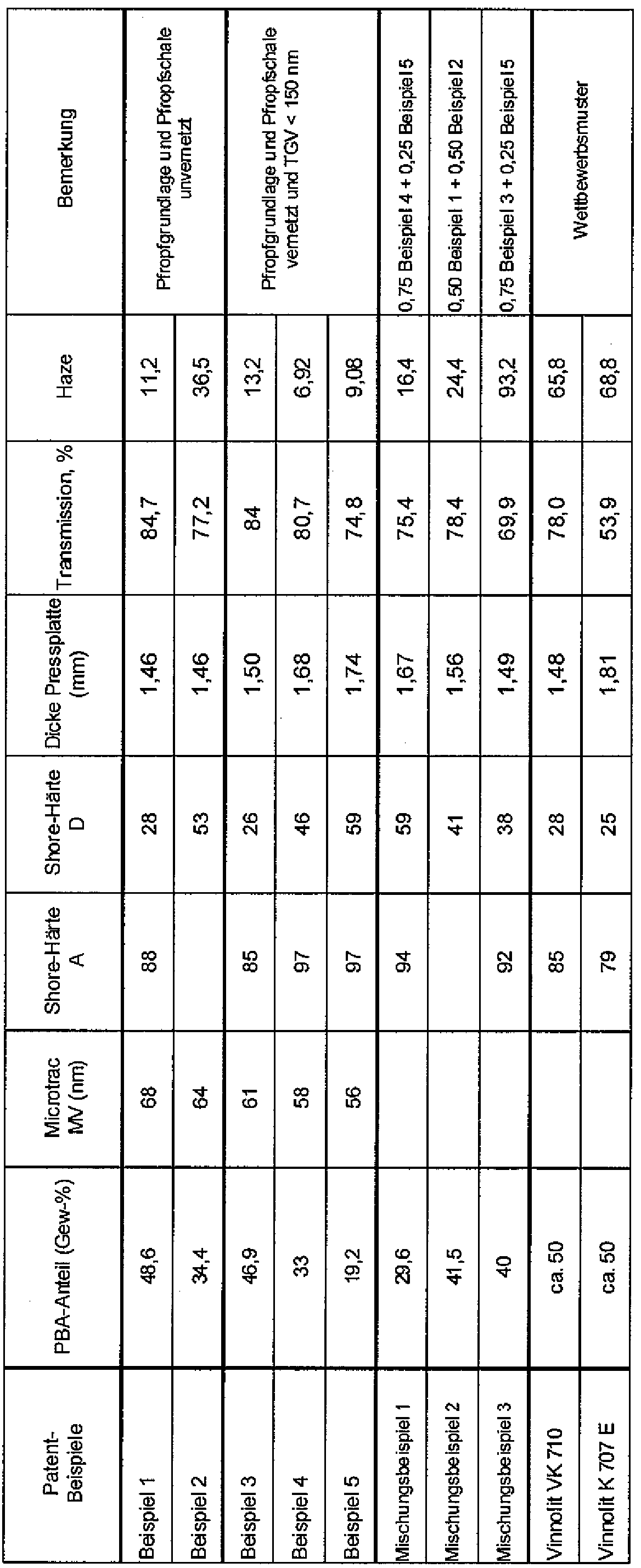
- the powders of the graft copolymers were processed to roll skins on a two-roll roller and pressed.
- Table 1 below lists the polybutyl acrylate content, the crosslinking, the particle size of the graft copolymers and the optical properties (transmission, haze) of the press plates.
- the particle size distributions were measured using a Microtrac Blue-Wave
- S 3500 series measured by Particle Metrix The permissible measuring range is between 0.01 and 2000 ⁇ .
- a standard procedure for dispersions was created in which certain physical properties of the dispersion are stored.
- three drops of Hellmanex® from Hellmanex-Anaiytics are added to the demineralized water in the circulation unit using a 3 ml disposable pipette.
- the cleanliness of the measuring system is checked by a zero measurement.
- Dispersion is carefully added to the sample unit until a loading factor of about 0.004 is reached. In general, these are 1 to 2 drops of dispersion.
- the measuring duration is 30 s.
- the evaluation of the measurement is automatic.
- the mean volume-related particle diameter is used.
- Two-roller rolling mill (including processing conditions and recipe)
- specimens To determine mechanical properties and optical properties, specimens must be provided.
- the production of the rolled skins takes place under the following conditions.
- BaZn stabilizer 1.5 phr of BaZn stabilizer (Baerostab UBZ 171)
- the powder compound is added to the roll to form a coherent mass (hide). After the coat has been formed, the coat is "cut” and “turned” for 3 minutes. Then set the roll thickness to 1.1 mm and plasticize the coat for another 2 minutes without cutting and turning on the roll. After a predetermined rolling time, the rolled sheet is removed. Press
- the previously produced rolled sheets are cut to size according to the frame size used, inserted into the frame and placed in the laboratory press together with the press plates forming the outer surfaces. Under the following conditions, the skins are formed into a press plate. Pressing temperature: 150 ° C
- N D-pressing pressure 30 bar
- N D-pressing time 2 min
- HD pressing pressure 200 bar HD pressing time: 3 min
- Cooling pressure 200 bar Cooling time: approx. 8 min
- transmission (here: "transmission”), which represents the ratio of transmitted to incident light and is dependent on the absorption properties and the surface conditions
- the measurement of the transmission and the determination of the high-angle scattering of the semi-finished products produced by means of rolls / presses is carried out with the Haze-Guard Dual transparency meter from Byk-Gardner.
- the sample to be measured is illuminated vertically and the transmitted light is photoelectrically measured in an integrating sphere.
- the light transmitted perpendicularly for the purpose of transparency evaluation and the light scattering at an angle of 2 ° to the irradiation axis are measured to evaluate the haze.
- the measurements are carried out according to ISO 13468, which ensures that the measuring conditions are the same during calibration and measurement.
- the press plate of the transparent graft copolymer of Example 3 is opaque by a proportion of 25% by weight S-PVC.
Landscapes
- Chemical & Material Sciences (AREA)
- Health & Medical Sciences (AREA)
- Chemical Kinetics & Catalysis (AREA)
- Medicinal Chemistry (AREA)
- Polymers & Plastics (AREA)
- Organic Chemistry (AREA)
- Graft Or Block Polymers (AREA)
- Compositions Of Macromolecular Compounds (AREA)
- Manufacture Of Macromolecular Shaped Articles (AREA)
- Processes Of Treating Macromolecular Substances (AREA)
- Casting Or Compression Moulding Of Plastics Or The Like (AREA)
Abstract
Description
Claims
Priority Applications (14)
| Application Number | Priority Date | Filing Date | Title |
|---|---|---|---|
| EP13704083.8A EP2954007B8 (de) | 2013-02-11 | 2013-02-11 | Weichmacherfreie artikel aus pfropfcopolymeren des pvc's |
| PT137040838T PT2954007T (pt) | 2013-02-11 | 2013-02-11 | Artigos isentos de plastificantes dos copolímeros de enxerto do pvc |
| CN201380074417.6A CN105246969B (zh) | 2013-02-11 | 2013-02-11 | 由pvc的接枝共聚物制成的不含增塑剂的制品 |
| CA2907442A CA2907442C (en) | 2013-02-11 | 2013-02-11 | Plasticizer-free articles from graft copolymers of pvc |
| PCT/EP2013/052657 WO2014121852A1 (de) | 2013-02-11 | 2013-02-11 | Weichmacherfreie artikel aus pfropfcopolymeren des pvc's |
| US14/767,259 US9957385B2 (en) | 2013-02-11 | 2013-02-11 | Plasticizer-free article made of PVC graft copolymers |
| BR112015019104-5A BR112015019104B1 (pt) | 2013-02-11 | 2013-02-11 | Mistura, método para preparação de uma mistura, artigo, e, uso |
| ES13704083.8T ES2616140T3 (es) | 2013-02-11 | 2013-02-11 | Artículo exento de plastificante constituido por copolímeros de injerto de PVC |
| PL13704083T PL2954007T3 (pl) | 2013-02-11 | 2013-02-11 | Wyroby niezawierające zmiękczacza ze szczepionych kopolimerów pvc |
| MX2015010338A MX376044B (es) | 2013-02-11 | 2013-02-11 | Articulo libre de plastificante hecho de copolimeros de injerto de pvc. |
| RU2015138700A RU2622309C2 (ru) | 2013-02-11 | 2013-02-11 | Не содержащие пластификатора изделия из привитых сополимеров pvc |
| JP2015556403A JP6333295B2 (ja) | 2013-02-11 | 2013-02-11 | Pvcのグラフト共重合体由来の可塑剤フリー物品 |
| DK13704083.8T DK2954007T3 (da) | 2013-02-11 | 2013-02-11 | Blødgørerfrie artikler af podede copolymerer af PVC |
| UAA201508725A UA112616C2 (uk) | 2013-02-11 | 2013-11-02 | Вироби з прищеплених співполімерів рvc, які не містять пластифікатора |
Applications Claiming Priority (1)
| Application Number | Priority Date | Filing Date | Title |
|---|---|---|---|
| PCT/EP2013/052657 WO2014121852A1 (de) | 2013-02-11 | 2013-02-11 | Weichmacherfreie artikel aus pfropfcopolymeren des pvc's |
Publications (1)
| Publication Number | Publication Date |
|---|---|
| WO2014121852A1 true WO2014121852A1 (de) | 2014-08-14 |
Family
ID=47714084
Family Applications (1)
| Application Number | Title | Priority Date | Filing Date |
|---|---|---|---|
| PCT/EP2013/052657 Ceased WO2014121852A1 (de) | 2013-02-11 | 2013-02-11 | Weichmacherfreie artikel aus pfropfcopolymeren des pvc's |
Country Status (14)
| Country | Link |
|---|---|
| US (1) | US9957385B2 (de) |
| EP (1) | EP2954007B8 (de) |
| JP (1) | JP6333295B2 (de) |
| CN (1) | CN105246969B (de) |
| BR (1) | BR112015019104B1 (de) |
| CA (1) | CA2907442C (de) |
| DK (1) | DK2954007T3 (de) |
| ES (1) | ES2616140T3 (de) |
| MX (1) | MX376044B (de) |
| PL (1) | PL2954007T3 (de) |
| PT (1) | PT2954007T (de) |
| RU (1) | RU2622309C2 (de) |
| UA (1) | UA112616C2 (de) |
| WO (1) | WO2014121852A1 (de) |
Cited By (3)
| Publication number | Priority date | Publication date | Assignee | Title |
|---|---|---|---|---|
| US9957385B2 (en) | 2013-02-11 | 2018-05-01 | Vestolit Gmbh & Co. Kg | Plasticizer-free article made of PVC graft copolymers |
| US10125208B2 (en) | 2013-02-11 | 2018-11-13 | Vestolit Gmbh & Co. Kg | Transparent article made of PVC graft copolymers |
| US10407529B2 (en) | 2013-02-11 | 2019-09-10 | Vestolit Gmbh & Co. Kg | Transparent article made of PVC graft copolymers |
Families Citing this family (1)
| Publication number | Priority date | Publication date | Assignee | Title |
|---|---|---|---|---|
| CN114395069B (zh) * | 2021-12-21 | 2023-03-21 | 云南正邦科技有限公司 | 一种不含塑化剂的软质pvc及其制备方法 |
Citations (6)
| Publication number | Priority date | Publication date | Assignee | Title |
|---|---|---|---|---|
| DE3803036A1 (de) | 1988-02-02 | 1989-08-10 | Wacker Chemie Gmbh | Verfahren zur herstellung eines elastomerhaltigen vinylchloridpfropfcopolymerisats |
| EP0472852A2 (de) | 1990-08-31 | 1992-03-04 | VESTOLIT GmbH | Herstellung eines schlagzähen Polyacrylsäureester-Vinylchlorid-Pfropfcopolymerisats |
| EP0590659A1 (de) * | 1992-10-01 | 1994-04-06 | Wacker-Chemie GmbH | Verfahren zur Herstellung von Vinylchlorid-Polymerisats-Massen mit stufenlos einstellbaren Stoffeigenschaften |
| EP0647663A1 (de) | 1993-10-12 | 1995-04-12 | Vinnolit Kunststoff GmbH | Thermoplastische Elastomere auf der Basis von Vinylchlorid-Pfropfcopolymerisaten |
| DE4338374A1 (de) * | 1993-11-10 | 1995-05-11 | Wacker Chemie Gmbh | Verwendung von wäßrigen Dispersionen zweiphasiger Emulsions-Pfropfcopolymerisate als Bindemittel für Versteifungsmaterialien in der Textil- und Lederindustrie |
| DE10121580A1 (de) | 2001-05-03 | 2002-11-14 | Vinnolit Gmbh & Co Kg | Schlagzähmodifier, Verfahren zu dessen Herstellung und Verwendung |
Family Cites Families (22)
| Publication number | Priority date | Publication date | Assignee | Title |
|---|---|---|---|---|
| JPS4817459B1 (de) * | 1969-01-17 | 1973-05-29 | ||
| DE2123384A1 (en) | 1971-05-12 | 1972-11-23 | Deutsche Solvay-Werke Gmbh, 5650 Solingen-Ohligs | Non-tacky vinyl chloride (co) polymer for moulded sheet - film,articles prodn |
| CH566354A5 (de) | 1972-06-08 | 1975-09-15 | Lonza Ag | |
| CH586722A5 (de) * | 1973-12-07 | 1977-04-15 | Lonza Ag | |
| SU562203A3 (ru) * | 1973-12-07 | 1977-06-15 | Лонца Аг (Фирма) | Способ получени прозрачного, ударопрочного и атмосферостойкого поливинилхлорида |
| FR2350361A1 (fr) | 1976-05-03 | 1977-12-02 | Solvay | Procede pour la polymerisation en suspension aqueuse du chlorure de vinyle |
| DE3886677D1 (de) | 1987-10-23 | 1994-02-10 | Hoechst Ag | Verfahren zur Herstellung eines Acrylsäureester-Vinylchlorid-Pfropfpolymerisates. |
| AU610013B2 (en) * | 1988-09-09 | 1991-05-09 | B.F. Goodrich Company, The | Flexible blend compositions based on overpolymers of vinyl chloride polymers on ethylene copolymers |
| BE1004374A3 (fr) * | 1991-02-01 | 1992-11-10 | Solvay | Compositions resistant aux chocs a base de polymeres du chlorure de vinyle et leur utilisation. |
| JP2000053839A (ja) * | 1998-08-11 | 2000-02-22 | Sekisui Chem Co Ltd | 塩化ビニル系樹脂組成物 |
| JP2000119349A (ja) * | 1998-10-19 | 2000-04-25 | Sekisui Chem Co Ltd | 塩化ビニル系樹脂、その製造方法及び成形体 |
| JP2000128941A (ja) * | 1998-10-27 | 2000-05-09 | Sekisui Chem Co Ltd | 透明耐衝撃性塩化ビニル系グラフト共重合体及び成形体 |
| JP2001089622A (ja) * | 1999-09-21 | 2001-04-03 | Sekisui Chem Co Ltd | 塩化ビニル系樹脂組成物及びその成形体 |
| DE19958820B4 (de) | 1999-12-07 | 2010-04-01 | Vestolit Gmbh & Co. Kg | Verfahren zur Herstellung thermoplastischer Formmassen, nach diesem Verfahren hergestellte Formmassen und deren Verwendung |
| JP2003253082A (ja) | 2002-02-27 | 2003-09-10 | Sekisui Chem Co Ltd | ポリ塩化ビニル系樹脂組成物 |
| US20070149713A1 (en) | 2004-12-14 | 2007-06-28 | Kanaeka Corporation | Soft vinyl chloride copolymer resin, resin composition and process for preparing the same |
| US20090143547A1 (en) * | 2007-11-29 | 2009-06-04 | Cheng-Jung Lin | Method for producing a functional vinyl halide polymer |
| EP2067795A1 (de) | 2007-12-04 | 2009-06-10 | Formosa Plastics Corporation | Verfahren zur Herstellung eines funktionalen Vinylhalogenidpolymers |
| CN102766231B (zh) * | 2012-08-08 | 2015-03-25 | 上海氯碱化工股份有限公司 | 羟基化聚氯乙烯共聚树脂的合成方法 |
| RU2617648C2 (ru) | 2013-02-11 | 2017-04-25 | Фестолит Гмбх | Прозрачное изделие из привитых сополимеров пвх |
| CA2900843C (en) | 2013-02-11 | 2019-09-03 | Vestolit Gmbh & Co. Kg | Transparent articles from graft copolymers of pvc |
| JP6333295B2 (ja) | 2013-02-11 | 2018-05-30 | ヴェストリート ゲゼルシャフト ミット ベシュレンクテル ハフツング ウント コンパニー コマンディートゲゼルシャフト | Pvcのグラフト共重合体由来の可塑剤フリー物品 |
-
2013
- 2013-02-11 JP JP2015556403A patent/JP6333295B2/ja active Active
- 2013-02-11 PL PL13704083T patent/PL2954007T3/pl unknown
- 2013-02-11 DK DK13704083.8T patent/DK2954007T3/da active
- 2013-02-11 BR BR112015019104-5A patent/BR112015019104B1/pt not_active IP Right Cessation
- 2013-02-11 CN CN201380074417.6A patent/CN105246969B/zh not_active Expired - Fee Related
- 2013-02-11 WO PCT/EP2013/052657 patent/WO2014121852A1/de not_active Ceased
- 2013-02-11 ES ES13704083.8T patent/ES2616140T3/es active Active
- 2013-02-11 RU RU2015138700A patent/RU2622309C2/ru active
- 2013-02-11 US US14/767,259 patent/US9957385B2/en active Active
- 2013-02-11 MX MX2015010338A patent/MX376044B/es active IP Right Grant
- 2013-02-11 EP EP13704083.8A patent/EP2954007B8/de active Active
- 2013-02-11 PT PT137040838T patent/PT2954007T/pt unknown
- 2013-02-11 CA CA2907442A patent/CA2907442C/en active Active
- 2013-11-02 UA UAA201508725A patent/UA112616C2/uk unknown
Patent Citations (6)
| Publication number | Priority date | Publication date | Assignee | Title |
|---|---|---|---|---|
| DE3803036A1 (de) | 1988-02-02 | 1989-08-10 | Wacker Chemie Gmbh | Verfahren zur herstellung eines elastomerhaltigen vinylchloridpfropfcopolymerisats |
| EP0472852A2 (de) | 1990-08-31 | 1992-03-04 | VESTOLIT GmbH | Herstellung eines schlagzähen Polyacrylsäureester-Vinylchlorid-Pfropfcopolymerisats |
| EP0590659A1 (de) * | 1992-10-01 | 1994-04-06 | Wacker-Chemie GmbH | Verfahren zur Herstellung von Vinylchlorid-Polymerisats-Massen mit stufenlos einstellbaren Stoffeigenschaften |
| EP0647663A1 (de) | 1993-10-12 | 1995-04-12 | Vinnolit Kunststoff GmbH | Thermoplastische Elastomere auf der Basis von Vinylchlorid-Pfropfcopolymerisaten |
| DE4338374A1 (de) * | 1993-11-10 | 1995-05-11 | Wacker Chemie Gmbh | Verwendung von wäßrigen Dispersionen zweiphasiger Emulsions-Pfropfcopolymerisate als Bindemittel für Versteifungsmaterialien in der Textil- und Lederindustrie |
| DE10121580A1 (de) | 2001-05-03 | 2002-11-14 | Vinnolit Gmbh & Co Kg | Schlagzähmodifier, Verfahren zu dessen Herstellung und Verwendung |
Non-Patent Citations (3)
| Title |
|---|
| CHARLES E. WILKES; JAMES W. SUMMERS; CHARLES ANTHONY DANIELS: "PVC-Handbook", 2005, pages: 14 |
| DOMININGHAUS: "Kunststoffe", 2008 |
| DOMININGHAUS: "Kunststoffe", 2008, article "Erhöhung der Schlagzähigkeit - Polyacrylate als Modifiziermittel für transparente PVC-Artikel", pages: 372 |
Cited By (4)
| Publication number | Priority date | Publication date | Assignee | Title |
|---|---|---|---|---|
| US9957385B2 (en) | 2013-02-11 | 2018-05-01 | Vestolit Gmbh & Co. Kg | Plasticizer-free article made of PVC graft copolymers |
| US10125208B2 (en) | 2013-02-11 | 2018-11-13 | Vestolit Gmbh & Co. Kg | Transparent article made of PVC graft copolymers |
| US10407529B2 (en) | 2013-02-11 | 2019-09-10 | Vestolit Gmbh & Co. Kg | Transparent article made of PVC graft copolymers |
| US10407530B2 (en) | 2013-02-11 | 2019-09-10 | Vestolit Gmbh & Co. Kg | Transparent article made of PVC graft copolymers |
Also Published As
| Publication number | Publication date |
|---|---|
| RU2015138700A (ru) | 2017-03-16 |
| UA112616C2 (uk) | 2016-09-26 |
| EP2954007A1 (de) | 2015-12-16 |
| PL2954007T3 (pl) | 2017-06-30 |
| US9957385B2 (en) | 2018-05-01 |
| EP2954007B1 (de) | 2016-12-07 |
| JP6333295B2 (ja) | 2018-05-30 |
| CA2907442C (en) | 2019-12-31 |
| DK2954007T3 (da) | 2017-02-20 |
| BR112015019104A2 (pt) | 2017-07-18 |
| CN105246969A (zh) | 2016-01-13 |
| MX2015010338A (es) | 2016-09-19 |
| CN105246969B (zh) | 2019-05-17 |
| EP2954007B8 (de) | 2017-04-19 |
| CA2907442A1 (en) | 2014-08-14 |
| ES2616140T3 (es) | 2017-06-09 |
| PT2954007T (pt) | 2017-01-19 |
| US20160075870A1 (en) | 2016-03-17 |
| JP2016510074A (ja) | 2016-04-04 |
| MX376044B (es) | 2025-03-07 |
| BR112015019104B1 (pt) | 2021-07-27 |
| RU2622309C2 (ru) | 2017-06-14 |
Similar Documents
| Publication | Publication Date | Title |
|---|---|---|
| EP3074439B1 (de) | Thermoplastische formmassen mit angepasster pfropfhülle | |
| EP2953980B1 (de) | Transparente artikel aus pfropfcopolymeren des pvc's | |
| EP2054472B1 (de) | Thermoplastische formmassen auf basis von acrylnitril, styrol und butadien, sowie agglomerationsmittel enthaltend ethylacrylat und methacrylamid | |
| EP2986649B1 (de) | Thermoplastische formmassen auf basis von acrylnitril, styrol und butadien | |
| EP2953981B1 (de) | Transparente artikel aus pfropfcopolymeren des pvc's | |
| EP0182282B1 (de) | Polymerisationsemulgatoren | |
| EP3137524A1 (de) | Thermoplastische formmassen mit optimiertem restmonomeranteil | |
| EP2954007B1 (de) | Weichmacherfreie artikel aus pfropfcopolymeren des pvc's | |
| DE2363564C3 (de) | Thermoplastische Formmasse auf der Basis von Vinylchlorid-Homo- oder Mischpolymerisaten | |
| DE2003331B2 (de) | Verfahren zur herstellung eines vinylchloridpfropfpolymerisates | |
| EP3039072A1 (de) | Styrol-copolymer-zusammensetzungen mit verbessertem glanz | |
| DE2439542A1 (de) | Extrudierbare, pressbare oder warmverformbare gemische aus thermoplastischen polymeren und einem oberflaechenveraendernden mittel sowie verfahren zu deren herstellung | |
| EP0011158A1 (de) | Schlagzähe thermoplastische Kunststoffmassen, ihre Verwendung zur Herstellung von Formkörpern und aus diesen Massen hergestellte Formkörper | |
| EP2566921A1 (de) | Formmasse mit verminderter lichtstreuung | |
| WO2016139307A1 (de) | Effiziente agglomerierend wirkende copolymere | |
| EP1798246A1 (de) | Verfahren zur Herstellung von wässrigen Vinylchlorid-(Meth)Acrylat-Copolymerisaten und deren Verwendung in wässriger Form |
Legal Events
| Date | Code | Title | Description |
|---|---|---|---|
| 121 | Ep: the epo has been informed by wipo that ep was designated in this application |
Ref document number: 13704083 Country of ref document: EP Kind code of ref document: A1 |
|
| DPE1 | Request for preliminary examination filed after expiration of 19th month from priority date (pct application filed from 20040101) | ||
| ENP | Entry into the national phase |
Ref document number: 2015556403 Country of ref document: JP Kind code of ref document: A |
|
| WWE | Wipo information: entry into national phase |
Ref document number: MX/A/2015/010338 Country of ref document: MX |
|
| NENP | Non-entry into the national phase |
Ref country code: DE |
|
| REG | Reference to national code |
Ref country code: BR Ref legal event code: B01A Ref document number: 112015019104 Country of ref document: BR |
|
| REEP | Request for entry into the european phase |
Ref document number: 2013704083 Country of ref document: EP |
|
| WWE | Wipo information: entry into national phase |
Ref document number: 2013704083 Country of ref document: EP |
|
| WWE | Wipo information: entry into national phase |
Ref document number: A201508725 Country of ref document: UA |
|
| WWE | Wipo information: entry into national phase |
Ref document number: 15214093 Country of ref document: CO |
|
| ENP | Entry into the national phase |
Ref document number: 2015138700 Country of ref document: RU Kind code of ref document: A |
|
| ENP | Entry into the national phase |
Ref document number: 2907442 Country of ref document: CA |
|
| WWE | Wipo information: entry into national phase |
Ref document number: 14767259 Country of ref document: US |
|
| ENP | Entry into the national phase |
Ref document number: 112015019104 Country of ref document: BR Kind code of ref document: A2 Effective date: 20150810 |