WO2014126105A1 - マイクロニードルコーティング用組成物及びマイクロニードルデバイス - Google Patents
マイクロニードルコーティング用組成物及びマイクロニードルデバイス Download PDFInfo
- Publication number
- WO2014126105A1 WO2014126105A1 PCT/JP2014/053198 JP2014053198W WO2014126105A1 WO 2014126105 A1 WO2014126105 A1 WO 2014126105A1 JP 2014053198 W JP2014053198 W JP 2014053198W WO 2014126105 A1 WO2014126105 A1 WO 2014126105A1
- Authority
- WO
- WIPO (PCT)
- Prior art keywords
- microneedle
- acid
- coating
- composition
- coating composition
- Prior art date
- Legal status (The legal status is an assumption and is not a legal conclusion. Google has not performed a legal analysis and makes no representation as to the accuracy of the status listed.)
- Ceased
Links
Images


Classifications
-
- A—HUMAN NECESSITIES
- A61—MEDICAL OR VETERINARY SCIENCE; HYGIENE
- A61K—PREPARATIONS FOR MEDICAL, DENTAL OR TOILETRY PURPOSES
- A61K39/00—Medicinal preparations containing antigens or antibodies
- A61K39/12—Viral antigens
-
- A—HUMAN NECESSITIES
- A61—MEDICAL OR VETERINARY SCIENCE; HYGIENE
- A61K—PREPARATIONS FOR MEDICAL, DENTAL OR TOILETRY PURPOSES
- A61K47/00—Medicinal preparations characterised by the non-active ingredients used, e.g. carriers or inert additives; Targeting or modifying agents chemically bound to the active ingredient
- A61K47/06—Organic compounds, e.g. natural or synthetic hydrocarbons, polyolefins, mineral oil, petrolatum or ozokerite
- A61K47/08—Organic compounds, e.g. natural or synthetic hydrocarbons, polyolefins, mineral oil, petrolatum or ozokerite containing oxygen, e.g. ethers, acetals, ketones, quinones, aldehydes, peroxides
- A61K47/12—Carboxylic acids; Salts or anhydrides thereof
-
- A—HUMAN NECESSITIES
- A61—MEDICAL OR VETERINARY SCIENCE; HYGIENE
- A61K—PREPARATIONS FOR MEDICAL, DENTAL OR TOILETRY PURPOSES
- A61K47/00—Medicinal preparations characterised by the non-active ingredients used, e.g. carriers or inert additives; Targeting or modifying agents chemically bound to the active ingredient
- A61K47/06—Organic compounds, e.g. natural or synthetic hydrocarbons, polyolefins, mineral oil, petrolatum or ozokerite
- A61K47/16—Organic compounds, e.g. natural or synthetic hydrocarbons, polyolefins, mineral oil, petrolatum or ozokerite containing nitrogen, e.g. nitro-, nitroso-, azo-compounds, nitriles, cyanates
- A61K47/18—Amines; Amides; Ureas; Quaternary ammonium compounds; Amino acids; Oligopeptides having up to five amino acids
- A61K47/183—Amino acids, e.g. glycine, EDTA or aspartame
-
- A—HUMAN NECESSITIES
- A61—MEDICAL OR VETERINARY SCIENCE; HYGIENE
- A61K—PREPARATIONS FOR MEDICAL, DENTAL OR TOILETRY PURPOSES
- A61K9/00—Medicinal preparations characterised by special physical form
- A61K9/0012—Galenical forms characterised by the site of application
- A61K9/0019—Injectable compositions; Intramuscular, intravenous, arterial, subcutaneous administration; Compositions to be administered through the skin in an invasive manner
- A61K9/0021—Intradermal administration, e.g. through microneedle arrays or needleless injectors
-
- A—HUMAN NECESSITIES
- A61—MEDICAL OR VETERINARY SCIENCE; HYGIENE
- A61P—SPECIFIC THERAPEUTIC ACTIVITY OF CHEMICAL COMPOUNDS OR MEDICINAL PREPARATIONS
- A61P31/00—Antiinfectives, i.e. antibiotics, antiseptics, chemotherapeutics
- A61P31/12—Antivirals
- A61P31/14—Antivirals for RNA viruses
-
- C—CHEMISTRY; METALLURGY
- C12—BIOCHEMISTRY; BEER; SPIRITS; WINE; VINEGAR; MICROBIOLOGY; ENZYMOLOGY; MUTATION OR GENETIC ENGINEERING
- C12N—MICROORGANISMS OR ENZYMES; COMPOSITIONS THEREOF; PROPAGATING, PRESERVING, OR MAINTAINING MICROORGANISMS; MUTATION OR GENETIC ENGINEERING; CULTURE MEDIA
- C12N7/00—Viruses; Bacteriophages; Compositions thereof; Preparation or purification thereof
-
- A—HUMAN NECESSITIES
- A61—MEDICAL OR VETERINARY SCIENCE; HYGIENE
- A61K—PREPARATIONS FOR MEDICAL, DENTAL OR TOILETRY PURPOSES
- A61K39/00—Medicinal preparations containing antigens or antibodies
- A61K2039/54—Medicinal preparations containing antigens or antibodies characterised by the route of administration
-
- C—CHEMISTRY; METALLURGY
- C12—BIOCHEMISTRY; BEER; SPIRITS; WINE; VINEGAR; MICROBIOLOGY; ENZYMOLOGY; MUTATION OR GENETIC ENGINEERING
- C12N—MICROORGANISMS OR ENZYMES; COMPOSITIONS THEREOF; PROPAGATING, PRESERVING, OR MAINTAINING MICROORGANISMS; MUTATION OR GENETIC ENGINEERING; CULTURE MEDIA
- C12N2770/00—MICROORGANISMS OR ENZYMES; COMPOSITIONS THEREOF; PROPAGATING, PRESERVING, OR MAINTAINING MICROORGANISMS; MUTATION OR GENETIC ENGINEERING; CULTURE MEDIA ssRNA viruses positive-sense
- C12N2770/00011—Details
- C12N2770/24011—Flaviviridae
- C12N2770/24111—Flavivirus, e.g. yellow fever virus, dengue, JEV
- C12N2770/24134—Use of virus or viral component as vaccine, e.g. live-attenuated or inactivated virus, VLP, viral protein
-
- Y—GENERAL TAGGING OF NEW TECHNOLOGICAL DEVELOPMENTS; GENERAL TAGGING OF CROSS-SECTIONAL TECHNOLOGIES SPANNING OVER SEVERAL SECTIONS OF THE IPC; TECHNICAL SUBJECTS COVERED BY FORMER USPC CROSS-REFERENCE ART COLLECTIONS [XRACs] AND DIGESTS
- Y02—TECHNOLOGIES OR APPLICATIONS FOR MITIGATION OR ADAPTATION AGAINST CLIMATE CHANGE
- Y02A—TECHNOLOGIES FOR ADAPTATION TO CLIMATE CHANGE
- Y02A50/00—TECHNOLOGIES FOR ADAPTATION TO CLIMATE CHANGE in human health protection, e.g. against extreme weather
- Y02A50/30—Against vector-borne diseases, e.g. mosquito-borne, fly-borne, tick-borne or waterborne diseases whose impact is exacerbated by climate change
Definitions
- the present invention relates to a composition for microneedle coating and a microneedle device.
- a microneedle device is known as one of means for transdermally administering a drug.
- a device there is a device in which a coating containing a drug and a thickener is formed (for example, Patent Document 1).
- a composition comprising a biologically active substance and a viscosity-enhancing counterion preparation (Patent Document 2), the coating formulation having a pH of less than about pH 6 and containing at least one low volatility counterion.
- the thing is known.
- a composition comprising a therapeutically effective amount of a peptide drug and a formulation of at least one counterion (US Pat. No. 6,057,049), a biologically active ingredient and a non-active composition having increased pH stability and solubility when dried.
- a composition (Patent Document 5) containing a volatile counterion preparation is known.
- Patent Documents 1 and 2 it has been found that when a material exemplified as a thickener is contained, the stability of physiologically active substances such as proteins contained in the drug is not sufficient.
- composition for microneedle coating of the present invention contains a Japanese encephalitis vaccine antigen, a basic amino acid and an acid, and the number of moles of acid relative to 1 mole of basic amino acid is 1 / It exceeds (N + 1) and is less than 2.
- the acid is preferably an acid having a melting point of 40 ° C. or higher, and comprises phosphoric acid, lactic acid, benzoic acid, maleic acid, citric acid, tartaric acid, succinic acid, ascorbic acid and aspartic acid. More preferably, it is at least one acid selected from the group, and more preferably at least one acid selected from the group consisting of phosphoric acid, citric acid and tartaric acid.
- the microneedle coating composition preferably contains lysine or lysine hydrochloride.
- lysine or lysine hydrochloride By containing lysine or lysine hydrochloride, the stability of the Japanese encephalitis vaccine antigen can be further improved.
- the present invention also provides a microneedle device comprising a coating layer formed from the composition for microneedle coating on the microneedle.
- the coating layer is preferably formed at the tip portion of the microneedle, and more preferably formed only at the tip portion of the microneedle.
- microneedle coating composition and a microneedle device capable of stabilizing the contained Japanese encephalitis vaccine antigen.
- FIG. 2 is a sectional view taken along line II-II in FIG. (A), (b) and (c) is a figure which shows embodiment of the manufacturing method of a microneedle device. It is a graph which shows the influence which it has on the specific activity of lysine hydrochloride.
- FIG. 1 is a perspective view showing an embodiment of a microneedle device.
- a microneedle device 1 shown in FIG. 1 includes a substrate 2, a plurality of microneedles 3 arranged two-dimensionally on the substrate 2, and a coating layer 5 formed on the microneedles 3.
- the coating layer 5 is formed from the composition for microneedle coating of the present invention, and it is preferable that at least a part of the volatile component is removed.
- the microneedle 3 has a fine structure, and its height (length) is preferably 50 to 600 ⁇ m.
- its height (length) is preferably 50 to 600 ⁇ m.
- the length of the microneedle 3 is set to 50 ⁇ m or more, the administration of the Japanese encephalitis vaccine antigen contained in the composition for microneedle coating is ensured.
- the length of the microneedle 3 600 ⁇ m or less it is possible to avoid the microneedle from coming into contact with the nerve, to surely reduce the possibility of pain, and to avoid the possibility of bleeding. Will be able to.
- the length of the microneedle 3 is 500 ⁇ m or less, an amount of Japanese encephalitis vaccine antigen that should enter the skin can be efficiently administered, and administration without perforating the basement membrane is also possible.
- the length of the microneedle 3 is particularly preferably 300 to 500 ⁇ m.
- the microneedles 3 are typically spaced so that there is a density of about 1-10 per millimeter (mm) per row of needles. In general, adjacent rows are separated from each other by a substantially equal distance with respect to the space of the needles in the row and have a density of 100-10000 needles per cm 2 . When there is a needle density of 100 or more, the skin can be efficiently perforated. On the other hand, when the needle density exceeds 10,000, it is difficult to maintain the strength of the microneedles 3.
- the density of the microneedles 3 is preferably 200 to 5000, more preferably 300 to 2000, and still more preferably 400 to 850.
- Examples of the material of the substrate 2 or the microneedle 3 include silicon, silicon dioxide, ceramic, metal (stainless steel, titanium, nickel, molybdenum, chromium, cobalt, etc.) and synthetic or natural resin materials.
- biodegradable polymers such as polylactic acid, polyglycolide, polylactic acid-co-polyglycolide, pullulan, capronolactone, polyurethane, polyanhydride
- non-degradable polymers such as polycarbonate, polymethacryl Synthetic or natural resin materials such as acid, ethylene vinyl acetate, polytetrafluoroethylene, and polyoxymethylene are particularly preferable.
- polysaccharides such as hyaluronic acid, sodium hyaluronate, pullulan, dextran, dextrin or chondroitin sulfate.
- Substrate 2 or microneedle 3 can be produced by wet etching or dry etching using a silicon substrate, precision machining using metal or resin (electric discharge machining, laser machining, dicing machining, hot embossing, injection molding) Etc.), machine cutting and the like. By these processing methods, the substrate 2 and the microneedles 3 are integrally molded. As a method for making the microneedle 3 hollow, there is a method in which the microneedle 3 is fabricated and then subjected to secondary processing with a laser or the like.
- the microneedle device 1 includes a coating layer 5 on the microneedle 3, but the coating layer 5 is preferably formed by applying a composition for microneedle coating. Examples of the application method include spray coating and dip coating, and dip coating is preferred.
- the coating layer 5 is formed on all the microneedles 3, but the coating layer 5 may be formed only on a part of the plurality of microneedles 3.
- the coating layer 5 is formed only on the tip portion of the microneedle 3, but may be formed so as to cover the entire microneedle 3. Furthermore, the coating layer 5 may be formed on the substrate 2.
- FIGS. 3A, 3B, and 3C are views showing an embodiment of a method for manufacturing the microneedle device 1.
- FIG. 3A the microneedle coating composition 10 is swept on the mask plate 11 by the spatula 12 in the arrow A direction.
- the opening 13 is filled with the microneedle coating composition 10.
- FIG. 3B the microneedle 3 is inserted into the opening 13 of the mask plate 11.
- FIG. 3C the microneedle 3 is pulled out from the opening 13 of the mask plate 11.
- the composition 10 for microneedle coating is made to adhere on the microneedle 3.
- the microneedle coating composition 10 may be adhered on the substrate 2. Thereafter, the volatile components of the microneedle coating composition 10 on the microneedles 3 are removed by a known method of air drying, vacuum drying, or a combination thereof. Thereby, the coating layer 5 adheres firmly on the microneedle 3 and typically becomes vitreous or solid, and the microneedle device is manufactured.
- the water content of the coating layer 5 is usually 55% by mass or less, preferably 30% by mass or less, more preferably 10% by mass or less based on the total amount of the coating layer 5.
- the height H of the coating layer 5 adhered on the microneedle 3 is adjusted by a clearance (gap) C shown in FIG.
- This clearance C is defined by the distance from the base of the microneedle 3 to the surface of the mask plate 11 (the thickness of the substrate 2 is not involved), and is set according to the tension of the mask plate 11 and the length of the microneedle 3.
- the distance range of the clearance C is preferably 0 to 500 ⁇ m. When the distance of the clearance C is 0, it means that the microneedle coating composition 10 is applied to the entire microneedle 3.
- the tip is 50 to 150 ⁇ m More preferably, it is present in Since the composition 10 for microneedle coating can dissolve a basic amino acid in an aqueous solution at a high concentration (for example, 20% w / w or more) and has a high viscosity, the coating layer 5 is formed on a part of the microneedle. Can be formed.
- the microneedle coating composition 10 held on the microneedle 3 in this manner is inserted into the skin at the same time when the microneedle 3 is punctured into the skin.
- the thickness after drying of the coating layer 5 attached on the microneedles 3 is preferably less than 50 ⁇ m, more preferably less than 40 ⁇ m, and further preferably 1 to 30 ⁇ m.
- the thickness of the coating layer 5 deposited on the microneedles is an average thickness measured across the surface of the microneedles 3 after drying.
- the thickness of the coating layer 5 deposited on the microneedle 3 is increased by applying a plurality of coatings of the microneedle coating composition 10, that is, the microneedle coating composition 10 is deposited. It can be increased by repeating the adhesion process later.
- the temperature and humidity of the installation environment of the apparatus are preferably controlled to be constant.
- the composition 10 for microneedle coating contains water, it can also be filled with water as needed. Thereby, transpiration of water in the composition 10 for microneedle coating can be prevented as much as possible.
- the composition 10 for microneedle coating contains a Japanese encephalitis vaccine antigen, a basic amino acid and an acid, and the number of moles of acid relative to 1 mole of basic amino acid is 1 / (N + 1) when the valence of the acid is N. And less than 2.
- the number of moles of acid relative to 1 mole of basic amino acid is preferably 1 / N or more and 1 or less.
- the concentration of the Japanese encephalitis vaccine antigen in the microneedle coating composition 10 is preferably 0.01 to 30% w / w based on the total mass of the microneedle coating composition 10, and preferably 0.02 to More preferably, it is 20% w / w, and even more preferably 0.05 to 10% w / w.
- concentration of Japanese encephalitis vaccine antigen is 0.01% w / w or more, an effective amount of Japanese encephalitis vaccine antigen can be released into the skin when administered to the skin, and sufficient medicinal effects are exhibited.
- the concentration of the Japanese encephalitis vaccine antigen in the coating layer 5 obtained after applying the microneedle coating composition 10 to the microneedle 3 and removing the volatile components is set to 0. 0 based on the total mass of the coating layer 5. It is preferably 01 to 30% w / w, more preferably 0.03 to 15% w / w, still more preferably 0.1 to 10% w / w.
- the concentration of the basic amino acid in the microneedle coating composition 10 is 20% w / w or more from the viewpoint of the viscosity and the stability of the Japanese encephalitis vaccine antigen based on the total mass of the microneedle coating composition 10. It is preferable that it is 30% w / w or more. When the concentration of the basic amino acid is 20% w / w or more, the stability of the Japanese encephalitis vaccine antigen in the microneedle coating composition 10 can be improved. Moreover, when the concentration of the basic amino acid is 70% w / w or less, handling when applying to the microneedle 3 is facilitated.
- the concentration of the basic amino acid in the coating layer 5 obtained after applying the microneedle coating composition 10 to the microneedles 3 and removing the volatile components is 50 to 90 based on the total mass of the coating layer 5.
- % W / w is preferable, and 60 to 80% w / w is more preferable.
- the ratio of the blending amount (mass) of the basic amino acid to the blending amount (mass) of the Japanese encephalitis vaccine antigen in the microneedle coating composition 10 is preferably 1.8 to 2400, preferably 3.5 to 700. More preferably, it is more preferably 5 to 500.
- the acid in the microneedle coating composition 10 is preferably an acid having a melting point of 40 ° C. or higher.
- a basic amino acid can be present at a high concentration (for example, 20% w / w or more) in the microneedle coating composition 10, and the microneedle coating composition 10
- the stability of Japanese encephalitis vaccine antigen can be improved.
- at least one acid selected from the group consisting of phosphoric acid, lactic acid, benzoic acid, maleic acid, citric acid, tartaric acid, succinic acid, ascorbic acid and aspartic acid is preferable.
- the acid concentration in the microneedle coating composition 10 is preferably 5 to 50% w / w, based on the total mass of the microneedle coating composition 10, and is 10 to 30% w / w. It is more preferable.
- the concentration of the acid in the coating layer 5 obtained after applying the microneedle coating composition 10 to the microneedles 3 and removing the volatile components is 5 to 50% w based on the total mass of the coating layer 5. / W is preferable, and 10 to 30% w / w is more preferable.
- the microneedle coating composition 10 may contain lysine or a pharmaceutically acceptable salt of lysine together with the basic amino acid.
- lysine or a pharmaceutically acceptable salt of lysine By containing lysine or a pharmaceutically acceptable salt of lysine, the stability of the Japanese encephalitis vaccine antigen can be further improved.
- hydrochloride is preferable.
- the concentration of lysine hydrochloride may be 0.1 to 20% w / w based on the total mass of the microneedle coating composition 10. If it exceeds 20% w / w, lysine hydrochloride may not be dissolved, and if it is less than 0.1% w / w, the stability of the Japanese encephalitis vaccine antigen may be insufficient.
- the concentration of lysine hydrochloride in the coating layer 5 obtained after applying the microneedle coating composition 10 to the microneedles 3 and removing volatile components is 0.1% based on the total mass of the coating layer 5. It may be up to 20% w / w.
- a polymer carrier viscosity-imparting agent
- polyethylene oxide, polyhydroxymethylcellulose, hydroxypropylcellulose, polyhydroxypropylmethylcellulose, polymethylcellulose, dextran, polyethylene glycol, polyvinyl alcohol, polyvinylpyrrolidone, pullulan, carmellose sodium, chondroitin sulfate, hyaluronic acid, dextran examples include gum arabic.
- the weight average molecular weight of polyethylene glycol used as the polymer carrier is preferably more than 600 and 500,000 or less.
- polymer carrier a carrier having high compatibility with the Japanese encephalitis vaccine antigen (properly intersecting property) is preferable, and hydroxypropylcellulose, dextran, polyvinyl alcohol, pullulan and the like are particularly preferable.
- composition 10 for microneedle coating may contain propylene carbonate, crotamiton, L-menthol, mint oil, limonene, diisopropyl adipate, etc. , Methyl salicylate, glycolic salicylate, L-menthol, thymol, mint oil, nonylic acid vanillylamide, pepper extract and the like may be added.
- any of a nonionic surfactant and an ionic surfactant may be used, but a nonionic surfactant usually used for a pharmaceutical base is desirable from the viewpoint of safety.
- examples of these compounds include sugar alcohol fatty acid esters such as sucrose fatty acid esters, propylene glycol fatty acid esters, polyoxyethylene sorbitan fatty acid esters, polyoxyethylene glycerin fatty acid esters, polyethylene glycol fatty acid esters, polyoxyethylene castor oil, polyoxyethylene Examples include oxyethylene hydrogenated castor oil.
- the composition 10 for microneedle coating needs to have a certain degree of viscosity so as not to drip on the microneedle 3 after application.
- the viscosity is about 100 to 45000 mPa ⁇ s, and when the viscosity of the microneedle coating composition 10 is within this range, a desired amount of the microneedle coating composition 10 can be obtained without depending on the material of the microneedle. It is possible to attach at a time.
- the viscosity at 25 ° C. of the microneedle coating composition 10 is 45000 mPa ⁇ s or less, the shear stress is increased and the resistance to delamination between substances is increased. For this reason, when a chemical solution is applied by the dip (immersion) method, the property (aggregation) of the individual that resists dissociation from the microneedle becomes stronger, and more coating composition is retained on the microneedle. Is possible. On the other hand, when it exceeds 45000 mPa ⁇ s, the content of the Japanese encephalitis vaccine antigen in the coating composition adhering to the microneedle starts to decrease, which is economically undesirable.
- the viscosity of the coating composition is 100 mPa ⁇ s or more, the cohesiveness is strong, so that a large amount of the coating composition can be held on the microneedles.
- the viscosity at 25 ° C. of the microneedle coating composition 10 is preferably 100 to 45000 mPa ⁇ s, more preferably 300 to 35000 mPa ⁇ s, and more preferably 500 to 30000 mPa ⁇ s. It is more preferable that the pressure is 600 to 15000 mPa ⁇ s.
- ⁇ indicates that the solution can be completely dissolved and a high-concentration solution can be prepared, “ ⁇ ” indicates that the solution is partially dissolved, and “ ⁇ ” indicates that the solution is hardly dissolved. ⁇ ”.
- a PBS (phosphate buffered saline) solution of Japanese encephalitis vaccine antigen was used as the drug substance.
- This drug substance is subjected to ultrafiltration concentration, and lyophilized solid (Arg + acid), lysine hydrochloride (Lys ⁇ HCl) of a mixture of arginine and acid is added to the concentrate and mixed, or arginine, acid,
- lysine hydrochloride was prepared by mixing, freeze-dried, and re-dissolved to prepare a Japanese encephalitis vaccine antigen coating solution.
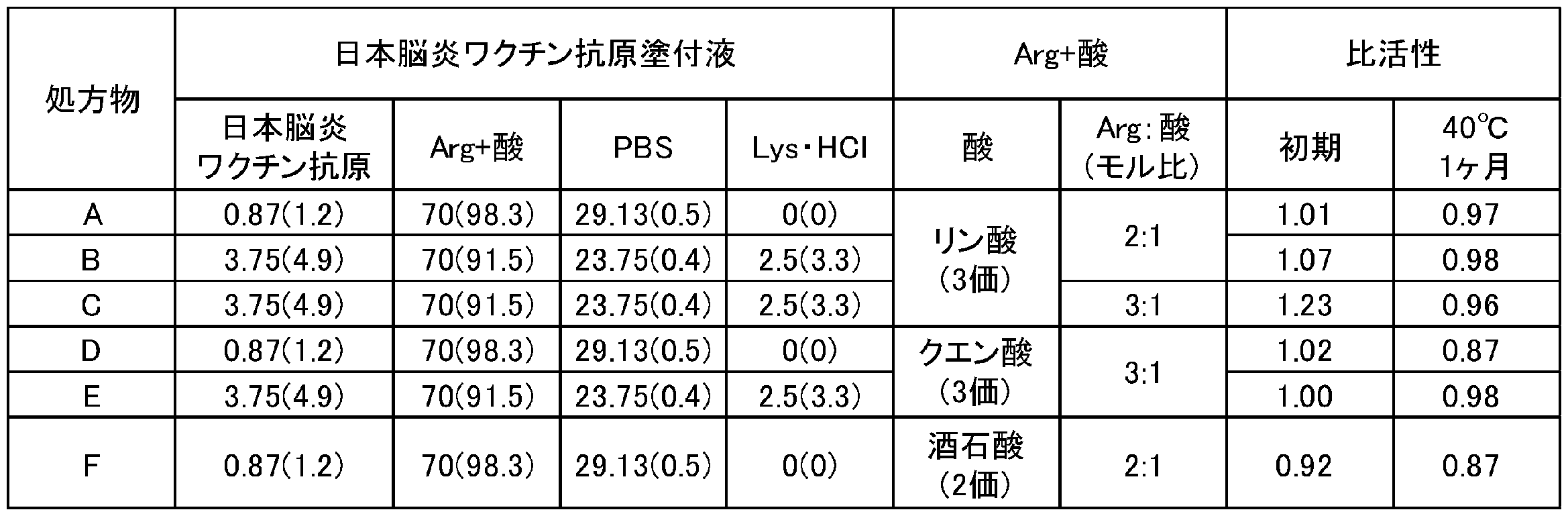
- the compounding ratio (unit: mass%) of each component and the molar ratio of Arg + acid are as shown in Table 6.
- the obtained Japanese encephalitis vaccine antigen coating solution was applied to microneedles (height: about 500 ⁇ m, density: 640 lines / cm 2 , square pyramid shape) and dried to obtain formulations A to F.
- the numerical values in parentheses for each component in Table 6 indicate the blending ratio (unit: mass%) after drying.
- Formulations A to F were encapsulated together with Pharmakeep (Mitsubishi Gas Chemical Co., Ltd., trade name) in Moist Catch (Kyodo Printing Co., Ltd., trade name) and stored at 40 ° C. for 1 month.
- the stability was evaluated by extracting Japanese encephalitis vaccine antigen from a microneedle with an extract (0.01% by weight Tween 80/1% by weight trehalose / PBS), then measuring the E antigen content (ELISA method) and quantifying protein (Lowry).
- the E) content per protein content was defined as the specific activity, and the initial value was compared with the value after one month at 40 ° C.
- FIG. 4 is a graph showing the degree of influence on the specific activity of lysine hydrochloride.
- a PBS (phosphate buffered saline) solution of Japanese encephalitis vaccine antigen was used as the drug substance.
- This drug substance was concentrated by ultrafiltration, and prepared by mixing arginine, phosphoric acid, and lysine hydrochloride at the time of concentration, and lyophilized and redissolved to prepare a Japanese encephalitis vaccine antigen coating solution.
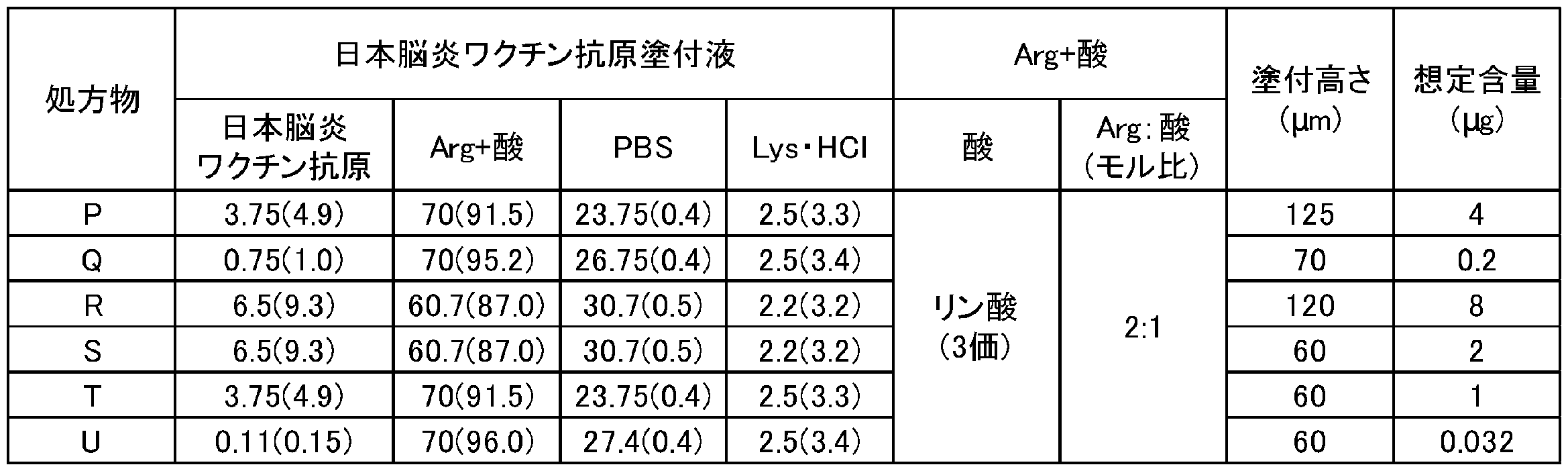
- the compounding ratio (unit: mass%) of each component and the molar ratio of Arg + acid are as shown in Table 8.
- the obtained Japanese encephalitis vaccine antigen coating solution is applied to microneedles (height: about 500 ⁇ m, density: 640 lines / cm 2 , square pyramid shape), and the formulation P is coated with a coating height of 125 ⁇ m and an assumed content of 4 ⁇ g.
- Formulation Q with a coating height of 70 ⁇ m, an assumed content of 0.2 ⁇ g, a coating height of 120 ⁇ m, a formulation R of an assumed content of 8 ⁇ g, a coating height of 60 ⁇ m, a formulation S with an assumed content of 2 ⁇ g, a coating height of 60 ⁇ m, an assumption A formulation T having a content of 1 ⁇ g and a coating height of 60 ⁇ m and an expected content of 0.032 ⁇ g were obtained.
- the stability was evaluated by extracting Japanese encephalitis vaccine antigen from a microneedle with an extract (0.01% by weight Tween 80/1% by weight trehalose / PBS), then measuring the E antigen content (ELISA method) and quantifying protein (Lowry). And the E antigen content per protein content was made specific activity.
- specific activities of low-dose formulations Q and U were determined by calculation from the measured amino acid content and the compounding ratio in the formulation, instead of the protein content measured by the Lowry method.
- the amino acid content was determined by the OPA (orthophthalaldehyde) method.
Landscapes
- Health & Medical Sciences (AREA)
- Life Sciences & Earth Sciences (AREA)
- Chemical & Material Sciences (AREA)
- General Health & Medical Sciences (AREA)
- Medicinal Chemistry (AREA)
- Pharmacology & Pharmacy (AREA)
- Veterinary Medicine (AREA)
- Public Health (AREA)
- Animal Behavior & Ethology (AREA)
- Epidemiology (AREA)
- Engineering & Computer Science (AREA)
- General Chemical & Material Sciences (AREA)
- Chemical Kinetics & Catalysis (AREA)
- Virology (AREA)
- Dermatology (AREA)
- Oil, Petroleum & Natural Gas (AREA)
- Immunology (AREA)
- Microbiology (AREA)
- Organic Chemistry (AREA)
- Wood Science & Technology (AREA)
- Genetics & Genomics (AREA)
- Mycology (AREA)
- Proteomics, Peptides & Aminoacids (AREA)
- Bioinformatics & Cheminformatics (AREA)
- Zoology (AREA)
- Biotechnology (AREA)
- Biomedical Technology (AREA)
- Biochemistry (AREA)
- General Engineering & Computer Science (AREA)
- Communicable Diseases (AREA)
- Oncology (AREA)
- Nuclear Medicine, Radiotherapy & Molecular Imaging (AREA)
- Molecular Biology (AREA)
- Medicinal Preparation (AREA)
- Medicines Containing Antibodies Or Antigens For Use As Internal Diagnostic Agents (AREA)
Abstract
Description
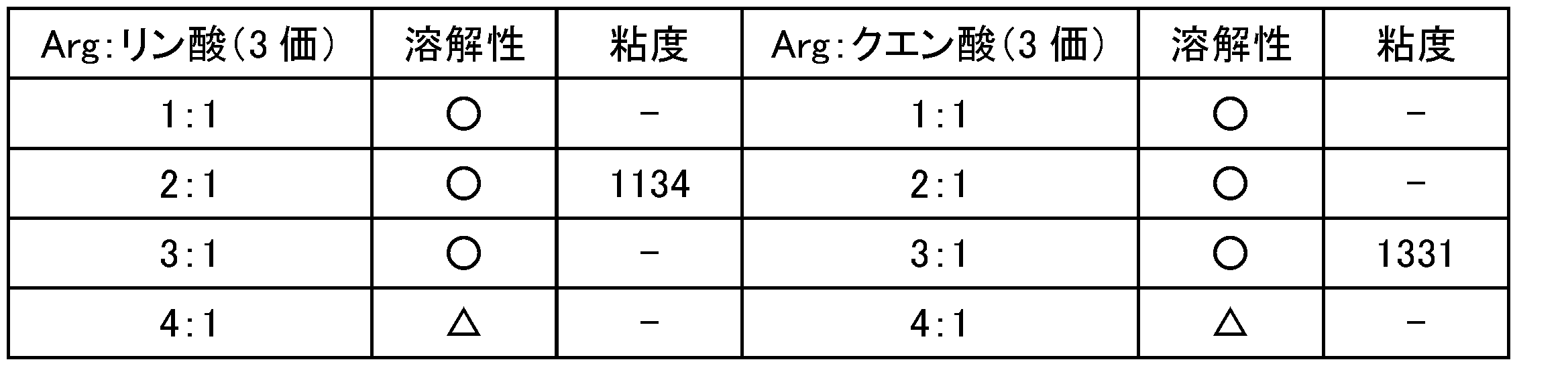
アルギニンと表1~3に示す酸(N価)を、アルギニン:酸=N:1の比率で混合し、精製水を加え20%w/wのアルギニン-酸の希薄液を調製した後、凍結乾燥によって水分を蒸発させ凍結乾燥固体を作製した。この凍結乾燥固体に、アルギニンと酸の混合物(Arg+酸):水=7:3の比率で精製水を添加して、アルギニンと酸の混合物(Arg+酸)の高濃度溶液を調製した。表中、「溶解性」はその結果を示し、完全溶解し高濃度溶液の調製が可能であったものを「○」、一部溶解したものを「△」とした。



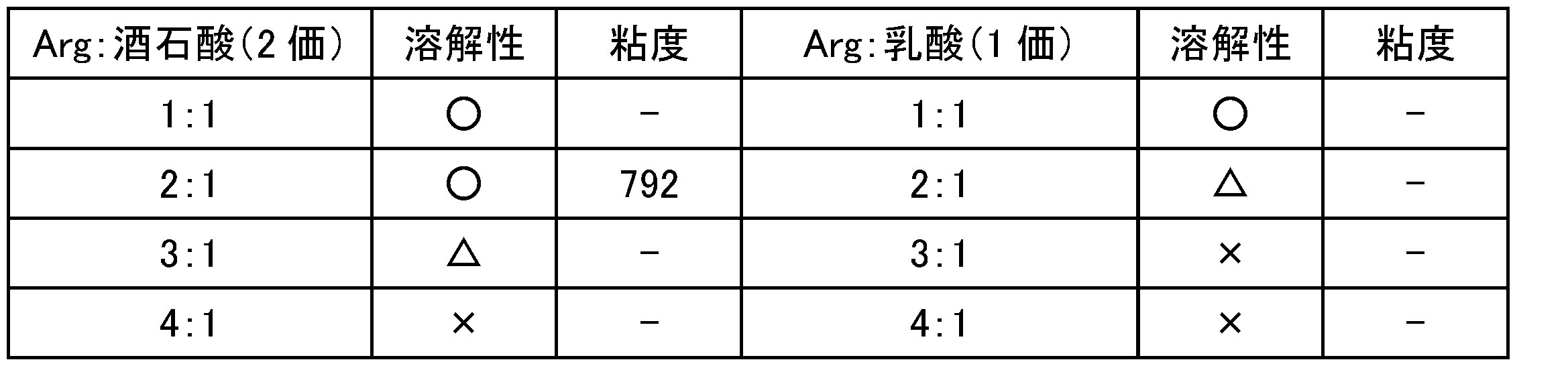
アルギニンと酸を表4、5に示すモル比で混合し、精製水を加え20%w/wのアルギニン-酸の希薄液を調製した後、凍結乾燥によって水分を蒸発させ凍結乾燥固体を作製した。この凍結乾燥固体に、アルギニンと酸の混合物(Arg+酸):水=7:3の比率で精製水を添加して、アルギニンと酸の混合物(Arg+酸)の高濃度溶液を調製した。表中、「溶解性」はその結果を示し、完全溶解し高濃度溶液の調製が可能であったものを「○」、一部溶解したものを「△」、ほとんど溶解しなかったものを「×」とした。また、表中、「粘度」は微量サンプル粘度計(VROC、RheoSense社製)を用いて測定したものであり、単位は「mPa・s」である。
また、上記アルギニンと酸の混合物(Arg+酸、アルギニン:リン酸=2:1、アルギニン:クエン酸=3:1、アルギニン:酒石酸=2:1)の高濃度溶液をマイクロニードル(高さ約500μm、密度640本/cm2、四角錐形状)に塗付し、顕微鏡(VH-8000、KEYENCE社製)を用いて、マイクロニードルの針先を観察した。観察の結果、コーティング層がマイクロニードルの先端部分に形成されていることが確認され、アルギニンと酸の混合物が針先塗付に適したものであることが判明した。
アルギニンと酸とを配合した日本脳炎ワクチン抗原塗付液をマイクロニードル上に塗付し、安定性を評価した。
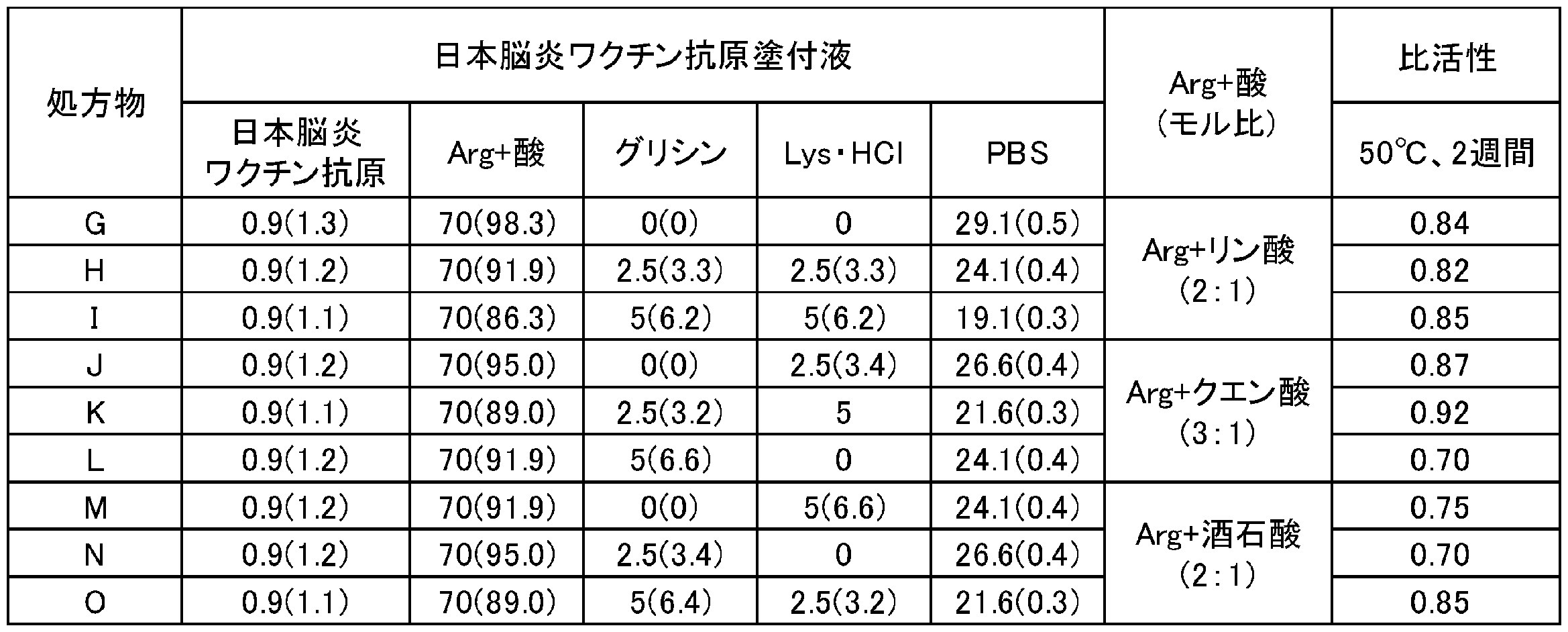
各成分の配合比(単位:質量%)及びアルギニンと酸とのモル比を表7に示す70質量%配合した日本脳炎ワクチン抗原塗付液をマイクロニードル上に塗付し、リジン塩酸塩の配合効果についてL9直交表を用いて評価した。なお、表7の各成分における括弧内の数値は揮発成分を除去した後の配合比(単位:質量%)を示す。
日本脳炎ワクチン抗原のPBS溶液を原薬とし、これを限外ろ過濃縮したものに、所定量の添加剤を加えて混合したものをマイクロニードルの塗付液とした。これをポリ乳酸製のマイクロニードル(高さ約500μm、密度640本/cm2、四角錐形状)に相対湿度80~85%の環境下にて針先に塗付した。乾燥後、モイストキャッチ(共同印刷株式会社、商品名)内にファーマキープ(三菱ガス化学株式会社、商品名)とともに封入し、各温度条件での安定性を評価した。マイクロニードルより日本脳炎ワクチン抗原を抽出液(0.01%Tween80/1%トレハロース/PBS)にて抽出後、E抗原含量測定(ELISA法)及びたん白質定量(Lowry法)を行い、たん白質含量あたりのE抗原含量を比活性として評価した。50℃2週間保存検体の比活性の値について、リジン塩酸塩の配合が比活性に及ぼす影響度を最小二乗法により解析した。図4は、リジン塩酸塩の比活性に及ぼす影響度を示すグラフである。リジン塩酸塩について、2.5又は5.0%配合した場合に、50℃2週間保存検体の比活性への影響度が高かったことから、リジン塩酸塩について安定性向上効果が確認された。
アルギニンと酸とを配合した日本脳炎ワクチン抗原塗付液をマイクロニードル上に塗付し、4μg製剤及び0.2μg製剤の2用量の製剤の安定性を評価した。2用量の製剤の作製は日本脳炎ワクチン抗原塗付液の抗原濃度及び塗付高さを調整して行った。

Claims (7)
- 日本脳炎ワクチン抗原、塩基性アミノ酸及び酸を含有し、
前記塩基性アミノ酸1モルに対する前記酸のモル数が、前記酸の価数をNとしたときに、1/(N+1)を超え2未満である、マイクロニードルコーティング用組成物。 - 前記酸は、融点が40℃以上の酸である、請求項1に記載のマイクロニードルコーティング用組成物。
- 前記酸は、リン酸、乳酸、安息香酸、マレイン酸、クエン酸、酒石酸、コハク酸、アスコルビン酸及びアスパラギン酸からなる群より選ばれる少なくとも1種の酸である、請求項1又は2に記載のマイクロニードルコーティング用組成物。
- 前記塩基性アミノ酸は、アルギニンである、請求項1~3のいずれか一項に記載のマイクロニードルコーティング用組成物。
- リジン又はリジン塩酸塩を含有する、請求項1~4のいずれか一項に記載のマイクロニードルコーティング用組成物。
- マイクロニードル上に、請求項1~5のいずれか一項に記載のマイクロニードルコーティング用組成物から形成されるコーティング層を備える、マイクロニードルデバイス。
- 前記コーティング層は、前記マイクロニードルの先端部分に形成されている、請求項6に記載のマイクロニードルデバイス。
Priority Applications (9)
| Application Number | Priority Date | Filing Date | Title |
|---|---|---|---|
| US14/766,922 US9849170B2 (en) | 2013-02-13 | 2014-02-12 | Microneedle coating composition and microneedle device |
| SG11201506326YA SG11201506326YA (en) | 2013-02-13 | 2014-02-12 | Microneedle coating composition and microneedle device |
| KR1020157024908A KR101948972B1 (ko) | 2013-02-13 | 2014-02-12 | 마이크로 니들 코팅용 조성물 및 마이크로 니들 디바이스 |
| CN201480008603.4A CN104994880B (zh) | 2013-02-13 | 2014-02-12 | 微针涂敷用组合物及微针装置 |
| JP2015500259A JP6175485B2 (ja) | 2013-02-13 | 2014-02-12 | マイクロニードルコーティング用組成物及びマイクロニードルデバイス |
| EP14751836.9A EP2957298B1 (en) | 2013-02-13 | 2014-02-12 | Microneedle coating composition and microneedle device |
| CA2900920A CA2900920C (en) | 2013-02-13 | 2014-02-12 | Microneedle coating composition and microneedle device |
| AU2014217108A AU2014217108B2 (en) | 2013-02-13 | 2014-02-12 | Microneedle coating composition and microneedle device |
| PH12015501765A PH12015501765B1 (en) | 2013-02-13 | 2015-08-12 | Microneedle coating composition and microneedle device |
Applications Claiming Priority (2)
| Application Number | Priority Date | Filing Date | Title |
|---|---|---|---|
| JP2013025955 | 2013-02-13 | ||
| JP2013-025955 | 2013-02-13 |
Publications (1)
| Publication Number | Publication Date |
|---|---|
| WO2014126105A1 true WO2014126105A1 (ja) | 2014-08-21 |
Family
ID=51354104
Family Applications (1)
| Application Number | Title | Priority Date | Filing Date |
|---|---|---|---|
| PCT/JP2014/053198 Ceased WO2014126105A1 (ja) | 2013-02-13 | 2014-02-12 | マイクロニードルコーティング用組成物及びマイクロニードルデバイス |
Country Status (12)
| Country | Link |
|---|---|
| US (1) | US9849170B2 (ja) |
| EP (1) | EP2957298B1 (ja) |
| JP (1) | JP6175485B2 (ja) |
| KR (1) | KR101948972B1 (ja) |
| CN (1) | CN104994880B (ja) |
| AU (1) | AU2014217108B2 (ja) |
| CA (1) | CA2900920C (ja) |
| MY (1) | MY173041A (ja) |
| PH (1) | PH12015501765B1 (ja) |
| SG (1) | SG11201506326YA (ja) |
| TW (1) | TWI621445B (ja) |
| WO (1) | WO2014126105A1 (ja) |
Cited By (2)
| Publication number | Priority date | Publication date | Assignee | Title |
|---|---|---|---|---|
| WO2015129807A1 (ja) * | 2014-02-27 | 2015-09-03 | 久光製薬株式会社 | マイクロニードル |
| WO2017090767A1 (ja) * | 2015-11-27 | 2017-06-01 | 日東電工株式会社 | インフルエンザワクチン乾燥製剤、及び、インフルエンザワクチン乾燥製剤の製造方法 |
Families Citing this family (6)
| Publication number | Priority date | Publication date | Assignee | Title |
|---|---|---|---|---|
| WO2017115583A1 (ja) * | 2015-12-28 | 2017-07-06 | セイコーエプソン株式会社 | 液体供給ユニット |
| KR20170115429A (ko) | 2016-04-07 | 2017-10-17 | 랩앤피플주식회사 | 생체분해성 금속을 이용한 마이크로 니들 |
| US11266344B2 (en) | 2016-09-21 | 2022-03-08 | Samsung Electronics Co., Ltd. | Method for measuring skin condition and electronic device therefor |
| WO2019225948A1 (ko) | 2018-05-21 | 2019-11-28 | 랩앤피플주식회사 | 여드름 완화 및 예방용 패치 |
| KR102310566B1 (ko) | 2018-05-21 | 2021-10-08 | 랩앤피플주식회사 | 여드름 완화 및 예방용 패치 |
| EP3856322A1 (en) * | 2018-09-24 | 2021-08-04 | L'oreal | Device comprising microneedles for in-situ reaction of a skin |
Citations (7)
| Publication number | Priority date | Publication date | Assignee | Title |
|---|---|---|---|---|
| JP2007511508A (ja) | 2003-11-13 | 2007-05-10 | アルザ・コーポレーシヨン | 経皮送達のための組成物及び装置 |
| JP2007527392A (ja) | 2003-06-30 | 2007-09-27 | アルザ・コーポレーシヨン | 非揮発性の対イオンを含有する被覆された微小突起のための製剤 |
| JP2007536988A (ja) | 2004-05-13 | 2007-12-20 | アルザ コーポレイション | 副甲状腺ホルモン剤の経皮送達のための装置および方法 |
| JP2008528509A (ja) | 2005-01-21 | 2008-07-31 | アルザ コーポレイション | 少なくとも1つの対イオンを含む、向上した安定性でマイクロニードルをコーティングするための治療用ペプチド製剤 |
| US20080213461A1 (en) | 2005-06-17 | 2008-09-04 | Georgia Tech Research Corporation | Coated Microstructures and Methods of Manufacture Thereof |
| WO2010013601A1 (ja) * | 2008-07-30 | 2010-02-04 | 久光製薬株式会社 | マイクロニードルデバイスおよびマイクロニードルデバイスによる日本脳炎ウイルス抗原の奏功性を上昇させる方法 |
| WO2011150144A2 (en) | 2010-05-28 | 2011-12-01 | 3M Innovative Properties Company | Aqueous formulations for coating microneedle arrays |
Family Cites Families (1)
| Publication number | Priority date | Publication date | Assignee | Title |
|---|---|---|---|---|
| AU2012345768B2 (en) * | 2011-11-30 | 2016-05-12 | Kindeva Drug Delivery L.P. | Microneedle device having a peptide therapeutic agent and an amino acid, methods of making and using the same |
-
2014
- 2014-02-12 WO PCT/JP2014/053198 patent/WO2014126105A1/ja not_active Ceased
- 2014-02-12 KR KR1020157024908A patent/KR101948972B1/ko active Active
- 2014-02-12 JP JP2015500259A patent/JP6175485B2/ja active Active
- 2014-02-12 CA CA2900920A patent/CA2900920C/en active Active
- 2014-02-12 CN CN201480008603.4A patent/CN104994880B/zh active Active
- 2014-02-12 US US14/766,922 patent/US9849170B2/en active Active
- 2014-02-12 AU AU2014217108A patent/AU2014217108B2/en active Active
- 2014-02-12 SG SG11201506326YA patent/SG11201506326YA/en unknown
- 2014-02-12 EP EP14751836.9A patent/EP2957298B1/en active Active
- 2014-02-12 MY MYPI2015702622A patent/MY173041A/en unknown
- 2014-02-13 TW TW103104725A patent/TWI621445B/zh active
-
2015
- 2015-08-12 PH PH12015501765A patent/PH12015501765B1/en unknown
Patent Citations (7)
| Publication number | Priority date | Publication date | Assignee | Title |
|---|---|---|---|---|
| JP2007527392A (ja) | 2003-06-30 | 2007-09-27 | アルザ・コーポレーシヨン | 非揮発性の対イオンを含有する被覆された微小突起のための製剤 |
| JP2007511508A (ja) | 2003-11-13 | 2007-05-10 | アルザ・コーポレーシヨン | 経皮送達のための組成物及び装置 |
| JP2007536988A (ja) | 2004-05-13 | 2007-12-20 | アルザ コーポレイション | 副甲状腺ホルモン剤の経皮送達のための装置および方法 |
| JP2008528509A (ja) | 2005-01-21 | 2008-07-31 | アルザ コーポレイション | 少なくとも1つの対イオンを含む、向上した安定性でマイクロニードルをコーティングするための治療用ペプチド製剤 |
| US20080213461A1 (en) | 2005-06-17 | 2008-09-04 | Georgia Tech Research Corporation | Coated Microstructures and Methods of Manufacture Thereof |
| WO2010013601A1 (ja) * | 2008-07-30 | 2010-02-04 | 久光製薬株式会社 | マイクロニードルデバイスおよびマイクロニードルデバイスによる日本脳炎ウイルス抗原の奏功性を上昇させる方法 |
| WO2011150144A2 (en) | 2010-05-28 | 2011-12-01 | 3M Innovative Properties Company | Aqueous formulations for coating microneedle arrays |
Non-Patent Citations (1)
| Title |
|---|
| See also references of EP2957298A4 |
Cited By (2)
| Publication number | Priority date | Publication date | Assignee | Title |
|---|---|---|---|---|
| WO2015129807A1 (ja) * | 2014-02-27 | 2015-09-03 | 久光製薬株式会社 | マイクロニードル |
| WO2017090767A1 (ja) * | 2015-11-27 | 2017-06-01 | 日東電工株式会社 | インフルエンザワクチン乾燥製剤、及び、インフルエンザワクチン乾燥製剤の製造方法 |
Also Published As
| Publication number | Publication date |
|---|---|
| CA2900920C (en) | 2018-08-21 |
| PH12015501765A1 (en) | 2015-11-09 |
| US9849170B2 (en) | 2017-12-26 |
| TW201505651A (zh) | 2015-02-16 |
| EP2957298A1 (en) | 2015-12-23 |
| AU2014217108B2 (en) | 2017-06-15 |
| CN104994880B (zh) | 2018-04-03 |
| JP6175485B2 (ja) | 2017-08-02 |
| TWI621445B (zh) | 2018-04-21 |
| AU2014217108A1 (en) | 2015-08-27 |
| JPWO2014126105A1 (ja) | 2017-02-02 |
| CA2900920A1 (en) | 2014-08-21 |
| EP2957298B1 (en) | 2018-11-28 |
| US20160000898A1 (en) | 2016-01-07 |
| EP2957298A4 (en) | 2016-09-14 |
| SG11201506326YA (en) | 2015-09-29 |
| KR20150121053A (ko) | 2015-10-28 |
| MY173041A (en) | 2019-12-20 |
| PH12015501765B1 (en) | 2019-01-11 |
| KR101948972B1 (ko) | 2019-02-15 |
| CN104994880A (zh) | 2015-10-21 |
Similar Documents
| Publication | Publication Date | Title |
|---|---|---|
| JP6175485B2 (ja) | マイクロニードルコーティング用組成物及びマイクロニードルデバイス | |
| JP6246784B2 (ja) | マイクロニードルコーティング用組成物及びマイクロニードルデバイス | |
| JP6121734B2 (ja) | マイクロニードル用ゾルミトリプタン含有コーティング組成物及びマイクロニードルデバイス | |
| TWI702061B (zh) | 微針裝置 | |
| KR20120138235A (ko) | 마이크로 니들 디바이스 및 그 제조 방법 | |
| JP5675952B2 (ja) | マイクロニードルデバイス用glp−1アナログ組成物 | |
| TW200528154A (en) | Composition and apparatus for transdermal delivery | |
| TWI655953B (zh) | 含有基因重組型卵泡刺激激素之微針裝置 | |
| TWI631965B (zh) | 微針裝置及其製造方法 |
Legal Events
| Date | Code | Title | Description |
|---|---|---|---|
| 121 | Ep: the epo has been informed by wipo that ep was designated in this application |
Ref document number: 14751836 Country of ref document: EP Kind code of ref document: A1 |
|
| ENP | Entry into the national phase |
Ref document number: 2015500259 Country of ref document: JP Kind code of ref document: A |
|
| WWE | Wipo information: entry into national phase |
Ref document number: 14766922 Country of ref document: US |
|
| ENP | Entry into the national phase |
Ref document number: 2900920 Country of ref document: CA |
|
| NENP | Non-entry into the national phase |
Ref country code: DE |
|
| ENP | Entry into the national phase |
Ref document number: 2014217108 Country of ref document: AU Date of ref document: 20140212 Kind code of ref document: A |
|
| WWE | Wipo information: entry into national phase |
Ref document number: IDP00201505564 Country of ref document: ID Ref document number: 2014751836 Country of ref document: EP |
|
| ENP | Entry into the national phase |
Ref document number: 20157024908 Country of ref document: KR Kind code of ref document: A |