WO2014129101A1 - 体毛用光美容装置 - Google Patents
体毛用光美容装置 Download PDFInfo
- Publication number
- WO2014129101A1 WO2014129101A1 PCT/JP2014/000094 JP2014000094W WO2014129101A1 WO 2014129101 A1 WO2014129101 A1 WO 2014129101A1 JP 2014000094 W JP2014000094 W JP 2014000094W WO 2014129101 A1 WO2014129101 A1 WO 2014129101A1
- Authority
- WO
- WIPO (PCT)
- Prior art keywords
- light
- wavelength range
- body hair
- peak
- cosmetic
- Prior art date
- Legal status (The legal status is an assumption and is not a legal conclusion. Google has not performed a legal analysis and makes no representation as to the accuracy of the status listed.)
- Ceased
Links
Images




Classifications
-
- A—HUMAN NECESSITIES
- A61—MEDICAL OR VETERINARY SCIENCE; HYGIENE
- A61N—ELECTROTHERAPY; MAGNETOTHERAPY; RADIATION THERAPY; ULTRASOUND THERAPY
- A61N5/00—Radiation therapy
- A61N5/06—Radiation therapy using light
- A61N5/0613—Apparatus adapted for a specific treatment
- A61N5/0616—Skin treatment other than tanning
- A61N5/0617—Hair treatment
-
- A—HUMAN NECESSITIES
- A61—MEDICAL OR VETERINARY SCIENCE; HYGIENE
- A61B—DIAGNOSIS; SURGERY; IDENTIFICATION
- A61B18/00—Surgical instruments, devices or methods for transferring non-mechanical forms of energy to or from the body
- A61B2018/00315—Surgical instruments, devices or methods for transferring non-mechanical forms of energy to or from the body for treatment of particular body parts
- A61B2018/00452—Skin
- A61B2018/00476—Hair follicles
-
- A—HUMAN NECESSITIES
- A61—MEDICAL OR VETERINARY SCIENCE; HYGIENE
- A61B—DIAGNOSIS; SURGERY; IDENTIFICATION
- A61B18/00—Surgical instruments, devices or methods for transferring non-mechanical forms of energy to or from the body
- A61B18/18—Surgical instruments, devices or methods for transferring non-mechanical forms of energy to or from the body by applying electromagnetic radiation, e.g. microwaves
- A61B2018/1807—Surgical instruments, devices or methods for transferring non-mechanical forms of energy to or from the body by applying electromagnetic radiation, e.g. microwaves using light other than laser radiation
-
- A—HUMAN NECESSITIES
- A61—MEDICAL OR VETERINARY SCIENCE; HYGIENE
- A61N—ELECTROTHERAPY; MAGNETOTHERAPY; RADIATION THERAPY; ULTRASOUND THERAPY
- A61N5/00—Radiation therapy
- A61N5/06—Radiation therapy using light
- A61N2005/0635—Radiation therapy using light characterised by the body area to be irradiated
- A61N2005/0643—Applicators, probes irradiating specific body areas in close proximity
- A61N2005/0644—Handheld applicators
-
- A—HUMAN NECESSITIES
- A61—MEDICAL OR VETERINARY SCIENCE; HYGIENE
- A61N—ELECTROTHERAPY; MAGNETOTHERAPY; RADIATION THERAPY; ULTRASOUND THERAPY
- A61N5/00—Radiation therapy
- A61N5/06—Radiation therapy using light
- A61N2005/0658—Radiation therapy using light characterised by the wavelength of light used
- A61N2005/0662—Visible light
Definitions
- the present invention relates to a photocosmetic device for body hair.
- Patent Document 1 discloses a conventional photocosmetic device for body hair.
- the photocosmetic device for body hair of Patent Document 1 is configured to irradiate light having a wavelength range of 400 nm to 600 nm and an energy density range of 0.01 to 1 (J / cm 2 ) near the hair root. .
- Patent Document 1 describes absorption of melanin in paragraph [0016], but the absorption of melanin has not been studied in association with skin side effects and suppression of body hair growth.
- An object of the present invention is to provide a photocosmetic device for body hair that is less likely to cause undesirable side effects on the skin and that can suppress the growth of body hair.
- the photocosmetic device for body hair includes an optical system that irradiates cosmetic light for body hair, and the integrated value of the intensity of the cosmetic light for body hair in the wavelength range of 400 nm to 700 nm is in the wavelength range of 700 nm to 1200 nm.
- the integrated value of the intensity of the cosmetic light for body hair in the wavelength range of 400 nm to 500 nm is smaller than that in the wavelength range of 500 nm to 600 nm.
- the cosmetic light for body hair has a plurality of intensity peaks in a wavelength range of 400 nm to 700 nm, and a maximum intensity peak among the plurality of intensity peaks is in a wavelength range of 500 nm to 600 nm.
- the cosmetic light for body hair has a plurality of intensity peaks in a wavelength range of 400 nm to 700 nm, and a minimum intensity peak among the plurality of intensity peaks is in a wavelength range of 400 nm to 500 nm.
- the cosmetic light for body hair does not have a light intensity peak in the wavelength range of 400 nm to 440 nm corresponding to the first absorption peak of oxyhemoglobin.
- the cosmetic light for body hair does not have a light intensity peak in the wavelength range of 530 nm to 570 nm including the second absorption peak of oxyhemoglobin.
- the hair cosmetic light has an energy density of 0.2J / cm 2 ⁇ 1.5J / cm 2.
- the inventor of the present application examined the absorption spectrum of oxyhemoglobin and the light absorption rate of melanin, and identified the spectrum of cosmetic light for body hair based on the findings obtained from the results.
- the inventor of the present application summarized the experimental results and the like obtained for oxygenated hemoglobin and melanin, and summarized the relationship between the side effect suppressing effect and the cosmetic effect promoting effect and the spectrum of cosmetic light for body hair as follows.
- the term side effect-suppressing effect refers to an effect that makes it difficult to cause undesirable side effects on the skin.
- cosmetic effect promoting effect refers to the effect of suppressing the growth of body hair by promoting the body hair cosmetic effect.
- body hair cosmetic effect refers to the body's hair suppression or hair removal effect.
- hair suppression refers to a phenomenon in which body hair regeneration and growth in a living body are suppressed.
- Hair loss refers to a phenomenon in which body hair is removed from a living body.
- Unfavorable side effects on the skin correlate with the amount of light energy absorbed by oxyhemoglobin.
- Undesirable side effects on the skin may be accelerated as the amount of light energy absorbed by oxyhemoglobin increases.
- Light in the wavelength range of 400 nm to 500 nm is more easily absorbed by oxyhemoglobin than light in the wavelength range of 500 nm to 600 nm and light in the wavelength range of 600 nm to 700 nm. For this reason, when the focus is on suppressing undesirable side effects on the skin, it is preferable that the amount of light energy at short wavelengths is small in the wavelength range of 400 nm to 700 nm.
- Body hair cosmetic action correlates with the amount of light energy absorbed by melanin.
- the body hair cosmetic effect may be promoted as the amount of light energy absorbed by body hair melanin increases.
- melanin of body hair tends to absorb light as the wavelength of the irradiated light becomes shorter.
- the amount of light energy in the short wavelength range is large in the wavelength range of 400 nm to 700 nm.
- the above items indicate the following.
- the amount of light energy in the wavelength range of 400 nm to 500 nm is small, the light irradiated to the body hair is less likely to cause undesirable side effects on the skin.
- the amount of light energy absorbed by melanin is reduced, there is a high possibility that the hair cosmetic effect is insufficient.
- the amount of light energy in the wavelength range of 400 nm to 500 nm is large, the light irradiating the body hair can easily promote the body hair cosmetic effect.
- an increase in the amount of light energy absorbed by oxyhemoglobin increases the risk of undesirable side effects on the skin.
- the inventor of the present invention has cosmetic light for body hair having an appropriate balance between the amount of light energy absorbed by oxyhemoglobin and the amount of light energy absorbed by melanin, that is, a side effect suppressing effect and a beauty action promoting effect.
- the cosmetic light for body hair to be played together was specified.
- the inventor of the present application has defined this cosmetic light for body hair by the relationship between the amount of light energy in the wavelength range of 400 nm to 500 nm and the amount of light energy in the wavelength range of 500 nm to 600 nm.
- the amount of light energy in the wavelength range of 400 nm to 500 nm is smaller than the amount of light energy in the wavelength range of 500 nm to 600 nm.
- the amount of light energy can be defined by the integrated value of the intensity in the wavelength range of 400 nm to 500 nm and the integrated value of the intensity in the wavelength range of 500 nm to 600 nm.
- cosmetic light for body hair has a smaller amount of light energy in the wavelength range of 400 nm to 500 nm than that in the wavelength range of 500 nm to 600 nm, it is less likely to be absorbed by oxyhemoglobin and cause undesirable side effects on the skin.
- the cosmetic light for body hair has a larger integrated value of intensity in the wavelength range of 400 nm to 700 nm than that in the wavelength range of 700 nm to 1200 nm, so that it is easy to promote the body hair cosmetic effect.
- the photocosmetic device for body hair of the present invention is less likely to cause undesirable side effects on the skin and can suppress the growth of body hair.
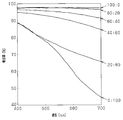
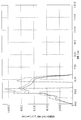
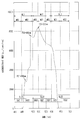
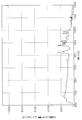
- the schematic diagram of the photocosmetic device for body hair of 1st Embodiment The graph which shows the absorption spectrum of oxyhemoglobin. The graph for demonstrating the light absorption of various body hair. 6 is a graph showing the spectrum of cosmetic light for body hair irradiated from the photocosmetic device for body hair according to the first to third embodiments. The graph which shows a part of spectrum of the cosmetic light for body hair irradiated from the photo cosmetic device for body hair of 1st Embodiment. The graph which shows a part of spectrum of the cosmetic light for body hair irradiated from the photo cosmetic device for body hair of 2nd Embodiment. The graph which shows a part of spectrum of the cosmetic light for body hair irradiated from the photo cosmetic device for body hair of 3rd Embodiment. The graph which shows the spectrum of the light irradiated from the apparatus of the comparative example.
- the photocosmetic device 10 for body hair has, for example, the configuration shown in FIG.
- the photocosmetic device 10 for body hair includes an optical system configured to irradiate a living body with cosmetic light for body hair for promoting a body hair cosmetic operation.
- the photocosmetic device 10 for body hair includes a main unit 20, a light source unit 30, a power supply circuit unit 40, and a control unit 50.
- the main unit 20 has a shape that can be gripped by a user, for example.
- the main body unit 20 includes, for example, a main body housing 21 and a main body side connector 22.
- the main unit 20 has a structure in which a plurality of components are integrated.
- the main body housing 21 is made of, for example, a resin material.
- the main body housing 21 has a vertically long shape.
- the main body housing 21 has a space inside.
- the main body housing 21 accommodates the power supply circuit unit 40 and the control unit 50 in the internal space.
- the main body side connector 22 is coupled to the main body housing 21.
- the main body side connector 22 is electrically connected to the power supply circuit unit 40.
- the main body side connector 22 has a structure that can be mechanically coupled to and separated from the light source side connector 32.
- the main body side connector 22 is electrically connected to the light source side connector 32 when mechanically coupled to the light source side connector 32.
- the light source unit 30 may be an attachment that can be coupled to and separated from the main unit 20, for example.
- the light source unit 30 includes, for example, a light source housing 31, a light source side connector 32, a filter mounting portion 33, a light source 34, a reflector 35, a lens 36, and an optical filter 37.
- the light source unit 30 has a structure in which a plurality of components are integrated.
- the light source unit 30 can replace the optical filter 37 with another optical filter.
- the light source unit 30 can change the spectrum of light emitted from the light source 34 according to the type of the optical filter 37.
- the light source housing 31 is made of, for example, a resin material.
- the light source housing 31 has a shape similar to a cylindrical shape.
- the light source housing 31 has a space inside.
- the light source housing 31 accommodates a light source 34, a reflector 35, and a lens 36 in the internal space.
- the light source housing 31 has a foreign matter intrusion suppression structure, thereby preventing external dust or the like from entering the internal space of the light source housing 31.
- the light source housing 31 absorbs light in a specific wavelength range.
- the light source housing 31 absorbs light in a wavelength range longer than 700 nm, for example.
- the light source housing 31 absorbs light in a wavelength range longer than 700 nm and shorter than 1200 nm, for example.
- the light source side connector 32 is coupled to the light source housing 31.
- the light source side connector 32 is electrically connected to the light source 34.
- the light source side connector 32 has a structure that can be mechanically coupled to and separated from the main body side connector 22.
- the light source side connector 32 is electrically connected to the main body side connector 22 when mechanically coupled to the main body side connector 22.
- the filter mounting portion 33 has a shape similar to an annular shape.
- the filter mounting portion 33 is disposed in the opening of the light source housing 31.
- the filter mounting portion 33 is coupled to the light source housing 31.
- the filter mounting portion 33 has a structure that can be mechanically coupled to and separated from the optical filter 37.
- the light source 34 is disposed in the internal space of the light source housing 31.
- the light source 34 is coupled to the light source housing 31.
- the light source 34 is electrically connected to the light source side connector 32.
- the light source 34 is formed by, for example, a xenon flash lamp, a laser, an LED, or an organic EL.
- the light source 34 is, for example, a xenon flash lamp, and irradiates light including a component having a wavelength range of 400 nm to 1200 nm, for example.
- the reflector 35 is made of a material having a high reflectance, and is made of, for example, a metal material, a resin material, or ceramic.
- the reflector 35 preferably has a surface that is treated to increase the reflectance of light emitted from the light source 34.
- the treated surface can be, for example, a mirrored surface, a surface coated with a metal thin film, or a surface deposited with a metal thin film.
- the reflector 35 is coupled to the inner peripheral surface of the light source housing 31.
- the reflector 35 reflects the light emitted from the light source 34 toward the opening of the light source housing 31.
- the reflector 35 can include a dielectric thin film that reflects light in a specific wavelength range.
- the dielectric thin film reflects, for example, light having a wavelength that contributes to the promotion of the hair cosmetic effect.
- the reflector 35 absorbs light in a wavelength range longer than 700 nm, for example.
- the reflector 35 absorbs light in a wavelength range longer than 700 nm and shorter than 1200 nm, for example.
- the lens 36 has a shape similar to a circular shape.
- the lens 36 is made of a material having a high light transmittance in a specific wavelength range.
- the lens 36 is made of, for example, a material having a high transmittance for light in the wavelength range of visible light to the near infrared wavelength range.
- the lens 36 is made of, for example, acrylic, polycarbonate, or glass.
- the lens 36 is disposed in the internal space of the light source housing 31.
- the lens 36 is coupled to the light source housing 31.
- the lens 36 diffuses the light reflected by the reflector 35 toward the outside of the light source housing 31.
- the lens 36 has a structure for uniformizing the energy density of light measured at an external position at a predetermined distance from the opening of the light source housing 31 (also referred to as an energy density uniforming structure).
- the optical filter 37 is mainly made of glass.
- the optical filter 37 has a shape similar to a circular shape.
- the optical filter 37 is disposed in the opening of the light source housing 31.
- the optical filter 37 is disposed outside the light source housing 31 with respect to the lens 36.
- the optical filter 37 is superimposed on the lens 36.
- the optical filter 37 covers the outer surface of the lens 36.
- the optical filter 37 has a structure that can be mechanically coupled to and separated from the filter mounting portion 33.
- the optical filter 37 is mechanically coupled to the filter mounting portion 33.
- the optical filter 37 may be a wavelength selection filter that absorbs light in a specific wavelength range.
- the optical filter 37 is designed to absorb light having a wavelength outside the range of 400 nm to 700 nm, for example.
- the light absorption structure of the optical filter 37 can be, for example, a structure in which a light absorbing material is mixed in a glass substrate.
- the light absorbing thin film includes, for example, a metal thin film, a dielectric thin film, or a mixed thin film in which a metal and a dielectric are mixed.
- the metal of the metal thin film includes, for example, titanium oxide, zirconium oxide, or aluminum oxide.
- Another example of the light absorption structure has a structure in which a light absorption thin film is formed on the surface of a glass substrate.
- the light-absorbing substance includes, for example, metal fine particles or metal fine particle oxides.
- the metal of the metal fine particles includes, for example, gold, silver, copper, lead, zinc, cobalt, or manganese.
- the light absorbing thin film has a single layer structure or a multilayer structure.
- the multilayer structure of the light absorbing thin film is formed by, for example, vacuum deposition.
- the light absorption structure absorbs light in a wavelength range longer than 700 nm, for example.
- the light absorption structure absorbs light in a wavelength range longer than 700 nm and shorter than 1200 nm, for example.
- the light source housing 31, the reflector 35, and the optical filter 37 absorb light in a wavelength range longer than 700 nm and shorter than 1200 nm. For this reason, compared with the structure assumed that at least one of the light source housing 31 and the reflector 35 does not absorb light, the temperature rise of the optical filter 37 is suppressed.
- the cosmetic light for body hair that has passed through the optical filter 37 preferably has only components contained in the wavelength range of 400 nm to 700 nm.
- the cosmetic light for body hair that has passed through the optical filter 37 may contain components outside the wavelength range of 400 nm to 700 nm.
- a component outside the wavelength range of 400 nm to 700 nm has a sufficiently small amount of light energy as compared with a component included in the wavelength range of 400 nm to 700 nm. For this reason, components outside the wavelength range of 400 nm to 700 nm have a small effect on body hair and skin.
- the power supply circuit unit 40 is accommodated in the internal space of the main body housing 21.
- the power supply circuit unit 40 supplies the light source 34 with power from a power source built in the main body housing 21 or power supplied from an external power source.
- the control unit 50 is accommodated in the internal space of the main body housing 21.
- the controller 50 controls at least one of a voltage and a current supplied to the light source 34 in order to control light irradiation from the light source 34.
- the control unit 50 may determine the total amount of light energy that the light source 34 irradiates in one operation, the time that the light source 34 irradiates light in one operation (hereinafter “irradiation time”), and / or the light source 34.
- the energy density of the irradiated light is adjusted by one operation.
- the irradiation time per time is set in a range of 600 ⁇ s to 2 ms, for example.
- the energy density of light is set in the range of 0.2 to 1.5 (J / cm 2 ), for example.
- the inventor of the present application specified the wavelength of cosmetic light for body hair having a side effect suppressing effect and a cosmetic action promoting effect by experiments.
- the solid line in FIG. 4 and FIG. 5 show the spectrum of the cosmetic light for body hair irradiated from the photocosmetic device for body hair of the first embodiment.
- the broken line of FIG. 4 and FIG. 6 have shown the spectrum of the cosmetic light for body hair irradiated from the photo cosmetic device for body hair of 2nd Embodiment.
- the two-dot chain line in FIG. 4 and FIG. 7 show the spectrum of the cosmetic light for body hair irradiated from the photocosmetic device for body hair of the third embodiment.
- the cosmetic light for body hair is light emitted from the light source 34 and transmitted through the lens 36 and the optical filter 37.
- the inventor of the present application examined the absorption spectrum of oxyhemoglobin and the light absorption rate of melanin, and found cosmetic light for body hair based on the knowledge obtained from the results.
- the matter examined by the present inventor in finding cosmetic light for body hair and the knowledge obtained by the present inventor from this matter will be described.
- FIG. 2 shows an absorption spectrum of oxyhemoglobin.
- Oxyhemoglobin has three absorption peaks PH1, PH2, and PH3 in the wavelength range of 400 nm to 700 nm.
- the first absorption peak PH1 appears in the wavelength range of 400 nm to 440 nm, and has a wavelength of 420 nm, for example.
- the second absorption peak PH2 appears in the wavelength range of 530 nm to 570 nm, and has a wavelength of 540 nm, for example.
- the third absorption peak PH3 appears in the wavelength range of 560 nm to 600 nm, and has a wavelength of, for example, 580 nm.
- the inventor of the present application divided the wavelength range from 400 nm to 700 nm into three, and studied the integrated value of the absorbance of oxyhemoglobin in each wavelength range (hereinafter, “absorbance integrated value”).
- the three types of wavelength ranges are a first wavelength range WL1, a second wavelength range WL2, and a third wavelength range WL3.
- the first wavelength range WL1 is a wavelength range of 400 nm to 500 nm.
- the second wavelength range WL2 is a wavelength range of 500 nm to 600 nm.
- the third wavelength range WL3 is a wavelength range of 600 nm to 700 nm.
- the spectrum of oxyhemoglobin has a first absorbance integrated value SH1 in the first wavelength range WL1.
- the spectrum of oxyhemoglobin has a second absorbance integrated value SH2 in the second wavelength range WL2.
- the spectrum of oxyhemoglobin has a third absorbance integrated value SH3 in the third wavelength range WL3.
- the first absorbance integrated value SH1 is the maximum value among the three absorbance integrated values.
- the second absorbance integrated value SH2 has an intermediate value among the three absorbance integrated values.
- the third absorbance integrated value SH3 is the minimum value of the three absorbance integrated values.
- the inventor of the present application has obtained the following knowledge from the relationship between each absorbance integral value.
- the light in the first wavelength range WL1 is more easily absorbed by oxyhemoglobin than the light in the second wavelength range WL2 and the light in the third wavelength range WL3.
- the living body has a possibility that oxyhemoglobin absorbs light to cause undesirable side effects on the skin. Therefore, the light in the first wavelength range WL1 is more likely to cause undesirable side effects on the skin than the light in the second wavelength range WL2 and the light in the third wavelength range WL3. For this reason, it is preferable that the amount of light energy in the first wavelength range WL1 is smaller than the amount of light energy in the second wavelength range WL2 and the third wavelength range WL3 from the aspect of suppressing undesirable side effects on the skin.
- Body hair contains at least one of two types of pigments.
- the first pigment is eumelanin.
- the second pigment is pheomelanin.
- Eumelanin has a dark brown color.
- Pheomelanin has an orange-red color.
- the color of the body hair changes according to the ratio of eumelanin and pheomelanin (hereinafter “melanin ratio”).
- Hair is mainly classified into 4 types according to color.
- the four types of hair are black hair, chestnut hair, blonde hair, and red hair.
- the four types of hair differ in the content of the two types of pigments as follows.
- Black hair has the highest eumelanin content and the lowest pheomelanin content.
- Black hair contains a lot of eumelanin.
- Black hair contains little or no pheomelanin.
- Brown hair has the second highest eumelanin content and the second lowest pheomelanin content.
- Blond has the second lowest eumelanin content and the second highest pheomelanin content.
- Red hair has the lowest eumelanin content and the highest pheomelanin content. Brown hair, blonde hair, and red hair are high in pheomelanin.
- the inventor of the present application investigated the light absorption rate of various body hairs having different melanin ratios.
- the curves in FIG. 3 have melanin ratios of “100: 0”, “80:20”, “60:40”, “40:60”, “20:80”, and “0: 100” in order from the top.
- the experimental result of body hair is shown.
- the light absorptance can be measured according to the method for measuring absorbance.
- the absorption rate of body hair can be measured with a spectrophotometer.
- the light absorption rate of eumelanin is larger than the light absorption rate of pheomelanin.
- the light absorptivity of eumelanin is hardly affected by the wavelength in the wavelength range of 400 nm to 700 nm.
- the light absorption rate of eumelanin is substantially constant in the wavelength range of 400 nm to 700 nm.
- the light absorption rate of pheomelanin is more susceptible to wavelength than eumelanin in the wavelength range of 400 nm to 700 nm.
- the light absorptivity of femelanin decreases greatly as the wavelength becomes longer in the wavelength range of 400 nm to 700 nm.
- the light absorptance of pheomelanin is approximately half at the wavelength of 400 nm at the wavelength of 700 nm.
- the hair absorbency of light changes in accordance with the melanin ratio in the wavelength range of 400 nm to 700 nm.
- the hair absorbs less light as the proportion of pheomelanin increases.
- the light absorption rate of the hair becomes less susceptible to wavelength as the eumelanin ratio increases.
- the light absorptance of body hair becomes more susceptible to wavelength as the pheomelanin ratio increases.
- the light absorption rate of body hair decreases as the wavelength increases.
- the ratio of pheomelanin increases, the degree of decrease in light absorption with respect to the increase in wavelength increases.
- Body hair cosmetic action varies depending on the amount of light energy absorbed by melanin in body hair.
- the body hair cosmetic action is easily promoted as the amount of light energy absorbed by melanin increases.
- long-wavelength light is difficult to be absorbed by pheomelanin. For this reason, long-wavelength light is unlikely to promote the hair cosmetic action of body hair containing a large amount of pheomelanin.
- the inventor of the present application summarized the above experimental results and the like obtained for oxygenated hemoglobin and melanin, and summarized the relationship between the side effect suppressing effect and the cosmetic effect promoting effect and the spectrum of cosmetic light for body hair as follows.
- Unfavorable side effects on the skin correlate with the amount of light energy absorbed by oxyhemoglobin.
- Undesirable side effects on the skin are likely to be accelerated as the amount of light energy absorbed by oxyhemoglobin increases.
- Light in the wavelength range of 400 nm to 500 nm is more easily absorbed by oxyhemoglobin than light in the wavelength range of 500 nm to 600 nm and light in the wavelength range of 600 nm to 700 nm. For this reason, when the main purpose is to suppress undesirable side effects on the skin, it is preferable that the amount of light energy in the short wavelength range is small in the wavelength range of 400 nm to 700 nm.
- Body hair cosmetic action correlates with the amount of light energy absorbed by melanin.
- the body hair cosmetic action is easily promoted as the amount of light energy absorbed by body hair melanin increases.
- melanin of body hair tends to absorb light as the wavelength of the irradiated light becomes shorter.
- the amount of light energy in the short wavelength range is large in the wavelength range of 400 nm to 700 nm.
- the above items indicate the following.
- the amount of light energy in the wavelength range of 400 nm to 500 nm is small, the light irradiated to the body hair is less likely to cause undesirable side effects on the skin.
- the amount of light energy absorbed by melanin is reduced, there is a high possibility that the hair cosmetic effect is not promoted.
- the amount of light energy in the wavelength range of 400 nm to 500 nm is large, the light irradiated to the body hair is likely to promote the body hair cosmetic effect.
- an increase in the amount of light energy absorbed by oxyhemoglobin increases the risk of undesirable side effects on the skin.
- the inventor of the present application has identified an appropriate balance between the amount of light energy absorbed by oxyhemoglobin and the amount of light energy absorbed by melanin from the above items, that is, the side effect suppressing effect and the cosmetic effect promoting effect together.
- the cosmetic light for body hair to be played was identified.
- This cosmetic light for body hair is defined by the relationship between the amount of light energy in the wavelength range of 400 nm to 500 nm and the amount of light energy in the wavelength range of 500 nm to 600 nm.
- the amount of light energy in the wavelength range of 400 nm to 500 nm is smaller than the amount of light energy in the wavelength range of 500 nm to 600 nm.
- the amount of light can be defined by an integrated value of intensity in the wavelength range of 400 nm to 500 nm and an integrated value of intensity in the wavelength range of 500 nm to 600 nm.
- Cosmetic light for body hair is less likely to be absorbed by oxyhemoglobin because the amount of light energy in the wavelength range of 400 nm to 500 nm is smaller than the amount of light energy in the wavelength range of 500 nm to 600 nm. For this reason, it is difficult to cause undesirable side effects on the skin.
- the cosmetic light for body hair has a preferable amount of light energy in the wavelength range of 400 nm to 700 nm. For this reason, the cosmetic light for body hair makes it easier to promote the hair cosmetic action.
- Cosmetic light for body hair has an effect of suppressing side effects without depending on the relationship between the amount of light energy in the wavelength range of 400 nm to 500 nm and the amount of light energy in the wavelength range of 600 nm to 700 nm.
- An example of cosmetic light for body hair has a light spectrum whose main purpose is to suppress side effects.
- the amount of light energy in the wavelength range of 400 nm to 500 nm is smaller than the amount of light energy in the wavelength range of 600 nm to 700 nm.
- Another example of the cosmetic light for body hair has a light spectrum mainly for the effect of promoting the cosmetic effect.
- the amount of light energy in the wavelength range of 400 nm to 500 nm is larger than the amount of light energy in the wavelength range of 600 nm to 700 nm.
- the photocosmetic device 10 for body hair has the novel features as described above.
- the first novel feature is that the light spectrum is determined so that the balance between the two effects is appropriate, taking into account both the effect of light on oxyhemoglobin and the effect of light on melanin in hair. It is a point.
- the second novel feature is that the relationship of the integrated value of the light intensity in several predetermined wavelength ranges is specified in order to determine the spectrum of cosmetic light for body hair.
- the spectrum of cosmetic light for body hair will be described.
- the intensity of cosmetic light for body hair is defined by, for example, the spectral radiant energy density ( ⁇ J / cm 2 / nm).
- the integrated value of the intensity in the wavelength range of 400 nm to 700 nm is larger than the integrated value of the intensity in the wavelength range of 700 nm to 1200 nm.
- the cosmetic light for body hair has a significant light intensity peak in the wavelength range of 400 nm to 700 nm, and does not have a significant light intensity peak in the wavelength range longer than 700 nm.
- Cosmetic light for body hair can be classified into a wavelength component having a magnitude greater than or equal to a predetermined spectral radiant energy density and a wavelength component having a magnitude less than the predetermined spectral radiant energy density.
- a wavelength component having a magnitude equal to or greater than a predetermined spectral radiant energy density is a component that is considered to have a significant influence on the growth of body hair.
- a wavelength component having a size less than a predetermined spectral radiant energy density is a component that is considered not to have a significant effect on hair growth.
- a significant peak of cosmetic light for body hair is a peak that appears in a wavelength component having a magnitude equal to or greater than a predetermined spectral radiant energy density. In the graphs of FIGS. 4 to 7, the wavelength component having a magnitude less than the predetermined spectral radiant energy density is displayed as zero.
- the cosmetic light for body hair shows the characteristic spectrum shown in FIG.
- the first wavelength range WL1 is divided into a low wavelength range WA1 and a high wavelength range WA2.
- the low wavelength range WA1 is a wavelength range of 400 nm to 440 nm
- the first wavelength range WL1 corresponds to a wavelength range in which the first absorption peak PH1 of oxyhemoglobin appears (see FIG. 2).
- the high wavelength range WA2 is a wavelength range obtained by removing the low wavelength range WA1 from the first wavelength range WL1.
- the second wavelength range WL2 is divided into a second absorption peak range WB1 and a non-second absorption peak range WB2.
- the second absorption peak range WB1 is a wavelength range of 530 nm to 570 nm, and corresponds to a wavelength range in which the second absorption peak PH2 of oxyhemoglobin appears (see FIG. 2).
- the non-second absorption peak range WB2 is a wavelength range obtained by removing the second absorption peak range WB1 from the second wavelength range WL2.
- the third wavelength range WL3 is divided into a high intensity wavelength range WC1 and a low intensity wavelength range WC2.
- the high intensity wavelength range WC1 is a range in which the amount of light energy is large in the third wavelength range WL3, for example, a wavelength range of 600 nm to 650 nm.
- the low intensity wavelength range WC2 is a range in which the amount of light energy is small in the third wavelength range WL3, for example, a wavelength range of 650 nm to 700 nm.
- the cosmetic light for body hair has three light intensity peaks P11, P12, and P13 in the wavelength range of 400 nm to 700 nm.
- the three light intensity peaks are referred to as a first peak P11, a second peak P12, and a third peak P13.
- the first and second peaks P11 and P12 are in the first wavelength range WL1, and the third peak P13 is in the second wavelength range WL2.
- the cosmetic light for body hair does not have a peak in the third wavelength range WL3.
- the first peak P11 is formed in the wavelength range of 440 nm to 460 nm, for example, in the first wavelength range WL1.
- the first peak P11 has a wavelength of 445 nm, for example.
- the first peak P11 has the minimum intensity among the plurality of peaks existing in the first wavelength range WL1.
- the first peak P11 has a minimum intensity in a plurality of peaks existing in the first wavelength range WL1 and the second wavelength range WL2.
- the first peak P11 has the minimum intensity at the plurality of peaks existing in the first wavelength range WL1 to the third wavelength range WL3.
- the spectral radiant energy density of the first peak P11 is preferably included in the first appropriate energy density range.
- the first appropriate energy density range is a preferable energy density range from the viewpoint of the side effect suppressing effect and the cosmetic effect promoting effect, and is in the range of 400 to 3000 ( ⁇ J / cm 2 / nm) in one example, and 200 in another example. It is in the range of ⁇ 1500 ( ⁇ J / cm 2 / nm).
- the second peak P12 is formed in the wavelength range of 480 nm to 500 nm, for example, in the first wavelength range WL1.
- the second peak P12 has a wavelength of 490 nm, for example.
- the second peak P12 has a higher intensity than the first peak P11.
- the second peak P12 may have an intensity that is twice or more that of the first peak P11.
- the second peak P12 has the maximum intensity in the first wavelength range WL1.
- the second peak P12 has the maximum intensity at the plurality of peaks existing in the first wavelength range WL1.
- the second peak P12 has the second intensity in the plurality of peaks existing in the first wavelength range WL1 and the second wavelength range WL2.
- the second peak P12 has the second intensity in the plurality of peaks existing in the first wavelength range WL1 to the third wavelength range WL3.
- the spectral radiant energy density of the second peak P12 is preferably included in the second appropriate energy density range.
- the second appropriate energy density range is a preferable energy density range from the viewpoint of the side effect suppressing effect and the cosmetic effect promoting effect, and is in the range of 933 to 7000 ( ⁇ J / cm 2 / nm) in one example, and in the other example from 467 to The range is 3500 ( ⁇ J / cm 2 / nm).
- the third peak P13 is formed in a wavelength range of, for example, 520 nm to 540 nm in the second wavelength range WL2.
- the third peak P13 has a wavelength of, for example, 530 nm.
- the third peak P13 has a higher intensity than the first peak P11 and the second peak P12.
- the third peak P13 may have an intensity that is twice or more that of the first peak P11.
- the third peak P13 has the maximum intensity in the second wavelength range WL2.
- the third peak P13 has the maximum intensity at the plurality of peaks existing in the first wavelength range WL1 and the second wavelength range WL2.
- the third peak P13 has the maximum intensity at the plurality of peaks existing in the first wavelength range WL1 to the third wavelength range WL3.
- the spectral radiant energy density of the third peak P13 is preferably included in the third appropriate energy density range.
- the third appropriate energy density range is a preferable energy density range in terms of the side effect suppressing effect and the cosmetic effect promoting effect, and is in the range of 1040 to 7800 ( ⁇ J / cm 2 / nm) in one example, and in the other example, 1307 to It is in the range of 9800 ( ⁇ J / cm 2 / nm).
- the cosmetic light for body hair has the largest increase rate in the first wavelength range WL1 to the third wavelength range WL3 in the wavelength range of 480 nm to 500 nm.
- the increase rate can be defined as the amount of increase in intensity per unit wavelength.
- the integrated value of the intensity of cosmetic light for body hair in the first wavelength range WL1 is referred to as an integrated value SL11.
- the integrated value of the intensity of the cosmetic light for body hair in the low wavelength range WA1 is referred to as an integrated value SA11.
- the integrated value of the intensity of cosmetic light for body hair in the high wavelength range WA2 is referred to as an integrated value SA12.
- the integral value SL12 is an integral value of the intensity of cosmetic light for body hair in the second wavelength range WL2.
- the integrated value SB11 is an integrated value of the intensity of the cosmetic light for body hair in the second absorption peak range WB1.
- the integrated value SB12 is an integrated value of the intensity of cosmetic light for body hair in the non-second absorption peak range WB2.
- the integral value SL13 is an integral value of the intensity of cosmetic light for body hair in the third wavelength range WL3.
- the integral value SC11 is an integral value of the intensity of the cosmetic light for body hair in the high intensity wavelength range WC1.
- the integral value SC12 is an integral value of the intensity of the cosmetic light for body hair in the low intensity wavelength range WC2.
- the intensity of the cosmetic light for body hair is determined so that the sum of the integrated values SL11, SL12, and SL13 is included in the total appropriate integrated value range.
- the total appropriate integrated value range is a preferable integrated value range in terms of the side effect suppressing effect and the cosmetic effect promoting effect, and is in a range of 0.2 to 1.5 (J / cm 2 ) in one example, and 0 in another example. The range is from 2 to 1.5 (J / cm 2 ).
- the integral value SL11 is preferably included in the first proper integral value range.
- the first appropriate integrated value range is a preferable integrated value range in terms of the side effect suppressing effect and the cosmetic effect promoting effect, and is in a range of 0.05 to 0.4 (J / cm 2 ) in one example, and in another example. The range is from 0.03 to 0.2 (J / cm 2 ).
- the integral value SA11 is preferably included in the second appropriate integral value range.
- the second appropriate integrated value range is a preferable integrated value range in terms of the side effect suppressing effect and the cosmetic effect promoting effect, and is in a range of 0.008 to 0.06 (J / cm 2 ) in one example, and in another example.
- the range is 0.004 to 0.03 (J / cm 2 ).
- the integral value SA12 is preferably included in the third appropriate integral value range.
- the third appropriate integrated value range is a preferable integrated value range in terms of the side effect suppressing effect and the cosmetic effect promoting effect, and is in a range of 0.042 to 0.34 (J / cm 2 ) in one example, and in another example. , 0.021 to 0.17 (J / cm 2 ).
- the integral value SL12 is preferably included in the fourth appropriate integral value range.
- the fourth appropriate integrated value range is a preferable integrated value range in terms of the side effect suppressing effect and the cosmetic effect promoting effect, and is in a range of 0.11 to 0.8 (J / cm 2 ) in one example, and in another example. It is in the range of 0.13 to 1 (J / cm 2 ).
- the integral value SB11 is preferably included in the fifth appropriate integral value range.
- the fifth appropriate integrated value range is a preferable integrated value range in terms of the side effect suppressing effect and the cosmetic effect promoting effect, and is in a range of 0.04 to 0.3 (J / cm 2 ) in one example, and in another example. It is in the range of 0.04 to 0.3 (J / cm 2 ).
- the integration value SB12 is preferably included in the sixth appropriate integration value range.
- the sixth appropriate integrated value range is a preferable integrated value range in terms of the side effect suppressing effect and the cosmetic effect promoting effect, and is in a range of 0.07 to 0.5 (J / cm 2 ) in one example, and in another example. It is in the range of 0.09 to 0.7 (J / cm 2 ).
- the integral value SL13 is preferably included in the seventh appropriate integral value range.
- the seventh appropriate integrated value range is a preferable integrated value range in terms of the side effect suppressing effect and the cosmetic effect promoting effect, and is in a range of 0.04 to 0.3 (J / cm 2 ) in one example, and in another example. It is in the range of 0.04 to 0.3 (J / cm 2 ).
- the integral value SC11 is preferably included in the eighth appropriate integral value range.
- the eighth appropriate integrated value range is a preferable integrated value range in terms of the side effect suppressing effect and the cosmetic effect promoting effect, and is in a range of 0.04 to 0.3 (J / cm 2 ) in one example, and in another example. It has a range of 0.04 to 0.3 (J / cm 2 ).
- the integral value SC12 is preferably included in the ninth appropriate integral value range.
- the ninth appropriate integrated value range is a preferable integrated value range in terms of the side effect suppressing effect and the cosmetic effect promoting effect, and is, for example, 0 (J / cm 2 ).
- Each intensity integral value has the following relationship in the light spectrum shown in FIG.
- the integral value SL11 is smaller than the integral value SL12.
- the integral value SL11 is larger than the integral value SL13.
- the integral value SA11 is smaller than the integral value SA12.
- the integral value SB11 is smaller than the integral value SB12.
- the integral value SC11 is larger than the integral value SC12.
- the integral value SA11 is smaller than the integral value SB11.
- G The integral value SA11 is smaller than the integral value SB12.
- H The integral value SA11 is smaller than the integral value SC11.
- the integral value SA11 is larger than the integral value SC12.
- the integral value SA12 is larger than the integral value SB11.
- the integral value SA12 is smaller than the integral value SB12.
- the integral value SA12 is larger than the integral value SC11.
- M The integral value SA12 is larger than the integral value SC12.
- N The integral value SB11 is larger than the integral value SC11.
- O The integral value SB11 is larger than the integral value SC12.
- P The integral value SB12 is larger than the integral value SC11.
- Q The integral value SB12 is larger than the integral value SC12.
- the photocosmetic device 10 for body hair irradiates cosmetic light for body hair.
- the integrated value of the intensity in the wavelength range of 400 nm to 700 nm is larger than the integrated value of the intensity in the wavelength range of 700 nm to 1200 nm.
- the inventor of the present application has confirmed through experiments that the following effects can be obtained by the cosmetic light for body hair having this characteristic. Since this cosmetic light for body hair has a large amount of light energy absorbed by melanin, it facilitates the promotion of body hair beauty. For this reason, the photocosmetic device 10 for body hair can suppress the growth of body hair.
- the integrated value of the intensity in the wavelength range of 400 nm to 500 nm is smaller than the integrated value of the intensity in the wavelength range of 500 nm to 600 nm.
- the inventor of the present application has confirmed through experiments that the following effects can be obtained by the cosmetic light for body hair having this characteristic.
- This cosmetic light for body hair has an amount of light energy absorbed by oxyhemoglobin as compared with the case where the integrated value of the intensity in the wavelength range of 400 nm to 500 nm is larger than the integrated value of the intensity in the wavelength range of 500 nm to 600 nm. Less is. For this reason, the photocosmetic device 10 for body hair is less likely to cause undesirable side effects on the skin.
- the photocosmetic device 10 for body hair also exhibits the effects (1) and (2) above. That is, the photocosmetic device 10 for body hair is less likely to cause undesirable side effects on the skin and can suppress the growth of body hair.
- the integrated value of the intensity in the wavelength range of 500 nm to 600 nm is larger than the integrated value of the intensity in the wavelength range of 600 nm to 700 nm.
- the inventor of the present application has confirmed through experiments that the following effects can be obtained by the cosmetic light for body hair having this characteristic.
- the amount of light energy absorbed by melanin is smaller than the case where the integrated value of the intensity in the wavelength range of 500 nm to 600 nm is smaller than the integrated value of the intensity in the wavelength range of 600 nm to 700 nm. Many. For this reason, the hair cosmetic action improves.
- the integrated value of the intensity in the wavelength range of 500 nm to 600 nm is larger than the integrated value of the intensity in the wavelength range of 600 nm to 700 nm.
- the inventor of the present application has confirmed through experiments that the following effects can be obtained by the cosmetic light for body hair having this characteristic.
- Light in the wavelength range of 500 nm to 600 nm has a greater effect on pheomelanin than light in the wavelength range longer than 600 nm.
- the cosmetic light for body hair is light absorbed by pheomelanin as compared to the case where the integrated value of the intensity in the wavelength range of 500 nm to 600 nm is smaller than the integrated value of the intensity in the wavelength range of 600 nm to 700 nm.
- the integrated value of the intensity in the wavelength range of 500 nm to 600 nm is smaller than the integrated value of the intensity in the wavelength range of 600 nm to 700 nm.
- the photocosmetic device 10 for body hair also exhibits the effects (2) and (5) above. This means that the hair cosmetic action of body hair containing a large amount of pheomelanin is promoted, and the possibility of undesirable side effects on the skin is reduced. For this reason, the photocosmetic device 10 for body hair has a low risk for living skin having chestnut hair, blonde hair, or red hair, and can provide a preferable beauty effect due to body hair beauty action.
- the integrated value of the intensity in the wavelength range of 400 nm to 500 nm is larger than the integrated value of the intensity in the wavelength range of 600 nm to 700 nm.
- the inventor of the present application has confirmed through experiments that the following effects can be obtained by the cosmetic light for body hair having this characteristic.
- the hair cosmetic effect is improved as compared with the case where the integrated value of the intensity in the wavelength range of 400 nm to 500 nm is smaller than the integrated value of the intensity in the wavelength range of 600 nm to 700 nm.
- the integrated value in the wavelength range of 500 nm to 530 nm is larger than the integrated value in the wavelength range of 570 nm to 600 nm.
- the inventor of the present application has confirmed through experiments that the following effects can be obtained by the cosmetic light for body hair having this characteristic.
- the hair cosmetic effect is improved as compared with the case where the integrated value of the intensity in the wavelength range of 500 nm to 530 nm is smaller than the integrated value of the intensity in the wavelength range of 570 nm to 600 nm.
- the cosmetic light for body hair has the first peak P11 in the wavelength range of 440 nm to 460 nm.
- the first peak P11 has a minimum value among a plurality of peaks existing in a wavelength range of 400 nm to 700 nm.
- the inventor of the present application has confirmed through experiments that the following effects can be obtained by the cosmetic light for body hair having this characteristic.
- This cosmetic light for body hair is less likely to cause undesirable side effects on the skin than when the first peak P11 is larger than the other peaks present in the wavelength range of 400 nm to 700 nm.
- the cosmetic light for body hair has the first peak P11 in the wavelength range of 440 nm to 460 nm.
- the first peak P11 has a minimum value among a plurality of peaks existing in a wavelength range of 400 nm to 600 nm.
- the inventor of the present application has confirmed through experiments that the following effects can be obtained by the cosmetic light for body hair having this characteristic. This cosmetic light for body hair is less likely to cause undesirable side effects on the skin than when the first peak P11 is larger than other peaks present in the wavelength range of 400 nm to 600 nm.
- the cosmetic light for body hair has the second peak P12 in the wavelength range of 480 nm to 500 nm.
- the second peak P12 has the second largest value among the plurality of peaks existing in the wavelength range of 400 nm to 700 nm.
- the inventor of the present application has confirmed through experiments that the following effects can be obtained by the cosmetic light for body hair having this characteristic.
- the hair cosmetic effect is improved in a plurality of peaks existing in the wavelength range of 400 nm to 700 nm as compared with the case where the second peak P12 has the third or smaller size.
- the cosmetic light for body hair has the second peak P12 in the wavelength range of 480 nm to 500 nm.
- the second peak P12 has the second largest value among the plurality of peaks existing in the wavelength range of 400 nm to 600 nm.
- the inventor of the present application has confirmed through experiments that the following effects can be obtained by the cosmetic light for body hair having this characteristic.
- the hair cosmetic effect is improved in a plurality of peaks existing in the wavelength range of 400 nm to 600 nm as compared with the case where the second peak P12 has the third or smaller size.
- the cosmetic light for body hair has the first peak P11 in the wavelength range of 440 nm to 460 nm.
- the cosmetic light for body hair has a second peak P12 in the wavelength range of 480 nm to 500 nm.
- the second peak P12 has an intensity twice or more that of the first peak P11.
- the inventor of the present application has confirmed through experiments that the following effects can be obtained by the cosmetic light for body hair having this characteristic. This cosmetic light for body hair improves the hair cosmetic effect as compared with the case where the second peak P12 has an intensity less than twice that of the first peak P11.
- the cosmetic light for body hair has the third peak P13 in the wavelength range of 520 nm to 540 nm.
- the third peak P13 has the maximum value among the plurality of peaks existing in the wavelength range of 400 nm to 700 nm.
- the inventor of the present application has confirmed through experiments that the following effects can be obtained by the cosmetic light for body hair having this characteristic.
- the hair cosmetic effect is improved in a plurality of peaks existing in the wavelength range of 400 nm to 700 nm, as compared with the case where the third peak P13 has the second size or less.
- the cosmetic light for body hair has the third peak P13 in the wavelength range of 520 nm to 540 nm.
- the third peak P13 has the maximum value among the plurality of peaks existing in the wavelength range of 400 nm to 600 nm.
- the inventor of the present application has confirmed through experiments that the following effects can be obtained by the cosmetic light for body hair having this characteristic.
- the hair cosmetic effect is improved in a plurality of peaks existing in the wavelength range of 400 nm to 600 nm as compared with the case where the third peak P13 has the second or smaller size.
- the cosmetic light for body hair has the first peak P11 in the wavelength range of 440 nm to 460 nm.
- the cosmetic light for body hair has a third peak P13 in the wavelength range of 520 nm to 540 nm.
- the third peak P13 has an intensity twice or more that of the first peak P11.
- the inventor of the present application has confirmed through experiments that the following effects can be obtained by the cosmetic light for body hair having this characteristic. This hair cosmetic light improves the hair cosmetic effect as compared with the case where the third peak P13 has an intensity less than twice that of the first peak P11.
- the cosmetic light for body hair has the first peak P11 in the wavelength range of 440 nm to 460 nm.
- the inventor of the present application has confirmed through experiments that the following effects can be obtained by the cosmetic light for body hair having this characteristic.
- This cosmetic light for body hair is preferable in terms of the side effect suppressing effect and the cosmetic effect promoting effect, compared with the case where the first peak P11 is present outside the wavelength range of 440 nm to 460 nm.
- the cosmetic light for body hair has the second peak P12 in the wavelength range of 480 nm to 500 nm.
- the inventor of the present application has confirmed through experiments that the following effects can be obtained by the cosmetic light for body hair having this characteristic.
- This cosmetic light for body hair is preferable in terms of the side effect suppressing effect and the cosmetic effect promoting effect as compared with the case where it has the second peak P12 outside the wavelength range of 480 nm to 500 nm.
- the cosmetic light for body hair has the third peak P13 in the wavelength range of 520 nm to 540 nm.
- the inventor of the present application has confirmed through experiments that the following effects can be obtained by the cosmetic light for body hair having this characteristic.
- This cosmetic light for body hair is preferable in terms of the side effect suppressing effect and the cosmetic effect promoting effect as compared with the case where it has the third peak P13 outside the wavelength range of 520 nm to 540 nm.
- the cosmetic light for body hair has the largest increase rate in the wavelength range of 400 nm to 700 nm in the wavelength range of 480 nm to 500 nm.
- the inventor of the present application has confirmed through experiments that the following effects can be obtained by the cosmetic light for body hair having this characteristic.
- This cosmetic light for body hair improves the hair cosmetic effect as compared with the case where the maximum increase rate is obtained in a wavelength range shorter than the wavelength range of 480 nm to 500 nm.
- the cosmetic light for body hair has an energy density in the range of 0.2 to 1.5 (J / cm 2 ).
- the inventor of the present application has confirmed through experiments that the following effects can be obtained by the cosmetic light for body hair having this characteristic.
- This hair cosmetic light improves the hair cosmetic action as compared to the case where it has an energy density of less than 0.2 (J / cm 2 ).
- This cosmetic light for body hair is less likely to cause undesirable side effects on the skin than when it has an energy density greater than 1.5 (J / cm 2 ).
- the cosmetic light for body hair has an irradiation time in the range of 600 ⁇ s to 2 ms per irradiation.
- the inventor of the present application has confirmed through experiments that the following effects can be obtained by the cosmetic light for body hair having this characteristic.
- This cosmetic light for body hair improves the hair cosmetic effect as compared with the case where it has an irradiation time of less than 600 ⁇ s.
- This cosmetic light for body hair is less likely to cause undesirable side effects on the skin than when it has an irradiation time longer than 2 ms.
- the photocosmetic device 10 for body hair according to the second embodiment is different from the first embodiment in that the cosmetic light for body hair having the broken line of FIG. 4 and the light spectrum of FIG. 6 is irradiated.
- the cosmetic light for body hair of the second embodiment has three peaks P21, P22, and P23 in the wavelength range of 400 nm to 700 nm.
- the first peak P21 and the second peak P22 are in the first wavelength range WL1
- the third peak P23 is in the second wavelength range WL2.
- the cosmetic light for body hair does not have a peak in the third wavelength range WL3.
- the first peak P21 is formed in the first wavelength range WL1, for example, in the wavelength range of 450 nm to 470 nm.
- the first peak P21 has a wavelength of 460 nm, for example.
- the first peak P21 has the minimum intensity among the plurality of peaks existing in the first wavelength range WL1.
- the first peak P21 has the minimum intensity at the plurality of peaks existing in the first wavelength range WL1 and the second wavelength range WL2.
- the first peak P21 has the minimum intensity at a plurality of peaks existing in the first wavelength range WL1 to the third wavelength range WL3.
- the first peak P21 is preferably included in the first appropriate energy density range.
- the first appropriate energy density range is a preferable energy density range in terms of the side effect suppressing effect and the cosmetic effect promoting effect, for example, a range of 400 to 3000 (J / cm 2 ), and in another example, 200 to 1500 (J / Cm 2 ).
- the second peak P22 is formed in the first wavelength range WL1, for example, in the wavelength range of 480 nm to 500 nm.
- the second peak P22 has a wavelength of 490 nm, for example.
- the second peak P22 has a higher intensity than the first peak P21.
- the second peak P22 has an intensity twice or more that of the first peak P21.
- the second peak P22 has the maximum intensity in the first wavelength range WL1.
- the second peak P22 has the maximum intensity at the plurality of peaks existing in the first wavelength range WL1.
- the second peak P22 has the second intensity in the plurality of peaks existing in the first wavelength range WL1 and the second wavelength range WL2.
- the second peak P22 has the second intensity among the plurality of peaks existing in the first wavelength range WL1 to the third wavelength range WL3.
- the second peak P22 is preferably included in the second appropriate energy density range.
- the second appropriate energy density range is a preferable energy density range in terms of the side effect suppressing effect and the cosmetic effect promoting effect, for example, in the range of 1000 to 7500 ( ⁇ J / cm 2 / nm), and in another example, 500 to 3750.
- the range is (J / cm 2 ).
- the third peak P23 is formed in the second wavelength range WL2.
- the third peak P23 is formed in a wavelength range of, for example, 520 nm to 540 nm.
- the third peak P23 has a wavelength of, for example, 530 nm.
- the third peak P23 has a higher intensity than the first peak P21 and the second peak P22.
- the third peak P23 has an intensity twice or more that of the first peak P21.
- the third peak P23 has the maximum intensity in the second wavelength range WL2.
- the third peak P23 has the maximum intensity at a plurality of peaks existing in the first wavelength range WL1 and the second wavelength range WL2.
- the third peak P23 has the maximum intensity at a plurality of peaks existing in the first wavelength range WL1 to the third wavelength range WL3.
- the third peak P23 is preferably included in the third appropriate energy density range.
- the third appropriate energy density range is a preferable energy density range in terms of the side effect suppressing effect and the cosmetic effect promoting effect, for example, a range of 1093 to 8200 ( ⁇ J / cm 2 / nm), and in another example, 1307 to 9800.
- the range is ( ⁇ J / cm 2 / nm).
- the cosmetic light for body hair has the largest increase rate in the first wavelength range WL1 to the third wavelength range WL3 in the wavelength range of 480 nm to 500 nm.
- the increase rate can be defined as the amount of increase in intensity per unit wavelength.
- the integrated value of the light intensity in the first wavelength range WL1 is called an integrated value SL21.
- the integrated value of the light intensity in the low wavelength range WA1 is called an integrated value SA21.
- the integrated value of the light intensity in the high wavelength range WA2 is called an integrated value SA22.
- the integral value SL22 is an integral value of the light intensity in the second wavelength range WL2.
- the integrated value SB21 is an integrated value of the light intensity in the second absorption peak range WB1.
- the integrated value SB22 is an integrated value of the light intensity in the non-second absorption peak range WB2.
- the integral value SL23 is an integral value of the light intensity in the third wavelength range WL3.
- the integral value SC21 is an integral value of the light intensity in the high intensity wavelength range WC1.
- the integrated value SC22 is an integrated value of the light intensity in the lower intensity wavelength range WC2.
- the intensity of the cosmetic light for body hair is determined so that the sum of the integral values SL21 and SL22 and the integral value SL23 is included in the total appropriate integral value range.
- the total appropriate integrated value range is a preferable integrated value range in terms of the side effect suppressing effect and the cosmetic effect promoting effect, for example, a range of 0.2 to 1.5 (J / cm 2 ). It is in the range of 2 to 1.5 (J / cm 2 ).
- the integral value SL21 is preferably included in the first proper integral value range.
- the first appropriate integrated value range is a preferable integrated value range in terms of the side effect suppressing effect and the cosmetic effect promoting effect.
- the first appropriate integrated value range is, for example, a range of 0.04 to 0.3 (J / cm 2 ), and in another example, a range of 0.03 to 0.2 (J / cm 2 ).
- the integral value SA21 is preferably included in the second appropriate integral value range.
- the second appropriate integrated value range is a preferable integrated value range in terms of the side effect suppressing effect and the cosmetic effect promoting effect, for example, a range of 0.003 to 0.02 (J / cm 2 ). In another example, the range is 0. (J / cm 2 ).
- the integral value SA22 is preferably included in the third appropriate integral value range.
- the third appropriate integrated value range is a preferable integrated value range in terms of the side effect suppressing effect and the cosmetic effect promoting effect, for example, a range of 0.037 to 0.28 (J / cm 2 ), and in another example, 0. The range is from 0.03 to 0.2 (J / cm 2 ).
- the integral value SL22 is preferably included in the fourth appropriate integral value range.
- the fourth appropriate integrated value range is a preferable integrated value range in terms of the side effect suppressing effect and the cosmetic effect promoting effect, for example, a range of 0.12 to 0.9 (J / cm 2 ), and in another example, 0. The range is from 13 to 1 (J / cm 2 ).
- the integration value SB21 is preferably included in the fifth appropriate integration value range.
- the fifth appropriate integrated value range is a preferable integrated value range in terms of the side effect suppressing effect and the cosmetic effect promoting effect, for example, a range of 0.045 to 0.34 (J / cm 2 ), and in another example, 0. The range is from .04 to 0.3 (J / cm 2 ).
- the integration value SB22 is preferably included in the sixth appropriate integration value range.
- the sixth appropriate integrated value range is a preferable integrated value range in terms of the side effect suppressing effect and the cosmetic effect promoting effect, for example, a range of 0.075 to 0.56 (J / cm 2 ), and in another example, 0. The range is 0.09 to 0.7 (J / cm 2 ).
- the integral value SL23 is preferably included in the seventh appropriate integral value range.
- the seventh appropriate integrated value range is a preferable integrated value range in terms of the side effect suppressing effect and the cosmetic effect promoting effect, for example, a range of 0.04 to 0.3 (J / cm 2 ), and in another example, 0. The range is from .04 to 0.3 (J / cm 2 ).
- the integral value SC21 is preferably included in the eighth appropriate integral value range.
- the eighth appropriate integrated value range is a preferable integrated value range in terms of the side effect suppressing effect and the cosmetic effect promoting effect, for example, a range of 0.04 to 0.3 (J / cm 2 ), and in another example, 0. The range is from .04 to 0.3 (J / cm 2 ).
- the integral value SC22 is preferably included in the ninth appropriate integral value range.
- the ninth appropriate integrated value range is a preferable integrated value range in terms of the side effect suppressing effect and the cosmetic effect promoting effect, and is, for example, 0 (J / cm 2 ).
- Each intensity integral value has the following relationship in the light spectrum shown in FIG.
- the integral value SL21 is smaller than the integral value SL22.
- the integral value SL21 is smaller than the integral value SL23.
- the integral value SA21 is smaller than the integral value SA22.
- the integral value SB21 is smaller than the integral value SB22.
- the integral value SC21 is larger than the integral value SC22.
- the integral value SA21 is smaller than the integral value SB21.
- G The integral value SA21 is smaller than the integral value SB22.
- the integral value SA21 is smaller than the integral value SC21.
- the integral value SA21 is equal to the integral value SC22.
- the integral value SA22 is smaller than the integral value SB21.
- the integral value SA22 is smaller than the integral value SB22.
- the integral value SA22 is smaller than the integral value SC21.
- the integral value SA22 is larger than the integral value SC22.
- the integral value SB21 is larger than the integral value SC21.
- O The integral value SB21 is larger than the integral value SC22.
- P The integral value SB22 is larger than the integral value SC21.
- Q The integral value SB22 is larger than the integral value SC22.
- the photocosmetic device 10 for body hair according to the second embodiment has effects according to the effects (1) to (22) produced by the photocosmetic device 10 for body hair according to the first embodiment. That is, it is difficult to cause undesirable side effects on the skin, and has the effect of suppressing the growth of body hair and various other effects. Moreover, the photocosmetic device 10 for body hair of 2nd Embodiment has the following effects further.
- the integral value SA21 is smaller than the integral value SA11.
- the inventor of the present application has confirmed through experiments that the following effects can be obtained by the cosmetic light for body hair having this characteristic.
- This cosmetic light for body hair has a higher effect of making it difficult to cause undesirable side effects on the skin as compared with the case where the integral value SA21 is larger than the integral value SA11.
- the hair cosmetic device 10 of the third embodiment is different from that of the first embodiment in that the cosmetic light for body hair having the two-dot chain line of FIG. 4 and the light spectrum of FIG. 7 is irradiated.
- the cosmetic light for body hair of the third embodiment has four peaks in the wavelength range of 400 nm to 700 nm.
- the cosmetic light for body hair has two of the four peaks in the first wavelength range WL1.
- the cosmetic light for body hair has two of the four peaks in the second wavelength range WL2.
- the cosmetic light for body hair does not have a peak in the third wavelength range WL3.
- the four peaks are a first peak P31, a second peak P32, a third peak P33, and a fourth peak P34.
- the first peak P31 is formed in the first wavelength range WL1.
- the first peak P31 is formed in a wavelength range of 440 nm to 460 nm, for example.
- the first peak P31 has a wavelength of 450 nm, for example.
- the first peak P31 has the minimum intensity in the plurality of peaks existing in the first wavelength range WL1.
- the first peak P31 has a minimum intensity at a plurality of peaks existing in the first wavelength range WL1 and the second wavelength range WL2.
- the first peak P31 has the minimum intensity at the plurality of peaks existing in the first wavelength range WL1 to the third wavelength range WL3.
- the first peak P31 is preferably included in the first appropriate energy density range.
- the first appropriate energy density range is a preferable energy density range in terms of the side effect suppressing effect and the cosmetic effect promoting effect, for example, a range of 507 to 3800 (J / cm 2 ), and in another example, 254 to 1900 (J / Cm 2 ).
- the second peak P32 is formed in the first wavelength range WL1.
- the second peak P32 is formed in a wavelength range of 480 nm to 500 nm, for example.
- the second peak P32 has a wavelength of 490 nm, for example.
- the second peak P32 has a higher intensity than the first peak P31.
- the second peak P32 has an intensity twice or more that of the first peak P31.
- the second peak P32 has the maximum intensity in the first wavelength range WL1.
- the second peak P32 has the maximum intensity at the plurality of peaks existing in the first wavelength range WL1.
- the second peak P32 has the second intensity in the plurality of peaks existing in the first wavelength range WL1 and the second wavelength range WL2.
- the second peak P32 has the second intensity in the plurality of peaks existing in the first wavelength range WL1 to the third wavelength range WL3.
- the second peak P32 is preferably included in the second appropriate energy density range.
- the second appropriate energy density range is a preferable energy density range in terms of the side effect suppressing effect and the beauty promoting effect, for example, a range of 1240 to 9300 (J / cm 2 ), and in another example, 620 to 4650 (J / Cm 2 ).
- the third peak P33 is formed in the second wavelength range WL2.
- the third peak P33 is formed in a wavelength range of 515 nm to 535 nm, for example.
- the third peak P33 has a wavelength of 525 nm, for example.
- the third peak P33 has a higher intensity than the first peak P31 and the second peak P32.
- the third peak P33 has an intensity twice or more that of the first peak P31.
- the third peak P33 has the maximum intensity in the second wavelength range WL2.
- the third peak P33 has the maximum intensity at the plurality of peaks existing in the second wavelength range WL2.
- the third peak P33 has the maximum intensity at a plurality of peaks existing in the first wavelength range WL1 and the second wavelength range WL2.
- the third peak P33 has the maximum intensity at a plurality of peaks existing in the first wavelength range WL1 to the third wavelength range WL3.
- the third peak P33 is preferably included in the third appropriate energy density range.
- the third appropriate energy density range is a preferable energy density range from the viewpoint of the side effect suppressing effect and the cosmetic effect promoting effect, for example, a range of 1467 to 11000 (J / cm 2 ). In another example, 2444 to 18333 (J / Cm 2 ).
- the fourth peak P34 is formed in the second wavelength range WL2.
- the fourth peak P34 is formed in a wavelength range of, for example, 580 nm to 600 nm.
- the fourth peak P34 has a wavelength of 590 nm, for example.
- the fourth peak P34 has a higher intensity than the first peak P31.
- the fourth peak P34 has an intensity twice or more that of the first peak P31.
- the fourth peak P34 has the second intensity in the second wavelength range WL2.
- the fourth peak P34 has the third intensity in the plurality of peaks existing in the first wavelength range WL1 and the second wavelength range WL2.
- the fourth peak P34 has the third intensity among the plurality of peaks existing in the first wavelength range WL1 to the third wavelength range WL3.
- the fourth peak P34 is preferably included in the fourth appropriate energy density range.
- the fourth appropriate energy density range is a preferable energy density range in terms of the side effect suppressing effect and the beauty promoting effect, for example, a range of 1173 to 8800 (J / cm 2 ), and in another example, 1956 to 14667 (J / Cm 2 ).
- the cosmetic light for body hair has the largest increase rate in the first wavelength range WL1 to the third wavelength range WL3 in the wavelength range of 480 nm to 500 nm.
- the increase rate can be defined as the amount of increase in intensity per unit wavelength.
- the integrated value of the light intensity in the first wavelength range WL1 is called an integrated value SL31.
- the integrated value of the light intensity in the low wavelength range WA1 is called an integrated value SA31.
- the integrated value of the light intensity in the high wavelength range WA2 is referred to as an integrated value SA32.
- the integral value SL32 is an integral value of the light intensity in the second wavelength range WL2.
- the integral value SB31 is an integral value of the light intensity in the second absorption peak range WB1.
- the integrated value SB32 is an integrated value of the light intensity in the non-second absorption peak range WB2.
- the integral value SL33 is an integral value of the light intensity in the third wavelength range WL3.
- the integral value SC31 is an integral value of the light intensity in the high intensity wavelength range WC1.
- the integral value SC32 is an integral value of the light intensity in the low intensity wavelength range WC2.
- the intensity of the cosmetic light for body hair is determined so that the sum of the integral values SL31, SL32, and SL33 is included in the total appropriate integral value range.
- the total appropriate integrated value range is a preferable integrated value range in terms of the side effect suppressing effect and the cosmetic effect promoting effect, for example, a range of 0.2 to 1.5 (J / cm 2 ). It is in the range of 2 to 1.5 (J / cm 2 ).
- the integral value SL31 is preferably included in the first proper integral value range.
- the first appropriate integrated value range is a preferable integrated value range in terms of the side effect suppressing effect and the cosmetic effect promoting effect.
- the first appropriate integrated value range is, for example, a range of 0.05 to 0.4 (J / cm 2 ), and in another example, a range of 0.03 to 0.2 (J / cm 2 ).
- the integral value SA31 is preferably included in the second appropriate integral value range.
- the second appropriate integrated value range is a preferable integrated value range in terms of the side effect suppressing effect and the cosmetic effect promoting effect, for example, a range of 0.008 to 0.06 (J / cm 2 ), and in another example, 0. (J / cm 2 ).
- the integral value SA32 is preferably included in the third appropriate integral value range.
- the third appropriate integrated value range is a preferable integrated value range in terms of the side effect suppressing effect and the cosmetic effect promoting effect, for example, a range of 0.042 to 0.34 (J / cm 2 ), and in another example, 0. The range is from 0.03 to 0.2 (J / cm 2 ).
- the integral value SL32 is preferably included in the fourth appropriate integral value range.
- the fourth appropriate integrated value range is a preferable integrated value range in terms of the side effect suppressing effect and the cosmetic effect promoting effect, for example, a range of 0.08 to 0.6 (J / cm 2 ), and in another example, 0. The range is from 13 to 1 (J / cm 2 ).
- the integration value SB31 is preferably included in the fifth appropriate integration value range.
- the fifth appropriate integrated value range is a preferable integrated value range in terms of the side effect suppressing effect and the cosmetic effect promoting effect, and is, for example, 0 (J / cm 2 ).
- the integration value SB32 is preferably included in the sixth appropriate integration value range.
- the sixth appropriate integrated value range is a preferable integrated value range in terms of the side effect suppressing effect and the cosmetic effect promoting effect, for example, a range of 0.08 to 0.6 (J / cm 2 ), and in another example, 0. The range is from 13 to 1 (J / cm 2 ).
- the integral value SL33 is preferably included in the seventh appropriate integral value range.
- the seventh appropriate integrated value range is a preferable integrated value range in terms of the side effect suppressing effect and the cosmetic effect promoting effect, for example, a range of 0.07 to 0.5 (J / cm 2 ), and in another example, 0. The range is from .04 to 0.3 (J / cm 2 ).
- the integral value SC31 is preferably included in the eighth appropriate integral value range.
- the eighth appropriate integrated value range is a preferable integrated value range from the viewpoint of the side effect suppressing effect and the cosmetic effect promoting effect, for example, a range of 0.07 to 0.5 (J / cm 2 ).
- the range is from .04 to 0.3 (J / cm 2 ).
- the integral value SC32 is preferably included in the ninth appropriate integral value range.
- the ninth appropriate integrated value range is a preferable integrated value range in terms of the side effect suppressing effect and the cosmetic effect promoting effect, and is, for example, 0 (J / cm 2 ).
- Each intensity integral value has the following relationship in the light spectrum shown in FIG.
- A The integral value SL31 is smaller than the integral value SL32.
- B The integral value SL31 is smaller than the integral value SL33.
- C The integral value SA31 is smaller than the integral value SA32.
- D The integral value SB31 is smaller than the integral value SB32.
- E The integral value SC31 is larger than the integral value SC32.
- F The integral value SA31 is larger than the integral value SB31.
- G The integral value SA31 is smaller than the integral value SB32.
- H The integral value SA31 is smaller than the integral value SC31.
- I The integral value SA31 is larger than the integral value SC32.
- J The integral value SA32 is larger than the integral value SB31.
- the integral value SA32 is smaller than the integral value SB32.
- L The integral value SA32 is smaller than the integral value SC31.
- M The integral value SA32 is larger than the integral value SC32.
- N The integral value SB31 is smaller than the integral value SC31.
- O The integral value SB31 is equal to the integral value SC32.
- P The integral value SB32 is larger than the integral value SC31.
- Q The integral value SB32 is larger than the integral value SC32.
- the photocosmetic device 10 for body hair according to the third embodiment has effects similar to the effects (1) to (22) exhibited by the photocosmetic device 10 for body hair according to the first embodiment. That is, it is difficult to cause undesirable side effects on the skin, and has the effect of suppressing the growth of body hair and various other effects. Moreover, the photocosmetic device 10 for body hair of 3rd Embodiment has the following effects further.
- the integral value SB31 of cosmetic light for body hair is smaller than the integral value SB11.
- the inventor of the present application has confirmed through experiments that the following effects can be obtained by the cosmetic light for body hair having this characteristic. Compared with the case where the integral value SB31 of the cosmetic light for body hair is larger than the integral value SB11, the effect of making it difficult to cause undesirable side effects on the skin is enhanced.
- the present invention is not limited to the first to third embodiments, and may be modified as follows, for example.
- the cosmetic light for body hair of the first embodiment has a first peak P11 and a second peak P12 in the first wavelength range WL1.
- the number of peaks formed in the first wavelength range WL1 is not limited to the content exemplified in the first embodiment.
- the cosmetic light for body hair of the modified example does not have at least one of the first peak P11 and the second peak P12.
- the cosmetic light for body hair of another modified example has one or more additional peaks other than the first peak P11 and the second peak P12 in the first wavelength range WL1. Even when the number of peaks in the first wavelength range WL1 is different from that in the first embodiment, when the integral value SL11 is smaller than the integral value SL12, at least the effects (1) to (3) of the first embodiment. The effect according to is obtained.
- the cosmetic light for body hair according to the first embodiment has the third peak P13 in the second wavelength range WL2.
- the number of peaks formed in the second wavelength range WL2 is not limited to the content exemplified in the first embodiment.
- the cosmetic light for body hair of the modified example omits the third peak P13, for example.
- the cosmetic light for body hair according to another modification has, for example, one or more peaks other than the third peak P13 in the second wavelength range WL2. Even if the number of peaks in the second wavelength range WL2 is different from that in the first embodiment, the photocosmetic device for body hair has at least (1) to (1) in the first embodiment when the integrated value SL11 is smaller than the integrated value SL12. The effect according to the effect of (3) is produced.
- the cosmetic light for body hair of the first embodiment has no peak in the third wavelength range WL3.
- the number of peaks formed in the third wavelength range WL3 is not limited to the content exemplified in the first embodiment.
- the cosmetic light for body hair of the modified example has one or more peaks in the third wavelength range WL3, for example.
- the peak of the third wavelength range WL3 is preferably smaller than the peak of the first wavelength range WL1.
- the peak of the third wavelength range WL3 is preferably smaller than the peak of the second wavelength range WL2. Even when the number of peaks in the third wavelength range WL3 is different from that of the first embodiment, the photocosmetic device for body hair has at least (1) to (1) of the first embodiment when the integrated value SL11 is smaller than the integrated value SL12. The effect according to the effect of (3) is produced.
- the cosmetic light for body hair of the first embodiment has a third peak P13 that is larger than the second peak P12.
- the relationship between the peaks is not limited to the content exemplified in the first embodiment.
- the cosmetic light for body hair of the modified example has a third peak P13 that is smaller than or equal to the second peak P12.
- the cosmetic light for body hair of the second embodiment has a first peak P21 and a second peak P22 in the first wavelength range WL1.
- the number of peaks formed in the first wavelength range WL1 is not limited to the content exemplified in the second embodiment.
- the cosmetic light for body hair of the modified example omits at least one of the first peak P21 and the second peak P22, for example.
- the cosmetic light for body hair of another modified example has one or more peaks other than the first peak P21 and the second peak P22 in the first wavelength range WL1, for example.
- the photocosmetic device for body hair has at least (1) to (2) in the second embodiment when the integrated value SL21 is smaller than the integrated value SL22.
- the effect according to the effect of (3) is produced.
- the cosmetic light for body hair of the second embodiment has a third peak P23 in the second wavelength range WL2.
- the number of peaks formed in the second wavelength range WL2 is not limited to the content exemplified in the second embodiment.
- the third peak P23 is omitted.
- the cosmetic light for body hair of another modified example has one or more peaks other than the third peak P23 in the second wavelength range WL2, for example. Even if the number of peaks in the second wavelength range WL2 is different from that of the second embodiment, the photocosmetic device for body hair has at least (1) to (2) of the second embodiment when the integrated value SL21 is smaller than the integrated value SL22. The effect according to the effect of (3) is produced.
- the cosmetic light for body hair of the second embodiment has no peak in the third wavelength range WL3.
- the number of peaks formed in the third wavelength range WL3 is not limited to the content exemplified in the second embodiment.
- the cosmetic light for body hair of the modified example has one or more peaks in the third wavelength range WL3, for example.
- the peak of the third wavelength range WL3 is preferably smaller than the peak of the first wavelength range WL1.
- the peak of the third wavelength range WL3 is preferably smaller than the peak of the second wavelength range WL2. Even when the number of peaks in the third wavelength range WL3 is different from that of the second embodiment, the photocosmetic device for body hair has at least (1) to (2) of the second embodiment when the integrated value SL21 is smaller than the integrated value SL22. The effect according to the effect of (3) is produced.
- the cosmetic light for body hair of the second embodiment has a third peak P23 that is larger than the second peak P22.
- the relationship between the peaks is not limited to the content exemplified in the second embodiment.
- the cosmetic light for body hair of the modified example has a third peak P23 that is smaller than or equal to the second peak P22.
- the cosmetic light for body hair of the third embodiment has a first peak P31 and a second peak P32 in the first wavelength range WL1.
- the number of peaks formed in the first wavelength range WL1 is not limited to the content exemplified in the third embodiment.
- at least one of the first peak P31 and the second peak P32 is omitted.
- the cosmetic light for body hair of another modified example has one or more peaks other than the first peak P31 and the second peak P32 in the first wavelength range WL1, for example.
- the photocosmetic device for body hair has at least (1) to (3) in the third embodiment when the integrated value SL31 is smaller than the integrated value SL32.
- the effect according to the effect of (3) is produced.
- the cosmetic light for body hair of the third embodiment has a third peak P33 and a fourth peak P34 in the second wavelength range WL2.
- the number of peaks formed in the second wavelength range WL2 is not limited to the content exemplified in the third embodiment.
- at least one of the third peak P33 and the fourth peak P34 is omitted.
- the cosmetic light for body hair according to another modified example has one or more peaks other than the third peak P33 and the fourth peak P34 in the second wavelength range WL2, for example.
- the photocosmetic device for body hair has at least (1) to (3) in the third embodiment when the integrated value SL31 is smaller than the integrated value SL32.
- the effect according to the effect of (3) is produced.
- the cosmetic light for body hair of the third embodiment has no peak in the third wavelength range WL3.
- the number of peaks formed in the third wavelength range WL3 is not limited to the content exemplified in the third embodiment.
- the cosmetic light for body hair of the modified example has one or more peaks in the third wavelength range WL3, for example.
- the peak of the third wavelength range WL3 is preferably smaller than the peak of the first wavelength range WL1.
- the peak of the third wavelength range WL3 is preferably smaller than the peak of the second wavelength range WL2. Even if the number of peaks in the third wavelength range WL3 is different from that in the third embodiment, the photocosmetic device for body hair has at least (1) to (3) in the third embodiment when the integrated value SL31 is smaller than the integrated value SL32. The effect according to the effect of (3) is produced.
- the cosmetic light for body hair of the third embodiment has a third peak P33 that is larger than the second peak P32.
- the relationship between the peaks is not limited to the content exemplified in the third embodiment.
- the cosmetic light for body hair of the modified example has a third peak P33 that is smaller than or equal to the second peak P32.
- the cosmetic light for body hair of the third embodiment has a fourth peak P34 that is smaller than the second peak P32.
- the relationship between the peaks is not limited to the content exemplified in the third embodiment.
- the cosmetic light for body hair of the modified example has a fourth peak P34 that is greater than or equal to the second peak P32.
- the cosmetic light for body hair of the third embodiment has a fourth peak P34 that is smaller than the third peak P33.
- the relationship between the peaks is not limited to the content exemplified in the third embodiment.
- the cosmetic light for body hair of the modified example has a fourth peak P34 that is larger than or equal to the third peak P33.
- the cosmetic light for body hair of the first to third embodiments includes a component having a wavelength range longer than 700 nm.
- the spectrum of light in the wavelength range longer than 700 nm is not limited to the content exemplified in each embodiment.
- the cosmetic light for body hair of the modified example does not completely contain a component having a wavelength range longer than 700 nm, for example.
- the photocosmetic device 10 for body hair of the first to third embodiments defines the wavelength range of 400 nm to 500 nm as the first wavelength range WL1.
- the content of the first wavelength range WL1 is not limited to the content exemplified in each embodiment.
- the first wavelength range WL1 of the modification has, for example, a wavelength range of 400 nm or more and less than 500 nm, a wavelength range longer than 400 nm and less than 500 nm, or a wavelength range longer than 400 nm and less than or equal to 500 nm.
- the photocosmetic device 10 for body hair of the first to third embodiments defines the wavelength range of 500 nm to 600 nm as the second wavelength range WL2.
- the content of the second wavelength range WL2 is not limited to the content exemplified in each embodiment.
- the second wavelength range WL2 of the modification has, for example, a wavelength range of 500 nm or more and less than 600 nm, a wavelength range longer than 500 nm and less than 600 nm, or a wavelength range longer than 500 nm and not more than 600 nm.
- the photocosmetic device 10 for body hair defines a wavelength range of 600 nm to 700 nm as the third wavelength range WL3.
- the content of the third wavelength range WL3 is not limited to the content exemplified in each embodiment.
- the modified third wavelength range WL3 has, for example, a wavelength range of 600 nm or more and less than 700 nm, a wavelength range longer than 600 nm and less than 700 nm, or a wavelength range longer than 600 nm and not longer than 700 nm.
- the photocosmetic device 10 for body hair of the first to third embodiments has a lens 36 made of acrylic, polycarbonate, or glass.
- the structure of the lens 36 is not limited to the content exemplified in each embodiment.
- the lens of the modified example has a structure in which a light-absorbing substance is mixed with a base material, for example.
- the structures of the lens 36 and the optical filter 37 of the photocosmetic device 10 for body hair according to the first to third embodiments are not limited to the contents exemplified in each embodiment.
- the photocosmetic device for body hair of the modified example can have a lens integrated with an optical filter.
- the optical system of the hair cosmetic device 10 includes a light source 34, a wavelength selection element such as an optical filter 37, and a lens 36. If the desired cosmetic light for body hair can be irradiated, the optical filter 37 is used. One or both of the lens 36 and the lens 36 may be omitted.
- the photocosmetic device 10 for body hair regulates the intensity of the cosmetic light for body hair by the spectral radiant energy density.
- the content of the intensity of the cosmetic light for body hair is not limited to the content exemplified in each embodiment.
- the intensity of cosmetic light for body hair may be defined by relative intensity.
- Example The inventor of the present application conducted an experiment for examining the influence of cosmetic light for body hair of the first to third embodiments and light of the comparative example on body hair.
- FIG. 8 shows the spectrum of light emitted by the apparatus of the comparative example.
- the experiment was conducted under a plurality of experimental conditions. Light irradiated mice were irradiated with light, and non-irradiated mice were not irradiated with light. The growth of body hair at the site to be observed after light irradiation and the change in skin at the site to be observed were observed. At the same time, the growth and skin changes of non-irradiated mice were observed.
- the number and length of body hairs in the observation target part were measured by image analysis of the observation target part, and the body hair amount was calculated by multiplying the measured number of body hairs and the total length of the body hairs.
- the average value of the hair volume of the light-irradiated mouse was divided by the average value of the hair volume of the non-irradiated mouse to calculate the hair reduction rate.
- the hair suppression rate is 1, it indicates that the growth of the hair of the light-irradiated mouse is the same as that of the non-irradiated mouse.
- the experimental conditions consisting of light energy density, light irradiation time, light irradiation cycle, light unit irradiation number, total light irradiation number, observation start time, and follow-up time were set as follows.
- the energy density of light was set to three types of 0.2 (J / cm 2 ), 1.0 (J / cm 2 ), and 1.5 (J / cm 2 ).
- the energy density of light can be adjusted by the amount of power supplied to the light source 34, for example.
- the light irradiation time was set to three types of 0.6 ms, 1.0 ms, and 2.0 ms.
- the light irradiation time can be adjusted by a signal supplied from the control unit 50 to the light source 34, for example.
- the light irradiation cycle can be adjusted by a signal supplied from the control unit 50 to the light source 34, for example.
- the number of times of unit irradiation of light was set to 4 types / day and 8 times / day. The experiment was conducted for 4 days. Therefore, the total number of times of light irradiation is 16 times and 32 times.
- the light was first irradiated to the site to be observed in the light-irradiated mouse. Images of the site to be observed were acquired at the end of the last light irradiation (referred to as immediately after irradiation), 1 week later, and 2 weeks later.
- the image acquisition time may be called the observation time.
- Table 1 shows the results when the light irradiation cycle is set to 30 seconds, the light unit irradiation frequency is set to 4 times / day, and the total light irradiation frequency is set to 16 times.
- Table 2 shows the results when the light irradiation cycle is set to 30 seconds, the light unit irradiation number is set to 8 times / day, and the total light irradiation number is set to 32 times.
- Table 3 shows the results when the light irradiation cycle is set to 60 seconds, the light unit irradiation frequency is set to 4 times / day, and the total light irradiation frequency is set to 16 times.
- Table 4 shows the results when the light irradiation cycle is set to 60 seconds, the light unit irradiation number is set to 8 times / day, and the total light irradiation number is set to 32 times.
- the hair suppression rates of the first to third embodiments and the comparative example show smaller values as the light energy density increases.
- the hair reduction rate of the first to third embodiments is a value that is generally smaller than that of the comparative example immediately after irradiation.
- the hair reduction rate of the first to third embodiments approaches 0 as time passes immediately after irradiation, and the difference between the hair reduction rate of the embodiment and the comparative example increases. That is, the cosmetic light for body hair of the first to third embodiments has a hair cosmetic effect over a longer period than the light of the comparative example.
- the skin of the observation target sites of the light-irradiated mouse and the non-irradiated mouse was observed, and the effects of the cosmetic light for body hair of the first to third embodiments and the light of the comparative example on the skin were qualitatively evaluated.
- the integrated value of the intensity of the cosmetic light for body hair in the wavelength range of 500 nm to 600 nm is in the wavelength range of 600 nm to 700 nm. Bigger than.
- the photocosmetic device for body hair configured in this way has a hair beauty effect compared to the reference example in which the integrated value of the intensity in the wavelength range of 500 nm to 600 nm is smaller than the integrated value of the intensity in the wavelength range of 600 nm to 700 nm. improves.
- the intensity of the cosmetic light for body hair in the wavelength range of 400 nm to 500 nm. Is larger than that in the wavelength range of 600 nm to 700 nm.
- the photocosmetic device for body hair constructed in this way has improved body hair beauty compared to the case where the integrated value of intensity in the wavelength range of 400 nm to 500 nm is smaller than the integrated value of intensity in the wavelength range of 600 nm to 700 nm. To do.
- the integrated value of the intensity of the cosmetic light for body hair in the wavelength range of 500 nm to 530 nm is 570 nm. Greater than those in the wavelength range of ⁇ 600 nm.
- the photocosmetic device for body hair constructed in this way has improved hair hair beauty compared to the case where the integrated value of intensity in the wavelength range of 500 nm to 530 nm is smaller than the integrated value of intensity in the wavelength range of 570 nm to 600 nm. To do.
- the cosmetic light for body hair is: It has a first peak in the wavelength range of 440 nm to 460 nm.
- the first peak has a minimum value among a plurality of peaks existing in a wavelength range of 400 nm to 700 nm.
- the photocosmetic device for body hair configured in this way is less likely to cause undesirable side effects on the skin than when the first peak is larger than the other peaks present in the wavelength range of 400 nm to 700 nm.
- the first peak has a minimum value among a plurality of peaks existing in a wavelength range of 400 nm to 600 nm.
- the photocosmetic device for body hair configured in this way is less likely to cause undesirable side effects on the skin than when the first peak is larger than the other peaks present in the wavelength range of 400 nm to 600 nm.
- the cosmetic light for body hair is: It has a second peak in the wavelength range of 480 nm to 500 nm.
- the second peak has the second largest value among a plurality of peaks existing in a wavelength range of 400 nm to 700 nm.
- the photocosmetic device for body hair constructed in this way has an improved hair beauty effect in the plurality of peaks existing in the wavelength range of 400 nm to 700 nm compared to the case where the second peak has a size of the third or smaller. To do.
- the second peak has the second largest value among a plurality of peaks existing in a wavelength range of 400 nm to 600 nm.
- the photocosmetic device for body hair constructed in this way has an improved hair beauty function in a plurality of peaks existing in the wavelength range of 400 nm to 600 nm compared to the case where the second peak has a size of the third or smaller. To do.
- the cosmetic light for body hair is: It has a first peak in the wavelength range of 440 nm to 460 nm.
- the cosmetic light for body hair has a second peak in the wavelength range of 480 nm to 500 nm.
- the second peak has an intensity twice or more that of the first peak.
- the hair beauty function is improved as compared with the case where the second peak has an intensity less than twice the first peak.
- the cosmetic light for body hair is: It has a third peak in the wavelength range of 520 nm to 540 nm.
- the third peak has a maximum value among a plurality of peaks existing in a wavelength range of 400 nm to 700 nm.
- the photocosmetic device for body hair constructed in this way has improved body hair beautifying effect in the plurality of peaks existing in the wavelength range of 400 nm to 700 nm compared to the case where the third peak has the second size or less. To do.
- the third peak has a maximum value among a plurality of peaks existing in a wavelength range of 400 nm to 600 nm.
- the photocosmetic device for body hair constructed in this way has improved body hair beautifying effects in a plurality of peaks existing in the wavelength range of 400 nm to 600 nm compared to the case where the third peak has the second size or less. To do.
- the cosmetic light for body hair is: It has a first peak in the wavelength range of 440 nm to 460 nm.
- the cosmetic light for body hair has a third peak in the wavelength range of 520 nm to 540 nm.
- the third peak has an intensity twice or more that of the first peak.
- the hair hair cosmetic function is improved as compared with the reference example in which the third peak has an intensity less than twice the first peak.
- the cosmetic light for body hair is:
- the maximum increase rate in the wavelength range of 400 nm to 700 nm is obtained in the wavelength range of 480 nm to 500 nm.
- the hair cosmetic device configured as described above has an improved hair cosmetic effect as compared with the reference example having the largest increase rate in a wavelength range shorter than the wavelength range of 480 nm to 500 nm.
Landscapes
- Health & Medical Sciences (AREA)
- Biomedical Technology (AREA)
- Life Sciences & Earth Sciences (AREA)
- Engineering & Computer Science (AREA)
- Nuclear Medicine, Radiotherapy & Molecular Imaging (AREA)
- Pathology (AREA)
- Biophysics (AREA)
- Radiology & Medical Imaging (AREA)
- Animal Behavior & Ethology (AREA)
- General Health & Medical Sciences (AREA)
- Public Health (AREA)
- Veterinary Medicine (AREA)
- Radiation-Therapy Devices (AREA)
Abstract
体毛用光美容装置(10)は、体毛用美容光を照射する光学系(34、37)を備える。400nm~700nmの波長範囲における体毛用美容光の強度の積分値は700nm~1200nmの波長範囲のものよりも大きく、400nm~500nmの波長範囲における体毛用美容光の強度の積分値は500nm~600nmの波長範囲のものよりも小さい。
Description
本発明は、体毛用光美容装置に関する。
特許文献1は、従来の体毛用光美容装置を開示している。特許文献1の体毛用光美容装置は、400nm~600nmの波長範囲および0.01~1(J/cm2)のエネルギー密度の範囲を有する光を毛根部付近に照射するように構成されている。
本願発明者は、酸化ヘモグロビンおよびメラニンの吸光について検討し、その結果、皮膚の炎症のような好ましくない副作用を生じさせにくく、体毛の成長を抑制することが可能な光のスペクトルを見出した。一方、特許文献1は、段落[0016]においてメラニンの吸光について説明しているが、そのメラニンの吸光は、皮膚の副作用および体毛の成長の抑制と関連付けて検討されていない。
本発明は、皮膚の好ましくない副作用を生じさせにくく、体毛の成長を抑制することができる体毛用光美容装置を提供することを目的とする。
本発明の一形態に従う体毛用光美容装置は、体毛用美容光を照射する光学系を備え、400nm~700nmの波長範囲における前記体毛用美容光の強度の積分値が700nm~1200nmの波長範囲のものよりも大きく、400nm~500nmの波長範囲における前記体毛用美容光の強度の積分値が500nm~600nmの波長範囲のものよりも小さい。
一例では、前記体毛用美容光は、400nm~700nmの波長範囲に複数の強度ピークを有し、前記複数の強度ピークのうちの最大強度ピークは500nm~600nmの波長範囲にある。
一例では、前記体毛用美容光は、400nm~700nmの波長範囲に複数の強度ピークを有し、前記複数の強度ピークのうちの最小強度ピークは、400nm~500nmの波長範囲にある。
一例では、前記体毛用美容光は、酸化ヘモグロビンの第1吸光ピークに対応する400nm~440nmの波長範囲に光強度ピークを有していない。
一例では、前記体毛用美容光は、酸化ヘモグロビンの第2吸光ピークを含む530nm~570nmの波長範囲に光強度ピークを有していない。
一例では、前記体毛用美容光は、0.2J/cm2~1.5J/cm2のエネルギー密度を有する。
本願発明者は、酸化ヘモグロビンの吸光スペクトルおよびメラニンの光の吸収率について検討し、その結果から得られた知見に基づいて体毛用美容光のスペクトルを特定した。本願発明者は、酸化ヘモグロビンおよびメラニンに関して得られた実験結果等を総合し、副作用抑制効果および美容作用促進効果と体毛用美容光のスペクトルとの関係を以下のとおりまとめた。なお、本明細書で使用する副作用抑制効果という用語は、皮膚の好ましくない副作用を生じさせにくくする効果を指す。本明細書で使用する美容作用促進効果という用語は、体毛美容作用の促進により体毛の成長を抑制する効果を指す。本明細書で使用する体毛美容作用という用語は、生体の抑毛作用または脱毛作用を指す。本明細書で使用する抑毛という用語は、生体における体毛の再生および成長が抑制される現象を指す。脱毛は、生体から体毛が抜ける現象を指す。
皮膚の好ましくない副作用は、酸化ヘモグロビンに吸収される光エネルギーの量と相関を有する。皮膚の好ましくない副作用は、酸化ヘモグロビンに吸収される光エネルギーの量が多くなるにつれて促進されることがある。400nm~500nmの波長範囲の光は、500nm~600nmの波長範囲の光および600nm~700nmの波長範囲の光よりも酸化ヘモグロビンに吸収されやすい。このため、皮膚の好ましくない副作用を抑制することに主眼をおいた場合、400nm~700nmの波長範囲において、短い波長の光エネルギーの量が少ないことが好ましい。
体毛美容作用は、メラニンに吸収される光エネルギーの量と相関を有する。体毛美容作用は、体毛のメラニンに吸収される光エネルギーの量が多くなるにつれて促進されることがある。体毛のメラニンは、400nm~700nmの波長範囲において、照射される光の波長が短くなるにつれて光を吸収しやすくなる。このため、体毛美容作用の促進に主眼をおいた場合、400nm~700nmの波長範囲において短い波長範囲の光エネルギーの量が多いことが好ましい。
以上の事項は、次のことを示している。体毛に照射される光は、400nm~500nmの波長範囲の光エネルギーの量が少ない場合、皮膚の好ましくない副作用を生じさせにくい。しかし、メラニンに吸収される光エネルギーの量が少なくなることにより、体毛美容作用が不十分になるおそれが高くなる。体毛に照射される光は、400nm~500nmの波長範囲の光エネルギーの量が多い場合、体毛美容作用を促進させやすくなる。しかし、酸化ヘモグロビンに吸収される光エネルギーの量が多くなることにより、皮膚の好ましくない副作用が生じるおそれが高くなる。
本願発明者は、以上の各事項から、酸化ヘモグロビンに吸収される光エネルギー量と、メラニンに吸収される光エネルギー量との適正バランスを有する体毛用美容光すなわち副作用抑制効果および美容作用促進効果を併せて奏する体毛用美容光を特定した。本願発明者は、この体毛用美容光を、400nm~500nmの波長範囲における光エネルギーの量と、500nm~600nmの波長範囲における光エネルギーの量との関係によって規定した。体毛用美容光は、400nm~500nmの波長範囲における光エネルギーの量が500nm~600nmの波長範囲における光エネルギーの量よりも少ない。光エネルギーの量は、400nm~500nmの波長範囲における強度の積分値、および500nm~600nmの波長範囲における強度の積分値により規定することができる。
体毛用美容光は、400nm~500nmの波長範囲における光エネルギーの量が500nm~600nmの波長範囲のものよりも少ないため、酸化ヘモグロビンに吸収されにくく、皮膚の好ましくない副作用を生じさせにくい。体毛用美容光は、400nm~700nmの波長範囲における強度の積分値が700nm~1200nmの波長範囲のものよりも大きいため、体毛美容作用を促進させやすい。
本発明の体毛用光美容装置は、皮膚の好ましくない副作用を生じさせにくく、かつ体毛の成長を抑制することができる。
(第1実施形態)
体毛用光美容装置10は、例えば図1に示される構成を有する。体毛用光美容装置10は、生体の体毛美容作用を促進するための体毛用美容光を生体に照射するように構成された光学系を備える。体毛用光美容装置10は、本体ユニット20、光源ユニット30、電源回路部40、および制御部50を有する。
体毛用光美容装置10は、例えば図1に示される構成を有する。体毛用光美容装置10は、生体の体毛美容作用を促進するための体毛用美容光を生体に照射するように構成された光学系を備える。体毛用光美容装置10は、本体ユニット20、光源ユニット30、電源回路部40、および制御部50を有する。
本体ユニット20は、例えば使用者が把持することが可能な形状を有する。本体ユニット20は、例えば本体ハウジング21および本体側コネクター22を含む。本体ユニット20は、複数の構成部品が一体化された構造を有する。
本体ハウジング21は、例えば樹脂材料により形成されている。本体ハウジング21は、縦長形状を有する。本体ハウジング21は、内部に空間を有する。本体ハウジング21は、内部空間に電源回路部40および制御部50を収容している。
本体側コネクター22は、本体ハウジング21と結合されている。本体側コネクター22は、電源回路部40と電気的に接続されている。本体側コネクター22は、光源側コネクター32との機械的な結合および分離が可能な構造を有する。本体側コネクター22は、光源側コネクター32と機械的に結合されているとき、光源側コネクター32と電気的に接続される。
光源ユニット30は、例えば本体ユニット20との結合および分離が可能なアタッチメントであり得る。光源ユニット30は、例えば光源ハウジング31、光源側コネクター32、フィルター装着部33、光源34、リフレクター35、レンズ36、および光学フィルター37を含む。光源ユニット30は、複数の構成部品が一体化された構造を有する。光源ユニット30は、光学フィルター37を別の光学フィルターと交換することができる。光源ユニット30は、光学フィルター37の種類に応じて、光源34から照射される光のスペクトルを変更することができる。
光源ハウジング31は、例えば樹脂材料により形成されている。光源ハウジング31は、円柱形状に類似する形状を有する。光源ハウジング31は、内部に空間を有する。光源ハウジング31は、内部空間に光源34、リフレクター35、およびレンズ36を収容している。光源ハウジング31は、異物侵入抑制構造を有することにより、外部の埃等が光源ハウジング31の内部空間に侵入することを抑制する。光源ハウジング31は、特定の波長範囲の光を吸収する。光源ハウジング31は、例えば700nmよりも長い波長範囲の光を吸収する。光源ハウジング31は、例えば700nmよりも長く1200nm以下の波長範囲の光を吸収する。
光源側コネクター32は、光源ハウジング31と結合されている。光源側コネクター32は、光源34と電気的に接続されている。光源側コネクター32は、本体側コネクター22との機械的な結合および分離が可能な構造を有する。光源側コネクター32は、本体側コネクター22と機械的に結合されているとき、本体側コネクター22と電気的に接続される。
フィルター装着部33は、円環形状に類似する形状を有する。フィルター装着部33は、光源ハウジング31の開口部に配置されている。フィルター装着部33は、光源ハウジング31と結合されている。フィルター装着部33は、光学フィルター37との機械的な結合および分離が可能な構造を有する。
光源34は、光源ハウジング31の内部空間に配置されている。光源34は、光源ハウジング31と結合されている。光源34は、光源側コネクター32と電気的に接続されている。光源34は、例えばキセノンフラッシュランプ、レーザー、LED、または有機ELにより形成される。光源34は例えばキセノンフラッシュランプであり、例えば400nm~1200nmの波長範囲の成分を含む光を照射する。
リフレクター35は、高い反射率を有する材料により形成されており、例えば金属材料、樹脂材料、またはセラミックにより形成される。リフレクター35は、光源34から照射された光の反射率を高めるように処理された表面を有することが好ましい。処理された表面は、例えば鏡面処理された面、金属薄膜が塗布された面、または金属薄膜が蒸着された面であり得る。
リフレクター35は、光源ハウジング31の内周面と結合されている。リフレクター35は、光源34から照射された光を光源ハウジング31の開口部に向けて反射する。リフレクター35は、特定の波長範囲の光を反射する誘電体薄膜を有することができる。誘電体薄膜は、例えば体毛美容作用の促進に貢献する波長の光を反射する。リフレクター35は、例えば700nmよりも長い波長範囲の光を吸収する。リフレクター35は、例えば700nmよりも長く1200nm以下の波長範囲の光を吸収する。
レンズ36は、円形状に類似する形状を有する。レンズ36は、特定の波長範囲において光の透過率が高い材料により形成されている。レンズ36は、例えば可視光の波長範囲から近赤外光の波長範囲の光の透過率が高い材料により形成される。レンズ36は、例えばアクリル、ポリカーボネート、またはガラスにより形成される。レンズ36は、光源ハウジング31の内部空間に配置されている。レンズ36は、光源ハウジング31に結合されている。レンズ36は、リフレクター35により反射された光を光源ハウジング31の外部に向けて拡散する。レンズ36は、光源ハウジング31の開口部から所定の距離を隔てた外部の位置で測定した光のエネルギー密度を均一化するための構造を有する(エネルギー密度均一化構造ともいう)。
光学フィルター37は、主としてガラスにより形成されている。光学フィルター37は、円形状に類似する形状を有する。光学フィルター37は、光源ハウジング31の開口部に配置されている。光学フィルター37は、レンズ36に対して光源ハウジング31の外部側に配置されている。光学フィルター37は、レンズ36に重ね合わせられている。光学フィルター37は、レンズ36の外面を覆う。光学フィルター37は、フィルター装着部33との機械的な結合および分離が可能な構造を有する。光学フィルター37は、フィルター装着部33と機械的に結合されている。光学フィルター37は、特定の波長範囲の光を吸収する波長選択フィルターであり得る。光学フィルター37は、例えば400nm~700nmの範囲外の波長を有する光を吸収するように設計されている。
光学フィルター37の光吸収構造は、例えばガラス基材に光吸収物質が混ぜられた構造であり得る。光吸収薄膜は、例えば金属薄膜、誘電体薄膜、または金属および誘電体が混合された混合薄膜を含む。金属薄膜の金属は、例えば酸化チタン、酸化ジルコニウム、または酸化アルミニウムを含む。光吸収構造の別の例は、ガラス基材の表面に光吸収薄膜が形成された構造を有する。光吸収物質は、例えば金属微粒子または金属微粒子の酸化物を含む。金属微粒子の金属は、例えば金、銀、銅、鉛、亜鉛、コバルト、またはマンガンを含む。光吸収薄膜は、単層構造または多層構造を有する。光吸収薄膜の多層構造は、例えば真空蒸着により形成される。光吸収構造は、例えば700nmよりも長い波長範囲の光を吸収する。光吸収構造は、例えば700nmよりも長く1200nm以下の波長範囲の光を吸収する。
光源ハウジング31、リフレクター35、および光学フィルター37は、700nmよりも長く1200nm以下の波長範囲の光を吸収する。このため、光源ハウジング31およびリフレクター35の少なくとも一方が光を吸収しないと仮定した構成と比較して、光学フィルター37の温度の上昇が抑制される。
光学フィルター37を透過した体毛用美容光は、好ましくは400nm~700nmの波長範囲に含まれる成分のみを有する。光学フィルター37を透過した体毛用美容光は、400nm~700nmの波長範囲外の成分を含むこともある。この場合、400nm~700nmの波長範囲外の成分は、400nm~700nmの波長範囲に含まれる成分と比較して、光エネルギーの量が十分に小さい。このため、400nm~700nmの波長範囲外の成分は、体毛および皮膚等に及ぼす影響が小さい。
電源回路部40は、本体ハウジング21の内部空間に収容されている。電源回路部40は、本体ハウジング21に内蔵された電源の電力、または外部電源から供給された電力を光源34に供給する。
制御部50は、本体ハウジング21の内部空間に収容されている。制御部50は、光源34からの光の照射を制御すべく、光源34に供給される電圧および電流の少なくとも一方を制御する。例えば、制御部50は、光源34が1回の動作で照射する光エネルギーの総量、光源34が1回の動作により光を照射する時間(以下、「照射時間」)、及び/または光源34が1回の動作により照射する光のエネルギー密度を調整する。1回あたりの照射時間は例えば600μs~2msの範囲に設定される。光のエネルギー密度は例えば0.2~1.5(J/cm2)の範囲に設定される。
本願発明者は、副作用抑制効果および美容作用促進効果を有する体毛用美容光の波長を実験により特定した。図4の実線および図5は、第1実施形態の体毛用光美容装置から照射された体毛用美容光のスペクトルを示している。図4の破線および図6は、第2実施形態の体毛用光美容装置から照射された体毛用美容光のスペクトルを示している。図4の二点鎖線および図7は、第3実施形態の体毛用光美容装置から照射された体毛用美容光のスペクトルを示している。実施形態では、体毛用美容光は、光源34から照射されレンズ36および光学フィルター37を透過した光である。
本願発明者は、酸化ヘモグロビンの吸光スペクトルおよびメラニンの光の吸収率について検討し、その結果から得られた知見に基づいて体毛用美容光を見出した。以下、体毛用美容光を見出すにあたり本願発明者が検討した事項、およびこの事項から本願発明者が得た知見について説明する。
図2は酸化ヘモグロビンの吸光スペクトルを示す。酸化ヘモグロビンは、400nm~700nmの波長範囲に3つの吸光ピークPH1、PH2、およびPH3を有する。
第1吸光ピークPH1は、400nm~440nmの波長範囲に現れ、例えば420nmの波長を有する。第2吸光ピークPH2は、530nm~570nmの波長範囲に現れ、例えば540nmの波長を有する。第3吸光ピークPH3は、560nm~600nmの波長範囲に現れ、例えば580nmの波長を有する。
本願発明者は、400nm~700nmの波長範囲を3つに区分し、各波長範囲における酸化ヘモグロビンの吸光度の積分値(以下、「吸光度積分値」)を検討した。3種類の波長範囲は、第1波長範囲WL1、第2波長範囲WL2、および第3波長範囲WL3である。第1波長範囲WL1は、400nm~500nmの波長範囲である。第2波長範囲WL2は、500nm~600nmの波長範囲である。第3波長範囲WL3は、600nm~700nmの波長範囲である。
酸化ヘモグロビンのスペクトルは、第1波長範囲WL1において第1吸光度積分値SH1を有する。酸化ヘモグロビンのスペクトルは、第2波長範囲WL2において第2吸光度積分値SH2を有する。酸化ヘモグロビンのスペクトルは、第3波長範囲WL3において第3吸光度積分値SH3を有する。第1吸光度積分値SH1は、3つの吸光度積分値のうちの最大値である。第2吸光度積分値SH2は、3つの吸光度積分値のうちの中間の値を有する。第3吸光度積分値SH3は、3つの吸光度積分値のうちの最小値である。
本願発明者は、各吸光度積分値の関係から以下の知見を得た。
第1波長範囲WL1の光は、第2波長範囲WL2の光および第3波長範囲WL3の光と比較して、酸化ヘモグロビンに吸収されやすい。一方、生体は、酸化ヘモグロビンが光を吸収することにより、皮膚の好ましくない副作用を生じるおそれを有する。このため、第1波長範囲WL1の光は、第2波長範囲WL2の光および第3波長範囲WL3の光と比較して、皮膚の好ましくない副作用を生じさせるおそれが高い。このため、皮膚の好ましくない副作用を抑制する側面から、第1波長範囲WL1の光エネルギーの量を第2波長範囲WL2および第3波長範囲WL3の光エネルギーの量よりも少なくすることが好ましい。
体毛は、2種類の色素の少なくとも一方を含む。1つめの色素は、ユーメラニンである。2つめの色素は、フェオメラニンである。ユーメラニンは、黒褐色を有する。フェオメラニンは、橙赤色を有する。体毛の色は、ユーメラニンおよびフェオメラニンの比率(以下、「メラニン比率」)に応じて変化する。
髪は、色に応じて主に4種類に分類される。4種類の髪は、黒髪、栗毛、金髪、および赤毛である。4種類の髪は、次のとおり2種類の色素の含有量が異なる。黒髪は、ユーメラニンの含有量が最も多く、フェオメラニンの含有量が最も少ない。黒髪は、ユーメラニンを多く含む。黒髪は、フェオメラニンをほとんどまたは完全に含まない。栗毛は、ユーメラニンの含有量が2番目に多く、フェオメラニンの含有量が2番目に少ない。金髪は、ユーメラニンの含有量が2番目に少なく、フェオメラニンの含有量が2番目に多い。赤毛は、ユーメラニンの含有量が最も少なく、フェオメラニンの含有量が最も多い。栗毛、金髪、および赤毛は、フェオメラニンを多く含む。
本願発明者は、メラニン比率の異なる様々な体毛について、光の吸収率を調べた。図3の曲線は、上から順に「100:0」、「80:20」、「60:40」、「40:60」、「20:80」、および「0:100」のメラニン比率を有する体毛の実験結果を示す。光の吸収率は、吸光度の測定方法に準じて測定することができる。例えば体毛の吸収率は、分光光度計により測定することができる。
図3のグラフによれば、ユーメラニンの光の吸収率は、フェオメラニンの光の吸収率よりも大きい。ユーメラニンの光の吸収率は、400nm~700nmの波長範囲において波長の影響を受けにくい。ユーメラニンの光の吸収率は、400nm~700nmの波長範囲において略一定である。
また、フェオメラニンの光の吸収率は、400nm~700nmの波長範囲において、ユーメラニンよりも波長の影響を受けやすい。フェメラニンの光の吸収率は、400nm~700nmの波長範囲において、波長が長くなるにつれて大きく低下する。フェオメラニンの光の吸収率は、700nmの波長において400nmの波長におけるおよそ半分である。
体毛は、400nm~700nmの波長範囲において、メラニン比率に応じて光の吸収率が変化する。体毛は、400nm~700nmの波長範囲において、フェオメラニンの比率が大きくなるにつれて光の吸収率が小さくなる。体毛の光の吸収率は、ユーメラニンの比率が高くなるにつれて波長の影響を受けにくくなる。体毛の光の吸収率は、フェオメラニンの比率が高くなるにつれて波長の影響を受けやすくなる。体毛の光の吸収率は、波長が長くなるにつれて小さくなる。体毛は、フェオメラニンの比率が高くなるにつれて、波長が長くなることに対する光の吸収率の減少度合が大きくなる。
体毛美容作用は、体毛のメラニンが吸収する光エネルギーの量に応じて異なる。体毛美容作用は、メラニンが吸収する光エネルギーの量が多くなるにつれて促進されやすくなる。一方、長い波長の光は、フェオメラニンに吸収されにくい。このため、長い波長の光は、フェオメラニンを多く含む体毛の体毛美容作用を促進させにくい。
本願発明者は、酸化ヘモグロビンおよびメラニンに関して得られた上記の実験結果等を総合し、副作用抑制効果および美容作用促進効果と、体毛用美容光のスペクトルとの関係を次のとおりまとめた。
皮膚の好ましくない副作用は、酸化ヘモグロビンに吸収される光エネルギーの量と相関を有する。皮膚の好ましくない副作用は、酸化ヘモグロビンに吸収される光エネルギーの量が多くなるにつれて促進されやすくなる。400nm~500nmの波長範囲の光は、500nm~600nmの波長範囲の光および600nm~700nmの波長範囲の光よりも酸化ヘモグロビンに吸収されやすい。このため、皮膚の好ましくない副作用を抑制することに主眼をおいた場合、400nm~700nmの波長範囲において短い波長範囲の光エネルギーの量が少ないことが好ましい。
体毛美容作用は、メラニンに吸収される光エネルギーの量と相関を有する。体毛美容作用は、体毛のメラニンに吸収される光エネルギーの量が多くなるにつれて促進されやすくなる。体毛のメラニンは、400nm~700nmの波長範囲において、照射される光の波長が短くなるにつれて光を吸収しやすくなる。このため、体毛美容作用の促進に主眼をおいた場合、400nm~700nmの波長範囲において短い波長範囲の光エネルギーの量が多いことが好ましい。
以上の事項は、次のことを示している。体毛に照射される光は、400nm~500nmの波長範囲における光エネルギーの量が少ない場合、皮膚の好ましくない副作用を生じさせにくい。しかし、メラニンに吸収される光エネルギーの量が少なくなることにより、体毛美容作用が促進されないおそれが高くなる。体毛に照射される光は、400nm~500nmの波長範囲における光エネルギーの量が多い場合、体毛美容作用を促進させやすくなる。しかし、酸化ヘモグロビンに吸収される光エネルギーの量が多くなることにより、皮膚の好ましくない副作用が生じるおそれが高くなる。
本願発明者は、以上の各事項から、酸化ヘモグロビンに吸収される光エネルギー量と、メラニンに吸収される光エネルギー量との適正バランスを特定したすなわち、副作用抑制効果および美容作用促進効果を併せて奏する体毛用美容光を特定した。この体毛用美容光は、400nm~500nmの波長範囲における光エネルギーの量と、500nm~600nmの波長範囲における光エネルギーの量との関係によって規定される。体毛用美容光は、400nm~500nmの波長範囲における光エネルギーの量が500nm~600nmの波長範囲における光エネルギーの量よりも少ない。光量は、400nm~500nmの波長範囲における強度の積分値、および500nm~600nmの波長範囲における強度の積分値により規定することができる。
体毛用美容光は、400nm~500nmの波長範囲における光エネルギーの量が500nm~600nmの波長範囲における光エネルギーの量よりも小さいため、酸化ヘモグロビンに吸収されにくい。このため、皮膚の好ましくない副作用を生じさせにくい。体毛用美容光は、400nm~700nmの波長範囲において好ましい量の光エネルギーを有する。このため、体毛用美容光は、体毛美容作用を促進させやすくする。
体毛用美容光は、400nm~500nmの波長範囲における光エネルギーの量と、600nm~700nmの波長範囲における光エネルギーの量との関係に依存することなく、副作用抑制効果を奏する。体毛用美容光の一例は、副作用抑制効果を主眼とした光のスペクトルを有する。この体毛用美容光は、400nm~500nmの波長範囲における光エネルギーの量が600nm~700nmの波長範囲における光エネルギーの量よりも少ない。体毛用美容光の別の一例は、美容作用促進効果を主眼とした光のスペクトルを有する。この体毛用美容光は、400nm~500nmの波長範囲における光エネルギーの量が600nm~700nmの波長範囲における光エネルギーの量よりも多い。
体毛用光美容装置10は、以上のとおり新規な特徴を有している。1つ目の新規な特徴は、光が酸化ヘモグロビンに及ぼす影響と光が体毛のメラニンに及ぼす影響との双方を考慮し、2つの影響のバランスが適正になるように、光のスペクトルが決定されている点である。2つ目の新規な特徴は、体毛用美容光のスペクトルを決定するために、いくつかの所定の波長範囲における光の強度の積分値の関係が特定されている点である。
体毛用美容光のスペクトルについて説明する。体毛用美容光の強度は例えば分光放射エネルギー密度(μJ/cm2/nm)により規定される。体毛用美容光は、400nm~700nmの波長範囲における強度の積分値が700nm~1200nmの波長範囲における強度の積分値よりも大きい。体毛用美容光は、400nm~700nmの波長範囲において有意な光強度ピークを有し、700nmよりも長い波長範囲において有意な光強度ピークを有していない。体毛用美容光に関する説明では、体毛用美容光が有意なピークを有することを、「ピークを有する」等と表現し、体毛用美容光が有意な光強度ピークを有していないことを、「ピークを有していない」等と表現する。
体毛用美容光は、所定の分光放射エネルギー密度以上の大きさを有する波長成分、および所定の分光放射エネルギー密度未満の大きさを有する波長成分に区分することができる。所定の分光放射エネルギー密度以上の大きさを有する波長成分は、体毛の成長に対して有意な影響を及ぼすと考えられる成分である。所定の分光放射エネルギー密度未満の大きさを有する波長成分は、体毛の成長に対して有意な影響を及ぼすことがないと考えられる成分である。体毛用美容光の有意なピークは、所定の分光放射エネルギー密度以上の大きさを有する波長成分において現れるピークである。なお、図4~図7のグラフは、所定の分光放射エネルギー密度未満の大きさを有する波長成分を0として表示している。
体毛用美容光は、図5に示される特徴的なスペクトルを示す。
図5において第1波長範囲WL1は低波長範囲WA1および高波長範囲WA2に区分される。低波長範囲WA1は、400nm~440nmの波長範囲であり、第1波長範囲WL1は酸化ヘモグロビンの第1吸光ピークPH1が現れる波長範囲に対応する(図2参照)。高波長範囲WA2は、第1波長範囲WL1から低波長範囲WA1を除いた波長範囲である。
第2波長範囲WL2は第2吸光ピーク範囲WB1および非第2吸光ピーク範囲WB2に区分される。第2吸光ピーク範囲WB1は、530nm~570nmの波長範囲であり、酸化ヘモグロビンの第2吸光ピークPH2が現れる波長範囲に対応する(図2参照)。非第2吸光ピーク範囲WB2は、第2波長範囲WL2のうち第2吸光ピーク範囲WB1を除いた波長範囲である。
第3波長範囲WL3は高位強度波長範囲WC1および低位強度波長範囲WC2に区分される。高位強度波長範囲WC1は、第3波長範囲WL3のうち光エネルギーの量が多い範囲であり、例えば600nm~650nmの波長範囲である。低位強度波長範囲WC2は、第3波長範囲WL3のうち光エネルギーの量が少ない範囲であり、例えば650nm~700nmの波長範囲である。
体毛用美容光は、400nm~700nmの波長範囲に3つの光強度ピークP11、P12、P13を有する。その3つの光強度ピークを、第1ピークP11、第2ピークP12、および第3ピークP13と呼ぶ。第1及び第2ピークP11、P12は、第1波長範囲WL1にあり、第3ピークP13は、第2波長範囲WL2にある。体毛用美容光は、第3波長範囲WL3にピークを有していない。
第1ピークP11は、第1波長範囲WL1のうち、例えば440nm~460nmの波長範囲に形成される。第1ピークP11は、例えば445nmの波長を有する。
第1ピークP11は、第1波長範囲WL1に存在する複数のピークにおいて最小の強度を有する。第1ピークP11は、第1波長範囲WL1および第2波長範囲WL2に存在する複数のピークにおいて最小の強度を有する。第1ピークP11は、第1波長範囲WL1~第3波長範囲WL3に存在する複数のピークにおいて最小の強度を有する。
第1ピークP11の分光放射エネルギー密度は、第1適正エネルギー密度範囲に含まれることが好ましい。第1適正エネルギー密度範囲は、副作用抑制効果および美容作用促進効果の点で好ましいエネルギー密度範囲であり、一例では、400~3000(μJ/cm2/nm)の範囲であり、別の例では200~1500(μJ/cm2/nm)の範囲である。
第2ピークP12は、第1波長範囲WL1のうち、例えば480nm~500nmの波長範囲に形成される。第2ピークP12は、例えば490nmの波長を有する。第2ピークP12は、第1ピークP11よりも高い強度を有する。第2ピークP12は、第1ピークP11の2倍以上の強度を有し得る。
第2ピークP12は、第1波長範囲WL1において最大の強度を有する。第2ピークP12は、第1波長範囲WL1に存在する複数のピークにおいて最大の強度を有する。第2ピークP12は、第1波長範囲WL1および第2波長範囲WL2に存在する複数のピークにおいて2番目の強度を有する。第2ピークP12は、第1波長範囲WL1~第3波長範囲WL3に存在する複数のピークにおいて2番目の強度を有する。
第2ピークP12の分光放射エネルギー密度は、第2適正エネルギー密度範囲に含まれることが好ましい。第2適正エネルギー密度範囲は、副作用抑制効果および美容作用促進効果の点で好ましいエネルギー密度範囲であり、一例では933~7000(μJ/cm2/nm)の範囲であり、別の例では467~3500(μJ/cm2/nm)の範囲である。
第3ピークP13は、第2波長範囲WL2のうち、例えば520nm~540nmの波長範囲に形成される。第3ピークP13は、例えば530nmの波長を有する。第3ピークP13は、第1ピークP11、および第2ピークP12よりも高い強度を有する。第3ピークP13は、第1ピークP11の2倍以上の強度を有し得る。
第3ピークP13は、第2波長範囲WL2において最大の強度を有する。第3ピークP13は、第1波長範囲WL1および第2波長範囲WL2に存在する複数のピークにおいて最大の強度を有する。第3ピークP13は、第1波長範囲WL1~第3波長範囲WL3に存在する複数のピークにおいて最大の強度を有する。
第3ピークP13の分光放射エネルギー密度は、第3適正エネルギー密度範囲に含まれることが好ましい。第3適正エネルギー密度範囲は、副作用抑制効果および美容作用促進効果の点で好ましいエネルギー密度範囲であり、一例では1040~7800(μJ/cm2/nm)の範囲であり、別の例では1307~9800(μJ/cm2/nm)の範囲である。
体毛用美容光は、480nm~500nmの波長範囲において、第1波長範囲WL1~第3波長範囲WL3における最大の増加率を有する。増加率は、単位波長あたりの強度の増加量として規定することができる。
以下の説明では、第1波長範囲WL1における体毛用美容光の強度の積分値を積分値SL11と呼ぶ。低波長範囲WA1における体毛用美容光の強度の積分値を積分値SA11と呼ぶ。高波長範囲WA2における体毛用美容光の強度の積分値を積分値SA12と呼ぶ。
同様に、積分値SL12は、第2波長範囲WL2における体毛用美容光の強度の積分値である。積分値SB11は、第2吸光ピーク範囲WB1における体毛用美容光の強度の積分値である。積分値SB12は、非第2吸光ピーク範囲WB2における体毛用美容光の強度の積分値である。積分値SL13は、第3波長範囲WL3における体毛用美容光の強度の積分値である。積分値SC11は、高位強度波長範囲WC1における体毛用美容光の強度の積分値である。積分値SC12は、低位強度波長範囲WC2における体毛用美容光の強度の積分値である。
積分値SL11、SL12、SL13の合計が合計適正積分値範囲に含まれるように、体毛用美容光の強度は決められる。合計適正積分値範囲は、副作用抑制効果および美容作用促進効果の点で好ましい積分値範囲であり、一例では0.2~1.5(J/cm2)の範囲であり、別の例では0.2~1.5(J/cm2)の範囲である。
積分値SL11は、第1適正積分値範囲に含まれることが好ましい。第1適正積分値範囲は、副作用抑制効果および美容作用促進効果の点で好ましい積分値範囲であり、一例では0.05~0.4(J/cm2)の範囲であり、別の例では0.03~0.2(J/cm2)の範囲である。
積分値SA11は、第2適正積分値範囲に含まれることが好ましい。第2適正積分値範囲は、副作用抑制効果および美容作用促進効果の点で好ましい積分値範囲であり、一例では0.008~0.06(J/cm2)の範囲であり、別の例では0.004~0.03(J/cm2)の範囲である。
積分値SA12は、第3適正積分値範囲に含まれることが好ましい。第3適正積分値範囲は、副作用抑制効果および美容作用促進効果の点で好ましい積分値範囲であり、一例では0.042~0.34(J/cm2)の範囲であり、別の例では、0.021~0.17(J/cm2)の範囲である。
積分値SL12は、第4適正積分値範囲に含まれることが好ましい。第4適正積分値範囲は、副作用抑制効果および美容作用促進効果の点で好ましい積分値範囲であり、一例では0.11~0.8(J/cm2)の範囲であり、別の例では0.13~1(J/cm2)の範囲である。
積分値SB11は、第5適正積分値範囲に含まれることが好ましい。第5適正積分値範囲は、副作用抑制効果および美容作用促進効果の点で好ましい積分値範囲であり、一例では0.04~0.3(J/cm2)の範囲であり、別の例では0.04~0.3(J/cm2)の範囲である。
積分値SB12は、第6適正積分値範囲に含まれることが好ましい。第6適正積分値範囲は、副作用抑制効果および美容作用促進効果の点で好ましい積分値範囲であり、一例では0.07~0.5(J/cm2)の範囲であり、別の例では0.09~0.7(J/cm2)の範囲である。
積分値SL13は、第7適正積分値範囲に含まれることが好ましい。第7適正積分値範囲は、副作用抑制効果および美容作用促進効果の点で好ましい積分値範囲であり、一例では0.04~0.3(J/cm2)の範囲であり、別の例では0.04~0.3(J/cm2)の範囲である。
積分値SC11は、第8適正積分値範囲に含まれることが好ましい。第8適正積分値範囲は、副作用抑制効果および美容作用促進効果の点で好ましい積分値範囲であり、一例では0.04~0.3(J/cm2)の範囲であり、別の例では0.04~0.3(J/cm2)の範囲を有する。
積分値SC12は、第9適正積分値範囲に含まれることが好ましい。第9適正積分値範囲は、副作用抑制効果および美容作用促進効果の点で好ましい積分値範囲であり、例えば0(J/cm2)である。
各強度積分値は、図5に示される光のスペクトルにおいて以下の関係を有する。
(a)積分値SL11は、積分値SL12よりも小さい。
(b)積分値SL11は、積分値SL13よりも大きい。
(c)積分値SA11は、積分値SA12よりも小さい。
(d)積分値SB11は、積分値SB12よりも小さい。
(e)積分値SC11は、積分値SC12よりも大きい。
(f)積分値SA11は、積分値SB11よりも小さい。
(g)積分値SA11は、積分値SB12よりも小さい。
(h)積分値SA11は、積分値SC11よりも小さい。
(i)積分値SA11は、積分値SC12よりも大きい。
(j)積分値SA12は、積分値SB11よりも大きい。
(k)積分値SA12は、積分値SB12よりも小さい。
(l)積分値SA12は、積分値SC11よりも大きい。
(m)積分値SA12は、積分値SC12よりも大きい。
(n)積分値SB11は、積分値SC11よりも大きい。
(o)積分値SB11は、積分値SC12よりも大きい。
(p)積分値SB12は、積分値SC11よりも大きい。
(q)積分値SB12は、積分値SC12よりも大きい。
(a)積分値SL11は、積分値SL12よりも小さい。
(b)積分値SL11は、積分値SL13よりも大きい。
(c)積分値SA11は、積分値SA12よりも小さい。
(d)積分値SB11は、積分値SB12よりも小さい。
(e)積分値SC11は、積分値SC12よりも大きい。
(f)積分値SA11は、積分値SB11よりも小さい。
(g)積分値SA11は、積分値SB12よりも小さい。
(h)積分値SA11は、積分値SC11よりも小さい。
(i)積分値SA11は、積分値SC12よりも大きい。
(j)積分値SA12は、積分値SB11よりも大きい。
(k)積分値SA12は、積分値SB12よりも小さい。
(l)積分値SA12は、積分値SC11よりも大きい。
(m)積分値SA12は、積分値SC12よりも大きい。
(n)積分値SB11は、積分値SC11よりも大きい。
(o)積分値SB11は、積分値SC12よりも大きい。
(p)積分値SB12は、積分値SC11よりも大きい。
(q)積分値SB12は、積分値SC12よりも大きい。
実施形態によれば、以下の効果が得られる。
(1)体毛用光美容装置10は、体毛用美容光を照射する。体毛用美容光は、400nm~700nmの波長範囲における強度の積分値が700nm~1200nmの波長範囲における強度の積分値よりも大きい。本願発明者は、この特徴を有する体毛用美容光により次の効果が得られることを実験により確認した。この体毛用美容光は、メラニンに吸収される光エネルギーの量が多いため、体毛美容作用を促進させやすくする。このため、体毛用光美容装置10は、体毛の成長を抑制することができる。
(2)体毛用美容光は、400nm~500nmの波長範囲における強度の積分値が500nm~600nmの波長範囲における強度の積分値よりも小さい。本願発明者は、この特徴を有する体毛用美容光により次の効果が得られることを実験により確認した。この体毛用美容光は、400nm~500nmの波長範囲における強度の積分値が、500nm~600nmの波長範囲における強度の積分値よりも大きい場合と比較して、酸化ヘモグロビンに吸収される光エネルギーの量が少ない。このため、体毛用光美容装置10は、皮膚の好ましくない副作用を生じさせにくい。
(3)体毛用光美容装置10は、上記(1)および(2)の効果を併せて奏する。すなわち、体毛用光美容装置10は、皮膚の好ましくない副作用を生じさせにくく、かつ体毛の成長を抑制することができる。
(4)体毛用美容光は、500nm~600nmの波長範囲における強度の積分値が600nm~700nmの波長範囲における強度の積分値よりも大きい。本願発明者は、この特徴を有する体毛用美容光により次の効果が得られることを実験により確認した。この体毛用美容光は、500nm~600nmの波長範囲における強度の積分値が、600nm~700nmの波長範囲における強度の積分値よりも小さい場合と比較して、メラニンに吸収される光エネルギーの量が多い。このため、体毛美容作用は向上する。
(5)体毛用美容光は、500nm~600nmの波長範囲における強度の積分値が600nm~700nmの波長範囲における強度の積分値よりも大きい。本願発明者は、この特徴を有する体毛用美容光により次の効果が得られることを実験により確認した。500nm~600nmの波長範囲の光は、600nmよりも長い波長範囲の光と比較して、フェオメラニンに及ぼす影響が大きい。このため、上記体毛用美容光は、500nm~600nmの波長範囲における強度の積分値が、600nm~700nmの波長範囲における強度の積分値よりも小さい場合と比較して、フェオメラニンに吸収される光エネルギーの量が多い。このため、体毛がフェオメラニンを多く含む場合において、体毛美容作用が促進されにくくなることが抑制される。
(6)体毛用光美容装置10は、上記(2)および(5)の効果を併せて奏する。このことは、フェオメラニンを多く含む体毛の体毛美容作用を促進させ、かつ皮膚の好ましくない副作用が生じるおそれが低減されることを意味する。このため、体毛用光美容装置10は、栗毛、金髪、または赤毛を有する生体皮膚に対するリスクが小さく、かつ体毛美容作用による好ましい美容効果を提供することができる。
(7)体毛用美容光は、400nm~500nmの波長範囲における強度の積分値が600nm~700nmの波長範囲における強度の積分値よりも大きい。本願発明者は、この特徴を有する体毛用美容光により次の効果が得られることを実験により確認した。この体毛用美容光は、400nm~500nmの波長範囲における強度の積分値が600nm~700nmの波長範囲における強度の積分値よりも小さい場合と比較して、体毛美容作用は向上する。
(8)体毛用美容光は、500nm~530nmの波長範囲の積分値が570nm~600nmの波長範囲の積分値よりも大きい。本願発明者は、この特徴を有する体毛用美容光により次の効果が得られることを実験により確認した。この体毛用美容光は、500nm~530nmの波長範囲における強度の積分値が570nm~600nmの波長範囲における強度の積分値よりも小さい場合と比較して、体毛美容作用は向上する。
(9)体毛用美容光は、440nm~460nmの波長範囲において第1ピークP11を有する。第1ピークP11は、400nm~700nmの波長範囲に存在する複数のピークのうちの最小値を有する。本願発明者は、この特徴を有する体毛用美容光により次の効果が得られることを実験により確認した。この体毛用美容光は、400nm~700nmの波長範囲に存在する他のピークよりも第1ピークP11が大きい場合と比較して、皮膚の好ましくない副作用を生じさせにくい。
(10)体毛用美容光は、440nm~460nmの波長範囲において第1ピークP11を有する。第1ピークP11は、400nm~600nmの波長範囲に存在する複数のピークのうちの最小値を有する。本願発明者は、この特徴を有する体毛用美容光により次の効果が得られることを実験により確認した。この体毛用美容光は、400nm~600nmの波長範囲に存在する他のピークよりも第1ピークP11が大きい場合と比較して、皮膚の好ましくない副作用を生じさせにくい。
(11)体毛用美容光は、480nm~500nmの波長範囲において、第2ピークP12を有する。第2ピークP12は、400nm~700nmの波長範囲に存在する複数のピークのうちの2番目に大きい値を有する。本願発明者は、この特徴を有する体毛用美容光により次の効果が得られることを実験により確認した。この体毛用美容光は、400nm~700nmの波長範囲に存在する複数のピークにおいて、第2ピークP12が3番目以下の大きさを有する場合と比較して、体毛美容作用は向上する。
(12)体毛用美容光は、480nm~500nmの波長範囲において、第2ピークP12を有する。第2ピークP12は、400nm~600nmの波長範囲に存在する複数のピークのうちの2番目に大きい値を有する。本願発明者は、この特徴を有する体毛用美容光により次の効果が得られることを実験により確認した。この体毛用美容光は、400nm~600nmの波長範囲に存在する複数のピークにおいて、第2ピークP12が3番目以下の大きさを有する場合と比較して、体毛美容作用は向上する。
(13)体毛用美容光は、440nm~460nmの波長範囲において第1ピークP11を有する。体毛用美容光は、480nm~500nmの波長範囲において第2ピークP12を有する。第2ピークP12は、第1ピークP11の2倍以上の強度を有する。本願発明者は、この特徴を有する体毛用美容光により次の効果が得られることを実験により確認した。この体毛用美容光は、第2ピークP12が第1ピークP11の2倍未満の強度を有する場合と比較して、体毛美容作用は向上する。
(14)体毛用美容光は、520nm~540nmの波長範囲において第3ピークP13を有する。第3ピークP13は、400nm~700nmの波長範囲に存在する複数のピークのうちの最大値を有する。本願発明者は、この特徴を有する体毛用美容光により次の効果が得られることを実験により確認した。この体毛用美容光は、400nm~700nmの波長範囲に存在する複数のピークにおいて、第3ピークP13が2番目以下の大きさを有する場合と比較して、体毛美容作用は向上する。
(15)体毛用美容光は、520nm~540nmの波長範囲において第3ピークP13を有する。第3ピークP13は、400nm~600nmの波長範囲に存在する複数のピークのうちの最大値を有する。本願発明者は、この特徴を有する体毛用美容光により次の効果が得られることを実験により確認した。この体毛用美容光は、400nm~600nmの波長範囲に存在する複数のピークにおいて、第3ピークP13が2番目以下の大きさを有する場合と比較して、体毛美容作用は向上する。
(16)体毛用美容光は、440nm~460nmの波長範囲において第1ピークP11を有する。体毛用美容光は、520nm~540nmの波長範囲において第3ピークP13を有する。第3ピークP13は、第1ピークP11の2倍以上の強度を有する。本願発明者は、この特徴を有する体毛用美容光により次の効果が得られることを実験により確認した。この体毛用美容光は、第3ピークP13が第1ピークP11の2倍未満の強度を有する場合と比較して、体毛美容作用は向上する。
(17)体毛用美容光は、440nm~460nmの波長範囲において第1ピークP11を有する。本願発明者は、この特徴を有する体毛用美容光により次の効果が得られることを実験により確認した。この体毛用美容光は、440nm~460nmの波長範囲外において、第1ピークP11を有する場合と比較して、副作用抑制効果および美容作用促進効果の点で好ましい。
(18)体毛用美容光は、480nm~500nmの波長範囲において第2ピークP12を有する。本願発明者は、この特徴を有する体毛用美容光により次の効果が得られることを実験により確認した。この体毛用美容光は、480nm~500nmの波長範囲外において、第2ピークP12を有する場合と比較して、副作用抑制効果および美容作用促進効果の点で好ましい。
(19)体毛用美容光は、520nm~540nmの波長範囲において第3ピークP13を有する。本願発明者は、この特徴を有する体毛用美容光により次の効果が得られることを実験により確認した。この体毛用美容光は、520nm~540nmの波長範囲外において、第3ピークP13を有する場合と比較して、副作用抑制効果および美容作用促進効果の点で好ましい。
(20)体毛用美容光は、480nm~500nmの波長範囲において、400nm~700nmの波長範囲における最大の増加率を有する。本願発明者は、この特徴を有する体毛用美容光により次の効果が得られることを実験により確認した。この体毛用美容光は、480nm~500nmの波長範囲よりも短い波長範囲において最大の増加率を有する場合と比較して、体毛美容作用は向上する。
(21)体毛用美容光は、0.2~1.5(J/cm2)の範囲のエネルギー密度を有する。本願発明者は、この特徴を有する体毛用美容光により次の効果が得られることを実験により確認した。この体毛用美容光は、0.2(J/cm2)未満のエネルギー密度を有する場合と比較して、体毛美容作用は向上する。この体毛用美容光は、1.5(J/cm2)よりも大きいエネルギー密度を有する場合と比較して、皮膚の好ましくない副作用を生じさせにくい。
(22)体毛用美容光は、1回の照射あたり600μs~2msの範囲の照射時間を有する。本願発明者は、この特徴を有する体毛用美容光により次の効果が得られることを実験により確認した。この体毛用美容光は、600μs未満の照射時間を有する場合と比較して、体毛美容作用は向上する。この体毛用美容光は、2msよりも長い照射時間を有する場合と比較して、皮膚の好ましくない副作用を生じさせにくい。
(第2実施形態)
第2実施形態の体毛用光美容装置10は、図4の破線および図6の光のスペクトルを有する体毛用美容光を照射する点において第1実施形態と異なる。
第2実施形態の体毛用光美容装置10は、図4の破線および図6の光のスペクトルを有する体毛用美容光を照射する点において第1実施形態と異なる。
第2実施形態の体毛用美容光は、400nm~700nmの波長範囲に3つのピークP21、P22、P23を有する。第1ピークP21、第2ピークP22は、第1波長範囲WL1にあり、第3ピークP23は、第2波長範囲WL2にある。体毛用美容光は、第3波長範囲WL3にピークを有していない。
第1ピークP21は、第1波長範囲WL1に形成され、例えば450nm~470nmの波長範囲に形成される。第1ピークP21は、例えば460nmの波長を有する。
第1ピークP21は、第1波長範囲WL1に存在する複数のピークにおいて最小の強度を有する。第1ピークP21は、第1波長範囲WL1および第2波長範囲WL2に存在する複数のピークにおいて最小の強度を有する。第1ピークP21は、第1波長範囲WL1~第3波長範囲WL3に存在する複数のピークにおいて最小の強度を有する。
第1ピークP21は、第1適正エネルギー密度範囲に含まれることが好ましい。第1適正エネルギー密度範囲は、副作用抑制効果および美容作用促進効果の点で好ましいエネルギー密度範囲であり、例えば400~3000(J/cm2)の範囲であり、別の例では200~1500(J/cm2)の範囲である。
第2ピークP22は、第1波長範囲WL1に形成され、例えば480nm~500nmの波長範囲に形成される。第2ピークP22は、例えば490nmの波長を有する。第2ピークP22は、第1ピークP21よりも高い強度を有する。第2ピークP22は、第1ピークP21の2倍以上の強度を有する。
第2ピークP22は、第1波長範囲WL1において最大の強度を有する。第2ピークP22は、第1波長範囲WL1に存在する複数のピークにおいて最大の強度を有する。第2ピークP22は、第1波長範囲WL1および第2波長範囲WL2に存在する複数のピークにおいて2番目の強度を有する。第2ピークP22は、第1波長範囲WL1~第3波長範囲WL3に存在する複数のピークにおいて2番目の強度を有する。
第2ピークP22は、第2適正エネルギー密度範囲に含まれることが好ましい。第2適正エネルギー密度範囲は、副作用抑制効果および美容作用促進効果の点で好ましいエネルギー密度範囲であり、例えば1000~7500(μJ/cm2/nm)の範囲であり、別の例では500~3750(J/cm2)の範囲である。
第3ピークP23は、第2波長範囲WL2に形成される。第3ピークP23は、例えば520nm~540nmの波長範囲に形成される。第3ピークP23は、例えば530nmの波長を有する。第3ピークP23は、第1ピークP21、および第2ピークP22よりも高い強度を有する。第3ピークP23は、第1ピークP21の2倍以上の強度を有する。
第3ピークP23は、第2波長範囲WL2において最大の強度を有する。第3ピークP23は、第1波長範囲WL1および第2波長範囲WL2に存在する複数のピークにおいて最大の強度を有する。第3ピークP23は、第1波長範囲WL1~第3波長範囲WL3に存在する複数のピークにおいて最大の強度を有する。
第3ピークP23は、第3適正エネルギー密度範囲に含まれることが好ましい。第3適正エネルギー密度範囲は、副作用抑制効果および美容作用促進効果の点で好ましいエネルギー密度範囲であり、例えば1093~8200(μJ/cm2/nm)の範囲であり、別の例では1307~9800(μJ/cm2/nm)の範囲である。
体毛用美容光は、480nm~500nmの波長範囲において、第1波長範囲WL1~第3波長範囲WL3における最大の増加率を有する。増加率は、単位波長あたりの強度の増加量として規定することができる。
第1波長範囲WL1における光の強度の積分値を積分値SL21と呼ぶ。低波長範囲WA1における光の強度の積分値を積分値SA21と呼ぶ。高波長範囲WA2における光の強度の積分値を積分値SA22と呼ぶ。
同様に、積分値SL22は、第2波長範囲WL2における光の強度の積分値である。積分値SB21は、第2吸光ピーク範囲WB1における光の強度の積分値である。積分値SB22は、非第2吸光ピーク範囲WB2における光の強度の積分値である。積分値SL23は、第3波長範囲WL3における光の強度の積分値である。積分値SC21は、高位強度波長範囲WC1における光の強度の積分値である。積分値SC22は、低位強度波長範囲WC2における光の強度の積分値である。
積分値SL21、SL22、積分値SL23の合計が合計適正積分値範囲に含まれるように、体毛用美容光の強度は決められる。合計適正積分値範囲は、副作用抑制効果および美容作用促進効果の点で好ましい積分値範囲であり、例えば0.2~1.5(J/cm2)の範囲であり、別の例では0.2~1.5(J/cm2)の範囲である。
積分値SL21は、第1適正積分値範囲に含まれることが好ましい。第1適正積分値範囲は、副作用抑制効果および美容作用促進効果の点で好ましい積分値範囲を示す。第1適正積分値範囲は、例えば0.04~0.3(J/cm2)の範囲であり、別の例では0.03~0.2(J/cm2)の範囲である。
積分値SA21は、第2適正積分値範囲に含まれることが好ましい。第2適正積分値範囲は、副作用抑制効果および美容作用促進効果の点で好ましい積分値範囲であり、例えば0.003~0.02(J/cm2)の範囲であり、別の例では0(J/cm2)である。
積分値SA22は、第3適正積分値範囲に含まれることが好ましい。第3適正積分値範囲は、副作用抑制効果および美容作用促進効果の点で好ましい積分値範囲であり、例えば0.037~0.28(J/cm2)の範囲であり、別の例では0.03~0.2(J/cm2)の範囲である。
積分値SL22は、第4適正積分値範囲に含まれることが好ましい。第4適正積分値範囲は、副作用抑制効果および美容作用促進効果の点で好ましい積分値範囲であり、例えば0.12~0.9(J/cm2)の範囲であり、別の例では0.13~1(J/cm2)の範囲である。
積分値SB21は、第5適正積分値範囲に含まれることが好ましい。第5適正積分値範囲は、副作用抑制効果および美容作用促進効果の点で好ましい積分値範囲であり、例えば0.045~0.34(J/cm2)の範囲であり、別の例では0.04~0.3(J/cm2)の範囲である。
積分値SB22は、第6適正積分値範囲に含まれることが好ましい。第6適正積分値範囲は、副作用抑制効果および美容作用促進効果の点で好ましい積分値範囲であり、例えば0.075~0.56(J/cm2)の範囲であり、別の例では0.09~0.7(J/cm2)の範囲である。
積分値SL23は、第7適正積分値範囲に含まれることが好ましい。第7適正積分値範囲は、副作用抑制効果および美容作用促進効果の点で好ましい積分値範囲であり、例えば0.04~0.3(J/cm2)の範囲であり、別の例では0.04~0.3(J/cm2)の範囲である。
積分値SC21は、第8適正積分値範囲に含まれることが好ましい。第8適正積分値範囲は、副作用抑制効果および美容作用促進効果の点で好ましい積分値範囲であり、例えば0.04~0.3(J/cm2)の範囲であり、別の例では0.04~0.3(J/cm2)の範囲である。
積分値SC22は、第9適正積分値範囲に含まれることが好ましい。第9適正積分値範囲は、副作用抑制効果および美容作用促進効果の点で好ましい積分値範囲であり、例えば0(J/cm2)である。
各強度積分値は、図6に示される光のスペクトルにおいて以下の関係を有する。
(a)積分値SL21は、積分値SL22よりも小さい。
(b)積分値SL21は、積分値SL23よりも小さい。
(c)積分値SA21は、積分値SA22よりも小さい。
(d)積分値SB21は、積分値SB22よりも小さい。
(e)積分値SC21は、積分値SC22よりも大きい。
(f)積分値SA21は、積分値SB21よりも小さい。
(g)積分値SA21は、積分値SB22よりも小さい。
(h)積分値SA21は、積分値SC21よりも小さい。
(i)積分値SA21は、積分値SC22と等しい。
(j)積分値SA22は、積分値SB21よりも小さい。
(k)積分値SA22は、積分値SB22よりも小さい。
(l)積分値SA22は、積分値SC21よりも小さい。
(m)積分値SA22は、積分値SC22よりも大きい。
(n)積分値SB21は、積分値SC21よりも大きい。
(o)積分値SB21は、積分値SC22よりも大きい。
(p)積分値SB22は、積分値SC21よりも大きい。
(q)積分値SB22は、積分値SC22よりも大きい。
(a)積分値SL21は、積分値SL22よりも小さい。
(b)積分値SL21は、積分値SL23よりも小さい。
(c)積分値SA21は、積分値SA22よりも小さい。
(d)積分値SB21は、積分値SB22よりも小さい。
(e)積分値SC21は、積分値SC22よりも大きい。
(f)積分値SA21は、積分値SB21よりも小さい。
(g)積分値SA21は、積分値SB22よりも小さい。
(h)積分値SA21は、積分値SC21よりも小さい。
(i)積分値SA21は、積分値SC22と等しい。
(j)積分値SA22は、積分値SB21よりも小さい。
(k)積分値SA22は、積分値SB22よりも小さい。
(l)積分値SA22は、積分値SC21よりも小さい。
(m)積分値SA22は、積分値SC22よりも大きい。
(n)積分値SB21は、積分値SC21よりも大きい。
(o)積分値SB21は、積分値SC22よりも大きい。
(p)積分値SB22は、積分値SC21よりも大きい。
(q)積分値SB22は、積分値SC22よりも大きい。
第2実施形態の体毛用光美容装置10は、第1実施形態の体毛用光美容装置10が奏する(1)~(22)の効果に準じた効果を奏する。すなわち、皮膚の好ましくない副作用を生じさせにくく、かつ体毛の成長を抑制する旨の効果、およびその他の種々の効果を奏する。また、第2実施形態の体毛用光美容装置10は、さらに以下の効果を奏する。
(23)体毛用美容光は、積分値SA21が積分値SA11よりも小さい。本願発明者は、この特徴を有する体毛用美容光により次の効果が得られることを実験により確認した。この体毛用美容光は、積分値SA21が積分値SA11よりも大きい場合と比較して、皮膚の好ましくない副作用を生じさせにくくする効果が高くなる。
(第3実施形態)
第3実施形態の体毛用光美容装置10は、図4の二点鎖線および図7の光のスペクトルを有する体毛用美容光を照射する点で、第1実施形態と異なる。
第3実施形態の体毛用光美容装置10は、図4の二点鎖線および図7の光のスペクトルを有する体毛用美容光を照射する点で、第1実施形態と異なる。
第3実施形態の体毛用美容光は、400nm~700nmの波長範囲に4つのピークを有する。体毛用美容光は、第1波長範囲WL1に4つのピークのうちの2つを有する。体毛用美容光は、第2波長範囲WL2に4つのピークのうちの2つを有する。体毛用美容光は、第3波長範囲WL3にピークを有していない。4つのピークは、第1ピークP31、第2ピークP32、第3ピークP33、および第4ピークP34である。
第1ピークP31は、第1波長範囲WL1に形成される。第1ピークP31は、例えば440nm~460nmの波長範囲に形成される。第1ピークP31は、例えば450nmの波長を有する。
第1ピークP31は、第1波長範囲WL1に存在する複数のピークにおいて最小の強度を有する。第1ピークP31は、第1波長範囲WL1および第2波長範囲WL2に存在する複数のピークにおいて最小の強度を有する。第1ピークP31は、第1波長範囲WL1~第3波長範囲WL3に存在する複数のピークにおいて最小の強度を有する。
第1ピークP31は、第1適正エネルギー密度範囲に含まれることが好ましい。第1適正エネルギー密度範囲は、副作用抑制効果および美容作用促進効果の点で好ましいエネルギー密度範囲であり、例えば507~3800(J/cm2)の範囲であり、別の例では254~1900(J/cm2)の範囲である。
第2ピークP32は、第1波長範囲WL1に形成される。第2ピークP32は、例えば480nm~500nmの波長範囲に形成される。第2ピークP32は、例えば490nmの波長を有する。第2ピークP32は、第1ピークP31よりも高い強度を有する。第2ピークP32は、第1ピークP31の2倍以上の強度を有する。
第2ピークP32は、第1波長範囲WL1において最大の強度を有する。第2ピークP32は、第1波長範囲WL1に存在する複数のピークにおいて最大の強度を有する。第2ピークP32は、第1波長範囲WL1および第2波長範囲WL2に存在する複数のピークにおいて2番目の強度を有する。第2ピークP32は、第1波長範囲WL1~第3波長範囲WL3に存在する複数のピークにおいて2番目の強度を有する。
第2ピークP32は、第2適正エネルギー密度範囲に含まれることが好ましい。第2適正エネルギー密度範囲は、副作用抑制効果および美容作用促進効果の点で好ましいエネルギー密度範囲であり、例えば1240~9300(J/cm2)の範囲であり、別の例では620~4650(J/cm2)の範囲である。
第3ピークP33は、第2波長範囲WL2に形成される。第3ピークP33は、例えば515nm~535nmの波長範囲に形成される。第3ピークP33は、例えば525nmの波長を有する。第3ピークP33は、第1ピークP31、および第2ピークP32よりも高い強度を有する。第3ピークP33は、第1ピークP31の2倍以上の強度を有する。
第3ピークP33は、第2波長範囲WL2において最大の強度を有する。第3ピークP33は、第2波長範囲WL2に存在する複数のピークにおいて最大の強度を有する。第3ピークP33は、第1波長範囲WL1および第2波長範囲WL2に存在する複数のピークにおいて最大の強度を有する。第3ピークP33は、第1波長範囲WL1~第3波長範囲WL3に存在する複数のピークにおいて最大の強度を有する。
第3ピークP33は、第3適正エネルギー密度範囲に含まれることが好ましい。第3適正エネルギー密度範囲は、副作用抑制効果および美容作用促進効果の点で好ましいエネルギー密度範囲であり、例えば1467~11000(J/cm2)の範囲であり、別の例では2444~18333(J/cm2)の範囲である。
第4ピークP34は、第2波長範囲WL2に形成される。第4ピークP34は、例えば580nm~600nmの波長範囲に形成される。第4ピークP34は、例えば590nmの波長を有する。第4ピークP34は、第1ピークP31よりも高い強度を有する。第4ピークP34は、第1ピークP31の2倍以上の強度を有する。
第4ピークP34は、第2波長範囲WL2において2番目の強度を有する。第4ピークP34は、第1波長範囲WL1および第2波長範囲WL2に存在する複数のピークにおいて3番目の強度を有する。第4ピークP34は、第1波長範囲WL1~第3波長範囲WL3に存在する複数のピークにおいて3番目の強度を有する。
第4ピークP34は、第4適正エネルギー密度範囲に含まれることが好ましい。第4適正エネルギー密度範囲は、副作用抑制効果および美容作用促進効果の点で好ましいエネルギー密度範囲であり、例えば1173~8800(J/cm2)の範囲であり、別の例では1956~14667(J/cm2)の範囲である。
体毛用美容光は、480nm~500nmの波長範囲において、第1波長範囲WL1~第3波長範囲WL3における最大の増加率を有する。増加率は、単位波長あたりの強度の増加量として規定することができる。
第1波長範囲WL1における光の強度の積分値を積分値SL31と呼ぶ。低波長範囲WA1における光の強度の積分値を積分値SA31と呼ぶ。高波長範囲WA2における光の強度の積分値を積分値SA32と呼ぶ。
同様に、積分値SL32は、第2波長範囲WL2における光の強度の積分値である。積分値SB31は、第2吸光ピーク範囲WB1における光の強度の積分値である。積分値SB32は、非第2吸光ピーク範囲WB2における光の強度の積分値である。積分値SL33は、第3波長範囲WL3における光の強度の積分値である。積分値SC31は、高位強度波長範囲WC1における光の強度の積分値である。積分値SC32は、低位強度波長範囲WC2における光の強度の積分値である。
積分値SL31、SL32、SL33の合計が合計適正積分値範囲に含まれるように、体毛用美容光の強度は決められる。合計適正積分値範囲は、副作用抑制効果および美容作用促進効果の点で好ましい積分値範囲であり、例えば0.2~1.5(J/cm2)の範囲であり、別の例では0.2~1.5(J/cm2)の範囲である。
積分値SL31は、第1適正積分値範囲に含まれることが好ましい。第1適正積分値範囲は、副作用抑制効果および美容作用促進効果の点で好ましい積分値範囲を示す。第1適正積分値範囲は、例えば0.05~0.4(J/cm2)の範囲であり、別の例では0.03~0.2(J/cm2)の範囲である。
積分値SA31は、第2適正積分値範囲に含まれることが好ましい。第2適正積分値範囲は、副作用抑制効果および美容作用促進効果の点で好ましい積分値範囲であり、例えば0.008~0.06(J/cm2)の範囲であり、別の例では0(J/cm2)である。
積分値SA32は、第3適正積分値範囲に含まれることが好ましい。第3適正積分値範囲は、副作用抑制効果および美容作用促進効果の点で好ましい積分値範囲であり、例えば0.042~0.34(J/cm2)の範囲であり、別の例では0.03~0.2(J/cm2)の範囲である。
積分値SL32は、第4適正積分値範囲に含まれることが好ましい。第4適正積分値範囲は、副作用抑制効果および美容作用促進効果の点で好ましい積分値範囲であり、例えば0.08~0.6(J/cm2)の範囲であり、別の例では0.13~1(J/cm2)の範囲である。
積分値SB31は、第5適正積分値範囲に含まれることが好ましい。第5適正積分値範囲は、副作用抑制効果および美容作用促進効果の点で好ましい積分値範囲であり、例えば0(J/cm2)である。
積分値SB32は、第6適正積分値範囲に含まれることが好ましい。第6適正積分値範囲は、副作用抑制効果および美容作用促進効果の点で好ましい積分値範囲であり、例えば0.08~0.6(J/cm2)の範囲であり、別の例では0.13~1(J/cm2)の範囲である。
積分値SL33は、第7適正積分値範囲に含まれることが好ましい。第7適正積分値範囲は、副作用抑制効果および美容作用促進効果の点で好ましい積分値範囲であり、例えば0.07~0.5(J/cm2)の範囲であり、別の例では0.04~0.3(J/cm2)の範囲である。
積分値SC31は、第8適正積分値範囲に含まれることが好ましい。第8適正積分値範囲は、副作用抑制効果および美容作用促進効果の点で好ましい積分値範囲であり、例えば0.07~0.5(J/cm2)の範囲であり、別の例では0.04~0.3(J/cm2)の範囲である。
積分値SC32は、第9適正積分値範囲に含まれることが好ましい。第9適正積分値範囲は、副作用抑制効果および美容作用促進効果の点で好ましい積分値範囲であり、例えば0(J/cm2)である。
各強度積分値は、図7に示される光のスペクトルにおいて以下の関係を有する。
(a)積分値SL31は、積分値SL32よりも小さい。
(b)積分値SL31は、積分値SL33よりも小さい。
(c)積分値SA31は、積分値SA32よりも小さい。
(d)積分値SB31は、積分値SB32よりも小さい。
(e)積分値SC31は、積分値SC32よりも大きい。
(f)積分値SA31は、積分値SB31よりも大きい。
(g)積分値SA31は、積分値SB32よりも小さい。
(h)積分値SA31は、積分値SC31よりも小さい。
(i)積分値SA31は、積分値SC32よりも大きい。
(j)積分値SA32は、積分値SB31よりも大きい。
(k)積分値SA32は、積分値SB32よりも小さい。
(l)積分値SA32は、積分値SC31よりも小さい。
(m)積分値SA32は、積分値SC32よりも大きい。
(n)積分値SB31は、積分値SC31よりも小さい。
(o)積分値SB31は、積分値SC32と等しい。
(p)積分値SB32は、積分値SC31よりも大きい。
(q)積分値SB32は、積分値SC32よりも大きい。
(a)積分値SL31は、積分値SL32よりも小さい。
(b)積分値SL31は、積分値SL33よりも小さい。
(c)積分値SA31は、積分値SA32よりも小さい。
(d)積分値SB31は、積分値SB32よりも小さい。
(e)積分値SC31は、積分値SC32よりも大きい。
(f)積分値SA31は、積分値SB31よりも大きい。
(g)積分値SA31は、積分値SB32よりも小さい。
(h)積分値SA31は、積分値SC31よりも小さい。
(i)積分値SA31は、積分値SC32よりも大きい。
(j)積分値SA32は、積分値SB31よりも大きい。
(k)積分値SA32は、積分値SB32よりも小さい。
(l)積分値SA32は、積分値SC31よりも小さい。
(m)積分値SA32は、積分値SC32よりも大きい。
(n)積分値SB31は、積分値SC31よりも小さい。
(o)積分値SB31は、積分値SC32と等しい。
(p)積分値SB32は、積分値SC31よりも大きい。
(q)積分値SB32は、積分値SC32よりも大きい。
第3実施形態の体毛用光美容装置10は、第1実施形態の体毛用光美容装置10が奏する(1)~(22)の効果に準じた効果を奏する。すなわち、皮膚の好ましくない副作用を生じさせにくく、かつ体毛の成長を抑制する旨の効果、およびその他の種々の効果を奏する。また、第3実施形態の体毛用光美容装置10は、さらに以下の効果を奏する。
(24)体毛用美容光の積分値SB31は積分値SB11よりも小さい。本願発明者は、この特徴を有する体毛用美容光により次の効果が得られることを実験により確認した。この体毛用美容光の積分値SB31が積分値SB11よりも大きい場合と比較して、皮膚の好ましくない副作用を生じさせにくくする効果が高くなる。
本発明は、第1実施形態~第3実施形態に限定されず、例えば以下のように変形してもよい。
・第1実施形態の体毛用美容光は、第1波長範囲WL1において第1ピークP11および第2ピークP12を有する。ただし、第1波長範囲WL1に形成されるピークの数は、第1実施形態に例示された内容に限られない。変形例の体毛用美容光は、第1ピークP11および第2ピークP12の少なくとも一方を有さない。別の変形例の体毛用美容光は、第1波長範囲WL1において第1ピークP11および第2ピークP12以外の1つ以上の追加ピークを有する。第1波長範囲WL1のピークの数が第1実施形態のものと相違する場合においても、積分値SL11が積分値SL12よりも小さいとき、少なくとも第1実施形態の(1)~(3)の効果に準じた効果が得られる。
・第1実施形態の体毛用美容光は、第2波長範囲WL2において第3ピークP13を有する。ただし、第2波長範囲WL2に形成されるピークの数は、第1実施形態に例示された内容に限られない。変形例の体毛用美容光は、例えば第3ピークP13を省略する。別の変形例の体毛用美容光は、例えば第2波長範囲WL2において第3ピークP13以外の1つ以上のピークを有する。体毛用光美容装置は、第2波長範囲WL2のピークの数が第1実施形態と相違する場合においても、積分値SL11が積分値SL12よりも小さいとき、少なくとも第1実施形態の(1)~(3)の効果に準じた効果を奏する。
・第1実施形態の体毛用美容光は、第3波長範囲WL3においてピークを有していない。ただし、第3波長範囲WL3に形成されるピークの数は、第1実施形態に例示された内容に限られない。変形例の体毛用美容光は、例えば第3波長範囲WL3において1つ以上のピークを有する。第3波長範囲WL3のピークは、第1波長範囲WL1のピークよりも小さいことが好ましい。第3波長範囲WL3のピークは、第2波長範囲WL2のピークよりも小さいことが好ましい。体毛用光美容装置は、第3波長範囲WL3のピークの数が第1実施形態と相違する場合においても、積分値SL11が積分値SL12よりも小さいとき、少なくとも第1実施形態の(1)~(3)の効果に準じた効果を奏する。
・第1実施形態の体毛用美容光は、第2ピークP12よりも大きい第3ピークP13を有する。ただし、各ピークの関係は、第1実施形態に例示された内容に限られない。変形例の体毛用美容光は、第2ピークP12よりも小さい、または第2ピークP12と等しい第3ピークP13を有する。
・第2実施形態の体毛用美容光は、第1波長範囲WL1において第1ピークP21および第2ピークP22を有する。ただし、第1波長範囲WL1に形成されるピークの数は、第2実施形態に例示された内容に限られない。変形例の体毛用美容光は、例えば第1ピークP21および第2ピークP22の少なくとも一方を省略する。別の変形例の体毛用美容光は、例えば第1波長範囲WL1において第1ピークP21および第2ピークP22以外の1つ以上のピークを有する。体毛用光美容装置は、第1波長範囲WL1のピークの数が第2実施形態と相違する場合においても、積分値SL21が積分値SL22よりも小さいとき、少なくとも第2実施形態の(1)~(3)の効果に準じた効果を奏する。
・第2実施形態の体毛用美容光は、第2波長範囲WL2において第3ピークP23を有する。ただし、第2波長範囲WL2に形成されるピークの数は、第2実施形態に例示された内容に限られない。変形例の体毛用美容光は、例えば第3ピークP23を省略する。別の変形例の体毛用美容光は、例えば第2波長範囲WL2において第3ピークP23以外の1つ以上のピークを有する。体毛用光美容装置は、第2波長範囲WL2のピークの数が第2実施形態と相違する場合においても、積分値SL21が積分値SL22よりも小さいとき、少なくとも第2実施形態の(1)~(3)の効果に準じた効果を奏する。
・第2実施形態の体毛用美容光は、第3波長範囲WL3においてピークを有していない。ただし、第3波長範囲WL3に形成されるピークの数は、第2実施形態に例示された内容に限られない。変形例の体毛用美容光は、例えば第3波長範囲WL3において1つ以上のピークを有する。第3波長範囲WL3のピークは、第1波長範囲WL1のピークよりも小さいことが好ましい。第3波長範囲WL3のピークは、第2波長範囲WL2のピークよりも小さいことが好ましい。体毛用光美容装置は、第3波長範囲WL3のピークの数が第2実施形態と相違する場合においても、積分値SL21が積分値SL22よりも小さいとき、少なくとも第2実施形態の(1)~(3)の効果に準じた効果を奏する。
・第2実施形態の体毛用美容光は、第2ピークP22よりも大きい第3ピークP23を有する。ただし、各ピークの関係は、第2実施形態に例示された内容に限られない。変形例の体毛用美容光は、第2ピークP22よりも小さい、または第2ピークP22と等しい第3ピークP23を有する。
・第3実施形態の体毛用美容光は、第1波長範囲WL1において第1ピークP31および第2ピークP32を有する。ただし、第1波長範囲WL1に形成されるピークの数は、第3実施形態に例示された内容に限られない。変形例の体毛用美容光は、例えば第1ピークP31および第2ピークP32の少なくとも一方を省略する。別の変形例の体毛用美容光は、例えば第1波長範囲WL1において第1ピークP31および第2ピークP32以外の1つ以上のピークを有する。体毛用光美容装置は、第1波長範囲WL1のピークの数が第3実施形態と相違する場合においても、積分値SL31が積分値SL32よりも小さいとき、少なくとも第3実施形態の(1)~(3)の効果に準じた効果を奏する。
・第3実施形態の体毛用美容光は、第2波長範囲WL2において第3ピークP33および第4ピークP34を有する。ただし、第2波長範囲WL2に形成されるピークの数は、第3実施形態に例示された内容に限られない。変形例の体毛用美容光は、例えば第3ピークP33および第4ピークP34の少なくとも一方を省略する。別の変形例の体毛用美容光は、例えば第2波長範囲WL2において第3ピークP33および第4ピークP34以外の1つ以上のピークを有する。体毛用光美容装置は、第2波長範囲WL2のピークの数が第3実施形態と相違する場合においても、積分値SL31が積分値SL32よりも小さいとき、少なくとも第3実施形態の(1)~(3)の効果に準じた効果を奏する。
・第3実施形態の体毛用美容光は、第3波長範囲WL3においてピークを有していない。ただし、第3波長範囲WL3に形成されるピークの数は、第3実施形態に例示された内容に限られない。変形例の体毛用美容光は、例えば第3波長範囲WL3において1つ以上のピークを有する。第3波長範囲WL3のピークは、第1波長範囲WL1のピークよりも小さいことが好ましい。第3波長範囲WL3のピークは、第2波長範囲WL2のピークよりも小さいことが好ましい。体毛用光美容装置は、第3波長範囲WL3のピークの数が第3実施形態と相違する場合においても、積分値SL31が積分値SL32よりも小さいとき、少なくとも第3実施形態の(1)~(3)の効果に準じた効果を奏する。
・第3実施形態の体毛用美容光は、第2ピークP32よりも大きい第3ピークP33を有する。ただし、各ピークの関係は、第3実施形態に例示された内容に限られない。変形例の体毛用美容光は、第2ピークP32よりも小さい、または第2ピークP32と等しい第3ピークP33を有する。
・第3実施形態の体毛用美容光は、第2ピークP32よりも小さい第4ピークP34を有する。ただし、各ピークの関係は、第3実施形態に例示された内容に限られない。変形例の体毛用美容光は、第2ピークP32よりも大きい、または第2ピークP32と等しい第4ピークP34を有する。
・第3実施形態の体毛用美容光は、第3ピークP33よりも小さい第4ピークP34を有する。ただし、各ピークの関係は、第3実施形態に例示された内容に限られない。変形例の体毛用美容光は、第3ピークP33よりも大きい、または第3ピークP33と等しい第4ピークP34を有する。
・第1実施形態~第3実施形態の体毛用美容光は、700nmよりも長い波長範囲の成分を含む。ただし、700nmよりも長い波長範囲の光のスペクトルは、各実施形態に例示された内容に限られない。変形例の体毛用美容光は、例えば700nmよりも長い波長範囲の成分を完全に含まない。
・第1実施形態~第3実施形態の体毛用光美容装置10は、400nm~500nmの波長範囲を第1波長範囲WL1として規定している。ただし、第1波長範囲WL1の内容は、各実施形態に例示された内容に限られない。変形例の第1波長範囲WL1は、例えば400nm以上かつ500nm未満の波長範囲、または400nmよりも長くかつ500nm未満の波長範囲、または400nmよりも長くかつ500nm以下の波長範囲を有する。
・第1実施形態~第3実施形態の体毛用光美容装置10は、500nm~600nmの波長範囲を第2波長範囲WL2として規定している。ただし、第2波長範囲WL2の内容は、各実施形態に例示された内容に限られない。変形例の第2波長範囲WL2は、例えば500nm以上かつ600nm未満の波長範囲、または500nmよりも長くかつ600nm未満の波長範囲、または500nmよりも長くかつ600nm以下の波長範囲を有する。
・第1実施形態~第3実施形態の体毛用光美容装置10は、600nm~700nmの波長範囲を第3波長範囲WL3として規定している。ただし、第3波長範囲WL3の内容は、各実施形態に例示された内容に限られない。変形例の第3波長範囲WL3は、例えば600nm以上かつ700nm未満の波長範囲、または600nmよりも長くかつ700nm未満の波長範囲、または600nmよりも長くかつ700nm以下の波長範囲を有する。
・第1実施形態~第3実施形態の体毛用光美容装置10は、アクリル、ポリカーボネート、またはガラスにより形成されたレンズ36を有する。ただし、レンズ36の構造は、各実施形態に例示された内容に限られない。変形例のレンズは、例えば基材に光吸収物質が混ぜられた構造を有する。
・第1実施形態~第3実施形態の体毛用光美容装置10のレンズ36および光学フィルター37の構造は、各実施形態に例示された内容に限られない。変形例の体毛用光美容装置は、光学フィルターと一体化されたレンズを有することができる。
・体毛用光美容装置10の光学系は、光源34と、光学フィルター37のような波長選択素子と、レンズ36とを含むが、所望の体毛用美容光を照射できるのであれば、光学フィルター37とレンズ36の一方または両方を省略してもよい。
・第1~第3実施形態の体毛用光美容装置10は、体毛用美容光の強度を分光放射エネルギー密度により規定している。ただし、体毛用美容光の強度の内容は、各実施形態に例示された内容に限られない。例えば体毛用美容光の強度を相対強度により規定してもよい。
・技術的に矛盾しない範囲において、変形例及び好ましい例のいくつかを任意に組み合わせることができる。
(実施例)
本願発明者は、第1乃至第3実施形態の体毛用美容光および比較例の光が体毛に及ぼす影響を調べるための実験を実施した。
本願発明者は、第1乃至第3実施形態の体毛用美容光および比較例の光が体毛に及ぼす影響を調べるための実験を実施した。
比較例では、レンズ36および光学フィルター37の種類においてのみ実施形態の体毛用光美容装置10と異なる装置を使用した。図8は、比較例の装置により照射された光のスペクトルを示す。
5匹の光照射マウスの背中の所定部位の体毛を剃ることにより、1辺が2cmの正方形の観察対象部位を形成した。光照射マウスと同様に、コントロールとしての5匹の非照射マウスについても観察対象部位を形成した。
複数の実験条件で実験を行った。光照射マウスに光を照射し、非照射マウスには光を照射しなかった。光の照射後における観察対象部位の体毛の成長、および観察対象部位の皮膚の変化を観察した。同じタイミングで非照射マウスの体毛の成長および皮膚の変化を観察した。
観察対象部位の画像解析により観察対象部位における体毛の数と長さを測定し、測定した体毛の数と体毛の合計長さとを乗算して体毛量を算出した。
光照射マウスの体毛量の平均値を非照射マウスの体毛量の平均値で除算し、抑毛率を算出した。
抑毛率が1であると、光照射マウスの体毛の成長が非照射マウスの体毛の成長と同じであることを示す。抑毛率が0に近いほど、光照射マウスの体毛の成長が非照射マウスの体毛の成長よりも遅く、光の抑毛作用が高いことを示す。
光のエネルギー密度、光の照射時間、光の照射サイクル、光の単位照射回数、光の合計照射回数、観察開始時期、および経過観察時期からなる実験条件を以下のとおり設定した。
光のエネルギー密度を、0.2(J/cm2)、1.0(J/cm2)、1.5(J/cm2)の3種類に設定した。光のエネルギー密度は、例えば光源34に供給される電力量によって調整することができる。
光の照射時間を、0.6ms、1.0ms、および2.0msの3種類に設定した。光の照射時間は、例えば制御部50から光源34に供給される信号によって調節することができる。
光の照射サイクルを、30秒および60秒の2種類を設定した。光の照射サイクルは、例えば制御部50から光源34に供給される信号によって調節することができる。
光の単位照射回数を、4回/日および8回/日の2種類に設定した。実験は、4日間行った。したがって、光の合計照射回数は16回および32回である。
光照射マウスおよび非照射マウスに観察対象部位を形成した直後の観察開始時期に、光照射マウスの観察対象部位に1回目の光を照射した。観察対象部位の画像を、最後の光照射の終了時点(照射直後と呼ぶ)、1週間後、及び2週間後に取得した。画像取得時期は、観察時期と呼ぶことがある。
表1は、光の照射サイクルを30秒に設定し、光の単位照射回数を4回/日に設定し、光の合計照射回数を16回に設定した場合の結果を示す。
表2は、光の照射サイクルを30秒に設定し、光の単位照射回数を8回/日に設定し、光の合計照射回数を32回に設定した場合の結果を示す。
表3は、光の照射サイクルを60秒に設定し、光の単位照射回数を4回/日に設定し、光の合計照射回数を16回に設定した場合の結果を示す。
表4は、光の照射サイクルを60秒に設定し、光の単位照射回数を8回/日に設定し、光の合計照射回数を32回に設定した場合の結果を示す。

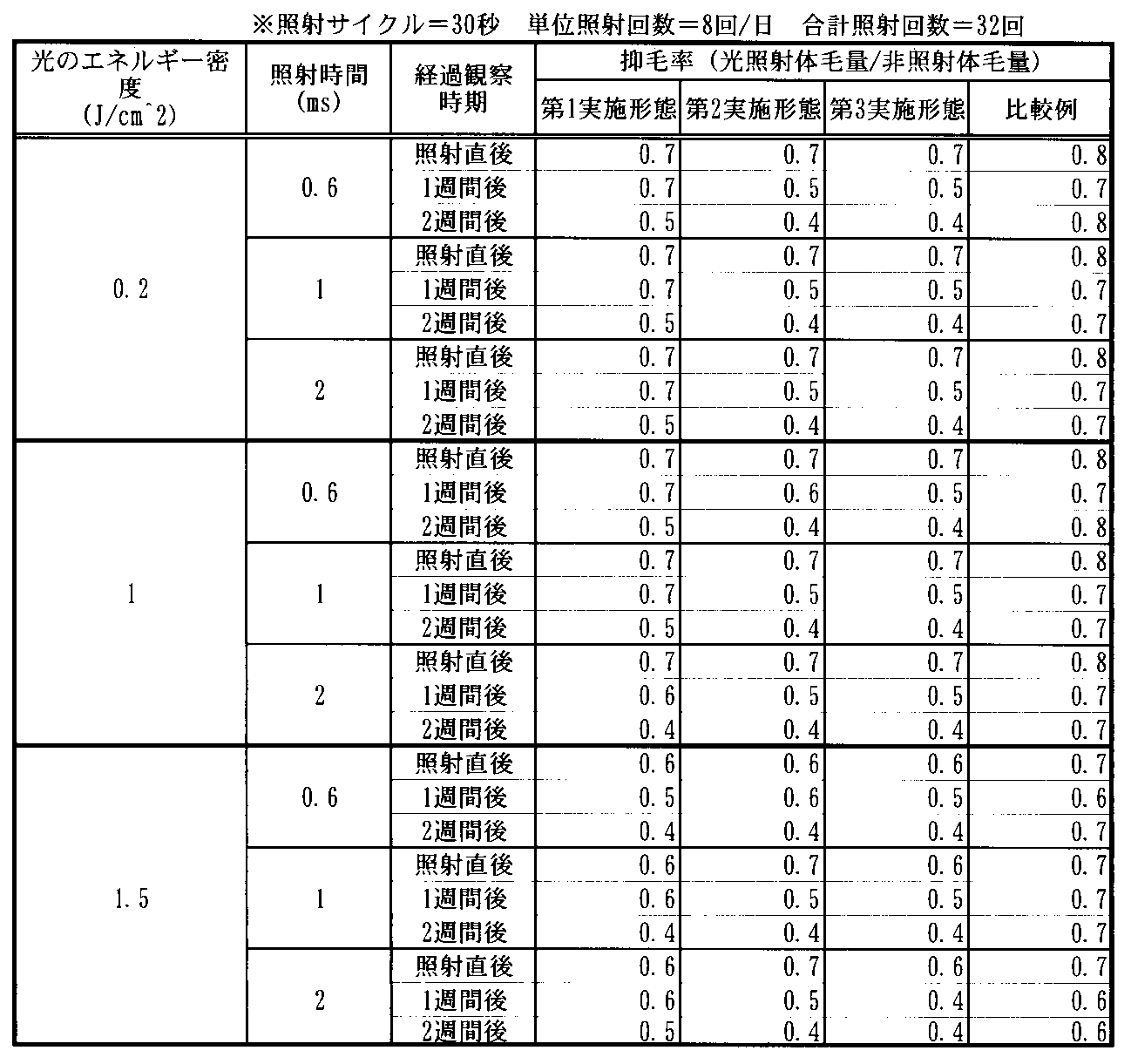
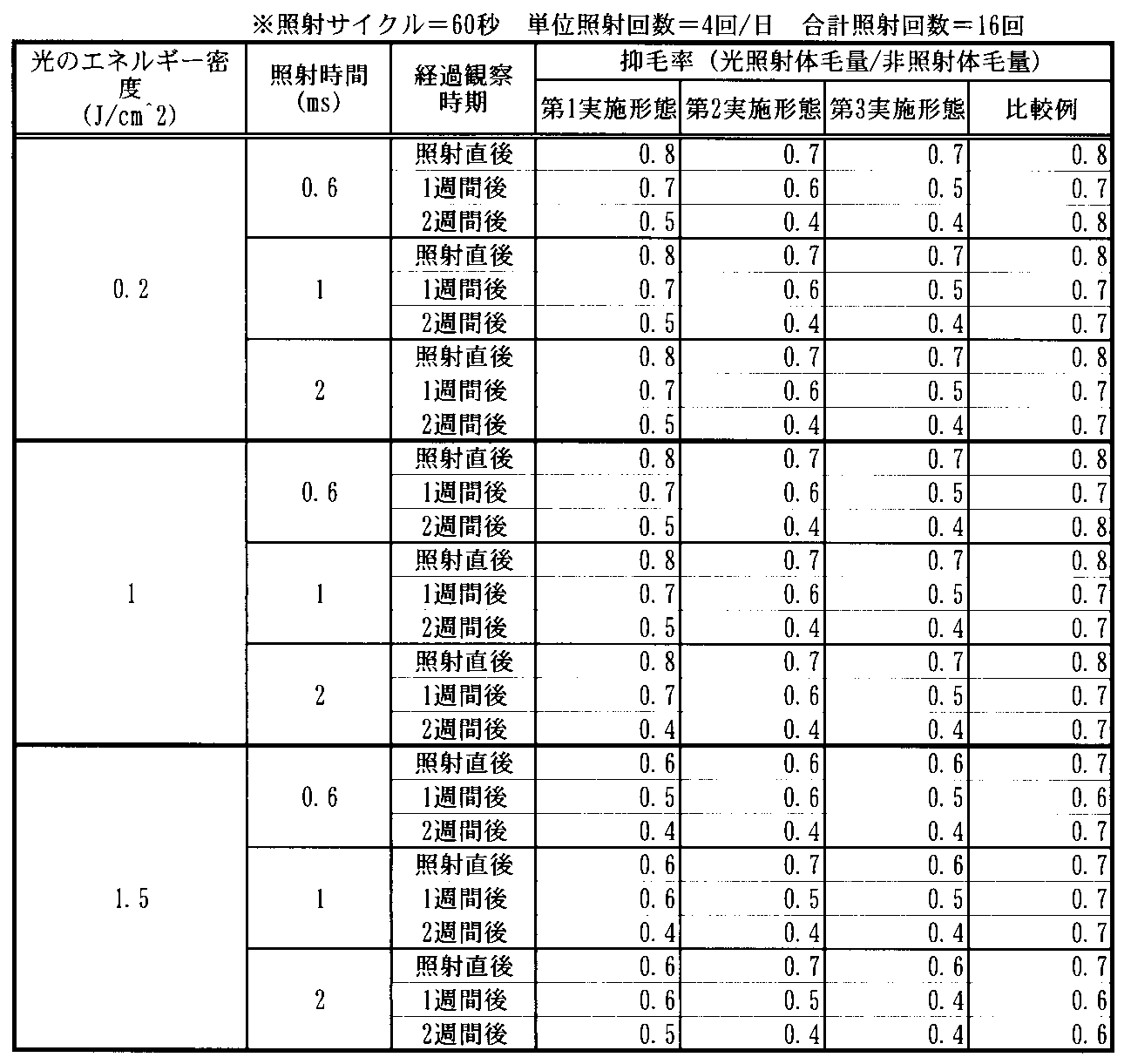
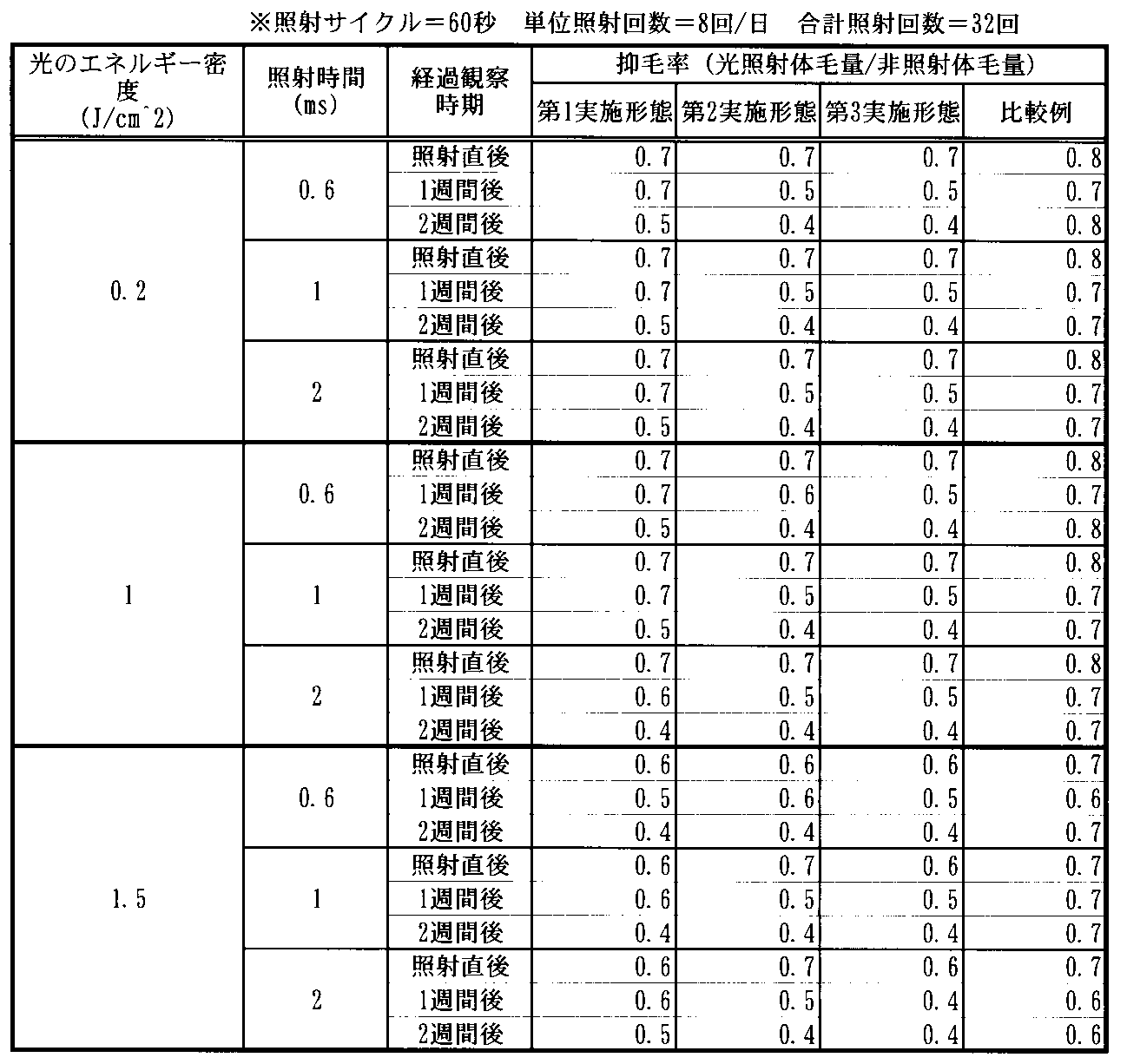
光照射マウスおよび非照射マウスの観察対象部位の皮膚を観察して、第1実施形態~第3実施形態の体毛用美容光、および比較例の光が皮膚に及ぼす影響を定性的に評価した。
照射直後に観察対象部位から皮膚の顆粒層を取得した。光照射マウスおよび非照射マウスの顆粒層を比較した。実施形態の体毛用美容光が照射された光照射マウスの顆粒層と、非照射マウスの顆粒層との間に実質的な相違はない。比較例の光が照射された光照射マウスの顆粒層と非照射マウスの顆粒層との間に実質的な相違があり、この結果は、比較例の光が実施形態の体毛用美容光よりも皮膚に及ぼす影響が大きいことを示す。
[付記1] 請求項1~6のいずれか一項に記載の体毛用光美容装置において、500nm~600nmの波長範囲における前記体毛用美容光の強度の積分値が600nm~700nmの波長範囲におけるものよりも大きい。このように構成された体毛用光美容装置は、500nm~600nmの波長範囲における強度の積分値が600nm~700nmの波長範囲における強度の積分値よりも小さい参考例と比較して、体毛美容作用は向上する。
[付記2] 請求項1~6のいずれか一項に記載の体毛用光美容装置、または付記1に記載の体毛用光美容装置において、400nm~500nmの波長範囲における前記体毛用美容光の強度の積分値が600nm~700nmの波長範囲のものよりも大きい。このように構成された体毛用光美容装置は、400nm~500nmの波長範囲における強度の積分値が600nm~700nmの波長範囲における強度の積分値よりも小さい場合と比較して、体毛美容作用は向上する。
[付記3] 請求項1~6のいずれか一項、または付記1もしくは付記2に記載の体毛用光美容装置において、500nm~530nmの波長範囲の前記体毛用美容光の強度の積分値が570nm~600nmの波長範囲のものよりも大きい。このように構成された体毛用光美容装置は、500nm~530nmの波長範囲における強度の積分値が570nm~600nmの波長範囲における強度の積分値よりも小さい場合と比較して、体毛美容作用は向上する。
[付記4] 請求項1~6のいずれか一項に記載の体毛用光美容装置、または付記1~3のいずれか一項に記載の体毛用光美容装置において、前記体毛用美容光は、440nm~460nmの波長範囲において第1ピークを有する。前記第1ピークは、400nm~700nmの波長範囲に存在する複数のピークのうちの最小値を有する。このように構成された体毛用光美容装置は、400nm~700nmの波長範囲に存在する他のピークよりも第1ピークが大きい場合と比較して、皮膚の好ましくない副作用を生じさせにくい。
[付記5] 付記4に記載の体毛用光美容装置において、前記第1ピークは、400nm~600nmの波長範囲に存在する複数のピークのうちの最小値を有する。このように構成された体毛用光美容装置は、400nm~600nmの波長範囲に存在する他のピークよりも第1ピークが大きい場合と比較して、皮膚の好ましくない副作用を生じさせにくい。
[付記6] 請求項1~6のいずれか一項に記載の体毛用光美容装置、または付記1~5のいずれか一項に記載の体毛用光美容装置において、前記体毛用美容光は、480nm~500nmの波長範囲において、第2ピークを有する。前記第2ピークは、400nm~700nmの波長範囲に存在する複数のピークのうちの2番目に大きい値を有する。このように構成された体毛用光美容装置は、400nm~700nmの波長範囲に存在する複数のピークにおいて、第2ピークが3番目以下の大きさを有する場合と比較して、体毛美容作用は向上する。
[付記7] 付記6に記載の体毛用光美容装置において、前記第2ピークは、400nm~600nmの波長範囲に存在する複数のピークのうちの2番目に大きい値を有する。このように構成された体毛用光美容装置は、400nm~600nmの波長範囲に存在する複数のピークにおいて、第2ピークが3番目以下の大きさを有する場合と比較して、体毛美容作用は向上する。
[付記8] 請求項1~6のいずれか一項に記載の体毛用光美容装置、または付記1~7のいずれか一項に記載の体毛用光美容装置において、前記体毛用美容光は、440nm~460nmの波長範囲において第1ピークを有する。前記体毛用美容光は、480nm~500nmの波長範囲において第2ピークを有する。前記第2ピークは、前記第1ピークの2倍以上の強度を有する。このように構成された体毛用光美容装置は、第2ピークが第1ピークの2倍未満の強度を有する場合と比較して、体毛美容作用は向上する。
[付記9] 請求項1~6のいずれか一項に記載の体毛用光美容装置、または付記1~8のいずれか一項に記載の体毛用光美容装置において、前記体毛用美容光は、520nm~540nmの波長範囲において第3ピークを有する。前記第3ピークは、400nm~700nmの波長範囲に存在する複数のピークのうちの最大値を有する。このように構成された体毛用光美容装置は、400nm~700nmの波長範囲に存在する複数のピークにおいて、第3ピークが2番目以下の大きさを有する場合と比較して、体毛美容作用は向上する。
[付記10] 付記9に記載の体毛用光美容装置において、前記第3ピークは、400nm~600nmの波長範囲に存在する複数のピークのうちの最大値を有する。このように構成された体毛用光美容装置は、400nm~600nmの波長範囲に存在する複数のピークにおいて、第3ピークが2番目以下の大きさを有する場合と比較して、体毛美容作用は向上する。
[付記11] 請求項1~6のいずれか一項に記載の体毛用光美容装置、または付記1~10のいずれか一項に記載の体毛用光美容装置において、前記体毛用美容光は、440nm~460nmの波長範囲において第1ピークを有する。前記体毛用美容光は、520nm~540nmの波長範囲において第3ピークを有する。前記第3ピークは、前記第1ピークの2倍以上の強度を有する。このように構成された体毛用光美容装置は、第3ピークが第1ピークの2倍未満の強度を有する参考例と比較して、体毛美容作用は向上する。
[付記12] 請求項1~6のいずれか一項に記載の体毛用光美容装置、または付記1~11のいずれか一項に記載の体毛用光美容装置において、前記体毛用美容光は、480nm~500nmの波長範囲において400nm~700nmの波長範囲における最大の増加率を有する。このように構成された体毛用光美容装置は、480nm~500nmの波長範囲よりも短い波長範囲に最大の増加率を有する参考例と比較して、体毛美容作用は向上する。
Claims (6)
- 体毛用美容光を照射する光学系を備える体毛用光美容装置であって、
400nm~700nmの波長範囲における前記体毛用美容光の強度の積分値が700nm~1200nmの波長範囲のものよりも大きく、400nm~500nmの波長範囲における前記体毛用美容光の強度の積分値が500nm~600nmの波長範囲のものよりも小さい体毛用光美容装置。 - 前記体毛用美容光は、400nm~700nmの波長範囲に複数の強度ピークを有し、前記複数の強度ピークのうちの最大強度ピークは、500nm~600nmの波長範囲にある請求項1に記載の体毛用光美容装置。
- 前記体毛用美容光は、400nm~700nmの波長範囲に複数の強度ピークを有し、前記複数の強度ピークのうちの最小強度ピークは、400nm~500nmの波長範囲にある請求項1または2に記載の体毛用光美容装置。
- 前記体毛用美容光は、酸化ヘモグロビンの第1吸光ピークに対応する400nm~440nmの波長範囲に光強度ピークを有していない請求項1~3のいずれか一項に記載の体毛用光美容装置。
- 前記体毛用美容光は、酸化ヘモグロビンの第2吸光ピークを含む530nm~570nmの波長範囲に光強度ピークを有していない請求項1~4のいずれか一項に記載の体毛用光美容装置。
- 前記体毛用美容光は、0.2J/cm2~1.5J/cm2のエネルギー密度を有する請求項1~5のいずれか一項に記載の体毛用光美容装置。
Priority Applications (2)
| Application Number | Priority Date | Filing Date | Title |
|---|---|---|---|
| EP14754211.2A EP2959941B1 (en) | 2013-02-22 | 2014-01-10 | Body hair luminescence aesthetic device |
| US14/418,346 US10137310B2 (en) | 2013-02-22 | 2014-01-10 | Body hair luminescence aesthetic device |
Applications Claiming Priority (2)
| Application Number | Priority Date | Filing Date | Title |
|---|---|---|---|
| JP2013033889A JP2014161455A (ja) | 2013-02-22 | 2013-02-22 | 体毛用光美容装置 |
| JP2013-033889 | 2013-02-22 |
Publications (2)
| Publication Number | Publication Date |
|---|---|
| WO2014129101A1 true WO2014129101A1 (ja) | 2014-08-28 |
| WO2014129101A9 WO2014129101A9 (ja) | 2015-02-26 |
Family
ID=51390912
Family Applications (1)
| Application Number | Title | Priority Date | Filing Date |
|---|---|---|---|
| PCT/JP2014/000094 Ceased WO2014129101A1 (ja) | 2013-02-22 | 2014-01-10 | 体毛用光美容装置 |
Country Status (4)
| Country | Link |
|---|---|
| US (1) | US10137310B2 (ja) |
| EP (1) | EP2959941B1 (ja) |
| JP (1) | JP2014161455A (ja) |
| WO (1) | WO2014129101A1 (ja) |
Families Citing this family (1)
| Publication number | Priority date | Publication date | Assignee | Title |
|---|---|---|---|---|
| EP3202351B1 (en) * | 2016-02-02 | 2021-08-25 | Braun GmbH | Skin treatment device |
Citations (4)
| Publication number | Priority date | Publication date | Assignee | Title |
|---|---|---|---|---|
| JP2006149489A (ja) * | 2004-11-25 | 2006-06-15 | Matsushita Electric Works Ltd | 光脱毛装置 |
| JP2008029811A (ja) | 2006-06-26 | 2008-02-14 | Matsushita Electric Works Ltd | 毛成長調節方法及びその装置 |
| JP2009538157A (ja) * | 2006-04-06 | 2009-11-05 | ライトタッチ・リミテッド | 光熱分解のための方法および装置 |
| JP2012531239A (ja) * | 2009-06-26 | 2012-12-10 | コーニンクレッカ フィリップス エレクトロニクス エヌ ヴィ | 皮膚放射装置 |
Family Cites Families (18)
| Publication number | Priority date | Publication date | Assignee | Title |
|---|---|---|---|---|
| GB1316803A (en) | 1969-07-07 | 1973-05-16 | Gen Electric | High intensity arc lamp |
| US4792341A (en) * | 1986-06-19 | 1988-12-20 | Clairol Incorporated | Hair photobleaching |
| US6280438B1 (en) * | 1992-10-20 | 2001-08-28 | Esc Medical Systems Ltd. | Method and apparatus for electromagnetic treatment of the skin, including hair depilation |
| US5626631A (en) * | 1992-10-20 | 1997-05-06 | Esc Medical Systems Ltd. | Method and apparatus for therapeutic electromagnetic treatment |
| US5885273A (en) * | 1995-03-29 | 1999-03-23 | Esc Medical Systems, Ltd. | Method for depilation using pulsed electromagnetic radiation |
| EP0885629A3 (en) | 1997-06-16 | 1999-07-21 | Danish Dermatologic Development A/S | Light pulse generating apparatus and cosmetic and therapeutic phototreatment |
| CN1872363A (zh) * | 2001-03-02 | 2006-12-06 | 帕洛玛医疗技术公司 | 用于光照美容和光照皮肤病治疗的设备和方法 |
| US7762964B2 (en) * | 2001-12-10 | 2010-07-27 | Candela Corporation | Method and apparatus for improving safety during exposure to a monochromatic light source |
| US7540869B2 (en) | 2001-12-27 | 2009-06-02 | Palomar Medical Technologies, Inc. | Method and apparatus for improved vascular related treatment |
| US20040147985A1 (en) * | 2003-01-27 | 2004-07-29 | Altus Medical, Inc. | Dermatological treatment flashlamp device and method |
| US7435252B2 (en) * | 2003-10-15 | 2008-10-14 | Valam Corporation | Control of microorganisms in the sino-nasal tract |
| KR100638735B1 (ko) * | 2004-02-25 | 2006-10-27 | 이영수 | 분할 회전 광 필터가 내장된 ipl 조사장치 |
| JP5032749B2 (ja) * | 2005-03-16 | 2012-09-26 | パナソニック株式会社 | 光フィルタおよび照明装置 |
| JP2008188258A (ja) * | 2007-02-06 | 2008-08-21 | Ohira Co Ltd | 光線治療装置 |
| FR2940915B1 (fr) | 2009-01-12 | 2013-07-05 | Oreal | Dispositif de traitement des matieres keratiniques humaines |
| WO2011070795A1 (ja) | 2009-12-12 | 2011-06-16 | 有限会社ミニョンベル | 全身美容装置および全身美容方法 |
| JP5421813B2 (ja) * | 2010-02-22 | 2014-02-19 | パナソニック株式会社 | 抑毛光照射装置 |
| EP2550925A1 (en) * | 2011-07-28 | 2013-01-30 | Eduardo Antonio Gomez de Diego | Multipurpose portable laser depilationdevice |
-
2013
- 2013-02-22 JP JP2013033889A patent/JP2014161455A/ja active Pending
-
2014
- 2014-01-10 WO PCT/JP2014/000094 patent/WO2014129101A1/ja not_active Ceased
- 2014-01-10 EP EP14754211.2A patent/EP2959941B1/en active Active
- 2014-01-10 US US14/418,346 patent/US10137310B2/en not_active Expired - Fee Related
Patent Citations (4)
| Publication number | Priority date | Publication date | Assignee | Title |
|---|---|---|---|---|
| JP2006149489A (ja) * | 2004-11-25 | 2006-06-15 | Matsushita Electric Works Ltd | 光脱毛装置 |
| JP2009538157A (ja) * | 2006-04-06 | 2009-11-05 | ライトタッチ・リミテッド | 光熱分解のための方法および装置 |
| JP2008029811A (ja) | 2006-06-26 | 2008-02-14 | Matsushita Electric Works Ltd | 毛成長調節方法及びその装置 |
| JP2012531239A (ja) * | 2009-06-26 | 2012-12-10 | コーニンクレッカ フィリップス エレクトロニクス エヌ ヴィ | 皮膚放射装置 |
Non-Patent Citations (1)
| Title |
|---|
| See also references of EP2959941A4 * |
Also Published As
| Publication number | Publication date |
|---|---|
| EP2959941A1 (en) | 2015-12-30 |
| US20150224338A1 (en) | 2015-08-13 |
| EP2959941A4 (en) | 2016-03-23 |
| EP2959941B1 (en) | 2017-06-21 |
| US10137310B2 (en) | 2018-11-27 |
| WO2014129101A9 (ja) | 2015-02-26 |
| JP2014161455A (ja) | 2014-09-08 |
Similar Documents
| Publication | Publication Date | Title |
|---|---|---|
| NL8203377A (nl) | Werkwijze en inrichting voor de stimulering van biologische processen, die verband houden met de cellulaire activiteit, in het bijzonder voor het bevorderen van de genezing van kwetsuren van het lichaamsoppervlak, dat wil zeggen wonden, zweren en verschillende epitheelweefselletsels. | |
| JP2010535538A5 (ja) | ||
| JP2011511330A (ja) | フィルター層を備えた網膜メラトニン抑制装置 | |
| WO2014129101A1 (ja) | 体毛用光美容装置 | |
| US10660834B2 (en) | Shell-structured particles for sunscreen applications | |
| TW200836791A (en) | Hair growth light management device | |
| EP1213010A3 (de) | Verwendung von wasserlöslichen, filmbildenden Polymeren zur Verstärkung des Lichtschutzfaktors und/oder der UV-A-Schutzleistung kosmetischer oder dermatologischer Formulierungen | |
| AU2005249359A1 (en) | Phototherapy systems and methods | |
| JP2014212810A (ja) | 体毛用光美容装置 | |
| US20070016173A1 (en) | Protective material, clothing item and method of protection | |
| US10194984B2 (en) | Optical cosmetic device for bodily hair | |
| Shubnyy et al. | Laser bleaching of tattoos: a new approach | |
| CN204479783U (zh) | 一种美容仪滤光片 | |
| Soumana et al. | Nocturnal Exposure to White Light Without Melatonin Suppression: Using Spectral Tuning to Turn Light into Biological Darkness | |
| CN102353657A (zh) | 一种通过太阳光紫外光谱测量伞过滤紫外线的方法 | |
| Vertuani et al. | Safe by Design of nanomaterials in industrial production processes: nanomaterials in the cosmetic field | |
| WO2025183143A1 (ja) | 光学フィルタ及びそれを備える光脱毛装置 | |
| CN201445712U (zh) | 一种利用二元透镜聚焦进行皮肤医疗美容的装置 | |
| RU2008142424A (ru) | Топическая композиция и ее применение | |
| CA3097257C (fr) | Appareil pour generer un champ magnetique pulse a tres basse frequence porte par un champ magnetique alternatif a tres basse frequence | |
| CN120225164A (zh) | 用于生产化妆品组合物的预混物和方法、化妆品组合物、用于表面光保护的方法和预混物的用途 | |
| FR2483630A1 (fr) | Lunettes solaires de bronzage | |
| BR102023000931A2 (pt) | Premix e processo para preparar uma composição cosmética, composição cosmética e uso | |
| WO2001015776A1 (en) | Irradiation device | |
| IT202000014740A1 (it) | Kit medicale per la realizzazione di un dispositivo medico per il trattamento di patologie tramite luce polarizzata, tale dispositivo medico e metodo per trattare patologie con luce polarizzata usando tale kit medicale o tale dispositivo medico |
Legal Events
| Date | Code | Title | Description |
|---|---|---|---|
| 121 | Ep: the epo has been informed by wipo that ep was designated in this application |
Ref document number: 14754211 Country of ref document: EP Kind code of ref document: A1 |
|
| REEP | Request for entry into the european phase |
Ref document number: 2014754211 Country of ref document: EP |
|
| WWE | Wipo information: entry into national phase |
Ref document number: 2014754211 Country of ref document: EP |
|
| WWE | Wipo information: entry into national phase |
Ref document number: 14418346 Country of ref document: US |
|
| NENP | Non-entry into the national phase |
Ref country code: DE |