WO2014133114A1 - ポリカーボネート成形品 - Google Patents
ポリカーボネート成形品 Download PDFInfo
- Publication number
- WO2014133114A1 WO2014133114A1 PCT/JP2014/054985 JP2014054985W WO2014133114A1 WO 2014133114 A1 WO2014133114 A1 WO 2014133114A1 JP 2014054985 W JP2014054985 W JP 2014054985W WO 2014133114 A1 WO2014133114 A1 WO 2014133114A1
- Authority
- WO
- WIPO (PCT)
- Prior art keywords
- unit
- polycarbonate
- group
- parts
- molded article
- Prior art date
- Legal status (The legal status is an assumption and is not a legal conclusion. Google has not performed a legal analysis and makes no representation as to the accuracy of the status listed.)
- Ceased
Links
- 0 CC*(C)C(OC1C(*)(CN)C(CC(C)(C)CC)C1(*)*)=O Chemical compound CC*(C)C(OC1C(*)(CN)C(CC(C)(C)CC)C1(*)*)=O 0.000 description 2
- QSYUIRKABJKLBX-UHFFFAOYSA-N CCCC(C)(C)C(OC(COC1(C)C(CO2)OC(C)(C)CC)C12[I]=C)=O Chemical compound CCCC(C)(C)C(OC(COC1(C)C(CO2)OC(C)(C)CC)C12[I]=C)=O QSYUIRKABJKLBX-UHFFFAOYSA-N 0.000 description 1
Images

Classifications
-
- C—CHEMISTRY; METALLURGY
- C08—ORGANIC MACROMOLECULAR COMPOUNDS; THEIR PREPARATION OR CHEMICAL WORKING-UP; COMPOSITIONS BASED THEREON
- C08G—MACROMOLECULAR COMPOUNDS OBTAINED OTHERWISE THAN BY REACTIONS ONLY INVOLVING UNSATURATED CARBON-TO-CARBON BONDS
- C08G64/00—Macromolecular compounds obtained by reactions forming a carbonic ester link in the main chain of the macromolecule
- C08G64/02—Aliphatic polycarbonates
- C08G64/0208—Aliphatic polycarbonates saturated
-
- C—CHEMISTRY; METALLURGY
- C08—ORGANIC MACROMOLECULAR COMPOUNDS; THEIR PREPARATION OR CHEMICAL WORKING-UP; COMPOSITIONS BASED THEREON
- C08G—MACROMOLECULAR COMPOUNDS OBTAINED OTHERWISE THAN BY REACTIONS ONLY INVOLVING UNSATURATED CARBON-TO-CARBON BONDS
- C08G64/00—Macromolecular compounds obtained by reactions forming a carbonic ester link in the main chain of the macromolecule
-
- G—PHYSICS
- G02—OPTICS
- G02B—OPTICAL ELEMENTS, SYSTEMS OR APPARATUS
- G02B1/00—Optical elements characterised by the material of which they are made; Optical coatings for optical elements
- G02B1/04—Optical elements characterised by the material of which they are made; Optical coatings for optical elements made of organic materials, e.g. plastics
- G02B1/041—Lenses
-
- F—MECHANICAL ENGINEERING; LIGHTING; HEATING; WEAPONS; BLASTING
- F21—LIGHTING
- F21S—NON-PORTABLE LIGHTING DEVICES; SYSTEMS THEREOF; VEHICLE LIGHTING DEVICES SPECIALLY ADAPTED FOR VEHICLE EXTERIORS
- F21S41/00—Illuminating devices specially adapted for vehicle exteriors, e.g. headlamps
- F21S41/20—Illuminating devices specially adapted for vehicle exteriors, e.g. headlamps characterised by refractors, transparent cover plates, light guides or filters
-
- F—MECHANICAL ENGINEERING; LIGHTING; HEATING; WEAPONS; BLASTING
- F21—LIGHTING
- F21S—NON-PORTABLE LIGHTING DEVICES; SYSTEMS THEREOF; VEHICLE LIGHTING DEVICES SPECIALLY ADAPTED FOR VEHICLE EXTERIORS
- F21S43/00—Signalling devices specially adapted for vehicle exteriors, e.g. brake lamps, direction indicator lights or reversing lights
- F21S43/20—Signalling devices specially adapted for vehicle exteriors, e.g. brake lamps, direction indicator lights or reversing lights characterised by refractors, transparent cover plates, light guides or filters
Definitions
- the present invention relates to a molded article such as a resin window, a vehicle lamp lens, or a plastic lens, which is made of polycarbonate and has excellent heat resistance, weather resistance, low temperature characteristics, low water absorption, and surface hardness.
- Patent Document 1 As a proposal of using polycarbonate for a resin window, Patent Document 2 describes using polycarbonate obtained from bisphenol A as a resin window.
- Patent Document 3 proposes to use a polycarbonate obtained from isosorbide as a resin window.
- this polycarbonate has a high water absorption rate and is inferior in low-temperature impact properties and has a point to be improved.
- Patent Document 4 and Patent Document 5 describe the use of a polycarbonate copolymerized with isosorbide and an aliphatic diol in a vehicle lamp lens.
- this polycarbonate uses 1,4-cyclohexanedimethanol as an aliphatic diol, its physical properties at low temperatures are low, and for example, its impact strength is low, so its use in cold regions is limited.
- the water absorption rate is high, and the dimensional change and the curvature by water absorption arise in the molded product.
- polycarbonate using isosorbide has been studied, but the properties such as heat resistance, surface hardness, low water absorption, low temperature characteristics, weather resistance, etc. required for resin windows and vehicle lamp lenses have been studied. It does not have a good balance.
- polycarbonate obtained from bisphenol A is widely used as a material for plastic lenses.
- this polycarbonate has a disadvantage that the refractive index is as high as 1.585 but the Abbe number is as low as 30, so that the problem of chromatic aberration is likely to occur and the balance between the refractive index and Abbe number is poor.
- a polycarbonate containing isosorbide has been proposed as a plastic lens that satisfies the above characteristics, has a sufficient refractive index and a high Abbe number, has a low photoelastic constant, and is excellent in physical properties and solvent resistance ( Patent Documents 7, 8, and 9).
- Patent Documents 7, 8, and 9 it is difficult to say that this polycarbonate has sufficient impact properties to be used in a field where more safety is required.
- examination about the impact strength in low temperature is not made
- plastic lenses have excellent properties in terms of lightness, fashionability, impact resistance, and the like, and are rapidly spreading in the field of optical materials, particularly spectacle lenses.
- the impact resistance of the base material itself (a steel ball having a predetermined weight is dropped from a height of 127 cm to the center of the lens having a center thickness of 2 mm). In the falling ball impact test), it is about 200 g. However, it is known that when it is hard-coated, it drops to about 60 g, and when an antireflection film is further provided thereon, the impact resistance is markedly reduced to 10 g. .
- a method is disclosed in which impact resistance is improved by providing a primer layer between a plastic lens substrate and a silicone hard coat.
- Patent Document 10 by a method of providing a layer made of urethane resin as a primer layer (Patent Document 10), an eyeglass lens having impact resistance that clears the US FDA standard (falling ball impact value 16.4 g) even after an inorganic antireflection coating is obtained. It is disclosed that it can be obtained. However, it is required to exceed ANSI Z87.1 standard (falling ball impact value 68 g) in order to be used in fields requiring higher safety such as for education and work.
- ANSI Z87.1 standard Falling ball impact value 68 g
- Another object of the present invention is to provide a molded article such as a resin window or a vehicle lamp lens which is formed from polycarbonate and has excellent heat resistance, weather resistance, low water absorption, surface hardness and low temperature impact characteristics. .
- a polycarbonate containing a unit derived from isosorbide has a low water absorption and is excellent in low-temperature impact characteristics, thereby completing the present invention.
- the present invention includes 50 mol% or more of the unit (A) represented by the following formula among all repeating units, and has a maximum impact energy of 20 J or more in a high-speed surface impact test according to ASTM D3763 in an environment of ⁇ 20 ° C.
- the present invention includes (i) a carbonate unit (A) represented by the following formula: (Ii) the specific viscosity measured with a 20 ° C.
- methylene chloride solution is 0.3 to 0.8
- (Iv) Pencil hardness is HB or more
- (V) the total light transmittance is 80% or more, Formed from polycarbonate
- (Vii) In-plane retardation at a thickness of 2.0 mm is 50 nm or less, It is a plastic lens.
- FIG. 1 shows a molded article of an automotive through-type headlamp lens molded in the example. As shown, the lens has a dome shape.
- [1-A] is a front view (a figure projected onto a platen surface during molding. Therefore, such an area is the maximum projected area), and
- [1-B] is a cross-sectional view taken along line AA.
- the polycarbonate used in the present invention has a unit (A) content of 50 mol% or more, preferably 60 mol% or more, more preferably 70 mol% or more, based on all repeating units. Preferably it is 80 mol% or more.
- Unit (A) in the present invention is derived from an aliphatic diol having an ether group.
- a diol having an ether bond is a material having high heat resistance and high pencil hardness among biomass resources.
- Examples of the unit (A) include the following units (A1), (A2) and (A3) having a stereoisomeric relationship.
- carbohydrate-derived ether diols which are substances obtained from natural biomass and are one of the so-called renewable resources.
- Units (A1), (A2), and (A3) are units derived from isosorbide, isomannide, and isoidide, respectively.
- Isosorbide is obtained by hydrogenating D-glucose obtained from starch and then dehydrating it.
- Other ether diols can be obtained by the same reaction except for the starting materials.
- isosorbide, isomannide, and isoidide a repeating unit derived from isosorbide (1,4; 3,6-dianhydro-D-sorbitol) is particularly preferable because of ease of production and heat resistance.
- (Copolycarbonate (1)) As a preferred embodiment of the polycarbonate used in the present invention, Including a unit (A) and a unit (B-1) represented by the following formula, (I) In all repeating units, the sum of the unit (A) and the unit (B-1) is 80 mol% or more, (Ii) Copolycarbonate (1) in which the molar ratio (A / (B-1)) of unit (A) to unit (B-1) is 60/40 to 95/5.
- the copolycarbonate (1) contains units derived from long-chain aliphatic diols.
- the sum of the unit (A) and the unit (B-1) is preferably 90 mol% or more, more preferably 95 mol%, still more preferably 100 mol%.
- the molar ratio (A / (B-1)) between the unit (A) and the unit (B-1) is more preferably in the range of 70/30 to 93/7, and further in the range of 80/20 to 90/10. preferable. Within the above range, it is preferable because of excellent balance of heat resistance, weather resistance, low water absorption, surface hardness and low temperature impact characteristics.
- the molar ratio (A / (B-1)) can be measured and calculated by proton NMR of JNM-AL400 manufactured by JEOL.
- W represents an alkylene group having 8 to 12 carbon atoms.
- alkylene group having 8 to 12 carbon atoms include octylene group, nonylene group, decylene group and dodecylene group.
- the unit (B-1) is derived from an aliphatic diol having 8 to 12 carbon atoms. As aliphatic diols having 8 to 12 carbon atoms, 1,8-octanediol, 1,9-nonanediol, 1,10-decanediol, 1,12-dodecanediol, 2,4-diethyl-1,5-pentane And diol and 2-methyl-1,8-octanediol.
- 1,8-octanediol, 1,9-nonanediol, 1,10-decanediol and 1,12-dodecanediol are preferable, and 1,9-nonanediol, 1,10-decanediol, 1,12- Dodecanediol is more preferred. Two or more of these may be used in combination.
- the diol compound that derives other units other than the unit (A) and the unit (B-1) include a monomer compound that induces a unit (B-2) and a unit (B-3) described later, and other fats. Any of an aromatic diol compound, an alicyclic diol compound, and an aromatic dihydroxy compound may be used.
- diol compounds and oxyalkylene glycols such as diethylene glycol, triethylene glycol, tetraethylene glycol, and polyethylene glycol described in International Publication No. 2004/111106 pamphlet and International Publication No. 2011/021720 pamphlet.
- aliphatic dihydroxy compound examples include 1,3-propanediol, 1,4-butanediol, 1,5-pentanediol, 1,6-hexanediol, and the like.
- cycloaliphatic dihydroxy compounds As cycloaliphatic dihydroxy compounds, cyclohexanedimethanol, tricyclodecane dimethanol, adamantanediol, pentacyclopentadecane dimethanol, 3,9-bis (2-hydroxy-1,1-dimethylethyl) -2,4,8, And 10-tetraoxaspiro [5.5] undecane.
- ⁇ , ⁇ ′-bis (4-hydroxyphenyl) -m-diisopropylbenzene bisphenol M
- 9,9-bis (4-hydroxy-3-methylphenyl) fluorene 1,1-bis (4-hydroxyphenyl) cyclohexane
- 1,1-bis (4-hydroxyphenyl) -3,3,5-trimethylcyclohexane 4,4′-dihydroxy-3,3′-dimethyldiphenyl sulfide
- bisphenol A 2, 2-bis (4-hydroxy-3-methylphenyl) propane (bisphenol C), 2,2-bis (4-hydroxyphenyl) -1,1,1,3,3,3-hexafluoropropane (bisphenol AF)
- 1,1-bis (4-hydroxyphenyl) decane 1,1-bis (4-hydroxyphenyl) decane.
- the copolycarbonate containing the unit (A) and the unit (B-1) is produced by a reaction means known per se for producing an ordinary polycarbonate, for example, a method of reacting a diol component with a carbonate precursor such as a carbonic acid diester. .
- a reaction means known per se for producing an ordinary polycarbonate for example, a method of reacting a diol component with a carbonate precursor such as a carbonic acid diester.
- a carbonate precursor such as a carbonic acid diester.
- the transesterification reaction using a carbonic acid diester as a carbonate precursor is performed by a method in which an aromatic dihydroxy component in a predetermined ratio is stirred with a carbonic acid diester while heating with an inert gas atmosphere to distill the generated alcohol or phenols.
- the reaction temperature varies depending on the boiling point of the alcohol or phenol produced, but is usually in the range of 120 to 300 ° C.
- the reaction is completed while distilling off the alcohol or phenol produced under reduced pressure from the beginning. Moreover, you may add a terminal stopper, antioxidant, etc. as needed.
- the carbonic acid diester used in the transesterification include esters such as an aryl group having 6 to 12 carbon atoms and an aralkyl group which may be substituted. Specific examples include diphenyl carbonate, ditolyl carbonate, bis (chlorophenyl) carbonate and m-cresyl carbonate. Of these, diphenyl carbonate is particularly preferred.
- the amount of diphenyl carbonate to be used is preferably 0.97 to 1.10 mol, more preferably 1.00 to 1.06 mol, relative to a total of 1 mol of the dihydroxy compound.
- a polymerization catalyst can be used in order to increase the polymerization rate.
- the polymerization catalyst include alkali metal compounds, alkaline earth metal compounds, nitrogen-containing compounds, metal compounds and the like.
- organic acid salts, inorganic salts, oxides, hydroxides, hydrides, alkoxides, quaternary ammonium hydroxides, and the like of alkali metals and alkaline earth metals are preferably used. It can be used alone or in combination.
- alkali metal compound examples include sodium hydroxide, potassium hydroxide, cesium hydroxide, lithium hydroxide, sodium bicarbonate, sodium carbonate, potassium carbonate, cesium carbonate, lithium carbonate, sodium acetate, potassium acetate, cesium acetate, lithium acetate, Sodium stearate, potassium stearate, cesium stearate, lithium stearate, sodium borohydride, sodium benzoate, potassium benzoate, cesium benzoate, lithium benzoate, disodium hydrogen phosphate, dipotassium hydrogen phosphate, phosphorus
- Examples include dilithium oxyhydrogen, disodium phenylphosphate, disodium salt of bisphenol A, 2 potassium salt, 2 cesium salt, 2 lithium salt, sodium salt of phenol, potassium salt, cesium salt and lithium salt.
- Alkaline earth metal compounds include magnesium hydroxide, calcium hydroxide, strontium hydroxide, barium hydroxide, magnesium carbonate, calcium carbonate, strontium carbonate, barium carbonate, magnesium diacetate, calcium diacetate, strontium diacetate, diacetate Barium and the like are exemplified.
- nitrogen-containing compounds include quaternary ammonium hydroxides having alkyl, aryl groups, etc., such as tetramethylammonium hydroxide, tetraethylammonium hydroxide, tetrapropylammonium hydroxide, tetrabutylammonium hydroxide, and trimethylbenzylammonium hydroxide. Can be mentioned.
- tertiary amines such as triethylamine, dimethylbenzylamine, and triphenylamine
- imidazoles such as 2-methylimidazole, 2-phenylimidazole, and benzimidazole
- bases or basic salts such as ammonia, tetramethylammonium borohydride, tetrabutylammonium borohydride, tetrabutylammonium tetraphenylborate, tetraphenylammonium tetraphenylborate and the like are exemplified.
- metal compounds include zinc aluminum compounds, germanium compounds, organic tin compounds, antimony compounds, manganese compounds, titanium compounds, zirconium compounds, and the like. These compounds may be used alone or in combination of two or more.
- the amount of these polymerization catalysts used is preferably 1 ⁇ 10 with respect to 1 mol of the diol component. -9 ⁇ 1 ⁇ 10 -2 Equivalent weight, preferably 1 ⁇ 10 -8 ⁇ 1 ⁇ 10 -5 Equivalent weight, more preferably 1 ⁇ 10 -7 ⁇ 1 ⁇ 10 -3 It is selected in the range of equivalents.
- a catalyst deactivator can be added at a later stage of the reaction. As the catalyst deactivator to be used, a known catalyst deactivator is effectively used.
- sulfonic acid ammonium salt and phosphonium salt are preferable.
- salts of dodecylbenzenesulfonic acid such as tetrabutylphosphonium salt of dodecylbenzenesulfonic acid and salts of paratoluenesulfonic acid such as tetrabutylammonium salt of paratoluenesulfonic acid are preferable.
- esters of sulfonic acid methyl benzenesulfonate, ethyl benzenesulfonate, butyl benzenesulfonate, octyl benzenesulfonate, phenyl benzenesulfonate, methyl paratoluenesulfonate, ethyl paratoluenesulfonate, butyl paratoluenesulfonate, Octyl paratoluenesulfonate, phenyl paratoluenesulfonate and the like are preferably used.
- dodecylbenzenesulfonic acid tetrabutylphosphonium salt is most preferably used.
- the amount of the catalyst deactivator used is preferably 0.5 to 50 mol per mol of the catalyst when at least one polymerization catalyst selected from alkali metal compounds and / or alkaline earth metal compounds is used. It can be used in a proportion, more preferably in a proportion of 0.5 to 10 mol, still more preferably in a proportion of 0.8 to 5 mol.
- a carbonate unit (B-2) derived from a unit (A) and at least one compound selected from the group consisting of an aliphatic diol compound and an alicyclic diol compound. Including (I) has blockiness, (Ii) In all repeating units, the sum of the unit (A) and the unit (B-2) is 80 mol% or more, (Iii) The molar ratio (A / (B-2)) of the unit (A) to the unit (B-2) is 60/40 to 95/5. A copolycarbonate (2) is mentioned. The copolycarbonate (2) has a block structure in the unit (B-2).
- the total of the unit (A) and the unit (B-2) in all the repeating units is preferably 90 mol% or more, more preferably 95 mol%, still more preferably 100 mol%.
- the molar ratio (A / (B-2)) between the unit (A) and the unit (B-2) is preferably in the range of 65/35 to 93/7, and more preferably in the range of 70/30 to 90/10. . Within the above range, it is preferable because of excellent balance of heat resistance, weather resistance, low water absorption, surface hardness and low temperature impact characteristics.
- the molar ratio (A / (B-2)) can be measured and calculated by proton NMR of JNM-AL400 manufactured by JEOL.
- the aliphatic diol compound is mentioned as constituting the unit (B-2).
- the aliphatic diol compound may be either a linear aliphatic diol compound or a branched aliphatic diol compound.
- a linear aliphatic diol compound having preferably 2 to 30 carbon atoms, more preferably 3 to 20 carbon atoms, and further preferably 3 to 10 carbon atoms is used.
- linear aliphatic diol compound examples include ethylene glycol, 1,3-propanediol, 1,4-butanediol, 1,5-pentanediol, 1,6-hexanediol, and 1,7-heptanediol. 1,8-octanediol, 1,9-nonanediol, 1,10-decanediol, 1,12-dodecanediol, hydrogenated dilinoleyl glycol, hydrogenated dioleyl glycol and the like.
- 1,3-propanediol, 1,4-butanediol, 1,6-hexanediol, and 1,10-decanediol are preferable.
- branched aliphatic diol compound a branched aliphatic diol compound having preferably 3 to 30 carbon atoms, more preferably 3 to 20 carbon atoms, and further preferably 4 to 12 carbon atoms is used.
- branched aliphatic diol compound examples include 1,3-butylene glycol, 2-methyl-1,3-propanediol, neopentyl glycol, 2-ethyl-1,6-hexanediol, 2,2,4 -Trimethyl-1,6-hexanediol, 3-methyl-1,5-pentanediol, 2-n-butyl-2-ethyl-1,3-propanediol, 2,2-diethyl-1,3-propanediol 2,4-diethyl-1,5-pentanediol, 1,2-hexane glycol, 1,2-octyl glycol, 2-ethyl-1,3-hexanediol, 2,3-diisobutyl-1,3-propane Examples include diol, 2,2-diisoamyl-1,3-propanediol, and 2-methyl-2-propyl-1,3
- 3-methyl-1,5-pentanediol, 2-n-butyl-2-ethyl-1,3-propanediol, 2,2-diethyl-1,3-propanediol, 2,4-diethyl-1 , 5-pentanediol is preferred.
- An alicyclic diol compound is mentioned as constituting the unit (B-2).
- the alicyclic diol compound an alicyclic diol compound having preferably 6 to 30 carbon atoms, more preferably 6 to 20 carbon atoms is used.
- alicyclic diol compound examples include cyclohexanediols such as 1,2-cyclohexanediol, 1,3-cyclohexanediol, 1,4-cyclohexanediol, and 2-methyl-1,4-cyclohexanediol.
- Copolycarbonate (2) has a block-like unit (B-2).
- the average number of repeating units (n) of the unit (B-2) in the block portion is preferably 2 to 100, more preferably 2.2 to 50, still more preferably 2.3 to 30, particularly preferably 2.5 to 10. It is.
- the number average molecular weight of the unit (B-2) in the block portion is preferably 250 to 5000, more preferably 300 to 3000, still more preferably 300 to 2000, and particularly preferably 350 to 1500.
- the block property of the unit (B-2) in the copolycarbonate (2) is that of the copolycarbonate (2) with CDCl. 3 Dissolved in 13 It can be calculated from carbon of carbonate measured by C-NMR.
- the number average molecular weight of the unit (B-2) in the block portion is calculated by multiplying the average number of repeating units by the molecular weight of the repeating unit.
- Average number of repeating units of unit (B-2) (integral value of signal of [[unit (B-2) ⁇ unit (B-2)]) / [Integral value of signal in [unit (A) ⁇ unit (B-2)]) ⁇ 2 + 1 (Unit (B-2a))
- the unit (B-2) is preferably a unit (B-2a) represented by the following formula.
- Y is preferably an alkylene group having 2 to 30 carbon atoms, more preferably 3 to 20 carbon atoms, and still more preferably 3 to 10 carbon atoms.
- alkylene group having 2 to 12 carbon atoms include ethylene group, trimethylene group, tetramethylene group, pentylene group, hexylene group, octylene group, nonylene group, decylene group and dodecylene group.
- Y is preferably a cycloalkylene group having 6 to 30 carbon atoms, more preferably 6 to 20 carbon atoms.
- cycloalkylene group having 6 to 30 carbon atoms examples include a cyclohexylene group, a cyclooctylene group, a cyclononylene group, a cyclodecylene group, and a cyclododecylene group.
- Unit-(Y) n “N” representing the size of the block of ⁇ is preferably 2 to 100, more preferably 2.2 to 50, still more preferably 2.3 to 30, and particularly preferably 2.5 to 10.
- the number average molecular weight of the unit (B-2a) is preferably 250 to 5000, more preferably 300 to 3000, still more preferably 300 to 2000, and particularly preferably 350 to 1500.
- the copolycarbonate (2) is obtained in advance by obtaining a polycarbonate oligomer represented by the repeating unit (B-2) from at least one compound selected from the group consisting of an aliphatic diol compound and an alicyclic diol compound. It is preferred to produce a copolycarbonate by reacting the polycarbonate oligomer, the monomer (eg, isosorbide) derived from the unit (A), and a carbonate precursor.
- the polycarbonate oligomer is produced by a reaction means known per se for producing ordinary polycarbonate, for example, a method of reacting a diol compound with a carbonate precursor such as a carbonic acid diester or a known method of producing a polycarbonate diol.
- a reaction means known per se for producing ordinary polycarbonate for example, a method of reacting a diol compound with a carbonate precursor such as a carbonic acid diester or a known method of producing a polycarbonate diol.
- a reaction means known per se for producing ordinary polycarbonate for example, a method of reacting a diol compound with a carbonate precursor such as a carbonic acid diester or a known method of producing a polycarbonate diol.
- the transesterification reaction using a carbonic acid diester as a carbonate precursor is carried out by a method in which a predetermined proportion of a diol compound is stirred with a carbonic acid diester while heating in an inert
- the reaction temperature varies depending on the boiling point of the alcohol or phenol produced, but is usually in the range of 120 to 300 ° C.
- the reaction is carried out while distilling off the alcohol or phenol produced under reduced pressure from the beginning. Moreover, you may add antioxidant etc. as needed.
- the carbonic acid diester used in the transesterification reaction the same carbonic acid diesters as described above can be used.
- the usable catalyst the same catalyst as the above-mentioned catalyst (transesterification catalyst) can be used.
- the method for producing a polycarbonate oligomer can be carried out in the presence or absence of a catalyst, but is preferably carried out in the presence of a catalyst from the viewpoint of reaction efficiency.
- the reaction temperature in the method for producing a polycarbonate oligomer is preferably 90 to 230 ° C, more preferably 100 to 220 ° C, and further preferably 120 to 210 ° C.
- the reaction temperature exceeds 230 ° C.
- the obtained polycarbonate oligomer may be colored or an ether structure may be generated.
- the ester exchange reaction is performed at 10 kPa to normal pressure, and the end of the ester exchange reaction.
- the transesterification reaction is preferably carried out under a reduced pressure of 0.1 to 10 kPa, more preferably 0.1 to 1 kPa.
- the number average molecular weight of the polycarbonate oligomer is preferably 250 to 5000, more preferably 300 to 3000, still more preferably 400 to 2000, and particularly preferably 400 to 1500.
- the number average molecular weight is less than 250, the intended water absorption, heat resistance, and pencil hardness may be deteriorated.
- the number average molecular weight exceeds 5000, the block property becomes too high and phase separation is likely to occur.
- the number average molecular weight of the polycarbonate oligomer can be calculated by measuring proton NMR.
- the terminal hydroxyl group and the terminal phenyl group were calculated with respect to the repeating unit by proton NMR, and the number average molecular weight was calculated by the following formula.
- Polycarbonate oligomer number average molecular weight (integral value of signal of repeating unit) / (integral value of signal of terminal hydroxyl group + integral value of signal of terminal phenyl group) ⁇ 2 ⁇ molecular weight of repeating unit
- the ratio of the terminal hydroxyl group and terminal phenyl group of the polycarbonate oligomer is not particularly limited, and any ratio may be used.
- the production of the polycarbonate oligomer may be carried out in the same reaction vessel as the production of copolycarbonate, or a separate reaction vessel may be used. Alternatively, it may be used after being taken out from the reaction vessel and stored. Further, the polycarbonate oligomer may be purified by a filter or reprecipitation.
- the copolycarbonate (2) is obtained by reacting the polycarbonate oligomer obtained by the above-described method, the monomer (for example, isosorbide) derived from the unit (A) and the carbonate precursor by a reaction means known per se for producing an ordinary polycarbonate. Manufactured. Next, basic means for these manufacturing methods will be briefly described.
- the transesterification reaction using a carbonic acid diester as a carbonate precursor is performed by a method in which a predetermined proportion of a diol component is stirred with a carbonic acid diester while heating in an inert gas atmosphere to distill the resulting alcohol or phenol.
- the reaction temperature varies depending on the boiling point of the alcohol or phenol produced, but is usually in the range of 120 to 300 ° C.
- the reaction is completed while distilling off the alcohol or phenol produced under reduced pressure from the beginning. Moreover, you may add a terminal stopper, antioxidant, etc. as needed.
- the carbonic acid diester used in the transesterification reaction the same carbonic acid diesters as described above can be used. Of these, diphenyl carbonate is particularly preferred.
- the amount of diphenyl carbonate to be used is preferably 0.97 to 1.10 mol, more preferably 1.00 to 1.06 mol, relative to a total of 1 mol of the dihydroxy compound.
- a polymerization catalyst can be used in order to increase the polymerization rate, and as the polymerization catalyst, the same catalyst as described above (transesterification catalyst) can be used.
- the amount of the polymerization catalyst used is preferably 1 ⁇ 10 with respect to 1 mol of the diol component.
- a catalyst deactivator can be added at a later stage of the reaction.
- the catalyst deactivator mentioned above can be used as the catalyst deactivator to be used.
- the amount of the catalyst deactivator used is preferably 0.5 to 50 mol per mol of the catalyst when at least one polymerization catalyst selected from alkali metal compounds and / or alkaline earth metal compounds is used.
- Copolycarbonate (3) As a preferred embodiment of the polycarbonate used in the present invention, Including a unit (A) and a unit (B-3) represented by the following formula, (I) In all repeating units, the sum of the unit (A) and the unit (B-3) is 80 mol% or more, (Ii) The molar ratio (A / (B-3)) of the unit (A) to the unit (B-3) is 50/50 to 95/5. Copolycarbonate (3) is mentioned. Copolycarbonate (3) has a structure having side chains.
- the total of the unit (A) and the unit (B-3) is preferably 90 mol% or more, more preferably 95 mol% or more, and further preferably 100 mol%.
- the molar ratio of unit (A) to unit (B-3) (A / (B-3)) is preferably in the range of 60/40 to 95/5, more preferably in the range of 60/40 to 93/7.
- the range of 70/30 to 90/10 is more preferable. Within the above range, it is preferable because of excellent balance of heat resistance, weather resistance, low water absorption, surface hardness and low temperature impact characteristics.
- the molar ratio (A / B-3) can be measured and calculated by proton NMR of JNM-AL400 manufactured by JEOL.
- X represents an alkylene group having 3 to 20 carbon atoms or a cycloalkylene group having 3 to 20 carbon atoms
- R represents an alkyl group having 1 to 20 carbon atoms or a cycloalkyl group having 3 to 20 carbon atoms
- m represents an integer of 1 to 10.
- the unit (B-3) is a unit derived from an aliphatic diol having a side chain alkyl group or a side chain cycloalkyl group.
- the unit (B-3) preferably has a total carbon number in the range of 4 to 12, more preferably in the range of 5 to 10. Within such a range, the polycarbonate HDT (deflection temperature under load) is kept high.
- the total number of carbon atoms of X (main chain carbon number) and R carbon atoms (side chain carbon number) preferably satisfies the following formula (i). It is more preferable to satisfy (ia), and it is more preferable to satisfy the following formula (ib). When the following formula (i) is satisfied, the boiling water resistance is excellent and the water absorption rate can be greatly reduced, which is preferable.
- X represents an alkylene group having 3 to 20 carbon atoms or a cycloalkylene group having 3 to 20 carbon atoms.
- X is preferably an alkylene group having 3 to 12 carbon atoms, more preferably an alkylene group having 3 to 8 carbon atoms, and still more preferably an alkylene group having 2 to 6 carbon atoms.
- alkylene group include a propylene group, a butylene group, a pentylene group, a hexylene group, a heptylene group, and an octylene group.
- X is preferably a cycloalkylene group having 3 to 12 carbon atoms, more preferably a cycloalkylene group having 3 to 8 carbon atoms, and still more preferably a cycloalkylene group having 3 to 6 carbon atoms.
- Examples of the cycloalkylene group include a cyclopropylene group, a cyclobutylene group, a cyclopentylene group, a cyclohexylene group, a cycloheptylene group, and a cyclooctylene group.
- R in unit (B-3) R represents an alkyl group having 1 to 20 carbon atoms or a cycloalkyl group having 3 to 20 carbon atoms.
- R is preferably an alkyl group having 1 to 12 carbon atoms, more preferably an alkyl group having 1 to 8 carbon atoms.
- alkyl group examples include a methyl group, an ethyl group, a propyl group, a butyl group, a pentyl group, a hexyl group, a heptyl group, and an octyl group.
- R is preferably a cycloalkyl group having 3 to 12 carbon atoms, more preferably a cycloalkyl group having 3 to 8 carbon atoms.
- Examples of the cycloalkyl group include a cyclopropyl group, a cyclobutyl group, a cyclopentyl group, a cyclohexyl group, a cycloheptyl group, and a cyclooctyl group.
- m represents an integer of 1 to 10, preferably an integer of 2 to 8, and more preferably an integer of 2 to 5.
- X in the unit (B-3) is an alkylene group having 3 to 20 carbon atoms
- X is preferably an alkylene group having 3 to 20 carbon atoms
- R is an alkyl group having 1 to 4 carbon atoms
- m is preferably an integer of 2 to 8.
- X is preferably an alkylene group having 3 to 5 carbon atoms
- R is an alkyl group having 1 to 4 carbon atoms
- m is preferably an integer of 1 to 2.
- n R a Are each independently selected from a hydrogen atom and an alkyl group having 1 to 4 carbon atoms.
- n R b Are each independently selected from a hydrogen atom and an alkyl group having 1 to 4 carbon atoms.
- X in the unit (B-3) is a cycloalkylene group having 3 to 20 carbon atoms
- X is preferably a cycloalkylene group having 4 to 5 carbon atoms
- R is an alkyl group having 1 to 10 carbon atoms
- m is preferably an integer of 3 to 12.
- the unit (B-3) is preferably a unit (Bb) represented by the following formula.
- R 1 , R 2 , R 3 , R 4 Are the same or different alkyl groups, and R 1 ⁇ R 4 The total number of carbon atoms in the range 4 to 10 and R 1 And R 2 , R 3 And R 4 May combine to form a carbocycle.
- R in unit (Bb) 1 , R 2 , R 3 , R 4 Are each independently preferably a methyl group, an ethyl group or a propyl group.
- the unit (B-3) is preferably a unit (Bb-i) represented by the following formula.
- the unit (B-3) is derived from an aliphatic diol having a side chain alkyl group or a side chain cycloalkyl group.
- Examples of the aliphatic diol having a side chain alkyl group or a side chain cycloalkyl group include 1,3-butylene glycol, 2-methyl-1,3-propanediol, neopentyl glycol, and 3-methyl-1,5-pentanediol.
- 3-methyl-1,5-pentanediol, 2-n-butyl-2-ethyl-1,3-propanediol, 2,2-diethyl-1,3-propanediol, 2,4-diethyl-1 , 5-pentanediol is preferred, and 2-n-butyl-2-ethyl-1,3-propanediol and 2,4-diethyl-1,5-pentanediol are particularly preferred. Two or more of these may be used in combination.
- Examples of the diol compound that derives other units other than the unit (A) and the unit (B-3) include the monomer compound that induces the unit (B-1) and the unit (B-2), and other fats.
- Any of an aromatic diol compound, an alicyclic diol compound, and an aromatic dihydroxy compound may be used. Specific examples include diol compounds and oxyalkylene glycols such as diethylene glycol, triethylene glycol, tetraethylene glycol, and polyethylene glycol described in International Publication No. 2004/111106 pamphlet and International Publication No. 2011/021720 pamphlet.
- Examples of the aliphatic dihydroxy compound, the alicyclic dihydroxy compound, and the aromatic dihydroxy compound include those described above.
- the copolycarbonate containing the unit (A) and the unit (B-3) is produced by a reaction means known per se for producing an ordinary polycarbonate, for example, a method in which a diol component is reacted with a carbonate precursor such as a carbonic acid diester. .
- the basic means for these production methods is the same as that for the copolycarbonate containing the unit (A) and the unit (B-1) described above.
- the total of the unit (A) and the unit (B-4) is preferably 90 mol% or more, more preferably 95 mol% or more, and further preferably 100 mol%.
- the molar ratio (A / (B-4)) between the unit (A) and the unit (B-4) is preferably 60/40 to 95/5, more preferably 70/30 to 98/2, and 90 A range of / 10 to 97.5 / 2.5 is more preferable. It is preferable that it is in the above-mentioned range because of excellent balance of heat resistance, weather resistance, low water absorption, surface hardness and low temperature impact resistance.
- the molar ratio (A / (B-4)) can be measured and calculated by proton NMR of JNM-AL400 manufactured by JEOL Ltd.
- Unit (B-4) is a carbonate unit derived from a polyester diol containing a dicarboxylic acid component and a diol component as constituent components.
- Suitable dicarboxylic acids are aliphatic carboxylic acids, aromatic carboxylic acids or aromatic aliphatic carboxylic acids having 4 to 20 carbon atoms.
- dicarboxylic acid components may be used alone or in combination of two or more.
- Suitable diol components include linear aliphatic diol compounds, branched aliphatic diol compounds, and alicyclic diol compounds.
- linear aliphatic diol compound include ethylene glycol, 1,3-propanediol, 1,4-butanediol, 1,5-pentanediol, 1,6-hexanediol, and 1,7-heptanediol.
- 1,3-propanediol, 1,4-butanediol, 1,6-hexanediol, and 1,10-decanediol are preferable.
- branched aliphatic diol compound examples include 1,3-butylene glycol, 2-methyl-1,3-propanediol, neopentyl glycol, 2-ethyl-1,6-hexanediol, 2,2,4 -Trimethyl-1,6-hexanediol, 3-methyl-1,5-pentanediol, 2-n-butyl-2-ethyl-1,3-propanediol, 2,2-diethyl-1,3-propanediol 2,4-diethyl-1,5-pentanediol, 1,2-hexane glycol, 1,2-octyl glycol, 2-ethyl-1,3-hexanediol, 2,3-diisobutyl-1,3-propane Diol, 2,2-diisoamyl-1,3-propanediol, 2-methyl-2-propyl-1,3-propan
- 3-methyl-1,5-pentanediol, 2-n-butyl-2-ethyl-1,3-propanediol, 2,2-diethyl-1,3-propanediol, 2,4-diethyl-1 , 5-pentanediol is preferred.
- Specific examples of the alicyclic diol compound include cyclohexanediols such as 1,2-cyclohexanediol, 1,3-cyclohexanediol, 1,4-cyclohexanediol, and 2-methyl-1,4-cyclohexanediol.
- Suitable polyester diol (B4) is represented by the following formula.
- R represents a hydrocarbon group which may contain an aromatic group having 1 to 12 carbon atoms, specifically, the above-mentioned linear aliphatic diol compound, branched aliphatic diol compound, alicyclic diol compound. Is an aliphatic or alicyclic moiety.
- W represents a hydrocarbon group which may contain an aromatic group having 1 to 12 carbon atoms.
- N represents the average number of repeating units.
- the weight average molecular weight of the polyester diol (B1) is preferably in the range of 100 to 3000, and the average number of repeating units n is preferably set so as to have this weight average molecular weight.
- the polyester diol can be produced according to a known polyester diol production method.
- Examples of the metal catalyst used in the polyester diol production method include Lewis acids, carboxylates of alkali metals and alkaline earth metals, proton acids, activated clays, acidic clays, and ion exchange resins. More specifically, tetrabutoxy titanate, dibutyltin oxide, manganese acetate, cobalt acetate, zinc acetate, zinc benzoate, lithium acetate, sodium acetate, magnesium acetate, calcium acetate, acid value antimony, acid value germanium, phosphoric acid, boron Examples include acid, sulfuric acid, p-toluenesulfonic acid, metasulfonic acid, and Amberlyst E15.
- the amount of these catalysts used is 10 to 5000 ⁇ g, preferably 50 to 1000 ⁇ g, based on the raw material polyalkylene terephthalate.
- the reaction temperature for carrying out the transesterification reaction is usually in the range of 150 to 300 ° C, preferably in the range of 200 to 250 ° C.
- the pressure may be any, but is usually normal pressure to 1 MPa.
- the reaction time for the transesterification reaction is not particularly limited, but it is usually in the range of 0.5 to 5 hours.
- the transesterification reaction may be carried out by any of batch, semi-batch and continuous methods. The glycol component by-produced in the transesterification reaction is distilled off as necessary.
- the hydroxyl value and viscosity of the polyester diol can be controlled within a predetermined range.
- the distillation of the glycol component is usually carried out under heating and reduced pressure.
- the glycol component may be distilled off while reacting in the presence of a transesterification reaction catalyst, or it may be distilled off after completion of the reaction, but the reaction can be controlled because the ratio of the acid component and glycol component during the reaction can be controlled. It is sometimes preferred to distill off.
- the temperature for distilling off the glycol is usually in the range of 150 to 300 ° C, preferably in the range of 200 to 250 ° C.
- the pressure is usually 0.5 to 0.0001 MPa, preferably 0.1 to 0.001 MPa.
- the obtained polyester diol may remove impurities such as metal.
- metal components such as antimony and germanium using an adsorbent or the like.
- the catalyst used for the transesterification remains in the diol, the hydrolyzability and thermal stability deteriorate, so it may be removed with an adsorbent, or water such as tetrabutoxy titanate.
- a compound that is decomposed to become an insoluble compound in the diol may be removed by adding water to hydrolyze the catalyst to precipitate it, and then separating it by filtration.
- the weight average molecular weight of the polyester diol is not particularly limited, but is preferably 100 to 3000, more preferably 200 to 2500, still more preferably 300 to 2000, particularly preferably 400 to 1500, and most preferably 450 to 1000.
- the weight average molecular weight of the polyester diol is less than 100, the acid value tends to increase, which may affect the polymerization reaction and deteriorate the productivity.
- the weight average molecular weight of the polyester diol exceeds 3000, phase separation tends to occur.
- the acid value of the polyester diol is preferably 1 mgKOH / g or less, more preferably 0.3 mgKOH / g or less.
- the polyester carbonate resin is produced by reacting the polyester diol obtained by the above-described method, the monomer (for example, isosorbide) derived from the unit (A), and the carbonate precursor by a reaction means known per se for producing an ordinary polycarbonate. Is done.
- the basic means for these production methods is the same as that for the copolycarbonate containing the unit (A) and the unit (B-1) described above.
- (Low temperature impact) Polycarbonate has predetermined values for (i) maximum impact energy and (ii) brittle fracture rate in a high-speed surface impact test according to ASTM D3763 in an environment of ⁇ 20 ° C.
- the high-speed surface impact test uses a 2 mm thick square plate, a test temperature of -20 ° C, a test speed of 7 m / sec, a striker diameter of 1/2 inch, and a receiving diameter of 1 inch using a high-speed impact tester.
- the polycarbonate has a maximum impact energy of 20 J or more, preferably 25 J or more, more preferably 30 J or more, and particularly preferably 35 J or more. The upper limit is not particularly limited, but 100 J or less is sufficient.
- Polycarbonate has a brittle fracture rate of 50% or less, preferably 40% or less, more preferably 30% or less, still more preferably 20% or less, particularly preferably 15% or less, and most preferably 10% or less.
- Polycarbonate has excellent low-temperature impact properties due to ductile fracture in the form of fracture at low-temperature surface impact.
- ⁇ SP Specific viscosity
- Polycarbonate specific viscosity ( ⁇ SP ) Is preferably in the range of 0.23 to 0.60, more preferably in the range of 0.25 to 0.55, still more preferably in the range of 0.30 to 0.50, particularly preferably. It is in the range of 0.35 to 0.45.
- specific viscosity is 0.23 or more, the strength of the injection-molded molded piece is good, and if it is 0.60 or less, the molding processability at the time of injection molding is excellent.
- Specific viscosity was determined using an Ostwald viscometer from a solution of 0.7 g of polycarbonate dissolved in 100 ml of methylene chloride at 20 ° C.
- Specific viscosity ( ⁇ SP ) (T ⁇ t 0 ) / T 0 [T 0 Is the drop time of methylene chloride, t is the drop time of the sample solution]
- polycarbonate is dissolved in 20 to 30 times its weight of methylene chloride, and the soluble component is collected by celite filtration, and then the solution is removed and dried sufficiently to obtain a solid component of methylene chloride soluble component.
- the specific viscosity at 20 ° C. is determined from a solution of 0.7 g of the solid dissolved in 100 ml of methylene chloride. (impurities)
- the amount of the monohydroxy compound contained in the polycarbonate is preferably 700 ppm or less, more preferably 500 ppm or less, and particularly preferably 200 ppm or less in the reaction solution at the outlet of the final polymerization reactor.
- the concentration of the carbonic acid diester in the polycarbonate of the present invention is preferably 200 ppm by weight or less, more preferably 100 ppm by weight or less, particularly preferably 60 ppm by weight or less, and particularly preferably 30 ppm by weight or less. These impurities can be reduced by controlling the degree of vacuum of the polymerization reaction.
- the glass transition temperature (Tg) of the polycarbonate is preferably 80 to 160 ° C, more preferably 90 to 150 ° C, and further preferably 100 to 140 ° C. A glass transition temperature (Tg) of 80 ° C. or higher is preferable because the heat resistance of the molded product is sufficient.
- the glass transition temperature (Tg) is 160 ° C. or less because the moldability during injection molding is good.
- Glass transition temperature (Tg) is measured using a 2910 type DSC manufactured by TA Instruments Japan Co., Ltd., at a heating rate of 20 ° C./min. (Dynamic viscoelasticity) It is preferable that the temperature at which the tan ⁇ of dynamic viscoelasticity measurement is the maximum value is ⁇ 73 ° C. or less for polycarbonate. It is more preferably ⁇ 78 ° C. or lower, and further preferably ⁇ 80 ° C. or lower.
- the saturated water absorption rate of the polycarbonate is preferably 2.5% or less, more preferably 2.2% or less, and further preferably 2.0% or less. If the saturated water absorption is 2.5% or less, it is preferable that various physical properties such as dimensional change and warpage due to water absorption hardly occur in the molded product.
- the polycarbonate preferably has a relationship between the glass transition temperature (Tg ° C.) and the water absorption (Wa%) that satisfies the following formula (I), and more preferably the following formula (Ia). When the following formula (I) is satisfied, it is preferable because it is a polycarbonate having excellent heat resistance and low water absorption.
- the upper limit of the TW value is not particularly limited, but 10 or less is sufficient.
- 2.5 ⁇ TW value Tg x 0.04-Wa (I)
- 2.6 ⁇ TW value Tg x 0.04-Wa (Ia)
- Polycarbonate has a pencil hardness of preferably HB or higher. F or more is preferable and H or more is more preferable in terms of excellent scratch resistance.
- the pencil hardness can be increased by increasing the composition of the repeating units (B-1) to (B-3) based on all repeating units.
- the pencil hardness is a hardness that does not leave a scratch mark even when the resin of the present invention is rubbed with a pencil having a specific pencil hardness, and is measured according to JIS K-5600.
- the index is the pencil hardness used in the surface hardness test of the paint film that can be formed. Pencil hardness becomes soft in the order of 9H, 8H, 7H, 6H, 5H, 4H, 3H, 2H, H, F, HB, B, 2B, 3B, 4B, 5B, 6B, the hardest is 9H, The soft one is 6B.
- Polycarbonates are heat stabilizers, plasticizers, light stabilizers, polymerized metal deactivators, flame retardants, lubricants, antistatic agents, surfactants, antibacterial agents, ultraviolet absorbers, release agents as needed and necessary.
- An additive such as an agent can be blended.
- Polycarbonate may be used in combination with other resins as long as the effects of the present invention are not impaired.
- Heat stabilizer Polycarbonate particularly preferably contains a heat stabilizer in order to suppress a decrease in molecular weight and a deterioration in hue during extrusion and molding. Since the ether diol residue of the unit (A) is deteriorated by heat and oxygen and easily colored, it is preferable to contain a phosphorus stabilizer as the heat stabilizer.
- a pentaerythritol type phosphite compound or a phosphite compound having a cyclic structure by reacting with a dihydric phenol as a phosphorus stabilizer.
- pentaerythritol phosphite compound examples include distearyl pentaerythritol diphosphite, bis (2,4-di-tert-butylphenyl) pentaerythritol diphosphite, and bis (2,6 -Di-tert-butyl-4-methylphenyl) pentaerythritol diphosphite, bis (2,6-di-tert-butyl-4-ethylphenyl) pentaerythritol diphosphite, phenylbisphenol A pentaerythritol diphosphite, Examples thereof include bis (nonylphenyl) pentaerythritol diphosphite, dicyclohexylpentaerythritol diphosphite, etc.
- distearyl pentaerythritol diphosphite and bis (2,4-di-te) are preferable.
- distearyl pentaerythritol diphosphite and bis (2,4-di-te) are preferable.
- Examples of the phosphite compound having a cyclic structure by reacting with the above dihydric phenols include 2,2′-methylenebis (4,6-di-tert-butylphenyl) (2,4-di-tert-butylphenyl).
- phosphorus stabilizers include various other phosphite compounds, phosphonite compounds, and phosphate compounds.
- the phosphite compound include triphenyl phosphite, tris (nonylphenyl) phosphite, tridecyl phosphite, trioctyl phosphite, trioctadecyl phosphite, didecyl monophenyl phosphite, dioctyl monophenyl phosphite, diisopropyl Monophenyl phosphite, monobutyl diphenyl phosphite, monodecyl diphenyl phosphite, monooctyl diphenyl phosphite, 2,2-methylenebis (4,6-di-tert-butylphenyl) octyl phosphite, tris (diethylphenyl) phos
- phosphate compound examples include tributyl phosphate, trimethyl phosphate, tricresyl phosphate, triphenyl phosphate, trichlorophenyl phosphate, triethyl phosphate, diphenyl cresyl phosphate, diphenyl monoorxenyl phosphate, tributoxyethyl phosphate, dibutyl phosphate, dioctyl phosphate, Examples thereof include diisopropyl phosphate, and triphenyl phosphate and trimethyl phosphate are preferable.
- Examples of the phosphonite compound include tetrakis (2,4-di-tert-butylphenyl) -4,4′-biphenylenediphosphonite, tetrakis (2,4-di-tert-butylphenyl) -4,3′-biphenylenedi.
- Such a phosphonite compound is preferable because it can be used in combination with a phosphite compound having an aryl group in which two or more alkyl groups are substituted.
- the phosphonate compound include dimethyl benzenephosphonate, diethyl benzenephosphonate, and dipropyl benzenephosphonate.
- the above phosphorous heat stabilizers may be used alone or in combination of two or more.
- the above phosphorus stabilizers can be used alone or in combination of two or more, and it is preferable to blend an effective amount of at least a pentaerythritol type phosphite compound or a phosphite compound having a cyclic structure.
- the phosphorus stabilizer is preferably added in an amount of 0.001 to 1 part by weight, more preferably 0.01 to 0.5 part by weight, and still more preferably 0.01 to 0.3 part by weight per 100 parts by weight of the polycarbonate.
- Polycarbonate can be added with a hindered phenol-based heat stabilizer in combination with a phosphorus-based heat stabilizer as a heat stabilizer for the purpose of suppressing a decrease in molecular weight and deterioration of hue during extrusion and molding.
- the hindered phenol stabilizer is not particularly limited as long as it has an antioxidant function.
- n-octadecyl-3- (4′-hydroxy-3 ′, 5′-di-t-butyl) Phenyl) propionate tetrakis ⁇ methylene-3- (3 ′, 5′-di-tert-butyl-4-hydroxyphenyl) propionate ⁇ methane, distearyl (4-hydroxy-3-methyl-5-tert-butylbenzyl) Malonate, triethylene glycol-bis ⁇ 3- (3-t-butyl-5-methyl-4-hydroxyphenyl) propionate ⁇ , 1,6-hexanediol-bis ⁇ 3- (3,5-di-t-butyl) -4-hydroxyphenyl) propionate ⁇ , pentaerythrityl-tetrakis ⁇ 3- (3,5-di-t-butyl-4-hydroxy) Phenyl) propionate ⁇ , 2,2-thiodiethylenebis ⁇ 3- (3,5-di-t-butyl-4
- hindered phenol stabilizers may be used alone or in combination of two or more.
- the hindered phenol stabilizer is preferably added in an amount of 0.001 to 1 part by weight, more preferably 0.01 to 0.5 part by weight, and still more preferably 0.01 to 0.3 part by weight per 100 parts by weight of the polycarbonate. Is done. (Release agent)
- Polycarbonate can be blended with a release agent within a range that does not impair the object of the present invention in order to further improve the releasability from the mold during melt molding.
- Such release agents include higher fatty acid esters of mono- or polyhydric alcohols, higher fatty acids, paraffin wax, beeswax, olefin waxes, olefin waxes containing carboxy groups and / or carboxylic anhydride groups, silicone oils, Examples include organopolysiloxane.
- the higher fatty acid ester is preferably a partial ester or a total ester of a monohydric or polyhydric alcohol having 1 to 20 carbon atoms and a saturated fatty acid having 10 to 30 carbon atoms.
- Such partial esters or total esters of monohydric or polyhydric alcohols and saturated fatty acids include, for example, stearic acid monoglyceride, stearic acid diglyceride, stearic acid triglyceride, stearic acid monosorbate, stearyl stearate, behenic acid monoglyceride, behenic acid Behenyl, pentaerythritol monostearate, pentaerythritol tetrastearate, pentaerythritol tetrapelargonate, propylene glycol monostearate, stearyl stearate, palmityl palmitate, butyl stearate, methyl laurate, isopropyl palmitate, biphenyl biphene -To, sorbitan monostearate, 2-ethylhexyl stearate and the like.
- stearic acid monoglyceride stearic acid triglyceride, pentaerythritol tetrastearate, and behenyl behenate are preferably used.
- a saturated fatty acid having 10 to 30 carbon atoms is preferable.
- Such fatty acids include myristic acid, lauric acid, palmitic acid, stearic acid, behenic acid and the like.
- These release agents may be used alone or in combination of two or more.
- the amount of the release agent is preferably 0.01 to 5 parts by weight with respect to 100 parts by weight of the polycarbonate.
- Polycarbonate can contain an ultraviolet absorber.
- UV absorbers examples include benzotriazole UV absorbers, benzophenone UV absorbers, triazine UV absorbers, cyclic imino ester UV absorbers, and cyanoacrylate UV absorbers. Among them, benzotriazole UV absorbers Agents are preferred.
- benzotriazole ultraviolet absorber examples include 2- (2′-hydroxy-5′-methylphenyl) benzotriazole, 2- (2′-hydroxy-5′-tert-butylphenyl) benzotriazole, 2- (2 '-Hydroxy-5'-tert-octylphenyl) benzotriazole, 2- (2'-hydroxy-3', 5'-di-tert-butylphenyl) benzotriazole, 2- (2'-hydroxy-3 ', 5'-di-tert-amylphenyl) benzotriazole, 2- (2'-hydroxy-3'-dodecyl-5'-methylphenyl) benzotriazole, 2- (2'-hydroxy-3 ', 5'-bis ( ⁇ , ⁇ ′-dimethylbenzyl) phenylbenzotriazole, 2- [2′-hydroxy-3 ′-(3 ′′, 4 ′′, 5 “, 6” -tetraphthalimidomethyl) -5′-methylphenyl
- the ratio of the ultraviolet absorber is preferably 0.01 to 2 parts by weight, more preferably 0.1 to 1 part by weight, and further preferably 0.2 to 0.5 parts by weight with respect to 100 parts by weight of the polycarbonate.
- Polycarbonate can contain a light stabilizer. When a light stabilizer is included, there is an advantage that it is favorable in terms of weather resistance and cracks are hardly formed in the molded product.
- Examples of the light stabilizer include 1,2,2,6,6-pentamethyl-4-piperidyl methacrylate, didecanoic acid bis (2,2,6,6-tetramethyl-1-octyloxy-4-piperidinyl) ester, Bis (1,2,2,6,6-pentamethyl-4-piperidinyl)-[[3,5-bis (1,1-dimethylethyl) -4-hydroxyphenyl] methyl] butyl malonate, 2,4- Bis [N-butyl-N- (1-cyclohexyloxy-2,2,6,6-tetramethylpiperidin-2-yl) amino] -6- (2-hydroxyethylamine) -1,3,5-triazine, Bis (1,2,2,6,6-pentamethyl-4-piperidinyl) sebacate, methyl (1,2,2,6,6-pentamethyl-4-piperidinyl) sebacate, bis (2 2,6,6-tetramethyl-4-piperidyl) carbonate
- Light stabilizers may be used alone or in combination of two or more.
- the amount is preferably 0.01 to 1 part by weight, more preferably 0.05 to 0.5 part by weight with respect to 100 parts by weight.
- (Bluing agent) Polycarbonate can be blended with a bluing agent to counteract the yellowishness of lenses based on polymers and UV absorbers. Any bluing agent can be used without any problem as long as it is used for polycarbonate. In general, anthraquinone dyes are preferred because they are readily available. Specific examples of the bluing agent include, for example, the general name Solvent Violet 13 [CA. No (color index No) 60725], generic name Solvent Violet 31 [CA. No 68210, generic name Solvent Violet 33 [CA. No.
- the blending of polycarbonate and various additives as described above can be produced by, for example, premixing each component and optional components, and then melt-kneading and pelletizing.
- the premixing means include a Nauter mixer, a V-type blender, a Henschel mixer, a mechanochemical apparatus, and an extrusion mixer.
- granulation can be performed by an extrusion granulator or a briquetting machine.
- the mixture is melt-kneaded with a melt-kneader represented by a vent-type twin-screw extruder, and pelletized with an apparatus such as a pelletizer.
- melt kneader examples include a Banbury mixer, a kneading roll, and a constant temperature stirring vessel, but a vent type twin screw extruder is preferred.
- a vent type twin screw extruder is preferred.
- each component and optional component are independently supplied to a melt kneader represented by a twin screw extruder without being premixed.
- the cylinder temperature at the time of melt kneading is preferably 180 to 270 ° C, more preferably 190 to 260 ° C, and further preferably 200 to 250 ° C. When the cylinder temperature is 270 ° C. or lower, the progress of thermal decomposition of the polycarbonate is reduced, which is preferable.
- the resin window of the present invention is molded from the polycarbonate by an arbitrary method such as an injection molding method, a compression molding method, or an extrusion molding method.
- the resin window include window glass for aircraft, vehicles, automobiles, etc., sunroof, window glass for construction machinery, window glass for buildings, houses, greenhouses, and the like.
- the resin window of the present invention can be subjected to various surface treatments. As the surface treatment, various surface treatments such as a hard coat, a water / oil repellent coat, a hydrophilic coat, an antistatic coat, an ultraviolet absorption coat, an infrared absorption coat, and metalizing (evaporation) can be performed.
- Examples of the surface treatment method include liquid deposition, vapor deposition, thermal spraying, and plating.
- As the vapor deposition method either a physical vapor deposition method or a chemical vapor deposition method can be used.
- Examples of physical vapor deposition include vacuum vapor deposition, sputtering, and ion plating.
- Examples of the chemical vapor deposition (CVD) method include a thermal CVD method, a plasma CVD method, and a photo CVD method.
- the resin window of the present invention has a good surface hardness, but is further suitable for a resin window by applying a hard coat. That is, since the base molded article has a good surface hardness, the characteristics of the hard coat layer can be expressed more effectively.
- the hard coat agent examples include a silicone resin hard coat agent and an organic resin hard coat agent.
- the silicone resin hard coat agent forms a cured resin layer having a siloxane bond.
- a compound mainly composed of a compound corresponding to a trifunctional siloxane unit (trialkoxysilane compound, etc.).
- the silicone resin hard coat agent may further contain a bifunctional siloxane unit and a monofunctional siloxane unit.
- organic solvent examples include lower fatty acid alcohols, polyhydric alcohols and ethers thereof, and esters.
- surfactants such as siloxane-based and alkyl fluoride-based surfactants may be added to the hard coat layer.
- organic resin hard coat agent examples include melamine resin, urethane resin, alkyd resin, acrylic resin, and polyfunctional acrylic resin.
- examples of the polyfunctional acrylic resin include resins such as polyol acrylate, polyester acrylate, urethane acrylate, epoxy acrylate, and phosphazene acrylate.
- these hard coat agents silicone resin hard coat agents with excellent long-term durability and relatively high surface hardness, or UV curable acrylics that can be processed with a relatively simple and good hard coat layer.
- a resin or a polyfunctional acrylic resin is preferred.
- the silicone resin hard coat agent can be selected from a so-called two-coat type composed of a primer layer and a top layer and a so-called one-coat type formed from only one layer.
- Examples of the resin that forms such a primer layer (first layer) include urethane resins, acrylic resins, polyester resins, epoxy resins, melamine resins, amino resins, and polyester acrylates, urethane acrylates, and epoxy resins, which are composed of various blocked isocyanate components and polyol components.
- Various polyfunctional acrylic resins such as acrylate, phosphazene acrylate, melamine acrylate, amino acrylate and the like can be mentioned, and these can be used alone or in combination of two or more.
- an acrylic resin and a polyfunctional acrylic resin preferably include 50% by weight, more preferably 60% by weight or more, and those composed of an acrylic resin and a urethane acrylate are particularly preferable.
- the resin forming the hard coat layer includes the above-mentioned light stabilizer and ultraviolet absorber, catalyst, thermal / photopolymerization initiator, polymerization inhibitor, silicone antifoaming agent, leveling agent, thickener, precipitation prevention.
- Agents sag-preventing agents, flame retardants, various additives of organic / inorganic pigments / dyes, and auxiliary additives can be included.
- a coating method a method such as a bar coating method, a dip coating method, a flow coating method, a spray coating method, a spin coating method, or a roller coating method is appropriately selected depending on the shape of a molded product to be coated. be able to.
- the dip coating method, the flow coating method, and the spray coating method which can easily cope with complicated molded product shapes, are preferable.
- Amorphous resins such as polycarbonate (bisphenol A type) and acrylic resins are excellent in transparency and moldability, and are therefore used in lamp lenses for vehicles such as automobiles, motorcycles and trains.
- automotive lamp lenses are used in various applications such as headlamp lenses, rear lamp lenses, direction indicator lamp lenses, and room lamp lenses.
- mechanical characteristics, weather resistance, and heat resistance are used in various applications. Dimensional stability, scratch resistance, and low temperature characteristics are required.
- heat resistance because of the heat generated by the lamp, mechanical characteristics and dimensional stability under the usage environment of 80 to 120 ° C. are required.
- the glass transition temperature of the resin is high, for example, 100 ° C.
- the glass transition temperature of the acrylic resin is 80 to 90 ° C., and there are restrictions on the application to be applied. Since the glass transition temperature of polycarbonate is 130 to 150 ° C., it is applicable to most fields of automotive lamp lenses from the viewpoint of heat resistance. In car lamp lenses, scratch resistance is also an important factor.
- the head lamp lens has a hard coat film to improve the scratch resistance, but if the resin has excellent scratch resistance, the hard coat film can be made thinner, so the head lamp lens can be used for automobiles, including the head lamp lens. Lamp lenses are required to have high surface hardness and excellent scratch resistance.
- biomass resources that do not depend on petroleum as a raw material, and that are carbon-neutral that does not increase carbon dioxide even when burned, have attracted a great deal of attention.
- biomass plastics produced from biomass resources are nowadays.
- a representative example of biomass plastic is polylactic acid, which has relatively high heat resistance and mechanical properties among biomass plastics, so its application is expanding to tableware, packaging materials, general merchandise, etc. Sexuality has also been considered.
- polylactic acid is insufficient in heat resistance when used as an industrial material, and when a molded product is obtained by injection molding with high productivity, the crystalline polymer has low crystallinity. There is a problem that moldability is inferior.
- a polycarbonate using a raw material obtained from an ether diol residue that can be produced from a saccharide is being studied as an amorphous polycarbonate that uses biomass resources as a raw material and has high heat resistance.
- isosorbide as a monomer mainly in polycarbonate.
- the vehicle lamp lens of the present invention is molded from the polycarbonate by any method such as an injection molding method.
- the vehicle lamp lens of the present invention can be subjected to various surface treatments.
- Surface treatment refers to a new layer on the surface of resin molded products such as vapor deposition (physical vapor deposition, chemical vapor deposition, etc.), plating (electroplating, electroless plating, hot dipping, etc.), painting, coating, printing, etc.
- a method used for ordinary polycarbonate can be applied.
- Specific examples of the surface treatment include various surface treatments such as hard coat, water / oil repellent coat, ultraviolet absorption coat, infrared absorption coat, and metalizing (evaporation).
- Hard coat is a particularly preferred and required surface treatment.
- the vehicle lamp lens include a head lamp lens, a rear lamp lens, a direction indicating lamp lens, a room lamp lens, and the like for automobiles, motorcycles, and trains. Of these, a headlamp lens is preferable.
- ⁇ Plastic lens> Another object of the present invention is to provide a plastic lens having an excellent balance of heat resistance, cold resistance, transparency, impact strength, scratch resistance, optical properties, and the like. As a result of intensive studies, the present inventors have found that a polycarbonate composition containing isosorbide has an excellent balance of heat resistance, cold resistance, transparency, impact strength, scratch resistance, optical properties, etc. Was completed.
- the plastic lens of the present invention has an excellent balance of heat resistance, cold resistance, transparency, impact strength, scratch resistance, optical characteristics, and the like.
- the plastic lens of the present invention is particularly useful for spectacle lenses and sunglasses lenses that need to cut a specific wavelength.
- the present invention includes (i) a carbonate unit (A) represented by the following formula, (Ii) the specific viscosity measured in a methylene chloride solution at 20 ° C. is 0.3 to 0.8, (Iii) a glass transition temperature of 100 ° C.
- the polycarbonate used in the present invention contains the unit (A) represented by the above formula.
- the unit (A) is preferably 15 mol% or more, more preferably 30 mol% or more, and still more preferably 50 mol% or more in all carbonate units.
- the unit (A) is derived from an aliphatic diol having an ether group, as shown in the formula (A).
- the formula (A) is a diol having an ether bond among biomass resources, and is a material having high heat resistance and high pencil hardness.
- the formula (A) is exemplified by units (A1), (A2) and (A3) represented by the following formulas having a stereoisomer relationship. These are carbohydrate-derived ether diols, which are substances obtained from natural biomass and are one of the so-called renewable resources. Units (A1), (A2), and (A3) are called isosorbide, isomannide, and isoidide, respectively.
- Isosorbide is obtained by hydrogenating D-glucose obtained from starch and then dehydrating it.
- Other ether diols can be obtained by the same reaction except for the starting materials.
- isosorbide, isomannide, and isoidide a repeating unit derived from isosorbide (1,4; 3,6-dianhydro-D-sorbitol) is particularly preferable because of ease of production and heat resistance.
- the polycarbonate includes a unit (A) and a carbonate unit (b) derived from at least one compound selected from the group consisting of an aliphatic diol compound and an alicyclic diol compound.
- the molar ratio (A / b) is preferably 15/85 to 95/5.
- the molar ratio (A / b) between the unit (A) and the unit (b) is preferably 30/70 to 95/5, more preferably 40/60 to 95/5, particularly preferably 50/50 to 95 /. 5 and most preferably 60/40 to 95/5.
- the heat resistance tends to be low.
- the molar ratio (A / b) is larger than 95/5, the melt viscosity is high and the moldability is high. Is likely to deteriorate, and impact resistance is likely to deteriorate accordingly.
- the molar ratio of each repeating unit is measured and calculated by proton NMR of JNM-AL400 manufactured by JEOL Ltd.
- the total of the unit (A) and the unit (b) is preferably 70 mol% or more, more preferably 80 mol% or more, further preferably 90 mol% or more, and still more preferably 95 mol in all carbonate units. % Or more, particularly preferably 100 mol%.
- Unit (b) is a carbonate unit (b) derived from at least one compound selected from the group consisting of aliphatic diol compounds and alicyclic diol compounds.
- the aliphatic diol compound may be either a linear aliphatic diol compound or a branched aliphatic diol compound.
- As the linear aliphatic diol compound a linear aliphatic diol compound having preferably 2 to 30 carbon atoms, more preferably 3 to 20 carbon atoms, and further preferably 3 to 10 carbon atoms is used.
- linear aliphatic diol compound examples include ethylene glycol, 1,3-propanediol, 1,4-butanediol, 15-pentanediol, neopentyl glycol, 1,6-hexanediol, 1,7- Heptanediol, 1,8-octanediol, 1,9-nonanediol, 2-ethyl-1,6-hexanediol, 2,2,4-trimethyl-1,6-hexanediol, 1,10-decanediol, 1,12-dodecanediol, hydrogenated dilinoleyl glycol, hydrogenated dioleyl glycol and the like can be mentioned.
- 1,3-propanediol, 1,4-butanediol, 1,6-hexanediol, 1,9-nonanediol, 1,10-decanediol, and 1,12-dodecanediol are preferable.
- a branched aliphatic diol compound having preferably 3 to 30 carbon atoms, more preferably 3 to 20 carbon atoms, and further preferably 4 to 12 carbon atoms is used.
- branched aliphatic diol compound examples include 1,3-butylene glycol, 2-methyl-1,3-propanediol, neopentyl glycol, 3-methyl-1,5-pentanediol, and 2-n-butyl.
- 3-methyl-1,5-pentanediol, 2-n-butyl-2-ethyl-1,3-propanediol, 2,2-diethyl-1,3-propanediol, 2,4-diethyl-1 , 5-pentanediol is preferred.
- an alicyclic diol compound having preferably 6 to 30 carbon atoms, more preferably 6 to 20 carbon atoms is used.
- alicyclic diol compound examples include cyclohexanediols such as 1,2-cyclohexanediol, 1,3-cyclohexanediol, 1,4-cyclohexanediol, and 2-methyl-1,4-cyclohexanediol.
- Undecane is preferred.
- These aliphatic diol compounds and alicyclic diol compounds may be used alone or in combination of two or more.
- the diols used in the present invention may be used in combination with an aromatic diol as long as the effects of the present invention are not impaired.
- ⁇ , ⁇ ′-bis (4-hydroxyphenyl) -m-diisopropylbenzene bisphenol M
- 9,9-bis (4-hydroxy-3-methylphenyl) fluorene 1,1- Bis (4-hydroxyphenyl) cyclohexane
- 1,1-bis (4-hydroxyphenyl) -3,3,5-trimethylcyclohexane 4,4′-dihydroxy-3,3′-dimethyldiphenyl sulfide
- bisphenol A, 2 2-bis (4-hydroxy-3-methylphenyl) propane (bisphenol C), 2,2-bis (4-hydroxyphenyl) -1,1,1,3,3,3-hexafluoropropane (bisphenol AF) )
- 1,1-bis (4-hydroxyphenyl) decane 1,1-bis (4-hydroxyphenyl) decane.
- the unit (A) and the unit (b-1) represented by the following formula (b-1) are included, and among all repeating units, the unit (A), the unit (b-1), Is a copolymer polycarbonate having a total of 80 mol% or more, preferably 90 mol% or more.
- W represents an alkylene group having 8 to 12 carbon atoms. Examples of the alkylene group having 8 to 12 carbon atoms include octylene group, nonylene group, decylene group and dodecylene group.
- the unit (b-1) is derived from an aliphatic diol having 8 to 12 carbon atoms.
- Examples of the aliphatic diol having 8 to 12 carbon atoms include 1,8-octanediol, 1,9-nonanediol, 1,10-decanediol, 1,12-dodecanediol, 2,4-diethyl-1,5- Examples include pentanediol and 2-methyl-1,8-octanediol, and 1,8-octanediol, 1,9-nonanediol, 1,10-decanediol, and 1,12-dodecanediol are preferable.
- the molar ratio of unit (A) to unit (b-1) (A / (b-1)) is preferably in the range of 60/40 to 95/5, more preferably in the range of 70/30 to 95/5.
- the range of 80/20 to 95/5 is more preferable, and the range of 90/10 to 95/5 is more preferable.
- the molar ratio (A / B-1) can be measured and calculated by proton NMR of JNM-AL400 manufactured by JEOL.
- ⁇ SP Polycarbonate specific viscosity
- Polycarbonate specific viscosity ( ⁇ SP ) Is in the range of 0.3 to 0.8, preferably in the range of 0.32 to 0.6, more preferably in the range of 0.33 to 0.5, and in the range of 0.34 to 0.45. Particularly preferred is a range of 0.34 to 0.4. When the specific viscosity is 0.3 to 0.8, strength and moldability are good.
- specific viscosity of the polycarbonate of the present invention is smaller than 0.3, the strength is lowered, and if it is larger than 0.8, the moldability is undesirably deteriorated.
- Specific viscosity was determined using an Ostwald viscometer from a solution of 0.7 g of polycarbonate dissolved in 100 ml of methylene chloride at 20 ° C.
- Specific viscosity ( ⁇ SP ) (T ⁇ t 0 ) / T 0 [T 0 Is the drop time of methylene chloride, t is the drop time of the sample solution]
- polycarbonate is dissolved in 20 to 30 times its weight of methylene chloride, and the soluble component is collected by celite filtration, and then the solution is removed and dried sufficiently to obtain a solid component of methylene chloride soluble component.
- the specific viscosity at 20 ° C. is determined from a solution of 0.7 g of the solid dissolved in 100 ml of methylene chloride.
- the glass transition temperature (Tg) of the polycarbonate is preferably 100 to 150 ° C, more preferably 105 to 140 ° C, and further preferably 120 to 140 ° C. A Tg of 120 ° C. to 130 ° C.
- the glass transition temperature (Tg) of polycarbonate is lower than 100 ° C., the heat resistance of the molded product tends to be insufficient. Moreover, when the glass transition temperature (Tg) of the polycarbonate of the present invention is larger than 150 ° C., the moldability during injection molding tends to deteriorate.
- the glass transition temperature (Tg) is measured at 29 ° C./min using a 2910 type DSC manufactured by TA Instruments Japan.
- Polycarbonate has a total light transmittance of 80% or more, preferably 85% or more, more preferably 88% or more, more preferably 88%, in a molded article having a thickness of 2.0 mm formed by injection molding. .5% or more, particularly preferably 89% or more.
- the upper limit is preferably 95%, more preferably 94%, and still more preferably 93%.
- its haze is preferably 0.3 to 20%.
- the haze is more preferably 0.3 to 10%, further preferably 0.5 to 10%, still more preferably 0.6 to 5%, and particularly preferably 0.7 to 3%.
- total light transmittance used in connection with the present invention indicates the level of transparency and means the ratio of transmitted light to incident light according to method E308 of ASTM-D1003-61.
- Haze as used in connection with the present invention indicates the level of transparency and means the percentage of transmitted light that deviates from the incident light flux by forward scattering as it passes through the specimen (ASTM ⁇ ). D1003-61). That is, the higher the total light transmittance and the lower the Haze, the better the transparency.
- the absolute value of the photoelastic coefficient of polycarbonate is preferably 30 x 10 -12 Pa -1 Or less, more preferably 28 ⁇ 10 -12 Pa -1 Below, particularly preferably 20 ⁇ 10 -12 Pa -1 It is as follows.
- Polycarbonate has a pencil hardness of HB or more, preferably F or more. It is more preferably H or more from the viewpoint of excellent scratch resistance.
- the pencil hardness can be increased by increasing the composition of the repeating unit (B) based on all repeating units.
- the pencil hardness is a hardness that does not leave a scratch mark even when the resin of the present invention is rubbed with a pencil having a specific pencil hardness, and is measured according to JIS K-5600.
- the index is the pencil hardness used in the surface hardness test of the paint film that can be formed.
- Pencil hardness becomes soft in the order of 9H, 8H, 7H, 6H, 5H, 4H, 3H, 2H, H, F, HB, B, 2B, 3B, 4B, 5B, 6B, the hardest is 9H, The soft one is 6B.
- Polycarbonate production method Polycarbonate is produced by a reaction means known per se for producing ordinary polycarbonate, for example, a method in which a diol component is reacted with a carbonate precursor such as a carbonic acid diester. Next, basic means for these manufacturing methods will be briefly described.
- the transesterification reaction using a carbonic acid diester as a carbonate precursor is performed by a method in which an aromatic dihydroxy component in a predetermined ratio is stirred with a carbonic acid diester while heating with an inert gas atmosphere to distill the generated alcohol or phenols. .
- the reaction temperature varies depending on the boiling point of the alcohol or phenol produced, but is usually in the range of 120 to 300 ° C.
- the reaction is completed while distilling off the alcohol or phenol produced under reduced pressure from the beginning. Moreover, you may add a terminal stopper, antioxidant, etc. as needed.
- Examples of the carbonic acid diester used in the transesterification include esters such as an aryl group having 6 to 12 carbon atoms and an aralkyl group which may be substituted.
- diphenyl carbonate ditolyl carbonate, bis (chlorophenyl) carbonate and m-cresyl carbonate. Of these, diphenyl carbonate is particularly preferred.
- the amount of diphenyl carbonate to be used is preferably 0.97 to 1.10 mol, more preferably 1.00 to 1.06 mol, relative to a total of 1 mol of the dihydroxy compound.
- a polymerization catalyst can be used in order to increase the polymerization rate.
- the polymerization catalyst include alkali metal compounds, alkaline earth metal compounds, nitrogen-containing compounds, metal compounds and the like.
- organic acid salts organic acid salts, inorganic salts, oxides, hydroxides, hydrides, alkoxides, quaternary ammonium hydroxides, and the like of alkali metals and alkaline earth metals are preferably used. It can be used alone or in combination.
- alkali metal compound examples include sodium hydroxide, potassium hydroxide, cesium hydroxide, lithium hydroxide, sodium bicarbonate, sodium carbonate, potassium carbonate, cesium carbonate, lithium carbonate, sodium acetate, potassium acetate, cesium acetate, lithium acetate, Sodium stearate, potassium stearate, cesium stearate, lithium stearate, sodium borohydride, sodium benzoate, potassium benzoate, cesium benzoate, lithium benzoate, disodium hydrogen phosphate, dipotassium hydrogen phosphate, phosphorus
- Examples include dilithium oxyhydrogen, disodium phenylphosphate, disodium salt of bisphenol A, 2 potassium salt, 2 cesium salt, 2 lithium salt, sodium salt of phenol, potassium salt, cesium salt and lithium salt.
- Alkaline earth metal compounds include magnesium hydroxide, calcium hydroxide, strontium hydroxide, barium hydroxide, magnesium carbonate, calcium carbonate, strontium carbonate, barium carbonate, calcium bicarbonate, barium bicarbonate, magnesium bicarbonate, bicarbonate Examples include strontium, magnesium diacetate, calcium diacetate, strontium diacetate, and barium diacetate.
- Examples of basic boron compounds include tetramethylboron, tetraethylboron, tetrapropylboron, tetrabutylboron, trimethylethylboron, trimethylbenzylboron, trimethylphenylboron, triethylmethylboron, triethylbenzylboron, triethylphenylboron, tributylbenzyl.
- Examples include sodium, potassium, lithium, calcium, barium, magnesium, or strontium salts such as boron, tributylphenylboron, tetraphenylboron, benzyltriphenylboron, methyltriphenylboron, and butyltriphenylboron.
- Examples of the basic phosphorus compound include triethylphosphine, tri-n-propylphosphine, triisopropylphosphine, tri-n-butylphosphine, triphenylphosphine, tributylphosphine, and quaternary phosphonium salts.
- Examples of nitrogen-containing compounds include quaternary ammonium hydroxides having alkyl, aryl groups, etc., such as tetramethylammonium hydroxide, tetraethylammonium hydroxide, tetrapropylammonium hydroxide, tetrabutylammonium hydroxide, and trimethylbenzylammonium hydroxide.
- tertiary amines such as triethylamine, dimethylbenzylamine, and triphenylamine
- imidazoles such as 2-methylimidazole, 2-phenylimidazole, and benzimidazole
- bases or basic salts such as ammonia, tetramethylammonium borohydride, tetrabutylammonium borohydride, tetrabutylammonium tetraphenylborate, tetraphenylammonium tetraphenylborate and the like are exemplified.
- metal compounds include zinc aluminum compounds, germanium compounds, organic tin compounds, antimony compounds, manganese compounds, titanium compounds, zirconium compounds, and the like. These compounds may be used alone or in combination of two or more.
- the amount of these polymerization catalysts used is preferably 1 ⁇ 10 with respect to 1 mol of the diol component. -9 ⁇ 1 ⁇ 10 -2 Equivalent weight, preferably 1 ⁇ 10 -8 ⁇ 1 ⁇ 10 -5 Equivalent weight, more preferably 1 ⁇ 10 -7 ⁇ 1 ⁇ 10 -3 It is selected in the range of equivalents.
- a catalyst deactivator can be added at a later stage of the reaction. As the catalyst deactivator to be used, a known catalyst deactivator is effectively used.
- sulfonic acid ammonium salt and phosphonium salt are preferable.
- salts of dodecylbenzenesulfonic acid such as tetrabutylphosphonium salt of dodecylbenzenesulfonic acid and salts of paratoluenesulfonic acid such as tetrabutylammonium salt of paratoluenesulfonic acid are preferable.
- esters of sulfonic acid methyl benzenesulfonate, ethyl benzenesulfonate, butyl benzenesulfonate, octyl benzenesulfonate, phenyl benzenesulfonate, methyl paratoluenesulfonate, ethyl paratoluenesulfonate, butyl paratoluenesulfonate, Octyl paratoluenesulfonate, phenyl paratoluenesulfonate and the like are preferably used.
- dodecylbenzenesulfonic acid tetrabutylphosphonium salt is most preferably used.
- the amount of the catalyst deactivator used is preferably 0.5 to 50 mol per mol of the catalyst when at least one polymerization catalyst selected from alkali metal compounds and / or alkaline earth metal compounds is used. It can be used in a proportion, more preferably in a proportion of 0.5 to 10 mol, still more preferably in a proportion of 0.8 to 5 mol.
- Heat stabilizer Polycarbonate particularly preferably contains a heat stabilizer in order to suppress a decrease in molecular weight and a deterioration in hue during extrusion and molding. Since the ether diol residue of the unit (A) is deteriorated by heat and oxygen and easily colored, it is preferable to contain a phosphorus stabilizer as the heat stabilizer. Furthermore, it is more preferable to blend a pentaerythritol type phosphite compound or a phosphite compound having a cyclic structure by reacting with a dihydric phenol as a phosphorus stabilizer. Specific examples of these compounds are the same as those described above.
- the above phosphorus stabilizers can be used alone or in combination of two or more, and it is preferable to blend an effective amount of at least a pentaerythritol type phosphite compound or a phosphite compound having a cyclic structure.
- the phosphorus stabilizer is preferably added in an amount of 0.001 to 1 part by weight, more preferably 0.01 to 0.5 part by weight, and still more preferably 0.01 to 0.3 part by weight per 100 parts by weight of the polycarbonate.
- Polycarbonate can be added with a hindered phenol-based heat stabilizer in combination with a phosphorus-based heat stabilizer as a heat stabilizer for the purpose of suppressing a decrease in molecular weight and deterioration of hue during extrusion and molding.
- Specific examples of hindered phenol stabilizers are the same as those described above.
- the hindered phenol stabilizer is preferably blended in an amount of 0.001 to 1 part by weight, more preferably 0.01 to 0.5 part by weight, and still more preferably 0.01 to 0.3 part by weight per 100 parts by weight of the polycarbonate.
- the (Release agent) Polycarbonate can be blended with a release agent within a range that does not impair the object of the present invention in order to further improve the releasability from the mold during melt molding.
- Specific examples of the mold release agent include those described above. These release agents may be used alone or in combination of two or more.
- the compounding amount of the mold release agent is preferably 0.01 to 5 parts by weight when the polycarbonate is 100 parts by weight.
- (UV absorber) Polycarbonate can contain an ultraviolet absorber. Examples of UV absorbers include benzotriazole UV absorbers, benzophenone UV absorbers, triazine UV absorbers, cyclic imino ester UV absorbers, and cyanoacrylate UV absorbers.
- benzotriazole UV absorbers Agents are preferred. Specific examples of these compounds are the same as those described above.
- the ratio of the ultraviolet absorber is preferably 0.01 to 2 parts by weight, more preferably 0.1 to 1 part by weight, and further preferably 0.2 to 0.5 parts by weight with respect to 100 parts by weight of the polycarbonate. .
- Polycarbonate can contain a light stabilizer. When a light stabilizer is included, there is an advantage that it is favorable in terms of weather resistance and cracks are hardly formed in the molded product. Specific examples of light stabilizers are the same as those described above.
- the content is preferably 0.01 to 1 part by weight, more preferably 0.05 to 0.5 part by weight with respect to 100 parts by weight of the polycarbonate.
- (Bluing agent) Polycarbonate can be blended with a bluing agent to counteract the yellowishness of lenses based on polymers and UV absorbers. Any bluing agent can be used without any problem as long as it is used for polycarbonate. In general, anthraquinone dyes are preferred because they are readily available. Specific examples of the bluing agent are the same as those described above. These bluing agents are usually 0.1 ⁇ 10 5 when polycarbonate is 100 parts by weight. -4 ⁇ 2 ⁇ 10 -4 It mix
- dyes examples include perylene dyes, coumarin dyes, thioindigo dyes, anthraquinone dyes, thioxanthone dyes, ferrocyanides such as bitumen, perinone dyes, quinoline dyes, quinacridone dyes, dioxazine dyes Examples thereof include dyes, isoindolinone dyes, and phthalocyanine dyes.
- fluorescent whitening agents such as bisbenzoxazolyl-stilbene derivatives, bisbenzoxazolyl-naphthalene derivatives, bisbenzoxazolyl-thiophene derivatives, and coumarin derivatives can also be used.
- the ratio of the dye / pigment is preferably 0.0001 to 1 part by weight, more preferably 0.0005 to 0.8 part by weight with respect to 100 parts by weight of the polycarbonate.
- the blending of polycarbonate and various additives as described above can be produced by, for example, premixing each component and optional components, and then melt-kneading and pelletizing. Examples of the premixing means include a Nauter mixer, a V-type blender, a Henschel mixer, a mechanochemical apparatus, and an extrusion mixer.
- granulation can be performed by an extrusion granulator or a briquetting machine.
- the mixture is melt-kneaded with a melt-kneader represented by a vent-type twin-screw extruder, and pelletized with an apparatus such as a pelletizer.
- a melt-kneader represented by a vent-type twin-screw extruder
- pelletized with an apparatus such as a pelletizer.
- Other examples of the melt kneader include a Banbury mixer, a kneading roll, and a constant temperature stirring vessel, but a vent type twin screw extruder is preferred.
- the cylinder temperature at the time of melt kneading is preferably 180 to 270 ° C, more preferably 190 to 260 ° C, and further preferably 200 to 250 ° C.
- the plastic lens of the present invention can be obtained by molding the polycarbonate by injection molding or injection compression molding.
- the polycarbonate can also be formed by vacuum forming or compression forming.
- injection molding a plastic lens molded product is obtained by injection molding into a lens shape with an injection molding machine or an injection compression molding machine.
- the molding conditions are preferably performed in a cylinder temperature range of 180 to 270 ° C.
- the cylinder temperature is more preferably in the range of 180 to 270 ° C, and further preferably in the range of 190 to 260 ° C.
- the mold temperature can be in the range of 40 to 140 ° C., but is preferably 40 to 120 ° C., more preferably in the range of 40 to 100 ° C. in order to shorten the molding cycle and shorten the melt residence time of the resin. is there.
- the thickness of the plastic lens thus obtained can be appropriately selected depending on the application, but is preferably about 1 to 5 mm.
- the plastic lens of the present invention is preferably used in the form of an aspheric lens as necessary.
- An aspherical lens can substantially eliminate spherical aberration with a single lens, so there is no need to remove spherical aberration with a combination of multiple spherical lenses, making it possible to reduce weight and reduce production costs.
- a post-processing treatment such as a hard coat (cured) layer, an antireflection coating layer or an anti-fogging coating layer as necessary.
- a hard coat (cured) layer As the hard coat layer formed on the surface of the lens substrate of the present invention, either thermosetting or active energy curable is preferably used.
- thermosetting hard coat material examples include silicone resins such as organopolysiloxane and melamine resins.
- silicone resins resins described in JP-A-48-056230, JP-A-49-014535, JP-A-08-054501, JP-A-08-198985 and the like can be used.
- melamine-based resin a coating composition comprising a crosslinking agent, a curing agent, etc. on a melamine resin such as methylated methylol melamine, propylated methylol melamine, butylated methylol melamine or isobutylated methylol melamine is dried and / or heat cured.
- Other components can be added to the coating composition as long as the properties of the cured film obtained are not impaired.
- a curing agent for accelerating the reaction a particulate inorganic material for matching the refractive index with various base materials, and various surfactants for the purpose of improving wettability during coating and smoothness of the cured film. It can be included.
- an ultraviolet absorber and an antioxidant can be added.
- the means for applying the coating composition to the substrate (plastic lens) is not particularly limited, and known methods such as a dip method, a spray method, a spin coating method, a bar coating method, a flow coating method, and a roll coating method can be used. Can be adopted. From the viewpoint of surface accuracy, a dip method and a spin coating method are preferably used. If necessary, a single-layer or multi-layer antireflection layer may be formed on the cured layer. As constituent components of the antireflection layer, conventionally known ones such as inorganic oxides, fluorides and nitrides are used.
- the in-plane retardation at a wavelength of 550 nm of the plastic lens of the present invention is 50 nm or less, preferably 45 nm or less, more preferably 40 nm or less.
- the impact resistance is generally evaluated according to the US FDA standard, and the evaluation is based on the state when a steel ball having a weight of about 16.4 g spontaneously falls from 127 cm above the lens and collides. Furthermore, as a standard for compensating the wearer's safety, the American National Standard (ANSIZ87.1, 1989) defines an evaluation method for dropping a 68 g steel ball having a diameter of 25.4 mm from 127 cm as industrial safety glasses. It is safer for the wearer.
- the inventors of the present invention aimed to develop a more safe eyeglass lens having impact resistance that satisfies the regulations for industrial use in order to ensure the safety of eyeglass wearers.
- the above-mentioned ANSIZ87.1 standard steel ball (68 g) or a steel ball having a weight several times (357 g) is dropped from a height of 127 cm, and “cracking / chipping” is performed. ⁇ Observed and judged the degree of cracks. It is preferable that the plastic lens is not cracked by a falling ball of at least 357 g in a falling ball test conforming to ANSI Z87.1 standard at 25 ° C.
- a falling ball test in an environment of ⁇ 20 ° C. was performed.
- the plastic lens is not cracked by a falling ball of at least 357 g in a falling ball test conforming to ANSI Z87.1 standard at ⁇ 20 ° C.
- Water absorption rate (Wa) The water absorption is the weight increase after the polycarbonate pellet is dissolved in methylene chloride, and then the cast film with a thickness of 200 ⁇ m obtained by evaporating methylene chloride is used, dried at 100 ° C. for 12 hours, and immersed in water at 25 ° C. for 72 hours. Was measured, and the water absorption was determined by the following equation.
- Water absorption rate (%) ⁇ (polymer weight after water absorption ⁇ polymer weight before water absorption) / polymer weight before water absorption ⁇ ⁇ 100 5.
- TW value TW value was calculated by the following formula.
- TW value glass transition temperature (Tg) x 0.04-water absorption (Wa) 6).
- Pencil hardness A 2 mm thick square plate was molded from polycarbonate pellets using an injection molding machine J85-ELIII manufactured by Nippon Steel Corporation (JSW) at a cylinder temperature of 250 ° C., a mold temperature of 80 ° C., and a 1 minute cycle, and the molding test was performed. Using the piece, the measurement was performed by the base plate test method of JIS K5600. 7). Dynamic viscoelasticity The obtained polycarbonate pellets were vacuum-dried at 100 ° C. for 24 hours, and then a 2 mm-thick forming plate was formed using a 75 ton molding machine (JSW J-75EIII) manufactured by Nippon Steel Corporation (JSW).
- JSW J-75EIII 75 ton molding machine manufactured by Nippon Steel Corporation
- the above-mentioned molded piece was subjected to dynamic viscoelasticity measurement under the following conditions, and the temperature (Tmax: ° C) at which the loss tangent (tan ⁇ ) became the maximum value was determined.
- Examples I-1 to I-11 and Comparative Examples I-1 to I-6 the irradiation time was 500 hours. In Examples II-1 to II-10 and Comparative Examples II-1 to II-7, the irradiation time was 1000 hours. 10. Number average molecular weight of polycarbonate oligomer
- the polycarbonate copolymer in Examples II-5 and II-6 was used as CDCl. 3
- the terminal hydroxyl group, the terminal phenyl group, and the average number of repeating units were calculated by proton NMR of JNM-AL400 manufactured by JEOL Ltd., and the number average molecular weight was determined.
- Polycarbonate oligomer number average molecular weight (integral value of signal of repeating unit) / (integral value of signal of terminal hydroxyl group + integral value of signal of terminal phenyl group) ⁇ 2 ⁇ molecular weight of repeating unit 11.
- Average number of repeating units and number average molecular weight of unit (B-2) in the polycarbonate copolymer in Examples I-6 to I-9 and Examples II-5 to II-6 Polycarbonate copolymer is CDCl 3 Of JNM-AL400 manufactured by JEOL Ltd. 13 Measured by C-NMR.
- the signal of ISS (isosorbide) -ISS carbonate is 153 to 154 ppm
- the signal of ISS-copolymerized diol is usually 154 to 155 ppm
- the signal of copolymerized diol-copolymerized diol is usually 155 to 156 ppm.
- the average number of repeating units was calculated from the integrated value of this signal.
- the number average molecular weight of the average repeating unit (B-2) was calculated
- Average number of repeating units of unit (B-2) (integral value of signal of [[unit (B-2) ⁇ unit (B-2)]) / [Integral value of signal in [unit (A) ⁇ unit (B-2)]) ⁇ 2 + 1
- Example I-1 polymerization 436 parts of isosorbide (hereinafter abbreviated as ISS), 65 parts of 1,8-octanediol (hereinafter abbreviated as OD), 750 parts of diphenyl carbonate (hereinafter abbreviated as DPC), and tetramethylammonium hydroxide 0.8 ⁇ 10 as a catalyst -2 Part and sodium hydroxide 0.6 ⁇ 10 -4 The part was heated to 180 ° C.
- ISS isosorbide
- OD 1,8-octanediol
- DPC diphenyl carbonate
- the degree of vacuum was adjusted to 13.4 kPa over 30 minutes. Thereafter, the temperature was raised to 250 ° C. at a rate of 60 ° C./hr, held at that temperature for 10 minutes, and then the degree of vacuum was set to 133 Pa or less over 1 hour.
- the reaction was carried out with stirring for a total of 6 hours. After completion of the reaction, the mixture was discharged from the bottom of the reaction tank under nitrogen pressure and cut with a pelletizer while cooling in a water tank to obtain a pellet.
- a vent type twin screw extruder (TEX30 ⁇ -35BW-3V manufactured by Nippon Steel Works) having a diameter of 30 mm ⁇ was used.
- Extrusion conditions were a discharge rate of 30 to 40 kg / h, a screw rotation speed of 250 rpm, a vent vacuum of 3 kPa, and an extrusion temperature of 230 ° C. from the first supply port to the die part to obtain pellets.
- Various evaluation results are shown in Table I.
- Example I-2 The same evaluation as in Example I-1 was performed except that 450 parts of ISS, 66 parts of 1,9-nonanediol (hereinafter abbreviated as ND), and 750 parts of DPC were used as raw materials. The results are listed in Table I.
- Example I-3 The same evaluation was performed as in Example I-1, except that ISS 419 parts, 1,9-nonanediol (hereinafter abbreviated as ND) 101 parts, and DPC 750 parts were used as raw materials. The results are listed in Table I.
- Example I-4 The same evaluation as in Example I-2 was performed except that 68 parts of 1,10-decanediol (hereinafter abbreviated as DD) was used instead of ND.
- DD 1,10-decanediol
- Example I-5 The same evaluation as in Example I-2 was performed except that 68 parts of 1,12-dodecanediol (hereinafter abbreviated as DDD) was used as a raw material instead of ND. The results are listed in Table I.
- Example I-6 Polycarbonate oligomer 161 parts of 1,6-hexanediol (hereinafter abbreviated as HD), 257 parts of diphenyl carbonate (hereinafter abbreviated as DPC), tetramethylammonium hydroxide 0.4 ⁇ 10 as a catalyst -2 The part was heated to 180 ° C. in a nitrogen atmosphere and melted.
- the reaction was carried out with stirring for a total of 6 hours. After completion of the reaction, the mixture was discharged from the bottom of the reaction tank under nitrogen pressure and cut with a pelletizer while cooling in a water tank to obtain a pellet.
- the number of repeating units (B-2) in the copolycarbonate was 3.5, and the molecular weight of the unit (B-2) in the copolycarbonate was 500.
- a vent type twin screw extruder (TEX30 ⁇ -35BW-3V manufactured by Nippon Steel Works) having a diameter of 30 mm ⁇ was used.
- Extrusion conditions were a discharge rate of 30 to 40 kg / h, a screw rotation speed of 250 rpm, a vent vacuum of 3 kPa, and an extrusion temperature of 230 ° C. from the first supply port to the die part to obtain pellets.
- Example I-7 Except for using 94 parts of 2-methyl-1,5-pentanediol (hereinafter abbreviated as MPD), the same operation as in Example I-6 was carried out to obtain 189 parts of a molecular weight of 520 (average number of repeating units: 3.6).
- MPD homopolycarbonate oligomer hereinafter abbreviated as PCMPD. Except for using PCMDD74 in place of PCHD, the same evaluation as in Example I-6 was performed, and the same evaluation was performed.
- the number of repeating units (B-2) in the copolycarbonate was 3.4, and the molecular weight of the unit (B-2) in the copolycarbonate was 490. The results are listed in Table I.
- Example I-8 Except for using 188 parts of 1,4-cyclohexanedimethanol (hereinafter abbreviated as CHDM), the same operation as in Example I-6 was carried out to obtain 226 parts of CHDM having a molecular weight of 1030 (average number of repeating units: 6.0).
- a homopolycarbonate oligomer (hereinafter abbreviated as PCCHDM) was obtained. Except for using PCCHDM 179 parts and ISS 483 parts in place of PCHD, the same operations were performed as in Example I-6, and the same evaluation was performed.
- the number of repeating units (B-2) in the copolycarbonate was 5.6, and the molecular weight of the unit (B-2) in the copolycarbonate was 960.
- the results are listed in Table I.
- Example I-9 Except for using 208 parts of 1,9-nonanediol (hereinafter abbreviated as ND), the same operation as in Example I-6 was performed, and 240 parts of ND homopolymer having a molecular weight of 530 (average number of repeating units: 2.8) was obtained. A polycarbonate oligomer (hereinafter abbreviated as PCND) was obtained. Except for using PCMDD74 in place of PCHD, the same evaluation as in Example I-6 was performed, and the same evaluation was performed. The number of repeating units (B-2) in the copolycarbonate was 2.6, and the molecular weight of the unit (B-2) in the copolycarbonate was 490. The results are listed in Table I.
- Example I-10 Except for using 322 parts of ISS, 131 parts of 2,2,4,4-tetramethyl-1,3-cyclobutanediol (hereinafter abbreviated as TMCB), 62 parts of ND, and 750 parts of DPC as raw materials, exactly the same as Example I-1. The same evaluation was performed. The results are listed in Table I.
- Example I-11 Except for using ISS 256 parts, 2,2,4,4-tetramethyl-1,3-cyclobutanediol (hereinafter abbreviated as TMCB) 197 parts, ND 62 parts, and DPC 750 parts as raw materials, exactly the same as Example I-1. The same evaluation was performed. The results are listed in Table I.
- Comparative Example I-1 The same evaluation as in Example I-1 was performed except that 501 parts of ISS and 749.7 parts of DPC were used as raw materials. When the obtained molded product was cut out and attached with a window frame and used as a rear seat fixed triangular window glass of an automobile, it was inferior in impact property and could not withstand use in a cold region. The results are listed in Table I. Comparative Example I-2 The same evaluation as in Example I-1 was performed, except that 376 parts of ISS, 65 parts of 1,3-propanediol (hereinafter abbreviated as PD), and 750 parts of DPC were used as raw materials. The results are listed in Table I.
- PD 1,3-propanediol
- Comparative Example I-3 The same evaluation as in Example I-1 was performed except that 425 parts of ISS, 61 parts of 1,6-hexanediol (hereinafter abbreviated as HD), and 750 parts of DPC were used as raw materials. The results are listed in Table I. Comparative Example I-4 Except for using ISS 347 parts, CHDM 161 parts, and DPC 750 parts as raw materials, the same operation as in Example I-1 was performed, and the same evaluation was performed. The results are listed in Table I. Comparative Example I-5 Various evaluation results are shown in Table I using bisphenol A type polycarbonate (Panlite L1225Z100M manufactured by Teijin Chemicals Ltd.).
- Comparative Example I-6 Various evaluation results are shown in Table I using polyacrylic resin (Acrypet MF manufactured by Mitsubishi Rayon). When the obtained molded product was cut out and attached with a window frame and used as a rear seat fixed triangular window glass of an automobile, it was inferior in impact property and could not be used in a cold region.
- Example II-1 (polymerization) 436 parts of isosorbide (hereinafter abbreviated as ISS), 65 parts of 1,8-octanediol (hereinafter abbreviated as OD), 750 parts of diphenyl carbonate (hereinafter abbreviated as DPC), and tetramethylammonium hydroxide 0.8 ⁇ 10 as a catalyst -2 Part and sodium hydroxide 0.6 ⁇ 10 -4 The part was heated to 180 ° C. in a nitrogen atmosphere and melted. Thereafter, the degree of vacuum was adjusted to 13.4 kPa over 30 minutes. Thereafter, the temperature was raised to 250 ° C.
- ISS isosorbide
- OD 1,8-octanediol
- DPC diphenyl carbonate
- the part was heated to 180 ° C. in a nitrogen atmosphere and
- the degree of vacuum was set to 133 Pa or less over 1 hour.
- the reaction was carried out with stirring for a total of 6 hours. After completion of the reaction, the mixture was discharged from the bottom of the reaction tank under nitrogen pressure and cut with a pelletizer while cooling in a water tank to obtain a pellet.
- a vent type twin screw extruder (TEX30 ⁇ -35BW-3V manufactured by Nippon Steel Works) having a diameter of 30 mm ⁇ was used.
- Extrusion conditions were a discharge rate of 30 to 40 kg / h, a screw rotation speed of 250 rpm, a vent vacuum of 3 kPa, and an extrusion temperature of 230 ° C. from the first supply port to the die part to obtain pellets.
- the evaluation results are shown in Table II. (Vehicle lamp lens)
- a SG260M-HP manufactured by Sumitomo Heavy Industries, Ltd. a cylinder temperature of 240 ° C.
- Example II-2 The same evaluation as in Example II-1 was conducted except that 441 parts of ISS, 66 parts of 1,9-nonanediol (hereinafter abbreviated as ND), and 750 parts of DPC were used as raw materials. The results are listed in Table II.
- Example II-3 The same evaluation as in Example II-2 was performed except that 71 parts of 1,10-decanediol (hereinafter abbreviated as DD) was used instead of ND. The results are listed in Table II.
- Example II-4 The same evaluation as in Example II-1 was performed except that ISS 451 parts, 69 parts of 1,12-dodecanediol (hereinafter abbreviated as DDD) and 750 parts of DPC were used as raw materials. The results are listed in Table II.
- Example II-5 Polycarbonate oligomer 161 parts of 1,6-hexanediol (hereinafter abbreviated as HD), 257 parts of DPC, tetramethylammonium hydroxide 0.4 ⁇ 10 as a catalyst -2 The part was heated to 180 ° C. in a nitrogen atmosphere and melted. Thereafter, the degree of vacuum was adjusted to 13.4 kPa over 2 hours, the temperature was raised to 200 ° C. over 2 hours to 500 Pa or less, and the molecular weight was 530 (average repeat) except for the phenol and unreacted diol that had been distilled off. 190 parts of HD homopolycarbonate oligomer (hereinafter abbreviated as PCHD) having 3.7 units) was obtained.
- PCHD 1,6-hexanediol
- the mixture was discharged from the bottom of the reaction tank under nitrogen pressure and cut with a pelletizer while cooling in a water tank to obtain a pellet.
- the number of repeating units (B-2) in the copolycarbonate was 3.5, and the molecular weight of the unit (B-2) in the copolycarbonate was 500.
- a resin composition was produced in the same manner as in Example II-1, and the same evaluation was performed. The evaluation results are shown in Table II.
- Example II-6 Except for using 94 parts of 2-methyl-1,5-pentanediol (hereinafter abbreviated as MPD), the same operation as in Example II-5 (1) was carried out to obtain a molecular weight of 520 (average number of repeating units: 3.6). Of 189 parts of MPD homopolycarbonate oligomer (hereinafter abbreviated as PCMPD). Subsequently, the same evaluation as in Example II-5 (2) was performed except that PCMPD74 was used instead of PCHD. The number of repeating units (B-2) in the copolycarbonate was 3.4, and the molecular weight of the unit (B-2) in the copolycarbonate was 490. The results are listed in Table II.
- MPD 2-methyl-1,5-pentanediol
- Example II-7 500 parts of HD, 487 parts of adipic acid and 0.02 part of tetraisopropyl titanate (30 ppm with respect to the product) are heated to 200 ° C. through nitrogen under normal pressure, and subjected to a condensation reaction while distilling off the water produced by the reaction. It was. When the acid value of the product became 20 or less, the degree of vacuum was gradually increased by a vacuum pump and the reaction was carried out for 4 hours, and 780 parts of polyhexylene adipatediol (hereinafter abbreviated as HAA) having a weight average molecular weight of 500 was carried out. Obtained.
- HAA polyhexylene adipatediol
- Example II-8 Except for using 322 parts of ISS, 131 parts of 2,2,4,4-tetramethyl-1,3-cyclobutanediol (hereinafter abbreviated as TMCB), 62 parts of ND, and 750 parts of DPC as raw materials, it is exactly the same as Example II-1. The same evaluation was performed. The results are listed in Table II.
- Example II-9 Except that ISS256 parts, TMCB197 parts, ND62 parts, and DPC750 parts were used as raw materials, the same operation as in Example II-1 was performed, and the same evaluation was performed. The results are listed in Table II.
- Example II-10 Except for using ISS 431 parts, ND77 parts, and DPC 750 parts as raw materials, the same evaluation was performed as in Example II-1. The results are listed in Table II. Comparative Example II-1 Except for using 501 parts of ISS and 749.7 parts of DPC as raw materials, the same operation as in Example II-1 was performed and the same evaluation was performed. The results are listed in Table II.
- Comparative Example II-2 The same evaluation as in Example II-1 was performed except that 376 parts of ISS, 65 parts of 1,3-propanediol (hereinafter abbreviated as PD) and 750 parts of DPC were used as raw materials. The results are listed in Table II. Comparative Example II-3 The same evaluation as in Example II-1 was performed except that 400 parts of ISS, 72 parts of 1,5-pentanediol (hereinafter referred to as PeD) and 750 parts of DPC were used as raw materials. The results are listed in Table II.
- Comparative Example II-4 The same evaluation as in Example II-1 was performed except that 425 parts of ISS, 61 parts of 1,6-hexanediol (hereinafter abbreviated as HD), and 750 parts of DPC were used as raw materials. The results are listed in Table II. Comparative Example II-5 Except for using 341 parts of ISS, 158 parts of 1,4-cyclohexanedimethanol (hereinafter abbreviated as CHDM), and 750 parts of DPC as raw materials, the same operation as in Example II-1 was performed and the same evaluation was performed. The results are listed in Table II.
- Comparative Example II-6 Other than using bisphenol A type polycarbonate resin (Panlite L-1225Z100M manufactured by Teijin Chemicals Ltd.), the pellets were dried at 120 ° C. for 5 hours, and a through-type headlamp lens molded product was molded at a cylinder temperature of 320 ° C. The same operation as in Example II-1 was performed, and the same evaluation was performed. The results are listed in Table II. Comparative Example II-7 The same evaluation was performed using a polyacrylic resin (Mitsubishi Rayon Acrypet MF). The results are listed in Table II. Examples III-1 to III-4, Comparative Examples III-1 to III-5 Hereinafter, examples of the plastic lens will be further described with reference to examples. However, the present invention is not limited to these examples.
- the width is 50 mm
- the length is 90 mm
- the thickness is 3.0 mm (length 20 mm)
- 2.0 mm length 45 mm
- 1.0 mm length 25 mm
- the arithmetic average roughness (Ra) is 0.
- a three-stage plate having a size of 0.03 ⁇ m was formed.
- the total light transmittance at a thickness of 2.0 mm of the three-stage plate was measured according to ISO 13468 using Nippon Electric Decoration Co., Ltd. Haze Meter NDH 2000.
- Pencil hardness The pellets were formed by Nippon Steel Works, JSW J-75EIII, a cylinder temperature of 240 ° C., a mold temperature of 80 ° C., a 2 mm thick square plate was formed in a 1-minute cycle, and the molded specimen was used for JIS. It was measured by a scratch hardness of K5600 (pencil method).
- Appearance of lens The transmitted light and reflected light were applied to a plastic lens under a three-wavelength daylight white fluorescent lamp, and the degree of interference fringes and the whitening state were visually observed and judged.
- Example III-1 (Copolycarbonate) 463.72 parts of isosorbide (hereinafter abbreviated as ISS), 41.24 parts of 1,9-nonanediol (hereinafter abbreviated as ND), 749.70 parts of diphenyl carbonate (hereinafter abbreviated as DPC), and tetramethylammonium hydroxide as a catalyst 3.0 ⁇ 10 -2 Part and sodium hydroxide 1.0 ⁇ 10 -4 The part was heated to 170 ° C. in a nitrogen atmosphere and melted. After confirming melting, the EI reaction process was started.
- ISS isosorbide
- ND 1,9-nonanediol
- DPC diphenyl carbonate
- tetramethylammonium hydroxide as a catalyst 3.0 ⁇ 10 -2 Part
- sodium hydroxide 1.0 ⁇ 10 -4 The part was heated to 170 ° C. in a nitrogen atmosphere and melted. After confirming melting, the EI reaction process was
- the pressure was reduced while adjusting the final pressure reduction degree to be 13.4 kPa over 70 minutes, and the pressure reduction degree was maintained after reaching 13.4 kPa.
- the temperature was increased at a rate of 10 ° C./hr until the final polymer temperature reached 190 ° C.
- the pressure was reduced to 13.4 kPa and the polymer temperature was 190 ° C., and the mixture was held for 10 minutes until 80% of the theoretical amount of phenol was distilled off. After confirming that 80% had been distilled off, the PA reaction step (first step) was started.
- the temperature was raised at a rate of 0.5 ° C./min so that the final polymer temperature was 220 ° C.
- the pressure was reduced over 60 minutes so that the final pressure reduction degree was 3 kPa.
- the PA reaction process (late process) was started.
- the temperature was raised at a rate of 1 ° C./min so that the final polymer temperature was 240 ° C.
- the pressure was reduced over 20 minutes until the final pressure reduction level became 134 Pa.
- Adekastab LA-77Y (manufactured by ADEKA) as a secondary amine compound as a light stabilizer
- Irgaphos 168 (manufactured by BASF; Tris (2) as an antioxidant) , 6-di-tert-butylphenyl) phosphite
- a vent type twin screw extruder (TEX30 ⁇ -35BW-3V manufactured by Nippon Steel Works) having a diameter of 30 mm ⁇ was used.
- Extrusion conditions were a discharge rate of 30 to 40 kg / h, a screw rotation speed of 250 rpm, a vent vacuum of 3 kPa, and an extrusion temperature of 230 ° C. from the first supply port to the die part to obtain pellets.
- Glasses lens The obtained pellets were dried at 105 ° C. for 12 hours, and then evaluated for each physical property. Further, using the obtained copolycarbonate pellets, spectacle lenses were prepared by injection compression molding using a spectacle lens mold under the conditions of a cylinder temperature of 220 to 240 ° C. and a mold temperature of 70 to 100 ° C. This lens was excellent in transparency and appearance.
- Table III shows the results of a ball drop test using this lens.
- Example III-2 Copolycarbonate was melt polymerized in the same manner as in Example III-1 except that ISS 446.18 parts and ND 60.49 parts were used, and the polymer after the reaction was pelletized.
- the obtained pellets and the resin composition described in Table III were further mixed uniformly, and the mixture was put into an extruder in the same manner as in Example III-1 to prepare a resin composition, which was then injected and compressed.
- a lens for spectacles was made by molding. This lens was excellent in transparency and appearance.
- Table III shows the results of a ball drop test using this lens.
- Example III-3 Copolycarbonate was melt polymerized in the same manner as in Example III-1 except that ISS 350.93 parts and cyclohexanedimethanol (hereinafter abbreviated as CHDM) 148.44 parts were used to pelletize the polymer after the reaction.
- CHDM cyclohexanedimethanol
- the obtained pellets and the resin composition described in Table III were further mixed uniformly, and the mixture was put into an extruder in the same manner as in Example III-1 to prepare a resin composition, which was then injected and compressed.
- a lens for spectacles was made by molding. This lens was excellent in transparency and appearance.
- Table III shows the results of a ball drop test using this lens.
- Example III-4 The melt polymerization of the copolycarbonate was performed in the same manner as in Example III-1, and the polymer after the reaction was pelletized. The resulting pellet was uniformly mixed using Irgaphos 168 as an antioxidant, and a spectacle lens was prepared by injection compression molding. The results of a ball drop test using this lens are shown in Table III. It can be seen that the polycarbonate lens produced in Example 4 is inferior in weather resistance to the copolycarbonate lens produced in Examples III-1 to III-3, but other properties are equivalent.
- Comparative Example III-1 The copolycarbonate was melt polymerized in the same manner as in Example III-1 except that ISS 426.13 parts and 1,6-hexanediol (hereinafter abbreviated as HD) 60.84 parts were used, and the polymer after the reaction was pelletized. .
- the obtained pellets and the resin composition described in Table III were further mixed uniformly, and the mixture was put into an extruder in the same manner as in Example III-1 to prepare a resin composition, which was then injected and compressed.
- a lens for spectacles was made by molding. The results of a ball drop test using this lens are shown in Table III.
- Comparative Example III-2 The copolycarbonate was subjected to melt polymerization in the same manner as in Example III-1, except that ISS 340.90 parts and bisphenol A (hereinafter abbreviated as BPA) 250.68 parts, and the polymer after the reaction was pelletized.
- BPA bisphenol A
- the obtained pellets and the resin composition described in Table III were further mixed uniformly, and the mixture was put into an extruder in the same manner as in Example III-1 to prepare a resin composition, which was then injected and compressed.
- a lens for spectacles was made by molding. The results of a ball drop test using this lens are shown in Table III.
- Comparative Example III-3 Copolycarbonate was melt polymerized in the same manner as in Example III-1 except that ISS 501.32 parts and diphenyl carbonate 749.70 parts were used, and the polymer after the reaction was pelletized.
- the obtained pellets and the resin composition described in Table III were further mixed uniformly, and the mixture was put into an extruder in the same manner as in Example III-1 to prepare a resin composition, which was then injected and compressed.
- a lens for spectacles was made by molding. The results of a ball drop test using this lens are shown in Table III. It can be seen that the polycarbonate lenses prepared in Comparative Examples III-1 to III-3 are inferior in impact strength to the polycarbonate lenses prepared in Examples III-1 to III-3.
- Comparative Example III-4 A spectacle lens was produced in the same manner as in Example III-1, using Panlite (registered trademark) AD5503 (pellet shape) manufactured by Teijin Chemicals Limited, which is a polycarbonate made of bisphenol A (BPA). The results of a ball drop test using this lens are shown in Table III. It can be seen that the polycarbonate lens prepared in Comparative Example III-4 has a higher photoelastic constant, inferior weather resistance, and inferior lens characteristics compared to the copolycarbonate lens prepared in Examples III-1 to III-3. Moreover, it turns out that the surface hardness is also inferior.
- Comparative Example III-5 Various evaluation results are shown in Table III using polyacrylic resin (Acrypet MF manufactured by Mitsubishi Rayon). It can be seen that the impact strength of the polyacrylic resin lens prepared in Comparative Example 5 is inferior to that of the copolycarbonate lens prepared in Examples III-1 to III-3.
- the molded product of the present invention is excellent in heat resistance, weather resistance, low water absorption, surface hardness and low temperature impact characteristics.
- the resin window of the present invention is excellent in heat resistance, weather resistance, low water absorption, surface hardness and low temperature impact characteristics.
- the vehicle lamp lens of the present invention is excellent in heat resistance, weather resistance, surface hardness, low water absorption and low-temperature surface impact.
- the plastic lens of the present invention is excellent in a balance of heat resistance, cold resistance, transparency, impact strength, scratch resistance, optical characteristics, and the like.
- the molded article of the present invention is useful as a resin window, a vehicle lamp lens, and a plastic lens.
- the resin window of the present invention is useful as window glass for aircrafts, vehicles, automobiles, etc., sunroofs, window glass for construction machinery, buildings, houses, greenhouses and the like.
- the vehicular lamp lens of the present invention is widely useful for use in a vehicular lamp lens such as a head lamp lens, a rear lamp lens, a direction indicating lamp lens, and a room lamp lens for automobiles, motorcycles, and trains.
- the plastic lens of the present invention is useful as a spectacle lens or a sunglasses lens.
- Headlamp lens body Dome-shaped part of lens (convex surface corresponds to movable mold) 3 Lens outer peripheral part 4 Molded product gate (width 30 mm, gate part thickness 4 mm) 5 Sprue (diameter 7mm ⁇ of gate part) 6 Diameter of the outer periphery of the lens (220mm) 7 Lens dome diameter (200mm) 8 Height of lens dome (20mm) 9 Lens molded product thickness (4mm)
Landscapes
- Chemical & Material Sciences (AREA)
- Medicinal Chemistry (AREA)
- Health & Medical Sciences (AREA)
- Chemical Kinetics & Catalysis (AREA)
- Polymers & Plastics (AREA)
- Organic Chemistry (AREA)
- Physics & Mathematics (AREA)
- Optics & Photonics (AREA)
- General Physics & Mathematics (AREA)
- Polyesters Or Polycarbonates (AREA)
- Compositions Of Macromolecular Compounds (AREA)
- Engineering & Computer Science (AREA)
- Manufacturing & Machinery (AREA)
- Materials Engineering (AREA)
Abstract
Description
しかし、近年、石油資源の枯渇の懸念や、地球温暖化を引き起こす空気中の二酸化炭素の増加の問題から、原料を石油に依存せず、また燃焼させても二酸化炭素を増加させないカーボンニュートラルが成り立つバイオマス資源が大きく注目を集めるようになり、ポリカーボネートの原料として、バイオマス資源であるイソソルビドを用いることが検討されている(特許文献1)。
ポリカーボネートを樹脂窓に用いる提案として、特許文献2には、ビスフェノールAから得られるポリカーボネートを樹脂窓として使用することが記載されている。しかしこの樹脂窓は、耐侯性に劣るという問題がある。また特許文献3には、イソソルビドから得られたポリカーボネートを樹脂窓として使用することが提案されている。しかしこのポリカーボネートは、吸水率が高く、低温衝撃特性に劣り改良すべき点がある。
ポリカーボネートを車両用ランプレンズに用いる提案として、特許文献4および特許文献5には、イソソルビドと脂肪族ジオールとを共重合したポリカーボネートを車両用ランプレンズに用いることが記載されている。しかし、このポリカーボネートは、脂肪族ジオールとして、1,4−シクロヘキサンジメタノールを用いているため、低温時の物性が低く、例えば衝撃強度が低いため、寒冷地での使用に制限があった。また、吸水率が高く、その成形品において吸水による寸法変化や反りが生じる。
このようにイソソルビドを用いたポリカーボネートについての検討はなされているが、樹脂窓、車両用ランプレンズ向けに必要とされる、耐熱性、表面硬度、低吸水性、低温特性、耐候性などの特性をバランスよく有するものではない。
一方、プラスチックレンズの材料として、ビスフェノールAより得られるポリカーボネートが広く利用されている。しかし、このポリカーボネートは、屈折率は1.585と高いがアッベ数が30と低いため、色収差の問題が出やすく、屈折率とアッベ数のバランスが悪いという欠点を有する。また、光弾性定数が大きく、成形品の複屈折が大きくなってしまう欠点を有する。
このようなポリカーボネートの欠点を解決するために、ビスフェノールと脂肪族ジオールとのコポリカーボネートが提案されている(特許文献6)。しかしこのポリカーボネートは、屈折率、アッベ数が低く、光弾性定数が大きく、成形品の複屈折率が大きくなる欠点がある。また成形性、耐熱性、色相等が不十分で満足する成形品が得られない等の問題があった。
また、上記特性を満足し、十分な屈折率と高いアッベ数を有し、かつ光弾性定数が低く、さらに物理特性および耐溶剤性に優れるプラスチックレンズとして、イソソルビドを含むポリカーボネートが提案されている(特許文献7、8、9)。しかしこのポリカーボネートは、より安全性が要求される分野で使用されるには、十分な衝撃性を有しているとは言い難い。また、低温での衝撃強度についての検討はなされていない。
さらに、プラスチックレンズは、軽量性、ファッション性、耐衝撃性などにおいて優れた特性を有するため、光学材料、とりわけ眼鏡レンズの分野で急速に普及しつつある。プラスチック材料の欠点であるとされてきた表面硬度の低さや、表面反射などの問題は、シリコーン系のハードコート膜を設け、無機物質をレンズ表面に蒸着した反射防止膜を設けるなどの表面改質技術の開発により大きく改善され、レンズの高付加価値化に伴いますますプラスチックレンズの市場は拡大しつつある。
しかし、シリコーン系ハードコートや無機反射防止膜を設ける場合にはプラスチックレンズが本来有する耐衝撃性が大幅に低下するという問題が指摘されている。例えば、汎用熱硬化型プラスチックレンズ材料であるアリルジグリコールカーボネートを素材とした場合、基材自身の耐衝撃性(中心肉厚2mmのレンズ中心に、高さ127cmから所定重量の鋼球を落下させる落球衝撃試験において)は200g程度であるが、それにハードコートを施すと約60gに低下し、さらにその上に反射防止膜を付与すると10gに顕著に耐衝撃性が低下することが知られている。この問題を回避する目的で、熱硬化型プラスチックレンズの場合には、プラスチックレンズ基材とシリコーン系ハードコートとの間にプライマー層を設けることによって耐衝撃性の改善を得る方法が開示されている。例えば、プライマー層としてウレタン系樹脂からなる層を設ける方法(特許文献10)によって、無機反射防止コート後においても米国FDA規格(落球衝撃値16.4g)をクリアする耐衝撃性を有する眼鏡レンズが得られることが開示されている。しかしながら、教育用および作業用といったより安全性が要求される分野で使用されるには、ANSI Z87.1の規格(落球衝撃値68g)を越えることが求められる。
本発明者らは、鋭意研究を重ねた結果、イソソルビド由来の単位を含有するポリカーボネートは、吸水率が低く、低温衝撃特性に優れることを見出し、本発明を完成した。
すなわち本発明は、全繰り返し単位中、下記式で表される単位(A)を50モル%以上含み、−20℃の環境下においてASTM D3763に準拠した高速面衝撃試験の最大衝撃エネルギーが20J以上であり、脆性破壊率が50%以下であるポリカーボネートから形成された成形品である。成形品は、樹脂窓もしくは車両用ランプレンズであることが好ましい。

すなわち本発明は、(i)下記式で表されるカーボネート単位(A)を含み、
(ii)20℃の塩化メチレン溶液で測定された比粘度が0.3~0.8で、
(iii)ガラス転移温度が100℃以上、
(iv)鉛筆硬度がHB以上、
(v)全光線透過率が80%以上である、
ポリカーボネートより形成され、
(vi)25℃におけるANSI Z87.1規格に順ずる落球試験にて少なくとも68gの落球にて割れが生じず、
(vii)厚さ2.0mmにおける面内位相差が50nm以下、
であるプラスチックレンズである。
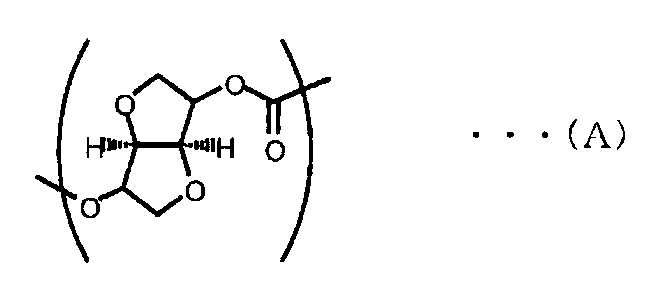
<成形品>
本発明で使用されるポリカーボネートは、全繰り返し単位を基準として、単位(A)の含有量が、50モル%以上であり、好ましくは60モル%以上であり、より好ましくは70モル%以上、さらに好ましくは80モル%以上である。
(単位(A))
本発明における単位(A)は、エーテル基を有する脂肪族ジオールから誘導される。エーテル結合を有するジオールは、バイオマス資源の中で耐熱性および鉛筆硬度が高い材料である。
単位(A)として、立体異性体の関係にある下記の単位(A1)、(A2)および(A3)が例示される。

イソソルビド、イソマンニド、イソイディッドのなかでも特に、イソソルビド(1,4;3,6ージアンヒドロ−D−ソルビトール)から誘導される繰り返し単位は、製造の容易さ、耐熱性に優れることから好ましい。
本発明で使用されるポリカーボネートの好ましい態様として、長鎖脂肪族ジオールから誘導される単位を含有するコポリカーボネート(1)、ブロック構造を有するコポリカーボネート(2)、側鎖を有するコポリカーボネート(3)、ポリエステルジオールから誘導される単位を含むコポリカーボネート(4)が挙げられる。
(コポリカーボネート(1))
本発明で使用されるポリカーボネートの好ましい一態様として、
単位(A)と下記式で表される単位(B−1)を含み、
(i)全繰り返し単位中、単位(A)と単位(B−1)との合計が80モル%以上であり、
(ii)単位(A)と単位(B−1)とのモル比(A/(B−1))が、60/40~95/5である、コポリカーボネート(1)が挙げられる。
コポリカーボネート(1)は、長鎖脂肪族ジオールから誘導される単位を含有する。
全繰り返し単位中、単位(A)と単位(B−1)との合計は、好ましくは90モル%以上、より好ましくは95モル%、さらに好ましくは100モル%である。
単位(A)と単位(B−1)とのモル比(A/(B−1))は、70/30~93/7の範囲がより好ましく、80/20~90/10の範囲がさらに好ましい。上記範囲内であると耐熱性、耐侯性、低吸水性、表面硬度および低温衝撃特性のバランスに優れることから好ましい。モル比(A/(B−1))は、日本電子社製JNM−AL400のプロトンNMRにて測定し算出することができる。

単位(B−1)は、炭素数8~12の脂肪族ジオールから誘導される。炭素数8~12の脂肪族ジオールとして、1,8−オクタンジオール、1,9−ノナンジオール、1,10−デカンジオール、1,12−ドデカンジオール、2,4−ジエチル−1,5−ペンタンジオール、2−メチル−1,8−オクタンジオールが挙げられる。なかでも1,8−オクタンジオール、1,9−ノナンジオール、1,10−デカンジオール、1,12−ドデカンジオールが好ましく、1,9−ノナンジオール、1,10−デカンジオール、1,12−ドデカンジオールがより好ましい。これらは2種類以上併用して用いても良い。
単位(A)および単位(B−1)以外のその他の単位を誘導するジオール化合物としては、後述する単位(B−2)、単位(B−3)を誘導するモノマー化合物や、それ以外の脂肪族ジオール化合物、脂環式ジオール化合物、芳香族ジヒドロキシ化合物のいずれでも良い。具体的には国際公開第2004/111106号パンフレット、国際公開第2011/021720号パンフレットに記載のジオール化合物やジエチレングリコール、トリエチレングリコール、テトラエチレングリコール、ポリエチレングリコールなどのオキシアルキレングリコール類が挙げられる。
脂肪族ジヒドロキシ化合物として、1,3−プロパンジオール、1,4−ブタンジオール、1,5−ペンタンジオール、1,6−ヘキサンジオール等が挙げられる。
脂環式ジヒドロキシ化合物として、シクロヘキサンジメタノール、トリシクロデカンジメタノール、アダマンタンジオール、ペンタシクロペンタデカンジメタノール、3,9−ビス(2−ヒドロキシ−1,1−ジメチルエチル)−2,4,8,10−テトラオキサスピロ[5.5]ウンデカン等が挙げられる。
芳香族ジヒドロキシ化合物として、α,α’−ビス(4−ヒドロキシフェニル)−m−ジイソプロピルベンゼン(ビスフェノールM)、9,9−ビス(4−ヒドロキシ−3−メチルフェニル)フルオレン、1,1−ビス(4−ヒドロキシフェニル)シクロヘキサン、1,1−ビス(4−ヒドロキシフェニル)−3,3,5−トリメチルシクロヘキサン、4,4’−ジヒドロキシ−3,3’−ジメチルジフェニルスルフィド、ビスフェノールA、2,2−ビス(4−ヒドロキシ−3−メチルフェニル)プロパン(ビスフェノールC)、2,2−ビス(4−ヒドロキシフェニル)−1,1,1,3,3,3−ヘキサフルオロプロパン(ビスフェノールAF)および1,1−ビス(4−ヒドロキシフェニル)デカン等が挙げられる。
単位(A)と単位(B−1)とを含むコポリカーボネートは、通常のポリカーボネートを製造するそれ自体公知の反応手段、例えばジオール成分に炭酸ジエステルなどのカーボネート前駆物質を反応させる方法により製造される。次にこれらの製造方法について基本的な手段を簡単に説明する。
カーボネート前駆物質として炭酸ジエステルを用いるエステル交換反応は、不活性ガス雰囲気下所定割合の芳香族ジヒドロキシ成分を炭酸ジエステルと加熱しながら撹拌して、生成するアルコールまたはフェノール類を留出させる方法により行われる。反応温度は生成するアルコールまたはフェノール類の沸点などにより異なるが、通常120~300℃の範囲である。反応はその初期から減圧にして生成するアルコールまたはフェノール類を留出させながら反応を完結させる。また、必要に応じて末端停止剤、酸化防止剤等を加えてもよい。
前記エステル交換反応に使用される炭酸ジエステルとしては、置換されてもよい炭素数6~12のアリール基、アラルキル基等のエステルが挙げられる。具体的には、ジフェニルカーボネート、ジトリールカーボネート、ビス(クロロフェニル)カーボネートおよびm−クレジルカーボネート等が例示される。なかでもジフェニルカーボネートが特に好ましい。ジフェニルカーボネートの使用量は、ジヒドロキシ化合物の合計1モルに対して、好ましくは0.97~1.10モル、より好ましは1.00~1.06モルである。
また溶融重合法においては重合速度を速めるために、重合触媒を用いることができ、かかる重合触媒としては、アルカリ金属化合物、アルカリ土類金属化合物、含窒素化合物、金属化合物等が挙げられる。
このような化合物としては、アルカリ金属やアルカリ土類金属の、有機酸塩、無機塩、酸化物、水酸化物、水素化物、アルコキシド、4級アンモニウムヒドロキシド等が好ましく用いられ、これらの化合物は単独もしくは組み合わせて用いることができる。
アルカリ金属化合物としては、水酸化ナトリウム、水酸化カリウム、水酸化セシウム、水酸化リチウム、炭酸水素ナトリウム、炭酸ナトリウム、炭酸カリウム、炭酸セシウム、炭酸リチウム、酢酸ナトリウム、酢酸カリウム、酢酸セシウム、酢酸リチウム、ステアリン酸ナトリウム、ステアリン酸カリウム、ステアリン酸セシウム、ステアリン酸リチウム、水素化ホウ素ナトリウム、安息香酸ナトリウム、安息香酸カリウム、安息香酸セシウム、安息香酸リチウム、リン酸水素2ナトリウム、リン酸水素2カリウム、リン酸水素2リチウム、フェニルリン酸2ナトリウム、ビスフェノールAの2ナトリウム塩、2カリウム塩、2セシウム塩、2リチウム塩、フェノールのナトリウム塩、カリウム塩、セシウム塩、リチウム塩等が例示される。
アルカリ土類金属化合物としては、水酸化マグネシウム、水酸化カルシウム、水酸化ストロンチウム、水酸化バリウム、炭酸マグネシウム、炭酸カルシウム、炭酸ストロンチウム、炭酸バリウム、二酢酸マグネシウム、二酢酸カルシウム、二酢酸ストロンチウム、二酢酸バリウム等が例示される。
含窒素化合物としては、テトラメチルアンモニウムヒドロキシド、テトラエチルアンモニウムヒドロキシド、テトラプロピルアンモニウムヒドロキシド、テトラブチルアンモニウムヒドロキシド、トリメチルベンジルアンモニウムヒドロキシド等のアルキル、アリール基等を有する4級アンモニウムヒドロキシド類が挙げられる。また、トリエチルアミン、ジメチルベンジルアミン、トリフェニルアミン等の3級アミン類、2−メチルイミダゾール、2−フェニルイミダゾール、ベンゾイミダゾール等のイミダゾール類が挙げられる。また、アンモニア、テトラメチルアンモニウムボロハイドライド、テトラブチルアンモニウムボロハイドライド、テトラブチルアンモニウムテトラフェニルボレート、テトラフェニルアンモニウムテトラフェニルボレート等の塩基あるいは塩基性塩等が例示される。
金属化合物としては亜鉛アルミニウム化合物、ゲルマニウム化合物、有機スズ化合物、アンチモン化合物、マンガン化合物、チタン化合物、ジルコニウム化合物等が例示される。これらの化合物は1種または2種以上併用してもよい。
これらの重合触媒の使用量は、ジオール成分1モルに対し好ましくは1×10⁻⁹~1×10⁻²当量、好ましくは1×10⁻⁸~1×10⁻⁵当量、より好ましくは1×10⁻⁷~1×10⁻³当量の範囲で選ばれる。
また、反応後期に触媒失活剤を添加することもできる。使用する触媒失活剤としては、公知の触媒失活剤が有効に使用されるが、この中でもスルホン酸のアンモニウム塩、ホスホニウム塩が好ましい。更にドデシルベンゼンスルホン酸テトラブチルホスホニウム塩等のドデシルベンゼンスルホン酸の塩類、パラトルエンスルホン酸テトラブチルアンモニウム塩等のパラトルエンスルホン酸の塩類が好ましい。
またスルホン酸のエステルとして、ベンゼンスルホン酸メチル、ベンゼンスルホン酸エチル、ベンゼンスルホン酸ブチル、ベンゼンスルホン酸オクチル、ベンゼンスルホン酸フェニル、パラトルエンスルホン酸メチル、パラトルエンスルホン酸エチル、パラトルエンスルホン酸ブチル、パラトルエンスルホン酸オクチル、パラトルエンスルホン酸フェニル等が好ましく用いられる。なかでも、ドデシルベンゼンスルホン酸テトラブチルホスホニウム塩が最も好ましく使用される。
これらの触媒失活剤の使用量はアルカリ金属化合物および/またはアルカリ土類金属化合物より選ばれた少なくとも1種の重合触媒を用いた場合、その触媒1モル当たり好ましくは0.5~50モルの割合で、より好ましくは0.5~10モルの割合で、更に好ましくは0.8~5モルの割合で使用することができる。
(コポリカーボネート(2))
本発明で使用されるポリカーボネートの好ましい一態様として、単位(A)と脂肪族ジオール化合物および脂環式ジオール化合物からなる群より選ばれる少なくとも1種の化合物から誘導されるカーボネート単位(B−2)を含み、
(i)ブロック性を有し、
(ii)全繰り返し単位中、単位(A)と単位(B−2)との合計が80モル%以上であり、
(iii)単位(A)と単位(B−2)とのモル比(A/(B−2))は、60/40~95/5である、
コポリカーボネート(2)が挙げられる。
コポリカーボネート(2)は、単位(B−2)中にブロック構造を有する。
全繰り返し単位中、単位(A)と単位(B−2)との合計は、好ましくは90モル%以上、より好ましくは95モル%、さらに好ましくは100モル%である。
単位(A)と単位(B−2)とのモル比(A/(B−2))は、65/35~93/7の範囲が好ましく、70/30~90/10の範囲がより好ましい。上記範囲内であると耐熱性、耐侯性、低吸水性、表面硬度および低温衝撃特性のバランスに優れることから好ましい。モル比(A/(B−2))は、日本電子社製JNM−AL400のプロトンNMRにて測定し算出することができる。
単位(B−2)を構成するとして脂肪族ジオール化合物が挙げられる。脂肪族ジオール化合物は、直鎖脂肪族ジオール化合物または分岐脂肪族ジオール化合物のいずれでもよい。
直鎖脂肪族ジオール化合物として、好ましくは炭素原子数2~30、より好ましくは炭素原子数3~20、さらに好ましくは炭素原子数3~10の直鎖脂肪族ジオール化合物が使用される。直鎖脂肪族ジオール化合物として、具体的には、エチレングリコール、1,3−プロパンジオール、1,4−ブタンジオール、1,5−ペンタンジオール、1,6−ヘキサンジオール、1,7−ヘプタンジオール、1,8−オクタンジオール、1,9−ノナンジオール、1,10−デカンジオール、1,12−ドデカンジオール、水素化ジリノレイルグリコール,水素化ジオレイルグリコールなどが挙げられる。なかでも1,3−プロパンジオール、1,4−ブタンジオール、1,6−ヘキサンジオール、1,10−デカンジオールが好ましい。
分岐脂肪族ジオール化合物として、好ましくは炭素原子数3~30、より好ましくは炭素原子数3~20、さらに好ましくは炭素原子数4~12の分岐脂肪族ジオール化合物が使用される。分岐脂肪族ジオール化合物として、具体的には、1,3−ブチレングリコール、2−メチル−1,3−プロパンジオール、ネオペンチルグリコール、2−エチル−1,6−ヘキサンジオール、2,2,4−トリメチル−1,6−ヘキサンジオール、3−メチル−1,5−ペンタンジオール、2−n−ブチル−2−エチル−1,3−プロパンジオール、2,2−ジエチル−1,3−プロパンジオール、2,4−ジエチル−1,5−ペンタンジオール、1,2−ヘキサングリコール、1,2−オクチルグリコール、2−エチル−1,3−ヘキサンジオール、2,3−ジイソブチル−1,3−プロパンジオール、2,2−ジイソアミル−1,3−プロパンジオール、2−メチル−2−プロピル−1,3−プロパンジオールなどが挙げられる。なかでも3−メチル−1,5−ペンタンジオール、2−n−ブチル−2−エチル−1,3−プロパンジオール、2,2−ジエチル−1,3−プロパンジオール、2,4−ジエチル−1,5−ペンタンジオールが好ましい。
単位(B−2)を構成するとして脂環式ジオール化合物が挙げられる。脂環式ジオール化合物として、好ましくは炭素原子数6~30、より好ましくは炭素原子数6~20の脂環式ジオール化合物が使用される。脂環式ジオール化合物として、具体的には、1,2−シクロヘキサンジオール、1,3−シクロヘキサンジオール、1,4−シクロヘキサンジオール、2−メチル−1,4−シクロヘキサンジオールなどのシクロヘキサンジオール類、1,2−シクロヘキサンジメタノール、1,3−シクロヘキサンジメタノール、1,4−シクロヘキサンジメタノールなどのシクロヘキサンジメタノール類、2,3−ノルボルナンジメタノール、2,5−ノルボルナンジメタノールなどのノルボルナンジメタノール類、トリシクロデカンジメタノール、ペンタシクロペンタデカンジメタノール、1,3−アダマンタンジオール、2,2−アダマンタンジオール、デカリンジメタノール、2,2,4,4−テトラメチル−1,3−シクロブタンジオールおよび3,9−ビス(2−ヒドロキシ−1,1−ジメチルエチル)−2,4,8,10−テトラオキサスピロ[5.5]ウンデカンなどが挙げられる。これらのうち、1,4−シクロヘキサンジメタノール、トリシクロデカンジメタノール、3,9−ビス(2−ヒドロキシ−1,1−ジメチルエチル)−2,4,8,10−テトラオキサスピロ[5.5]ウンデカンが好ましい。これらの脂肪族ジオール化合物および脂環式ジオール化合物は、1種もしくは2種類以上併用して用いても良い。
(ブロック性)
コポリカーボネート(2)は、ブロック状の単位(B−2)を有する。ブロック部分における単位(B−2)の平均繰り返し単位数(n)が好ましくは2~100、より好ましくは2.2~50、さらに好ましくは2.3~30、特に好ましくは2.5~10である。また、ブロック部分における単位(B−2)の数平均分子量は、好ましくは250~5000、より好ましくは300~3000、さらに好ましくは300~2000、特に好ましくは350~1500である。ブロック部分における単位(B−2)の平均繰り返し単位数(n)および数平均分子量が上記範囲内であると、目的とする吸水性や耐熱性、鉛筆硬度が良好となり、また相分離が起こり難く好ましい。
コポリカーボネート(2)における単位(B−2)のブロック性は、コポリカーボネート(2)をCDCl3に溶解して、13C−NMRで測定したカーボネートの炭素から算出することができる。[単位(A)−単位(A)]のシグナルは153~154ppmに3本あり(立体異性体が3種類あるため)、[単位(A)−単位(B−2)]のシグナルは通常154~155ppmに2本あり(共重合ジオールの立体異性がない場合は、イソソルビドとの立体異性体が2種類あるため)、[単位(B−2)−単位(B−2)]のシグナルは通常155~156ppmに測定される。このシグナルの積分値から単位(B−2)の平均繰り返し単位数を算出することができる。単位(B−2)の平均繰り返し単位数は下記式で求められる。また、平均繰り返し単位数とその繰り返し単位の分子量を乗算することによりブロック部分における単位(B−2)の数平均分子量が算出される。
単位(B−2)の平均繰り返し単位数=([単位(B−2)−単位(B−2)]のシグナルの積分値/
[単位(A)−単位(B−2)]のシグナルの積分値)×2+1
(単位(B−2a))
単位(B−2)は、好ましくは下記式で表される単位(B−2a)である。

単位(B−2a)中Yは、好ましくは炭素原子数6~30、より好ましくは炭素原子数6~20のシクロアルキレン基である。炭素原子数6~30シクロアルキレン基として、シクロヘキシレン基、シクロオクチレン基、シクロノニレン基、シクロデシレン基、シクロドデシレン基等が挙げられる。
単位−(Y)n−のブロックの大きさを表す“n”は、好ましくは2~100、より好ましくは2.2~50、さらに好ましくは2.3~30、特に好ましくは2.5~10である。単位(B−2a)の数平均分子量は、好ましくは250~5000、より好ましくは300~3000、さらに好ましくは300~2000、特に好ましくは350~1500である。
単位(A)および単位(B−2)以外のその他の単位を誘導する化合物、例えばオキシアルキレングリコール類や芳香族ジヒドロキシ化合物を使用することもできる。
(コポリカーボネート(2)の製造)
コポリカーボネート(2)は、予め脂肪族ジオール化合物および脂環式ジオール化合物からなる群より選ばれる少なくとも1種の化合物から繰り返し単位(B−2)で表されるポリカーボネートオリゴマーを得、その後、得られたポリカーボネートオリゴマー、単位(A)を誘導するモノマー(例えばイソソルビド)およびカーボネート前駆物質を反応させて、コポリカーボネートを製造することが好ましい。
(i)ポリカーボネートオリゴマーの製造方法
ポリカーボネートオリゴマーは、通常のポリカーボネートを製造するそれ自体公知の反応手段、例えばジオール化合物に炭酸ジエステルなどのカーボネート前駆物質を反応させる方法やポリカーボネートジオールを製造する公知の方法により製造される。次にこれらの製造方法について基本的な手段を簡単に説明する。
カーボネート前駆物質として炭酸ジエステルを用いるエステル交換反応は、不活性ガス雰囲気下所定割合のジオール化合物を炭酸ジエステルと加熱しながら撹拌して、生成するアルコールまたはフェノール類を留出させる方法により行われる。反応温度は生成するアルコールまたはフェノール類の沸点などにより異なるが、通常120~300℃の範囲である。反応はその初期から減圧にして生成するアルコールまたはフェノール類を留出させながら反応させる。また、必要に応じて酸化防止剤等を加えてもよい。
前記エステル交換反応に使用される炭酸ジエステルとしては、上述した炭酸ジエステルと同様のものが使用できる。
使用できる触媒としては、上述した触媒(エステル交換触媒)と同様のものが使用できる。
ポリカーボネートオリゴマーの製造方法は、触媒の存在下または不存在下で行うことができるが、反応効率の観点から、触媒の存在下で行うことが好ましい。
ポリカーボネートオリゴマーの製造方法における反応温度は好ましくは90~230℃であり、より好ましくは100~220℃、さらに好ましくは120~210℃である。反応温度が230℃を超えると、得られるポリカーボネートオリゴマーが着色する場合や、エーテル構造が生成する場合がある。
ポリカーボネートオリゴマーの製造方法の反応初期は、副生成するアルコールやフェノールの量が相対的に少ないので、炭酸ジエステルの留出を抑えるため、10kPa~常圧でエステル交換反応を行い、エステル交換反応の終盤、例えば、エステル交換反応が好ましくは50%以上、より好ましくは70%以上進行した後では、好ましくは0.1~10kPa、より好ましくは0.1~1kPaの減圧下でエステル交換反応を行うのが好ましい。
ポリカーボネートオリゴマーの数平均分子量は好ましくは250~5000、より好ましくは300~3000、さらに好ましくは400~2000、特に好ましくは400~1500である。数平均分子量が250未満の場合、目的とする吸水性や耐熱性、鉛筆硬度が悪化することがある。また数平均分子量が5000を超える場合、ブロック性が高くなりすぎ、相分離が起こり易くなる。ポリカーボネートオリゴマーの数平均分子量は、プロトンNMRを測定することにより算出することができる。プロトンNMRにて繰り返し単位に対して末端水酸基と末端フェニル基を算出し、下記式により数平均分子量を算出した。
ポリカーボネートオリゴマーの数平均分子量=(繰り返し単位のシグナルの積分値)/(末端水酸基のシグナルの積分値+末端フェニル基のシグナルの積分値)×2×繰り返し単位の分子量
ポリカーボネートオリゴマーの末端水酸基、末端フェニル基の比率は特に規定はなく、どのような比率であっても良い。
ポリカーボネートオリゴマーの製造はコポリカーボネートの製造と同じ反応釜で行っても良いし、別々の反応釜を使用しても良い。また、反応容器から一度取り出して、保管した後に使用しても良い。また、ポリカーボネートオリゴマーはフィルターでの精製や再沈などの精製を行っても良い。
(ii)コポリカーボネート(2)の製造
コポリカーボネート(2)は、上述の方法により得られたポリカーボネートオリゴマー、単位(A)を誘導するモノマー(例えばイソソルビド)およびカーボネート前駆物質を、通常のポリカーボネートを製造するそれ自体公知の反応手段により反応させて製造される。次にこれらの製造方法について基本的な手段を簡単に説明する。
カーボネート前駆物質として炭酸ジエステルを用いるエステル交換反応は、不活性ガス雰囲気下所定割合のジオール成分を炭酸ジエステルと加熱しながら撹拌して、生成するアルコールまたはフェノール類を留出させる方法により行われる。反応温度は生成するアルコールまたはフェノール類の沸点などにより異なるが、通常120~300℃の範囲である。反応はその初期から減圧にして生成するアルコールまたはフェノール類を留出させながら反応を完結させる。また、必要に応じて末端停止剤、酸化防止剤等を加えてもよい。
前記エステル交換反応に使用される炭酸ジエステルとしては、上述した炭酸ジエステルと同様のものが使用できる。なかでもジフェニルカーボネートが特に好ましい。ジフェニルカーボネートの使用量は、ジヒドロキシ化合物の合計1モルに対して、好ましくは0.97~1.10モル、より好ましは1.00~1.06モルである。
また溶融重合法においては重合速度を速めるために、重合触媒を用いることができ、かかる重合触媒としては、上述した触媒(エステル交換触媒)と同様のものが使用できる。
重合触媒の使用量は、ジオール成分1モルに対し好ましくは1×10⁻⁹~1×10⁻²当量、好ましくは1×10⁻⁸~1×10⁻⁵当量、より好ましくは1×10⁻⁷~1×10⁻³当量の範囲で選ばれる。
また、反応後期に触媒失活剤を添加することもできる。使用する触媒失活剤としては、上述した触媒失活剤が使用できる。
これらの触媒失活剤の使用量はアルカリ金属化合物および/またはアルカリ土類金属化合物より選ばれた少なくとも1種の重合触媒を用いた場合、その触媒1モル当たり好ましくは0.5~50モルの割合で、より好ましくは0.5~10モルの割合で、更に好ましくは0.8~5モルの割合で使用することができる。
(コポリカーボネート(3))
本発明で使用されるポリカーボネートの好ましい一態様として、
単位(A)と下記式で表される単位(B−3)を含み、
(i)全繰り返し単位中、単位(A)と単位(B−3)との合計が80モル%以上であり、
(ii)単位(A)と単位(B−3)とのモル比(A/(B−3))が、50/50~95/5である、
コポリカーボネート(3)が挙げられる。
コポリカーボネート(3)は、側鎖を有する構造である。
全繰り返し単位中、単位(A)と単位(B−3)との合計は、好ましくは90モル%以上、より好ましくは95モル%以上、さらに好ましくは100モル%である。
単位(A)と単位(B−3)とのモル比(A/(B−3))は、60/40~95/5の範囲が好ましく、60/40~93/7の範囲がより好ましく、70/30~90/10の範囲がさらに好ましい。上記範囲内であると耐熱性、耐侯性、低吸水性、表面硬度および低温衝撃特性のバランスに優れることから好ましい。モル比(A/B−3)は、日本電子社製JNM−AL400のプロトンNMRにて測定し算出することができる。
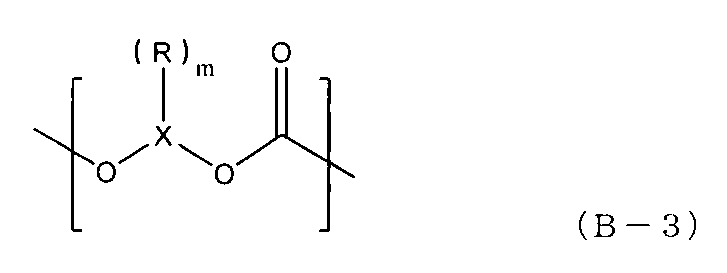
単位(B−3)は、側鎖アルキル基または側鎖シクロアルキル基を有する脂肪族ジオールから誘導される単位である。
単位(B−3)は、炭素数の合計が4~12の範囲であることが好ましく、5~10の範囲であることがより好ましい。かかる範囲であると、ポリカーボネートのHDT(荷重たわみ温度)が高く保持される。
また、単位(B−3)は、Xの炭素数(主鎖炭素数)と、Rの炭素数の合計(側鎖炭素数)が、下記式(i)を満足することが好ましく、下記式(i−a)を満足することがより好ましく、下記式(i−b)を満足することがさらに好ましい。下記式(i)を満足すると、耐沸水性に優れ、且つ大幅に吸水率が低減できるため好ましい。
0.3 ≦ (主鎖炭素数)/(側鎖炭素数) ≦ 8 (i)
0.4 ≦ (主鎖炭素数)/(側鎖炭素数) ≦ 5 (i−a)
0.5 ≦ (主鎖炭素数)/(側鎖炭素数) ≦ 2 (i−b)
(単位(B−3)中のX)
式(B−3)において、Xは炭素数3~20のアルキレン基または炭素数3~20のシクロアルキレン基を表す。
Xは、好ましくは炭素数3~12のアルキレン基、より好ましくは炭素数3~8のアルキレン基、さらに好ましくは炭素数2~6のアルキレン基である。アルキレン基としては、プロピレン基、ブチレン基、ペンチレン基、ヘキシレン基、ヘプチレン基、オクチレン基などが挙げられる。
Xは、好ましくは炭素数3~12のシクロアルキレン基、より好ましくは炭素数3~8のシクロアルキレン基、さらに好ましくは炭素数3~6のシクロアルキレン基である。シクロアルキレン基としては、シクロプロピレン基、シクロブチレン基、シクロペンチレン基、シクロヘキシレン基、シクロヘプチレン基、シクロオクチレン基などが挙げられる。
(単位(B−3)中のR)
式(B−3)において、Rは炭素数1~20のアルキル基または炭素数3~20のシクロアルキル基を表す。
Rは、好ましくは炭素数1~12のアルキル基、より好ましくは炭素数1~8のアルキル基である。アルキル基としては、メチル基、エチル基、プロピル基、ブチル基、ペンチル基、ヘキシル基、ヘプチル基、オクチル基などが挙げられる。
Rは、好ましくは炭素数3~12のシクロアルキル基、より好ましくは炭素数3~8のシクロアルキル基である。シクロアルキル基としては、シクロプロピル基、シクロブチル基、シクロペンチル基、シクロヘキシル基、シクロヘプチル基、シクロオクチル基などが挙げられる。
(単位(B−3)中のm)
式(B−3)において、mは1~10の整数、好ましくは2~8の整数、より好ましくは2~5の整数を示す。
(単位(B−3)中のXが炭素数3~20のアルキレン基のとき)
単位(B−3)中の、Xが炭素数3~20のアルキレン基で、Rが炭素数1~4のアルキル基で、mが2~8の整数であることが好ましい。単位(B)中のXが炭素数3~5のアルキレン基で、Rが炭素数1~4のアルキル基で、mが1~2の整数であることが好ましい。
単位(B−3)中の−X{−(R)m}−が、下記式で表される単位(Ba)であることが好ましい。

単位(B−3)中の、−X{−(R)m}−は、2−n−ブチル−2−エチル−1,3−プロパンジイル基、2,4−ジエチル−1,5−ペンタンジイル基、3−メチル−1,5−ペンタンジイル基であることが好ましい。
(単位(B−3)中のXが炭素数3~20のシクロアルキレン基のとき)
前記式(B−3)において、Xは炭素数4~5のシクロアルキレン基で、Rは炭素数1~10のアルキル基で、mは3~12の整数であることが好ましい。
単位(B−3)が、下記式で表される単位(Bb)であることが好ましい。

単位(B−3)が、下記式で表される単位(Bb−i)であることが好ましい。

なかでも3−メチル−1,5−ペンタンジオール、2−n−ブチル−2−エチル−1,3−プロパンジオール、2,2−ジエチル−1,3−プロパンジオール、2,4−ジエチル−1,5−ペンタンジオールが好ましく、2−n−ブチル−2−エチル−1,3−プロパンジオール、2,4−ジエチル−1,5−ペンタンジオールが特に好ましい。これらは2種類以上併用して用いても良い。
単位(A)および単位(B−3)以外のその他の単位を誘導するジオール化合物としては、前述した単位(B−1)、単位(B−2)を誘導するモノマー化合物や、それ以外の脂肪族ジオール化合物、脂環式ジオール化合物、芳香族ジヒドロキシ化合物のいずれでも良い。具体的には国際公開第2004/111106号パンフレット、国際公開第2011/021720号パンフレットに記載のジオール化合物やジエチレングリコール、トリエチレングリコール、テトラエチレングリコール、ポリエチレングリコールなどのオキシアルキレングリコール類が挙げられる。
脂肪族ジヒドロキシ化合物、脂環式ジヒドロキシ化合物、芳香族ジヒドロキシ化合物としては、前述したものと同様のものが挙げられる。
単位(A)と単位(B−3)とを含むコポリカーボネートは、通常のポリカーボネートを製造するそれ自体公知の反応手段、例えばジオール成分に炭酸ジエステルなどのカーボネート前駆物質を反応させる方法により製造される。これらの製造方法について基本的な手段は、上述した単位(A)と単位(B−1)とを含むコポリカーボネートの手段と同様である。
(コポリカーボネート(4))
本発明で使用されるポリカーボネートの他の一態様として、
単位(A)とポリエステルジオールから誘導されるカーボネート単位(B−4)を含み、
(i)全繰り返し単位中、単位(A)と単位(B−4)との合計が80モル%以上であり、
(ii)単位(A)と単位(B−4)とのモル比(A/(B−4)は、50/50~99/1であるコポリカーボネート(4)が挙げられる。
単位(A)と単位(B−4)との合計は、好ましくは90モル%以上、より好ましくは95モル%以上、さらに好ましくは100モル%である。
単位(A)と単位(B−4)とのモル比(A/(B−4))は、60/40~95/5が好ましく、70/30~98/2の範囲がより好ましく、90/10~97.5/2.5の範囲がさらに好ましい。上記範囲内であると耐熱性、耐侯性、低吸水性、表面硬度および低温耐衝撃性のバランスに優れることから好ましい。モル比(A/(B−4))は、日本電子社製JNM−AL400のプロトンNMRにて測定し算出することができる。
単位(B−4)は、ジカルボン酸成分とジオール成分とを構成成分として含むポリエステルジオールから誘導されるカーボネート単位である。
好適なジカルボン酸としては、4~20個の炭素原子を有する脂肪族カルボン酸、芳香族カルボン酸または芳香族脂肪族カルボン酸である。好ましくは、2,2−ジメチルマロン酸、コハク酸、グルタル酸、アジピン酸、ピメリン酸、セバシン酸、スベリン酸、アゼライン酸、1,4−シクロヘキサンジカルボン酸、オルソフタル酸、無水フタル酸、ナフタル酸、ビフェニルジカルボン酸、ヘキサヒドロフタル酸、5−メチルイソフタル酸、テレフタル酸およびイソフタル酸からなる群より選択される少なくとも一種のジカルボン酸であり、特に好ましくはアジピン酸、セバシン酸、1,4−シクロヘキサンジカルボン酸、テレフタル酸およびイソフタル酸からなる群より選ばれる少なくとも一種のジカルボン酸である。これらのジカルボン酸成分は、1種もしくは2種類以上併用して用いても良い。
好適なジオール成分としては、直鎖脂肪族ジオール化合物、分岐脂肪族ジオール化合物、脂環式ジオール化合物が挙げられる。
直鎖脂肪族ジオール化合物として、具体的には、エチレングリコール、1,3−プロパンジオール、1,4−ブタンジオール、1,5−ペンタンジオール、1,6−ヘキサンジオール、1,7−ヘプタンジオール、1,8−オクタンジオール、1,9−ノナンジオール、1,10−デカンジオール、1,12−ドデカンジオール、水素化ジリノレイルグリコール,水素化ジオレイルグリコールなどが挙げられる。なかでも1,3−プロパンジオール、1,4−ブタンジオール、1,6−ヘキサンジオール、1,10−デカンジオールが好ましい。
分岐脂肪族ジオール化合物として、具体的には、1,3−ブチレングリコール、2−メチル−1,3−プロパンジオール、ネオペンチルグリコール、2−エチル−1,6−ヘキサンジオール、2,2,4−トリメチル−1,6−ヘキサンジオール、3−メチル−1,5−ペンタンジオール、2−n−ブチル−2−エチル−1,3−プロパンジオール、2,2−ジエチル−1,3−プロパンジオール、2,4−ジエチル−1,5−ペンタンジオール、1,2−ヘキサングリコール、1,2−オクチルグリコール、2−エチル−1,3−ヘキサンジオール、2,3−ジイソブチル−1,3−プロパンジオール、2,2−ジイソアミル−1,3−プロパンジオール、2−メチル−2−プロピル−1,3−プロパンジオール、グリセリン、トリメチロールプロパン、ペンタエリスリトールなどが挙げられる。なかでも3−メチル−1,5−ペンタンジオール、2−n−ブチル−2−エチル−1,3−プロパンジオール、2,2−ジエチル−1,3−プロパンジオール、2,4−ジエチル−1,5−ペンタンジオールが好ましい。
脂環式ジオール化合物として、具体的には、1,2−シクロヘキサンジオール、1,3−シクロヘキサンジオール、1,4−シクロヘキサンジオール、2−メチル−1,4−シクロヘキサンジオールなどのシクロヘキサンジオール類、1,2−シクロヘキサンジメタノール、1,3−シクロヘキサンジメタノール、1,4−シクロヘキサンジメタノールなどのシクロヘキサンジメタノール類、2,3−ノルボルナンジメタノール、2,5−ノルボルナンジメタノールなどのノルボルナンジメタノール類、トリシクロデカンジメタノール、ペンタシクロペンタデカンジメタノール、1,3−アダマンタンジオール、2,2−アダマンタンジオール、デカリンジメタノール、2,2,4,4−テトラメチル−1,3−シクロブタンジオールおよび3,9−ビス(2−ヒドロキシ−1,1−ジメチルエチル)−2,4,8,10−テトラオキサスピロ[5.5]ウンデカンなどが挙げられる。これらのうち、1,4−シクロヘキサンジメタノール、トリシクロデカンジメタノール、3,9−ビス(2−ヒドロキシ−1,1−ジメチルエチル)−2,4,8,10−テトラオキサスピロ[5.5]ウンデカンが好ましい。
これらのジオール化合物は、1種もしくは2種類以上併用して用いても良い。
好適なポリエステルジオール(B4)は、下記式で表される。

Wは炭素原子数1~12の芳香族基を含んでもよい炭化水素基を示し、具体的には、上述した脂肪族カルボン酸、芳香族カルボン酸または芳香族脂肪族カルボン酸の脂肪族、芳香族または芳香族脂肪族部分である。
nは平均繰り返し単位数を示す。後述するように、ポリエステルジオール(B1)の重量平均分子量は100~3000の範囲が好ましく、この重量平均分子量となるように平均繰り返し単位数nを設定することが好ましい。
ポリエステルジオールは、公知のポリエステルジオールの製造方法に従って製造することができる。
ポリエステルジオールの製造法で用いられる金属系触媒としては、ルイス酸やアルカリ金属およびアルカリ土類金属のカルボン酸塩、プロトン酸、活性白土、酸性白土、イオン交換樹脂などを挙げることができる。より具体的には、テトラブトキシチタネート、ジブチル錫オキシド、酢酸マンガン、酢酸コバルト、酢酸亜鉛、安息香酸亜鉛、酢酸リチウム、酢酸ナトリウム、酢酸マグネシウム、酢酸カルシウム、酸価アンチモン、酸価ゲルマニウム、燐酸、ホウ酸、硫酸、p−トルエンスルホン酸、メタスルホン酸、アンバーリストE15などが挙げられる。これらの触媒の使用量は、原料ポリアルキレンテレフタレートに対して10~5000μg、好ましくは50~1000μgである。
ポリエステルジオールの製造方法において、エステル交換反応を行う際の反応温度は、通常150~300℃の範囲で、好ましくは200~250℃の範囲である。圧力はいずれでも良いが、通常常圧ないし1MPaである。また、エステル交換反応の反応時間は特に限定されないが,通常、0.5~5時間の範囲で行われる。エステル交換反応は、バッチ、セミバッチ、連続いずれの方法で実施しても良い。
エステル交換反応で副生したグリコール成分は、必要に応じて留去する。このことによりポリエステルジオールの水酸基価、粘度を所定の範囲に制御することができる。このグリコール成分の留去に際して特に限定の条件はないが、通常、加熱減圧下に実施する。また、エステル交換反応触媒の存在下に反応させながらグリコール成分を留去しても、反応終了後留去しても良いが反応時の酸成分とグリコール成分の割合を制御することができるので反応時に留去することが好ましい。グリコール留去の温度は通常150~300℃の範囲であり、好ましくは200~250℃の範囲である。圧力は通常0.5~0.0001MPa、好ましくは0.1~0.001MPaの範囲で実施される。
得られたポリエステルジオールは金属分等の不純物を除去しても良い。特にアンチモン、ゲルマニウム等の金属分は吸着剤等を用いて処理することが好ましい。さらに、エステル交換に用いた触媒がジオール中に残留していると加水分解性や熱安定性が悪化するので、吸着剤で除去を行っても良く、また、テトラブトキシチタネートのような水で加水分解してジオールに不溶な化合物になるものは、水を添加して触媒を加水分解して沈殿させ、濾別して除去しても良い。
ポリエステルジオールの重量平均分子量について特に制限されないが、100~3000が好ましく、200~2500がより好ましく、300~2000がさらに好ましく、400~1500が特に好ましく、450~1000が最も好ましい。ポリエステルジオールの重量平均分子量が100未満の場合、酸価が大きくなりやすく、重合反応に影響を与え、生産性が悪化することがある。一方、ポリエステルジオールの重量平均分子量が3000を超えると相分離が起こり易くなる。
ポリエステルジオールの酸価は好ましくは1mgKOH/g以下であり、より好ましくは0.3mgKOH/g以下である。1mgKOH/gを超えると、重合反応に影響を与え、生産性が悪化することがある。
ポリエステルカーボネート樹脂は、上述の方法により得られたポリエステルジオール、単位(A)を誘導するモノマー(例えばイソソルビド)およびカーボネート前駆物質を、通常のポリカーボネートを製造するそれ自体公知の反応手段により反応させて製造される。これらの製造方法について基本的な手段は、上述した単位(A)と単位(B−1)とを含むコポリカーボネートの手段と同様である。
(低温面衝撃)
ポリカーボネートは、−20℃の環境下においてASTM D3763に準拠した高速面衝撃試験の(i)最大衝撃エネルギーおよび(ii)脆性破壊率が所定の値を有する。
ASTM D3763に準拠した高速面衝撃試験は、厚さ2mm厚角板を用いて、高速衝撃試験機にて試験温度−20℃、試験速度7m/sec、ストライカー径1/2インチ、受け径1インチにて実施する。
(i)ポリカーボネートは、最大衝撃エネルギーが20J以上、好ましくは25J以上、さらに好ましくは30J以上、特に好ましくは35J以上である。上限値は特に限定されないが、100J以下で充分である。
また(ii)ポリカーボネートは脆性破壊率が50%以下、好ましくは40%以下、より好ましくは30%以下、さらに好ましくは20%以下、特に好ましくは15%以下、もっとも好ましくは10%以下である。
ポリカーボネートは、低温面衝撃の破壊形態が延性破壊となり、低温衝撃性に優れる。低温面衝撃の破壊形態が脆性破壊となる確率が50%を超える場合や最大衝撃エネルギーが20J未満の場合には、寒冷地での使用が困難となる。
(比粘度:ηSP)
ポリカーボネートの比粘度(ηSP)は、好ましくは0.23~0.60の範囲であり、より好ましくは0.25~0.55の範囲であり、さらに好ましくは0.30~0.50の範囲であり、特に好ましくは0.35~0.45の範囲である。比粘度が0.23以上であれば射出成形した成形片の強度が良好で、他方0.60以下であれば射出成形の際の成形加工性に優れ好ましい。
比粘度は、20℃で塩化メチレン100mlにポリカーボネート0.7gを溶解した溶液からオストワルド粘度計を用いて求めた。
比粘度(ηSP)=(t−t0)/t0
[t0は塩化メチレンの落下秒数、tは試料溶液の落下秒数]
なお、具体的な比粘度の測定としては、例えば次の要領で行うことができる。まず、ポリカーボネートをその20~30倍重量の塩化メチレンに溶解し、可溶分をセライト濾過により採取した後、溶液を除去して十分に乾燥し、塩化メチレン可溶分の固体を得る。かかる固体0.7gを塩化メチレン100mlに溶解した溶液から20℃における比粘度を、オストワルド粘度計を用いて求める。
(不純物)
ポリカーボネート中に含まれるモノヒドロキシ化合物の量は、最終重合反応器の出口における反応液中において、700ppm以下であることが好ましく、さらに好ましくは500ppm以下、特に好ましくは200ppm以下である。本発明のポリカーボネート中の炭酸ジエステルの濃度は、好ましくは200重量ppm以下、更に好ましくは100重量ppm以下、特に好ましくは60重量ppm以下、中でも30重量ppm以下が好適である。これら不純物は重合反応の真空度を制御することで、低減できる。
(ガラス転移温度:Tg)
ポリカーボネートのガラス転移温度(Tg)は、好ましくは80~160℃であり、より好ましくは90℃~150℃であり、さらに好ましくは100℃~140℃である。ガラス転移温度(Tg)が80℃以上であると成形品での耐熱性が十分となり好ましい。また、ガラス転移温度(Tg)が160℃以下であると射出成形の際の成形加工性が良好であり好ましい。
ガラス転移温度(Tg)はティー・エイ・インスツルメント・ジャパン(株)製2910型DSCを使用し、昇温速度20℃/minにて測定する。
(動的粘弾性)
ポリカーボネートは動的粘弾性測定のtanδが最高値となる温度が−73℃以下であることが好ましい。−78℃以下がより好ましく、−80℃以下がさらに好ましい。
(飽和吸水率)
ポリカーボネートの飽和吸水率は、好ましくは2.5%以下であり、より好ましくは2.2%以下であり、さらに好ましくは2.0%以下である。飽和吸水率が2.5%以下であれば、成形品において吸水による寸法変化や反りなど、種々の物性低下がほとんど起こらず好ましい。
またポリカーボネートは、ガラス転移温度(Tg℃)と吸水率(Wa%)との関係が下記式(I)を満足することが好ましく、下記式(I−a)を満足することがより好ましい。下記式(I)を満足すると、耐熱性に優れ、且つ低吸水率のポリカーボネートであるため好ましい。TW値の上限は特に限定されないけれども、10以下で充分である。
2.5 ≦ TW値 = Tg × 0.04 − Wa (I)
2.6 ≦ TW値 = Tg × 0.04 − Wa (I−a)
(鉛筆硬度)
ポリカーボネートは、鉛筆硬度が好ましくはHB以上である。耐傷性に優れるという点で、F以上が好ましく、H以上がより好ましい。鉛筆硬度は全繰り返し単位を基準として繰り返し単位(B−1)~(B−3)の組成を増加させることで硬くすることができる。本発明において、鉛筆硬度とは、本発明の樹脂を特定の鉛筆硬度を有する鉛筆で樹脂を擦過した場合に擦過しても擦過痕が残らない硬さのことであり、JIS K−5600に従って測定できる塗膜の表面硬度試験に用いる鉛筆硬度を指標とする。鉛筆硬度は、9H、8H、7H、6H、5H、4H、3H、2H、H、F、HB、B、2B、3B、4B、5B、6Bの順で柔らかくなり、最も硬いものが9H、最も軟らかいものが6Bである。
(添加剤)
またポリカーボネートは、用途や必要に応じて熱安定剤、可塑剤、光安定剤、重合金属不活性化剤、難燃剤、滑剤、帯電防止剤、界面活性剤、抗菌剤、紫外線吸収剤、離型剤等の添加剤を配合することができる。
なおポリカーボネートは、本発明の効果を損なわない範囲で他の樹脂と併用してもよい。
(熱安定剤)
ポリカーボネートは、押出・成形時の分子量低下や色相の悪化を抑制するために、とくに熱安定剤を含有することが好ましい。単位(A)のエーテルジオール残基が熱と酸素により劣化し、着色しやすいため、熱安定剤としてはリン系安定剤を含有することが好ましい。さらにリン系安定剤として、ペンタエリスリトール型ホスファイト化合物、または、二価フェノール類と反応し環状構造を有するホスファイト化合物を配合することがより好ましい。
上記のペンタエリスリトール型ホスファイト化合物としては、具体的には、例えば、ジステアリルペンタエリスリトールジホスファイト、ビス(2,4−ジ−tert−ブチルフェニル)ペンタエリスリトールジホスファイト、ビス(2,6−ジ−tert−ブチル−4−メチルフェニル)ペンタエリスリトールジホスファイト、ビス(2,6−ジ−tert−ブチル−4−エチルフェニル)ペンタエリスリトールジホスファイト、フェニルビスフェノールAペンタエリスリトールジホスファイト、ビス(ノニルフェニル)ペンタエリスリトールジホスファイト、ジシクロヘキシルペンタエリスリトールジホスファイトなどが挙げられ、中でも好適には、ジステアリルペンタエリスリトールジホスファイト、およびビス(2,4−ジ−tert−ブチルフェニル)ペンタエリスリトールジホスファイトが挙げられる。
上記の二価フェノール類と反応し環状構造を有するホスファイト化合物としては、例えば、2,2’−メチレンビス(4,6−ジ−tert−ブチルフェニル)(2,4−ジ−tert−ブチルフェニル)ホスファイト、2,2’−メチレンビス(4,6−ジ−tert−ブチルフェニル)(2−tert−ブチル−4−メチルフェニル)ホスファイト、2,2’−メチレンビス(4−メチル−6−tert−ブチルフェニル)(2−tert−ブチル−4−メチルフェニル)ホスファイト、2,2’−エチリデンビス(4−メチル−6−tert−ブチルフェニル)(2−tert−ブチル−4−メチルフェニル)ホスファイト、2,2’−メチレン−ビス−(4,6−ジ−t−ブチルフェニル)オクチルホスファイト、6−tert−ブチル−4−[3−[(2,4,8,10)−テトラ−tert−ブチルジベンゾ[d,f][1,3,2]ジオキサホスフェピン−6−イル)オキシ]プロピル]−2−メチルフェノールなどを挙げることができる。
他のリン系安定剤としては、前記以外の各種ホスファイト化合物、ホスホナイト化合物、およびホスフェート化合物が挙げられる。
ホスファイト化合物としては、例えば、トリフェニルホスファイト、トリス(ノニルフェニル)ホスファイト、トリデシルホスファイト、トリオクチルホスファイト、トリオクタデシルホスファイト、ジデシルモノフェニルホスファイト、ジオクチルモノフェニルホスファイト、ジイソプロピルモノフェニルホスファイト、モノブチルジフェニルホスファイト、モノデシルジフェニルホスファイト、モノオクチルジフェニルホスファイト、2,2−メチレンビス(4,6−ジ−tert−ブチルフェニル)オクチルホスファイト、トリス(ジエチルフェニル)ホスファイト、トリス(ジ−iso−プロピルフェニル)ホスファイト、トリス(ジ−n−ブチルフェニル)ホスファイト、トリス(2,4−ジ−tert−ブチルフェニル)ホスファイト、およびトリス(2,6−ジ−tert−ブチルフェニル)ホスファイトなどが挙げられる。
ホスフェート化合物としては、トリブチルホスフェート、トリメチルホスフェート、トリクレジルホスフェート、トリフェニルホスフェート、トリクロルフェニルホスフェート、トリエチルホスフェート、ジフェニルクレジルホスフェート、ジフェニルモノオルソキセニルホスフェート、トリブトキシエチルホスフェート、ジブチルホスフェート、ジオクチルホスフェート、ジイソプロピルホスフェートなどを挙げることができ、好ましくはトリフェニルホスフェート、トリメチルホスフェートである。
ホスホナイト化合物としては、テトラキス(2,4−ジ−tert−ブチルフェニル)−4,4’−ビフェニレンジホスホナイト、テトラキス(2,4−ジ−tert−ブチルフェニル)−4,3’−ビフェニレンジホスホナイト、テトラキス(2,4−ジ−tert−ブチルフェニル)−3,3’−ビフェニレンジホスホナイト、テトラキス(2,6−ジ−tert−ブチルフェニル)−4,4’−ビフェニレンジホスホナイト、テトラキス(2,6−ジ−tert−ブチルフェニル)−4,3’−ビフェニレンジホスホナイト、テトラキス(2,6−ジ−tert−ブチルフェニル)−3,3’−ビフェニレンジホスホナイト、ビス(2,4−ジ−tert−ブチルフェニル)−4−フェニル−フェニルホスホナイト、ビス(2,4−ジ−tert−ブチルフェニル)−3−フェニル−フェニルホスホナイト、ビス(2,6−ジ−n−ブチルフェニル)−3−フェニル−フェニルホスホナイト、ビス(2,6−ジ−tert−ブチルフェニル)−4−フェニル−フェニルホスホナイト、ビス(2,6−ジ−tert−ブチルフェニル)−3−フェニル−フェニルホスホナイト等があげられ、テトラキス(ジ−tert−ブチルフェニル)−ビフェニレンジホスホナイト、ビス(ジ−tert−ブチルフェニル)−フェニル−フェニルホスホナイトが好ましく、テトラキス(2,4−ジ−tert−ブチルフェニル)−ビフェニレンジホスホナイト、ビス(2,4−ジ−tert−ブチルフェニル)−フェニル−フェニルホスホナイトがより好ましい。かかるホスホナイト化合物は上記アルキル基が2以上置換したアリール基を有するホスファイト化合物との併用可能であり好ましい。
ホスホネイト化合物としては、ベンゼンホスホン酸ジメチル、ベンゼンホスホン酸ジエチル、およびベンゼンホスホン酸ジプロピル等が挙げられる。
上記のリン系熱安定剤は1種を単独で用いても良く、2種以上を併用しても用いても良い。
上記のリン系安定剤は、単独でまたは2種以上を併用して使用することができ、少なくともペンタエリスリトール型ホスファイト化合物、または、環状構造を有するホスファイト化合物を有効量配合することが好ましい。リン系安定剤はポリカーボネート100重量部当たり、好ましくは0.001~1重量部、より好ましくは0.01~0.5重量部、さらに好ましくは0.01~0.3重量部配合される。
ポリカーボネートは、押出・成形時の分子量低下や色相の悪化を抑制することを目的に、熱安定剤として、ヒンダードフェノール系熱安定剤を、リン系熱安定剤と組み合わせて添加することもできる。
ヒンダードフェノール系安定剤としては、例えば、酸化防止機能を有するものであれば特に限定されないが、例えば、n−オクタデシル−3−(4’−ヒドロキシ−3’,5’−ジ−t−ブチルフェニル)プロピオネート、テトラキス{メチレン−3−(3’,5’−ジ−t−ブチル−4−ヒドロキシフェニル)プロピオネート}メタン、ジステアリル(4−ヒドロキシ−3−メチル−5−t−ブチルベンジル)マロネート、トリエチレグリコール−ビス{3−(3−t−ブチル−5−メチル−4−ヒドロキシフェニル)プロピオネート}、1,6−ヘキサンジオール−ビス{3−(3,5−ジ−t−ブチル−4−ヒドロキシフェニル)プロピオネート}、ペンタエリスリチル−テトラキス{3−(3,5−ジ−t−ブチル−4−ヒドロキシフェニル)プロピオネート}、2,2−チオジエチレンビス{3−(3,5−ジ−t−ブチル−4−ヒドロキシフェニル)プロピオネート}、2,2−チオビス(4−メチル−6−t−ブチルフェノール)、1,3,5−トリメチル−2,4,6−トリス(3,5−ジ−t−ブチル−4−ヒドロキシベンジル)ベンゼン、トリス(3,5−ジ−t−ブチル−4−ヒドロキシベンジル)−イソシアヌレート、2,4−ビス{(オクチルチオ)メチル}−o−クレゾール、イソオクチル−3−(3,5−ジ−t−ブチル−4−ヒドロキシフェニル)プロピオネート、2,5,7,8−テトラメチル−2(4’,8’,12’−トリメチルトリデシル)クロマン−6−オール、3,3’,3”,5,5’,5”−ヘキサ−t−ブチル−a,a’,a”−(メシチレン−2,4,6−トリイル)トリ−p−クレゾール等が挙げられる。
これらの中で、n−オクタデシル−3−(4’−ヒドロキシ−3’,5’−ジ−t−ブチルフェニル)プロピオネート、ペンタエリスリチル−テトラキス{3−(3,5−ジ−t−ブチル−4−ヒドロキシフェニル)プロピオネート}、3,3’,3”,5,5’,5”−ヘキサ−t−ブチル−a,a’,a’−(メシチレン−2,4,6−トリイル)トリ−p−クレゾール、2,2−チオジエチレンビス{3−(3,5−ジ−t−ブチル−4−ヒドロキシフェニル)プロピオネート}等が好ましい。
これらのヒンダードフェノール系安定剤は1種を単独で用いても良く、2種以上を併用しても用いても良い。
ヒンダードフェノール系安定剤は、ポリカーボネート100重量部当たり、好ましくは0.001~1重量部、より好ましくは0.01~0.5重量部、さらに好ましくは0.01~0.3重量部配合される。
(離型剤)
ポリカーボネートは、溶融成形時の金型からの離型性をより向上させるために、本発明の目的を損なわない範囲で離型剤を配合することも可能である。
かかる離型剤としては、一価または多価アルコールの高級脂肪酸エステル、高級脂肪酸、パラフィンワックス、蜜蝋、オレフィン系ワックス、カルボキシ基および/またはカルボン酸無水物基を含有するオレフィン系ワックス、シリコーンオイル、オルガノポリシロキサン等が挙げられる。
高級脂肪酸エステルとしては、炭素原子数1~20の一価または多価アルコールと炭素原子数10~30の飽和脂肪酸との部分エステルまたは全エステルが好ましい。かかる一価または多価アルコールと飽和脂肪酸との部分エステルまたは全エステルとしては、例えば、ステアリン酸モノグリセリド、ステアリン酸ジグリセリド、ステアリン酸トリグリセリド、ステアリン酸モノソルビテート、ステアリン酸ステアリル、ベヘニン酸モノグリセリド、ベヘニン酸ベヘニル、ペンタエリスリトールモノステアレート、ペンタエリスリトールテトラステアレート、ペンタエリスリトールテトラペラルゴネート、プロピレングリコールモノステアレート、ステアリルステアレート、パルミチルパルミテート、ブチルステアレート、メチルラウレート、イソプロピルパルミテート、ビフェニルビフェネ−ト、ソルビタンモノステアレート、2−エチルヘキシルステアレート等が挙げられる。
なかでも、ステアリン酸モノグリセリド、ステアリン酸トリグリセリド、ペンタエリスリトールテトラステアレート、ベヘニン酸ベヘニルが好ましく用いられる。
高級脂肪酸としては、炭素原子数10~30の飽和脂肪酸が好ましい。かかる脂肪酸としては、ミリスチン酸、ラウリン酸、パルミチン酸、ステアリン酸、ベヘニン酸などが挙げられる。
これらの離型剤は、1種を単独で用いても良く、2種以上を併用しても良い。かかる離型剤の配合量は、ポリカーボネート100重量部に対して0.01~5重量部が好ましい。
(紫外線吸収剤)
ポリカーボネートは、紫外線吸収剤を含むことができる。紫外線吸収剤としてはベンゾトリアゾール系紫外線吸収剤、ベンゾフェノン系紫外線吸収剤、トリアジン系紫外線吸収剤、環状イミノエステル系紫外線吸収剤、シアノアクリレート系紫外線吸収剤等が挙げられ、なかでもベンゾトリアゾール系紫外線吸収剤が好ましい。
ベンゾトリアゾール系紫外線吸収剤としては、例えば2−(2’−ヒドロキシ−5’−メチルフェニル)ベンゾトリアゾール、2−(2’−ヒドロキシ−5’−tert−ブチルフェニル)ベンゾトリアゾール、2−(2’−ヒドロキシ−5’−tert−オクチルフェニル)ベンゾトリアゾール、2−(2’−ヒドロキシ−3’,5’−ジ−tert−ブチルフェニル)ベンゾトリアゾール、2−(2’−ヒドロキシ−3’,5’−ジ−tert−アミルフェニル)ベンゾトリアゾール、2−(2’−ヒドロキシ−3’−ドデシル−5’−メチルフェニル)ベンゾトリアゾール、2−(2’−ヒドロキシ−3’,5’−ビス(α,α’−ジメチルベンジル)フェニルベンゾトリアゾール、2−[2’−ヒドロキシ−3’−(3”,4”,5”,6”−テトラフタルイミドメチル)−5’−メチルフェニル]ベンゾトリアゾール、2−(2’−ヒドロキシ−3’−tert−ブチル−5’−メチルフェニル)−5−クロロベンゾトリアゾール、2−(2’−ヒドロキシ−3’,5’−ジ−tert−ブチルフェニル)−5−クロロベンゾトリアゾール、2,2’メチレンビス[4−(1,1,3,3−テトラメチルブチル)−6−(2H−ベンゾトリアゾール−2−イル)フェノール]、メチル−3−[3−tert−ブチル−5−(2H−ベンゾトリアゾール−2−イル)−4−ヒドロキシフェニルプロピオネート−ポリエチレングリコールとの縮合物に代表されるベンゾトリアゾール系紫外線吸収剤を挙げることができる。
かかる紫外線吸収剤の割合は、ポリカーボネート100重量部に対して好ましくは0.01~2重量部、より好ましくは0.1~1重量部、さらに好ましくは0.2~0.5重量部である。
(光安定剤)
ポリカーボネートは、光安定剤を含むことができる。光安定剤を含むと、耐候性の面で良好であり、成形品にクラックが入り難くなるという利点がある。
光安定剤としては、例えば1,2,2,6,6−ペンタメチル−4−ピペリジルメタクリレート、ジデカン酸ビス(2,2,6,6−テトラメチル−1−オクチルオキシ−4−ピペリジニル)エステル、ビス(1,2,2,6,6−ペンタメチル−4−ピペリジニル)−[[3,5−ビス(1,1−ジメチルエチル)−4−ヒドロキシフェニル]メチル]ブチルマロネート、2,4−ビス[N−ブチル−N−(1−シクロヘキシルオキシ−2,2,6,6−テトラメチルピペリジン−2−イル)アミノ]−6−(2−ヒドロキシエチルアミン)−1,3,5−トリアジン、ビス(1,2,2,6,6−ペンタメチル−4−ピペリジニル)セバケート、メチル(1,2,2,6,6−ペンタメチル−4−ピペリジニル)セバケート、ビス(2,2,6,6−テトラメチル−4−ピペリジル)カーボネート、ビス(2,2,6,6−テトラメチル−4−ピペリジル)サクシネ−ト、ビス(2,2,6,6−テトラメチル−4−ピペリジル)セバケート、4−ベンゾイルオキシ−2,2,6,6−テトラメチルピペリジン、4−オクタノイルオキシ−2,2,6,6−テトラメチルピペリジン、ビス(2,2,6,6−テトラメチル−4−ピペリジル)ジフェニルメタン−p,p′−ジカ−バメート、ビス(2,2,6,6−テトラメチル−4−ピペリジル)ベンゼン−1,3−ジスルホネート、ビス(2,2,6,6−テトラメチル−4−ピペリジル)フェニルホスファイト等のヒンダードアミン類、ニッケルビス(オクチルフェニルサルファイド、ニッケルコンプレクス−3,5−ジ−t−ブチル−4−ヒドロキシベンジルリン酸モノエチラート、ニッケルジブチルジチオカ−バメート等のニッケル錯体が挙げられる。これらの光安定剤は単独もしくは2種以上を併用してもよい。含有量は、ポリカーボネート100重量部に対して好ましくは0.01~1重量部、より好ましくは0.05~0.5重量部である。
(ブルーイング剤)
ポリカーボネートは、重合体や紫外線吸収剤に基づくレンズの黄色味を打ち消すためにブルーイング剤を配合することができる。ブルーイング剤としては、ポリカーボネートに使用されるものであれば、特に支障なく使用することができる。一般的にはアンスラキノン系染料が入手容易であり好ましい。
具体的なブルーイング剤としては、例えば、一般名Solvent Violet13[CA.No(カラーインデックスNo)60725]、一般名Solvent Violet31[CA.No 68210、一般名Solvent Violet33[CA.No 60725]、一般名Solvent Blue94[CA.No 61500]、一般名Solvent Violet36[CA.No 68210]、一般名Solvent Blue97[バイエル社製「マクロレックスバイオレットRR」]および一般名Solvent Blue45[CA.No61110]が代表例として挙げられる。
これらのブルーイング剤は、1種を単独で用いても良く、2種以上を併用しても良い。これらブルーイング剤は、通常、ポリカーボネート100重量部に対して0.1×10⁻⁴~2×10⁻⁴重量部の割合で配合される。
(樹脂組成物の製造方法)
ポリカーボネートと上述のような各種の添加剤との配合は、例えば各成分および任意成分を予備混合し、その後、溶融混練しペレット化して製造することができる。予備混合の手段としては、ナウターミキサー、V型ブレンダー、ヘンシェルミキサー、メカノケミカル装置、押出混合機などを挙げることができる。予備混合においては、押出造粒器やブリケッティングマシーンなどにより造粒を行うこともできる。予備混合後、ベント式二軸押出機に代表される溶融混練機で溶融混練し、ペレタイザー等の機器によりペレット化する。溶融混練機としては他にバンバリーミキサー、混練ロール、恒熱撹拌容器などを挙げることができるが、ベント式二軸押出機が好ましい。他に、各成分および任意成分を予備混合することなく、それぞれ独立に二軸押出機に代表される溶融混練機に供給する方法も取ることもできる。溶融混練する際のシリンダー温度は、好ましくは180~270℃、より好ましくは190~260℃、さらに好ましくは200~250℃である。シリンダー温度が270℃以下であると、ポリカーボネートの熱分解の進行が小さくなり好ましい。
<樹脂窓>
本発明の樹脂窓は、上記ポリカーボネートを、例えば射出成形法、圧縮成形法、押出成形法など任意の方法により成形される。樹脂窓としては、航空機、車輛、自動車等の窓ガラス、サンルーフ、建設機械の窓ガラス、ビル、家、温室などの窓ガラス等が挙げられる。
本発明の樹脂窓には、各種の表面処理を行うことが可能である。表面処理としては、ハードコート、撥水・撥油コート、親水性コート、帯電防止コート、紫外線吸収コート、赤外線吸収コート、並びにメタライジング(蒸着など)などの各種の表面処理を行うことができる。表面処理方法としては、液剤のコーティングの他、蒸着法、溶射法、およびメッキ法が挙げられる。蒸着法としては物理蒸着法および化学蒸着法のいずれも使用できる。物理蒸着法としては真空蒸着法、スパッタリング、およびイオンプレーティングが例示される。化学蒸着(CVD)法としては、熱CVD法、プラズマCVD法、および光CVD法などが例示される。
本発明の樹脂窓は、良好な表面硬度を有しているが、ハードコートを施すことにより更に樹脂窓に適したものとなる。すなわち基体成形品が良好な表面硬度を有することから、ハードコート層の特性をより有効に発現できる。
ハードコート剤としては、シリコーン樹脂系ハードコート剤や有機樹脂系ハードコート剤などが例示される。シリコーン樹脂系ハードコート剤は、シロキサン結合をもった硬化樹脂層を形成するものであり、例えば、3官能シロキサン単位に相当する化合物(トリアルコキシシラン化合物など)を主成分とする化合物の部分加水分解縮合物、好ましくは更に4官能シロキサン単位に相当する化合物(テトラアルコキシシラン化合物など)を含む部分加水分解縮合物、並びに更にこれらにコロイダルシリカなどの金属酸化物微粒子を充填した部分加水分解縮合物などが挙げられる。シリコーン樹脂系ハードコート剤は更に2官能性のシロキサン単位および1官能性のシロキサン単位を含んでよい。これらには縮合反応時に発生するアルコール(アルコキシシランの部分加水分解縮合物の場合)などが含まれるが、更に必要に応じて任意の有機溶剤、水、あるいはこれらの混合物に溶解ないしは分散させてもよい。そのための有機溶剤としては、低級脂肪酸アルコール類、多価アルコールとそのエーテル、エステル類などが挙げられる。なお、ハードコート層には平滑な表面状態を得るため各種界面活性剤、例えば、シロキサン系、フッ化アルキル系界面活性剤などを添加してもよい。
有機樹脂系ハードコート剤としては、例えば、メラミン樹脂、ウレタン樹脂、アルキド樹脂、アクリル樹脂、多官能アクリル樹脂などが挙げられる。ここで多官能アクリル樹脂としてはポリオールアクリレート、ポリエステルアクリレート、ウレタンアクリレート、エポキシアクリレート、ホスファゼンアクリレートなどの樹脂が挙げられる。
これらハードコート剤のうち長期間の耐久性に優れ、かつ表面硬度が比較的高いシリコーン樹脂系ハードコート剤、または処理が比較的簡便でかつ良好なハードコート層が形成される紫外線硬化型のアクリル樹脂または多官能アクリル樹脂が好ましい。シリコーン樹脂系ハードコート剤はプライマー層とトップ層から構成されるいわゆる2コートタイプ、並びに1層のみから形成されるいわゆる1コートタイプのいずれも選択できる。
かかるプライマー層(第1層)を形成する樹脂としては、各種ブロックイソシアネート成分およびポリオール成分からなるウレタン樹脂、アクリル樹脂、ポリエステル樹脂、エポキシ樹脂、メラミン樹脂、アミノ樹脂、およびポリエステルアクリレート、ウレタンアクリレート、エポキシアクリレート、ホスファゼンアクリレート、メラミンアクリレート、アミノアクリレートなどの各種多官能アクリル樹脂を挙げることができ、これらは単独でも2種以上を併用して使用することもできる。これらの中でも好ましくはアクリル樹脂、多官能アクリル樹脂が50重量%、より好ましくは60重量%以上含有するものを挙げることができ、特にアクリル樹脂およびウレタンアクリレートからなるものが好ましい。これらは未反応状態のものを塗布後所定の反応をさせて硬化樹脂とすること、並びに反応後の樹脂を直接塗布し硬化樹脂層を形成することのいずれも適用可能である。後者は通常樹脂を溶媒に溶解し溶液とした後、塗布されその後溶媒が除去される。また前者の場合も溶媒を使用することが一般的である。
更に、ハードコート層を形成する樹脂には、上述した光安定剤や紫外線吸収剤、並びに触媒、熱・光重合開始剤、重合禁止剤、シリコーン消泡剤、レベリング剤、増粘剤、沈殿防止剤、垂れ防止剤、難燃剤、有機・無機顔料・染料の各種添加剤および添加助剤を含むことができる。
コート方法としては、バーコート法、ディップコート法、フローコート法、スプレーコート法、スピンコート法、ローラーコート法等の方法を、塗装される基材となる成形品の形状に応じて適宜選択することができる。中でも複雑な成形品形状に対応しやすいディップコート法、フローコート法、およびスプレーコート法が好ましい。
<車両用ランプレンズ>
ポリカーボネート(ビスフェノールAタイプのもの)やアクリル樹脂などの非晶性樹脂は、透明性や成形性に優れることから自動車、二輪車、電車などの車両用ランプレンズの用途に使用されている。例えば、自動車用ランプレンズでは、ヘッドランプレンズ、リアランプレンズ、方向指示ランプレンズ、ルームランプレンズなど種々の用途で使用されており、透明性や成形性に加えて、機械特性、耐候性、耐熱性、寸法安定性、耐傷付き性、低温特性が要求されている。
耐熱性に関しては、ランプによる発熱のため、80~120℃使用環境下での機械特性、寸法安定性が必要とされ、非晶性樹脂においては、樹脂のガラス転移温度が高いこと、例えば100℃以上、更に好ましく120℃以上であることが要求される。この点からは、アクリル樹脂のガラス転移温度は80~90℃であり、適用される用途に制約がある。ポリカーボネートのガラス転移温度は130~150℃であるので、耐熱性の観点からは自動車用ランプレンズのほとんどの分野に適用可能である。
自動車用ランプレンズでは、耐傷付き性も重要な要素である。ヘッドランプレンズには耐傷付き性の改善のためにハードコート膜が施されているが、樹脂が耐傷付き性に優れるとハードコート膜を薄くすることが出来るため、ヘッドランプレンズも含めて自動車用ランプレンズには、表面硬度が高く、耐傷付き性に優れることが要求される。表面硬度が低いと、運転中に飛砂などにより、ランプレンズ表面が削られるため、傷が付き易く透明性も低下し易い。
屋外で使用する車両用ランプレンズでは、耐候性が要求されている。特にヘッドランプレンズでは長期間使用しても黄変しないことが要求されている。アクリル樹脂は、紫外線による変色性が少ないが、ポリカーボネートは紫外線により黄変するため、紫外線吸収剤を大量に配合しなければならず、成形時のガスの発生が大きくなり、精密な金型表面の転写が困難になったり、成形品表面に曇りが発生しやすくなる。
また、車両用ランプレンズは寒冷地において使用される可能性があるため、低温時にも高い衝撃強度を有することが望まれている。
ところで、ポリカーボネートやアクリル樹脂は一般的に石油資源から誘導される原料を用いて製造されるが、近年、石油資源の枯渇の懸念や、地球温暖化を引き起こす空気中の二酸化炭素の増加の問題から、原料を石油に依存せず、また燃焼させても二酸化炭素を増加させないカーボンニュートラルが成り立つバイオマス資源が大きく注目を集めるようになり、ポリマーの分野においても、バイオマス資源から生産されるバイオマスプラスチックが盛んに開発されている。
バイオマスプラスチックの代表例がポリ乳酸であり、バイオマスプラスチックの中でも比較的高い耐熱性、機械特性を有するため、食器、包装材料、雑貨などに用途展開が広がりつつあるが、更に、工業材料としての可能性も検討されるようになってきた。
しかしながら、ポリ乳酸は、工業材料として使用するに当っては、その耐熱性が不足し、また生産性の高い射出成形によって成形品を得ようとすると、結晶性ポリマーとしてはその結晶性が低いため成形性が劣るという問題がある。
バイオマス資源を原料として使用し、かつ耐熱性が高い非晶性のポリカーボネートとして、糖質から製造可能なエーテルジオール残基から得られる原料を用いたポリカーボネートが検討されている。特に、モノマーとしてイソソルビドを中心に用いてポリカーボネートに組み込むことが検討されてきた。
(車両用ランプレンズの製造)
本発明の車両用ランプレンズは、上記ポリカーボネートを、例えば射出成形法など任意の方法により成形される。射出成形法の場合、金型温度30~120℃、樹脂温度220~290℃の範囲で成形することが好ましい。更に本発明の車両用ランプレンズには、各種の表面処理を行うことが可能である。ここでいう表面処理とは、蒸着(物理蒸着、化学蒸着など)、メッキ(電気メッキ、無電解メッキ、溶融メッキなど)、塗装、コーティング、印刷などの樹脂成形品の表層上に新たな層を形成させるものであり、通常のポリカーボネートに用いられる方法が適用できる。表面処理としては、具体的には、ハードコート、撥水・撥油コート、紫外線吸収コート、赤外線吸収コート、並びにメタライジング(蒸着など)などの各種の表面処理が例示される。ハードコートは特に好ましくかつ必要とされる表面処理である。車両用ランプレンズとしては、自動車、二輪車、電車などのヘッドランプレンズ、リアランプレンズ、方向指示ランプレンズ、ルームランプレンズ等が挙げられる。なかでもヘッドランプレンズが好ましい。
<プラスチックレンズ>
本発明の他の目的は、耐熱性、耐寒性、透明性、衝撃強度、耐傷付性、光学特性等のバランスに優れるプラスチックレンズを提供することにある。本発明者らは、鋭意研究を重ねた結果、イソソルビドを含むポリカーボネート組成物が、耐熱性、耐寒性、透明性、衝撃強度、耐傷付性、光学特性等のバランスに優れることを見出し、本発明を完成した。
本発明のプラスチックレンズは、耐熱性、耐寒性、透明性、衝撃強度、耐傷付性、光学特性等のバランスに優れる。本発明のプラスチックレンズは、特に特定の波長をカットする必要がある眼鏡レンズや、サングラスレンズに有用である。
本発明は、(i)下記式で表されるカーボネート単位(A)を含み、
(ii)20℃の塩化メチレン溶液で測定された比粘度が0.3~0.8で、
(iii)ガラス転移温度が100℃以上、
(iv)鉛筆硬度がHB以上、
(v)全光線透過率が80%以上である、
ポリカーボネートより形成され、
(vi)25℃におけるANSI Z87.1規格に順ずる落球試験にて少なくとも68gの落球にて割れが生じず、
(vii)厚さ2.0mmにおける面内位相差が50nm以下、
であるプラスチックレンズである。

本発明で使用されるポリカーボネートは、上記式で表される単位(A)を含む。単位(A)は全カーボネート単位中、好ましくは15モル%以上、より好ましくは30モル%以上、さらに好ましくは50モル%以上である。
(単位(A))
本発明にかかる単位(A)は前記式(A)に示したように、エーテル基を有する脂肪族ジオールから誘導されるものである。
前記式(A)は、バイオマス資源の中でエーテル結合を有するジオールで、耐熱性及び鉛筆硬度が高い材料である。
前記式(A)は、立体異性体の関係にある下記式で表される単位(A1)、(A2)および(A3)が例示される。


イソソルビド、イソマンニド、イソイディッドのなかでも特に、イソソルビド(1,4;3,6ージアンヒドロ−D−ソルビトール)から誘導される繰り返し単位は、製造の容易さ、耐熱性に優れることから好ましい。
(単位(b))
ポリカーボネートは、単位(A)と脂肪族ジオール化合物および脂環式ジオール化合物からなる群より選ばれる少なくとも1種の化合物から誘導されるカーボネート単位(b)とを含み、単位(A)と単位(b)とのモル比(A/b)が15/85~95/5であることが好ましい。
単位(A)と単位(b)とのモル比(A/b)が15/85~95/5の範囲では、耐熱性が高くさらに成形性も良好となる。単位(A)と単位(b)とのモル比(A/b)は、好ましくは30/70~95/5、より好ましくは40/60~95/5、特に好ましくは50/50~95/5、もっとも好ましくは60/40~95/5である。なお、モル比(A/b)が15/85より小さい場合は、耐熱性が低くなり易く、他方モル比(A/b)が95/5より大きい場合は、溶融粘度が高くなり、成形性が悪化し易くなり、それに伴い、衝撃性が悪化し易くなる。各繰り返し単位のモル比は、日本電子社製JNM−AL400のプロトンNMRにて測定し算出する。
ポリカーボネートは、単位(A)と単位(b)との合計が全カーボネート単位中、好ましくは70モル%以上、より好ましくは80モル%以上、さらに好ましくは90モル%以上、さらにより好ましくは95モル%以上、特に好ましくは100モル%である。
単位(b)は、脂肪族ジオール化合物及び脂環式ジオール化合物からなる群より選ばれる少なくとも1種の化合物から誘導されるカーボネート単位(b)である。脂肪族ジオール化合物は、直鎖脂肪族ジオール化合物または分岐脂肪族ジオール化合物のいずれでもよい。
直鎖脂肪族ジオール化合物として、好ましくは炭素原子数2~30、より好ましくは炭素原子数3~20、さらに好ましくは炭素原子数3~10の直鎖脂肪族ジオール化合物が使用される。直鎖脂肪族ジオール化合物として、具体的には、エチレングリコール、1,3−プロパンジオール、1,4−ブタンジオール、15−ペンタンジオール、ネオペンチルグリコール、1,6−ヘキサンジオール、1,7−ヘプタンジオール、1,8−オクタンジオール、1,9−ノナンジオール、2−エチル−1,6−ヘキサンジオール、2,2,4−トリメチル−1,6−ヘキサンジオール、1,10−デカンジオール、1,12−ドデカンジオール、水素化ジリノレイルグリコール,水素化ジオレイルグリコールなどが挙げられる。なかでも1,3−プロパンジオール、1,4−ブタンジオール、1,6−ヘキサンジオール、1,9−ノナンジオール、1,10−デカンジオール、1,12−ドデカンジオールが好ましい。
また分岐脂肪族ジオール化合物として、好ましくは炭素原子数3~30、より好ましくは炭素原子数3~20、さらに好ましくは炭素原子数4~12の分岐脂肪族ジオール化合物が使用される。分岐脂肪族ジオール化合物として、具体的には、1,3−ブチレングリコール、2−メチル−1,3−プロパンジオール、ネオペンチルグリコール、3−メチル−1,5−ペンタンジオール、2−n−ブチル−2−エチル−1,3−プロパンジオール、2,2−ジエチル−1,3−プロパンジオール、2,4−ジエチル−1,5−ペンタンジオール、1,2−ヘキサングリコール、1,2−オクチルグリコール、2−エチル−1,3−ヘキサンジオール、2,3−ジイソブチル−1,3−プロパンジオール、2,2−ジイソアミル−1,3−プロパンジオール、2−メチル−2−プロピル−1,3−プロパンジオールなどが挙げられる。なかでも3−メチル−1,5−ペンタンジオール、2−n−ブチル−2−エチル−1,3−プロパンジオール、2,2−ジエチル−1,3−プロパンジオール、2,4−ジエチル−1,5−ペンタンジオールが好ましい。
脂環式ジオール化合物として、好ましくは炭素原子数6~30、より好ましくは炭素原子数6~20の脂環式ジオール化合物が使用される。脂環式ジオール化合物として、具体的には、1,2−シクロヘキサンジオール、1,3−シクロヘキサンジオール、1,4−シクロヘキサンジオール、2−メチル−1,4−シクロヘキサンジオールなどのシクロヘキサンジオール類、1,2−シクロヘキサンジメタノール、1,3−シクロヘキサンジメタノール、1,4−シクロヘキサンジメタノールなどのシクロヘキサンジメタノール類、2,3−ノルボルナンジメタノール、2,5−ノルボルナンジメタノールなどのノルボルナンジメタノール類、トリシクロデカンジメタノール、ペンタシクロペンタデカンジメタノール、1,3−アダマンタンジオール、2,2−アダマンタンジオール、デカリンジメタノール、2,2,4,4−テトラメチル−1,3−シクロブタンジオール及び3,9−ビス(2−ヒドロキシ−1,1−ジメチルエチル)−2,4,8,10−テトラオキサスピロ[5.5]ウンデカンなどが挙げられる。これらのうち、1,4−シクロヘキサンジメタノール、トリシクロデカンジメタノール、3,9−ビス(2−ヒドロキシ−1,1−ジメチルエチル)−2,4,8,10−テトラオキサスピロ[5.5]ウンデカンが好ましい。
これらの脂肪族ジオール化合物及び脂環式ジオール化合物は、1種もしくは2種類以上併用して用いても良い。また、本発明で使用されるジオール類は、本発明の効果を損なわない範囲で芳香族ジオールを併用してもよい。芳香族ジヒドロキシ化合物としては、α,α’−ビス(4−ヒドロキシフェニル)−m−ジイソプロピルベンゼン(ビスフェノールM)、9,9−ビス(4−ヒドロキシ−3−メチルフェニル)フルオレン、1,1−ビス(4−ヒドロキシフェニル)シクロヘキサン、1,1−ビス(4−ヒドロキシフェニル)−3,3,5−トリメチルシクロヘキサン、4,4’−ジヒドロキシ−3,3’−ジメチルジフェニルスルフィド、ビスフェノールA、2,2−ビス(4−ヒドロキシ−3−メチルフェニル)プロパン(ビスフェノールC)、2,2−ビス(4−ヒドロキシフェニル)−1,1,1,3,3,3−ヘキサフルオロプロパン(ビスフェノールAF)、および1,1−ビス(4−ヒドロキシフェニル)デカンなどが挙げられる。
ポリカーボネートの好ましい一態様として、上記単位(A)と下記式(b−1)で表される単位(b−1)を含み、全繰り返し単位中、単位(A)と単位(b−1)との合計が80モル%以上であり、好ましくは90モル%以上である共重合ポリカーボネートが挙げられる。

単位(b−1)は、炭素数8~12の脂肪族ジオールから誘導される。炭素数8~12の脂肪族ジオールとしては、1,8−オクタンジオール、1,9−ノナンジオール、1,10−デカンジオール、1,12−ドデカンジオール、2,4−ジエチル−1,5−ペンタンジオール、2−メチル−1,8−オクタンジオールが挙げられ、1,8−オクタンジオール、1,9−ノナンジオール、1,10−デカンジオール、1,12−ドデカンジオールが好ましく、1,9−ノナンジオール、1,10−デカンジオール、1,12−ドデカンジオールがより好ましい。これらは2種類以上併用して用いても良い。
単位(A)と単位(b−1)とのモル比(A/(b−1))は、60/40~95/5の範囲が好ましく、70/30~95/5の範囲がより好ましく、80/20~95/5の範囲がさらに好ましく、90/10~95/5の範囲がさらに好ましい。上記範囲内であると耐熱性、耐寒性、透明性、衝撃強度、耐傷付性、光学特性等のバランスに優れることから好ましい。モル比(A/B−1)は、日本電子社製JNM−AL400のプロトンNMRにて測定し算出することができる。
(比粘度:ηSP)
ポリカーボネートの比粘度(ηSP)は、0.3~0.8の範囲であり、0.32~0.6の範囲が好ましく、0.33~0.5の範囲がより好ましく、0.34~0.45の範囲が特に好ましく、0.34~0.4の範囲がもっとも好ましい。比粘度が0.3~0.8では強度及び成形加工性が良好となる。本発明のポリカーボネートの比粘度が、0.3より小さいと強度が低下し、他方0.8より大きいと成形性が悪化し好ましくない。
比粘度は、20℃で塩化メチレン100mlにポリカーボネート0.7gを溶解した溶液からオストワルド粘度計を用いて求めた。
比粘度(ηSP)=(t−t0)/t0
[t0は塩化メチレンの落下秒数、tは試料溶液の落下秒数]
なお、具体的な比粘度の測定としては、例えば次の要領で行うことができる。まず、ポリカーボネートをその20~30倍重量の塩化メチレンに溶解し、可溶分をセライト濾過により採取した後、溶液を除去して十分に乾燥し、塩化メチレン可溶分の固体を得る。かかる固体0.7gを塩化メチレン100mlに溶解した溶液から20℃における比粘度を、オストワルド粘度計を用いて求める。
(ガラス転移温度:Tg)
ポリカーボネートのガラス転移温度(Tg)は、好ましくは100~150℃、より好ましくは105~140℃である、さらに好ましくは120~140℃でる。Tgが120℃~130℃であると、光学成形品として使用した際に、耐熱安定性及び成形性が良好であり好ましい。
ポリカーボネートのガラス転移温度(Tg)が、100℃より低いと成形品での耐熱性が不十分となり易くなる。また、本発明のポリカーボネートのガラス転移温度(Tg)が、150℃より大きいと射出成形の際の成形加工性が悪化し易くなる。ガラス転移温度(Tg)はティー・エイ・インスツルメント・ジャパン(株)製2910型DSCを使用し、昇温速度20℃/minにて測定する。
(全光線透過率)
ポリカーボネートは、射出成形により形成される厚み2.0mmの成形品において、その全光線透過率が80%以上であり、85%以上が好ましく、88%以上であることがより好ましく、さらに好ましくは88.5%以上、特に好ましくは89%以上である。一方、その上限は好ましくは95%、より好ましくは94%、さらに好ましくは93%である。また、本発明で使用される樹脂組成物からなる厚み2.0mmの成形品において、そのHazeは0.3~20%が好ましい。かかるHazeは、より好ましくは0.3~10%、さらに好ましくは0.5~10%、さらにより好ましくは0.6~5%、特に好ましくは0.7~3%である。
本発明に関連して用いる用語「全光線透過率」は、透明性のレベルを表示するもので、ASTM−D1003−61の方法E308による、入射光に対する透過光の比を意味する。本発明に関連して用いる用語「Haze」は、透明性のレベルを表示するもので、試験片を通過する際に前方散乱により入射光束から逸れる透過光の割合(%)を意味する(ASTM−D1003−61)。すなわち、全光線透過率が高く、Hazeが低いほど透明性に優れる。
(光弾性係数)
ポリカーボネートの光弾性係数の絶対値は、好ましくは30×10−12Pa−1以下、より好ましくは28×10−12Pa−1以下、特に好ましくは20×10−12Pa−1以下である。30×10−12Pa−1以下であると、応力による光学ひずみが発生し難いため、光学用レンズとして好ましい。
(鉛筆硬度)
ポリカーボネートは、鉛筆硬度がHB以上であり、好ましくはF以上である。耐傷性に優れるという点で、H以上であることがより好ましい。鉛筆硬度は全繰り返し単位を基準として繰り返し単位(B)の組成を増加させることで硬くすることができる。本発明において、鉛筆硬度とは、本発明の樹脂を特定の鉛筆硬度を有する鉛筆で樹脂を擦過した場合に擦過しても擦過痕が残らない硬さのことであり、JIS K−5600に従って測定できる塗膜の表面硬度試験に用いる鉛筆硬度を指標とする。鉛筆硬度は、9H、8H、7H、6H、5H、4H、3H、2H、H、F、HB、B、2B、3B、4B、5B、6Bの順で柔らかくなり、最も硬いものが9H、最も軟らかいものが6Bである。
(ポリカーボネートの製造方法)
ポリカーボネートは、通常のポリカーボネートを製造するそれ自体公知の反応手段、例えばジオール成分に炭酸ジエステルなどのカーボネート前駆物質を反応させる方法により製造される。次にこれらの製造方法について基本的な手段を簡単に説明する。
カーボネート前駆物質として炭酸ジエステルを用いるエステル交換反応は、不活性ガス雰囲気下所定割合の芳香族ジヒドロキシ成分を炭酸ジエステルと加熱しながら撹拌して、生成するアルコールまたはフェノール類を留出させる方法により行われる。反応温度は生成するアルコールまたはフェノール類の沸点などにより異なるが、通常120~300℃の範囲である。反応はその初期から減圧にして生成するアルコールまたはフェノール類を留出させながら反応を完結させる。また、必要に応じて末端停止剤、酸化防止剤等を加えてもよい。
前記エステル交換反応に使用される炭酸ジエステルとしては、置換されてもよい炭素数6~12のアリール基、アラルキル基等のエステルが挙げられる。具体的には、ジフェニルカーボネート、ジトリールカーボネート、ビス(クロロフェニル)カーボネートおよびm−クレジルカーボネート等が例示される。なかでもジフェニルカーボネートが特に好ましい。ジフェニルカーボネートの使用量は、ジヒドロキシ化合物の合計1モルに対して、好ましくは0.97~1.10モル、より好ましは1.00~1.06モルである。
また溶融重合法においては重合速度を速めるために、重合触媒を用いることができ、かかる重合触媒としては、アルカリ金属化合物、アルカリ土類金属化合物、含窒素化合物、金属化合物等が挙げられる。
このような化合物としては、アルカリ金属やアルカリ土類金属の、有機酸塩、無機塩、酸化物、水酸化物、水素化物、アルコキシド、4級アンモニウムヒドロキシド等が好ましく用いられ、これらの化合物は単独もしくは組み合わせて用いることができる。
アルカリ金属化合物としては、水酸化ナトリウム、水酸化カリウム、水酸化セシウム、水酸化リチウム、炭酸水素ナトリウム、炭酸ナトリウム、炭酸カリウム、炭酸セシウム、炭酸リチウム、酢酸ナトリウム、酢酸カリウム、酢酸セシウム、酢酸リチウム、ステアリン酸ナトリウム、ステアリン酸カリウム、ステアリン酸セシウム、ステアリン酸リチウム、水素化ホウ素ナトリウム、安息香酸ナトリウム、安息香酸カリウム、安息香酸セシウム、安息香酸リチウム、リン酸水素2ナトリウム、リン酸水素2カリウム、リン酸水素2リチウム、フェニルリン酸2ナトリウム、ビスフェノールAの2ナトリウム塩、2カリウム塩、2セシウム塩、2リチウム塩、フェノールのナトリウム塩、カリウム塩、セシウム塩、リチウム塩等が例示される。
アルカリ土類金属化合物としては、水酸化マグネシウム、水酸化カルシウム、水酸化ストロンチウム、水酸化バリウム、炭酸マグネシウム、炭酸カルシウム、炭酸ストロンチウム、炭酸バリウム、炭酸水素カルシウム、炭酸水素バリウム、炭酸水素マグネシウム、炭酸水素ストロンチウム、二酢酸マグネシウム、二酢酸カルシウム、二酢酸ストロンチウム、二酢酸バリウム等が例示される。塩基性ホウ素化合物としては、例えば、テトラメチルホウ素、テトラエチルホウ素、テトラプロピルホウ素、テトラブチルホウ素、トリメチルエチルホウ素、トリメチルベンジルホウ素、トリメチルフェニルホウ素、トリエチルメチルホウ素、トリエチルベンジルホウ素、トリエチルフェニルホウ素、トリブチルベンジルホウ素、トリブチルフェニルホウ素、テトラフェニルホウ素、ベンジルトリフェニルホウ素、メチルトリフェニルホウ素、ブチルトリフェニルホウ素等のナトリウム塩、カリウム塩、リチウム塩、カルシウム塩、バリウム塩、マグネシウム塩、あるいはストロンチウム塩等が挙げられる。
塩基性リン化合物としては、例えば、トリエチルホスフィン、トリ−n−プロピルホスフィン、トリイソプロピルホスフィン、トリ−n−ブチルホスフィン、トリフェニルホスフィン、トリブチルホスフィン、あるいは四級ホスホニウム塩等が挙げられる。
含窒素化合物としては、テトラメチルアンモニウムヒドロキシド、テトラエチルアンモニウムヒドロキシド、テトラプロピルアンモニウムヒドロキシド、テトラブチルアンモニウムヒドロキシド、トリメチルベンジルアンモニウムヒドロキシド等のアルキル、アリール基等を有する4級アンモニウムヒドロキシド類が挙げられる。また、トリエチルアミン、ジメチルベンジルアミン、トリフェニルアミン等の3級アミン類、2−メチルイミダゾール、2−フェニルイミダゾール、ベンゾイミダゾール等のイミダゾール類が挙げられる。また、アンモニア、テトラメチルアンモニウムボロハイドライド、テトラブチルアンモニウムボロハイドライド、テトラブチルアンモニウムテトラフェニルボレート、テトラフェニルアンモニウムテトラフェニルボレート等の塩基あるいは塩基性塩等が例示される。
金属化合物としては亜鉛アルミニウム化合物、ゲルマニウム化合物、有機スズ化合物、アンチモン化合物、マンガン化合物、チタン化合物、ジルコニウム化合物等が例示される。これらの化合物は1種または2種以上併用してもよい。
これらの重合触媒の使用量は、ジオール成分1モルに対し好ましくは1×10⁻⁹~1×10⁻²当量、好ましくは1×10⁻⁸~1×10⁻⁵当量、より好ましくは1×10⁻⁷~1×10⁻³当量の範囲で選ばれる。
また、反応後期に触媒失活剤を添加することもできる。使用する触媒失活剤としては、公知の触媒失活剤が有効に使用されるが、この中でもスルホン酸のアンモニウム塩、ホスホニウム塩が好ましい。更にドデシルベンゼンスルホン酸テトラブチルホスホニウム塩等のドデシルベンゼンスルホン酸の塩類、パラトルエンスルホン酸テトラブチルアンモニウム塩等のパラトルエンスルホン酸の塩類が好ましい。
またスルホン酸のエステルとして、ベンゼンスルホン酸メチル、ベンゼンスルホン酸エチル、ベンゼンスルホン酸ブチル、ベンゼンスルホン酸オクチル、ベンゼンスルホン酸フェニル、パラトルエンスルホン酸メチル、パラトルエンスルホン酸エチル、パラトルエンスルホン酸ブチル、パラトルエンスルホン酸オクチル、パラトルエンスルホン酸フェニル等が好ましく用いられる。なかでも、ドデシルベンゼンスルホン酸テトラブチルホスホニウム塩が最も好ましく使用される。
これらの触媒失活剤の使用量はアルカリ金属化合物および/またはアルカリ土類金属化合物より選ばれた少なくとも1種の重合触媒を用いた場合、その触媒1モル当たり好ましくは0.5~50モルの割合で、より好ましくは0.5~10モルの割合で、更に好ましくは0.8~5モルの割合で使用することができる。また、用途や必要に応じて熱安定剤、可塑剤、光安定剤、重合金属不活性化剤、難燃剤、滑剤、帯電防止剤、界面活性剤、抗菌剤、紫外線吸収剤、離型剤等の添加剤を配合することができる。
(熱安定剤)
ポリカーボネートは、押出・成形時の分子量低下や色相の悪化を抑制するために、とくに熱安定剤を含有することが好ましい。単位(A)のエーテルジオール残基が熱と酸素により劣化し、着色しやすいため、熱安定剤としてはリン系安定剤を含有することが好ましい。さらにリン系安定剤として、ペンタエリスリトール型ホスファイト化合物、または、二価フェノール類と反応し環状構造を有するホスファイト化合物を配合することがより好ましい。これらの具体的な化合物は、前述したものと同様のものが挙げられる。
上記のリン系安定剤は、単独でまたは2種以上を併用して使用することができ、少なくともペンタエリスリトール型ホスファイト化合物、または、環状構造を有するホスファイト化合物を有効量配合することが好ましい。リン系安定剤はポリカーボネート100重量部当たり、好ましくは0.001~1重量部、より好ましくは0.01~0.5重量部、さらに好ましくは0.01~0.3重量部配合される。
ポリカーボネートは、押出・成形時の分子量低下や色相の悪化を抑制することを目的に、熱安定剤として、ヒンダードフェノール系熱安定剤を、リン系熱安定剤と組み合わせて添加することもできる。
ヒンダードフェノール系安定剤としては、前述したものと同様のものが具体的に挙げられる。
ヒンダードフェノール系安定剤はポリカーボネート100重量部当たり、好ましくは0.001~1重量部、より好ましくは0.01~0.5重量部、さらに好ましくは0.01~0.3重量部配合される。
(離型剤)
ポリカーボネートは、溶融成形時の金型からの離型性をより向上させるために、本発明の目的を損なわない範囲で離型剤を配合することも可能である。かかる離型剤としては、前述したものと同様のものが具体的に挙げられる。これらの離型剤は、1種を単独で用いても良く、2種以上を併用しても良い。かかる離型剤の配合量は、ポリカーボネートを100重量部とした場合、0.01~5重量部が好ましい。
(紫外線吸収剤)
ポリカーボネートは、紫外線吸収剤を含むことができる。紫外線吸収剤としてはベンゾトリアゾール系紫外線吸収剤、ベンゾフェノン系紫外線吸収剤、トリアジン系紫外線吸収剤、環状イミノエステル系紫外線吸収剤、シアノアクリレート系紫外線吸収剤等が挙げられ、なかでもベンゾトリアゾール系紫外線吸収剤が好ましい。これらの具体的な化合物は、前述したものと同様のものが挙げられる。
かかる紫外線吸収剤の割合は、ポリカーボネート100重量部に対して好ましくは0.01~2重量部、より好ましくは0.1~1重量部、さらに好ましくは0.2~0.5重量部である。
(光安定剤)
ポリカーボネートは、光安定剤を含むことができる。光安定剤を含むと、耐候性の面で良好であり、成形品にクラックが入り難くなるという利点がある。
光安定剤としては、前述したものと同様のものが具体的に挙げられる。含有量は、ポリカーボネート100重量部に対して好ましくは0.01~1重量部、より好ましくは0.05~0.5重量部である。
(ブルーイング剤)
ポリカーボネートは、重合体や紫外線吸収剤に基づくレンズの黄色味を打ち消すためにブルーイング剤を配合することができる。ブルーイング剤としては、ポリカーボネートに使用されるものであれば、特に支障なく使用することができる。一般的にはアンスラキノン系染料が入手容易であり好ましい。
具体的なブルーイング剤としては、前述したものと同様のものが具体的に挙げられる。これらブルーイング剤は、通常、ポリカーボネートを100重量部とした場合、0.1×10⁻⁴~2×10⁻⁴重量部の割合で配合される。
(着色剤)
ポリカーボネートには、プラスチックレンズを暗色化するため、もしくは上記紫外線吸収剤の着色を補正するため、着色剤として各種の染顔料が配合される。かかる染顔料しては、例えばペリレン系染料、クマリン系染料、チオインジゴ系染料、アンスラキノン系染料、チオキサントン系染料、紺青等のフェロシアン化物、ペリノン系染料、キノリン系染料、キナクリドン系染料、ジオキサジン系染料、イソインドリノン系染料、およびフタロシアニン系染料などが例示される。更にビスベンゾオキサゾリル−スチルベン誘導体、ビスベンゾオキサゾリル−ナフタレン誘導体、ビスベンゾオキサゾリル−チオフェン誘導体、およびクマリン誘導体などの蛍光増白剤を使用することもできる。その他メタリック顔料を配合してより良好なメタリック色彩を得ると共に、適度に熱線反射を行い、室内温度をより適正に保つこともできる。染顔料の割合は、ポリカーボネート100重量部に対して、好ましくは0.0001~1重量部、より好ましくは0.0005~0.8重量部である。
(樹脂組成物の製造方法)
ポリカーボネートと上述のような各種の添加剤との配合は、例えば各成分および任意成分を予備混合し、その後、溶融混練しペレット化して製造することができる。予備混合の手段としては、ナウターミキサー、V型ブレンダー、ヘンシェルミキサー、メカノケミカル装置、押出混合機などを挙げることができる。予備混合においては、押出造粒器やブリケッティングマシーンなどにより造粒を行うこともできる。予備混合後、ベント式二軸押出機に代表される溶融混練機で溶融混練し、ペレタイザー等の機器によりペレット化する。溶融混練機としては他にバンバリーミキサー、混練ロール、恒熱撹拌容器などを挙げることができるが、ベント式二軸押出機が好ましい。他に、各成分および任意成分を予備混合することなく、それぞれ独立に二軸押出機に代表される溶融混練機に供給する方法も取ることもできる。溶融混練する際のシリンダー温度は、好ましくは180~270℃、より好ましくは190~260℃、さらに好ましくは200~250℃である。シリンダー温度が270℃を超えると、ポリカーボネートの熱分解の進行が大きくなる。
(プラスチックレンズ)
本発明のプラスチックレンズは、上記ポリカーボネートを、射出成形または射出圧縮成形により成形することによって得ることができる。また、上記ポリカーボネートを真空成形や圧縮成形により成形することも可能である。
射出成形では、射出成形機または射出圧縮成形機によりレンズ形状に射出成形し、プラスチックレンズ成形品を得る。成形条件は、シリンダー温度180~270℃の範囲で行うことが好ましい。ポリマーの分解による着色や分子量低下を抑制するために、シリンダー温度は180~270℃の範囲がより好ましく、190~260℃の範囲が更に好ましい。シリンダー温度が270℃を超えると、ポリマーの分解が大きく促進されてしまう。金型温度は40~140℃の範囲で行うことができるが、成形サイクルを短縮し、樹脂の溶融滞留時間を短くするため、40~120℃が好ましく、更に好ましくは40~100℃の範囲である。
このようにして得られるプラスチックレンズの厚みは用途に応じて適宜選択することができるが、1~5mm程度が好ましい。
本発明のプラスチックレンズは、必要に応じて非球面レンズの形で用いることが好適に実施される。非球面レンズは1枚のレンズで球面収差を実質的にゼロにすることが可能であるため複数の球面レンズの組み合わせで球面収差を取り除く必要がなく、軽量化および生産コストの低減化が可能になる。
(ハードコート等)
本発明のプラスチックレンズは必要に応じてその表面にハードコート(硬化)層、反射防止コート層または防曇コート層などの後加工処理をして用いることができる。本発明のレンズ基材表面に形成されるハードコート層としては、熱硬化性または活性エネルギー硬化性のいずれも好ましく用いられる。熱硬化性ハードコート材料としては、オルガノポリシロキサンなどのシリコーン系樹脂およびメラミン系樹脂等が挙げられる。
かかるシリコーン系樹脂については、特開昭48−056230号、特開昭49−014535号、特開平08−054501号および特開平08−198985号公報等に記載されている樹脂を用いることができる。
メラミン系樹脂としては、メチル化メチロールメラミン、プロピル化メチロールメラミン、ブチル化メチロールメラミンまたはイソブチル化メチロールメラミン等のメラミン樹脂に架橋剤、硬化剤等からなるコーティング組成物を乾燥および/または加熱硬化させて得られるハードコート層である。
コーティング組成物には、上記成分以外に得られる硬化膜の物性を損なわない限り、他の成分を添加できる。例えば、反応を促進させるため硬化剤を、種々の基材との屈折率を合わせるために微粒子状無機物を、また塗布時における濡れ性や硬化膜の平滑性を向上させる目的で各種界面活性剤を含有させることができる。
また、着色剤(染料および顔料)や充填剤を分散させたり、有機ポリマーを溶解させて塗膜を着色させることが可能である。さらに紫外線吸収剤、酸化防止剤の添加も可能である。
コーティング組成物の基材(プラスチックレンズ)への塗布手段としては、特に制限されず、例えばディップ法、スプレー法、スピンコート法、バーコート法、フローコート法、ロールコート法等の公知の方法が採用できる。面精度の点からディップ法、スピンコート法が好ましく用いられる。
必要に応じて前記硬化層上に単層または多層の反射防止層を形成させても良い。反射防止層の構成成分としては、無機酸化物、フッ化物、窒化物などの従来から公知のものが用いられる。具体的には、二酸化ケイ素、一酸化ケイ素、酸化ジルコニウム、酸化タンタル、酸化イットリウム、酸化アルミニウム、酸化チタン、フッ化マグネシウム、窒化ケイ素等が挙げられる。その形成方法として、真空蒸着法、スパッタリング法、イオンプレーティング法、イオンビームアシスト法等が挙げられる。この反射防止層を設けることにより、反射防止性能が向上する。さらに前記硬化層または反射防止層の上にさらに防曇層を形成させてもよい。
(レンズの位相差)
本発明のプラスチックレンズの波長550nmにおける面内位相差は50nm以下であり、好ましくは45nm以下、より好ましくは40nm以下である。面内位相差が50nmを越えると、虹模様等の色ムラや歪みが悪化する点で好ましくない。
(耐衝撃性)
耐衝撃性の評価は米国FDA規格により実施されるのが一般的であり、重量約16.4gの鋼球をレンズ上方127cmから自然落下させ衝突したときの状態をもって評価している。
更に着用者の安全性を補償するための基準としてアメリカ国家規格(ANSIZ87.1 1989)では工業用安全メガネとして例えば、直径25.4mmの68gの鋼球を127cmから落下させる評価法が規定されており、着用者のより一層の安全をはかっている。
本発明者らは、メガネ着用者のより一層の安全を確保するため、工業用途の規定を満足する耐衝撃性を有するより安全性の高いメガネ用レンズを開発することを目的としたため、レンズの耐衝撃性を評価する方法としては、上記のANSIZ87.1規格の鋼球(68g)あるいはこれの数倍(357g)の重量を有する鋼球を127cmの高さから落下させて、『割れ・欠け・クラック』の程度を観察・判定した。
プラスチックレンズは、25℃におけるANSI Z87.1規格に順ずる落球試験にて少なくとも357gの落球にて割れが生じないことが好ましい。
さらに、低温環境下での衝撃強度を評価するために常温(25℃)でのテストに加えて、−20℃の環境下での落球試験を行った。実用の安全上としては、68g落球試験にて割れないことが求められ、357g落球試験にて割れないことが好ましく、さらに耐寒性能として−20℃での落球試験において割れないことが眼鏡レンズの安全性としてより好ましい。プラスチックレンズは、−20℃におけるANSI Z87.1規格に順ずる落球試験にて少なくとも357gの落球にて割れが生じないことが好ましい。
1.共重合比(NMR)
日本電子社製JNM−AL400のプロトンNMRにて各繰り返し単位を測定し、共重合比(モル比)を算出した。
2.比粘度
塩化メチレン100mlにポリカーボネートペレット0.7gを溶解した溶液として、20℃でオストワルド粘度計(装置名:RIGO AUTO VISCOSIMETER TYPE VMR−0525・PC)を使用して測定した。
比粘度(ηSP)=(t−t0)/t0
[t0は塩化メチレンの落下秒数、tは試料溶液の落下秒数]
3.ガラス転移温度(Tg)
ポリカーボネートペレット8mgを用いてティー・エイ・インスツルメント(株)製の熱分析システム DSC−2910を使用して、JIS K7121に準拠して窒素雰囲気下(窒素流量:40ml/min)、昇温速度:20℃/minの条件下で測定した。
4.吸水率(Wa)
吸水率は、ポリカーボネートペレットを塩化メチレンに溶解後、塩化メチレンを蒸発させて得られた厚み200μmのキャストフィルムを用い、100℃で12時間乾燥後、25℃72時間水中に浸漬した後の重量増加を測定し、次式によって吸水率を求めた。
吸水率(%)={(吸水後のポリマー重量−吸水前のポリマー重量)/吸水前のポリマー重量}×100
5.TW値
TW値は、次式によって求めた。
TW値=ガラス転移温度(Tg)×0.04—吸水率(Wa)
6.鉛筆硬度
ポリカーボネートペレットを日本製綱所(株)(JSW)製射出成形機J85−ELIIIを用いてシリンダー温度250℃、金型温度80℃、1分サイクルにて2mm厚角板を成形し、その成型試験片を用いて、JIS K5600の基図板試験方法によって測定した。
7.動的粘弾性
得られたポリカーボネートペレットを100℃で24時間真空乾燥した後、日本製綱所(株)(JSW)製75ton成形機(JSW J−75EIII)を用いて、厚さ2mmの成形板を成形した。上記の成形片を下記条件で動的粘弾性測定し、損失正接(tanδ)が最高値となる温度(Tmax:℃)を求めた。
装置名: RDAIII ティー・エイ・インスツルメント・ジャパン株式会社製
試料片: 厚さ2.0mm×幅12.0mm
測定温度: −200~100℃
昇温速度: 2℃/分
周波数: 10Hz
8.低温面衝撃
厚さ2mm厚角板を高速衝撃試験機 島津HYDROSHOTHITS−P10(島津製作所)を使用して、試験温度−20℃、試験速度7m/sec、ストライカー径1/2インチ、受け径1インチにて10回試験を実施し、そのときの脆性破壊となった確率と最大衝撃エネルギー(平均値)を評価した。
9.耐候変色
JIS B7753に準拠してスガ試験機社製サンシャインウェザオメーターS80を用いて、サンシャインカーボンアーク(ウルトラロングライフカーボン4対)光源で放電電圧50V、放電電流60Aに設定し、照射及び表面スプレ(降雨)にてブラックパネル温度63℃、相対湿度50%の条件下、射出成形片の平板(幅60mm×長さ60mm×厚さ3mm)の正方形の面に対して、所定時間照射処理を行った。表面スプレー(降雨)時間は、12分/1時間とした。ガラスフィルターはAタイプを用いた。その試験前後の試験片に対して、日本電色工業社製分光式色差計SE−2000を用いて色差ΔEを測定した。ΔEが小さいほど、変色が小さいことを示している。
実施例I−1~I−11、比較例I−1~I−6においては照射時間を500時間とした。実施例II−1~II−10、比較例II−1~II−7においては照射時間を1000時間とした。
10.ポリカーボネートオリゴマーの数平均分子量
実施例II−5およびII−6におけるポリカーボネート共重合体をCDCl3に溶解し、日本電子社製JNM−AL400のプロトンNMRにて末端水酸基と末端フェニル基と平均繰り返し単位数を算出し、数平均分子量を求めた。
ポリカーボネートオリゴマーの数平均分子量=(繰り返し単位のシグナルの積分値)/(末端水酸基のシグナルの積分値+末端フェニル基のシグナルの積分値)×2×繰り返し単位の分子量
11.実施例I−6~I—9、実施例II−5~II−6におけるポリカーボネート共重合体中の単位(B−2)の平均繰り返し単位数、数平均分子量
ポリカーボネート共重合体をCDCl3に溶解し、日本電子社製JNM−AL400の13C−NMRにて測定した。ISS(イソソルビド)−ISSカーボネートのシグナルは153~154ppm、ISS−共重合ジオールのシグナルは通常154~155ppm、共重合ジオール−共重合ジオールのシグナルは通常155~156ppmに測定される。このシグナルの積分値から平均繰り返し単位数を算出した。また、平均繰り返し単位数とその繰り返し単位の分子量を乗算し、平均繰り返し単位(B−2)の数平均分子量を求めた。
単位(B−2)の平均繰り返し単位数=([単位(B−2)−単位(B−2)]のシグナルの積分値/
[単位(A)−単位(B−2)]のシグナルの積分値)×2+1
実施例I−1
(重合)
イソソルビド(以下ISSと略す)436部、1,8−オクタンジオール(以下ODと略す)65部、ジフェニルカーボネート(以下DPCと略す)750部、および触媒としてテトラメチルアンモニウムヒドロキシド0.8×10⁻²部と水酸化ナトリウム0.6×10⁻⁴部を窒素雰囲気下180℃に加熱し溶融させた。その後、30分かけて減圧度を13.4kPaに調整した。その後、60℃/hrの速度で250℃まで昇温を行い、10分間その温度で保持した後、1時間かけて減圧度を133Pa以下とした。合計6時間撹拌下で反応を行い、反応終了後、反応槽の底より窒素加圧下吐出し、水槽で冷却しながら、ペレタイザーでカットしてペレットを得た。
(樹脂組成物)
得られたペレット100重量部に対して、紫外線吸収剤としてベンゾトリアゾール型紫外線吸収剤である2−(3−tert−ブチル−5−メチル−2−ヒドロキシフェニル)−5−クロロ−2H−ベンゾトリアゾールを0.4重量部、光安定剤として2級アミン化合物であるアデカスタブLA−77Y((株)ADEKA製)を0.1重量部、酸化防止剤としてリン系安定剤であるイルガフォス168(BASF製;トリス(2,6−ジ−tert−ブチルフェニル)ホスファイト)を0.1重量部を配合して均一に混合し、かかる混合物を押出機に投入して樹脂組成物を製造した。押出機としては径30mmφのベント式二軸押出機(日本製鋼所製TEX30α−35BW−3V)を使用した。押出条件は吐出量30~40kg/h、スクリュー回転数250rpm、ベントの真空度3kPaであり、また押出温度は第1供給口からダイス部分まで230℃とし、ペレットを得た。各種評価結果を表Iに記載した。
(樹脂窓)
また、乾燥後のペレットを用い、150mm角×1mm厚の平滑角板成形品を射出成形機(東芝機械(株)製:IS−150EN)によりシリンダー温度240℃、金型温度80℃、成形サイクル40秒で成形した。得られた成形品を切り出し窓枠を取り付け自動車の後部席固定三角窓ガラスとして使用したところ、外観、表面硬度、耐候性に優れた窓ガラスであった。
実施例I−2
ISS450部、1,9−ノナンジオール(以下NDと略す)66部、DPC750部を原料として用いた他は、実施例I−1と全く同様の操作を行い、同様の評価を行った。その結果を表Iに記載した。
実施例I−3
ISS419部、1,9−ノナンジオール(以下NDと略す)101部、DPC750部を原料として用いた他は、実施例I−1と全く同様の操作を行い、同様の評価を行った。その結果を表Iに記載した。
実施例I−4
NDの代わりに1,10−デカンジオール(以下DDと略す)68部を用いた他は、実施例I−2と全く同様の操作を行い、同様の評価を行った。その結果を表Iに記載した。
実施例I−5
NDの代わりに1,12−ドデカンジオール(以下DDDと略す)68部を原料として用いた他は、実施例I−2と全く同様の操作を行い、同様の評価を行った。その結果を表Iに記載した。
実施例I−6
(ポリカーボネートオリゴマー)
1,6−ヘキサンジオール(以下HDと略す)161部、ジフェニルカーボネート(以下DPCと略す)257部、触媒としてテトラメチルアンモニウムヒドロキシド0.4×10⁻²部を窒素雰囲気下180℃に加熱し溶融させた。その後、2時間かけて減圧度を13.4kPaに調整し、2時間かけて200℃に昇温し、500Pa以下とし、留出してきたフェノールと未反応のジオールを除いて、分子量530(平均繰り返し単位数3.7)の190部のHDホモポリカーボネートオリゴマー(以下PCHDと略す)を得た。
(コポリカーボネート)
得られたPCHD74部、イソソルビド(以下ISSと略す)488部、ジフェニルカーボネート(以下DPCと略す)750部、および触媒としてテトラメチルアンモニウムヒドロキシド0.8×10⁻²部と水酸化ナトリウム0.6×10⁻⁴部を窒素雰囲気下180℃に加熱し溶融させた。その後、30分かけて減圧度を13.4kPaに調整した。その後、60℃/hrの速度で250℃まで昇温を行い、10分間その温度で保持した後、1時間かけて減圧度を133Pa以下とした。合計6時間撹拌下で反応を行い、反応終了後、反応槽の底より窒素加圧下吐出し、水槽で冷却しながら、ペレタイザーでカットしてペレットを得た。コポリカーボネート中の単位(B−2)の繰り返し数は3.5、コポリカーボネート中の単位(B−2)の分子量は500であった。
(樹脂組成物)
得られたペレット100重量部に対して、紫外線吸収剤としてベンゾトリアゾール型紫外線吸収剤である2−(3−tert−ブチル−5−メチル−2−ヒドロキシフェニル)−5−クロロ−2H−ベンゾトリアゾールを0.4重量部、光安定剤として2級アミン化合物であるアデカスタブLA−77Y((株)ADEKA製)を0.1重量部、酸化防止剤としてリン系安定剤であるイルガフォス168(BASF製;トリス(2,4−ジ−tert−ブチルフェニル)ホスファイト)を0.1重量部を配合して均一に混合し、かかる混合物を押出機に投入して樹脂組成物を製造した。押出機としては径30mmφのベント式二軸押出機(日本製鋼所製TEX30α−35BW−3V)を使用した。押出条件は吐出量30~40kg/h、スクリュー回転数250rpm、ベントの真空度3kPaであり、また押出温度は第1供給口からダイス部分まで230℃とし、ペレットを得た。
(樹脂窓)
また、乾燥後のペレットを用い、150mm角×1mm厚の平滑角板成形品を射出成形機(東芝機械(株)製:IS−150EN)によりシリンダー温度240℃、金型温度80℃、成形サイクル40秒で成形した。得られた成形品を切り出し窓枠を取り付け自動車の後部席固定三角窓ガラスとして使用したところ、外観、表面硬度、耐候性に優れた窓ガラスであった。評価結果を表Iに記載した。
実施例I−7
2−メチル−1,5−ペンタンジオール(以下MPDと略す)94部を用いた以外は実施例I−6と全く同様の操作を行い、分子量520(平均繰り返し単位数3.6)の189部のMPDホモポリカーボネートオリゴマー(以下PCMPDと略す)を得た。PCHDの代わりにPCMPD74部を用いた他は、実施例I−6と全く同様の操作を行い、同様の評価を行った。コポリカーボネート中の単位(B−2)の繰り返し数は3.4、コポリカーボネート中の単位(B−2)の分子量は490であった。その結果を表Iに記載した。
実施例I−8
1,4−シクロヘキサンジメタノール(以下CHDMと略す)188部を用いた他は、実施例I−6と全く同様の操作を行い、分子量1030(平均繰り返し単位数6.0)の226部のCHDMホモポリカーボネートオリゴマー(以下PCCHDMと略す)を得た。PCHDの代わりにPCCHDM179部、ISS483部を用いた他は、実施例I−6と全く同様の操作を行い、同様の評価を行った。コポリカーボネート中の単位(B−2)の繰り返し数は5.6、コポリカーボネート中の単位(B−2)の分子量は960であった。その結果を表Iに記載した。
実施例I−9
1,9−ノナンジオール(以下NDと略す)208部を用いた他は、実施例I−6と全く同様の操作を行い、分子量530(平均繰り返し単位数2.8)の240部のNDホモポリカーボネートオリゴマー(以下PCNDと略す)を得た。PCHDの代わりにPCMPD74部を用いた他は、実施例I−6と全く同様の操作を行い、同様の評価を行った。コポリカーボネート中の単位(B−2)の繰り返し数は2.6、コポリカーボネート中の単位(B−2)の分子量は490であった。その結果を表Iに記載した。
実施例I−10
ISS322部、2,2,4,4−テトラメチル−1,3−シクロブタンジオール(以下TMCBと略す)131部、ND62部、DPC750部を原料として用いた他は、実施例I−1と全く同様の操作を行い、同様の評価を行った。その結果を表Iに記載した。
実施例I−11
ISS256部、2,2,4,4−テトラメチル−1,3−シクロブタンジオール(以下TMCBと略す)197部、ND62部、DPC750部を原料として用いた他は、実施例I−1と全く同様の操作を行い、同様の評価を行った。その結果を表Iに記載した。
比較例I−1
ISS501部、DPC749.7部を原料として用いた他は、実施例I−1と全く同様の操作を行い、同様の評価を行った。得られた成形品を切り出し窓枠を取り付け自動車の後部席固定三角窓ガラスとして使用したところ、衝撃性に劣り、寒冷地での使用に耐えうるものではなかった。その結果を表Iに記載した。
比較例I−2
ISS376部、1,3−プロパンジオール(以下PDと略す)65部、DPC750部を原料として用いた他は、実施例I−1と全く同様の操作を行い、同様の評価を行った。その結果を表Iに記載した。
比較例I−3
ISS425部、1,6−ヘキサンジオール(以下HDと略す)61部、DPC750部を原料として用いた他は、実施例I−1と全く同様の操作を行い、同様の評価を行った。その結果を表Iに記載した。
比較例I−4
ISS347部、CHDM161部、DPC750部を原料として用いた他は、実施例I−1と全く同様の操作を行い、同様の評価を行った。その結果を表Iに記載した。
比較例I−5
ビスフェノールA型ポリカーボネート(帝人化成社製 パンライトL1225Z100M)を使用して、各種評価結果を表Iに記載した。得られた成形品を切り出し窓枠を取り付け自動車の後部席固定三角窓ガラスとして使用したところ、耐候性および表面硬度が低く、実施例と比較して劣る結果となった。
比較例I−6
ポリアクリル樹脂(三菱レイヨン製 アクリペットMF)を使用して、各種評価結果を表Iに記載した。得られた成形品を切り出し窓枠を取り付け自動車の後部席固定三角窓ガラスとして使用したところ、衝撃性に劣り、寒冷地での使用に耐えうるものではなかった。


(重合)
イソソルビド(以下ISSと略す)436部、1,8−オクタンジオール(以下ODと略す)65部、ジフェニルカーボネート(以下DPCと略す)750部、および触媒としてテトラメチルアンモニウムヒドロキシド0.8×10⁻²部と水酸化ナトリウム0.6×10⁻⁴部を窒素雰囲気下180℃に加熱し溶融させた。その後、30分かけて減圧度を13.4kPaに調整した。その後、60℃/hrの速度で250℃まで昇温を行い、10分間その温度で保持した後、1時間かけて減圧度を133Pa以下とした。合計6時間撹拌下で反応を行い、反応終了後、反応槽の底より窒素加圧下吐出し、水槽で冷却しながら、ペレタイザーでカットしてペレットを得た。
(樹脂組成物)
得られたペレット100重量部に対して、紫外線吸収剤としてベンゾトリアゾール型紫外線吸収剤である2−(3−tert−ブチル−5−メチル−2−ヒドロキシフェニル)−5−クロロ−2H−ベンゾトリアゾールを0.4重量部、光安定剤として2級アミン化合物であるアデカスタブLA−77Y((株)ADEKA製)を0.1重量部、酸化防止剤としてリン系安定剤であるイルガフォス168(BASF製;トリス(2,4−ジ−tert−ブチルフェニル)ホスファイト)を0.1重量部を配合して均一に混合し、かかる混合物を押出機に投入して樹脂組成物の作製を行った。押出機としては径30mmφのベント式二軸押出機(日本製鋼所製TEX30α−35BW−3V)を使用した。押出条件は吐出量30~40kg/h、スクリュー回転数250rpm、ベントの真空度3kPaであり、また押出温度は第1供給口からダイス部分まで230℃とし、ペレットを得た。評価結果を表IIに記載した。
(車両用ランプレンズ)
また、上記で得られたペレットを100℃で5時間、熱風循環式乾燥機にて乾燥した後、住友重機械工業(株)製SG260M−HPを用いて、シリンダー温度240℃、金型温度80℃、射速50mm/sec、および成形サイクル70秒の条件で、図1に示す素通し型のヘッドランプレンズ成形品を成形した。かかるヘッドランプレンズは色相および透明性などの外観、耐候性、表面高度が良好であった。
実施例II−2
ISS441部、1,9−ノナンジオール(以下NDと略す)66部、DPC750部を原料として用いた他は、実施例II−1と全く同様の操作を行い、同様の評価を行った。その結果を表IIに記載した。
実施例II−3
NDの代わりに1,10−デカンジオール(以下DDと略す)71部を用いた他は、実施例II−2と全く同様の操作を行い、同様の評価を行った。その結果を表IIに記載した。
実施例II−4
ISS451部、1,12−ドデカンジオール(以下DDDと略す)69部、DPC750部を原料として用いた他は、実施例II−1と全く同様の操作を行い、同様の評価を行った。その結果を表IIに記載した。
実施例II−5
(1)ポリカーボネートオリゴマー)
1,6−ヘキサンジオール(以下HDと略す)161部、DPC257部、触媒としてテトラメチルアンモニウムヒドロキシド0.4×10⁻²部を窒素雰囲気下180℃に加熱し溶融させた。その後、2時間かけて減圧度を13.4kPaに調整し、2時間かけて200℃に昇温し、500Pa以下とし、留出してきたフェノールと未反応のジオールを除いて、分子量530(平均繰り返し単位数3.7)の190部のHDホモポリカーボネートオリゴマー(以下PCHDと略す)を得た。
(2)コポリカーボネート
得られたPCHD74部、ISS488部、DPC750部、および触媒としてテトラメチルアンモニウムヒドロキシド0.8×10⁻²部と水酸化ナトリウム0.6×10⁻⁴部を窒素雰囲気下180℃に加熱し溶融させた。その後、30分かけて減圧度を13.4kPaに調整した。その後、60℃/hrの速度で245℃まで昇温を行い、10分間その温度で保持した後、1時間かけて減圧度を133Pa以下とした。合計6時間撹拌下で反応を行い、反応終了後、反応槽の底より窒素加圧下吐出し、水槽で冷却しながら、ペレタイザーでカットしてペレットを得た。コポリカーボネート中の単位(B−2)の繰り返し数は3.5、コポリカーボネート中の単位(B−2)の分子量は500であった。得られたペレットを用いて、実施例II−1と同様の方法で樹脂組成物を製造し、同様の評価を行った。評価結果を表IIに記載した。
実施例II−6
2−メチル−1,5−ペンタンジオール(以下MPDと略す)94部を用いた以外は実施例II−5(1)と全く同様の操作を行い、分子量520(平均繰り返し単位数3.6)の189部のMPDホモポリカーボネートオリゴマー(以下PCMPDと略す)を得た。
次いで、PCHDの代わりにPCMPD74部を用いた他は、実施例II−5(2)と全く同様の操作を行い、同様の評価を行った。コポリカーボネート中の単位(B−2)の繰り返し数は3.4、コポリカーボネート中の単位(B−2)の分子量は490であった。その結果を表IIに記載した。
実施例II−7
HD500部およびアジピン酸487部、テトライソプロピルチタネート0.02部(生成物に対して30ppm)を常圧下に窒素を通じつつ200℃に加熱して、反応により生成する水を留去しながら縮合反応させた。生成物の酸価が20以下になった時点で、真空ポンプにより徐々に真空度を上げて4時間反応を行って、重量平均分子量500のポリヘキシレンアジペートジオール(以下HAAと略す)780部を得た。
(2)得られたHAA74部、ISS488部、DPC750部、および触媒としてテトラメチルアンモニウムヒドロキシド2.4×10⁻²部と水酸化ナトリウム1.8×10⁻⁴部を窒素雰囲気下180℃に加熱し溶融させた。その後、30分かけて減圧度を13.4kPaに調整した。その後、60℃/hrの速度で245℃まで昇温を行い、10分間その温度で保持した後、1時間かけて減圧度を133Pa以下とした。合計6時間撹拌下で反応を行い、反応終了後、反応槽の底より窒素加圧下吐出し、水槽で冷却しながら、ペレタイザーでカットしてペレットを得た。評価結果を表IIに記載した。
実施例II−8
ISS322部、2,2,4,4−テトラメチル−1,3−シクロブタンジオール(以下TMCBと略す)131部、ND62部、DPC750部を原料として用いた他は、実施例II−1と全く同様の操作を行い、同様の評価を行った。その結果を表IIに記載した。
実施例II−9
ISS256部、TMCB197部、ND62部、DPC750部を原料として用いた他は、実施例II−1と全く同様の操作を行い、同様の評価を行った。その結果を表IIに記載した。
実施例II−10
ISS431部、ND77部、DPC750部を原料として用いた他は、実施例II−1と全く同様の操作を行い、同様の評価を行った。その結果を表IIに記載した。
比較例II−1
ISS501部、DPC749.7部を原料として用いた他は、実施例II−1と全く同様の操作を行い、同様の評価を行った。その結果を表IIに記載した。
比較例II−2
ISS376部、1,3−プロパンジオール(以下PDと略す)65部、DPC750部を原料として用いた他は、実施例II−1と全く同様の操作を行い、同様の評価を行った。その結果を表IIに記載した。
比較例II−3
ISS400部、1,5−ペンタンジオール(以下PeDと略す)72部、DPC750部を原料として用いた他は、実施例II−1と全く同様の操作を行い、同様の評価を行った。その結果を表IIに記載した。
比較例II−4
ISS425部、1,6−ヘキサンジオール(以下HDと略す)61部、DPC750部を原料として用いた他は、実施例II−1と全く同様の操作を行い、同様の評価を行った。その結果を表IIに記載した。
比較例II−5
ISS341部、1,4−シクロヘキサンジメタノール(以下CHDMと略す)158部、DPC750部を原料として用いた他は、実施例II−1と全く同様の操作を行い、同様の評価を行った。その結果を表IIに記載した。
比較例II−6
ビスフェノールA型ポリカーボネート樹脂(帝人化成社製パンライトL−1225Z100M)を用い、ペレットを120℃で5時間乾燥し、シリンダー温度320℃の条件で、素通し型のヘッドランプレンズ成形品を成形した他は、実施例II−1と全く同様の操作を行い、同様の評価を行った。その結果を表IIに記載した。
比較例II−7
ポリアクリル樹脂(三菱レイヨン製 アクリペットMF)を用いて同様の操作を行い、同様の評価を行った。その結果を表IIに記載した。

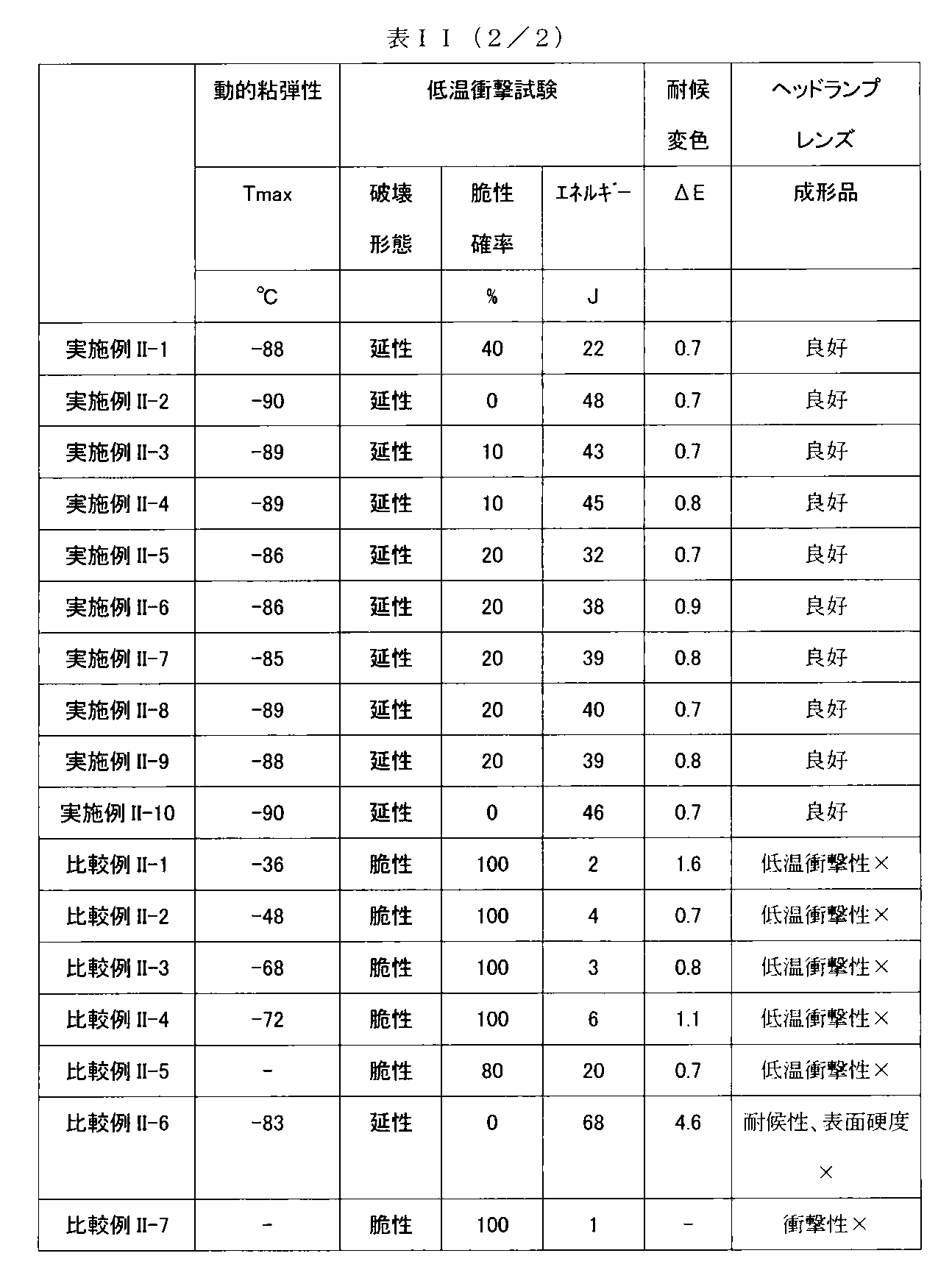
以下に実施例を挙げてプラスチックレンズについての発明を更に説明する。但し、本発明はこれら実施例に何ら限定されるものではない。なお、評価は以下の方法により測定した。
(1)比粘度(ηsp)
ペレットを塩化メチレンに溶解、濃度を約0.7g/dLとして、温度20℃にて、オストワルド粘度計(装置名:RIGO AUTO VISCOSIMETER TYPE VMR−0525・PC)を使用して測定した。なお、比粘度ηspは下記式から求められる。
ηsp=t/t0−1
t :試料溶液のフロータイム
t0 :溶媒のみのフロータイム
(2)ガラス転移温度(Tg)
ペレットをTA Instruments社製 DSC (型式 DSC2910)により測定した。
(3)光弾性定数
幅1cm、長さ6cmのフィルムを作成し、このフィルムの無荷重状態の位相差、1N、2N、3N荷重時の波長550nmの光の位相差を日本分光(株)製分光エリプソメーター「M220」で測定し(位相差)×(フィルム幅)/(荷重)を計算することにより求めた。
(4)全光線透過率
ペレットを105℃で5時間熱風乾燥した後、射出成形機(日本製鋼所(株)製, JSW J−75EIII)を用いて、成形温度240℃、金型温度80℃、成形サイクル50秒にて幅50mm、長さ90mm、厚みがゲート側から3.0mm(長さ20mm)、2.0mm(長さ45mm)、1.0mm(長さ25mm)であり、算術平均粗さ(Ra)が0.03μmである3段型プレートを成形した。
かかる3段型プレートの厚み2.0mm部における全光線透過率を日本電飾工業(株)製 Haze Meter NDH 2000を用い、ISO13468に準じて測定した。
(5)鉛筆硬度
ペレットを日本製鋼所(株)製, JSW J−75EIIIを用いてシリンダー温度240℃、金型温度80℃、1分サイクルにて2mm厚角板を成形し、その成型試験片を用いて、JIS K5600のひっかき硬度(鉛筆法)によって測定した。
(6)レンズの外観
三波長型昼光白色蛍光灯下で透過光及び反射光をプラスチックレンズに当て、干渉縞の程度と白化状態を目視観察・判定した。
(7)レンズの面内位相差
射出成形により、厚さ2.0mm、直径50mmの眼鏡レンズを成形し、微小面積位相差測定装置 KOBRA−CCD/XY30P 王子計測機器(株)を使用し位相差および遅相軸を測定した。
(8)耐候性
サンシャイン・ウェザーメーター(スガ試験機(株)製:WEL−SUN:HC−B)を使用し、ブラックパネル温度63℃、湿度50%、18分間水噴霧と102分間噴霧無しの計120分サイクルで1000時間暴露した後の上記(7)で得られたプラスチックレンズの厚み2.0mm部における色相(ΔYI)と外観クラックを観察・判定した。
(9)衝撃強さ
射出成形により、厚さ2.0mm、直径50mmの眼鏡レンズを成形し、ANSI Z87.1規格に従って、25℃および−20℃における、鋼球(68g、357g)を127cmの高さから落下させて、『割れ・欠け・クラック』の程度を観察・判定した。
実施例III−1
(コポリカーボネート)
イソソルビド(以下ISSと略す)463.72部、1,9−ノナンジオール(以下NDと略す)41.24部,ジフェニルカーボネート(以下DPCと略す)749.70部、および触媒としてテトラメチルアンモニウムヒドロキシド3.0×10⁻²部と水酸化ナトリウム1.0×10⁻⁴部を窒素雰囲気下170℃に加熱し溶融させた。溶融したことを確認した後、EI反応工程を開始した。減圧開始後、70分かけて最終減圧度が13.4kPaになるように調整しながら減圧し、13.4kPa到達後はその減圧度を保持した。減圧開始と同時に、10℃/hrの速度で、最終ポリマー温度が190℃になるまで昇温した。190℃到達後は、減圧度13.4kPa、ポリマー温度190℃の状態で、フェノールが理論量の80%留去するまで10分間保持した。
80%留去したことを確認した後、PA反応工程(前期工程)を開始した。最終ポリマー温度が220℃になるように、0.5℃/minの速度で昇温させた。また、昇温と併行して、最終減圧度が3kPaとなるように60分かけて減圧させた。
引き続いて、PA反応工程(後期工程)を開始した。後期工程では、最終ポリマー温度が240℃になるように、1℃/minの速度で昇温させた。また、昇温と併行して、最終減圧度が134Paとなるまで20分かけて減圧させた。所定の攪拌電力値に到達したところで反応を終了し、触媒量の2倍モルのドデシルベンゼンスルホン酸テトラブチルホスホニウム塩を添加し、触媒を失活した後、反応槽の底より窒素加圧下吐出し、水槽で冷却しながら、ペレタイザーでカットしてペレットを得た。
(樹脂組成物)
得られたペレットと更に表IIIに記載の樹脂組成物となるように、紫外線吸収剤としてベンゾトリアゾール型紫外線吸収剤である2−(3−tert−ブチル−5−メチル−2−ヒドロキシフェニル)−5−クロロ−2H−ベンゾトリアゾール、光安定剤として2級アミン化合物であるアデカスタブLA−77Y((株)ADEKA製)、酸化防止剤としてリン系安定剤であるイルガフォス168(BASF製;トリス(2,6−ジ−tert−ブチルフェニル)ホスファイト)を使用して均一に混合し、かかる混合物を押出機に投入して樹脂組成物の作成を行った。押出機としては径30mmφのベント式二軸押出機(日本製鋼所製TEX30α−35BW−3V)を使用した。押出条件は吐出量30~40kg/h、スクリュー回転数250rpm、ベントの真空度3kPaであり、また押出温度は第1供給口からダイス部分まで230℃とし、ペレットを得た。
(眼鏡レンズ)
得られたペレットを105℃で12時間乾燥した後、各物性評価を行った。さらに、得られたコポリカーボネートペレットを用いて、シリンダー温度220~240℃、金型温度70~100℃の条件で、眼鏡用レンズ用金型を使用し、射出圧縮成形により眼鏡レンズを作成した。このレンズは透明性に優れ外観も良好であった。また、このレンズを用いて落球試験を行った結果を表IIIに示した。
実施例III−2
ISS446.18部とND60.49部とした以外は実施例III−1と同様にしてコポリカーボネートの溶融重合を行い、反応後のポリマーをペレット化した。得られたペレットと更に表IIIに記載の樹脂組成物となるように均一に混合し、実施例III−1と同様にかかる混合物を押出機に投入して樹脂組成物の作成を行い、射出圧縮成形により眼鏡用レンズを作成した。このレンズは透明性に優れ外観も良好であった。また、このレンズを用いて落球試験を行った結果を表IIIに示した。
実施例III−3
ISS350.93部とシクロヘキサンジメタノール(以下CHDMと略す)148.44部とした以外は実施例III−1と同様にしてコポリカーボネートの溶融重合を行い、反応後のポリマーをペレット化した。得られたペレットと更に表IIIに記載の樹脂組成物となるように均一に混合し、実施例III−1と同様にかかる混合物を押出機に投入して樹脂組成物の作成を行い、射出圧縮成形により眼鏡用レンズを作成した。このレンズは透明性に優れ外観も良好であった。また、このレンズを用いて落球試験を行った結果を表IIIに示した。
実施例III−4
実施例III−1と同様にしてコポリカーボネートの溶融重合を行い、反応後のポリマーをペレット化した。得られたペレットに酸化防止剤としてイルガフォス168を使用して均一に混合し、射出圧縮成形により眼鏡用レンズを作成した。このレンズを用いて落球試験を行った結果を表IIIに示した。
実施例4で作成したポリカーボネートレンズは実施例III−1~III−3で作成したコポリカーボネートレンズと比べて耐候性が劣るものの、他の特性は同等となることが分かる。
比較例III−1
ISS426.13部と1,6−ヘキサンジオール(以下HDと略す)60.84部とした以外は実施例III−1と同様にしてコポリカーボネートの溶融重合を行い、反応後のポリマーをペレット化した。得られたペレットと更に表IIIに記載の樹脂組成物となるように均一に混合し、実施例III−1と同様にかかる混合物を押出機に投入して樹脂組成物の作成を行い、射出圧縮成形により眼鏡用レンズを作成した。このレンズを用いて落球試験を行った結果を表IIIに示した。
比較例III−2
ISS340.90部とビスフェノールA(以下BPAと略す)250.68部とした以外は実施例III−1と同様にしてコポリカーボネートの溶融重合を行い、反応後のポリマーをペレット化した。得られたペレットと更に表IIIに記載の樹脂組成物となるように均一に混合し、実施例III−1と同様にかかる混合物を押出機に投入して樹脂組成物の作成を行い、射出圧縮成形により眼鏡用レンズを作成した。このレンズを用いて落球試験を行った結果を表IIIに示した。
比較例III−3
ISS501.32部とジフェニルカーボネート749.70部とした以外は実施例III−1と同様にしてコポリカーボネートの溶融重合を行い、反応後のポリマーをペレット化した。得られたペレットと更に表IIIに記載の樹脂組成物となるように均一に混合し、実施例III−1と同様にかかる混合物を押出機に投入して樹脂組成物の作成を行い、射出圧縮成形により眼鏡用レンズを作成した。このレンズを用いて落球試験を行った結果を表IIIに示した。
比較例III−1~III−3で作成したポリカーボネートレンズは実施例III−1~III−3で作成したポリカーボネートレンズと比べて衝撃強度が劣っていることがわかる。また、レンズの複屈折が高いものや、耐候性が劣っているもの、表面硬度が劣っているものがあり、レンズ特性としてのバランスが劣ることが分かる。
比較例III−4
ビスフェノールA(BPA)からなるポリカーボネートである帝人化成(株)製パンライト(登録商標)AD5503(ペレット形状)を用いて、実施例III−1と同様の方法で眼鏡用レンズを作成した。このレンズを用いて落球試験を行った結果を表IIIに示した。
比較例III−4で作成したポリカーボネートレンズは実施例III−1~III−3で作成したコポリカーボネートレンズと比べて光弾性定数も高く、耐候性が劣っており、レンズ特性として劣ることが分かる。また、表面硬度も劣っていることが分かる。
比較例III−5
ポリアクリル樹脂(三菱レイヨン製 アクリペットMF)を使用して、各種評価結果を表IIIに記載した。
比較例5で作成したポリアクリル樹脂レンズは実施例III−1~III−3で作成したコポリカーボネートレンズと比べて衝撃強度が劣っていることがわかる。

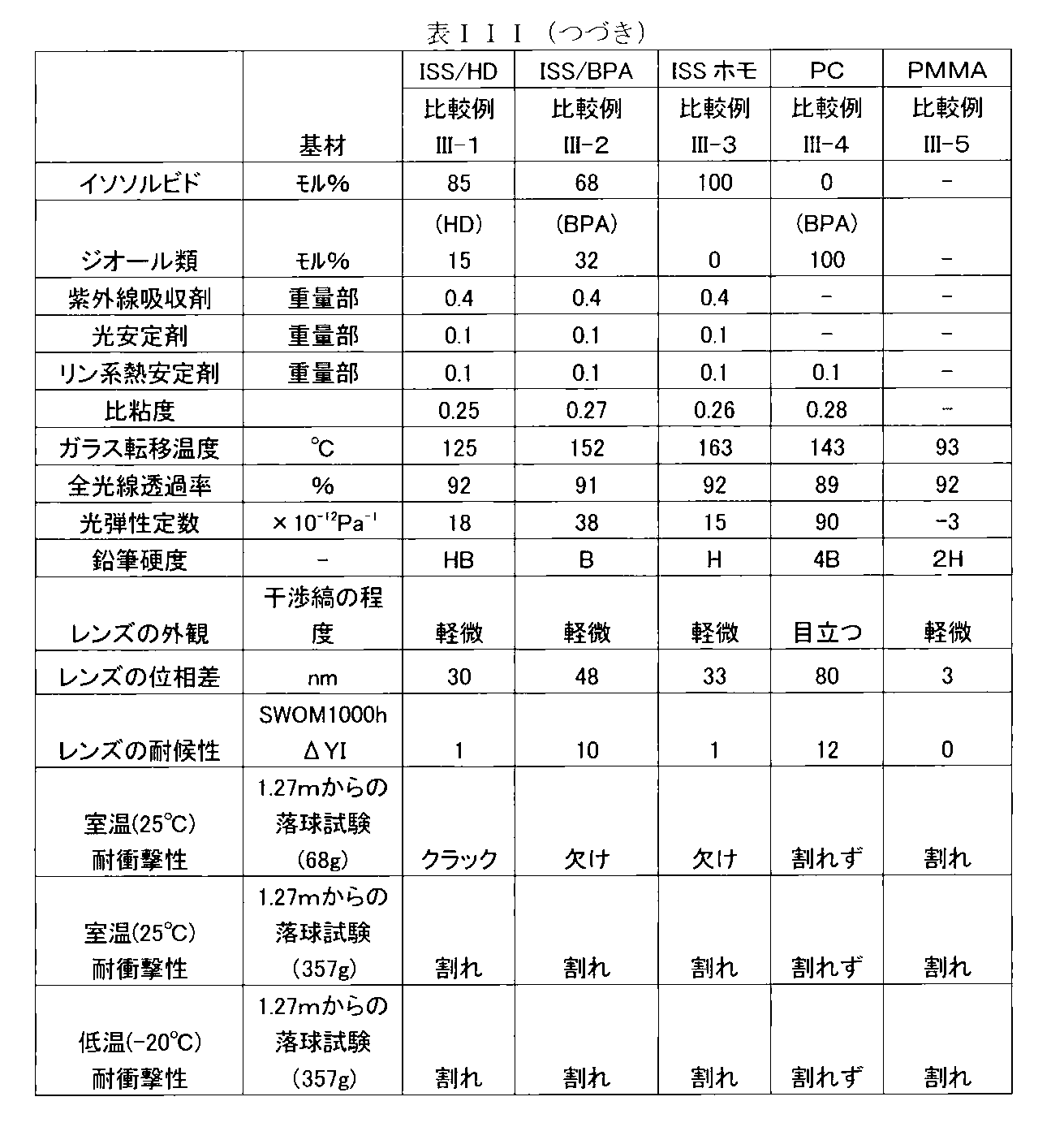
本発明の樹脂窓は、航空機、車輛、自動車等の窓ガラス、サンルーフ、建設機械の窓ガラス、ビル、家、温室などの窓ガラスとして有用である。本発明の車両用ランプレンズは、自動車、二輪車、電車などのヘッドランプレンズ、リアランプレンズ、方向指示ランプレンズ、ルームランプレンズ等車両用ランプレンズの用途に幅広く有用である。本発明のプラスチックレンズは、眼鏡レンズやサングラスレンズとして有用である。
2 レンズのドーム状部分(凸面が可動側金型に対応する)
3 レンズの外周部分
4 成形品のゲート(幅30mm、ゲート部の厚み4mm)
5 スプルー(ゲート部の直径7mmφ)
6 レンズの外周部分の直径(220mm)
7 レンズのドーム部分の直径(200mm)
8 レンズのドーム部分の高さ(20mm)
9 レンズ成形品の厚み(4mm)
Claims (17)
- 全繰り返し単位中、下記式(A)で表される単位(A)を50モル%以上含み、−20℃の環境下においてASTM D3763に準拠した高速面衝撃試験の最大衝撃エネルギーが20J以上であり、脆性破壊率が50%以下であるポリカーボネートから形成された成形品。
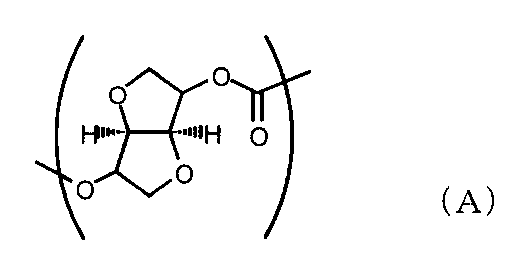
- ポリカーボネートは、さらに下記式(B−1)で表される単位(B−1)を含み、
(i)全繰り返し単位中、単位(A)と単位(B−1)との合計が80モル%以上であり、
(ii)単位(A)と単位(B−1)とのモル比(A/(B−1))が60/40~95/5である、
請求項1記載の成形品。
(式中、Wは、炭素数8~12のアルキレン基を示す。)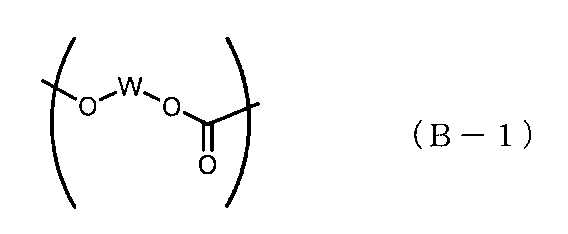
- ポリカーボネートは、さらに脂肪族ジオール化合物および脂環式ジオール化合物からなる群より選ばれる少なくとも1種の化合物から誘導されるカーボネート単位(B−2)を含み、
(i)ブロック性を有し、
(ii)全繰り返し単位中、単位(A)と単位(B−2)との合計が80モル%以上であり、
(iii)単位(A)と単位(B−2)とのモル比(A/(B−2))が60/40~95/5である、
請求項1記載の成形品。 - ポリカーボネートは、さらに下記式で表される単位(B−3)を含み、
(i)全繰り返し単位中、単位(A)と単位(B−3)との合計が80モル%以上であり、
(ii)単位(A)と単位(B−3)とのモル比(A/(B−3))が50/50~95/5である、
請求項1記載の成形品。
(式中Xは、炭素数3~20のアルキレン基または炭素数3~20のシクロアルキレン基を表し、Rは炭素数1~20のアルキル基または炭素数3~20のシクロアルキル基を表し、mは1~10の整数を示す。)
- ポリカーボネートの20℃の塩化メチレン溶液で測定された比粘度が0.23~0.60である請求項1記載の成形品。
- ポリカーボネートのガラス転移温度が80℃~160℃である請求項1記載の成形品。
- ポリカーボネートの動的粘弾性測定の損失正接(tanδ)が最高値となる温度(Tmax)が−73℃以下である請求項1記載の成形品。
- ポリカーボネートの飽和吸水率が2.5%以下である請求項1記載の成形品。
- ポリカーボネートのJIS K5600−5−4に準拠して測定した鉛筆硬度がHB以上である請求項1記載の成形品。
- ポリカーボネートのガラス転移温度(Tg℃)が100℃~160℃であり、飽和吸水率(Wa%)との関係が下記式(I)を満足する請求項1記載の成形品。
2.5 ≦ TW値 = Tg × 0.04 − Wa (I) - 樹脂窓もしくは車両用ランプレンズである請求項1記載の成形品。
- (i)下記式で表されるカーボネート単位(A)を含み、
(ii)20℃の塩化メチレン溶液で測定された比粘度が0.3~0.8で、
(iii)ガラス転移温度が100℃以上、
(iv)鉛筆硬度がHB以上、
(v)全光線透過率が80%以上である、
ポリカーボネートより形成され、
(vi)25℃におけるANSI Z87.1規格に順ずる落球試験にて少なくとも68gの落球にて割れが生じず、
(vii)厚さ2.0mmにおける面内位相差が50nm以下、
であるプラスチックレンズ。

- ポリカーボネートは、前記式で表されるカーボネート単位(A)と脂肪族ジオール化合物および脂環式ジオール化合物からなる群より選ばれる少なくとも1種の化合物から誘導されるカーボネート単位(B−2)とを含み、単位(A)と単位(B−2)とのモル比(A/(B−2))が15/85~95/5である、請求項12記載のプラスチックレンズ。
- ポリカーボネートは、ガラス転移温度が120~140℃以上である請求項12記載のプラスチックレンズ。
- ポリカーボネートは、光弾性係数の絶対値が30×10−12Pa−1以下である請求項12記載のプラスチックレンズ。
- 25℃におけるANSI Z87.1規格に順ずる落球試験にて少なくとも357gの落球にて割れが生じない請求項12記載のプラスチックレンズ。
- −20℃におけるANSI Z87.1規格に順ずる落球試験にて少なくとも357gの落球にて割れが生じない請求項12記載のプラスチックレンズ。
Priority Applications (5)
| Application Number | Priority Date | Filing Date | Title |
|---|---|---|---|
| US14/759,327 US20160075823A1 (en) | 2013-02-26 | 2014-02-21 | Polycarbonate molded article |
| KR1020157016877A KR20150124945A (ko) | 2013-02-26 | 2014-02-21 | 폴리카보네이트 성형품 |
| EP14756701.0A EP2963075B1 (en) | 2013-02-26 | 2014-02-21 | Polycarbonate molded article |
| JP2015503037A JP5899372B2 (ja) | 2013-02-26 | 2014-02-21 | ポリカーボネート成形品 |
| CN201480010590.4A CN105051089B (zh) | 2013-02-26 | 2014-02-21 | 聚碳酸酯成型品 |
Applications Claiming Priority (6)
| Application Number | Priority Date | Filing Date | Title |
|---|---|---|---|
| JP2013035919 | 2013-02-26 | ||
| JP2013035920 | 2013-02-26 | ||
| JP2013-035920 | 2013-02-26 | ||
| JP2013-035919 | 2013-02-26 | ||
| JP2013-040646 | 2013-03-01 | ||
| JP2013040646 | 2013-03-01 |
Publications (1)
| Publication Number | Publication Date |
|---|---|
| WO2014133114A1 true WO2014133114A1 (ja) | 2014-09-04 |
Family
ID=51428373
Family Applications (1)
| Application Number | Title | Priority Date | Filing Date |
|---|---|---|---|
| PCT/JP2014/054985 Ceased WO2014133114A1 (ja) | 2013-02-26 | 2014-02-21 | ポリカーボネート成形品 |
Country Status (6)
| Country | Link |
|---|---|
| US (1) | US20160075823A1 (ja) |
| EP (1) | EP2963075B1 (ja) |
| JP (1) | JP5899372B2 (ja) |
| KR (1) | KR20150124945A (ja) |
| CN (1) | CN105051089B (ja) |
| WO (1) | WO2014133114A1 (ja) |
Cited By (7)
| Publication number | Priority date | Publication date | Assignee | Title |
|---|---|---|---|---|
| WO2015119026A1 (ja) * | 2014-02-10 | 2015-08-13 | 帝人株式会社 | 多層体 |
| JP2016150990A (ja) * | 2015-02-18 | 2016-08-22 | 帝人株式会社 | ポリカーボネート樹脂フィルム |
| WO2016148267A1 (ja) * | 2015-03-17 | 2016-09-22 | 帝人株式会社 | フィルム |
| WO2016167024A1 (ja) * | 2015-04-17 | 2016-10-20 | ウシオ電機株式会社 | 蛍光光源装置 |
| WO2019163964A1 (ja) * | 2018-02-23 | 2019-08-29 | 帝人株式会社 | ポリカーボネート樹脂及び製造方法 |
| JP2025510264A (ja) * | 2022-03-25 | 2025-04-14 | ハンファ ソリューションズ コーポレイション | ポリカーボネート共重合体、その製造方法、およびそれを含む組成物 |
| JP7855715B2 (ja) | 2022-03-25 | 2026-05-08 | ハンファ ソリューションズ コーポレイション | ポリカーボネート共重合体、その製造方法、およびそれを含む組成物 |
Families Citing this family (6)
| Publication number | Priority date | Publication date | Assignee | Title |
|---|---|---|---|---|
| US10267482B2 (en) * | 2017-05-05 | 2019-04-23 | Ford Global Technologies, Llc | Vehicular lighting assemblies and headlamps with condenser lenses configured to prevent solar damage |
| JP2019107789A (ja) * | 2017-12-15 | 2019-07-04 | 株式会社小糸製作所 | 樹脂成形品および車両用部品 |
| CN108944374B (zh) * | 2018-07-06 | 2021-03-23 | 北京汽车股份有限公司 | 用于车辆的天窗组件及车辆 |
| WO2020220005A1 (en) * | 2019-04-26 | 2020-10-29 | Van Straten Enterprises, Inc. | Heater and electromagnetic illuminator heater |
| US12121088B2 (en) | 2021-01-21 | 2024-10-22 | Van Straten Enterprises, Inc. | Optical face protection shield, heated optical face protection apparatus, and method |
| CN121045782B (zh) * | 2025-08-27 | 2026-04-07 | 广东金海纳实业有限公司 | 一种抗冲击防爆型防护眼镜复合材料及其制备方法 |
Citations (17)
| Publication number | Priority date | Publication date | Assignee | Title |
|---|---|---|---|---|
| JPS4856230A (ja) | 1971-11-19 | 1973-08-07 | ||
| JPS4914535A (ja) | 1972-05-20 | 1974-02-08 | ||
| JPH0854501A (ja) | 1995-05-11 | 1996-02-27 | Hoya Corp | プラスチックレンズの製造法 |
| JPH08198985A (ja) | 1995-01-27 | 1996-08-06 | Hoya Corp | 硬化被覆膜を有する光学部材 |
| JP2003090901A (ja) | 2001-07-09 | 2003-03-28 | Teijin Chem Ltd | プラスチックレンズ |
| JP2003311908A (ja) | 2002-04-26 | 2003-11-06 | Teijin Chem Ltd | ポリカーボネート樹脂窓ガラス |
| WO2004111106A1 (ja) | 2003-06-16 | 2004-12-23 | Teijin Limited | ポリカーボネートおよびその製造方法 |
| JP2009063976A (ja) | 2007-09-10 | 2009-03-26 | Teijin Ltd | 光学素子成形品およびそのための成形材料 |
| JP2009061762A (ja) | 2007-09-10 | 2009-03-26 | Teijin Ltd | 樹脂成形品 |
| JP2009062501A (ja) | 2007-09-10 | 2009-03-26 | Teijin Ltd | 光学素子成形品およびそのための成形材料 |
| JP2009102536A (ja) * | 2007-10-24 | 2009-05-14 | Teijin Ltd | 共重合ポリカーボネート樹脂およびその製造方法 |
| JP2009144014A (ja) | 2007-12-12 | 2009-07-02 | Mitsubishi Chemicals Corp | ポリカーボネートからなる車両用ランプレンズ |
| JP2010190919A (ja) | 2009-02-13 | 2010-09-02 | Mitsubishi Gas Chemical Co Inc | 光学レンズ及びその製造方法 |
| WO2011021720A1 (ja) | 2009-08-21 | 2011-02-24 | 帝人株式会社 | 射出成形用加飾シート |
| WO2012008344A1 (ja) * | 2010-07-14 | 2012-01-19 | 三菱化学株式会社 | ポリカーボネート樹脂組成物、及びこれを用いた成形品、フィルム、プレート、射出成形品 |
| JP2012041471A (ja) | 2010-08-20 | 2012-03-01 | Mitsubishi Chemicals Corp | ポリカーボネートからなる車両用ランプレンズ |
| WO2013157661A1 (ja) * | 2012-04-18 | 2013-10-24 | 帝人株式会社 | コポリカーボネート |
Family Cites Families (5)
| Publication number | Priority date | Publication date | Assignee | Title |
|---|---|---|---|---|
| CN1277127C (zh) * | 2000-07-11 | 2006-09-27 | 帝人化成株式会社 | 塑料透镜 |
| JP2003292603A (ja) * | 2002-03-29 | 2003-10-15 | Matsushita Electric Ind Co Ltd | 熱可塑性成形材料 |
| EP2223951A4 (en) * | 2007-12-12 | 2013-08-21 | Mitsubishi Chem Corp | PROCESS FOR PREPARING POLYCARBONATE AND POLYCARBONATE FORMATS |
| JP5417432B2 (ja) * | 2009-04-16 | 2014-02-12 | 帝人株式会社 | 共重合ポリカーボネートおよびその製造方法 |
| KR101814832B1 (ko) * | 2009-12-10 | 2018-01-30 | 미쯔비시 케미컬 주식회사 | 폴리카보네이트 수지 조성물 그리고 이것을 성형하여 얻어지는 성형체, 필름, 플레이트 및 사출 성형품 |
-
2014
- 2014-02-21 JP JP2015503037A patent/JP5899372B2/ja active Active
- 2014-02-21 CN CN201480010590.4A patent/CN105051089B/zh active Active
- 2014-02-21 US US14/759,327 patent/US20160075823A1/en not_active Abandoned
- 2014-02-21 KR KR1020157016877A patent/KR20150124945A/ko not_active Withdrawn
- 2014-02-21 EP EP14756701.0A patent/EP2963075B1/en active Active
- 2014-02-21 WO PCT/JP2014/054985 patent/WO2014133114A1/ja not_active Ceased
Patent Citations (17)
| Publication number | Priority date | Publication date | Assignee | Title |
|---|---|---|---|---|
| JPS4856230A (ja) | 1971-11-19 | 1973-08-07 | ||
| JPS4914535A (ja) | 1972-05-20 | 1974-02-08 | ||
| JPH08198985A (ja) | 1995-01-27 | 1996-08-06 | Hoya Corp | 硬化被覆膜を有する光学部材 |
| JPH0854501A (ja) | 1995-05-11 | 1996-02-27 | Hoya Corp | プラスチックレンズの製造法 |
| JP2003090901A (ja) | 2001-07-09 | 2003-03-28 | Teijin Chem Ltd | プラスチックレンズ |
| JP2003311908A (ja) | 2002-04-26 | 2003-11-06 | Teijin Chem Ltd | ポリカーボネート樹脂窓ガラス |
| WO2004111106A1 (ja) | 2003-06-16 | 2004-12-23 | Teijin Limited | ポリカーボネートおよびその製造方法 |
| JP2009061762A (ja) | 2007-09-10 | 2009-03-26 | Teijin Ltd | 樹脂成形品 |
| JP2009063976A (ja) | 2007-09-10 | 2009-03-26 | Teijin Ltd | 光学素子成形品およびそのための成形材料 |
| JP2009062501A (ja) | 2007-09-10 | 2009-03-26 | Teijin Ltd | 光学素子成形品およびそのための成形材料 |
| JP2009102536A (ja) * | 2007-10-24 | 2009-05-14 | Teijin Ltd | 共重合ポリカーボネート樹脂およびその製造方法 |
| JP2009144014A (ja) | 2007-12-12 | 2009-07-02 | Mitsubishi Chemicals Corp | ポリカーボネートからなる車両用ランプレンズ |
| JP2010190919A (ja) | 2009-02-13 | 2010-09-02 | Mitsubishi Gas Chemical Co Inc | 光学レンズ及びその製造方法 |
| WO2011021720A1 (ja) | 2009-08-21 | 2011-02-24 | 帝人株式会社 | 射出成形用加飾シート |
| WO2012008344A1 (ja) * | 2010-07-14 | 2012-01-19 | 三菱化学株式会社 | ポリカーボネート樹脂組成物、及びこれを用いた成形品、フィルム、プレート、射出成形品 |
| JP2012041471A (ja) | 2010-08-20 | 2012-03-01 | Mitsubishi Chemicals Corp | ポリカーボネートからなる車両用ランプレンズ |
| WO2013157661A1 (ja) * | 2012-04-18 | 2013-10-24 | 帝人株式会社 | コポリカーボネート |
Cited By (14)
| Publication number | Priority date | Publication date | Assignee | Title |
|---|---|---|---|---|
| US10035336B2 (en) | 2014-02-10 | 2018-07-31 | Teijin Limited | Multilayer body |
| WO2015119026A1 (ja) * | 2014-02-10 | 2015-08-13 | 帝人株式会社 | 多層体 |
| JPWO2015119026A1 (ja) * | 2014-02-10 | 2017-03-23 | 帝人株式会社 | 多層体 |
| JP2016150990A (ja) * | 2015-02-18 | 2016-08-22 | 帝人株式会社 | ポリカーボネート樹脂フィルム |
| WO2016148267A1 (ja) * | 2015-03-17 | 2016-09-22 | 帝人株式会社 | フィルム |
| CN107001784A (zh) * | 2015-03-17 | 2017-08-01 | 帝人株式会社 | 膜 |
| JPWO2016148267A1 (ja) * | 2015-03-17 | 2017-11-30 | 帝人株式会社 | フィルム |
| EP3272793A4 (en) * | 2015-03-17 | 2018-01-24 | Teijin Limited | Film |
| WO2016167024A1 (ja) * | 2015-04-17 | 2016-10-20 | ウシオ電機株式会社 | 蛍光光源装置 |
| WO2019163964A1 (ja) * | 2018-02-23 | 2019-08-29 | 帝人株式会社 | ポリカーボネート樹脂及び製造方法 |
| JPWO2019163964A1 (ja) * | 2018-02-23 | 2020-10-22 | 帝人株式会社 | ポリカーボネート樹脂及び製造方法 |
| JP7535939B2 (ja) | 2018-02-23 | 2024-08-19 | 帝人株式会社 | ポリカーボネート樹脂及び製造方法 |
| JP2025510264A (ja) * | 2022-03-25 | 2025-04-14 | ハンファ ソリューションズ コーポレイション | ポリカーボネート共重合体、その製造方法、およびそれを含む組成物 |
| JP7855715B2 (ja) | 2022-03-25 | 2026-05-08 | ハンファ ソリューションズ コーポレイション | ポリカーボネート共重合体、その製造方法、およびそれを含む組成物 |
Also Published As
| Publication number | Publication date |
|---|---|
| KR20150124945A (ko) | 2015-11-06 |
| US20160075823A1 (en) | 2016-03-17 |
| JP5899372B2 (ja) | 2016-04-06 |
| EP2963075A1 (en) | 2016-01-06 |
| JPWO2014133114A1 (ja) | 2017-02-02 |
| EP2963075B1 (en) | 2018-12-12 |
| EP2963075A4 (en) | 2016-05-25 |
| CN105051089B (zh) | 2018-04-03 |
| CN105051089A (zh) | 2015-11-11 |
Similar Documents
| Publication | Publication Date | Title |
|---|---|---|
| WO2014133114A1 (ja) | ポリカーボネート成形品 | |
| JP5927299B2 (ja) | 樹脂組成物およびそれからの成形品 | |
| EP2799463B1 (en) | Polycarbonate resin | |
| WO2012144573A1 (ja) | 共重合ポリカーボネートおよびそれらからなる透明成形品 | |
| JP2011236336A (ja) | 光弾性定数が低いポリカーボネート樹脂および光学成形体 | |
| CN110869415B (zh) | 聚碳酸酯共聚物 | |
| JP6204030B2 (ja) | 成形品 | |
| EP3272793B1 (en) | Film | |
| JP6139293B2 (ja) | 耐熱容器 | |
| JP6211830B2 (ja) | ポリカーボネート樹脂 | |
| JP6247515B2 (ja) | 成形品およびその製造方法 | |
| CN108291016B (zh) | 聚碳酸酯树脂、其制造方法和膜 | |
| JP7718645B2 (ja) | ポリカーボネート樹脂組成物及びその成形品 | |
| JP6211803B2 (ja) | 容器 | |
| JP6411882B2 (ja) | ポリカーボネート樹脂の製造方法 | |
| JP6097547B2 (ja) | ディスプレー用フィルム | |
| JP2020139097A (ja) | 光拡散性ポリカーボネート樹脂組成物 |
Legal Events
| Date | Code | Title | Description |
|---|---|---|---|
| WWE | Wipo information: entry into national phase |
Ref document number: 201480010590.4 Country of ref document: CN |
|
| 121 | Ep: the epo has been informed by wipo that ep was designated in this application |
Ref document number: 14756701 Country of ref document: EP Kind code of ref document: A1 |
|
| ENP | Entry into the national phase |
Ref document number: 20157016877 Country of ref document: KR Kind code of ref document: A |
|
| ENP | Entry into the national phase |
Ref document number: 2015503037 Country of ref document: JP Kind code of ref document: A |
|
| WWE | Wipo information: entry into national phase |
Ref document number: 14759327 Country of ref document: US |
|
| WWE | Wipo information: entry into national phase |
Ref document number: 2014756701 Country of ref document: EP |
|
| NENP | Non-entry into the national phase |
Ref country code: DE |