WO2014136672A1 - 外部寄生虫防除剤 - Google Patents
外部寄生虫防除剤 Download PDFInfo
- Publication number
- WO2014136672A1 WO2014136672A1 PCT/JP2014/055057 JP2014055057W WO2014136672A1 WO 2014136672 A1 WO2014136672 A1 WO 2014136672A1 JP 2014055057 W JP2014055057 W JP 2014055057W WO 2014136672 A1 WO2014136672 A1 WO 2014136672A1
- Authority
- WO
- WIPO (PCT)
- Prior art keywords
- group
- substituted
- unsubstituted
- animal
- formula
- Prior art date
- Legal status (The legal status is an assumption and is not a legal conclusion. Google has not performed a legal analysis and makes no representation as to the accuracy of the status listed.)
- Ceased
Links
Classifications
-
- A—HUMAN NECESSITIES
- A61—MEDICAL OR VETERINARY SCIENCE; HYGIENE
- A61K—PREPARATIONS FOR MEDICAL, DENTAL OR TOILETRY PURPOSES
- A61K31/00—Medicinal preparations containing organic active ingredients
- A61K31/33—Heterocyclic compounds
- A61K31/38—Heterocyclic compounds having sulfur as a ring hetero atom
- A61K31/382—Heterocyclic compounds having sulfur as a ring hetero atom having six-membered rings, e.g. thioxanthenes
-
- A—HUMAN NECESSITIES
- A01—AGRICULTURE; FORESTRY; ANIMAL HUSBANDRY; HUNTING; TRAPPING; FISHING
- A01N—PRESERVATION OF BODIES OF HUMANS OR ANIMALS OR PLANTS OR PARTS THEREOF; BIOCIDES, e.g. AS DISINFECTANTS, AS PESTICIDES OR AS HERBICIDES; PEST REPELLANTS OR ATTRACTANTS; PLANT GROWTH REGULATORS
- A01N43/00—Biocides, pest repellants or attractants, or plant growth regulators containing heterocyclic compounds
- A01N43/02—Biocides, pest repellants or attractants, or plant growth regulators containing heterocyclic compounds having rings with one or more oxygen or sulfur atoms as the only ring hetero atoms
- A01N43/04—Biocides, pest repellants or attractants, or plant growth regulators containing heterocyclic compounds having rings with one or more oxygen or sulfur atoms as the only ring hetero atoms with one hetero atom
- A01N43/06—Biocides, pest repellants or attractants, or plant growth regulators containing heterocyclic compounds having rings with one or more oxygen or sulfur atoms as the only ring hetero atoms with one hetero atom five-membered rings
- A01N43/10—Biocides, pest repellants or attractants, or plant growth regulators containing heterocyclic compounds having rings with one or more oxygen or sulfur atoms as the only ring hetero atoms with one hetero atom five-membered rings with sulfur as the ring hetero atom
-
- A—HUMAN NECESSITIES
- A01—AGRICULTURE; FORESTRY; ANIMAL HUSBANDRY; HUNTING; TRAPPING; FISHING
- A01N—PRESERVATION OF BODIES OF HUMANS OR ANIMALS OR PLANTS OR PARTS THEREOF; BIOCIDES, e.g. AS DISINFECTANTS, AS PESTICIDES OR AS HERBICIDES; PEST REPELLANTS OR ATTRACTANTS; PLANT GROWTH REGULATORS
- A01N43/00—Biocides, pest repellants or attractants, or plant growth regulators containing heterocyclic compounds
- A01N43/02—Biocides, pest repellants or attractants, or plant growth regulators containing heterocyclic compounds having rings with one or more oxygen or sulfur atoms as the only ring hetero atoms
- A01N43/04—Biocides, pest repellants or attractants, or plant growth regulators containing heterocyclic compounds having rings with one or more oxygen or sulfur atoms as the only ring hetero atoms with one hetero atom
- A01N43/14—Biocides, pest repellants or attractants, or plant growth regulators containing heterocyclic compounds having rings with one or more oxygen or sulfur atoms as the only ring hetero atoms with one hetero atom six-membered rings
- A01N43/16—Biocides, pest repellants or attractants, or plant growth regulators containing heterocyclic compounds having rings with one or more oxygen or sulfur atoms as the only ring hetero atoms with one hetero atom six-membered rings with oxygen as the ring hetero atom
-
- A—HUMAN NECESSITIES
- A01—AGRICULTURE; FORESTRY; ANIMAL HUSBANDRY; HUNTING; TRAPPING; FISHING
- A01N—PRESERVATION OF BODIES OF HUMANS OR ANIMALS OR PLANTS OR PARTS THEREOF; BIOCIDES, e.g. AS DISINFECTANTS, AS PESTICIDES OR AS HERBICIDES; PEST REPELLANTS OR ATTRACTANTS; PLANT GROWTH REGULATORS
- A01N43/00—Biocides, pest repellants or attractants, or plant growth regulators containing heterocyclic compounds
- A01N43/02—Biocides, pest repellants or attractants, or plant growth regulators containing heterocyclic compounds having rings with one or more oxygen or sulfur atoms as the only ring hetero atoms
- A01N43/04—Biocides, pest repellants or attractants, or plant growth regulators containing heterocyclic compounds having rings with one or more oxygen or sulfur atoms as the only ring hetero atoms with one hetero atom
- A01N43/14—Biocides, pest repellants or attractants, or plant growth regulators containing heterocyclic compounds having rings with one or more oxygen or sulfur atoms as the only ring hetero atoms with one hetero atom six-membered rings
- A01N43/18—Biocides, pest repellants or attractants, or plant growth regulators containing heterocyclic compounds having rings with one or more oxygen or sulfur atoms as the only ring hetero atoms with one hetero atom six-membered rings with sulfur as the ring hetero atom
-
- A—HUMAN NECESSITIES
- A61—MEDICAL OR VETERINARY SCIENCE; HYGIENE
- A61K—PREPARATIONS FOR MEDICAL, DENTAL OR TOILETRY PURPOSES
- A61K31/00—Medicinal preparations containing organic active ingredients
- A61K31/33—Heterocyclic compounds
- A61K31/335—Heterocyclic compounds having oxygen as the only ring hetero atom, e.g. fungichromin
- A61K31/35—Heterocyclic compounds having oxygen as the only ring hetero atom, e.g. fungichromin having six-membered rings with one oxygen as the only ring hetero atom
- A61K31/351—Heterocyclic compounds having oxygen as the only ring hetero atom, e.g. fungichromin having six-membered rings with one oxygen as the only ring hetero atom not condensed with another ring
-
- A—HUMAN NECESSITIES
- A61—MEDICAL OR VETERINARY SCIENCE; HYGIENE
- A61K—PREPARATIONS FOR MEDICAL, DENTAL OR TOILETRY PURPOSES
- A61K31/00—Medicinal preparations containing organic active ingredients
- A61K31/33—Heterocyclic compounds
- A61K31/38—Heterocyclic compounds having sulfur as a ring hetero atom
- A61K31/381—Heterocyclic compounds having sulfur as a ring hetero atom having five-membered rings
-
- A—HUMAN NECESSITIES
- A61—MEDICAL OR VETERINARY SCIENCE; HYGIENE
- A61P—SPECIFIC THERAPEUTIC ACTIVITY OF CHEMICAL COMPOUNDS OR MEDICINAL PREPARATIONS
- A61P33/00—Antiparasitic agents
- A61P33/14—Ectoparasiticides, e.g. scabicides
-
- A—HUMAN NECESSITIES
- A61—MEDICAL OR VETERINARY SCIENCE; HYGIENE
- A61P—SPECIFIC THERAPEUTIC ACTIVITY OF CHEMICAL COMPOUNDS OR MEDICINAL PREPARATIONS
- A61P43/00—Drugs for specific purposes, not provided for in groups A61P1/00-A61P41/00
-
- C—CHEMISTRY; METALLURGY
- C07—ORGANIC CHEMISTRY
- C07D—HETEROCYCLIC COMPOUNDS
- C07D333/00—Heterocyclic compounds containing five-membered rings having one sulfur atom as the only ring hetero atom
- C07D333/02—Heterocyclic compounds containing five-membered rings having one sulfur atom as the only ring hetero atom not condensed with other rings
- C07D333/04—Heterocyclic compounds containing five-membered rings having one sulfur atom as the only ring hetero atom not condensed with other rings not substituted on the ring sulphur atom
- C07D333/26—Heterocyclic compounds containing five-membered rings having one sulfur atom as the only ring hetero atom not condensed with other rings not substituted on the ring sulphur atom with hetero atoms or with carbon atoms having three bonds to hetero atoms with at the most one bond to halogen, e.g. ester or nitrile radicals, directly attached to ring carbon atoms
- C07D333/30—Hetero atoms other than halogen
- C07D333/36—Nitrogen atoms
-
- C—CHEMISTRY; METALLURGY
- C07—ORGANIC CHEMISTRY
- C07D—HETEROCYCLIC COMPOUNDS
- C07D335/00—Heterocyclic compounds containing six-membered rings having one sulfur atom as the only ring hetero atom
- C07D335/02—Heterocyclic compounds containing six-membered rings having one sulfur atom as the only ring hetero atom not condensed with other rings
Definitions
- the present invention relates to an ectoparasite control agent having a certain effect.
- Extrinsic parasites such as fleas, lice, flies, mosquitoes, ticks, ticks, and endoparasites such as gastrointestinal nematodes, flukes, and filamentous worms are problematic in both humans and animals.
- Such parasites including the egg, larva, pupa, nymph, and adult stages, reduce host weight gain, cause leather, wool, and meat degradation, and in some cases death.
- External and endoparasites also contribute to the prevalence of disease and discomfort in food and pet animals.
- ectoparasites are known to become the home of various microbial pathogens including bacteria, viruses and parasitic protozoa. Many are pathogenic to humans, other isothermal mammals and birds.
- Diseases involving ectoparasites include, for example, malaria, lymphatic filariasis and blood-borne filariasis, trachoma, trypanosomiasis, leishmaniasis, rocky mountain spotted fever, Lyme disease, babesiosis, salmonella, E. coli and Examples include, but are not limited to, foodborne diseases caused by Campylobacter.
- the emphasis in medicine on parasitizing parasites is to promote the development of reagents that can control this.
- commonly found methods of controlling parasiticide parasitism generally focus on the use of agricultural pesticides, which may be unsuccessful or unsuccessful for at least one of the following reasons: Often enough. The reasons for this are (1) failure of owner or applicator compliance (requires frequent administration), (2) behavioral or physiological intolerance of the animal against the pesticide product or method of administration, (3) ectoparasites And (4) negative effects on the environment and / or toxicity.
- pathogens including bacteria, viruses and parasitic protozoa .
- ticks are considered the second largest human disease vector in the world after mosquitoes, but are considered the most important pathogen in North America.
- Effective control against ectoparasite infestations, such as fleas in the home environment, is difficult because often there is a need to treat both the direct host and the environmental reservoir host simultaneously, Unrealistic.
- the control of ticks in the agricultural environment is a comprehensive pest management method that adapts various control methods to one area or a single ticks, with full consideration for environmental impacts. Is implemented.
- insecticides and pesticides are beneficial for controlling ectoparasites, but requires alternative or improved compounds, formulations and methods for existing ones. Desirable compounds, formulations and methods will not only provide alternative treatment, but will overcome at least some of the limitations of current methods. Such limitations include (but are not limited to) toxicity and animal and user / owner safety, efficacy related limitations (efficacy, sustained activity, kill rate), and resistance issues. . Also, the beneficial use of pesticides and pesticides is hindering administration, which includes mode, user / owner compliance issues regarding treatment recommendations, and repeated dosing. For example, it is often cumbersome and difficult for the user / owner to treat an animal excessively, and therefore it is desirable to reduce the number of doses while maintaining efficacy.
- Patent Document 1 Specific examples of the 1-heterodiene compound used for the ectoparasite control agent of the present invention are disclosed in Patent Document 1 and Patent Document 2.
- the ectoparasite control agent according to the present invention has at least some limitations when using currently used insecticides and pesticides, especially killing rate, long shelf life, suppression of ectoparasites such as mites and fleas
- the challenge is to overcome the limitations.
- an ectoparasite control agent comprising as an active ingredient at least one compound selected from 1-heterodiene compounds represented by the formula (I) and salts thereof.
- Q 1 represents an unsubstituted or C6 ⁇ 10 aryl group having a substituent X 1 or unsubstituted or heteroaryl group 5-6 membered having a substituent X 1,.
- X 1 is an unsubstituted or substituted C1-6 alkyl group, an unsubstituted or substituted C2-6 alkenyl group, an unsubstituted or substituted C2-6 alkynyl group, unsubstituted or Substituted C3-8 cycloalkyl group, hydroxyl group, unsubstituted or substituted C1-6 alkoxy group, unsubstituted or substituted C1-7 acyl group, unsubstituted or substituted C1 -6 alkoxycarbonyl group, unsubstituted or substituted amino group, unsubstituted or substituted C1-6 alkylthio group, unsubstituted or substituted C1-6 alkylsulfonyl group, unsubstit
- the number of the substituents X 1 on Q 1 is an integer of 1-5. When there are two or more substituents X 1, X 1 may be the same as or different from each other.
- A represents an oxygen atom or a sulfur atom.
- R 1 and R 2 each independently have a hydrogen atom, an unsubstituted or substituted C1-6 alkyl group, an unsubstituted or substituted C2-6 alkenyl group, an unsubstituted or substituted group C2-6 alkynyl group, unsubstituted or substituted C3-8 cycloalkyl group, unsubstituted or substituted C6-10 aryl group, unsubstituted or substituted 3-6 membered heterocyclic group Or a cyano group.
- R 1 and R 2 may be combined to form an unsubstituted or substituted exomethylene group.
- R 3 and R 4 each independently have a hydrogen atom, an unsubstituted or substituted C1-6 alkyl group, an unsubstituted or substituted C2-6 alkenyl group, an unsubstituted or substituted group C2-6 alkynyl group, unsubstituted or substituted C3-8 cycloalkyl group, unsubstituted or substituted C6-10 aryl group, unsubstituted or substituted 3-6 membered heterocyclic group , A halogeno group, or a cyano group.
- n represents the number of methylenes substituted with R 3 and R 4 and is an integer of 1 to 4. When n is 2 or more, R 3 and R 4 may be the same or different. R 3 and R 4 may be connected to each other to form a ring together with the carbon atom to which R 3 and R 4 are bonded.
- R 5 represents a hydrogen atom or an unsubstituted or substituted C1-6 alkyl group.
- B represents an oxygen atom or a sulfur atom.
- Q 2 is an unsubstituted or C7 ⁇ 11 aralkyl group having a substituent X 2, unsubstituted or C6 ⁇ 10 aryl group having a substituent X 2, or 5-6 with an unsubstituted or substituted group X 2, A member heteroaryl group is shown.
- X 2 is an unsubstituted or substituted C1-6 alkyl group, an unsubstituted or substituted C2-6 alkenyl group, an unsubstituted or substituted C2-6 alkynyl group, unsubstituted or Substituted C3-8 cycloalkyl group, hydroxyl group, unsubstituted or substituted C1-6 alkoxy group, unsubstituted or substituted C1-7 acyl group, unsubstituted or substituted C1 -6 alkoxycarbonyl group, unsubstituted or substituted amino group, unsubstituted or substituted C1-6 alkylthio group, unsubstituted or substituted C1-6 alkylsulfonyl group, unsubstituted or A substituted C6-10 aryl group, an unsubstituted or substituted 3- to 6-membered heterocyclic group, a halogeno group, a cyano group, Other denotes a
- the number of the substituents X 2 on Q 2 is a integer of 1-5. When there are two or more substituents X 2, X 2 may be the same as or different from each other. (E), (Z), or (E / Z) is indicated by the stereoisomerism of the double bond to which R 5 and B are bonded in formula (I).
- R 3a , R 3b , R 4a , and R 4b are each independently a hydrogen atom, an unsubstituted or substituted C1-6 alkyl group, an unsubstituted or substituted C2-6 alkenyl group, Substituted or substituted C2-6 alkynyl group, unsubstituted or substituted C3-8 cycloalkyl group, unsubstituted or substituted C6-10 aryl group, unsubstituted or substituted A 3- to 6-membered heterocyclic group, a halogeno group, or a cyano group; R 3a and R 4a may be connected to each other to form a ring together with the carbon atom to which R 3a and R 4a are bonded.
- R 3a , R 3b , R 4a , and R 4b are each independently a hydrogen atom, an unsubstituted or substituted C1-6 alkyl group, an unsubstituted or substituted C2-6 alkenyl group, Substituted or substituted C2-6 alkynyl group, unsubstituted or substituted C3-8 cycloalkyl group, unsubstituted or substituted C6-10 aryl group, unsubstituted or substituted A 3- to 6-membered heterocyclic group, a halogeno group, or a cyano group; R 3a and R 4a may be connected to each other to form a ring together with the carbon atom to which R 3a and R 4a are bonded.
- a preparation comprising at least one compound selected from the 1-heterodiene compounds according to any one of [1] to [3] and salts thereof and at least one acceptable carrier.
- the preparation according to [4], wherein the preparation further comprises at least one additional active ingredient.
- the preparation according to [4], wherein the preparation is a human pharmaceutical preparation.
- the preparation according to [4], wherein the preparation is a veterinary pharmaceutical preparation.
- [8] A method for suppressing parasitism in or on the body surface of an animal in need of parasite infestation, wherein the animal has 1-heterodiene as described in any one of [1] to [3] above Administering an effective amount of at least one compound selected from the compounds and salts thereof. [9] The method according to [8], wherein at least one other active ingredient is administered to the animal. [10] The method according to [8], wherein the animal is a human. [11] The method according to [8], wherein the animal is a pet animal. [12] The method according to [11], wherein the pet animal is a dog or a cat. [13] The method according to [8], wherein the animal is a livestock animal. [14] The method according to [8], wherein the parasite is a tick.
- [15] A method for preventing and treating a disease transmitted through a parasite, wherein the effective amount of at least one compound selected from the 1-heterodiene compounds and salts thereof according to any one of [1] to [3] Administering to an animal in need thereof.
- [16] The method according to [15], wherein at least one other active ingredient is administered to the animal.
- the method according to [15], wherein the animal is a pet animal.
- the pet animal is a dog or a cat.
- the method according to [15] wherein the animal is a livestock animal.
- the method is characterized in that at least one compound selected from the 1-heterodiene compounds described in any one of [1] to [3] and salts thereof is allowed to act on pests and / or their habitats. , How to control pests.
- the ectoparasite control agent according to the present invention includes parasite-control compounds, methods and preparations used in the body and body surface of animals, and parasite-control parasites, in particular parasites of ectoparasite control on pet animals. Provide options to deal with.
- the ectoparasite control agent according to the present invention has at least some limitations when using currently used insecticides and pesticides, particularly ectoparasites such as kill rate, long effective period, mites and fleas. The limitations on the suppression of the problem can be overcome.
- the ectoparasite control agent of the present invention is effective at least one compound selected from 1-heterodiene compounds represented by formula (I) (hereinafter sometimes referred to as compound (I)) and salts thereof. Contains as a component.
- the term “unsubstituted” means only a group serving as a mother nucleus. When there is no description of “having a substituent” and only the name of the group serving as a mother nucleus is used, it means “unsubstituted” unless otherwise specified.
- the term “having a substituent” means that any hydrogen atom of a group serving as a mother nucleus is substituted with a group having the same or different structure from the mother nucleus. Accordingly, the “substituent” is another group bonded to a group serving as a mother nucleus.
- the number of substituents may be one, or two or more. Two or more substituents may be the same or different.
- C1-6 indicate that the group serving as the mother nucleus has 1 to 6 carbon atoms. This number of carbon atoms does not include the number of carbon atoms present in the substituent.
- a butyl group having an ethoxy group as a substituent is classified as a C2 alkoxy C4 alkyl group.
- the “substituent” is not particularly limited as long as it is chemically acceptable and has the effects of the present invention. Examples of groups that can be “substituents” are shown below. C1-6 such as methyl group, ethyl group, n-propyl group, i-propyl group, n-butyl group, s-butyl group, i-butyl group, t-butyl group, n-pentyl group, n-hexyl group, etc.
- alkyl group An alkyl group; Vinyl group, 1-propenyl group, 2-propenyl group (allyl group), 1-butenyl group, 2-butenyl group, 3-butenyl group, 1-methyl-2-propenyl group, 2-methyl-2-propenyl group, etc.
- a C2-6 alkenyl group of C2-6 alkynyl groups such as ethynyl group, 1-propynyl group, 2-propynyl group, 1-butynyl group, 2-butynyl group, 3-butynyl group, 1-methyl-2-propynyl group;
- a C3-8 cycloalkyl group such as a cyclopropyl group, a cyclobutyl group, a cyclopentyl group, a cyclohexyl group;
- a C4-8 cycloalkenyl group such as a 2-cyclopentenyl group, a 3-cyclohexenyl group, a 4-cyclooctenyl group;
- a C6-10 aryl group such as a phenyl group or a naphthyl group;
- a C7-11 aralkyl group such as a benzyl group or a phenethyl group;
- Saturated heterocyclic groups such as aziridinyl group, oxiranyl group, azetidinyl group, oxetanyl group, pyrrolidinyl group, tetrahydrofuranyl group, piperidyl group, piperazinyl group, morpholinyl group, dioxolanyl group, dioxanyl group;
- 5-membered heteroaryl groups such as pyrrolyl, furyl, thienyl, imidazolyl, pyrazolyl, oxazolyl, isoxazolyl, thiazolyl, isothiazolyl, triazolyl, oxadiazolyl, thiadiazolyl, tetrazolyl; 6-
- Hydroxyl group C1-6 alkoxy groups such as methoxy group, ethoxy group, n-propoxy group, i-propoxy group, n-butoxy group, s-butoxy group, i-butoxy group, t-butoxy group; C2-6 alkenyloxy groups such as vinyloxy group, allyloxy group, propenyloxy group, butenyloxy group; C2-6 alkynyloxy groups such as ethynyloxy group and propargyloxy group; C6-10 aryloxy groups such as phenoxy group and 1-naphthoxy group; A C7-11 aralkyloxy group such as a benzyloxy group or a phenethyloxy group;
- C1-7 acyloxy groups such as formyloxy group, acetyloxy group, propionyloxy group, benzoyloxy group, cyclohexylcarbonyloxy group;
- a C1-6 alkoxycarbonyl group such as a methoxycarbonyl group, an ethoxycarbonyl group, an n-propoxycarbonyl group, an i-propoxycarbonyl group, an n-butoxycarbonyl group, a t-butoxycarbonyl group; Carboxyl group;
- Halogeno groups such as fluoro, chloro, bromo and iodo groups; C1-6 haloalkyl groups such as chloromethyl group, chloroethyl group, trifluoromethyl group, 1,2-dichloro-n-propyl group, 1-fluoro-n-butyl group, perfluoro-n-pentyl group; A C2-6 haloalkenyl group such as a 2-chloro-1-propenyl group and a 2-fluoro-1-butenyl group; A C2-6 haloalkynyl group such as 4,4-dichloro-1-butynyl group, 4-fluoro-1-pentynyl group, 5-bromo-2-pentynyl group; C6-10 haloaryl group such as 4-chlorophenyl group, 4-fluorophenyl group, 2,4-dichlorophenyl group; A C1-6 haloalkoxy group such as a trifluorome
- a C1-6 alkylamino group such as a methylamino group, a dimethylamino group, a diethylamino group; C6-10 arylamino groups such as anilino group and naphthylamino group; A C7-11 aralkylamino group such as a benzylamino group or a phenethylamino group; C1-7 acylamino groups such as formylamino group, acetylamino group, propanoylamino group, butyrylamino group, i-propylcarbonylamino group, benzoylamino group; A C1-6 alkoxycarbonylamino group such as a methoxycarbonylamino group, ethoxycarbonylamino group, n-propoxycarbonylamino group, i-propoxycarbonylamino group; An aminocarbonyl group having no substituent or a substituent such as an aminocarbonyl group,
- a mercapto group such as methylthio group, ethylthio group, n-propylthio group, i-propylthio group, n-butylthio group, i-butylthio group, s-butylthio group, t-butylthio group;
- a C6-10 arylthio group such as a phenylthio group or a naphthylthio group;
- a heteroarylthio group such as a thiazolylthio group or a pyridylthio group;
- a C7-11 aralkylthio group such as a benzylthio group or a phenethylthio group;
- a C1-6 alkylsulfonyl group such as a methylsulfonyl group, an ethylsulfonyl group, a t-butylsulfonyl group;
- a tri-C1-6 alkyl-substituted silyl group such as a trimethylsilyl group, a triethylsilyl group, a t-butyldimethylsilyl group;
- a triaryl-substituted silyl group such as a triphenylsilyl group; Cyano group; nitro group;
- any hydrogen atom in the substituent may be substituted with a group having a different structure.
- Q 1 represents an unsubstituted or substituted C 6-10 aryl group having a substituent X 1 , or an unsubstituted or substituted X 1 5-6 membered heteroaryl group.
- the number of the substituents X 1 on Q 1 is an integer of 1-5. When there are two or more substituents X 1, X 1 may be the same or different. A preferred number of the substituent X 1 is an integer of 1 to 2.
- the “C6-10 aryl group” in Q 1 may be either a monocyclic aryl group or a polycyclic aryl group.
- the remaining ring may be a saturated alicyclic ring, an unsaturated alicyclic ring, or an aromatic ring.
- the “C6-10 aryl group” include phenyl group, naphthyl group, azulenyl group, indenyl group, indanyl group, tetralinyl group and the like.
- the “5- to 6-membered heteroaryl group” in Q 1 includes 1 to 4 heteroatoms selected from the group consisting of a nitrogen atom, an oxygen atom and a sulfur atom as ring constituent atoms.
- Examples of 5-membered heteroaryl rings include pyrrolyl, furyl, thienyl, imidazolyl, pyrazolyl, oxazolyl, isoxazolyl, thiazolyl, isothiazolyl, triazolyl, oxadiazolyl, thiadiazolyl, tetrazolyl Can do.
- 6-membered heteroaryl ring examples include a pyridyl group, a pyrazinyl group, a pyrimidinyl group, a pyridanidyl group, and a triazinyl group.
- Preferable Q 1 includes a phenyl group.
- X 1 is an unsubstituted or substituted C1-6 alkyl group, an unsubstituted or substituted C2-6 alkenyl group, an unsubstituted or substituted C2-6 alkynyl group, unsubstituted or Substituted C3-8 cycloalkyl group, hydroxyl group, unsubstituted or substituted C1-6 alkoxy group, unsubstituted or substituted C1-7 acyl group, unsubstituted or substituted C1 -6 alkoxycarbonyl group, unsubstituted or substituted amino group, unsubstituted or substituted C1-6 alkylthio group, unsubstituted or substituted C1-6 alkylsulfonyl group, unsubstituted or A substituted C6-10 aryl group, an unsubstituted or substituted 3- to 6-membered heterocyclic group, a halogeno group, a cyano group, Other denotes a
- the “C1-6 alkyl group” for X 1 may be linear or branched.
- Examples of the alkyl group include methyl group, ethyl group, n-propyl group, n-butyl group, n-pentyl group, n-hexyl group, i-propyl group, i-butyl group, s-butyl group and t-butyl group.
- C3-8 cycloalkyl C1-6 alkyl groups such as cyclopropylmethyl group, 2-cyclopropylethyl group, cyclopentylmethyl group, 2-cyclohexylethyl group, 2-cyclooctylethyl group; Fluoromethyl group, chloromethyl group, bromomethyl group, difluoromethyl group, dichloromethyl group, dibromomethyl group, trifluoromethyl group, trichloromethyl group, tribromomethyl group, 2,2,2-trifluoroethyl group, 2, 2,2-trichloroethyl group, pentafluoroethyl group, 4-fluorobutyl group, 4-chlorobutyl group, 3,3,3-trifluoropropyl group, 2,2,2-trifluoro-1-trifluoromethylethyl
- a C1-6 haloalkyl group such as a group, perfluorohexy
- Hydroxy C1-6 alkyl groups such as hydroxymethyl group, 2-hydroxyethyl group; Methoxymethyl group, ethoxymethyl group, methoxyethyl group, ethoxyethyl group, methoxy-n-propyl group, ethoxymethyl group, ethoxyethyl group, n-propoxymethyl group, i-propoxyethyl group, s-butoxymethyl group, t
- a C1-6 alkoxy C1-6 alkyl group such as a butoxyethyl group
- C2-6 alkenyloxy C1-6 alkyl groups such as vinyloxymethyl group, allyloxymethyl group, propenyloxymethyl group, butenyloxymethyl group
- Heteroaryloxy C1-6 alkyl groups such as a pyridin-2-yloxymethyl group
- C1-7 acyl C1-6 alkyl group such as formylmethyl group, acetylmethyl group, propionylmethyl group
- C2-6 alkenyl group for X 1 , a vinyl group, 1-propenyl group, 2-propenyl group, 1-butenyl group, 2-butenyl group, 3-butenyl group, 1-methyl-2-propenyl group, 2-methyl-2-propenyl group, 1-pentenyl group, 2-pentenyl group, 3-pentenyl group, 4-pentenyl group, 1-methyl-2-butenyl group, 2-methyl-2-butenyl group, 1-hexenyl Group, 2-hexenyl group, 3-hexenyl group, 4-hexenyl group, 5-hexenyl group and the like.
- Examples of the “substituted C2-6 alkenyl group” include C2-6 haloalkenyl groups such as 2-chloro-1-propenyl group and 2-fluoro-1-butenyl group.
- Examples of the “C2-6 alkynyl group” in X 1 include ethynyl group, 1-propynyl group, 2-propynyl group, 1-butynyl group, 2-butynyl group, 3-butynyl group, 1-methyl-2-propynyl group, 2-methyl-3-butynyl group, 1-pentynyl group, 2-pentynyl group, 3-pentynyl group, 4-pentynyl group, 1-methyl-2-butynyl group, 2-methyl-3-pentynyl group, 1-hexynyl And a 1,1-dimethyl-2-butynyl group.
- a C2-6 haloalkynyl group such as a 4,4-dichloro-1-butynyl group, a 4-fluoro-1-pentynyl group, a 5-bromo-2-pentynyl group, etc. And so on.
- Examples of the “C3-8 cycloalkyl group” in X 1 include a cyclopropyl group, a cyclobutyl group, a cyclopentyl group, a cyclohexyl group, and a cycloheptyl group.
- the “C1-6 alkoxy group” in X 1 is a methoxy group, ethoxy group, n-propoxy group, n-butoxy group, n-pentyloxy group, n-hexyloxy group, i-propoxy group, i-butoxy group S-butoxy group, t-butoxy group, i-hexyloxy group and the like.
- Examples of the “substituted C1-6 alkoxy group” include chloromethoxy group, dichloromethoxy group, difluoromethoxy group, trichloromethoxy group, trifluoromethoxy group, 1-fluoroethoxy group, 1,1-difluoroethoxy group, 2 , 2,2-trifluoroethoxy group, C1-6 haloalkoxy group such as pentafluoroethoxy group.
- Examples of the “C1-7 acyl group” in X 1 include a formyl group, an acetyl group, a propionyl group, and a benzoyl group.
- Examples of the “substituted C1-7 acyl group” include C1-7 haloacyl groups such as a chloroacetyl group, a trifluoroacetyl group, a trichloroacetyl group, and a 4-chlorobenzoyl group.
- Examples of the “C1-6 alkoxycarbonyl group” for X 1 include a methoxycarbonyl group, an ethoxycarbonyl group, an n-propoxycarbonyl group, and an i-propoxycarbonyl group.
- Examples of the “C1-6 alkoxycarbonyl group having a substituent” Cyclopropylmethoxycarbonyl group, cyclobutylmethoxycarbonyl group, cyclopentylmethoxycarbonyl group, cyclohexylmethoxycarbonyl group, 2-methylcyclopropylmethoxycarbonyl group, 2,3-dimethylcyclopropylmethoxycarbonyl group, 2-chlorocyclopropylmethoxycarbonyl group C3-8 cycloalkyl C1-6 alkoxycarbonyl groups such as 2-cyclopropylethoxycarbonyl group; fluoromethoxycarbonyl group, chloromethoxycarbonyl group, bromomethoxycarbonyl group, difluo
- Examples of the “amino group having a substituent” in X 1 include C1-6 alkyl-substituted amino groups such as a methylamino group, a dimethylamino group, and a diethylamino group.
- Examples of the “C1-6 alkylthio group” in X 1 include a methylthio group, an ethylthio group, an n-propylthio group, an n-butylthio group, an n-pentylthio group, an n-hexylthio group, and an i-propylthio group.
- Examples of the “C1-6 alkylsulfonyl group” for X 1 include a methylsulfonyl group, an ethylsulfonyl group, a t-butylsulfonyl group, and the like.
- the “C6-10 aryl group” for X 1 may be either a monocyclic aryl group or a polycyclic aryl group. In the polycyclic aryl group, if at least one ring is an aromatic ring, the remaining ring may be a saturated alicyclic ring, an unsaturated alicyclic ring, or an aromatic ring. Examples of the “C6-10 aryl group” include phenyl group, naphthyl group, azulenyl group, indenyl group, indanyl group, tetralinyl group and the like.
- the “3- to 6-membered heterocyclic group” for X 1 includes 1 to 4 heteroatoms selected from the group consisting of a nitrogen atom, an oxygen atom and a sulfur atom as constituent atoms of the ring.
- the heterocyclic group may be monocyclic or polycyclic. In the polycyclic heterocyclic group, if at least one ring is a heterocyclic ring, the remaining ring may be a saturated alicyclic ring, an unsaturated alicyclic ring or an aromatic ring.
- Examples of the “3- to 6-membered heterocyclic group” include a 3- to 6-membered saturated heterocyclic group, a 5- to 6-membered heteroaryl group, and a 5- to 6-membered partially unnecessary heterocyclic group.
- Examples of the 3- to 6-membered saturated heterocyclic group include aziridinyl group, oxiranyl group, azetidinyl group, oxetanyl group, pyrrolidinyl group, tetrahydrofuranyl group, piperidyl group, piperazinyl group, morpholinyl group, dioxolanyl group, and dioxanyl group. .
- Examples of 5-membered heteroaryl groups include pyrrolyl, furyl, thienyl, imidazolyl, pyrazolyl, oxazolyl, isoxazolyl, thiazolyl, isothiazolyl, triazolyl, oxadiazolyl, thiadiazolyl, tetrazolyl Can do.
- Examples of the 6-membered heteroaryl group include a pyridyl group, a pyrazinyl group, a pyrimidinyl group, a pyridanidyl group, and a triazinyl group.
- Examples of the partially unsaturated 5-membered heterocyclic group include a pyrrolinyl group, an imidazolinyl group (dihydroimidazolinyl group), a pyrazolinyl group, an oxazolinyl group, an isoxazolinyl group, a thiazolinyl group, and the like.
- Examples of the partially unsaturated 6-membered heterocyclic group include a thiopyranyl group, a 2H-pyridin-1-yl group, and a 4H-pyridin-1-yl group.
- Examples of the substituent on “C6-10 aryl group” and “3-6 membered heterocyclic group” include C1-6 alkyl group, hydroxyl group, C1-6 alkoxy group, halogeno group, cyano group, nitro group, etc. Can do.
- halogeno group examples include a fluoro group, a chloro group, a bromo group, and an iodo group.
- X 1 examples include “C1-6 alkyl group”, “C1-6 alkoxy group”, “C1-6 haloalkyl group”, and “halogeno group”.
- A represents an oxygen atom or a sulfur atom.
- A is a sulfur atom.
- R 1 and R 2 each independently have a hydrogen atom, an unsubstituted or substituted C1-6 alkyl group, an unsubstituted or substituted C2-6 alkenyl group, an unsubstituted or substituted group C2-6 alkynyl group, unsubstituted or substituted C3-8 cycloalkyl group, unsubstituted or substituted C6-10 aryl group, unsubstituted or substituted 3-6 membered heterocyclic group Or a cyano group.
- R 1 and R 2 may be combined to form an unsubstituted or substituted exomethylene group.
- R 1 and R 2 are each independently a hydrogen atom, a C1-6 alkyl group, or a C6-10 aryl group. More preferably, R 1 and R 2 are “C1-6 alkyl groups”.
- Examples of the “exomethylene group having a substituent” formed by R 1 and R 2 together with the carbon atom to which they are bonded include C1-6 alkyl substituted exomethylene such as ethylidene group and isopropylidene group. it can.
- the “exomethylene group having a substituent” formed by R 1 and R 2 together with the carbon atom to which they are bonded is an isopropylidene group.
- R 3 and R 4 each independently have a hydrogen atom, an unsubstituted or substituted C1-6 alkyl group, an unsubstituted or substituted C2-6 alkenyl group, an unsubstituted or substituted group C2-6 alkynyl group, unsubstituted or substituted C3-8 cycloalkyl group, unsubstituted or substituted C6-10 aryl group, unsubstituted or substituted 3-6 membered heterocyclic group , A halogeno group, or a cyano group.
- n represents the number of methylenes substituted with R 3 and R 4 and is an integer of 1 to 4. When n is 2 or more, R 3 and R 4 may be the same or different from each other. Preferably n is 1 or 2.
- C1-6 alkyl group in R 3 and R 4, "C2-6 alkenyl group”, “C2-6 alkynyl group”, “C3-8 cycloalkyl group”, “C6-10 aryl group”, “3 - Examples of the “6-membered heterocyclic group”, the “halogeno group”, and the group having a substituent in these groups include the same groups as those exemplified in X 1 above.
- R 3 and R 4 are each independently a hydrogen atom or a C1-6 alkyl group.
- R 3 and R 4 may be connected to each other to form a ring together with the carbon atom to which R 3 and R 4 are bonded.
- Examples of the “ring” formed by the carbon atoms to which R 3 and R 4 are linked to each other include a cyclopropane ring, a cyclobutane ring, a cyclopentane ring, a cyclohexane ring, a cycloheptane ring, a tetrahydrofuran ring, a tetrahydropyran ring, etc. Can be mentioned.
- the “ring” formed by R 3 and R 4 together with the carbon atom to which they are bonded is a cyclopentane ring, a cyclohexane ring, or a tetrahydropyran ring.
- R 5 represents a hydrogen atom or an unsubstituted or substituted C1-6 alkyl group.
- Examples of the “C1-6 alkyl group” in R 5 and the group having a substituent in this group include the same groups as those exemplified above for X 1 .
- R 5 is a hydrogen atom.
- B represents an oxygen atom or a sulfur atom.
- B is a sulfur atom.
- Q 2 is an unsubstituted or C7 ⁇ 11 aralkyl group having a substituent X 2, unsubstituted or C6 ⁇ 10 aryl group having a substituent X 2, or 5-6 with an unsubstituted or substituted group X 2, A member heteroaryl group is shown.
- the number of the substituents X 2 on Q 2 is a integer of 1-5. When there are two or more substituents X 2, X 2 may be the same as or different from each other.
- a preferred number of the substituent X 2 is an integer of 1 to 2.
- Examples of the “C7-11 aralkyl group” in Q 2 include a benzyl group and a phenethyl group.
- Examples of the “C6-10 aryl group” and “5-6 membered heteroaryl group” in Q 2 include the same groups as those exemplified in Q 1 above.
- the “C6-10 aryl group” and “5-6 membered heteroaryl group” in Q 2 are a phenyl group or a thienyl group.
- C1-6 alkyl group “C2-6 alkenyl group”, “C2-6 alkynyl group”, “C3-8 cycloalkyl group”, “C1-6 alkoxy group”, “C1-7 acyl” for X 2 Group “,” C1-6 alkoxycarbonyl group “,” amino group having a substituent ",” C1-6 alkylthio group “,” C1-6 alkylsulfonyl group “,” C6-10 aryl group “,” 3-6 " Examples of the “membered heterocyclic group”, the “halogeno group”, and the group having a substituent in these groups include the same groups as those exemplified for X 1 above.
- X 2 is preferably a “C1-6 alkyl group”, a “C1-6 alkoxy group”, a “C1-6 haloalkyl group”, a “C1-6 haloalkoxy group”, or a “halogeno group”.
- (E), (Z), or (E / Z) is indicated by the stereoisomerism of the double bond to which R 5 and B are bonded in formula (I).
- (E / Z) means a mixed state of the solid of (E) and the solid of (Z), or a state where the solid is not specified.
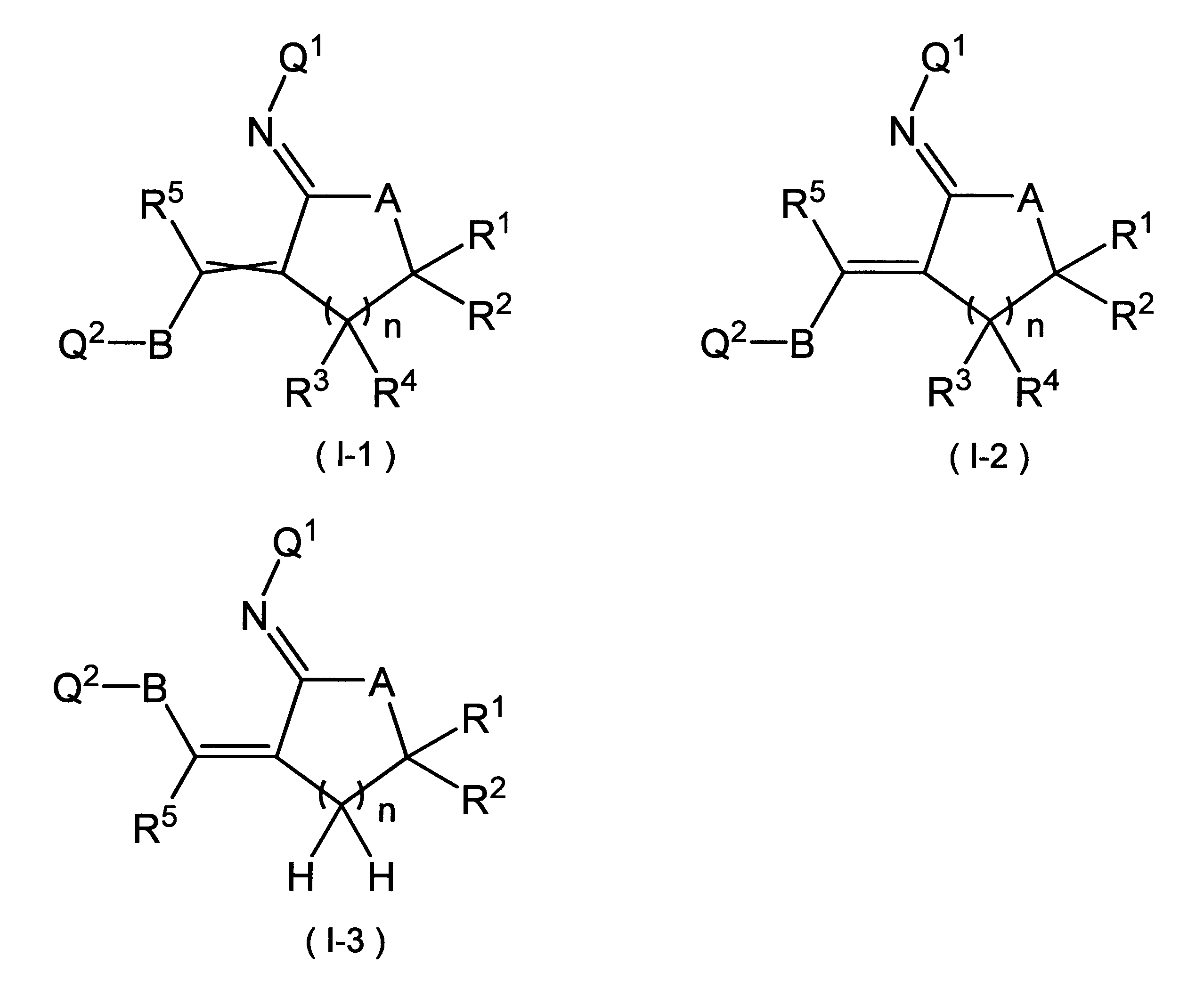
- Specific examples of stereoisomerism are represented by the following general formula.
- Q 1 , A, R 1 , R 2 , R 3 , R 4 , n, R 5 , B, and Q 2 are the same as those in formula (I). The same meaning is shown.
- the double bond portion is preferably a compound having the (E) steric structure.
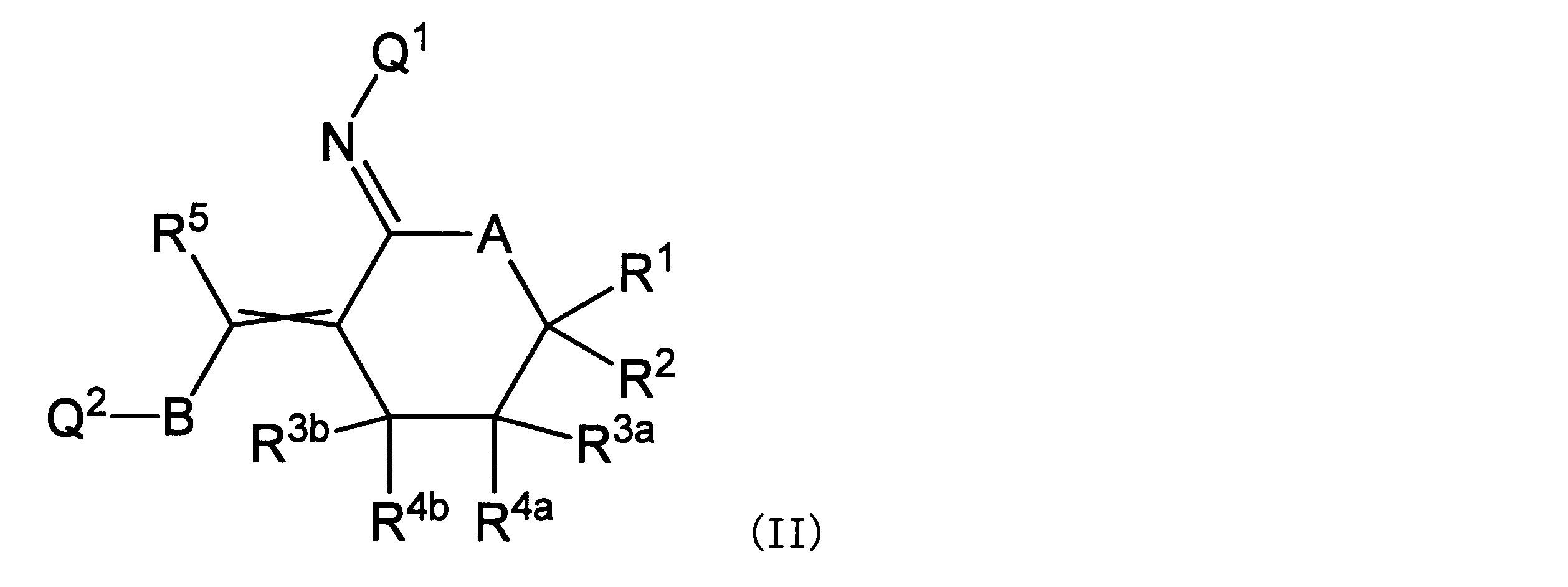
- the 1-heterodiene compound represented by the formula (I) is preferably a 1-heterodiene compound represented by the formula (II).
- R 3a , R 3b , R 4a , and R 4b are each independently a hydrogen atom, an unsubstituted or substituted C1-6 alkyl group, an unsubstituted or substituted C2-6 alkenyl group, Substituted or substituted C2-6 alkynyl group, unsubstituted or substituted C3-8 cycloalkyl group, unsubstituted or substituted C6-10 aryl group, unsubstituted or substituted A 3- to 6-membered heterocyclic group, a halogeno group, or a cyano group; “C1-6 alkyl group”, “C2-6 alkenyl group”, “C2-6 alkynyl group”, “C3-8 cycloalkyl group”, “C6-10” in R 3a , R 3b , R 4a , and R 4b Examples of the “aryl group”, “3- to 6-membered heterocyclic group”, and “halogeno group”, and groups having
- R 3a and R 4a may be connected to each other to form a ring together with the carbon atom to which R 3a and R 4a are bonded.
- Examples of the “ring” formed by the carbon atoms to which R 3a and R 4a are linked to each other include a cyclopropane ring, a cyclobutane ring, a cyclopentane ring, a cyclohexane ring, a cycloheptane ring, a tetrahydrofuran ring, a tetrahydropyran ring, etc. Can be mentioned.
- the “ring” formed by R 3 and R 4 together with the carbon atom to which they are bonded is a cyclopentane ring, a cyclohexane ring, or a tetrahydropyran ring.
- (E), (Z), or (E / Z) is indicated by the stereoisomerism of the double bond to which R 5 and B are bonded in formula (II).
- the double bond moiety is preferably a compound having the (E) steric structure.
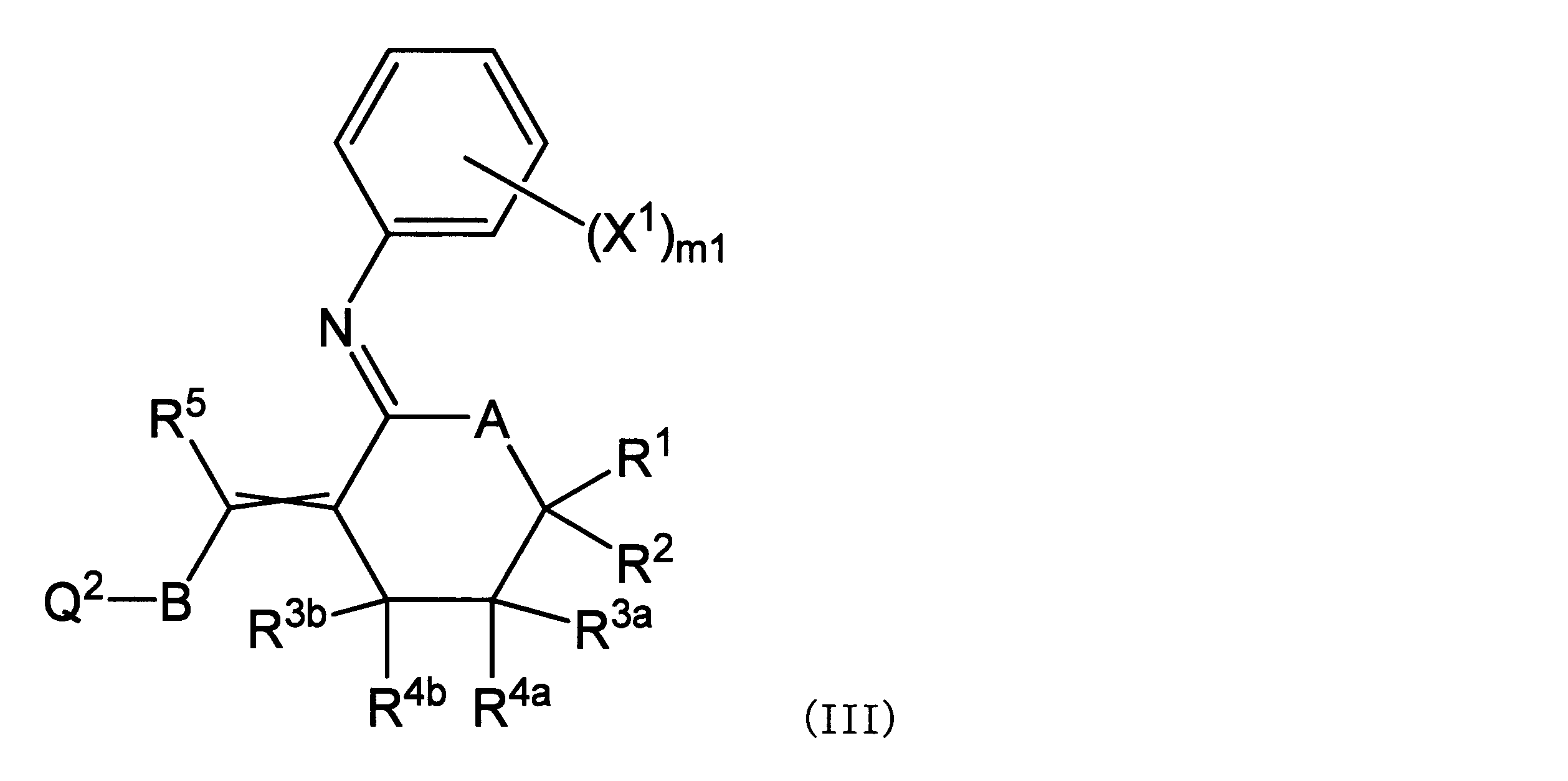
- the 1-heterodiene compound represented by the formula (I) is more preferably a 1-heterodiene compound represented by the formula (III).
- X 1 , A, R 1 , R 2 , R 5 , B, and Q 2 have the same meaning as in formula (I).
- m1 represents an integer of 0 to 5.
- m1 is any integer from 0 to 2.
- R 3a , R 3b , R 4a , and R 4b are each independently a hydrogen atom, an unsubstituted or substituted C1-6 alkyl group, an unsubstituted or substituted C2-6 alkenyl group, Substituted or substituted C2-6 alkynyl group, unsubstituted or substituted C3-8 cycloalkyl group, unsubstituted or substituted C6-10 aryl group, unsubstituted or substituted A 3- to 6-membered heterocyclic group, a halogeno group, or a cyano group; “C1-6 alkyl group”, “C2-6 alkenyl group”, “C2-6 alkynyl group”, “C3-8 cycloalkyl group”, “C6-10” in R 3a , R 3b , R 4a , and R 4b Examples of the “aryl group”, “3- to 6-membered heterocyclic group”, and “halogeno group”, and groups having
- R 3a and R 4a may be connected to each other to form a ring together with the carbon atom to which R 3a and R 4a are bonded.
- Examples of the “ring” formed by the carbon atoms to which R 3a and R 4a are linked to each other include a cyclopropane ring, a cyclobutane ring, a cyclopentane ring, a cyclohexane ring, a cycloheptane ring, a tetrahydrofuran ring, a tetrahydropyran ring, etc. Can be mentioned.
- the “ring” formed by R 3 and R 4 together with the carbon atom to which they are bonded is a cyclopentane ring, a cyclohexane ring, or a tetrahydropyran ring.
- (E), (Z), or (E / Z) is indicated by the stereoisomerism of the double bond to which R 5 and B are bonded in formula (III).
- the double bond moiety is preferably a compound having the (E) steric structure.
- Salts of 1-heterodiene compounds including pharmaceutically acceptable salts, and conventional methods for preparing them are known in the art.
- Examples of salts include, but are not limited to, sulfuric acid, hydrochloric acid, phosphoric acid, tetrafluoroboric acid, acetic acid, succinic acid, citric acid, lactic acid, maleic acid, fumaric acid, cholic acid, pamonic acid, mucinic acid, glutamic acid , Camphoric acid, glutaric acid, glycolic acid, phthalic acid, tartaric acid, formic acid, lauric acid, stearic acid, salicylic acid, methanesulfonic acid, benzenesulfonic acid, sorbic acid, picric acid, benzoic acid, cinnamic acid, and similar acids And salts formed by standard reactions with both organic and inorganic acids.
- the production methods described in Patent Documents 1 and 2 can be referred to.
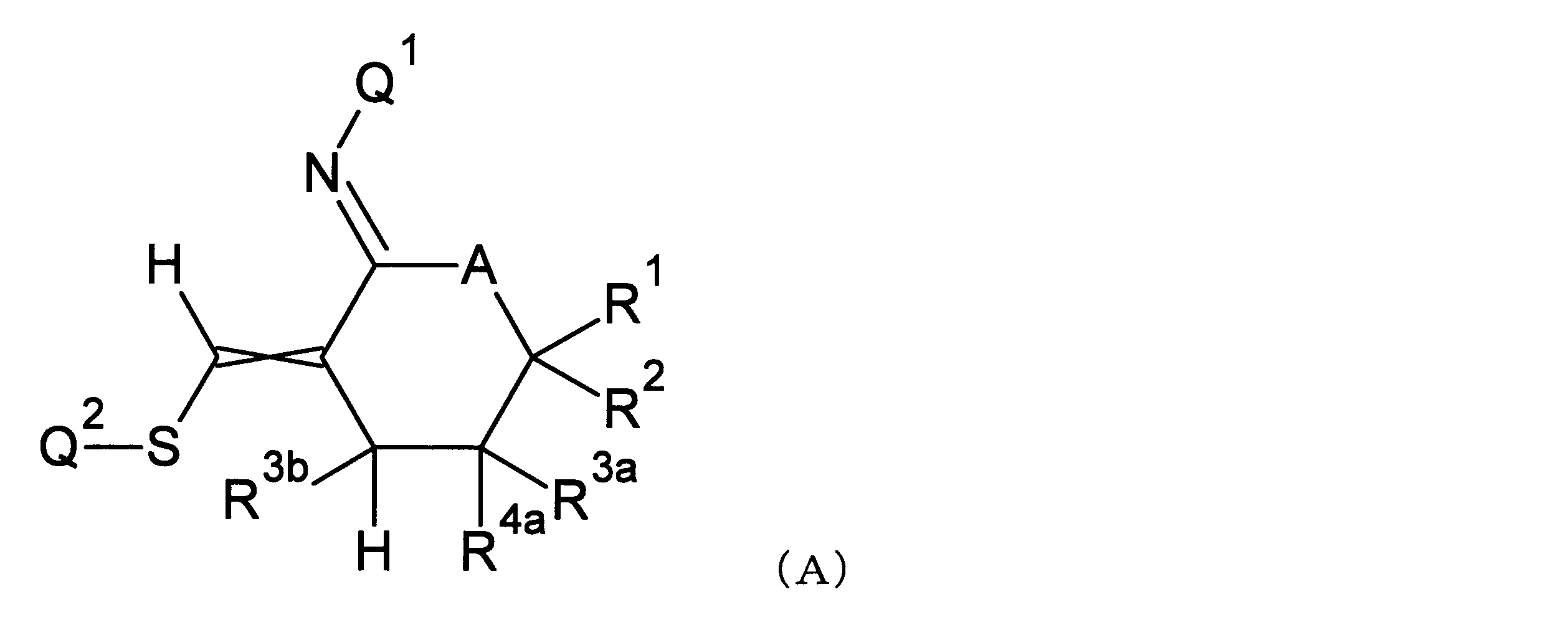
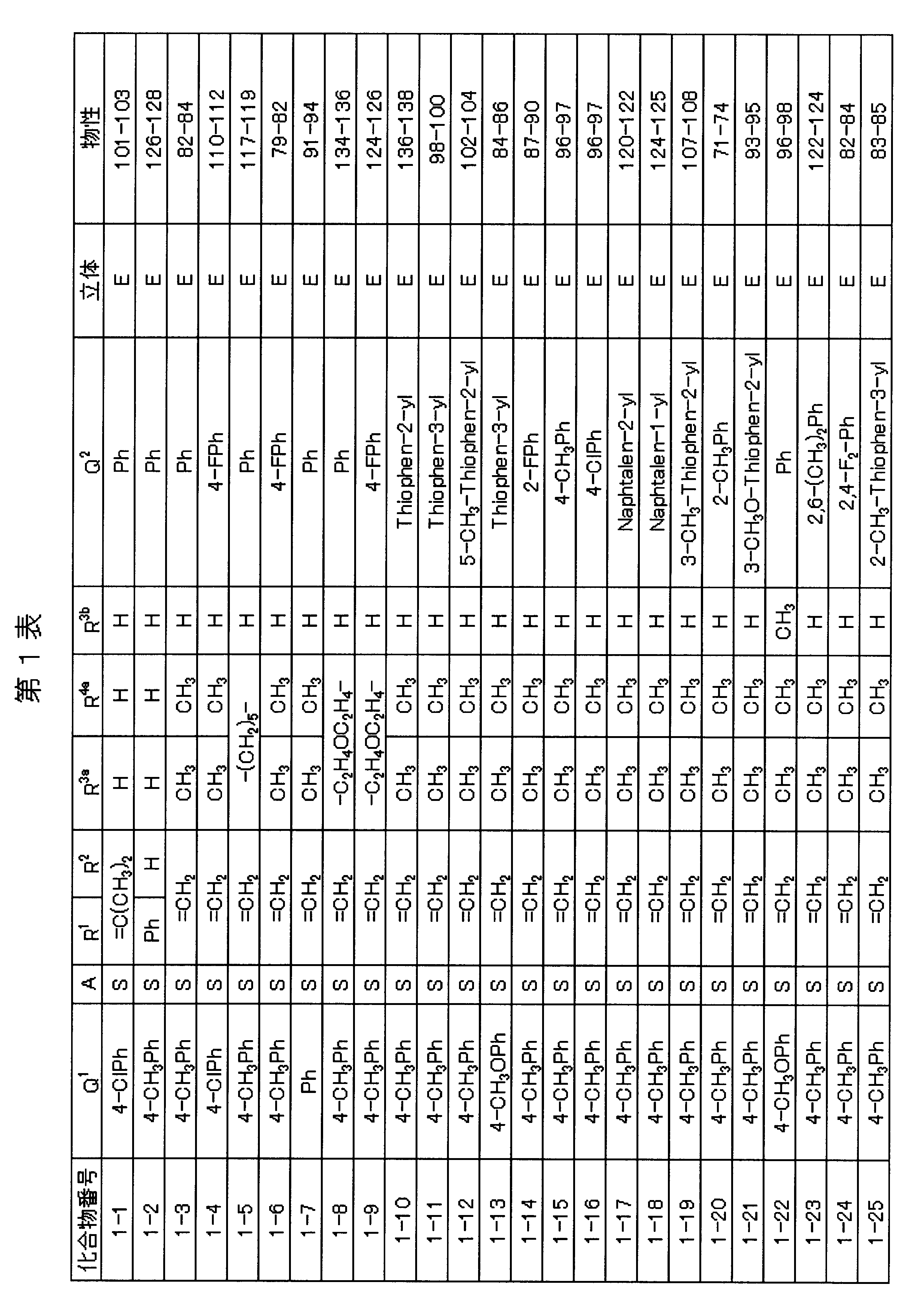
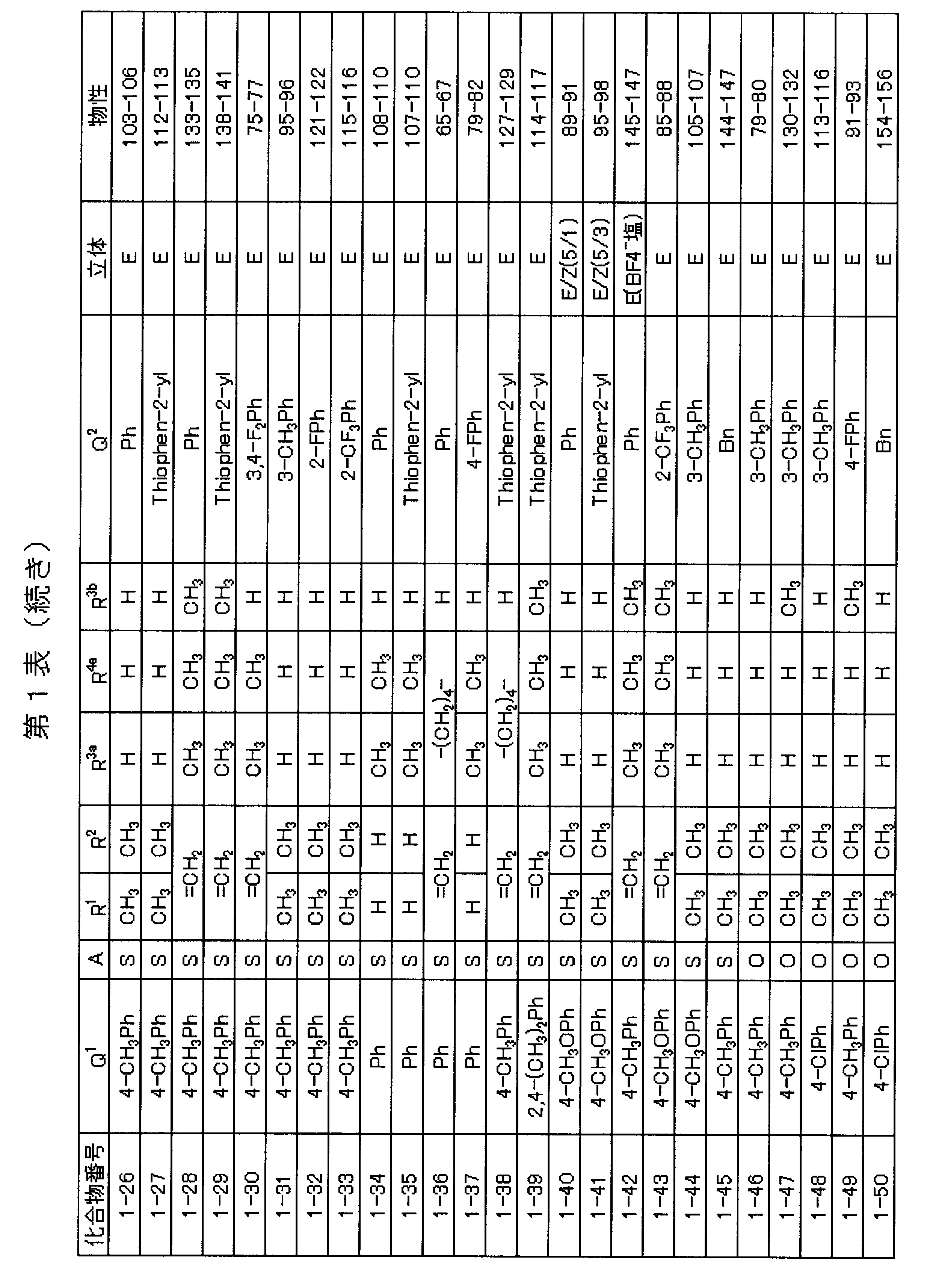
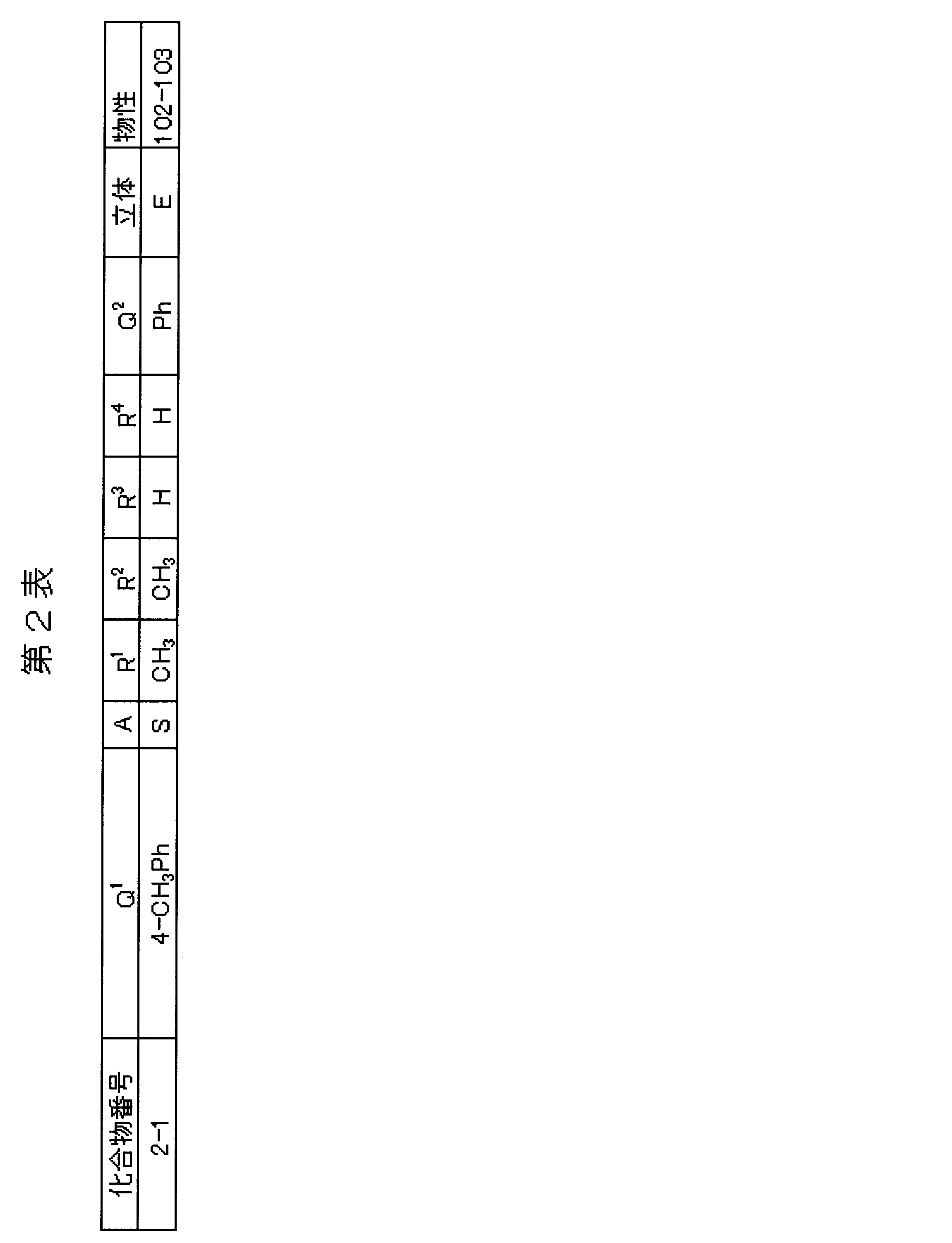
- Specific examples of 1-heterodiene compounds that can be synthesized by these production methods are shown in Tables 1 and 2.
- Table 1 the melting point (° C.), the refractive index, or the property (Viscous oil or amorphous) is shown as a physical property value.
- the symbols in Table 1 are the symbols in formula (A).
- the symbols in Table 2 are the symbols in formula (B).
- the ectoparasite control agent of the present invention contains, as an active ingredient, at least one selected from the 1-heterodiene compound according to the present invention and a salt thereof (sometimes referred to as the compound of the present invention).
- the present invention provides a method for controlling an animal in need of suppression of ectoparasite infestation, the method comprising administering to the animal an effective amount of at least one compound selected from the compounds of the present invention. including.
- the method may further comprise administering at least one other active ingredient to the animal.
- the animal may be a mammal, a pet such as a human, a dog or a cat, an edible animal such as a cow or a sheep, or a bird such as a chicken or turkey.
- the present invention provides a method of preventing and treating a disease transmitted through a parasite, comprising administering at least one compound selected from the compounds of the present invention to an animal in need thereof.
- the present invention provides a method for controlling pests, characterized by allowing at least one compound selected from the compounds of the present invention to act on pests and / or their habitats.
- the present invention provides the use of at least one compound selected from the compounds of the present invention for controlling pests.
- the present invention provides at least one compound selected from the compounds of the present invention for use in therapy.
- the present invention further provides at least one compound selected from the compounds of the present invention used for suppressing ectoparasite infestation.
- the present invention also provides the use of at least one compound selected from the compounds of the present invention for producing a preparation or a drug that suppresses infestation of ectoparasites.
- Parasites targeted by the ectoparasite control agent of the present invention are mainly ectoparasites, and usually include insects and mites pests that infest or infect animals. Including pupa stage, nymph stage, and adult stage. Such pests include ticks, fleas, lice, mosquitoes, mites, beetles, and blood sucking, biting or harmful flies.
- the habitat of these pests is mainly on the animal's body surface. In the case of fountains, they are also present in the body.
- the host animal in which the ectoparasite control agent of the present invention is effective may be a mammal or a non-mammal such as a bird (turkey, chicken) or fish.
- the host animal When the host animal is a mammal, it may be a human or non-human mammal.
- mammals other than humans include livestock animals such as livestock animals and pet animals.
- Livestock animals include cattle, camelids, pigs, sheep, goats and horses.
- Pets include dogs, rabbits, cats, and other pets that are kept and fed closely with humans as part of their connection.
- mites (Acari) to be controlled include the following pests.
- mite Mesostigmata mites (mite)
- A Dermanyssidae mites, for example, Dermanyssus gallinae from the genus Dermanyssus spp .
- B mites of the family Mronidsidae (Macronyssidae), for example, the mite species (Ornithonyssus spp.), The tick mite (Ornithonyssus sylviarum), the mite mite (Ornithonyssus bursa), the mite (Ornithonyssus bacoti);
- C mites of the family Laelapidae, for example, Laelaps spp., Laelaps echidninus, Laelaps jettmari; for example, Tropilaelaps spp.
- Varroidae ticks for example, Varroa spp., Varroa destructor, Varroa jacobsoni, Varroa underwoodi;
- Ornithodoros moubata (B) Ixodidae ticks, eg Haemaphysalis concinna, Haemaphysalis punctata, Haemaphysalis cinna, Haemaphysalis cinna, Haemaphysalis cinna (Haemaphysalis otophila), Haemaphysalis leachi, Haemaphysalis longicornis, ali seri (Haemaphysalis mageshimaensis), physalis tick (Haemaphysalis yeni), tick physics flava, Haemaphysalis megaspinosa, Haemaphysalis japonica, Haemaphysalis douglasi; for example, Amblyomma spp.
- Ixodidae ticks eg Haemaphysalis
- ticks Ixodes spp.
- Ticks Ixodes ricinus
- Ixodes hexagonus Ixodes canisuga
- Ixodes pilosus Ixodes rubicundus
- the tick Rhipicephalus (Boophilus) microplus
- Lipicephalus Boophilus) decoloratus
- Rhipicephalus Boophilus
- Lipicephalus Annuratus
- Rhipicephalus evertsi Rhipicephalus sanguineus, Rhipicephalus bursa
- Rhipicephalus appendiculatus Rhipicephalus appendiculatus
- Rhipicephalus appendiculatus Rhipicephalus turanicus
- Rhipicephalus zambeziensis for example, Dermacentor marginatus, Dermacentor reticulatus (Dermacentor reticulatica) Dermacentor pictus, Dermacentor albipictus, Dermacentor andersoni, American dog ticks Dermacentor variabilis);
- Astigmata (Acaridida) Psoroptidae mites, for example, Psoroptes ovis, Psoroptes cuniculi, Psoroptida equi, (Psoroptes equi) For example, Chorioptes spp., Chorioptes bovis; Otodectes spp., Otodectes cynotis; (B) Scaroptidae mites, for example, Sarcoptes scabiei, Sarcoptes canis, Sarcoptes bovis, Scaroptida spider mite (Sarcoptes spp.) Sarcoptes ovis), Sarcoptes rupicaprae, Sarcoptes equi, Sarcoptes suis; for example, Notoedres spp., Notoedres cati; (C) mites of the family Knemidokoptidae, for example, Knemidokoptes mutans of the genus Knemidokoptes s
- Prostigmata mites Actinedida
- A Acaridaceae (Demodixidae) ticks, for example, Demodex spp., Demodex canis, Demodex bovis, Demodex ovis, Demodex caprae , Demodex equis, Demodex caballi, Demodex suis, Demodex cati
- B Trombiculidae ticks, for example, Troombicula alfreddugesi, Troombicula akamushi from the species of the genus Trombicula spp .;
- fleas (Siphonaptera) to be controlled include the following pests.
- Echidnophaga gallinacea (C) fleas of the family Ceratophyllidae, for example, Ceratophyllus gallinae, Ceratophyllus anisus of Ceratophyllus spp .; for example, Ceratophyllus anisus; Nosopsyllus spp. Mouse minnow (Nosopsyllus fasciatus); (D) Fleas of the family Leptopsyllidae, for example, Leptopsylla segnis of the genus Leptopsylla spp .;
- the range of the compound of the present invention, or a conjugate thereof or a salt thereof in this method is 0.01 to 1000 mg / kg of the animal body weight, more preferably 0.1 to 100 mg. / Kg.
- the frequency of dosing will also depend on a number of factors, and can be administered once during the required time period determined by the attending physician or veterinarian, or other appropriately trained person.
- the additional active ingredient may be administered together with the compound of the present invention.
- pharmaceutically acceptable as used in this application is “dermatologically acceptable” and “veterinarily acceptable”. And thus includes individual applications to both humans and animals.
- “Suppressing” refers to improving or eliminating ongoing parasites in the body or body surface of an animal host or preventing parasites by administering at least one compound selected from the compounds of the present invention.
- Effective amount refers to the amount of at least one compound selected from the compounds of the present invention sufficient to suppress ectoparasite infestation, including reducing the number of ectoparasites to a measurable extent, Depends on several factors.
- the present invention provides formulations, including pharmaceutical formulations, comprising at least one compound selected from the compounds of the present invention and at least one acceptable carrier or excipient system.
- the formulation may further comprise at least one additional active ingredient.
- the pharmaceutical formulation of the present invention may be a human pharmaceutical formulation or a veterinary pharmaceutical formulation.
- Additional active ingredients include the following.
- Organic (thio) phosphates acephate, azamethiphos, azinephos methyl, azinephos ethyl, bromophos ethyl, bromfenbinphos, BRP, chlorpyrifos, chlorpyrifos methyl, chlorpyrifos ethyl, chlorfenvinphos, kazusafos, Carbophenothione, chloroethoxyphos, chlormefos, coumaphos, cyanophenphos, cyanophos, CYAP, diazinon, dichlorvos, dicrotophos, dimethoate, disulfotone, dimeton-S-methyl, dimethylvinphos, dimeton-S-methylsulfone, diariphos, diazinon , Diclofenthion, dioxabenzophos, disulfoton, ethion, etoprophos,
- Nicotine receptor agonist / antagonist compounds acetamiprid, clothianidin, dinotefuran, imidacloprid, nitenpyram, thiacloprid, thiamethoxam, nithiazine, nicotine, bensultap, cartap; (6) GABA antagonist compound: (A) acetoprole, ethiprole, fipronil, vaniliprole, pyrafluprole, pyriprole; (B) Organochlorine; camfechlor, chlordane, endosulfan, HCH, ⁇ -HCH, heptachlor, methoxychlor
- Macrocyclic lactone insecticides abamectin, emamectin benzoate, milbemectin, lepimectin, spinosad, ivermectin, selamectin, doramectin, epinomectin, moxidectin, (8)
- METI I compounds phenazaquin, pyridaben, tebufenpyrad, tolfenpyrad, flufenerim, hydramethylnon, fenpyroximate, pyrimidifen, dicophor;
- METI II and III compounds acequinosyl, fluacrylpyrim, rotenone;
- Uncoupler compounds chlorfenapyr, binapacryl, dinobutone, dinocup, DNOC;
- Oxidative phosphorylation inhibitor compounds cyhexatin, diafenthiuron, phenbutatin oxide, propargite, azocyclotin;
- molting disrupting compound cyromazine;
- Mixed function oxidase inhibitor compound piperonyl butoxide;
- Sodium channel blocker compounds indoxacarb, metaflumizone;
- Microbial pesticides BT agent, entomopathogenic virus agent, entomopathogenic fungus agent, nematode pathogenic fungus agent; Bacillus spp., White scab fungus, black scab fungus, Pekir Myces spp., Thuringiensins, Vertici Lilium species;
- Latrophilin receptor agonist depsipeptide, cyclic depsipeptide
- Octopaminergic agent Amitraz
- Ryanodine derivative agonist fulvendiamide, chlorantraniliprole, cyantraliniprol
- Inhibitor of magnesium-stimulated ATPase thiocyclam, thiosultap, nereistoxin
- antifeedant pymetrozine
- Tick growth inhibitor clofentezin, etoxazole
- Others Benclothiaz, Bifenazate, Pyridalyl, Sulfur, Sienopyraphene, Ciflumethofene, Amidoflumet, Tetradiphone, Chlordimeform, 1,3-Dichloropropene, DCIP, Phenisobromolate, Benzomate, Metaaldehyde, Spinetram, Pyrifluquinazone, Benzo Ximate, bromopropyrate, quinomethionate, chlorbenzilate, chloropicrin
- Anthelmintic (a) benzimidazole series: fenbendazole, albendazole, triclabendazole, oxybendazole; (B) Salicylanilide series: closantel, oxyclozanide; (C) substituted phenol type: nitroxinyl; (D) pyrimidine series: pyrantel; (E) imidazothiazole series: levamisole; (F) tetrahydropyrimidine: praziquantel; (G) Other anthelmintic drugs: cyclodiene, riania, chlorthrone, metronidazo
- At least one compound selected from the compounds of the present invention can be blended.
- Said pharmaceutical compositions for humans and non-human mammals and their production processes are known in the art.
- a preparation containing an effective amount of at least one compound selected from the compounds of the present invention is locally applied by a method that is routinely used such as a dipping method, a spray method, a liquid bath method, a pour-on method, a drip method, and a spraying method.
- Topical is defined as applying to the surface of an animal or human body and includes skin or hair. This does not include important systemic applications such as transdermal.
- At least one compound selected from the compounds of the present invention may be present in the preparation in an amount of generally 0.01% to 90% of the total weight percent.
- the formulation can also contain any other ingredients or carriers, such as antioxidants, buffers, preservatives, surfactants, chelating agents, wetting agents, admixtures, UV absorbing compounds or light. Stabilizers, viscosity modifiers, antibacterial agents, dyes, fragrances, modifiers, deodorants and physiologically or dermatologically acceptable diluents, excipients or adjuvants. Such agents are known in the art.
- the preparation can also be administered orally, by parenteral administration such as injection (muscular, subcutaneous, intravenous, intraperitoneal), or transdermally.
- parenteral administration such as injection (muscular, subcutaneous, intravenous, intraperitoneal), or transdermally.
- the preparation containing at least one compound selected from the compounds of the present invention may contain an additional active ingredient and a carrier.
- carrier is used herein to describe any ingredient other than the active ingredient in the formulation. The choice of carrier will depend widely on factors such as the particular mode of administration or application, the effect of the carrier on so
- the ectoparasite control agent of the present invention can control parasites over a long period of time by a single administration even at a low dose because of the excellent sustained activity of the compound of the present invention. Specifically, it is possible to control for about 3 weeks to about 1 month with a single administration. Therefore, the ectoparasite control agent of the present invention may be administered every week, every other week, every month, or at longer intervals. That is, a long effective period can be expected when the ectoparasite control agent of the present invention is administered to a host animal, particularly a warm-blooded animal, by a known veterinary technique, particularly, local administration.
- the present invention further includes the following. (1) It contains, as an active ingredient, at least one compound selected from 1-heterodiene compounds represented by formula (I) and salts thereof, which are locally administered every month or longer. Ectoparasite control agent. (2) An ectoparasite control agent characterized by containing, as an active ingredient, at least one compound selected from 1-heterodiene compounds represented by formula (I) and salts thereof, every month or longer A method of controlling ectoparasites gathering in and on warm-blooded animals, administered locally at intervals.
- the compounds shown below exhibit excellent activity sustainability, and therefore a long effective period can be expected.
- Larva immersion microassays can be performed as described in (J. Med. Entomol. 41: 1034-1042 (2004)). Briefly, a test solution is formulated in dimethyl sulfoxide (DMSO) to prepare a stock solution with a concentration of 10 mM. Subsequently, a 96-well microtiter plate is used, and for each fraction, 10 mM sample solution is diluted into an aqueous solution containing 1% ethanol and 0.2% Triton X-100 to obtain the desired concentration (general 0.1 ml or less) is obtained (repeated at least 3 times for each compound or concentration).
- DMSO dimethyl sulfoxide
- the following compounds to be tested showed more than 80% activity in tests using this assay at concentrations of 100 ⁇ M or less.
- Test Example 2 Rodent mite control test in vivo (RAT)
- the test target compound can be evaluated by a modified analytical method described in (J. Med. Entomol. 43 (3): 526 to 532 (2006)). This analysis method can be used by changing to another mite species (references are Amblyomma americanum mites), for example, other mite species such as Dermacentor variabilis mites.
- a tick holding unit (comprised of a small nipple, vented screw cap, and reinforced rubber washer) is attached to the back of an adult Sprague-Dawley rat. After attaching the holding unit, 0.05 ml of the test object compound dissolved in acetone is locally applied to the skin surface inside the holding unit.
- the untreated control group is used for comparison with the group given the compound to be tested for the calculation of% efficacy (% reduction in the number of surviving ticks).
- % efficacy % reduction in the number of surviving ticks.
- Efficacy [%] [(number of surviving tick GM in control ⁇ number of surviving tick GM in treatment group) / (Number of surviving tick GMs in control)] ⁇ 100
- the following compounds to be tested showed efficacy of 50% or more in tests using this analytical method at an active ingredient concentration of 1% or less (10 mg / ml).
- the activity in the above analytical method indicates that the compounds of the present invention are useful for inhibiting mite infestation.
- Test Example 3 In vivo canine parasite control test Four dogs were assigned to one test target compound. Each dog was infested with about 50 adult Rhipicephalus sanguineus adults on the first day (-1 day) before treatment with the test compound. These 50 ticks are estimated to be 50% male and 50% female.
- the test target compound was dissolved in a mixed solvent composed of 80% by volume of benzyl alcohol and 20% by volume of isopropyl myristate to a concentration of 50 mg / ml to prepare a test solution. On day 0, the test solution is “topical spot-on” in several different spots in the interscapular region so that 20 mg / Kg of the test compound per dog body weight is treated. Processed by. A negative control was also prepared for comparison.
- ticks were observed on the second day (48 hours after treatment). To assess persistence, 50 ticks that were not fed were again infested on days 5, 12, 19 and 28 per dog. On the 12th and 28th days, 50 cat fleas (Ctenocephalides felis) adults were co-infested. Furthermore, on the 33rd day, adults of American black ticks (Dermacentor variabilis) that had not been fed 50 were infested. On days 7, 14, 21, 30 and 35, 48 hours after each infestation, ticks and fleas were observed for life and death and removed from the dogs. The ticks were classified according to whether they were attached or not, and the viability was determined. For the evaluation of effectiveness, the same geometric average calculation as in Test Example 2 was used.
- test compounds 1-3, 1-5, 1-10, 1-28, 1-29, and 1-71 were used. However, the test using American dog ticks was conducted for 1-28 and 1-71. The test results are shown in the following table. The upper row of cells in the table shows the average number of live parasites, and the lower row shows the efficacy (%).
- test target compound 1-32 a test dog was treated with 5 mg / Kg per body weight of an individual dog. The test results are shown below.
- An ectoparasite control agent comprising as an active ingredient at least one compound selected from compounds represented by formula (III) and the like and salts thereof can be provided.
Landscapes
- Health & Medical Sciences (AREA)
- Life Sciences & Earth Sciences (AREA)
- Chemical & Material Sciences (AREA)
- General Health & Medical Sciences (AREA)
- Organic Chemistry (AREA)
- Veterinary Medicine (AREA)
- Animal Behavior & Ethology (AREA)
- Public Health (AREA)
- Medicinal Chemistry (AREA)
- Pharmacology & Pharmacy (AREA)
- Engineering & Computer Science (AREA)
- Agronomy & Crop Science (AREA)
- Environmental Sciences (AREA)
- Epidemiology (AREA)
- Zoology (AREA)
- Wood Science & Technology (AREA)
- Dentistry (AREA)
- Pest Control & Pesticides (AREA)
- Plant Pathology (AREA)
- Chemical Kinetics & Catalysis (AREA)
- Nuclear Medicine, Radiotherapy & Molecular Imaging (AREA)
- General Chemical & Material Sciences (AREA)
- Bioinformatics & Cheminformatics (AREA)
- Tropical Medicine & Parasitology (AREA)
- Pharmaceuticals Containing Other Organic And Inorganic Compounds (AREA)
- Agricultural Chemicals And Associated Chemicals (AREA)
- Plural Heterocyclic Compounds (AREA)
- Medicines That Contain Protein Lipid Enzymes And Other Medicines (AREA)
- Pyrane Compounds (AREA)
- Catching Or Destruction (AREA)
- Heterocyclic Compounds Containing Sulfur Atoms (AREA)
- Heterocyclic Carbon Compounds Containing A Hetero Ring Having Oxygen Or Sulfur (AREA)
- Thiazole And Isothizaole Compounds (AREA)
Abstract
Description
本願は、2013年3月8日に、日本に出願された特願2013-046259号に基づき優先権を主張し、その内容をここに援用する。
〔1〕 式(I)で表される1-ヘテロジエン化合物およびそれらの塩から選ばれる少なくとも1つの化合物を有効成分として含有する外部寄生虫防除剤。
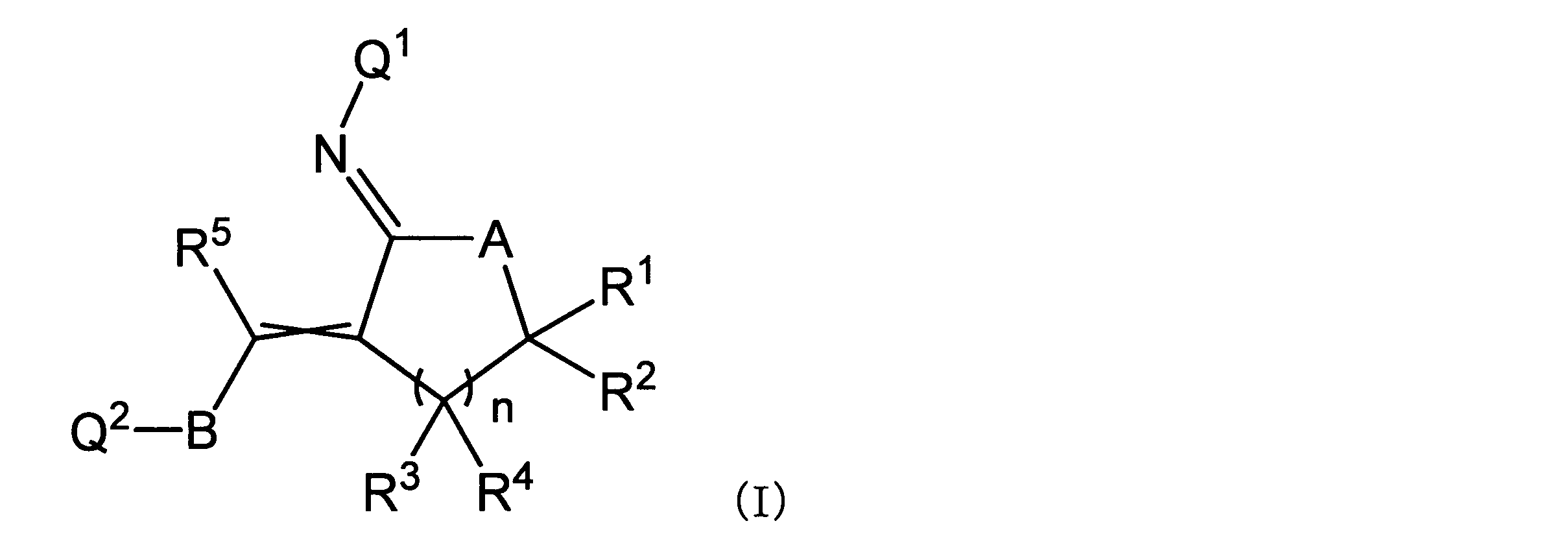
X1は、無置換のもしくは置換基を有するC1~6アルキル基、無置換のもしくは置換基を有するC2~6アルケニル基、無置換のもしくは置換基を有するC2~6アルキニル基、無置換のもしくは置換基を有するC3~8シクロアルキル基、水酸基、無置換のもしくは置換基を有するC1~6アルコキシ基、無置換のもしくは置換基を有するC1~7アシル基、無置換のもしくは置換基を有するC1~6アルコキシカルボニル基、無置換のもしくは置換基を有するアミノ基、無置換のもしくは置換基を有するC1~6アルキルチオ基、無置換のもしくは置換基を有するC1~6アルキルスルホニル基、無置換のもしくは置換基を有するC6~10アリール基、無置換のもしくは置換基を有する3~6員ヘテロ環基、ハロゲノ基、シアノ基、またはニトロ基を示す。
Q1上の置換基X1の個数は、1~5のいずれかの整数である。置換基X1が2以上あるときX1は互いに同一でも相違してもよい。
Aは、酸素原子または硫黄原子を示す。
R1およびR2は、それぞれ独立に、水素原子、無置換のもしくは置換基を有するC1~6アルキル基、無置換のもしくは置換基を有するC2~6アルケニル基、無置換のもしくは置換基を有するC2~6アルキニル基、無置換のもしくは置換基を有するC3~8シクロアルキル基、無置換のもしくは置換基を有するC6~10アリール基、無置換のもしくは置換基を有する3~6員ヘテロ環基、またはシアノ基を示す。
ここで、R1とR2は一緒になって、無置換のもしくは置換基を有するエキソメチレン基を形成してもよい。
R3およびR4は、それぞれ独立に、水素原子、無置換のもしくは置換基を有するC1~6アルキル基、無置換のもしくは置換基を有するC2~6アルケニル基、無置換のもしくは置換基を有するC2~6アルキニル基、無置換のもしくは置換基を有するC3~8シクロアルキル基、無置換のもしくは置換基を有するC6~10アリール基、無置換のもしくは置換基を有する3~6員ヘテロ環基、ハロゲノ基、またはシアノ基を示す。
nは、R3およびR4で置換されたメチレンの個数を示し、かつ1~4のいずれかの整数である。nが2以上のときR3およびR4は互いに同一でも相違してもよい。
また、R3とR4は相互に繋がってR3およびR4が結合する炭素原子とともに環を形成してもよい。
R5は、水素原子または無置換のもしくは置換基を有するC1~6アルキル基を示す。
Bは、酸素原子または硫黄原子を示す。
Q2は、無置換のもしくは置換基X2を有するC7~11アラルキル基、無置換のもしくは置換基X2を有するC6~10アリール基、または無置換のもしくは置換基X2を有する5~6員へテロアリール基を示す。
X2は、無置換のもしくは置換基を有するC1~6アルキル基、無置換のもしくは置換基を有するC2~6アルケニル基、無置換のもしくは置換基を有するC2~6アルキニル基、無置換のもしくは置換基を有するC3~8シクロアルキル基、水酸基、無置換のもしくは置換基を有するC1~6アルコキシ基、無置換のもしくは置換基を有するC1~7アシル基、無置換のもしくは置換基を有するC1~6アルコキシカルボニル基、無置換のもしくは置換基を有するアミノ基、無置換のもしくは置換基を有するC1~6アルキルチオ基、無置換のもしくは置換基を有するC1~6アルキルスルホニル基、無置換のもしくは置換基を有するC6~10アリール基、無置換のもしくは置換基を有する3~6員ヘテロ環基、ハロゲノ基、シアノ基、またはニトロ基を示す。
Q2上の置換基X2の個数は、1~5のいずれかの整数である。置換基X2が2以上あるときX2は互いに同一でも相違してもよい。
式(I)中のR5とBが結合する二重結合の立体異性によって、(E)、(Z)、または(E/Z)を示す。
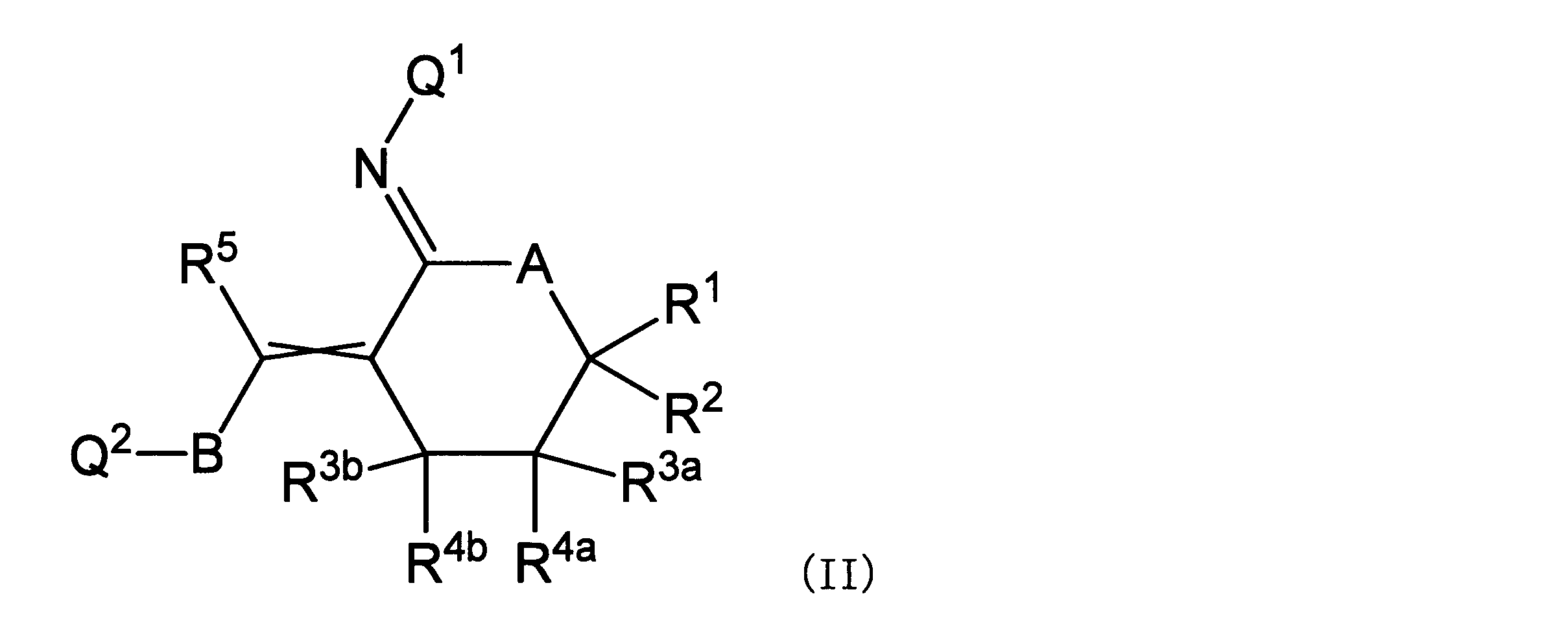
R3a、R3b、R4a、およびR4bは、それぞれ独立に、水素原子、無置換のもしくは置換基を有するC1~6アルキル基、無置換のもしくは置換基を有するC2~6アルケニル基、無置換のもしくは置換基を有するC2~6アルキニル基、無置換のもしくは置換基を有するC3~8シクロアルキル基、無置換のもしくは置換基を有するC6~10アリール基、無置換のもしくは置換基を有する3~6員ヘテロ環基、ハロゲノ基、またはシアノ基を示す。
また、R3aとR4aは、相互に繋がってR3aおよびR4aが結合する炭素原子とともに環を形成してもよい。
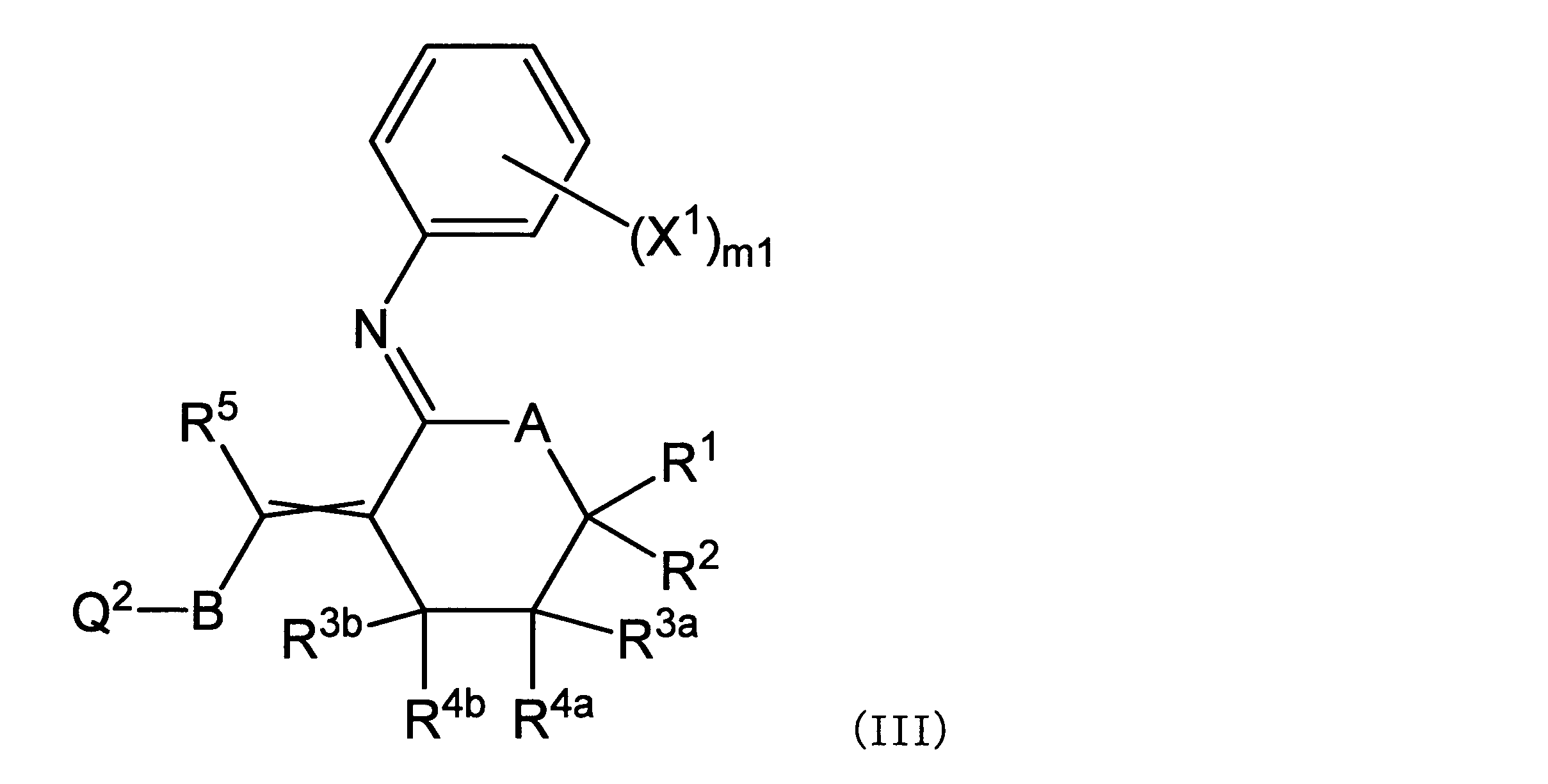
m1は、0~5のいずれかの整数を示す。
R3a、R3b、R4a、およびR4bは、それぞれ独立に、水素原子、無置換のもしくは置換基を有するC1~6アルキル基、無置換のもしくは置換基を有するC2~6アルケニル基、無置換のもしくは置換基を有するC2~6アルキニル基、無置換のもしくは置換基を有するC3~8シクロアルキル基、無置換のもしくは置換基を有するC6~10アリール基、無置換のもしくは置換基を有する3~6員ヘテロ環基、ハロゲノ基、またはシアノ基を示す。
また、R3aとR4aは、相互に繋がってR3aおよびR4aが結合する炭素原子とともに環を形成してもよい。
〔5〕 製剤がさらに、少なくとも1つの追加の有効成分を含む、〔4〕に記載の製剤。
〔6〕 製剤がヒトの医薬製剤である、〔4〕に記載の製剤。
〔7〕 製剤が獣医薬製剤である、〔4〕に記載の製剤。
〔9〕 少なくとも1つの他の有効成分を前記動物に投与する、〔8〕に記載の方法。
〔10〕 前記動物がヒトである、〔8〕に記載の方法。
〔11〕 前記動物が愛玩動物である、〔8〕に記載の方法。
〔12〕 前記愛玩動物がイヌまたはネコである、〔11〕に記載の方法。
〔13〕 前記動物が畜産動物である、〔8〕に記載の方法。
〔14〕 前記寄生生物がマダニである、〔8〕に記載の方法。
〔16〕 少なくとも1つの他の有効成分を前記動物に投与する、〔15〕に記載の方法。
〔17〕 前記動物がヒトである、〔15〕に記載の方法。
〔18〕 前記動物が愛玩動物である、〔15〕に記載の方法。
〔19〕 前記愛玩動物がイヌまたはネコである、〔18〕に記載の方法。
〔20〕 前記動物が畜産動物である、〔15〕に記載の方法。
〔21〕 前記寄生生物がマダニである、〔15〕に記載の方法。
〔23〕 前記生息環境が動物である、〔22〕に記載の方法。
〔24〕 有害生物を抑制するための前記〔1〕~〔3〕のいずれかひとつに記載の1-ヘテロジエン化合物およびそれらの塩から選ばれる少なくとも1つの化合物の使用。
〔25〕 治療するための前記〔1〕~〔3〕のいずれかひとつに記載の1-ヘテロジエン化合物およびそれらの塩から選ばれる少なくとも1つの化合物の使用。
〔26〕 外部寄生生物の寄生を抑制するための前記〔1〕~〔3〕のいずれかひとつに記載の1-ヘテロジエン化合物およびそれらの塩から選ばれる少なくとも1つの化合物の使用。
本発明の外部寄生虫防除剤は、式(I)で表される1-ヘテロジエン化合物(以下、化合物(I)と表記することがある。)およびそれらの塩から選ばれる少なくとも1つの化合物を有効成分として含有する。

一方、「置換基を有する」の用語は、母核となる基のいずれかの水素原子が、母核と同一または異なる構造の基で置換されていることを意味する。従って、「置換基」は、母核となる基に結合した他の基である。置換基は1つであってもよいし、2つ以上であってもよい。2つ以上の置換基は同一であってもよいし、異なるものであってもよい。
「C1~6」などの用語は、母核となる基の炭素原子数が1~6個などであることを表している。この炭素原子数には、置換基の中に在る炭素原子の数を含まない。例えば、置換基としてエトキシ基を有するブチル基は、C2アルコキシC4アルキル基に分類する。
メチル基、エチル基、n-プロピル基、i-プロピル基、n-ブチル基、s-ブチル基、i-ブチル基、t-ブチル基、n-ペンチル基、n-ヘキシル基などのC1~6アルキル基;
ビニル基、1-プロペニル基、2-プロペニル基(アリル基)、1-ブテニル基、2-ブテニル基、3-ブテニル基、1-メチル-2-プロペニル基、2-メチル-2-プロペニル基などのC2~6アルケニル基;
エチニル基、1-プロピニル基、2-プロピニル基、1-ブチニル基、2-ブチニル基、3-ブチニル基、1-メチル-2-プロピニル基などのC2~6アルキニル基;
シクロプロピル基、シクロブチル基、シクロペンチル基、シクロヘキシル基などのC3~8シクロアルキル基;
2-シクロペンテニル基、3-シクロヘキセニル基、4-シクロオクテニル基などのC4~8シクロアルケニル基;
ベンジル基、フェネチル基などのC7~11アラルキル基;
アジリジニル基、オキシラニル基、アゼチジニル基、オキセタニル基、ピロリジニル基、テトラヒドロフラニル基、ピペリジル基、ピペラジニル基、モルホリニル基、ジオキソラニル基、ジオキサニル基などの飽和へテロ環基;
ピロリル基、フリル基、チエニル基、イミダゾリル基、ピラゾリル基、オキサゾリル基、イソオキサゾリル基、チアゾリル基、イソチアゾリル基、トリアゾリル基、オキサジアゾリル基、チアジアゾリル基、テトラゾリル基などの5員ヘテロアリール基;
ピリジル基、ピラジニル基、ピリミジニル基、ピリダニジル基、トリアジニル基などの6員ヘテロアリール基;
ホルミル基、アセチル基、プロピオニル基、ベンゾイル基、シクロヘキシルカルボニル基などのC1~7アシル基;
メトキシ基、エトキシ基、n-プロポキシ基、i-プロポキシ基、n-ブトキシ基、s-ブトキシ基、i-ブトキシ基、t-ブトキシ基などのC1~6アルコキシ基;
ビニルオキシ基、アリルオキシ基、プロペニルオキシ基、ブテニルオキシ基などのC2~6アルケニルオキシ基;
エチニルオキシ基、プロパルギルオキシ基などのC2~6アルキニルオキシ基;
フェノキシ基、1-ナフトキシ基などのC6~10アリールオキシ基;
ベンジルオキシ基、フェネチルオキシ基などのC7~11アラルキルオキシ基;
メトキシカルボニル基、エトキシカルボニル基、n-プロポキシカルボニル基、i-プロポキシカルボニル基、n-ブトキシカルボニル基、t-ブトキシカルボニル基などのC1~6アルコキシカルボニル基;
カルボキシル基;
クロロメチル基、クロロエチル基、トリフルオロメチル基、1,2-ジクロロ-n-プロピル基、1-フルオロ-n-ブチル基、パーフルオロ-n-ペンチル基などのC1~6ハロアルキル基;
2-クロロ-1-プロペニル基、2-フルオロ-1-ブテニル基などのC2~6ハロアルケニル基;
4,4-ジクロロ-1-ブチニル基、4-フルオロ-1-ペンチニル基、5-ブロモ-2-ペンチニル基などのC2~6ハロアルキニル基;
4-クロロフェニル基、4-フルオロフェニル基、2,4-ジクロロフェニル基などのC6~10ハロアリール基;
トリフルオロメトキシ基、2-クロロ-n-プロポキシ基、2,3-ジクロロブトキシ基などのC1~6ハロアルコキシ基;
2-クロロプロペニルオキシ基、3-ブロモブテニルオキシ基などのC2~6ハロアルケニルオキシ基;
4-フルオロフェニルオキシ基、4-クロロ-1-ナフトキシ基などのC6~10ハロアリールオキシ基;
クロロアセチル基、トリフルオロアセチル基、トリクロロアセチル基、4-クロロベンゾイル基などのC1~7ハロアシル基;
メチルアミノ基、ジメチルアミノ基、ジエチルアミノ基などのC1~6アルキルアミノ基;
アニリノ基、ナフチルアミノ基などのC6~10アリールアミノ基;
ベンジルアミノ基、フェネチルアミノ基などのC7~11アラルキルアミノ基;
ホルミルアミノ基、アセチルアミノ基、プロパノイルアミノ基、ブチリルアミノ基、i-プロピルカルボニルアミノ基、ベンゾイルアミノ基などのC1~7アシルアミノ基;
メトキシカルボニルアミノ基、エトキシカルボニルアミノ基、n-プロポキシカルボニルアミノ基、i-プロポキシカルボニルアミノ基などのC1~6アルコキシカルボニルアミノ基;
アミノカルボニル基、ジメチルアミノカルボニル基、フェニルアミノカルボニル基、N-フェニル-N-メチルアミノカルボニル基などの無置換若しくは置換基を有するアミノカルボニル基;
イミノメチル基、(1-イミノ)エチル基、(1-イミノ)-n-プロピル基などのイミノ基で置換されたC1~6アルキル基;
ヒドロキシイミノメチル基、(1-ヒドロキシイミノ)エチル基、(1-ヒドロキシイミノ)プロピル基、メトキシイミノメチル基、(1-メトキシイミノ)エチル基などの無置換の若しくは置換基を有するヒドロキシイミノ基で置換されたC1~6アルキル基;
メチルチオ基、エチルチオ基、n-プロピルチオ基、i-プロピルチオ基、n-ブチルチオ基、i-ブチルチオ基、s-ブチルチオ基、t-ブチルチオ基などのC1~6アルキルチオ基;
フェニルチオ基、ナフチルチオ基などのC6~10アリールチオ基;
チアゾリルチオ基、ピリジルチオ基などのヘテロアリールチオ基;
ベンジルチオ基、フェネチルチオ基などのC7~11アラルキルチオ基;
メチルスルホニル基、エチルスルホニル基、t-ブチルスルホニル基などのC1~6アルキルスルホニル基;
フェニルスルホニル基などのC6~10アリールスルホニル基;
チアゾリルスルホニル基、ピリジルスルホニル基などのヘテロアリールスルホニル基;
ベンジルスルホニル基、フェネチルスルホニル基などのC7~11アラルキルスルホニル基;
トリフェニルシリル基などのトリアリール置換シリル基;
シアノ基;ニトロ基;
また、これらの「置換基」は、前記置換基中のいずれかの水素原子が、異なる構造の基で置換されていてもよい。
Q1上の置換基X1の個数は、1~5のいずれかの整数である。置換基X1が2以上あるときX1は互いに同一でも異なっていてもよい。
置換基X1の好ましい個数は、1~2のいずれかの整数である。
Q1における「C6~10アリール基」は、単環アリール基および多環アリール基のいずれであってもよい。多環アリール基は、少なくとも一つの環が芳香環であれば、残りの環が飽和脂環、不飽和脂環または芳香環のいずれであってもよい。
「C6~10アリール基」としては、フェニル基、ナフチル基、アズレニル基、インデニル基、インダニル基、テトラリニル基などを挙げることができる。
5員ヘテロアリール環としては、ピロリル基、フリル基、チエニル基、イミダゾリル基、ピラゾリル基、オキサゾリル基、イソオキサゾリル基、チアゾリル基、イソチアゾリル基、トリアゾリル基、オキサジアゾリル基、チアジアゾリル基、テトラゾリル基などを挙げることができる。
6員ヘテロアリール環としては、ピリジル基、ピラジニル基、ピリミジニル基、ピリダニジル基、トリアジニル基などを挙げることができる。
好ましいQ1としては、フェニル基を挙げることができる。
シクロプロピルメチル基、2-シクロプロピルエチル基、シクロペンチルメチル基、2-シクロヘキシルエチル基、2-シクロオクチルエチル基などのC3~8シクロアルキルC1~6アルキル基;
フルオロメチル基、クロロメチル基、ブロモメチル基、ジフルオロメチル基、ジクロロメチル基、ジブロモメチル基、トリフルオロメチル基、トリクロロメチル基、トリブロモメチル基、2,2,2-トリフルオロエチル基、2,2,2-トリクロロエチル基、ペンタフルオロエチル基、4-フルオロブチル基、4-クロロブチル基、3,3,3-トリフルオロプロピル基、2,2,2-トリフルオロ-1-トリフルオロメチルエチル基、パーフロロヘキシル基、パークロロヘキシル基、2,4,6-トリクロロヘキシル基などのC1~6ハロアルキル基;
メトキシメチル基、エトキシメチル基、メトキシエチル基、エトキシエチル基、メトキシ-n-プロピル基、エトキシメチル基、エトキシエチル基、n-プロポキシメチル基、i-プロポキシエチル基、s-ブトキシメチル基、t-ブトキシエチル基などのC1~6アルコキシC1~6アルキル基;
ビニルオキシメチル基、アリルオキシメチル基、プロペニルオキシメチル基、ブテニルオキシメチル基などのC2~6アルケニルオキシC1~6アルキル基;
ピリジン-2-イルオキシメチル基などのヘテロアリールオキシC1~6アルキル基;
ホルミルメチル基、アセチルメチル基、プロピオニルメチル基などのC1~7アシルC1~6アルキル基;
ホルミルオキシメチル基、アセトキシメチル基、2-アセトキシエチル基、プロピオニルオキシメチル基、プロピオニルオキシエチル基などのC1~7アシルオキシC1~6アルキル基;
カルボキシルメチル基、カルボキシルエチル基などのカルボキシル基C1~6アルキル基;
メトキシカルボニルメチル基、エトキシカルボニルメチル基、n-プロポキシカルボニルメチル基、i-プロポキシカルボニルメチル基などのC1~6アルコキシカルボニルC1~6アルキル基;
ホルムアミドメチル基、アセトアミドメチル基、2-アセトアミドエチル基、プロピオニルアミノメチル基、プロピオニルアミノエチル基などのC1~7アシルアミノC1~6アルキル基;
メチルアミノカルボニルメチル基、エチルアミノカルボニルメチル基、i-プロピルアミノカルボニルメチル基、t-ブチルアミノカルボニルメチル基、s-ブチルアミノカルボニルメチル基、n-ペンチルアミノカルボニルメチル基などのC1~6アルキルアミノカルボニルC1~6アルキル基;
メトキシカルボニルアミノメチル基、エトキシカルボニルアミノメチル基、i-プロポキシカルボニルアミノメチル基、t-ブトキシカルボニルアミノメチル基、s-ブチルオキシカルボニルアミノメチル基、n-ペンチルオキシカルボニルアミノメチル基などのC1~6アルコキシカルボニルアミノC1~6アルキル基;
ベンジル基、フェネチル基などのC7~11アラルキル基;
ベンゾイルアミノメチル基などのC6~10アリールカルボニルアミノC1~6アルキル基;
などを挙げることができる。
「置換基を有するC2~6アルケニル基」としては、2-クロロ-1-プロペニル基、2-フルオロ-1-ブテニル基などのC2~6ハロアルケニル基などを挙げることができる。
「置換基を有するC2~6アルキニル基」としては、4,4-ジクロロ-1-ブチニル基、4-フルオロ-1-ペンチニル基、5-ブロモ-2-ペンチニル基などのC2~6ハロアルキニル基などを挙げることができる。
「置換基を有するC1~6アルコキシ基」としては、クロロメトキシ基、ジクロロメトキシ基、ジフルオロメトキシ基、トリクロロメトキシ基、トリフルオロメトキシ基、1-フルオロエトキシ基、1,1-ジフルオロエトキシ基、2,2,2-トリフルオロエトキシ基、ペンタフルオロエトキシ基などのC1~6ハロアルコキシ基などを挙げることができる。
「置換基を有するC1~7アシル基」としては、クロロアセチル基、トリフルオロアセチル基、トリクロロアセチル基、4-クロロベンゾイル基などのC1~7ハロアシル基などを挙げることができる。
「置換基を有するC1~6アルコキシカルボニル基」としては、
シクロプロピルメトキシカルボニル基、シクロブチルメトキシカルボニル基、シクロペンチルメトキシカルボニル基、シクロヘキシルメトキシカルボニル基、2-メチルシクロプロピルメトキシカルボニル基、2,3-ジメチルシクロプロピルメトキシカルボニル基、2-クロロシクロプロピルメトキシカルボニル基、2-シクロプロピルエトキシカルボニル基などのC3~8シクロアルキルC1~6アルコキシカルボニル基; フルオロメトキシカルボニル基、クロロメトキシカルボニル基、ブロモメトキシカルボニル基、ジフルオロメトキシカルボニル基、ジクロロメトキシカルボニル基、ジブロモメトキシカルボニル基、トリフルオロメトキシカルボニル基、トリクロロメトキシカルボニル基、トリブロモメトキシカルボニル基、2,2,2-トリフルオロエトキシカルボニル基、2,2,2-トリクロロエトキシカルボニル基、ペンタフルオロエトキシカルボニル基、4-フルオロブトキシカルボニル基、3,3,3-トリフルオロプロポキシカルボニル基、2,2,2-トリフルオロ-1-トリフルオロメチルエトキシカルボニル基、パーフロロヘキシルオキシカルボニル基などのC1~6ハロアルコキシカルボニル基;などを挙げることができる。
「C6~10アリール基」としては、フェニル基、ナフチル基、アズレニル基、インデニル基、インダニル基、テトラリニル基などを挙げることができる。
6員ヘテロアリール基としては、ピリジル基、ピラジニル基、ピリミジニル基、ピリダニジル基、トリアジニル基などを挙げることができる。
部分不飽和の6員ヘテロ環基としては、チオピラニル基、2H-ピリジン-1-イル基、4H-ピリジン-1-イル基などが挙げられる。
ここで、R1とR2は一緒になって、無置換のもしくは置換基を有するエキソメチレン基を形成してもよい。
好ましくは、R1およびR2は、それぞれ独立に、水素原子、C1~6アルキル基、またはC6~10アリール基である。
より好ましくは、R1およびR2は「C1~6アルキル基」である。
好ましくは、R1とR2が一緒になってそれらが結合する炭素原子とともに形成する「置換基を有するエキソメチレン基」は、イソプロピリデン基である。
nは、R3およびR4で置換されたメチレンの個数を示し、かつ1~4のいずれかの整数である。nが2以上のときR3およびR4は互いに同一でも異なっていてもよい。
好ましくは、nは1または2である。
好ましくは、R3およびR4は、それぞれ独立に、水素原子またはC1~6アルキル基である。
R3とR4が相互に繋がってそれらが結合する炭素原子とともに形成する「環」としては、シクロプロパン環、シクロブタン環、シクロペンタン環、シクロヘキサン環、シクロヘプタン環、テトラヒドロフラン環、テトラヒドロピラン環などを挙げることができる。
好ましくは、R3とR4が相互に繋がってそれらが結合する炭素原子とともに形成する「環」は、シクロペンタン環、シクロヘキサン環、またはテトラヒドロピラン環である。
R5における「C1~6アルキル基」およびこの基に置換基を有する基としては、前記X1において例示したそれらと同じものを挙げることができる。好ましくは、R5は水素原子である。
Q2上の置換基X2の個数は、1~5のいずれかの整数である。置換基X2が2以上あるときX2は互いに同一でも異なっていてもよい。
置換基X2の好ましい個数は、1~2のいずれかの整数である。
Q2における「C7~11アラルキル基」としては、ベンジル基、フェネチル基などを挙げることができる。
Q2における「C6~10アリール基」、「5~6員ヘテロアリール基」としては、前記Q1において例示したそれらと同じものを挙げることができる。好ましくは、Q2における「C6~10アリール基」、「5~6員ヘテロアリール基」は、フェニル基またはチエニル基である。
立体異性の具体例を、以下の一般式で表す。式(I-1)~式(I-3)中、Q1、A、R1、R2、R3、R4、n、R5、B、およびQ2は、式(I)中のそれぞれと同じ意味を示す。
R3a、R3b、R4a、およびR4bにおける「C1~6アルキル基」、「C2~6アルケニル基」、「C2~6アルキニル基」、「C3~8シクロアルキル基」、「C6~10アリール基」、「3~6員ヘテロ環基」、および「ハロゲノ基」、ならびにこれらの基に置換基を有する基としては、前記X1において例示したそれらと同じものを挙げることができる。好ましくは、R3a、R3b、R4a、およびR4bは、それぞれ独立に、水素原子またはC1~6アルキル基である。
R3aとR4aが相互に繋がってそれらが結合する炭素原子とともに形成する「環」としては、シクロプロパン環、シクロブタン環、シクロペンタン環、シクロヘキサン環、シクロヘプタン環、テトラヒドロフラン環、テトラヒドロピラン環などを挙げることができる。
好ましくは、R3とR4が相互に繋がってそれらが結合する炭素原子とともに形成する「環」は、シクロペンタン環、シクロヘキサン環、またはテトラヒドロピラン環である。
式(II)中のR5とBが結合する二重結合の立体異性によって、(E)、(Z)、または(E/Z)を示す。二重結合部分は(E)の立体を有する化合物であることが好ましい。
m1は、0~5のいずれかの整数を示す。好ましくは、m1は0~2のいずれかの整数である。
R3a、R3b、R4a、およびR4bにおける「C1~6アルキル基」、「C2~6アルケニル基」、「C2~6アルキニル基」、「C3~8シクロアルキル基」、「C6~10アリール基」、「3~6員ヘテロ環基」、および「ハロゲノ基」、ならびにこれらの基に置換基を有する基としては、前記X1において例示したそれらと同じものを挙げることができる。
好ましくは、R3a、R3b、R4a、およびR4bは、それぞれ独立に、水素原子またはC1~6アルキル基である。
R3aとR4aが相互に繋がってそれらが結合する炭素原子とともに形成する「環」としては、シクロプロパン環、シクロブタン環、シクロペンタン環、シクロヘキサン環、シクロヘプタン環、テトラヒドロフラン環、テトラヒドロピラン環などを挙げることができる。
好ましくは、R3とR4が相互に繋がってそれらが結合する炭素原子とともに形成する「環」は、シクロペンタン環、シクロヘキサン環、またはテトラヒドロピラン環である。
式(III)中のR5とBが結合する二重結合の立体異性によって、(E)、(Z)、または(E/Z)を示す。二重結合部分は(E)の立体を有する化合物であることが好ましい。
これらの製造方法により合成しうる1-ヘテロジエン化合物の具体例を表1および2に示す。表1中に物性値として融点(℃)、屈折率、または性状(粘稠なオイル状であるもの(Viscous oil)、またはアモルファスであるもの(amorphous))を示す。表1中の記号は式(A)中の記号である。表2中の記号は式(B)中の記号である。


本発明の外部寄生虫防除剤は、本発明に係る1-ヘテロジエン化合物およびその塩(本発明化合物と言うことがある。)から選ばれる少なくとも1つを有効成分として含有する。
本発明は、外部寄生生物の寄生の抑制を必要としている動物のための抑制方法を提供し、その抑制方法は、前記動物に本発明化合物から選ばれる少なくとも1つの化合物の有効量を投与することを含む。この方法はさらに、少なくとも1つの他の有効成分を前記動物に投与することを含んでもよい。この動物は哺乳動物でもよいし、ヒトやイヌやネコなどの愛玩動物、ウシやヒツジなどの食用動物、あるいはニワトリやシチメンチョウなどのトリでもよい。
本発明は、寄生生物を通して伝染する疾患を予防および治療する方法を提供し、本発明化合物から選ばれる少なくとも1つの化合物を、それを必要としている動物に投与することを含む。
本発明は、本発明化合物から選ばれる少なくとも1つの化合物を、有害生物および/またはその生息環境に作用させることを特徴とする、有害生物を抑制する方法を提供する。本発明は、有害生物を抑制するための本発明化合物から選ばれる少なくとも1つの化合物の使用を提供する。
本発明は、治療に使用される本発明化合物から選ばれる少なくとも1つの化合物を提供する。本発明は、外部寄生生物の寄生を抑制するのに使用される、本発明化合物から選ばれる少なくとも1つの化合物をさらに提供する。また、本発明は、外部寄生生物の寄生を抑制する製剤または薬物を生産するための本発明化合物から選ばれる少なくとも1つの化合物の使用を提供する。
本発明の外部寄生虫防除剤が有効な宿主動物は、哺乳動物またはトリ(シチメンチョウ、ニワトリ)や魚などの非哺乳動物でよい。宿主動物が哺乳動物である場合、ヒトまたはヒト以外の哺乳動物でよい。ヒト以外の哺乳動物としては、畜産動物や愛玩動物などの家畜動物が挙げられる。畜産動物としては、ウシ、ラクダ科の動物、ブタ、ヒツジ、ヤギおよびウマが挙げられる。愛玩動物としては、ヒトと動物のつながりの一部としてヒトと密接に飼われ、養われるイヌ、ウサギ、ネコ、および他のペットが挙げられる。
(1)中気門目(Mesostigmata)のダニ類(mite)
(a)ワクモ科(Dermanyssidae)のダニ、例えば、ワクモ属種(Dermanyssus spp.)の、ワクモ(Dermanyssus gallinae);
(b)オオサシダニ科(Macronyssidae)のダニ、例えば、イエダニ属種(Ornithonyssus spp.)の、トリサシダニ(Ornithonyssus sylviarum)、ネッタイトリサシダニ(Ornithonyssus bursa)、イエダニ(Ornithonyssus bacoti);
(c)トゲダニ科(Laelapidae)のダニ、例えば、トゲダニ属種(Laelaps spp.)の、ネズミトゲダニ(Laelaps echidninus)、ホクマントゲダニ(Laelaps jettmari);例えば、トロピレラプス属種(Tropilaelaps spp.)の、ミツバチトゲダニ(Tropilaelaps clareae)、ケーニガーミツバチトゲダニ(Tropilaelaps koenigerum);
(d)ヘギダニ科(Varroidae)のダニ、例えば、ヘギダニ属種(Varroa spp.)の、ミツバチヘギイタダニ(Varroa destructor)、バロア・ジャコブソニ(Varroa jacobsoni)、バロア・アンデルウッディ(Varroa underwoodi);
(a)ヒメダニ科(Argasidae)のダニ、例えば、ナガヒメダニ属種(Argas spp.)の、ナガヒメダニ(Argas persicus)、アルガス・リフレクサス(Argas reflexus);例えば、ヒメダニ属種(Ornithodoros spp.)の、オルニトドラス・モウバータ(Ornithodoros moubata);
(b)マダニ科(Ixodidae)のダニ、例えば、チマダニ属種(Haemaphysalis spp.)の、ヘマフィサリス・コンシナ(Haemaphysalis concinna)、ヘマフィサリス・パンクタータ(Haemaphysalis punctata)、ヘマフィサリス・シンアバリナ(Haemaphysalis cinnabarina)、ヘマフィサリス・オトフィラ(Haemaphysalis otophila)、ヘマフィサリス・レアチ(Haemaphysalis leachi)、フタトゲチマダニ(Haemaphysalis longicornis)、マゲシマチマダニ(Haemaphysalis mageshimaensis)、イエンチマダニ(Haemaphysalis yeni)、ツリガネチマダニ(Haemaphysalis campanulata)、クロウサギチマダニ(Haemaphysalis pentalagi)、キチマダニ(Haemaphysalis flava)、オオトゲチマダニ(Haemaphysalis megaspinosa)、ヤマトチマダニ(Haemaphysalis japonica)、ダグラスチマダニ(Haemaphysalis douglasi);例えば、キララマダニ属種(Amblyomma spp.)の、ローンスター・ダニ(Amblyomma americanum)、アンブリオマ・バリエガタム(Amblyomma variegatum)、アンブリオマ・マキュラタム(Amblyomma maculatum)、アンブリオマ・ヘブラエウム(Amblyomma hebraeum)、アンブリオマ・カジェネンス(Amblyomma cajennense)、タカサゴキララマダニ(Amblyomma testudinarium);例えば、マダニ属種(Ixodes spp.)の、マダニ(Ixodes ricinus)、イクソデス・ヘキサゴナス(Ixodes hexagonus)、イクソデス・キャニスガ(Ixodes canisuga)、イクソデス・ピロサス(Ixodes pilosus)、イクソデス・ルビキュンダス(Ixodes rubicundus)、イクソデス・スキャプラリス(Ixodes scapularis)、イクソデス・ホロシクラス(Ixodes holocyclus)、ヤマトマダニ(Ixodes ovatus)、シュルツェマダニ(Ixodes persulcatus)、タネガタマダニ(Ixodes nipponensis);例えば、ウシマダニ亜属種(Boophilus spp.)の、オウシマダニ(Rhipicephalus(Boophilus)microplus)、リピセファラス(ブーフィラス)・デコロラタス(Rhipicephalus(Boophilus)decoloratus)、リピセファラス(ブーフィラス)・アニュラタス(Rhipicephalus(Boophilus)annulatus)、リピセファラス(ブーフィラス)・カルセラタス(Rhipicephalus(Boophilus)calceratus);例えば、コイタマダニ属種(Rhipicephalus spp.)の、リピセファラス・エベルトシ(Rhipicephalus evertsi)、クリイロコイタマダニ(Rhipicephalus sanguineus)、リピセファラス・ブルサ(Rhipicephalus bursa)、リピセファラス・アッペンディキュラタス(Rhipicephalus appendiculatus)、リピセファラス・キャペンシス(Rhipicephalus capensis)、リピセファラス・ツラニカス(Rhipicephalus turanicus)、リピセファラス・ザンベジエンシス(Rhipicephalus zambeziensis);例えば、カクマダニ属種(Dermacentor spp.)の、デルマセントール・マルギナタス(Dermacentor marginatus)、デルマセントール・レティキュラタス(Dermacentor reticulatus)、デルマセントール・ピクタス(Dermacentor pictus)、デルマセントール・アルビピクタス(Dermacentor albipictus)、デルマセントール・アンデルソニ(Dermacentor andersoni)、アメリカイヌカクマダニ(Dermacentor variabilis);
(a)キュウセンヒゼンダニ科(Psoroptidae)のダニ、例えば、キュウセンヒゼンダニ属種(Psoroptidae spp.)の、ヒツジキュウセンヒゼンダニ(Psoroptes ovis)、ウサギキュウセンヒゼンダニ(Psoroptes cuniculi)、ウマキュウセンヒヒゼンダニ(Psoroptes equi);例えば、ショクヒヒゼンダニ属種(Chorioptes spp.)の、ショクヒヒゼンダニ(Chorioptes bovis);オトデクテス属種(Otodectes spp.)の、ミミヒゼンダニ(Otodectes cynotis);
(b)ヒゼンダニ科(Sarcoptidae)のダニ、例えば、ヒゼンダニ属種(Sarcoptes spp.)の、センコウヒゼンダニ(Sarcoptes scabiei)、イヌセンコウヒゼンダニ(Sarcoptes canis)、ウシセンコウヒゼンダニ(Sarcoptes bovis)、ヒツジセンコウヒゼンダニ(Sarcoptes ovis)、サルコプテス・ルピカプラエ(Sarcoptes rupicaprae)、ウマセンコウヒゼンダニ(Sarcoptes equi)、ブタセンコウヒゼンダニ(Sarcoptes suis);例えば、ノトエドス属種(Notoedres spp.)、ネコショウセンコウヒゼンダニ(Notoedres cati);
(c)トリヒゼンダニ科(Knemidokoptidae)のダニ、例えば、トリアシヒゼンダニ属種(Knemidokoptes spp.)のトリアシヒゼンダニ(Knemidokoptes mutans);
(a)ニキビダニ科(Demodixidae)のダニ、例えば、ニキビダニ属種(Demodex spp.)の、イヌニキビダニ(Demodex canis)、ウシニキビダニ(Demodex bovis)、ヒツジニキビダニ(Demodex ovis)、ヤギニキビダニ(Demodex caprae)、ウマニキビダニ(Demodex equi)、デモデックス・カバリ(Demodex caballi)、ブタニキビダニ(Demodex suis)、ネコニキビダニ(Demodex cati);
(b)ツツガムシ科(Trombiculidae)のダニ、例えば、ツツガムシ属種(Trombicula spp.)の、トロンビキュラ・アルフレズゲシ(Trombicula alfreddugesi)、トロンビキュラ・アカムシ(Trombicula akamushi);
(a)スナノミ科(Tungidae)のノミ、例えば、スナノミ属種(Tunga spp.)の、スナノミ(Tunga penetrans);
(b)ヒトノミ科(Pulicidae)のノミ、例えば、イヌノミ属種(Ctenocephalides spp.)の、イヌノミ(Ctenocephalides canis)、ネコノミ(Ctenocephalides felis);例えば、アルカエオプシラ属種(Archaeopsylla spp.)の、ハリネズミノミ(Archaeopsylla erinacei);例えば、ネズミノミ属種(Xenopsylla spp.)の、東洋ネズミノミ(Xenopsylla cheopis);例えば、ヒトノミ属種(Pulex spp.)の、ヒトノミ(Pulex irritans);例えば、エチドノファガ属種(Echidnophaga spp.)の、ニワトリフトノミ(Echidnophaga gallinacea);
(c)ナガノミ科(Ceratophyllidae)のノミ、例えば、ナガノミ属種(Ceratophyllus spp.)の、トリノミ(Ceratophyllus gallinae)、ヤマトネズミノミ(Ceratophyllus anisus);例えば、ノソプスルラス属種(Nosopsyllus spp.)の、ヨーロッパネズミノミ(Nosopsyllus fasciatus);
(d)ホソノミ科(Leptopsyllidae)のノミ、例えば、ホソノミ属種(Leptopsylla spp.)の、メクラネズミノミ(Leptopsylla segnis);
例えば、塩および担体や原料などの製剤成分について、本出願で使用される「医薬的に許容される」という表現は、「皮膚科学的に許容される」および「獣医学的に許容される」という意味を含み、したがって、ヒトおよび動物両方への個別の適用を含む。
「抑制する」とは、本発明化合物から選ばれる少なくとも1つの化合物を投与することにより、動物宿主の体内または体表で進行中の寄生を改善または排除する、あるいは寄生を防止することを指す。
「有効量」とは、外部寄生生物の寄生を抑制するのに十分な本発明化合物から選ばれる少なくとも1つの化合物の量を指し、外部寄生生物数を測定できるほど減少させることを含み、それ自体は、複数の要因に依存する。
(1)有機(チオ)ホスフェート系:アセフェート、アザメチホス、アジンホス・メチル、アジンホス・エチル、ブロモホス・エチル、ブロムフェンビンホス、BRP、クロルピリホス、クロルピリホス・メチル、クロルピリホス・エチル、クロルフェンビンホス、カズサホス、カルボフェノチオン、クロルエトキシホス、クロルメホス、クマホス、シアノフェンホス、シアノホス、CYAP、ダイアジノン、ジクロルボス、ジクロトホス、ジメトエート、ジスルホトン、ジメトン-S-メチル、ジメチルビンホス、ジメトン-S-メチルスルホン、ジアリホス、ダイアジノン、ジクロフェンチオン、ジオキサベンゾホス、ジスルホトン、エチオン、エトプロホス、エトリムホス、EPN、フェナミホス、フェニトロチオン、フェンチオン、フェンスルホチオン、フルピラゾホス、ホノホス、ホルモチオン、ホスメチラン、ヘプテノホス、イサゾホス、ヨードフェンホス、イソフェンホス、イソキサチオン、イプロベンホス、マラチオン、メビンホス、メタミドホス、メチダチオン、モノクロトホス、メカルバム、メタクリホス、ナレッド、オメトエート、オキシジメトン・メチル、パラオクソン、パラチオン、パラチオン・メチル、フェントエート、ホサロン、ホスメット、ホスファミドン、ホレート、ホキシム、ピリミホス・メチル、ピリミホス・エチル、プロフェノホス、プロチオホス、ホスチアゼート、ホスホカルブ、プロパホス、プロペタムホス、プロトエート、ピリダフェンチオン、ピラクロホス、キナルホス、サリチオン、スルプロホス、スルホテップ、テトラクロルビンホス、テルブホス、トリアゾホス、トリクロルホン、テブピリムホス、テメホス、チオメトン、バミドチオン、;
(a)キチン合成阻害剤:クロルフルアズロン、ジフルベンズロン、フルシクロクスロン、フルフェノクスロン、ヘキサフルムロン、ルフェヌロン、ノバルロン、テフルベンズロン、トリフルムロン、ビストリフルロン、ノビフルムロン、ブプロフェジン、ヘキシチアゾクス、エトキサゾール、クロフェンテジン、フルアズロン、ペンフルロン;
(b)エクジソンアンタゴニスト:ハロフェノジド、メトキシフェノジド、テブフェノジド、クロマフェノジド、アザジラクチン;
(c)幼若ホルモン様物質: ピリプロキシフェン、メトプレン、ジオフェノラン、エポフェノナン、ハイドロプレン、キノプレン、トリプレン;
(d)脂質生合成阻害剤:スピロジクロフェン、スピロメシフェン、スピロテトラマト、フロニカミド;
(6)GABAアンタゴニスト化合物:
(a)アセトプロール、エチプロール、フィプロニル、バニリプロール、ピラフルプロール、ピリプロール;
(b)有機塩素系;カンフェクロル、クロルデン、エンドスルファン、HCH、γ-HCH、ヘプタクロル、メトキシクロル
(8)METI I化合物:フェナザキン、ピリダベン、テブフェンピラド、トルフェンピラド、フルフェネリム、ヒドラメチルノン、フェンピロキシメート、ピリミジフェン、ジコホル;
(9)METI IIおよびIII化合物:アセキノシル、フルアクリピリム、ロテノン;
(11)酸化的リン酸化阻害剤化合物:シヘキサチン、ジアフェンチウロン、フェンブタチン・オキシド、プロパルギット、アゾシクロチン;
(12)脱皮かく乱化合物:シロマジン;
(13)混合機能オキシダーゼ阻害剤化合物:ピペロニルブトキシド;
(14)ナトリウムチャネル遮断剤化合物:インドキサカルブ、メタフルミゾン;
(15)微生物農薬:BT剤、昆虫病原ウイルス剤、昆虫病原糸状菌剤、線虫病原糸状菌剤;バチルス属種、白きょう病菌、黒きょう病菌、ペキロマイセス属種、チューリンギエンシン、バーティシリウム属種;
(16)ラトロフィリン受容体作用薬:デプシペプチド、環状デプシペプチド、24員環状デプシペプチド、エモデプシド;
(18)リアノジン誘導体作用薬:フルベンジアミド、クロラントラニリプロール、シアントラリニプロール
(19)マグネシウム刺激性ATPアーゼの阻害薬:チオシクラム、チオスルタップ、ネライストキシン;
(20)摂食阻害薬:ピメトロジン;
(21)ダニ成長阻害薬:クロフェンテジン、エトキサゾール;
(22)その他のもの:ベンクロチアズ、ビフェナゼート、ピリダリル、硫黄、シエノピラフェン、シフルメトフェン、アミドフルメット、テトラジホン、クロルジメホルム、1,3-ジクロロプロペン、DCIP、フェニソブロモレート、ベンゾメート、メタアルデヒド、スピネトラム、ピリフルキナゾン、ベンゾキシメート、ブロモプロピレート、キノメチオネート、クロルベンジレート、クロルピクリン、クロチアゾベン、ジシクラニル、フェノキサクリム、フェントリファニル、フルベンジミン、フルフェナジン、ゴシップルア、ジャポニルア、メトキサジアゾン、石油、オレイン酸カリウム、スルフルラミド、テトラスル、トリアラセン、フルララナー、アホクソラナー、5-[5-(3,5-ジクロロフェニル)-5-トリフルオロ-4,5-ジヒドロイソオキザール-3-イル]-2-(1H-1,2,4-トリアゾール-1-イル)ベンゾニトリル(CAS:943137-49-3)、メタジアミド類;
(a)ベンズイミダゾール系:フェンベンダゾール、アルベンダゾール、トリクラベンダゾール、オキシベンダゾール;
(b)サリチルアニリド系:クロサンテル、オキシクロザニド;
(c)置換フェノール系:ニトロキシニル;
(d)ピリミジン系:ピランテル;
(e)イミダゾチアゾール系:レバミソール;
(f)テトラヒドロピリミジン:プラジカンテル;
(g)その他の駆虫薬:シクロジエン、リアニア、クロルスロン、メトロニダゾ
「担体」という表現は、製剤中の有効成分以外の任意の原料を記述するために、本明細書中で用いられる。担体の選択は、投与または適用における特定の方式、溶解度および安定性に対する担体の効果、および剤形の性質などの要因に幅広く依存する。
そのため、本発明の外部寄生虫防除剤は、毎週、隔週、毎月、またはそれよりも長い間隔で投与してもよい。
すなわち、本発明の外部寄生虫防除剤を、宿主動物、特には温血動物に対して、公知の獣医学的な手法、特には局所的な投与に際して、長い有効期間が期待できる。
(1)毎月またはそれより長い間隔で局所的に投与される、式(I)で表される1-ヘテロジエン化合物およびそれらの塩から選ばれる少なくとも1種の化合物を有効成分として含有することを特徴とする外部寄生虫防除剤。
(2)式(I)で表される1-ヘテロジエン化合物およびそれらの塩から選ばれる少なくとも1種の化合物を有効成分として含有することを特徴とする外部寄生虫防除剤を、毎月またはそれより長い間隔で局所的に投与する、温血動物の中および上に集っている外部寄生虫の防除方法。
(3)寄生生物の寄生の抑制を必要としている動物の体内または体表における、寄生の抑制方法であって、前記動物に式(I)で表される1-ヘテロジエン化合物およびそれらの塩から選ばれる少なくとも1つの化合物の有効量を、毎月またはそれより長い間隔で局所的に投与することを含む方法。
(4)外部寄生生物の寄生を抑制するための式(I)で表される1-ヘテロジエン化合物およびそれらの塩から選ばれる少なくとも1つの化合物の、毎月またはそれより長い間隔で局所的な使用。

幼虫浸漬マイクロアッセイは、(J.Med.Entomol.41:1034~1042(2004))に記載されているように行うことができる。簡単に言えば、試験対象化合物をジメチルスルホキシド(DMSO)に配合して、濃度10mMの保存溶液を調製する。続いて、96ウェルのマイクロタイタープレートを使用し、分画ひとつ当りに、10mMのサンプル溶液を1%エタノールおよび0.2%TritonX-100を含有する水性溶液に希釈して、望ましい濃度(一般的に、0.3mM以下)の試験対象化合物が0.1ml得られる(化合物または濃度ごとに最低3回繰り返す)。
ローンスター・ダニ(Amblyomma americanum)の幼虫約30~50匹を、試験対象化合物を含有する各ウェルに浸す。30分浸漬した後、0.05ml容量のワイドボアピペットチップを用いて幼虫を取り出し、プラスティック製の透析クリップで上部を密封した市販の紙製組織生検バッグに分け入れ、逆さにして60分間風乾する。
その後、幼虫の入ったバッグを約27℃、相対湿度90%以上で保温する。24時間後、バッグを開き、生存している幼虫および死亡した幼虫を数え、幼虫の死亡率を計算する。
1-2、1-3、1-4、1-5、1-6、1-7、1-8、1-9、1-10、1-15、1-16、1-17、1-18、1-19、1-20、1-21、1-22、1-23、1-24、1-25、1-28、1-29、1-30、1-31、1-33、1-36、1-38、1-39、1-42、1-43、1-44、1-45、1-52、1-69、1-70、1-71、1-72、1-73、1-74、2-1
試験対象化合物の評価は、(J.Med.Entomol.43(3):526~532(2006))に記載の分析法を変更したものにより行うことができる。この分析法は別のダニ種(参考文献の記載はAmblyomma americanumのダニ)に変更して用いることができ、例えばDermacentor variabilisのダニなどの他のダニ種を用いることができる。
ダニ保持ユニット(小型のニップル、通気口付ねじ蓋、補強ゴム座金で構成される)を、成体のSprague-Dawleyラットの背部に取り付ける。保持ユニットを取り付けた後、保持ユニット内側の皮膚表面に、アセトンに溶解した試験対象化合物の0.05ml量を局所的に塗布する。アセトンを蒸発させるのに十分な時間を置いた後、食物を与えられていない若虫期のアメリカイヌカクダニ(Dermacentor variabilis)約10匹を、各保持ユニット内に入れる。処理群ごとに、最低3匹、最高5匹のラットを利用する。
処理後48時間で、保持ユニットをはずし、生存しているダニおよび死亡したダニを数えた。
有効性の評価は、幾何平均計算を用いた。まずは、生存しているダニの合計数は、1を足して自然対数変換により変換される(Ln合計数+1)。つまり、各合計数に1を加えて、ゼロであった合計数を調節する。処理群のダニ合計数の幾何平均(GM)は、処理群の合計数の平均変換値を逆変換し、1を引いて得られる。非処理のコントロール群は、有効性%(生存しているダニ数の減少%)の計算用に、試験対象化合物を与えられた群との比較に用いられる。処理ラットで観察された生存しているダニの幾何平均(GM)数を、ネガティブコントロールのラットで数えられた生存しているダニのGM数と比較することで、次式を用いて処理の有効性が算出される。
/(コントロールの生存ダニGM数)〕
×100
1-1、1-2、1-3、1-4、1-5、1-6、1-7、1-8、1-9、1-10、1-11、1-12、1-13、1-14、1-15、1-16、1-17、1-18、1-19、1-20、1-21、1-22、1-23、1-25、1-26、1-27、1-28、1-29、1-30、1-31、1-32、1-33、1-34、1-35、1-36、1-37、1-38、1-39、1-40、1-41、1-42、1-43、1-44、1-46、1-52、1-55、1-57、1-61、1-62、1-64、1-69、1-71、1-72、2-1
上記分析法における活性は、本発明の化合物がダニの寄生を抑制するのに有用であることを示す。
試験対象化合物1種に対して、イヌを4頭割り当てた。イヌ1頭につき、試験対象化合物の処理前1日目(-1日目)に、餌を与えていないクリイロコイタマダニ(Rhipicephalus sanguineus)の成虫をおよそ50匹寄生させた。この50匹のマダニは、オス50%、メス50%と推定する。
別途、80容量%のベンジルアルコールと20容量%のイソプロピルミリステートから成る混合溶媒に、試験対象化合物を50mg/mlの濃度になるように溶解し、試験溶液を調製した。
0日目に、イヌの体重あたり20mg/Kgの試験対象化合物が処理されるように、試験溶液を、肩甲間領域のいくつかの異なるスポットにおいて「局所的スポットオン(topical spot-on)」により処理した。比較のためにネガティブコントロールも用意した。
寄生させたマダニに対する治療性を評価するため、2日目(処理から48時間後)にマダニの生死を観察した。
持続性を評価するため、イヌ1頭につき、5、12、19および28日目に、50匹の餌を与えていないマダニを、再度寄生させた。
また、12および28日目には、50匹の餌を与えていないネコノミ(Ctenocephalides felis)の成虫を共寄生させた。
さらに、33日目に、50匹の餌を与えていないアメリカイヌカクダニ(Dermacentor variabilis)の成虫を寄生させた。
それぞれ寄生させた48時間後の7、14、21、30および35日目に、マダニおよびノミの生死を観察し、イヌから除去した。マダニは、付着しているか付着していないかについて分類し、生死状態を決定した。
有効性の評価は、試験例2と同様の幾何平均計算を用いた。
試験結果を以下の表に示す。表中のセルの上段は生存寄生虫の平均数、下段は有効性(%)を示す。


Claims (26)
- 式(I)で表される1-ヘテロジエン化合物およびそれらの塩から選ばれる少なくとも1つの化合物を有効成分として含有する外部寄生虫防除剤。
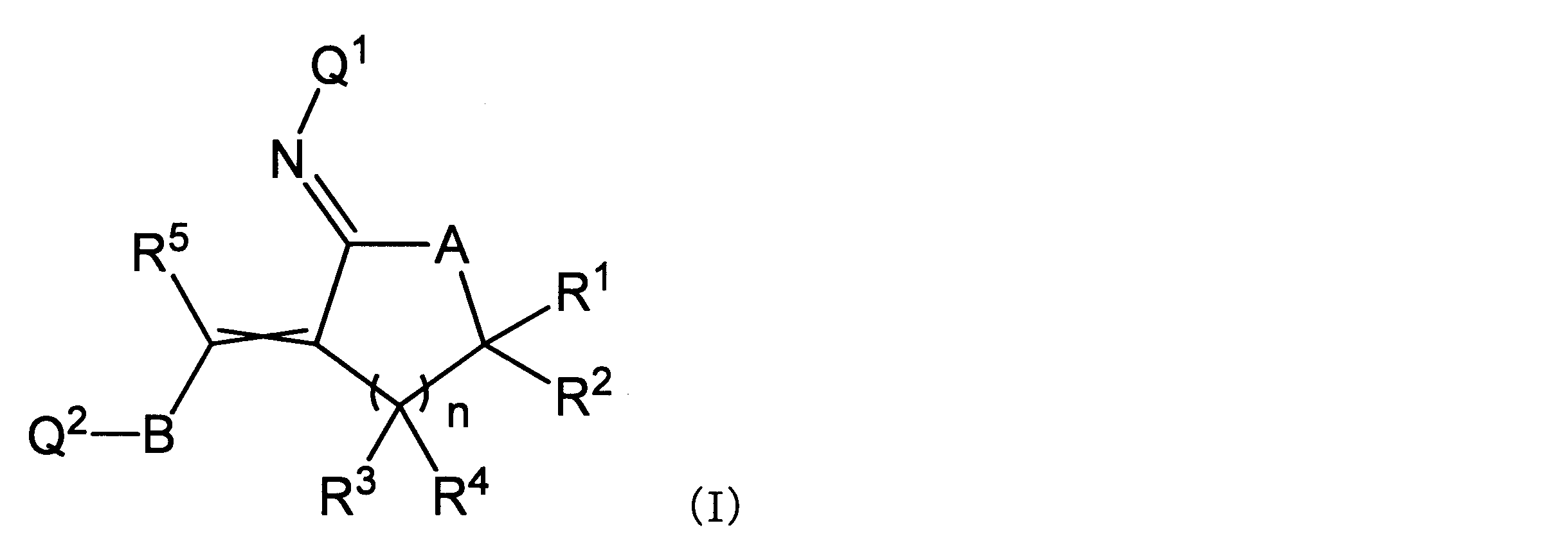
Q1は、無置換のもしくは置換基X1を有するC6~10アリール基、または無置換のもしくは置換基X1を有する5~6員へテロアリール基を示す。
X1は、無置換のもしくは置換基を有するC1~6アルキル基、無置換のもしくは置換基を有するC2~6アルケニル基、無置換のもしくは置換基を有するC2~6アルキニル基、無置換のもしくは置換基を有するC3~8シクロアルキル基、水酸基、無置換のもしくは置換基を有するC1~6アルコキシ基、無置換のもしくは置換基を有するC1~7アシル基、無置換のもしくは置換基を有するC1~6アルコキシカルボニル基、無置換のもしくは置換基を有するアミノ基、無置換のもしくは置換基を有するC1~6アルキルチオ基、無置換のもしくは置換基を有するC1~6アルキルスルホニル基、無置換のもしくは置換基を有するC6~10アリール基、無置換のもしくは置換基を有する3~6員ヘテロ環基、ハロゲノ基、シアノ基、またはニトロ基を示す。
Q1上の置換基X1の個数は、1~5のいずれかの整数である。置換基X1が2以上あるときX1は互いに同一でも相違してもよい。
Aは、酸素原子または硫黄原子を示す。
R1およびR2は、それぞれ独立に、水素原子、無置換のもしくは置換基を有するC1~6アルキル基、無置換のもしくは置換基を有するC2~6アルケニル基、無置換のもしくは置換基を有するC2~6アルキニル基、無置換のもしくは置換基を有するC3~8シクロアルキル基、無置換のもしくは置換基を有するC6~10アリール基、無置換のもしくは置換基を有する3~6員ヘテロ環基、またはシアノ基を示す。
ここで、R1とR2は一緒になって、無置換のもしくは置換基を有するエキソメチレン基を形成してもよい。
R3およびR4は、それぞれ独立に、水素原子、無置換のもしくは置換基を有するC1~6アルキル基、無置換のもしくは置換基を有するC2~6アルケニル基、無置換のもしくは置換基を有するC2~6アルキニル基、無置換のもしくは置換基を有するC3~8シクロアルキル基、無置換のもしくは置換基を有するC6~10アリール基、無置換のもしくは置換基を有する3~6員ヘテロ環基、ハロゲノ基、またはシアノ基を示す。
nは、R3およびR4で置換されたメチレンの個数を示し、かつ1~4のいずれかの整数である。nが2以上のときR3およびR4は互いに同一でも相違してもよい。
また、R3とR4は相互に繋がってR3およびR4が結合する炭素原子とともに環を形成してもよい。
R5は、水素原子または無置換のもしくは置換基を有するC1~6アルキル基を示す。
Bは、酸素原子または硫黄原子を示す。
Q2は、無置換のもしくは置換基X2を有するC7~11アラルキル基、無置換のもしくは置換基X2を有するC6~10アリール基、または無置換のもしくは置換基X2を有する5~6員へテロアリール基を示す。
X2は、無置換のもしくは置換基を有するC1~6アルキル基、無置換のもしくは置換基を有するC2~6アルケニル基、無置換のもしくは置換基を有するC2~6アルキニル基、無置換のもしくは置換基を有するC3~8シクロアルキル基、水酸基、無置換のもしくは置換基を有するC1~6アルコキシ基、無置換のもしくは置換基を有するC1~7アシル基、無置換のもしくは置換基を有するC1~6アルコキシカルボニル基、無置換のもしくは置換基を有するアミノ基、無置換のもしくは置換基を有するC1~6アルキルチオ基、無置換のもしくは置換基を有するC1~6アルキルスルホニル基、無置換のもしくは置換基を有するC6~10アリール基、無置換のもしくは置換基を有する3~6員ヘテロ環基、ハロゲノ基、シアノ基、またはニトロ基を示す。
Q2上の置換基X2の個数は、1~5のいずれかの整数である。置換基X2が2以上あるときX2は互いに同一でも相違してもよい。
式(I)中のR5とBが結合する二重結合の立体異性によって、(E)、(Z)、または(E/Z)を示す。] - 式(I)で表される化合物が、式(II)で表される化合物である、請求項1に記載の外部寄生虫防除剤。
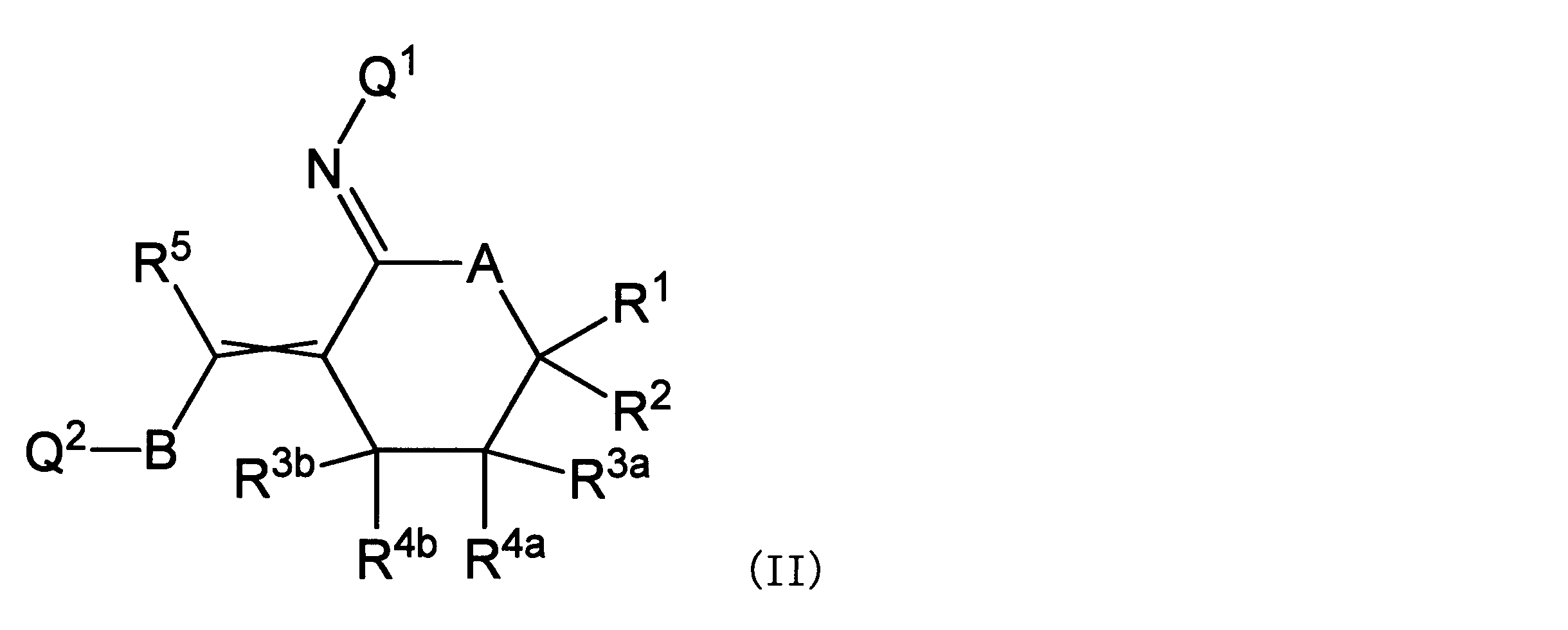
R3a、R3b、R4a、およびR4bは、それぞれ独立に、水素原子、無置換のもしくは置換基を有するC1~6アルキル基、無置換のもしくは置換基を有するC2~6アルケニル基、無置換のもしくは置換基を有するC2~6アルキニル基、無置換のもしくは置換基を有するC3~8シクロアルキル基、無置換のもしくは置換基を有するC6~10アリール基、無置換のもしくは置換基を有する3~6員ヘテロ環基、ハロゲノ基、またはシアノ基を示す。
また、R3aとR4aは、相互に繋がってR3aおよびR4aが結合する炭素原子とともに環を形成してもよい。] - 式(I)で表される化合物が、式(III)で表される化合物である、請求項1に記載の外部寄生虫防除剤。
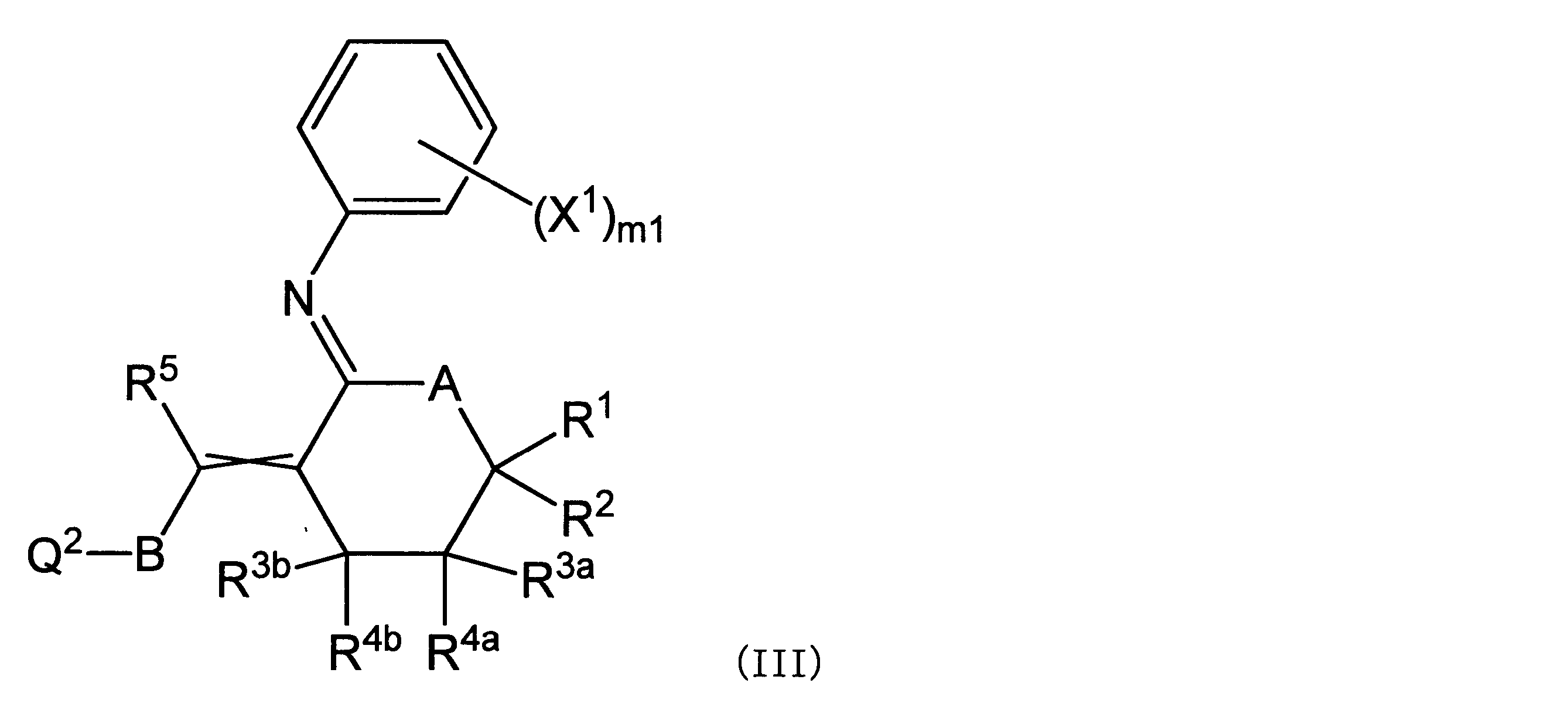
m1は、0~5のいずれかの整数を示す。
R3a、R3b、R4a、およびR4bは、それぞれ独立に、水素原子、無置換のもしくは置換基を有するC1~6アルキル基、無置換のもしくは置換基を有するC2~6アルケニル基、無置換のもしくは置換基を有するC2~6アルキニル基、無置換のもしくは置換基を有するC3~8シクロアルキル基、無置換のもしくは置換基を有するC6~10アリール基、無置換のもしくは置換基を有する3~6員ヘテロ環基、ハロゲノ基、またはシアノ基を示す。
また、R3aとR4aは、相互に繋がってR3aおよびR4aが結合する炭素原子とともに環を形成してもよい。] - 請求項1~3のいずれかひとつに記載の1-ヘテロジエン化合物およびそれらの塩から選ばれる少なくとも1つの化合物並びに少なくとも1つの許容される担体を含む製剤。
- 製剤がさらに、少なくとも1つの追加の有効成分を含む、請求項4に記載の製剤。
- 製剤がヒトの医薬製剤である、請求項4に記載の製剤。
- 製剤が獣医薬製剤である、請求項4に記載の製剤。
- 寄生生物の寄生の抑制を必要としている動物の体内または体表における、寄生の抑制方法であって、前記動物に請求項1~3のいずれかひとつに記載の1-ヘテロジエン化合物およびそれらの塩から選ばれる少なくとも1つの化合物の有効量を投与することを含む方法。
- 少なくとも1つの他の有効成分を前記動物に投与する、請求項8に記載の方法。
- 前記動物がヒトである、請求項8に記載の方法。
- 前記動物が愛玩動物である、請求項8に記載の方法。
- 前記愛玩動物がイヌまたはネコである、請求項11に記載の方法。
- 前記動物が畜産動物である、請求項8に記載の方法。
- 前記寄生生物がマダニである、請求項8に記載の方法。
- 寄生生物を通して伝染する疾患の予防および治療方法であって、請求項1~3のいずれかひとつに記載の1-ヘテロジエン化合物およびそれらの塩から選ばれる少なくとも1つの化合物の有効量を、それを必要としている動物に投与することを含む方法。
- 少なくとも1つの他の有効成分を前記動物に投与する、請求項15に記載の方法。
- 前記動物がヒトである、請求項15に記載の方法。
- 前記動物が愛玩動物である、請求項15に記載の方法。
- 前記愛玩動物がイヌまたはネコである、請求項18に記載の方法。
- 前記動物が畜産動物である、請求項15に記載の方法。
- 前記寄生生物がマダニである、請求項15に記載の方法。
- 請求項1~3のいずれかひとつに記載の1-ヘテロジエン化合物およびそれらの塩から選ばれる少なくとも1つの化合物を有害生物および/またはその生息環境に作用させることを特徴とする、有害生物を抑制する方法。
- 前記生息環境が動物である、請求項22に記載の方法。
- 有害生物を抑制するための請求項1~3のいずれかひとつに記載の1-ヘテロジエン化合物およびそれらの塩から選ばれる少なくとも1つの化合物の使用。
- 治療するための請求項1~3のいずれかひとつに記載の1-ヘテロジエン化合物およびそれらの塩から選ばれる少なくとも1つの化合物の使用。
- 外部寄生生物の寄生を抑制するための請求項1~3のいずれかひとつに記載の1-ヘテロジエン化合物およびそれらの塩から選ばれる少なくとも1つの化合物の使用。
Priority Applications (7)
| Application Number | Priority Date | Filing Date | Title |
|---|---|---|---|
| CN201480011589.3A CN105025716A (zh) | 2013-03-08 | 2014-02-28 | 外部寄生虫防除剂 |
| EP14759592.0A EP2965627A4 (en) | 2013-03-08 | 2014-02-28 | EKTOPARASITENBEKÄMPFUNGSMITTEL |
| US14/771,866 US9474740B2 (en) | 2013-03-08 | 2014-02-28 | Ectoparasite control agent |
| JP2015504274A JPWO2014136672A1 (ja) | 2013-03-08 | 2014-02-28 | ヒトの医薬製剤および獣医薬製剤 |
| AU2014227122A AU2014227122B2 (en) | 2013-03-08 | 2014-02-28 | Ectoparasite control agent |
| NZ711753A NZ711753A (en) | 2013-03-08 | 2014-02-28 | Ectoparasite control agent |
| AU2017203019A AU2017203019B2 (en) | 2013-03-08 | 2017-05-05 | Ectoparasite control agent |
Applications Claiming Priority (2)
| Application Number | Priority Date | Filing Date | Title |
|---|---|---|---|
| JP2013046259 | 2013-03-08 | ||
| JP2013-046259 | 2013-03-08 |
Publications (1)
| Publication Number | Publication Date |
|---|---|
| WO2014136672A1 true WO2014136672A1 (ja) | 2014-09-12 |
Family
ID=51491191
Family Applications (1)
| Application Number | Title | Priority Date | Filing Date |
|---|---|---|---|
| PCT/JP2014/055057 Ceased WO2014136672A1 (ja) | 2013-03-08 | 2014-02-28 | 外部寄生虫防除剤 |
Country Status (7)
| Country | Link |
|---|---|
| US (1) | US9474740B2 (ja) |
| EP (1) | EP2965627A4 (ja) |
| JP (2) | JPWO2014136672A1 (ja) |
| CN (2) | CN107929285A (ja) |
| AU (2) | AU2014227122B2 (ja) |
| NZ (1) | NZ711753A (ja) |
| WO (1) | WO2014136672A1 (ja) |
Cited By (2)
| Publication number | Priority date | Publication date | Assignee | Title |
|---|---|---|---|---|
| WO2015087801A1 (ja) * | 2013-12-09 | 2015-06-18 | 日本曹達株式会社 | 水棲有害付着生物防除組成物および防汚塗料組成物 |
| WO2019142880A1 (ja) * | 2018-01-19 | 2019-07-25 | 日本曹達株式会社 | 1-ヘテロジエン化合物及び有害生物防除剤 |
Citations (4)
| Publication number | Priority date | Publication date | Assignee | Title |
|---|---|---|---|---|
| WO2010070910A1 (ja) | 2008-12-19 | 2010-06-24 | 日本曹達株式会社 | 1-ヘテロジエン誘導体および有害生物防除剤 |
| WO2011058963A1 (ja) | 2009-11-12 | 2011-05-19 | 日本曹達株式会社 | 1-ヘテロジエン誘導体および有害生物防除剤 |
| JP2012092091A (ja) * | 2010-10-01 | 2012-05-17 | Nippon Soda Co Ltd | アセタール化合物誘導体および有害生物防除剤 |
| WO2012072489A1 (de) * | 2010-11-29 | 2012-06-07 | Bayer Cropscience Ag | Alpha-beta-ungesättigte imine |
-
2014
- 2014-02-28 US US14/771,866 patent/US9474740B2/en not_active Expired - Fee Related
- 2014-02-28 CN CN201711033624.3A patent/CN107929285A/zh active Pending
- 2014-02-28 EP EP14759592.0A patent/EP2965627A4/en not_active Withdrawn
- 2014-02-28 JP JP2015504274A patent/JPWO2014136672A1/ja active Pending
- 2014-02-28 NZ NZ711753A patent/NZ711753A/en not_active IP Right Cessation
- 2014-02-28 WO PCT/JP2014/055057 patent/WO2014136672A1/ja not_active Ceased
- 2014-02-28 AU AU2014227122A patent/AU2014227122B2/en not_active Ceased
- 2014-02-28 CN CN201480011589.3A patent/CN105025716A/zh active Pending
-
2017
- 2017-04-11 JP JP2017078290A patent/JP2017132800A/ja active Pending
- 2017-05-05 AU AU2017203019A patent/AU2017203019B2/en not_active Ceased
Patent Citations (4)
| Publication number | Priority date | Publication date | Assignee | Title |
|---|---|---|---|---|
| WO2010070910A1 (ja) | 2008-12-19 | 2010-06-24 | 日本曹達株式会社 | 1-ヘテロジエン誘導体および有害生物防除剤 |
| WO2011058963A1 (ja) | 2009-11-12 | 2011-05-19 | 日本曹達株式会社 | 1-ヘテロジエン誘導体および有害生物防除剤 |
| JP2012092091A (ja) * | 2010-10-01 | 2012-05-17 | Nippon Soda Co Ltd | アセタール化合物誘導体および有害生物防除剤 |
| WO2012072489A1 (de) * | 2010-11-29 | 2012-06-07 | Bayer Cropscience Ag | Alpha-beta-ungesättigte imine |
Non-Patent Citations (3)
| Title |
|---|
| J. MED. ENTOMOL., vol. 41, 2004, pages 1034 - 1042 |
| J. MED. ENTOMOL., vol. 43, no. 3, 2006, pages 526 - 532 |
| See also references of EP2965627A4 * |
Cited By (2)
| Publication number | Priority date | Publication date | Assignee | Title |
|---|---|---|---|---|
| WO2015087801A1 (ja) * | 2013-12-09 | 2015-06-18 | 日本曹達株式会社 | 水棲有害付着生物防除組成物および防汚塗料組成物 |
| WO2019142880A1 (ja) * | 2018-01-19 | 2019-07-25 | 日本曹達株式会社 | 1-ヘテロジエン化合物及び有害生物防除剤 |
Also Published As
| Publication number | Publication date |
|---|---|
| AU2014227122B2 (en) | 2017-03-09 |
| EP2965627A4 (en) | 2016-09-28 |
| JPWO2014136672A1 (ja) | 2017-02-09 |
| AU2017203019A1 (en) | 2017-05-25 |
| US9474740B2 (en) | 2016-10-25 |
| CN105025716A (zh) | 2015-11-04 |
| AU2014227122A1 (en) | 2015-09-24 |
| EP2965627A1 (en) | 2016-01-13 |
| CN107929285A (zh) | 2018-04-20 |
| US20160008321A1 (en) | 2016-01-14 |
| AU2017203019B2 (en) | 2018-04-05 |
| NZ711753A (en) | 2017-01-27 |
| JP2017132800A (ja) | 2017-08-03 |
Similar Documents
| Publication | Publication Date | Title |
|---|---|---|
| CN111132549B (zh) | 动物用体外寄生虫长效防除剂 | |
| JP5980119B2 (ja) | イソオキサゾリン誘導体に基づく殺虫化合物 | |
| JP5632290B2 (ja) | 動物寄生虫を防除するための有用な薬剤としてのアミノベンズアミド誘導体 | |
| JP2014015397A (ja) | 動物用外部寄生虫防除剤 | |
| CN110248941B (zh) | 芳基或杂芳基取代的咪唑并吡啶衍生物及其作为农药的用途 | |
| EP4613096A2 (en) | Antiparasitic compounds | |
| WO2012086462A1 (ja) | イソオキサゾリン化合物および有害生物防除剤 | |
| JP2014028758A (ja) | 寄生虫及び衛生害虫防除剤 | |
| JP6088631B2 (ja) | アリールオキシ酢酸アミド化合物および有害生物防除剤 | |
| WO2013047144A1 (ja) | 環状アミン化合物および有害生物防除剤 | |
| KR20140145145A (ko) | 아릴옥시우레아 화합물 및 유해 생물 방제제 | |
| JP2017132800A (ja) | 外部寄生虫防除剤 | |
| US20240196898A1 (en) | Insanitary insect pest control method using condensed heterocyclic compound | |
| JP2019006686A (ja) | 有害生物防除組成物およびその用途 | |
| WO2026004779A1 (ja) | トリアゾリルピリジン化合物、動物の寄生虫防除剤、動物の寄生虫の防除方法、並びに寄生虫病の予防および治療方法 | |
| JP2014024770A (ja) | 動物用外部寄生虫防除剤 | |
| JP2015151363A (ja) | 動物外部寄生虫防除組成物 | |
| JP2009137910A (ja) | 動物の外部寄生虫防除剤および動物の寄生生物による感染症の治療方法 | |
| JP2013216626A (ja) | アリールオキシ酢酸アミド化合物を含有する殺ダニ剤または殺虫剤 | |
| HK1151282A (en) | Aminobenzamide derivatives as useful agents for controlling animal parasites | |
| HK1191808B (en) | Ectoparasiticidal active substance combinations | |
| WO2013164954A1 (ja) | ピペリジン化合物及びその有害生物防除用途 | |
| HK1227029A1 (en) | Substituted benzamides for the treatment of arthropods |
Legal Events
| Date | Code | Title | Description |
|---|---|---|---|
| WWE | Wipo information: entry into national phase |
Ref document number: 201480011589.3 Country of ref document: CN |
|
| 121 | Ep: the epo has been informed by wipo that ep was designated in this application |
Ref document number: 14759592 Country of ref document: EP Kind code of ref document: A1 |
|
| ENP | Entry into the national phase |
Ref document number: 2015504274 Country of ref document: JP Kind code of ref document: A |
|
| WWE | Wipo information: entry into national phase |
Ref document number: 14771866 Country of ref document: US |
|
| WWE | Wipo information: entry into national phase |
Ref document number: 2014759592 Country of ref document: EP |
|
| NENP | Non-entry into the national phase |
Ref country code: DE |
|
| ENP | Entry into the national phase |
Ref document number: 2014227122 Country of ref document: AU Date of ref document: 20140228 Kind code of ref document: A |