WO2014136797A1 - 淡色茶飲料 - Google Patents
淡色茶飲料 Download PDFInfo
- Publication number
- WO2014136797A1 WO2014136797A1 PCT/JP2014/055512 JP2014055512W WO2014136797A1 WO 2014136797 A1 WO2014136797 A1 WO 2014136797A1 JP 2014055512 W JP2014055512 W JP 2014055512W WO 2014136797 A1 WO2014136797 A1 WO 2014136797A1
- Authority
- WO
- WIPO (PCT)
- Prior art keywords
- green tea
- ppm
- beverage
- concentration
- valine
- Prior art date
- Legal status (The legal status is an assumption and is not a legal conclusion. Google has not performed a legal analysis and makes no representation as to the accuracy of the status listed.)
- Ceased
Links
- 0 CC(C1O)[C@@](CC2=CC[C@](C*)(CO)CO2)OC(CO[C@](C(C2=O)O)O[C@](CO[C@](C(C3O)O)OC(C*)[C@@]3O)[C@@]2O)[C@]1O Chemical compound CC(C1O)[C@@](CC2=CC[C@](C*)(CO)CO2)OC(CO[C@](C(C2=O)O)O[C@](CO[C@](C(C3O)O)OC(C*)[C@@]3O)[C@@]2O)[C@]1O 0.000 description 1
Classifications
-
- A—HUMAN NECESSITIES
- A23—FOODS OR FOODSTUFFS; TREATMENT THEREOF, NOT COVERED BY OTHER CLASSES
- A23F—COFFEE; TEA; THEIR SUBSTITUTES; MANUFACTURE, PREPARATION, OR INFUSION THEREOF
- A23F3/00—Tea; Tea substitutes; Preparations thereof
- A23F3/16—Tea extraction; Tea extracts; Treating tea extract; Making instant tea
- A23F3/163—Liquid or semi-liquid tea extract preparations, e.g. gels or liquid extracts in solid capsules
-
- A—HUMAN NECESSITIES
- A23—FOODS OR FOODSTUFFS; TREATMENT THEREOF, NOT COVERED BY OTHER CLASSES
- A23V—INDEXING SCHEME RELATING TO FOODS, FOODSTUFFS OR NON-ALCOHOLIC BEVERAGES AND LACTIC OR PROPIONIC ACID BACTERIA USED IN FOODSTUFFS OR FOOD PREPARATION
- A23V2002/00—Food compositions, function of food ingredients or processes for food or foodstuffs
Definitions
- the present invention relates to a green tea beverage having a green tea extract extracted from green tea leaves as a main component and filled with a container such as a PET bottle or a can.
- vitamin C or a salt thereof blended in a packaged tea beverage is said to have some effect on color stabilization under light irradiation or the like.
- a green tea beverage having a stable color tone characterized by containing 1,5-D-anhydrofructose has also been proposed (Patent Document 1).
- An object of the present invention is to provide a beverage having a stable color tone and flavor even when heated and stored for a long time.
- a green tea beverage in which the brightness and saturation of a color difference meter are adjusted to a specific range has a visual supernatant coolness and has a color tone for storage. It was found to have stability.
- valine known as an amino acid having ascorbic acids and a bitter taste
- Containerized green tea beverage that satisfies the following conditions: (I) containing ascorbic acids (A) at a concentration of 100 to 800 ppm; (Ii) valine (B1) at a concentration of 1 to 200 ppm; (Iii) Lightness (L * ) by a color difference meter is 75 ⁇ L * ⁇ 95; (Iv) According to a color difference meter and saturation (C * ) is 15 ⁇ C * ⁇ 25.
- the beverage according to (1) or (2) containing phosphoric acid (D) at a concentration of 2.0 to 18 mg / 100 mL.
- the beverage according to (3) further comprising 3 to 100 ppb of linalool (F1).
- the beverage according to (1) or (2) comprising linalool (F1) at a concentration of 2.8 to 10 ppb and phenylacetaldehyde (F2) at a concentration of 0.2 to 1.0 ppb.
- the beverage according to (1) or (2) further comprising raffinose (G1) and stachyose (G2) having a total amount of 10 ppm to 100 ppm.
- the present invention includes the following embodiments.
- the container-packed green tea beverage according to (1) which is obtained by blending a green plant pulverized product with a green tea extract.
- the present invention includes the following embodiments.
- the container-packed green tea beverage according to (1) which is obtained by blending a green plant pulverized product with a green tea extract.
- the present invention includes the following aspects.
- the present invention includes the following aspects.
- (1) Contains phenylacetaldehyde at a concentration of 0.2 to 1.0 ppb and linalool at a concentration of 2.8 to 10 ppb, and the lightness (L * ) and chroma (C * ) due to the color difference form satisfy the following: , Green tea beverage in a container: (I) 75 ⁇ L * ⁇ 95; (Ii) 15 ⁇ C * ⁇ 25.
- the present invention includes the following aspects.
- Containerized green tea beverage containing raffinose and stachyose, the total amount of which is 10 ppm or more, and the lightness (L * ) and saturation (C * ) due to the color difference form satisfy the following: (I) 75 ⁇ L * ⁇ 95; (Ii) 15 ⁇ C * ⁇ 25.
- a green tea beverage having a refreshing feeling both visually and flavor and having good storage stability of flavor and color tone.
- the container-packed green tea beverage of the present invention is formulated with ascorbic acids (also referred to as (A) in the present specification) for the purpose of stabilizing the color tone during long-term storage.
- Ascorbic acid as used in the field of this invention means 1 type (s) or 2 or more types in ascorbic acid, its isomer, those derivatives, and those salts. Any ascorbic acid of the present invention can be used as long as it can be blended into a beverage.
- ascorbic acid isomers of ascorbic acid such as erythorbic acid; ascorbic acid 2,6-dipalmitate, ascorbic acid 6-stearate, ascorbic acid-2 sodium phosphate, ascorbic acid-2 disulphate disodium, ascorbine Isomers of ascorbic acid such as 2-glucoside acid, glucosamine ascorbate, L-dehydroascorbic acid, 6-palmitate ascorbate, L-ascorbyl tetraisopalmitate, ascorbyl tetrahexyldecanoate, and L-ascorbyl magnesium phosphate Derivatives; and salts with alkali metals such as sodium and potassium; salts with alkaline earth metals such as calcium, magnesium and barium; basic amino acid salts such as arginine and lysine; ammonium salts and tricyclohexyl ammonium Ammonium salts such as salts, monoisopropanolamine salts,
- the amount of ascorbic acids required for storage stabilization is about 100 to 800 ppm, preferably 150 to 700 ppm, more preferably about 200 to 600 ppm in the packaged beverage.
- the green tea beverage of the present invention contains valine (also referred to as (B1) in the present specification) as a free amino acid in addition to the ascorbic acids.
- valine used in the present invention commercially available products, synthetic products, and other edible materials can be used regardless of the production method. Any of D-form, L-form and DL-form can be used, but L-form is most preferred. Specifically, L-valine produced by a fermentation method or a synthesis method can be exemplified.
- a plant or plant extract containing L-valine can be used as it is or after purification (including crude purification).
- An example of a plant containing L-valine is a pulverized product of green tea leaves.
- the extract of a green tea leaf can be illustrated suitably.
- tea beverages with a natural taste only of tea-derived ingredients can be easily produced without using additives (excluding antioxidants). There is also an advantage that it can be done.
- the extract of green tea leaves contains many amino acids such as theanine, glutamic acid, aspartic acid and methionine, but the content of valine is small. Therefore, when using an extract of green tea leaves, it is preferable to perform a treatment to increase the concentration of valine by subjecting the green tea leaves to physical or chemical treatment. Specifically, a green tea leaf as a raw material is impregnated in an aqueous solution containing valine, and this impregnated green tea leaf is fired and dried (see JP 2012-183064 A).
- the valine of the present invention is blended as an extract of green tea leaves obtained by impregnating an aqueous solution containing valine with green tea leaves as a raw material, and heating and drying the impregnated green tea leaves at a temperature of 100 to 200 ° C.
- the green tea beverage of the present invention is provided with incense (a savory scent) and further has a flavor stability.
- the green tea beverage of the present invention contains valine at a concentration of 1.0 to 200 ppm, preferably 3.0 to 100 ppm, more preferably 5.0 to 50 ppm based on the whole beverage.
- valine at a concentration of 1.0 to 200 ppm, preferably 3.0 to 100 ppm, more preferably 5.0 to 50 ppm based on the whole beverage.
- valine suppresses the generation of an unpleasant heated odor associated with the heat sterilization treatment, or effectively masks the heated odor.
- the green tea beverage of the present invention is characterized by its color tone. According to the study by the present inventors, the change in the color tone of the green tea beverage is closely related to the saturation (C * ), and 15 ⁇ C * ⁇ 25 (preferably 15 ⁇ C * ⁇ 23, more preferably 15 ⁇ C. It was found that a green tea beverage satisfying * ⁇ 21) has liquid color tone stability.
- the saturation (C * ) in the present invention means the degree of saturation of the color, that is, a sense of vividness of the color, and ranges from 0 to 100 (a dull color when the value is small, vivid when the value is large) Color).
- the saturation (C * ) can be calculated from the following equation using L * value, a * value, and b * value measured by a color difference meter.
- C * (a * 2 + b * 2 ) 1/2
- the green tea beverage whose lightness (L * ) satisfies 75 ⁇ L * ⁇ 95 (preferably 75 ⁇ L * ⁇ 90) is a green tea beverage that has a refreshing sensation.
- Green tea beverages with an L * of less than 75 are associated with a firm and heavy taste due to their color, and it is difficult to recall a refreshing feeling.
- the lightness (L * ) means a sensation of color brightness, and is a value expressed in the range of 0 to 100 (0: black, 100: white).
- the green tea beverage of the present invention containing a specific amount of ascorbic acid and valine and adjusted to the above lightness (L * ) and saturation (C * ) has a natural color tone as a packaged green tea beverage. And the natural color tone which has the refreshing feeling is maintained also when warming preservation
- a green tea beverage satisfying the color tone of the present invention (75 ⁇ L * ⁇ 95, 15 ⁇ C * ⁇ 25) can be easily used by those skilled in the art by appropriately selecting the type of tea leaf, the processing method of the tea leaf, and the like. Can be manufactured. For example, a method of blending a green plant pulverized product into a green tea extract extracted from green tea leaves so that the L * value and the C * value become desired values can be mentioned.
- the pulverized green plant it is preferable to use a pulverized plant having a dark green color. Specifically, it is preferable to use a pulverized green tea leaf.
- the pulverized product of green tea leaves is not particularly limited as long as it has a tea leaf structure such as matcha and powdered tea, but it is average from the viewpoint of operability and dispersibility during beverage production. It is preferable to use particles having a particle size of about 1 to 100 ⁇ m, preferably about 5 to 50 ⁇ m.
- the green tea leaves used as the raw material for the pulverized product are green tea leaves that are produced from the leaves and stems of the Camellia genus by a non-fermented tea making process, and are not particularly limited as long as they are generally classified as non-fermented tea.
- the green tea extract that is the source of valine (B1) contains methionine (also referred to as (B2) in the present specification), although in a trace amount. According to the study by the present inventors, it has been found that the presence of methionine inhibits the effect of valine in the present invention. Therefore, it is preferable to select tea leaves of the tea extract or adjust the extraction conditions so that the methionine content in the tea beverage of the present invention is reduced. Specifically, the methionine content relative to the whole tea beverage should be adjusted to a methionine concentration of less than 6 ppm, preferably less than 5 ppm and less than 4 ppm.
- the lower limit of methionine is not 0, but 0.5 ppm or more, preferably 0.6 ppm or more, more preferably 0. About 7 ppm or more. If the amount of methionine is within the above range, the stability of the color tone and flavor is remarkably improved. However, if the amount of methionine exceeds 6 ppm, the peculiar taste of methionine, which is a sulfur-containing amino acid, becomes strong and the refreshing feeling is impaired become.
- the container-packed green tea drink which satisfy
- the inventors of the present invention can selectively enhance the aroma of light-colored tea having a light hue by further blending phosphoric acid having a threshold value or less (also referred to as (D) in the present specification), and preserve the flavor storage stability.
- phosphoric acid having a threshold value or less also referred to as (D) in the present specification
- the fresh green leaf odor means at least one fragrance component of linalool, linalool oxide, geraniol, and phenylacetaldehyde.
- linalool it is preferable to include at least one component of linalool, linalool oxide, geraniol and phenylacetaldehyde, and more preferable to include all of these components.
- an embodiment containing 3 to 100 ppb of linalool is one of the preferred embodiments of the present invention.
- the pH of the tea beverage of the present invention at 20 ° C. is adjusted to 5.0 to 7.0, preferably pH 5.5 to 7.0, more preferably pH 5.5 to 6.5. It is important to adjust.
- the pH within the above range the fresh green leaf fragrance, which is the effect of the present invention, is selectively enhanced.
- the total amount of phosphoric acid in the green tea beverage of the present invention is 2.0 to 18 mg / 100 mL, preferably 2.5 to 5 mg / 100 mL. If the total amount of phosphoric acid is 18 mg / 100 mL or more, the sourness of phosphoric acid may inhibit the enhancing action of green leaves. In addition, if it is less than 2.0 mg / 100 mL, the enhancement action expected by the present invention cannot be obtained.
- the phosphoric acid As the phosphoric acid, commercially available products, synthetic products, and other edible materials can be used regardless of the production method. Moreover, the plant body and plant extract containing phosphoric acid can be used as they are or after purification (including crude purification). Phosphoric acid is said to be more common in gyokuro than sencha (see Tea Research Bulletin No. 93, 26p26-33 (2002) Non-Patent Document 1). The phosphoric acid in the beverage of the present invention includes those derived from these tea extracts.
- the container-packed green tea drink which satisfy
- the present inventors lost or changed the high-quality aroma flavor of green tea beverages, particularly light green tea beverages, by heat treatment such as retort sterilization, whereas trace amounts of linalool (F1) and phenyl
- F1 2.8 to 10 ppb
- F2 0.2 to 1.0 ppb
- the scent that spreads over the mouth scented
- the scent that remains over the throat including scent
- the taste brightness
- the preference the balance between taste and scent
- a green tea beverage in which these are in this range has a rich sweetness and is a green tea beverage that can perceive the richness of sweetness and umami.
- (F1) / (F2) is too small, freshness is lacking.
- (F1) / (F2) is too large, only the fragrance is emphasized, and a sense of discomfort may occur as a tea beverage.
- linalool (F1) and phenylacetaldehyde (F2) in the tea beverage in the form of a green tea extract.
- F1 and F2 phenylacetaldehyde
- F1 and F2 phenylacetaldehyde
- the amount of aroma components in the tea beverage can be quantified using gas chromatography with a mass spectrometer (GC / MS).
- the aroma and flavor of the low catechin tea beverage can be enhanced additively or synergistically by containing the above-mentioned phosphoric acid.
- a preferable phosphoric acid content in the tea beverage is 2.0 to 15 mg / 100 mL, more preferably 2.5 to 5 mg / 100 mL.
- the container-packed green tea drink which satisfy
- (Ii) contains valine (B1) at a concentration of 1 to 200 ppm;
- (Iii) contains 2.0-15 mg / 100 mL of phosphoric acid (D);
- (Iv) contains linalool (F1) at a concentration of 2.8-10 ppb and phenylacetaldehyde (F2) at a concentration of 0.2-1.0 ppb;
- (V) Lightness (L * ) by a color difference meter is 75 ⁇ L * ⁇ 95;
- (Vi) According to a color difference meter and the saturation (C * ) is 15 ⁇ C * ⁇ 25.
- Raffinose (also denoted as (G1) in the present specification), which is a trisaccharide represented by the following formula (2)
- Stachyose also referred to as (G2) in the present specification
- the total weight of these raffinose and stachyose ((G1) + (G2)) is 10 ppm or more, preferably 15 ppm
- the tea beverage maintains the flavor and color tone of the light-colored tea beverage and further improves the drinkability.
- “drinkability” in this specification means the capacity of a beverage that is drunk at the time of a single drink, and a beverage with enhanced drinkability is a large amount at a stretch to heal thirst.
- the large amount refers to a dose of 350 mL to 2000 mL, preferably 500 mL to 1000 mL per adult male.
- the container-packed green tea drink which satisfy
- the container-packed green tea beverage of the present invention includes, for example, the following steps: (I) A process of obtaining a green tea extract by subjecting the green tea leaves to an extraction process; (Ii) a step of blending ascorbic acids (A) and valine (B1) into the green tea extract, (Iii) a step of obtaining a blended solution with adjusted brightness and saturation; (Iv) a step of heat sterilizing the preparation solution, and (v) a step of filling the container, It can obtain by the manufacturing method containing.
- Green tea leaves used in the green tea extract which is the main component of green tea beverages, include green tea leaves made from tea leaves obtained from the genus Camellia, such as C. sinensis, C. assamica, Yabutaki species and their hybrids , Gyokuro, tencha, roasted tea, etc.) can be appropriately selected and used alone or in combination.
- water, hot water, or an aqueous solution to which an extraction aid is added is used.
- the temperature is low (60 ° C. or less, preferably about 10 to 60 ° C., more preferably 15 ° C.). About 55 ° C.).
- the container used for the beverage of the present invention can be provided in a normal form such as a plastic bottle (PET bottle), a metal can, a paper container combined with a metal foil or a plastic film, a bottle like a general beverage.
- PET bottle plastic bottle
- metal can metal can
- paper container combined with a metal foil or a plastic film
- a transparent container that can significantly perceive the effects of the present invention.
- the heat sterilization treatment is performed under the sterilization conditions stipulated in the Food Sanitation Law if the container can be heat sterilized after being filled into a container such as a metal can.
- a container such as a metal can.
- PET bottles and paper containers that cannot be sterilized by retort sterilize under the same conditions as above, for example, after sterilizing at high temperature and short time with a plate heat exchanger, etc. The method is adopted.
- Example 1 A commercially available green tea beverage in a PET bottle (commercial beverage B in the test example) was diluted about 2.7 times with water, and further crushed green tea leaves (green tea with an average particle size of 10 ⁇ m) were added at a rate of 4 mg / 100 ml. And a green tea beverage (No. 1). To this was added L-valine (Ajinomoto Healthy Supply Co., Ltd.) and green tea beverages having different valine concentrations (Nos. 2 to 7). After sterilization by heating to produce a packaged green tea beverage, the amino acid (valine, methionine) concentration and ascorbic acid concentration in these beverages were measured. The analysis method is as follows.
- the refreshing beverage has a light liquid color, is free of bitterness, astringency and odor, and is suitable for being able to drink a large amount at once (also called “highly drinkable”).
- a sensory beverage A sensory beverage.
- the evaluation criteria are as follows. [Evaluation criteria] 1: excellent, 2: good, 3: normal, 4: not good, 5: bad, and expressed with the highest evaluation.
- the green tea beverage having lightness (L * ) and saturation (C * ) adjusted to 75 ⁇ L * ⁇ 95 and 15 ⁇ C * ⁇ 25 has excellent storage stability in color tone.
- the green tea beverage containing about 1 to 200 ppm (preferably 5 to 190 ppm) of valine was a beverage that maintained a refreshing feeling immediately after production.
- Example 3 Production of tea leaves with high valine content Tea leaves with high valine content were produced by the method described in Example 2 of JP2012-183064A. First, a tea extract containing a high concentration of amino acids was produced. 10 g of green tea leaves (heating degree: medium) were sealed in an airtight container equipped with a stirrer, and 180 mL of ion exchange water at 40 ° C. was added to immerse the green tea leaves. Thereto was added 0.2 g of protease preparation (Mitsubishi Chemical Foods Co., Ltd. “Coclase P”), and the mixture was stirred for 16 hours while being kept at 40 ° C. to perform enzyme treatment. Thereafter, the obtained enzyme treatment liquid was heated at 90 ° C.
- protease preparation Mitsubishi Chemical Foods Co., Ltd. “Coclase P”
- Table 4 shows the results of analyzing the amino acid composition of this extract under the HPLC conditions of Example 1. The extract was concentrated under reduced pressure so that the total concentration of the 17 amino acids in Table 4 was 1% to prepare a valine-containing green tea concentrate.
- the extraction treatment was performed with about 30 times the amount of water (40 ° C.) with respect to the weight of the mixed tea leaves.
- 6 mg / 100 ml of green tea leaf pulverized product (matcha tea with an average particle size of 10 ⁇ m) and 350 ppm of ascorbic acid were added, and the pH was adjusted to 6.4 using a pH adjuster, followed by heat disinfection.
- Each 500 mL was filled into a PET bottle to produce a container-packed green tea beverage (No. 11-14).
- the obtained green tea beverage was evaluated in the same manner as in Example 1.
- Example 4 A green tea beverage was added to a commercially available green tea beverage in a PET bottle (commercial beverage F in the test example) at a ratio of 5 mg / 100 ml of green tea leaf pulverized product (matcha tea with an average particle size of 10 ⁇ m) (No. 15).
- phosphoric acid was added at various concentrations to obtain green tea beverages (No. 16 to 20).
- the amino acid (valine, methionine) concentration and ascorbic acid concentration in these beverages were quantified in the same manner as in Example 1.
- concentration of an aromatic component (linalool and phenylacetaldehyde) were analyzed with the following method.
- the results are shown in Table 6.
- the total amount of phosphoric acid in the green tea beverage is 2.5-18 mg / 100 mL (preferably 2.5-5.0 mg / 100 mL) of phosphoric acid. It was a drink that had a refreshing scent and a strong scent. With regard to this green tea beverage, all the panelists have a light liquid color, no bitterness, astringency or odor, and suitable for being able to drink a large amount at once, refreshing both visually and in flavor answered. On the other hand, when the phosphoric acid was 20 mg / 100 mL or more, the acidity was strong and no fresh green leaves were felt.
- Example 5 No. manufactured in Example 4 The linalool of 2.2-107.2ppb was dripped at 17 green tea beverages, and the influence on the flavor was examined (No. 21-23). Evaluation was made by 5 expert panelists. Better than 17 beverages, ⁇ : No. About the same as 17 beverages, x: No. It was worse than 17 drinks, and was expressed by the highest evaluation.
- Example 6 No. manufactured in Example 4 Phenylacetaldehyde was added to 15 green tea beverages (control) to prepare green tea beverages (No. 24-26) having different phenylacetaldehyde contents, and the effect on flavor was examined. Evaluation was made by 5 expert panelists. Better than 15 beverages, ⁇ : No. About the same as 15 beverages, x: No. It was worse than 15 drinks, and was expressed by the highest evaluation.
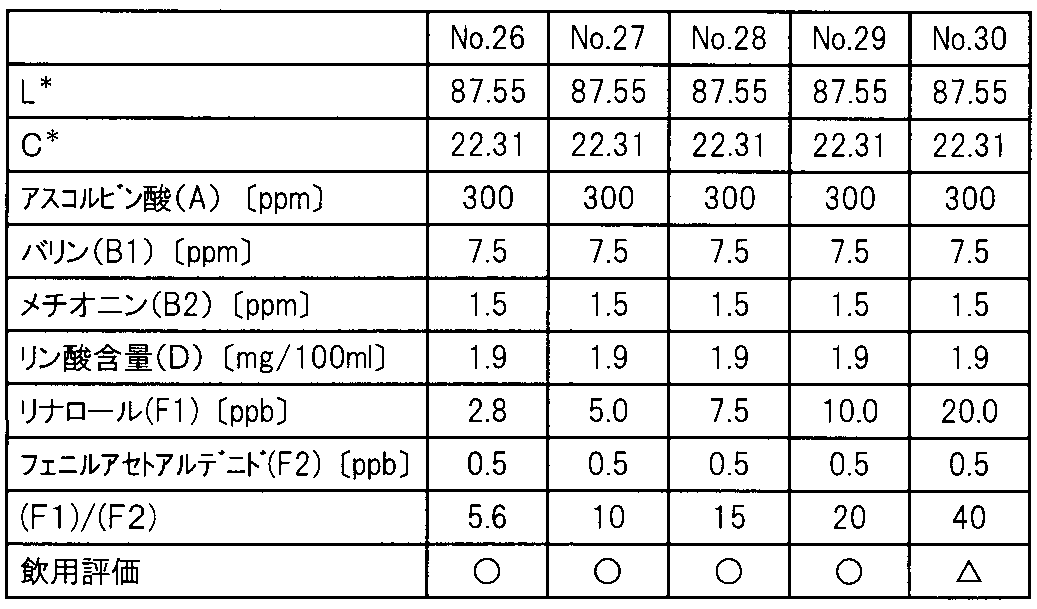
- Example 7 No. 6 in Example 6. Linalool was added to 26 green tea beverages to prepare green tea beverages (No. 27-30) having different linalool contents, and the effect on flavor was examined. As in Example 6, the evaluation is No. Compared to 15 drinks. The results are shown in Table 9. Green tea beverages containing linalool (F1) at a concentration of 2.8-10 ppb and phenylacetaldehyde (F2) at a concentration of 0.2-1.0 ppb are beverages that have an excellent refreshing feeling both visually and drunk. It was.
- F1 linalool
- F2 phenylacetaldehyde
- green tea beverages having a content ratio of linalool (F1) and phenylacetaldehyde (F2) ((F1) / (F2)) in the range of 5 to 20 have a refreshing color tone even when stored at room temperature for a long time. The flavor was maintained.
- Example 8 No. manufactured in Example 4 Peat oligosaccharide (raffinose 98% or more, Nichiei Co., Ltd.) was added to 15 green tea beverages (control; containing 7.0 ppm raffinose and 2.8 ppm stachyose) and sterilized by heating as in Example 1.
- control containing 7.0 ppm raffinose and 2.8 ppm stachyose
- packaged green tea beverages having different oligosaccharide compositions and concentrations were prepared (No. 31 to 33).
- five panelists evaluated the refreshing feeling. The evaluation is: ⁇ : extremely preferable than the control, ⁇ : more preferable than the control, ⁇ : the same level as the control, x: less preferable than the control, and the highest evaluation.
- Table 10 shows the results. Tea beverages with raffinose and stachyose content in the beverage of 10 ppm or more and 100 ppm or less can enhance the incense and richness while maintaining the refreshing feeling of the light-colored tea beverage without having a taste of the beverage itself, Drinkability increased.
Landscapes
- Chemical & Material Sciences (AREA)
- Dispersion Chemistry (AREA)
- Life Sciences & Earth Sciences (AREA)
- Engineering & Computer Science (AREA)
- Food Science & Technology (AREA)
- Polymers & Plastics (AREA)
- Tea And Coffee (AREA)
- Non-Alcoholic Beverages (AREA)
Abstract
Description
(1) 以下の条件を満たす、容器詰緑茶飲料:
(i)100~800ppmの濃度のアスコルビン酸類(A)を含有する;
(ii)1~200ppmの濃度のバリン(B1);
(iii)色差計による明度(L*)が75≦L*≦95である;
(iv)色差計による及び彩度(C*)が15≦C*≦25である。
(2) 6ppm未満の濃度のメチオニン(B2)を含有する、(1)に記載の飲料。
(3) 2.0~18mg/100mLの濃度のリン酸(D)を含有する、(1)又は(2)に記載の飲料。
(4) さらに3~100ppbのリナロール(F1)を含有する、(3)に記載の飲料。
(5) 2.8~10ppbの濃度のリナロール(F1)及び0.2~1.0ppbの濃度のフェニルアセトアルデヒド(F2)を含有する、(1)又は(2)に記載の飲料。
(6) さらに総量が10ppm以上100ppm以下となるラフィノース(G1)及びスタキオース(G2)を含有する、(1)又は(2)に記載の飲料。
(1)100~800ppmの濃度のアスコルビン酸類と、1~200ppmの濃度のバリンとを含有し、色差計による明度(L*)及び彩度(C*)が以下を満たす、容器詰緑茶飲料:
(i)75≦L*≦95;
(ii)15≦C*≦25。
(2)緑茶の抽出液に、緑色植物粉砕物を配合して得られたものである、(1)に記載の容器詰緑茶飲料。
(3)緑色植物粉砕物が、緑茶葉の粉砕物である、(2)に記載の容器詰緑茶飲料。
(4)バリンが、緑茶葉の抽出物として配合されたものである、(1)~(3)のいずれかに記載の緑茶飲料。
(1) 100~800ppmの濃度のアスコルビン酸類と、0.5~6ppmの濃度のメチオニンとを含有し、色差形による明度(L*)及び彩度(C*)が以下を満たす、容器詰緑茶飲料:
(i)75≦L*≦95;
(ii)15≦C*≦25。
(2) 緑茶の抽出液に、緑色植物粉砕物を配合して得られたものである、(1)記載の容器詰緑茶飲料。
(3) 緑色植物粉砕物が、緑茶葉の粉砕物である、(2)に記載の容器詰緑茶飲料。
(1) 2.0~18mg/100mLの濃度のリン酸を含有し、色差形による明度(L*)及び彩度(C*)が以下を満たす、容器詰緑茶飲料:
(i) 75≦L*≦95;
(ii)15≦C*≦25。
(2) 3~100ppbの濃度のリナロールを含有する、(1)記載の容器詰緑茶飲料。
(1) 0.2~1.0ppbの濃度のフェニルアセトアルデヒドと、2.8~10ppbの濃度のリナロールとを含有し、色差形による明度(L*)及び彩度(C*)が以下を満たす、容器詰緑茶飲料:
(i)75≦L*≦95;
(ii)15≦C*≦25。
(1) ラフィノース及びスタキオースを含有し、その合計量が10ppm以上であり、色差形による明度(L*)及び彩度(C*)が以下を満たす、容器詰緑茶飲料:
(i) 75≦L*≦95;
(ii)15≦C*≦25。
(2) ラフィノース及びスタキオースが、緑茶の抽出液にとして配合されたものである、(1)記載の容器詰緑茶飲料。
本発明の容器詰緑茶飲料は、長期保存中の色調安定化を目的として、アスコルビン酸類(本明細書中、(A)とも表記する)を配合する。本発明でいうアスコルビン酸類とは、アスコルビン酸、その異性体、それらの誘導体及びそれらの塩の中の1種又は2種以上をいう。本発明のアスコルビン酸類としては、飲料へ配合できるものであればいずれのものも用いることができる。具体的には、アスコルビン酸;エリソルビン酸等のアスコルビン酸の異性体;アスコルビン酸2,6-ジパルミテート、アスコルビン酸6-ステアレート、アスコルビン酸-2リン酸ナトリウム、アスコルビン酸-2硫酸2ナトリウム、アスコルビン酸2-グルコシド、アスコルビン酸グルコサミン、L-デヒドロアスコルビン酸、アスコルビン酸6-パルミテート、テトライソパルミチン酸L-アスコルビン、テトラ2-ヘキシルデカン酸アスコルビル、リン酸L-アスコルビルマグネシウム等のアスコルビン酸の異性体の誘導体;及びナトリウム、カリウム等のアルカリ金属との塩;カルシウム、マグネシウム、バリウム等のアルカリ土類金属との塩;アルギニン、リジン等の塩基性アミノ酸塩;アンモニウム塩、トリシクロヘキシルアンモニウム塩等のアンモニウム塩;モノイソプロパノールアミン塩、ジイソプロパノールアミン塩、トリイソプロパノールアミン塩等のアルカノールアミン塩等のアスコルビン酸及びその誘導体の塩が例示できる。なかでも、アスコルビン酸、エリソルビン酸及びこれらの塩、更に好ましくはアスコルビン酸ナトリウム、及びエリソルビン酸ナトリウムが好適に用いられる。
本発明の緑茶飲料は、上記アスコルビン酸類の他に、遊離アミノ酸としてのバリン(本明細書中、(B1)とも表記する)を含有する。
本発明の緑茶飲料は、その色調に特徴を有する。本発明者らの検討によると、緑茶飲料の色調の変化は、彩度(C*)と関係が深く、15≦C*≦25(好ましくは15≦C*≦23、より好ましくは15≦C*≦21)を満たす緑茶飲料が、液色の色調安定性を有することを見出した。ここで、本発明における彩度(C*)とは、色彩の飽和度、すなわち色の鮮やかさの感覚を意味し、0~100の範囲(値が小さいとくすんだ色、値が大きいと鮮やかな色)で表わされる値である。彩度(C*)は、色差計でL*値、a*値、b*値を測定し、この値を用いた下記式から算出できる。
式:C*=(a*2+b*2)1/2
上記C*値の範囲の緑茶飲料の中でも、明度(L*)が75≦L*≦95(好ましくは75≦L*≦90)を満たす緑茶飲料は、見た目にも清涼感を有する緑茶飲料である。L*が75未満の緑茶飲料は、その色合いからしっかりとした重たい味を連想し、清涼感を想起し難い。ここで、明度(L*)とは、色の明るさの感覚を意味し、0~100の範囲(0:黒色、100:白色)で表わされる値である。
バリン(B1)の起源となる緑茶抽出物には、微量ではあるがメチオニン(本明細書中、(B2)とも表記する)が含まれる。本発明者らの検討によると、メチオニンの存在は、本発明におけるバリンの効果を阻害することを見出した。したがって、本発明の茶飲料中のメチオニン含量が少なくなるように、茶抽出物の茶葉を選択したり、抽出条件を調整したりするのが好ましい。具体的には、茶飲料全体に対するメチオニン含量が、6ppm未満、好ましくは5ppm未満、4ppm未満の濃度のメチオニンとなるように調整するのがよい。また、微量のメチオニンの存在は飲料中のアスコルビン酸類の安定性付与に寄与すると考えられることから、メチオニンの下限値は0ではなく、0.5ppm以上、好ましくは0.6ppm以上、より好ましくは0.7ppm以上程度とする。メチオニンの量が上記範囲内であれば、色調や風味の安定性が格段に向上するが、メチオニンが6ppmを超えると、含硫アミノ酸であるメチオニンの特異な臭味が強くなり清涼感を損なうことになる。
(i)100~800ppmの濃度のアスコルビン酸類(A)を含有する;
(ii)1~200ppmの濃度のバリン(B1)及び6ppm未満の濃度のメチオニン(B2)を含有する;
(iii)色差計による明度(L*)が75≦L*≦95である;
(iv)色差計による及び彩度(C*)が15≦C*≦25である。
(i)100~800ppmの濃度のアスコルビン酸類(A)を含有する;
(ii)1~200ppmの濃度のバリン(B1)を含有する;
(iii)2.0~18mg/100mLのリン酸(D)を含有する;
(iv)色差計による明度(L*)が75≦L*≦95である;
(v)色差計による及び彩度(C*)が15≦C*≦25である。
(i)100~800ppmの濃度のアスコルビン酸類(A)を含有する;
(ii)1~200ppmの濃度のバリン(B1)を含有する;
(iii)2.0~18mg/100mLのリン酸(D)を含有する;
(iv)3~100ppbのリナロール(F1)を含有する;
(v)色差計による明度(L*)が75≦L*≦95である;
(vi)色差計による及び彩度(C*)が15≦C*≦25である。
(i)100~800ppmの濃度のアスコルビン酸類(A)を含有する;
(ii)1~200ppmの濃度のバリン(B1)を含有する;
(iii)2.8~10ppbの濃度のリナロール(F1)及び0.2~1.0ppbの濃度のフェニルアセトアルデヒド(F2)を含有する;
(iv)色差計による明度(L*)が75≦L*≦95である;
(v)色差計による及び彩度(C*)が15≦C*≦25である。
(i)100~800ppmの濃度のアスコルビン酸類(A)を含有する;
(ii)1~200ppmの濃度のバリン(B1)を含有する;
(iii)2.0~15mg/100mLのリン酸(D)を含有する;
(iv)2.8~10ppbの濃度のリナロール(F1)及び0.2~1.0ppbの濃度のフェニルアセトアルデヒド(F2)を含有する;
(v)色差計による明度(L*)が75≦L*≦95である;
(vi)色差計による及び彩度(C*)が15≦C*≦25である。
下記式(1)
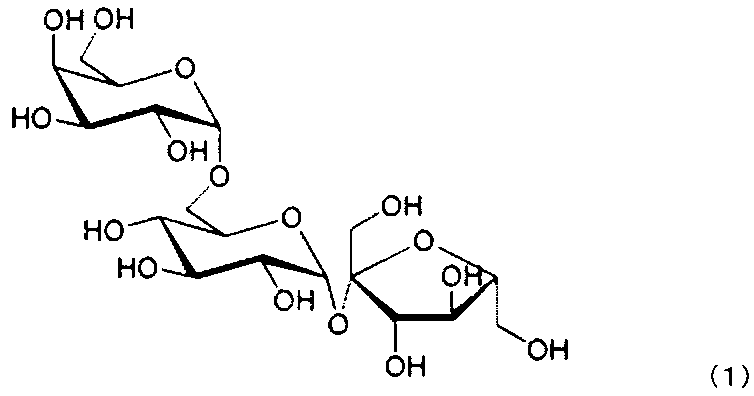

(i)100~800ppmの濃度のアスコルビン酸類(A)を含有する;
(ii)1~200ppmの濃度のバリン(B1)を含有する;
(iii)総量が10ppm以上100ppm以下となるラフィノース(G1)及びスタキオース(G2)を含有する;
(iv)色差形による明度(L*)が75≦L*≦95である;
(v)色差計による及び彩度(C*)が15≦C*≦25である。
本発明の容器詰緑茶飲料は、例えば以下の工程:
(i)緑茶葉に抽出処理を施して緑茶抽出液を得る工程、
(ii)緑茶抽出液に、アスコルビン酸類(A)及びバリン(B1)を配合する工程、
(iii)明度及び彩度の調整された調合液を得る工程、
(iv)該調合液を加熱殺菌処理する工程、及び
(v)容器に充填する工程、
を含む製造方法により得ることができる。
市販のPETボトル入り緑茶飲料について、色差計(Spectro Color Meter SE2000(日本電色工業(株))でL*値、a*値、b*値を測定し、彩度(C*=(a*2+b*2)1/2)を算出した。また、この市販の緑茶飲料を55℃で2週間保管し、保管後の色調(L*値、a*値、b*値、C*値)を測定し、保存前後における彩度の差(ΔC*)値を算出した。55℃で2週間の保管は、長期保存(常温10ヶ月相当)の加速試験を意味するが、加温保存のモデルでもある。

市販のPETボトル入り緑茶飲料(試験例の市販飲料B)を水で約2.7倍に希釈し、さらに緑茶葉粉砕物(平均粒子径が10μmの抹茶)を4mg/100mlの割合で添加して、緑茶飲料とした(No.1)。これに、L-バリン(味の素ヘルシーサプライ株式会社)及びを添加して、バリン濃度の異なる緑茶飲料を得た(No.2~7)。加熱殺菌して容器詰緑茶飲料を製造した後、これら飲料中のアミノ酸(バリン、メチオニン)濃度及びアスコルビン酸濃度を測定した。分析方法は以下のとおり。
試料となる茶飲料をフィルター(0.45μm)でろ過し、HPLC分析に供した。HPLCの分析条件は以下のとおり。
・HPLC装置:Waters アミノ酸分析装置2695
・カラム:AccQ-Tagカラム(3.9mm×150mm)
・カラム温度:40℃
・移動相A:AccQ-TagA(pH5.8)
・移動相B:アセトニトリル
・移動層C:水/メタノール=9/1
・検出:EX250nm EM395nm Gain100
・注入量:5μL
・グラジエントプログラム:
時間(分) 流速(ml/min) %A %B %C
0 1 100 0 0
1 1 99 1 0
16 1 97 3 0
25 1 94 6 0
35 1 86 14 0
40 1 86 14 0
50 1 82 18 0
51 1 0 60 40
54 1 100 0 0
75 1 0 60 40
110 0 0 60 40
・標準物質:アミノ酸(バリン、メチオニン)
(官能評価)
パネラー5名による清涼感についての飲用試験を行った。ここで、清涼感を有する飲料とは、淡い液色を有し、苦味や渋味や臭味がなく、一気に大量をゴクゴク飲むことができる(「飲用性が高い」ともいう)のに適した感覚の飲料をいう。評価基準は以下のとおり。
[評価基準]
1:優れる、2:良好、3:標準、4:良くない、5:悪いとし、最も多い評価で表わした。
[総合評価]
◎:とても好ましい、○:好ましい、△:ふつう、×:好ましくない
(評価結果)
結果を表2に示す。飲料全体に対して100~800ppmの濃度のアスコルビン酸類(A)と、1~200ppm(好ましくは5~190ppm)の濃度のバリン(B1)とを含有し、色差計による明度(L*)及び彩度(C*)が、75≦L*≦95、15≦C*≦25を満たす緑茶飲料(No.2~7)は、加熱臭がなく、視覚上も風味上も清涼感を有する好ましい緑茶飲料であった。

実施例1のNo.4の淡色茶飲料に、L-メチオニン(味の素ヘルシーサプライ株式会社)を添加して、メチオニン濃度の異なる緑茶飲料を得た(No.8~10)。これらの飲料を加熱殺菌した後、パネラー5名で実施例1と同様に、成分分析及び飲用試験を行った。

(1)バリン高含有茶葉の製造
特開2012-183064号公報の実施例2に記載の方法で、バリン高含有茶葉を製造した。まず、アミノ酸を高濃度に含有する茶抽出物を製造した。攪拌機付き密閉容器に10gの緑茶葉(火入れ度:中)を封入し、40℃のイオン交換水を180mL加え、緑茶葉を浸漬させた。そこにプロテアーゼ製剤(三菱化学フーズ社「コクラーゼ・P」)を0.2g添加し、40℃に保持したまま16時間攪拌を行い、酵素処理を行った。その後、得られた酵素処理液を90℃で10分加熱して酵素を失活させ、酵素抽出液を得た。この抽出液のアミノ酸組成を実施例1のHPLC条件で分析した結果を表4に示す。この抽出液を表4の17種のアミノ酸濃度の合計が1%になるよう、減圧濃縮してバリン含有緑茶濃縮液を調製した。

・火入れ機 : 寺田製作所、TR-10
・ドラム温度 : 200℃
・ドラム回転数: 12rpm
・火入れ時間 : 15~20分
・火入れ温度 : 150℃
(2)容器詰緑茶飲料の製造
上記(1)で得られたバリン高含有茶葉と煎茶(一番茶)を任意の割合で混合し、バリン含量の異なる3種類の混合茶葉を得た。混合茶葉の重量に対して、約30倍量の水(40℃)で抽出処理を行った。これに、緑茶葉粉砕物(平均粒子径が10μmの抹茶)を6mg/100mlと、アスコルビン酸350ppmを添加して、pH調整剤を用いてpHを6.4に調整した後、配加熱殺菌し、500mLずつをPETボトルに充填して、容器詰緑茶飲料を製造した(No.11~14)。得られた緑茶飲料について、実施例1と同様に評価した。

市販のPETボトル入り緑茶飲料(試験例の市販飲料F)に緑茶葉粉砕物(平均粒子径が10μmの抹茶)を5mg/100mlの割合で添加して、緑茶飲料とした(No.15)。これに、リン酸を種々の濃度で添加して、緑茶飲料を得た(No.16~20)。加熱殺菌して容器詰緑茶飲料を製造した後、これら飲料中のアミノ酸(バリン、メチオニン)濃度及びアスコルビン酸濃度を実施例1と同様に定量した。また、飲料中のリン酸濃度、香気成分(リナロール及びフェニルアセトアルデヒド)の濃度を以下の方法により分析した。
飲料中のリン酸の定量は、Agilent社のキャピラリー電気泳動システム(HPCE)を用いて実施した。
茶飲料中の香気成分分析にあたっては質量分析計付きガスクロマトグラフィー(GC/MS)を使用し、定量は標準添加法を用いた。前処理にはSBSE(Stir Bar Sorptive Extraction)法を採用し、Twister(Stir Bar にpolydimethylsiloxaneをコーティングしたもの;GERSTEL社製)による攪拌吸着で成分を濃縮した。分析試料は、試料量:50ml、吸着温度:25℃(室温)、吸着時間:120分で調整した。分析条件は以下のとおり。
TDS 条件 (Thermo Desorption System, 加熱脱着装置)
・装置:GERSTEL TDS
・脱着温度. 35℃(1min)~250℃(60℃/min, 5min hold)
・注入口温度. -90℃~250℃ (10℃/sec, 5min hold)
GC/MS条件
・装置:Agilent GC 6890, MSD 5973N
・カラム Inert Cap pure-WAX (30m×0.25mm I.D., Film 0.25μm)
・カラム温度 40℃(5min)~260℃(10℃/min, 13min hold)
・Splitless 5min
・カラム流量:1.2mL/min
・トランスファーライン温度.:260℃
・イオン源温度:230℃
・四重極温度:150℃
・定量に用いたイオン:フェニルアセトアルデヒド m/z=91
(官能評価)
パネラー5名により、清涼感および香気の強さ(香り立ち、含み香)についての飲用試験を行った。また、実施例1と同様に保存安定性についても評価した。
結果を表6に示す。緑茶飲料中のリン酸の総量が、リン酸を2.5~18mg/100mL(好ましくは2.5~5.0mg/100mL)含有する緑茶飲料は、加熱臭がなく、緑茶独特の青葉のような清々しい香りを香り立ちと含み香で強く知覚できる飲料であった。この緑茶飲料について、パネラー全員が、淡い液色を有し、苦味や渋味や臭味がなく、一気に大量をゴクゴク飲むことができるのに適した、視覚上も風味上も清涼感であると答えた。一方、リン酸が20mg/100mL以上になると酸味が強く、清々しい青葉香は感じられなかった。

実施例4で製造したNo.17の緑茶飲料に、2.2~107.2ppbのリナロールを滴下し、香味への影響について検討した(No.21~23)。評価は5名の専門パネラーにより、○:No.17飲料より良い、△:No.17飲料と同程度、×:No.17飲料より悪いとし、最も多い評価で表わした。

実施例4で製造したNo.15の緑茶飲料(対照)に、フェニルアセトアルデヒドを添加し、フェニルアセトアルデヒド含量の異なる緑茶飲料(No.24~26)を調製し、香味への影響について検討した。評価は5名の専門パネラーにより、○:No.15飲料より良い、△:No.15飲料と同程度、×:No.15飲料より悪いとし、最も多い評価で表わした。

実施例6のNo.26の緑茶飲料に、リナロールを添加し、リナロール含量の異なる緑茶飲料(No.27~30)を調製し、香味への影響について検討した。評価は実施例6と同様に、No.15飲料と比較して行った。結果を表9に示す。2.8~10ppbの濃度のリナロール(F1)及び0.2~1.0ppbの濃度のフェニルアセトアルデヒド(F2)を含有する緑茶飲料は、見た目にも飲用しても清涼感に優れた飲料であった。また、リナロール(F1)とフェニルアセトアルデヒド(F2)の含有割合((F1)/(F2))が5~20の範囲にある緑茶飲料は、常温で長期保存してもその清涼感のある色調及び風味が維持されていた。
実施例4で製造したNo.15の緑茶飲料(対照;7.0ppmのラフィノースと2.8ppmのスタキオースを含有)に、ピートオリゴ糖(ラフィノース98%以上、ニチエー株式会社)を添加して、実施例1と同様に加熱殺菌して、オリゴ糖組成及び濃度の異なる容器詰緑茶飲料を調製した(No.31~33)。これらの茶飲料について、パネラー5名により清涼感の評価を行った。評価は、◎:対照より極めて好ましい、○:対照より好ましい、△:対照と同程度、×:対照より好ましくないとし、最も多い評価で表わした。

Claims (6)
- 以下の条件を満たす、容器詰緑茶飲料:
(i)100~800ppmの濃度のアスコルビン酸類(A)を含有する;
(ii)1~200ppmの濃度のバリン(B1);
(iii)色差計による明度(L*)が75≦L*≦95である;
(iv)色差計による及び彩度(C*)が15≦C*≦25である。 - 6ppm未満の濃度のメチオニン(B2)を含有する、請求項1記載の飲料。
- 2.0~18mg/100mLの濃度のリン酸(D)を含有する、請求項1又は2に記載の飲料。
- さらに3~100ppbのリナロール(F1)を含有する、請求項3に記載の飲料。
- 2.8~10ppbの濃度のリナロール(F1)及び0.2~1.0ppbの濃度のフェニルアセトアルデヒド(F2)を含有する、請求項1又は2に記載の飲料。
- さらに総量が10ppm以上100ppm以下となるラフィノース(G1)及びスタキオース(G2)を含有する、請求項1又は2に記載の飲料。
Priority Applications (7)
| Application Number | Priority Date | Filing Date | Title |
|---|---|---|---|
| JP2014560969A JP5762651B2 (ja) | 2013-03-04 | 2014-03-04 | 淡色茶飲料 |
| ES14760538T ES2696274T3 (es) | 2013-03-04 | 2014-03-04 | Bebida de té ligeramente coloreada |
| EP14760538.0A EP2965635B1 (en) | 2013-03-04 | 2014-03-04 | Light-coloured tea beverage |
| CN201480025079.1A CN105246344B (zh) | 2013-03-04 | 2014-03-04 | 淡色茶饮料 |
| SG11201507017UA SG11201507017UA (en) | 2013-03-04 | 2014-03-04 | Light-coloured tea beverage |
| NZ711397A NZ711397A (en) | 2013-03-04 | 2014-03-04 | Light-coloured tea beverage |
| AU2014227002A AU2014227002B2 (en) | 2013-03-04 | 2014-03-04 | Light-coloured tea beverage |
Applications Claiming Priority (10)
| Application Number | Priority Date | Filing Date | Title |
|---|---|---|---|
| JP2013-042423 | 2013-03-04 | ||
| JP2013-042422 | 2013-03-04 | ||
| JP2013042424 | 2013-03-04 | ||
| JP2013042422 | 2013-03-04 | ||
| JP2013-042412 | 2013-03-04 | ||
| JP2013042423 | 2013-03-04 | ||
| JP2013-042424 | 2013-03-04 | ||
| JP2013042412 | 2013-03-04 | ||
| JP2013042415 | 2013-03-04 | ||
| JP2013-042415 | 2013-03-04 |
Publications (1)
| Publication Number | Publication Date |
|---|---|
| WO2014136797A1 true WO2014136797A1 (ja) | 2014-09-12 |
Family
ID=51491312
Family Applications (1)
| Application Number | Title | Priority Date | Filing Date |
|---|---|---|---|
| PCT/JP2014/055512 Ceased WO2014136797A1 (ja) | 2013-03-04 | 2014-03-04 | 淡色茶飲料 |
Country Status (10)
| Country | Link |
|---|---|
| EP (1) | EP2965635B1 (ja) |
| JP (1) | JP5762651B2 (ja) |
| CN (1) | CN105246344B (ja) |
| AU (1) | AU2014227002B2 (ja) |
| ES (1) | ES2696274T3 (ja) |
| MY (1) | MY175094A (ja) |
| NZ (1) | NZ711397A (ja) |
| SG (1) | SG11201507017UA (ja) |
| TW (1) | TWI574626B (ja) |
| WO (1) | WO2014136797A1 (ja) |
Cited By (6)
| Publication number | Priority date | Publication date | Assignee | Title |
|---|---|---|---|---|
| JP2016123316A (ja) * | 2014-12-26 | 2016-07-11 | 花王株式会社 | 容器詰飲料 |
| JP2018000075A (ja) * | 2016-06-30 | 2018-01-11 | サントリーホールディングス株式会社 | 高濃度イヌリン含有茶飲料 |
| JP2018117608A (ja) * | 2017-01-20 | 2018-08-02 | サントリーホールディングス株式会社 | 高濃度の粉砕茶葉を含有する緑茶飲料 |
| JP2018139582A (ja) * | 2017-01-20 | 2018-09-13 | サントリーホールディングス株式会社 | 高濃度の粉砕茶葉を含有する緑茶飲料 |
| JP2019013222A (ja) * | 2017-07-07 | 2019-01-31 | 株式会社ナリス化粧品 | 茶葉抽出物の製造方法 |
| JP2022097645A (ja) * | 2020-03-16 | 2022-06-30 | サントリーホールディングス株式会社 | 抹茶風味付与剤及びこれを含有する緑茶飲料 |
Citations (7)
| Publication number | Priority date | Publication date | Assignee | Title |
|---|---|---|---|---|
| JP2006174801A (ja) * | 2004-12-24 | 2006-07-06 | Kao Corp | 緑茶抽出物の精製物及びそれを配合した高濃度カテキン含有容器詰飲料 |
| JP2008131875A (ja) * | 2006-11-28 | 2008-06-12 | Kao Corp | 容器詰め飲料の製造法 |
| JP4287583B2 (ja) | 2000-11-17 | 2009-07-01 | アサマ化成株式会社 | 色調安定な緑茶飲料 |
| JP2011505816A (ja) * | 2007-12-14 | 2011-03-03 | ユニリーバー・ナームローゼ・ベンノートシヤープ | 揮発性茶化合物の回収方法 |
| WO2011092976A1 (ja) * | 2010-01-29 | 2011-08-04 | 株式会社伊藤園 | 容器詰緑茶飲料 |
| WO2012029132A1 (ja) * | 2010-08-31 | 2012-03-08 | 株式会社伊藤園 | 容器詰緑茶飲料及びその製造方法 |
| JP2012183064A (ja) | 2011-02-17 | 2012-09-27 | Suntory Holdings Ltd | 茶葉の製造方法 |
Family Cites Families (4)
| Publication number | Priority date | Publication date | Assignee | Title |
|---|---|---|---|---|
| US20100015288A1 (en) * | 2006-12-27 | 2010-01-21 | Kao Corporation | Packed drink |
| KR101463639B1 (ko) * | 2007-05-08 | 2014-12-04 | 카오카부시키가이샤 | 환원 음료용 농축 조성물 |
| CN102933087B (zh) * | 2010-04-05 | 2014-12-03 | 三得利食品饮料株式会社 | 乌龙茶提取物 |
| CN103607911B (zh) * | 2011-02-17 | 2016-11-23 | 三得利食品饮料株式会社 | 茶饮料用原料的制造方法 |
-
2014
- 2014-03-04 EP EP14760538.0A patent/EP2965635B1/en active Active
- 2014-03-04 MY MYPI2015702923A patent/MY175094A/en unknown
- 2014-03-04 SG SG11201507017UA patent/SG11201507017UA/en unknown
- 2014-03-04 WO PCT/JP2014/055512 patent/WO2014136797A1/ja not_active Ceased
- 2014-03-04 NZ NZ711397A patent/NZ711397A/en not_active IP Right Cessation
- 2014-03-04 AU AU2014227002A patent/AU2014227002B2/en not_active Ceased
- 2014-03-04 ES ES14760538T patent/ES2696274T3/es active Active
- 2014-03-04 TW TW103107358A patent/TWI574626B/zh not_active IP Right Cessation
- 2014-03-04 JP JP2014560969A patent/JP5762651B2/ja active Active
- 2014-03-04 CN CN201480025079.1A patent/CN105246344B/zh not_active Expired - Fee Related
Patent Citations (7)
| Publication number | Priority date | Publication date | Assignee | Title |
|---|---|---|---|---|
| JP4287583B2 (ja) | 2000-11-17 | 2009-07-01 | アサマ化成株式会社 | 色調安定な緑茶飲料 |
| JP2006174801A (ja) * | 2004-12-24 | 2006-07-06 | Kao Corp | 緑茶抽出物の精製物及びそれを配合した高濃度カテキン含有容器詰飲料 |
| JP2008131875A (ja) * | 2006-11-28 | 2008-06-12 | Kao Corp | 容器詰め飲料の製造法 |
| JP2011505816A (ja) * | 2007-12-14 | 2011-03-03 | ユニリーバー・ナームローゼ・ベンノートシヤープ | 揮発性茶化合物の回収方法 |
| WO2011092976A1 (ja) * | 2010-01-29 | 2011-08-04 | 株式会社伊藤園 | 容器詰緑茶飲料 |
| WO2012029132A1 (ja) * | 2010-08-31 | 2012-03-08 | 株式会社伊藤園 | 容器詰緑茶飲料及びその製造方法 |
| JP2012183064A (ja) | 2011-02-17 | 2012-09-27 | Suntory Holdings Ltd | 茶葉の製造方法 |
Non-Patent Citations (1)
| Title |
|---|
| TEA RESEARCH JOURNAL, 2002, pages 26 - 33 |
Cited By (9)
| Publication number | Priority date | Publication date | Assignee | Title |
|---|---|---|---|---|
| JP2016123316A (ja) * | 2014-12-26 | 2016-07-11 | 花王株式会社 | 容器詰飲料 |
| JP2018000075A (ja) * | 2016-06-30 | 2018-01-11 | サントリーホールディングス株式会社 | 高濃度イヌリン含有茶飲料 |
| JP2018117608A (ja) * | 2017-01-20 | 2018-08-02 | サントリーホールディングス株式会社 | 高濃度の粉砕茶葉を含有する緑茶飲料 |
| JP2018139582A (ja) * | 2017-01-20 | 2018-09-13 | サントリーホールディングス株式会社 | 高濃度の粉砕茶葉を含有する緑茶飲料 |
| JP7022600B2 (ja) | 2017-01-20 | 2022-02-18 | サントリーホールディングス株式会社 | 高濃度の粉砕茶葉を含有する緑茶飲料 |
| JP2019013222A (ja) * | 2017-07-07 | 2019-01-31 | 株式会社ナリス化粧品 | 茶葉抽出物の製造方法 |
| JP7175650B2 (ja) | 2017-07-07 | 2022-11-21 | 株式会社ナリス化粧品 | 茶葉抽出物の製造方法 |
| JP2022097645A (ja) * | 2020-03-16 | 2022-06-30 | サントリーホールディングス株式会社 | 抹茶風味付与剤及びこれを含有する緑茶飲料 |
| JP7311673B2 (ja) | 2020-03-16 | 2023-07-19 | サントリーホールディングス株式会社 | 抹茶風味付与剤及びこれを含有する緑茶飲料 |
Also Published As
| Publication number | Publication date |
|---|---|
| MY175094A (en) | 2020-06-05 |
| AU2014227002A1 (en) | 2015-09-24 |
| NZ711397A (en) | 2017-03-31 |
| JPWO2014136797A1 (ja) | 2017-02-16 |
| AU2014227002B2 (en) | 2016-11-03 |
| CN105246344A (zh) | 2016-01-13 |
| EP2965635A1 (en) | 2016-01-13 |
| EP2965635B1 (en) | 2018-10-31 |
| TW201438587A (zh) | 2014-10-16 |
| CN105246344B (zh) | 2017-07-25 |
| JP5762651B2 (ja) | 2015-08-12 |
| EP2965635A4 (en) | 2017-01-04 |
| SG11201507017UA (en) | 2015-10-29 |
| ES2696274T3 (es) | 2019-01-14 |
| TWI574626B (zh) | 2017-03-21 |
Similar Documents
| Publication | Publication Date | Title |
|---|---|---|
| JP6178827B2 (ja) | 緑茶飲料 | |
| JP5762651B2 (ja) | 淡色茶飲料 | |
| WO2010098443A1 (ja) | 容器詰緑茶飲料 | |
| CN103607911A (zh) | 茶饮料用原料的制造方法 | |
| JP6150354B2 (ja) | ヘスペリジン含有茶飲料組成物の製造方法 | |
| JP2013005787A (ja) | レモン風味を呈する飲料 | |
| EP4082351A1 (en) | Green tea beverage with enhanced flavor | |
| JP7030170B2 (ja) | 茶飲料 | |
| JP2016154500A (ja) | 優れた香味と旨味が持続する容器詰茶飲料の製造方法 | |
| JP2019115295A (ja) | ルイボス飲料及びその製造方法 | |
| JP6877526B1 (ja) | 呈味が増強された緑茶飲料 | |
| JP6785740B2 (ja) | 茶飲料 | |
| JP6209484B2 (ja) | 容器詰飲料の製造方法及び容器詰飲料の呈味及び/又は香味劣化抑制方法 | |
| TWI829783B (zh) | 容器裝飲料 | |
| JP2023158280A (ja) | ショウガ含有飲料の風味改善方法 | |
| TW202100020A (zh) | 容器裝茶飲料 | |
| JP2016096728A (ja) | ジャスミン茶飲料 |
Legal Events
| Date | Code | Title | Description |
|---|---|---|---|
| 121 | Ep: the epo has been informed by wipo that ep was designated in this application |
Ref document number: 14760538 Country of ref document: EP Kind code of ref document: A1 |
|
| ENP | Entry into the national phase |
Ref document number: 2014560969 Country of ref document: JP Kind code of ref document: A |
|
| WWE | Wipo information: entry into national phase |
Ref document number: 2014760538 Country of ref document: EP |
|
| NENP | Non-entry into the national phase |
Ref country code: DE |
|
| ENP | Entry into the national phase |
Ref document number: 2014227002 Country of ref document: AU Date of ref document: 20140304 Kind code of ref document: A |
|
| WWE | Wipo information: entry into national phase |
Ref document number: IDP00201506191 Country of ref document: ID |