WO2014136863A1 - 植物の成長促進剤 - Google Patents
植物の成長促進剤 Download PDFInfo
- Publication number
- WO2014136863A1 WO2014136863A1 PCT/JP2014/055743 JP2014055743W WO2014136863A1 WO 2014136863 A1 WO2014136863 A1 WO 2014136863A1 JP 2014055743 W JP2014055743 W JP 2014055743W WO 2014136863 A1 WO2014136863 A1 WO 2014136863A1
- Authority
- WO
- WIPO (PCT)
- Prior art keywords
- acid
- amino
- plant growth
- agent
- salt
- Prior art date
- Legal status (The legal status is an assumption and is not a legal conclusion. Google has not performed a legal analysis and makes no representation as to the accuracy of the status listed.)
- Ceased
Links
Classifications
-
- A—HUMAN NECESSITIES
- A01—AGRICULTURE; FORESTRY; ANIMAL HUSBANDRY; HUNTING; TRAPPING; FISHING
- A01N—PRESERVATION OF BODIES OF HUMANS OR ANIMALS OR PLANTS OR PARTS THEREOF; BIOCIDES, e.g. AS DISINFECTANTS, AS PESTICIDES OR AS HERBICIDES; PEST REPELLANTS OR ATTRACTANTS; PLANT GROWTH REGULATORS
- A01N37/00—Biocides, pest repellants or attractants, or plant growth regulators containing organic compounds containing a carbon atom having three bonds to hetero atoms with at the most two bonds to halogen, e.g. carboxylic acids
- A01N37/44—Biocides, pest repellants or attractants, or plant growth regulators containing organic compounds containing a carbon atom having three bonds to hetero atoms with at the most two bonds to halogen, e.g. carboxylic acids containing at least one carboxylic group or a thio analogue, or a derivative thereof, and a nitrogen atom attached to the same carbon skeleton by a single or double bond, this nitrogen atom not being a member of a derivative or of a thio analogue of a carboxylic group, e.g. amino-carboxylic acids
-
- A—HUMAN NECESSITIES
- A01—AGRICULTURE; FORESTRY; ANIMAL HUSBANDRY; HUNTING; TRAPPING; FISHING
- A01G—HORTICULTURE; CULTIVATION OF VEGETABLES, FLOWERS, RICE, FRUIT, VINES, HOPS OR SEAWEED; FORESTRY; WATERING
- A01G7/00—Botany in general
Definitions
- the present invention relates to a novel plant growth promoter.
- Plant growth regulators Drugs aimed at controlling plant growth and development and saving labor in cultivation management work are called plant growth regulators, and their effects are growth promotion, budding suppression, elongation suppression, and fruit-free seeding. , Fall prevention and so on.
- plant hormones such as gibberellin and synthetic cytokinin and related substances (Non-Patent Documents 1 and 2).
- the use time, concentration and amount of these plant hormone-based plant growth regulators are limited to a narrow range because the effect of the fluctuations on the action is large. If the usage conditions are wrong, not only cannot the effect be obtained, but also healthy growth is not exhibited, so it is not widely used.
- amino acid compounds that help plant growth have been reported, such as glutamic acid, glycine, and proline.
- glutamic acid glycine
- proline amino acid compounds that help plant growth
- 5-aminolevulinic acid having actions such as improvement of photosynthetic activity and promotion of nitrogen absorption.
- These amino acid compounds are mild in action and have a wide range of use periods, concentrations and amounts, and thus are expected as easy-to-use drugs, and further development is desired.
- an object of the present invention is to provide a new plant growth promoter comprising an amino acid compound as an active ingredient.
- the present inventor conducted intensive research in view of the present situation, and found that if 5-amino-4-hydroxypentanoic acid, a derivative thereof or a salt thereof is applied to a plant, the growth of the plant can be promoted.
- the present invention has been completed.
- R 1 represents a hydrogen atom or a hydrocarbon group having 1 to 10 carbon atoms.
- a plant growth promoter comprising 5-amino-4-hydroxypentanoic acid, a derivative thereof or a salt thereof represented by the formula:
- the present invention also provides a method for promoting plant growth, which comprises applying 5-amino-4-hydroxypentanoic acid represented by the general formula (1), a derivative thereof or a salt thereof.
- plant growth can be promoted and the cultivation period can be shortened. Therefore, according to the present invention, plant cultivation can be labor-saving and efficient.
- the active ingredient of the plant growth promoter of the present invention is 5-amino-4-hydroxypentanoic acid, a derivative thereof (the above general formula (1)) or a salt thereof.
- R 1 represents a hydrogen atom or a hydrocarbon group having 1 to 10 carbon atoms.
- the hydrocarbon group preferably has 1 to 6 carbon atoms.
- the hydrocarbon group as R 1 is, for example, a saturated aliphatic hydrocarbon group having 1 to 10 carbon atoms, an unsaturated aliphatic hydrocarbon group having 2 to 10 carbon atoms, an alicyclic hydrocarbon group having 3 to 10 carbon atoms, And an alicyclic-aliphatic hydrocarbon group having 4 to 10 carbon atoms, an aromatic hydrocarbon group having 6 to 10 carbon atoms, and an aromatic-aliphatic hydrocarbon group having 7 to 10 carbon atoms.
- a preferred hydrocarbon group is a saturated aliphatic hydrocarbon group.
- saturated aliphatic hydrocarbon group examples include, for example, methyl, ethyl, n-propyl, isopropyl, n-butyl, isobutyl, tert-butyl, n-pentyl, isopentyl, neopentyl, tert-pentyl, 2-methylbutyl, n-hexyl, isohexyl, 3-methylpentyl, ethylbutyl, n-heptyl, 2-methylhexyl, n-octyl, isooctyl, tert-octyl, 2-ethylhexyl, 3-methylheptyl, n-nonyl, isononyl, 1-methyl Octyl, ethylheptyl, n-decyl, 1-methylnonyl and the like, and preferred saturated aliphatic hydrocarbon groups are methyl, ethyl, n
- Suitable examples of the unsaturated aliphatic hydrocarbon group include, for example, vinyl, allyl, isopropenyl, 2-butenyl, 2-methylallyl, 1,1-dimethylallyl, 3-methyl-2-butenyl, and 3-methyl.
- n-hexenyl 4-pentenyl, n-hexenyl, n-octenyl, n-nonenyl, n-decenyl and the like, and preferred unsaturated aliphatic hydrocarbon groups are vinyl, allyl, isopropenyl, 2-butenyl, C2-C6 linear or branched alkenyl groups such as 2-methylallyl, 1,1-dimethylallyl, 3-methyl-2-butenyl, 3-methyl-3-butenyl, 4-pentenyl, and n-hexenyl Is mentioned.
- Suitable examples of the alicyclic hydrocarbon group include, for example, cyclopropyl, cyclobutyl, cyclopentyl, cyclohexyl, cycloheptyl, cyclooctyl, 3-methylcyclohexyl, 4-methylcyclohexyl, 4-ethylcyclohexyl, 2-methylcyclohexane.
- Suitable examples of the alicyclic-aliphatic hydrocarbon group include, for example, cyclopropylethyl, cyclobutylethyl, cyclopentylethyl, cyclohexylmethyl, cyclohexylethyl, cycloheptylmethyl, cyclooctylethyl, 3-methylcyclohexylpropyl, Examples include 4-methylcyclohexylethyl, 4-ethylcyclohexylethyl, cyclopropenylbutyl, cyclobutenylethyl, cyclopentenylethyl, cyclohexenylmethyl, cycloheptenylmethyl, cyclooctenylethyl, and 4-methylcyclohexenylpropyl.
- Preferred alicyclic-aliphatic hydrocarbon groups include cycloalkyl-alkyl groups having 4 to 6 carbon atoms such as cyclopropyle
- aromatic hydrocarbon group examples include aryl groups such as phenyl and naphthyl; 4-methylphenyl, 3,4-dimethylphenyl, 3,4,5-trimethylphenyl, 2-ethylphenyl, n Examples thereof include alkyl-substituted phenyl groups such as -butylphenyl and tert-butylphenyl, and preferred aromatic hydrocarbon groups include phenyl.
- aromatic-aliphatic hydrocarbon group examples include 7 to 7 carbon atoms such as benzyl, 1-phenylethyl, 2-phenylethyl, 2-phenylpropyl, 3-phenylpropyl and 4-phenylbutyl. 10 phenylalkyl groups are mentioned.
- Examples of the salt of the compound of the general formula (1) include hydrochloride, hydrobromide, hydroiodide, phosphate, methyl phosphate, ethyl phosphate, phosphite, hypophosphite, nitrate , Sulfate, acetate, propionate, toluenesulfonate, succinate, oxalate, lactate, tartrate, glycolate, methanesulfonate, butyrate, valerate, citrate, Examples thereof include acid addition salts such as fumarate, maleate and malate, metal salts such as sodium salt, potassium salt and calcium salt, ammonium salt and alkylammonium salt.
- the 5-amino-4-hydroxypentanoic acid, its derivative, or a salt thereof detailed above may form a hydrate or a solvate, either alone or in appropriate combination of two or more. Can be used. Moreover, an optically active form may be used and a racemate may be used.
- 5-Amino-4-hydroxypentanoic acid, a derivative thereof, or a salt thereof can be produced by any method of chemical synthesis, production by microorganisms, and production by enzymes. For example, as described in Patent Documents 1 and 2, etc. It can manufacture according to this method.
- the 5-amino-4-hydroxypentanoic acid produced as described above, the chemical reaction solution and the fermentation solution before purification thereof can be used as they are without separation and purification as long as they do not contain harmful substances.
- a commercial item etc. can also be used.
- 5-Amino-4-hydroxypentanoic acid, a derivative thereof or a salt thereof has an excellent plant growth promoting action.
- it has excellent effects such as promoting the growth of plant height, promoting tillering and increasing the weight of the ground part, and has the effect of promoting the growth of a wide range of plants and increasing the yield.
- the plant to which the plant growth promoter of the present invention is applied is not particularly limited, and examples thereof include cereals and vegetables.
- specific examples of cereals include rice, wheat, barley, corn, buckwheat, Leafy vegetables such as soybeans, azuki bean, peas, green beans, beans, etc. , Shungiku, mikuna, lettuce, parsley, leek, etc. , Carrot, lotus root, burdock, raccoon, sweet potato, di Gaimo, taro, and the like.
- barley, komatsuna, shungiku, broccoli, and radish are preferred.
- the plant growth promoter may contain 5-amino-4-hydroxypentanoic acid, a derivative thereof, or a salt thereof.
- a plant growth regulator sugar, Nitrogen compounds, acids, alcohols, vitamins, trace elements, metal salts, chelating agents, preservatives, antifungal agents, and the like can be blended.
- plant growth regulators used here include brassinolides such as epibrassinolide, choline agents such as choline chloride and choline nitrate, indolebutyric acid, indoleacetic acid, ethiclozate agent, 1-naphthylacetamide agent, isoprothiolane.
- Agent nicotinamide agent, hydroxyisoxazole agent, calcium peroxide agent, benzylaminopurine agent, metasulfocamb agent, oxyethylene docosanol agent, ethephon agent, croquinhonac agent, gibberellin, streptomycin agent, daminogit agent, benzylamino
- a purine agent a 4-CPA agent, an animidol agent, an inapentide agent, a uniconazole agent, a chlorme coat agent, a dike black agent, a mefluidide agent, a calcium carbonate agent, and a piperonyl butoxide agent.
- saccharide examples include glucose, sucrose, xylitol, sorbitol, galactose, xylose, mannose, arabinose, majurose, sucrose, ribose, rhamnose, fructose, maltose, lactose, maltotriose and the like.
- nitrogen-containing compounds examples include amino acids (asparagine, glutamine, histidine, tyrosine, glycine, arginine, alanine, tryptophan, methionine, valine, proline, leucine, lysine, glutamic acid, aspartic acid, isoleucine, etc.), urea, ammonia and the like. It is done.
- acids examples include organic acids (formic acid, acetic acid, propionic acid, butyric acid, valeric acid, oxalic acid, phthalic acid, benzoic acid, lactic acid, citric acid, tartaric acid, malonic acid, malic acid, succinic acid, glycolic acid, maleic acid.
- sulfurous acid sulfuric acid, nitric acid, phosphorous acid, phosphoric acid, polyphosphoric acid and the like.
- alcohols examples include methanol, ethanol, propanol, butanol, pentanol, hexanol, and glycerol.
- vitamins include nicotinamide, vitamin B 6 , vitamin B 12 , vitamin B 5 , vitamin C, vitamin B 13 , vitamin B 1 , vitamin B 3 , vitamin B 2 , vitamin K 3 , vitamin A, vitamin D 2 , vitamin D 3 , vitamin K 1 , ⁇ -tocopherol, ⁇ -tocopherol, ⁇ -tocopherol, p-hydroxybenzoic acid, biotin, folic acid, nicotinic acid, pantothenic acid, ⁇ -liponic acid, etc. Can do.
- trace elements examples include boron, manganese, zinc, copper, iron, molybdenum, and chlorine.
- metal salts examples include calcium salts, potassium salts, and magnesium salts.
- the chelating agent examples include aminocarboxylic acid-based chelating agents (ethylenediaminetetraacetic acid, nitrilotriacetic acid, hydroxyethyliminodiacetic acid, hydroxyethylethylenediaminetriacetic acid, diethylenetriaminepentaacetic acid, triethylenetetraaminehexaacetic acid, dicarboxymethylglutamic acid, dihydroxy Ethyl glycine, 1,3-propanediaminetetraacetic acid, 1,3-diamino-2-hydroxypropanetetraacetic acid) and phosphonic acid chelating agents (hydroxyethylidene diphosphonic acid, methylenephosphonic acid, phosphonobutanetricarboxylic acid, etc.) Etc. These chelating agents may be used as metal salts.
- the plant growth promoter of the present invention may be applied by any method of foliage spraying treatment, soil spraying or irrigation treatment, and hydroponic irrigation treatment.
- the growth promoter may be absorbed before planting or before cutting.
- the 5-amino-4-hydroxypentanoic acid, its derivative or a salt thereof is contained in a concentration of 0.0001 to 100 ppm, particularly 0.005 to 1 ppm. It is preferable to use 10 to 1000 L, particularly 50 to 300 L per 10 ares.
- a spreading agent can be used for a plant such as a monocotyledonous plant that hardly adheres to the leaf surface, but the type and amount of use are not particularly limited.
- the concentration of 5-amino-4-hydroxypentanoic acid, its derivative or a salt thereof is 0.0001 to 100 ppm, particularly 0.01 to 1 ppm.
- the concentration of 5-amino-4-hydroxypentanoic acid, its derivative or a salt thereof is 0.0001 to 100 ppm, particularly 0.01 to 1 ppm.
- it is preferably used in an amount of 10 to 1000 L, particularly 50 to 300 L per 10 ares, and in potted cultivation, it is preferably used in an amount of 10 ml to 2 L, particularly 10 ml to 1 L per strain.
- 5-amino-4-hydroxypentanoic acid, its derivatives or salts thereof may be added and absorbed, and 5-amino of the solution to be applied
- concentration of -4-hydroxypentanoic acid, a derivative thereof or a salt thereof is preferably 0.00001 to 10 ppm, particularly 0.001 to 0.1 ppm.
- the soaking time is preferably 1 second to 1 week, particularly 1 minute to 1 day.
- the treatment can achieve a sufficient effect even once, but the effect can be further enhanced by performing the treatment multiple times. In this case, the above methods can be combined.
- Example 1 Effect of promoting promotion of barley growth by 5-amino-4-hydroxypentanoic acid Barley was sown in a pot and cultivated. The soil used black soil. The number of individuals was 4 individuals / pot, 4-6 pots / section. Chemical fertilizer (containing 8% each of nitrogen, phosphoric acid, and potassium) was applied as a basic fertilizer so that nitrogen, phosphoric acid, and potassium would each be 5 kg per 10a. 22 days after sowing, 200 L of an aqueous solution containing 0.006 ppm, 0.06 ppm or 0.6 ppm of 5-amino-4-hydroxypentanoic acid was sprayed. Thirty-five days after sowing, the plant height, tillers, and dry weight on the ground were examined.
- Chemical fertilizer containing 8% each of nitrogen, phosphoric acid, and potassium
- the above-ground dry weight of the 5-amino-4-hydroxypentanoic acid-treated group increased by 20 to 30% compared to the control group, and a plant growth promoting effect was observed.
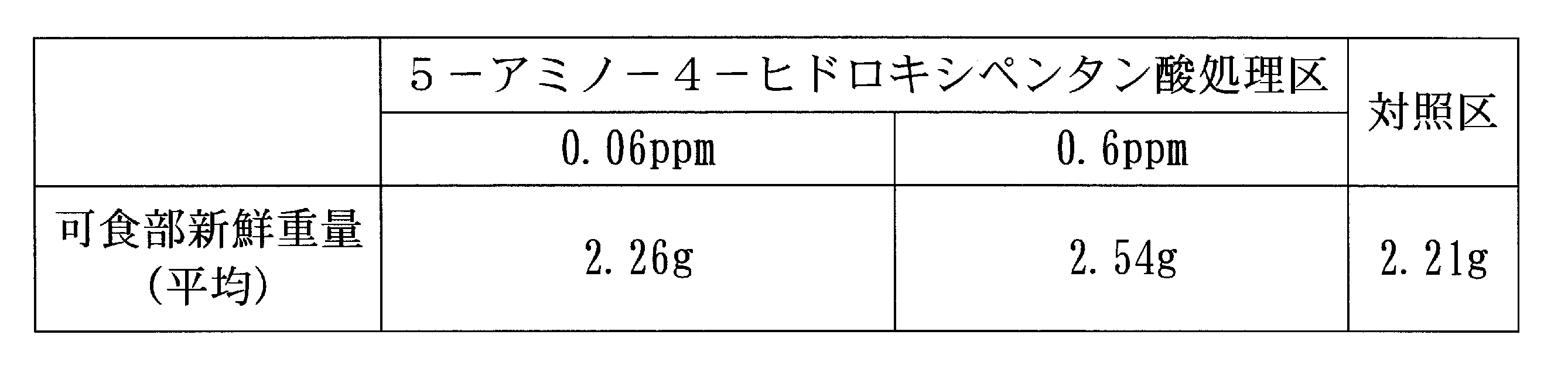
- Example 3 Growth promotion effect of 5-amino-4-hydroxypentanoic acid on radish Growing radish was sown in a pot and cultivated.
- soil sterilized cultured soil containing fertilizer components (nitrogen 180 mg / L, phosphoric acid 120 mg / L, potassium 220 mg / L) was used. The number of individuals was 4 individuals / pot and 4 pots / zone. After 15 and 21 days after sowing, 200 L of an aqueous solution containing 0.06 ppm or 0.6 ppm of 5-amino-4-hydroxypentanoic acid was sprayed. 28 days after sowing, the fresh weight of the edible portion was examined.
- fertilizer components nitrogen 180 mg / L, phosphoric acid 120 mg / L, potassium 220 mg / L
- the number of individuals was 4 individuals / pot and 4 pots / zone. After 15 and 21 days after sowing, 200 L of an aqueous solution containing 0.06 ppm or 0.6 ppm of 5-amino-4-
- Example 4 Effect of 5-amino-4-hydroxypentanoic acid on promoting growth of garlic cultivars were sown in a pot.
- soil sterilized cultured soil containing fertilizer components (nitrogen 180 mg / L, phosphoric acid 120 mg / L, potassium 220 mg / L) was used.
- the number of individuals was 4 individuals / pot and 4 pots / zone.
- 200 L of an aqueous solution containing 0.06 ppm or 0.6 ppm of 5-amino-4-hydroxypentanoic acid was sprayed per 10a. The fresh weight of the above-ground part was examined 8 weeks after sowing.
- the above-ground fresh weight of the 5-amino-4-hydroxypentanoic acid-treated group increased by 9 to 12% compared to the control group, and a plant growth promoting effect was observed.
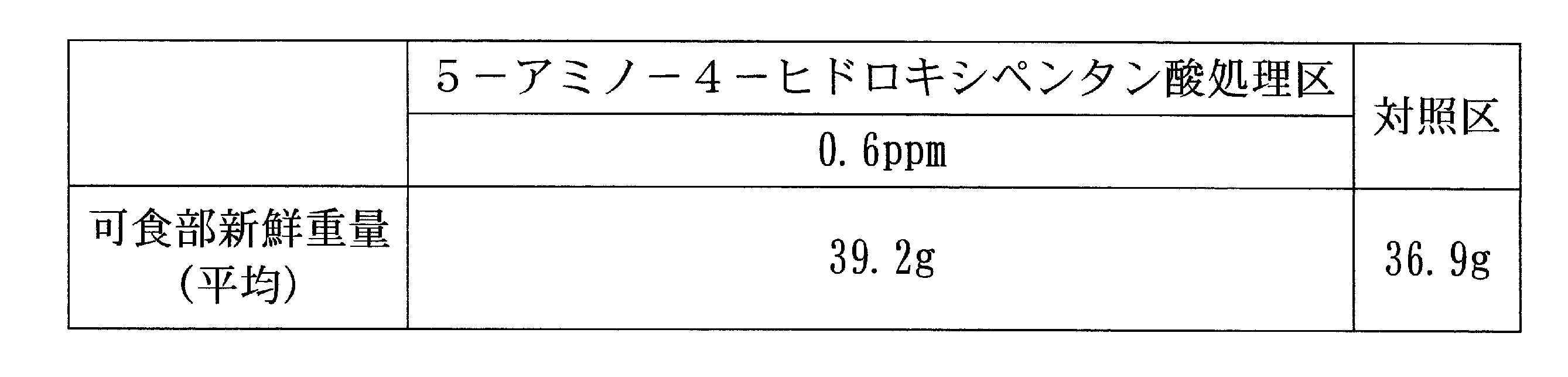
- Example 5 Broccoli growth-promoting effect of 5-amino-4-hydroxypentanoic acid
- fertilizer components nitrogen 180 mg / L, phosphoric acid 120 mg / L, potassium 220 mg / L
- the number of individuals was 1 individual / pot and 4 pots / section. Every week from the 2nd week to the 10th week after planting, 200 L of an aqueous solution containing 0.6 ppm of 5-amino-4-hydroxypentanoic acid was sprayed per 10a. The fresh weight of the edible portion was examined 11 weeks after planting.
Landscapes
- Life Sciences & Earth Sciences (AREA)
- Environmental Sciences (AREA)
- Wood Science & Technology (AREA)
- Zoology (AREA)
- Health & Medical Sciences (AREA)
- Engineering & Computer Science (AREA)
- Dentistry (AREA)
- General Health & Medical Sciences (AREA)
- Pest Control & Pesticides (AREA)
- Plant Pathology (AREA)
- Agronomy & Crop Science (AREA)
- Biodiversity & Conservation Biology (AREA)
- Botany (AREA)
- Ecology (AREA)
- Forests & Forestry (AREA)
- Agricultural Chemicals And Associated Chemicals (AREA)
- Cultivation Of Plants (AREA)
- Fertilizers (AREA)
Abstract
Description
これら植物ホルモン系の植物成長調整剤の使用時期、濃度および量は、その変動が作用に及ぼす影響が大きいことから、狭い範囲に限定されている。使用条件を誤ると効果を得ることができないばかりでなく、健全な生育を示さなくなることから、広くは普及していない。
で表される5-アミノ-4-ヒドロキシペンタン酸、その誘導体又はそれらの塩を有効成分とする植物の成長促進剤を提供するものである。
以上詳述した5-アミノ-4-ヒドロキシペンタン酸、その誘導体又はそれらの塩は、水和物又は溶媒和物を形成していてもよく、またいずれかを単独で又は2種以上を適宜組み合わせて用いることができる。また、光学活性体を使用してもよく、ラセミ体を使用してもよい。
これらのうち、オオムギ、コマツナ、シュンギク、ブロッコリー、ハツカダイコンが好適である。
オオムギをポットに播種して栽培した。土壌は黒土を用いた。個体数は4個体/ポット、4~6ポット/区とした。基肥として化成肥料(窒素、リン酸、カリウム各々8%含有)を10a当たり窒素、リン酸、カリウムが各々5kgとなるよう施用した。播種22日後、5-アミノ-4-ヒドロキシペンタン酸0.006ppm、0.06ppm又は0.6ppmを含む水溶液を10a当たり200L散布した。播種35日後、草丈、分げつ及び地上部乾燥重量を調べた。

コマツナを圃場に播種して栽培した。土壌は赤土を用いた。個体数は、40~52個体/区画、2~3区画/区とした。基肥として被覆肥料(窒素13%、リン酸11%、カリウム13%含有)を10a当たり窒素が50kgとなるよう施用した。播種22日後、5-アミノ-4-ヒドロキシペンタン酸0.06ppmを含む水溶液を10a当たり1000L、2回散布した。播種42日後、地上部新鮮重量を調べた。

ハツカダイコンをポットに播種して栽培した。土壌は肥料成分(窒素180mg/L、リン酸120mg/L、カリウム220mg/L)を含む滅菌済培養土を用いた。個体数は4個体/ポット、4ポット/区とした。播種15日後および21日後に、5-アミノ-4-ヒドロキシペンタン酸0.06ppm又は0.6ppmを含む水溶液を10a当たり200L散布した。播種28日後、可食部新鮮重量を調べた。
シュンギクをポットに播種して栽培した。土壌は肥料成分(窒素180mg/L、リン酸120mg/L、カリウム220mg/L)を含む滅菌済培養土を用いた。個体数は4個体/ポット、4ポット/区とした。播種後4、5、6、7週目に、5-アミノ-4-ヒドロキシペンタン酸0.06ppm又は0.6ppmを含む水溶液を10a当たり200L散布した。播種後8週目に地上部新鮮重量を調べた。

市販の苗をポットに定植して栽培した。土壌は肥料成分(窒素180mg/L、リン酸120mg/L、カリウム220mg/L)を含む滅菌済培養土を用いた。個体数は1個体/ポット、4ポット/区とした。定植後2週目から10週目まで毎週、5-アミノ-4-ヒドロキシペンタン酸0.6ppmを含む水溶液を10a当たり200L散布した。定植後11週目に可食部新鮮重量を調べた。
Claims (4)
- 一般式(1)
H2NCH2CH(OH)CH2CH2COOR1 (1)
(式中、R1は水素原子又は炭素数1~10の炭化水素基を示す。)
で表される5-アミノ-4-ヒドロキシペンタン酸、その誘導体又はそれらの塩を有効成分とする植物の成長促進剤。 - 5-アミノ-4-ヒドロキシペンタン酸、その誘導体又はそれらの塩を0.0001~10ppm含有する請求項1記載の植物の成長促進剤。
- 植物が穀類又は野菜類である請求項1又は2記載の植物の成長促進剤。
- 一般式(1)
H2NCH2CH(OH)CH2CH2COOR1 (1)
(式中、R1は水素原子又は炭素数1~10の炭化水素基を示す。)
で表される5-アミノ-4-ヒドロキシペンタン酸、その誘導体又はそれらの塩を施用する、植物の成長促進方法。
Priority Applications (6)
| Application Number | Priority Date | Filing Date | Title |
|---|---|---|---|
| JP2014511661A JP6283609B2 (ja) | 2013-03-07 | 2014-03-06 | 植物の成長促進剤 |
| ES14759651T ES2742076T3 (es) | 2013-03-07 | 2014-03-06 | Acelerador del crecimiento de las plantas |
| BR112015021760A BR112015021760A2 (pt) | 2013-03-07 | 2014-03-06 | acelerador de crescimento de planta |
| CN201480012757.0A CN105025714B (zh) | 2013-03-07 | 2014-03-06 | 植物的生长促进剂 |
| US14/773,074 US9693554B2 (en) | 2013-03-07 | 2014-03-06 | Plant growth accelerator |
| EP14759651.4A EP2965626B1 (en) | 2013-03-07 | 2014-03-06 | Plant growth accelerator |
Applications Claiming Priority (2)
| Application Number | Priority Date | Filing Date | Title |
|---|---|---|---|
| JP2013045083 | 2013-03-07 | ||
| JP2013-045083 | 2013-03-07 |
Publications (1)
| Publication Number | Publication Date |
|---|---|
| WO2014136863A1 true WO2014136863A1 (ja) | 2014-09-12 |
Family
ID=51491371
Family Applications (1)
| Application Number | Title | Priority Date | Filing Date |
|---|---|---|---|
| PCT/JP2014/055743 Ceased WO2014136863A1 (ja) | 2013-03-07 | 2014-03-06 | 植物の成長促進剤 |
Country Status (7)
| Country | Link |
|---|---|
| US (1) | US9693554B2 (ja) |
| EP (1) | EP2965626B1 (ja) |
| JP (1) | JP6283609B2 (ja) |
| CN (1) | CN105025714B (ja) |
| BR (1) | BR112015021760A2 (ja) |
| ES (1) | ES2742076T3 (ja) |
| WO (1) | WO2014136863A1 (ja) |
Cited By (2)
| Publication number | Priority date | Publication date | Assignee | Title |
|---|---|---|---|---|
| JP2016124848A (ja) * | 2015-01-08 | 2016-07-11 | アサヒグループホールディングス株式会社 | 有効分げつ促進方法 |
| JP2021050162A (ja) * | 2019-09-25 | 2021-04-01 | 株式会社フローラ | 植物生長促進剤および植物生長阻害剤、並びにそれらの利用 |
Families Citing this family (5)
| Publication number | Priority date | Publication date | Assignee | Title |
|---|---|---|---|---|
| US11064658B2 (en) | 2018-10-11 | 2021-07-20 | Industrial Technology Research Institute | Method for inducing plants to increase their flavonoid compound content |
| CN114586786B (zh) * | 2022-02-18 | 2023-05-26 | 南京天秾生物技术有限公司 | 2-甲氨基-3-苯基丙酸或其衍生物在制备生长调节剂中的应用 |
| CN114946856B (zh) * | 2022-02-18 | 2024-09-27 | 南京天秾生物技术有限公司 | 2-氨基-3-羟基-3-甲基丁酸在促进植物生长上的应用 |
| CN114514932B (zh) * | 2022-02-18 | 2024-09-27 | 南京天秾生物技术有限公司 | 3-甲基-2-甲氨基戊酸在促进植物生长上的应用 |
| CN118120570A (zh) * | 2024-04-10 | 2024-06-04 | 扬州大学 | 一种叶片喷施剂在促进香沙芋增产中的应用 |
Citations (4)
| Publication number | Priority date | Publication date | Assignee | Title |
|---|---|---|---|---|
| JPH04338305A (ja) * | 1991-05-14 | 1992-11-25 | Cosmo Sogo Kenkyusho:Kk | 植物成長促進剤 |
| JP2002284750A (ja) | 2001-03-23 | 2002-10-03 | Cosmo Research Inst | 5−アミノ−4−ヒドロキシペンタン酸誘導体とその製造方法 |
| JP2003088393A (ja) | 2001-09-20 | 2003-03-25 | Cosmo Oil Co Ltd | (S)−(+)−5−アミノ−4−ヒドロキシペンタン酸及び(S)−(+)−γ−アミノメチル−γ−ブチロラクトンの製造方法 |
| JP2011121878A (ja) * | 2009-12-09 | 2011-06-23 | Cosmo Oil Co Ltd | 植物の抽苔抑制剤 |
Family Cites Families (3)
| Publication number | Priority date | Publication date | Assignee | Title |
|---|---|---|---|---|
| US4322440A (en) * | 1980-06-25 | 1982-03-30 | New York University | Anticonvulsive compositions and method of treating convulsive disorders |
| JP2747644B2 (ja) * | 1993-08-19 | 1998-05-06 | 株式会社コスモ総合研究所 | 植物成長調節剤 |
| JPH09101599A (ja) * | 1995-07-28 | 1997-04-15 | Konica Corp | ハロゲン化銀写真感光材料の処理方法及び現像液 |
-
2014
- 2014-03-06 US US14/773,074 patent/US9693554B2/en not_active Expired - Fee Related
- 2014-03-06 BR BR112015021760A patent/BR112015021760A2/pt not_active Application Discontinuation
- 2014-03-06 ES ES14759651T patent/ES2742076T3/es active Active
- 2014-03-06 WO PCT/JP2014/055743 patent/WO2014136863A1/ja not_active Ceased
- 2014-03-06 JP JP2014511661A patent/JP6283609B2/ja active Active
- 2014-03-06 EP EP14759651.4A patent/EP2965626B1/en active Active
- 2014-03-06 CN CN201480012757.0A patent/CN105025714B/zh not_active Expired - Fee Related
Patent Citations (4)
| Publication number | Priority date | Publication date | Assignee | Title |
|---|---|---|---|---|
| JPH04338305A (ja) * | 1991-05-14 | 1992-11-25 | Cosmo Sogo Kenkyusho:Kk | 植物成長促進剤 |
| JP2002284750A (ja) | 2001-03-23 | 2002-10-03 | Cosmo Research Inst | 5−アミノ−4−ヒドロキシペンタン酸誘導体とその製造方法 |
| JP2003088393A (ja) | 2001-09-20 | 2003-03-25 | Cosmo Oil Co Ltd | (S)−(+)−5−アミノ−4−ヒドロキシペンタン酸及び(S)−(+)−γ−アミノメチル−γ−ブチロラクトンの製造方法 |
| JP2011121878A (ja) * | 2009-12-09 | 2011-06-23 | Cosmo Oil Co Ltd | 植物の抽苔抑制剤 |
Non-Patent Citations (4)
| Title |
|---|
| JAPANESE JOURNAL OF CROP SCIENCE, vol. 70, no. 3, 2001, pages 471 |
| JAPANESE JOURNAL PESTICIDE SCIENCE, vol. 30, no. 2, 2005, pages 153 - 156 |
| JOHN LOKVAM, ET AL.: "Allelochemic function for a primary metabolite: the case of l-tyrosine hyper-production in Inga umbellifera (Fabaceae)", AMERICAN JOURNAL OF BOTANY, vol. 93, no. 8, August 2006 (2006-08-01), pages 1109 - 1115, XP055280913 * |
| MASANA NOMA, NOBUMARO KAWASHIMA, MASAO NOGUCHI: "Isolation and Characterization of Hydroxyvaleric Acid Derivatives from Tobacco Leaves and the Hydrolyzate of Tobacco Extract", AGRICULTURAL AND BIOLOGICAL CHEMISTRY, vol. 41, no. 5, 1977, pages 913 - 915, XP055280915 * |
Cited By (4)
| Publication number | Priority date | Publication date | Assignee | Title |
|---|---|---|---|---|
| JP2016124848A (ja) * | 2015-01-08 | 2016-07-11 | アサヒグループホールディングス株式会社 | 有効分げつ促進方法 |
| WO2016110885A1 (ja) * | 2015-01-08 | 2016-07-14 | アサヒグループホールディングス株式会社 | 有効分げつ促進剤、および有効分げつ促進方法 |
| JP2021050162A (ja) * | 2019-09-25 | 2021-04-01 | 株式会社フローラ | 植物生長促進剤および植物生長阻害剤、並びにそれらの利用 |
| JP7357914B2 (ja) | 2019-09-25 | 2023-10-10 | 株式会社フローラ | 植物生長促進剤および植物生長阻害剤、並びにそれらの利用 |
Also Published As
| Publication number | Publication date |
|---|---|
| EP2965626A1 (en) | 2016-01-13 |
| EP2965626A4 (en) | 2016-08-24 |
| JP6283609B2 (ja) | 2018-02-21 |
| EP2965626B1 (en) | 2019-07-31 |
| CN105025714A (zh) | 2015-11-04 |
| BR112015021760A2 (pt) | 2017-07-18 |
| US20160007599A1 (en) | 2016-01-14 |
| ES2742076T3 (es) | 2020-02-13 |
| JPWO2014136863A1 (ja) | 2017-02-16 |
| US9693554B2 (en) | 2017-07-04 |
| CN105025714B (zh) | 2017-02-22 |
Similar Documents
| Publication | Publication Date | Title |
|---|---|---|
| JP6283609B2 (ja) | 植物の成長促進剤 | |
| JP2896963B2 (ja) | 植物の耐塩性向上剤 | |
| JP5276894B2 (ja) | イネの健苗育成向上剤 | |
| US4169716A (en) | Synergistic metal proteinate plant hormone compositions | |
| RU2014116237A (ru) | Хитоолигосахариды и способы их применения для усиления роста кукурузы | |
| JP5909332B2 (ja) | 5−アミノレブリン酸の補助剤及びその使用方法 | |
| JP4705616B2 (ja) | 植物における金属成分の吸収向上剤 | |
| JP5244772B2 (ja) | 植物の抽苔抑制剤 | |
| JP5771454B2 (ja) | ナス科植物の高温障害抑制剤 | |
| JP6714233B2 (ja) | 葉物野菜の生産方法 | |
| JP2019085382A (ja) | 植物ウイルス病の予防又は治療剤 | |
| JP2022114322A (ja) | 植物の生育阻害の抑制又は緩和剤 | |
| JP5775490B2 (ja) | 植物の窒素酸化物吸収向上剤 | |
| JP2007238482A (ja) | 植物の特定元素の吸収向上剤 | |
| JPH05330968A (ja) | 葉面散布剤 | |
| JPH0777990B2 (ja) | カルシウム肥料 | |
| RU2582358C1 (ru) | Комплексное средство для регулирования роста растений | |
| JP5461854B2 (ja) | 苗の塩締め処理における健苗育成剤 | |
| AU2008210692B2 (en) | Hop alpha acid or hop oil content enhancer | |
| JP5528165B2 (ja) | イネの深播耐性付与剤 | |
| ES2989481T3 (es) | Combinación agroquímica | |
| JP2019151577A (ja) | 植物の病原菌感染抑制剤 | |
| JP2007252248A (ja) | 結球促進剤 | |
| US20190230933A1 (en) | Tomato Treatment | |
| JPS62294603A (ja) | 植物生長調節剤 |
Legal Events
| Date | Code | Title | Description |
|---|---|---|---|
| WWE | Wipo information: entry into national phase |
Ref document number: 201480012757.0 Country of ref document: CN |
|
| ENP | Entry into the national phase |
Ref document number: 2014511661 Country of ref document: JP Kind code of ref document: A |
|
| 121 | Ep: the epo has been informed by wipo that ep was designated in this application |
Ref document number: 14759651 Country of ref document: EP Kind code of ref document: A1 |
|
| WWE | Wipo information: entry into national phase |
Ref document number: 14773074 Country of ref document: US |
|
| NENP | Non-entry into the national phase |
Ref country code: DE |
|
| WWE | Wipo information: entry into national phase |
Ref document number: 2014759651 Country of ref document: EP |
|
| REG | Reference to national code |
Ref country code: BR Ref legal event code: B01A Ref document number: 112015021760 Country of ref document: BR |
|
| ENP | Entry into the national phase |
Ref document number: 112015021760 Country of ref document: BR Kind code of ref document: A2 Effective date: 20150904 |