WO2014138505A1 - Treatment of cancer and other conditions using a transcription factor modulator - Google Patents
Treatment of cancer and other conditions using a transcription factor modulator Download PDFInfo
- Publication number
- WO2014138505A1 WO2014138505A1 PCT/US2014/021449 US2014021449W WO2014138505A1 WO 2014138505 A1 WO2014138505 A1 WO 2014138505A1 US 2014021449 W US2014021449 W US 2014021449W WO 2014138505 A1 WO2014138505 A1 WO 2014138505A1
- Authority
- WO
- WIPO (PCT)
- Prior art keywords
- leukemia
- cancer
- group
- compounds
- pharmaceutically acceptable
- Prior art date
- Legal status (The legal status is an assumption and is not a legal conclusion. Google has not performed a legal analysis and makes no representation as to the accuracy of the status listed.)
- Ceased
Links
Classifications
-
- A—HUMAN NECESSITIES
- A61—MEDICAL OR VETERINARY SCIENCE; HYGIENE
- A61K—PREPARATIONS FOR MEDICAL, DENTAL OR TOILETRY PURPOSES
- A61K31/00—Medicinal preparations containing organic active ingredients
- A61K31/16—Amides, e.g. hydroxamic acids
- A61K31/165—Amides, e.g. hydroxamic acids having aromatic rings, e.g. colchicine, atenolol, progabide
- A61K31/167—Amides, e.g. hydroxamic acids having aromatic rings, e.g. colchicine, atenolol, progabide having the nitrogen of a carboxamide group directly attached to the aromatic ring, e.g. lidocaine, paracetamol
-
- A—HUMAN NECESSITIES
- A61—MEDICAL OR VETERINARY SCIENCE; HYGIENE
- A61K—PREPARATIONS FOR MEDICAL, DENTAL OR TOILETRY PURPOSES
- A61K31/00—Medicinal preparations containing organic active ingredients
- A61K31/33—Heterocyclic compounds
- A61K31/335—Heterocyclic compounds having oxygen as the only ring hetero atom, e.g. fungichromin
- A61K31/34—Heterocyclic compounds having oxygen as the only ring hetero atom, e.g. fungichromin having five-membered rings with one oxygen as the only ring hetero atom, e.g. isosorbide
- A61K31/341—Heterocyclic compounds having oxygen as the only ring hetero atom, e.g. fungichromin having five-membered rings with one oxygen as the only ring hetero atom, e.g. isosorbide not condensed with another ring, e.g. ranitidine, furosemide, bufetolol, muscarine
-
- A—HUMAN NECESSITIES
- A61—MEDICAL OR VETERINARY SCIENCE; HYGIENE
- A61K—PREPARATIONS FOR MEDICAL, DENTAL OR TOILETRY PURPOSES
- A61K31/00—Medicinal preparations containing organic active ingredients
- A61K31/33—Heterocyclic compounds
- A61K31/395—Heterocyclic compounds having nitrogen as a ring hetero atom, e.g. guanethidine or rifamycins
- A61K31/40—Heterocyclic compounds having nitrogen as a ring hetero atom, e.g. guanethidine or rifamycins having five-membered rings with one nitrogen as the only ring hetero atom, e.g. sulpiride, succinimide, tolmetin, buflomedil
- A61K31/403—Heterocyclic compounds having nitrogen as a ring hetero atom, e.g. guanethidine or rifamycins having five-membered rings with one nitrogen as the only ring hetero atom, e.g. sulpiride, succinimide, tolmetin, buflomedil condensed with carbocyclic rings, e.g. carbazole
- A61K31/404—Indoles, e.g. pindolol
-
- A—HUMAN NECESSITIES
- A61—MEDICAL OR VETERINARY SCIENCE; HYGIENE
- A61K—PREPARATIONS FOR MEDICAL, DENTAL OR TOILETRY PURPOSES
- A61K31/00—Medicinal preparations containing organic active ingredients
- A61K31/33—Heterocyclic compounds
- A61K31/395—Heterocyclic compounds having nitrogen as a ring hetero atom, e.g. guanethidine or rifamycins
- A61K31/435—Heterocyclic compounds having nitrogen as a ring hetero atom, e.g. guanethidine or rifamycins having six-membered rings with one nitrogen as the only ring hetero atom
- A61K31/44—Non condensed pyridines; Hydrogenated derivatives thereof
- A61K31/4406—Non condensed pyridines; Hydrogenated derivatives thereof only substituted in position 3, e.g. zimeldine
-
- A—HUMAN NECESSITIES
- A61—MEDICAL OR VETERINARY SCIENCE; HYGIENE
- A61K—PREPARATIONS FOR MEDICAL, DENTAL OR TOILETRY PURPOSES
- A61K31/00—Medicinal preparations containing organic active ingredients
- A61K31/33—Heterocyclic compounds
- A61K31/395—Heterocyclic compounds having nitrogen as a ring hetero atom, e.g. guanethidine or rifamycins
- A61K31/495—Heterocyclic compounds having nitrogen as a ring hetero atom, e.g. guanethidine or rifamycins having six-membered rings with two or more nitrogen atoms as the only ring heteroatoms, e.g. piperazine or tetrazines
- A61K31/496—Non-condensed piperazines containing further heterocyclic rings, e.g. rifampin, thiothixene or sparfloxacin
-
- C—CHEMISTRY; METALLURGY
- C07—ORGANIC CHEMISTRY
- C07C—ACYCLIC OR CARBOCYCLIC COMPOUNDS
- C07C233/00—Carboxylic acid amides
- C07C233/01—Carboxylic acid amides having carbon atoms of carboxamide groups bound to hydrogen atoms or to acyclic carbon atoms
- C07C233/34—Carboxylic acid amides having carbon atoms of carboxamide groups bound to hydrogen atoms or to acyclic carbon atoms having the nitrogen atom of at least one of the carboxamide groups bound to a carbon atom of a hydrocarbon radical substituted by amino groups
- C07C233/42—Carboxylic acid amides having carbon atoms of carboxamide groups bound to hydrogen atoms or to acyclic carbon atoms having the nitrogen atom of at least one of the carboxamide groups bound to a carbon atom of a hydrocarbon radical substituted by amino groups with the substituted hydrocarbon radical bound to the nitrogen atom of the carboxamide group by a carbon atom of a six-membered aromatic ring
-
- C—CHEMISTRY; METALLURGY
- C07—ORGANIC CHEMISTRY
- C07C—ACYCLIC OR CARBOCYCLIC COMPOUNDS
- C07C237/00—Carboxylic acid amides, the carbon skeleton of the acid part being further substituted by amino groups
- C07C237/52—Carboxylic acid amides, the carbon skeleton of the acid part being further substituted by amino groups having the nitrogen atom of at least one of the carboxamide groups further acylated
-
- C—CHEMISTRY; METALLURGY
- C07—ORGANIC CHEMISTRY
- C07D—HETEROCYCLIC COMPOUNDS
- C07D213/00—Heterocyclic compounds containing six-membered rings, not condensed with other rings, with one nitrogen atom as the only ring hetero atom and three or more double bonds between ring members or between ring members and non-ring members
- C07D213/02—Heterocyclic compounds containing six-membered rings, not condensed with other rings, with one nitrogen atom as the only ring hetero atom and three or more double bonds between ring members or between ring members and non-ring members having three double bonds between ring members or between ring members and non-ring members
- C07D213/04—Heterocyclic compounds containing six-membered rings, not condensed with other rings, with one nitrogen atom as the only ring hetero atom and three or more double bonds between ring members or between ring members and non-ring members having three double bonds between ring members or between ring members and non-ring members having no bond between the ring nitrogen atom and a non-ring member or having only hydrogen or carbon atoms directly attached to the ring nitrogen atom
- C07D213/24—Heterocyclic compounds containing six-membered rings, not condensed with other rings, with one nitrogen atom as the only ring hetero atom and three or more double bonds between ring members or between ring members and non-ring members having three double bonds between ring members or between ring members and non-ring members having no bond between the ring nitrogen atom and a non-ring member or having only hydrogen or carbon atoms directly attached to the ring nitrogen atom with substituted hydrocarbon radicals attached to ring carbon atoms
- C07D213/36—Radicals substituted by singly-bound nitrogen atoms
- C07D213/40—Acylated substituent nitrogen atom
-
- C—CHEMISTRY; METALLURGY
- C07—ORGANIC CHEMISTRY
- C07D—HETEROCYCLIC COMPOUNDS
- C07D213/00—Heterocyclic compounds containing six-membered rings, not condensed with other rings, with one nitrogen atom as the only ring hetero atom and three or more double bonds between ring members or between ring members and non-ring members
- C07D213/02—Heterocyclic compounds containing six-membered rings, not condensed with other rings, with one nitrogen atom as the only ring hetero atom and three or more double bonds between ring members or between ring members and non-ring members having three double bonds between ring members or between ring members and non-ring members
- C07D213/04—Heterocyclic compounds containing six-membered rings, not condensed with other rings, with one nitrogen atom as the only ring hetero atom and three or more double bonds between ring members or between ring members and non-ring members having three double bonds between ring members or between ring members and non-ring members having no bond between the ring nitrogen atom and a non-ring member or having only hydrogen or carbon atoms directly attached to the ring nitrogen atom
- C07D213/60—Heterocyclic compounds containing six-membered rings, not condensed with other rings, with one nitrogen atom as the only ring hetero atom and three or more double bonds between ring members or between ring members and non-ring members having three double bonds between ring members or between ring members and non-ring members having no bond between the ring nitrogen atom and a non-ring member or having only hydrogen or carbon atoms directly attached to the ring nitrogen atom with hetero atoms or with carbon atoms having three bonds to hetero atoms with at the most one bond to halogen, e.g. ester or nitrile radicals, directly attached to ring carbon atoms
- C07D213/72—Nitrogen atoms
- C07D213/75—Amino or imino radicals, acylated by carboxylic or carbonic acids, or by sulfur or nitrogen analogues thereof, e.g. carbamates
Definitions
- Hematological cancer includes leukemia, lymphoma, and myeloma.
- Leukemia is a type of cancer of blood or bone marrow characterized by an abnormal increase of immature leukocytes. The exact cause of leukemia is unknown;
- Leukemia is the most common malignant tumor in children (Leukemia in Children). Among all cancers, leukemia is most common and the leading cause of death for children and teens under 20 years old (Blood Cancers: Leukemia,
- leukemia can be classified into a large variety of groups, one of the most commonly used methods is to classify leukemia into four major subtypes: acute lymphoblastic leukemia (ALL), chronic lymphocytic leukemia (CLL), acute myelogenous leukemia (AML) and chronic myelogenous leukemia (CML) (Types of Leukemia, National Cancer Institute).
- ALL acute lymphoblastic leukemia
- CLL chronic lymphocytic leukemia
- AML acute myelogenous leukemia
- CML chronic myelogenous leukemia
- CML Crohn's disease 2019
- chemotherapy radiotherapy
- CML CML may be treated with the introduction of imatinib (Gleevec) into chemotherapy with some success.
- CML only accounts for about 15% of adult leukemia (Faderl et al, 1999).
- Other leukemia patients still rely on traditional chemotherapeutic drugs (e.g., cisplatin), most of which are cytotoxic in nature.
- Cytotoxic drugs act to disrupt cell proliferation by directly destroying cellular DNA, incorporating into the DNA template and interfering with DNA synthesis, inhibiting microtubule assembly/disassembly, impairing nucleic acid synthesis, or disrupting protein synthesis.
- cytotoxic drugs function in a non-specific manner and kill both cancer cells and normal cells, resulting in severe adverse side effects for patients. Further, by interfering with DNA synthesis, cytotoxic drugs may also induce new DNA mutations that could result in the occurrence of new cancers (Carew et al., 2003; Sturm et al., 2003).
- One aspect of the present disclosure relates to methods of treating cancer by administering one or more compounds disclosed herein or a composition or pharmaceutical formulation thereof.
- cancer is breast cancer, central nervous system cancer, colon cancer, prostate cancer, lung cancer, leukemia, renal cancer, ovarian cancer, melanoma, liver cancer, and/or cervical cancer.
- the type of leukemia may include, but is not limited to, acute myelogenous leukemia (AML), acute promyelocytic leukemia (APL), acute lymphoblastic leukemia (ALL), chronic myelogenous leukemia (CML), CML (imatinib resistant), multiple myeloma, B-cell myelomonocytic leukemia, T-cell myelomonocytic leukemia, biphenotypic B-cell leukemia, and/or lymphoma.
- AML acute myelogenous leukemia
- APL acute promyelocytic leukemia
- ALL acute lymphoblastic leukemia
- CML chronic myelogenous leukemia
- CML CML (imatinib resistant)
- multiple myeloma B-cell myelomonocytic leukemia
- T-cell myelomonocytic leukemia T-cell myelomonocytic
- Another aspect described herein relates to a method of treating a condition regulatable by a transcription factor and/or cofactor comprising administering to the subject a therapeutically effective amount of one or more compounds disclosed herein or a composition or pharmaceutical formulation thereof.
- Another aspect relates to the use of one or more compounds disclosed herein or a composition or pharmaceutical formulation thereof in the manufacture of a medicament for the treatment of a condition regulatable by a transcription factor and/or cofactor.
- Figure 2 Cumulative survival of BALB/c nude mice bearing acute lymphoblastic leukemia injected with YT30 or solvent control.
- the compounds disclosed herein comprise a structure of Formula I:
- R-H-R-I9 and R-no are each independently selected from the group consisting of hydrogen, alkyl, alkenyl, alkynyl, alkoxy, aryl, heteroaryl, amino, alkylamino, dialkylamino, arylamino, heteroarylamino, hydroxy, haloalkyl, and halogen, and optionally, two or more substituents of R11-R19 and R-no combine together to form a ring of up to 12 atoms;
- L-12 is a linking group selected from the group consisting of a chain of up to 10 carbon atoms, wherein up to three atoms are replaced with one or more hetero atoms selected from the group consisting of oxygen, nitrogen and sulfur atom, and said one or more hetero atoms are optionally further substituted with one or more substituents selected from the group consisting of alkyl, alkenyl, alkynyl, aryl, heteroaryl, benzo, hydroxy, alkoxy, aryloxy, oxa, keto, amido, sulfonamido, and fluoro.
- the compounds are transcription factor modulators.
- R11 , R-I5, R16, and R-no are each independently selected from the group consisting of N H 2 and H , at least one of Rn and R15 is H , and at least one of R16 and R-12 and Ri 4 are each independently selected from the group consisting of H, aryl (e.g. phenyl), alkyl (e.g. methyl, ethyl, isopropyl), hydroxyl, and arylcarbonyl (e.g. phenyl carbonyl);
- R-I3 is selected from the group consisting of H, alkylamino (e.g. dimethyl amino), arylcarbonyl (e.g. phenyl carbonyl) and aryl (e.g. phenyl);
- R-I7 and R19 are each independently selected from the group consisting of H, halogen (e.g. Br, F), heteroaryl (e.g. pyridinyl), alkoxy (e.g. -OCH 3 ), and haloalkyl (e.g. CF 3 );
- halogen e.g. Br, F
- heteroaryl e.g. pyridinyl
- alkoxy e.g. -OCH 3
- haloalkyl e.g. CF 3
- R-I8 is selected from the group consisting of H and halogen (e.g. Br);
- Embodiments of compounds of Formula I include, without limitation, the compounds listed in Table 1.
- the compounds disclosed herein comprise a structure of Formula II:
- R 21 and R 22 are each independently selected from the group consisting of aryl and heteroaryl.
- R21 is selected from the group consisting of heteroarylalkoxy (e.g. wherein alkoxy is C 1 -C 2 alkoxy, and heteroaryl is pyridinyl or benzopyrrolyl), heteroarylalkyi (e.g. wherein alkyl is C 1 -C 2 alkyl, and heteroaryl is pyridinyl or benzopyrrolyl), and heteroaryl (e.g. pyridinyl); and
- R 22 is aryl (e.g. aminophenyl).
- the compounds are transcription factor modulators.
- Embodiments of compounds of Formula I I include, without limitation, the compounds listed in Table 2. Table 2. Exemplary Compounds of Formula II
- the compounds disclosed herein comprise a structure of Formula V:
- R51 and R52 are each independently selected from the group consisting of alkyl, aryl, and heteroaryl.
- the compounds are transcription factor modulators.
- R51 is heteroaryl (e.g. pyridinyl, optionally substituted with e.g. amino (e.g.
- R52 is aryl (e.g. phenyl, optionally substituted with e.g. amino (e.g. NH 2 ) or halogen (e.g. Br)).
- Embodiments of compounds of Formula V include, without limitation, the compound listed in Table 3.
- the compounds disclosed herein comprise a structure of Formula VI:
- R6i and ⁇ 3 ⁇ 4 2 are independently selected from the group consisting of aryl, and heteroaryl.
- the compounds are transcription factor modulators.
- R6i is selected from the group consisting of heteroaryl (e.g. benzopyrrolyl, benzopyrrolyl substituted with halogen (e.g. Br), haloalkyi (e.g. CF3), or aryl (e.g. phenyl); and furanyl substituted with aryl (e.g. phenyl)), heteroarylalkyi (e.g. wherein alkyl is C 2 -alkyl, and heteroaryl is benzopyrrolyl), and heteroarylalkoxy (e.g. wherein alkoxy is Ci-alkoxy, and heteroaryl is pyridinyl); and
- heteroaryl e.g. benzopyrrolyl, benzopyrrolyl substituted with halogen (e.g. Br), haloalkyi (e.g. CF3), or aryl (e.g. phenyl); and furanyl substituted with aryl (e.g. phenyl)
- R 62 is aryl (e.g. aminophenyl).
- Embodiments of compounds of Formula VI include, without limitation, the compounds listed in Table 4.
- the compounds disclosed herein comprise a structure of Formula VII:
- R71 and R 7 2 are each independently selected from the group consisting of aryl, and heteroaryl;
- L71 has a structure of -L 72 -L 73 -L 7 - , wherein:
- L 73 is an alkyl chain of up to 10 carbons, optionally inserted with:
- the compounds are transcription factor modulators.
- R71 is heteroaryl (e.g. benzopyrrolyl);
- R72 is aryl (e.g. aminophenyl);
- Embodiments of compounds of Formula VII include, without limitation, the compounds listed in Table 5.
- the compounds disclosed herein comprise a structure of Structu
- Structure I including pharmaceutically acceptable solvates, pharmaceutically acceptable prodrugs, pharmaceutically acceptable salts and pharmaceutically acceptable stereoisomers thereof, wherein:
- a and B rings are each independently selected from the group consisting of phenyl, pyridyl and N-alkylated pyridyl rings;
- R1-R5 are each independently selected from the group consisting of hydrogen, halogen, and haloalkyi, wherein at least one or two of R1-R5 are halogen and/or haloalkyi;
- the compounds are transcription factor modulators.
- L-i is -(CH 2 ) n -, where n is 4, 5, 6, 7, or 8.
- a ring is a phenyl ring
- B ring is a pyridyl ring or N-alkylated pyridyl ring.
- both A and B rings are phenyl rings.
- a ring is a pyridyl ring
- B ring is a phenyl ring or N-alkylated pyridyl ring.
- both A and B rings are pyridyl rings.
- a ring is an N-alkylated pyridyl ring
- B ring is a phenyl ring or pyridyl ring.
- both A and B rings are N-alkylated pyridyl rings.
- R 4 and/or R 5 are/is haloalkyi (e.g. trifluoromethyl).
- R 4 and/or R5 are/is halogen (e.g. Br).
- one of R 4 and R5 is haloalkyi (e.g. trifluoromethyl), and the other is halogen (e.g. Br).
- R3 and/or R 4 are/is haloalkyi (e.g. trifluoromethyl).
- R3 and/or R 4 are/is halogen (e.g. Br).
- one of R3 and R 4 is haloalkyi (e.g. trifluoromethyl), and the other is halogen (e.g. Br).
- the compounds disclosed herein comprise a structure of Structure II:
- the compounds are transcription factor modulators.
- R 4 and/or R 5 are/is haloalkyl (e.g. trifluoromethyl).
- R and/or R 5 are/is halogen (e.g. Br).
- R3 and/or R 4 are/is haloalkyl (e.g. trifluoromethyl).
- R 3 and/or R 4 are/is halogen (e.g. Br).
- l_i is -(CH 2 ) n -, where n is 4, 5, 6, 7, or 8.
- the compounds disclosed herein comprise a structure selected from the group consisting of Structures IIIA-IIIC:
- Structure NIC including pharmaceutically acceptable solvates, pharmaceutically acceptable prodrugs, pharmaceutically acceptable salts and pharmaceutically acceptable stereoisomers thereof, wherein:
- a ring, R1-R5, Xi , X 2 , and l_i are defined the same as above;
- R 7 is alkyl group having 1 -3 carbon atoms (e.g. methyl).
- the compounds are transcription factor modulators.
- the N-alkylated pyridine ring of Structures II IA- IIIC may be positively charged and form a salt with one or more suitable counterions (e.g., without limitations, anions derived from pharmaceutically acceptable acids described herein, e.g. acetate, fluoroacetate or other carboxylate).
- suitable counterions e.g., without limitations, anions derived from pharmaceutically acceptable acids described herein, e.g. acetate, fluoroacetate or other carboxylate.
- R and/or R 5 are/is haloalkyl (e.g. trifluoromethyl).
- R 4 and/or R 5 are/is halogen (e.g. Br).
- one of R 4 and R5 is haloalkyl (e.g. trifluoromethyl), and the other is halogen (e.g. Br).
- R3 and/or R 4 are/is haloalkyl (e.g. trifluoromethyl).
- R3 and/or R 4 are/is halogen (e.g. Br).
- one of R3 and R 4 is haloalkyl (e.g. trifluoromethyl), and the other is halogen (e.g. Br).
- a ring is a phenyl ring.
- a ring is a pyridyl ring.
- a ring is an N-alkylated pyridyl ring.
- L-i is -(CH 2 ) n -, where n is 4, 5, 6, 7, or 8.
- the one or more compounds disclosed herein comprise a structure selected from the group consisting of Structures IVA-IVD:
- Structure IVC Structure IVD including pharmaceutically acceptable solvates, pharmaceutically acceptable prodrugs, pharmaceutically acceptable salts and pharmaceutically acceptable stereoisomers thereof, wherein:
- R6 is alkyl group having 1 -3 carbon atoms (e.g. methyl).
- the compounds are transcription factor modulators.
- the N-alkylated pyridine ring of Structures IVA- IVD may be positively charged and form a salt with one or more suitable counterions (e.g., without limitations, anions derived from pharmaceutically acceptable acids described herein, acetate, fluoroacetate or other carboxylate).
- suitable counterions e.g., without limitations, anions derived from pharmaceutically acceptable acids described herein, acetate, fluoroacetate or other carboxylate.
- R 4 and/or R 5 are/is haloalkyl (e.g. trifluoromethyl).
- R 4 and/or R 5 are/is halogen (e.g. Br).
- one of R 4 and R5 is haloalkyl (e.g. trifluoromethyl), and the other is halogen (e.g. Br).
- R 3 and/or R are/is haloalkyl (e.g. trifluoromethyl).
- R3 and/or R 4 are/is halogen (e.g. Br).
- one of R3 and R 4 is haloalkyl trifluoromethyl), and the other is halogen (e.g. Br).
- B ring is a phenyl ring.
- B ring is a pyridyl ring.
- B ring is an N-alkylated pyridyl ring.
- L-i is -(CH 2 ) n -, where n is 4, 5, 6, 7, or 8.
- the compounds disclosed herein comprise a structure selected from the group consisting of Structures VA-VE:
- the compounds are transcription factor modulators.
- the N-alkylated pyridine ring of Structures VA- VE may be positively charged and form a salt with one or more suitable counterions (e.g., without limitations, anions derived from pharmaceutically acceptable acids described herein, e.g. acetate, fluoroacetate or other carboxylate).
- suitable counterions e.g., without limitations, anions derived from pharmaceutically acceptable acids described herein, e.g. acetate, fluoroacetate or other carboxylate.
- L-i is -(CH 2 ) n -, where n is 4, 5, 6, 7, or 8.
- the compounds disclosed herein comprise a structure of Structure V
- Structure VI including pharmaceutically acceptable solvates, pharmaceutically acceptable prodrugs, pharmaceutically acceptable salts and pharmaceutically acceptable stereoisomers thereof, wherein n, X-i, and X 2 are defined the same as above.
- n 4, 5, 6, 7, or 8.
- the compounds disclosed herein comprise a structure selected from the group consisting of Structures VIIA-VIIE:
- Structure VI IE including pharmaceutically acceptable solvates, pharmaceutically acceptable prodrugs, pharmaceutically acceptable salts and pharmaceutically acceptable stereoisomers thereof, wherein A ring, B ring, R1-R7, X-i , X 2 , and U are defined the same as above.
- the compounds are transcription factor modulators.
- the N-alkylated pyridine ring of Structures VIIA-VIIE may be positively charged and form a salt with one or more suitable counterions (e.g., without limitations, anions derived from pharmaceutically acceptable acids described herein, e.g. acetate, fluoroacetate or other carboxylate).
- suitable counterions e.g., without limitations, anions derived from pharmaceutically acceptable acids described herein, e.g. acetate, fluoroacetate or other carboxylate.
- L-i is -(CH 2 ) n -, where n is 4, 5, 6, 7, or 8.
- the compounds disclosed herein comprise a structure of Structur
- Structure VIII including pharmaceutically acceptable solvates, pharmaceutically acceptable prodrugs, pharmaceutically acceptable salts and pharmaceutically acceptable stereoisomers thereof, wherein n, X-i , and X 2 are defined the same as above.
- the compounds are transcription factor modulators.
- n 4, 5, 6, 7, or 8.
- alkyl refers to a straight or branched chain hydrocarbon having 1 , 2, 3, 4, 5, 6, 7, 8, 9, 10, 1 1 , 12, 13, 14, 15, 16, 17, 18, 19 or 20 carbon atoms.
- cycloalkyl refers to a non-aromatic cyclic hydrocarbon ring having from three to seven carbon atoms and which optionally includes an alkyl linker through which it may be attached, preferably a d-C6 alkyl linker as defined above. Such a ring may be optionally fused to one or more cycloalkyl ring(s), aryl ring(s), and/or heteroaryl ring(s).
- exemplary "cycloalkyl” groups include, but are not limited to, cyclopropyl, cyclobutyl, cyclopentyl, cyclohexyl and cycloheptyl.
- heterocyclic or the term “heterocyclyl” refers to a 3, 4, 5, 6, 7, 8, 9, 10, 1 1 or 12-membered cycloalkyl ring containing one or more heteroatomic substitutions on the ring selected from S, O or N.
- a ring may be optionally fused to one or more cycloalkyl ring(s), heterocyclic ring(s), aryl ring(s), and/or heteroaryl ring(s).
- heterocyclic moieties include, but are not limited to, tetrahydrofuran, pyran, 1 ,4-dioxane, 1 ,3-dioxane, pyrrolidine, piperidine, morpholine, tetrahydrothiopyran, tetrahydrothiophene, piperazine, and the like.
- aryl refers to an aromatic cyclic hydrocarbon ring (such as phenyl ring) and which optionally includes an alkyl linker through which it may be attached, preferably a Ci-C6 alkyl linker as defined above. Such a ring may be optionally fused to one or more other aryl ring(s).
- alkyl linker through which it may be attached, preferably a Ci-C6 alkyl linker as defined above.
- alkyl linker such as a a Ci-C6 alkyl linker as defined above.
- alkyl linker such as a ring
- Such a ring may be optionally fused to one or more other aryl ring(s).
- aryl include, but are not limited to, phenyl, 2-naphthyl, 1 -naphthyl, biphenyl, imidazolyl as well as substituted derivatives thereof.
- heteroaryl refers to an aromatic cyclic hydrocarbon ring containing one or more heteroatomic substitutions on the ring selected from S, O or N, and which optionally includes an alkyl linker through which it may be attached, preferably a C1-C6 alkyl linker as defined above. Such a ring may be optionally fused to one or more other aryl ring(s) and/or heteroaryl ring(s).
- heteroaryl groups used herein include furanyl, thiophenyl, pyrrolyl, imidazolyl, pyrazolyl, triazolyl, tetrazolyl, thiazolyl, oxazolyl, isoxazolyl, oxadiazolyl, oxo-pyridyl, thiadiazolyl, isothiazolyl, pyridyl, pyridazyl, pyrazinyl, pyrimidyl, quinolinyl, isoquinolinyl, benzofuranyl, benzopyrrolyl, benzothiophenyl, indolyl, indazolyl, and substituted derivatives thereof.
- halogen refers to fluorine (F), chlorine (CI), bromine (Br) or iodine (I).
- alkoxy refers to an alkyl group wherein one or more hydrogen and/or carbon atoms are substituted with oxygen or hydroxyl group.
- aryloxy refers to an aryl group wherein one or more hydrogen atoms are substituted with oxygen or hydroxyl group.
- alkylamino refers to an alkyl group wherein one or more hydrogen and/or carbon atoms are substituted with nitrogen or amino group.
- arylamino refers to an amino group substituted with at least an aryl or heteroaryl group on nitrogen.
- the nitrogen is further substituted with one or more substituents selected from the group consisting of alkyl, cycloalkyl, heterocyclic, aryl and heteroaryl.
- haloalkyl refers to an alkyl group wherein one or more hydrogen and/or carbon atoms are substituted with halogen atom.
- substituted refers to substitution(s) on one or more atoms, wherein each atom may be substituted with one or more substituents described above. Further examples of substitutions include, without limitation, halogen, alkyl, alkoxy, alkylamino, haloalkyl, -CN, and alkylcarbonyl. [001 13] Unless otherwise specified, all substituents intend to include optionally substituted substituents, i.e. further substituted or not. For example, an alkyl group may be an unsubstituted alkyl group, or a substituted alkyl group as defined supra.
- a compound or a composition that is "pharmaceutically acceptable” is suitable for use in contact with the tissue or organ of a biological subject without excessive toxicity, irritation, allergic response, immunogenicity, or other problems or complications, commensurate with a reasonable benefit/risk ratio.
- said compound or composition is to be used with other ingredients, said compound or composition is also compatible with said other ingredients.
- solvate refers to a complex of variable stoichiometry formed by a solute (e.g., compounds disclosed herein) and a solvent.
- Such solvents for the purpose of the invention may not interfere with the biological activity of the solute.
- suitable solvents include, but are not limited to, water, aqueous solution (e.g. buffer), methanol, ethanol and acetic acid.
- the solvent used is a pharmaceutically acceptable solvent.
- suitable pharmaceutically acceptable solvents include, without limitation, water, aqueous solution (e.g. buffer), ethanol and acetic acid.
- the solvent used is water or aqueous solution (e.g. buffer).
- suitable solvates are the mono- or dihydrates or alcoholates of the compound according to the invention.
- Suitable acids include organic and inorganic acids.
- Suitable bases include organic and inorganic bases.
- suitable inorganic acids include, but are not limited to: hydrochloric acid, hydrofluoric acid, hydrobromic acid, hydroiodic acid, sulfuric acid and boric acid.
- suitable organic acids include but are not limited to: acetic acid, trifluoroacetic acid, formic acid, oxalic acid, malonic acid, succinic acid, tartaric acid, maleic acid, fumaric acid,
- methanesulfonic acid trifluoromethanesulfonic acid
- benzoic acid glycolic acid, lactic acid, citric acid and mandelic acid
- suitable inorganic bases include, but are not limited to: ammonia, hydroxyethylamine and
- hydrazine examples include, but are not limited to, methylamine, ethylamine, trimethylamine, triethylamine, ethylenediamine, hydroxyethylamine, morpholine, piperazine and guanidine.
- suitable organic bases include, but are not limited to, methylamine, ethylamine, trimethylamine, triethylamine, ethylenediamine, hydroxyethylamine, morpholine, piperazine and guanidine.
- the invention further provides for the hydrates and polymorphs of all of the compounds
- compositions comprising the compounds disclosed herein may include mixtures of stereoisomers or mixtures of enantiomers, as well as purified stereoisomers, purified enantiomers, stereoisomerically enriched mixtures, or enantiomerically enriched mixtures.
- the composition provided herein also include the individual isomers of the compound represented by the structures described above as well as any wholly or partially equilibrated mixtures thereof.
- compositions disclosed herein also cover the individual isomers of the compound represented by the structures described above as mixtures with isomers thereof in which one or more chiral centers are inverted. Also, it is understood that all tautomers and mixtures of tautomers of the structures described above are included within the scope of the structures and preferably the structures corresponding thereto.
- Racemates obtained can be resolved into the isomers mechanically or chemically by methods known per se.
- Diastereomers are preferably formed from the racemic mixture by reaction with an optically active resolving agent.
- suitable resolving agents are optically active acids, such as the D and L forms of tartaric acid, diacetyltartaric acid, dibenzoyltartaric acid, mandelic acid, malic acid, lactic acid or the various optically active camphorsulfonic acids, such as
- camphorsulfonic acid Also advantageous is enantiomer resolution with the aid of a column filled with an optically active resolving agent.
- the diastereomer resolution can also be carried out by standard purification processes, such as, for example, chromatography or fractional crystallization.
- optically active compounds comprising the structure of the transcription factor modulators disclosed herein by the methods described above by using starting materials which are already optically active.
- a pharmaceutical formulation comprises a
- the pharmaceutical formulation further comprises a pharmaceutically acceptable carrier.
- a “therapeutically effective amount,” “therapeutically effective concentration” or “therapeutically effective dose” is an amount which, as compared to a corresponding subject who has not received such amount, results in improved treatment, healing, prevention, or amelioration of a disease, disorder, or side effect, or a decrease in the rate of advancement of a disease or disorder.
- This amount will vary depending upon a variety of factors, including but not limited to the characteristics of the compounds, compositions, or pharmaceutical formulations thereof (including activity, pharmacokinetics, pharmacodynamics, and bioavailability thereof), the physiological condition of the subject treated (including age, sex, disease type and stage, general physical condition, responsiveness to a given dosage, and type of medication) or cells, the nature of the pharmaceutically acceptable carrier or carriers in the formulation, and the route of administration. Further, an effective or therapeutically effective amount may vary depending on whether the compound, composition, or pharmaceutical formulation thereof is administered alone or in combination with other drug(s), other therapy/therapies or other therapeutic method(s) or modality/modalities.
- a typical dosage may range from about 0.1 mg/kg to about 100 mg/kg or more, depending on the factors mentioned above. In other embodiments, the dosage may range from about 0.1 mg/kg to about 100 mg/kg; or about 1 mg/kg to about 100 mg/kg; or about 5 mg/kg up to about 100 mg/kg.
- Remington The Science and Practice of Pharmacy, 21 st Edition, Univ. of Sciences in Philadelphia (USIP), Lippincott Williams & Wilkins, Philadelphia, PA, 2005, which is hereby incorporated by reference as if fully set forth herein for additional guidance for determining a therapeutically effective amount.
- a "pharmaceutically acceptable carrier” is a pharmaceutically- acceptable material, composition or vehicle, such as a liquid or solid filler, diluent, excipient, solvent or encapsulating material, involved in carrying or transporting an active ingredient from one location, body fluid, tissue, organ (interior or exterior), or portion of the body, to another location, body fluid, tissue, organ, or portion of the body.
- Each carrier is "pharmaceutically acceptable" in the sense of being compatible with the other ingredients, e.g., the transcription factor modulators described herein or other ingredients, of the formulation and suitable for use in contact with the tissue or organ of a biological subject without excessive toxicity, irritation, allergic response, immunogenicity, or other problems or complications, commensurate with a reasonable benefit/risk ratio.
- Pharmaceutically acceptable carriers include, without limitation, (1 ) sugars, such as lactose, glucose and sucrose; (2) starches, such as corn starch and potato starch; (3) cellulose, and its derivatives, such as sodium carboxymethyl cellulose, ethyl cellulose and cellulose acetate; (4) powdered tragacanth; (5) malt; (6) gelatin; (7) talc; (8) excipients, such as cocoa butter and suppository waxes; (9) oils, such as peanut oil, cottonseed oil, safflower oil, sesame oil, olive oil, corn oil and soybean oil; (10) glycols, such as propylene glycol; (1 1 ) polyols, such as glycerin, sorbitol, mannitol and polyethylene glycol; (12) esters, such as ethyl oleate and ethyl laurate; (13) agar; (14) buffering agents, such as
- the pharmaceutical formulations disclosed herein may contain pharmaceutically acceptable auxiliary substances as required to approximate physiological conditions such as pH adjusting and buffering agents, toxicity adjusting agents and the like, for example, sodium acetate, sodium chloride, potassium chloride, calcium chloride, sodium lactate and the like.
- concentration of the one or more compounds disclosed herein in a pharmaceutical formulation can vary widely, and will be selected primarily based on fluid volumes, viscosities, body weight and the like in accordance with the particular mode of administration selected and the biological subject's needs.
- concentration of the compounds disclosed herein can be about 0.0001 % to about 100%, about 0.001 % to about 50%, about 0.01 % to about 30%, about 0.1 % to about 20%, about 1 % to about 10% wt.
- a suitable pharmaceutically acceptable carrier may be selected taking into account the chosen mode of administration, and the physical and chemical properties of the compounds.
- a pharmaceutical formulation containing the one or more compounds disclosed herein or compositions thereof can be administered to a subject by various routes including, without limitation, orally or parenterally, such as intravenously.
- the composition may also be administered through subcutaneous injection, subcutaneous embedding, intragastric, topical, and/or vaginal administration.
- the composition may also be administered by injection or intubation.
- the pharmaceutical carrier may be a liquid and the pharmaceutical formulation would be in the form of a solution.
- the pharmaceutical formulation would be in the form of a solution.
- the pharmaceutically acceptable carrier is a solid and the
- the pharmaceutical formulation is in the form of a powder, tablet, pill, or capsules.
- the pharmaceutical carrier is a gel and the pharmaceutical formulation is in the form of a suppository or cream.
- a solid carrier can include one or more substances which may also act as flavoring agents, lubricants, solubilizers, suspending agents, fillers, glidants, compression aids, binders or table-disintegrating agents, it can also be an encapsulating material.
- the carrier is a finely divided solid that is in admixture with the finely divided active ingredient.
- the active-ingredient is mixed with a carrier having the necessary compression properties in suitable proportions and compacted in the shape and size desired.
- the powders and tablets preferably contain up to about 99% of the one or more transcription factor modulators disclosed herein.
- Suitable solid carriers include, for example, calcium phosphate, magnesium stearate, talc, sugars, lactose, dextrin, starch, gelatin, cellulose, polyvinylpyrrolidine, low melting waxes and ion exchange resins.
- the pharmaceutical formulations provided herein may also include suitable diluents, preservatives, solubilizers, emulsifiers, adjuvant and/or carriers.
- the pharmaceutical formulation can be administered in the form of a sterile solution or suspension containing other solutes or suspending agents, for example, enough saline or glucose to make the solution isotonic, bile salts, acacia, gelatin, sorbitan monoleate, polysorbate 80 (oleate esters of sorbitol and its anhydrides copolymerized with ethylene oxide) and the like.
- a sterile solution or suspension containing other solutes or suspending agents, for example, enough saline or glucose to make the solution isotonic, bile salts, acacia, gelatin, sorbitan monoleate, polysorbate 80 (oleate esters of sorbitol and its anhydrides copolymerized with ethylene oxide) and the like.
- sustained- or controlled-delivery formulations will be evident to those skilled in the art, including formulations involving binding agent molecules in sustained- or controlled-delivery formulations.
- Techniques for formulating a variety of other sustained- or controlled-delivery means such as liposome carriers, bio-erodible microparticles or porous beads and depot injections, are also known to those skilled in the art. See, for example, PCT/US93/0082948 which is incorporated herein by reference as if fully set forth herein for the techniques of controlled release of porous polymeric microparticles for the delivery of pharmaceutical formulations.
- Additional examples of sustained-release preparations include semipermeable polymer matrices in the form of shaped articles, e.g. films, or microcapsules.
- Sustained release matrices may include polyesters, hydrogels, polylactides, copolymers of L- glutamic acid and gamma ethyl-L-glutamate, poly (2-hydroxyethyl-methacrylate), ethylene vinyl acetate or poly-D (-)-3-hydroxybutyric acid.
- Sustained-release compositions also include liposomes, which can be prepared by any of several methods known in the art.
- One aspect of the present disclosure relates to methods of treating a cancer or a tumor in a subject comprising administering to the subject a therapeutically effective amount of one or more compounds, compositions, or pharmaceutical formulations disclosed herein.
- Optimal dosages to be administered may be determined by those skilled in the art, and will vary with the particular compound, composition, or formulation being used, the strength of the preparation, the mode of administration, and the advancement of the disease condition. Additional factors depending on the particular subject being treated, include, without limitation, subject age, weight, gender, diet, time of administration, time and frequency of administration, drug combination(s), reaction sensitivities, and response to therapy. Administration of the compound, composition, or pharmaceutical formulation may be effected continuously or intermittently.
- the compound, composition, or pharmaceutical formulation may be administered to a subject either singly or in a cocktail containing two or more compounds or compositions thereof, other therapeutic agents, compositions, or the like, including, but not limited to, tolerance- inducing agents, potentiators and side-effect relieving agents. All of these agents are administered in generally-accepted efficacious dose ranges such as those disclosed in the Physician's Desk Reference, 41 st Ed., Publisher Edward R.
- an appropriate dosage level will generally be about 0.001 to about 50 mg per kg subject body weight per day that can be administered in single or multiple doses.
- the dosage level will be about 0.005 to about 25 mg/kg, per day; more preferably about 0.01 to about 10 mg/kg per day; and even more preferably about 0.05 to about 1 mg/kg per day.
- the daily dosage may be between about 10 "6 g/kg to about 5 g/kg of body weight.
- Treating” or “treatment” of a condition may refer to preventing the condition, slowing the onset or rate of development of the condition, reducing the risk of developing the condition, preventing or delaying the development of symptoms associated with the condition, reducing or ending symptoms associated with the condition, generating a complete or partial regression of the condition, or some combination thereof.
- “treating” or “treatment” may refer to reducing the size or number of tumors, slowing or preventing tumor growth, reducing or preventing malignancy of a tumor, lowering a tumor grade or preventing an increase in tumor grade.
- the one or more compounds disclosed herein or compositions or pharmaceutical formulations thereof may be administered in combination with one or more additional therapeutic agents for the treatment of cancer.
- “In combination” or “in combination with,” as used herein, means in the course of treating the same cancer in the same subject using two or more agents, drugs, treatment regimens, treatment modalities or a combination thereof, in any order. This includes simultaneous administration (in the same or separate
- Such combination treatment may also include more than a single administration of any one or more of the agents, drugs, treatment regimens or treatment modalities. Further, the administration of the two or more agents, drugs, treatment regimens, treatment modalities or a combination thereof may be by the same or different routes of administration.
- compositions or pharmaceutical formulations thereof include, but are not limited to, anti-cancer agents and radioisotopes.
- the therapeutic agent may also include a metal, metal alloy, intermetallic or core-shell nanoparticle bound to a chelator that acts as a
- radiosensitizer to render the targeted cells more sensitive to radiation therapy as compared to healthy cells.
- the therapeutic agent is an anti-cancer agent.
- Anti-cancer agents that may be used in accordance with certain embodiments described herein are often cytotoxic or cytostatic in nature and may include, but are not limited to, alkylating agents; antimetabolites; anti-tumor antibiotics;
- topoisomerase inhibitors include mitotic inhibitors; hormones (e.g., corticosteroids); targeted therapeutics (e.g., selective estrogen receptor modulators (SERMs)); toxins; immune adjuvants, immunomodulators, and other immunotherapeutics (e.g., therapeutic antibodies and fragments thereof, recombinant cytokines and immunostimulatory molecules - synthetic or from whole microbes or microbial components); enzymes
- nucleases e.g., mRNA molecules, cDNA molecules or RNAi molecules such as siRNA or shRNA
- nucleic acid molecules e.g., mRNA molecules, cDNA molecules or RNAi molecules such as siRNA or shRNA
- anti-cancer agents that may be used as therapeutic agents in accordance with certain
- embodiments of the disclosure include, but are not limited to, 13-cis-retinoic acid, 2- chlorodeoxyadenosine, 5-azacitidine, 5-fluorouracil, 6-mercaptopurine, 6- thioguanine, actinomycin-D, adriamycin, aldesleukin, alitretinoin, all-transretinoic acid, alpha interferon, altretamine, amethopterin, amifostine, anagrelide, anastrozole, arabinosylcytosine, arsenic trioxide, amsacrine, aminocamptothecin,
- Therapeutic antibodies and functional fragments thereof, that may be used as anti-cancer agents in accordance with certain embodiments of the disclosure include, but are not limited to, alemtuzumab, bevacizumab, cetuximab, edrecolomab, gemtuzumab, ibritumomab tiuxetan, panitumumab, rituximab, tositumomab, and trastuzumab and other antibodies associated with specific diseases listed herein.
- Toxins that may be used as anti-cancer agents in accordance with certain embodiments of the disclosure include, but are not limited to, ricin, abrin, ribonuclease (RNase), DNase I, Staphylococcal enterotoxin-A, pokeweed antiviral protein, gelonin, diphtheria toxin, Pseudomonas exotoxin, and Pseudomonas endotoxin.
- RNase ribonuclease
- DNase I DNase I
- Staphylococcal enterotoxin-A Staphylococcal enterotoxin-A
- pokeweed antiviral protein pokeweed antiviral protein
- gelonin gelonin
- diphtheria toxin diphtheria toxin
- Pseudomonas exotoxin Pseudomonas exotoxin
- Pseudomonas endotoxin Pseudomona
- Radioisotopes that may be used as therapeutic agents in accordance with certain embodiments of the disclosure include, but are not limited to, 32 P, 89 Sr,
- the frequency of dosing will depend upon the pharmacokinetic parameters of the therapeutic agents in the pharmaceutical formulation (e.g. the one or more compounds disclosed herein) used.
- a pharmaceutical formulation is administered until a dosage is reached that achieves the desired effect.
- the formulation may therefore be administered as a single dose, or as multiple doses (at the same or different concentrations/dosages) over time, or as a continuous infusion.
- Appropriate dosages may be ascertained through use of appropriate dose-response data.
- Long- acting pharmaceutical formulations may be administered every 3 to 4 days, every week, or biweekly depending on the half-life and clearance rate of the particular formulation.
- the one or more compounds disclosed herein or compositions or pharmaceutical formulations thereof may be administered in combination with a therapeutic agent or radiotherapy.
- the one or more compounds or compositions or pharmaceutical formulations thereof may be used in combination with imatinib (Gleevec), and in certain cancers being treated.
- the cancer being treated is leukemia.
- the type of leukemia may include, but is not limited to, acute myelogenous leukemia (AML), acute promyelocytic leukemia (APL), acute lymphoblastic leukemia (ALL), chronic myelogenous leukemia (CML), CML (imatinib resistant), multiple myeloma, B-cell myelomonocytic leukemia, T-cell
- AML acute myelogenous leukemia
- APL acute promyelocytic leukemia
- ALL acute lymphoblastic leukemia
- CML chronic myelogenous leukemia
- CML chronic myelogenous leukemia
- CML CML (imatinib resistant)
- multiple myeloma B-cell myelomonocytic leukemia
- T-cell myelomonocytic leukemia T-cell
- myelomonocytic leukemia myelomonocytic leukemia, biphenotypic B-cell leukemia, and/or lymphoma.
- the type of leukemia may be treatable by a compound disclosed herein, including but not limited to YT30.
- the cancer is breast cancer, central nervous system cancer, colon cancer, prostate cancer, lung cancer, leukemia, renal cancer, ovarian cancer, melanoma, liver cancer, and/or cervical cancer.
- the cancer is leukemia.
- the type of leukemia may include, but is not limited to, acute myelogenous leukemia (AML), acute promyelocytic leukemia (APL), acute lymphoblastic leukemia (ALL), chronic myelogenous leukemia (CML), CML (imatinib resistant), multiple myeloma, B-cell myelomonocytic leukemia, T-cell
- the ALL is T-cell ALL and/or B-cell ALL.
- the leukemia may be treatable by one or more compounds selected from the group consisting of YT29, YT30, YT45, YT46, YT51 , YT53, YT54, YT58,
- the leukemia may be treatable by one or more compounds comprising a structure selected from the group consisting of Formula I, Formula II, Formula V, Formula VI, Formula VII, Structure I, Structure II, Structure IMA, Structure 1MB, Structure NIC, Structure IVA, Structure IVB, Structure IVC, Structure IVD, Structure VA, Structure VB, Structure VC, Structure VD, Structure VE, Structure VI, Structure VIIA, Structure VIIB, Structure VIIC, Structure VIID, Structure VIIE, and Structure VIII.
- the leukemia is ALL.
- the cancer is breast cancer.
- the type of breast cancer may be metastatic adenocarcinoma, infiltrating ductal carcinoma, papillary infiltrating ductal carcinoma, and/or metastatic mammary gland carcinosarcoma.
- the breast cancer may be treatable by one or more compounds selected from the group consisting of YT30, YT86, YT88, and YT128.
- the breast cancer may be treatable by one or more compounds comprising a structure selected from the group consisting of Formula I, Formula VI, Formula VII, Structure I, Structure II, Structure IMA, Structure NIB, Structure NIC, Structure IVA, Structure IVB, Structure IVC, Structure IVD, Structure VA, Structure VB, Structure VC, Structure VD, Structure VE, and Structure VI.
- the cancer is central nervous system cancer.
- the type of central nervous system cancer is glioblastoma, astrocytoma, and/or glial cell neoplasm.
- the central nervous system cancer may be treatable by one or more compounds selected from the group consisting of YT30, YT86, YT88, and YT128.
- the central nervous system cancer may be treatable by one or more compounds comprising a structure selected from the group consisting of Formula I,
- Structure N Structure IVA, Structure IVB, Structure IVC, Structure IVD, Structure
- the cancer is colon cancer.
- the colon cancer may be treatable by a compound including, but not limited to, YT30.
- the colon cancer may be treatable by one or more compounds comprising a structure selected from the group consisting of Formula I, Structure I, Structure II, Structure IIIA, Structure NIB,
- Structure N Structure IVA, Structure IVB, Structure IVC, Structure IVD, Structure
- the cancer is cervical cancer.
- the type of cervical cancer may be positive for human papilloma virus (HPV) 16 and/or HPV 18.
- the cervical cancer may be treatable by one or more compounds selected from the group consisting of YT30, YT86, YT88, and YT128.
- the cervical cancer may be treatable by one or more compounds comprising a structure selected from the group consisting of Formula I, Formula VI, Formula VII, Structure I, Structure II, Structure MA, Structure N IB, Structure NIC, Structure IVA, Structure IVB, Structure IVC, Structure IVD, Structure VA, Structure VB, Structure VC, Structure VD, Structure VE, and Structure VI.
- the cancer is ovarian cancer.
- the ovarian cancer may be treatable by one or more
- the ovarian cancer may be treatable by one or more compounds comprising a structure selected from the group consisting of Formula I, Formula VI, Formula VII, Structure I, Structure II, Structure MA, Structure MB, Structure NIC, Structure IVA, Structure IVB, Structure IVC, Structure IVD, Structure VA, Structure VB, Structure VC, Structure VD, Structure VE, and Structure VI.
- the cancer is prostate cancer.
- the prostate cancer may be treatable by one or more
- the prostate cancer may be treatable by one or more compounds comprising a structure selected from the group consisting of Formula I, Formula VI, Structure I, Structure II, Structure MA, Structure MB, Structure NIC, Structure IVA, Structure IVB, Structure IVC, Structure IVD, Structure VA, Structure VB, Structure VC, Structure VD, Structure VE, and Structure VI.
- the cancer is renal cancer.
- the renal cancer may be clear cell carcinoma metastasis, renal cell carcinoma, renal spindle cell carcinoma and/or hypernephroma.
- the renal cancer may be treatable by one or more compounds selected from the group consisting of YT30, YT86, YT88, and YT128.
- the renal cancer may be treatable by one or more compounds comprising a structure selected from the group consisting of Formula I, Formula VI,
- Structure IVA Structure IVB, Structure IVC, Structure IVD, Structure VA, Structure VB, Structure VC, Structure VD, Structure VE, and Structure VI.
- the cancer is lung cancer.
- the lung cancer may be non-small cell lung cancer (NSCLC), large cell carcinoma, squamous cell carcinoma, and /or adenocarcinoma.
- the lung cancer may be treatable by one or more compounds selected from the group consisting of YT30, YT86, and YT128.
- the lung cancer may be treatable by one or more compounds comprising a structure selected from the group consisting of Formula I, Formula VI, Formula VII, Structure I, Structure II, Structure MA, Structure NIB, Structure NIC, Structure IVA, Structure IVB, Structure IVC, Structure IVD, Structure VA, Structure VB, Structure VC, Structure VD, Structure VE, and Structure VI.
- the cancer is melanoma.
- the type of melanoma may be malignant amelanotic melanoma and/or melanotic melanoma.
- the melanoma may be treatable by a transcription factor modulator including, but not limited to, YT30.
- the melanoma when the cancer is melanoma, the melanoma may be treatable by one or more transcription factor modulators comprising a structure selected from the group consisting of Formula I, Structure I, Structure II, Structure MA, Structure MB, Structure N IC, Structure IVA, Structure IVB, Structure IVC, Structure IVD, Structure VA, Structure VB, Structure VC, Structure VD, Structure VE, and Structure VI.
- specific compounds disclosed herein may be preferred for the treatment of specific cancer types.
- Table 6 provides a non-limiting list of specific cancer types that can be treated by specific compounds provided herein.
- the cancer types listed in Table 6 may be treatable by one or more compounds other than those listed in the table, and one or more compounds listed in Table 6 may be used to treat types of cancer other than those listed.
- ALL YT29 leukemia
- NIC prostate cancer
- lung cancer Structure IVA non-small cell lung cancer
- Structure VB resistant
- multiple myeloma T- Structure VC, cell ALL), B-cell ALL(B), B-cell Structure VD, myelomonocytic, lymphoma, Structure VE, myeloma
- renal cancer renal Structure VI cell carcinoma, renal spindle cell carcinoma, clear cell carcinoma
- ovarian cancer melanoma (malignant amelanotic melanoma); liver cancer; cervical cancer (HPV 18 and/or 16 positive)
- ALL YT45 leukemia
- ALL YT46 leukemia
- ALL YT99 leukemia
- ALL YT108 leukemia
- ALL YT53 leukemia
- ALL leukemia
- ALL YT58 leukemia
- ALL YT61 leukemia
- ALL YT62 leukemia
- ALL YT63 leukemia
- ALL YT65 leukemia
- ALL YT67 leukemia
- ALL YT68 leukemia
- ALL YT73 leukemia
- ALL YT74 leukemia
- ALL YT76 leukemia
- ALL YT77 leukemia
- ALL YT78 leukemia
- ALL YT79 leukemia
- ALL YT80 leukemia
- ALL YT1 16 leukemia
- ALL YT134 leukemia
- ALL YT135 leukemia
- ALL YT138 leukemia
- ALL YT139 leukemia
- ALL YT91 leukemia
- ALL YT1 18 leukemia
- ALL YT121 leukemia
- ALL YT123 leukemia
- ALL YT51 leukemia
- ALL YT132 leukemia
- ALL YT136 leukemia
- ALL YT137 leukemia
- adenocarcinoma mammary gland carcinoma, infiltrating ductal carcinoma, papillary infiltrating ductal carcinoma
- central nervous system glioblastoma, glial cell neoplasm
- cervical cancer adenocarcinoma, mammary gland carcinoma, infiltrating ductal carcinoma, papillary infiltrating ductal carcinoma
- central nervous system glioblastoma, glial cell neoplasm
- lung cancer non-small cell lung cancer (NSCLC)
- NSCLC non-small cell lung cancer
- AML APL
- CML CML
- T- cell ALL T- cell ALL
- B-cell ALL lymphoma
- renal cancer renal spindle cell carcinoma, renal cell carcinoma
- adenocarcinoma mammary gland carcinoma, infiltrating ductal carcinoma, papillary infiltrating ductal carcinoma
- central nervous system glioblastoma, astrocytoma, glial cell neoplasm
- prostate cancer HPV 18 and/or 16 positive
- prostate cancer HPV 18 and/or 16 positive
- prostate cancer HPV 18 and/or 16 positive
- Formula VI leukemia (AML, APL, CML, T- cell ALL, B-cell ALL, lymphoma); renal cancer (renal spindle cell carcinoma, renal cell carcinoma); ovarian cancer
- ALL YT109 leukemia
- ALL YT1 10 leukemia
- ALL YT1 17 leukemia
- ALL YT127 leukemia
- ALL YT131 leukemia
- ALL YT122 leukemia
- glioblastoma glial cell neoplasm
- cervical cancer glioblastoma, glial cell neoplasm
- NSCLC non-small cell lung cancer
- AML leukemia
- APL a leukemia
- CML CML
- ALL renal cancer
- renal spindle cell carcinoma renal cell carcinoma
- ovarian ovarian
- Another aspect of the present disclosure relates to the use of one or more compounds disclosed herein or compositions or pharmaceutical formulations thereof in the manufacture of a medicament for the treatment of cancer.
- the compounds, compositions, and formulations are the same as disclosed above, and the treatment of cancer is the same as described supra.
- Another aspect described herein relates to a method of treating a condition regulatable by a transcription factor and/or cofactor comprising
- the condition is a disease related to dysfunction of a transcription factor and/or cofactor.
- the condition is a disease related to dysfunction of a transcription factor and/or cofactor.
- the transcription factor is selected from the group consisting of forkhead box protein P3 (FOXP3) and myocyte enhancer factor 2 (MEF2).
- FOXP3 forkhead box protein P3
- MEF2 myocyte enhancer factor 2
- the transcription factor modulators binds to a highly conserved hydrophobic groove on the MADS-box of MEF2.
- the condition is a cancer as described above, and the suitable compounds,
- compositions, or pharmaceutical formulations are the same as disclosed herein.
- the compounds provided herein are transcription factor modulators, the compounds may selectively bind a transcription factor or cofactor.
- the compounds provided herein are transcription factor modulators
- the compounds may modulate the function of transcription factors that are associated with certain diseases.
- the compounds may modulate the function of transcription factors that are associated with certain diseases.
- the diseases are cancers as described herein.
- the compounds provided herein are transcription factor modulators
- the compounds may directly bind the transcription factor and modulate its interaction with transcription cofactors such as transcription co-activators and co-repressors.
- transcription cofactor is selected from the group consisting of calcineurin binding protein 1 , histone deacetylases (HDACs), E1 A binding protein P300, CREB binding protein,
- the transcription cofactor is a Class I la HDAC.
- Another aspect of the present disclosure relates to the use of one or more compounds disclosed herein or compositions or pharmaceutical formulations thereof in the manufacture of a medicament for the treatment of a condition regulatable by a transcription factor and/or cofactor.
- the one or more compounds or compositions or pharmaceutical formulations thereof, the transcription factors and/or cofactors, and the conditions regulatable by the transcription factor and/or cofactor are the same as disclosed above, and the treatment of the condition is the same as described supra.
- Example 1 Effect of compounds on the growth of a variety of leukemia cell lines.
- YT30 inhibits cell proliferation of numerous leukemia cell lines.
- Table 7 provides the YT30 IC50 ( ⁇ ) concentrations for inhibiting various leukemia cell lines. YT30 inhibited the proliferation of all leukemia cell lines tested. The strongest YT30 cell growth inhibition was observed in the Jurkat, HL60, RS4, MOLT-4, and SEM leukemia cells under the described experimental conditions.
- MOLT-4 ALL (T-cell) 1 .13
- Figure 1 shows that treatment of REH, HL60, and Nalm-6 leukemia cells with 4 ⁇ of YT30 was sufficient to significantly inhibit cell growth. In contrast, treatment of the same cells with 4 ⁇ of the inactive YT19 failed to inhibit cell growth.
- the structure of the inactive YT19 compound is:
- YT30, YT54, and other compounds inhibited the growth of the Nalm-6 leukemia cell line.
- Table 8 displays the survival percentage of Nalm-6 leukemia cells that were treated with YT30, YT54, and numerous other compounds.
- Example 2 Compound YT30 significantly inhibited disease progression in BALB/c nude mice with acute B cell lymphoblastic leukemia and increased the lifespan of those mice.
- IP pathogen-free
- mice in the YT30 treated group were intraperitoneal ⁇ injected with 200 ⁇ of YT30 (50 mg/kg) once a day, for 5 days a week, and for 3 or 4 weeks.
- the mice in the solvent control group were intraperitoneal ⁇ injected with the same volume of solvent (20% DMSO, 80% of 20% w/v (2-hydroxypropyl)-3-cyclodextrin in PBS), and were on the same treatment schedule as the YT30 treated group.
- the body weights of the mice were recorded prior to the start of the treatment and at least twice a week thereafter.
- the dosages were adjusted according to the body weight to conform to the 50 mg/kg/day treatment plan.
- mice of every group was also monitored daily for any other symptoms of side effects including change in behavior, activity or posture, areas of redness and swelling, and food and water withdrawal.
- the mice were euthanized when moribund or if weight loss was more than 20% during the experiment. Dates of death were recorded.
- YT30 significantly extended the survival time of BALB/c nude mice with acute lymphoblastic leukemia (Table 9 and Figure 2).
- the mice in the control group developed hind limb paralysis and hunch back with disease progression at approximately 28 days. Mice in the control group also had rapid weight loss, reduced activity, loss of appetite and lack of energy.
- the general conditions of the YT30 treated group were significantly better than the control group throughout the course of treatment.
- the average life span of the 3 week YT30 treated group was 48.8 ⁇ 9.7 days in contrast to 36.6 ⁇ 3.9 days for the control group with mice in both groups having received an inoculation of 5x10 6 Nalm-6 cells (Table 9).
- mice When the mice were inoculated with 3.5x10 6 Nalm6 cells, the median survival time for the mice was 45 days for the control group and >340 days for the YT30 treated group (Table 9). The median survival time was used instead of average survival time because three out of five mice in the YT30 treated group appeared to be cured. These three mice were euthanized 341 days after treatment was started.
- IP administration of YT30 increased the life span of BABL/c nude mice with leukemia
- Example 3 YT30 and other transcription modulators inhibited the growth of many different cancer cells lines
- YT30 was tested for growth inhibition against 67 human cancer cell lines derived from diverse tissues including the National Cancer Institute human cancer cell lines (NCI-60). These cell lines were grown to the logarithmic growth phase and seeded into 96-well plates. Plated cells were incubated at 37°C in a 5% C0 2 humidified incubator for about 24 hours. Cells in different wells were treated with various concentrations of YT30, YT86, YT88, or YT128. Treated cells were further incubated for 72 hours and then were examined for cell viability. Cell viabilities were determined by the CellTiter-Glo Luminescence Cell Viability assay kit (Promega Corporation, Madison, Wl) according to manufacturer's protocol.
- Inhibition rate (%) (1 -Luminescence of compound treated group/Luminescence of DMSO control group) X 100.
- IC50 is the calculated concentration of a compound needed to inhibit half of the maximum cell growth (equivalent to cell growth in control group) based on the corresponding dose-response curve under the described experimental conditions.
- YT30 growth inhibition was detected in 49 of the 67 human cancer cell lines (Table 1 0). YT30 inhibited the growth of breast, central nervous system (CNS), colon, prostate, non-small cell lung cancer (NSCLC), leukemia, renal, ovarian, melanoma, liver, and cervical cancer cell lines (Table 10).
- CNS central nervous system
- NSCLC non-small cell lung cancer
- leukemia renal, ovarian
- melanoma melanoma
- liver and cervical cancer cell lines
- YT86 and YT128 inhibited the growth of breast, central nervous system (CNS), cervical, lung, leukemia, renal, and ovarian cancer cells (Table 1 1 ).
- YT88 inhibited the growth of breast, central nervous system (CNS), cervical, prostate, leukemia, renal, and ovarian cancer cells (Table 1 1 ). All of the various cell lines and their characteristics of which compounds inhibit cell growth are listed in Table 12.
- Example 4 Combination therapy of YT30 and imatinib inhibited leukemia
- Example 5 YT30 inhibition of subcutaneous leukemia tumor growth in mouse model
- NOD/SCID mice Female Nonobese Diabetic/Severe Combined Immunodeficiency (NOD/SCID) mice that were 4-6 weeks old were used in the experiment. The mice were fed under specific pathogen free (SPF) conditions. Food and water were available to the mice at will. A suspension of 1 x10 7 cells per mouse B-myelomonocytic leukemia MV4-1 1 cells (0.2 mL) in logarithmic phase were inoculated subcutaneously into the right back of the NOD/SCID nude mice.
- SPF pathogen free
- mice The general conditions of the mice and the growth of the transplanted tumor were monitored.
- the transplanted tumor grew to about 100 mm 3 in size
- the NOD/SCID mice were divided into four groups with five mice in each group so that each group of mice had a similar average tumor size.
- the control group received an intraperitoneal (IP) injection of 0.2 mL of solvent (20% DMSO, 80% of 20% w/v (2-hydroxypropyl)-3-cyclodextrin made in PBS).
- IP intraperitoneal
- the imatinib group received gavage of 100 mg/kg/day imatinib.
- the high dosage group received an intraperitoneal injection of 50 mg/kg/day of YT30 (0.2 mL in volume) suspended in solvent (20% DMSO, 80% of 20% w/v (2-hydroxypropyl)-3-cyclodextrin made in PBS), while the low dosage group received IP injection of 25 mg/kg/day YT30 (0.2 mL in volume). Frequency of the administration was once per day and the experiment lasted 27 days after treatment started.
- Tumor inhibition rate by weight (%) (Tumor weight of the control group-Tumor weight of the treated group)/Tumor weight of the control group X 100).
- YT30 inhibited the growth of subcutaneously transplanted leukemia tumors in NOD/SCID mice. About one week after seeding the NOD/SCID mice with MV4-1 1 cells, all of the transplanted tumors grew to a size around 100 mm 3 . The rate of successful transplantation was 100%. After 27 days of treatment with YT30, tumor growth inhibition by size is 58.8% for the high dosage YT30 treatment group and 38.8% for the low dosage YT30 treatment group (Table 14). The difference in tumor growth inhibitions between the high dosage and the low dosage group demonstrated clear dose-response relationship. The tumor weight was also significantly less than that of the control group, and the difference was statistically significant.
- Example 6 YT30 growth inhibition of chronic myelogenous leukemia (CML) tumors in SCID mice transplanted with K562 cells
- SCID mice Male Severe Combined Immunodeficiency (SCID) mice that were 4-6 weeks old were used in the experiment. The mice were fed under specific pathogen free (SPF) conditions.
- SPF pathogen free
- mice Food and water were available to the mice at will.
- mice were divided into four groups with eight mice in each group so that each group of mice had a similar average tumor size.
- the control group received an intraperitoneal injection (IP) of 0.2 mL solvent (20% DMSO, 80% of 20% w/v (2- hydroxypropyl)-3-cyclodextrin made in PBS).
- IP intraperitoneal injection
- the imatinib group received oral gavage of 100 mg/kg/day imatinib suspended in 0.5% sodium carboxymethyl cellulose.
- the YT30 treated groups received either intraperitoneal injection of 50 mg/kg/day of YT30 (0.2 mL in volume) suspended in solvent (20% DMSO, 80% of 20% w/v (2-hydroxypropyl)- -cyclodextrin made in PBS) or oral gavage of 90 mg/kg/day YT30 in solvent (Cremophor RH40:TW80:PEG400 (2:1 :1 )). Frequency of the administration was once per day and the experiment lasted 16 days after initiation of the treatment.
- Tumor inhibition rate by weight (%) (Tumor weight of the control group-Tumor weight of the treated group)/Tumor weight of the control group X 100.
- YT30 inhibited the growth of leukemia tumors subcutaneously transplanted in SCID mice with human chronic myeloid leukemia cells (K562). At 12 days after inoculation of K562 cells in SCID mice all of the transplanted tumors grew to a size around 100 mm 3 . The rate of successful transplantation was 100%. After 16 days of treatment with YT30, tumor growth inhibition by weight was 40.76% for the intraperitoneal YT30 treatment group and 33.17% for the oral YT30 treatment group (Table 15).
Landscapes
- Chemical & Material Sciences (AREA)
- Health & Medical Sciences (AREA)
- Organic Chemistry (AREA)
- Life Sciences & Earth Sciences (AREA)
- Pharmacology & Pharmacy (AREA)
- Epidemiology (AREA)
- Medicinal Chemistry (AREA)
- Animal Behavior & Ethology (AREA)
- General Health & Medical Sciences (AREA)
- Public Health (AREA)
- Veterinary Medicine (AREA)
- Pain & Pain Management (AREA)
- Pharmaceuticals Containing Other Organic And Inorganic Compounds (AREA)
- Pyridine Compounds (AREA)
Abstract
The present disclosure provides novel methods for treating cancer and conditions regulatable by a transcription factor and/or cofactor using specific compounds, as well as compositions, and pharmaceutical formulations. In certain embodiments, the compounds are transcription factor modulators. Hematological cancer includes leukemia, lymphoma, and myeloma. Leukemia is a type of cancer of blood or bone marrow characterized by an abnormal increase of immature leukocytes. The exact cause of leukemia is unknown; however, it generally results from DNA mutations in stem cells.
Description
TREATMENT OF CANCER AND OTHER CONDITIONS USING A
TRANSCRIPTION FACTOR MODULATOR
PRIORITY CLAIM
[0001] This application claims priority to United States Patent Application Serial No. 13/844,396, filed March 15, 2013, and United States Provisional Patent Application Serial No. 61 /773,798, filed March 6, 2013, which are incorporated herein by reference in their entirety, as if fully set forth herein.
BACKGROUND
[0002] Hematological cancer includes leukemia, lymphoma, and myeloma. Leukemia is a type of cancer of blood or bone marrow characterized by an abnormal increase of immature leukocytes. The exact cause of leukemia is unknown;
however, it generally results from DNA mutations in stem cells.
[0003] Leukemia is the most common malignant tumor in children (Leukemia in Children). Among all cancers, leukemia is most common and the leading cause of death for children and teens under 20 years old (Blood Cancers: Leukemia,
Lymphoma, and Myeloma). Although leukemia can be classified into a large variety of groups, one of the most commonly used methods is to classify leukemia into four major subtypes: acute lymphoblastic leukemia (ALL), chronic lymphocytic leukemia (CLL), acute myelogenous leukemia (AML) and chronic myelogenous leukemia (CML) (Types of Leukemia, National Cancer Institute).
[0004] Since it is not possible to remove leukemia via surgery, standard treatment options for leukemia are chemotherapy and radiotherapy. Among the four major subtypes, CML may be treated with the introduction of imatinib (Gleevec) into chemotherapy with some success. Unfortunately, CML only accounts for about 15% of adult leukemia (Faderl et al, 1999). Other leukemia patients still rely on traditional chemotherapeutic drugs (e.g., cisplatin), most of which are cytotoxic in nature.
[0005] Cytotoxic drugs act to disrupt cell proliferation by directly destroying cellular DNA, incorporating into the DNA template and interfering with DNA synthesis, inhibiting microtubule assembly/disassembly, impairing nucleic acid synthesis, or disrupting protein synthesis. Unfortunately, cytotoxic drugs function in a non-specific manner and kill both cancer cells and normal cells, resulting in severe adverse side effects for patients. Further, by interfering with DNA synthesis,
cytotoxic drugs may also induce new DNA mutations that could result in the occurrence of new cancers (Carew et al., 2003; Sturm et al., 2003).
[0006] Given the lack of an effective treatment option and the negative side effects associated with current treatment options there is a need to develop a new generation of target-specific drugs for the treatment of leukemia and other cancers with improved therapeutic benefits and reduced side effects.
SUMMARY
[0007] One aspect of the present disclosure relates to methods of treating cancer by administering one or more compounds disclosed herein or a composition or pharmaceutical formulation thereof.
[0008] Another aspect relates to the use of one or more compounds disclosed herein, or a composition or pharmaceutical formulation thereof, in the manufacture of a medicament for the treatment of a cancer. In certain embodiments, the cancer is breast cancer, central nervous system cancer, colon cancer, prostate cancer, lung cancer, leukemia, renal cancer, ovarian cancer, melanoma, liver cancer, and/or cervical cancer. In certain embodiments, when the cancer is leukemia, the type of leukemia may include, but is not limited to, acute myelogenous leukemia (AML), acute promyelocytic leukemia (APL), acute lymphoblastic leukemia (ALL), chronic myelogenous leukemia (CML), CML (imatinib resistant), multiple myeloma, B-cell myelomonocytic leukemia, T-cell myelomonocytic leukemia, biphenotypic B-cell leukemia, and/or lymphoma.
[0009] Another aspect described herein relates to a method of treating a condition regulatable by a transcription factor and/or cofactor comprising administering to the subject a therapeutically effective amount of one or more compounds disclosed herein or a composition or pharmaceutical formulation thereof.
[0010] Another aspect relates to the use of one or more compounds disclosed herein or a composition or pharmaceutical formulation thereof in the manufacture of a medicament for the treatment of a condition regulatable by a transcription factor and/or cofactor.
BRIEF DESCRIPTION OF THE DRAWINGS
[001 1] Figure 1 - Growth inhibition of REH, HL60, and Nalm-6 leukemia cell lines in the presence of different concentrations of YT30 and inactive YT19.
[0012] Figure 2 - Cumulative survival of BALB/c nude mice bearing acute
lymphoblastic leukemia injected with YT30 or solvent control.
DETAILED DESCRIPTION
[0013] /. Compounds
[0014] In certain embodiments, the compounds disclosed herein comprise a structure of Formula I:

Formula I,
including pharmaceutically acceptable solvates, pharmaceutically acceptable prodrugs, pharmaceutically acceptable salts and pharmaceutically acceptable stereoisomers thereof, wherein:
R-H-R-I9 and R-no are each independently selected from the group consisting of hydrogen, alkyl, alkenyl, alkynyl, alkoxy, aryl, heteroaryl, amino, alkylamino, dialkylamino, arylamino, heteroarylamino, hydroxy, haloalkyl, and halogen, and optionally, two or more substituents of R11-R19 and R-no combine together to form a ring of up to 12 atoms;
L11 and L-I3 are linking groups each independently selected from the group consisting of amino, alkylamino, arylamino, oxa, keto, N HC(=0), N R(C=0), S(=0) and -S(=0)2; and
L-12 is a linking group selected from the group consisting of a chain of up to 10 carbon atoms, wherein up to three atoms are replaced with one or more hetero atoms selected from the group consisting of oxygen, nitrogen and sulfur atom, and said one or more hetero atoms are optionally further substituted with one or more substituents selected from the group consisting of alkyl, alkenyl, alkynyl, aryl, heteroaryl, benzo, hydroxy, alkoxy, aryloxy, oxa, keto, amido, sulfonamido, and fluoro. In certain of these embodiments, the compounds are transcription factor modulators.
[0015] In certain embodiments:
R11 , R-I5, R16, and R-no are each independently selected from the group consisting of N H2 and H , at least one of Rn and R15 is H , and at least one of R16 and
R-12 and Ri4 are each independently selected from the group consisting of H, aryl (e.g. phenyl), alkyl (e.g. methyl, ethyl, isopropyl), hydroxyl, and arylcarbonyl (e.g. phenyl carbonyl);
R-I3 is selected from the group consisting of H, alkylamino (e.g. dimethyl amino), arylcarbonyl (e.g. phenyl carbonyl) and aryl (e.g. phenyl);
R-I7 and R19 are each independently selected from the group consisting of H, halogen (e.g. Br, F), heteroaryl (e.g. pyridinyl), alkoxy (e.g. -OCH3), and haloalkyl (e.g. CF3);
R-I8 is selected from the group consisting of H and halogen (e.g. Br);
-Ln-and -L 3- are independently -NH-C(=0)- or -C(=0)-NH-; and
-L11-L12-L13- is a symmetric structure of -NH-C(=0)-Li2-C(=0)-NH-, or an asymmetric structure of -NHC(=0)-L12-NH-C(=0)-, or -C(=0)-NH-L12-C(=0)-NH-.
[0016] Embodiments of compounds of Formula I include, without limitation, the compounds listed in Table 1.
Table 1. Exemplary Compounds of Formula I

-A-


[0017] In certain embodiments, the compounds disclosed herein comprise a structure of Formula II:
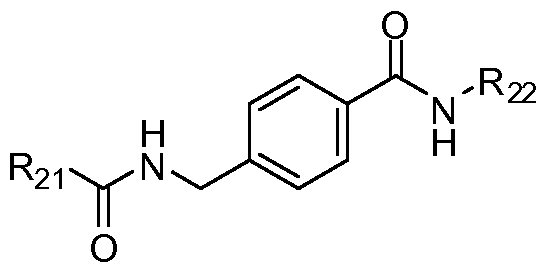
Formula II
including pharmaceutically acceptable solvates, pharmaceutically acceptable prodrugs, pharmaceutically acceptable salts and pharmaceutically acceptable stereoisomers thereof, wherein:
R21 and R22 are each independently selected from the group consisting of aryl and heteroaryl.
[0018] In certain embodiments:
R21 is selected from the group consisting of heteroarylalkoxy (e.g. wherein alkoxy is C1-C2 alkoxy, and heteroaryl is pyridinyl or benzopyrrolyl), heteroarylalkyi (e.g. wherein alkyl is C1-C2 alkyl, and heteroaryl is pyridinyl or benzopyrrolyl), and heteroaryl (e.g. pyridinyl); and
R22 is aryl (e.g. aminophenyl). In certain of these embodiments, the compounds are transcription factor modulators.
[0019] Embodiments of compounds of Formula I I include, without limitation, the compounds listed in Table 2.
Table 2. Exemplary Compounds of Formula II

[0020] In certain embodiments, the compounds disclosed herein comprise a structure of Formula V:

Formula V
including pharmaceutically acceptable solvates, pharmaceutically acceptable prodrugs, pharmaceutically acceptable salts and pharmaceutically acceptable stereoisomers thereof, wherein:
R51 and R52 are each independently selected from the group consisting of alkyl, aryl, and heteroaryl. In certain of these embodiments, the compounds are transcription factor modulators.
[0021] In certain embodiments:
R51 is heteroaryl (e.g. pyridinyl, optionally substituted with e.g. amino (e.g.
NH2) or halogen (e.g. Br)); and
R52 is aryl (e.g. phenyl, optionally substituted with e.g. amino (e.g. NH2) or halogen (e.g. Br)).
[0022] Embodiments of compounds of Formula V include, without limitation, the compound listed in Table 3.
Table 3. Exemplary Compounds of Formula V

[0023] In certain embodiments, the compounds disclosed herein comprise a structure of Formula VI:

Formula VI
including pharmaceutically acceptable solvates, pharmaceutically acceptable prodrugs, pharmaceutically acceptable salts and pharmaceutically acceptable stereoisomers thereof, wherein:
R6i and ί¾2 are independently selected from the group consisting of aryl, and heteroaryl. In certain of these embodiments, the compounds are transcription factor modulators.
[0024] In certain embodiments:
R6i is selected from the group consisting of heteroaryl (e.g. benzopyrrolyl, benzopyrrolyl substituted with halogen (e.g. Br), haloalkyi (e.g. CF3), or aryl (e.g. phenyl); and furanyl substituted with aryl (e.g. phenyl)), heteroarylalkyi (e.g. wherein alkyl is C2-alkyl, and heteroaryl is benzopyrrolyl), and heteroarylalkoxy (e.g. wherein alkoxy is Ci-alkoxy, and heteroaryl is pyridinyl); and
R62 is aryl (e.g. aminophenyl).
[0025] Embodiments of compounds of Formula VI include, without limitation, the compounds listed in Table 4.
Table 4. Exemplary Compounds of Formula VI


[0026] In certain embodiments, the compounds disclosed herein comprise a structure of Formula VII:
R71"~~L71^R72
Formula VII
including pharmaceutically acceptable solvates, pharmaceutically acceptable prodrugs, pharmaceutically acceptable salts and pharmaceutically acceptable stereoisomers thereof, wherein:
R71 and R72 are each independently selected from the group consisting of aryl, and heteroaryl; and
L71 has a structure of -L72-L73-L7 - , wherein:
-L72- and -L73- are -C(=0)-N-; and
L73 is an alkyl chain of up to 10 carbons, optionally inserted with:

In certain of these embodiments, the compounds are transcription factor modulators.
[0027] In certain embodiments:
R71 is heteroaryl (e.g. benzopyrrolyl);
R72 is aryl (e.g. aminophenyl); and

[0028] Embodiments of compounds of Formula VII include, without limitation, the compounds listed in Table 5.
Table 5. Exemplary Compounds of Formula VII

[0029] In another embodiment, the compounds disclosed herein comprise a structure of Structu

Structure I, including pharmaceutically acceptable solvates, pharmaceutically acceptable prodrugs, pharmaceutically acceptable salts and pharmaceutically acceptable stereoisomers thereof, wherein:
A and B rings are each independently selected from the group consisting of phenyl, pyridyl and N-alkylated pyridyl rings;
R1-R5 are each independently selected from the group consisting of hydrogen, halogen, and haloalkyi, wherein at least one or two of R1-R5 are halogen and/or haloalkyi;
Xi and X2 are independently selected from -NHC(=0)- or -C(=0)-NH-; and Li is -(CH2)n-, where n is 4, 5, 6, 7, or 8, where one or more -CH2- moieties are optionally replaced with one or more substituents selected from the group consisting of -0-, -S-, -C(=0)-, -S(=0)-, -S(=0)2-, -NH-C(=0)-, -C(=0)-NH-, -NR- (wherein R is hydrogen, alkyl or aryl), -C=C-, carbon-carbon triple bond, phenylene (e.g. 1 , 4-phenylene) and cyclohexylene (e.g. 1 , 4-cyclohexylene). In certain of these embodiments, the compounds are transcription factor modulators.
[0030] In certain embodiments, L-i is -(CH2)n-, where n is 4, 5, 6, 7, or 8.
[0031] In certain embodiments, -XrL X2-is -NHC(=0)-L1-C(=0)NH-.
[0032] In certain embodiments, -XrL X2-is -C(=0)-NH-L1-C(=0)NH-.
[0033] In certain embodiments, A ring is a phenyl ring, and B ring is a pyridyl ring or N-alkylated pyridyl ring.
[0034] In certain embodiments, both A and B rings are phenyl rings.
[0035] In certain embodiments, A ring is a pyridyl ring, and B ring is a phenyl ring or N-alkylated pyridyl ring.
[0036] In certain embodiments, both A and B rings are pyridyl rings.
[0037] In certain embodiments, A ring is an N-alkylated pyridyl ring, and B ring is a phenyl ring or pyridyl ring.
[0038] In certain embodiments, both A and B rings are N-alkylated pyridyl rings.
[0039] In certain embodiments, R4 and/or R5 are/is haloalkyi (e.g. trifluoromethyl).
[0040] In certain embodiments, R4 and/or R5 are/is halogen (e.g. Br).
[0041] In certain embodiments, one of R4 and R5 is haloalkyi (e.g. trifluoromethyl), and the other is halogen (e.g. Br).
[0042] In certain embodiments, R3 and/or R4 are/is haloalkyi (e.g. trifluoromethyl).
[0043] In certain embodiments, R3 and/or R4 are/is halogen (e.g. Br).
[0044] In certain embodiments, one of R3 and R4 is haloalkyi (e.g. trifluoromethyl), and the other is halogen (e.g. Br).
[0045] In another embodiment, the compounds disclosed herein comprise a
structure of Structure II:

[0046] In certain embodiments, R4 and/or R5 are/is haloalkyl (e.g. trifluoromethyl).
[0047] In certain embodiments, R and/or R5 are/is halogen (e.g. Br).
[0048] In certain embodiments, R3 and/or R4 are/is haloalkyl (e.g. trifluoromethyl).
[0049] In certain embodiments, R3 and/or R4 are/is halogen (e.g. Br).
[0050] In certain embodiments, l_i is -(CH2)n-, where n is 4, 5, 6, 7, or 8.
[0051] In certain embodiments, -X L X2- is -NHC(=0)-L1-C(=0)NH-.
[0052] In certain embodiments, -X1-L1-X2- is -C(=0)-NH-I_1-C(=0)NH-.
[0053] In another embodiment, the compounds disclosed herein comprise a structure selected from the group consisting of Structures IIIA-IIIC:

Structure IMA, Structure NIB,

Structure NIC, including pharmaceutically acceptable solvates, pharmaceutically acceptable prodrugs, pharmaceutically acceptable salts and pharmaceutically acceptable stereoisomers thereof, wherein:
A ring, R1-R5, Xi , X2, and l_i are defined the same as above; and
R7 is alkyl group having 1 -3 carbon atoms (e.g. methyl). In certain of these embodiments, the compounds are transcription factor modulators.
[0054] In certain embodiments, the N-alkylated pyridine ring of Structures II IA- IIIC may be positively charged and form a salt with one or more suitable counterions (e.g., without limitations, anions derived from pharmaceutically acceptable acids described herein, e.g. acetate, fluoroacetate or other carboxylate).
[0055] In certain embodiments, R and/or R5 are/is haloalkyl (e.g. trifluoromethyl).
[0056] In certain embodiments, R4 and/or R5 are/is halogen (e.g. Br).
[0057] In certain embodiments, one of R4 and R5 is haloalkyl (e.g. trifluoromethyl), and the other is halogen (e.g. Br).
[0058] In certain embodiments, R3 and/or R4 are/is haloalkyl (e.g. trifluoromethyl).
[0059] In certain embodiments, R3 and/or R4 are/is halogen (e.g. Br).
[0060] In certain embodiments, one of R3 and R4 is haloalkyl (e.g. trifluoromethyl), and the other is halogen (e.g. Br).
[0061] In certain embodiments, A ring is a phenyl ring.
[0062] In certain embodiments, A ring is a pyridyl ring.
[0063] In certain embodiments, A ring is an N-alkylated pyridyl ring.
[0064] In certain embodiments, L-i is -(CH2)n-, where n is 4, 5, 6, 7, or 8.
[0065] In certain embodiments, -Xi-L X2-is -NHC(=0)-Li-C(=0)NH-.
[0066] In certain embodiments, -Xi-L X2-is -C(=0)-NH-I_1-C(=0)NH-.
[0067] In another embodiment, the one or more compounds disclosed herein comprise a structure selected from the group consisting of Structures IVA-IVD:

Structure IVA Structure IVB

Structure IVC Structure IVD including pharmaceutically acceptable solvates, pharmaceutically acceptable prodrugs, pharmaceutically acceptable salts and pharmaceutically acceptable stereoisomers thereof, wherein:
B ring, R1-R5, X-i , X2, and L-i are defined the same as above; and
R6 is alkyl group having 1 -3 carbon atoms (e.g. methyl). In certain of these embodiments, the compounds are transcription factor modulators.
[0068] In certain embodiments, the N-alkylated pyridine ring of Structures IVA- IVD may be positively charged and form a salt with one or more suitable counterions (e.g., without limitations, anions derived from pharmaceutically acceptable acids described herein, acetate, fluoroacetate or other carboxylate).
[0069] In certain embodiments, R4 and/or R5 are/is haloalkyl (e.g. trifluoromethyl).
[0070] In certain embodiments, R4 and/or R5 are/is halogen (e.g. Br).
[0071] In certain embodiments, one of R4 and R5 is haloalkyl (e.g. trifluoromethyl), and the other is halogen (e.g. Br).
[0072] In certain embodiments, R3 and/or R are/is haloalkyl (e.g. trifluoromethyl).
[0073] In certain embodiments, R3 and/or R4 are/is halogen (e.g. Br).
[0074] In certain embodiments, one of R3 and R4 is haloalkyl trifluoromethyl), and the other is halogen (e.g. Br).
[0075] In certain embodiments, B ring is a phenyl ring.
[0076] In certain embodiments, B ring is a pyridyl ring.
[0077] In certain embodiments, B ring is an N-alkylated pyridyl ring.
[0078] In certain embodiments, L-i is -(CH2)n-, where n is 4, 5, 6, 7, or 8.
[0079] In certain embodiments, -XrLi-X2-is -NHC(=0)-Li-C(=0)NH-.
[0080] In certain embodiments, -XrLi-X2-is -C(=0)-NH-Li-C(=0)NH-.
[0081] In another embodiment, the compounds disclosed herein comprise a structure selected from the group consisting of Structures VA-VE:

Structure VA Structure VB

Structure VC Structure VD

Structure VE,
including pharmaceutically acceptable solvates, pharmaceutically acceptable prodrugs, pharmaceutically acceptable salts and pharmaceutically acceptable stereoisomers thereof, wherein A ring, B ring, R-1-R7, X-i, X2, and L-i are defined the same as above. In certain of these embodiments, the compounds are transcription
factor modulators.
[0082] In certain embodiments, the N-alkylated pyridine ring of Structures VA- VE may be positively charged and form a salt with one or more suitable counterions (e.g., without limitations, anions derived from pharmaceutically acceptable acids described herein, e.g. acetate, fluoroacetate or other carboxylate).
[0083] In certain embodiments, L-i is -(CH2)n-, where n is 4, 5, 6, 7, or 8.
[0084] In certain embodiments, -X l X2-\s -NHC(=0)-L1-C(=0)NH-.
[0085] In certain embodiments, -X l X2-\s -C(=0)-NH-L1-C(=0)NH-.
[0086] In another embodiment, the compounds disclosed herein comprise a structure of Structure V

Structure VI including pharmaceutically acceptable solvates, pharmaceutically acceptable prodrugs, pharmaceutically acceptable salts and pharmaceutically acceptable stereoisomers thereof, wherein n, X-i, and X2 are defined the same as above.
[0087] In certain embodiments, n is 4, 5, 6, 7, or 8.
[0088] In certain embodiments, -X (CH2)n-X2-is -NHC(=0)-(CH2)n-C(=0)NH-.
[0089] In certain embodiments, -Xi-(CH2)n-X2-is -C(=0)-NH- (CH2)n- C(=0)NH-.
[0090] In another embodiment, the compounds disclosed herein comprise a structure selected from the group consisting of Structures VIIA-VIIE:

Structure VI I A Structure VI IB

Structure VI IC Structure VI ID

Structure VI IE, including pharmaceutically acceptable solvates, pharmaceutically acceptable prodrugs, pharmaceutically acceptable salts and pharmaceutically acceptable stereoisomers thereof, wherein A ring, B ring, R1-R7, X-i , X2, and U are defined the same as above. In certain of these embodiments, the compounds are transcription factor modulators.
[0091] In certain embodiments, the N-alkylated pyridine ring of Structures VIIA-VIIE may be positively charged and form a salt with one or more suitable counterions (e.g., without limitations, anions derived from pharmaceutically acceptable acids described herein, e.g. acetate, fluoroacetate or other carboxylate).
[0092] In certain embodiments, L-i is -(CH2)n-, where n is 4, 5, 6, 7, or 8.
[0093] In certain embodiments, -X U-Xz-is -NHC(=0)-L1-C(=0)NH-.
[0094] In certain embodiments, -X U-Xz-is -C(=0)-NH-L1-C(=0)NH-.
[0095] In another embodiment, the compounds disclosed herein comprise a structure of Structur

Structure VIII
including pharmaceutically acceptable solvates, pharmaceutically acceptable prodrugs, pharmaceutically acceptable salts and pharmaceutically acceptable stereoisomers thereof, wherein n, X-i , and X2 are defined the same as above. In certain of these embodiments, the compounds are transcription factor modulators.
[0096] In certain embodiments, n is 4, 5, 6, 7, or 8.
[0097] In certain embodiments, -Xi-(CH2)n-X2-is -NHC(=0)-(CH2)n-C(=0)NH-.
[0098] In certain embodiments, -X (CH2)n-X2-is -C(=0)-NH- (CH2)n- C(=0)NH-.
[0099] As used herein, the term "alkyl" refers to a straight or branched chain hydrocarbon having 1 , 2, 3, 4, 5, 6, 7, 8, 9, 10, 1 1 , 12, 13, 14, 15, 16, 17, 18, 19 or 20 carbon atoms. Optionally, an alkyl group may contain one or more unsaturated bonds (e.g. -C=C-, and carbon-carbon triple bond).
[00100] As used herein, the term "cycloalkyl" refers to a non-aromatic cyclic hydrocarbon ring having from three to seven carbon atoms and which optionally includes an alkyl linker through which it may be attached, preferably a d-C6 alkyl linker as defined above. Such a ring may be optionally fused to one or more cycloalkyl ring(s), aryl ring(s), and/or heteroaryl ring(s). Exemplary "cycloalkyl" groups include, but are not limited to, cyclopropyl, cyclobutyl, cyclopentyl, cyclohexyl and cycloheptyl.
[00101] As used herein, the term "heterocyclic" or the term "heterocyclyl" refers to a 3, 4, 5, 6, 7, 8, 9, 10, 1 1 or 12-membered cycloalkyl ring containing one or more heteroatomic substitutions on the ring selected from S, O or N. Such a ring may be optionally fused to one or more cycloalkyl ring(s), heterocyclic ring(s), aryl ring(s), and/or heteroaryl ring(s). Examples of "heterocyclic" moieties include, but are not limited to, tetrahydrofuran, pyran, 1 ,4-dioxane, 1 ,3-dioxane, pyrrolidine, piperidine, morpholine, tetrahydrothiopyran, tetrahydrothiophene, piperazine, and the like.
[00102] As used herein, the term "aryl" refers to an aromatic cyclic hydrocarbon ring (such as phenyl ring) and which optionally includes an alkyl linker through which it may be attached, preferably a Ci-C6 alkyl linker as defined above. Such a ring may be optionally fused to one or more other aryl ring(s). Examples of "aryl" groups include, but are not limited to, phenyl, 2-naphthyl, 1 -naphthyl, biphenyl, imidazolyl as well as substituted derivatives thereof.
[00103] As used herein, the term "heteroaryl" refers to an aromatic cyclic hydrocarbon ring containing one or more heteroatomic substitutions on the ring
selected from S, O or N, and which optionally includes an alkyl linker through which it may be attached, preferably a C1-C6 alkyl linker as defined above. Such a ring may be optionally fused to one or more other aryl ring(s) and/or heteroaryl ring(s).
Examples of "heteroaryl" groups used herein include furanyl, thiophenyl, pyrrolyl, imidazolyl, pyrazolyl, triazolyl, tetrazolyl, thiazolyl, oxazolyl, isoxazolyl, oxadiazolyl, oxo-pyridyl, thiadiazolyl, isothiazolyl, pyridyl, pyridazyl, pyrazinyl, pyrimidyl, quinolinyl, isoquinolinyl, benzofuranyl, benzopyrrolyl, benzothiophenyl, indolyl, indazolyl, and substituted derivatives thereof.
[00104] As used herein, the term "halogen" or "halo" refers to fluorine (F), chlorine (CI), bromine (Br) or iodine (I).
[00105] As used herein, the term "alkoxy" refers to an alkyl group wherein one or more hydrogen and/or carbon atoms are substituted with oxygen or hydroxyl group.
[00106] As used herein, the term "aryloxy" refers to an aryl group wherein one or more hydrogen atoms are substituted with oxygen or hydroxyl group.
[00107] As used herein, the term "alkylamino" refers to an alkyl group wherein one or more hydrogen and/or carbon atoms are substituted with nitrogen or amino group.
[00108] As used herein, the term "arylamino" refers to an amino group substituted with at least an aryl or heteroaryl group on nitrogen. In certain
embodiments, the nitrogen is further substituted with one or more substituents selected from the group consisting of alkyl, cycloalkyl, heterocyclic, aryl and heteroaryl.
[00109] As used herein, the term "haloalkyl" refers to an alkyl group wherein one or more hydrogen and/or carbon atoms are substituted with halogen atom.
[00110] As used herein, the term "alkylcarbonyl" refers to R'-C(=0)-, wherein R' is an optionally substituted alkyl group.
[00111] As used herein, the term "arylcarbonyl" refers to R-C(=0)-, wherein R is an optionally substituted aryl group.
[00112] As used herein, the term "substituted" refers to substitution(s) on one or more atoms, wherein each atom may be substituted with one or more substituents described above. Further examples of substitutions include, without limitation, halogen, alkyl, alkoxy, alkylamino, haloalkyl, -CN, and alkylcarbonyl.
[001 13] Unless otherwise specified, all substituents intend to include optionally substituted substituents, i.e. further substituted or not. For example, an alkyl group may be an unsubstituted alkyl group, or a substituted alkyl group as defined supra.
[001 14] As used herein, a compound or a composition that is "pharmaceutically acceptable" is suitable for use in contact with the tissue or organ of a biological subject without excessive toxicity, irritation, allergic response, immunogenicity, or other problems or complications, commensurate with a reasonable benefit/risk ratio.
If said compound or composition is to be used with other ingredients, said compound or composition is also compatible with said other ingredients.
[001 15] As used herein, the term "solvate" refers to a complex of variable stoichiometry formed by a solute (e.g., compounds disclosed herein) and a solvent.
Such solvents for the purpose of the invention may not interfere with the biological activity of the solute. Examples of suitable solvents include, but are not limited to, water, aqueous solution (e.g. buffer), methanol, ethanol and acetic acid. Preferably, the solvent used is a pharmaceutically acceptable solvent. Examples of suitable pharmaceutically acceptable solvents include, without limitation, water, aqueous solution (e.g. buffer), ethanol and acetic acid. Most preferably, the solvent used is water or aqueous solution (e.g. buffer). Examples for suitable solvates are the mono- or dihydrates or alcoholates of the compound according to the invention.
[001 16] As used herein, pharmaceutically acceptable salts of a
compound refers to any pharmaceutically acceptable acid and/or base
additive salt of the compound (e.g., compounds disclosed herein). Suitable acids include organic and inorganic acids. Suitable bases include organic and inorganic bases. Examples of suitable inorganic acids include, but are not limited to: hydrochloric acid, hydrofluoric acid, hydrobromic acid, hydroiodic acid, sulfuric acid and boric acid. Examples of suitable organic acids include but are not limited to: acetic acid, trifluoroacetic acid, formic acid, oxalic acid, malonic acid, succinic acid, tartaric acid, maleic acid, fumaric acid,
methanesulfonic acid, trifluoromethanesulfonic acid, benzoic acid, glycolic acid, lactic acid, citric acid and mandelic acid. Examples of suitable inorganic bases include, but are not limited to: ammonia, hydroxyethylamine and
hydrazine. Examples of suitable organic bases include, but are not limited to, methylamine, ethylamine, trimethylamine, triethylamine, ethylenediamine, hydroxyethylamine, morpholine, piperazine and guanidine. The invention
further provides for the hydrates and polymorphs of all of the compounds
described herein.
[001 17] //. Compositions
[001 18] The compounds disclosed herein may contain one or more chiral atoms, or may otherwise be capable of existing as two or more stereoisomers, which are usually enantiomers and/or diastereomers. Accordingly, compositions comprising the compounds disclosed herein may include mixtures of stereoisomers or mixtures of enantiomers, as well as purified stereoisomers, purified enantiomers, stereoisomerically enriched mixtures, or enantiomerically enriched mixtures. The composition provided herein also include the individual isomers of the compound represented by the structures described above as well as any wholly or partially equilibrated mixtures thereof. The compositions disclosed herein also cover the individual isomers of the compound represented by the structures described above as mixtures with isomers thereof in which one or more chiral centers are inverted. Also, it is understood that all tautomers and mixtures of tautomers of the structures described above are included within the scope of the structures and preferably the structures corresponding thereto.
[001 19] Racemates obtained can be resolved into the isomers mechanically or chemically by methods known per se. Diastereomers are preferably formed from the racemic mixture by reaction with an optically active resolving agent. Examples of suitable resolving agents are optically active acids, such as the D and L forms of tartaric acid, diacetyltartaric acid, dibenzoyltartaric acid, mandelic acid, malic acid, lactic acid or the various optically active camphorsulfonic acids, such as
camphorsulfonic acid. Also advantageous is enantiomer resolution with the aid of a column filled with an optically active resolving agent. The diastereomer resolution can also be carried out by standard purification processes, such as, for example, chromatography or fractional crystallization.
[00120] It is also possible to obtain optically active compounds comprising the structure of the transcription factor modulators disclosed herein by the methods described above by using starting materials which are already optically active.
[00121] ///. Pharmaceutical formulations
[00122] As used herein, a pharmaceutical formulation comprises a
therapeutically effective amount of one or more of the compounds or compositions thereof disclosed herein. In certain embodiments, the pharmaceutical formulation
further comprises a pharmaceutically acceptable carrier.
[00123] As used herein, a "therapeutically effective amount," "therapeutically effective concentration" or "therapeutically effective dose" is an amount which, as compared to a corresponding subject who has not received such amount, results in improved treatment, healing, prevention, or amelioration of a disease, disorder, or side effect, or a decrease in the rate of advancement of a disease or disorder.
[00124] This amount will vary depending upon a variety of factors, including but not limited to the characteristics of the compounds, compositions, or pharmaceutical formulations thereof (including activity, pharmacokinetics, pharmacodynamics, and bioavailability thereof), the physiological condition of the subject treated (including age, sex, disease type and stage, general physical condition, responsiveness to a given dosage, and type of medication) or cells, the nature of the pharmaceutically acceptable carrier or carriers in the formulation, and the route of administration. Further, an effective or therapeutically effective amount may vary depending on whether the compound, composition, or pharmaceutical formulation thereof is administered alone or in combination with other drug(s), other therapy/therapies or other therapeutic method(s) or modality/modalities. One skilled in the clinical and pharmacological arts will be able to determine an effective amount or therapeutically effective amount through routine experimentation, namely by monitoring a cell's or subject's response to administration of the one or more compounds, compositions, or pharmaceutical formulations thereof and adjusting the dosage accordingly. A typical dosage may range from about 0.1 mg/kg to about 100 mg/kg or more, depending on the factors mentioned above. In other embodiments, the dosage may range from about 0.1 mg/kg to about 100 mg/kg; or about 1 mg/kg to about 100 mg/kg; or about 5 mg/kg up to about 100 mg/kg. For additional guidance, see Remington: The Science and Practice of Pharmacy, 21 st Edition, Univ. of Sciences in Philadelphia (USIP), Lippincott Williams & Wilkins, Philadelphia, PA, 2005, which is hereby incorporated by reference as if fully set forth herein for additional guidance for determining a therapeutically effective amount.
[00125] As used herein, the term "about" refers to ±10%, ±5%, or ±1 %, of the value following "about."
[00126] A "pharmaceutically acceptable carrier" is a pharmaceutically- acceptable material, composition or vehicle, such as a liquid or solid filler, diluent, excipient, solvent or encapsulating material, involved in carrying or transporting an
active ingredient from one location, body fluid, tissue, organ (interior or exterior), or portion of the body, to another location, body fluid, tissue, organ, or portion of the body. Each carrier is "pharmaceutically acceptable" in the sense of being compatible with the other ingredients, e.g., the transcription factor modulators described herein or other ingredients, of the formulation and suitable for use in contact with the tissue or organ of a biological subject without excessive toxicity, irritation, allergic response, immunogenicity, or other problems or complications, commensurate with a reasonable benefit/risk ratio.
[00127] Pharmaceutically acceptable carriers are well known in the art and include, without limitation, (1 ) sugars, such as lactose, glucose and sucrose; (2) starches, such as corn starch and potato starch; (3) cellulose, and its derivatives, such as sodium carboxymethyl cellulose, ethyl cellulose and cellulose acetate; (4) powdered tragacanth; (5) malt; (6) gelatin; (7) talc; (8) excipients, such as cocoa butter and suppository waxes; (9) oils, such as peanut oil, cottonseed oil, safflower oil, sesame oil, olive oil, corn oil and soybean oil; (10) glycols, such as propylene glycol; (1 1 ) polyols, such as glycerin, sorbitol, mannitol and polyethylene glycol; (12) esters, such as ethyl oleate and ethyl laurate; (13) agar; (14) buffering agents, such as magnesium hydroxide and aluminum hydroxide; (15) alginic acid; (16) pyrogen- free water; (17) isotonic saline; (18) Ringer's solution; (19) alcohol, such as ethyl alcohol and propane alcohol; (20) phosphate buffer solutions; and (21 ) other nontoxic compatible substances employed in pharmaceutical formulations.
[00128] The pharmaceutical formulations disclosed herein may contain pharmaceutically acceptable auxiliary substances as required to approximate physiological conditions such as pH adjusting and buffering agents, toxicity adjusting agents and the like, for example, sodium acetate, sodium chloride, potassium chloride, calcium chloride, sodium lactate and the like.
[00129] The concentration of the one or more compounds disclosed herein in a pharmaceutical formulation can vary widely, and will be selected primarily based on fluid volumes, viscosities, body weight and the like in accordance with the particular mode of administration selected and the biological subject's needs. For example, the concentration of the compounds disclosed herein can be about 0.0001 % to about 100%, about 0.001 % to about 50%, about 0.01 % to about 30%, about 0.1 % to about 20%, about 1 % to about 10% wt.
[00130] A suitable pharmaceutically acceptable carrier may be selected taking
into account the chosen mode of administration, and the physical and chemical properties of the compounds.
[00131] One skilled in the art will recognize that a pharmaceutical formulation containing the one or more compounds disclosed herein or compositions thereof can be administered to a subject by various routes including, without limitation, orally or parenterally, such as intravenously. The composition may also be administered through subcutaneous injection, subcutaneous embedding, intragastric, topical, and/or vaginal administration. The composition may also be administered by injection or intubation.
[00132] In one embodiment, the pharmaceutical carrier may be a liquid and the pharmaceutical formulation would be in the form of a solution. In another
embodiment, the pharmaceutically acceptable carrier is a solid and the
pharmaceutical formulation is in the form of a powder, tablet, pill, or capsules. In another embodiment, the pharmaceutical carrier is a gel and the pharmaceutical formulation is in the form of a suppository or cream.
[00133] A solid carrier can include one or more substances which may also act as flavoring agents, lubricants, solubilizers, suspending agents, fillers, glidants, compression aids, binders or table-disintegrating agents, it can also be an encapsulating material. In powders, the carrier is a finely divided solid that is in admixture with the finely divided active ingredient. In tablets, the active-ingredient is mixed with a carrier having the necessary compression properties in suitable proportions and compacted in the shape and size desired. The powders and tablets preferably contain up to about 99% of the one or more transcription factor modulators disclosed herein. Suitable solid carriers include, for example, calcium phosphate, magnesium stearate, talc, sugars, lactose, dextrin, starch, gelatin, cellulose, polyvinylpyrrolidine, low melting waxes and ion exchange resins.
[00134] Besides containing an effective amount of the one or more compounds described herein or compositions thereof, the pharmaceutical formulations provided herein may also include suitable diluents, preservatives, solubilizers, emulsifiers, adjuvant and/or carriers.
[00135] The pharmaceutical formulation can be administered in the form of a sterile solution or suspension containing other solutes or suspending agents, for example, enough saline or glucose to make the solution isotonic, bile salts, acacia, gelatin, sorbitan monoleate, polysorbate 80 (oleate esters of sorbitol and its
anhydrides copolymerized with ethylene oxide) and the like.
[00136] Additional pharmaceutical formulations will be evident to those skilled in the art, including formulations involving binding agent molecules in sustained- or controlled-delivery formulations. Techniques for formulating a variety of other sustained- or controlled-delivery means, such as liposome carriers, bio-erodible microparticles or porous beads and depot injections, are also known to those skilled in the art. See, for example, PCT/US93/0082948 which is incorporated herein by reference as if fully set forth herein for the techniques of controlled release of porous polymeric microparticles for the delivery of pharmaceutical formulations. Additional examples of sustained-release preparations include semipermeable polymer matrices in the form of shaped articles, e.g. films, or microcapsules. Sustained release matrices may include polyesters, hydrogels, polylactides, copolymers of L- glutamic acid and gamma ethyl-L-glutamate, poly (2-hydroxyethyl-methacrylate), ethylene vinyl acetate or poly-D (-)-3-hydroxybutyric acid. Sustained-release compositions also include liposomes, which can be prepared by any of several methods known in the art.
[00137] IV. Methods of treatment
[00138] One aspect of the present disclosure relates to methods of treating a cancer or a tumor in a subject comprising administering to the subject a therapeutically effective amount of one or more compounds, compositions, or pharmaceutical formulations disclosed herein.
[00139] Optimal dosages to be administered may be determined by those skilled in the art, and will vary with the particular compound, composition, or formulation being used, the strength of the preparation, the mode of administration, and the advancement of the disease condition. Additional factors depending on the particular subject being treated, include, without limitation, subject age, weight, gender, diet, time of administration, time and frequency of administration, drug combination(s), reaction sensitivities, and response to therapy. Administration of the compound, composition, or pharmaceutical formulation may be effected continuously or intermittently. In any treatment regimen, the compound, composition, or pharmaceutical formulation may be administered to a subject either singly or in a cocktail containing two or more compounds or compositions thereof, other therapeutic agents, compositions, or the like, including, but not limited to, tolerance- inducing agents, potentiators and side-effect relieving agents. All of these agents
are administered in generally-accepted efficacious dose ranges such as those disclosed in the Physician's Desk Reference, 41 st Ed., Publisher Edward R.
Barnhart, N.J. (1987), which is herein incorporated by reference as if fully set forth herein. In certain embodiments, an appropriate dosage level will generally be about 0.001 to about 50 mg per kg subject body weight per day that can be administered in single or multiple doses. Preferably, the dosage level will be about 0.005 to about 25 mg/kg, per day; more preferably about 0.01 to about 10 mg/kg per day; and even more preferably about 0.05 to about 1 mg/kg per day. In some embodiments, the daily dosage may be between about 10"6 g/kg to about 5 g/kg of body weight.
[00140] "Treating" or "treatment" of a condition may refer to preventing the condition, slowing the onset or rate of development of the condition, reducing the risk of developing the condition, preventing or delaying the development of symptoms associated with the condition, reducing or ending symptoms associated with the condition, generating a complete or partial regression of the condition, or some combination thereof. With regard to cancer specifically, "treating" or "treatment" may refer to reducing the size or number of tumors, slowing or preventing tumor growth, reducing or preventing malignancy of a tumor, lowering a tumor grade or preventing an increase in tumor grade.
[00141] In some embodiments, the one or more compounds disclosed herein or compositions or pharmaceutical formulations thereof may be administered in combination with one or more additional therapeutic agents for the treatment of cancer. "In combination" or "in combination with," as used herein, means in the course of treating the same cancer in the same subject using two or more agents, drugs, treatment regimens, treatment modalities or a combination thereof, in any order. This includes simultaneous administration (in the same or separate
formulations), as well as administration in a temporally spaced order of up to several days apart. Such combination treatment may also include more than a single administration of any one or more of the agents, drugs, treatment regimens or treatment modalities. Further, the administration of the two or more agents, drugs, treatment regimens, treatment modalities or a combination thereof may be by the same or different routes of administration.
[00142] Examples of therapeutic agents that may be administered in
combination with the compounds disclosed herein or compositions or pharmaceutical formulations thereof include, but are not limited to, anti-cancer agents and
radioisotopes. The therapeutic agent may also include a metal, metal alloy, intermetallic or core-shell nanoparticle bound to a chelator that acts as a
radiosensitizer to render the targeted cells more sensitive to radiation therapy as compared to healthy cells.
[00143] In one embodiment, the therapeutic agent is an anti-cancer agent.
Anti-cancer agents that may be used in accordance with certain embodiments described herein are often cytotoxic or cytostatic in nature and may include, but are not limited to, alkylating agents; antimetabolites; anti-tumor antibiotics;
topoisomerase inhibitors; mitotic inhibitors; hormones (e.g., corticosteroids); targeted therapeutics (e.g., selective estrogen receptor modulators (SERMs)); toxins; immune adjuvants, immunomodulators, and other immunotherapeutics (e.g., therapeutic antibodies and fragments thereof, recombinant cytokines and immunostimulatory molecules - synthetic or from whole microbes or microbial components); enzymes
(e.g., enzymes to cleave prodrugs to a cytotoxic agent at the site of the tumor);
nucleases; antisense oligonucleotides; nucleic acid molecules (e.g., mRNA molecules, cDNA molecules or RNAi molecules such as siRNA or shRNA);
chelators; boron compounds; photoactive agents and dyes. Examples of anti-cancer agents that may be used as therapeutic agents in accordance with certain
embodiments of the disclosure include, but are not limited to, 13-cis-retinoic acid, 2- chlorodeoxyadenosine, 5-azacitidine, 5-fluorouracil, 6-mercaptopurine, 6- thioguanine, actinomycin-D, adriamycin, aldesleukin, alitretinoin, all-transretinoic acid, alpha interferon, altretamine, amethopterin, amifostine, anagrelide, anastrozole, arabinosylcytosine, arsenic trioxide, amsacrine, aminocamptothecin,
aminoglutethimide, asparaginase, azacytidine, bacillus calmette-guerin (BCG), bendamustine, bexarotene, bicalutamide, bortezomib, bleomycin, busulfan, calcium leucovorin, citrovorum factor, capecitabine, canertinib, carboplatin, carmustine, chlorambucil, cisplatin, cladribine, cortisone, cyclophosphamide, cytarabine, darbepoetin alfa, dasatinib, daunomycin, decitabine, denileukin diftitox,
dexamethasone, dexasone, dexrazoxane, dactinomycin, daunorubicin, decarbazine, docetaxel, doxorubicin, doxifluridine, eniluracil, epirubicin, epoetin alfa, erlotinib, everolimus, exemestane, estramustine, etoposide, filgrastim, fluoxymesterone, fulvestrant, flavopiridol, floxuridine, fludarabine, fluorouracil, flutamide, gefitinib, gemcitabine, ozogamicin, goserelin, granulocyte - colony stimulating factor, granulocyte macrophage-colony stimulating factor, hexamethylmelamine,
hydrocortisone hydroxyurea, interferon alpha, interleukin - 2, interleukin-1 1 , isotretinoin, ixabepilone, idarubicin, imatinib mesylate, ifosfamide, irinotecan, lapatinib, lenalidomide, letrozole, leucovorin, leuprolide, liposomal Ara-C, lomustine, mechlorethamine, megestrol, melphalan, mercaptopurine, mesna, methotrexate, methylprednisolone, mitomycin C, mitotane, mitoxantrone, nelarabine, nilutamide, octreotide, oprelvekin, oxaliplatin, paclitaxel, pamidronate, pemetrexed, PEG
Interferon, pegaspargase, pegfilgrastim, PEG-L-asparaginase, pentostatin, plicamycin, prednisolone, prednisone, procarbazine, raloxifene, romiplostim, ralitrexed, sapacitabine, sargramostim, satraplatin, sorafenib, sunitinib, semustine, streptozocin, tamoxifen, tegafur, tegafur-uracil, temsirolimus, temozolamide, teniposide, thalidomide, thioguanine, thiotepa, topotecan, toremifene, tretinoin, trimitrexate, alrubicin, vincristine, vinblastine, vindestine, vinorelbine, vorinostat, and zoledronic acid.
[00144] Therapeutic antibodies and functional fragments thereof, that may be used as anti-cancer agents in accordance with certain embodiments of the disclosure include, but are not limited to, alemtuzumab, bevacizumab, cetuximab, edrecolomab, gemtuzumab, ibritumomab tiuxetan, panitumumab, rituximab, tositumomab, and trastuzumab and other antibodies associated with specific diseases listed herein.
[00145] Toxins that may be used as anti-cancer agents in accordance with certain embodiments of the disclosure include, but are not limited to, ricin, abrin, ribonuclease (RNase), DNase I, Staphylococcal enterotoxin-A, pokeweed antiviral protein, gelonin, diphtheria toxin, Pseudomonas exotoxin, and Pseudomonas endotoxin.
[00146] Radioisotopes that may be used as therapeutic agents in accordance with certain embodiments of the disclosure include, but are not limited to, 32P, 89Sr,
90Y, 99mTc, "Mo, 1311, 153Sm, 177Lu, 186Re, 213Bi, 223Ra and 225Ac.
[00147] The frequency of dosing will depend upon the pharmacokinetic parameters of the therapeutic agents in the pharmaceutical formulation (e.g. the one or more compounds disclosed herein) used. Typically, a pharmaceutical formulation is administered until a dosage is reached that achieves the desired effect. The formulation may therefore be administered as a single dose, or as multiple doses (at the same or different concentrations/dosages) over time, or as a continuous infusion.
Further refinement of the appropriate dosage is routinely made. Appropriate
dosages may be ascertained through use of appropriate dose-response data. Long- acting pharmaceutical formulations may be administered every 3 to 4 days, every week, or biweekly depending on the half-life and clearance rate of the particular formulation.
[00148] In certain embodiments, the one or more compounds disclosed herein or compositions or pharmaceutical formulations thereof may be administered in combination with a therapeutic agent or radiotherapy. In some embodiments, the one or more compounds or compositions or pharmaceutical formulations thereof may be used in combination with imatinib (Gleevec), and in certain cancers being treated. In some of these embodiments the cancer being treated is leukemia. In certain embodiments, the type of leukemia may include, but is not limited to, acute myelogenous leukemia (AML), acute promyelocytic leukemia (APL), acute lymphoblastic leukemia (ALL), chronic myelogenous leukemia (CML), CML (imatinib resistant), multiple myeloma, B-cell myelomonocytic leukemia, T-cell
myelomonocytic leukemia, biphenotypic B-cell leukemia, and/or lymphoma. In certain of these embodiments, the type of leukemia may be treatable by a compound disclosed herein, including but not limited to YT30.
[00149] In certain embodiments, the cancer is breast cancer, central nervous system cancer, colon cancer, prostate cancer, lung cancer, leukemia, renal cancer, ovarian cancer, melanoma, liver cancer, and/or cervical cancer.
[00150] In certain embodiments, the cancer is leukemia. In certain of these embodiments, the type of leukemia may include, but is not limited to, acute myelogenous leukemia (AML), acute promyelocytic leukemia (APL), acute lymphoblastic leukemia (ALL), chronic myelogenous leukemia (CML), CML (imatinib resistant), multiple myeloma, B-cell myelomonocytic leukemia, T-cell
myelomonocytic leukemia, biphenotypic B-cell leukemia, and/or lymphoma. In certain embodiments, the ALL is T-cell ALL and/or B-cell ALL. In certain
embodiments, the leukemia may be treatable by one or more compounds selected from the group consisting of YT29, YT30, YT45, YT46, YT51 , YT53, YT54, YT58,
YT61 -YT63, YT65, YT67, YT68, YT73, YT74, YT76-YT80, YT86, YT88, YT91 ,
YT99, YT108-YT1 10, YT1 16-YT1 18, YT121 ~YT123, YT127, YT128, YT131 ,
YT132, and YT134-YT139. In certain embodiments, the leukemia may be treatable by one or more compounds comprising a structure selected from the group consisting of Formula I, Formula II, Formula V, Formula VI, Formula VII, Structure I,
Structure II, Structure IMA, Structure 1MB, Structure NIC, Structure IVA, Structure IVB, Structure IVC, Structure IVD, Structure VA, Structure VB, Structure VC, Structure VD, Structure VE, Structure VI, Structure VIIA, Structure VIIB, Structure VIIC, Structure VIID, Structure VIIE, and Structure VIII. In certain of these embodiments, the leukemia is ALL.
[00151] In certain embodiments, the cancer is breast cancer. In certain of these embodiments, the type of breast cancer may be metastatic adenocarcinoma, infiltrating ductal carcinoma, papillary infiltrating ductal carcinoma, and/or metastatic mammary gland carcinosarcoma. In certain embodiments, the breast cancer may be treatable by one or more compounds selected from the group consisting of YT30, YT86, YT88, and YT128. In certain embodiments, the breast cancer may be treatable by one or more compounds comprising a structure selected from the group consisting of Formula I, Formula VI, Formula VII, Structure I, Structure II, Structure IMA, Structure NIB, Structure NIC, Structure IVA, Structure IVB, Structure IVC, Structure IVD, Structure VA, Structure VB, Structure VC, Structure VD, Structure VE, and Structure VI.
[00152] In certain embodiments, the cancer is central nervous system cancer.
In certain of these embodiments, the type of central nervous system cancer is glioblastoma, astrocytoma, and/or glial cell neoplasm. In certain embodiments, the central nervous system cancer may be treatable by one or more compounds selected from the group consisting of YT30, YT86, YT88, and YT128. In certain embodiments, the central nervous system cancer may be treatable by one or more compounds comprising a structure selected from the group consisting of Formula I,
Formula VI, Formula VII, Structure I, Structure II, Structure IIIA, Structure 1 MB,
Structure N IC, Structure IVA, Structure IVB, Structure IVC, Structure IVD, Structure
VA, Structure VB, Structure VC, Structure VD, Structure VE, and Structure VI.
[00153] In certain embodiments, the cancer is colon cancer. In certain of these embodiments, the colon cancer may be treatable by a compound including, but not limited to, YT30. In certain of these embodiments, the colon cancer may be treatable by one or more compounds comprising a structure selected from the group consisting of Formula I, Structure I, Structure II, Structure IIIA, Structure NIB,
Structure N IC, Structure IVA, Structure IVB, Structure IVC, Structure IVD, Structure
VA, Structure VB, Structure VC, Structure VD, Structure VE, and Structure VI.
[00154] In certain embodiments, the cancer is cervical cancer. In certain of
these embodiments, the type of cervical cancer may be positive for human papilloma virus (HPV) 16 and/or HPV 18. In certain of these embodiments, the cervical cancer may be treatable by one or more compounds selected from the group consisting of YT30, YT86, YT88, and YT128. In certain embodiments, the cervical cancer may be treatable by one or more compounds comprising a structure selected from the group consisting of Formula I, Formula VI, Formula VII, Structure I, Structure II, Structure MA, Structure N IB, Structure NIC, Structure IVA, Structure IVB, Structure IVC, Structure IVD, Structure VA, Structure VB, Structure VC, Structure VD, Structure VE, and Structure VI.
[00155] In certain embodiments, the cancer is ovarian cancer. In certain of these embodiments, the ovarian cancer may be treatable by one or more
compounds selected from the group consisting of YT30, YT86, YT88, and YT128. In certain embodiments, the ovarian cancer may be treatable by one or more compounds comprising a structure selected from the group consisting of Formula I, Formula VI, Formula VII, Structure I, Structure II, Structure MA, Structure MB, Structure NIC, Structure IVA, Structure IVB, Structure IVC, Structure IVD, Structure VA, Structure VB, Structure VC, Structure VD, Structure VE, and Structure VI.
[00156] In certain embodiments, the cancer is prostate cancer. In certain of these embodiments, the prostate cancer may be treatable by one or more
compounds selected from the group consisting of YT30 and YT88. In certain embodiments, the prostate cancer may be treatable by one or more compounds comprising a structure selected from the group consisting of Formula I, Formula VI, Structure I, Structure II, Structure MA, Structure MB, Structure NIC, Structure IVA, Structure IVB, Structure IVC, Structure IVD, Structure VA, Structure VB, Structure VC, Structure VD, Structure VE, and Structure VI.
[00157] In certain embodiments, the cancer is renal cancer. In certain of these embodiments, the renal cancer may be clear cell carcinoma metastasis, renal cell carcinoma, renal spindle cell carcinoma and/or hypernephroma. In certain embodiments, the renal cancer may be treatable by one or more compounds selected from the group consisting of YT30, YT86, YT88, and YT128. In certain embodiments, the renal cancer may be treatable by one or more compounds comprising a structure selected from the group consisting of Formula I, Formula VI,
Formula VI I, Structure I, Structure II, Structure MA, Structure MB, Structure NIC,
Structure IVA, Structure IVB, Structure IVC, Structure IVD, Structure VA, Structure
VB, Structure VC, Structure VD, Structure VE, and Structure VI.
[00158] In certain embodiments, the cancer is lung cancer. In certain of these embodiments, the lung cancer may be non-small cell lung cancer (NSCLC), large cell carcinoma, squamous cell carcinoma, and /or adenocarcinoma. In certain embodiments, the lung cancer may be treatable by one or more compounds selected from the group consisting of YT30, YT86, and YT128. In certain embodiments, the lung cancer may be treatable by one or more compounds comprising a structure selected from the group consisting of Formula I, Formula VI, Formula VII, Structure I, Structure II, Structure MA, Structure NIB, Structure NIC, Structure IVA, Structure IVB, Structure IVC, Structure IVD, Structure VA, Structure VB, Structure VC, Structure VD, Structure VE, and Structure VI.
[00159] In certain embodiments, the cancer is melanoma. In certain of these embodiments, the type of melanoma may be malignant amelanotic melanoma and/or melanotic melanoma. In certain embodiments, the melanoma may be treatable by a transcription factor modulator including, but not limited to, YT30. In certain
embodiments, when the cancer is melanoma, the melanoma may be treatable by one or more transcription factor modulators comprising a structure selected from the group consisting of Formula I, Structure I, Structure II, Structure MA, Structure MB, Structure N IC, Structure IVA, Structure IVB, Structure IVC, Structure IVD, Structure VA, Structure VB, Structure VC, Structure VD, Structure VE, and Structure VI.
[00160] In some embodiments, specific compounds disclosed herein may be preferred for the treatment of specific cancer types. Table 6 provides a non-limiting list of specific cancer types that can be treated by specific compounds provided herein. In other embodiments, the cancer types listed in Table 6 may be treatable by one or more compounds other than those listed in the table, and one or more compounds listed in Table 6 may be used to treat types of cancer other than those listed.
Table 6: Cancers Treatable by One or More Compounds Disclosed Herein
Compound Cancer Treated
YT29 leukemia (ALL)
YT30 Breast cancer (mammary
Structure I, gland adenocarcinoma);
Formula I Structure II, central nervous system
Structure MA, (glioblastoma, glial cell
Structure MB, neoplasm); colon cancer;
Structure NIC, prostate cancer; lung cancer
Structure IVA, (non-small cell lung cancer
Structure IVB, (NSCLC), squamous cell Structure IVC, carcinoma, large cell
Structure IVD, carcinoma); leukemia (AML,
Structure VA, APL, CML, CML (imatinib
Structure VB, resistant), multiple myeloma, T- Structure VC, cell ALL), B-cell ALL(B), B-cell Structure VD, myelomonocytic, lymphoma, Structure VE, myeloma); renal cancer (renal Structure VI cell carcinoma, renal spindle cell carcinoma, clear cell carcinoma); ovarian cancer; melanoma (malignant amelanotic melanoma); liver cancer; cervical cancer (HPV 18 and/or 16 positive)
YT45 leukemia (ALL)
YT46 leukemia (ALL)
YT99 leukemia (ALL)
YT108 leukemia (ALL)
YT53 leukemia (ALL)
YT54
Structure I,
Structure II,
Structure MA,
Structure NIB,
Structure N IC,
Structure IVA,
Structure IVB,
leukemia (ALL) Structure IVC,
Structure IVD,
Structure VI I A,
Structure VIIB,
Structure VI IC,
Structure VIID,
Formula 1 Structure VIIE,
Structure VI II
YT58 leukemia (ALL)
YT61 leukemia (ALL)
YT62 leukemia (ALL)
YT63 leukemia (ALL)
YT65 leukemia (ALL)
YT67 leukemia (ALL)
YT68 leukemia (ALL)
YT73 leukemia (ALL)
YT74 leukemia (ALL)
YT76 leukemia (ALL)
YT77 leukemia (ALL)
YT78 leukemia (ALL)
YT79 leukemia (ALL)
YT80 leukemia (ALL)
YT1 16 leukemia (ALL)
YT134 leukemia (ALL)
YT135 leukemia (ALL)
YT138 leukemia (ALL)
YT139 leukemia (ALL)
YT91 leukemia (ALL)
YT1 18 leukemia (ALL)
Formula II
YT121 leukemia (ALL)
YT123 leukemia (ALL)
YT51 leukemia (ALL)
YT132 leukemia (ALL)
Formula V
YT136 leukemia (ALL)
YT137 leukemia (ALL)
breast cancer
(adenocarcinoma, mammary gland carcinoma, infiltrating ductal carcinoma, papillary infiltrating ductal carcinoma); central nervous system (glioblastoma, glial cell neoplasm); cervical cancer
Formula VI YT86 (HPV 18 and/or 16 positive) ;
lung cancer (non-small cell lung cancer (NSCLC)); leukemia (AML, APL, CML, T- cell ALL, B-cell ALL, lymphoma); renal cancer (renal spindle cell carcinoma, renal cell carcinoma); ovarian cancer
breast cancer
(adenocarcinoma, mammary gland carcinoma, infiltrating ductal carcinoma, papillary infiltrating ductal carcinoma); central nervous system (glioblastoma, astrocytoma, glial cell neoplasm); cervical
YT88
cancer (HPV 18 and/or 16 positive); prostate cancer;
Formula VI leukemia (AML, APL, CML, T- cell ALL, B-cell ALL, lymphoma); renal cancer (renal spindle cell carcinoma, renal cell carcinoma); ovarian cancer
YT109 leukemia (ALL)
YT1 10 leukemia (ALL)
YT1 17 leukemia (ALL)
YT127 leukemia (ALL)
YT131 leukemia (ALL)
YT122 leukemia (ALL)
Formula VII breast cancer
YT128
(adenocarcinoma, mammary
gland carcinoma, infiltrating
ductal carcinoma, papillary infiltrating ductal carcinoma);
central nervous system
(glioblastoma, glial cell neoplasm); cervical cancer
(HPV 18 and/or 16 positive);
lung cancer (non-small cell lung cancer (NSCLC);
leukemia (AML, APL, CML, ALL); renal cancer (renal spindle cell carcinoma, renal cell carcinoma); ovarian
cancer
[00161] Another aspect of the present disclosure relates to the use of one or more compounds disclosed herein or compositions or pharmaceutical formulations thereof in the manufacture of a medicament for the treatment of cancer. For this aspect, the compounds, compositions, and formulations are the same as disclosed above, and the treatment of cancer is the same as described supra.
[00162] Another aspect described herein relates to a method of treating a condition regulatable by a transcription factor and/or cofactor comprising
administering to the subject a therapeutically effective amount of one or more compounds disclosed herein or compositions or pharmaceutical formulations thereof. In some embodiments, the condition is a disease related to dysfunction of a transcription factor and/or cofactor. In certain of these embodiments, the
compounds provided herein are transcription factor modulators. In certain
embodiments, the transcription factor is selected from the group consisting of forkhead box protein P3 (FOXP3) and myocyte enhancer factor 2 (MEF2). In certain embodiments, the transcription factor modulators binds to a highly conserved hydrophobic groove on the MADS-box of MEF2. In certain embodiments, the condition is a cancer as described above, and the suitable compounds,
compositions, or pharmaceutical formulations are the same as disclosed herein.
[00163] In certain embodiments where the compounds provided herein are transcription factor modulators, the compounds may selectively bind a transcription factor or cofactor.
[00164] In certain embodiments where the compounds provided herein are transcription factor modulators, the compounds may modulate the function of
transcription factors that are associated with certain diseases. In certain
embodiments, the diseases are cancers as described herein.
[00165] In certain embodiments where the compounds provided herein are transcription factor modulators, the compounds may directly bind the transcription factor and modulate its interaction with transcription cofactors such as transcription co-activators and co-repressors. In certain embodiments, the transcription cofactor is selected from the group consisting of calcineurin binding protein 1 , histone deacetylases (HDACs), E1 A binding protein P300, CREB binding protein,
extracellular signal-regulated kinase 5, myoblast differentiation protein, Smad protein, nuclear factor of activated T cell, myocardin, and positive transcription elongation factor b. In some embodiments, the transcription cofactor is a Class I la HDAC.
[00166] Another aspect of the present disclosure relates to the use of one or more compounds disclosed herein or compositions or pharmaceutical formulations thereof in the manufacture of a medicament for the treatment of a condition regulatable by a transcription factor and/or cofactor. For this aspect, the one or more compounds or compositions or pharmaceutical formulations thereof, the transcription factors and/or cofactors, and the conditions regulatable by the transcription factor and/or cofactor are the same as disclosed above, and the treatment of the condition is the same as described supra.
[00167] The following examples are intended to illustrate various embodiments of the invention. As such, the specific embodiments discussed are not to be construed as limitations on the scope of the invention. It will be apparent to one skilled in the art that various equivalents, changes, and modifications may be made without departing from the scope of invention, and it is understood that such equivalent embodiments are to be included herein. Further, all references cited in the disclosure are hereby incorporated by reference in their entireties, as if fully set forth herein.
EXAMPLES
Example 1 : Effect of compounds on the growth of a variety of leukemia cell lines.
Methods
[00168] Treatment of cells. Various human leukemia cells were grown to the logarithmic growth phase and seeded into 24-well plates. Plated cells were
incubated at 37°C in a 5% C02 humidified incubator for 24 hours and treated with various concentrations of YT30 or other compounds disclosed herein. Treated cells were further incubated for 72 hours and then were examined for cell proliferation. Cell proliferation was determined using the CellTiter-Glo Luminescence Cell Viability assay (Promega Corporation, Madison, Wl) according to the manufacturer's protocol. The calculated inhibition rate was determined with the following formula: Inhibition rate (%) = (1 -Luminescence of experimental group/Luminescence of control group) X 100. IC50 is the calculated concentration of a compound needed to inhibit half of the maximum cell growth (equivalent to cell growth in control group) based on the corresponding dose-response curve under the described experimental conditions.
Results
[00169] YT30 inhibits cell proliferation of numerous leukemia cell lines. Table 7 provides the YT30 IC50 (μΜ) concentrations for inhibiting various leukemia cell lines. YT30 inhibited the proliferation of all leukemia cell lines tested. The strongest YT30 cell growth inhibition was observed in the Jurkat, HL60, RS4, MOLT-4, and SEM leukemia cells under the described experimental conditions.
Table 7. YT30 inhibits cell growth of various leukemia cell lines
Cell lines Leukemia sub-type IC50 (μΜ)
HL60 AM L (subtype APL) 1 .04
K-562 CML 1 .82
K562R CML (Gleevec resistant) 3.21
U266 Multiple myeloma 8.29
RPMI-8226 Multiple myeloma 2
MOLT-4 ALL (T-cell) 1 .13
Jurkat ALL (T-cell) 0.91
NALM-6 ALL (B-cell) 2.36
RCH-ACV ALL (B-cell) 0.79
RS4;11 ALL (B-cell) 1 .05
SEM ALL (B-cell) 1 .15
B-myelomonocytic
MV4-11 4.06
(Biphenotypic B-cell leukemia)
BaF3 BCR-ABL Mouse cell line with BCR-ABL 3.40
Mouse cell line with BCR-ABL
BaF3 BCR-ABL
with T315I point mutation 1 .11
T315I
(Gleevec resistant)
SR Lymphoma 6.89
CCRF-CEM ALL (T-cell) 1 .53
[00170] Figure 1 shows that treatment of REH, HL60, and Nalm-6 leukemia cells with 4 μΜ of YT30 was sufficient to significantly inhibit cell growth. In contrast, treatment of the same cells with 4 μΜ of the inactive YT19 failed to inhibit cell growth. The structure of the inactive YT19 compound is:

[00171] YT30, YT54, and other compounds inhibited the growth of the Nalm-6 leukemia cell line. Table 8 displays the survival percentage of Nalm-6 leukemia cells that were treated with YT30, YT54, and numerous other compounds.
Table 8. YT30, YT54 and other compounds inhibit the growth of Nalm-6 leukemia cells


Example 2: Compound YT30 significantly inhibited disease progression in BALB/c nude mice with acute B cell lymphoblastic leukemia and increased the lifespan of those mice.
Methods
[00172] Inducing B cell lymphoblastic leukemia in BALB/c nude mice and treatment with YT30. BALB/c nu/nu nude mice were 4 to 5 weeks old with an average weight of 22.4±1 .03 grams. The mice were raised under specific pathogen- free (SPF) conditions and had access to food and water freely. Cyclophosphamide at about 130mg/kg per day was administrated with intraperitoneal (IP) injection for 2 days. Twenty-four hours later, a suspension of 3.5X10⁶ or 5X10⁶ Nalm-6 cells (0.2 ml.) were injected through tail vein of each BALB/c nude mouse. Five days later, the mice were randomly divided into a YT30 treated group (n=5) and a solvent control group (n=5).
[00173] Mice in the YT30 treated group were intraperitoneal^ injected with 200 μί of YT30 (50 mg/kg) once a day, for 5 days a week, and for 3 or 4 weeks. The mice in the solvent control group were intraperitoneal^ injected with the same volume of solvent (20% DMSO, 80% of 20% w/v (2-hydroxypropyl)-3-cyclodextrin in PBS), and were on the same treatment schedule as the YT30 treated group. The body weights of the mice were recorded prior to the start of the treatment and at least twice a week thereafter. The dosages were adjusted according to the body weight to conform to the 50 mg/kg/day treatment plan. Each mouse of every group was also monitored daily for any other symptoms of side effects including change in behavior, activity or posture, areas of redness and swelling, and food and water withdrawal. The mice were euthanized when moribund or if weight loss was more than 20% during the experiment. Dates of death were recorded.
Results
[00174] YT30 significantly extended the survival time of BALB/c nude mice with acute lymphoblastic leukemia (Table 9 and Figure 2). The mice in the control group developed hind limb paralysis and hunch back with disease progression at approximately 28 days. Mice in the control group also had rapid weight loss, reduced activity, loss of appetite and lack of energy. The general conditions of the YT30 treated group were significantly better than the control group throughout the
course of treatment. The average life span of the 3 week YT30 treated group was 48.8±9.7 days in contrast to 36.6±3.9 days for the control group with mice in both groups having received an inoculation of 5x10⁶ Nalm-6 cells (Table 9). When the mice were inoculated with 3.5x10⁶ Nalm6 cells, the median survival time for the mice was 45 days for the control group and >340 days for the YT30 treated group (Table 9). The median survival time was used instead of average survival time because three out of five mice in the YT30 treated group appeared to be cured. These three mice were euthanized 341 days after treatment was started.
[00175] The results demonstrated that YT30 significantly inhibited leukemia progression in Balb/c nude mice. Moreover, the data shows that YT30 treatment at an early stage of leukemia development further increased life span and decreased disease progression even more. All of the data were analyzed with Microsoft Excel or SPSS14.0 statistical software count data using the x±s. The difference between the groups was statistically significant with P<0.05.
Table 9. IP administration of YT30 increased the life span of BABL/c nude mice with leukemia

Example 3: YT30 and other transcription modulators inhibited the growth of many different cancer cells lines
[00176] YT30 was tested for growth inhibition against 67 human cancer cell lines derived from diverse tissues including the National Cancer Institute human cancer cell lines (NCI-60). These cell lines were grown to the logarithmic growth phase and seeded into 96-well plates. Plated cells were incubated at 37°C in a 5%
C02 humidified incubator for about 24 hours. Cells in different wells were treated with various concentrations of YT30, YT86, YT88, or YT128. Treated cells were further incubated for 72 hours and then were examined for cell viability. Cell viabilities were determined by the CellTiter-Glo Luminescence Cell Viability assay kit (Promega Corporation, Madison, Wl) according to manufacturer's protocol. Cell growth inhibition rates were determined by the following formula: Inhibition rate (%) = (1 -Luminescence of compound treated group/Luminescence of DMSO control group) X 100. IC50 is the calculated concentration of a compound needed to inhibit half of the maximum cell growth (equivalent to cell growth in control group) based on the corresponding dose-response curve under the described experimental conditions.
Results
[00177] YT30 growth inhibition was detected in 49 of the 67 human cancer cell lines (Table 1 0). YT30 inhibited the growth of breast, central nervous system (CNS), colon, prostate, non-small cell lung cancer (NSCLC), leukemia, renal, ovarian, melanoma, liver, and cervical cancer cell lines (Table 10).
Table 10. YT30-induced growth inhibition of various human cancer cell lines
Cancer Type Cell Lines : ICSO(MM) Cancer Type Cell Lines ICSO(MM)
MCF7 6.84 RPM 1-8226 2
MDA-MB23 1 14.22 SR 6.89
LeuKemia
HS 578T 10.82 RCH-HCV 0.79
Breast
MDA-MB-4( 38 SEM 1 .15
BT-549 - 786-0 -
T-47D - A498 13.86
U251 7.36 ACHN 12.50
SF-268 - Renal CAK1 1 1 .72
SF-295 10.30 RXF 393 -
CNS
SF-539 10.78 SN 12C 9.52
SNB-19 - TK-10 16.06
SNB-75 - UO-31 10.66
HCT1 16 13.01 IGROV1 -
Colo 205 14.37 OVCAR-3 9.17
Ovary
Colon HCT-2998 OVCAR-4 -
HCT-15 - OVCAR-5 1 1 .93
HT29 - OVCAR-8 6.74
KM12 - SK-OV-3 8.09
SW-620 1 1 .03 NCI/ADR-RES -
Prostate DU-145 4.98 MDA-MB-435 10.42
PC-3 9.79 LOX IMVI 3.03
A549 3.41 MALME-3M 5.84
EKVX 4.57 M14 6.13
Melanoma
HOP-62 29.60 SK-MEL-2 4.60
HOP-92 10.99 SK-MEL-28 5.99
NSCLC
NCI-H226 12.66 SK-MEL-5 3.87
NCI-H23 1 1 .00 UACC-257 6.10
NCI-H322M - UACC-62 5.20
NCI-H460 5.41 Liver HepG2 12.67
NCI-H522 8.15 Caski 5
HL60 1 .04 HeLa 4.3
Cervical
Leukemia K562 1 .82 C33A -
CCRF-CEM 1 .53 siHa 13.06
MOLT-4 1 .13
[00178] Additionally, YT86 and YT128 inhibited the growth of breast, central nervous system (CNS), cervical, lung, leukemia, renal, and ovarian cancer cells (Table 1 1 ). YT88 inhibited the growth of breast, central nervous system (CNS), cervical, prostate, leukemia, renal, and ovarian cancer cells (Table 1 1 ). All of the various cell lines and their characteristics of which compounds inhibit cell growth are listed in Table 12.
Table 11. YT86, YT88, and YT128 growth inhibition of various human cancer cell lines

U251 5.00 4.47 4.38
SF-268 13.42 14.92 14.42
SF-295 8.61 7.41 6.83
CNS SF-539 7.61 7.76 6.91
SNB-19 13.83 14.15 9.61
SNB-75 - - 1 1 .18
Caski 10.91 1 1 .31 14.18
HeLa 6.58 6.74 6.02
Cervical C33A - - - siHa 9.70 8.78 9.07
HCT1 16
Colo
205
HCT- 2998
Colon HCT-15
HT29
KM12
SW-620
DU-145 - - 16.24
Prostate
PC-3
A549 12.83 10.88 -
EKVX
Lung HOP-62
HOP-92
NCI- H226
NCI-H23
NCI- H322M
NCI- H460
NCI- H522
HL60 5.86 4.81 6.97
K562 5.03 5.64 5.74
CCRF-
4.24 3.17 2.65 CEM
Leukemia
MOLT-4 5.08 3.09 3.00
RPM I- 8226
SR 5.96 6.40 5.89
786-0 9.47 - 13.79
A498 7.46 9.55 9.54
ACHN
CAKI-1
Renal
RXF 393
SN12C 7.1 1 8.00 7.25
TK-10 12.07 17.22 13.43
UO-31 6.58 7.51 9.53
IGROV1
OVCAR-
6.91 7.20 6.57
3
Ovarian OVCAR-
13.63 14.26 1 1 .86 4
OVCAR-
6.87 5.99 5.66
5
OVCAR- 8
SK-OV- 3
LOX IMVI
MALME- 3M
M 14
SK- MEL-2
Melanoma
SK- MEL-28
SK- MEL-5
UACC- 257
UACC- 62
Liver HepG2
Table 12. Characteristics of cell lines exhibiting inhibited cell growth

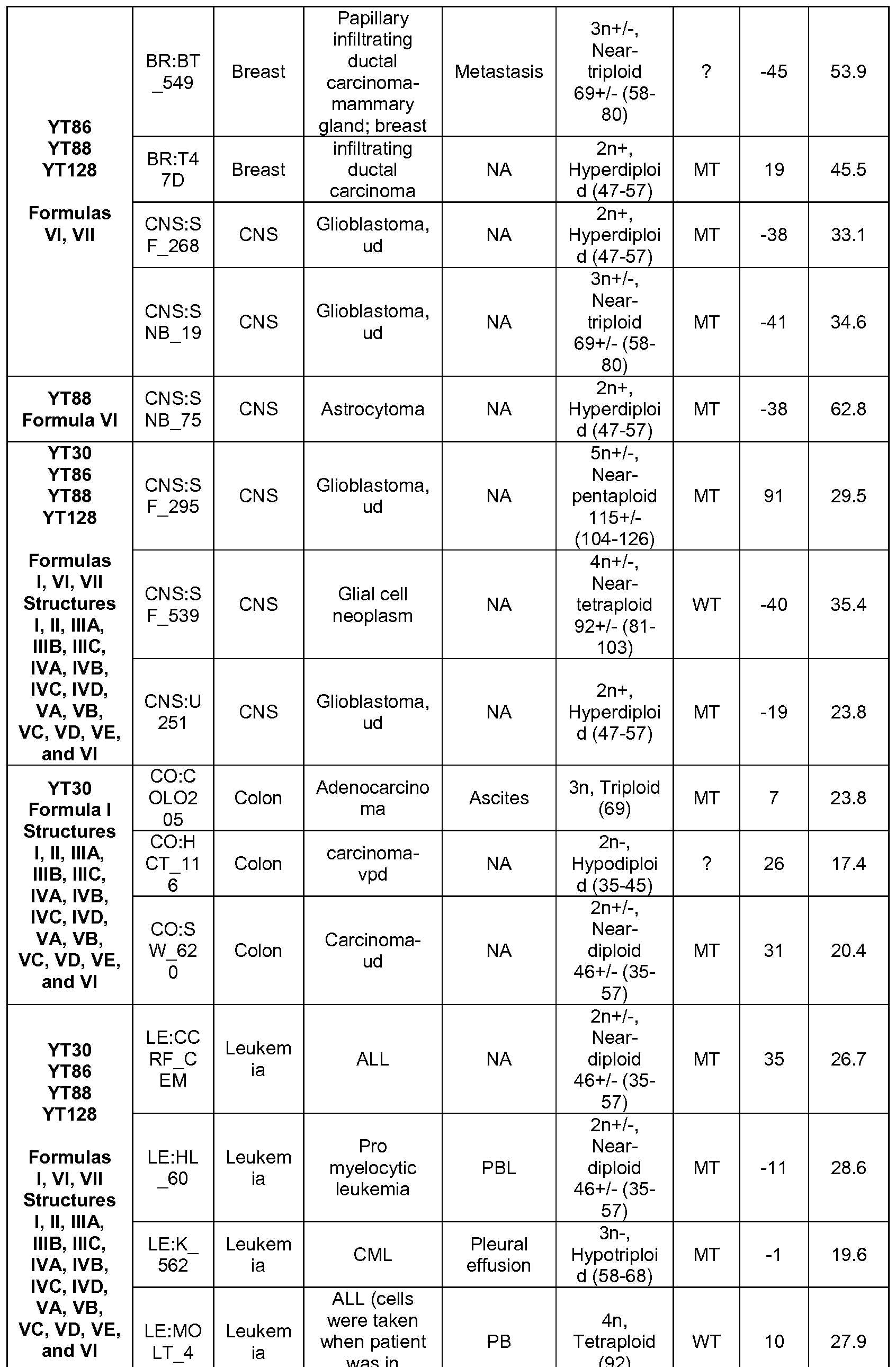
relapse)

effusion;


Example 4: Combination therapy of YT30 and imatinib inhibited leukemia
[00179] Growth inhibition experiments were performed as previously described. The combination of YT30 and imatinib displayed a synergistic effect in growth inhibition of a Nalm-6, a leukemia cell line. After 72hrs, combination of YT30 and Imatinib showed an increase in growth inhibition compared to addition of each agent alone (Table 13). For example, 1 μΜ YT30 alone induced growth inhibition by 8.4%, 10μΜ imatinib induced growth inhibition by 44%, but the combination of 1 μΜ YT30 and 10μΜ imatinib induced growth inhibition by 97%. The synergistic effects were also observed when the YT30 and imatinib were combined with other concentrations.
Table 13. Inhibition of leukemia growth with the combination of YT30 and imatinib
YT30 concentrations Imatinib concentrations 72hr growth inhibition
(μΜ) (μΜ) (%)
0 0 0
0.5 0 2.5
1 0 8.4
0 5 0
0.5 5 9
1 5 28
0 10 44
0.5 10 67
1 10 94
Example 5: YT30 inhibition of subcutaneous leukemia tumor growth in mouse model
[00180] Tumor transplantation and treatment of NOD/SCID mice. Female Nonobese Diabetic/Severe Combined Immunodeficiency (NOD/SCID) mice that were 4-6 weeks old were used in the experiment. The mice were fed under specific pathogen free (SPF) conditions. Food and water were available to the mice at will. A suspension of 1 x10⁷ cells per mouse B-myelomonocytic leukemia MV4-1 1 cells (0.2 mL) in logarithmic phase were inoculated subcutaneously into the right back of the NOD/SCID nude mice.
[00181] The general conditions of the mice and the growth of the transplanted tumor were monitored. When the transplanted tumor grew to about 100 mm3 in size, the NOD/SCID mice were divided into four groups with five mice in each group so that each group of mice had a similar average tumor size. The control group received an intraperitoneal (IP) injection of 0.2 mL of solvent (20% DMSO, 80% of 20% w/v (2-hydroxypropyl)-3-cyclodextrin made in PBS). The imatinib group received gavage of 100 mg/kg/day imatinib. The high dosage group received an intraperitoneal injection of 50 mg/kg/day of YT30 (0.2 mL in volume) suspended in solvent (20% DMSO, 80% of 20% w/v (2-hydroxypropyl)-3-cyclodextrin made in PBS), while the low dosage group received IP injection of 25 mg/kg/day YT30 (0.2 mL in volume). Frequency of the administration was once per day and the experiment lasted 27 days after treatment started.
[00182] The body weights of the mice were recorded prior to the start of treatment and twice every week thereafter. Each mouse of every group was monitored daily for any other symptoms of side effects including change in behavior, activity or posture, areas of redness and swelling, and food and water withdrawal. Caliper measurements of the longest perpendicular tumor diameters were performed every 2 days to estimate the tumor volume; the following formula: 4π/3 * (width/2)2 χ (length/2) was used to calculate the three-dimensional volume of an ellipse. The tumor inhibition rate was calculated according to tumor volume: Tumor inhibition rate by size (%) = (Tumor volume of the control group-Tumor volume of the treated
group)/Tumor volume of the control group X 100. The mice were euthanized on the next day after the final injection and the subcutaneous tumor nodules were taken out intact and weighed. The tumor inhibition rate was calculated again according to tumor weight: Tumor inhibition rate by weight (%) = (Tumor weight of the control group-Tumor weight of the treated group)/Tumor weight of the control group X 100).
Table 14. YT30 inhibited subcutaneous leukemia tumor growth in a mouse model

Results
YT30 inhibited the growth of subcutaneously transplanted leukemia tumors in NOD/SCID mice. About one week after seeding the NOD/SCID mice with MV4-1 1 cells, all of the transplanted tumors grew to a size around 100 mm3. The rate of successful transplantation was 100%. After 27 days of treatment with YT30, tumor growth inhibition by size is 58.8% for the high dosage YT30 treatment group and 38.8% for the low dosage YT30 treatment group (Table 14). The difference in tumor growth inhibitions between the high dosage and the low dosage group demonstrated clear dose-response relationship. The tumor weight was also significantly less than that of the control group, and the difference was statistically significant.
Example 6: YT30 growth inhibition of chronic myelogenous leukemia (CML) tumors in SCID mice transplanted with K562 cells
Methods
[00183] Tumor transplantation and treatment of SCID mice. Male Severe Combined Immunodeficiency (SCID) mice that were 4-6 weeks old were used in the experiment. The mice were fed under specific pathogen free (SPF) conditions.
Food and water were available to the mice at will. A suspension of 8 X 10s chronic myelogenous leukemia K562 cells (0.2 mL) was inoculated subcutaneously into the right back of the SCID mice.
[00184] The general conditions of the mice and the growth of the transplanted tumor were monitored. When the transplanted tumor grew to about 100 mm3 in size, the SCID mice were divided into four groups with eight mice in each group so that each group of mice had a similar average tumor size. The control group received an intraperitoneal injection (IP) of 0.2 mL solvent (20% DMSO, 80% of 20% w/v (2- hydroxypropyl)-3-cyclodextrin made in PBS). The imatinib group received oral gavage of 100 mg/kg/day imatinib suspended in 0.5% sodium carboxymethyl cellulose. The YT30 treated groups received either intraperitoneal injection of 50 mg/kg/day of YT30 (0.2 mL in volume) suspended in solvent (20% DMSO, 80% of 20% w/v (2-hydroxypropyl)- -cyclodextrin made in PBS) or oral gavage of 90 mg/kg/day YT30 in solvent (Cremophor RH40:TW80:PEG400 (2:1 :1 )). Frequency of the administration was once per day and the experiment lasted 16 days after initiation of the treatment.
[00185] The body weights of the mice were recorded prior to the start of treatment and twice every week thereafter. Each mouse of every group was monitored daily for any other symptoms of side effects including change in behavior, activity or posture, areas of redness and swelling, and food and water withdrawal. Caliper measurements of the longest perpendicular tumor diameters were performed every 2 days to estimate the tumor volume; the following formula: 4π/3 * (width/2)2 χ (length/2) was used to calculate the three-dimensional volume of an ellipse. The tumor inhibition rate was calculated according to tumor volume: Tumor inhibition rate by size (%) = (Tumor volume of the control group-Tumor volume of the treated group)/Tumor volume of the control group X 100. The SCID mice were euthanized 2 hours after the final injection and the subcutaneous tumor nodules were taken out
intact and weighed. The tumor inhibition rate was calculated again according to tumor weight: Tumor inhibition rate by weight (%) = (Tumor weight of the control group-Tumor weight of the treated group)/Tumor weight of the control group X 100.
Results
[00186] YT30 inhibited the growth of leukemia tumors subcutaneously transplanted in SCID mice with human chronic myeloid leukemia cells (K562). At 12 days after inoculation of K562 cells in SCID mice all of the transplanted tumors grew to a size around 100 mm3. The rate of successful transplantation was 100%. After 16 days of treatment with YT30, tumor growth inhibition by weight was 40.76% for the intraperitoneal YT30 treatment group and 33.17% for the oral YT30 treatment group (Table 15).
Table 15. K562 (CML) tumor growth inhibition by weight and size in SCID mice treated with YT30

REFERENCES
The references, patents and published patent applications listed below, and all references cited in the specification above are hereby incorporated by reference in their entireties, as if fully set forth herein.
1 . Leukemia in Children, http://www.cancer.org/cancer/leukemiainchildren/index.
2. Blood Cancers: Leukemia, Lymphoma, and Myeloma,
http://www.cdc.gov/features/hematologiccancers.
3. Types of Leukemia. National Cancer Institute,
http://www.cancer.gov/cancertopics/wyntk/leukemia/page3.
4. Faderl et al, Chronic Myelogenous Leukemia: Biology and Therapy. Ann
Intern Med. 1999; 131 (3):207-219.
5. Carew et al, Mitochondrial DNA mutations in primary leukemia cells after chemotherapy: clinical significance and therapeutic implications. Leukemia (2003) 17, 1437-1447.
6. Sturm et al, Mutation of p53 and consecutive selective drug resistance in B- CLL occurs as a consequence of prior DNA-damaging chemotherapy. Cell Death and Differentiation (2003) 10, 477-484.
7. Physician's Desk Reference, 41 st Ed., Publisher Edward R. Barnhart, N.J.
(1987).
8. PCT/US93/0082948.
9. Remington: The Science and Practice of Pharmacy, 21 st Edition, Univ. of Sciences in Philadelphia (USIP), Lippincott Williams & Wilkins, Philadelphia, PA, 2005.
10. Wu, L., Smythe, A.M., Stinson, et. al. Multidrug-resistant Phenotype of
Disease-oriented Panels of Human Tumor Cell Lines Used for Anticancer Drug Screening. (1992) Cancer Research 52: 3029-3034.
Claims
1 . A method of treating a cancer or a tumor in a subject comprising
administering to the subject a therapeutically effective amount of one or more compounds or a composition or pharmaceutical formulation thereof, wherein the one or more compounds comprise a structure selected from the group consisting of YT54, Structure I, Structure I I, Structure I I IA, Structure N IB, Structure N IC, Structure IVA, Structure IVB, Structure IVC, Structure IVD, Structure VA, Structure VB, Structure VC, Structure VD, Structure VE, Structure VI , Structure VI IA, Structure VI IB, Structure VI IC, Structure VI ID, Structure VI IE, and Structure VI I I, including pharmaceutically acceptable solvates, pharmaceutically acceptable prodrugs, pharmaceutically acceptable salts and pharmaceutically acceptable stereoisomers thereof, wherein:
A and B rings are each independently selected from the group consisting of phenyl, pyridyl and N-alkylated pyridyl rings;
RrRs are each independently selected from the group consisting of hydrogen, halogen, alkyl, and haloalkyl, wherein at least one or two of R1-R5 are halogen and/or haloalkyl;
R6 and R7 are an alkyl group having 1 -3 carbon atoms;
Xi and X2 are independently selected from -NHC(=0)- or -C(=0)-NH-; and
Li is -(CH2)n-, where n is 4, 5, 6, 7, or 8, where one or more -CH2- moieties are optionally replaced with one or more substituents selected from the group consisting of -0-, -S-, -C(=0)-, -S(=0)-, -S(=0)2-, -NH-C(=0)-, - C(=0)-NH-, -NR-, -C=C-, carbon-carbon triple bond, phenylene, 1 , 4- phenylene and cyclohexylene, 1 , 4-cyclohexylene, wherein R is hydrogen, alkyl or aryl.
2. The method according to claim 1 , wherein U is -(CH2)n-, where n is 4, 5, 6, 7, or 8.
3. The method according to claim 2, wherein:
Rs and R4 are halogen; and
Ri , R2, and R5 are hydrogen.
4. The method according to claim 3, wherein the halogen is bromine.
5. The method according to claim 2, wherein the cancer or tumor is selected from the group consisting of breast cancer, central nervous system cancer, colon cancer, prostate cancer, lung cancer, leukemia, renal cancer, ovarian cancer, melanoma, liver cancer, and cervical cancer.
6. The method according to claim 4, wherein the cancer or tumor is selected from the group consisting of breast cancer, central nervous system cancer, colon cancer, prostate cancer, lung cancer, leukemia, renal cancer, ovarian cancer, melanoma, liver cancer, and cervical cancer.
7. The method according to claim 2, wherein the cancer treated is leukemia selected from the group consisting of acute myelogenous leukemia (AML), acute promyelocytic leukemia (APL), acute lymphoblastic leukemia (ALL), chronic myelogenous leukemia (CML), CML (imatinib resistant), multiple myeloma, B-cell myelomonocytic leukemia, T-cell myelomonocytic leukemia, biphenotypic B-cell leukemia, and/or lymphoma.
8. The method according to claim 4, wherein the cancer treated is leukemia selected from the group consisting of acute myelogenous leukemia (AML), acute promyelocytic leukemia (APL), acute lymphoblastic leukemia (ALL), chronic myelogenous leukemia (CML), CML (imatinib resistant), multiple myeloma, B-cell myelomonocytic leukemia, T-cell myelomonocytic leukemia, biphenotypic B-cell leukemia, and/or lymphoma.
9. The method according to claim 7, wherein the one or more compounds are selected from the group consisting of YT29, YT30, YT53, YT54, YT61 , YT65, YT67, YT68, YT73, YT74, and YT139, or pharmaceutically acceptable solvates, pharmaceutically acceptable prodrugs, pharmaceutically acceptable salts or pharmaceutically acceptable stereoisomers thereof.
10. The method according to claim 7, wherein the leukemia is resistant to Imatinib or Gleevec.
1 1 . The method according to claim 7, wherein the leukemia has a p53 mutation in the genome of the leukemia cells.
12. The method according to claim 7, wherein the leukemia has wild type p53 in the genome of the leukemia cells.
13. The method according to claim 7, wherein the leukemia has a Multidrug Resistance value between 1 and 50.
14. The method according to claim 7, wherein the leukemia has a Multidrug Resistance value between -15 and 0.
15. The method according to claim 2, wherein the one or more compounds or a composition or pharmaceutical formulation thereof may be administered orally or by intraperitoneal injection.
16. The method according to claim 2, wherein the one or more compounds or a composition or pharmaceutical formulation thereof may be administered in combination with a pharmaceutically effective amount of imatinib.
17. A method of treating cancer or a tumor in a subject comprising administering to the subject a therapeutically effective amount of one or more compounds or a composition or pharmaceutical formulation thereof, wherein the one or more compounds comprise a structure selected from the group consisting of YT45, T46, YT51 , YT58, YT62-YT63, YT76-YT80, YT86, YT88, YT91 , YT99, YT108-YT1 10, YT1 16-YT1 18, YT121 ~YT123, YT127, YT128, YT131 , YT134-YT136, and 137-139 including pharmaceutically acceptable solvates, pharmaceutically acceptable prodrugs, pharmaceutically acceptable salts and pharmaceutically acceptable stereoisomers thereof.
18. The method of claim 17, wherein the cancer is leukemia selected from the group consisting of acute myelogenous leukemia (AML), acute promyelocytic leukemia (APL), acute lymphoblastic leukemia (ALL), chronic myelogenous leukemia
(CML), CML (imatinib resistant), multiple myeloma, B-cell myelomonocytic leukemia, T-cell myelomonocytic leukemia, biphenotypic B-cell leukemia, and/or lymphoma.
19. The method of claim 18, wherein the one or more compounds or a
composition or pharmaceutical formulation thereof may be administered in combination with a pharmaceutically effective amount of Imatinib or one or more compounds of claim 1 .
20. The method of claim 18, wherein the one or more compounds or a
composition or pharmaceutical formulation thereof may be administered orally or by intraperitoneal injection.
Priority Applications (4)
| Application Number | Priority Date | Filing Date | Title |
|---|---|---|---|
| CA2903464A CA2903464A1 (en) | 2013-03-06 | 2014-03-06 | Treatment of cancer and other conditions using a transcription factor modulator |
| CN201480026046.9A CN105209032A (en) | 2013-03-06 | 2014-03-06 | Treatment of cancer and other conditions using a transcription factor modulator |
| EP14759569.8A EP2994121A4 (en) | 2013-03-06 | 2014-03-06 | Treatment of cancer and other conditions using a transcription factor modulator |
| US14/848,179 US20150374646A1 (en) | 2013-03-06 | 2015-09-08 | Treatment of cancer and other conditions using a transcription factor modulator |
Applications Claiming Priority (4)
| Application Number | Priority Date | Filing Date | Title |
|---|---|---|---|
| US201361773798P | 2013-03-06 | 2013-03-06 | |
| US61/773,798 | 2013-03-06 | ||
| US13/844,396 | 2013-03-15 | ||
| US13/844,396 US20140256776A1 (en) | 2013-03-06 | 2013-03-15 | Treatment of cancer and other conditions using a transcription factor modulator |
Related Parent Applications (1)
| Application Number | Title | Priority Date | Filing Date |
|---|---|---|---|
| US13/844,396 Continuation US20140256776A1 (en) | 2013-03-06 | 2013-03-15 | Treatment of cancer and other conditions using a transcription factor modulator |
Related Child Applications (1)
| Application Number | Title | Priority Date | Filing Date |
|---|---|---|---|
| US14/848,179 Continuation US20150374646A1 (en) | 2013-03-06 | 2015-09-08 | Treatment of cancer and other conditions using a transcription factor modulator |
Publications (1)
| Publication Number | Publication Date |
|---|---|
| WO2014138505A1 true WO2014138505A1 (en) | 2014-09-12 |
Family
ID=51488553
Family Applications (2)
| Application Number | Title | Priority Date | Filing Date |
|---|---|---|---|
| PCT/US2014/021449 Ceased WO2014138505A1 (en) | 2013-03-06 | 2014-03-06 | Treatment of cancer and other conditions using a transcription factor modulator |
| PCT/US2014/021452 Ceased WO2014138508A1 (en) | 2013-03-06 | 2014-03-06 | Novel transcription factor modulators |
Family Applications After (1)
| Application Number | Title | Priority Date | Filing Date |
|---|---|---|---|
| PCT/US2014/021452 Ceased WO2014138508A1 (en) | 2013-03-06 | 2014-03-06 | Novel transcription factor modulators |
Country Status (5)
| Country | Link |
|---|---|
| US (3) | US20140256776A1 (en) |
| EP (2) | EP2994121A4 (en) |
| CN (2) | CN105228609A (en) |
| CA (2) | CA2903464A1 (en) |
| WO (2) | WO2014138505A1 (en) |
Families Citing this family (4)
| Publication number | Priority date | Publication date | Assignee | Title |
|---|---|---|---|---|
| US9782387B2 (en) | 2013-12-26 | 2017-10-10 | Tel Hashomer Medical Research Infrastructure And Services Ltd. | Compositions and methods for treating hematological malignancies |
| CN104974079A (en) * | 2014-04-02 | 2015-10-14 | C&C生物医药有限公司 | Amide derivatives of aniline-related compound and composition of amide derivatives of aniline-related compound |
| CN112341429B (en) * | 2019-08-09 | 2021-11-23 | 成都先导药物开发股份有限公司 | Intermediate compound of immunomodulator |
| CN115974719B (en) * | 2022-12-06 | 2025-01-07 | 小江生物技术有限公司 | Compounds, pharmaceutical compositions comprising said compounds and uses thereof |
Citations (4)
| Publication number | Priority date | Publication date | Assignee | Title |
|---|---|---|---|---|
| US20080131526A1 (en) * | 2006-10-04 | 2008-06-05 | University Of South Florida | Akt sensitization of cancer cells |
| US20110081331A1 (en) * | 2009-10-01 | 2011-04-07 | Peter Maccallum Cancer Institute | Cancer therapy |
| US20110275674A1 (en) * | 2008-11-05 | 2011-11-10 | University Of Southern California | Small Molecules Modulator of Epigenetic Regulation and Their Therapeutic Applications |
| US20110319447A1 (en) * | 2006-05-25 | 2011-12-29 | Synta Pharmaceuticals Corp. | Triazole compounds that modulate hsp90 activity |
Family Cites Families (7)
| Publication number | Priority date | Publication date | Assignee | Title |
|---|---|---|---|---|
| US5369108A (en) | 1991-10-04 | 1994-11-29 | Sloan-Kettering Institute For Cancer Research | Potent inducers of terminal differentiation and methods of use thereof |
| US5700811A (en) | 1991-10-04 | 1997-12-23 | Sloan-Kettering Institute For Cancer Research | Potent inducers of terminal differentiation and method of use thereof |
| WO2004094591A2 (en) | 2003-04-16 | 2004-11-04 | The Regents Of The University Of Colorado | Three-dimensional structures of hdac9 and cabin1 and compound structures and methods related thereto |
| WO2007058927A1 (en) | 2005-11-11 | 2007-05-24 | The Scripps Research Institute | Histone deacetylase inhibitors as therapeutics for neurological diseases |
| WO2010028193A1 (en) | 2008-09-03 | 2010-03-11 | Repligen Corporation | Compounds including pimelic acid derivatives as hdac inhibitors |
| AU2009289649B2 (en) * | 2008-09-03 | 2016-05-05 | Biomarin Pharmaceutical Inc. | Compositions including 6-aminohexanoic acid derivatives as HDAC inhibitors |
| CN102633668B (en) * | 2012-01-20 | 2015-05-06 | 天舒生物技术有限公司 | Use of compound in therapeutic drug for diseases related to disorder of transcription factor |
-
2013
- 2013-03-15 US US13/844,396 patent/US20140256776A1/en not_active Abandoned
- 2013-03-15 US US13/843,612 patent/US9133105B2/en not_active Expired - Fee Related
-
2014
- 2014-03-06 WO PCT/US2014/021449 patent/WO2014138505A1/en not_active Ceased
- 2014-03-06 EP EP14759569.8A patent/EP2994121A4/en not_active Withdrawn
- 2014-03-06 CA CA2903464A patent/CA2903464A1/en not_active Abandoned
- 2014-03-06 WO PCT/US2014/021452 patent/WO2014138508A1/en not_active Ceased
- 2014-03-06 CA CA2904339A patent/CA2904339A1/en not_active Abandoned
- 2014-03-06 EP EP14760650.3A patent/EP2994122A4/en not_active Withdrawn
- 2014-03-06 CN CN201480025954.6A patent/CN105228609A/en active Pending
- 2014-03-06 CN CN201480026046.9A patent/CN105209032A/en active Pending
-
2015
- 2015-09-08 US US14/848,179 patent/US20150374646A1/en not_active Abandoned
Patent Citations (4)
| Publication number | Priority date | Publication date | Assignee | Title |
|---|---|---|---|---|
| US20110319447A1 (en) * | 2006-05-25 | 2011-12-29 | Synta Pharmaceuticals Corp. | Triazole compounds that modulate hsp90 activity |
| US20080131526A1 (en) * | 2006-10-04 | 2008-06-05 | University Of South Florida | Akt sensitization of cancer cells |
| US20110275674A1 (en) * | 2008-11-05 | 2011-11-10 | University Of Southern California | Small Molecules Modulator of Epigenetic Regulation and Their Therapeutic Applications |
| US20110081331A1 (en) * | 2009-10-01 | 2011-04-07 | Peter Maccallum Cancer Institute | Cancer therapy |
Non-Patent Citations (3)
| Title |
|---|
| JAYATHILAKA ET AL.: "Inhibition of the function of class IIa HDACs by blocking their interaction with MEF2", NUCLEIC ACIDS RESEARCH, vol. 40, no. 12, 2012, pages 5378 - 5388, XP055292909, Retrieved from the Internet <URL:http://nar.oxfordjournals.org/content/40/12/5378.full.pdf+html> [retrieved on 20140716] * |
| See also references of EP2994121A4 * |
| WU ET AL.: "Multidrug-resistant Phenotype of Disease-oriented Panels of Human Tumor Cell Lines Used for Anticancer Drug Screening", CANCER RESEARCH, vol. 52, no. 11, 1992, pages 3029 - 3034, XP001208236, Retrieved from the Internet <URL:http://cancerres.aacrjournals.org/content/52/11/3029.full.pdf> [retrieved on 20140716] * |
Also Published As
| Publication number | Publication date |
|---|---|
| EP2994122A4 (en) | 2017-05-03 |
| CN105209032A (en) | 2015-12-30 |
| US9133105B2 (en) | 2015-09-15 |
| US20140256775A1 (en) | 2014-09-11 |
| WO2014138508A1 (en) | 2014-09-12 |
| CA2904339A1 (en) | 2014-09-12 |
| CA2903464A1 (en) | 2014-09-12 |
| US20140256776A1 (en) | 2014-09-11 |
| CN105228609A (en) | 2016-01-06 |
| EP2994121A1 (en) | 2016-03-16 |
| EP2994122A1 (en) | 2016-03-16 |
| US20150374646A1 (en) | 2015-12-31 |
| EP2994121A4 (en) | 2017-06-07 |
Similar Documents
| Publication | Publication Date | Title |
|---|---|---|
| US20250197379A1 (en) | Novel ras inhibitors | |
| US9828342B2 (en) | Isatin derivatives, pharmaceutical compositions thereof, and methods of use thereof | |
| KR100628013B1 (en) | Tricyclic lactams and sulfam derivatives, and their use as histone deacetylase inhibitors | |
| ES2660215T3 (en) | Antitumor effect enhancer comprising an imidazooxazine compound | |
| CN103570738A (en) | Novel artemisinin derivatives and preparation method and use thereof | |
| CN101711154A (en) | carbamate compound | |
| CN107163027B (en) | Crystalline form of pyridylaminopyrimidine derivative mesylate and its preparation and application | |
| CN104119330B (en) | Synthesis of berberine derivative and application thereof in preparation of antitumor drug and synergetic adriamycin antitumor drug composition | |
| WO2014138505A1 (en) | Treatment of cancer and other conditions using a transcription factor modulator | |
| Fan et al. | F10, a new camptothecin derivative, was identified as a new orally–bioavailable, potent antitumor agent | |
| WO2022083657A1 (en) | Substituted benzo or pyridopyrimidine amine inhibitor, preparation method therefor, and application thereof | |
| WO2022166592A1 (en) | Substituted pyrimidopyridone inhibitor, and preparation method therefor and use thereof | |
| CN103420923B (en) | 4-amido quinazoline hydroxamic acid compound and applying as antitumor drug | |
| CN107074806B (en) | HSP70 regulon and methods of making and using the same | |
| CN101365461B (en) | Derivatives of sulindac, use thereof and preparation thereof | |
| TW201136925A (en) | Triazole compounds as KSP inhibitors | |
| JP2021518836A (en) | Substituted alkynylene compound as an anti-cancer agent | |
| WO2017181974A1 (en) | Five-membered heterocyclic compound, preparation method therefor, pharmaceutical composition and use | |
| EP3195867B1 (en) | Pyrimidine compounds inhibiting the formation of nitric oxide and prostaglandin e2, method of production thereof and use thereof | |
| CN113045487A (en) | Selective sodium channel regulator and preparation and application thereof | |
| CN107304202A (en) | Five-membered heterocycles and preparation method thereof, pharmaceutical composition and purposes | |
| WO2024175659A1 (en) | 3ah-cyclopenta[b]benzofuran-3a-yl as ras inhibitors | |
| WO2024175662A1 (en) | Flavagline derivatives as ras inhibitors | |
| AU2016307438B2 (en) | Tricyclic compounds and their use in the treatment of cancer | |
| CA3258147A1 (en) | Sting agonist compounds |
Legal Events
| Date | Code | Title | Description |
|---|---|---|---|
| 121 | Ep: the epo has been informed by wipo that ep was designated in this application |
Ref document number: 14759569 Country of ref document: EP Kind code of ref document: A1 |
|
| ENP | Entry into the national phase |
Ref document number: 2903464 Country of ref document: CA |
|
| NENP | Non-entry into the national phase |
Ref country code: DE |
|
| WWE | Wipo information: entry into national phase |
Ref document number: 2014759569 Country of ref document: EP |