WO2014140850A2 - Aryloxy-phthalocyanines of group iv metals - Google Patents
Aryloxy-phthalocyanines of group iv metals Download PDFInfo
- Publication number
- WO2014140850A2 WO2014140850A2 PCT/IB2014/000984 IB2014000984W WO2014140850A2 WO 2014140850 A2 WO2014140850 A2 WO 2014140850A2 IB 2014000984 W IB2014000984 W IB 2014000984W WO 2014140850 A2 WO2014140850 A2 WO 2014140850A2
- Authority
- WO
- WIPO (PCT)
- Prior art keywords
- group
- compound
- substituted
- halogen
- combination
- Prior art date
- Legal status (The legal status is an assumption and is not a legal conclusion. Google has not performed a legal analysis and makes no representation as to the accuracy of the status listed.)
- Ceased
Links
Classifications
-
- C—CHEMISTRY; METALLURGY
- C07—ORGANIC CHEMISTRY
- C07F—ACYCLIC, CARBOCYCLIC OR HETEROCYCLIC COMPOUNDS CONTAINING ELEMENTS OTHER THAN CARBON, HYDROGEN, HALOGEN, OXYGEN, NITROGEN, SULFUR, SELENIUM OR TELLURIUM
- C07F7/00—Compounds containing elements of Groups 4 or 14 of the Periodic Table
- C07F7/02—Silicon compounds
- C07F7/025—Silicon compounds without C-silicon linkages
-
- C—CHEMISTRY; METALLURGY
- C07—ORGANIC CHEMISTRY
- C07F—ACYCLIC, CARBOCYCLIC OR HETEROCYCLIC COMPOUNDS CONTAINING ELEMENTS OTHER THAN CARBON, HYDROGEN, HALOGEN, OXYGEN, NITROGEN, SULFUR, SELENIUM OR TELLURIUM
- C07F7/00—Compounds containing elements of Groups 4 or 14 of the Periodic Table
- C07F7/22—Tin compounds
- C07F7/2284—Compounds with one or more Sn-N linkages
-
- C—CHEMISTRY; METALLURGY
- C07—ORGANIC CHEMISTRY
- C07F—ACYCLIC, CARBOCYCLIC OR HETEROCYCLIC COMPOUNDS CONTAINING ELEMENTS OTHER THAN CARBON, HYDROGEN, HALOGEN, OXYGEN, NITROGEN, SULFUR, SELENIUM OR TELLURIUM
- C07F7/00—Compounds containing elements of Groups 4 or 14 of the Periodic Table
- C07F7/30—Germanium compounds
-
- C—CHEMISTRY; METALLURGY
- C09—DYES; PAINTS; POLISHES; NATURAL RESINS; ADHESIVES; COMPOSITIONS NOT OTHERWISE PROVIDED FOR; APPLICATIONS OF MATERIALS NOT OTHERWISE PROVIDED FOR
- C09B—ORGANIC DYES OR CLOSELY-RELATED COMPOUNDS FOR PRODUCING DYES, e.g. PIGMENTS; MORDANTS; LAKES
- C09B47/00—Porphines; Azaporphines
- C09B47/04—Phthalocyanines abbreviation: Pc
- C09B47/08—Preparation from other phthalocyanine compounds, e.g. cobaltphthalocyanineamine complex
-
- C—CHEMISTRY; METALLURGY
- C09—DYES; PAINTS; POLISHES; NATURAL RESINS; ADHESIVES; COMPOSITIONS NOT OTHERWISE PROVIDED FOR; APPLICATIONS OF MATERIALS NOT OTHERWISE PROVIDED FOR
- C09B—ORGANIC DYES OR CLOSELY-RELATED COMPOUNDS FOR PRODUCING DYES, e.g. PIGMENTS; MORDANTS; LAKES
- C09B47/00—Porphines; Azaporphines
- C09B47/04—Phthalocyanines abbreviation: Pc
- C09B47/08—Preparation from other phthalocyanine compounds, e.g. cobaltphthalocyanineamine complex
- C09B47/18—Obtaining compounds having oxygen atoms directly bound to the phthalocyanine skeleton
-
- H—ELECTRICITY
- H10—SEMICONDUCTOR DEVICES; ELECTRIC SOLID-STATE DEVICES NOT OTHERWISE PROVIDED FOR
- H10F—INORGANIC SEMICONDUCTOR DEVICES SENSITIVE TO INFRARED RADIATION, LIGHT, ELECTROMAGNETIC RADIATION OF SHORTER WAVELENGTH OR CORPUSCULAR RADIATION
- H10F99/00—Subject matter not provided for in other groups of this subclass
-
- H—ELECTRICITY
- H10—SEMICONDUCTOR DEVICES; ELECTRIC SOLID-STATE DEVICES NOT OTHERWISE PROVIDED FOR
- H10K—ORGANIC ELECTRIC SOLID-STATE DEVICES
- H10K85/00—Organic materials used in the body or electrodes of devices covered by this subclass
- H10K85/30—Coordination compounds
- H10K85/311—Phthalocyanine
-
- H—ELECTRICITY
- H10—SEMICONDUCTOR DEVICES; ELECTRIC SOLID-STATE DEVICES NOT OTHERWISE PROVIDED FOR
- H10K—ORGANIC ELECTRIC SOLID-STATE DEVICES
- H10K85/00—Organic materials used in the body or electrodes of devices covered by this subclass
- H10K85/40—Organosilicon compounds, e.g. TIPS pentacene
-
- H—ELECTRICITY
- H10—SEMICONDUCTOR DEVICES; ELECTRIC SOLID-STATE DEVICES NOT OTHERWISE PROVIDED FOR
- H10K—ORGANIC ELECTRIC SOLID-STATE DEVICES
- H10K99/00—Subject matter not provided for in other groups of this subclass
-
- H—ELECTRICITY
- H10—SEMICONDUCTOR DEVICES; ELECTRIC SOLID-STATE DEVICES NOT OTHERWISE PROVIDED FOR
- H10K—ORGANIC ELECTRIC SOLID-STATE DEVICES
- H10K30/00—Organic devices sensitive to infrared radiation, light, electromagnetic radiation of shorter wavelength or corpuscular radiation
-
- H—ELECTRICITY
- H10—SEMICONDUCTOR DEVICES; ELECTRIC SOLID-STATE DEVICES NOT OTHERWISE PROVIDED FOR
- H10K—ORGANIC ELECTRIC SOLID-STATE DEVICES
- H10K30/00—Organic devices sensitive to infrared radiation, light, electromagnetic radiation of shorter wavelength or corpuscular radiation
- H10K30/20—Organic devices sensitive to infrared radiation, light, electromagnetic radiation of shorter wavelength or corpuscular radiation comprising organic-organic junctions, e.g. donor-acceptor junctions
-
- H—ELECTRICITY
- H10—SEMICONDUCTOR DEVICES; ELECTRIC SOLID-STATE DEVICES NOT OTHERWISE PROVIDED FOR
- H10K—ORGANIC ELECTRIC SOLID-STATE DEVICES
- H10K30/00—Organic devices sensitive to infrared radiation, light, electromagnetic radiation of shorter wavelength or corpuscular radiation
- H10K30/50—Photovoltaic [PV] devices
-
- Y—GENERAL TAGGING OF NEW TECHNOLOGICAL DEVELOPMENTS; GENERAL TAGGING OF CROSS-SECTIONAL TECHNOLOGIES SPANNING OVER SEVERAL SECTIONS OF THE IPC; TECHNICAL SUBJECTS COVERED BY FORMER USPC CROSS-REFERENCE ART COLLECTIONS [XRACs] AND DIGESTS
- Y02—TECHNOLOGIES OR APPLICATIONS FOR MITIGATION OR ADAPTATION AGAINST CLIMATE CHANGE
- Y02E—REDUCTION OF GREENHOUSE GAS [GHG] EMISSIONS, RELATED TO ENERGY GENERATION, TRANSMISSION OR DISTRIBUTION
- Y02E10/00—Energy generation through renewable energy sources
- Y02E10/50—Photovoltaic [PV] energy
- Y02E10/549—Organic PV cells
Definitions
- compositions comprising an aryloxy- phthalocyanine compound of a group IV metal, methods for preparing said compositions, and articles of manufacture made therefrom.
- Organic materials can be used, for example, as semiconductors in low-cost photovoltaic cells.
- Organic materials can offer significant advantages in terms of materials and manufacturing cost relative to existing silicon technologies, and they do not typically suffer from supply demand pressures of the marketplace common to silicon.
- Current state of the art molecular based thin film devices can exhibit efficiencies similar to those of polymer based cells; however, organic thin film solar cells provide a significant advantage due to their ease of manufacture.
- Organic thin film solar cells do not necessarily utilize solution- processing methods employed for polymer-based cells. Instead, they typically use vacuum deposition methods that can be scalable and relatively cheap to implement.
- Such a device structure has the advantage that formation of a nano-phase separated bulk heterojunction film structure is not required.
- This invention relates generally to aryloxy-phthalocyanine compounds, methods for preparing said compounds, and articles of manufacture made therefrom.
- the aryloxy-phthalocyanine compound comprises various aryloxy molecular fragments and group IV metals.
- M is one or more group IV metals and comprises silicon, germanium, tin, or a combination thereof; wherein "n" is an integer equal to or greater than 0; wherein each Ri independently comprises a straight chain alkyl group, a branched alkyl group, a cycloalkyl group, an alkenyl group, an alkynyl group, an alkoxy group, an aryloxy group, heterocyclic group, a monocyclic aromatic group, a polycyclic aromatic group, an aryl, an alkylaryl group, an arylalkyl group, an akylene group, a hydrogen, a halogen, or a combination thereof; and wherein R 2 comprises an aryl containing group comprising from greater than or equal to about 6 to about 22 carbon atoms, wherein the aryl containing group can optionally be substituted at any one or more positions by one or more heteroatoms, wherein the heteroatom, if present, can comprise a halogen, oxygen, sulfur, nitrogen
- M is one or more group IV metals and comprises silicon, germanium, tin, or a combination thereof; wherein "n" is an integer equal to or greater than 0; wherein each Ri independently comprises a straight chain alkyl group, a branched alkyl group, a cycloalkyl group, an alkenyl group, an alkynyl group, an alkoxy group, an aryloxy group, heterocyclic group, a monocyclic aromatic group, a polycyclic aromatic group, an aryl group, an alkylaryl group, an arylalkyl group, an akylene group, a hydrogen, a halogen, or a combination thereof; and wherein R 2 and R 3 are the same or different and can independently comprise a halogen, oxygen, sulfur, nitrogen, aryl or an aryloxy containing group comprising from greater than or equal to about 6 to about 22 carbon atoms, wherein the aryl containing group can optionally be substituted at any one or more positions by one
- a method for preparing a compound having the general structure (I) comprising: (a) providing a compound comprising a halogen-metal bond containing Ri substituted phthalocyanine precursor, wherein the halogen comprises chloride, bromine, iodine, fluorine, or a combination thereof, and wherein each Ri comprises a straight chain alkyl group, a branched alkyl group, a cycloalkyl group, an alkenyl group, an alkynyl group, an alkoxy group, an aryloxy group, heterocyclic group, a monocyclic aromatic group, a polycyclic aromatic group, an aryl group, an alkylaryl group, an arylalkyl group, an akylene group, a hydrogen, a halogen, or a combination thereof; (b) providing a reactant comprising optionally substituted aryl containing (-R 2 ) and/or optionally substituted
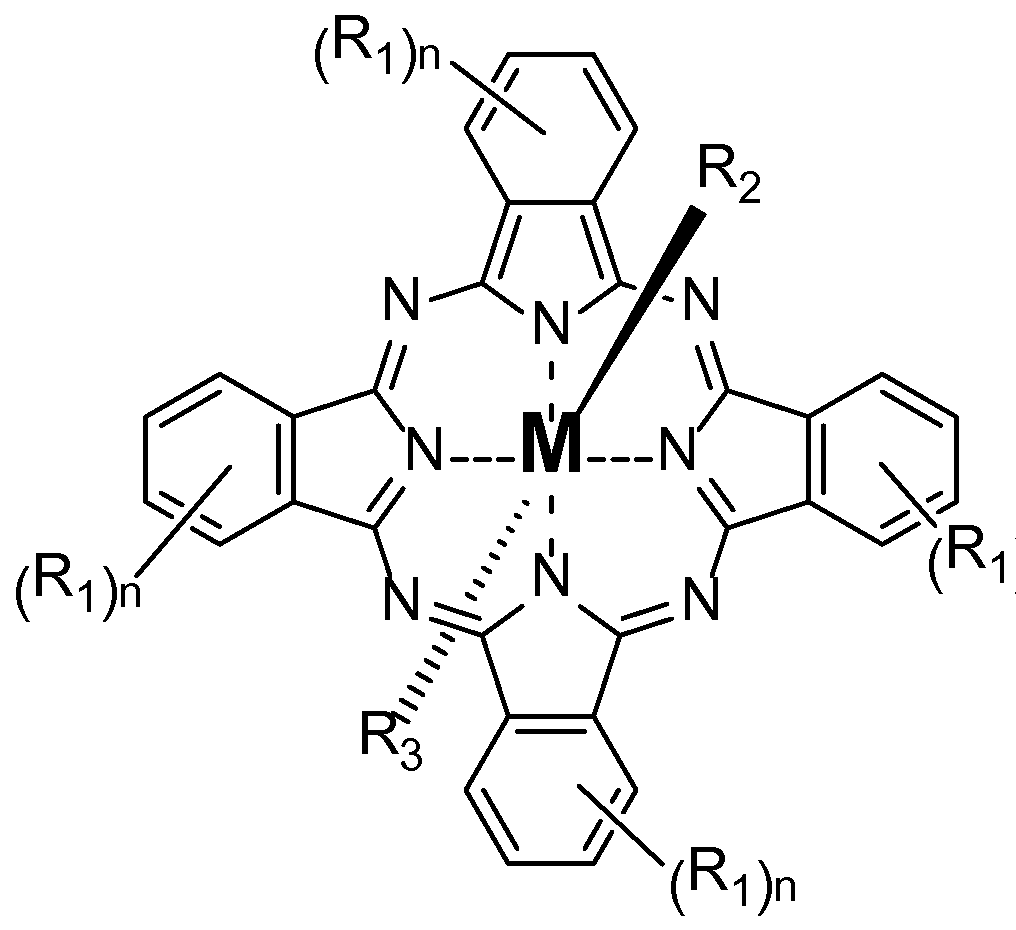
- a photovoltaic cell wherein a photoactive region comprises a small molecule organic semiconductor comprising an aryloxy-phtalocyanine of group IV metals comprising a compound of a general formula (I):
- M is one or more group IV metals and comprises silicon, germanium, tin, or a combination thereof; wherein "n" is an integer equal to or greater than 0; wherein each Ri independently comprises a straight chain alkyl group, a branched alkyl group, a cycloalkyl group, an alkenyl group, an alkynyl group, an alkoxy group, an aryloxy group, heterocyclic group, a monocyclic aromatic group, a polycyclic aromatic group, an aryl, an alkylaryl group, an arylalkyl group, an akylene group, a hydrogen, a halogen, or a combination thereof; and wherein R 2 comprises an aryl containing group comprising from greater than or equal to about 6 to about 22 carbon atoms, wherein the aryl containing group can optionally be substituted at any one or more positions by one or more heteroatoms, wherein the heteroatom, if present, can comprise a halogen, oxygen, sulfur, nitrogen
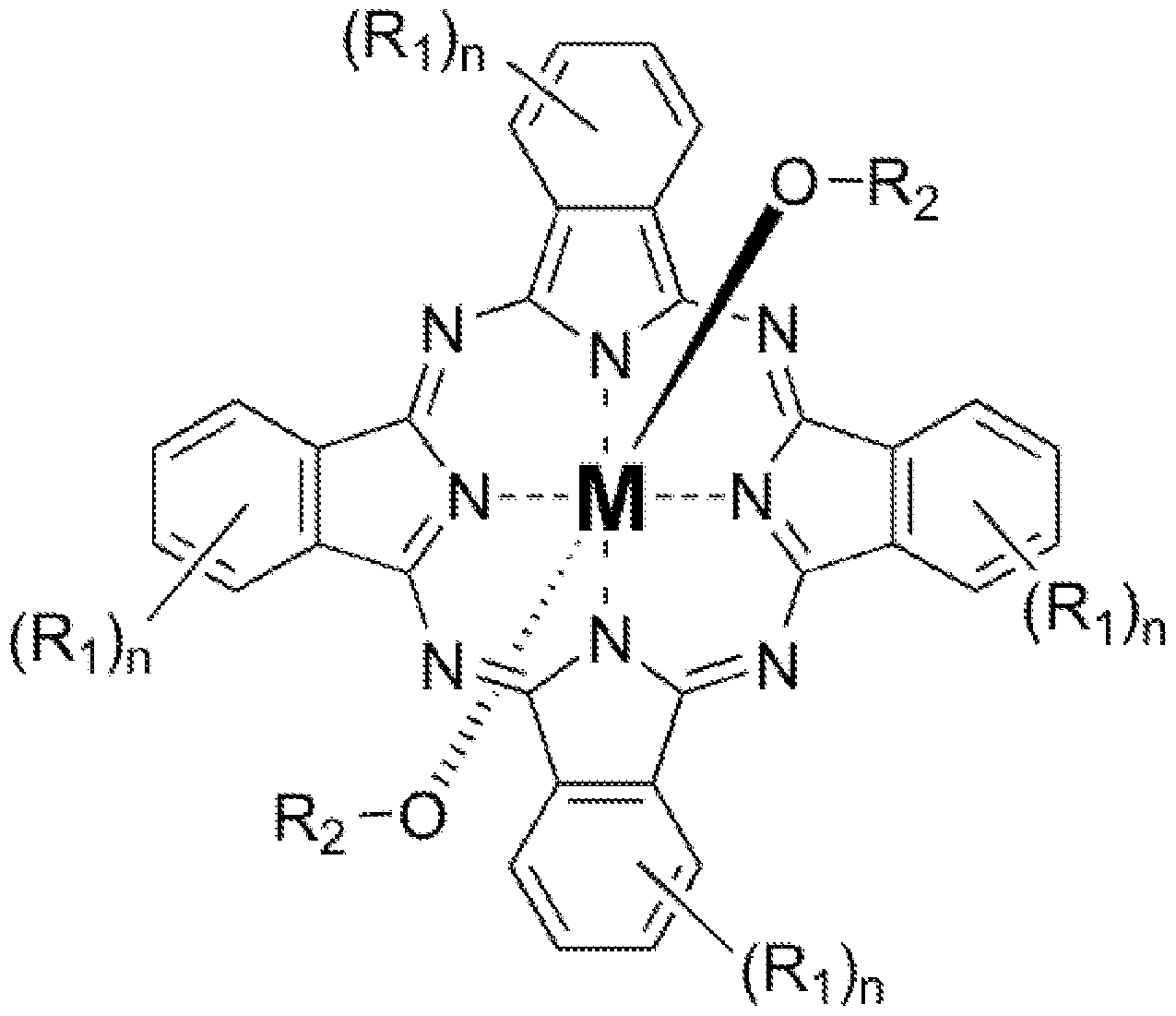
- a photovoltaic cell wherein a photoactive region comprises a small molecule organic semiconductor comprising an aryloxy-phtalocyanine of group IV metals comprising a compound of a general formula (II):
- M is one or more group IV metals and comprises silicon, germanium, tin, or a combination thereof; wherein "n" is an integer equal to or greater than 0; wherein each Ri independently comprises a straight chain alkyl group, a branched alkyl group, a cycloalkyl group, an alkenyl group, an alkynyl group, an alkoxy group, an aryloxy group, heterocyclic group, a monocyclic aromatic group, a polycyclic aromatic group, an aryl group, an alkylaryl group, an arylalkyl group, an akylene group, a hydrogen, a halogen, or a combination thereof; and wherein R 2 and R 3 are the same or different and can independently comprise a halogen, oxygen, sulfur, nitrogen, aryl or an aryloxy containing group comprising from greater than or equal to about 6 to about 22 carbon atoms, wherein the aryl containing group can optionally be substituted at any one or more positions by one
- FIG. 1 illustrates UV-VIS absorbance of (m-cresol) 2 -SiPc, (m-cresol) 2 -GePc and (PDP) 2 -SnPc, in accordance with various aspects of the present disclosure.
- FIG. 2 Illustrates cyclic voltammograms of (m-cresol) 2 -SiPc, (m-cresol) 2 -GePc and (PDP) 2 -SnPc, in accordance with various aspects of the present disclosure.
- M comprises silicon, germanium, tin, or a combination thereof; wherein "n" is an integer equal to or greater than 0; wherein each Ri comprises a straight chain alkyl group, a branched alkyl group, a cycloalkyl group, an alkenyl group, an alkynyl group, an alkoxy group, an aryloxy group, heterocyclic group, a monocyclic aromatic group, a polycyclic aromatic group, an aryl group, an alkylaryl group, an arylalkyl group, an akylene group, a hydrogen, a halogen, or a combination thereof; and wherein R 2 comprises an optionally substituted aryl containing group comprising from greater than or equal to about 6 to about 22 carbon atoms, wherein the aryl containing group, if substituted, can be substituted at one or more positions by one or more of the same or different heteroatoms comprising a halogen, oxygen, sulfur, nitrogen, or a combination thereof.
- n ranges from about 0 to about 4.
- R 2 comprises an optionally substituted aryl containing group comprising from greater than or equal to about 6 to about 18 carbon atoms, or from greater than or equal to about 6 to about 10 carbon atoms and wherein not all of which are considered aromatic carbon atoms, wherein, the aryl containing group, if substituted, can be substituted at one or more positions by one or more of the same of different heteroatoms comprising a halogen, oxygen, sulfur, nitrogen, or a combination thereof.
- R 2 does not comprise a metal.
- R 2 does not comprise a heteroatom as a bridging group.
- Ri and R 2 are the same or different and at least one of Ri and R 2 can comprise a hydrocarbon, hydrogen, halogen such as, for example, bromine, chlorine, fluorine, or iodine, or a combination thereof.
- Ri and R 2 are the same or different and at least one of Ri and R 2 can comprise a Ci -C 2 o-alkyl group: straight-chain or branched hydrocarbon radicals having up to about 20 carbon atoms, for example Ci-Cio-alkyl or Cn-C 20 -alkyl, or a Ci-Cio- alkyl, for example Ci-C3-alkyl, such as methyl, ethyl, propyl, isopropyl, or C4-C 6 -alkyl, n- butyl, sec-butyl, tert-butyl, 1, 1 -dimethyl ethyl, pentyl, 2-methylbutyl, 1 , 1-dimethylpropyl, 1 ,2- dimethylpropyl, 2,2-dimethylpropyl, 1-ethylpropyl, hexyl, 2-methylpentyl, 3-methylpentyl, 1 ,1-d
- Ri and R 2 are the same or different and at least one of Ri and R 2 can comprise a C 2 -C 2 o-alkenyl group: unsaturated, straight-chain or branched hydrocarbon radicals having from about 2 to about 20 carbon atoms and a double bond in any position, for example C 2 -Cio-alkenyl or Cn-C 2 o-alkenyl, a C 2 -Cio-alkenyl such as C 2 -C 4 -alkenyl, such as ethenyl, 1-propenyl, 2-propenyl, 1-methylethenyl, 1 -butenyl, 2-butenyl, 3 -butenyl, 1-methyl- 1-propenyl, 2 -methyl- 1-propenyl, 1 -methyl-2-propenyl, 2-methyl-2-propenyl, or C 5 -C6- alkenyl, such as 1-pentenyl, 2-pentenyl,
- Ri and R 2 are the same or different and at least one of Ri and R 2 can comprise a C 2 -C 2 o-alkynyl group: straight-chain or branched hydrocarbon groups having from about 2 to about 20 carbon atoms and a triple bond in any position, for example C 2 -Cio-alkynyl or Cn-C 2 o-alkynyl, a C 2 -Cio-alkynyl such as C 2 -C 4 -alkynyl, such as ethynyl, 1-propynyl, 2-propynyl, 1-butynyl, 2-butynyl, 3-butynyl, l-methyl-2-propynyl, or C5-C7- alkynyl, such as 1-pentynyl, 2-pentynyl, 3-pentynyl, 4-pentynyl, l-methyl-2-butynyl, 1-
- Ri and R 2 are the same or different and at least one of Ri and R 2 can comprise a Cs-Cig-cycloalkyl group: monocyclic saturated hydrocarbon groups having from about 3 up to about 18 carbon ring members, or a Cs-Cs-cycloalkyl such as cyclopropyl, cyclobutyl, cyclopentyl, cyclohexyl, cycloheptyl or cyclooctyl, and a saturated or unsaturated cyclic system, for example norbornyl or norbenzyl.
- Ri and R 2 can be substituted with groups independently selected from all possible isomers and enantiomers, including mixtures of isomers or enantiomers.
- Ri and R 2 are the same or different and at least one of Ri and R 2 can comprise a heterocycle, for example, five- to twelve-member, five- to nine-member, five- to six-member, ring systems having oxygen, nitrogen and/or sulfur atoms and optionally a plurality of rings, such as furyl, thiophenyl, pyrryl, pyridyl, indolyl, benzoxazolyl, dioxolyl, dioxyl, benzimidazolyl, benzthiazolyl, dimethylpyridyl, methylquinolyl, dimethylpyrryl, methoxyfuryl, dimethoxypyridyl, difluoropyridyl, methylthiophenyl, isopropylthiophenyl or tert-butylthiophenyl.
- a heterocycle for example, five- to twelve-member, five- to nine-member, five- to six-member, ring systems having oxygen, nitrogen and/or sulfur
- Ri and/or R 2 can comprise a five- or six-member saturated nitrogen-containing ring systems attached via a ring nitrogen atom and which can comprise one or two further nitrogen atoms or a further oxygen or sulfur atom.
- Ri and R 2 can comprise C 2 -C 17 Heterocycloalkyl, for example, aziridinyl, oxiranyl, thiiranyl, azetidinyl, oxetanyl, thietanyl, pyrrolidinyl, tetrahydrofuranyl, tetrahydrothiophenyl, piperidinyl, tetrahydro-2H-pyranyl, tetrahydro-2H-thiopyranyl, azepanyl, oxepanyl, thiepanyl, azocanyl, oxocanyl, thiocanyl, imidazolidinyl, pyrazolidinyl, oxazo
- Ri comprises a Ci-C 2 o-alkoxy group: a straight-chain or branched alkyl group having from about 1 to about 20 carbon atoms (as specified above) which is attached via an oxygen atom (—0—), for example Ci-Cio-alkoxy or Cn-C 2 o-alkoxy, a Ci-Cio- alkyloxy, or a Ci-C3-alkoxy, for example methoxy, ethoxy, propoxy.
- Ci-C 2 o-alkoxy group a straight-chain or branched alkyl group having from about 1 to about 20 carbon atoms (as specified above) which is attached via an oxygen atom (—0—), for example Ci-Cio-alkoxy or Cn-C 2 o-alkoxy, a Ci-Cio- alkyloxy, or a Ci-C3-alkoxy, for example methoxy, ethoxy, propoxy.
- Ri comprises an aryloxy containing group, for example, a mono- to tricyclic aromatic ring system (as described above) which is attached via an oxygen atom (— O— ), or a mono- to bicyclic, or a monocyclic, aromatic ring system.
- aryloxy containing group for example, a mono- to tricyclic aromatic ring system (as described above) which is attached via an oxygen atom (— O— ), or a mono- to bicyclic, or a monocyclic, aromatic ring system.
- Ri and R 2 are the same or different and at least one of Ri and R 2 can comprise an arylalkyl group, for example, a mono- to tricyclic aromatic ring system (as specified above) which is attached via a Ci-C2o-alkylene group, a mono- to bicyclic, or a monocyclic, aromatic ring system.
- arylalkyl group for example, a mono- to tricyclic aromatic ring system (as specified above) which is attached via a Ci-C2o-alkylene group, a mono- to bicyclic, or a monocyclic, aromatic ring system.
- Ri and/or R 2 comprise a Ci-C 2 o-alkylene group, for example, a straight-chain or branched hydrocarbon radicals having from about 1 to about 20 carbon atoms, for example Ci-Cio-alkylene or Cn-C 2 o-alkylene, C 2 -Cio-alkylene, such as, for example, methylene, dimethylene, trimethylene, tetramethylene, pentamethylene or hexamethylene.
- Ci-C 2 o-alkylene group for example, a straight-chain or branched hydrocarbon radicals having from about 1 to about 20 carbon atoms, for example Ci-Cio-alkylene or Cn-C 2 o-alkylene, C 2 -Cio-alkylene, such as, for example, methylene, dimethylene, trimethylene, tetramethylene, pentamethylene or hexamethylene.
- Ri and/or R 2 comprises an aryl group, for example, a mono- to tricyclic aromatic ring system comprising from greater than or equal to about 6 to about 22 carbon ring members, for example phenyl, naphthyl or anthracenyl, a mono- to bicyclic, or a monocyclic, aromatic ring system.
- aryl group for example, a mono- to tricyclic aromatic ring system comprising from greater than or equal to about 6 to about 22 carbon ring members, for example phenyl, naphthyl or anthracenyl, a mono- to bicyclic, or a monocyclic, aromatic ring system.
- R 2 comprises a mono- to tricyclic aromatic ring system comprising from greater than or equal to about 6 to about 22 carbon ring members, greater than or equal to about 6 and about 18 carbon ring members, or from greater than or equal to about 6 to about 10 carbon ring members, wherein not all carbons are necessarily aromatic, and wherein the ring system can optionally be substituted at any one or more positions by one or more heteroatoms.
- a heteroatom can comprise a halogen, oxygen, sulfur, nitrogen, or a combination thereof.
- a heteroatom if present, can comprise a chlorine, fluorine, bromine, iodine, or a combination thereof.
- R 2 comprises a mono-to tricyclic aromatic ring system comprising from greater than or equal to about 6 to about 22 carbon ring members, greater than or equal to about 6 and about 18 carbon ring members, greater than or equal to about 6 to about 10 carbon ring members, wherein not all carbons are necessarily aromatic, and wherein the ring system can optionally be substituted at any one or more positions by one or more halogens.
- a halogen does not comprise chlorine.
- a halogen comprises fluorine, chlorine bromine, iodine, or a combination thereof.
- the ring system is not substituted in a para- position.
- a halogen comprises chlorine
- the ring system is substituted at one or more ortho-positions. While not wishing to be bound to a particular theory, it is believed that the substituted R 2 can be highly electronegative so as to affect the electron cloud around the metal.
- any of the hydrocarbon groups can be optionally substituted one, two, or more times at any position with the same or different substituting moiety such as a nitrogen containing group, for example, amino and/or nitro; a sulfur containing group, for example, thiol, sulfoxide, sulfate, and/or chlorosulfate; a hydroxyl group; a silicon containing group, for example, a trisubstituted silane where the substituent is a hydrocarbon; a halogen, for example, bromine, chlorine, fluorine, and/or iodine; and a hetero atom moiety, having for example about 3 to about 15 atoms, and including an element selected for instance from the group consisting of nitrogen, sulfur, silicon, and oxygen, such as thiophen-2-yl, thiophen-3- yl, pyridine-2-yl, pyridine-3-yl, pyridine-4-yl, furna-2-yll,
- substituting moiety such
- the present disclosure provides a compound having the general structure (II):
- M comprises silicon, germanium, tin, or a combination thereof, wherein "n" is an integer equal to or greater than 0; wherein each Ri comprises a straight chain alkyl group, a branched alkyl group, a cycloalkyl group, an alkenyl group, an alkynyl group, an alkoxy group, an aryloxy group, heterocyclic group, a monocyclic aromatic group, a polycyclic aromatic group, an aryl group, an alkylaryl group, an arylalkyl group, an akylene group, a hydrogen, a halogen, or a combination thereof; and wherein R 2 and R 3 are the same or different and comprise a halogen, oxygen, sulfur, nitrogen, aryl or an optionally substituted aryloxy containing group comprising from greater than or equal to about 6 to about 22 carbon atoms, wherein if present and substituted, an aryloxy containing group can be substituted in one or more positions by one or more of
- n can range from about 0 to about 4.
- R ls R 2 , and R 3 can be the same or different and can comprise a hydrocarbon; hydrogen; halogen, such as bromine, chlorine, fluorine, and iodine; or a combination thereof.
- R 2 and R 3 are the same or different and at least one of R 2 and R 3 can comprise an optionally substituted aryloxy containing group comprising from greater than or equal to about 6 to about 18 carbon atoms, or from greater than 6 to about 10 carbon atoms, wherein if substituted, can be substituted at one or more positions by one or more heteroatoms comprising a halogen, oxygen, sulfur, nitrogen, or a combination thereof.
- R 2 and R 3 do not comprise a metal.
- R 2 and R 3 do not comprise a heteroatom as a bridging group.
- R ls R 2 , and R 3 are the same or different and at least one of R ls R 2 , and R 3 comprise a Ci -C 2 o-alkyl group: straight-chain or branched hydrocarbon radicals having up to about 20 carbon atoms, for example Ci-Cio-alkyl or Cn-C 20 -alkyl, a Ci-Cio- alkyl, for example Ci-C 3 -alkyl, such as methyl, ethyl, propyl, isopropyl, or C4-C 6 -alkyl, n- butyl, sec-butyl, tert-butyl, 1,1 -dimethyl ethyl, pentyl, 2-methylbutyl, 1,1-dimethylpropyl, 1,2- dimethylpropyl, 2,2-dimethylpropyl, 1-ethylpropyl, hexyl, 2-methylpentyl, 3-methylpent
- R ls R 2 , and R 3 are the same or different and at least one of R ls R 2 , and R 3 comprise a C 2 -C 2 o-alkenyl group: unsaturated, straight-chain or branched hydrocarbon radicals having from about 2 to about 20 carbon atoms and a double bond in any position, for example C2-Cio-alkenyl or Cn-C2o-alkenyl, a C2-Cio-alkenyl such as C2-C4- alkenyl, such as ethenyl, 1-propenyl, 2-propenyl, 1-methylethenyl, 1-butenyl, 2-butenyl, 3- butenyl, 1 -methyl- 1-propenyl, 2 -methyl- 1-propenyl, l-methyl-2-propenyl, 2-methyl-2- propenyl, or C 5 -C6-alkenyl, such as 1-pentenyl, 2-penten
- R ls R2, and R 3 are the same or different and at least one of R ls R2, and R 3 comprise a C2-C2o-alkynyl group: straight-chain or branched hydrocarbon groups having from about 2 to about 20 carbon atoms and a triple bond in any position, for example C2-Cio-alkynyl or Cn-C2o-alkynyl, a C2-Cio-alkynyl such as C2-C 4 -alkynyl, such as ethynyl, 1-propynyl, 2-propynyl, 1-butynyl, 2-butynyl, 3-butynyl, l-methyl-2-propynyl, or C5-C7- alkynyl, such as 1-pentynyl, 2-pentynyl, 3-pentynyl, 4-pentynyl, l-methyl-2-butynyl, 1- methyl
- R ls R 2 , and R 3 are the same or different and at least one of Ri, R 2 , and R 3 comprise a C 3 -Ci8-cycloalkyl group, for example, monocyclic saturated hydrocarbon groups having from about 3 up to about 18 carbon ring members, a C 3 -Cg- cycloalkyl such as cyclopropyl, cyclobutyl, cyclopentyl, cyclohexyl, cycloheptyl or cyclooctyl, and a saturated or unsaturated cyclic system, for example norbornyl or norbenzyl.
- Ri and R 2 can be substituted with groups independently selected from other isomers and enantiomers, including mixtures of isomers or enantiomers, that one of ordinary skill in the art would deem appropriate.
- R ls R 2i and R 3 are the same or different and at least one of R ls R 2 , and R 3 comprise a heterocycle, for example, five- to twelve-member, five- to nine -member, five- to six -member, ring systems having oxygen, nitrogen and/or sulfur atoms and optionally a plurality of rings, such as furyl, thiophenyl, pyrryl, pyridyl, indolyl, benzoxazolyl, dioxolyl, dioxyl, benzimidazolyl, benzthiazolyl, dimethylpyridyl, methylquinolyl, dimethylpyrryl, methoxyfuryl, dimethoxypyridyl, difluoropyridyl, methylthiophenyl, isopropylthiophenyl or tert-butylthiophenyl; or moreover, five- or six-member saturated nitrogen-containing ring systems which are attached via
- Ri , R 2 , and/or R 3 can comprise a C 2 -C 17 heterocycloalkyl, for example, aziridinyl, oxiranyl, thiiranyl, azetidinyl, oxetanyl, thietanyl, pyrrolidinyl, tetrahydrofuranyl, tetrahydrothiophenyl, piperidinyl, tetrahydro-2H-pyranyl, tetrahydro-2H- thiopyranyl, azepanyl, oxepanyl, thiepanyl, azocanyl, oxocanyl, thiocanyl, imidazolidinyl, pyrazolidinyl, oxazolidinyl, piperazinyl, tetrahydropyrimidinyl, tetrahydropyridazinyl, oxazinanyl
- Ri , R 2 , and R 3 are the same or different and can at least one of Ri, R 2 , and R 3 comprise a Ci-C 22 -alkoxy group: a straight-chain or branched alkyl group having from about 1 to about 22 carbon atoms (as specified above) which is attached via an oxygen atom (—0—), for example Ci-Cio-alkoxy or Cn-C 2 o-alkoxy, a Ci-Cio-alkyloxy, or a Ci-C 3 -alkoxy, for example methoxy, ethoxy, propoxy.
- a Ci-C 22 -alkoxy group a straight-chain or branched alkyl group having from about 1 to about 22 carbon atoms (as specified above) which is attached via an oxygen atom (—0—), for example Ci-Cio-alkoxy or Cn-C 2 o-alkoxy, a Ci-Cio-alkyloxy, or a Ci-C 3 -
- Ri, R 2 , and R3 are the same or different and at least one of Ri, R 2 , and R3 can comprise an aryloxy containing group, for example, a mono- to tricyclic aromatic ring system (as specified above) which is attached via an oxygen atom (—0—), a a mono- to bicyclic, or a monocyclic, aromatic ring system.
- R l s R 2i and R3 are the same or different and at least one of R l s R 2 , and R3 comprise an arylalkyl containing group, for example, a mono- to tricyclic aromatic ring system (as specified above) which is attached via a Ci-C 2 o-alkylene group, a mono- to bicyclic, or a monocyclic, aromatic ring system.
- arylalkyl containing group for example, a mono- to tricyclic aromatic ring system (as specified above) which is attached via a Ci-C 2 o-alkylene group, a mono- to bicyclic, or a monocyclic, aromatic ring system.
- R l s R 2 and R3 are the same or different and at least one of Ri, R 2 , and R3 comprise a Ci-C 2 o-alkylene containing group, for example, straight-chain or branched hydrocarbon radicals having from about 1 to about 20 carbon atoms, for example C 1 -C 10 - alkylene or Cn-C 2 o-alkylene, or a C 2 -Cio-alkylene, especially methylene, dimethylene, trimethylene, tetramethylene, pentamethylene or hexamethylene.
- a Ci-C 2 o-alkylene containing group for example, straight-chain or branched hydrocarbon radicals having from about 1 to about 20 carbon atoms, for example C 1 -C 10 - alkylene or Cn-C 2 o-alkylene, or a C 2 -Cio-alkylene, especially methylene, dimethylene, trimethylene, tetramethylene, pentamethylene or hexamethylene
- R l s R 2 and R3 are the same or different and at least one of Ri, R 2 , and R3 can comprise an aryl containing group, for example, a mono- to tricyclic aromatic ring system comprising greater than or equal to about 6 to about 22 carbon ring members, for example phenyl, naphthyl or anthracenyl, a mono- to bicyclic, or a monocyclic, aromatic ring system.
- aryl containing group for example, a mono- to tricyclic aromatic ring system comprising greater than or equal to about 6 to about 22 carbon ring members, for example phenyl, naphthyl or anthracenyl, a mono- to bicyclic, or a monocyclic, aromatic ring system.
- R 2 and R3 are the same or different and can comprise a mono- to tricyclic aromatic ring system comprising from greater than or equal to about 6 to about 22 carbon ring members, from greater than or equal to about 6 and about 18 carbon ring members, or from greater than or equal to about 6 and about 10 carbon ring members, wherein not all carbon atoms are necessarily aromatic, and wherein the ring system can be optionally substituted at any one or more positions by one or more of the same of different heteroatoms, such as, for example, a halogen, oxygen, sulfur, nitrogen, or a combination thereof.
- a heteroatom if present, can comprise chlorine, fluorine, bromine, iodine, or a combination thereof.
- R 2 and R3 are the same or different and can comprise a mono-to tricyclic aromatic ring system comprising from greater than or equal to about 6 to about 22 carbon ring members, greater than or equal to about 6 and about 18 carbon ring members, greater than or equal to about 6 to about 10 carbon ring members, wherein not all carbons are necessarily aromatic, and wherein the ring system can optionally be substituted at any one or more positions by one or more halogens.
- a halogen does not comprise chlorine.
- a halogen comprises fluorine, chlorine bromine, iodine, or a combination thereof.
- the ring system is not substituted in a para-position.
- a halogen comprises chlorine
- the ring system is substituted at one or more ortho-positions. While not wishing to be bound to a particular theory, it is believed that the substituted R 2 can be highly electronegative so as to affect the electron cloud around the metal.
- any of the hydrocarbon groups described herein can be optionally substituted at one, two, or more positions with the same or different substituting moiety such as, for example, a nitrogen containing groups such as amino and nitro; a sulfur containing group such as thiol, sulfoxide, sulfate, chlorosulfate; a hydroxyl group; a silicon containing group such as a trisubstituted silane where the substituent is a hydrocarbon; a halogen such as bromine, chlorine, fluorine, and iodine; and a hetero atom moiety, having for example 3 to 15 atoms, and including an element selected for instance from the group consisting of nitrogen, sulfur, silicon, and oxygen, such as thiophen-2-yl, thiophen-3-yl, pyridine-2-yl, pyridine-3-yl, pyridine-4-yl, furna-2-yll, furan-3-yl, and the like.
- substituting moiety such as,
- R 2 and R 3 are the same or different and comprise a halogen, oxygen, sulfur, nitrogen, or a combination thereof.
- the method for preparing the compounds described herein can comprise: (a) providing a compound comprising a halogen-metal bond containing Ri substituted phthalocyanine precursor, wherein the halogen comprises chlorine, bromine, iodine, fluorine, or a combination thereof, and each Ri comprises a straight chain alkyl group, a branched alkyl group, a cycloalkyl group, an alkenyl group, an alkynyl group, an alkoxy group, an aryloxy group, heterocyclic group, a monocyclic aromatic group, a polycyclic aromatic group, an aryl group, an alkylaryl group, an arylalkyl group, an akylene group, a hydrogen, a halogen, or a combination thereof; (b) providing a reactant comprising an optionally substituted aryl (-R 2 ) and/or optionally
- PC metal-free phthalocyanines
- U.S. Pat. No. 3,509,146 describes the preparation of metal-free phthalocyanines (Pc) and related compounds by mixing 1, 3-diiminoisoindolines or their heterocyclic analogs with alkylalanolamines.
- EP 0 373 643 A2 describes the preparation of metal containing phthalocyanines, for example, the synthesis of metal containing phthalocyanines by reaction of mixtures of o-phthalodinitriles and /or 1,30 diiminoisoindolines with metallic compounds.
- Durmus et al., Tetrahedron, 2007, 1385 describe preparation of halogen- metal bond containing phthalocyanines. These compounds can be prepared for example, by the treatment of phthalonitriles with a metal chloride in freshly distilled quinoline solvent.
- step (b) of the method for preparing compounds having the general structure (I) comprises providing a reactant comprising an optionally substituted aryl (-R 2 ) and/or an optionally substituted arylalcohol groups (OH-R 2 ), wherein R 2 comprises from greater than or equal to about 6 to about 18 carbon atoms, or from greater than or equal to about 6 to about 10 carbon atoms, wherein not all of the carbon atoms are necessarily aromatic, and wherein, if substituted, the reactant can be substituted at one or more positions by one or more heteroatoms, for example, comprising a halogen, oxygen, sulfur, nitrogen, or a combination thereof.
- a reactant comprising an optionally substituted aryl (-R 2 ) and/or an optionally substituted arylalcohol groups (OH-R 2 ), wherein R 2 comprises from greater than or equal to about 6 to about 18 carbon atoms, or from greater than or equal to about 6 to about 10 carbon atoms, wherein not all of the
- step (b) of the method for preparing a compound having the general structure (I) comprises providing a reactant comprising an optionally substituted aryl (-R 2 ) and/or an optionally substituted arylalcohol groups (OH-R 2 ), wherein R 2 comprises a mono- to tricyclic aromatic ring system comprising from greater than or equal to about 6 to about 22 carbon ring members, greater than or equal to about 6 and about 18 carbon ring members, or from greater than or equal to about 6 to about 10 carbon ring members, wherein not all carbons are necessarily aromatic, and wherein the ring system can optionally be substituted at any one or more positions by one or more heteroatoms.
- a reactant comprising an optionally substituted aryl (-R 2 ) and/or an optionally substituted arylalcohol groups (OH-R 2 ), wherein R 2 comprises a mono- to tricyclic aromatic ring system comprising from greater than or equal to about 6 to about 22 carbon ring members, greater than or equal to about 6
- such a heteroatom can comprise a halogen, oxygen, sulfur, nitrogen or a combination thereof.
- a heteroatom if present, can comprise a chlorine, fluorine, bromine, iodine, or a combination thereof.
- step (b) of the method for preparing a compound having the general structure (I) comprises providing a reactant comprising an optionally substituted aryl (-R 2 ) and/or an optionally substituted arylalcohol groups (OH-R 2 ), wherein R 2 comprises a mono- to tricyclic aromatic ring system comprising from greater than or equal to about 6 to about 22 carbon ring members, greater than or equal to about 6 and about 18 carbon ring members, or from greater than or equal to about 6 to about 10 carbon ring members, wherein not all carbons are necessarily aromatic, and wherein the ring system can optionally be substituted at any one or more positions by one or more halogens.
- a halogen does not comprise chlorine.
- a halogen can comprise a chlorine, fluorine, bromine, iodine, or a combination thereof.
- a halogen comprises chlorine
- the ring system is not substituted in a para-position.
- a halogen comprises chlorine
- the ring system is substituted at one or more ortho- positions. While not wishing to be bound to a particular theory, it is believed that the substituted R 2 can be highly electronegative so as to the affect electron cloud around the metal.
- a method for preparing a compound of the general molecular structure (II) comprises the steps of: (a) providing a compound comprising a halogen-metal bond containing Ri substituted phthalocyanine precursor, wherein the halogen comprises chlorine, bromine, iodine, fluorine, or a combination thereof, and wherein and each Ri can independently comprise a straight chain alkyl group, a branched alkyl group, a cycloalkyl group, an alkenyl group, an alkynyl group, an alkoxy group, an aryloxy group, heterocyclic group, a monocyclic aromatic group, a polycyclic aromatic group, an alkylaryl group, an arylalkyl group, an akylene group, a hydrogen, a halogen, or a combination thereof; (b) providing a reactant comprising R 2 and/or R 3 moieties, wherein R 2 and/or R 3 are the same or different and can comprise
- R 2 and R 3 are the same or different and can independently comprise an optionally substituted aryloxy containing group comprising from greater than or equal to about 6 to about 18 carbon atoms, or from greater than or equal to about 6 to about 10 carbon atoms, wherein not all carbon atoms are necessarily aromatic, and wherein, if substituted, can be substituted at any one or more positions by one or more of the same or different heteroatoms, such as, for example, a halogen, oxygen, sulfur, nitrogen, or a combination thereof.
- step (b) of the method for preparing a compound having the general structure (II) comprises providing a reactant comprising an optionally substituted aryl (-R 2 ) or (-R 3 ) and/or an optionally substituted arylalcohol groups (OH-R 2 ) or (OH-R 3 ) , wherein R 2 and R 3 are the same or different and can comprise a mono- to tricyclic aromatic ring system comprising from greater than or equal to about 6 to about 22 carbon ring members, greater than or equal to about 6 and about 18 carbon ring members, or from greater than or equal to about 6 to about 10 carbon ring members, wherein not all carbons are necessarily aromatic, and wherein the ring system can optionally be substituted at any one or more positions by one or more heteroatoms.
- a reactant comprising an optionally substituted aryl (-R 2 ) or (-R 3 ) and/or an optionally substituted arylalcohol groups (OH-R 2 ) or (OH-R 3
- such a heteroatom can comprise a halogen, oxygen, sulfur, nitrogen or a combination thereof.
- a heteroatom if present, can comprise a chlorine, fluorine, bromine, iodine, or a combination thereof.
- step (b) of the method for preparing a compound having the general structure (II) comprises providing a reactant comprising an optionally substituted aryl (-R 2 ) or (-R 3 ) and/or an optionally substituted arylalcohol groups (OH-R 2 ) or (OH-R 3 ), wherein R 2 and R 3 are the same or different and can comprise a mono- to tricyclic aromatic ring system comprising from greater than or equal to about 6 to about 22 carbon ring members, greater than or equal to about 6 and about 18 carbon ring members, or from greater than or equal to about 6 to about 10 carbon ring members, wherein not all carbons are necessarily aromatic, and wherein the ring system can optionally be substituted at any one or more positions by one or more halogens.
- a reactant comprising an optionally substituted aryl (-R 2 ) or (-R 3 ) and/or an optionally substituted arylalcohol groups (OH-R 2 ) or (OH-R 3 ),
- a halogen does not comprise chlorine.
- a halogen can comprise a chlorine, fluorine, bromine, iodine, or a combination thereof.
- a halogen comprises chlorine
- the ring system is not substituted in a para-position.
- a halogen comprises chlorine
- the ring system is substituted at one or more ortho-positions.
- the compounds of the general structure (I) and/or (II) can be prepared in the presence of a solvent.
- suitable solvents can comprise substances which are liquid at the temperatures of the process according to the invention and in which all compounds involved are at least partly soluble.
- such solvents have boiling points of over about 100 °C at standard pressure (101.325 kPa).
- the solutions of the compounds of the general structure (I) and/or (II) used in the method according to the invention in the presence of a solvent can also have the properties of suspensions or dispersions.
- Suitable solvents can comprise, for example, aromatic compounds or polar aprotic compounds.
- the solvent can comprise toluene, xylene, mesitylene, teralin, chlorobenzene, dichlorobenzene, quinoline, pyridine, sulfolane, THF, chloromethane, chloroform, dimethyl sulfoxide, or a combination thereof.
- the amount of solvent which can be used in the process according to the invention is dependent upon the solubility of the compounds dissolved and can therefore vary within a wide range.
- one or more solvents can be added in excess (weight ratio).
- the temperatures which are established for the preparation of the general compounds of the structure (I) and (II) in the method according to the invention can vary within a wide range.
- the selection of the temperature can, for example, depend on the solubility of one or more compounds involved to form the compounds of the of the general structure (I) and (II), and can be determined by one of ordinary skill in the art.
- solubility is high, it can be possible, for example, to select relatively low temperatures for the reaction in the method according to the invention.
- the temperatures in the method according to the invention can generally be selected from the range of from about 0 °C to about 200 °C.
- the temperature can be in the range of from about 20 °C to about 150 °C.
- the temperature can be in the range of from about 70 °C to about 140 °C.
- the pressure range within which the method according to the invention for preparing compounds of the general structure (I) and (II) are performed can vary.
- the method according to the invention can be performed at standard pressure, slightly reduced pressure or else elevated pressure.
- the pressure can be selected from the range of from about 90 kPa to about 1000 kPa.
- the process can be performed in any apparatus which is suitable for this purpose, such as, for example, those known to one skilled in the art of organic compounds.
- any methods with which the person skilled in the art is familiar.
- the removal can be performed by, for example, filtration or phase separation.
- the workup can comprise a purification step, such as, for example, washing the compounds with a liquid, and/or a drying step.
- the duration of all time steps (a) to (c) overall, and also of any individual step can vary, for example, depending on the temperature. In another aspect, the duration of all time steps together can vary within a wide range from a few minutes up to, for example, about 72 hours.
- a first "Highest Occupied Molecular Orbital” (HOMO) or “Lowest Unoccupied Molecular Orbital (LUMO) energy level is "greater than” or "higher than” a second HOMO or LUMO energy level if the first energy level is closer to the vacuum energy level. Since ionization potentials (IP) are measured as a negative energy relative to a vacuum level, a higher HOMO energy level corresponds to an IP having a smaller absolute value (an IP that is less negative). Similarly, a higher LUMO energy level corresponds to an electron affinity (EA) having a smaller absolute value (an EA that is less negative).
- IP ionization potentials
- EA electron affinity
- the LUMO energy level of a material is higher than HOMO energy level of the same material.
- a "higher” HOMO or LUMO energy level appears closer to the top of such a diagram than a "lower” HOMO or LUMO energy level.
- the terms “donor” and “acceptor” refer to relative positions of the HOMO and LUMO energy levels of two contacting but different organic materials.
- the term “electron donor” refers to the material's electron affinity. An electron donor material has a relative low electron affinity, i.e. the EA value has a smaller absolute value. As such, an electron donor material tends to act as p-type material. In other words, an electron donor material can act as a hole transport material.
- the term “electron acceptor” refers to material's electron affinity. An electron acceptor material has a relatively high electron affinity. As such, an electron acceptor material can act as an electron transport material.
- charge transport material refers to a material transports charge, i.e. holes or electrons.
- An electron donor material transports holes and an electron acceptor material transports electrons.
- photoactive region is a portion of a photosensitive device that absorbs electromagnetic radiation to generate excitation (i.e. electrically neutral excited state in form of electron-hole pairs).
- Described herein are uses of compounds having the general molecular structures (I) and (II).
- photovoltaic cells comprising compounds having the general molecular structure (I) and (II) are described.
- a photovoltaic cell comprising a compound having the general molecular structure (I):
- M comprises silicon, germanium, tin, or a combination thereof; wherein "n" is an integer equal to or greater than 0; wherein each Ri independently comprises a straight chain alkyl group, a branched alkyl group, a cycloalkyl group, an alkenyl group, an alkynyl group, an alkoxy group, an aryloxy group, heterocyclic group, a monocyclic aromatic group, a polycyclic aromatic group, an aryl group, an alkylaryl group, an arylalkyl group, an akylene group, a hydrogen, a halogen, or a combination thereof; and wherein R 2 comprises an optionally substituted aryl containing group comprising from greater than or equal to about 6 to about 22 carbon atoms, wherein aryl containing group, if substituted, can be substituted at one or more positions with one or more of the same or different heteroatoms comprising a halogen, oxygen, sulfur, nitrogen, or a combination thereof.
- a photovoltaic cell comprising a compound having the general molecular structure (II):
- M comprises silicon, germanium, tin, or a combination thereof, wherein "n" is an integer equal to or greater than 0; wherein each Ri independently comprises a straight chain alkyl group, a branched alkyl group, a cycloalkyl group, an alkenyl group, an alkynyl group, an alkoxy group, an aryloxy group, heterocyclic group, a monocyclic aromatic group, a polycyclic aromatic group, an alkylaryl group, an arylalkyl group, an akylene group, a hydrogen, a halogen, or a combination thereof; and wherein R 2 and R3 are the same or different and comprise a halogen, oxygen, sulfur, nitrogen, aryl or an optionally substituted aryloxy containing group comprising from greater than or equal to about 6 to about 22 carbon atoms, wherein aryl containing group, if substituted, can be substituted at one or more positions with one or more of the same or different heteroatoms comprising
- Organic solar cells generally have a layered structure and generally comprise at least the following layers: anode, photoactive region, and cathode. These layers are generally disposed on a substrate.
- the structure of organic solar cells can vary, and various structures are known in the art, for example, in US 2005/0098726 and US 2005/0224905, which are fully incorporated here by reference.
- Organic solar cells make use of heterogeneous junction regions of conjugated hole- and electron-conducting molecules to produce separated electrical charges after photo- induced charge transfer from the electron-donor to the electron-acceptor component.
- the invention provides an organic solar cell comprising a substrate with at least one cathode, at least one anode, and at least one compound of the general molecular structure (I) and /or (II) as defined above as a photoactive material.
- the organic solar cell according to the invention comprises at least one photoactive region.
- a photoactive region can comprise two layers that each has a homogeneous composition and form a planar donor-acceptor heterojunction (PHJ) or a mixed layer forming a donor-acceptor bulk heterojunction (BHJ).
- excitations i.e. electron-hole pairs
- the excitations can be dissociated at the donor-acceptor interface, the driving force for this process being provided by the energy offset between the LUMO orbitals of the donor and acceptor molecules.
- the performance of the cells is usually determined by the analysis of the current- voltage (I-V) curves, from which key parameters such as the open-circuit (Voc) (associated to the gap between the LUMO level of the acceptor and the HOMO level of the donor), short- circuit density (Jsc) (proportional to how much light can be absorbed), fill factor (FF) and power conversion efficiency (PCE) are extracted.
- I-V current- voltage
- Suitable substrates for organic solar cells can comprise, for example, materials such as glass, ceramic, Si0 2 , quartz, polymers such as polyvinyl chloride, polyolefms such as polyethylene and polypropylene, polyesters, fluoropolymers, polyamides, polyurethanes, polyalkyl(meth)acrylates, polystyrene and mixtures and composites thereof and combinations thereof.
- Suitable electrodes can comprise metals (for example, of groups 8, 9, 10 or 11 of the Periodic Table, e.g. Pt, Au, Ag, Cu, Al, In, Mg, Ca), semiconductors (e.g.
- One of the electrodes used can be a material essentially transparent to incident light. This includes, for example, ITO, doped ITO, FTO (fluorine doped tin oxide), AZO (aluminium doped ZnO), ZnO, Ti0 2 , Ag, Au, Pt.
- the other electrode used can be a material which essentially reflects the incident light. This includes, for example, metal films, for example of Al, Ag, Au, In, Mg, Mg/Al, Ca, etc.
- the photoactive region can comprise at least one layer which comprises, as an organic semiconductor material, at least one compound of the general molecular structure (I) or (II) as defined above.
- the photoactive region there can be one or more further layers. These include, for example, layers with electron- conducting properties (electron transport layer, ETL); layers which comprise a hole- conducting material (hole transport layer, HTL); exciton- and hole-blocking layers (e.g. EBLs) which should not absorb and multiplication layers.
- ETL electron- conducting properties
- HTL hole transport layer
- EBLs exciton- and hole-blocking layers
- the role of the EBLs is to prevent damage of the acceptor layer due to cathode evaporation; eliminate undesired exciton quenching at the electron-acceptor/cathode interface; and provide a spacer between the photoactive region and reflecting cathode, thereby increasing the optical intensity at the donor-acceptor interface and, thus, the light absorption efficiency.
- Suitable exciton- and hole-blocking layers are described, for example, in U.S. Pat. No. 6,451,415.
- Suitable materials for exciton blocker layers are, for example, bathocuproin (BCP), 4,4',4"-tris[3-methylphenyl-N-phenylamino]triphenylamine (m-MTDATA) or polyethylenedioxy-thiophene (PEDOT) .
- a solar cell can comprise at least one photoactive donor-acceptor heterojunction.
- excitons are generated.
- the electron-hole pair has to be separated, typically at a donor-acceptor interface between two dissimilar contacting materials.
- the donor material forms a heterojunction with an acceptor material. If the charges do not separate, they can recombine in a geminate recombination process, also known as quenching, either radioactively, by the emission of light of a lower energy than the incident light, or non- radioactively, by the production of heat. Either of these outcomes is undesirable.
- ETM electron transport material
- Suitable ETMs are, for example, C60 and other fullerenes, perylene-3,4;9,10-bis(dicarboximides) (PTCDIs), etc.
- the heterojunction can have a planar configuration (PHJ) (cf. Two layer organic photovoltaic cell, C. W. Tang, Appl. Phys. Lett., 48 (2), 183-185 (1986) or N. Karl, A. Bauer, J. Holzapfel, J. Natanner, M. Mobus, F. Stolzle, Mol. Cryst. Liq. Cryst., 252, 243-258 (1994), M.V. Martinez-diaz, G. de la Toree, T. Torres, ChemChomm.,7090- 7108 (2010)).
- PHJ planar configuration
- the heterojunction can be implemented as a bulk heterojunction (BHJ) or interpenetrating donor-acceptor network.
- Organic photovoltaic cells with a bulk heterojunction are e.g. described by C. J. Brabec, N. S. Sariciftci, J. C. Hummelen in Adv. Funct. Mater., 11 (1), 15 (2001) or by J. Xue, B. P. Rand, S. Uchida and S. R. Forrest in J. Appl. Phys. 98, 124903 (2005), M.V. Martinez-diaz, G. de la Toree, T. Torres, ChemChomm.,7090-7108 (2010).
- the compounds of the general molecular structure (I) and/or (II) can be used as a photoactive material in solar cells with M-i-M, p-i-n, p-n, M-i-p or M-i-n structure
- M metal
- p p-doped organic or inorganic semiconductor
- n n-doped organic or inorganic semiconductor
- i intrinsically conductive system of organic layers
- cf for example, J. Drechsel et al, Org. Electron., 5 (4), 175 (2004) or Maennig et al, Appl. Phys. A 79, 1-14 (2004)).
- the compounds of the general molecular structure (I) and/or (II) can also be used as a photoactive material in tandem cells.
- Tandem cells comprise two combined unit cells, each one being a two-layer organic solar cell.
- Suitable tandem cells are described e.g. by P. Peumans, A. Yakimov, S. R. Forrest in J. Appl. Phys, 93 (7), 3693-3723 (2003) (cf. U.S. Pat. No. 4,461,922, U.S. Pat. No. 6,198,091 and U.S. Pat. No. 6,198,092) and are discussed in details below.
- the compounds of the general molecular structure (I) and/or (II) can also be used as a photoactive material in tandem cells composed of two or more M-i-M, p-i-n, M-i-p or M- i-n diodes stacked on one another (cf. patent application DE 103 13 232.5) (J. Drechsel et al., Thin Solid Films, 451452, 515-517 (2004)).
- the layer thicknesses of the M, n, i and p layers can range from about 10 to about 1,000 nm.
- Thin layers can be produced by vapor deposition under reduced pressure or in inert gas atmosphere, by laser ablation or by solution- or dispersion- processable methods such as spin-coating, knife-coating, casting methods, spraying, dip- coating or printing (e.g. inkjet, flexographic, offset, gravure; intaglio, nano-imprinting).
- a morphology of a bulk-heterojunction is characterized by a great donor-acceptor interface area and continuous carrier conducting pathways to the opposing electrodes.
- Bulk heterojunctions can be produced by a gas phase deposition process (physical vapor deposition, PVD). Suitable methods are described in US 2005/0227406, to which reference is made here. To this end, typically a compound of general molecular structure (I) and/or (II) as electron donor and at least one electron acceptor material can be subjected to a vapor phase deposition by co-sublimation. PVD processes are performed under high-vacuum conditions and comprise the following steps: evaporation, transport, deposition.
- other layers of solar cell can be produced by known methods, such as, for example, vapor deposition under reduced pressure or in inert gas atmosphere, by laser ablation or by solution- or dispersion-processable methods such as spin-coating, knife- coating, casting methods, spraying, dip-coating or printing (e.g. inkjet, flexographic, offset, gravure; intaglio, nano-imprinting).
- a complete solar cell can be produced by a gas phase deposition process.
- the photoactive region (homogeneous layers or mixed layer) can be subjected to a thermal treatment directly after its preparation or after the preparation of other layers being part of the solar cell. Annealing can improve the morphology of the photoactive region.
- the photoactive region can be subjected to a treatment using a solvent-containing gas.
- saturated solvent vapors in air at ambient temperature are used. Suitable solvents can comprise toluene, xylene, chlorobenzene, trichloromethane, dichloromethane, N-methylpyrrolidone, N,N- dimethylformamide, ethyl acetate and mixtures thereof.
- the disclosed compounds and methods for preparing said compounds and articles of manufacture made therefrom include at least the following aspects:
- Aspect 1 A compound of a general molecular structure (I):
- M comprises silicon, germanium, tin, or a combination thereof; wherein "n" is an integer equal to or greater than 0; wherein each Ri independently comprises a straight chain alkyl group, a branched alkyl group, a cycloalkyl group, an alkenyl group, an alkynyl group, an alkoxy group, an aryloxy group, heterocyclic group, a monocyclic aromatic group, a polycyclic aromatic group, an aryl group, an alkylaryl group, an arylalkyl group, an akylene group, a hydrogen, a halogen, or a combination thereof; and wherein R 2 comprises an optionally substituted aryl containing group comprising from greater than or equal to about 6 to about 22 carbon atoms, wherein aryl containing group, if substituted, can be substituted at one or more positions with one or more of the same or different heteroatoms comprising a halogen, oxygen, sulfur, nitrogen, or a combination thereof.
- Aspect 2 The compound of Aspect 1, wherein n ranges from about 0 to about 4.
- Aspect 3 The compound of Aspect 1, wherein R 2 comprises an optionally substituted aryl containing group comprising from greater than or equal to about 6 to about 18 carbon atoms, wherein if substituted, can be substituted at one or more positions with one or more of the same of different heteroatoms.
- Aspect 4 The compound of Aspect 1, wherein R 2 does not comprise a metal.
- Aspect 5 The compound of Aspect 1, wherein R 2 does not comprise a heteroatom as a bridging group.
- Aspect 6 The compound of Aspect 1, wherein R 2 comprises a halogen comprising fluorine, chlorine, bromine, iodine, or a combination thereof.
- Aspect 7 The compound of Aspect 6, wherein R 2 does not comprise chlorine.
- Aspect 8 The compound of Aspect 6, wherein R 2 comprises chlorine, and wherein the aryl containing group, if substituted, cannot be substituted at a para-position.
- Aspect 9 The compound of Aspect 6, wherein R 2 comprises chlorine, and wherein the aryl containing group, if substituted, is substituted at one or more ortho- positions.
- Aspect 10 A compound of a general molecular structure (II):
- M comprises silicon, germanium, tin, or a combination thereof, wherein "n" is an integer equal to or greater than 0; wherein each Ri independently comprises a straight chain alkyl group, a branched alkyl group, a cycloalkyl group, an alkenyl group, an alkynyl group, an alkoxy group, an aryloxy group, heterocyclic group, a monocyclic aromatic group, a polycyclic aromatic group, an alkylaryl group, an arylalkyl group, an akylene group, a hydrogen, a halogen, or a combination thereof; and wherein R 2 and R 3 are the same or different and comprise a halogen, oxygen, sulfur, nitrogen, aryl or an optionally substituted aryloxy containing group comprising from greater than or equal to about 6 to about 22 carbon atoms, wherein aryl containing group, if substituted, can be substituted at one or more positions with one or more of the same or different heteroatoms comprising
- Aspect 11 The compound of Aspect 10, wherein n ranges from about 0 to about 4.
- Aspect 12 The compound of Aspect 10, wherein R 2 and R 3 are the same or different and comprise an optionally substituted aryloxy containing group comprising from greater than or equal to about 6 to about 18 carbon atoms, wherein if substituted, can be substituted at one or more positions with one or more of the same of different heteroatoms.
- Aspect 13 The compound of Aspect 10, wherein R 2 and R 3 do not comprise a metal.
- Aspect 14 The compound of Aspect 10, wherein R 2 and R 3 do not comprise a heteroatom as a bridging group.
- Aspect 15 The compound of Aspect 10, wherein R 2 and R 3 comprises a halogen comprising fluorine, chlorine, bromine, iodine, or a combination thereof.
- Aspect 16 The compound of Aspect 15, wherein R 2 and R 3 does not comprise chlorine.
- Aspect 17 The compound of Aspect 15, wherein R 2 and R 3 comprise chlorine, and wherein the aryl containing group, if substituted, cannot be substituted at a para-position.
- Aspect 18 The compound of Aspect 15, wherein R 2 and R 3 comprise chlorine, and wherein the aryl containing group, if substituted, is substituted at one or more ortho- positions.
- Aspect 19 A method for preparing a compound of the general molecular structure (I) comprising the steps of: a) providing a compound comprising a halogen-metal bond containing Ri substituted phthalocyanines precursor, wherein the halogen comprises chlorine, bromine, iodine, fluorine, or a combination thereof; and wherein each Ri independently comprises a straight chain alkyl group, a branched alkyl group, a cycloalkyl group, an alkenyl group, an alkynyl group, an alkoxy group, an aryloxy group, heterocyclic group, a monocyclic aromatic group, a polycyclic aromatic group, an aryl group, an alkylaryl group, an arylalkyl group, an akylene group,
- Aspect 20 The method of Aspect 19, wherein the reactant comprises an optionally substituted aryl (-R 2 ) or optionally substituted arylalcohol group (OH-R 2 ), wherein R 2 comprises from greater than or equal to about 6 to about 18 carbon atoms.
- the reactant comprises an optionally substituted aryl (-R 2 ) or optionally substituted arylalcohol group (OH-R 2 ), wherein R 2 comprises from greater than or equal to about 6 to about 18 carbon atoms.
- Aspect 21 The method of Aspect 19, wherein the organic solvent comprises toluene, dimethylsulfoxide, dichloromethane.
- Aspect 22 A method for preparing a compound of the general molecular structure
- (II) comprising the steps of: a) providing a compound comprising a halogen-metal bond containing Ri substituted phthalocyanines precursor, wherein the halogen comprises chlorine, bromine, iodine, fluorine, or a combination thereof, and wherein each Ri independently comprises a straight chain alkyl group, a branched alkyl group, a cycloalkyl group, an alkenyl group, an alkynyl group, an alkoxy group, an aryloxy group, heterocyclic group, a monocyclic aromatic group, a polycyclic aromatic group, an aryl group, an alkylaryl group, an arylalkyl group, an akylene group, a hydrogen, a halogen, or a combination thereof; b) providing a reactant comprising R 2 and/or R 3 moieties, wherein R 2 and R 3 are the same or different and comprise a halogen, oxygen, sulfur, nitrogen, or an optionally substituted aryl
- Aspect 23 The method of Aspect 22, wherein R 2 and/or R 3 moieties are added simultaneously or in a plurality of steps.
- Aspect 24 The method of Aspect 22, wherein R 2 and R 3 are the same or different and comprise an optionally substituted aryloxy containing group comprising from greater than or equal to about 6 to about 18 carbon atoms.
- Aspect 25 The method of Aspect 22, wherein the organic solvent comprises toluene, dimethylsulfoxide, dichloromethane, or a combination thereof.
- a photovoltaic cell comprising a compound having the general molecular structure (I)
- M comprises silicon, germanium, tin, or a combination thereof; wherein "n" is an integer equal to or greater than 0; wherein each Ri independently comprises a straight chain alkyl group, a branched alkyl group, a cycloalkyl group, an alkenyl group, an alkynyl group, an alkoxy group, an aryloxy group, heterocyclic group, a monocyclic aromatic group, a polycyclic aromatic group, an aryl group, an alkylaryl group, an arylalkyl group, an akylene group, a hydrogen, a halogen, or a combination thereof; and wherein R 2 comprises an optionally substituted aryl containing group comprising from greater than or equal to about 6 to about 22 carbon atoms, wherein aryl containing group, if substituted, can be substituted at one or more positions with one or more of the same or different heteroatoms comprising a halogen, oxygen, sulfur, nitrogen, or a combination thereof.
- a photovoltaic cell comprising a compound having the general molecular structure (II)
- M comprises silicon, germanium, tin, or a combination thereof, wherein "n" is an integer equal to or greater than 0; wherein each Ri independently comprises a straight chain alkyl group, a branched alkyl group, a cycloalkyl group, an alkenyl group, an alkynyl group, an alkoxy group, an aryloxy group, heterocyclic group, a monocyclic aromatic group, a polycyclic aromatic group, an alkylaryl group, an arylalkyl group, an akylene group, a hydrogen, a halogen, or a combination thereof; and wherein R 2 and R 3 are the same or different and comprise a halogen, oxygen, sulfur, nitrogen, aryl or an optionally substituted aryloxy containing group comprising from greater than or equal to about 6 to about 22 carbon atoms, wherein aryl containing group, if substituted, can be substituted at one or more positions with one or more of the same or different heteroatoms comprising
- Ranges can be expressed herein as from “about” one particular value, and/or to "about” another particular value. When such a range is expressed, another aspect includes from the one particular value and/or to the other particular value. Similarly, when values are expressed as approximations, by use of the antecedent "about,” it will be understood that the particular value forms another aspect. It will be further understood that the endpoints of each of the ranges are significant both in relation to the other endpoint, and independently of the other endpoint. It is also understood that there are a number of values disclosed herein, and that each value is also herein disclosed as "about” that particular value in addition to the value itself. For example, if the value "10” is disclosed, then “about 10" is also disclosed. It is also understood that each unit between two particular units are also disclosed. For example, if 10 and 15 are disclosed, then 11, 12, 13, and 14 are also disclosed.
- the sub-group of A-E, B-F, and C-E are specifically contemplated and should be considered disclosed from disclosure of A, B, and C; D, E, and F; and the example combination A-D.
- This concept applies to all aspects of this disclosure including, but not limited to, steps in methods of making and using the disclosed compositions.
- steps in methods of making and using the disclosed compositions are a variety of additional steps that can be performed it is understood that each of these additional steps can be performed with any specific embodiment or combination of embodiments of the disclosed methods, and that each such combination is specifically contemplated and should be considered disclosed.
- the term or phrase "effective,” “effective amount,” or “conditions effective to” refers to such amount or condition that is capable of performing the function or property for which an effective amount is expressed.
- the exact amount or particular condition required can vary from one aspect to another, depending on recognized variables such as the materials employed and the processing conditions observed. Thus, it is not always possible to specify an exact “effective amount” or “condition effective to.” However, it should be understood that an appropriate effective amount will be readily determined by one of ordinary skill in the art using only routine experimentation.
- a weight percent of a component is based on the total weight of the general molecular structure or composition in which the component is included. For example if a particular element or component in a composition or article is said to have 8% weight, it is understood that this percentage is relation to a total compositional percentage of 100%.
- Pc as used herein is intended to refer to a phthalocyanine moiety, unless specifically stated to the contrary, and such a phthalocyanine moiety can comprise any phthalocyanine moiety, derivative or analogue thereof.
- alkyl group is a branched or unbranched saturated hydrocarbon group of 1 to 24 carbon atoms, such as methyl, ethyl, n-propyl, isopropyl, n-butyl, isobutyl, i-butyl, pentyl, hexyl, heptyl, octyl, decyl, tetradecyl, hexadecyl, eicosyl, tetracosyl and the like.
- a "lower alkyl” group is an alkyl group containing from one to six carbon atoms.
- alkoxy as used herein is an alkyl group bound through a single, terminal ether linkage; that is, an "alkoxy” group can be defined as -OR where R is alkyl as defined above.
- a "lower alkoxy” group is an alkoxy group containing from one to six carbon atoms.
- alkynyl group as used herein is a hydrocarbon group of 2 to 24 carbon atoms and a structural formula containing at least one carbon-carbon triple bond.
- aryl group as used herein is any carbon-based aromatic group including, but not limited to, benzene, naphthalene, etc.
- aromatic also includes “heteroaryl group,” which is defined as an aromatic group that has at least one heteroatom incorporated within the ring of the aromatic group. Examples of heteroatoms include, but are not limited to, nitrogen, oxygen, sulfur, and phosphorus.
- the aryl group can be substituted or unsubstituted.
- the aryl group can be substituted with one or more groups including, but not limited to, alkyl, alkynyl, alkenyl, aryl, halide, nitro, amino, ester, ketone, aldehyde, hydroxy, carboxylic acid, or alkoxy.
- cycloalkyl group is a non-aromatic carbon-based ring composed of at least three carbon atoms.
- examples of cycloalkyl groups include, but are not limited to, cyclopropyl, cyclobutyl, cyclopentyl, cyclohexyl, etc.
- heterocycloalkyl group is a cycloalkyl group as defined above where at least one of the carbon atoms of the ring is substituted with a heteroatom such as, but not limited to, nitrogen, oxygen, sulfur, or phosphorus.
- aralkyl as used herein is an aryl group having an alkyl, alkynyl, or alkenyl group as defined above attached to the aromatic group.
- An example of an aralkyl group is a benzyl group.
- hydroxyalkyl group as used herein is an alkyl, alkenyl, alkynyl, aryl, aralkyl, cycloalkyl, halogenated alkyl, or heterocycloalkyl group described above that has at least one hydrogen atom substituted with a hydroxyl group.
- alkoxyalkyl group is defined as an alkyl, alkenyl, alkynyl, aryl, aralkyl, cycloalkyl, halogenated alkyl, or heterocycloalkyl group described above that has at least one hydrogen atom substituted with an alkoxy group described above.
- the compounds disclosed herein can, independently, possess two or more of the groups listed above. For example, if Ri is a straight chain alkyl group, one of the hydrogen atoms of the alkyl group can be substituted with a hydroxyl group, an alkoxy group, etc.
- a first group can be incorporated within second group or, alternatively, the first group can be pendant (i.e., attached) to the second group.
- the ester group can be incorporated within the backbone of the alkyl group.
- the ester can be attached to the backbone of the alkyl group. The nature of the group(s) that is (are) selected will determine if the first group is embedded or attached to the second group.
- reaction conditions e.g., component concentrations, desired solvents, solvent mixtures, temperatures, pressures and other reaction ranges and conditions that can be used to optimize the product purity and yield obtained from the described process. Only reasonable and routine experimentation will be required to optimize such process conditions.
- group IV metal- phthalocyanines (Pes) functionalized with m- cresol, as model phenoxy groups, were successfully synthesized (Scheme 1). All group IV Pes were characterized by UV-Vis spectroscopy and cyclic voltammetry.
- Scheme 1 Group IV phthalocyanines functionalized with m-phenol: (m-cresol) 2 - SiPc, (m-cresol) 2 -GePc and (PDP) 2 -SnPc.
- various methods can be utilized to synthesize the phthalocyanines (Pc) containing group IV metals described herein that are soluble in organic solvents.
- the previous methodology of engineering the solid state arrangement of subphthalocyanines (Ind. Eng. Chem. Res. 2011, 50, 10910) can be extended to the synthesis of phthalocyanines (Pc) containing group IV metal.
- the chloride-metal bond of the group IV metal containing Pc (MPcs) precursor is amenable to the displacement of the chloride ion with a nucleophile like a phenoxide group.
- a mixture of Cl 2 -SiPc (0.50 g, 0.82 mmol) and m-cresol (3.20 g, 29.63 mmol) can be added to 25 mL of Toluene in an oven dried and degassed 100 ml glass reactor.
- the reaction mixture can then be heated to 115 °C overnight under ultra-pure N 2 gas.
- the crude product can be cooled to room temperature prior to being washed by basic aqueous solution (2M KOH) to remove excess phenol and dried under vacuum.
- the functionalized Pc can be washed with isopropanol (optionally ultrasonicated) and filtered to remove excess phenol.
- UV-Vis spectroscopy can be performed in toluene.
- the corresponding UV-Vis absorbance spectras for the group IV metal containing Pes can be found in FIG. 1 and the corresponding X M AX can also be found in Table 1 for all the soluble compounds.
- Cyclic voltammetry was performed using a three-electrode cell assembly at room temperature in a 0.1 M tetrabutylammonium perchlorate (TBAP) in dichloromethane electrolyte solution.
- the working electrode was a glassy carbon disk electrode
- the counter electrode was a polished platinum wire
- the reference electrode was Ag/AgCl.
- An internal standard of bis(pentamethylcyclopentadienyl)iron (Ei/2 >red 0.012 V) and a scan rate was 100 mV/s was used for all measurements. The samples were bubbled using nitrogen until no dissolved oxygen was present (20-30 minutes prior to each run).
- Oxidative scanning of (m-cresol) 2 -SiPc reveals an completely reversible peak at +1.148 V, which is used to calculate a HOMO level of -6.1 eV.
- Reductive scanning of the compound reveals multiple reversible processes at - 0.507 V and -0.690 V and a third less noticeable one at > -0.9 V (FIG. 2, Table 1).
- the oxidative scanning of (m-cresol) 2 - GePc also reveals a completely reversible peak at +0.586 V, which is used to calculate a HOMO level of -5.3 eV.
- ELUMO EHOMO E GAPI Qp t
Landscapes
- Chemical & Material Sciences (AREA)
- Organic Chemistry (AREA)
- Engineering & Computer Science (AREA)
- Materials Engineering (AREA)
- Inorganic Chemistry (AREA)
- Nitrogen Condensed Heterocyclic Rings (AREA)
- Physics & Mathematics (AREA)
- Condensed Matter Physics & Semiconductors (AREA)
- Electromagnetism (AREA)
- General Physics & Mathematics (AREA)
- Organic Low-Molecular-Weight Compounds And Preparation Thereof (AREA)
- Photovoltaic Devices (AREA)
Abstract
Description






Claims


Priority Applications (6)
| Application Number | Priority Date | Filing Date | Title |
|---|---|---|---|
| BR112015020725A BR112015020725A2 (en) | 2013-03-11 | 2014-03-05 | aryloxy phthalocyanines of group iv metals |
| EP14736434.3A EP2948463A2 (en) | 2013-03-11 | 2014-03-05 | Aryloxy-phthalocyanines of group iv metals |
| CN201480010350.4A CN105051049A (en) | 2013-03-11 | 2014-03-05 | Aryloxyphthalocyanines of group IV metals for use in solar cells |
| KR1020167029857A KR20160126101A (en) | 2013-03-11 | 2014-03-05 | Aryloxy-phthalocyanines of group iv metals for use in solar cells |
| KR1020157025498A KR101679999B1 (en) | 2013-03-11 | 2014-03-05 | Aryloxy-phthalocyanines of group iv metals for use in solar cells |
| JP2015560805A JP5965556B2 (en) | 2013-03-11 | 2014-03-05 | Group IV metal aryloxy-phthalocyanines for use in solar cells |
Applications Claiming Priority (2)
| Application Number | Priority Date | Filing Date | Title |
|---|---|---|---|
| US201361776220P | 2013-03-11 | 2013-03-11 | |
| US61/776,220 | 2013-03-11 |
Publications (2)
| Publication Number | Publication Date |
|---|---|
| WO2014140850A2 true WO2014140850A2 (en) | 2014-09-18 |
| WO2014140850A3 WO2014140850A3 (en) | 2015-04-02 |
Family
ID=51136513
Family Applications (1)
| Application Number | Title | Priority Date | Filing Date |
|---|---|---|---|
| PCT/IB2014/000984 Ceased WO2014140850A2 (en) | 2013-03-11 | 2014-03-05 | Aryloxy-phthalocyanines of group iv metals |
Country Status (8)
| Country | Link |
|---|---|
| US (2) | US9040710B2 (en) |
| EP (1) | EP2948463A2 (en) |
| JP (1) | JP5965556B2 (en) |
| KR (2) | KR101679999B1 (en) |
| CN (2) | CN105051049A (en) |
| BR (1) | BR112015020725A2 (en) |
| TW (1) | TW201441238A (en) |
| WO (1) | WO2014140850A2 (en) |
Families Citing this family (6)
| Publication number | Priority date | Publication date | Assignee | Title |
|---|---|---|---|---|
| RU2607550C1 (en) * | 2013-08-29 | 2017-01-10 | И.Г. Кардборд Текнолоджиз Лтд. | Structural unit and assembly method thereof |
| LU93246B1 (en) * | 2015-02-04 | 2017-03-27 | Kordsa Global Endustriyel Iplik Ve Kord Bezi Sanayi Ve Ticaret As | Photovoltaic yarn and a production method |
| WO2018002170A1 (en) * | 2016-06-29 | 2018-01-04 | Cosmophos Ltd | Polymeric micelle –phthalocyanine nano-systems for photodynamic therapy and/or fluorescence-based imaging |
| JP6971561B2 (en) * | 2016-11-11 | 2021-11-24 | キヤノン株式会社 | Photoelectric conversion element, image sensor and image sensor |
| CN110085753B (en) * | 2019-05-05 | 2021-06-11 | 中南大学 | Non-fullerene perovskite solar cell and preparation method thereof |
| CN111048666B (en) * | 2019-11-20 | 2021-06-22 | 上海大学 | A method for preparing a vertical phase separation active layer and a photovoltaic device with solvent assistance |
Citations (9)
| Publication number | Priority date | Publication date | Assignee | Title |
|---|---|---|---|---|
| US3509146A (en) | 1967-07-03 | 1970-04-28 | Xerox Corp | Process of preparing phthalocyanine and heterocyclic analogues |
| US4461922A (en) | 1983-02-14 | 1984-07-24 | Atlantic Richfield Company | Solar cell module |
| EP0373643A2 (en) | 1988-12-15 | 1990-06-20 | MITSUI TOATSU CHEMICALS, Inc. | Near infrared absorbers and display/recording materials prepared by using same |
| US6198092B1 (en) | 1998-08-19 | 2001-03-06 | The Trustees Of Princeton University | Stacked organic photosensitive optoelectronic devices with an electrically parallel configuration |
| US6198091B1 (en) | 1998-08-19 | 2001-03-06 | The Trustees Of Princeton University | Stacked organic photosensitive optoelectronic devices with a mixed electrical configuration |
| US6451415B1 (en) | 1998-08-19 | 2002-09-17 | The Trustees Of Princeton University | Organic photosensitive optoelectronic device with an exciton blocking layer |
| US20050098726A1 (en) | 2003-11-07 | 2005-05-12 | Peter Peumans | Solid state photosensitive devices which employ isolated photosynthetic complexes |
| US20050224905A1 (en) | 2004-04-13 | 2005-10-13 | Forrest Stephen R | High efficiency organic photovoltaic cells employing hybridized mixed-planar heterojunctions |
| US20050227406A1 (en) | 2004-04-13 | 2005-10-13 | Max Shtein | Method of fabricating an optoelectronic device having a bulk heterojunction |
Family Cites Families (72)
| Publication number | Priority date | Publication date | Assignee | Title |
|---|---|---|---|---|
| CA1086410A (en) | 1977-08-02 | 1980-09-23 | Ching W. Tang | Organic photovoltaic elements |
| US4175981A (en) | 1978-07-03 | 1979-11-27 | Xerox Corporation | Photovoltaic cell comprising metal-free phthalocyanine |
| JPS5791565A (en) | 1980-11-29 | 1982-06-07 | Konishiroku Photo Ind Co Ltd | Photo electromotive force element |
| JPS60201672A (en) | 1984-03-27 | 1985-10-12 | Agency Of Ind Science & Technol | Photovoltaic element |
| JPS6310909A (en) | 1986-07-02 | 1988-01-18 | Victor Co Of Japan Ltd | Frequency adjusting method for surface acoustic wave resonator |
| JPS6360367A (en) | 1986-08-29 | 1988-03-16 | 株式会社 清水工務店 | Method for assembling mold frame for forming entrance part |
| JP2871898B2 (en) * | 1991-06-06 | 1999-03-17 | 三菱製紙株式会社 | Germanium phthalocyanine-based photoelectric conversion agent |
| US5916481A (en) * | 1995-07-25 | 1999-06-29 | The Procter & Gamble Company | Low hue photobleaches |
| JPH1036830A (en) * | 1996-07-22 | 1998-02-10 | Toyo Ink Mfg Co Ltd | Light emitting material for organic electroluminescent device and organic electroluminescent device using the same |
| US20020107302A1 (en) | 2000-09-08 | 2002-08-08 | Escano Nelson Zamora | Monomeric dye inkjet printing ink formulations for invisible marking / identification |
| JP2003152208A (en) | 2001-11-15 | 2003-05-23 | Sharp Corp | Photoelectric conversion element and solar cell using phthalocyanine dye |
| JP4461011B2 (en) | 2002-06-10 | 2010-05-12 | オリヱント化学工業株式会社 | μ-Oxo bridged heterogeneous metal phthalocyanine compound and method for selective production thereof |
| US7291782B2 (en) | 2002-06-22 | 2007-11-06 | Nanosolar, Inc. | Optoelectronic device and fabrication method |
| US7347957B2 (en) | 2003-07-10 | 2008-03-25 | Sipix Imaging, Inc. | Methods and compositions for improved electrophoretic display performance |
| TWI293715B (en) | 2002-10-10 | 2008-02-21 | Sipix Imaging Inc | A method for inducing or enhancing the threshold of an electrophoretic display, an electrophoretic fluid and an electrophoretic display |
| JP4430862B2 (en) | 2002-11-08 | 2010-03-10 | オリヱント化学工業株式会社 | μ-Oxo-bridged heterogeneous metal compound and selective production method thereof |
| AU2003304679A1 (en) | 2002-12-09 | 2005-06-08 | Rensselaer Polytechnic Institute | Nanotube-organic photoelectric conversion devices and methods of making same |
| US7056632B2 (en) | 2003-01-21 | 2006-06-06 | Xerox Corporatioin | Solution-coatable, three-component thin film design for organic optoelectronic devices |
| US7232617B2 (en) | 2003-02-04 | 2007-06-19 | Cityu Research Limited | Electroluminescent devices |
| AU2004221377B2 (en) | 2003-03-19 | 2009-07-16 | Heliatek Gmbh | Photoactive component comprising organic layers |
| US7645934B1 (en) | 2003-04-29 | 2010-01-12 | Nanosolar, Inc. | Nanostructured layer and fabrication methods |
| US7462774B2 (en) | 2003-05-21 | 2008-12-09 | Nanosolar, Inc. | Photovoltaic devices fabricated from insulating nanostructured template |
| US7605327B2 (en) | 2003-05-21 | 2009-10-20 | Nanosolar, Inc. | Photovoltaic devices fabricated from nanostructured template |
| US20070137701A1 (en) | 2003-06-11 | 2007-06-21 | Nanoledge | Device comprising at least one type of tubular nanostructure having at least one complex pigment on the surface thereof |
| CN100492697C (en) * | 2003-08-22 | 2009-05-27 | 松下电器产业株式会社 | Vertical organic FET and its manufacturing method |
| US7686978B2 (en) | 2003-09-24 | 2010-03-30 | E. I. Du Pont De Nemours And Company | Method for the application of active materials onto active surfaces and devices made with such methods |
| EP1564826A1 (en) | 2004-02-10 | 2005-08-17 | Université Libre De Bruxelles | Phthalocyanine derivative layer in electronic multilayer devices and method for the manufacturing thereof |
| US7329709B2 (en) | 2004-06-02 | 2008-02-12 | Konarka Technologies, Inc. | Photoactive materials and related compounds, devices, and methods |
| CN1315850C (en) * | 2004-06-11 | 2007-05-16 | 福州大学 | Axial substituted phthalocyanine compound, its preparation and application in optical kinetic treatment |
| US20060005877A1 (en) | 2004-07-06 | 2006-01-12 | General Electric Company | Passivated, dye-sensitized oxide semiconductor electrode, solar cell using same, and method |
| FR2873492B1 (en) | 2004-07-21 | 2006-11-24 | Commissariat Energie Atomique | PHOTOACTIVE NANOCOMPOSITE AND METHOD OF MANUFACTURING THE SAME |
| EP1722424A1 (en) | 2005-05-13 | 2006-11-15 | Université Libre de Bruxelles | Method for the manufacturing of homeotropically aligned layer of discotic liquid crystals |
| DE102005031974A1 (en) | 2005-07-08 | 2007-01-11 | Lanxess Deutschland Gmbh | Axially substituted phthalocyanine sulfonamides as light-absorbing compounds in the information layer of optical data carriers |
| JP2007027566A (en) | 2005-07-20 | 2007-02-01 | Ricoh Co Ltd | Vertical transistor and light emitting device |
| US20070290195A1 (en) | 2005-08-22 | 2007-12-20 | Stephen Forrest | Increased open-circuit-voltage organic photosensitive devices |
| JP5044776B2 (en) | 2005-09-05 | 2012-10-10 | 国立大学法人東京工業大学 | Evaluation apparatus and characteristic measuring method for organic semiconductor field effect transistor. |
| US8017863B2 (en) | 2005-11-02 | 2011-09-13 | The Regents Of The University Of Michigan | Polymer wrapped carbon nanotube near-infrared photoactive devices |
| US8013240B2 (en) * | 2005-11-02 | 2011-09-06 | The Trustees Of Princeton University | Organic photovoltaic cells utilizing ultrathin sensitizing layer |
| KR101219046B1 (en) | 2005-11-17 | 2013-01-08 | 삼성디스플레이 주식회사 | Display device and manufacturing method thereof |
| ATE434837T1 (en) | 2006-05-01 | 2009-07-15 | Univ Wake Forest | ORGANIC OPTOELECTRONIC COMPONENTS AND APPLICATIONS THEREOF |
| WO2007129832A1 (en) | 2006-05-04 | 2007-11-15 | Lg Chem, Ltd. | Composition for forming gate insulating layer of organic thin-film transistor and organic thin film transistor using the same |
| DE102006023075A1 (en) | 2006-05-13 | 2007-12-27 | Thüringisches Institut für Textil- und Kunststoff-Forschung e.V. | Photoelectric semiconductor device based on a soluble fullerene derivative |
| US20070272918A1 (en) | 2006-05-25 | 2007-11-29 | Barry Rand | Organic photosensitive devices using subphthalocyanine compounds |
| KR101206661B1 (en) | 2006-06-02 | 2012-11-30 | 삼성전자주식회사 | Organic electronic device comprising semiconductor layer and source/drain electrodes which are formed from materials of same series |
| CN100381444C (en) * | 2006-06-21 | 2008-04-16 | 福州大学 | Phthalocyanine silicon complexes and their complexes as well as their preparation and application |
| US7955889B1 (en) | 2006-07-11 | 2011-06-07 | The Trustees Of Princeton University | Organic photosensitive cells grown on rough electrode with nano-scale morphology control |
| US8987589B2 (en) * | 2006-07-14 | 2015-03-24 | The Regents Of The University Of Michigan | Architectures and criteria for the design of high efficiency organic photovoltaic cells |
| US8115378B2 (en) | 2006-12-28 | 2012-02-14 | E. I. Du Pont De Nemours And Company | Tetra-substituted chrysenes for luminescent applications |
| KR101345507B1 (en) | 2007-05-28 | 2013-12-27 | 삼성전자주식회사 | Functionalized metal nano-particle, buffer layer comprising the same and electronic device comprising the buffer layer |
| DE102007037945A1 (en) * | 2007-08-11 | 2009-02-19 | Helmholtz-Zentrum Berlin Für Materialien Und Energie Gmbh | Passivation layer for a transparent conductive oxide layer in an organic active-layer device |
| EP2179458A1 (en) | 2007-08-13 | 2010-04-28 | University Of Southern California | Organic photosensitive optoelectronic devices with triplet harvesting |
| JP5402635B2 (en) * | 2007-08-28 | 2014-01-29 | 日産化学工業株式会社 | Phthalocyanine compounds |
| JP5217479B2 (en) * | 2008-02-13 | 2013-06-19 | コニカミノルタホールディングス株式会社 | Semiconductor for photoelectric conversion material, photoelectric conversion element and solar cell |
| WO2009142787A2 (en) | 2008-02-18 | 2009-11-26 | Board Of Regents, The University Of Texas System | Photovoltaic devices based on nanostructured polymer films molded from porous template |
| US8242263B2 (en) | 2008-04-08 | 2012-08-14 | Sony Deutschland Gmbh | Composition for photon-energy up-conversion |
| JP5071223B2 (en) * | 2008-04-23 | 2012-11-14 | コニカミノルタビジネステクノロジーズ株式会社 | Toner for electrostatic image development |
| KR101508780B1 (en) | 2008-09-18 | 2015-04-03 | 삼성전자주식회사 | Method of manufacturing organic thin film transistor and organic thin film transistor manufactured thereby |
| JP2010101987A (en) | 2008-10-22 | 2010-05-06 | Konica Minolta Business Technologies Inc | Toner for electrostatic image development |
| US7868536B2 (en) | 2008-10-27 | 2011-01-11 | General Electric Company | Organic light emitting device |
| JP5228949B2 (en) * | 2009-01-30 | 2013-07-03 | コニカミノルタビジネステクノロジーズ株式会社 | Toner and toner production method |
| CN102449795B (en) | 2009-05-26 | 2015-06-10 | 巴斯夫欧洲公司 | Use of phthalocyanine compounds with aryl or hetaryl substituents in organic solar cells |
| WO2011015265A2 (en) | 2009-08-04 | 2011-02-10 | Merck Patent Gmbh | Electronic devices comprising multi cyclic hydrocarbons |
| US9017826B2 (en) | 2009-08-26 | 2015-04-28 | The University Of Southern California | Visible/near-infrared porphyrin-tape/C60 organic photodetectors |
| GB0915501D0 (en) | 2009-09-04 | 2009-10-07 | Univ Warwick | Organic photosensitive optoelectronic devices |
| GB0916037D0 (en) | 2009-09-11 | 2009-10-28 | Isis Innovation | Device |
| DK2483925T3 (en) | 2009-09-29 | 2018-08-20 | Res Triangle Inst | QUANTITY POINT FILLER TRANSITION BASED PHOTO DETECTORS |
| JP2011155185A (en) | 2010-01-28 | 2011-08-11 | Konica Minolta Holdings Inc | Organic photoelectric conversion element, solar cell using the same, and optical sensor array |
| CN101872842A (en) | 2010-06-24 | 2010-10-27 | 电子科技大学 | A kind of organic optoelectronic device and preparation method thereof |
| JP5464088B2 (en) * | 2010-07-26 | 2014-04-09 | コニカミノルタ株式会社 | Organic photoelectric conversion element, solar cell, and optical sensor array |
| JP5561780B2 (en) | 2010-10-27 | 2014-07-30 | 公益財団法人九州先端科学技術研究所 | Inclusion complex crystal material |
| CN103329298B (en) | 2010-11-05 | 2017-04-12 | 香港城市大学 | Phthalocyanine/polymer nanocomposite inks for optoelectronics |
| JP5569549B2 (en) | 2012-03-27 | 2014-08-13 | コニカミノルタ株式会社 | Colorant production method, colorant composition, toner, ink jet recording ink, and color filter |
-
2014
- 2014-03-05 EP EP14736434.3A patent/EP2948463A2/en not_active Withdrawn
- 2014-03-05 CN CN201480010350.4A patent/CN105051049A/en active Pending
- 2014-03-05 KR KR1020157025498A patent/KR101679999B1/en not_active Expired - Fee Related
- 2014-03-05 WO PCT/IB2014/000984 patent/WO2014140850A2/en not_active Ceased
- 2014-03-05 KR KR1020167029857A patent/KR20160126101A/en not_active Ceased
- 2014-03-05 CN CN201710150147.2A patent/CN107068871A/en active Pending
- 2014-03-05 US US14/197,903 patent/US9040710B2/en not_active Expired - Fee Related
- 2014-03-05 JP JP2015560805A patent/JP5965556B2/en not_active Expired - Fee Related
- 2014-03-05 BR BR112015020725A patent/BR112015020725A2/en not_active IP Right Cessation
- 2014-03-11 TW TW103108564A patent/TW201441238A/en unknown
-
2015
- 2015-04-09 US US14/682,675 patent/US9362509B2/en not_active Expired - Fee Related
Patent Citations (9)
| Publication number | Priority date | Publication date | Assignee | Title |
|---|---|---|---|---|
| US3509146A (en) | 1967-07-03 | 1970-04-28 | Xerox Corp | Process of preparing phthalocyanine and heterocyclic analogues |
| US4461922A (en) | 1983-02-14 | 1984-07-24 | Atlantic Richfield Company | Solar cell module |
| EP0373643A2 (en) | 1988-12-15 | 1990-06-20 | MITSUI TOATSU CHEMICALS, Inc. | Near infrared absorbers and display/recording materials prepared by using same |
| US6198092B1 (en) | 1998-08-19 | 2001-03-06 | The Trustees Of Princeton University | Stacked organic photosensitive optoelectronic devices with an electrically parallel configuration |
| US6198091B1 (en) | 1998-08-19 | 2001-03-06 | The Trustees Of Princeton University | Stacked organic photosensitive optoelectronic devices with a mixed electrical configuration |
| US6451415B1 (en) | 1998-08-19 | 2002-09-17 | The Trustees Of Princeton University | Organic photosensitive optoelectronic device with an exciton blocking layer |
| US20050098726A1 (en) | 2003-11-07 | 2005-05-12 | Peter Peumans | Solid state photosensitive devices which employ isolated photosynthetic complexes |
| US20050224905A1 (en) | 2004-04-13 | 2005-10-13 | Forrest Stephen R | High efficiency organic photovoltaic cells employing hybridized mixed-planar heterojunctions |
| US20050227406A1 (en) | 2004-04-13 | 2005-10-13 | Max Shtein | Method of fabricating an optoelectronic device having a bulk heterojunction |
Non-Patent Citations (13)
| Title |
|---|
| C. J. BRABEC; N. S. SARICIFTCI; J. C. HUMMELEN, ADV. FUNCT. MATER., vol. 11, no. 1, 2001, pages 15 |
| C. W. TANG, APPL. PHYS. LETT., vol. 48, no. 2, 1986, pages 183 - 185 |
| DANDRADE ET AL., ORGANIC ELECTRONICS, vol. 6, 2005, pages 11 - 20 |
| IND. ENG. CHEM. RES., vol. 50, 2011, pages 10910 |
| J. DRECHSEL ET AL., ORG. ELECTRON., vol. 5, no. 4, 2004, pages 175 |
| J. DRECHSEL ET AL., THIN SOLID FILMS, vol. 451452, 2004, pages 515 - 517 |
| J. XUE; B. P. RAND; S. UCHIDA; S. R. FORREST, J. APPL. PHYS., vol. 98, 2005, pages 124903 |
| M. DURMUS ET AL., TETRAHEDRON, 2007, pages 1385 |
| M.V. MARTINEZ-DIAZ; G. DE LA TOREE; T. TORRES, CHEMCHOMM., 2010, pages 7090 - 7108 |
| MAENNIG ET AL., APPL. PHYS. A, vol. 79, 2004, pages 1 - 14 |
| N. KARL; A. BAUER; J. HOLZAPFEL; J. MARKTANNER; M. MOBUS; F. STOLZLE, MOL. CRYST. LIQ. CRYST., vol. 252, 1994, pages 243 - 258 |
| P. PEUMANS; A. YAKIMOV; S. R. FORREST, J. APPL. PHYS, vol. 93, no. 7, 2003, pages 3693 - 3723 |
| See also references of EP2948463A2 |
Also Published As
| Publication number | Publication date |
|---|---|
| US9362509B2 (en) | 2016-06-07 |
| WO2014140850A3 (en) | 2015-04-02 |
| KR20150119381A (en) | 2015-10-23 |
| US20140256955A1 (en) | 2014-09-11 |
| JP2016516013A (en) | 2016-06-02 |
| BR112015020725A2 (en) | 2017-07-18 |
| TW201441238A (en) | 2014-11-01 |
| CN105051049A (en) | 2015-11-11 |
| KR20160126101A (en) | 2016-11-01 |
| CN107068871A (en) | 2017-08-18 |
| US20150255732A1 (en) | 2015-09-10 |
| KR101679999B1 (en) | 2016-11-25 |
| US9040710B2 (en) | 2015-05-26 |
| JP5965556B2 (en) | 2016-08-10 |
| EP2948463A2 (en) | 2015-12-02 |
Similar Documents
| Publication | Publication Date | Title |
|---|---|---|
| Sun et al. | A structure–property study of fluoranthene-cored hole-transporting materials enables 19.3% efficiency in dopant-free perovskite solar cells | |
| Guo et al. | Effect of energy alignment, electron mobility, and film morphology of perylene diimide based polymers as electron transport layer on the performance of perovskite solar cells | |
| Umeyama et al. | Synthesis and photophysical and photovoltaic properties of porphyrin− furan and− thiophene alternating copolymers | |
| CN101842917B (en) | Use of halogenated phthalocyanines | |
| US9362509B2 (en) | Aryloxy-phthalocyanines of group IV metals | |
| Luo et al. | Increased electron transport and hole blocking in an aqueous solution processed dye-doped ZnO cathode interlayer for high performance organic solar cells | |
| US20170057962A1 (en) | Non-fullerene electron acceptors for organic photovoltaic devices | |
| KR102079941B1 (en) | spirobifluorene compound and perovskite solar cells comprising the same | |
| KR101810900B1 (en) | Conductive polymers, the organic photovoltaic cell comprising the same, and the synthesis thereof | |
| KR102778499B1 (en) | Manufacturing method of highly purified cesium halide and Perovskite complex materials | |
| Liang et al. | Donor–acceptor conjugates-functionalized zinc phthalocyanine: Towards broad absorption and application in organic solar cells | |
| CN119630678A (en) | δ-phase perovskite crystal synthesis method and δ-phase perovskite crystal prepared by the method | |
| Wan et al. | Benzobis (thiadiazole)-based small molecules as efficient electron transporting materials in perovskite solar cells | |
| Jin et al. | Hexadecafluorophthalocyaninatocopper as an electron conductor for high-efficiency fullerene-free planar perovskite solar cells | |
| US8933238B2 (en) | Aryloxy-phthalocyanines of group III metals | |
| Vidhya et al. | Polymer/Organic Solar cells: Progress and current status | |
| Qi | Optimization of Optoelectronic Devices by Interface Modification | |
| Fitzner | Functionalized oligothiophenes for application in organic solar cells | |
| Stenta | Novel electron acceptors and new solution processed hole blocking layer for organic solar cells | |
| 申雄 | Molecular Design, Synthesis, and Characterization of Low Bandgap π-Conjugated Molecules for Solution-Processed Organic Solar Cells | |
| Yang | Molecular tetrapods for optoelectronic applications |
Legal Events
| Date | Code | Title | Description |
|---|---|---|---|
| WWE | Wipo information: entry into national phase |
Ref document number: 201480010350.4 Country of ref document: CN |
|
| WWE | Wipo information: entry into national phase |
Ref document number: 2014736434 Country of ref document: EP |
|
| ENP | Entry into the national phase |
Ref document number: 2015560805 Country of ref document: JP Kind code of ref document: A |
|
| ENP | Entry into the national phase |
Ref document number: 20157025498 Country of ref document: KR Kind code of ref document: A |
|
| 121 | Ep: the epo has been informed by wipo that ep was designated in this application |
Ref document number: 14736434 Country of ref document: EP Kind code of ref document: A2 |
|
| REG | Reference to national code |
Ref country code: BR Ref legal event code: B01A Ref document number: 112015020725 Country of ref document: BR |
|
| ENP | Entry into the national phase |
Ref document number: 112015020725 Country of ref document: BR Kind code of ref document: A2 Effective date: 20150827 |