WO2014142230A1 - 潤滑油組成物 - Google Patents
潤滑油組成物 Download PDFInfo
- Publication number
- WO2014142230A1 WO2014142230A1 PCT/JP2014/056639 JP2014056639W WO2014142230A1 WO 2014142230 A1 WO2014142230 A1 WO 2014142230A1 JP 2014056639 W JP2014056639 W JP 2014056639W WO 2014142230 A1 WO2014142230 A1 WO 2014142230A1
- Authority
- WO
- WIPO (PCT)
- Prior art keywords
- lubricating oil
- oil composition
- less
- composition
- kinematic viscosity
- Prior art date
- Legal status (The legal status is an assumption and is not a legal conclusion. Google has not performed a legal analysis and makes no representation as to the accuracy of the status listed.)
- Ceased
Links
Classifications
-
- C—CHEMISTRY; METALLURGY
- C10—PETROLEUM, GAS OR COKE INDUSTRIES; TECHNICAL GASES CONTAINING CARBON MONOXIDE; FUELS; LUBRICANTS; PEAT
- C10M—LUBRICATING COMPOSITIONS; USE OF CHEMICAL SUBSTANCES EITHER ALONE OR AS LUBRICATING INGREDIENTS IN A LUBRICATING COMPOSITION
- C10M169/00—Lubricating compositions characterised by containing as components a mixture of at least two types of ingredient selected from base-materials, thickeners or additives, covered by the preceding groups, each of these compounds being essential
- C10M169/04—Mixtures of base-materials and additives
- C10M169/044—Mixtures of base-materials and additives the additives being a mixture of non-macromolecular and macromolecular compounds
-
- C—CHEMISTRY; METALLURGY
- C10—PETROLEUM, GAS OR COKE INDUSTRIES; TECHNICAL GASES CONTAINING CARBON MONOXIDE; FUELS; LUBRICANTS; PEAT
- C10M—LUBRICATING COMPOSITIONS; USE OF CHEMICAL SUBSTANCES EITHER ALONE OR AS LUBRICATING INGREDIENTS IN A LUBRICATING COMPOSITION
- C10M145/00—Lubricating compositions characterised by the additive being a macromolecular compound containing oxygen
- C10M145/02—Macromolecular compounds obtained by reactions only involving carbon-to-carbon unsaturated bonds
- C10M145/10—Macromolecular compounds obtained by reactions only involving carbon-to-carbon unsaturated bonds containing monomers having an unsaturated radical bound to a carboxyl radical, e.g. acrylate
- C10M145/12—Macromolecular compounds obtained by reactions only involving carbon-to-carbon unsaturated bonds containing monomers having an unsaturated radical bound to a carboxyl radical, e.g. acrylate monocarboxylic
- C10M145/14—Acrylate; Methacrylate
-
- C—CHEMISTRY; METALLURGY
- C10—PETROLEUM, GAS OR COKE INDUSTRIES; TECHNICAL GASES CONTAINING CARBON MONOXIDE; FUELS; LUBRICANTS; PEAT
- C10M—LUBRICATING COMPOSITIONS; USE OF CHEMICAL SUBSTANCES EITHER ALONE OR AS LUBRICATING INGREDIENTS IN A LUBRICATING COMPOSITION
- C10M169/00—Lubricating compositions characterised by containing as components a mixture of at least two types of ingredient selected from base-materials, thickeners or additives, covered by the preceding groups, each of these compounds being essential
- C10M169/04—Mixtures of base-materials and additives
-
- C—CHEMISTRY; METALLURGY
- C10—PETROLEUM, GAS OR COKE INDUSTRIES; TECHNICAL GASES CONTAINING CARBON MONOXIDE; FUELS; LUBRICANTS; PEAT
- C10M—LUBRICATING COMPOSITIONS; USE OF CHEMICAL SUBSTANCES EITHER ALONE OR AS LUBRICATING INGREDIENTS IN A LUBRICATING COMPOSITION
- C10M2207/00—Organic non-macromolecular hydrocarbon compounds containing hydrogen, carbon and oxygen as ingredients in lubricant compositions
- C10M2207/28—Esters
- C10M2207/2805—Esters used as base material
-
- C—CHEMISTRY; METALLURGY
- C10—PETROLEUM, GAS OR COKE INDUSTRIES; TECHNICAL GASES CONTAINING CARBON MONOXIDE; FUELS; LUBRICANTS; PEAT
- C10M—LUBRICATING COMPOSITIONS; USE OF CHEMICAL SUBSTANCES EITHER ALONE OR AS LUBRICATING INGREDIENTS IN A LUBRICATING COMPOSITION
- C10M2209/00—Organic macromolecular compounds containing oxygen as ingredients in lubricant compositions
- C10M2209/02—Macromolecular compounds obtained by reactions only involving carbon-to-carbon unsaturated bonds
- C10M2209/08—Macromolecular compounds obtained by reactions only involving carbon-to-carbon unsaturated bonds containing monomers having an unsaturated radical bound to a carboxyl radical, e.g. acrylate type
- C10M2209/084—Acrylate; Methacrylate
-
- C—CHEMISTRY; METALLURGY
- C10—PETROLEUM, GAS OR COKE INDUSTRIES; TECHNICAL GASES CONTAINING CARBON MONOXIDE; FUELS; LUBRICANTS; PEAT
- C10N—INDEXING SCHEME ASSOCIATED WITH SUBCLASS C10M RELATING TO LUBRICATING COMPOSITIONS
- C10N2020/00—Specified physical or chemical properties or characteristics, i.e. function, of component of lubricating compositions
- C10N2020/01—Physico-chemical properties
- C10N2020/02—Viscosity; Viscosity index
-
- C—CHEMISTRY; METALLURGY
- C10—PETROLEUM, GAS OR COKE INDUSTRIES; TECHNICAL GASES CONTAINING CARBON MONOXIDE; FUELS; LUBRICANTS; PEAT
- C10N—INDEXING SCHEME ASSOCIATED WITH SUBCLASS C10M RELATING TO LUBRICATING COMPOSITIONS
- C10N2040/00—Specified use or application for which the lubricating composition is intended
- C10N2040/04—Oil-bath; Gear-boxes; Automatic transmissions; Traction drives
Definitions
- the present invention relates to a lubricating oil composition, and more particularly to a lubricating oil composition that can be suitably used for a gear device used in a manual transmission used in an automobile or the like.
- the lubricating oil composition for gear devices used in manual transmissions and final reduction gears for automobiles, speed increasers and reduction gears for various industrial machines, requires performance for energy saving by reducing friction loss. It has been.
- simple reduction of the viscosity of gear oil for example, 6 mm 2 / s or less at 100 ° C. kinematic viscosity
- gear wear, reduction in tooth surface fatigue life, and seizure of the gear occur.
- the gear oil achieves low viscosity and reduced friction loss in the normal temperature range (20 ° C. or higher and 80 ° C. or lower) while maintaining the oil film holding performance in the high temperature range (eg, 100 ° C. or higher).
- it is required to reduce the load on the prime mover when starting the apparatus by improving the low temperature fluidity.
- gear oil examples include a lubricating base oil having a kinematic viscosity at 100 ° C. of 1.5 to 10 mm 2 / s, and a kinematic viscosity at 100 ° C. of 40 to 500 mm 2 / s based on the total amount of the composition.
- a lubricating oil composition comprising 2 to 40% by mass of a high-viscosity synthetic lubricating oil and 0.01 to 5% by mass of an extreme pressure additive such as a phosphorus extreme pressure agent is disclosed (see Patent Document 1). ).
- a fluid composition comprising 95% by weight, 1 to 49% by weight of a specific polyol ester, and a functional additive package, wherein the composition has a kinematic viscosity at 100 ° C. of at least 4 mm 2 / s.
- a base oil a mineral oil or synthetic oil having a kinematic viscosity at 100 ° C.
- the present invention provides a lubricating oil composition that lowers the viscosity in the normal temperature range (20 ° C. or more and 80 ° C. or less) to ensure fuel economy, has excellent shear stability, and can further reduce friction loss.
- the purpose is to do.
- the present invention provides the following lubricating oil composition.
- a poly (meth) acrylate having a mass average molecular weight of 3 ⁇ 10 4 or more and 5 ⁇ 10 4 or less is blended with a base oil having a kinematic viscosity at 100 ° C. of 0.5 mm 2 / s to 3.5 mm 2 / s.
- a lubricating oil composition characterized by comprising: (2) The above lubricating oil composition, further comprising an ester having a kinematic viscosity at 100 ° C. of 5 mm 2 / s or less as a base oil.
- the above lubricating oil composition further comprising a poly (meth) acrylate having a mass average molecular weight of 1.4 ⁇ 10 5 or more and 2 ⁇ 10 5 or less.
- a lubricating oil composition comprising the above lubricating oil composition, further comprising a molybdenum compound.
- the above lubricating oil composition further comprising at least one of a cleaning dispersant, an extreme pressure agent, and an oily agent.
- the 100 ° C. kinematic viscosity of the composition is 13.5 mm 2 / s or more and 18.5 mm 2 / s or less, and the 40 ° C.
- kinematic viscosity of the composition is 65 mm 2 / s.
- a lubricating oil composition characterized by the following: (7) The lubricating oil composition described above, wherein the composition has a viscosity index of 245 or more.
- the lubricating oil composition described above wherein the rate of decrease in the 100 ° C. kinematic viscosity in a shear stability test (ultrasonic shear test) is 15% or less.
- a lubricating oil composition characterized in that the lubricating oil composition described above is for a manual transmission.
- a lubricating oil composition that lowers the viscosity in the normal temperature range (20 ° C. or more and 80 ° C. or less) to ensure fuel saving, is excellent in shear stability, and can further reduce friction loss. it can.
- the lubricating oil composition of the present invention (hereinafter also referred to as “the present composition”) is a base oil having a kinematic viscosity at 100 ° C. of 0.6 mm 2 / s to 3.5 mm 2 / s and a mass average molecular weight of 3 ⁇ . It is characterized by blending 10 4 or more and 5 ⁇ 10 4 or less poly (meth) acrylate.
- the composition will be described in detail.
- the base oil used in the present composition has a kinematic viscosity at 100 ° C. of 0.5 mm 2 / s or more and 3.5 mm 2 / s or less, preferably 0.6 mm 2 / s or more and 3 mm 2 / s or less. If the kinematic viscosity at 100 ° C. is 0.5 mm 2 / s or more, the evaporation loss is small. On the other hand, if it is 3.5 mm 2 / s or less, the power loss due to viscous resistance is small, and the fuel efficiency improvement effect is obtained. Moreover, when the kinematic viscosity at 100 ° C. of the base oil exceeds 3.5 mm 2 / s, it becomes difficult to improve the viscosity index of the composition.
- the base oil used in the present composition may be a mineral-type lubricating base oil or a synthetic-type lubricating base oil.
- mineral-based lubricating base oil include paraffin-based mineral oil, intermediate-based mineral oil, and naphthene-based mineral oil.
- Examples of the synthetic lubricating base oil include polybutene, polyolefin ( ⁇ -olefin homopolymer and copolymer (for example, ethylene- ⁇ -olefin copolymer)), various esters (for example, polyol ester, Dibasic acid ester, phosphoric acid ester and the like), various ethers (for example, polyphenyl ether and the like), polyglycol, alkylbenzene, alkylnaphthalene and the like.
- the base oil one kind of the mineral-based lubricating base oil may be used, or two or more kinds may be used in combination.
- 1 type of the said synthetic-type lubricating base oil may be used, and may be used in combination of 2 or more type. Furthermore, you may use combining the 1 type or more of the said mineral type lubricating oil base oil, and the 1 type or more of the said synthetic type lubricating oil base oil.
- the viscosity index of the base oil is preferably 70 or more, more preferably 100 or more, and further preferably 120 or more.
- Such a base oil having a viscosity index equal to or more than the lower limit has a small change in viscosity due to a change in temperature, and an effect of improving fuel consumption can be obtained even at a low temperature.
- the composition contains a poly (meth) acrylate having a mass average molecular weight of 3 ⁇ 10 4 or more and 5 ⁇ 10 4 or less, preferably 3.2 ⁇ 10 4 or more and 4.5 ⁇ 10 4 or less.
- the blending amount of the poly (meth) acrylate is preferably 20% by mass or more and 45% by mass or less, and more preferably 25% by mass or more and 40% by mass or less, based on the total amount of the composition. If the blending amount is less than 20% by mass, the blending effect may not be sufficient. On the other hand, even if the blending amount exceeds 45% by mass, the blending effect is limited.
- blend ester whose 100 degreeC kinematic viscosity is 5 mm ⁇ 2 > / s or less into this composition as base oil further.
- blending such ester with this composition the solubility of the poly (meth) acrylate mentioned above can increase, and the cloudiness of this composition can be suppressed.
- the kinematic viscosity at 100 ° C. should not exceed 3.5 mm 2 / s.
- the blending amount of such an ester is preferably 5% by mass or more and 20% by mass or less, and more preferably 8% by mass or more and 15% by mass or less based on the total amount of the composition. If the blending amount is less than 5% by mass, the blending effect may not be sufficient. On the other hand, even if the blending amount exceeds 20% by mass, the effect is limited.
- dicarboxylic acids such as monocarboxylic acid, adipic acid, azel
- examples of the ester composed of alcohol and carboxylic acid described above include polyglycol benzoate such as polyethylene glycol dibenzoate and polypropylene glycol dibenzoate, n-octanoic acid tetraester of pentaerythritol, and n-octanoic acid triester of trimethylolpropane.
- Linear carboxylic acid hindered esters such as di-n-octyl azelate and ethylhexyl 1,10-decamethylenedicarboxylate, long-chain monoesters such as dodecyl 16-methylheptadecanoate and n-dodecyl 2-heptylundecanoate
- Long chain oleyl esters such as esters, oleyl oleate and 16-methylheptadecyl oleate are preferred.
- blended with this composition does not need to be manufactured from carboxylic acid and alcohol. For example, it may be produced by a transesterification method.
- the composition preferably further contains a poly (meth) acrylate having a mass average molecular weight of 1.4 ⁇ 10 5 or more and 2 ⁇ 10 5 or less.
- a more preferable mass average molecular weight is 1.6 ⁇ 10 5 or more and 1.8 ⁇ 10 5 or less.
- the viscosity index of the present composition can be further improved.
- the mass average molecular weight of the poly (meth) acrylate is less than 1.4 ⁇ 10 5 , the effect of improving the viscosity index is limited.
- the mass average molecular weight of the poly (meth) acrylate exceeds 2 ⁇ 10 5 , the shear stability may be lowered.
- a preferable blending amount of the poly (meth) acrylate is 2% by mass or more and 7% by mass or less, and a more preferable blending amount is 3% by mass or more and 6% by mass or less.
- the composition preferably further contains a molybdenum compound.
- a molybdenum compound By incorporating a molybdenum compound, the wear resistance of the composition can be further improved. For example, the wear of the synchronizer ring can be suppressed without lowering the coefficient of friction between the synchronizer ring and the gear cone in the manual transmission.
- molybdenum compounds include MoDTC (molybdenum dialkyldithiocarbamate) and MoDTP (molybdenum dialkyldithiophosphate). MoDTC is more preferable from the viewpoint of effect.
- the blending amount of the above-mentioned molybdenum compound is preferably 30 ppm to 300 ppm by mass, more preferably 50 ppm to 150 ppm, in terms of the total amount of the composition and in terms of Mo element. If the blending amount of the molybdenum compound is less than 30 ppm by mass, the effect of improving the wear resistance may not be sufficient. On the other hand, even if the compounding quantity of a molybdenum compound exceeds 300 mass ppm, the effect is limited.
- the composition preferably further contains at least one of a detergent dispersant, an extreme pressure agent, and an oily agent.
- a detergent dispersant there are a metal-based detergent and an ashless dispersant.
- Preferred examples of the metallic detergent include sulfonates, phenates, salicylates and naphthenates of alkaline earth metals (calcium (Ca), magnesium (Mg), etc.).
- the thing whose total base number is 300 mg / KOH or more is preferable.
- the total base number referred to here is JIS K 2501 “Petroleum products and lubricants—neutralization number test method”.
- the preferable compounding amount of the metal detergent is in the range of 1% by mass to 2.5% by mass based on the total amount of the composition from the viewpoint of the effect.
- group dispersing agent derivatives, such as polybutenyl succinimide, polybutenyl benzylamine, polybutenyl amine, or these boric acid modified substances, are mentioned preferably.
- a preferable blending amount of the ashless dispersant is in the range of 0.5% by mass or more and 1.5% by mass or less based on the total amount of the composition from the viewpoint of the effect.
- Examples of the extreme pressure agent include sulfur-based, phosphorus-based, and boron-based extreme pressure agents.
- sulfur-based extreme pressure agents include sulfurized olefins, sulfurized fats and oils, sulfurized esters, thiocarbonates, dithiocarbamates, polysulfides, and the like.
- Examples of the phosphorus-based extreme pressure agent include zinc dithiophosphate, phosphite, alkyl or aryl acid phosphate, amine salts thereof, trialkyl or triaryl phosphate, and the like.
- a preferable blending amount of the extreme pressure agent is in the range of about 0.1% by mass or more and 5% by mass or less, and more preferably in the range of 0.5% by mass or more and 3% by mass or less, based on the total composition.
- oily agent examples include aliphatic monocarboxylic acids, polymerized fatty acids, hydroxy fatty acids, aliphatic monoalcohols, aliphatic monoamines, aliphatic monocarboxylic amides, partial esters of polyhydric alcohols and aliphatic monocarboxylic acids (sorbitan). And a partial ester thereof. These may be used individually by 1 type and may be used in combination of 2 or more type. Although the compounding quantity of an oiliness agent is not specifically limited, It is preferable that it is the range of 0.01 mass% or more and 5 mass% or less on the basis of the composition whole quantity.
- the composition may further contain an additive for imparting characteristics necessary as a lubricating oil composition.
- an antioxidant for example, an antioxidant, a rust inhibitor, a corrosion inhibitor, an antifoaming agent, and the like can be given.
- the rust preventive include fatty acid, alkenyl succinic acid half ester, fatty acid soap, alkyl sulfonate, polyhydric alcohol fatty acid ester, fatty acid amide, oxidized paraffin, alkyl polyoxyethylene ether, and the like.
- the preferable compounding quantity of a rust preventive agent is not specifically limited, It is the range of 0.01 mass% or more and 3 mass% or less on the basis of the composition whole quantity.
- the corrosion inhibitor examples include benzotriazole corrosion inhibitors, benzimidazole corrosion inhibitors, benzothiazole corrosion inhibitors, thiadiazole corrosion inhibitors, and the like.
- the preferable compounding quantity of a corrosion inhibitor is not specifically limited, It is the range of 0.01 mass% or more and 1 mass% or less on the basis of the composition whole quantity.
- antifoaming agents include silicone compounds and ester compounds.
- the preferable compounding quantity of an antifoamer is not specifically limited, It is the range of 1 mass ppm or more and 5000 mass ppm or less on the composition whole quantity basis.
- 100 ° C. kinematic viscosity of the composition is preferably no greater than 13.5 mm 2 / s or more 18.5 mm 2 / s, more preferably at most 14 mm 2 / s or more 16 mm 2 / s.
- exponent can be effectively improved as 100 degreeC kinematic viscosity is 13.5 mm ⁇ 2 > / s or more.
- the 100 ° C. kinematic viscosity exceeds 18.5 mm 2 / s, fuel economy may be reduced. It is preferable that 40 ° C.
- kinematic viscosity of the composition is less than 65 mm 2 / s, and more preferably 60 mm 2 / s or less. When the 40 ° C. kinematic viscosity is 65 mm 2 / s or less, fuel economy is excellent.
- the viscosity index of the present composition is preferably 245 or more, and more preferably 250 or more. When the viscosity index is 245 or more, fuel consumption in the normal temperature range is improved due to reduction of stirring loss or the like.
- the rate of decrease in kinematic viscosity at 100 ° C. in a shear stability test is preferably 15% or less, and more preferably 10% or less.
- the rate of decrease in the kinematic viscosity at 100 ° C. is 15% or less, the fatigue life of gears and bearings can be extended, so that the reliability of the apparatus to which the present composition is applied becomes excellent.
- This composition lowers the viscosity in the normal temperature range to ensure fuel economy, is excellent in shear stability, and can also reduce friction loss. Therefore, manual transmissions and final reduction gears for automobiles, and industrial machinery It is suitably used as a lubricating oil composition for a gear device used for a speed increaser, a reduction gear, and the like.
- Example oil kinematic viscosity at 40 ° C. and 100 ° C., viscosity index, flash point, shear stability, wear characteristics, and appearance
- Kinematic viscosity at 40 ° C. and 100 ° C. Based on the method described in JIS K2283, the kinematic viscosity at 40 ° C. and 100 ° C. (unit: mm 2 / s) was measured.
- Viscosity index The viscosity index was calculated based on the method described in JIS K2283.
- Flash point Measured according to JIS K 2265. Practically preferred is 150 ° C. or higher.
- Shear stability (ultrasonic shear stability test) A test was conducted in accordance with JPI-5S-29-88 (Method A, 60 minutes, 30 mL), and the rate of decrease in kinematic viscosity (%) was calculated from the 100 ° C. kinematic viscosity after the test.
- the rate of decrease in kinematic viscosity at 100 ° C. is preferably 15% or less.
- Wear characteristics wear of the synchronizer ring
- the wear length refers to the amount of change (unit: mm) in the gap between the synchronizer ring and the gear cone, and is indicated by a value obtained by subtracting the gap width before the test from the gap width after the test. . It is practically preferable that the wear length is 0.3 mm or less.
- Synchronizer ring (SNR) material high-strength brass SNR cone angle ( ⁇ ): 6.5 ° Effective radius of SNR (R): 26.5mm Gear material: Carbon steel Gear rotation speed: 1200rpm SNR pressing force: 400N SNR pressing time and rest time: pressing time 0.5 seconds, rest time 1 second Oil temperature: 80 ° C Oil amount: Fills up to the shaft center of the drive shaft and pressing shaft (approx. 4L)
- Lubricating oil compositions (sample oils) shown in Tables 1 and 2 were prepared using the base oils and additives shown below. The performance of each sample oil was evaluated by the method described above, and the results are shown in Tables 1 and 2.
- Mineral oil-1 Highly refined mineral oil (100 ° C. kinematic viscosity: 0.87 mm 2 / s)
- Mineral oil-2 Highly refined mineral oil (100 ° C. kinematic viscosity: 1.5 mm 2 / s, viscosity index: 83)
- Mineral oil-3 Highly refined mineral oil (100 ° C.
- kinematic viscosity 1.8 mm 2 / s, viscosity index: 128)
- Synthetic oil-2 poly- ⁇ -olefin (kinematic viscosity at 100 ° C .: 3.9 mm 2 / s, viscosity index: 120)
- Synthetic oil-3 poly- ⁇ -olefin (kinematic viscosity at 100 ° C .: 5.9 mm 2 / s, viscosity index: 132)
- Ester A Dibasic acid ester (100 ° C.
- the sample oils of Examples 1 to 9 have reduced fuel viscosity in the normal temperature range to ensure fuel saving (40 Viscosity is 65 ° C. or less). In addition, it has excellent shear stability. Furthermore, it is also excellent in wear resistance, and specifically, since the wear of the synchronizer ring is small, it can be seen that the synchro operability can be maintained over a long period of time.
- the sample oils of Comparative Examples 1 to 9 at least one of the 100 ° C. kinematic viscosity of the base oil and the mass average molecular weight of the polymer (PMA) is out of the range defined in the present invention. Therefore, the problem of the present invention cannot be solved.
Landscapes
- Chemical & Material Sciences (AREA)
- Chemical Kinetics & Catalysis (AREA)
- General Chemical & Material Sciences (AREA)
- Oil, Petroleum & Natural Gas (AREA)
- Organic Chemistry (AREA)
- Lubricants (AREA)
Abstract
Description
(1)100℃動粘度が0.5mm2/s以上3.5mm2/s以下の基油に、質量平均分子量が3×104以上5×104以下のポリ(メタ)アクリレートを配合してなることを特徴とする潤滑油組成物。
(2)上述の潤滑油組成物において、さらに基油として、100℃動粘度が5mm2/s以下のエステルを配合してなることを特徴とする潤滑油組成物。
(3)上述の潤滑油組成物において、さらに、質量平均分子量が1.4×10⁵以上2×10⁵以下のポリ(メタ)アクリレートを配合してなることを特徴とする潤滑油組成物。
(4)上述の潤滑油組成物において、さらに、モリブデン化合物を配合してなることを特徴とする潤滑油組成物。
(5)上述の潤滑油組成物において、さらに、清浄分散剤、極圧剤および油性剤の少なくともいずれかを配合してなることを特徴とする潤滑油組成物。
(6)上述の潤滑油組成物において、当該組成物の100℃動粘度が13.5mm2/s以上18.5mm2/s以下であり、当該組成物の40℃動粘度が65mm2/s以下であることを特徴とする潤滑油組成物。
(7)上述の潤滑油組成物において、当該組成物の粘度指数が245以上であることを特徴とする潤滑油組成物。
(8)上述の潤滑油組成物において、せん断安定性試験(超音波せん断試験)における100℃動粘度の低下率が15%以下であることを特徴とする潤滑油組成物。
(9)上述の潤滑油組成物が手動変速機用であることを特徴とする潤滑油組成物。
鉱物系潤滑油基油としては、例えば、パラフィン基系鉱油、中間基系鉱油、ナフテン基系鉱油などが挙げられる。また、合成系潤滑油基油としては、例えば、ポリブテン、ポリオレフィン(α-オレフィン単独重合体や共重合体(例えばエチレン-α-オレフィン共重合体)など)、各種のエステル(例えば、ポリオールエステル、二塩基酸エステル、リン酸エステルなど)、各種のエーテル(例えば、ポリフェニルエーテルなど)、ポリグリコール、アルキルベンゼン、アルキルナフタレンなどが挙げられる。
本発明においては、前記基油として、前記鉱物系潤滑油基油を1種用いてもよく、2種以上を組み合わせて用いてもよい。また、前記合成系潤滑油基油を1種用いてもよく、2種以上を組み合わせて用いてもよい。さらには、前記鉱物系潤滑油基油1種以上と前記合成系潤滑油基油1種以上とを組み合わせて用いてもよい。
このポリ(メタ)アクリレートの配合量は、組成物全量基準で、20質量%以上45質量%以下が好ましく、25質量%以上40質量%以下がより好ましい。配合量が20質量%未満では配合効果が十分ではなくなるおそれがあり、一方、配合量が45質量%を超えてもその配合効果は限定的である。
このようなエステルの配合量は、組成物全量基準で、5質量%以上20質量%以下が好ましく、8質量%以上15質量%以下がより好ましい。配合量が5質量%未満では配合効果が十分ではなくなるおそれがあり、一方、配合量が20質量%を超えてもその効果は限定的である。
なお、本組成物に配合される上記エステルは、カルボン酸とアルコールから製造される必要はない。例えば、エステル交換法によって製造してもよい。
このポリ(メタ)アクリレートの好ましい配合量は、2質量%以上7質量%以下であり、より好ましい配合量は3質量%以上6質量%以下である。
このようなモリブデン化合物としては、MoDTC(ジアルキルジチオカルバミン酸モリブデン)やMoDTP(ジアルキルジチオリン酸モリブデン)などが挙げられる。効果の観点よりMoDTCがより好ましい。
上述のモリブデン化合物の配合量は、組成物全量基準かつMo元素量換算で30質量ppm以上300質量ppm以下であることが好ましく、50質量ppm以上150質量ppm以下であることがより好ましい。モリブデン化合物の配合量が30質量ppm未満では、耐摩耗性向上効果が十分ではないおそれがある。一方、モリブデン化合物の配合量が300質量ppmを超えてもその効果は限定的である。
清浄分散剤としては、金属系清浄剤と無灰系分散剤がある。金属系清浄剤としては、アルカリ土類金属(カルシウム(Ca)、マグネシウム(Mg)など)のスルフォネート、フェネート、サリシレートおよびナフテネートなどが好ましく挙げられる。また、全塩基価が300mg/KOH以上であるものが好ましい。なお、ここでいう全塩基価とは、JIS K 2501「石油製品及び潤滑油-中和価試験方法」の7.に準拠して測定される電位差滴定法(塩基価・過塩素酸法)による全塩基価を意味する。金属系清浄剤の好ましい配合量は、効果の観点より組成物全量基準で、1質量%以上2.5質量%以下の範囲である。
また、無灰系分散剤としては、ポリブテニルコハク酸イミド、ポリブテニルベンジルアミン、ポリブテニルアミン、あるいはこれらのホウ酸変性物等の誘導体が好ましく挙げられる。無灰系分散剤の好ましい配合量は、効果の観点より組成物全量基準で、0.5質量%以上1.5質量%以下の範囲である。
極圧剤の好ましい配合量は、組成物全量基準で、0.1質量%以上5質量%以下程度の範囲であり、より好ましくは0.5質量%以上3質量%以下の範囲である。
油性剤の配合量は、特に限定されないが、組成物全量基準で、0.01質量%以上5質量%以下の範囲であることが好ましい。
防錆剤としては、例えば、脂肪酸、アルケニルコハク酸ハーフエステル、脂肪酸セッケン、アルキルスルホン酸塩、多価アルコール脂肪酸エステル、脂肪酸アミド、酸化パラフィン、アルキルポリオキシエチレンエーテルなどが挙げられる。防錆剤の好ましい配合量は、特に限定されないが、組成物全量基準で、0.01質量%以上3質量%以下の範囲である。
消泡剤としては、例えば、シリコーン系化合物、エステル系化合物などが挙げられる。消泡剤の好ましい配合量は、特に限定されないが、組成物全量基準で、1質量ppm以上5000質量ppm以下の範囲である。
また、当該組成物の40℃動粘度は65mm2/s以下であることが好ましく、60mm2/s以下であることがより好ましい。40℃動粘度が65mm2/s以下であると、省燃費性に優れる。
本組成物の粘度指数は、245以上であることが好ましく250以上であることがより好ましい。粘度指数が245以上であると、攪拌損失の低減等により常用温度領域における燃費が向上する。
(1)40℃および100℃における動粘度
JIS K2283に記載の方法に準拠して、40℃および100℃における動粘度(単位:mm2/s)を測定した。
(2)粘度指数
JIS K2283に記載の方法に準拠して、粘度指数を算出した。
(3)引火点
JIS K 2265に準拠して測定した。150℃以上であることが実用上好ましい。
JPI-5S-29-88(A法、60分、30mL)に準拠して試験を行い、試験後の100℃動粘度から、動粘度の低下率(%)を算出した。100℃動粘度低下率は15%以下であることが実用上好ましい。
シンクロ単体試験機を用い、以下に示す条件で、サイクル数10万回後の摩耗長さを測定した。なお、摩耗長さとは、シンクロナイザーリングとギヤコーンとの間の隙間の変化量(単位:mm)のことをいい、試験後での隙間幅から試験前での隙間幅を減じた値で示される。摩耗長さは0.3mm以下であることが実用上好ましい。
シンクロナイザーリング(SNR)の材質:高力黄銅材
SNRのコーン角度(θ):6.5°
SNRの有効半径(R):26.5mm
ギヤの材質:炭素鋼
ギヤの回転速度:1200rpm
SNRの押付け力:400N
SNRの押付け時間および休止時間:押付け時間0.5秒、休止時間1秒
油温:80℃
油量:駆動シャフトおよび押付シャフトの軸心まで充填(約4L)
試料油を-5℃で24時間冷却後、外観を目視で観察し、くもりや沈殿の有無を確認した。
くもりや沈殿が無い場合を「良好」とした。
以下に示す基油および添加剤を用いて、表1、表2に示す潤滑油組成物(試料油)を調製した。各試料油は前記した方法で各性能を評価し、結果を表1、表2に示した。
鉱油-1:高精製鉱油(100℃動粘度:0.87mm2/s)
鉱油-2:高精製鉱油(100℃動粘度:1.5mm2/s、粘度指数:83)
鉱油-3:高精製鉱油(100℃動粘度:2.2mm2/s、粘度指数:109)
鉱油-4:高精製鉱油(100℃動粘度:2.7mm2/s、粘度指数:114)
鉱油-5:高精製鉱油(100℃動粘度:3.1mm2/s、粘度指数:109)
鉱油-6:高精製鉱油(100℃動粘度:4.1mm2/s、粘度指数:131)
合成油-1:ポリ-α-オレフィン(100℃動粘度:1.8mm2/s、粘度指数:128)
合成油-2:ポリ-α-オレフィン(100℃動粘度:3.9mm2/s、粘度指数:120)
合成油-3:ポリ-α-オレフィン(100℃動粘度:5.9mm2/s、粘度指数:132)
エステルA:二塩基酸エステル(100℃動粘度:4.3mm2/s、粘度指数:139)
PMA-1:ポリメタクリレート(Mw=1.7×10⁵)
PMA-2:ポリメタクリレート(Mw=5.5×10⁵)
PMA-3:ポリメタクリレート(Mw=3.2×10⁴)
ZnDTP:ジチオリン酸エステル
ポリブテニルコハク酸イミド
ポリスルフィド
硫化油脂
リン酸エステルアミン塩
ソルビタンの部分エステル
Caスルフォネート:全塩基価 400mgKOH/g
MoDTC:化合物中のMo量4.1質量%
消泡剤:シリコーン系

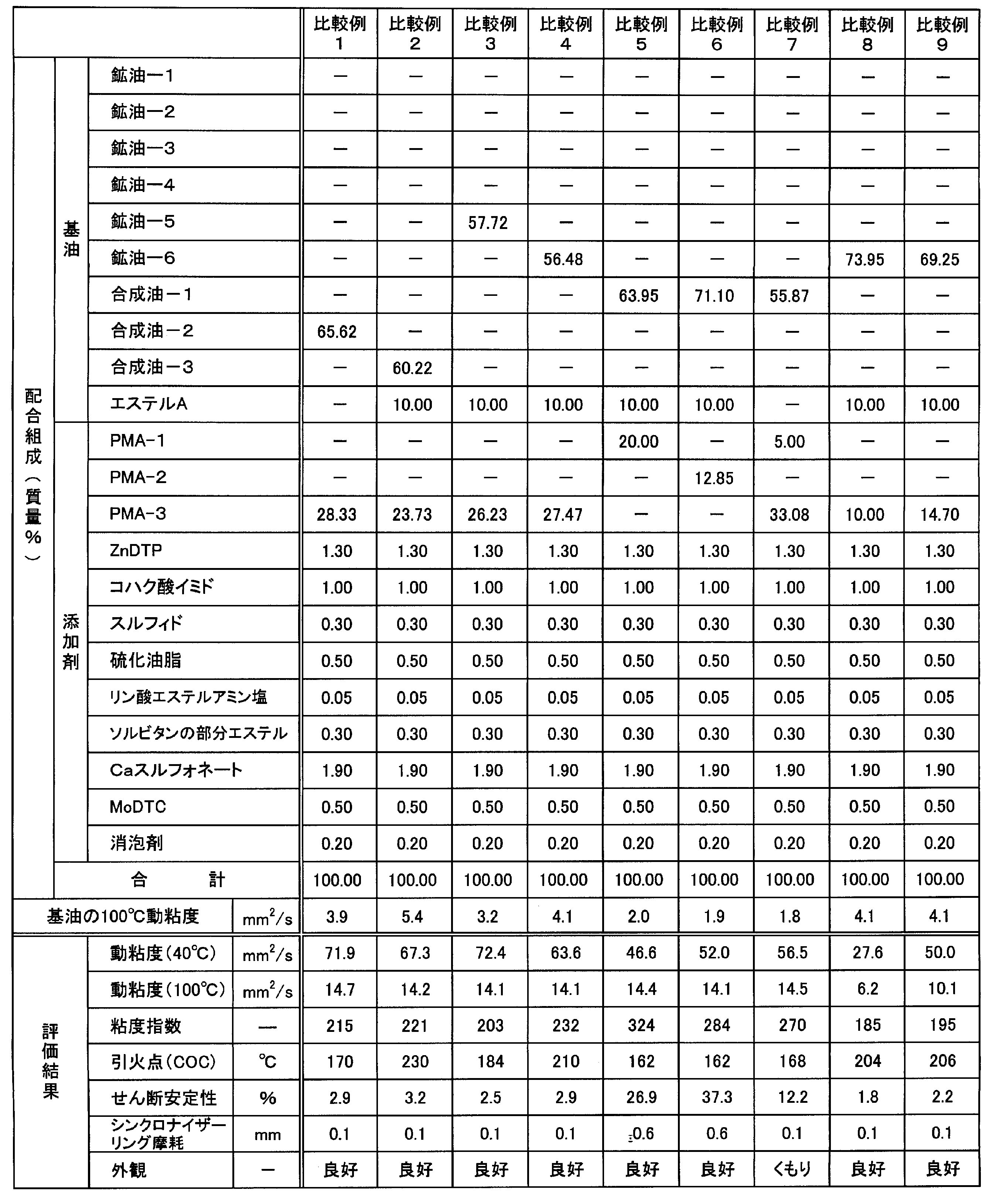
表1に示した結果から明らかなように、実施例1~9の試料油(本発明の潤滑油組成物)は、常用温度領域の粘度を低下させて省燃費性を確保している(40℃粘度がいずれも65℃以下)。また、せん断安定性にも優れている。さらに耐摩耗性にも優れており、具体的には、シンクロナイザーリングの摩耗が少ないことから、シンクロ操作性を長期間に渡って維持可能であることがわかる。
一方、表2に示したように、比較例1~9の試料油は、基油の100℃動粘度と、ポリマー(PMA)の質量平均分子量の少なくともいずれかが本発明で規定する範囲をはずれているため、本発明の課題を解決することができない。
Claims (9)
- 100℃動粘度が0.5mm2/s以上3.5mm2/s以下の基油に、
質量平均分子量が3×10⁴以上5×10⁴以下のポリ(メタ)アクリレートを配合してなる
ことを特徴とする潤滑油組成物。 - 請求項1に記載の潤滑油組成物において、
さらに基油として、100℃動粘度が5mm2/s以下のエステルを配合してなる
ことを特徴とする潤滑油組成物。 - 請求項1または請求項2に記載の潤滑油組成物において、
さらに、質量平均分子量が1.4×10⁵以上2×10⁵以下のポリ(メタ)アクリレートを配合してなる
ことを特徴とする潤滑油組成物。 - 請求項1から請求項3までのいずれか1項に記載の潤滑油組成物において、
さらに、モリブデン化合物を配合してなる
ことを特徴とする潤滑油組成物。 - 請求項1から請求項4までのいずれか1項に記載の潤滑油組成物において、
さらに、清浄分散剤、極圧剤および油性剤の少なくともいずれかを配合してなる
ことを特徴とする潤滑油組成物。 - 請求項1から請求項5までのいずれか1項に記載の潤滑油組成物において、
当該組成物の100℃動粘度が13.5mm2/s以上18.5mm2/s以下であり、当該組成物の40℃動粘度が65mm2/s以下である
ことを特徴とする潤滑油組成物。 - 請求項1から請求項6までのいずれか1項に記載の潤滑油組成物において、
当該組成物の粘度指数が245以上である
ことを特徴とする潤滑油組成物。 - 請求項1から請求項7までのいずれか1項に記載の潤滑油組成物において、
せん断安定性試験(超音波せん断試験)における100℃動粘度の低下率が15%以下である
ことを特徴とする潤滑油組成物。 - 請求項1から請求項8までのいずれか1項に記載の潤滑油組成物が手動変速機用である
ことを特徴とする潤滑油組成物。
Priority Applications (4)
| Application Number | Priority Date | Filing Date | Title |
|---|---|---|---|
| MX2015012068A MX2015012068A (es) | 2013-03-15 | 2014-03-13 | Composicion de aceite lubricante. |
| US14/777,056 US20160040095A1 (en) | 2013-03-15 | 2014-03-13 | Lubricating oil composition |
| EP14765301.8A EP2975104A4 (en) | 2013-03-15 | 2014-03-13 | OIL COMPOSITION |
| CN201480015219.7A CN105026531A (zh) | 2013-03-15 | 2014-03-13 | 润滑油组合物 |
Applications Claiming Priority (2)
| Application Number | Priority Date | Filing Date | Title |
|---|---|---|---|
| JP2013054220A JP6159107B2 (ja) | 2013-03-15 | 2013-03-15 | 潤滑油組成物 |
| JP2013-054220 | 2013-03-15 |
Publications (1)
| Publication Number | Publication Date |
|---|---|
| WO2014142230A1 true WO2014142230A1 (ja) | 2014-09-18 |
Family
ID=51536879
Family Applications (1)
| Application Number | Title | Priority Date | Filing Date |
|---|---|---|---|
| PCT/JP2014/056639 Ceased WO2014142230A1 (ja) | 2013-03-15 | 2014-03-13 | 潤滑油組成物 |
Country Status (6)
| Country | Link |
|---|---|
| US (1) | US20160040095A1 (ja) |
| EP (1) | EP2975104A4 (ja) |
| JP (1) | JP6159107B2 (ja) |
| CN (1) | CN105026531A (ja) |
| MX (1) | MX2015012068A (ja) |
| WO (1) | WO2014142230A1 (ja) |
Cited By (1)
| Publication number | Priority date | Publication date | Assignee | Title |
|---|---|---|---|---|
| EP3279293A4 (en) * | 2015-03-30 | 2018-08-08 | Idemitsu Kosan Co., Ltd | Lubricant composition |
Families Citing this family (6)
| Publication number | Priority date | Publication date | Assignee | Title |
|---|---|---|---|---|
| JP2016172818A (ja) * | 2015-03-17 | 2016-09-29 | Jxエネルギー株式会社 | 潤滑油組成物 |
| KR102026330B1 (ko) * | 2018-09-27 | 2019-09-27 | 에스케이이노베이션 주식회사 | 저온 성능이 개선된 광유계 윤활기유 및 이의 제조 방법, 및 이를 포함하는 윤활유 제품 |
| CN113454194A (zh) * | 2019-02-20 | 2021-09-28 | 引能仕株式会社 | 变速器用润滑油组合物 |
| WO2021210068A1 (ja) * | 2020-04-14 | 2021-10-21 | コスモ石油ルブリカンツ株式会社 | 農業機械用潤滑油組成物 |
| US12600918B2 (en) | 2020-12-21 | 2026-04-14 | Idemitsu Kosan Co., Ltd. | Lubricating oil composition |
| CN115558536A (zh) * | 2021-07-01 | 2023-01-03 | 中国石油天然气股份有限公司 | 一种柴油机油抗磨添加剂组合物、ch-4/ci-4柴油机油组合物 |
Citations (15)
| Publication number | Priority date | Publication date | Assignee | Title |
|---|---|---|---|---|
| JP2001262176A (ja) * | 2000-03-21 | 2001-09-26 | Nippon Mitsubishi Oil Corp | 変速機用潤滑油組成物 |
| JP2004010894A (ja) | 2002-06-05 | 2004-01-15 | Infineum Internatl Ltd | エネルギー保存型動力伝達装置用流体 |
| JP2004155873A (ja) * | 2002-11-05 | 2004-06-03 | Nippon Oil Corp | 潤滑油組成物 |
| JP2004155924A (ja) * | 2002-11-07 | 2004-06-03 | Tonengeneral Sekiyu Kk | 変速機用潤滑油組成物 |
| WO2004069967A1 (ja) | 2003-02-07 | 2004-08-19 | Nippon Oil Corporation | 変速機用潤滑油組成物 |
| WO2004074414A1 (ja) * | 2003-02-21 | 2004-09-02 | Nippon Oil Corporation | 変速機用潤滑油組成物 |
| JP2006117854A (ja) * | 2004-10-22 | 2006-05-11 | Nippon Oil Corp | 変速機用潤滑油組成物 |
| JP2007039480A (ja) | 2005-07-29 | 2007-02-15 | Tonengeneral Sekiyu Kk | ギヤ油組成物 |
| JP2008179662A (ja) * | 2007-01-23 | 2008-08-07 | Cosmo Sekiyu Lubricants Kk | 自動変速機用潤滑油組成物 |
| JP2008208212A (ja) | 2007-02-26 | 2008-09-11 | Nippon Oil Corp | 潤滑油組成物 |
| JP2009249496A (ja) * | 2008-04-07 | 2009-10-29 | Nippon Oil Corp | 潤滑油組成物 |
| JP2009292997A (ja) * | 2008-06-09 | 2009-12-17 | Idemitsu Kosan Co Ltd | 基油および潤滑油組成物 |
| WO2010087398A1 (ja) * | 2009-02-02 | 2010-08-05 | 出光興産株式会社 | 自動変速機用潤滑油組成物 |
| JP2011168677A (ja) * | 2010-02-17 | 2011-09-01 | Idemitsu Kosan Co Ltd | 無段変速機用潤滑油組成物 |
| JP2012201808A (ja) * | 2011-03-25 | 2012-10-22 | Jx Nippon Oil & Energy Corp | 潤滑油組成物 |
Family Cites Families (7)
| Publication number | Priority date | Publication date | Assignee | Title |
|---|---|---|---|---|
| EP0453114B1 (en) * | 1990-03-31 | 1995-05-24 | Tonen Corporation | Hydraulic fluids for automobile suspensions |
| JP2001294883A (ja) * | 2000-04-14 | 2001-10-23 | Nippon Mitsubishi Oil Corp | トラクションドライブ用流体 |
| JP3921178B2 (ja) * | 2003-02-21 | 2007-05-30 | 新日本石油株式会社 | 変速機用潤滑油組成物 |
| KR101347964B1 (ko) * | 2004-10-22 | 2014-01-07 | 제이엑스 닛코닛세키에너지주식회사 | 변속기용 윤활유 조성물 |
| JP4792216B2 (ja) * | 2004-11-01 | 2011-10-12 | Jx日鉱日石エネルギー株式会社 | 極微量油剤供給式切削・研削加工用油剤組成物 |
| JP2009275084A (ja) * | 2008-05-13 | 2009-11-26 | Japan Energy Corp | カップリング用流体 |
| JP5925003B2 (ja) * | 2012-03-23 | 2016-05-25 | 出光興産株式会社 | 潤滑油組成物およびこれを用いた機器 |
-
2013
- 2013-03-15 JP JP2013054220A patent/JP6159107B2/ja active Active
-
2014
- 2014-03-13 US US14/777,056 patent/US20160040095A1/en not_active Abandoned
- 2014-03-13 WO PCT/JP2014/056639 patent/WO2014142230A1/ja not_active Ceased
- 2014-03-13 CN CN201480015219.7A patent/CN105026531A/zh active Pending
- 2014-03-13 MX MX2015012068A patent/MX2015012068A/es unknown
- 2014-03-13 EP EP14765301.8A patent/EP2975104A4/en not_active Withdrawn
Patent Citations (15)
| Publication number | Priority date | Publication date | Assignee | Title |
|---|---|---|---|---|
| JP2001262176A (ja) * | 2000-03-21 | 2001-09-26 | Nippon Mitsubishi Oil Corp | 変速機用潤滑油組成物 |
| JP2004010894A (ja) | 2002-06-05 | 2004-01-15 | Infineum Internatl Ltd | エネルギー保存型動力伝達装置用流体 |
| JP2004155873A (ja) * | 2002-11-05 | 2004-06-03 | Nippon Oil Corp | 潤滑油組成物 |
| JP2004155924A (ja) * | 2002-11-07 | 2004-06-03 | Tonengeneral Sekiyu Kk | 変速機用潤滑油組成物 |
| WO2004069967A1 (ja) | 2003-02-07 | 2004-08-19 | Nippon Oil Corporation | 変速機用潤滑油組成物 |
| WO2004074414A1 (ja) * | 2003-02-21 | 2004-09-02 | Nippon Oil Corporation | 変速機用潤滑油組成物 |
| JP2006117854A (ja) * | 2004-10-22 | 2006-05-11 | Nippon Oil Corp | 変速機用潤滑油組成物 |
| JP2007039480A (ja) | 2005-07-29 | 2007-02-15 | Tonengeneral Sekiyu Kk | ギヤ油組成物 |
| JP2008179662A (ja) * | 2007-01-23 | 2008-08-07 | Cosmo Sekiyu Lubricants Kk | 自動変速機用潤滑油組成物 |
| JP2008208212A (ja) | 2007-02-26 | 2008-09-11 | Nippon Oil Corp | 潤滑油組成物 |
| JP2009249496A (ja) * | 2008-04-07 | 2009-10-29 | Nippon Oil Corp | 潤滑油組成物 |
| JP2009292997A (ja) * | 2008-06-09 | 2009-12-17 | Idemitsu Kosan Co Ltd | 基油および潤滑油組成物 |
| WO2010087398A1 (ja) * | 2009-02-02 | 2010-08-05 | 出光興産株式会社 | 自動変速機用潤滑油組成物 |
| JP2011168677A (ja) * | 2010-02-17 | 2011-09-01 | Idemitsu Kosan Co Ltd | 無段変速機用潤滑油組成物 |
| JP2012201808A (ja) * | 2011-03-25 | 2012-10-22 | Jx Nippon Oil & Energy Corp | 潤滑油組成物 |
Non-Patent Citations (1)
| Title |
|---|
| See also references of EP2975104A4 |
Cited By (2)
| Publication number | Priority date | Publication date | Assignee | Title |
|---|---|---|---|---|
| EP3279293A4 (en) * | 2015-03-30 | 2018-08-08 | Idemitsu Kosan Co., Ltd | Lubricant composition |
| US11124732B2 (en) | 2015-03-30 | 2021-09-21 | Idemitsu Kosan Co., Ltd. | Lubricant composition |
Also Published As
| Publication number | Publication date |
|---|---|
| JP6159107B2 (ja) | 2017-07-05 |
| EP2975104A4 (en) | 2016-11-30 |
| EP2975104A1 (en) | 2016-01-20 |
| MX2015012068A (es) | 2015-12-16 |
| CN105026531A (zh) | 2015-11-04 |
| US20160040095A1 (en) | 2016-02-11 |
| JP2014177605A (ja) | 2014-09-25 |
Similar Documents
| Publication | Publication Date | Title |
|---|---|---|
| JP6159107B2 (ja) | 潤滑油組成物 | |
| CN101328445B (zh) | 润滑防锈油及其用途 | |
| EP2537914B1 (en) | Lubricant composition for continuously variable transmission | |
| JP5329067B2 (ja) | 自動変速機油及びその製造方法 | |
| JP5638256B2 (ja) | 潤滑油組成物 | |
| JP6255265B2 (ja) | 油圧作動油組成物 | |
| KR20090050051A (ko) | 윤활유 조성물 | |
| US8669215B2 (en) | Gear oil additive | |
| CN102272276A (zh) | 润滑油组合物 | |
| JP6088305B2 (ja) | 消泡剤組成物、潤滑油組成物及びその製造方法 | |
| JP6219203B2 (ja) | 農業機械用潤滑油組成物 | |
| JP5965139B2 (ja) | 潤滑油組成物 | |
| JP5551330B2 (ja) | 潤滑油組成物 | |
| CN110168062A (zh) | 含有api第ii类基础油的传动系统流体 | |
| JP5033610B2 (ja) | 農業機械用潤滑油組成物 | |
| WO2024166719A1 (ja) | 潤滑油基油 | |
| JP2022041932A (ja) | 潤滑油添加剤組成物、潤滑油添加剤組成物を含有する潤滑油組成物及び潤滑油添加剤組成物の用途 | |
| JP5875952B2 (ja) | 農業機械用潤滑油組成物 | |
| JP6125980B2 (ja) | 潤滑剤組成物 | |
| AU2009323847B2 (en) | Gear oil additive |
Legal Events
| Date | Code | Title | Description |
|---|---|---|---|
| WWE | Wipo information: entry into national phase |
Ref document number: 201480015219.7 Country of ref document: CN |
|
| 121 | Ep: the epo has been informed by wipo that ep was designated in this application |
Ref document number: 14765301 Country of ref document: EP Kind code of ref document: A1 |
|
| WWE | Wipo information: entry into national phase |
Ref document number: MX/A/2015/012068 Country of ref document: MX |
|
| NENP | Non-entry into the national phase |
Ref country code: DE |
|
| WWE | Wipo information: entry into national phase |
Ref document number: 14777056 Country of ref document: US |
|
| REEP | Request for entry into the european phase |
Ref document number: 2014765301 Country of ref document: EP |
|
| WWE | Wipo information: entry into national phase |
Ref document number: 2014765301 Country of ref document: EP |