WO2014148395A1 - 映像監視システム、映像監視方法、および映像監視装置 - Google Patents
映像監視システム、映像監視方法、および映像監視装置 Download PDFInfo
- Publication number
- WO2014148395A1 WO2014148395A1 PCT/JP2014/056955 JP2014056955W WO2014148395A1 WO 2014148395 A1 WO2014148395 A1 WO 2014148395A1 JP 2014056955 W JP2014056955 W JP 2014056955W WO 2014148395 A1 WO2014148395 A1 WO 2014148395A1
- Authority
- WO
- WIPO (PCT)
- Prior art keywords
- person
- target
- area
- identification information
- face image
- Prior art date
- Legal status (The legal status is an assumption and is not a legal conclusion. Google has not performed a legal analysis and makes no representation as to the accuracy of the status listed.)
- Ceased
Links
Images


Classifications
-
- H—ELECTRICITY
- H04—ELECTRIC COMMUNICATION TECHNIQUE
- H04N—PICTORIAL COMMUNICATION, e.g. TELEVISION
- H04N7/00—Television systems
- H04N7/18—Closed-circuit television [CCTV] systems, i.e. systems in which the video signal is not broadcast
- H04N7/188—Capturing isolated or intermittent images triggered by the occurrence of a predetermined event, e.g. an object reaching a predetermined position
-
- G—PHYSICS
- G06—COMPUTING OR CALCULATING; COUNTING
- G06V—IMAGE OR VIDEO RECOGNITION OR UNDERSTANDING
- G06V20/00—Scenes; Scene-specific elements
- G06V20/50—Context or environment of the image
- G06V20/52—Surveillance or monitoring of activities, e.g. for recognising suspicious objects
-
- G—PHYSICS
- G06—COMPUTING OR CALCULATING; COUNTING
- G06V—IMAGE OR VIDEO RECOGNITION OR UNDERSTANDING
- G06V40/00—Recognition of biometric, human-related or animal-related patterns in image or video data
- G06V40/10—Human or animal bodies, e.g. vehicle occupants or pedestrians; Body parts, e.g. hands
-
- H—ELECTRICITY
- H04—ELECTRIC COMMUNICATION TECHNIQUE
- H04N—PICTORIAL COMMUNICATION, e.g. TELEVISION
- H04N7/00—Television systems
- H04N7/18—Closed-circuit television [CCTV] systems, i.e. systems in which the video signal is not broadcast
-
- H—ELECTRICITY
- H04—ELECTRIC COMMUNICATION TECHNIQUE
- H04N—PICTORIAL COMMUNICATION, e.g. TELEVISION
- H04N7/00—Television systems
- H04N7/18—Closed-circuit television [CCTV] systems, i.e. systems in which the video signal is not broadcast
- H04N7/181—Closed-circuit television [CCTV] systems, i.e. systems in which the video signal is not broadcast for receiving images from a plurality of remote sources
Definitions
- the present invention relates to a video surveillance system for searching for a target person from surveillance video.
- FIG. 7 shows a state where an unoccupied passenger is searched at an airport facility.
- the passenger presents the medium (IC card, Osaifu-Keitai (registered trademark), 2D barcode, etc.) on which the passenger information is recorded to the boarding gate terminal, passes through the boarding gate, Board the desired flight.
- the ground staff understands the unoccupied person (the person who has not passed through the boarding gate) from the information collected at the boarding gate terminal, and searches by calling around the airport facility or running around the radio with one hand at a specified time. To take action.
- such correspondence is demanded to be improved because it involves physical fatigue caused by ground staff running around in the vast departure lobby.
- the present invention has been made in view of the above-described conventional circumstances, and is a technique that is useful for finding out where in the area a person who has not reached the target position in the predetermined area by the scheduled time.
- the purpose is to propose.
- the following video surveillance system is proposed. That is, in the video surveillance system according to the present invention, the first acquisition means for acquiring the identification information of the target person from the recording medium possessed by the target person who enters the predetermined area, and the identification information is acquired by the first acquisition means.
- the first photographing means for photographing the face image of the subject, the second photographing means for photographing each of the plurality of divided areas obtained by dividing the predetermined area, and the subject who has entered the predetermined area should arrive
- the non-arrival person specifying means for specifying the target person who has not reached the target position
- the target person specified by the non-arrival person specifying means The unarrived person identification is determined based on the feature amount of the face image photographed by the first photographing means and the feature amount of the face image of the person included in the video photographed in the plurality of divided areas by the second photographing means.
- the second acquisition means includes the target person from the recording medium possessed by the target person at a target position that the target person who has entered the predetermined area should reach by a predetermined time.
- the identification information of the target person is acquired based on the identification information of the target person acquired by the first acquisition means and the identification information of the target person acquired by the second acquisition means. The target person who has not reached the target position at the predetermined time is specified.
- the first photographing means may photograph the face image of the subject person by performing photographing according to the fact that the identification information is obtained by the first obtaining means, and always photographing.
- a face image taken at the timing when the identification information is acquired by the first acquisition unit may be specified and handled as the face image of the subject.
- the second photographing means does not need to photograph the entire divided area, and it is sufficient if the person moving across the divided areas can be photographed.
- the second photographing means for photographing one divided area and the other divided area are photographed in a line dividing the two divided areas.
- the second photographing means is opposite to each other. With such an arrangement, the number of second photographing means can be reduced.
- a search key is used as the search key for the feature amount of the face image of the subject specified by the non-arrival specifying means, and the search is performed from the video shot by the second shooting means.
- a similar face image search is performed to search for a face image having a feature amount whose similarity to the feature amount of the key face image is equal to or greater than a threshold value.
- a plurality of persons estimated to be unarrived subjects can be searched.
- the similarity level or the shooting time is selected from the plurality of searched persons.
- One person may be selected based on one or both of novelty, and the divided area may be specified, or the divided area may be specified for each of a plurality of searched persons.
- a plurality of first photographing means are provided, and the face images of the unarrived subject are photographed from a plurality of directions by the first photographing means, and the feature amount of the face image in each direction is used as a search key.
- a face image taken by the first photographing means for the target person specified by the non-arrival person specifying means a face image of a person estimated to be the target person, and It further includes display means for displaying a divided area where the person is photographed.
- the emphasis level of the face image display of each person is changed according to the similarity to the unarrived target persons and the shooting time. Or the position of the display may be changed, which makes it easy to find out which person is the target person from the plurality of face images.
- the non-arrival person position estimation means includes the feature amount and face of the face image taken by the first photographing means for the subject specified by the non-arrival person specifying means. Based on the feature amount of the image portion other than the image, the feature amount of the face image of the person included in the video imaged in the plurality of divided areas by the second imaging unit, and the feature amount of the image portion other than the face image, A divided area in which a person who is estimated to be a target person specified by the unarrived person specifying means is photographed is specified.
- the video surveillance system can be applied to various scenes for searching for a person who has not reached the target position within a predetermined area by the scheduled time.
- the first acquisition means acquires identification information of a person who enters the boarding lobby area at a security checkpoint of the airport facility, and
- the first photographing unit photographs a person who enters the boarding lobby area, the second photographing unit photographs each of a plurality of divided areas that divide the boarding lobby area, and the second obtaining unit includes a boarding lobby area.
- the identification information of the target person is acquired, and the unarrived person specifying means can identify the target person who has not reached the boarding gate after the scheduled time.
- the non-arrival person position estimating means may specify a divided area in the boarding lobby area where the person estimated to be the target person specified by the non-arrival person specifying means is photographed.
- a rough position (divided area) where a person who is estimated to be a target person can be estimated, and a target person who has not reached the target position by the scheduled time is searched from a predetermined area.
- FIG. 1 It is a figure which shows the structural example of the non-passenger search system to which this invention is applied. It is a figure which shows a mode that a boarding lobby is divided and managed. It is a figure which shows the example which discriminate
- FIG. 1 shows a configuration example of a non-passenger search system to which a video surveillance system according to the present invention is applied.
- the non-passenger search system in this example is composed of blocks of a security checkpoint, an operation management center, a passenger lobby, and a boarding gate, and each block is connected to be communicable with each other.
- the security check block has multiple passenger reception systems.
- Each passenger reception system has a passenger management device 1, a passenger reception terminal 2, a surveillance camera 3, a facial feature quantity extraction / registration device 4, and a video recording device 5, which have a network switch 6. Via a communicable connection.
- the network switch 6 of each passenger reception system is connected to an upper network switch 7.
- the block of the operation management center has an occupant management device 9, a facial feature amount search device 10, a video display device 11, and an announcement sending device 12, which are connected via a network switch 8 so that they can communicate with each other. Yes.
- the block in the passenger lobby has one or more surveillance cameras 14 and announcement playback devices 15, a facial feature quantity extraction / registration device 16, and a video recording device 17 provided for each divided area of the passenger lobby. These are connected via the network switch 13 so that they can communicate with each other.
- the boarding gate block has a passenger management device 19, a boarding gate terminal 20, and a non-passenger position display device 21 for each of a plurality of boarding gates, which are communicably connected via a network switch 18.
- each boarding gate system of the present example includes a face feature amount search device 22 and a video display device 23 as options, and these are also connected to be communicable via the network switch 18.
- the number of passenger acceptance systems in the security inspection block, the number of divided areas in the passenger lobby block, and the number of boarding gates in the boarding gate block are N in common. Each number may be different.
- the passenger is a passenger information recording medium (passport, e-ticket, IC card, Osaifu-Keitai (registered trademark), two-dimensional bar, etc.) that records passenger information such as the passenger's name and flight at the security checkpoint.
- Code is presented to the passenger reception terminal 2 to read the passenger information, issue boarding guidance, obtain information such as boarding flight name / seat number / boarding gate, and enter the boarding lobby.
- the passenger acceptance terminal 2 of the present example has various types of information such as an IC chip reader / writer and a two-dimensional barcode reader in order to cope with various types of passenger information recording media. It has a reading unit.
- an operation of presenting the passenger information recording medium to the passenger reception terminal 2 and reading the passenger information as a trigger is used as a trigger by the surveillance camera 3 installed in the vicinity of the passenger reception terminal 2.
- An image including a face is taken, and the image recording device 5 records the image.
- the passenger management device 1 issues a passenger management number which is a “number for uniquely managing a passenger” such as an airline ticket number using the above operation as a trigger, and thereafter, this passenger management number is used.
- the passenger management number identification information
- face image of the passenger are acquired in the process of the passenger passing through the security checkpoint and entering the boarding lobby.
- the facial feature quantity extraction / registration device 4 reads out the recorded video including the passenger's face from the video recording device 5, extracts the feature quantity of the passenger's face based on the video, and captures the video. Call the passenger management number issued when the ticket is issued at the passenger reception terminal 2 from the passenger management device 1, and connect the facial feature data and the passenger management number to the facial feature quantity. Register in the database.
- the facial feature amount is quickly extracted and registered in the database. Extraction of the facial feature amount and registration in the database will be described later. It may be performed when the similar face image search is performed.
- the extraction of the facial feature amount is performed as follows as an example. First, using a known face detection technique, the presence / absence of a face in the video is determined, and if the presence of a face is detected, the coordinates of the area are calculated, and the face image area in the video Is identified. Next, the face image area is analyzed and statistically determined from the shape and direction of the face outline, skin color, size / shape of the main face components (eyes, nose, mouth, etc.) Vector components, statistics, and the like that show a difference for each individual are detected, and these are recorded as face feature data in association with the passenger management number.
- a known face detection technique the presence / absence of a face in the video is determined, and if the presence of a face is detected, the coordinates of the area are calculated, and the face image area in the video Is identified.
- the face image area is analyzed and statistically determined from the shape and direction of the face outline, skin color, size / shape of the main face components (eyes, nose, mouth, etc
- a feature amount of a passenger's clothing is extracted.
- the outline of a person is extracted, and the color distribution within the outline and the frequency characteristics of the texture (frequency distribution when performing FFT, wavelet transform, etc.)
- the presence of clothes (clothes) is detected, the coordinates of the area are calculated, and the clothes area in the video is specified.
- the distribution of the clothing color and the frequency feature quantity are detected, and these are recorded as data of the clothing feature quantity in association with the passenger management number.
- the boarding lobby of airport facilities generally has a vast area. For this reason, if an attempt is made to construct an environment for capturing an image including a passenger's face in this area, it is expected that a huge number of surveillance cameras must be installed. However, this increases the installation and operation costs and is not very realistic. Therefore, in the non-passenger search system of this example, the concept of area division is used to install the surveillance camera in such a way that the entire boarding lobby can be roughly divided into a plurality of areas.
- Fig. 2 shows how the boarding lobby is divided into areas.
- the entire boarding lobby is divided into N divided areas and managed.
- an area division line serving as a division of each divided area is virtually set, and two divided areas divided by a certain area division line, and one or more surveillance cameras 14 that capture one of the divided areas;
- One or more surveillance cameras 14 that photograph the other divided area are installed in opposite directions with an area division line interposed therebetween.
- the surveillance camera 14 that captures the divided area (2) located on the left side of the area division line is installed facing left
- the surveillance camera 14 for photographing the divided area (3) located on the right side is installed facing right.
- the monitoring camera 14 that photographs the divided area.
- a monitoring camera 14 having a number and performance sufficient to capture a portion serving as a movement route between the areas is installed.
- the monitoring cameras 14 having the number and performance capable of photographing the entire divided area may be installed.
- each monitoring camera 14 is managed in a form that associates the identification information with the identification information of the divided area to be photographed, and the divided area can be specified by specifying the monitoring camera 14.
- the video shot by each monitoring camera 14 is recorded (recorded) by camera by the video recording device 17.
- the face feature amount extraction / registration device 16 reads out a recorded video including the passenger's face from the video recording device 17, extracts the feature amount of the passenger's face based on the video, and stores the face feature amount data and the video. Is registered in the face feature database in a format that associates the identification information of the surveillance camera 14 that captured the image with the shooting time of the video. At this time, in addition to the extraction of the passenger's facial feature amount, another feature amount that contributes to the identification of the passenger (for example, the feature amount of clothing) may be extracted.
- extraction of a passenger's face feature amount may be performed for all frames of a video, in this example, it is performed for each predetermined number of frames.
- the passenger in the boarding lobby area heads to the boarding gate, which is the target position to be reached by the departure time, and presents the passenger information recording medium to the boarding gate terminal 20 for boarding.
- Passenger information is read, board the target flight through the boarding gate.
- the boarding gate terminal 20 of the present example reads various types of information such as an IC chip reader / writer and a two-dimensional barcode reader in order to cope with various types of passenger information recording media. Has a part.
- the passenger management device 19 is a list of customers who have already boarded (hereinafter referred to as passenger list). ) And a list of customers who have not yet boarded (hereinafter referred to as a “no-passenger list”). Specifically, for example, every time the passenger information is read by the passenger reception terminal 2, the passenger management number issued at that time is added to the non-passenger list, and the passenger information is displayed at the boarding gate terminal 20. Each time is read, the passenger management number corresponding to the passenger information is deleted from the non-passenger list and added to the passenger list. In this case, the unoccupied passenger list is emptied when all passengers finish boarding.
- the occupant management devices 1, 9, and 19 in each block are configured to synchronize the management information by notifying each other of the management information (or the contents of the change). Then, when the departure time of a certain flight is approaching, the passenger management device 9 of the operation management center checks the non-passenger list at every predetermined interval to check whether there is a non-passenger. As a result, if it is determined that there is an unoccupied passenger, the facial feature quantity search device 10 is given the passenger management number of the unoccupied person and instructs similar face image retrieval.
- the facial feature quantity search device 10 Upon receiving an instruction to search for a similar face image, the facial feature quantity search device 10 receives the facial feature quantity data associated with the non-passenger passenger management number from the facial feature quantity extraction / registration device 4 of the security checkpoint. A similar face image search is performed on the face feature quantity extraction / registration device 16 in the boarding lobby using the face feature quantity of the non-passenger as a search key, and the result is output to the passenger management apparatus 9.
- face feature amount data having a high degree of similarity with a face feature amount serving as a search key greater than or equal to a threshold value
- identification information and photographing time of the monitoring camera 14 associated therewith are specified. To do. Thereby, it can be specified with which monitoring camera 14 when the person estimated to be a non-passenger was shot.
- the similarity of the facial feature amount can be calculated by various methods.
- W (w1, w2,..., Wn)
- the distance Z between the two facial feature quantities can be calculated by the following (formula 1).
- i is a variable indicating 0 ⁇ i ⁇ n.
- Z ⁇ i (wi
- another personal feature amount for example, the feature amount of clothing
- the feature amount of clothing contributes to the identification of the passenger
- a plurality of surveillance cameras 3 are installed in the vicinity of the passenger reception terminal 2, and images including the passenger's face are photographed from different directions, and the face image in each direction is used as a search key. An image search may be performed, which can further improve the accuracy of searching for a person who is estimated to be a non-passenger.
- the occupant management device 9 When the person who is estimated to be an unoccupied person is photographed by a plurality of surveillance cameras 14, the occupant management device 9 has a plurality of facial feature quantities determined to be highly similar to the facial feature quantity of the unoccupied person.
- the identification information of the monitoring camera 14 is rearranged (sorted) in the order of the shooting time based on the identification information of the monitoring camera 14 and the shooting time associated with the data of each facial feature amount. It is estimated with which monitoring camera 14 the person estimated to be a passenger was taken last, that is, in which divided area at the end. This makes it possible to roughly specify the position in the boarding lobby area where the unoccupied person would have been last.
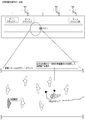
- FIG. 3 shows an example of determining a divided area in which it is estimated that a non-passenger was last.
- the person estimated to be a non-passenger is the last by the surveillance camera 14 installed toward the divided area (2) side in the area dividing line that becomes the division between the divided area (2) and the divided area (3). It is determined that the image was taken. From this, it can be estimated that the person estimated to be a non-passenger remains in the divided area (2) or the divided area (3). More specifically, the person who is estimated to be a non-passenger is installed in the area division line of the divided area (2) and the divided area (3) toward the divided area (2) side in the divided area (2).
- Range area near the divided area (3)
- Information on the processing results by the occupant management device 9 and the facial feature quantity search device 10 is given from the occupant management device 9 to the video display device 11, the announcement sending device 12, and the non-passenger position display device 21, and these devices are Used when outputting various types of information.
- the video display device 11 When the video display device 11 receives from the passenger management device 9 information such as the identification information of the surveillance camera 14 that captured a person who is estimated to be a non-passenger, the shooting time, and the like, based on such information, the video recording device 11 performs the corresponding recording.
- the video is read from the video recording device 17 in the boarding lobby and reproduced.
- the video display device 11 reproduces the video starting from the video frame in which the person estimated to be an unoccupied person was last taken, and the user can check the situation before and after the video operation.
- the video display device 11 reads out the recorded video including the face of the unoccupied person from the video recording device 5 and displays it.
- the user can visually determine whether the person (the person who is estimated to be a non-passenger) included in the reproduced boarding lobby video is the non-passenger himself or herself. Even if it is insufficient, this can be compensated.
- the non-passenger position display device 22 includes, from the passenger management device 9, identification information and shooting time of the monitoring camera 14 that has shot a person estimated to be a non-passenger, a divided area where it is estimated that there is a non-passenger, and the like.
- various information that contributes to the search for the non-passenger is displayed based on the information.
- FIG. 4 shows a display example by the non-passenger position display device 22.
- a map display area 31 for displaying a map of a boarding lobby
- a non-passenger information display area 32 for displaying information on non-passengers
- a plurality of non-passengers on the screen of the non-passenger position display device 22
- an operation button 33 for receiving a user operation for switching a non-passenger to be displayed when there is a passenger.
- the boarding lobby map displayed in the map display area 31 is divided into a plurality of sections according to the divided areas, and the divided areas where it is estimated that there are unoccupied passengers are highlighted.
- the divided area (2) and the divided area (3) are highlighted, and it is estimated that there are no passengers in these divided areas. Further, as described with reference to FIG. 3, when it is possible to estimate the range within the divided area where the unoccupied person is present, a display that specifically identifies the range may be performed.
- a representation image such as an icon representing a person who is estimated to be an unoccupied person may be displayed in the divided area. You may make it display the face image of the person estimated to be a passenger in a division area.
- the face image (or the coordinates of the region) from which the face feature value is extracted in the face feature value extraction / registration device 16 in the boarding lobby. ) Is recorded, it is possible to easily display the face image of a person estimated to be a non-passenger.
- non-passenger information display area 32 destination, boarding time, departure time limit, passenger management number, name, assumed area (and shooting time), and the like are displayed as non-passenger information.
- the face image from which the face feature value is extracted is recorded in the face feature value extraction / registration device 4 at the security checkpoint, the face image of the unoccupied person can be easily displayed as shown in FIG. It can be added to the contents, and it helps the user (ground staff) to search for unoccupied persons in the corresponding divided area.
- each divided area corresponding to the plurality of face feature amounts may be highlighted. That is, for a plurality of persons estimated to be non-passengers, the divided areas in which each is photographed may be highlighted.
- the division area in which a person with a high degree of similarity with a non-passenger is photographed is displayed with a higher degree of emphasis, or the emphasis degree is increased in a divided area as the person who is estimated to be a non-passenger and the shooting time of the person is newer.
- Searching for unoccupied passengers can be achieved by giving a higher display, weighting the divided areas in consideration of both the similarity with the non-passenger and the shooting time, and increasing the emphasis level for the higher weighted divided areas. It is easier to grasp the divided areas that should be focused on.
- the degree of emphasis is changed according to the order of similarity with the non-passenger, the degree of emphasis is changed according to the order of the shooting time, and both the order of similarity with the non-passenger and the order of the shooting time are taken into consideration.
- the degree of emphasis may be changed in order of weight. It should be noted that the degree of enhancement of the representation image and the face image can be expressed using various elements such as the size and shape of the image and the color and thickness of the frame line.
- FIG. 5 shows an example in which three face images of candidates A, B, and C, who are estimated to be non-passengers, are displayed in the divided areas in which the images are taken. According to the figure, it can be grasped that the candidates A and C were in the divided area (2) and that the candidate B was in the divided area (1). Thus, even when a plurality of persons estimated to be non-boarders are searched by displaying the face images of each person estimated to be a non-boarder in the corresponding divided area, It is possible to identify an unoccupied person from among a plurality of persons estimated to be unoccupied persons, and to understand which divided area the person was in.
- the similarity with the non-passenger and the shooting time may be expressed by the display position of the face image in the divided area.
- the vertical axis on the two-dimensional plane of the map is used as a scale representing similarity
- the horizontal axis is used as a scale representing imaging time.
- the face image of a person who is estimated to be a non-passenger is displayed at the top of the divided area
- the face image of a person with a new shooting time is displayed on the right side of the divided area.
- the face image closer to the upper right of the is more important.
- the user when there are a plurality of unoccupied passengers (when a plurality of passenger management numbers remain in the unoccupied passenger list), the user operates the operation button 33 to display the unoccupied objects.
- a plurality of non-passengers may be collectively displayed.
- a plurality of non-passenger information may be displayed in a list format or the like in the non-passenger information display area 32, or may be displayed in a switchable manner using an operation button or the like.
- the boarding lobby map displayed in the map display area 31 may be divided for each non-passenger, and the divided area (or the representation image or the face image) estimated to have been a non-passenger may be used. You may display in the aspect (for example, color-coded for every unoccupied person etc.) distinguishable for every.
- the announcement sending device 12 receives from the passenger management device 9 information such as the identification information of the monitoring camera 14 that captured a person who is estimated to be a non-passenger, the shooting time, and a divided area where it is estimated that there is a non-passenger. Based on these pieces of information, the voice information of the announcement that prompts the non-passenger to board is transmitted to the announcement reproduction device 15 in the divided area where it is estimated that there is a non-passenger.
- the announcement reproduction device 15 that has received the audio information from the announcement transmission device 12 performs audio output based on the received audio information. For this reason, an announcement that prompts the non-passenger to board is output only in the divided area where it is estimated that there is a non-passenger.
- FIG. 6 shows an example in which announcements are selectively made only in the divided areas where it is assumed that there are no passengers.
- an announcement that prompts boarding is output from the announcement reproducing device 15 in the divided area (2) in which it is estimated that the unoccupied person was at the end.
- This makes it possible to continue broadcasting without stopping conventional announcements such as music and advertisements in divided areas where it is assumed that there are no unoccupied passengers.
- This takes into account that it is not desirable in terms of image for an airport facility to continue outputting a call announcement to the entire facility, and it is also embarrassing for the individual who is called.
- the passenger management device 1 and the passenger reception terminal 2 acquire the passenger management number (identification information) of the target person who enters the boarding lobby, and the passenger reception terminal 2
- a surveillance camera 3 installed in the vicinity photographs a target person entering the boarding lobby, and a surveillance camera 14 installed corresponding to a plurality of divided areas dividing the inside of the boarding lobby has each divided area in the boarding lobby.
- the passenger management device 19 and the boarding gate terminal 20 obtain the passenger management number of the target person at the boarding gate that the target person who entered the boarding lobby should reach by the scheduled time, and the passenger management device 9 and 19 specify a target person who has not reached the boarding gate after the scheduled time, and the passenger management device 9 and the facial feature quantity search device 10 have taken a person who is estimated to be a non-arrival target person.
- the It was configured to identify the divided area in the lobby multiplication.
- the first acquisition unit according to the present invention is realized by the passenger management apparatus 1 and the passenger reception terminal 2, and the first imaging unit according to the present invention is realized by the surveillance camera 3,
- the second imaging means according to the present invention is realized by the surveillance camera 14, the second acquisition means according to the present invention is realized by the passenger management device 19 and the boarding gate terminal 20, and the non-arrival person specifying means according to the present invention is realized.
- the non-arrival position estimation means according to the present invention is realized by the occupant management device 9 and the facial feature quantity search device 10
- the display means according to the present invention is displayed as the non-passenger position display. This is realized by the device 21.
- the video surveillance system according to the present invention can be applied to various other situations.
- the present invention can be applied to a scene where a person who has not reached the target position by the scheduled time is searched in another transportation facility such as a ship.
- the present invention can be applied to a scene where a person who has not reached the target position on time is searched in another closed facility such as a hospital.
- the configuration of the system or apparatus according to the present invention is not necessarily limited to the configuration described above, and various configurations may be used.
- the present invention can also be provided as, for example, a method or method for executing processing according to the present invention, a program for realizing such a method or method, or a storage medium for storing the program. .
- the video surveillance system according to the present invention can be applied to various scenes for searching for a person who has not reached the target position within a predetermined area by the scheduled time, and particularly when applied to searching for a non-passenger in an airport facility. Is preferred.
Landscapes
- Engineering & Computer Science (AREA)
- Multimedia (AREA)
- Signal Processing (AREA)
- Physics & Mathematics (AREA)
- General Physics & Mathematics (AREA)
- Theoretical Computer Science (AREA)
- Human Computer Interaction (AREA)
- Closed-Circuit Television Systems (AREA)
- Alarm Systems (AREA)
- Image Analysis (AREA)
Abstract
Description
Claims (15)
- 所定エリアに入場する対象者が所持する記録媒体から対象者の識別情報を取得する第1の取得手段と、 前記第1の取得手段により識別情報が取得された対象者の顔画像を撮影する第1の撮影手段と、 前記所定エリアを区分した複数の分割エリアをそれぞれ撮影する第2の撮影手段と、 前記所定エリアに入場した対象者が到達すべき目的位置において、対象者が所持する記録媒体から対象者の識別情報を取得する第2の取得手段と、 前記第1の取得手段により取得された対象者の識別情報と、前記第2の取得手段により取得された対象者の識別情報に基づいて、前記目的位置に到達していない対象者を特定する未到着者特定手段と、 前記未到着者特定手段により特定された対象者について前記第1の撮影手段により撮影された顔画像の特徴量と、前記第2の撮影手段により複数の分割エリアで撮影された映像に含まれる人物の顔画像の特徴量に基づいて、前記未到着者特定手段により特定された対象者と推定される人物が撮影された分割エリアを特定する未到着者位置推測手段と、 を備えたことを特徴とする映像監視システム。
- 前記第2の取得手段は、前記所定エリアに入場した対象者が所定の時刻までに到達すべき目的位置において、対象者が所持する記録媒体から対象者の識別情報を取得し、前記未到着者特定手段は、前記第1の取得手段により取得された対象者の識別情報と、前記第2の取得手段により取得された対象者の識別情報に基づいて、前記所定の時刻において前記目的位置に到達していない対象者を特定する、ことを特徴とする請求項1に記載の映像監視システム。
- 前記未到着者特定手段により特定された対象者について前記第1の撮影手段により撮影された顔画像と、当該対象者と推定される人物の顔画像及び当該人物が撮影された分割エリアとを表示する表示手段を更に備えた、 ことを特徴とする請求項1または請求項2に記載の映像監視システム。
- 前記未到着者位置推測手段は、前記未到着者特定手段により特定された対象者について前記第1の撮影手段により撮影された顔画像の特徴量及び顔画像以外の画像部分の特徴量と、前記第2の撮影手段により複数の分割エリアで撮影された映像に含まれる人物の顔画像の特徴量及び顔画像以外の画像部分の特徴量に基づいて、前記未到着者特定手段により特定された対象者と推定される人物が撮影された分割エリアを特定する、 ことを請求項1乃至請求項3のいずれか1項に記載の映像監視システム。
- 前記第1の取得手段は、空港施設の保安検査場において、搭乗ロビーエリアに入場する対象者の識別情報を取得し、 前記第1の撮影手段は、搭乗ロビーエリアに入場する対象者を撮影し、 前記第2の撮影手段は、搭乗ロビーエリアを区分した複数の分割エリアをそれぞれ撮影し、 前記第2の取得手段は、搭乗ロビーエリアに入場した対象者が定刻までに到達すべき搭乗ゲートにおいて、対象者の識別情報を取得し、 前記未到着者特定手段は、定刻後でありながら搭乗ゲートに到達していない対象者を特定し、 前記未到着者位置推測手段は、前記未到着者特定手段により特定された対象者と推定される人物が撮影された搭乗ロビーエリア内の分割エリアを特定する、 ことを請求項1乃至請求項4のいずれか1項に記載の映像監視システム。
- 第1の取得手段と、第2の取得手段と、第1の撮影手段と、第2の撮影手段と、未到着者特定手段と、未到着者位置推測手段とを備える映像監視システムにおいて、 前記第1の取得手段は、所定エリアに入場する対象者が所持する記録媒体から対象者の識別情報を取得し、 前記第1の撮影手段は、前記第1の取得手段により識別情報が取得された対象者の顔画像を撮影し、 前記第2の撮影手段は、前記所定エリアを区分した複数の分割エリアをそれぞれ撮影し、 前記第2の取得手段は、前記所定エリアに入場した対象者が到達すべき目的位置において、対象者が所持する記録媒体から対象者の識別情報を取得し、 前記未到着者特定手段は、前記第1の取得手段により取得された対象者の識別情報と、前記第2の取得手段により取得された対象者の識別情報に基づいて、前記目的位置に到達していない対象者を特定し、 前記未到着者位置推測手段は、前記未到着者特定手段により特定された対象者について前記第1の撮影手段により撮影された顔画像の特徴量と、前記第2の撮影手段により複数の分割エリアで撮影された映像に含まれる人物の顔画像の特徴量に基づいて、前記未到着者特定手段により特定された対象者と推定される人物が撮影された分割エリアを特定する、ことを特徴とする映像監視方法。
- 前記第2の取得手段は、前記所定エリアに入場した対象者が所定の時刻までに到達すべき目的位置において、対象者が所持する記録媒体から対象者の識別情報を取得し、前記未到着者特定手段は、前記第1の取得手段により取得された対象者の識別情報と、前記第2の取得手段により取得された対象者の識別情報に基づいて、前記所定の時刻において前記目的位置に到達していない対象者を特定する、ことを特徴とする請求項6に記載の映像監視方法。
- 前記映像監視システムは、表示手段をさらに備え、 前記表示手段は、前記未到着者特定手段により特定された対象者について前記第1の撮影手段により撮影された顔画像と、当該対象者と推定される人物の顔画像及び当該人物が撮影された分割エリアとを表示する、ことを特徴とする請求項6または請求項7に記載の映像監視方法。
- 前記未到着者位置推測手段は、前記未到着者特定手段により特定された対象者について前記第1の撮影手段により撮影された顔画像の特徴量及び顔画像以外の画像部分の特徴量と、前記第2の撮影手段により複数の分割エリアで撮影された映像に含まれる人物の顔画像の特徴量及び顔画像以外の画像部分の特徴量に基づいて、前記未到着者特定手段により特定された対象者と推定される人物が撮影された分割エリアを特定する、 ことを請求項6乃至請求項8のいずれか1項に記載の映像監視方法。
- 前記第1の取得手段は、空港施設の保安検査場において、搭乗ロビーエリアに入場する対象者の識別情報を取得し、 前記第1の撮影手段は、搭乗ロビーエリアに入場する対象者を撮影し、 前記第2の撮影手段は、搭乗ロビーエリアを区分した複数の分割エリアをそれぞれ撮影し、 前記第2の取得手段は、搭乗ロビーエリアに入場した対象者が所定の時刻までに到達すべき搭乗ゲートにおいて、対象者の識別情報を取得し、 前記未到着者特定手段は、前記所定の時刻後でありながら搭乗ゲートに到達していない対象者を特定し、 前記未到着者位置推測手段は、前記未到着者特定手段により特定された対象者と推定される人物が撮影された搭乗ロビーエリア内の分割エリアを特定する、 ことを請求項6乃至請求項9のいずれか1項に記載の映像監視方法。
- 第1の取得手段により所定エリアに入場する対象者が所持する記録媒体から取得された対象者の識別情報と、第2の取得手段により前記所定エリアに入場した対象者が到達すべき目的位置において対象者が所持する記録媒体から取得された対象者の識別情報に基づいて、前記目的位置に到達していない対象者を特定する未到着者特定手段と、 前記未到着者特定手段により特定された対象者について、第1の撮影手段により撮影された前記第1の取得手段により識別情報が取得された対象者の顔画像の特徴量と、第2の撮影手段により複数の分割エリアで撮影された映像に含まれる人物の顔画像の特徴量に基づいて、前記未到着者特定手段により特定された対象者と推定される人物が撮影された分割エリアを特定する未到着者位置推測手段と、 を備えたことを特徴とする映像監視装置。
- 前記未到着者特定手段は、前記第1の取得手段により取得された対象者の識別情報と、前記第2の取得手段により、前記所定エリアに入場した対象者が所定の時刻までに到達すべき目的位置において、対象者が所持する記録媒体から取得された対象者の識別情報に基づいて、前記所定の時刻において前記目的位置に到達していない対象者を特定する、ことを特徴とする請求項11に記載の映像監視装置。
- 前記未到着者特定手段により特定された対象者について前記第1の撮影手段により撮影された顔画像と、当該対象者と推定される人物の顔画像及び当該人物が撮影された分割エリアとを、表示装置に表示させる、ことを特徴とする請求項11または請求項12に記載の映像監視装置。
- 前記未到着者位置推測手段は、前記未到着者特定手段により特定された対象者について前記第1の撮影手段により撮影された顔画像の特徴量及び顔画像以外の画像部分の特徴量と、前記第2の撮影手段により複数の分割エリアで撮影された映像に含まれる人物の顔画像の特徴量及び顔画像以外の画像部分の特徴量に基づいて、前記未到着者特定手段により特定された対象者と推定される人物が撮影された分割エリアを特定する、 ことを請求項11乃至請求項13のいずれか1項に記載の映像監視装置。
- 前記第1の取得手段より取得される識別情報は、空港施設の保安検査場において、搭乗ロビーエリアに入場する際に取得される対象者の識別情報であり、 前記第1の撮影手段により取得される顔画像は、搭乗ロビーエリアに入場する対象者を撮影したものであり、 前記第2の撮影手段により取得される顔画像は、搭乗ロビーエリアを区分した複数の分割エリアをそれぞれ撮影したものであり、 前記第2の取得手段により取得される識別情報は、搭乗ロビーエリアに入場した対象者が所定の時刻までに到達すべき搭乗ゲートにおいて取得される対象者の識別情報であり、 前記未到着者特定手段は、前記所定の時刻後でありながら搭乗ゲートに到達していない対象者を特定し、 前記未到着者位置推測手段は、前記未到着者特定手段により特定された対象者と推定される人物が撮影された搭乗ロビーエリア内の分割エリアを特定する、 ことを請求項11乃至請求項14のいずれか1項に記載の映像監視装置。
Priority Applications (2)
| Application Number | Priority Date | Filing Date | Title |
|---|---|---|---|
| JP2015506746A JP5851651B2 (ja) | 2013-03-21 | 2014-03-14 | 映像監視システム、映像監視方法、および映像監視装置 |
| US14/770,539 US9819912B2 (en) | 2013-03-21 | 2014-03-14 | Video monitoring system, video monitoring method, and video monitoring device |
Applications Claiming Priority (2)
| Application Number | Priority Date | Filing Date | Title |
|---|---|---|---|
| JP2013-057858 | 2013-03-21 | ||
| JP2013057858 | 2013-03-21 |
Publications (1)
| Publication Number | Publication Date |
|---|---|
| WO2014148395A1 true WO2014148395A1 (ja) | 2014-09-25 |
Family
ID=51580079
Family Applications (1)
| Application Number | Title | Priority Date | Filing Date |
|---|---|---|---|
| PCT/JP2014/056955 Ceased WO2014148395A1 (ja) | 2013-03-21 | 2014-03-14 | 映像監視システム、映像監視方法、および映像監視装置 |
Country Status (3)
| Country | Link |
|---|---|
| US (1) | US9819912B2 (ja) |
| JP (1) | JP5851651B2 (ja) |
| WO (1) | WO2014148395A1 (ja) |
Cited By (12)
| Publication number | Priority date | Publication date | Assignee | Title |
|---|---|---|---|---|
| JP2017078952A (ja) * | 2015-10-20 | 2017-04-27 | 株式会社エクサ | 空港内パッセンジャー追跡システム |
| WO2019181047A1 (ja) | 2018-03-23 | 2019-09-26 | 日本電気株式会社 | 情報処理装置、人物検索システム、場所推定方法及びプログラムが格納された非一時的なコンピュータ可読媒体 |
| WO2020026367A1 (ja) | 2018-07-31 | 2020-02-06 | 日本電気株式会社 | 情報処理装置、情報処理方法及び記録媒体 |
| WO2020067433A1 (ja) * | 2018-09-28 | 2020-04-02 | 株式会社デンソーウェーブ | 荷物管理システム、及び、このシステムで用いるサーバ |
| JP2020055691A (ja) * | 2018-09-28 | 2020-04-09 | 株式会社デンソーウェーブ | 航空手荷物管理システム |
| JP2020061666A (ja) * | 2018-10-10 | 2020-04-16 | キヤノン株式会社 | 情報処理装置、撮影装置、追跡システム、情報処理装置の制御方法、および、プログラム |
| CN112073689A (zh) * | 2020-09-03 | 2020-12-11 | 国网北京市电力公司 | 一种有限空间作业人员进出管控装置 |
| WO2020261508A1 (en) * | 2019-06-27 | 2020-12-30 | Nec Corporation | Image processing device, person search system, image processing method, and non-transitory computer readable medium |
| JPWO2021029046A1 (ja) * | 2019-08-14 | 2021-02-18 | ||
| CN113505713A (zh) * | 2021-07-16 | 2021-10-15 | 上海塞嘉电子科技有限公司 | 一种基于机场安全管理平台的视频智能分析方法及系统 |
| US11281894B2 (en) | 2016-12-22 | 2022-03-22 | Nec Solution Innovators, Ltd. | Non-boarded passenger search device, non-boarded passenger search method, and recording medium |
| US12614127B2 (en) | 2023-12-21 | 2026-04-28 | Nec Corporation | Information processing apparatus, information processing method, and storage medium |
Families Citing this family (23)
| Publication number | Priority date | Publication date | Assignee | Title |
|---|---|---|---|---|
| KR102222318B1 (ko) * | 2014-03-18 | 2021-03-03 | 삼성전자주식회사 | 사용자 인식 방법 및 장치 |
| US10009536B2 (en) | 2016-06-12 | 2018-06-26 | Apple Inc. | Applying a simulated optical effect based on data received from multiple camera sensors |
| DK180859B1 (en) | 2017-06-04 | 2022-05-23 | Apple Inc | USER INTERFACE CAMERA EFFECTS |
| US11722764B2 (en) | 2018-05-07 | 2023-08-08 | Apple Inc. | Creative camera |
| JP7176565B2 (ja) | 2018-07-31 | 2022-11-22 | 日本電気株式会社 | 情報処理装置、情報処理方法及びプログラム |
| DK201870623A1 (en) | 2018-09-11 | 2020-04-15 | Apple Inc. | User interfaces for simulated depth effects |
| US11321857B2 (en) | 2018-09-28 | 2022-05-03 | Apple Inc. | Displaying and editing images with depth information |
| US11128792B2 (en) | 2018-09-28 | 2021-09-21 | Apple Inc. | Capturing and displaying images with multiple focal planes |
| JP7153205B2 (ja) | 2018-10-11 | 2022-10-14 | 日本電気株式会社 | 情報処理装置、情報処理方法及びプログラム |
| US20220058760A1 (en) * | 2018-12-27 | 2022-02-24 | Nec Corporation | Information processing apparatus, information processing method, and storage medium |
| US11770601B2 (en) | 2019-05-06 | 2023-09-26 | Apple Inc. | User interfaces for capturing and managing visual media |
| US11706521B2 (en) | 2019-05-06 | 2023-07-18 | Apple Inc. | User interfaces for capturing and managing visual media |
| CN112084824B (zh) * | 2019-06-14 | 2024-02-06 | 杭州海康威视数字技术股份有限公司 | 乘客提醒方法、装置、电子设备及存储介质 |
| JP7310511B2 (ja) * | 2019-09-30 | 2023-07-19 | 株式会社デンソーウェーブ | 施設利用者管理システム |
| JP7740227B2 (ja) * | 2020-03-13 | 2025-09-17 | 日本電気株式会社 | 処理装置、処理方法及びプログラム |
| US11054973B1 (en) | 2020-06-01 | 2021-07-06 | Apple Inc. | User interfaces for managing media |
| US11212449B1 (en) | 2020-09-25 | 2021-12-28 | Apple Inc. | User interfaces for media capture and management |
| US12301979B2 (en) | 2021-01-31 | 2025-05-13 | Apple Inc. | User interfaces for wide angle video conference |
| US11778339B2 (en) | 2021-04-30 | 2023-10-03 | Apple Inc. | User interfaces for altering visual media |
| US11539876B2 (en) | 2021-04-30 | 2022-12-27 | Apple Inc. | User interfaces for altering visual media |
| US12112024B2 (en) | 2021-06-01 | 2024-10-08 | Apple Inc. | User interfaces for managing media styles |
| CN116051344B (zh) * | 2022-12-27 | 2025-06-27 | 北京城建设计发展集团股份有限公司 | 基于安防监控视频的机场出租车运力流的检测分析方法 |
| US20240373121A1 (en) | 2023-05-05 | 2024-11-07 | Apple Inc. | User interfaces for controlling media capture settings |
Citations (3)
| Publication number | Priority date | Publication date | Assignee | Title |
|---|---|---|---|---|
| WO2005055151A1 (ja) * | 2003-12-03 | 2005-06-16 | Hitachi, Ltd. | 搭乗セキュリティチェックシステムおよび方法ならびにコンピュータプログラム |
| JP2007058763A (ja) * | 2005-08-26 | 2007-03-08 | Toshiba Corp | 入場管理システムおよび入場管理方法 |
| JP2007072781A (ja) * | 2005-09-07 | 2007-03-22 | Toshiba Corp | 入場管理・監視システム |
Family Cites Families (12)
| Publication number | Priority date | Publication date | Assignee | Title |
|---|---|---|---|---|
| US7634662B2 (en) * | 2002-11-21 | 2009-12-15 | Monroe David A | Method for incorporating facial recognition technology in a multimedia surveillance system |
| US20050256724A1 (en) * | 2002-02-01 | 2005-11-17 | Amnon Rasin | Personalized boarding pass |
| US7257235B2 (en) * | 2002-02-28 | 2007-08-14 | Minolta Co., Ltd. | Monitoring apparatus, monitoring method, monitoring program and monitoring program recorded recording medium readable by computer |
| IL156629A0 (en) * | 2003-06-25 | 2004-01-04 | A method and a system for control over unauthorized persons | |
| JP4476744B2 (ja) * | 2003-09-02 | 2010-06-09 | 富士フイルム株式会社 | 撮像システム、及びプログラム |
| MY140501A (en) * | 2003-09-12 | 2009-12-31 | Stratech Systems Ltd | A method and system for monitoring the movement of people |
| US7787013B2 (en) * | 2004-02-03 | 2010-08-31 | Panasonic Corporation | Monitor system and camera |
| JP2005242775A (ja) * | 2004-02-27 | 2005-09-08 | Omron Corp | ゲートシステム |
| US7327262B2 (en) * | 2005-10-12 | 2008-02-05 | Mantic Point Solutions Limited | System and method for electronic article surveillance |
| US7806604B2 (en) * | 2005-10-20 | 2010-10-05 | Honeywell International Inc. | Face detection and tracking in a wide field of view |
| JP5733775B2 (ja) * | 2008-06-06 | 2015-06-10 | 日本電気株式会社 | 対象物画像表示システム |
| JP5227911B2 (ja) | 2009-07-22 | 2013-07-03 | 株式会社日立国際電気 | 監視映像検索装置及び監視システム |
-
2014
- 2014-03-14 WO PCT/JP2014/056955 patent/WO2014148395A1/ja not_active Ceased
- 2014-03-14 US US14/770,539 patent/US9819912B2/en not_active Expired - Fee Related
- 2014-03-14 JP JP2015506746A patent/JP5851651B2/ja active Active
Patent Citations (3)
| Publication number | Priority date | Publication date | Assignee | Title |
|---|---|---|---|---|
| WO2005055151A1 (ja) * | 2003-12-03 | 2005-06-16 | Hitachi, Ltd. | 搭乗セキュリティチェックシステムおよび方法ならびにコンピュータプログラム |
| JP2007058763A (ja) * | 2005-08-26 | 2007-03-08 | Toshiba Corp | 入場管理システムおよび入場管理方法 |
| JP2007072781A (ja) * | 2005-09-07 | 2007-03-22 | Toshiba Corp | 入場管理・監視システム |
Cited By (29)
| Publication number | Priority date | Publication date | Assignee | Title |
|---|---|---|---|---|
| JP2017078952A (ja) * | 2015-10-20 | 2017-04-27 | 株式会社エクサ | 空港内パッセンジャー追跡システム |
| US11281894B2 (en) | 2016-12-22 | 2022-03-22 | Nec Solution Innovators, Ltd. | Non-boarded passenger search device, non-boarded passenger search method, and recording medium |
| WO2019181047A1 (ja) | 2018-03-23 | 2019-09-26 | 日本電気株式会社 | 情報処理装置、人物検索システム、場所推定方法及びプログラムが格納された非一時的なコンピュータ可読媒体 |
| US11501568B2 (en) | 2018-03-23 | 2022-11-15 | Nec Corporation | Information processing apparatus, person search system, place estimation method, and non-transitory computer readable medium storing program |
| US11854106B2 (en) | 2018-07-31 | 2023-12-26 | Nec Corporation | Information processing apparatus, information processing method, and storage medium |
| WO2020026367A1 (ja) | 2018-07-31 | 2020-02-06 | 日本電気株式会社 | 情報処理装置、情報処理方法及び記録媒体 |
| US11200630B2 (en) | 2018-07-31 | 2021-12-14 | Nec Corporation | Information processing apparatus, information processing method, and storage medium |
| US12361504B2 (en) | 2018-07-31 | 2025-07-15 | Nec Corporation | Information processing apparatus, information processing method, and storage medium |
| US12354177B2 (en) | 2018-07-31 | 2025-07-08 | Nec Corporation | Information processing apparatus, information processing method, and storage medium |
| WO2020067433A1 (ja) * | 2018-09-28 | 2020-04-02 | 株式会社デンソーウェーブ | 荷物管理システム、及び、このシステムで用いるサーバ |
| JP7486930B2 (ja) | 2018-09-28 | 2024-05-20 | 株式会社デンソーウェーブ | 航空手荷物管理システム |
| JP2020055691A (ja) * | 2018-09-28 | 2020-04-09 | 株式会社デンソーウェーブ | 航空手荷物管理システム |
| JP2020061666A (ja) * | 2018-10-10 | 2020-04-16 | キヤノン株式会社 | 情報処理装置、撮影装置、追跡システム、情報処理装置の制御方法、および、プログラム |
| JP7270359B2 (ja) | 2018-10-10 | 2023-05-10 | キヤノン株式会社 | 情報処理装置、撮影装置、追跡システム、情報処理装置の制御方法、および、プログラム |
| WO2020261508A1 (en) * | 2019-06-27 | 2020-12-30 | Nec Corporation | Image processing device, person search system, image processing method, and non-transitory computer readable medium |
| JP7264283B2 (ja) | 2019-06-27 | 2023-04-25 | 日本電気株式会社 | 画像処理装置、人検索システム、画像処理方法、及び画像処理プログラム |
| JP2022535540A (ja) * | 2019-06-27 | 2022-08-09 | 日本電気株式会社 | 画像処理装置、人検索システム、画像処理方法、及び画像処理プログラム |
| JP2024159787A (ja) * | 2019-08-14 | 2024-11-08 | 日本電気株式会社 | 情報処理装置、情報処理方法及びプログラム |
| JP2023054187A (ja) * | 2019-08-14 | 2023-04-13 | 日本電気株式会社 | 情報処理装置、情報処理方法及び記録媒体 |
| JP7235123B2 (ja) | 2019-08-14 | 2023-03-08 | 日本電気株式会社 | 情報処理装置、情報処理方法及びプログラム |
| CN114175087A (zh) * | 2019-08-14 | 2022-03-11 | 日本电气株式会社 | 信息处理装置、信息处理方法和记录介质 |
| WO2021029046A1 (ja) * | 2019-08-14 | 2021-02-18 | 日本電気株式会社 | 情報処理装置、情報処理方法及び記録媒体 |
| JP7540521B2 (ja) | 2019-08-14 | 2024-08-27 | 日本電気株式会社 | 情報処理装置、情報処理方法及びプログラム |
| JPWO2021029046A1 (ja) * | 2019-08-14 | 2021-02-18 | ||
| JP7835252B2 (ja) | 2019-08-14 | 2026-03-25 | 日本電気株式会社 | 情報処理装置、情報処理方法及びプログラム |
| CN112073689A (zh) * | 2020-09-03 | 2020-12-11 | 国网北京市电力公司 | 一种有限空间作业人员进出管控装置 |
| CN113505713A (zh) * | 2021-07-16 | 2021-10-15 | 上海塞嘉电子科技有限公司 | 一种基于机场安全管理平台的视频智能分析方法及系统 |
| CN113505713B (zh) * | 2021-07-16 | 2022-09-23 | 上海塞嘉电子科技有限公司 | 一种基于机场安全管理平台的视频智能分析方法及系统 |
| US12614127B2 (en) | 2023-12-21 | 2026-04-28 | Nec Corporation | Information processing apparatus, information processing method, and storage medium |
Also Published As
| Publication number | Publication date |
|---|---|
| US20160014382A1 (en) | 2016-01-14 |
| JP5851651B2 (ja) | 2016-02-03 |
| JPWO2014148395A1 (ja) | 2017-02-16 |
| US9819912B2 (en) | 2017-11-14 |
Similar Documents
| Publication | Publication Date | Title |
|---|---|---|
| JP5851651B2 (ja) | 映像監視システム、映像監視方法、および映像監視装置 | |
| JP7622711B2 (ja) | 情報処理装置、情報処理方法及び記録媒体 | |
| US10839227B2 (en) | Queue group leader identification | |
| US11138420B2 (en) | People stream analysis method, people stream analysis apparatus, and people stream analysis system | |
| JP6139364B2 (ja) | 人物特定装置、人物特定方法及びプログラム | |
| JP7405200B2 (ja) | 人物検出システム | |
| US20150088637A1 (en) | Information processing system, information processing method, and non-transitory computer readable storage medium | |
| JPWO2019181499A1 (ja) | 店舗管理装置および店舗管理方法 | |
| CN109359625A (zh) | 基于头肩检测和人脸识别技术判断顾客身份的方法和系统 | |
| JP7230173B2 (ja) | 置去り物検知装置および置去り物検知方法 | |
| JP2003187352A (ja) | 特定人物検出システム | |
| US20190385173A1 (en) | System and method for assessing customer service times | |
| JP2008152810A (ja) | 顧客情報収集管理システム | |
| JP7533645B2 (ja) | 情報処理装置、情報処理方法及び記録媒体 | |
| JP7521807B2 (ja) | 動線判定装置、動線判定システム、動線判定方法及びプログラム | |
| CN103310185A (zh) | 监视装置以及可靠度计算方法 | |
| JP2012252613A (ja) | 顧客行動追跡型映像配信システム | |
| EP3905147A1 (en) | Information processing device, information processing method, and recording medium | |
| KR20170006356A (ko) | 이차원 영상 기반 고객 분석 방법 및 장치 | |
| US20190122228A1 (en) | Examination device | |
| JP6982168B2 (ja) | 顔照合システム | |
| CN113570644B (zh) | 一种机场旅客定位方法、装置、电子设备及介质 | |
| CN113127758A (zh) | 物品存放点推送方法、装置、电子设备及存储介质 | |
| JP2019028559A (ja) | 作業分析装置、作業分析方法及びプログラム | |
| CN110852161A (zh) | 实时识别运动中人员身份的方法、装置及系统 |
Legal Events
| Date | Code | Title | Description |
|---|---|---|---|
| 121 | Ep: the epo has been informed by wipo that ep was designated in this application |
Ref document number: 14768652 Country of ref document: EP Kind code of ref document: A1 |
|
| ENP | Entry into the national phase |
Ref document number: 2015506746 Country of ref document: JP Kind code of ref document: A |
|
| WWE | Wipo information: entry into national phase |
Ref document number: 14770539 Country of ref document: US |
|
| NENP | Non-entry into the national phase |
Ref country code: DE |
|
| 122 | Ep: pct application non-entry in european phase |
Ref document number: 14768652 Country of ref document: EP Kind code of ref document: A1 |