WO2014156741A1 - タイヤ - Google Patents
タイヤ Download PDFInfo
- Publication number
- WO2014156741A1 WO2014156741A1 PCT/JP2014/056997 JP2014056997W WO2014156741A1 WO 2014156741 A1 WO2014156741 A1 WO 2014156741A1 JP 2014056997 W JP2014056997 W JP 2014056997W WO 2014156741 A1 WO2014156741 A1 WO 2014156741A1
- Authority
- WO
- WIPO (PCT)
- Prior art keywords
- tire
- polyamide
- resin material
- thermoplastic elastomer
- acid
- Prior art date
- Legal status (The legal status is an assumption and is not a legal conclusion. Google has not performed a legal analysis and makes no representation as to the accuracy of the status listed.)
- Ceased
Links
Images


Classifications
-
- B—PERFORMING OPERATIONS; TRANSPORTING
- B60—VEHICLES IN GENERAL
- B60C—VEHICLE TYRES; TYRE INFLATION; TYRE CHANGING; CONNECTING VALVES TO INFLATABLE ELASTIC BODIES IN GENERAL; DEVICES OR ARRANGEMENTS RELATED TO TYRES
- B60C1/00—Tyres characterised by the chemical composition or the physical arrangement or mixture of the composition
-
- C—CHEMISTRY; METALLURGY
- C08—ORGANIC MACROMOLECULAR COMPOUNDS; THEIR PREPARATION OR CHEMICAL WORKING-UP; COMPOSITIONS BASED THEREON
- C08G—MACROMOLECULAR COMPOUNDS OBTAINED OTHERWISE THAN BY REACTIONS ONLY INVOLVING UNSATURATED CARBON-TO-CARBON BONDS
- C08G69/00—Macromolecular compounds obtained by reactions forming a carboxylic amide link in the main chain of the macromolecule
- C08G69/40—Polyamides containing oxygen in the form of ether groups
-
- B—PERFORMING OPERATIONS; TRANSPORTING
- B29—WORKING OF PLASTICS; WORKING OF SUBSTANCES IN A PLASTIC STATE IN GENERAL
- B29D—PRODUCING PARTICULAR ARTICLES FROM PLASTICS OR FROM SUBSTANCES IN A PLASTIC STATE
- B29D30/00—Producing pneumatic or solid tyres or parts thereof
- B29D30/06—Pneumatic tyres or parts thereof (e.g. produced by casting, moulding, compression moulding, injection moulding, centrifugal casting)
- B29D30/08—Building tyres
- B29D30/10—Building tyres on round cores, i.e. the shape of the core is approximately identical with the shape of the completed tyre
- B29D30/16—Applying the layers; Guiding or stretching the layers during application
- B29D30/1628—Applying the layers; Guiding or stretching the layers during application by feeding a continuous band and winding it helically, i.e. the band is fed while being advanced along the core axis, to form an annular element
-
- B—PERFORMING OPERATIONS; TRANSPORTING
- B60—VEHICLES IN GENERAL
- B60C—VEHICLE TYRES; TYRE INFLATION; TYRE CHANGING; CONNECTING VALVES TO INFLATABLE ELASTIC BODIES IN GENERAL; DEVICES OR ARRANGEMENTS RELATED TO TYRES
- B60C9/00—Reinforcements or ply arrangement of pneumatic tyres
- B60C9/0007—Reinforcements made of metallic elements, e.g. cords, yarns, filaments or fibres made from metal
-
- C—CHEMISTRY; METALLURGY
- C08—ORGANIC MACROMOLECULAR COMPOUNDS; THEIR PREPARATION OR CHEMICAL WORKING-UP; COMPOSITIONS BASED THEREON
- C08G—MACROMOLECULAR COMPOUNDS OBTAINED OTHERWISE THAN BY REACTIONS ONLY INVOLVING UNSATURATED CARBON-TO-CARBON BONDS
- C08G69/00—Macromolecular compounds obtained by reactions forming a carboxylic amide link in the main chain of the macromolecule
- C08G69/02—Polyamides derived from amino-carboxylic acids or from polyamines and polycarboxylic acids
- C08G69/36—Polyamides derived from amino-carboxylic acids or from polyamines and polycarboxylic acids derived from amino acids, polyamines and polycarboxylic acids
-
- C—CHEMISTRY; METALLURGY
- C08—ORGANIC MACROMOLECULAR COMPOUNDS; THEIR PREPARATION OR CHEMICAL WORKING-UP; COMPOSITIONS BASED THEREON
- C08K—Use of inorganic or non-macromolecular organic substances as compounding ingredients
- C08K3/00—Use of inorganic substances as compounding ingredients
- C08K3/10—Metal compounds
-
- B—PERFORMING OPERATIONS; TRANSPORTING
- B60—VEHICLES IN GENERAL
- B60C—VEHICLE TYRES; TYRE INFLATION; TYRE CHANGING; CONNECTING VALVES TO INFLATABLE ELASTIC BODIES IN GENERAL; DEVICES OR ARRANGEMENTS RELATED TO TYRES
- B60C1/00—Tyres characterised by the chemical composition or the physical arrangement or mixture of the composition
- B60C2001/0083—Compositions of the cap ply layers
-
- B—PERFORMING OPERATIONS; TRANSPORTING
- B60—VEHICLES IN GENERAL
- B60C—VEHICLE TYRES; TYRE INFLATION; TYRE CHANGING; CONNECTING VALVES TO INFLATABLE ELASTIC BODIES IN GENERAL; DEVICES OR ARRANGEMENTS RELATED TO TYRES
- B60C9/00—Reinforcements or ply arrangement of pneumatic tyres
- B60C9/18—Structure or arrangement of belts or breakers, crown-reinforcing or cushioning layers
- B60C9/20—Structure or arrangement of belts or breakers, crown-reinforcing or cushioning layers built-up from rubberised plies each having all cords arranged substantially parallel
- B60C2009/2061—Physical properties or dimensions of the belt coating rubber
- B60C2009/207—Double layers, e.g. using different rubbers in the same belt ply
-
- B—PERFORMING OPERATIONS; TRANSPORTING
- B60—VEHICLES IN GENERAL
- B60C—VEHICLE TYRES; TYRE INFLATION; TYRE CHANGING; CONNECTING VALVES TO INFLATABLE ELASTIC BODIES IN GENERAL; DEVICES OR ARRANGEMENTS RELATED TO TYRES
- B60C9/00—Reinforcements or ply arrangement of pneumatic tyres
- B60C9/18—Structure or arrangement of belts or breakers, crown-reinforcing or cushioning layers
- B60C9/20—Structure or arrangement of belts or breakers, crown-reinforcing or cushioning layers built-up from rubberised plies each having all cords arranged substantially parallel
- B60C9/22—Structure or arrangement of belts or breakers, crown-reinforcing or cushioning layers built-up from rubberised plies each having all cords arranged substantially parallel the plies being arranged with all cords disposed along the circumference of the tyre
- B60C9/2204—Structure or arrangement of belts or breakers, crown-reinforcing or cushioning layers built-up from rubberised plies each having all cords arranged substantially parallel the plies being arranged with all cords disposed along the circumference of the tyre obtained by circumferentially narrow strip winding
Definitions
- the present invention relates to a tire mounted on a rim, and particularly relates to a tire in which at least a part of a tire case is formed of a resin material.
- pneumatic tires made of rubber, organic fiber materials, steel members, and the like are used for vehicles such as passenger cars.
- Conventional rubber materials conventionally used for pneumatic tires have no problem in heat resistance.
- a plurality of processes such as kneading, sheeting, molding, and vulcanization are usually performed, and improvement in productivity has been demanded.
- thermoplastic resins have many advantages from the viewpoint of improving productivity, such as being capable of injection molding.
- thermoplastic polymer material tires using a polyamide-based thermoplastic elastomer as the thermoplastic polymer material have been proposed (see, for example, Japanese Patent Application Laid-Open No. 2012-46030 and European Patent Application Publication No. 1482011).
- thermoplastic polymer material is easier to manufacture and less expensive than a conventional rubber tire.
- the tire skeleton is formed of a hygroscopic thermoplastic polymer material such as polyamide, there is room for improvement in terms of corrosion of metal members embedded in the tire as compared to conventional rubber tires. is there.
- an object of the present invention is to provide a tire that is formed using a resin material and that is excellent in rust prevention of a reinforcing metal cord member.
- a tire comprising a polyamide-based thermoplastic elastomer having a hard segment having a structural unit represented by [CO— (CH 2 ) m —NH] — (where m represents an integer of 6 to 11).
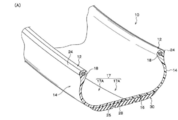
- FIG. 1 is a perspective view showing a partial cross section of a tire according to an embodiment of the present invention. It is sectional drawing of the bead part with which the rim
- the tire of the present invention is formed of a resin material and has an annular tire skeleton, and the resin material has a structure represented by a soft segment and — [CO— (CH 2 ) m —NH] — in the molecule. And a polyamide-based thermoplastic elastomer having a hard segment having units (wherein m represents an integer of 6 to 11).
- the tire skeleton in the present invention has a soft segment and a structural unit represented by — [CO— (CH 2 ) m —NH] — in the molecule (where m is an integer of 6 to 11). Therefore, the reinforcing metal cord member embedded in the tire is excellent in rust prevention. Further, the tire of the present invention is excellent in productivity because it is possible to form a tire frame body by injection molding.
- the tire has a tire frame body using a resin material.
- the resin material includes at least a soft segment in a molecule and a hard segment having a structural unit represented by — [CO— (CH 2 ) m —NH] — (where m represents an integer of 6 to 11).
- a polyamide-based thermoplastic elastomer may contain a thermoplastic elastomer other than the polyamide-based thermoplastic elastomer or an arbitrary component, but is represented by a soft segment and — [CO— (CH 2 ) m —NH] — in the molecule.
- the content of the polyamide-based thermoplastic elastomer having a hard segment having a structural unit is preferably 30% by mass or more, and more preferably 50% by mass or more. It is preferably 70% by mass or more.
- resin is a concept including a thermoplastic resin and a thermosetting resin, but does not include natural rubber.
- the “polyamide thermoplastic elastomer” is a copolymer having a crystalline polymer having a high melting point and a non-crystalline polymer having a low glass transition temperature. It means a thermoplastic resin material having an amide bond (—CONH—) in the main chain of the polymer constituting the hard segment.
- the polyamide-based thermoplastic elastomer may be simply referred to as “TPA” (Thermoplastic Amid elastomer).
- polyamide-based thermoplastic elastomer As the above-mentioned polyamide-based thermoplastic elastomer, at least polyamide is a crystalline hard segment having a high melting point, and other polymers (eg, polyester or polyether) are amorphous and a soft segment having a low glass transition temperature. The material which is doing is mentioned.
- the polyamide-based thermoplastic elastomer may use a chain extender such as dicarboxylic acid as a bonding part between the hard segment and the soft segment.
- the hard segment has a structural unit represented by — [CO— (CH 2 ) m —NH] — (wherein m represents an integer of 6 to 11).
- M in the structural unit represented by — [CO— (CH 2 ) m —NH] — affects the hygroscopicity, rigidity, etc. of the resin material constituting the tire, and if m is less than 6, the resin material The hygroscopic property is high, and the rust prevention property of the reinforcing metal cord member in the tire is insufficient.
- M in the structural unit represented by — [CO— (CH 2 ) m —NH] — is preferably 7 or more, more preferably 8 or more, and particularly preferably 9 or more.
- m in the structural unit represented by — [CO— (CH 2 ) m —NH] — is preferably 10 or less.
- m is 10 or less, the number of hydrogen bonds is increased, the melting point is increased, and heat resistance is excellent.
- polyamides having a structural unit represented by — [CO— (CH 2 ) m —NH] — polyamides obtained by ring-opening polycondensation of undecane lactam (polyamide 11), polyamides obtained by ring-opening polycondensation of lauryl lactam (polyamides) 12), polyamide (polyamide 12) obtained by polycondensation of 12-aminododecanoic acid, and the like.
- the number of repeating structural units represented by — [CO— (CH 2 ) m —NH] — is preferably 2 to 100, and more preferably 3 to 50.
- m is 7, and the number of repeating structural units represented by — [CO— (CH 2 ) m —NH] — is preferably 2 to 100, more preferably 3 to 50.
- m is 10
- the number of repeating structural units represented by — [CO— (CH 2 ) m —NH] — is preferably 2 to 100, more preferably 3 to 50.
- m is 11, and the number of repeating structural units represented by — [CO— (CH 2 ) m —NH] — is preferably 2 to 100, and more preferably 3 to 50.
- the resin material is a hard segment having a soft segment and a structural unit represented by — [CO— (CH 2 ) m —NH] — (where m represents an integer of 6 to 11) in the molecule.
- a polyamide-based thermoplastic elastomer other than the polyamide-based thermoplastic elastomer (hereinafter also referred to as other polyamide-based thermoplastic elastomer) may be further included.
- polyamides that form other polyamide-based thermoplastic elastomers include polyamides synthesized using monomers represented by the following general formula (1) or general formula (2).
- R 1 represents a molecular chain of a hydrocarbon having 2 to 5 or 12 to 20 carbon atoms, or an alkylene group having 2 to 5 or 12 to 20 carbon atoms.
- R 2 represents a hydrocarbon molecular chain having 3 to 5 or 12 to 20 carbon atoms, or an alkylene group having 3 to 5 or 12 to 20 carbon atoms.
- Examples of the monomer represented by the general formula (1) or the general formula (2) include ⁇ -aminocarboxylic acid and lactam.
- Examples of the polyamide forming the hard segment include polycondensates of these ⁇ -aminocarboxylic acids and lactams, and copolycondensation polymers of diamines and dicarboxylic acids.
- Examples of the ⁇ -aminocarboxylic acid include aliphatic ⁇ -aminocarboxylic acids having 3 to 5 or 12 to 20 carbon atoms.
- Examples of the lactam include aliphatic lactams having 3 to 5 or 12 to 20 carbon atoms.
- Examples of the diamine include diamine compounds such as aliphatic diamines having 2 to 5 or 12 to 20 carbon atoms.
- the dicarboxylic acid can be represented by HOOC- (R 3 ) m-COOH (R 3 : a hydrocarbon molecular chain having 3 to 20 carbon atoms, m: 0 or 1).
- oxalic acid for example, oxalic acid, succinic acid And aliphatic dicarboxylic acids having 2 to 22 carbon atoms such as glutaric acid, adipic acid, pimelic acid, suberic acid, azelaic acid, sebacic acid and dodecanedioic acid.
- polycondensation polyamide (polyamide 66) of diamine and dibasic acid, polyamide (amide MX) having metaxylenediamine as a structural unit, or the like may be used in combination.
- the polyamide 66 for example, - containing a structural unit represented by - - [CO (CH 2) 4 CONH ( CH 2) 6 NH ] [CO (CH 2) 4 CONH ( CH 2) 6 NH ] -
- the number of repeating structural units represented by is preferably 2 to 100, more preferably 3 to 50.
- the amide MX having meta-xylenediamine as a structural unit can be represented, for example, by the following structural unit (A-1) [in (A-1), n represents an arbitrary number of repeating units], for example, n is preferably 2 to 100, and more preferably 3 to 50.
- the polyamide-based thermoplastic elastomer preferably has a polyamide (polyamide 12) having a unit structure represented by — [CO— (CH 2 ) 11 —NH] — as a hard segment.
- the polyamide 12 can be obtained by ring-opening polycondensation of lauryl lactam or polycondensation of 12-aminododecanoic acid.
- polymer that forms the soft segment examples include polyester and polyether.
- polyether examples include polyethylene glycol, polypropylene glycol, polytetramethylene ether glycol (PTMG), and ABA type triblock polyether diol. These can be used alone or in combination of two or more.
- polyether diamine etc. which are obtained by reacting an anionia etc. with the terminal of polyether can be used, for example, ABA type
- examples of the “ABA type triblock polyether diol” include polyethers represented by the following general formula (3).
- x and z each independently represents an integer of 1 to 20.
- y represents an integer of 4 to 50.
- each of x and z is preferably an integer of 1 to 18, more preferably an integer of 1 to 16, particularly preferably an integer of 1 to 14, and most preferably an integer of 1 to 12.
- y is preferably an integer of 5 to 45, more preferably an integer of 6 to 40, particularly preferably an integer of 7 to 35, and most preferably an integer of 8 to 30.
- examples of the “ABA type triblock polyether diamine” include polyether diamines represented by the following general formula (N).
- X N and Z N each independently represent an integer of 1 to 20.
- Y N represents an integer of 4 to 50.
- X N and Z N are each preferably an integer of 1 to 18, more preferably an integer of 1 to 16, particularly preferably an integer of 1 to 14, and an integer of 1 to 12 Most preferred.
- Y N is preferably an integer of 5 to 45, more preferably an integer of 6 to 40, particularly preferably an integer of 7 to 35, and most preferably an integer of 8 to 30.
- the soft segment is preferably a polymer including a structural unit derived from tetramethylene ether glycol (TMG), and particularly includes a structural unit derived from tetramethylene ether glycol (TMG) from the viewpoint of improving the pressure resistance of the tire.
- TMG tetramethylene ether glycol
- a copolymer is preferred.
- the other structural unit that can constitute the copolymer together with the structural unit derived from tetramethylene ether glycol (TMG) is not particularly limited, and is a structural unit derived from the aforementioned ethylene glycol (EG), propylene glycol (PPG), or the like. Is mentioned.
- a copolymer containing a structural unit derived from tetramethylene ether glycol for example, a binary copolymer (such as PTMG / PPG) having a structural unit derived from TMG and a structural unit derived from PPG.
- a binary copolymer such as PTMG / PPG
- terpolymers PPG / PTMG / PPG, PTMG / PPG / PEG, etc.
- PPG / PTMG / PPG may be expressed as “PPG-PTMG-PPG”.
- the polymer forming the soft segment may contain a diamine such as a branched saturated diamine having 6 to 22 carbon atoms, a branched alicyclic diamine having 6 to 16 carbon atoms, or norbornane diamine as a monomer unit.
- a diamine such as a branched saturated diamine having 6 to 22 carbon atoms, a branched alicyclic diamine having 6 to 16 carbon atoms, or norbornane diamine as a monomer unit.
- These branched saturated diamines having 6 to 22 carbon atoms, branched alicyclic diamines having 6 to 16 carbon atoms, or norbornane diamines may be used alone or in combination. However, it may be used in combination with the above-mentioned ABA type triblock polyether or the ABA type triblock polyether diamine.
- the combination of the hard segment and the soft segment the combination of the hard segment and the soft segment mentioned above can be given.
- lauryl lactam ring-opening polycondensate / polyethylene glycol combination lauryl lactam ring-opening polycondensate / polypropylene glycol combination, lauryl lactam ring-opening polycondensate / polytetramethylene ether glycol combination, lauryl lactam Ring-opening polycondensate / ABA type triblock polyether combination, lauryl lactam ring-opening polycondensate / ABA type triblock polyether diamine combination, aminododecanoic acid polycondensate / polyethylene glycol combination, aminododecane Acid polycondensate / polypropylene glycol combination, aminododecanoic acid polycondensate / polytetramethylene ether glycol combination, aminododecanoic acid polycondensate / ABA type
- Examples of the branched saturated diamine having 6 to 22 carbon atoms include 2,2,4-trimethyl-1,6-hexanediamine, 2,4,4-trimethyl-1,6-hexanediamine, and 1,2- Examples include diaminopropane, 1,3-diaminopentane, 2-methyl-1,5-diaminopentane, and 2-methyl-1,8-diaminooctane.
- Examples of the branched alicyclic diamine having 6 to 16 carbon atoms include 5-amino-2,2,4-trimethyl-1-cyclopentanemethylamine and 5-amino-1,3,3-trimethylcyclohexanemethylamine. Etc. These diamines may be either cis isomers or trans isomers, or may be a mixture of these isomers.
- Examples of the norbornane diamine include 2,5-norbonane dimethylamine, 2,6-norbonane dimethylamine, and mixtures thereof.
- the polymer which comprises the said soft segment may contain other diamine compounds other than the above as a monomer unit.
- diamine compounds include ethylene diamine, trimethylene diamine, tetramethylene diamine, hexamethylene diamine, heptamethylene diamine, octamethylene diamine, nonamethylene diamine, decamethylene diamine, undecamethylene diamine, dodecamethylene diamine, 2, Aliphatic diamines such as 2,4-trimethylhexamethylenediamine, 2,4,4-trimethylhexamethylenediamine, 3-methylpentanemethylenediamine, bis (4-aminocyclohexyl) methane, bis (4-aminocyclohexyl) propane, Alicyclic diamines such as 1,3-bisaminomethylcyclohexane and 1,4-bisaminomethylcyclohexane, aromatic diamines such as metaxylylenediamine and paraxylylenediamine, etc. And the like.
- the above diamine
- the polyamide-based thermoplastic elastomer may use a chain extender such as dicarboxylic acid in addition to the hard segment and the soft segment.
- a chain extender such as dicarboxylic acid
- dicarboxylic acid at least 1 type chosen from aliphatic, alicyclic, and aromatic dicarboxylic acid, or these derivatives can be used, for example.
- dicarboxylic acid examples include straight chain having 2 to 25 carbon atoms such as adipic acid, decanedicarboxylic acid, oxalic acid, succinic acid, glutaric acid, pimelic acid, suberic acid, azelaic acid, sebacic acid, dodecanedioic acid and the like.
- Aliphatic dicarboxylic acids dimerized aliphatic dicarboxylic acids having 14 to 48 carbon atoms obtained by dimerizing unsaturated fatty acids obtained by fractionation of triglycerides, and aliphatic dicarboxylic acids such as hydrogenated products thereof, 1,4-cyclohexanedicarboxylic acid Mention may be made of alicyclic dicarboxylic acids such as acids and aromatic dicarboxylic acids such as terephthalic acid and isophthalic acid.
- the polyamide thermoplastic elastomer contained in the resin material preferably has a weight average molecular weight of 10,000 to 300,000.
- the weight average molecular weight of the polyamide-based thermoplastic elastomer is 10,000 or more, the rigidity of the resin material can be increased and the pressure resistance of the tire can be improved.
- the weight average molecular weight of the said polyamide-type thermoplastic elastomer is 300000 or less, the rigidity of a resin material does not become large too much and it becomes a material which is easy to carry out injection molding.
- the weight average molecular weight of the polyamide-based thermoplastic elastomer is more preferably 10,000 to 200,000.
- the weight average molecular weight of the polyamide-based thermoplastic elastomer can be measured by gel permeation chromatography (GPC), for example, using GPC such as “HLC-8320GPC EcoSEC” manufactured by Tosoh Corporation. Can do.
- GPC gel permeation chromatography
- the number average molecular weight of the polymer (polyamide) constituting the hard segment is preferably 300 to 15000 from the viewpoint of melt moldability.
- the number average molecular weight of the polymer constituting the soft segment is preferably 200 to 6000 from the viewpoint of toughness and low temperature flexibility.
- the ratio (HS / SS) to the mass (HS) of the hard segment and the mass (SS) of the soft segment is 50 from the viewpoint of moldability and rust prevention of the reinforcing metal cord member. / 50 to 90/10 is preferable, and 50/50 to 80/20 is more preferable.
- the content of the hard segment in the polyamide thermoplastic elastomer is preferably 5 to 95% by mass, more preferably 10 to 90% by mass, and particularly preferably 15 to 90% by mass with respect to the total amount of the polyamide thermoplastic elastomer.
- the content of the soft segment in the polyamide thermoplastic elastomer is preferably 10 to 95% by mass, more preferably 10 to 90% by mass, and particularly preferably 10 to 90% by mass with respect to the total amount of the polyamide thermoplastic elastomer.
- the chain extender is used, the content thereof is preferably set so that the hydroxyl group or amino group of the monomer constituting the soft segment and the carboxyl group of the chain extender are approximately equimolar.
- the polyamide-based thermoplastic elastomer can be synthesized by copolymerizing the polymer that forms the hard segment and the polymer that forms the soft segment by a known method.
- the polyamide-based thermoplastic elastomer includes a monomer constituting a hard segment (for example, an ⁇ -aminocarboxylic acid such as 12-aminododecanoic acid and a lactam such as lauryl lactam) and a monomer constituting a soft segment (for example, The ABA triblock polyether or the ABA triblock polyether diamine) and a chain extender (for example, adipic acid or decanedicarboxylic acid) can be polymerized in a container.
- a monomer constituting a hard segment for example, an ⁇ -aminocarboxylic acid such as 12-aminododecanoic acid and a lactam such as lauryl lactam
- a monomer constituting a soft segment for example, The
- ⁇ -aminocarboxylic acid when used as a monomer constituting the hard segment, it can be synthesized by further performing reduced-pressure melt polymerization on normal-pressure melt polymerization or normal-pressure melt polymerization.
- lactam when used as the monomer constituting the hard segment, it is a method comprising coexisting an appropriate amount of water and comprising melt polymerization under a pressure of 0.1 to 5 MPa, followed by normal pressure melt polymerization and / or reduced pressure melt polymerization. Can be manufactured.
- These synthesis reactions can be carried out either batchwise or continuously. In the above synthesis reaction, a batch type reaction vessel, a single tank type or multi-tank type continuous reaction apparatus, a tubular continuous reaction apparatus or the like may be used alone or in appropriate combination.
- the polymerization temperature is preferably 150 ° C. to 300 ° C., more preferably 160 ° C. to 280 ° C.
- the polymerization time can be appropriately determined depending on the relationship between the polymerization average molecular weight of the polyamide-based thermoplastic elastomer to be synthesized and the polymerization temperature. For example, it is preferably 0.5 hours to 30 hours, and more preferably 0.5 hours to 20 hours. preferable.
- monoamines or diamines such as laurylamine, stearylamine, hexamethylenediamine, and metaxylylenediamine for the purpose of adjusting the molecular weight and stabilizing the melt viscosity at the time of molding as necessary.
- An additive such as monocarboxylic acid such as acetic acid, benzoic acid, stearic acid, adipic acid, sebacic acid, dodecanedioic acid, or dicarboxylic acid may be added.
- additives can be appropriately selected in relation to the molecular weight and viscosity of the resulting polyamide-based thermoplastic elastomer within a range that does not adversely affect the effects of the present invention.
- a catalyst can be used as necessary.
- the catalyst includes at least one selected from the group consisting of P, Ti, Ge, Zn, Fe, Sn, Mn, Co, Zr, V, Ir, La, Ce, Li, Ca, and Hf. Compounds.
- the catalyst include inorganic phosphorus compounds, organic titanium compounds, organic zirconium compounds, and organic tin compounds.
- examples of the inorganic phosphorus compound include phosphoric acid, pyrophosphoric acid, polyphosphoric acid, phosphorous acid, hypophosphorous acid and other phosphorus-containing acids, phosphorus-containing acid alkali metal salts, and phosphorus-containing acid alkaline earths.
- a metal salt etc. are mentioned.
- the organic titanium compound include titanium alkoxide [titanium tetrabutoxide, titanium tetraisopropoxide, and the like].
- examples of the organic zirconium compound include zirconium alkoxide (zirconium tetrabutoxide (also referred to as “Zr (OBu) 4 ” or “Zr (OC 4 H 8 ) 4 )”).
- organotin compounds include distannoxane compounds [1-hydroxy-3-isothiocyanate-1,1,3,3-tetrabutyl distanoxane, etc.], tin acetate, dibutyltin dilaurate, butyltin hydroxide oxide hydrate, and the like. Can be mentioned.
- the catalyst addition amount and the catalyst addition timing are not particularly limited as long as the target product can be obtained quickly.
- polyamide-based thermoplastic elastomer examples include lauryl lactam ring-opening polycondensate / polyethylene glycol / adipic acid combination, lauryl lactam ring-opening polycondensate / polypropylene glycol / adipic acid combination, and lauryl lactam ring opening.
- ring-opening polycondensate of lauryl lactam / ABA type triblock polyether / adipic acid combination aminododecanoic acid polycondensate / ABA type triblock polyether / adipic acid combination, aminododecanoic acid polycondensate / ABA type triblock polyether diamine / decane dicarboxylic acid combination, aminododecanoic acid polycondensate / polytetramethylene ether glycol / adipic acid combination, and aminododecanoic acid polycondensate / polytetramethylene ether glycol / A combination of decanedicarboxylic acids is particularly preferred.
- polyamide-type thermoplastic elastomer what combined the preferable aspect mentioned above about the combination of a structural unit, the structural ratio, molecular weight, etc. can be used.
- additives such as rubber, various fillers (for example, silica, calcium carbonate, clay), anti-aging agents, oils, plasticizers, colorants, weathering agents, and reinforcing materials are added to the resin material as desired. You may make it contain.
- the content of the additive in the resin material (tire frame) is not particularly limited, and can be appropriately used as long as the effects of the present invention are not impaired.
- the content of the resin component in the resin material is preferably 50% by mass or more, and more preferably 90% by mass or more based on the total amount of the resin material.
- the content of the resin component in the resin material is the remainder obtained by subtracting the total content of various additives from the total amount of the resin component.
- the tire frame in the present invention uses the above-mentioned resin material.
- the melting point (or softening point) of the resin material (tire frame) itself is usually 100 ° C. to 350 ° C., preferably about 100 ° C. to 250 ° C., but from the viewpoint of tire productivity, 120 ° C. to 250 ° C. The degree is preferable, and 120 ° C. to 200 ° C. is more preferable.
- a resin material having a melting point of 120 ° C. to 250 ° C. for example, when a tire skeleton is formed by fusing the divided bodies (frame pieces), the periphery of 120 ° C. to 250 ° C. Even if the frame body is fused in the temperature range, the bonding strength between the tire frame pieces is sufficient.
- the heating temperature is preferably 10 ° C. to 150 ° C. higher than the melting point (or softening point) of the resin material forming the tire frame piece, more preferably 10 ° C. to 100 ° C. higher.
- the resin material can be obtained by adding various additives as necessary and mixing them appropriately by a known method (for example, melt mixing).
- the resin material obtained by melt mixing can be used in the form of pellets if necessary.
- the tensile yield strength defined in JIS K7113: 1995 of the resin material (tire frame) itself is preferably 5 MPa or more, preferably 5 MPa to 20 MPa, and more preferably 5 MPa to 17 MPa.
- the resin material can withstand deformation against a load applied to the tire during traveling.
- the tensile yield elongation defined by JIS K7113: 1995 of the resin material (tire frame) itself is preferably 10% or more, preferably 10% to 70%, and more preferably 15% to 60%.
- the tensile yield elongation of the resin material is 10% or more, the elastic region can be increased.
- the tensile elongation at break specified in JIS K7113: 1995 of the resin material (tire frame) itself is preferably 50% or more, preferably 100% or more, more preferably 150% or more, and particularly preferably 200% or more. If the tensile elongation at break of the resin material is 50% or more, it can be made difficult to break against collision.
- the deflection temperature under load (when loaded with 0.45 MPa) as defined in ISO 75-2 or ASTM D648 of the resin material (tire frame) itself is preferably 50 ° C. or more, preferably 50 ° C. to 150 ° C., and preferably 50 ° C. to 50 ° C. 130 ° C. is more preferable.
- the deflection temperature under load of the resin material is 50 ° C. or higher, deformation of the tire skeleton can be suppressed even when vulcanization is performed in the manufacture of the tire.
- FIG. 1A is a perspective view showing a partial cross section of a tire according to an embodiment of the present invention.
- FIG. 1B is a cross-sectional view of a bead portion attached to a rim.
- the tire 10 of the present embodiment has a cross-sectional shape that is substantially the same as a conventional general rubber pneumatic tire.
- the tire 10 includes a pair of bead portions 12 that contact the bead seat 21 and the rim flange 22 of the rim 20 shown in FIG. 1B, and side portions 14 that extend outward from the bead portion 12 in the tire radial direction.
- a tire case 17 is provided that includes a crown portion 16 (outer peripheral portion) that connects an outer end in the tire radial direction of one side portion 14 and an outer end in the tire radial direction of the other side portion 14.
- a resin material for example, a soft segment in a molecule and a structural unit represented by — [CO— (CH 2 ) m —NH] — (where m is 6 to 6).
- a polyamide-based thermoplastic elastomer having a hard segment having an integer of 11) and each additive may be used.
- the tire case 17 is formed of a single resin material.
- the present invention is not limited to this configuration, and each part of the tire case 17 is similar to a conventional general rubber pneumatic tire.
- a reinforcing material (polymer material, metal fiber, cord, nonwoven fabric, woven fabric, etc.) is embedded in the tire case 17 (for example, the bead portion 12, the side portion 14, the crown portion 16 and the like), and the reinforcing material is provided.
- the tire case 17 may be reinforced.
- the tire case 17 of the present embodiment is obtained by joining a pair of tire case halves (tire frame pieces) 17A formed of a resin material.
- the tire case half 17A is formed by injection molding or the like so that one bead portion 12, one side portion 14, and a half-width crown portion 16 are integrated with each other so as to face each other. It is formed by joining at the tire equator part.
- the tire case 17 is not limited to the one formed by joining two members, and may be formed by joining three or more members.
- the tire case half 17A formed of the resin material can be formed by, for example, vacuum forming, pressure forming, injection molding, melt casting, or the like. For this reason, it is not necessary to perform vulcanization compared to the case where the tire case is molded with rubber as in the prior art, the manufacturing process can be greatly simplified, and the molding time can be omitted.
- the tire case half body 17A has a symmetrical shape, that is, the one tire case half body 17A and the other tire case half body 17A have the same shape. There is also an advantage that only one type of mold is required.
- an annular bead core 18 made of a steel cord is embedded in the bead portion 12, similar to a conventional general pneumatic tire.
- the present invention is not limited to this configuration, and the bead core 18 can be omitted if the rigidity of the bead portion 12 is ensured and there is no problem in fitting with the rim 20.
- an organic fiber cord, a resin-coated organic fiber cord, or a hard resin may be used.
- An annular seal layer 24 made of is formed.
- the seal layer 24 may also be formed at a portion where the tire case 17 (bead portion 12) and the bead sheet 21 are in contact with each other.
- a material having better sealing properties than the resin material constituting the tire case 17 a softer material than the resin material constituting the tire case 17 can be used.
- thermoplastic resin thermoplastic elastomer
- examples of such other thermoplastic resins include polyurethane resins, polyolefin resins, polystyrene thermoplastic resins, polyester resins, and the like, and blends of these resins with rubbers or elastomers.
- Thermoplastic elastomers can also be used, for example, polyester-based thermoplastic elastomers, polyurethane-based thermoplastic elastomers, polystyrene-based thermoplastic elastomers, polyolefin-based thermoplastic elastomers, or combinations of these elastomers or blends with rubber. Thing etc. are mentioned.
- a reinforcing metal cord 26 having higher rigidity than the resin material constituting the tire case 17 is wound around the crown portion 16 in the circumferential direction of the tire case 17.
- the reinforcing metal cord 26 is spirally wound in a state where at least a part thereof is embedded in the crown portion 16 in a cross-sectional view along the axial direction of the tire case 17, and forms a reinforcing metal cord layer 28. Yes.
- FIG. 2 is a cross-sectional view along the tire rotation axis showing a state in which a reinforcing metal cord is embedded in the crown portion of the tire case of the tire according to the present embodiment.
- the reinforcing metal cord 26 is spirally wound in a state in which at least a part is embedded in the crown portion 16 in a sectional view along the axial direction of the tire case 17.
- a reinforcing metal cord layer 28 indicated by a broken line portion in FIG. 2 is formed together with a part of the outer peripheral portion of the case 17.
- the portion embedded in the crown portion 16 of the reinforcing metal cord 26 is in close contact with the resin material constituting the crown portion 16 (tire case 17).
- the reinforcing metal cord 26 is not particularly limited as long as it is a member containing at least metal fiber, and a metal fiber, a multifilament (twisted wire) obtained by twisting these fibers such as a steel cord twisted with steel fibers, or the like is used. Can do.
- a steel cord is used as the reinforcing metal cord 26.
- the burying amount L indicates the burying amount of the reinforcing metal cord 26 in the tire rotation axis direction with respect to the tire case 17 (crown portion 16).
- the embedding amount L of the reinforcing metal cord 26 in the crown portion 16 is preferably 1/5 or more of the diameter D of the reinforcing metal cord 26, and more preferably more than 1/2.
- the entire reinforcing metal cord 26 is most preferably embedded in the crown portion 16.
- the reinforcing metal cord layer 28 corresponds to a belt disposed on the outer peripheral surface of the carcass of a conventional rubber pneumatic tire.
- the crown 30 is disposed on the outer circumferential side of the reinforcing metal cord layer 28 in the tire radial direction.
- the rubber used for the crown 30 is preferably the same type of rubber used in conventional rubber pneumatic tires.
- a crown formed of another type of resin material that is more excellent in wear resistance than the resin material constituting the tire case 17 may be used.
- the crown 30 is formed with a crown pattern including a plurality of grooves on the ground contact surface with the road surface in the same manner as a conventional rubber pneumatic tire.
- the manufacturing method of the tire of this embodiment is explained.
- a tire case half is formed using a resin material containing the polyamide-based thermoplastic elastomer. These tire cases are preferably formed by injection molding.
- the tire case halves supported by the thin metal support ring face each other.
- a joining mold (not shown) is installed so as to be in contact with the outer peripheral surface of the abutting portion of the tire case half.
- die is comprised so that the periphery of the junction part (butting part) of the tire case half body 17A may be pressed with a predetermined pressure.
- the periphery of the joint portion of the tire case half is pressed at a temperature equal to or higher than the melting point (or softening point) of the resin material constituting the tire case.
- the joint portion of the tire case half is heated and pressed by the joining mold, the joint portion is melted and the tire case halves are fused together, and the tire case 17 is formed by integrating these members.
- the joining portion of the tire case half body is heated using a joining mold, but the present invention is not limited to this, and for example, the joining portion is heated by a separately provided high-frequency heater or the like.
- the tire case halves may be joined by being softened or melted in advance by irradiation with hot air, infrared rays, or the like, and pressurized by a joining mold.
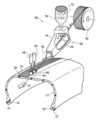
- FIG. 3 is an explanatory diagram for explaining an operation of embedding a reinforcing metal cord in a crown portion of a tire case using a cord heating device and rollers.
- the cord supply device 56 is disposed on the downstream side of the reel 58 around which the reinforcing metal cord 26 is wound, the cord heating device 59 disposed on the downstream side of the reel 58 in the cord transport direction, and the downstream side of the reinforcing metal cord 26 in the transport direction.
- the first roller 60, the first cylinder device 62 that moves the first roller 60 in the direction of moving toward and away from the tire outer peripheral surface, and the downstream of the first roller 60 in the conveying direction of the reinforcing metal cord 26 A second roller 64 disposed on the side, and a second cylinder device 66 that moves the second roller 64 in a direction of moving toward and away from the tire outer peripheral surface.
- the second roller 64 can be used as a metal cooling roller.
- the surface of the first roller 60 or the second roller 64 is made of fluororesin (in this embodiment, Teflon (registered trademark)) in order to suppress adhesion of a molten or softened resin material. It is coated.
- the cord supply device 56 includes two rollers, the first roller 60 and the second roller 64, but the present invention is not limited to this configuration, and any one of the rollers. It is also possible to have only one (that is, one roller).
- the cord heating device 59 includes a heater 70 and a fan 72 that generate hot air.
- the cord heating device 59 also includes a heating box 74 through which the reinforcing metal cord 26 passes through an internal space in which hot air is supplied, and a discharge port 76 for discharging the heated reinforcing metal cord 26.
- the temperature of the heater 70 of the cord heating device 59 is raised, and the ambient air heated by the heater 70 is sent to the heating box 74 by the wind generated by the rotation of the fan 72.
- the reinforcing metal cord 26 unwound from the reel 58 is fed into a heating box 74 in which the internal space is heated with hot air (for example, the temperature of the reinforcing metal cord 26 is heated to about 100 to 200 ° C.).
- the heated reinforcing metal cord 26 passes through the discharge port 76 and is wound spirally around the outer peripheral surface of the crown portion 16 of the tire case 17 rotating in the direction of arrow R in FIG.
- the resin material at the contact portion is melted or softened, and at least a part of the heated reinforcing metal cord 26 is outer peripheral surface of the crown portion 16. Buried in At this time, since the heated reinforcing metal cord 26 is embedded in the molten or softened resin material, the resin material and the reinforcing metal cord 26 are in a state where there is no gap, that is, in a close contact state. In addition, by heating the reinforcing metal cord 26 to a temperature higher than the melting point (or softening point) of the resin material of the tire case 17, melting or softening of the resin material in the portion in contact with the reinforcing metal cord 26 is promoted. By doing so, the reinforcing metal cord 26 can be easily embedded in the outer peripheral surface of the crown portion 16.
- the burying amount L of the reinforcing metal cord 26 can be adjusted by the heating temperature of the reinforcing metal cord 26, the tension applied to the reinforcing metal cord 26, the pressing force by the first roller 60, and the like.
- the burying amount L of the reinforcing metal cord 26 is set to be 1/5 or more of the diameter D of the reinforcing metal cord 26.
- the burying amount L of the reinforcing metal cord 26 is more preferably more than 1/2 of the diameter D, and most preferably the entire reinforcing metal cord 26 is embedded.
- the reinforced metal cord layer 28 is formed on the outer peripheral side of the crown portion 16 of the tire case 17 by winding the heated reinforcing metal cord 26 while being embedded in the outer peripheral surface of the crown portion 16.
- the vulcanized belt-shaped crown 30 is wound around the outer peripheral surface of the tire case 17 by one turn, and the crown 30 is bonded to the outer peripheral surface of the tire case 17 using an adhesive or the like.
- the crown 30 may be, for example, a precure crown that is used in conventionally known retreaded tires. This step is the same step as the step of bonding the precure crown to the outer peripheral surface of the base tire of the retreaded tire.
- the seal layer 24 made of vulcanized rubber is bonded to the bead portion 12 of the tire case 17 using an adhesive or the like, the tire 10 is completed.
- the tire case 17 includes a soft segment and a structural unit represented by — [CO— (CH 2 ) m —NH] — in the molecule (where m represents an integer of 6 to 11). ) And a hard segment having a hard segment, the pressure resistance is excellent.
- the tire 10 is light in weight because it has a simple structure as compared with a conventional rubber tire. For this reason, the tire 10 of this embodiment has high friction resistance and durability. Further, since the tire case 17 can be injection-molded, the productivity is very excellent.
- a reinforcing metal cord 26 having a rigidity higher than that of the resin material is spirally wound in the circumferential direction on the outer peripheral surface of the crown portion 16 of the tire case 17 formed of a resin material. Therefore, puncture resistance, cut resistance, and circumferential rigidity of the tire 10 are improved. In addition, creep of the tire case 17 formed of a resin material is prevented by improving the circumferential rigidity of the tire 10.
- the reinforcing metal cord 26 is embedded in the outer peripheral surface of the crown portion 16 of the tire case 17 formed of a resin material in a cross-sectional view along the axial direction of the tire case 17 (the cross section shown in FIG. 1A).
- the reinforcing metal cord 26 since it is in close contact with the resin material, it is possible to prevent the reinforcing metal cord 26 from moving due to an input during traveling. Thereby, generation
- the reinforcing metal cord layer 28 is configured to include a resin material
- the hardness of the tire case 17 and the reinforcing metal cord layer 28 is higher than that in the case where the reinforcing metal cord 26 is fixed with cushion rubber. Since the difference can be reduced, the reinforcing metal cord 26 can be further fixed in close contact with the tire case 17. Thereby, generation
- the reinforcing metal cord 26 when the reinforcing metal cord 26 is a steel cord, the reinforcing metal cord 26 can be easily separated and recovered from the resin material by heating at the time of disposal of the tire, which is advantageous in terms of recyclability of the tire 10. .
- the resin material since the resin material has a lower loss coefficient (tan ⁇ ) than vulcanized rubber, if the reinforcing metal cord layer 28 contains a large amount of resin material, the rolling property of the tire can be improved.
- the resin material has an advantage that the in-plane shear rigidity is larger than that of the vulcanized rubber, and the handling property and wear resistance during running of the tire are excellent.
- the crown 30 in contact with the road surface is made of a rubber material that is more resistant to wear than the resin material constituting the tire case 17, the wear resistance of the tire 10 is improved. Further, since an annular bead core 18 made of a metal material is embedded in the bead portion 12, the tire case 17, that is, the tire 10 is strong against the rim 20 like the conventional rubber pneumatic tire. Retained.
- the reinforcing metal cord 26 is heated, and the surface of the tire case 17 in a portion where the heated reinforcing metal cord 26 contacts is melted or softened, but the present invention is not limited to this configuration.
- the hot metal generator 26 may be used without heating the reinforcing metal cord 26, and after heating the outer peripheral surface of the crown portion 16 in which the reinforcing metal cord 26 is embedded, the reinforcing metal cord 26 may be embedded in the crown portion 16. .
- the heat source of the cord heating device 59 is a heater and a fan.
- the present invention is not limited to this configuration, and the reinforcing metal cord 26 may be directly heated by radiant heat (for example, infrared rays). Good.
- the portion where the resin material in which the reinforcing metal cord 26 is embedded is melted or softened is forcibly cooled by the metal second roller 64, but the present invention is limited to this configuration.
- a configuration may be adopted in which cold air is directly blown onto a portion where the resin material is melted or softened to forcibly cool and solidify the melted or softened portion of the resin material.
- the reinforcing metal cord 26 is heated.
- the outer periphery of the reinforcing metal cord 26 may be covered with the same resin material as the tire case 17.
- the tire 10 of the present embodiment is a so-called tubeless tire in which an air chamber is formed between the tire 10 and the rim 20 by attaching the bead portion 12 to the rim 20, but the present invention is limited to this configuration. Instead, it may be a complete tube shape.
- the tire of the present invention is an embodiment using a reinforced metal cord member in which the cord member is coated with a resin material as shown in the second embodiment (FIGS. 4 and 5) of JP 2012-46030 A. May be.
- the polyamide-based thermoplastic elastomer TPA1 is polyamide 5 (nylon 5; N5) in which the polymer constituting the hard segment includes a structural unit represented by — [CO— (CH 2 ) 4 —NH] —.
- Nylon is a registered trademark.
- polyamide thermoplastic elastomer TPA2- A polyamide thermoplastic elastomer TPA2 was obtained in the same manner as in the synthesis of the polyamide thermoplastic elastomer TPA1, except that 6-aminohexanoic acid was used instead of 5-aminovaleric acid.
- the polyamide-based thermoplastic elastomer TPA2 is polyamide 6 (nylon 6; N6) in which the polymer constituting the hard segment includes a structural unit represented by — [CO— (CH 2 ) 5 —NH] —. Nylon is a registered trademark.
- polyamide-based thermoplastic elastomer TPA3 was obtained in the same manner as in the synthesis of the polyamide-based thermoplastic elastomer TPA1, except that ⁇ -aminocaprylic acid was used instead of 5-aminovaleric acid.
- the polyamide-based thermoplastic elastomer TPA3 is polyamide 8 (nylon 8; N8) in which the polymer constituting the hard segment includes a structural unit represented by — [CO— (CH 2 ) 7 —NH] —. Nylon is a registered trademark.
- polyamide-based thermoplastic elastomer TPA4 was obtained in the same manner as in the synthesis of the polyamide-based thermoplastic elastomer TPA1, except that 11-aminoundecanoic acid was used instead of 5-aminovaleric acid.
- the polyamide-based thermoplastic elastomer TPA4 is polyamide 11 (nylon 11; N11) in which the polymer constituting the hard segment includes a structural unit represented by — [CO— (CH 2 ) 10 —NH] —. Nylon is a registered trademark.
- polyamide-based thermoplastic elastomer TPA5 was obtained in the same manner as in the synthesis of the polyamide-based thermoplastic elastomer TPA1, except that 12-aminododecanoic acid was used instead of 5-aminovaleric acid.
- the polyamide-based thermoplastic elastomer TPA5 is polyamide 12 (nylon 12; N12) in which the polymer constituting the hard segment includes a structural unit represented by — [CO— (CH 2 ) 11 —NH] —. Nylon is a registered trademark.
- the polyamide-based thermoplastic elastomer TPA6 is polyamide 5 (nylon 5; N5) in which the polymer constituting the hard segment includes a structural unit represented by — [CO— (CH 2 ) 4 —NH] —.
- Nylon is a registered trademark.
- polyamide-based thermoplastic elastomer TPA7 was obtained in the same manner as in the synthesis of the polyamide-based thermoplastic elastomer TPA6 except that 6-aminohexanoic acid was used instead of 5-aminovaleric acid.
- the polyamide-based thermoplastic elastomer TPA7 is polyamide 6 (nylon 6; N6) in which the polymer constituting the hard segment includes a structural unit represented by — [CO— (CH 2 ) 5 —NH] —. Nylon is a registered trademark.
- polyamide-based thermoplastic elastomer TPA8 was obtained in the same manner as in the synthesis of the polyamide-based thermoplastic elastomer TPA6 except that ⁇ -aminocaprylic acid was used instead of 5-aminovaleric acid.
- the polyamide-based thermoplastic elastomer TPA8 is polyamide 8 (nylon 8; N8) in which the polymer constituting the hard segment includes a structural unit represented by — [CO— (CH 2 ) 7 —NH] —. Nylon is a registered trademark.
- polyamide thermoplastic elastomer TPA9 A polyamide thermoplastic elastomer TPA9 was obtained in the same manner as in the synthesis of the polyamide thermoplastic elastomer TPA6 except that 11-aminoundecanoic acid was used instead of 5-aminovaleric acid.
- the polyamide-based thermoplastic elastomer TPA9 is polyamide 11 (nylon 11; N11) in which the polymer constituting the hard segment includes a structural unit represented by — [CO— (CH 2 ) 10 —NH] —. Nylon is a registered trademark.
- polyamide-based thermoplastic elastomer TPA10 was obtained in the same manner as in the synthesis of the polyamide-based thermoplastic elastomer TPA6 except that 12-aminododecanoic acid was used instead of 5-aminovaleric acid.
- the polyamide-based thermoplastic elastomer TPA10 is polyamide 12 (nylon 12; N12) in which the polymer constituting the hard segment includes a structural unit represented by — [CO— (CH 2 ) 11 —NH] —. Nylon is a registered trademark.
- TPA1 to TPA10 shown in the “Polymer type” column of Table 1 were injection-molded to produce tires of Examples or Comparative Examples including steel cords (SC cords).
- the “hard structure” column represents the polymer species constituting the hard segments of TPA1 to TPA10.
- the “soft structure” column represents that the polymer type constituting the soft segment of TPA1 to TPA10 is PPG / PTMG / PPG.
- the quantity ratio in the “Hard / Soft ratio” column in Table 1 represents the ratio of the hard segment mass (hard) and the soft segment mass (soft) of TPA1 to TPA10.
- the component shown in the “dicarboxylic acid” column in Table 1 represents a component of a chain extender that becomes a bonding part of the hard segment and the soft segment.
Landscapes
- Chemical & Material Sciences (AREA)
- Health & Medical Sciences (AREA)
- Chemical Kinetics & Catalysis (AREA)
- Medicinal Chemistry (AREA)
- Polymers & Plastics (AREA)
- Organic Chemistry (AREA)
- Engineering & Computer Science (AREA)
- Mechanical Engineering (AREA)
- Life Sciences & Earth Sciences (AREA)
- Proteomics, Peptides & Aminoacids (AREA)
- Tires In General (AREA)
- Polyamides (AREA)
Abstract
Description
上述のように前記タイヤは、樹脂材料を用いたタイヤ骨格体を有する。前記樹脂材料は、少なくとも、分子内にソフトセグメントと-[CO-(CH2)m-NH]-で表される構成単位(ただし、mは6~11の整数を表す)を有するハードセグメントとを有するポリアミド系熱可塑性エラストマーを含む。
前記樹脂材料は、ポリアミド系熱可塑性エラストマー以外の熱可塑性エラストマーや任意の成分を含んでいてもよいが、分子内にソフトセグメントと-[CO-(CH2)m-NH]-で表される構成単位(ただし、mは6~11の整数を表す)を有するハードセグメントとを有するポリアミド系熱可塑性エラストマーの含有量が30質量%以上であることが好ましく、50質量%以上であることが更に好ましく、70質量%以上であることが特に好ましい。また、本明細書において「樹脂」とは、熱可塑性樹脂及び熱硬化性樹脂を含む概念であるが、天然ゴムは含まない。
本発明において、「ポリアミド系熱可塑性エラストマー」とは、結晶性で融点の高いハードセグメントを構成するポリマーと非晶性でガラス転移温度の低いソフトセグメントを構成するポリマーとを有する共重合体からなる熱可塑性樹脂材料であって、ハードセグメントを構成するポリマーの主鎖にアミド結合(-CONH-)を有するものを意味する。
ポリアミド系熱可塑性エラストマーを、単に「TPA」(ThermoPlastic Amid elastomer)と称することもある。
本発明において、前記ハードセグメントは、-[CO-(CH2)m-NH]-で表される構成単位(ただし、mは6~11の整数を表す)を有する。
-[CO-(CH2)m-NH]-で表される構成単位におけるmは、タイヤを構成する樹脂材料の吸湿性、剛性等に影響を与え、mが6未満であると、樹脂材料の吸湿性が高く、タイヤ内の補強金属コード部材の防錆性が不十分である。-[CO-(CH2)m-NH]-で表される構成単位におけるmが11を超えると、合成が困難となる。
-[CO-(CH2)m-NH]-で表される構成単位におけるmは、7以上であることが好ましく、8以上であることがより好ましく、9以上であることが特に好ましい。
前記ポリアミド8は、mが7であり、-[CO-(CH2)m-NH]-で表される構成単位の繰り返し数としては2~100が好ましく、3~50が更に好ましい。
前記ポリアミド11は、mが10であり、-[CO-(CH2)m-NH]-で表される構成単位の繰り返し数としては2~100が好ましく、3~50が更に好ましい。
前記ポリアミド12は、mが11であり、-[CO-(CH2)m-NH]-で表される構成単位の繰り返し数としては2~100が好ましく、3~50が更に好ましい。
他のポリアミド系熱可塑性エラストマーを形成するポリアミドとしては、例えば、下記一般式(1)又は一般式(2)で表されるモノマーを用いて合成されるポリアミドを挙げることができる。


前記ジアミンとしては、炭素数2~5または12~20の脂肪族ジアミンなどのジアミン化合物を挙げることができる。また、ジカルボン酸は、HOOC-(R3)m-COOH(R3:炭素数3~20の炭化水素の分子鎖、m:0又は1)で表すことができ、例えば、シュウ酸、コハク酸、グルタル酸、アジピン酸、ピメリン酸、スベリン酸、アゼライン酸、セバシン酸、ドデカン二酸などの炭素数2~22の脂肪族ジカルボン酸を挙げることができる。
前記ポリアミド66は、例えば、-〔CO(CH2)4CONH(CH2)6NH〕-で表される構成単位を含み、-〔CO(CH2)4CONH(CH2)6NH〕-で表される構成単位の繰り返し数としては2~100が好ましく、3~50が更に好ましい。

前記ソフトセグメントを形成するポリマーとしては、例えば、ポリエステルや、ポリエーテルが挙げられる。ポリエーテルとしては、例えば、ポリエチレングリコール、ポリプロピレングリコール、ポリテトラメチレンエーテルグリコール(PTMG)、ABA型トリブロックポリエーテルジオール等が挙げられ、これらを単独で又は2種以上を用いることができる。また、ポリエーテルの末端にアニモニア等を反応させることによって得られるポリエーテルジアミン等を用いることができ、例えば、ABA型トリブロックポリエーテルジアミンを用いることができる。

具体的には、テトラメチレンエーテルグリコール(TMG)由来の構成単位を含む共重合体としては、例えば、TMG由来の構成単位とPPG由来の構成単位を有する二元共重合体(PTMG/PPG等)、三元共重合体(PPG/PTMG/PPG、PTMG/PPG/PEG等)などが挙げられる。なお、PPG/PTMG/PPGを、「PPG-PTMG-PPG」と表すこともある。
上述のジアミンは単独で使用してもよいし、2種類以上を適宜組合せて使用してもよい。
上述のように、ポリアミド系熱可塑性エラストマーはハードセグメント及びソフトセグメントの他に、ジカルボン酸等の鎖長延長剤を用いてもよい。前記ジカルボン酸としては、例えば、脂肪族、脂環式及び芳香族ジカルボン酸から選ばれる少なくとも一種又はこれらの誘導体を用いることができる。
本発明において、樹脂材料に含まれるポリアミド系熱可塑性エラストマーの重量平均分子量は、10000~300000であることが好ましい。
前記ポリアミド系熱可塑性エラストマーの重量平均分子量が10000以上であることで、樹脂材料の剛性を上げ、タイヤの耐圧性を向上することができる。また、前記ポリアミド系熱可塑性エラストマーの重量平均分子量が300000以下であることで、樹脂材料の剛性が過度に大きくならず、射出成形し易い材料となる。
前記ポリアミド系熱可塑性エラストマーの重量平均分子量としては、10000~200000がより好ましい。前記ポリアミド系熱可塑性エラストマーの重量平均分子量は、ゲルパーミエーションクロマトグラフィー(GPC;Gel Permeation Chromatography)により測定することができ、例えば、東ソー株式会社製の「HLC-8320GPC EcoSEC」等のGPCを用いることができる。
前記ポリアミド系熱可塑性エラストマー中のソフトセグメントの含有量は、ポリアミド系熱可塑性エラストマー全量に対して、10~95質量%が好ましく、10~90質量%が更に好ましく、10~90質量%が特に好ましい。
前記鎖長延長剤を用いる場合、その含有量は前記ソフトセグメントを構成するモノマーの水酸基又はアミノ基と、鎖長延長剤のカルボキシル基とがほぼ等モルになるように設定されることが好ましい。
前記触媒としては、例えば、無機系リン化合物、有機チタン化合物、有機ジルコニウム化合物、有機スズ化合物等が挙げられる。
具体的には、無機系リン化合物としては、リン酸、ピロリン酸、ポリリン酸、亜リン酸、次亜リン酸等のリン含有酸、リン含有酸のアルカリ金属塩、リン含有酸のアルカリ土類金属塩等が挙げられる。
有機チタン化合物としては、チタンアルコキシド〔チタンテトラブトキシド、チタンテトライソプロポキシド等〕等が挙げられる。
有機ジルコニウム化合物としては、ジルコニウムアルコキシド〔ジルコニウムテトラブトキシド(「Zr(OBu)4」または「Zr(OC4H8)4」とも称される)等〕等が挙げられる。
有機スズ化合物としては、ジスタノキサン化合物〔1-ヒドロキシ-3-イソチオシアネート-1,1,3,3-テトラブチルジスタノキサン等〕、酢酸スズ、ジラウリン酸ジブチルスズ、ブチルチンヒドロキシドオキシドヒドレート等が挙げられる。
触媒添加量及び触媒添加時期は、目的物を速やかに得られる条件であれば特に制限されない。
さらに、ラウリルラクタムの開環重縮合体/ABA型トリブロックポリエーテル/アジピン酸の組合せ、アミノドデカン酸の重縮合体/ABA型トリブロックポリエーテル/アジピン酸の組合せ、アミノドデカン酸の重縮合体/ABA型トリブロックポリエーテルジアミン/デカンジカルボン酸の組み合わせ、アミノドデカン酸の重縮合体/ポリテトラメチレンエーテルグリコール/アジピン酸の組合せ、及び、アミノドデカン酸の重縮合体/ポリテトラメチレンエーテルグリコール/デカンジカルボン酸の組合せが特に好ましい。
前記ポリアミド系熱可塑性エラストマーとしては、構成単位の組み合わせ、その構成比、分子量等について上述した好ましい態様同士を組み合わせたものを用いることができる。
次に、タイヤ骨格体を構成する樹脂材料の好ましい物性について説明する。本発明におけるタイヤ骨格体は、上述の樹脂材料を用いるものである。
このように、融点が120℃~250℃の樹脂材料を用いることで、例えばタイヤの骨格体を、その分割体(骨格片)を融着して形成する場合に、120℃~250℃の周辺温度範囲で融着された骨格体であってもタイヤ骨格片同士の接着強度が十分である。このため、本発明のタイヤは耐パンク性や耐摩耗性など走行時における耐久性に優れる。なお、前記加熱温度は、タイヤ骨格片を形成する樹脂材料の融点(又は軟化点)よりも10℃~150℃高い温度が好ましく、10℃~100℃高い温度が更に好ましい。
溶融混合して得られた樹脂材料は、必要に応じてペレット状にして用いることができる。
本実施形態のタイヤ10について説明する。図1Aは、本発明の一実施形態に係るタイヤの一部の断面を示す斜視図である。図1Bは、リムに装着したビード部の断面図である。図1Aに示すように、本実施形態のタイヤ10は、従来一般のゴム製の空気入りタイヤと略同様の断面形状を呈している。
また、本実施形態では、タイヤケース半体17Aは左右対称形状、即ち、一方のタイヤケース半体17Aと他方のタイヤケース半体17Aとが同一形状とされているので、タイヤケース半体17Aを成形する金型が1種類で済むメリットもある。
以下、本実施形態のタイヤの製造方法について説明する。
まず、上述のように前記ポリアミド系熱可塑性エラストマーを含む樹脂材料を用いて、タイヤケース半体を形成する。これらタイヤケースの形成は、射出成形で行うことが好ましい。次に、薄い金属の支持リングに支持されたタイヤケース半体同士を互いに向かい合わせる。次いで、タイヤケース半体の突き当て部分の外周面と接するように図を省略する接合金型を設置する。ここで、前記接合金型はタイヤケース半体17Aの接合部(突き当て部分)周辺を所定の圧力で押圧するように構成されている。次いで、タイヤケース半体の接合部周辺を、タイヤケースを構成する樹脂材料の融点(又は軟化点)以上で押圧する。タイヤケース半体の接合部が接合金型によって加熱及び加圧されると、前記接合部が溶融しタイヤケース半体同士が融着しこれら部材が一体となってタイヤケース17が形成される。なお、本実施形態においては接合金型を用いてタイヤケース半体の接合部を加熱したが、本発明はこれに限定されず、例えば、別に設けた高周波加熱機等によって前記接合部を加熱したり、予め熱風、赤外線の照射等によって軟化又は溶融させ、接合金型によって加圧してタイヤケース半体を接合させてもよい。
次に、補強金属コード巻回工程について図3を用いて説明する。図3は、コード加熱装置、及びローラ類を用いてタイヤケースのクラウン部に補強金属コードを埋設する動作を説明するための説明図である。図3において、コード供給装置56は、補強金属コード26を巻き付けたリール58と、リール58のコード搬送方向下流側に配置されたコード加熱装置59と、補強金属コード26の搬送方向下流側に配置された第1のローラ60と、第1のローラ60をタイヤ外周面に対して接離する方向に移動する第1のシリンダ装置62と、第1のローラ60の補強金属コード26の搬送方向下流側に配置される第2のローラ64と、及び第2のローラ64をタイヤ外周面に対して接離する方向に移動する第2のシリンダ装置66と、を備えている。第2のローラ64は、金属製の冷却用ローラとして利用することができる。また、本実施形態において、第1のローラ60又は第2のローラ64の表面は、溶融又は軟化した樹脂材料の付着を抑制するためにフッ素樹脂(本実施形態では、テフロン(登録商標))でコーティングされている。なお、本実施形態では、コード供給装置56は、第1のローラ60又は第2のローラ64の2つのローラを有する構成としているが、本発明はこの構成に限定されず、何れか一方のローラのみ(即ち、ローラ1個)を有している構成でもよい。
本実施形態のタイヤ10では、タイヤケース17が、分子内にソフトセグメントと-[CO-(CH2)m-NH]-で表される構成単位(ただし、mは6~11の整数を表す)を有するハードセグメントとを有するポリアミド系熱可塑性エラストマーを含む樹脂材料によって形成されているため、耐圧性に優れる。また、タイヤ10は従来のゴム製のタイヤに比して構造が簡易であるため重量が軽い。このため、本実施形態のタイヤ10は、耐摩擦性及び耐久性が高い。更に、タイヤケース17を射出成形できることから生産性にも非常に優れる。
更に、補強金属コード26がスチールコードの場合に、タイヤ処分時に補強金属コード26を加熱によって樹脂材料から容易に分離し回収することが可能であるため、タイヤ10のリサイクル性の点で有利である。また、樹脂材料は加硫ゴムに比して損失係数(tanδ)が低いため、補強金属コード層28が樹脂材料を多く含んでいると、タイヤの転がり性を向上させることができる。更には、樹脂材料は加硫ゴムに比して、面内せん断剛性が大きく、タイヤ走行時の操安性や耐摩耗性にも優れるといった利点がある。
さらに、ビード部12には、金属材料からなる環状のビードコア18が埋設されていることから、従来のゴム製の空気入りタイヤと同様に、リム20に対してタイヤケース17、すなわちタイヤ10が強固に保持される。
-ポリアミド系熱可塑性エラストマーTPA1の合成-
攪拌機、温度計、トルクメーター、圧力計、窒素ガス導入口、圧力調整装置及びポリマー取り出し口を備えた50リットルの圧力容器に、5-アミノ吉草酸11.3kg、ABA型のトリブロックポリエーテルジアミン(HUNTSMAN社製の商品名「XTJ-542)5.58kg、及びアジピン酸1.11kgを仕込んだ。
次いで、圧力容器内を十分窒素置換した後、窒素ガスを供給しながら、圧力容器内の圧力を0.05MPaに調整し、室温から240℃まで昇温した。圧力容器内の圧力を0.05MPaに調整しながら240℃で2時間重合を行った。
ポリアミド系熱可塑性エラストマーTPA1は、ハードセグメントを構成するポリマーが、-[CO-(CH2)4-NH]-で表される構成単位を含むポリアミド5(ナイロン5;N5)である。なお、ナイロンは登録商標である。
ポリアミド系熱可塑性エラストマーTPA1の合成において、5-アミノ吉草酸に代えて、6-アミノヘキサン酸を用いたほかは同様にして、ポリアミド系熱可塑性エラストマーTPA2を得た。
ポリアミド系熱可塑性エラストマーTPA2は、ハードセグメントを構成するポリマーが、-[CO-(CH2)5-NH]-で表される構成単位を含むポリアミド6(ナイロン6;N6)である。なお、ナイロンは登録商標である。
ポリアミド系熱可塑性エラストマーTPA1の合成において、5-アミノ吉草酸に代えて、ω-アミノカプリル酸を用いたほかは同様にして、ポリアミド系熱可塑性エラストマーTPA3を得た。
ポリアミド系熱可塑性エラストマーTPA3は、ハードセグメントを構成するポリマーが、-[CO-(CH2)7-NH]-で表される構成単位を含むポリアミド8(ナイロン8;N8)である。なお、ナイロンは登録商標である。
ポリアミド系熱可塑性エラストマーTPA1の合成において、5-アミノ吉草酸に代えて、11-アミノウンデカン酸を用いたほかは同様にして、ポリアミド系熱可塑性エラストマーTPA4を得た。
ポリアミド系熱可塑性エラストマーTPA4は、ハードセグメントを構成するポリマーが、-[CO-(CH2)10-NH]-で表される構成単位を含むポリアミド11(ナイロン11;N11)である。なお、ナイロンは登録商標である。
ポリアミド系熱可塑性エラストマーTPA1の合成において、5-アミノ吉草酸に代えて、12-アミノドデカン酸を用いたほかは同様にして、ポリアミド系熱可塑性エラストマーTPA5を得た。
ポリアミド系熱可塑性エラストマーTPA5は、ハードセグメントを構成するポリマーが、-[CO-(CH2)11-NH]-で表される構成単位を含むポリアミド12(ナイロン12;N12)である。なお、ナイロンは登録商標である。
攪拌機、温度計、トルクメーター、圧力計、窒素ガス導入口、圧力調整装置及びポリマー取り出し口を備えた50リットルの圧力容器に、5-アミノ吉草酸7.72kg、ABA型のトリブロックポリエーテルジアミン(HUNTSMAN社製の商品名「XTJ-542)6.3kg、及びアジピン酸1.45kgを仕込んだ。
次いで、圧力容器内を十分窒素置換した後、窒素ガスを供給しながら、圧力容器内の圧力を0.05MPaに調整し、室温から240℃まで昇温した。圧力容器内の圧力を0.05MPaに調整しながら240℃で2時間重合を行った。
ポリアミド系熱可塑性エラストマーTPA6は、ハードセグメントを構成するポリマーが、-[CO-(CH2)4-NH]-で表される構成単位を含むポリアミド5(ナイロン5;N5)である。なお、ナイロンは登録商標である。
ポリアミド系熱可塑性エラストマーTPA6の合成において、5-アミノ吉草酸に代えて、6-アミノヘキサン酸を用いたほかは同様にして、ポリアミド系熱可塑性エラストマーTPA7を得た。
ポリアミド系熱可塑性エラストマーTPA7は、ハードセグメントを構成するポリマーが、-[CO-(CH2)5-NH]-で表される構成単位を含むポリアミド6(ナイロン6;N6)である。なお、ナイロンは登録商標である。
ポリアミド系熱可塑性エラストマーTPA6の合成において、5-アミノ吉草酸に代えて、ω-アミノカプリル酸を用いたほかは同様にして、ポリアミド系熱可塑性エラストマーTPA8を得た。
ポリアミド系熱可塑性エラストマーTPA8は、ハードセグメントを構成するポリマーが、-[CO-(CH2)7-NH]-で表される構成単位を含むポリアミド8(ナイロン8;N8)である。なお、ナイロンは登録商標である。
ポリアミド系熱可塑性エラストマーTPA6の合成において、5-アミノ吉草酸に代えて、11-アミノウンデカン酸を用いたほかは同様にして、ポリアミド系熱可塑性エラストマーTPA9を得た。
ポリアミド系熱可塑性エラストマーTPA9は、ハードセグメントを構成するポリマーが、-[CO-(CH2)10-NH]-で表される構成単位を含むポリアミド11(ナイロン11;N11)である。なお、ナイロンは登録商標である。
ポリアミド系熱可塑性エラストマーTPA6の合成において、5-アミノ吉草酸に代えて、12-アミノドデカン酸を用いたほかは同様にして、ポリアミド系熱可塑性エラストマーTPA10を得た。
ポリアミド系熱可塑性エラストマーTPA10は、ハードセグメントを構成するポリマーが、-[CO-(CH2)11-NH]-で表される構成単位を含むポリアミド12(ナイロン12;N12)である。なお、ナイロンは登録商標である。
〔実施例1~実施例6、及び、比較例1~比較例4〕
上述の本実施形態に従って、表1の「ポリマー種」欄に示されるTPA1~TPA10を射出成形し、スチールコード(SCコード)を含む実施例または比較例のタイヤを作製した。
各実施例及び比較例で作製したタイヤを、それぞれ50℃、かつ、90%RHの恒温高湿槽に入れ、1カ月静置した後のSCコードの状態を観察した。SCコードの錆発生状況を、下記評価基準に基づき、評価した。SCコードに錆が発生することで、SCコードの強力が低下する。結果を表1に示す。
-評価基準-
A:SCコードに錆が発生していなかった。
B:SCコードに錆が発生していた

表1中の「ハード/ソフト比」欄の量比は、TPA1~TPA10のハードセグメントの質量(ハード)およびソフトセグメントの質量(ソフト)の比を表す。
表1中の「ジカルボン酸」欄に示す成分は、ハードセグメント及びソフトセグメントの結合部となる鎖長延長剤の成分を表す。
本明細書に記載された全ての文献、特許出願、及び技術規格は、個々の文献、特許出願、及び技術規格が参照により取り込まれることが具体的かつ個々に記された場合と同程度に、本明細書中に参照により取り込まれる。
Claims (3)
- 樹脂材料で形成され且つ環状のタイヤ骨格体と、
前記タイヤ骨格体の外周部に巻回される補強金属コード部材と
を有し、
前記樹脂材料は、分子内にソフトセグメントと-[CO-(CH2)m-NH]-で表される構成単位(ただし、mは6~11の整数を表す)を有するハードセグメントとを有するポリアミド系熱可塑性エラストマーを含むタイヤ。 - 前記ポリアミド系熱可塑性エラストマーは、前記ハードセグメントの質量(HS)および前記ソフトセグメントの質量(SS)の比(HS/SS)が50/50~90/10である請求項1に記載のタイヤ。
- 前記ソフトセグメントは、テトラメチレンエーテルグリコール由来の構成単位を含む共重合体である請求項1又は請求項2に記載のタイヤ。
Priority Applications (3)
| Application Number | Priority Date | Filing Date | Title |
|---|---|---|---|
| CN201480018878.6A CN105073444B (zh) | 2013-03-29 | 2014-03-14 | 轮胎 |
| EP14774573.1A EP2979898B1 (en) | 2013-03-29 | 2014-03-14 | Tire |
| US14/780,558 US20160046152A1 (en) | 2013-03-29 | 2014-03-14 | Tire |
Applications Claiming Priority (2)
| Application Number | Priority Date | Filing Date | Title |
|---|---|---|---|
| JP2013074647A JP6001488B2 (ja) | 2013-03-29 | 2013-03-29 | タイヤ |
| JP2013-074647 | 2013-03-29 |
Publications (1)
| Publication Number | Publication Date |
|---|---|
| WO2014156741A1 true WO2014156741A1 (ja) | 2014-10-02 |
Family
ID=51623722
Family Applications (1)
| Application Number | Title | Priority Date | Filing Date |
|---|---|---|---|
| PCT/JP2014/056997 Ceased WO2014156741A1 (ja) | 2013-03-29 | 2014-03-14 | タイヤ |
Country Status (5)
| Country | Link |
|---|---|
| US (1) | US20160046152A1 (ja) |
| EP (1) | EP2979898B1 (ja) |
| JP (1) | JP6001488B2 (ja) |
| CN (1) | CN105073444B (ja) |
| WO (1) | WO2014156741A1 (ja) |
Cited By (3)
| Publication number | Priority date | Publication date | Assignee | Title |
|---|---|---|---|---|
| US20180370282A1 (en) * | 2015-12-14 | 2018-12-27 | Bridgestone Corporation | Tire |
| US10654975B2 (en) * | 2014-09-24 | 2020-05-19 | Bridgestone Corporation | Tire |
| US10766304B2 (en) | 2015-04-10 | 2020-09-08 | Bridgestone Corporation | Polyamide-based thermoplastic elastomer and tire |
Families Citing this family (7)
| Publication number | Priority date | Publication date | Assignee | Title |
|---|---|---|---|---|
| US10703139B2 (en) | 2014-09-29 | 2020-07-07 | Bridgestone Corporation | Tire |
| US10611189B2 (en) | 2014-09-29 | 2020-04-07 | Bridgestone Corporaiton | Tire |
| CN108698443B (zh) * | 2016-02-22 | 2020-07-24 | 株式会社普利司通 | 轮胎 |
| JP2018111400A (ja) * | 2017-01-11 | 2018-07-19 | 株式会社ブリヂストン | タイヤ |
| JP6928494B2 (ja) * | 2017-06-19 | 2021-09-01 | 株式会社ブリヂストン | 空気入りタイヤ |
| WO2019082767A1 (ja) * | 2017-10-25 | 2019-05-02 | 株式会社ブリヂストン | タイヤ用金属樹脂複合部材及びタイヤ |
| EP3805013A4 (en) * | 2018-05-30 | 2022-02-23 | Bridgestone Corporation | COMPOSITE RESIN METAL COMPONENT FOR TIRES, PRODUCTION METHOD THEREOF, AND TIRE |
Citations (6)
| Publication number | Priority date | Publication date | Assignee | Title |
|---|---|---|---|---|
| JPH07149108A (ja) * | 1993-11-26 | 1995-06-13 | Sumitomo Rubber Ind Ltd | 空気入りタイヤ |
| JP2001004301A (ja) * | 1999-06-25 | 2001-01-12 | Kds:Kk | 巻尺とその製造方法 |
| JP2003104008A (ja) | 2001-09-28 | 2003-04-09 | Yokohama Rubber Co Ltd:The | 空気入りタイヤ |
| EP1482011A1 (en) | 2003-05-27 | 2004-12-01 | Ube Industries, Ltd. | Thermoplastic resin composition having improved resistance to hydrolysis |
| JP2012046030A (ja) | 2010-08-25 | 2012-03-08 | Bridgestone Corp | タイヤ |
| JP2012066809A (ja) * | 2010-08-25 | 2012-04-05 | Bridgestone Corp | タイヤ |
Family Cites Families (7)
| Publication number | Priority date | Publication date | Assignee | Title |
|---|---|---|---|---|
| JP2005343994A (ja) * | 2004-06-02 | 2005-12-15 | Yokohama Rubber Co Ltd:The | 熱可塑性エラストマー組成物及びそれを用いた空気入りタイヤ |
| JP2007069745A (ja) * | 2005-09-07 | 2007-03-22 | Yokohama Rubber Co Ltd:The | 空気入りタイヤ |
| JP5417802B2 (ja) * | 2008-11-04 | 2014-02-19 | 横浜ゴム株式会社 | 空気入りタイヤの製造方法 |
| KR20110113208A (ko) * | 2009-02-17 | 2011-10-14 | 가부시키가이샤 브리지스톤 | 타이어 및 타이어의 제조 방법 |
| EP3254868B1 (en) * | 2010-08-25 | 2019-08-14 | Bridgestone Corporation | Tire, and tire manufacturing method |
| JP5775320B2 (ja) * | 2011-02-15 | 2015-09-09 | 株式会社ブリヂストン | タイヤ |
| EP2821250B1 (en) * | 2012-02-29 | 2017-04-19 | Bridgestone Corporation | Tire |
-
2013
- 2013-03-29 JP JP2013074647A patent/JP6001488B2/ja not_active Expired - Fee Related
-
2014
- 2014-03-14 WO PCT/JP2014/056997 patent/WO2014156741A1/ja not_active Ceased
- 2014-03-14 CN CN201480018878.6A patent/CN105073444B/zh not_active Expired - Fee Related
- 2014-03-14 US US14/780,558 patent/US20160046152A1/en not_active Abandoned
- 2014-03-14 EP EP14774573.1A patent/EP2979898B1/en not_active Not-in-force
Patent Citations (6)
| Publication number | Priority date | Publication date | Assignee | Title |
|---|---|---|---|---|
| JPH07149108A (ja) * | 1993-11-26 | 1995-06-13 | Sumitomo Rubber Ind Ltd | 空気入りタイヤ |
| JP2001004301A (ja) * | 1999-06-25 | 2001-01-12 | Kds:Kk | 巻尺とその製造方法 |
| JP2003104008A (ja) | 2001-09-28 | 2003-04-09 | Yokohama Rubber Co Ltd:The | 空気入りタイヤ |
| EP1482011A1 (en) | 2003-05-27 | 2004-12-01 | Ube Industries, Ltd. | Thermoplastic resin composition having improved resistance to hydrolysis |
| JP2012046030A (ja) | 2010-08-25 | 2012-03-08 | Bridgestone Corp | タイヤ |
| JP2012066809A (ja) * | 2010-08-25 | 2012-04-05 | Bridgestone Corp | タイヤ |
Non-Patent Citations (1)
| Title |
|---|
| See also references of EP2979898A4 |
Cited By (3)
| Publication number | Priority date | Publication date | Assignee | Title |
|---|---|---|---|---|
| US10654975B2 (en) * | 2014-09-24 | 2020-05-19 | Bridgestone Corporation | Tire |
| US10766304B2 (en) | 2015-04-10 | 2020-09-08 | Bridgestone Corporation | Polyamide-based thermoplastic elastomer and tire |
| US20180370282A1 (en) * | 2015-12-14 | 2018-12-27 | Bridgestone Corporation | Tire |
Also Published As
| Publication number | Publication date |
|---|---|
| EP2979898A1 (en) | 2016-02-03 |
| CN105073444A (zh) | 2015-11-18 |
| EP2979898B1 (en) | 2017-10-18 |
| JP6001488B2 (ja) | 2016-10-05 |
| JP2014198518A (ja) | 2014-10-23 |
| CN105073444B (zh) | 2016-10-19 |
| US20160046152A1 (en) | 2016-02-18 |
| EP2979898A4 (en) | 2016-04-06 |
Similar Documents
| Publication | Publication Date | Title |
|---|---|---|
| JP6001488B2 (ja) | タイヤ | |
| JP6086782B2 (ja) | タイヤ | |
| JP6333806B2 (ja) | タイヤ | |
| JP6560973B2 (ja) | タイヤ | |
| JP6723157B2 (ja) | タイヤ | |
| US10017007B2 (en) | Tire | |
| JP5989280B1 (ja) | タイヤ骨格体およびタイヤ | |
| JP2016084424A (ja) | タイヤ | |
| JP5893440B2 (ja) | タイヤおよびタイヤの製造方法 | |
| JP6474273B2 (ja) | タイヤ | |
| JP5989279B1 (ja) | タイヤ骨格体およびタイヤ | |
| WO2016195112A1 (ja) | タイヤ | |
| JP2017002270A (ja) | タイヤ |
Legal Events
| Date | Code | Title | Description |
|---|---|---|---|
| WWE | Wipo information: entry into national phase |
Ref document number: 201480018878.6 Country of ref document: CN |
|
| 121 | Ep: the epo has been informed by wipo that ep was designated in this application |
Ref document number: 14774573 Country of ref document: EP Kind code of ref document: A1 |
|
| WWE | Wipo information: entry into national phase |
Ref document number: 14780558 Country of ref document: US |
|
| NENP | Non-entry into the national phase |
Ref country code: DE |
|
| REEP | Request for entry into the european phase |
Ref document number: 2014774573 Country of ref document: EP |
|
| WWE | Wipo information: entry into national phase |
Ref document number: 2014774573 Country of ref document: EP |