WO2014156858A1 - 水硬性組成物硬化体の強度向上方法 - Google Patents
水硬性組成物硬化体の強度向上方法 Download PDFInfo
- Publication number
- WO2014156858A1 WO2014156858A1 PCT/JP2014/057454 JP2014057454W WO2014156858A1 WO 2014156858 A1 WO2014156858 A1 WO 2014156858A1 JP 2014057454 W JP2014057454 W JP 2014057454W WO 2014156858 A1 WO2014156858 A1 WO 2014156858A1
- Authority
- WO
- WIPO (PCT)
- Prior art keywords
- mass
- hydraulic
- composition
- component
- strength
- Prior art date
- Legal status (The legal status is an assumption and is not a legal conclusion. Google has not performed a legal analysis and makes no representation as to the accuracy of the status listed.)
- Ceased
Links
Classifications
-
- C—CHEMISTRY; METALLURGY
- C07—ORGANIC CHEMISTRY
- C07C—ACYCLIC OR CARBOCYCLIC COMPOUNDS
- C07C41/00—Preparation of ethers; Preparation of compounds having groups, groups or groups
- C07C41/48—Preparation of compounds having groups
- C07C41/50—Preparation of compounds having groups by reactions producing groups
-
- C—CHEMISTRY; METALLURGY
- C04—CEMENTS; CONCRETE; ARTIFICIAL STONE; CERAMICS; REFRACTORIES
- C04B—LIME, MAGNESIA; SLAG; CEMENTS; COMPOSITIONS THEREOF, e.g. MORTARS, CONCRETE OR LIKE BUILDING MATERIALS; ARTIFICIAL STONE; CERAMICS; REFRACTORIES; TREATMENT OF NATURAL STONE
- C04B24/00—Use of organic materials as active ingredients for mortars, concrete or artificial stone, e.g. plasticisers
- C04B24/02—Alcohols; Phenols; Ethers
- C04B24/023—Ethers
-
- C—CHEMISTRY; METALLURGY
- C04—CEMENTS; CONCRETE; ARTIFICIAL STONE; CERAMICS; REFRACTORIES
- C04B—LIME, MAGNESIA; SLAG; CEMENTS; COMPOSITIONS THEREOF, e.g. MORTARS, CONCRETE OR LIKE BUILDING MATERIALS; ARTIFICIAL STONE; CERAMICS; REFRACTORIES; TREATMENT OF NATURAL STONE
- C04B28/00—Compositions of mortars, concrete or artificial stone, containing inorganic binders or the reaction product of an inorganic and an organic binder, e.g. polycarboxylate cements
- C04B28/02—Compositions of mortars, concrete or artificial stone, containing inorganic binders or the reaction product of an inorganic and an organic binder, e.g. polycarboxylate cements containing hydraulic cements other than calcium sulfates
-
- C—CHEMISTRY; METALLURGY
- C04—CEMENTS; CONCRETE; ARTIFICIAL STONE; CERAMICS; REFRACTORIES
- C04B—LIME, MAGNESIA; SLAG; CEMENTS; COMPOSITIONS THEREOF, e.g. MORTARS, CONCRETE OR LIKE BUILDING MATERIALS; ARTIFICIAL STONE; CERAMICS; REFRACTORIES; TREATMENT OF NATURAL STONE
- C04B7/00—Hydraulic cements
- C04B7/36—Manufacture of hydraulic cements in general
- C04B7/48—Clinker treatment
- C04B7/52—Grinding ; After-treatment of ground cement
-
- C—CHEMISTRY; METALLURGY
- C04—CEMENTS; CONCRETE; ARTIFICIAL STONE; CERAMICS; REFRACTORIES
- C04B—LIME, MAGNESIA; SLAG; CEMENTS; COMPOSITIONS THEREOF, e.g. MORTARS, CONCRETE OR LIKE BUILDING MATERIALS; ARTIFICIAL STONE; CERAMICS; REFRACTORIES; TREATMENT OF NATURAL STONE
- C04B2103/00—Function or property of ingredients for mortars, concrete or artificial stone
- C04B2103/52—Grinding aids; Additives added during grinding
-
- Y—GENERAL TAGGING OF NEW TECHNOLOGICAL DEVELOPMENTS; GENERAL TAGGING OF CROSS-SECTIONAL TECHNOLOGIES SPANNING OVER SEVERAL SECTIONS OF THE IPC; TECHNICAL SUBJECTS COVERED BY FORMER USPC CROSS-REFERENCE ART COLLECTIONS [XRACs] AND DIGESTS
- Y02—TECHNOLOGIES OR APPLICATIONS FOR MITIGATION OR ADAPTATION AGAINST CLIMATE CHANGE
- Y02W—CLIMATE CHANGE MITIGATION TECHNOLOGIES RELATED TO WASTEWATER TREATMENT OR WASTE MANAGEMENT
- Y02W30/00—Technologies for solid waste management
- Y02W30/50—Reuse, recycling or recovery technologies
- Y02W30/91—Use of waste materials as fillers for mortars or concrete
Definitions
- the present invention relates to a method for improving the strength of a cured hydraulic composition, a method for producing a hydraulic powder, an additive composition for grinding a hydraulic compound, a hydraulic composition, a strength improver composition for hydraulic powder, and The present invention relates to the use of a hydraulic composition for improving the strength of a cured product.
- the initial strength of the concrete is important for determining the initial properties of the concrete, such as the formwork sliding speed, frost damage resistance, and the time of removal of the slats in the slip form method.
- the retention period of the formwork is stipulated in JASS 5 and Ministry of Construction Notification No. 110, but the minimum retention period is 2 to 3 days (foundation, pillars, walls, etc.) at an air temperature of 15 ° C or higher. Yes.
- the reason is that the expression of long-term strength due to drying of the concrete after demolding is remarkably deteriorated, and it is said that the evaporation of water within 3 days is particularly remarkable. In order to suppress this, it is effective to promote the hydration reaction of the cement and convert it into a cement hydrate that is hard to dry (evaporate). This is important from the viewpoint of suppressing long-term strength reduction due to drying of the cured product.
- cement strength may vary greatly. Cement quality standards are classified into strength classes (3 ranks of 28-day strength and 2 ranks of initial strength) from the viewpoint of strength, as in Europe and China. However, the 3-day strength expressed by the initial strength is dependent on the initial hydration reaction of the cement, and the mineral composition is likely to change due to wastes. For this reason, it is important from the viewpoint of stable production of cement to develop a high initial strength.
- blast furnace slag and fly ash which are by-products of other industries, are used as a cement material (a filler), but increasing the initial strength increases the amount of the mixture within the quality standard. In other words, it is possible to reduce the amount of clinker, which is important from the viewpoint of reducing greenhouse gas emissions generated during clinker production.
- JP 2008-519752 discloses a method of using untreated glycerin as a cement additive in order to improve the compressive strength of cement.
- a grinding aid composition comprising at least one biomass-derived polyol selected from diols, triols, or mixtures thereof is introduced into particles for the production of powders such as cement.
- a method for improving the pulverization efficiency of particles comprising:
- JP 2012-500287 A uses, as a conventional technique, industrial grade glycerin (90%) and 37% formaldehyde together with benzene.
- a process for preparing glycerol formal is disclosed (paragraph 0010 of JP2012-500287A).
- JP 2008-519752 discloses a compressive strength cement to which untreated glycerin is added.
- JP 2008-542182 discloses a cement grinding aid containing a biomass-derived polyol.
- WO-A2013 / 045419 is a powder composition containing glycerol formal, a copolymer and an inorganic binder, corresponding to EP-A2574636 distributed on April 04, 2013 and distributed on April 03, 2013. We are disclosing things.
- JP 2001-518871 discloses a shrinkage reducing agent for cement composition containing at least one acetal of a trivalent or polyhydric alcohol containing at least one 1,3-dioxa group.
- the present invention includes (a1) one or more compounds selected from polyhydric alcohols having a valence of 2 or more and 5 or less [hereinafter referred to as the component (a1)], and (a2) an aldehyde compound or a ketone compound [hereinafter referred to as a component]. , (A2) component] is added to the hydraulic composition, a hydraulic powder strength improver composition containing a reaction product (hereinafter referred to as component (A)) obtained by reacting with the hydraulic composition.
- component (A) a hydraulic powder strength improver composition containing a reaction product obtained by reacting with the hydraulic composition.
- the present invention relates to a method for improving the strength of a cured composition.
- the present invention further provides the above-described strength improver composition for hydraulic powder, further comprising one or more compounds selected from the group consisting of urea-formaldehyde condensate and hydroxymethanesulfonate (hereinafter referred to as component (B)).
- component (B) urea-formaldehyde condensate and hydroxymethanesulfonate
- the present invention relates to a method for improving the strength of a cured hydraulic composition, in which a product is added to the hydraulic composition.
- the present invention when the hydraulic compound is further pulverized, the above-described strength improver composition for a hydraulic powder is used in a solid content of 0.0005 parts by mass or more,
- the present invention relates to a method for producing a hydraulic powder to which 0.0 part by mass or less is added.
- the present invention further includes one or more compounds selected from the group consisting of the above-described strength improver composition for hydraulic powder, ethylene oxide adduct of glycerin, diethylene glycol and triethanolamine [hereinafter referred to as component (C). And an additive composition for pulverizing hydraulic compounds.
- the present invention further includes a strength improver composition for hydraulic powder, a hydraulic powder, an aggregate, and water, wherein the content of the strength improver composition for hydraulic powder is Further, the present invention relates to a hydraulic composition having a solid content of 0.0005 parts by mass or more and 2.0 parts by mass or less with respect to 100 parts by mass of the hydraulic powder.
- the present invention further includes (a1) one or more compounds selected from polyhydric alcohols having a valence of 2 or more and 5 or less (hereinafter referred to as component (a1)), and (a2) an aldehyde compound or a ketone compound [hereinafter, Reaction product (hereinafter referred to as component (A)) obtained by reacting (a2) component;
- component (B) a strength improver composition for hydraulic powder containing one or more compounds selected from the group consisting of urea-formaldehyde condensate and hydroxymethanesulfonate
- the present invention further relates to the use of the strength improver composition for hydraulic powder for improving the strength of a cured product of the hydraulic composition.
- the present invention relates to (a1) one or more compounds selected from polyhydric alcohols having a valence of 2 or more and 5 or less [hereinafter referred to as component (a1)], and (a2) an aldehyde compound or a ketone compound [hereinafter referred to as (a2). It is related with the strength improvement agent composition for hydraulic powder containing the reaction product [henceforth (A) component] obtained by making it react.
- component (a1) one or more compounds selected from polyhydric alcohols having a valence of 2 or more and 5 or less
- component (a2) an aldehyde compound or a ketone compound
- the present invention provides an additive composition for pulverizing a hydraulic compound from which a cured product having a high initial strength can be obtained. Further, by using the pulverizing additive composition, a method for improving the strength of a cured hydraulic composition, a method for producing a hydraulic powder capable of obtaining a cured product having a high initial strength, and a cured product having a high initial strength can be obtained. Provided are the use of a hydraulic composition, a strength improver composition for hydraulic powder, and a strength improver composition for hydraulic powder for improving the strength of a cured product of the hydraulic composition.
- the solid component may contain a liquid component.
- a strength improver composition for hydraulic powder from which a cured product having a high initial strength can be obtained.
- the strength improver composition for hydraulic powder of the present invention can be added not only at the time of preparing the hydraulic composition but also at the time of producing the hydraulic powder by pulverizing the hydraulic compound.
- the reason why a cured product with high initial strength is obtained by the strength improver composition for hydraulic powder of the present invention is not clear, but is considered as follows. It was observed that when the strength improving agent composition for hydraulic powder of the present invention was contained in a hydraulic composition composed of cement and water, fine crystals grew. Based on this, the mechanism for improving the initial strength is estimated. First, a compound containing two or more oxygen atoms having at least one ether group by reacting a dihydric or higher polyhydric alcohol with an aldehyde compound or a ketone compound. Can be obtained.
- the compound is adsorbed on the surface of the hydraulic powder in the hydraulic compound by oxygen atoms, and a hydrated product of C 3 S, which is one component of the mineral of the hydraulic powder, such as calcium hydroxide Suppresses crystal growth.
- a compound serving as a crystal nucleus such as calcium is eluted from the hydraulic powder.
- a large number of fine crystals are formed, and each crystal grows to create gaps between the crystals, so that water enters the surface of the hydraulic powder and is maintained at a certain speed. It is estimated that hydration of the body proceeds and the compressive strength after 3 days from water contact is improved.
- the component (A) includes (a1) one or more compounds selected from dihydric or higher and polyhydric alcohols lower than pentavalent [hereinafter referred to as (a1) component], and (a2) an aldehyde compound or a ketone compound [hereinafter, (Referred to as component (a2)).
- the component (a1) is preferably 2 or more, more preferably 3 or more, and preferably 5 or less, more preferably 4 or less, still more preferably 3 from the viewpoint of improving the 3-day strength of the hydraulic composition. It is a polyhydric alcohol.
- the component (a1) is preferably a trihydric or higher polyhydric alcohol.
- Examples of the component (a1) include glycerin and alkylene oxide adducts of glycerin such as ethylene oxide adducts of glycerin. From the viewpoint of improving the 3-day strength of the hydraulic composition, glycerin is preferable.
- the alkylene oxide adduct of glycerin includes an ethylene oxide adduct of glycerin. In the alkylene oxide adduct of glycerin, the average added mole number of alkylene oxide is preferably 0.5 or more and 3 or less.
- the aldehyde compound as the component (a2) is a compound represented by the general formula, R—CHO (wherein R represents a monovalent hydrocarbon group and may contain a hetero atom).
- the ketone compound has the general formula (R 1 ) (R 2 ) C ⁇ O (wherein R 1 and R 2 each independently represents a hydrocarbon group, and R 1 and R 2 are bonded to each other to form a ring). And R 1 and R 2 may contain a hetero atom.).
- the component (a2) is preferably an aldehyde compound.
- the aldehyde compound has 1 or more carbon atoms, and preferably has 7 or less carbon atoms, more preferably 3 or less, from the viewpoint of improving the 3-day strength of the hydraulic composition.
- an aldehyde compound Specifically, formaldehyde, acetaldehyde, propionaldehyde, butyraldehyde, isobutyraldehyde, valeraldehyde, isovaleraldehyde, pivalin aldehyde, capronaldehyde, heptaldehyde, caprylaldehyde, pelargonaldehyde , Caprinaldehyde, undecyl aldehyde, lauric aldehyde, tridecyl aldehyde, myristic aldehyde, pentadecyl aldehyde, palmitic aldehyde, margarine aldehyde, ste
- formaldehyde is preferable.
- it can also be made to react by using the compound which decomposes
- the ketone compound has 3 or more carbon atoms, and preferably 9 or less carbon atoms, more preferably 5 or less, from the viewpoint of improving the 3-day strength of the hydraulic composition.
- Specific examples of the ketone compound include acetone, ethyl methyl ketone, methyl propyl ketone, isopropyl methyl ketone, butyl methyl ketone, isobutyl methyl ketone, pinacolone, diethyl ketone, butyrone, diisopropyl ketone, methyl vinyl ketone, mesityl oxide, Examples include methylheptenone, cyclobutanone, cyclopentanone, cyclohexanone, acetophenone, propiophenone, butyrophenone, valerophenone, benzophenone, dibenzyl ketone, 2-acetonaphthone, acetothienone, 2-acetofurone and the like.
- the (a1) component is glycerin
- the (a2) component is Formaldehyde is preferred.
- Examples of the reaction system for obtaining the component (A) include a reaction system for removing moisture out of the system and a reaction system for performing moisture under reflux.
- the component (A) comprises the components (a1) and (a2), ) / (A2), preferably 0.9 / 1.0 or more, and preferably 1.1 / 1.0 or less, more preferably 1.0 / 1.0 or less.
- the resulting reaction product is preferred.
- reaction temperature in the reaction system for removing moisture out of the system for obtaining the component (A) is preferably 80 ° C. or more from the viewpoint of reactivity and improving the 3-day strength of the hydraulic composition. More preferably, the reaction is performed at 90 ° C. or higher, and more preferably at 100 ° C. The reaction can be carried out at normal pressure.
- reaction time in the reaction system for removing water out of the system for obtaining the component (A) is preferably 1 hour or more from the viewpoint of reactivity and improving the 3-day strength of the hydraulic composition. More preferably, the reaction is performed for 2 hours or longer, more preferably 4 hours or longer, and preferably 24 hours or shorter, more preferably 10 hours or shorter, still more preferably 6 hours or shorter.
- the component (A) comprises the components (a1) and (a2), (a1) / (A2) molar ratio, preferably 1.0 / 1.0 or more, and preferably 4.0 / 1.0 or less, more preferably 2.0 / 1.0 or less.
- the reaction product obtained is preferred.
- reaction temperature in the reaction system in which moisture is refluxed to obtain the component (A) is preferably 80 ° C. or less, from the viewpoint of reactivity and improving the 3-day strength of the hydraulic composition.
- the reaction is preferably performed at 50 ° C or lower, more preferably at 20 ° C or lower.
- the reaction can be carried out at normal pressure.
- reaction time in the reaction system in which moisture is refluxed to obtain the component (A) is preferably 1 hour or more from the viewpoint of reactivity and improving the 3-day strength of the hydraulic composition.
- the reaction is preferably performed for 2 hours or longer, more preferably 4 hours or longer, and preferably 24 hours or shorter, more preferably 10 hours or shorter, and even more preferably 6 hours or shorter.
- the component (A) is a reaction product obtained by reacting the components (a1) and (a2) in the presence of a catalyst from the viewpoint of reactivity and improving the 3-day strength of the hydraulic composition. Things are preferred.
- the catalyst include an acid catalyst and an alkali catalyst.
- the acid catalyst include inorganic acids, organic acids, and solid acids. Examples of inorganic acids include hydrochloric acid, nitric acid, phosphoric acid, sulfuric acid, boric acid, hydrofluoric acid and the like.
- Examples of the organic acid include formic acid, acetic acid, citric acid, oxalic acid, p-toluenesulfonic acid, trifluoromethanesulfonic acid, fluorosulfonic acid and the like.
- Alkali catalysts include alkali metal hydroxides such as lithium hydroxide, sodium hydroxide, potassium hydroxide, rubidium hydroxide and cesium hydroxide, and alkali metals such as lithium carbonate, sodium carbonate, potassium carbonate, rubidium carbonate and cesium carbonate.
- alkali metal hydrogen carbonates such as carbonate, lithium hydrogen carbonate, sodium hydrogen carbonate, potassium hydrogen carbonate, rubidium hydrogen carbonate, and cesium hydrogen carbonate.
- the catalyst is preferably in a molar ratio of catalyst / (a2) component to component (a2), preferably 0.001 / 1 or more, more preferably 0.002 / 1 or more, and further preferably 0.005 / 1 or more. And preferably 0.1 / 1 or less, more preferably 0.05 / 1 or less, and still more preferably 0.01 / 1 or less.
- Step (2) in which component (a1), component (a2), and reaction catalyst are mixed to form a mixture (2)
- the mixture obtained in (1) is adjusted to the reaction temperature, and the temperature is maintained for 1 hour or more.
- step (3) After step (2), step (4) for cooling the mixture Step (4) Step for neutralizing the mixture after step (3), or during the step (3)
- Step (1b) can also serve as step (2).
- the component (A) is usually obtained as a liquid reaction product.
- the component (A) can also be used as it is as a strength improver for hydraulic powder.
- the present invention provides a strength improver for hydraulic powder comprising the component (A).
- the strength improver for hydraulic powder composed of the component (A) is mixed with other components, for example, water, the components (B) and (C) described later, and used as a strength improver composition for hydraulic powder.
- the strength improver composition for hydraulic powder containing the component (A) and the component (B) and the hydraulic powder containing the component (A), the component (B), and the component (C) A strength improver composition is mentioned.
- the component (A) has a solid content of preferably 20% by mass or more, more preferably 30% by mass or more, still more preferably 40% by mass or more, and preferably 100% by mass or less.
- the amount of solid content in the reaction product varies depending on the reaction conditions for obtaining the component (A) (whether it is a reaction system for removing moisture out of the system or a reaction system for removing moisture under reflux).
- the content of the solid component as component (A) is preferably 80% by mass or more, more preferably 90% by mass or more, and still more preferably A reaction product of 95% by mass or more can be obtained.
- a reaction product having a solid content of preferably 90% by mass or less, more preferably 80% by mass or less can be obtained as (A). it can.
- the reaction product contains unreacted components as components other than water.
- the content of the unreacted component (a1) in the quantitative analysis of gas chromatography improves the 3-day strength of the hydraulic composition.
- the solid content is preferably 20% by mass or less, more preferably 15% by mass or less, still more preferably 10% by mass or less, and 0% by mass or more in the solid content of the reaction product.
- the reaction product of the component (A) is a solid content from the viewpoint that the content of the unreacted component (a1) improves the three-day strength of the hydraulic composition.
- the solid content of the reaction product is preferably 60% by mass or less, more preferably 50% by mass or less, still more preferably 40% by mass or less, and 0% by mass or more, and the reaction of the components (a1) and (a2) From the viewpoint of easiness, it is preferably 10% by mass or more, more preferably 20% by mass or more, and further preferably 30% by mass or more.
- the content of the unreacted component (a1) is measured by gas chromatography quantitative analysis under the following conditions.
- the collected reaction solution is precisely weighed together with liquid squalane as an internal standard substance, and then derivatized with an excess amount of a trimethylsilylating agent and measured.
- the strength improver composition for hydraulic powder according to the present invention has a solid content such as component (A), component (B) described later, component (C) described later, and the like. From the viewpoint of storing and transporting the composition, it is preferably 8% by mass or more, more preferably 18% by mass or more, still more preferably 20% by mass or more, and addition operation of the strength improver composition for hydraulic powder, etc. From the viewpoint of workability, it is preferably 100% by mass or less, more preferably 90% by mass or less, and still more preferably 80% by mass or less.
- the proportion of the component (A) in the solid content of the strength improver composition for hydraulic powder is preferably 3% by mass or more, more preferably from the viewpoint of improving the 3-day strength of the hydraulic composition. From the viewpoint of improving the three-day strength of the hydraulic composition, it is preferably 100% by mass or less, more preferably 80% by mass or less, and still more preferably 75% by mass or less.
- the proportion of the component (A) is preferably 55% by mass or more, more preferably 80% by mass or more, in the solid content of the strength improver composition for hydraulic powder
- the strength improvement for hydraulic powder is achieved.
- the solid content in the agent composition is preferably 20% by mass or more, more preferably 30% by mass or more, and still more preferably 40% by mass or more, and the strength improver composition for hydraulic powders. From the viewpoint of workability such as addition operation, it is preferably 100% by mass or less, more preferably 80% by mass or less, and still more preferably 60% by mass or less.
- the content of the component (A) in the strength improver composition for hydraulic powder is preferably from the viewpoint of storing and transporting the strength improver composition for hydraulic powder. 20% by mass or more, more preferably 30% by mass or more, more preferably 40% by mass or more, and from the viewpoint of workability such as addition operation of the strength improver composition for hydraulic powder, preferably 100% by mass or less. More preferably, it is 80 mass% or less, More preferably, it is 60 mass% or less.
- the strength improver composition for hydraulic powder can contain water from the viewpoint of workability such as addition operation.
- the content of water is preferably 20% by mass or more, more preferably 40% by mass or more in the strength improver composition for hydraulic powder, from the viewpoint of workability such as addition operation. From the viewpoint of storing and transporting the strength improver composition, it is preferably 80% by mass or less, more preferably 70% by mass or less, and still more preferably 60% by mass or less.
- the strength improver composition for hydraulic powder of the present invention further comprises urea-formaldehyde condensate and hydroxymethane sulfonate as component (B) from the viewpoint of improving the 3-day strength of the hydraulic composition.
- One or more compounds selected from the group can be contained.
- the urea-formaldehyde condensate include tetrahydro-4H-1,3,5-oxadiazin-4-one.
- the hydroxymethane sulfonate is preferably an alkali metal salt such as a sodium salt or a potassium salt.
- the component (A) and the component (B) can be used by mixing them in advance to prepare a strength improver composition for hydraulic powder and adding it to the hydraulic powder. Further, the component (A) and the component (B) can be separately added to the hydraulic powder and used.
- the proportion of the component (A) in the solid content in the strength improver composition for hydraulic powder is preferably 10 from the viewpoint of improving the three-day strength of the hydraulic composition. It is at least mass%, more preferably at least 25 mass%, even more preferably at least 35 mass%, and preferably at most 90 mass%, more preferably at most 70 mass%, still more preferably at most 60 mass%. Further, when the component (B) is contained, the ratio of the component (B) in the solid content in the strength improver composition for hydraulic powder is preferably from the viewpoint of improving the three-day strength of the hydraulic composition. Is 10% by mass or more, more preferably 30% by mass or more, further preferably 40% by mass or more, and preferably 90% by mass or less, more preferably 75% by mass or less, still more preferably 65% by mass or less. .
- the mass ratio (in terms of solid content) of the component (A) and the component (B) is (B) / (A) from the viewpoint of improving the three-day strength of the hydraulic composition.
- component (B) exceeds 0 part by mass, more preferably 20/80 or more, still more preferably 45/55 or more, still more preferably 50 / 50 or more, and preferably 80/20 or less, more preferably 70/30 or less, and still more preferably 60/40 or less.
- the content of the component (A) in the strength improver composition for hydraulic powder containing the component (A) and the component (B) is preferably 3 masses from the viewpoint of improving the 3-day strength of the hydraulic composition. % Or more, more preferably 5% by weight or more, still more preferably 8% by weight or more, and preferably 60% by weight or less, more preferably 50% by weight or less, still more preferably 45% by weight or less, and even more preferably 30% by weight. % Or less, more preferably 20% by mass or less.
- the content of the component (B) in the strength improver composition for hydraulic powder containing the component (A) and the component (B) is preferably 5 mass from the viewpoint of improving the 3-day strength of the hydraulic composition. % Or more, more preferably 10% by weight or more, and preferably 60% by weight or less, more preferably 50% by weight or less, still more preferably 45% by weight or less, still more preferably 30% by weight or less, and further preferably 15% by weight. % Or less.
- the total content of the component (A) and the component (B) in the strength improver composition for hydraulic powder containing the component (A) and the component (B) is the same as the strength improver composition for hydraulic powder.
- From the viewpoint of storage and transportation preferably 8% by mass or more, more preferably 15% by mass or more, still more preferably 18% by mass or more, still more preferably 20% by mass or more, and a strength improver composition for hydraulic powder.
- From the viewpoint of workability such as the operation of adding a product it is preferably 100% by mass or less, more preferably 90% by mass or less, still more preferably 80% by mass or less, and still more preferably 60% by mass or less.
- the strength improver composition for hydraulic powder containing the component (A) and the component (B) can contain water from the viewpoint of workability such as addition operation.
- the water content is preferably 10% by mass or more, more preferably 20% by mass or more, further preferably 40% by mass or more, and from the viewpoint of storing and transporting the strength improver composition for hydraulic powder. Is 95% by mass or less, more preferably 92% by mass or less, still more preferably 82% by mass or less, and still more preferably 80% by mass or less.
- the form of the strength improver composition for hydraulic powder of the present invention is preferably a liquid composition.
- the strength improver composition for hydraulic powder of the present invention may contain an antifoaming agent described later.
- the strength improver composition for hydraulic powder of the present invention improves the strength of a cured product of the hydraulic powder by coexisting with the hydraulic powder.
- hydraulic powder is used as a hydraulic composition containing this and water.
- An example of the hydraulic powder is cement.
- the cement include ordinary Portland cement, early-strength Portland cement, ultra-early strong Portland cement, sulfate-resistant Portland cement, low heat Portland cement, white cement, and eco-cement (for example, JIS R5214).
- Cement may contain other hydraulic powders such as blast furnace slag, fly ash, silica fume, volcanic ash, silicate clay, and non-hydraulic fine limestone powder. Good.
- the mixed material is preferably at least one selected from blast furnace slag, fly ash, and silica fume, and more preferably at least one selected from blast furnace slag and fly ash.
- a mixed cement mixed with cement such as silica fume cement or blast furnace cement, may be used. Further, the mixed material can be used without being mixed with cement.
- the hydraulic powder in which the strength improver composition for hydraulic powder of the present invention is used is not curable by itself, but when combined with a substance having a property of curing by reacting with water or an alkaline substance, It is preferable to contain a mixed material that is a substance that forms a hydrate by interaction through water and cures.
- the strength improver composition for hydraulic powder of the present invention is for a hydraulic powder containing one or more substances (mixtures) selected from the group consisting of blast furnace slag, fly ash and silica fume.
- one or more substances (mixtures) selected from the group consisting of blast furnace slag, fly ash and silica fume are preferably 10% by mass or more, more preferably It is suitable for hydraulic powder containing 30% by mass or more, and preferably 80% by mass or less, more preferably 70% by mass or less, and still more preferably 50% by mass or less.
- the strength improver composition for hydraulic powder of the present invention as a solid content, with respect to 100 parts by mass of the hydraulic powder, Preferably it is used in a proportion of 0.0005 parts by mass or more, preferably 2.0 parts by mass or less.
- the solid content is more preferably 0.001 parts by mass or more, further preferably 0.003 parts by mass or more, with respect to 100 parts by mass of the hydraulic powder. More preferably, it is used in a ratio of 0.008 parts by mass or more, still more preferably 0.012 parts by mass or more, and still more preferably 0.020 parts by mass or more.
- the solid content is more preferably 1.0 parts by mass or less, more preferably 100 parts by mass or less with respect to 100 parts by mass of the hydraulic powder. Is 0.5 parts by mass or less, more preferably 0.3 parts by mass or less, and still more preferably 0.1 parts by mass or less.
- the composition can be added to the hydraulic compound in the manufacturing process of hydraulic powder.
- hydraulic powder is manufactured by pulverizing a hydraulic compound.
- the strength improver composition for hydraulic powder of the present invention contains the hydraulic compound 100 as a solid content. From the viewpoint of improving the three-day strength of the hydraulic composition, 0.0005 parts by mass or more with respect to parts by mass, preferably 0.001 parts by mass or more, more preferably 0.003 parts by mass or more, and still more preferably 0.
- a method for producing a hydraulic powder comprising a step of pulverizing a hydraulic compound in the presence of the strength improver composition for hydraulic powder of the present invention, the strength for hydraulic powder of the present invention.
- the improver composition as a solid content is 0.0005 parts by mass or more, preferably 0.001 parts by mass or more, more preferably 0.003 parts by mass or more, and still more preferably 0 with respect to 100 parts by mass of the hydraulic compound. 0.008 parts by mass or more, more preferably 0.012 parts by mass or more, still more preferably 0.020 parts by mass or more, and preferably 1.0 parts by mass or less, more preferably 0.5 parts by mass or less, Preferably, a method for producing a hydraulic powder is provided that is present in a proportion of 0.3 parts by mass or less, more preferably 0.1 parts by mass or less.
- component (C) is preferably an ethylene oxide adduct of glycerin.
- the average added mole number of ethylene oxide is preferably 0.5 or more and 3 or less.
- an additive composition for crushing a hydraulic compound comprising the strength improver composition for hydraulic powder of the present invention and the component (C).
- the strength improver composition for hydraulic powder preferably contains the component (A) and the component (B).
- the mass ratio (solid content conversion) of the sum total of (A) component in the strength improvement agent composition for hydraulic powders of the present invention and (B) component, and (C) component is [(A) component and From the viewpoint of improving the grindability of the hydraulic compound and improving the 3-day strength of the hydraulic composition, the total of component (B)] / (C) is preferably 10/90 or more, more preferably 20 / 80 or more, more preferably 40/60 or more, and preferably 90/10 or less, more preferably 80/20 or less, still more preferably 60/40 or less.
- the additive composition for grinding may be used as a composition containing water such as an aqueous solution.
- the total concentration of the strength improver composition for hydraulic powder and the component (C) is preferably 20% by mass or more, more preferably from the viewpoint of improving the handleability of the mixture as a low-viscosity liquid mixture. 30% by mass or more, more preferably 35% by mass or more, and preferably 99% by mass or less, more preferably 80% by mass or less.
- a strength improver composition for hydraulic powder is added to the hydraulic composition.
- the timing of addition include the time of preparing the hydraulic composition, the time of pulverizing the hydraulic compound in the production of the hydraulic powder, and the time after pulverization.
- hydraulic compound is pulverized to obtain hydraulic powder.
- a hydraulic compound is a substance that has the property of curing by reacting with water, and a single substance does not have curability, but when two or more are combined, a hydrate is formed by interaction through water and cured. Refers to a compound.
- hydraulic compounds include alkaline earth metal oxides and oxides such as SiO 2 , Al 2 O 3 , Fe 2 O 3 , TiO 2 , P 2 O 5 , and ZnO hydrate at room temperature or hydrothermal conditions. Form things.
- Components of hydraulic compound for example, in cement, 3CaO ⁇ SiO 2 as the component (C 3 S: alite), 2CaO ⁇ SiO 2 (C 2 S: belite), 3CaO ⁇ Al 2 O 3 (C 3 A : Calcium aluminate) and 4CaO.Al 2 O 3 .Fe 2 O 3 (C 4 AF: calcium aluminoferrite).
- the mixed material used with cement includes one or more substances selected from blast furnace slag, fly ash, and silica fume.
- hydraulic compounds examples include minerals contained in cement (C 3 S, C 2 S, C 3 A, C 4 AF), slag, fly ash, limestone, iron slag, gypsum, alumina, incinerated ash, and quick lime. And slaked lime can be used as a raw material for hydraulic powder.
- the hydraulic compound preferably contains one or more substances (mixtures) selected from the group consisting of blast furnace slag, fly ash and silica fume, and is further selected from the group consisting of blast furnace slag, fly ash and silica fume.
- the substance of more than one species is preferably 10% by mass or more, more preferably 30% by mass or more, and preferably 80% by mass or less, more preferably Is 70% by mass or less, more preferably 50% by mass or less.
- Portland cement is a clinker (also called cement clinker, which is a hydraulic compound obtained by firing raw materials such as limestone, clay, iron slag, etc., and contains gypsum. In some cases, it is preferably preliminarily pulverized together with the above-mentioned mixed material, added with an appropriate amount of gypsum, and finish pulverized to produce a powder having a specific surface area of a brane value of 2500 cm 2 / g or more.
- the strength improver composition for hydraulic powder according to the present invention is used as an additive in the hydraulic compound, preferably clinker pulverization, and preferably as an additive in finish pulverization.
- the strength improver composition for hydraulic powder is the solid content of the strength improver composition for hydraulic powder, with respect to 100 parts by mass of the hydraulic compound as a raw material used for pulverization. From the viewpoint of improving strength, it is preferably 0.0005 parts by mass or more, more preferably 0.005 parts by mass or more, still more preferably 0.01 parts by mass or more, and preferably 1.0 parts by mass or less, more preferably It is used so that the abundance is 0.5 parts by mass or less, more preferably 0.1 parts by mass or less, and still more preferably 0.05 parts by mass or less.
- the mixture of the strength improver composition for hydraulic powder and the component (C) is used as the hydraulic compound, preferably clinker.
- it can be suitably used as an additive in finishing pulverization. This amount is based on the solid content of the strength improver composition for hydraulic powder that is present in the step of pulverizing the hydraulic compound. Specifically, until the pulverization of the hydraulic compound is completed, Is based on the solid content of the strength improver composition for hydraulic powder that is present until the target brane value is reached.
- the pulverization conditions may be adjusted so that a powder having an appropriate particle size can be obtained depending on the raw material, use, and the like.
- the specific surface area, Blaine value preferably up to 2500 cm 2 / g or more, more preferably 3000 cm 2 / g or more, and, preferably 5000 cm 2 / g or less, more preferably less than or equal to the powder 4000 cm 2 / g
- the target brain value can be obtained, for example, by adjusting the grinding time. When the pulverization time is lengthened, the brane value tends to increase, and when shortened, the brane value tends to decrease.
- the pulverizing apparatus used for pulverizing the hydraulic compound is not particularly limited, and examples thereof include a ball mill which is widely used for pulverizing cement and the like.
- the material of the grinding media (grinding balls) of the apparatus is preferably one having a hardness equal to or higher than that of the material to be ground (for example, calcium aluminate in the case of cement clinker). Steel, stainless steel, alumina, zirconia, titania, tungsten carbide and the like can be mentioned.
- an antifoaming agent can be used in combination. Moreover, by making an antifoamer exist at the time of the grinding
- a silicone-based antifoaming agent a silicone-based antifoaming agent, a fatty acid ester-based antifoaming agent, and an ether-based antifoaming agent are preferable.
- dimethylpolysiloxane is more preferable, and in the fatty acid ester-based antifoaming agent, polyalkylene glycol. Fatty acid esters are more preferred, and polyalkylene glycol ethers are more preferred for ether-based antifoaming agents.
- the hydraulic composition using the hydraulic powder obtained by the production method of the present invention has improved compressive strength at the time of curing.
- the hydraulic powder include Portland cement, alumina cement, blast furnace slag, fly ash, limestone, and gypsum, and Portland cement is preferable.
- a hydraulic powder containing the mixed material is preferred.
- the hydraulic powder obtained by the production method of the present invention can be used as a material for concrete structures and concrete products.
- the concrete using the hydraulic powder obtained by the production method of the present invention has improved compressive strength after 3 days from water contact.
- hydraulic powder blast furnace slag, fly ash, limestone, etc.
- the strength improver composition for hydraulic powder of the present invention a hydraulic powder, an aggregate, and water
- the content of the strength improver composition for hydraulic powder is From the viewpoint of improving the three-day strength of the hydraulic composition, the hydraulic composition as a solid content is 0.0005 parts by mass or more and 2.0 parts by mass or less with respect to 100 parts by mass of the hydraulic powder. Is provided.
- the solid content is 100 parts by mass as the solid content.
- it is 0.0005 parts by mass or more, preferably 0.005 parts by mass or more, from the viewpoint of improving the three-day strength of the hydraulic composition, preferably 0.001 parts by mass or more, more preferably 0.003.
- Part by mass or more more preferably 0.008 part by mass or more, still more preferably 0.012 part by mass or more, still more preferably 0.020 part by mass or more, and 2.0 parts by mass or less, From the viewpoint of improving the three-day strength of the hard composition, it is preferably 1.0 part by mass or less, more preferably 0.5 part by mass or less, still more preferably 0.3 part by mass or less, and still more preferably 0.1 part by mass. Or less.
- the hydraulic powder described above can be used.
- the hydraulic powder preferably contains one or more substances (mixed materials) selected from the group consisting of blast furnace slag, fly ash and silica fume, and is further selected from the group consisting of blast furnace slag, fly ash and silica fume.
- one or more substances (mixtures) are preferably 10% by mass or more, more preferably 30% by mass or more, and preferably 80% by mass or less, more
- a hydraulic powder containing 70% by mass or less, more preferably 50% by mass or less is preferable.
- the content of the hydraulic powder in the hydraulic composition of the present invention is preferably 300 kg / m 3 or more per volume of the hydraulic composition from the viewpoint of the separation resistance of the hydraulic composition and the strength after curing. 350 kg / m 3 or more is more preferable, and from the viewpoint of suppressing cracking due to heat of hydration of the hydraulic composition, 450 kg / m 3 or less is preferable, and 430 kg / m 3 or less is more preferable.
- Aggregates include aggregates selected from fine aggregates and coarse aggregates.
- the fine aggregate include those defined by JIS A0203-2302.
- Fine aggregates include river sand, land sand, mountain sand, sea sand, lime sand, silica sand and crushed sand, blast furnace slag fine aggregate, ferronickel slag fine aggregate, lightweight fine aggregate (artificial and natural) and reclaimed Examples include fine aggregates.
- examples of the coarse aggregate include those defined in JIS A0203-2303. Examples of coarse aggregates include river gravel, land gravel, mountain gravel, sea gravel, lime gravel, crushed stones, blast furnace slag coarse aggregate, ferronickel slag coarse aggregate, lightweight coarse aggregate (artificial and natural) and recycled Coarse aggregate etc. are mentioned. Different types of fine aggregates and coarse aggregates may be used in combination, or a single type may be used.
- the aggregate content in the hydraulic composition of the present invention is preferably 1700 kg / m 3 or more per volume of the hydraulic composition, 1720 kg / m 3. or more, and then, preferably 1800 kg / m 3 or less, 1760kg / m 3 or less is more preferable.
- the volume ratio [s / a ⁇ 100 (%)] of the fine aggregate (s) in the aggregate (a) in the hydraulic composition of the present invention is the viewpoint of separation resistance and workability of the hydraulic composition. Therefore, 45% or more is preferable, 47% or more is more preferable, 55% or less is preferable, and 53% or less is more preferable.
- the mass ratio [W / C ⁇ 100 (%)] of water (W) and hydraulic powder (C) of the hydraulic composition of the present invention is 35% or more from the viewpoint of fluidity of the hydraulic composition. Preferably, 38% or more is more preferable, and from the viewpoint of strength after curing of the hydraulic composition, 55% or less is preferable, and 52% or less is more preferable.
- the hydraulic composition of the present invention can contain a dispersant from the viewpoint of increasing fluidity.
- Dispersants such as phosphate ester polymers, polycarboxylic acid copolymers, sulfonic acid copolymers, naphthalene polymers, melamine polymers, phenol polymers, lignin polymers, etc. Is mentioned.
- the dispersant may be an admixture containing other components.
- the dispersant is preferably a dispersant selected from a polycarboxylic acid copolymer and a naphthalene polymer, and more preferably a polycarboxylic acid copolymer, from the viewpoint of suppressing the curing delay of the hydraulic composition.
- the polycarboxylic acid-based copolymer include a copolymer of a monoester of polyalkylene glycol and (meth) acrylic acid and a carboxylic acid such as (meth) acrylic acid (for example, described in JP-A-8-12397).
- copolymers of unsaturated alcohols having polyalkylene glycol and carboxylic acids such as (meth) acrylic acid, copolymers of unsaturated alcohols having polyalkylene glycol and dicarboxylic acids such as maleic acid, etc.
- (meth) acrylic acid means a carboxylic acid selected from acrylic acid and methacrylic acid.
- polycarboxylic acid copolymer As a polycarboxylic acid copolymer, a monomer (1) represented by the following general formula (1) and a monomer (2) represented by the following general formula (2) are polymerized.
- the resulting copolymer [hereinafter referred to as polycarboxylic acid copolymer (I)] can be used.
- R 1 , R 2 hydrogen atom or methyl group 1: number of 0 or more and 2 or less m: number of 0 or 1 AO: alkyleneoxy group of 2 or more and 4 or less carbon atoms n: average number of added moles of AO, A number between 5 and 150, R 3 represents a hydrogen atom or an alkyl group having 1 to 4 carbon atoms.
- R 4 , R 5 , R 6 hydrogen atom, methyl group, or (CH 2 ) m1 COOM 2
- M 1 and M 2 each represents a number of hydrogen atom, alkali metal, alkaline earth metal (1/2 atom), ammonium, alkylammonium, or substituted alkylammonium m1: 0 to 2;
- (CH 2 ) m1 COOM 2 may form an anhydride with COOM 1 .
- AO is preferably an alkyleneoxy group (ethyleneoxy group) having 2 or 3 carbon atoms, more preferably 2 carbon atoms, from the viewpoint of fluidity of the hydraulic composition.
- N is a number of preferably 9 or more, more preferably 20 or more, still more 50 or more, and still more 70 or more, from the viewpoint of suppressing the curing delay of the hydraulic composition.
- n is preferably a number of 150 or less and further 130 or less.
- l is preferably 1 or 2.
- l is preferably 0.
- m is preferably 1.
- R 3 is preferably a hydrogen atom from the viewpoint of ease of production of the monomer.
- R 3 is preferably an alkyl group having 1 to 4 carbon atoms from the viewpoint of ease of production of the monomer, and more preferably a methyl group from the viewpoint of water solubility.
- the monomer (1) for example, an ester of a polyalkylene glycol and (meth) acrylic acid, an ether obtained by adding an alkylene oxide to an alkenyl alcohol, or the like can be used.
- Monomer (1) is preferably an ester of polyalkylene glycol and (meth) acrylic acid from the viewpoint of polymerizability during polymerization of the copolymer.
- an ester of polyalkylene glycol and (meth) acrylic acid an ester of alkylene glycol and (meth) acrylic acid blocked at one end can be used.
- one or more kinds such as methoxypolyethylene glycol acrylate, methoxypolyethylene glycol methacrylate, ethoxypolyethylene glycol acrylate, and ethoxypolyethylene glycol methacrylate can be used.
- an ether in which an alkylene oxide is added to an alkenyl alcohol an allyl alcohol ethylene oxide adduct or the like can be used.
- an ethylene oxide adduct of methallyl alcohol and an ethylene oxide adduct of 3-methyl-3-buten-1-ol can be used.
- the monomer (2) one or more selected from acrylic acid or a salt thereof, methacrylic acid or a salt thereof, maleic acid or a salt thereof, maleic anhydride, or the like can be used.
- the monomer (2) is preferably methacrylic acid or a salt thereof from the viewpoint of polymerizability at the time of polymerization of the copolymer when m of the monomer (1) is 1.
- m is 0, maleic acid or a salt thereof and maleic anhydride are preferred from the viewpoint of polymerizability at the time of polymerization of the copolymer.
- the molar ratio of the monomer (1) to the monomer (2) is selected from the viewpoint of improving the initial fluidity of the hydraulic composition.
- / Monomer (2) is preferably 3/97 or more, more preferably 5/95 or more, further preferably 10/90 or more, and preferably 70/30 or less, more preferably 50/50 or less, Preferably it is 30/70 or less.
- the total ratio of the monomer (1) and the monomer (2) in all the monomers contained in the polycarboxylic acid copolymer (I) is an improvement in the initial fluidity of the hydraulic composition. From the viewpoint, it is preferably 50 mol% or more, more preferably 80 mol% or more, and preferably 100 mol% or less, and more preferably 100 mol%.
- a constituent monomer other than the monomer (1) and the monomer (2) one or more selected from alkyl esters of unsaturated carboxylic acids and the like can be used.
- the weight average molecular weight of the polycarboxylic acid copolymer (I) is preferably 10,000 or more, more preferably 35,000 or more, and further preferably 50,000 or more, from the viewpoint of improving the initial fluidity of the hydraulic composition. From the viewpoint of reducing the viscosity of the hydraulic composition, the weight average molecular weight of the polycarboxylic acid copolymer (I) is preferably 100,000 or less, more preferably 80000 or less, and further preferably 70000 or less. This weight average molecular weight is measured by a gel permeation chromatography (GPC) method under the following conditions.
- GPC gel permeation chromatography
- the content of the dispersant is preferably 0.005 parts by mass or more with respect to 100 parts by mass of the hydraulic powder from the viewpoint of improving the fluidity of the hydraulic composition and suppressing the curing delay of the hydraulic composition.
- 0.05 parts by mass or more is more preferable, 0.1 parts by mass or more is more preferable, and 2.5 parts by mass or less is preferable, 1.0 parts by mass or less is more preferable, and 0.5 parts by mass or less is still more preferable. .
- the hydraulic composition of the present invention can further contain other components.
- AE agent retarder, foaming agent, thickener, foaming agent, waterproofing agent, fluidizing agent and the like can be mentioned.
- the hydraulic composition of the present invention may be concrete or mortar.
- the hydraulic composition of the present invention can be used for self-leveling, for refractory, for plaster, for light or heavy concrete, for AE, for repair, for prepacked, for tramy, for ground improvement, for grout, for cold, etc. It is also useful in the field. From the viewpoint of developing strength in about 24 hours after preparing the hydraulic composition and reducing the heat curing energy, it is possible to remove it from the mold at an early stage. It is preferable to use it.
- a hydraulic composition containing the strength improver composition for hydraulic powder of the present invention preferably a step of preparing the hydraulic composition of the present invention, and the prepared hydraulic composition as a formwork
- a method for producing a cured body having a step of filling, curing, curing, and a step of demolding the cured hydraulic composition. What was obtained by preparation of a hydraulic composition is preferably the hydraulic composition of the present invention.
- the hydraulic composition is prepared by mixing the strength improver composition for hydraulic powder of the present invention, hydraulic powder such as cement, aggregate, and water. And do it. Moreover, these and a dispersing agent can be mixed and performed. From the viewpoint of smoothly mixing the strength improver composition for hydraulic powder of the present invention and hydraulic powder such as cement, the strength improver composition for hydraulic powder of the present invention and water, or the It is preferable that the strength improver composition for hydraulic powder, water and a dispersant are mixed in advance and mixed with cement.
- the strength improver composition for hydraulic powder of the present invention can be used as a composition containing water.
- Hydraulic powder and water preferably a mixture of strength improver composition for hydraulic powder and water of the present invention or a mixture of strength improver composition for hydraulic powder of the present invention, a dispersant and water
- a mixer such as a mortar mixer or a forced biaxial mixer.
- the mixing is preferably performed for 1 minute or more, more preferably 2 minutes or more, and preferably 5 minutes or less, more preferably 3 minutes or less.
- the materials and chemicals described in the hydraulic composition and their amounts can be used.
- the obtained hydraulic composition is filled into the mold and cured.
- a formwork a formwork for a building, a formwork for a concrete product, and the like can be given.
- the method of filling the mold include a method of directly feeding from a mixer, a method of pumping the hydraulic composition with a pump and introducing it into the mold.
- the curing may be promoted by heating and curing in order to accelerate the curing of the hydraulic composition.
- heat curing can hold
- the strength improver composition for hydraulic powder of the present invention for improving the strength of the cured body of the hydraulic composition
- the strength improver composition for hydraulic powder is watered for the purpose of improving the strength of the cured body. It is made to contain in a hard composition.
- a method of inclusion a method of adding a strength improver composition for hydraulic powder at the time of preparing the hydraulic composition, a method of adding to a hydraulic compound in the production of hydraulic powder, The method of adding etc. is mentioned.
- the matters described in the section of the strength improver composition for hydraulic powder and the hydraulic composition are the method for improving the strength of the cured hydraulic composition of the present invention and the hydraulic powder of the present invention.
- Production method, hydraulic composition of the present invention, strength improver composition for hydraulic powder of the present invention and strength improver composition for hydraulic powder of the present invention It can also be applied for use.
- the “content” of the strength improver composition for a hydraulic powder and the dispersant of the present invention in the section of the hydraulic composition can be read as “mixed amount” or “added amount”.
- component (a1) One or more compounds selected from polyhydric alcohols having a valence of 2 or more and 5 or less [hereinafter referred to as component (a1)], and (a2) an aldehyde compound or a ketone compound [hereinafter referred to as (a2)
- component (A) A strength improver composition for a hydraulic powder containing a reaction product obtained by reacting with a component (hereinafter referred to as component (A)).
- component (B) urea-formaldehyde condensate and hydroxymethanesulfonate
- ⁇ 3> 10% by mass or more, preferably 30% by mass or more, and 80% by mass or less, preferably 70% by mass or less, of one or more substances selected from the group consisting of blast furnace slag, fly ash and silica fume ⁇ 1> or ⁇ 2>
- ⁇ 4> The strength improver composition for hydraulic powder according to any one of ⁇ 1> to ⁇ 3>, wherein the component (a1) is glycerin and the component (a2) is formaldehyde.
- the mass ratio of the component (A) to the component (B) is (B) / (A), more than 0/100, preferably 20/80 or more, more preferably 45/55 or more, and still more preferably 50. / 50 or more, and 80/20 or less, preferably 70/30 or less, more preferably 60/40 or less, the strength improver for hydraulic powder according to any one of the above ⁇ 2> to ⁇ 4> Composition.
- the content of the component (A) is 3% by mass or more, preferably 5% by mass or more, more preferably 8% by mass or more, and preferably 60% by mass or less, more preferably 50% by mass or less.
- the content of the component (B) is preferably 5% by mass or more, more preferably 10% by mass or more, and preferably 60% by mass or less, more preferably 50% by mass or less, and further preferably 45% by mass.
- the total content of the component (A) and the component (B) is preferably 8% by mass or more, more preferably 15% by mass or more, still more preferably 18% by mass or more, and still more preferably 20% by mass or more.
- Strength improver composition for hard powder preferably 100% by mass or less, more preferably 90% by mass or less, further preferably 80% by mass or less, and still more preferably 60% by mass or less.
- the solid content is preferably 8% by mass or more, more preferably 18% by mass or more, further preferably 20% by mass or more, and preferably 100% by mass or less, more preferably 90% by mass or less, and further
- the proportion of the component (A) is preferably 3% by mass or more, more preferably 8% by mass or more, and preferably 100% by mass or less.
- the proportion of the component (A) is preferably 55% by mass or more, more preferably 80% by mass or more,
- the solid content in the strength improver composition for hydraulic powder is preferably 20% by mass or more, more preferably 30% by mass or more, still more preferably 40% by mass or more, and preferably 100% by mass or less.
- the strength improver composition for hydraulic powder according to any one of ⁇ 1> to ⁇ 10>, more preferably 80% by mass or less, and still more preferably 60% by mass or less.
- the proportion of the component (A) is preferably 10% by mass or more, more preferably 25% by mass or more, and further preferably 35% by mass or more.
- the ratio of the component (B) is preferably 10% by mass or more, more preferably 30% by mass or more, and further preferably 40% by mass or more.
- the ratio of the component (B) is preferably 10% by mass or more, more preferably 30% by mass or more, and further preferably 40% by mass or more.
- the reaction system for obtaining the component (A) from the components (a1) and (a2) is a reaction system for removing moisture out of the system, and the reaction temperature is 80 ° C. or higher.
- the reaction system for obtaining the component (A) from the components (a1) and (a2) is a reaction system in which moisture is refluxed, and the reaction temperature is 80 ° C. or less.
- the strength improver composition for hydraulic powder according to any one of the above ⁇ 1> to ⁇ 15> is used as a solid content with respect to 100 parts by mass of the hydraulic compound. , 0.0005 parts by mass or more and 1.0 part by mass or less.
- the strength improver composition for hydraulic powder as a solid content is preferably 0.001 part by mass or more, more preferably 0.003 part by mass or more, and more preferably 100 parts by mass or more with respect to 100 parts by mass of the hydraulic compound. Preferably it is 0.008 parts by mass or more, more preferably 0.012 parts by mass or more, still more preferably 0.020 parts by mass or more, and preferably 0.5 parts by mass or less, more preferably 0.3 parts by mass.
- ⁇ 18> The above ⁇ 16> or pulverizing a hydraulic compound in the presence of one or more compounds selected from the group consisting of ethylene oxide adduct of glycerin, diethylene glycol and triethanolamine [hereinafter referred to as component (C)] ⁇ 17> A method for producing a hydraulic powder.
- the mass ratio (in terms of solid content) of the sum of (A) component and (B) component and (C) component is [total of (A) component and (B) component] / (C) component, 10/90 or more, preferably 20/80 or more, more preferably 40/60 or more, and 90/10 or less, preferably 80/20 or less, more preferably 60/40 or less. Manufacturing method of hard powder.
- ⁇ 20> The method for producing hydraulic powder according to ⁇ 18> or ⁇ 19>, wherein the ethylene oxide adduct of glycerin has an average addition mole number of ethylene oxide of 0.5 or more and 3 or less.
- the strength improving agent composition for hydraulic powder according to any one of ⁇ 1> to ⁇ 15>, a hydraulic powder, an aggregate, and water.
- the hydraulic composition whose content of an improver composition is 0.0005 mass part or more and 2.0 mass parts or less with respect to 100 mass parts of hydraulic powder as solid content.
- the hydraulic powder is 10% by mass or more, preferably 30% by mass or more, and 80% by mass or less, preferably 70% by mass, of one or more substances selected from the group consisting of blast furnace slag, fly ash and silica fume.
- the hydraulic composition according to the above ⁇ 22> which is a hydraulic powder containing not more than mass%, more preferably not more than 50 mass%, and cement.
- the strength improver composition for hydraulic powder as a solid content is 0.001 part by mass or more, preferably 0.003 part by mass or more, more preferably 100 parts by mass of hydraulic powder. 0.008 parts by mass or more, more preferably 0.012 parts by mass or more, still more preferably 0.020 parts by mass or more, and 1.0 parts by mass or less, preferably 0.5 parts by mass or less, more preferably 0.
- the hydraulic composition according to ⁇ 22> or ⁇ 23> which is contained in an amount of 3 parts by mass or less, more preferably 0.1 parts by mass or less.
- a method for improving the strength of a cured body comprising adding the strength improver composition for hydraulic powder according to any one of ⁇ 1> to ⁇ 15> to the hydraulic composition.
- Strength improver composition The reaction products obtained in the following production examples A1 to A10 are used alone or as a component selected from urea-formaldehyde condensate and hydroxymethanesulfonate [component (B)], and glycerin. It was mixed with EO 1 mol adduct [component (C)] and used as a strength improver composition of the present invention (indicated as “additive” in some examples). All strength improver compositions were in liquid form. When the reaction product was used alone, the reaction product was used as it was unless otherwise specified.
- component (B) When a component selected from urea-formaldehyde condensate and hydroxymethanesulfonate [component (B)] is mixed, the reaction product [component (A)] and component (C) (some examples), As it was, it was mixed with the component (B) to obtain a strength improver composition. Moreover, when (B) component was used independently by a comparative example, (B) component was made into the strength improver composition as it was.
- the solid content in the compositions of Examples and Comparative Examples was a component selected from the component (A) (including unreacted materials), the component (B) and the component (C).
- reaction product A2 A glass reaction vessel (200 ml flask) equipped with a stirrer was charged with 76.74 g of glycerin, 0.41 g of sulfuric acid and 67.57 g of an aqueous formaldehyde solution (37% by mass) and heated to 100 ° C. while stirring. After raising the temperature, the mixture was stirred at the same temperature for 4 hours while removing moisture from the system. Thereafter, the heating was stopped, the mixture was cooled to 50 ° C. or less by natural cooling, and neutralized to pH 6 with a 48 mass% aqueous sodium hydroxide solution to obtain a reaction product A2. The unreacted (a1) component in the gas chromatographic quantitative analysis was 9.8% by mass in the solid content. Moreover, solid content of reaction product A2 was 99 mass%.
- reaction product A4 A glass reaction vessel (200 ml flask) equipped with a stirrer and a reflux tube was charged with 76.74 g of glycerin, 0.41 g of sulfuric acid and 67.57 g of an aqueous formaldehyde solution (37% by mass), and the temperature was raised to 50 ° C. while stirring. After raising the temperature, the mixture was stirred at the same temperature for 4 hours while refluxing the water. Then, heating was stopped and neutralized to pH 6 with a 48 mass% sodium hydroxide aqueous solution to obtain a reaction product A4. In the gas chromatographic quantitative analysis, the unreacted component (a1) was 30% by mass in the solid content. Moreover, solid content of reaction product A4 was 72 mass%.
- reaction product A5 A glass reaction vessel (200 ml flask) equipped with a stirrer and a reflux tube was charged with 76.74 g of glycerin, 0.41 g of sulfuric acid and 67.57 g of aqueous formaldehyde solution (37% by mass), and stirred at 20 ° C. for 4 hours while refluxing water. . Thereafter, the reaction product was neutralized to pH 6 with a 48% by mass aqueous sodium hydroxide solution to obtain a reaction product A5. In the gas chromatographic quantitative analysis, the unreacted component (a1) was 34% by mass in the solid content. Moreover, solid content of reaction product A5 was 74 mass%.
- reaction product A6 A glass reaction vessel (200 ml flask) equipped with a stirrer and a reflux tube was charged with 76.74 g of glycerin, 0.204 g of sulfuric acid and 33.78 g of an aqueous formaldehyde solution (37% by mass), and the temperature was raised to 80 ° C. while stirring. After raising the temperature, the mixture was stirred at the same temperature for 4 hours while refluxing the water. Thereafter, the heating was stopped, the mixture was cooled to 50 ° C. or less by natural cooling, and neutralized to pH 6 with a 48 mass% sodium hydroxide aqueous solution to obtain a reaction product A6. The unreacted (a1) component in the gas chromatographic quantitative analysis was 42% by mass in the solid content. Moreover, solid content of reaction product A6 was 78 mass%.
- reaction product A10 A glass reaction vessel with a stirrer (200 ml flask) was charged with 113.46 g of glycerin ethylene oxide average 1 mol adduct, 0.41 g of sulfuric acid and 25 g of paraformaldehyde, and the temperature was raised to 100 ° C. while stirring. After raising the temperature, the mixture was stirred at the same temperature for 4 hours while removing moisture from the system. Thereafter, the heating was stopped, the mixture was cooled to 50 ° C. or less by natural cooling, and neutralized to pH 6 with a 48 mass% sodium hydroxide aqueous solution to obtain a reaction product A10. In the gas chromatographic quantitative analysis, the unreacted (a1) component was 7.5% by mass in the solid content. Moreover, solid content of reaction product A10 was 98 mass%.
- the reagents used in the above production examples are as follows.
- the reaction conditions and the like of the above production examples are summarized in Table 1.
- “removal” indicates a reaction system that removes moisture from the system
- “under reflux” indicates a reaction system that is performed under reflux.
- ⁇ Glycerin 1,2,3-propanetriol manufactured by Wako Pure Chemical Industries, Ltd.
- the urea-formaldehyde condensate, hydroxymethanesulfonate and polymer 1 were as follows.
- Urea-formaldehyde condensate obtained by the following synthesis method. 450 g of urea and 3588 g of distilled water were added to a 10 L three-necked flask and mixed for 10 minutes at 200 rpm using a stirring blade. Then, after adjusting pH to 11, it heated up at 40 degreeC. Then, 37 mass% formaldehyde aqueous solution (formalin) 305g was dripped over 90 minutes. After completion of the dropping, stirring was continued for 1 hour for aging, followed by cooling to room temperature, to obtain a urea-formaldehyde condensate having a solid content (urea-formaldehyde condensate) content of 13.5% by mass.
- -Polymer 1 obtained by the following synthesis method. Into a glass reaction vessel (four-necked flask) equipped with a stirrer, 114 g of water was charged, purged with nitrogen while stirring, and heated to 80 ° C. in a nitrogen atmosphere.
- the polymer 1 is a polycarboxylic acid copolymer, and the molar ratio of monomer (1) / monomer (2) is 20/80.
- Blast furnace granulated slag obtained by primary pulverization of blast furnace granulated slag with a crusher and grinder (3.5 mm sieve passing material, indicated as Slag in the table)
- ⁇ Fly ash Commercial product, manufactured by Chubu Electric Power Co., Ltd.
- BET specific surface area was measured using Macsorb HM-model 1201 (Mountech) under the following conditions. Degassing: 100 ° C. ⁇ 30 minutes, cooling ⁇ 4 minutes Measurement gas: Helium was used as a carrier gas, and nitrogen was used as a coolant and adsorbate. Further, the mixed gas concentration was 30.4%, and the flow rate was 25 ml / min. It was.
- Examples 1-1 to 1-4 and Comparative Examples 1-1 to 1-5 A hydraulic composition was prepared by using the additives shown in Table 2 in the amounts shown in Table 2 in 100 parts by weight of the hydraulic powder having a mixed material content of 0% by mass. And the compressive strength after 3 days and 28 days after hydraulic composition preparation was measured. In addition, all the addition amount in a table
- surface is a mass part of solid content conversion (following, the same).
- Comparative Example 1-4 The amount of additive in Comparative Example 1-4 is the same as the raw material charge ratio of reaction products A1, A5 and A9, and the total amount is the same as in the example (based on 100 parts by mass of hydraulic powder) 0.015 parts by mass) was used. The results are shown in Table 2.
- Examples 2-1 to 2-16 and comparative examples 2-1 to 2-5 A hydraulic composition was prepared using the additives shown in Table 3 in the amounts shown in Table 3 in 100 parts by mass of the hydraulic powder having a mixed material content of 47% by mass. And the compressive strength after 3 days and 28 days after hydraulic composition preparation was measured.
- Comparative Example 2-4 The amount of additive in Comparative Example 2-4 is the same as the raw material charge ratio of reaction products A1, A5 and A9, and the total amount is the same as in Example 2-1 (hydraulic powder 100 mass) 0.015 parts by mass) was used. The results are shown in Table 3.
- Examples 3-1 to 3-13 and comparative examples 3-1 to 3-6 A hydraulic composition was prepared by using the strength improver composition shown in Table 4 in the amount shown in Table 4 for 100 parts by mass of the hydraulic powder having a mixed material content of 47% by mass. And the compressive strength after 3 days and 28 days after hydraulic composition preparation was measured. The results are shown in Table 4.
- Test Examples 4-9 When the reaction product A1 and the urea-formaldehyde condensate are used in combination as a strength improver composition for hydraulic powders having different contents of the mixed material (example with “-1” branch number) and When the reaction product A5 was used alone (an example with a branch number of “ ⁇ 2”), the compressive strength after 3 days and 28 days after the preparation of the hydraulic composition was measured. The results are shown in Table 5.
- a strength improver composition was prepared in the same manner as Example 3-3. The total content of the component (A) and the component (B) in these compositions was 23.8% by mass.
- Examples 10-1 to 10-3 and Comparative Example 10 When the strength improver composition was used as an additive composition for grinding, the pulverizability and the compressive strength after 3 days and 28 days after the preparation of the hydraulic composition were measured.
- As the hydraulic compound a hydraulic powder composition having a mixed material content of 47 mass% was used.
- As an additive composition for grinding combined use of reaction product A1 and urea-formaldehyde condensate, reaction product A5 alone and reaction product A5, urea-formaldehyde condensate (component (B)) and ethylene oxide average of 1 A combined use of a mole adduct [(C) component, indicated as glycerin EO 1 mol adduct in the table] was used.
- an average of 1 mol of ethylene oxide adduct of glycerin is obtained by adding an average of 1 mol of ethylene oxide to glycerin (1,2,3-propanetriol manufactured by Wako Pure Chemical Industries, Ltd.).
- the components in Table 6 were added in an amount shown in Table 6 with respect to 100 parts by mass of the hydraulic compound, the hydraulic compound was pulverized with a ball mill, and the pulverization was evaluated using the BET specific surface area after pulverization for 38 minutes as an index. Moreover, the compressive strength 3 days after and 28 days after preparation of a hydraulic composition was measured using the obtained hydraulic powder. The results are shown in Table 6. In Examples 10-1 and 10-3, a strength improver composition was prepared in the same manner as Example 3-3.
- Example 10-3 a predetermined amount of the component (C) was also mixed, and the solid concentration was adjusted with water.
- the total content of the component (A) and the component (B) in the composition of Example 10-1 was 23.8% by mass. Further, the total content of the component (A), the component (B) and the component (C) in the composition of Example 10-3 was 37.2% by mass.
- Examples 11-1 to 11-2 and Comparative Example 11 When the strength improver composition was used in combination with a dispersant, the compressive strength after 3 days and 28 days after the preparation of the hydraulic composition was measured.
- the hydraulic composition was prepared by using the dispersant and the strength improver composition shown in Table 7 in the amount shown in Table 7, respectively, on 100 parts by mass of the hydraulic powder having a mixed material content of 47% by mass.
- As the strength improver composition the combined use of reaction product A1 and urea-formaldehyde condensate, and reaction product A5 alone were used.
- a polycarboxylic acid-based dispersant (Polymer 1) was used as the dispersant.
- Example 11 and Examples 11-1 and 11-2 the water amount of 225 g (the mass ratio of water / hydraulic powder is 50 (%)) in the other Examples and Comparative Examples is 180 g [water / The experiment was conducted in place of the mass ratio of the hydraulic powder being 40 (%).
- Polymer 1 was mixed with the strength improver composition to prepare an admixture. And the said admixture was added to kneading water. The compressive strength was measured 3 days and 28 days after preparing the hydraulic composition. The results are shown in Table 7.
- Example 11-1 a strength improver composition was prepared in the same manner as Example 3-3. The total content of the component (A) and the component (B) in this composition was 23.8% by mass.
Landscapes
- Chemical & Material Sciences (AREA)
- Engineering & Computer Science (AREA)
- Ceramic Engineering (AREA)
- Organic Chemistry (AREA)
- Materials Engineering (AREA)
- Structural Engineering (AREA)
- Chemical Kinetics & Catalysis (AREA)
- Inorganic Chemistry (AREA)
- Curing Cements, Concrete, And Artificial Stone (AREA)
- Organic Low-Molecular-Weight Compounds And Preparation Thereof (AREA)
- Compositions Of Macromolecular Compounds (AREA)
Abstract
Description
背景技術
本発明は、(a1)2価以上、5価以下の多価アルコールから選ばれる1種以上の化合物〔以下、(a1)成分という〕と、(a2)アルデヒド化合物またはケトン化合物〔以下、(a2)成分という〕とを反応させて得られる反応生成物〔以下、(A)成分という〕を含有する水硬性粉体用強度向上剤組成物を水硬性組成物に添加する、水硬性組成物硬化体の強度向上方法に関する。
本発明は、更に、尿素-ホルムアルデヒド縮合物及びヒドロキシメタンスルホン酸塩からなる群から選ばれる1種以上の化合物〔以下、(B)成分という〕を含有する上記水硬性粉体用強度向上剤組成物を水硬性組成物に添加する、水硬性組成物硬化体の強度向上方法に関する。
本発明は、更に、(a1)2価以上、5価以下の多価アルコールから選ばれる1種以上の化合物〔以下、(a1)成分という〕と、(a2)アルデヒド化合物またはケトン化合物〔以下、(a2)成分という〕とを反応させて得られる反応生成物〔以下、(A)成分という〕と、
尿素-ホルムアルデヒド縮合物及びヒドロキシメタンスルホン酸塩からなる群から選ばれる1種以上の化合物〔以下、(B)成分という〕を含有する水硬性粉体用強度向上剤組成物に関する。
発明の詳細な説明
(1)(a1)成分、(a2)成分、および反応触媒を混合して混合物を形成する工程
(2)(1)で得た混合物を反応温度に調整し、その温度を1時間以上保持する工程
(3)(2)の工程後、混合物を冷却する工程
(4)(3)の工程後、又は(3)の工程の途中で、混合物を中和する工程
(1a)(a2)成分が溶解する温度まで昇温する工程
(1b)(a2)成分がすべて溶解するまで温度を保持する工程
装置:アジレント・テクノロジー(株)製 HP6850
カラム:Frontier Ultra-Alloy-1 (30 m * 0.25 mm id * 0.15 μm filmthickness)
装置条件:
・ Injection temp. : 300 ℃
・ Detector temp. : 350 ℃
・ H2 flow : 30 mL/min
・ Air flow : 300 mL/min
・ He flow : 28 mL/min
・ Injection volume : 2.0 μL
・ Split mode : Split ratio = 50/1
・ Total Flow rate : 104 mL/min(He)
温度プログラム
・ Initial temp. : 40℃
・ Initial time : 5 min
・ Increasing rate : 10 ℃/min
・ Final temp. 350℃
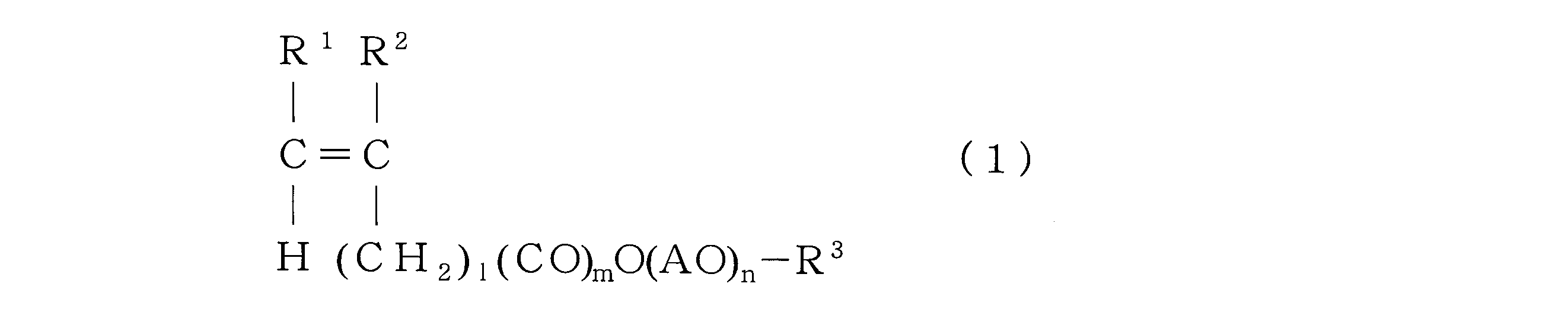
R1、R2:水素原子、又はメチル基
l:0以上2以下の数
m:0又は1の数
AO:炭素数2以上4以下のアルキレンオキシ基
n:AOの平均付加モル数であり、5以上150以下の数、
R3:水素原子、又は炭素数1以上4以下のアルキル基
を表す。〕

R4、R5、R6:水素原子、メチル基、又は(CH2)m1COOM2
M1、M2:水素原子、アルカリ金属、アルカリ土類金属(1/2原子)、アンモニウム、アルキルアンモニウム、又は置換アルキルアンモニウム
m1:0以上2以下の数
を表す。なお、(CH2)m1COOM2はCOOM1と無水物を形成していてもよい。〕
[GPC条件]
装置:高速GPC装置 HLC-8320GPC(東ソー(株)製)
カラム:G4000PWXL+G2500PWXL(東ソー(株)製)
溶離液:0.2Mリン酸バッファー/CH3CN=9/1
流量:1.0mL/min
カラム温度:40℃
検出:示差屈折検出器(RI)
サンプルサイズ:0.5mg/mL
標準物質:ポリエチレングリコール換算
<1> (a1)2価以上、5価以下の多価アルコールから選ばれる1種以上の化合物〔以下、(a1)成分という〕と、(a2)アルデヒド化合物またはケトン化合物〔以下、(a2)成分という〕とを反応させて得られる反応生成物〔以下、(A)成分という〕を含有する水硬性粉体用強度向上剤組成物。
水硬性粉体用強度向上剤組成物中の固形分の含有量が、好ましくは20質量%以上、より好ましくは30質量%以上、更に好ましくは40質量%以上、そして、好ましくは100質量%以下、より好ましくは80質量%以下、更に好ましくは60質量%以下である、前記<1>~<10>の何れか記載の水硬性粉体用強度向上剤組成物。
実施例
次の実施例は本発明の実施について述べる。実施例は本発明の例示について述べるものであり、本発明を限定するためではない。
下記製造例A1~A10により得られた反応生成物を、単独又は、尿素-ホルムアルデヒド縮合物及びヒドロキシメタンスルホン酸塩から選ばれる成分〔(B)成分〕、並びにグリセリンEO1モル付加物〔(C)成分〕と混合し、本発明の強度向上剤組成物(一部の実施例では「添加剤」と表記した)として用いた。強度向上剤組成物はいずれも液体の形態であった。反応生成物を単独で用いる場合は、特に記載がない限り、反応生成物をそのまま使用した。尿素-ホルムアルデヒド縮合物及びヒドロキシメタンスルホン酸塩から選ばれる成分〔(B)成分〕を混合した場合は、反応生成物〔(A)成分〕及び(C)成分(一部の実施例)を、そのまま(B)成分と混合し強度向上剤組成物とした。また、比較例で(B)成分を単独で用いる場合は、(B)成分をそのまま強度向上剤組成物とした。実施例、比較例の組成物中の固形分は、(A)成分(未反応物等を含む)、(B)成分及び(C)成分から選ばれる成分であった。
製造例A1
攪拌機付きガラス製反応容器(200mlフラスコ)にグリセリン76.74g、硫酸0.41g、パラホルムアルデヒド25gを仕込み、撹拌しながら100℃まで昇温した。昇温後、水分を系外に除去しながら、同温度で4時間攪拌した。その後、加熱をやめて自然冷却にて50℃以下に冷却し48質量%水酸化ナトリウム水溶液でpH6に中和し、反応生成物A1を得た。ガスクロマトグラフィー定量分析における未反応(a1)成分は、固形分中6.8質量%であった。また、反応生成物A1の固形分は99質量%であった。なお、固形分は水以外の成分のことであり、カールフィッシャー法により水の量を測定し、その量から固形分を求めた。
攪拌機付きガラス製反応容器(200mlフラスコ)にグリセリン76.74g、硫酸0.41g、ホルムアルデヒド水溶液(37質量%)67.57gを仕込み、撹拌しながら100℃まで昇温した。昇温後、水分を系外に除去しながら、同温度で4時間攪拌した。その後、加熱をやめて自然冷却にて50℃以下に冷却し48質量%水酸化ナトリウム水溶液でpH6に中和し、反応生成物A2を得た。ガスクロマトグラフィー定量分析における未反応(a1)成分は、固形分中9.8質量%であった。また、反応生成物A2の固形分は99質量%であった。
攪拌機および還流管付きガラス製反応容器(200mlフラスコ)にグリセリン76.74g、硫酸0.41g、ホルムアルデヒド水溶液(37質量%)67.57gを仕込み、撹拌しながら80℃まで昇温した。昇温後、水分を還流しながら、同温度で4時間攪拌した。その後、加熱をやめて自然冷却にて50℃以下に冷却し48質量%水酸化ナトリウム水溶液でpH6に中和し、反応生成物A3を得た。ガスクロマトグラフィー定量分析における未反応(a1)成分は、固形分中21質量%であった。また、反応生成物A3の固形分は69質量%であった。
攪拌機および還流管付きガラス製反応容器(200mlフラスコ)にグリセリン76.74g、硫酸0.41g、ホルムアルデヒド水溶液(37質量%)67.57gを仕込み、撹拌しながら50℃まで昇温した。昇温後、水分を還流しながら、同温度で4時間攪拌した。その後、加熱をやめて48質量%水酸化ナトリウム水溶液でpH6に中和し、反応生成物A4を得た。ガスクロマトグラフィー定量分析における未反応(a1)成分は、固形分中30質量%であった。また、反応生成物A4の固形分は72質量%であった。
攪拌機および還流管付きガラス製反応容器(200mlフラスコ)にグリセリン76.74g、硫酸0.41g、ホルムアルデヒド水溶液(37質量%)67.57gを仕込み、水分を還流しながら、20℃で4時間攪拌した。その後、48質量%水酸化ナトリウム水溶液でpH6に中和し、反応生成物A5を得た。ガスクロマトグラフィー定量分析における未反応(a1)成分は、固形分中34質量%であった。また、反応生成物A5の固形分は74質量%であった。
攪拌機および還流管付きガラス製反応容器(200mlフラスコ)にグリセリン76.74g、硫酸0.204g、ホルムアルデヒド水溶液(37質量%)33.78gを仕込み、撹拌しながら80℃まで昇温した。昇温後、水分を還流しながら、同温度で4時間攪拌した。その後、加熱をやめて自然冷却にて50℃以下に冷却し48質量%水酸化ナトリウム水溶液でpH6に中和し、反応生成物A6を得た。ガスクロマトグラフィー定量分析における未反応(a1)成分は、固形分中42質量%であった。また、反応生成物A6の固形分は78質量%であった。
攪拌機および還流管付きガラス製反応容器(200mlフラスコ)にグリセリン76.74g、硫酸0.41g、ホルムアルデヒド水溶液(37質量%)33.78gを仕込み、水分を還流しながら、20℃で4時間攪拌した。その後、48質量%水酸化ナトリウム水溶液でpH6に中和し、反応生成物A7を得た。ガスクロマトグラフィー定量分析における未反応(a1)成分は、固形分中57質量%であった。また、反応生成物A7の固形分は83質量%であった。
攪拌機および還流管付きガラス製反応容器(200mlフラスコ)にグリセリン76.74g、水酸化ナトリウム0.17g、ホルムアルデヒド水溶液(37質量%)67.57gを仕込み、撹拌しながら80℃まで昇温した。昇温後、水分を還流しながら、同温度で4時間攪拌した。その後、加熱をやめて自然冷却にて50℃以下に冷却しpH6に硫酸で中和し、反応生成物A8を得た。ガスクロマトグラフィー定量分析における未反応(a1)成分は、固形分中34質量%であった。また、反応生成物A8の固形分は75質量%であった。
攪拌機および還流管付きガラス製反応容器(200mlフラスコ)にグリセリン76.74g、水酸化ナトリウム0.17g、ホルムアルデヒド水溶液(37質量%)67.57gを仕込み、水分を還流しながら、20℃で4時間攪拌した。その後、pH6に硫酸で中和し、反応生成物A9を得た。ガスクロマトグラフィー定量分析における未反応(a1)成分は、固形分中36質量%であった。また、反応生成物A9の固形分は75質量%であった。
攪拌機付きガラス製反応容器(200mlフラスコ)にグリセリンエチレンオキサイド平均1モル付加物113.46g、硫酸0.41g、パラホルムアルデヒド25gを仕込み、撹拌しながら100℃まで昇温した。昇温後、水分を系外に除去しながら、同温度で4時間攪拌した。その後、加熱をやめて自然冷却にて50℃以下に冷却し48質量%水酸化ナトリウム水溶液でpH6に中和し、反応生成物A10を得た。ガスクロマトグラフィー定量分析における未反応(a1)成分は、固形分中7.5質量%であった。また、反応生成物A10の固形分は98質量%であった。
・グリセリン:和光純薬工業株式会社製1,2,3-プロパントリオール
・グリセリンエチレンオキサイド平均1モル付加物:グリセリン(和光純薬工業株式会社製1,2,3-プロパントリオール)にエチレンオキサイドを平均で1モル付加したもの・硫酸:シグマアルドリッチ社製
・水酸化ナトリウム:試薬特級、和光純薬工業株式会社製
・パラホルムアルデヒド:和光一級、和工純薬工業株式会社製
・ホルムアルデヒド:試薬特級、和光純薬工業株式会社製
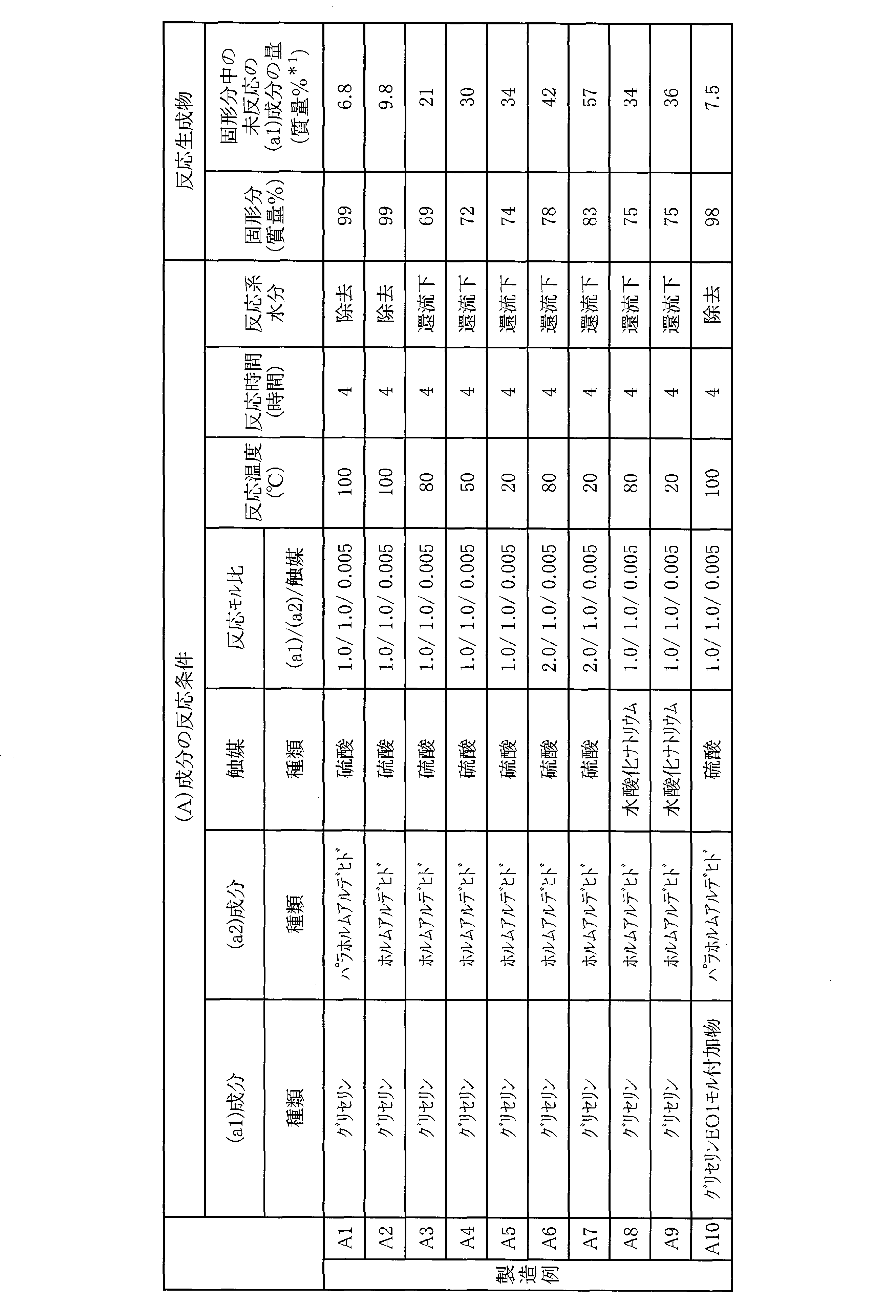
尿素450gと蒸留水3588gを容量10Lの三口フラスコに添加し、攪拌翼を用いて200rpmで10分混合した。その後、pHを11に調整した後、40℃に昇温した。続いて、37質量%ホルムアルデヒド水溶液(ホルマリン)305gを90分かけて滴下した。滴下終了後、1時間攪拌を継続し熟成させ、室温に冷却し、固形分(尿素-ホルムアルデヒド縮合物)含有量が13.5質量%の尿素-ホルムアルデヒド縮合物を得た。
攪拌機付きガラス製反応容器(四つ口フラスコ)に水114gを仕込み、撹拌しながら窒素置換をし、窒素雰囲気中で80℃まで昇温した。60質量%のω-メトキシポリエチレングリコールモノメタクリレート(エチレンオキシドの平均付加モル数120:エステル純度100質量%)水溶液300g、メタクリル酸(試薬:和光純薬工業株式会社製)11.5g、及び3-メルカプトプロピオン酸1.2gを混合溶解した水溶液と、過硫酸アンモニウム1.9gを水45gに溶解した水溶液の2者を、それぞれ1.5時間かけて上記反応容器中に滴下した。その後、80℃で1時間熟成し、更に過硫酸アンモニウム0.8gを水15gに溶解した水溶液を30分かけて滴下し、引き続き80℃で1.5時間熟成した。熟成終了後に40℃以下に冷却した後、48質量%水酸化ナトリウム水溶液9.6gで中和し、重量平均分子量54000の共重合体(重合体1)を得た(中和度0.7)。その後、水を用いて固形分40質量%に調整し、重合体1の40質量%水溶液を得た。重合体1は、ポリカルボン酸系共重合体であり、単量体(1)/単量体(2)のモル比は20/80である。
(2-1)混合材含有量0質量%の水硬性粉体の調製
クリンカー95質量%、二水石膏5質量%の粉砕原料を、粉砕助剤を添加せず、ボールミルでブレーン値3600cm2/gまで粉砕して、混合材含有量0質量%の水硬性粉体を調製した。
クリンカー90質量%、二水石膏5質量%、高炉水砕スラグ5質量%の粉砕原料を、粉砕助剤を添加せず、ボールミルでブレーン値3600cm2/gまで粉砕して、混合材含有量5質量%の水硬性粉体を調製した。
クリンカー86質量%、二水石膏4質量%、高炉水砕スラグ5質量%、フライアッシュ5質量%の粉砕原料を、粉砕助剤を添加せず、ボールミルでブレーン値3600cm2/gまで粉砕して、混合材含有量10質量%の水硬性粉体を調製した。
クリンカー67質量%、二水石膏3質量%、高炉水砕スラグ15質量%、フライアッシュ15質量%の粉砕原料を、粉砕助剤を添加せず、ボールミルでブレーン値3600cm2/gまで粉砕して、混合材含有量30質量%の水硬性粉体を調製した。
クリンカー50質量%、二水石膏3質量%、高炉水砕スラグ25質量%、フライアッシュ22質量%の粉砕原料を、粉砕助剤を添加せず、ボールミルでブレーン値3600cm2/gまで粉砕して、混合材含有量47質量%の水硬性粉体を調製した。
クリンカー28質量%、二水石膏2質量%、高炉水砕スラグ35質量%、フライアッシュ35質量%の粉砕原料を、粉砕助剤を添加せず、ボールミルでブレーン値3600cm2/gまで粉砕して、混合材含有量70質量%の水硬性粉体を調製した。
・クリンカー:成分が、CaO:約65%、SiO2:約22%、Al2O3:約5%、Fe2O3:約3%、MgO他:約3%(質量基準)となるように、石灰石、粘土、けい石、酸化鉄原料等を組み合わせて焼成したものを、クラッシャー及びグラインダーにより一次粉砕して得た、普通ポルトランドセメント用クリンカー(3.5mmふるい通過物、表中、Cと表示)
・二水石膏:試薬特級、和光純薬工業株式会社製(表中、Gと表示)
・高炉水砕スラグ:高炉水砕スラグをクラッシャー及びグラインダーにより一次粉砕して得た(3.5mmふるい通過物、表中、Slagと表示)
・フライアッシュ:市販品、中部電力製(表中、FAと表示)
株式会社セイワ技研製AXB-15を用い、ステンレスポット容量は18リットル(外径300mm)とし、ステンレスボールは30mmφ(呼び1・3/16)を70個、20mmφ(呼び3/4)を70個の合計140個のボールを使用し、ボールミルの回転数は、45rpmとした。また粉砕途中で粉砕物を排出する時間を1分間と設定した。
ブレーン値の測定は、セメントの物理試験方法(JIS R 5201)に定められるブレーン空気透過装置を使用した。
BET比表面積の測定は、Macsorb HM-model 1201(Mountech社製)を用い、以下の条件で行った。
・脱気:100℃×30分、冷却×4分
・測定ガス:キャリアガスとしてヘリウムを用い、冷却剤および吸着質として窒素を用いた。また、混合ガス濃度は30.4%、流量は25ml/min.とした。
セメントの物理試験方法(JIS R 5201)附属書2(セメントの試験方法-強さの測定)に従った。なお使用材料として、セメントは(2)で調製した水硬性粉体を使用し、水硬性粉体用強度向上剤組成物は練り水に添加した(一部の実施例、比較例を除く)。
セメントの物理試験方法(JIS R 5201)附属書2(セメントの試験方法-強さの測定)に従った。各測定値と、強度向上剤組成物(添加剤)無添加の比較例(試験例では同じ試験例での比較例)の測定値を100とする各相対値とを表に示した。
混合材含有量0質量%の水硬性粉体100質量部に、表2で示した添加剤を表2の量で用いて水硬性組成物を調製した。そして、水硬性組成物調製後3日後及び28日後の圧縮強度を測定した。なお、表中の添加量は、何れも固形分換算の質量部である(以下、同様)。
なお、比較例1-4は、練り水に、グリセリン、ホルムアルデヒドを別々に添加し、直後にモルタルを調製した〔グリセリン/ホルムアルデヒド=75/25(質量比)〕。比較例1-4の添加剤の添加量は、反応生成物A1、A5及びA9の原料仕込み比率と同じとして、合計量が実施例と同じとなる量(水硬性粉体100質量部に対して0.015質量部)を用いた。結果を表2に示した。
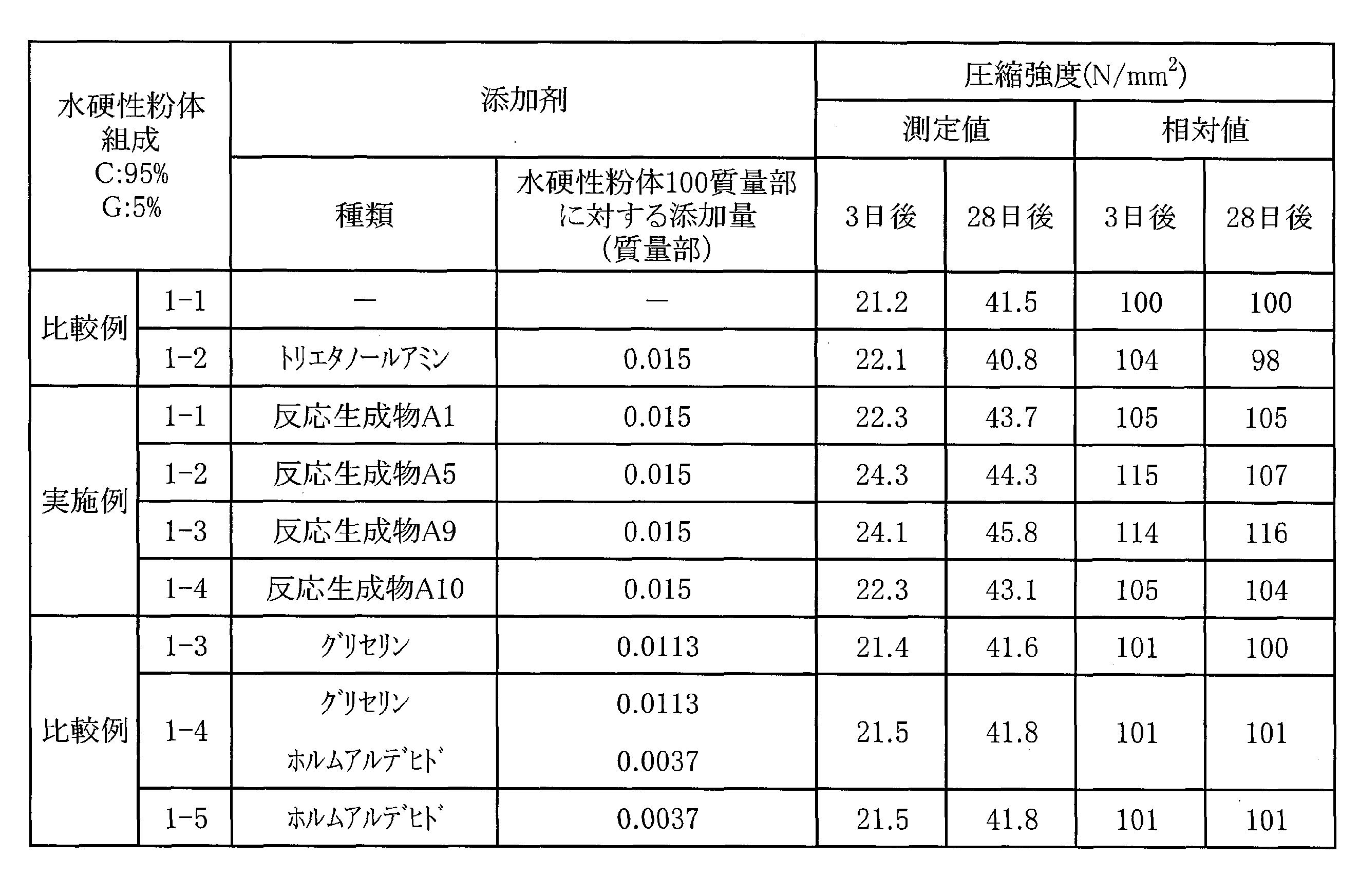
混合材含有量47質量%の水硬性粉体100質量部に、表3で示した添加剤を表3の量で用いて水硬性組成物を調製した。そして、水硬性組成物調製後3日後及び28日後の圧縮強度を測定した。
なお、比較例2-4は、練り水に、グリセリン、ホルムアルデヒドを別々に添加し、直後にモルタルを調製した〔グリセリン/ホルムアルデヒド=75/25(質量比)〕。比較例2-4の添加剤の添加量は、反応生成物A1、A5及びA9の原料仕込み比率と同じとして、合計量が実施例2-1等と同じとなる量(水硬性粉体100質量部に対して0.015質量部)を用いた。結果を表3に示した。

混合材含有量47質量%の水硬性粉体100質量部に、表4で示した強度向上剤組成物を表4の量で用いて水硬性組成物を調製した。そして、水硬性組成物調製後3日後及び28日後の圧縮強度を測定した。結果を表4に示した。

混合材の含有量の異なる水硬性粉体に対して、強度向上剤組成物として、反応生成物A1と尿素-ホルムアルデヒド縮合物を併用した場合(「-1」の枝番を付した例)及び反応生成物A5単独で用いた場合(「-2」の枝番を付した例)について、水硬性組成物調製後3日後及び28日後の圧縮強度を測定した。結果を表5に示した。なお、実施例4-1、5-1、6-1、7-1、8-1及び9-1は、実施例3-3と同様に強度向上剤組成物を調製した。これらの組成物中の(A)成分及び(B)成分の合計の含有量は、23.8質量%であった。

強度向上剤組成物を粉砕用添加剤組成物として使用した場合の粉砕性と水硬性組成物調製後3日後及び28日後の圧縮強度を測定した。
水硬性化合物として、混合材含有量47質量%の水硬性粉体の組成を用いた。粉砕用添加剤組成物として、反応生成物A1と尿素-ホルムアルデヒド縮合物の併用、反応生成物A5単独及び反応生成物A5と尿素-ホルムアルデヒド縮合物〔(B)成分〕とグリセリンのエチレンオキサイド平均1モル付加物〔(C)成分、表中、グリセリンEO1モル付加物と表記した〕の併用を用いた。ここで、グリセリンのエチレンオキサイド平均1モル付加物は、グリセリン(和光純薬工業株式会社製1,2,3-プロパントリオール)にエチレンオキサイドを平均で1モル付加したものである。
水硬性化合物100質量部に対して、表6の成分を表6の量で添加し、ボールミルで水硬性化合物の粉砕を行ない、粉砕性を38分粉砕後のBET比表面積を指標として評価した。また、得られた水硬性粉体を用いて、水硬性組成物調製後3日後及び28日後の圧縮強度を測定した。結果を表6に示した。なお、実施例10-1、10-3は、実施例3-3と同様に強度向上剤組成物を調製した。その際、実施例10-3では所定量の(C)成分も混合し、固形分濃度を水で調整した。実施例10-1の組成物中の(A)成分及び(B)成分の合計の含有量は、23.8質量%であった。また、実施例10-3の組成物中の(A)成分、(B)成分及び(C)成分の合計の含有量は、37.2質量%であった。
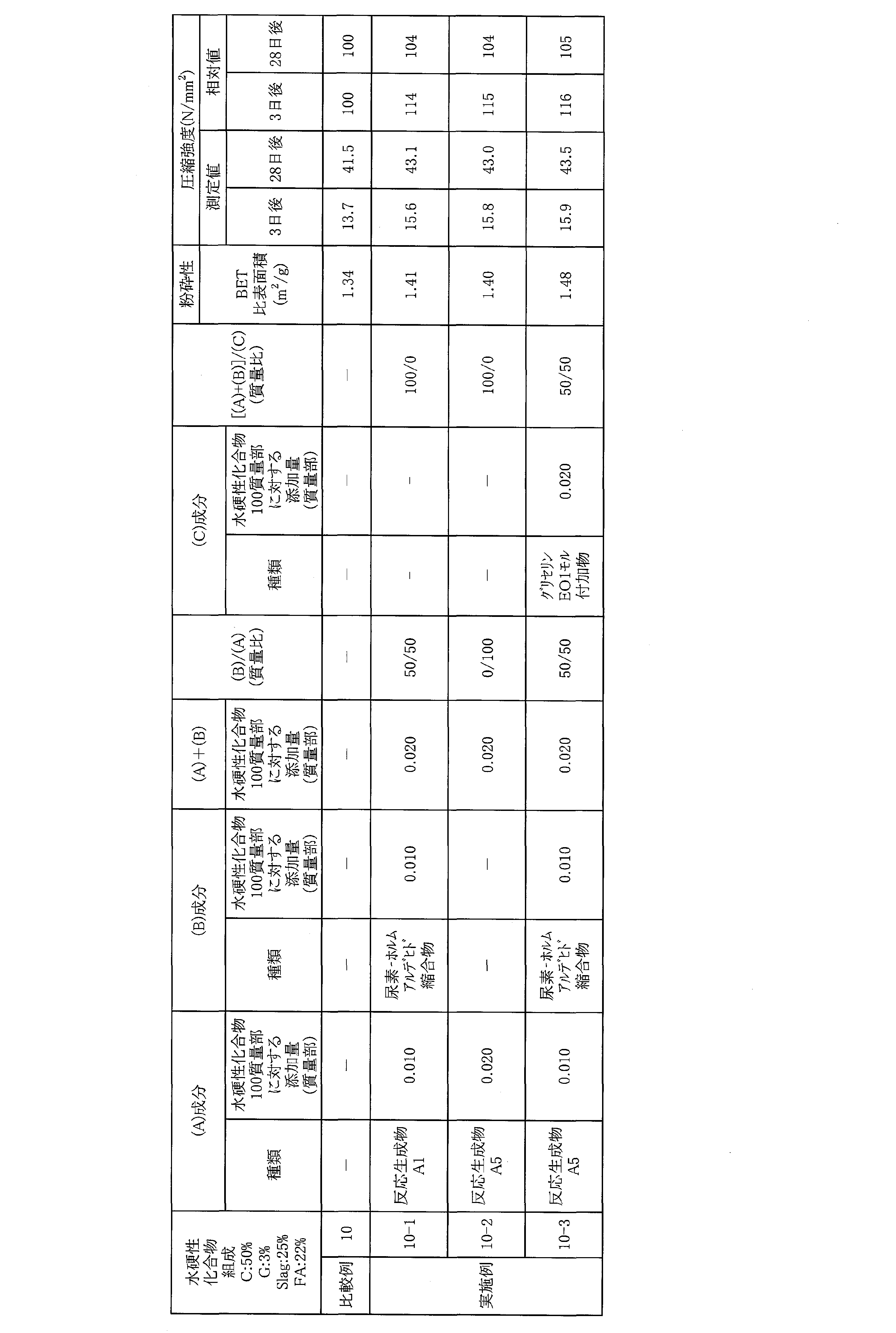
強度向上剤組成物を分散剤と併用して使用した場合の水硬性組成物調製後3日後及び28日後の圧縮強度を測定した。水硬性組成物は、混合材含有量47質量%の水硬性粉体100質量部に、表7で示した分散剤と強度向上剤組成物を、それぞれ、表7の量で用いて調製した。
強度向上剤組成物として、反応生成物A1と尿素-ホルムアルデヒド縮合物の併用、反応生成物A5単独を用いた。分散剤としてポリカルボン酸系分散剤(重合体1)を用いた。
なお、比較例11、実施例11-1及び11-2では、他の実施例及び比較例の水量225g〔水/水硬性粉体の質量比は50(%)〕を、水量180g〔水/水硬性粉体の質量比は40(%)〕に代えて実験を行った。実施例11-1及び11-2では重合体1を強度向上剤組成物と混合し混和剤を調製した。そして、前記混和剤を練り水に添加した。
水硬性組成物調製後3日後及び28日後の圧縮強度を測定した。結果を表7に示した。なお、実施例11-1は、実施例3-3と同様に強度向上剤組成物を調製した。この組成物中の(A)成分及び(B)成分の合計の含有量は、23.8質量%であった。
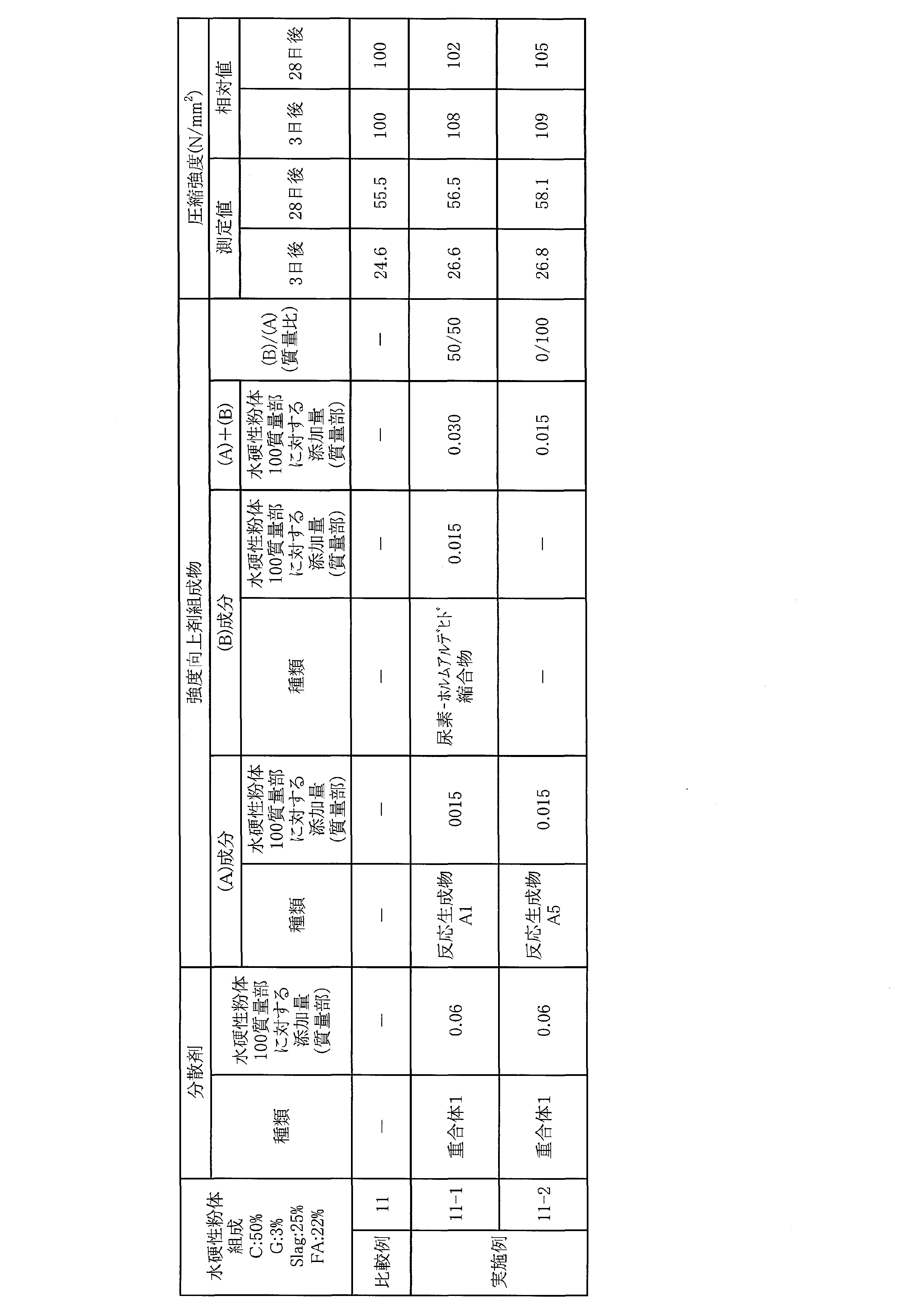
Claims (16)
- (a1)2価以上、5価以下の多価アルコールから選ばれる1種以上の化合物〔以下、(a1)成分という〕と、(a2)アルデヒド化合物またはケトン化合物〔以下、(a2)成分という〕とを反応させて得られる反応生成物〔以下、(A)成分という〕を含有する水硬性粉体用強度向上剤組成物を水硬性組成物に添加する、水硬性組成物硬化体の強度向上方法。
- 水硬性粉体用強度向上剤組成物が、更に、尿素-ホルムアルデヒド縮合物及びヒドロキシメタンスルホン酸塩からなる群から選ばれる1種以上の化合物〔以下、(B)成分という〕を含有する、請求項1に記載の水硬性組成物硬化体の強度向上方法。
- 水硬性組成物が、高炉スラグ、フライアッシュ及びシリカフュームからなる群から選ばれる1種以上の物質を10質量%以上、80質量%以下含有する水硬性粉体を含有する、請求項1又は2に記載の水硬性組成物硬化体の強度向上方法。
- 水硬性粉体用強度向上剤組成物の(a1)成分がグリセリンであり、(a2)成分がホルムアルデヒドである、請求項1~3の何れか1項に記載の水硬性組成物硬化体の強度向上方法。
- 水硬性粉体用強度向上剤組成物において、(A)成分と(B)成分の質量比が、(B)/(A)で、0/100超、80/20以下である、請求項2~4の何れか1項に記載の水硬性組成物硬化体の強度向上方法。
- 水硬性粉体用強度向上剤組成物の(a1)成分と(a2)成分から(A)成分を得るための反応系が水分を系外に除去する反応系であり、反応温度が80℃以上である、請求項1~5のいずれか1項に記載の水硬性組成物硬化体の強度向上方法。
- 水硬性粉体用強度向上剤組成物の(a1)成分と(a2)成分から(A)成分を得るための反応系が水分を還流下で行う反応系であり、反応温度が80℃以下である、請求項1~5のいずれか1項に記載の水硬性組成物硬化体の強度向上方法。
- 水硬性化合物を粉砕する際に、請求項1~7の何れか1項に記載の水硬性粉体用強度向上剤組成物を、固形分として、水硬性化合物100質量部に対して、0.0005質量部以上、1.0質量部以下添加する、水硬性粉体の製造方法。
- 請求項1~7の何れか1項に記載の水硬性粉体用強度向上剤組成物と、グリセリンのエチレンオキサイド付加物、ジエチレングリコール及びトリエタノールアミンからなる群から選ばれる1種以上の化合物とを含有する、水硬性化合物の粉砕用添加剤組成物。
- 請求項1~7の何れか1項に記載の水硬性粉体用強度向上剤組成物と、水硬性粉体と、骨材と、水とを含有し、前記水硬性粉体用強度向上剤組成物の含有量が、固形分として、水硬性粉体100質量部に対して、0.0005質量部以上、2.0質量部以下である、水硬性組成物。
- 水硬性粉体が、高炉スラグ、フライアッシュ及びシリカフュームからなる群から選ばれる1種以上の物質を10質量%以上、80質量%以下と、セメントとを含有する水硬性粉体である、請求項10に記載の水硬性組成物。
- (a1)2価以上、5価以下の多価アルコールから選ばれる1種以上の化合物〔以下、(a1)成分という〕と、(a2)アルデヒド化合物またはケトン化合物〔以下、(a2)成分という〕とを反応させて得られる反応生成物〔以下、(A)成分という〕と、
尿素-ホルムアルデヒド縮合物及びヒドロキシメタンスルホン酸塩からなる群から選ばれる1種以上の化合物〔以下、(B)成分という〕を含有する水硬性粉体用強度向上剤組成物。 - 高炉スラグ、フライアッシュ及びシリカフュームからなる群から選ばれる1種以上の物質を10質量%以上、80質量%以下含有する水硬性粉体用である、請求項12に記載の水硬性粉体用強度向上剤組成物。
- (a1)成分がグリセリンであり、(a2)成分がホルムアルデヒドである請求項12又は13に記載の水硬性粉体用強度向上剤組成物。
- (A)成分と(B)成分の質量比が、(B)/(A)で、0/100超、80/20以下である請求項12~14の何れか1項に記載の水硬性粉体用強度向上剤組成物。
- 請求項12~15の何れか1項に記載の水硬性粉体用強度向上剤組成物の、水硬性組成物の硬化体の強度向上のための使用。
Priority Applications (4)
| Application Number | Priority Date | Filing Date | Title |
|---|---|---|---|
| ES14775232T ES2769579T3 (es) | 2013-03-26 | 2014-03-19 | Método para mejorar la resistencia de un producto endurecido de una composición hidráulica |
| BR112015024694A BR112015024694A2 (pt) | 2013-03-26 | 2014-03-19 | método para produzir um pó hidráulico, composição aditiva para pulverizar um composto hidráulico, e uso de uma composição elevadora de resistência para um pó hidráulico como um auxílio à pulverização durante a pulverização de um composto hidráulico |
| EP14775232.3A EP2980038B1 (en) | 2013-03-26 | 2014-03-19 | Method for improving strength of hydraulic composition hardened product |
| MX2015013503A MX373252B (es) | 2013-03-26 | 2014-03-19 | Método para mejorar la resistencia de curado de productos de composición hidráulica. |
Applications Claiming Priority (2)
| Application Number | Priority Date | Filing Date | Title |
|---|---|---|---|
| JP2013-064187 | 2013-03-26 | ||
| JP2013064187A JP6016686B2 (ja) | 2013-03-26 | 2013-03-26 | 水硬性粉体用強度向上剤組成物 |
Publications (1)
| Publication Number | Publication Date |
|---|---|
| WO2014156858A1 true WO2014156858A1 (ja) | 2014-10-02 |
Family
ID=51623837
Family Applications (1)
| Application Number | Title | Priority Date | Filing Date |
|---|---|---|---|
| PCT/JP2014/057454 Ceased WO2014156858A1 (ja) | 2013-03-26 | 2014-03-19 | 水硬性組成物硬化体の強度向上方法 |
Country Status (6)
| Country | Link |
|---|---|
| EP (1) | EP2980038B1 (ja) |
| JP (1) | JP6016686B2 (ja) |
| BR (1) | BR112015024694A2 (ja) |
| ES (1) | ES2769579T3 (ja) |
| MX (1) | MX373252B (ja) |
| WO (1) | WO2014156858A1 (ja) |
Cited By (2)
| Publication number | Priority date | Publication date | Assignee | Title |
|---|---|---|---|---|
| CN104446116A (zh) * | 2014-11-18 | 2015-03-25 | 桂林华越环保科技有限公司 | 一种大掺量石灰石助磨剂 |
| US9670093B2 (en) * | 2014-09-05 | 2017-06-06 | Kao Corporation | Hydraulic composition |
Families Citing this family (3)
| Publication number | Priority date | Publication date | Assignee | Title |
|---|---|---|---|---|
| JP6278147B1 (ja) | 2017-04-28 | 2018-02-14 | 住友大阪セメント株式会社 | 混合セメント |
| JP7051610B2 (ja) * | 2018-06-27 | 2022-04-11 | 太平洋セメント株式会社 | セメント組成物及びその製造方法 |
| JP7854178B2 (ja) * | 2022-03-29 | 2026-05-01 | 竹本油脂株式会社 | 水硬性組成物用強度増進剤、水硬性組成物用混和剤、水硬性組成物、及び水硬性組成物硬化体 |
Citations (9)
| Publication number | Priority date | Publication date | Assignee | Title |
|---|---|---|---|---|
| JPS61117142A (ja) * | 1984-11-08 | 1986-06-04 | 藤沢薬品工業株式会社 | セメント組成物 |
| JPH0517187A (ja) * | 1991-07-02 | 1993-01-26 | Kao Corp | 高強度コンクリートの製造法 |
| JPH0812397A (ja) | 1994-06-30 | 1996-01-16 | Kao Corp | 自己充填性コンクリート混和剤 |
| JP2001518871A (ja) | 1997-04-09 | 2001-10-16 | ペルストルプ アーベー | セメント組成用収縮低減剤 |
| JP2002234886A (ja) * | 2000-12-04 | 2002-08-23 | Kao Corp | アセタールの製造法 |
| JP2008519752A (ja) | 2004-11-12 | 2008-06-12 | ユニヴァーシタ デグリ ストゥディ ディ ミラノ | 改善された圧縮強度セメント |
| JP2008542182A (ja) | 2005-06-02 | 2008-11-27 | ダブリュー・アール・グレイス・アンド・カンパニー−コネチカット | バイオマス由来粉砕助剤 |
| JP2012500287A (ja) | 2008-08-20 | 2012-01-05 | フューチャーフューエル ケミカル カンパニー | グリセロールホルマールの製造方法 |
| EP2574636A1 (de) | 2011-09-30 | 2013-04-03 | BASF Construction Polymers GmbH | Schnell suspendierbare pulverförmige Zusammensetzung |
Family Cites Families (4)
| Publication number | Priority date | Publication date | Assignee | Title |
|---|---|---|---|---|
| US3216966A (en) * | 1964-09-08 | 1965-11-09 | James D Collins | High strength concrete from hydraulic cement, aggregate, an aldehyde (formaldehyde, glyoxal), and a phenol |
| US7892353B2 (en) * | 2006-03-21 | 2011-02-22 | Nalco Company | Glycerin by-products and methods of using same |
| FR2909997B1 (fr) * | 2006-12-14 | 2009-07-10 | Roquette Freres | Utilisation de compositions de dihydroxyacetone(dha)pour l'adjuvantation de liants mineraux |
| CN102976650B (zh) * | 2012-12-04 | 2015-01-28 | 山东宏艺科技股份有限公司 | 一种用于缓凝水泥的缓凝助磨剂及其制备方法 |
-
2013
- 2013-03-26 JP JP2013064187A patent/JP6016686B2/ja not_active Expired - Fee Related
-
2014
- 2014-03-19 EP EP14775232.3A patent/EP2980038B1/en active Active
- 2014-03-19 ES ES14775232T patent/ES2769579T3/es active Active
- 2014-03-19 WO PCT/JP2014/057454 patent/WO2014156858A1/ja not_active Ceased
- 2014-03-19 BR BR112015024694A patent/BR112015024694A2/pt not_active Application Discontinuation
- 2014-03-19 MX MX2015013503A patent/MX373252B/es active IP Right Grant
Patent Citations (10)
| Publication number | Priority date | Publication date | Assignee | Title |
|---|---|---|---|---|
| JPS61117142A (ja) * | 1984-11-08 | 1986-06-04 | 藤沢薬品工業株式会社 | セメント組成物 |
| JPH0517187A (ja) * | 1991-07-02 | 1993-01-26 | Kao Corp | 高強度コンクリートの製造法 |
| JPH0812397A (ja) | 1994-06-30 | 1996-01-16 | Kao Corp | 自己充填性コンクリート混和剤 |
| JP2001518871A (ja) | 1997-04-09 | 2001-10-16 | ペルストルプ アーベー | セメント組成用収縮低減剤 |
| JP2002234886A (ja) * | 2000-12-04 | 2002-08-23 | Kao Corp | アセタールの製造法 |
| JP2008519752A (ja) | 2004-11-12 | 2008-06-12 | ユニヴァーシタ デグリ ストゥディ ディ ミラノ | 改善された圧縮強度セメント |
| JP2008542182A (ja) | 2005-06-02 | 2008-11-27 | ダブリュー・アール・グレイス・アンド・カンパニー−コネチカット | バイオマス由来粉砕助剤 |
| JP2012500287A (ja) | 2008-08-20 | 2012-01-05 | フューチャーフューエル ケミカル カンパニー | グリセロールホルマールの製造方法 |
| EP2574636A1 (de) | 2011-09-30 | 2013-04-03 | BASF Construction Polymers GmbH | Schnell suspendierbare pulverförmige Zusammensetzung |
| WO2013045419A1 (de) | 2011-09-30 | 2013-04-04 | Basf Construction Polymers Gmbh | Schnell suspendierbare pulverförmige zusammensetzung |
Cited By (2)
| Publication number | Priority date | Publication date | Assignee | Title |
|---|---|---|---|---|
| US9670093B2 (en) * | 2014-09-05 | 2017-06-06 | Kao Corporation | Hydraulic composition |
| CN104446116A (zh) * | 2014-11-18 | 2015-03-25 | 桂林华越环保科技有限公司 | 一种大掺量石灰石助磨剂 |
Also Published As
| Publication number | Publication date |
|---|---|
| MX2015013503A (es) | 2016-06-21 |
| EP2980038B1 (en) | 2020-01-01 |
| EP2980038A1 (en) | 2016-02-03 |
| EP2980038A4 (en) | 2016-12-14 |
| BR112015024694A2 (pt) | 2017-07-18 |
| JP2014189417A (ja) | 2014-10-06 |
| JP6016686B2 (ja) | 2016-10-26 |
| ES2769579T3 (es) | 2020-06-26 |
| MX373252B (es) | 2020-05-04 |
Similar Documents
| Publication | Publication Date | Title |
|---|---|---|
| EP2687497B1 (en) | Dispersing agent for hydraulic compositions | |
| CN105189403B (zh) | 水硬性粉体用强度提高剂组合物和水硬性粉体硬化体的强度提高方法 | |
| JP6001357B2 (ja) | 水硬性組成物 | |
| US9670093B2 (en) | Hydraulic composition | |
| JP6016686B2 (ja) | 水硬性粉体用強度向上剤組成物 | |
| JP5632108B2 (ja) | 水硬性組成物 | |
| JP2008208016A (ja) | 粉体状セメント分散剤 | |
| JP5811461B2 (ja) | プレミックスセメント用粉体状乾燥収縮低減剤 | |
| JP6444726B2 (ja) | 遠心成形用水硬性組成物 | |
| JP6016615B2 (ja) | 水硬性組成物 | |
| JP6054736B2 (ja) | 水硬性組成物 | |
| JP6198439B2 (ja) | 水硬性組成物 | |
| JP2017186233A (ja) | 水硬性材料用分散保持剤の製造方法 | |
| JP2018095516A (ja) | 遠心成型用水硬性組成物 | |
| JP6362531B2 (ja) | 水硬性組成物 | |
| JP5965305B2 (ja) | 水硬性組成物 | |
| JP6250385B2 (ja) | 水硬性組成物用白色化剤 | |
| JP7488732B2 (ja) | 水硬性組成物用添加剤 | |
| JP2008247730A (ja) | シリカヒュームセメント組成物 | |
| JP2016172688A (ja) | 水硬性組成物用分散剤組成物 | |
| JP6200314B2 (ja) | 水硬性組成物用添加剤組成物 | |
| JP6382421B2 (ja) | 水硬性組成物 | |
| JP6200315B2 (ja) | 水硬性組成物用添加剤組成物 | |
| JP6422324B2 (ja) | 遠心成形用水硬性組成物 | |
| JP5269627B2 (ja) | グラフトポリマーの製造方法 |
Legal Events
| Date | Code | Title | Description |
|---|---|---|---|
| 121 | Ep: the epo has been informed by wipo that ep was designated in this application |
Ref document number: 14775232 Country of ref document: EP Kind code of ref document: A1 |
|
| WWE | Wipo information: entry into national phase |
Ref document number: IDP00201505623 Country of ref document: ID |
|
| WWE | Wipo information: entry into national phase |
Ref document number: 2014775232 Country of ref document: EP |
|
| WWE | Wipo information: entry into national phase |
Ref document number: MX/A/2015/013503 Country of ref document: MX |
|
| NENP | Non-entry into the national phase |
Ref country code: DE |
|
| REG | Reference to national code |
Ref country code: BR Ref legal event code: B01A Ref document number: 112015024694 Country of ref document: BR |
|
| ENP | Entry into the national phase |
Ref document number: 112015024694 Country of ref document: BR Kind code of ref document: A2 Effective date: 20150925 |