WO2014157280A1 - 不織布およびそれを用いて得られた製品 - Google Patents
不織布およびそれを用いて得られた製品 Download PDFInfo
- Publication number
- WO2014157280A1 WO2014157280A1 PCT/JP2014/058424 JP2014058424W WO2014157280A1 WO 2014157280 A1 WO2014157280 A1 WO 2014157280A1 JP 2014058424 W JP2014058424 W JP 2014058424W WO 2014157280 A1 WO2014157280 A1 WO 2014157280A1
- Authority
- WO
- WIPO (PCT)
- Prior art keywords
- nonwoven fabric
- fibers
- heat
- thermally bonded
- region
- Prior art date
- Legal status (The legal status is an assumption and is not a legal conclusion. Google has not performed a legal analysis and makes no representation as to the accuracy of the status listed.)
- Ceased
Links
Images
Classifications
-
- D—TEXTILES; PAPER
- D04—BRAIDING; LACE-MAKING; KNITTING; TRIMMINGS; NON-WOVEN FABRICS
- D04H—MAKING TEXTILE FABRICS, e.g. FROM FIBRES OR FILAMENTARY MATERIAL; FABRICS MADE BY SUCH PROCESSES OR APPARATUS, e.g. FELTS, NON-WOVEN FABRICS; COTTON-WOOL; WADDING ; NON-WOVEN FABRICS FROM STAPLE FIBRES, FILAMENTS OR YARNS, BONDED WITH AT LEAST ONE WEB-LIKE MATERIAL DURING THEIR CONSOLIDATION
- D04H1/00—Non-woven fabrics formed wholly or mainly of staple fibres or like relatively short fibres
- D04H1/40—Non-woven fabrics formed wholly or mainly of staple fibres or like relatively short fibres from fleeces or layers composed of fibres without existing or potential cohesive properties
- D04H1/54—Non-woven fabrics formed wholly or mainly of staple fibres or like relatively short fibres from fleeces or layers composed of fibres without existing or potential cohesive properties by welding together the fibres, e.g. by partially melting or dissolving
- D04H1/5405—Non-woven fabrics formed wholly or mainly of staple fibres or like relatively short fibres from fleeces or layers composed of fibres without existing or potential cohesive properties by welding together the fibres, e.g. by partially melting or dissolving at spaced points or locations
-
- D—TEXTILES; PAPER
- D04—BRAIDING; LACE-MAKING; KNITTING; TRIMMINGS; NON-WOVEN FABRICS
- D04H—MAKING TEXTILE FABRICS, e.g. FROM FIBRES OR FILAMENTARY MATERIAL; FABRICS MADE BY SUCH PROCESSES OR APPARATUS, e.g. FELTS, NON-WOVEN FABRICS; COTTON-WOOL; WADDING ; NON-WOVEN FABRICS FROM STAPLE FIBRES, FILAMENTS OR YARNS, BONDED WITH AT LEAST ONE WEB-LIKE MATERIAL DURING THEIR CONSOLIDATION
- D04H1/00—Non-woven fabrics formed wholly or mainly of staple fibres or like relatively short fibres
- D04H1/40—Non-woven fabrics formed wholly or mainly of staple fibres or like relatively short fibres from fleeces or layers composed of fibres without existing or potential cohesive properties
- D04H1/54—Non-woven fabrics formed wholly or mainly of staple fibres or like relatively short fibres from fleeces or layers composed of fibres without existing or potential cohesive properties by welding together the fibres, e.g. by partially melting or dissolving
- D04H1/542—Adhesive fibres
-
- A—HUMAN NECESSITIES
- A61—MEDICAL OR VETERINARY SCIENCE; HYGIENE
- A61F—FILTERS IMPLANTABLE INTO BLOOD VESSELS; PROSTHESES; DEVICES PROVIDING PATENCY TO, OR PREVENTING COLLAPSING OF, TUBULAR STRUCTURES OF THE BODY, e.g. STENTS; ORTHOPAEDIC, NURSING OR CONTRACEPTIVE DEVICES; FOMENTATION; TREATMENT OR PROTECTION OF EYES OR EARS; BANDAGES, DRESSINGS OR ABSORBENT PADS; FIRST-AID KITS
- A61F13/00—Bandages or dressings; Absorbent pads
- A61F13/15—Absorbent pads, e.g. sanitary towels, swabs or tampons for external or internal application to the body; Supporting or fastening means therefor; Tampon applicators
- A61F13/51—Absorbent pads, e.g. sanitary towels, swabs or tampons for external or internal application to the body; Supporting or fastening means therefor; Tampon applicators characterised by the outer layers of the pads
- A61F13/511—Topsheet, i.e. the permeable cover or layer facing the skin
-
- A—HUMAN NECESSITIES
- A61—MEDICAL OR VETERINARY SCIENCE; HYGIENE
- A61F—FILTERS IMPLANTABLE INTO BLOOD VESSELS; PROSTHESES; DEVICES PROVIDING PATENCY TO, OR PREVENTING COLLAPSING OF, TUBULAR STRUCTURES OF THE BODY, e.g. STENTS; ORTHOPAEDIC, NURSING OR CONTRACEPTIVE DEVICES; FOMENTATION; TREATMENT OR PROTECTION OF EYES OR EARS; BANDAGES, DRESSINGS OR ABSORBENT PADS; FIRST-AID KITS
- A61F13/00—Bandages or dressings; Absorbent pads
- A61F13/15—Absorbent pads, e.g. sanitary towels, swabs or tampons for external or internal application to the body; Supporting or fastening means therefor; Tampon applicators
- A61F13/51—Absorbent pads, e.g. sanitary towels, swabs or tampons for external or internal application to the body; Supporting or fastening means therefor; Tampon applicators characterised by the outer layers of the pads
- A61F2013/51002—Absorbent pads, e.g. sanitary towels, swabs or tampons for external or internal application to the body; Supporting or fastening means therefor; Tampon applicators characterised by the outer layers of the pads with special fibres
- A61F2013/51014—Absorbent pads, e.g. sanitary towels, swabs or tampons for external or internal application to the body; Supporting or fastening means therefor; Tampon applicators characterised by the outer layers of the pads with special fibres characterized by the connection between the fibres
Definitions
- the present invention relates to a nonwoven fabric that can be suitably used as a surface material for sanitary materials, and a product obtained by using the nonwoven fabric.
- a nonwoven fabric obtained by thermally bonding a web made of heat-bonding fibers with a circulating hot air heat treatment machine becomes a bulky nonwoven fabric.
- the fiber intersections are thermally bonded and fixed throughout the nonwoven fabric, so the flexibility of the nonwoven fabric becomes low, and the liquid permeability such as highly viscous liquid becomes low. There was a drawback.
- a nonwoven fabric having high flexibility while maintaining bulkiness.
- the nonwoven fabric Consists of a heat-bonding region (I) and a non-heat-bonding region (II), and the heat-bonding region (I) is heat-bonded by a heat-fusible composite fiber, and the heat-bonded portion is A non-woven fabric is proposed in which the fiber intersections are thermally bonded without the flattening and flattening of the fibers, and the non-thermal bonding region (II) is a portion that is not thermally bonded (see, for example, Patent Document 1). .
- the non-thermal bonding region (II) continuously exists on the non-woven fabric surface, for example, when the thermal bonding regions (I) are in a staggered arrangement, the non-woven fabric. There is a tendency for the strength to decrease.
- the non-woven fabric since the non-woven fabric has a structure in which the thermal bonding region (I) that gives a hard tactile feel is scattered in the non-thermal bonding region (II) that gives a soft tactile sense, the hard tactile sense becomes more conspicuous. There is a tendency to roughen and reduce the texture.
- the non-thermal bonding region (II) becomes bulky because the fibers of the non-thermal bonding region (II) become distorted when the nonwoven fabric gets wet with water or the like, and as a result, once absorbed liquid is absorbed. There is a tendency that the liquid is easily discharged (liquid is easily returned) and the absorption performance is lowered.
- An object of the present invention is to provide a non-woven fabric having high non-woven strength while having excellent flexibility and a product obtained using the same.
- the obtained non-woven fabric is excellent in liquid permeability and absorbability of highly viscous liquids, and is expected to have an effect of reducing liquid return of the liquid.
- the present inventor has intensively studied to solve the above problems. As a result, it has been found that a nonwoven fabric in which a non-thermally bonded region and a thermally bonded region having a specific structure are configured in a specific arrangement on the surface of the nonwoven fabric can solve the above problems, and the present invention is based on this finding. It came to be completed.
- the present invention has the following configuration.
- [1] Non-thermally bonded regions obtained by using heat-bondable fibers, where the fiber intersections are not thermally bonded, and heat-bonded regions where the fiber intersections are thermally bonded alternately on the surface of the nonwoven fabric It is a non-woven fabric that exists, and the non-thermoadhesive regions are dispersed in a dotted manner, or are present continuously or intermittently in a linear fashion, and the fibers in the thermoadhesive regions are flattened by pressure bonding.
- the nonwoven fabric of the present invention has high nonwoven fabric strength while being excellent in flexibility. And because of its special structure, it has excellent liquid permeability and absorbability for highly viscous liquids such as menstrual blood and soft stool, and has an effect of reducing liquid return of the liquid.
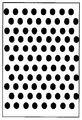
- One aspect of masking of a masking conveyor in which a plurality of circular mask portions (black portions in the drawing) are provided on a mesh conveyor. However, the mesh structure of the mesh conveyor is not shown.
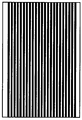
- One mode of masking of a masking conveyor in which a plurality of linear mask portions (black portions in the drawing) are provided on a mesh conveyor. However, the mesh structure of the mesh conveyor is not shown.
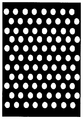
- An embodiment of a punching plate in which a plurality of circular holes are provided in a metal plate (black in the drawing).
- the non-woven fabric of the present invention is obtained by using heat-adhesive fibers, and a non-heat-bonded region where the fiber intersections are not thermally bonded and a heat-bonded region where the fiber intersections are heat-bonded are on the surface of the nonwoven fabric.
- the non-thermally bonded regions exist alternately in a dotted manner, or exist continuously or intermittently in a linear shape, and the fibers in the thermally bonded region are not flattened without being flattened. The intersection is heat bonded.
- the method for producing the nonwoven fabric of the present invention is not particularly limited as long as the intersection of the fibers in the thermal bonding region is thermally bonded without being flattened by pressure bonding.
- a method for producing a non-woven fabric after producing a web using heat-adhesive fibers, in the process of thermally bonding the fibers at the intersection of the fibers, the web is placed on a transport conveyor, and from there, it has sufficient air permeability. A web is sandwiched between conveyors that have been partially masked to prevent hot air from penetrating through mesh conveyors (hereinafter referred to as “masking conveyors”).
- circulating hot air An example is a method of penetrating hot air using a heat treatment machine.
- the nonwoven fabric obtained in this way is thermally bonded at the intersection of the fibers where the hot air penetrates, and the intersection of the fibers where the hot air does not penetrate by masking is not adhered.
- the “thermal bonding region” refers to a region where the intersection of fibers is bonded, particularly a region through which hot air penetrates and the intersection of fibers is bonded
- the “non-thermal bonding region” refers to , Refers to a region where the fiber intersection is not thermally bonded, and particularly refers to a region where hot air is not penetrated by masking and the fiber intersection is not thermally bonded.
- a pattern-like non-thermal bonding portion corresponding to the mesh shape of the mesh conveyor may be formed.
- the non-bonding portion generated in the thermal bonding region in accordance with such a manufacturing method.
- a heat-bonded region including the pattern of the heat-bonded portion is also referred to as a “heat-bonded region”.
- “masking” means covering to protect parts other than those to be thermally bonded at the time of thermal bonding.
- an apparatus such as a mesh conveyor having a blocking portion (mask) for preventing hot air from penetrating and a portion having no shielding portion for allowing hot air to penetrate can be suitably used for masking.
- the fibers in the heat-bonded region are not flattened by crimping means that the fibers at the intersection point where the non-woven fibers are thermally bonded are not compressed and flattened in the thickness direction of the non-woven fabric.
- Pressure flattening includes a state in which fibers are formed into a film by thermocompression bonding.
- the “web” refers to a fiber assembly in which fibers are entangled, and for example, refers to a fiber assembly obtained by a card method, a wet method, a spun bond method, a melt blow method, or the like.
- a masking conveyor in which a plurality of masks are partially applied may be used so that hot air does not penetrate the mesh conveyor.
- the individual masks may be provided so as to be dispersed in a dotted manner.
- each mask should just be provided so that it may arrange in a line form continuously or intermittently.
- the mask is “continuously or intermittently arranged linearly” means that the mask extends continuously or intermittently in a straight line or curved line with a certain periodicity or regularity. Therefore, “the non-thermally bonded region exists continuously or intermittently in a line” means a non-thermally bonded region obtained by the masking.
- the width of the mask line is not particularly limited. It is preferable that the mask is a mode in which the mask continuously extends linearly or in a curved line corresponding to MD (abbreviation of Machine) Direction) or CD (abbreviation of Crcss Machine Direction).
- each line of the mask is preferably 0.5 to 30 mm, more preferably 1 to 20 mm, in terms of the texture of the resulting nonwoven fabric.
- the distance between the individual lines of the mask is preferably 0.5 to 20 mm, more preferably 1 to 10 mm in terms of strength.
- the mask is “dispersed in the form of dots” means that the mask exists in the form of dots, and the presence of the mask may be irregular (separate) or regular. Good.
- the phrase “the non-thermally bonded region exists in a dispersed manner in the form of dots” refers to a non-thermally bonded region obtained by the above masking.
- the individual shape of the mask for masking is not particularly limited, and may be any desired shape according to the purpose, such as a circle, an ellipse, a quadrangle, and a rhombus, and the individual size is not particularly limited. Independently of each other, they may have different shapes and sizes.
- the mask for each masking is not particularly limited as long as it is arranged so that the non-thermally bonded regions are not connected to each other on the nonwoven fabric surface, but in terms of improving the strength and texture of the nonwoven fabric, according to the purpose, It may be arranged randomly or irregularly (randomly).
- Each “spot” is preferably 0.5 to 30 mm in terms of texture when converted to a circle having the same area as the spot area based on the individual area. More preferably, it is 10 mm. Further, the interval between the individual “dots” is preferably 1 to 20 mm, more preferably 5 to 10 mm in terms of the strength of the nonwoven fabric.
- a mesh conveyor having a mesh size that allows hot air to effectively pass therethrough may be adopted, and a mesh size that can attach a mask of the above size may be selected.
- the ratio of the total area of the heat-bonded area to the surface area of one side of the nonwoven fabric is preferably 40% to 95%, more preferably 60% to 90%, and particularly preferably 60 to 70%.
- the thermal bonding area is 40% or more, the strength of the nonwoven fabric is sufficient, and furthermore, the voids between the fibers are formed by a three-dimensional network structure formed by connecting the thermal bonding areas formed by thermal bonding to each other. Since it is fixed (secured) and the bulk of the nonwoven fabric can be maintained, it is expected that the liquid is difficult to return.
- the non-thermal bonding area is 95% or less, the non-thermal bonding area is 5% or more, and a certain amount or more of the non-thermal bonding area is ensured in the nonwoven fabric.
- the fibers in the non-thermally bonded region exist without being bonded to each other, for example, when a high-viscosity fluid such as soft stool is pressed against the non-thermally bonded region at a constant flow rate, it exists with a degree of freedom.
- the fibers of the non-thermally bonded region can be expanded or reshaped to be pressed by the fluid pressure and to ensure a fluid flow path.
- the nonwoven fabric of the present invention is also expected to have good liquid permeability of a particularly viscous fluid.
- the measurement of the ratio of the said area is as follows.
- the surface of the nonwoven fabric is observed, the area of the thermal bonding region where the constituent fibers are partially concentrated and thermally bonded is measured, and the area ratio with respect to the total area of the measurement sample is calculated.
- the measurement sample is cut into 100 mm ⁇ 100 mm (the total area of the measurement sample is 10000 mm 2 ).
- OMRON “3D Digital Fine Scope VC2400-IMU Ver. 2.3” the front and back of the measurement sample are observed, and the area of the thermal bonding region is measured at 10 locations. It can be determined by calculating the average value (%) of the front and back sides.
- the nonwoven fabric of the present invention can be suitably obtained by performing a heat treatment using hot air while sandwiching the web between the web conveyance conveyor and the masking conveyor in the heat treatment step.
- the clearance between the transfer conveyor and the masking conveyor may be changed according to the thickness of the web to be used.
- the desired bulkiness of the resulting nonwoven fabric is not impaired, and hot air does not penetrate into the gap between the portion covered with the mask and the web so that weak adhesion is not formed in the non-thermally bonded region.
- the clearance between the conveyors may be adjusted as appropriate so that the masking function can be sufficiently exhibited.
- the mask may be provided on the surface of the masking conveyor facing the web side, or may be provided on the surface facing away from the web side, but in order to enhance the hot air blocking effect by the mask
- the mask is preferably provided on the surface facing the web side. It is because a masking effect increases more because a mask part contacts a web directly.
- the portion covered with the mask of the masking conveyor may have a structure in which the thickness is particularly increased toward the web side. This makes it possible to more effectively suppress hot air from entering the gap between the portion covered with the mask and the web.
- the thickness of the mask at this time may be set to an appropriate range as long as it achieves the original purpose and the hot air efficiently reaches the web, and does not become industrially disadvantageous.
- the material of the masking conveyor can be exemplified by PET net and metal net. Moreover, it is preferable that a masking conveyor is industrially endless, and it is preferable to rotate at the same speed as a conveyance conveyor.
- the masking portion is configured by filling a hole with silicon resin or the like.
- Examples of the heat-adhesive fiber used in the present invention include fibers made of polyolefin, polyester, polyamide, polylactic acid, various elastomer resins, and the like. These fibers may be used as a mixture. Further, when the heat-adhesive fiber is a composite fiber made of different resins, a composite fiber made of a combination of a low melting point component and a high melting point component can be exemplified. Specifically, examples of the combination of the low melting point component / the high melting point component include, but are not limited to, polyethylene / polypropylene, polypropylene copolymer / polypropylene homopolymer, and polyethylene / polyethylene terephthalate.
- polyethylene can be a polyethylene homopolymer, a copolymer of ethylene and propylene or other olefins having ethylene as a main component, or a copolymer of ethylene and ethylene and other copolymerization components having ethylene as a main component.
- Polypropylene homopolymer, a copolymer of propylene mainly composed of propylene and ethylene or other olefin, and a copolymer of propylene mainly composed of propylene and other components can be used as polypropylene.
- Polyesters that can be used include polyethylene terephthalate, polybutylene terephthalate, and copolymers thereof.
- the melting point of the high melting point component is preferably higher by 10 ° C. than the melting point of the low melting point component.
- the composite fiber is composed of different resins, particularly two types of resins having different melting points (low melting point component and high melting point component)
- the area occupied by the fiber cross section in the direction perpendicular to the length direction of the composite fiber The ratio (low melting point component / high melting point component) is preferably 10/90 to 90/10, and more preferably 40/60 to 60/40.
- the temperature of the hot air may be set such that the surface of the heat-adhesive fiber is melted and the intersection of the heat-adhesive fibers is heat-bonded.
- the wind speed etc. of a hot air are not specifically limited, Usually, it can employ
- other fibers may be mixed with the heat-adhesive fibers.
- other fibers include natural fibers such as wood fibers, regenerated fibers such as rayon, semi-synthetic fibers such as acetate fibers, and synthetic fibers such as acrylic, nylon, and polyvinyl chloride. If these other fibers are fibers that do not participate in thermal bonding, the number of adhesion points between the fibers in the nonwoven fabric obtained from the web can be reduced, thereby further imparting flexibility to the resulting nonwoven fabric. Is possible.
- the fineness of the fibers used in the present invention is preferably 1.0 to 11 dtex, more preferably 1.5 to 5.5 dtex.
- a continuous fiber (long fiber) or a short fiber can be used, but a short fiber having a fiber length of 10 to 120 mm is preferable, and more preferably 30 to 60 mm.
- the cross section can illustrate a concentric sheath core type, an eccentric sheath core type, a parallel type etc., but if it is a range which does not prevent the effect of this invention remarkably, it will not specifically limit.
- the fibers constituting the heat-bonding region are thermally bonded at the intersections between the fibers without being flattened by pressure bonding.
- the manufacturing method for obtaining this structure is not particularly limited, it can be suitably obtained by a method such as hot air bonding which does not depend on thermocompression bonding with a heated embossing roll.
- the non-woven fabric obtained in the present invention can be used satisfactorily for passing a relatively viscous liquid such as menstrual blood or loose stool.
- a relatively viscous liquid such as menstrual blood or loose stool.
- the non-woven fabric heat-bonded with a circulating hot-air heat treatment machine or the like becomes a bulky non-woven fabric, but the whole non-woven fabric is heat-bonded at the intersection of the fibers and fixed three-dimensionally, The fiber cannot move freely.
- the liquid will pass between the fibers laid in a three-dimensional network, and the heat-adhesive fibers will flow the liquid. Since it inhibits, it becomes difficult to let a liquid with especially high viscosity pass.
- the nonwoven fabric obtained by thermocompression bonding with a heating roll such as an embossing roll has a thin nonwoven fabric as a whole.
- the bonded portion by thermocompression does not allow liquid to pass through because the fibers are flattened and formed into a film.
- the entire heat-adhesive fiber is heated in the process of passing through the heating roll and forms a slightly bonded state, so that the fiber cannot move freely. As mentioned above, it becomes a factor that inhibits the flow of liquid.
- the nonwoven fabric at a position corresponding to the concave portions sandwiched between the two convex portions is pushed down on both sides, so that its thickness is also reduced.
- the thickness of the obtained nonwoven fabric is generally thin and lacks water retention as a whole, and the liquid once absorbed is easy to return (the liquid return is large).
- the nonwoven fabric of the present invention there are a heat-bonded region in which the intersections of the fibers are thermally bonded, and a non-heat-bonded region in which the fibers are not thermally bonded and can move freely only by the entanglement of the fibers. Because of the mixture, a part of the highly viscous liquid passes while avoiding the heat-adhesive fibers spread in a three-dimensional network, but a part of the non-heat-adhesive region, that is, the heat-adhesive fibers are free. You will pass through an area where you can move quickly.
- thermoadhesive fiber In this non-thermoadhesive region, the thermoadhesive fiber can move freely, and does not impede the liquid passage, so that the liquid permeability of a particularly viscous liquid is excellent. Furthermore, when the liquid passes through the non-thermoadhesive region, the heat-adhesive fiber is wetted with the liquid and is bent (sagging), and the bulk in the thickness direction of the nonwoven fabric is reduced. This not only shortens the liquid passing time but also serves to prevent the liquid that has once passed through from returning. This is because, in the liquid reverse return, the portion that becomes the thermal bonding region maintains the bulk by the fiber adhesion, and thus the liquid return is inhibited by the bulk (empty wall). Therefore, the absorption performance can be adjusted by adjusting the range of the thermal bonding region and the non-thermal bonding region within the range shown in this specification according to the field to be used.
- the thickness of the non-thermally bonded region is preferably thinner than the thickness of the thermally bonded region in the thickness direction of the nonwoven fabric from the above points.
- the nonwoven fabric of the present invention may be a single layer or a plurality of layers. When setting it as a some layer, you may laminate
- the present invention is obtained by using a heat-bondable fiber, and a non-heat-bonded region in which fiber intersections are not thermally bonded and a heat-bonded region in which fiber intersections are heat-bonded alternately on the surface of the nonwoven fabric. And the non-thermally bonded regions are dispersed in a dotted manner, or are continuously present in a linear shape, and the intersections are thermally bonded without the flattening of the fibers in the thermally bonded regions.
- the present invention also relates to a product obtained using a non-woven fabric.
- Examples of products obtained using the nonwoven fabric of the present invention include products as sanitary materials such as disposable paper diapers, sanitary products, and absorbent sheets. Furthermore, it can be suitably used for a disposable wiper or the like.
- Fiber A Zigzag crimped fineness using polyester (Chukobo SP1912SD: IV value 0.63) as the core component and HDPE (high density polyethylene, S6900: MI16 manufactured by Keiyo Polyethylene Co., Ltd.) as the sheath component 2
- HDPE high density polyethylene, S6900: MI16 manufactured by Keiyo Polyethylene Co., Ltd.
- Fiber B Fineness of spiral crimp using polypropylene (SA2E: MFR15 manufactured by Nippon Polypro Co., Ltd.) as the core component and HDPE (high density polyethylene, S6900: MI16 manufactured by Keiyo Polyethylene Co., Ltd.) as the sheath component Eccentric sheath-core type composite fiber with 3dtex and cut length of 51mm.
- SA2E MFR15 manufactured by Nippon Polypro Co., Ltd.
- HDPE high density polyethylene, S6900: MI16 manufactured by Keiyo Polyethylene Co., Ltd.
- a web having a basis weight of 25 g / m 2 was produced using the above fibers as a raw material by a miniature card machine manufactured by Yamato Kiko.
- the hot air circulation heat treatment machine was subjected to heat treatment after placing the masking conveyor on the web produced by the above method under the processing conditions of a hot air temperature of 130 ° C., a wind speed of 0.5 m / s, and a conveyor speed of 8.5 m / min.
- the following masking conveyors a and b were used. Further, the punching plate c was placed under the same conditions and heat treatment was performed.
- Nonwoven fabric cross section observation> The nonwoven fabric was cut perpendicularly from the surface so as to pass through both the heat-bonded region and the non-heat-bonded region, and the cross-section of the nonwoven fabric was observed with a Keyence microscope (VHX-600).
- ⁇ Nonwoven fabric flexibility evaluation> The flexibility was measured according to JIS L1096 Bending Softness-A method (45 ° C. cantilever method) except that the sample width was 50 mm (JIS was 20 mm). The smaller the numerical value of the measured bending resistance, the higher the drape and the softer the nonwoven fabric. Evaluation is very flexible in both the MD and CD directions, ⁇ for those that are very flexible in either direction, ⁇ for those that are flexible, and those that are inferior due to the large number of adhesion points X.
- Non-woven fabric strength evaluation> is 10 mm for samples with a sample width of 50 mm and sample length of 150 mm, and ⁇ indicates that the sample is very strong. X was determined to be less strength.
- Example 1 Using the fiber A, a web having a basis weight of 25 g / m 2 obtained by the above web production method was used. On the web, the masking conveyor a was placed so that the masked surface side would be the web side, and a nonwoven fabric was produced by a hot air circulating heat treatment machine. The masked portion (also referred to as a portion covered with a mask) of the obtained nonwoven fabric was not thermally bonded, and a non-thermally bonded region was formed. In other portions where the hot air penetrated, the fibers were thermally bonded at the intersection of the fibers, and a thermal bonding region was formed.
- the thickness of the non-thermally bonded region was thinner than the thickness of the thermally bonded region (respectively 0.7 mm and 1.8 mm).
- the non-woven fabric was very flexible in both the MD and CD directions because the non-thermal bonding regions were evenly scattered throughout the non-woven fabric.
- Example 2 Using the fiber B, a web having a basis weight of 25 g / m 2 obtained by the above-described web production method was used. On the web, the masking conveyor b was placed so that the masked surface side would be the web side, and a nonwoven fabric was obtained with a hot air circulating heat treatment machine. The masked portion of the obtained nonwoven fabric was not thermally bonded, and a non-thermally bonded region was formed. In other portions where the hot air penetrated, the fibers were thermally bonded at the intersection of the fibers, and a thermal bonding region was formed.
- the thickness of the non-thermally bonded region was thinner than that of the thermally bonded region (respectively 0.7 mm and 1.4 mm).
- the non-woven fabric was very flexible, especially in CD, because the non-thermally bonded area goes straight to the MD.
- the nonwoven fabric of the present invention maintains good nonwoven fabric strength while maintaining high flexibility. And because of its structural characteristics, it has good absorbability, is particularly excellent in absorbability of highly viscous liquids, and is expected to be hard to return, so it is suitable for products such as surface materials for sanitary materials Can be used for
Landscapes
- Health & Medical Sciences (AREA)
- Engineering & Computer Science (AREA)
- Textile Engineering (AREA)
- Vascular Medicine (AREA)
- Biomedical Technology (AREA)
- Heart & Thoracic Surgery (AREA)
- Epidemiology (AREA)
- Life Sciences & Earth Sciences (AREA)
- Animal Behavior & Ethology (AREA)
- General Health & Medical Sciences (AREA)
- Public Health (AREA)
- Veterinary Medicine (AREA)
- Nonwoven Fabrics (AREA)
- Absorbent Articles And Supports Therefor (AREA)
- Treatment Of Fiber Materials (AREA)
Abstract
Description
[1]熱接着性繊維を用いて得られ、繊維の交点が熱接着されていない非熱接着領域と、繊維の交点が熱接着されている熱接着領域とが、不織布の表面において、交互に存在する不織布であって、前記非熱接着領域が、点状に分散して存在するか、または、線状に連続又は断続して存在しており、前記熱接着領域の繊維が圧着扁平化することなくその交点が熱接着されている不織布。
[2]不織布の厚み方向において、非熱接着領域の厚みが、熱接着領域の厚みより薄い、前記[1]に記載の不織布。
[3]前記[1]または[2]に記載の不織布を用いて得られる製品。
以下の熱接着性繊維を実施例、比較例に用いた。
繊維A:芯成分としてポリエステル(中興紡製SP1912SD:IV値0.63)を用い、鞘成分としてHDPE(高密度ポリエチレン、京葉ポリエチレン(株)製S6900:MI16)を用いたジグザグ捲縮の繊度2.2dtexでカット長51mmの同心鞘芯型複合繊維。
繊維B:芯成分としてポリプロピレン(日本ポリプロ(株)製SA2E:MFR15)を用い、鞘成分としてHDPE(高密度ポリエチレン、京葉ポリエチレン(株)製S6900:MI16)を用いた螺旋捲縮の繊度3.3dtexでカット長51mmの偏心鞘芯型複合繊維。
上記繊維を原料として、大和機工製ミニチュアカード機により、目付25g/m2のウェブを作製した。
熱風循環式熱処理機を熱風温度130℃、風速0.5m/s、コンベアー速度8.5m/minの加工条件で、上記方法で作製したウェブ上にマスキングコンベアーを載せた後、熱処理を行った。下記a、bのマスキングコンベアーを使用した。また、同条件でパンチングプレートcを載せ熱処理を行なった。
a.一つの円形状のマスクの直径が5mmで厚みが2mmであり、当該マスクが5mmのピッチで千鳥状に配列した図1の態様のマスキングコンベアー
b.一つの直線状のマスクの幅が2mmで厚みが2mmであり、当該マスクが1mmのピッチでMD方向に伸びるように配列した図2の態様のマスキングコンベアー
c.一つの円形状の穴の直径が3mmであり、5mmのピッチで千鳥状に配列した図3の態様のパンチングプレート
熱接着領域と非熱接着領域の両方を通るように表面から垂直に不織布を切断し、不織布の断面をキーエンス社製 マイクロスコープ(VHX-600)によって観察した。
柔軟性は、サンプル幅50mm(JISは20mm)とした以外は、JIS L1096 剛軟度-A法(45℃カンチレバー法)に準じて測定した。測定した剛軟度の数値が小さいほど、ドレープ性が高く、柔軟な不織布であると評価した。評価を、MD、CDの方向共に非常に柔軟であるか、いずれか方向に非常に柔軟であるものを◎、柔軟であるものを○、接着点が多いために柔軟性に劣っているものを×とした。
不織布強度は、サンプル幅50mm、サンプル長150mmのサンプルを10名のモニターが、引っ張り、引き裂きを行い、非常に強度があると判断したものを◎、強度があると判断したものを○、接着点が少なく強度がないと判断したものを×とした。
繊維Aを用い、上記ウェブ作製の方法で得た目付25g/m2のウェブを用いた。ウェブ上に、マスクを施した面側がウェブ側となるようにマスキングコンベアーaを置き、熱風循環熱処理機によって不織布を製造した。得られた不織布のマスキングした部分(これはマスクで被覆した部分ともいう。)は、熱接着されておらず、非熱接着領域が形成されていた。それ以外の熱風が貫通した部分は、繊維同士の交点で繊維同士が熱接着し、熱接着領域が形成されていた。不織布断面観察によって、非熱接着領域の厚みは、熱接着領域の厚みより薄いことを確認した(それぞれ0.7mmと、1.8mmであった)。不織布は、非熱接着領域が不織布全体に均等に点在しているため、MD、CDの方向共に非常に柔軟であった。
繊維Bを用い、上記ウェブ作製の方法で得た目付25g/m2のウェブを用いた。ウェブ上に、マスクを施した面側がウェブ側となるようにマスキングコンベアーbを置き、熱風循環熱処理機によって不織布を得た。得られた不織布のマスキングした部分は、熱接着されておらず、非熱接着領域が形成されていた。それ以外の熱風が貫通した部分は、繊維同士の交点で繊維同士が熱接着し、熱接着領域が形成されていた。非熱接着領域の厚みは、熱接着領域の厚みより薄いことを確認した(それぞれ0.7mmと、1.4mmであった)。不織布は、非熱接着領域がMDに向かい直進しているため、特にCDにおいて非常に柔軟であった。
繊維Aを用い、上記ウェブ作製の方法で得た目付25g/m2のウェブを用いた。ウェブ上に、マスキングコンベアーを使用せずに、熱風循環熱処理機によって不織布を製造した。得られた不織布は、ウェブ全体に熱風が貫通したことにより繊維同士の交点で熱接着し、不織布の厚みはすべて均一であった(1.3mmであった)。不織布は、熱接着領域のみで構成されているため、柔軟性に劣っていた。
繊維Bを用い、上記ウェブ作製の方法で得た目付25g/m2のウェブを用いた。ウェブ上に、マスキングコンベアーを使用せずに、熱風循環熱処理機によって不織布を製造した。得られた不織布は、ウェブ全体に熱風が貫通したことにより繊維同士の交点で熱接着し、不織布の厚みはすべて均一であった。不織布は、熱接着領域のみで構成され、且つ、熱風により繊維Bが螺旋綣縮を発生したことによって、非常に嵩が高くなり柔軟性に劣っていた。
繊維Aを用い、上記ウェブ作製の方法で得た目付25g/m2のウェブを用い、120℃に加熱されたエンボス面積率25%のエンボスロールとフラットロールにて加熱圧着し、不織布を製造した。エンボス圧着部は繊維同士の熱圧着によりフィルム化され、エンボス点間は、繊維形状を残しているものの、上下のロール熱により軽い接着状態であった。
繊維Aを用い、上記ウェブ作製の方法で得た目付25g/m2のウェブを用い、ウェブ上にパンチングプレートcを置き、熱風循環熱処理機によって不織布を得た。得られた不織布のパンチング部分は、熱風が貫通し、繊維同士の交点で繊維同士が熱接着し、熱接着領域が形成されていた。その他の部分は非熱接着領域となり、厚みは熱接着領域の厚みより薄いことを確認した(それぞれ1.2mmと、0.7mmであった)。不織布は、非熱接着領域がMDに向かい直進しているため、特にCDにおいて非常に柔軟であったが強度が非常に弱かった。

Claims (3)
- 熱接着性繊維を用いて得られ、繊維の交点が熱接着されていない非熱接着領域と、繊維の交点が熱接着されている熱接着領域とが、不織布の表面において、交互に存在する不織布であって、前記非熱接着領域が、点状に分散して存在するか、または、線状に連続又は断続して存在しており、前記熱接着領域の繊維が圧着扁平化することなくその交点が熱接着されている、不織布。
- 不織布の厚み方向において、非熱接着領域の厚みが、熱接着領域の厚みより薄い、請求項1に記載の不織布。
- 請求項1または2記載の不織布を用いて得られる製品。
Priority Applications (4)
| Application Number | Priority Date | Filing Date | Title |
|---|---|---|---|
| CN201480017680.6A CN105051279B (zh) | 2013-03-28 | 2014-03-26 | 无纺布以及使用该无纺布所获得的制品 |
| KR1020157029599A KR102190133B1 (ko) | 2013-03-28 | 2014-03-26 | 부직포 및 이를 이용하여 얻어진 제품 |
| US14/778,617 US20160040336A1 (en) | 2013-03-28 | 2014-03-26 | Nonwoven fabric and product obtained using same |
| EP14775255.4A EP2980293B1 (en) | 2013-03-28 | 2014-03-26 | Nonwoven fabric and product obtained using same |
Applications Claiming Priority (2)
| Application Number | Priority Date | Filing Date | Title |
|---|---|---|---|
| JP2013070156A JP6024915B2 (ja) | 2013-03-28 | 2013-03-28 | 不織布およびそれを用いて得られた製品 |
| JP2013-070156 | 2013-03-28 |
Publications (1)
| Publication Number | Publication Date |
|---|---|
| WO2014157280A1 true WO2014157280A1 (ja) | 2014-10-02 |
Family
ID=51624245
Family Applications (1)
| Application Number | Title | Priority Date | Filing Date |
|---|---|---|---|
| PCT/JP2014/058424 Ceased WO2014157280A1 (ja) | 2013-03-28 | 2014-03-26 | 不織布およびそれを用いて得られた製品 |
Country Status (6)
| Country | Link |
|---|---|
| US (1) | US20160040336A1 (ja) |
| EP (1) | EP2980293B1 (ja) |
| JP (1) | JP6024915B2 (ja) |
| KR (1) | KR102190133B1 (ja) |
| CN (1) | CN105051279B (ja) |
| WO (1) | WO2014157280A1 (ja) |
Cited By (1)
| Publication number | Priority date | Publication date | Assignee | Title |
|---|---|---|---|---|
| WO2019151527A1 (ja) * | 2018-02-05 | 2019-08-08 | ダイワボウホールディングス株式会社 | 不織布及び不織布の製造方法 |
Families Citing this family (3)
| Publication number | Priority date | Publication date | Assignee | Title |
|---|---|---|---|---|
| EP3240514B1 (en) | 2015-01-02 | 2020-11-18 | Essity Hygiene and Health Aktiebolag | Absorbent article |
| JP6351648B2 (ja) * | 2016-03-23 | 2018-07-04 | ユニ・チャーム株式会社 | 吸収性物品 |
| JP7517898B2 (ja) * | 2020-08-05 | 2024-07-17 | 花王株式会社 | 吸収性物品 |
Citations (3)
| Publication number | Priority date | Publication date | Assignee | Title |
|---|---|---|---|---|
| JP2001003253A (ja) | 1999-04-23 | 2001-01-09 | Chisso Corp | 不織布およびそれを用いた吸収性物品 |
| JP2011219873A (ja) * | 2010-04-02 | 2011-11-04 | Jnc Corp | 熱風処理不織布加工装置および加工方法 |
| JP2011219900A (ja) * | 2010-04-13 | 2011-11-04 | Jnc Corp | 伸縮不織布およびそれを用いた加工物品 |
Family Cites Families (13)
| Publication number | Priority date | Publication date | Assignee | Title |
|---|---|---|---|---|
| US3510389A (en) * | 1965-08-03 | 1970-05-05 | Kendall & Co | Spot-bonded nonwoven fabric |
| US4265954A (en) * | 1978-04-11 | 1981-05-05 | Phillips Petroleum Company | Selective-area fusion of non-woven fabrics |
| NZ212999A (en) * | 1984-08-16 | 1987-05-29 | Chicopee | Entangled non woven fabric; fusible fibres at one surface thermobonded to base fibres |
| DK245488D0 (da) * | 1988-05-05 | 1988-05-05 | Danaklon As | Syntetisk fiber samt fremgangsmaade til fremstilling deraf |
| JP3409988B2 (ja) * | 1997-03-21 | 2003-05-26 | ユニ・チャーム株式会社 | 拭き取りシート |
| US6383958B1 (en) * | 1999-06-18 | 2002-05-07 | David P. Swanson | Nonwoven sheets, adhesive articles, and methods for making the same |
| JP4804337B2 (ja) * | 2006-12-27 | 2011-11-02 | 花王株式会社 | 吸収性物品用の表面シート及びその製造方法 |
| JP5278237B2 (ja) * | 2008-10-08 | 2013-09-04 | Jnc株式会社 | 複合スパンボンド不織布 |
| US8759606B2 (en) * | 2009-06-03 | 2014-06-24 | The Procter & Gamble Company | Structured fibrous web |
| WO2010150611A1 (ja) * | 2009-06-24 | 2010-12-29 | チッソ株式会社 | 表面凹凸構造を有する不織布及びそれを用いた製品 |
| JP5421720B2 (ja) * | 2009-10-09 | 2014-02-19 | ユニ・チャーム株式会社 | 不織布 |
| JP5927757B2 (ja) * | 2010-12-24 | 2016-06-01 | Jnc株式会社 | 機能性シート |
| JP5796336B2 (ja) * | 2011-04-28 | 2015-10-21 | Jnc株式会社 | 凹凸伸縮不織布 |
-
2013
- 2013-03-28 JP JP2013070156A patent/JP6024915B2/ja active Active
-
2014
- 2014-03-26 CN CN201480017680.6A patent/CN105051279B/zh active Active
- 2014-03-26 EP EP14775255.4A patent/EP2980293B1/en not_active Not-in-force
- 2014-03-26 WO PCT/JP2014/058424 patent/WO2014157280A1/ja not_active Ceased
- 2014-03-26 KR KR1020157029599A patent/KR102190133B1/ko not_active Expired - Fee Related
- 2014-03-26 US US14/778,617 patent/US20160040336A1/en not_active Abandoned
Patent Citations (3)
| Publication number | Priority date | Publication date | Assignee | Title |
|---|---|---|---|---|
| JP2001003253A (ja) | 1999-04-23 | 2001-01-09 | Chisso Corp | 不織布およびそれを用いた吸収性物品 |
| JP2011219873A (ja) * | 2010-04-02 | 2011-11-04 | Jnc Corp | 熱風処理不織布加工装置および加工方法 |
| JP2011219900A (ja) * | 2010-04-13 | 2011-11-04 | Jnc Corp | 伸縮不織布およびそれを用いた加工物品 |
Non-Patent Citations (1)
| Title |
|---|
| See also references of EP2980293A4 |
Cited By (5)
| Publication number | Priority date | Publication date | Assignee | Title |
|---|---|---|---|---|
| WO2019151527A1 (ja) * | 2018-02-05 | 2019-08-08 | ダイワボウホールディングス株式会社 | 不織布及び不織布の製造方法 |
| JPWO2019151527A1 (ja) * | 2018-02-05 | 2021-01-14 | ダイワボウホールディングス株式会社 | 不織布及び不織布の製造方法 |
| JP7395102B2 (ja) | 2018-02-05 | 2023-12-11 | 大和紡績株式会社 | 不織布及び不織布の製造方法 |
| JP2023182007A (ja) * | 2018-02-05 | 2023-12-25 | 大和紡績株式会社 | 不織布及び不織布の製造方法 |
| JP7699184B2 (ja) | 2018-02-05 | 2025-06-26 | 大和紡績株式会社 | 不織布及び不織布の製造方法 |
Also Published As
| Publication number | Publication date |
|---|---|
| JP6024915B2 (ja) | 2016-11-16 |
| KR102190133B1 (ko) | 2020-12-11 |
| EP2980293A1 (en) | 2016-02-03 |
| CN105051279A (zh) | 2015-11-11 |
| EP2980293B1 (en) | 2017-12-13 |
| US20160040336A1 (en) | 2016-02-11 |
| KR20150134370A (ko) | 2015-12-01 |
| JP2014194090A (ja) | 2014-10-09 |
| CN105051279B (zh) | 2017-08-25 |
| EP2980293A4 (en) | 2017-01-04 |
Similar Documents
| Publication | Publication Date | Title |
|---|---|---|
| JP4894977B2 (ja) | 表面凹凸構造を有する不織布及びそれを用いた製品 | |
| EP2034068B1 (en) | Non-woven fabric | |
| US7662462B2 (en) | Nonwoven fabric | |
| JP5154048B2 (ja) | 不織布 | |
| JP5328089B2 (ja) | 多層不織布及び多層不織布の製造方法 | |
| JP5069891B2 (ja) | 不織布 | |
| JP5783951B2 (ja) | 複合シートおよび複合シートの製造方法 | |
| CN103210131A (zh) | 蓬松片材及其制造方法 | |
| TWI575132B (zh) | 伸縮不織布及其製造方法 | |
| JP6024915B2 (ja) | 不織布およびそれを用いて得られた製品 | |
| JP5985258B2 (ja) | 不織布 | |
| JP5449056B2 (ja) | 吸収性物品の表面シート | |
| JP5196774B2 (ja) | 多層吸収性衛生物品 | |
| JP2006104629A (ja) | 凹凸模様が付与されてなるスパンレース不織布およびその製造方法 | |
| JP2012055362A (ja) | 吸収性物品の表面シート | |
| JP6580420B2 (ja) | 吸収性物品 | |
| JP6431397B2 (ja) | 吸収性物品 | |
| JP2017055841A (ja) | 吸収性物品 | |
| JP6467242B2 (ja) | 吸収性物品 | |
| JP7157388B2 (ja) | 開孔不織布及びその製造方法 | |
| CN110062828A (zh) | 赋形不织布 | |
| JP2012197530A (ja) | クッション性を有する不織布シート、およびその製造方法 |
Legal Events
| Date | Code | Title | Description |
|---|---|---|---|
| WWE | Wipo information: entry into national phase |
Ref document number: 201480017680.6 Country of ref document: CN |
|
| 121 | Ep: the epo has been informed by wipo that ep was designated in this application |
Ref document number: 14775255 Country of ref document: EP Kind code of ref document: A1 |
|
| WWE | Wipo information: entry into national phase |
Ref document number: 14778617 Country of ref document: US |
|
| NENP | Non-entry into the national phase |
Ref country code: DE |
|
| ENP | Entry into the national phase |
Ref document number: 20157029599 Country of ref document: KR Kind code of ref document: A |
|
| WWE | Wipo information: entry into national phase |
Ref document number: 2014775255 Country of ref document: EP |