WO2014157337A1 - 応力発光材料とその応用、応力発光材料用原料組成物、及び、応力発光材料の製造方法 - Google Patents
応力発光材料とその応用、応力発光材料用原料組成物、及び、応力発光材料の製造方法 Download PDFInfo
- Publication number
- WO2014157337A1 WO2014157337A1 PCT/JP2014/058533 JP2014058533W WO2014157337A1 WO 2014157337 A1 WO2014157337 A1 WO 2014157337A1 JP 2014058533 W JP2014058533 W JP 2014058533W WO 2014157337 A1 WO2014157337 A1 WO 2014157337A1
- Authority
- WO
- WIPO (PCT)
- Prior art keywords
- alumina
- stress
- luminescent material
- raw material
- stimulated luminescent
- Prior art date
- Legal status (The legal status is an assumption and is not a legal conclusion. Google has not performed a legal analysis and makes no representation as to the accuracy of the status listed.)
- Ceased
Links
Images


Classifications
-
- C—CHEMISTRY; METALLURGY
- C09—DYES; PAINTS; POLISHES; NATURAL RESINS; ADHESIVES; COMPOSITIONS NOT OTHERWISE PROVIDED FOR; APPLICATIONS OF MATERIALS NOT OTHERWISE PROVIDED FOR
- C09K—MATERIALS FOR MISCELLANEOUS APPLICATIONS, NOT PROVIDED FOR ELSEWHERE
- C09K11/00—Luminescent materials, e.g. electroluminescent or chemiluminescent
- C09K11/08—Luminescent materials, e.g. electroluminescent or chemiluminescent containing inorganic luminescent materials
- C09K11/77—Luminescent materials, e.g. electroluminescent or chemiluminescent containing inorganic luminescent materials containing rare earth metals
- C09K11/7783—Luminescent materials, e.g. electroluminescent or chemiluminescent containing inorganic luminescent materials containing rare earth metals containing two or more rare earth metals one of which being europium
- C09K11/7792—Aluminates
-
- C—CHEMISTRY; METALLURGY
- C08—ORGANIC MACROMOLECULAR COMPOUNDS; THEIR PREPARATION OR CHEMICAL WORKING-UP; COMPOSITIONS BASED THEREON
- C08K—Use of inorganic or non-macromolecular organic substances as compounding ingredients
- C08K3/00—Use of inorganic substances as compounding ingredients
- C08K3/18—Oxygen-containing compounds, e.g. metal carbonyls
- C08K3/20—Oxides; Hydroxides
- C08K3/22—Oxides; Hydroxides of metals
-
- C—CHEMISTRY; METALLURGY
- C08—ORGANIC MACROMOLECULAR COMPOUNDS; THEIR PREPARATION OR CHEMICAL WORKING-UP; COMPOSITIONS BASED THEREON
- C08L—COMPOSITIONS OF MACROMOLECULAR COMPOUNDS
- C08L101/00—Compositions of unspecified macromolecular compounds
-
- F—MECHANICAL ENGINEERING; LIGHTING; HEATING; WEAPONS; BLASTING
- F21—LIGHTING
- F21K—NON-ELECTRIC LIGHT SOURCES USING LUMINESCENCE; LIGHT SOURCES USING ELECTROCHEMILUMINESCENCE; LIGHT SOURCES USING CHARGES OF COMBUSTIBLE MATERIAL; LIGHT SOURCES USING SEMICONDUCTOR DEVICES AS LIGHT-GENERATING ELEMENTS; LIGHT SOURCES NOT OTHERWISE PROVIDED FOR
- F21K2/00—Non-electric light sources using luminescence; Light sources using electrochemiluminescence
- F21K2/04—Non-electric light sources using luminescence; Light sources using electrochemiluminescence using triboluminescence; using thermoluminescence
-
- C—CHEMISTRY; METALLURGY
- C08—ORGANIC MACROMOLECULAR COMPOUNDS; THEIR PREPARATION OR CHEMICAL WORKING-UP; COMPOSITIONS BASED THEREON
- C08K—Use of inorganic or non-macromolecular organic substances as compounding ingredients
- C08K3/00—Use of inorganic substances as compounding ingredients
- C08K3/18—Oxygen-containing compounds, e.g. metal carbonyls
- C08K3/20—Oxides; Hydroxides
- C08K3/22—Oxides; Hydroxides of metals
- C08K2003/2227—Oxides; Hydroxides of metals of aluminium
Definitions
- the present invention relates to a stress luminescent material and its application, a raw material composition for a stress luminescent material, and a method for producing a stress luminescent material.
- a light-emitting material that emits visible light near room temperature when a substance is given an external stimulus is known.
- a material that emits light in response to a mechanical stimulus of an externally applied force is called a stress luminescent material.
- An object of the present invention is to provide a stress-stimulated luminescent material that is excellent in stress-stimulated luminescence properties and can achieve practically sufficient luminescence intensity, a raw material composition for providing the stress-stimulated luminescent material, and a method for producing the stress-stimulated luminescent material. .
- the present inventors are composed of neodymium (Nd), dysprosium (Dy), and holmium (Ho) in addition to europium (Eu) that has been often used as an activator. It has been found that a specific high emission luminance can be achieved by combining specific amounts of at least one element selected from the group as a coactivator, and the present invention has been achieved.
- alumina which is a raw material of the stress luminescent material.
- ⁇ -alumina is the most thermally stable (see, for example, Patent Document 3).
- this ⁇ -alumina has low reactivity due to its thermal stability, and was produced using ⁇ -alumina as a raw material.
- the present inventors have found that stress-stimulated luminescent materials have insufficient formation of lattice defects in the crystal structure necessary to achieve the stress-stimulated luminescence mechanism.
- the first aspect of the present invention is a stress luminescent material based on strontium aluminate, Eu ions, Containing at least one ion selected from the group consisting of Nd, Dy, and Ho,
- the amount of Eu ions contained in the stress-stimulated luminescent material is 0.0001 to 0.01 mol per mol of strontium aluminate
- the amount of at least one ion selected from the group consisting of Nd, Dy, and Ho contained in the stress-stimulated luminescent material is the above-mentioned aluminate as the total amount of three types of ions, Nd, Dy, and Ho.
- the present invention relates to a stress-stimulated luminescent material that is 0.0001 to 0.01 mol per mol of strontium.
- Eu ions act as activators, and at least one ion selected from the group consisting of Nd, Dy, and Ho acts as a coactivator.
- the amount of Eu ions contained in the stress-stimulated luminescent material is 0.0005 to 0.005 mol per mol of the strontium aluminate
- the amount of at least one ion selected from the group consisting of Nd, Dy, and Ho contained in the stress-stimulated luminescent material is strontium aluminate as the total amount of the three ions Nd, Dy, and Ho. 0.0005 to 0.005 mole per mole.
- the strontium aluminate contains at least one alumina selected from ⁇ alumina, ⁇ alumina, ⁇ alumina, ⁇ alumina, ⁇ alumina, and ⁇ alumina, and / or water. It is synthesized from aluminum oxide and a strontium source.
- strontium aluminate is synthesized from a raw material composition for stress luminescent materials containing alumina and / or aluminum hydroxide and a strontium source,
- the ratio of ⁇ -alumina in the alumina and / or aluminum hydroxide contained in the raw material composition for stress-stimulated luminescent material is 90 mol% or less.
- the second aspect of the present invention is a material composition for a stress-stimulated luminescent material for synthesizing the stress-stimulated luminescent material, comprising alumina and / or aluminum hydroxide and a strontium source, It is related with the composition whose ratio of the alpha alumina in the said alumina and / or aluminum hydroxide is 90 mol% or less.
- a third aspect of the present invention relates to a stress luminescent coating composition containing the stress luminescent material, a resin composition, and applied products such as a stress luminescent material formed from the resin composition.
- a fourth aspect of the present invention relates to a method for producing the above stress-stimulated luminescent material using alumina containing alumina other than ⁇ -alumina and / or aluminum hydroxide as a raw material.
- the alumina other than ⁇ alumina is preferably at least one alumina selected from ⁇ alumina, ⁇ alumina, ⁇ alumina, ⁇ alumina, ⁇ alumina, ⁇ alumina, and ⁇ alumina.
- the raw material consisting of alumina and / or aluminum hydroxide containing alumina other than ⁇ -alumina is a raw material composition for stress luminescent materials in which the proportion of ⁇ -alumina in alumina and / or aluminum hydroxide is 90 mol% or less. Preferably there is.
- the stress-luminescent material based on strontium aluminate at least one selected from the group consisting of europium (Eu) as an activator, neodymium (Nd), dysprosium (Dy), and holmium (Ho) as a coactivator.
- Eu europium
- Nd neodymium
- Dy dysprosium
- Ho holmium
- stress luminescent material means the mechanical force of externally applied force (compression, displacement, friction, impact, etc.). The material that emits light when stimulated.
- a material obtained by molding the stress luminescent material alone or in combination with another material (for example, resin) is referred to as “stress luminescent material”.
- the “raw material composition for stress-stimulated luminescent material” refers to a mixture containing a component that is a raw material of the stress-stimulated luminescent material and itself does not have a stress-stimulated luminescence ability.
- This stress luminescent material is a stress luminescent material based on strontium aluminate, and contains Eu ions and at least one ion selected from the group consisting of Nd, Dy, and Ho. By containing both Eu ions and at least one ion selected from the group consisting of Nd, Dy, and Ho, high stress luminescence brightness is exhibited as compared with conventional strontium aluminate-based stress luminescent materials. Can do.
- Strontium aluminate is a compound generally represented by Sr x Al y O z (0 ⁇ X, 0 ⁇ y, 0 ⁇ Z). Although not particularly limited, various compounds such as SrAl 2 O 4 , SrAl 4 O 7 , Sr 4 Al 14 O 25 , SrAl 12 O 19 , Sr 3 Al 2 O 6 are known as specific examples of strontium aluminate. ing.
- the strontium aluminate contains Eu as an activator and at least one ion selected from the group consisting of Nd, Dy, and Ho as a coactivator is the stress-stimulated luminescent material of the present invention.
- general formula: Sr x Al y O z: Eu, M (0 ⁇ X, 0 ⁇ y, 0 ⁇ Z, M is Nd, Dy, and at least one selected from the group consisting of Ho) can be expressed as .
- the stress-stimulated luminescent material of the present invention contains europium (Eu) ions.
- Eu ions act as activators.
- the amount of Eu ions contained in the stress-stimulated luminescent material is not particularly limited, but is 0.0001 to 0.01 mol, preferably 0.0005 to 0.01 mol, more preferably 0 per mol of the strontium aluminate. .0005 to 0.005 mol. If the amount of Eu ions is too small, sufficient light emission intensity cannot be achieved, and if it is too large, the light emission intensity is saturated, but other physical properties may be affected.
- the stress-stimulated luminescent material of the present invention contains at least one ion selected from the group consisting of Nd, Dy, and Ho. These ions act as a co-activator for Eu ions.
- the amount of Nd, Dy, and Ho ions contained in the stress-stimulated luminescent material is not particularly limited, but the total amount of the three types of ions, Nd, Dy, and Ho, is about 0.1 per mol of strontium aluminate. The amount is from 0001 to 0.01 mol, preferably from 0.0005 to 0.01 mol, more preferably from 0.0005 to 0.005 mol.
- the stress-stimulated luminescent material of the present invention has a specific improvement in emission intensity by selecting the amount of Eu ions and the amount of at least one ion selected from the group consisting of Nd, Dy, and Ho as described above. To do.
- the stress-stimulated luminescent material of the present invention may further contain another co-activator as long as it contains at least one ion selected from the group consisting of Nd, Dy, and Ho.
- another co-activator contains at least one ion selected from the group consisting of Nd, Dy, and Ho.
- the compound or ion of rare earth elements other than the above-mentioned element is mentioned. Examples include one or more elements selected from Sc, Y, La, Ce, Pr, Pm, Sm, Gd, Tb, Er, Tm, Yb, and Lu.
- examples of the compound to be actually added include carbonates, oxides, chlorides, sulfates, nitrates, and acetates of the above elements. These contents can be appropriately set based on known knowledge or through ordinary experiments.
- Strontium aluminate as a base is an alumina raw material containing at least one kind of alumina selected from ⁇ alumina, ⁇ alumina, ⁇ alumina, ⁇ alumina, ⁇ alumina, ⁇ alumina, and ⁇ alumina, or aluminum hydroxide, It is preferably synthesized from a strontium source.
- alumina refers to cheap and general-purpose ⁇ -alumina, but if so-called activated alumina such as ⁇ -alumina or aluminum hydroxide is used as a raw material, higher emission intensity is achieved than when ⁇ -alumina is used. This is because it can.
- the raw material composition for a stress-stimulated luminescent material that is suitably used as a component that is a raw material for such a stress-stimulated luminescent material will be described.
- the stress-stimulated luminescent material of the present invention is not limited to those produced using the following raw material composition for stress-stimulated luminescent materials.
- ⁇ Raw material composition for stress luminescent material> This composition is a composition used as a raw material of a stress luminescent material for synthesizing a europium-activated strontium aluminate-based stress luminescent material containing alumina and / or aluminum hydroxide and a strontium source.
- the amount of ⁇ -alumina in the alumina and / or aluminum hydroxide contained in the composition is a predetermined amount or less, that is, the proportion of ⁇ -alumina in the total amount of alumina and aluminum hydroxide is 90 mol% or less.
- the rest is other alumina or aluminum hydroxide having a crystalline phase different from ⁇ -alumina.
- the other alumina is selected from the group consisting of alumina having a crystal phase different from ⁇ alumina, specifically ⁇ alumina, ⁇ alumina, ⁇ alumina, ⁇ alumina, ⁇ alumina, and ⁇ alumina.
- alumina species are preferably used. Since these aluminas have high reactivity, they are also called “activated alumina” in contrast to stable ⁇ -alumina. Of these, ⁇ alumina and ⁇ alumina are preferable as the other alumina because the light emitting ability of the stress luminescent material obtained from them is high.
- the amount of ⁇ -alumina in the total amount of alumina and / or aluminum hydroxide is 90 mol% or less, preferably 50 mol% or less, more preferably 30 mol% or less. More preferably, the alumina is substantially free of ⁇ -alumina (for example, the proportion of ⁇ -alumina is 5 mol% or less). This is because the smaller the amount of ⁇ -alumina, the higher the emission luminance of the stress-stimulated luminescent material. Needless to say, the lower limit of the proportion of ⁇ -alumina is 0 mol%.
- the proportion of ⁇ -alumina in the total amount of alumina and aluminum hydroxide can be quantified by, for example, X-ray diffraction. As a method for calculating a quantitative value from a qualitative analysis result obtained by X-ray diffraction, a WPF (Whole Pattern Fitting) method is known.
- Aluminum hydroxide of crystal phases such as gibbsite, bayerite, and boehmite, is used.
- the strontium aluminate serving as the base material of the stress-stimulated luminescent material is obtained by reacting the alumina and / or aluminum hydroxide with a strontium compound. Therefore, the raw material composition for a stress-stimulated luminescent material contains a strontium compound.
- the strontium compound include, but are not limited to, strontium carbonate, strontium oxide, strontium hydroxide, strontium halide (such as strontium chloride), strontium sulfate, strontium nitrate, and strontium hydrogen phosphate.
- the raw material composition is a composition for synthesizing a europium activated strontium aluminate-based stress luminescent material. Therefore, the raw material composition usually contains europium (Eu) ions or europium compounds as activators.
- the europium compound is not particularly limited, and examples thereof include europium carbonate, europium oxide, europium chloride, europium sulfate, europium nitrate, and europium acetate.
- the composition of the present invention further includes a coactivator containing at least one ion selected from the group consisting of Nd, Dy, and Ho described above, and may further include another coactivator.
- examples of rare earth element compounds added to the composition include carbonates, oxides, chlorides, sulfates, nitrates, and acetates of the above elements.
- a dispersing agent for improving the dispersibility of particle
- An anionic surfactant and a nonionic surfactant are used.
- the anionic surfactant include ammonium polycarboxylate, sodium polycarboxylate, sodium hexametaphosphate and the like.
- Nonionic surfactants include polyoxyethylene alkyl ether, polyoxyethylene hydrogenated castor oil, polyoxyethylene. Examples include mono fatty acid esters and polyoxyethylene sorbitan mono fatty acid esters. These may be used alone or in combination of two or more.
- a flux component may be added to the composition in order to increase the crystallinity of the particles.
- the flux component is not particularly limited, but calcium fluoride, magnesium fluoride, aluminum fluoride, ammonium fluoride, sodium chloride, potassium chloride, lithium chloride, ammonium bromide, ammonium iodide, potassium iodide, hydroxide
- the compound include sodium, potassium hydroxide, ammonium sulfate, sodium sulfate, potassium sulfate, sodium nitrate, ammonium nitrate, boric acid, and sodium borate. These may be used alone or in combination of two or more.
- a raw material composition for a stress-stimulated luminescent material is obtained by mixing these components.
- the mixing means is not particularly limited, and known mixing means can be used.
- wet mixing is preferably performed in the presence of a dispersion medium (for example, water) in a reaction vessel equipped with a pulverizing medium stirring type pulverizer.
- the pulverization medium stirring type pulverizer refers to the pulverization medium that is put into the pulverization container and stirred together with the object to be pulverized by rotating and rotating (rotating or revolving) the pulverization container. This is a pulverizer that performs pulverization with direct stirring.
- An example of the pulverization medium stirring type pulverizer is not particularly limited, but is preferably any one selected from the group consisting of a planetary mill, a bead mill, and a vibration mill. Among these, a planetary mill with rotation and revolution is particularly preferable.
- the raw material composition for a stress-stimulated luminescent material can be produced by removing the dispersion medium and drying. Specifically, a raw material composition for a stress-stimulated luminescent material can be manufactured through steps (1) to (3) in an example of a method for manufacturing a stress-stimulated luminescent material described below.
- a fourth aspect of the present invention relates to a method for producing the above strontium aluminate-based stress luminescent material.
- alumina containing alumina other than ⁇ alumina preferably at least one selected from ⁇ alumina, ⁇ alumina, ⁇ alumina, ⁇ alumina, ⁇ alumina, ⁇ alumina, and ⁇ alumina
- the present invention relates to a method for producing the stress-stimulated luminescent material using aluminum hydroxide as a raw material.
- An example of this manufacturing method is A step of charging a reaction vessel with water and / or an organic solvent, an alumina raw material, a strontium source, a europium source, and a compound of at least one element selected from the group consisting of Nd, Dy, and Ho ( 1) and In the reaction vessel, the raw material mixture is mixed to obtain a slurry (2); Step (3) for removing the water and / or organic solvent from the obtained slurry and separating the solid, And a step (4) of obtaining a stress-stimulated luminescent material by firing the separated solid content.
- Step (1) is a step of charging a raw material of the stress luminescent material into the reaction vessel.
- the strontium aluminate serving as a base can be obtained by reacting an alumina raw material with a strontium compound serving as a strontium source.
- the alumina raw material is not particularly limited, and examples thereof include low-cost and general-purpose ⁇ -alumina, and so-called activated alumina such as ⁇ -alumina, ⁇ -alumina, ⁇ -alumina, ⁇ -alumina, ⁇ -alumina, ⁇ -alumina, and ⁇ -alumina. Among them, it is preferable to use an alumina raw material containing ⁇ alumina and / or ⁇ alumina whose luminous ability of the obtained stress luminescent material is high.
- the strontium compound is not particularly limited, and examples thereof include strontium carbonate, strontium oxide, strontium hydroxide, strontium halide (such as strontium chloride), strontium sulfate, strontium nitrate, and strontium hydrogen phosphate.
- the Eu compound that is a source of europium (Eu) as an activator is not particularly limited, and examples thereof include europium carbonate, europium oxide, europium chloride, europium sulfate, europium nitrate, and europium acetate.
- the compound that is a source of Nd, Dy, and Ho that are coactivators is not particularly limited, and examples thereof include carbonates, oxides, chlorides, sulfates, nitrates, acetates, and the like of Nd, Dy, and Ho. .
- another co-activator may be included.
- examples thereof include, but are not limited to, one or more compounds selected from Sc, Y, La, Ce, Pr, Pm, Sm, Gd, Tb, Er, Tm, Yb, and Lu, such as these Examples include elemental carbonates, oxides, chlorides, sulfates, nitrates, acetates, and the like.
- a dispersant for enhancing the dispersibility of the particles may be further added to the charged raw material.
- An anionic surfactant and a nonionic surfactant are used.
- the anionic surfactant include ammonium polycarboxylate, sodium polycarboxylate, sodium hexametaphosphate and the like.
- Nonionic surfactants include polyoxyethylene alkyl ether, polyoxyethylene hydrogenated castor oil, polyoxyethylene. Examples include mono fatty acid esters and polyoxyethylene sorbitan mono fatty acid esters. These may be used alone or in combination of two or more.
- a flux component may be further added to the charged raw material in order to increase the crystallinity of the particles.
- the flux component is not particularly limited, but calcium fluoride, magnesium fluoride, aluminum fluoride, ammonium fluoride, sodium chloride, potassium chloride, lithium chloride, ammonium bromide, ammonium iodide, potassium iodide, hydroxide
- Examples of the compound include sodium, potassium hydroxide, ammonium sulfate, sodium sulfate, potassium sulfate, sodium nitrate, ammonium nitrate, boric acid, and sodium borate. These may be used alone or in combination of two or more.
- ingredients are added to water and / or an organic solvent to charge the raw materials.
- organic solvent such as water-soluble organic solvents, such as alcohol, such as methanol, ethanol, isopropyl alcohol, and ethylene glycol, and ketones, such as acetone and methyl ethyl ketone, are mentioned.
- other dispersion media may be included in the range which does not impair the effect of this invention.
- the reaction vessel is not particularly limited as long as it has a stirring function in which raw materials are appropriately mixed.
- the pulverization medium stirring type pulverizer refers to the pulverization medium that is put into the pulverization container and stirred together with the object to be pulverized by rotating and rotating (rotating or revolving) the pulverization container. This is a pulverizer that performs pulverization with direct stirring.
- An example of the pulverization medium stirring type pulverizer is not particularly limited, but is preferably any one selected from the group consisting of a planetary mill, a bead mill, and a vibration mill. Among these, a planetary mill with rotation and revolution is particularly preferable.
- the obtained solid content is further baked and, if necessary, pulverized, sized, etc., to obtain the stress-stimulated luminescent material described as the first aspect of the present invention (step (4)).
- the firing conditions are not particularly limited, and can be performed according to a general firing method.
- the obtained solid content may be baked, for example, at 1000 ° C. or higher in a reducing atmosphere.
- the stress-stimulated luminescent material of the present invention is physically and chemically stable under various environments, and the lattice defect or the carrier of the lattice defect and the luminescent center is excited by being deformed by applying a mechanical external force. When it returns to the base, it emits light.
- the stress-stimulated luminescent material obtained by molding the stress-stimulated luminescent material of the present invention can be applied under various environments, for example, in air, in vacuum, in a reducing or oxidizing atmosphere, of course, Light is emitted by mechanical external force even in various solution environments such as water, inorganic solution, and organic solution. Therefore, it is effective for stress detection under various environments.
- a method for utilizing such a stress-stimulated luminescent material is not particularly limited, but the following may be considered.
- a light emitting layer containing a stress light emitting material is made of ordinary paper, synthetic paper, or a polymer material such as epoxy resin, polyethylene, polyethylene terephthalate, polyester, polypropylene, polyvinyl chloride, natural rubber or synthetic rubber, glass, ceramics, metal, By forming it on the exterior surface of wood, artificial fiber or natural fiber, concrete, or a combination thereof, and their processed products, or by containing a stress luminescent material inside, anomalies can be detected or shock waves can be detected. It can be used to diagnose deterioration of various structures and members (stress-strain detection, stress distribution measurement).
- large buildings such as buildings, viaducts, bridges, roads, railway rails, columns, towers, pipelines and tunnels, flooring, tiles, wall materials, block materials, paving materials, building materials such as wood, steel, concrete
- Power transmission members such as gears and cams, exterior parts or built-in parts (engine parts, tires, belts, etc.) used for bicycles, automobiles, trains, ships, airplanes, bearing parts, bearing cages, and light
- fastening parts such as bearings with sensors, screws, bolts, nuts and washers.
- Stress light emitting materials using light emitting elements include pressure sensitive devices, touch pads, touch sensors, photodiodes or phototransistors, piezoelectric actuators or electrostatic actuators, light emitting polymer actuators, liquid volume detection devices, impact force detection devices, Can be used for electronic devices and devices such as optical waveguides, optical waveguide devices, mechanical optical devices, detection devices, information processing devices, switches, operation buttons, input devices, key input devices, non-contact control of devices and systems, Enables automated process, remote operation.
- height measuring device for connecting terminals of semiconductor parts, measuring device for cavitation generation amount, measuring device for sound pressure intensity distribution, sound pressure intensity distribution and energy density distribution measuring device by ultrasonic for medical examination, living bone or simulation
- measuring device for distribution of stress / strain acting on members such as implants attached to bone, transmission cable, transmission device and laser processing device, device for detecting twisting amount of steering shaft, radiation imaging device for specifying position of imaging part
- Parallelism check device for flow velocity detector mold press machine
- solid-state imaging device that can generate and generate stress corresponding to thermal energy of infrared light, friction force, shear force, impact force, pressure, etc.
- a light emitting head that converts mechanical external force into an optical signal and transmits it, a remote switch system that remotely operates the mechanical device using the light emitting head,
- a detection system that detects the couple using the light emitting head, a detachable body that is detachably mounted on the main body of various electrical, electronic, and mechanical devices, for example, an ink cartridge of an ink jet printer or a mounting state of a paper tray
- a detection device for a removable body that can detect an unmounted state, and a removable body; an imprint device that can inspect ultraviolet curable resin remaining on an uneven portion in a short time, an operation device that does not require wiring, in vivo or dark
- a small and wireless light source stress luminescent particles that can be introduced at a place, an inspection apparatus including the light source, an inspection method, a stress history recording system, and the like. It can also be used for measuring the sealing properties of gaskets and packings, measuring the contact surface shape and distribution of contact pressure of tires, measuring dental occlus
- a tactile sensor element is also possible.
- a human cooperative robot a prosthetic hand, a prosthetic finger, a prosthetic limb, a palpation device for diagnosis, and a hardness / softness tester of various industries are included.
- a hardness / softness tester of various industries are included.
- by measuring the luminescence energy generated by the action with radiation it can be expected to measure the radiation exposure dose and the exposure intensity distribution.
- lighting fixtures such as device vibration lamps and wind lamps; emergency, abnormality notification, emergency equipment, danger indications, emergency lights, emergency signs, life-saving equipment signs, signs, display devices; safety fences, around factory buildings Tension ropes, animal repellent fences; staircases installed in semi-embedded stair steps, handrails, passages, etc .; health equipment, walking aids (walking aids, light emitting notification antennas, etc.); earrings, necklace Accessories such as flag supporting poles, railroad barrier breakers, exterior parts or built-in parts such as bicycles, cars, trains, ships, airplanes, fishing gear (pseudo baits, fishing rods, fish nets, etc.); Fiber structure, luminous fishing gear, fishing line, fishing net, etc.), buoy (floating, buoy); pets such as humans, dogs and cats, livestock such as cattle, pigs, sheep and chickens; fans (wind power generation) , Fan etc.) Clothing (sho
- Examples of utilization of paint compositions, ink compositions, bonding agents, and surface coatings containing stress-stimulated luminescent materials include those used in financial institutions, public institutions, credit card companies, distribution industries, etc.
- Postage sheets such as pressure-bonded postcard sheets containing stress luminescent materials in adhesives; furniture such as chairs and beds; flooring materials, tiles, wall materials, block materials, paving materials, building materials such as wood, steel, and concrete.
- Luminous balls golf balls, baseball balls, table tennis balls, billiard balls, etc.
- windmills with luminous mechanisms balloons; sheet-like structures made of paper, winding whistle, origami, paper balloons, harisen, greeting cards, picture books Sporting goods (rods for high jumping rods, long bodies such as fencing, bows and arrows, etc.); pressure-sensitive seals for hitting golf clubs, line tapes for tennis courts, dynamic decorations, dynamic sculptures, dynamic monuments; Exhibiting equipment; impact lighting equipment; acoustic equipment such as speakers, musical instruments (stringed instruments such as violins and guitars, percussion instruments such as xylophone and drums, wind instruments such as trumpet and flute, diaphragms such as beadro), tuning forks, etc .; event goods, etc.
- Amusement products aquarium ornamental aquariums, containers; luminous watches, luminous hourglasses or hourglass-type luminous devices; Type artificial candle apparatus; artificial plant capable of emitting light; artificial eye; cosmetic composition containing adhesive polymer; printed matter and securities that can be forged and discerned visually; printing ink containing stress luminescent particles; Checks, stock certificates, corporate bonds, various securities, gift certificates, book tickets, transportation tickets, entrance tickets for paid facilities and events, lottery tickets, winning tickets for public competition voting tickets, banknotes, identification cards, tickets, Examples include passports, passports, printed matter on which confidential documents are written, or seals.
- Stress-stimulated phosphor-photocatalyst complex which activates the photocatalyst attached to the surface by using light emission due to stress, is antibacterial, antibacterial, treatment for non-human animals, vehicle suspension, handle, etc. It can be used for purification of dirt on articles and purification by flow energy of fluid on internal wall surfaces such as pipes in a dark place. It is possible that the photocrosslinking agent in the polymer resin is activated by the light emission of the stress-stimulated luminescent substance and promotes crosslinking.
- the stress-stimulated luminescent material of the present invention may be formed into a composite material with another inorganic material or organic material and then molded to produce a stress-stimulated luminescent material.
- the stress-stimulated luminescent material can be obtained by mixing or embedding the stress-stimulated luminescent material of the present invention in an organic material such as resin or plastic at an arbitrary ratio to form a composite material.
- thermoplastic resin examples include polyethylene such as low density polyethylene, medium density polyethylene, high density polyethylene, and linear low density polyethylene, polypropylene, polystyrene, polyvinyl chloride, polyvinyl fluoride, polyvinylidene chloride, acrylonitrile-butadiene-styrene.
- Styrene polymers or copolymers such as copolymers (ABS resins), polyamides such as 6-nylon, 66-nylon, 12-nylon, polyamideimide, polyimide, polyetherimide, polyurethane, and acrylic resins such as polymethyl methacrylate , Fluororesin such as polyvinyl acetate, ethylene-vinyl acetate copolymer, polyvinylidene fluoride, polytetrafluoroethylene, alkenyl aromatic resin, polyethylene terephthalate, polybutylene terephthalate, poly Polyethylene such as tylene naphthalate, polyester such as polylactic acid, polycarbonate such as polycarbonate of bisphenol A, polyacetal, polyphenylene sulfide, polymethylpentene, cellulose, polyvinyl alcohol, polyvinyl acetal, polyacrylonitrile, styrene-acrylonitrile copolymer ( AS resin), polyphenylene ether (PPE),
- thermoplastic resin is used individually or in combination of 2 or more types.
- the thermoplastic resin may be a copolymer of any form such as a random copolymer or a block copolymer.
- Thermosetting resins include phenolic resin, urea resin, melamine resin, unsaturated polyester resin, diallyl phthalate resin, epoxy resin, silicon resin, alkyd resin, polyimide, polyaminobismaleimide, casein resin, furan resin, urethane resin, etc. Can be mentioned. In addition, resins that are cured by ultraviolet rays or radiation can also be used.
- rubber materials such as natural rubber, polyisoprene rubber, styrene butadiene rubber, polybutadiene rubber, ethylene-propylene-diene rubber, butyl rubber, chloroprene rubber, acrylonitrile butadiene rubber, and silicone rubber.
- pigments, dyes, lubricants, antioxidants, ultraviolet absorbers, light stabilizers, antistatic agents, flame retardants, bactericides, antibacterial agents, curing catalysts, photopolymerization initiators, etc. Mixed with materials, rod, plate, film, fiber, membrane, needle, sphere, foil, particle, sand, scale, sheet, liquid, gel, sol, suspension , Aggregates, capsules, etc.
- examples of the pigment include inorganic pigments and organic pigments.
- examples of inorganic pigments include titanium oxide, barium sulfate, calcium carbonate, zinc white, lead sulfate, yellow lead, zinc yellow, red rose (red iron oxide (III)), cadmium red, ultramarine blue, bitumen, chromium oxide green, cobalt green, Amber, titanium black, synthetic iron black, carbon black, mica, aluminum oxide coated with titanium oxide or iron oxide, mica coated with titanium oxide or iron oxide, glass flake, hologram pigment and the like.
- examples of the metal powder pigment include aluminum powder, copper powder, stainless steel powder, metal colloid, and transparent pearl mica, colored mica, interference mica, interference alumina, interference silica (interference glass) and the like having interference action.
- Organic pigments include azo pigments (monoazo yellow, condensed azo yellow, azomethine yellow, etc.), yellow iron oxide, titanium yellow, bismuth vanadate, benzimidazolone, isoindolinone, isoindoline, quinophthalone, benzidine yellow, permanent yellow Orange pigments such as permanent orange; red pigments such as red iron oxide, naphthol AS azo red, ansanthrone, anthraquinonyl red, perylene maroon, quinacridone red, diketopyrrolopyrrole red, permanent red, etc .; cobalt violet Purple pigments such as quinacridone violet and dioxazine violet; blue pigments such as cobalt blue, phthalocyanine pigments (phthalocyanine blue, etc.) and selenium blue; phthalocyanine Can be mentioned green pigments such emissions, azo disperse dyes, organic dyes such as anthraquinone disperse dyes.
- dyes As dyes, azo dyes, anthraquinone dyes, indigoid dyes, sulfur dyes, triphenylmethane dyes, pyrazolone dyes, stilbene dyes, diphenylmethane dyes, xanthene dyes, alizarin dyes, acridine dyes, quinoneimine dyes (azine dyes, oxazine dyes, thiazine dyes) ), Thiazole dyes, methine dyes, nitro dyes, and nitroso dyes.
- antioxidant examples include hindered phenol compounds, phosphite compounds, phosphonite compounds, and thioether compounds.
- hindered phenol compounds include ⁇ -tocopherol, butylhydroxytoluene, sinapyr alcohol, vitamin E, n-octadecyl- ⁇ - (4′-hydroxy-3 ′, 5′-di-tert-butylphenyl) propionate, 2-tert-butyl-6- (3′-tert-butyl-5′-methyl-2′-hydroxybenzyl) -4-methylphenyl acrylate, 2,6-di-tert-butyl-4- (N, N -Dimethylaminomethyl) phenol, 3,5-di-tert-butyl-4-hydroxybenzylphosphonate diethyl ester, 2,2'-methylenebis (4-methyl-6-tert-butylphenol), 2,2'-methylenebis ( 4-ethyl-6-tert-butylphenol), 4,4′-methylenebis (2 , 6-di-tert-butylphenol), 2,2′-methylenebis (4-methyl-6-cyclo
- Phosphite compounds include triphenyl phosphite, tris (nonylphenyl) phosphite, tridecyl phosphite, trioctyl phosphite, trioctadecyl phosphite, didecyl monophenyl phosphite, dioctyl monophenyl phosphite, diisopropyl mono Phenyl phosphite, monobutyl diphenyl phosphite, monodecyl diphenyl phosphite, monooctyl diphenyl phosphite, tris (diethylphenyl) phosphite, tris (di-iso-propylphenyl) phosphite, tris (di-n-butylphenyl) ) Phosphite, tris (2,4-di-tert-butylphen
- Examples of phosphonite compounds include tetrakis (2,4-di-tert-butylphenyl) -4,4′-biphenylenediphosphonite, tetrakis (2,4-di-tert-butylphenyl) -4,3′-biphenyl.
- Thioether compounds include dilauryl thiodipropionate, ditridecyl thiodipropionate, dimyristyl thiodipropionate, distearyl thiodipropionate, pentaerythritol-tetrakis (3-lauryl thiopropionate), pentaerythritol- Tetrakis (3-dodecylthiopropionate), pentaerythritol-tetrakis (3-octadecylthiopropionate), pentaerythritol tetrakis (3-myristylthiopropionate), and pentaerythritol-tetrakis (3-stearylthiopropionate) Nate) and the like.
- Examples of the light stabilizer including the ultraviolet absorber include benzophenone compounds, benzotriazole compounds, aromatic benzoate compounds, oxalic acid anilide compounds, cyanoacrylate compounds, hindered amine compounds, and the like.
- benzophenone compounds include benzophenone, 2,4-dihydroxybenzophenone, 2,2′-dihydroxybenzophenone, 2,2 ′, 4,4′-tetrahydroxybenzophenone, 2-hydroxy-4-methoxybenzophenone, 2,2 ′.
- benzotriazole compounds include 2- (5-methyl-2-hydroxyphenyl) benzotriazole, 2- (3,5-di-tert-butyl-2-hydroxyphenyl) benzotriazole, 2- (3,5- Di-tert-amyl-2-hydroxyphenyl) benzotriazole, 2- (3 ′, 5′-di-tert-butyl-4′-methyl-2′-hydroxyphenyl) benzotriazole, 2- (3,5- Di-tert-amyl-2-hydroxyphenyl) -5-chlorobenzotriazole, 2- (5-tert-butyl-2-hydroxyphenyl) benzotriazole, 2- [2'-hydroxy-3 ', 5'-bis ( ⁇ , ⁇ -Dimethylbenzyl) phenyl] benzotriazole, 2- [2′-hydroxy-3 ′, 5′-bis ( ⁇ , ⁇ Dimethylbenzyl) phenyl] -2H- benzotriazole, and 2- (4'-octoxy
- aromatic benzoate compounds include alkylphenyl salicylates such as p-tert-butylphenyl salicylate and p-octylphenyl salicylate.
- oxalic acid anilide compounds examples include 2-ethoxy-2′-ethyloxalic acid bisanilide, 2-ethoxy-5-tert-butyl-2′-ethyloxalic acid bisanilide, and 2-ethoxy-3 ′.
- -Dodecyl oxalic acid bisanilide and the like examples include 2-ethoxy-2′-ethyloxalic acid bisanilide, 2-ethoxy-5-tert-butyl-2′-ethyloxalic acid bisanilide, and 2-ethoxy-3 ′.
- cyanoacrylate compound examples include ethyl-2-cyano-3,3'-diphenyl acrylate, 2-ethylhexyl-cyano-3,3'-diphenyl acrylate, and the like.
- hindered amine compounds include 4-acetoxy-2,2,6,6-tetramethylpiperidine, 4-stearoyloxy-2,2,6,6-tetramethylpiperidine, 4-acryloyloxy-2,2,6, 6-tetramethylpiperidine, 4- (phenylacetoxy) -2,2,6,6-tetramethylpiperidine, 4-benzoyloxy-2,2,6,6-tetramethylpiperidine, 4-methoxy-2,2, 6,6-tetramethylpiperidine, 4-octadecyloxy-2,2,6,6-tetramethylpiperidine, 4-cyclohexyloxy-2,2,6,6-tetramethylpiperidine, 4-benzyloxy-2,2 , 6,6-tetramethylpiperidine, 4-phenoxy-2,2,6,6-tetramethylpiperidine, 4- (ethylcarba Yloxy) -2,2,6,6-tetramethylpiperidine, 4- (cyclohexylcarbamoyloxy)
- Antistatic agents include carbon black, graphite and other carbon powders, tin / antimony composite oxides, antimony / indium / tin composite oxides, indium / tin composite oxides, conductive oxides doped with Sn, F, Cl, etc.
- Metal oxides such as indium, tin oxide and zinc oxide, various metal particles (powder) such as copper, nickel, silver, gold and aluminum, or inorganic antistatic agents such as metal fibers, and ( ⁇ -lauramide propionyl) Examples include organic antistatic agents such as quaternary ammonium salts such as trimethylammonium sulfate and sodium dodecylbenzenesulfonate, sulfonate compounds, and alkyl phosphate compounds.
- the flame retardant examples include a brominated flame retardant, a phosphorus flame retardant, a chlorine flame retardant, a triazine flame retardant, a salt of phosphoric acid and piperazine, and an inorganic flame retardant.
- Brominated flame retardants include some or all of the glycidyl groups at the molecular chain ends of brominated polystyrene, brominated polyacrylates, brominated polyphenylene ethers, brominated bisphenol A type epoxy resins, and brominated bisphenol A type epoxy resins. Stopped modified products, polycarbonate oligomers synthesized from brominated bisphenol A, brominated diphthalimide compounds, brominated biphenyl ethers, and compounds such as brominated diphenylalkanes such as 1,2-di (pentabromophenyl) ethane Can be mentioned.
- brominated polystyrene such as polytribromostyrene, poly (dibromophenylene oxide), decabromodiphenyl ether, bis (tribromophenoxy) ethane, 1,2-di (pentabromophenyl) ethane, ethylene-bis- (tetra Bromophthalimide), tetrabromobisphenol A, brominated polycarbonate oligomer, brominated polystyrene such as polytribromostyrene, 1,2-di (pentabromophenyl) ethane, and the like.
- Phosphorus flame retardants include trimethyl phosphate, triethyl phosphate, tributyl phosphate, tri (2-ethylhexyl) phosphate, tributoxyethyl phosphate, triphenyl phosphate, tricresyl phosphate, trixylenyl phosphate, tris (isopropylphenyl) phosphate, Tris (phenylphenyl) phosphate, trinaphthyl phosphate, cresyl diphenyl phosphate, xylenyl diphenyl phosphate, diphenyl (2-ethylhexyl) phosphate, di (isopropylphenyl) phenyl phosphate, monoisodecyl phosphate, 2-acryloyloxyethyl acid phosphate , 2-methacryloyloxyethyl acid phosphate, diphenyl-2-acetate Acryloyloxy
- Resorcinol polyphenyl phosphate 1,3-phenylenebis (2,6-dimethylphenyl phosphate), resorcinol poly (di-2,6-xylyl) phosphate, bisphenol A polycresyl phosphate, bisphenol A polyphenyl phosphate, hydroquinone poly ( 2,6-Xylyl) phosphate and condensed phosphate esters such as aromatic condensed phosphate esters such as condensates thereof.
- chlorine-based flame retardant examples include pentachloropentacyclodecane, hexachlorobenzene, pentachlorotoluene, tetrachlorobisphenol A, and polychlorostyrene.
- triazine flame retardants examples include melamine, acetoguanamine, benzoguanamine, acrylic guanamine, 2,4-diamino-6-nonyl-1,3,5-triazine, 2,4-diamino-6-hydroxy-1,3,5 -Triazine, 2-amino-4,6-dihydroxy-1,3,5-triazine, 2,4-diamino-6-methoxy-1,3,5-triazine, 2,4-diamino-6-ethoxy- 1,3,5-triazine, 2,4-diamino-6-propoxy-1,3,5-triazine, 2,4-diamino-6-isopropoxy-1,3,5-triazine, 2,4-diamino Examples include -6-mercapto-1,3,5-triazine and 2-amino-4,6-dimercapto-1,3,5-triazine.
- Examples of the salt of phosphoric acid and piperazine include piperazine orthophosphate, piperazine pyrophosphate, and piperazine polyphosphate.
- inorganic flame retardant examples include antimony compounds such as antimony trioxide and antimony pentachloride, zinc borate, sodium borate, aluminum hydroxide, magnesium hydroxide, and red phosphorus.
- antimony compounds such as antimony trioxide and antimony pentachloride, zinc borate, sodium borate, aluminum hydroxide, magnesium hydroxide, and red phosphorus.
- copper fungicides such as oxine copper, organic sulfur fungicides such as dineb, mannebu, organochlorine fungicides such as captan, chlorothalonil, benzimidazole fungicides such as thiophanate methyl, benomyl, carbendazole, thiabendazole, Dicarboximide fungicides such as iprodione, vinclozolin, procymidone, acid amide fungicides such as furametopil, phenylpyrrole fungicides such as fludioxonil, morpholine fungicides such as dimethomorph, azoxystrobin, cresoxime methyl, and olibrite
- methoxyacrylate fungicides such as mepanipyrim, cyprodinil, pyrimethanil and the like, ergosterol biosynthesis inhibitors such as triazimephone and triflumizole, chlorpicrin,
- Fungicide other fluazinam, o-phenylphenol (OPP), diphenyl, chlorodiphenyl, cresol, 1,2-bis (bromoacetoxy) ethane, cinnamic aldehyde, phenyl acetate, allyl isothiocyanate, ⁇ -methylacetophenone, thymol Perchlorocyclopentadiene, bromoacetic acid, 2,2-dibromo-3-nitrilepropionamide, ethyl chloroacetate, butyl chloroacetate, methyl chloroacetate, 5-chloro-2-methylisothiazolin-3-one, glutaraldehyde, and And hinokitiol.
- OPP o-phenylphenol
- diphenyl diphenyl
- chlorodiphenyl cresol
- 1,2-bis (bromoacetoxy) ethane cinnamic aldehyde
- the antibacterial agent examples include inorganic powders in which one or more antibacterial metals of silver, zinc, and copper are supported on an inorganic compound.
- the support examples include zeolite, apatite, zirconium phosphate, titanium oxide, silica gel, aluminum sulfate hydroxide, calcium phosphate, and calcium silicate.
- antibacterial properties in which one or more types of phosphoric acid, boric acid, or silicic acid type glass are used as a glass-forming component and silver, zinc, copper, or two or more types of antibacterial metals. Glass powder is also mentioned.
- Lubricants include fatty acids, fatty acid metal salts, oxy fatty acids, paraffins, low molecular weight polyolefins, fatty acid amides, alkylene bis fatty acid amides, aliphatic ketones, fatty acid partial saponified esters, fatty acid lower alcohol esters, fatty acid polyhydric alcohol esters, fatty acid poly Examples include glycol esters and modified silicones.
- fatty acid examples include fatty acids having 6 to 40 carbon atoms such as oleic acid, stearic acid, lauric acid, hydroxystearic acid, behenic acid, arachidonic acid, linoleic acid, linolenic acid, ricinoleic acid, palmitic acid, montanic acid and mixtures thereof.
- Fatty acid metal salts include sodium laurate, potassium laurate, magnesium laurate, calcium laurate, zinc laurate, barium laurate, sodium stearate, potassium stearate, magnesium stearate, calcium stearate, zinc stearate, barium stearate.
- Alkali (earth) metal salts of fatty acids having 6 to 40 carbon atoms such as sodium behenate, potassium behenate, magnesium behenate, calcium behenate, zinc behenate, barium behenate, sodium montanate, and calcium montanate Is mentioned.
- Examples of the oxy fatty acid include 1,2-oxysteric acid.
- paraffin examples include those having 18 or more carbon atoms such as liquid paraffin, natural paraffin, microcrystalline wax, and petrolactam.
- low molecular weight polyolefin examples include those having a molecular weight of 5000 or less, such as polyethylene wax, maleic acid-modified polyethylene wax, oxidation type polyethylene wax, chlorinated polyethylene wax, and polypropylene wax.
- fatty acid amide examples include those having 6 or more carbon atoms such as oleic acid amide, erucic acid amide, and behenic acid amide.
- alkylene bis fatty acid amide examples include those having 6 or more carbon atoms such as methylene bis stearic acid amide, ethylene bis stearic acid amide, and N, N-bis (2-hydroxyethyl) stearic acid amide.
- aliphatic ketone examples include those having 6 or more carbon atoms such as higher aliphatic ketones.
- Examples of the fatty acid partial saponified ester include a montanic acid partial saponified ester.
- fatty acid lower alcohol esters examples include stearic acid esters, oleic acid esters, linoleic acid esters, linolenic acid esters, adipic acid esters, behenic acid esters, arachidonic acid esters, montanic acid esters, and isostearic acid esters.
- fatty acid polyhydric alcohol esters examples include glycerol tristearate, glycerol distearate, glycerol monostearate, pentaerythritol tetrastearate, pentaerythritol tristearate, pentaerythritol dimyristate, pentaerythritol Examples include tall monostearate, pentaerythritol adipate stearate, and sorbitan monobehenate.
- fatty acid polyglycol esters examples include polyethylene glycol fatty acid esters, polytrimethylene glycol fatty acid esters, and polypropylene glycol fatty acid esters.
- modified silicone examples include polyether-modified silicone, higher fatty acid alkoxy-modified silicone, higher fatty acid-containing silicone, higher fatty acid ester-modified silicone, methacryl-modified silicone, and fluorine-modified silicone.
- Curing catalysts include organic peroxides such as (t-butylperoxybenzoate, benzoyl peroxide, methyl ethyl ketone peroxide, etc.) and azo compounds (azobisisobutyronitrile, azobisisovaleronitrile, etc.), octylic acid Tin, dibutyltin di (2-ethylhexanoate), dioctyltin di (2-ethylhexanoate), dioctyltin diacetate, dibutyltin dilaurate, dioctyltin dilaurate, dibutyltin oxide, dioctyltin oxide, dibutyltin fatty acid Salt, lead 2-ethylhexanoate, zinc octylate, zinc naphthenate, fatty acid zinc, cobalt naphthenate, calcium octylate, copper naphthenate, lead 2-ethy
- Examples of the phosphoric acid monoester include monooctyl phosphate, monopropyl phosphate, and monolauryl phosphate.
- Examples of the phosphoric acid diester include dioctyl phosphate, dipropyl phosphate, and dilauryl phosphate.
- phosphoric acid compounds such as mono (2- (meth) acryloyloxyethyl) acid phosphate, diazabicycloundecene catalysts, Lewis acids, acid anhydrides and the like can be mentioned.
- Photopolymerization initiators include hydroxybenzoyl compounds (2-hydroxy-2-methyl-1-phenylpropan-1-one, 1-hydroxycyclohexyl phenyl ketone, benzoin alkyl ether, etc.), benzoylformate compounds (methylbenzoylformate) Etc.), thioxanthone compounds (such as isopropylthioxanthone), benzophenone compounds (such as benzophenone), phosphate ester compounds (such as 1,3,5-trimethylbenzoyldiphenylphosphine oxide), and benzyldimethyl ketal.
- hydroxybenzoyl compounds (2-hydroxy-2-methyl-1-phenylpropan-1-one, 1-hydroxycyclohexyl phenyl ketone, benzoin alkyl ether, etc.
- benzoylformate compounds methylbenzoylformate
- thioxanthone compounds such as isopropylthioxanthone
- This stress-luminescent coating composition can also constitutes one aspect of the present invention.
- the stress-luminescent coating composition can be applied to the surface of another material. When a mechanical external force is applied to the material to which the light-emitting material is applied, the light-emitting material layer on the material surface emits light by deformation. Moreover, since the coating composition containing the luminescent material of the present invention has high emission luminance, it can be applied with high visibility.
- the coating composition a coating composition containing a film-forming resin is used.
- the coating composition of the present invention comprises a light containing a solvent, a dispersant, a filler, a thickener, a leveling agent, a curing agent, a crosslinking agent, a pigment, an antifoaming agent, an antioxidant, and an ultraviolet absorber as necessary. It may contain paint additives such as stabilizers, flame retardants, curing catalysts, bactericides, and antibacterial agents.
- thermosetting resins such as thermosetting resins, room temperature curable resins, ultraviolet curable resins, and radiation curable resins
- materials used in the coating composition such as acrylic resins, alkyd resins, urethane resins, and polyester resins.
- the ink film forming material include urethane resin, acrylic resin, polyamide resin, vinyl chloride-vinyl acetate resin, and chlorinated propylene resin.
- Solvents include aliphatic hydrocarbons, aromatic hydrocarbons (C7-10, such as toluene, xylene and ethylbenzene), esters or ether esters (C4-10, such as methoxybutyl acetate), ethers (C4-10, such as , Tetrahydrofuran, EG monoethyl ether, EG monobutyl ether, PG monomethyl ether and DEG monoethyl ether), ketones (C3-10, eg methyl isobutyl ketone, di-n-butyl ketone), alcohols (C1-10 For example, methanol, ethanol, n- and i-propanol, n-, i-, sec- and t-butanol, 2-ethylhexyl alcohol), amide (C3-6, such as dimethylformamide, dimethylacetamide, N-methylpyrrole) Emissions, etc.), sulfoxides (C2
- the dispersant if it is a polymer dispersant, a formalin condensate of naphthalene sulfonate [alkali metal (Na and K) salt, ammonium salt, etc.], polystyrene sulfonate (same as above), polyacrylic acid Salt (same as above), poly (2-4) carboxylic acid (maleic acid / glycerin / monoallyl ether copolymer, etc.) salt (same as above), carboxymethylcellulose (Mn 2,000 to 10,000) and polyvinyl alcohol (Mn 2,000 to 100,000). The following are mentioned as a low molecular weight dispersing agent.
- AO of polyoxyalkylene type aliphatic alcohol (C4-30), [alkyl (C1-30)] phenol, aliphatic (C4-30) amine and aliphatic (C4-30) amide 1-30 mole adduct.
- inorganic dispersants include alkali metal (same as above) salts of polyphosphoric acid and phosphoric acid dispersants (such as phosphoric acid, monoalkyl phosphoric acid ester, and dialkyl phosphoric acid ester).
- fillers include inorganic oxides such as silica, alumina, zirconia, and mica, fine oxides of non-oxide inorganic substances such as silicon carbide and silicon nitride, and organic compounds such as acrylic resins and fluororesins. .
- inorganic oxides such as silica, alumina, zirconia, and mica
- fine oxides of non-oxide inorganic substances such as silicon carbide and silicon nitride
- organic compounds such as acrylic resins and fluororesins.
- metal powders such as aluminum, zinc and copper can be added.
- the filler include sols such as silica sol, zirconia sol, alumina sol, and titania sol; silica-based materials such as silica sand, quartz, novaculite, and diatomaceous earth; synthetic amorphous silica; kaolinite, mica, talc, wo Silicates such as lastnite, asbestos, calcium silicate, aluminum silicate; glass bodies such as glass powder, glass sphere, hollow glass sphere, glass flake, foam glass sphere; boron nitride, boron carbide, aluminum nitride, aluminum carbide
- Non-oxide inorganic materials such as silicon nitride, silicon carbide, titanium boride, titanium nitride, titanium carbide; calcium carbonate; metal oxides such as zinc oxide, alumina, magnesia, titanium oxide, beryllium oxide: barium sulfate, disulfide Molybdenum, tungsten disulfide, carbon fluoride and other inorganic materials;
- Thickeners include montmorillonite clay minerals, bentonites containing these minerals, inorganic filler thickeners such as colloidal alumina, and cellulose thickeners such as methylcellulose, carboxymethylcellulose, hexylmethylcellulose, hydroxyethylcellulose, and hydroxypropylcellulose.
- Agent urethane resin thickener, polyvinyl alcohol, polyvinylpyrrolidone, polyvinyl benzyl ether copolymer and other polyvinyl thickeners, polyether dialkyl ester, polyether dialkyl ether, polyether epoxy modified products, etc.
- Thickeners such as urethane-modified polyethers, special polymer nonionic thickeners such as polyether polyol urethane resins, nonionic surfactants, etc.
- Mosquito Inn casein sodium, protein thickeners such as ammonium caseinate, and sodium alginate and acrylic acid-based thickener, and the like.
- Leveling agents include PEG type nonionic surfactants (nonylphenol EO 1 to 40 mol adducts, stearic acid EO 1 to 40 mol adducts, etc.), polyhydric alcohol type nonionic surfactants (sorbitan palmitic acid monoester, sorbitan stearic acid) Monoesters, sorbitan stearic acid triesters, etc.), fluorine-containing surfactants (perfluoroalkyl EO 1-50 mol adducts, perfluoroalkyl carboxylates, perfluoroalkyl betaines, etc.), and modified silicone oils [polyether-modified silicones] Oil, (meth) acrylate-modified silicone oil, etc.].
- PEG type nonionic surfactants nonylphenol EO 1 to 40 mol adducts, stearic acid EO 1 to 40 mol adducts, etc.
- polyhydric alcohol type nonionic surfactants
- hexamethylene diisocyanate trimethylhexamethylene diisocyanate, isophorone diisocyanate, hydrogenated diphenylmethane diisocyanate, diphenylmethane diisocyanate, xylylene diisocyanate, hydrogenated xylylene diisocyanate, tolylene diisocyanate, hydrogenated trihydride.
- Isocyanates that can cure at room temperature, such as body like.
- examples of the curing agent for epoxy resins include acid anhydrides, phenol resins, polyamide resins, amine adducts, urea resins, melamine resins, and isocyanates.
- crosslinking agent examples include melamine resin, urea resin, polyisocyanate compound, block polyisocyanate compound, epoxy compound or resin, carboxyl group-containing compound or resin, acid anhydride, alkoxysilane group-containing compound or resin, Hydroxymethyl groups such as hexamethoxymethylated melamine, N, N, N ′, N′-tetrahydroxymethylsuccinamide, tetramethoxymethylated urea, 2,4,6-tetrahydroxymethylated phenol, and methoxymethyl groups Or a compound having an ethoxymethyl group or the like.
- vanadium compounds such as vanadium pentoxide, calcium vanadate, magnesium vanadate and ammonium metavanadate; magnesium phosphate, magnesium phosphate / ammonium eutectoid, magnesium monohydrogen phosphate, phosphoric acid Magnesium dihydrogen, magnesium phosphate / calcium eutectoid, magnesium phosphate / cobalt eutectoid, magnesium phosphate / nickel eutectoid, magnesium phosphite, magnesium phosphite / calcium eutectoid, dihydrogen tripolyphosphate Treated with magnesium-containing compounds of metal phosphates such as aluminum, magnesium tripolyphosphate, magnesium dipolyphosphate treated with magnesium oxide, zinc trihydrogenphosphate treated with magnesium oxide, silica Phosphate-based antirust pigments such as silica-modified compounds of magnesium phosphate such as basic magnesium phosphate; antirust pigments containing zinc components such
- antifoaming agents include silicone-based antifoaming agents such as silicone oil, dimethylpolysiloxane, organically modified polysiloxane, and fluorine-modified polysiloxane, mineral oil-based antifoaming agents, non-silicone / polymer-based antifoaming agents, and organically modified fluorine.
- silicone-based antifoaming agents such as silicone oil, dimethylpolysiloxane, organically modified polysiloxane, and fluorine-modified polysiloxane, mineral oil-based antifoaming agents, non-silicone / polymer-based antifoaming agents, and organically modified fluorine.
- examples thereof include an antifoaming agent comprising at least one selected from a compound and a polyoxyalkylene compound, and an antifoaming agent comprising an aliphatic alcohol having 18 or more carbon atoms.
- antioxidant the light stabilizer containing a ultraviolet absorber, a flame retardant, a curing catalyst, a disinfectant, an antibacterial agent, etc.
- Example 1 stress luminescent material using activated alumina as a raw material and using neodymium as a co-activator
- Strontium carbonate SW-K, Sakai Chemical Industry Co., Ltd., 23.50 g
- europium oxide Shin-Etsu Chemical Co., Ltd., 0.16 g
- neodymium oxide Wako Pure Chemical Industries, Ltd., reagent, 0.06 g
- Aluminum oxide Iwatani Chemical Industries, Ltd., activated alumina RG-40 (a mixture of ⁇ alumina and ⁇ alumina, ⁇ alumina content 8 mol%), 18.04 g) was weighed and charged into water (90 mL). .
- a slurry was obtained by dispersing, grinding and mixing using a planetary ball mill.
- the resulting slurry was evaporated to dryness at 130 ° C.
- the obtained solid was pulverized in a mortar to obtain a powdery raw material composition for stress luminescent materials.
- 20 g of the composition was filled in an alumina crucible, heated to 1200 ° C. at 200 ° C./hour in a reducing atmosphere (2% hydrogen-containing nitrogen), held for 4 hours, and then at room temperature at 200 ° C./hour. The temperature was lowered.
- the fired product thus obtained was pulverized and sized in an alcohol solvent using a planetary ball mill, filtered and dried to obtain the desired stress luminescent material as a powder.
- Example 2 stress luminescent material using activated alumina as a raw material and using dysprosium as a co-activator
- Strontium carbonate SW-K, Sakai Chemical Industry Co., Ltd., 23.50 g
- europium oxide Shin-Etsu Chemical Co., Ltd., 0.16 g
- dysprosium acetate tetrahydrate manufactured by Wako Pure Chemical Industries, Ltd., reagent, 0.15 g
- aluminum oxide Iwatani Chemical Industries, Ltd., activated alumina, RG-40, 18.03 g
- Example 3 stress light emitting material using activated alumina as a raw material and holmium as a co-activator
- Strontium carbonate SW-K, Sakai Chemical Industry Co., Ltd., 23.50 g
- europium oxide Shin-Etsu Chemical Co., Ltd., 0.16 g
- holmium oxide Wako Pure Chemical Industries, Ltd., reagent, 0.07 g
- Aluminum oxide Iwatani Chemical Industries, Ltd., activated alumina, RG-40, 18.03 g
- Example 4 stress luminescent material using ⁇ -alumina as a raw material and neodymium as a co-activator
- the target stress-stimulated luminescent material was obtained as a powder in the same manner as in Example 1 except that RA-40 (manufactured by Iwatani Chemical Industry Co., Ltd., ⁇ -alumina, 18.03 g) was used as alumina oxide instead of RG-40. .
- Example 5 stress luminescent material using ⁇ -alumina as a raw material and dysprosium as a co-activator
- the target stress luminescent material was obtained as a powder in the same manner as in Example 2 except that RA-40 (manufactured by Iwatani Chemical Industry Co., Ltd., ⁇ -alumina, 18.03 g) was used as alumina oxide instead of RG-40. .
- Example 6 stress luminescent material using ⁇ -alumina as a raw material and holmium as a co-activator
- the target stress luminescent material was obtained as a powder in the same manner as in Example 3 except that RA-40 (manufactured by Iwatani Chemical Industry Co., Ltd., ⁇ -alumina, 18.03 g) was used as alumina oxide instead of RG-40. .
- Comparative Example 1 stress luminescent material using activated alumina as a raw material and no co-activator
- Strontium carbonate SW-K, Sakai Chemical Industry Co., Ltd., 23.54 g
- Europium oxide Shin-Etsu Chemical Co., Ltd., 0.16 g
- Aluminum oxide Iwatani Chemical Industry Co., Ltd., activated alumina, RG-40, 18.06 g
- a slurry was obtained by dispersing, grinding and mixing using a planetary ball mill.
- the resulting slurry was evaporated to dryness at 130 ° C.
- the obtained solid was pulverized in a mortar to obtain a powdery raw material composition for stress luminescent materials.
- a crystal structure analysis (RINT-TTRIII, manufactured by Rigaku Corporation) was performed on this composition.
- 20 g of the composition was filled in an alumina crucible, heated to 1200 ° C. at 200 ° C./hour in a reducing atmosphere (2% hydrogen-containing nitrogen), held for 4 hours, and then at room temperature at 200 ° C./hour. The temperature was lowered.
- the fired product thus obtained was pulverized and sized in an alcohol solvent using a planetary ball mill, filtered and dried to obtain a comparative stress luminescent material as a powder.
- the powder was analyzed by crystal structure analysis.
- Comparative Example 2 stress luminescent material using activated alumina as a raw material and lanthanum as a co-activator
- Strontium carbonate SW-K, Sakai Chemical Industry Co., Ltd., 23.50 g
- europium oxide Shin-Etsu Chemical Co., Ltd., 0.16 g
- lanthanum oxide Wako Pure Chemical Industries, Ltd., reagent, 0.06 g
- Aluminum oxide Iwatani Chemical Industries, Ltd., activated alumina, RG-40, 18.04 g was weighed and charged into water (90 mL). Thereafter, in the same manner as in Example 1, a comparative stress-stimulated luminescent material was obtained as a powder.
- Comparative Example 3 stress luminescent material using activated alumina as a raw material and cerium as a co-activator
- Strontium carbonate SW-K, Sakai Chemical Industry Co., Ltd., 23.50 g
- europium oxide Shin-Etsu Chemical Co., Ltd., 0.16 g
- cerium oxide Wako Pure Chemical Industries, Ltd., reagent, 0.06 g
- Aluminum oxide Iwatani Chemical Industries, Ltd., activated alumina, RG-40, 18.04 g was weighed and charged into water (90 mL). Thereafter, in the same manner as in Example 1, a comparative stress-stimulated luminescent material was obtained as a powder.
- Comparative Example 4 stress luminescent material using activated alumina as a raw material and samarium as a co-activator
- Strontium carbonate SW-K, Sakai Chemical Industry Co., Ltd., 23.50 g
- europium oxide Shin-Etsu Chemical Co., Ltd., 0.16 g
- samarium acetate tetrahydrate manufactured by Wako Pure Chemical Industries, Ltd., reagent, 0.14 g
- aluminum oxide Iwatani Chemical Industries, Ltd., activated alumina, RG-40, 18.03 g
- Comparative Example 5 stress luminescent material using activated alumina as a raw material and using gadolinium as a co-activator
- Strontium carbonate SW-K, Sakai Chemical Industry Co., Ltd., 23.50 g
- Europium oxide Shin-Etsu Chemical Co., Ltd., 0.16 g
- Gadolinium oxide Wako Pure Chemical Industries, Ltd., Reagent, 0.06 g
- Aluminum oxide Iwatani Chemical Industries, Ltd., activated alumina, RG-40, 18.03 g was weighed and charged into water (90 mL). Thereafter, in the same manner as in Example 1, a comparative stress-stimulated luminescent material was obtained as a powder.
- Comparative Example 6 stress luminescent material using activated alumina as a raw material and terbium as a co-activator
- Strontium carbonate SW-K, Sakai Chemical Industry Co., Ltd., 23.50 g
- Europium oxide Shin-Etsu Chemical Co., Ltd., 0.16 g
- Terbium oxide Wako Pure Chemical Industries, Ltd., Reagent, 0.07 g
- Aluminum oxide Iwatani Chemical Industries, Ltd., activated alumina, RG-40, 18.03 g
- Example 1 comparative stress-stimulated luminescent material was obtained as a powder.
- Comparative Example 7 stress luminescent material using activated alumina as a raw material and erbium as a co-activator
- Strontium carbonate SW-K, Sakai Chemical Industry Co., Ltd., 23.50 g
- Europium oxide Shin-Etsu Chemical Co., Ltd., 0.16 g
- Erbium oxide Wako Pure Chemical Industries, Ltd., Reagent, 0.07 g
- Aluminum oxide Iwatani Chemical Industries, Ltd., activated alumina, RG-40, 18.03 g
- Example 1 comparative stress-stimulated luminescent material was obtained as a powder.
- Comparative Example 8 Stress luminescent material using activated alumina as a raw material and ytterbium as a co-activator
- Strontium carbonate SW-K, Sakai Chemical Industry Co., Ltd., 23.50 g
- europium oxide Shin-Etsu Chemical Co., Ltd., 0.16 g
- ytterbium oxide Wako Pure Chemical Industries, Ltd., reagent, 0.07 g
- Aluminum oxide Iwatani Chemical Industries, Ltd., activated alumina, RG-40, 18.03 g was weighed and charged into water (90 mL). Thereafter, in the same manner as in Example 1, a comparative stress-stimulated luminescent material was obtained as a powder.
- Comparative Example 9 stress luminescent material using ⁇ -alumina as a raw material and no co-activator
- the target stress was the same as in Comparative Example 1 except that RA-40 (manufactured by Iwatani Chemical Industry Co., Ltd., ⁇ -alumina (content: 98 mol%), 18.06 g) was used as alumina oxide instead of RG-40.
- the luminescent material was obtained as a powder.
- Comparative Example 10 stress luminescent material using ⁇ -alumina as a raw material and lanthanum as a co-activator
- the target stress-stimulated luminescent material was obtained as a powder in the same manner as in Comparative Example 2 except that RA-40 (Iwatani Chemical Industry Co., Ltd., ⁇ -alumina, 18.04 g) was used instead of RG-40 as alumina oxide. .
- Comparative Example 11 stress luminescent material using ⁇ -alumina as a raw material and cerium as a co-activator
- the target stress-stimulated luminescent material was obtained as a powder in the same manner as in Comparative Example 3 except that RA-40 (manufactured by Iwatani Chemical Industry Co., Ltd., ⁇ -alumina, 18.04 g) was used as alumina oxide instead of RG-40. .
- Comparative Example 12 stress luminescent material using ⁇ -alumina as a raw material and samarium as a co-activator
- the target stress-stimulated luminescent material was obtained as a powder in the same manner as in Comparative Example 4 except that RA-40 (manufactured by Iwatani Chemical Industry Co., Ltd., ⁇ -alumina, 18.03 g) was used as alumina oxide instead of RG-40. .
- Comparative Example 13 stress luminescent material using ⁇ -alumina as a raw material and using gadolinium as a co-activator
- the target stress-stimulated luminescent material was obtained as a powder in the same manner as in Comparative Example 5 except that RA-40 (Iwatani Chemical Industry Co., Ltd., ⁇ -alumina, 18.03 g) was used instead of RG-40 as the alumina oxide. .
- Comparative Example 14 stress luminescent material using ⁇ -alumina as a raw material and terbium as a co-activator
- the target stress-stimulated luminescent material was obtained as a powder in the same manner as in Comparative Example 6 except that RA-40 (manufactured by Iwatani Chemical Industry Co., Ltd., ⁇ -alumina, 18.03 g) was used as alumina oxide instead of RG-40. .
- Comparative Example 15 stress luminescent material using ⁇ -alumina as a raw material and erbium as a co-activator
- the target stress-stimulated luminescent material was obtained as a powder in the same manner as in Comparative Example 7 except that RA-40 (Iwatani Chemical Industry Co., Ltd., ⁇ -alumina, 18.03 g) was used as the alumina oxide instead of RG-40. .
- Comparative Example 16 stress luminescent material using ⁇ -alumina as raw material and ytterbium as co-activator
- the target stress luminescent material was obtained as a powder in the same manner as in Comparative Example 8 except that RA-40 (manufactured by Iwatani Chemical Industry Co., Ltd., ⁇ -alumina, 18.03 g) was used as the alumina oxide instead of RG-40. .
- “relative ML” on the vertical axis is synonymous with “relative stress luminescence intensity” in Tables 1 and 2, and stress luminescence intensity when no co-activator is added (Comparative Example 1 or 9). The relative intensity (unit:%) is shown when 100 is 100%.
- Example 7 stress luminescent material using activated alumina as a raw material and holmium as a co-activator
- Strontium carbonate SW-K, Sakai Chemical Industry Co., Ltd., 23.52 g
- europium oxide Shin-Etsu Chemical Co., Ltd., 0.16 g
- holmium oxide Wako Pure Chemical Industries, Ltd., reagent, 0.03 g
- Aluminum oxide Iwatani Chemical Industries, Ltd., activated alumina, RG-40, 18.05 g was weighed and charged in water (90 mL). Thereafter, the target stress luminescent material was obtained as a powder in the same manner as in Example 1.
- Example 8 stress luminescent material using activated alumina as a raw material and holmium as a co-activator
- Strontium carbonate SW-K, Sakai Chemical Industry Co., Ltd., 23.48 g
- europium oxide Shin-Etsu Chemical Co., Ltd., 0.16 g
- holmium oxide Wako Pure Chemical Industries, Ltd., reagent, 0.10 g
- Aluminum oxide Iwatani Chemical Industries, Ltd., activated alumina, RG-40, 18.02 g
- Example 9 stress luminescent material using activated alumina as a raw material and holmium as a co-activator
- Strontium carbonate SW-K, Sakai Chemical Industry Co., Ltd., 23.44 g
- europium oxide Shin-Etsu Chemical Co., Ltd., 0.16 g
- holmium oxide Wako Pure Chemical Industries, Ltd., reagent, 0.17 g
- Aluminum oxide Iwatani Chemical Industries, Ltd., activated alumina, RG-40, 17.99 g
- the target stress luminescent material was obtained as a powder in the same manner as in Example 1.
- Comparative Example 17 stress luminescent material using activated alumina as a raw material and holmium as a co-activator
- Strontium carbonate SW-K, Sakai Chemical Industry Co., Ltd., 22.59 g
- Europium oxide Shin-Etsu Chemical Co., Ltd., 0.15 g
- Holmium oxide Wako Pure Chemical Industries, Ltd., reagent, 1.61 g
- Aluminum oxide Iwatani Chemical Industries, Ltd., activated alumina, RG-40, 17.34 g
- Example 10 stress luminescent material using a highly active alumina material having a specific surface area higher than that of activated alumina as a raw material and using neodymium as a co-activator
- Strontium carbonate SW-K, Sakai Chemical Industry Co., Ltd., 23.23 g
- europium oxide Shin-Etsu Chemical Co., Ltd., 0.31 g
- neodymium oxide Wako Pure Chemical Industries, Ltd., reagent, 0.30 g
- Aluminum oxide (RK-40 a mixture of boehmite, ⁇ alumina, and ⁇ alumina, 1 mol% ⁇ alumina, manufactured by Iwatani Chemical Industry Co., Ltd.
- 17.87 g which is highly active alumina, was weighed, (90 mL) and slurry to obtain a slurry by using 3 mm diameter alumina balls (Nikkato Co., Ltd., SSA-999W, 190 g) as
- the obtained slurry was evaporated and dried at 130 ° C., and the obtained solid was pulverized in a mortar to obtain a powdery raw material composition for a stress luminescent material.
- 20 g of this composition was filled in an alumina crucible, heated to 1200 ° C. at 200 ° C./hour in a reducing atmosphere (2% hydrogen-containing nitrogen), held for 4 hours, and then at room temperature at 200 ° C./hour. The temperature was lowered.
- the fired product thus obtained was pulverized and sized in an alcohol solvent using a planetary ball mill, filtered and dried to obtain the desired stress luminescent material as a powder.
- Example 11 stress light emitting material using a highly active alumina material as a raw material and using dysprosium as a co-activator
- a stress-stimulated luminescent material was obtained as a powder in the same manner as in Example 10 except that neodymium oxide was changed to dysprosium acetate tetrahydrate (manufactured by Wako Pure Chemical Industries, Ltd., reagent, 0.72 g).
- Example 12 stress light emitting material using a highly active alumina material as a raw material and holmium as a co-activator
- a stress-stimulated luminescent material was obtained as a powder in the same manner as in Example 10 except that the neodymium oxide was changed to holmium oxide (manufactured by Wako Pure Chemical Industries, Ltd., reagent, 0.33 g).
- Comparative Example 18 stress light emitting material using a highly active alumina material as a raw material and not using a co-activator
- Strontium carbonate SW-K, Sakai Chemical Industry Co., Ltd., 23.45 g
- europium oxide Shin-Etsu Chemical Co., Ltd., 0.31 g
- aluminum oxide RK-40 (boehmite and ⁇ alumina, which is a highly active alumina) ⁇ alumina mixture mixture, ⁇ alumina content 1 mol%, manufactured by Iwatani Chemical Industry Co., Ltd., 17.99 g)
- a slurry was obtained by dispersing, pulverizing and mixing using a planetary ball mill using Nikkato's SSA-999W, 190 g) as a pulverizing medium.
- the obtained slurry was evaporated and dried at 130 ° C., and the obtained solid was pulverized in a mortar to obtain a powdery raw material composition for a stress luminescent material.
- 20 g of this composition was filled in an alumina crucible, heated to 1200 ° C. at 200 ° C./hour in a reducing atmosphere (2% hydrogen-containing nitrogen), held for 4 hours, and then at room temperature at 200 ° C./hour. The temperature was lowered.
- the fired product thus obtained was pulverized and sized in an alcohol solvent using a planetary ball mill, filtered and dried to obtain the desired stress luminescent material as a powder.
- Comparative Example 19 stress luminescent material using highly active alumina material as raw material and lanthanum as co-activator
- a stress-stimulated luminescent material was obtained as a powder in the same manner as in Example 10 except that the neodymium oxide was changed to lanthanum oxide (manufactured by Wako Pure Chemical Industries, Ltd., reagent, 0.290 g).
- Comparative Example 20 stress luminescent material using a highly active alumina material as a raw material and cerium as a co-activator
- a stress-stimulated luminescent material was obtained as a powder in the same manner as in Example 10 except that the neodymium oxide was changed to cerium oxide (manufactured by Wako Pure Chemical Industries, Ltd., reagent, 0.30 g).
- Comparative Example 21 stress luminescent material using a highly active alumina material as a raw material and using samarium as a co-activator
- a stress-stimulated luminescent material was obtained as a powder in the same manner as in Example 10 except that neodymium oxide was changed to samarium acetate tetrahydrate (manufactured by Wako Pure Chemical Industries, Ltd., reagent, 0.700 g).
- Comparative Example 22 stress luminescent material using highly active alumina material as raw material and gadolinium as co-activator
- a stress-stimulated luminescent material was obtained as a powder in the same manner as in Example 10 except that the neodymium oxide was changed to gadolinium oxide (manufactured by Wako Pure Chemical Industries, Ltd., reagent, 0.32 g).
- Comparative Example 23 stress light emitting material using a highly active alumina material as a raw material and terbium as a co-activator
- a stress-stimulated luminescent material was obtained as a powder in the same manner as in Example 10 except that the neodymium oxide was changed to terbium oxide (manufactured by Wako Pure Chemical Industries, Ltd., reagent, 0.33 g).
- Comparative Example 24 stress luminescent material using highly active alumina material as raw material and erbium as co-activator
- a stress-stimulated luminescent material was obtained as a powder in the same manner as in Example 10, except that neodymium oxide was changed to erbium oxide (manufactured by Wako Pure Chemical Industries, Ltd., reagent, 0.34 g).
- Comparative Example 25 stress light-emitting material using a highly active alumina material as a raw material and ytterbium as a co-activator
- a stress-stimulated luminescent material was obtained as a powder in the same manner as in Example 10 except that neodymium oxide was changed to ytterbium oxide (manufactured by Wako Pure Chemical Industries, Ltd., reagent, 0.35 g).
- Example 13 Stress luminescent material using aluminum hydroxide material as raw material and neodymium as co-activator
- a stress-stimulated luminescent material was obtained as a powder in the same manner as in Example 10 except that 24.97 g of RH-40 (mixture of bayerite and boehmite, manufactured by Iwatani Chemical Industry Co., Ltd.) was used instead of aluminum oxide.
- Example 14 Stress luminescent material using aluminum hydroxide material as raw material and dysprosium as co-activator
- a stress-stimulated luminescent material was obtained as a powder in the same manner as in Example 11 except that 24.94 g of RH-40 was used instead of aluminum oxide.
- Example 15 stress luminescent material using aluminum hydroxide material as raw material and holmium as co-activator
- a stress-stimulated luminescent material was obtained as a powder in the same manner as in Example 12 except that 24.94 g of RH-40 was used instead of aluminum oxide.
- Comparative Example 26 stress luminescent material using aluminum hydroxide material as raw material and no co-activator
- a stress-stimulated luminescent material was obtained as a powder in the same manner as in Comparative Example 18 except that 25.15 g of RH-40 was used instead of aluminum oxide.
- the powder was analyzed by crystal structure analysis.
- Comparative Example 27 stress luminescent material using aluminum hydroxide material as raw material and lanthanum as co-activator
- a stress-stimulated luminescent material was obtained as a powder in the same manner as in Comparative Example 19 except that 24.98 g of RH-40 was used instead of aluminum oxide.
- Comparative Example 28 stress luminescent material using aluminum hydroxide material as raw material and cerium as co-activator
- a stress-stimulated luminescent material was obtained as a powder in the same manner as in Comparative Example 20, except that 24.98 g of RH-40 was used instead of aluminum oxide.
- Comparative Example 29 stress luminescent material using aluminum hydroxide material as raw material and samarium as co-activator
- a stress-stimulated luminescent material was obtained as a powder in the same manner as in Comparative Example 21 except that 24.96 of RH-40 was used instead of aluminum oxide.
- Comparative Example 30 stress luminescent material using aluminum hydroxide material as raw material and gadolinium as co-activator
- a stress-stimulated luminescent material was obtained as a powder in the same manner as in Comparative Example 22 except that 24.95 g of RH-40 was used instead of aluminum oxide.
- Comparative Example 31 stress luminescent material using aluminum hydroxide material as raw material and terbium as co-activator
- a stress-stimulated luminescent material was obtained as a powder in the same manner as in Comparative Example 23 except that 24.95 g of RH-40 was used instead of aluminum oxide.
- Comparative Example 32 stress luminescent material using aluminum hydroxide material as raw material and erbium as co-activator
- a stress-stimulated luminescent material was obtained as a powder in the same manner as in Comparative Example 24 except that 24.94 g of RH-40 was used instead of aluminum oxide.
- Comparative Example 33 stress luminescent material using aluminum hydroxide material as raw material and ytterbium as co-activator
- a stress-stimulated luminescent material was obtained as a powder in the same manner as in Comparative Example 25 except that 24.93 g of RH-40 was used instead of aluminum oxide.
- Reference Example 1-5 As aluminum oxide, RA-40 (alpha alumina content 98 mol%, manufactured by Iwatani Chemical Industry Co., Ltd.) and RG-40 (active alumina, a mixture of ⁇ alumina and ⁇ alumina, alpha alumina content 8 mol%, Iwatani Chemical Industry) A stress-stimulated luminescent material was obtained as a powder in the same manner as in Comparative Example 1 except that the product of ⁇ -alumina was mixed and used so that the content of ⁇ -alumina was in the ratio shown in Table 5.
- the stress-stimulated luminescent material containing Nd, Dy, and Ho as the coactivator exhibits significantly higher stress luminescence intensity than that containing other lanthanoid elements. It was. Based on the knowledge of the prior art, lanthanoids or rare earth elements have been discussed in parallel without any particular distinction, but as described above, Nd, Dy, and Ho are used in the europium-activated strontium aluminate-based stress-luminescent material. The remarkable increase in stress luminescence intensity was an effect that could not be predicted from previous findings. Thus, it was shown that the stress-stimulated luminescent material of the present invention exhibits a remarkable synergistic effect by combining Eu as an activator with at least one selected from Nd, Dy, and Ho as a coactivator. .
- the luminous intensity of the stress-stimulated luminescent material is higher than when ⁇ alumina is used as a raw material. Remarkably high.
- the relative stress emission intensity exceeded 900%, indicating a high value.
Landscapes
- Chemical & Material Sciences (AREA)
- Organic Chemistry (AREA)
- Chemical Kinetics & Catalysis (AREA)
- Medicinal Chemistry (AREA)
- Polymers & Plastics (AREA)
- Health & Medical Sciences (AREA)
- Engineering & Computer Science (AREA)
- Physics & Mathematics (AREA)
- Electromagnetism (AREA)
- General Engineering & Computer Science (AREA)
- Inorganic Chemistry (AREA)
- Materials Engineering (AREA)
- Luminescent Compositions (AREA)
- Compositions Of Macromolecular Compounds (AREA)
Abstract
Description
Euイオンと、
Nd、Dy、及びHoからなる群から選択される少なくとも1種のイオンと
を含有し、
上記応力発光材料中に含まれる上記Euイオンの量が、上記アルミン酸ストロンチウム1モル当たり0.0001~0.01モルであり、
上記応力発光材料中に含まれる、上記Nd、Dy、及びHoからなる群から選択される少なくとも1種のイオンの量が、Nd、Dy、及びHoの3種のイオンの合計量として上記アルミン酸ストロンチウム1モル当たり0.0001~0.01モルである応力発光材料に関する。Euイオンは賦活剤として、Nd、Dy、及びHoからなる群から選択される少なくとも1種のイオンは共賦活剤として作用する。
上記応力発光材料中に含まれる、上記Nd、Dy、及びHoからなる群から選択される少なくとも1種のイオンの量が、Nd、Dy、及びHoの3種のイオンの合計量としてアルミン酸ストロンチウム1モル当たり0.0005~0.005モルである。
上記応力発光材料用原料組成物中に含まれる上記アルミナ及び/又は水酸化アルミニウム中のαアルミナの割合が90モル%以下である。
上記アルミナ及び/又は水酸化アルミニウム中のαアルミナの割合が90モル%以下である組成物に関する。
本発明の説明の前に、まず本明細書で使用する語について説明する。本願明細書及び特許請求の範囲、要約書(以下、「本願明細書等」)において、「応力発光材料」とは、外部から印加された力(圧縮、変位、摩擦、衝撃など)の力学的刺激を受けて発光する材料そのもののことをいう。この応力発光材料を単独で、又は別の素材(例えば樹脂等)と組み合わせた後、成形して得られるものを「応力発光体」という。
まず本発明の第一の態様である応力発光材料について説明する。この応力発光材料は、アルミン酸ストロンチウムを母体とする応力発光材料であって、Euイオンと、Nd、Dy、及びHoからなる群から選択される少なくとも1種のイオンとを含有する。Euイオンと、Nd、Dy、及びHoからなる群から選択される少なくとも1種のイオンの両方を含有することにより、従来のアルミン酸ストロンチウム系応力発光材料に比べて高い応力発光輝度を発揮することができる。
なお、本発明の応力発光材料は、下記応力発光材料用原料組成物を用いて製造されたものに限定されるわけではない。
<応力発光材料用原料組成物>
この組成物は、アルミナ及び/又は水酸化アルミニウムと、ストロンチウム源とを含有する、ユーロピウム賦活アルミン酸ストロンチウム系応力発光材料を合成するための、応力発光材料の原料となる組成物である。本組成物に含まれる上記アルミナ及び/又は水酸化アルミニウム中のαアルミナの量は所定量以下、即ち、アルミナと水酸化アルミニウムの総量に占めるαアルミナの割合は90モル%以下である。
残りはαアルミナとは異なる結晶相を有するその他のアルミナ又は水酸化アルミニウムである。
また本発明の組成物は、さらに上述したNd、Dy、及びHoからなる群から選択される少なくとも1種のイオンを含有する共賦活剤を含み、さらに別の共賦活剤を含んでもよい。
また、上記組成物に添加する希土類元素の化合物としては、上記元素の炭酸塩、酸化物、塩化物、硫酸塩、硝酸塩、酢酸塩等が挙げられる。
具体的には、下記する応力発光材料の製造方法の例における工程(1)~(3)を経て、応力発光材料用原料組成物を製造することができる。
本発明の第四の態様は、上記アルミン酸ストロンチウム系応力発光材料の製造方法に関する。具体的には、αアルミナ以外のアルミナ(好ましくはθアルミナ、κアルミナ、δアルミナ、ηアルミナ、χアルミナ、γアルミナ、及びρアルミナから選択される少なくとも1種)を含有するアルミナ、及び/又は水酸化アルミニウムを原料とする、上記応力発光材料の製造方法に関する。
反応容器中に、水及び/又は有機溶媒と、アルミナ原料と、ストロンチウム源と、ユーロピウム源と、Nd、Dy、及びHoからなる群から選択される少なくとも1種の元素の化合物とを仕込む工程(1)と、
該反応容器中で、原料混合物の混合処理を行い、スラリーを得る工程(2)と、
得られたスラリーから、上記水及び/又は有機溶媒と除去して固形分を分離する工程(3)と、
分離した固形分を焼成して応力発光材料を得る工程(4)と
を含む方法である。
得られた固形分をさらに焼成し、必要に応じて粉砕、整粒等を行なうことで、本発明の第一の態様として説明した上記応力発光材料を得る(工程(4))。焼成条件は特に限定されず、一般的な焼成方法に従って実施できる。例えば得られた固形分を、例えば1000℃以上、還元雰囲気下で焼成すればよい。
本発明の応力発光材料は、様々な環境下において、物理的かつ化学的に安定であり、そして、機械的な外力を加えて変形させることによって、格子欠陥又は格子欠陥と発光中心のキャリアが励起されて、基底に戻る場合に発光する。このような本発明の応力発光材料を成形して得られる応力発光体は、様々な環境下においても適用することができ、例えば空気中をはじめ、真空中、還元又は酸化雰囲気中においてはもちろん、水、無機溶液、有機溶液などの各種溶液環境下においても、機械的な外力によって発光する。したがって、様々な環境下での応力検知に有効である。
無機顔料としては、酸化チタン、硫酸バリウム、炭酸カルシウム、亜鉛華、硫酸鉛、黄色鉛、亜鉛黄、べんがら(赤色酸化鉄(III))、カドミウム赤、群青、紺青、酸化クロム緑、コバルト緑、アンバー、チタンブラック、合成鉄黒、カーボンブラック、雲母、酸化チタンや酸化鉄で被覆された酸化アルミニウム、酸化チタンや酸化鉄で被覆された雲母、ガラスフレーク、ホログラム顔料等が挙げられる。その他にも金属粉末顔料として、アルミニウム粉末、銅粉末、ステンレス粉末、金属コロイド、干渉作用があるものとして透明パールマイカ、着色マイカ、干渉マイカ、干渉アルミナ、干渉シリカ(干渉ガラス)等が挙げられる。
低分子分散剤としては、下記のものが挙げられる。
(1)ポリオキシアルキレン型
脂肪族アルコール(C4~30)、[アルキル(C1~30)]フェノール、脂肪族(C4~30)アミンおよび脂肪族(C4~30)アミドのAO(C2~4)1~30モル付加物。
脂肪族アルコールとしては、n-、i-、sec-およびt-ブタノール、オクタノール、ドデカノール等;(アルキル)フェノールとしては、フェノール、メチルフェノールおよびノニルフェノール等;脂肪族アミンとしては、ラウリルアミンおよびメチルステアリルアミン等;および脂肪族アミドとしては、ステアリン酸アミド等。
(2)多価アルコール型
C4~30の脂肪酸(ラウリン酸、ステアリン酸等)と多価(2~6またはそれ以上)アルコール(例えばGR、PE、ソルビトールおよびソルビタン)のモノエステル化合物。
(3)カルボン酸塩型
C4~30の脂肪酸(上記に同じ)のアルカリ金属(上記に同じ)塩。
(4)硫酸エステル型
C4~30の脂肪族アルコール(上記に同じ)および脂肪族アルコールのAO(C2~4)1~30モル付加物の硫酸エステルアルカリ金属(上記に同じ)塩等。
(5)スルホン酸塩型
[アルキル(C1~30)]フェノール(上記に同じ)のスルホン酸アルカリ金属(上記に同じ)塩。
(6)リン酸エステル型
C4~30の脂肪族アルコール(上記に同じ)および脂肪族アルコールのAO(C2~4)1~30モル付加物のモノまたはジリン酸エステルの塩[アルカリ金属(上記に同じ)塩、4級アンモニウム塩等]。
(7)1~3級アミン塩型
C4~30の脂肪族アミン[1級(ラウリルアミン等)、2級(ジブチルアミン等)および3級アミン(ジメチルステアリルアミン等)]塩酸塩、トリエタノールアミンとC4~30の脂肪酸(上記に同じ)のモノエステルの無機酸(塩酸、硫酸、硝酸およびリン酸等)塩。
(8)4級アンモニウム塩型
C4~30の4級アンモニウム(ブチルトリメチルアンモニウム、ジエチルラウリルメチルアンモニウム、ジメチルジステアリルアンモニウム等)の無機酸(上記に同じ)塩等。
炭酸ストロンチウム(堺化学工業株式会社製SW-K、23.50g)、酸化ユーロピウム(信越化学工業株式会社製、0.16g)、酸化ネオジム(和光純薬工業株式会社製、試薬、0.06g)、酸化アルミニウム(岩谷化学工業株式会社製、活性アルミナRG-40(θアルミナとηアルミナの混合物、αアルミナ含有率8モル%)、18.04g)を秤量し、水(90mL)中に仕込んだ。その後、3mm径アルミナボール(株式会社ニッカトー製、SSA-999W、190g)を粉砕メディアとして使用し、遊星ボールミルを用いて分散・粉砕・混合することによりスラリーを得た。得られたスラリーを130℃にて蒸発乾燥した。得られた固形物を乳鉢で解砕して粉末状の応力発光材料用原料組成物を得た。次いで、その組成物をアルミナ製坩堝に20g充填して、還元雰囲気(2%水素含有窒素)中で200℃/時で1200℃まで昇温し、そのまま4時間保持後、200℃/時で室温まで降温した。こうして得られた焼成物を、遊星ボールミルを用いてアルコール溶媒中で粉砕して整粒し、濾過・乾燥して目的の応力発光材料を粉末として得た。
炭酸ストロンチウム(堺化学工業株式会社製SW-K、23.50g)、酸化ユーロピウム(信越化学工業株式会社製、0.16g)、酢酸ジスプロシウム四水和物(和光純薬工業株式会社製、試薬、0.15g)、酸化アルミニウム(岩谷化学工業株式会社製、活性アルミナ、RG-40、18.03g)を秤量し、水(90mL)中に仕込んだ。その後は、実施例1と同様にして目的の応力発光材料を粉末として得た。
炭酸ストロンチウム(堺化学工業株式会社製SW-K、23.50g)、酸化ユーロピウム(信越化学工業株式会社製、0.16g)、酸化ホルミウム(和光純薬工業株式会社製、試薬、0.07g)、酸化アルミニウム(岩谷化学工業株式会社製、活性アルミナ、RG-40、18.03g)を秤量し、水(90mL)中に仕込んだ。その後は、実施例1と同様にして目的の応力発光材料を粉末として得た。
酸化アルミナとして、RG-40の代わりにRA-40(岩谷化学工業株式会社製、αアルミナ、18.03g)を用いた以外は実施例1と同様にして目的の応力発光材料を粉末として得た。
酸化アルミナとして、RG-40の代わりにRA-40(岩谷化学工業株式会社製、αアルミナ、18.03g)を用いた以外は実施例2と同様にして目的の応力発光材料を粉末として得た。
酸化アルミナとして、RG-40の代わりにRA-40(岩谷化学工業株式会社製、αアルミナ、18.03g)を用いた以外は実施例3と同様にして目的の応力発光材料を粉末として得た。
炭酸ストロンチウム(堺化学工業株式会社製SW-K、23.54g)、酸化ユーロピウム(信越化学工業株式会社製、0.16g)、酸化アルミニウム(岩谷化学工業株式会社製、活性アルミナ、RG-40、18.06g)を秤量し、水(90mL)中に仕込んだ。その後、3mm径アルミナボール(株式会社ニッカトー製、SSA-999W、190g)を粉砕メディアとして使用し、遊星ボールミルを用いて分散・粉砕・混合することによりスラリーを得た。得られたスラリーを130℃にて蒸発乾燥した。得られた固形物を乳鉢で解砕して粉末状の応力発光材料用原料組成物を得た。この組成物に対して結晶構造解析(株式会社リガク製、RINT-TTRIII)を行った。次いで、その組成物をアルミナ製坩堝に20g充填して、還元雰囲気(2%水素含有窒素)中で200℃/時で1200℃まで昇温し、そのまま4時間保持後、200℃/時で室温まで降温した。こうして得られた焼成物を、遊星ボールミルを用いてアルコール溶媒中で粉砕して整粒し、濾過・乾燥して比較用の応力発光材料を粉末として得た。粉末は結晶構造解析により分析を行った。
炭酸ストロンチウム(堺化学工業株式会社製SW-K、23.50g)、酸化ユーロピウム(信越化学工業株式会社製、0.16g)、酸化ランタン(和光純薬工業株式会社製、試薬、0.06g)、酸化アルミニウム(岩谷化学工業株式会社製、活性アルミナ、RG-40、18.04g)を秤量し、水(90mL)中に仕込んだ。その後は、実施例1と同様にして比較用の応力発光材料を粉末として得た。
炭酸ストロンチウム(堺化学工業株式会社製SW-K、23.50g)、酸化ユーロピウム(信越化学工業株式会社製、0.16g)、酸化セリウム(和光純薬工業株式会社製、試薬、0.06g)、酸化アルミニウム(岩谷化学工業株式会社製、活性アルミナ、RG-40、18.04g)を秤量し、水(90mL)中に仕込んだ。その後は、実施例1と同様にして比較用の応力発光材料を粉末として得た。
炭酸ストロンチウム(堺化学工業株式会社製SW-K、23.50g)、酸化ユーロピウム(信越化学工業株式会社製、0.16g)、酢酸サマリウム四水和物(和光純薬工業株式会社製、試薬、0.14g)、酸化アルミニウム(岩谷化学工業株式会社製、活性アルミナ、RG-40、18.03g)を秤量し、水(90mL)中に仕込んだ。その後は、実施例1と同様にして比較用の応力発光材料を粉末として得た。
炭酸ストロンチウム(堺化学工業株式会社製SW-K、23.50g)、酸化ユーロピウム(信越化学工業株式会社製、0.16g)、酸化ガドリニウム(和光純薬工業株式会社製、試薬、0.06g)、酸化アルミニウム(岩谷化学工業株式会社製、活性アルミナ、RG-40、18.03g)を秤量し、水(90mL)中に仕込んだ。その後は、実施例1と同様にして比較用の応力発光材料を粉末として得た。
炭酸ストロンチウム(堺化学工業株式会社製SW-K、23.50g)、酸化ユーロピウム(信越化学工業株式会社製、0.16g)、酸化テルビウム(和光純薬工業株式会社製、試薬、0.07g)、酸化アルミニウム(岩谷化学工業株式会社製、活性アルミナ、RG-40、18.03g)を秤量し、水(90mL)中に仕込んだ。その後は、実施例1と同様にして比較用の応力発光材料を粉末として得た。
炭酸ストロンチウム(堺化学工業株式会社製SW-K、23.50g)、酸化ユーロピウム(信越化学工業株式会社製、0.16g)、酸化エルビウム(和光純薬工業株式会社製、試薬、0.07g)、酸化アルミニウム(岩谷化学工業株式会社製、活性アルミナ、RG-40、18.03g)を秤量し、水(90mL)中に仕込んだ。その後は、実施例1と同様にして比較用の応力発光材料を粉末として得た。
炭酸ストロンチウム(堺化学工業株式会社製SW-K、23.50g)、酸化ユーロピウム(信越化学工業株式会社製、0.16g)、酸化イッテルビウム(和光純薬工業株式会社製、試薬、0.07g)、酸化アルミニウム(岩谷化学工業株式会社製、活性アルミナ、RG-40、18.03g)を秤量し、水(90mL)中に仕込んだ。その後は、実施例1と同様にして比較用の応力発光材料を粉末として得た。
酸化アルミナとして、RG-40の代わりにRA-40(岩谷化学工業株式会社製、αアルミナ(含有率98モル%)、18.06g)を用いた以外は比較例1と同様にして目的の応力発光材料を粉末として得た。
酸化アルミナとして、RG-40の代わりにRA-40(岩谷化学工業株式会社製、αアルミナ、18.04g)を用いた以外は比較例2と同様にして目的の応力発光材料を粉末として得た。
酸化アルミナとして、RG-40の代わりにRA-40(岩谷化学工業株式会社製、αアルミナ、18.04g)を用いた以外は比較例3と同様にして目的の応力発光材料を粉末として得た。
酸化アルミナとして、RG-40の代わりにRA-40(岩谷化学工業株式会社製、αアルミナ、18.03g)を用いた以外は比較例4と同様にして目的の応力発光材料を粉末として得た。
酸化アルミナとして、RG-40の代わりにRA-40(岩谷化学工業株式会社製、αアルミナ、18.03g)を用いた以外は比較例5と同様にして目的の応力発光材料を粉末として得た。
酸化アルミナとして、RG-40の代わりにRA-40(岩谷化学工業株式会社製、αアルミナ、18.03g)を用いた以外は比較例6と同様にして目的の応力発光材料を粉末として得た。
酸化アルミナとして、RG-40の代わりにRA-40(岩谷化学工業株式会社製、αアルミナ、18.03g)を用いた以外は比較例7と同様にして目的の応力発光材料を粉末として得た。
酸化アルミナとして、RG-40の代わりにRA-40(岩谷化学工業株式会社製、αアルミナ、18.03g)を用いた以外は比較例8と同様にして目的の応力発光材料を粉末として得た。

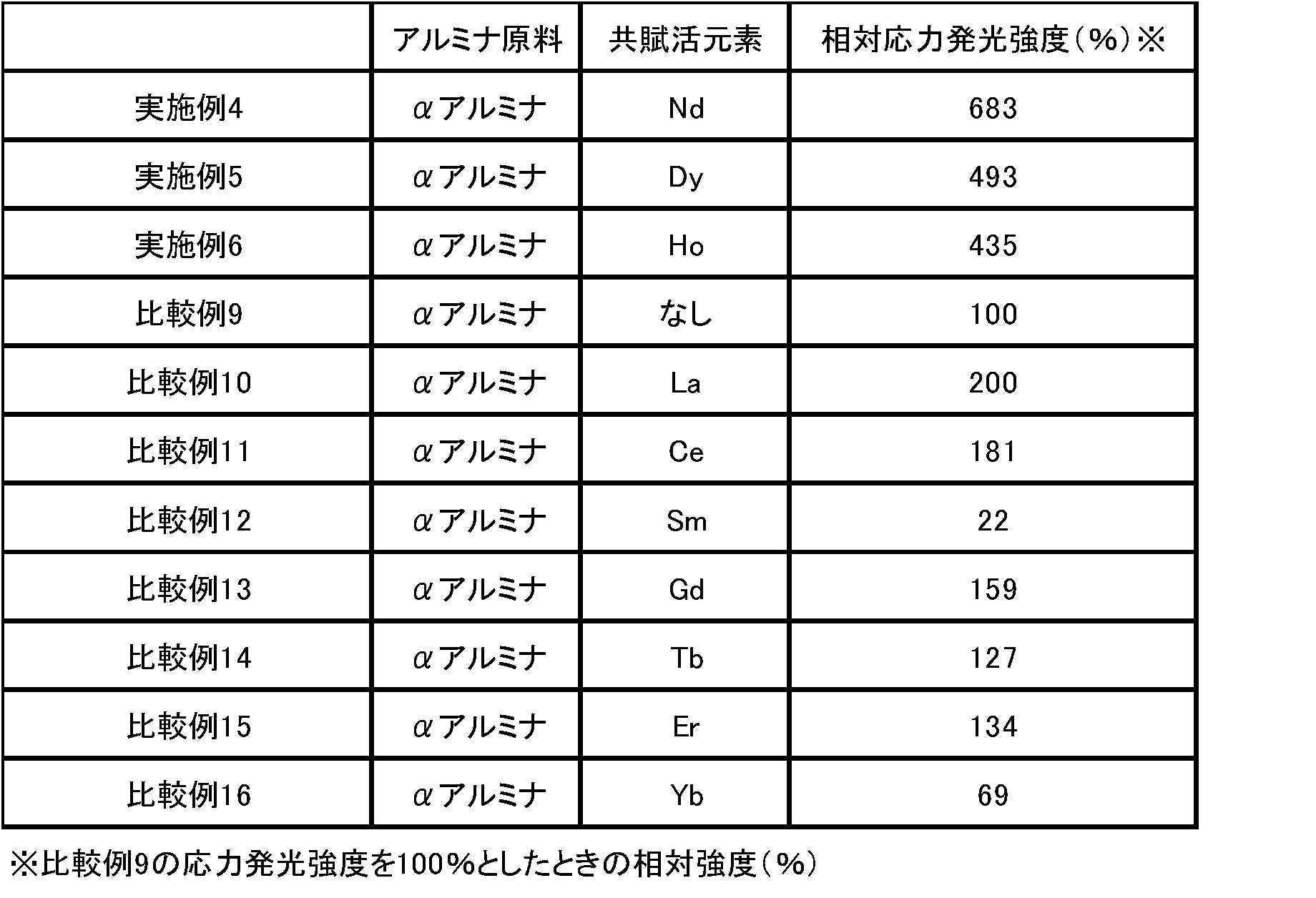
炭酸ストロンチウム(堺化学工業株式会社製SW-K、23.52g)、酸化ユーロピウム(信越化学工業株式会社製、0.16g)、酸化ホルミウム(和光純薬工業株式会社製、試薬、0.03g)、酸化アルミニウム(岩谷化学工業株式会社製、活性アルミナ、RG-40、18.05g)を秤量し、水(90mL)中に仕込んだ。その後は、実施例1と同様にして目的の応力発光材料を粉末として得た。
炭酸ストロンチウム(堺化学工業株式会社製SW-K、23.48g)、酸化ユーロピウム(信越化学工業株式会社製、0.16g)、酸化ホルミウム(和光純薬工業株式会社製、試薬、0.10g)、酸化アルミニウム(岩谷化学工業株式会社製、活性アルミナ、RG-40、18.02g)を秤量し、水(90mL)中に仕込んだ。その後は、実施例1と同様にして目的の応力発光材料を粉末として得た。
炭酸ストロンチウム(堺化学工業株式会社製SW-K、23.44g)、酸化ユーロピウム(信越化学工業株式会社製、0.16g)、酸化ホルミウム(和光純薬工業株式会社製、試薬、0.17g)、酸化アルミニウム(岩谷化学工業株式会社製、活性アルミナ、RG-40、17.99g)を秤量し、水(90mL)中に仕込んだ。その後は、実施例1と同様にして目的の応力発光材料を粉末として得た。
炭酸ストロンチウム(堺化学工業株式会社製SW-K、22.59g)、酸化ユーロピウム(信越化学工業株式会社製、0.15g)、酸化ホルミウム(和光純薬工業株式会社製、試薬、1.61g)、酸化アルミニウム(岩谷化学工業株式会社製、活性アルミナ、RG-40、17.34g)を秤量し、水(90mL)中に仕込んだ。その後は、実施例1と同様にして目的の応力発光材料を粉末として得た。
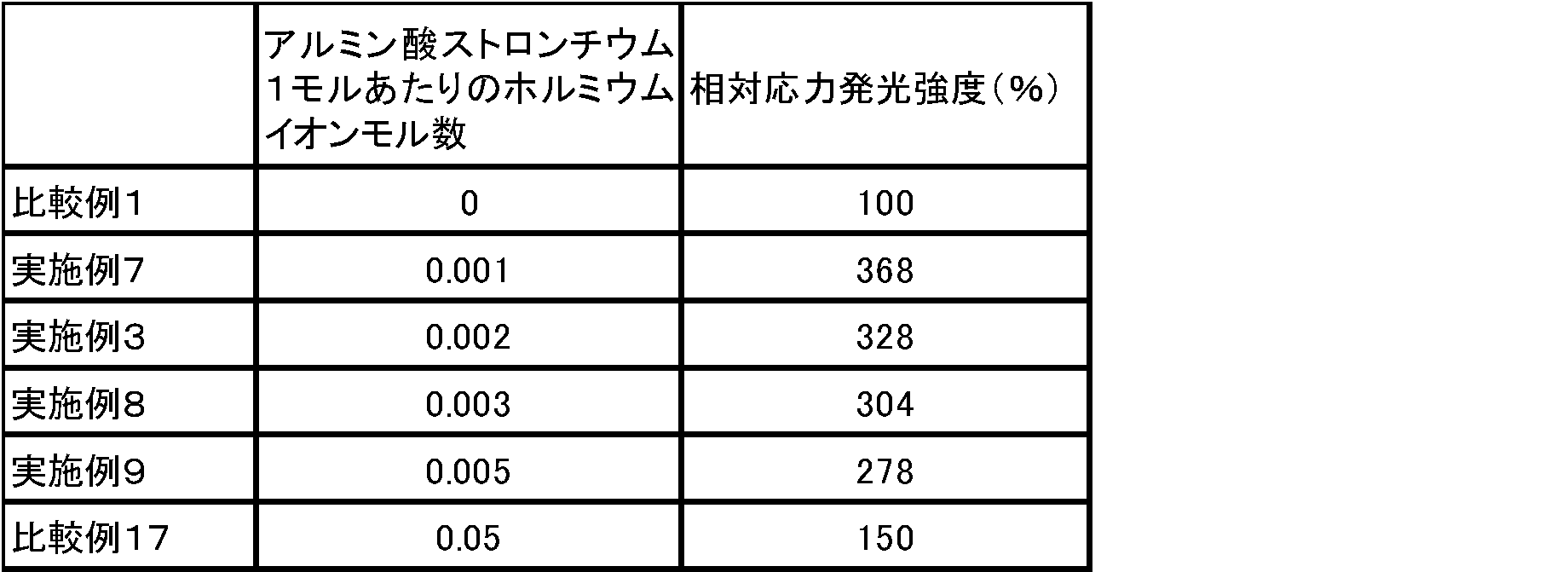
炭酸ストロンチウム(堺化学工業株式会社製SW-K、23.23g)、酸化ユーロピウム(信越化学工業株式会社製、0.31g)、酸化ネオジム(和光純薬工業株式会社製、試薬、0.30g)、酸化アルミニウム(高活性アルミナであるRK-40(ベーマイトとθアルミナとηアルミナの混合物の混合物、αアルミナ含有率1モル%、岩谷化学工業株式会社製)、17.87g)を秤量し、水(90mL)中に入れてスラリー化後、3mm径アルミナボール(株式会社ニッカトー製、SSA-999W、190g)を粉砕メディアとして使用し、遊星ボールミルを用いて分散・粉砕・混合することによりスラリーを得た。得られたスラリーを130℃にて蒸発乾燥し、得られた固形物を乳鉢で解砕して粉末状の応力発光材料用原料組成物を得た。次いで、この組成物をアルミナ製坩堝に20g充填して、還元雰囲気(2%水素含有窒素)中で200℃/時で1200℃まで昇温し、そのまま4時間保持後、200℃/時で室温まで降温した。こうして得られた焼成物を、遊星ボールミルを用いてアルコール溶媒中で粉砕して整粒し、濾過・乾燥して目的の応力発光材料を粉末として得た。
酸化ネオジムを酢酸ジスプロシウム四水和物(和光純薬工業株式会社製、試薬、0.72g)に変更したこと以外は実施例10と同様にして応力発光材料を粉末として得た。
酸化ネオジムを酸化ホルミウム(和光純薬工業株式会社製、試薬、0.33g)に変更したこと以外は実施例10と同様にして応力発光材料を粉末として得た。
炭酸ストロンチウム(堺化学工業株式会社製SW-K、23.45g)、酸化ユーロピウム(信越化学工業株式会社製、0.31g)、酸化アルミニウム(高活性アルミナであるRK-40(ベーマイトとθアルミナとηアルミナの混合物の混合物、αアルミナ含有率1モル%、岩谷化学工業株式会社製)、17.99g)を秤量し、水(90mL)中に入れてスラリー化後、3mm径アルミナボール(株式会社ニッカトー製、SSA-999W、190g)を粉砕メディアとして使用し、遊星ボールミルを用いて分散・粉砕・混合することによりスラリーを得た。得られたスラリーを130℃にて蒸発乾燥し、得られた固形物を乳鉢で解砕して粉末状の応力発光材料用原料組成物を得た。次いで、この組成物をアルミナ製坩堝に20g充填して、還元雰囲気(2%水素含有窒素)中で200℃/時で1200℃まで昇温し、そのまま4時間保持後、200℃/時で室温まで降温した。こうして得られた焼成物を、遊星ボールミルを用いてアルコール溶媒中で粉砕して整粒し、濾過・乾燥して目的の応力発光材料を粉末として得た。
酸化ネオジムを酸化ランタン(和光純薬工業株式会社製、試薬、0.290g)に変更したこと以外は実施例10と同様にして応力発光材料を粉末として得た。
酸化ネオジムを酸化セリウム(和光純薬工業株式会社製、試薬、0.30g)に変更したこと以外は実施例10と同様にして応力発光材料を粉末として得た。
酸化ネオジムを酢酸サマリウム四水和物(和光純薬工業株式会社製、試薬、0.700g)に変更したこと以外は実施例10と同様にして応力発光材料を粉末として得た。
酸化ネオジムを酸化ガドリニウム(和光純薬工業株式会社製、試薬、0.32g)に変更したこと以外は実施例10と同様にして応力発光材料を粉末として得た。
酸化ネオジムを酸化テルビウム(和光純薬工業株式会社製、試薬、0.33g)に変更したこと以外は実施例10と同様にして応力発光材料を粉末として得た。
酸化ネオジムを酸化エルビウム(和光純薬工業株式会社製、試薬、0.34g)に変更したこと以外は実施例10と同様にして応力発光材料を粉末として得た。
酸化ネオジムを酸化イッテルビウム(和光純薬工業株式会社製、試薬、0.35g)に変更したこと以外は実施例10と同様にして応力発光材料を粉末として得た。
酸化アルミニウムの代わりに、RH-40(バイヤライトとベーマイトの混合物、岩谷化学工業株式会社製)を24.97gを用いたこと以外は実施例10と同様にして応力発光材料を粉末として得た。
酸化アルミニウムの代わりに、前述のRH-40を24.94g用いたこと以外は実施例11と同様にして応力発光材料を粉末として得た。
酸化アルミニウムの代わりに、前述のRH-40を24.94g用いたこと以外は実施例12と同様にして応力発光材料を粉末として得た。
酸化アルミニウムの代わりに、前述のRH-40を25.15g用いたこと以外は比較例18と同様にして応力発光材料を粉末として得た。粉末は結晶構造解析により分析を行った。
酸化アルミニウムの代わりに、前述のRH-40を24.98g用いたこと以外は比較例19と同様にして応力発光材料を粉末として得た。
酸化アルミニウムの代わりに、前述のRH-40を24.98g用いたこと以外は比較例20と同様にして応力発光材料を粉末として得た。
酸化アルミニウムの代わりに、前述のRH-40を24.96用いたこと以外は比較例21と同様にして応力発光材料を粉末として得た。
酸化アルミニウムの代わりに、前述のRH-40を24.95g用いたこと以外は比較例22と同様にして応力発光材料を粉末として得た。
酸化アルミニウムの代わりに、前述のRH-40を24.95g用いたこと以外は比較例23と同様にして応力発光材料を粉末として得た。
酸化アルミニウムの代わりに、前述のRH-40を24.94g用いたこと以外は比較例24と同様にして応力発光材料を粉末として得た。
酸化アルミニウムの代わりに、前述のRH-40を24.93g用いたこと以外は比較例25と同様にして応力発光材料を粉末として得た。
表4において、活性アルミナの結果(実施例1-3及び比較例1-8)の値は、表1に示す値と異なるが、相対応力発光強度を100%とする基準を比較例1から比較例9に変更して示していることに伴い、測定値を換算した値である。αアルミナの結果(実施例4-6及び比較例9-16)の値は、表2に示す値と同じである。
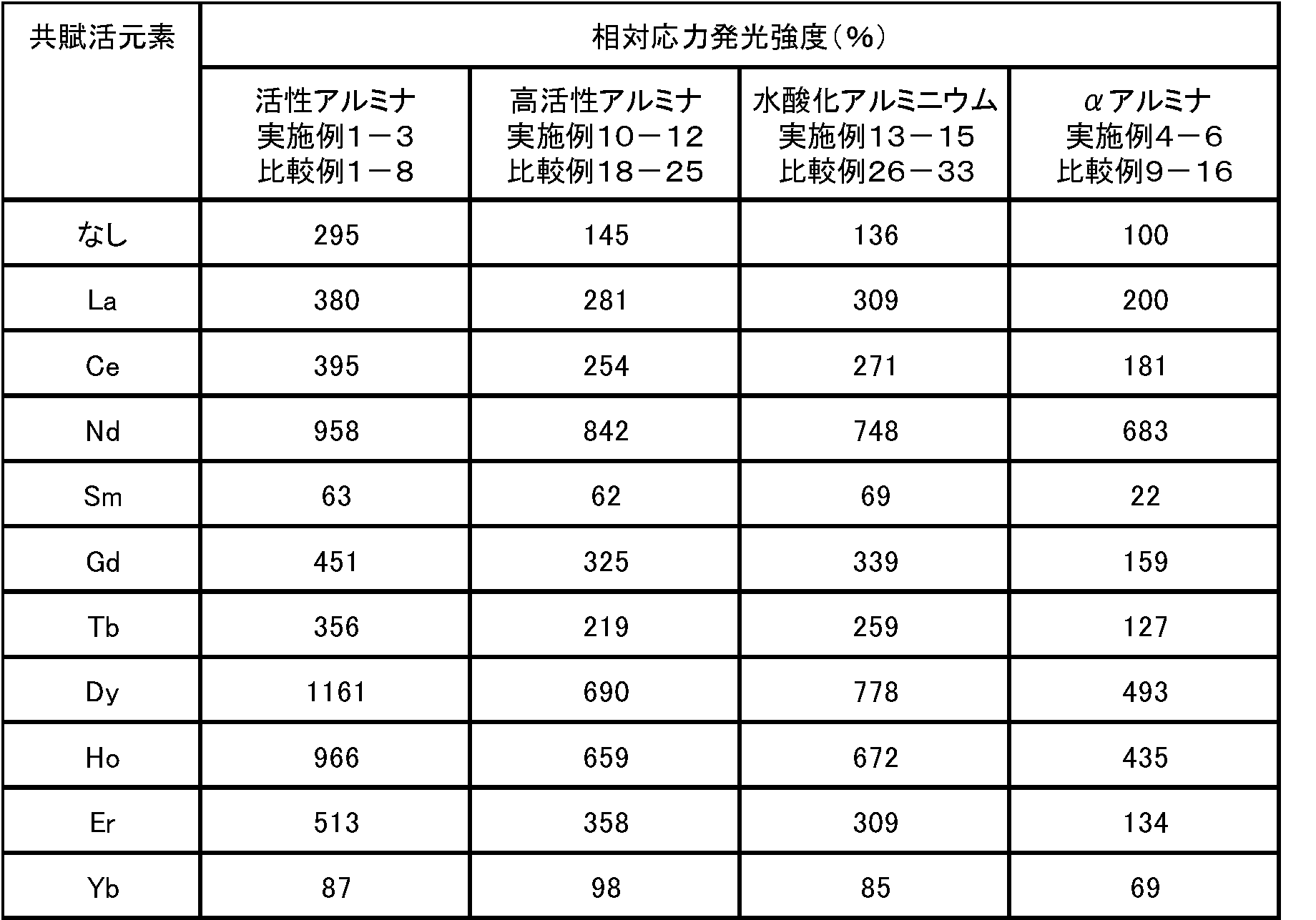
酸化アルミニウムとして、RA-40(αアルミナ含有率98モル%、岩谷化学工業株式会社製)とRG-40(活性アルミナ、θアルミナとηアルミナの混合物、αアルミナ含有率8モル%、岩谷化学工業株式会社製)をαアルミナの含有量が表5記載の割合になるように混合して用いたこと以外は、比較例1と同様にして応力発光材料を粉末として得た。
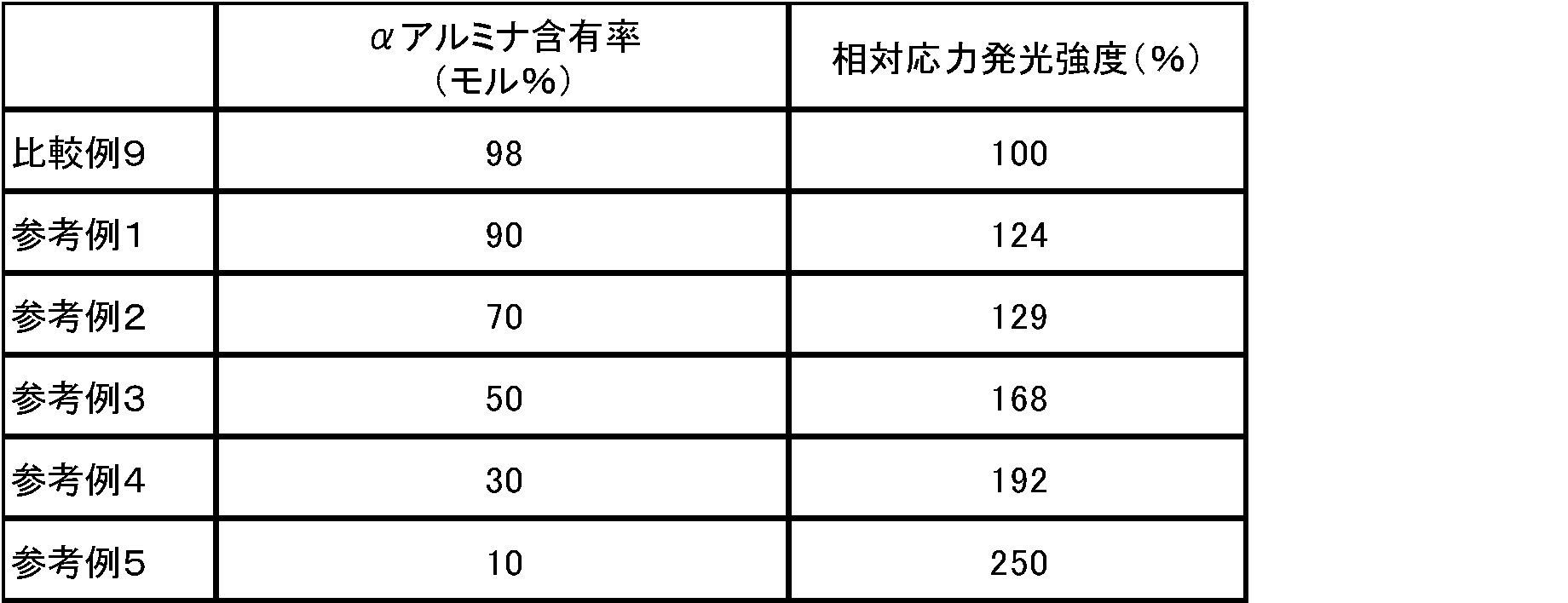
Claims (11)
- アルミン酸ストロンチウムを母体とする応力発光材料であって、
Euイオンと、
Nd、Dy、及びHoからなる群から選択される少なくとも1種のイオンと
を含有し、
前記応力発光材料中に含まれる前記Euイオンの量が、前記アルミン酸ストロンチウム1モル当たり0.0001~0.01モルであり、
前記応力発光材料中に含まれる、前記Nd、Dy、及びHoからなる群から選択される少なくとも1種のイオンの量が、Nd、Dy、及びHoの3種のイオンの合計量として前記アルミン酸ストロンチウム1モル当たり0.0001~0.01モルである
応力発光材料。 - 前記応力発光材料中に含まれるEuイオンの量が、前記アルミン酸ストロンチウム1モル当たり0.0005~0.005モルであり、
前記応力発光材料中に含まれる、前記Nd、Dy、及びHoからなる群から選択される少なくとも1種のイオンの量が、Nd、Dy、及びHoの3種のイオンの合計量としてアルミン酸ストロンチウム1モル当たり0.0005~0.005モルである請求項1記載の応力発光材料。 - 前記アルミン酸ストロンチウムが、θアルミナ、κアルミナ、δアルミナ、ηアルミナ、χアルミナ、γアルミナ、及びρアルミナから選択される少なくとも1種のアルミナを含有するアルミナ原料、及び/又は水酸化アルミニウムと、ストロンチウム源とから合成されたものである
請求項1又は2記載の応力発光材料。 - 前記アルミン酸ストロンチウムが、アルミナ及び/又は水酸化アルミニウムと、ストロンチウム源とを含有する応力発光材料用原料組成物から合成されたものであって、
前記応力発光材料用原料組成物中に含まれる前記アルミナ及び/又は水酸化アルミニウム中のαアルミナの割合が90モル%以下である請求項1又は2に記載の応力発光材料。 - アルミナ及び/又は水酸化アルミニウムと、ストロンチウム源とを含有する、請求項1~4のいずれか1項記載の応力発光材料を合成するための応力発光材料用原料組成物であって、
前記アルミナ及び/又は水酸化アルミニウム中のαアルミナの割合が90モル%以下である
組成物。 - 請求項1~4のいずれか1項記載の応力発光材料を含有する応力発光性塗料組成物。
- 請求項1~4のいずれか1項記載の応力発光材料を含有する樹脂組成物。
- 請求項7記載の樹脂組成物から形成された応力発光体。
- αアルミナ以外のアルミナを含有するアルミナ及び/又は水酸化アルミニウムを原料とする、
請求項1~4のいずれかに記載の応力発光材料の製造方法。 - 前記αアルミナ以外のアルミナは、θアルミナ、κアルミナ、δアルミナ、ηアルミナ、χアルミナ、γアルミナ、及びρアルミナから選択される少なくとも1種のアルミナである請求項9記載の方法。
- 前記αアルミナ以外のアルミナを含有するアルミナ及び/又は水酸化アルミニウムからなる原料は、アルミナ及び/又は水酸化アルミニウム中のαアルミナの割合が90モル%以下である応力発光材料用原料組成物である請求項9又は10に記載の方法。
Priority Applications (5)
| Application Number | Priority Date | Filing Date | Title |
|---|---|---|---|
| EP14776114.2A EP2980184B1 (en) | 2013-03-29 | 2014-03-26 | Use of a mechanoluminescent material |
| KR1020157031093A KR102134941B1 (ko) | 2013-03-29 | 2014-03-26 | 응력 발광 재료와 그 응용, 응력 발광 재료용 원료 조성물, 및, 응력 발광 재료의 제조 방법 |
| US14/780,942 US20160053172A1 (en) | 2013-03-29 | 2014-03-26 | Mechanoluminescent material and use applications thereof, raw material composition for mechanoluminescent material, and method for producing mechanoluminescent material |
| CN201480018789.1A CN105209572B (zh) | 2013-03-29 | 2014-03-26 | 应力发光材料和其应用、应力发光材料用原料组合物、以及应力发光材料的制造方法 |
| AU2014245218A AU2014245218B2 (en) | 2013-03-29 | 2014-03-26 | Mechanoluminescent material and use applications thereof, raw material composition for mechanoluminescent material, and method for producing mechanoluminescent material |
Applications Claiming Priority (4)
| Application Number | Priority Date | Filing Date | Title |
|---|---|---|---|
| JP2013-074422 | 2013-03-29 | ||
| JP2013-074268 | 2013-03-29 | ||
| JP2013074268A JP2014198758A (ja) | 2013-03-29 | 2013-03-29 | 応力発光材料とその応用、及び応力発光材料の製造方法 |
| JP2013074422A JP6135249B2 (ja) | 2013-03-29 | 2013-03-29 | 応力発光材料用原料組成物、応力発光材料、及びその応用 |
Publications (1)
| Publication Number | Publication Date |
|---|---|
| WO2014157337A1 true WO2014157337A1 (ja) | 2014-10-02 |
Family
ID=51624300
Family Applications (1)
| Application Number | Title | Priority Date | Filing Date |
|---|---|---|---|
| PCT/JP2014/058533 Ceased WO2014157337A1 (ja) | 2013-03-29 | 2014-03-26 | 応力発光材料とその応用、応力発光材料用原料組成物、及び、応力発光材料の製造方法 |
Country Status (6)
| Country | Link |
|---|---|
| US (1) | US20160053172A1 (ja) |
| EP (1) | EP2980184B1 (ja) |
| KR (1) | KR102134941B1 (ja) |
| CN (1) | CN105209572B (ja) |
| AU (1) | AU2014245218B2 (ja) |
| WO (1) | WO2014157337A1 (ja) |
Cited By (9)
| Publication number | Priority date | Publication date | Assignee | Title |
|---|---|---|---|---|
| WO2015159919A1 (ja) * | 2014-04-15 | 2015-10-22 | 大日本印刷株式会社 | 発光用紙、偽造防止媒体および包装容器 |
| ES2567652A1 (es) * | 2014-10-23 | 2016-04-25 | Universidad De Valladolid | Procedimiento para control triboluminiscente de sobrecarga en madera estructural |
| JP2017064995A (ja) * | 2015-09-29 | 2017-04-06 | 大日本印刷株式会社 | チューブ容器用積層体、チューブ容器およびチューブ容器用積層体の製造方法 |
| WO2018135106A1 (ja) * | 2017-01-19 | 2018-07-26 | 国立研究開発法人産業技術総合研究所 | 応力発光材料及び同応力発光材料を含有する塗料、応力発光体並びに応力発光材料の製造方法 |
| CN108443719A (zh) * | 2017-02-16 | 2018-08-24 | 清华大学 | 摩擦发光的方法 |
| CN108443717A (zh) * | 2017-02-16 | 2018-08-24 | 清华大学 | 摩擦发光装置 |
| TWI682981B (zh) * | 2014-12-25 | 2020-01-21 | 日商信越化學工業股份有限公司 | 表層用黏著劑、使用該黏著劑之表層、及表層之評估方法 |
| US20200101452A1 (en) * | 2014-09-24 | 2020-04-02 | Kai-Li HUANG | Environment-controlling fibers and fabrics using the same |
| CN111442862A (zh) * | 2020-04-24 | 2020-07-24 | 中国科学院宁波材料技术与工程研究所 | 一种铝合金结构件的应力动态监测方法 |
Families Citing this family (20)
| Publication number | Priority date | Publication date | Assignee | Title |
|---|---|---|---|---|
| US20150242057A1 (en) * | 2014-02-27 | 2015-08-27 | Samsung Display Co., Ltd. | Technique for generating localized light source for an embedded optical sensor array |
| ES2551759B1 (es) * | 2014-05-20 | 2016-09-09 | Universidad De Cantabria | Procedimiento de fabricación de tejidos fosforescentes de larga duración y tejidos otenidos a partir del mismo |
| JP6790491B2 (ja) * | 2016-06-22 | 2020-11-25 | ブリヂストンスポーツ株式会社 | ゴルフボール |
| US10258836B2 (en) | 2017-05-25 | 2019-04-16 | Nike, Inc. | Sports ball with mechanoluminescence |
| CN107283987A (zh) * | 2017-06-07 | 2017-10-24 | 复旦大学 | 一种具有应力响应的发光织物及其制备方法 |
| US11541624B2 (en) | 2017-08-18 | 2023-01-03 | Nike, Inc. | Luminescent bladders, luminescent articles, methods of making luminescent bladders and methods of making luminescent articles |
| CN107565944B (zh) * | 2017-09-07 | 2020-08-28 | 深圳大学 | 一种基于应力发光的光控开关组合物 |
| EP3679181A4 (en) * | 2017-09-08 | 2021-05-12 | The Board of Regents of The University of Texas System | TISSUE AND METHOD DOPED WITH MECHANOLUMINESCENT POLYMER |
| CN111943663A (zh) * | 2017-11-02 | 2020-11-17 | 杭州显庆科技有限公司 | 一种应力发光元件及其制备方法 |
| CN107974332B (zh) * | 2017-11-24 | 2020-09-08 | 中国科学院兰州化学物理研究所 | 一种具有失效自预警功能的固体润滑材料 |
| CN108117827A (zh) * | 2017-11-29 | 2018-06-05 | 浙江大学自贡创新中心 | 一种自组装耐热涂料的制备方法 |
| CN107987644A (zh) * | 2017-11-29 | 2018-05-04 | 浙江大学自贡创新中心 | 一种自组装耐热涂料 |
| US11360009B2 (en) * | 2017-12-26 | 2022-06-14 | National Institute Of Advanced Industrial Science And Technology | Fracture-visualization sensor and fracture-visualization system using same |
| CN108314958A (zh) * | 2018-01-30 | 2018-07-24 | 西昌学院 | 一种应用于网球赛事评判的应力发光材料的制备方法 |
| CN108693985B (zh) * | 2018-07-10 | 2024-05-24 | 深圳大学 | 一种基于应力发光的新型电子签名触感笔 |
| EP4301910A4 (en) | 2021-03-02 | 2024-08-14 | Board of Regents, The University of Texas System | HANDHELD/PORTABLE DEVICE FOR THE PRODUCTION OF FINE FIBERS |
| CN114958373B (zh) * | 2021-12-16 | 2023-10-03 | 昆明理工大学 | 一种具有压力记忆传感特性的应力发光薄膜及其制备方法 |
| US12550916B2 (en) | 2022-06-28 | 2026-02-17 | Board Of Regents, The University Of Texas System | Nanofiber systems as meat substitute |
| EP4357088A1 (en) | 2022-10-18 | 2024-04-24 | BIC Violex Single Member S.A. | Razor cartridge comprising mechanochromic layer |
| CN119116493A (zh) * | 2024-05-27 | 2024-12-13 | 一汽解放汽车有限公司 | 玄武岩纤维复合材料及其制备方法、玄武岩纤维制品 |
Citations (9)
| Publication number | Priority date | Publication date | Assignee | Title |
|---|---|---|---|---|
| JPH05170449A (ja) | 1991-07-08 | 1993-07-09 | Sumitomo Chem Co Ltd | θ−アルミナ粉末、その製造方法およびこれを用いてなる磁気記録媒体 |
| JP2001152145A (ja) * | 1999-11-30 | 2001-06-05 | Sumitomo Chem Co Ltd | 蓄光材用アルミン酸塩系蛍光体の製造方法 |
| JP3511083B2 (ja) | 1999-08-06 | 2004-03-29 | 独立行政法人産業技術総合研究所 | 高輝度応力発光材料、その製造方法及びそれを用いた発光方法 |
| JP2005179399A (ja) * | 2003-12-16 | 2005-07-07 | Ishihara Sangyo Kaisha Ltd | アルミン酸塩系微粒子蓄光粉末の製造方法 |
| WO2006016567A1 (ja) * | 2004-08-10 | 2006-02-16 | Ishihara Sangyo Kaisha, Ltd. | 蓄光材料及びその製造方法 |
| WO2006109704A1 (ja) * | 2005-04-08 | 2006-10-19 | National Institute Of Advanced Industrial Science And Technology | 紫外線を発光する高強度応力発光材料とその製造方法、ならびに、その利用 |
| JP2010180280A (ja) * | 2009-02-03 | 2010-08-19 | National Institute Of Advanced Industrial Science & Technology | 複層型応力発光積層体 |
| JP2011246662A (ja) * | 2010-05-28 | 2011-12-08 | Nippon Chem Ind Co Ltd | アルミン酸塩蛍光体、その製造方法及び発光素子 |
| JP5007971B2 (ja) | 2004-04-09 | 2012-08-22 | 独立行政法人産業技術総合研究所 | 高輝度応力発光材料およびその製造方法、並びにその利用 |
Family Cites Families (20)
| Publication number | Priority date | Publication date | Assignee | Title |
|---|---|---|---|---|
| JPS507971B2 (ja) | 1971-12-18 | 1975-03-31 | ||
| JPS511083A (ja) | 1974-06-21 | 1976-01-07 | Hitachi Ltd | Monorishitsukushusekikairono seiho |
| JP2543825B2 (ja) * | 1993-04-28 | 1996-10-16 | 根本特殊化学株式会社 | 蓄光性蛍光体 |
| JP3268760B2 (ja) * | 1998-08-18 | 2002-03-25 | 株式会社リード | 高輝度アルミン酸ストロンチウム蓄光体 |
| US6253698B1 (en) * | 1998-09-14 | 2001-07-03 | Marineglo Corporation | Phosphorescent marine products |
| JP3956551B2 (ja) * | 1999-10-06 | 2007-08-08 | 住友化学株式会社 | 蓄光材用アルミン酸塩系蛍光体の製造方法 |
| TWI272299B (en) * | 1999-10-06 | 2007-02-01 | Sumitomo Chemical Co | A process for producing aluminate-based phosphor |
| JP2002146346A (ja) * | 2000-11-13 | 2002-05-22 | Minolta Co Ltd | 希土類元素を含むアルミン酸塩の薄膜およびその作製方法ならびに蓄光性光学素子 |
| JP2002371275A (ja) * | 2001-06-14 | 2002-12-26 | Chemitec Kk | 長残光性蛍光材料及びその製造方法 |
| US6661946B2 (en) * | 2001-07-09 | 2003-12-09 | Lucent Technologies Inc. | Method of controlling optical signal power at an add/drop node in a WDM optical communication system |
| JP2003253261A (ja) * | 2001-12-28 | 2003-09-10 | Sony Corp | 蛍光性物質、複合材料、コート材料、塗料、インク、人工皮膚、人工皮膚の接触情報処理方法、人工発光皮膚、人工発光毛髪、発光素子、電子装置、発光システム、表示システム、フレキシブル発光材料、超音波発光性物質、交通標識、発光方法、複合材料の製造方法および発光素子の製造方法 |
| US6969475B2 (en) * | 2002-11-22 | 2005-11-29 | Kb Alloys | Photoluminescent alkaline earth aluminate and method for making the same |
| GB0404315D0 (en) * | 2004-02-26 | 2004-03-31 | Norchip As | Improved detection of human papillomavirus |
| JP4524357B2 (ja) * | 2004-07-26 | 2010-08-18 | 独立行政法人産業技術総合研究所 | 異方性の応力発光体を含有する応力発光組成物、及びその製造方法 |
| US20070111884A1 (en) * | 2005-11-14 | 2007-05-17 | Laiyuan Chen | Catalyst support, supported catalyst, and methods of making and using the same |
| JP2009162600A (ja) * | 2007-12-29 | 2009-07-23 | Brother Ind Ltd | 流速検知器及びインクジェットプリンタ |
| US8436901B2 (en) * | 2008-02-21 | 2013-05-07 | Id. Fone Co., Ltd. | Field monitoring system using a mobile terminal and method thereof |
| CN101440280B (zh) * | 2008-12-12 | 2012-02-01 | 江苏博睿光电有限公司 | 一种表面包覆型长余辉荧光粉及其制备方法 |
| CN102787294B (zh) * | 2011-05-19 | 2014-08-27 | 海洋王照明科技股份有限公司 | 一种钛掺杂铝酸锌镁薄膜的制备方法及其应用 |
| US9394480B2 (en) * | 2012-02-10 | 2016-07-19 | Rolex Sa | Long decay phosphors |
-
2014
- 2014-03-26 CN CN201480018789.1A patent/CN105209572B/zh active Active
- 2014-03-26 US US14/780,942 patent/US20160053172A1/en not_active Abandoned
- 2014-03-26 AU AU2014245218A patent/AU2014245218B2/en active Active
- 2014-03-26 KR KR1020157031093A patent/KR102134941B1/ko active Active
- 2014-03-26 EP EP14776114.2A patent/EP2980184B1/en active Active
- 2014-03-26 WO PCT/JP2014/058533 patent/WO2014157337A1/ja not_active Ceased
Patent Citations (9)
| Publication number | Priority date | Publication date | Assignee | Title |
|---|---|---|---|---|
| JPH05170449A (ja) | 1991-07-08 | 1993-07-09 | Sumitomo Chem Co Ltd | θ−アルミナ粉末、その製造方法およびこれを用いてなる磁気記録媒体 |
| JP3511083B2 (ja) | 1999-08-06 | 2004-03-29 | 独立行政法人産業技術総合研究所 | 高輝度応力発光材料、その製造方法及びそれを用いた発光方法 |
| JP2001152145A (ja) * | 1999-11-30 | 2001-06-05 | Sumitomo Chem Co Ltd | 蓄光材用アルミン酸塩系蛍光体の製造方法 |
| JP2005179399A (ja) * | 2003-12-16 | 2005-07-07 | Ishihara Sangyo Kaisha Ltd | アルミン酸塩系微粒子蓄光粉末の製造方法 |
| JP5007971B2 (ja) | 2004-04-09 | 2012-08-22 | 独立行政法人産業技術総合研究所 | 高輝度応力発光材料およびその製造方法、並びにその利用 |
| WO2006016567A1 (ja) * | 2004-08-10 | 2006-02-16 | Ishihara Sangyo Kaisha, Ltd. | 蓄光材料及びその製造方法 |
| WO2006109704A1 (ja) * | 2005-04-08 | 2006-10-19 | National Institute Of Advanced Industrial Science And Technology | 紫外線を発光する高強度応力発光材料とその製造方法、ならびに、その利用 |
| JP2010180280A (ja) * | 2009-02-03 | 2010-08-19 | National Institute Of Advanced Industrial Science & Technology | 複層型応力発光積層体 |
| JP2011246662A (ja) * | 2010-05-28 | 2011-12-08 | Nippon Chem Ind Co Ltd | アルミン酸塩蛍光体、その製造方法及び発光素子 |
Non-Patent Citations (1)
| Title |
|---|
| See also references of EP2980184A4 |
Cited By (13)
| Publication number | Priority date | Publication date | Assignee | Title |
|---|---|---|---|---|
| WO2015159919A1 (ja) * | 2014-04-15 | 2015-10-22 | 大日本印刷株式会社 | 発光用紙、偽造防止媒体および包装容器 |
| US12152180B2 (en) * | 2014-09-24 | 2024-11-26 | Kai-Li HUANG | Environment-controlling fibers and fabrics using the same |
| US20200101452A1 (en) * | 2014-09-24 | 2020-04-02 | Kai-Li HUANG | Environment-controlling fibers and fabrics using the same |
| ES2567652A1 (es) * | 2014-10-23 | 2016-04-25 | Universidad De Valladolid | Procedimiento para control triboluminiscente de sobrecarga en madera estructural |
| TWI682981B (zh) * | 2014-12-25 | 2020-01-21 | 日商信越化學工業股份有限公司 | 表層用黏著劑、使用該黏著劑之表層、及表層之評估方法 |
| JP2017064995A (ja) * | 2015-09-29 | 2017-04-06 | 大日本印刷株式会社 | チューブ容器用積層体、チューブ容器およびチューブ容器用積層体の製造方法 |
| WO2018135106A1 (ja) * | 2017-01-19 | 2018-07-26 | 国立研究開発法人産業技術総合研究所 | 応力発光材料及び同応力発光材料を含有する塗料、応力発光体並びに応力発光材料の製造方法 |
| JPWO2018135106A1 (ja) * | 2017-01-19 | 2019-11-07 | 国立研究開発法人産業技術総合研究所 | 応力発光材料及び同応力発光材料を含有する塗料、応力発光体並びに応力発光材料の製造方法 |
| US11225603B2 (en) | 2017-01-19 | 2022-01-18 | National Institute Of Advanced Industrial Science And Technology | Mechanoluminescent material, coating containing mechanoluminescent material, mechanoluminescent substance and method for producing mechanoluminescent material |
| CN108443719B (zh) * | 2017-02-16 | 2019-09-20 | 清华大学 | 摩擦发光的方法 |
| CN108443717A (zh) * | 2017-02-16 | 2018-08-24 | 清华大学 | 摩擦发光装置 |
| CN108443719A (zh) * | 2017-02-16 | 2018-08-24 | 清华大学 | 摩擦发光的方法 |
| CN111442862A (zh) * | 2020-04-24 | 2020-07-24 | 中国科学院宁波材料技术与工程研究所 | 一种铝合金结构件的应力动态监测方法 |
Also Published As
| Publication number | Publication date |
|---|---|
| EP2980184B1 (en) | 2018-08-01 |
| EP2980184A1 (en) | 2016-02-03 |
| US20160053172A1 (en) | 2016-02-25 |
| AU2014245218A1 (en) | 2015-10-22 |
| CN105209572A (zh) | 2015-12-30 |
| EP2980184A4 (en) | 2016-10-12 |
| AU2014245218B2 (en) | 2017-04-06 |
| KR20150136130A (ko) | 2015-12-04 |
| KR102134941B1 (ko) | 2020-07-16 |
| AU2014245218A8 (en) | 2015-11-19 |
| CN105209572B (zh) | 2018-06-19 |
Similar Documents
| Publication | Publication Date | Title |
|---|---|---|
| KR102134941B1 (ko) | 응력 발광 재료와 그 응용, 응력 발광 재료용 원료 조성물, 및, 응력 발광 재료의 제조 방법 | |
| JP5743044B1 (ja) | 応力発光材料、応力発光材料の製造方法、応力発光性塗料組成物、樹脂組成物及び応力発光体 | |
| JP6307837B2 (ja) | 疎水性応力発光材料、疎水性応力発光材料の製造方法、応力発光性塗料組成物、樹脂組成物及び応力発光体 | |
| CN107778002B (zh) | 一种蓝色力致发光陶瓷材料及其制备方法 | |
| CN107739211B (zh) | 一种黄绿色力致发光陶瓷材料及其制备方法 | |
| JP6135249B2 (ja) | 応力発光材料用原料組成物、応力発光材料、及びその応用 | |
| JP6137619B2 (ja) | 応力発光材料用原料組成物、応力発光材料、及びその応用 | |
| CN108822606B (zh) | 一种涂料 | |
| CN107936963B (zh) | 一种绿色摩擦发光荧光粉及其制备方法 | |
| CN108690608A (zh) | 一种旋转木马 | |
| CN107903065A (zh) | 一种摩擦发光陶瓷材料及其制备方法 | |
| JP2014198758A (ja) | 応力発光材料とその応用、及び応力発光材料の製造方法 | |
| JP2015067780A (ja) | 応力発光材料用原料組成物、応力発光材料、及びその応用 | |
| HK1226434A1 (en) | Mecanoluminescent material, method for manufacturing mecanoluminescent material, mecanoluminescent paint composition, resin composition, and mecanoluminescent article | |
| HK1226434B (en) | Mecanoluminescent material, method for manufacturing mecanoluminescent material, mecanoluminescent paint composition, resin composition, and mecanoluminescent article |
Legal Events
| Date | Code | Title | Description |
|---|---|---|---|
| 121 | Ep: the epo has been informed by wipo that ep was designated in this application |
Ref document number: 14776114 Country of ref document: EP Kind code of ref document: A1 |
|
| WWE | Wipo information: entry into national phase |
Ref document number: 14780942 Country of ref document: US |
|
| NENP | Non-entry into the national phase |
Ref country code: DE |
|
| WWE | Wipo information: entry into national phase |
Ref document number: 2014776114 Country of ref document: EP |
|
| ENP | Entry into the national phase |
Ref document number: 2014245218 Country of ref document: AU Date of ref document: 20140326 Kind code of ref document: A |
|
| ENP | Entry into the national phase |
Ref document number: 20157031093 Country of ref document: KR Kind code of ref document: A |