WO2014157424A1 - 静電荷像現像用トナー - Google Patents
静電荷像現像用トナー Download PDFInfo
- Publication number
- WO2014157424A1 WO2014157424A1 PCT/JP2014/058695 JP2014058695W WO2014157424A1 WO 2014157424 A1 WO2014157424 A1 WO 2014157424A1 JP 2014058695 W JP2014058695 W JP 2014058695W WO 2014157424 A1 WO2014157424 A1 WO 2014157424A1
- Authority
- WO
- WIPO (PCT)
- Prior art keywords
- toner
- mass
- temperature
- parts
- softening agent
- Prior art date
- Legal status (The legal status is an assumption and is not a legal conclusion. Google has not performed a legal analysis and makes no representation as to the accuracy of the status listed.)
- Ceased
Links
Classifications
-
- G—PHYSICS
- G03—PHOTOGRAPHY; CINEMATOGRAPHY; ANALOGOUS TECHNIQUES USING WAVES OTHER THAN OPTICAL WAVES; ELECTROGRAPHY; HOLOGRAPHY
- G03G—ELECTROGRAPHY; ELECTROPHOTOGRAPHY; MAGNETOGRAPHY
- G03G9/00—Developers
- G03G9/08—Developers with toner particles
- G03G9/087—Binders for toner particles
- G03G9/08702—Binders for toner particles comprising macromolecular compounds obtained by reactions only involving carbon-to-carbon unsaturated bonds
- G03G9/08706—Polymers of alkenyl-aromatic compounds
- G03G9/08708—Copolymers of styrene
- G03G9/08711—Copolymers of styrene with esters of acrylic or methacrylic acid
-
- G—PHYSICS
- G03—PHOTOGRAPHY; CINEMATOGRAPHY; ANALOGOUS TECHNIQUES USING WAVES OTHER THAN OPTICAL WAVES; ELECTROGRAPHY; HOLOGRAPHY
- G03G—ELECTROGRAPHY; ELECTROPHOTOGRAPHY; MAGNETOGRAPHY
- G03G9/00—Developers
- G03G9/08—Developers with toner particles
- G03G9/0802—Preparation methods
- G03G9/081—Preparation methods by mixing the toner components in a liquefied state; melt kneading; reactive mixing
-
- G—PHYSICS
- G03—PHOTOGRAPHY; CINEMATOGRAPHY; ANALOGOUS TECHNIQUES USING WAVES OTHER THAN OPTICAL WAVES; ELECTROGRAPHY; HOLOGRAPHY
- G03G—ELECTROGRAPHY; ELECTROPHOTOGRAPHY; MAGNETOGRAPHY
- G03G9/00—Developers
- G03G9/08—Developers with toner particles
- G03G9/087—Binders for toner particles
- G03G9/08775—Natural macromolecular compounds or derivatives thereof
- G03G9/08782—Waxes
-
- G—PHYSICS
- G03—PHOTOGRAPHY; CINEMATOGRAPHY; ANALOGOUS TECHNIQUES USING WAVES OTHER THAN OPTICAL WAVES; ELECTROGRAPHY; HOLOGRAPHY
- G03G—ELECTROGRAPHY; ELECTROPHOTOGRAPHY; MAGNETOGRAPHY
- G03G9/00—Developers
- G03G9/08—Developers with toner particles
- G03G9/087—Binders for toner particles
- G03G9/08784—Macromolecular material not specially provided for in a single one of groups G03G9/08702 - G03G9/08775
- G03G9/08793—Crosslinked polymers
-
- G—PHYSICS
- G03—PHOTOGRAPHY; CINEMATOGRAPHY; ANALOGOUS TECHNIQUES USING WAVES OTHER THAN OPTICAL WAVES; ELECTROGRAPHY; HOLOGRAPHY
- G03G—ELECTROGRAPHY; ELECTROPHOTOGRAPHY; MAGNETOGRAPHY
- G03G9/00—Developers
- G03G9/08—Developers with toner particles
- G03G9/087—Binders for toner particles
- G03G9/08784—Macromolecular material not specially provided for in a single one of groups G03G9/08702 - G03G9/08775
- G03G9/08795—Macromolecular material not specially provided for in a single one of groups G03G9/08702 - G03G9/08775 characterised by their chemical properties, e.g. acidity, molecular weight, sensitivity to reactants
-
- G—PHYSICS
- G03—PHOTOGRAPHY; CINEMATOGRAPHY; ANALOGOUS TECHNIQUES USING WAVES OTHER THAN OPTICAL WAVES; ELECTROGRAPHY; HOLOGRAPHY
- G03G—ELECTROGRAPHY; ELECTROPHOTOGRAPHY; MAGNETOGRAPHY
- G03G9/00—Developers
- G03G9/08—Developers with toner particles
- G03G9/087—Binders for toner particles
- G03G9/08784—Macromolecular material not specially provided for in a single one of groups G03G9/08702 - G03G9/08775
- G03G9/08797—Macromolecular material not specially provided for in a single one of groups G03G9/08702 - G03G9/08775 characterised by their physical properties, e.g. viscosity, solubility, melting temperature, softening temperature, glass transition temperature
-
- G—PHYSICS
- G03—PHOTOGRAPHY; CINEMATOGRAPHY; ANALOGOUS TECHNIQUES USING WAVES OTHER THAN OPTICAL WAVES; ELECTROGRAPHY; HOLOGRAPHY
- G03G—ELECTROGRAPHY; ELECTROPHOTOGRAPHY; MAGNETOGRAPHY
- G03G9/00—Developers
- G03G9/08—Developers with toner particles
- G03G9/09—Colouring agents for toner particles
- G03G9/0902—Inorganic compounds
- G03G9/0904—Carbon black
-
- G—PHYSICS
- G03—PHOTOGRAPHY; CINEMATOGRAPHY; ANALOGOUS TECHNIQUES USING WAVES OTHER THAN OPTICAL WAVES; ELECTROGRAPHY; HOLOGRAPHY
- G03G—ELECTROGRAPHY; ELECTROPHOTOGRAPHY; MAGNETOGRAPHY
- G03G9/00—Developers
- G03G9/08—Developers with toner particles
- G03G9/097—Plasticisers; Charge controlling agents
- G03G9/09733—Organic compounds
Definitions
- the present invention relates to an electrostatic charge image developing toner that can be used for developing an image forming apparatus using electrophotography such as a copying machine, a facsimile machine, and a printer.
- an electrostatic recording apparatus an electrostatic recording apparatus or the like, an electric latent image or a magnetic latent image is visualized with toner.
- an electrostatic image (latent image) is formed on a photoreceptor, and then the latent image is developed with toner to form a toner image.
- the toner image is usually transferred onto a recording medium such as paper and then fixed by a method such as heating.
- the toner used for electrostatic image development is generally colored resin particles containing a colorant, a charge control agent, and other additives in a binder resin.
- a heated heat roller method As a fixing method in the dry development method, a heated heat roller method is widely used because of its energy efficiency. In recent years, in order to save energy, it is required to fix the toner at a low temperature in order to reduce the thermal energy applied to the toner during fixing. In order to achieve this requirement, it is considered that an essential technical achievement is to lower the fixing temperature by lowering the melting start temperature of the toner.
- the improvement of the fixing device is further advanced, and the thermal energy efficiency is increased by reducing the thickness of the roller on the side in contact with the toner image, and the start-up time can be greatly shortened.
- the specific heat capacity is reduced, the temperature difference between the portion through which the recording medium passes and the portion through which the recording medium does not pass increases, and toner adheres to the fixing roller. For this reason, a so-called hot offset phenomenon occurs in which the toner is fixed to the non-image portion on the recording medium after the fixing roller makes one round. Therefore, the demand for toner with respect to hot offset resistance as well as low-temperature fixability is becoming stricter.
- a release agent softener
- a release agent has a low melt viscosity and is separable from the resin. It is desirable to have excellent characteristics.
- a hydrocarbon wax represented by carnauba wax, polyethylene, polypropylene, paraffins, and the like are known.
- Patent Document 1 discloses a toner containing a specific amount of a specific ester wax in an electrostatic charge image developing toner containing at least a binder resin, a colorant, and an ester wax. It is also disclosed that the transparency of the toner is improved and that the fixing property and the offset resistance are excellent.
- Patent Document 2 discloses a toner containing a binder resin, a colorant and a release agent, which contains a monoester compound having a specific structure and a hydrocarbon compound as a release agent, and is fixed at a low temperature. Further, it is also disclosed that no band-like or streak-like image defect occurs in the formed fixed image.
- Patent Document 3 discloses a toner containing a release agent, a binder resin, and a colorant with a specific range of the kinematic viscosity, melting point, etc. of the release agent, and is excellent in low-temperature fixability and stain resistance. It is also disclosed.
- Patent Document 4 discloses a toner having toner particles containing a binder resin, an ester wax, and a colorant, the component having a specific range of components detected at a specific time measured by GC / MS analysis of the ester wax. It is also disclosed that, even during high-speed image formation, it exhibits good fixing characteristics, suppresses internal contamination, and can obtain an image having no gloss unevenness over a long period of time.
- Patent Document 5 a toner prepared by emulsifying or dispersing a liquid in which a toner material containing a binder resin and a release agent is dissolved or dispersed in an organic solvent is used as a release agent.
- a toner using a mixture of a synthetic ester wax composed of a monoester having a specific melting point and an erythritol wax having a branched structure and a hydrocarbon wax having a specific melting point in a specific ratio is disclosed, and is excellent in releasability and low-temperature fixability, It is also disclosed that the contamination is low.
- An object of the present invention is to provide a toner having an excellent balance between heat-resistant storage stability and low-temperature fixability and excellent hot-offset resistance.
- the present inventors have mixed at least two monoester compounds having a specific structure as a softening agent with the colored resin particles constituting the toner for developing an electrostatic image. It has been found that the above-mentioned problems can be solved by containing a specific amount of.
- the softening agent in the electrostatic charge image developing toner containing a colored resin particle containing a binder resin, a colorant, and a softening agent, and an external additive, the softening agent is represented by the following formula (1).
- an electrostatic charge image developing toner comprising 10 to 30 parts by mass of the softening agent with respect to 100 parts by mass.
- R 1 —COO—R 2 formula (1) (In the above formula (1), R 1 represents a linear alkyl group having 17 to 23 carbon atoms, R 2 represents a linear alkyl group having 16 to 22 carbon atoms, and the sum of R 1 and R 2 The carbon number is 39.)
- R 3 —COO—R 4 formula (2) (In the above formula (2), R 3 represents a linear alkyl group having 15 to 21 carbon atoms, R 4 represents a linear alkyl group having 16 to 22 carbon atoms, and the total of R 3 and R 4 (The number of carbon atoms is 35 to 37.)
- the melting point of the softener is preferably 60 to 75 ° C.
- the acid value of the softening agent is 1.0 mgKOH / g or less and the hydroxyl value of the softening agent is 10 mgKOH / g or less.
- the monoester compound A having the structure of the above formula (1) and the monoester compound B having the structure of the above formula (2) are respectively used as the softening agent.
- the toner for developing an electrostatic charge image of the present invention includes a colored resin particle containing a binder resin, a colorant, and a softening agent, and a toner for developing an electrostatic charge image containing an external additive.
- the monoester compound A having the structure of (1) is contained in a proportion of 95 to 99% by mass
- the softening agent is contained in an amount of 10 to 30 parts by mass with respect to 100 parts by mass of the binder resin.
- R 1 —COO—R 2 formula (1) (In the above formula (1), R 1 represents a linear alkyl group having 17 to 23 carbon atoms, R 2 represents a linear alkyl group having 16 to 22 carbon atoms, and the sum of R 1 and R 2 The carbon number is 39.)
- R 3 —COO—R 4 formula (2) (In the above formula (2), R 3 represents a linear alkyl group having 15 to 21 carbon atoms, R 4 represents a linear alkyl group having 16 to 22 carbon atoms, and the total of R 3 and R 4 (The number of carbon atoms is 35 to 37.)
- the toner of the present invention contains a binder resin, a colorant, a specific softening agent, and an external additive.
- the manufacturing method of the colored resin particles used in the present invention, the colored resin particles obtained by the manufacturing method, the manufacturing method of the toner of the present invention using the colored resin particles, and the toner of the present invention will be described in order.
- the production method of colored resin particles is roughly classified into dry methods such as a pulverization method, and wet methods such as an emulsion polymerization aggregation method, a suspension polymerization method, and a dissolution suspension method.
- the wet method is preferable because it is easy to obtain a toner excellent in printing characteristics such as the property.
- a polymerization method such as an emulsion polymerization aggregation method and a suspension polymerization method is preferable because a toner having a relatively small particle size distribution on the order of microns is preferable.
- a suspension polymerization method is more preferable among polymerization methods. preferable.
- an emulsified polymerizable monomer is polymerized to obtain a resin fine particle emulsion, which is aggregated with a colorant dispersion or the like to produce colored resin particles.
- the dissolution suspension method produces droplets of a solution in which toner components such as a binder resin and a colorant are dissolved or dispersed in an organic solvent in an aqueous medium, and the organic solvent is removed to produce colored resin particles.
- toner components such as a binder resin and a colorant are dissolved or dispersed in an organic solvent in an aqueous medium, and the organic solvent is removed to produce colored resin particles.
- the colored resin particles of the present invention can be produced by employing a wet method or a dry method.
- a wet method a preferred suspension polymerization method is adopted, and the following process is performed.
- A) Suspension polymerization method (A-1) Preparation step of polymerizable monomer composition First, a polymerizable monomer, a colorant, a softening agent, a charge control agent added as necessary, etc. Other additives are mixed to prepare a polymerizable monomer composition. The mixing at the time of preparing the polymerizable monomer composition is performed using, for example, a media type dispersing machine.
- the polymerizable monomer means a monomer having a polymerizable functional group, and the polymerizable monomer is polymerized to become a binder resin. It is preferable to use a monovinyl monomer as the main component of the polymerizable monomer.
- the monovinyl monomer examples include styrene; styrene derivatives such as vinyl toluene and ⁇ -methylstyrene; acrylic acid and methacrylic acid; methyl acrylate, ethyl acrylate, propyl acrylate, butyl acrylate, acrylic acid 2
- Acrylic esters such as ethylhexyl and dimethylaminoethyl acrylate
- methacrylic esters such as methyl methacrylate, ethyl methacrylate, propyl methacrylate, butyl methacrylate, 2-ethylhexyl methacrylate and dimethylaminoethyl methacrylate
- acrylonitrile And nitrile compounds such as methacrylonitrile
- amide compounds such as acrylamide and methacrylamide
- olefins such as ethylene, propylene, and butylene.
- a crosslinkable polymerizable monomer means a monomer having two or more polymerizable functional groups.
- the crosslinkable polymerizable monomer include aromatic divinyl compounds such as divinylbenzene, divinylnaphthalene, and derivatives thereof; alcohols having two or more hydroxyl groups such as ethylene glycol dimethacrylate and diethylene glycol dimethacrylate; Ester compounds in which two or more carboxylic acids having carbon-carbon double bonds are ester-bonded; other divinyl compounds such as N, N-divinylaniline and divinyl ether; compounds having three or more vinyl groups; Can be mentioned.
- crosslinkable polymerizable monomers can be used alone or in combination of two or more.
- the crosslinkable polymerizable monomer is usually used in a proportion of 0.1 to 5 parts by mass, preferably 0.3 to 2 parts by mass, with respect to 100 parts by mass of the monovinyl monomer. desirable.
- the macromonomer has a polymerizable carbon-carbon unsaturated double bond at the end of the molecular chain, and is a reactive oligomer or polymer having a number average molecular weight of usually 1,000 to 30,000.
- the macromonomer is preferably one that gives a polymer having a higher Tg than the glass transition temperature of the polymer obtained by polymerizing the monovinyl monomer (hereinafter sometimes referred to as “Tg”).
- Tg the glass transition temperature of the polymer obtained by polymerizing the monovinyl monomer
- the macromonomer is preferably used in an amount of 0.03 to 5 parts by mass, more preferably 0.05 to 1 part by mass, with respect to 100 parts by mass of the monovinyl monomer.
- a colorant is used.
- black, cyan, yellow, and magenta colorants can be used.
- the black colorant for example, carbon black, titanium black, magnetic powder such as zinc zinc oxide and nickel iron oxide can be used.
- cyan colorant for example, a copper phthalocyanine compound, a derivative thereof, and an anthraquinone compound can be used. Specifically, C.I. I. Pigment blue 2, 3, 6, 15, 15: 1, 15: 2, 15: 3, 15: 4, 16, 17: 1, 60, and the like.
- yellow colorant examples include compounds such as monoazo pigments, azo pigments such as disazo pigments, and condensed polycyclic pigments.
- monoazo pigments examples include compounds such as monoazo pigments, azo pigments such as disazo pigments, and condensed polycyclic pigments.
- azo pigments such as disazo pigments
- condensed polycyclic pigments examples include compounds such as monoazo pigments, azo pigments such as disazo pigments, and condensed polycyclic pigments.
- magenta colorant examples include compounds such as monoazo pigments, azo pigments such as disazo pigments, and condensed polycyclic pigments.
- each colorant can be used alone or in combination of two or more.
- the amount of the colorant is preferably 1 to 10 parts by mass with respect to 100 parts by mass of the monovinyl monomer.
- the colored resin particles used in the present invention contain, as a softener, a monoester compound B having the structure of the following formula (2) in a proportion of 95 to 99% by mass of the monoester compound A having the structure of the following formula (1). In a proportion of 1 to 5% by mass.
- R 1 —COO—R 2 formula (1) (In the above formula (1), R 1 represents a linear alkyl group having 17 to 23 carbon atoms, R 2 represents a linear alkyl group having 16 to 22 carbon atoms, and the sum of R 1 and R 2 The carbon number is 39.)
- R 3 —COO—R 4 formula (2) (In the above formula (2), R 3 represents a linear alkyl group having 15 to 21 carbon atoms, R 4 represents a linear alkyl group having 16 to 22 carbon atoms, and the total of R 3 and R 4 (The number of carbon atoms is 35 to 37.)
- R 1 to R 4 may all be the same group, a part thereof may be the same group, or all may be different from each other.
- R 1 to R 4 are larger than the above range, the toner fixing property is deteriorated.
- R 1 to R 4 are smaller than the above range, the heat resistant storage stability of the toner is deteriorated.
- the difference between the carbon number in the raw fatty acid (that is, the carbon number obtained by adding 1 to the carbon number of R 1 ) and the carbon number in the raw material alcohol (that is, the carbon number of R 2 ). Is preferably 0 to 6, more preferably 2 to 6, and still more preferably 4 to 6.
- the number of carbons in the raw fatty acid that is, the number of carbons obtained by adding 1 to the number of carbons in R 3
- the number of carbons in the raw material alcohol that is, the number of carbons in R 4
- the difference is preferably 0 to 6, more preferably 2 to 6, and still more preferably 4 to 6.
- monoester compound A represented by the above formula (1)
- behenyl stearate C 17 H 35 —COO—C 22 H 45
- eicosyl acid eicosyl C 19 H 39 —COO—C 20 H.
- 41 eicosyl acid eicosyl
- stearyl behenate C 21 H 43 —COO—C 18 H 37
- hexadecyl lignocerate C 23 H 47 —COO—C 16 H 33 .
- monoester compound A is more preferably behenyl stearate and stearyl behenate.
- monoester compound B represented by the above formula (2)
- monoester compound B represented by the above formula (2)
- monoester compound B is more preferably behenyl palmitate and eicosyl palmitate.
- the softener if the monoester compound A is more than 99% by mass, the low-temperature fixability may be deteriorated. On the other hand, if the monoester compound B is more than 5% by mass, the preservability is deteriorated. And hot offset resistance may deteriorate. More preferably, the softener contains the monoester compound A in a proportion of 95.5 to 98.5 mass% and the monoester compound B in a proportion of 1.5 to 4.5 mass%.
- the hydroxyl value of the softener is usually preferably 10 mgKOH / g or less, more preferably 6 mgKOH / g or less, and still more preferably 3 mgKOH / g or less.
- the hydroxyl value of the softening agent is a value measured according to JIS K 0070, which is a standard oil analysis method established by the Japan Industrial Standards Committee (JICS).
- the acid value of the softening agent is preferably 1.0 mgKOH / g or less, more preferably 0.6 mgKOH / g or less, and further preferably 0.3 mgKOH / g or less.
- the acid value of the softening agent is a value measured in accordance with JIS K 0070, which is a standard oil analysis method established by the Japan Industrial Standards Committee (JICS). More preferably, the softening agent satisfies both the acid value and hydroxyl value conditions described above.
- the content of the softening agent is usually 10 to 30 parts by mass with respect to 100 parts by mass of the colored resin particles.
- the total content of all the softening agents is usually 10 to 30 parts by weight with respect to 100 parts by weight of the colored resin particles.
- the content is less than 10 parts by mass, the low-temperature fixability may be deteriorated as a result of too little softening agent.
- the content exceeds 30 parts by mass, the preservability may be deteriorated as a result of too much softening agent.
- the content of the softening agent is preferably 10 to 25 parts by mass, more preferably 12 to 22 parts by mass, and further preferably 15 to 20 parts by mass with respect to 100 parts by mass of the colored resin particles. preferable.
- the melting point of the softener is preferably 60 to 75 ° C.
- the melting point of the softening agent is more preferably 63 to 72 ° C, and further preferably 65 to 70 ° C.
- the melting point of the softening agent is measured, for example, by using a differential scanning calorimeter (trade name: RDC-220, manufactured by Seiko Instruments Inc.) and the like under a condition where the temperature is raised at 100 ° C./min in a specific temperature range.
- the top of the peak of the obtained DSC curve can be the melting point (TmD).
- Monoester compounds A and B used for the softener include a synthesis method by oxidation reaction, synthesis from carboxylic acid and derivatives thereof, ester group introduction reaction represented by Michael addition reaction, carboxylic acid compound and Examples include a method utilizing a dehydration condensation reaction from an alcohol compound, a reaction from an acid halide and an alcohol compound, and a transesterification reaction.
- a catalyst can be appropriately used for the production of these monoester compounds.
- the general acidic or alkaline catalyst used for esterification reaction for example, zinc acetate, a titanium compound, etc. are preferable.
- the target product may be purified by recrystallization, distillation or the like.
- the typical example of the manufacturing method of monoester compound A and B is as follows.
- the manufacturing method of monoester compound A and B used for this invention is not limited to the following typical examples.
- alcohol and carboxylic acid as raw materials are added to a reaction vessel.
- the mixture is appropriately heated to perform a dehydration condensation reaction.
- a basic aqueous solution and an appropriate organic solvent are added to the esterified crude product obtained by the dehydration condensation reaction, and the unreacted alcohol and carboxylic acid are deprotonated and separated into an aqueous phase. Thereafter, the desired monoester compound A or B is obtained by appropriately washing with water, distilling off the solvent, and filtering.
- a positively or negatively chargeable charge control agent can be used to improve the chargeability of the toner.
- the charge control agent is not particularly limited as long as it is generally used as a charge control agent for toner, but among charge control agents, the compatibility with the polymerizable monomer is high, and stable chargeability. (Charge stability) can be imparted to the toner particles, and therefore a positively or negatively chargeable charge control resin is preferred. Further, from the viewpoint of obtaining a positively chargeable toner, a positively chargeable charge control resin is preferred. More preferably used.
- positively chargeable charge control agents include nigrosine dyes, quaternary ammonium salts, triaminotriphenylmethane compounds and imidazole compounds, polyamine resins as charge control resins that are preferably used, and quaternary ammonium group-containing copolymers. , And quaternary ammonium base-containing copolymers.
- Negatively chargeable charge control agents include azo dyes containing metals such as Cr, Co, Al, and Fe, salicylic acid metal compounds and alkylsalicylic acid metal compounds, and sulfonic acid group containing charge control resins that are preferably used Examples thereof include a copolymer, a sulfonate group-containing copolymer, a carboxylic acid group-containing copolymer, and a carboxylic acid group-containing copolymer.
- the charge control agent in a proportion of usually 0.01 to 10 parts by mass, preferably 0.03 to 8 parts by mass with respect to 100 parts by mass of the monovinyl monomer. If the addition amount of the charge control agent is less than 0.01 parts by mass, fog may occur. On the other hand, when the addition amount of the charge control agent exceeds 10 parts by mass, printing stains may occur.
- a molecular weight modifier when polymerizing a polymerizable monomer that is polymerized to become a binder resin.
- the molecular weight modifier is not particularly limited as long as it is generally used as a molecular weight modifier for toners.
- t-dodecyl mercaptan t-dodecyl mercaptan, n-dodecyl mercaptan, n-octyl mercaptan, and 2,2, Mercaptans such as 4,6,6-pentamethylheptane-4-thiol; tetramethylthiuram disulfide, tetraethylthiuram disulfide, tetrabutylthiuram disulfide, N, N′-dimethyl-N, N′-diphenylthiuram disulfide, N, And thiuram disulfides such as N′-dioctadecyl-N, N′-diisopropylthiuram disulfide;
- molecular weight modifiers may be used alone or in combination of two or more. In the present invention, it is desirable to use the molecular weight adjusting agent in a proportion of usually 0.01 to 10 parts by mass,
- A-2 Suspension step for obtaining a suspension (droplet formation step)
- a polymerizable monomer composition containing at least a polymerizable monomer, a colorant, and a softening agent is dispersed in an aqueous medium containing a dispersion stabilizer, and after adding a polymerization initiator, the polymerization property is increased.
- the droplet formation of the monomer composition is performed.
- the method of forming the droplet is not particularly limited, but, for example, an (in-line type) emulsifying disperser (trade name: Milder, manufactured by Taiheiyo Kiko Co., Ltd.), a high-speed emulsifying disperser (manufactured by PRIMIX Corporation, trade name: TK Homomixer (MARK II type) and the like capable of strong stirring.
- an (in-line type) emulsifying disperser trade name: Milder, manufactured by Taiheiyo Kiko Co., Ltd.
- TK Homomixer trade name: TK Homomixer
- persulfates such as potassium persulfate and ammonium persulfate: 4,4′-azobis (4-cyanovaleric acid), 2,2′-azobis (2-methyl-N- (2- Hydroxyethyl) propionamide), 2,2′-azobis (2-amidinopropane) dihydrochloride, 2,2′-azobis (2,4-dimethylvaleronitrile), and 2,2′-azobisisobutyronitrile Azo compounds such as: di-t-butyl peroxide, benzoyl peroxide, t-butyl peroxy-2-ethylhexanoate, t-butyl peroxydiethyl acetate, t-hexylperoxy-2-ethylbutanoate Diisopropyl peroxydicarbonate, di-t-butyl peroxyisophthalate, and t-butyl peroxy Organic peroxides such as butyrate and the like.
- peroxyesters are preferable because non-aromatic peroxyesters, that is, peroxyesters having no aromatic ring, are preferable because initiator efficiency is good and the amount of remaining polymerizable monomers can be reduced. More preferred.
- the polymerization initiator may be added before the droplet formation after the polymerizable monomer composition is dispersed in the aqueous medium. However, the polymerization initiator is not dispersed in the aqueous medium. It may be added to the monomer composition.
- the addition amount of the polymerization initiator used for the polymerization of the polymerizable monomer composition is preferably 0.1 to 20 parts by mass, more preferably 0.3 to 100 parts by mass of the monovinyl monomer. Is 15 parts by mass, and particularly preferably 1 to 10 parts by mass.
- the aqueous medium refers to a medium containing water as a main component.
- the aqueous medium preferably contains a dispersion stabilizer.
- the dispersion stabilizer include sulfates such as barium sulfate and calcium sulfate; carbonates such as barium carbonate, calcium carbonate and magnesium carbonate; phosphates such as calcium phosphate; metals such as aluminum oxide and titanium oxide. Oxides; metal hydroxides such as aluminum hydroxide, magnesium hydroxide, and ferric hydroxide; inorganic compounds such as; water-soluble polymers such as polyvinyl alcohol, methylcellulose, and gelatin; anionic surfactants; Organic compounds such as nonionic surfactants; amphoteric surfactants;
- the said dispersion stabilizer can be used 1 type or in combination of 2 or more types.
- inorganic compounds particularly colloids of poorly water-soluble metal hydroxides are preferred.
- a colloid of an inorganic compound, particularly a poorly water-soluble metal hydroxide the particle size distribution of the colored resin particles can be narrowed, and the residual amount of the dispersion stabilizer after washing can be reduced.
- the toner can reproduce the image clearly and has excellent environmental stability.
- the polymerization temperature of the polymerizable monomer composition is preferably 50 ° C. or higher, more preferably 60 to 95 ° C.
- the polymerization reaction time is preferably 1 to 20 hours, and more preferably 2 to 15 hours.
- the colored resin particles may be used as a polymerized toner by adding an external additive as it is, but the so-called core-shell type obtained by using the colored resin particles as a core layer and forming a shell layer different from the core layer on the outside thereof. It is preferable to use colored resin particles (also referred to as “capsule type”).
- the core-shell type colored resin particles balance the reduction of the fixing temperature and the prevention of aggregation during storage by coating the core layer made of a material having a low softening point with a material having a higher softening point. be able to.
- the method for producing core-shell type colored resin particles using the colored resin particles described above is not particularly limited, and can be produced by a conventionally known method.
- An in situ polymerization method and a phase separation method are preferable from the viewpoint of production efficiency.
- a method for producing core-shell type colored resin particles by in situ polymerization will be described below. Addition of a polymerizable monomer (polymerizable monomer for shell) and a polymerization initiator to form a shell layer into an aqueous medium in which colored resin particles are dispersed, and then polymerize to form a core-shell type color. Resin particles can be obtained.
- the same monomers as the aforementioned polymerizable monomers can be used.
- monomers such as styrene, acrylonitrile, and methyl methacrylate, which can obtain a polymer having a Tg exceeding 80 ° C., alone or in combination of two or more.
- Examples of the polymerization initiator used for polymerization of the polymerizable monomer for shell include persulfate metal salts such as potassium persulfate and ammonium persulfate; 2,2′-azobis (2-methyl-N- (2-hydroxyethyl) ) Propionamide), and 2,2′-azobis- (2-methyl-N- (1,1-bis (hydroxymethyl) 2-hydroxyethyl) propionamide), 2,2′-azobis [N- (2 And water-soluble polymerization initiators such as azo initiators such as -carboxyethyl) -2-methylpropionamidine] or hydrates thereof. These can be used alone or in combination of two or more.
- the amount of the polymerization initiator is preferably 0.1 to 30 parts by mass, more preferably 1 to 20 parts by mass with respect to 100 parts by mass of the polymerizable monomer for shell.
- the polymerization temperature of the shell layer is preferably 50 ° C. or higher, more preferably 60 to 95 ° C.
- the polymerization reaction time is preferably 1 to 20 hours, and more preferably 2 to 15 hours.
- A-4 Washing, filtration, dehydration, and drying steps
- the aqueous dispersion of colored resin particles obtained by polymerization is subjected to filtration and removal of the dispersion stabilizer according to a known method after the polymerization is completed.
- the drying operation is preferably repeated several times as necessary.
- the temperature of the aqueous dispersion during the stripping treatment is preferably 60 to 95 ° C. If the temperature is too low, a sufficient stripping effect cannot be obtained, and dispersion stabilizers, polymerizable monomers, and the like may remain in the toner. If the temperature is too high, the water in the aqueous dispersion may evaporate too much, making subsequent processing difficult.
- an inert gas such as argon gas or nitrogen gas.
- the flow rate of the inert gas is preferably 0.2 to 1.0 m 3 / (hr ⁇ kg).
- the stripping treatment time is preferably 1 to 24 hours.
- the dispersion stabilizer when an inorganic compound is used as the dispersion stabilizer, the dispersion stabilizer can be dissolved in water and removed by adding an acid or alkali to the aqueous dispersion of colored resin particles. preferable.
- a colloid of a poorly water-soluble inorganic hydroxide is used as the dispersion stabilizer, it is preferable to adjust the pH of the colored resin particle aqueous dispersion to 6.5 or less by adding an acid.
- the acid to be added inorganic acids such as sulfuric acid, hydrochloric acid, and nitric acid, and organic acids such as formic acid and acetic acid can be used. Particularly, since the removal efficiency is large and the burden on the manufacturing equipment is small, Sulfuric acid is preferred.
- dehydration and filtration methods there are no particular limitations on the dehydration and filtration methods, and various known methods can be used. Examples thereof include a centrifugal filtration method, a vacuum filtration method, and a pressure filtration method. Also, the drying method is not particularly limited, and various methods can be used.
- (B) Pulverization method When the pulverization method is used to produce colored resin particles, the following process is performed. First, a binder, a colorant, a softener, and other additives such as a charge control agent added as necessary are mixed in a mixer such as a ball mill, a V-type mixer, an FM mixer (trade name). Mix using a high-speed dissolver or internal mixer. Next, the mixture obtained as described above is kneaded while being heated using a pressure kneader, a twin-screw extrusion kneader, a roller or the like.
- a mixer such as a ball mill, a V-type mixer, an FM mixer (trade name).
- Mix using a high-speed dissolver or internal mixer Next, the mixture obtained as described above is kneaded while being heated using a pressure kneader, a twin-screw extrusion kneader, a roller or the like.
- the obtained kneaded material is coarsely pulverized using a pulverizer such as a hammer mill, a cutter mill, or a roller mill. Furthermore, after finely pulverizing using a pulverizer such as a jet mill or a high-speed rotary pulverizer, it is classified into a desired particle size by a classifier such as an air classifier or an airflow classifier, and colored resin particles obtained by a pulverization method. Get.
- the colored resin particles obtained by the pulverization method can be made into core-shell type colored resin particles by a method such as an in situ polymerization method, similarly to the colored resin particles obtained by the suspension polymerization method (A) described above.
- binder resin other resins that have been widely used for toners can be used.
- specific examples of the binder resin used in the pulverization method include polystyrene, styrene-butyl acrylate copolymer, polyester resin, and epoxy resin.
- Colored resin particles are obtained by a production method such as the above-described (A) suspension polymerization method or (B) pulverization method.
- A) suspension polymerization method or (B) pulverization method the colored resin particles constituting the toner will be described.
- the colored resin particles described below include both core-shell type and non-core type.
- the volume average particle diameter (Dv) of the colored resin particles is preferably 4 to 12 ⁇ m, more preferably 5 to 10 ⁇ m.
- Dv volume average particle diameter
- the volume average particle diameter (Dv) of the colored resin particles is preferably 4 to 12 ⁇ m, more preferably 5 to 10 ⁇ m.
- Dv is less than 4 ⁇ m, the fluidity of the toner is lowered, the transferability may be deteriorated, and the image density may be lowered.
- Dv exceeds 12 ⁇ m the resolution of the image may decrease.
- the ratio (Dv / Dn) of the volume average particle diameter (Dv) to the number average particle diameter (Dn) of the colored resin particles is preferably 1.0 to 1.3, and more preferably 1. 0 to 1.2. If Dv / Dn exceeds 1.3, transferability, image density, and resolution may decrease.
- the volume average particle diameter and the number average particle diameter of the colored resin particles can be measured using, for example, a particle size analyzer (trade name: Multisizer, manufactured by Beckman Coulter).
- the average circularity of the colored resin particles of the present invention is preferably 0.96 to 1.00, more preferably 0.97 to 1.00, and more preferably 0.98 to 1.00 from the viewpoint of image reproducibility. More preferably, it is 1.00.
- the average circularity of the colored resin particles is less than 0.96, the fine line reproducibility of printing may be deteriorated.
- the circularity is defined as a value obtained by dividing the circumference of a circle having the same projected area as the particle image by the circumference of the projected image of the particle.
- the average circularity in the present invention is used as a simple method for quantitatively expressing the shape of the particles, and is an index indicating the degree of unevenness of the colored resin particles.
- the average circularity is determined by the colored resin particles. 1 is shown in the case of a perfect sphere, and the value becomes smaller as the surface shape of the colored resin particles becomes more complicated.
- the colored resin particles are mixed and stirred together with an external additive and subjected to an external addition treatment, whereby the external additive is attached to the surface of the colored resin particles to form one component.
- Toner developer
- the one-component toner may be further mixed and stirred together with carrier particles to form a two-component developer.
- the stirrer that performs the external addition treatment is not particularly limited as long as the stirrer can attach the external additive to the surface of the colored resin particles.
- an FM mixer (trade name, manufactured by Nippon Coke Kogyo Co., Ltd.), Super Mixer (: trade name, manufactured by Kawada Seisakusho Co., Ltd.), Q mixer (: trade name, manufactured by Nihon Coke Kogyo Co., Ltd.), mechano-fusion system (: trade name, manufactured by Hosokawa Micron), and mechano mill (: trade name, manufactured by Okada Seiko Co., Ltd.)
- the external addition treatment can be performed using a stirrer capable of mixing and stirring.
- Examples of the external additive include inorganic fine particles composed of silica, titanium oxide, aluminum oxide, zinc oxide, tin oxide, calcium carbonate, calcium phosphate, and / or cerium oxide; polymethyl methacrylate resin, silicone resin, and / or melamine Organic fine particles made of a resin or the like; Among these, inorganic fine particles are preferable, and among inorganic fine particles, silica and / or titanium oxide are preferable, and fine particles made of silica are particularly preferable.
- These external additives can be used alone or in combination of two or more. Among these, it is preferable to use two or more types of silica having different particle diameters in combination.
- the external additive it is desirable to use the external additive at a ratio of usually 0.05 to 6 parts by mass, preferably 0.2 to 5 parts by mass with respect to 100 parts by mass of the colored resin particles.
- a ratio of usually 0.05 to 6 parts by mass preferably 0.2 to 5 parts by mass with respect to 100 parts by mass of the colored resin particles.
- the added amount of the external additive is less than 0.05 parts by mass, a transfer residue may occur. If the amount of the external additive exceeds 6 parts by mass, fog may occur.
- Toner of the present invention The toner of the present invention obtained through the above steps is a toner having an excellent balance of heat-resistant storage stability and low-temperature fixability and excellent hot-offset resistance.
- a heat resistant temperature determined by the following method can be mentioned. After a predetermined amount of toner is put in a container and sealed, the container is left under a predetermined temperature condition. After a predetermined time has passed, the toner is transferred from the container onto a sieve and set in a powder measuring machine (trade name: Powder Tester PT-R, manufactured by Hosokawa Micron). After vibrating for a predetermined time under the condition of a predetermined amplitude, the mass of the toner remaining on the sieve is measured, and this is defined as the mass of the aggregated toner. The maximum temperature at which the mass of the aggregated toner is equal to or less than a predetermined threshold is determined as the heat resistant temperature of the toner.
- the heat-resistant temperature is preferably 55 ° C or higher.
- the heat resistant temperature is less than 55 ° C., blocking is likely to occur when exposed to high heat, and the quality after transportation may not be guaranteed. Further, even if the heat resistant temperature is high and the heat resistant storage stability is excellent, if the minimum fixing temperature is too high, it is preferable from the viewpoint of the environment because a large amount of energy is required for fixing with the image forming apparatus. Absent.
- the softening temperature Ts in the flow tester of the toner of the present invention is preferably 55 to 70 ° C.
- the softening temperature Ts of the toner in the flow tester is less than 55 ° C., the storage stability may be deteriorated.
- the softening temperature Ts exceeds 70 ° C. the low-temperature fixability may be deteriorated (fixing lower limit temperature is increased).
- the softening temperature Ts of the toner of the present invention in a flow tester is more preferably 56 to 67 ° C., and further preferably 57 to 65 ° C.
- the softening temperature Ts can be controlled by the composition of the polymerizable monomer, the amount of the polymerization initiator, and the amount of the molecular weight modifier.
- the flow start temperature Tfb in the toner flow tester of the present invention is preferably 80 to 115 ° C.
- the hot offset resistance may be deteriorated (hot offset temperature is lowered).
- the flow start temperature Tfb exceeds 115 ° C. the low-temperature fixability may be deteriorated.
- the flow start temperature Tfb in the flow tester of the toner of the present invention is more preferably 85 to 110 ° C., further preferably 90 to 105 ° C.
- the flow initiation temperature Tfb can be controlled by the composition of the polymerizable monomer (in particular, the amount of the crosslinkable monomer), the amount of the polymerization initiator, and the amount of the molecular weight modifier.
- the melting temperature Tm by the 1/2 method in the toner flow tester of the present invention is preferably 100 to 145 ° C.
- the melting temperature Tm of the toner of the present invention by the 1/2 method in the flow tester is more preferably 120 to 140 ° C., and further preferably 127 to 138 ° C.
- the melting temperature Tm can be controlled by the addition amount of the softening agent, the addition amount of the crosslinkable polymerizable monomer, and the like.
- the glass transition temperature of the toner of the present invention is preferably 44 to 60 ° C. When the glass transition temperature is less than 44 ° C., the storage stability may be deteriorated. On the other hand, when the glass transition temperature exceeds 60 ° C., the low-temperature fixability may be deteriorated (fixing lower limit temperature is increased).
- the glass transition temperature of the toner of the present invention is more preferably 46 to 58 ° C., further preferably 47 to 54 ° C.
- the glass transition temperature can be controlled by the composition of the polymerizable monomer, the amount of the polymerization initiator, and the amount of the molecular weight modifier.
- the toner softening temperature Ts, the flow start temperature Tfb, and the melting temperature Tm by the 1/2 method in the flow tester can be calculated from the melt viscosity measured using the flow tester. Specifically, first, using a flow tester (manufactured by Shimadzu Corporation, trade name: CFT-500C) or the like, the melt viscosity is measured under the conditions of a predetermined starting temperature, a heating rate, a preheating time, and a shear stress. . Next, from the obtained melt viscosity, the softening temperature Ts of the toner, the flow start temperature Tfb, and the melting temperature Tm by the 1/2 method can be obtained.
- a flow tester manufactured by Shimadzu Corporation, trade name: CFT-500C
- the glass transition temperature of the toner can be measured in accordance with, for example, ASTM D3418-97. Specifically, using a differential scanning calorimeter (trade name: DSC6220, manufactured by SII Nanotechnology Inc.) etc., the sample was heated at a heating rate of 10 ° C./min, and the DSC curve obtained in the process was used. The glass transition temperature can be determined.
- the number average molecular weight (Mn) of the toner is preferably 5,000 to 20,000, more preferably 7,000 to 15,000, and still more preferably 8,000 to 10,000. If the number average molecular weight of the toner is too large, the low temperature fixability may be deteriorated. Conversely, if the number average molecular weight is too small, the heat resistant storage stability may be deteriorated.
- the weight average molecular weight (Mw) of the toner is preferably 100,000 to 300,000, more preferably 150,000 to 260,000, and still more preferably 200,000 to 230,000. If the weight average molecular weight of the toner is too large, the low temperature fixability may be deteriorated. Conversely, if the weight average molecular weight is too small, the heat resistant storage stability may be deteriorated.
- the molecular weight distribution (Mw / Mn) of the toner is preferably 10 to 40, more preferably 15 to 35, and still more preferably 17 to 23. If the molecular weight distribution of the toner is too large, the low-temperature fixability and storage stability may be deteriorated. Conversely, if the molecular weight distribution is too small, the hot offset resistance may be deteriorated.
- the number average molecular weight (Mn), weight average molecular weight (Mw), and molecular weight distribution (Mw / Mn) of the toner are measured by, for example, gel permeation chromatography (GPC) using tetrahydrofuran (THF). It can obtain
- GPC gel permeation chromatography
- THF tetrahydrofuran
- toner for developing electrostatic image [Example 1] 73 parts of styrene and 27 parts of n-butyl acrylate as a monovinyl monomer, 7 parts of carbon black (trade name: # 25B, manufactured by Mitsubishi Chemical) as a black colorant, and 0.75 of divinylbenzene as a crosslinkable polymerizable monomer Part, 0.38 part of styrene / acrylic resin (trade name: FCA-592P, manufactured by Fujikura Kasei Co., Ltd.) as a charge control agent, 1 part of tetraethylthiuram disulfide as a molecular weight regulator, and polymethacrylate macromonomer ( 0.25 parts of Toa Gosei Chemical Co., Ltd.
- the polymerizable monomer composition is added to the magnesium hydroxide colloid dispersion obtained as described above at room temperature and stirred until the droplets are stabilized, where t-butylperoxy-is used as a polymerization initiator.
- t-butylperoxy-is used as a polymerization initiator After adding 5 parts of 2-ethylhexanoate (trade name: Perbutyl O, manufactured by NOF Corporation), rotation speed of 15,000 rpm using an in-line type emulsifying disperser (trade name: Milder, manufactured by Taiheiyo Kiko Co., Ltd.)
- the droplets of the polymerizable monomer composition were formed with high shear stirring.
- the magnesium hydroxide colloidal dispersion in which droplets of the polymerizable monomer composition are dispersed is charged into a reactor equipped with a stirring blade, and the temperature is controlled to be constant by raising the temperature to 89 ° C. A polymerization reaction was performed.
- the aqueous dispersion of colored resin particles was set to 80 ° C., a stripping treatment was performed for 5 hours at a nitrogen gas flow rate of 0.6 m 3 / (hr ⁇ kg), and then the aqueous dispersion was cooled to 25 ° C.
- the aqueous dispersion obtained was acid-washed with sulfuric acid to a pH of 6.5 or lower with stirring at 25 ° C., and water was separated by filtration. Was added to reslurry and washed with water. Thereafter, dehydration and water washing were repeated again several times, and the solid content was separated by filtration, then put in a dryer and dried at a temperature of 40 ° C. for 12 hours.
- silica fine particles having a hydrophobic number average primary particle diameter of 7 nm and 1 part of silica fine particles having a hydrophobic number average primary particle diameter of 50 nm are added.
- the toner for developing an electrostatic charge image of Example 1 was produced by mixing using a high speed stirrer (trade name: FM mixer, manufactured by Nippon Coke Kogyo Co., Ltd.). The test results are shown in Table 2.
- Example 2 Comparative Examples 1 to 4
- Example 1 the statics of Examples 2 to 6 and Comparative Examples 1 to 4 were changed in the same manner as in Example 1 except that the type or addition amount of the softening agent was changed as shown in Table 2.
- a toner for developing a charge image was prepared.
- Table 2 shows the characteristics of the obtained toners for developing electrostatic images.
- a colored resin particle sample was placed in a beaker, and an alkylbenzenesulfonic acid aqueous solution (manufactured by Fuji Film, trade name: Drywell) was added as a dispersant therein. Further, 2 mL of a dispersion medium was added to wet the colored resin particles, 10 mL of the dispersion medium was added, and the mixture was dispersed with an ultrasonic disperser for 1 minute, and then measured with the particle size measuring instrument.
- an alkylbenzenesulfonic acid aqueous solution manufactured by Fuji Film, trade name: Drywell
- Glass transition temperature (Tg) of colored resin particles was measured by the following method. About 10 mg of the colored resin particles obtained by drying was precisely weighed, and a precisely measured measurement sample was made of aluminum using a differential scanning calorimeter (trade name: DSC6220, manufactured by SII Nano Technology) according to ASTM D 3418-97. The glass transition temperature of the colored resin particles was measured in a pan, using an empty aluminum pan as a reference, and at a temperature rise rate of 10 ° C./min.
- the tape peeling operation means that an adhesive tape (manufactured by Sumitomo 3M Co., Ltd., trade name: Scotch Mending Tape 810-3-18) is applied to the measurement part (solid black area) of the test paper and pressed with a constant pressure. It is a series of operations for attaching and then peeling the adhesive tape in a direction along the paper at a constant speed. The image density was measured using a reflection densitometer (manufactured by Macbeth, trade name: RD918). In this fixing test, the minimum fixing roll temperature at which the fixing rate is 80% or more was defined as the minimum fixing temperature of the toner.
- a hot offset test was performed using a modified printer similar to the measurement of the minimum fixing temperature.
- the temperature of the fixing roll is changed from 150 ° C. to 230 ° C. in 5 ° C., and a print pattern having a black solid (print density 100%) and white solid (print density 0%) print area is obtained.
- the presence or absence of print stains in the solid white print area (print density 0%) or the occurrence of toner fusing (hot offset phenomenon) on the fixing roll is visually observed. Observed.
- the hot offset occurrence temperature of the polymerized toner is preferably over 210 ° C. from the viewpoint of heat resistance.
- the hot offset occurrence temperature is expressed as “230 ⁇ ” in Table 2.
- Table 2 shows the measurement and evaluation results of the electrostatic charge image developing toners of Examples 1 to 6 and Comparative Examples 1 to 4.
- the toner evaluation will be examined with reference to Tables 1 and 2.
- the toner of Comparative Example 1 contains 20 parts of a softener E containing behenyl stearate 1 (90% by mass) and behenyl myristate (10% by mass).
- the melting point of the softening agent E is 63 ° C.
- the acid value is 0.1 mgKOH / g
- the hydroxyl value is 1.5 mgKOH / g.
- the toner of Comparative Example 1 has a minimum fixing temperature of 125 ° C.
- the toner of Comparative Example 1 has a hot offset temperature as low as 180 ° C. and a heat resistant temperature as low as 54 ° C.
- the hot offset temperature of Comparative Example 1 is the lowest among the toners evaluated this time.
- Comparative Example 1 using softener E containing behenyl stearate 1 (monoester compound A) less than 95% by mass and further containing behenyl myristate having a carbon number on the fatty acid side R 3 of less than 15 It can be seen that the toner is inferior in hot offset resistance and poor in heat resistant storage stability.
- the toner of Comparative Example 2 contains 20 parts of a softener F containing stearyl stearate (98% by mass) and stearyl palmitate (2% by mass). From Table 1, the melting point of the softening agent F is 60 ° C., the acid value is 0.1 mgKOH / g, and the hydroxyl value is 1.0 mgKOH / g. From Table 2, the toner of Comparative Example 2 has a minimum fixing temperature of 120 ° C. Therefore, for the toner of Comparative Example 2, there is no problem with at least the low-temperature fixability.
- the toner of Comparative Example 2 has a hot offset temperature as low as 200 ° C. and a heat resistant temperature as low as 53 ° C.
- the heat-resistant temperature of Comparative Example 2 is the lowest among the toners evaluated this time.
- stearyl stearate sum is less than 39 the number of carbon atoms and number of carbon atoms in the alcohol side R 2 fatty acid side R 1 or 95 wt%, and the carbon number of the fatty acid side R 3 and alcohol side R 4 It can be seen that the toner of Comparative Example 2 using the softening agent F containing 5% by mass or less of stearyl palmitate having a sum of carbon number of less than 35 is inferior in hot offset resistance and poor in heat resistant storage stability.
- the toner of Comparative Example 3 contains 20 parts of a softener G containing behenyl eicosanoate (98% by mass) and behenyl stearate 1 (2% by mass). From Table 1, the melting point of the softening agent G is 75 ° C., the acid value is 0.1 mgKOH / g, and the hydroxyl value is 0.8 mgKOH / g. From Table 2, the toner of Comparative Example 3 has a hot offset temperature exceeding 230 ° C. and a heat resistant temperature of 61 ° C. Therefore, for the toner of Comparative Example 3, there is no problem with at least hot offset resistance and heat storage stability.
- the toner of Comparative Example 3 has a minimum fixing temperature as high as 140 ° C.
- the minimum fixing temperature of Comparative Example 3 is the highest among the toners evaluated this time. From the above, including sum eicosane behenyl more than 39 more than 95 wt% of the number of carbon atoms in the fatty acid side number of carbon atoms of R 1 with an alcohol side R 2, and, in the fatty acid side R 3 the number and the alcohol side R 4 carbons It can be seen that the toner of Comparative Example 3 using the softening agent G containing 5% by mass or less of behenyl stearate 1 having a sum of carbon number exceeding 37 is inferior in low-temperature fixability.
- the toner of Comparative Example 4 contains 20 parts of a softener H containing tetracosyl palmitate (98% by mass) and behenyl palmitate (2% by mass). From Table 1, the melting point of the softener H is 72 ° C., the acid value is 0.1 mgKOH / g, and the hydroxyl value is 1.2 mgKOH / g. From Table 2, the toner of Comparative Example 4 has a minimum fixing temperature of 135 ° C. Therefore, for the toner of Comparative Example 4, there is no problem at least in the low-temperature fixability.
- the toner of Comparative Example 4 has a hot offset temperature as low as 190 ° C. and a heat resistant temperature as low as 54 ° C. From the above, it can be seen that the toner of Comparative Example 4 using the softening agent H containing tetracosyl palmitate having more than 22 carbon atoms on the alcohol side R 2 is inferior in hot offset resistance and heat storage stability.
- the toners of Examples 1 to 6 contain 12 to 25 parts of any one of softeners A to D from Tables 1 and 2.
- the softening agents A to D contain 96 to 98% by mass of behenyl stearate 1, eicosyl eicosane, or stearyl behenate, and 2 to 4% by mass of behenyl palmitate, respectively.
- the softening agents A to D have melting points of 66 to 73 ° C., acid values of 0.1 mgKOH / g, and hydroxyl values of 0.7 to 0.8 mgKOH / g.
- the toners of Examples 1 to 6 have a minimum fixing temperature as low as 135 ° C.
- the monoester compound A having the structure of the above formula (1) is in a proportion of 95 to 99% by mass
- the monoester compound B having the structure of the above formula (2) is in a proportion of 1 to 5% by mass.
- the toner of the present invention each containing 10 to 30 parts by mass of the softening agent with respect to 100 parts by mass of the binder resin, has an excellent balance between heat-resistant storage stability and low-temperature fixability and is resistant to hot offset. It turns out that it is excellent in property.
- Example 1 (addition amount: 20 parts), Example 5 (addition amount: 12 parts), and Example 6 (addition amount: 25 parts) differing only in the addition amount of the softening agent will be compared.
- the toner of Example 5 is slightly better in heat-resistant storage stability than the toner of Example 1, but slightly inferior in low-temperature fixability.
- the toner of Example 6 is slightly superior in low-temperature fixability to the toner of Example 1, but slightly inferior in heat-resistant storage stability. From the above results, the higher the amount of the softener added, the better the low-temperature fixability, but the heat-resistant storage stability is somewhat inferior. Conversely, the lower the amount of the softener added, the better the heat-resistant storage stability. On the other hand, it is estimated that the low-temperature fixability is slightly inferior.
Landscapes
- Physics & Mathematics (AREA)
- General Physics & Mathematics (AREA)
- Spectroscopy & Molecular Physics (AREA)
- Chemical & Material Sciences (AREA)
- Chemical Kinetics & Catalysis (AREA)
- Inorganic Chemistry (AREA)
- Developing Agents For Electrophotography (AREA)
Abstract
Description
R1-COO-R2 式(1)
(上記式(1)中、R1は炭素数17~23の直鎖アルキル基を示し、R2は炭素数16~22の直鎖アルキル基を示し、さらに、R1とR2との合計炭素数が39である。)
R3-COO-R4 式(2)
(上記式(2)中、R3は炭素数15~21の直鎖アルキル基を示し、R4は炭素数16~22の直鎖アルキル基を示し、さらに、R3とR4との合計炭素数が35~37である。)
R1-COO-R2 式(1)
(上記式(1)中、R1は炭素数17~23の直鎖アルキル基を示し、R2は炭素数16~22の直鎖アルキル基を示し、さらに、R1とR2との合計炭素数が39である。)
R3-COO-R4 式(2)
(上記式(2)中、R3は炭素数15~21の直鎖アルキル基を示し、R4は炭素数16~22の直鎖アルキル基を示し、さらに、R3とR4との合計炭素数が35~37である。)
本発明のトナーは、結着樹脂、着色剤、及び特定の軟化剤、並びに外添剤を含有する。
以下、本発明に用いられる着色樹脂粒子の製造方法、当該製造方法により得られる着色樹脂粒子、当該着色樹脂粒子を用いた本発明のトナーの製造方法及び本発明のトナーについて、順に説明する。
一般に、着色樹脂粒子の製造方法は、粉砕法等の乾式法、並びに乳化重合凝集法、懸濁重合法、及び溶解懸濁法等の湿式法に大別され、画像再現性等の印字特性に優れたトナーが得られ易いことから湿式法が好ましい。湿式法の中でも、ミクロンオーダーで比較的小さい粒径分布を持つトナーを得やすいことから、乳化重合凝集法、及び懸濁重合法等の重合法が好ましく、重合法の中でも懸濁重合法がより好ましい。
(A-1)重合性単量体組成物の調製工程
まず、重合性単量体、着色剤、及び軟化剤、さらに必要に応じて添加される帯電制御剤等のその他の添加物を混合し、重合性単量体組成物の調製を行う。重合性単量体組成物を調製する際の混合には、例えば、メディア式分散機を用いて行う。
本発明では、架橋性の重合性単量体を、モノビニル単量体100質量部に対して、通常、0.1~5質量部、好ましくは0.3~2質量部の割合で用いることが望ましい。
ブラック着色剤としては、例えば、カーボンブラック、チタンブラック、並びに酸化鉄亜鉛、及び酸化鉄ニッケル等の磁性粉等を用いることができる。
R1-COO-R2 式(1)
(上記式(1)中、R1は炭素数17~23の直鎖アルキル基を示し、R2は炭素数16~22の直鎖アルキル基を示し、さらに、R1とR2との合計炭素数が39である。)
R3-COO-R4 式(2)
(上記式(2)中、R3は炭素数15~21の直鎖アルキル基を示し、R4は炭素数16~22の直鎖アルキル基を示し、さらに、R3とR4との合計炭素数が35~37である。)
R1~R4は全て同じ基であってもよいし、一部が同じ基であってもよいし、全て互いに異なる基であってもよい。
R1~R4が上述した範囲より大きい場合には、トナーの定着性が悪化する。一方、R1~R4が上述した範囲より小さい場合には、トナーの耐熱保存性が悪化する。
軟化剤は、モノエステル化合物Aを95.5~98.5質量%の割合で、モノエステル化合物Bを1.5~4.5質量%の割合で、それぞれ含有することがより好ましい。
上記軟化剤は、上述した酸価及び水酸基価の条件をいずれも満たすことがより好ましい。
軟化剤の含有量は、着色樹脂粒子100質量部に対して、10~25質量部であることが好ましく、12~22質量部であることがより好ましく、15~20質量部であることがさらに好ましい。
軟化剤の融点は、63~72℃であることがより好ましく、65~70℃であることがさらに好ましい。
軟化剤の融点は、例えば、示差走査熱量分析機(セイコーインスツル社製、商品名:RDC-220)等を用いて、特定の温度範囲において100℃/分で昇温する条件で測定を行い、得られたDSC曲線のピークのトップを融点(TmD)とすることができる。
モノエステル化合物A及びBの製造方法の典型例は以下の通りである。なお、本発明に用いられるモノエステル化合物A及びBの製造方法は、以下の典型例に限定されない。
まず、反応容器に、原料となるアルコールとカルボン酸を加える。アルコールとカルボン酸のモル比は、目的とする軟化剤の化学構造に合わせて適宜調整する。すなわち、モノエステル化合物の場合は、アルコール:カルボン酸=1:1のモル比となるようにアルコールとカルボン酸を混合する。なお、脱水縮合反応における反応性等を考慮して、アルコールとカルボン酸のうちいずれか一方を、上記比より若干過剰に加えてもよい。
次に、混合物を適宜加熱し、脱水縮合反応を行う。脱水縮合反応により得られるエステル化粗生成物に対し、塩基性水溶液、及び適宜有機溶媒を加え、未反応のアルコール及びカルボン酸を脱プロトン化し水相に分離する。あとは、適宜水洗、溶媒留去、及びろ過を行うことにより、所望のモノエステル化合物A又はBが得られる。
帯電制御剤としては、一般にトナー用の帯電制御剤として用いられているものであれば、特に限定されないが、帯電制御剤の中でも、重合性単量体との相溶性が高く、安定した帯電性(帯電安定性)をトナー粒子に付与させることができることから、正帯電性又は負帯電性の帯電制御樹脂が好ましく、さらに、正帯電性トナーを得る観点からは、正帯電性の帯電制御樹脂がより好ましく用いられる。
正帯電性の帯電制御剤としては、ニグロシン染料、4級アンモニウム塩、トリアミノトリフェニルメタン化合物及びイミダゾール化合物、並びに、好ましく用いられる帯電制御樹脂としてのポリアミン樹脂、並びに4級アンモニウム基含有共重合体、及び4級アンモニウム塩基含有共重合体等が挙げられる。
負帯電性の帯電制御剤としては、Cr、Co、Al、及びFe等の金属を含有するアゾ染料、サリチル酸金属化合物及びアルキルサリチル酸金属化合物、並びに、好ましく用いられる帯電制御樹脂としてのスルホン酸基含有共重合体、スルホン酸塩基含有共重合体、カルボン酸基含有共重合体及びカルボン酸塩基含有共重合体等が挙げられる。
本発明では、帯電制御剤を、モノビニル単量体100質量部に対して、通常、0.01~10質量部、好ましくは0.03~8質量部の割合で用いることが望ましい。帯電制御剤の添加量が、0.01質量部未満の場合にはカブリが発生することがある。一方、帯電制御剤の添加量が10質量部を超える場合には印字汚れが発生することがある。
分子量調整剤としては、一般にトナー用の分子量調整剤として用いられているものであれば、特に限定されず、例えば、t-ドデシルメルカプタン、n-ドデシルメルカプタン、n-オクチルメルカプタン、及び2,2,4,6,6-ペンタメチルヘプタン-4-チオール等のメルカプタン類;テトラメチルチウラムジスルフィド、テトラエチルチウラムジスルフィド、テトラブチルチウラムジスルフィド、N,N’-ジメチル-N,N’-ジフェニルチウラムジスルフィド、N,N’-ジオクタデシル-N,N’-ジイソプロピルチウラムジスルフィド等のチウラムジスルフィド類;等が挙げられる。これらの分子量調整剤は、それぞれ単独で、あるいは2種以上を組み合わせて用いてもよい。
本発明では、分子量調整剤を、モノビニル単量体100質量部に対して、通常0.01~10質量部、好ましくは0.1~5質量部の割合で用いることが望ましい。
本発明では、少なくとも重合性単量体、着色剤、及び軟化剤を含む重合性単量体組成物を、分散安定剤を含む水系媒体中に分散させ、重合開始剤を添加した後、重合性単量体組成物の液滴形成を行う。液滴形成の方法は特に限定されないが、例えば、(インライン型)乳化分散機(太平洋機工社製、商品名:マイルダー)、高速乳化分散機(プライミクス株式会社製、商品名:T.K.ホモミクサー MARK II型)等の強攪拌が可能な装置を用いて行う。
上記(A-2)のようにして、液滴形成を行い、得られた水系分散媒体を加熱し、重合を開始し、着色樹脂粒子の水分散液を形成する。
重合性単量体組成物の重合温度は、好ましくは50℃以上であり、更に好ましくは60~95℃である。また、重合の反応時間は好ましくは1~20時間であり、更に好ましくは2~15時間である。
着色樹脂粒子が分散している水系媒体中に、シェル層を形成するための重合性単量体(シェル用重合性単量体)と重合開始剤を添加し、重合することでコアシェル型の着色樹脂粒子を得ることができる。
重合により得られた着色樹脂粒子の水分散液は、重合終了後に、公知の方法に従い、ろ過、分散安定化剤の除去を行う洗浄、脱水、及び乾燥の操作が、必要に応じて数回繰り返されることが好ましい。
なお、洗浄、濾過、脱水、及び乾燥の一連の操作の前に、着色樹脂粒子の水分散液について、ストリッピング処理工程を設けてもよい。
ストリッピング処理には、アルゴンガスや窒素ガス等の不活性ガスを用いることが好ましい。不活性ガスの流量は、0.2~1.0m3/(hr・kg)とすることが好ましい。当該流量が少なすぎる場合には、十分なストリッピング効果が得られず、分散安定化剤や重合性単量体等がトナーに残るおそれがある。当該流量が多すぎる場合には、水系分散液中の水が蒸発し過ぎ、後の処理が困難となるおそれがある。
ストリッピング処理時間は、1~24時間とすることが好ましい。
粉砕法を採用して着色樹脂粒子を製造する場合、以下のようなプロセスにより行われる。
まず、結着樹脂、着色剤、及び軟化剤、さらに必要に応じて添加される帯電制御剤等のその他の添加物を混合機、例えば、ボールミル、V型混合機、FMミキサー(:商品名)、高速ディゾルバ、インターナルミキサー等を用いて混合する。次に、上記により得られた混合物を、加圧ニーダー、二軸押出混練機、ローラ等を用いて加熱しながら混練する。得られた混練物を、ハンマーミル、カッターミル、ローラミル等の粉砕機を用いて、粗粉砕する。更に、ジェットミル、高速回転式粉砕機等の粉砕機を用いて微粉砕した後、風力分級機、気流式分級機等の分級機により、所望の粒径に分級して粉砕法による着色樹脂粒子を得る。
上述の(A)懸濁重合法、又は(B)粉砕法等の製造方法により、着色樹脂粒子が得られる。
以下、トナーを構成する着色樹脂粒子について述べる。なお、以下で述べる着色樹脂粒子は、コアシェル型のものとそうでないもの両方を含む。
上記着色樹脂粒子の平均円形度が0.96未満の場合、印字の細線再現性が悪くなるおそれがある。
本発明においては、上記着色樹脂粒子を、外添剤と共に混合攪拌して外添処理を行うことにより、着色樹脂粒子の表面に、外添剤を付着させて1成分トナー(現像剤)とする。
なお、1成分トナーは、さらにキャリア粒子と共に混合攪拌して2成分現像剤としてもよい。
なお、これらの外添剤は、それぞれ単独で用いることもできるが、2種以上を併用して用いることができる。中でも粒径の異なる2種以上のシリカを併用することが好ましい。
上記工程を経て得られる本発明のトナーは、耐熱保存性及び低温定着性のバランスに優れ、耐ホットオフセット性に優れるトナーである。
所定量のトナーを容器に入れて密閉した後、当該容器を所定の温度条件下放置する。所定時間経過後、容器からトナーを篩の上に移し、粉体測定機(ホソカワミクロン社製、商品名:パウダテスタPT-R)等にセットする。所定の振幅の条件下で所定時間振動した後、篩上に残ったトナーの質量を測定し、これを凝集したトナーの質量とする。この凝集したトナーの質量が所定の閾値以下となる最大の温度を、そのトナーの耐熱温度に決定する。
所定のプリンターを用いて、所定の温度におけるトナーの定着率を測定する。定着率は、当該プリンターにより試験用紙に印刷した黒ベタ領域の、所定のテープ剥離操作前後の画像濃度の比率から計算する。即ち、テープ剥離前の画像濃度をID(前)、テープ剥離後の画像濃度をID(後)とすると、定着率は、次式から算出することができる。なお、画像濃度は、反射型濃度計(マクベス社製、商品名:RD918)等を用いて測定する。
定着率(%)=(ID(後)/ID(前))×100
この定着試験において、定着率が所定の閾値以上となる定着温度を、そのトナーの最低定着温度に決定する。
本発明のトナーの、フローテスターにおける軟化温度Tsは、より好ましくは56~67℃であり、さらに好ましくは57~65℃である。軟化温度Tsは、重合性単量体の組成、重合開始剤の量、分子量調整剤の量により制御できる。
本発明のトナーの、フローテスターにおける流動開始温度Tfbは、より好ましくは85~110℃であり、さらに好ましくは90~105℃である。流動開始温度Tfbは、重合性単量体の組成(中でも特に架橋性単量体の量)、重合開始剤の量、分子量調整剤の量により制御できる。
本発明のトナーの、フローテスターにおける1/2法での溶融温度Tmは、より好ましくは120~140℃であり、さらに好ましくは127~138℃である。溶融温度Tmは、軟化剤の添加量や架橋性重合性単量体の添加量等により制御できる。
本発明のトナーのガラス転移温度は、より好ましくは46~58℃であり、さらに好ましくは47~54℃である。ガラス転移温度は、重合性単量体の組成、重合開始剤の量、分子量調整剤の量により制御できる。
本実施例及び比較例において行った試験方法は以下のとおりである。
モノエステル化合物の合成に使用するカルボン酸は、市販の純度95~98%の試薬を、熱エタノール/水により再結晶し、予め純度100%とした。
同様に、モノエステル化合物の合成に使用するアルコールは、市販の純度95~98%の試薬を、熱エタノール/水、又はアセトン/水により再結晶し、予め純度100%とした。
温度計、窒素導入管、攪拌機、ディーンスタークトラップ及びジムロート冷却管を備えた反応容器に、ベヘニルアルコール100部及びステアリン酸79.8部(ベヘニルアルコールの1.05モル当量)を加え、窒素気流下220℃で、反応により生じる水を留去しつつ15時間常圧で反応を行って、エステル化粗生成物を得た。
このエステル化粗生成物にトルエン20部及びイソプロパノール25部を添加し、エステル化粗生成物の酸価の1.5倍当量に相当する量の10%水酸化カリウム水溶液190部を加え、70℃で30分間攪拌した。30分間静置して水層部を除去して脱酸工程を終了した。次いで、20部のイオン交換水を入れて70℃で30分間攪拌した後、30分間静置して水層部を除去した。除去した水層のpHが中性になるまで水洗を4回繰り返した。エステル層を180℃、1kPaの条件下で減圧して溶媒を留去し、ろ過を行い、最終目的物であるステアリン酸ベヘニル1を952.3g得た。脱酸処理に供したエステル化粗生成物に対する収率は95.2%であった。
上記合成例1と同様の反応容器及び原料を用い、窒素気流下220℃で、反応により生じる水を留去しつつ5時間常圧で反応を行って、エステル化粗生成物を得た。
あとは、上記合成例1と同様に脱酸工程以降を行うことにより、ステアリン酸ベヘニル2を合成した。
上記合成例1と同様の反応容器を用い、エイコシルアルコール、及びエイコサン酸をエイコシルアルコールの1.05モル当量加え、窒素気流下220℃で、反応により生じる水を留去しつつ15時間常圧で反応を行って、エステル化粗生成物を得た。
あとは、上記合成例1と同様に脱酸工程以降を行うことにより、エイコサン酸エイコシルを合成した。
上記合成例1と同様の反応容器を用い、ステアリルアルコール、及びベヘン酸をステアリルアルコールの1.05モル当量加え、窒素気流下220℃で、反応により生じる水を留去しつつ15時間常圧で反応を行って、エステル化粗生成物を得た。
あとは、上記合成例1と同様に脱酸工程以降を行うことにより、ベヘン酸ステアリルを合成した。
上記合成例1と同様の反応容器を用い、ベヘニルアルコール、及びパルミチン酸をベへニルアルコールの1.05モル当量加え、窒素気流下220℃で、反応により生じる水を留去しつつ15時間常圧で反応を行って、エステル化粗生成物を得た。
あとは、上記合成例1と同様に脱酸工程以降を行うことにより、パルミチン酸ベヘニルを合成した。
上記合成例1と同様の反応容器を用い、ベヘニルアルコール、及びミリスチン酸をベへニルアルコールの1.05モル当量加え、窒素気流下220℃で、反応により生じる水を留去しつつ15時間常圧で反応を行って、エステル化粗生成物を得た。
あとは、上記合成例1と同様に脱酸工程以降を行うことにより、ミリスチン酸ベヘニルを合成した。
上記合成例1と同様の反応容器を用い、ステアリルアルコール、及びステアリン酸をステアリルアルコールの1.05モル当量を加え、窒素気流下220℃で、反応により生じる水を留去しつつ15時間常圧で反応を行って、エステル化粗生成物を得た。
あとは、上記合成例1と同様に脱酸工程以降を行うことにより、ステアリン酸ステアリルを合成した。
上記合成例1と同様の反応容器を用い、ステアリルアルコール、及びパルミチン酸をステアリルアルコールの1.05モル当量加え、窒素気流下220℃で、反応により生じる水を留去しつつ15時間常圧で反応を行って、エステル化粗生成物を得た。
あとは、上記合成例1と同様に脱酸工程以降を行うことにより、パルミチン酸ステアリルを合成した。
上記合成例1と同様の反応容器を用い、ベヘニルアルコール、及びエイコサン酸をベヘニルアルコールの1.05モル当量加え、窒素気流下220℃で、反応により生じる水を留去しつつ15時間常圧で反応を行って、エステル化粗生成物を得た。
あとは、上記合成例1と同様に脱酸工程以降を行うことにより、エイコサン酸ベヘニルを合成した。
上記合成例1と同様の反応容器を用い、テトラコシルアルコール、及びパルミチン酸をテトラコシルアルコールの1.05モル当量加え、窒素気流下220℃で、反応により生じる水を留去しつつ15時間常圧で反応を行って、エステル化粗生成物を得た。
あとは、上記合成例1と同様に脱酸工程以降を行うことにより、パルミチン酸テトラコシルを合成した。
[製造例1]
上記合成例1のステアリン酸ベヘニル1、及び上記合成例5のパルミチン酸ベヘニルを、(ステアリン酸ベヘニル1):(パルミチン酸ベヘニル)=98.0質量%:2.0質量%の割合で混合し、軟化剤Aを製造した。
製造例1において、モノエステル化合物の種類及び混合割合を表1に示す通りに変更したこと以外は、製造例1と同様にして、軟化剤B~Hを製造した。
(1)軟化剤の融点
試料用ホルダーに軟化剤試料6~8mgを計量し、示差走査熱量分析機(セイコーインスツル社製、商品名:RDC-220)を用いて、-200℃~1,000℃まで100℃/分で昇温する条件で測定を行い、DSC曲線を得た。当該DSC曲線のピークのトップを融点(TmD)とした。
軟化剤A~軟化剤Hの酸価及び水酸基価は、日本工業標準調査会(JICS)制定の規準油脂分析手法である、JIS K 0070に準拠して測定した。

[実施例1]
モノビニル単量体としてスチレン73部及びn-ブチルアクリレート27部、ブラック着色剤としてカーボンブラック(三菱化学製、商品名:#25B)7部、架橋性の重合性単量体としてジビニルベンゼン0.75部、帯電制御剤としてスチレン/アクリル樹脂(藤倉化成株式会社製、商品名:FCA-592P)0.38部、分子量調整剤としてテトラエチルチウラムジスルフィド1部、及びマクロモノマーとしてポリメタクリル酸エステルマクロモノマー(東亜合成化学工業社製、商品名:AA6、Tg=94℃)0.25部を、通常の攪拌装置で攪拌及び混合した後、メディア型分散機により、均一分散した。ここに、上記製造例1で製造した軟化剤A(融点:70℃)を20部添加、混合、及び溶解して、重合性単量体組成物を得た。重合性単量体組成物の調製はすべて室温下で行った。
実施例1において、軟化剤の種類又は添加量を表2に示す通りに変更したこと以外は、実施例1と同様にして、実施例2~実施例6及び比較例1~比較例4の静電荷像現像用トナーを作製した。得られた各静電荷像現像用トナーの特性を表2に示す。
上記実施例1~実施例6及び比較例1~比較例4のトナー、並びにトナーに使用した着色樹脂粒子について、特性を調べた。詳細は以下の通りである。
(1)着色樹脂粒子の体積平均粒径Dv及び粒径分布Dv/Dn
着色樹脂粒子の体積平均粒径Dv、個数平均粒径Dn、及び粒径分布Dv/Dnを粒径測定機(ベックマン・コールター社製、商品名:マルチサイザー)により測定した。このマルチサイザーによる測定は、アパーチャー径:100μm、分散媒体:アイソトンII(:商品名)、濃度10%、測定粒子個数:100,000個の条件で行った。
具体的には、着色樹脂粒子サンプル0.2gをビーカーに取り、その中に分散剤としてアルキルベンゼンスルホン酸水溶液(富士フイルム社製、商品名:ドライウエル)を加えた。そこへ、更に分散媒体を2mL加え、着色樹脂粒子を湿潤させた後、分散媒体を10mL加え、超音波分散器で1分間分散させてから上記の粒径測定器による測定を行った。
着色樹脂粒子1.0~1.3gを高架式フローテスター(島津製作所製、商品名:CFT-500C)に入れ、下記の測定条件で、軟化温度(Ts)、流動開始温度(Tfb)及び1/2法での溶融温度(Tm)を測定した。
測定開始温度:40℃、昇温速度:3℃/分、予熱時間:5分、シリンダー圧力:10kgf/cm2、ダイス直径:0.5mm、ダイス長さ1.0mm、剪断応力:2.451×105Pa
着色樹脂粒子のガラス転移温度(Tg)の測定は、以下の方法により行った。
乾燥によって得られた着色樹脂粒子を約10mg精秤し、示差走査熱量計(エスアイアイ・ナノテクノロジー社製、商品名:DSC6220)を用い、ASTM D 3418-97に従って、精秤した測定試料をアルミニウムパン中に入れ、リファレンスとして空のアルミニウムパンを用い、測定温度範囲0~150℃の間で、昇温速度10℃/分の条件下で、着色樹脂粒子のガラス転移温度を測定した。
着色樹脂粒子の数平均分子量(Mn)、重量平均分子量(Mw)、及び分子量分布(Mw/Mn)は、ゲル浸透クロマトグラフィー(GPC)によるポリスチレン換算で求めた。具体的には以下の方法を用いて行った。
(a)試料調製
着色樹脂粒子約10mgを5mLのテトラヒドロフラン溶媒に溶解し、250℃、16時間放置後、0.45μmメンブランフィルターを通して試料とした。
(b)測定条件
温度:350℃、溶媒:テトラヒドロフラン、流速:1.0mL/min、濃度:0.2wt%、試料注入量:100μL
(c)カラム
東ソー(株)製、GPC TSKgel MultiporeHXL-M(30cm×2本)を用いた。分子量Mw1,000~300,000間のLog(Mw)‐溶出時間の一次相関式が0.98以上の条件で測定した。
(a)最低定着温度及びホットオフセット温度
市販の非磁性一成分現像方式のプリンター(印刷速度:20枚/分)の定着ロールの温度を変化できるように改造したプリンターを用いて、定着試験を行った。定着試験は、改造プリンターの定着ロールの温度を5℃刻みで変化させ、それぞれの温度でのトナーの定着率を測定した。
定着率は、改造プリンターで試験用紙に印刷した黒ベタ領域の、テープ剥離操作前後の画像濃度の比率から計算した。即ち、テープ剥離前の画像濃度をID(前)、テープ剥離後の画像濃度をID(後)とすると、定着率は、次式から算出することができる。
定着率(%)=(ID(後)/ID(前))×100
ここで、テープ剥離操作とは、試験用紙の測定部分(黒ベタ領域)に粘着テープ(住友スリーエム社製、商品名:スコッチメンディングテープ810-3-18)を貼り、一定圧力で押圧して付着させ、その後、一定速度で紙に沿った方向に粘着テープを剥離する一連の操作である。また、画像濃度は、反射型濃度計(マクベス社製、商品名:RD918)を用いて測定した。
この定着試験において、定着率が80%以上になる最低定着ロール温度をトナーの最低定着温度とした。
最低定着温度の測定と同様の改造プリンターを用いて、ホットオフセット試験を行った。ホットオフセット試験は、定着ロール部の温度を150℃から5℃ずつ230℃まで変化させて、黒ベタ(印字濃度100%)、及び白ベタ(印字濃度0%)の印字領域を有する印字パターンを印刷し、それぞれの温度で、白ベタ(印字濃度0%)の印字領域に印字汚れが認められるか、定着ロールにトナーの融着が発生(ホットオフセット現象)しているかの有無を目視にて観察した。
このホットオフセット試験において、印字汚れまたは定着ロールにトナーの融着が発生した最低の設定温度を、ホットオフセット発生温度とした。重合トナーのホットオフセット発生温度としては、210℃を超えることが、耐熱性の点で好ましい。
なお、定着ロールの温度が230℃の時点でもホットオフセット現象の発生がなかった場合は、表2中でホットオフセット発生温度を、「230<」と表記する。
トナー10gを密閉した容器に入れて、密閉した後、所定の温度に設定した恒温水槽の中に該容器を沈め、8時間経過した後に取り出した。取り出した容器からトナーを42メッシュの篩の上にできるだけ振動を与えないように移し、粉体測定機(ホソカワミクロン社製、商品名:パウダテスタPT-R)にセットした。篩の振幅を1.0mmに設定して、30秒間振動した後、篩上に残ったトナーの質量を測定し、これを凝集したトナーの質量とした。
この凝集したトナーの質量が0.5g以下になる最大の温度を、耐熱温度として耐熱保存性の指標とした。
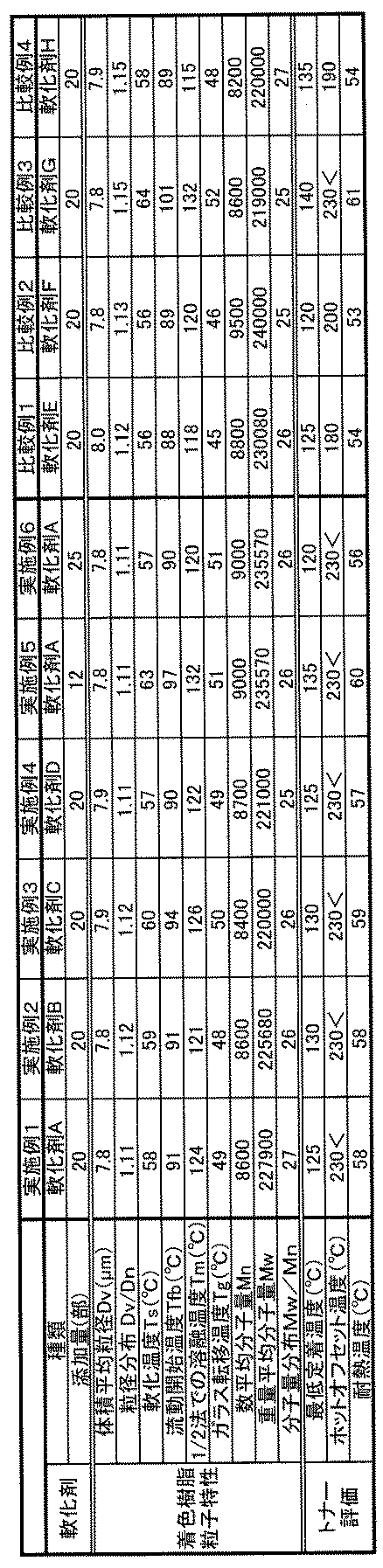
以下、表1及び表2を参照しながら、トナー評価について検討する。
まず、比較例1のトナーについて検討する。表1及び表2より、比較例1のトナーは、ステアリン酸ベヘニル1(90質量%)及びミリスチン酸ベヘニル(10質量%)を含む軟化剤Eを20部含有する。表1より、軟化剤Eの融点は63℃、酸価は0.1mgKOH/g、水酸基価は1.5mgKOH/gである。
表2より、比較例1のトナーは、最低定着温度が125℃である。したがって、比較例1のトナーについては、少なくとも低温定着性に問題は見られない。
しかし、比較例1のトナーは、ホットオフセット温度が180℃と低く、耐熱温度が54℃と低い。特に、比較例1のホットオフセット温度は、今回評価したトナー中、最も低い。
以上より、ステアリン酸ベヘニル1(モノエステル化合物A)を95質量%よりも少なく含み、さらに脂肪酸側R3の炭素数が15未満であるミリスチン酸ベヘニルを含む軟化剤Eを用いた比較例1のトナーは、耐ホットオフセット性に劣り、耐熱保存性にも乏しいことが分かる。
表2より、比較例2のトナーは、最低定着温度が120℃である。したがって、比較例2のトナーについては、少なくとも低温定着性に問題は見られない。
しかし、比較例2のトナーは、ホットオフセット温度が200℃と低く、耐熱温度が53℃と低い。特に、比較例2の耐熱温度は、今回評価したトナー中、最も低い。
以上より、脂肪酸側R1の炭素数とアルコール側R2の炭素数との和が39未満であるステアリン酸ステアリルを95質量%以上含み、且つ、脂肪酸側R3の炭素数とアルコール側R4の炭素数との和が35未満であるパルミチン酸ステアリルを5質量%以下含む軟化剤Fを用いた比較例2のトナーは、耐ホットオフセット性に劣り、耐熱保存性に乏しいことが分かる。
表2より、比較例3のトナーは、ホットオフセット温度が230℃を超え、耐熱温度が61℃である。したがって、比較例3のトナーについては、少なくとも耐ホットオフセット性及び耐熱保存性に問題は見られない。
しかし、比較例3のトナーは、最低定着温度が140℃と高い。比較例3の最低定着温度は、今回評価したトナー中、最も高い。
以上より、脂肪酸側R1の炭素数とアルコール側R2の炭素数との和が39を超えるエイコサン酸ベヘニルを95質量%以上含み、且つ、脂肪酸側R3の炭素数とアルコール側R4の炭素数との和が37を超えるステアリン酸ベヘニル1を5質量%以下含む軟化剤Gを用いた比較例3のトナーは、低温定着性に劣ることが分かる。
表2より、比較例4のトナーは、最低定着温度が135℃である。したがって、比較例4のトナーについては、少なくとも低温定着性に問題は見られない。
しかし、比較例4のトナーは、ホットオフセット温度が190℃と低く、耐熱温度が54℃と低い。
以上より、アルコール側R2の炭素数が22を超えるパルミチン酸テトラコシルを含む軟化剤Hを用いた比較例4のトナーは、耐ホットオフセット性及び耐熱保存性に劣ることが分かる。
表2より、実施例1~実施例6のトナーは、最低定着温度が135℃以下と低く、ホットオフセット温度がいずれも230℃を超え、耐熱温度が56℃以上と高い。
したがって、軟化剤として、上記式(1)の構造を有するモノエステル化合物Aを95~99質量%の割合で、上記式(2)の構造を有するモノエステル化合物Bを1~5質量%の割合で、それぞれ含有し、且つ、結着樹脂100質量部に対して、軟化剤を10~30質量部含有する本発明のトナーは、耐熱保存性と低温定着性のバランスに優れ、且つ耐ホットオフセット性に優れることが分かる。
表2より、実施例5のトナーは、実施例1のトナーと比較して、耐熱保存性にやや優れるが、低温定着性にやや劣る。また、実施例6のトナーは、実施例1のトナーと比較して、低温定着性にやや優れるが、耐熱保存性にやや劣る。
以上の結果から、軟化剤の添加量が多いほど、低温定着性にやや優れるが耐熱保存性にやや劣ることになり、その逆として、軟化剤の添加量が少ないほど、耐熱保存性にやや優れる一方、低温定着性にやや劣ると推測される。
Claims (3)
- 結着樹脂、着色剤、及び軟化剤を含有する着色樹脂粒子、並びに外添剤を含有する静電荷像現像用トナーにおいて、
前記軟化剤として、下記式(1)の構造を有するモノエステル化合物Aを95~99質量%の割合で、下記式(2)の構造を有するモノエステル化合物Bを1~5質量%の割合で、それぞれ含有し、且つ、
結着樹脂100質量部に対して、前記軟化剤を10~30質量部含有することを特徴とする静電荷像現像用トナー。
R1-COO-R2 式(1)
(上記式(1)中、R1は炭素数17~23の直鎖アルキル基を示し、R2は炭素数16~22の直鎖アルキル基を示し、さらに、R1とR2との合計炭素数が39である。)
R3-COO-R4 式(2)
(上記式(2)中、R3は炭素数15~21の直鎖アルキル基を示し、R4は炭素数16~22の直鎖アルキル基を示し、さらに、R3とR4との合計炭素数が35~37である。) - 前記軟化剤の融点が60~75℃であることを特徴とする請求項1に記載の静電荷像現像用トナー。
- 前記軟化剤の酸価が1.0mgKOH/g以下であり、且つ、前記軟化剤の水酸基価が10mgKOH/g以下であることを特徴とする請求項1又は2に記載の静電荷像現像用トナー。
Priority Applications (4)
| Application Number | Priority Date | Filing Date | Title |
|---|---|---|---|
| CN201480017934.4A CN105283808B (zh) | 2013-03-27 | 2014-03-26 | 静电荷图像显像用调色剂 |
| US14/779,367 US10503089B2 (en) | 2013-03-27 | 2014-03-26 | Toner for developing electrostatic images |
| JP2015508639A JP6250637B2 (ja) | 2013-03-27 | 2014-03-26 | 静電荷像現像用トナー |
| EP14773117.8A EP2980648B1 (en) | 2013-03-27 | 2014-03-26 | Toner for development of electrostatic charge image |
Applications Claiming Priority (2)
| Application Number | Priority Date | Filing Date | Title |
|---|---|---|---|
| JP2013-066398 | 2013-03-27 | ||
| JP2013066398 | 2013-03-27 |
Publications (1)
| Publication Number | Publication Date |
|---|---|
| WO2014157424A1 true WO2014157424A1 (ja) | 2014-10-02 |
Family
ID=51624387
Family Applications (1)
| Application Number | Title | Priority Date | Filing Date |
|---|---|---|---|
| PCT/JP2014/058695 Ceased WO2014157424A1 (ja) | 2013-03-27 | 2014-03-26 | 静電荷像現像用トナー |
Country Status (5)
| Country | Link |
|---|---|
| US (1) | US10503089B2 (ja) |
| EP (1) | EP2980648B1 (ja) |
| JP (1) | JP6250637B2 (ja) |
| CN (1) | CN105283808B (ja) |
| WO (1) | WO2014157424A1 (ja) |
Cited By (8)
| Publication number | Priority date | Publication date | Assignee | Title |
|---|---|---|---|---|
| JP2017167524A (ja) * | 2016-03-11 | 2017-09-21 | 株式会社リコー | トナー用エステルワックス、並びにそれを用いたトナー、現像剤、トナー収容ユニット及び画像形成装置 |
| JP2019120861A (ja) * | 2018-01-10 | 2019-07-22 | 京セラドキュメントソリューションズ株式会社 | トナー |
| JP2019168713A (ja) * | 2015-09-29 | 2019-10-03 | 日本ゼオン株式会社 | 負帯電性トナーの製造方法 |
| WO2020075660A1 (ja) | 2018-10-10 | 2020-04-16 | 日本ゼオン株式会社 | 静電荷像現像用トナー用ワックス、及びこれを含む静電荷像現像用トナー |
| EP3828633A1 (en) | 2019-11-29 | 2021-06-02 | Canon Kabushiki Kaisha | Image forming apparatus and process cartridge |
| JP2023001021A (ja) * | 2021-06-18 | 2023-01-04 | 三洋化成工業株式会社 | 樹脂粒子の製造方法 |
| US11614687B2 (en) | 2019-11-29 | 2023-03-28 | Canon Kabushiki Kaisha | Image forming apparatus and image forming method |
| JP2023121292A (ja) * | 2022-02-21 | 2023-08-31 | 日油株式会社 | トナー用ワックス組成物 |
Families Citing this family (3)
| Publication number | Priority date | Publication date | Assignee | Title |
|---|---|---|---|---|
| JP6733453B2 (ja) * | 2016-09-21 | 2020-07-29 | コニカミノルタ株式会社 | 静電荷像現像用トナー |
| JP7350638B2 (ja) * | 2019-11-29 | 2023-09-26 | キヤノン株式会社 | 画像形成装置、及び画像形成方法 |
| JP7495827B2 (ja) * | 2020-06-19 | 2024-06-05 | 東芝テック株式会社 | トナー、トナーカートリッジ、画像形成装置 |
Citations (11)
| Publication number | Priority date | Publication date | Assignee | Title |
|---|---|---|---|---|
| JPH0850368A (ja) | 1994-05-31 | 1996-02-20 | Canon Inc | 静電荷像現像用トナー及び画像形成方法 |
| JPH0850367A (ja) * | 1994-06-02 | 1996-02-20 | Canon Inc | 静電荷像現像用トナー |
| JP2005215256A (ja) * | 2004-01-29 | 2005-08-11 | Konica Minolta Business Technologies Inc | 電子写真印刷物及び画像形成方法 |
| JP2007206179A (ja) | 2006-01-31 | 2007-08-16 | Konica Minolta Business Technologies Inc | トナー |
| JP2011138120A (ja) | 2009-12-04 | 2011-07-14 | Sanyo Chem Ind Ltd | トナー |
| JP2012018249A (ja) | 2010-07-07 | 2012-01-26 | Ricoh Co Ltd | トナー、現像剤、現像剤入り容器、プロセスカートリッジ及び画像形成方法、画像形成装置 |
| JP2012078809A (ja) | 2010-09-08 | 2012-04-19 | Canon Inc | トナー |
| JP2013015673A (ja) * | 2011-07-04 | 2013-01-24 | Ricoh Co Ltd | トナー、並びに現像剤、画像形成装置及び画像形成方法 |
| JP2013047702A (ja) * | 2010-08-31 | 2013-03-07 | Ricoh Co Ltd | トナー、トナーの製造方法、及び画像形成方法 |
| JP2013148862A (ja) * | 2011-12-20 | 2013-08-01 | Ricoh Co Ltd | トナー、現像剤、及び画像形成装置 |
| JP2013160809A (ja) * | 2012-02-01 | 2013-08-19 | Ricoh Co Ltd | トナー、現像剤、及び画像形成装置 |
Family Cites Families (6)
| Publication number | Priority date | Publication date | Assignee | Title |
|---|---|---|---|---|
| SG49550A1 (en) | 1994-05-31 | 1998-06-15 | Canon Kk | Toner for developing electrostatic images and image forming method |
| JP3308812B2 (ja) * | 1995-05-31 | 2002-07-29 | キヤノン株式会社 | 静電荷像現像用トナー及びその製造方法 |
| DE10302271B4 (de) * | 2003-01-22 | 2014-06-18 | Sms Siemag Aktiengesellschaft | Einbaustück zur Aufnahme eines Walzenzapfens |
| CN1938649B (zh) * | 2004-02-03 | 2012-10-24 | 株式会社理光 | 调色剂、显影剂、调色剂盛放容器、处理盒、图像形成装置及图像形成方法 |
| US7507514B2 (en) * | 2004-06-09 | 2009-03-24 | Konica Minolta Business Technologies, Inc. | Toner and manufacturing method of the same |
| US20110281210A1 (en) * | 2010-05-11 | 2011-11-17 | Toshiba Tec Kabushiki Kaisha | Developing agent |
-
2014
- 2014-03-26 US US14/779,367 patent/US10503089B2/en active Active
- 2014-03-26 JP JP2015508639A patent/JP6250637B2/ja active Active
- 2014-03-26 CN CN201480017934.4A patent/CN105283808B/zh active Active
- 2014-03-26 EP EP14773117.8A patent/EP2980648B1/en active Active
- 2014-03-26 WO PCT/JP2014/058695 patent/WO2014157424A1/ja not_active Ceased
Patent Citations (11)
| Publication number | Priority date | Publication date | Assignee | Title |
|---|---|---|---|---|
| JPH0850368A (ja) | 1994-05-31 | 1996-02-20 | Canon Inc | 静電荷像現像用トナー及び画像形成方法 |
| JPH0850367A (ja) * | 1994-06-02 | 1996-02-20 | Canon Inc | 静電荷像現像用トナー |
| JP2005215256A (ja) * | 2004-01-29 | 2005-08-11 | Konica Minolta Business Technologies Inc | 電子写真印刷物及び画像形成方法 |
| JP2007206179A (ja) | 2006-01-31 | 2007-08-16 | Konica Minolta Business Technologies Inc | トナー |
| JP2011138120A (ja) | 2009-12-04 | 2011-07-14 | Sanyo Chem Ind Ltd | トナー |
| JP2012018249A (ja) | 2010-07-07 | 2012-01-26 | Ricoh Co Ltd | トナー、現像剤、現像剤入り容器、プロセスカートリッジ及び画像形成方法、画像形成装置 |
| JP2013047702A (ja) * | 2010-08-31 | 2013-03-07 | Ricoh Co Ltd | トナー、トナーの製造方法、及び画像形成方法 |
| JP2012078809A (ja) | 2010-09-08 | 2012-04-19 | Canon Inc | トナー |
| JP2013015673A (ja) * | 2011-07-04 | 2013-01-24 | Ricoh Co Ltd | トナー、並びに現像剤、画像形成装置及び画像形成方法 |
| JP2013148862A (ja) * | 2011-12-20 | 2013-08-01 | Ricoh Co Ltd | トナー、現像剤、及び画像形成装置 |
| JP2013160809A (ja) * | 2012-02-01 | 2013-08-19 | Ricoh Co Ltd | トナー、現像剤、及び画像形成装置 |
Non-Patent Citations (1)
| Title |
|---|
| See also references of EP2980648A4 |
Cited By (12)
| Publication number | Priority date | Publication date | Assignee | Title |
|---|---|---|---|---|
| JP2019168713A (ja) * | 2015-09-29 | 2019-10-03 | 日本ゼオン株式会社 | 負帯電性トナーの製造方法 |
| JP2017167524A (ja) * | 2016-03-11 | 2017-09-21 | 株式会社リコー | トナー用エステルワックス、並びにそれを用いたトナー、現像剤、トナー収容ユニット及び画像形成装置 |
| JP2019120861A (ja) * | 2018-01-10 | 2019-07-22 | 京セラドキュメントソリューションズ株式会社 | トナー |
| WO2020075660A1 (ja) | 2018-10-10 | 2020-04-16 | 日本ゼオン株式会社 | 静電荷像現像用トナー用ワックス、及びこれを含む静電荷像現像用トナー |
| US11754936B2 (en) | 2018-10-10 | 2023-09-12 | Zeon Corporation | Wax for toners for developing electrostatic images, and toner for developing electrostatic images containing the wax |
| EP3828633A1 (en) | 2019-11-29 | 2021-06-02 | Canon Kabushiki Kaisha | Image forming apparatus and process cartridge |
| US11409233B2 (en) | 2019-11-29 | 2022-08-09 | Canon Kabushiki Kaisha | Image forming apparatus and process cartridge |
| US11614687B2 (en) | 2019-11-29 | 2023-03-28 | Canon Kabushiki Kaisha | Image forming apparatus and image forming method |
| JP2023001021A (ja) * | 2021-06-18 | 2023-01-04 | 三洋化成工業株式会社 | 樹脂粒子の製造方法 |
| JP7538831B2 (ja) | 2021-06-18 | 2024-08-22 | 三洋化成工業株式会社 | 樹脂粒子の製造方法 |
| JP2023121292A (ja) * | 2022-02-21 | 2023-08-31 | 日油株式会社 | トナー用ワックス組成物 |
| JP7726091B2 (ja) | 2022-02-21 | 2025-08-20 | 日油株式会社 | トナー用ワックス組成物 |
Also Published As
| Publication number | Publication date |
|---|---|
| CN105283808B (zh) | 2019-08-20 |
| EP2980648A1 (en) | 2016-02-03 |
| US10503089B2 (en) | 2019-12-10 |
| JPWO2014157424A1 (ja) | 2017-02-16 |
| US20160048090A1 (en) | 2016-02-18 |
| JP6250637B2 (ja) | 2017-12-20 |
| EP2980648A4 (en) | 2017-03-01 |
| CN105283808A (zh) | 2016-01-27 |
| EP2980648B1 (en) | 2017-10-18 |
Similar Documents
| Publication | Publication Date | Title |
|---|---|---|
| JP6020458B2 (ja) | 静電荷像現像用トナー | |
| JP6250637B2 (ja) | 静電荷像現像用トナー | |
| JP5598640B1 (ja) | 静電荷像現像用トナー | |
| WO2018181189A1 (ja) | マゼンタトナー | |
| JP6413826B2 (ja) | トナー | |
| JP2019070835A (ja) | 負帯電性トナー及びその製造方法 | |
| JP5549579B2 (ja) | シアントナー | |
| JP5845570B2 (ja) | 静電荷像現像用トナー及びその製造方法 | |
| CN110945438B (zh) | 静电图像显影用调色剂 | |
| JP6965875B2 (ja) | 正帯電性ブラックトナー | |
| JP7308222B2 (ja) | 静電荷像現像用トナー用ワックス、及びこれを含む静電荷像現像用トナー | |
| JP7183679B2 (ja) | 重合トナーの製造方法 | |
| JP2023125146A (ja) | トナー | |
| JP6269653B2 (ja) | イエロートナーの製造方法 |
Legal Events
| Date | Code | Title | Description |
|---|---|---|---|
| WWE | Wipo information: entry into national phase |
Ref document number: 201480017934.4 Country of ref document: CN |
|
| 121 | Ep: the epo has been informed by wipo that ep was designated in this application |
Ref document number: 14773117 Country of ref document: EP Kind code of ref document: A1 |
|
| ENP | Entry into the national phase |
Ref document number: 2015508639 Country of ref document: JP Kind code of ref document: A |
|
| REEP | Request for entry into the european phase |
Ref document number: 2014773117 Country of ref document: EP |
|
| WWE | Wipo information: entry into national phase |
Ref document number: 2014773117 Country of ref document: EP |
|
| WWE | Wipo information: entry into national phase |
Ref document number: 14779367 Country of ref document: US |
|
| NENP | Non-entry into the national phase |
Ref country code: DE |