WO2014159952A1 - Grafted polyethylene - Google Patents
Grafted polyethylene Download PDFInfo
- Publication number
- WO2014159952A1 WO2014159952A1 PCT/US2014/025513 US2014025513W WO2014159952A1 WO 2014159952 A1 WO2014159952 A1 WO 2014159952A1 US 2014025513 W US2014025513 W US 2014025513W WO 2014159952 A1 WO2014159952 A1 WO 2014159952A1
- Authority
- WO
- WIPO (PCT)
- Prior art keywords
- polyethylene
- wax
- grafted
- oligomeric
- flow index
- Prior art date
- Legal status (The legal status is an assumption and is not a legal conclusion. Google has not performed a legal analysis and makes no representation as to the accuracy of the status listed.)
- Ceased
Links
Classifications
-
- C—CHEMISTRY; METALLURGY
- C08—ORGANIC MACROMOLECULAR COMPOUNDS; THEIR PREPARATION OR CHEMICAL WORKING-UP; COMPOSITIONS BASED THEREON
- C08L—COMPOSITIONS OF MACROMOLECULAR COMPOUNDS
- C08L91/00—Compositions of oils, fats or waxes; Compositions of derivatives thereof
- C08L91/06—Waxes
-
- C—CHEMISTRY; METALLURGY
- C08—ORGANIC MACROMOLECULAR COMPOUNDS; THEIR PREPARATION OR CHEMICAL WORKING-UP; COMPOSITIONS BASED THEREON
- C08F—MACROMOLECULAR COMPOUNDS OBTAINED BY REACTIONS ONLY INVOLVING CARBON-TO-CARBON UNSATURATED BONDS
- C08F255/00—Macromolecular compounds obtained by polymerising monomers on to polymers of hydrocarbons as defined in group C08F10/00
- C08F255/02—Macromolecular compounds obtained by polymerising monomers on to polymers of hydrocarbons as defined in group C08F10/00 on to polymers of olefins having two or three carbon atoms
-
- C—CHEMISTRY; METALLURGY
- C08—ORGANIC MACROMOLECULAR COMPOUNDS; THEIR PREPARATION OR CHEMICAL WORKING-UP; COMPOSITIONS BASED THEREON
- C08L—COMPOSITIONS OF MACROMOLECULAR COMPOUNDS
- C08L51/00—Compositions of graft polymers in which the grafted component is obtained by reactions only involving carbon-to-carbon unsaturated bonds; Compositions of derivatives of such polymers
- C08L51/06—Compositions of graft polymers in which the grafted component is obtained by reactions only involving carbon-to-carbon unsaturated bonds; Compositions of derivatives of such polymers grafted on to homopolymers or copolymers of aliphatic hydrocarbons containing only one carbon-to-carbon double bond
Definitions
- This disclosure is related to the modification of the rheological properties of polyethylene or polyethylene copolymers.
- Polyolefins are commonly modified by reactive extrusion. The modification is often desirable in order to facilitate the blending of the generally incompatible polyolefins with other polymers.
- Reactive extrusion functionalizes the polyolefins and thus is a method typically employed to overcome their incompatibility issue with other polymers.
- Most polyolefins, such as polypropylene, upon grafting have desirable functional rheological properties that permit secondary manipulation or formation of a desired end product.
- the rheological properties of polyethylene or polyethylene copolymers generally change to a less desirable state.
- One characteristic of grafted polyethylene polymers and copolymers is that their melt flow index decreases upon grafting when compared to the polymer in the ungrafted state.
- grafted polyethylene polymers or polyethylene copolymers that have enhanced rheological properties.
- One particular convention for measuring rheological properties of a polymeric melt is the melt flow index, as specified under ASTM D1238.
- the grafted polyethylene polymers or polyethylene copolymers, produced in accordance with this disclosure exhibit melt flow indices ("MFI") of at least 50% greater when compared to the functionalized polyethylene copolymer produced in the absence of an oligomeric or polymeric wax.
- rheological properties include melt viscosity, melt transition temperature (T m ), glass transition temperature (T g ), and the storage modulus (G') and/or loss modulus (G") at a specified temperature or shear rate.
- the grafted polyethylene polymers and copolymers are suitable for various applications such as compatibilizers, coupling agents, viscosity modifiers, surface modifiers, lubricants, impact modifiers and tie-layers.
- the grafted polyethylene polymers have specific application as coupling agents for glass, mineral or natural fiber filled polyolefms. By controlling or tailoring the rheology of the grafted polyethylene, it is possible to improve the effectiveness and performance in such composite systems. In one embodiment, it is desirable to increase the melt flow index and subsequent flow properties of the grafted polyethylene polymer to improve the likelihood of successful interfacial bonding during melt processing of the composite system.
- Enhanced or improved rheological properties of polyethylene polymers or copolymers is contemplated by a melt processable polymeric composite derived from the combination of a polyethylene or polyethylene copolymer, an oligomeric or polymeric wax, a functionalized agent, and a free radical initiator. Melt processing the polyolefm or polyolefm copolymer with an oligomeric or polymeric wax, maleic anhydride, and a functionalized agent forms a grafted polyethlyene polymer or polyethylene copolymer with desirable and improved rheological properties.
- Polyethylene or polyethylene copolymers function as the host polymer and are a component of the melt processable composition subjected to the reactive extrusion process along with the other components.
- a wide variety of polyethylene polymers and copolymers conventionally available and suitable for melt processing are useful.
- the polyethylene or polyethylene copolymers may comprise from about 20% to about 90% by weight of the entire composition.
- a non-limiting example of a commercially available polymer includes Dowlex IP40, high density polyethylene from Dow Chemical Corporation, Midland, MI. Other conventional low density and linear low density polyethylene polymers or copolymers are suitable as well.
- the polyethylene or polyethylene copolymers may comprise from about 20% to about 90% by weight of the entire composition.
- Oligomeric or polymeric waxes are generally those low molecular weight waxes that have a weight average molecular weight of less than 50,000 g/mol, and are compatible with the polyethylene matrix during melt processing.
- the low molecular weight wax has a weight average molecular weight of less than 20,000 g/mol. In most preferred embodiments, the low molecular weight wax has a weight average molecular weight of less than 10,000 g/mol.
- Non- limiting examples of oligomeric and polymeric waxes include, polyethylene waxes, polypropylene waxes, triglyceride waxes, diglyceride waxes, monoglyceride waxes, fatty acid waxes, fatty amide waxes, and metal stearates.
- the amount of oligomeric or polymeric wax present in the melt processable composition is dependent upon several variables, such as for example, the polyethylene polymer or copolymer, the type of functionalizing agent, the type of melt processing equipment, the processing conditions, and others. Those of ordinary skill in the art with knowledge of this disclosure are capable of selecting an appropriate amount of oligomeric or polymeric wax to achieve the desired result.
- the oligomeric or polymeric wax is used at 0.01 to 80 wt% by weight of the melt processable composition. In other embodiments, the oligomeric or polymeric wax is used at 1.0 to 50 wt% by weight of the melt processable composition.
- Functionalizing agents enable the incorporation of a reactive moiety onto the backbone of the polyethylene polymers and polyethylene copolymers.
- the resulting functionalized polyethylene polymer or copolymer can have utility as an interfacial modifier (e.g., compatibilizer, coupling agent, surface modifier, tie-layer).
- the grafting process that takes place in the melt is accomplished by free radical grafting of an unsaturated polar monomer or functionalizing agent onto the polyethylene polymer or copolymer.
- functionalized agents include ethylenically unsaturated monomers having a reactive group. Examples include functionalized acrylates, methacrylates, stryenics, dienes and olefins.
- the reactive group may be any electrophilic or nucleophilic reactive moiety.
- Non-limiting examples of reactive groups include: amines, amides, esters, carboxylic acids, carboxylic acid halides, anhydrides, imides, alcohols, isocyanates, oxazolines, epoxides and silanes.
- the functionalizing agents may be included in the melt processable composition in amounts ranging from about 0.1% to about 10% by weight. In certain embodiments, the functionalized agent may be included at about 0.5%> to about 5%> by weight.
- a free radical initiator is a species that, when melt processed, forms reactive free radical moieties that influence the grafting process in the extruder.
- Free radical initiators useful in the grafting process include organic peroxides and diazocompounds.
- Non- limiting examples of specific free radical initiators include: benzoyl peroxide, dicumyl peroxide, di-tert-butyl peroxide and azoisobutrylnitrile.
- the free radical initiator may be included in the melt processable composition at amounts less than 1% by weight.
- the melt processable composition can be prepared by any of a variety of ways.
- the polyethylene polymers and polyethylene copolymers, the oligomeric or polymeric wax, and the functionalized agent can be combined together by any of the blending means usually employed in the plastics industry.
- Melt-processing typically is performed at a temperature from 120° to 300° C, although optimum operating temperatures are selected depending upon the melting point, melt viscosity, and thermal stability of the composition.
- Different types of melt processing equipment, such as extruders may be used to process the melt processable compositions of this invention.
- an extruder is utilized to enable a reactive extrusion of the components.
- Those of ordinary skill in the art in polymer processing are able to select appropriate operating conditions based upon the specific materials utilized for forming the grafted polyethylene or polyethylene copolymer.
- the melt processing and reactive extrusion is performed in a twin screw extruder.
- the reactive extrusion is performed in a co- rotating, segmented twin screw extruder.
- the length: diameter of the twin screw extruder is at least 32: 1.
- the length: diameter of the twin screw extruder is at least 40: 1.
- the resulting grafted polyethylene or polyethylene copolymers possess desirable rheological characteristics.
- grafted polyethylene polymers and polyethylene copolymers made in accordance with this disclosure can exhibit enhanced or improved melt flow indices as measured in accordance with ASTM D1238.
- the grafted polyolefin or polyethylene copolymer has a melt flow index value according to ASTM D1238 of at least 50% greater value than the melt flow index of a grafted polyethylene or polyethylene copolymer produced in the absence of the oligomeric or polymeric wax.
- the melt flow index is at least 100% greater and may be at least 200% greater.
- rheological properties such as flexural strength, flexural modulus, tensile strength, tensile modulus, tensile elongation, moisture resistance and impact properties may be enhanced.
- the grafted polyethylene polymers and copolymers are suitable for various applications such as compatibilizers, coupling agents, viscosity modifiers, surface modifiers, lubricants, impact modifiers and tie-layers.
- Table 1 gives the formulations for comparative example CEl and Examples 1-2.
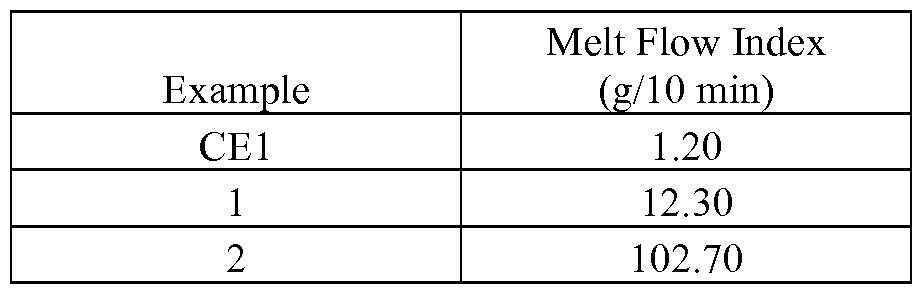
- Table 2 gives the properties for comparative example CEl and Examples 1-2.
- Table 1 Formulation for CEl and Examples 1-2
Landscapes
- Chemical & Material Sciences (AREA)
- Health & Medical Sciences (AREA)
- Chemical Kinetics & Catalysis (AREA)
- Medicinal Chemistry (AREA)
- Polymers & Plastics (AREA)
- Organic Chemistry (AREA)
- Oil, Petroleum & Natural Gas (AREA)
- Compositions Of Macromolecular Compounds (AREA)
- Graft Or Block Polymers (AREA)
- Addition Polymer Or Copolymer, Post-Treatments, Or Chemical Modifications (AREA)
Abstract
Grafted polyethylene polymers and copolymers are reactively extruded to achieve enhanced rheological properties. The utilization of an oligomeric or polymeric wax in the reactive extrusion process with functionalized agents, results in improved rheological characteristics of the grafted polymer.
Description
GRAFTED POLYETHYLENE
TECHNICAL FIELD
[0001] This disclosure is related to the modification of the rheological properties of polyethylene or polyethylene copolymers.
BACKGROUND
[0002] Polyolefins are commonly modified by reactive extrusion. The modification is often desirable in order to facilitate the blending of the generally incompatible polyolefins with other polymers. Reactive extrusion functionalizes the polyolefins and thus is a method typically employed to overcome their incompatibility issue with other polymers. Most polyolefins, such as polypropylene, upon grafting have desirable functional rheological properties that permit secondary manipulation or formation of a desired end product. However, the rheological properties of polyethylene or polyethylene copolymers generally change to a less desirable state. One characteristic of grafted polyethylene polymers and copolymers is that their melt flow index decreases upon grafting when compared to the polymer in the ungrafted state.
SUMMARY
[0003] In the grafting of functional monomers with polyethylene polymers and copolymers, it is generally recognized that the rheological properties of the resulting grafted polymers will not be in the most efficient or effective state for secondary processing. This disclosure is directed at the use of oligomeric or polymeric waxes incorporated into the reactive extrusion process for forming grafted polyethylene polymers and copolymers with enhanced rheological properties.
[0004] The utilization of an oligomeric or polymeric wax during the reactive extrusion of polyethylene polymers or polyethylene copolymers, functionalizing agents, and free radical initiators during reactive extrusion practices results in grafted polyethylene polymers or polyethylene copolymers that have enhanced rheological properties. One
particular convention for measuring rheological properties of a polymeric melt is the melt flow index, as specified under ASTM D1238. In certain embodiments, the grafted polyethylene polymers or polyethylene copolymers, produced in accordance with this disclosure, exhibit melt flow indices ("MFI") of at least 50% greater when compared to the functionalized polyethylene copolymer produced in the absence of an oligomeric or polymeric wax. Other non-limiting examples of rheological properties that may also be enhanced include melt viscosity, melt transition temperature (Tm), glass transition temperature (Tg), and the storage modulus (G') and/or loss modulus (G") at a specified temperature or shear rate.
[0005] The grafted polyethylene polymers and copolymers are suitable for various applications such as compatibilizers, coupling agents, viscosity modifiers, surface modifiers, lubricants, impact modifiers and tie-layers. The grafted polyethylene polymers have specific application as coupling agents for glass, mineral or natural fiber filled polyolefms. By controlling or tailoring the rheology of the grafted polyethylene, it is possible to improve the effectiveness and performance in such composite systems. In one embodiment, it is desirable to increase the melt flow index and subsequent flow properties of the grafted polyethylene polymer to improve the likelihood of successful interfacial bonding during melt processing of the composite system. In another embodiment, it is important to tailor the rheology of the grafted polyethylene polymer in order to match the rheology of the polymer matrix the additive is being blended into. In another embodiment, it is important to tailor the rheology of the grafted polyethylene polymer in a tie-layer application in order to match the rheology of other polymers being simultaneously coextruded with the grafted polyethylene polymer.
DETAILED DESCRIPTION
[0006] Enhanced or improved rheological properties of polyethylene polymers or copolymers is contemplated by a melt processable polymeric composite derived from the combination of a polyethylene or polyethylene copolymer, an oligomeric or polymeric wax, a functionalized agent, and a free radical initiator. Melt processing the polyolefm or polyolefm copolymer with an oligomeric or polymeric wax, maleic anhydride, and a
functionalized agent forms a grafted polyethlyene polymer or polyethylene copolymer with desirable and improved rheological properties.
[0007] Polyethylene or polyethylene copolymers function as the host polymer and are a component of the melt processable composition subjected to the reactive extrusion process along with the other components. A wide variety of polyethylene polymers and copolymers conventionally available and suitable for melt processing are useful. The polyethylene or polyethylene copolymers may comprise from about 20% to about 90% by weight of the entire composition. A non-limiting example of a commercially available polymer includes Dowlex IP40, high density polyethylene from Dow Chemical Corporation, Midland, MI. Other conventional low density and linear low density polyethylene polymers or copolymers are suitable as well. The polyethylene or polyethylene copolymers may comprise from about 20% to about 90% by weight of the entire composition.
[0008] Oligomeric or polymeric waxes are generally those low molecular weight waxes that have a weight average molecular weight of less than 50,000 g/mol, and are compatible with the polyethylene matrix during melt processing. In some embodiments, the low molecular weight wax has a weight average molecular weight of less than 20,000 g/mol. In most preferred embodiments, the low molecular weight wax has a weight average molecular weight of less than 10,000 g/mol. Non- limiting examples of oligomeric and polymeric waxes include, polyethylene waxes, polypropylene waxes, triglyceride waxes, diglyceride waxes, monoglyceride waxes, fatty acid waxes, fatty amide waxes, and metal stearates.
[0009] The amount of oligomeric or polymeric wax present in the melt processable composition is dependent upon several variables, such as for example, the polyethylene polymer or copolymer, the type of functionalizing agent, the type of melt processing equipment, the processing conditions, and others. Those of ordinary skill in the art with knowledge of this disclosure are capable of selecting an appropriate amount of oligomeric or polymeric wax to achieve the desired result. In certain embodiments, the oligomeric or polymeric wax is used at 0.01 to 80 wt% by weight of the melt processable composition.
In other embodiments, the oligomeric or polymeric wax is used at 1.0 to 50 wt% by weight of the melt processable composition.
[0010] Functionalizing agents enable the incorporation of a reactive moiety onto the backbone of the polyethylene polymers and polyethylene copolymers. The resulting functionalized polyethylene polymer or copolymer can have utility as an interfacial modifier (e.g., compatibilizer, coupling agent, surface modifier, tie-layer). The grafting process that takes place in the melt is accomplished by free radical grafting of an unsaturated polar monomer or functionalizing agent onto the polyethylene polymer or copolymer. Non-limiting examples of functionalized agents include ethylenically unsaturated monomers having a reactive group. Examples include functionalized acrylates, methacrylates, stryenics, dienes and olefins. The reactive group may be any electrophilic or nucleophilic reactive moiety. Non-limiting examples of reactive groups include: amines, amides, esters, carboxylic acids, carboxylic acid halides, anhydrides, imides, alcohols, isocyanates, oxazolines, epoxides and silanes. The functionalizing agents may be included in the melt processable composition in amounts ranging from about 0.1% to about 10% by weight. In certain embodiments, the functionalized agent may be included at about 0.5%> to about 5%> by weight.
[0011] A free radical initiator is a species that, when melt processed, forms reactive free radical moieties that influence the grafting process in the extruder. Free radical initiators useful in the grafting process include organic peroxides and diazocompounds. Non- limiting examples of specific free radical initiators include: benzoyl peroxide, dicumyl peroxide, di-tert-butyl peroxide and azoisobutrylnitrile. The free radical initiator may be included in the melt processable composition at amounts less than 1% by weight.
[0012] The melt processable composition can be prepared by any of a variety of ways. For example, the polyethylene polymers and polyethylene copolymers, the oligomeric or polymeric wax, and the functionalized agent can be combined together by any of the blending means usually employed in the plastics industry.
[0013] Melt-processing typically is performed at a temperature from 120° to 300° C, although optimum operating temperatures are selected depending upon the melting point, melt viscosity, and thermal stability of the composition. Different types of melt processing equipment, such as extruders, may be used to process the melt processable compositions of this invention. In one embodiment, an extruder is utilized to enable a reactive extrusion of the components. Those of ordinary skill in the art in polymer processing are able to select appropriate operating conditions based upon the specific materials utilized for forming the grafted polyethylene or polyethylene copolymer.
[0014] In some embodiments, the melt processing and reactive extrusion is performed in a twin screw extruder. In another embodiment, the reactive extrusion is performed in a co- rotating, segmented twin screw extruder. In such instances, it is preferable that the length: diameter of the twin screw extruder is at least 32: 1. In yet another embodiment, the length: diameter of the twin screw extruder is at least 40: 1. Those who are skilled in the art will recognize preferred screw designs and temperature profiles to achieve optimal reactive extrusion to produce the grafted polyethylene or polyethylene copolymers.
[0015] The resulting grafted polyethylene or polyethylene copolymers possess desirable rheological characteristics. For example, grafted polyethylene polymers and polyethylene copolymers made in accordance with this disclosure can exhibit enhanced or improved melt flow indices as measured in accordance with ASTM D1238. The grafted polyolefin or polyethylene copolymer has a melt flow index value according to ASTM D1238 of at least 50% greater value than the melt flow index of a grafted polyethylene or polyethylene copolymer produced in the absence of the oligomeric or polymeric wax. In certain embodiments, the melt flow index is at least 100% greater and may be at least 200% greater.
[0016] In other embodiments, rheological properties such as flexural strength, flexural modulus, tensile strength, tensile modulus, tensile elongation, moisture resistance and impact properties may be enhanced.
[0017] The grafted polyethylene polymers and copolymers are suitable for various applications such as compatibilizers, coupling agents, viscosity modifiers, surface modifiers, lubricants, impact modifiers and tie-layers.
[0018] EXAMPLES

[0019] Compounding Procedure for CEl and Examples 1-2
For Comparative Example CEl and examples 1-2, polyethylene resin, wax, maleic anhydride and DHBP were dry blended in a plastic bag and fed using a gravimetric feeder into a 26 mm co-rotating twin screw extruder (40: 1, L:D) fitted with a four strand die (commercially available from Lab Tech Engineering, Samutprakarn, Thailand). All samples were processed at 250 rpm screw speed using the following temperature profile: Zone 1-2 = 160 °C, Zone 3-4 = 190 °C, Zone 5-6 = 210 °C, Zone 7-8 = 190 °C, 9-10 = 180 °C Die = 170 °C. The resulting strands were subsequently continuously processed into a room temperature water bath and pelletized into 0.64 cm pellets. The resulting pellets were tested for melt flow index following ASTM D1238. The test was performed at 190 °C with a 2.2 Kg mass.
[0020] Table 1 gives the formulations for comparative example CEl and Examples 1-2. Table 2 gives the properties for comparative example CEl and Examples 1-2.
[0021] Table 1. Formulation for CEl and Examples 1-2

Table 2. Properties of Formulation CEl and Examples 1-2
Claims
1. A composition comprising a melt processable polymeric composite derived from the combination of
(i) a polyethylene or polyethylene copolymer,
(ii) an oligomeric or polymeric wax,
(iii) a functionalized agent, and
(iv) a free radical initiator.
2. A composition according to claim 1, wherein the free radical initiator includes organic peroxides or diazocompounds.
3. A composition according to claim 2, wherein the free radical initiator is one or more of a benzyl peroxide, dicumyl peroxide, di-tert-butyl peroxide or azoisobutrylnitrile.
4. A composition according to claim 1 wherein the oligomeric or polymeric wax is a polyethylene wax, polypropylene wax, triglyceride wax, diglyceride wax, monoglyceride wax, fatty acid wax, fatty amide wax, metal stearates or combinations thereof.
5. A composition according to claim 1, wherein the functionalized agent includes ethylenically unsaturated monomers having a reactive group.
6. A composition according to claim 1, wherein the functionalized agent includes functionalized acrylates, functionalized methacrylates, functionalized stryenics, functionalized dienes, functionalized olefins, or combinations thereof.
7. A composition according to claim 1, wherein the functionalized agent includes an electrophilic or nucleophilic reactive moiety selected from amines, amides, esters, carboxylic acids, carboxylic acid halides, anhydrides, imides, alcohols, isocyanates, oxazolines, epoxides and silanes.
8. A composition according to claim 1, wherein the melt processable polymeric composite has a melt flow index value according to ASTM D1238 of at least a 50% greater value
than the melt flow index of a grafted polyethylene or polyethylene copolymer produced in the absence of an oligomeric or polymeric wax.
9. A composition comprising a grafted polyethylene or polyethylene copolymer wherein the grafted polyolefm or polyethylene copolymer has a melt flow index value according to ASTM D1238 of at least 50% greater than the melt flow index value of a grafted polyethylene or polyethylene copolymer produced in the absence of an oligomeric or polymeric wax .
10. A composition according to claim 9, wherein the melt flow index is at least 100% greater value than the melt flow index of a polyethylene or polyethylene copolymer produced in the absence of the wax additive.
11. A method comprising melt processing a polyolefm or polyolefm copolymer with an oligomeric or polymeric wax, maleic anhydride, and a functionalized agent to form a grafted polyethlyene polymer or polyethylene copolymer.
12. A method according to claim 11, wherein the grafted polyethlyene polymer or polyethylene copolymer has a melt flow index value according to ASTM D1238 at least a 50% greater value than the melt flow index of the grafted polyethylene or polyethylene copolymer in the absence of an oligomeric or polymeric wax.
13. A method according to claim 12, wherein the melt flow index is at least twice the value of the polyethylene or polyethylene copolymer grafted in the absence of the oligomeric or polymeric wax.
Priority Applications (5)
| Application Number | Priority Date | Filing Date | Title |
|---|---|---|---|
| MX2015010664A MX2015010664A (en) | 2013-03-14 | 2014-03-13 | Grafted polyethylene. |
| CA2900301A CA2900301A1 (en) | 2013-03-14 | 2014-03-13 | Grafted polyethylene |
| EP14774108.6A EP2970545A4 (en) | 2013-03-14 | 2014-03-13 | Grafted polyethylene |
| US14/764,876 US20150376409A1 (en) | 2013-03-14 | 2014-03-13 | Grafted polyethylene |
| US15/678,913 US10745562B2 (en) | 2013-03-14 | 2017-08-16 | Grafted polyethylene |
Applications Claiming Priority (2)
| Application Number | Priority Date | Filing Date | Title |
|---|---|---|---|
| US201361783177P | 2013-03-14 | 2013-03-14 | |
| US61/783,177 | 2013-03-14 |
Related Child Applications (2)
| Application Number | Title | Priority Date | Filing Date |
|---|---|---|---|
| US14/764,876 A-371-Of-International US20150376409A1 (en) | 2013-03-14 | 2014-03-13 | Grafted polyethylene |
| US15/678,913 Continuation US10745562B2 (en) | 2013-03-14 | 2017-08-16 | Grafted polyethylene |
Publications (1)
| Publication Number | Publication Date |
|---|---|
| WO2014159952A1 true WO2014159952A1 (en) | 2014-10-02 |
Family
ID=51625299
Family Applications (1)
| Application Number | Title | Priority Date | Filing Date |
|---|---|---|---|
| PCT/US2014/025513 Ceased WO2014159952A1 (en) | 2013-03-14 | 2014-03-13 | Grafted polyethylene |
Country Status (5)
| Country | Link |
|---|---|
| US (2) | US20150376409A1 (en) |
| EP (1) | EP2970545A4 (en) |
| CA (1) | CA2900301A1 (en) |
| MX (1) | MX2015010664A (en) |
| WO (1) | WO2014159952A1 (en) |
Families Citing this family (3)
| Publication number | Priority date | Publication date | Assignee | Title |
|---|---|---|---|---|
| CN103732402B (en) * | 2011-06-14 | 2016-01-20 | 爱索尔包装有限公司 | Polypropylene homopolymer class laminar films and layered product thereof |
| CN106232646B (en) * | 2014-04-18 | 2018-11-20 | 日本A&L株式会社 | Graft copolymer and thermoplastic resin composition |
| CN111690285B (en) * | 2020-07-03 | 2022-07-12 | 江苏法迩蜡业有限公司 | PE wax applied to road marking paint, preparation method of PE wax and road marking paint |
Citations (4)
| Publication number | Priority date | Publication date | Assignee | Title |
|---|---|---|---|---|
| US20070129498A1 (en) * | 2005-12-07 | 2007-06-07 | Curry Christopher L | Systems and methods used for functionalization of polymeric material and polymeric materials prepared therefrom |
| JP2009120714A (en) * | 2007-11-14 | 2009-06-04 | Idemitsu Kosan Co Ltd | Composite resin pellet, molded product, and method of manufacturing composite resin pellet |
| US20100305259A1 (en) * | 2009-05-29 | 2010-12-02 | George Rodriguez | Polyolefin Adhesive Compositions And Method of Making Thereof |
| US20110111243A1 (en) * | 2008-04-28 | 2011-05-12 | Borealis Ag | Adhesive Propylene Polymer Composition Suitable for Extrusion Coating of Paper Substrates |
Family Cites Families (8)
| Publication number | Priority date | Publication date | Assignee | Title |
|---|---|---|---|---|
| US3243395A (en) * | 1960-12-28 | 1966-03-29 | Eastman Kodak Co | Poyethylene modified with polypropylene wax |
| JPH0678379B2 (en) | 1984-08-30 | 1994-10-05 | 三井石油化学工業株式会社 | Ultra high molecular weight crystalline polyethylene modified product and method for producing the same |
| CA1236613A (en) * | 1985-06-27 | 1988-05-10 | Chun S. Wong | Process for the grafting of monomers onto polyolefins |
| DE3869593D1 (en) * | 1988-01-21 | 1992-04-30 | Idemitsu Petrochemical Co | METHOD FOR PRODUCING MODIFIED POLYAETHYLENE. |
| US5310806A (en) * | 1991-05-22 | 1994-05-10 | Quantum Chemical Corporation | Process for preparing an ethylene-unsaturated polycarboxylic compound graft copolymer |
| AR012582A1 (en) * | 1997-04-14 | 2000-11-08 | Dow Global Technologies Inc | POLYMERIC COMPOSITIONS OF IMPROVED ELONGATION AND ADHESIVE FORMULATIONS OF HOT MELTING INCLUDING SUCH COMPOSITION |
| KR101105515B1 (en) * | 2003-12-22 | 2012-01-13 | 노바 케미칼즈 인코포레이팃드 | Interpolymer resin particles |
| CN102702436B (en) * | 2012-06-11 | 2014-05-07 | 上海清远管业科技有限公司 | Material special for buried plastic drainage pipeline and preparation method thereof |
-
2014
- 2014-03-13 EP EP14774108.6A patent/EP2970545A4/en not_active Withdrawn
- 2014-03-13 WO PCT/US2014/025513 patent/WO2014159952A1/en not_active Ceased
- 2014-03-13 CA CA2900301A patent/CA2900301A1/en not_active Abandoned
- 2014-03-13 MX MX2015010664A patent/MX2015010664A/en unknown
- 2014-03-13 US US14/764,876 patent/US20150376409A1/en not_active Abandoned
-
2017
- 2017-08-16 US US15/678,913 patent/US10745562B2/en active Active
Patent Citations (4)
| Publication number | Priority date | Publication date | Assignee | Title |
|---|---|---|---|---|
| US20070129498A1 (en) * | 2005-12-07 | 2007-06-07 | Curry Christopher L | Systems and methods used for functionalization of polymeric material and polymeric materials prepared therefrom |
| JP2009120714A (en) * | 2007-11-14 | 2009-06-04 | Idemitsu Kosan Co Ltd | Composite resin pellet, molded product, and method of manufacturing composite resin pellet |
| US20110111243A1 (en) * | 2008-04-28 | 2011-05-12 | Borealis Ag | Adhesive Propylene Polymer Composition Suitable for Extrusion Coating of Paper Substrates |
| US20100305259A1 (en) * | 2009-05-29 | 2010-12-02 | George Rodriguez | Polyolefin Adhesive Compositions And Method of Making Thereof |
Non-Patent Citations (1)
| Title |
|---|
| See also references of EP2970545A4 * |
Also Published As
| Publication number | Publication date |
|---|---|
| US20150376409A1 (en) | 2015-12-31 |
| US20180030275A1 (en) | 2018-02-01 |
| US10745562B2 (en) | 2020-08-18 |
| MX2015010664A (en) | 2016-07-06 |
| EP2970545A4 (en) | 2016-12-21 |
| EP2970545A1 (en) | 2016-01-20 |
| CA2900301A1 (en) | 2014-10-02 |
Similar Documents
| Publication | Publication Date | Title |
|---|---|---|
| US7402625B2 (en) | Compositions and method for improving the processing of polymer composites | |
| CA2290318C (en) | Crosslinked compositions containing silane-grafted polyolefins and polypropylene | |
| JPH08509772A (en) | Blends of graft-modified substantially linear ethylene polymers with other thermoplastic polymers | |
| EP1283243A1 (en) | Composition comprising polypropylene and an ethylene/alkylacrylate copolymer | |
| CA2626992A1 (en) | Pvc/wood composite | |
| US8236874B2 (en) | Compositions and method for improving the processing of polymer composites | |
| EP0169069B1 (en) | Polymer composition | |
| CA2695313A1 (en) | Moisture-crosslinked polyolefin compositions | |
| JP7358468B2 (en) | Polypropylene/polycarbonate alloy with high weld line strength and its manufacturing method | |
| WO2003099930A1 (en) | Toughened thermoplastic polyamide compositions | |
| US20090131594A1 (en) | Polypropylene composition with selective cross-linkable dispersed phase | |
| US10745562B2 (en) | Grafted polyethylene | |
| CN103897260A (en) | Blended composition of ethylene-ethylene vinyl-acetate copolymer (EVA) and polylactic acid (PLA) and molding product thereof | |
| JP4191610B2 (en) | Ionomer / high density polyethylene blend with improved flowability | |
| JPS6121148A (en) | Composition containing thermoplastic fluorine-containing resin | |
| JP6238793B2 (en) | Method for melt molding vinylidene fluoride resin | |
| JPS63305148A (en) | Glass fiber-reinforced polyamide composition | |
| JPH10506139A (en) | Halogen-free flexible thermoplastic polyolefin composition | |
| KR100574286B1 (en) | Heat Adhesive Polyolefin Resin Composition | |
| JP2009114402A (en) | Polyester resin composition for injection molding and molded article thereof | |
| JP6517068B2 (en) | Vinylidene fluoride-based resin composition and molded product, and method for producing them | |
| CN115151421A (en) | PVDF (polyvinylidene fluoride) extruding agent containing interface agent | |
| US12559590B2 (en) | Polymer compositions and polymeric plasticizer applications incorporating same | |
| WO2025080350A1 (en) | Polyolefin compositions | |
| WO2022162694A1 (en) | Graft copolymer and method of preparation thereof |
Legal Events
| Date | Code | Title | Description |
|---|---|---|---|
| 121 | Ep: the epo has been informed by wipo that ep was designated in this application |
Ref document number: 14774108 Country of ref document: EP Kind code of ref document: A1 |
|
| ENP | Entry into the national phase |
Ref document number: 2900301 Country of ref document: CA |
|
| WWE | Wipo information: entry into national phase |
Ref document number: MX/A/2015/010664 Country of ref document: MX |
|
| WWE | Wipo information: entry into national phase |
Ref document number: 2014774108 Country of ref document: EP |
|
| NENP | Non-entry into the national phase |
Ref country code: DE |