WO2014160351A1 - Food products prepared with soluble whole grain oat flour - Google Patents
Food products prepared with soluble whole grain oat flour Download PDFInfo
- Publication number
- WO2014160351A1 WO2014160351A1 PCT/US2014/026367 US2014026367W WO2014160351A1 WO 2014160351 A1 WO2014160351 A1 WO 2014160351A1 US 2014026367 W US2014026367 W US 2014026367W WO 2014160351 A1 WO2014160351 A1 WO 2014160351A1
- Authority
- WO
- WIPO (PCT)
- Prior art keywords
- oat flour
- beverage
- soluble
- soluble oat
- serving
- Prior art date
- Legal status (The legal status is an assumption and is not a legal conclusion. Google has not performed a legal analysis and makes no representation as to the accuracy of the status listed.)
- Ceased
Links
Classifications
-
- A—HUMAN NECESSITIES
- A21—BAKING; EDIBLE DOUGHS
- A21D—TREATMENT OF FLOUR OR DOUGH FOR BAKING, e.g. BY ADDITION OF MATERIALS; BAKING; BAKERY PRODUCTS
- A21D13/00—Finished or partly finished bakery products
- A21D13/04—Products made from materials other than rye or wheat flour
- A21D13/047—Products made from materials other than rye or wheat flour from cereals other than rye or wheat, e.g. rice
-
- A—HUMAN NECESSITIES
- A23—FOODS OR FOODSTUFFS; TREATMENT THEREOF, NOT COVERED BY OTHER CLASSES
- A23L—FOODS, FOODSTUFFS OR NON-ALCOHOLIC BEVERAGES, NOT OTHERWISE PROVIDED FOR; PREPARATION OR TREATMENT THEREOF
- A23L2/00—Non-alcoholic beverages; Dry compositions or concentrates therefor; Preparation or treatment thereof
- A23L2/52—Adding ingredients
-
- A—HUMAN NECESSITIES
- A21—BAKING; EDIBLE DOUGHS
- A21D—TREATMENT OF FLOUR OR DOUGH FOR BAKING, e.g. BY ADDITION OF MATERIALS; BAKING; BAKERY PRODUCTS
- A21D10/00—Batters, dough or mixtures before baking
- A21D10/002—Dough mixes; Baking or bread improvers; Premixes
- A21D10/005—Solid, dry or compact materials; Granules; Powders
-
- A—HUMAN NECESSITIES
- A21—BAKING; EDIBLE DOUGHS
- A21D—TREATMENT OF FLOUR OR DOUGH FOR BAKING, e.g. BY ADDITION OF MATERIALS; BAKING; BAKERY PRODUCTS
- A21D13/00—Finished or partly finished bakery products
- A21D13/02—Products made from whole meal; Products containing bran or rough-ground grain
-
- A—HUMAN NECESSITIES
- A21—BAKING; EDIBLE DOUGHS
- A21D—TREATMENT OF FLOUR OR DOUGH FOR BAKING, e.g. BY ADDITION OF MATERIALS; BAKING; BAKERY PRODUCTS
- A21D13/00—Finished or partly finished bakery products
- A21D13/04—Products made from materials other than rye or wheat flour
-
- A—HUMAN NECESSITIES
- A21—BAKING; EDIBLE DOUGHS
- A21D—TREATMENT OF FLOUR OR DOUGH FOR BAKING, e.g. BY ADDITION OF MATERIALS; BAKING; BAKERY PRODUCTS
- A21D13/00—Finished or partly finished bakery products
- A21D13/06—Products with modified nutritive value, e.g. with modified starch content
-
- A—HUMAN NECESSITIES
- A21—BAKING; EDIBLE DOUGHS
- A21D—TREATMENT OF FLOUR OR DOUGH FOR BAKING, e.g. BY ADDITION OF MATERIALS; BAKING; BAKERY PRODUCTS
- A21D13/00—Finished or partly finished bakery products
- A21D13/40—Products characterised by the type, form or use
-
- A—HUMAN NECESSITIES
- A21—BAKING; EDIBLE DOUGHS
- A21D—TREATMENT OF FLOUR OR DOUGH FOR BAKING, e.g. BY ADDITION OF MATERIALS; BAKING; BAKERY PRODUCTS
- A21D13/00—Finished or partly finished bakery products
- A21D13/40—Products characterised by the type, form or use
- A21D13/41—Pizzas
-
- A—HUMAN NECESSITIES
- A21—BAKING; EDIBLE DOUGHS
- A21D—TREATMENT OF FLOUR OR DOUGH FOR BAKING, e.g. BY ADDITION OF MATERIALS; BAKING; BAKERY PRODUCTS
- A21D13/00—Finished or partly finished bakery products
- A21D13/40—Products characterised by the type, form or use
- A21D13/44—Pancakes or crêpes
-
- A—HUMAN NECESSITIES
- A21—BAKING; EDIBLE DOUGHS
- A21D—TREATMENT OF FLOUR OR DOUGH FOR BAKING, e.g. BY ADDITION OF MATERIALS; BAKING; BAKERY PRODUCTS
- A21D2/00—Treatment of flour or dough by adding materials thereto before or during baking
- A21D2/08—Treatment of flour or dough by adding materials thereto before or during baking by adding organic substances
- A21D2/24—Organic nitrogen compounds
- A21D2/26—Proteins
- A21D2/264—Vegetable proteins
- A21D2/265—Vegetable proteins from cereals, flour, bran
-
- A—HUMAN NECESSITIES
- A23—FOODS OR FOODSTUFFS; TREATMENT THEREOF, NOT COVERED BY OTHER CLASSES
- A23L—FOODS, FOODSTUFFS OR NON-ALCOHOLIC BEVERAGES, NOT OTHERWISE PROVIDED FOR; PREPARATION OR TREATMENT THEREOF
- A23L2/00—Non-alcoholic beverages; Dry compositions or concentrates therefor; Preparation or treatment thereof
-
- A—HUMAN NECESSITIES
- A23—FOODS OR FOODSTUFFS; TREATMENT THEREOF, NOT COVERED BY OTHER CLASSES
- A23L—FOODS, FOODSTUFFS OR NON-ALCOHOLIC BEVERAGES, NOT OTHERWISE PROVIDED FOR; PREPARATION OR TREATMENT THEREOF
- A23L2/00—Non-alcoholic beverages; Dry compositions or concentrates therefor; Preparation or treatment thereof
- A23L2/385—Concentrates of non-alcoholic beverages
- A23L2/39—Dry compositions
-
- A—HUMAN NECESSITIES
- A23—FOODS OR FOODSTUFFS; TREATMENT THEREOF, NOT COVERED BY OTHER CLASSES
- A23L—FOODS, FOODSTUFFS OR NON-ALCOHOLIC BEVERAGES, NOT OTHERWISE PROVIDED FOR; PREPARATION OR TREATMENT THEREOF
- A23L23/00—Soups; Sauces; Preparation or treatment thereof
-
- A—HUMAN NECESSITIES
- A23—FOODS OR FOODSTUFFS; TREATMENT THEREOF, NOT COVERED BY OTHER CLASSES
- A23L—FOODS, FOODSTUFFS OR NON-ALCOHOLIC BEVERAGES, NOT OTHERWISE PROVIDED FOR; PREPARATION OR TREATMENT THEREOF
- A23L7/00—Cereal-derived products; Malt products; Preparation or treatment thereof
- A23L7/10—Cereal-derived products
-
- A—HUMAN NECESSITIES
- A23—FOODS OR FOODSTUFFS; TREATMENT THEREOF, NOT COVERED BY OTHER CLASSES
- A23L—FOODS, FOODSTUFFS OR NON-ALCOHOLIC BEVERAGES, NOT OTHERWISE PROVIDED FOR; PREPARATION OR TREATMENT THEREOF
- A23L7/00—Cereal-derived products; Malt products; Preparation or treatment thereof
- A23L7/10—Cereal-derived products
- A23L7/143—Cereal granules or flakes to be cooked and eaten hot, e.g. oatmeal; Reformed rice products
Definitions
- the present invention relates generally to food products prepared with whole oat flour having soluble components (hereinafter "soluble oat flour").
- oatmeal has a high content of complex carbohydrates and fibers, which facilitates slow digestion and stable blood-glucose levels.
- a whole oat product must have 0.75 g soluble beta-glucan fiber per serving of food to support a health claim.
- 1 full serving of whole grain is 16 g.
- aspects of the invention relate to food products containing highly dispersible, soluble whole oat flour.
- the soluble whole oat flour maintains its standard of identity as whole grain and thus has the characteristics of whole grain oats.
- aspects of the present invention relate to the use of the soluble oat flour in various food products including liquid food products such as beverages, semi-solid food products such as yogurt, and solid food products such as bakery items in order to provide enhanced health benefits.
- Figure 1 depicts a proximate composition of unprocessed and processed whole oat flour.
- Figure 2 depicts the viscosity of oat flour and soluble oat flour slurries after hydration.
- Figure 3 depicts the analysis of lipid oxidation product ("LOP”) in various hydration conditions for soluble oat flour.
- LOP lipid oxidation product
- Figure 4 is a photograph illustrating the amount of sedimentation observed when regular oat flour is mixed in cold water versus the soluble oat flour mixed with cold water.
- Figure 5 depicts viscosity of instant hot beverages containing unprocessed oat flour and soluble oat flour after the beverages cool down.
- Figure 6 depicts the viscosity of oat flour and soluble oat flour slurries after boiling in water for three (3) minutes.
- Figure 7 is a photograph illustrating the antifoaming properties observed when the soluble oat flour is included in a slushie.
- Figure 8 depicts the viscosities of a full fat dip, a 50% reduced fat dip, and a 50% reduced fat dip containing soluble oat flour.
- the present invention relates to products containing soluble whole oat flour.
- the soluble oat flour is prepared using an extruder or other suitable continuous cooker. The process is easier, less expensive, and less time-consuming than prior art processes.
- the process of preparing soluble oat flour is found in U.S. Patent Application No. 12/264,399 filed November 4, 2008 and issued as U.S. Patent No. 8,574,644 on November 5, 2013, the contents of which is expressly incorporated herein by reference in its entirety.
- the soluble whole oat flour (whole grain) made in accordance with the methods described herein maintains its standard of identity as whole grain throughout processing.
- "Whole grain” or “standard of identity as whole grain” shall mean that the cereal grain, in this instance, oat, "consists of the intact, ground cracked or flaked caryopsis, whole principal anatomical components - the starchy endosperm, germ and bran - are present in the same relative proportions as they exist in the intact caryopsis - should be considered a whole grain food.”
- the processed oat flour made in accordance with the instant disclosure maintains the same levels of starch, protein, fat, total dietary fiber (TDF), ⁇ glucan, sugar and maltose as the unprocessed oat flour.
- TDF total dietary fiber
- soluble oat flour or "soluble whole grain oat flour” refers to flour that maintains soluble components such as beta-glucan but also is highly dispersible in liquids such as water.
- the dispersibility of the flour was measured in water observing formation of a lump and size of the lumps on the top and bottom of the water after stirring for five (5) seconds. "Highly dispersible” therefore means that there are no lumps present or formed after stirring the mixture for about 5 seconds.
- stirring may also be substituted with shaking or some other specific movement to incorporate and mix the flour into the liquid.
- oat flour "regular oat flour”, “whole oat flour”, “typical oat flour”, and
- unprocessed oat flour refers to whole oat flour that is made by conventional or traditional milling methods and not "soluble oat flour” or oat flour made in accordance with the methods described herein.
- hot beverage or “hot comestible” shall mean a beverage or comestible that is typically served or consumed between about 55°C and 85°C.
- cold beverage or “cold comestible” as used herein shall refer to a beverage or comestible that is typically serve or consume between about 4°C and 25°C.
- the skilled food technician would recognize, however, that although the beverages and comestibles are intended to be consumed at the temperature ranges discussed above, the respective beverages and comestibles may be served and consumed at temperatures outside of these ranges based on consumer preference or circumstance.
- enzyme -treated oat flour is prepared by combining a whole oat flour starting mixture and a suitable enzyme solution in a mixer (sometimes called a pre-conditioner) and then heating the mixture.
- the enzyme-treated mixture is then subjected to an extrusion process to gelatinize, hydrolyze, and cook the oat flour mixture.
- a suitable starting mixture is prepared by combining the whole oat flour with other desired ingredients.
- a typical starting mixture contains whole oat flour and granulated sugar. Maltodextrin and/or at least one antioxidant may also be added.
- the whole oat flour is present in an amount of about 50% to about 100% by weight of the total weight of the starting composition. In further aspects, the whole oat flour is present in amounts of about 80 % to about 95 % by weight or about 90 % to about 95 % by weight.
- the sugar can be any suitable sugar known to those skilled in the art.
- Non-limiting examples of sugars include sucrose, fructose, dextrose, other sugars known in the art, and combinations thereof.
- the sugar is present in an amount of about 1% to about 15% by weight or about 3% to about 15% by weight of the total weight of the starting composition. In further aspects, the sugar is present in amounts of about 3% to about 7%) by weight.
- the maltodextrin may be present in an amount of about 0% to about 15% by weight of the total weight of the starting composition. In further aspects, the maltodextrin is present in amounts of about 3% to about 7% by weight.
- the antioxidant may be any suitable antioxidant such as mixed natural tocopherols or artificial antioxidant such as BHT and BHA.
- the antioxidant is present in an amount from 0.1 % to 2 % by weight. In further aspects, the antioxidant is present in amounts of about 0.25 % to about 0.75 % by weight.
- the enzyme may be any suitable enzyme to hydrolyze the starch in the oat flour and does not change or adversely affect the beta-glucan that is present in the oat flour. Suitable enzymes include a-amylase in the range of about 0.01-0.5%, for example about 0.1-0.2%). In one aspect of the present disclosure, the ⁇ -amylase used may be Validase 1000L having approximately 1,000,000 MWU/g (MWU - Modified Wohlgemuth Unit). Whether the beta-glucan has changed by the hydrolysis can be determined by any suitable method such as by analyzing the structure of the beta- glucan. This can be done by laser light scattering mass spectroscopy. The enzyme is added to water to form an enzyme water solution. Then the enzyme-water solution is combined with the starting mixture in the pre-conditioner.
- a-amylase in the range of about 0.01-0.5%, for example about 0.1-0.2%.
- the ⁇ -amylase used may be Validase 1000L having approximately 1,000,000 MWU
- the starting mixture and enzyme solution is heated to between about 120 °F and about
- the starting mixture and enzyme solution may be mixed in any suitable vessel such as a high speed mixer that permits liquid to be added to free-flowing flour.
- the output is a free-flowing wetted flour mixture having a moisture content of about 25 to about 40 %.
- the residence time is the time sufficient to obtain the desired result and typically 1 to 5 min.
- the enzyme -treated mixture is subsequently added to an extruder (continuous cooker) to gelatinize, hydrolyze, and cook the starch.
- the mixture resides in the extruder for a time sufficient to gelatinize and cook the starch, but not long enough to dextrinize or otherwise modify the starch to void the whole grain aspect, generally at least 1 minute, typically, about 1 to about 1.5 minutes, to form a dough.
- the material is heated from an initial inlet temperature to a final exit temperature in order to provide the energy for starch gelatinization.
- Starch gelatinization requires water and heat.
- the gelatinization temperature range for oats is 127 °F to 160 °F (53 - 71 °C). If the moisture is less than about 60% then higher temperatures are required.
- Heat may be applied through the extruder barrel wall such as with a jacket around the barrel through which a hot medium like steam, water or oil is circulated, or electric heaters imbedded in the barrel.
- a hot medium like steam, water or oil is circulated, or electric heaters imbedded in the barrel.
- the extrusion occurs at barrel temperatures between 140 °F and 350 °F, for example between 175 °F and 340 °F, more specifically about 180 °F-300 °F.
- Heat is also generated within the material by friction as it moves within the extruder by the dissipation of mechanical energy in the extruder, which is equal to the product of the viscosity and the shear rate squared for a Newtonian fluid. Shear is controlled by the design of the extruder screw(s) and the screw speed. Viscosity is a function of starch structure, temperature, moisture content, fat content and shear. The temperature of the dough increases in the extruder to approximately 212 °F and 300 °F.
- the process balances limiting the dough temperature to avoid too much cooked grain flavor and to keep the enzyme active.
- the process is balanced such that the dough temperature rises to a sufficient temperature to deactivate the enzyme.
- Such temperatures are at least 280 °F, generally 212 °F to 300 °F.
- a low shear extrusion process is characterized relative to high shear extrusion by high moisture and a low shear screw design versus low moisture and a high shear screw design.
- Any suitable extruder may be used including suitable single screw or twin screw extruders. Typical, but not limiting, screw speeds are 200-350 rpm.
- the resulting product may be pelletized using a forming extruder and dried, typically to about 1.5 to about 10%, for example 6.5 to 8.5%, moisture content.
- the pellets may be granulated to a max 5% through a US 40 screen.
- the particle size of the resulting granulated product is about 10-500 microns, for instance, about 1-450 microns, more particularly about 30-420 microns.
- Jet milling may be used to mill the pellets produced in accordance with aspects of the present disclosure. Jet milling creates ultrafme particles. In particular, jet milling reduces the particle size of the pelletized soluble oat flour to less than about 90 micron, for example, less than about 50 microns, such as about 46 microns. As one of ordinary skill in the art would recognize, alternative milling processes can be used to reduce the particle size or micronize the flour to, 0.5 - 50 microns, such as between 10 to 50 microns.
- the resulting soluble oat flour includes beta glucan soluble fiber, such as beta-1, 3- glucan, beta-1, 6-glucan, or beta-1, 4-glucan or mixtures thereof.
- beta glucan may also be added as approved by the FDA.
- the oat flour preferably contains at least about 3% to 5% or about 3.7% to 4% beta glucan.
- the oat flour containing liquid, semi-solid, or solid product contains 0.1 % to about 1.5% beta glucan, or about 0.8% to 1.3% beta glucan. Other amounts of beta glucan are also useful.
- the soluble oat flour disperses in less than about 5 seconds in a liquid media at 25°C.
- the soluble oat flour prepared in accordance with the process described above may be utilized in a variety of products such as: ready-to-drink (RTD) beverages such as dairy- based beverages and juice-based beverages; powders such as for cold and hot instant beverages, instant pudding, custards, mousses, or gelatin, or as an additive to smoothies or shakes for example; dairy products such as yogurt, ice cream, oat-milk, and processed cheeses such as cream cheese; bakery products such as cookies, muffins, breads, pizza crust, bagels, cakes, crepes, and pancakes; ready-to-eat (RTE) snacks such as pudding, fruit leather, and fruit gel snacks; starters or side dishes such as soups (including, without limitation instant soups and ready-to-eat soups) and congee; seasoning mixes, dressings, and sauces; grain-based foods such as upma and hum
- RTD ready
- the soluble oat flour may also be used as texture modifiers for bakery products or as a replacement for gums, such as guar gum, for instant oatmeal products. Moreover, the soluble oat flour may be used as a fat replacer in products such as cream-based dips. This list is not all-inclusive and one skilled in the art would recognize that the soluble oat flour may be added to other beverages and food products in accordance with the invention.
- oat flour used in RTE or RTD products is typically pasteurized or sterilized in order to kill microorganisms that could cause disease or spoilage. This high heat process ensures that the flour is safe and healthy to consume. Such pasteurization and sterilization cannot be easily done on dry flour. Hence, prior to pasteurization or sterilization, the oat flour needs to be completely hydrated to ensure appropriate heat transfer through the oat flour during the kill step. Full hydration and complete gelatinization of the oat flour are desired to ensure the viscosity of the product will not dramatically increase during further processing.
- Oat flour is typically hydrated by dispersing the oat flour in water and heating the slurry using an appropriate time and temperature combination that results in starch gelatinization. Typically the temperature is 90 °C and the time to hydrate fully is at least 25 minutes. Lower hydration temperatures will require longer times. Then the slurry needs to be cooled down to blend the other ingredients. Then the oat flour slurry may be pasteurized or sterilized by any suitable means such as High Temperature Short time (HTST) pasteurization or Ultra High Temperature (UHT) sterilization. Pasteurization or sterilization is a necessary step for RTD or RTE liquid or semi-solid foods.
- HTST High Temperature Short time
- UHT Ultra High Temperature
- soluble oat flour made in accordance with the process described above hydrates without the need of a lengthy heating process of standard or typical oat flour.
- the quality of the oats is maintained, that is the integrity of the oat flour is maintained throughout the process.
- the temperature may be around chilled to room temperature, typically 4 to 30 °C reducing the total processing time by 1.5 hours.
- the amount of soluble oat flour in the water is 2 wt% to 10 wt%, or 3 wt% to 9 wt%, or 4 wt% to 8 wt%.
- the flour may be further processed to prepare the RTE or RTD product.
- the soluble oat flour slurry has a much lower viscosity compared to standard or typical oat flour slurry. Attention is drawn to Figure 2 which demonstrates that standard oat flour produced a much higher viscosity than soluble oat flour especially at higher concentrations of oats. In fact, the viscosity of the soluble oat flour slurry at 8 wt% oats is lower than the viscosity of oat flour at 4 wt% oat concentration.
- Clause 1 A beverage comprising soluble oat flour, wherein the beverage provides 1 ⁇ 2 to 1 serving of whole grain per 8 oz serving of the beverage.
- Clause 2 The beverage of clause 1 wherein the beverage is selected from the group consisting of ready-to-drink juice-based beverages and ready-to-drink milk-based beverages.
- Clause 3 The beverage of clause 1 or clause 2 wherein the beverage is a juice-based smoothie, a milk-based smoothie, or oat-milk.
- Clause 4 A method of making a beverage of any of clauses 1-3 comprising hydrating soluble oat flour comprising mixing the soluble oat flour with a liquid at a temperature of 4 to 30 °C, wherein the amount of soluble oat flour in the liquid is 1 wt% to 10 wt% based on total weight of the liquid; and adding the hydrated soluble oat flour to beverage components to form the beverage.
- Clause 5 A semi-solid dairy product comprising soluble oat flour in an amount of 2 to 11 wt% based on total weight of the semi-solid dairy product.
- Clause 6 The semi-solid dairy product of clause 5 selected from the group consisting of dips, yogurt, ice-cream, and processed cheeses comprising hydrated soluble oat flour in an amount to provide 1 ⁇ 2 to 1 serving of whole grain per 4 oz to 8 oz serving of dairy product.
- Clause 7 The semi-solid dairy product of clause 5 or clause 6 wherein the semisolid dairy product is selected from the group consisting of yogurt, ice-cream, dips, and processed cheeses.
- Clause 8 The semi-solid dairy product of clause 5 wherein the product is a reduced fat cream-based dip, wherein the dip contains 50% less fat compared to a full fat dip, and whereby the full fat dip and reduced fat cream-based dip have a viscosity of about 600,000 cp.
- Clause 9 A method of making a semi-solid dairy product of any of clauses 5-8 comprising hydrating soluble oat flour comprising mixing the soluble oat flour with a liquid at a temperature of 4 to 30 °C, wherein the amount of soluble oat flour in the liquid is 2 wt% to 11 wt%. based on total weight of the liquid; and adding the hydrated soluble oat flour to components to form the semi-solid dairy products.
- Clause 11 The instant powder of clause 10 wherein the beverage is selected from the group consisting of fruit juice, vegetable juice, milk beverage, water, shakes, and smoothies.
- Clause 12 An instant powder comprising 25 to 35 wt% soluble oat flour wherein, when hydrated in liquid, the powder provides 1 ⁇ 2 to 1 whole serving of whole grain per 4 to 8 oz serving of product.
- Clause 13 The instant powder of clause 12, wherein the instant powder further comprises components for preparing comestibles served hot and wherein, when hydrated in liquid, the comestible provides 1 ⁇ 2 to 1 whole serving of whole grain per 6 oz serving of the comestible.
- Clause 14 The instant powder of clause 13 wherein the comestibles are selected from the group consisting of hot chocolate, congee, gravy, sauce, and soup.
- Clause 15 The instant powder of clause 12, wherein the instant powder further comprises components for preparing a semi-solid comestible product.
- Clause 16 The instant powder of clause 15 wherein the semi-solid comestible product is selected from the group consisting of puddings, mousses, custards, and gelatins.
- Clause 17 A bakery product selected from the group consisting of muffins, cookies, breads, bagels, pizza crust, cakes, crepes, and pancakes prepared from ingredients comprising soluble oat flour in an amount of 2 to 10 wt% as a texturizer.
- Clause 18 The bakery product of clause 17 wherein the product is a cookie comprising about 15-35 wt% oat flour wherein the oat flour further comprises oat flakes, oat flour, and soluble oat flour.
- Clause 19 The bakery product of clause 17 or clause 18 wherein oat flakes and oat flour comprise about 15-25 wt% of the cookie and the soluble oat flour comprises about 2-5 wt% of the cookie.
- Clause 20 The bakery product of any of clause 17 wherein the product is a muffin comprising about 20-30 wt% flour and whereint about 5-10% of the oat flour is soluble oat flour.
- Clause 21 The bakery product of any of clauses 17-20 wherein the soluble oat flour provides at least 1 ⁇ 2 serving of whole grains.
- Clause 23 The instant oatmeal of clause 22 wherein the at least one texturizer consists of soluble oat flour and guar gum.
- Clause 24 the instant oatmeal of clause 22 wherein the at least one texturizer consists of soluble oat flour.
- a ready-to-eat soup comprising about 2 to 10 wt% of soluble oat flour based on total weight of the soup wherein the soluble oat flour provides at least 1 ⁇ 2 serving of whole grains per 8 oz serving.
- a frozen commodity selected from the group consisting of ice cream and slushies comprising soluble oat flour in an amount of 2 to 10 wt% based on total weight of the frozen commodity.
- Clause 27 The frozen commodity of claim 26 wherein the frozen commodity is a slushie that exhibits antifoaming properties.
- Soluble oat flour is very effective in dairy beverages because no high temperature heating is required. As discussed above, typically high temperature and time is involved in oat flour hydration. If one wants to use typical oat flour in a dairy beverage, it is recommended to hydrate the oat flour in water because heating fluid milk to the high temperatures required for hydration results in cooked milk flavors. To be able to produce a beverage with high concentration of dairy components, the dairy components must be added as a dairy powder.
- soluble oat flour allows hydration to occur directly in the fluid milk, producing a product with better sensorial properties, for instance, a fresher flavor is associated with the product since the cold milk has not been subjected to a severe heat hydration treatment and therefore does not have the cooked notes commonly associated with heat treating milk. Attention is drawn to U.S. Serial number 13/547,733 which is hereby incorporated by reference in its entirety, which describes the benefits of hydro lyzed oat flour in dairy beverages.
- Soluble oat flour may also be used in juice beverages. Soluble oat flour can be hydrated in the juice at ambient temperatures or cold temperatures.
- the juice may be any suitable juice or juice/puree combination. Suitable juices may be acidic or non- acidic, fruit, vegetable, or combinations thereof.
- Non-limiting examples of juices and purees include, Acai, Aloe Vera Juice, Apple Apricot Nectar, Bancha, Beet, Black Cherry, Black Currant, Blackberry, Blueberry, Boysenberry, Carrot, Celery Coconut, Cranberry, Cucumber, Elderberry, Gogi Berry, Grape, Grapefruit, Kiwi, Strawberry, Tomato, Raspberry, Lemon, Lime, Mango, Orange, Papaya Nectar, Passion fruit, Pear, Pineapple, Plum, Pomegranate, Potato, Prune, Pummelo, Radish, Razzleberry, Sorrel, Spinach, Tangerine, Tomato, Turnip, Watercress, Watermelon, and Wheat Grass. Purees are well-known to those skilled in the art and are generally prepared from smashed or mashed fruits and vegetables.
- Suitable RTD juice products such juice-based or milk-based smoothies may be prepared with 1 ⁇ 2 serving of whole grain oats per 8 oz serving.
- Flavors, colors, texturizers, anti-foaming agents, fruit pieces or other inclusions, and other additives may be added as is within the skill of the art. It is understood that the juice-based beverages may be made with many types of additives. Artificial and natural, non-nutritive and nutritive, sweeteners may be added if desired. Texturizers may be gums or starches. As noted below, the soluble oat flour may also wholly or partially replace certain texturizers such as gellan gum. The amount of soluble oats added may be to provide up to 1 serving of whole grain oats per 8 oz serving. Generally, the juice may include up to 8 wt% soluble oats, generally 1 to 8%, or 2 to 4 wt%.
- soluble oat flour provides unexpected benefits for liquids such as beverages or yogurts. As discussed above, there is no need to hydrate soluble oat flour in water at high temperature. Instead room temperature or temperatures of 4 to 30 °C are suitable. Second, there is no need for a mechanical process step to reduce viscosity driven by starch. Third, there is no need of a cooling process of a heated oat slurry.
- Figure 3 provides an analysis of lipid oxidation product under various hydration conditions. It is shown that the degree of oxidation of the soluble oat flour slurry is driven by hydration temperature and time. That is, figure 3 shows that a less oxidized compound was identified with juice samples prepared by cold juice hydration when compared to that prepared by high temperature water hydration.
- Soluble oat flour as described herein may also be added to instant powders such as to provide instant cold beverages (e.g. chocolate milk) or whole grain oat "shots" for smoothie or other beverages.
- instant cold beverages e.g. chocolate milk
- whole grain oat "shots" for smoothie or other beverages.
- the consumer purchases the instant powder and mixes it with a liquid, including, without limitation, water, juice, or milk.
- Soluble oat flour provide less and slower sedimentation of insoluble solids and further provides a less grainy or gritty mouthfeel compared to other oat flours.
- Soluble oat flour also provides a slight oatmeal flavor bringing authenticity to the product versus a "raw flour” flavor when using oat flour.
- One aspect of the instant powder is provided below:
- FIG. 4 illustrates that the amount of sedimentation observed when regular oat flour was mixed with cold water was much greater than the sedimentation observed when soluble oat flour was mixed with cold water. Specifically, Figure 4 shows the sedimentation of a sample containing regular oat flour and soluble oat flour suspensions after 5, 10 and 30 minutes following preparation. The separation of phases in the regular oat flour sample was observed after only 5 minutes following preparation. Additional results of the sensory tasting are shown in Table 1 below.
- Soluble oat flour as described herein may also be added to instant powders such as to provide instant hot beverages.
- Soluble oat flour provides less and slower sedimentation of insoluble solids and lower viscosity at temperatures at which hot beverages are customarily consumed. That is, as demonstrated in Figure 5, there is a minimal viscosity increase as a beverage cools down when compared to typical oat flour processed by conventional oat milling methods.
- Soluble oat flour included in powders for instant cold beverages may comprise 25 to 90 wt% of the total powder weight.
- powders for instant cold beverages such as chocolate milk may comprise 50 to 70 wt% of the total powder weight as noted in the example above and soluble oat flour included in powders as shots for addition to already prepared beverages may comprise 50 to 100 wt% of the total powder weight.
- typical oat flour dispersed in hot water will significantly increase the viscosity of the liquid as the temperature decreases, typically, the viscosity will more than double as the temperature decreases (e.g. increases over 100%).
- the soluble oat flour when dispersed in hot water in the same amount will not significantly increase the viscosity of the liquid as the temperature decreases (e.g. increases no more than 40%>.)
- Flavors, colors, powdered milk, anti-foaming agents, stabilizers, salt, and other additives may be added to the instant powders for hot and cold beverages as is within the skill of the art. It is understood that the powders may be made with many types of additives. Artificial and natural, non-nutritive and nutritive, sweeteners may be used if desired. The amount of soluble oats depends on the amount desired in the final product. For example, for a 1 ⁇ 2 to full serving of whole grains, soluble oats included in powders intended for hot beverages may comprise 25 to 50 wt% of the total powder weight for instance 28 to 32 wt% of the total powder weight. Again, a benefit to soluble oat powders is the easy hydration when added to water or other liquids.
- Soluble oat flour may also be used in side dishes and entrees such as soups and congee.
- the easy hydration and lower viscosity of the soluble oat allows addition of higher amounts of whole grain oats per serving size providing increased health benefits.
- the soluble oat flour may be used in both instant soups and ready-to-eat soups.
- a ready-to-eat soup comprising about 2 to 10 wt% of soluble oat flour based on total weight of the soup wherein the soluble oat flour provides at least 1 ⁇ 2 serving of whole grains may be prepared. Attention is drawn to Figure 6 which demonstrates that standard oat flour produced a much higher viscosity than soluble oat flour especially at higher concentrations of oats. Further, 4% soluble oat flour per 8 oz.
- a butternut squash soup may be prepared as follows: Ingredient wt%
- Suitable spices may be a combination of cinnamon, allspice, cayenne pepper, and black pepper. Any of the ingredients may be modified or replaced as appropriate for the particular desired result.
- Soluble oat flour may also be used in semi-solid dairy products such as yogurt, ice cream, or spreads.
- the benefits of using the soluble oat flour of the instant application in semi-solid dairy products include easy hydration, minimal to no increase of viscosity during processing as shown in Figure 5.
- yogurt may be prepared with a 1 ⁇ 2 serving of whole grain oats per 6 oz serving:
- Flavors, colors, texturizers, fruit preparations, fruit pieces or other inclusions, and other additives may be added as is within the skill of the art. It is understood that the yogurt may be made with many types of additives and that the amounts of the ingredients may vary.
- the sugar may be wholly or partially replaced with any suitable artificial and natural, non-nutritive and nutritive, sweeteners. Texturizers may be gums or starches.
- the soluble oat flour may also wholly or partially replace certain texturizers such as guar gum. The amount of soluble oats added may be to provide up to 1 serving of whole grain oats per 6 oz serving.
- the yogurt may include up to 11 wt% soluble oats, generally 2 to 11%, or 2.5 to 6 wt%.
- Soluble oat flour as described herein may also be added to instant powders such as to provide instant puddings. Such products provide a smoother texture with a reduced grainy or gritty mouthfeel.
- Flavors, colors, powdered milk, anti-foaming agents, stabilizers, salt, and other additives may be added to the instant powders for pudding as is within the skill of the art. It is understood that the powders may be made with many types of additives. Artificial and natural, non-nutritive and nutritive, sweeteners may be used if desired. The amount of soluble oats depends on the amount desired in the final product. For example, soluble oats included in powders intended for puddings may comprise 10 to 50 wt% of the total powder weight, for instance 20 to 25 wt% of the total powder weight.
- Soluble oat flour may be added to a variety of bakery products in combination with oat, wheat, and/or other grain flour. Baked products include, but are not limited to, cookies, muffins, breads, bagels, pizza crust, cakes, crepes, and pancakes. Soluble oat flour provides improved texture with typical commercial oat flour versus such oat flour alone.
- Texturizers are typically gums or starches (e.g. corn starch). Instead of such typical texturizers, soluble oat flour may be used to improve the textural properties of baked products.
- the soluble oat flour may be present in amounts of 2 to 10 wt% as a texturizer.
- soluble oat flour may be used as a texturizer in soft baked cookies.
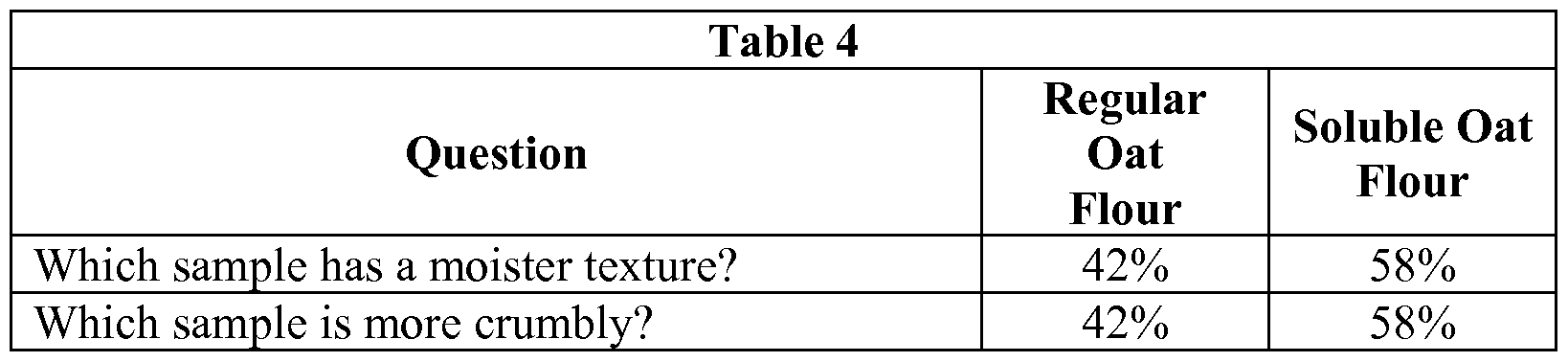
- Cookies are made with oat flour and/or oat flakes to provide 1 ⁇ 2 serving of whole grain oats (8g) may have up to about 25 wt% of the oat flour replaced with soluble oat flour. Replacement of a portion of the oat flour with soluble oat flour provides a moister texture. The cookie containing soluble oat flour may also provide a more crumbly texture. In limited instances a chewier texture was also observed.
- a suitable soft baked cookie recipe :
- Soluble oat flour may be used in muffins.
- muffins made with oat flour to provide 1 full serving of whole grain oats (16g) may have up to about 50 wt% of the oat flour replaced with soluble oat flour. Replacement of a portion of the oat flour with soluble oat flour provides a moister texture and more crumbly product.
- Soluble oat flour may also be used in ready-to-eat high moisture snacks such as RTE puddings, fruit leather, and fruit gels.
- the lower viscosity of the soluble oat flour at the same level of typical oats allows addition of higher amounts of whole grain oats per serving.
- Soluble oat flour provides improved mouthfeel (less slimy or less slippery mouthfeel and lower undesirable mouthcoating).
- a fruit Gel snack may be prepared as follows:
- Colors, preservatives, and other additives may be as needed or desired. Further, any of the ingredients may be modified or replaced as appropriate for the particular desired result.
- Soluble oat flour may also be used in sauces and seasoning mixes for preparation of various foods such as gravies, creamy sauces, seasoning mixes added during preparation of rice or pasta.
- Soluble oat flour may also be used as a texturizer in instant oatmeal products.
- Texturizers improve the overall texture of a bowl of instant oatmeal
- the instant oatmeal comprises oat flakes and a powder comprising flavors, sweeteners, and texturizers such as guar gum.
- the texturizers are generally present in an amount of 0 to 1 wt% based on the total weight of the instant oatmeal dry mix.
- Soluble oat flour may replace a portion or all of the guar gum.
- a suitable instant oatmeal dry mix will contain 0 wt% guar gum and 0.09 wt% to 0.3 wt% soluble oat flour based on total weight of the instant oatmeal dry mix.
- Soluble oat flour was used to replace all of guar gum in instant oatmeal in selected varieties. Soluble oat flour level was 50 to 75% guar gum usage rate. No significant differences were detected.
- a sensory discrimination test (Triangle test) was used with 60 panelists to evaluate if there were significant differences between oatmeal samples made with guar gum or soluble oat flour. Panelists were presented with 3 samples, from which 2 were the same and 1 was different. Panelists were asked to identify the different sample. No statistically significant differences were found between samples made with guar gum or soluble oat flour in two varieties of instant oatmeal.
- Soluble oat flour may be used in frozen commodities such as slushies and ice cream.
- a frozen commodity selected from the group consisting of ice cream and slushies comprising soluble oat flour in an amount of 2 to 10 wt% based on total weight of the frozen commodity may be prepared. It was discovered that soluble oat flour may be used in slushie and ice cream products for not only the health benefits of the whole grain oat flour, but because of the lower viscosity benefits during processing of these products, since the soluble oat flour does not require hydration like regular oat flour.
- antifoaming properties refers to the ability of a component to reduce or prevent the formation of air bubbles or foam during processing of liquids or semisolids.
- a ready-to-eat mixed berry slushie may be prepared as follows: Ingredient Wt%
- the water should be suitable for use in food such as water treated by reverse osmosis.
- the total water may be provided in part or in whole from other parts of the food, especially if milk, juices, or other water containing components are used.
- the milk may be dairy (e.g. whole, 2%, 1%, or non-fat) or non-dairy (e.g. soy).
- the milk may also be produced from powdered milk and water.
- Additional ingredients may be added to the beverage and food products.
- Such ingredients can include grain or non-grain-based ingredients.
- flavoring agents such as fruit flavors, chocolate flavors, or spice flavors may be added to enhance the taste of the product.
- Fruit flavoring agents include, for example, strawberry, mango, banana and mixtures thereof.
- Spices, in particular, cinnamon, can be used.
- any desired flavor or flavors can be used.
- Suitable sweeteners - artificial or natural, nutritive or non-nutritive can be added in the food product to provide a desired sweetness.
- brown sugar, maple sugar or fruit sugar can be used. It is noted that the percentage of soluble oat flour will increase if high intensity sweeteners are used.
- Other optional ingredients may include, but are not limited to, hydrocolloids, polysaccharides, thickeners, caffeine, dairy, coffee solids, tea solids, herbs, nutraceutical compounds, electrolytes, vitamins, minerals, amino acids, preservatives, alcohol, colorants, emulsifiers, and oils as known in the art.
- Fruit and nut components may also be included as well as chips or pieces such as chocolate chips.
- Fruit components can include fruit puree; fresh fruit, fruit preserves, fruit sorbet, fruit sherbet, dried fruit powder, and combinations thereof. Typically, fruit or nut component have particles sufficiently small that the component may be safely swallowed without chewing.
- Acidulants may be used to adjust the H, for example a pH of less than about 4.6 for an acidic beverage - e.g. juices or colas.
- the soluble oat flour also may be used as a fat replacer.
- the soluble oat fiber was used as a fat replacer in creamy dips to obtain a 50% fat reduction.
- Figure 8 depicts the viscosities of a full fat dip, a 50% reduced fat dip, and a 50%> reduced fat dip containing soluble oat flour.
- a 50% reduced fat dip containing the soluble oat flour described herein exhibited a viscosity similar to the full fat dip.
- a reduced fat dip may be prepared as follows:
Landscapes
- Food Science & Technology (AREA)
- Life Sciences & Earth Sciences (AREA)
- Engineering & Computer Science (AREA)
- Nutrition Science (AREA)
- Health & Medical Sciences (AREA)
- Polymers & Plastics (AREA)
- Chemical & Material Sciences (AREA)
- General Health & Medical Sciences (AREA)
- Cereal-Derived Products (AREA)
- Bakery Products And Manufacturing Methods Therefor (AREA)
- Confectionery (AREA)
- Dairy Products (AREA)
- Grain Derivatives (AREA)
Abstract
Description




Claims
Priority Applications (10)
| Application Number | Priority Date | Filing Date | Title |
|---|---|---|---|
| CN201480023490.5A CN105142423A (en) | 2013-03-14 | 2014-03-13 | Food products prepared with soluble whole grain oat flour |
| AU2014243911A AU2014243911B2 (en) | 2013-03-14 | 2014-03-13 | Food products prepared with soluble whole grain oat flour |
| EP14775080.6A EP2986143B1 (en) | 2013-03-14 | 2014-03-13 | Use of soluble whole grain oat flour in the preparation of slushies |
| EP19175627.9A EP3560338A1 (en) | 2013-03-14 | 2014-03-13 | Food products prepared with soluble whole grain oat flour |
| RU2015143599A RU2663416C2 (en) | 2013-03-14 | 2014-03-13 | Food products prepared with soluble whole-grain oat flour |
| BR112015022793A BR112015022793A8 (en) | 2013-03-14 | 2014-03-13 | beverage comprising whole grain oatmeal, semisolid dairy product, instant powders and methods |
| MX2015013041A MX379319B (en) | 2013-03-14 | 2014-03-13 | FOOD PRODUCTS PREPARED WITH SOLUBLE WHOLE GRAIN OAT FLOUR. |
| CA2906078A CA2906078C (en) | 2013-03-14 | 2014-03-13 | Food products prepared with soluble whole grain oat flour |
| AU2017279568A AU2017279568B2 (en) | 2013-03-14 | 2017-12-18 | Food products prepared with soluble whole grain oat flour |
| AU2018202011A AU2018202011A1 (en) | 2013-03-14 | 2018-03-21 | Food products prepared with soluble whole grain oat flour |
Applications Claiming Priority (2)
| Application Number | Priority Date | Filing Date | Title |
|---|---|---|---|
| US201361783046P | 2013-03-14 | 2013-03-14 | |
| US61/783,046 | 2013-03-14 |
Publications (1)
| Publication Number | Publication Date |
|---|---|
| WO2014160351A1 true WO2014160351A1 (en) | 2014-10-02 |
Family
ID=51625405
Family Applications (1)
| Application Number | Title | Priority Date | Filing Date |
|---|---|---|---|
| PCT/US2014/026367 Ceased WO2014160351A1 (en) | 2013-03-14 | 2014-03-13 | Food products prepared with soluble whole grain oat flour |
Country Status (9)
| Country | Link |
|---|---|
| EP (2) | EP3560338A1 (en) |
| CN (1) | CN105142423A (en) |
| AU (3) | AU2014243911B2 (en) |
| BR (1) | BR112015022793A8 (en) |
| CA (1) | CA2906078C (en) |
| MX (1) | MX379319B (en) |
| RU (1) | RU2663416C2 (en) |
| TW (1) | TW201507626A (en) |
| WO (1) | WO2014160351A1 (en) |
Cited By (8)
| Publication number | Priority date | Publication date | Assignee | Title |
|---|---|---|---|---|
| WO2017165553A1 (en) * | 2016-03-22 | 2017-09-28 | The Quaker Oats Company | A method and composition comprising hydrolyzed starch |
| US20170354696A1 (en) * | 2014-11-26 | 2017-12-14 | Abbott Laboratories | Infant formula with rrr-alpha-tocopherol, 2'-fucosyllactose, and a probiotic |
| US10426181B2 (en) | 2011-03-21 | 2019-10-01 | The Quaker Oats Company | Method for preparing high acid RTD whole grain beverages |
| WO2020092730A1 (en) * | 2018-11-02 | 2020-05-07 | Cargill, Incorporated | Soluble flour for use in food applications |
| US10913963B2 (en) | 2016-03-22 | 2021-02-09 | The Quaker Oats Company | Method and apparatus for controlled hydrolysis |
| US10980244B2 (en) | 2008-11-04 | 2021-04-20 | The Quaker Oats Company | Whole grain composition comprising hydrolyzed starch |
| US11172695B2 (en) | 2016-03-22 | 2021-11-16 | The Quaker Oats Company | Method, apparatus, and product providing hydrolyzed starch and fiber |
| US12446603B2 (en) | 2019-12-23 | 2025-10-21 | Cargill, Incorporated | Soluble rice flour compositions |
Families Citing this family (3)
| Publication number | Priority date | Publication date | Assignee | Title |
|---|---|---|---|---|
| US11337444B2 (en) | 2019-02-22 | 2022-05-24 | Jasper Products, L.L.C. | Rapid hydrolysis process for oat-based beverage composition |
| CN116669562A (en) * | 2020-10-09 | 2023-08-29 | 雀巢产品有限公司 | Plant-based soft or frozen dessert made from grains and beans |
| CN117512030A (en) | 2022-08-03 | 2024-02-06 | 桂格燕麦公司 | Oat fermentation products, products prepared therefrom and uses thereof |
Citations (6)
| Publication number | Priority date | Publication date | Assignee | Title |
|---|---|---|---|---|
| US6210722B1 (en) * | 1997-11-07 | 2001-04-03 | Kellogg Company | Extruded intermediates containing a soluble fiber and food products containing same |
| US20080260909A1 (en) | 2007-04-20 | 2008-10-23 | The Quaker Oats Company | Hydrolyzed, Spray Dried, Agglomerated Grain Powder And Drinkable Food Products |
| US20100112127A1 (en) | 2008-11-04 | 2010-05-06 | The Quaker Oats Company | Soluble Oat Or Barley Flour And Method Of Making Utilizing Enzymes |
| US20100316765A1 (en) | 2009-06-14 | 2010-12-16 | The Quaker Oats Company | Method of Preparing Highly Dispersible Whole Grain Flour |
| US20110020523A1 (en) * | 2008-07-15 | 2011-01-27 | Pepsico, Inc. | Method for Preparing a Low Viscosity Whole Grain Flour Slurry Via Mechanical Treatment |
| US20130017300A1 (en) | 2011-07-12 | 2013-01-17 | Pepsico, Inc. | Method of Preparing an Oat-Containing Dairy Beverage |
Family Cites Families (1)
| Publication number | Priority date | Publication date | Assignee | Title |
|---|---|---|---|---|
| US8802177B2 (en) * | 2008-11-04 | 2014-08-12 | The Quaker Oats Company | Soluble oat or barley flour and method of making utilizing a continuous cooker |
-
2014
- 2014-03-13 EP EP19175627.9A patent/EP3560338A1/en not_active Withdrawn
- 2014-03-13 AU AU2014243911A patent/AU2014243911B2/en not_active Ceased
- 2014-03-13 CN CN201480023490.5A patent/CN105142423A/en active Pending
- 2014-03-13 CA CA2906078A patent/CA2906078C/en active Active
- 2014-03-13 RU RU2015143599A patent/RU2663416C2/en active
- 2014-03-13 BR BR112015022793A patent/BR112015022793A8/en not_active Application Discontinuation
- 2014-03-13 EP EP14775080.6A patent/EP2986143B1/en active Active
- 2014-03-13 WO PCT/US2014/026367 patent/WO2014160351A1/en not_active Ceased
- 2014-03-13 MX MX2015013041A patent/MX379319B/en unknown
- 2014-03-14 TW TW103109710A patent/TW201507626A/en unknown
-
2017
- 2017-12-18 AU AU2017279568A patent/AU2017279568B2/en not_active Ceased
-
2018
- 2018-03-21 AU AU2018202011A patent/AU2018202011A1/en not_active Abandoned
Patent Citations (7)
| Publication number | Priority date | Publication date | Assignee | Title |
|---|---|---|---|---|
| US6210722B1 (en) * | 1997-11-07 | 2001-04-03 | Kellogg Company | Extruded intermediates containing a soluble fiber and food products containing same |
| US20080260909A1 (en) | 2007-04-20 | 2008-10-23 | The Quaker Oats Company | Hydrolyzed, Spray Dried, Agglomerated Grain Powder And Drinkable Food Products |
| US20110020523A1 (en) * | 2008-07-15 | 2011-01-27 | Pepsico, Inc. | Method for Preparing a Low Viscosity Whole Grain Flour Slurry Via Mechanical Treatment |
| US20100112127A1 (en) | 2008-11-04 | 2010-05-06 | The Quaker Oats Company | Soluble Oat Or Barley Flour And Method Of Making Utilizing Enzymes |
| US8574644B2 (en) | 2008-11-04 | 2013-11-05 | The Quaker Oats Company | Soluble oat flour and method of making utilizing enzymes |
| US20100316765A1 (en) | 2009-06-14 | 2010-12-16 | The Quaker Oats Company | Method of Preparing Highly Dispersible Whole Grain Flour |
| US20130017300A1 (en) | 2011-07-12 | 2013-01-17 | Pepsico, Inc. | Method of Preparing an Oat-Containing Dairy Beverage |
Cited By (13)
| Publication number | Priority date | Publication date | Assignee | Title |
|---|---|---|---|---|
| US10975404B2 (en) | 2008-11-04 | 2021-04-13 | The Quaker Oats Company | Method and composition comprising hydrolyzed starch |
| US10980244B2 (en) | 2008-11-04 | 2021-04-20 | The Quaker Oats Company | Whole grain composition comprising hydrolyzed starch |
| US10426181B2 (en) | 2011-03-21 | 2019-10-01 | The Quaker Oats Company | Method for preparing high acid RTD whole grain beverages |
| US20170354696A1 (en) * | 2014-11-26 | 2017-12-14 | Abbott Laboratories | Infant formula with rrr-alpha-tocopherol, 2'-fucosyllactose, and a probiotic |
| US11172695B2 (en) | 2016-03-22 | 2021-11-16 | The Quaker Oats Company | Method, apparatus, and product providing hydrolyzed starch and fiber |
| US10913963B2 (en) | 2016-03-22 | 2021-02-09 | The Quaker Oats Company | Method and apparatus for controlled hydrolysis |
| RU2739605C2 (en) * | 2016-03-22 | 2020-12-28 | Дзэ Куэйкер Оатс Компани | Method and composition containing hydrolysed starch |
| WO2017165553A1 (en) * | 2016-03-22 | 2017-09-28 | The Quaker Oats Company | A method and composition comprising hydrolyzed starch |
| WO2020092730A1 (en) * | 2018-11-02 | 2020-05-07 | Cargill, Incorporated | Soluble flour for use in food applications |
| CN112969372A (en) * | 2018-11-02 | 2021-06-15 | 嘉吉公司 | Soluble powder for food applications |
| EP3873230A4 (en) * | 2018-11-02 | 2022-08-03 | Cargill, Incorporated | Soluble flour for use in food applications |
| CN112969372B (en) * | 2018-11-02 | 2024-05-14 | 嘉吉公司 | Soluble powder for food applications |
| US12446603B2 (en) | 2019-12-23 | 2025-10-21 | Cargill, Incorporated | Soluble rice flour compositions |
Also Published As
| Publication number | Publication date |
|---|---|
| CA2906078C (en) | 2021-09-07 |
| EP3560338A1 (en) | 2019-10-30 |
| TW201507626A (en) | 2015-03-01 |
| EP2986143B1 (en) | 2020-01-08 |
| CA2906078A1 (en) | 2014-10-02 |
| AU2017279568B2 (en) | 2019-07-11 |
| BR112015022793A8 (en) | 2019-11-26 |
| AU2017279568A1 (en) | 2018-01-18 |
| AU2014243911A1 (en) | 2015-11-05 |
| AU2014243911B2 (en) | 2018-01-04 |
| CN105142423A (en) | 2015-12-09 |
| EP2986143A1 (en) | 2016-02-24 |
| AU2018202011A1 (en) | 2018-04-12 |
| RU2015143599A (en) | 2017-04-26 |
| MX379319B (en) | 2025-03-10 |
| BR112015022793A2 (en) | 2017-07-18 |
| RU2663416C2 (en) | 2018-08-09 |
| EP2986143A4 (en) | 2017-03-08 |
| MX2015013041A (en) | 2016-05-05 |
Similar Documents
| Publication | Publication Date | Title |
|---|---|---|
| US9622500B2 (en) | Food products prepared with soluble whole grain oat flour | |
| US9510614B2 (en) | Food products prepared with soluble whole grain oat flour | |
| US10980244B2 (en) | Whole grain composition comprising hydrolyzed starch | |
| AU2017279568B2 (en) | Food products prepared with soluble whole grain oat flour | |
| US10975404B2 (en) | Method and composition comprising hydrolyzed starch | |
| US9149060B2 (en) | Soluble oat flour and method of making utilizing enzymes | |
| US20130183405A1 (en) | Method of Processing Oats to Achieve Oats with an Increased Avenanthramide Content | |
| WO2010053651A1 (en) | Soluble oat or barley flour and method of making utilizing a continuous cooker | |
| AU2014226467B2 (en) | Method of processing oats to achieve oats with an increased avenanthramide content | |
| AU2015264815B2 (en) | Soluble oat or barley flour and method of making utilizing enzymes |
Legal Events
| Date | Code | Title | Description |
|---|---|---|---|
| WWE | Wipo information: entry into national phase |
Ref document number: 201480023490.5 Country of ref document: CN |
|
| 121 | Ep: the epo has been informed by wipo that ep was designated in this application |
Ref document number: 14775080 Country of ref document: EP Kind code of ref document: A1 |
|
| ENP | Entry into the national phase |
Ref document number: 2906078 Country of ref document: CA |
|
| NENP | Non-entry into the national phase |
Ref country code: DE |
|
| WWE | Wipo information: entry into national phase |
Ref document number: MX/A/2015/013041 Country of ref document: MX |
|
| ENP | Entry into the national phase |
Ref document number: 2015143599 Country of ref document: RU Kind code of ref document: A |
|
| WWE | Wipo information: entry into national phase |
Ref document number: 2014775080 Country of ref document: EP |
|
| ENP | Entry into the national phase |
Ref document number: 2014243911 Country of ref document: AU Date of ref document: 20140313 Kind code of ref document: A |
|
| REG | Reference to national code |
Ref country code: BR Ref legal event code: B01A Ref document number: 112015022793 Country of ref document: BR |
|
| ENP | Entry into the national phase |
Ref document number: 112015022793 Country of ref document: BR Kind code of ref document: A2 Effective date: 20150911 |