WO2014175305A1 - ペプチド提示タンパク質及びそれを用いたペプチドライブラリー - Google Patents
ペプチド提示タンパク質及びそれを用いたペプチドライブラリー Download PDFInfo
- Publication number
- WO2014175305A1 WO2014175305A1 PCT/JP2014/061366 JP2014061366W WO2014175305A1 WO 2014175305 A1 WO2014175305 A1 WO 2014175305A1 JP 2014061366 W JP2014061366 W JP 2014061366W WO 2014175305 A1 WO2014175305 A1 WO 2014175305A1
- Authority
- WO
- WIPO (PCT)
- Prior art keywords
- amino acid
- peptide
- acid sequence
- protein
- presenting
- Prior art date
- Legal status (The legal status is an assumption and is not a legal conclusion. Google has not performed a legal analysis and makes no representation as to the accuracy of the status listed.)
- Ceased
Links
Images


Classifications
-
- C—CHEMISTRY; METALLURGY
- C12—BIOCHEMISTRY; BEER; SPIRITS; WINE; VINEGAR; MICROBIOLOGY; ENZYMOLOGY; MUTATION OR GENETIC ENGINEERING
- C12N—MICROORGANISMS OR ENZYMES; COMPOSITIONS THEREOF; PROPAGATING, PRESERVING, OR MAINTAINING MICROORGANISMS; MUTATION OR GENETIC ENGINEERING; CULTURE MEDIA
- C12N15/00—Mutation or genetic engineering; DNA or RNA concerning genetic engineering, vectors, e.g. plasmids, or their isolation, preparation or purification; Use of hosts therefor
- C12N15/09—Recombinant DNA-technology
- C12N15/10—Processes for the isolation, preparation or purification of DNA or RNA
- C12N15/1034—Isolating an individual clone by screening libraries
- C12N15/1037—Screening libraries presented on the surface of microorganisms, e.g. phage display, E. coli display
-
- C—CHEMISTRY; METALLURGY
- C07—ORGANIC CHEMISTRY
- C07K—PEPTIDES
- C07K14/00—Peptides having more than 20 amino acids; Gastrins; Somatostatins; Melanotropins; Derivatives thereof
- C07K14/001—Peptides having more than 20 amino acids; Gastrins; Somatostatins; Melanotropins; Derivatives thereof by chemical synthesis
-
- C—CHEMISTRY; METALLURGY
- C07—ORGANIC CHEMISTRY
- C07K—PEPTIDES
- C07K14/00—Peptides having more than 20 amino acids; Gastrins; Somatostatins; Melanotropins; Derivatives thereof
- C07K14/435—Peptides having more than 20 amino acids; Gastrins; Somatostatins; Melanotropins; Derivatives thereof from animals; from humans
- C07K14/43504—Peptides having more than 20 amino acids; Gastrins; Somatostatins; Melanotropins; Derivatives thereof from animals; from humans from invertebrates
- C07K14/43595—Peptides having more than 20 amino acids; Gastrins; Somatostatins; Melanotropins; Derivatives thereof from animals; from humans from invertebrates from coelenteratae, e.g. medusae
-
- C—CHEMISTRY; METALLURGY
- C07—ORGANIC CHEMISTRY
- C07K—PEPTIDES
- C07K7/00—Peptides having 5 to 20 amino acids in a fully defined sequence; Derivatives thereof
- C07K7/04—Linear peptides containing only normal peptide links
- C07K7/06—Linear peptides containing only normal peptide links having 5 to 11 amino acids
-
- C—CHEMISTRY; METALLURGY
- C07—ORGANIC CHEMISTRY
- C07K—PEPTIDES
- C07K7/00—Peptides having 5 to 20 amino acids in a fully defined sequence; Derivatives thereof
- C07K7/04—Linear peptides containing only normal peptide links
- C07K7/08—Linear peptides containing only normal peptide links having 12 to 20 amino acids
-
- C—CHEMISTRY; METALLURGY
- C12—BIOCHEMISTRY; BEER; SPIRITS; WINE; VINEGAR; MICROBIOLOGY; ENZYMOLOGY; MUTATION OR GENETIC ENGINEERING
- C12N—MICROORGANISMS OR ENZYMES; COMPOSITIONS THEREOF; PROPAGATING, PRESERVING, OR MAINTAINING MICROORGANISMS; MUTATION OR GENETIC ENGINEERING; CULTURE MEDIA
- C12N15/00—Mutation or genetic engineering; DNA or RNA concerning genetic engineering, vectors, e.g. plasmids, or their isolation, preparation or purification; Use of hosts therefor
- C12N15/09—Recombinant DNA-technology
- C12N15/10—Processes for the isolation, preparation or purification of DNA or RNA
- C12N15/1034—Isolating an individual clone by screening libraries
-
- C—CHEMISTRY; METALLURGY
- C12—BIOCHEMISTRY; BEER; SPIRITS; WINE; VINEGAR; MICROBIOLOGY; ENZYMOLOGY; MUTATION OR GENETIC ENGINEERING
- C12N—MICROORGANISMS OR ENZYMES; COMPOSITIONS THEREOF; PROPAGATING, PRESERVING, OR MAINTAINING MICROORGANISMS; MUTATION OR GENETIC ENGINEERING; CULTURE MEDIA
- C12N15/00—Mutation or genetic engineering; DNA or RNA concerning genetic engineering, vectors, e.g. plasmids, or their isolation, preparation or purification; Use of hosts therefor
- C12N15/09—Recombinant DNA-technology
- C12N15/10—Processes for the isolation, preparation or purification of DNA or RNA
- C12N15/1034—Isolating an individual clone by screening libraries
- C12N15/1044—Preparation or screening of libraries displayed on scaffold proteins
-
- C—CHEMISTRY; METALLURGY
- C12—BIOCHEMISTRY; BEER; SPIRITS; WINE; VINEGAR; MICROBIOLOGY; ENZYMOLOGY; MUTATION OR GENETIC ENGINEERING
- C12N—MICROORGANISMS OR ENZYMES; COMPOSITIONS THEREOF; PROPAGATING, PRESERVING, OR MAINTAINING MICROORGANISMS; MUTATION OR GENETIC ENGINEERING; CULTURE MEDIA
- C12N15/00—Mutation or genetic engineering; DNA or RNA concerning genetic engineering, vectors, e.g. plasmids, or their isolation, preparation or purification; Use of hosts therefor
- C12N15/09—Recombinant DNA-technology
- C12N15/10—Processes for the isolation, preparation or purification of DNA or RNA
- C12N15/1034—Isolating an individual clone by screening libraries
- C12N15/1093—General methods of preparing gene libraries, not provided for in other subgroups
-
- C—CHEMISTRY; METALLURGY
- C12—BIOCHEMISTRY; BEER; SPIRITS; WINE; VINEGAR; MICROBIOLOGY; ENZYMOLOGY; MUTATION OR GENETIC ENGINEERING
- C12N—MICROORGANISMS OR ENZYMES; COMPOSITIONS THEREOF; PROPAGATING, PRESERVING, OR MAINTAINING MICROORGANISMS; MUTATION OR GENETIC ENGINEERING; CULTURE MEDIA
- C12N9/00—Enzymes; Proenzymes; Compositions thereof; Processes for preparing, activating, inhibiting, separating or purifying enzymes
- C12N9/10—Transferases (2.)
- C12N9/1085—Transferases (2.) transferring alkyl or aryl groups other than methyl groups (2.5)
- C12N9/1088—Glutathione transferase (2.5.1.18)
-
- C—CHEMISTRY; METALLURGY
- C12—BIOCHEMISTRY; BEER; SPIRITS; WINE; VINEGAR; MICROBIOLOGY; ENZYMOLOGY; MUTATION OR GENETIC ENGINEERING
- C12Q—MEASURING OR TESTING PROCESSES INVOLVING ENZYMES, NUCLEIC ACIDS OR MICROORGANISMS; COMPOSITIONS OR TEST PAPERS THEREFOR; PROCESSES OF PREPARING SUCH COMPOSITIONS; CONDITION-RESPONSIVE CONTROL IN MICROBIOLOGICAL OR ENZYMOLOGICAL PROCESSES
- C12Q1/00—Measuring or testing processes involving enzymes, nucleic acids or microorganisms; Compositions therefor; Processes of preparing such compositions
- C12Q1/34—Measuring or testing processes involving enzymes, nucleic acids or microorganisms; Compositions therefor; Processes of preparing such compositions involving hydrolase
- C12Q1/37—Measuring or testing processes involving enzymes, nucleic acids or microorganisms; Compositions therefor; Processes of preparing such compositions involving hydrolase involving peptidase or proteinase
-
- G—PHYSICS
- G01—MEASURING; TESTING
- G01N—INVESTIGATING OR ANALYSING MATERIALS BY DETERMINING THEIR CHEMICAL OR PHYSICAL PROPERTIES
- G01N33/00—Investigating or analysing materials by specific methods not covered by groups G01N1/00 - G01N31/00
- G01N33/48—Biological material, e.g. blood, urine; Haemocytometers
- G01N33/50—Chemical analysis of biological material, e.g. blood, urine; Testing involving biospecific ligand binding methods; Immunological testing
- G01N33/68—Chemical analysis of biological material, e.g. blood, urine; Testing involving biospecific ligand binding methods; Immunological testing involving proteins, peptides or amino acids
- G01N33/6803—General methods of protein analysis not limited to specific proteins or families of proteins
- G01N33/6845—Methods of identifying protein-protein interactions in protein mixtures
-
- C—CHEMISTRY; METALLURGY
- C07—ORGANIC CHEMISTRY
- C07K—PEPTIDES
- C07K2319/00—Fusion polypeptide
- C07K2319/60—Fusion polypeptide containing spectroscopic/fluorescent detection, e.g. green fluorescent protein [GFP]
-
- C—CHEMISTRY; METALLURGY
- C12—BIOCHEMISTRY; BEER; SPIRITS; WINE; VINEGAR; MICROBIOLOGY; ENZYMOLOGY; MUTATION OR GENETIC ENGINEERING
- C12Y—ENZYMES
- C12Y205/00—Transferases transferring alkyl or aryl groups, other than methyl groups (2.5)
- C12Y205/01—Transferases transferring alkyl or aryl groups, other than methyl groups (2.5) transferring alkyl or aryl groups, other than methyl groups (2.5.1)
- C12Y205/01018—Glutathione transferase (2.5.1.18)
-
- G—PHYSICS
- G01—MEASURING; TESTING
- G01N—INVESTIGATING OR ANALYSING MATERIALS BY DETERMINING THEIR CHEMICAL OR PHYSICAL PROPERTIES
- G01N2333/00—Assays involving biological materials from specific organisms or of a specific nature
- G01N2333/90—Enzymes; Proenzymes
- G01N2333/914—Hydrolases (3)
- G01N2333/948—Hydrolases (3) acting on peptide bonds (3.4)
- G01N2333/95—Proteinases, i.e. endopeptidases (3.4.21-3.4.99)
- G01N2333/964—Proteinases, i.e. endopeptidases (3.4.21-3.4.99) derived from animal tissue
- G01N2333/96425—Proteinases, i.e. endopeptidases (3.4.21-3.4.99) derived from animal tissue from mammals
- G01N2333/96427—Proteinases, i.e. endopeptidases (3.4.21-3.4.99) derived from animal tissue from mammals in general
- G01N2333/9643—Proteinases, i.e. endopeptidases (3.4.21-3.4.99) derived from animal tissue from mammals in general with EC number
- G01N2333/96466—Cysteine endopeptidases (3.4.22)
Definitions
- the present invention relates to a peptide-presenting protein and a peptide library using the same. According to the present invention, a peptide having high specificity for a target molecule can be screened.
- phage display As a display method for a specific peptide library, a phage display method (phage display), an E. coli display method, a yeast display method, or the like is used.
- phage display the screened peptide is expressed as a polypeptide fusion to a bacteriophage coat protein.
- the phage particles on which the peptide is displayed are brought into contact with a microtiter plate on which the target substance is immobilized, and affinity selection is performed to concentrate the phage having a peptide having an affinity for the target substance (non-binding).
- Patent Document 1 In the phage display method, since the peptide displayed on the enriched phage and the gene encoding it correspond one-to-one, the target peptide can be easily identified. Further, since the gene can be easily amplified (proliferated), it is widely used as a screening method for peptides.
- an object of the present invention is to provide a method for screening a peptide having high specificity with a target molecule.
- Non-patent Document 2 Non-patent Document 2; hereinafter referred to as sfGFP may be referred to as No.
- a peptide-presenting protein in which a peptide is presented in the presentation region of Nos. 131 to 139 in the amino acid sequence represented by SEQ ID NO: 54, wherein the presentation represents the amino acid sequence of 4 to 15 peptides, An amino acid sequence that is inserted into the amino acid sequence of Nos. 131 to 139 or substituted for the amino acid sequence of 1 to 9 of the amino acid sequence of Nos.
- peptide-presenting protein having a chain length of 15 or less
- amino acid sequence of Nos. 1 to 130 or the amino acid sequence of Nos. 140 to 238 in the amino acid sequence represented by SEQ ID NO: 54 one or more amino acids are deleted, substituted, inserted, and / or added.
- amino acid sequence represented by SEQ ID NO: 54 wherein the presentation comprises the amino acid sequence of 4 to 15 peptides
- a peptide-presenting protein having a sequence chain length of 15 or less [10]
- one or more amino acids are deleted, substituted, inserted, and / or added.
- 131 to 139 or Nos. 131 to A nucleotide encoding a peptide that is substituted with the amino acid sequence of 1 to 9 of the amino acid sequence of the presentation region of 139 and whose chain length of the amino acid sequence corresponding to the amino acid sequence of 131 to 139 is 15 or less
- a method of constructing a library comprising integration, obtaining an expression vector, and (2) introducing the expression vector into a host, [17]
- a method for screening a peptide that binds to a target molecule comprising: (1) contacting the target molecule with the peptide library according to [8]; and (2) recovering a host bound to the target molecule.
- the peptide-presenting protein of the present invention and a peptide library using the same, it is possible to screen for peptides having high specificity for the target molecule.
- sfGFP which is a parent protein for presenting peptides
- the number of molecules can be easily estimated from the fluorescence intensity. Therefore, it is useful for evaluating the amount of peptide binding during screening.
- the present invention can be applied to widely used display technologies (eg, phage display method, E. coli display method, yeast display method, in vitro virus method, or ribosome display method). Therefore, it can be applied to existing high-throughput screening techniques.
- based on the sequence information and structure information of the peptide obtained by the present invention it is possible to develop a molecular target drug and a drug delivery system.
- the peptide-presenting protein of the present invention is a peptide-presenting protein in which a peptide is presented in the presentation region of Nos. 131 to 139 in the amino acid sequence represented by SEQ ID NO: 54, and the number of presentations is 4 to 15 (preferably 4-14, more preferably 4-13, and still more preferably 4-12) amino acid sequences of the 131st to 139th amino acid sequences or the 131st to 139th amino acid sequences.
- 131 to 139 is 15 or less (preferably 14 or less, more preferably 13 or less, More preferably, it is 12 or less. Further, the lower limit of the chain length of the amino acid sequence corresponding to the amino acid sequence of Nos. 131 to 139 is preferably 5 or more.
- one or a plurality of amino acids in the amino acid sequence Nos. 1 to 130 or the amino acid sequence Nos. 140 to 238 in the amino acid sequence represented by SEQ ID NO: 54 are deleted, substituted, inserted, And / or a peptide-presenting protein consisting of an added amino acid sequence and having fluorogenic activity.
- the protein consisting of the amino acid sequence represented by SEQ ID NO: 54 is sfGFP described in Non-Patent Document 2, but in the peptide-presenting protein of the present invention, a GFP protein is used as a parent protein into which the peptide is incorporated. Can do. That is, GFP or GFP-derived GFP mutant protein can be used without limitation. Specific parent proteins can include GFP, YFP, CFP, BFP, or RFP. More preferably, the peptide-presenting protein of the present invention is a peptide-presenting protein in which a peptide is presented in the region of Nos.
- the amino acid sequence of the peptide (preferably 4 to 13, more preferably 4 to 12) is inserted into the amino acid sequence of Nos. 131 to 138, or 1 to 8 amino acids of the amino acid sequence of Nos. 131 to 138
- the chain length of the amino acid sequence that replaces the sequence and corresponds to the amino acid sequence of Nos. 131 to 138 is 14 or less (preferably 13 or less, more preferably 12 or less). Further, the lower limit of the chain length of the amino acid sequence corresponding to the amino acid sequence of Nos. 131 to 138 is preferably 4 or more.
- the peptide-presenting protein of the present invention preferably has one or more amino acids deleted in the amino acid sequence Nos. 1 to 130 or 139 to 238 in the amino acid sequence represented by SEQ ID NO: 54 It may be a peptide-presenting protein consisting of a substituted, inserted, and / or added amino acid sequence and having fluorogenic activity. More preferably, the peptide-presenting protein of the present invention is a peptide-presenting protein in which a peptide is presented in the region of Nos.
- the amino acid sequence of the peptide (preferably 4 to 12) is inserted into the amino acid sequence of the 131st to 137th amino acids or substituted with the 1 to 7 amino acid sequence of the amino acid sequence of the 131st to 137th amino acids.
- the chain length of the amino acid sequence corresponding to the amino acid sequence of Nos. 131 to 137 is 13 or less (preferably 12 or less). Further, the lower limit of the chain length of the amino acid sequence corresponding to the amino acid sequence of Nos. 131 to 137 is preferably 4 or more.
- the peptide-presenting protein of the present invention preferably has one or more amino acids deleted in the amino acid sequence Nos. 1 to 130 or 139 to 238 in the amino acid sequence represented by SEQ ID NO: 54 It may be a peptide-presenting protein consisting of a substituted, inserted, and / or added amino acid sequence and having fluorogenic activity.
- the one where the length of the peptide shown is short is preferable at the point that aggregation of protein may be suppressed.
- the 131st to 138th region or the 131st to 137th region is preferable because the aggregation of proteins may be suppressed.
- the peptide-presenting protein of the present invention is a peptide-presenting protein capable of presenting a peptide in the presenting region of the 131st to 139th amino acids in the amino acid sequence represented by SEQ ID NO: 54, and the number of the presenting proteins is 4-15 ( Preferably 4 to 14, more preferably 4 to 13, more preferably 4 to 12) amino acid sequence is inserted into the 131st to 139th amino acid sequences, or 131st to 139th amino acids.
- the protein for presenting a peptide of the present invention is preferably 15 or less (preferably 14 or less, more preferably 13) Hereinafter, more preferably 12 or less. Further, the lower limit of the chain length of the amino acid sequence corresponding to the amino acid sequence of Nos. 131 to 139 is preferably 5 or more. Furthermore, in the protein for presenting a peptide of the present invention, one or more amino acids are deleted or substituted in the amino acid sequence Nos. 1 to 130 or the amino acid sequence Nos. 140 to 238 in the amino acid sequence represented by SEQ ID NO: 54
- the peptide-presenting protein may comprise the amino acid sequence inserted, inserted and / or added, and has a fluorogenic activity.
- the protein consisting of the amino acid sequence represented by SEQ ID NO: 54 is sfGFP described in Non-Patent Document 2, but in the peptide presenting protein of the present invention, a GFP protein is used as a parent protein into which the peptide is incorporated. be able to. That is, GFP or GFP-derived GFP mutant protein can be used without limitation. Specific parent proteins can include GFP, YFP, CFP, BFP, or RFP.
- the peptide-presenting protein of the present invention is more preferably a peptide-presenting protein in which a peptide is presented in the region of Nos. 131 to 138 in the amino acid sequence represented by SEQ ID NO: 54.
- amino acid sequences are inserted into the 131st to 138th amino acid sequences, or 1 to 8 amino acid sequences of 131st to 138th amino acids.
- the chain length of the amino acid sequence corresponding to the amino acid sequence of Nos. 131 to 138 is 14 or less (preferably 13 or less, more preferably 12 or less).
- the lower limit of the chain length of the amino acid sequence corresponding to the amino acid sequence of Nos. 131 to 138 is preferably 4 or more.
- the peptide-presenting protein of the present invention preferably lacks one or more amino acids in the amino acid sequence Nos. 1 to 130 or 139 to 238 in the amino acid sequence represented by SEQ ID NO: 54.
- the peptide-presenting protein of the present invention is more preferably a peptide-presenting protein in which a peptide is presented in the region of Nos. 131 to 137 in the amino acid sequence represented by SEQ ID NO: 54, wherein the presentation is 4 to 13
- the amino acid sequence of each peptide (preferably 4 to 12) is inserted into the amino acid sequence of the 131st to 138th amino acids, or is replaced with the 1-7 amino acid sequence of the amino acid sequence of the 131st to 137th amino acids.
- the peptide-presenting protein of the present invention preferably lacks one or more amino acids in the amino acid sequence Nos. 1 to 130 or 139 to 238 in the amino acid sequence represented by SEQ ID NO: 54. It may be a peptide-presenting protein consisting of a deleted, substituted, inserted and / or added amino acid sequence and having fluorogenic activity.
- the “peptide-presenting protein” means, for example, a protein in which a peptide is presented in the region of Nos. 131 to 139 of sfGFP.
- it means an sfGFP protein in which an arbitrary peptide used for peptide screening has already been incorporated in the region from No. 131 to No. 139.
- it means a protein expressed from a vector contained in the peptide library of the present invention.
- the “peptide-presenting protein” means a protein designed so that a peptide can be presented in the region of Nos. 131 to 139 of sfGFP, for example.
- the polynucleotide encoding the peptide-presenting protein preferably has a restriction enzyme site for introducing a nucleotide encoding any peptide.
- the areas 131 to 139 are preferably areas 131 to 138, and more preferably areas 131 to 137.
- the length of the peptide to be inserted is preferably 4 to 15, more preferably 4 to 14, further preferably 4 to 13, and most preferably 4 to 12. This is because a peptide having a shorter length tends to solubilize the peptide-presenting protein.
- Presentation region amino acid sequence from No. 131 to No. 139
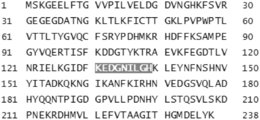
- the amino acid sequence of Nos. 131 to 139 in the amino acid sequence of sfGFP is “KEDGNLGH” (SEQ ID NO: 55).
- this 9 amino acid sequence region is replaced with a peptide consisting of 4 to 15 (preferably 4 to 14) amino acid sequences, the structural freedom of the peptide is limited and a stable structure is presented on sfGFP. Is done. Therefore, by using it as a peptide library, it is possible to screen peptides having high specificity for the target molecule.
- the presentation region is the amino acid sequence of Nos.
- the amino acid sequence to be inserted or substituted is 4 to 15, preferably 4 to 14, and a part of the amino acid sequence of Nos. 131 to 139 is used. May be included. Accordingly, 4 to 6 amino acid sequences may be inserted without deleting the amino acid sequence of Nos. 131 to 139. Further, any number of amino acid sequences from 1 to 9 of the amino acid sequence of No. 131 to No. 139 is deleted, and the foreign amino acid sequence is changed to a total of 5 to 15, preferably 5 to 14. May be incorporated.
- the presentation region is preferably the amino acid sequence from number 131 to number 138.
- the number of amino acid sequences to be inserted or substituted is 4 to 14, preferably 4 to 13, and may include a part of the amino acid sequence of Nos. 131 to 138. Therefore, 4 to 6 amino acid sequences may be inserted without deleting the amino acid sequence of Nos. 131 to 138. Further, any number of amino acid sequences from 1 to 8 in the amino acid sequence from No. 131 to No. 138 is deleted, and the foreign amino acid sequence is changed to 4 to 14, preferably 4 to 13 in total. May be incorporated. Furthermore, in order to construct a peptide library efficiently, the amino acid sequences at both ends of the inserted or substituted peptide are preferably translated amino acid sequences of base sequences including restriction enzyme sites.
- restriction enzyme site used for peptide incorporation is not limited, for example, BamHI, EcoRI, ScaI, SalI, SphI, PstI, NcoI, NheI, SspI, NotI, SacI, PvuII, MfeI, HindIII, SbfI, EagI, EcoRV, AvrII, BstXI, PciI, HpaI, AgeI, BsmBI, BspQI, SapI, KpnI or BsaI can be used.
- amino acid sequence at both ends of 4 to 14 peptides to be inserted or substituted may be an amino acid sequence translated from a nucleotide containing a base sequence recognized by these restriction enzymes.
- a peptide translated from such a restriction enzyme site may be referred to as a linker peptide.
- the GFP-based protein can be used as the parent protein of the “peptide-presenting protein” and the “peptide-presenting protein” of the present invention.
- the amino acid sequence encoding the GFP-based protein 1 or It may be a protein having an amino acid sequence in which a plurality of amino acids are deleted, substituted, inserted and / or added, and having fluorogenic activity.
- amino acid in which one or more amino acids are deleted, substituted, inserted, and / or added in an amino acid sequence means a GFP-based protein or a site-specific mutation.
- modification has been made by a known method such as a mutagenesis method or by substitution of several amino acids to the extent that can occur naturally.
- the number of amino acid modifications is preferably 1 to 15, more preferably 1 to 10, still more preferably 1 to 5, even more preferably 1 to 3, and most preferably 1.
- An example of a modified amino acid sequence of a polypeptide of the present invention can preferably be an amino acid sequence in which the amino acid has one or several (preferably 1, 2, 3 or 4) conservative substitutions. .
- “conservative substitution” means that one or several amino acid residues are replaced with another chemically similar amino acid residue. For example, when a certain hydrophobic residue is substituted by another hydrophobic residue, a certain polar residue is substituted by another polar residue having the same charge, and the like. Functionally similar amino acids that can be made by such substitutions are known in the art for each amino acid. Examples of nonpolar (hydrophobic) amino acids include alanine, valine, isoleucine, leucine, proline, tryptophan, phenylalanine, methionine, and the like.
- Examples of polar (neutral) amino acids include glycine, serine, threonine, tyrosine, glutamine, asparagine, cysteine, and the like.
- Examples of positively charged (basic) amino acids include arginine, histidine, and lysine.
- Examples of negatively charged (acidic) amino acids include aspartic acid and glutamic acid. Even when they are not chemically similar, amino acid residues having similar amino acid structures may be substituted. Examples include substitution of aspartic acid (D) with alanine (A), substitution of asparagine (E) with alanine (A), substitution of tyrosine (Y) with phenylalanine (F), and the like.
- the fusion protein of the present invention is a protein in which the peptide-presenting protein of the present invention or a peptide-presenting protein and a surface-presenting protein are fused.
- the surface display protein means a protein displayed on the surface of the host described later.
- the host when the host is a phage, it means a surface protein of the phage.
- the host when the host is a bacterium, it means a bacterial surface protein.
- yeast when the host is yeast, it means a yeast surface protein, and when the host is an animal cell, it means an animal cell surface protein.
- the peptide-presenting protein can be presented on the surface of the host by fusing the peptide-presenting protein or the protein for presenting the peptide with the surface protein of the host. Therefore, when affinity selection (screening) of a target peptide is performed using the peptide library of the present invention, the target peptide can be easily concentrated.
- the surface protein of the phage includes, but is not limited to, g13p of g13p, g8p of M13 phage, or G10 of T7 phage.
- Bacterial surface proteins such as E. coli surface protein include, but are not limited to, OmpA.
- Examples of the surface protein of yeast include, but are not limited to, Flo1, ⁇ -agglutinin, or AGA2.
- Examples of animal cell surface proteins include, but are not limited to, human Toll-like receptor 4, EGFR, LDL receptor, angiotensin II receptor, or PDGFR.
- the polynucleotide of the present invention includes a polynucleotide encoding the peptide-presenting protein of the present invention (hereinafter sometimes referred to as a peptide-presenting polynucleotide), and a polynucleotide encoding a peptide-presenting protein (hereinafter referred to as a peptide-presenting polynucleotide). Or a polynucleotide encoding a fusion protein (hereinafter sometimes referred to as a fusion polynucleotide).
- the fusion polynucleotide may comprise a nucleotide encoding a linker polypeptide that may be present between the peptide-presenting protein or peptide-presenting protein and the surface-presenting protein.
- the base sequence of SEQ ID NO: 53 is the base sequence of the nucleotide encoding sfGFP.
- the polynucleotide of the present invention is not limited, but can be easily amplified by incorporating it into a vector. Moreover, it can be easily expressed as a peptide-presenting protein or a fusion protein.
- a vector into which the polynucleotide is incorporated any vector such as a plasmid, phage, or virus can be used as long as it can replicate in a host cell.
- Escherichia coli plasmids such as pBR322, pBR325, pUC118, pUC119, pKC30, and pCFM536, Bacillus subtilis plasmids such as pUB110, yeast plasmids such as pG-1, YEp13, and YCp50, and phage DNAs such as ⁇ gt110 and ⁇ ZAPII.
- vectors for mammalian cells include viral DNA such as baculovirus, vaccinia virus, adenovirus, SV40 and its derivatives.
- the vector contains a replication origin, a selectable marker, and a promoter, and may contain an enhancer, a transcription termination sequence (terminator), a ribosome binding site, a polyadenylation signal, and the like as necessary.
- a transcription termination sequence terminal
- a ribosome binding site a polyadenylation signal, and the like.
- the “host” is not limited as long as the vector is incorporated and the peptide-presenting protein or fusion protein can be expressed, and examples thereof include phage, bacteria, yeast, insect cells, or animal cells. Can do.
- the phage vector host may include M13 phage, fd phage, or T7 phage.
- examples of bacterial vector hosts include Escherichia coli, Streptomyces, and Bacillus subtilis.
- examples of the yeast vector host include baker's yeast and methanol-assimilating yeast.
- examples of insect cell vector hosts include Drosophila S2 and Spodoptera Sf9.
- examples of the host for animal cell vectors include CHO, COS, BHK, 3T3, and C127.
- the library of the present invention is a peptide display library, and the displayed peptide has an arbitrary amino acid sequence.
- the peptide display library of the present invention can be used to screen for peptides that bind to a target molecule. Therefore, the presented peptide preferably includes a plurality (multiple types) of peptides having a random amino acid sequence.
- the library of the present invention is a library containing the above-mentioned host, and examples thereof include phage display or cell display libraries of bacteria, yeast, insect cells, or animal cells.
- the length of the displayed peptide subjected to screening using the library of the present invention is not particularly limited, but is, for example, 4 to 15, preferably 4 to 14, more preferably 4 to 13. is there.
- the library construction method of the present invention comprises (1) 4 to 15 (preferably 4 to 14) vectors containing a polypeptide encoding the peptide-presenting protein of the present invention. Wherein the amino acid sequence is inserted into the amino acid sequence of the 131st to 139th presentation regions or substituted with 1 to 9 amino acid sequences of the amino acid sequence of the 131st to 139th presentation regions, And a step of obtaining a vector by incorporating a nucleotide encoding a peptide having a chain length of 15 or less (preferably 14 or less) of the amino acid sequence corresponding to the amino acid sequence of the display region of Nos. 131 to 139, and (2 ) Introducing the vector into a host; including.
- the library is specifically a peptide display library and is a library capable of displaying any peptide.
- the library construction method of the present invention preferably comprises (1) a vector containing a polypeptide encoding the peptide-presenting protein of the present invention and 4 to 14 (preferably 4 to 13) peptides, The amino acid sequence is inserted into the amino acid sequence of the presentation region of Nos. 131 to 138 or substituted with the 1-8 amino acid sequence of the amino acid sequence of the presentation region of Nos. 131 to 138, and the Nos.
- 131 to 138 Incorporating a nucleotide encoding a peptide having an amino acid sequence corresponding to the amino acid sequence of the display region of 14 or less (preferably 13 or less) into a vector, and (2) using the vector as a host. Introducing.
- the vector used for the library construction method is a vector containing a polypeptide encoding a peptide-presenting protein, and a polynucleotide encoding any polypeptide can be easily incorporated, for example, by a restriction enzyme site.
- the length of the polypeptide encoded by the nucleotide to be incorporated is not particularly limited, but is, for example, 4 to 15, preferably 4 to 14, and more preferably 4 to 13.
- a known method can be used for the construction of the vector and the introduction of the vector into the host.
- the host is a phage
- a library gene of a peptide displayed on a vector arm having a restriction enzyme cloning site is incorporated by ligation.
- the resulting ligation solution is mixed with a packaging solution containing phage protein to form phage particles.
- a phage library can be constructed by infecting this phage particle with E. coli (eg, BLT5403).
- the gene to be incorporated into the library can be adjusted by a known method.
- an NNK codon that encodes a random amino acid (N is any base of A, G, C, or T, K is any base of G or T) and a codon that encodes any amino acid are site-specifically Replace.
- a method of chemically synthesizing an oligo DNA containing the region and incorporating it using a restriction enzyme or replicating the full length of the vector using PCR is used.
- the screening method of the present invention comprises (1) a step of contacting a target molecule and the peptide library, (2) a step of recovering a host bound to the target molecule, Preferably, (3) further includes a step of amplifying the recovered host.
- the contact between the target molecule and the peptide library in the contact step (1) can be performed by immobilizing the target molecule on an insoluble carrier (for example, a well or a dish).
- the screening method of the present invention can be performed according to a known method except that the library of the present invention is used.
- screening of a phage library using a phage as a host can be performed as follows.
- the reaction is carried out by contacting the immobilized target molecule with a phage library on a plate or the like.
- the phage that did not bind to the target molecule is removed by washing.
- the phage bound to the target molecule is collected, infected with E. coli, lysed and propagated.
- the phage displaying the binding molecule specific for the target molecule is concentrated.
- the phage is cloned and the displayed peptide is identified by sequencing.
- the resulting peptide is a peptide that can bind to the target molecule.
- a peptide having a stable peptide structure and high specificity to the target molecule can be screened.
- This fragment was cleaved with Bam HI and Eco RI, and ligated to the cloning vector pGEM-3Zf (+) (Promega) previously cleaved with Bam HI and Eco RI.
- a vector pGEM-EGFP into which the EGFP gene was inserted was obtained.
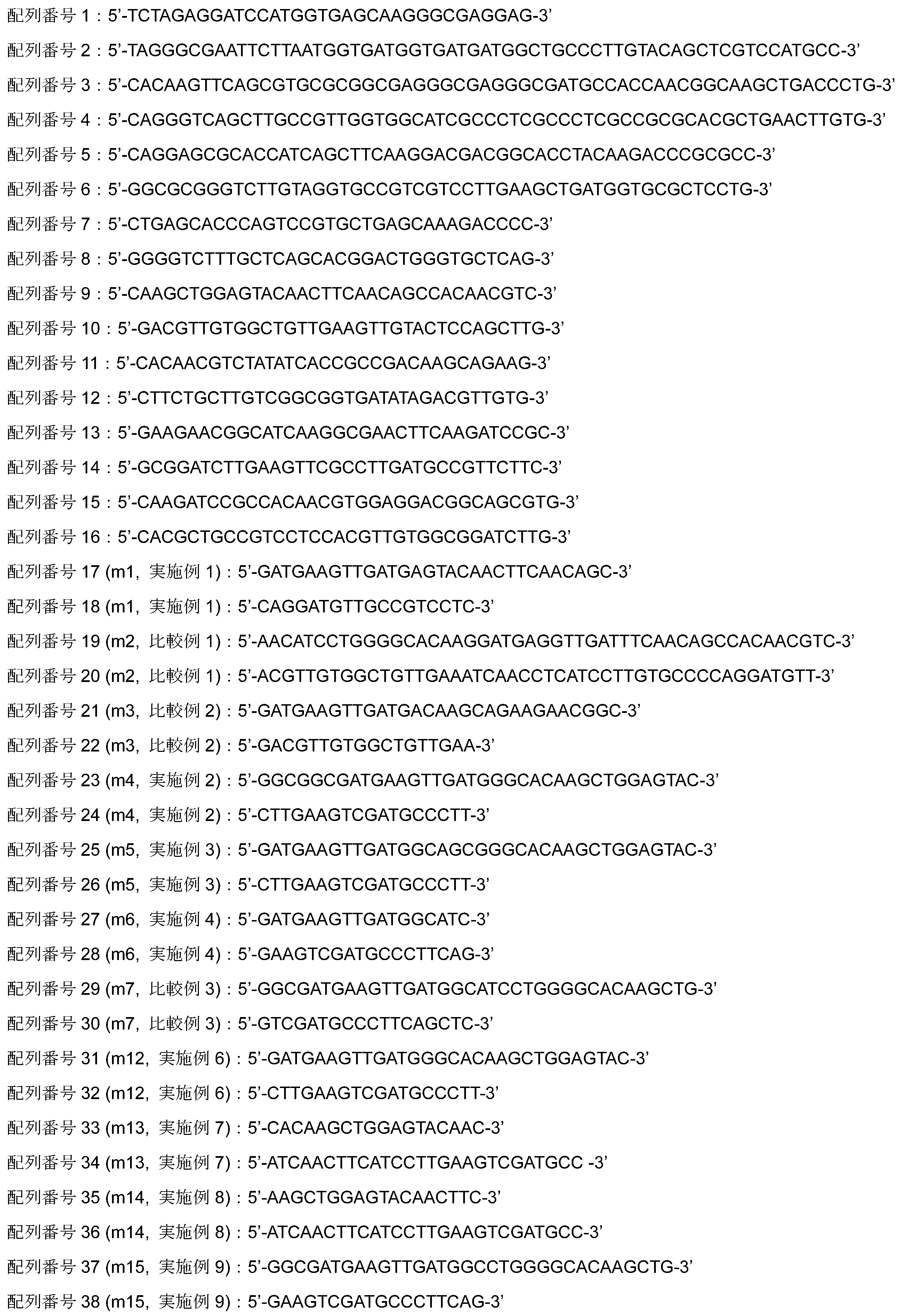
- PCR is performed with PfuUltra High fidelity DNA Polymerase (Agilent Technology) using the vector pGEM-EGFP as a template and primers (SEQ ID NOs: 3-16) (Table 2), and 9 amino acids are substituted site-specifically.
- a vector pGEM-sfGFP into which the sfGFP gene was inserted was obtained.
- This vector was digested with Bam HI and Eco RI to obtain a Bam HI-Eco RI fragment. This fragment was ligated to the BamHI site and EcoRI site of the GST fusion protein expression vector pGEX-6P-3 (GE Healthcare) to obtain a vector pGEX-sfGFP in which the sfGFP gene was inserted.
- pGEX-sfGFP has a size of 5.6 kbp, and has the base sequences of GST and sfGFP structural genes in this order downstream of the tac promoter. Therefore, pGEX-sfGFP expresses GST and sfGFP in this order as one fusion protein in E. coli cells.
- a peptide-presenting protein was prepared by introducing a caspase 3 recognition peptide into the amino acid sequence of Nos. 131 to 139 of sfGFP.
- pGEX-sfGFP constructed in Reference Example 1 as a template and using primers (SEQ ID NOs: 17, 18, 23-28, 31-46, 58-59, 64-71) (Table 2)
- PfuUltra High fidelity DNA PCR was performed with Polymerase, and vectors pGEX-m1 (Example 1) and pGEX-m4 to pGEX-m6 (Example 2) for expressing sfGFP incorporating a Caspase-3 recognition peptide sequence (DEVD) in a site-specific manner To 4) and pGEX-m10 to pGEX-m22 (Examples 5 to 17) were obtained.
- Table 1 shows the length and position of the substituted peptides.
- the peptide presentation protein shows the length and position of the substituted
- Comparative Examples 1 to 5 a peptide-presenting protein in which a caspase 3 recognition peptide was introduced into an amino acid sequence other than the region of the amino acid sequence of Nos. 131 to 139 of sfGFP was prepared.
- Example 1 As primers, SEQ ID NO: 19 and 20 (Comparative Example 1), SEQ ID NO: 21 and 22 (Comparative Example 2), SEQ ID NO: 29 and 30 (Comparative Example 3), SEQ ID NO: 60 and 61 (Comparative Example 4), SEQ ID NO: 62 And 63 (Comparative Example 5), the procedure of Example 1 was repeated except that the vectors pGEX-m2 (Comparative Example 1), pGEX-m3 (Comparative Example 2), and pGEX-m7 (Comparative Example 3) were used. ), PGEX-m8 (Comparative Example 4), and pGEX-m9 (Comparative Example 5). Table 1 shows the length and position of the substituted peptides.
- Isopropyl- ⁇ -thiogalactopyranoside was added to the culture solution to a concentration of 0.1 mM, and cultured overnight at 20 ° C. to obtain E. coli expressing the GST fusion protein.
- Escherichia coli expressing the protein was collected by centrifugation and resuspended in 20 mL of phosphate buffer (PBS).
- PBS phosphate buffer
- the obtained bacterial cells were crushed by freeze-thawing and ultrasonication three times, and then Triton x-100 with a final concentration of 1% was added, and the mixture was allowed to stand on ice for 30 minutes.
- the bacterial cell liquid was centrifuged at 5000 rpm for 10 minutes at 4 ° C., and the supernatant containing the protein was recovered.
- the collected solution was added to GST agarose beads washed with PBS, and GST fusion protein was adsorbed while slowly rotating at 4 ° C. overnight.
- the beads were washed with PBS, and further washed with Precision Clearvage Buffer (0.05 M Tris-HCl (pH 7.0), 0.15 M NaCl, 1 mM EDTA, 1 mM DTT).
- Precision Clearvage Buffer 0.05 M Tris-HCl (pH 7.0), 0.15 M NaCl, 1 mM EDTA, 1 mM DTT.
- 1 mL of Prescission Cleavage Buffer and 5 ⁇ L of Prescission Protease (GE Healthcare) were added and reacted at room temperature for 4 hours. The reaction was allowed to proceed overnight at 4 ° C. Next, the supernatant was collected by centrifugation at 3000 rpm for 15 minutes at 4 ° C.
- peptide-presenting proteins sfGFP-m1 to m9 and sfGFP-m11 to m21
- sfGFP-m10 and sfGFP-m22 were expressed in inclusion bodies.
- m1 (Example 1), m4 (Example 2), m5 (Example 3), m6 (Example 4), m11 (Example 5), m12 (Example 6), m13 (Example 7).
- M14 (Example 8), m15 (Example 9), m16 (Example 10), m17 (Example 11), m18 (Example 12), m19 (Example 13), m20 (Example 14), In m21 (Example 15), it was hardly cut
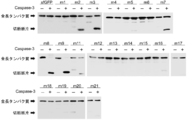
- disconnected (Table 1 and FIG. 2).
- ⁇ Fluorescence intensity of peptide-presenting protein The influence of the peptide incorporation on the fluorescence intensity of the peptide-presenting protein was examined.
- thermodynamically stable structure was calculated from the initial structure using the ff99SB force field of Amber 11 program package (Amber).
- the molecular dynamics simulation uses the Amber 11 Sander module to calculate 10 nanoseconds in the GB / SA solvent model and evaluate fluctuations using the 4.5 nanosecond to 10 nanosecond structure that reached equilibrium. did.
- the results are shown in FIG.
- the vertical axis represents the fluctuation magnitude of each residue in the simulation of 4.5 nanoseconds to 10 nanoseconds
- the horizontal axis represents the residue number.
- the fluctuations in the K131-H139 region of sfGFP, m1 (Example 1), m6 (Example 4), and m19 (Example 13) were within 0.1 nanometers for most residues.
- m7 Comparative Example 3
- the maximum size was increased to about 0.3 nanometers, indicating that the K131-H139 region fluctuated greatly. Therefore, it was shown that the modified substance that is not easily decomposed into caspase 3 has almost no fluctuation, and the structural freedom of the incorporated peptide is limited.
- Examples 16 to 20 In this example, five types of peptides reported to bind to the breast cancer marker protein HER2 were incorporated into the region of the amino acid sequence of amino acids 131 to 139 of sfGFP to obtain an expression vector and a purified protein.
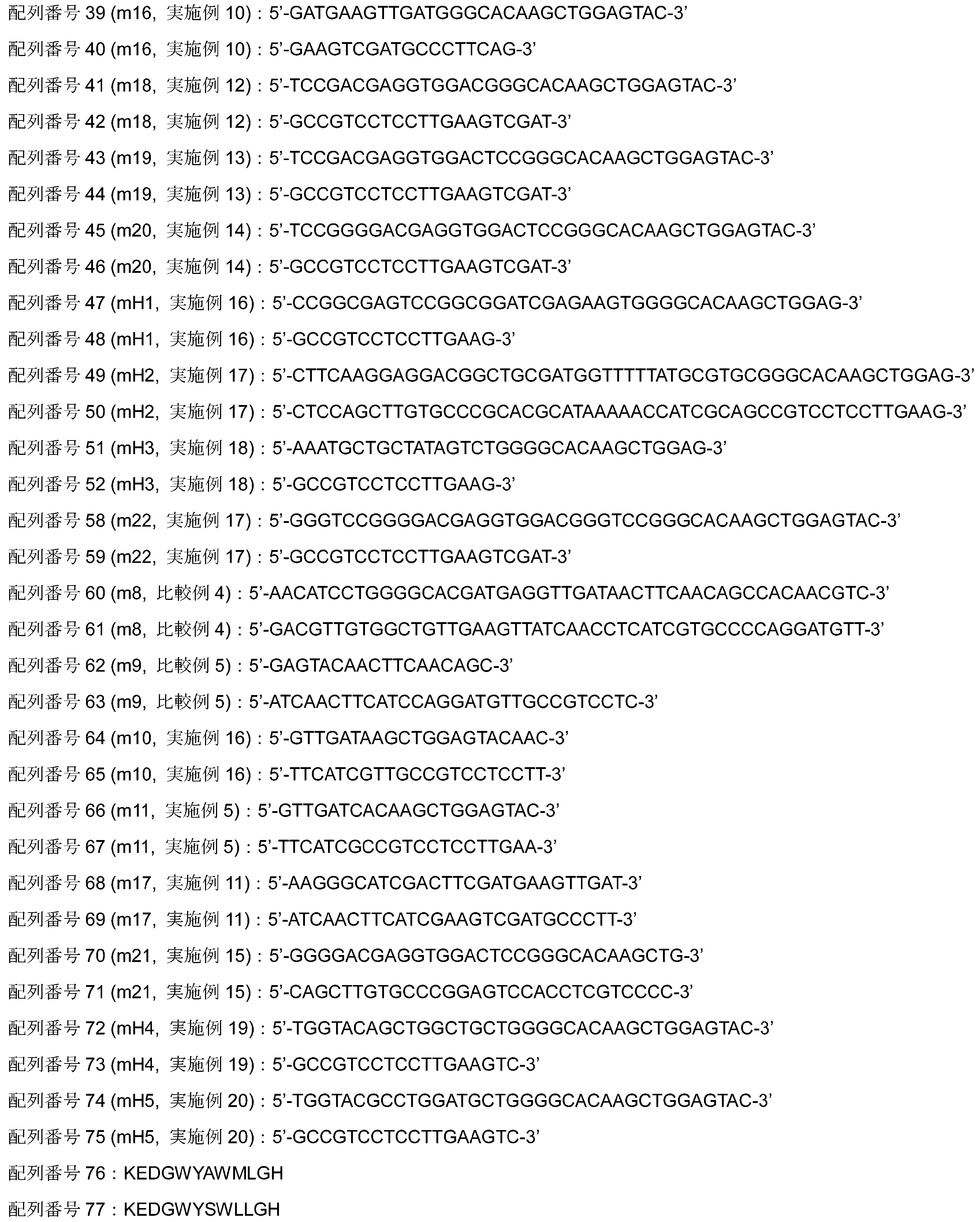
- SEQ ID NO: 47 and 48 (Example 16), SEQ ID NO: 49 and 50 (Example 17), SEQ ID NO: 51 and 52 (Example 18), SEQ ID NO: 72 and 73 (Example 19), SEQ ID NO: 74 And 75 (Example 20), except that the primers of Example 1 were used, and the vectors pGEX-mH1 (Example 16), pGEX-mH2 (Example 17), and pGEX-mH3 (Example 18) were repeated. ), PGEX-mH4 (Example 19), and pGEX-mH5 (Example 20).
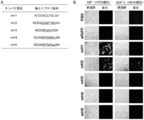
- FIG. 5A shows the length and position of the substituted peptide.
- mH1 is “KEDGCCKCYSLGH” (SEQ ID NO: 55)
- mH2 is “KEDGCDGFYACGH” (SEQ ID NO: 56)
- mH3 is “KEDGFHAHPGH” (SEQ ID NO: 57)
- mH4 is “KEDGWYAWMLGH” (SEQ ID NO: 76)
- mH5 is “KEDGHY”. (SEQ ID NO: 77).
- the vectors pGEX-mH1, pGEX-mH2, pGEX-mH3, pGEX-mH4, and pGEX-mH5 were used, the above-described “expression and purification of peptide-presenting protein” was repeated to display the peptide. Proteins were obtained (hereinafter, peptide-presenting proteins obtained from pGEX-mH1 to mH5 may be referred to as mH1 to mH5, respectively).
- HER2 protein which is overexpressed frequently in breast cancer cells, is useful as a therapeutic target / imaging target for breast cancer, and a peptide that functions in vivo in mice has been reported.
- the peptide of mH1 has been screened from a phage library, has an SS bond between adjacent cysteines, and is partially limited in structure (Karasseva et al., J. Protein Protein Chem., 2002, 21, 287). -296).
- the peptide of mH2 is a peptide designed with reference to the binding surface of a HER2 binding antibody, and has binding activity in a state in which the structure is limited by cyclization (Park et al., Nat. Biotechnol., 2000, 18, 194). -198).
- the mH3 peptide was selected by in silico screening under conditions that allow it to take a free structure (Nakajima et al., Breast Cancer, 2008, 15, 65-72).
- the mH4 and mH5 peptides were screened simultaneously with the mH1 peptide and the structure is not limited.
- mH1 and mH2 have already been reported to function in vivo in mice (Deutscher SL, Chem. Rev., 2010, 110, 3196-3211).
- ⁇ Binding of peptide-presenting protein incorporating HER2 peptide to cancer cells >> 2.5 ⁇ 10 4 HER2-positive N87 gastric cancer cells and HER2-negative SUIT-2 pancreatic cancer cells were cultured for 16 hours in 8-well slide chamber culture plates. The cells were fixed by reacting with 4% paraformaldehyde phosphate buffer for 15 minutes, washed with PBS solution, and blocked with 3% bovine serum albumin / TBST for 15 minutes. Next, 2 ⁇ M peptide-presenting protein (mH1, mH2, mH3, mH4, or mH5) was added and incubated at 4 ° C. for 16 hours, and the binding property was evaluated by observation with a fluorescence microscope.
- Example 2 Examination of structural fluctuations in the K131-L137 region >> M12 (Example 6), m15 (Example 9), m16 (Example 10), m19 (Example 13), m21 (Example 15), and m22 which are the peptide-presenting proteins of the present invention in the K131-L137 region
- the molecular dynamics simulation of (Example 17) was performed.
- As a positive control sfGFP was used.
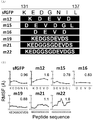
- the amino acid sequence is shown in FIG. 6 (A), and the analysis result is shown in FIG. 6 (B).
- the vertical axis represents the fluctuation magnitude of each residue in the simulation of 4.5 nanoseconds to 10 nanoseconds, and the horizontal axis represents the amino acid sequence. It was shown that the modified substance that is not easily decomposed into caspase 3 has almost no fluctuation, and the structural freedom of the incorporated peptide is limited.
- the peptide-presenting protein of the present invention and a peptide library using the same can be used for screening for peptides that can specifically bind to a target molecule.
- Peptides screened by the peptide library of the present invention can be used effectively as an active ingredient of a medicine.
Landscapes
- Life Sciences & Earth Sciences (AREA)
- Chemical & Material Sciences (AREA)
- Health & Medical Sciences (AREA)
- Engineering & Computer Science (AREA)
- Organic Chemistry (AREA)
- Genetics & Genomics (AREA)
- Molecular Biology (AREA)
- Zoology (AREA)
- Bioinformatics & Cheminformatics (AREA)
- Wood Science & Technology (AREA)
- Biomedical Technology (AREA)
- Biotechnology (AREA)
- General Health & Medical Sciences (AREA)
- Biochemistry (AREA)
- General Engineering & Computer Science (AREA)
- Biophysics (AREA)
- Microbiology (AREA)
- Physics & Mathematics (AREA)
- Proteomics, Peptides & Aminoacids (AREA)
- Medicinal Chemistry (AREA)
- Plant Pathology (AREA)
- Crystallography & Structural Chemistry (AREA)
- Immunology (AREA)
- Bioinformatics & Computational Biology (AREA)
- Urology & Nephrology (AREA)
- Hematology (AREA)
- Analytical Chemistry (AREA)
- Gastroenterology & Hepatology (AREA)
- Food Science & Technology (AREA)
- Cell Biology (AREA)
- General Physics & Mathematics (AREA)
- Pathology (AREA)
- Virology (AREA)
- Chemical Kinetics & Catalysis (AREA)
- General Chemical & Material Sciences (AREA)
- Tropical Medicine & Parasitology (AREA)
- Toxicology (AREA)
- Peptides Or Proteins (AREA)
- Micro-Organisms Or Cultivation Processes Thereof (AREA)
- Measuring Or Testing Involving Enzymes Or Micro-Organisms (AREA)
Abstract
Description
ファージディスプレイ法では、濃縮されたファージに提示されたペプチドと、それをコードする遺伝子が1対1で対応するため、目的のペプチドが容易に特定可能である。また、遺伝子を容易に増幅(増殖)できるため、ペプチドのスクリーニング方法として、広範に用いられている。
従って、本発明の目的は、標的分子との特異性の高いペプチドのスクリーニング方法を提供することである。
本発明者は、提示されるペプチドの構造の自由度を抑制する方法について、鋭意研究した結果、驚くべきことに、superfolderGFP(非特許文献2;以下、sfGFPと称することがある)の131番~139番の領域にペプチドを組込むことにより、ペプチドの構造の自由度が抑制され、標的分子と特異的に結合することのできるペプチドをスクリーニングできることを見出した。
本発明は、こうした知見に基づくものである。
従って、本発明は、
[1]配列番号54で表されるアミノ酸配列における131番~139番の提示領域にペプチドが提示されたペプチド提示タンパク質であって、前記提示が、4~15個のペプチドのアミノ酸配列を、前記131番~139番のアミノ酸配列に挿入、若しくは131番~139番のアミノ酸配列の1~9個のアミノ酸配列と置換するものであって、且つ131番~139番のアミノ酸配列に相当するアミノ酸配列の鎖長が15個以下である、ペプチド提示タンパク質、
[2]前記配列番号54で表されるアミノ酸配列における1番~130番のアミノ酸配列又は140番~238番のアミノ酸配列において、1又は複数のアミノ酸が欠失、置換、挿入、及び/又は付加されたアミノ酸配列からなり、且つ蛍光発生活性を有する[1]に記載のペプチド提示タンパク質、
[3]前記挿入又は置換される4~15個のペプチドの末端のアミノ酸配列が、制限酵素サイトを含む塩基配列から翻訳されたアミノ酸配列である、[1]又は[2]に記載のタンパク質、
[4]前記[1]~[3]のいずれかに記載のペプチド提示タンパク質及び表面提示タンパク質の融合タンパク質、
[5]前記[1]~[3]のいずれかに記載のペプチド提示タンパク質、又は[4]に記載の融合タンパク質をコードするポリヌクレオチド、
[6][5]に記載のポリヌクレオチドを含むベクター、
[7][6]に記載のベクターを含む宿主、
[8]前記提示されるペプチドがランダムなアミノ酸配列からなる複数のペプチドである、[7]の宿主を含むライブラリー、
[9]配列番号54で表されるアミノ酸配列における131番~139番の提示領域にペプチドが提示可能なペプチド提示用タンパク質であって、前記提示が、4~15個のペプチドのアミノ酸配列を、前記131番~139番のアミノ酸配列に挿入、若しくは131番~139番のアミノ酸配列の1~9個のアミノ酸配列と置換するものであって、且つ131番~139番のアミノ酸配列に相当するアミノ酸配列の鎖長が15個以下である、ペプチド提示用タンパク質、
[10]前記配列番号54で表されるアミノ酸配列における1番~130番のアミノ酸配列又は140番~238番のアミノ酸配列において、1又は複数のアミノ酸が欠失、置換、挿入、及び/又は付加されたアミノ酸配列からなり、且つ蛍光発生活性を有する[9]に記載のペプチド提示用タンパク質、
[11]前記挿入又は置換される4~15個のペプチドの末端のアミノ酸配列が、制限酵素サイトを含む塩基配列の翻訳されたアミノ酸配列である、[9]又は[10]に記載のペプチド提示用タンパク質、
[12]前記[9]~[10]のいずれかに記載のペプチド提示用タンパク質及び表面提示タンパク質の融合タンパク質、
[13]前記[9]~[11]のいずれかに記載のペプチド提示用タンパク質及び[12]に記載の融合タンパク質をコードするポリヌクレオチド、
[14][13]に記載のポリヌクレオチドを含むベクター、
[15][14]に記載のベクターを含む宿主、
[16](1)前記[14]に記載のベクターに、4~15個のペプチドであって、そのアミノ酸配列を、前記131番~139番の提示領域のアミノ酸配列に挿入、若しくは131番~139番の提示領域のアミノ酸配列の1~9個のアミノ酸配列と置換し、且つ131番~139番のアミノ酸配列に相当するアミノ酸配列の鎖長が15個以下であるペプチド、をコードするヌクレオチドを組込み、発現ベクターを得る工程、及び(2)前記発現ベクターを宿主に導入する工程、を含むライブラリーの構築方法、
[17](1)標的分子及び[8]に記載のペプチドライブラリーを接触させる工程、(2)標的分子に結合した宿主を回収する工程、を含む標的分子に結合するペプチドのスクリーニング方法、
[18](3)前記回収した宿主を増幅する工程、を更に含む[17]に記載のペプチドのスクリーニング方法、及び
[19]前記接触工程(1)、宿主回収工程(2)及び増幅工程(3)を繰り返す、[18]に記載のペプチドのスクリーニング方法、
に関する。
《ペプチド提示タンパク質》
本発明のペプチド提示タンパク質は、配列番号54で表されるアミノ酸配列における131番~139番の提示領域にペプチドが提示されたペプチド提示タンパク質であって、前記提示が、4~15個(好ましくは4~14個、より好ましくは4~13個、更に好ましくは4~12個)のペプチドのアミノ酸配列を、前記131番~139番のアミノ酸配列に挿入、若しくは131番~139番のアミノ酸配列の1~9個のアミノ酸配列と置換するものであって、且つ131番~139番のアミノ酸配列に相当するアミノ酸配列の鎖長が15個以下(好ましくは14個以下、より好ましくは13個以下、更に好ましくは12個以下)である。また、131番~139番のアミノ酸配列に相当するアミノ酸配列の鎖長の下限は、好ましくは5個以上である。本発明のペプチド提示タンパク質は、配列番号54で表されるアミノ酸配列における1番~130番のアミノ酸配列又は140番~238番のアミノ酸配列において、1又は複数のアミノ酸が欠失、置換、挿入、及び/又は付加されたアミノ酸配列からなり、且つ蛍光発生活性を有するペプチド提示タンパク質であってもよい。配列番号54で表されるアミノ酸配列からなるタンパク質は、非特許文献2に記載のsfGFPであるが、本発明のペプチド提示タンパク質において、ペプチドが組込まれる親タンパク質としては、GFP系のタンパク質を用いることができる。すなわち、GFP又はGFP由来のGFP変異体タンパク質を、限定されることなく用いることができる。具体的な親タンパク質としては、GFP、YFP、CFP、BFP、又はRFPを挙げることができる。
本発明のペプチド提示タンパク質は、より好ましくは配列番号54で表されるアミノ酸配列における131番~138番の領域にペプチドが提示されたペプチド提示タンパク質であって、前記提示が、4~14個(好ましくは4~13個、より好ましくは4~12個)のペプチドのアミノ酸配列を、前記131番~138番のアミノ酸配列に挿入、若しくは131番~138番のアミノ酸配列の1~8個のアミノ酸配列と置換するものであって、且つ131番~138番のアミノ酸配列に相当するアミノ酸配列の鎖長が14個以下(好ましくは13個以下、より好ましくは12個以下)である。また、131番~138番のアミノ酸配列に相当するアミノ酸配列の鎖長の下限は、好ましくは4個以上である。この場合、本発明のペプチド提示タンパク質は、好ましくは配列番号54で表されるアミノ酸配列における1番~130番のアミノ酸配列又は139番~238番のアミノ酸配列において、1又は複数のアミノ酸が欠失、置換、挿入、及び/又は付加されたアミノ酸配列からなり、且つ蛍光発生活性を有するペプチド提示タンパク質であってもよい。
本発明のペプチド提示タンパク質は、より好ましくは配列番号54で表されるアミノ酸配列における131番~137番の領域にペプチドが提示されたペプチド提示タンパク質であって、前記提示が、4~13個(好ましくは4~12個)のペプチドのアミノ酸配列を、前記131番~137番のアミノ酸配列に挿入、若しくは131番~137番のアミノ酸配列の1~7個のアミノ酸配列と置換するものであって、且つ131番~137番のアミノ酸配列に相当するアミノ酸配列の鎖長が13個以下(好ましくは12個以下)である。また、131番~137番のアミノ酸配列に相当するアミノ酸配列の鎖長の下限は、好ましくは4個以上である。この場合、本発明のペプチド提示タンパク質は、好ましくは配列番号54で表されるアミノ酸配列における1番~130番のアミノ酸配列又は139番~238番のアミノ酸配列において、1又は複数のアミノ酸が欠失、置換、挿入、及び/又は付加されたアミノ酸配列からなり、且つ蛍光発生活性を有するペプチド提示タンパク質であってもよい。
なお、提示されるペプチドの長さが短い方が、タンパク質の凝集が抑制されることがある点で好ましい。また、提示される領域が131~139番の領域に比べて、131番~138番の領域、又は131番~137番の領域の場合、タンパク質の凝集が抑制されることがある点で好ましい。
本発明のペプチド提示用タンパク質は、配列番号54で表されるアミノ酸配列における131番~139番の提示領域にペプチドが提示可能なペプチド提示用タンパク質であって、前記提示が、4~15個(好ましくは4~14個、より好ましくは4~13個、更に好ましくは4~12個)のペプチドのアミノ酸配列を、前記131番~139番のアミノ酸配列に挿入、若しくは131番~139番のアミノ酸配列の1~9個のアミノ酸配列と置換するものであって、且つ131番~139番のアミノ酸配列に相当するアミノ酸配列の鎖長が15個以下(好ましくは14個以下、より好ましくは13個以下、更に好ましくは12個以下)である。また、131番~139番のアミノ酸配列に相当するアミノ酸配列の鎖長の下限は、好ましくは5個以上である。
更に、本発明のペプチド提示用タンパク質は、配列番号54で表されるアミノ酸配列における1番~130番のアミノ酸配列又は140番~238番のアミノ酸配列において、1又は複数のアミノ酸が欠失、置換、挿入、及び/又は付加されたアミノ酸配列からなり、且つ蛍光発生活性を有する前記のペプチド提示用タンパク質であってもよい。配列番号54で表されるアミノ酸配列からなるタンパク質は、非特許文献2に記載のsfGFPであるが、本発明のペプチド提示用タンパク質において、ペプチドが組込まれる親タンパク質としては、GFP系のタンパク質を用いることができる。すなわち、GFP又はGFP由来のGFP変異体タンパク質を、限定されることなく用いることができる。具体的な親タンパク質としては、GFP、YFP、CFP、BFP、又はRFPを挙げることができる。
本発明のペプチド提示用タンパク質は、より好ましくは配列番号54で表されるアミノ酸配列における131番~138番の領域にペプチドが提示されたペプチド提示用タンパク質であって、前記提示が、4~14個(好ましくは4~13個、より好ましくは4~12個)のペプチドのアミノ酸配列を、前記131番~138番のアミノ酸配列に挿入、若しくは131番~138番のアミノ酸配列の1~8個のアミノ酸配列と置換するものであって、且つ131番~138番のアミノ酸配列に相当するアミノ酸配列の鎖長が14個以下(好ましくは13個以下、より好ましくは12個以下)である。また、131番~138番のアミノ酸配列に相当するアミノ酸配列の鎖長の下限は、好ましくは4個以上である。この場合、本発明のペプチド提示用タンパク質は、好ましくは配列番号54で表されるアミノ酸配列における1番~130番のアミノ酸配列又は139番~238番のアミノ酸配列において、1又は複数のアミノ酸が欠失、置換、挿入、及び/又は付加されたアミノ酸配列からなり、且つ蛍光発生活性を有するペプチド提示タンパク質であってもよい。
本発明のペプチド提示用タンパク質は、より好ましくは配列番号54で表されるアミノ酸配列における131番~137番の領域にペプチドが提示されたペプチド提示用タンパク質であって、前記提示が、4~13個(好ましくは4~12個)のペプチドのアミノ酸配列を、前記131番~138番のアミノ酸配列に挿入、若しくは131番~137番のアミノ酸配列の1~7個のアミノ酸配列と置換するものであって、且つ131番~137番のアミノ酸配列に相当するアミノ酸配列の鎖長が13個以下(好ましくは12個以下)である。また、131番~137番のアミノ酸配列に相当するアミノ酸配列の鎖長の下限は、好ましくは4個以上である。この場合、本発明のペプチド提示用タンパク質は、好ましくは配列番号54で表されるアミノ酸配列における1番~130番のアミノ酸配列又は139番~238番のアミノ酸配列において、1又は複数のアミノ酸が欠失、置換、挿入、及び/又は付加されたアミノ酸配列からなり、且つ蛍光発生活性を有するペプチド提示タンパク質であってもよい。
一方、本明細書において「ペプチド提示用タンパク質」とは、例えばsfGFPの131番~139番の領域に、ペプチドが提示可能なように設計されたタンパク質を意味する。例えば、131番~139番の領域に、ペプチドスクリーニングに用いる任意のペプチドが組込み可能であるが、まだスクリーニングされるペプチドが組込まれていないsfGFPのタンパク質を意味する。具体的な1つの態様としては、sfGFPの131番~139番の領域にペプチドが組込み可能に設計されたベクターから、翻訳されるタンパク質を意味する。従って、ペプチド提示用タンパク質をコードするポリヌクレオチドは、任意のペプチドをコードするヌクレオチドを導入するための制限酵素サイトを有することが好ましい。
前記131番~139番の領域は、好ましくは131番~138番の領域であり、更に好ましくは131番~137番の領域である。領域の長さが短い方が、ペプチド提示タンパク質が可溶化しやすい傾向があるからである。更に、挿入されるペプチドの長さは、好ましくは4~15個であり、より好ましくは4~14個であり、更に好ましくは4~13個であり、最も好ましくは4~12個である。挿入されるペプチドの長さが短い方が、ペプチド提示タンパク質が可溶化しやすい傾向があるからである。
sfGFPのアミノ酸配列における131番~139番のアミノ酸配列は「KEDGNLGH」(配列番号55)である。この9個のアミノ酸配列の領域を、4~15個(好ましくは4~14個)のアミノ酸配列からなるペプチドに置換した場合、ペプチドの構造自由度が制限され、安定した構造でsfGFP上に提示される。そのため、ペプチドライブラリーとして用いることにより、標的分子に対して特異性の高いペプチドをスクリーニングすることができる。
提示領域が131番~139番のアミノ酸配列の場合、挿入又は置換されるアミノ酸配列は4~15個であり、好ましくは4~14個であり、131番~139番のアミノ酸配列の1部を含んでいてもよい。従って、131番~139番のアミノ酸配列を欠失することなく、4~6個のアミノ酸配列が挿入されてもよい。また、131番~139番のアミノ酸配列の1~9個のいずれかの数のアミノ酸配列を欠失させ、合計で5~15個、好ましくは5~14個となるように外来のアミノ酸配列を組込んでもよい。
提示領域は、好ましくは131番~138番のアミノ酸配列である。この場合、挿入又は置換されるアミノ酸配列は4~14個であり、好ましくは4~13個であり、131番~138番のアミノ酸配列の1部を含んでいてもよい。従って、131番~138番のアミノ酸配列を欠失することなく、4~6個のアミノ酸配列が挿入されてもよい。また、131番~138番のアミノ酸配列の1~8個のいずれかの数のアミノ酸配列を欠失させ、合計で4~14個、好ましくは4~13個となるように外来のアミノ酸配列を組込んでもよい。
更に、効率的にペプチドライブラリーを構築するためには、挿入又は置換されるペプチドの両末端のアミノ酸配列が、制限酵素サイトを含む塩基配列の翻訳されたアミノ酸配列であることが好ましい。ペプチドの組み込みに用いられる制限酵素サイトは、限定されるものではないが、例えばBamHI、EcoRI、ScaI、SalI、SphI、PstI、NcoI、NheI、SspI、NotI、SacI、PvuII、MfeI、HindIII、SbfI、EagI、EcoRV、AvrII、BstXI、PciI、HpaI、AgeI、BsmBI、BspQI、SapI、KpnI又はBsaIを用いることができる。例えば、挿入又は置換される4~14個のペプチドの両末端のアミノ酸配列はこれらの制限酵素が認識する塩基配列を含むヌクレオチドから翻訳されるアミノ酸配列であってもよい。
なお、このような制限酵素サイトから翻訳されるペプチドをリンカーペプチドと称することがある。
前記のように、本発明の「ペプチド提示タンパク質」、及び「ペプチド提示用タンパク質」の親タンパク質は、GFP系のタンパク質を用いることができるが、GFP系のタンパク質をコードするアミノ酸配列において、1若しくは複数のアミノ酸が欠失、置換、挿入、及び/又は付加されたアミノ酸配列からなり、且つ蛍光発生活性を有するタンパク質であってもよい。
本発明において、「アミノ酸配列において、1若しくは複数のアミノ酸が欠失、置換、挿入、及び/又は付加されたアミノ酸」とは、GFP系のタンパク質であることを意味するか、又は部位特異的突然変異誘発法等の周知の方法により、又は天然に生じ得る程度の数個の数のアミノ酸の置換等により改変がなされたことを意味する。アミノ酸の改変の個数は、好ましくは1~15個、より好ましくは1~10個、更に好ましくは1~5個、更により好ましくは1~3個、最も好ましくは1個である。
本発明のポリペプチドの改変アミノ酸配列の例は、好ましくは、そのアミノ酸が、1又は数個(好ましくは、1、2、3又は4個)の保存的置換を有するアミノ酸配列であることができる。
本発明の融合タンパク質は、本発明のペプチド提示タンパク質、又はペプチド提示用タンパク質と、表面提示タンパク質とが融合したタンパク質である。
本明細書において、表面提示タンパク質とは、後述の宿主の表面に提示されるタンパク質を意味する。例えば、宿主がファージの場合は、ファージの表面タンパク質を意味する。また、宿主が細菌の場合は、細菌表面タンパク質を意味する。更に、宿主が酵母の場合は、酵母の表面タンパク質を意味し、宿主が動物細胞の場合は、動物細胞の表面タンパク質を意味する。
ペプチド提示タンパク質、又はペプチド提示用タンパク質と、宿主の表面たんぱく質とが融合することにより、ペプチド提示タンパク質は、宿主の表面に提示されることができる。従って、本発明のペプチドライブラリーを用いて、目的ペプチドのアフィニティーセレクション(スクリーニング)を行う場合、容易に目的ペプチドの濃縮を行うことができる。
細菌の表面タンパク質、例えば大腸菌の表面タンパク質としては、限定されるものではないが、OmpAを挙げることができる。
酵母の表面タンパク質としては、限定されるものではないが、Flo1、αアグルチニン、又はAGA2を挙げることができる。
動物細胞の表面タンパク質としては、限定されるものではないが、human Toll-like receptor 4、EGFR、LDL receptor、angiotensin II receptor、又はPDGFRを挙げることができる。
本発明のポリヌクレオチドは、本発明のペプチド提示タンパク質をコードするポリヌクレオチド(以下、ペプチド提示ポリヌクレオチドと称することがある)、ペプチド提示用タンパク質をコードするポリヌクレオチド(以下、ペプチド提示用ポリヌクレオチドと称することがある)、又は融合タンパク質をコードするポリヌクレオチド(以下、融合ポリヌクレオチドと称することがある)である。融合ポリヌクレオチドは、ペプチド提示タンパク質又はペプチド提示用タンパク質と、表面提示タンパク質との間に存在することのあるリンカーポリペプチドをコードするヌクレオチドを含んでもよい。なお、配列番号53の塩基配列は、sfGFPをコードするヌクレオチドの塩基配列である。
本発明のポリヌクレオチドは、限定されるものではないが、ベクターに組み込むことによって、容易に増幅させることができる。また、ペプチド提示タンパク質、又は融合タンパク質として、容易に発現させることができる。
前記ポリヌクレオチドを組込むベクターとしては、宿主細胞において複製可能である限り、プラスミド、ファージ、又はウイルス等のいかなるベクターも用いることができる。例えば、pBR322、pBR325、pUC118、pUC119、pKC30、pCFM536等の大腸菌プラスミド、pUB110等の枯草菌プラスミド、pG-1、YEp13、YCp50等の酵母プラスミド、λgt110、λZAPII等のファージのDNA等が挙げられ、哺乳類細胞用のベクターとしては、バキュロウイルス、ワクシニアウイルス、アデノウイルス等のウイルスDNA、SV40とその誘導体等が挙げられる。ベクターは、複製開始点、選択マーカー、プロモーターを含み、必要に応じてエンハンサー、転写終結配列(ターミネーター)、リボソーム結合部位、ポリアデニル化シグナル等を含んでいてもよい。
例えば、本発明のライブラリーとして用いる場合、M13ファージベクター、又はT7ファージベクターを用いることが好ましい。ファージディスプレイのベクターとして用いることができるからである。
本明細書において「宿主」とは、前記ベクターが組込まれ、ペプチド提示タンパク質又は融合タンパク質を発現できる限りにおいて、限定されるものでなく、ファージ、細菌、酵母、昆虫細胞、又は動物細胞を挙げることができる。例えば、ファージベクターの宿主としては、M13ファージ、fdファージ、又はT7ファージを挙げることができる。
また、細菌のベクターの宿主としては、大腸菌、ストレプトミセス、又は枯草菌を挙げることができる。更に、酵母ベクターの宿主としては、パン酵母、又はメタノール資化性酵母を挙げることができる。昆虫細胞ベクターの宿主としては、ドロソフィラS2、スポドプテラSf9を挙げることができる。更に、動物細胞ベクターの宿主としては、CHO、COS、BHK、3T3、C127を挙げることができる。
本発明のライブラリーは、ペプチド提示ライブラリーであり、提示されるペプチドは任意のアミノ酸配列を有するものである。本発明のペプチド提示ライブラリーは、標的分子に結合するペプチドをスクリーニングするために用いることができる。従って提示されるペプチドは、ランダムなアミノ酸配列からなる複数(多種類)のペプチドが含まれているものが好ましい。また、本発明のライブラリーは、前記の宿主を含むライブラリーであり、ファージディスプレイ、又は細菌、酵母、昆虫細胞、若しくは動物細胞の細胞ディスプレイのライブラリーを挙げることができる。
本発明のライブラリーを用いたスクリーニングに供される提示ペプチドの長さは特に限定されるものではないが、例えば4~15であり、好ましくは4~14であり、より好ましくは4~13である。
本発明のライブラリーの構築方法は、(1)本発明のペプチド提示用タンパク質をコードするポリペプチドを含むベクターに、4~15個(好ましくは4~14個)のペプチドであって、そのアミノ酸配列を、前記131番~139番の提示領域のアミノ酸配列に挿入、若しくは131番~139番の提示領域のアミノ酸配列の1~9個のアミノ酸配列と置換し、且つ131番~139番の提示領域のアミノ酸配列に相当するアミノ酸配列の鎖長が15個以下(好ましくは14個以下)であるペプチド、をコードするヌクレオチドを組込み、ベクターを得る工程、及び(2)前記ベクターを宿主に導入する工程、
を含む。ライブラリーは、具体的にはペプチド提示ライブラリーであり、任意のペプチドを提示することのできるライブラリーである。
本発明のライブラリーの構築方法は、好ましくは(1)本発明のペプチド提示用タンパク質をコードするポリペプチドを含むベクターに、4~14個(好ましくは4~13個)のペプチドであって、そのアミノ酸配列を、前記131番~138番の提示領域のアミノ酸配列に挿入、若しくは131番~138番の提示領域のアミノ酸配列の1~8個のアミノ酸配列と置換し、且つ131番~138番の提示領域のアミノ酸配列に相当するアミノ酸配列の鎖長が14個以下(好ましくは13個以下)であるペプチド、をコードするヌクレオチドを組込み、ベクターを得る工程、及び(2)前記ベクターを宿主に導入する工程、を含む。
組込まれるヌクレオチドがコードするポリペプチドの長さは、特に限定されるものではないが、例えば4~15であり、好ましくは4~14であり、より好ましくは4~13である。
ライブラリーに組込む遺伝子は、公知の方法で調整することができる。
例えば、ランダムなアミノ酸をコードするNNKコドン(NはA、G、C、Tのいずれかの塩基、KはGもしくはTのいずれかの塩基)を任意のアミノ酸をコードするコドンと部位特異的に置換する。置換には当該領域を含むオリゴDNAを化学合成し、制限酵素を利用して組込む、あるいはPCRを用いてベクター全長を複製する方法が用いられる。
本発明のスクリーニング方法は、(1)標的分子及び前記のペプチドライブラリーを接触させる工程、(2)標的分子に結合した宿主を回収する工程、
を含み、好ましくは(3)前記回収した宿主を増幅する工程を更に含む。本発明のスクリーニング方法は、前記接触工程(1)、宿主回収工程(2)及び増幅工程(3)を繰り返し、標的分子に結合するペプチドを濃縮することが好ましい。前記接触工程(1)における標的分子及びペプチドライブラリーの接触は、標的分子を不溶性担体(例えば、ウエル又はディッシュ)に固相化して行うことができる。
本発明のスクリーニング方法は、本発明のライブラリーを用いる以外は、公知の方法に従って行うことができる。例えば、宿主としてファージを用いたファージライブラリーのスクリーニングは、以下のようにことができる。プレートなどに、固相化した標的分子と、ファージライブラリーとを接触させることにより反応させる。洗浄によって標的分子と結合しなかったファージを除去する。標的分子に結合したファージを回収し、大腸菌に感染させ、溶菌、そして増殖させる。溶菌後の培養上清、又は精製したファージを、更に固相化した標的分子と反応させる(パンニングさせる)ことによって、標的分子に特異的な結合分子を提示したファージを濃縮する。最終的にファージをクローン化し、提示ペプチドをシークエンスにより同定する。
得られたペプチドは、標的分子と結合することができるペプチドである。本発明のスクリーニング方法では、ペプチドが本発明のペプチド提示用タンパク質に提示されているため、ペプチドの構造が安定し、標的分子に特異性の高いペプチドをスクリーニングすることができる。
本参考例では、sfGFPを発現するベクターを構築した。
Enhanced GFP(EGFP)の遺伝子を持つベクターpGEX-6P-3-PTD-3-ODD-EGFP(Kizaka-Kondohら、Clin. Cancer. Res.、2009年、15巻、3433-3441頁)を鋳型として、プライマー(配列番号1及び2)(表2)を用いて、KOD FX(TOYOBO)にてPCRを行い、両端に制限酵素Bam HI及びEco RI認識部位が付加された0.7kbのEGFP遺伝子断片を得た。この断片をBam HI及びEco RIで切断し、予めBam HI及びEco RIで切断しておいたクローニングベクターpGEM-3Zf(+)(プロメガ)に連結した。これにより、EGFP遺伝子が挿入されたベクターpGEM-EGFPを得た。
ベクターpGEM-EGFPを鋳型としてプライマー(配列番号3-16)(表2)を用いて、PfuUltra High fidelity DNA Polymerase(アジレント・テクノロジー)にてPCRを行い、部位特異的に9ヶ所のアミノ酸を置換するための変異を導入してsfGFP遺伝子が挿入されたベクターpGEM-sfGFPを得た。このベクターをBam HI及びEco RIで切断してBam HI-Eco RI断片を得た。この断片をGST融合タンパク質発現用ベクターpGEX-6P-3(GEヘルスケア)のBam HI部位とEco RI部位に連結し、sfGFP遺伝子を挿入したベクターpGEX-sfGFPを得た。pGEX-sfGFPは、5.6kbpの大きさであり、tacプロモーターの下流にGST及びsfGFPの構造遺伝子の塩基配列をこの順で有する。従って、pGEX-sfGFPは、GST及びsfGFPを、この順に1つの融合タンパク質として大腸菌細胞内に発現する。
本実施例では、sfGFPの131番~139番のアミノ酸配列に、カスパーゼ3の認識ペプチドを導入したペプチド提示タンパク質を作成した。
参考例1で構築したベクターpGEX-sfGFPを鋳型として、プライマー(配列番号17、18、23-28、31-46、58-59、64-71)(表2)を用いて、PfuUltra High fidelity DNA PolymeraseにてPCRを行い、部位特異的にCaspase-3認識ペプチド配列(DEVD)を組み込んだsfGFPを発現するためのベクターpGEX-m1(実施例1)、pGEX-m4~pGEX-m6(実施例2~4)、pGEX-m10~pGEX-m22(実施例5~実施例17)を得た。置換されたペプチドの長さ及び位置を表1に示す。なお、実施例16(m10)及び実施例17(m22)で得られたペプチド提示タンパク質は、不溶化しやすかった。
本比較例では、sfGFPの131番~139番のアミノ酸配列の領域以外のアミノ酸配列に、カスパーゼ3の認識ペプチドを導入したペプチド提示タンパク質を作成した。
プライマーとして、配列番号19及び20(比較例1)、配列番号21及び22(比較例2)、配列番号29及び30(比較例3)、配列番号60及び61(比較例4)、配列番号62及び63(比較例5)のプライマーを用いた以外は、実施例1の操作を繰り返して、ベクターpGEX-m2(比較例1)、pGEX-m3(比較例2)、pGEX-m7(比較例3)、pGEX-m8(比較例4)、pGEX-m9(比較例5)を得た。置換されたペプチドの長さ及び位置を表1に示す。

前記実施例1~17及び比較例1~5で得られたベクターを用いて、ペプチド提示タンパク質の発現及び精製を行った。
前記発現ベクターpGEX-sfGFP、pGEX-m1~pGEX-m22を、ヒートショック法で大腸菌Escherichia Coli BL21-CodonPlus(DE3)株(アジレント・テクノロジー)にそれぞれ導入した。発現ベクターが導入された大腸菌を、50mLのLBA培地(0.01%アンピシリンを含む、1%Bacto Tryptone、0.5%Bacto Yeast extract、1%NaCl培地)中で37℃にてO.D.600=0.5になるまで培養した。イソプロピル-β-チオガラクトピラノシドを0.1mMになるように培養液に添加し、20℃にて一晩培養してGST融合タンパク質を発現させた大腸菌を得た。
pGEX-m1~m9及びm11~m21から得られたペプチド提示タンパク質は、カスパーゼ3認識ペプチド配列(DEVD)が組込まれている。この提示ペプチドの構造自由度を検討のために、ペプチド提示タンパク質のカスパーゼ3による切断を行った。
10μMのペプチド提示タンパク質m1~m9及びm11~m21をカスパーゼ3反応バッファー(20mM Pipes(pH7.2)、100mM NaCl、0.1%CHAPS、10%スクロース、10mM DTT)中で、4mU/mLのヒトカスパーゼ3(Sigma-Aldrich)と37℃で24時間反応させた。コントロールとしてsfGFPを用いた。反応液は15%アクリルアミドゲルで電気泳動し、Hybond ECL membranes(GEヘルスケア)に20V電圧一定で1時間転写した。次に5%スキムミルクでブロッキングを行い、一次抗体(ラビットポリクローナル抗GFP抗体)を4℃で一晩反応させ、二次抗体(HRP結合抗ラビットIgG抗体)を室温で1時間反応させ、ECL prime(GEヘルスケア)を添加して切断断片を検出した。この結果、m2(比較例1)、m3(比較例2)、m7(比較例3)、m8(比較例4)、m9(比較例5)はカスパーゼ3に分解された。一方、m1(実施例1)、m4(実施例2)、m5(実施例3)、m6(実施例4)、m11(実施例5)、m12(実施例6)、m13(実施例7)、m14(実施例8)、m15(実施例9)、m16(実施例10)、m17(実施例11)、m18(実施例12)、m19(実施例13)、m20(実施例14)、m21(実施例15)ではほとんど切断されなかった(表1及び図2)。これはsfGFPの131番~139番の領域に、アミノ酸長5-14の認識ペプチドを組み込んだ場合、カスパーゼ3に結合されないことを示し、これ以外の領域ではカスパーゼ3が結合可能であることを示している。すなわち、sfGFPの131番~139番の領域に組込まれたペプチドは、構造的に固定されており、ペプチドの構造自由度が制限されていると考えられた。
ペプチドを組込むことによるペプチド提示タンパク質の蛍光強度への影響を検討した。
ペプチド提示タンパク質(m1~m9及びm11~m21)を、バッファー(20mM Pipes(pH7.2)、100mM NaCl、0.1%CHAPS、10スクロース、10mM DTT)で10μMに調整して蛍光を測定した(励起/蛍光波長=480/510nm)。ペプチドの構造自由度が制限されているm1(実施例1)、m4(実施例2)、m5(実施例3)、m6(実施例4)、m11(実施例5)、m12(実施例6)、m13(実施例7)、m14(実施例8)、m15(実施例9)、m16(実施例10)、m17(実施例11)、m18(実施例12)、m19(実施例13)、m20(実施例14)、m21(実施例15)では蛍光が見られたが、m2(比較例1)、m3(比較例2)、m7(比較例3)、m8(比較例4)、m9(比較例5)では蛍光が消失していた(表1及び図3)。すなわち、sfGFPの131番~H139番の領域に、アミノ酸長5-14の認識ペプチドを組み込んだ場合は、GFPの蛍光が維持されることが示された。
作製したペプチド提示タンパク質に組み込んだペプチドの構造自由度が制限されていれば、分子動力学シミュレーションにおいてK131-H139領域は構造的なゆらぎが小さくなると考えられた。
カスパーゼ3に分解されにくいsfGFP、m1(実施例1)、m6(実施例4)、m19(実施例13)の分子動力学シミュレーションを実施した。コントロールとしてカスパーゼ3に分解されるm7(比較例3)を用いた。これらのタンパク質の初期構造はsfGFPの結晶構造(PDB ID:2B3P)より作成した。計算を簡便にするために蛍光団を構成する2アミノ酸(65T,66Y)はグリシン残基に置換した。Amber 11 program package(Amber)のff99SB力場を利用して初期構造から熱力学的な安定構造を計算した。分子動力学シミュレーションはAmber 11のSanderモジュールを利用し、GB/SA溶媒モデルにおいて10ナノ秒の計算を行い、平衡状態に達した4.5ナノ秒~10ナノ秒の構造を用いてゆらぎを評価した。
本実施例では、乳癌マーカータンパク質HER2に結合することが報告されている5種のペプチドをsfGFPの131番~139番のアミノ酸配列の領域に組み込み、発現ベクター及び精製タンパク質を得た。
プライマーとして、配列番号47及び48(実施例16)、配列番号49及び50(実施例17)、配列番号51及び52(実施例18)、配列番号72及び73(実施例19)、配列番号74及び75(実施例20)のプライマーを用いた以外は、実施例1の操作を繰り返して、ベクターpGEX-mH1(実施例16)、pGEX-mH2(実施例17)、pGEX-mH3(実施例18)、pGEX-mH4(実施例19)、及びpGEX-mH5(実施例20)を得た。置換されたペプチドの長さ及び位置を図5(A)に示す。mH1は「KEDGKCCYSLGH」(配列番号55)、mH2は「KEDGCDGFYACGH」(配列番号56)、mH3は「KEDGFHAHPGH」(配列番号57)、mH4は「KEDGWYAWMLGH」(配列番号76)、そしてmH5は「KEDGWYSWLLGH」(配列番号77)である。
更に、ベクターpGEX-mH1、pGEX-mH2、pGEX-mH3、pGEX-mH4、及びpGEX-mH5を用いたことを除いては、前記「ペプチド提示タンパク質の発現及び精製」の操作を繰り返して、ペプチド提示タンパク質を得た(以下、pGEX-mH1~mH5から得られたペプチド提示タンパク質を、それぞれmH1~mH5と称することがある)。
2.5×104個のHER2陽性N87胃がん細胞及びHER2陰性SUIT-2膵がん細胞を8wellスライドチャンバー培養プレート中で16時間培養した。細胞は4%パラホルムアルデヒドリン酸バッファーと15分反応させて固定し、PBS溶液で洗浄、3%ウシ血清アルブミン/TBSTで15分ブロッキングした。次に2μMのペプチド提示タンパク質(mH1、mH2、mH3、mH4、又はmH5)を添加して4℃で16時間インキュベートし、蛍光顕微鏡観察により結合性を評価した。この結果、mH1及びmH2ではN87細胞への特異的な結合が見られたが、mH3、mH4、及びmH5は結合しなかった(図4(B))。つまり、構造が制限されている条件でスクリーニングされたペプチドを組み込んだ場合には同様に高い結合性が見られ、構造が自由に変化する条件でスクリーニングされたペプチドを組み込んでも結合は見られなかった。前者は既にマウス生体内でも機能することが分かっている。従って、sfGFPのK131-H139領域にペプチドを組み込み評価に利用することで、生体内でも機能する特異性の高い標的結合ペプチドを簡便に高感度にスクリーニングできることが示された。
K131-L137領域における本発明のペプチド提示タンパク質であるm12(実施例6)、m15(実施例9)、m16(実施例10)、m19(実施例13)、m21(実施例15)、及びm22(実施例17)の分子動力学シミュレーションを実施した。陽性コントトールとして、sfGFPを用いた。m12(実施例6)、m15(実施例9)、m16(実施例10)、m19(実施例13)、m21(実施例15)、及びm22(実施例17)を用いた以外は、解析例1の操作を繰り返した。
以上、本発明を特定の態様に沿って説明したが、当業者に自明の変形や改良は本発明の範囲に含まれる。
Claims (19)
- 配列番号54で表されるアミノ酸配列における131番~139番の提示領域にペプチドが提示されたペプチド提示タンパク質であって、
前記提示が、4~15個のペプチドのアミノ酸配列を、前記131番~139番のアミノ酸配列に挿入、若しくは131番~139番のアミノ酸配列の1~9個のアミノ酸配列と置換するものであって、且つ131番~139番のアミノ酸配列に相当するアミノ酸配列の鎖長が15個以下である、ペプチド提示タンパク質。 - 前記配列番号54で表されるアミノ酸配列における1番~130番のアミノ酸配列又は140番~238番のアミノ酸配列において、1又は複数のアミノ酸が欠失、置換、挿入、及び/又は付加されたアミノ酸配列からなり、且つ蛍光発生活性を有する請求項1に記載のペプチド提示タンパク質。
- 前記挿入又は置換される4~15個のペプチドの末端のアミノ酸配列が、制限酵素サイトを含む塩基配列から翻訳されたアミノ酸配列である、請求項1又は2に記載のタンパク質。
- 請求項1~3のいずれか一項に記載のペプチド提示タンパク質及び表面提示タンパク質の融合タンパク質。
- 請求項1~3のいずれか一項に記載のペプチド提示タンパク質、又は請求項4に記載の融合タンパク質をコードするポリヌクレオチド。
- 請求項5に記載のポリヌクレオチドを含むベクター。
- 請求項6に記載のベクターを含む宿主。
- 前記提示されるペプチドがランダムなアミノ酸配列からなる複数のペプチドである、請求項7の宿主を含むライブラリー。
- 配列番号54で表されるアミノ酸配列における131番~139番の提示領域にペプチドが提示可能なペプチド提示用タンパク質であって、
前記提示が、4~15個のペプチドのアミノ酸配列を、前記131番~139番のアミノ酸配列に挿入、若しくは131番~139番のアミノ酸配列の1~9個のアミノ酸配列と置換するものであって、且つ131番~139番のアミノ酸配列に相当するアミノ酸配列の鎖長が15個以下である、ペプチド提示用タンパク質。 - 前記配列番号54で表されるアミノ酸配列における1番~130番のアミノ酸配列又は140番~238番のアミノ酸配列において、1又は複数のアミノ酸が欠失、置換、挿入、及び/又は付加されたアミノ酸配列からなり、且つ蛍光発生活性を有する請求項9に記載のペプチド提示用タンパク質。
- 前記挿入又は置換される4~15個のペプチドの末端のアミノ酸配列が、制限酵素サイトを含む塩基配列の翻訳されたアミノ酸配列である、請求項9又は10に記載のペプチド提示用タンパク質。
- 前記請求項9~11のいずれか一項に記載のペプチド提示用タンパク質及び表面提示タンパク質の融合タンパク質。
- 前記請求項9~11のいずれか一項に記載のペプチド提示用タンパク質及び請求項12に記載の融合タンパク質をコードするポリヌクレオチド。
- 請求項13に記載のポリヌクレオチドを含むベクター。
- 請求項14に記載のベクターを含む宿主。
- (1)前記請求項14に記載のベクターに、
4~15個のペプチドであって、そのアミノ酸配列を、前記131番~139番の提示領域のアミノ酸配列に挿入、若しくは131番~139番の提示領域のアミノ酸配列の1~9個のアミノ酸配列と置換し、且つ131番~139番のアミノ酸配列に相当するアミノ酸配列の鎖長が15個以下であるペプチド、
をコードするヌクレオチドを組込み、発現ベクターを得る工程、及び
(2)前記発現ベクターを宿主に導入する工程、
を含むライブラリーの構築方法。 - (1)標的分子及び請求項8に記載のペプチドライブラリーを接触させる工程、
(2)標的分子に結合した宿主を回収する工程、
を含む標的分子に結合するペプチドのスクリーニング方法。 - (3)前記回収した宿主を増幅する工程、
を更に含む請求項17に記載のペプチドのスクリーニング方法。 - 前記接触工程(1)、宿主回収工程(2)及び増幅工程(3)を繰り返す、請求項18に記載のペプチドのスクリーニング方法。
Priority Applications (3)
| Application Number | Priority Date | Filing Date | Title |
|---|---|---|---|
| EP14788079.3A EP2990484B1 (en) | 2013-04-23 | 2014-04-23 | Peptide-presenting protein and peptide library using same |
| JP2015513781A JP6478410B2 (ja) | 2013-04-23 | 2014-04-23 | ペプチド提示タンパク質及びそれを用いたペプチドライブラリー |
| US14/786,416 US20160145605A1 (en) | 2013-04-23 | 2014-04-23 | Peptide-presenting protein and peptide library using same |
Applications Claiming Priority (2)
| Application Number | Priority Date | Filing Date | Title |
|---|---|---|---|
| JP2013-090524 | 2013-04-23 | ||
| JP2013090524 | 2013-04-23 |
Publications (1)
| Publication Number | Publication Date |
|---|---|
| WO2014175305A1 true WO2014175305A1 (ja) | 2014-10-30 |
Family
ID=51791875
Family Applications (1)
| Application Number | Title | Priority Date | Filing Date |
|---|---|---|---|
| PCT/JP2014/061366 Ceased WO2014175305A1 (ja) | 2013-04-23 | 2014-04-23 | ペプチド提示タンパク質及びそれを用いたペプチドライブラリー |
Country Status (4)
| Country | Link |
|---|---|
| US (1) | US20160145605A1 (ja) |
| EP (1) | EP2990484B1 (ja) |
| JP (1) | JP6478410B2 (ja) |
| WO (1) | WO2014175305A1 (ja) |
Cited By (4)
| Publication number | Priority date | Publication date | Assignee | Title |
|---|---|---|---|---|
| WO2017115828A1 (ja) * | 2015-12-29 | 2017-07-06 | 国立大学法人東京工業大学 | 標的結合ペプチドの安定化方法 |
| WO2017217535A1 (ja) * | 2016-06-16 | 2017-12-21 | サンスター株式会社 | 新規トリペプチド |
| JP2023508799A (ja) * | 2019-12-23 | 2023-03-06 | イルミナ インコーポレイテッド | 鋳型ポリヌクレオチド付着のための単一部位を有するナノ粒子 |
| WO2023074749A1 (ja) * | 2021-10-27 | 2023-05-04 | 国立大学法人東京工業大学 | 抗体代替分子のスクリーニング方法 |
Families Citing this family (1)
| Publication number | Priority date | Publication date | Assignee | Title |
|---|---|---|---|---|
| EP4150065A2 (en) | 2020-05-12 | 2023-03-22 | Illumina Inc | Generating nucleic acids with modified bases using recombinant terminal deoxynucleotidyl transferase |
Citations (3)
| Publication number | Priority date | Publication date | Assignee | Title |
|---|---|---|---|---|
| JP2003235577A (ja) * | 2002-02-18 | 2003-08-26 | Japan Science & Technology Corp | 膜局在化蛋白質を発現する細胞の作製法 |
| JP2007151479A (ja) * | 2005-12-06 | 2007-06-21 | Olympus Corp | 微弱光解析方法 |
| US20120034619A1 (en) * | 2010-07-30 | 2012-02-09 | Troy Walton | Method of determining the oligomeric state of a protein complex |
Family Cites Families (1)
| Publication number | Priority date | Publication date | Assignee | Title |
|---|---|---|---|---|
| US6025485A (en) * | 1997-02-14 | 2000-02-15 | Arcaris, Inc. | Methods and compositions for peptide libraries displayed on light-emitting scaffolds |
-
2014
- 2014-04-23 JP JP2015513781A patent/JP6478410B2/ja not_active Expired - Fee Related
- 2014-04-23 US US14/786,416 patent/US20160145605A1/en not_active Abandoned
- 2014-04-23 WO PCT/JP2014/061366 patent/WO2014175305A1/ja not_active Ceased
- 2014-04-23 EP EP14788079.3A patent/EP2990484B1/en not_active Not-in-force
Patent Citations (3)
| Publication number | Priority date | Publication date | Assignee | Title |
|---|---|---|---|---|
| JP2003235577A (ja) * | 2002-02-18 | 2003-08-26 | Japan Science & Technology Corp | 膜局在化蛋白質を発現する細胞の作製法 |
| JP2007151479A (ja) * | 2005-12-06 | 2007-06-21 | Olympus Corp | 微弱光解析方法 |
| US20120034619A1 (en) * | 2010-07-30 | 2012-02-09 | Troy Walton | Method of determining the oligomeric state of a protein complex |
Non-Patent Citations (9)
| Title |
|---|
| DEUTSCHER SL, CHEM. REV., vol. 110, 2010, pages 3196 - 3211 |
| ETSURI YABE ET AL.: "Apoptosis Shinko o Kenshutsu suru Shinki Keiko Tanpakushitsu no Kaihatsu", ANNUAL MEETING OF THE MOLECULAR BIOLOGY SOCIETY OF JAPAN PROGRAM.YOSHISHU (WEB, vol. 34, December 2011 (2011-12-01), pages 1P-0876, XP008183372 * |
| KARASSEVA ET AL., J. PROTEIN CHEM., vol. 21, 2002, pages 287 - 296 |
| KIZAKA-KONDOH ET AL., CLIN. CANCER. RES., vol. 15, 2009, pages 3433 - 3441 |
| NAKAJIMA ET AL., BREAST CANCER, vol. 15, 2008, pages 65 - 72 |
| NATURE BIOTECHNOLOGY (GREAT BRITAIN, vol. 24, 2006, pages 79 - 88 |
| PARK ET AL., NAT. BIOTECHNOL., vol. 18, 2000, pages 194 - 198 |
| PEDELACQ, JEAN-DENIS ET AL.: "Engineering and characterization of a superfolder green fluorescent protein", NATURE BIOTECHNOLOGY, vol. 24, no. 1, January 2006 (2006-01-01), pages 79 - 88, XP002368364 * |
| SCIENCE (UNITED STATES, vol. 249, 1990, pages 386 - 390 |
Cited By (10)
| Publication number | Priority date | Publication date | Assignee | Title |
|---|---|---|---|---|
| WO2017115828A1 (ja) * | 2015-12-29 | 2017-07-06 | 国立大学法人東京工業大学 | 標的結合ペプチドの安定化方法 |
| JPWO2017115828A1 (ja) * | 2015-12-29 | 2018-10-18 | 国立大学法人東京工業大学 | 標的結合ペプチドの安定化方法 |
| WO2017217535A1 (ja) * | 2016-06-16 | 2017-12-21 | サンスター株式会社 | 新規トリペプチド |
| CN109563129A (zh) * | 2016-06-16 | 2019-04-02 | 太阳星光齿磨公司 | 新型三肽 |
| JPWO2017217535A1 (ja) * | 2016-06-16 | 2019-04-04 | サンスター株式会社 | 新規トリペプチド |
| US10676505B2 (en) | 2016-06-16 | 2020-06-09 | Sunstar Inc. | Tripeptides having angiotensin converting enzyme inhibitory activity and uses thereof |
| CN109563129B (zh) * | 2016-06-16 | 2022-04-01 | 太阳星光齿磨公司 | 新型三肽 |
| JP2023508799A (ja) * | 2019-12-23 | 2023-03-06 | イルミナ インコーポレイテッド | 鋳型ポリヌクレオチド付着のための単一部位を有するナノ粒子 |
| JP7812663B2 (ja) | 2019-12-23 | 2026-02-10 | イルミナ インコーポレイテッド | 鋳型ポリヌクレオチド付着のための単一部位を有するナノ粒子 |
| WO2023074749A1 (ja) * | 2021-10-27 | 2023-05-04 | 国立大学法人東京工業大学 | 抗体代替分子のスクリーニング方法 |
Also Published As
| Publication number | Publication date |
|---|---|
| EP2990484A4 (en) | 2017-01-18 |
| EP2990484A1 (en) | 2016-03-02 |
| JPWO2014175305A1 (ja) | 2017-02-23 |
| US20160145605A1 (en) | 2016-05-26 |
| EP2990484B1 (en) | 2019-04-10 |
| JP6478410B2 (ja) | 2019-03-06 |
Similar Documents
| Publication | Publication Date | Title |
|---|---|---|
| JP6883529B2 (ja) | 融合タンパク質を合成するための方法および製品 | |
| KR102642896B1 (ko) | 자발적 이소펩타이드 결합 형성 속도가 향상된 단백질 및 펩타이드 태그 및 이의 용도 | |
| US10527609B2 (en) | Peptide tag systems that spontaneously form an irreversible link to protein partners via isopeptide bonds | |
| JP7707070B2 (ja) | ペプチドタグパートナーとの自発的イソペプチド結合形成速度を高めたポリペプチド及びその使用 | |
| Guimaraes et al. | Site-specific C-terminal and internal loop labeling of proteins using sortase-mediated reactions | |
| CN110582566B (zh) | 肽连接酶及其用途 | |
| US10654906B2 (en) | High-stability T-cell receptor and preparation method and application thereof | |
| JP4907542B2 (ja) | 治療、診断およびクロマトグラフィーに使用するためのタンパク質複合体 | |
| JP6478410B2 (ja) | ペプチド提示タンパク質及びそれを用いたペプチドライブラリー | |
| CN114929730A (zh) | 重组肽-mhc复合物结合蛋白及其生成和用途 | |
| JP2019073510A (ja) | 新規ペプチド・ライブラリー及びその使用 | |
| US20170137464A1 (en) | Antibody, epitope tag and method for detection, capture and/or purification of tagged polypeptides | |
| JP2025137512A (ja) | 新規に設計された共局在化依存性タンパク質スイッチを使用する超特異的細胞標的化 | |
| Nguyen et al. | Numaswitch: an efficient high-titer expression platform to produce peptides and small proteins | |
| JP2024513126A (ja) | ループまたは末端でペプチドタグと相互作用するポリペプチドおよびその使用 | |
| JP6629325B2 (ja) | 親和性タンパク質及びその使用 | |
| WO2012105616A1 (ja) | ペプチド・ライブラリー | |
| US20230106353A1 (en) | System for covalently linking proteins | |
| JP2017530726A (ja) | 抗体様タンパク質 | |
| CN114524870A (zh) | 源自于ssx2抗原的短肽 | |
| KR20240111802A (ko) | 전환 가능한 폴리펩타이드 및 온화한 친화성 정제를 위한 용도 | |
| WO2025074091A1 (en) | Polypeptides and peptide tags capable of spontaneous isopeptide bond formation at low temperature and low ph and uses thereof | |
| Bobolowski | Helix shuffling in staphylococcal protein A: design, selection and characterization of novel domain B variants | |
| Appelt et al. | A method for facile production of variable lymphocyte receptors using SHuffle Escherichia coli | |
| Westerberg | Development of an Affibody-based Prodrug Against HER2 for Cancer Therapy |
Legal Events
| Date | Code | Title | Description |
|---|---|---|---|
| 121 | Ep: the epo has been informed by wipo that ep was designated in this application |
Ref document number: 14788079 Country of ref document: EP Kind code of ref document: A1 |
|
| ENP | Entry into the national phase |
Ref document number: 2015513781 Country of ref document: JP Kind code of ref document: A |
|
| NENP | Non-entry into the national phase |
Ref country code: DE |
|
| WWE | Wipo information: entry into national phase |
Ref document number: 2014788079 Country of ref document: EP |
|
| WWE | Wipo information: entry into national phase |
Ref document number: 14786416 Country of ref document: US |