WO2014175968A1 - Uplink enhancements for efficient operation in small cell environments - Google Patents
Uplink enhancements for efficient operation in small cell environments Download PDFInfo
- Publication number
- WO2014175968A1 WO2014175968A1 PCT/US2014/023744 US2014023744W WO2014175968A1 WO 2014175968 A1 WO2014175968 A1 WO 2014175968A1 US 2014023744 W US2014023744 W US 2014023744W WO 2014175968 A1 WO2014175968 A1 WO 2014175968A1
- Authority
- WO
- WIPO (PCT)
- Prior art keywords
- transmission
- cell
- pucch
- grant
- pdcch
- Prior art date
- Legal status (The legal status is an assumption and is not a legal conclusion. Google has not performed a legal analysis and makes no representation as to the accuracy of the status listed.)
- Ceased
Links
Classifications
-
- H—ELECTRICITY
- H04—ELECTRIC COMMUNICATION TECHNIQUE
- H04L—TRANSMISSION OF DIGITAL INFORMATION, e.g. TELEGRAPHIC COMMUNICATION
- H04L65/00—Network arrangements, protocols or services for supporting real-time applications in data packet communication
- H04L65/80—Responding to QoS
-
- H—ELECTRICITY
- H04—ELECTRIC COMMUNICATION TECHNIQUE
- H04L—TRANSMISSION OF DIGITAL INFORMATION, e.g. TELEGRAPHIC COMMUNICATION
- H04L65/00—Network arrangements, protocols or services for supporting real-time applications in data packet communication
- H04L65/10—Architectures or entities
- H04L65/1016—IP multimedia subsystem [IMS]
-
- H—ELECTRICITY
- H04—ELECTRIC COMMUNICATION TECHNIQUE
- H04J—MULTIPLEX COMMUNICATION
- H04J11/00—Orthogonal multiplex systems, e.g. using WALSH codes
-
- H—ELECTRICITY
- H04—ELECTRIC COMMUNICATION TECHNIQUE
- H04J—MULTIPLEX COMMUNICATION
- H04J11/00—Orthogonal multiplex systems, e.g. using WALSH codes
- H04J11/0023—Interference mitigation or co-ordination
-
- H—ELECTRICITY
- H04—ELECTRIC COMMUNICATION TECHNIQUE
- H04J—MULTIPLEX COMMUNICATION
- H04J11/00—Orthogonal multiplex systems, e.g. using WALSH codes
- H04J11/0023—Interference mitigation or co-ordination
- H04J11/005—Interference mitigation or co-ordination of intercell interference
-
- H—ELECTRICITY
- H04—ELECTRIC COMMUNICATION TECHNIQUE
- H04L—TRANSMISSION OF DIGITAL INFORMATION, e.g. TELEGRAPHIC COMMUNICATION
- H04L1/00—Arrangements for detecting or preventing errors in the information received
- H04L1/12—Arrangements for detecting or preventing errors in the information received by using return channel
- H04L1/16—Arrangements for detecting or preventing errors in the information received by using return channel in which the return channel carries supervisory signals, e.g. repetition request signals
- H04L1/1607—Details of the supervisory signal
- H04L1/1671—Details of the supervisory signal the supervisory signal being transmitted together with control information
-
- H—ELECTRICITY
- H04—ELECTRIC COMMUNICATION TECHNIQUE
- H04L—TRANSMISSION OF DIGITAL INFORMATION, e.g. TELEGRAPHIC COMMUNICATION
- H04L1/00—Arrangements for detecting or preventing errors in the information received
- H04L1/12—Arrangements for detecting or preventing errors in the information received by using return channel
- H04L1/16—Arrangements for detecting or preventing errors in the information received by using return channel in which the return channel carries supervisory signals, e.g. repetition request signals
- H04L1/18—Automatic repetition systems, e.g. Van Duuren systems
- H04L1/1812—Hybrid protocols; Hybrid automatic repeat request [HARQ]
-
- H—ELECTRICITY
- H04—ELECTRIC COMMUNICATION TECHNIQUE
- H04L—TRANSMISSION OF DIGITAL INFORMATION, e.g. TELEGRAPHIC COMMUNICATION
- H04L12/00—Data switching networks
- H04L12/02—Details
- H04L12/14—Charging, metering or billing arrangements specially adapted for data communications, e.g. authentication, authorisation and accounting [AAA] framework
- H04L12/1403—Architecture for metering, charging or billing
- H04L12/1407—Policy-and-charging control [PCC] architecture
-
- H—ELECTRICITY
- H04—ELECTRIC COMMUNICATION TECHNIQUE
- H04L—TRANSMISSION OF DIGITAL INFORMATION, e.g. TELEGRAPHIC COMMUNICATION
- H04L43/00—Arrangements for monitoring or testing data switching networks
- H04L43/16—Threshold monitoring
-
- H—ELECTRICITY
- H04—ELECTRIC COMMUNICATION TECHNIQUE
- H04L—TRANSMISSION OF DIGITAL INFORMATION, e.g. TELEGRAPHIC COMMUNICATION
- H04L47/00—Traffic control in data switching networks
- H04L47/10—Flow control; Congestion control
- H04L47/12—Avoiding congestion; Recovering from congestion
-
- H—ELECTRICITY
- H04—ELECTRIC COMMUNICATION TECHNIQUE
- H04L—TRANSMISSION OF DIGITAL INFORMATION, e.g. TELEGRAPHIC COMMUNICATION
- H04L5/00—Arrangements affording multiple use of the transmission path
- H04L5/0001—Arrangements for dividing the transmission path
- H04L5/0003—Two-dimensional division
- H04L5/0005—Time-frequency
- H04L5/0007—Time-frequency the frequencies being orthogonal, e.g. OFDM(A) or DMT
-
- H—ELECTRICITY
- H04—ELECTRIC COMMUNICATION TECHNIQUE
- H04L—TRANSMISSION OF DIGITAL INFORMATION, e.g. TELEGRAPHIC COMMUNICATION
- H04L5/00—Arrangements affording multiple use of the transmission path
- H04L5/003—Arrangements for allocating sub-channels of the transmission path
- H04L5/0032—Distributed allocation, i.e. involving a plurality of allocating devices, each making partial allocation
-
- H—ELECTRICITY
- H04—ELECTRIC COMMUNICATION TECHNIQUE
- H04L—TRANSMISSION OF DIGITAL INFORMATION, e.g. TELEGRAPHIC COMMUNICATION
- H04L5/00—Arrangements affording multiple use of the transmission path
- H04L5/003—Arrangements for allocating sub-channels of the transmission path
- H04L5/0032—Distributed allocation, i.e. involving a plurality of allocating devices, each making partial allocation
- H04L5/0033—Distributed allocation, i.e. involving a plurality of allocating devices, each making partial allocation each allocating device acting autonomously, i.e. without negotiation with other allocating devices
-
- H—ELECTRICITY
- H04—ELECTRIC COMMUNICATION TECHNIQUE
- H04L—TRANSMISSION OF DIGITAL INFORMATION, e.g. TELEGRAPHIC COMMUNICATION
- H04L5/00—Arrangements affording multiple use of the transmission path
- H04L5/003—Arrangements for allocating sub-channels of the transmission path
- H04L5/0048—Allocation of pilot signals, i.e. of signals known to the receiver
- H04L5/005—Allocation of pilot signals, i.e. of signals known to the receiver of common pilots, i.e. pilots destined for multiple users or terminals
-
- H—ELECTRICITY
- H04—ELECTRIC COMMUNICATION TECHNIQUE
- H04L—TRANSMISSION OF DIGITAL INFORMATION, e.g. TELEGRAPHIC COMMUNICATION
- H04L5/00—Arrangements affording multiple use of the transmission path
- H04L5/003—Arrangements for allocating sub-channels of the transmission path
- H04L5/0058—Allocation criteria
- H04L5/0073—Allocation arrangements that take into account other cell interferences
-
- H—ELECTRICITY
- H04—ELECTRIC COMMUNICATION TECHNIQUE
- H04L—TRANSMISSION OF DIGITAL INFORMATION, e.g. TELEGRAPHIC COMMUNICATION
- H04L65/00—Network arrangements, protocols or services for supporting real-time applications in data packet communication
- H04L65/10—Architectures or entities
- H04L65/1045—Proxies, e.g. for session initiation protocol [SIP]
-
- H—ELECTRICITY
- H04—ELECTRIC COMMUNICATION TECHNIQUE
- H04L—TRANSMISSION OF DIGITAL INFORMATION, e.g. TELEGRAPHIC COMMUNICATION
- H04L65/00—Network arrangements, protocols or services for supporting real-time applications in data packet communication
- H04L65/1066—Session management
- H04L65/1069—Session establishment or de-establishment
-
- H—ELECTRICITY
- H04—ELECTRIC COMMUNICATION TECHNIQUE
- H04L—TRANSMISSION OF DIGITAL INFORMATION, e.g. TELEGRAPHIC COMMUNICATION
- H04L65/00—Network arrangements, protocols or services for supporting real-time applications in data packet communication
- H04L65/1066—Session management
- H04L65/1073—Registration or de-registration
-
- H—ELECTRICITY
- H04—ELECTRIC COMMUNICATION TECHNIQUE
- H04L—TRANSMISSION OF DIGITAL INFORMATION, e.g. TELEGRAPHIC COMMUNICATION
- H04L65/00—Network arrangements, protocols or services for supporting real-time applications in data packet communication
- H04L65/1066—Session management
- H04L65/1101—Session protocols
- H04L65/1104—Session initiation protocol [SIP]
-
- H—ELECTRICITY
- H04—ELECTRIC COMMUNICATION TECHNIQUE
- H04L—TRANSMISSION OF DIGITAL INFORMATION, e.g. TELEGRAPHIC COMMUNICATION
- H04L65/00—Network arrangements, protocols or services for supporting real-time applications in data packet communication
- H04L65/40—Support for services or applications
- H04L65/403—Arrangements for multi-party communication, e.g. for conferences
-
- H—ELECTRICITY
- H04—ELECTRIC COMMUNICATION TECHNIQUE
- H04L—TRANSMISSION OF DIGITAL INFORMATION, e.g. TELEGRAPHIC COMMUNICATION
- H04L65/00—Network arrangements, protocols or services for supporting real-time applications in data packet communication
- H04L65/60—Network streaming of media packets
- H04L65/65—Network streaming protocols, e.g. real-time transport protocol [RTP] or real-time control protocol [RTCP]
-
- H—ELECTRICITY
- H04—ELECTRIC COMMUNICATION TECHNIQUE
- H04L—TRANSMISSION OF DIGITAL INFORMATION, e.g. TELEGRAPHIC COMMUNICATION
- H04L65/00—Network arrangements, protocols or services for supporting real-time applications in data packet communication
- H04L65/60—Network streaming of media packets
- H04L65/75—Media network packet handling
- H04L65/762—Media network packet handling at the source
-
- H—ELECTRICITY
- H04—ELECTRIC COMMUNICATION TECHNIQUE
- H04L—TRANSMISSION OF DIGITAL INFORMATION, e.g. TELEGRAPHIC COMMUNICATION
- H04L67/00—Network arrangements or protocols for supporting network services or applications
- H04L67/01—Protocols
- H04L67/02—Protocols based on web technology, e.g. hypertext transfer protocol [HTTP]
-
- H—ELECTRICITY
- H04—ELECTRIC COMMUNICATION TECHNIQUE
- H04L—TRANSMISSION OF DIGITAL INFORMATION, e.g. TELEGRAPHIC COMMUNICATION
- H04L67/00—Network arrangements or protocols for supporting network services or applications
- H04L67/01—Protocols
- H04L67/10—Protocols in which an application is distributed across nodes in the network
-
- H—ELECTRICITY
- H04—ELECTRIC COMMUNICATION TECHNIQUE
- H04L—TRANSMISSION OF DIGITAL INFORMATION, e.g. TELEGRAPHIC COMMUNICATION
- H04L69/00—Network arrangements, protocols or services independent of the application payload and not provided for in the other groups of this subclass
- H04L69/08—Protocols for interworking; Protocol conversion
-
- H—ELECTRICITY
- H04—ELECTRIC COMMUNICATION TECHNIQUE
- H04N—PICTORIAL COMMUNICATION, e.g. TELEVISION
- H04N7/00—Television systems
- H04N7/14—Systems for two-way working
- H04N7/141—Systems for two-way working between two video terminals, e.g. videophone
-
- H—ELECTRICITY
- H04—ELECTRIC COMMUNICATION TECHNIQUE
- H04N—PICTORIAL COMMUNICATION, e.g. TELEVISION
- H04N7/00—Television systems
- H04N7/14—Systems for two-way working
- H04N7/141—Systems for two-way working between two video terminals, e.g. videophone
- H04N7/147—Communication arrangements, e.g. identifying the communication as a video-communication, intermediate storage of the signals
-
- H—ELECTRICITY
- H04—ELECTRIC COMMUNICATION TECHNIQUE
- H04N—PICTORIAL COMMUNICATION, e.g. TELEVISION
- H04N7/00—Television systems
- H04N7/14—Systems for two-way working
- H04N7/15—Conference systems
-
- H—ELECTRICITY
- H04—ELECTRIC COMMUNICATION TECHNIQUE
- H04W—WIRELESS COMMUNICATION NETWORKS
- H04W24/00—Supervisory, monitoring or testing arrangements
- H04W24/06—Testing, supervising or monitoring using simulated traffic
-
- H—ELECTRICITY
- H04—ELECTRIC COMMUNICATION TECHNIQUE
- H04W—WIRELESS COMMUNICATION NETWORKS
- H04W28/00—Network traffic management; Network resource management
- H04W28/02—Traffic management, e.g. flow control or congestion control
- H04W28/0231—Traffic management, e.g. flow control or congestion control based on communication conditions
- H04W28/0236—Traffic management, e.g. flow control or congestion control based on communication conditions radio quality, e.g. interference, losses or delay
-
- H—ELECTRICITY
- H04—ELECTRIC COMMUNICATION TECHNIQUE
- H04W—WIRELESS COMMUNICATION NETWORKS
- H04W36/00—Hand-off or reselection arrangements
- H04W36/0005—Control or signalling for completing the hand-off
- H04W36/0055—Transmission or use of information for re-establishing the radio link
- H04W36/0066—Transmission or use of information for re-establishing the radio link of control information between different types of networks in order to establish a new radio link in the target network
-
- H—ELECTRICITY
- H04—ELECTRIC COMMUNICATION TECHNIQUE
- H04W—WIRELESS COMMUNICATION NETWORKS
- H04W4/00—Services specially adapted for wireless communication networks; Facilities therefor
- H04W4/70—Services for machine-to-machine communication [M2M] or machine type communication [MTC]
-
- H—ELECTRICITY
- H04—ELECTRIC COMMUNICATION TECHNIQUE
- H04W—WIRELESS COMMUNICATION NETWORKS
- H04W48/00—Access restriction; Network selection; Access point selection
- H04W48/18—Selecting a network or a communication service
-
- H—ELECTRICITY
- H04—ELECTRIC COMMUNICATION TECHNIQUE
- H04W—WIRELESS COMMUNICATION NETWORKS
- H04W52/00—Power management, e.g. Transmission Power Control [TPC] or power classes
- H04W52/02—Power saving arrangements
- H04W52/0209—Power saving arrangements in terminal devices
- H04W52/0212—Power saving arrangements in terminal devices managed by the network, e.g. network or access point is leader and terminal is follower
-
- H—ELECTRICITY
- H04—ELECTRIC COMMUNICATION TECHNIQUE
- H04W—WIRELESS COMMUNICATION NETWORKS
- H04W52/00—Power management, e.g. Transmission Power Control [TPC] or power classes
- H04W52/02—Power saving arrangements
- H04W52/0209—Power saving arrangements in terminal devices
- H04W52/0212—Power saving arrangements in terminal devices managed by the network, e.g. network or access point is leader and terminal is follower
- H04W52/0216—Power saving arrangements in terminal devices managed by the network, e.g. network or access point is leader and terminal is follower using a pre-established activity schedule, e.g. traffic indication frame
-
- H—ELECTRICITY
- H04—ELECTRIC COMMUNICATION TECHNIQUE
- H04W—WIRELESS COMMUNICATION NETWORKS
- H04W52/00—Power management, e.g. Transmission Power Control [TPC] or power classes
- H04W52/04—Transmission power control [TPC]
- H04W52/06—TPC algorithms
- H04W52/08—Closed loop power control
-
- H—ELECTRICITY
- H04—ELECTRIC COMMUNICATION TECHNIQUE
- H04W—WIRELESS COMMUNICATION NETWORKS
- H04W52/00—Power management, e.g. Transmission Power Control [TPC] or power classes
- H04W52/04—Transmission power control [TPC]
- H04W52/30—Transmission power control [TPC] using constraints in the total amount of available transmission power
- H04W52/32—TPC of broadcast or control channels
-
- H—ELECTRICITY
- H04—ELECTRIC COMMUNICATION TECHNIQUE
- H04W—WIRELESS COMMUNICATION NETWORKS
- H04W60/00—Affiliation to network, e.g. registration; Terminating affiliation with the network, e.g. de-registration
-
- H—ELECTRICITY
- H04—ELECTRIC COMMUNICATION TECHNIQUE
- H04W—WIRELESS COMMUNICATION NETWORKS
- H04W68/00—User notification, e.g. alerting and paging, for incoming communication, change of service or the like
-
- H—ELECTRICITY
- H04—ELECTRIC COMMUNICATION TECHNIQUE
- H04W—WIRELESS COMMUNICATION NETWORKS
- H04W68/00—User notification, e.g. alerting and paging, for incoming communication, change of service or the like
- H04W68/02—Arrangements for increasing efficiency of notification or paging channel
-
- H—ELECTRICITY
- H04—ELECTRIC COMMUNICATION TECHNIQUE
- H04W—WIRELESS COMMUNICATION NETWORKS
- H04W72/00—Local resource management
- H04W72/04—Wireless resource allocation
- H04W72/044—Wireless resource allocation based on the type of the allocated resource
- H04W72/0446—Resources in time domain, e.g. slots or frames
-
- H—ELECTRICITY
- H04—ELECTRIC COMMUNICATION TECHNIQUE
- H04W—WIRELESS COMMUNICATION NETWORKS
- H04W72/00—Local resource management
- H04W72/20—Control channels or signalling for resource management
-
- H—ELECTRICITY
- H04—ELECTRIC COMMUNICATION TECHNIQUE
- H04W—WIRELESS COMMUNICATION NETWORKS
- H04W72/00—Local resource management
- H04W72/50—Allocation or scheduling criteria for wireless resources
- H04W72/52—Allocation or scheduling criteria for wireless resources based on load
-
- H—ELECTRICITY
- H04—ELECTRIC COMMUNICATION TECHNIQUE
- H04W—WIRELESS COMMUNICATION NETWORKS
- H04W72/00—Local resource management
- H04W72/50—Allocation or scheduling criteria for wireless resources
- H04W72/54—Allocation or scheduling criteria for wireless resources based on quality criteria
- H04W72/542—Allocation or scheduling criteria for wireless resources based on quality criteria using measured or perceived quality
-
- H—ELECTRICITY
- H04—ELECTRIC COMMUNICATION TECHNIQUE
- H04W—WIRELESS COMMUNICATION NETWORKS
- H04W76/00—Connection management
- H04W76/10—Connection setup
- H04W76/14—Direct-mode setup
-
- H—ELECTRICITY
- H04—ELECTRIC COMMUNICATION TECHNIQUE
- H04W—WIRELESS COMMUNICATION NETWORKS
- H04W76/00—Connection management
- H04W76/20—Manipulation of established connections
- H04W76/27—Transitions between radio resource control [RRC] states
-
- H—ELECTRICITY
- H04—ELECTRIC COMMUNICATION TECHNIQUE
- H04W—WIRELESS COMMUNICATION NETWORKS
- H04W76/00—Connection management
- H04W76/20—Manipulation of established connections
- H04W76/28—Discontinuous transmission [DTX]; Discontinuous reception [DRX]
-
- H—ELECTRICITY
- H04—ELECTRIC COMMUNICATION TECHNIQUE
- H04W—WIRELESS COMMUNICATION NETWORKS
- H04W8/00—Network data management
- H04W8/005—Discovery of network devices, e.g. terminals
-
- H—ELECTRICITY
- H04—ELECTRIC COMMUNICATION TECHNIQUE
- H04W—WIRELESS COMMUNICATION NETWORKS
- H04W8/00—Network data management
- H04W8/22—Processing or transfer of terminal data, e.g. status or physical capabilities
-
- H—ELECTRICITY
- H04—ELECTRIC COMMUNICATION TECHNIQUE
- H04W—WIRELESS COMMUNICATION NETWORKS
- H04W88/00—Devices specially adapted for wireless communication networks, e.g. terminals, base stations or access point devices
- H04W88/02—Terminal devices
-
- H—ELECTRICITY
- H04—ELECTRIC COMMUNICATION TECHNIQUE
- H04L—TRANSMISSION OF DIGITAL INFORMATION, e.g. TELEGRAPHIC COMMUNICATION
- H04L1/00—Arrangements for detecting or preventing errors in the information received
- H04L1/12—Arrangements for detecting or preventing errors in the information received by using return channel
- H04L1/16—Arrangements for detecting or preventing errors in the information received by using return channel in which the return channel carries supervisory signals, e.g. repetition request signals
- H04L1/18—Automatic repetition systems, e.g. Van Duuren systems
- H04L1/1829—Arrangements specially adapted for the receiver end
- H04L1/1861—Physical mapping arrangements
-
- H—ELECTRICITY
- H04—ELECTRIC COMMUNICATION TECHNIQUE
- H04L—TRANSMISSION OF DIGITAL INFORMATION, e.g. TELEGRAPHIC COMMUNICATION
- H04L47/00—Traffic control in data switching networks
- H04L47/10—Flow control; Congestion control
-
- H—ELECTRICITY
- H04—ELECTRIC COMMUNICATION TECHNIQUE
- H04L—TRANSMISSION OF DIGITAL INFORMATION, e.g. TELEGRAPHIC COMMUNICATION
- H04L5/00—Arrangements affording multiple use of the transmission path
- H04L5/003—Arrangements for allocating sub-channels of the transmission path
- H04L5/0044—Allocation of payload; Allocation of data channels, e.g. PDSCH or PUSCH
-
- H—ELECTRICITY
- H04—ELECTRIC COMMUNICATION TECHNIQUE
- H04L—TRANSMISSION OF DIGITAL INFORMATION, e.g. TELEGRAPHIC COMMUNICATION
- H04L5/00—Arrangements affording multiple use of the transmission path
- H04L5/003—Arrangements for allocating sub-channels of the transmission path
- H04L5/0053—Allocation of signalling, i.e. of overhead other than pilot signals
- H04L5/0055—Physical resource allocation for ACK/NACK
-
- H—ELECTRICITY
- H04—ELECTRIC COMMUNICATION TECHNIQUE
- H04N—PICTORIAL COMMUNICATION, e.g. TELEVISION
- H04N21/00—Selective content distribution, e.g. interactive television or video on demand [VOD]
- H04N21/40—Client devices specifically adapted for the reception of or interaction with content, e.g. set-top-box [STB]; Operations thereof
- H04N21/47—End-user applications
- H04N21/472—End-user interface for requesting content, additional data or services; End-user interface for interacting with content, e.g. for content reservation or setting reminders, for requesting event notification, for manipulating displayed content
- H04N21/4728—End-user interface for requesting content, additional data or services; End-user interface for interacting with content, e.g. for content reservation or setting reminders, for requesting event notification, for manipulating displayed content for selecting a Region Of Interest [ROI], e.g. for requesting a higher resolution version of a selected region
-
- H—ELECTRICITY
- H04—ELECTRIC COMMUNICATION TECHNIQUE
- H04N—PICTORIAL COMMUNICATION, e.g. TELEVISION
- H04N21/00—Selective content distribution, e.g. interactive television or video on demand [VOD]
- H04N21/40—Client devices specifically adapted for the reception of or interaction with content, e.g. set-top-box [STB]; Operations thereof
- H04N21/47—End-user applications
- H04N21/478—Supplemental services, e.g. displaying phone caller identification, shopping application
- H04N21/4788—Supplemental services, e.g. displaying phone caller identification, shopping application communicating with other users, e.g. chatting
-
- H—ELECTRICITY
- H04—ELECTRIC COMMUNICATION TECHNIQUE
- H04N—PICTORIAL COMMUNICATION, e.g. TELEVISION
- H04N21/00—Selective content distribution, e.g. interactive television or video on demand [VOD]
- H04N21/60—Network structure or processes for video distribution between server and client or between remote clients; Control signalling between clients, server and network components; Transmission of management data between server and client, e.g. sending from server to client commands for recording incoming content stream; Communication details between server and client
- H04N21/63—Control signaling related to video distribution between client, server and network components; Network processes for video distribution between server and clients or between remote clients, e.g. transmitting basic layer and enhancement layers over different transmission paths, setting up a peer-to-peer communication via Internet between remote STB's; Communication protocols; Addressing
- H04N21/643—Communication protocols
- H04N21/6437—Real-time Transport Protocol [RTP]
-
- H—ELECTRICITY
- H04—ELECTRIC COMMUNICATION TECHNIQUE
- H04W—WIRELESS COMMUNICATION NETWORKS
- H04W48/00—Access restriction; Network selection; Access point selection
- H04W48/02—Access restriction performed under specific conditions
- H04W48/06—Access restriction performed under specific conditions based on traffic conditions
-
- H—ELECTRICITY
- H04—ELECTRIC COMMUNICATION TECHNIQUE
- H04W—WIRELESS COMMUNICATION NETWORKS
- H04W52/00—Power management, e.g. Transmission Power Control [TPC] or power classes
- H04W52/04—Transmission power control [TPC]
- H04W52/06—TPC algorithms
- H04W52/14—Separate analysis of uplink or downlink
- H04W52/146—Uplink power control
-
- H—ELECTRICITY
- H04—ELECTRIC COMMUNICATION TECHNIQUE
- H04W—WIRELESS COMMUNICATION NETWORKS
- H04W52/00—Power management, e.g. Transmission Power Control [TPC] or power classes
- H04W52/04—Transmission power control [TPC]
- H04W52/18—TPC being performed according to specific parameters
- H04W52/24—TPC being performed according to specific parameters using SIR [Signal to Interference Ratio] or other wireless path parameters
- H04W52/242—TPC being performed according to specific parameters using SIR [Signal to Interference Ratio] or other wireless path parameters taking into account path loss
-
- H—ELECTRICITY
- H04—ELECTRIC COMMUNICATION TECHNIQUE
- H04W—WIRELESS COMMUNICATION NETWORKS
- H04W52/00—Power management, e.g. Transmission Power Control [TPC] or power classes
- H04W52/04—Transmission power control [TPC]
- H04W52/30—Transmission power control [TPC] using constraints in the total amount of available transmission power
- H04W52/32—TPC of broadcast or control channels
- H04W52/325—Power control of control or pilot channels
-
- H—ELECTRICITY
- H04—ELECTRIC COMMUNICATION TECHNIQUE
- H04W—WIRELESS COMMUNICATION NETWORKS
- H04W72/00—Local resource management
- H04W72/04—Wireless resource allocation
-
- H—ELECTRICITY
- H04—ELECTRIC COMMUNICATION TECHNIQUE
- H04W—WIRELESS COMMUNICATION NETWORKS
- H04W72/00—Local resource management
- H04W72/04—Wireless resource allocation
- H04W72/044—Wireless resource allocation based on the type of the allocated resource
-
- H—ELECTRICITY
- H04—ELECTRIC COMMUNICATION TECHNIQUE
- H04W—WIRELESS COMMUNICATION NETWORKS
- H04W72/00—Local resource management
- H04W72/04—Wireless resource allocation
- H04W72/044—Wireless resource allocation based on the type of the allocated resource
- H04W72/0453—Resources in frequency domain, e.g. a carrier in FDMA
-
- H—ELECTRICITY
- H04—ELECTRIC COMMUNICATION TECHNIQUE
- H04W—WIRELESS COMMUNICATION NETWORKS
- H04W72/00—Local resource management
- H04W72/20—Control channels or signalling for resource management
- H04W72/21—Control channels or signalling for resource management in the uplink direction of a wireless link, i.e. towards the network
-
- H—ELECTRICITY
- H04—ELECTRIC COMMUNICATION TECHNIQUE
- H04W—WIRELESS COMMUNICATION NETWORKS
- H04W72/00—Local resource management
- H04W72/20—Control channels or signalling for resource management
- H04W72/23—Control channels or signalling for resource management in the downlink direction of a wireless link, i.e. towards a terminal
-
- H—ELECTRICITY
- H04—ELECTRIC COMMUNICATION TECHNIQUE
- H04W—WIRELESS COMMUNICATION NETWORKS
- H04W76/00—Connection management
- H04W76/10—Connection setup
- H04W76/18—Management of setup rejection or failure
-
- H—ELECTRICITY
- H04—ELECTRIC COMMUNICATION TECHNIQUE
- H04W—WIRELESS COMMUNICATION NETWORKS
- H04W76/00—Connection management
- H04W76/30—Connection release
- H04W76/38—Connection release triggered by timers
-
- H—ELECTRICITY
- H04—ELECTRIC COMMUNICATION TECHNIQUE
- H04W—WIRELESS COMMUNICATION NETWORKS
- H04W88/00—Devices specially adapted for wireless communication networks, e.g. terminals, base stations or access point devices
- H04W88/02—Terminal devices
- H04W88/06—Terminal devices adapted for operation in multiple networks or having at least two operational modes, e.g. multi-mode terminals
-
- Y—GENERAL TAGGING OF NEW TECHNOLOGICAL DEVELOPMENTS; GENERAL TAGGING OF CROSS-SECTIONAL TECHNOLOGIES SPANNING OVER SEVERAL SECTIONS OF THE IPC; TECHNICAL SUBJECTS COVERED BY FORMER USPC CROSS-REFERENCE ART COLLECTIONS [XRACs] AND DIGESTS
- Y02—TECHNOLOGIES OR APPLICATIONS FOR MITIGATION OR ADAPTATION AGAINST CLIMATE CHANGE
- Y02D—CLIMATE CHANGE MITIGATION TECHNOLOGIES IN INFORMATION AND COMMUNICATION TECHNOLOGIES [ICT], I.E. INFORMATION AND COMMUNICATION TECHNOLOGIES AIMING AT THE REDUCTION OF THEIR OWN ENERGY USE
- Y02D30/00—Reducing energy consumption in communication networks
- Y02D30/70—Reducing energy consumption in communication networks in wireless communication networks
Definitions
- Embodiments of the present invention relate generally to the technical field of uplink transmissions in wireless networks.
- hyper-dense networks have been identified as a promising direction towards addressing the increased demands from mobile traffic on system capacity and throughput in next-generation wireless systems.
- these hyper-dense networks may involve hotspot deployments in both indoor and outdoor environments and deployment of low-power nodes (LPNs).
- LPNs low-power nodes
- a hyper-dense network may include both legacy downlink (DL) - uplink (UL) association and decoupled DL-UL association.
- legacy DL-UL association may involve a user equipment (UE) coupled with a cell in the network and be configured to both transmit UL signals to a base station of the cell such as an eNodeB (eNB), and receive DL signals from the eNB.
- eNB eNodeB
- Decoupled DL-UL association may involve a UE that is coupled with two different cells in the network, and the UE may be configured to transmit UL signals to one of the cells while receiving DL signals from another of the cells.
- decoupled DL-UL association may introduce delay or latency to one or more UL or DL transmissions of the UE.
- Figure 1 schematically illustrates a high-level example of a network comprising a UE and a base station, in accordance with various embodiments.
- Figure 2 schematically illustrates a high-level example of a network having a UE with decoupled DL-UL association, in accordance with various embodiments.
- Figure 3 depicts an example process for UL signal re-transmission by a UE, in accordance with various embodiments.
- Figure 4 depicts an alternative example of a process for UL signal re-transmission by a UE, in accordance with various embodiments.
- Figure 5 depicts an alternative example of a process for UL signal re-transmission by a UE, in accordance with various embodiments.
- Figure 6 depicts an example of a process for timely delivery of reports from a small cell to a macro cell, in accordance with various embodiments.
- FIG. 7 depicts an example power control process, in accordance with various embodiments.
- FIG. 8 depicts an alternative example power control process, in accordance with various embodiments.
- FIG. 9 schematically illustrates an example system that may be used to practice various embodiments described herein.
- Apparatuses, methods, and storage media are described herein for identifying one or more procedures for networks with decoupled DL-UL association. Specifically, different processes are discussed related to HARQ and power control (PC). It will be understood that although the different HARQ and PC processes described below are described with respect to decoupled networks, in other embodiments the HARQ and PC processes may be applicable to other networks such as TDD networks with dynamic UL- DL configurations for the purpose of traffic adaptation and interference management.
- PC power control
- phrases “A and/or B” and “A or B” mean (A), (B), or (A and B).
- phrase “A, B, and/or C” means (A), (B), (C), (A and B), (A and C), (B and C), or (A, B and C).
- FIG. 1 schematically illustrates a wireless communication network 100 (hereinafter "network 100") in accordance with various embodiments.
- the network 100 may include a UE 110 coupled with a eNB 105.
- the network 100 may be an access network of a third generation partnership project (3 GPP) long term evolution (LTE) network such as evolved universal terrestrial radio access network (E- UTRAN).
- 3 GPP third generation partnership project
- LTE long term evolution
- E- UTRAN evolved universal terrestrial radio access network
- the eNB 105 may be an eNodeB (eNB, also referred to as an evolved NodeB) configured to wirelessly communicate with the UE 110 using a wireless protocol such as the 3GPP LTE wireless protocol.
- eNB eNodeB
- the UE 110 may include a transceiver module 122, which may also be referred to as a multi-mode transceiver chip.
- the transceiver module 122 may be configured to transmit and receive wireless signals.
- the transceiver module 122 may be coupled with one or more of a plurality of antennas 125 of the UE 110 for communicating wirelessly with other components of the network 100, e.g., eNB 105 or another UE.
- the antennas 125 may be powered by a power amplifier 130 which may be a component of the transceiver module 122, or coupled with the transceiver module 122 and generally between the transceiver module 122 and the antennas 125 as shown in Figure 1.
- the power amplifier 130 may provide the power for all transmissions on the antennas 125. In other embodiments, there may be multiple power amplifiers on the UE 110. The use of multiple antennas 125 may allow for the UE 110 to use transmit diversity techniques such as spatial orthogonal resource transmit diversity (SORTD), multiple-input multiple-output (MIMO), or full-dimension MIMO (FD-MIMO).
- SORTD spatial orthogonal resource transmit diversity
- MIMO multiple-input multiple-output
- FD-MIMO full-dimension MIMO
- the transceiver module 122 may include a communication module 120, which may be referred to as a broadband module.
- Communication module 120 may contain both transmitter circuitry 145 configured to cause the antennas 125 to transmit one or more signals from the UE 110, and receiver circuitry 150 configured to cause the antennas 125 to receive one or more signals at the UE 110.
- the communication module 120 may be implemented in separate chips or modules, for example one chip including the receiver circuitry 150 and another chip including the transmitter circuitry 145.
- the signals may be cellular signals transmitted to or received from a 3 GPP eNB such as eNB 105.
- the transceiver module 122 may include or be coupled with a re- transmission module 155 configured to facilitate re-transmission of one or more of the wireless signals, as described below.
- the eNB 105 may include a transceiver module 135.
- the transceiver module 135 may be further coupled with one or more of a plurality of antennas 140 of the eNB 105 for communicating wirelessly with other components of the network 100, e.g., UE 110.
- the antennas 140 may be powered by a power amplifier 160 which may be a component of the transceiver module 135, or may be a separate component of the eNB 105 generally positioned between the transceiver module 135 and the antennas 140 as shown in Figure 1.
- the power amplifier 160 may provide the power for all transmissions on the antennas 140. In other embodiments, there may be multiple power amplifiers on the eNB 105.
- the use of multiple antennas 140 may allow for the eNB 105 to use transmit diversity techniques such as SORTD, MIMO, or FD- MIMO.
- the transceiver module 135 may contain both transmitter circuitry 165 configured to cause the antennas 140 to transmit one or more signals from the eNB 105, and receiver circuitry 170 configured to cause the antennas 140 to receive one or more signals at the eNB 105.
- the transceiver module 135 may be replaced by transmitter circuitry 165 and receiver circuitry 170 which are separate from one another (not shown).
- the transceiver module 135 may include a communication module such as communication module 120 that includes the receiver circuitry 170 and the transmitter circuitry 165.
- Figure 2 depicts a high-level example of a network having a UE with decoupled DL-UL association with a macro cell and a small cell, in accordance with various embodiments.
- Figure 2 depicts a network 200.
- the network 200 may include a macro cell 205 with a first coverage area.
- the macro cell 205 may include an eNB 210 which may be similar to eNB 105.
- the eNB 210 may be configured to transmit and/or receive signals from one or more UEs in the macro cell 205, for example UE 215.
- the network 200 may also include one or more small cells such as small cells 220a, 220b, and 220c.
- the small cells 220a, 220b, and 220c may be grouped in a "cluster" which may be a logical or physical grouping.
- the small cells 220a, 220b, or 220c may be a piconet, a hotspot deployment, a LPN, or some other type of cell with a smaller coverage area than the macro cell 205.
- the small cells 220a, 220b, and 220c may each have an eNB such as eNBs 225a, 225b, and 225c, respectively.
- the eNBs 225a, 225b, and 225c may be configured to transmit and/or receive signals to or from UEs located in a respective small cell 220a, 220b, and 220c.
- the coverage area of a macro cell may entirely overlap the coverage area of a small cell, for example as shown with small cell 220c and macro cell 205.
- the coverage area of a macro cell may only partially overlap the coverage area of a small cell, for example as shown with small cell 220a and macro cell 205.
- a small cell may be a remote radio head (R H) with an identity that is separate from the associated macro cell.
- R H remote radio head
- the macro cell and the small cells may operate with different physical cell identifiers (PCIs). Therefore, in some embodiments the small cells may not have all the functionalities of an eNB. However, for the sake of consistency small cells will be discussed herein with eNBs, but it will be understood that other configurations of small cells may be usable in different embodiments.
- one or more of the small cells may be communicatively coupled to another of the small cells by a backhaul link such as backhaul link 230 shown coupling small cells 220b and 220c.
- the eNBs 225b and 225c may be communicatively coupled via backhaul link 230.
- one or more of the small cells may be coupled to the macro cell by a backhaul link such as backhaul link 235 shown coupling small cell 220a to macro cell 205.
- the eNBs 220a and 210 may be communicatively coupled via backhaul link 235.
- the enumerated backhaul links are discussed herein as examples and other links may be present in the network 200.
- links 230 and 235 will be discussed but it will be understood that the discussion is not exclusive of one or more other backhaul links that may be present in the network 200, such as the backhaul link shown, but not enumerated, between eNBs 220a and 220b.
- the network 200 may be configured such that one or more of the small cells 220a, 220b, or 220c use a frequency band that at least partially overlaps the frequency band of the macro cell 205. In embodiments, this may be referred to as co- channel deployment of the macro cell 205 and the small cells 220a, 220b, and 220c, and may be referred to herein as "Scenario 1" or "See 1.” In embodiments, See 1 may be described as the small cells 220a, 220b, or 220c using the same component carriers (cc's) as the macro cell 205. In some embodiments, one or more of the small cells 220a, 220b, or 220c in a See 1 network may be located outdoors.
- the small cells 220a, 220b, and 220c may be located relatively close to each other.
- the small cells 220a, 220b, and 220c of a See 1 network may be located relatively closer to one another than small cells described in 3GPP Release 10 (Rel-10) and Release 11 (Rel-11) specifications related to enhanced inter-cell interference (elCIC), further elCIC (FelCIC) or coordinated multi-point (CoMP) transmission scenarios.
- Rel-10 3GPP Release 10
- Rel-11 Release 11
- elCIC enhanced inter-cell interference
- FelCIC further elCIC
- CoMP coordinated multi-point
- the backhaul links 230 and 235 may be "ideal" or "non-ideal.”
- An ideal backhaul link may be characterized by a very high throughput (for example, up to 10 Gigabits per second) and a very low latency (e.g., less than 2.5 microseconds), while a non-ideal backhaul link may be characterized by typical backhaul technologies such as digital subscriber line technologies (xDSL), microwave, or other backhauls like relaying.
- xDSL digital subscriber line technologies
- microwave or other backhauls like relaying.
- Other backhaul links of the network may be non-ideal backhaul links.
- the network 200 may be configured such that one or more of the small cells 220a, 220b, or 220c use a frequency band that does not overlap the frequency band of the macro cell 205, that is the small cells 220a, 220b, or 220c may use different component carriers than the macro cell 205.
- the small cells 220a, 220b, or 220c may be located outdoors.
- the network 200 may be referred to as a "Scenario 2a" or "See 2a" network.
- the small cells 220a, 220b, and 220c may be located relatively close to one another, such as described above with respect to the See 1 network. Additionally, backhaul links 230 and 235 of a See 2a network may be either ideal or non-ideal, while other backhaul links of the network may be non-ideal.
- the network 200 may be configured similarly to the See 2a network described above, however one or more of the small cells 220a, 220b, or 220c may be located indoors.
- the network 200 may be referred to as a See 2b network.
- a See 2b network one or more of the small cells 220a, 220b, or 220c may use different frequencies or component carriers than the macro cell 205.
- backhaul links 230 and 235 may be idea or non-ideal, while other backhaul links are non- ideal.
- the small cells 220a, 220b, or 220c may be located relatively close to one another as described with respect to the See 1 and See 2a networks.
- the small cells 220a, 220b, or 220c may be relatively sparse such as the indoor hotspot scenario discussed with respect to the 3 GPP Rel-10 specifications.
- a See 1 network may be different from, for example, a CoMP such as the CoMP networks described in the 3GPP Rel-11 specifications. In some embodiments, it may be desirable for the See 1 network to exhibit improved non-ideal backhaul connectivity over backhaul links 230 and 235. Additionally, as mentioned above, a See 1 network may have a higher density of small cells 220a, 220b, and 220c in a cluster than the density of a CoMP network.
- See 2a and See 2b networks may be different than a network with carrier aggregation (CA) such as those proposed in the 3GPP Rel-11 specifications.
- CA carrier aggregation
- See 2a and See 2b networks may allow for non-ideal backhaul connectivity between different cells, such as over backhaul links 230 or 235.
- CA is discussed in greater detail below with respect to See 2a and See 2b networks.
- a UE 215 of a network 200 with decoupled DL-UL association may be in both a coverage area of a macro cell 205 and a coverage area of a small cell 220c, as shown in Figure 2.
- it may benefit the UE 215 to receive DL signals from the eNB 210 of the macro cell 205, while transmitting UL signals to the eNB 225c of the small cell 220c.
- the DL signal from the eNB 210 of the macro cell 205 may be stronger than a DL signal from the eNB 225c of the small cell 220c.
- the UL pathloss of a UL transmission from the UE 215 to the eNB 225c of the small cell 220c may be smaller than the UL pathloss of a UL transmission from the UE 215 to the eNB 210 of the macro cell 205.
- the difference in pathloss may be, for example, because the UE 215 may only have a limited transmission power.
- the benefits of the decoupled DL-UL associations may be even larger for UEs that may not benefit from cell range expansion (CRE) and elCIC or FelCIC mechanisms as described in 3GPP Rel-10 and Rel-11 specifications due to heavy cell reference signal (CRS) interference from the macro cell 205 in the absence of efficient CRS cancellation receivers.
- CRS heavy cell reference signal
- a network 200 with decoupled DL-UL association with non-ideal backhaul may experience one or more difficulties.
- the network 200 may experience one or more difficulties with regards to timely transmission of Physical Hybrid Automatic Repeat Request Indication Channel (PHICH) transmissions from the eNB 210 of the macro cell 205 corresponding to Physical Uplink Shared Channel (PUSCH) transmissions from the UE 215 to the eNB 225c of the small cell 220c.
- PHICH Physical Hybrid Automatic Repeat Request Indication Channel
- PUSCH Physical Uplink Shared Channel
- the network 200 may experience one or more difficulties with regards to timely delivery of DL Hybrid Automatic Repeat Request (HARQ) Acknowledgement (ACK) signals, herein referred to as HARQ-ACK signals, or HARQ non-Acknowledgement (NACK) signals, herein referred to as HARQ-NACK signals, and channel state information (CSI) reports from the small cell 220c to the macro cell 205.
- HARQ-ACK signals Hybrid Automatic Repeat Request (HARQ) Acknowledgement (ACK) signals
- NACK HARQ non-Acknowledgement
- CSI channel state information
- transmissions will be discussed between two cells, for example the macro cell 205 and the small cell 225c, or between the UE 215 and one of the cells.
- the transmissions may be discussed with respect to wireless transmissions to/from the UE 215, or backhaul transmissions between two cells.
- the transmissions may be between the respective eNBs of the cells.
- the UE may transmit a first UL signal to an eNB, for example in a UL PUSCH transmission.
- the UE may then receive an indication in a DL PHICH transmission that the UE should re -transmit the signal.
- the indication may be based, for example, on interference in the signal, missing data, or some other reason.
- the UE may re-transmit the signal in a UL PUSCH transmission.
- the timing relationship may be based on a maximum allowed HARQ-ACK re-transmission delay. That is, the longest time allowed between the transmission of an original signal and a re-transmission of that signal based on a DL PHICH indication.
- the re-transmission delay may be 8 ms.
- a legacy UE may expect to receive HARQ-ACK feedback from an eNB in subframe i of a radio frame that has one or more subframes.
- the radio frame may have 10 subframes.
- the HARQ-ACK feedback in subframe i may correspond to a UL PUSCH transmission in subframe i-4 of the radio frame (or a previous radio frame).
- TDD time division duplexing
- a DL HARQ- ACK signal received on the PHICH assigned to a UE in subframe i may be associated with the UL PUSCH transmission in the subframe i-k as indicated in Table 1, below.
- Table 1 may correspond to Table 8.3-1 of 3GPP TS 36.213 vl 1.2.0.
- the resource may be associated with the corresponding UL PUSCH transmission in subframe i-k as indicated above in Table 1.
- a legacy UE may detect, on a given serving cell, a DL Physical Downlink Control Channel (PDCCH) or enhanced PDCCH (ePDCCH) transmission with downlink control information (DO) format 0/4, and/or a DL PHICH transmission in subframe n intended for the UE.
- the UE may adjust the corresponding UL PUSCH transmission in subframe n+4 according to the detected DL PDCCH, ePDCCH, and/or PHICH information.
- the UE may adjust the timing of a UL PUSCH transmission based on reception of a DL PDCCH, ePDCCH, or PHICH transmission.
- the UE 215 may, upon detection of a DL PDCCH or ePDCCH transmission with a UL DCI format, and/or detection of a DL PHICH transmission in subframe n intended for the UE 215, adjust the corresponding UL PUSCH transmission in subframe n+k, as indicated in Table 2 below.
- This timing adjustment may be based at least in part on the PDCCH, ePDCCH, and/or PHICH information.
- the UE may likewise adjust the timing of a UL PUSCH transmission. Specifically, the UE may detect a DL PDCCH or ePDCCH transmission with a UL DCI format and/or a DL PHICH transmission in subframe n intended for the UE.
- MSB most significant bit
- the UE 215 may adjust the corresponding UL PUSCH transmission in both subframe n+k and ⁇ + ⁇ , with k described in Table 2 above.
- the timing of a DL PHICH, PDCCH, or ePDCCH transmission relative to the timing of a corresponding UL PUSCH transmission may be strictly controlled.
- the DL PHICH, PDCCH, or ePDCCH transmissions may be received by the UE 215 from the macro cell 205 while the corresponding UL PUSCH transmission may be transmitted by the UE 215 to the small cell 220c.
- the decoupled DL-UL association may introduce delays because the macro cell 205 and the small cell 220c may have to coordinate with one another over backhaul links such as backhaul links 230 and 235.
- timing of a UL PUSCH transmission received by the small cell 220c is related to timing of a DL PHICH transmission of the macro cell 205
- the cells 220c and 205 may be required to communicate with one another over the backhaul links, which may delay the HARQ process.
- Four alternative solutions to coordinating the timing of UL PUSCH transmissions and DL PHICH, PDCCH, or ePDCCH transmissions are described below.
- the HARQ-ACK retransmission delay may be extended from 8 ms to 16 ms for FDD transmissions.
- Additional UL grants may be transmitted from the macro cell 205 to the UE 215 in a PDCCH or ePDCCH transmission.
- a UL grant may indicate to the UE 215 when the UE 215 is assigned UL resources for UL transmissions, for example UL PUSCH transmissions.
- the UL grant may include an indication that the UE 215 is to re-transmit the previous UL transmission to the small cell 220c.
- the UL grant may take the place of a DL PHICH transmission because the UL grant may be used to trigger the UL re-transmission instead of the DL PHICH transmission.
- the DL PHICH transmission may not even occur, and the network 200 may be considered PHICH-less.
- the PUSCH decoding results may need to be forwarded to eNB 210, for example over backhaul links 230 and 235.
- the results may need to be forwarded within a time-window that allows for sufficient time-budget for the transmission of the UL grants from the macro cell 205.
- the macro cell 205 may need to transmit the UL grant indicating retransmission within 12 subframes of the original PUSCH UL transmission to maintain a similar timing relationship as in legacy UE operation of (n+4)-t subframe PUSCH retransmission in FDD deployments if the UL grant or DL PHICH indicating retransmission is received on the n-t subframe.
- the UE 215 may be configured to receive a signal or indication, for example from higher layers, regarding whether to use a HARQ-ACK retransmission delay of 8 ms and a HARQ-ACK retransmission delay of 16 ms. Additionally, if a higher HARQ-ACK retransmission delay is used, the maximum number of HARQ processes allowed in the network 200 may be higher than 8 concurrent HARQ processes, which is the maximum number of HARQ processes allowed in the currently specified 3GPP LTE specifications.
- PUSCH scheduling information may be transmitted to the UE 215 in a DL ePDCCH transmission from the small cell 220c.
- the operation of the network 200 may be PHICH-less. That is, the eNBs may not trigger re -transmission of a UL PUSCH transmission using a DL PHICH transmission as described above.
- UL grants indicating retransmission may be transmitted to the UE 215 from the small cell 220c in DL ePDCCH transmissions from the small cell 220c.
- the HARQ-ACK information may not need to be extended because the timing of the PUSCH UL signals targeted to the small cell 220c may be controlled by the small cell 220c.
- the small cell 220c may transmit UL grants using dynamic point selection (DPS) ePDCCH scheduling as described in the 3GPP Rel-11 specifications.
- DPS dynamic point selection
- two ePDCCH sets may be configured for the UE 215.
- the ePDCCH sets may respectively correspond to the transmissions from the macro cell 205 and the small cell 220c, respectively.
- the two ePDCCH sets may be scheduled by configuring difference virtual cell identifiers (VCIDs) corresponding to the macro cell 205 and the small cell 220c for the respective ePDCCH sets.
- VCIDs difference virtual cell identifiers
- FIG. 3 depicts an example process that briefly summarizes the two alternative solutions described above.
- UE 215 may receive at 300 a transmission from a macro cell 205.
- the UE 215 may receive a DL transmission such as a PDCCH or ePDCCH transmission from macro cell 205.
- the UE 215 may then transmit a DL transmission at 305 to a small cell 220c.
- the UE 215 may transmit a UL PUSCH transmission to small cell 220c.
- the UE 215 may then receive at 310 a UL grant.
- the UL grant may be received in a DL PDCCH or ePDCCH transmission from the macro cell 205 or the small cell 220c.
- the UE 215 may re-transmit at 315 the UL PUSCH transmission to the small cell 220c based on the received UL grant.
- UE 215 may receive at 400 a transmission from a macro cell 205.
- the UE 215 may receive a DL transmission such as a DL PDCCH or ePDCCH transmission from macro cell 205.
- the UE 215 may then transmit a UL transmission at 405 to a small cell 220c.
- the UE 215 may transmit a UL PUSCH transmission to small cell 220c.
- the UE 215 may then receive at 410 PUSCH scheduling information from macro cell 205, for example in a DL PDCCH or ePDCCH transmission.
- the PUSCH scheduling information may be controlled by the macro cell 205 even though the UL PUSCH transmission may be targeted to the small cell 220.
- the PUSCH scheduling information may include a new data indicator which indicates whether to transmit new data or whether to re-transmit a previously transmitted PUSCH transmission. If the new data indicator indicates to not transmit new data, for example the indicator has a value of "0," then the scheduled PUSCH transmission may be used to re-transmit a previous PUSCH UL transmission at 415.
- the previous UL PUSCH transmission may be stored in a buffer of the UE 215, and the UE 215 may not flush its buffer before re-transmitting the previous UL PUSCH transmission. In this embodiment if a DL PHICH transmission is received, the UE 215 may not act according to the received DL PHICH transmission.
- UE 215 may receive at 500 a transmission from a macro cell 205.
- the UE 215 may receive a DL transmission such as a DL PDCCH or ePDCCH transmission from macro cell 205.
- the UE 215 may then transmit a transmission at 505 to a small cell 220c.
- the UE 215 may transmit a UL PUSCH transmission to small cell 220c.
- a DL PHICH transmission corresponding to the UL PUSCH transmission may be received by the UE 215 at 510 from the small cell 220c rather than the macro cell 205.
- the macro cell 205 and small cell 220c may have different PCIs
- the DL PHICH transmission may be based on the PCI of the cell transmitting the DL PHICH transmission. Therefore, in this embodiment the UE 215 may attempt to detect the DL PHICH transmission based on the PCI of the small cell 220c at 515. Based on the detected PCI parameters, the DL PHICH transmission may be identified and decoded, and the UE 215 may re-transmit the previous UL PUSCH transmission.
- the UE 215 may be configured with the PCI to be used for detecting and decoding a DL PHICH transmission by way of radio resource control (RRC) signaling received in a DL physical downlink shared channel (PDSCH) transmission.
- RRC radio resource control
- the RRC signaling may be UE-specific and received in a system information block (SIB) message of a DL physical downlink shared channel (PDSCH) transmission.
- SIB system information block
- the RRC signaling may further contain an indicator of the PCI to use, the number of OFDM symbols for a DL PDCCH transmission, a starting symbol for a DL PDSCH transmission, the duration of a DL PHICH transmission, and/or other configuration parameters of the DL PHICH transmission that are currently associated with the PBCH transmissions in legacy systems for a UE 215 to receive a DL PHICH transmission from the small cell 220c.
- the Ng value of the PHICH configuration may have been received in a DL physical broadcast channel (PBCH) transmission from an eNB of the network 205.
- PBCH physical broadcast channel
- the UE 215 may use the configuration for a DL serving cell such as the macro cell 205 which has a system information block-2 (SIB-2) linkage.
- SIB-2 system information block-2
- one or more of the elements of the processes depicted in Figures 3, 4, or 5 may be performed in a different order.
- the UE 215 may be pre-configured with decoupled DL-UL association. Therefore, the initial transmission from the macro cell at 300, 400, or 500 may not occur, or may occur after the small cell transmission at 305, 405, or 505.
- macro cell 205 may transmit data to the UE 215, for example using a DL PDSCH transmission.
- the UE 215 may provide HARQ feedback such as a HARQ-ACK or HARQ-NACK message in a UL physical uplink control channel (PUCCH) transmission.
- the macro cell 205 may re-transmit the data transmission in a subsequent DL PDSCH transmission. This process may be referred to as DL HARQ.
- DL HARQ may be asynchronous. That is, the network 200 may include a plurality of HARQ processes and any of the HARQ processes may be used in DL HARQ.
- the UE 215 may transmit the HARQ feedback message to the small cell 220c.
- the small cell 220c may need to forward to HARQ feedback message to the macro cell 205, for example over backhaul links 230 and 235.
- the forwarding of the HARQ feedback message may introduce undesirable latency that may affect traffic with strict QoS or latency requirements.
- the UE 215 may provide channel state information (CSI) feedback to the small cell 220c in a UL PUCCH transmission.
- the CSI feedback may be related to the quality of one or more communication channels of the network 200, and may be used by the small cell 220c or macro cell 205 to adjust one or more parameters of the UL or DL transmissions respectively.
- the quality of the DL transmissions may be degraded because the macro cell 205 may not be able to adjust the parameter(s) of the DL transmissions.
- the UL PUCCH transmissions may be formatted according to a PUCCH format as described, for example, in 3GPP TS 36.213 vl 1.2.0 (February, 2013), ⁇ 10.1.1.
- one or more of the above described difficulties may be reduced or minimized if UL PUCCH transmissions carrying delay-sensitive HARQ-ACK feedback are targeted directly to the macro cell 205.
- UL PUCCH transmissions that are formatted according to PUCCH formats la, lb, or 3 may be delay-sensitive. Therefore, UL PUCCH transmissions with those PUCCH formats may be targeted directly to the macro cell 205.
- These UL PUCCH transmissions may be targeted to the macro cell 205 through semi-static configuration of virtual cell identifiers (VCIDs) that are both format-specific and UE-specific. These VCIDs may be used for the generation of the PUCCH transmission base sequences.
- VCIDs virtual cell identifiers
- Resource allocation for UL PUCCH format la or lb transmissions may be signaled using a combination of semi-static RRC signaling of the PUCCH starting offset and other dynamic parameters described below via a DL PDCCH or ePDCCH transmission from the macro cell 205 or via a DL ePDCCH transmission from the small cell 220c.
- the semi-static RRC signaling may include a PUCCH starting offset for PUCCH formats la or lb.
- UE-specific signaling of a PUCCH format la or lb starting offset, ⁇ PUCCH UE for PDCCH and ⁇ PUCCH, J for ePDCCH set j, respectively, may be configured via higher layers based on coordination between the macro cell 205 and the small cell 220c.
- the configuration of the PUCCH format la or lb starting offset may be considered to be semi-static because it is signaled via the RRC and may not change with a high frequency (i.e. change on a frequency of approximately 600 milliseconds).
- the final dynamic resource allocation information may be determined by using the semi-statically configured UE-specific PUCCH la/lb starting offset, a lowest control channel element (CCE), HQCE for the DL PDCCH or ePDDCH transmission from the macro cell 205 or small cell 220c, an antenna port (AP) configuration of the UE 215, or ACK-NACK resource offset (ARO) configuration.
- the AP configuration or ARO configuration information may be most applicable to ePDCCH- based dynamic resource allocation for PUCCH format la or lb.
- the UE-specific resource allocation may likewise be semi- static. Therefore, in embodiments the macro cell 205 and small cell 220c may synchronize the resource allocation information over the backhaul even with non-zero delay.
- the network 200 may have a maximum number of DL HARQ processes that can be maintained between the network 200 and the UE 215.
- the network 200 may allow a maximum of 8 DL HARQ processes between the network 200 and the UE 215.
- the network 200 may allow a maximum of between 4 and 15 DL HARQ processes dependent on a TDD UL/DL configuration of the TDD transmission.
- the TDD UL/DL configuration may be as described, for example, in Table 7-1 of 3 GPP TS 36.213 vl 1.2.0 (February, 2013).
- the maximum number of DL HARQ processes may be increased to provide more flexibility in scheduling HARQ-ACK feedback.
- some HARQ- ACK feedback may still be routed through the small cell 220c via UL PUCCH transmissions using PUCCH formats 2a or 2b.
- This HARQ-ACK feedback may be related to DL PDSCH, PDCCH, or ePDCCH transmissions that are not highly latency sensitive.
- PUCCH formats 2a and 2b are used herein as an example, in some embodiments the specific PUCCH format may be based on the use of a normal cyclic prefix (CP) and in other embodiments the specific PUCCH format may be different.
- the delay-sensitive HARQ-ACK feedback that is targeted to the macro cell 205 may also be accompanied by a scheduling request (SR) that may be needed by the small cell 220c.
- the SR may need to be forwarded by the macro cell 205 to the small cell 220c, for example over backhaul links 230 and 235.
- UL grants for UEs 215 with decoupled DL-UL association may be transmitted by the small cell 220c using one or more DL ePDCCH transmissions.
- Buffer status reports (BSRs) and SRs in UL PUCCH transmissions using PUCCH format 1 from a UE 215 with decoupled DL-UL association may be received at the small cell 220c. Reception of these UL PUCCH transmissions may facilitate maximal decoupling of DL and UL scheduling from the macro cell 205 and the small cell 220c, respectively.
- Figure 6 depicts a high level example of a process for DL HARQ according to the embodiments described above.
- the UE 215 may identify the transmission format of the UL PUCCH transmission at 600. Based on the format, a format-specific and UE- specific VCID may be generated at 605. The VCID may be used as the basis for generating a PUCCH base sequence at 610. One or more dynamic transmission parameters may then be identified at 615 and a UL PUCCH transmission may be generated at 620 that targets the macro cell 205.
- a UE 215 with decoupled UL-DL association may be subjected to inefficiencies with regards to UL PC.
- a decoupled DL-UL association may require careful selection of which pathloss reference to use for open loop (OL) PC.
- OL open loop
- a PC process that relies on the DL association point, that is eNB 210, as a pathloss reference may not be ideal for a UL PC process because the DL pathloss may be different than the UE pathloss. Therefore, careful selection of the pathloss reference for the UL PC may be desirable.
- a decoupled DL-UL association may generate inefficiencies regarding how a closed loop (CL) PC mechanism may operate in a network 200 with a non-ideal backhaul between a macro cell 205 and a small cell 220c.
- CL PC may not be configured to compensate for a UE 215 with decoupled DL-UL association when the UE 215 uses a different pathloss reference for OL PC calculations than CL PC calculations because it may be very difficult for the macro cell 205 and small cell 220c to share a common PC process for a particular UE 215 over non-ideal backhaul links with a delay as low as 10 - 30 ms.
- Similar challenges may be present for UL PC for See 2a and See 2b networks.
- the CL PC process may be maintained at the small cell 220c, and transmit power control (TPC) commands may be sent by the small cell 220c along with UL grant information using ePDCCH DL transmissions.
- the UL grant information may be similar to the UL grant information described above.
- the transmission of the TPC commands and the UL grant information may assist the UE 215 in CL PC processes for low-mobility UEs.
- a low-mobility UE may be a UE 215 that is moving with a relatively low frequency or velocity.
- an adjustment to the UL OL PC may be desirable.
- an additional accumulative or non-cumulative TPC parameter may be used by the small cell 220c to compensate for the non-ideal DL pathloss reference.
- the existing TPC field bit-width may be increased by one or more bits to support a larger range of TPC commands that may be used to compensate for the non-ideal DL pathloss reference.
- a different parameter or value may be used to compensate for the non-ideal DL pathloss reference.
- a UE 215 may use the macro cell 205 (i.e. the DL association point) as its pathloss reference.
- a UE 215 may be signaled via higher layers or Layer 1 signaling as to whether to use the macro cell 205 or the small cell 220c (i.e. the UL association point) as its pathloss reference.
- the use of the macro cell 205 as a pathloss reference may be referred to as a DL pathloss reference
- the use of the small cell 220c as a pathloss reference may be referred to as a UL pathloss reference.
- OL PC may be performed using one or more parameters such as PO_ P UCC H , PO_NOMINAL_PUCCH, or PO_UE_PUCCH as described, for example, in 3 GPP Technical Specification (TS) 36.213 vl 1.2.0 (February, 2013), ⁇ 5.1.2.
- PO_ P UCC H may be the sum of PO_NO MI NA L P UCC H , which may be a cell-specific parameter indicated via R C signaling, and PO U E P UCC H , which may be a UE-specific parameter indicated via RRC signaling.
- the UE 215 may be configured with two values for the OL PC parameters such as PO_ P UCC H , one each corresponding to the UL pathloss reference and DL pathloss reference, respectively.
- a common value of PO_NOMINAL PUCCH may be configured with two independent configurations of PO U E P UCC H provided by higher layers, one each corresponding to the UL pathloss reference and DL pathloss reference, respectively.
- each configuration of Po U E P UCC H may be associated with a different CL PC process (as described in further detail below with regards to Option 2a) because reconfiguration of the PO U E P UCC H value may result in a resetting of the PUCCH power control adjustment state (i.e. the CL PC process).
- Two options may be available for CL PC processes for PUCCH.
- a first option (referred to herein as Option 2a) two independent CL PC processes may be maintained for each UE in the network. The processes may be maintained at the UE side as well as the network side. One of the processes may be maintained at the macro cell 205 and the other may be maintained at the small cell 220c. In embodiments, the different PUCCH processes may be maintained and performed substantially in parallel with or concurrently with one another.
- Option 2b only one CL PC process for PUCCH may be maintained.
- one or more CL PC processes for PUSCH may be maintained at the small cell 220c, and two independent concurrent PC processes may be maintained for PUCCH.
- one CL PC process may be maintained for PUCCH UL transmissions carrying delay-sensitive DL HARQ-ACK information targeted for the macro cell 205 (for example, UL PUCCH transmissions with PUCCH formats la, lb, and 3).
- Another CL PC process may be maintained for PUCCH UL transmissions carrying CSI (for example, PUCCH UL transmissions with PUCCH formats 1, 2, 2a, or 2b) that may be received by the small cell 220c.
- certain OL PC parameters such as PO_ P UCC H may need to be communicated between the macro cell 205 and the small cell over backhaul links 230 and 235.
- the UE 215 may be configured with independent sets of OL PC parameters, for example as proposed under Option lb, above.
- a TPC command for PUCCH transmissions may need to be associated with one of the CL PC processes.
- the CL PC process to which the TPC command should be applied may be implicitly indicated by association of each PUCCH CL PC process to the respective pathloss reference choice.
- the UE may maintain two CL PC processes and apply the TPC parameter that is dynamically signaled (via PDCCH or ePDCCH) to the corresponding CL PC process depending on which pathloss reference was signaled to the UE for use via R C signaling per Option lb.
- Option 2a is used in conjunction with Option la (i.e., UE 215 uses the DL association point as its pathloss reference)
- the use of an appropriate CL PC process may be defined in a PUCCH format-specific manner.
- a first CL PC process may be maintained at the macro cell 205 for UL PUCCH transmissions with PUCCH formats la, lb, or 3.
- a second CL PC process may be maintained at the small cell 220c for UL PUCCH transmissions with PUCCH formats 1, 2, 2a, or 2b.
- Additional or alternative processes may be used in other embodiments, or the processes may be split between different PUCCH formats.
- explicit dynamic signaling may be used to indicate the application of the particular CL PC process. For instance, one new bit in a downlink control information (DO) signal received in a DL PDCCH or ePDDCH transmission may be used to indicate which CL PC process the TPC command should be applied to.
- DO downlink control information
- a general process for UL PC for a UE 215 that incorporates one or more of the embodiments above related to Option 2a may be described with respect to Figure 7.
- the UE 215 may identify the CL PC process for PUSCH at 700, as described above.
- the UE 215 may identify a CL PC process for a first set of UL PUCCH transmissions with PUCCH formats such as la, lb, or 3 at 705.
- the UE 215 may identify a CL PC process for a second set of UL PUCCH transmissions with PUCCH formats such as 1, 2, 2a, or 2b at 710.
- the UE 215 may optionally identify the pathloss reference to use for the PC processes at 715.
- the pathloss reference may be the UL pathloss reference or the DL pathloss reference, and may be signaled via higher layer signaling, Layer 1 signaling, or some other type of signal or indicator.
- UE 215 may use the DL association point as its pathloss reference.
- the CL PC process for PUCCH may be maintained at the macro cell 205.
- delay-sensitive HARQ-ACK information e.g. UL PUCCH transmissions formatted according to PUCCH formats la, lb, and 3
- normal PC for PUCCH may be applied as specified in existing Rel-10 and Rel-11 3GPP specifications.
- the PUCCH UL transmission may be adjusted to account for the use of the DL pathloss reference in the UL transmission targeting the small cell 220c (assuming the macro cell 205 is maintaining the CL PC process).
- the TPC value carried as part of the DCI may be applied as a non-cumulative TPC command.
- the bit-width for the TPC field for PUCCH may be increased or altered to accommodate a larger range of TPC commands.
- a new field may be added to one or more DCI formats such as DCI formats 1A, IB, ID, 1, 2A, 2, 2B, 2C, or 2D, which may be carried by a DL ePDCCH transmission received from the small cell 220c.
- the new field in the received DCI may be applied as an additional non-cumulative parameter instead of the TPC field discussed above.
- UE 215 may use the DL association point as its pathloss reference.
- the CL PC process for PUCCH may be maintained at the small cell 220c.
- normal PC for PUCCH may be applied as specified in existing Rel-10 and Rel-11 3GPP specifications (assuming the small cell 220c is maintaining the CL PC process).
- the bit-width of the existing TPC field may be extended to compensate for the effect of UE 215 using a wrong pathloss reference, i.e., pathloss reference to the macro cell as per Option la.
- the UL PUCCH transmission may be adjusted to account for the use of the DL pathloss reference in the UL transmission targeting the macro cell 205 (assuming the CL PC process is maintained at the small cell 220c).
- the TPC value carried as part of the DCI may be applied as a non-cumulative TPC command.
- a new field may be added to one or more DCI formats such as DCI formats 1A, IB, ID, 1, 2A, 2, 2B, 2C, 2D, 3, or 3A which may be carried by a DL ePDCCH transmission received from the macro cell 205.
- the new field in the received DCI may be applied instead of the TPC field discussed above.
- the pathloss reference may be signaled via higher layers as described previously.
- the CL PC process for PUCCH may be maintained at the macro cell 205.
- delay-sensitive HARQ-ACK information e.g. UL PUCCH transmissions formatted according to PUCCH formats la, lb, and 3
- normal PC for PUCCH may be applied as specified in existing Rel-10 and Rel-11 3GPP specifications.
- the TPC field for PUCCH in the received DCI may be re-interpreted as a non-cumulative TPC command, in which case the bit-width for the TPC field for PUCCH may be further increased to accommodate additional TPC commands.
- a new field may be added to the DCI formats 1A, IB, ID, 1, 2A, 2, 2B, 2C, or 2D (which may correspond to DCI transmissions carried by an ePDCCH DL transmission from the small cell 220c) as an additional non-cumulative TPC command for PUCCH that is applied instead of the TPC field currently specified in existing 3GPP Rel-10 and Rel-11 specifications.
- the pathloss reference may be signaled via higher layers as described previously.
- the CL PC process for PUCCH may be maintained at the small cell 220c.
- the TPC field for a UL PUCCH transmission in a received DCI command may be re-interpreted as a non-cumulative TPC command.
- the bit-width for the TPC field for PUCCH may be increased.
- a new field may be added to the DCI formats 1A, IB, ID, 1, 2A, 2, 2B, 2C, 2D, 3, or 3A (which may be carried by DL PDCCH or ePDCCH transmissions from the macro cell 205) as an additional non-cumulative TPC command for PUCCH that is applied instead of the currently specified TPC field.
- PC for PUCCH may be applied as specified in existing 3GPP Rel-10 or Rel-11 specifications.
- a general process for UL PC for a UE 215 that incorporates one or more of the embodiments above related to Option 2b may be described with respect to Figure 8.
- the CL PC process for PUCCH may be identified at 800.
- the TPC command for the CL PC process may be identified at 805, for example in a DCI field of a DL PDCCH or ePDCCH transmission.
- the TPC command may be used as a non- cumulative adjustment to adjust the UL PUCCH transmission power at 810. As described above, the adjustment may be to compensate for the use of a non-ideal pathloss reference.
- Some See 2A and See 2B networks may be configured with DL CA. Specifically, in some See 2A and See 2B networks, DL or UL signals may be transmitted from eNB 210, eNB 225c, or UE 215 respectively using more than one carrier or channel. In embodiments CA transmissions may be on two separate cells or channels, a primary cell (PCell) and a secondary cell (SCell). In embodiments, if UE 215 is configured with DL and UL CA, then legacy UL PC for PUSCH transmissions such as that defined in Rel-10 or Rel-11 specifications may be supported using self-scheduling for each CC. UL PC for UEs in See 2a and See 2b Networks with CA - PUCCH
- UE 215 may be configured to transmit UL PUCCH transmissions on the SCell.
- the UE 215 may be configured with a SIB-2 linkage between macro cell 205 DL PCell transmissions and small cell 220c UL PCell transmissions.
- each UL PUCCH transmission from a serving cell may be identified as corresponding to the serving cell. For example, if UE 215 transmits HARQ-ACK information in a UL PUCCH transmission, and the HARQ-ACK information corresponds to DL data received in a DL PDSCH transmission from a DL serving cell such as macro cell 205, or the UE 215 transmits CSI information in a UL PUCCH transmission, the pathloss reference for PC of the UL PUCCH transmission may be derived from the DL serving cell. In embodiments, this PC process may mean that in some embodiments it may not be necessary or useful to forward UL control information (UCI) from the macro cell 205 to small cell 220c, or vice-versa.
- UCI UL control information
- PUCCH format lb which may have channel selection enabled, is used to transmit a UL PUCCH transmission with HARQ-ACK information in a See 2a or See 2b network with CA
- some PUCCH resource may be derived from the CCE or enhanced CCE (eCCE) index of a DL PDCCH or ePDCCH transmission transmitted on the PCell.
- Other PUCCH resources may be derived from the RRC signaling.
- the network 200 may configure the PUCCH resources so that the UL PUCCH transmission may be transmitted on an SCell.
- both a PCell such as macro cell 205 and a secondary cell such as small cell 220c are configured by multiple-input multiple-output (MIMO), for example with two transmit beamforming systems (TBs)
- MIMO multiple-input multiple-output
- HARQ-ACK (0), HARQ-ACK (1), HARQ-ACK (2), and HARQ-ACK (3) may be transmitted.
- HARQ-ACK (0) and HARQ-ACK (1) may be related to the PCell
- HARQ-ACK (2) and HARQ-ACK (3) may be related to the SCell.
- the PUCCH resources /7 ( 1) PUCCH,O and /7 ( 1 ) PUCCH,I may be derived from the CCE or eCCE index of a DL PDCCH or ePDCCH transmission of the PCell, and the PUCCH resources /? ( 1) PU CCH,2 and ⁇ ( 1 ) PUCCH,3 may be given by RRC signaling.
- the UL PUCCH transmission that uses PUCCH resources /7 ( 1 ) PUCCH,2 and « ⁇ PUCCH,3 may be transmitted on the SCell.
- a CA channel selection operation may be performed across the various serving cells.
- the PUCCH resource for UL PUCCH transmission is for the UL PCell
- the pathloss reference for PUCCH PC may be derived from the DL PCell.
- the PUCCH resource for UL PUCCH transmissions is for the UL SCell
- the pathloss reference for PUCCH PC may be derived from the DL SCell.
- TPC commands for UL PUCCH transmissions targeting small cell 220c may not be carried by a DCI field in a DL PDCCH or ePDCCH transmission from the small cell 220c, which may be the DL SCell.
- the "TPC for PUCCH" field which may be a field of the DCI, may be reinterpreted in this case as the ACK-NACK resource indicator (ARI), which may indicate PUCCH format la/lb or PUCCH format 3 resource, for example for FDD networks.
- ARI ACK-NACK resource indicator
- a new 2-bit field may be added to DCI fields with DCI formats 1A, IB, ID, 1, 2A, 2, 2B, 2C, or 2D for an accumulative or non-cumulative PUCCH TPC command that is carried in DL PDCCH or ePDCCH transmissions on the SCell.
- the new field may also be considered for DCI formats 3 or 3 A to facilitate group power control for groups of UEs.
- UL PUCCH resources may be derived implicitly for both the PCell and the SCell.
- dynamic PUCCH resource for the PCell and the SCell may be implicitly derived from the DL PDCCH or ePDCCH transmissions transmitted by the PCell or SCell, respectively.
- the used PUCCH format for a UL PUCCH transmission with HARQ-ACK information may be PUCCH format la or lb, or PUCCH format lb with channel selection.
- the network may have a SIB-2 linkage between DL parameters of the macro cell 205 and UL parameters of the small cell 220c.
- all UL control information may need to be communicated by the small cell 220c to the macro cell 205 via backhaul links 230 and 235.
- delivery of time-sensitive information such as DL HARQ-ACK information to the macro cell 205 may be delayed if the backhaul links are susceptible to delays.
- UL PC for PUSCH, PUCCH, and SRS may either rely on OL PC or a less dynamic version of CL PC based on a "semi-static" PC process maintained at the small cell 220c and communicated over the delay-prone backhaul to the macro cell 205.
- Embodiments of the present disclosure may be implemented into a system using any suitable hardware and/or software to configure as desired.
- Figure 9 schematically illustrates an example system 900 that may be used to practice various embodiments described herein.
- Figure 9 illustrates, for one embodiment, an example system 900 having one or more processor(s) 905, system control module 910 coupled to at least one of the processor(s) 905, system memory 915 coupled to system control module 910, non- volatile memory (NVM)/storage 920 coupled to system control module 910, and one or more communications interface(s) 925 coupled to system control module 910.
- processor(s) 905 system control module 910 coupled to at least one of the processor(s) 905
- system memory 915 coupled to system control module 910
- NVM non- volatile memory
- communications interface(s) 925 coupled to system control module 910.
- the system 900 may be capable of functioning as the UE 110 or 215 as described herein. In other embodiments, the system 900 may be capable of functioning as one of eNBs 105, 210, 225a, 225b, or 225c, as described herein. In some embodiments, the system 900 may include one or more computer-readable media (e.g., system memory or NVM/storage 920) having instructions and one or more processors (e.g., processor(s) 905) coupled with the one or more computer-readable media and configured to execute the instructions to implement a module to perform actions described herein.
- processors e.g., processor(s) 905
- System control module 910 for one embodiment may include any suitable interface controllers to provide for any suitable interface to at least one of the processor(s) 905 and/or to any suitable device or component in communication with system control module 910.
- System control module 910 may include memory controller module 930 to provide an interface to system memory 915.
- the memory controller module 930 may be a hardware module, a software module, and/or a firmware module.
- System memory 915 may be used to load and store data and/or instructions, for example, for system 900.
- System memory 915 for one embodiment may include any suitable volatile memory, such as suitable DRAM, for example.
- the system memory 915 may include double data rate type four synchronous dynamic random-access memory (DDR4 SDRAM).
- DDR4 SDRAM double data rate type four synchronous dynamic random-access memory
- System control module 910 for one embodiment may include one or more input/output (I/O) controller(s) to provide an interface to NVM/storage 920 and communications interface(s) 925.
- I/O input/output
- the NVM/storage 920 may be used to store data and/or instructions, for example.
- NVM/storage 920 may include any suitable non- volatile memory, such as flash memory, for example, and/or may include any suitable non-volatile storage device(s), such as one or more hard disk drive(s) (HDD(s)), one or more compact disc (CD) drive(s), and/or one or more digital versatile disc (DVD) drive(s), for example.
- HDD hard disk drive
- CD compact disc
- DVD digital versatile disc
- the NVM/storage 920 may include a storage resource physically part of a device on which the system 900 may be installed or it may be accessible by, but not necessarily a part of, the device.
- the NVM/storage 920 may be accessed over a network via the communications interface(s) 925.
- Communications interface(s) 925 may provide an interface for system 900 to communicate over one or more network(s) and/or with any other suitable device.
- the system 900 may wirelessly communicate with the one or more components of the wireless network in accordance with any of one or more wireless network standards and/or protocols.
- the communications interface(s) 925 may include the transceiver modules 122 or 135.
- At least one of the processor(s) 905 may be packaged together with logic for one or more controller(s) of system control module 910, e.g., memory controller module 930.
- at least one of the processor(s) 905 may be packaged together with logic for one or more controllers of system control module 910 to form a System in Package (SiP).
- SiP System in Package
- at least one of the processor(s) 905 may be integrated on the same die with logic for one or more controller(s) of system control module 910.
- at least one of the processor(s) 905 may be integrated on the same die with logic for one or more controller(s) of system control module 910 to form a System on Chip (SoC).
- SoC System on Chip
- the processor(s) 905 may include or otherwise be coupled with one or more of a graphics processor (GPU) (not shown), a digital signal processor (DSP) (not shown), wireless modem (not shown), digital camera or multimedia circuitry (not shown), sensor circuitry (not shown), display circuitry (not shown), and/or GPS circuitry (not shown).
- GPU graphics processor
- DSP digital signal processor
- wireless modem not shown
- digital camera or multimedia circuitry not shown
- sensor circuitry not shown
- display circuitry not shown
- GPS circuitry not shown
- the system 900 may be, but is not limited to, a server, a workstation, a desktop computing device, or a mobile computing device (e.g., a laptop computing device, a handheld computing device, a tablet, a netbook, a smart phone, a gaming console, etc.).
- the system 900 may have more or less components, and/or different architectures.
- the system 900 includes one or more of a camera, a keyboard, liquid crystal display (LCD) screen (including touch screen displays), non-volatile memory port, multiple antennas, graphics chip, application-specific integrated circuit (ASIC), and speakers.
- LCD liquid crystal display
- ASIC application-specific integrated circuit
- a first example may include a method comprising: receiving, by a user equipment (UE), a downlink transmission from a first cell; transmitting, by the UE responsive to the downlink transmission, a physical uplink shared channel (PUSCH) transmission; receiving, by the UE responsive to the PUSCH transmission, an uplink (UL) grant indicating a re -transmission of the PUSCH transmission; and transmitting, by the UE responsive to the UL grant, the PUSCH transmission.
- PUSCH physical uplink shared channel
- Example 2 may include the method of example 1 , wherein the UL grant is a UL grant from the first cell.
- Example 3 may include the method of example 2, wherein the UL grant is received on a physical downlink control channel (PDCCH) or an enhanced PDCCH (ePDCCH) of the first cell.
- PDCH physical downlink control channel
- ePDCCH enhanced PDCCH
- Example 4 may include the method of example 1 , wherein the UL grant is a UL grant from a second cell.
- Example 5 may include the method of example 4, wherein the UL grant is received on a physical downlink control channel (PDCCH) or an enhanced PDCCH (ePDCCH) of the second cell.
- PDCH physical downlink control channel
- ePDCCH enhanced PDCCH
- Example 6 may include the method of any of examples 1-5, wherein the first cell or the second cell are configured to not transmit an indicator to the UE on a physical hybrid automatic repeat request indicator channel (PHICH) of the first cell or a PHICH of the second cell.
- PHICH physical hybrid automatic repeat request indicator channel
- Example 7 may include an apparatus comprising means to perform the method of any of examples 1-6.
- Example 8 may include one or more non-statutory computer readable media comprising instructions to, upon executions of the instructions by one or more processors of a computing device, perform the method of any of examples 1-6.
- Example 9 may include an apparatus to be employed in a user equipment (UE), the apparatus comprising: receiver circuitry to receive a downlink transmission from a first cell; transmitter circuitry to transmit, responsive to the downlink transmission, a physical uplink shared channel (PUSCH) transmission; wherein the receiver circuitry is further to receive, responsive to the PUSCH transmission, an uplink (UL) grant indicating a retransmission of the PUSCH transmission; and the transmitter circuitry is further to transmit, responsive to the UL grant, the PUSCH transmission.
- PUSCH physical uplink shared channel
- Example 10 may include the apparatus of example 9, wherein the UL grant is a UL grant from the first cell.
- Example 11 may include the apparatus of example 10, wherein the receiver circuitry is further to receive the UL grant on a physical downlink control channel (PDCCH) or an enhanced PDCCH (ePDCCH) of the first cell.
- Example 12 may include the apparatus of example 9, wherein the UL grant is a UL grant from a second cell.
- PDCCH physical downlink control channel
- ePDCCH enhanced PDCCH
- Example 13 may include the apparatus of example 12, wherein the receiver circuitry is further to receive the UL grant on a physical downlink control channel (PDCCH) or an enhanced PDCCH (ePDCCH) of the second cell.
- PDCH physical downlink control channel
- ePDCCH enhanced PDCCH
- Example 14 may include the apparatus of any of examples 9-13, wherein the first cell or the second cell are configured to not transmit an indicator to the UE on a physical hybrid automatic repeat request indicator channel (PHICH) of the first cell or a PHICH of the second cell.
- PHICH physical hybrid automatic repeat request indicator channel
- Example 15 may include an apparatus comprising: a communication module to: receive a physical downlink control channel (PDCCH) or enhanced PDCCH (ePDCCH) transmission from a first cell; and transmit, responsive to the PDCCH or ePDCCH transmission, a physical uplink shared channel (PUSCH) transmission; and a retransmission module to: facilitate, in response to identification of an uplink (UL) grant received in a downlink (DL) transmission and independent of a physical hybrid automatic repeat request indicator channel (PHICH) transmission from the first cell or a second cell, a re -transmission of a previously-transmitted PUSCH transmission.
- a communication module to: receive a physical downlink control channel (PDCCH) or enhanced PDCCH (ePDCCH) transmission from a first cell; and transmit, responsive to the PDCCH or ePDCCH transmission, a physical uplink shared channel (PUSCH) transmission; and a retransmission module to: facilitate, in response to identification of an uplink (UL) grant received in a
- Example 16 may include the apparatus of example 15, wherein the UL grant is a UL grant from the first cell.
- Example 17 may include the apparatus of example 16, wherein the communication module is further to receive the UL grant in the PDCCH or ePDCCH transmission of the first cell.
- Example 18 may include the apparatus of example 15, wherein the UL grant is a UL grant from the second cell.
- Example 19 may include the apparatus of example 18, wherein the communication is further to receive the UL grant in a physical downlink control channel (PDCCH) or an enhanced PDCCH (ePDCCH) of the second cell.
- PDCH physical downlink control channel
- ePDCCH enhanced PDCCH
- Example 20 may include the apparatus of example 15, wherein the communication module is further to: receive an indication in a radio resource control (RRC) signal from the first cell; and receive, based at least in part on the indication, a PHICH signal from the second cell.
- RRC radio resource control
- Example 21 may include the apparatus of example 20, wherein the indication, includes an indication of a physical cell identifier (PCI), a number of orthogonal frequency division multiplexing (OFDM) symbols for a PDCCH transmission, a starting symbol for a physical downlink shared channel (PDSCH) transmission, a duration of a PHICH transmission, or a configuration parametera of a physical broadcast channel (PBCH) transmission that may include one or more antenna port (AP) configuration.
- PCI physical cell identifier
- OFDM orthogonal frequency division multiplexing
- Example 22 may include the apparatus of any of examples 15-21, wherein the communication module is a baseband module and the apparatus further comprises a multi- mode transceiver chip that includes the baseband module, the re-transmission module, and a power management unit to control power provided to the baseband and re-transmission modules.
- the communication module is a baseband module and the apparatus further comprises a multi- mode transceiver chip that includes the baseband module, the re-transmission module, and a power management unit to control power provided to the baseband and re-transmission modules.
- Example 23 may include a method comprising: receiving, by a computing device, a physical downlink control channel (PDCCH) or enhanced PDCCH (ePDCCH) transmission from a first cell; transmitting, by the computing device responsive to the PDCCH or ePDCCH transmission, a physical uplink shared channel (PUSCH)
- PDCH physical downlink control channel
- ePDCCH enhanced PDCCH
- Example 24 may include the method of example 23, wherein the UL grant is a UL grant from the first cell.
- Example 25 may include the method of example 24, further comprising receiving, by the computing device, the UL grant in the PDCCH or ePDCCH transmission of the first cell.
- Example 26 may include the method of example 23, wherein the UL grant is a UL grant from the second cell.
- Example 27 may include the method of example 26, further comprising receiving, by the computing device, the UL grant in a physical downlink control channel (PDCCH) or an enhanced PDCCH (ePDCCH) of the second cell.
- PDCH physical downlink control channel
- ePDCCH enhanced PDCCH
- Example 28 may include the method of example 23, further comprising receiving, by the computing device, an indication in a radio resource control (RRC) signal from the first cell; and receiving, by the computing device based at least in part on the indication, a PHICH signal from the second cell.
- RRC radio resource control
- Example 29 may include the method of example 28, wherein the indication includes an indication of a physical cell identifier (PCI), a number of orthogonal frequency division multiplexing (OFDM) symbols for a PDCCH transmission, a starting symbol for a physical downlink shared channel (PDSCH) transmission, a duration of a PHICH transmission, or a configuration parametera of a physical broadcast channel (PBCH) transmission that may include one or more antenna port (AP) configuration.
- PCI physical cell identifier
- OFDM orthogonal frequency division multiplexing
- Example 30 may include an apparatus comprising means to perform the method of any of examples 23-29.
- Example 31 may include one or more non-statutory computer readable media comprising instructions to, upon executions of the instructions by one or more processors of a computing device, perform the method of any of examples 23-29.
- Example 32 may include a method comprising: identifying, by a user equipment (UE) configured to transmit uplink signals using one or more power control (PC) processes, one or more closed loop (CL) PC processes for physical uplink shared channel (PUSCH) transmissions of the UE; identifying, by the UE, a second CL PC process for a first physical uplink control channel (PUCCH) transmission from the UE; and identifying, by the UE, a third CL PC process for a second PUCCH transmission from the UE that is concurrent with the second CL PC process.
- PC power control
- CL closed loop
- Example 33 may include the method of example 32, wherein the second or third
- CL PC process is based on a PUCCH format of the first or second PUCCH transmissions.
- Example 34 may include the method of examples 32 or 33, further comprising identifying, by the UE, a pathloss reference based at least in part on a first cell.
- Example 35 may include the method of examples 32 or 33, further comprising identifying, by the UE, a first cell or a second cell as a pathloss reference based at least in part on a radio resource control (RRC) signal received by the UE.
- RRC radio resource control
- Example 36 may include the method of example 35, further comprising receiving, by the UE, a first value for open loop (OL) PC parameters, the first value associated with the use of the first cell as a pathloss reference; and receiving, by the UE, a second value for OL PC parameters, the second value associated with the use of the first cell as a pathloss reference; wherein the OL PC parameters include PO_PUCCH, PO_NOMINAL PUCCH, or
- Example 37 may include the method of example 35, further comprising identifying, by the UE in a transmission received from the eNB of the first cell, a transmit power control (TPC) command; and changing, by the UE, a transmit power of the first CL PC, second CL PC, or third CL PC based at least in part on the received TPC command.
- TPC transmit power control
- Example 38 may include an apparatus comprising means to perform the method of any of examples 32-37.
- Example 39 may include one or more non- statutory computer readable media comprising instructions to, upon executions of the instructions by one or more processors of a computing device, perform the method of any of examples 32-37.
- Example 40 may include an apparatus to be employed in a user equipment (UE), the apparatus comprising: transmitter circuitry to transmit uplink signals using one or more power control (PC) processes; and a processor coupled with the transmitter circuitry, the processor to: identify one or more closed loop (CL) PC processes for physical uplink shared channel (PUSCH) transmissions of the UE; identify a second CL PC process for a first physical uplink control channel (PUCCH) transmission from the UE; and identify a third CL PC process for a second PUCCH transmission from the UE that is concurrent with the second CL PC process.
- PC power control
- Example 41 may include the apparatus of example 40, wherein the second or third CL PC process is based on a PUCCH format of the first or second PUCCH transmissions.
- Example 42 may include the apparatus of examples 40 or 41, wherein the processor is further to a pathloss reference based at least in part on a first cell.
- Example 43 may include the apparatus of examples 40 or 41, wherein the processor is further to a first cell or a second cell as a pathloss reference based at least in part on a radio resource control (RRC) signal received by the UE.
- RRC radio resource control
- Example 44 may include the method of example 43, further comprising receiving, by the UE, a first value for open loop (OL) PC parameters, the first value associated with the use of the first cell as a pathloss reference; and receiving, by the UE, a second value for OL PC parameters, the second value associated with the use of the first cell as a pathloss reference; wherein the OL PC parameters include PO_PUCCH, PO_NOMINAL PUCCH, or
- PO UE PUCCH- Example 45 may include the method of example 43, further comprising
- TPC transmit power control
- Example 46 may include one or more non-transitory computer readable media comprising instructions configured to cause a user equipment (UE) configured to receive downlink transmissions from a first cell of a wireless network and transmit uplink transmissions, upon execution of the instructions by the UE, to: identify a closed loop (CL) power control (PC) process for a physical uplink control channel (PUCCH) of the UE; identify, based on a downlink (DL) signal from the first cell, a non-cumulative transmit power control (TPC) command for the CL PC process; and adjust a transmission power value of a PUCCH transmission based at least in part on a value of the non- cumulative TPC command.
- UE user equipment
- PC power control
- PUCCH physical uplink control channel
- Example 47 may include the one or more non-transitory computer readable media of example 46, wherein the instructions further comprise instructions to adjust the transmission power value of the PUCCH transmission based at least in part on pathloss reference of the PUCCH transmission.
- Example 48 may include the one or more non-transitory computer readable media of example 46, wherein the PUCCH CL PC process is maintained at a second cell and the PUCCH transmission is a PUCCH transmission targeted to the first cell.
- Example 49 may include the one or more non-transitory computer readable media of example 46, wherein the PUCCH CL PC process is maintained at the first cell and the PUCCH transmission is a PUCCH transmission targeted to a second cell.
- Example 50 may include the one or more non-transitory computer readable media of any of examples 46-49, wherein the PUCCH transmission is configured according to a delay-sensitive third generation partnership project (3 GPP) PUCCH format.
- 3 GPP third generation partnership project
- Example 51 may include a method comprising: identifying, by a user equipment (UE) configured to receive downlink transmissions from a first cell of a wireless network and transmit uplink transmissions, closed loop (CL) power control (PC) process for a physical uplink control channel (PUCCH) of the UE; identifying, by the UE based on a downlink (DL) signal from the first cell, a non-cumulative transmit power control (TPC) command for the CL PC process; and adjusting, by the UE, a transmission power value of a PUCCH transmission based at least in part on a value of the non-cumulative TPC command.
- UE user equipment
- PC power control
- PUCCH physical uplink control channel
- Example 52 may include the method of example 51 , further comprising adjusting, by the UE, the transmission power value of the PUCCH transmission based at least in part on pathloss reference of the PUCCH transmission.
- Example 53 may include the method of example 51, wherein the PUCCH CL PC process is maintained at a second cell and the PUCCH transmission is a PUCCH transmission targeted to the first cell.
- Example 54 may include the method of example 51, wherein the PUCCH CL PC process is maintained at the first cell and the PUCCH transmission is a PUCCH transmission targeted to a second cell.
- Example 55 may include the method of any of examples 51-54, wherein the PUCCH transmission is configured according to a delay-sensitive third generation partnership project (3GPP) PUCCH format.
- 3GPP third generation partnership project
- Example 56 may include an apparatus comprising means to perform the method of any of examples 51-55.
- Example 57 may include an apparatus to be employed in a user equipment (UE), the apparatus comprising: a transceiver module to receive downlink transmissions from a first cell of a wireless network and transmit uplink transmissions; and a processor coupled with the transceiver module, the processor to: identify a closed loop (CL) power control (PC) process for a physical uplink control channel (PUCCH) of the UE; identify, based on a downlink (DL) signal from the first cell, a non-cumulative transmit power control (TPC) command for the CL PC process; and adjust a transmission power value of a PUCCH transmission based at least in part on a value of the non-cumulative TPC command.
- CL closed loop
- PC power control
- PUCCH physical uplink control channel
- TPC transmit power control
- Example 58 may include the apparatus of example 57, wherein the processor is further to adjust the transmission power value of the PUCCH transmission based at least in part on pathloss reference of the PUCCH transmission.
- Example 59 may include the apparatus of example 57, wherein the PUCCH CL PC process is maintained at a second cell and the PUCCH transmission is a PUCCH transmission targeted to the first cell.
- Example 60 may include the apparatus of example 57, wherein the PUCCH CL PC process is maintained at the first cell and the PUCCH transmission is a PUCCH
- Example 61 may include the apparatus of any of examples 57-60, wherein the PUCCH transmission is configured according to a delay-sensitive third generation partnership project (3GPP) PUCCH format.
- 3GPP third generation partnership project
Landscapes
- Engineering & Computer Science (AREA)
- Signal Processing (AREA)
- Computer Networks & Wireless Communication (AREA)
- Multimedia (AREA)
- Business, Economics & Management (AREA)
- General Business, Economics & Management (AREA)
- Databases & Information Systems (AREA)
- Computer Security & Cryptography (AREA)
- Quality & Reliability (AREA)
- Mobile Radio Communication Systems (AREA)
- Two-Way Televisions, Distribution Of Moving Picture Or The Like (AREA)
- Telephonic Communication Services (AREA)
- Communication Control (AREA)
- Computer And Data Communications (AREA)
- Data Exchanges In Wide-Area Networks (AREA)
- Human Computer Interaction (AREA)
- General Engineering & Computer Science (AREA)
Abstract
In embodiments, apparatuses, methods, and storage media may be described for processes that may be performed in a network with decoupled uplink (UL) - downlink (DL) association. Specifically, if a user equipment (UE) is configured to receive DL transmissions from a macro cell, and transmit UL transmissions to a small cell, hybrid automatic repeat request (HARQ) or power control (PC) may be described.
Description
UPLINK ENHANCEMENTS FOR EFFICIENT OPERATION IN SMALL CELL
ENVIRONMENTS
Cross Reference to Related Application
The present application claims priority to U.S. Provisional Patent Application No. 61/816,662, filed April 26, 2013, entitled "Advanced Wireless Communication Systems and Techniques," the entire disclosure of which is hereby incorporated by reference in its entirety.
Field
Embodiments of the present invention relate generally to the technical field of uplink transmissions in wireless networks.
Background
The background description provided herein is for the purpose of generally presenting the context of the disclosure. Work of the presently named inventors, to the extent it is described in this background section, as well as aspects of the description that may not otherwise qualify as prior art at the time of filing, are neither expressly nor impliedly admitted as prior art against the present disclosure. Unless otherwise indicated herein, the approaches described in this section are not prior art to the claims in the present disclosure and are not admitted to be prior art by inclusion in this section.
Realization of hyper-dense networks has been identified as a promising direction towards addressing the increased demands from mobile traffic on system capacity and throughput in next-generation wireless systems. In some cases, these hyper-dense networks may involve hotspot deployments in both indoor and outdoor environments and deployment of low-power nodes (LPNs).
In some cases, a hyper-dense network may include both legacy downlink (DL) - uplink (UL) association and decoupled DL-UL association. Specifically, legacy DL-UL association may involve a user equipment (UE) coupled with a cell in the network and be configured to both transmit UL signals to a base station of the cell such as an eNodeB (eNB), and receive DL signals from the eNB. Decoupled DL-UL association may involve a UE that is coupled with two different cells in the network, and the UE may be configured to transmit UL signals to one of the cells while receiving DL signals from another of the cells.
In some cases, decoupled DL-UL association may introduce delay or latency to one or more UL or DL transmissions of the UE.
Brief Description of the Drawings
Embodiments will be readily understood by the following detailed description in conjunction with the accompanying drawings. To facilitate this description, like reference numerals designate like structural elements. Embodiments are illustrated by way of example and not by way of limitation in the figures of the accompanying drawings.
Figure 1 schematically illustrates a high-level example of a network comprising a UE and a base station, in accordance with various embodiments.
Figure 2 schematically illustrates a high-level example of a network having a UE with decoupled DL-UL association, in accordance with various embodiments.
Figure 3 depicts an example process for UL signal re-transmission by a UE, in accordance with various embodiments.
Figure 4 depicts an alternative example of a process for UL signal re-transmission by a UE, in accordance with various embodiments.
Figure 5 depicts an alternative example of a process for UL signal re-transmission by a UE, in accordance with various embodiments.
Figure 6 depicts an example of a process for timely delivery of reports from a small cell to a macro cell, in accordance with various embodiments.
Figure 7 depicts an example power control process, in accordance with various embodiments.
Figure 8 depicts an alternative example power control process, in accordance with various embodiments.
Figure 9 schematically illustrates an example system that may be used to practice various embodiments described herein.
Detailed Description
Apparatuses, methods, and storage media are described herein for identifying one or more procedures for networks with decoupled DL-UL association. Specifically, different processes are discussed related to HARQ and power control (PC). It will be understood that although the different HARQ and PC processes described below are described with respect to decoupled networks, in other embodiments the HARQ and PC processes may be applicable to other networks such as TDD networks with dynamic UL- DL configurations for the purpose of traffic adaptation and interference management.
In the following detailed description, reference is made to the accompanying drawings which form a part hereof wherein like numerals designate like parts throughout, and in which is shown by way of illustration embodiments that may be practiced. It is to
be understood that other embodiments may be utilized and structural or logical changes may be made without departing from the scope of the present disclosure. Therefore, the following detailed description is not to be taken in a limiting sense.
Various operations may be described as multiple discrete actions or operations in turn, in a manner that is most helpful in understanding the claimed subject matter. However, the order of description should not be construed as to imply that these operations are necessarily order dependent. In particular, these operations may not be performed in the order of presentation. Operations described may be performed in a different order than the described embodiment. Various additional operations may be performed and/or described operations may be omitted in additional embodiments.
For the purposes of the present disclosure, the phrases "A and/or B" and "A or B" mean (A), (B), or (A and B). For the purposes of the present disclosure, the phrase "A, B, and/or C" means (A), (B), (C), (A and B), (A and C), (B and C), or (A, B and C).
The description may use the phrases "in an embodiment," or "in embodiments," which may each refer to one or more of the same or different embodiments. Furthermore, the terms "comprising," "including," "having," and the like, as used with respect to embodiments of the present disclosure, are synonymous.
Figure 1 schematically illustrates a wireless communication network 100 (hereinafter "network 100") in accordance with various embodiments. The network 100 may include a UE 110 coupled with a eNB 105. In some embodiments, the network 100 may be an access network of a third generation partnership project (3 GPP) long term evolution (LTE) network such as evolved universal terrestrial radio access network (E- UTRAN). In these embodiments the eNB 105 may be an eNodeB (eNB, also referred to as an evolved NodeB) configured to wirelessly communicate with the UE 110 using a wireless protocol such as the 3GPP LTE wireless protocol.
As shown in Figure 1, the UE 110 may include a transceiver module 122, which may also be referred to as a multi-mode transceiver chip. The transceiver module 122 may be configured to transmit and receive wireless signals. Specifically, the transceiver module 122 may be coupled with one or more of a plurality of antennas 125 of the UE 110 for communicating wirelessly with other components of the network 100, e.g., eNB 105 or another UE. The antennas 125 may be powered by a power amplifier 130 which may be a component of the transceiver module 122, or coupled with the transceiver module 122 and generally between the transceiver module 122 and the antennas 125 as shown in Figure 1. In one embodiment, the power amplifier 130 may provide the power for all transmissions
on the antennas 125. In other embodiments, there may be multiple power amplifiers on the UE 110. The use of multiple antennas 125 may allow for the UE 110 to use transmit diversity techniques such as spatial orthogonal resource transmit diversity (SORTD), multiple-input multiple-output (MIMO), or full-dimension MIMO (FD-MIMO).
In certain embodiments the transceiver module 122 may include a communication module 120, which may be referred to as a broadband module. Communication module 120 may contain both transmitter circuitry 145 configured to cause the antennas 125 to transmit one or more signals from the UE 110, and receiver circuitry 150 configured to cause the antennas 125 to receive one or more signals at the UE 110. In other embodiments, the communication module 120 may be implemented in separate chips or modules, for example one chip including the receiver circuitry 150 and another chip including the transmitter circuitry 145. In some embodiments the signals may be cellular signals transmitted to or received from a 3 GPP eNB such as eNB 105. In some embodiments, the transceiver module 122 may include or be coupled with a re- transmission module 155 configured to facilitate re-transmission of one or more of the wireless signals, as described below.
Similarly to the UE 110, the eNB 105 may include a transceiver module 135. The transceiver module 135 may be further coupled with one or more of a plurality of antennas 140 of the eNB 105 for communicating wirelessly with other components of the network 100, e.g., UE 110. The antennas 140 may be powered by a power amplifier 160 which may be a component of the transceiver module 135, or may be a separate component of the eNB 105 generally positioned between the transceiver module 135 and the antennas 140 as shown in Figure 1. In one embodiment, the power amplifier 160 may provide the power for all transmissions on the antennas 140. In other embodiments, there may be multiple power amplifiers on the eNB 105. The use of multiple antennas 140 may allow for the eNB 105 to use transmit diversity techniques such as SORTD, MIMO, or FD- MIMO. In certain embodiments the transceiver module 135 may contain both transmitter circuitry 165 configured to cause the antennas 140 to transmit one or more signals from the eNB 105, and receiver circuitry 170 configured to cause the antennas 140 to receive one or more signals at the eNB 105. In other embodiments, the transceiver module 135 may be replaced by transmitter circuitry 165 and receiver circuitry 170 which are separate from one another (not shown). In some embodiments, though not shown, the transceiver module 135 may include a communication module such as communication module 120 that includes the receiver circuitry 170 and the transmitter circuitry 165.
Figure 2 depicts a high-level example of a network having a UE with decoupled DL-UL association with a macro cell and a small cell, in accordance with various embodiments. Specifically, Figure 2 depicts a network 200. The network 200 may include a macro cell 205 with a first coverage area. The macro cell 205 may include an eNB 210 which may be similar to eNB 105. The eNB 210 may be configured to transmit and/or receive signals from one or more UEs in the macro cell 205, for example UE 215.
The network 200 may also include one or more small cells such as small cells 220a, 220b, and 220c. The small cells 220a, 220b, and 220c may be grouped in a "cluster" which may be a logical or physical grouping. The small cells 220a, 220b, or 220c may be a piconet, a hotspot deployment, a LPN, or some other type of cell with a smaller coverage area than the macro cell 205. The small cells 220a, 220b, and 220c may each have an eNB such as eNBs 225a, 225b, and 225c, respectively. The eNBs 225a, 225b, and 225c may be configured to transmit and/or receive signals to or from UEs located in a respective small cell 220a, 220b, and 220c. In some embodiments the coverage area of a macro cell may entirely overlap the coverage area of a small cell, for example as shown with small cell 220c and macro cell 205. In other embodiments the coverage area of a macro cell may only partially overlap the coverage area of a small cell, for example as shown with small cell 220a and macro cell 205. In some embodiments a small cell may be a remote radio head (R H) with an identity that is separate from the associated macro cell. For example, the macro cell and the small cells may operate with different physical cell identifiers (PCIs). Therefore, in some embodiments the small cells may not have all the functionalities of an eNB. However, for the sake of consistency small cells will be discussed herein with eNBs, but it will be understood that other configurations of small cells may be usable in different embodiments.
In some embodiments one or more of the small cells may be communicatively coupled to another of the small cells by a backhaul link such as backhaul link 230 shown coupling small cells 220b and 220c. Specifically, the eNBs 225b and 225c may be communicatively coupled via backhaul link 230. In some embodiments one or more of the small cells may be coupled to the macro cell by a backhaul link such as backhaul link 235 shown coupling small cell 220a to macro cell 205. Specifically, the eNBs 220a and 210 may be communicatively coupled via backhaul link 235. The enumerated backhaul links are discussed herein as examples and other links may be present in the network 200. When backhaul links are discussed below, links 230 and 235 will be discussed but it will be understood that the discussion is not exclusive of one or more other backhaul links that
may be present in the network 200, such as the backhaul link shown, but not enumerated, between eNBs 220a and 220b.
In some embodiments, the network 200 may be configured such that one or more of the small cells 220a, 220b, or 220c use a frequency band that at least partially overlaps the frequency band of the macro cell 205. In embodiments, this may be referred to as co- channel deployment of the macro cell 205 and the small cells 220a, 220b, and 220c, and may be referred to herein as "Scenario 1" or "See 1." In embodiments, See 1 may be described as the small cells 220a, 220b, or 220c using the same component carriers (cc's) as the macro cell 205. In some embodiments, one or more of the small cells 220a, 220b, or 220c in a See 1 network may be located outdoors. In some embodiments, the small cells 220a, 220b, and 220c may be located relatively close to each other. For example, the small cells 220a, 220b, and 220c of a See 1 network may be located relatively closer to one another than small cells described in 3GPP Release 10 (Rel-10) and Release 11 (Rel-11) specifications related to enhanced inter-cell interference (elCIC), further elCIC (FelCIC) or coordinated multi-point (CoMP) transmission scenarios. In a See 1 network, the backhaul links 230 and 235 may be "ideal" or "non-ideal." An ideal backhaul link may be characterized by a very high throughput (for example, up to 10 Gigabits per second) and a very low latency (e.g., less than 2.5 microseconds), while a non-ideal backhaul link may be characterized by typical backhaul technologies such as digital subscriber line technologies (xDSL), microwave, or other backhauls like relaying. Other backhaul links of the network may be non-ideal backhaul links.
In other embodiments, the network 200 may be configured such that one or more of the small cells 220a, 220b, or 220c use a frequency band that does not overlap the frequency band of the macro cell 205, that is the small cells 220a, 220b, or 220c may use different component carriers than the macro cell 205. In some embodiments, the small cells 220a, 220b, or 220c may be located outdoors. In these embodiments, the network 200 may be referred to as a "Scenario 2a" or "See 2a" network. In embodiments, the small cells 220a, 220b, and 220c may be located relatively close to one another, such as described above with respect to the See 1 network. Additionally, backhaul links 230 and 235 of a See 2a network may be either ideal or non-ideal, while other backhaul links of the network may be non-ideal.
In other embodiments, the network 200 may be configured similarly to the See 2a network described above, however one or more of the small cells 220a, 220b, or 220c may be located indoors. In this embodiment, the network 200 may be referred to as a See 2b
network. In a See 2b network, one or more of the small cells 220a, 220b, or 220c may use different frequencies or component carriers than the macro cell 205. Additionally, backhaul links 230 and 235 may be idea or non-ideal, while other backhaul links are non- ideal. In a See 2b network, the small cells 220a, 220b, or 220c may be located relatively close to one another as described with respect to the See 1 and See 2a networks. However, in some embodiments the small cells 220a, 220b, or 220c may be relatively sparse such as the indoor hotspot scenario discussed with respect to the 3 GPP Rel-10 specifications.
In some embodiments, a See 1 network may be different from, for example, a CoMP such as the CoMP networks described in the 3GPP Rel-11 specifications. In some embodiments, it may be desirable for the See 1 network to exhibit improved non-ideal backhaul connectivity over backhaul links 230 and 235. Additionally, as mentioned above, a See 1 network may have a higher density of small cells 220a, 220b, and 220c in a cluster than the density of a CoMP network.
In some embodiments See 2a and See 2b networks may be different than a network with carrier aggregation (CA) such as those proposed in the 3GPP Rel-11 specifications. Specifically, See 2a and See 2b networks may allow for non-ideal backhaul connectivity between different cells, such as over backhaul links 230 or 235. CA is discussed in greater detail below with respect to See 2a and See 2b networks.
A UE 215 of a network 200 with decoupled DL-UL association may be in both a coverage area of a macro cell 205 and a coverage area of a small cell 220c, as shown in Figure 2. In some embodiments, it may benefit the UE 215 to receive DL signals from the eNB 210 of the macro cell 205, while transmitting UL signals to the eNB 225c of the small cell 220c. For example, if the UE 215 is near the cell edge of the small cell 220c, the DL signal from the eNB 210 of the macro cell 205 may be stronger than a DL signal from the eNB 225c of the small cell 220c. However, the UL pathloss of a UL transmission from the UE 215 to the eNB 225c of the small cell 220c may be smaller than the UL pathloss of a UL transmission from the UE 215 to the eNB 210 of the macro cell 205. The difference in pathloss may be, for example, because the UE 215 may only have a limited transmission power. The benefits of the decoupled DL-UL associations may be even larger for UEs that may not benefit from cell range expansion (CRE) and elCIC or FelCIC mechanisms as described in 3GPP Rel-10 and Rel-11 specifications due to heavy cell reference signal (CRS) interference from the macro cell 205 in the absence of efficient CRS cancellation receivers.
In embodiments, a network 200 with decoupled DL-UL association with non-ideal
backhaul may experience one or more difficulties. Specifically, the network 200 may experience one or more difficulties with regards to timely transmission of Physical Hybrid Automatic Repeat Request Indication Channel (PHICH) transmissions from the eNB 210 of the macro cell 205 corresponding to Physical Uplink Shared Channel (PUSCH) transmissions from the UE 215 to the eNB 225c of the small cell 220c. Secondly, the network 200 may experience one or more difficulties with regards to timely delivery of DL Hybrid Automatic Repeat Request (HARQ) Acknowledgement (ACK) signals, herein referred to as HARQ-ACK signals, or HARQ non-Acknowledgement (NACK) signals, herein referred to as HARQ-NACK signals, and channel state information (CSI) reports from the small cell 220c to the macro cell 205. Thirdly, the network 200 may experience one or more difficulties with regards to power control for UEs with decoupled DL-UL association. Each of the above described difficulties, and potential resolutions to that difficulties, will be described in greater detail below.
In the discussion below, transmissions will be discussed between two cells, for example the macro cell 205 and the small cell 225c, or between the UE 215 and one of the cells. The transmissions may be discussed with respect to wireless transmissions to/from the UE 215, or backhaul transmissions between two cells. However, when cells are referred to, it will be understood that the transmissions may be between the respective eNBs of the cells.
PHICH Transmissions Corresponding to PUSCH Transmissions
In a network such as network 200, it may be desirable to control the timing of DL PHICH transmissions and UL PUSCH transmissions, because the PHICH and PUSCH transmissions may be related and useful for one or more processes such as HARQ processes. Specifically, the UE may transmit a first UL signal to an eNB, for example in a UL PUSCH transmission. In some cases, the UE may then receive an indication in a DL PHICH transmission that the UE should re -transmit the signal. The indication may be based, for example, on interference in the signal, missing data, or some other reason. In response to receiving the indication, the UE may re-transmit the signal in a UL PUSCH transmission. A brief discussion of legacy HARQ processes indicating a timing relationship between DL PHICH transmissions and UL PUSCH transmissions is given below. In some embodiments, the timing relationship may be based on a maximum allowed HARQ-ACK re-transmission delay. That is, the longest time allowed between the transmission of an original signal and a re-transmission of that signal based on a DL
PHICH indication. In some embodiments, the re-transmission delay may be 8 ms.
Specifically, in frequency division duplexing (FDD) systems, a legacy UE may expect to receive HARQ-ACK feedback from an eNB in subframe i of a radio frame that has one or more subframes. Specifically, in some embodiments the radio frame may have 10 subframes. The HARQ-ACK feedback in subframe i may correspond to a UL PUSCH transmission in subframe i-4 of the radio frame (or a previous radio frame).
In a time division duplexing (TDD) system, assuming that the UE is configured with a single serving cell or multiple serving cells with the same UL/DL TDD subframe configuration, the legacy behavior of the UE for UL HARQ-ACK may be described with reference to 3 GPP Technical Specification (TS) 36.213 vl 1.2.0 (February, 2013).
Specifically, for Frame Structure type 2 UL/DL configuration 1-6, a DL HARQ- ACK signal received on the PHICH assigned to a UE in subframe i may be associated with the UL PUSCH transmission in the subframe i-k as indicated in Table 1, below. Table 1 may correspond to Table 8.3-1 of 3GPP TS 36.213 vl 1.2.0.
Table 1
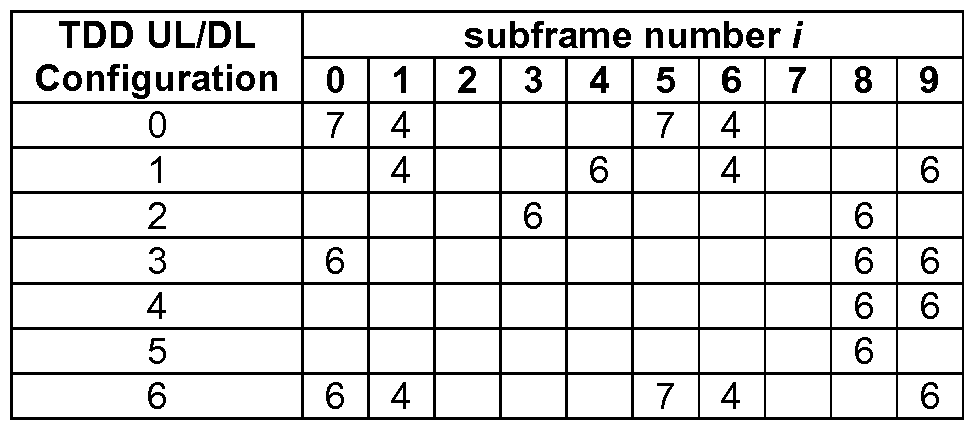
For Frame Structure type 2 UL/DL configuration 0, a HARQ-ACK signal may be received by the legacy UE in a DL PHICH transmission in a resource corresponding to IPHICH = 0, for example as described in Section 9.1.2 of 3GPP TS 36.213 vl 1.2.0, assigned to the UE in subframe i. The resource may be associated with the corresponding UL PUSCH transmission in subframe i-k as indicated above in Table 1. For Frame Structure type 2 UL/DL configuration 0, a HARQ-ACK received in a DL PHICH transmission in the resource corresponding to IPHICH = 1 assigned to a UE in subframe i may be associated with an UL PUSCH transmission in the subframe i-6.
Additionally, for FDD and normal HARQ operation, a legacy UE may detect, on a given serving cell, a DL Physical Downlink Control Channel (PDCCH) or enhanced PDCCH (ePDCCH) transmission with downlink control information (DO) format 0/4, and/or a DL PHICH transmission in subframe n intended for the UE. In response, the UE may adjust the corresponding UL PUSCH transmission in subframe n+4 according to the
detected DL PDCCH, ePDCCH, and/or PHICH information.
For TDD, if a UE is configured with a single serving cell, or if the UE is configured with more than one serving cell and the TDD UL/DL configuration of all of the configured serving cells is the same, the UE may adjust the timing of a UL PUSCH transmission based on reception of a DL PDCCH, ePDCCH, or PHICH transmission. Specifically, for TDD UL/DL configurations 1-6 and normal HARQ operation, the UE 215 may, upon detection of a DL PDCCH or ePDCCH transmission with a UL DCI format, and/or detection of a DL PHICH transmission in subframe n intended for the UE 215, adjust the corresponding UL PUSCH transmission in subframe n+k, as indicated in Table 2 below. This timing adjustment may be based at least in part on the PDCCH, ePDCCH, and/or PHICH information.
Table 2

If, for TDD UL/DL configuration 0 and normal HARQ operation, the least significant bit (LSB) of the UL index in the DCI format 0/4 is set to 1 in subframe n, or a DL PHICH transmission is received in subframe n=0 or 5 in the resource corresponding to IPHICH = 1, for example as described in Section 9.1.2 of TS 36.213 vl 1.2.0, or a DL PHICH is received in subframe n=\ or 6, the UE may adjust the corresponding UL PUSCH transmission in subframe n+l ' .
If, for TDD UL/DL configuration 0, both the MSB and LSB of the UL index in the received PDCCH or ePDCCH transmission with a UL DCI format are set in subframe n, then the UE 215 may adjust the corresponding UL PUSCH transmission in both subframe n+k and η+Ί, with k described in Table 2 above.
As can be seen above, the timing of a DL PHICH, PDCCH, or ePDCCH transmission relative to the timing of a corresponding UL PUSCH transmission may be strictly controlled. However, if a UE 215 is in a network 200 with decoupled DL-UL association, then the DL PHICH, PDCCH, or ePDCCH transmissions may be received by the UE 215 from the macro cell 205 while the corresponding UL PUSCH transmission may be transmitted by the UE 215 to the small cell 220c. The decoupled DL-UL association may introduce delays because the macro cell 205 and the small cell 220c may have to coordinate with one another over backhaul links such as backhaul links 230 and 235. Specifically, if timing of a UL PUSCH transmission received by the small cell 220c is related to timing of a DL PHICH transmission of the macro cell 205, the cells 220c and 205 may be required to communicate with one another over the backhaul links, which may delay the HARQ process. Four alternative solutions to coordinating the timing of UL PUSCH transmissions and DL PHICH, PDCCH, or ePDCCH transmissions are described below.
As a first alternative solution, the HARQ-ACK retransmission delay may be extended from 8 ms to 16 ms for FDD transmissions. Additional UL grants may be transmitted from the macro cell 205 to the UE 215 in a PDCCH or ePDCCH transmission. A UL grant may indicate to the UE 215 when the UE 215 is assigned UL resources for UL transmissions, for example UL PUSCH transmissions. In some embodiments, the UL grant may include an indication that the UE 215 is to re-transmit the previous UL transmission to the small cell 220c. Therefore, the UL grant may take the place of a DL PHICH transmission because the UL grant may be used to trigger the UL re-transmission instead of the DL PHICH transmission. In some embodiments the DL PHICH transmission may not even occur, and the network 200 may be considered PHICH-less.
In some embodiments, the PUSCH decoding results, that is the result of the eNB 225c decoding the original PUSCH transmission, may need to be forwarded to eNB 210, for example over backhaul links 230 and 235. In some embodiments the results may need to be forwarded within a time-window that allows for sufficient time-budget for the transmission of the UL grants from the macro cell 205. For example, if the network 200 is an FDD network, with the extension of the HARQ-ACK retransmission delay to 16ms, the
macro cell 205 may need to transmit the UL grant indicating retransmission within 12 subframes of the original PUSCH UL transmission to maintain a similar timing relationship as in legacy UE operation of (n+4)-t subframe PUSCH retransmission in FDD deployments if the UL grant or DL PHICH indicating retransmission is received on the n-t subframe. Additionally, in some embodiments the UE 215 may be configured to receive a signal or indication, for example from higher layers, regarding whether to use a HARQ-ACK retransmission delay of 8 ms and a HARQ-ACK retransmission delay of 16 ms. Additionally, if a higher HARQ-ACK retransmission delay is used, the maximum number of HARQ processes allowed in the network 200 may be higher than 8 concurrent HARQ processes, which is the maximum number of HARQ processes allowed in the currently specified 3GPP LTE specifications.
As a second alternative solution, PUSCH scheduling information may be transmitted to the UE 215 in a DL ePDCCH transmission from the small cell 220c. In this embodiment, the operation of the network 200 may be PHICH-less. That is, the eNBs may not trigger re -transmission of a UL PUSCH transmission using a DL PHICH transmission as described above. In this embodiment, UL grants indicating retransmission may be transmitted to the UE 215 from the small cell 220c in DL ePDCCH transmissions from the small cell 220c. In this embodiment, the HARQ-ACK information may not need to be extended because the timing of the PUSCH UL signals targeted to the small cell 220c may be controlled by the small cell 220c.
In some embodiments it may be possible for the small cell 220c to transmit UL grants using dynamic point selection (DPS) ePDCCH scheduling as described in the 3GPP Rel-11 specifications. In this embodiment two ePDCCH sets may be configured for the UE 215. The ePDCCH sets may respectively correspond to the transmissions from the macro cell 205 and the small cell 220c, respectively. The two ePDCCH sets may be scheduled by configuring difference virtual cell identifiers (VCIDs) corresponding to the macro cell 205 and the small cell 220c for the respective ePDCCH sets.
Figure 3 depicts an example process that briefly summarizes the two alternative solutions described above. Initially, UE 215 may receive at 300 a transmission from a macro cell 205. For example, the UE 215 may receive a DL transmission such as a PDCCH or ePDCCH transmission from macro cell 205. The UE 215 may then transmit a DL transmission at 305 to a small cell 220c. Specifically, the UE 215 may transmit a UL PUSCH transmission to small cell 220c. The UE 215 may then receive at 310 a UL grant. For example, as described above, the UL grant may be received in a DL PDCCH or
ePDCCH transmission from the macro cell 205 or the small cell 220c. Finally, the UE 215 may re-transmit at 315 the UL PUSCH transmission to the small cell 220c based on the received UL grant.
As a third alternative solution, and with reference to Figure 4, UE 215 may receive at 400 a transmission from a macro cell 205. For example, the UE 215 may receive a DL transmission such as a DL PDCCH or ePDCCH transmission from macro cell 205. The UE 215 may then transmit a UL transmission at 405 to a small cell 220c. Specifically, the UE 215 may transmit a UL PUSCH transmission to small cell 220c. The UE 215 may then receive at 410 PUSCH scheduling information from macro cell 205, for example in a DL PDCCH or ePDCCH transmission. The PUSCH scheduling information may be controlled by the macro cell 205 even though the UL PUSCH transmission may be targeted to the small cell 220. In this embodiment, the PUSCH scheduling information may include a new data indicator which indicates whether to transmit new data or whether to re-transmit a previously transmitted PUSCH transmission. If the new data indicator indicates to not transmit new data, for example the indicator has a value of "0," then the scheduled PUSCH transmission may be used to re-transmit a previous PUSCH UL transmission at 415. For example, the previous UL PUSCH transmission may be stored in a buffer of the UE 215, and the UE 215 may not flush its buffer before re-transmitting the previous UL PUSCH transmission. In this embodiment if a DL PHICH transmission is received, the UE 215 may not act according to the received DL PHICH transmission.
A fourth alternative process may be discussed with reference to Figure 5. UE 215 may receive at 500 a transmission from a macro cell 205. For example, the UE 215 may receive a DL transmission such as a DL PDCCH or ePDCCH transmission from macro cell 205. The UE 215 may then transmit a transmission at 505 to a small cell 220c. Specifically, the UE 215 may transmit a UL PUSCH transmission to small cell 220c. A DL PHICH transmission corresponding to the UL PUSCH transmission may be received by the UE 215 at 510 from the small cell 220c rather than the macro cell 205. In some embodiments, the macro cell 205 and small cell 220c may have different PCIs In embodiments, the DL PHICH transmission may be based on the PCI of the cell transmitting the DL PHICH transmission. Therefore, in this embodiment the UE 215 may attempt to detect the DL PHICH transmission based on the PCI of the small cell 220c at 515. Based on the detected PCI parameters, the DL PHICH transmission may be identified and decoded, and the UE 215 may re-transmit the previous UL PUSCH transmission.
In some embodiments, the UE 215 may be configured with the PCI to be used for
detecting and decoding a DL PHICH transmission by way of radio resource control (RRC) signaling received in a DL physical downlink shared channel (PDSCH) transmission. The RRC signaling may be UE-specific and received in a system information block (SIB) message of a DL physical downlink shared channel (PDSCH) transmission. The RRC signaling may further contain an indicator of the PCI to use, the number of OFDM symbols for a DL PDCCH transmission, a starting symbol for a DL PDSCH transmission, the duration of a DL PHICH transmission, and/or other configuration parameters of the DL PHICH transmission that are currently associated with the PBCH transmissions in legacy systems for a UE 215 to receive a DL PHICH transmission from the small cell 220c. In some embodiments the Ng value of the PHICH configuration may have been received in a DL physical broadcast channel (PBCH) transmission from an eNB of the network 205. As a default operation, in case a UE 215 is not configured by the UE- specific RRC signaling for decoding the received DL PHICH transmission, the UE 215 may use the configuration for a DL serving cell such as the macro cell 205 which has a system information block-2 (SIB-2) linkage.
In the embodiments described above, one or more of the elements of the processes depicted in Figures 3, 4, or 5 may be performed in a different order. For example, in some embodiments the UE 215 may be pre-configured with decoupled DL-UL association. Therefore, the initial transmission from the macro cell at 300, 400, or 500 may not occur, or may occur after the small cell transmission at 305, 405, or 505.
DL HARQ-ACK and CSI Reports
In some embodiments macro cell 205 may transmit data to the UE 215, for example using a DL PDSCH transmission. In response, the UE 215 may provide HARQ feedback such as a HARQ-ACK or HARQ-NACK message in a UL physical uplink control channel (PUCCH) transmission. Upon receiving the HARQ feedback message, the macro cell 205 may re-transmit the data transmission in a subsequent DL PDSCH transmission. This process may be referred to as DL HARQ. In some embodiments, DL HARQ may be asynchronous. That is, the network 200 may include a plurality of HARQ processes and any of the HARQ processes may be used in DL HARQ. As a result, a strict DL HARQ round-trip time may not be mandatory. However, in some embodiments the UE 215 may transmit the HARQ feedback message to the small cell 220c. In order for the macro cell 205 to re-transmit the data transmission, the small cell 220c may need to forward to HARQ feedback message to the macro cell 205, for example over backhaul
links 230 and 235. The forwarding of the HARQ feedback message may introduce undesirable latency that may affect traffic with strict QoS or latency requirements.
Additionally, in some embodiments the UE 215 may provide channel state information (CSI) feedback to the small cell 220c in a UL PUCCH transmission. The CSI feedback may be related to the quality of one or more communication channels of the network 200, and may be used by the small cell 220c or macro cell 205 to adjust one or more parameters of the UL or DL transmissions respectively. In some embodiments, it may be desirable for the small cell 220c to supply the CSI feedback to the macro cell 205 so that the macro cell 205 may adjust a parameter of the DL transmissions if a particular signal or frequency is experiencing QoS degradation due to interference or some other reason. In some embodiments, if transmission of the CSI feedback from the small cell 220c to the macro cell 205 is delayed, the quality of the DL transmissions may be degraded because the macro cell 205 may not be able to adjust the parameter(s) of the DL transmissions.
In some embodiments, the UL PUCCH transmissions may be formatted according to a PUCCH format as described, for example, in 3GPP TS 36.213 vl 1.2.0 (February, 2013), § 10.1.1. In some embodiments, one or more of the above described difficulties may be reduced or minimized if UL PUCCH transmissions carrying delay-sensitive HARQ-ACK feedback are targeted directly to the macro cell 205. For example, UL PUCCH transmissions that are formatted according to PUCCH formats la, lb, or 3 may be delay-sensitive. Therefore, UL PUCCH transmissions with those PUCCH formats may be targeted directly to the macro cell 205. These UL PUCCH transmissions may be targeted to the macro cell 205 through semi-static configuration of virtual cell identifiers (VCIDs) that are both format-specific and UE-specific. These VCIDs may be used for the generation of the PUCCH transmission base sequences.
Resource allocation for UL PUCCH format la or lb transmissions may be signaled using a combination of semi-static RRC signaling of the PUCCH starting offset and other dynamic parameters described below via a DL PDCCH or ePDCCH transmission from the macro cell 205 or via a DL ePDCCH transmission from the small cell 220c. Specifically, the semi-static RRC signaling may include a PUCCH starting offset for PUCCH formats la or lb. Specifically, UE-specific signaling of a PUCCH format la or lb starting offset, ^PUCCH UE for PDCCH and ^PUCCH, J for ePDCCH set j, respectively, may be configured via higher layers based on coordination between the macro cell 205 and the small cell 220c. In embodiments, the configuration of the PUCCH format la or lb starting
offset may be considered to be semi-static because it is signaled via the RRC and may not change with a high frequency (i.e. change on a frequency of approximately 600 milliseconds). Therefore, those parameters may be considered "semi-static." Given the semi-static nature of this configuration, necessary PUCCH resource coordination between the macro cell 205 and the small cell 220c to determine the UE-specific PUCCH format la or lb starting position may be feasible even with non-zero backhaul latency. In some embodiments, the final dynamic resource allocation information may be determined by using the semi-statically configured UE-specific PUCCH la/lb starting offset, a lowest control channel element (CCE), HQCE for the DL PDCCH or ePDDCH transmission from the macro cell 205 or small cell 220c, an antenna port (AP) configuration of the UE 215, or ACK-NACK resource offset (ARO) configuration. In some embodiments the AP configuration or ARO configuration information may be most applicable to ePDCCH- based dynamic resource allocation for PUCCH format la or lb.
For PUCCH format 3, the UE-specific resource allocation may likewise be semi- static. Therefore, in embodiments the macro cell 205 and small cell 220c may synchronize the resource allocation information over the backhaul even with non-zero delay.
In some embodiments, the network 200 may have a maximum number of DL HARQ processes that can be maintained between the network 200 and the UE 215. For example, in FDD networks, the network 200 may allow a maximum of 8 DL HARQ processes between the network 200 and the UE 215. In TDD networks, the network 200 may allow a maximum of between 4 and 15 DL HARQ processes dependent on a TDD UL/DL configuration of the TDD transmission. The TDD UL/DL configuration may be as described, for example, in Table 7-1 of 3 GPP TS 36.213 vl 1.2.0 (February, 2013). In some embodiments, the maximum number of DL HARQ processes may be increased to provide more flexibility in scheduling HARQ-ACK feedback. For example, some HARQ- ACK feedback may still be routed through the small cell 220c via UL PUCCH transmissions using PUCCH formats 2a or 2b. This HARQ-ACK feedback may be related to DL PDSCH, PDCCH, or ePDCCH transmissions that are not highly latency sensitive. Although PUCCH formats 2a and 2b are used herein as an example, in some embodiments the specific PUCCH format may be based on the use of a normal cyclic prefix (CP) and in other embodiments the specific PUCCH format may be different.
In some embodiments, the delay-sensitive HARQ-ACK feedback that is targeted to the macro cell 205 may also be accompanied by a scheduling request (SR) that may be needed by the small cell 220c. In some embodiments, the SR may need to be forwarded by
the macro cell 205 to the small cell 220c, for example over backhaul links 230 and 235. In some embodiments, UL grants for UEs 215 with decoupled DL-UL association may be transmitted by the small cell 220c using one or more DL ePDCCH transmissions. Buffer status reports (BSRs) and SRs in UL PUCCH transmissions using PUCCH format 1 from a UE 215 with decoupled DL-UL association may be received at the small cell 220c. Reception of these UL PUCCH transmissions may facilitate maximal decoupling of DL and UL scheduling from the macro cell 205 and the small cell 220c, respectively.
Figure 6 depicts a high level example of a process for DL HARQ according to the embodiments described above. Initially, the UE 215 may identify the transmission format of the UL PUCCH transmission at 600. Based on the format, a format-specific and UE- specific VCID may be generated at 605. The VCID may be used as the basis for generating a PUCCH base sequence at 610. One or more dynamic transmission parameters may then be identified at 615 and a UL PUCCH transmission may be generated at 620 that targets the macro cell 205.
UL PC
In some embodiments a UE 215 with decoupled UL-DL association may be subjected to inefficiencies with regards to UL PC. Specifically, with regards to See 1 networks, a decoupled DL-UL association may require careful selection of which pathloss reference to use for open loop (OL) PC. For example, a PC process that relies on the DL association point, that is eNB 210, as a pathloss reference may not be ideal for a UL PC process because the DL pathloss may be different than the UE pathloss. Therefore, careful selection of the pathloss reference for the UL PC may be desirable.
Additionally, a decoupled DL-UL association may generate inefficiencies regarding how a closed loop (CL) PC mechanism may operate in a network 200 with a non-ideal backhaul between a macro cell 205 and a small cell 220c. Specifically, CL PC may not be configured to compensate for a UE 215 with decoupled DL-UL association when the UE 215 uses a different pathloss reference for OL PC calculations than CL PC calculations because it may be very difficult for the macro cell 205 and small cell 220c to share a common PC process for a particular UE 215 over non-ideal backhaul links with a delay as low as 10 - 30 ms. Similar challenges may be present for UL PC for See 2a and See 2b networks.
In the description below, different PC processes may be most relevant to different channels. Additionally, different PC processes may be most relevant to See 1, See 2a, or
See 2b networks. Therefore, the different channels and networks are addressed individually below. However, the different processes described below are merely examples of different embodiments, and certain channels may find efficiencies from using processes described for another channel in other embodiments.
PUSCH - See 1
For PUSCH transmissions, the CL PC process may be maintained at the small cell 220c, and transmit power control (TPC) commands may be sent by the small cell 220c along with UL grant information using ePDCCH DL transmissions. The UL grant information may be similar to the UL grant information described above. The transmission of the TPC commands and the UL grant information may assist the UE 215 in CL PC processes for low-mobility UEs. A low-mobility UE may be a UE 215 that is moving with a relatively low frequency or velocity.
In some embodiments, if the UE 215 uses the DL association point as its pathloss reference, an adjustment to the UL OL PC may be desirable. Specifically, to adjust for the use of a non-ideal DL pathloss reference in a UL PC process, an additional accumulative or non-cumulative TPC parameter may be used by the small cell 220c to compensate for the non-ideal DL pathloss reference. Alternatively, the existing TPC field bit-width may be increased by one or more bits to support a larger range of TPC commands that may be used to compensate for the non-ideal DL pathloss reference. In other embodiments a different parameter or value may be used to compensate for the non-ideal DL pathloss reference.
PUCCH - See 1
Two options may be available for the selection of a pathloss reference for PUCCH
PC in See 1 networks. Specifically, as a first option (referred to herein as Option la), a UE 215 may use the macro cell 205 (i.e. the DL association point) as its pathloss reference. As a second option (referred to herein as Option lb), a UE 215 may be signaled via higher layers or Layer 1 signaling as to whether to use the macro cell 205 or the small cell 220c (i.e. the UL association point) as its pathloss reference. As used herein, the use of the macro cell 205 as a pathloss reference may be referred to as a DL pathloss reference, while the use of the small cell 220c as a pathloss reference may be referred to as a UL pathloss reference.
OL PC may be performed using one or more parameters such as PO_PUCCH,
PO_NOMINAL_PUCCH, or PO_UE_PUCCH as described, for example, in 3 GPP Technical Specification (TS) 36.213 vl 1.2.0 (February, 2013), § 5.1.2. In some embodiments, PO_PUCCH may be the sum of PO_NOMINAL PUCCH, which may be a cell-specific parameter indicated via R C signaling, and PO UE PUCCH, which may be a UE-specific parameter indicated via RRC signaling.
For Option lb, the UE 215 may be configured with two values for the OL PC parameters such as PO_PUCCH, one each corresponding to the UL pathloss reference and DL pathloss reference, respectively. For the case of independent configuration of the two values of PO_PUCCH, a common value of PO_NOMINAL PUCCH may be configured with two independent configurations of PO UE PUCCH provided by higher layers, one each corresponding to the UL pathloss reference and DL pathloss reference, respectively. For this embodiment, each configuration of Po UE PUCCH may be associated with a different CL PC process (as described in further detail below with regards to Option 2a) because reconfiguration of the PO UE PUCCH value may result in a resetting of the PUCCH power control adjustment state (i.e. the CL PC process).
Two options may be available for CL PC processes for PUCCH. Specifically, as a first option (referred to herein as Option 2a), two independent CL PC processes may be maintained for each UE in the network. The processes may be maintained at the UE side as well as the network side. One of the processes may be maintained at the macro cell 205 and the other may be maintained at the small cell 220c. In embodiments, the different PUCCH processes may be maintained and performed substantially in parallel with or concurrently with one another. As a second option (referred to herein as Option 2b), only one CL PC process for PUCCH may be maintained.
For Option 2a, for each CC, one or more CL PC processes for PUSCH may be maintained at the small cell 220c, and two independent concurrent PC processes may be maintained for PUCCH. Specifically, one CL PC process may be maintained for PUCCH UL transmissions carrying delay-sensitive DL HARQ-ACK information targeted for the macro cell 205 (for example, UL PUCCH transmissions with PUCCH formats la, lb, and 3). Another CL PC process may be maintained for PUCCH UL transmissions carrying CSI (for example, PUCCH UL transmissions with PUCCH formats 1, 2, 2a, or 2b) that may be received by the small cell 220c.
In some embodiments, certain OL PC parameters such as PO_PUCCH may need to be communicated between the macro cell 205 and the small cell over backhaul links 230 and 235. In other embodiments the UE 215 may be configured with independent sets of OL PC
parameters, for example as proposed under Option lb, above.
If Option 2a is used in conjunction with Option lb (i.e. with the use of multiple pathloss references), then a TPC command for PUCCH transmissions that may be received at the UE 215 in a DL PDCCH or DL ePDCCH transmission, may need to be associated with one of the CL PC processes. The CL PC process to which the TPC command should be applied may be implicitly indicated by association of each PUCCH CL PC process to the respective pathloss reference choice. Specifically, the UE may maintain two CL PC processes and apply the TPC parameter that is dynamically signaled (via PDCCH or ePDCCH) to the corresponding CL PC process depending on which pathloss reference was signaled to the UE for use via R C signaling per Option lb.
If Option 2a is used in conjunction with Option la (i.e., UE 215 uses the DL association point as its pathloss reference), then the use of an appropriate CL PC process may be defined in a PUCCH format-specific manner. For example, a first CL PC process may be maintained at the macro cell 205 for UL PUCCH transmissions with PUCCH formats la, lb, or 3. A second CL PC process may be maintained at the small cell 220c for UL PUCCH transmissions with PUCCH formats 1, 2, 2a, or 2b. Additional or alternative processes may be used in other embodiments, or the processes may be split between different PUCCH formats. Additionally or alternatively, explicit dynamic signaling may be used to indicate the application of the particular CL PC process. For instance, one new bit in a downlink control information (DO) signal received in a DL PDCCH or ePDDCH transmission may be used to indicate which CL PC process the TPC command should be applied to.
A general process for UL PC for a UE 215 that incorporates one or more of the embodiments above related to Option 2a may be described with respect to Figure 7. Initially, the UE 215 may identify the CL PC process for PUSCH at 700, as described above. Next, the UE 215 may identify a CL PC process for a first set of UL PUCCH transmissions with PUCCH formats such as la, lb, or 3 at 705. Next, the UE 215 may identify a CL PC process for a second set of UL PUCCH transmissions with PUCCH formats such as 1, 2, 2a, or 2b at 710. Finally, the UE 215 may optionally identify the pathloss reference to use for the PC processes at 715. The pathloss reference may be the UL pathloss reference or the DL pathloss reference, and may be signaled via higher layer signaling, Layer 1 signaling, or some other type of signal or indicator.
If Option 2b is used in conjunction with Option la then UE 215 may use the DL association point as its pathloss reference. In some embodiments the CL PC process for
PUCCH may be maintained at the macro cell 205. For UL PUCCH transmissions carrying delay-sensitive HARQ-ACK information (e.g. UL PUCCH transmissions formatted according to PUCCH formats la, lb, and 3) targeted to the macro cell 205, assuming the macro cell 205 is maintaining the CL PC process, normal PC for PUCCH may be applied as specified in existing Rel-10 and Rel-11 3GPP specifications.
For other PUCCH transmissions targeted to the small cell 220c, for example UL PUCCH transmissions formatted according to PUCCH formats 1, 2, 2a, 2b or some other format, the PUCCH UL transmission may be adjusted to account for the use of the DL pathloss reference in the UL transmission targeting the small cell 220c (assuming the macro cell 205 is maintaining the CL PC process). In one embodiment, the TPC value carried as part of the DCI may be applied as a non-cumulative TPC command. In this embodiment, the bit-width for the TPC field for PUCCH may be increased or altered to accommodate a larger range of TPC commands. Alternatively, a new field may be added to one or more DCI formats such as DCI formats 1A, IB, ID, 1, 2A, 2, 2B, 2C, or 2D, which may be carried by a DL ePDCCH transmission received from the small cell 220c. In this embodiment, the new field in the received DCI may be applied as an additional non-cumulative parameter instead of the TPC field discussed above.
If Option 2b is used in conjunction with Option la then UE 215 may use the DL association point as its pathloss reference. In some embodiments, the CL PC process for PUCCH may be maintained at the small cell 220c. For UL PUCCH transmissions carrying delay-sensitive HARQ-ACK information (e.g. UL PUCCH transmissions formatted according to PUCCH formats la, lb, and 3) targeted to the small cell 220c, normal PC for PUCCH may be applied as specified in existing Rel-10 and Rel-11 3GPP specifications (assuming the small cell 220c is maintaining the CL PC process). However, in some embodiments the bit-width of the existing TPC field may be extended to compensate for the effect of UE 215 using a wrong pathloss reference, i.e., pathloss reference to the macro cell as per Option la.
For other PUCCH transmissions targeted to the macro cell 205, for example UL PUCCH transmissions formatted according to PUCCH formats 1, 2, 2a, 2b or some other format, the UL PUCCH transmission may be adjusted to account for the use of the DL pathloss reference in the UL transmission targeting the macro cell 205 (assuming the CL PC process is maintained at the small cell 220c). In one embodiment, the TPC value carried as part of the DCI may be applied as a non-cumulative TPC command. Alternatively, a new field may be added to one or more DCI formats such as DCI formats
1A, IB, ID, 1, 2A, 2, 2B, 2C, 2D, 3, or 3A which may be carried by a DL ePDCCH transmission received from the macro cell 205. In this embodiment, the new field in the received DCI may be applied instead of the TPC field discussed above.
If Option lb is used in conjunction with Option 2b, then the pathloss reference may be signaled via higher layers as described previously. In some embodiments, the CL PC process for PUCCH may be maintained at the macro cell 205. For UL PUCCH transmissions carrying delay-sensitive HARQ-ACK information (e.g. UL PUCCH transmissions formatted according to PUCCH formats la, lb, and 3) targeted to the macro cell 205, assuming the macro cell 205 is maintaining the CL PC process, normal PC for PUCCH may be applied as specified in existing Rel-10 and Rel-11 3GPP specifications.
For other PUCCH transmissions targeted to the small cell 220c, the TPC field for PUCCH in the received DCI may be re-interpreted as a non-cumulative TPC command, in which case the bit-width for the TPC field for PUCCH may be further increased to accommodate additional TPC commands. Alternatively, a new field may be added to the DCI formats 1A, IB, ID, 1, 2A, 2, 2B, 2C, or 2D (which may correspond to DCI transmissions carried by an ePDCCH DL transmission from the small cell 220c) as an additional non-cumulative TPC command for PUCCH that is applied instead of the TPC field currently specified in existing 3GPP Rel-10 and Rel-11 specifications.
If Option lb is used in conjunction with Option 2b, then the pathloss reference may be signaled via higher layers as described previously. In some embodiments, the CL PC process for PUCCH may be maintained at the small cell 220c. For UL PUCCH transmissions carrying delay-sensitive HARQ-ACK information (e.g. UL PUCCH transmissions with PUCCH formats la, lb, or 3) targeted to the macro cell 205, the TPC field for a UL PUCCH transmission in a received DCI command may be re-interpreted as a non-cumulative TPC command. In this embodiment, the bit-width for the TPC field for PUCCH may be increased. Alternatively, a new field may be added to the DCI formats 1A, IB, ID, 1, 2A, 2, 2B, 2C, 2D, 3, or 3A (which may be carried by DL PDCCH or ePDCCH transmissions from the macro cell 205) as an additional non-cumulative TPC command for PUCCH that is applied instead of the currently specified TPC field. For other PUCCH transmissions targeted to the small cell 220c, PC for PUCCH may be applied as specified in existing 3GPP Rel-10 or Rel-11 specifications.
A general process for UL PC for a UE 215 that incorporates one or more of the embodiments above related to Option 2b may be described with respect to Figure 8. Initially the CL PC process for PUCCH may be identified at 800. Next, the TPC command
for the CL PC process may be identified at 805, for example in a DCI field of a DL PDCCH or ePDCCH transmission. Finally, the TPC command may be used as a non- cumulative adjustment to adjust the UL PUCCH transmission power at 810. As described above, the adjustment may be to compensate for the use of a non-ideal pathloss reference.
UL PC for UEs in See 2a and See 2b Networks with CA - PUSCH
Some See 2A and See 2B networks may be configured with DL CA. Specifically, in some See 2A and See 2B networks, DL or UL signals may be transmitted from eNB 210, eNB 225c, or UE 215 respectively using more than one carrier or channel. In embodiments CA transmissions may be on two separate cells or channels, a primary cell (PCell) and a secondary cell (SCell). In embodiments, if UE 215 is configured with DL and UL CA, then legacy UL PC for PUSCH transmissions such as that defined in Rel-10 or Rel-11 specifications may be supported using self-scheduling for each CC. UL PC for UEs in See 2a and See 2b Networks with CA - PUCCH
In some See 2a or See 2b networks, UE 215 may be configured to transmit UL PUCCH transmissions on the SCell. In some embodiments the UE 215 may be configured with a SIB-2 linkage between macro cell 205 DL PCell transmissions and small cell 220c UL PCell transmissions.
If multiple UL PUCCH transmissions from the multiple serving cells in CA are allowed, each UL PUCCH transmission from a serving cell may be identified as corresponding to the serving cell. For example, if UE 215 transmits HARQ-ACK information in a UL PUCCH transmission, and the HARQ-ACK information corresponds to DL data received in a DL PDSCH transmission from a DL serving cell such as macro cell 205, or the UE 215 transmits CSI information in a UL PUCCH transmission, the pathloss reference for PC of the UL PUCCH transmission may be derived from the DL serving cell. In embodiments, this PC process may mean that in some embodiments it may not be necessary or useful to forward UL control information (UCI) from the macro cell 205 to small cell 220c, or vice-versa.
When PUCCH format lb, which may have channel selection enabled, is used to transmit a UL PUCCH transmission with HARQ-ACK information in a See 2a or See 2b network with CA, some PUCCH resource may be derived from the CCE or enhanced CCE (eCCE) index of a DL PDCCH or ePDCCH transmission transmitted on the PCell. Other PUCCH resources may be derived from the RRC signaling. The network 200 may
configure the PUCCH resources so that the UL PUCCH transmission may be transmitted on an SCell.
For example, if both a PCell such as macro cell 205 and a secondary cell such as small cell 220c are configured by multiple-input multiple-output (MIMO), for example with two transmit beamforming systems (TBs), then four HARQ-ACK UL PUCCH transmissions, HARQ-ACK (0), HARQ-ACK (1), HARQ-ACK (2), and HARQ-ACK (3) may be transmitted. HARQ-ACK (0) and HARQ-ACK (1) may be related to the PCell, while HARQ-ACK (2) and HARQ-ACK (3) may be related to the SCell.
In embodiments where cross-carrier scheduling is not configured, the PUCCH resources /7( 1)PUCCH,O and /7( 1 )PUCCH,I may be derived from the CCE or eCCE index of a DL PDCCH or ePDCCH transmission of the PCell, and the PUCCH resources /?( 1) PUCCH,2 and ^( 1 )PUCCH,3 may be given by RRC signaling. In this example, because /7( 1 )PUCCH,2 and «( 1 )PUCCH,3 may be for the PUCCH resources related to UL PUCCH transmissions on the UL SCell, the UL PUCCH transmission that uses PUCCH resources /7( 1 )PUCCH,2 and «^PUCCH,3 may be transmitted on the SCell. In this embodiment, a CA channel selection operation may be performed across the various serving cells. When the PUCCH resource for UL PUCCH transmission is for the UL PCell, the pathloss reference for PUCCH PC may be derived from the DL PCell. When the PUCCH resource for UL PUCCH transmissions is for the UL SCell, the pathloss reference for PUCCH PC may be derived from the DL SCell.
In some embodiments, TPC commands for UL PUCCH transmissions targeting small cell 220c may not be carried by a DCI field in a DL PDCCH or ePDCCH transmission from the small cell 220c, which may be the DL SCell. Specifically, the "TPC for PUCCH" field, which may be a field of the DCI, may be reinterpreted in this case as the ACK-NACK resource indicator (ARI), which may indicate PUCCH format la/lb or PUCCH format 3 resource, for example for FDD networks. In other embodiments, for example networks with non-ideal backhaul, it may not be possible to transmit TPC commands for PUCCH in a DL transmission or DL CC from the macro cell 205 in a timely fashion.
Instead of transmitting the TPC commands, in some embodiments a new 2-bit field may be added to DCI fields with DCI formats 1A, IB, ID, 1, 2A, 2, 2B, 2C, or 2D for an accumulative or non-cumulative PUCCH TPC command that is carried in DL PDCCH or ePDCCH transmissions on the SCell. In other embodiments, for example where common search space (CSS) is supported for ePDCCH, then the new field may also be considered
for DCI formats 3 or 3 A to facilitate group power control for groups of UEs.
If multiple UL PUCCH transmissions with implicit resource allocation corresponding to independent PDSCH scheduling using DL PDCCH or ePDCCH transmissions from the macro cell 205 (i.e. the PCell) and small cell 220c (i.e. the SCell) to multiple serving cells in CA are allowed by the network 200, then it may not be necessary or desirable to add the additional TPC bits as described above. In this embodiment, UL PUCCH resources may be derived implicitly for both the PCell and the SCell. In other words, dynamic PUCCH resource for the PCell and the SCell may be implicitly derived from the DL PDCCH or ePDCCH transmissions transmitted by the PCell or SCell, respectively. In these embodiments, it may be sufficient to restore the TPC fields in a DL PDCCH or ePDCCH transmission that indicate scheduling of a DL PDSCH transmission transmitted on an SCell as real TPC which is not used as ARI, as described above. In this embodiment, the used PUCCH format for a UL PUCCH transmission with HARQ-ACK information may be PUCCH format la or lb, or PUCCH format lb with channel selection.
UL PC for UEs in See 2a and See 2b Networks Without CA
In embodiments where a See 2a or See 2b network has decoupled DL-UL association and the network is not configured with CA, the network may have a SIB-2 linkage between DL parameters of the macro cell 205 and UL parameters of the small cell 220c. However, in this embodiment, all UL control information may need to be communicated by the small cell 220c to the macro cell 205 via backhaul links 230 and 235. As a result, delivery of time-sensitive information such as DL HARQ-ACK information to the macro cell 205 may be delayed if the backhaul links are susceptible to delays. Therefore, in this embodiment, UL PC for PUSCH, PUCCH, and SRS may either rely on OL PC or a less dynamic version of CL PC based on a "semi-static" PC process maintained at the small cell 220c and communicated over the delay-prone backhaul to the macro cell 205. Embodiments of the present disclosure may be implemented into a system using any suitable hardware and/or software to configure as desired. Figure 9 schematically illustrates an example system 900 that may be used to practice various embodiments described herein. Figure 9 illustrates, for one embodiment, an example system 900 having one or more processor(s) 905, system control module 910 coupled to at least one of the
processor(s) 905, system memory 915 coupled to system control module 910, non- volatile memory (NVM)/storage 920 coupled to system control module 910, and one or more communications interface(s) 925 coupled to system control module 910.
In some embodiments, the system 900 may be capable of functioning as the UE 110 or 215 as described herein. In other embodiments, the system 900 may be capable of functioning as one of eNBs 105, 210, 225a, 225b, or 225c, as described herein. In some embodiments, the system 900 may include one or more computer-readable media (e.g., system memory or NVM/storage 920) having instructions and one or more processors (e.g., processor(s) 905) coupled with the one or more computer-readable media and configured to execute the instructions to implement a module to perform actions described herein.
System control module 910 for one embodiment may include any suitable interface controllers to provide for any suitable interface to at least one of the processor(s) 905 and/or to any suitable device or component in communication with system control module 910.
System control module 910 may include memory controller module 930 to provide an interface to system memory 915. The memory controller module 930 may be a hardware module, a software module, and/or a firmware module.
System memory 915 may be used to load and store data and/or instructions, for example, for system 900. System memory 915 for one embodiment may include any suitable volatile memory, such as suitable DRAM, for example. In some embodiments, the system memory 915 may include double data rate type four synchronous dynamic random-access memory (DDR4 SDRAM).
System control module 910 for one embodiment may include one or more input/output (I/O) controller(s) to provide an interface to NVM/storage 920 and communications interface(s) 925.
The NVM/storage 920 may be used to store data and/or instructions, for example. NVM/storage 920 may include any suitable non- volatile memory, such as flash memory, for example, and/or may include any suitable non-volatile storage device(s), such as one or more hard disk drive(s) (HDD(s)), one or more compact disc (CD) drive(s), and/or one or more digital versatile disc (DVD) drive(s), for example.
The NVM/storage 920 may include a storage resource physically part of a device on which the system 900 may be installed or it may be accessible by, but not necessarily a part of, the device. For example, the NVM/storage 920 may be accessed over a network
via the communications interface(s) 925.
Communications interface(s) 925 may provide an interface for system 900 to communicate over one or more network(s) and/or with any other suitable device. The system 900 may wirelessly communicate with the one or more components of the wireless network in accordance with any of one or more wireless network standards and/or protocols. In some embodiments the communications interface(s) 925 may include the transceiver modules 122 or 135.
For one embodiment, at least one of the processor(s) 905 may be packaged together with logic for one or more controller(s) of system control module 910, e.g., memory controller module 930. For one embodiment, at least one of the processor(s) 905 may be packaged together with logic for one or more controllers of system control module 910 to form a System in Package (SiP). For one embodiment, at least one of the processor(s) 905 may be integrated on the same die with logic for one or more controller(s) of system control module 910. For one embodiment, at least one of the processor(s) 905 may be integrated on the same die with logic for one or more controller(s) of system control module 910 to form a System on Chip (SoC).
In some embodiments the processor(s) 905 may include or otherwise be coupled with one or more of a graphics processor (GPU) (not shown), a digital signal processor (DSP) (not shown), wireless modem (not shown), digital camera or multimedia circuitry (not shown), sensor circuitry (not shown), display circuitry (not shown), and/or GPS circuitry (not shown).
In various embodiments, the system 900 may be, but is not limited to, a server, a workstation, a desktop computing device, or a mobile computing device (e.g., a laptop computing device, a handheld computing device, a tablet, a netbook, a smart phone, a gaming console, etc.). In various embodiments, the system 900 may have more or less components, and/or different architectures. For example, in some embodiments, the system 900 includes one or more of a camera, a keyboard, liquid crystal display (LCD) screen (including touch screen displays), non-volatile memory port, multiple antennas, graphics chip, application-specific integrated circuit (ASIC), and speakers.
EXAMPLES
A first example (Example 1) may include a method comprising: receiving, by a user equipment (UE), a downlink transmission from a first cell; transmitting, by the UE responsive to the downlink transmission, a physical uplink shared channel (PUSCH)
transmission; receiving, by the UE responsive to the PUSCH transmission, an uplink (UL) grant indicating a re -transmission of the PUSCH transmission; and transmitting, by the UE responsive to the UL grant, the PUSCH transmission.
Example 2 may include the method of example 1 , wherein the UL grant is a UL grant from the first cell.
Example 3 may include the method of example 2, wherein the UL grant is received on a physical downlink control channel (PDCCH) or an enhanced PDCCH (ePDCCH) of the first cell.
Example 4 may include the method of example 1 , wherein the UL grant is a UL grant from a second cell.
Example 5 may include the method of example 4, wherein the UL grant is received on a physical downlink control channel (PDCCH) or an enhanced PDCCH (ePDCCH) of the second cell.
Example 6 may include the method of any of examples 1-5, wherein the first cell or the second cell are configured to not transmit an indicator to the UE on a physical hybrid automatic repeat request indicator channel (PHICH) of the first cell or a PHICH of the second cell.
Example 7 may include an apparatus comprising means to perform the method of any of examples 1-6.
Example 8 may include one or more non-statutory computer readable media comprising instructions to, upon executions of the instructions by one or more processors of a computing device, perform the method of any of examples 1-6.
Example 9 may include an apparatus to be employed in a user equipment (UE), the apparatus comprising: receiver circuitry to receive a downlink transmission from a first cell; transmitter circuitry to transmit, responsive to the downlink transmission, a physical uplink shared channel (PUSCH) transmission; wherein the receiver circuitry is further to receive, responsive to the PUSCH transmission, an uplink (UL) grant indicating a retransmission of the PUSCH transmission; and the transmitter circuitry is further to transmit, responsive to the UL grant, the PUSCH transmission.
Example 10 may include the apparatus of example 9, wherein the UL grant is a UL grant from the first cell.
Example 11 may include the apparatus of example 10, wherein the receiver circuitry is further to receive the UL grant on a physical downlink control channel (PDCCH) or an enhanced PDCCH (ePDCCH) of the first cell.
Example 12 may include the apparatus of example 9, wherein the UL grant is a UL grant from a second cell.
Example 13 may include the apparatus of example 12, wherein the receiver circuitry is further to receive the UL grant on a physical downlink control channel (PDCCH) or an enhanced PDCCH (ePDCCH) of the second cell.
Example 14 may include the apparatus of any of examples 9-13, wherein the first cell or the second cell are configured to not transmit an indicator to the UE on a physical hybrid automatic repeat request indicator channel (PHICH) of the first cell or a PHICH of the second cell.
Example 15 may include an apparatus comprising: a communication module to: receive a physical downlink control channel (PDCCH) or enhanced PDCCH (ePDCCH) transmission from a first cell; and transmit, responsive to the PDCCH or ePDCCH transmission, a physical uplink shared channel (PUSCH) transmission; and a retransmission module to: facilitate, in response to identification of an uplink (UL) grant received in a downlink (DL) transmission and independent of a physical hybrid automatic repeat request indicator channel (PHICH) transmission from the first cell or a second cell, a re -transmission of a previously-transmitted PUSCH transmission.
Example 16 may include the apparatus of example 15, wherein the UL grant is a UL grant from the first cell.
Example 17 may include the apparatus of example 16, wherein the communication module is further to receive the UL grant in the PDCCH or ePDCCH transmission of the first cell.
Example 18 may include the apparatus of example 15, wherein the UL grant is a UL grant from the second cell.
Example 19 may include the apparatus of example 18, wherein the communication is further to receive the UL grant in a physical downlink control channel (PDCCH) or an enhanced PDCCH (ePDCCH) of the second cell.
Example 20 may include the apparatus of example 15, wherein the communication module is further to: receive an indication in a radio resource control (RRC) signal from the first cell; and receive, based at least in part on the indication, a PHICH signal from the second cell.
Example 21 may include the apparatus of example 20, wherein the indication, includes an indication of a physical cell identifier (PCI), a number of orthogonal frequency division multiplexing (OFDM) symbols for a PDCCH transmission, a starting symbol for
a physical downlink shared channel (PDSCH) transmission, a duration of a PHICH transmission, or a configuration parametera of a physical broadcast channel (PBCH) transmission that may include one or more antenna port (AP) configuration.
Example 22 may include the apparatus of any of examples 15-21, wherein the communication module is a baseband module and the apparatus further comprises a multi- mode transceiver chip that includes the baseband module, the re-transmission module, and a power management unit to control power provided to the baseband and re-transmission modules.
Example 23 may include a method comprising: receiving, by a computing device, a physical downlink control channel (PDCCH) or enhanced PDCCH (ePDCCH) transmission from a first cell; transmitting, by the computing device responsive to the PDCCH or ePDCCH transmission, a physical uplink shared channel (PUSCH)
transmission; and facilitating, by the computing device in response to identification of an uplink (UL) grant received in a downlink (DL) transmission and independent of a physical hybrid automatic repeat request indicator channel (PHICH) transmission from the first cell or a second cell, a re-transmission of a previously-transmitted PUSCH transmission.
Example 24 may include the method of example 23, wherein the UL grant is a UL grant from the first cell.
Example 25 may include the method of example 24, further comprising receiving, by the computing device, the UL grant in the PDCCH or ePDCCH transmission of the first cell.
Example 26 may include the method of example 23, wherein the UL grant is a UL grant from the second cell.
Example 27 may include the method of example 26, further comprising receiving, by the computing device, the UL grant in a physical downlink control channel (PDCCH) or an enhanced PDCCH (ePDCCH) of the second cell.
Example 28 may include the method of example 23, further comprising receiving, by the computing device, an indication in a radio resource control (RRC) signal from the first cell; and receiving, by the computing device based at least in part on the indication, a PHICH signal from the second cell.
Example 29 may include the method of example 28, wherein the indication includes an indication of a physical cell identifier (PCI), a number of orthogonal frequency division multiplexing (OFDM) symbols for a PDCCH transmission, a starting symbol for a physical downlink shared channel (PDSCH) transmission, a duration of a PHICH
transmission, or a configuration parametera of a physical broadcast channel (PBCH) transmission that may include one or more antenna port (AP) configuration.
Example 30 may include an apparatus comprising means to perform the method of any of examples 23-29.
Example 31 may include one or more non-statutory computer readable media comprising instructions to, upon executions of the instructions by one or more processors of a computing device, perform the method of any of examples 23-29.
Example 32 may include a method comprising: identifying, by a user equipment (UE) configured to transmit uplink signals using one or more power control (PC) processes, one or more closed loop (CL) PC processes for physical uplink shared channel (PUSCH) transmissions of the UE; identifying, by the UE, a second CL PC process for a first physical uplink control channel (PUCCH) transmission from the UE; and identifying, by the UE, a third CL PC process for a second PUCCH transmission from the UE that is concurrent with the second CL PC process.
Example 33 may include the method of example 32, wherein the second or third
CL PC process is based on a PUCCH format of the first or second PUCCH transmissions.
Example 34 may include the method of examples 32 or 33, further comprising identifying, by the UE, a pathloss reference based at least in part on a first cell.
Example 35 may include the method of examples 32 or 33, further comprising identifying, by the UE, a first cell or a second cell as a pathloss reference based at least in part on a radio resource control (RRC) signal received by the UE.
Example 36 may include the method of example 35, further comprising receiving, by the UE, a first value for open loop (OL) PC parameters, the first value associated with the use of the first cell as a pathloss reference; and receiving, by the UE, a second value for OL PC parameters, the second value associated with the use of the first cell as a pathloss reference; wherein the OL PC parameters include PO_PUCCH, PO_NOMINAL PUCCH, or
PO UE PUCCH-
Example 37 may include the method of example 35, further comprising identifying, by the UE in a transmission received from the eNB of the first cell, a transmit power control (TPC) command; and changing, by the UE, a transmit power of the first CL PC, second CL PC, or third CL PC based at least in part on the received TPC command.
Example 38 may include an apparatus comprising means to perform the method of any of examples 32-37.
Example 39 may include one or more non- statutory computer readable media comprising instructions to, upon executions of the instructions by one or more processors of a computing device, perform the method of any of examples 32-37.
Example 40 may include an apparatus to be employed in a user equipment (UE), the apparatus comprising: transmitter circuitry to transmit uplink signals using one or more power control (PC) processes; and a processor coupled with the transmitter circuitry, the processor to: identify one or more closed loop (CL) PC processes for physical uplink shared channel (PUSCH) transmissions of the UE; identify a second CL PC process for a first physical uplink control channel (PUCCH) transmission from the UE; and identify a third CL PC process for a second PUCCH transmission from the UE that is concurrent with the second CL PC process.
Example 41 may include the apparatus of example 40, wherein the second or third CL PC process is based on a PUCCH format of the first or second PUCCH transmissions.
Example 42 may include the apparatus of examples 40 or 41, wherein the processor is further to a pathloss reference based at least in part on a first cell.
Example 43 may include the apparatus of examples 40 or 41, wherein the processor is further to a first cell or a second cell as a pathloss reference based at least in part on a radio resource control (RRC) signal received by the UE.
Example 44 may include the method of example 43, further comprising receiving, by the UE, a first value for open loop (OL) PC parameters, the first value associated with the use of the first cell as a pathloss reference; and receiving, by the UE, a second value for OL PC parameters, the second value associated with the use of the first cell as a pathloss reference; wherein the OL PC parameters include PO_PUCCH, PO_NOMINAL PUCCH, or
PO UE PUCCH- Example 45 may include the method of example 43, further comprising
identifying, by the UE in a transmission received from the eNB of the first cell, a transmit power control (TPC) command; and changing, by the UE, a transmit power of the first CL PC, second CL PC, or third CL PC based at least in part on the received TPC command.
Example 46 may include one or more non-transitory computer readable media comprising instructions configured to cause a user equipment (UE) configured to receive downlink transmissions from a first cell of a wireless network and transmit uplink transmissions, upon execution of the instructions by the UE, to: identify a closed loop (CL) power control (PC) process for a physical uplink control channel (PUCCH) of the UE; identify, based on a downlink (DL) signal from the first cell, a non-cumulative
transmit power control (TPC) command for the CL PC process; and adjust a transmission power value of a PUCCH transmission based at least in part on a value of the non- cumulative TPC command.
Example 47 may include the one or more non-transitory computer readable media of example 46, wherein the instructions further comprise instructions to adjust the transmission power value of the PUCCH transmission based at least in part on pathloss reference of the PUCCH transmission.
Example 48 may include the one or more non-transitory computer readable media of example 46, wherein the PUCCH CL PC process is maintained at a second cell and the PUCCH transmission is a PUCCH transmission targeted to the first cell.
Example 49 may include the one or more non-transitory computer readable media of example 46, wherein the PUCCH CL PC process is maintained at the first cell and the PUCCH transmission is a PUCCH transmission targeted to a second cell.
Example 50 may include the one or more non-transitory computer readable media of any of examples 46-49, wherein the PUCCH transmission is configured according to a delay-sensitive third generation partnership project (3 GPP) PUCCH format.
Example 51 may include a method comprising: identifying, by a user equipment (UE) configured to receive downlink transmissions from a first cell of a wireless network and transmit uplink transmissions, closed loop (CL) power control (PC) process for a physical uplink control channel (PUCCH) of the UE; identifying, by the UE based on a downlink (DL) signal from the first cell, a non-cumulative transmit power control (TPC) command for the CL PC process; and adjusting, by the UE, a transmission power value of a PUCCH transmission based at least in part on a value of the non-cumulative TPC command.
Example 52 may include the method of example 51 , further comprising adjusting, by the UE, the transmission power value of the PUCCH transmission based at least in part on pathloss reference of the PUCCH transmission.
Example 53 may include the method of example 51, wherein the PUCCH CL PC process is maintained at a second cell and the PUCCH transmission is a PUCCH transmission targeted to the first cell.
Example 54 may include the method of example 51, wherein the PUCCH CL PC process is maintained at the first cell and the PUCCH transmission is a PUCCH transmission targeted to a second cell.
Example 55 may include the method of any of examples 51-54, wherein the PUCCH transmission is configured according to a delay-sensitive third generation partnership project (3GPP) PUCCH format.
Example 56 may include an apparatus comprising means to perform the method of any of examples 51-55.
Example 57 may include an apparatus to be employed in a user equipment (UE), the apparatus comprising: a transceiver module to receive downlink transmissions from a first cell of a wireless network and transmit uplink transmissions; and a processor coupled with the transceiver module, the processor to: identify a closed loop (CL) power control (PC) process for a physical uplink control channel (PUCCH) of the UE; identify, based on a downlink (DL) signal from the first cell, a non-cumulative transmit power control (TPC) command for the CL PC process; and adjust a transmission power value of a PUCCH transmission based at least in part on a value of the non-cumulative TPC command.
Example 58 may include the apparatus of example 57, wherein the processor is further to adjust the transmission power value of the PUCCH transmission based at least in part on pathloss reference of the PUCCH transmission.
Example 59 may include the apparatus of example 57, wherein the PUCCH CL PC process is maintained at a second cell and the PUCCH transmission is a PUCCH transmission targeted to the first cell.
Example 60 may include the apparatus of example 57, wherein the PUCCH CL PC process is maintained at the first cell and the PUCCH transmission is a PUCCH
transmission targeted to a second cell.
Example 61 may include the apparatus of any of examples 57-60, wherein the PUCCH transmission is configured according to a delay-sensitive third generation partnership project (3GPP) PUCCH format.
Although certain embodiments have been illustrated and described herein for purposes of description, this application is intended to cover any adaptations or variations of the embodiments discussed herein. Therefore, it is manifestly intended that embodiments described herein be limited only by the claims.
Where the disclosure recites "a" or "a first" element or the equivalent thereof, such disclosure includes one or more such elements, neither requiring nor excluding two or more such elements. Further, ordinal indicators (e.g., first, second or third) for identified elements are used to distinguish between the elements, and do not indicate or imply a required or limited number of such elements, nor do they indicate a particular position or
order of such elements unless otherwise specifically stated.
Claims
1. A method comprising:
receiving, by a user equipment (UE), a downlink transmission from a first cell; transmitting, by the UE responsive to the downlink transmission, a physical uplink shared channel (PUSCH) transmission;
receiving, by the UE responsive to the PUSCH transmission, an uplink (UL) grant indicating a re-transmission of the PUSCH transmission; and
transmitting, by the UE responsive to the UL grant, the PUSCH transmission.
2. The method of claim 1, wherein the UL grant is a UL grant from the first cell.
3. The method of claim 2, wherein the UL grant is received on a physical downlink control channel (PDCCH) or an enhanced PDCCH (ePDCCH) of the first cell.
4. The method of claim 1, wherein the UL grant is a UL grant from a second cell.
5. The method of claim 4, wherein the UL grant is received on a physical downlink control channel (PDCCH) or an enhanced PDCCH (ePDCCH) of the second cell.
6. The method of any of claims 1-5, wherein the first cell or the second cell are configured to not transmit an indicator to the UE on a physical hybrid automatic repeat request indicator channel (PHICH) of the first cell or a PHICH of the second cell.
7. An apparatus comprising:
a communication module to:
receive a physical downlink control channel (PDCCH) or enhanced PDCCH (ePDCCH) transmission from a first cell; and
transmit, responsive to the PDCCH or ePDCCH transmission, a physical uplink shared channel (PUSCH) transmission; and
a re -transmission module to:
facilitate, in response to identification of an uplink (UL) grant received in a downlink (DL) transmission and independent of a physical hybrid automatic repeat
request indicator channel (PHICH) transmission from the first cell or a second cell, a re -transmission of a previously-transmitted PUSCH transmission.
8. The apparatus of claim 7, wherein the UL grant is a UL grant from the first cell.
9. The apparatus of claim 8, wherein the communication module is further to receive the UL grant in the PDCCH or ePDCCH transmission of the first cell.
10. The apparatus of claim 7, wherein the UL grant is a UL grant from the second cell.
11. The apparatus of claim 10, wherein the communication is further to receive the UL grant in a physical downlink control channel (PDCCH) or an enhanced PDCCH (ePDCCH) of the second cell.
12. The apparatus of claim 7, wherein the communication module is further to: receive an indication in a radio resource control (RRC) signal from the first cell; and
receive, based at least in part on the indication, a PHICH signal from the second cell.
13. The apparatus of claim 12, wherein the indication, includes an indication of a physical cell identifier (PCI), a number of orthogonal frequency division multiplexing (OFDM) symbols for a PDCCH transmission, a starting symbol for a physical downlink shared channel (PDSCH) transmission, a duration of a PHICH transmission, or a configuration parametera of a physical broadcast channel (PBCH) transmission that may include one or more antenna port (AP) configuration.
14. The apparatus of any of claims 7-13, wherein the communication module is a baseband module and the apparatus further comprises a multi-mode transceiver chip that includes the baseband module, the re-transmission module, and a power management unit to control power provided to the baseband and re -transmission modules.
15. A method comprising:
identifying, by a user equipment (UE) configured to transmit uplink signals using one or more power control (PC) processes, one or more closed loop (CL) PC processes for physical uplink shared channel (PUSCH) transmissions of the UE;
identifying, by the UE, a second CL PC process for a first physical uplink control channel (PUCCH) transmission from the UE; and
identifying, by the UE, a third CL PC process for a second PUCCH transmission from the UE that is concurrent with the second CL PC process.
16. The method of claim 15, wherein the second or third CL PC process is based on a PUCCH format of the first or second PUCCH transmissions.
17. The method of claims 15 or 16, further comprising identifying, by the UE, a pathloss reference based at least in part on a first cell.
18. The method of claims 15 or 16, further comprising identifying, by the UE, a first cell or a second cell as a pathloss reference based at least in part on a radio resource control (R C) signal received by the UE.
19. The method of claim 18, further comprising receiving, by the UE, a first value for open loop (OL) PC parameters, the first value associated with the use of the first cell as a pathloss reference; and
receiving, by the UE, a second value for OL PC parameters, the second value associated with the use of the first cell as a pathloss reference;
wherein the OL PC parameters include PO_PUCCH, PO_NOMINAL_PUCCH, or
PO UE PUCCH-
20. The method of claim 18, further comprising identifying, by the UE in a transmission received from the eNB of the first cell, a transmit power control (TPC) command; and
changing, by the UE, a transmit power of the first CL PC, second CL PC, or third
CL PC based at least in part on the received TPC command.
21. One or more non-transitory computer readable media comprising instructions configured to cause a user equipment (UE) configured to receive downlink transmissions
from a first cell of a wireless network and transmit uplink transmissions, upon execution of the instructions by the UE, to:
identify a closed loop (CL) power control (PC) process for a physical uplink control channel (PUCCH) of the UE;
identify, based on a downlink (DL) signal from the first cell, a non-cumulative transmit power control (TPC) command for the CL PC process; and
adjust a transmission power value of a PUCCH transmission based at least in part on a value of the non-cumulative TPC command.
22. The one or more non-transitory computer readable media of claim 21 , wherein the instructions further comprise instructions to adjust the transmission power value of the PUCCH transmission based at least in part on pathloss reference of the PUCCH transmission.
23. The one or more non-transitory computer readable media of claim 21 , wherein the PUCCH CL PC process is maintained at a second cell and the PUCCH transmission is a PUCCH transmission targeted to the first cell.
24. The one or more non-transitory computer readable media of claim 21, wherein the PUCCH CL PC process is maintained at the first cell and the PUCCH transmission is a
PUCCH transmission targeted to a second cell.
25. The one or more non-transitory computer readable media of any of claims 21- 24, wherein the PUCCH transmission is configured according to a delay-sensitive third generation partnership project (3GPP) PUCCH format.
Priority Applications (5)
| Application Number | Priority Date | Filing Date | Title |
|---|---|---|---|
| EP14788057.9A EP2989729A4 (en) | 2013-04-26 | 2014-03-11 | Uplink enhancements for efficient operation in small cell environments |
| CN201480017758.4A CN105052052B (en) | 2013-04-26 | 2014-03-11 | Method and apparatus for retransmission |
| HK16105108.0A HK1217140B (en) | 2013-04-26 | 2014-03-11 | Method and apparatus for re-transmitting |
| US14/778,985 US20160057769A1 (en) | 2013-04-26 | 2014-03-11 | Uplink enhancements for efficient operation in small cell environments |
| TW103111441A TWI539769B (en) | 2013-04-26 | 2014-03-27 | Uplink enhancement method, device and non-transitory computer readable medium for efficient operation in a small cell environment |
Applications Claiming Priority (2)
| Application Number | Priority Date | Filing Date | Title |
|---|---|---|---|
| US201361816662P | 2013-04-26 | 2013-04-26 | |
| US61/816,662 | 2013-04-26 |
Publications (1)
| Publication Number | Publication Date |
|---|---|
| WO2014175968A1 true WO2014175968A1 (en) | 2014-10-30 |
Family
ID=51788911
Family Applications (14)
| Application Number | Title | Priority Date | Filing Date |
|---|---|---|---|
| PCT/US2013/062455 Ceased WO2014175919A1 (en) | 2013-04-26 | 2013-09-27 | Shared spectrum reassignment in a spectrum sharing context |
| PCT/US2013/074692 Ceased WO2014175923A1 (en) | 2013-04-26 | 2013-12-12 | Hybrid reference signals for wireless communication |
| PCT/US2014/023022 Ceased WO2014175967A1 (en) | 2013-04-26 | 2014-03-11 | Wireless local area network (wlan) selection rules |
| PCT/US2014/023744 Ceased WO2014175968A1 (en) | 2013-04-26 | 2014-03-11 | Uplink enhancements for efficient operation in small cell environments |
| PCT/US2014/032032 Ceased WO2014175990A1 (en) | 2013-04-26 | 2014-03-27 | Systems, methods, and devices for distributed scheduling for device-to-device interference mitigation |
| PCT/US2014/032268 Ceased WO2014175999A1 (en) | 2013-04-26 | 2014-03-28 | Diameter/xml protocol conversion |
| PCT/US2014/032227 Ceased WO2014175997A1 (en) | 2013-04-26 | 2014-03-28 | Systems and methods using a centralized node to collect ran user plane congestion information |
| PCT/US2014/033965 Ceased WO2014176058A1 (en) | 2013-04-26 | 2014-04-14 | User equipment and methods for adapting system parameters based on extended paging cycles |
| PCT/US2014/034307 Ceased WO2014176087A1 (en) | 2013-04-26 | 2014-04-16 | Interactive zooming in video conferencing |
| PCT/US2014/034337 Ceased WO2014176089A1 (en) | 2013-04-26 | 2014-04-16 | Architecture for web-based real-time communications (webrtc) to access internet protocol multimedia subsystem (ims) |
| PCT/US2014/034480 Ceased WO2014176106A1 (en) | 2013-04-26 | 2014-04-17 | Radio access technology information storage in a mobile network |
| PCT/US2014/034966 Ceased WO2014176245A1 (en) | 2013-04-26 | 2014-04-22 | System and method for interference cancellation and/or supression on physical downlink shared channel at the user equipment |
| PCT/US2014/034879 Ceased WO2014176200A1 (en) | 2013-04-26 | 2014-04-22 | An apparatus and method for congestion control in wireless communication networks |
| PCT/US2014/035409 Ceased WO2014176480A1 (en) | 2013-04-26 | 2014-04-25 | User equipment and method for feedback of user equipment performance metrics during dynamic radio switching |
Family Applications Before (3)
| Application Number | Title | Priority Date | Filing Date |
|---|---|---|---|
| PCT/US2013/062455 Ceased WO2014175919A1 (en) | 2013-04-26 | 2013-09-27 | Shared spectrum reassignment in a spectrum sharing context |
| PCT/US2013/074692 Ceased WO2014175923A1 (en) | 2013-04-26 | 2013-12-12 | Hybrid reference signals for wireless communication |
| PCT/US2014/023022 Ceased WO2014175967A1 (en) | 2013-04-26 | 2014-03-11 | Wireless local area network (wlan) selection rules |
Family Applications After (10)
| Application Number | Title | Priority Date | Filing Date |
|---|---|---|---|
| PCT/US2014/032032 Ceased WO2014175990A1 (en) | 2013-04-26 | 2014-03-27 | Systems, methods, and devices for distributed scheduling for device-to-device interference mitigation |
| PCT/US2014/032268 Ceased WO2014175999A1 (en) | 2013-04-26 | 2014-03-28 | Diameter/xml protocol conversion |
| PCT/US2014/032227 Ceased WO2014175997A1 (en) | 2013-04-26 | 2014-03-28 | Systems and methods using a centralized node to collect ran user plane congestion information |
| PCT/US2014/033965 Ceased WO2014176058A1 (en) | 2013-04-26 | 2014-04-14 | User equipment and methods for adapting system parameters based on extended paging cycles |
| PCT/US2014/034307 Ceased WO2014176087A1 (en) | 2013-04-26 | 2014-04-16 | Interactive zooming in video conferencing |
| PCT/US2014/034337 Ceased WO2014176089A1 (en) | 2013-04-26 | 2014-04-16 | Architecture for web-based real-time communications (webrtc) to access internet protocol multimedia subsystem (ims) |
| PCT/US2014/034480 Ceased WO2014176106A1 (en) | 2013-04-26 | 2014-04-17 | Radio access technology information storage in a mobile network |
| PCT/US2014/034966 Ceased WO2014176245A1 (en) | 2013-04-26 | 2014-04-22 | System and method for interference cancellation and/or supression on physical downlink shared channel at the user equipment |
| PCT/US2014/034879 Ceased WO2014176200A1 (en) | 2013-04-26 | 2014-04-22 | An apparatus and method for congestion control in wireless communication networks |
| PCT/US2014/035409 Ceased WO2014176480A1 (en) | 2013-04-26 | 2014-04-25 | User equipment and method for feedback of user equipment performance metrics during dynamic radio switching |
Country Status (12)
| Country | Link |
|---|---|
| US (19) | US10306589B2 (en) |
| EP (12) | EP2989833B1 (en) |
| JP (3) | JP6272984B2 (en) |
| KR (4) | KR20150121110A (en) |
| CN (13) | CN105144768B (en) |
| BR (1) | BR112015024631A2 (en) |
| ES (2) | ES2666554T3 (en) |
| HK (3) | HK1217144A1 (en) |
| HU (2) | HUE037091T2 (en) |
| PL (1) | PL2989777T3 (en) |
| TW (15) | TWI523555B (en) |
| WO (14) | WO2014175919A1 (en) |
Families Citing this family (220)
| Publication number | Priority date | Publication date | Assignee | Title |
|---|---|---|---|---|
| US9363133B2 (en) | 2012-09-28 | 2016-06-07 | Avaya Inc. | Distributed application of enterprise policies to Web Real-Time Communications (WebRTC) interactive sessions, and related methods, systems, and computer-readable media |
| US10164929B2 (en) | 2012-09-28 | 2018-12-25 | Avaya Inc. | Intelligent notification of requests for real-time online interaction via real-time communications and/or markup protocols, and related methods, systems, and computer-readable media |
| US9407302B2 (en) | 2012-12-03 | 2016-08-02 | Intel Corporation | Communication device, mobile terminal, method for requesting information and method for providing information |
| US9294458B2 (en) | 2013-03-14 | 2016-03-22 | Avaya Inc. | Managing identity provider (IdP) identifiers for web real-time communications (WebRTC) interactive flows, and related methods, systems, and computer-readable media |
| CN105144768B (en) | 2013-04-26 | 2019-05-21 | 英特尔Ip公司 | Shared spectrum reallocation in spectrum sharing scenarios |
| US10164693B2 (en) * | 2013-05-09 | 2018-12-25 | Intel IP Corporation | Reduction of buffer overflow |
| WO2014189414A1 (en) * | 2013-05-20 | 2014-11-27 | Telefonaktiebolaget L M Ericsson (Publ) | Congestion control in a communications network |
| US10205624B2 (en) | 2013-06-07 | 2019-02-12 | Avaya Inc. | Bandwidth-efficient archiving of real-time interactive flows, and related methods, systems, and computer-readable media |
| EP4027751B1 (en) * | 2013-06-13 | 2026-04-01 | Telefonaktiebolaget LM Ericsson (publ) | Controlling vehicle-to-vehicle communication using a distribution scheme |
| US9525718B2 (en) | 2013-06-30 | 2016-12-20 | Avaya Inc. | Back-to-back virtual web real-time communications (WebRTC) agents, and related methods, systems, and computer-readable media |
| US9113030B2 (en) * | 2013-07-25 | 2015-08-18 | Verizon Patent And Licensing Inc. | Multimedia-enhanced emergency call systems |
| EP2986041B1 (en) * | 2013-07-26 | 2018-04-04 | Huawei Device (Dongguan) Co., Ltd. | Communication method, user equipment and network device |
| US9614890B2 (en) | 2013-07-31 | 2017-04-04 | Avaya Inc. | Acquiring and correlating web real-time communications (WEBRTC) interactive flow characteristics, and related methods, systems, and computer-readable media |
| WO2015021229A1 (en) * | 2013-08-08 | 2015-02-12 | Intel IP Corporation | Method and system of advanced interference cancellation on pdsch at the ue |
| US9531808B2 (en) | 2013-08-22 | 2016-12-27 | Avaya Inc. | Providing data resource services within enterprise systems for resource level sharing among multiple applications, and related methods, systems, and computer-readable media |
| JP6226458B2 (en) * | 2013-08-30 | 2017-11-08 | シャープ株式会社 | Program and base station apparatus |
| US10225212B2 (en) | 2013-09-26 | 2019-03-05 | Avaya Inc. | Providing network management based on monitoring quality of service (QOS) characteristics of web real-time communications (WEBRTC) interactive flows, and related methods, systems, and computer-readable media |
| US9241289B1 (en) * | 2013-10-23 | 2016-01-19 | Sprint Communications Company L.P. | Dynamic adjustment of cell reselection parameters for a wireless communication device |
| US10263952B2 (en) | 2013-10-31 | 2019-04-16 | Avaya Inc. | Providing origin insight for web applications via session traversal utilities for network address translation (STUN) messages, and related methods, systems, and computer-readable media |
| US9769214B2 (en) * | 2013-11-05 | 2017-09-19 | Avaya Inc. | Providing reliable session initiation protocol (SIP) signaling for web real-time communications (WEBRTC) interactive flows, and related methods, systems, and computer-readable media |
| JP2016541217A (en) * | 2013-11-08 | 2016-12-28 | 富士通株式会社 | System information acquisition method, apparatus and system |
| US9641310B2 (en) * | 2013-12-13 | 2017-05-02 | Qualcomm Incorporated | Network assisted interference cancellation signaling |
| US10129243B2 (en) | 2013-12-27 | 2018-11-13 | Avaya Inc. | Controlling access to traversal using relays around network address translation (TURN) servers using trusted single-use credentials |
| US9386275B2 (en) * | 2014-01-06 | 2016-07-05 | Intel IP Corporation | Interactive video conferencing |
| KR102313625B1 (en) * | 2014-01-10 | 2021-10-19 | 삼성전자 주식회사 | Method and apparatus for allocating radio resource for device to device communication in mobile communication system |
| US9491725B2 (en) * | 2014-01-30 | 2016-11-08 | Intel Corporation | User equipment and methods for device-to-device communication over an LTE air interface |
| US9807655B2 (en) * | 2014-02-14 | 2017-10-31 | Telefonaktiebolaget Lm Ericsson (Publ) | PCRF assisted APN selection |
| EP3496452A1 (en) * | 2014-02-21 | 2019-06-12 | Telefonaktiebolaget LM Ericsson (publ) | Service delivery in a communication network |
| US20150253974A1 (en) | 2014-03-07 | 2015-09-10 | Sony Corporation | Control of large screen display using wireless portable computer interfacing with display controller |
| CN106105084B (en) * | 2014-03-12 | 2019-07-12 | Lg电子株式会社 | The method and device thereof of uplink control channel are sent in the wireless communication system for the use variation for supporting radio resource |
| KR102172468B1 (en) * | 2014-03-14 | 2020-10-30 | 삼성전자 주식회사 | Method for user equipment to access ims network via web browser for web real-time communication |
| WO2015141689A1 (en) * | 2014-03-20 | 2015-09-24 | シャープ株式会社 | Terminal device, base station device, and integrated circuit |
| JP6723150B2 (en) * | 2014-03-20 | 2020-07-15 | シャープ株式会社 | Terminal device and integrated circuit |
| US9294337B2 (en) * | 2014-03-26 | 2016-03-22 | Sonus Networks, Inc. | Methods and systems for integrating independent IMS and WebRTC networks |
| EP3128800B1 (en) * | 2014-03-30 | 2019-10-16 | LG Electronics Inc. | Method for transmitting and receiving signal for device-to-device communication in wireless communication system and device therefor |
| US9749363B2 (en) * | 2014-04-17 | 2017-08-29 | Avaya Inc. | Application of enterprise policies to web real-time communications (WebRTC) interactive sessions using an enterprise session initiation protocol (SIP) engine, and related methods, systems, and computer-readable media |
| US10581927B2 (en) * | 2014-04-17 | 2020-03-03 | Avaya Inc. | Providing web real-time communications (WebRTC) media services via WebRTC-enabled media servers, and related methods, systems, and computer-readable media |
| US20150326362A1 (en) * | 2014-05-08 | 2015-11-12 | Intel IP Corporation | Demodulation reference signal (dmrs) sequence design for device-to-device (d2d) discovery |
| EP3155854B1 (en) * | 2014-05-08 | 2021-03-03 | Telefonaktiebolaget LM Ericsson (publ) | Method and apparatus for controlling the activity state of a wireless device having device-to-device communication capabilities |
| JP6261455B2 (en) * | 2014-06-13 | 2018-01-17 | パナソニック株式会社 | Communication control station apparatus, communication terminal apparatus and communication control method |
| US9912705B2 (en) * | 2014-06-24 | 2018-03-06 | Avaya Inc. | Enhancing media characteristics during web real-time communications (WebRTC) interactive sessions by using session initiation protocol (SIP) endpoints, and related methods, systems, and computer-readable media |
| WO2015199462A1 (en) * | 2014-06-27 | 2015-12-30 | Samsung Electronics Co., Ltd. | Method and apparatus for providing quality of service for web-based real-time communication |
| WO2016000842A1 (en) * | 2014-06-30 | 2016-01-07 | Telefonaktiebolaget L M Ericsson (Publ) | Aggregation of congestion information |
| US20170150395A1 (en) * | 2014-07-04 | 2017-05-25 | Telefonaktiebolaget Lm Ericsson (Publ) | Mobility management of user equipment |
| CA2943831C (en) * | 2014-07-16 | 2020-06-30 | Lg Electronics Inc. | Method and device for estimating channel in wireless communication system |
| US9705993B1 (en) * | 2014-07-18 | 2017-07-11 | Sprint Communications Company L.P. | Information exchange between a directory assistance application server and a web-RTC engine |
| CN105337684B (en) * | 2014-07-25 | 2019-09-13 | 华为技术有限公司 | A method for transmitting and storing downlink data, a base station and a terminal |
| US9648525B2 (en) * | 2014-08-12 | 2017-05-09 | Qualcomm Incorporated | System and methods for improving intra-frequency cell reselection on a wireless communication device in connected mode |
| US10356807B2 (en) * | 2014-08-22 | 2019-07-16 | Qualcomm Incorporated | Techniques for transmitting and receiving channel occupancy identifiers over an unlicensed radio frequency spectrum band |
| WO2016048428A1 (en) * | 2014-09-25 | 2016-03-31 | Intel IP Corporation | Apparatuses, systems, and methods for probabilistic transmission of device-to-device (d2d) discovery messages |
| WO2016045739A1 (en) * | 2014-09-25 | 2016-03-31 | Telefonaktiebolaget L M Ericsson (Publ) | Congestion mitigation by offloading to non-3gpp networks |
| US9935807B2 (en) * | 2014-09-26 | 2018-04-03 | Telefonaktiebolaget L M Ericsson (Publ) | Discovery signal design |
| US20160098180A1 (en) * | 2014-10-01 | 2016-04-07 | Sony Corporation | Presentation of enlarged content on companion display device |
| US9516220B2 (en) | 2014-10-02 | 2016-12-06 | Intel Corporation | Interactive video conferencing |
| US9716758B2 (en) * | 2014-10-13 | 2017-07-25 | General Motors Llc | Network-coordinated DRx transmission reduction for a network access device of a telematics-equipped vehicle |
| CN105592285B (en) * | 2014-10-21 | 2020-04-21 | 华为技术有限公司 | ROI video realization method and device |
| PT3634035T (en) * | 2014-10-28 | 2023-07-11 | Ericsson Telefon Ab L M | Network nodes, a user equipment and methods therein for handling a connection between the user equipment and a wireless communications network |
| US10652798B2 (en) * | 2014-11-14 | 2020-05-12 | Motorola Mobility Llc | Method and device for routing traffic of applications installed on a mobile device |
| KR20160057873A (en) * | 2014-11-14 | 2016-05-24 | 삼성전자주식회사 | Communication method, electronic apparatus and storage medium |
| US10021346B2 (en) * | 2014-12-05 | 2018-07-10 | Intel IP Corporation | Interactive video conferencing |
| KR102253868B1 (en) | 2014-12-12 | 2021-05-20 | 삼성전자주식회사 | Apparatus and method for operating ad hoc mode in wireless communication network |
| JP6436762B2 (en) * | 2014-12-25 | 2018-12-12 | 株式会社野村総合研究所 | Information processing apparatus and service providing method |
| EP3245841B1 (en) * | 2015-01-15 | 2020-09-02 | Sony Corporation | Radio terminal measurements in extended drx |
| EP3245818B1 (en) * | 2015-01-16 | 2019-12-25 | Telefonaktiebolaget LM Ericsson (publ) | A core network node and a method therein for an extended drx paging cycle |
| EP3247162B1 (en) * | 2015-02-09 | 2019-04-10 | Huawei Technologies Co., Ltd. | Method for retransmitting rlc data packet and base station |
| US9769646B2 (en) * | 2015-02-26 | 2017-09-19 | T-Mobile Usa, Inc. | Realm translation in an IMS network |
| US9661529B2 (en) * | 2015-03-05 | 2017-05-23 | Cisco Technology, Inc. | Congestion mitigation for roamers |
| US10129788B2 (en) * | 2015-03-11 | 2018-11-13 | Cisco Technology, Inc. | System and method for deferred delivery of content based on congestion in a network environment |
| US9723652B2 (en) * | 2015-04-23 | 2017-08-01 | Acer Incorporated | Device and method of handling cell reselection |
| EP3295732B1 (en) * | 2015-05-13 | 2019-01-30 | Telefonaktiebolaget LM Ericsson (publ) | Paging coordination between a wireless communication device and a core network node |
| WO2016182634A1 (en) * | 2015-05-14 | 2016-11-17 | Intel IP Corporation | Evolved node-b, shared spectrum controller and method for communication in shared spectrum |
| US10630717B2 (en) * | 2015-05-15 | 2020-04-21 | Avaya, Inc. | Mitigation of WebRTC attacks using a network edge system |
| US9504012B1 (en) * | 2015-05-22 | 2016-11-22 | Sony Corporation | Extended discontinuous reception mechanism |
| WO2017026975A1 (en) * | 2015-08-12 | 2017-02-16 | Intel Corporation | Demodulation in wireless communications |
| US9788219B1 (en) * | 2015-08-25 | 2017-10-10 | Amdocs Development Limited | System, method, and computer program for remotely driving mobile web application testing on mobile devices |
| CN105245919B (en) * | 2015-10-08 | 2018-01-16 | 清华大学 | The adaptive stream media distribution method of intelligent terminal energy optimization |
| US10178414B2 (en) | 2015-10-14 | 2019-01-08 | International Business Machines Corporation | Aggregated region-based reduced bandwidth video streaming |
| US10299312B2 (en) * | 2015-10-14 | 2019-05-21 | Telefonaktiebolaget Lm Ericsson (Publ) | Managing transitions between different user equipment activity configurations |
| US10382256B2 (en) * | 2015-11-20 | 2019-08-13 | Geotab Inc. | Big telematics data network communication fault identification device |
| GB201520519D0 (en) * | 2015-11-20 | 2016-01-06 | Microsoft Technology Licensing Llc | Communication system |
| US10299205B2 (en) | 2015-11-20 | 2019-05-21 | Geotab Inc. | Big telematics data network communication fault identification method |
| US11223518B2 (en) | 2015-11-20 | 2022-01-11 | Geotab Inc. | Big telematics data network communication fault identification device |
| US10136392B2 (en) | 2015-11-20 | 2018-11-20 | Geotab Inc. | Big telematics data network communication fault identification system method |
| US10127096B2 (en) | 2015-11-20 | 2018-11-13 | Geotab Inc. | Big telematics data network communication fault identification system |
| GB201520509D0 (en) | 2015-11-20 | 2016-01-06 | Microsoft Technology Licensing Llc | Communication system |
| US10952259B2 (en) | 2015-12-15 | 2021-03-16 | Samsung Electronics Co., Ltd. | Device and method for transmitting/receiving data in wireless communication system |
| KR102191334B1 (en) | 2015-12-31 | 2020-12-15 | 후아웨이 테크놀러지 컴퍼니 리미티드 | Mobility management method, terminal, and base station |
| CN107995688B (en) * | 2016-01-08 | 2021-06-25 | 瑞典爱立信有限公司 | Method and apparatus for radio resource control |
| CN105657722B (en) * | 2016-03-10 | 2019-06-18 | 北京佰才邦技术有限公司 | Spectrum resource selection method and device |
| KR102373794B1 (en) * | 2016-05-02 | 2022-03-14 | 한국전자통신연구원 | Method and appartus for convetrting signaling |
| WO2017195152A1 (en) * | 2016-05-11 | 2017-11-16 | Telefonaktiebolaget Lm Ericsson (Publ) | Validation of pal protection areas |
| CN109155998B (en) * | 2016-05-17 | 2023-06-27 | 瑞典爱立信有限公司 | Network node and method for resource allocation for multiple radio access technologies |
| US9888420B2 (en) | 2016-06-29 | 2018-02-06 | Alcatel-Lucent Usa Inc. | Processing handovers for mobile terminals capable of interference cancellation |
| US9961600B2 (en) * | 2016-06-30 | 2018-05-01 | Qualcomm Incorporated | Techniques for employing antenna switched diversity in wireless communications |
| US10419264B2 (en) * | 2016-07-27 | 2019-09-17 | Qualcomm Incorporated | Subframe structure for the co-existence network of sidelink and mission critical mobile devices |
| WO2018024325A1 (en) * | 2016-08-03 | 2018-02-08 | Telefonaktiebolaget Lm Ericsson (Publ) | Guest user access in the ip multimedia subsystem ims |
| US10536955B2 (en) * | 2016-08-12 | 2020-01-14 | Qualcomm Incorporated | Capability coordination across radio access technologies |
| US20180054806A1 (en) * | 2016-08-22 | 2018-02-22 | Alcatel-Lucent Usa, Inc. | Systems and methods for decoupling control and data channels in wireless networks |
| CN107770141B (en) * | 2016-08-23 | 2022-04-19 | 中兴通讯股份有限公司 | Communication method and device of video conference system |
| EP3504911B1 (en) * | 2016-09-01 | 2022-06-01 | Huawei Technologies Co., Ltd. | Method of configuring parameters for a base station |
| US10484878B2 (en) * | 2016-09-16 | 2019-11-19 | Qualcomm Incorporated | Mixed-access mode communication for standalone operation on a shared communication medium |
| US10756785B2 (en) * | 2016-09-29 | 2020-08-25 | Nokia Technologies Oy | Flexible reference signal design |
| CN109792685B (en) | 2016-09-29 | 2022-02-11 | 英国电讯有限公司 | Base station and method of operating a base station in a cellular telecommunications network |
| US10142886B2 (en) | 2016-09-30 | 2018-11-27 | Cisco Technology, Inc. | System and method to facilitate group reporting of user equipment congestion information in a network environment |
| US10944849B2 (en) * | 2016-09-30 | 2021-03-09 | Extreme Networks, Inc. | Selective policy network device operation |
| WO2018058563A1 (en) * | 2016-09-30 | 2018-04-05 | 广东欧珀移动通信有限公司 | Method for transmitting downlink control information, network side device and terminal device |
| CN108024335A (en) * | 2016-10-31 | 2018-05-11 | 普天信息技术有限公司 | The dynamic spectrum resource management method and device of a kind of sensory perceptual system |
| US10652851B2 (en) * | 2016-11-03 | 2020-05-12 | Huawei Technologies Co., Ltd. | Uplink-based user equipment tracking for connected inactive state |
| US10505697B2 (en) | 2016-11-03 | 2019-12-10 | At&T Intellectual Property I, L.P. | Facilitating a mobile device specific physical downlink shared channel resource element mapping indicator |
| US10362574B2 (en) * | 2016-11-18 | 2019-07-23 | Qualcomm Incorporated | Uplink resource allocation techniques for shared radio frequency spectrum |
| WO2018114000A1 (en) * | 2016-12-23 | 2018-06-28 | Telefonaktiebolaget Lm Ericsson (Publ) | Access spectrum assignment |
| CN108616905B (en) * | 2016-12-28 | 2021-03-19 | 大唐移动通信设备有限公司 | Method and system for optimizing user plane in narrow-band Internet of things based on honeycomb |
| US10212192B2 (en) * | 2017-01-10 | 2019-02-19 | Mavenir Systems, Inc. | Systems and methods for interworking with over the top applications in communications network |
| US11032480B2 (en) | 2017-01-31 | 2021-06-08 | Hewlett-Packard Development Company, L.P. | Video zoom controls based on received information |
| CN112469127B (en) * | 2017-03-20 | 2024-03-19 | 华为技术有限公司 | A communication method, terminal and network equipment |
| WO2018171783A1 (en) * | 2017-03-24 | 2018-09-27 | 华为技术有限公司 | Method, apparatus and system for signal transmission |
| CN108632005B (en) | 2017-03-24 | 2023-12-15 | 华为技术有限公司 | Reference signal transmission method, device and system |
| CN108633043B (en) * | 2017-03-24 | 2021-06-29 | 中兴通讯股份有限公司 | Processing method and device for beam recovery |
| US10091777B1 (en) | 2017-03-31 | 2018-10-02 | At&T Intellectual Property I, L.P. | Facilitating physical downlink shared channel resource element mapping indicator |
| WO2018186667A1 (en) | 2017-04-03 | 2018-10-11 | 엘지전자 주식회사 | D2d operation method of terminal in wireless communication system, and terminal using method |
| EP3386250A1 (en) | 2017-04-07 | 2018-10-10 | Telefonaktiebolaget LM Ericsson (publ) | A network node, a first communications device and methods therein for monitoring of an information signal in monitoring time periods of different time durations |
| KR102418891B1 (en) * | 2017-04-25 | 2022-07-08 | 삼성전자주식회사 | Apparatus and method for controlling of traffic in wireless communication system |
| WO2018195777A1 (en) * | 2017-04-25 | 2018-11-01 | Oppo广东移动通信有限公司 | Signal processing method and apparatus |
| CN111148263B (en) * | 2017-05-05 | 2021-04-09 | 华为技术有限公司 | Method and device for transmitting data |
| EP3619957B1 (en) * | 2017-05-05 | 2024-11-20 | Telefonaktiebolaget LM Ericsson (Publ) | Methods and systems for reducing system information (si) acquisition time |
| US10469298B2 (en) * | 2017-05-12 | 2019-11-05 | Qualcomm Incorporated | Increasing reference signal density in wireless communications |
| US10728823B2 (en) * | 2017-05-14 | 2020-07-28 | FG Innovation Company Limited | Methods, devices, and systems for beam refinement during handover |
| US10592417B2 (en) * | 2017-06-03 | 2020-03-17 | Vmware, Inc. | Video redirection in virtual desktop environments |
| US10648829B2 (en) * | 2017-06-08 | 2020-05-12 | Microsoft Technology Licensing, Llc | Selecting content items using map contexts by background applications |
| US11050789B2 (en) | 2017-06-15 | 2021-06-29 | Palo Alto Networks, Inc. | Location based security in service provider networks |
| US10721272B2 (en) | 2017-06-15 | 2020-07-21 | Palo Alto Networks, Inc. | Mobile equipment identity and/or IOT equipment identity and application identity based security enforcement in service provider networks |
| WO2018231855A1 (en) * | 2017-06-15 | 2018-12-20 | Palo Alto Networks, Inc. | Location based security in service provider networks |
| US10708306B2 (en) | 2017-06-15 | 2020-07-07 | Palo Alto Networks, Inc. | Mobile user identity and/or SIM-based IoT identity and application identity based security enforcement in service provider networks |
| US10834136B2 (en) | 2017-06-15 | 2020-11-10 | Palo Alto Networks, Inc. | Access point name and application identity based security enforcement in service provider networks |
| US10812532B2 (en) | 2017-06-15 | 2020-10-20 | Palo Alto Networks, Inc. | Security for cellular internet of things in mobile networks |
| US10455638B2 (en) * | 2017-07-06 | 2019-10-22 | Qualcomm Incorporated | Techniques and apparatuses for configuring an extended discontinuous reception cycle |
| WO2019018716A1 (en) | 2017-07-21 | 2019-01-24 | Infrared5, Inc. | System and method for using a proxy to communicate between secure and unsecure devices |
| KR102325521B1 (en) * | 2017-08-14 | 2021-11-12 | 삼성전자 주식회사 | Method and apparatus for handling network congestion control to rrc-inactive or light-connection device |
| WO2019035007A1 (en) | 2017-08-15 | 2019-02-21 | American Well Corporation | Methods and apparatus for remote camera control with intention based controls and machine learning vision state management |
| US11082458B2 (en) * | 2017-08-18 | 2021-08-03 | T-Mobile Usa, Inc. | Web access in 5G environments |
| US10805521B2 (en) | 2017-09-05 | 2020-10-13 | Facebook, Inc. | Modifying capture of video data by an image capture device based on video data previously captured by the image capture device |
| US10666857B2 (en) | 2017-09-05 | 2020-05-26 | Facebook, Inc. | Modifying capture of video data by an image capture device based on video data previously captured by the image capture device |
| US10868955B2 (en) | 2017-09-05 | 2020-12-15 | Facebook, Inc. | Modifying capture of video data by an image capture device based on video data previously captured by the image capture device |
| US10666489B2 (en) * | 2017-09-18 | 2020-05-26 | Apple Inc. | Synchronization sequence design for device-to-device communication |
| US11323888B2 (en) * | 2017-10-16 | 2022-05-03 | Nokia Technologies Oy | Spectrum sharing adaptation function |
| CN110710275B (en) * | 2017-11-10 | 2020-12-18 | Oppo广东移动通信有限公司 | Terminal policy configuration method and terminal and network device |
| WO2019136645A1 (en) * | 2018-01-10 | 2019-07-18 | Oppo广东移动通信有限公司 | Method for determining state of a terminal device, terminal device, and access network device |
| US10405192B2 (en) * | 2018-01-15 | 2019-09-03 | Charter Communications Operating, Llc | Methods and apparatus for allocation and reconciliation of quasi-licensed wireless spectrum across multiple entities |
| US10735969B2 (en) * | 2018-02-22 | 2020-08-04 | T-Mobile Usa, Inc. | 600 MHz spectrum access systems and methods |
| US10756863B2 (en) | 2018-05-11 | 2020-08-25 | At&T Intellectual Property I, L.P. | Transmitting reference signals in 5G or other next generation communication systems |
| US10887843B2 (en) * | 2018-05-11 | 2021-01-05 | Lenovo (Singapore) Pte. Ltd. | Method and apparatus for transmitting an uplink transmission based on a pathloss estimate |
| US20190372897A1 (en) * | 2018-05-31 | 2019-12-05 | T-Mobile Usa, Inc. | Systems and methods for congestion measurements in data networks via qos availability |
| US10986219B2 (en) | 2018-06-19 | 2021-04-20 | At&T Intellectual Property I, L.P. | LTE fault-tolerant signaling approach |
| WO2019241967A1 (en) | 2018-06-21 | 2019-12-26 | Qualcomm Incorporated | Signaling design for non-linear precoding schemes |
| US10681559B2 (en) * | 2018-06-29 | 2020-06-09 | Verizon Patent And Licensing Inc. | Method and system for supporting voice calls in 5G new radio environments |
| US11405796B2 (en) | 2018-08-22 | 2022-08-02 | Telefonaktiebolaget Lm Ericsson (Publ) | Spectrum allocation using a distributed ledger network |
| CN110933623B (en) * | 2018-09-17 | 2021-08-31 | 华为技术有限公司 | A communication method and device |
| CN118574248A (en) | 2018-09-19 | 2024-08-30 | 三星电子株式会社 | Method and apparatus for transmitting and receiving data in wireless communication system |
| KR102856249B1 (en) * | 2018-09-19 | 2025-09-09 | 삼성전자주식회사 | Method and apparatus for transmitting and receiving data in a wireless communication system |
| US10771570B2 (en) * | 2018-10-15 | 2020-09-08 | Citrix Systems, Inc. | Scalable message passing architecture a cloud environment |
| US20200154267A1 (en) * | 2018-11-12 | 2020-05-14 | Qualcomm Incorporated | Configuring a maximum number of layers |
| WO2020101852A1 (en) * | 2018-11-12 | 2020-05-22 | Coherent Logix, Inc. | Shared spectrum access for broadcast and bi-directional, packet-switched communications |
| WO2020108741A1 (en) * | 2018-11-27 | 2020-06-04 | Unify Patente Gmbh & Co. Kg | Computer-implemented method for sharing a data stream displayed on a display of a first client, and communication and collaboration platform |
| WO2020130895A1 (en) * | 2018-12-19 | 2020-06-25 | Telefonaktiebolaget Lm Ericsson (Publ) | Methods, remote radio units and base band units of a distributed base station system for handling uplink signals |
| US10942633B2 (en) | 2018-12-20 | 2021-03-09 | Microsoft Technology Licensing, Llc | Interactive viewing and editing system |
| US10754526B2 (en) | 2018-12-20 | 2020-08-25 | Microsoft Technology Licensing, Llc | Interactive viewing system |
| KR102240904B1 (en) * | 2019-01-24 | 2021-04-15 | 주식회사 브리지텍 | Metho and apparstus for providing for call center service |
| US11343865B2 (en) * | 2019-02-12 | 2022-05-24 | Qualcomm Incorporated | Unicast link management via radio resource control signaling |
| CN113491152B (en) * | 2019-03-08 | 2024-06-18 | 索尼集团公司 | Controlled transmission method of non-real-time data, wireless device and radio network node |
| US11191077B2 (en) * | 2019-03-11 | 2021-11-30 | Qualcomm Incorporated | Enhanced discovery resource configuration with staggering for directional vehicle to anything (V2X) |
| US12213053B2 (en) | 2019-03-29 | 2025-01-28 | Telefonaktiebolaget Lm Ericsson (Publ) | UE, network nodes for handling UE category information |
| US10805246B1 (en) | 2019-06-12 | 2020-10-13 | International Business Machines Corporation | Direct communication between a secure application and a local application running on the same device |
| US12185403B2 (en) * | 2019-08-19 | 2024-12-31 | Qualcomm Incorporated | Suspend and resume techniques with radio access network (RAN) and user plane function (UPF) buffered downlink data for multi-USIM user equipment |
| US11012690B2 (en) | 2019-08-21 | 2021-05-18 | Tencent America LLC | Method and apparatus for video coding |
| CN112448875B (en) | 2019-08-28 | 2023-10-20 | 华为技术有限公司 | Communication processing method, communication processing device and system |
| EP3787352B1 (en) * | 2019-08-29 | 2023-05-31 | Nokia Technologies Oy | Method for user equipment's registration update |
| WO2021056569A1 (en) * | 2019-09-29 | 2021-04-01 | Lenovo (Beijing) Limited | Method and apparatus for power control |
| CN113661749A (en) * | 2019-10-12 | 2021-11-16 | Oppo广东移动通信有限公司 | Wireless communication method, apparatus and communication device |
| CN111083568A (en) * | 2019-12-13 | 2020-04-28 | 维沃移动通信有限公司 | Video data processing method and electronic equipment |
| CN115191127B (en) * | 2020-02-27 | 2024-11-26 | 株式会社Ntt都科摩 | Terminal, wireless communication method and base station |
| CN111404880B (en) * | 2020-02-28 | 2022-08-23 | 深圳震有科技股份有限公司 | Registration management method of IMS (IP multimedia subsystem), storage medium and intelligent terminal |
| US11601831B2 (en) * | 2020-03-05 | 2023-03-07 | Qualcomm Incorporated | Switching reference signals for beam or link failure detection |
| GB2596118B (en) | 2020-06-18 | 2022-07-20 | British Telecomm | Cellular telecommunications network |
| GB2596123B (en) * | 2020-06-18 | 2023-08-09 | British Telecomm | Cellular telecommunications network |
| GB2596128B (en) * | 2020-06-18 | 2022-10-05 | British Telecomm | Cellular telecommunications network |
| GB2597096B (en) | 2020-07-15 | 2022-10-05 | British Telecomm | Computer-implemented automatic security methods and systems |
| GB2597097B (en) | 2020-07-15 | 2022-10-05 | British Telecomm | Computer-implemented automatic security methods and systems |
| GB2597098A (en) | 2020-07-15 | 2022-01-19 | British Telecomm | Computer-implemented automatic security methods and systems |
| US11711505B2 (en) | 2020-07-16 | 2023-07-25 | Nokia Technologies Oy | Viewport dependent delivery methods for omnidirectional conversational video |
| EP3952410B1 (en) * | 2020-08-05 | 2025-01-15 | Sandvine Corporation | Method and system for managing mobile network congestion |
| WO2022030814A1 (en) * | 2020-08-07 | 2022-02-10 | 삼성전자 주식회사 | Method for managing wireless connection of electronic device, and apparatus therefor |
| KR102902960B1 (en) * | 2020-08-07 | 2025-12-22 | 삼성전자주식회사 | Method and apparatus for managing wireless connections of electronic device |
| US11496575B2 (en) * | 2020-09-10 | 2022-11-08 | T-Mobile Usa, Inc. | Enhanced messaging as a platform |
| CN112367271B (en) * | 2020-09-25 | 2023-04-18 | 福建星网智慧科技有限公司 | AI-based congestion control feature extraction method, device, equipment and medium |
| US11729648B2 (en) * | 2020-11-06 | 2023-08-15 | Qualcomm Incorporated | Resource availability information reporting and utilization |
| JP7469216B2 (en) * | 2020-11-30 | 2024-04-16 | 株式会社日立製作所 | Communication support system and method |
| EP4271034A4 (en) * | 2021-02-10 | 2024-03-06 | Huawei Technologies Co., Ltd. | QUALITY OF EXPERIENCE MEASUREMENT METHOD AND COMMUNICATION APPARATUS |
| CN115002785B (en) * | 2021-03-02 | 2024-06-04 | 中国联合网络通信集团有限公司 | Antenna port data processing method and communication device |
| US11901983B1 (en) * | 2021-03-17 | 2024-02-13 | T-Mobile Innovations Llc | Selectively assigning uplink transmission layers |
| EP4320848B1 (en) * | 2021-04-05 | 2024-07-10 | Telefonaktiebolaget LM Ericsson (publ) | Methods and apparatuses for selecting a media resource function or a media gateway in an internet protocol session |
| US12414177B2 (en) * | 2021-05-28 | 2025-09-09 | Comcast Cable Communications, Llc | Multiple access |
| GB202108635D0 (en) | 2021-06-17 | 2021-08-04 | British Telecomm | Cellular telecommunications network |
| WO2023283839A1 (en) * | 2021-07-14 | 2023-01-19 | Nokia Shanghai Bell Co., Ltd. | Group-based sir measurement |
| EP4125275A1 (en) | 2021-07-27 | 2023-02-01 | Nokia Technologies Oy | A method, an apparatus and a computer program product for video conferencing |
| US11509408B1 (en) * | 2021-07-30 | 2022-11-22 | Inntot Technologies Private Limited | System and method for large data transmission in digital radio broadcasting |
| US20230039328A1 (en) * | 2021-08-06 | 2023-02-09 | Qualcomm Incorporated | Selective use of transmission diversity |
| CN113727386B (en) * | 2021-08-09 | 2023-06-23 | 中国联合网络通信集团有限公司 | A communication method and device |
| CN114040511B (en) * | 2021-10-11 | 2023-05-16 | 深圳市联平半导体有限公司 | Communication device, OBO counter value method thereof, electronic device and storage medium |
| CN113660146B (en) * | 2021-10-20 | 2021-12-21 | 成都数默科技有限公司 | Network boundary traffic acquisition method, device and storage medium |
| US12219582B2 (en) | 2021-12-17 | 2025-02-04 | T-Mobile Usa, Inc. | Network-based cell assignment for carrier aggregation systems and methods |
| US11792712B2 (en) | 2021-12-23 | 2023-10-17 | T-Mobile Usa, Inc. | Cell reselection priority assignment based on performance triggers |
| US12153955B2 (en) | 2021-12-29 | 2024-11-26 | Insight Direct Usa, Inc. | IoT edge scheduler module and system |
| US11900677B2 (en) | 2022-02-25 | 2024-02-13 | Cisco Technology, Inc. | User-selected multi-view videoconferencing |
| US11765052B1 (en) | 2022-03-11 | 2023-09-19 | T-Mobile Usa, Inc. | User equipment hosting for customizable 5G services |
| WO2023210957A1 (en) * | 2022-04-28 | 2023-11-02 | Lg Electronics Inc. | Method and apparatus for performing data transmissions based on congestion indicator in wireless communication system |
| US12309731B2 (en) * | 2022-09-20 | 2025-05-20 | Qualcomm Incorporated | Timing and synchronization techniques for secure networks |
| TWI851066B (en) * | 2023-03-06 | 2024-08-01 | 宏碁股份有限公司 | Electronic device and participant attention-degree analysis method thereof |
| US20240334244A1 (en) * | 2023-03-30 | 2024-10-03 | Mavenir Systems, Inc. | RAN and UE Driven L4S Marking and Processing for Congestion Management in an O-RAN Based Network Architecture |
| US12367031B2 (en) | 2023-05-24 | 2025-07-22 | T-Mobile Usa, Inc. | Intelligent method and systems for automated radio network performance evaluation of a wireless telecommunication network |
| US20250150491A1 (en) * | 2023-11-06 | 2025-05-08 | Qualcomm Incorporated | Tethered devices for webrtc in a cellular system |
Citations (8)
| Publication number | Priority date | Publication date | Assignee | Title |
|---|---|---|---|---|
| US20060035660A1 (en) * | 2004-08-12 | 2006-02-16 | Anderson Nicholas W | Power control in a wireless communication system |
| WO2011008049A2 (en) | 2009-07-16 | 2011-01-20 | Lg Electronics Inc. | Method and apparatus for performing harq in multiple carrier system |
| US20110207415A1 (en) * | 2009-08-04 | 2011-08-25 | Qualcomm Incorporated | Control for uplink in mimo communication system |
| US8281201B2 (en) * | 2008-02-03 | 2012-10-02 | Lg Electronics Inc. | Method and apparatus for supporting HARQ |
| WO2012174213A1 (en) | 2011-06-14 | 2012-12-20 | Interdigital Patent Holdings, Inc. | Methods, systems and apparatus for defining and using phich resources for carrier aggregation |
| US20130035132A1 (en) * | 2006-10-03 | 2013-02-07 | Interdigital Technology Corporation | Combined open loop/closed loop (cqi-based) uplink transmit power control with interference mitigation for e-utra |
| US20130039292A1 (en) * | 2011-08-12 | 2013-02-14 | Qualcomm Incorporated | MITIGATION OF LOST RESOURCE ALLOCATION SYNCHRONIZATION BETWEEN A USER EQUIPMENT (UE) AND AN EVOLVED NODE B (eNodeB) |
| WO2013024570A1 (en) | 2011-08-12 | 2013-02-21 | パナソニック株式会社 | Communication device, and retransmission control method |
Family Cites Families (286)
| Publication number | Priority date | Publication date | Assignee | Title |
|---|---|---|---|---|
| US5331413A (en) | 1992-09-28 | 1994-07-19 | The United States Of America As Represented By The United States National Aeronautics And Space Administration | Adjustable control station with movable monitors and cameras for viewing systems in robotics and teleoperations |
| US5508734A (en) | 1994-07-27 | 1996-04-16 | International Business Machines Corporation | Method and apparatus for hemispheric imaging which emphasizes peripheral content |
| US5617422A (en) | 1995-08-10 | 1997-04-01 | Mci Communications Corp. | High speed interface in a telecommunications network |
| US5822313A (en) * | 1996-05-24 | 1998-10-13 | National Semiconductor Corporation | Seamless handover in a cordless TDMA system |
| US5770275A (en) * | 1996-08-23 | 1998-06-23 | Raman; Narayan K. | Molecular sieving silica membrane fabrication process |
| US5771275A (en) * | 1996-12-17 | 1998-06-23 | Telefonaktiebolaget Lm Ericsson | Use of ISDN to provide wireless office environment connection to the public land mobile network |
| US5963203A (en) | 1997-07-03 | 1999-10-05 | Obvious Technology, Inc. | Interactive video icon with designated viewing position |
| US6573907B1 (en) | 1997-07-03 | 2003-06-03 | Obvious Technology | Network distribution and management of interactive video and multi-media containers |
| US6104721A (en) | 1997-12-02 | 2000-08-15 | Symmetry Communcations System | DSP based dynamic resource allocation multiprocessor communications board |
| WO1999044504A1 (en) * | 1998-03-06 | 1999-09-10 | Hitachi Medical Corporation | Ultrasonic video apparatus |
| CN1231825A (en) * | 1999-03-08 | 1999-10-20 | 梁东海 | Mixed insecticide and its preparing method |
| US6831895B1 (en) | 1999-05-19 | 2004-12-14 | Lucent Technologies Inc. | Methods and devices for relieving congestion in hop-by-hop routed packet networks |
| US6253146B1 (en) | 1999-12-06 | 2001-06-26 | At&T Corp. | Network-based traffic congestion notification service |
| US7046632B2 (en) | 2000-04-01 | 2006-05-16 | Via Technologies, Inc. | Method and switch controller for relieving flow congestion in network |
| US7308263B2 (en) * | 2001-02-26 | 2007-12-11 | Kineto Wireless, Inc. | Apparatus for supporting the handover of a telecommunication session between a licensed wireless system and an unlicensed wireless system |
| US7782777B2 (en) | 2001-11-23 | 2010-08-24 | Nokia Corporation | Method and system for handling network congestion |
| US6799038B2 (en) * | 2002-01-09 | 2004-09-28 | Motorola, Inc. | Method and apparatus for wireless network selection |
| US7116833B2 (en) | 2002-12-23 | 2006-10-03 | Eastman Kodak Company | Method of transmitting selected regions of interest of digital video data at selected resolutions |
| TWI492643B (en) | 2003-06-16 | 2015-07-11 | Qualcomm Inc | Apparatus, system, and method for managing reverse link communication resources in a distributed communication system |
| US7559026B2 (en) | 2003-06-20 | 2009-07-07 | Apple Inc. | Video conferencing system having focus control |
| US7738901B2 (en) * | 2003-07-10 | 2010-06-15 | Telefonaktiebolaget Lm Ericsson (Publ) | Secondary link power control in a wireless communication network |
| US20050024487A1 (en) | 2003-07-31 | 2005-02-03 | William Chen | Video codec system with real-time complexity adaptation and region-of-interest coding |
| CN1293728C (en) * | 2003-09-30 | 2007-01-03 | 华为技术有限公司 | Rapid interactive method for selection of accessing mobile network by user terminal in WLAN |
| JP4451395B2 (en) * | 2003-11-13 | 2010-04-14 | リサーチ イン モーション リミテッド | Network selection method and apparatus using home network priority after network signal recovery or power input |
| DE60327270D1 (en) | 2003-12-22 | 2009-05-28 | Ericsson Telefon Ab L M | DOWNLOAD AND UPGRADE TERMINAL SOFTWARE OF A WIRELESS SETUP BY RADIO |
| US7599698B2 (en) * | 2003-12-29 | 2009-10-06 | Telefonaktiebolaget Lm Ericsson (Publ) | Network controlled channel information reporting |
| JP4642069B2 (en) * | 2004-03-12 | 2011-03-02 | インターデイジタル テクノロジー コーポレーション | Method and apparatus for switching radio access technology between radio communication systems using multimode radio transceiver |
| TWI360361B (en) * | 2004-04-13 | 2012-03-11 | Qualcomm Inc | Multimedia communication using co-located care of |
| CN1914915A (en) * | 2004-04-23 | 2007-02-14 | 住友电气工业株式会社 | Encoding method and decoding method of moving picture data, terminal device implementing these methods, and two-way interactive system |
| US20060062478A1 (en) * | 2004-08-16 | 2006-03-23 | Grandeye, Ltd., | Region-sensitive compression of digital video |
| GB2419774A (en) | 2004-10-27 | 2006-05-03 | Ericsson Telefon Ab L M | Accessing IP multimedia subsystem (IMS) services |
| JP4627182B2 (en) * | 2004-12-03 | 2011-02-09 | 富士通株式会社 | Data communication system and communication terminal device |
| US20060166677A1 (en) * | 2005-01-27 | 2006-07-27 | Lucent Technologies, Inc. | Balancing load of cells in inter-frequency handover of wireless communications |
| US20090144167A1 (en) | 2005-02-10 | 2009-06-04 | Pablo Calamera | System and method for managing data and voice connectivity for wireless devices |
| US7724972B2 (en) | 2005-03-01 | 2010-05-25 | Qualcomm Incorporated | Quality metric-biased region-of-interest coding for video telephony |
| US8693537B2 (en) | 2005-03-01 | 2014-04-08 | Qualcomm Incorporated | Region-of-interest coding with background skipping for video telephony |
| US8019175B2 (en) | 2005-03-09 | 2011-09-13 | Qualcomm Incorporated | Region-of-interest processing for video telephony |
| US8977063B2 (en) | 2005-03-09 | 2015-03-10 | Qualcomm Incorporated | Region-of-interest extraction for video telephony |
| US7801328B2 (en) | 2005-03-31 | 2010-09-21 | Honeywell International Inc. | Methods for defining, detecting, analyzing, indexing and retrieving events using video image processing |
| ES2379964T3 (en) * | 2005-04-01 | 2012-05-07 | Telefonaktiebolaget Lm Ericsson (Publ) | Method to initiate communications based on IMSI |
| FR2884027B1 (en) | 2005-04-04 | 2007-06-01 | Canon Kk | METHOD AND DEVICE FOR TRANSMITTING AND RECEIVING IMAGE SEQUENCES BETWEEN A SERVER AND A CUSTOMER |
| JP2008536420A (en) | 2005-04-13 | 2008-09-04 | ノキア コーポレイション | Scalability information encoding, storage and signaling |
| US7937083B2 (en) | 2005-04-14 | 2011-05-03 | Nokia Corporation | Method, apparatus and computer program providing for rapid network selection in a multimode device |
| WO2006118563A1 (en) | 2005-04-29 | 2006-11-09 | Chubb International Holdings Limited | Method and device for consistent region of interest |
| US8112094B1 (en) * | 2005-06-09 | 2012-02-07 | At&T Mobility Ii Llc | Radio access layer management |
| CN100583935C (en) * | 2005-07-29 | 2010-01-20 | Ut斯达康通讯有限公司 | Charging method for cluster communication in IMS/PoC system |
| US20070024706A1 (en) * | 2005-08-01 | 2007-02-01 | Brannon Robert H Jr | Systems and methods for providing high-resolution regions-of-interest |
| WO2007028122A2 (en) * | 2005-09-02 | 2007-03-08 | Nortel Networks Limited | Sip header reduction |
| US8184153B2 (en) * | 2005-09-26 | 2012-05-22 | Electronics And Telecommunications Research Institute | Method and apparatus for defining and reconstructing ROIs in scalable video coding |
| KR101255226B1 (en) * | 2005-09-26 | 2013-04-16 | 한국과학기술원 | Method and Apparatus for defining and reconstructing ROIs in Scalable Video Coding |
| US8208758B2 (en) | 2005-10-05 | 2012-06-26 | Qualcomm Incorporated | Video sensor-based automatic region-of-interest detection |
| US8019170B2 (en) | 2005-10-05 | 2011-09-13 | Qualcomm, Incorporated | Video frame motion-based automatic region-of-interest detection |
| US8358629B2 (en) | 2005-11-01 | 2013-01-22 | Qualcomm Incorporated | Mobile device-initiated measurement gap request |
| US20070118881A1 (en) * | 2005-11-18 | 2007-05-24 | Julian Mitchell | Application control at a policy server |
| KR100648067B1 (en) | 2005-12-10 | 2006-11-23 | 한국전자통신연구원 | Adaptive Discontinuous Receive Method Based on Extended Call Indicator for Improving Power Saving Performance of Asynchronous Broadband Code Division Multiple Access |
| WO2007071269A1 (en) | 2005-12-19 | 2007-06-28 | Telefonaktiebolaget Lm Ericsson (Publ) | Technique for providing interoperability between different protocol domains |
| US8150155B2 (en) | 2006-02-07 | 2012-04-03 | Qualcomm Incorporated | Multi-mode region-of-interest video object segmentation |
| US8265349B2 (en) | 2006-02-07 | 2012-09-11 | Qualcomm Incorporated | Intra-mode region-of-interest video object segmentation |
| US20100045773A1 (en) | 2007-11-06 | 2010-02-25 | Ritchey Kurtis J | Panoramic adapter system and method with spherical field-of-view coverage |
| US8219080B2 (en) * | 2006-04-28 | 2012-07-10 | Research In Motion Limited | Methods and apparatus for producing a user-controlled PLMN list for a SIM/USIM card with use of a user agent application |
| US8818321B2 (en) * | 2006-06-20 | 2014-08-26 | Nokia Corporation | Method and system for providing reply-controlled discontinuous reception |
| WO2008007304A2 (en) | 2006-07-12 | 2008-01-17 | Nokia Corporation | Signaling of region-of-interest scalability information in media files |
| US7423201B2 (en) * | 2006-07-12 | 2008-09-09 | Mertec Llc | Soybean cultivar 306734323 |
| US8045996B2 (en) * | 2006-07-31 | 2011-10-25 | Qualcomm Incorporated | Determination of cell RF parameters based on measurements by user equipments |
| US20080089411A1 (en) | 2006-10-16 | 2008-04-17 | Nokia Corporation | Multiple-hypothesis cross-layer prediction |
| KR100996704B1 (en) | 2006-11-06 | 2010-11-25 | 삼성전자주식회사 | How buffer size information is sent |
| US8406170B2 (en) * | 2006-11-16 | 2013-03-26 | Telefonaktiebolaget Lm Ericsson (Publ) | Gateway selection mechanism |
| WO2008077119A2 (en) | 2006-12-19 | 2008-06-26 | Ortiva Wireless | Intelligent video signal encoding utilizing regions of interest information |
| US8315466B2 (en) | 2006-12-22 | 2012-11-20 | Qualcomm Incorporated | Decoder-side region of interest video processing |
| KR20080067273A (en) | 2007-01-15 | 2008-07-18 | 삼성전자주식회사 | Reverse data processing method and apparatus of terminal for performing discontinuous reception in mobile communication system |
| US8959238B2 (en) * | 2007-01-18 | 2015-02-17 | At&T Intellectual Property I, L.P. | Systems, methods and computer program products for providing access to web services via device authentication in an IMS network |
| US20130258919A1 (en) | 2007-02-05 | 2013-10-03 | Qualcomm Incorporated | Flexible dtx and drx in a wireless communication system |
| CN101257437A (en) * | 2007-02-28 | 2008-09-03 | 华为技术有限公司 | Call arbitration node failure routing reselection method, switch and system |
| US20080220773A1 (en) * | 2007-03-07 | 2008-09-11 | Research In Motion Limited | Apparatus, and associated method, for facilitating i-wlan plmn selection |
| AU2008229273A1 (en) * | 2007-03-21 | 2008-09-25 | Interdigital Technology Corporation | MIMO wireless communication method and apparatus for transmitting and decoding resource block structures based on a dedicated reference signal mode |
| KR100917205B1 (en) | 2007-05-02 | 2009-09-15 | 엘지전자 주식회사 | Method of configuring a data block in wireless communication system |
| US8542266B2 (en) | 2007-05-21 | 2013-09-24 | Polycom, Inc. | Method and system for adapting a CP layout according to interaction between conferees |
| US8289371B2 (en) | 2007-05-21 | 2012-10-16 | Polycom, Inc. | Smart cropping of video images in a videoconferencing session |
| US8446454B2 (en) | 2007-05-21 | 2013-05-21 | Polycom, Inc. | Dynamic adaption of a continuous presence videoconferencing layout based on video content |
| EP2169856A4 (en) | 2007-06-19 | 2014-11-05 | Ntt Docomo Inc | BASE STATION DEVICE AND COMMUNICATION CONTROL METHOD |
| KR101498968B1 (en) * | 2007-07-05 | 2015-03-12 | 삼성전자주식회사 | Apparatus and method for determining communication resource of peer to peer in a communication system |
| US8526410B2 (en) | 2007-07-06 | 2013-09-03 | Qualcomm Incorporated | Methods and apparatus related to interference management when sharing downlink bandwidth between wide area network usage and peer to peer signaling |
| WO2009009519A1 (en) * | 2007-07-09 | 2009-01-15 | Interdigital Technology Corporation | Method and apparatus for handover and session continuity using pre-registration tunneling procedure |
| US8718548B2 (en) | 2007-07-10 | 2014-05-06 | Qualcomm Incorporated | Method and apparatus for adaptive partitioning of links |
| KR100963103B1 (en) | 2007-07-11 | 2010-06-14 | 주식회사 케이티테크 | Portable terminal and display method for video call using same |
| CN101345981B (en) | 2007-07-13 | 2012-02-29 | 华为技术有限公司 | Network selection method, communication system and mobile terminal |
| JP4963453B2 (en) | 2007-08-21 | 2012-06-27 | 株式会社エヌ・ティ・ティ・ドコモ | Wireless communication system, wireless communication method, and wireless terminal |
| ATE556509T1 (en) | 2007-08-22 | 2012-05-15 | Ericsson Telefon Ab L M | METHOD AND DEVICES FOR DATA TRANSMISSION CONTROL |
| KR101421587B1 (en) | 2007-08-23 | 2014-07-22 | 삼성전자주식회사 | A method and apparatus for determining a preferred video standard among wireless video telephone terminals |
| BRPI0823518B1 (en) * | 2007-09-07 | 2020-09-29 | Ntt Docomo, Inc | MOBILE STATION AND MOBILE COMMUNICATION METHOD |
| US8929891B2 (en) * | 2007-10-02 | 2015-01-06 | Blackberry Limited | Measurement control for handover from one radio access technology to another |
| FR2923106B1 (en) | 2007-10-24 | 2010-01-01 | Commissariat Energie Atomique | METHOD FOR SEARCHING FREE TAPE FOR OPPORTUNISTIC TELECOMMUNICATION TERMINAL. |
| US8041375B2 (en) * | 2007-10-31 | 2011-10-18 | Qualcomm Incorporated | Methods and apparatus for use in peer to peer communications devices and/or systems relating to rate scheduling, traffic scheduling, rate control, and/or power control |
| ES2744824T3 (en) | 2007-12-01 | 2020-02-26 | Nokia America Corp | IMS Diameter Router with Load Balancing |
| DE602007013786D1 (en) | 2007-12-06 | 2011-05-19 | Alcatel Lucent Usa Inc | Accumulation control in a packet-switched data network |
| EP2091192A1 (en) | 2008-02-15 | 2009-08-19 | Nokia Siemens Networks Oy | Interworking between messaging service domains |
| JP5210895B2 (en) | 2008-02-20 | 2013-06-12 | 株式会社日立製作所 | Wireless communication system, terminal and base station |
| WO2010028307A1 (en) | 2008-09-04 | 2010-03-11 | Powerwave Cognition, Inc. | Waveform for use in mobile ad hoc networks |
| CN102176790B (en) * | 2008-04-28 | 2014-01-01 | 富士通株式会社 | Connection processing method in wireless communication system, wireless base station and wireless terminal |
| RU2476001C2 (en) | 2008-04-28 | 2013-02-20 | Фудзицу Лимитед | Method of connection processing in wireless communication system, and basic station of wireless communication and terminal of wireless communication |
| CN102067513B (en) * | 2008-05-01 | 2016-08-03 | 阿尔卡特朗讯美国公司 | Centralized charging system and method for offline charging and online charging |
| US8971955B2 (en) | 2008-05-11 | 2015-03-03 | Qualcomm Incorporated | Systems and methods for multi-mode terminal operations in overlaid networks |
| US8189807B2 (en) | 2008-06-27 | 2012-05-29 | Microsoft Corporation | Satellite microphone array for video conferencing |
| US8396030B2 (en) | 2008-06-30 | 2013-03-12 | Nokia Siemens Networks Oy | Selecting between normal and virtual dual layer ACK/NACK |
| US8364698B2 (en) | 2008-07-11 | 2013-01-29 | Videosurf, Inc. | Apparatus and software system for and method of performing a visual-relevance-rank subsequent search |
| CN101626482B (en) | 2008-07-11 | 2011-11-09 | 华为技术有限公司 | Method, device and system for implementing video conference |
| ES2609004T3 (en) | 2008-07-30 | 2017-04-18 | China Academy Of Telecommunications Technology | Adaptive modulation and coding procedures and devices |
| US8570359B2 (en) | 2008-08-04 | 2013-10-29 | Microsoft Corporation | Video region of interest features |
| US8576760B2 (en) | 2008-09-12 | 2013-11-05 | Qualcomm Incorporated | Apparatus and methods for controlling an idle mode in a wireless device |
| US8488572B2 (en) | 2008-09-17 | 2013-07-16 | Qualcomm Incorporated | Methods and systems for multi-mode signal quality reporting |
| CN101686227A (en) | 2008-09-23 | 2010-03-31 | 华为技术有限公司 | Method and equipment of data suspension |
| MY155379A (en) * | 2008-09-26 | 2015-10-15 | Ericsson Telefon Ab L M | Congestion control method and devices |
| JP2010081524A (en) | 2008-09-29 | 2010-04-08 | Fujitsu Ltd | Communications system, mobile station device, and base station device |
| US8406297B2 (en) | 2008-10-17 | 2013-03-26 | Futurewei Technologies, Inc. | System and method for bit-allocation in video coding |
| JP5189460B2 (en) * | 2008-10-30 | 2013-04-24 | 株式会社エヌ・ティ・ティ・ドコモ | Base station apparatus, user apparatus and method in mobile communication system |
| KR101632208B1 (en) * | 2008-11-07 | 2016-06-21 | 엘지전자 주식회사 | Method for transmitting a reference signal |
| US20100118111A1 (en) | 2008-11-10 | 2010-05-13 | Nokia Corporation | Method and apparatus for remote camera control indications in video conferencing |
| KR20100054015A (en) | 2008-11-13 | 2010-05-24 | 주식회사 케이티테크 | Method for setting discontinuous reception mode cycle in mobile communication apparatus and apparatus the same |
| US8971933B2 (en) | 2008-11-18 | 2015-03-03 | Qualcomm Incorporated | Method and apparatus for determining DRX cycle used for paging |
| JP5477793B2 (en) * | 2008-12-26 | 2014-04-23 | シャープ株式会社 | Base station apparatus, mobile station apparatus, radio communication system, and radio communication method |
| US8493887B2 (en) | 2008-12-30 | 2013-07-23 | Qualcomm Incorporated | Centralized control of peer discovery pilot transmission |
| US20100178919A1 (en) * | 2009-01-15 | 2010-07-15 | Qualcomm Incorporated | Optimum technology selection |
| EP2211117B1 (en) * | 2009-01-27 | 2015-12-02 | Rational AG | Method for selecting and assembling representatives for programs and cooking device for same |
| US10057775B2 (en) * | 2009-01-28 | 2018-08-21 | Headwater Research Llc | Virtualized policy and charging system |
| US8289848B2 (en) * | 2009-02-02 | 2012-10-16 | Telefonaktiebolaget Lm Ericsson (Publ) | Controlling a packet flow from a user equipment |
| US8644409B2 (en) | 2009-02-11 | 2014-02-04 | Qualcomm Incorporated | Method and apparatus for modulation and layer mapping in a wireless communication system |
| US9100880B2 (en) | 2009-02-13 | 2015-08-04 | Qualcomm Incorporated | Methods and systems for QoS translation during handover between wireless networks |
| US8358613B1 (en) | 2009-02-27 | 2013-01-22 | L-3 Communications Corp. | Transmitter-directed security for wireless-communications |
| WO2010115455A1 (en) * | 2009-04-07 | 2010-10-14 | Togewa Holding Ag | Method and system for authenticating a network node in a uam-based wlan network |
| US8369885B2 (en) | 2009-04-14 | 2013-02-05 | Samsung Electronics Co., Ltd. | Multi-user MIMO transmissions in wireless communication systems |
| CN102804694B (en) | 2009-04-29 | 2015-11-25 | 三星电子株式会社 | Terminal device, coordinator and method for managing emergency events |
| US8724707B2 (en) * | 2009-05-07 | 2014-05-13 | Qualcomm Incorporated | Video decoding using temporally constrained spatial dependency |
| KR20100121384A (en) * | 2009-05-08 | 2010-11-17 | 삼성전자주식회사 | System and method for providing service related to telephone to a plurality of devices using upnp in the home network |
| CN101945459B (en) | 2009-05-22 | 2013-06-05 | 中兴通讯股份有限公司 | Single-mode service continuity implementation method and single-mode service continuity system |
| US9055105B2 (en) | 2009-05-29 | 2015-06-09 | Nokia Technologies Oy | Method and apparatus for engaging in a service or activity using an ad-hoc mesh network |
| US8711198B2 (en) | 2009-06-04 | 2014-04-29 | Hewlett-Packard Development Company, L.P. | Video conference |
| US9264097B2 (en) | 2009-06-04 | 2016-02-16 | Qualcomm Incorporated | Interference mitigation for downlink in a wireless communication system |
| US8295874B2 (en) | 2009-06-10 | 2012-10-23 | Motorola Mobility Llc | Femto-cell power control using idle-mode user equipment in a cellular communication system |
| KR101637589B1 (en) * | 2009-06-12 | 2016-07-08 | 엘지전자 주식회사 | Apparatus and method of flow control in wireless communication system |
| CA2766062C (en) * | 2009-06-19 | 2014-09-23 | Research In Motion Limited | Reference signal design for wireless communication system |
| WO2010148551A1 (en) * | 2009-06-22 | 2010-12-29 | 华为技术有限公司 | Policy information processing method, device and system |
| WO2011006116A1 (en) * | 2009-07-10 | 2011-01-13 | Saeid Safavi | Centralized cross-layer enhanced method and apparatus for interference mitigation in a wireless network |
| US8878912B2 (en) | 2009-08-06 | 2014-11-04 | Qualcomm Incorporated | Encapsulating three-dimensional video data in accordance with transport protocols |
| US9083958B2 (en) | 2009-08-06 | 2015-07-14 | Qualcomm Incorporated | Transforming video data in accordance with three dimensional input formats |
| US8629899B2 (en) | 2009-08-06 | 2014-01-14 | Qualcomm Incorporated | Transforming video data in accordance with human visual system feedback metrics |
| US8300587B2 (en) | 2009-08-17 | 2012-10-30 | Nokia Corporation | Initialization of reference signal scrambling |
| US9344953B2 (en) * | 2009-08-17 | 2016-05-17 | Nokia Technologies Oy | Apparatus and method for initialization and mapping of reference signals in a communication system |
| US8345749B2 (en) | 2009-08-31 | 2013-01-01 | IAD Gesellschaft für Informatik, Automatisierung und Datenverarbeitung mbH | Method and system for transcoding regions of interests in video surveillance |
| US20110217985A1 (en) | 2009-09-28 | 2011-09-08 | Qualcomm Incorporated | Predictive short-term channel quality reporting utilizing reference signals |
| US8948097B2 (en) * | 2009-09-30 | 2015-02-03 | Qualcomm Incorporated | UE-RS sequence initialization for wireless communication systems |
| US8613073B2 (en) | 2009-10-16 | 2013-12-17 | Tekelec, Inc. | Methods, systems, and computer readable media for providing diameter signaling router with firewall functionality |
| US8922718B2 (en) | 2009-10-21 | 2014-12-30 | Disney Enterprises, Inc. | Key generation through spatial detection of dynamic objects |
| KR101663617B1 (en) | 2009-10-29 | 2016-10-07 | 엘지전자 주식회사 | A method for transmitting and receiving downlink reference signals, and a base station and a user equipment thereof |
| TW201125334A (en) * | 2009-11-03 | 2011-07-16 | Interdigital Patent Holdings | Method and apparatus for inter-device session transfer between internet protocol (IP) multimedia subsystem (IMS) and H.323 based clients |
| EP2320705B1 (en) * | 2009-11-06 | 2013-03-13 | Cinterion Wireless Modules GmbH | Differentiation between mobile and stationary mobile radio terminals |
| WO2011057127A2 (en) | 2009-11-06 | 2011-05-12 | Interdigital Patent Holdings, Inc. | Method and apparatus for inter-device transfer (handoff) between ims and generic ip clients |
| KR101583088B1 (en) | 2009-11-11 | 2016-01-07 | 엘지전자 주식회사 | Method and apparatus for sharing data in a video conferencing system |
| US20110124335A1 (en) * | 2009-11-25 | 2011-05-26 | Hans Martin | Enhanced plmn list |
| CN101711041B (en) * | 2009-12-09 | 2012-10-17 | 华为技术有限公司 | Congestion control method, operation-maintenance center equipment and base station |
| GB2476488A (en) * | 2009-12-23 | 2011-06-29 | Nec Corp | Allocating physical resource blocks to a user device for transmitting uplink data |
| KR101102446B1 (en) * | 2010-01-08 | 2012-01-05 | 고려대학교 산학협력단 | Resource Allocation Method in Mobile Communication System |
| US10004034B2 (en) * | 2010-01-11 | 2018-06-19 | Nokia Solutions And Networks Oy | Network selection mechanisms |
| US8537906B2 (en) | 2010-01-22 | 2013-09-17 | Qualcomm Incorporated | Method and apparatus for acknowledgment detection during preamble transmission |
| CN101771615B (en) | 2010-01-26 | 2012-01-25 | 华为技术有限公司 | Neighborhood relationship building method, communication equipment and system thereof |
| WO2011100166A2 (en) | 2010-02-11 | 2011-08-18 | Tekelec | Methods, systems, and computer readable media for dynamic subscriber profile adaptation |
| US20110202635A1 (en) | 2010-02-18 | 2011-08-18 | Alcatel-Lucent Canada Inc. | Policy controller application enablement api for wireline/wireless converged solution |
| EP3550916B1 (en) * | 2010-03-03 | 2021-01-20 | BlackBerry Limited | Method and apparatus to signal use-specific capabilities of mobile stations to establish data transfer sessions |
| US9319318B2 (en) * | 2010-03-15 | 2016-04-19 | Tekelec, Inc. | Methods, systems, and computer readable media for performing PCRF-based user information pass through |
| US8375144B2 (en) * | 2010-03-22 | 2013-02-12 | Metaswitch Networks Ltd | System for connecting applications to legacy and next generation networks |
| US20110235706A1 (en) | 2010-03-25 | 2011-09-29 | Texas Instruments Incorporated | Region of interest (roi) video encoding |
| US8531947B2 (en) | 2010-03-31 | 2013-09-10 | Qualcomm Incorporated | Single and dual internet protocol bearer support |
| EP2378815B1 (en) | 2010-04-13 | 2016-04-13 | LG Electronics Inc. | Method and apparatus for performing cell reselection in wireless communication system |
| US8812657B2 (en) | 2010-04-15 | 2014-08-19 | Qualcomm Incorporated | Network-assisted peer discovery |
| US8417244B2 (en) * | 2010-04-23 | 2013-04-09 | Telefonaktiebolaget L M Ericsson (Publ) | Detection of early inter-radio access technology (IRAT) handover triggering |
| US9185637B2 (en) * | 2010-04-27 | 2015-11-10 | Nokia Solutions And Networks Oy | Updating of network selection information |
| KR101721268B1 (en) | 2010-04-29 | 2017-03-29 | 한국전자통신연구원 | Apparatus and method for wideband high frequency short-range wireless communication |
| WO2011141931A2 (en) * | 2010-05-10 | 2011-11-17 | Global Rural Netco Ltd. | A method and system to attain multi-band, multi-carrier, multi-user through access point base station - a femtocell. |
| US8792365B2 (en) | 2010-05-26 | 2014-07-29 | Qualcomm Incorporated | Service-based inter-radio access technology (inter-RAT) handover |
| EP2578050B1 (en) * | 2010-05-28 | 2018-12-12 | Nokia Technologies Oy | Method, and apparatus for determining a network interface preference policy |
| US8331760B2 (en) | 2010-06-02 | 2012-12-11 | Microsoft Corporation | Adaptive video zoom |
| US8732274B2 (en) * | 2010-06-18 | 2014-05-20 | Nokia Corporation | Method and apparatus for generating and handling streaming media quality-of-experience metrics |
| KR101707543B1 (en) * | 2010-06-24 | 2017-02-16 | 주식회사 케이티 | Method for handover according to services based on PMIP and system thereof |
| KR20120009772A (en) * | 2010-07-21 | 2012-02-02 | 삼성전자주식회사 | Signaling method and device for interference mitigation in M2M communication system |
| WO2012015902A1 (en) * | 2010-07-30 | 2012-02-02 | Interdigital Patent Holdings, Inc. | Method and apparatus for managing and processing policy profile restrictions |
| PT105235B (en) * | 2010-08-04 | 2013-05-20 | Portugal Telecom Inovacao S A | LINK LAYER RESOURCE MANAGEMENT FOR THE INDEPENDENT MEDIA TRANSFER. |
| JP5437195B2 (en) * | 2010-08-05 | 2014-03-12 | 日本電信電話株式会社 | Network control method and system |
| IT1402430B1 (en) | 2010-09-17 | 2013-09-04 | St Microelectronics Srl | "PROCEDURE AND DEVICE FOR THE DEVELOPMENT OF VIDEO SIGNALS, TRANSMITTER OR RELATED COMPUTER PRODUCT" |
| US9369887B2 (en) * | 2010-09-21 | 2016-06-14 | Telefonaktiebolaget Lm Ericsson (Publ) | Network signal tracing using charging identifiers as trace recording session references |
| KR101333908B1 (en) * | 2010-09-24 | 2013-11-27 | 인텔 코오퍼레이션 | Method and system for access point congestion detection and reduction |
| KR101688546B1 (en) * | 2010-09-29 | 2016-12-21 | 삼성전자주식회사 | Method of transmitting and receiving for uplink mimo retransmission according to phich in lte system and apparatus thereof |
| WO2012044674A1 (en) | 2010-09-30 | 2012-04-05 | Alcatel-Lucent Usa Inc. | Method and apparatus for group paging in wireless communication |
| CN103250457B (en) | 2010-10-01 | 2017-03-29 | 黑莓有限公司 | Method and apparatus for avoiding mutual interference in equipment |
| US8724742B2 (en) | 2010-10-06 | 2014-05-13 | Motorola Mobility Llc | Method and apparatus for soft buffer management for carrier aggregation |
| CN102457863A (en) * | 2010-10-15 | 2012-05-16 | 电信科学技术研究院 | Method, device and system for realizing cell switching based on CR |
| US8626156B2 (en) * | 2010-10-20 | 2014-01-07 | Tekelec, Inc. | Methods, systems, and computer readable media for selective policy enhancement (PE) for high-usage roamers |
| US8620263B2 (en) | 2010-10-20 | 2013-12-31 | Tekelec, Inc. | Methods, systems, and computer readable media for diameter routing agent (DRA) based credit status triggered policy control |
| CN103210683A (en) * | 2010-11-11 | 2013-07-17 | 高通股份有限公司 | Systems and methods for improving circuit switched fallback performance |
| US20120122472A1 (en) | 2010-11-12 | 2012-05-17 | Motorola Mobility, Inc. | Positioning Reference Signal Assistance Data Signaling for Enhanced Interference Coordination in a Wireless Communication Network |
| ES2387437B1 (en) * | 2010-11-19 | 2013-05-20 | Telefónica, S.A. | COMMUNICATIONS SYSTEM AND METHOD FOR COMMUNICATIONS BETWEEN INTERNET AND NGN / IMS SUBSYSTEMS. |
| WO2012092935A1 (en) * | 2011-01-04 | 2012-07-12 | Nokia Siemens Networks Oy | Access network selection in communications system |
| US8842622B2 (en) | 2011-01-07 | 2014-09-23 | Interdigital Patent Holdings, Inc. | Method, system and apparatus for downlink shared channel reception in cooperative multipoint transmissions |
| WO2012108688A2 (en) * | 2011-02-10 | 2012-08-16 | 엘지전자 주식회사 | Method and apparatus for monitoring scheduling information |
| JP5895163B2 (en) | 2011-03-11 | 2016-03-30 | パナソニックIpマネジメント株式会社 | WIRELESS VIDEO TRANSMITTING DEVICE, WIRELESS VIDEO RECEIVING DEVICE, AND WIRELESS VIDEO TRANSMISSION SYSTEM PROVIDED WITH THE SAME |
| JP5645021B2 (en) * | 2011-03-14 | 2014-12-24 | 独立行政法人情報通信研究機構 | Self-coexistence mechanism for frame acquisition in wireless networks |
| WO2012124996A2 (en) * | 2011-03-15 | 2012-09-20 | 엘지전자 주식회사 | Method for transmitting/receiving signal and device therefor |
| US9191180B2 (en) * | 2011-03-21 | 2015-11-17 | Lg Electronics Inc. | Method and device for executing HARQ in TDD-based wireless communication system |
| CN103621114B (en) * | 2011-04-01 | 2017-09-15 | 交互数字专利控股公司 | Method and apparatus for triggering and synchronizing machine type communication devices |
| US20130170415A1 (en) | 2011-04-04 | 2013-07-04 | Kyocera Corporation | Mobile communication method and radio terminal |
| US9661029B2 (en) | 2011-04-05 | 2017-05-23 | Interdigital Patent Holdings, Inc. | Wireless peer-to-peer network topology |
| WO2012139275A1 (en) | 2011-04-11 | 2012-10-18 | Intel Corporation | Object of interest based image processing |
| US20130137423A1 (en) | 2011-05-27 | 2013-05-30 | Qualcomm Incorporated | Allocating access to multiple radio access technologies via a multi-mode access point |
| US8788113B2 (en) * | 2011-06-13 | 2014-07-22 | Ford Global Technologies, Llc | Vehicle driver advisory system and method |
| US8970653B2 (en) | 2011-06-16 | 2015-03-03 | Vtel Products Corporation, Inc. | Video conference control system and method |
| US9204329B2 (en) * | 2011-07-21 | 2015-12-01 | Movik Networks | Distributed RAN information collection, consolidation and RAN-analytics |
| US20130035095A1 (en) * | 2011-08-01 | 2013-02-07 | Mediatek Inc. | Apparatuses and methods for roaming public land mobile network (plmn) selection |
| US9377867B2 (en) | 2011-08-11 | 2016-06-28 | Eyesight Mobile Technologies Ltd. | Gesture based interface system and method |
| US8744502B2 (en) * | 2011-08-12 | 2014-06-03 | Qualcomm Incorporated | Antenna to transceiver mapping of a multimode wireless device |
| EP2557889B1 (en) | 2011-08-12 | 2019-07-17 | BlackBerry Limited | Simplified ue + enb messaging |
| US9497765B2 (en) | 2011-08-17 | 2016-11-15 | Qualcomm Incorporated | Network coordination for improved interference cancellation |
| US9288829B2 (en) | 2011-08-18 | 2016-03-15 | Lg Electronics Inc. | Method for performing device to device direct communication, method for supporting the same, and device therefor |
| KR20130020252A (en) | 2011-08-19 | 2013-02-27 | 삼성전자주식회사 | Apparatus and method for transmitting an emergency call in a portable terminal |
| US20130051321A1 (en) * | 2011-08-24 | 2013-02-28 | Qualcomm Incorporated | Multiple description coding (mdc) for channel state information reference signals (csi-rs) |
| US20130051277A1 (en) | 2011-08-30 | 2013-02-28 | Renesas Mobile Corporation | Method and apparatus for allocating resources for device-to-device discovery |
| CN102347950B (en) * | 2011-09-29 | 2018-02-06 | 中兴通讯股份有限公司 | Communication network provides the method and system of conversational services to internet |
| WO2013048484A1 (en) | 2011-09-30 | 2013-04-04 | Intel Corporation | Quality of experience enhancements over wireless networks |
| US20130083684A1 (en) * | 2011-09-30 | 2013-04-04 | Electronics And Telecommunications Research Institute | Methods of device to device communication |
| KR101636475B1 (en) | 2011-10-04 | 2016-07-05 | 노키아 솔루션스 앤드 네트웍스 오와이 | Minimal access transfer control function requirements for single radio voice call continuity handover |
| US9743306B2 (en) * | 2011-10-12 | 2017-08-22 | Telefonaktiebolaget Lm Ericsson (Publ) | Method and arrangement for terminal reporting |
| US9584819B2 (en) | 2011-10-24 | 2017-02-28 | Qualcomm Incorporated | Grouping of tiles for video coding |
| US10645398B2 (en) | 2011-10-25 | 2020-05-05 | Texas Instruments Incorporated | Sample-based angular intra-prediction in video coding |
| US9078257B2 (en) | 2011-11-11 | 2015-07-07 | Intel Coproration | Random backoff for extended access barring |
| EP2603046B1 (en) * | 2011-12-05 | 2014-08-06 | Alcatel Lucent | Communication process and communication network comprising a local access network discovery and selection function, L-ANDSF |
| US8483182B1 (en) * | 2012-01-27 | 2013-07-09 | Telefonaktiebolaget L M Ericsson (Publ) | Single radio voice call continuity handover of calls with video media from a circuit switched access network |
| KR101594942B1 (en) | 2012-02-06 | 2016-02-26 | 인텔 코포레이션 | Signaling for configuration of downlink coordinated multipoint communications |
| US9215060B2 (en) * | 2012-02-21 | 2015-12-15 | Lg Electronics Inc. | Communication method for user equipment and user equipment, and communication method for base station and base station |
| CN102547984B (en) | 2012-02-23 | 2015-03-11 | 华为技术有限公司 | Method and device for paging in device-to-device communication |
| US8923865B2 (en) * | 2012-03-15 | 2014-12-30 | Qualcomm Incorporated | Apparatus and method of inter-radio access technology measurement scheduling |
| GB2501675B (en) | 2012-03-27 | 2014-11-19 | Microsoft Corp | Encoding and transmitting video streams |
| CN102647771B (en) * | 2012-04-10 | 2016-05-25 | 华为技术有限公司 | The discovery of WLAN and system of selection, equipment and system and terminal |
| EP2658202B1 (en) * | 2012-04-24 | 2017-10-11 | Telefonaktiebolaget LM Ericsson (publ) | Identification of an ip-can session in a policy and charging control apparatus |
| CN110602669B (en) | 2012-05-09 | 2023-08-18 | 交互数字专利控股公司 | Handle MTC long DRX cycle/sleep length |
| US9407391B2 (en) * | 2012-05-11 | 2016-08-02 | Intel Corporation | User equipment power savings for machine type communications |
| US8982693B2 (en) * | 2012-05-14 | 2015-03-17 | Google Technology Holdings LLC | Radio link monitoring in a wireless communication device |
| CN103428817B (en) | 2012-05-23 | 2016-08-03 | 华为技术有限公司 | D2D method for discovering equipment based on LTE cellular communication system and device |
| CN102724735A (en) * | 2012-05-28 | 2012-10-10 | 中兴通讯股份有限公司 | Method, device and terminal for selecting public land mobile network (PLMN) |
| US9917772B2 (en) * | 2012-05-29 | 2018-03-13 | Alcatel Lucent | Diameter message mirroring and spoofing |
| US20140019876A1 (en) * | 2012-07-11 | 2014-01-16 | International Business Machines Corporation | Calendar synch with another user and preferred free time search for scheduling an event |
| WO2014027948A1 (en) * | 2012-08-13 | 2014-02-20 | Telefonaktiebolaget L M Ericsson (Publ) | Method and apparatus for reference signal transmission and reception |
| WO2014074200A2 (en) | 2012-08-21 | 2014-05-15 | Skybox Imaging, Inc. | Multi-resolution pyramid for georeferenced video |
| US8830892B2 (en) | 2012-08-30 | 2014-09-09 | Apple Inc. | Radio power saving techniques for video conference applications |
| US8890923B2 (en) | 2012-09-04 | 2014-11-18 | Cisco Technology, Inc. | Generating and rendering synthesized views with multiple video streams in telepresence video conference sessions |
| US8842541B2 (en) * | 2012-09-04 | 2014-09-23 | Verizon Patent And Licensing Inc. | Providing policies using a direct interface between network devices |
| US20140071854A1 (en) * | 2012-09-13 | 2014-03-13 | Futurewei Technologies, Inc. | System and Methods for Dual Mode Network Selection |
| US9231774B2 (en) * | 2012-09-27 | 2016-01-05 | Alcatel Lucent | Congestion control for radio access networks (RAN) |
| US9420511B2 (en) | 2012-11-01 | 2016-08-16 | Intel Corporation | Signaling QoS requirements and UE power preference in LTE-A networks |
| WO2014071551A1 (en) * | 2012-11-06 | 2014-05-15 | 华为技术有限公司 | Method for paging ue, base station and ue |
| US9055216B1 (en) | 2012-11-19 | 2015-06-09 | A9.Com, Inc. | Using sensor data to enhance image data |
| CN103874170A (en) * | 2012-12-10 | 2014-06-18 | 中兴通讯股份有限公司 | User equipment and method and system utilizing extended paging cycles for paging |
| US9832717B2 (en) * | 2012-12-19 | 2017-11-28 | Blackberry Limited | Method and apparatus for layer 3 configuration in a heterogeneous network |
| US9124762B2 (en) | 2012-12-20 | 2015-09-01 | Microsoft Technology Licensing, Llc | Privacy camera |
| CN103299569B (en) * | 2012-12-31 | 2016-09-28 | 华为技术有限公司 | The method, apparatus and system that radio bearer controls |
| US10051668B2 (en) * | 2013-01-08 | 2018-08-14 | Lg Electronics Inc. | Method and apparatus for communicating in carrier aggregation system |
| WO2014110380A1 (en) * | 2013-01-11 | 2014-07-17 | Huawei Technologies Co., Ltd. | System and method for network selection |
| US9973966B2 (en) * | 2013-01-11 | 2018-05-15 | Interdigital Patent Holdings, Inc. | User-plane congestion management |
| KR102039541B1 (en) * | 2013-01-21 | 2019-11-01 | 삼성전자 주식회사 | Method and apparatus for controlling of selection wireless lan access point of user equipment in wireless communication system |
| US10045032B2 (en) | 2013-01-24 | 2018-08-07 | Intel Corporation | Efficient region of interest detection |
| GB2511730A (en) | 2013-01-28 | 2014-09-17 | Microsoft Corp | Spatially adaptive video coding |
| US10133342B2 (en) | 2013-02-14 | 2018-11-20 | Qualcomm Incorporated | Human-body-gesture-based region and volume selection for HMD |
| KR101833187B1 (en) * | 2013-02-22 | 2018-02-27 | 인텔 아이피 코포레이션 | Systems and methods for access network selection and traffic routing |
| US9386511B2 (en) * | 2013-02-25 | 2016-07-05 | Lg Electronics Inc. | Method and an apparatus for access network selection in visited network in a wireless communication system |
| KR101729878B1 (en) * | 2013-02-25 | 2017-04-24 | 엘지전자 주식회사 | Method and terminal for determining access on basis of policy |
| US9686284B2 (en) * | 2013-03-07 | 2017-06-20 | T-Mobile Usa, Inc. | Extending and re-using an IP multimedia subsystem (IMS) |
| WO2014137259A1 (en) * | 2013-03-07 | 2014-09-12 | Telefonaktiebolaget L M Ericsson (Publ) | Radio link monitoring |
| US9749946B2 (en) * | 2013-03-11 | 2017-08-29 | Qualcomm Incorporated | Method and apparatus for improved reselection during mode transitions |
| US10219206B2 (en) * | 2013-03-22 | 2019-02-26 | Qualcomm Incorporated | Selecting a network node based on precedence of network policies |
| EP2979373A4 (en) | 2013-03-29 | 2016-12-28 | Intel Ip Corp | Device-to-device (d2d) preamble design |
| WO2014163573A1 (en) * | 2013-04-05 | 2014-10-09 | Telefonaktiebolaget L M Ericsson (Publ) | User equipment, network node, and methods for managing an extended discontinuous reception cycle mode |
| EP2984864B1 (en) * | 2013-04-08 | 2017-03-01 | Telefonaktiebolaget LM Ericsson (publ) | Methods of performing inter-frequency measurements in the idle state |
| CN105144768B (en) | 2013-04-26 | 2019-05-21 | 英特尔Ip公司 | Shared spectrum reallocation in spectrum sharing scenarios |
| KR20140136365A (en) * | 2013-05-20 | 2014-11-28 | 삼성전자주식회사 | Method and apparatus for selecting wlan efficiently |
| EP2819455A1 (en) * | 2013-06-28 | 2014-12-31 | Alcatel Lucent | Off-path notification of RAN congestion information in an EPS network |
| WO2015005842A1 (en) * | 2013-07-09 | 2015-01-15 | Telefonaktiebolaget L M Ericsson (Publ) | Core network node, radio access network node and methods therein for contrail overload in core network |
| US9386275B2 (en) * | 2014-01-06 | 2016-07-05 | Intel IP Corporation | Interactive video conferencing |
| US9668203B2 (en) * | 2014-05-29 | 2017-05-30 | Apple Inc. | Device-type specific preferred PLMN list |
| US9516220B2 (en) | 2014-10-02 | 2016-12-06 | Intel Corporation | Interactive video conferencing |
| US10021346B2 (en) | 2014-12-05 | 2018-07-10 | Intel IP Corporation | Interactive video conferencing |
-
2013
- 2013-09-27 CN CN201380074929.2A patent/CN105144768B/en active Active
- 2013-09-27 WO PCT/US2013/062455 patent/WO2014175919A1/en not_active Ceased
- 2013-12-12 US US14/778,037 patent/US10306589B2/en active Active
- 2013-12-12 WO PCT/US2013/074692 patent/WO2014175923A1/en not_active Ceased
- 2013-12-12 CN CN201380074950.2A patent/CN105052227B/en active Active
- 2013-12-16 US US14/107,400 patent/US9392539B2/en active Active
- 2013-12-17 US US14/109,121 patent/US9307192B2/en active Active
- 2013-12-18 US US14/132,974 patent/US9294714B2/en active Active
- 2013-12-18 US US14/132,525 patent/US9325937B2/en active Active
- 2013-12-19 US US14/135,265 patent/US20140321369A1/en not_active Abandoned
- 2013-12-26 US US14/140,823 patent/US9414306B2/en active Active
- 2013-12-26 US US14/141,034 patent/US9621845B2/en active Active
- 2013-12-27 US US14/141,985 patent/US9288434B2/en active Active
-
2014
- 2014-03-11 EP EP14788832.5A patent/EP2989833B1/en active Active
- 2014-03-11 CN CN201480017758.4A patent/CN105052052B/en active Active
- 2014-03-11 EP EP14788057.9A patent/EP2989729A4/en not_active Withdrawn
- 2014-03-11 US US14/778,985 patent/US20160057769A1/en not_active Abandoned
- 2014-03-11 WO PCT/US2014/023022 patent/WO2014175967A1/en not_active Ceased
- 2014-03-11 WO PCT/US2014/023744 patent/WO2014175968A1/en not_active Ceased
- 2014-03-11 US US14/779,228 patent/US10237846B2/en active Active
- 2014-03-11 CN CN201480017253.8A patent/CN105103626B/en active Active
- 2014-03-26 TW TW103111226A patent/TWI523555B/en active
- 2014-03-27 WO PCT/US2014/032032 patent/WO2014175990A1/en not_active Ceased
- 2014-03-27 CN CN201480018424.9A patent/CN105103519B/en active Active
- 2014-03-27 TW TW103111441A patent/TWI539769B/en not_active IP Right Cessation
- 2014-03-27 EP EP14787500.9A patent/EP2989728A4/en not_active Withdrawn
- 2014-03-27 US US14/771,869 patent/US9974048B2/en active Active
- 2014-03-28 US US14/771,859 patent/US10638449B2/en active Active
- 2014-03-28 WO PCT/US2014/032268 patent/WO2014175999A1/en not_active Ceased
- 2014-03-28 PL PL14788990.1T patent/PL2989777T3/en unknown
- 2014-03-28 HK HK16105110.6A patent/HK1217144A1/en unknown
- 2014-03-28 BR BR112015024631A patent/BR112015024631A2/en not_active Application Discontinuation
- 2014-03-28 JP JP2016502616A patent/JP6272984B2/en active Active
- 2014-03-28 KR KR1020157025773A patent/KR20150121110A/en not_active Ceased
- 2014-03-28 CN CN201480017184.0A patent/CN105052114A/en active Pending
- 2014-03-28 CN CN201480018504.4A patent/CN105103648A/en active Pending
- 2014-03-28 WO PCT/US2014/032227 patent/WO2014175997A1/en not_active Ceased
- 2014-03-28 US US14/778,983 patent/US11122538B2/en active Active
- 2014-03-28 CN CN202010779110.8A patent/CN111935128B/en active Active
- 2014-03-28 EP EP14788990.1A patent/EP2989777B1/en active Active
- 2014-04-11 TW TW103113447A patent/TWI542231B/en active
- 2014-04-14 WO PCT/US2014/033965 patent/WO2014176058A1/en not_active Ceased
- 2014-04-14 EP EP14788741.8A patent/EP2989842B1/en active Active
- 2014-04-15 TW TW103113700A patent/TWI559714B/en not_active IP Right Cessation
- 2014-04-16 WO PCT/US2014/034307 patent/WO2014176087A1/en not_active Ceased
- 2014-04-16 JP JP2016505623A patent/JP6138340B2/en not_active Expired - Fee Related
- 2014-04-16 TW TW106111401A patent/TWI688275B/en active
- 2014-04-16 KR KR1020157026489A patent/KR101825073B1/en active Active
- 2014-04-16 WO PCT/US2014/034337 patent/WO2014176089A1/en not_active Ceased
- 2014-04-16 KR KR1020187004455A patent/KR102063460B1/en active Active
- 2014-04-16 TW TW103113875A patent/TWI578723B/en not_active IP Right Cessation
- 2014-04-16 HU HUE16168880A patent/HUE037091T2/en unknown
- 2014-04-16 ES ES16168880.9T patent/ES2666554T3/en active Active
- 2014-04-16 TW TW103113898A patent/TWI559776B/en active
- 2014-04-16 TW TW103113872A patent/TWI517726B/en active
- 2014-04-16 CN CN201480017233.0A patent/CN105052109A/en active Pending
- 2014-04-16 KR KR1020177001580A patent/KR20170010448A/en not_active Ceased
- 2014-04-16 TW TW105115759A patent/TWI578796B/en active
- 2014-04-16 TW TW106102708A patent/TWI635751B/en active
- 2014-04-16 TW TW103113876A patent/TWI589159B/en active
- 2014-04-16 EP EP14788589.1A patent/EP2989790B1/en active Active
- 2014-04-16 TW TW103113897A patent/TWI559790B/en not_active IP Right Cessation
- 2014-04-16 TW TW103113871A patent/TWI552619B/en not_active IP Right Cessation
- 2014-04-16 EP EP16168880.9A patent/EP3094063B1/en active Active
- 2014-04-16 TW TW104139673A patent/TWI578809B/en active
- 2014-04-16 EP EP14788192.4A patent/EP2989772B1/en active Active
- 2014-04-17 HK HK16108622.1A patent/HK1220846A1/en unknown
- 2014-04-17 CN CN201480017187.4A patent/CN105340327A/en active Pending
- 2014-04-17 EP EP14787874.8A patent/EP2989830A4/en not_active Withdrawn
- 2014-04-17 WO PCT/US2014/034480 patent/WO2014176106A1/en not_active Ceased
- 2014-04-18 TW TW103114205A patent/TWI568207B/en not_active IP Right Cessation
- 2014-04-22 CN CN201480017167.7A patent/CN105103622A/en active Pending
- 2014-04-22 CN CN201480017266.5A patent/CN105324952B/en active Active
- 2014-04-22 HK HK16105507.7A patent/HK1217852A1/en unknown
- 2014-04-22 ES ES14787987T patent/ES2703980T3/en active Active
- 2014-04-22 HU HUE14787987A patent/HUE040641T2/en unknown
- 2014-04-22 EP EP14787776.5A patent/EP2989734A4/en not_active Withdrawn
- 2014-04-22 EP EP14787987.8A patent/EP2989829B1/en not_active Not-in-force
- 2014-04-22 WO PCT/US2014/034966 patent/WO2014176245A1/en not_active Ceased
- 2014-04-22 WO PCT/US2014/034879 patent/WO2014176200A1/en not_active Ceased
- 2014-04-25 CN CN201480017237.9A patent/CN105052202B/en active Active
- 2014-04-25 EP EP14788674.1A patent/EP2989827B1/en active Active
- 2014-04-25 WO PCT/US2014/035409 patent/WO2014176480A1/en not_active Ceased
-
2016
- 2016-03-21 US US15/076,500 patent/US10420065B2/en active Active
- 2016-03-29 US US15/083,897 patent/US9743380B2/en active Active
-
2017
- 2017-04-10 US US15/483,831 patent/US20170244765A1/en not_active Abandoned
- 2017-04-25 JP JP2017086494A patent/JP2017195603A/en active Pending
- 2017-08-21 US US15/682,168 patent/US10225817B2/en active Active
-
2020
- 2020-03-26 US US16/830,684 patent/US20200229136A1/en not_active Abandoned
Patent Citations (8)
| Publication number | Priority date | Publication date | Assignee | Title |
|---|---|---|---|---|
| US20060035660A1 (en) * | 2004-08-12 | 2006-02-16 | Anderson Nicholas W | Power control in a wireless communication system |
| US20130035132A1 (en) * | 2006-10-03 | 2013-02-07 | Interdigital Technology Corporation | Combined open loop/closed loop (cqi-based) uplink transmit power control with interference mitigation for e-utra |
| US8281201B2 (en) * | 2008-02-03 | 2012-10-02 | Lg Electronics Inc. | Method and apparatus for supporting HARQ |
| WO2011008049A2 (en) | 2009-07-16 | 2011-01-20 | Lg Electronics Inc. | Method and apparatus for performing harq in multiple carrier system |
| US20110207415A1 (en) * | 2009-08-04 | 2011-08-25 | Qualcomm Incorporated | Control for uplink in mimo communication system |
| WO2012174213A1 (en) | 2011-06-14 | 2012-12-20 | Interdigital Patent Holdings, Inc. | Methods, systems and apparatus for defining and using phich resources for carrier aggregation |
| US20130039292A1 (en) * | 2011-08-12 | 2013-02-14 | Qualcomm Incorporated | MITIGATION OF LOST RESOURCE ALLOCATION SYNCHRONIZATION BETWEEN A USER EQUIPMENT (UE) AND AN EVOLVED NODE B (eNodeB) |
| WO2013024570A1 (en) | 2011-08-12 | 2013-02-21 | パナソニック株式会社 | Communication device, and retransmission control method |
Non-Patent Citations (2)
| Title |
|---|
| 3GPP TS 36.213, February 2013 (2013-02-01) |
| See also references of EP2989729A4 |
Also Published As
Similar Documents
| Publication | Publication Date | Title |
|---|---|---|
| US20160057769A1 (en) | Uplink enhancements for efficient operation in small cell environments | |
| EP3741066B1 (en) | User equipment in wireless communication system | |
| US9432093B2 (en) | Dynamic point selection via a coordinating set of base stations | |
| US12133238B2 (en) | Radio-network node, wireless device and methods performed therein | |
| EP3843303B1 (en) | Method for sending and receiving uplink control information, and communication apparatus | |
| TWI572223B (en) | Data retransmissions in an anchor-booster network | |
| US9515782B2 (en) | HARQ feedback implementation method and device | |
| JP5931828B2 (en) | User terminal, base station, and wireless communication method | |
| US9942916B2 (en) | Uplink control information transmission method and device | |
| KR102195695B1 (en) | Aggregation of fdd and tdd cells | |
| EP2824862B1 (en) | Method of handling HARQ feedbacks | |
| CN104885376B (en) | Method and apparatus for use in carrier aggregation | |
| US11445531B2 (en) | Communication method, communications apparatus, and readable storage medium | |
| US11647511B2 (en) | Methods for inter-system carrier aggregation in advanced wireless communication systems | |
| CN106134121A (en) | Half Duplex FDD WTRU with Single Oscillator | |
| CN105580469A (en) | User terminal, base station, and wireless communication method | |
| KR20150009456A (en) | Method for communication in wireless communication system based on carrier aggregation | |
| EP3018853B1 (en) | Method and device for configuring data transmission resource | |
| US9577814B2 (en) | Method and apparatus for allocating resources in carrier aggregation system | |
| CN105230095B (en) | Uplink control channel transmission method, device and system | |
| HK1217140B (en) | Method and apparatus for re-transmitting |
Legal Events
| Date | Code | Title | Description |
|---|---|---|---|
| WWE | Wipo information: entry into national phase |
Ref document number: 201480017758.4 Country of ref document: CN |
|
| 121 | Ep: the epo has been informed by wipo that ep was designated in this application |
Ref document number: 14788057 Country of ref document: EP Kind code of ref document: A1 |
|
| WWE | Wipo information: entry into national phase |
Ref document number: 2014788057 Country of ref document: EP |
|
| WWE | Wipo information: entry into national phase |
Ref document number: 14778985 Country of ref document: US |
|
| NENP | Non-entry into the national phase |
Ref country code: DE |