WO2014182128A1 - 고흡수성 수지의 제조방법 - Google Patents
고흡수성 수지의 제조방법 Download PDFInfo
- Publication number
- WO2014182128A1 WO2014182128A1 PCT/KR2014/004166 KR2014004166W WO2014182128A1 WO 2014182128 A1 WO2014182128 A1 WO 2014182128A1 KR 2014004166 W KR2014004166 W KR 2014004166W WO 2014182128 A1 WO2014182128 A1 WO 2014182128A1
- Authority
- WO
- WIPO (PCT)
- Prior art keywords
- polymer
- weight
- salt
- surface crosslinking
- super absorbent
- Prior art date
- Legal status (The legal status is an assumption and is not a legal conclusion. Google has not performed a legal analysis and makes no representation as to the accuracy of the status listed.)
- Ceased
Links
Classifications
-
- C—CHEMISTRY; METALLURGY
- C08—ORGANIC MACROMOLECULAR COMPOUNDS; THEIR PREPARATION OR CHEMICAL WORKING-UP; COMPOSITIONS BASED THEREON
- C08F—MACROMOLECULAR COMPOUNDS OBTAINED BY REACTIONS ONLY INVOLVING CARBON-TO-CARBON UNSATURATED BONDS
- C08F220/00—Copolymers of compounds having one or more unsaturated aliphatic radicals, each having only one carbon-to-carbon double bond, and only one being terminated by only one carboxyl radical or a salt, anhydride ester, amide, imide or nitrile thereof
- C08F220/02—Monocarboxylic acids having less than ten carbon atoms; Derivatives thereof
- C08F220/04—Acids; Metal salts or ammonium salts thereof
- C08F220/06—Acrylic acid; Methacrylic acid; Metal salts or ammonium salts thereof
-
- A—HUMAN NECESSITIES
- A61—MEDICAL OR VETERINARY SCIENCE; HYGIENE
- A61L—METHODS OR APPARATUS FOR STERILISING MATERIALS OR OBJECTS IN GENERAL; DISINFECTION, STERILISATION OR DEODORISATION OF AIR; CHEMICAL ASPECTS OF BANDAGES, DRESSINGS, ABSORBENT PADS OR SURGICAL ARTICLES; MATERIALS FOR BANDAGES, DRESSINGS, ABSORBENT PADS OR SURGICAL ARTICLES
- A61L15/00—Chemical aspects of, or use of materials for, bandages, dressings or absorbent pads
- A61L15/16—Bandages, dressings or absorbent pads for physiological fluids such as urine or blood, e.g. sanitary towels, tampons
- A61L15/42—Use of materials characterised by their function or physical properties
- A61L15/60—Liquid-swellable gel-forming materials, e.g. super-absorbents
-
- C—CHEMISTRY; METALLURGY
- C08—ORGANIC MACROMOLECULAR COMPOUNDS; THEIR PREPARATION OR CHEMICAL WORKING-UP; COMPOSITIONS BASED THEREON
- C08J—WORKING-UP; GENERAL PROCESSES OF COMPOUNDING; AFTER-TREATMENT NOT COVERED BY SUBCLASSES C08B, C08C, C08F, C08G or C08H
- C08J3/00—Processes of treating or compounding macromolecular substances
- C08J3/24—Crosslinking, e.g. vulcanising, of macromolecules
- C08J3/245—Differential crosslinking of one polymer with one crosslinking type, e.g. surface crosslinking
-
- B—PERFORMING OPERATIONS; TRANSPORTING
- B01—PHYSICAL OR CHEMICAL PROCESSES OR APPARATUS IN GENERAL
- B01J—CHEMICAL OR PHYSICAL PROCESSES, e.g. CATALYSIS OR COLLOID CHEMISTRY; THEIR RELEVANT APPARATUS
- B01J2220/00—Aspects relating to sorbent materials
- B01J2220/50—Aspects relating to the use of sorbent or filter aid materials
- B01J2220/68—Superabsorbents
-
- C—CHEMISTRY; METALLURGY
- C08—ORGANIC MACROMOLECULAR COMPOUNDS; THEIR PREPARATION OR CHEMICAL WORKING-UP; COMPOSITIONS BASED THEREON
- C08J—WORKING-UP; GENERAL PROCESSES OF COMPOUNDING; AFTER-TREATMENT NOT COVERED BY SUBCLASSES C08B, C08C, C08F, C08G or C08H
- C08J2333/00—Characterised by the use of homopolymers or copolymers of compounds having one or more unsaturated aliphatic radicals, each having only one carbon-to-carbon double bond, and only one being terminated by only one carboxyl radical, or of salts, anhydrides, esters, amides, imides, or nitriles thereof; Derivatives of such polymers
- C08J2333/02—Homopolymers or copolymers of acids; Metal or ammonium salts thereof
Definitions
- the present invention relates to a method for producing a super absorbent polymer.
- Super Absorbent Polymer is a synthetic polymer material capable of absorbing water of 500 to 1,000 times its own weight. Each developer has a super absorbent material (SAM) and an absorbent gel (AGM). They are named differently. Such super absorbent polymers have been put into practical use as physiological tools. Currently, in addition to sanitary products such as paper diapers for children, horticultural soil repair agents, civil engineering, building index materials, seedling sheets, freshness maintainers in food distribution, And it is widely used as a material for steaming.
- a method for producing such a super absorbent polymer a method by reverse phase suspension polymerization or a solution polymerization is known.
- Reverse phase suspension polymerization is disclosed, for example, in Japanese Patent Laid-Open Nos. 56-161408, 57-158209, and 57-198714.
- the photopolymerization method etc. which are performed are known.
- the hydrous gel polymer obtained through the polymerization reaction as described above is generally subjected to a step of selectively crosslinking the surface of the polymer in order to have a desired absorption capacity and pressure absorption capacity after the drying process.
- selective crosslinking it is necessary to control the penetration depth of the surface crosslinking agent.
- alcohol and water it is common to control the penetration depth of the surface crosslinking agent by using alcohol and water.
- a large amount of alcohol is consumed, which is disadvantageous in terms of cost, and additional drying treatment is required.
- the amount of alcohol used is minimized or I have suggested ways to not use alcohol.
- the amount of alcohol is excessively lowered, water is excessively absorbed into the polymer, and thus, there is a problem that efficient crosslinking is difficult due to the aggregation of the gel 3 ⁇ 4.
- Patent Document 1 Japanese Patent Laid-Open No. 56-161408
- Patent Document 2 Japanese Patent Laid-Open No. 57-158209
- Patent Document 3 Japanese Patent Laid-Open No. 57-198714
- the surface crosslinking solution containing a component capable of controlling the degree of water absorption and the depth of penetration of the surface crosslinking agent is uniformly dispersed on the surface of the synthetic gel polymer to perform surface crosslinking, thereby swelling the gel. It is to provide a manufacturing method of the super absorbent polymer which can further improve the product properties compared to the existing.
- Method for producing a super absorbent polymer comprises the steps of thermally polymerizing or photopolymerizing a monomer composition comprising a water-soluble ethylenically unsaturated monomer and a polymerization initiator to form a hydrogel polymer;
- crosslinking the surface of the ground polymer by spraying a surface crosslinking agent comprising a surface crosslinking agent, water, and an ionic liquid on the ground polymer.
- the ionic liquid is used in an amount of 0.05 to 1.0 parts by weight based on 100 parts by weight of the pulverized polymer.
- the ionic liquid is composed of cations and anions and can be neutral.
- the cation is imidazole, pyridine, pyrazole, thiazole, isothiazole, azathiazole, oxothiazole, oxaine, oxazoline, oxazobo, dithioazole, triazole, selenosol, oxaphosphol , Blood, Bor, Furan, thiophene, phosphol, pentazole, indole, indolin , jade Azoles, isoxazoles, isotriazoles, tetrazole, benzofuran, dibenzofuran, benzothiophene, dibenzothiophene thiadiazole, pyrimidine, pyrazine, pyridazine, piperazine, piperidine, morphofolene eupi - is ⁇ Oh Quinoline - - phthalate - I rake - the sleepy prosciutto o rust relive 7 eukwi
- the cation may be selected from the group consisting of ⁇ -alkylpyridinium, ⁇ , ⁇ -dialkylimidazolium.
- alkyl may be an alkyl group having 1 to 4 carbon atoms.
- the anion may be selected from the group consisting of anions constituting chloride salts, borates, phosphates, nitrates, sulfates, triflate, copper halides, antimony salts, carboranes, thioxo metal salts, metal boranes, and carboxylates. Can be.
- the anion is Cr, BF 4 " , PF 6 —, CF 3 S0 3 ⁇ , CF 3 C00 “ , SbfV, [CuCl 2 ] ⁇ , AsF 6 " , S0 4 " , CF 3 CH 2 CH 2 C0 , (CF 3 S0 2 ) C ⁇ , CF 3 (CF 2 ) 3 S0 3 ⁇ , and [CF 3 S0 2 ] 2 if.
- the ionic liquid may include an acidic ionic liquid prepared from a salt in the form of a negative silver bonded form of carboxylic acid.
- the surface cross-linking agent is a polyhydric alcohol compound; Epoxy compounds; Polyamine compounds; Haloepoxy compound; Condensation products of haloepoxy compounds; Oxazoline compounds; Mono
- Cyclic urea compounds Di- or polyoxazolidinone compounds; Cyclic urea compounds; Polyvalent metal salts; And it may be one or more selected from the group consisting of an alkylene carbonate compound.
- the surface crosslinking agent may be added in an amount of 0.1 to 2.0 parts by weight based on 100 parts by weight of the pulverized polymer.
- the surface crosslinking liquid may further include a monovalent lower alcohol.
- the lower alcohol may be added in 0.1 to 2.0 parts by weight of 100 parts by weight of the pulverized polymer.
- the water content of the thermally polymerized or photopolymerized hydrogel polymer may be 40 to 80 weight 3 ⁇ 4 Struktur
- the moisture content of the dried polymer may be 0.1 to 10% by weight ⁇
- the pulverization of the dried polymer may be performed such that the weight average particle diameter of the pulverized polymer is 150 to 850 ⁇ .
- the surface penetration depth of the crosslinking agent can be controlled by using an ionic liquid instead of the existing general monohydric alcohol in the surface crosslinking solution, and the superabsorbent property having excellent physical properties through uniform surface crosslinking. Resins can be prepared.
- a step of thermally polymerizing or photopolymerizing a monomer composition comprising a water-soluble ethylenically unsaturated monomer and a polymerization initiator to form a hydrogel-like polymerizer; Drying the hydrogel polymer; Pulverizing the dried polymer; And crosslinking the surface of the pulverized polymer by spraying a surface crosslinker comprising a surface crosslinker, water and an ionic liquid on the pulverized polymer, wherein the dispersible liquid is 100 parts by weight of the pulverized polymer.
- a method for preparing a super absorbent polymer which is used in an amount of 0.05 to 1.0 parts by weight.
- the surface crosslinking liquid may further include monovalent lower alcohol.
- a method of preparing a super absorbent polymer according to an embodiment of the present invention except for the composition of the surface cross-linking solution, the preparation of the polymer gel polymer by the polymerization of the monomer composition, polymerization conditions, drying and grinding process of the hydrogel polymer Can proceed by the method mentioned later.
- the hydrogel polymer may refer to a base resin in a primary classified state. Then, the composition of the surface crosslinking liquid which is a characteristic of this invention is demonstrated.
- the present invention uses a surface crosslinking solution for surface crosslinking of a pulverized polymer, the surface crosslinking solution including a surface crosslinking agent, water and an ionic liquid.
- the present invention when the surface cross-linking agent is added, unlike the conventional method using the alcohol may be added by mixing the ionic liquid together.
- the ionic liquid when the ionic liquid is added, the ionicity of the solution can be increased to control the surface crosslink penetration depth of the crosslinking agent. That is, as described above, the present invention, by adding an ionic liquid instead of the monohydric alcohol, such as the existing methanol in the surface cross-linking solution, the swelling control by the absorption of water to the hydrous gel than when water is added Can be facilitated.
- the monohydric alcohol does not participate in the surface crosslinking reaction.
- the ionic liquid used in the present invention generally means a neutral ionic liquid composed of organic or inorganic cations and anions.
- the ionic liquid (ionic liquid) used in the present invention is in the form of a solid or liquid having an ionic, it means that the liquid state at room temperature, for example, a liquid state at 15 to 40 ° C, It is possible to control the swelling of the gel by the absorption of water by replacing the alcohol mainly used in the existing surface cross-linking liquid.
- Such dissociative liquids dissolve ionic substances in a solvent, preferably in water. It is preferable to use it, and this method helps to treat the surface of the hydrogel more effectively than simply adding water.
- the concentration of the ionic liquid may be prepared to be 0 to 10% by weight.
- the ionic liquid may be added in an amount of 0.05 to 1.0 parts by weight based on 100 parts by weight of the ground polymer. This is because, when the ionic liquid is added in less than 0.05 parts by weight, there is no difference as compared with the case where pure water is added, and when it is added in excess of 1.0 parts by weight, there is a problem in economy.
- the cation is imidazole, pyridine, pyrazole, thiazole, isothiazole, azathiazole, oxothiazole, oxaine, oxazoline, oxazoborol, dithioazole, triazole.
- pyridinium or imidazolium-based cations may be preferable, and more preferably, it may be selected from the group consisting of N-alkylpyridinium, N, N-dialkylimidazolium cations.
- alkyl is a methyl, ethyl, propyl, or butyl group in order to prevent the viscosity from increasing and to prevent yields from increasing side reactions. It may be desirable
- the structure of the ionic liquid may be a compound including an imidazolium-based cation of Formula 1 below.
- R1 and R2 are each independently an organic substituent, a linear or branched alkyl group having 1 to 1 to 20 carbon atoms.
- the anion is a salt containing an element of Groups IB, IIIA, IVA, VA, VIA, and VIIA, or a carboxyl group or a halogenated salt on the periodic table.
- the silver liquid is usable on its own and can also be used as an acidic silver liquid.
- the amount of the acidic ionic liquid may be selected and used in the above cations, but preferably, the anion has a carboxyl group.
- the ionic liquid may include an acidic ionic liquid, which is prepared from a salt of a form in which an amount of alkali metal or alkaline earth metal is combined with an anion of carboxylic acid through a separate process. That is, the acidic ionic liquid may be prepared by, for example, reacting imidazolium chloride with sodium acetate to produce sodium chloride and then separating it.
- the carboxylic acid may be formic acid, acetic acid, propionic acid, butyric acid, isobutyric acid, ' acrylic acid, methacrylic acid, nucleic acid, or 2-ethylnuclear acid.
- the surface crosslinking agent may be added to the surface crosslinking solution in order to proceed with the surface crosslinking reaction to the pulverized hydrogel polymer powder.
- the surface crosslinking agent that can be used there is no limitation in the composition as long as it is a compound capable of reacting with the functional group of the polymer.
- the surface crosslinking agent may be a divalent or higher polyhydric alcohol compound; Epoxy compounds; Polyamine compounds; Haloepoxy compound; Condensation products of haloepoxy compounds; Oxazoline compounds; Mono-, di- or polyoxazolidinone compounds; Cyclic urea compounds; Polyvalent metal salts; And it may be at least one selected from the group consisting of ' alkylene carbonate compound ' .
- examples of the polyhydric alcohol compound include mono-, di-, tri-, tetra- or polyethylene glycol, monopropylene glycol, 1,3-propanediol, dipropylene glycol, and 2,3,4- —treatment-medium.
- Ethylene glycol diglycidyl ether and glycidol may be used as the epoxy compound, and polyamine compounds may be ethylenediamine, diethylenetriamine, triethylenetetraamine, tetraethylenepentamine or pentaethylene nucleus.
- polyamine compounds may be ethylenediamine, diethylenetriamine, triethylenetetraamine, tetraethylenepentamine or pentaethylene nucleus.
- One or more types selected from the group consisting of samine, polyethyl ' renimine and polyamide polyamine can be used.
- haloepoxy compound epichlorohydrin, epibromohydrin and ⁇ -methyl epichlorohydrin can be used.
- 2-oxazolidinone etc. can be used as a mono-, di-, or a polyoxazolidinone compound.
- alkylene carbonate compound ethylene carbonate etc. can be used. In addition, these may be used alone or in combination with each other.
- the amount of the surface crosslinking agent added to mix the surface crosslinking agent to surface-treat the polymer particles as described above may be appropriately selected depending on the kind of the surface crosslinking agent to be added or the reaction conditions, but preferably 100 weights of the polymer. In parts, it may be added in an amount of 0.1 to 2.0 parts by weight.
- the surface crosslinking reaction When the content of the surface crosslinking agent is too small, the surface crosslinking reaction hardly occurs, and when 100 parts by weight of the polymer exceeds 2.0 parts by weight, the phenomena of the hop water capacity and the physical properties may decrease due to the excessive surface crosslinking reaction. Can be.
- the method of adding a surface crosslinking agent to a polymer does not have the limitation of the structure.
- the surface crosslinking agent and the polymer powder may be mixed in a semi-permanent mixture, or the surface crosslinking agent may be sprayed onto the polymer powder, or the polymer and crosslinking agent may be continuously supplied and mixed to a mixer which is operated continuously.
- water is used as a solvent for controlling the penetration depth of the surface crosslinking agent
- a solvent other than water may be added, and the kind of the solvent is not particularly limited.
- the water contained in the surface crosslinking liquid is not limited in content, and may be used in a well-known content in the art.
- the present invention can further use monovalent lower alcohols in the surface crosslinking solution.
- the lower alcohol may be added in 0.1 to 2.0 parts by weight based on 100 parts by weight of the ground polymer. The "When a lower alcohol is used in less than 0.1 part by weight, there is no difference as compared with the case of the addition of purified water, if it is added more than 2.0 parts by weight is that there is a problem in economical efficiency.
- the present invention if necessary, ethylene glycol monobutyl ether, propylene glycol monomethyl ether, propylene glycol monomethyl ether acetate, methyl ethyl ketone, acetone, methyl amyl ketone, cyclonuclide, cyclopentanone , Diethyleneglycol monomethyl ether, diethylene glycol ethyl ether, toluene, xylene, butyrolactone, carbyl, methylcellosolve acetate, ⁇ , ⁇ -dimethylacetamide
- the above solvent can be further used.
- the amount of the solvent used may be equivalent to that of the monovalent lower alcohol, or may be used in a well-known amount in the art.
- the manufacturing method according to the above-described embodiment it is possible to prepare a polymer by the steps and methods commonly used in the art for preparing superabsorbent polymers.
- the water-soluble ethylenically unsaturated monomer can be used without limitation in the configuration as long as it is a monomer commonly used in the production of superabsorbent polymer.
- any one or more selected from the group consisting of anionic monomers and salts thereof, nonionic hydrophilic-containing monomers, and amino group-containing unsaturated monomers and quaternized compounds thereof can be used.
- acrylic acid or its salt can be used, and in the case where acrylic acid or its salt is used as a monomer, it is possible to obtain a super absorbent polymer having improved water absorption.
- the monomer composition includes a polymerization initiator, a photopolymerization initiator by the photopolymerization method according to the polymerization method, a thermal polymerization initiator, etc. by the thermal polymerization method. It may include. However, even with the photopolymerization method, since a certain amount of heat is generated by irradiation such as ultraviolet irradiation, and a certain amount of heat is generated in accordance with the progress of the polymerization reaction, which is an exothermic reaction, a thermal polymerization initiator may be additionally included. have.
- persulfate initiators examples include sodium persulfate (Na 2 S 2 0 8 ), potassium persulfate (K2S 2 0 8 ), and ammonium persulfate (NH 4 ) 2 S 2 0 8
- azo initiators examples include 2 2-azobis- (2-amidinopropane) dihydrochloride (2, 2-azob is (2-am idi nopr opane) dihydrochlor ide) 2,2-azobis- (N, N-dimethylene) isobutyr ami dine dihydrochloride) 2- (carbamoyl azo) iso-bisobis- (N, N-dimethylene) isobutyramidine dihydrochloride Butyronitrile (2- (carbamoylazo)
- Photopolymerization initiators include benzoin ether, dialkyl acetophenone, hydroxyl alkylketone, and phenylglyox.
- One or more selected from the group consisting of phenyl glyoxylate, benzyl dimethyl ketal, acyl phosphine and a-aminoketone can be used.
- acylphosphine a commercially available lucirin TP0, that is, 2, 4, 6-trimethyl-benzoyl-trimethyl phosphine oxide (2,4,6-trimethyl-benzoyl-trimethyl phosphine oxide) can be used.
- More photoinitiators are well described in the Reinhold Schwalm lm "UV Coatings: Basics, Recent Developments and New Application (Elsevier 2007), pll5, and are not limited to the examples described above.”
- the method of preparing a hydrogel polymer by thermally polymerizing or photopolymerizing such a monomer composition is also a commonly used polymerization method
- the polymerization method is largely divided into thermal polymerization and photopolymerization according to the polymerization energy source, and when the thermal polymerization is usually carried out, it can be carried out in a reactor having a stirring shaft such as a kneader, when the photopolymerization, although it can be carried out in a semi-furnace with a movable conveyor belt, the above-described polymerization method is an example, the present invention is not limited to the above-described polymerization method.
- the hydrogel polymer obtained by supplying hot air to a reactor such as a kneader having a stirring shaft or by heating a semi-ungker, as described above, is a semi-ungung outlet according to the shape of the stirring shaft provided in the reactor.
- the hydrogel polymer discharged into may be in the form of several centimeters to several millimeters.
- the size of the water-containing gel polymer obtained may vary depending on the concentration and the injection rate of the monomer composition to be injected, it can be obtained a water-containing gel polymer having a particle size of 2 to 50 mm.
- the moisture content of the thermally polymerized or photopolymerized hydrogel polymer may be 40 to 80% by weight.
- water content means the weight of the water-containing gel polymer subtracted from the weight of the dried polymer by the content of water to account for the total weight of the water-containing gel polymer. Specifically, it is defined as a value calculated by measuring the weight loss due to moisture evaporation in the polymer during the process of drying the polymer by raising the temperature through infrared heating. At this time, the drying condition is to increase the temperature to 180 ° C at room temperature and then maintained at 180 tons total drying time is 20 minutes, including 5 minutes of temperature rise step. Set to to measure the moisture content.
- the function gel polymer obtained in the present invention go through the step of drying, John Peel ⁇ - ⁇ ttaha the "standing o is ⁇ drying step eu-eu increase the effective rate o o - - babies found to ⁇ " Article jeonjje ⁇ inter-stage Heb eu eu swaehi: o can undergo further limitations.
- drying temperature 11 may be defined as the temperature of the heating reactor, including the heating medium and the polymer in the drying process or the temperature of the heating medium supplied for drying.
- the drying temperature is less than 150 ° C, the drying time may be too long and the physical properties of the superabsorbent polymer to be finally formed L0 may be lowered. If the drying temperature exceeds 250 ° C, only the polymer surface is dried excessively, Fine powder may occur in the grinding process, and there is a fear that the physical properties of the superabsorbent polymer to be finally formed decrease.
- the drying may be carried out at a temperature of 150 ° C to 200 ° C, more preferably at a temperature of 160 ° C to 18 CTC.
- drying time is not limited to the configuration, but in consideration of the process efficiency, it can proceed for 20 to 90 minutes.
- the drying method of such a drying step may also be selected and used without limitation in the configuration, as long as it is commonly used as a drying process of the hydrous 3 ⁇ 4 phase polymer.
- the drying step may be carried out by a method? 0 such as hot air supply, infrared irradiation, microwave irradiation, or ultraviolet irradiation.
- the water content of the polymer after the drying step may be 0.1 to 10% by weight.
- the dried polymer obtained through this drying step is subjected to a grinding step.
- the polymer powder obtained after the final grinding step may have a weight average particle diameter of 150 to 850 / / m.
- the grinder used to grind to such a weight average particle diameter is concrete! 5, pin mill, hammer mill, screw mill, screw mill, roll mill, disk mill (disc mill) or jog mill 11 may be used, but the present invention is not limited to the above-described example.
- the present invention undergoes a surface crosslinking step using the surface crosslinking solution to which the ionic liquid is added, and this surface crosslinking step is performed for 1 to 120 minutes. It may proceed and may proceed at 100 to 250 ° C.
- a temperature raising means for surface crosslinking reaction there is no limitation in the structure.
- Euyeol-sheet jjerul eu supply-hakeo - the heat-source eu the eu ever-fold ⁇ supplied eu the yo preheating can eu-atda ⁇ yo ahttae T eu used eu is - unequal to the type of eu heating medium is steam, hot air, A heated fluid, such as hot oil, may be used, but the present invention is not limited to the above-described embodiment, and the temperature of the heat medium to be supplied may be appropriately selected in consideration of the means of the heat medium, the rate of temperature rise, and the target temperature of the temperature rise. Can be.
- the heat source directly supplied may be a heating method through electricity, a gas heating method, the present invention is not limited to the above examples.
- the surface crosslinking reaction temperature is measured when the reaction product including the polymer and the surface crosslinking agent included in the "effective volume of the reactor" for the crosslinking reaction has passed 70 to 90% of the total time of the surface crosslinking reaction. It can be defined as the average silver. And, throughout this specification, "effective volume of the reaction vessel” or “volume of the reaction vessel” is defined as the total volume of the reaction product contained in the volume of the reactor.
- the temperature of the surface crosslinking reaction is preferably 100 to 250 ° C, after the elevated temperature for the crosslinking reaction, the crosslinking reaction is 1 to 120 minutes, preferably 1 to 60 minutes, most preferably May proceed for 10 to 50 minutes.
- Base resin KBase resin 1, hereinafter BR-1 Base resin KBase resin 1, hereinafter BR-1
- Llg 1L IRGACURE 819 initiator dilute in 500 g of acrylic acid and acrylic acid, enclosed in a jacket in which the heat medium pre-cooled to 25 ° C is circulated.
- a mixture of 34 g diluted 5% polyethyleneglycol diacrylate (PEGDA, molecular weight 400) mixed solution (A solution) was injected and 800 g (B solution) of 24% caustic soda solution was slowly added dropwise to mix.
- PEGDA polyethyleneglycol diacrylate
- the solution was poured into a Vat-shaped tray (15 cm x 15 cm) mounted in a square polymerizer equipped with a light irradiation apparatus on the top and preheated to 80 ° C. and irradiated with light. After about 25 seconds after the light irradiation, the gel is generated from the surface, and after 50 seconds, the polymerization reaction occurs at the same time as the foaming, and after 3 minutes of further reaction, the polymerized sheet is taken out and cut into 3x3cm size.
- a crumb was prepared by chopping using a meat chopper.
- the crumb was dried in Aubon, which was capable of transferring air volume up and down.
- the hot air of 18 () ° C was dried uniformly by flowing from downward to upward for 15 minutes and upward from downward for 15 minutes. After drying, the moisture content of the dried body was less than 2%.
- Base resin 2 (hereinafter BR-2)
- the heat medium is circulated jacketed 2L are glass half unggi to 60 ° C, a 10% tetraethylene glycol diacrylate (TEGDA) 12g diluted in acrylic acid 450g acrylic acid common combined solution (A solution) was injected, and 750 g of 25% caustic soda solution (B solution) was slowly added dropwise to mix.
- TAGDA tetraethylene glycol diacrylate
- the polymer was cut to a size of 3 ⁇ 3 cm and chopping using a meat chopper to prepare a crumb.
- the crumb was dried in an oven capable of transferring air volume up and down. The hot air of 180 ° C was dried uniformly by flowing from downward to upward for 15 minutes and upward from downward for 15 minutes, and the water content of the dried body was 2% or less after drying.
- Example 1 After drying, the resultant was pulverized with a pulverizer and classified to prepare a base resin by selecting 150 to 850 ⁇ sizes. At this time, the water retention capacity of the base resin was 41.4g / g, the water-soluble component content was 15.3% by weight.
- Example 1 the water retention capacity of the base resin was 41.4g / g, the water-soluble component content was 15.3% by weight.
- the surface treatment solution was sprayed on the classified base resin BR-1 powder, and the base resin and the surface crosslinking solution were mixed.
- the polymer mixed with the crosslinking solution was supplied to one surface crosslinking reaction machine, and the surface crosslinking reaction of the hydrogel polymer was performed for 40 minutes at a temperature of 185 ° C.
- the surface treatment solution was sprayed on the classified base resin BR-2 powder, and the base resin and the surface crosslinking solution were mixed.
- the polymer mixed with the crosslinking liquid in the surface crosslinking reaction It was fed to one surface crosslinking reactor, and the surface crosslinking reaction of the hydrogel polymer was performed for 40 minutes at a temperature of 185 ° C.
- the surface treatment solution was prepared by adding 1 part 3 pro-propanter to 1 part 3 part by weight based on 100 parts by weight of BR-2, and then adding 5 parts by weight to 5 parts by weight of silver. ffim] CT) TT
- Aerosil 200 was prepared by adding 0.03 parts by weight.
- Absorbent resin was prepared in the same manner as in Example 1 except that 0.1 part by weight of Aerosil 200 was added based on 100 parts by weight of BR-1 in the surface crosslinking composition.
- Example 4
- the surface treatment solution was sprayed on the classified base resin BR-2 powder, and the base resin and the surface crosslinking solution were mixed.
- the polymer mixed with the crosslinking solution was supplied to one surface crosslinking reaction machine, and the surface crosslinking reaction of the hydrogel polymer was performed for 40 minutes at 185 ° C.
- Example 5 Absorbent resin was prepared in the same manner as in Example 3 except that 0.25 part by weight of aluminum sulfate was added to 100 parts by weight of BR-2 in the surface crosslinking composition. Comparative Example 1
- Absorbent resin was prepared in the same manner as in Example 1 except that the surface crosslinking was carried out without using the ionic liquid in the surface crosslinking solution composition.
- Absorbent resin was prepared in the same manner as in Example 1, except that 3 parts by weight of methane was added to the base resin without using an ionic liquid in the surface crosslinking composition. Although the ionic liquid was not used, it was confirmed that the base resin and the crosslinking solution were well mixed without adding large particles after the crosslinking solution was added when methanolol was used.
- the resin obtained in Examples and Comparative Examples was classified into 300 to 600 micrometers in size, and W (g) (about 0.2 g) was uniformly placed in a non-woven bag, and then sealed at 0.9 at room temperature. Impregnated in physiological saline of mass%. After 30 minutes, the envelope was centrifuged and drained at 250 G for 3 minutes, and then the mass W2 (g) of the envelope was measured. Moreover, after carrying out the same operation without using resin, the mass W1 (g) at that time was measured. Using each mass obtained, CRC (g / g) was computed according to the following formula. [Calculation 4]
- W (g) is the weight of the hops resin (g),
- Wl (g) is the weight of the device after impregnating non-absorbent resin bag with 0.9% by weight of normal saline at room temperature for 30 minutes and dehydrating it at 250G for 3 minutes using a centrifuge.
- W2 (g) is the device weight including water absorbent resin after 30 minutes impregnation of nonwoven bag containing absorbent resin in physiological saline of 0.9 wt.> At room temperature, followed by dehydration at 250G for 3 minutes using centrifuge. .
- AUL Absorbency under load
- the obtained resin is classified into 300-600 micro size, that is, the resin obtained in Examples and Comparative Examples is classified into 300-600 micro size, and W (g) (about 0.16 g, A) is evenly sprayed on the AUL cylinder, Lift 0.9 psi weight and weigh it.
- W (g) (about 0.16 g, A) is evenly sprayed on the AUL cylinder, Lift 0.9 psi weight and weigh it.
- B) ⁇ Swell in a Petri dish containing 0.9 mass% of physiological saline and swell for 60 minutes. Remove after 60 minutes and weigh.
- C C
- A is the weight of absorbent resin (g) .
- C is the weight of the AUL Kit assembly after swelling in 0.9% by weight of physiological saline for 60 minutes at phase silver.
Landscapes
- Chemical & Material Sciences (AREA)
- Health & Medical Sciences (AREA)
- Chemical Kinetics & Catalysis (AREA)
- Medicinal Chemistry (AREA)
- Polymers & Plastics (AREA)
- Organic Chemistry (AREA)
- Engineering & Computer Science (AREA)
- Hematology (AREA)
- Dispersion Chemistry (AREA)
- Materials Engineering (AREA)
- Epidemiology (AREA)
- Life Sciences & Earth Sciences (AREA)
- Animal Behavior & Ethology (AREA)
- General Health & Medical Sciences (AREA)
- Public Health (AREA)
- Veterinary Medicine (AREA)
- Processes Of Treating Macromolecular Substances (AREA)
- Addition Polymer Or Copolymer, Post-Treatments, Or Chemical Modifications (AREA)
Abstract
본 발명은 고흡수성 수지의 제조 방법에 관한 것이다. 본 발명의 일 측면에 따른 고흡수성 수지의 제조방법은, 고흡수성 수지를 제조하는 과정에서 분쇄된 함수겔상 중합체를 얻은 다음, 상기 분쇄된 중합체에 표면 가교제, 알코올, 및 이온성 액체를 포함하는 표면가교액을 분사하여 상기 분쇄된 중합체의 표면을 가교하는 단계를 포함한다. 이러한 고흡수성 수지의 제조방법은 이온성 액체를 사용하여 저급 알코올을 사용하지 않거나 함께 사용되는 경우 그 양을 최소로 할 수 있어 비용절감 및 추가적인 건조처리를 줄일 수 있는 효과가 있고, 겔의 팽윤을 조절하여 제품 물성이 우수한 고흡수성 수지를 제조할 수 있다.
Description
【명세서】
【발명의 명칭】
고흡수성 수지의 제조방법
【기술분야】
본 발명은 고흡수성 수지의 제조 방법에 관한 것이다.
【발명의 배경이 되는 기술】
고흡수성 수지 (Super Absorbent Polymer, SAP)란 자체 무게의 5백 내지 1천 배 정도의 수분을 흡수할 수 있는 기능을 가진 합성 고분자 물질로, 개발업체마다 SAM (Super Absorbency Material) , AGM(Absorbent Gel Material) 등 각기 다른 이름 으로 명명하고 있다. 상기와 같은 고흡수성 수지는 생리용구로 실용화되기 시작해 서, 현재는 어린이용 종이기저귀 등 위생용품 외에 원예용 토양보수제, 토목, 건축 용 지수재, 육묘용 시트, 식품유통분야에서의 신선도 유지제, 및 찜질용 등의 재료 로 널리 사용되고 있다.
상기와 같은 고흡수성 수지를 제조하는 방법으로는 역상현탁중합에 의한 방 법 또는 수용액 중합에 의한 방법 등이 알려져 있다. 역상현탁중합에 대해서는 예 를 들면 일본 특개소 56-161408 특개소 57-158209, 및 특개소 57-198714 등에 개 시되어 있다. 수용액 중합에 의한 방법으로는 또 다시, 여러 개의 축을 구비한 반 죽기 내에서 함수겔상 중합체를 파단, 넁각하면서 중합하는 열중합 방법, 및 고농 도 수용액을 벨트상에서 자외선 등을 조사하여 중합과 건조를 동시에 행하는 광중 합 방법 등이 알려져 있다.
한편, 상기와 같은 중합 반응을 거쳐 얻은 함수겔상 중합체는 일반적으로 건 조공정을 거쳐 분쇄한 뒤, 원하는 흡수능과 가압흡수능을 갖기 위해 중합체의 표면 을 선택적으로 가교하는 단계를 거치게 된다. 이러한 선택적 가교에서는 표면 가교 제의 침투 깊이를 조절하는 것이 필요하며, 이를 위해 알코올과 물을 사용하여 표 면 가교제의 침투 깊이를 조절하는 것이 일반적이었다. 그러나, 상기와 같이 알코 올을 사용하여 가교제의 침투깊이를 조절하는 경우, 다량의 알코올이 소모되어 비 용면에서 불리하고, 추가적인 건조 처리가 필요하다는 단점이 있었다.
따라서, 상기 방법을 해결하기 위해 종래에는 알코올의 사용량을 최소화하거
나 알코을을 사용하지 않는 방법들을 제시한 바 있다. 하지만, 알코올의 사용량을 무리하게 낮출 경우는 물이 중합체에 과도하게 흡수되어 겔의 뭉침현 ¾으로 인해 효율적인 가교가 어렵다는 문제점이 있었다.
【선행기술문헌】
【특허문헌】
(특허문헌 1) 1. 일본 특개소 56-161408호
(특허문헌 2) 2. 일본 특개소 57-158209호
(특허문헌 3) 3. 일본 특개소 57-198714호
【발명의 내용】
【해결하고자 하는 과제】
본 발명은 알코올과 유사한 원리로 물의 흡수정도를 조절하고 표면가교제의 침투깊이를.조절할 수 있는 성분을 포함한 표면가교액을 합수겔 중합체의 표면에 균일하게 분산시켜 표면가교를 행함으로써, 겔의 팽윤을 조절하여 기존 대비 제품 물성을 더욱 향상시킬 수 있는 고흡수성 수지의 제조방법을 제공하는 것이다.
【과제의 해결 수단】
본 발명의 일 측면에 따른 고흡수성 수지의 제조방법은, 수용성 에틸렌계 불포화 단량체 및 중합개시제를 포함하는 모노머 조성물을 열중합 또는 광중합하여 함수겔상 중합체를 형성하는 단계 ;
상기 함수겔상 중합체를 건조하는 단계;
상기 건조된 중합체를 분쇄하는 단계; 및
상기 분쇄된 중합체에 표면가교'제, 물 및 이온성 액체를 포함하는 표면가교 액을 분사하여 상기 분쇄된 중합체의 표면을 가교하는 단계;를 포함하며,
상기 이온성 액체는 상기 분쇄된 중합체 100 중량부에 대해 0.05 내지 1.0 중량부로 사용한다.
상기에서, 이온성 액체는 양이온 및 음이온으로 구성되고 중성을 될 수 있 다.
그리고, 상기 양이온은 이미다졸, 피리딘, 피라졸, 티아졸, 이소티아졸, 아 자티아졸, 옥소티아졸, 옥사인, 옥사졸린, 옥사조보를, 디티오졸, 트리아졸, 셀레 노졸, 옥사포스폴, 피를, 보를, 퓨란, 티오펜, 포스폴, 펜타졸, 인돌, 인돌린, 옥
사졸, 이소옥사졸, 이소트리아졸, 테트라졸, 벤조퓨란, 디벤조퓨란, 벤조티오펜, 디벤조티오펜 티아디아졸, 피리미딘, 피라진, 피리다진, 피페라진, 피페리딘, 모 ᅳ폴렌 ᅳ피—란 ^아놀린—,—프탈-전 퀴-다졸린 퀴ᅩ녹살란 7ᅳ퀴-놀-련ᅳ7ᅳ이ᅳ소—퀴—놀—련ᅳ;ᅳ타진,一옥■ 사진, 아자아눌렌, 알칼리 금속, 알칼리 토금속, 및 전이금속계 양이온으로 이루어 지는.군으로부터 선택될 수 있다.
또한, 상기 양이온은 Ν-알킬피리디늄, Ν,Ν-디알킬이미다졸륨으로 이루어진 군으로부터 선택될 수 있다.
아울러, 상기 알킬은 탄소수 1 내지 4의 알킬기 일 수 있다.
그리고, 상기 음이온은 염화물염 , 붕산염, 인산염 , 질산염 , 황산염, 트리플 레이트, 할로겐화 구리염, 안티몬산염, 카르보란, 플리옥소 금속염, 금속보란, 및 카르복실산염을 구성하는 음이온으로 이루어진 군으로부터 선택될 수 있다.
또한, 상기 음이온은 Cr, BF4 ", PF6— , CF3S03一, CF3C00", SbfV, [CuCl2]ᅳ, AsF6 ", S04 ", CF3CH2CH2C0으, (CF3S02)Cᅳ, CF3(CF2)3S03-, 및 [CF3S02]2if 로 이루어진 군으로부 터 선택될 수 있다.
상기 이온성 액체는 카르복시산의 음이은이 결합된 형태의 염으로부터 제조 되는 산성 이온성 액체를 포함할 수 있다.
또한 상기 표면 가교제는 다가 알코을 화합물; 에폭시 화합물; 폴리아민 화 합물; 할로에폭시 화합물; 할로에폭시 화합물의 축합 산물; 옥사졸린 화합물; 모노
-, 디- 또는 폴리옥사졸리디논 화합물; 환상 우레아 화합물; 다가 금속염; 및 알킬 렌 카보네이트 화합물로 이루어진 군으로 어루어진 군에서 선택되는 1 종 이상일 수 있다.
여기서, 표면 가교제는 상기 분쇄된 중합체 100 중량부에 대해 0.1 내지 2.0 중량부로 첨가될 수 있다.
상기에서, 표면 가교액은 1가의 저급 알코올을 더 포함할 수 있다. 여기에서, 상기 저급 알코을은 상기 분쇄된 중합체 100 중량부에 0.1 내지 2.0 중량부로 첨가 될 수 있다.
상기에서, 열중합 또는 광중합된 함수겔상 중합체의 함수율은 40 내지 80 중 량 ¾»일 수 있다.
그리고, 상기 건조된 중합체의 함수율은 0.1 내지 10 중량 %일 수 있다ᅳ
그리고, 상기 건조된 중합체의 분쇄는 분쇄된 중합체의 중량평균 입경이 150 내지 850^가 되도록 진행할 수 있다.
—또한 Tᅳ상키—표ᅳ면ᅳ 7† ᅳ탄계 -는 ᅭ분一대 -지— 120—분ᅳ등안ᅳ rooᅳ대—지ᅳ 250T 거ᅳ친행ᅩ 될 수 있다.
【발명의 효과】
본 발명에 따른 고흡수성 수지의 제조방법은, 표면가교액 중의 기존 일반적 인 1가 알코올 대신 이온성 액체를 사용하여 가교제의 표면침투 깊이를 조절할 수 있고 아울러 균일한 표면가교를 통해 물성이 우수한 고흡수성 수지를 제조할 수 있 다.
【발명을 실시하기 위한 구체적인 내용】 - 본 발명은 다양한 변환을 가할 수 있고 여러 가지 실시예를 가질 수 있는 바, 특정 실시예들올 도면에 예시하고 상세한 설명에 상세하게 설명하고자 한다. 그러 나, 이는 본 발명을 특정한 실시 형태에 대해 한정하려는 것이 아니며, 본 발명의 사상 및 기술 범위에 포함되는 모든 변환, 균등물 내지 대체물을 포함하는 것으로 이해되어야 한다. 본 발명을 설명함에 있어서 관련된 공지 기술에 대한 구체적인 설명이 본 발명의 요지를 흐릴 수 있다고 판단되는 경우 그 상세한 설명을 생략한 다.
본 발명은의 일 구현예에 따르면ᅳ 수용성 에틸렌계 불포화 단량체 및 중합개시제를 포함하는 모노머 조성물을 열중합 또는 광중합하여 함수겔상 증합체를 형성하는 단계; 상기 함수겔상 중합체를 건조하는 단계; 상기 건조된 중합체를 분쇄하는 단계; 및 상기 분쇄된 중합체에 표면가교제, 물 및 이온성 액체를 포함하는 표면가교액을 분사하여 상기 분쇄된 증합체의 표면을 가교하는 단계;를 포함하며, 상기 이은성 액체는 상기 분쇄된 중합체 100 중량부에 대해 0.05 내지 1.0 중량부로 사용하는 고흡수성 수지의 제조방법이 제공된다. 또한 표면 가교액은 1가의 저급 알코을을 더 포함할 수 있다.
종래 일반적으로 가교단계에서 표면 가교제의 침투 깊이 조절을 위해 알코올 과 물을 사용하여 알코을의 사용량을 줄이기가 어려웠다. 그러나, 본 발명에 따른
고흡수성 수지 제조방법에서는, 표면가교액 중 기존 1가의 알코올 대신 이온성 액 체를 추가로 사용함으로써, 메탄을 등의 1가 알코올을 사용하지 않거나 그 사용량 ᅳ을一매—우一소ᅩ량 로ᅳ줄—어ᅩ는ᅳ경 ^에— 중言체—에ᅳ과ᅩ도한ᅳ! ^의ᅳ흡수ᅩ를ᅳ막을 ^ Χΐ—또― 한 비용절감효과를 얻을 수 있으며 물의 흡수에 의한 겔의 팽윤을 조절하여 고흡수 성 수지의 물성을 향상시킬 수 있다. 이하, 본 발명의 구'현예에 따른 고흡수성 수지의 제조방법에 대하여 보다 상 세하게 설명한다.
먼저, 본 발명의 일 실시예에 따른 고흡수성 수지의 제조방법은, 상기 표면 가교액의 조성을 제외하고, 모노머 조성물의 중합에 의한 합수겔 중합체의 제조, 중합 조건, 함수겔 중합체의 건조 및 분쇄 과정은 후술하는 방법에 의해 진행할 수 있다. 또한 함수겔 중합체는 1차 분급된 상태의 베이스 수지를 의미할 수 있다. 그러면, 본 발명의 특징인 표면 가교액의 조성에 대해 설명한다.
본 발명은 분쇄된 중합체의 표면 가교를 위해 표면가교액을 사용하는데, 상 기 표면 가교액은 표면가교제, 물 및 이온성 액체를 포함한다.
이때, 본 발명은 상기 표면 가교제의 첨가 시, 기존의 알코올을 사용하는 방 법과 다르게 추가로 이온성 액체를 함께 흔합하여 첨가할 수 있다. 이온성 액체를 첨가하는 경우, 용액의 이온성을 높여 가교제의 표면 가교 침투 깊이를 조절할 수 있다. 즉, 상기 설명된 바와 같이, 본 발명은 표면가교액 중 기존 포함되는 기존 메탄올과 같은 1가 알코올 대신 이온성 액체를 첨가시킴으로써, 물을 첨가하는 경 우보다 함수겔에 대한 물의 흡수에 의한 팽윤 조절을 용이하게 할 수 있다. 상기 1가 알코올은 표면 가교 반응에 참여하지 않는다.
본 발명에서 사용하는 상기 이온성 액체는 일반적으로 유기 또는 무기계 양 이온과 음이온으로 구성된 중성을 띄는 이온성이 강한 액체를 의미한다. 또한, 본 발명에서 사용하는 이온성 액체 (ionic liquid)는 이온성을 가지는 고체 또는 액체의 형상을 가지나, 상온에서 액체 상태, 예를 들어 15 내지 40°C에서 액체상태를 나타 내는 것을 의미하며, 기존 표면 가교액에 주로 사용되는 알코올을 대체하여 물의 흡수에 의한 겔의 팽윤올 조절할 수 있다.
이러한 이은성 액체는 이온성을 함유하는 물질을 용매, 바람직하게 물에 녹
여 사용하는 것이 바람직하며, 이러한 방법은 물을 단순히 첨가하는 경우보다 효과 적으로 함수겔의 표면을 처리하는데 도움을 준다. 여기서, 상기 이온성 액체의 농 도는 0 내지 10 중량%가 되도록 제조될 수 있다.
또한, 상기 이온성 액체는 상기 분쇄된 중합체 100 중량부에 대해 0.05 내지 1.0 중량부로 첨가될 수 있다. 이는 이온성 액체를 0.05 중량부 미만으로 첨가할 경우는 순수한 물을 첨가하는 경우와 비교하여 차이가 없고, 1.0 중량부를 초과하게 첨가할 경우는 경제성에 문제가 있기 때문이다.
또한 본 발명의 이온성 액체에서, 양이온은 이미다졸, 피리딘, 피라졸, 티아 졸, 이소티아졸, 아자티아졸, 옥소티아졸, 옥사인, 옥사졸린, 옥사조보롤, 디티오 졸, 트리아졸, 셀레노졸, 옥사포스폴, 피를, 보를, 퓨란, 티오펜, 포스폴, 펜타졸, 인둘, 인돌린, 옥사졸, 이소옥사졸, 이소트리아졸, 테트라졸, 벤조퓨란, 디벤조퓨 란, 벤조티오펜, 디벤조티오펜, 티아디아졸, 피리미딘, 피라진, 피리다진, 피페라 진, 피페리딘, 모폴렌, 피란, 아놀린, 프탈진, 퀴나졸린, 퀴녹살린, 퀴놀린, 이소 퀴놀린, 타진, 옥사진, 아자아눌렌, 알칼리 금속, 알칼리 토금속, 및 전이금속계 양이온으로 이루어지는 군으로부터 선택될 수 있다.
상기 양이온들 중에서는 피리디늄 또는 이미다졸륨계 양이온이 바람직할 수 있고, 더욱 바람직하게는 N-알킬피리디늄, Ν,Ν-디알킬이미다졸륨 양이온으로 이루어 진 군으로부터 선택될 수 있다. Ν-알킬피리디늄 및 Ν,Ν-디알킬이미다졸륨 양이온에 서 알킬은 점도가 커지는 것을 방지하고, 부반응 증가에 따른 수율 감소를 방지하 기 위해, 메틸기, 에틸기, 프로필기, 또는 부틸기 인 것이 바람직할 수 있다ᅳ
가장 바람직하게ᅳ 상기 이온성 액체의 구조는 하기 화학식 1의 이미다졸륨계 양이온을 포함하는 화합물일 수 있다.
[화학식 1]
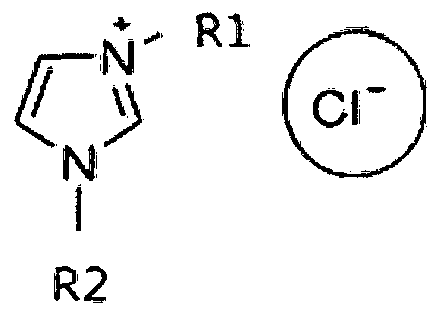
(상기 식에서 , R1 및 R2는 각각 독립적으로 유기물 치환기로서, 탄소수 1 내 지 1 내지 20의 직쇄 또는 측쇄의 알킬기이다)
한편, 상기에서 음이온은 주기율표 상의 IB족, IIIA족, IVA족, VA족, VIA족, 및 VIIA족의 원소를 포함하는 염, 또는 카르복시기 또는 할로겐화 염을 구성하는 ᅳ음어ᅳ온—등어一사용—될—수ᅳ있—타ᅳ ~구-체쩍- 로ᅭ는 7ᅳ상기ᅳ음—이ᅳ은은一염—화물—염 ᅭ 산ᅳ염—Γ인ᅳ 산염, 질산염, 황산염, 트리플레이트, 할로겐화 구리염, 안티몬산염, 카르보란, 폴 리옥소 금속염, 금속보란, 및 카르복실산염을 구성하는 음이온으로 이루어진 군으 로부터 선택될 수 있으며, 바람직하게는 CI", BF4 ", PFV, CFsSOa", CF3C0으, SbF6 ", [CuCl2]", AsFe", SOT, CF3CH2CH2C0Cr, (CF3S02)Cᅳ, CF3(CF2)3S03 _, 및 [CF3S02]2N— 로 이 루어진 군으로부터 선택될 수 있다. 아을러, 더욱 바람직하게는 Cr, BFV또는 PFV 일 수 있다.
상기 이은성 액체는 그 자체로 사용가능하고, 아울러 산성 이은성 액체로써 사용될 수 있다. 이러한 산성 이온성 액체의 양이은은 상술한 양이온들 증에서 선 택되어 사용될 수 있으나, 바람직하게 음이온은 카르복시기를 가지는 것을 특징으 로 한다.
상기 이온성 액체는 별도의 과정을 통하여 알칼리 금속 또는 알칼리 토금속 의 양이은과, 카르복시산의 음이온이 결합된 형태의 염으로부터 제조되는, 산성 이 온성 액체를 포함할 수 있다. 즉, 상기 산성 이온성 액체는 예를 들어 염화 이미다 졸륨을 아세트산 나트륨과 반웅시켜 염화 나트륨을 생성한 후 이를 분리하여 제조 될 수 있다. 상기 카르복시산은 포름산, 아세트산, 프로피온산, 부티르산, 이소부 티르산, '아크릴산, 메타아크릴산, 핵소산, 또는 2-에틸핵소산 등이 있다.
한편, 본 발명에서는 상기 분쇄된 함수겔 중합체 분말에 대하여 표면 가교 반웅을 진행하기 위해, 표면가교액에 표면 가교제가 첨가될 수 있다. 이때, 사용될 수 있는 표면 가교제로는 증합체가 갖는 관능기와 반응 가능한 화합물이라면 그 구 성의 한정이 없다.
본 발명의 일 구현예에 따른 고흡수성 수지의 제조방법에서 생성되는 고흡수 성 수지의 특성을 향상시키기 위해, 표면 가교제는 2가 이상의 다가 알코올 화합물; 에폭시 화합물; 폴리아민 화합물; 할로에폭시 화합물; 할로에폭시 화합물의 축합 산물; 옥사졸린 화합물; 모노-, 디 - 또는 폴리옥사졸리디논 화합물; 환상 우레아 화합물; 다가 금속염; 및 알킬렌 카보네이트 화합물로 '이루어진 군으로 이루어진 군에서 선택되는 1 종 이상일 수 있다.
구체적으로 , 다가 알코올 화합물로는 모노-, 디-, 트리-, 테트라- 또는 폴리 에틸렌 글리콜, 모노프로필렌 글리콜, 1,3-프로판디올, 디프로필렌 글리콜, 2,3,4- —트러-메궐ᅳ -— 1-73— -빨탄더울 7ᅳ플리ᅳ프로—필 -렌ᅳ—글—리-콜 7ᅳ클리쩨
-1,4-디을, 1,4-부탄디올, 1,3-부탄디올, 1,5-펜탄디을, 1,6-핵산디올, 및 1,2-사이 클로핵산디메탄올로 이루어진 군에서 선택되는 1 종 이상올 사용할 수 있다.
또한, 에폭시 화합물로는 에틸렌 글리콜 디글리시딜 에테르 및 글리시돌 등 을 사용할 수 있으며, 폴리아민 화합물류로는 에틸렌디아민, 디에틸렌트리아민, 트 리에틸렌테트라아민, 테트라에틸렌펜타민, 펜타에틸렌핵사민, 폴리에틸'렌이민 및 폴리아미드폴리아민로 이루어진 군에서 선택되는 1 종 이상을 사용할 수 있다.
그리고, 할로에폭시 화합물로는 에피클로로히드린, 에피브로모히드린 및 α- 메틸에피클로로히드린을 사용할 수 있다. 한편, 모노-, 디 - 또는 폴리옥사졸리디논 화합물로는 예를 들어 2-옥사졸리디논 등을 사용할 수 있다.
그리고, 알킬렌 카보네이트 화합물로는 에틸렌 카보네이트 등을 사용할 수 있다. 또한, 이들을 각각 단독으로 사용하거나 서로 조합하여 사용할 수도 있다.
그리고, 상기와 같이 표면 가교제를 흔합하여, 중합체 입자를 표면 처리하기 위해 첨가되는 표면 가교제의 함량은 구체적으로 추가되는 표면 가교제의 종류나 반응 조건에 따라 적절히 선택될 수 있지만, 바람직하게는 중합체 100 중량부에 대 해, 0.1 내지 2.0 중량부로 첨가될 수 있다.
표면 가교제의 함량이 지나치게 적으면, 표면 가교 반웅이 거의 일어나지 않 으며, 중합체 100 중량부에 대해, 2.0 중량부를 초과하는 경우, 과도한 표면가교 반 웅의 진행으로 인해 홉수능력 및 물성의 저하 현상이 발생할 수 있다.
이때, 표면 가교제를 중합체에 첨가하는 방법은 그 구성의 한정은 없다. 표 면 가교제와 중합체 분말을 반웅조에 넣고 흔합하거나, 중합체 분말에 표면 가교제 를 분사하는 방법, 연속적으로 운전되는 믹서에 중합체와 가교제를 연속적으로 공 급하여 흔합하는 방법 등을 사용할 수 있다.
한편, 표면 가교제의 침투 깊이 조절을 위해 물을 용매로 사용하나, 물 이외 의 용매를 추가하여도 되며, 이러한 용매의 종류는 특별히 한정되지는 아니한다. 상기 표면 가교액에 포함되는 물은 그 함량이 한정되지 않고, 이 분야에 잘 알려진 함량으로 사용 가능하다.
또한, 본 발명은 표면가교액에 1가의 저급 알코올을 추가로 사용 가능하다. 상기 저급 알코올은 상기 분쇄된 중합체 100 중량부에 대해 0.1 내지 2.0 중 량부로 첨가될 수 있다. 상기 '저급 알코올이 0.1 중량부 미만으로 사용되면 순수한 물을 첨가하는 경우와 비교하여 차이가 없고, 2.0 중량부를 초과하게 첨가할 경우는 경제성에 문제가 있기 때문이다.
또한, 종래 물과 알코을을 사용할 경우 일반적으로 분쇄된 중합체 100 중량 부에 대하여 물과 알코올을 각각 4 중량부 정도로 사용하였으나, 본 발명의 일 구 현예에 따르면, 알코올을 사용하지 않거나 매우 소량 사용하여도 되는 장점이 있 다.
또한 본 발명은 필요에 따르면, 상기 표면가교액에 에틸렌글리콜모노부틸에 테르, 프로필렌글리콜모노메틸에테르, 프로필렌글리콜모노메틸에테르아세테이트, 메틸에틸케톤, 아세톤, 메틸아밀케톤, 시클로핵사늡, 시클로펜타논, 디에틸렌글리 콜모노메틸에테르, 디에틸렌글리콜에틸에테르, 를루엔, 크실렌, 부틸로락톤, 카르 비를, 메틸셀로솔브아세테이트, Ν,Ν-디메틸아세트아미드로 이루어진 군에서 선택되 는 1종 이상의 용매를 추가로 사용 가능하다. 용매의 사용량은 상기 1가의 저급 알코을의 사용량과 동등하거나, 이 분야에 잘 알려진 함량으로 사용 가능하다. 한편, 상술한 구현예에 따른 제조방법에 있어서, 고흡수성 수지 제조를 위한 당해 기술 분야에서 통상 사용되는 단계 및 방법으로 중합체를 준비할 수 있다. 구체적으로, 상기 수용성 에틸렌계 불포화 단량체로는 고흡수성 수지의 제조 에 통상 사용되는 단량체라면 그 구성의 한정이 없이 사용될 수 있다. 크게, 음이 온성 단량체와 그 염, 비이온계 친수성 함유 단량체, 및 아미노기 함유 불포화 단 량체 및 그의 4급화물로 이루어진 군에서 선택되는 어느 하나 이상을 사용할 수 있 다.
구체적으로는 아크릴산, 메타아크릴산, 무수말레인산 , 푸말산, 크로톤산, 이 타콘산, 2-아크릴로일에탄 술폰산, 2-메타아크릴로일에탄술폰산, 2- (메타)아크릴로 일프로판술폰산, 또는 2- (메타)아크릴아미드 -2-메틸 프로판 술폰산의 음이온성 단 량체와 그 염; (메타)아크릴아미드, Ν-치환 (메타)아크릴레이트, 2-히드록시에틸 (메 타)아크릴레이트, 2-히드록시프로필 (메타)아크릴레이트, 메록시폴리에틸렌글리콜 (메
타)아크릴레이트 또는 폴리에틸렌 글리콜 (메타)아크릴레이트의 비이온계 친수성 함 유 단량체; 및 (N, N)-디메틸아미노에틸 (메타)아크릴레이트 또는 (N, N)-디메틸아 ᅳ미노—프로필 (-메 -타— >아크뮐아미—드의—아머ᅩ노키—함ᅩ유 _불ᅳ포화ᅳ단량체一및ᅳ그 4言화ᅳ물ᅭ로—― 이루어진 군에서 선택된 어느 하나 이상을 바람직하게 사용할 수 있다.
더욱 바람직하게는 아크릴산 또는 그 염을 사용할 수 있는데, 아크릴산 또는 그 염을 단량체로 하는 경우, 특히 흡수성이 향상된 고흡수성 수지를 얻을 수 있다 는 있다.
또한 상술한 구현예에 따른 제조방법에 있어서, 상기 단량체 조성물은 중합 개시제를 포함하는데, 중합 방법에 따라 광중합 방법에 의할 경우에는 광중합 개시 제를, 열중합 방법에 의할 경우에는 열중합 개시제 등을 포함할 수 있다. 다만, 광 중합 방법에 의하더라도 , 자외선 조사 등의 조사에 의해 일정량의 열이 발생하고, 또한 발열 반응인 중합 반응의 진행에 따라 어느 정도의 열이 발생하므로, 추가적 으로 열중합 개시제를 포함할 수도 있다.
구체적으로는 열증합 개시제로 과황산염계 개시제, 아조계 개시제, 과산화수 소, 및 아스코르빈산으로 이루어진 개시제 군에서 선택되는 하나 이상을 사용할 수 있다. 구체적으로, 과황산염계 개시제의 예로는 과황산나트륨 (Sodium persulfate; Na2S208) , 과황산칼륨 (Potassium persulfate; K2S208), 과황산암모늄 (Ammonium persulfate; (NH4)2S208) 등이 있으며, 아조 (Azo)계 개시제의 예로는 2 2-아조비스 -(2-아미디노프로판)이염산염 (2, 2-azob i s ( 2-am i d i nopr opane ) dihydrochlor ide) , 2 2ᅳ아조비스 -(N, N-디메틸렌)이소부티라마이딘 디하이드로클로라이드 (2,2-azobis-(N, N-dimethylene)isobutyr ami dine dihydrochlor ide) 2- (카바모일아조)이소부티로니트 릴 (2-(carbamoylazo)isobutylonitril), 2, 2-아조비스 [2-(2ᅳ이미다졸린 -2-일)프로판] 디하이드로클로라이드 (2 2ᅳ azobis[2— (2-imidazolin-2-yl)propane] dihydrochlor ide) , 4, 4-아조비스 -(4—시아노발레릭 산) (4,4— azobis-(4-cyanovaleric acid)) 등을 사용할 수 있다. 보다 다양한 열개시제에 대해서는 Odian 저서인 "Principle of Polymerization(Wiley, 1981년) ", p203에 잘 명시되어 있으며 상술한 예에 한정되 지 않는다.
광증합 개시제로는 벤조인 에테르 (benzoin ether), 디알킬아세토페논 (dialkyl acetophenone) , 하이드록실 알킬케톤 (hydroxyl alkylketone) , 페닐글리옥
실레이트 (phenyl glyoxylate), 벤질디메틸케탈 (Benzyl Dimethyl Ketal), 아실포스핀 (acyl phosphine) 및 알파 -아미노케톤 ( a -aminoketone)으로 이루어진 군에서 선택되 는 하나 이상을 사용할 수 있다. 한편, 아실포스핀의 구체예로, 상용하는 lucirin TP0, 즉, 2, 4, 6-트리메틸—벤조일-트리메틸 포스핀 옥사이드 (2,4,6-trimethyl-benzoyl-trimethyl phosphine oxide)를 사용할 수 있다. 보다 다 양한 광개시제에 대해서는 Reinhold Schwa lm 저서인 "UV Coatings: Basics, Recent Developments and New Appl icat ion(Elsevier 2007년) , pll5에 잘 명시되어 있으며, 상술한 예에 한정되지 않는다.
한편, 이와 같은 단량체 조성물을 열중합 또는 광중합하여 함수겔상 중합체 를 준비하는 방법 또한 통상 사용되는 중합 방법이면, 그 구성의 한정이 없다. 구 체적으로, 중합 방법은 중합 에너지 원에 따라 크게 열중합 및 광중합으로 나뉘며, 통상 열중합을 진행하는 경우, 니더 (kneader)와 같은 교반축을 가진 반응기에서 진 행될 수 있으며, 광중합을 진행하는 경우, 이동 가능한 컨베이어 벨트를 구비한 반 웅기에서 진행될 수 있으나, 상술한 중합 방법은 일 예이며, 본 발명은 상술한 중 합 방법에 한정되지는 않는다.
일 예로, 상술한 바와 같이 교반축을 구비한 니더 (kneader)와 같은 반응기에 열풍을 공급하거나 반웅기를 가열하여 열중합을 하여 얻어진 함수겔상 중합체는 반 웅기에 구비된 교반축의 형태에 따라, 반웅기 배출구로 배출되는 함수겔상 중합체 는 수 센티미터 내지 수 밀리미터 형태일 수 있다. 구체적으로, 얻어지는 함수겔상 중합체의 크기는 주입되는 모노머 조성물의 농도 및 주입속도 등에 따라 다양하게 나타날 수 있는데, 통상 입도가 2 내지 50 mm 인 함수겔상 중합체가 얻어질 수 있 다.
한편, 상기에서 열중합 또는 광중합된 함수겔상 증합체의 함수율은 40 내지 80 중량 %일 수 있다. 본 명세서 전체에서 "함수율 "은 전체 함수겔상 중합체 중량에 대해, 차지하는 수분의 함량으로 함수겔상 중합체의 중량에서 건조 상태의 중합체 의 중량을 뺀 값을 의미한다. 구체적으로는, 적외선 가열을 통해 중합체의 온도를 올려 건조하는 과정에서 중합체 중의 수분증발에 따른 무게감소분을 측정하여 계산 된 값으로 정의한다. 이때, 건조 조건은 상온에서 180°C까지 온도를 상승시킨 뒤 180t에서 유지하는 방식으로 총 건조시간은 온도상승단계 5분올 포함하여 20분으
로 설정하여, 함수율을 측정한다 .
또한, 본 발명에서 얻어진 함수겔상 중합체는 건조하는 단계를 거치는데, 필 一요—에一따하"서ᅩ는一건—조ᅳ단계—의—효ᅩ율ᅩ을ᅳ높—아기一위해 견 "조一전쩨一간—단ᅳ히ᅳ 쇄히:는ᅩ한계 를 더 거칠 수 있다.
5 상기와 같이 분쇄되거나, 혹은 중합 직후의 함수겔상 중합체는 건조 단계를 거치는데, 바람직하게 상기 건조 단계의 건조 온도는 15CTC 내지 250°C일 수 있다. 본 명세서 전체에서 "건조 온도 11는 건조를 위해 공급되는 열매체의 온도 또는 건조 공정에서 열매체 및 중합체를 포함한 건조 반응기의 온도로 정의될 수 있다.
건조 온도가 150 °C 미만인 경우, 건조 시간이 지나치게 길어지고 최종 형성 L0 되는 고흡수성 수지의 물성이 저하될 우려가 있고, 건조 온도가 250 °C를 초과하는 경우 지나치게 중합체 표면만 건조되어, 추후 이루어지는 분쇄 공정에서 미분이 발생할 수도 있고, 최종 형성되는 고흡수성 수지의 물성이 저하될 우려가 있다. 바 람직하게 상기 건조는 150°C 내지 200°C의 온도에서, 더욱 바람직하게는 160°C 내 지 18CTC의 온도에서 진행될 수 있다.
L5 한편, 건조 시간의 경우에는 그 구성의 한정은 없으나 공정 효율 둥을 고려 하여 , 20분 내지 90분 동안 진행될 수 있다..
그리고, 이와 같은 건조 단계의 건조 방법 역시, 함수 ¾상 중합체의 건조 공 정으로 통상 사용되는 것이면, 그 구성의 한정이 없이 선택되어 사용될 수 있다. 구체적으로, 열풍 공급, 적외선 조사, 극초단파 조사, 또는 자외선 조사 등의 방법 ?0 으로 건조 단계를 진행할 수 있다. 이러한 건조 단계 진행 후의 중합체의 함수율은 0.1 내지 10 중량 %일 수 있다.
이와 같은 건조 단계를 거쳐 얻어진 건조된 중합체는 분쇄 단계를 거친다. 최종 분쇄 단계 후 얻어지는 중합체 분말은 중량평균 입경이 150 내지 850//m 일 수 있다. 이와 같은 중량평균 입경으로 분쇄하기 위해 사용되는 분쇄기는 구체 !5 적으로, 핀 밀 (pin mill), 해머 밀 (hammer mill), 스크류 밀 (screw nii 11 ) , 롤 밀 (roll mill), 디스크 밀 (disc mill) 또는 조그 밀 (jog mi 11) 등을 사용할 수 있으나, 상술한 예에 본 발명이 한정되는 것은 아니다ᅳ
그리고 최종적으로 본 발명은 상기 이온성 액체를 첨가한 표면가교액을 사용 하여 표면 가교 단계를 거치는데, 이러한 표면 가교 단계는 1분 내지 120분 동안
진행될 수 있고, 100 내지 250°C에서 진행될 수 있다.
여기에서, 표면 가교 반웅을 위한 승온 수단으로는, 그 구성의 한정이 없다. ᅳ열-매쩨룰ᅳ공급 -하커—다 열—원ᅳ을ᅳ적 -접一공급하여ᅳ가ᅭ열할ᅳ수—았다 Γᅭ아때 Tᅳ사용ᅳ가—등한ᅳ 열매체의 종류로는 스팀, 열풍, 뜨거운 기름과 같은 승온한 유체 등을 사용할 수 있으나, 본 발명이 상술한 구현예에 한정되는 것은 아니며, 또한 공급되는 열매체 의 온도는 열매체의 수단, 승온 속도 및 승온 목표 온도를 고려하여, 적절히 선택 할 수 있다. 한편, 직접 공급되는 열원으로는 전기를 통한 가열, 가스를 통한 가열 방법을 들 수 있으나, 상술한 예에 본 발명이 한정되는 것은 아니다.
한편 본 명세서 전체에서 표면 가교 반웅 온도는 가교반응을 위한 "반응기 의.유효 부피"에 포함된 중합체 및 표면 가교제를 포함한 반웅물이 표면 가교 반웅 전체 시간 중 70 내지 90%의 시간이 경과되었을 때의 평균 은도로 정의될 수 있다. 그리고, 본 명세서 전체에서 "반웅기의 유효 부피" 또는 "반웅기의 부피' '는 반응기의 체적 내에 포함된 반웅물의 전체 부피로 정의한다.
상기에서, 표면가교 반웅의 온도는 100 내지 250°C임이 바람직하며, 가교 반 웅을 위한 승온이 이루어진 후, 가교 반웅은 1분 내지 120분, 바람직하게는 1분 내 지 60분, 가장 바람직하게는 10분 내지 50분 동안 진행될 수 있다.
가교 반웅 시간이 1분 미만으로 지나치게 짧은 경우, 층분한 가교반응을 할 수 없고, 가교 반웅 시간이 120분을 초과하는 경우, 과도한 표면 가교반웅으로 인 해, 중합체 입자의 손상에 따른 물성저하가 발생할 수 있다. 이하, 발명의 구체적인 실시예를 통해, 발명의 작용 및 효과를 보다 상술하기로 한다. 다만, 이러한 실시예는 발명의 예시로 제시된 것에 불과하며, 이에 의해 발명의 권리범위가 정해지는 것은 아니다. <제조예 >
베이스 수지의 준비
(1) 베이스 수지 KBase resin 1, 이하 BR-1)
. 25°C로 미리 냉각된 열매체가 순환되는 쟈켓으로 둘러 싸여진 2L 들이 유리 반웅기에, 아크릴산 500g과 아크릴산에 회석된 1% IRGACURE 819 개시제를 llg
흔합하고, 희석된 5% 폴리에틸렌글리콜 디아크릴레이트 (PEGDA, 분자량 400) 34g올 흔합한 용액 (A 용액)을 주입하고, 24% 가성소다 용액 800g(B 용액)을 서서히 적가하여 흔합하였다.
두 용액의 흔합 시 중화열에 의해 흔합액의 온도가 80 °C 이상으로 상승하는 것을 확인 후, 은도가 40°C로 냉각되기를 기다렸다가 반웅온도가 4(rc에 이르렀을 때 물에 회석된 2 과황산나트륨 용액 54g을 주입하였다.
상기 용액을 광조사 장치가 상부에 장착되고 내부가 80°C로 예열된 정방형 중합기 내에 설치된 Vat 형태의 tray (가로 15cm x 세로 15cm)에 붓고 광조사를 행하여 광개시하였다. 광조사 후 약 25초 후 표면부터 겔이 발생하며 50초 정도가 되면 발포와 동시에 중합반응이 일어나는 것을 확인 후, 그 후 3분을 추가로 반응 시킨 뒤 중합된 시트를 꺼내어 3x3cm 의 크기로 자른 뒤 Meat chopper를 이용하여 chop ing 하여 crumb을 제조하였다.
상기 crumb을 상하로 풍량 전이가 가능한 오본에서 건조하였다. 18()°C의 hot air를 15분은 하방에서 상방으로, 15분은 상방에서 하방으로 흐르게 하여 균일하게 건조하였으며, 건조 후 건조체의 함수량은 2% 이하가 되게 하였다.
건조 후, 분쇄기로 분쇄한 다음 분급하여 150 내지 850 ym 크기를 선별하여 베이스 수지를 준비하였다ᅳ 제조된 베이스 수지의 보수능은 39.2g/g, 수가용 성분 함량은 14.1중량 %였다. (2) 베이스 수지 2(Base resin 2, 이하 BR-2)
' 60°C로 미리 넁각된 열매체가 순환되는 쟈켓으로 둘러 싸여진 2L 들이 유리 반웅기에, 아크릴산 450g과 아크릴산에 희석된 10% 테트라에틸렌글리콜 디아크릴레이트 (TEGDA) 12g을 흔합한 용액 (A 용액)을 주입하고, 25% 가성소다 용액 750g(B 용액)을 서서히 적가하여 흔합하였다.
두 용액의 흔합 시 중화열에 의해 흔합액의 온도가 80°C 이상으로 상승하는 것을 확인 후, 온도가 8(rc로 냉각되기를 기다렸다가 반웅온도가 8(rc에 이르렀을 때 물에 회석된 10¾ 과황산나트륨 용액 22. 을 주입하였다.
과황산나트륨을 주입하고 수초 교반 후, 바로 중합이 시작되는 것을 확인하였다. 초기에는 맑은 액체였으나 점차 용액이 불투명해지며, 반웅기 내에
겔이 형성되었올 때에는 교반이 멈춰지고 발포를 동반한 고분자 중합이 활발히 일어나는 것을 확인하였다. 발포 시 부피 팽창율은 초기 주입된 모노머 용액 부피의 30배 이상이 되는 것을 확인하였다.
3 분 경과 후, 서서히 발포가 가라앉으면서 함수겔상 중합체를 얻을 수 있었다. 이 중합체를 3x3cm 의 크기로 자른 후 Meat chopper를 이용하여 chopping 하여 crumb을 제조하였다. 상기 crumb을 상하로 풍량 전이가 가능한 오븐에서 건조하였다. 180°C의 hot air를 15분은 하방에서 상방으로, 15분은 상방에서 하방으로 흐르게 하여 균일하게 건조하였으며 건조 후 건조체의 함수량은 2% 이하가 되게 하였다.
건조 후, 분쇄기로 분쇄한 다음 분급하여 150 내지 850 μιη 크기를 선별하여 베이스 수지를 준비하였다. 이때 베이스 수지의 보수능은 41.4g/g, 수가용 성분 함량은 15.3중량 %였다. 실시예 1
분급한 베이스 수지 BR— 1 분말에 표면 처리 용액을 분사하고 베이스 수지와 표면 가교액을 흔합하였다. 상기 표면 가교 반웅에서 가교액과 흔합된 중합체를 하나의 표면 가교반웅기에 공급하고, 185°C의 온도에서 40분 동안 함수겔 중합체의 표면 가교 반응을 진행하였다. 상기 표면처리용액은 BR-1100 중량부에 대해 물 3 중량부에 1 3_프로판디을 0.3 중량부, 이온성 액체 (화학식 l([Bmin]Cl): Rl = butyl, R2 = methyl , l-butyl-3-methyl imidazol ium chloride) 0.5 중량부, Aerosil 200 0.03 중량부를 첨가하여 제조하였다.
저급 알코올류를 가교액에 첨가하지 않아도 가교액 첨가 후 큰 입자의 뭉침이 없이 베이스 수지와 가교액이 잘 흔합됨을 확인하였다.
표면 가교 반웅 후, ASTM 규격의 표준망체로 분급하여 150 내지 850 의 입자크기를 갖는 고흡수성 수지를 얻었다. 실시예 2
분급한 베이스 수지 BR-2 분말에 표면 처리 용액을 분사하고 베이스 수지와 표면 가교액을 흔합하였다. 상기 표면 가교 반웅에서 가교액과 흔합된 중합체를
하나의 표면 가교반응기에 공급하고, 185 °C의 온도에서 40분 동안 함수겔 중합체의 표면 가교 반웅을 진행하였다. 상기 표면처리용액은 BR-2 100 중량부에 대해 물 3 -중량부에ᅳ 1丁 3 프-로판터—을一 0丁 5一중량-부 ᅳ어—은성ᅳ액체 t화학ᅳ석ᅳ r([ffim]CT)ᅮ
= methyl , l-butyl-3-methyl imidazol ium chloride) 0.3 중량부, Aerosil 200 0.03 중량부를 첨가하여 제조하였다.
저급 알코을류를 가교액에 첨가하지 않아도 가교액 첨가 후 큰 입자의 뭉침이 없이 베이스 수지와 가교액이 잘 흔합됨을 확인하였다.
표면 가교 반웅 후, ASTM 규격의 표준망체로 분급하여 150 내지 850卿의 입자크기를 갖는 고흡수성 수지를 얻었다. 실시예 3
표면가교액 조성에서 BR-1 100 중량부에 대해 Aerosil 200 0.1 중량부를 첨가한 것을 제외하고는, 상기 실시예 1과 등일하게 하여 흡수성 수지를 제조하였다. 실시예 4
분급한 베이스 수지 BR-2 분말에 표면 처리 용액을 분사하고 베이스 수지와 표면 가교액을 흔합하였다. 상기 표면 가교 반응에서 가교액과 흔합된 중합체를 하나의 표면 가교반웅기에 공급하고, 185°C의 은도에서 40분 동안 함수겔 중합체의 표면 가교 반웅을 진행하였다. 상기 표면처리용액은 BR-2 100 중량부에 대해 물 3 중량부에 1,3-프로판디올 0.5 증량부 프로필렌글리콜 0.1 중량부, 이온성 액체 (화학식 1 ([BminlCD : Rl F butyl , R2 = methyl , l-butyl-3-methyl imidazol ium chloride) 0.2 중량부, Aerosil 200 0.1 중량부를 첨가하여 제조하였다.
저급 알코을류를 가교액에 첨가하지 않아도 가교액 첨가 후 큰 입자의 뭉침이 없이 베이스 수지와 가교액이 잘 흔합됨을 확인하였다.
표면 가교 반웅 후, ASTM 규격의 표준망체로 분급하여 150卿 내지 850 의 입자크기를 갖는 고흡수성 수지를 얻었다. 실시예 5
표면가교액 조성에서 BR-2 100 중량부에 대해 aluminum sulfate 0.25 중량부를 첨가한 것을 제외하고는 상기 실시예 3과 동일하게 하여 흡수성 수지를 제조하였다. 비교예 1
표면가교액 조성에서 이온성 액체를 사용하지 않고 표면가교를 실시한 것을 제외하고는 실시예 1과 동일하게 하여 흡수성 수지를 제조하였다.
이온성 액체를 사용하지 않은 경우 가교액 첨가 후 큰 입자의 뭉침이 많고 베이스 수지와 가교액이 잘 흔합되지 않음올 확인하였다. 비교예 2
표면가교액 조성에서 이온성 액체를 사용하지 않고, 메탄을을 베이스 수지 대비 3 중량부 첨가한 것을 제외하고는, 실시예 1과 동일하게 하여 흡수성 수지를 제조하였다. 이온성 액체를 사용하지 않았지만 메탄올올 사용한 경우로 가교액 첨가 후 큰 입자의 뭉침이 없이 베이스 수지와 가교액이 잘 흔합됨을 확인하였다.
<실험예 >
실시예 및 비교예에의 고흡수성 수지에 대해, 다음의 방법을 물성을 측정하였고, 그 결과를 표 1에 나타내었다.
<무하중하 흡수배율 (CRC, Centrifuge Retention Capacity) 측정 방법 > 상기 실시예 및 비교예의 고흡수성 수지에 대하여 무하중하 흡수배율에 의한 원심분리 보수능 (CRC)을 측정하였다.
즉, 실시예 및 비교예로 얻어진 수지 얻어진 수지를 300~600 마이크로미터 크기로 분급하고 W(g) (약 0.2g)을 부직포제의 봉투에 균일하게 넣고 밀봉 (seal)한 후, 상온에서 0.9 질량 %의 생리 식염수에 함침시켰다. 30분 후에 봉투를 원심 분리기를 이용하고 250G로 3분간 물기를 뺀 후에 봉투의 질량 W2(g)을 측정했다. 또 수지를 이용하지 않고 동일한 조작을 한 후에 그때의 질량 Wl(g)을 측정했다. 얻어진 각 질량을 이용하여 다음과 같은 식에 따라 CRC (g/g)를 산출하였다.
[계산식 4]
CRC(g/g) = {(W2(g) ― WKg)-W(g)})/ W(g)}
상기 식에서,
W(g)는 홉수성 수지의 무게 (g)이고,
Wl(g)는 흡수성 수지를 넣지 않은 부직포 봉투를 상온에서 0.9 중량 %의 생리식염수에 30분 동안 함침한 후 원심분리기를 사용하여 250G로 3분간 탈수한 후 측정한 장치 무게이고,
W2(g)는 상온에서 0.9 중량 >의 생리 식염수에 흡수성 수지를 넣은 부직포 봉투를 30분 동안 함침한 다음에 원심분리기를 사용하여 250G로 3분간 탈수한 후 흡수성 수지를 포함하여 측정한 장치 무게이다.
<하중하 흡수배율 (AUL, Absorbency under Load) 측정 방법 >
상기 실시예 및 비교예의 고흡수성 수지에 대하여 하중하 흡수배율 (AUL)을 측정하였다 (EDANA ERT 442).
얻어진 수지를 300-600 마이크로 크기로 분급하고 즉, 실시예 및 비교예로 얻어진 수지를 300-600 마이크로 크기로 분급하고, W(g) (약 0.16g, A)을 AUL 실린더에 골고루 뿌린 뒤 , 0.9psi 추를 올린 뒤 무게를 잰다 (B)ᅳ 0.9 질량 %의 생리 식염수가 포함된 Petri dish에 올리고 60분 간 팽윤 시킨다. 60분 후 꺼내서 무게를 측정한다. (C)
얻어진 각 질량을 이용하여 다음과 같은 식에 따라 CRC (g/g)를 산출하였다.
[계산식 4]
AUL(g/g) = (C - B)})/ A
상기 식에서,
A는 흡수성 수지의 무게 (g)이고,
B는 흡수성 수지를 넣은 AUL Kit 에셈블리의 무게이며 ,
C는 상은에서 0.9 증량 %의 생리 식염수에서 60분 간 팽윤시킨 후의 AUL Kit 에셈블리의 무게이다.
<겔베드 투과율 (GBP) 측정 방법 >
상기 실시예 및 비교예의 고흡수성 수지에 대하여 겔베드 투과율 (GBP)를 측정하였다. 측정방법은 미국특허 7179851에 명시된 방법에 따라서 측정하였다. 본 발명의 실시예 1 내지 5 및 비교예 1 내지 2에 비해 이온성 액체를 첨가한 표면처리액으로 함수겔 중합체의 표면 가교를 진행함에 따라, 이온성 액체의 사용량 대비 겔의 뭉침현상이 없이 물의 흡수량이 조절 가능함을 알 수 있다. 또한 이은성 액체를 사용하는 경우, 제품의 물성이 우수하게 평가되는 것을 표 1을 통해 알 수 있었다.
【표 1】

【특허청구범위】
Claims
【청구항 1】
수용성 에틸렌계 불포화 단량체 및 중합개시제를 포함하는 모노머 조성물을 ᅳ열중합-또는一광증—합하여ᅳ함수 상—중ᅭ합체 -를ᅳ형성하는ᅳ단계; _
상기 함수겔상 중합체를 건조하는 단계;
상기 건조된 중합체를 분쇄하는 단계; 및
상기 분쇄된 ᅳ중합체에 표면가교제, 물 및 이온성 액체를 포함하는 표면가교 액을 분사하여 상기 분쇄된 중합체의 표면을 가교하는 단계;를 포함하며,
상기 이온성 액체는 상기 분쇄된 중합체 100 중량부에 대해 0.05 내지 1.0 중량부로 사용하는 고흡수성 수지의 제조방법 .
【청구항 2]
제 1항에 있어서, 상기 이온성 액체는 양이온 및 음이온으로 구성되고 중성을 띄는 고흡수성 수지의 제조방법 .
【청구항 3】
제 2항에 있어서, 상기 양이온은 이미다졸, 피리딘, 피라졸, 티아졸, 이소티아졸, 아자티아졸, 옥소티아졸, 옥사인, 옥사졸린, 옥사조보를, 디티오졸, 트리아졸, 셀레노졸, 옥사포스폴, 피를, 보를ᅳ 퓨란, 티오펜, 포스폴, 펜타졸, 인돌, 인돌린, 옥사졸, 이소옥사졸, 이소트리아졸, 테트라졸, 벤조퓨란, 디벤조퓨란, 벤조티오펜, 디벤조티오펜, 티아디아졸, 피리미딘, 피라진, 피리다진, 피페라진, 피페리딘, 모폴렌, 피란, 아놀린, 프탈진, 퀴나졸린, 퀴녹살린, 퀴놀린, 이소퀴놀린, 타진, 옥사진, 아자아눌렌, 알칼리 금속, 알칼리 토금속, 및 전이금속계 양이은으로 이루어지는 군으로부터 선택되는 고흡수성 수지의 제조방법.
【청구항 4]
제 3항에 있어서, 상기 양이온은 N-알킬피리디늄, Ν,Ν-디알킬이미다졸륨으로 이루어진 군으로부터 선택되는 고흡수성 수지의 제조방법.
【청구항 5】
제 2항에 있어서, 상기 음이온은 염화물염ᅳ 붕산염, 인산염, 질산염, 황산염, 트리플레이트, 할로겐화 구리염, 안티몬산염, 카르보란, 폴리옥소 금속염, 금속보란, 및 카르복실산염을 구성하는 음이온으로 이루어진 군으로부터 선택되는 고흡수성 수지의 제조방법.
【청구항 6】
제 5항에 있어서, 상기 음이온은 CI", BFV, PF6 CF3S03— , CF3C00— , SbF6 ", [CuCl2r, AsF6 ", S04 ", CF3CH2CH2C0C , (CF3S02)C_, CF3(CF2)3S03 , 및 [CF3S02]2N— 로 이 루어진 군으로부터 선택되는 고흡수성 수지의 제조방법.
'
【청구항 7]
제 1항에 있어서, 상기 이은성 액체는 알칼리 금속 또는 알칼리 토금속의 양이온과, 카르복시산의 음이온이 결합된 형태의 염으로부터 제조되는, 산성 이온성 액체를 포함하는, 고흡수성 수지의 제조방법.
【청구항 8】
제 1항에 있어서, 상기 표면 가교제는 2가 이상의 다가 알코올 화합물; 에폭시 화합물; 폴리아민 화합물; 할로에폭시 화합물; 할로에폭시 화합물의 축합 산물; 옥사졸린 화합물; 모노-, 디- 또는 폴리옥사졸리디논 화합물; 환상 우레아 화합물; 다가 금속염 ; 및 알킬렌 카보네이트 화합물로 이루어진 군으로 이루어진 군에서 선택되는 1 종 이상인 고흡수성 수지의 제조방법.
【청구항 9]
제 1항에 있어서, 상기 표면 가교제는 상기 분쇄된 중합체 100 중량부에 대해
0.1 내지 2.0 중량부로 첨가되는 것인 고흡수성 수지의 제조방법.
【청구항 10]
제 1항에 있어서, 상기 표면 가교액은 1가의 저급 알코을을 더 포함하는,
고흡수성 수지의 제조방법
【청구항 11】
제 10항에 있어서, 상기 저급 알코을은 상기 분쇄된 중합체 100 중량부에 대해 0.1 내지 2.0 중량부로 첨가되는 것인 고흡수성 수지의 제조방법.
【청구항 12】
제 1항에 있어서, 상기 열중합 또는 광중합된 함수겔상 중합체의 함수율은 40 내지 80 중량 %인 고흡수성 수지의 제조방법.
【청구항 13]
게 1항에 있어서, 상기 건조된 중합체의 함수율은 0.1 내지 10 중량 %인 고흡수성 수지의 제조방법 .
【청구항 14】
제 1항에 있어서, 상기 건조된 중합체의 분쇄는 분쇄된 중합체의 중량평균 입경이 150 내지 850 가 되도록 진행하는 것인 고흡수성 수지의 제조방법.
【청구항 15]
거 U항에 있어서, 상기 표면 가교 단계는 1분 내지 120분 동안 100 내지 25CTC에서 진행되는 것인 고흡수성 수지의 제조방법.
Priority Applications (3)
| Application Number | Priority Date | Filing Date | Title |
|---|---|---|---|
| EP14772050.2A EP2829566B2 (en) | 2013-05-09 | 2014-05-09 | Preparation method for super absorbent resin |
| US14/390,303 US9708452B2 (en) | 2013-05-09 | 2014-05-09 | Method of preparing superabsorbent polymer |
| CN201480001184.1A CN104284921B (zh) | 2013-05-09 | 2014-05-09 | 制备高吸水性聚合物的方法 |
Applications Claiming Priority (4)
| Application Number | Priority Date | Filing Date | Title |
|---|---|---|---|
| KR10-2013-0052700 | 2013-05-09 | ||
| KR20130052700 | 2013-05-09 | ||
| KR1020140054990A KR101604272B1 (ko) | 2013-05-09 | 2014-05-08 | 고흡수성 수지의 제조방법 |
| KR10-2014-0054990 | 2014-05-08 |
Publications (1)
| Publication Number | Publication Date |
|---|---|
| WO2014182128A1 true WO2014182128A1 (ko) | 2014-11-13 |
Family
ID=51867522
Family Applications (1)
| Application Number | Title | Priority Date | Filing Date |
|---|---|---|---|
| PCT/KR2014/004166 Ceased WO2014182128A1 (ko) | 2013-05-09 | 2014-05-09 | 고흡수성 수지의 제조방법 |
Country Status (3)
| Country | Link |
|---|---|
| EP (1) | EP2829566B2 (ko) |
| CN (1) | CN104284921B (ko) |
| WO (1) | WO2014182128A1 (ko) |
Cited By (2)
| Publication number | Priority date | Publication date | Assignee | Title |
|---|---|---|---|---|
| CN115475607A (zh) * | 2022-09-28 | 2022-12-16 | 安徽农业大学 | 一种阳离子型两亲性含氟水凝胶吸附剂及其制备方法和应用 |
| CN116003830A (zh) * | 2021-03-23 | 2023-04-25 | 叶绿体(新加坡)有限公司 | 超吸收性水凝胶及其制备方法和应用 |
Families Citing this family (5)
| Publication number | Priority date | Publication date | Assignee | Title |
|---|---|---|---|---|
| KR101871968B1 (ko) | 2015-06-01 | 2018-06-27 | 주식회사 엘지화학 | 고흡수성 수지 |
| KR101949454B1 (ko) | 2015-06-15 | 2019-02-18 | 주식회사 엘지화학 | 고흡수성 수지 |
| KR101949995B1 (ko) | 2015-07-06 | 2019-02-19 | 주식회사 엘지화학 | 고흡수성 수지의 제조 방법 및 이로부터 제조된 고흡수성 수지 |
| KR101855351B1 (ko) * | 2015-08-13 | 2018-05-04 | 주식회사 엘지화학 | 고흡수성 수지의 제조 방법 |
| WO2017146347A1 (ko) | 2016-02-25 | 2017-08-31 | 주식회사 엘지화학 | 고흡수성 수지 및 이의 제조 방법 |
Citations (9)
| Publication number | Priority date | Publication date | Assignee | Title |
|---|---|---|---|---|
| JPS56161408A (en) | 1980-05-19 | 1981-12-11 | Kao Corp | Production of water-absorbing resin |
| JPS57158209A (en) | 1981-03-25 | 1982-09-30 | Kao Corp | Production of bead-form highly water-absorbing polymer |
| JPS57198714A (en) | 1981-05-29 | 1982-12-06 | Sumitomo Chem Co Ltd | Production of hydrogel |
| US7179851B2 (en) | 2003-09-05 | 2007-02-20 | Kimberly-Clark Worldwide, Inc. | Damage-resistant superabsorbent materials |
| US20090299315A1 (en) * | 2004-07-20 | 2009-12-03 | Andreas Flohr | Surface Cross-Linked Superabsorbent Polymer Particles and Methods of Making Them |
| KR20110049072A (ko) * | 2009-11-04 | 2011-05-12 | 주식회사 엘지화학 | 높은 생산성을 갖는 흡수성수지의 제조방법 |
| KR20120049004A (ko) * | 2010-11-08 | 2012-05-16 | 주식회사 엘지화학 | 고흡수성 수지의 제조 방법 |
| KR20120054836A (ko) * | 2010-11-22 | 2012-05-31 | 주식회사 엘지화학 | 고흡수성 수지의 제조 방법 |
| KR20120059169A (ko) * | 2010-11-30 | 2012-06-08 | 주식회사 엘지화학 | 고흡수성 수지의 제조 방법 |
Family Cites Families (8)
| Publication number | Priority date | Publication date | Assignee | Title |
|---|---|---|---|---|
| US4043952A (en) * | 1975-05-09 | 1977-08-23 | National Starch And Chemical Corporation | Surface treatment process for improving dispersibility of an absorbent composition, and product thereof |
| CA2086031A1 (en) | 1992-01-28 | 1993-07-29 | Shigeki Ueda | Process for producing improved water absorbing resin and resin made by the same |
| DE19909653A1 (de) † | 1999-03-05 | 2000-09-07 | Stockhausen Chem Fab Gmbh | Pulverförmige, vernetzte, wässrige Flüssigkeiten sowie Blut absorbierende Polymere, Verfahren zu ihrer Herstellung und ihre Verwendung |
| PL204244B1 (pl) | 2001-06-08 | 2009-12-31 | Nippon Catalytic Chem Ind | Środek absorbujący wodę i sposób jego wytwarzania, oraz materiał higieniczny |
| US7169843B2 (en) | 2003-04-25 | 2007-01-30 | Stockhausen, Inc. | Superabsorbent polymer with high permeability |
| US20100261604A1 (en) * | 2007-12-19 | 2010-10-14 | Norbert Herfert | Process for Producing Surface Crosslinked Superabsorbents |
| JP2009269974A (ja) * | 2008-05-02 | 2009-11-19 | Three M Innovative Properties Co | ゲル状組成物とその製造方法、およびそれを用いた衝撃吸収材 |
| WO2012102407A1 (ja) † | 2011-01-28 | 2012-08-02 | 株式会社日本触媒 | ポリアクリル酸(塩)系吸水性樹脂粉末の製造方法 |
-
2014
- 2014-05-09 EP EP14772050.2A patent/EP2829566B2/en active Active
- 2014-05-09 CN CN201480001184.1A patent/CN104284921B/zh active Active
- 2014-05-09 WO PCT/KR2014/004166 patent/WO2014182128A1/ko not_active Ceased
Patent Citations (9)
| Publication number | Priority date | Publication date | Assignee | Title |
|---|---|---|---|---|
| JPS56161408A (en) | 1980-05-19 | 1981-12-11 | Kao Corp | Production of water-absorbing resin |
| JPS57158209A (en) | 1981-03-25 | 1982-09-30 | Kao Corp | Production of bead-form highly water-absorbing polymer |
| JPS57198714A (en) | 1981-05-29 | 1982-12-06 | Sumitomo Chem Co Ltd | Production of hydrogel |
| US7179851B2 (en) | 2003-09-05 | 2007-02-20 | Kimberly-Clark Worldwide, Inc. | Damage-resistant superabsorbent materials |
| US20090299315A1 (en) * | 2004-07-20 | 2009-12-03 | Andreas Flohr | Surface Cross-Linked Superabsorbent Polymer Particles and Methods of Making Them |
| KR20110049072A (ko) * | 2009-11-04 | 2011-05-12 | 주식회사 엘지화학 | 높은 생산성을 갖는 흡수성수지의 제조방법 |
| KR20120049004A (ko) * | 2010-11-08 | 2012-05-16 | 주식회사 엘지화학 | 고흡수성 수지의 제조 방법 |
| KR20120054836A (ko) * | 2010-11-22 | 2012-05-31 | 주식회사 엘지화학 | 고흡수성 수지의 제조 방법 |
| KR20120059169A (ko) * | 2010-11-30 | 2012-06-08 | 주식회사 엘지화학 | 고흡수성 수지의 제조 방법 |
Non-Patent Citations (3)
| Title |
|---|
| ODIAN: "PrincipleofPolymerization", 1981, WILEY, pages: 203 |
| REINHOLD SCHWALM: "UV Coatings: Basics, Recent Developments and New Application", 2007, ELSEVIER, pages: 115 |
| See also references of EP2829566A1 |
Cited By (3)
| Publication number | Priority date | Publication date | Assignee | Title |
|---|---|---|---|---|
| CN116003830A (zh) * | 2021-03-23 | 2023-04-25 | 叶绿体(新加坡)有限公司 | 超吸收性水凝胶及其制备方法和应用 |
| CN115475607A (zh) * | 2022-09-28 | 2022-12-16 | 安徽农业大学 | 一种阳离子型两亲性含氟水凝胶吸附剂及其制备方法和应用 |
| CN115475607B (zh) * | 2022-09-28 | 2024-01-23 | 安徽农业大学 | 一种阳离子型两亲性含氟水凝胶吸附剂及其制备方法和应用 |
Also Published As
| Publication number | Publication date |
|---|---|
| EP2829566B1 (en) | 2017-03-01 |
| CN104284921B (zh) | 2016-07-06 |
| EP2829566B2 (en) | 2020-05-27 |
| EP2829566A4 (en) | 2015-12-23 |
| CN104284921A (zh) | 2015-01-14 |
| EP2829566A1 (en) | 2015-01-28 |
Similar Documents
| Publication | Publication Date | Title |
|---|---|---|
| KR101604272B1 (ko) | 고흡수성 수지의 제조방법 | |
| JP7038825B2 (ja) | 高吸水性樹脂およびその製造方法 | |
| JP6321805B2 (ja) | 高吸水性樹脂の製造方法 | |
| KR101507287B1 (ko) | 고흡수성 수지의 제조방법 | |
| JP6309553B2 (ja) | 高吸水性樹脂 | |
| JP6731078B2 (ja) | 高吸水性樹脂およびその製造方法 | |
| WO2014182128A1 (ko) | 고흡수성 수지의 제조방법 | |
| JP7039105B2 (ja) | 高吸水性樹脂およびその製造方法 | |
| KR102069312B1 (ko) | 고흡수성 수지의 제조 방법 및 고흡수성 수지 | |
| CN106232714A (zh) | 具有改善的抗固结性的超吸收性树脂及其制备方法 | |
| WO2017164459A1 (ko) | 고흡수성 수지의 제조 방법 | |
| CN108026282A (zh) | 用于制备超吸收性聚合物的方法 | |
| WO2018124550A1 (ko) | 다공성 고흡수성 수지의 제조방법 | |
| JP6277282B2 (ja) | 高吸水性樹脂の製造方法 | |
| KR20150064649A (ko) | 고흡수성 수지의 제조방법 | |
| KR102112832B1 (ko) | 고흡수성 수지 및 이의 제조 방법 | |
| JP2016533423A (ja) | 高吸水性樹脂およびその製造方法 | |
| KR101680830B1 (ko) | 고흡수성 수지 및 이의 제조방법 | |
| WO2018124404A1 (ko) | 고흡수성 수지 및 이의 제조 방법 | |
| JP6811259B2 (ja) | 高吸水性樹脂およびその製造方法 | |
| KR101631297B1 (ko) | 고흡수성 수지 및 그 제조 방법 | |
| JP7080539B2 (ja) | 高吸水性樹脂の製造方法 | |
| WO2019117541A1 (ko) | 고흡수성 수지 및 이의 제조 방법 | |
| WO2018004162A1 (ko) | 고흡수성 수지의 제조 방법 및 고흡수성 수지 | |
| CN116157450A (zh) | 制备超吸收性聚合物的方法 |
Legal Events
| Date | Code | Title | Description |
|---|---|---|---|
| REEP | Request for entry into the european phase |
Ref document number: 2014772050 Country of ref document: EP |
|
| WWE | Wipo information: entry into national phase |
Ref document number: 2014772050 Country of ref document: EP |
|
| WWE | Wipo information: entry into national phase |
Ref document number: 14390303 Country of ref document: US |
|
| 121 | Ep: the epo has been informed by wipo that ep was designated in this application |
Ref document number: 14772050 Country of ref document: EP Kind code of ref document: A1 |
|
| NENP | Non-entry into the national phase |
Ref country code: DE |