WO2014184181A1 - Discontinuous operation in communication systems using vectoring - Google Patents
Discontinuous operation in communication systems using vectoring Download PDFInfo
- Publication number
- WO2014184181A1 WO2014184181A1 PCT/EP2014/059736 EP2014059736W WO2014184181A1 WO 2014184181 A1 WO2014184181 A1 WO 2014184181A1 EP 2014059736 W EP2014059736 W EP 2014059736W WO 2014184181 A1 WO2014184181 A1 WO 2014184181A1
- Authority
- WO
- WIPO (PCT)
- Prior art keywords
- lines
- crosstalk
- active
- case
- matrix
- Prior art date
- Legal status (The legal status is an assumption and is not a legal conclusion. Google has not performed a legal analysis and makes no representation as to the accuracy of the status listed.)
- Ceased
Links
Classifications
-
- H—ELECTRICITY
- H04—ELECTRIC COMMUNICATION TECHNIQUE
- H04B—TRANSMISSION
- H04B3/00—Line transmission systems
- H04B3/02—Details
- H04B3/32—Reducing cross-talk, e.g. by compensating
-
- H—ELECTRICITY
- H04—ELECTRIC COMMUNICATION TECHNIQUE
- H04M—TELEPHONIC COMMUNICATION
- H04M11/00—Telephonic communication systems specially adapted for combination with other electrical systems
- H04M11/06—Simultaneous speech and data transmission, e.g. telegraphic transmission over the same conductors
- H04M11/062—Simultaneous speech and data transmission, e.g. telegraphic transmission over the same conductors using different frequency bands for speech and other data
-
- H—ELECTRICITY
- H04—ELECTRIC COMMUNICATION TECHNIQUE
- H04M—TELEPHONIC COMMUNICATION
- H04M3/00—Automatic or semi-automatic exchanges
- H04M3/005—Interface circuits for subscriber lines
- H04M3/007—Access interface units for simultaneous transmission of speech and data, e.g. digital subscriber line [DSL] access interface units
-
- Y—GENERAL TAGGING OF NEW TECHNOLOGICAL DEVELOPMENTS; GENERAL TAGGING OF CROSS-SECTIONAL TECHNOLOGIES SPANNING OVER SEVERAL SECTIONS OF THE IPC; TECHNICAL SUBJECTS COVERED BY FORMER USPC CROSS-REFERENCE ART COLLECTIONS [XRACs] AND DIGESTS
- Y02—TECHNOLOGIES OR APPLICATIONS FOR MITIGATION OR ADAPTATION AGAINST CLIMATE CHANGE
- Y02D—CLIMATE CHANGE MITIGATION TECHNOLOGIES IN INFORMATION AND COMMUNICATION TECHNOLOGIES [ICT], I.E. INFORMATION AND COMMUNICATION TECHNOLOGIES AIMING AT THE REDUCTION OF THEIR OWN ENERGY USE
- Y02D30/00—Reducing energy consumption in communication networks
- Y02D30/50—Reducing energy consumption in communication networks in wire-line communication networks, e.g. low power modes or reduced link rate
Definitions
- the present application relates to methods, devices and systems relating to discontinuous operation in communication systems using vectoring.
- DSL Digital Subscriber Line
- cabinets are connected to the CO by a high-speed backbone communication line, like multi- gigabit passive optical network (GPON) and installed close to the customer premises. From these cabinets or other DPs, high-speed DSL systems, such as Very-High-Bit-Rate DSL (VDSL) , can be deployed.
- VDSL Very-High-Bit-Rate DSL
- Current VDSL systems ITU-T Recommendation G.993.2
- ITU-T Recommendation G.993.2 have range of operation about 1 km, providing bit rates in the range of tens of Mb/s.
- To increase the bit rate of VDSL systems deployed from the cabinet recent ITU-T
- Recommendation G.993.5 defined vectored transmission that allows increasing bit rates up to 100 Mb/s per direction.
- vectoring is implemented by precoding the transmit signals (at the DP) , so that each signal
- Fig. 1 illustrates a communication system according to some embodiments .
- Fig. 2 is a diagram illustrating discontinuous operation.
- Fig. 3 illustrates transmission on a line using two sets of precoder matrices.
- Fig. 4 illustrates a precoder of a single distribution point port according to an embodiment.
- Figs. 5A and 5B illustrate a simulation of signal-to-noise ratios for a 16 line binder with equally distributed lengths. In Fig. 5A, all lines are active, in Fig. 5B, one line is disabled.
- Fig. 6 illustrates behavior of the example of Fig. 5 after an update of matrix coefficients.
- Fig. 7A and 7B show signal-to-noise ratios for a 16 line binder with equally distributed lengths from 50 meters to 250 meters with nonlinear precoding. In Fig. 7A, all lines are active, in Fig. 7B one line is disabled.
- Fig. 8 illustrates a downstream system model with a
- Figs. 9A and 9B illustrate signal-to-noise ratio for a 16- line binder with equally distributed length from 50 meters to 250 meters with nonlinear precoding.
- Fig. 9A all lines are active, in Fig. 9B, two lines are disabled. The channel matrix has been updated, and disabled lines were the last ones added to the precoder.
- Fig. 10 illustrates a receiver of a single distribution point port according to an embodiment.
- Fig. 11 is a diagram illustrating precoder settings and updates in a downstream direction. Embodiments will be described in the following in detail with reference to the attached drawings. It should be noted that these embodiments serve as illustrative examples only and are not to be construed as limiting. For example, while
- Communication connections discussed in the following may be direct connections or indirect connections, i.e. connections with or without additional intervening elements, as long as the general function of the connection, for example to transmit a certain kind of signal, is preserved.
- Connections may be wireless connections or wire-based connections unless noted otherwise.
- efficient possibilities for updating vectoring coefficients, for example precoding coefficients, in systems using discontinuous operation may be discussed. For example, a precoder matrix may be updated based on actually active lines.
- Fig. 1 a communication system according to an embodiment is shown.
- the system of Fig. 1 comprises a provider equipment 10 communicating with a plurality of CPE units 14-16. While three CPE units 14-16 are shown in Fig. 1, this serves merely as an example, and any number of CPE units may be provided.
- Provider equipment 10 may be central office equipment, equipment in a distribution point (DP), or any other equipment used on a provider side. In case provider equipment 10 is part of a distribution point, it may for example receive and send data from and to a network via a fiber optic connection 110. In other
- provider equipment 10 comprises a plurality of transceivers 11-13 to communicate with CPE units 14-16 via respective communication connections 17-19.
- Communication connections 17-19 may for example be copper lines, e.g. twisted pairs of copper lines.
- Communication via communication connections 17-19 may be a communication based on a multicarrier modulation like discrete multitone
- DMT orthogonal frequency division
- the communication system may use vectoring, as indicated by a block 111 (e.g. a crosstalk reduction circuit like a precoder or equalizer) in Fig. 1.
- Vectoring comprises joint processing of signals to be sent and/or received to reduce crosstalk.
- a communication direction from provider equipment 10 to CPE units 14-16 will also be referred to as downstream direction, and a communication direction from CPE units 14-16 will be also be referred to as upstream direction.
- Vectoring in the downstream direction is also referred to as crosstalk
- precompensation whereas vectoring in the upstream direction is also referred to as crosstalk cancellation or equalization .
- Provider equipment 10 and/or CPE units 14-16 may include further communication circuits (not shown) conventionally employed in communication systems, for example circuitry for modulating, bit loading, Fourier transformation etc.
- connections 17-19 is a frame-based communication.
- a plurality of frames may form a superframe.
- the communication uses time division duplexing, as will be explained later.
- discontinuous operation which is employed in some embodiments, is one of the ways to save power, e.g. in DSL lines.
- TDD Time Division Duplexing
- DS_TO Downstream Transmission Opportunity
- US_TO Upstream Transmission Opportunity
- transmitted in a particular line during a particular TDD frame may be different, which is illustrated in Fig. 2.
- Figure 2 also shows markers that indicate when the active transmission will expire.
- the duration of the transmission in a number of consecutive TDD frames may be set in advance and indicated to the CPE during management
- Discontinuous operation was previously proposed and defined. It provides an ability to transmit symbols only when there is user data available for transmission, while powers the line off when no data for transmission is available. Therefore, with discontinuous operation, the number of symbols
- FIG. 3 Another conventional approach, illustrated in Fig. 3, uses a second method, and in the aim to reduce the number of sets of coefficients to be stored, it proposes to group lines
- the precoder matrices for each group may be stored and kept during the group assignment. This may limit the flexibility of such a conventional system, while padding itself may substantially reduce potential power savings.
- the method according to some embodiments is reliable, guarantees quality of service (QoS) , and
- FIG. 4 A functional model of downstream vectoring according to some embodiments is presented in Figure 4 (LD stands for Line Driver, AFE for Analog Front End and IFFT for Inverse Fast Fourier Transform) .
- a vectoring precoder is included into the transmitter to compensate FEXT (Far-End Crosstalk) : one input of the precoder is the actual transmit signal for the line at tone i, Z (i) , others are inputs are from other lines of the vectored group and intended for FEXT cancelling.
- the precoder applies inputs from other lines via precoding coefficients and special processing to compensate FEXT generated by other lines into line i.
- each line transmits different number of symbols in each TDD frame. That means that from a certain symbol (time instant T 2 for Line 2 in Figure 2) the number of actual vectored lines changes - it may change after every symbol.
- T 2 time instant
- T 2 time instant
- the complexity and processing associated with the update may depend on the type of the precoding.
- precoding matrices of all remaining lines need to be obtained and stored at the transmitter prior the session, which requires big amount of memory to keep all the matrices associated with all possible symbol combinations. This doesn't seem to be practical.
- the above-desribed conventional approach uses line grouping and padding, as shown in Figure 3, to leverage complexity increase. It should be noted that switching of the lines ON and OFF during discontinuous operation should not involve substantial changes in the impedance of the line; if the impedance of the transmitter or receiver changes substantially, it may results in substantial changes of FEXT coupling between all lines in the binder (especially at high frequencies) .
- FIG. 5 shows a simulation example for an SNR degradation in lines of a 16-line binder using linear
- precoding caused by a removal of just one line - the SNR reduction in some lines is more than 10 dB, which is
- FIG. 5A shows the SNR with all lines active
- Fig. 5B the SNR with one line switched off.
- discontinuous operation and using linear precoder which results in minimized number of computations for coefficient updates and thus can be performed on symbol bases in some embodiments .
- a received signal ⁇ can be presented as : u ⁇ H - P - u (1)
- u is the transmit signal prior to precoding
- H is a channel matrix
- P is the precoder matrix.
- the frequency equalized (FEQ) matrix G is considered as a part of the channel matrix H to simplify equations.
- the corresponding rows and columns from the channel matrix H and the precoder matrix P are set to zero. Accordingly, we partition the matrix into matrixes of active (a) and of disabled (d) lines. Before deactivation of the line, for perfect crosstalk precompensation the following holds .
- I is the unitary matrix with non-zero elements only in the main diagonal. With disabled lines (due to discontinuous operation), equation (2) must still be fulfilled, which requires a different matrix P ⁇ .
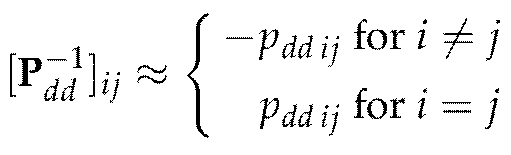
- equation (3) Based on the matrix inversion lemma, equation (3) is found for the calculation of the matrix coefficients for active lines :
- equation (4) simplifies to:
- line deactivation is temporary and therefore a recomputation of the coefficients is disadvantageous.
- the operation of equation (5) can be, however, incooperated into the precoding operation (i.e., can be implemented by changing the order of multiplication and summation during precoding). This doesn't require additional computation resources.
- Equation (9) shows that computation of the precoding output has the same number of multiply-accumulated (MAC operations) as when all lines are active since the value Pad ' u « needs to be computed only once for all lines and needs to be scaled for each line differently by the corresponding coefficient Pid .
- equation (9) still holds because this can be seen as sequential deactivation of a number of single lines.
- equation (9) still holds because this can be seen as sequential deactivation of a number of single lines.
- the number of MAC operations for the computation on the active lines is still the same.
- PSDs on the precoder output. Some lines transmit more power than before, while others transmit less. However, these PSD changes are rather small ( ⁇ 2-4 dB) , and if lines are enable and disabled for rather short time and randomly, as takes place in discontinuous operation, the average spectrum does not increase.
- the nonlinear precoder matrices ( P b and P f ) are given by equations (12) to (15) shown below.
- the coefficients are calculated based on the QR decomposition according to equation (12), where Q is a unitary matrix and R is an upper triangular matrix.
- the matrix ⁇ is a permutation matrix defining the encoding order of the data streams.
- the encoding order is selected such that the line that is disabled first is encoded first. By doing so, it is guaranteed that if the input signal of the disabled line is set to zero, a
- corresponding modulo output signal u mod is also equal zero and the nonlinear operation does not change.
- some embodiments comprise replacing the signals of the lines which were transmitted prior to deactivation, which, in embodiments, is given by equation (16) .
- This modification of the precoder matrix results in a change of the transmit PSD (Power Spectral Density) , similarly as in the linear precoder case. Similarly as in case of linear precoder, this in embodiments is not expected to be harmful because the discontinued lines reduce the total power
- FIG. 9A An example is shown in Figs. 9A and 9B, Fig. 9A illustrating a case where all lines are active, and Fig. 9B illustrating a case where two lines were disabled and techniques as
- the functional model of the receiver (e.g. in a DP) is presented in Figure 10.
- the output of the decoder is a composition of the signal received from the line and the sum of signals received from all other active lines multiplied by matrix coefficients, which corresponds to the aforementioned crosstalk cancellation or equalization. If a receiver of a particular line is switched off, the corresponding input of the decoder is zeroed and FEXT
- the receiver shall update decoder matrix coefficients upon the number of actually transmitting lines changes. This is rather similar to the case of downstream. However, such coefficient
- the coefficients of the updated matrix in some embodiments can be found in the way that is similar to the downstream: Upstream model similar to equation (1) : ⁇ - - G H ⁇ u (18)
- the equalizer matrix G has non-zero nondiagonal
- This noise increase can be compensated by temporary increase of the transmit PSD, or by bit loading change. For both cases additional protocol may be required in some embodiments.
- the receiver is kept operating, so that FEXT signals accumulated by the line are added to the decoder. This requires AFE, FFT and precoder to be left ON. Same as in the downstream direction, the dynamic range of the AFE may be reduced if used frequency spectrum is limited to 100 MHz (none or very few pairs has close to negative or negative impulse-to-SNR ratio) . This gives additional power saving .
- a fast power allocation update according to some embodiments will be described.
- the transmit gains scale the input of the precoder such that the output of the precoder does not violate transmit PSD.
- the scale factor update for each configuration of inactive lines is pre-computed by the DP for the following TDD frames and communicated to the CPEs.
- the CPEs receive the update of the subcarrier gains table for the configurations contained in the following TDD frames. For frequencies up to 100 MHz where the direct channel can be assumed to be the strongest path between transmitter and receiver, this scaling will increase performance on average.
- the transceiver at the DP computes the precoder matrix and normalizes the PSD at an initialization of the vectored group. Further, for each symbol position in each TDD frame, the DP updates the precoder matrix based on actually active lines using any method as described above. Similarly, the DP computes the decoder matrix during the initialization and updates it on symbol-to-symbol bases using any method as described above.
- the DP may adjust transmit PSD normalization if one or more lines are turned to a long term deactivation. Bit loading adjustment in the downstream direction may be a part of this procedure .
- the DP re-computes precoder coefficients and updates PSD
- the DP performs 3 updates of the precoder matrix based on actually active lines using the method defined in section 5.1.2.
- the upstream decoder matrix may be updated on symbol-to-symbol bases using any method as described above.
- the PSD normalization may be performed in the range that allows to keep the same bit loading; otherwise bit loading may need to be adjusted for the TDD frame or group of TDD frames .
- the DP re-computes precoder coefficients at the at the start of each TDD frame or each group of same TDD frames (superframe) in the order lines are discontinuous during the TDD frame.
- N lines may, e.g., be precoded in order: #5, #2, #1, #3, and for TDD frame (N+l) they will be precoded in order: #6, #5, #2, #1, #3.
- the DP also modifies appropriately the feed ⁇ forward matrix P f using any method defined above.
- the PSD normalization may be performed in the range that allows to keep the same bit loading; otherwise bit loading may need to be adjusted. This is usually only possible for a group of same TDD frames, so the PSD normalization can be pre-computed and bit loading changes may be exchanged with the CPE.
- padding is added to some transmissions of some frames. In all the mentioned embodiments no action from the receiver is required except when bit loading or
- subcarrier gains are modified.
- Method of exchanging new values of bit loading and gains may be trivial and is beyond the scope of this invention.
- Embodiments introduce special precoding update techniques (methods and algorithms) and a protocol associated with these updates.
- the proposed embodiments may serve as a part of the new G.fast standard.
- a vectored transmission correction network that employs discontinuous operation is provided, wherein a method or device updates precoder matrices and decoder or postcoder matrices such that a subset of coefficients needs to be updated.
Landscapes
- Engineering & Computer Science (AREA)
- Signal Processing (AREA)
- Computer Networks & Wireless Communication (AREA)
- Cable Transmission Systems, Equalization Of Radio And Reduction Of Echo (AREA)
- Data Exchanges In Wide-Area Networks (AREA)
Abstract
Description



Claims

Priority Applications (9)
| Application Number | Priority Date | Filing Date | Title |
|---|---|---|---|
| US14/890,173 US9838075B2 (en) | 2013-05-13 | 2014-05-13 | Methods, devices and systems of supporting discontinuous operation in communication systems using vectoring |
| KR1020157032393A KR101773278B1 (en) | 2013-05-13 | 2014-05-13 | Discontinuous operation in communication systems using vectoring |
| EP19167062.9A EP3525440B1 (en) | 2013-05-13 | 2014-05-13 | Methods, devices and systems of supporting discontinuous operation in communication systems using vectoring |
| BR112015028024-2A BR112015028024B1 (en) | 2013-05-13 | 2014-05-13 | METHOD AND DEVICE TO SUPPORT DISCONTINUOUS OPERATION IN COMMUNICATION SYSTEMS USING VECTORIZATION |
| JP2016513332A JP6178498B2 (en) | 2013-05-13 | 2014-05-13 | Method, apparatus and system for supporting discontinuous operation in communication system using vectoring |
| EP14725072.4A EP2997724B1 (en) | 2013-05-13 | 2014-05-13 | Discontinuous operation in communication systems using vectoring |
| CN201480027072.3A CN105210359B (en) | 2013-05-13 | 2014-05-13 | Use the discontinuous operation in the communication system of vectorization |
| US15/819,511 US10567037B2 (en) | 2013-05-13 | 2017-11-21 | Methods, devices and systems of supporting discontinuous operation in communication systems using vectoring |
| US16/697,746 US11218188B2 (en) | 2013-05-13 | 2019-11-27 | Methods, devices and systems of supporting discontinuous operation in communication systems using vectoring |
Applications Claiming Priority (2)
| Application Number | Priority Date | Filing Date | Title |
|---|---|---|---|
| US201361822478P | 2013-05-13 | 2013-05-13 | |
| US61/822,478 | 2013-05-13 |
Related Child Applications (2)
| Application Number | Title | Priority Date | Filing Date |
|---|---|---|---|
| US14/890,173 A-371-Of-International US9838075B2 (en) | 2013-05-13 | 2014-05-13 | Methods, devices and systems of supporting discontinuous operation in communication systems using vectoring |
| US15/819,511 Continuation US10567037B2 (en) | 2013-05-13 | 2017-11-21 | Methods, devices and systems of supporting discontinuous operation in communication systems using vectoring |
Publications (1)
| Publication Number | Publication Date |
|---|---|
| WO2014184181A1 true WO2014184181A1 (en) | 2014-11-20 |
Family
ID=50736071
Family Applications (1)
| Application Number | Title | Priority Date | Filing Date |
|---|---|---|---|
| PCT/EP2014/059736 Ceased WO2014184181A1 (en) | 2013-05-13 | 2014-05-13 | Discontinuous operation in communication systems using vectoring |
Country Status (7)
| Country | Link |
|---|---|
| US (3) | US9838075B2 (en) |
| EP (2) | EP2997724B1 (en) |
| JP (1) | JP6178498B2 (en) |
| KR (1) | KR101773278B1 (en) |
| CN (1) | CN105210359B (en) |
| BR (1) | BR112015028024B1 (en) |
| WO (1) | WO2014184181A1 (en) |
Families Citing this family (11)
| Publication number | Priority date | Publication date | Assignee | Title |
|---|---|---|---|---|
| US9143195B2 (en) * | 2011-07-07 | 2015-09-22 | Adtran, Inc. | Systems and methods for communicating among network distribution points |
| EP2997724B1 (en) * | 2013-05-13 | 2019-06-26 | Lantiq Beteiligungs-GmbH & Co.KG | Discontinuous operation in communication systems using vectoring |
| WO2015127624A1 (en) * | 2014-02-27 | 2015-09-03 | 华为技术有限公司 | Crosstalk channel estimation method, vectoring control entity and osd system |
| US20150341081A1 (en) * | 2014-05-20 | 2015-11-26 | Ikanos Communications, Inc. | Method and apparatus for updating fext coefficients for g.fast vectoring with discontinuous operation |
| US10038473B2 (en) * | 2015-01-30 | 2018-07-31 | Alcatel Lucent | Methods and systems for reducing crosstalk via stabilized vectoring control |
| WO2016165948A1 (en) * | 2015-04-14 | 2016-10-20 | Lantiq Beteiligungs-GmbH & Co.KG | Line grouping for crosstalk avoidance |
| PL3154205T3 (en) | 2015-10-06 | 2018-12-31 | Alcatel Lucent | Targeted rectangular conditioning |
| CN107925438B (en) * | 2016-02-03 | 2020-12-22 | 华为技术有限公司 | A method, device and system for resource scheduling in a DSL system |
| US10594520B2 (en) * | 2016-12-28 | 2020-03-17 | Sckipio Technologies S.I Ltd | System and method unifying linear and nonlinear precoding for transceiving data |
| CN109728837B (en) * | 2017-10-30 | 2020-11-17 | 桐乡市定邦信息技术有限公司 | Method, device and system for counteracting crosstalk signals |
| US11438038B1 (en) * | 2021-02-17 | 2022-09-06 | Qualcomm Incorporated | Neural network based nonlinear MU-MIMO precoding |
Citations (2)
| Publication number | Priority date | Publication date | Assignee | Title |
|---|---|---|---|---|
| US20090270038A1 (en) * | 2008-04-24 | 2009-10-29 | Infineon Technologies Ag | Method and Apparatus for Adding a Communication Connection to a Vectored Group |
| EP2466757A1 (en) * | 2010-12-17 | 2012-06-20 | Alcatel Lucent | Crosstalk cancellation device and method with improved vectoring stabilisation |
Family Cites Families (13)
| Publication number | Priority date | Publication date | Assignee | Title |
|---|---|---|---|---|
| US7158563B2 (en) * | 2001-06-01 | 2007-01-02 | The Board Of Trustees Of The Leland Stanford Junior University | Dynamic digital communication system control |
| US8204100B2 (en) * | 2009-01-15 | 2012-06-19 | Lantiq Deutschland Gmbh | Methods and apparatuses for data transmission |
| ATE540484T1 (en) * | 2009-06-24 | 2012-01-15 | Alcatel Lucent | COMMON SIGNAL PROCESSING ACROSS MULTIPLE LINE END CARDS |
| CN102136852B (en) | 2010-08-05 | 2014-01-22 | 华为技术有限公司 | Crosstalk counteracting method and system |
| US8363789B2 (en) * | 2010-12-15 | 2013-01-29 | At&T Intellectual Property I, L.P. | Apparatus, methods, and articles of manufacture to predict vectored digital subscriber line (DSL) performance gains |
| US8537655B2 (en) * | 2011-01-28 | 2013-09-17 | Alcatel Lucent | Multiplicative updating of precoder or postcoder matrices for crosstalk control in a communication system |
| US8817903B2 (en) * | 2012-02-17 | 2014-08-26 | Alcatel Lucent | Methods and systems for reducing crosstalk |
| AU2012374062B2 (en) * | 2012-03-19 | 2016-04-21 | Assia Spe, Llc | System for diagnosing and optimizing vectored DSL line |
| US9503985B2 (en) * | 2012-03-29 | 2016-11-22 | Sckipio Technologies S.I Ltd | Transmission scheme for communication systems |
| PL2755333T3 (en) * | 2013-01-11 | 2019-04-30 | Alcatel Lucent | Gain adaptation for downstream vectoring systems |
| US9614581B2 (en) * | 2013-03-11 | 2017-04-04 | Futurewei Technologies, Inc. | Control and management of power saving link states in vectored TDD transmission systems |
| US9614582B2 (en) * | 2013-05-07 | 2017-04-04 | Metanoia Communications Inc. | Dynamic rate adaptation methods in a vectored G.fast system |
| EP2997724B1 (en) | 2013-05-13 | 2019-06-26 | Lantiq Beteiligungs-GmbH & Co.KG | Discontinuous operation in communication systems using vectoring |
-
2014
- 2014-05-13 EP EP14725072.4A patent/EP2997724B1/en active Active
- 2014-05-13 KR KR1020157032393A patent/KR101773278B1/en active Active
- 2014-05-13 WO PCT/EP2014/059736 patent/WO2014184181A1/en not_active Ceased
- 2014-05-13 BR BR112015028024-2A patent/BR112015028024B1/en active IP Right Grant
- 2014-05-13 US US14/890,173 patent/US9838075B2/en active Active
- 2014-05-13 EP EP19167062.9A patent/EP3525440B1/en active Active
- 2014-05-13 CN CN201480027072.3A patent/CN105210359B/en active Active
- 2014-05-13 JP JP2016513332A patent/JP6178498B2/en active Active
-
2017
- 2017-11-21 US US15/819,511 patent/US10567037B2/en active Active
-
2019
- 2019-11-27 US US16/697,746 patent/US11218188B2/en active Active
Patent Citations (2)
| Publication number | Priority date | Publication date | Assignee | Title |
|---|---|---|---|---|
| US20090270038A1 (en) * | 2008-04-24 | 2009-10-29 | Infineon Technologies Ag | Method and Apparatus for Adding a Communication Connection to a Vectored Group |
| EP2466757A1 (en) * | 2010-12-17 | 2012-06-20 | Alcatel Lucent | Crosstalk cancellation device and method with improved vectoring stabilisation |
Non-Patent Citations (1)
| Title |
|---|
| BT: "G.fast: Low Power Modes - Continued;TD2013-03-Q4-067", ITU-T DRAFT ; STUDY PERIOD 2013-2016, INTERNATIONAL TELECOMMUNICATION UNION, GENEVA ; CH, vol. 4a/15, 10 May 2013 (2013-05-10), pages 1 - 8, XP017580484 * |
Also Published As
| Publication number | Publication date |
|---|---|
| US10567037B2 (en) | 2020-02-18 |
| CN105210359B (en) | 2018-06-26 |
| EP2997724B1 (en) | 2019-06-26 |
| JP2016519542A (en) | 2016-06-30 |
| JP6178498B2 (en) | 2017-08-09 |
| US11218188B2 (en) | 2022-01-04 |
| EP3525440B1 (en) | 2020-11-04 |
| US20160119025A1 (en) | 2016-04-28 |
| EP2997724A1 (en) | 2016-03-23 |
| KR20150142042A (en) | 2015-12-21 |
| US9838075B2 (en) | 2017-12-05 |
| EP3525440A1 (en) | 2019-08-14 |
| BR112015028024A2 (en) | 2017-07-25 |
| US20180212647A1 (en) | 2018-07-26 |
| KR101773278B1 (en) | 2017-08-30 |
| CN105210359A (en) | 2015-12-30 |
| BR112015028024B1 (en) | 2022-12-27 |
| US20200244308A1 (en) | 2020-07-30 |
Similar Documents
| Publication | Publication Date | Title |
|---|---|---|
| US11218188B2 (en) | Methods, devices and systems of supporting discontinuous operation in communication systems using vectoring | |
| US9906353B2 (en) | Scheme system and method for power saving in vectored communications | |
| US9544423B2 (en) | Channel ordering for multi-channel multi-carrier communication systems | |
| KR101759016B1 (en) | Low power modes for data transmission from a distribution point | |
| US11411603B2 (en) | Device for transmitting and receiving on a copper wire installed at a customer premise | |
| CN103004099A (en) | A method, device and system for reducing digital subscriber line interference | |
| WO2015135870A1 (en) | Non-linear precoder with separate tracking | |
| US20140023190A1 (en) | MIMO Mechanism for Strong FEXT Mitigation | |
| US9407760B2 (en) | Performance monitoring for discontinuous operation modes | |
| US11632145B2 (en) | Method and apparatus for full-duplex communication over wired transmission media | |
| Strobel et al. | Achievable rates with implementation limitations for G. fast-based hybrid copper/fiber networks | |
| US20100254467A1 (en) | Method and device for noise processing and communication system comprising such device | |
| JP5498585B2 (en) | Crosstalk control method and crosstalk control apparatus using bandwidth adaptive precoder interface | |
| US8908489B2 (en) | Method and device for data processing and communication system comprising such device | |
| CN107431504A (en) | The circuit packet avoided for crosstalk | |
| Lanneer et al. | Vectoring design optimization in ultra-broadband DSL networks |
Legal Events
| Date | Code | Title | Description |
|---|---|---|---|
| 121 | Ep: the epo has been informed by wipo that ep was designated in this application |
Ref document number: 14725072 Country of ref document: EP Kind code of ref document: A1 |
|
| WWE | Wipo information: entry into national phase |
Ref document number: 14890173 Country of ref document: US |
|
| ENP | Entry into the national phase |
Ref document number: 20157032393 Country of ref document: KR Kind code of ref document: A |
|
| ENP | Entry into the national phase |
Ref document number: 2016513332 Country of ref document: JP Kind code of ref document: A |
|
| NENP | Non-entry into the national phase |
Ref country code: DE |
|
| WWE | Wipo information: entry into national phase |
Ref document number: 2014725072 Country of ref document: EP |
|
| REG | Reference to national code |
Ref country code: BR Ref legal event code: B01A Ref document number: 112015028024 Country of ref document: BR |
|
| ENP | Entry into the national phase |
Ref document number: 112015028024 Country of ref document: BR Kind code of ref document: A2 Effective date: 20151106 |