WO2014184983A1 - 樹脂積層体及びその製造方法並びにディスプレー前面板 - Google Patents
樹脂積層体及びその製造方法並びにディスプレー前面板 Download PDFInfo
- Publication number
- WO2014184983A1 WO2014184983A1 PCT/JP2013/084163 JP2013084163W WO2014184983A1 WO 2014184983 A1 WO2014184983 A1 WO 2014184983A1 JP 2013084163 W JP2013084163 W JP 2013084163W WO 2014184983 A1 WO2014184983 A1 WO 2014184983A1
- Authority
- WO
- WIPO (PCT)
- Prior art keywords
- component
- mass
- meth
- parts
- resin
- Prior art date
- Legal status (The legal status is an assumption and is not a legal conclusion. Google has not performed a legal analysis and makes no representation as to the accuracy of the status listed.)
- Ceased
Links
Images


Classifications
-
- C—CHEMISTRY; METALLURGY
- C08—ORGANIC MACROMOLECULAR COMPOUNDS; THEIR PREPARATION OR CHEMICAL WORKING-UP; COMPOSITIONS BASED THEREON
- C08F—MACROMOLECULAR COMPOUNDS OBTAINED BY REACTIONS ONLY INVOLVING CARBON-TO-CARBON UNSATURATED BONDS
- C08F222/00—Copolymers of compounds having one or more unsaturated aliphatic radicals, each having only one carbon-to-carbon double bond, and at least one being terminated by a carboxyl radical and containing at least one other carboxyl radical in the molecule; Salts, anhydrides, esters, amides, imides, or nitriles thereof
- C08F222/10—Esters
- C08F222/1006—Esters of polyhydric alcohols or polyhydric phenols
- C08F222/102—Esters of polyhydric alcohols or polyhydric phenols of dialcohols, e.g. ethylene glycol di(meth)acrylate or 1,4-butanediol dimethacrylate
-
- B—PERFORMING OPERATIONS; TRANSPORTING
- B29—WORKING OF PLASTICS; WORKING OF SUBSTANCES IN A PLASTIC STATE IN GENERAL
- B29C—SHAPING OR JOINING OF PLASTICS; SHAPING OF MATERIAL IN A PLASTIC STATE, NOT OTHERWISE PROVIDED FOR; AFTER-TREATMENT OF THE SHAPED PRODUCTS, e.g. REPAIRING
- B29C39/00—Shaping by casting, i.e. introducing the moulding material into a mould or between confining surfaces without significant moulding pressure; Apparatus therefor
- B29C39/02—Shaping by casting, i.e. introducing the moulding material into a mould or between confining surfaces without significant moulding pressure; Apparatus therefor for making articles of definite length, i.e. discrete articles
- B29C39/10—Shaping by casting, i.e. introducing the moulding material into a mould or between confining surfaces without significant moulding pressure; Apparatus therefor for making articles of definite length, i.e. discrete articles incorporating preformed parts or layers, e.g. casting around inserts or for coating articles
-
- B—PERFORMING OPERATIONS; TRANSPORTING
- B29—WORKING OF PLASTICS; WORKING OF SUBSTANCES IN A PLASTIC STATE IN GENERAL
- B29C—SHAPING OR JOINING OF PLASTICS; SHAPING OF MATERIAL IN A PLASTIC STATE, NOT OTHERWISE PROVIDED FOR; AFTER-TREATMENT OF THE SHAPED PRODUCTS, e.g. REPAIRING
- B29C39/00—Shaping by casting, i.e. introducing the moulding material into a mould or between confining surfaces without significant moulding pressure; Apparatus therefor
- B29C39/02—Shaping by casting, i.e. introducing the moulding material into a mould or between confining surfaces without significant moulding pressure; Apparatus therefor for making articles of definite length, i.e. discrete articles
- B29C39/12—Making multilayered or multicoloured articles
-
- G—PHYSICS
- G09—EDUCATION; CRYPTOGRAPHY; DISPLAY; ADVERTISING; SEALS
- G09F—DISPLAYING; ADVERTISING; SIGNS; LABELS OR NAME-PLATES; SEALS
- G09F9/00—Indicating arrangements for variable information in which the information is built-up on a support by selection or combination of individual elements
-
- B—PERFORMING OPERATIONS; TRANSPORTING
- B29—WORKING OF PLASTICS; WORKING OF SUBSTANCES IN A PLASTIC STATE IN GENERAL
- B29K—INDEXING SCHEME ASSOCIATED WITH SUBCLASSES B29B, B29C OR B29D, RELATING TO MOULDING MATERIALS OR TO MATERIALS FOR MOULDS, REINFORCEMENTS, FILLERS OR PREFORMED PARTS, e.g. INSERTS
- B29K2033/00—Use of polymers of unsaturated acids or derivatives thereof as moulding material
- B29K2033/04—Polymers of esters
- B29K2033/12—Polymers of methacrylic acid esters, e.g. PMMA, i.e. polymethylmethacrylate
-
- B—PERFORMING OPERATIONS; TRANSPORTING
- B29—WORKING OF PLASTICS; WORKING OF SUBSTANCES IN A PLASTIC STATE IN GENERAL
- B29L—INDEXING SCHEME ASSOCIATED WITH SUBCLASS B29C, RELATING TO PARTICULAR ARTICLES
- B29L2031/00—Other particular articles
- B29L2031/34—Electrical apparatus, e.g. sparking plugs or parts thereof
- B29L2031/3475—Displays, monitors, TV-sets, computer screens
-
- C—CHEMISTRY; METALLURGY
- C08—ORGANIC MACROMOLECULAR COMPOUNDS; THEIR PREPARATION OR CHEMICAL WORKING-UP; COMPOSITIONS BASED THEREON
- C08F—MACROMOLECULAR COMPOUNDS OBTAINED BY REACTIONS ONLY INVOLVING CARBON-TO-CARBON UNSATURATED BONDS
- C08F222/00—Copolymers of compounds having one or more unsaturated aliphatic radicals, each having only one carbon-to-carbon double bond, and at least one being terminated by a carboxyl radical and containing at least one other carboxyl radical in the molecule; Salts, anhydrides, esters, amides, imides, or nitriles thereof
- C08F222/10—Esters
- C08F222/1006—Esters of polyhydric alcohols or polyhydric phenols
- C08F222/103—Esters of polyhydric alcohols or polyhydric phenols of trialcohols, e.g. trimethylolpropane tri(meth)acrylate
Definitions
- the present invention relates to a resin laminate, a manufacturing method thereof, and a display front plate.
- a transparent glass plate or resin plate is used as a display front plate in order to protect the surface of various displays such as a CRT display device, a liquid crystal television, and a mobile phone.
- various displays such as a CRT display device, a liquid crystal television, and a mobile phone.
- touch panel displays have been adopted.
- a glass plate having excellent scratch resistance and surface hardness is used as a display front plate used for a touch panel display.
- it is necessary to reduce the thickness in order to satisfy cost reduction and weight reduction.
- a thin glass plate is prone to cracking, cost reduction and weight reduction are possible. Display front plates using various resin plates are being studied.
- a base material is a crosslinked coating obtained by curing a curable composition containing a polyfunctional monomer such as polyfunctional (meth) acrylate.
- a method of forming on the surface is known.
- Patent Document 1 discloses that a coating composition containing a specific polyfunctional monomer is cured in air with active energy rays. By forming a cross-linked cured film on the surface of the synthetic resin molded product, a surface with excellent wear resistance, surface smoothness, flexibility, heat resistance, solvent resistance, durability and adhesion to the substrate is obtained. It has been proposed to obtain a synthetic resin molded product.
- the coating material composition is cured in the air, surface defects such as dust caused by air or dust and flow patterns generated during the coating process are likely to occur.
- cured in air is used, there exists a problem of being easy to receive the hardening inhibition by oxygen in the case of hardening by an active energy ray.
- Patent Document 2 As a method for solving the above problem, for example, in Patent Document 2, a curable composition is applied to at least a part of an inner surface of a mold and cured, and then an acrylic resin raw material is injected into the mold to perform casting polymerization. A method of manufacturing an acrylic resin laminate having a process of performing has been proposed.
- the present invention is used as a display front plate in a touch panel type display at low cost and light weight by laminating a cured film excellent in transparency, scratch resistance, surface hardness and crack resistance on the surface of a resin substrate.
- An object of the present invention is to provide a resin laminate excellent in design processability and a method for producing the same.
- the present invention also provides a display that can be used in a touch panel type display using a resin laminate obtained by laminating a cured film excellent in transparency, scratch resistance, surface hardness and crack resistance on the surface of a resin substrate. It is an object to provide a front plate.
- ⁇ Curable composition> (A) 20-50 parts by mass of at least one polyfunctional monomer selected from dipentaerythritol penta (meth) acrylate and dipentaerythritol hexa (meth) acrylate (B) excluding polyfunctional monomer (A) ( 20 to 60 parts by mass of a polyfunctional monomer having 3 or more meth) acryloyl groups (C) 15 to 35 parts by mass of a polyfunctional monomer having 2 (meth) acryloyl groups (D) polymerization initiator (provided that The total amount of polyfunctional monomer (A), polyfunctional monomer (B) and polyfunctional monomer (C) is 100 parts by mass) [2] The resin laminate according to [1], wherein the cured film has
- the polyfunctional monomer (A), the polyfunctional monomer (B), and the polyfunctional monomer (C) are cured films of a curable composition having the following contents, and the film thickness of the cured film is The resin laminate according to [1] or [2], which is 25 to 30 ⁇ m.
- the resin laminate has crack resistance that does not generate cracks when bent to a radius of curvature of 40 mm.
- the resin laminate described. ⁇ Crack resistance evaluation method> A resin laminate having a width of 30 mm, a length of 120 mm, and a thickness of 1 mm is placed on a male mold having a predetermined radius of curvature so that the surface having the cured coating is on the outside, and is bent while twisting over the male mold for 30 seconds. The surface of the cured film of the resin laminate after being held is visually observed to determine the presence or absence of cracks.
- ⁇ Curable composition> (A) 20-50 parts by mass of at least one polyfunctional monomer selected from dipentaerythritol penta (meth) acrylate and dipentaerythritol hexa (meth) acrylate (B) excluding polyfunctional monomer (A) ( 20 to 60 parts by mass of a polyfunctional monomer having 3 or more meth) acryloyl groups (C) 15 to 35 parts by mass of a polyfunctional monomer having 2 (meth) acryloyl groups (D) polymerization initiator (provided that The total amount of polyfunctional monomer (A), polyfunctional monomer (B) and polyfunctional monomer (C) is 100 parts by mass) [10]
- the polyfunctional monomer (A), the polyfunctional monomer (B), and the polyfunctional monomer (C) are cured films of a curable composition having the following contents, and the film thickness of the cured film is The method for producing a resin laminate according to [9] or [10], which is 25 to 30 ⁇ m.
- a resin laminate comprising a cured coating and a resin base material,
- the cured coating is (A) at least one polyfunctional monomer selected from dipentaerythritol penta (meth) acrylate and dipentaerythritol hexa (meth) acrylate; (B) a polyfunctional monomer having three or more (meth) acryloyl groups excluding component (A); (C) a polyfunctional monomer having two (meth) acryloyl groups; (D) a polymerization initiator, and the total amount of (A) component (B) component and (C) component is 100 parts by mass,
- the content of the component (A) is 20 to 50 parts by mass with respect to 100 parts by mass of the total amount of the component (A) component (B) and the component (C), and the content of component (B) is 20 to 20 parts by mass.
- [3 ′] The content of the component (A) is 24 to 45 parts by mass with respect to 100 parts by mass of the total amount of the component (A), the component (B), and the component (C), B) a cured film obtained by curing a curable composition having a component content of 20 to 60 parts by mass and a component (C) having a content of 20 to 33 parts by mass;
- [5 ′] The resin laminate according to any one of [1 ′] to [3 ′], which has a pencil hardness of 8H or more and 9H or less.
- [6 ′] The resin laminate according to any one of [1 ′] to [5 ′], which has crack resistance that does not generate cracks when the resin laminate is bent to a curvature radius of 60 mm.
- [7 ′] The resin laminate according to any one of [1 ′] to [5 ′], which has crack resistance that does not generate cracks when the resin laminate is bent to a curvature radius of 40 mm.
- a method for producing a resin laminate includes: Applying a curable composition to the inner surface of the mold and then curing to form a laminated mold having a film thickness of 22 to 40 ⁇ m and a cured film of the curable composition laminated on the mold; Pouring a resin base material containing a mixture of radically polymerizable monomers mainly composed of methyl methacrylate into the laminated mold so as to be in contact with the surface on which the cured film of the laminated mold is formed, and the lamination Polymerizing the resin base material poured into a mold by cast polymerization to form a resin base material, The cured coating is laminated on the surface of the resin base material,
- the curable composition is (A) at least one polyfunctional monomer selected from dipentaerythr
- the content of the component (A) is 24 to 45 parts by mass with respect to 100 parts by mass of the total amount of the component (A), the component (B), and the component (C), B) a cured film obtained by curing a curable composition having a component content of 20 to 60 parts by mass and a component (C) having a content of 20 to 33 parts by mass;
- the method for producing a resin laminate according to [9 ′] or [10 ′], wherein the thickness of the cured coating is 25 to 30 ⁇ m.
- [12 ′] A display front plate using the resin laminate according to any one of [1 ′] to [8 ′].
- [13 ′] A display front plate using the resin laminate obtained by the method according to any one of [9 ′] to [11 ′].
- the cured film may be laminated
- (meth) acrylate means at least one selected from “acrylate” and “methacrylate”
- (meth) acryloyl group” is selected from “acryloyl group” and “methacryloyl group”. Means at least one selected.
- the resin laminate having a cured coating film according to an embodiment of the present invention is excellent in transparency, scratch resistance, surface hardness and crack resistance, before various displays that can be used in a touch panel type display. It can be suitably used as a face plate.
- the curable composition used in the present invention includes a polyfunctional monomer (A) described later, a polyfunctional monomer (B) described later, a polyfunctional monomonomer (C) described later, and a polymerization start described later.
- the agent (D) Containing the agent (D), the total amount of the polyfunctional monomer (A), the polyfunctional monomer (B) and the polyfunctional monomer (C) is 100 parts by mass, A), the content of the polyfunctional monomer (A) is 20 to 50 parts by mass with respect to 100 parts by mass of the total amount of the polyfunctional monomer (B) and the polyfunctional monomer (C), The content of the polyfunctional monomer (B) is 20 to 60 parts by mass, and the content of the polyfunctional monomer (C) is 15 to 35 parts by mass.
- the content of the polyfunctional monomer (A) is 20 parts by mass or more, the scratch resistance and surface hardness of the cured film are good. Moreover, when content of a polyfunctional monomer (A) is 50 mass parts or less, the cure shrinkage rate at the time of hardening a curable composition falls, the crack resistance of a cured film becomes favorable, and it mentions later. Adhesiveness of the cured film to the resin substrate becomes good.
- the lower limit of the content of the polyfunctional monomer (A) with respect to 100 parts by mass of the total amount of the polyfunctional monomer (A), polyfunctional monomer (B) and polyfunctional monomer (C) Is preferably 25 parts by mass, and the upper limit of the content of the polyfunctional monomer (A) is preferably 45 parts by mass. That is, as content of a polyfunctional monomer (A), with respect to 100 mass parts of total amounts of a polyfunctional monomer (A), a polyfunctional monomer (B), and a polyfunctional monomer (C). 20 parts by mass or more and 50 parts by mass or less is preferable, and more preferably 25 parts by mass or more and 45 parts by mass or less.
- the cured film has good scratch resistance and surface hardness.
- the content of the polyfunctional monomer (B) is 60 parts by mass or less, the curing shrinkage rate when the curable composition is cured is lowered, and the crack resistance of the cured coating is improved, and the resin group Adhesion of the cured film to the material becomes good. That is, as content of a polyfunctional monomer (B), with respect to 100 mass parts of total amounts of a polyfunctional monomer (A), a polyfunctional monomer (B), and a polyfunctional monomer (C). The amount is preferably 20 parts by mass or more and 60 parts by mass or less.
- the upper limit of the content of the polyfunctional monomer (C) is preferably 33 parts by mass. That is, the content of the polyfunctional monomer (C) is 100 parts by mass with respect to the total amount of the polyfunctional monomer (A), the polyfunctional monomer (B), and the polyfunctional monomer (C). Is preferably 15 parts by mass or more and 35 parts by mass or less, more preferably 20 parts by mass or more and 33 parts by mass or less.
- the curable composition of the present invention is a monomer having one (meth) acryloyl group; and a mold release agent, a lubricant, a plasticizer, an antioxidant, an antistatic agent, a light stabilizer, an ultraviolet ray It contains various additives such as absorbents, flame retardants, flame retardant aids, polymerization inhibitors, fillers, pigments, dyes, silane coupling agents, leveling agents, antifoaming agents, fluorescent agents, or chain transfer agents. Can do.
- the polyfunctional monomer (A) is at least one monomer or monomer mixture selected from dipentaerythritol penta (meth) acrylate and dipentaerythritol hexa (meth) acrylate.
- the polyfunctional monomer (B) is a monomer having 3 to 20 (meth) acryloyl groups excluding the polyfunctional monomer (A).
- polyfunctional monomer (B) for example, a polyfunctional monomer in which the residue that binds each (meth) acryloyl group is a hydrocarbon group or a derivative thereof, an ether bond in the molecule, A thioether bond, an ester bond, an amide bond, a urethane bond, and the like can be included.
- polyfunctional monomer (B) examples include esterified products obtained from 1 mol of polyhydric alcohol and 3 mol or more of (meth) acrylic acid or a derivative thereof, polyhydric alcohol and polycarboxylic acid, or Examples thereof include linear esterified products obtained from the anhydride and (meth) acrylic acid or a derivative thereof.
- polyhydric alcohol means an alcohol having two or more hydroxyl groups in the molecule.
- Polyvalent carboxylic acid means a carboxylic acid having two or more carboxyl groups in the molecule.
- derivative of (meth) acrylic acid means a compound in which the functional group or hydrogen atom of the (meth) acrylic acid compound is substituted with another functional group.
- polycarboxylic acid derivative means a compound in which a functional group or hydrogen atom of a polyvalent carboxylic acid is substituted with another functional group.
- Linear means linear and branched.
- esterified products obtained from 1 mol of polyhydric alcohol and 3 mol or more of (meth) acrylic acid or derivatives thereof include trimethylolpropane tri (meth) acrylate, trimethylolethane tri (meth) acrylate, ethylene oxide Adduct trimethylolpropane tri (meth) acrylate, propylene oxide adduct trimethylolpropane tri (meth) acrylate, ditrimethylolpropane tetra (meth) acrylate, pentaglycerol tri (meth) acrylate, pentaerythritol tri (meth) acrylate, penta Erythritol tetra (meth) acrylate, glycerin tri (meth) acrylate, dipentaerythritol tri (meth) acrylate, dipentaerythritol tetra (meth) acrylate , Tripentaerythritol tetra (meth)
- a linear esterified product obtained from a polyhydric alcohol, a polyhydric carboxylic acid or an anhydride thereof, and (meth) acrylic acid or a derivative thereof, the polyhydric alcohol, the polyhydric carboxylic acid or an anhydride thereof Preferred examples of combinations of (meth) acrylic acid include malonic acid / trimethylolethane / (meth) acrylic acid, malonic acid / trimethylolpropane / (meth) acrylic acid, malonic acid / glycerin / (meth) acrylic acid, malonic acid / Pentaerythritol / (meth) acrylic acid, succinic acid / trimethylolethane / (meth) acrylic acid, succinic acid / trimethylolpropane / (meth) acrylic acid, succinic acid / glycerin / (meth) acrylic acid, succinic acid / Pentaerythritol / (meth) acrylic acid, adipic acid
- polyfunctional monomer (B) examples include 2-hydroxyethyl (meth) acrylate, 2-hydroxypropyl (meth) acrylate, 2 mol per mol of the polyisocyanate represented by the following formula (1): -Urethane (meth) acrylate obtained by reacting 3 mol or more of an acrylic monomer having active hydrogen such as hydroxy-3-methoxypropyl (meth) acrylate, N-methylol (meth) acrylamide, N-hydroxy (meth) acrylamide; Examples include poly [(meth) acryloyloxyethyl] isocyanurates such as tris (2-hydroxyethyl) isocyanuric acid tri (meth) acrylate; epoxy polyacrylates; and urethane polyacrylates.
- an acrylic monomer having active hydrogen such as hydroxy-3-methoxypropyl (meth) acrylate, N-methylol (meth) acrylamide, N-hydroxy (meth) acrylamide
- Examples include poly [(
- R represents a divalent hydrocarbon group having 1 to 12 carbon atoms which may contain a substituent.
- polyisocyanate represented by the following formula (1) examples include trimethylolpropane toluylene diisocyanate, hexamethylene diisocyanate, tolylene diisocyanate, diphenylmethane diisocyanate, xylene diisocyanate, 4,4′-methylenebis (cyclohexyl isocyanate), isophorone diisocyanate, trimethylhexa
- polyisocyanates obtained by trimerization of isocyanate compounds such as methylene diisocyanate are preferred.
- polyfunctional monomer (B) one of the above monomers can be used alone, or two or more monomers can be used in combination.
- polyfunctional monomer (B) ditrimethylolpropane tetra (meth) acrylate, pentaerythritol tri (meth) acrylate and pentaerythritol tetra (meth) acrylate are preferable in terms of scratch resistance and surface hardness of the cured film. .
- the polyfunctional monomer (C) is a monomer having two (meth) acryloyl groups.
- Examples of the polyfunctional monomer (C) include ethylene glycol di (meth) acrylate, dicyclopentenyl di (meth) acrylate, triethylene glycol di (meth) acrylate, tetraethylene glycol di (meth) acrylate, polyethylene glycol Di (meth) acrylate, trimethylolpropane di (meth) acrylate, ethylene oxide adduct trimethylolpropane di (meth) acrylate, tripropylene glycol di (meth) acrylate, neopentyl glycol di (meth) acrylate, 1,4-butane Diol di (meth) acrylate, 1,6-hexanediol di (meth) acrylate, polyester di (meth) acrylate, polyethylene glycol di (meth) acrylate, tricyclodecan
- the polyfunctional monomer (A) is dipentaerythritol penta (meth) acrylate. And at least one monomer or monomer mixture selected from dipentaerythritol hexa (meth) acrylate, and the polyfunctional monomer (B) is pentaerythritol tri (meth) acrylate and pentaerythritol tetra (meth)
- a combination in which at least one monomer or monomer mixture selected from acrylates and the polyfunctional monomer (C) is 1,6-hexanediol di (meth) acrylate may be mentioned.
- the polymerization initiator (D) is a component for curing the curable composition.
- the content of the polymerization initiator (D) is 0.1 to 0.1 parts by mass with respect to 100 parts by mass of the total amount of the polyfunctional monomer (A), the polyfunctional monomer (B), and the polyfunctional monomer (C). 10 parts by mass is preferred.
- productivity tends to be improved.
- content of a polymerization initiator (D) is 10 mass parts or less, there exists a tendency which can suppress coloring of a cured film.
- Examples of the polymerization initiator (D) include a thermal polymerization initiator and a photopolymerization initiator.
- thermal polymerization initiator examples include methyl ethyl ketone peroxide, benzoyl peroxide, dicumyl peroxide, t-butyl hydroperoxide, cumene hydroperoxide, t-butyl peroxy octoate, t-butyl peroxybenzoate, lauroyl.
- Organic peroxides such as peroxides; azo compounds such as azobisisobutyronitrile; and the above peroxides combined with amines such as N, N-dimethylaniline and N, N-dimethyl-p-toluidine A redox polymerization initiator is mentioned.
- photopolymerization initiator examples include benzophenone, 4,4-bis (diethylamino) benzophenone, 2,4,6-trimethylbenzophenone, methyl orthobenzoylbenzoate, 4-phenylbenzophenone, t-butylanthraquinone, 2-ethylanthraquinone, Thioxanthones such as 2,4-diethylthioxanthone, isopropylthioxanthone, 2,4-dichlorothioxanthone; diethoxyacetophenone, 2-hydroxy-2-methyl-1-phenylpropan-1-one, benzyldimethyl ketal, 1-hydroxycyclohexyl -Phenyl ketone, 2-methyl-2-morpholino (4-thiomethylphenyl) propan-1-one, 2-benzyl-2-dimethylamino-1- (4-morpholinophenyl) -butanone, etc.
- Cetophenones such as benzoin methyl ether, benzoin ethyl ether, benzoin isopropyl ether, benzoin isobutyl ether; 2,4,6-trimethylbenzoyldiphenylphosphine oxide, bis (2,6-dimethoxybenzoyl) -2,4 Acylphosphine oxides such as 4-trimethylpentylphosphine oxide, bis (2,4,6-trimethylbenzoyl) -phenylphosphine oxide; methylbenzoylformate; 1,7-bisacridinylheptane; and 9-phenylacridine Can be mentioned.
- benzoin ethers such as benzoin methyl ether, benzoin ethyl ether, benzoin isopropyl ether, benzoin isobutyl ether
- 2,4,6-trimethylbenzoyldiphenylphosphine oxide bis (2,6-dimethoxybenzoyl)
- benzoin ethyl ether 1-hydroxycyclohexyl-phenyl ketone, and 2-hydroxy-2-methyl-1-phenylpropan-1-one are preferable.
- these 1 type compounds can be used individually or in combination of 2 or more types.
- the cured film in this invention is a film obtained by hardening the above-mentioned curable composition.
- the film thickness of the cured film is 22-40 ⁇ m.
- the film thickness is 22 ⁇ m or more, the scratch resistance and surface hardness of the cured film are good.
- a film thickness is 40 micrometers or less, the crack resistance of a cured film becomes favorable and the curvature of the resin laminated body of this invention mentioned later can be suppressed.
- the film thickness is 40 ⁇ m or less, cracks at the time of cutting the resin laminate can be suppressed, and cracks can be prevented from occurring in the cured coating during handling of the resin laminate, thereby improving workability.
- the lower limit of the film thickness of the cured coating is preferably 25 ⁇ m, and the upper limit of the film thickness is preferably 30 ⁇ m.
- the thickness of the cured film is preferably 25 to 30 ⁇ m.
- the “film thickness of the cured film” means the film thickness of the cured film in the resin laminate.
- the film thickness of the cured film in this specification and a claim can be measured with the measuring method demonstrated in the below-mentioned Example. Specifically, using the differential interference micrograph of the cross section of the resin laminate, measure the maximum length from the resin substrate side of the cured coating to the outermost surface on the surface layer side opposite to the resin substrate By doing so, the film thickness can be measured.
- the surface of the cured film preferably has a pencil hardness measured in accordance with JIS K5600-5-4 of 6H or more and 9H or less, more preferably 7H or more and 9H or less, and more preferably 8H or more and 9H or less. More preferably it is.
- the pencil hardness of the surface of the cured coating is 6H or more, even if it is used as various display front plates such as a touch panel type display front plate, it becomes difficult to be scratched when used by direct human touch.
- the above-mentioned curable composition is applied to the surface of a resin substrate described later, and the curable composition is cured after being heated or irradiated with active energy rays. And a method of forming a cured film.
- Examples of the method for applying the curable composition to the surface of the resin substrate include a casting method, a roller coating method, a bar coating method, a spray coating method, and an air knife coating method.
- the surface of the curable composition is coated with a resin film after the curable composition is applied to the surface of the resin base material in terms of obtaining a cured coating having a good appearance free from defects due to foreign matters and the like.
- the resin film surface can be smoothed using a roll such as a rubber roll having a JIS hardness of 40 °. Thereby, a cured film having a more uniform film thickness can be obtained, and a cured film having high smoothness and a desired film thickness can be obtained.
- the crosslinking reaction of the curable composition is sufficiently advanced and a cured film having a good degree of curing tends to be obtained.
- the resulting cured coating tends to have good scratch resistance and surface hardness.
- the resin film examples include a polyethylene terephthalate (PET) film, a polypropylene (PP) film, a polyethylene (PE) film, and a polyvinylidene fluoride (PVDF) film.
- PET polyethylene terephthalate
- PP polypropylene
- PE polyethylene
- PVDF polyvinylidene fluoride
- a PET film is preferable in terms of cost and curability of the cured film.
- the thickness of the resin film is preferably 8 to 125 ⁇ m.
- Examples of the active energy rays include electron beams, ultraviolet rays, and visible rays, but ultraviolet rays are preferable from the viewpoints of apparatus cost and productivity.
- the cumulative amount of active energy rays is preferably 5 to 2000 mJ / cm 2 .
- Examples of light sources for active energy rays include fluorescent ultraviolet lamps, ultra high pressure mercury lamps, high pressure mercury lamps, medium pressure mercury lamps, low pressure mercury lamps, metal halide lamps, Ar lasers, He-Cd lasers, solid state lasers, xenon lamps, and high frequency.
- Examples include induction mercury lamps and sunlight.
- a fluorescent ultraviolet lamp and a high-pressure mercury lamp are preferable from the viewpoint of the curing rate of the curable composition.
- the heating device When the curable composition is cured by heating, a known hot air drying furnace or the like can be used as the heating device.
- the heating temperature is usually 40 ° C. to 120 ° C., and the heating time is usually 1 minute to 48 hours.
- resin base material As resin which comprises the resin base material used by this invention, polyolefin resin, (meth) acrylic resin, an epoxy resin, a polyimide resin, a phenol resin, a polyester resin, a polycarbonate resin etc. are mentioned, for example.
- the resin base material a resin base material obtained by laminating the above resin can be used as necessary.
- the resin constituting the resin base material is preferably a (meth) acrylic resin having a methyl methacrylate unit as a main component from the viewpoint of transparency.
- (Meth) acrylic resin having methyl methacrylate unit as main component means 50 to 100% by mass of methyl methacrylate unit and copolymerizable with methyl methacrylate with respect to all constituent units constituting (meth) acrylic resin. It means a polymer containing 0 to 50% by mass of monomer units and the total amount of the respective components does not exceed 100% by mass.
- Examples of monomers copolymerizable with methyl methacrylate units include methacrylic compounds such as ethyl methacrylate, isopropyl methacrylate, n-butyl methacrylate, iso-butyl methacrylate, tert-butyl methacrylate, 2-ethylhexyl methacrylate, phenyl methacrylate, and benzyl methacrylate.
- methacrylic compounds such as ethyl methacrylate, isopropyl methacrylate, n-butyl methacrylate, iso-butyl methacrylate, tert-butyl methacrylate, 2-ethylhexyl methacrylate, phenyl methacrylate, and benzyl methacrylate.
- Acid ester acrylic acid ester such as methyl acrylate, ethyl acrylate, n-butyl acrylate, iso-butyl acrylate, tert-butyl acrylate, 2-ethylhexyl acrylate; unsaturated carboxylic acid such as acrylic acid, methacrylic acid, maleic acid, itaconic acid Acids; unsaturated carboxylic acid anhydrides such as maleic anhydride and itaconic anhydride; N-phenylmaleimide, N-cyclohexylmaleimide and the like Maleimide; Hydroxy group-containing vinyl monomers such as 2-hydroxyethyl acrylate, 2-hydroxyethyl methacrylate and 2-hydroxypropyl methacrylate; Vinyl esters such as vinyl acetate and vinyl benzoate; Vinyl chloride, vinylidene chloride and derivatives thereof; Examples thereof include nitrogen-containing vinyl monomers such as methacrylamide and acrylonitrile; epoxy group-containing monomers such as g
- Examples of monomers copolymerizable with methyl methacrylate units include, in addition to the above monomers, ethylene glycol di (meth) acrylate, 1,2-propylene glycol di (meth) acrylate, 1,3- Alkanediol di (meth) acrylates such as butylene glycol di (meth) acrylate and 1,6-hexanediol di (meth) acrylate; diethylene glycol di (meth) acrylate, dipropylene glycol di (meth) acrylate, triethylene glycol (meta ) Acrylate, tetraethylene glycol di (meth) acrylate, polyethylene glycol di (meth) acrylate, neopentyl glycol di (meth) acrylate and other polyoxyalkylene glycol di (meth) acrylate; divinylbenze Vinyl monomers having two or more ethylenically unsaturated bonds in the molecule such as ethylene; unsaturated obtained from at
- the (meth) acrylic resin having a methyl methacrylate unit as a main component is, for example, a mixture of radical polymerizable monomers having a methyl methacrylate as a main component, that is, methyl methacrylate with respect to the total mass of the (meth) acrylic resin. 50 to 100% by mass and a monomer copolymerizable with methyl methacrylate in an amount of 0 to 50% by mass with respect to the total mass of the (meth) acrylic resin, and the methyl methacrylate and the methyl methacrylate It can be obtained by polymerizing a resin base material containing a mixture of radically polymerizable monomers, the total amount of which can be copolymerized with the monomer not exceeding 100% by mass.
- the resin base material contains 50 to 100% by mass of methyl methacrylate and 0 to 50% by mass of a monomer copolymerizable with methyl methacrylate, based on the total mass of the (meth) acrylic resin,
- a partial polymer obtained by polymerizing a part of a mixture of radical polymerizable monomers, wherein the total amount of the methyl methacrylate and the monomer copolymerizable with the methyl methacrylate does not exceed 100% by mass, and the remaining radicals Syrup, which is a mixture of polymerizable monomers, can be used.
- a syrup of a type in which (meth) acrylic resin as a resin base material is dissolved in a mixture of radical polymerizable monomers mainly composed of methyl methacrylate is used as a resin base material. can do.
- the molecular weight of the partial polymer in the syrup or the (meth) acrylic resin as the resin base material is preferably 300,000 or less. Moreover, as a polymerization rate of a partial polymer, 5 mass% or more and 50 mass% or less are preferable with respect to the total mass of a partial polymer.
- the mixing ratio of the partial polymer or (meth) acrylic resin in the syrup and the radical polymerizable monomer is preferably from 2:98 to 50:50 by mass ratio.
- An initiator can be added to the resin base material.
- Examples of the initiator include the same compounds as the organic oxide and azo compound in the polymerization initiator (D).
- the addition amount of the initiator is preferably 0.005 to 5 parts by mass with respect to 100 parts by mass of the radical polymerizable monomer in the (meth) acrylic resin base material.
- Resin base materials include colorants, mold release agents, antioxidants, stabilizers, flame retardants, impact modifiers, light stabilizers, UV absorbers, polymerization inhibitors, chain transfer agents as necessary.
- additives such as can be added.
- Examples of the polymerization method of the resin base material include a bulk polymerization method, a solution polymerization method, an emulsion polymerization method, and a suspension polymerization method, but the environmental burden due to the production cost of the (meth) acrylic resin composition, the use of a solvent, and the like. From the viewpoint of productivity and transparency of the (meth) acrylic resin molded article, the bulk polymerization method is preferred.
- the resin laminate according to one embodiment of the present invention is a laminate in which a cured film having a film thickness of 22 to 40 ⁇ m is laminated on the surface of a resin substrate.
- the resin laminate according to one embodiment of the present invention is a resin laminate having crack resistance in which cracks do not occur when the resin laminate is bent to a curvature radius of 60 mm in the evaluation of crack resistance by the following evaluation method. It is preferable that the resin laminate has a crack resistance that does not generate cracks when the resin laminate is bent to a curvature radius of 40 mm.
- a display front plate having excellent processability such as handleability tends to be obtained.
- ⁇ Crack resistance evaluation method> A resin laminate having a width of 30 mm, a length of 120 mm, and a thickness of 1 mm is placed on a male mold having a predetermined radius of curvature so that the surface having the cured coating is on the outside, and is bent while twisting over the male mold for 30 seconds. The surface of the cured film of the resin laminate after being held is visually observed to determine the presence or absence of cracks.
- Examples of the method for producing the resin laminate of the present invention include the following two methods. (1) A method of obtaining a resin laminate by applying a curable composition to the surface of a resin substrate and then curing the curable composition. (2) A method of obtaining a resin laminate by polymerizing a resin base material layer after forming a resin base material layer on the surface of a cured film obtained by curing the curable composition . Among these methods, the method (2) described above is preferable from the viewpoint of obtaining a balance between the pencil hardness of the cured film and the crack resistance of the resin laminate.
- Examples of the method (2) include the following method (2-1).
- a curable composition is apply
- the resin film is peeled off to obtain a laminated mold in which a cured coating is laminated on the inner surface of the mold.
- the resin base material is injected into the obtained laminated mold, and then the resin base material is cured by cast polymerization.
- the resin laminate in which the cured coating is laminated on the surface of the resin substrate is peeled from the mold to obtain a resin laminate.
- the curable composition is applied to the inner surface of the mold, and the surface of the curable composition is covered with a resin film;
- the resin film is peeled off after curing the curable composition to obtain a laminated mold in which a cured film is laminated on the inner surface of the mold;
- the resin base material is injected into the laminated mold, and the resin base material is cast by polymerization.
- peeling the resin laminate having the cured coating layer laminated on the surface of the resin substrate obtained by curing the resin substrate raw material from the mold. is there.
- the resin film a film similar to the resin film described above can be used.
- the same energy rays as the above-mentioned active energy rays can be used, and the curing method using the active energy rays can be cured by the same method as described above.
- the resin laminate having a crack resistance that does not generate cracks when bent to a radius of curvature of 60 mm and the cured film has a pencil hardness of 6H or more can be obtained, for example, by the method (2-1) above. It can be obtained by forming a cured film having a thickness of 22 to 40 ⁇ m on the surface of the material.
- a resin laminate having a crack resistance that does not generate cracks when bent to the above-mentioned curvature radius of 60 mm and the cured film has a pencil hardness of 8H or more can be obtained, for example, by the method (2-1) described above. It can be obtained by forming a cured film having a film thickness of 25 to 40 ⁇ m on the surface of the resin substrate.
- the resin laminate having a crack resistance that does not generate cracks when bent to a curvature radius of 40 mm and the pencil hardness of the cured film is 8H or more
- the above-mentioned method (2-1) On the surface of the resin substrate, the polyfunctional monomer (A), the polyfunctional monomer (B), and the polyfunctional monomer (C) cure the curable composition having the following content. It can be obtained by forming a cured film having a film thickness of 25 to 40 ⁇ m.
- mold types include molds such as molds and sheets.
- the mold is usually prepared by facing two molds so that the surface on which the cured coating is laminated is the inner surface. It is preferable that the surface on which the mold cured film is laminated has a smooth surface.
- Examples of the mold material include stainless steel, glass and resin.
- the mold may be a mold in which two molds of the same material face each other or a mold in which two molds of different materials face each other.
- one laminated mold in which a cured film is formed on the inner surface of one mold is disposed.
- another mold is disposed so as to face the stacked mold, and a gasket is provided at the periphery of the space formed between the molds and sealed, thereby providing a stack having a constant volume inside.
- the cured coating may be formed on the inner surface of one mold or on the inner surfaces of two molds.
- the material of the gasket is preferably polyvinyl chloride, and more preferably soft polyvinyl chloride.
- a resin base material is injected and cast polymerization is performed to form a resin base.
- the resin laminate can be obtained by taking out the obtained resin substrate from the mold in a state where the cured film and the resin substrate are integrated.
- cast polymerization is, for example, formed by a mold in which two molds arranged to face each other at a predetermined interval are opposed to each other and a sealing material arranged in the peripheral portion thereof. This means a method of using the laminated mold and injecting a resin base material into the laminated mold for polymerization.
- the casting polymerization method for the resin base material include a cell casting method in which the resin base material is poured into a laminated mold and heated.
- the continuous casting polymerization method means a laminated stainless steel endless belt having a hard coating laminated on the surface of an opposed stainless steel endless belt that runs at the same speed in the same direction, other stainless steel endless belts, This is a polymerization method in which a resin base material is continuously poured from the upstream into a space where both end portions of a stainless steel endless belt are sealed with a gasket similar to the above-described gasket and heated to continuously polymerize.
- Examples of the method for heating the laminated mold include a method of heating the laminated mold with a heat source such as hot water of 30 to 98 ° C.
- the polymerization time is appropriately determined according to the progress of the polymerization.
- heat treatment at 90 to 150 ° C. can be performed with a heat source such as a far infrared heater in an air atmosphere as necessary.
- the polymerization time is appropriately determined according to the progress of the polymerization.
- a cooling treatment such as blowing can be performed as necessary.
- the thickness of the resin laminate may be 0.2 mm to 2 mm, preferably 0.3 mm to 1 mm.
- Display front version In the display front plate according to the embodiment of the present invention, any of the resin laminates according to the embodiments of the present invention described above can be used as the display front plate as it is.
- DPHA Mixture of dipentaerythritol pentaacrylate and dipentaerythritol hexaacrylate (Nippon Kayaku Co., Ltd., trade name)
- U-6HA urethane compound obtained by reacting 3 mol of 3-acryloyloxy-2-hydroxypropyl methacrylate with 1 mol of triisocyanate obtained by trimerizing hexamethylene diisocyanate (manufactured by Shin-Nakamura Chemical Co., Ltd.) ,Product name)
- DPCA-30 A mixture of caprolactone adduct dipentaerythritol pentaacrylate and caprolactone-modified dipentaerythritol hexaacrylate (trade name, manufactured by Nippon Kayaku Co., Ltd.)
- M305 A mixture of pentaerythritol triacrylate and pentaerythritol tetraacrylate (trade name, manufactured by Nippon Kayaku Co
- Example 1 DPHA; 30 parts, U-6HA; 10 parts, M305; 30 parts, C6DA; 30 parts and BEE; 1.5 parts were mixed to obtain a curable composition (1).
- a SUS304 plate having a mirror surface is used as a mold, and the curable composition (1) is applied to the mirror surface of the mold, and a 12 ⁇ m thick PET film “NS” (trade name, manufactured by Teijin DuPont Films Co., Ltd.) is covered. A pre-curing coating (1-1) was obtained.
- a rubber roll having a JIS hardness of 40 ° is pressure-bonded so as not to contain bubbles while squeezing out the excessive curable composition (1). 1-2) was obtained.
- the position of 20 cm below the fluorescent UV lamp (product name: FL40BL, manufactured by Toshiba Corporation) with an output of 40 W is at a speed of 2 m / min.
- the curable composition (1) was cured by passing through to obtain a cured film (1-3). Thereafter, the cured PET film (1-3) was peeled off to obtain a cured film (1-4).
- a position 20 cm below a high-pressure mercury lamp with an output of 30 W / cm 2 is passed at a speed of 3 m / min, and the coated film (1-4) ) was further cured by irradiating ultraviolet rays to obtain a laminated mold (1A) in which a cured film of a curable composition (1) having a film thickness of 39 ⁇ m was laminated on the mold.
- the obtained laminated mold (1A) and the SUS304 plate on which no cured coating is formed face each other so that the cured coating of the laminated mold (1A) is on the inside, and the peripheral portions of these two SUS304 plates are
- a laminated mold (1B) was produced by sealing with a soft polyvinyl chloride gasket.
- the SUS304 plate was peeled from the laminated mold (1B) to obtain a 1 mm thick resin laminate (1D) having a cured coating on one surface.
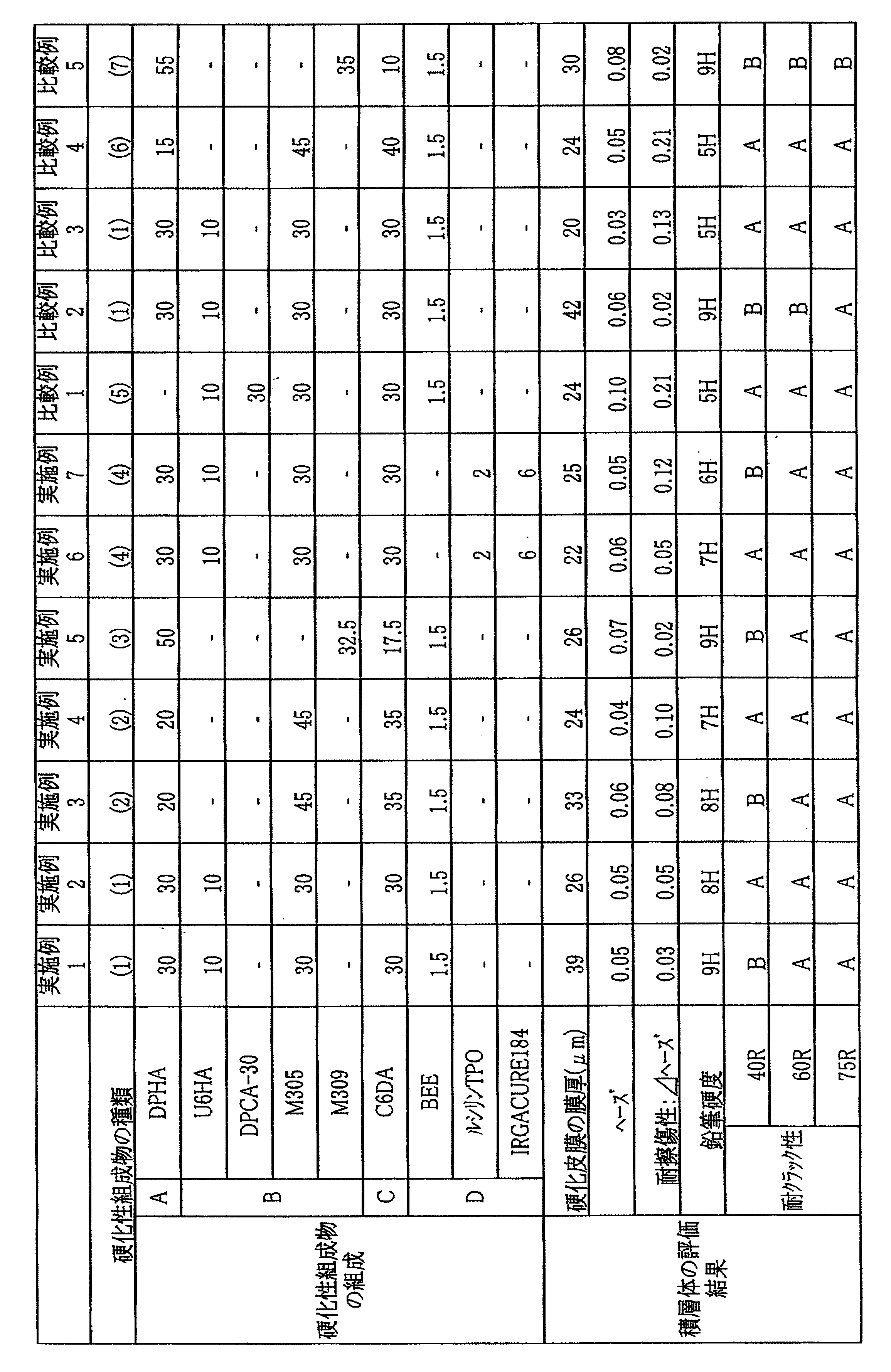
- the film thickness of the cured film, haze, scratch resistance, pencil hardness, and crack resistance were evaluated by the above-described evaluation method. The evaluation results are shown in Table 1.
- the cured film of the resin laminate (1D) had a scratch resistance of 0.03% and a pencil hardness of 9H, and was excellent in scratch resistance and surface hardness.
- Example 2 A pair of SUS304 endless belts with a mirror finish of 2800mm wide and 1mm thick, running oppositely at the same speed in the same direction, are temporarily stopped to run on the upper endless belt surface of the pair of endless belts.
- a curable composition (1) having the same composition as in Example 1 was applied, and a 12 ⁇ m thick PET film “NS” (trade name, manufactured by Teijin DuPont Films Co., Ltd.) was applied to the film before curing (2-1) Got.
- a rubber roll having a JIS hardness of 40 ° is pressure-bonded so as not to contain bubbles while squeezing out the excessive curable composition (1).
- 2-2 was obtained.
- the endless belt was restarted with the PET film surface of the pre-curing coating (2-2) facing up, below the fluorescent UV lamp with an output of 40 W / cm 2 (trade name: FL40BL, manufactured by Toshiba Corporation).
- the curable composition (1) was cured by passing through a 20 cm position at a speed of 2 m / min to obtain a cured film (2-3). Thereafter, the cured PET film (2-3) was peeled off to obtain a cured film (2-4).
- a position 20 cm below the high-pressure mercury lamp with an output of 30 W / cm 2 is passed at a speed of 3 m / min, and the coated film (2-4) ) Was irradiated with ultraviolet rays to obtain a laminated mold (2A) in which a cured film of a curable composition (1) having a film thickness of 32 ⁇ m was laminated on the mold.
- An endless belt (laminated type (2A)) on which a cured coating is formed and another endless belt are surrounded by a soft polyvinyl chloride gasket that runs at the same speed as the endless belt, and the gap between the pair of endless belts
- the resin base material (2C) was injected into the laminated mold (2B) having a space of 1.5 mm at a constant flow rate using a metering pump and polymerized. At that time, polymerization was carried out by heating for 45 minutes in a hot water shower at 78 ° C. along with running of the endless belt. Thereafter, a heat treatment at 135 ° C. was further performed for 30 minutes with a far infrared heater, and then cooled to 85 ° C. over 10 minutes by blowing.
- Examples 3 to 6, Comparative Examples 1 to 5 A resin laminate was obtained in the same manner as in Example 1 except that the composition of the curable composition shown in Table 1 and the film thickness of the cured coating were used. About the obtained resin laminated body, the film thickness of a cured film, haze, scratch resistance, pencil hardness, and crack resistance were evaluated by the above-described evaluation method. The evaluation results are shown in Table 1.
- Example 7 The curable composition shown in Table 1 was applied to the surface of the 1 mm-thick methacrylic resin plate “Acrylite MR100” (trade name, manufactured by Mitsubishi Rayon Co., Ltd.) where the hard coat layer was not formed. Next, the PET film “OX-50” (trade name, manufactured by Teijin DuPont Films Co., Ltd.) was bonded so that the highly smooth surface was in contact with the coating surface of the curable composition, and the press roll was used at a speed of 7 m / min. The thickness of the cured film of the curable composition was adjusted to 25 ⁇ m.
- a methacrylic resin plate, a curable composition, and a PET film were sequentially laminated for 1 minute to obtain a laminate. Thereafter, the obtained laminate was passed through a position 24 cm below the metal halide lamp with an output of 120 W / cm 2 at a speed of 2.5 m / min to cure the curable composition to obtain a cured laminate. Thereafter, the PET film was peeled from the obtained cured laminate to obtain a resin laminate in which a cured film was laminated on a methacrylic resin plate.
- the film thickness of the cured film, haze, scratch resistance, pencil hardness, and crack resistance were evaluated by the above-described evaluation method. The evaluation results are shown in Table 1.
- the resin laminate of Comparative Example 1 does not contain the polyfunctional monomer (A) in the curable composition, the scratch resistance and surface hardness were low.
- the resin laminate of Comparative Example 2 had poor crack resistance because the cured coating film was too thick.
- the resin laminate of Comparative Example 3 had low scratch resistance and surface hardness because the cured coating film was too thin.
- the resin laminate of Comparative Example 4 has a low content of the polyfunctional monomer (A) in the curable composition and a high content of the polyfunctional monomer (C), the scratch resistance and surface hardness are high. It was low.
- the crack resistance was poor. It was.
- the resin laminate of the present invention a method for producing the same, and a display front plate using the resin laminate are low-cost and lightweight, and have excellent design workability that can be used as a front plate of a touch panel display. Therefore, it is very useful industrially.
Landscapes
- Chemical & Material Sciences (AREA)
- Organic Chemistry (AREA)
- Health & Medical Sciences (AREA)
- Chemical Kinetics & Catalysis (AREA)
- Medicinal Chemistry (AREA)
- Polymers & Plastics (AREA)
- Engineering & Computer Science (AREA)
- Theoretical Computer Science (AREA)
- General Physics & Mathematics (AREA)
- Physics & Mathematics (AREA)
- Laminated Bodies (AREA)
- Casting Or Compression Moulding Of Plastics Or The Like (AREA)
- Paints Or Removers (AREA)
- Coating Of Shaped Articles Made Of Macromolecular Substances (AREA)
Abstract
Description
本願は、2013年5月16日に、日本に出願された特願2013-103769号に基づき優先権を主張し、その内容をここに援用する。
タッチパネル方式のディスプレーに使用されるディスプレー前面板としては耐擦傷性及び表面硬度に優れたガラス板が使用されている。ガラス板をディスプレー前面板として使用する場合、低コスト化と軽量化を満足させるために薄板化が必要となるが、薄いガラス板では割れが発生し易いことから、低コスト化と軽量化が可能な樹脂板を使用したディスプレー前面板が検討されている。また、最近では種々の形状を有するディスプレー前面板の要求もあり、デザイン加工性が必要な場合にも、ガラスよりも加工性が優れた樹脂板を使用したディスプレー前面板が検討されている。
しかしながら、透明性を有する樹脂板はガラスと比較して柔らかいため、引掻き等による傷が発生し易い。
[1] 以下に示す硬化性組成物の硬化被膜が膜厚22~40μmで樹脂基材の表面に積層された樹脂積層体。
<硬化性組成物>
(A)ジペンタエリスリトールペンタ(メタ)アクリレート及びジペンタエリスリトールヘキサ(メタ)アクリレートから選ばれる少なくとも一種の多官能単量体20~50質量部
(B)多官能単量体(A)を除く(メタ)アクリロイル基を3個以上有する多官能単量体20~60質量部
(C)(メタ)アクリロイル基を2個有する多官能単量体15~35質量部
(D)重合開始剤
(但し、多官能単量体(A)、多官能単量体(B)及び多官能単量体(C)の合計量が100質量部)
[2] 硬化被膜の膜厚が25~40μmである[1]に記載の樹脂積層体。
[3] 多官能単量体(A)、多官能単量体(B)及び多官能単量体(C)が以下の含有量の硬化性組成物の硬化被膜で、硬化被膜の膜厚が25~30μmである[1]又は[2]に記載の樹脂積層体。
多官能単量体(A)25~45質量部
多官能単量体(B)20~60質量部
多官能単量体(C)20~33質量部
(但し、多官能単量体(A)、多官能単量体(B)及び多官能単量体(C)の合計量が100質量部)
[4] 鉛筆硬度が6H以上である[1]~[3]のいずれかに記載の樹脂積層体。
[5] 鉛筆硬度が8H以上である[1]~[3]のいずれかに記載の樹脂積層体。
[6] 下記の評価方法による樹脂積層体の耐クラック性の評価において、曲率半径60mmに曲げた際にクラックが発生しない耐クラック性を有するものである[1]~[5]のいずれかに記載の樹脂積層体。
<耐クラック性の評価方法>明細書全文を通して曲率半径の表示をmm記載に致しました。
幅30mm、長さ120mm及び厚み1mmの樹脂積層体を所定の曲率半径を有するオス型の上に硬化被膜を有する面が外側になるように乗せて、オス型に這わせながら曲げて、30秒間保持した後の樹脂積層体の硬化被膜の表面を目視観察して、クラックの発生の有無を判断する。
[7] 下記の評価方法による樹脂積層体の耐クラック性の評価において、曲率半径40mmに曲げた際にクラックが発生しない耐クラック性を有するものである[1]~[5]のいずれかに記載の樹脂積層体。
<耐クラック性の評価方法>
幅30mm、長さ120mm及び厚み1mmの樹脂積層体を所定の曲率半径を有するオス型の上に硬化被膜を有する面が外側になるように乗せて、オス型に這わせながら曲げて、30秒間保持した後の樹脂積層体の硬化被膜の表面を目視観察して、クラックの発生の有無を判断する。
[8] 樹脂基材がメチルメタクリレート単位を主成分とするメタクリル樹脂である[1]~[7]のいずれかに記載の樹脂積層体。
[9] 以下に示す硬化性組成物を型の内面に塗布した後に硬化させて、膜厚が22~40μmの、硬化性組成物の硬化被膜が積層された積層鋳型を形成し、次いで、メチルメタクリレートを主成分とするラジカル重合性単量体を含む樹脂基材原料を、積層鋳型の硬化被膜が形成された面に接触するように積層鋳型に流し込んだ後に、注型重合により樹脂基材原料を重合して樹脂基材を形成する、硬化被膜が樹脂基材の表面に積層された樹脂積層体の製造方法。
<硬化性組成物>
(A)ジペンタエリスリトールペンタ(メタ)アクリレート及びジペンタエリスリトールヘキサ(メタ)アクリレートから選ばれる少なくとも一種の多官能単量体20~50質量部
(B)多官能単量体(A)を除く(メタ)アクリロイル基を3個以上有する多官能単量体20~60質量部
(C)(メタ)アクリロイル基を2個有する多官能単量体15~35質量部
(D)重合開始剤
(但し、多官能単量体(A)、多官能単量体(B)及び多官能単量体(C)の合計量が100質量部)
[10] 硬化被膜の膜厚が25~40μmである[9]に記載の樹脂積層体の製造方法。
[11] 多官能単量体(A)、多官能単量体(B)及び多官能単量体(C)が以下の含有量の硬化性組成物の硬化被膜で、硬化被膜の膜厚が25~30μmである[9]又は[10]に記載の樹脂積層体の製造方法。
多官能単量体(A)25~45質量部
多官能単量体(B)20~60質量部
多官能単量体(C)20~33質量部
(但し、多官能単量体(A)、多官能単量体(B)及び多官能単量体(C)の合計量が100質量部)
[12] [1]~[8]のいずれかに記載の樹脂積層体を使用したディスプレー前面板。
[13] [9]~[11]のいずれかに記載の方法で得られた樹脂積層体を使用したディスプレー前面板。
前記硬化被膜は、
(A)ジペンタエリスリトールペンタ(メタ)アクリレート及びジペンタエリスリトールヘキサ(メタ)アクリレートから選ばれる少なくとも一種の多官能単量体と、
(B)(A)成分を除く(メタ)アクリロイル基を3個以上有する多官能単量体と、
(C)(メタ)アクリロイル基を2個有する多官能単量体と、
(D)重合開始剤と、を含有し、かつ
(A)成分(B)成分、及び(C)成分の合計量が100質量部であり、
(A)成分(B)成分、及び(C)成分の合計量100質量部に対して、(A)成分の含有量が20~50質量部であり、(B)成分の含有量が20~60質量部であり、(C)成分の含有量が15~35質量部である硬化性組成物を硬化して得られる硬化被膜であり、
前記硬化被膜の膜厚は、22~40μmであり、かつ
前記硬化被膜が、前記樹脂基材の表面に積層されている樹脂積層体。
[2’] 硬化被膜の膜厚が25~40μmである[1’]に記載の樹脂積層体。
[3’]硬化被膜が、(A)成分、(B)成分、及び(C)成分の合計量100質量部に対して、(A)成分の含有量が24~45質量部であり、(B)成分の含有量が20~60質量部であり、(C)成分の含有量が20~33質量部である硬化性組成物を硬化して得られる硬化被膜であり、
前記硬化被膜の膜厚が、25~30μmである[1’]又は[2’]に記載の樹脂積層体。
[4’] 鉛筆硬度が6H以上、9H以下である[1’]~[3’]のいずれかに記載の樹脂積層体。
[5’]鉛筆硬度が8H以上、9H以下である[1’]~[3’]のいずれかに記載の樹脂積層体。
[6’]樹脂積層体を曲率半径60mmに曲げた際に、クラックが発生しない耐クラック性を有する[1’]~[5’]のいずれかに記載の樹脂積層体。
[7’] 樹脂積層体を曲率半径40mmに曲げた際に、クラックが発生しない耐クラック性を有する[1’]~[5’]のいずれかに記載の樹脂積層体。
[8’] 樹脂基材がメチルメタクリレート単位を主成分とするメタクリル樹脂である[1’]~[7’]のいずれかに記載の樹脂積層体。
[9’]樹脂積層体の製造方法であって、
前記製造方法は、
硬化性組成物を型の内面に塗布した後に硬化させて、膜厚が22~40μmの、前記硬化性組成物の硬化被膜が型に対して積層された積層鋳型を形成すること、
メチルメタクリレートを主成分とするラジカル重合性単量体の混合物を含む樹脂基材原料を、前記積層鋳型の前記硬化被膜が形成された面に接触するように前記積層鋳型に流し込むこと、及び
前記積層鋳型に流し込んだ前記樹脂基材原料を注型重合により重合して樹脂基材を形成すること、を含み、
前記硬化被膜は前記樹脂基材の表面に積層されており、
前記硬化性組成物は、
(A)ジペンタエリスリトールペンタ(メタ)アクリレート及びジペンタエリスリトールヘキサ(メタ)アクリレートから選ばれる少なくとも一種の多官能単量体と、(B)(A)成分を除く(メタ)アクリロイル基を3個以上有する多官能単量体と、(C)(メタ)アクリロイル基を2個有する多官能単量体と、
(D)重合開始剤と、を含有し、かつ、
(A)成分、(B)成分、及び(C)成分の合計量が100質量部であり、(A)成分、(B)成分、及び(C)成分の合計量100質量部に対して、(A)成分の含有量が20~50質量部であり、(B)成分の含有量が20~60質量部であり、(C)成分の含有量が15~35質量部である
樹脂積層体の製造方法。
[10’] 硬化被膜の膜厚が25~40μmである[9’]に記載の樹脂積層体の製造方法。
[11’] 硬化被膜が、(A)成分、(B)成分、及び(C)成分の合計量100質量部に対して、(A)成分の含有量が24~45質量部であり、(B)成分の含有量が20~60質量部であり、(C)成分の含有量が20~33質量部である硬化性組成物を硬化して得られる硬化被膜であり、
前記硬化被膜の膜厚が、25~30μmである[9’]又は[10’]に記載の樹脂積層体の製造方法。
[12’] [1’]~[8’]のいずれかに記載の樹脂積層体を使用したディスプレー前面板。
[13’] [9’]~[11’]のいずれかに記載の方法で得られた樹脂積層体を使用したディスプレー前面板。
(硬化性組成物)
本発明で使用される硬化性組成物は、後述する多官能単量体(A)、後述する多官能単量体(B)、後述する多官能単単量体(C)及び後述する重合開始剤(D)を含有し、多官能単量体(A)、多官能単量体(B)及び多官能単量体(C)の合計量が100質量部であり、多官能単量体(A)、多官能単量体(B)及び多官能単量体(C)の合計量100質量部に対して、多官能単量体(A)の含有量が20~50質量部であり、多官能単量体(B)の含有量が20~60質量部であり、多官能単量体(C)の含有量が15~35質量部である。
即ち、多官能単量体(A)の含有量としては、多官能単量体(A)、多官能単量体(B)及び多官能単量体(C)の合計量100質量部に対して、20質量部以上、50質量部以下が好ましく、より好ましくは、25質量部以上、45質量部以下である。
即ち、多官能単量体(B)の含有量としては、多官能単量体(A)、多官能単量体(B)及び多官能単量体(C)の合計量100質量部に対して、20質量部以上、60質量部以下であることが好ましい。
即ち、多官能単量体(A)、多官能単量体(B)及び多官能単量体(C)の合計量100質量部に対して、多官能単量体(C)の含有量としては、15質量部以上、35質量部以下であることが好ましく、より好ましくは、20質量部以上、33質量部以下である。
多官能単量体(A)は、ジペンタエリスリトールペンタ(メタ)アクリレート及びジペンタエリスリトールヘキサ(メタ)アクリレートから選ばれる少なくとも一種の単量体又は単量体混合物である。
多官能単量体(B)は、多官能単量体(A)を除く(メタ)アクリロイル基を3個以上、20個以下有する単量体である。
なお、ここでいう「多価アルコール」とは、分子中に水酸基を2個以上有するアルコールを意味する。
「多価カルボン酸」とは、分子中にカルボキシル基を2個以上有するカルボン酸を意味する。
「(メタ)アクリル酸の誘導体」とは、(メタ)アクリル酸化合物の官能基または水素原子が、他の官能基に置換された化合物を意味する。
「多価カルボン酸の誘導体」とは多価カルボン酸の官能基または水素原子が、他の官能基に置換された化合物を意味する。
「線状」とは、直鎖状及び分岐鎖状を意味する。
上記のなかでも、好ましくは、ペンタエリスリトールトリ(メタ)アクリレート、ペンタエリスリトールテトラ(メタ)アクリレートが挙げられる。

多官能単量体(B)としては、硬化被膜の耐擦傷性及び表面硬度の点で、ジトリメチロールプロパンテトラ(メタ)アクリレート、ペンタエリスリトールトリ(メタ)アクリレート及びペンタエリスリトールテトラ(メタ)アクリレートが好ましい。
多官能単量体(C)は、(メタ)アクリロイル基を2個有する単量体である。
多官能単量体(C)としては、例えば、エチレングリコールジ(メタ)アクリレート、ジシクロペンテニルジ(メタ)アクリレート、トリエチレングリコールジ(メタ)アクリレート、テトラエチレングリコールジ(メタ)アクリレート、ポリエチレングリコールジ(メタ)アクリレート、トリメチロールプロパンジ(メタ)アクリレート、エチレンオキシド付加物トリメチロールプロパンジ(メタ)アクリレート、トリプロピレングリコールジ(メタ)アクリレート、ネオペンチルグリコールジ(メタ)アクリレート、1,4-ブタンジオールジ(メタ)アクリレート、1,6-ヘキサンジオールジ(メタ)アクリレート、ポリエステルジ(メタ)アクリレート、ポリエチレングリコールジ(メタ)アクリレート、トリシクロデカンジメチロールジ(メタ)アクリレート、ヒドロキシピバリン酸ネオペンチルグリコールジ(メタ)アクリレート、ビスフェノールAポリエトキシジ(メタ)アクリレート、1,10-デカンジオールジ(メタ)アクリレート及びヒドロキシピバリン酸ネオペンチルグリコールジ(メタ)アクリレート等が挙げられる。
上記のなかでも、好ましくは、1,6-ヘキサンジオールジ(メタ)アクリレートが挙げられる。
多官能単量体(C)としては、上記の中から1種類の単量体を単独で又は2種以上の単量体を組み合わせて使用することができる。
重合開始剤(D)は、硬化性組成物を硬化させるための成分である。
上記のなかでも、好ましくは、ベンゾインエチルエーテル、1-ヒドロキシシクロヘキシル-フェニルケトン、2-ヒドロキシ-2-メチル-1-フェニルプロパン-1-オンが挙げられる。
重合開始剤(D)としては、これら1種の化合物を単独で又は2種以上の化合物を組み合わせて使用することができる。
本発明における硬化被膜は、前述の硬化性組成物を硬化させて得られる被膜である。
ここでいう「硬化被膜の膜厚」とは、樹脂積層体における硬化被膜の膜厚を意味する。
なお、本願明細書及び請求の範囲における硬化被膜の膜厚は、後述の実施例において説明する測定方法により測定することができる。具体的には、樹脂積層体の断面の微分干渉顕微鏡写真を用いて、硬化被膜の樹脂基材側から、樹脂基材と反対に位置する表層側の最表面までの長さの最大値を測定することにより、膜厚を測定することができる。
本発明で使用される樹脂基材を構成する樹脂としては、例えば、ポリオレフィン樹脂、(メタ)アクリル樹脂、エポキシ樹脂、ポリイミド樹脂、フェノール樹脂、ポリエステル樹脂及びポリカーボネート樹脂等が挙げられる。
上記の中でも、好ましくは、n-ブチルアクリレート、tert-ブチルメタクリレート、イソボニル(メタ)アククリレートが挙げられる。
上記の中でも、好ましくは、ネオペンチルグリコールジメタクリレートが挙げられる。
本発明の一実施形態である樹脂積層体は、樹脂基材の表面に膜厚22~40μmの硬化被膜が積層した積層体である。
本発明の一実施形態である樹脂積層体は、下記の評価方法による耐クラック性の評価において、樹脂積層体を曲率半径60mmに曲げた際にクラックが発生しない耐クラック性を有する樹脂積層体であることが好ましく、樹脂積層体を曲率半径40mmに曲げた際にクラックが発生しない耐クラック性を有する樹脂積層体であることがより好ましい。曲率半径60mmに曲げた際にクラックが発生しない耐クラック性を有する樹脂積層体とすることにより、取扱加工性等の加工性に優れたディスプレー前面板を得ることができる傾向にある。
<耐クラック性の評価方法>
幅30mm、長さ120mm及び厚み1mmの樹脂積層体を所定の曲率半径を有するオス型の上に硬化被膜を有する面が外側になるように乗せて、オス型に這わせながら曲げて、30秒間保持した後の樹脂積層体の硬化被膜の表面を目視観察して、クラックの発生の有無を判断する。
(1)樹脂基材の表面に硬化性組成物を塗布した後に硬化性組成物を硬化させて樹脂積層体を得る方法。
(2)硬化性組成物を硬化させて得られた硬化被膜の表面に樹脂基材を得るための樹脂基材原料層を形成した後に樹脂基材原料層を重合して樹脂積層体を得る方法。
これらの方法の中で、硬化被膜の鉛筆硬度と樹脂積層体の耐クラック性のバランスを得る点で上記の(2)の方法が好ましい。
まず、型の内面に硬化性組成物を塗布し、硬化性組成物の表面を樹脂フィルムで覆う。次いで、活性エネルギー線を照射して硬化性組成物を硬化した後に樹脂フィルムを剥がし、型の内表面に硬化被膜が積層された積層鋳型を得る。得られた積層鋳型に樹脂基材原料を注入し、その後、注型重合により樹脂基材原料を硬化させる。次いで、樹脂基材の表面に硬化被膜が積層された樹脂積層体を型から剥離して樹脂積層体を得る。
即ち、(2-1)の樹脂積層体の製造方法は、型の内面に硬化性組成物を塗布し、硬化性組成物の表面を樹脂フィルムで覆うこと;活性エネルギー線を照射して前記硬化性組成物を硬化した後に樹脂フィルムを剥がし、型の内表面に硬化被膜が積層された積層鋳型を得ること;前記積層鋳型に樹脂基材原料を注入し、注型重合により前記樹脂基材原料を硬化させること;及び前記樹脂基材原料の硬化により得られた樹脂基材の表面に、前記硬化被膜が積層された樹脂積層体を型から剥離すること、を含む樹脂積層体の製造方法である。
樹脂フィルムとしては、前述の樹脂フィルムと同様のフィルムを用いることができる。
活性エネルギー線としては、前述の活性エネルギー線と同様のエネルギー線を用いることができ、活性エネルギー線を用いた硬化方法としては、前述と同様の方法で硬化することができる。
前述の曲率半径60mmに曲げた際にクラックが発生しない耐クラック性を有し、硬化被膜の鉛筆硬度が6H以上である樹脂積層体は、例えば、上記の(2-1)の方法で樹脂基材の表面に膜厚が22~40μmの硬化被膜を形成することにより得ることができる。
また、前述の曲率半径60mmに曲げた際にクラックが発生しない耐クラック性を有し、硬化被膜の鉛筆硬度が8H以上である樹脂積層体は、例えば、上記の(2-1)の方法で樹脂基材の表面に膜厚が25~40μmの硬化被膜を形成することにより得ることができる。
更に、前述の曲率半径40mmに曲げた際にクラックが発生しない耐クラック性を有し、硬化被膜の鉛筆硬度が8H以上である樹脂積層体としては、例えば、上記の(2-1)の方法で樹脂基材の表面に、前記多官能単量体(A)、前記多官能単量体(B)及び前記多官能単量体(C)が以下の含有量の硬化性組成物を硬化して得られる硬化被膜で、膜厚が25~40μmの硬化被膜を形成することにより得ることができる。
前記多官能単量体(A):25~45質量部
前記多官能単量体(B):20~60質量部
前記多官能単量体(C):20~33質量部
(但し、多官能単量体(A)、多官能単量体(B)及び多官能単量体(C)の合計量が100質量部である。)
樹脂基材原料の注型重合法としては、例えば、樹脂基材原料を積層鋳型内に流し込んで加熱する、セルキャスト法が挙げられる。
連続注型重合法とは、同一方向に同一速度で走行する、対向させたステンレス製エンドレスベルトの表面に硬化被膜が積層された積層ステンレス製エンドレスベルトと、他のステンレス製エンドレスベルトと、これらのステンレス製エンドレスベルトの両側端部を上記のガスケットと同様のガスケットでシールした空間部に、上流から連続的に樹脂基材原料を流し込んで加熱することによって連続的に重合させる重合法である。
本発明の一実施形態であるディスプレー前面版は、前述した本発明の実施形態であるいずれかの樹脂積層体をそのままディスプレー前面版として使用することができる。
樹脂積層体の断面の微分干渉顕微鏡写真を用いて硬化被膜の膜厚を測定した。
(2)ヘーズ
日本電色工業(株)製HAZE METER NDH4000(商品名)を用いてJIS K7136に示される測定法に準拠して、樹脂積層体ヘーズを測定した。
(3)耐擦傷性
樹脂積層体の表面の硬化被膜の耐擦傷性を、以下に示す擦傷試験前と擦傷試験後のヘーズ値の差△ヘーズ(%)により評価した。擦傷試験は、#000のスチールウール(日本スチールウール(株)製、商品名:ボンスターNo.000)を装着した直径24mmの円形パッドを樹脂積層体の硬化被膜側の表面上に置き、2,000gの荷重下で20mmの距離を、100回往復させて実施した。
[耐擦傷性(△ヘーズ(%))]=[擦傷後のヘーズ値(%)]-[擦傷前のヘーズ値(%)]
(4)鉛筆硬度
樹脂積層体の表面の硬化被膜の鉛筆硬度をJIS K5600-5-4に準拠して測定し、表面硬度を評価した。
(5)耐クラック性
樹脂積層体の表面の耐クラック性を、樹脂積層体を40mm、60mm及び75mmの3種の曲率半径に曲げた時のクラック発生の有無を観察することにより評価した。耐クラック性の評価は、幅30mm、長さ120mm及び厚み1mmの樹脂積層体を所定の曲率半径を有するオス型の上に硬化被膜を有する面が外側になるように乗せて、オス型に這わせながら曲げて、30秒間保持した後の樹脂積層体の硬化被膜の表面を目視観察して、下記基準で判断した。なお、ここでいうクラック無とは、全くクラックがない事を意味し、クラック有りとは1本以上のクラックがある事を意味する。
「A」:クラック無し
「B」:クラック有り
DPHA:ジペンタエリスリトールペンタアクリレート及びジペンタエリスリトールヘキサアクリレートの混合物(日本化薬(株)製、商品名)
U-6HA:ヘキサメチレンジイソシアネートを3量化して得られるトリイソシアネート1モルに対して3-アクリロイルオキシ-2-ヒドロキシプロピルメタクリレート3モルを反応して得られるウレタン化合物(新中村化学工業(株)製、商品名)
DPCA-30:カプロラクトン付加物ジペンタエリスリトールペンタアクリレート及びカプロラクトン変性ジペンタエリスリトールヘキサアクリレートの混合物(日本化薬(株)製、商品名)
M305:ペンタエリスリトールトリアクリレート及びペンタエリスリトールテトラアクリレートの混合物(東亞合成(株)製、商品名)
M309:トリメチルールプロパントリアクリレート(東亞合成(株)製、商品名)
C6DA:1,6-ヘキサンジオールジアクリレート(大阪有機化学工業(株)製、商品名)
BEE:ベンゾインエチルエーテル(精工化学 (株)製、商品名)
ルシリンTPO:ジフェニル-(2,4,6-トリメチルベンゾイル)フォスフィンオキサイド(BASFジャパン(株)製、商品名)
IRGACURE184:1-ヒドロキシシクロヘキシルフェニルケトン(BASFジャパン(株)製、商品名)
DPHA;30部、U-6HA;10部、M305;30部、C6DA;30部及びBEE;1.5部を混合し、硬化性組成物(1)を得た。
得られた樹脂積層体(1D)について、前述の評価方法にて、硬化被膜の膜厚、ヘーズ、耐擦傷性、鉛筆硬度、及び耐クラック性を評価した。評価結果を表1に示す。
対向して同一方向へ同一速度で走行する、幅2800mm、厚さ1mmの鏡面仕上げされた一対のSUS304製エンドレスベルトの走行を一時停止させて、一対のエンドレスベルトの上側のエンドレスベルト面に、実施例1と同じ組成である硬化性組成物(1)を塗布し、厚さ12μmのPETフィルム「NS」(帝人デュポンフィルム(株)製、商品名)を被せ、硬化前被膜(2-1)を得た。
得られた樹脂積層体(2D)について、前述の評価方法にて、硬化被膜の膜厚、ヘーズ、耐擦傷性、鉛筆硬度、及び耐クラック性を評価した。評価結果を表1に示す。
表1に示す硬化性組成物の組成及び硬化被膜の膜厚とした以外は、実施例1と同様の方法で樹脂積層体を得た。
得られた樹脂積層体について、前述の評価方法にて、硬化被膜の膜厚、ヘーズ、耐擦傷性、鉛筆硬度、及び耐クラック性を評価した。
評価結果を表1に示す。
表1に示す硬化性組成物を、厚さ1mmのメタクリル樹脂板「アクリライトMR100」(三菱レイヨン(株)製、商品名)のハードコート層が形成されていない面に塗布した。
次いで、PETフィルム「OX-50」(帝人デュポンフィルム(株)製、商品名)の高平滑面が硬化性組成物の塗布面に接触するように貼り合わせ、プレスロールにより7m/分間の速度でプレスし、硬化性組成物の硬化被膜の膜厚が25μmになるように調整した。
次いで、メタクリル樹脂板、硬化性組成物及びPETフィルムが順次積層された状態で1分間保持し、積層物を得た。この後、得られた積層物を出力120W/cm2のメタルハライドランプの下24cmの位置を2.5m/分間の速度で通過させて硬化性組成物を硬化させ、硬化積層物を得た。
この後、得られた硬化積層物からPETフィルムを剥離し、メタクリル樹脂板に硬化被膜が積層された樹脂積層体を得た。
得られた樹脂積層体(2D)について、前述の評価方法にて、硬化被膜の膜厚、ヘーズ、耐擦傷性、鉛筆硬度、及び耐クラック性を評価した。評価結果を表1に示す。
2 硬化被膜
3 樹脂積層体
Claims (13)
- 硬化被膜と樹脂基材とを含む樹脂積層体であって、
前記硬化被膜は、
(A)ジペンタエリスリトールペンタ(メタ)アクリレート及びジペンタエリスリトールヘキサ(メタ)アクリレートから選ばれる少なくとも一種の多官能単量体と、
(B)(A)成分を除く(メタ)アクリロイル基を3個以上有する多官能単量体と、
(C)(メタ)アクリロイル基を2個有する多官能単量体と、
(D)重合開始剤と、を含有し、かつ
(A)成分、(B)成分、及び(C)成分の合計量が100質量部であり、
(A)成分、(B)成分、及び(C)成分の合計量100質量部に対して、(A)成分の含有量が20~50質量部であり、(B)成分の含有量が20~60質量部であり、(C)成分の含有量が15~35質量部である硬化性組成物を硬化して得られる硬化被膜であり、
前記硬化被膜の膜厚は、22~40μmであり、かつ
前記硬化被膜が、前記樹脂基材の表面に積層されている樹脂積層体。 - 硬化被膜の膜厚が25~40μmである請求項1に記載の樹脂積層体。
- 硬化被膜が、(A)成分、(B)成分、及び(C)成分の合計量100質量部に対して、(A)成分の含有量が24~45質量部であり、(B)成分の含有量が20~60質量部であり、(C)成分の含有量が20~33質量部である硬化性組成物を硬化して得られる硬化被膜であり、
前記硬化被膜の膜厚が、25~30μmである請求項1に記載の樹脂積層体。 - 鉛筆硬度が6H以上、9H以下である請求項1に記載の樹脂積層体。
- 鉛筆硬度が8H以上、9H以下である請求項1に記載の樹脂積層体。
- 樹脂積層体を曲率半径60mmに曲げた際に、クラックが発生しない耐クラック性を有する請求項1に記載の樹脂積層体。
- 樹脂積層体を曲率半径40mmに曲げた際に、クラックが発生しない耐クラック性を有する請求項1に記載の樹脂積層体。
- 樹脂基材がメチルメタクリレート単位を主成分とするメタクリル樹脂である請求項1に記載の樹脂積層体。
- 樹脂積層体の製造方法であって、
前記製造方法は、
硬化性組成物を型の内面に塗布した後に硬化させて、膜厚が22~40μmの、前記硬化性組成物の硬化被膜が積層された積層鋳型を形成すること、
メチルメタクリレートを主成分とするラジカル重合性単量体の混合物を含む樹脂基材原料を、前記積層鋳型の前記硬化被膜が形成された面に接触するように前記積層鋳型に流し込むこと、及び
前記積層鋳型に流し込んだ前記樹脂基材原料を注型重合により重合して樹脂基材を形成すること、を含み、
前記硬化被膜は前記樹脂基材の表面に積層されており、
前記硬化性組成物は、
(A)ジペンタエリスリトールペンタ(メタ)アクリレート及びジペンタエリスリトールヘキサ(メタ)アクリレートから選ばれる少なくとも一種の多官能単量体と、(B)(A)成分を除く(メタ)アクリロイル基を3個以上有する多官能単量体と、(C)(メタ)アクリロイル基を2個有する多官能単量体と、
(D)重合開始剤と、を含有し、かつ、
(A)成分、(B)成分、及び(C)成分の合計量が100質量部であり、
(A)成分、(B)成分、及び(C)成分の合計量100質量部に対して、(A)成分の含有量が20~50質量部であり、(B)成分の含有量が20~60質量部であり、(C)成分の含有量が15~35質量部である
樹脂積層体の製造方法 - 硬化被膜の膜厚が25~40μmである請求項9に記載の樹脂積層体の製造方法。
- 硬化被膜が、(A)成分、(B)成分、及び(C)成分の合計量100質量部に対して、(A)成分の含有量が24~45質量部であり、(B)成分の含有量が20~60質量部であり、(C)成分の含有量が20~33質量部である硬化性組成物を硬化して得られる硬化被膜であり、
前記硬化被膜の膜厚が、25~30μmである請求項9に記載の樹脂積層体の製造方法。 - 請求項1に記載の樹脂積層体を使用したディスプレー前面板。
- 請求項9に記載の方法で得られた樹脂積層体を使用したディスプレー前面板。
Priority Applications (5)
| Application Number | Priority Date | Filing Date | Title |
|---|---|---|---|
| CN201380075474.6A CN105102225B (zh) | 2013-05-16 | 2013-12-19 | 树脂层叠体及其制造方法、以及显示器前面板 |
| KR1020157025907A KR101858328B1 (ko) | 2013-05-16 | 2013-12-19 | 수지 적층체 및 그의 제조 방법, 및 디스플레이 전면판 |
| EP13884541.7A EP2998114A1 (en) | 2013-05-16 | 2013-12-19 | Resin laminate, method for producing same and display front panel |
| US14/787,871 US20160075057A1 (en) | 2013-05-16 | 2013-12-19 | Resin laminate and its production method and display front panel |
| JP2014501330A JP6229204B2 (ja) | 2013-05-16 | 2013-12-19 | 樹脂積層体及びその製造方法並びにディスプレー前面板 |
Applications Claiming Priority (2)
| Application Number | Priority Date | Filing Date | Title |
|---|---|---|---|
| JP2013-103769 | 2013-05-16 | ||
| JP2013103769 | 2013-05-16 |
Publications (1)
| Publication Number | Publication Date |
|---|---|
| WO2014184983A1 true WO2014184983A1 (ja) | 2014-11-20 |
Family
ID=51897979
Family Applications (1)
| Application Number | Title | Priority Date | Filing Date |
|---|---|---|---|
| PCT/JP2013/084163 Ceased WO2014184983A1 (ja) | 2013-05-16 | 2013-12-19 | 樹脂積層体及びその製造方法並びにディスプレー前面板 |
Country Status (7)
| Country | Link |
|---|---|
| US (1) | US20160075057A1 (ja) |
| EP (1) | EP2998114A1 (ja) |
| JP (1) | JP6229204B2 (ja) |
| KR (1) | KR101858328B1 (ja) |
| CN (1) | CN105102225B (ja) |
| TW (1) | TWI592304B (ja) |
| WO (1) | WO2014184983A1 (ja) |
Cited By (4)
| Publication number | Priority date | Publication date | Assignee | Title |
|---|---|---|---|---|
| WO2015182744A1 (ja) * | 2014-05-30 | 2015-12-03 | 三菱レイヨン株式会社 | 樹脂製品 |
| WO2016098856A1 (ja) * | 2014-12-19 | 2016-06-23 | 東亞合成株式会社 | 樹脂シート製造用硬化型組成物 |
| JP2017170837A (ja) * | 2016-03-25 | 2017-09-28 | 三菱ケミカル株式会社 | 樹脂積層体及びその製造方法 |
| JP2018103543A (ja) * | 2016-12-28 | 2018-07-05 | 三菱ケミカル株式会社 | 樹脂積層体及びその製造方法並びにディスプレー前面板及び移動体用グレージング |
Families Citing this family (2)
| Publication number | Priority date | Publication date | Assignee | Title |
|---|---|---|---|---|
| KR102084060B1 (ko) * | 2013-06-21 | 2020-03-04 | 삼성디스플레이 주식회사 | 보호용 윈도우의 제조 방법 및 이를 이용하여 제작한 표시 장치 |
| KR102192181B1 (ko) * | 2015-08-11 | 2020-12-17 | 삼성전자주식회사 | 외관 하우징, 이의 제작 방법 및 이를 구비한 전자 장치 |
Citations (8)
| Publication number | Priority date | Publication date | Assignee | Title |
|---|---|---|---|---|
| JPS5497633A (en) | 1978-01-18 | 1979-08-01 | Mitsubishi Rayon Co Ltd | Coating composition and preparation of synthetic resin molding articles coated with said composition and having improved wear resistance and smoothness |
| JP2001287308A (ja) * | 2000-02-04 | 2001-10-16 | Toray Ind Inc | プラスチック積層体および画像表示保護フイルム |
| WO2003026881A1 (fr) * | 2001-09-25 | 2003-04-03 | Fuji Photo Film Co., Ltd. | Film de revetement dur, base sur laquelle ce film est forme, et affichage d'image comportant ceux-ci |
| JP2005248070A (ja) | 2004-03-05 | 2005-09-15 | Mitsubishi Rayon Co Ltd | アクリル系樹脂積層体とその製法、およびアクリル系樹脂ミラー |
| JP2006198823A (ja) * | 2005-01-19 | 2006-08-03 | Mitsubishi Rayon Co Ltd | アクリル系樹脂成型品用被覆材組成物およびアクリル系樹脂成型品 |
| JP2007276310A (ja) * | 2006-04-07 | 2007-10-25 | Mitsubishi Rayon Co Ltd | メタクリル系樹脂積層品の製造方法 |
| JP2010077282A (ja) * | 2008-09-26 | 2010-04-08 | Mitsubishi Rayon Co Ltd | 硬化性組成物、積層樹脂板及びその製造方法、並びにディスプレイ前面板 |
| JP2010280064A (ja) * | 2009-06-02 | 2010-12-16 | Mitsubishi Rayon Co Ltd | 積層樹脂板の製造方法及びディスプレー前面板 |
Family Cites Families (5)
| Publication number | Priority date | Publication date | Assignee | Title |
|---|---|---|---|---|
| AU1899599A (en) * | 1998-09-14 | 2000-04-03 | Allied-Signal Inc. | Demilitarization of chemical munitions |
| JP4475016B2 (ja) * | 2003-06-30 | 2010-06-09 | 東レ株式会社 | ハードコートフィルム、反射防止フィルムおよび画像表示装置 |
| JP2006342213A (ja) * | 2005-06-07 | 2006-12-21 | Mitsubishi Rayon Co Ltd | 光硬化性樹脂組成物、樹脂積層体および樹脂積層体の製造方法 |
| EP2711394A4 (en) * | 2011-05-10 | 2014-04-02 | Mitsubishi Rayon Co | Acrylic resin composition, acrylic resin sheet, acrylic resin laminate, and manufacturing method for same |
| US20150284558A1 (en) * | 2012-11-06 | 2015-10-08 | Mitsubishi Rayon Co., Ltd. | Method for producing (meth)acrylic resin composition, method for producing (meth)acrylic resin shaped article, (meth)acrylic resin shaped article, front-surface plate for liquid crystal display device, and touch panel |
-
2013
- 2013-12-19 JP JP2014501330A patent/JP6229204B2/ja active Active
- 2013-12-19 EP EP13884541.7A patent/EP2998114A1/en not_active Withdrawn
- 2013-12-19 CN CN201380075474.6A patent/CN105102225B/zh active Active
- 2013-12-19 WO PCT/JP2013/084163 patent/WO2014184983A1/ja not_active Ceased
- 2013-12-19 US US14/787,871 patent/US20160075057A1/en not_active Abandoned
- 2013-12-19 KR KR1020157025907A patent/KR101858328B1/ko not_active Expired - Fee Related
- 2013-12-23 TW TW102147680A patent/TWI592304B/zh not_active IP Right Cessation
Patent Citations (8)
| Publication number | Priority date | Publication date | Assignee | Title |
|---|---|---|---|---|
| JPS5497633A (en) | 1978-01-18 | 1979-08-01 | Mitsubishi Rayon Co Ltd | Coating composition and preparation of synthetic resin molding articles coated with said composition and having improved wear resistance and smoothness |
| JP2001287308A (ja) * | 2000-02-04 | 2001-10-16 | Toray Ind Inc | プラスチック積層体および画像表示保護フイルム |
| WO2003026881A1 (fr) * | 2001-09-25 | 2003-04-03 | Fuji Photo Film Co., Ltd. | Film de revetement dur, base sur laquelle ce film est forme, et affichage d'image comportant ceux-ci |
| JP2005248070A (ja) | 2004-03-05 | 2005-09-15 | Mitsubishi Rayon Co Ltd | アクリル系樹脂積層体とその製法、およびアクリル系樹脂ミラー |
| JP2006198823A (ja) * | 2005-01-19 | 2006-08-03 | Mitsubishi Rayon Co Ltd | アクリル系樹脂成型品用被覆材組成物およびアクリル系樹脂成型品 |
| JP2007276310A (ja) * | 2006-04-07 | 2007-10-25 | Mitsubishi Rayon Co Ltd | メタクリル系樹脂積層品の製造方法 |
| JP2010077282A (ja) * | 2008-09-26 | 2010-04-08 | Mitsubishi Rayon Co Ltd | 硬化性組成物、積層樹脂板及びその製造方法、並びにディスプレイ前面板 |
| JP2010280064A (ja) * | 2009-06-02 | 2010-12-16 | Mitsubishi Rayon Co Ltd | 積層樹脂板の製造方法及びディスプレー前面板 |
Non-Patent Citations (1)
| Title |
|---|
| See also references of EP2998114A4 |
Cited By (7)
| Publication number | Priority date | Publication date | Assignee | Title |
|---|---|---|---|---|
| WO2015182744A1 (ja) * | 2014-05-30 | 2015-12-03 | 三菱レイヨン株式会社 | 樹脂製品 |
| JPWO2015182744A1 (ja) * | 2014-05-30 | 2017-04-20 | 三菱レイヨン株式会社 | 樹脂製品 |
| WO2016098856A1 (ja) * | 2014-12-19 | 2016-06-23 | 東亞合成株式会社 | 樹脂シート製造用硬化型組成物 |
| CN107207643A (zh) * | 2014-12-19 | 2017-09-26 | 东亚合成株式会社 | 树脂片制造用固化型组合物 |
| JPWO2016098856A1 (ja) * | 2014-12-19 | 2017-09-28 | 東亞合成株式会社 | 樹脂シート製造用硬化型組成物 |
| JP2017170837A (ja) * | 2016-03-25 | 2017-09-28 | 三菱ケミカル株式会社 | 樹脂積層体及びその製造方法 |
| JP2018103543A (ja) * | 2016-12-28 | 2018-07-05 | 三菱ケミカル株式会社 | 樹脂積層体及びその製造方法並びにディスプレー前面板及び移動体用グレージング |
Also Published As
| Publication number | Publication date |
|---|---|
| CN105102225A (zh) | 2015-11-25 |
| EP2998114A4 (en) | 2016-03-23 |
| KR101858328B1 (ko) | 2018-05-15 |
| JPWO2014184983A1 (ja) | 2017-02-23 |
| CN105102225B (zh) | 2018-06-01 |
| JP6229204B2 (ja) | 2017-11-15 |
| EP2998114A1 (en) | 2016-03-23 |
| US20160075057A1 (en) | 2016-03-17 |
| TWI592304B (zh) | 2017-07-21 |
| TW201444686A (zh) | 2014-12-01 |
| KR20150123849A (ko) | 2015-11-04 |
Similar Documents
| Publication | Publication Date | Title |
|---|---|---|
| JP6229204B2 (ja) | 樹脂積層体及びその製造方法並びにディスプレー前面板 | |
| CN103249796B (zh) | 光学用粘附材料树脂组合物、光学用粘附材料片材、图像显示装置、光学用粘附材料片材的制造方法以及图像显示装置的制造方法 | |
| KR101900742B1 (ko) | 수지제품 | |
| JP6476865B2 (ja) | 樹脂積層体及びその製造方法 | |
| WO2012153733A1 (ja) | アクリル樹脂組成物、アクリル樹脂シート、アクリル樹脂積層体、及びそれらの製造方法 | |
| JP5656054B2 (ja) | アクリル樹脂板の製造方法、アクリル樹脂板、アクリル樹脂積層体及び表示装置 | |
| WO2012029905A1 (ja) | ハードコートフィルム及び前面保護板 | |
| JP6728854B2 (ja) | 樹脂積層体及びその製造方法 | |
| JP2017078139A (ja) | 硬化膜、樹脂積層体及び樹脂積層体の製造方法 | |
| JP7521314B2 (ja) | 樹脂積層体 | |
| JP2007276310A (ja) | メタクリル系樹脂積層品の製造方法 | |
| JP2010046948A (ja) | 樹脂積層体および樹脂積層体の製造方法 | |
| JP5700245B2 (ja) | アクリル樹脂板、アクリル樹脂積層体及び表示装置 | |
| JP6662232B2 (ja) | 樹脂積層体、ディスプレー前面板、携帯型情報端末装置及び移動体用グレージング | |
| JP2011189554A (ja) | 樹脂積層体の連続製造方法 | |
| JP2010280167A (ja) | メタクリル樹脂積層板の製造方法 | |
| JP2014223735A (ja) | 樹脂積層シート及びフラットパネルディスプレイの前面保護シート | |
| JP2020059238A (ja) | 樹脂積層体、ディスプレー前面板、携帯型情報端末装置、及び移動体用グレージング | |
| JPWO2019044786A1 (ja) | 樹脂シート及びこれを製造するための硬化型組成物 | |
| JP5760675B2 (ja) | アクリル系樹脂板の製造方法、アクリル系樹脂板、アクリル系樹脂積層体及び表示装置 | |
| JP6825363B2 (ja) | 樹脂積層体及びその製造方法並びにディスプレー前面板及び移動体用グレージング | |
| JP2009166276A (ja) | 樹脂積層体の製造方法 | |
| JP2011255574A (ja) | 透明樹脂積層体の連続的製造方法 |
Legal Events
| Date | Code | Title | Description |
|---|---|---|---|
| WWE | Wipo information: entry into national phase |
Ref document number: 201380075474.6 Country of ref document: CN |
|
| ENP | Entry into the national phase |
Ref document number: 2014501330 Country of ref document: JP Kind code of ref document: A |
|
| 121 | Ep: the epo has been informed by wipo that ep was designated in this application |
Ref document number: 13884541 Country of ref document: EP Kind code of ref document: A1 |
|
| ENP | Entry into the national phase |
Ref document number: 20157025907 Country of ref document: KR Kind code of ref document: A |
|
| WWE | Wipo information: entry into national phase |
Ref document number: 2013884541 Country of ref document: EP |
|
| WWE | Wipo information: entry into national phase |
Ref document number: 14787871 Country of ref document: US |
|
| NENP | Non-entry into the national phase |
Ref country code: DE |