WO2014189254A1 - 나프타에 함유된 방향족 화합물의 분리 방법 - Google Patents
나프타에 함유된 방향족 화합물의 분리 방법 Download PDFInfo
- Publication number
- WO2014189254A1 WO2014189254A1 PCT/KR2014/004492 KR2014004492W WO2014189254A1 WO 2014189254 A1 WO2014189254 A1 WO 2014189254A1 KR 2014004492 W KR2014004492 W KR 2014004492W WO 2014189254 A1 WO2014189254 A1 WO 2014189254A1
- Authority
- WO
- WIPO (PCT)
- Prior art keywords
- bis
- butaneyl
- carbon atoms
- naphtha
- group
- Prior art date
- Legal status (The legal status is an assumption and is not a legal conclusion. Google has not performed a legal analysis and makes no representation as to the accuracy of the status listed.)
- Ceased
Links
Classifications
-
- B—PERFORMING OPERATIONS; TRANSPORTING
- B01—PHYSICAL OR CHEMICAL PROCESSES OR APPARATUS IN GENERAL
- B01D—SEPARATION
- B01D11/00—Solvent extraction
- B01D11/04—Solvent extraction of solutions which are liquid
-
- C—CHEMISTRY; METALLURGY
- C10—PETROLEUM, GAS OR COKE INDUSTRIES; TECHNICAL GASES CONTAINING CARBON MONOXIDE; FUELS; LUBRICANTS; PEAT
- C10G—CRACKING HYDROCARBON OILS; PRODUCTION OF LIQUID HYDROCARBON MIXTURES, e.g. BY DESTRUCTIVE HYDROGENATION, OLIGOMERISATION, POLYMERISATION; RECOVERY OF HYDROCARBON OILS FROM OIL-SHALE, OIL-SAND, OR GASES; REFINING MIXTURES MAINLY CONSISTING OF HYDROCARBONS; REFORMING OF NAPHTHA; MINERAL WAXES
- C10G21/00—Refining of hydrocarbon oils, in the absence of hydrogen, by extraction with selective solvents
- C10G21/06—Refining of hydrocarbon oils, in the absence of hydrogen, by extraction with selective solvents characterised by the solvent used
- C10G21/12—Organic compounds only
- C10G21/20—Nitrogen-containing compounds
-
- C—CHEMISTRY; METALLURGY
- C07—ORGANIC CHEMISTRY
- C07C—ACYCLIC OR CARBOCYCLIC COMPOUNDS
- C07C7/00—Purification; Separation; Use of additives
- C07C7/10—Purification; Separation; Use of additives by extraction, i.e. purification or separation of liquid hydrocarbons with the aid of liquids
Definitions
- the present invention relates to a method for separating aromatic compounds contained in naphtha, and more particularly, it is environmentally-friendly and economical to remove aromatic compounds from naphtha with high efficiency through a simpler process while eliminating a multi-stage process or processing equipment. To a separation method.
- the sulfolane process of U0P company is known as a typical process of separating the aromatic compound contained in the said naphtha.
- the sulfolane process is a process for separating an aromatic compound from the C6 ⁇ C8 heart cut (HTPG) from the hydrogenation process by extractive distillation method, sulfolane has a higher boiling point than the C8 aromatic compound to easily separate the aromatic compound from the extraction solvent It can be used as extraction solvent.
- HTPG C6 ⁇ C8 heart cut
- the sulfolane process has problems in terms of energy, cost, and environment as follows.
- the sulfolane process is composed of a total of two distillation columns, the benzene is separated in the first distillation column (extraction process), and other high boiling fractions are converted into the second distillation column (stripper).
- the toluene is separated by distillation again.
- the toluene is separated from the first distillation column at the highest concentration and then mixed again and transferred to the second distillation column. Repeated remixing occurs in the energy consumption inefficient problem.
- the sulfolane process is a large unit process consisting of an extractive distillation column and strippers and various apparatuses for extracting the extraction solvent, an operation consumed in a distillation unit and a heat exchanger for separating among several unit units is particularly necessary. It costs a lot
- sulfolane is a representative polar substance, which is stable to heat and hydrolysis, and has a high boiling point.
- the selectivity is low and a small amount of sulfolane is mixed with aliphatic compounds.
- the disadvantage is that loss of solvent occurs.
- the decomposition starts at 200 ° C. and exceeds 260 ° C shows a high decomposition rate. This means that decomposition of the solvent occurs when a high temperature is applied for regeneration of the solvent in the regeneration column.
- the presence of oxygen in the process accelerates the decomposition of sulfolane, and the acid gases produced at this time cause corrosion of the process.
- US Pat. No. 5,849,981 relates to adsorptive separation, and more particularly, discloses a method for selectively separating aromatic components using an adsorbent in which one or more barium or potassium ions are substituted with zeolite.
- the use of such a method is not only limited to the adsorption capacity but also has the disadvantage of requiring high temperature and high vacuum requirements for desorption.
- U.S. Pat.No. 4,914,064 relates to membrane separation, and more particularly discloses a method for separating aromatic and aliphatic components using anisotropic elastomeric membranes made from polyurea / urethane copolymers. have.
- a liquid film method is difficult and expensive to prepare a specific film to be used.
- some of the membrane components It is difficult to maintain the separation efficiency for a long time because it is lost.
- Patent Document 1 United States Patent No. 5,849,981
- Patent Document 2 US Patent No. 4,914,064
- the present invention is to provide an environmentally friendly and economical separation method that can remove the aromatic compound from naphtha with high efficiency through a simpler process while omitting a multi-stage process or processing equipment.
- triethylene glycol Bis-imidazolium-based ionic solvents; Bis-piperidinium-based heterogeneous solvents; Bispyridinium-based ionic solvents; Bis-morpholinium ionic solvents; Bis-imidazolium salts containing an ether group; Bis-piperidinium salt containing an ether group; Bis-Pyrrolidinium salt containing an ether group; And a bis-morpholinium salt comprising an ether group; an extraction step of contacting an ionic liquid and naphtha comprising at least one compound selected from the group consisting of; And There is provided a method for separating an aromatic compound contained in naphtha, comprising the step of: separating the aromatic compound from naphtha in contact with the ionic liquid.
- 'alkylene 1 means a divalent functional group derived from alkane.
- triethylene glycol Bis-imidazolium-based ionic solvents; Bisidipiperidinium ionic solvents; Bis-Pyrroliclinium-based ionic solvent; Bis-morpholinium ionic solvents; Bis-imidazolium salts containing an ether group; Bis-piperidinium salt containing an ether group; Bis-Pyrrolidinium salt containing an ether group; And a bis-morpholinium salt comprising an ether group; an extraction step of contacting the ionic liquid and naphtha comprising at least one compound selected from the group consisting of; And separating the aromatic compound from the naphtha in contact with the dissociable liquid.
- a separation method of the aromatic compound contained in the naphtha may
- the present inventors have simplified the process by omitting a multistage process or processing apparatus through contacting an ionic liquid containing the specific compound with naphtha and separating the aromatic compound from the naphtha in contact with the ionic liquid. Through experiments it was confirmed that the aromatic compound can be removed from the naphtha with high efficiency and completed the invention. In the process of using the ionic liquid containing the specific compound, no toxic or corrosive components are generated. Greener process design is possible.
- Ionic liquids are described in P. Molten salt (Molten), which is a liquid composed of ions as defined in Wasser Kunststoff, T.Welton, Ionic Liquid in Synthesis, 2nd Ed, Wiley-VCH, 2008, in a broad sense at relatively low temperatures below 100 ° C. salt). Since the ionic liquid can be designed for cations and anions to suit the purpose, a wide range of uses, such as catalysts, reaction solvents, separation media, electrolyte solvents. In particular, ionic liquids (IL) can have high solubility and selectivity to metals, organics and organometallics, as well as non-volatile, thermally safe.
- triethylene glycol In the separation method of the aromatic compound contained in the naphtha of the above embodiment, triethylene glycol; Bis-imidazolium-based ionic solvents; Bismuth piperidinium-based ionic solvent; Bis-Pyrrolidinium ionic solvents; Bis-morpholinium ionic solvents; Bis-imidazolium salts containing an ether group; Bismuth piperidinium salt containing an ether group; Bispyrridinium salt containing an ether group; And a bismuth morpholinium salt comprising an ether group: an ionic liquid including one or more compounds selected from the group consisting of:
- the bisquem imidazolium-based salt including the ether group may include a cation in which two imidazolium-based rings are connected through a functional group including at least one ether group having 2 to 20 carbon atoms in total; And a halide-based anion constricting hydrophobicity, wherein the bis-piperidinium salt including the ether group is two piperidiniums via a functional group containing at least one ether group having 2 to 20 carbon atoms in total.
- (Piperidinium) ring-linked cation; And a hydrophobic halide anion having a hydrophobic property, and the bis-pyrrolidinium salt including the ether group may be formed by two bloods through a functional group including at least one ether group having 2 to 20 carbon atoms in total. Pyrrolidinium ring Linked cations; And a hydrophobic halide anion having a hydrophobic property , wherein the bis-morpholinium salt including the ether group is obtained from two morphuris via a functional group containing at least one ether group having 2 to 20 carbon atoms in total. Cations with morpholinium-based rings; And halide-based anions exhibiting hydrophobicity.
- the total carbon number of the ether group means the total number of carbon atoms excluding oxygen elements included in the ether group.
- Specific examples of the functional group including at least one ether group having 2 to 20 carbon atoms in total may include functional groups having 1 to 10 ether groups having 2 to 20 carbon atoms in total.
- a bis-morpholinium salt containing a lidinium salt and an ether group contains two monovalent cations and two anions, respectively, and interacts with an aromatic compound contained in naphtha (hydrogen bond or ⁇ ). -interact ion, etc.) is increased, and thus the aromatic compounds contained in naphtha can be extracted more efficiently.
- Bis-morpholinium salts include two imidazolium rings, a piperidinium ring, and a pyridol idinium via a functional group containing at least one ether group having 2 to 20 carbon atoms in total.
- Ring, or morpholiniu ring is connected, the imidazolium ring, piperidininium ring, Pyrrolidinium ring, or mor Polymorphic (morphol inium) -based ring has an aromatic structure (pi -interact ion) easily formed by the aromatic compound contained in naphtha to increase the extraction efficiency Can improve
- a bis-Piperidinium salt containing an ether group a bis-Piperidinium salt containing an ether group, and a bis-Pyrrolidinium salt or an ether containing an ether group
- the bis-morpholinium salt containing a group has an ether group to easily form a hydrogen bond with an aromatic compound included in naphtha, thereby improving extraction efficiency.
- a bis-imidazolium salt containing the ether group may include hydrophobic halide anions including ether groups, such as (CF 3 S0 2 ) 2 N " , BF 4 -or PF 6 — ,
- Such hydrophobic halide-based anions have a greater electronegativity than halogen ions (F ⁇ , C1-, Br- or I ⁇ ) and are present in the above-described salt compounds, and thus, the aromatic compounds contained in naphtha and Interactions such as hydrogen bonds are maximized, and thus aromatic compounds contained in naphtha can be extracted more efficiently.
- halogen ions F ⁇ , C1-, Br- or I ⁇
- Bis-imidazolium salt containing an ether group Bis-piperidinium salt containing an ether group, Bis-Pyrrolklinium salt containing an ether group, or an ether group
- the containing bismuth morpholinium Onorpholinium salt is almost non-viscous, so that the mass transfer of aromatic components (naphtha to ionic liquid) may be active, thereby increasing the extraction efficiency of the aromatic components. have.
- the four salt compounds described above have a very stable structure, the extraction performance of the aromatic compounds included in naphtha can be maintained for a long time.
- the ionic liquid used in the separation method of the embodiment shows hydrophobicity and thus has little affinity for water, thus unlike the ionic liquid containing conventional F—, C1-, Br-, and I-based anions. , No reaction with water Therefore, it does not emit harmful substances such as halide-based hydrogen acids (eg hydrofluoric acid).
- the ionic liquid used in the separation method of the embodiment has no self vapor pressure due to the boiling point (bp) of about 400 ° C or more, there is no risk of losing the solvent compared to the conventional organic solvent extractant when reuse. It is economical because no process is required, and it does not emit components that cause environmental pollution, so it is possible to design eco-friendly processes.
- the bis-imidazolium-based salt including the ether group may include a compound of Formula 1 below.
- 3 ⁇ 4 and ' may be the same as or different from each other, and a linear or branched alkyl group having 1 to 10 carbon atoms, a straight or branched alkenyl group having 2 to 10 carbon atoms, or a straight chain having 1 to 10 carbon atoms, respectively.
- a branched alkoxy group or a linear or branched alkyl carboxyl group having 1 to 10 carbon atoms and , R 3 'and R 4 , R 4 ' may be the same or different from each other, hydrogen, a straight or branched chain alkyl group having 1 to 10 carbon atoms, a straight or branched chain alkenyl group having 2 to 10 carbon atoms, or 1 carbon atoms, respectively Or a straight or branched chain alkoxy group having from 10 to 10 or a straight chain or branched chain alkyl carboxyl having 1 to 10 carbon atoms.
- Y is (CF 3 SO 2 ) 2 N—, BF 4 — or PF 6 —
- X is the following Formula la or Formula lb.
- R akl and R ak2 each represent a linear or branched alkylene group having 1 to 10 carbon atoms, and n is an integer of 1 to 5, respectively.
- Bispypiperidinium salts containing the ether group may include a compound of Formula 2 below.
- 3 ⁇ 4 and I may be the same as or different from each other, and a linear or branched alkyl group having 1 to 10 carbon atoms, a straight or branched alkenyl group having 2 to 10 carbon atoms, or a straight chain having 1 to 10 carbon atoms, respectively.
- a branched alkoxy group or a linear or branched alkyl carboxyl group having 1 to 10 carbon atoms wherein, R 3 , R 3 ', 3 ⁇ 4, R 4 ', R 5 , 5 ', R 6 and' Or may be different from hydrogen, a straight or branched chain alkyl group having 1 to 1Q carbon atoms, a straight or branched chain alkenyl group having 2 to 10 carbon atoms, or a straight or branched chain alkoxy group having 1 to 10 carbon atoms or 1 to 10 carbon atoms, respectively.
- Y is (CF 3 S0 2 ) 2 N_, BF 4 -or PF 6 —, X is the following general formula (2a) or (2b).
- R akl and R ak2 each represent a linear or branched alkylene group having 1 to 10 carbon atoms, and n is an integer of 1 to 5, respectively.
- Bispyrrolidinium (Pyrrolidin Kn) salts containing the ether group may include a compound of Formula 3 below.
- 3 ⁇ 4 and ' may be the same as or different from each other, and a linear or branched alkyl group having 1 to 10 carbon atoms, a straight or branched alkenyl group having 2 to 10 carbon atoms, or a straight chain having 1 to 10 carbon atoms, respectively.
- Y is (CF 3 SO 2 ) 2 N—, BF 4 -or PF 6 —, and X is the following Chemical Formula 3a or Chemical Formula 3b.
- 3 ⁇ 4 and I may be the same as or different from each other, and a linear or branched alkyl group having 1 to 10 carbon atoms, a linear or branched alkenyl group having 2 to 10 carbon atoms, or a straight chain having 1 to 10 carbon atoms, respectively.
- a branched alkoxy group or a linear or branched alkyl carboxyl group having 1 to 10 carbon atoms wherein R 2 , R 2 ', R 3 ,', R 4 , R 4 ', R 5 and' are the same as each other or Hydrogen, straight or branched chain of 1 to 10 carbon atoms, respectively
- Y is (CF 3 SO 2 ) 2 N ⁇ , BFV or PF 6 —, wherein X is the following Chemical Formula 4a or Chemical Formula 4b.
- R akl and! ⁇ 2 are each carbon atoms.
- the compound of II-29 can be mentioned.
- Bis-imidazolium salts containing the ether group may be selected from [2-
- It may include one or more compounds selected from the group consisting of bis (nucleofluorophosphate).
- It may include one or more compounds selected from the group consisting of bis (nucleofluorophosphate).
- It may include one or more compounds selected from the group consisting of bis (nucleofluorophosphate).
- Bis-morpholinium salt containing the ether group is
- 1,1,-(1,2-ethanedil) bis (3 ⁇ methylimidazolium) bis (trifluoromethanesulphurethane) Phenyl) imide ⁇ 1,1, — (1,4-butaneyl) bis (3-ethylimidazolium) bis ' (trifluoromethanesulfonyl) imide, 1 ⁇ 1,-(2,4- Butenyl) bis (3-butylimidazolium) bis (trifluoromethanesulfonyl) imide,
- the ionic liquids that may be included in the bis - avoid bipyridinium (Pyrrolidinium) based ionic solvent is 1, 1, eu (1, 4-butane pyridyl) bis (1-ethyl-pyrrolidin-pyridinium) bis (tri Fluoromethanesulfonyl) imide, 1, ⁇ - (1,4-butaneyl) bis (1—butylpyridinium) bis (trifluoromethanesulfonyl) imide,
- the bis-morpholinium-based ionic solvent is 1, ⁇ _
- the bis-piperidinium-based heterogeneous solvent is ⁇ , ⁇ - (1,4-butaneyl) bis (1—ethylpiperidinium) bis (trifluoromethanesulfonyl) imide, 1, 1, — (1,4 ⁇ butaneyl) bis (1 ⁇ butylpiperidinium)
- naphtha which is an object of extracting and separating the aromatic compound
- the naphtha can use any conventional naphtha known in the art without limitation.
- the naphtha may include 4 wt% to 15 wt% of an aromatic compound, and specifically, 4 wt% to 15 wt% of an aromatic compound such as benzene, toluene, mixed xylene, and ethylbenzene may be included. .
- naphtha examples include aliphatic hydrocarbon compounds, such as butane (about 2.3 wt%), pentane (about 30.1 wt%), nucleic acid (about 31.8 wt%), heptane (about 8.7 wt%), octane (about 8.1 wt) Aliphatic hydrocarbon compounds and compounds including compounds such as nonane (about 2.0 wt%) and / or decane (about 7.0 wt%), for example benzene (about 1.8 wt%), toluene (about 3.0 wt%), Aromatic compounds, including compounds such as mixed xylenes (about 3.2 wt%) and / or ethylbenzene (about 2.0 wt%).
- aliphatic hydrocarbon compounds such as butane (about 2.3 wt%), pentane (about 30.1 wt%), nucleic acid (about 31.8 wt%), heptane (about 8.7 wt%),
- the naphtha may be used in an amount of 0.05 vol% to 5 vol 3 ⁇ 4 or 0.1 vol% to 3 vol 3 ⁇ 4 as compared to the ionic liquid.
- the efficiency, productivity, and economics of the separation method of the aromatic compound contained in the naphtha of the one embodiment may not be sufficiently secured. It may be necessary to add additional process equipment or process steps to the example separation method.
- the naphtha is used in an amount of more than 5% by volume compared to the ionic liquid, the extraction efficiency of the aromatic compound may be lowered, and a multistage process or additional processing equipment may be added to separate the aromatic compound from the naphtha. .
- the step of contacting the ionic liquid and naphtha may be carried out at a temperature of 20 ° C to 100 ° C or a temperature of 25 ° C to 80 ° C.
- the step of contacting the ionic liquid and naphtha is performed at less than 20 ° C, the viscosity of the ionic liquid may be increased, the dispersion is lowered and the mass transfer performance may be reduced.
- the step of contacting the ionic liquid and naphtha is carried out at a temperature greater than lorc, the naphtha is vaporized, so that the contact with the ionic liquid is not made smoothly, the extraction performance may be reduced, the energy Consumption can cause the production cost to rise.
- the time for performing the step of contacting the dissociable liquid and naphtha is not limited, but may be performed for more than 1 minute or more than 30 minutes to ensure that the aromatic compound included in the naphtha is in sufficient contact with the ionic liquid. Specifically, it may be performed for 1 minute to 20 hours or 30 minutes to 10 hours.
- Separating the aromatic compound from the naphtha in contact with the dissociable liquid may be performed at least once or more, for example once to four times, to ensure higher separation efficiency.
- Separating the aromatic compound from the naphtha in contact with the ionic liquid may include separating by liquid-liquid extraction.
- the liquid-liquid extraction method may use a conventionally known method and apparatus, and may select an organic solvent to be used in consideration of the polarity and the like of the material.
- Separation method of the aromatic compound contained in naphtha may further comprise the step of separating the raffinate obtained in the extraction step.
- Raffinate means a component that is not extracted or adsorbed by solvent extraction or adsorption by molecular sieve, etc.
- a raffinate means a residue from which an aromatic compound component is separated from naphtha.
- the separation method of the aromatic compound contained in the naphtha may further include a degassing step for separating the aromatic compound from the ionic liquid after raffinate separation. After being introduced, a degassing step can be performed.
- Deairing, deaeration is an operation for removing a gas dissolved in a liquid, and in this specification, means to vaporize and remove an aromatic compound present in an ionic liquid.
- the degassing may be carried out at a temperature of 20 ° C to 150 ° C or 50 ° C to 120 ° C. If the temperature is too low during the degassing, the degassing performance may be lowered and the extraction efficiency may be lowered when reusing the liquid. In addition, if the temperature is maintained too high during the degassing, there may be a problem that the deformation and energy consumption of the ionic liquid is increased.
- the degassing may be carried out under a pressure of 1 Pa 3 to 200 mm Hg or 50 mm Hg to 100 Pa Hg. If the pressure is too low when degassing, energy consumption may increase. In addition, if the pressure is maintained too high during the degassing, the degassing performance may be lowered and the extraction efficiency may decrease when the ionic liquid reuse.
- the step of separating the aromatic compound from the naphtha in contact with the ionic liquid may further include the step of degassing at a temperature of 20 to 150 ° C and a pressure of 1 to 200 kPa 3 ⁇ 4.
- the degassing time is not particularly limited, but may be performed for at least 5 minutes to ensure sufficient degassing efficiency.
- Separating the aromatic compound from the naphtha in contact with the ionic liquid may further include the step of reusing the ionic liquid after the separation step again in contact with the naphtha.
- the aromatic compound separated from the ionic liquid separated from the raffinate is discharged to the upper passage of the evaporator, and the ionic liquid from which the aromatic compound is separated is discharged to the lower passage of the evaporator, and again the ionic liquid of the extraction tower. It can be introduced and reused into the inlet passage. That is, the ionic liquid from which the aromatic compound is separated through the degassing step can be reused without loss.
- the extraction step of contacting the ionic liquid and naphtha may be performed in a pulsation extraction tower.
- the pulsation extraction tower is a continuous phase of liquid-liquid countercurrent extraction tower.
- a pulsating extraction column is used to apply a pill to the liquid to take advantage of the phenomenon that the small volume fraction of the two liquid phases is dispersed in the form of droplets in different continuous phases.
- the pulsation extraction tower has a pulsation generating motor operated at a speed of 10 m / s to 60 m / s or 20 m / s to 50 m / s at the top so that the double tube type pulsating column performs vertical reciprocating motion. If the speed of the pulsation generating motor is too slow, less than 10 m / s, the vertical reciprocating motion of the pulsating column is slowed, the dispersion is lowered, the mass transfer performance is reduced and the extraction efficiency of the aromatic compound may be reduced. In addition, too fast, the speed of the pulse motor occurs exceeds 60 m / s,. The wear of the device may cause a problem that the function is reduced and the production cost is increased due to the consumption of energy.
- the separation method of the aromatic compound contained in the naphtha comprises the steps of introducing the ionic liquid to the top of the pulsation extraction tower; And introducing the naphtha to the bottom of the pulsation extraction tower.
- the information about the pulsation extraction tower used in the extraction step may include conventionally known methods and commonly known parts or device components except for the above description.
- a method for separating aromatic compounds contained in naphtha which can efficiently remove aromatic compounds from naphtha through a simpler process while omitting a multistage process or processing apparatus.
- the separation method of the aromatic compound contained in the naphtha it is possible to design a more environmentally friendly process because no toxic or corrosion-causing components are generated, and only an extraction process using a specific ionic liquid Since the naphtha can separate the aromatic compound more efficiently and efficiently, it is possible to omit complicated processes such as a multistage extraction process or a purification process or installation of various apparatuses therefor, thereby enabling more economical process design.
- 1 is a diagram schematically showing a method for separating aromatic compounds from naphtha using a pulsation extraction column.
- Example 1 Except for changing the kind of the bis-imidazolium-based ionic liquid and ether-containing bis-biimidazolium ionic liquid represented by the formula 1 to 4 as shown in Table 1 below, The same method as in Example 1 was performed to extract aromatic compounds in naphtha. After extraction, the extraction removal rates of the main aromatic compounds included in the ionic liquid extraction solvent are shown in Table 1, respectively.
- the extraction solvent [2 ′ (1—ethylpyridinium-1-yl ⁇ ethoxy) -ethyl] ⁇ 1-ethylpyridinium bis (trifluoromethanesulfonyl) imide was used, and an ether group was used.
- the naphtha aromatics were extracted in the same manner as in Example 1, except that the naphtha treatment amount was changed to 5 times by weight and the extraction step was changed for the bismuth biimidazolium-based ionic liquid. .
- the extraction removal rates of the main aromatic compounds included in the ionic liquid extraction solvent are shown in Table 4 below.
- Separation of the aromatic compounds in the naphtha mixture using the pulsation extraction tower introduces the extraction solvent into the extraction solvent inlet passage (1) at room temperature at 5 mL / min on top of the pulsation extraction tower (3) and simultaneously to the naphtha inlet passage (2).
- Naphtha was introduced at the bottom of the pulsation column (3) at lmL per minute and liquid-liquid extraction was separated at a pulsation rate of 50 m / s for 3 hours in the pulsation column.
- Examples 57-64 As a extraction solvent, [2- (1-ethylpiperidinium-l-yl-exclusive) ⁇ ethyl] -1-ethylpiperidinium bis (trifluoromethanesulfonyl) imide was used, and the amount of a naphtha compound used Except that the (introduction amount) was changed as shown in Table 12, the aromatic compounds were extracted from the naphtha mixture in the same manner as in Example 52. The extraction rate (extraction removal rate) of the aromatic compounds after the extraction is shown in Table 2 below.
- the extraction solvent [2- (1—butylimidazolium-3—yl-special) -ethyl] # 1-butylimidazolium bis (trifluoromethanesulfonyl) imide was used, and the above example was used.
- the aromatics in naphtha were removed by the same conditions and methods as in 52.
- the extraction solvent containing aromatics was discharged into the passage (5) at the bottom of the pulsation extraction tower and introduced into the evaporator (6) It was degassed under reduced pressure under the conditions. At this time, the degassing rate according to the degassing temperature, pressure and time conditions are shown in Table 16 below.
- the extraction solvent used in the removal process of the aromatic compounds is subjected to conditions such as temperature (20 to 150 ° C), pressure (1 to 200 ⁇ Hg), time (10 to 120 minutes), and the like. It was confirmed that the aromatic compound can be easily removed by diversification and degassing. Examples 89-92, and Comparative Example 3
- the degassed aromatic compound is discharged into the passage (7) at the top of the evaporator and introduced into the condenser (8), and the extraction solvent from which the aromatic compound is removed is removed from the bottom of the evaporator. It is discharged to the passage 9, and then introduced into the extraction solvent inlet passage 1 and reused. At this time, the loss rate of the extraction solvent according to the degassing conditions of Table 17 is shown in Table 17 below.
- Separation of the aromatic compound in the naphtha mixture using a pulsation extraction tower introduces triethylene glycol or ionic liquid into the extraction solvent inlet passage (1) at the top of the pulsation extraction tower (3) at room temperature and simultaneously introduces naphtha inlet.
- Naphtha is introduced into the bottom of the pulsation extraction tower (3) at 1 mL / min through the passage (2), and the liquid-liquid liquid is separated and separated at a pulsation speed of 50 m / s for 3 hours in the pulsation extraction tower.
- Examples 106 107, and Comparative Examples 12-16 As the extraction solvent, 1, ⁇ - (1,2-ethanedil) bis (3-methylimidazolium) bis (trifluoromethanesulfonyl) imide was used, and the amount of naphtha mixture used (introduction) was shown in Table 22 below. Except for the change as described above, aromatic compounds were extracted from the naphtha mixture in the same manner as in Example 101. The extraction rate (extraction removal rate) of the aromatic compounds after extraction is shown in Table 22 below.
- Examples 102, 106, and 107 in which the amount of naphtha used (introduced amount) are 0.1% by volume to 3% by volume based on 100% by volume of the extraction solvent, are compared with those of Comparative Examples 12-16. It can be confirmed that it shows a good extraction rate of 90% or more. Examples 108-110
- Triethylene glycol was used as the extraction solvent, except that the extraction was performed by varying the number of times of performing the step of liquid-liquid extraction.
- the aromatic compounds in naphtha were extracted in the same manner as in Example 1 above.
- the extraction rate (extraction removal rate) of the aromatic compounds after extraction is shown in Table 23 below. Table 23
- the extraction rate (extraction removal rate) of the aromatic compounds after extraction is shown in Table 24 below.
- 1,1,-(2,3-butenedyl) bis (1-ethylmorpholinium) bis (trifluoromethanesulfonyl) imide was used as the extraction solvent, and the extraction silver was changed as shown in Table 25 below. Except that, the aromatic compounds in naphtha were extracted in the same manner as in Example 1 () 1. The extraction rate (extraction removal rate) of the aromatic compounds after extraction is shown in Table 25 below.
- the extraction solvent used in the removal process of the aromatic compounds is subjected to conditions such as temperature (20 ° C to 150 ° C), pressure (1 mmHg to 200 mmHg), time (10 minutes to 120 minutes) It can be confirmed that the aromatic compound can be easily removed by diversification and degassing. Examples 131 to 135, and Comparative Example 17
- the degassed aromatic compound is discharged into the passage (7) at the top of the evaporator and introduced into the condenser (8), and the extraction solvent from which the aromatic compound is removed is discharged into the passage (9) at the bottom of the evaporator, and again the extraction solvent inflow passage (1) It is introduced and reused.
- the loss ratio of the extraction solvent according to the degassing conditions of Table 27 is shown in Table 27 below.
- the triethylene glycol extraction solvent, bismuthimidazolium-based ionic liquid extraction solvent, and bismuthimidazolium-based dissociative liquid extraction solvent used in the present process are again subjected to the extraction process without loss under constant degassing conditions. You can see that it can be reused.
Landscapes
- Chemical & Material Sciences (AREA)
- Organic Chemistry (AREA)
- Oil, Petroleum & Natural Gas (AREA)
- Chemical Kinetics & Catalysis (AREA)
- Engineering & Computer Science (AREA)
- Analytical Chemistry (AREA)
- Water Supply & Treatment (AREA)
- General Chemical & Material Sciences (AREA)
- Organic Low-Molecular-Weight Compounds And Preparation Thereof (AREA)
Abstract
본 발명의 특정의 이온성 액체 및 나프타를 접촉시키는 추출 단계; 및 상기 이온성 액체와 접촉한 나프타로부터 방향족 화합물을 분리하는 단계;를 포함하는 나프타에 함유된 방향족 화합물의 분리 방법에 관한 것이다.
Description
【명세서】
【발명의 명칭】
나프타에 함유된 방향족 화합물의 분리 방법
【기술분야】
본 발명은 나프타에 함유된 방향족 화합물의 분리 방법에 관한 것으로서, 보다 상세하게는 다단의 공정이나 공정 장치를 생략하면서 보다 간단한 과정을 통하여 나프타로부터 방향족 화합물을 높은 효율로 제거할 수 있는 친환경적이고 경제적인 분리 방법에 관한 것이다.
【발명의 배경이 되는 기술】
원유 정제시 발생하는 나프타 (naphtha)에는 부탄, 펜탄, 시클로펜탄, 헵탄, 옥탄 등의 지방족 화합물뿐만 아니라 벤젠, 를루엔, 흔합 자일렌 및 에틸벤젠과 같은 주 (主) 방향족 화합물이 약 4% 내지 15% 정도 포함되어 있다. 이러한 나프타 중 주 방향족 화합물을 선택적으로 제거하면, 나프타 열분해시 퍼니스 크래킹 (Furnace Cracking) 효율 증대로 인해 에틸렌 및 프로필렌 수율이 증가하고 크래킹시 사용되는 연료량이 감소하여 이산화탄소 발생량이 최대 10% 저감되는 효과가 발휘된다. 구체적으로, 나프타에서 방향족 화합물을 약 90% 가량 제거하는 경우 에틸렌 및 프로필렌 수율이 약 3% 증가하게 되는 점이 알려져 있다. 또한, 나프타 크래커 코일 (Cracker Coil) 내 쇼트 발생을 줄여 코일 수명이 증가하는 장점이 있다.
상기 나프타에 포함되는 방향족 화합물을 분리하는 대표적인 공정으로 U0P사의 술포란 공정이 알려져 있다. 상기 술포란 공정은 수첨 공정으로부터 오는 C6~C8 heart cut (HTPG)으로부터 방향족 화합물을 추출 증류법에 의해 분리하는 공정이며, 술포란은 C8 방향족 화합물보다 비점이 높아 방향족 화합물을 추출 용매로부터 용이하게 분리할 수 있어 추출 용매로 사용된다.
그러나, 이러한 술포란 공정은 하기와 같이 에너지 측면, 비용 측면, 및 환경 측면에서 문제점을 가지고 있다. 먼저, 에너지 측면에서, 상기 술포란 공정은 총 2기의 증류칼럼으로 구성되며 제 1증류칼럼 (추출공정)에서 벤젠을 분리하고, 그 외 비점이 높은 분획을 제 2증류칼럼 (스트리퍼)으로
보내어 를루엔을 다시 증류를 통하여 분리해내는 공정인데, 이 때 를루엔은 게 1증류칼럼에서 최고 농도로 분리된 후 다시 흔합되고 게 2증류칼럼으로 이송되어, 를루엔이 게 1, 2증류칼럼에서 반복되는 재흔합 (remixing)현상이 일어나므로 에너지가 비효율적으로 소비되는 문제점을 가진다.
또한, 비용 측면에서, 상기 술포란 공정은 추출 증류 컬럼과 스트리퍼 및 추출 용매 재생을 위한 여러 장치들로 구성된 대단위 공정이기 때문에, 특히 여러 단위 장치들 중 분리를 위한 증류 장치와 열 교환기에 소비되는 조업 비용이 많이 든다.
또한, 환경 측면에서, 술포란은 대표적인 극성 물질로서 열과 가수분해에 안정적이며 높은 끓는점을 갖는다는 장점이 있으나 방향족 화합물뿐만 아니라 지방족 화합물까지 추출함으로써 선택도가 낮고 소량의 술포란이 지방족 화합물과 섞임으로써 용매의 손실이 발생한다는 단점이 있다. 또한, 200 °C에서 분해가 시작되고 260 °C가 넘게 되면 높은 분해율을 보인다. 이는 재생칼럼 내에서 용매의 재생을 위해 높은 온도를 가하였을 때, 용매의 분해가 일어난다는 것을 의미한다. 나아가, 공정 내 산소의 존재는 술포란의 분해를 가속화하고, 이 때 생성되는 산성가스는 공정의 부식을 초래한다.
상기 술포란 공정 이외로 나프타에서 방향족 화합물을 분리하는 방법이 몇 가지 알려져 있다.
일례로, 미국 등록특허 게 5,849,981호는 흡착 분리에 관한 것으로서, 보다 상세하게는 제올라이트에 하나 또는 그 이상의 바륨 또는 칼륨 이온을 치환시킨 흡착제를 사용하여 방향족 성분을 선택적으로 분리하는 방법이 개시되어 있다. 그러나 이러한 방법을 사용하는 경우 흡착 용량에 한계가 있을 뿐만 아니라 탈착시 고온 및 고진공의 요건을 필요로 하는 단점이 있다.
또힌 ·, 미국 등록특허 제 4,914, 064호는 막 분리에 관한 것으로서, 보다 상세하게는 폴리우레아 /우레탄 공중합체로부터 제조된 이방성의 탄성 중합체 막을 사용하여 방향족 성분과 지방족 성분을 분리하는 방법이 개시되어 있다. 그러나 이러한 액막법은 사용되는 특정 막의 제조방법이 어렵고 비용이 비싸다. 또한 도입되는 기체에 의해서 일부 막 성분이
유실되어 분리효율을 장시간 유지하기 어려워 효율성이 떨어지는 단점이 있다.
또한, 할라이드계 이온성 액체를 액체—액체 추출법의 추출용매로 사용하여 이중 추출분리에 의해 나프타로부터 방향족 화합물을 제거하는 방법도 알려져 있다. 그러나, 상기 이은성 액체의 음이온 부분에 F-, C1-, Br-, I- 를 가질 경우, 상기 공정 중에 사용되거나 또는 일부 포함된 수분과 반웅하여 유독성 및 부식을 일으키는 플루오린화 수소산, 클로린화 수소산, 브로민화 수소산, 아이오딘 수소산으로 분해될 가능성이 높을 뿐만 아니라, 더불어 상대적으로 낮은 전기음성도로 인해 방향족 화합물과의 상호작용이 약해 주 (主) 방향족 화합물의 추출 효율이 감소되는 문제점이 있었다.
【선행기술문헌】
【특허문헌】
(특허문헌 1) 미국등록특허 게 5,849,981호
(특허문헌 2) 미국등록특허 제 4,914,064호
【발명의 내용】
【해결하고자 하는 과제】
본 발명은 다단의 공정이나 공정 장치를 생략하면서 보다 간단한 과정을 통하여 나프타로부터 방향족 화합물을 높은 효율로 제거할 수 있는 친환경적이고 경제적인 분리 방법을 제공하기 위한 것이다.
【과제의 해결 수단】
본 명세서에서는, 트라이에틸렌글리콜; 비스—이미다졸륨계 이온성 용매; 비스 -피페리디늄 (Piperidinium)계 이은성 용매; 비스一 피를리디늄 (Pyrrolidinium)계 이온성 용매; 비스- 모르폴리늄 (morpholinium)계 이온성 용매; 에테르기를 포함하는 비스- 이미다졸륨 (Imidazolium)계 염; 에테르기를 포함하는 비스- 피페리디늄 (Piperidi um)계 염; 에테르기를 포함하는 비스- 피를리디늄 (Pyrrolidinium)계 염; 및 에테르기를 포함하는 비스- 모르폴리늄 (morpholinium)계 염;으로 이루어진 군에서 선택된 1종 이상의 화합물을 포함하는 이온성 액체 및 나프타를 접촉시키는 추출 단계; 및
상기 이온성 액체와 접촉한 나프타로부터 방향족 화합물을 분리하는 단계 ;를 포함하는, 나프타에 함유된 방향족 화합물의 분리 방법이 제공된다. 이하 발명의 구체적인 구현예에 따른 나프타에 함유된 방향족 화합물의 분리 방법에 관하여 보다 상세하게 설명하기로 한다 . 본 명세서에서, '알킬렌1은 알케인 (alkane)으로부터 유래한 2가의 작용기를 의미한다. 발명의 일 구현예에 따르면, 트라이에틸렌글리콜; 비스-이미다졸륨계 이온성 용매; 비스ᅳ피페리디늄 (Piperidinium)계 이온성 용매; 비스- 피를리디늄 (Pyrroliclinium)계 이온성 용매; 비스- 모르폴리늄 (morpholinium)계 이온성 용매; 에테르기를 포함하는 비스- 이미다졸륨 (Imidazolium)계 염; 에테르기를 포함하는 비스- 피페리디늄 (Piperidinium)계 염; 에테르기를 포함하는 비스- 피를리디늄 (Pyrrolidinium)계 염; 및 에테르기를 포함하는 비스- 모르폴리늄 (morpholinium)계 염;으로 이투어진 군에서 선택된 1종 이상의 화합물을 포함하는 이온성 액체 및 나프타를 접촉시키는 추출 단계; 및 상기 이은성 액체와 접촉한 나프타로부터 방향족 화합물을 분리하는 단계;를 포함하는, 나프타에 함유된 방향족 화합물의 분리 방법이 제공될 수 있다.
본 발명자들은 상기 특정의 화합물을 포함하는 이온성 액체를 나프타와 접촉 시키는 단계 및 상기 이온성 액체와 접촉한 나프타로부터 방향족 화합물을 분리하는 단계를 통하여, 다단의 공정이나 공정 장치를 생략하면서 보다 간단한 과정을 통하여 나프타로부터 방향족 화합물을 높은 효율로 제거할 수 있다는 점을 실험을 통하여 확인하고 발명을 완성하였다. 상기 특정의 화합물을 포함하는 이온성 액체를 이용하는 과정에서는 유독성을 갖거나 부식을 일으키는 성분이 발생하지 아니하여. 보다 친환경적인 공정 설계가 가능하다. 또한, 상기 특정의 화합물을 포함하는 이온성 액체를 이용한 추출 공정만으로도 나프타에서 방향족 화합물을 보다 효과적이고 높은 효율로 분리해 낼 수 있기 때문에, 다단계의 추출
과정이나 정제 과정 등의 복잡한 공정이나 이를 위한 다양한 장치의 설치를 생략할 수 있어서 보다 경제적인 공정 설계가 가능하다.
이온성 액체 (Ionic liquid, IL)는 문헌 [P. Wasserschied, T.Welton, Ionic Liquid in Synthesis, 2nd Ed, Wiley-VCH, 2008]에서 정의된 바와 같이 이온으로 구성된 액체이며, 넓은 의미에서 100 °C 미만의 비교적 저온에서 액체로 존재하는 용융염 (Molten salt)을 의미한다. 상기 이온성 액체는 양이온과 음이온을 용도에 맞게 디자인할 수 있으므로, 촉매, 반웅 용매, 분리 매체, 전해질 용매 등 웅용 범위가 넓다. 특히 이온성 액체 (IL)는 비휘발성, 열적 안전성뿐만 아니라 금속, 유기물, 유기금속에 대한 높은 용해성 및 선택성을 가질 수 있다.
상기 구현예의 나프타에 함유된 방향족 화합물의 분리 방법에서는, 트라이에틸렌글리콜; 비스-이미다졸륨계 이온성 용매; 비스ᅳ 피페리디늄 (Piperidinium)계 이온성 용매; 비스- 피를리디늄 (Pyrrolidinium)계 이온성 용매; 비스- 모르폴리늄 (morpholinium)계 이온성 용매; 에테르기를 포함하는 비스- 이미다졸륨 (Imidazolium)계 염; 에테르기를 포함하는 비스ᅳ 피페리디늄 (Piperidinium)계 염; 에테르기를 포함하는 ᅵ 비스ᅳ 피를리디늄 (Pyrrolidinium)계 염; 및 에테르기를 포함하는 비스ᅳ 모르폴리늄 (morpholinium)계 염:으로 이루어진 군에서 선택된 1종 이상의 화합물을 포함하는 이온성 액체를 사용할 수 있다.
구체적으로, 상기 에테르기를 포함하는 비스ᅳ 이미다졸륨 (Imidazolium)계 염은 전체 탄소수 2 내지 20의 에테르기를 1이상 포함한 작용기를 매개로 2개의 이미다졸륨 (Imidazolium)계 고리가 연결된 양이온; 및 소수성을 죄는 할라이드계 음이온;을 포함할 수 있고, 상기 에테르기를 포함하는 비스 -피페리디늄 (Piperidinium)계 염은 전체 탄소수 2 내지 20의 에테르기를 1이상 포함한 작용기를 매개로 2개의 피페리디늄 (Piperidinium)계 고리가 연결된 양이온; 및 소수성을 띄는 할라이드계 음이온;을 포함할 수 있고, 상기 에테르기를 포함하는 비스- 피롤리디늄 (Pyrrol linium)계 염은 전체 탄소수 2 내지 20의 에테르기를 1이상 포함한 작용기를 매개로 2개의 피를리디늄 (Pyrrolidinium)계 고리가
연결된 양이온; 및 소수성을 띄는 할라이드계 음이온;을 포함할 수 있고, 상기 에테르기를 포함하는 비스 -모르폴리늄 (morpholinium)계 염은ᅵ 전체 탄소수 2 내지 20의 에테르기를 1이상 포함한 작용기를 매개로 2개의 모르풀리늄 (morpholinium)계 고리가 연결된 양이온; 및 소수성을 띄는 할라이드계 음이온;을 포함할 수 있다.
상기 에테르기의 전체 탄소수는 에테르기에 포함된 산소 원소를 제외한 탄소 원자의 총 개수를 의미한다 .
상기 전체 탄소수 2 내지 20의 에테르기를 1이상 포함한 작용기의 구체적인 예로는 전체 탄소수 2 내지 20의 에테르기가 1개 내지 10개 연결된 작용기를 들 수 있다.
상기 이은성 액체에 포함되는 에테르기를 포함하는 비스- 이미다졸륨 (Imidazolium)계 염, 에테르기를 포함하는 비스— 피페리디늄 (Piperidinium)계' 염, 에테르기를 포함하는 비스— 피를리디늄 (pyrr0lidinium)계 염 및 에테르기를 포함하는 비스- 모르폴리늄 (morpholinium)계 염은 1가의 양이온을 띄는 부분 2개와 음이온 2개를 각각 포함하여, 나프타에 포함되는 방향족 화합물과 상호작용 (수소결합 또는 π -interact ion 등)하는 부분이 많아지게 되며, 이에 따라 나프타에 포함된 방향족 화합물을 보다 효율적으로 추출해낼 수 있다.
상기 에테르기를 포함하는 비스 -이미다졸륨 (Imidazolium)계 염, 에테르기를 포함하는 비스 -피페리디늄 (Piperidinium)계 염, 에테르기를 포함하는 비스ᅳ피롤리디늄 (Pyrrolidinium)계 염 또는 에테르기를 포함하는 비스—모르폴리늄 (morpholinium)계 염은 전체 탄소수 2 내지 20의 에테르기를 1이상 포함한 작용기를 매개로 2개의 이미다졸륨계 고리, 피페리디늄 (Piperi dinium)계 고리, 피를리디늄 (Pyrrol idinium)계 고리, 또는 모르폴리늄 (morpholiniu)계 고리가 연결되어 있는데, 상기 이미다졸륨 (Imidazolium)계 고리, 피페리디늄 (Piperidini面)계 고리, 피를리디늄 (Pyrrolidinium)계 고리, 또는 모르폴리늄 (morphol inium)계 고리는 방향족 구조 (aromatic)를 가져서 나프타에 포함된 방향족 화합물과 파이-상호작용 ( π -interact ion)올 용이하게 형성하여 추출 효율을 보다
향상시킬 수 있다ᅳ
또한, 상기 에테르기를 포함하는 비스 -이미다졸륨 (Iniidazolium)계 염ᅳ 에테르기를 포함하는 비스—피페리디늄 (Piperidinium)계 염, 에테르기를 포함하는 비스—피를리디늄 (Pyrrolidinium)계 염 또는 에테르기를 포함하는 비스 -모르폴리늄 (morpholinium)계 염은 에테르기를 가져서 나프타에 포함된 방향족 화합물과 수소결합 (Hydrogen bond)을 용이하게 형성하여 추출 효율을 보다 향상시킬 수 있다.
또한, 상기 에테르기를 포함하는 비스 -이미다졸륨 (Imidazolium)계 염, 에테르기를 포함하는 비스ᅳ피페리디늄 (Piperidinium)계 염, 에테르기를 포함하는 비스 -피를리디늄 (Pyrrolidiniuni)계 염 또는 에테르기를 포함하는 비스 -모르폴리늄 (morpholinium)계 염은 에테르기를 포함하여 소수성을 띄는 할라이드계 음이온, 예를 들어 (CF3S02)2N", BF4- 또는 PF6—을 포함할 수 있는데,
이러한 소수성을 띄는 할라이드계 음이온은 할로겐 이온 (Fᅳ, C1-, Br- 또는 Iᅳ)에 비하여 보다 큰 전기 음성도를 가지며 상술한 염 화합물에 2개씩 존재하기 때문에, 나프타에 포함된 방향족 화합물과 수소 결합 등의 상호 작용이 극대화 되고, 이에 따라 나프타에 포함된 방향족 화합물을 보다 효율적으로 추출해낼 수 있다.
상술한 에테르기를 포함하는 비스 -이미다졸륨 (Imidazolium)계 염, 에테르기를 포함하는 비스 -피페리디늄 (Piperidinium)계 염, 에테르기를 포함하는 비스 -피를리디늄 (Pyrrolklinium)계 염 또는 에테르기를 포함하는 비스ᅳ모르폴리늄 Onorpholinium)계 염은 점성이 거의 없어서 방향족 성분들의 물질 이동 (mass transfer: 나프타로부터 이온성 액체로 이동)이 활발해질 수 있으며, 이에 따라 방향족 성분에 대한 추출효율이 높아질 수 있다. 또한, 상술한 4종의 염 화합물들은 매우 안정한 구조를 가지기 때문에 나프타에 포함되는 방향족 화합물에 대한 추출 성능이 장시간 유지할 수 있다.
또한 상기 구현예의 분리 방법에서 사용되는 상기 이온성 액체는 소수성을 나타내어 물에 대한 친화력이 거의 없고, 이에 따라 종래 F—, C1-, Br-, I-계 음이온을 포함하는 이온성 액체와는 달리, 물과 전혀 반응하지
않으므로 할라이드계 수소산 (예, 플루오린화 수소산)과 같은 유해물질을 배출하지 않는다.
나아가, 상기 구현예의 분리 방법에서 사용되는 상기 이온성 액체는 약 400 °C 이상의 끓는점 (bp)으로 인해 자체 증기압이 없으므로, 재사용시 기존의 유기용매 추출제에 비해 용매가 유실될 위험이 없으며 별도의 공정이 필요 없어 경제적이며, 또한 환경오염을 일으키는 성분을 배출하지 않으므로 친환경적인 공정을 설계할 수 있도록 한다.
상기 에테르기를 포함하는 비스 -이미다졸륨 (Imidazolium)계 염은 하기 화학식 1의 화합물을 포함할 수 있다.
[화학식 1]


또한, 상기 화학식 1에서, Y는 (CF3S02)2N―, BF4— 또는 PF6—이고, 상기 X는 하기 화학식 la또는 화학식 lb이다.
[화학식 la]

[화학식 lb]

상기 화학식 la 또는 화학식 lb에서, 상기 Rakl 및 Rak2는 각각 탄소수 1 내지 10의 직쇄 또는 분지쇄의 알킬렌기 이고, n은 1 내지 5의 정수이다. 상기 에테르기를 포함하는 비스ᅳ피페리디늄 (Piperidinium)계 염은 하기 화학식 2의 화합물을 포함할 수 있다.
[화학식 2]

또한, 상기 화학식 2에서, Y는 (CF3S02)2N_, BF4- 또는 PF6—이고, 상기
X는 하기 화학식 2a 또는 화학식 2b이다.
[화학식 2a]

Rak1~0- "Rak2一
n
상기 화학식 2a 또는 화학식 2b에서 , 상기 Rakl 및 Rak2는 각각 탄소수 1 내지 10의 직쇄 또는 분지쇄의 알킬렌기 이고, n은 1 내지 5의 정수이다. 상기 에테르기를 포함하는 비스ᅳ피를리디늄 (Pyrrolidin Kn)계 염은 하기 화학식 3의 화합물을 포함할 수 있다.
[화학식 3]
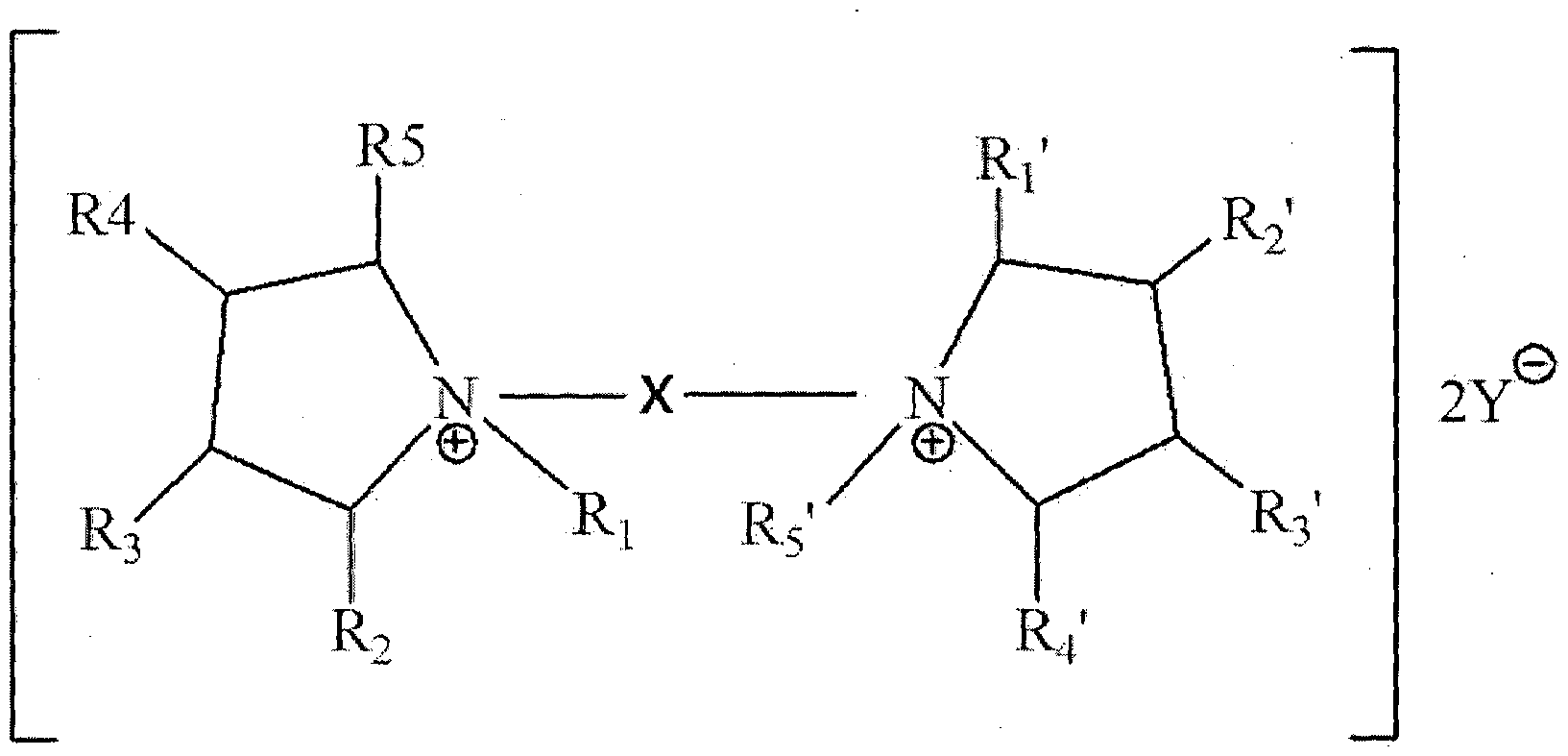
또한, 상기 화학식 3에서, Y는 (CF3S02)2N— , BF4- 또는 PF6—이고, 상기 X는 하기 화학식 3a 또는 화학식 3b이다.
[화학식 3a]

[화학식 3b]

상기 화학식 3a 또는 화학식 3b에세 상기 Rakl 및 Rak2는 각각 탄소수 1 내지 10의 직쇄 또는 분지쇄의 알킬렌기 이고, n은 1 내지 5의 정수이다. 상기 에테르기를 포함하는 비스—모르폴리늄 (morphonnium)계 염은 하기 화학식 4의 화합물을 포함할 수 있다.
[화학식 4]

상기 화학식 4에서, 상기 ¾ 및 I 는 서로 같거나 또는 다를 수 있으며 각각 탄소수 工 내지 10의 직쇄 또는 분지쇄의 알킬기, 탄소수 2 내지 10의 직쇄 또는 분지쇄의 알케닐기, 또는 탄소수 1 내지 10의 직쇄 또는 분지쇄의 알콕시기 또는 탄소수 1 내지 10의 직쇄 또는 분지쇄의 알킬 카르복실기이고, 상기 R2, R2' , R3, ', R4, R4' , R5 및 '는 서로 같거나 또는 다를 수 있으며 각각 수소, 탄소수 1 내지 10의 직쇄 또는 분지쇄의
알킬기, 탄소수 2 내지 10의 직쇄 또는 분지쇄의 알케닐기, 또는 탄소수 1 내지 10의 직쇄 또는 분지쇄의 알콕시기 또는 탄소수 1 내지 10의 직쇄 또는 분지쇄의 알킬 카르복실기이다.
또한, 상기 화학식 4에서, Y는 (CF3S02)2Nᅳ, BFV 또는 PF6—이고, 상기 X는 하기 화학식 4a 또는 화학식 4b이다.
[화학식 4a]

상기 화학식 4a 또는 화학식 4b에서, 상기 Rakl 및 !^2는 각각 탄소수
I 내지 10의 직쇄 또는 분지쇄의 알킬렌기 이고, n은 1 내지 5의 정수이다. 상기 이온성 액체에 포함되는 화합물의 구체적인 예로 하기 화학식
II 내지 29의 화합물을 들 수 있다.
[화학식 11]

[화학식 12]


[화학식 18]
 [화학식 20]

[화학식 21]
 [화학식 23]

[화학식 25]
 [화학식 26]

[화학식 28]
 [화학식 29]

( 1-에틸이미다졸륨 -3-일―에톡시) -에틸]— 1-에틸이미다졸륨
비스 (트리플루오로메탄술포닐)이미드, [2— (1ᅳ부틸이미다졸륨— 3—일—에톡시 )— 에틸]ᅳ 1ᅳ부틸이미다졸륨 비스 (트리플루오로메탄술포닐)이미드, [4-(1— 에틸이미다졸륨 -3ᅳ일—부록시 ) -부틸 ]-1-에틸이미다졸륨
비스 (트리플루오로메탄술포닐)이미드, {2-[2-(1ᅳ에틸이미다졸륨— 3-일- 에록시 )ᅳ에록시 ]ᅳ에틸 에틸이미다졸륨
비스 (트리플루오로메탄술포닐)이미드 , (2— {2— [2-( 1ᅳ에틸이미다졸륨—3-일- 에특시 )ᅳ에록시 ]-에특시 }一에틸 )— 1—에틸이미다졸륨
비스 (트리플루오로메탄술포닐)이미드, [2— (1-에틸이미다졸륨 -3-일-에특시 ) - 에틸 ]ᅳ1ᅳ에틸이미다졸륨 비스 (테트라플루오로보레이트), [2— (1一 부틸이미다졸륨 -3-일—에록시 ) -에틸] -1—부틸이미다졸륨
비스 (테트라플루오로보레이트)ᅳ [4-(1-에틸이미다졸륨 -3-일-부특시 ) -부틸 ]- 1-에틸이미다졸륨 비스 (테트라플루오로보레이트), {2-[2-(1- 에틸이미다졸륨—3—일-에록시 ) -에록시 ]ᅳ에틸 }-1-에틸이미다졸륨
비스 (테트라플루오로보레이트), (2-{2ᅳ[2-(1-에틸이미다졸륨ᅳ 3ᅳ일-에특시) - 에록시] -에록시} -에틸 )ᅳ1—에틸이미다졸륨 비스 (테트라플루오로보레이트),
[2-( 1-에틸이미다졸륨ᅳ3ᅳ일ᅳ에특시 ) -에틸 ] -1-에틸이미다졸륨
비스 (핵사플루오로포스페이트), [2ᅳ ( 1—부틸이미다졸륨 -3ᅳ일ᅳ에록시 ) -에틸] - 1ᅳ부틸이미다졸륨 비스 (핵사플루오로포스페이트), [4-(1-에틸이미다졸륨 -3ᅳ 일-부톡시)ᅳ부틸 ]-1ᅳ에틸이미다졸륨 비스 (핵사플루오로포스페이트), {2-[2- (1-에틸이미다졸륨 -3-일ᅳ에록시)ᅳ에록시]ᅳ에틸 }ᅳ1—에틸이미다졸륨
비스 (핵사플루오로포스페이트) 및 (2-{2ᅳ[2-(1-에틸이미다졸륨ᅳ 3-일- 에톡시 ) -에톡시 ]-에톡시 } -에틸 )-1-에틸이미다졸륨
비스 (핵사플루오로포스페이트)로 이루어진 군에서 선택된 1종 이상의 화합물을 포함할 수 있다.
상기 에테르기를 포함하는 비스—피페리디늄 (Piperidinium)계 염은
[2-( 1ᅳ에틸피페리디늄ᅳ 1ᅳ일—에록시 ) -에틸]— 1-에틸피페리디늄
비스 (트리플루오로메탄술포닐)이미드, [2ᅳ (1-부틸피페리디늄 -1-일-에특시) - 에틸]—1-부틸피페리디늄 비스 (트리플루오로메탄술포닐)이미드, [4— (1- 에틸피페리디늄— 1ᅳ일ᅳ부록시)ᅳ부틸 ]-1ᅳ에틸피페리디늄
비스 (트리플루오로메탄술포닐)이미드, {2-[2ᅳ (1-에틸피페리디늄 -1-일- 에특시 ) -에톡시 ] -에틸 }— 1-에틸피페리디늄
비스 (트리플루오로메탄술포닐)이미드, (2-{2-[2ᅳ (1-에틸피페리디늄— 1ᅳ일- 에톡시 )ᅳ에록시 ] -에특시 } -에틸 )-1-에틸피페리디늄
비스 (트리플루오로메탄술포닐)이미드, [2-(1—에틸피페리디늄 -1-일-에톡시) - 에틸] -1ᅳ에틸피페리디늄 비스 (테트라플루오로보레이트), [2— (1- 부틸피페리디늄ᅳ 1-일-에록시) -에틸 ]-1-부틸피페리디늄
비스 (테트라플루오로보레이트), [4— (1ᅳ에틸피페리디늄 -1-일-부톡시 ) - 부틸]—1—에틸피페리디늄 비스 (테트라플루오로보레이트), {2-[2-(1- 에틸피페리디늄ᅳ 1—일—에록시 )—에특시 ] -에틸 }-1ᅳ에틸피페리디늄
비스 (테트라플루오로보레이트), ( 2ᅳ { 2- [ 2— (1-에틸피페리디늄 - 1-일-에톡시)ᅳ 에톡시 ] -에톡시 }—에틸)ᅳ 1-에틸피페리디늄 비스 (테트라플루오로보레이트),
[2-(1-에틸피페리디늄 -1ᅳ일ᅳ에록시)ᅳ에틸 ]— 1ᅳ에틸피페리디늄
비스 (핵사플루오로포스페이트), [2ᅳ(1ᅳ부틸피페리디늄 -1ᅳ일-에톡시 ) -에틸] - 1ᅳ부틸피페리디늄 비스 (핵사플루오로포스페이트), [4-(1-에틸피페리디늄-
1ᅳ일-부특시 )ᅳ부틸 ]-1—에틸피페리디늄 비스 (핵사플루오로포스페이트), {2- [2-(1-에틸피페리디늄ᅳ 1—일-에톡시 )ᅳ에록시 ]ᅳ에틸 }-1ᅳ에틸피페리디늄
비스 (핵사플루오로포스페이트) 및 (2-{2-[2-(1-에틸피페리디늄ᅳ1-일- 에록시 )—에록시 ]ᅳ에톡시 } -에틸 )—1ᅳ에틸피페리디늄
비스 (핵사플루오로포스페이트) 로 이루어진 군에서 선택된 1종 이상의 화합물을 포함할 수 있다.
, 상기 에테르기를 포함하는 비스—피롤리디늄 (Pyrrolidinium)계 염은
[2一 (1—에틸피롤리디늄ᅳ 1-일-에특시 ) -에틸 ]-1ᅳ에틸피를리디늄
비스 (트리플루오로메탄술포닐)이미드, [2-(1—부틸피를리디늄 -1-일ᅳ에특시 ) - 에틸] -1ᅳ부틸피롤리디늄 비스 (트리플루오로메탄술포닐)이미드, [4-(1- 에틸피롤리디늄 -1-일―부특시 )ᅳ부틸 ]-1—에틸피를리디늄
비스 (트리플루오로메탄술포닐)이미드, {2-[2ᅳ(1-에틸피를리디늄ᅳ 1ᅳ일- 에특시 )ᅳ에톡시 ] -에틸 }ᅳ1ᅳ에틸피롤리디늄
비스 (트리플루오로메탄술포닐)이미드, (2-{2ᅳ[2ᅳ(1ᅳ에틸피를리디늄ᅳ 1-일ᅳ 에톡시 )ᅳ에록시 ;卜에톡시 }—에틸 -에틸피를리디늄
비스 (트리플루오로메탄술포닐)이미드, [2— (1-에틸피를리디늄ᅳ 1ᅳ일ᅳ에톡시)ᅳ 에틸]— 1-에틸피를리디늄 비스 (테트라플루오로보레이트), [2-(1- 부틸피를리디늄— 1-일-에특시) -에틸 ]ᅳ1-부틸피롤리디늄
비스 (테트라플루오로보레이트), [4ᅳ (1ᅳ에틸피롤리디늄 -1-일-부특시 )ᅳ 부틸]—1-에틸피를리디늄 비스 (테트라플루오로보레이트), {2ᅳ[2— (1ᅳ 에틸피롤리디늄 -1ᅳ일ᅳ에록시 ) -에록시 ] -에틸 }-1ᅳ에틸피를리디늄
비스 (테트라플루오로보레이트), (2-{2-[2ᅳ (1-에틸피를리디늄— 1—일―에특시)ᅳ 에특시:卜에톡시 }ᅳ에틸 )ᅳ1ᅳ에틸피롤리디늄 비스 (테트라플루오로보레이트),
[2一 (1-에틸피롤리디늄 -1ᅳ일―에톡시 ) -에틸 ]-1-에틸피를리디늄
비스 (핵사플루오로포스페이트), [2— (1-부틸피롤리디늄 -1ᅳ일ᅳ에록시) -에틸] - 1ᅳ부틸피롤리디늄 비스 (핵사플루오로포스페이트), [4ᅳ(1-에틸피를리디늄- 1-일-부톡시)ᅳ부틸 ]-1-에틸피를리디늄 비스 (핵사플루오로포스페이트), {2- [2ᅳ(1ᅳ에틸피를리디늄— 1ᅳ일 -에록시 )—에록시 ] -에틸 }— 1-에틸피를리디늄
비스 (핵사플루오로포스페이트) 및 (2-{2-[2ᅳ(1-에틸피를리디늄 -1-일- 에특시 )-에톡시 ] -에특시 } -에틸 )ᅳ 1-에틸피롤리디늄
비스 (핵사플루오로포스페이트) 로 이루어진 군에서 선택된 1종 이상의 화합물을 포함할 수 있다.
상기 에테르기를 포함하는 비스—모르폴리늄 (morpholinium)계 염은
[2ᅳ(4—에틸모르폴리늄 -4-일-에특시 )—에틸 ]ᅳ 4-에틸모르폴리늄
비스 (트리플루오로메탄술포닐)이미드, [2— (4ᅳ부틸모르폴리늄— 4ᅳ일ᅳ에록시) - 에틸] -4-부틸모르폴리늄 비스 (트리플루오로메탄술포닐)이미드, [4— (4一 에틸모르폴리늄ᅳ4—일-부록시 ) -부틸 ]-4-에틸모르폴리늄
비스 (트리플루오로메탄술포닐)이미드, {2-[2-(4-에틸피를리디늄 -4-일- 에록시 ) -에특시 ] -에틸 }-4—에틸모르폴리늄
비스 (트리플루오로메탄술포닐)이미드, (2-{2-[2-(4-에틸모르폴리늄ᅳ 4-일- 에특시 )ᅳ에톡시 ] -에톡시 }ᅳ에틸 )-4ᅳ에틸모르폴리늄
비스 (트리플루오로메탄술포닐)이미드, [2— (4—에틸모르폴리늄 -4—일-에톡시) - 에틸] -4-에틸모르폴리늄 비스 (테트라플루오로보레이트), [2ᅳ(4- 부틸모르폴리늄ᅳ 4—일-에톡시) -에틸:卜 4—부틸모르폴리늄
비스 (테트라플루오로보레이트) , [4-(4-에틸모르폴리늄 -4-일-부특시 )ᅳ부틸 ] - 4—에틸모르폴리늄 비스 (테트라플루오로보레이트), {2-[2-(4- 에틸모르폴리늄ᅳ 4-일-에톡시 ) -에록시 ]—에틸 }ᅳ4—에틸모르폴리늄
(테트라플루오로보레이트), (2ᅳ{2-[2-(4-에틸모르폴리늄ᅳ 4-일ᅳ에특시) - 에톡시 ]—에특시 }ᅳ에틸 )-4ᅳ에틸모르폴리늄
비스 (테트라플루오로보레이트 ),[2-(4ᅳ에틸모르폴리늄 -4ᅳ일-에톡시)ᅳ에틸]ᅳ 4-에틸모르폴리늄 비스 (핵사플루오로포스페이트), [2-(4-부틸모르폴리늄 -4- 일-에특시)ᅳ에틸 ]ᅳ4-부틸모르폴리늄 비스 (핵사플루오로포스페이트), [4ᅳ (4- 에틸모르폴리늄 -4ᅳ일―부록시 ) -부틸]ᅳ 4-에틸모르폴리늄
비스 (핵사플루오로포스페이트), {2— [2— (4-에틸모르폴리늄 -4-일-에특시 )ᅳ 에록시 ]—에틸 }ᅳ4-에틸모르폴리늄 (핵사플루오로포스페이트) 및 (2-{2-[2ᅳ (4ᅳ에틸모르폴리늄 -4-일-에특시 ) -에특시 ]ᅳ에특시 } -에틸 )-4-에틸모르폴리늄 비스 (핵사플루오로포스페이트)로 이루어진 군에서 선택된 1종 이상의 화합물을 포함할 수 있다.
한편, 상기 이온성 액체에 포함될 수 있는 상기 비스-이미다졸륨계 이온성 용매로는 1,1、-(1,2-에탄딜)비스 (3ᅳ메틸이미다졸륨) 비스 (트리플루오로메탄술포닐)이미드ᅳ 1,1、— (1,4-부탄딜)비스 (3- 에틸이미다졸륨) 비스' (트리플루오로메탄술포닐)이미드, 1ᅳ1、-(2,4-
부텐딜)비스 (3-부틸이미다졸륨) 비스 (트리플루오로메탄술포닐)이미드,
1,Γ-(1,4ᅳ부탄딜 -2-온)비스 (3-에틸이미다졸륨)
비스 (트리플루오로메탄술포닐)이미드, 1,1、— (1,4ᅳ부탄딜ᅳ 2,3ᅳ디온)비스 (3— 부틸이미다졸륨) 비스 (트리플루오로메탄술포닐)이미드, 1,1、ᅳ(1,4-부탄딜- 2ᅳ을)비스 (3-메틸이미다졸륨) 비스 (트리폴루오로메탄술포닐)이미드, 및 1,1、-(1,4ᅳ부탄딜-2,3—디올)비스(3ᅳ에틸이미다졸륨)
비스 (트리플루오로메탄술포닐)이미드, 1,1、-(1ᅳ2ᅳ에탄딜)비스(3- 메틸이미다졸륨) 비스 (테트라플루오로보레이트), 1,1、-(1,4-부탄딜)비스(3ᅳ 에틸이미다졸륨) 비스 (테트라플루오로보레이트), 1,1、ᅳ(2,4ᅳ부텐딜)비스 (3- 부틸이미다졸륨) 비스 (테트라플루오로보레이트), 1,1、ᅳ(1,4-부탄딜-2- 은)비스 (3-에틸이미다졸륨) 비스 (테트라플루오로보레이트), 1,1、-(1,4- 부탄딜—2, 3-디온)비스 ( 3-에틸이미다졸륨) 비스 (테트라플루오로보레이트), 1,Γ-(1,4-부탄딜— 2-을)비스 (3-에틸이미다졸륨)
비스 (테트라플루오로보레이트), 및 1,1、— (1,4-부탄딜 -2,3ᅳ디을)비스 (3ᅳ 에틸이미다졸륨) 비스 (테트라플루오로보레이트), 1,1、ᅳ(1,2-에탄딜)비스(3- 메틸이미다졸륨) 비스 (핵사플루오로포스페이트), 1,1、-(1,4-부탄딜)비스(3- 에틸이미다졸륨) 비스 (핵사플루오로포스페이트), 1,1、— (2,4ᅳ부텐딜)비스 (3- 부틸이미다졸륨) 비스 (핵사플루오로포스페이트), 1,1、ᅳ(1,4-부탄딜 -2- 온)비스 (3ᅳ에틸이미다졸륨) 비스 (핵사플루오로포스페이트), 1,1、-(1,4- 부탄딜ᅳ 2,3ᅳ디온)비스 (3-부틸이미다졸륨) 비스 (핵사플루오로포스페이트), Ι,Γ— (1,4-부탄딜 -2-올)비스 (3ᅳ에틸이미다졸륨)
비스 (핵사플루오로포스페이트), 및 1,1、-(1,4-부탄딜ᅳ2,3-디올)비스 (3ᅳ 에틸이미다졸륨) 비스 (핵사플루오로포스페이트)로 이루어진 군에서 선택된 1종 이상을 들 수 있다.
또한, 상기 이온성 액체에 포함될 수 있는 비스- 피를리디늄 (Pyrrolidinium)계 이온성 용매는 1, 1、ᅳ(1,4-부탄딜)비스 (1- 에틸피롤리.디늄) 비스 (트리플루오로메탄술포닐)이미드, 1,Γ-(1,4- 부탄딜)비스 (1—부틸피를리디늄) 비스 (트리플루오로메탄술포닐)이미드,
1,1、— (1,4-부탄딜—2-올)비스 (1ᅳ에틸피를리디늄)
비스 (트리플루오로메탄술포닐)이미드 1,1、-(1,4-부탄딜 -2,3-디을)비스 (1-
에틸피를리디늄) 비스 (트리플루오로메탄술포닐)이미드, 1,1、ᅳ(2,3- 부텐딜)비스 (1ᅳ에틸피를리디늄) 비스 (트리플루오로메탄술포닐)이미드,
1,1、-(1,4—부탄딜 -2,3-디온)비스 (1-에틸피를리디늄)
비스 (트리플루오로메탄술포닐)이미드, 1,1、-(1,4-부탄딜)비스(1ᅳ 에틸피를리디늄) 비스 (테트라플루오로보레이트), , 1,1、-(1,4ᅳ 부탄딜)비스 (1-부틸피를리디늄) 비스 (테트라플루오로보레이트), i,r-(i,4- 부탄딜ᅳ2—올)비스 (1ᅳ에틸피롤리디늄) 비스 (테트라플루오로보레이트), 1,1、ᅳ (1,4-부탄딜 -2,3—디올)비스 (1—에틸피를리디늄)
비스 (테트라폴루오로보레이트), i,rᅳ (2ᅳ 3ᅳ부텐딜)비스 (1ᅳ에틸피를리디늄) 비스 (테트라플루오로보레이트), 1,1、-(1,4-부탄딜ᅳ2,3-디온)비스(1- 에틸피를리디늄) 비스 (테트라플루오로보레이트), 1,1、ᅳ(1,4-부탄딜)비스 (1- 에틸피를리디늄) 비스 (핵사플루오로포스페이트), 1,1、-(1,4—부탄딜)비스 (1- 부틸피를리디늄) 비스 (핵사플루오로포스페이트), 1,1、-(1,4-부탄딜-2- 을)비스 (1-에틸피롤리디늄) 비스 (핵사플루오로포스페이트), 1,1、-(1,4- 부탄딜ᅳ2,3—디을)비스 (1-에틸피롤리디늄) 비스 (핵사플루오로포스페이트), 1,1、-(2,3ᅳ부텐딜)비스(1ᅳ에틸피를리디늄) 비스 (핵사플루오로포스페이트) 및 1, Γᅳ (1,4-부탄딜 -2,3—디온)비스 (1-에틸피롤리디늄) 비스 (핵사플루오로포스페이트) 로 이루어진 군에서 선택된 1종 이상을 들 수 있다.
또한, 상기 비스 -모르폴리늄 (morpholinium)계 이온성 용매는 1,Γ_
(1,4ᅳ부탄딜)비스 (1-에틸모르폴리늄) 비스 (트리플루오로메탄술포닐)이미드, 1,1、ᅳ(1,4ᅳ부탄딜)비스 (1—부틸모르폴리늄)
비스 (트리플루오로메탄술포닐)이미드, 1,1、— (1,4-부탄딜 -2-올)비스 (1- 에틸모르폴리늄) 비스 (트리플루오로메탄술포닐)이미드, 1,1、ᅳ(1,4-부탄딜- 2,3-디올)비스 (1-에틸모르폴리늄) 비스 (트리플루오로메탄술포닐)이미드, 1,1、— (2,3ᅳ부텐딜)비스 (1-에틸모르폴리늄)
비스 (트리플루오로메탄술포닐)이미드, 1,1、ᅳ(1,4-부탄딜-2,3-디온)비스(1_ 에틸모르폴리늄) 비스 (트리플투오로메탄술포닐)이미드, 1,1、-(1,4- 부탄딜)비스 (1-에틸모르폴리늄) 비스 (테트라플루오로보레이트), , Ι,Γ- (1,4-부탄딜)비스 (1-부틸모르폴리늄) 비스 (테트라플루오로보레이트), i,r-
(1,4-부탄딜 -2-올)비스 (1—에틸모르폴리늄) 비스 (테트라플루오로보레이트), 1,1、ᅳ (1,4-부탄딜 -2,3—디을)비스 (1-에틸모르폴리늄)
비스 (테트라플루오로보레이트), 1,1、-(2,3ᅳ부텐딜)비스(1-에틸모르폴리늄) 비스 (테트라플루오로보레이트), 1,1、_(1,4-부탄딜—2,3-디온)비스(1- 에틸모르폴리늄) 비스 (테트라플루오로보레이트), 1,1、ᅳ(1,4-부탄딜)비스 (1- 에틸모르폴리늄) 비스 (핵사플루오로포스페이트), 1,1、-(1,4-부탄딜)비스(1- 부틸모르폴리늄) 비스 (핵사플루오로포스페이트), 1,1、-(1,4-부탄딜-2- 을)비스 (1ᅳ에틸모르폴리늄) 비스 (핵사플루오로포스페이트), 1,1、-(1,4- 부탄딜—2, 3-디을)비스 (1-에틸모르폴리늄) 비스 (핵사플투오로포스페이트), 1,1、-(2,3ᅳ부텐딜)비스 (1—에틸모르폴리늄) 비스 (핵사플루오로포스페이트) 및 1,1、-(1,4-부탄딜ᅳ2,3ᅳ디온)비스(1-에틸모르폴리늄) 비스 (핵사플루오로포스페이트) 로 이루어진 군에서 선택된 1종 이상을 포함할 수 있다.
또한, 상기 비스 -피페리디늄 (Piperidiniutn)계 이은성 용매는 Ι,Γ- (1,4-부탄딜)비스 (1—에틸피페리디늄) 비스 (트리플루오로메탄술포닐)이미드, 1,1、— (1,4ᅳ부탄딜)비스 (1ᅳ부틸피페리디늄)
비스 (트리플루오로메탄술포닐)이미드, 1,1、ᅳ(1,4ᅳ부탄딜-2-올)비스(1- 에틸피페리디늄) 비스 (트리플루오로메탄술포닐)이미드, 1,1、-(1,4-부탄딜ᅳ 2, 3-디을)비스 (1—에틸피페리디늄) 비스 (트리플루오로메탄술포닐)이미드, Ι, Γ (2,3ᅳ부텐딜)비스 (1ᅳ에틸피페리디늄)
비스 (트리플루오로메탄술포닐)이미드, 1,1、ᅳ(1,4-부탄딜—2,3-디은)비스(1- 에틸피페리디늄늄) 비스 (트리폴루오로메탄술포닐)이미드, 1,1、ᅳ (1,4- 부탄딜)비스 (1—에틸피페리디늄) 비스 (테트라플루오로보레이트), , Ι,Γ- (1,4-부탄딜)비스 (1-부틸피페리디늄) 비스 (테트라플루오로보레이트), Ι,Γ- (1,4-부탄딜—2ᅳ올)비스 (1ᅳ에틸피페리디늄) 비스 (테트라플루오로보레이트), Ι,Γ— (1,4-부탄딜 2,3—디을)비스 (1-에틸피페리디늄)
비스 (테트라플루오로보레이트), 1, 1、ᅳ (2, 3-부텐딜)비스 ( 1—에틸피페리디늄) 비스 (테트라플루오로보레이트), 1,1、ᅳ(1,4—부탄딜—2,3ᅳ디은)비스(1- 에틸피페리디늄) 비스 (테트라플루오로보레이트), 1,1、— (1,4-부탄딜)비스 (1- 에틸피페리디늄) 비스 (핵사플루오로포스페이트), 1,1、-(1,4ᅳ부탄딜)비스(1-
부틸피페리디늄) 비스 (핵사플루오로포스페이트), 1,1、-(1,4-부탄딜-2- 을)비스 (1-에틸피페리디늄) 비스 (핵사플루오로포스페이트)ᅳ 1,1、-(1,4- 부탄딜 -2, 3-디을)비스 (1ᅳ에틸피페리디늄) 비스 (핵사플루오로포스페이트), 1,1、-(2,3—부텐딜)비스 (1ᅳ에틸피페리디늄) 비스 (핵사플루오로포스페이트), 및 1, 1、-(1 ,4-부탄딜 -2,3—디은)비스 (1-에틸피페리디늄) 비스 (핵사플루오로포스페이트)로 이루어진 군에서 선택된 1종 이상을 포함할 수 있다.
한편, 상기 방향족 화합물을 추출 및 분리해내는 대상인 나프타는 당 업계에 알려진 통상적인 나프타를 제한 없이 사용할 수 있다. 예를 들어, 상기 나프타는 방향족 화합물 4 중량 % 내지 15 증량 % 포함할 수 있으며, 구체적으로 벤젠, 를루엔, 흔합 자일렌, 에틸벤젠 등의 방향족 화합물을 4 증량 % 내지 15 중량 % 포함할 수 있다.
상기 나프타의 일 예로 지방족 탄화수소 화합물, 예를 들어 부탄 (약 2.3 wt%) , 펜탄 (약 30.1 wt%) , 핵산 (약 31.8 wt%) , 헵탄 (약 8.7 wt%) , 옥탄 (약 8.1 wt ) , 노난 (약 2.0 wt%) 및 /또는 데칸 (약 7.0 wt%) 등의 화합물을 포함한 지방족 탄화수소 화합물과 방향족 화합물, 예를 들어 벤젠 (약 1.8 wt%), 틀루엔 (약 3.0 wt%) , 흔합 자일렌 (약 3.2 wt%) 및 /또는 에틸벤젠 (약 2.0 wt%) 등의 화합물을 포함한 방향족 화합물을 포함할 수 있다.
한편, 상기 일 구현예의 나프타에 함유된 방향족 화합물의 분리 방법에서는 상기 이온성 액체 대비 상기 나프타가 0.05 부피 % 내지 5 부피 ¾ 또는 0.1 부피 % 내지 3 부피 ¾로 사용될 수 있다.
상기 나프타가 이온성 액체 대비 0.05 부피 % 미만으로 사용되면 상기 일 구현예의 나프타에 함유된 방향족 화합물의 분리 방법의 효율이나 생산성 및 경제성이 층분히 확보되지 않을 수 있으며, 방향족 화합물 회수를 위하여 상기 일 구현예의 분리 방법에 부가적인 공정 장치나 공정 단계를 추가하여야 할 수 있다. 상기 나프타가 이온성 액체 대비 5 부피 % 초과하여 사용되면 상기 방향족 화합물의 추출 효율이 저하될 수 있으며 나프타로부터 방향족 화합물을 층분히 분리해내기 위하여 다단계의 공정이나 부가적인 공정 장치를 추가하여야 할 수 있다.
상기 이온성 액체 및 나프타를 접촉시키는 단계는 20°C 내지 100°C의 온도 또는 25°C 내지 80°C의 온도에서 수행될 수 있다. 상기 이온성 액체 및 나프타를 접촉시키는 단계가 20°C 미만에서 수행되면, 이온성 액체의 점성이 커져 분산이 저하되고 물질 이동 성능이 감소되는 문제점이 발생할 수 있다. 또한, 상기 이온성 액체 및 나프타를 접촉시키는 단계가 lorc 초과의 온도에서 수행되면, 나프타가 기화되어 이온성 액체와의 접촉이 원활하게 이루어지지 않아 추출 성능이 감소되는 문제점이 발생할 수 있고, 에너지의 소모로 인해 생산비가 상승되는 원인이 될 수 있다.
상기 이은성 액체 및 나프타를 접촉시키는 단계가 수행되는 시간은 크게 한정되는 것은 아니나, 나프타에 포함된 방향족 화합물이 이온성 액체와 충분히 접촉될 수 있도록 하기 위하여 1분 이상 또는 30분 이상 수행될 수 있으며, 구체적으로 1분 내지 20시간 또는 30분 내지 10시간 동안 수행될 수 있다.
상기 이은성 액체와 접촉한 나프타로부터 방향족 화합물을 분리하는 단계는 보다 높은 분리 효율을 확보하기 위하여 적어도 1회 이상, 예컨대 1회 내지 4회 수행될 수 있다.
상기 이온성 액체와 접촉한 나프타로부터 방향족 화합물을 분리하는 단계는 액체 -액체 추출법으로 분리하는 단계를 포함할 수 있다. 상기 액체- 액체 추출법은 통상적으로 알려진 방법 및 장치를 사용할 수 있으며, 물질의 극성 등을 고려하여 사용되는 유기 용매를 선택할 수 있다.
상기 구현예에 따른 나프타에 함유된 방향족 화합물의 분리 방법은 상기 추출 단계에서 얻어지는 라피네이트를 분리하는 단계를 더 포함할 수 있다.
라피네이트는 용제 추출 또는 분자체 등에 의한 흡착으로 추출 또는 흡착되지 않은 성분을 의미하여, 상기 추출 단계에서는 나프타에서 방향족 화합물 성분이 분리된 잔류물을 의미한다.
상기 구현예에 따른 나프타에 함유된 방향족 화합물의 분리 방법은 라피네이트 분리 후, 이온성 액체로부터 방향족 화합물을 분리하기 위한 탈기 단계를 더 포함할 수 있다ᅳ 라피테이트와 분리된 이온성 액체는 증발기에 도입된 후, 탈기 단계가 수행될 수 있다. 탈기 (deairing,
deaeration)란 액체 중에 용존하는 기체를 제거하는 조작으로, 본 명세서에서는 이온성 액체 내에 존재하는 방향족 화합물을 기화하여 제거하는 것을 의미한다.
상기 탈기는 20 °C 내지 150°C 또는 50°C 내지 120 °C의 온도에서 수행될 수 있다. 상기 탈기 시 온도가 너무 낮으면, 탈기 성능이 떨어지고 이은성 액체 재사용 시 추출 효율이 저하되는 문제점이 발생할 수 있다 . 또한, 상기 탈기 시 온도가 너무 높게 유지될 경우, 이온성 액체의 변형 및 에너지 소비가 늘어나는 문제점이 발생할 수 있다.
상기 탈기는 1 隱¾ 내지 200 mmHg 또는 50 mmHg 내지 100 隱 Hg의 압력 하에서 수행될 수 있다. 상기 탈기 시 압력이 너무 낮으면, 에너지 소비가 늘어나는 문제점이 발생할 수 있다. 또한, 상기 탈기 시 압력이 너무 높게 유지될 경우, 탈기 성능이 떨어지고 이온성 액체 재사용 시 추출 효율이 저하되는 문제점이 발생할 수 있다.
즉, 상기 이온성 액체와 접촉한 나프타로부터 방향족 화합물을 분리하는 단계는 20 내지 150 °C의 온도 및 1 내지 200 醒 ¾의 압력 조건에서 탈기하는 단계를 더 포함할 수 있다.
상기 탈기가 수행되는 시간은 크게 한정되는 것은 아니나, 탈기 효율을 충분히 확보하기 위하여 5분 이상 수행될 수 있으며 구체적으로
10분 내지 300분 또는 30분 내지 120분 동안 수행될 수 있다.
상기 이온성 액체와 접촉한 나프타로부터 방향족 화합물을 분리하는 단계는 상기 분리 단계 이후의 이온성 액체를 다시 나프타와 접촉시켜 재사용하는 단계를 더 포함할 수 있다. 예컨대, 상기 탈기 단계 이후, 라피네이트와 분리된 이온성 액체 로부터 분리된 방향족 화합물을 증발기 상단 통로로 배출하고, 방향족 화합물이 분리된 이온성 액체를 증발기 하단 통로로 배출하여 다시 추출탑의 이온성 액체 유입 통로로 도입시켜 재사용할 수 있다. 즉, 상기 탈기 단계를 통해 방향족 화합물이 분리된 이온성 액체는 유실 없이 재사용될 수 있다ᅳ
상기 일 구현예의 나프타에 함유된 방향족 화합물의 분리 방법에서, 상기 이온성 액체 및 나프타를 접촉시키는 추출 단계는 맥동 추출탑에서 수행될 수 있다. 상기 맥동 추출탑은 액체 -액체 향류 추출탑의 연속 상에
맥동을 부여하는 형식의 추출탑으로 액에 필스를 줌으로써 두 액상 중 용적비율이 작은 상이 다른 연속 상 속에 물방울 형태로 분산되는 현상을 이용한다. 상기 일 구현예의 분리 방법에서 맥동 추출탑을 이용함으로써 분산성이 높아지고 물질 이동 성능이 현저하게 향상되어, 나프타로부터 방향족 화합물을 추출하는 효율이 증가하게 된다.
상기 맥동 추출탑은 상단에 맥동 발생 모터가 10 m/s 내지 60 m/s 또는 20 m/s 내지 50 m/s의 속도로 작동되어 이중관 형식의 맥동형 컬럼이 수직 왕복 운동을 한다. 상기 맥동 발생 모터의 속도가 10 m/s 미만으로 너무 느리면, 맥동형 컬럼의 수직 왕복 운동이 느려져 분산이 저하되고 물질 이동 성능이 감소하여 방향족 화합물의 추출 효율이 저하되는 문제점이 발생할 수 있다. 또한, 상기 맥동 발생 모터의 속도가 60 m/s를 초과하여 너무 빠르면,. 기기의 마모로 기능이 저하되고 에너지의 소모로 인해 생산비가 상승되는 문제점이 발생할 수 있다.
상기 추출 단계가 맥동 추출탑에서 수행되는 경우, 상기 구현예에 따른 나프타에 함유된 방향족 화합물의 분리 방법은 상기 이온성 액체를 맥동 추출탑 상단으로 도입시키는 단계; 및 상기 나프타를 맥동 추출탑 하단으로 도입시키는 단계;를 더 포함할 수 있다.
상기 추출 단계에서 사용되는 맥동 추출탑에 관한 내용은 상술한 내용을 제외하고 통상적으로 알려진 방법 및 통상적으로 알려진 부품이나 장치 구성 요소를 포함할 수 있다.
상기 일 구현예의 방향족 화합물의 분리 방법에서는 상술한 내용을 제외하고 나프타 성분의 분리에 사용될 수 있는 것으로 알려진 통상의 방법이나 장치를 큰 제한 없이 사용할 수 있다.
【발명의 효과】
본 발명에 따르면, 다단의 공정이나 공정 장치를 생략하면서 보다 간단한 과정을 통하여 나프타로부터 방향족 화합물을 높은 효율로 제거할 수 있는 나프타에 함유된 방향족 화합물의 분리 방법이 제공될 수 있다. 상기 나프타에 함유된 방향족 화합물의 분리 방법에서는, 유독성을 갖거나 부식을 일으키는 성분이 발생하지 아니하여 보다 친환경적인 공정 설계가 가능하며, 특정의 이온성 액체를 이용한 추출 공정만으로도
나프타에서 방향족 화합물을 보다 효과적이고 높은 효율로 분리해 낼 수 있기 때문에, 다단계의 추출 과정이나 정제 과정 등의 복잡한 공정이나 이를 위한 다양한 장치의 설치를 생략할 수 있어서 보다 경제적인 공정 설계가 가능하다.
【도면의 간단한 설명】
도 1 은 맥동 추출탑을 이용한 나프타로부터 방향족 화합물의 분리 방법을 개략적으로 나타낸 그림이다.
【발명을 실시하기 위한 구체적인 내용】
발명을 하기의 실시예에서 보다 상세하게 설명한다. 단, 하기의 실시예는 본 발명을 예시하는 것일 뿐, 본 발명의 내용이 하기의 실시예에 의하여 한정되는 것은 아니다.
[제조예: 이은성 액체의 제조]
1. 제조예 1: [2-(1-에틸이미다졸륨 -3-일-에록시) -에틸 ]-1- 에틸이미다졸륨 비스 (트리플루오로메탄술포닐)이미드 제조
환류 장치가 부착된 250 ml 2구 플라스크에 물을 용매로 50 g의 [2ᅳ ( 1-에틸이미다졸륨 -3—일-에톡시)—에틸 ] -1-에틸이미다졸륨
디브로마이드 [424.17g/mol]와 78 g의 비스 (트리플루오로메탄술포닐)이미드 리튬염 [287.09g/mol] (2.3 당량)을 넣고, 실온에서 두 시간 정도 교반한 후 생성물을 work— up하여 미 반웅물질들을 제거한 후, 601:에서 진공 건조하여 98%의 수율로 [2— (1-에틸이미다졸륨— 3-일-에톡시)—에틸 ]-1-에틸이미다졸륨 비스 (트리플루오로메탄술포닐)이미드 화합물을 얻었다.
2. 제조예 2: [4-(1-에틸피페리디늄 -1-일―부톡시) -부틸 ]-1ᅳ 에틸피페리디늄 비스 (트리플루오로메탄술포닐)이미드 제조
환류 장치가 부착된 250 ml 2구 플라스크에 물을 용매로 50 g의 [4- ( 1-에틸피페리디늄 -1-일-부톡시 )ᅳ부틸 ]-1-에틸피페리디늄
디브로마이드 [514.4¾/mol]와 64 g의 비스 (트리플루오로메탄술포닐)이미드 리튬염 [287.09g/mol] (2.3 당량)을 넣고, 실온에서 두 시간 정도 교반한 후 생성물을 work— up하여 미 반응물질들을 제거한 후, 60°C에서 진공 건조하여
98%의 수율로 [4ᅳ( 1-에틸피페리디늄 -1-일-부록시 ) -부틸 ]-1—에틸피페리디늄 비스 (트리플루오로메탄술포닐)이미드 화합물을 얻었다.
3. 제조예 3: {2-[2-(1-에틸피를리디늄 -1-일-에록시) -에록시] -에틸 } - 1-에틸 피를리디늄 비스 (테트라플루오로보레이트) 제조
환류 장치가 부착된 250 ml 2구 플라스크에 물을 용매로 50 g의 {2—
[2ᅳ(1-에틸피롤리디늄 -1—일-에특시 ) -에록시 ] -에틸 }ᅳ1-에틸 피를리디늄 디브로마이드 [474.31g/mol]와 23 g의 테트라플루오로보레이트 리튬염 [93.75g/mol] (2.3 당량)을 넣고, 실은에서 두 시간 정도 교반한 후 생성물을 work— up하여 미 반웅물질들을 제거한 후, 60°C에서 진공 건조하여 98%의 수율로 {2— [2-(1-에틸피롤리디늄— 1-일—에특시)—에록시]ᅳ에틸 }-1ᅳ에틸 피롤리디늄 비스 (테트라플루오로보레이트) 화합물을 얻었다.
4. 제조예 4: (2-{2-[2-(4—에틸모르폴리늄— 4-일-에록시) -에특시] - 에록시 } -에틸 )--에틸모르폴리늄 비스 (핵사플루오로포스페이트) 제조
환류 장치가 부착된 250 ml 2구 플라스크에 물을 용매로 50 g의 (2ᅳ {2— [2-(4-에틸모르폴리늄— 4-일-에록시)ᅳ에특시] -에특시}—에틸 )-4—
에틸모르폴리늄 디브로마이드 [550.37g.mol]와 32 g의 핵사플루오로포스페이트 리튬염 [151.91g/mol] (2.3 당량)을 넣고, 실온에서 두 시간 정도 교반한 후 생성물을 work— up하여 미 반웅물질들을 제거한 후, 6(TC에서 진공 건조하여 98%의 수율로 (2-{2-[2— (4—에틸모르폴리늄 -4-일ᅳ 에록시 ) -에록시 ] -에특시 } -에틸 )-4-에틸모르폴리늄
비스 (핵사플루오로포스페이트) 화합물을 얻었다. [실시예 및 비교예: 나프타로부터 방향족 화합물 분리]
[실시예 1]
나프타 시료 과 [2-(1-에틸이미다졸륨 -3-일—에록시)—에틸] -1- 에틸이미다졸륨 비스 (트리폴루오로메탄술포닐)이미드를 10 g을 흔합하고ᅳ 25°C에서 1시간 동안 교반한 후 30분 동안 안정시켜, 상층액 및 하층액을 각각 분리하였다. 이후 분리된 상층액은 FID 및 FFAP column이 부착된 Gas
Chromatography (영린기기, model #: YL6100)를 이용하여 분석하였고, 하층액은 Bruker Nuclear Magnetic Resonance (400MHz/52MM, Coil No: 944067A)를 이용하여 주 방향족 화합물들의 추출율을 분석하였다. 추출 후에 [2-(1-에틸이미다졸륨 -3-일-에특시)ᅳ에틸 ]-1-에틸이미다졸륨 비스 (트리플루오로메탄술포닐)이미드에 포함된 주 방향족 화합물들의 추출 제거율은 하기 표 1에 나타내었다.
[실시예 2 내지 20]
상기 화학식 1~4로 표시되는 에테르기자 포함된 비스—이미다졸륨계 이온성 액체 및 에테르기가 포함된 비스-비이미다졸륨 이온성 액체의 종류를 하기 표 1과 같이 변화시켜 사용한 것을 제외하고는, 상기 실시예 1과 동일한 방법을 수행하여 나프타 내 방향족 화합물들을 추출하였다. 추출 후에 이온성 액체 추출용매에 포함된 주 방향족 화합물들의 추출 제거율은 하기 표 1에 각각 나타내었다.
[비교예]
나프타 시료 과 술포란 10 g을 흔합하고, 25°C에서 1시간 동안 교반한 후 30분 동안 안정시켜 상층액 및 하층액을 각각 분리하였다. 이후 분리된 상충액은 FID 및 FFAP column이 부착된 Gas Chromatography (영린기기, model #: YL6100)를 이용하여 분석하였고, 하층액은 Bruker Nuclear Magnetic Resonance (400MHz/52匪, Coil No: 944067A)를 이용하여 주 방향족 화합물들의 추출율을 분석하였다. 성가 추출 용액에 포함된 주 방향족 화합물들의 추출 제거율은 하기 표 1에 나타내었다.
【표 1】


[실시예 20 내지 26]
추출 용매로서 1종의 이온성 액체 대신 서로 다른 2종의 이온성
액체를 사용한 것을 제외하고는, 상기 실시예 1과 동일한 방법을 수행하여 나프타로부터 방향족 화합물들을 추출하였다. 추출 후에 이은성 액체계 추출 용매에 포함된 주 방향족 화합물들의 추출 제거율은 하기 표 2에 각각 나타내었다.
【표 2】


[실시예 27 내지 33]
추출 용매로서 [2— (1-에틸피를리디늄ᅳ 1-일ᅳ에톡시) -에틸 ]—1- 에틸피를리디늄 비스 (트리플루오로메탄술포닐)이미드를 사용하고, 나프타의 시료 사용량을 하기 표 3과 같이 변화시킨 것을 제외하고는, 상기 실시예 1과 동일한 방법을 수행하여 나프타 내 방향족 화합물들을 추출하였다. 추출 후에 이온성 액체계 추출용매에 포함된 주 방향족 화합물들의 추출 제거율은 하기 표 3에 각각 나타내었다.
【표 3】

[실시예 34 내지 36]
추출 용매로서 [2ᅳ (1—에틸피를리디늄 -1-일ᅳ에톡시 ) -에틸 ]ᅳ1- 에틸피를리디늄 비스 (트리플루오로메탄술포닐 )이미드를 사용하고 , 에테르기를 포함하는 비스ᅳ비이미다졸륨계 이온성 액체에 대하여 나프타 처리량을 5 중량배로 변경하고, 추출 단계를 달리하여 추출한 것을 제외하고는, 상기 실시예 1과 동일한 방법을 수행하여 나프타 내 방향족 화합물들을 추출하였다. 추출 후에 이온성 액체계 추출용매에 포함된 주 방향족 화합물들의 추출 제거율은 하기 표 4에 각각 나타내었다.
【표 4】

[실시예 37 내지 44]
추출 용매로서 [2-(4 틸모르폴리늄 -4-일-에톡시) -에틸 ] 4- 에틸모르폴리늄 비스 (트리플루오로메탄술포닐)이미드를 사용하고, 추출 온도를 하기 표 5와 같이 변화시킨 것을 제외하고는, 상기 실시예 1과 동일한 방법을 수행하여 나프타 내 방향족 화합물들을 추출하였다. 추출 후에 이온성 액체계 추출 용매에 포함된 주 방향족 화합물들의 추출 제거율은 하기 표 5에 각각 나타내었다.
【표 5】

[실시예 45 ~ 51]
추출 용매로서 {2-[2-(1-에틸피페리디늄 -1-일-에록시)ᅳ에특시] -
에틸 }ᅳ1—에틸피페리디늄 비스 (트리플루오로메탄술포닐)이미드를 사용하고, 상기 실시예 1과 동일한 조건 및 방법으로 나프타 내 주 방향족 화합물들을 제거하였으며, 추출한 후 이은성 액체 추출용매에 포함된 주 방향족 화합물들의 탄화수소를 감압시켜 탈기하였다. 이때 탈기온도와 압력 및 시간 조건에 따른 탈기율은 표 6에 각각 나타내었다.
【표 6】

맥동 추출탑을 이용한 나프타 흔합물 내 방향족 화합물의 분리는 실온 조건에서 추출 용매 유입 통로 (1)로 추출 용매를 분당 5mL로 맥동 추출탑 (3) 상단에 도입시키고, 동시에 나프타 유입 통로 (2)로 나프타를 분당 lmL로 맥동 추출탑 (3) 하단에 도입시켜 맥동 추출탑 내에서 3시간 동안 50m/s의 맥동 속도로 액체—액체 추출 분리하였다.
상기 액체ᅳ액체 추출 분리 후, 상층의 라피네이트 (방향족이 제거된 나프타 흔합물)는 맥동 추출탑 상단의 통로 (4)로 배출시켜 FID 및 FFAP
column이 부착된 Gas Chromatography (영린기기, model #: YL6100)를 이용하여 방향족 화합물들의 추출율을 분석하였다. 추출 후에 각 추출 용매에 포함된 방향족 화합물들의 추출율 (추출 제거율)은 하기 표 11에 나타내었다.
【표 11】

【표 12】

추출 용매로서 [2-(1-에틸피페리디늄ᅳ 1—일-에록시) -에틸 ]-1- 에틸피페리디늄 비스 (트리플루오로메탄술포닐)이미드를 사용하고, 에테르기를 포함하는 비스-비이미다졸륨계 이온성 액체에 대하여 나프타
사용량 (도입량)을 5부피 %로 변경하고, 액체—액체 추출법으로 분리하는 단계 수행 흿수를 달리하여 추출한 것을 제외하고는, 상기 실시예 52과 동일한 방법으로 수행하여 나프타 내 방향족 화합물들을 추출하였다. 추출 후에 방향족 화합물들의 추출율 (추출 제거율)은 하기 표 13에 나타내었다.
【표 13】

추출 용매로서 [4— (4-에틸모르폴리늄 -4-일-부록시) -부틸 ]-4- 에틸모르폴리늄 비스 (트리플루오로메탄술포닐)이미드를 사용하고, 맥동 추출탑 내 맥동 발생 모터 속도를 하기 표 14와 같이 변화시킨 것을 제외하고는, 상기 실시예 52과 동일한 방법으로 수행하여 나프타 내 방향족 화합물들을 추출하였다. 추출 후에 방향족 화합물들의 추출율 (추출 제거율)은 하기 표 14에 나타내었다.
【표 14]


추출 용매로서 (2— {2-[2ᅳ (1-에틸피를리디늄 -1-일ᅳ에특시)ᅳ에록시]ᅳ 에톡시 } -에틸 )—1-에틸피를리디늄 비스 (트리플루오로메탄술포닐)이미드를 사용하고, 추출 온도를 하기 표 15와 같이 변화시킨 것을 제외하고는, 상기 실시예 52과 동일한 방법으로 수행하여 나프타 내 방향족 화합물들을 추출하였다. 추출 후에 방향족 화합물들의 추출율 (추출 제거율)은 하기 표 15에 나타내었다.
【표 15】

추출 용매로서, [2-(1—부틸이미다졸륨 -3—일―에특시) -에틸 ]ᅳ1- 부틸이미다졸륨 비스 (트리플루오로메탄술포닐)이미드를 사용하고, 상기 실시예 52과 동일한 조건 및 방법으로 나프타 내 방향족 화합물들을 제거하였으며, 액체ᅳ액체 추출법으로 분리 후 방향족 화합물들이 포함된 추출 용매는 맥동 추출탑 하단의 통로 (5)로 배출하여 증발기 (6)로 도입하고 일정 조건하에서 감압시켜 탈기하였다. 이때 탈기 온도, 압력 및 시간 조건에 따른 탈기율은 하기 표 16에 나타내었다.
【표 16】

탈기된 방향족 화합물은 증발기 상단의 통로 (7)로 배출하여 웅축기 (8)로 도입되고, 방향족 화합물이 제거된 추출 용매는 증발기 하단의
통로 (9)로 배출되어, 다시 추출 용매 유입 통로 (1)로 도입되어 재사용된다. 이 때 하기 표 17의 탈기 조건에 따른 추출 용매의 유실율을 하기 표 17에 나타내었다.
【표 17】

맥동 추출탑을 이용한 나프타 흔합물 내 방향족 화합물의 분리는 실온 조건에서 추출 용매 유입 통로 (1)로 트라이에틸렌글리콜 또는 이온성 액체를 분당 5mL로 맥동 추출탑 (3) 상단에 도입시키고, 동시에 나프타 유입 통로 (2)로 나프타를 분당 lmL로 맥동 추출탑 (3) 하단에 도입시켜 맥동 추출탑 내에서 3시간 동안 50m/s의 맥동 속도로 액처卜액체 추출 분리한다.
액체—액체 추출 분리 후, 상층의 라피네이트 (방향족이 제거된 나프타 흔합물)는 맥동 추출탑 상단의 통로 (4)로 배출시켜 FID 및 FFAP column이 부착된 Gas Chromatography (영린기기, model #: YL6100)를 이용하여 방향족 화합물들의 추출율을 분석하였다. 추출 후에 각 추출 용매에 포함된 방향족 화합물들의 추출율 (추출 제거율)은 하기 표 21에 나타내었다.
【표 21】

【표 22]

추출 용매로서 트라이에틸렌글리콜을 사용하고, 액체—액체 추출법으로 분리하는 단계 수행 횟수를 달리하여 추출한 것을 제외하고는, 상기 실시예 1이과 동일한 방법으로 수행하여 나프타 내 방향족 화합물들을 추출하였다. 추출 후에 방향족 화합물들의 추출율 (추출 제거율)은 하기 표 23에 나타내었다.
【표 23】

추출 용매로서 1,Γ-(1,4-부탄딜 -2-올)비스 (1-에틸피를리디늄) 비스 (트리플루오로메탄술포닐)이미드를 사용하고, 맥동 추출탑 내 맥동 발생 모터 속도를 하기 표 4와 같이 변화시킨 것을 제외하고는, 상기 실시예 101과 동일한 방법으로 수행하여 나프타 내 방향족 화합물들을 추출하였다. 추출 후에 방향족 화합물들의 추출율 (추출 제거율)은 하기 표 24에 나타내었다.
【표 24】

추출 용매로서 1,1、-(2,3—부텐딜)비스 (1—에틸모르폴리늄) 비스 (트리플루오로메탄술포닐)이미드를 사용하고, 추출 은도를 하기 표 25와 같이 변화시킨 것을 제외하고는, 상기 실시예 1()1과 동일한 방법으로 수행하여 나프타 내 방향족 화합물들을 추출하였다. 추출 후에 방향족 화합물들의 추출율 (추출 제거율)은 하기 표 25에 나타내었다.
【표 25]

추출 용매로서 1, Γ-(1, 4-부탄딜ᅳ 2,3-디온)비스 (1-에틸피페리디늄) 비스 (트리플루오로메탄술포닐)이미드를 사용하고, 상기 실시예 101과
동일한 조건 및 방법으로 나프타 내 방향족 화합물들을 제거하였으며, 액체—액체 추출법으로 분리 후 방향족 화합물들이 포함된 추출 용매는 맥동 추출탑 하단의 통로 (5)로 배출하여 증발기 (6)로 도입하고 일정 조건하에서 감압시켜 탈기하였다. 이때 탈기 은도, 압력 및 시간 조건에 따른 탈기율은 하기 표 26에 나타내었다.
【표 26】

탈기된 방향족 화합물은 증발기 상단의 통로 (7)로 배출하여 응축기 (8)로 도입되고, 방향족 화합물이 제거된 추출 용매는 증발기 하단의 통로 (9)로 배출되어, 다시 추출 용매 유입 통로 (1)로 도입되어 재사용된다. 이 때 하기 표 27의 탈기 조건에 따른 추출 용매의 유실율을 하기 표 27에 나타내었다
【표 27】
구분 추출 용매 일정 탈기 조건 *에 따른 추출 용매 유실율 %)

【부호의 설명】
1: 추출 용매 유입 통로
2: 나프타 흔합물 유입 통로
3: 맥동 추출탑
4: 맥동 추출탑 상단의 통로
5: 맥동 추출탑 하단의 통로
6: 증발기
7: 증발기 상단의 통로
8: 응축기
9: 증발기 하단의 통로
Claims
【청구항 1】
트라이에틸렌글리콜; 비스—이미다졸륨계 이은성 용매; 비스- 피페리디늄 (PipericUnium)계 이온성 용매; 비스ᅳ 피롤리디늄 (Pyrrol idinium)계 이온성 용매; 비스- 모르들리늄 (morphol inium)계 이온성 용매; 에테르기를 포함하는 비스ᅳ 이미다졸륨 (Imi dazo Hum)계 염; 에테르기를 포함하는 비스- 피페리디늄 (Piper idinium)계 염; 에테르기를 포함하는 비스- 피를리디늄 (Pyrrolklinium)계 염; 및 에테르기를 포함하는 비스- 모르폴리늄 (morpholiniutn)계 염;으로 이루어진 군에서 선택된 1종 이상의 화합물을 포함하는 이온성 액체 및 나프타를 접촉시키는 추출 단계 ; 및
상기 이온성 액체와 접촉한 나프타로부터 방향족 화합물을 분리하는 단계;를 포함하는, 나프타에 함유된 방향족 화합물의 분리 방법.
【청구항 2]
제 1항에 있어서,
상기 에테르기를 포함하는 비스 -이미다졸륨 (Imidazoliutn)계 염은 전체 탄소수 2 내지 20의 에테르기를 1이상 포함한 작용기를 매개로 2개의 이미다졸륨계 고리가 연결된 양이온; 및 소수성을 띄는 할라이드계 음이온;을 포함하고,
상기 에테르기를 포함하는 비스 -피페리디늄 (Piperidinium)계 염은 전체 탄소수 2 내지 20의 에테르기를 1이상 포함한 작용기를 매개로 2개의 피페리디늄 (Piperidinium)계 고리가 연결된 양이온; 및 소수성을 띄는 할라이드계 음이온;을 포함하고,
상기 에테르기를 포함하는 비스—피를리디늄 (Pyrrolidinium)계 염은 전체 탄소수 2 내지 20의 에테르기를 1이상 포함한 작용기를 매개로 2개의 피를리디늄 (Pyrrolidinium)계 고리가 연결된 양이온; 및 소수성을 띄는 할라이드계 음이온;을 포함하고,
상기 에테르기를 포함하는 비스 -모르폴리늄 (morpholiniutn)계 염은
전체 탄소수 2 내지 20의 에테르기를 1이상 포함한 작용기를 매개로 2개의 모르폴리늄 (morpholinium)계 고리가 연결된 양이온; 및 소수성을 띄는 할라이드계 음이온;을 포함하는,
나프타에 함유된 방향족 화합물의 분리 방법ᅳ
【청구항 3】
게 1항에 있어서,
상기 에테르기를 포함하는 비스 -이미다졸륨 (Imidazolium)계 염은 하기 화학식 1의 화합물을'포함하고,
상기 에테르기를 포함하는 비스 -피페리디늄 (Piperidinium)계 염은 하기 화학식 2의 화합물을 포함하고,
상기 에테르기를 포함하는 비스 -피를리디늄 (Pyrrolidinium)계 염은 하기 화학식 3의 화합물을 포함하고,
상기에테르기를 포함하는 비스 -모르폴리늄 (morpholinium)계 염은 하기 화학식 4의 화합물을 포함하는, 나프타에 함유된 방향족 화합물의 분리 방법
[화학식 1]

Y는 (CF3S02)2N— , BF4-또는 PF6—이고,
상기 X는 하기 화학식 la또는 화학식 lb이고,
[화학식 la]

[화학식 lb]
Rak1-0- "Rak2一
n
상기 화학식 la또는 화학식 lb에서, 상기 Rakl 및 Rak2는 각각 탄소수 10의 직쇄 또는 분지쇄의 알킬렌기 이고, n은 1 내지 5의 정수이고, [화학식 2]

상기 ¾ 및 는 서로 같거나 또는 다를 수 있으며 각각 탄소수 1 내지 10의 직쇄 또는 분지쇄의 알킬기, 탄소수 2 내지 10의 직쇄 또는 분지쇄의 알케닐기ᅳ 또는 탄소수 1 내지 10의 직쇄 또는 분지쇄의 알콕시기 또는 탄소수 1 내지 10의 직쇄 또는 분지쇄의 알킬 카르복실기이고, 상기 ¾
O 2014/189254
, R4, R4' , , R5' , R6 및 '는 서로 같거나 또는 다를 수 있으며 각각 수소 탄소수 1 내지 10의 직쇄 또는 분지쇄의 알킬기, '탄소수 2 내지 10의 직쇄 또는 분지쇄의 알케닐기, 또는 탄소수 1 내지 10의 직쇄 또는 분지쇄의 알콕시기 또는 탄소수 1 내지 10의 ¾]쇄 또는 분지쇄의 알킬 카르복실기이고,
Y는 (CF3S02)2N―, BF4- 또는 PF 이고,
상기 X는 하기 화학식 2a 또는 화학식 2b이고,
[화학식 2a]
RaMᅳ 0一 Rak2- n
[화학식 2b]
Raki-O- Rak2一
n
상기 화학식 2a 또는 화학식 2b에서, 상기 Rakl 및 Rak2는 각각 탄소수 10의 직쇄 또는 분지쇄의 알킬렌기 이고, n은 1 내지 5의 정수이고, [화학식 3]

상기 ¾ 및 '는 서로 같거나 또는 다를 수 있으며 각각 탄소수 1 내지 10의 직쇄 또는 분지쇄의 알킬기, 탄소수 2 내지 10의 직쇄 또는 분지쇄의 알케닐기 , 또는 탄소수 1 내지 10의 직쇄 또는 분지쇄의 알콕시기
또는 탄소수 1 내지 10의 직쇄 또는 분지쇄의 알킬 카르복실기이고, 상기 R2 R2', R3, ¾', R4, R4', R5 및 '는 서로 같거나 또는 다를 수 있으며 각각 수소, 탄소수 1 내지 10의 직쇄 또는 분지쇄의 알킬기, 탄소수 2 내지 10의 직쇄 또는 분지쇄의 알케닐기, 또는 탄소수 1 내지 10의 직쇄 또는 분지쇄의 알콕시기 또는 탄소수 1 내지 10의 직쇄 또는 분지쇄의 알킬 카르복실기이고,
Y는 (CF3S02)2N―, BF4- 또는 PF 이고, .
상기 X는 하기 화학식 3a 또는 화학식 3b이고,
[화학식 3a]
RaM一 O― Rak2
Π
[화학식 3b]

상기 화학식 3a 또는 화학식 3b에서, 상기 Rakl 및 Rak2는 각각 탄소수 1 내지 10의 직쇄 또는 분지쇄의 알킬렌기 이고, n은 1 내지 5의 정수이고,
[화학식 4]

상기 ¾ 및 I 는 서로 같거나 또는 다를 수 있으며 각각 탄소수 1 10의 직쇄 또는 분지쇄의 알킬기, 탄소수 2 내지 10의 직쇄 또는
분지쇄의 알케닐기, 또는 탄소수 1 내지 10의 직쇄 또는 분지쇄의 알콕시기 또는 탄소수 1 내지 10의 직쇄 또는 분지쇄의 알킬 카르복실기이고, 상기 R2 R2' , R3> IV, , I , ¾ 및 '는 서로 같거나 또는 다를 수 있으며 각각 수소, 탄소수 1 내지 10의 직쇄 또는 분지쇄의 알킬기, 탄소수 2 내지 10의 직쇄 또는 분지쇄의 알케닐기, 또는 탄소수 1 내지 10의 직쇄 또는 분지쇄의 알콕시기 또는 탄소수 1 내지 10의 직쇄 또는 분지쇄의 알킬 카르복실기이고,
Y는 (CF3S02)2N—, BF4- 또는 PI 이고,
상기 X는 하기 화학식 4a 또는 화학식 4b이고,
[화학식 4a]
Rak广 0 "ᅳ R ak2
n
[화학식 4b]
Rak1~0- "Rak2一
n
상기 화학식 4a 또는 화학식 4b에서, 상기 Rakl 및 Rak2는 각각 탄소수 10의 직쇄 또는 분지쇄의 알킬렌기 이고, n은 1 내지 5의 정수이다.
【청구항 4]
제 1항에 있어서,
상기 비스-이미다졸륨계 이온성 용매는 1,1、-(1,2-에탄딜)비스(3- 메틸이미다졸륨) 비스 (트리플루오로메탄술포닐)이미드, Ι,Γ— (1,4一 부탄딜)비스 (3-에틸이미다졸륨) 비스 (트리플루오로메탄술포닐)이미드,
1,1、-(2,4ᅳ부텐딜)비스 (3—부틸이미다졸륨)
비스 (트리플루오로메탄술포닐)이미드, 1,1、-(1,4-부탄딜—2-온)비스(3- 에틸이미다졸륨) 비스 (트리플루오로메탄술포닐)이미드, Ι,Γᅳ (1,4ᅳ부탄딜- 2,3ᅳ디온)비스 (3-부틸이미다졸륨) 비스 (트리플루오로메탄술포닐)이미드, 1,1、-(1,4—부탄딜— 2—올)비스 (3-메틸이미다졸륨)
비스 (트리플루오로메탄술포닐)이미드, 및 1,1、-(1,4-부탄딜 -2,3-
디올)비스 (3-에틸이미다졸륨) 비스 (트리플루오로메탄술포닐)이미드, 1,1、ᅳ (1,2ᅳ에탄딜)비스 (3—메틸이미다졸륨) 비스 (테트라플루오로보레이트), 1,1、ᅳ (1,4—부탄딜)비스 (3-에틸이미다졸륨) 비스 (테트라플루오로보레이트), 1,1、ᅳ (2,4—부텐딜)비스 (3-부틸이미다졸륨) 비스 (테트라플루오로보레이트), 1,1、ᅳ (1,4-부탄딜 -2-온)비스 (3ᅳ에틸이미다졸륨) 비스 (테트라플루오로보레이트), 1,1、-(1,4-부탄딜 2,3-디온)비스 (3-에틸이미다졸륨)
비스 (테트라플루오로보레이트), 1,1、-(1,4-부탄딜-2ᅳ을)비스(3ᅳ 에틸이미다졸륨) 비스 (테트라플루오로보레이트), 및 1,1、ᅳ(1,4—부탄딜ᅳ2,3ᅳ 디올)비스 (3-에틸이미다졸륨) 비스 (테트라플루오로보레이트), 1,1、-(1,2ᅳ 에탄딜)비스 (3-메틸이미다졸륨) 비스 (핵사플루오로포스페이트), 1,1、-(1,4一 부탄딜)비스 (3—에틸이미다졸륨) 비스 (핵사플루오로포스페이트), 1,Γ-(2,4- 부텐딜)비스 (3ᅳ부틸이미다졸륨) 비스 (핵사플루오로포스페이트), 1,1、— (1,4— 부탄딜 -2-온)비스 (3-에틸이미다졸륨) 비스 (핵사플루오로포스페이트), i,r- (1,4—부탄딜—2, 3—디온)비스 (3ᅳ부틸이미다졸륨)
비스 (핵사플루오로포스페이트), 1,Γ-(1,4-부탄딜 -2-을)비스 (3- 에틸이미다졸륨) 비스 (핵사폴루오로포스페이트), 및 1,1、-(1,4-부탄딜 -2,3- 디을)비스 (3ᅳ에틸이미다졸륨) 비스 (핵사플루오로포스페이트)로 이루어진 군에서 선택된 1종 이상을 포함하는,
나프타에 함유된 방향족 화합물의 분리 방법
【청구항 5】
제 1항에 있어서,
상기 비스—피롤리디늄 (Pyrrolidinium)계 이온성 용매는 1,1、-(1,4- 부탄딜 )비스 (1-에틸피를리디늄) 비스 (트리플루오로메탄술포닐)이미드, Ι,Γ— (1,4ᅳ부탄딜)비스 (1—부틸피를리디늄)
비스 (트리플루오로메탄술포닐)이미드, 1,1、-(1,4-부탄딜-2-올)비스(1- 에틸피를리디늄) 비스 (트리플루오로메탄술포닐)이미드, i,r— (1,4ᅳ부탄딜-
2,3-디을)비스 (1-에틸피롤리디늄) 비스 (트리플루오로메탄술포닐)이미드, 1,1、-(2,3-부텐딜)비스(1-에틸피롤리디늄)
비스 (트리플루오로메탄술포닐)이미드, 1,1、— (1,4-부탄딜 -2,3-디온)비스 (1-
에틸피롤리디늄) 비스 (트리플루오로메탄술포닐)이미드, i,r— (1,4— 부탄딜)비스 (1-에틸피를리디늄) 비스 (테트라플루오로보레이트), , 1,1、-
(1,4-부탄딜)비스 (1-부틸피를리디늄) 비스 (테트라플루오로보레이트), 1,1、- (1,4—부탄딜— 2-올)비스 (1-에틸피롤리디늄) 비스 (테트라플루오로보레이트), 1,1、-(1,4-부탄딜—2,3-디올)비스(1ᅳ에틸피를리디늄)
비스 (테트라플루오로보레이트), 1, rᅳ (2,3-부텐딜)비스 (1ᅳ에틸피를리디늄) 비스 (테트라플루오로보레이트), 1,1、ᅳ(1,4-부탄딜-2,3ᅳ디온)비스(1- 에틸피롤리디늄) 비스 (테트라플루오로보레이트), 1,1、-(1,4-부탄딜)비스(1- 에틸피롤리디늄) 비스 (핵사플루오로포스페이트), 1,1、-(1,4-부탄딜)비스 CL¬ 부틸피를리디늄) 비스 (핵사플루오로포스페이트), 1,1、-(1,4—부탄딜ᅳ2- 올)비스 (1-에틸피를리디늄) 비스 (핵사플루오로포스페이트), 1,1、-(1,4- 부탄딜 -2, 3-디올)비스 (1-에틸피롤리디늄) 비스 (핵사플루오로포스페이트), 1,1、-(2,3—부텐딜)비스 (1-에틸피를리디늄) 비스 (핵사플루오로포스페이트) 및 1,1、— (1,4-부탄딜 -2, 3-디은)비스 (1ᅳ에틸피를리디늄) 비스 (핵사플루오로포스페이트) 로 이루어진 군에서 선택된 1종 이상을 포함하고,
상기 비스ᅳ모르폴리늄 (morphoHnium)계 이온성 용매는 1,1、ᅳ(1,4— 부탄딜)비스 (1ᅳ에틸모르폴리늄) 비스 (트리플루오로메탄술포닐)이미드,
1,1、ᅳ(1,4-부탄딜)비스(1—부틸모르폴리늄)
비스 (트리플루오로메탄술포닐)이미드, 1,1、-(1,4-부탄딜 -2—올)비스 (1— 에틸모르폴리늄) 비스 (트리플루오로메탄술포닐)이미드, 1,1、-(1,4-부탄딜- 2,3-디을)비스 (1-에틸모르폴리늄) 비스 (트리플루오로메탄술포닐)이미드, Ι,Γ— (2,3—부텐딜)비스 (1ᅳ에틸모르폴리늄)
비스 (트리플루오로메탄술포닐 )이미드, 1,1、-(1,4-부탄딜-2,3—디온)비스(1- 에틸모르폴리늄) 비스 (트리플루오로메탄술포닐)이미드, 1,1、ᅳ(1,4- 부탄딜)비스 (1ᅳ에틸모르폴리늄) 비스 (테트라플루오로보레이트), , i,r- (1ᅳ 4-부탄딜)비스 (1-부틸모르폴리늄) 비스 (테트라플루오로보레이트), i,r- (1,4-부탄딜 -2-올)비스 (1ᅳ에틸모르폴리늄) 비스 (테트라플루오로보레이트),
1,1、— (1,4—부탄딜 -2,3ᅳ디을)비스 (1-에틸모르폴리늄)
비스 (테트라플루오로보레이트), 1,1、-(2,3-부텐딜)비스 (1-에틸모르폴리늄)
비스 (테트라플루오로보레이트), 1,1、-(1,4-부탄딜-2,3ᅳ디온)비스(1- 에틸모르폴리늄) 비스 (테트라플루오로보레이트)ᅳ 1,1、_(1,4-부탄딜)비스(1一 에틸모르폴리늄)' 비스 (핵사플루오로포스페이트), 1,1、-(1,4—부탄딜)비스 (1- 부틸모르폴리늄) 비스 (핵사플루오로포스페이트), 1,1、-(1,4-부탄딜ᅳ2- 을)비스 (1-에틸모르폴리늄) 비스 (헥사플루오로포스페이트), 1,Γ-(1(4- 부탄딜—2, 3-디올)비스 (1-에틸모르폴리늄) 비스 (핵사플루오로포스페이트), 1,1、ᅳ (2, 3-부텐딜)비스 (1-에틸모르폴리늄) 비스 (핵사플루오로포스페이트) 및 1,1、_(1,4—부탄딜 -2,3ᅳ디온)비스 (1-에틸모르폴리늄) 비스 (핵사플루오로포스페이트) 로 이루어진 군에서 선택된 1종 이상을 포함하고,
상기 비스 -피페리디늄 (Piperidinium)계 이온성 용매는 1,1、-(1,4- 부탄딜)비스 (1ᅳ에틸피페리디늄) 비스 (트리플루오로메탄술포닐)이미드,
1,1、-(1,4-부탄딜)비스(1—부틸피페리디늄)
비스 (트리플루오로메탄술포닐 )이미드, Ι,Γ— (1,4ᅳ부탄딜 -2—올)비스 (1- 에틸피페리디늄) 비스 (트리플루오로메탄술포닐)이미드, 1,1、-(1,4-부탄딜- 2,3-디올)비스 (1-에틸피페리디늄) 비스 (트리플루오로메탄술포닐)이미드, 1,1、ᅳ(2,3—부텐딜)비스 (1ᅳ에틸피페리디늄)
비스 (트리플루오로메탄술포닐)이미드, 1,1、ᅳ(1,4—부탄딜 -2,3-디온)비스 (1- 에틸피페리디늄늄) 비스 (트리플루오로메탄술포닐)이미드, 1,1、-(1,4- 부탄딜)비스 (1-에틸피페리디늄) 비스 (테트라플루오로보레이트), , Ι,Γ- (1,4-부탄딜)비스 (1—부틸피페리디늄) 비스 (테트라플루오로보레이트), 1,1、- ( 1, 4-부탄딜ᅳ 2-올 )비스 ( 1-에틸피페리디늄) 비스 (테트라플루오로보레이트), 1,1、-(1,4—부탄딜— 2,3—디올)비스 (1-에틸피페리디늄)
비스 (테트라플루오로보레이트), 1,Γ-(2,3—부텐딜)비스 (1-에틸피페리디늄) 비스 (테트라플루오로보레이트), Ι,Γ— (1,4-부탄딜— 2,3—디온)비스 (1- 에틸피페리디늄) 비스 (테트라플루오로보레이트), 1,1、ᅳ(1,4-부탄딜)비스 (1- 에틸피페리디늄) 비스 (핵사플투오로포스페이트), 1,1、-(1,4-부탄딜)비스(1_ 부틸피페리디늄) 비스 (핵사플루오로포스페이트), 1,1、— (1,4-부탄딜ᅳ2- 올)비스 (1-에틸피페리디늄) 비스 (핵사플루오로포스페이트), 1,1、-(1,4ᅳ 부탄딜 -2,3—디을)비스 (1-에틸피페리디늄) 비스 (핵사플루오로포스페이트),
1,1、-(2,3ᅳ부텐딜)비스(1—에틸피페리디늄) 비스 (핵사플루오로포스페이트), 및 1,1、ᅳ(1,4ᅳ부탄딜ᅳ 2,3ᅳ디은)비스(1—에틸피페리디늄) 비스 (핵사플루오로포스페이트)로 이루어진 군에서 선택된 1종 이상을 포함하는,
나프타에 함유된 방향족 화합물의 분리 방법
【청구항 6】
제 1항에 있어서,
상기 이온성 액체 대비 상기 나프타가 0.05 부피 % 내지 5 부피 %로 사용되는, 나프타에 함유된 방향족 화합물의 분리 방법.
【청구항 7】
제 1항에 있어서,
상기 이온성 액체 및 나프타를 접촉시키는 단계는 2o°c 내지 i rc의 온도에서 수행되는, 나프타에 함유된 방향족 화합물의 분리 방법.
【청구항 8】
제 1항에 있어서,
상기 이온성 액체 및 나프타를 접촉시키는 단계는 1분 이상 수행되는, 나프타에 함유된 방향족 화합물의 분리 방법 .
【청구항 9】
거 U항에 있어서,
상기 이온성 액체 및 나프타를 접촉시키는 단계는 30분 내지 10시간 동안 수행되는, 나프타에 함유된 방향족 화합물의 분리 방법.
【청구항 10]
거 U항에 있어서,
상기 이온성 액체와 접촉한 나프타로부터 방향족 화합물을 분리하는 단계를 적어도 1회 이상 수행하는, 나프타에 함유된 방향족 화합물의 분리
방법
【청구항 111
제 1항에 있어서,
상기 이온성 액체와 접촉한 나프타로부터 방향족 화합물을 분리하는 단계는 액체ᅳ액체 추출법으로 분리하는 단계를 포함하는, 나프타에 함유된 방향족 화합물의 분리 방법 .
【청구항 12】
제 1항에 있어서,
상기 추출 단계에서 얻어지는 라피네이트를 분리하는 단계를 더 포함하는, 나프타에 함유된 방향족 화합물의 분리 방법.
【청구항 13】
게 1항에 있어서,
상기 이온성 액체와 접촉한 나프타로부터 방향족 화합물을 분리하는 단계는 20 내지 150 °C의 온도 및 1 내지 200 醒 Hg의 압력 조건에서 탈기하는 단계를 더 포함하는, 나프타에 함유된 방향족 화합물의 분리 방법.
【청구항 14】
제 1항에 있어서,
상기 추출 단계는 맥동 추출탑에서 수행되는, 나프타에 함유된 방향족 화합물의 분리 방법 .
【청구항 15】
제 14항에 있어서,
상기 맥동 추출탑에서는 10 m/s 내지 60 m/s의 속도로 맥동이 주입되는, 나프타에 함유된 방향족 화합물의 분리 방법.
【청구항 16】
제 14항에 있어서,
상기 추출 용매를 맥동 추출탑 상단으로 도입시키는 단계; 및 상기 나프타를 맥동 추출탑 하단으로 도입시키는 단계;를 더 포함하는, 나프타에 함유된 방향족 화합물의 분리 방법 .
【청구항 17】
게 1항에 있어서,
상기 추출 용매와 접촉한 나프타로부터 방향족 화합물을 분리하는 단계는 액체—액체 추출법으로 분리하는 단계인, 나프타에. 함유된 방향족 화합물의 분리 방법 .
Priority Applications (2)
| Application Number | Priority Date | Filing Date | Title |
|---|---|---|---|
| US14/891,381 US20160075952A1 (en) | 2013-05-20 | 2014-05-20 | Method for separating aromatic compounds contained in naphtha |
| EP14801585.2A EP3000801A4 (en) | 2013-05-20 | 2014-05-20 | Method for separating aromatic compounds contained in naphtha |
Applications Claiming Priority (8)
| Application Number | Priority Date | Filing Date | Title |
|---|---|---|---|
| KR1020130056619A KR101542298B1 (ko) | 2013-05-20 | 2013-05-20 | 비이미다졸륨계 이온성 액체를 이용한 나프타 내 방향족 화합물의 분리방법 |
| KR10-2013-0056619 | 2013-05-20 | ||
| KR1020130139235A KR101551928B1 (ko) | 2013-11-15 | 2013-11-15 | 나프타에 함유된 방향족 화합물의 분리 방법 |
| KR10-2013-0139235 | 2013-11-15 | ||
| KR1020140050152A KR101588009B1 (ko) | 2014-04-25 | 2014-04-25 | 이온성 액체를 이용한 나프타에 함유된 방향족 화합물의 분리 방법 |
| KR1020140050151A KR101621465B1 (ko) | 2014-04-25 | 2014-04-25 | 나프타에 함유된 방향족 화합물의 분리 방법 |
| KR10-2014-0050151 | 2014-04-25 | ||
| KR10-2014-0050152 | 2014-04-25 |
Publications (1)
| Publication Number | Publication Date |
|---|---|
| WO2014189254A1 true WO2014189254A1 (ko) | 2014-11-27 |
Family
ID=51933764
Family Applications (1)
| Application Number | Title | Priority Date | Filing Date |
|---|---|---|---|
| PCT/KR2014/004492 Ceased WO2014189254A1 (ko) | 2013-05-20 | 2014-05-20 | 나프타에 함유된 방향족 화합물의 분리 방법 |
Country Status (3)
| Country | Link |
|---|---|
| US (1) | US20160075952A1 (ko) |
| EP (1) | EP3000801A4 (ko) |
| WO (1) | WO2014189254A1 (ko) |
Cited By (1)
| Publication number | Priority date | Publication date | Assignee | Title |
|---|---|---|---|---|
| CN116891764A (zh) * | 2023-08-04 | 2023-10-17 | 浙江美福石油化工有限责任公司 | 基于芳烃抽提的石脑油预处理方法 |
Families Citing this family (6)
| Publication number | Priority date | Publication date | Assignee | Title |
|---|---|---|---|---|
| TWI624101B (zh) * | 2016-09-12 | 2018-05-11 | 國立成功大學 | 以醚基爲架橋之雙陽離子及其離子液體電解質與儲電裝置 |
| EP3720920B1 (en) | 2017-12-08 | 2024-01-24 | Baker Hughes Holdings LLC | Ionic liquid based well asphaltene inhibitors and methods of using the same |
| EA202091413A1 (ru) | 2018-07-11 | 2020-09-24 | Бейкер Хьюз Холдингз Ллк | Скважинные ингибиторы асфальтенов на основе ионной жидкости и способы их применения |
| CN110204473B (zh) * | 2019-05-22 | 2023-03-10 | 常州乾艺智能制造科技有限公司 | 一种用于锂电池的双中心阳离子液体及其制备方法 |
| US11631897B2 (en) * | 2021-01-21 | 2023-04-18 | High Tech Battery Inc. | Ionic liquid additive for lithium-ion battery |
| CN117624078A (zh) * | 2023-11-30 | 2024-03-01 | 安徽启威生物科技有限公司 | 一种双子吗啉季铵盐及其制备方法和应用 |
Citations (5)
| Publication number | Priority date | Publication date | Assignee | Title |
|---|---|---|---|---|
| US4914064A (en) | 1987-10-14 | 1990-04-03 | Exxon Research And Engineering Company | Highly aromatic polyurea/urethane membranes and their use for the separation of aromatics from non-aromatics |
| US5849981A (en) | 1994-10-11 | 1998-12-15 | Uop Llc | Adsorptive separation of para-xylene using isopropylbenzene desorbent |
| WO2005019137A1 (de) * | 2003-07-21 | 2005-03-03 | Basf Aktiengesellschaft | Verfahren zur extraktion von verunreinigungen mit ionischen flüssigkeiten |
| US20060025598A1 (en) * | 2004-07-23 | 2006-02-02 | Advanced Separation Technologies Inc. | High stability diionic liquid salts |
| KR100944804B1 (ko) * | 2009-05-19 | 2010-02-26 | 삼성엔지니어링 주식회사 | 방향족 화합물과 지방족 화합물을 포함하는 혼합액으로부터의 방향족 화합물의 분리방법 |
Family Cites Families (6)
| Publication number | Priority date | Publication date | Assignee | Title |
|---|---|---|---|---|
| US4179362A (en) * | 1978-01-05 | 1979-12-18 | Irani Cyrus A | Process for aromatics extraction from a 300°-430° F. boiling range naphtha |
| GB2218651A (en) * | 1988-05-18 | 1989-11-22 | British Nuclear Fuels Plc | Solvent extraction contactors |
| AU3438899A (en) * | 1998-05-08 | 1999-11-29 | Sasol Technology (Proprietary) Limited | Removal of impurities from a hydrocarbon component or fraction |
| MX2008011121A (es) * | 2008-08-29 | 2010-03-01 | Mexicano Inst Petrol | Liquidos ionicos libres de halogenos en la desulfuracion de naftas y su recuperacion. |
| US20100261945A1 (en) * | 2009-04-08 | 2010-10-14 | Samsung Engineering Co., Ltd. | Method of separating aromatic compound from mixture containing aromatic compound and aliphatic compound |
| KR101402386B1 (ko) * | 2012-09-27 | 2014-06-27 | 롯데케미칼 주식회사 | 이온성 액체를 사용한 나프타 내 방향족 화합물의 분리방법 |
-
2014
- 2014-05-20 EP EP14801585.2A patent/EP3000801A4/en not_active Withdrawn
- 2014-05-20 US US14/891,381 patent/US20160075952A1/en not_active Abandoned
- 2014-05-20 WO PCT/KR2014/004492 patent/WO2014189254A1/ko not_active Ceased
Patent Citations (5)
| Publication number | Priority date | Publication date | Assignee | Title |
|---|---|---|---|---|
| US4914064A (en) | 1987-10-14 | 1990-04-03 | Exxon Research And Engineering Company | Highly aromatic polyurea/urethane membranes and their use for the separation of aromatics from non-aromatics |
| US5849981A (en) | 1994-10-11 | 1998-12-15 | Uop Llc | Adsorptive separation of para-xylene using isopropylbenzene desorbent |
| WO2005019137A1 (de) * | 2003-07-21 | 2005-03-03 | Basf Aktiengesellschaft | Verfahren zur extraktion von verunreinigungen mit ionischen flüssigkeiten |
| US20060025598A1 (en) * | 2004-07-23 | 2006-02-02 | Advanced Separation Technologies Inc. | High stability diionic liquid salts |
| KR100944804B1 (ko) * | 2009-05-19 | 2010-02-26 | 삼성엔지니어링 주식회사 | 방향족 화합물과 지방족 화합물을 포함하는 혼합액으로부터의 방향족 화합물의 분리방법 |
Non-Patent Citations (4)
| Title |
|---|
| MD. ANWAR HOSSAIN ET AL.: "Ionic Liquids as Benign Solvents for the Extraction of Aromatics", BULL. KOREAN CHEM. SOC., vol. 33, no. 10, 2012, pages 3241 - 3247, XP055296482 * |
| See also references of EP3000801A4 |
| WASSERSCHIED, T. WELTON: "Ionic Liquid in Synthesis", 2008, WILEY-VCH |
| ZHUO ZENG ET AL.: "Polyfluoroalkyl, Polyethylene Glycol, 1,4-Bismethylenebenzene, o 1,4-Bismethylene-2,3,5,6-Tetrafluorobenzene Bridged Functionalized Dicationic Ionic Liquids: Synthesis and Properties as High Temperature Lubricants", CHEM. MATER., vol. 20, 2008, pages 2719 - 2726, XP055241210 * |
Cited By (1)
| Publication number | Priority date | Publication date | Assignee | Title |
|---|---|---|---|---|
| CN116891764A (zh) * | 2023-08-04 | 2023-10-17 | 浙江美福石油化工有限责任公司 | 基于芳烃抽提的石脑油预处理方法 |
Also Published As
| Publication number | Publication date |
|---|---|
| US20160075952A1 (en) | 2016-03-17 |
| EP3000801A1 (en) | 2016-03-30 |
| EP3000801A4 (en) | 2017-01-25 |
Similar Documents
| Publication | Publication Date | Title |
|---|---|---|
| WO2014189254A1 (ko) | 나프타에 함유된 방향족 화합물의 분리 방법 | |
| Hanada et al. | Synergistic deep eutectic solvents for lithium extraction | |
| Pavlinac et al. | Halogenation of organic compounds in ionic liquids | |
| JP6867494B2 (ja) | リサイクルからイオン性液体及び固体吸着剤により重質多核芳香族を分離することを含む水素化分解方法及びシステム | |
| CN101265152B (zh) | 一种离子液体作为萃取精馏分离苯和环己烷的溶剂的应用 | |
| Wang et al. | Screening of imidazole ionic liquids for separating the acetone–n-hexane azeotrope by COSMO-SAC simulations and experimental verification | |
| Jongmans et al. | Ionic liquid screening for ethylbenzene/styrene separation by extractive distillation | |
| US7553406B2 (en) | Process for removing polar impurities from hydrocarbons and mixtures of hydrocarbons | |
| CN110128235B (zh) | 一种低共熔溶剂及其制备方法与作为萃取剂的应用 | |
| Bai et al. | Efficient extraction of lithium ions from high Mg/Li ratio brine through the synergy of TBP and hydroxyl functional ionic liquids | |
| US20060070919A1 (en) | Process for separating oxygen-containing compounds contained in a hydrocarbon feed, employing an ionic liquid | |
| Huang et al. | Carboxylate ionic liquids with large free volume and strong hydrogen bonding basicity for efficient separation of butadiene and n-butene | |
| CN109265307A (zh) | 利用反应分离耦合工艺从费托合成油中分离1-辛烯的方法与装置 | |
| CN113185996A (zh) | 一种用离子液体的催化柴油稠环芳烃多级错流抽提装置及方法 | |
| Gonfa et al. | COSMO-RS based screening ionic liquids for separation of benzene and cyclohexane | |
| Yao et al. | Intensification of water on the extraction of pyridine from n-hexane using ionic liquid | |
| EP2855626B1 (en) | Manufacturing polymers of thiophene, benzothiophene, and their alkylated derivatives | |
| KR101402386B1 (ko) | 이온성 액체를 사용한 나프타 내 방향족 화합물의 분리방법 | |
| KR101014886B1 (ko) | 이온성 액체계 용액을 사용한 올레핀으로부터 아세틸렌류의 제거방법 | |
| CN107722033A (zh) | 加疏水离子液体减压蒸馏分离糖醇脱水反应产物的方法 | |
| KR101551928B1 (ko) | 나프타에 함유된 방향족 화합물의 분리 방법 | |
| CN104003961B (zh) | 一种连续萃取环氧氯丙烷的方法 | |
| KR101621465B1 (ko) | 나프타에 함유된 방향족 화합물의 분리 방법 | |
| CN102701895A (zh) | 采用功能化离子液体萃取分离液态烯烃和烷烃混合物的方法 | |
| CN108690658B (zh) | 一种回收低芳烃含量油中芳烃的方法 |
Legal Events
| Date | Code | Title | Description |
|---|---|---|---|
| 121 | Ep: the epo has been informed by wipo that ep was designated in this application |
Ref document number: 14801585 Country of ref document: EP Kind code of ref document: A1 |
|
| WWE | Wipo information: entry into national phase |
Ref document number: 14891381 Country of ref document: US |
|
| NENP | Non-entry into the national phase |
Ref country code: DE |
|
| WWE | Wipo information: entry into national phase |
Ref document number: 2014801585 Country of ref document: EP |