WO2014196533A1 - 積層体、インナーライナー材および空気入りタイヤ - Google Patents
積層体、インナーライナー材および空気入りタイヤ Download PDFInfo
- Publication number
- WO2014196533A1 WO2014196533A1 PCT/JP2014/064748 JP2014064748W WO2014196533A1 WO 2014196533 A1 WO2014196533 A1 WO 2014196533A1 JP 2014064748 W JP2014064748 W JP 2014064748W WO 2014196533 A1 WO2014196533 A1 WO 2014196533A1
- Authority
- WO
- WIPO (PCT)
- Prior art keywords
- rubber
- nylon
- composition
- laminate
- copolymer
- Prior art date
- Legal status (The legal status is an assumption and is not a legal conclusion. Google has not performed a legal analysis and makes no representation as to the accuracy of the status listed.)
- Ceased
Links
Classifications
-
- B—PERFORMING OPERATIONS; TRANSPORTING
- B60—VEHICLES IN GENERAL
- B60C—VEHICLE TYRES; TYRE INFLATION; TYRE CHANGING; CONNECTING VALVES TO INFLATABLE ELASTIC BODIES IN GENERAL; DEVICES OR ARRANGEMENTS RELATED TO TYRES
- B60C1/00—Tyres characterised by the chemical composition or the physical arrangement or mixture of the composition
- B60C1/0008—Compositions of the inner liner
-
- B—PERFORMING OPERATIONS; TRANSPORTING
- B32—LAYERED PRODUCTS
- B32B—LAYERED PRODUCTS, i.e. PRODUCTS BUILT-UP OF STRATA OF FLAT OR NON-FLAT, e.g. CELLULAR OR HONEYCOMB, FORM
- B32B25/00—Layered products comprising a layer of natural or synthetic rubber
- B32B25/04—Layered products comprising a layer of natural or synthetic rubber comprising rubber as the main or only constituent of a layer, which is next to another layer of the same or of a different material
- B32B25/08—Layered products comprising a layer of natural or synthetic rubber comprising rubber as the main or only constituent of a layer, which is next to another layer of the same or of a different material of synthetic resin
-
- B—PERFORMING OPERATIONS; TRANSPORTING
- B32—LAYERED PRODUCTS
- B32B—LAYERED PRODUCTS, i.e. PRODUCTS BUILT-UP OF STRATA OF FLAT OR NON-FLAT, e.g. CELLULAR OR HONEYCOMB, FORM
- B32B25/00—Layered products comprising a layer of natural or synthetic rubber
- B32B25/16—Layered products comprising a layer of natural or synthetic rubber comprising polydienes homopolymers or poly-halodienes homopolymers
-
- B—PERFORMING OPERATIONS; TRANSPORTING
- B32—LAYERED PRODUCTS
- B32B—LAYERED PRODUCTS, i.e. PRODUCTS BUILT-UP OF STRATA OF FLAT OR NON-FLAT, e.g. CELLULAR OR HONEYCOMB, FORM
- B32B27/00—Layered products comprising a layer of synthetic resin
- B32B27/30—Layered products comprising a layer of synthetic resin comprising vinyl (co)polymers; comprising acrylic (co)polymers
- B32B27/302—Layered products comprising a layer of synthetic resin comprising vinyl (co)polymers; comprising acrylic (co)polymers comprising aromatic vinyl (co)polymers, e.g. styrenic (co)polymers
-
- B—PERFORMING OPERATIONS; TRANSPORTING
- B32—LAYERED PRODUCTS
- B32B—LAYERED PRODUCTS, i.e. PRODUCTS BUILT-UP OF STRATA OF FLAT OR NON-FLAT, e.g. CELLULAR OR HONEYCOMB, FORM
- B32B27/00—Layered products comprising a layer of synthetic resin
- B32B27/30—Layered products comprising a layer of synthetic resin comprising vinyl (co)polymers; comprising acrylic (co)polymers
- B32B27/306—Layered products comprising a layer of synthetic resin comprising vinyl (co)polymers; comprising acrylic (co)polymers comprising vinyl acetate or vinyl alcohol (co)polymers
-
- B—PERFORMING OPERATIONS; TRANSPORTING
- B32—LAYERED PRODUCTS
- B32B—LAYERED PRODUCTS, i.e. PRODUCTS BUILT-UP OF STRATA OF FLAT OR NON-FLAT, e.g. CELLULAR OR HONEYCOMB, FORM
- B32B27/00—Layered products comprising a layer of synthetic resin
- B32B27/30—Layered products comprising a layer of synthetic resin comprising vinyl (co)polymers; comprising acrylic (co)polymers
- B32B27/308—Layered products comprising a layer of synthetic resin comprising vinyl (co)polymers; comprising acrylic (co)polymers comprising acrylic (co)polymers
-
- B—PERFORMING OPERATIONS; TRANSPORTING
- B32—LAYERED PRODUCTS
- B32B—LAYERED PRODUCTS, i.e. PRODUCTS BUILT-UP OF STRATA OF FLAT OR NON-FLAT, e.g. CELLULAR OR HONEYCOMB, FORM
- B32B27/00—Layered products comprising a layer of synthetic resin
- B32B27/32—Layered products comprising a layer of synthetic resin comprising polyolefins
-
- B—PERFORMING OPERATIONS; TRANSPORTING
- B32—LAYERED PRODUCTS
- B32B—LAYERED PRODUCTS, i.e. PRODUCTS BUILT-UP OF STRATA OF FLAT OR NON-FLAT, e.g. CELLULAR OR HONEYCOMB, FORM
- B32B27/00—Layered products comprising a layer of synthetic resin
- B32B27/34—Layered products comprising a layer of synthetic resin comprising polyamides
-
- B—PERFORMING OPERATIONS; TRANSPORTING
- B32—LAYERED PRODUCTS
- B32B—LAYERED PRODUCTS, i.e. PRODUCTS BUILT-UP OF STRATA OF FLAT OR NON-FLAT, e.g. CELLULAR OR HONEYCOMB, FORM
- B32B7/00—Layered products characterised by the relation between layers; Layered products characterised by the relative orientation of features between layers, or by the relative values of a measurable parameter between layers, i.e. products comprising layers having different physical, chemical or physicochemical properties; Layered products characterised by the interconnection of layers
- B32B7/04—Interconnection of layers
- B32B7/12—Interconnection of layers using interposed adhesives or interposed materials with bonding properties
-
- B—PERFORMING OPERATIONS; TRANSPORTING
- B60—VEHICLES IN GENERAL
- B60C—VEHICLE TYRES; TYRE INFLATION; TYRE CHANGING; CONNECTING VALVES TO INFLATABLE ELASTIC BODIES IN GENERAL; DEVICES OR ARRANGEMENTS RELATED TO TYRES
- B60C5/00—Inflatable pneumatic tyres or inner tubes
- B60C5/12—Inflatable pneumatic tyres or inner tubes without separate inflatable inserts, e.g. tubeless tyres with transverse section open to the rim
- B60C5/14—Inflatable pneumatic tyres or inner tubes without separate inflatable inserts, e.g. tubeless tyres with transverse section open to the rim with impervious liner or coating on the inner wall of the tyre
-
- C—CHEMISTRY; METALLURGY
- C08—ORGANIC MACROMOLECULAR COMPOUNDS; THEIR PREPARATION OR CHEMICAL WORKING-UP; COMPOSITIONS BASED THEREON
- C08L—COMPOSITIONS OF MACROMOLECULAR COMPOUNDS
- C08L15/00—Compositions of rubber derivatives
-
- C—CHEMISTRY; METALLURGY
- C08—ORGANIC MACROMOLECULAR COMPOUNDS; THEIR PREPARATION OR CHEMICAL WORKING-UP; COMPOSITIONS BASED THEREON
- C08L—COMPOSITIONS OF MACROMOLECULAR COMPOUNDS
- C08L63/00—Compositions of epoxy resins; Compositions of derivatives of epoxy resins
- C08L63/08—Epoxidised polymerised polyenes
-
- C—CHEMISTRY; METALLURGY
- C08—ORGANIC MACROMOLECULAR COMPOUNDS; THEIR PREPARATION OR CHEMICAL WORKING-UP; COMPOSITIONS BASED THEREON
- C08L—COMPOSITIONS OF MACROMOLECULAR COMPOUNDS
- C08L9/00—Compositions of homopolymers or copolymers of conjugated diene hydrocarbons
-
- B—PERFORMING OPERATIONS; TRANSPORTING
- B32—LAYERED PRODUCTS
- B32B—LAYERED PRODUCTS, i.e. PRODUCTS BUILT-UP OF STRATA OF FLAT OR NON-FLAT, e.g. CELLULAR OR HONEYCOMB, FORM
- B32B2274/00—Thermoplastic elastomer material
-
- B—PERFORMING OPERATIONS; TRANSPORTING
- B60—VEHICLES IN GENERAL
- B60C—VEHICLE TYRES; TYRE INFLATION; TYRE CHANGING; CONNECTING VALVES TO INFLATABLE ELASTIC BODIES IN GENERAL; DEVICES OR ARRANGEMENTS RELATED TO TYRES
- B60C5/00—Inflatable pneumatic tyres or inner tubes
- B60C5/12—Inflatable pneumatic tyres or inner tubes without separate inflatable inserts, e.g. tubeless tyres with transverse section open to the rim
- B60C5/14—Inflatable pneumatic tyres or inner tubes without separate inflatable inserts, e.g. tubeless tyres with transverse section open to the rim with impervious liner or coating on the inner wall of the tyre
- B60C2005/145—Inflatable pneumatic tyres or inner tubes without separate inflatable inserts, e.g. tubeless tyres with transverse section open to the rim with impervious liner or coating on the inner wall of the tyre made of laminated layers
-
- C—CHEMISTRY; METALLURGY
- C08—ORGANIC MACROMOLECULAR COMPOUNDS; THEIR PREPARATION OR CHEMICAL WORKING-UP; COMPOSITIONS BASED THEREON
- C08C—TREATMENT OR CHEMICAL MODIFICATION OF RUBBERS
- C08C19/00—Chemical modification of rubber
- C08C19/04—Oxidation
- C08C19/06—Epoxidation
-
- C—CHEMISTRY; METALLURGY
- C08—ORGANIC MACROMOLECULAR COMPOUNDS; THEIR PREPARATION OR CHEMICAL WORKING-UP; COMPOSITIONS BASED THEREON
- C08K—Use of inorganic or non-macromolecular organic substances as compounding ingredients
- C08K5/00—Use of organic ingredients
- C08K5/04—Oxygen-containing compounds
- C08K5/09—Carboxylic acids; Metal salts thereof; Anhydrides thereof
-
- C—CHEMISTRY; METALLURGY
- C09—DYES; PAINTS; POLISHES; NATURAL RESINS; ADHESIVES; COMPOSITIONS NOT OTHERWISE PROVIDED FOR; APPLICATIONS OF MATERIALS NOT OTHERWISE PROVIDED FOR
- C09J—ADHESIVES; NON-MECHANICAL ASPECTS OF ADHESIVE PROCESSES IN GENERAL; ADHESIVE PROCESSES NOT PROVIDED FOR ELSEWHERE; USE OF MATERIALS AS ADHESIVES
- C09J163/00—Adhesives based on epoxy resins; Adhesives based on derivatives of epoxy resins
- C09J163/08—Epoxidised polymerised polyenes
Definitions
- the present invention relates to a laminate of a thermoplastic resin or thermoplastic elastomer composition film and a rubber composition layer.
- the present invention also relates to an inner liner material comprising the laminate, and a pneumatic tire using the laminate as an inner liner material.
- a laminate of a film of a thermoplastic resin or a thermoplastic elastomer composition and a layer of a rubber composition is known, and an adhesive force between the film and the layer of the rubber composition
- a method of blending an epoxidized natural rubber with a rubber composition is known (Japanese Patent Publication No. 2009-528178).
- This invention makes it a subject to improve the adhesive force between a film and the layer of a rubber composition, without using a large amount of epoxidized natural rubber.
- the present inventor further added an aromatic carboxylic acid such as salicylic acid to the rubber composition containing the epoxidized natural rubber, so that the film and the layer of the rubber composition can be used without using a large amount of the epoxidized natural rubber. It was found that the adhesive force between the two can be improved, and the present invention has been completed. That is, the present invention is a laminate of a film of a thermoplastic resin or thermoplastic elastomer composition and a layer of a rubber composition, and 5 to 60% by mass of the rubber component contained in the rubber composition is epoxidized natural.
- an aromatic carboxylic acid such as salicylic acid
- the present invention is also an inner liner material for a pneumatic tire comprising the laminate.
- the present invention is also a pneumatic tire using the laminate as an inner liner material.
- the present invention includes the following aspects.
- [1] A laminate of a film of a thermoplastic resin or thermoplastic elastomer composition and a layer of a rubber composition, wherein 5 to 60% by mass of the rubber component contained in the rubber composition is epoxidized natural rubber 20-50% by mass is butadiene rubber, and the rubber composition contains 0.5-5 parts by mass of an unsubstituted or substituted aromatic carboxylic acid having a pKa of 1.5-4.0 with respect to 100 parts by mass of the rubber component.
- a laminate characterized by the above.
- the unsubstituted or substituted aromatic carboxylic acid is at least one selected from salicylic acid, 4-aminosalicylic acid, benzoic acid, o-aminobenzoic acid and 2,4-dihydroxybenzoic acid
- thermoplastic resin is polyvinyl alcohol, ethylene-vinyl alcohol copolymer, nylon 6, nylon 66, nylon 11, nylon 12, nylon 610, nylon 612, nylon 6/66, nylon MXD6 and nylon 6T
- a thermoplastic elastomer composition is a composition in which an elastomer component is dispersed in a thermoplastic resin component, and the thermoplastic resin component is polyvinyl alcohol, an ethylene-vinyl alcohol copolymer, nylon 6, nylon 66, nylon 11, Nylon 12, Nylon 610, Nylon 612, Nylon 6/66, Nylon MXD6 and Nylon 6T, at least one selected from the group consisting of a brominated isobutylene-p-methylstyrene copolymer, maleic anhydride It is at least one selected from the group consisting of a modified ethylene- ⁇ -ole
- Adhesive strength between the film and the layer of the rubber composition can be improved without using a large amount of epoxidized natural rubber.
- the present invention relates to a laminate of a thermoplastic resin or thermoplastic elastomer composition film and a rubber composition layer.
- thermoplastic resin constituting the film includes polyamide resins, polyester resins, polynitrile resins, polymethacrylate resins, polyvinyl resins, cellulose resins, fluorine resins, imide resins, polystyrene resins, polyolefin resins. Etc.
- Polyamide resins include nylon 6 (N6), nylon 66 (N66), nylon 46 (N46), nylon 11 (N11), nylon 12 (N12), nylon 610 (N610), nylon 612 (N612), nylon 6 / 66 (N6 / 66), nylon 6/66/12 (N6 / 66/12), nylon 6/66/610 (N6 / 66/610), nylon MXD6 (MXD6), nylon 6T, nylon 6 / 6T, Examples include nylon 9T, nylon 66 / PP copolymer, nylon 66 / PPS copolymer, and the like.
- Polyester resins include polybutylene terephthalate (PBT), polyethylene terephthalate (PET), polyethylene isophthalate (PEI), PET / PEI copolymer, polyarylate (PAR), polybutylene naphthalate (PBN), liquid crystal polyester, And aromatic polyesters such as polyoxyalkylene diimidic acid / polybutyrate terephthalate copolymer.
- PBT polybutylene terephthalate
- PET polyethylene terephthalate
- PEI polyethylene isophthalate
- PET / PEI copolymer PET / PEI copolymer
- PAR polyarylate
- PBN polybutylene naphthalate
- liquid crystal polyester and aromatic polyesters such as polyoxyalkylene diimidic acid / polybutyrate terephthalate copolymer.
- polynitrile resins examples include polyacrylonitrile (PAN), polymethacrylonitrile, acrylonitrile / styrene copolymer (AS), methacrylonitrile / styrene copolymer, methacrylonitrile / styrene / butadiene copolymer, and the like.
- polymethacrylate resin examples include polymethyl methacrylate (PMMA) and polyethyl methacrylate.
- Polyvinyl resins include polyvinyl acetate (PVAc), polyvinyl alcohol (PVA), ethylene-vinyl alcohol copolymer (EVOH), polyvinylidene chloride (PVDC), polyvinyl chloride (PVC), and vinyl chloride / vinylidene chloride. Examples thereof include a polymer and a vinylidene chloride / methyl acrylate copolymer. Examples of the cellulose resin include cellulose acetate and cellulose acetate butyrate.
- fluorine-based resin examples include polyvinylidene fluoride (PVDF), polyvinyl fluoride (PVF), polychlorofluoroethylene (PCTFE), and tetrafluoroethylene / ethylene copolymer (ETFE).
- imide resin examples include aromatic polyimide (PI).
- polystyrene resin examples include polystyrene (PS).
- polyolefin resin examples include polyethylene (PE) and polypropylene (PP).
- Thermoplastic resins are commonly used in resin compositions such as fillers, reinforcing agents, processing aids, stabilizers, and antioxidants to improve processability, dispersibility, heat resistance, and antioxidant properties. You may mix
- the plasticizer should not be blended from the viewpoints of air barrier properties and heat resistance, but may be blended as long as the effects of the present invention are not impaired.
- thermoplastic elastomer composition constituting the film is a composition in which an elastomer component is dispersed in a thermoplastic resin component, the thermoplastic resin component constituting a matrix phase, and the elastomer component constituting a dispersed phase. is there.
- thermoplastic resin component constituting the thermoplastic elastomer composition
- thermoplastic resin as described above the same thermoplastic resin as described above can be used.
- Examples of the elastomer component constituting the thermoplastic elastomer composition include diene rubber and hydrogenated product thereof, olefin rubber, halogen-containing rubber, silicone rubber, sulfur-containing rubber, and fluorine rubber. Diene rubbers and hydrogenated products thereof include natural rubber (NR), isoprene rubber (IR), epoxidized natural rubber, styrene butadiene rubber (SBR), butadiene rubber (BR) (high cis BR and low cis BR), Examples thereof include acrylonitrile butadiene rubber (NBR), hydrogenated NBR, hydrogenated SBR, and the like.
- NR natural rubber
- IR isoprene rubber
- SBR styrene butadiene rubber
- BR butadiene rubber
- NBR acrylonitrile butadiene rubber
- hydrogenated NBR hydrogenated SBR, and the like.
- olefin rubber examples include ethylene propylene rubber (EPM), ethylene propylene diene rubber (EPDM), maleic acid modified ethylene propylene rubber (M-EPM), maleic anhydride modified ethylene- ⁇ -olefin copolymer, ethylene-glycidyl methacrylate.
- EPM ethylene propylene rubber
- EPDM ethylene propylene diene rubber
- M-EPM maleic acid modified ethylene propylene rubber
- M-EPM maleic anhydride modified ethylene- ⁇ -olefin copolymer
- ethylene-glycidyl methacrylate examples include a copolymer, a maleic anhydride-modified ethylene-ethyl acrylate copolymer (modified EEA), butyl rubber (IIR), isobutylene and aromatic vinyl or diene monomer copolymer, acrylic rubber (ACM), ionomer and the like.
- halogen-containing rubber examples include halogenated butyl rubber such as brominated butyl rubber (Br-IIR) and chlorinated butyl rubber (Cl-IIR), brominated isobutylene-p-methylstyrene copolymer (BIMS), and halogenated isobutylene-isoprene copolymer.
- halogenated butyl rubber such as brominated butyl rubber (Br-IIR) and chlorinated butyl rubber (Cl-IIR), brominated isobutylene-p-methylstyrene copolymer (BIMS), and halogenated isobutylene-isoprene copolymer.
- Polymerized rubber, chloroprene rubber (CR), hydrin rubber (CHR), chlorosulfonated polyethylene (CSM), chlorinated polyethylene (CM), maleic acid-modified chlorinated polyethylene (M-CM) and the like can be mentioned.
- silicone rubber examples include
- sulfur-containing rubber examples include polysulfide rubber.
- fluororubber examples include vinylidene fluoride rubber, fluorine-containing vinyl ether rubber, tetrafluoroethylene-propylene rubber, fluorine-containing silicone rubber, and fluorine-containing phosphazene rubber.
- brominated isobutylene-p-methylstyrene copolymer, maleic anhydride-modified ethylene- ⁇ -olefin copolymer, ethylene-glycidyl methacrylate copolymer, maleic anhydride-modified ethylene-ethyl acrylate copolymer are From the viewpoint of barrier properties, it is preferable.
- fillers such as carbon black and silica, softeners, anti-aging agents, processing aids and the like are generally added to the rubber composition. You may mix
- thermoplastic elastomer component is not limited, but halogenated butyl rubber and polyamide resin, brominated isobutylene-p-methylstyrene copolymer rubber and polyamide resin Butadiene rubber and polystyrene resin, isoprene rubber and polystyrene resin, hydrogenated butadiene rubber and polystyrene resin, ethylene propylene rubber and polyolefin resin, ethylene propylene diene rubber and polyolefin resin, amorphous butadiene rubber and syndiotactic poly (1,2-polybutadiene), amorphous isoprene rubber and transpoly (1,4-isoprene), fluororubber and fluororesin, etc.
- butyl rubber and polyamide resin with excellent air barrier properties
- a brominated isobutylene-p-methylstyrene copolymer rubber which is a modified butyl rubber
- nylon 6/66 or nylon 6 or a blend resin of nylon 6/66 and nylon 6 provides fatigue resistance and air. This is particularly preferable in terms of both barrier properties.
- thermoplastic elastomer composition is obtained by melt-kneading a thermoplastic resin component and an elastomer component with, for example, a twin-screw kneading extruder to disperse the elastomer component as a dispersed phase in the thermoplastic resin component forming a matrix phase.
- the mass ratio of the thermoplastic resin component and the elastomer component is not limited, but is preferably 10/90 to 90/10, and more preferably 15/85 to 90/10.
- thermoplastic resin or the thermoplastic elastomer composition can contain various additives as long as the effects of the present invention are not impaired.
- the rubber composition constituting the layer of the rubber composition contains a rubber component and an unsubstituted or substituted aromatic carboxylic acid having a pKa of 1.5 to 4.0.
- the rubber composition further includes a rubber composition such as a vulcanizing agent, a vulcanization accelerating aid, a vulcanization accelerating agent, a reinforcing agent (filler) such as carbon black and silica, a softening agent, an anti-aging agent, and a processing aid.
- the compounding agent generally blended in can be included.
- the rubber component contains at least epoxidized natural rubber and butadiene rubber. 5 to 60% by mass of the rubber component is epoxidized natural rubber, and 20 to 50% by mass of the rubber component is butadiene rubber. When the ratio of the epoxidized natural rubber is too small, it is difficult to obtain sufficient adhesiveness. On the other hand, when the ratio is too large, cracks tend to occur in a low temperature environment depending on the high glass transition temperature of the epoxidized natural rubber.
- the epoxidized natural rubber is a modified rubber in which a part of the unsaturated bond of the natural rubber is substituted with an epoxy group. This modification is typically achieved by an epoxidation reaction.
- the epoxidation reaction can be carried out by reacting natural rubber with an epoxidizing agent.
- Useful epoxidizing agents are peracids such as m-chloroperbenzoic acid and peracetic acid.
- Other examples include carboxylic acids such as acetic acid and formic acid, or carboxylic anhydrides such as acetic anhydride, and hydrogen peroxide.
- a catalyst such as sulfuric acid, p-toluenesulfonic acid, or a cation exchange resin such as sulfonated polystyrene may be used as necessary.
- the epoxidation reaction is preferably carried out at a temperature of 0 ° C. to 150 ° C., more preferably 25 ° C. to 80 ° C.
- the time required to carry out the epoxidation reaction is preferably 0.25 hours to 10 hours, more preferably 0.5 hours to 3 hours.
- the epoxidation reaction is preferably carried out in a solvent capable of substantially dissolving the rubber both in its original state and after epoxidation.
- Suitable solvents include aromatic solvents such as benzene, toluene, xylene and chlorobenzene and cycloaliphatic solvents such as cyclohexane, cyclopentane and mixtures thereof.
- the epoxidized rubber is preferably removed or isolated from an acidic environment that may contain oxidizing agents and acidic catalysts. This isolation can be achieved by filtration or by adding dilute aqueous base to neutralize the acid followed by flocculation of the polymer.
- Epoxidized natural rubber can be agglomerated by using alcohols such as methanol, ethanol or propanol. After the isolation procedure, typically an anti-aging agent is added and the final product can be dried using techniques such as vacuum distillation.
- Epoxidized natural rubber is available from Kumpulan Guthrie Beshad (Malaysia) under the trade name “Epoxyprene”, grade ENR25 (epoxidation degree: about 25 ⁇ 2 mol%), ENR50 (degree of epoxidation: about 50 ⁇ 2). Mol%). Similar products are also commercially available from River Research Institute (RRIM), Malaysia.
- RRIM River Research Institute
- the epoxidized natural rubber preferably has an epoxidation degree of 10 to 75 mol%, more preferably 15 to 60 mol%, still more preferably 20 to 55 mol%, and most preferably 25 to 50 mol%.
- the degree of epoxidation is the mol% of the epoxidized unsaturated bonds among the unsaturated bonds present in the natural rubber before epoxidation. If the degree of epoxidation is too small, a large amount of compounding is required, so it is difficult to compound rubbers other than epoxidized natural rubber such as butadiene rubber. It is difficult to obtain a rubber composition.
- Butadiene rubber is a rubber obtained by polymerizing butadiene, and the butadiene unit can take three kinds of microstructures (1,4-cis, 1,4-trans, 1,2-). Depending on the difference, butadiene rubber having a different proportion of 1,4-cis bonds is obtained, and there are high cis-butadiene rubber, low cis-butadiene rubber and the like. Any butadiene rubber can be used, but high cis-butadiene rubber is preferred.
- Rubber components other than epoxidized natural rubber and butadiene rubber are not particularly limited, and examples thereof include diene rubber and hydrogenated products thereof, olefin rubber, halogen-containing rubber, silicone rubber, sulfur-containing rubber, and fluorine rubber. it can.
- diene rubber and hydrogenated product thereof include natural rubber (NR), isoprene rubber (IR), styrene butadiene rubber (SBR), acrylonitrile butadiene rubber (NBR), hydrogenated NBR, hydrogenated SBR, and the like.
- olefin rubber examples include ethylene propylene rubber (EPM), ethylene propylene diene rubber (EPDM), maleic acid modified ethylene propylene rubber (M-EPM), maleic anhydride modified ethylene- ⁇ -olefin copolymer, ethylene-glycidyl methacrylate.
- EPM ethylene propylene rubber
- EPDM ethylene propylene diene rubber
- M-EPM maleic acid modified ethylene propylene rubber
- M-EPM maleic anhydride modified ethylene- ⁇ -olefin copolymer
- ethylene-glycidyl methacrylate examples thereof include a copolymer, a maleic anhydride-modified ethylene-ethyl acrylate copolymer (modified EEA), butyl rubber (IIR), isobutylene and aromatic vinyl or diene monomer copolymer, acrylic rubber (ACM), and ionomer.
- halogen-containing rubber examples include halogenated butyl rubber such as brominated butyl rubber (Br-IIR) and chlorinated butyl rubber (Cl-IIR), brominated isobutylene-p-methylstyrene copolymer (BIMS), and halogenated isobutylene-isoprene copolymer.
- halogenated butyl rubber such as brominated butyl rubber (Br-IIR) and chlorinated butyl rubber (Cl-IIR), brominated isobutylene-p-methylstyrene copolymer (BIMS), and halogenated isobutylene-isoprene copolymer.
- Polymerized rubber, chloroprene rubber (CR), hydrin rubber (CHR), chlorosulfonated polyethylene (CSM), chlorinated polyethylene (CM), maleic acid-modified chlorinated polyethylene (M-CM) and the like can be mentioned.
- silicone rubber examples include
- sulfur-containing rubber examples include polysulfide rubber.
- fluororubber examples include vinylidene fluoride rubber, fluorine-containing vinyl ether rubber, tetrafluoroethylene-propylene rubber, fluorine-containing silicone rubber, and fluorine-containing phosphazene rubber.
- diene rubber, olefin rubber, and halogen-containing rubber are preferable from the viewpoint of co-crosslinking properties with adjacent rubber materials, and natural rubber, styrene butadiene rubber, brominated butyl rubber, and ethylene-propylene-diene rubber are more preferable. is there.
- the rubber composition includes an unsubstituted or substituted aromatic carboxylic acid having a pKa of 1.5 to 4.0.
- the aromatic carboxylic acid refers to a compound in which at least one hydrogen in the aromatic ring of the aromatic compound is substituted with a carboxyl group.
- An unsubstituted or substituted aromatic carboxylic acid refers to an unsubstituted aromatic carboxylic acid or a substituted aromatic carboxylic acid.
- An unsubstituted aromatic carboxylic acid refers to an aromatic carboxylic acid having no substituent.
- the substituted aromatic carboxylic acid refers to an aromatic carboxylic acid having a substituent, and refers to a compound in which at least one hydrogen of the aromatic ring of the aromatic carboxylic acid is substituted with a substituent other than a carboxyl group.
- substituent other than the carboxyl group include an alkyl group having 1 to 6 carbon atoms, a hydroxyl group, an amino group, and a halogen.
- pKa refers to the ionization index of the acid.
- the pKa of the unsubstituted or substituted aromatic carboxylic acid is 1.5 to 4.0. If the pKa is too small, the effect on the vulcanization is increased. Conversely, if the pKa is too large, the concentration of the adhesive material is relatively reduced because it is necessary to add a large amount.
- a seed may be used, or two or more kinds may be used in combination.
- the laminate of the present invention can be produced by laminating a rubber composition on a film of a thermoplastic resin or a thermoplastic elastomer composition. Although it does not limit, more specifically, it can manufacture as follows. First, a thermoplastic resin or a thermoplastic elastomer composition is formed into a film shape by a molding apparatus such as an inflation molding apparatus or a T-die extruder to produce a thermoplastic resin or thermoplastic elastomer composition film. Next, the rubber composition is extruded on the film with a T-die extruder or the like and laminated at the same time to produce a laminate.
- a molding apparatus such as an inflation molding apparatus or a T-die extruder to produce a thermoplastic resin or thermoplastic elastomer composition film.
- the rubber composition is extruded on the film with a T-die extruder or the like and laminated at the same time to produce a laminate.
- the laminate of the present invention can be used as an inner liner material for a pneumatic tire.
- the pneumatic tire of the present invention is a pneumatic tire using the laminate as an inner liner material.
- the pneumatic tire of the present invention can be manufactured by a conventional method.
- the laminate of the present invention as an inner liner material is placed on a tire molding drum so that the film side of the thermoplastic resin or thermoplastic elastomer composition faces the tire molding drum, and the unvulcanized product is placed thereon. Rubber tire carcass layer, belt layer, tread layer and other members used in normal tire production are laminated one after another. After molding, the drum is pulled out to make a green tire. By doing so, a pneumatic tire can be manufactured.
- Adhesive strength between the film and the layer of the rubber composition can be improved without using a large amount of epoxidized natural rubber.
- high adhesiveness can be expressed without using a large amount of epoxidized natural rubber according to the present invention, the range of rubber blending is widened, and cost reduction and physical property adjustment are facilitated.
- thermoplastic elastomer composition a thermoplastic elastomer composition
- thermoplastic elastomer composition was molded with an inflation molding apparatus, and the thickness was 0.2 mm.
- a film was prepared.
- BIMS Brominated isobutylene-p-methylstyrene copolymer “Exxpro (registered trademark) 3035” manufactured by ExxonMobil Chemical Co., Ltd.
- Zinc oxide “Zinc Hana 3” manufactured by Shodo Chemical Industry Co., Ltd.
- Stearic acid Industrial stearate manufactured by Chiba Fatty Acid Co., Ltd.
- Zinc stearate Zinc stearate manufactured by NOF Corporation N6 / 66: Nylon 6/66 manufactured by Ube Industries, Ltd. “UBE nylon (registered trademark) 5033B” Modified EEA: Maleic anhydride modified ethylene-ethyl acrylate copolymer “Rilsan BESNOTL” manufactured by Arcea Plasticizer: N-butylbenzenesulfonamide “BM-4” manufactured by Daihachi Chemical Industry Co., Ltd.
- a 195 / 65R15 size tire is manufactured by a conventional method, and the tire is mounted on an FF passenger car having a rim of 15 ⁇ 6 JJ and an internal pressure of 200 kPa and an displacement of 1800 cc, and an urban area of 30,000 km Ran. Thereafter, the tire was removed from the rim, and the inner surface was observed to confirm the presence or absence of a peeling failure of the laminate used as the inner liner material. When there is no peeling, “None” is indicated, and when there is peeling, “Yes” is indicated.
- a laminate as an inner liner material a 195 / 65R15 size tire is manufactured by a conventional method, and the tire is mounted on an FF passenger car having a rim of 15 ⁇ 6 JJ and an internal pressure of 200 kPa and an displacement of 1800 cc, and an urban area of 30,000 km Ran. Thereafter, the tire was removed from the rim and the inner surface was observed, and the laminate used as the inner liner material was visually checked for cracks and presence of cracks. When there is no appearance abnormality, it is expressed as “none”, and when there is an appearance abnormality, it is expressed as “present”. The sign “-” indicates that this test was not performed when peeling was confirmed in the “tire peeling” test.
- the laminate of the present invention can be suitably used for the production of pneumatic tires.
- the pneumatic tire of the present invention can be suitably used as an automobile tire.
Landscapes
- Chemical & Material Sciences (AREA)
- Health & Medical Sciences (AREA)
- Chemical Kinetics & Catalysis (AREA)
- Medicinal Chemistry (AREA)
- Polymers & Plastics (AREA)
- Organic Chemistry (AREA)
- Engineering & Computer Science (AREA)
- Mechanical Engineering (AREA)
- Compositions Of Macromolecular Compounds (AREA)
- Tires In General (AREA)
- Laminated Bodies (AREA)
Abstract
熱可塑性樹脂または熱可塑性エラストマー組成物のフィルムとエポキシ化天然ゴムを配合したゴム組成物の層との積層体において、エポキシ化天然ゴムを多量に用いることなく、フィルムとゴム組成物の層との間の接着力を向上させる。熱可塑性樹脂または熱可塑性エラストマー組成物のフィルムとゴム組成物の層との積層体であって、ゴム組成物に含まれるゴム成分のうち5~60質量%がエポキシ化天然ゴムであり、20~50質量%がブタジエンゴムであり、ゴム組成物がゴム成分100質量部に対しpKaが1.5~4.0の非置換または置換芳香族カルボン酸を0.5~5質量部含むことを特徴とする。
Description
本発明は、熱可塑性樹脂または熱可塑性エラストマー組成物のフィルムとゴム組成物の層との積層体に関する。本発明は、また、その積層体からなるインナーライナー材、およびその積層体をインナーライナー材として用いた空気入りタイヤに関する。
空気入りタイヤのインナーライナー材として、熱可塑性樹脂または熱可塑性エラストマー組成物のフィルムとゴム組成物の層との積層体が知られており、そのフィルムとゴム組成物の層との間の接着力を向上するために、ゴム組成物にエポキシ化天然ゴムを配合する手法が知られている(特表2009-528178号公報)。
しかし、フィルムとゴム組成物の層との間の接着力を向上するために、ゴム組成物にエポキシ化天然ゴムを多量に配合すると、エポキシ化天然ゴムは高価なため製造コストがかさむという問題があった。
本発明は、エポキシ化天然ゴムを多量に用いることなく、フィルムとゴム組成物の層との間の接着力を向上させることを課題とする。
本発明は、エポキシ化天然ゴムを多量に用いることなく、フィルムとゴム組成物の層との間の接着力を向上させることを課題とする。
本発明者は、エポキシ化天然ゴムを配合したゴム組成物に、さらにサリチル酸等の芳香族カルボン酸を添加することにより、エポキシ化天然ゴムを多量に用いなくても、フィルムとゴム組成物の層との間の接着力を向上させることができることを見いだし、本発明を完成した。
すなわち、本発明は、熱可塑性樹脂または熱可塑性エラストマー組成物のフィルムとゴム組成物の層との積層体であって、ゴム組成物に含まれるゴム成分のうち5~60質量%がエポキシ化天然ゴムであり、20~50質量%がブタジエンゴムであり、ゴム組成物がゴム成分100質量部に対しpKaが1.5~4.0の非置換または置換芳香族カルボン酸を0.5~5質量部含むことを特徴とする積層体である。
本発明は、また、前記積層体からなる空気入りタイヤ用インナーライナー材である。
本発明は、また、前記積層体をインナーライナー材として用いた空気入りタイヤである。
すなわち、本発明は、熱可塑性樹脂または熱可塑性エラストマー組成物のフィルムとゴム組成物の層との積層体であって、ゴム組成物に含まれるゴム成分のうち5~60質量%がエポキシ化天然ゴムであり、20~50質量%がブタジエンゴムであり、ゴム組成物がゴム成分100質量部に対しpKaが1.5~4.0の非置換または置換芳香族カルボン酸を0.5~5質量部含むことを特徴とする積層体である。
本発明は、また、前記積層体からなる空気入りタイヤ用インナーライナー材である。
本発明は、また、前記積層体をインナーライナー材として用いた空気入りタイヤである。
本発明は、以下の態様を含む。
[1]熱可塑性樹脂または熱可塑性エラストマー組成物のフィルムとゴム組成物の層との積層体であって、ゴム組成物に含まれるゴム成分のうち5~60質量%がエポキシ化天然ゴムであり、20~50質量%がブタジエンゴムであり、ゴム組成物がゴム成分100質量部に対しpKaが1.5~4.0の非置換または置換芳香族カルボン酸を0.5~5質量部含むことを特徴とする積層体。
[2]非置換または置換芳香族カルボン酸が、サリチル酸、4-アミノサリチル酸、安息香酸、o-アミノ安息香酸および2,4-ジヒドロキシ安息香酸から選ばれた少なくとも1種であることを特徴とする[1]に記載の積層体。
[3]前記エポキシ化天然ゴムが10~75モル%のエポキシ化度を有することを特徴とする[1]または[2]に記載の組成物。
[4]熱可塑性樹脂が、ポリビニルアルコール、エチレン-ビニルアルコール共重合体、ナイロン6、ナイロン66、ナイロン11、ナイロン12、ナイロン610、ナイロン612、ナイロン6/66、ナイロンMXD6およびナイロン6Tからなる群から選ばれた少なくとも1種であることを特徴とする[1]~[3]のいずれか1つに記載の積層体。
[5]熱可塑性エラストマー組成物が熱可塑性樹脂成分にエラストマー成分を分散させた組成物であり、熱可塑性樹脂成分がポリビニルアルコール、エチレン-ビニルアルコール共重合体、ナイロン6、ナイロン66、ナイロン11、ナイロン12、ナイロン610、ナイロン612、ナイロン6/66、ナイロンMXD6およびナイロン6Tからなる群から選ばれた少なくとも1種であり、エラストマー成分が臭素化イソブチレン-p-メチルスチレン共重合体、無水マレイン酸変性エチレン-α-オレフィン共重合体、エチレン-グリシジルメタクリレート共重合体および無水マレイン酸変性エチレン-エチルアクリレート共重合体からなる群から選ばれた少なくとも1種であることを特徴とする[1]~[3]のいずれか1つに記載の積層体。
[6][1]~[5]のいずれか1つに記載の積層体からなる空気入りタイヤ用インナーライナー材。
[7][1]~[6]のいずれか1つに記載の積層体をインナーライナー材として用いた空気入りタイヤ。
[1]熱可塑性樹脂または熱可塑性エラストマー組成物のフィルムとゴム組成物の層との積層体であって、ゴム組成物に含まれるゴム成分のうち5~60質量%がエポキシ化天然ゴムであり、20~50質量%がブタジエンゴムであり、ゴム組成物がゴム成分100質量部に対しpKaが1.5~4.0の非置換または置換芳香族カルボン酸を0.5~5質量部含むことを特徴とする積層体。
[2]非置換または置換芳香族カルボン酸が、サリチル酸、4-アミノサリチル酸、安息香酸、o-アミノ安息香酸および2,4-ジヒドロキシ安息香酸から選ばれた少なくとも1種であることを特徴とする[1]に記載の積層体。
[3]前記エポキシ化天然ゴムが10~75モル%のエポキシ化度を有することを特徴とする[1]または[2]に記載の組成物。
[4]熱可塑性樹脂が、ポリビニルアルコール、エチレン-ビニルアルコール共重合体、ナイロン6、ナイロン66、ナイロン11、ナイロン12、ナイロン610、ナイロン612、ナイロン6/66、ナイロンMXD6およびナイロン6Tからなる群から選ばれた少なくとも1種であることを特徴とする[1]~[3]のいずれか1つに記載の積層体。
[5]熱可塑性エラストマー組成物が熱可塑性樹脂成分にエラストマー成分を分散させた組成物であり、熱可塑性樹脂成分がポリビニルアルコール、エチレン-ビニルアルコール共重合体、ナイロン6、ナイロン66、ナイロン11、ナイロン12、ナイロン610、ナイロン612、ナイロン6/66、ナイロンMXD6およびナイロン6Tからなる群から選ばれた少なくとも1種であり、エラストマー成分が臭素化イソブチレン-p-メチルスチレン共重合体、無水マレイン酸変性エチレン-α-オレフィン共重合体、エチレン-グリシジルメタクリレート共重合体および無水マレイン酸変性エチレン-エチルアクリレート共重合体からなる群から選ばれた少なくとも1種であることを特徴とする[1]~[3]のいずれか1つに記載の積層体。
[6][1]~[5]のいずれか1つに記載の積層体からなる空気入りタイヤ用インナーライナー材。
[7][1]~[6]のいずれか1つに記載の積層体をインナーライナー材として用いた空気入りタイヤ。
本発明によれば、熱可塑性樹脂または熱可塑性エラストマー組成物のフィルムとエポキシ化天然ゴムを配合したゴム組成物の層との積層体において、ゴム組成物に芳香族カルボン酸を添加したことにより、エポキシ化天然ゴムを多量に用いることなく、フィルムとゴム組成物の層との間の接着力を向上させることができる。
本発明は、熱可塑性樹脂または熱可塑性エラストマー組成物のフィルムとゴム組成物の層との積層体に関する。
フィルムを構成する熱可塑性樹脂としては、ポリアミド系樹脂、ポリエステル系樹脂、ポリニトリル系樹脂、ポリメタクリレート系樹脂、ポリビニル系樹脂、セルロース系樹脂、フッ素系樹脂、イミド系樹脂、ポリスチレン系樹脂、ポリオレフィン系樹脂等を挙げることができる。ポリアミド系樹脂としては、ナイロン6(N6)、ナイロン66(N66)、ナイロン46(N46)、ナイロン11(N11)、ナイロン12(N12)、ナイロン610(N610)、ナイロン612(N612)、ナイロン6/66(N6/66)、ナイロン6/66/12(N6/66/12)、ナイロン6/66/610(N6/66/610)、ナイロンMXD6(MXD6)、ナイロン6T、ナイロン6/6T、ナイロン9T、ナイロン66/PP共重合体、ナイロン66/PPS共重合体等が挙げられる。ポリエステル系樹脂としては、ポリブチレンテレフタレート(PBT)、ポリエチレンテレフタレート(PET)、ポリエチレンイソフタレート(PEI)、PET/PEI共重合体、ポリアリレート(PAR)、ポリブチレンナフタレート(PBN)、液晶ポリエステル、ポリオキシアルキレンジイミド酸/ポリブチレートテレフタレート共重合体などの芳香族ポリエステル等が挙げられる。ポリニトリル系樹脂としては、ポリアクリロニトリル(PAN)、ポリメタクリロニトリル、アクリロニトリル/スチレン共重合体(AS)、メタクリロニトリル/スチレン共重合体、メタクリロニトリル/スチレン/ブタジエン共重合体等が挙げられる。ポリメタクリレート系樹脂としては、ポリメタクリル酸メチル(PMMA)、ポリメタクリル酸エチル等が挙げられる。ポリビニル系樹脂としては、ポリ酢酸ビニル(PVAc)、ポリビニルアルコール(PVA)、エチレン-ビニルアルコール共重合体(EVOH)、ポリ塩化ビニリデン(PVDC)、ポリ塩化ビニル(PVC)、塩化ビニル/塩化ビニリデン共重合体、塩化ビニリデン/メチルアクリレート共重合体等が挙げられる。セルロース系樹脂としては、酢酸セルロース、酢酸酪酸セルロース等が挙げられる。フッ素系樹脂としては、ポリフッ化ビニリデン(PVDF)、ポリフッ化ビニル(PVF)、ポリクロルフルオロエチレン(PCTFE)、テトラフロロエチレン/エチレン共重合体(ETFE)等が挙げられる。イミド系樹脂としては、芳香族ポリイミド(PI)等が挙げられる。ポリスチレン系樹脂としては、ポリスチレン(PS)等が挙げられる。ポリオレフィン系樹脂としては、ポリエチレン(PE)、ポリプロピレン(PP)等が挙げられる。
なかでも、ポリビニルアルコール、エチレン-ビニルアルコール共重合体、ナイロン6、ナイロン66、ナイロン11、ナイロン12、ナイロン610、ナイロン612、ナイロン6/66、ナイロンMXD6、ナイロン6Tが、耐疲労性と空気遮断性の両立という点で、好ましい。
なかでも、ポリビニルアルコール、エチレン-ビニルアルコール共重合体、ナイロン6、ナイロン66、ナイロン11、ナイロン12、ナイロン610、ナイロン612、ナイロン6/66、ナイロンMXD6、ナイロン6Tが、耐疲労性と空気遮断性の両立という点で、好ましい。
熱可塑性樹脂には、加工性、分散性、耐熱性、酸化防止性などの改善のために、充填剤、補強剤、加工助剤、安定剤、酸化防止剤などの、樹脂組成物に一般的に配合される配合剤を、本発明の効果を阻害しない範囲で、配合してもよい。可塑剤は、空気遮断性および耐熱性の観点から、配合しない方がよいが、本発明の効果を阻害しない範囲であれば、配合してもよい。
フィルムを構成する熱可塑性エラストマー組成物は、熱可塑性樹脂成分にエラストマー成分を分散させた組成物であり、熱可塑性樹脂成分がマトリックス相を構成し、エラストマー成分が分散相を構成しているものである。
熱可塑性エラストマー組成物を構成する熱可塑性樹脂成分としては、前記の熱可塑性樹脂と同一のものが使用できる。
熱可塑性エラストマー組成物を構成するエラストマー成分としては、ジエン系ゴムおよびその水添物、オレフィン系ゴム、含ハロゲンゴム、シリコーンゴム、含イオウゴム、フッ素ゴム等を挙げることができる。
ジエン系ゴムおよびその水添物としては、天然ゴム(NR)、イソプレンゴム(IR)、エポキシ化天然ゴム、スチレンブタジエンゴム(SBR)、ブタジエンゴム(BR)(高シスBRおよび低シスBR)、アクリルニトリルブタジエンゴム(NBR)、水素化NBR、水素化SBR等が挙げられる。
オレフィン系ゴムとしては、エチレンプロピレンゴム(EPM)、エチレンプロピレンジエンゴム(EPDM)、マレイン酸変性エチレンプロピレンゴム(M-EPM)、無水マレイン酸変性エチレン-α-オレフィン共重合体、エチレン-グリシジルメタクリレート共重合体、無水マレイン酸変性エチレン-エチルアクリレート共重合体(変性EEA)、ブチルゴム(IIR)、イソブチレンと芳香族ビニルまたはジエン系モノマー共重合体、アクリルゴム(ACM)、アイオノマー等が挙げられる。
含ハロゲンゴムとしては、臭素化ブチルゴム(Br-IIR)や塩素化ブチルゴム(Cl-IIR)等のハロゲン化ブチルゴム、臭素化イソブチレン-p-メチルスチレン共重合体(BIMS)、ハロゲン化イソブチレン-イソプレン共重合ゴム、クロロプレンゴム(CR)、ヒドリンゴム(CHR)、クロロスルホン化ポリエチレン(CSM)、塩素化ポリエチレン(CM)、マレイン酸変性塩素化ポリエチレン(M-CM)等が挙げられる。シリコーンゴムとしては、メチルビニルシリコーンゴム、ジメチルシリコーンゴム、メチルフェニルビニルシリコーンゴム等が挙げられる。含イオウゴムとしては、ポリスルフィドゴム等が挙げられる。フッ素ゴムとしては、ビニリデンフルオライド系ゴム、含フッ素ビニルエーテル系ゴム、テトラフルオロエチレン-プロピレン系ゴム、含フッ素シリコーン系ゴム、含フッ素ホスファゼン系ゴム等が挙げられる。
なかでも、臭素化イソブチレン-p-メチルスチレン共重合体、無水マレイン酸変性エチレン-α-オレフィン共重合体、エチレン-グリシジルメタクリレート共重合体、無水マレイン酸変性エチレン-エチルアクリレート共重合体が、空気遮断性の観点から、好ましい。
ジエン系ゴムおよびその水添物としては、天然ゴム(NR)、イソプレンゴム(IR)、エポキシ化天然ゴム、スチレンブタジエンゴム(SBR)、ブタジエンゴム(BR)(高シスBRおよび低シスBR)、アクリルニトリルブタジエンゴム(NBR)、水素化NBR、水素化SBR等が挙げられる。
オレフィン系ゴムとしては、エチレンプロピレンゴム(EPM)、エチレンプロピレンジエンゴム(EPDM)、マレイン酸変性エチレンプロピレンゴム(M-EPM)、無水マレイン酸変性エチレン-α-オレフィン共重合体、エチレン-グリシジルメタクリレート共重合体、無水マレイン酸変性エチレン-エチルアクリレート共重合体(変性EEA)、ブチルゴム(IIR)、イソブチレンと芳香族ビニルまたはジエン系モノマー共重合体、アクリルゴム(ACM)、アイオノマー等が挙げられる。
含ハロゲンゴムとしては、臭素化ブチルゴム(Br-IIR)や塩素化ブチルゴム(Cl-IIR)等のハロゲン化ブチルゴム、臭素化イソブチレン-p-メチルスチレン共重合体(BIMS)、ハロゲン化イソブチレン-イソプレン共重合ゴム、クロロプレンゴム(CR)、ヒドリンゴム(CHR)、クロロスルホン化ポリエチレン(CSM)、塩素化ポリエチレン(CM)、マレイン酸変性塩素化ポリエチレン(M-CM)等が挙げられる。シリコーンゴムとしては、メチルビニルシリコーンゴム、ジメチルシリコーンゴム、メチルフェニルビニルシリコーンゴム等が挙げられる。含イオウゴムとしては、ポリスルフィドゴム等が挙げられる。フッ素ゴムとしては、ビニリデンフルオライド系ゴム、含フッ素ビニルエーテル系ゴム、テトラフルオロエチレン-プロピレン系ゴム、含フッ素シリコーン系ゴム、含フッ素ホスファゼン系ゴム等が挙げられる。
なかでも、臭素化イソブチレン-p-メチルスチレン共重合体、無水マレイン酸変性エチレン-α-オレフィン共重合体、エチレン-グリシジルメタクリレート共重合体、無水マレイン酸変性エチレン-エチルアクリレート共重合体が、空気遮断性の観点から、好ましい。
エラストマー成分には、カーボンブラックやシリカなどのその他の補強剤(フィラー)、軟化剤、老化防止剤、加工助剤などの、ゴム組成物に一般的に配合される配合剤を、本発明の効果を阻害しない範囲で、配合してもよい。
熱可塑性エラストマー組成物を構成するエラストマー成分と熱可塑性樹脂成分との組み合わせは、限定するものではないが、ハロゲン化ブチルゴムとポリアミド系樹脂、臭素化イソブチレン-p-メチルスチレン共重合ゴムとポリアミド系樹脂、ブタジエンゴムとポリスチレン系樹脂、イソプレンゴムとポリスチレン系樹脂、水素添加ブタジエンゴムとポリスチレン系樹脂、エチレンプロピレンゴムとポリオレフィン系樹脂、エチレンプロピレンジエンゴムとポリオレフィン系樹脂、非結晶ブタジエンゴムとシンジオタクチックポリ(1,2-ポリブタジエン)、非結晶イソプレンゴムとトランスポリ(1,4-イソプレン)、フッ素ゴムとフッ素樹脂等が挙げられるが、空気遮断性に優れたブチルゴムとポリアミド系樹脂の組み合わせが好ましく、なかでも、変性ブチルゴムである臭素化イソブチレン-p-メチルスチレン共重合ゴムとナイロン6/66もしくはナイロン6またはナイロン6/66とナイロン6のブレンド樹脂との組み合わせが、耐疲労性と空気遮断性の両立という点で特に好ましい。
熱可塑性エラストマー組成物は、熱可塑性樹脂成分とエラストマー成分とを、たとえば2軸混練押出機等で、溶融混練し、マトリックス相を形成する熱可塑性樹脂成分中にエラストマー成分を分散相として分散させることにより、製造することができる。熱可塑性樹脂成分とエラストマー成分の質量比率は、限定するものではないが、好ましくは10/90~90/10であり、より好ましくは15/85~90/10である。
熱可塑性樹脂または熱可塑性エラストマー組成物は、本発明の効果を損なわない範囲において、各種添加剤を含むことができる。
ゴム組成物の層を構成するゴム組成物は、ゴム成分、およびpKaが1.5~4.0の非置換または置換芳香族カルボン酸を含む。ゴム組成物は、さらに、加硫剤、加硫促進助剤、加硫促進剤、カーボンブラックやシリカなどの補強剤(フィラー)、軟化剤、老化防止剤、加工助剤などの、ゴム組成物に一般的に配合される配合剤を含むことができる。
ゴム成分は、少なくともエポキシ化天然ゴムおよびブタジエンゴムを含む。ゴム成分のうちの5~60質量%がエポキシ化天然ゴムであり、ゴム成分のうちの20~50質量%がブタジエンゴムである。エポキシ化天然ゴムの比率が少なすぎると十分な接着性を得ることが難しく、逆に多すぎるとエポキシ化天然ゴムの高いガラス転移温度に依存して低温環境下でのクラックが発生しやすくなる。
エポキシ化天然ゴムとは、天然ゴムの不飽和結合の一部がエポキシ基で置換された変性ゴムである。この変性は、典型的には、エポキシ化反応によって達せられる。
エポキシ化反応は、天然ゴムをエポキシ化剤と反応させることによって実施することができる。有用なエポキシ化剤はm-クロロ過安息香酸および過酢酸のような過酸である。他の例にはカルボン酸、例えば酢酸およびギ酸、またはカルボン酸無水物、例えば無水酢酸、ならびに過酸化水素が含まれる。硫酸、p-トルエンスルホン酸のような触媒、またはスルホン化ポリスチレンのようなカチオン交換樹脂を必要に応じ使用してもよい。エポキシ化反応は、好ましくは0℃~150℃、より好ましくは25℃~80℃の温度で実施する。エポキシ化反応を実施するのに必要な時間は、好ましくは0.25時間~10時間、より好ましくは0.5時間~3時間である。
エポキシ化反応は、ゴムをその原状態およびエポキシ化後の状態の両方で実質的に溶解することができる溶剤中で実施するのが好ましい。適当な溶剤には、ベンゼン、トルエン、キシレンおよびクロロベンゼンのような芳香族溶剤ならびにシクロヘキサン、シクロペンタンのようなシクロ脂肪族溶剤ならびにそれらの混合物が含まれる。エポキシ化後、エポキシ化ゴムは、酸化剤や酸性触媒を含むことがある酸性環境から除去または単離するのが好ましい。この単離は、濾過によって、または希釈水性塩基を添加して酸を中和し、続いてポリマーを凝集させることによって、達成することができる。エポキシ化天然ゴムは、メタノール、エタノールまたはプロパノールのようなアルコールを用いることによって凝集させることができる。単離手続の後、典型的には、老化防止剤を添加し、最終生成物は真空蒸留のような技術を用いて乾燥させることができる。あるいは炭化水素溶剤などからポリマーを除去する他の公知の方法、例えばスチームストリッピングやドラム乾燥を使用することができる。
エポキシ化天然ゴムは、Kumpulan Guthrie Beshad社(マレーシア)から、商品名「エポキシプレン(Epoxyprene)」、グレードENR25(エポキシ化度:約25±2モル%)、ENR50(エポキシ化度:約50±2モル%)として市販されている。同様な製品はマレーシアのRibber Research Institute(RRIM)からも市販されている。
エポキシ化反応は、天然ゴムをエポキシ化剤と反応させることによって実施することができる。有用なエポキシ化剤はm-クロロ過安息香酸および過酢酸のような過酸である。他の例にはカルボン酸、例えば酢酸およびギ酸、またはカルボン酸無水物、例えば無水酢酸、ならびに過酸化水素が含まれる。硫酸、p-トルエンスルホン酸のような触媒、またはスルホン化ポリスチレンのようなカチオン交換樹脂を必要に応じ使用してもよい。エポキシ化反応は、好ましくは0℃~150℃、より好ましくは25℃~80℃の温度で実施する。エポキシ化反応を実施するのに必要な時間は、好ましくは0.25時間~10時間、より好ましくは0.5時間~3時間である。
エポキシ化反応は、ゴムをその原状態およびエポキシ化後の状態の両方で実質的に溶解することができる溶剤中で実施するのが好ましい。適当な溶剤には、ベンゼン、トルエン、キシレンおよびクロロベンゼンのような芳香族溶剤ならびにシクロヘキサン、シクロペンタンのようなシクロ脂肪族溶剤ならびにそれらの混合物が含まれる。エポキシ化後、エポキシ化ゴムは、酸化剤や酸性触媒を含むことがある酸性環境から除去または単離するのが好ましい。この単離は、濾過によって、または希釈水性塩基を添加して酸を中和し、続いてポリマーを凝集させることによって、達成することができる。エポキシ化天然ゴムは、メタノール、エタノールまたはプロパノールのようなアルコールを用いることによって凝集させることができる。単離手続の後、典型的には、老化防止剤を添加し、最終生成物は真空蒸留のような技術を用いて乾燥させることができる。あるいは炭化水素溶剤などからポリマーを除去する他の公知の方法、例えばスチームストリッピングやドラム乾燥を使用することができる。
エポキシ化天然ゴムは、Kumpulan Guthrie Beshad社(マレーシア)から、商品名「エポキシプレン(Epoxyprene)」、グレードENR25(エポキシ化度:約25±2モル%)、ENR50(エポキシ化度:約50±2モル%)として市販されている。同様な製品はマレーシアのRibber Research Institute(RRIM)からも市販されている。
エポキシ化天然ゴムは、好ましくは10~75モル%、より好ましくは15~60モル%、さらに好ましくは20~55モル%、もっとも好ましくは25~50モル%のエポキシ化度を有する。ここで、エポキシ化度とは、エポキシ化する前に天然ゴム中に存在していた不飽和結合のうちエポキシ化された不飽和結合のモル%である。エポキシ化度が小さすぎると多量に配合が必要となるためにブタジエンゴムなどのエポキシ化天然ゴム以外のゴムの配合が困難となり、逆に大きすぎると配合量は少量で良くなるが良好な相構造のゴム組成物が得づらくなる。
ブタジエンゴムは、ブタジエンを重合することにより得られるゴムであり、ブタジエン単位は3種のミクロ構造(1,4-シス、1,4-トランス、1,2-)をとり得るので、重合方法の違いによって1,4-シス結合の割合の異なるブタジエンゴムが得られ、高シス-ブタジエンゴム、低シス-ブタジエンゴム等が存在する。いずれのブタジエンゴムも使用することができるが、好ましくは高シス-ブタジエンゴムである。
エポキシ化天然ゴムおよびブタジエンゴム以外のゴム成分は、特に限定されないが、たとえば、ジエン系ゴムおよびその水添物、オレフィン系ゴム、含ハロゲンゴム、シリコーンゴム、含イオウゴム、フッ素ゴム等を挙げることができる。
ジエン系ゴムおよびその水添物としては、天然ゴム(NR)、イソプレンゴム(IR)、スチレンブタジエンゴム(SBR)、アクリルニトリルブタジエンゴム(NBR)、水素化NBR、水素化SBR等が挙げられる。
オレフィン系ゴムとしては、エチレンプロピレンゴム(EPM)、エチレンプロピレンジエンゴム(EPDM)、マレイン酸変性エチレンプロピレンゴム(M-EPM)、無水マレイン酸変性エチレン-α-オレフィン共重合体、エチレン-グリシジルメタクリレート共重合体、無水マレイン酸変性エチレン-エチルアクリレート共重合体(変性EEA)、ブチルゴム(IIR)、イソブチレンと芳香族ビニル又はジエン系モノマー共重合体、アクリルゴム(ACM)、アイオノマー等が挙げられる。
含ハロゲンゴムとしては、臭素化ブチルゴム(Br-IIR)や塩素化ブチルゴム(Cl-IIR)等のハロゲン化ブチルゴム、臭素化イソブチレン-p-メチルスチレン共重合体(BIMS)、ハロゲン化イソブチレン-イソプレン共重合ゴム、クロロプレンゴム(CR)、ヒドリンゴム(CHR)、クロロスルホン化ポリエチレン(CSM)、塩素化ポリエチレン(CM)、マレイン酸変性塩素化ポリエチレン(M-CM)等が挙げられる。
シリコーンゴムとしては、メチルビニルシリコーンゴム、ジメチルシリコーンゴム、メチルフェニルビニルシリコーンゴム等が挙げられる。
含イオウゴムとしては、ポリスルフィドゴム等が挙げられる。
フッ素ゴムとしては、ビニリデンフルオライド系ゴム、含フッ素ビニルエーテル系ゴム、テトラフルオロエチレン-プロピレン系ゴム、含フッ素シリコーン系ゴム、含フッ素ホスファゼン系ゴム等が挙げられる。
なかでも、隣接ゴム材料との共架橋性の観点から、ジエン系ゴム、オレフィン系ゴム、含ハロゲンゴムが好ましく、より好ましくは、天然ゴム、スチレンブタジエンゴム、臭素化ブチルゴム、エチレン-プロピレン-ジエンゴムである。
ジエン系ゴムおよびその水添物としては、天然ゴム(NR)、イソプレンゴム(IR)、スチレンブタジエンゴム(SBR)、アクリルニトリルブタジエンゴム(NBR)、水素化NBR、水素化SBR等が挙げられる。
オレフィン系ゴムとしては、エチレンプロピレンゴム(EPM)、エチレンプロピレンジエンゴム(EPDM)、マレイン酸変性エチレンプロピレンゴム(M-EPM)、無水マレイン酸変性エチレン-α-オレフィン共重合体、エチレン-グリシジルメタクリレート共重合体、無水マレイン酸変性エチレン-エチルアクリレート共重合体(変性EEA)、ブチルゴム(IIR)、イソブチレンと芳香族ビニル又はジエン系モノマー共重合体、アクリルゴム(ACM)、アイオノマー等が挙げられる。
含ハロゲンゴムとしては、臭素化ブチルゴム(Br-IIR)や塩素化ブチルゴム(Cl-IIR)等のハロゲン化ブチルゴム、臭素化イソブチレン-p-メチルスチレン共重合体(BIMS)、ハロゲン化イソブチレン-イソプレン共重合ゴム、クロロプレンゴム(CR)、ヒドリンゴム(CHR)、クロロスルホン化ポリエチレン(CSM)、塩素化ポリエチレン(CM)、マレイン酸変性塩素化ポリエチレン(M-CM)等が挙げられる。
シリコーンゴムとしては、メチルビニルシリコーンゴム、ジメチルシリコーンゴム、メチルフェニルビニルシリコーンゴム等が挙げられる。
含イオウゴムとしては、ポリスルフィドゴム等が挙げられる。
フッ素ゴムとしては、ビニリデンフルオライド系ゴム、含フッ素ビニルエーテル系ゴム、テトラフルオロエチレン-プロピレン系ゴム、含フッ素シリコーン系ゴム、含フッ素ホスファゼン系ゴム等が挙げられる。
なかでも、隣接ゴム材料との共架橋性の観点から、ジエン系ゴム、オレフィン系ゴム、含ハロゲンゴムが好ましく、より好ましくは、天然ゴム、スチレンブタジエンゴム、臭素化ブチルゴム、エチレン-プロピレン-ジエンゴムである。
ゴム組成物は、pKaが1.5~4.0の非置換または置換芳香族カルボン酸を含む。
ここで、芳香族カルボン酸とは、芳香族化合物の芳香環の水素の少なくとも1個がカルボキシル基で置換された化合物をいう。非置換または置換芳香族カルボン酸とは、非置換芳香族カルボン酸または置換芳香族カルボン酸をいう。非置換芳香族カルボン酸とは、置換基を有しない芳香族カルボン酸をいう。置換芳香族カルボン酸とは、置換基を有する芳香族カルボン酸をいい、芳香族カルボン酸の芳香環の水素の少なくとも1個がカルボキシル基以外の置換基で置換された化合物をいう。カルボキシル基以外の置換基としては、炭素数1~6のアルキル基、ヒドロキシル基、アミノ基、ハロゲン等が挙げられる。
ここで、芳香族カルボン酸とは、芳香族化合物の芳香環の水素の少なくとも1個がカルボキシル基で置換された化合物をいう。非置換または置換芳香族カルボン酸とは、非置換芳香族カルボン酸または置換芳香族カルボン酸をいう。非置換芳香族カルボン酸とは、置換基を有しない芳香族カルボン酸をいう。置換芳香族カルボン酸とは、置換基を有する芳香族カルボン酸をいい、芳香族カルボン酸の芳香環の水素の少なくとも1個がカルボキシル基以外の置換基で置換された化合物をいう。カルボキシル基以外の置換基としては、炭素数1~6のアルキル基、ヒドロキシル基、アミノ基、ハロゲン等が挙げられる。
pKaとは、酸の電離指数をいう。酸の電離指数とは、酸の電離定数Kaの常用対数に負号を付けたものをいう。すなわち、pKaは次式で表わされる。
pKa=-log10Ka
pKaの値が小さいほど、強い酸であることを示す。
非置換または置換芳香族カルボン酸のpKaは1.5~4.0である。pKaが小さすぎると加硫に与える影響が大きくなり、逆に大きすぎると多量に配合する必要があるために相対的に接着材料の濃度が減少してしまう。
pKa=-log10Ka
pKaの値が小さいほど、強い酸であることを示す。
非置換または置換芳香族カルボン酸のpKaは1.5~4.0である。pKaが小さすぎると加硫に与える影響が大きくなり、逆に大きすぎると多量に配合する必要があるために相対的に接着材料の濃度が減少してしまう。
pKaが1.5~4.0である非置換または置換芳香族カルボン酸の具体例としては、安息香酸(pKa=4.0)、2,4-ジヒドロキシ安息香酸(pKa=3.2)、サリチル酸(o-ヒドロキシ安息香酸)(pKa=2.7)、o-アミノ安息香酸(pKa=2.0)、4-アミノサリチル酸(pKa=1.5)等が挙げられ、これらのうちの1種を使用しても、2種以上を組み合わせて使用してもよい。
本発明の積層体は、熱可塑性樹脂または熱可塑性エラストマー組成物のフィルムにゴム組成物を積層することによって製造することができる。限定するものではないが、より具体的には、次のようにして製造することができる。まず、熱可塑性樹脂または熱可塑性エラストマー組成物を、インフレーション成形装置、Tダイ押出機等の成形装置でフィルム状に成形して、熱可塑性樹脂または熱可塑性エラストマー組成物のフィルムを作製する。次に、ゴム組成物を、Tダイ押出機等で、前記フィルムの上に押出すと同時に積層して、積層体を製造する。
本発明の積層体は、空気入りタイヤ用インナーライナー材として用いることができる。
本発明の空気入りタイヤは、前記積層体をインナーライナー材として用いた空気入りタイヤである。
本発明の空気入りタイヤは、常法により製造することができる。たとえば、タイヤ成形用ドラム上に、インナーライナー材として本発明の積層体を、熱可塑性樹脂または熱可塑性エラストマー組成物のフィルム側がタイヤ成形用ドラムの方を向くように置き、その上に未加硫ゴムからなるカーカス層、ベルト層、トレッド層等の通常のタイヤ製造に用いられる部材を順次貼り重ね、成形後、ドラムを抜き去ってグリーンタイヤとし、次いで、このグリーンタイヤを常法に従って加熱加硫することにより、空気入りタイヤを製造することができる。
本発明の空気入りタイヤは、前記積層体をインナーライナー材として用いた空気入りタイヤである。
本発明の空気入りタイヤは、常法により製造することができる。たとえば、タイヤ成形用ドラム上に、インナーライナー材として本発明の積層体を、熱可塑性樹脂または熱可塑性エラストマー組成物のフィルム側がタイヤ成形用ドラムの方を向くように置き、その上に未加硫ゴムからなるカーカス層、ベルト層、トレッド層等の通常のタイヤ製造に用いられる部材を順次貼り重ね、成形後、ドラムを抜き去ってグリーンタイヤとし、次いで、このグリーンタイヤを常法に従って加熱加硫することにより、空気入りタイヤを製造することができる。
本発明によれば、熱可塑性樹脂または熱可塑性エラストマー組成物のフィルムとエポキシ化天然ゴムを配合したゴム組成物の層との積層体において、ゴム組成物に芳香族カルボン酸を添加したことにより、エポキシ化天然ゴムを多量に用いることなく、フィルムとゴム組成物の層との間の接着力を向上させることができる。また、本発明によりエポキシ化天然ゴムを多量に用いることなく高接着性を発現できるためゴム配合としての幅が広がり、コストの低減や物性の調整が容易となる。特に、エポキシ化天然ゴムは低温特性に優れないため、エポキシ化天然ゴムを多量に配合すると、低温で割れるなど、低温耐久性が悪化する虞があるが、本発明によれば、エポキシ化天然ゴムの配合量を減らすことができるので、低温耐久性向上も期待できる。
(1)フィルムの作製
下記の原料を、表1に示す配合比率で配合して熱可塑性エラストマー組成物を調製し、その熱可塑性エラストマー組成物をインフレーション成形装置で成形し、厚さ0.2mmのフィルムを作製した。
[フィルムの原料]
BIMS: エクソンモービルケミカル社製臭素化イソブチレン-p-メチルスチレン共重合体「Exxpro(登録商標)3035」
酸化亜鉛: 正同化学工業株式会社製「亜鉛華3号」
ステアリン酸: 千葉脂肪酸株式会社製工業用ステアリン酸
ステアリン酸亜鉛: 日油株式会社製ステアリン酸亜鉛
N6/66: 宇部興産株式会社製ナイロン6/66「UBEナイロン(登録商標)5033B」
変性EEA: アルケア社製無水マレイン酸変性エチレン-エチルアクリレート共重合体「リルサンBESNOTL」
可塑剤: 大八化学工業株式会社製N-ブチルベンゼンスルホンアミド「BM-4」
下記の原料を、表1に示す配合比率で配合して熱可塑性エラストマー組成物を調製し、その熱可塑性エラストマー組成物をインフレーション成形装置で成形し、厚さ0.2mmのフィルムを作製した。
[フィルムの原料]
BIMS: エクソンモービルケミカル社製臭素化イソブチレン-p-メチルスチレン共重合体「Exxpro(登録商標)3035」
酸化亜鉛: 正同化学工業株式会社製「亜鉛華3号」
ステアリン酸: 千葉脂肪酸株式会社製工業用ステアリン酸
ステアリン酸亜鉛: 日油株式会社製ステアリン酸亜鉛
N6/66: 宇部興産株式会社製ナイロン6/66「UBEナイロン(登録商標)5033B」
変性EEA: アルケア社製無水マレイン酸変性エチレン-エチルアクリレート共重合体「リルサンBESNOTL」
可塑剤: 大八化学工業株式会社製N-ブチルベンゼンスルホンアミド「BM-4」

(2)ゴム組成物の調製
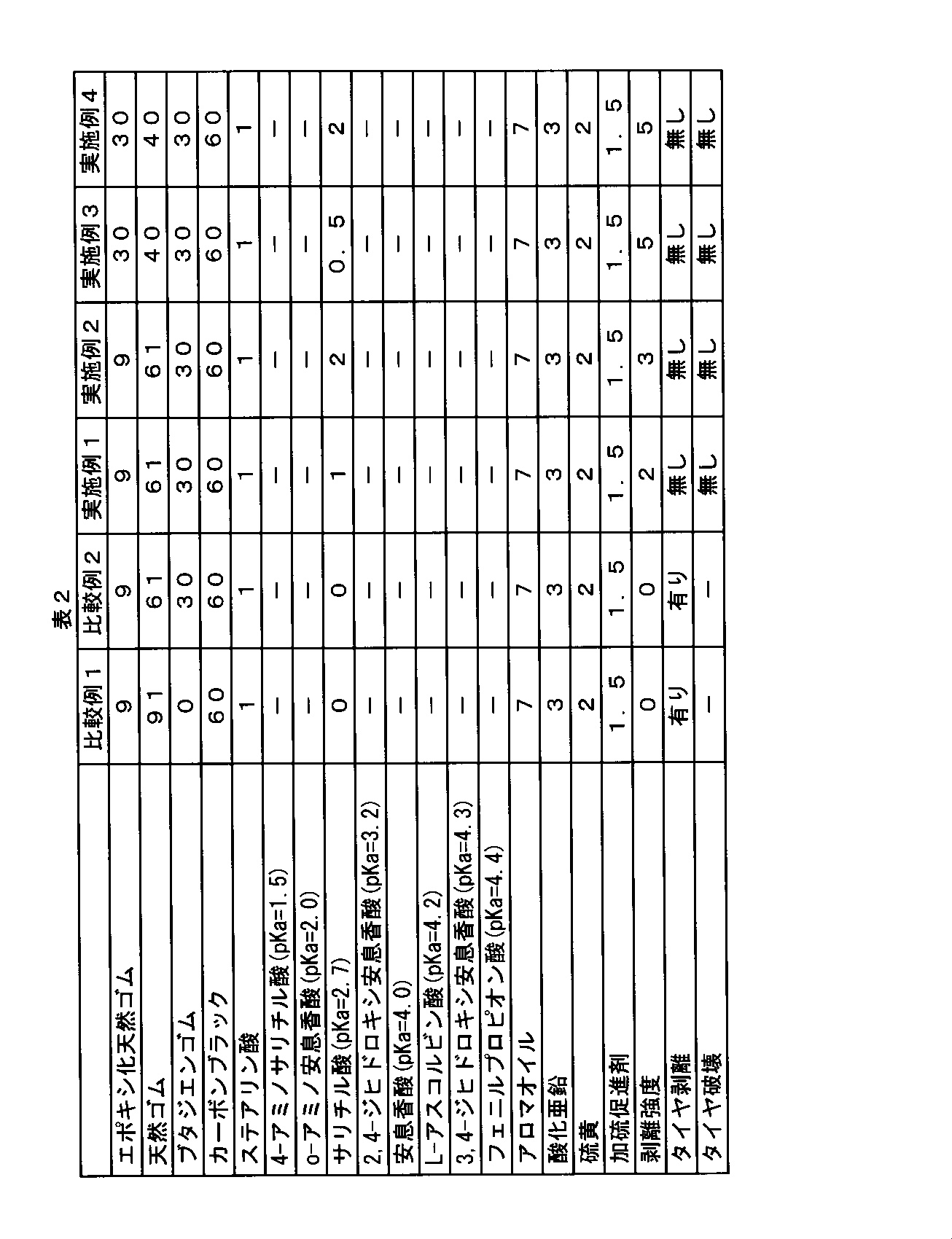
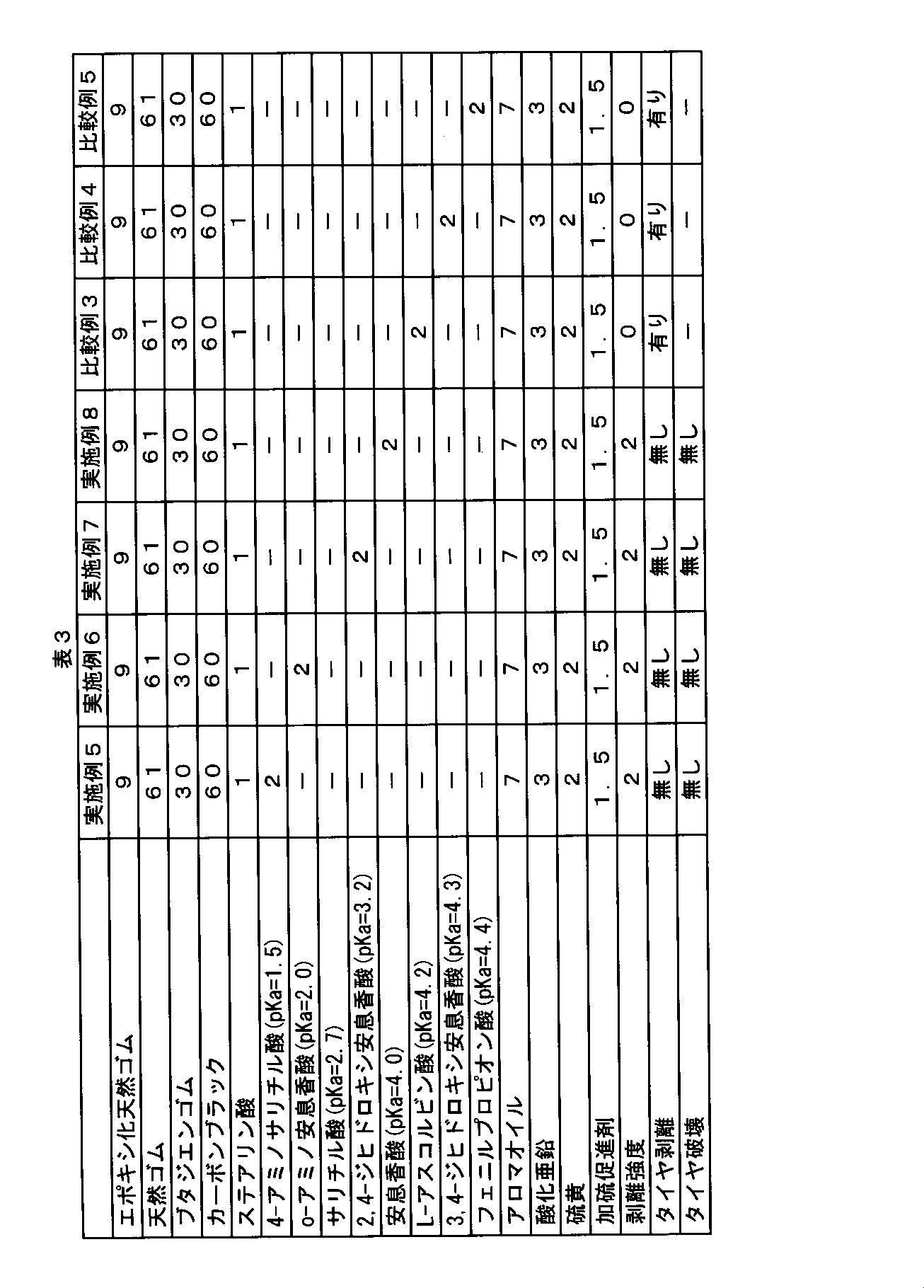
下記の原料を表2~表4に示す配合比率(質量部)でバンバリーミキサーにより配合し、実施例1~8および比較例1~5のゴム組成物を調製した。
[ゴム組成物の原料]
エポキシ化天然ゴム: Kumpulan Guthrie Beshad社製「ENR-50」、エポキシ化度=50モル%
天然ゴム: 「SIR-20」
ブタジエンゴム: 日本ゼオン株式会社製「BR1220」
カーボンブラック: 東海カーボン株式会社製「シーストV」
ステアリン酸: 千葉脂肪酸株式会社製工業用ステアリン酸
アロマオイル: 昭和シェル石油株式会社製「デソレックス3号」
酸化亜鉛: 正同化学工業株式会社製「亜鉛華3号」
硫黄: 株式会社軽井沢精錬所製5%油展処理硫黄
加硫促進剤: 大内新興化学工業株式会社製ジ-2-ベンゾチアゾリルスジルフィド「ノクセラーDM」
下記の原料を表2~表4に示す配合比率(質量部)でバンバリーミキサーにより配合し、実施例1~8および比較例1~5のゴム組成物を調製した。
[ゴム組成物の原料]
エポキシ化天然ゴム: Kumpulan Guthrie Beshad社製「ENR-50」、エポキシ化度=50モル%
天然ゴム: 「SIR-20」
ブタジエンゴム: 日本ゼオン株式会社製「BR1220」
カーボンブラック: 東海カーボン株式会社製「シーストV」
ステアリン酸: 千葉脂肪酸株式会社製工業用ステアリン酸
アロマオイル: 昭和シェル石油株式会社製「デソレックス3号」
酸化亜鉛: 正同化学工業株式会社製「亜鉛華3号」
硫黄: 株式会社軽井沢精錬所製5%油展処理硫黄
加硫促進剤: 大内新興化学工業株式会社製ジ-2-ベンゾチアゾリルスジルフィド「ノクセラーDM」
(3)積層体の作製
上記(1)で作製したフィルムの上に、上記(2)で調製したゴム組成物を0.7mmの厚さで押出積層し、積層体を作製した。
上記(1)で作製したフィルムの上に、上記(2)で調製したゴム組成物を0.7mmの厚さで押出積層し、積層体を作製した。
(4)積層体の評価
作製した積層体について、剥離強度、タイヤ剥離、およびタイヤ破壊を評価した。評価結果を表2~表4に示す。なお、各評価項目の評価方法は次のとおりである。
作製した積層体について、剥離強度、タイヤ剥離、およびタイヤ破壊を評価した。評価結果を表2~表4に示す。なお、各評価項目の評価方法は次のとおりである。
[剥離強度]
積層体の試料を、加硫後、幅25mmに切断し、その短冊状試験片の剥離強度をJIS-K6256に従い測定した。測定された剥離強度(N/25mm)を次の基準で指数化した。指数0以外はすべて良好の範囲である。
指数 剥離強度(N/25mm)
0 0以上20未満
1 20以上25未満
2 25以上50未満
3 50以上75未満
4 75以上100未満
5 100以上200未満
6 200以上
積層体の試料を、加硫後、幅25mmに切断し、その短冊状試験片の剥離強度をJIS-K6256に従い測定した。測定された剥離強度(N/25mm)を次の基準で指数化した。指数0以外はすべて良好の範囲である。
指数 剥離強度(N/25mm)
0 0以上20未満
1 20以上25未満
2 25以上50未満
3 50以上75未満
4 75以上100未満
5 100以上200未満
6 200以上
[タイヤ剥離]
積層体をインナーライナー材として用いて、定法により、195/65R15サイズのタイヤを作製し、そのタイヤをリム15×6JJ、内圧200kPaとして、排気量1800ccのFF乗用車に装着し、市街地を30,000km走行した。その後、タイヤをリムから外し内面観察を行い、インナーライナー材として用いた積層体の剥離故障の有無を確認した。剥離がなかった場合を「無し」で、剥離があった場合を「有り」で表す。
積層体をインナーライナー材として用いて、定法により、195/65R15サイズのタイヤを作製し、そのタイヤをリム15×6JJ、内圧200kPaとして、排気量1800ccのFF乗用車に装着し、市街地を30,000km走行した。その後、タイヤをリムから外し内面観察を行い、インナーライナー材として用いた積層体の剥離故障の有無を確認した。剥離がなかった場合を「無し」で、剥離があった場合を「有り」で表す。
[タイヤ破壊]
積層体をインナーライナー材として用いて、定法により、195/65R15サイズのタイヤを作製し、そのタイヤをリム15×6JJ、内圧200kPaとして、排気量1800ccのFF乗用車に装着し、市街地を30,000km走行した。その後、タイヤをリムから外し内面観察を行い、インナーライナー材として用いた積層体のクラック、亀裂の有無を目視にて確認した。外観異常がなかった場合を「無し」で、外観異常があった場合を「有り」で表す。なお、符号「-」は、上記「タイヤ剥離」試験において、剥離が確認された場合に、この試験は行わなかったことを表す。
積層体をインナーライナー材として用いて、定法により、195/65R15サイズのタイヤを作製し、そのタイヤをリム15×6JJ、内圧200kPaとして、排気量1800ccのFF乗用車に装着し、市街地を30,000km走行した。その後、タイヤをリムから外し内面観察を行い、インナーライナー材として用いた積層体のクラック、亀裂の有無を目視にて確認した。外観異常がなかった場合を「無し」で、外観異常があった場合を「有り」で表す。なお、符号「-」は、上記「タイヤ剥離」試験において、剥離が確認された場合に、この試験は行わなかったことを表す。
本発明の積層体は、空気入りタイヤの製造に好適に利用することができる。本発明の空気入りタイヤは、自動車用タイヤとして好適に利用することができる。
Claims (7)
- 熱可塑性樹脂または熱可塑性エラストマー組成物のフィルムとゴム組成物の層との積層体であって、ゴム組成物に含まれるゴム成分のうち5~60質量%がエポキシ化天然ゴムであり、20~50質量%がブタジエンゴムであり、ゴム組成物がゴム成分100質量部に対しpKaが1.5~4.0の非置換または置換芳香族カルボン酸を0.5~5質量部含むことを特徴とする積層体。
- 非置換または置換芳香族カルボン酸が、サリチル酸、4-アミノサリチル酸、安息香酸、o-アミノ安息香酸および2,4-ジヒドロキシ安息香酸から選ばれた少なくとも1種であることを特徴とする請求項1に記載の積層体。
- 前記エポキシ化天然ゴムが10~75モル%のエポキシ化度を有することを特徴とする請求項1または2に記載の組成物。
- 熱可塑性樹脂が、ポリビニルアルコール、エチレン-ビニルアルコール共重合体、ナイロン6、ナイロン66、ナイロン11、ナイロン12、ナイロン610、ナイロン612、ナイロン6/66、ナイロンMXD6およびナイロン6Tからなる群から選ばれた少なくとも1種であることを特徴とする請求項1~3のいずれか1項に記載の積層体。
- 熱可塑性エラストマー組成物が熱可塑性樹脂成分にエラストマー成分を分散させた組成物であり、熱可塑性樹脂成分がポリビニルアルコール、エチレン-ビニルアルコール共重合体、ナイロン6、ナイロン66、ナイロン11、ナイロン12、ナイロン610、ナイロン612、ナイロン6/66、ナイロンMXD6およびナイロン6Tからなる群から選ばれた少なくとも1種であり、エラストマー成分が臭素化イソブチレン-p-メチルスチレン共重合体、無水マレイン酸変性エチレン-α-オレフィン共重合体、エチレン-グリシジルメタクリレート共重合体および無水マレイン酸変性エチレン-エチルアクリレート共重合体からなる群から選ばれた少なくとも1種であることを特徴とする請求項1~3のいずれか1項に記載の積層体。
- 請求項1~5のいずれか1項に記載の積層体からなる空気入りタイヤ用インナーライナー材。
- 請求項1~6のいずれか1項に記載の積層体をインナーライナー材として用いた空気入りタイヤ。
Priority Applications (3)
| Application Number | Priority Date | Filing Date | Title |
|---|---|---|---|
| EP14806973.5A EP3006206B1 (en) | 2013-06-03 | 2014-06-03 | Laminate, inner liner material and pneumatic tire |
| CN201480031638.XA CN105263707B (zh) | 2013-06-03 | 2014-06-03 | 层叠体、内衬材料及充气轮胎 |
| US14/893,272 US10183530B2 (en) | 2013-06-03 | 2014-06-03 | Laminate, inner liner material and pneumatic tire |
Applications Claiming Priority (2)
| Application Number | Priority Date | Filing Date | Title |
|---|---|---|---|
| JP2013116841A JP6136592B2 (ja) | 2013-06-03 | 2013-06-03 | 積層体、インナーライナー材および空気入りタイヤ |
| JP2013-116841 | 2013-06-03 |
Publications (1)
| Publication Number | Publication Date |
|---|---|
| WO2014196533A1 true WO2014196533A1 (ja) | 2014-12-11 |
Family
ID=52008172
Family Applications (1)
| Application Number | Title | Priority Date | Filing Date |
|---|---|---|---|
| PCT/JP2014/064748 Ceased WO2014196533A1 (ja) | 2013-06-03 | 2014-06-03 | 積層体、インナーライナー材および空気入りタイヤ |
Country Status (5)
| Country | Link |
|---|---|
| US (1) | US10183530B2 (ja) |
| EP (1) | EP3006206B1 (ja) |
| JP (1) | JP6136592B2 (ja) |
| CN (1) | CN105263707B (ja) |
| WO (1) | WO2014196533A1 (ja) |
Cited By (1)
| Publication number | Priority date | Publication date | Assignee | Title |
|---|---|---|---|---|
| CN111511579A (zh) * | 2017-12-21 | 2020-08-07 | 米其林集团总公司 | 用二酸交联并且包含酚化合物的橡胶组合物 |
Families Citing this family (9)
| Publication number | Priority date | Publication date | Assignee | Title |
|---|---|---|---|---|
| JP6561518B2 (ja) * | 2015-03-20 | 2019-08-21 | 横浜ゴム株式会社 | タイヤ用積層体、タイヤ用インナーライナー材及び空気入りタイヤ |
| JP6604065B2 (ja) * | 2015-07-17 | 2019-11-13 | 横浜ゴム株式会社 | 熱可塑性樹脂フィルムとゴムの積層体、インナーライナー材および空気入りタイヤ |
| EP3181598A1 (en) * | 2015-12-17 | 2017-06-21 | Lanxess Inc. | Butyl rubber containing allylic alcohol |
| EP3181595A1 (en) | 2015-12-17 | 2017-06-21 | Lanxess Inc. | Treatment of epoxidized unsaturated isoolefin copolymers |
| FR3056442A1 (fr) * | 2016-09-27 | 2018-03-30 | Compagnie Generale Des Etablissements Michelin | Produit stratifie a base de caoutchouc silicone et de composite fibre-resine |
| JP2019077072A (ja) * | 2017-10-23 | 2019-05-23 | 横浜ゴム株式会社 | 空気入りタイヤ用の積層体、インナーライナー材及び空気入りタイヤの製造方法 |
| JP7275136B2 (ja) * | 2017-12-21 | 2023-05-17 | コンパニー ゼネラール デ エタブリッスマン ミシュラン | フェノール化合物を含む二酸架橋ゴム組成物 |
| FR3089988A3 (fr) * | 2018-12-17 | 2020-06-19 | Michelin & Cie | Composition de caoutchouc à base d’au moins un élastomère fonctionnalisé comprenant des groupes fonctionnels polaires et un composé phénolique spécifique |
| CN112409951B (zh) * | 2020-11-24 | 2022-06-07 | 上海都昱新材料科技有限公司 | 一种耐老化橡胶型压敏胶及其制备方法 |
Citations (4)
| Publication number | Priority date | Publication date | Assignee | Title |
|---|---|---|---|---|
| JP2000230054A (ja) * | 1998-12-07 | 2000-08-22 | Nichias Corp | ポリマー組成物及びポリマー材料 |
| JP2009528178A (ja) | 2005-10-27 | 2009-08-06 | 横浜ゴム株式会社 | タイ層を含む構造体 |
| JP2011255645A (ja) * | 2010-06-11 | 2011-12-22 | Yokohama Rubber Co Ltd:The | 積層体 |
| JP2012082323A (ja) * | 2010-10-12 | 2012-04-26 | Yokohama Rubber Co Ltd:The | タイヤ用ゴム組成物およびそれを用いた空気入りタイヤ |
Family Cites Families (11)
| Publication number | Priority date | Publication date | Assignee | Title |
|---|---|---|---|---|
| KR100272125B1 (ko) | 1996-05-29 | 2000-11-15 | 하기와라 세이지 | 저투과성 열가소성 엘라스토머 조성물을 기체 투과 방지층에 사용하는 공기 주입 타이어 및 이에 사용하는 열가소성 엘라스토머 조성물 |
| JP2002371156A (ja) * | 2001-04-10 | 2002-12-26 | Yokohama Rubber Co Ltd:The | ゴム組成物 |
| US7414087B2 (en) * | 2003-08-20 | 2008-08-19 | Sumitomo Rubber Industries, Ltd. | Rubber composition and pneumatic tire using the same |
| WO2006121140A1 (ja) * | 2005-05-09 | 2006-11-16 | The Yokohama Rubber Co., Ltd. | 積層体及びそれを用いた空気入りタイヤ |
| EP1940617B1 (en) | 2005-10-27 | 2014-03-26 | The Yokohama Rubber Co., Ltd. | Construction comprising tie layer |
| WO2007100021A1 (ja) * | 2006-02-23 | 2007-09-07 | The Yokohama Rubber Co., Ltd. | 積層体及びそれを用いた空気入りタイヤ |
| US8960250B2 (en) * | 2006-10-26 | 2015-02-24 | The Yokohama Rubber Co., Ltd. | Low moisture permeability laminate construction |
| WO2009022564A1 (ja) * | 2007-08-10 | 2009-02-19 | Sumitomo Rubber Industries, Ltd. | 空気入りタイヤ |
| JP5654409B2 (ja) * | 2011-04-22 | 2015-01-14 | 住友ゴム工業株式会社 | タイヤ用ゴム組成物及び空気入りタイヤ |
| EP2716447A4 (en) * | 2011-05-31 | 2014-10-22 | Bridgestone Corp | LAMINATE, TIRES AND MANUFACTURING METHOD THEREFOR |
| WO2014097994A1 (ja) * | 2012-12-17 | 2014-06-26 | 横浜ゴム株式会社 | 積層体、タイヤ用インナーライナー及び空気入りタイヤ |
-
2013
- 2013-06-03 JP JP2013116841A patent/JP6136592B2/ja not_active Expired - Fee Related
-
2014
- 2014-06-03 WO PCT/JP2014/064748 patent/WO2014196533A1/ja not_active Ceased
- 2014-06-03 EP EP14806973.5A patent/EP3006206B1/en active Active
- 2014-06-03 CN CN201480031638.XA patent/CN105263707B/zh not_active Expired - Fee Related
- 2014-06-03 US US14/893,272 patent/US10183530B2/en active Active
Patent Citations (4)
| Publication number | Priority date | Publication date | Assignee | Title |
|---|---|---|---|---|
| JP2000230054A (ja) * | 1998-12-07 | 2000-08-22 | Nichias Corp | ポリマー組成物及びポリマー材料 |
| JP2009528178A (ja) | 2005-10-27 | 2009-08-06 | 横浜ゴム株式会社 | タイ層を含む構造体 |
| JP2011255645A (ja) * | 2010-06-11 | 2011-12-22 | Yokohama Rubber Co Ltd:The | 積層体 |
| JP2012082323A (ja) * | 2010-10-12 | 2012-04-26 | Yokohama Rubber Co Ltd:The | タイヤ用ゴム組成物およびそれを用いた空気入りタイヤ |
Cited By (2)
| Publication number | Priority date | Publication date | Assignee | Title |
|---|---|---|---|---|
| CN111511579A (zh) * | 2017-12-21 | 2020-08-07 | 米其林集团总公司 | 用二酸交联并且包含酚化合物的橡胶组合物 |
| CN111511579B (zh) * | 2017-12-21 | 2022-05-24 | 米其林集团总公司 | 用二酸交联并且包含酚化合物的橡胶组合物 |
Also Published As
| Publication number | Publication date |
|---|---|
| CN105263707A (zh) | 2016-01-20 |
| US20160121654A1 (en) | 2016-05-05 |
| EP3006206B1 (en) | 2019-12-25 |
| EP3006206A1 (en) | 2016-04-13 |
| US10183530B2 (en) | 2019-01-22 |
| JP2014233910A (ja) | 2014-12-15 |
| CN105263707B (zh) | 2017-05-24 |
| EP3006206A4 (en) | 2017-01-25 |
| JP6136592B2 (ja) | 2017-05-31 |
Similar Documents
| Publication | Publication Date | Title |
|---|---|---|
| JP6136592B2 (ja) | 積層体、インナーライナー材および空気入りタイヤ | |
| JP6136626B2 (ja) | 積層体、インナーライナー材および空気入りタイヤ | |
| EP2581237B1 (en) | Pneumatic tire and laminate | |
| CN105764685B (zh) | 膜与橡胶组合物的叠层体以及包含该叠层体的轮胎 | |
| JP6292118B2 (ja) | 積層体、タイヤ用インナーライナー及び空気入りタイヤ | |
| CN104411508B (zh) | 轮胎用叠层体 | |
| JP2012096785A (ja) | タイヤ層及びそれに接着されたdvaバリア層を有する空気入りタイヤ及びその製造法 | |
| JP5682211B2 (ja) | 空気入りタイヤ用インナーライナー | |
| EP3327082B1 (en) | Laminate of thermoplastic resin film and rubber, inner liner material, and pneumatic tire | |
| JP2019077072A (ja) | 空気入りタイヤ用の積層体、インナーライナー材及び空気入りタイヤの製造方法 | |
| JP5779874B2 (ja) | 空気入りタイヤ修理用ゴム組成物および修理方法 | |
| EP3327081B1 (en) | Laminate of thermoplastic resin film and rubber, inner liner material, and pneumatic tire | |
| US12496852B2 (en) | Laminate for tires |
Legal Events
| Date | Code | Title | Description |
|---|---|---|---|
| WWE | Wipo information: entry into national phase |
Ref document number: 201480031638.X Country of ref document: CN |
|
| 121 | Ep: the epo has been informed by wipo that ep was designated in this application |
Ref document number: 14806973 Country of ref document: EP Kind code of ref document: A1 |
|
| WWE | Wipo information: entry into national phase |
Ref document number: 14893272 Country of ref document: US |
|
| WWE | Wipo information: entry into national phase |
Ref document number: 2014806973 Country of ref document: EP |
|
| NENP | Non-entry into the national phase |
Ref country code: DE |