WO2014199492A1 - Composant de fermeture, fermeture à glissière, et procédé de fabrication de composant de fermeture - Google Patents
Composant de fermeture, fermeture à glissière, et procédé de fabrication de composant de fermeture Download PDFInfo
- Publication number
- WO2014199492A1 WO2014199492A1 PCT/JP2013/066368 JP2013066368W WO2014199492A1 WO 2014199492 A1 WO2014199492 A1 WO 2014199492A1 JP 2013066368 W JP2013066368 W JP 2013066368W WO 2014199492 A1 WO2014199492 A1 WO 2014199492A1
- Authority
- WO
- WIPO (PCT)
- Prior art keywords
- fastener
- color
- polyamide resin
- molded part
- dyed layer
- Prior art date
- Legal status (The legal status is an assumption and is not a legal conclusion. Google has not performed a legal analysis and makes no representation as to the accuracy of the status listed.)
- Ceased
Links
Images
Classifications
-
- B—PERFORMING OPERATIONS; TRANSPORTING
- B29—WORKING OF PLASTICS; WORKING OF SUBSTANCES IN A PLASTIC STATE IN GENERAL
- B29C—SHAPING OR JOINING OF PLASTICS; SHAPING OF MATERIAL IN A PLASTIC STATE, NOT OTHERWISE PROVIDED FOR; AFTER-TREATMENT OF THE SHAPED PRODUCTS, e.g. REPAIRING
- B29C45/00—Injection moulding, i.e. forcing the required volume of moulding material through a nozzle into a closed mould; Apparatus therefor
- B29C45/16—Making multilayered or multicoloured articles
-
- A—HUMAN NECESSITIES
- A44—HABERDASHERY; JEWELLERY
- A44B—BUTTONS, PINS, BUCKLES, SLIDE FASTENERS, OR THE LIKE
- A44B19/00—Slide fasteners
-
- A—HUMAN NECESSITIES
- A44—HABERDASHERY; JEWELLERY
- A44B—BUTTONS, PINS, BUCKLES, SLIDE FASTENERS, OR THE LIKE
- A44B19/00—Slide fasteners
- A44B19/24—Details
-
- A—HUMAN NECESSITIES
- A44—HABERDASHERY; JEWELLERY
- A44B—BUTTONS, PINS, BUCKLES, SLIDE FASTENERS, OR THE LIKE
- A44B19/00—Slide fasteners
- A44B19/42—Making by processes not fully provided for in one other class, e.g. B21D53/50, B21F45/18, B22D17/16, B29D5/00
-
- B—PERFORMING OPERATIONS; TRANSPORTING
- B29—WORKING OF PLASTICS; WORKING OF SUBSTANCES IN A PLASTIC STATE IN GENERAL
- B29C—SHAPING OR JOINING OF PLASTICS; SHAPING OF MATERIAL IN A PLASTIC STATE, NOT OTHERWISE PROVIDED FOR; AFTER-TREATMENT OF THE SHAPED PRODUCTS, e.g. REPAIRING
- B29C45/00—Injection moulding, i.e. forcing the required volume of moulding material through a nozzle into a closed mould; Apparatus therefor
- B29C45/0001—Injection moulding, i.e. forcing the required volume of moulding material through a nozzle into a closed mould; Apparatus therefor characterised by the choice of material
-
- B—PERFORMING OPERATIONS; TRANSPORTING
- B29—WORKING OF PLASTICS; WORKING OF SUBSTANCES IN A PLASTIC STATE IN GENERAL
- B29C—SHAPING OR JOINING OF PLASTICS; SHAPING OF MATERIAL IN A PLASTIC STATE, NOT OTHERWISE PROVIDED FOR; AFTER-TREATMENT OF THE SHAPED PRODUCTS, e.g. REPAIRING
- B29C45/00—Injection moulding, i.e. forcing the required volume of moulding material through a nozzle into a closed mould; Apparatus therefor
- B29C45/17—Component parts, details or accessories; Auxiliary operations
- B29C45/46—Means for plasticising or homogenising the moulding material or forcing it into the mould
- B29C45/47—Means for plasticising or homogenising the moulding material or forcing it into the mould using screws
-
- B—PERFORMING OPERATIONS; TRANSPORTING
- B29—WORKING OF PLASTICS; WORKING OF SUBSTANCES IN A PLASTIC STATE IN GENERAL
- B29D—PRODUCING PARTICULAR ARTICLES FROM PLASTICS OR FROM SUBSTANCES IN A PLASTIC STATE
- B29D5/00—Producing elements of slide fasteners; Combined making and attaching of elements of slide fasteners
-
- B—PERFORMING OPERATIONS; TRANSPORTING
- B29—WORKING OF PLASTICS; WORKING OF SUBSTANCES IN A PLASTIC STATE IN GENERAL
- B29K—INDEXING SCHEME ASSOCIATED WITH SUBCLASSES B29B, B29C OR B29D, RELATING TO MOULDING MATERIALS OR TO MATERIALS FOR MOULDS, REINFORCEMENTS, FILLERS OR PREFORMED PARTS, e.g. INSERTS
- B29K2077/00—Use of PA, i.e. polyamides, e.g. polyesteramides or derivatives thereof, as moulding material
-
- B—PERFORMING OPERATIONS; TRANSPORTING
- B29—WORKING OF PLASTICS; WORKING OF SUBSTANCES IN A PLASTIC STATE IN GENERAL
- B29K—INDEXING SCHEME ASSOCIATED WITH SUBCLASSES B29B, B29C OR B29D, RELATING TO MOULDING MATERIALS OR TO MATERIALS FOR MOULDS, REINFORCEMENTS, FILLERS OR PREFORMED PARTS, e.g. INSERTS
- B29K2105/00—Condition, form or state of moulded material or of the material to be shaped
- B29K2105/06—Condition, form or state of moulded material or of the material to be shaped containing reinforcements, fillers or inserts
- B29K2105/12—Condition, form or state of moulded material or of the material to be shaped containing reinforcements, fillers or inserts of short lengths, e.g. chopped filaments, staple fibres or bristles
-
- B—PERFORMING OPERATIONS; TRANSPORTING
- B29—WORKING OF PLASTICS; WORKING OF SUBSTANCES IN A PLASTIC STATE IN GENERAL
- B29K—INDEXING SCHEME ASSOCIATED WITH SUBCLASSES B29B, B29C OR B29D, RELATING TO MOULDING MATERIALS OR TO MATERIALS FOR MOULDS, REINFORCEMENTS, FILLERS OR PREFORMED PARTS, e.g. INSERTS
- B29K2309/00—Use of inorganic materials not provided for in groups B29K2303/00 - B29K2307/00, as reinforcement
- B29K2309/08—Glass
-
- B—PERFORMING OPERATIONS; TRANSPORTING
- B29—WORKING OF PLASTICS; WORKING OF SUBSTANCES IN A PLASTIC STATE IN GENERAL
- B29K—INDEXING SCHEME ASSOCIATED WITH SUBCLASSES B29B, B29C OR B29D, RELATING TO MOULDING MATERIALS OR TO MATERIALS FOR MOULDS, REINFORCEMENTS, FILLERS OR PREFORMED PARTS, e.g. INSERTS
- B29K2995/00—Properties of moulding materials, reinforcements, fillers, preformed parts or moulds
- B29K2995/0018—Properties of moulding materials, reinforcements, fillers, preformed parts or moulds having particular optical properties, e.g. fluorescent or phosphorescent
- B29K2995/002—Coloured
-
- B—PERFORMING OPERATIONS; TRANSPORTING
- B29—WORKING OF PLASTICS; WORKING OF SUBSTANCES IN A PLASTIC STATE IN GENERAL
- B29L—INDEXING SCHEME ASSOCIATED WITH SUBCLASS B29C, RELATING TO PARTICULAR ARTICLES
- B29L2005/00—Elements of slide fasteners
Definitions
- the present invention relates to a fastener part, a slide fastener, and a method for manufacturing a fastener part.
- the slide fastener is an opening / closing tool for articles that are used not only for daily necessities such as clothing, shoes, shoes and sundries, but also for industrial goods such as water tanks, fishing nets and space suits.
- the fastener parts such as elements, sliders, top and bottom stops, and openers are molded parts that are generally manufactured by injection molding if the element is a resin fastener. And / or it is known that polyamide resin can be produced as a material. And in order to improve the designability, these molded parts may be desired to be dyed in a desired color.
- Patent Document 1 when a slide fastener composed of a fabric and a resin part is dyed in the same bath, the fabric and the slide fastener are dyed so that the appearance is the same color.
- the invention which makes a subject is described.
- the publication discloses a resin composition comprising a component (A) and at least one component selected from the group consisting of (B), (C), (D), and (E), and having a sufficient surface.
- a slide fastener part characterized by a satin surface having a point average roughness of 7 to 200 ⁇ m.
- A Polyolefin polymer having a glass transition point of 0 ° C.
- polyester resin and / or less and polyester dispersed as a domain having an average dispersed particle size of 0.1 to 2 ⁇ m in a matrix comprising a polyester resin and / or a polyamide resin
- B (A) Polymer or acrylic polymer
- C At least one inorganic compound selected from the group consisting of titanium compounds, zinc compounds and silicon compounds
- D From the group consisting of glass fibers, acicular wollastonite and aramid fibers
- the effect of pear texture is evaluated by the difference in gloss and brightness between the mirror surface and pear ground, and it is described that pear texture processing with a lightness difference of 10 or less, preferably 8 or less, is used. Yes.
- the ten-point average roughness of the surface is preferably 7 to 200 ⁇ m, particularly 10 to 150 ⁇ m.
- the result of the same bath dyeing of the polyester molded article and the fabric processed with the satin finish is shown, and the molded article whose surface has a predetermined 10-point average roughness is the fabric when the same bath dyeing is performed with the fabric. It is described that the colors are close to each other.
- Patent Document 1 the main focus is on controlling the color tone when the resin molded product and the fabric are dyed in the same bath, and the strength required for the fastener, the production efficiency and the color reproducibility at the time of dyeing, There is a lack of consideration for achieving both.
- the present invention was created in view of the above circumstances, and provides a fastener part, a slide fastener, and a method for manufacturing a fastener part that can be dyed with a small amount of dye while maintaining high strength and that have excellent color reproducibility. Is an issue.
- a polyamide resin containing reinforcing fibers is used as a material for fastener parts. It was found that it is effective to use and form a dyed layer having a predetermined thickness on the surface.
- the present invention has been completed on the basis of the above knowledge.
- the present invention includes a molded part formed of a polyamide resin composition containing reinforcing fibers, and is dyed inward from the surface of the molded part.
- This is a fastener part in which the layers are arranged and the thickness of the dyed layer is 30 to 100 ⁇ m.
- each L * a * b * value when the color of the central portion of the cross section of the molded part is evaluated according to JIS Z 8729: 2004 (color display method) is in the following range. : 80 ⁇ L * ⁇ 95, ⁇ 5 ⁇ a * ⁇ 5, 0 ⁇ b * ⁇ 10 Meet.
- the average of the color difference ( ⁇ E * ab) at each measurement point with respect to the average value of the ten points is calculated. 1.0 or less.
- the polyamide resin composition contains an aliphatic polyamide, and the reinforcing fibers are glass fibers.
- a polyamide resin having a melting point of 210 ° C. or higher and 310 ° C. and a pigment having a Mohs hardness of 4 or less and a refractive index of 2 or more are added. .5% by mass or more and less than 5% by mass.
- the present invention is a slide fastener provided with the above fastener component.
- a molded part is produced using a polyamide resin composition containing reinforcing fibers, and (b) a thickness of 30 to 100 ⁇ m from the surface of the molded part toward the inside. It is a manufacturing method of a fastener part including forming a dyeing layer.
- each color L * when the color of the central portion of the cross section of the molded part is evaluated according to JIS Z 8729: 2004 (color display method) .
- a * b * value is in the following range: 80 ⁇ L * ⁇ 95, ⁇ 5 ⁇ a * ⁇ 5, 0 ⁇ b * ⁇ 10 Adjusting the color of the molded part to satisfy.
- the step (a) includes containing 20 to 70% by mass of a reinforcing fiber.
- a fastener part a slide fastener, and a method for manufacturing a fastener part that can be dyed with a small amount of dye while maintaining high strength and that has excellent color reproducibility.
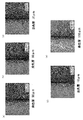
- FIG. 2A shows a case where the polyamide resin does not contain a reinforced resin
- FIG. 2B shows a case where the polyamide resin contains 20% by mass of a reinforced resin
- FIG. 2C shows a case where the polyamide resin contains a reinforced resin.
- FIG. 2 (d) shows the dyeing when the polyamide resin contains 60% by mass of the reinforced resin
- FIG. 2 (e) shows the dyeing when the polybutylene terephthalate resin contains 30% by mass of the reinforced resin. It is a photograph which shows the formation state of a layer.
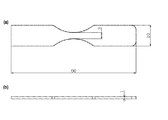
- FIG.3 (a) is a top view explaining the shape of the test piece (dumbbell piece) used in order to evaluate the mechanical characteristic of the fastener component which concerns on embodiment of this invention
- FIG. 4 is a side view for explaining the thickness of the test piece of FIG.
- a fastener part according to an embodiment of the present invention includes a molded part formed of a polyamide resin composition containing reinforcing fibers, and includes a dyed layer dyed inward from the surface of the molded part.
- the strength reduction after dyeing can be reduced and the thickness of the dyeing layer can be reduced compared to conventional fastener parts materials such as polyester. it can. Further, since the dyeing layer can be made thin, the amount of dye necessary for dyeing can be reduced and the dyeing work can be completed in a short time, so that the dyeing work can be made more efficient.
- polyamide resin there are no particular restrictions on the polyamide resin that can be used, but polyamides have different melting points depending on the molecular structure. The higher the melting point, the higher the molding temperature and the more easily yellowing occurs. Therefore, it is preferable to use a polyamide resin having a melting point of less than 310 ° C, more preferably a polyamide resin having a melting point of 305 ° C or less, and even more preferably a polyamide resin having a melting point of 300 ° C or less.
- the low melting point polyamide resin has a reduced number of amide bonds per unit molecular structure and tends to be reduced in strength and rigidity due to a flexible chain, so use a polyamide resin having a melting point of 210 ° C. or higher. It is preferable to use a polyamide resin having a melting point of 240 ° C. or higher, and it is even more preferable to use a polyamide resin having a melting point of 250 ° C. or higher.
- the melting point of the polyamide resin is the endothermic peak top temperature when the endothermic amount is measured by DSC (differential scanning calorimeter).
- DSC differential scanning calorimeter
- the endothermic peak top temperature on the highest temperature side is defined as the melting point.
- Polyamide resin is obtained by copolycondensation of diamine and dicarboxylic acid, polycondensation of ⁇ -amino acid, ring-opening polymerization of lactams, and the like.
- diamine include linear or branched fatty acids such as ethylenediamine, propylenediamine, butylenediamine, hexamethylenediamine, 2-methylpropanediamine, 3-methylpropanediamine, octamethylenediamine, decanediamine, and dodecanediamine.
- Aromatic diamine metaxylylenediamine, paraxylylenediamine, aromatic diamine such as metaphenylenediamine and paraphenylenediamine, isophoronediamine, 2-aminomethylpiperidine, 4-aminomethylpiperidine, 4,4'-diaminodicyclohexylene Methane, 4,4'-diamino-3,3'-dimethyldicyclohexylenemethane, 1,3-di (4-piperidyl) -propane, 1,2-diaminocyclohexane, 1,3-diaminocyclohexane 1,4-diaminocyclohexane, N-aminopropylpiperazine, 4,4′-diaminodicyclohexylenepropane, 1,2-bis (aminomethyl) cyclohexane, 1,3-bis (aminomethyl) cyclohexane and 1,4- And alicyclic diamine
- dicarboxylic acid examples include succinic acid, propanedioic acid, butanedioic acid, pentanedioic acid, adipic acid, heptanedioic acid, octanedioic acid, nonanedioic acid, decanedioic acid, dodecanedioic acid, undecanedioic acid, dimer Linear or branched aliphatic dicarboxylic acids such as acids and hydrogenated dimer acids, phthalic acid, terephthalic acid, isophthalic acid, naphthalenedicarboxylic acid, 2-chloroterephthalic acid, 2-methylterephthalic acid, 5-methylisophthalic acid Acids, and aromatic dicarboxylic acids such as 5-sodium sulfoisophthalic acid and 1,5-naphthalenedicarboxylic acid, 1,4-cyclohexanedicarboxylic acid, 1,2-cyclohexane
- Examples of ⁇ -amino acids include 6-aminohexanoic acid, 11-aminoundecanoic acid, 12-aminododecanoic acid, 4-piperidinecarboxylic acid, 3-piperidinecarboxylic acid, and 2-piperidinecarboxylic acid.
- Examples of the lactam include ⁇ -caprolactam, undecane lactam, and lauryl lactam.
- polyamides include polycaproamide (nylon 6), polydodecanamide (nylon 12), polytetramethylene adipamide (nylon 46), polyhexamethylene adipamide (nylon 66), polyundecamethylene azide Pamide (nylon 116), polymetaxylylene adipamide (nylon MXD6), polyparaxylylene adipamide (nylon PXD6), polytetramethylene sebacamide (nylon 410), polyhexamethylene sebacamide (nylon 610) ), Polydecamethylene adipamide (nylon 106), polydecamethylene sebamide (nylon 1010), polyhexamethylene dodecamide (nylon 612), polydecamethylene dodecamide (nylon 1012), polyhexamethylene isophthalamide ( Nai 6I), polyhexamethylene terephthalamide (nylon 6T), polybis (3-methyl-4-aminohexyl) methane terephthalamide (nylon PACMT),
- a copolymer obtained by any combination of repeating units of polyamide can also be used.
- polyamide copolymers include caprolactam / hexamethylene adipamide copolymer (nylon 6/6, 6), hexamethylene adipamide / caprolactam copolymer (nylon 6, 6/6). ), Hexamethylene adipamide / hexamethylene-azelainamide copolymer (nylon 6, 6/6, 9) and the like.
- the strength of fastener parts is improved by including reinforcing fibers in the polyamide resin composition.
- Polyamide can be treated with a silane coupling agent, titanate coupling agent, or aluminate coupling agent, etc., so that the affinity for reinforcing fibers can be improved compared to conventional resins such as polyester. Even if it is added in a large amount, it is possible to increase the strength and rigidity without impairing the strength.
- the higher the concentration of the reinforcing fiber in the polyamide resin composition the higher the strength can be obtained.
- the concentration of the reinforcing fiber is preferably 20% by mass or more, and more preferably 30% by mass or more in order to give a predetermined strength as a fastener part after dyeing.
- the concentration of the reinforcing fiber in the polyamide resin composition is preferably 70% by mass or less.
- the reinforcing fiber used in the present invention is not limited.
- organic fibers such as carbon fiber and aramid fiber
- glass fiber e.g, glass fiber, acicular wollastonite, whisker (eg, calcium titanate whisker, calcium carbonate).
- whisker eg, calcium titanate whisker, calcium carbonate
- Inorganic fibers such as whiskers and aluminum borate whiskers
- the average fiber diameter of the reinforced resin before being compounded with the resin is preferably about 3 to 20 ⁇ m, more preferably about 5 to 12 ⁇ m.
- the average fiber length of the reinforced resin before compounding with the resin is preferably about 1 mm to 10 mm, and more preferably about 3 mm to 6 mm.
- the fiber diameter refers to the diameter when the cross-sectional area of the reinforcing fiber is obtained and the cross-sectional area is calculated as a perfect circle.
- the average fiber length of the reinforcing fibers is generally 1/10 to 1/20, for example, 0.1 to 1 mm, typically 0.1 to 0.5 mm.
- Polyamide resins generally have low color reproducibility because they are easily yellowed, but color reproducibility can be improved by adding pigments.
- color reproducibility is ensured while keeping the pigment content low by using a pigment having a high whiteness refractive index of 2 or more, preferably 2.5 or more.
- the hardness of the pigment is high, the reinforcing fibers are easily broken at the time of compounding, which adversely affects the strength of the molded product.
- a pigment having a Mohs hardness of 4 or less preferably 3.5 or less.
- pigments that satisfy such conditions include zinc sulfide and antimony oxide, and zinc sulfide is preferred from the viewpoint of safety.
- the content of the pigment in the polyamide resin composition is preferably 0.5% by mass or more, and more preferably 1.0% by mass or more from the viewpoint of color reproducibility.
- the content of the pigment in the polyamide resin composition is preferably less than 5.0% by mass, and more preferably 4.5% by mass or less from the viewpoint of dark color dyeability. If there are too many pigments, it will be difficult to develop the color of the dyed layer.
- the pigment is generally granular or powdery, but if it is too large, the hiding power is lowered and the whiteness per added amount is lowered, so that the median diameter is preferably 5.0 ⁇ m or less, and is 3.0 ⁇ m or less. Is more preferable. On the other hand, if the pigment is too small, it causes aggregation due to van der Waals force. Therefore, the median diameter is preferably 0.1 ⁇ m or more, and more preferably 0.2 ⁇ m or more. The median diameter of the pigment is measured by a laser diffraction method in accordance with JIS 8825-1: 2001.
- conventional additives such as heat resistance stabilizers, weather resistance agents, hydrolysis resistance agents, and other pigments may be added to the polyamide resin composition so that the total amount is, for example, 10.0% by mass or less.
- other pigments it is desirable that the above-mentioned pigment having the predetermined Mohs hardness and refractive index occupy 90% by mass or more, preferably 95% by mass, and more preferably 100% by mass of the entire pigment. .
- the molded part formed of the polyamide resin composition constituting the fastener part according to the embodiment of the present invention has each L * a * b * value when evaluated according to JIS Z 8729: 2004 (color display method).
- the color of the molded part is adjusted to satisfy the above.
- the color of the molded part can be based on the color at the center of the cross section. In the molded part before dyeing, there is almost no color difference between the surface and the central part, so the color of the surface of the molded part may be used as a reference.
- the molded part is cut vertically and measured according to JIS Z 8729: 2004 (color display method) with respect to the central part of the cross section.
- the lightness (L * ) of the color at the center of the cross section of the molded part is more preferably 85 ⁇ L * ⁇ 95, and more preferably 88 ⁇ L * ⁇ 95. .
- the chromaticity (a * ) at the center of the cross section of the molded part is more preferably ⁇ 3 ⁇ a * ⁇ 3, and further preferably ⁇ 2 ⁇ a * ⁇ 1.
- the chromaticity (b * ) at the center of the cross section of the molded part is more preferably 0 ⁇ b * ⁇ 9, and more preferably 2 ⁇ b * ⁇ 8.
- the color of the molded part in the above range, even when the dyed layer is a thin layer of, for example, 100 ⁇ m or less, it becomes difficult for the dyed layer to be affected by the discoloration of the base color due to the polyamide resin or glass fiber containing,
- the desired color can be dyed with a small amount of dye.
- the L * a * b * value on the surface of the molded part may be adjusted to be within the above range.
- the thickness of the dyed layer formed from the surface of the molded part to the inside decreases, the decrease in strength of the molded part due to dyeing can be suppressed and the dyeing operation can be performed in a shorter time, so both strength and productivity are achieved. Preferred above.
- the dyed layer is too thin, color reproducibility may not be sufficiently obtained.
- the dyed layer is formed too thick, the amount of dye required for dyeing increases and the time required for dyeing increases, resulting in poor productivity.
- the dyed layer is formed too thick color unevenness may occur in the surface of the dyed layer, and the leveling of the dyed layer surface may be reduced.
- the thickness of the dyed layer is preferably at least about 30 ⁇ m, more preferably at least about 40 ⁇ m.
- the thickness of a dyeing layer it is preferable to set it as 100 micrometers or less, More preferably, it is 90 micrometers or less.
- the most convenient method for measuring the thickness of the dyed layer is to cut the dyed molded part vertically and observe the cross section with a microscope or the like.
- the thickness of the dyed layer is obtained by comparing the color tone inherent to the molded part (for example, the color of the central part of the cross section of the molded part) with the color tone of the surface central part of the dyed layer of the molded part.
- the definition of the thickness of the dyed layer in the molded product is as follows. Using a microtome (manufactured by Leika, manual rotating microtome: RM2125RT), the surface layer was ground by 1 ⁇ m from the state where the grinding blade was applied to the surface of the molded product, and the color of the base material (in this embodiment, 80 ⁇ L * ⁇ 95, ⁇ The amount of grinding when grinding until the numerical values of 5 ⁇ a * ⁇ 5, 0 ⁇ b * ⁇ 10) are made the dyeing thickness.
- the chemical quantification method of the stained layer can be evaluated by using C-NMR (Fourier transform nuclear magnetic resonance apparatus: JNM-EX400 manufactured by JEOL).
- C-NMR Full transform nuclear magnetic resonance apparatus: JNM-EX400 manufactured by JEOL.
- EPMA electron probe microanalyzer: EPMA1610 manufactured by Shimadzu Corporation
- sulfur of a sulfonate that is a soluble component of an acid dye can be specified and identified as a dyed layer.
- the dye is not limited, but a metal-containing dye, an acid dye, a selenium dye, and a disperse dye are suitable. Among them, an acid dye can be particularly suitably used because of good dyeability and fastness.
- the color of the entire surface of the molded part is uniformly dyed.
- the average color difference of each measurement point from the average value of 10 points is 1. 0 or less, more preferably 0.9 or less, and still more preferably 0.8 or less.
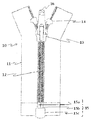
- the fastener component according to the present invention can be applied to each component of the slide fastener 10 illustrated in FIG.
- the slide fastener 10 controls the opening and closing of a fastener by engaging and separating a pair of long tapes 11, a plurality of elements 12 that are meshing portions of fasteners sewn along one side edge of each tape, and the elements 12.
- the slider 13 is mainly composed of three parts.
- an upper stopper 14 and an opening tool 15 can be further provided, and a handle 16 can be attached to the surface of the slider 13.
- the opening tool 15 can be composed of a box 15c with a butterfly stick 15a and a box stick 15b. While the slider 13 moves to the opening 15 provided at the lower part of the long tape 11, the engagement of the element 12 is released, the butterfly bar 15a is extracted from the box 15c, and each tape 11 is separated.
- At least one of these slide fastener molded parts can be produced using the resin composition according to the present embodiment.
- the resin composition according to the present invention is suitably used as a material for sliders and pullers. it can.
- various slide fasteners provided with the fastener parts can be manufactured.
- the kind of element which is a meshing part of a slide fastener is not specifically limited, For example, a coil fastener, an extrusion fastener, an injection fastener etc. are mentioned. (Production method)
- polyamide, reinforcing fibers, pigments, and the like which are components of the resin composition, are sufficiently kneaded so that there is no bias in the components.
- a single screw extruder, a twin screw extruder, a kneader or the like can be used for the kneading.
- a molded part is completed by injection-molding the kneaded resin composition using a mold having a predetermined shape.
- the cylinder temperature is preferably set in the range of 280 to 320 ° C. from the viewpoint of ensuring high productivity without deterioration, and the mold temperature is higher than usual, for example, 90 to 130. It is preferable to set it as ° C.
- the ten-point average roughness is adjusted so that the ten-point average roughness of the surface is 6 ⁇ m or less, more specifically 0.1 to 6 ⁇ m. Also good.
- the ten-point average roughness is measured using a non-contact type surface roughness measuring machine using a laser microscope. Thereafter, a dyed layer having a thickness of 30 to 100 ⁇ m is formed on the surface of the obtained molded part to complete various fastener parts.
- Nylon 66 polyhexamethylene adipamide having a melting point of 265 ° C. was used as the polyamide resin (PA) according to the example.
- the melting point of the polyamide resin was measured using DSC EXSTAR6000 (manufactured by Seiko Instruments Inc.) in a sample amount of 5 to 10 mg in an N 2 gas atmosphere at a heating rate of 10 ° C./min.
- polybutylene terephthalate Tecon 1101G30 was used as the resin of the comparative example.
- glass fibers (GF) having an average fiber diameter of 11 ⁇ m, an average fiber length before molding: 3 mm, and an average fiber length after molding: 0.25 mm were used.
- zinc sulfide (ZnS) having a Mohs hardness of 3 and a refractive index of 2.4 was used.
- a dyeing layer was formed on the surface of each test piece by using a pot dyeing machine for each obtained test piece and using an acid dye with a dye concentration of 1.0 mass%, a dyeing temperature of 100 ° C., and a dyeing time of 30 minutes.
- a dyed layer was formed on the surface of the test piece using a disperse dye at a dye concentration of 1.0% by mass, a dyeing temperature of 130 ° C., and a dyeing time of 30 minutes.
- FIG. 2A to FIG. 2E show the formation state of the dyed layer.
- L * , a * and b * values were determined according to JIS Z 8729: 2004 (color display method) for any 10 points on the dyed layer surface.
- an average value of 10 L * , a *, and b * values was determined, and an average of color differences ( ⁇ E * ab) at each measurement point (average color difference in the dyed layer) was determined with respect to this average value.
- the measurement results are shown in Table 1.
- “PA66” represents a polyamide resin (nylon 66) according to the present embodiment
- PBT represents polybutylene terephthalate
- GF represents a reinforcing fiber (glass fiber).
- Nylon 66 having a melting point of 265 ° C. is used as the polyamide resin according to the example, 2% by mass of zinc oxide as a pigment, and 0%, 20%, 30%, and 60% by mass of glass fiber as a reinforcing resin are added and kneaded.
- a molten resin was prepared. Each resin is put into a mold and molded, and as shown in FIGS. 3A and 3B, the total length (longitudinal direction) is 60 mm, the end width (short direction) is 10 mm, and it is in the center of the test piece.
- a dumbbell-shaped test piece having a narrow portion width (short direction) of 3 mm and a thickness of 1 mm was prepared.
- a pot dyeing machine was used for the test piece, and a dye layer was formed on the surface of the test piece using an acid dye at a dye concentration of 1.0% by mass, a dyeing temperature of 100 ° C., and a dyeing time of 30 minutes.
- the tensile strength of each test piece before and after dyeing was measured by a tensile test according to JIS K7161, 7162. The measurement results are shown in Table 2.
Landscapes
- Engineering & Computer Science (AREA)
- Mechanical Engineering (AREA)
- Manufacturing & Machinery (AREA)
- Compositions Of Macromolecular Compounds (AREA)
- Slide Fasteners (AREA)
- Application Of Or Painting With Fluid Materials (AREA)
Abstract
Priority Applications (7)
| Application Number | Priority Date | Filing Date | Title |
|---|---|---|---|
| US14/891,583 US9827700B2 (en) | 2013-06-13 | 2013-06-13 | Component for fasteners, slide fastener and method for manufacturing component for fasteners |
| PCT/JP2013/066368 WO2014199492A1 (fr) | 2013-06-13 | 2013-06-13 | Composant de fermeture, fermeture à glissière, et procédé de fabrication de composant de fermeture |
| TR2015/15579T TR201515579T1 (tr) | 2013-06-13 | 2013-06-13 | Fermuarlar için bileşen, fermuar ve fermuarlar için bileşenin üretim yöntemi. |
| JP2015522349A JP6143864B2 (ja) | 2013-06-13 | 2013-06-13 | ファスナー部品、スライドファスナー及びファスナー部品の製造方法 |
| DE112013007156.8T DE112013007156B4 (de) | 2013-06-13 | 2013-06-13 | Komponente für Reißverschlüsse, Reißverschluss und Verfahren zur Herstellung einer Komponente für Reißverschlüsse |
| CN201380073229.1A CN104994763B (zh) | 2013-06-13 | 2013-06-13 | 拉链部件、拉链及拉链部件的制造方法 |
| TW103120112A TWI542293B (zh) | 2013-06-13 | 2014-06-11 | 拉鍊零件、拉鍊以及拉鍊零件的製造方法 |
Applications Claiming Priority (1)
| Application Number | Priority Date | Filing Date | Title |
|---|---|---|---|
| PCT/JP2013/066368 WO2014199492A1 (fr) | 2013-06-13 | 2013-06-13 | Composant de fermeture, fermeture à glissière, et procédé de fabrication de composant de fermeture |
Publications (1)
| Publication Number | Publication Date |
|---|---|
| WO2014199492A1 true WO2014199492A1 (fr) | 2014-12-18 |
Family
ID=52021822
Family Applications (1)
| Application Number | Title | Priority Date | Filing Date |
|---|---|---|---|
| PCT/JP2013/066368 Ceased WO2014199492A1 (fr) | 2013-06-13 | 2013-06-13 | Composant de fermeture, fermeture à glissière, et procédé de fabrication de composant de fermeture |
Country Status (7)
| Country | Link |
|---|---|
| US (1) | US9827700B2 (fr) |
| JP (1) | JP6143864B2 (fr) |
| CN (1) | CN104994763B (fr) |
| DE (1) | DE112013007156B4 (fr) |
| TR (1) | TR201515579T1 (fr) |
| TW (1) | TWI542293B (fr) |
| WO (1) | WO2014199492A1 (fr) |
Families Citing this family (1)
| Publication number | Priority date | Publication date | Assignee | Title |
|---|---|---|---|---|
| CN115336844B (zh) * | 2021-05-12 | 2025-04-29 | Ykk株式会社 | 拉链制造方法 |
Citations (6)
| Publication number | Priority date | Publication date | Assignee | Title |
|---|---|---|---|---|
| JPH0312103A (ja) * | 1989-06-09 | 1991-01-21 | Yoshida Kogyo Kk <Ykk> | スライドフアスナー用フアスナーエレメント |
| JPH10243805A (ja) * | 1997-03-05 | 1998-09-14 | Ykk Corp | 合成樹脂製スライドファスナー |
| JP2001342305A (ja) * | 2000-05-31 | 2001-12-14 | Toyo Ink Mfg Co Ltd | 繊維強化オレフィン系樹脂用着色剤組成物及びその成形品 |
| JP4517277B2 (ja) * | 2003-12-02 | 2010-08-04 | 東洋紡績株式会社 | 染色に適するスライドファスナー用部品およびスライドファスナー |
| JP2010538104A (ja) * | 2007-08-31 | 2010-12-09 | ジーエス カルテックス コーポレーション | 着色長繊維強化ペレットおよびこれを用いて製造された着色樹脂成形品 |
| WO2011125176A1 (fr) * | 2010-04-06 | 2011-10-13 | Ykk株式会社 | Demi-chaîne de fermeture et fermeture à glissière |
Family Cites Families (5)
| Publication number | Priority date | Publication date | Assignee | Title |
|---|---|---|---|---|
| CA2011944C (fr) * | 1989-03-16 | 1996-02-20 | Yoshiyuki Horita | Element de fixation pour fermeture a glissiere |
| DE19804033A1 (de) * | 1998-02-02 | 1999-08-05 | Basf Ag | Kontinuierliches Verfahren zur Herstellung von Polyamiden aus Aminonitrilen |
| JP3650733B2 (ja) * | 2000-10-30 | 2005-05-25 | Ykk株式会社 | スライドファスナーの補強テープ |
| DE102005045501A1 (de) | 2005-09-23 | 2007-03-29 | Braun Gmbh | Verfahren zum Einfärben von Zahnbürstenfilamenten |
| KR101428905B1 (ko) * | 2010-06-30 | 2014-08-08 | 와이케이케이 가부시끼가이샤 | 슬라이드 파스너 및 슬라이드 파스너의 제조 방법 |
-
2013
- 2013-06-13 WO PCT/JP2013/066368 patent/WO2014199492A1/fr not_active Ceased
- 2013-06-13 DE DE112013007156.8T patent/DE112013007156B4/de active Active
- 2013-06-13 JP JP2015522349A patent/JP6143864B2/ja active Active
- 2013-06-13 CN CN201380073229.1A patent/CN104994763B/zh active Active
- 2013-06-13 US US14/891,583 patent/US9827700B2/en active Active
- 2013-06-13 TR TR2015/15579T patent/TR201515579T1/tr unknown
-
2014
- 2014-06-11 TW TW103120112A patent/TWI542293B/zh active
Patent Citations (6)
| Publication number | Priority date | Publication date | Assignee | Title |
|---|---|---|---|---|
| JPH0312103A (ja) * | 1989-06-09 | 1991-01-21 | Yoshida Kogyo Kk <Ykk> | スライドフアスナー用フアスナーエレメント |
| JPH10243805A (ja) * | 1997-03-05 | 1998-09-14 | Ykk Corp | 合成樹脂製スライドファスナー |
| JP2001342305A (ja) * | 2000-05-31 | 2001-12-14 | Toyo Ink Mfg Co Ltd | 繊維強化オレフィン系樹脂用着色剤組成物及びその成形品 |
| JP4517277B2 (ja) * | 2003-12-02 | 2010-08-04 | 東洋紡績株式会社 | 染色に適するスライドファスナー用部品およびスライドファスナー |
| JP2010538104A (ja) * | 2007-08-31 | 2010-12-09 | ジーエス カルテックス コーポレーション | 着色長繊維強化ペレットおよびこれを用いて製造された着色樹脂成形品 |
| WO2011125176A1 (fr) * | 2010-04-06 | 2011-10-13 | Ykk株式会社 | Demi-chaîne de fermeture et fermeture à glissière |
Also Published As
| Publication number | Publication date |
|---|---|
| DE112013007156T5 (de) | 2016-03-10 |
| JPWO2014199492A1 (ja) | 2017-02-23 |
| CN104994763B (zh) | 2018-06-01 |
| JP6143864B2 (ja) | 2017-06-07 |
| TR201515579T1 (tr) | 2016-06-21 |
| US20170001348A1 (en) | 2017-01-05 |
| TW201507656A (zh) | 2015-03-01 |
| TWI542293B (zh) | 2016-07-21 |
| US9827700B2 (en) | 2017-11-28 |
| DE112013007156B4 (de) | 2023-07-13 |
| CN104994763A (zh) | 2015-10-21 |
Similar Documents
| Publication | Publication Date | Title |
|---|---|---|
| JP5940161B2 (ja) | スライドファスナー用成形部品及びそれを備えたスライドファスナー | |
| JP6041982B2 (ja) | スライドファスナー用射出成形エレメント及びそれを備えたスライドファスナー | |
| JP4517277B2 (ja) | 染色に適するスライドファスナー用部品およびスライドファスナー | |
| JP6266094B2 (ja) | スライドファスナー用ポリアミド樹脂組成物、スライドファスナー用部品及びそれを備えたスライドファスナー | |
| JP6143864B2 (ja) | ファスナー部品、スライドファスナー及びファスナー部品の製造方法 | |
| JP6072931B2 (ja) | スライドファスナー用樹脂製スライダー及びそれを備えたスライドファスナー | |
| JP6568312B2 (ja) | スライドファスナー用ポリアミド樹脂組成物、スライドファスナー用部品及びそれを備えたスライドファスナー | |
| JP7340135B2 (ja) | 樹脂組成物および成形品 | |
| WO2026088645A1 (fr) | Composition de résine, pastille, article moulé et procédé de production de composition de résine | |
| JPH08143770A (ja) | 熱可塑性樹脂組成物 |
Legal Events
| Date | Code | Title | Description |
|---|---|---|---|
| 121 | Ep: the epo has been informed by wipo that ep was designated in this application |
Ref document number: 13886839 Country of ref document: EP Kind code of ref document: A1 |
|
| ENP | Entry into the national phase |
Ref document number: 2015522349 Country of ref document: JP Kind code of ref document: A |
|
| WWE | Wipo information: entry into national phase |
Ref document number: 14891583 Country of ref document: US |
|
| WWE | Wipo information: entry into national phase |
Ref document number: 2015/15579 Country of ref document: TR |
|
| WWE | Wipo information: entry into national phase |
Ref document number: 112013007156 Country of ref document: DE |
|
| 122 | Ep: pct application non-entry in european phase |
Ref document number: 13886839 Country of ref document: EP Kind code of ref document: A1 |