WO2014203814A1 - ニッケルコバルトマンガン複合水酸化物及びその製造方法 - Google Patents
ニッケルコバルトマンガン複合水酸化物及びその製造方法 Download PDFInfo
- Publication number
- WO2014203814A1 WO2014203814A1 PCT/JP2014/065722 JP2014065722W WO2014203814A1 WO 2014203814 A1 WO2014203814 A1 WO 2014203814A1 JP 2014065722 W JP2014065722 W JP 2014065722W WO 2014203814 A1 WO2014203814 A1 WO 2014203814A1
- Authority
- WO
- WIPO (PCT)
- Prior art keywords
- composite hydroxide
- manganese composite
- nickel cobalt
- nickel
- cobalt manganese
- Prior art date
- Legal status (The legal status is an assumption and is not a legal conclusion. Google has not performed a legal analysis and makes no representation as to the accuracy of the status listed.)
- Ceased
Links
Images

Classifications
-
- H—ELECTRICITY
- H01—ELECTRIC ELEMENTS
- H01M—PROCESSES OR MEANS, e.g. BATTERIES, FOR THE DIRECT CONVERSION OF CHEMICAL ENERGY INTO ELECTRICAL ENERGY
- H01M4/00—Electrodes
- H01M4/02—Electrodes composed of, or comprising, active material
- H01M4/36—Selection of substances as active materials, active masses, active liquids
- H01M4/48—Selection of substances as active materials, active masses, active liquids of inorganic oxides or hydroxides
- H01M4/50—Selection of substances as active materials, active masses, active liquids of inorganic oxides or hydroxides of manganese
- H01M4/505—Selection of substances as active materials, active masses, active liquids of inorganic oxides or hydroxides of manganese of mixed oxides or hydroxides containing manganese for inserting or intercalating light metals, e.g. LiMn2O4 or LiMn2OxFy
-
- C—CHEMISTRY; METALLURGY
- C01—INORGANIC CHEMISTRY
- C01G—COMPOUNDS CONTAINING METALS NOT COVERED BY SUBCLASSES C01D OR C01F
- C01G53/00—Compounds of nickel
- C01G53/80—Compounds containing nickel, with or without oxygen or hydrogen, and containing one or more other elements
- C01G53/82—Compounds containing nickel, with or without oxygen or hydrogen, and containing two or more other elements
-
- H—ELECTRICITY
- H01—ELECTRIC ELEMENTS
- H01M—PROCESSES OR MEANS, e.g. BATTERIES, FOR THE DIRECT CONVERSION OF CHEMICAL ENERGY INTO ELECTRICAL ENERGY
- H01M10/00—Secondary cells; Manufacture thereof
- H01M10/05—Accumulators with non-aqueous electrolyte
- H01M10/052—Li-accumulators
- H01M10/0525—Rocking-chair batteries, i.e. batteries with lithium insertion or intercalation in both electrodes; Lithium-ion batteries
-
- H—ELECTRICITY
- H01—ELECTRIC ELEMENTS
- H01M—PROCESSES OR MEANS, e.g. BATTERIES, FOR THE DIRECT CONVERSION OF CHEMICAL ENERGY INTO ELECTRICAL ENERGY
- H01M4/00—Electrodes
- H01M4/02—Electrodes composed of, or comprising, active material
- H01M4/36—Selection of substances as active materials, active masses, active liquids
- H01M4/48—Selection of substances as active materials, active masses, active liquids of inorganic oxides or hydroxides
- H01M4/52—Selection of substances as active materials, active masses, active liquids of inorganic oxides or hydroxides of nickel, cobalt or iron
- H01M4/525—Selection of substances as active materials, active masses, active liquids of inorganic oxides or hydroxides of nickel, cobalt or iron of mixed oxides or hydroxides containing iron, cobalt or nickel for inserting or intercalating light metals, e.g. LiNiO2, LiCoO2 or LiCoOxFy
-
- C—CHEMISTRY; METALLURGY
- C01—INORGANIC CHEMISTRY
- C01P—INDEXING SCHEME RELATING TO STRUCTURAL AND PHYSICAL ASPECTS OF SOLID INORGANIC COMPOUNDS
- C01P2004/00—Particle morphology
- C01P2004/01—Particle morphology depicted by an image
- C01P2004/03—Particle morphology depicted by an image obtained by SEM
-
- C—CHEMISTRY; METALLURGY
- C01—INORGANIC CHEMISTRY
- C01P—INDEXING SCHEME RELATING TO STRUCTURAL AND PHYSICAL ASPECTS OF SOLID INORGANIC COMPOUNDS
- C01P2004/00—Particle morphology
- C01P2004/60—Particles characterised by their size
- C01P2004/64—Nanometer sized, i.e. from 1-100 nanometer
-
- C—CHEMISTRY; METALLURGY
- C01—INORGANIC CHEMISTRY
- C01P—INDEXING SCHEME RELATING TO STRUCTURAL AND PHYSICAL ASPECTS OF SOLID INORGANIC COMPOUNDS
- C01P2006/00—Physical properties of inorganic compounds
- C01P2006/12—Surface area
-
- C—CHEMISTRY; METALLURGY
- C01—INORGANIC CHEMISTRY
- C01P—INDEXING SCHEME RELATING TO STRUCTURAL AND PHYSICAL ASPECTS OF SOLID INORGANIC COMPOUNDS
- C01P2006/00—Physical properties of inorganic compounds
- C01P2006/40—Electric properties
-
- H—ELECTRICITY
- H01—ELECTRIC ELEMENTS
- H01M—PROCESSES OR MEANS, e.g. BATTERIES, FOR THE DIRECT CONVERSION OF CHEMICAL ENERGY INTO ELECTRICAL ENERGY
- H01M10/00—Secondary cells; Manufacture thereof
- H01M10/05—Accumulators with non-aqueous electrolyte
-
- H—ELECTRICITY
- H01—ELECTRIC ELEMENTS
- H01M—PROCESSES OR MEANS, e.g. BATTERIES, FOR THE DIRECT CONVERSION OF CHEMICAL ENERGY INTO ELECTRICAL ENERGY
- H01M4/00—Electrodes
- H01M4/02—Electrodes composed of, or comprising, active material
- H01M2004/026—Electrodes composed of, or comprising, active material characterised by the polarity
- H01M2004/028—Positive electrodes
-
- Y—GENERAL TAGGING OF NEW TECHNOLOGICAL DEVELOPMENTS; GENERAL TAGGING OF CROSS-SECTIONAL TECHNOLOGIES SPANNING OVER SEVERAL SECTIONS OF THE IPC; TECHNICAL SUBJECTS COVERED BY FORMER USPC CROSS-REFERENCE ART COLLECTIONS [XRACs] AND DIGESTS
- Y02—TECHNOLOGIES OR APPLICATIONS FOR MITIGATION OR ADAPTATION AGAINST CLIMATE CHANGE
- Y02E—REDUCTION OF GREENHOUSE GAS [GHG] EMISSIONS, RELATED TO ENERGY GENERATION, TRANSMISSION OR DISTRIBUTION
- Y02E60/00—Enabling technologies; Technologies with a potential or indirect contribution to GHG emissions mitigation
- Y02E60/10—Energy storage using batteries
Definitions
- the present invention relates to a nickel-cobalt-manganese composite hydroxide that is a precursor of a positive electrode active material of a non-aqueous electrolyte secondary battery and a manufacturing method thereof, and in particular, nickel cobalt that is a precursor of a positive electrode active material of a lithium ion secondary battery.
- the present invention relates to a manganese composite hydroxide and a method for producing the same.
- lithium ion secondary batteries with small size, light weight, large discharge capacity, and good cycle characteristics are available. It has been demanded. Particularly in a power source for automobiles, output characteristics are important, and a lithium ion secondary battery with good output characteristics is required.
- the battery has been put into practical use.
- lithium ion secondary batteries using this type of lithium cobalt composite oxide have been developed to obtain excellent initial capacity characteristics and cycle characteristics, and various results have already been obtained. ing.
- lithium cobalt composite oxide uses an expensive cobalt compound as a raw material, it causes an increase in the cost of the active material and the battery, and improvement of the active material is desired. Since the unit price per capacity of the battery using this lithium cobalt composite oxide is significantly higher than that of the nickel metal hydride battery, the application to which it is applied is considerably limited. Therefore, not only for small secondary batteries for portable devices that are now widely used, but also for large-sized secondary batteries for power storage and electric vehicles, the cost of the active material is reduced, and cheaper lithium ion secondary batteries are used. The expectation for enabling the production of batteries is great, and the realization of this can be said to have great industrial significance.
- a 4V class positive electrode active material which is cheaper than the lithium cobalt composite oxide, that is, the atomic ratio of nickel, cobalt and manganese is substantially 1: 1.
- a lithium nickel cobalt manganese composite oxide having a composition of Li: 1 Ni 1/3 Co 1/3 Mn 1/3 ] O 2 that is 1 has attracted attention.
- Lithium nickel cobalt manganese composite oxide is not only inexpensive, but also has higher thermal stability than lithium ion secondary batteries using lithium cobalt composite oxide or lithium nickel composite oxide as the positive electrode active material. Is actively performed.
- the lithium nickel cobalt manganese composite oxide which is a positive electrode active material, has an appropriate particle size and specific surface area and a high density. Since the properties of such a positive electrode active material strongly reflect the properties of the precursor nickel cobalt manganese composite hydroxide, the same properties are also required for the composite hydroxide.
- nickel cobalt manganese is excellent in reactivity, in which the reaction with the lithium compound easily proceeds even in the atmosphere of water vapor or carbon dioxide generated during the synthesis with the lithium compound.
- a composite hydroxide is required.
- Nickel cobalt manganese composite hydroxide which has poor reactivity with lithium compounds, becomes incompletely reacted with nickel cobalt manganese composite hydroxide during synthesis with lithium compounds, leaving unreacted lithium compounds. . Further, there is a problem that the lithium compound melts and causes aggregation before the reaction between the nickel cobalt manganese composite hydroxide and the lithium compound is completed.
- nickel-cobalt-manganese composite hydroxide as a positive electrode active material precursor as described below.
- the densification is studied, but the surface properties of the nickel cobalt manganese composite hydroxide and the reactivity with the lithium compound are not sufficiently considered.
- Patent Document 1 continuously supplies an aqueous nickel salt solution containing cobalt salt and manganese salt, a complexing agent, and an alkali metal hydroxide in an inert gas atmosphere or in the presence of a reducing agent.
- aqueous nickel salt solution containing cobalt salt and manganese salt, a complexing agent, and an alkali metal hydroxide in an inert gas atmosphere or in the presence of a reducing agent.
- high-density cobalt manganese coprecipitated nickel hydroxide having a tap density of 1.5 g / cm 3 or more, an average particle diameter of 5 to 20 ⁇ m, and a specific surface area of 8 to 30 m 2 / g is obtained. It is described.
- the resulting coprecipitated nickel hydroxide can be used as a raw material for lithium nickel cobalt manganese composite oxide.
- this co-submerged nickel oxide although the tap density 1.71 ⁇ 1.91g / cm 3, to be sufficiently dense because it is less than 2.0 g / cm 3 Absent.
- no specific numerical value is described for the specific surface area, the optimization of the specific surface area is unknown, and the reactivity with the lithium compound has not been studied. Therefore, even if this coprecipitated nickel hydroxide is used as a precursor, a lithium nickel cobalt manganese composite oxide having good battery characteristics cannot be obtained.
- Patent Document 2 discloses a nickel salt, cobalt salt, and manganese in an aqueous solution having a pH of 9 to 13 in which the atomic ratio of nickel, cobalt, and manganese is substantially 1: 1: 1 in the presence of a complexing agent.
- a method for producing a lithium nickel cobalt manganese composite oxide comprising a step of firing a mixture with a lithium compound at 700 ° C. or higher.
- the tap density of the obtained nickel-cobalt-manganese composite hydroxide is less than 2.0 g / cm 3 at 1.95 g / cm 3, a specific surface area of 13.5 m 2 / g is very large. Furthermore, the reactivity with lithium compounds has not been studied.
- the present invention provides a nickel cobalt manganese composite hydroxide capable of obtaining a positive electrode active material for a non-aqueous electrolyte secondary battery excellent in reactivity with a lithium compound, excellent in thermal stability and battery characteristics, and its An object is to provide a manufacturing method.
- the present inventor conducted intensive studies on the influence of nickel cobalt manganese composite hydroxide on the reactivity with lithium compounds. As a result, the average valence and specific surface area of Co and Mn due to oxidation after drying were determined. The knowledge that it has a great influence has been obtained, and the present invention has been completed.
- the nickel-cobalt-manganese composite hydroxide according to the present invention that achieves the above-described object has a general formula: Ni 1-xyz Co x Mn y M z (OH) 2 (0 ⁇ x ⁇ 1/3, 0 ⁇ Y ⁇ 1/3, 0 ⁇ z ⁇ 0.1, M is represented by one or more elements selected from Mg, Al, Ca, Ti, V, Cr, Zr, Nb, Mo, and W)
- a nickel cobalt manganese composite hydroxide which is a precursor of a positive electrode active material of a non-aqueous electrolyte secondary battery, and has a specific surface area of 3.0 to 11.0 m 2 / g measured by a BET method by nitrogen adsorption. And the average valence of Co and Mn determined by oxidation-reduction titration is 2.4 or more.
- the method for producing a nickel-cobalt composite hydroxide according to the present invention is a method for producing the above-described nickel-cobalt-manganese composite hydroxide, and includes a mixed aqueous solution containing at least a nickel salt, a cobalt salt, and a manganese salt,
- the aqueous solution containing the ammonium ion supplier is mixed in the reaction vessel, and a caustic aqueous solution is supplied to maintain the pH within the range of 11 to 13 on the basis of the liquid temperature of 25 ° C.
- the present invention is a nickel cobalt manganese composite hydroxide that is a precursor of a positive electrode active material of a non-aqueous electrolyte secondary battery, and has excellent reactivity with a lithium compound, and obtained as a precursor
- a non-aqueous electrolyte secondary battery having excellent thermal stability and battery characteristics can be obtained.
- the present invention can easily produce nickel cobalt manganese composite hydroxide on an industrial scale, and has an extremely high industrial value.
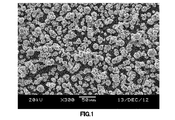
- FIG. 1 is a SEM photograph of a sample obtained after raising the temperature of a mixture of nickel cobalt manganese composite hydroxide and lithium compound obtained in Example 1 in a carbon dioxide atmosphere.
- FIG. 2 is an SEM photograph of a sample obtained after heating in a carbon dioxide atmosphere of a mixture of the nickel cobalt manganese composite hydroxide and lithium compound obtained in Comparative Example 1.
- Nickel cobalt manganese composite hydroxide to which the present invention is applied and the production method thereof will be described in detail. Note that the present invention is not limited to the following detailed description unless otherwise specified.
- the embodiment according to the present invention will be described in the following order. 1.
- Nickel cobalt manganese composite hydroxide 2.
- Manufacturing method of nickel cobalt manganese composite hydroxide 2-1.
- the nickel cobalt manganese composite hydroxide according to the present embodiment is a precursor of a positive electrode active material of a non-aqueous electrolyte secondary battery, and particularly a precursor of a positive electrode active material of a lithium ion secondary battery. .
- the nickel cobalt manganese composite hydroxide has a general formula: Ni 1-xyz Co x Mn y M z (OH) 2 (0 ⁇ x ⁇ 1/3, 0 ⁇ y ⁇ 1/3, 0 ⁇ z ⁇ 0.1, where M is one or more elements selected from Mg, Al, Ca, Ti, V, Cr, Zr, Nb, Mo, and W), and the positive electrode activity of the non-aqueous electrolyte secondary battery It becomes the precursor of the substance.
- the nickel cobalt manganese composite hydroxide has a specific surface area of 3.0 to 11.0 m 2 / g measured by the BET method by nitrogen adsorption, and the average valence of Co and Mn determined by redox titration is 2. It is tetravalent or higher.
- the specific surface area of the finally obtained positive electrode active material becomes too large, and sufficient safety cannot be obtained.
- the specific surface area is less than 3.0 m 2 / g, the reactivity with the lithium compound is deteriorated during the synthesis with the lithium compound, the reaction does not proceed sufficiently, and the lithium compound is melted during the temperature rising process. Cause aggregation. Therefore, in order to increase the safety of the positive electrode active material and prevent agglomeration, the specific surface area of the nickel cobalt manganese composite hydroxide is set in the range of 3.0 to 11.0 m 2 / g.
- the average valence of Co and Mn obtained by oxidation-reduction titration is less than 2.4, the synthesis with the lithium compound is an oxidation reaction, so the reactivity with the lithium compound is deteriorated and the reaction is sufficiently performed. In some cases, the lithium compound does not progress and the lithium compound remains, and the lithium compound melts during the temperature rising process, causing aggregation between the particles. If the average valence is increased more than necessary, the oxidation of the nickel cobalt manganese composite hydroxide proceeds and the specific surface area may become too large. Therefore, it is preferable that the average valence is 2.4 to 3.3.
- the nickel cobalt manganese composite hydroxide has an average mesopore radius measured by the nitrogen adsorption method of 4.00 to 6.00 nm and a pore volume of 0.010 to 0.020 ml / g. Is preferred.
- the nickel cobalt manganese composite hydroxide satisfying such requirements has better reactivity with the lithium compound, and sufficient reactivity with the lithium compound can be obtained.
- the average mesopore radius is less than 4.00 nm or the pore volume is less than 0.010 ml / g, the penetration of lithium carbonate melted into the particles during synthesis is not sufficient, and the reactivity with the lithium compound decreases. There is. On the other hand, if the average mesopore radius exceeds 6.00 nm or the pore volume exceeds 0.020 ml / g, the specific surface area becomes too large, and sufficient safety may not be obtained.
- the average particle diameter of the nickel cobalt manganese composite hydroxide is preferably 5 to 15 ⁇ m, and the tap density is preferably 2.0 g / cm 3 or more.
- nickel cobalt manganese composite hydroxide satisfying such requirements is used as a precursor of a positive electrode active material, battery performance can be further improved.
- the additive element represented by M in the general formula is added to improve battery characteristics such as cycle characteristics and output characteristics.
- the atomic ratio z of the additive element M exceeds 0.1, the metal element contributing to the Redox reaction decreases, which is not preferable because the battery capacity decreases. Therefore, the additive element M is adjusted so that the atomic ratio z is 0.1 or less.
- the nickel cobalt manganese composite hydroxide as described above is suitable as a precursor of a positive electrode active material of a non-aqueous electrolyte secondary battery, and can be used as a positive electrode active material of a non-aqueous electrolyte secondary battery by a normal manufacturing method. it can.
- nickel cobalt manganese composite oxide to be a positive electrode active material of a lithium ion secondary battery
- the nickel cobalt manganese composite hydroxide is heat-treated as it is or at a temperature of 800 ° C. or lower.
- the lithium compound is preferably mixed with the metal element of the nickel-cobalt-manganese composite hydroxide so that the atomic ratio is 0.95 to 1.5 and fired at 800 to 1000 ° C.
- nickel cobalt manganese complex oxide can be obtained.
- the nickel cobalt manganese composite hydroxide described above has a specific surface area of 3.0 to 11.0 m 2 / g measured by the BET method by nitrogen adsorption, and the average values of Co and Mn determined by oxidation-reduction titration.
- the number is 2.4 or more, the reactivity with the lithium compound is excellent, the reaction with the lithium compound easily proceeds, the reaction with the lithium compound precedes the melting of the lithium compound, and aggregation occurs. Can be prevented.
- thermogravimetry and differential thermal analysis in an inert atmosphere can be used.
- a mixture obtained by mixing nickel cobalt manganese composite hydroxide and lithium carbonate can be evaluated by measuring TG-DTA in a carbon dioxide gas atmosphere. If the reactivity of nickel cobalt manganese composite hydroxide with lithium carbonate is poor, unreacted lithium carbonate remains even after the temperature rises, and an endothermic peak derived from the melting of lithium carbonate is observed in the DTA curve around 680-720 ° C. Is done. Moreover, the presence or absence of aggregation of nickel cobalt manganese composite hydroxide can be confirmed by performing SEM observation on the sample after TG-DTA measurement.
- the nickel-cobalt-manganese composite hydroxide as described above is excellent in reactivity with the lithium compound, and aggregation is suppressed. In this way, when nickel cobalt manganese recovery hydroxide is used as a positive electrode active material precursor of a non-aqueous electrolyte secondary battery, the non-aqueous electrolyte secondary battery has excellent battery characteristics while being excellent in thermal stability. Can be obtained.
- the method for producing a nickel cobalt manganese composite hydroxide comprises mixing a mixed aqueous solution containing at least a nickel salt, a cobalt salt and a manganese salt and an aqueous solution containing an ammonium ion supplier, and having a pH of 11 to 11 based on a liquid temperature of 25 ° C.
- a caustic aqueous solution is supplied so as to be maintained in a range of 13 to form a reaction solution, and nickel cobalt manganese composite hydroxide particles are crystallized in the reaction solution, dried after solid-liquid separation, and oxidized after drying.
- the specific surface area of the nickel cobalt manganese composite hydroxide and the average valence of Co and Mn can be increased.
- the crystallization step comprises mixing a mixed aqueous solution containing at least a nickel salt, a cobalt salt and a manganese salt with an aqueous solution containing an ammonium ion supplier, and having a pH based on a liquid temperature of 25 ° C.
- a caustic aqueous solution is supplied so as to be maintained in the range of 11 to 13 to form a reaction solution, and nickel cobalt manganese composite hydroxide particles are crystallized in the reaction solution in the presence of a non-oxidizing atmosphere or a reducing agent.
- the temperature of the reaction solution is preferably maintained at 20 to 70 ° C. Thereby, a crystal of nickel cobalt manganese composite hydroxide grows.
- the temperature of the reaction solution is lower than 20 ° C., the solubility of the salt in the reaction solution is low and the salt concentration is low, so that the nickel cobalt manganese composite hydroxide crystal does not grow sufficiently.
- the temperature of the reaction solution exceeds 70 ° C., the generation of crystal nuclei is large and the number of fine particles increases, so that the nickel cobalt manganese composite hydroxide particles do not become dense.
- the reaction solution is controlled so that the pH based on the liquid temperature of 25 ° C. is in the range of 11 to 13, preferably 11 to 12. If the pH is less than 11, the nickel cobalt manganese composite hydroxide particles become coarse, and nickel remains in the reaction solution after the reaction, resulting in nickel loss. On the other hand, when the pH exceeds 13, the crystallization speed of the nickel cobalt manganese composite hydroxide increases, and the number of fine particles increases. When the number of fine particles increases, there arises a problem that these particles sinter to produce agglomerated powder.
- the pH of the reaction solution can be controlled by supplying a caustic aqueous solution.
- the aqueous caustic solution is not particularly limited, and for example, an aqueous alkali metal hydroxide solution such as sodium hydroxide or potassium hydroxide can be used.
- the alkali metal hydroxide can be added directly to the reaction solution, but it is preferably added as an aqueous solution in view of easy pH control.
- the method of adding the caustic aqueous solution is not particularly limited, and is a pump capable of controlling the flow rate such as a metering pump while sufficiently stirring the reaction solution, and having a pH of 11 to 13 based on a liquid temperature of 25 ° C. What is necessary is just to add so that it may become a range.
- nickel cobalt manganese composite hydroxide particles by coprecipitation are generated in a non-oxidizing atmosphere or in the presence of a reducing agent.
- a reducing agent When crystallization is performed in an oxidizing atmosphere or in the absence of a reducing agent, cobalt and manganese are oxidized, new nuclei are easily generated, primary particles become fine, and the specific surface area becomes too large. Furthermore, since the secondary particles have a low density, an excessive average pore radius and pore volume increase.
- the atmosphere non-oxidizing by maintaining the oxygen concentration in the atmosphere in the reaction tank in contact with the open surface of the reaction solution at 0.2% by volume or less.
- the oxygen concentration is maintained at 0.2% by volume or less, oxidation of metal elements, particularly manganese, in the reaction solution is suppressed, and primary particles develop to obtain highly crystalline spherical secondary particles.
- an increase in low specific surface area excessive average pore radius and pore volume can be suppressed.
- the oxygen concentration exceeds 0.2% by volume, the primary particles become fine and the crystal interface increases, so that the specific surface area of the obtained nickel cobalt manganese composite hydroxide may exceed 11.0 m 2 / g. is there. Also, the average pore radius and pore volume may become too large.
- the lower limit of the oxygen concentration is not particularly limited, and the specific surface area and the carbon content are reduced as the oxygen concentration is lowered. Therefore, the desired specific surface area is within 0.2% by volume and within an industrially possible range.
- the oxygen concentration can be controlled to the carbon content.
- the carbon content is preferably 0.1% by mass or less in the nickel cobalt manganese composite hydroxide.
- the carbon content can be measured by a high frequency-infrared combustion method.
- the inert gas is supplied into the reaction tank by supplying or supplying a sufficient amount of inert atmosphere gas during crystallization so that the oxygen concentration is maintained at 0.2% by volume or less. It is necessary to continue.
- the oxygen concentration can be easily adjusted by adjusting the amount of inert gas supplied to the reaction tank using a reaction tank with a lid.
- the inert gas nitrogen gas is advantageous in terms of cost and is preferable.
- oxygen concentration is not limited to the above-described control method, as long as it is maintained at 0.2% by volume or less.
- the nickel cobalt manganese composite hydroxide obtained in the crystallization step has a general formula: Ni 1-xyz Co x Mn y M z (OH) 2 (0 ⁇ x ⁇ 1/3, 0 ⁇ y ⁇ 1 / 3, 0 ⁇ z ⁇ 0.1, where M is one or more elements selected from Mg, Al, Ca, Ti, V, Cr, Zr, Nb, Mo, and W). This is almost the same as the atomic ratio in the supplied raw material. Therefore, by adjusting the atomic ratio in the raw material to the atomic ratio of the above general formula, the atomic ratio of nickel, cobalt, manganese, and additive element M can be set within the range of the above general formula.
- the salt concentration of the mixed aqueous solution of nickel salt, cobalt salt and manganese salt is preferably 1 mol / L to 2.6 mol / L in total for each salt.
- concentration is less than 1 mol / L, the salt concentration is low and the nickel cobalt manganese composite hydroxide crystal does not grow sufficiently.
- the saturated concentration at room temperature is exceeded, so there is a risk that crystals will reprecipitate and clog piping, and there are many crystal nuclei and many fine particles. turn into.
- the nickel salt, cobalt salt and manganese salt are not particularly limited, but are preferably at least one of sulfate, nitrate or chloride.
- the ammonium ion supplier used in the crystallization step is not particularly limited, but is preferably at least one of ammonia, ammonium sulfate, and ammonium chloride.
- the addition amount of the ammonium ion supplier is preferably in the range of 5 to 20 g / L in terms of ammonium ion concentration in the reaction solution. If the ammonium ion concentration is less than 5 g / L, the solubility of nickel, cobalt and manganese in the reaction solution is low and the crystal growth is not sufficient, so that a high density nickel cobalt manganese composite hydroxide cannot be obtained. On the other hand, when the ammonium ion concentration exceeds 20 g / L, the crystallization rate is lowered and the productivity is deteriorated, and the metal ions such as nickel remaining in the liquid increase and the cost increases.
- the additive element M is one or more elements selected from Mg, Al, Ca, Ti, V, Cr, Zr, Nb, Mo, and W, and is added to the mixed aqueous solution during the crystallization process or individually.
- the nickel cobalt manganese composite hydroxide can have a general formula composition.
- the additive element M is preferably added as a water-soluble compound, such as titanium sulfate, ammonium peroxotitanate, potassium oxalate, vanadium sulfate, ammonium vanadate, chromium sulfate, potassium chromate, zirconium sulfate, zirconium nitrate, Niobium oxalate, ammonium molybdate, sodium tungstate, ammonium tungstate, or the like can be used.
- a water-soluble compound such as titanium sulfate, ammonium peroxotitanate, potassium oxalate, vanadium sulfate, ammonium vanadate, chromium sulfate, potassium chromate, zirconium sulfate, zirconium nitrate, Niobium oxalate, ammonium molybdate, sodium tungstate, ammonium tungstate, or the like can be used.
- an additive containing the additive element M may be added to the mixed aqueous solution. This can be achieved by coprecipitation with the additive element M uniformly dispersed therein.
- the surface of the nickel cobalt manganese composite hydroxide particles may be coated with the additive element M.
- nickel cobalt manganese composite hydroxide particles are slurried with an aqueous solution containing the additive element M, and an aqueous solution containing one or more additive elements M is added while controlling the slurry to have a predetermined pH. If the additive element M is precipitated on the surface of the nickel cobalt manganese composite hydroxide particles by crystallization reaction, the surface can be uniformly coated with the additive element M.
- an alkoxide solution of the additive element M may be used.
- the surface of the nickel cobalt manganese composite hydroxide particles is coated with the additive element M by spraying an aqueous solution or slurry containing the additive element M on the nickel cobalt manganese composite hydroxide particles and drying the solution. Can do. Further, the slurry in which the nickel cobalt manganese composite hydroxide particles and the salt containing one or more additional elements M are suspended is spray-dried, or the nickel cobalt manganese composite hydroxide and one or more additional elements M are included.
- the coating can also be performed by a method such as mixing a salt by a solid phase method.
- the atomic ratio of the additive element ions present in the mixed aqueous solution is reduced by an amount that covers the desired amount.
- the atomic ratio of the metal ions of the nickel cobalt manganese composite hydroxide particles can be matched.
- the reaction method in the crystallization process is not particularly limited, and a batch method or a continuous method can be used.
- a mixed aqueous solution, an aqueous solution containing an ammonium ion supplier, and an aqueous caustic solution are continuously supplied, and the reaction solution containing nickel cobalt manganese composite hydroxide particles is continuously overflowed from the reaction vessel.
- This is a method for recovering cobalt manganese composite hydroxide particles, which is preferable from the viewpoint of productivity and stability.
- the pH is controlled by adding a caustic aqueous solution, and the reaction tank is in a steady state. Then, it is preferable to continuously collect the generated particles from the overflow pipe.
- it is possible to mix the mixed aqueous solution and the caustic alkaline aqueous solution in advance and then supply them to the reaction vessel it is possible that nickel cobalt manganese composite hydroxide is formed in the mixed aqueous solution when mixed with the caustic alkaline aqueous solution. In order to prevent this, it is preferable to supply the mixed aqueous solution and the caustic aqueous solution separately to the reaction vessel.
- the water used for the crystallization step is preferably water having as little impurity content as possible, such as pure water, in order to prevent impurities from being mixed.
- nickel cobalt manganese composite hydroxide particles obtained by crystallization are filtered, washed with water, and filtered again to obtain nickel cobalt manganese composite hydroxide. Particles can be recovered.
- Filtration may be a commonly used method, and for example, a centrifuge or a suction filter can be used. Washing with water may be performed by a usual method as long as it can remove excess base and non-reducing complexing agent contained in the nickel cobalt manganese composite hydroxide particles.
- the water used in the water washing is preferably water having as little impurity content as possible, and more preferably pure water, in order to prevent contamination of impurities.
- the nickel cobalt manganese composite hydroxide particles after solid-liquid separation are dried in a non-oxidizing atmosphere, preferably at a drying temperature of 100 to 230 ° C.
- the non-oxidizing atmosphere may be any atmosphere that can suppress the oxidation of the nickel cobalt manganese composite hydroxide particles, and an inert gas atmosphere such as a vacuum atmosphere or a nitrogen atmosphere having an oxygen concentration of 0.2% by volume or less is preferable.
- the drying temperature is the physical temperature, that is, the highest temperature of nickel cobalt manganese composite hydroxide particles to be dried.
- the drying temperature is less than 100 ° C., the evaporation of moisture is insufficient.
- the drying temperature exceeds 230 ° C., the decomposition of the nickel cobalt manganese composite hydroxide proceeds, and It becomes a mixture.
- the metal content such as nickel per mass fluctuates depending on the amount of oxide mixed, making it difficult to accurately mix with a lithium compound in the production process of the positive electrode active material. It becomes difficult to make the battery characteristics of the positive electrode active material obtained sufficient.
- the nickel cobalt manganese composite hydroxide particles after drying are oxidized.
- the nickel cobalt manganese composite hydroxide particles have a specific surface area measured by the BET method by nitrogen adsorption of 3.0 to 11.0 m 2 / g, and an average of Co and Mn determined by redox titration. Oxidation is performed so that the valence becomes 2.4 or more.
- the oxidation step by oxidizing the nickel cobalt manganese composite hydroxide particles, fine cracks are generated in the particles and the specific surface area is increased. This improves the reactivity between the nickel cobalt manganese composite hydroxide particles and the lithium compound. Further, since the fine cracks are finer than the pores formed at the time of crystallization, the average pore radius is decreased, while the pore volume is increased by increasing the number of pores.
- the oxidation conditions are appropriately determined so as to obtain a desired specific surface area and average valence.
- the oxidation temperature is preferably 20 to 230 ° C. When the oxidation temperature is less than 20 ° C., the oxidation does not proceed and the specific surface area may be less than 3.0 or the average valence of Co and Mn may be less than 2.4. Further, if the oxidation temperature is low, the oxidation time becomes too long, which is not industrially preferable. Furthermore, the average pore radius and pore volume may be too small. On the other hand, when the oxidation temperature exceeds 230 ° C., the oxidation proceeds rapidly, and thus the specific surface area may exceed 11.0 m 2 / g. In addition, the decomposition of the nickel cobalt manganese composite hydroxide proceeds and may become a mixture with the oxide. Furthermore, the average pore radius and pore volume may become too large.
- the oxidation time may be adjusted to be long when the oxidation temperature is low and short when the oxidation temperature is high so as to obtain a desired specific surface area and average valence.
- the atmosphere at the time of oxidation should just be an atmosphere which Co and Mn oxidize, and it is preferable from air
- a mixed aqueous solution containing at least a nickel salt, a cobalt salt and a manganese salt and an aqueous solution containing an ammonium ion supplier are mixed, and the liquid temperature is based on 25 ° C.
- a caustic aqueous solution is supplied so that the pH is maintained in the range of 11 to 13 to obtain a reaction solution, and nickel cobalt manganese composite hydroxide particles are crystallized in the reaction solution, dried after solid-liquid separation, and dried. Oxidizes later.
- Ni 1-x-y- z Co x Mn y M z (OH) 2 (0 ⁇ x ⁇ 1 / 3,0 ⁇ y ⁇ 1 / 3, 0 ⁇ z ⁇ 0.1
- M is one or more elements selected from Mg, Al, Ca, Ti, V, Cr, Zr, Nb, Mo, and W
- BET nitrogen adsorption
- Nickel cobalt manganese composite hydroxide having a specific surface area measured by the method of 3.0 to 11.0 m 2 / g and an average valence of Co and Mn determined by oxidation-reduction titration of 2.4 or more. You can get things.
- the obtained nickel-cobalt-manganese composite hydroxide has moderately refined crystals, increased specific surface area, and the average valence of Co and Mn is 2.4 or more. It is a precursor of a positive electrode active material that can obtain a non-aqueous electrolyte secondary battery that has high performance and excellent thermal stability and battery characteristics.
- the battery characteristics and safety are high, with high capacity and good cycle characteristics. It will be excellent.
- the present invention will be described in more detail by way of examples and comparative examples of the present invention, but the present invention is not limited to these examples.
- the evaluation method of the positive electrode active material for nickel cobalt manganese composite hydroxide and non-aqueous electrolyte secondary battery used in the Examples and Comparative Examples is as follows.
- Example 1 In Example 1, 4 L of pure water and 200 mL of 25% by mass ammonia water were put into a 5 L overflow crystallization reaction tank equipped with 4 baffle plates, and the temperature was adjusted to 60 ° C. with a thermostatic bath and a heating jacket. The mixture was heated and a 25% by mass caustic soda solution was added to adjust the pH of the reaction solution in the thermostatic bath to 12.0 based on the liquid temperature of 25 ° C.
- the stirring during the crystallization was performed by rotating horizontally at a rotation speed of 800 rpm using a 6-blade turbine blade having a diameter of 8 cm.
- an injection nozzle serving as a supply port was inserted into the reaction solution so that the mixed aqueous solution was directly supplied into the reaction solution.
- Nickel cobalt manganese composite hydroxide particles produced by the crystallization reaction were continuously taken out by overflow. The reaction was taken out for 48 to 72 hours from the start of the stable reaction. The nickel cobalt manganese composite hydroxide particles were subjected to solid-liquid separation using a Buchner funnel and a suction bottle, and then washed with water to obtain a filtrate. This filtrated product was dried by holding it at a drying temperature of 120 ° C. for 12 hours in a vacuum dryer.
- this dried product was oxidized for 1 hour by a stationary drier maintained at 120 ° C. to obtain a nickel cobalt manganese composite hydroxide.
- the nickel cobalt manganese composite hydroxide obtained had a nickel quality of 21.5 wt%, a cobalt quality of 21.5 wt%, a manganese quality of 19.8 wt%, and the ratio of each element was 33.6: 33.4: 33. 0 was almost equal to the composition ratio of the raw material aqueous solution, and the average particle size was 10.5 ⁇ m.
- the specific surface area was 7.6 m 2 / g, and the average valence of Co and Mn was 3.1. These values are shown in Table 1.
- the obtained nickel cobalt manganese composite hydroxide was mixed with lithium carbonate, and the mixture was subjected to TG-DTA measurement up to 980 ° C. at a temperature rising rate of 5 ° C./min in a carbon dioxide gas atmosphere of 100 ml / min. No endothermic peak was observed between 680 and 720 ° C. Further, when the sample after TG-DTA measurement was pulverized with a mortar and observed with an SEM, no aggregation was confirmed. Table 1 shows the presence or absence of an endothermic peak between 680 and 720 ° C. and the presence or absence of aggregation observed by SEM. Moreover, the SEM photograph of the sample obtained by Example 1 is shown in FIG. Furthermore, Table 1 shows the results of measuring the average mesopore radius and pore volume of the nickel cobalt manganese composite hydroxide by the nitrogen adsorption method.
- Example 2 a nickel-cobalt-manganese composite hydroxide was obtained and evaluated in the same manner as in Example 1 except that the dried product was oxidized by maintaining for 2 hours with a stationary drier.
- the specific surface area of this nickel cobalt manganese composite hydroxide was 8.6 m 2 / g, and the average valence of Co and Mn was 3.2.
- the obtained nickel cobalt manganese composite hydroxide was mixed with lithium carbonate, and the mixture was subjected to TG-DTA measurement up to 980 ° C. at a temperature rising rate of 5 ° C./min in a carbon dioxide gas atmosphere of 100 ml / min. No endothermic peak was observed between 680 and 720 ° C. Further, when the sample after TG-DTA measurement was pulverized with a mortar and observed with an SEM, no aggregation was confirmed. Table 1 shows the presence or absence of an endothermic peak between 680 and 720 ° C. and the presence or absence of aggregation observed by SEM. Furthermore, Table 1 shows the results of measuring the average mesopore radius and pore volume of the nickel cobalt manganese composite hydroxide by the nitrogen adsorption method.
- Example 3 In Example 3, a nickel-cobalt-manganese composite hydroxide was obtained and evaluated in the same manner as in Example 1 except that the dried product was oxidized for 3 weeks at a temperature of 25 ° C. using a stationary dryer. The specific surface area of this nickel cobalt manganese composite hydroxide was 5.2 m 2 / g, and the average valence of Co and Mn was 2.5.
- the obtained nickel cobalt manganese composite hydroxide was mixed with lithium carbonate, and the mixture was subjected to TG-DTA measurement up to 980 ° C. at a temperature rising rate of 5 ° C./min in a carbon dioxide gas atmosphere of 100 ml / min. No endothermic peak was observed between 680 and 720 ° C. Further, when the sample after TG-DTA measurement was pulverized with a mortar and observed with an SEM, no aggregation was confirmed. Table 1 shows the presence or absence of an endothermic peak between 680 and 720 ° C. and the presence or absence of aggregation observed by SEM. Furthermore, Table 1 shows the results of measuring the average mesopore radius and pore volume of the nickel cobalt manganese composite hydroxide by the nitrogen adsorption method.
- Comparative Example 1 In Comparative Example 1, a nickel cobalt manganese composite hydroxide was obtained and evaluated in the same manner as in Example 1 except that the dried product was not maintained in a stationary dryer, that is, not oxidized. The specific surface area of this nickel cobalt manganese composite hydroxide was 2.8 m 2 / g, and the average valence of Co and Mn was 2.1.
- the obtained nickel cobalt manganese composite hydroxide was mixed with lithium carbonate, and the mixture was subjected to TG-DTA measurement up to 980 ° C. at a temperature rising rate of 5 ° C./min in a carbon dioxide gas atmosphere of 100 ml / min. An endothermic peak was observed between 680 and 720 ° C.
- the sample after TG-DTA measurement was pulverized with a mortar and then observed with an SEM. As a result, aggregates were confirmed.
- Table 1 shows the presence or absence of an endothermic peak between 680 and 720 ° C. and the presence or absence of aggregation observed by SEM.
- the SEM photograph of the sample obtained by the comparative example 1 is shown in FIG. Furthermore, Table 1 shows the results of measuring the average mesopore radius and pore volume of the nickel cobalt manganese composite hydroxide by the nitrogen adsorption method.
- Comparative Example 2 nickel cobalt manganese composite hydroxide was obtained and evaluated in the same manner as in Example 1 except that the dried product was maintained for 10 minutes by a stationary dryer.
- the specific surface area of this nickel cobalt manganese composite hydroxide was 3.6 m 2 / g, and the average valence of Co and Mn was 2.3.
- the obtained nickel cobalt manganese composite hydroxide was mixed with lithium carbonate, and the mixture was subjected to TG-DTA measurement up to 980 ° C. at a temperature rising rate of 5 ° C./min in a carbon dioxide gas atmosphere of 100 ml / min. An endothermic peak was observed between 680 and 720 ° C.
- the sample after TG-DTA measurement was pulverized with a mortar and then observed with an SEM. As a result, aggregates were confirmed.
- Table 1 shows the presence or absence of an endothermic peak between 680 and 720 ° C. and the presence or absence of aggregation observed by SEM. Furthermore, Table 1 shows the results of measuring the average mesopore radius and pore volume of the nickel cobalt manganese composite hydroxide by the nitrogen adsorption method.
- Comparative Example 3 nickel cobalt manganese composite hydroxide was obtained and evaluated in the same manner as in Example 1 except that the dried product was maintained for 5 hours by a stationary dryer.
- the specific surface area of this nickel cobalt manganese composite hydroxide was 11.3 m 2 / g, and the average valence of Co and Mn was 3.4.
- the obtained nickel cobalt manganese composite hydroxide was mixed with lithium carbonate, and the mixture was subjected to TG-DTA measurement up to 980 ° C. at a temperature rising rate of 5 ° C./min in a carbon dioxide gas atmosphere of 100 ml / min. No endothermic peak was observed between 680 and 720 ° C. Further, when the sample after TG-DTA measurement was pulverized with a mortar and observed with an SEM, no aggregation was confirmed. Table 1 shows the presence or absence of an endothermic peak between 680 and 720 ° C. and the presence or absence of aggregation observed by SEM. Furthermore, Table 1 shows the results of measuring the average mesopore radius and pore volume of the nickel cobalt manganese composite hydroxide by the nitrogen adsorption method.
- Comparative Example 4 the nickel-cobalt-manganese composite was prepared in the same manner as in Example 1 except that the filtrate was maintained at a drying temperature of 120 ° C. for 12 hours with a stationary drier in the air atmosphere, and the dried product after drying was not oxidized. A hydroxide was obtained and each evaluation was performed. The specific surface area of this nickel cobalt manganese composite hydroxide was 11.9 m 2 / g, and the average valence of Co and Mn was 3.4.
- the obtained nickel cobalt manganese composite hydroxide was mixed with lithium carbonate, and the mixture was subjected to TG-DTA measurement up to 980 ° C. at a temperature rising rate of 5 ° C./min in a carbon dioxide gas atmosphere of 100 ml / min. No endothermic peak was observed between 680 and 720 ° C. Further, when the sample after TG-DTA measurement was pulverized with a mortar and observed with an SEM, no aggregation was confirmed. Table 1 shows the presence or absence of an endothermic peak between 680 and 720 ° C. and the presence or absence of aggregation observed by SEM. Furthermore, Table 1 shows the results of measuring the average mesopore radius and pore volume of the nickel cobalt manganese composite hydroxide by the nitrogen adsorption method.
- the nickel cobalt manganese composite hydroxide particles crystallized while maintaining the pH of the reaction solution at 12 on the basis of the liquid temperature of 25 ° C. are oxidized for a predetermined time after drying.
- the nickel cobalt manganese composite hydroxide obtained by the above method had a specific surface area of 3.0 to 11.0 m 2 / g, and the average valence of Co and Mn was 2.4 or more.
- the nickel cobalt manganese composite hydroxide having the specific surface area and the average valence of Co and Mn within the desired range does not show an endothermic peak between 680 and 720 ° C., and the reaction with the lithium compound proceeds. It can be seen that the reaction between the nickel cobalt manganese composite hydroxide and lithium carbonate proceeds earlier than the melting of lithium carbonate in a carbon dioxide atmosphere, and no aggregation occurs as shown in FIG.
- Comparative Example 2 in which the average valences of Co and Mn are lower than 2.4, an endothermic peak is observed in the vicinity of 680 ° C. to 720 ° C. as in Comparative Example 1, and the reaction with the lithium compound is observed. It can be seen that it is difficult to proceed and causes aggregation.
- Comparative Example 3 since the oxidation time was long and the oxidation proceeded too much, the average valence was high, but the specific surface area was too large and exceeded 11 m 2 / g. Similarly, in Comparative Example 4, the nickel cobalt manganese composite hydroxide was dried in the air, so that oxidation progressed and the specific surface area became too large.
Landscapes
- Chemical & Material Sciences (AREA)
- Inorganic Chemistry (AREA)
- Chemical Kinetics & Catalysis (AREA)
- Electrochemistry (AREA)
- General Chemical & Material Sciences (AREA)
- Organic Chemistry (AREA)
- Engineering & Computer Science (AREA)
- Materials Engineering (AREA)
- Manufacturing & Machinery (AREA)
- Inorganic Compounds Of Heavy Metals (AREA)
- Battery Electrode And Active Subsutance (AREA)
Abstract
Description
1.ニッケルコバルトマンガン複合水酸化物
2.ニッケルコバルトマンガン複合水酸化物の製造方法
2-1.晶析工程
2-2.固液分離工程
2-3.乾燥工程
2-4.酸化工程
本実施の形態に係るニッケルコバルトマンガン複合水酸化物は、非水系電解質二次電池の正極活物質の前駆体であって、特にリチウムイオン二次電池の正極活物質の前駆体となるものである。ニッケルコバルトマンガン複合水酸化物は、一般式:Ni1-x-y-zCoxMnyMz(OH)2(0<x≦1/3、0<y≦1/3、0≦z≦0.1、Mは、Mg、Al、Ca、Ti、V、Cr、Zr、Nb、Mo、Wから選択される1種以上の元素)で表され、非水系電解質二次電池の正極活物質の前駆体となる。ニッケルコバルトマンガン複合水酸化物は、窒素吸着によるBET法により測定される比表面積が3.0~11.0m2/gであり、酸化還元滴定より求められるCoとMnの平均価数が2.4価以上である。
次に、上述したニッケルコバルトマンガン複合水酸化物の製造方法について説明する。
晶析工程は、少なくともニッケル塩、コバルト塩及びマンガン塩を含む混合水溶液と、アンモニウムイオン供給体を含む水溶液とを混合するとともに、液温25℃基準でのpHが11~13の範囲に保持されるように苛性アルカリ水溶液を供給して反応溶液とし、反応溶液中においてニッケルコバルトマンガン複合水酸化物粒子を非酸化性雰囲気又は還元剤の存在下で晶析する。
固液分離工程では、晶析によって得られたニッケルコバルトマンガン複合水酸化物粒子を濾過した後、水洗し、再び濾過することにより、ニッケルコバルトマンガン複合水酸化物粒子を回収することができる。濾過は、通常用いられる方法でよく、例えば、遠心機、吸引濾過機を用いることができる。また、水洗は、通常行なわれる方法でよく、ニッケルコバルトマンガン複合水酸化物粒子に含まれる余剰の塩基、非還元性錯化剤を除去できればよい。水洗で用いる水は、不純物の混入を防止するため、可能な限り不純物の含有量が少ない水を用いることが好ましく、純水を用いることがより好ましい。
乾燥工程では、固液分離後のニッケルコバルトマンガン複合水酸化物粒子を非酸化性雰囲気中で、好ましくは乾燥温度を100~230℃で乾燥する。
酸化工程では、乾燥後のニッケルコバルトマンガン複合水酸化物粒子を酸化する。酸化工程では、ニッケルコバルトマンガン複合水酸化物粒子を、窒素吸着によるBET法により測定される比表面積が3.0~11.0m2/gで、かつ酸化還元滴定より求められるCoとMnの平均価数が2.4価以上となるように酸化する。酸化工程では、ニッケルコバルトマンガン複合水酸化物粒子を酸化することにより、粒子内に微細なクラックが発生して比表面積が増加する。これにより、ニッケルコバルトマンガン複合水酸化物粒子とリチウム化合物との反応性が良くなる。また、前記微細なクラックは、晶析時に形成された細孔より微細であるため、平均細孔半径が減少する一方、細孔数の増加により細孔容積は増加する。
ICP(Inductively Coupled Plasma)発光分析装置(VARIAN社製、725ES)を用いて、ICP発光分析法により分析した。
(2)アンモニウムイオン濃度の分析:
JIS標準による蒸留法によって測定した。
(3)BET比表面積の測定:
比表面積測定装置(ユアサアイオニクス社製、マルチソープ16)を用いて、窒素吸着によるBET1点法により測定した。
(4)平均粒径の測定および粒度分布幅の評価:
レーザー回折式粒度分布計(日機装株式会社製、マイクロトラックHRA)を用いて、平均粒径の測定及び粒度分布幅の評価を行った。
(5)TG-DTA測定:
差動型示差熱天秤(ブルカーAXS社製、TG-DTA2020SR)を用いて、熱重量測定及び示差熱分析を行った。
(6)形態の観察評価:
走査型電子顕微鏡(日本電子株式会社製、JSM-6360LA、以下、SEMと記載)を用いて、形状と外観の観察及び凝集の有無の評価を行った。
実施例1では、邪魔板を4枚取り付けた槽容積5Lのオーバーフロー式晶析反応槽に、純水4L、25質量%アンモニア水を200mL投入して、恒温槽及び加温ジャケットにて60℃に加温し、25質量%苛性ソーダ溶液を添加して、恒温槽内の反応溶液のpHを液温25℃基準で12.0に調整した。
実施例2では、乾燥物を定置乾燥機により2時間維持して酸化したこと以外は実施例1と同様にしてニッケルコバルトマンガン複合水酸化物を得るとともに各評価を行った。このニッケルコバルトマンガン複合水酸化物の比表面積は、8.6m2/gであり、CoとMnの平均価数は3.2価であった。
実施例3では、乾燥物を定置乾燥機により温度25℃で3週間維持して酸化したこと以外は実施例1と同様にしてニッケルコバルトマンガン複合水酸化物を得るとともに各評価を行った。このニッケルコバルトマンガン複合水酸化物の比表面積は、5.2m2/gであり、CoとMnの平均価数は2.5価であった。
比較例1では、乾燥物を定置乾燥機での維持を行わなかった、即ち酸化しなかったこと以外は実施例1と同様にしてニッケルコバルトマンガン複合水酸化物を得るとともに各評価を行った。このニッケルコバルトマンガン複合水酸化物の比表面積は、2.8m2/gであり、CoとMnの平均価数は2.1価であった。
比較例2では、乾燥物を定置乾燥機により10分間維持すること以外は実施例1と同様にしてニッケルコバルトマンガン複合水酸化物を得るとともに各評価を行った。このニッケルコバルトマンガン複合水酸化物の比表面積は3.6m2/gであり、CoとMnの平均価数は2.3価であった。
比較例3では、乾燥物を定置乾燥機により5時間維持すること以外は実施例1と同様にしてニッケルコバルトマンガン複合水酸化物を得るとともに各評価を行った。このニッケルコバルトマンガン複合水酸化物の比表面積は、11.3m2/gであり、CoとMnの平均価数は、3.4価であった。
比較例4では、濾過物を大気雰囲気下の定置乾燥機で乾燥温度120℃、12時間維持し、乾燥後の乾燥物を酸化しなかったこと以外は実施例1と同様にしてニッケルコバルトマンガン複合水酸化物を得るとともに各評価を行った。このニッケルコバルトマンガン複合水酸化物の比表面積は、11.9m2/gであり、CoとMnの平均価数は、3.4価であった。

Claims (9)
- 一般式:Ni1-x-y-zCoxMnyMz(OH)2(0<x≦1/3、0<y≦1/3、0≦z≦0.1、Mは、Mg、Al、Ca、Ti、V、Cr、Zr、Nb、Mo、Wから選択される1種以上の元素)で表され、非水系電解質二次電池の正極活物質の前駆体となるニッケルコバルトマンガン複合水酸化物であって、
窒素吸着によるBET法により測定される比表面積が3.0~11.0m2/gであり、かつ、酸化還元滴定より求められるCoとMnの平均価数が2.4価以上であることを特徴とするニッケルコバルトマンガン複合水酸化物。 - 窒素吸着法により測定される平均メソ細孔半径が4.00~6.00nmであり、細孔容積が0.010~0.020ml/gであることを特徴とする請求項1記載のニッケルコバルトマンガン複合水酸化物。
- 一般式:Ni1-x-y-zCoxMnyMz(OH)2(0<x≦1/3、0<y≦1/3、0≦z≦0.1、Mは、Mg、Al、Ca、Ti、V、Cr、Zr、Nb、Mo、Wから選択される1種以上の元素)で表され、非水系電解質二次電池の正極活物質の前駆体となるニッケルコバルトマンガン複合水酸化物の製造方法であって、
少なくともニッケル塩、コバルト塩及びマンガン塩を含む混合水溶液と、アンモニウムイオン供給体を含む水溶液を反応槽内で混合するとともに、液温25度基準でのpHが11~13の範囲に維持されるように苛性アルカリ水溶液を供給して反応溶液とし、該反応溶液中でニッケルコバルトマンガン複合水酸化物粒子を非酸化性雰囲気又は還元剤の存在下で晶析する晶析工程と、
上記ニッケルコバルトマンガン複合水酸化物粒子を固液分離し、水洗する固液分離工程と、
水洗した上記ニッケルコバルトマンガン複合水酸化物粒子を非酸化性雰囲気中で乾燥する乾燥工程と、
乾燥後の上記ニッケルコバルトマンガン複合水酸化物粒子を酸化して、窒素吸着によるBET法により測定される比表面積を3.0~11.0m2/gとし、かつ酸化還元滴定より求められるCoとMnの平均価数を2.4価以上とする酸化工程とを有することを特徴とするニッケルコバルトマンガン複合水酸化物の製造方法。 - 上記晶析工程では、上記反応槽内に不活性ガスを供給することにより、上記反応溶液の解放面と接触する反応槽内の雰囲気の酸素濃度を0.2容量%以下に維持することを特徴とする請求項3記載のニッケルコバルトマンガン複合水酸化物の製造方法。
- 上記反応溶液の温度を20~70℃、アンモニウムイオン濃度を5~20g/Lの範囲に維持することを特徴とする請求項3記載のニッケルコバルトマンガン複合水酸化物の製造方法。
- 上記混合水溶液、上記アンモニウムイオン供給体を含む水溶液及び上記苛性アルカリ水溶液をそれぞれ連続的に供給して、上記反応槽から上記ニッケルコバルトマンガン複合水酸化物粒子を含む反応溶液を連続的にオーバーフローさせて上記ニッケルコバルトマンガン複合水酸化物粒子を回収することを特徴とする請求項3に記載のニッケルコバルトマンガン複合水酸化物の製造方法。
- 上記ニッケルコバルトマンガン複合水酸化物粒子の表面を添加元素Mの水酸化物で被覆することを特徴とする請求項3に記載のニッケルコバルトマンガン複合水酸化物の製造方法。
- 上記ニッケル塩、上記コバルト塩及び上記マンガン塩は、硫酸塩、硝酸塩又は塩化物の少なくとも1種であることを特徴とする請求項3に記載のニッケルコバルトマンガン複合水酸化物の製造方法。
- 上記アンモニウムイオン供給体は、アンモニア、硫酸アンモニウム又は塩化アンモニウムの少なくとも1種であることを特徴とする請求項3に記載のニッケルコバルトマンガン複合水酸化物の製造方法。
Priority Applications (4)
| Application Number | Priority Date | Filing Date | Title |
|---|---|---|---|
| KR1020157035216A KR102072737B1 (ko) | 2013-06-17 | 2014-06-13 | 니켈 코발트 망간 복합 수산화물 및 그 제조 방법 |
| CN201480034686.4A CN105340112B (zh) | 2013-06-17 | 2014-06-13 | 镍钴锰复合氢氧化物和其制造方法 |
| EP14812925.7A EP3012889B1 (en) | 2013-06-17 | 2014-06-13 | Nickel-cobalt-manganese composite hydroxide, and production method therefor |
| US14/898,521 US10236504B2 (en) | 2013-06-17 | 2014-06-13 | Nickel-cobalt-manganese composite hydroxide, and production method therefor |
Applications Claiming Priority (2)
| Application Number | Priority Date | Filing Date | Title |
|---|---|---|---|
| JP2013-126893 | 2013-06-17 | ||
| JP2013126893A JP6186919B2 (ja) | 2013-06-17 | 2013-06-17 | ニッケルコバルトマンガン複合水酸化物及びその製造方法 |
Publications (1)
| Publication Number | Publication Date |
|---|---|
| WO2014203814A1 true WO2014203814A1 (ja) | 2014-12-24 |
Family
ID=52104549
Family Applications (1)
| Application Number | Title | Priority Date | Filing Date |
|---|---|---|---|
| PCT/JP2014/065722 Ceased WO2014203814A1 (ja) | 2013-06-17 | 2014-06-13 | ニッケルコバルトマンガン複合水酸化物及びその製造方法 |
Country Status (6)
| Country | Link |
|---|---|
| US (1) | US10236504B2 (ja) |
| EP (1) | EP3012889B1 (ja) |
| JP (1) | JP6186919B2 (ja) |
| KR (1) | KR102072737B1 (ja) |
| CN (1) | CN105340112B (ja) |
| WO (1) | WO2014203814A1 (ja) |
Cited By (4)
| Publication number | Priority date | Publication date | Assignee | Title |
|---|---|---|---|---|
| CN106159252A (zh) * | 2015-04-13 | 2016-11-23 | 惠州市豪鹏科技有限公司 | 一种正极活性材料的制备方法、正极片及锂离子电池 |
| WO2022107861A1 (ja) * | 2020-11-19 | 2022-05-27 | 住友化学株式会社 | 前駆体、リチウム二次電池用正極活物質、リチウム二次電池用正極及びリチウム二次電池 |
| WO2023095548A1 (ja) * | 2021-11-26 | 2023-06-01 | 株式会社田中化学研究所 | 遷移金属含有水酸化物、遷移金属含有水酸化物を前駆体とした正極活物質、遷移金属含有水酸化物の製造方法 |
| WO2023095547A1 (ja) * | 2021-11-26 | 2023-06-01 | 株式会社田中化学研究所 | 遷移金属含有水酸化物、遷移金属含有水酸化物を前駆体とした正極活物質 |
Families Citing this family (27)
| Publication number | Priority date | Publication date | Assignee | Title |
|---|---|---|---|---|
| JP6044463B2 (ja) * | 2013-06-19 | 2016-12-14 | 住友金属鉱山株式会社 | ニッケルコバルトマンガン複合水酸化物及びその製造方法 |
| US10593942B2 (en) * | 2014-10-30 | 2020-03-17 | Sumitomo Metal Mining Co., Ltd. | Nickel-containing composite hydroxide and production process therefor, positive-electrode active material for a nonaqueous-electrolyte secondary battery and production process therefor, and nonaqueous-electrolyte secondary battery |
| WO2018021556A1 (ja) * | 2016-07-29 | 2018-02-01 | 住友金属鉱山株式会社 | ニッケルマンガン複合水酸化物とその製造方法、非水系電解質二次電池用正極活物質とその製造方法、および非水系電解質二次電池 |
| JP7134590B2 (ja) * | 2016-07-29 | 2022-09-12 | ユミコア | 割れのないリチウムイオン電池正極活物質前駆体の製造方法 |
| KR102390594B1 (ko) | 2016-07-29 | 2022-04-26 | 스미토모 긴조쿠 고잔 가부시키가이샤 | 니켈망간 복합 수산화물과 그 제조 방법, 비수계 전해질 이차 전지용 정극 활물질과 그 제조 방법, 및 비수계 전해질 이차 전지 |
| CN109803928A (zh) * | 2016-07-29 | 2019-05-24 | 住友金属矿山株式会社 | 镍锰复合氢氧化物及其制造方法、非水系电解质二次电池用正极活性物质及其制造方法、以及非水系电解质二次电池 |
| CN109803929B (zh) * | 2016-07-29 | 2022-08-26 | 住友金属矿山株式会社 | 镍锰复合氢氧化物及其制造方法、非水系电解质二次电池用正极活性物质及其制造方法 |
| US11910931B2 (en) * | 2016-09-13 | 2024-02-27 | Stratasys, Inc. | Porous body, additive manufacturing method for the body and apparatus for supporting and/or bearing a person |
| KR102133916B1 (ko) | 2016-12-28 | 2020-07-15 | 주식회사 엘지화학 | 이차전지용 양극 활물질, 그 제조방법 및 이를 포함하는 리튬 이차전지 |
| JP6583359B2 (ja) * | 2017-07-27 | 2019-10-02 | 住友金属鉱山株式会社 | ニッケルコバルトマンガン複合水酸化物 |
| CN109428076B (zh) | 2017-09-04 | 2023-04-11 | 三星电子株式会社 | 正极活性材料前体、正极活性材料、制备正极活性材料的方法、正极和锂电池 |
| EP3702330A4 (en) * | 2017-10-26 | 2020-12-23 | Sumitomo Metal Mining Co., Ltd. | COMPOSITE NICKEL OXIDE AND PROCESS FOR THE PRODUCTION OF LITHIUM-NICKEL COMPOSITE OXIDE |
| JP6523508B1 (ja) * | 2018-03-30 | 2019-06-05 | 住友化学株式会社 | リチウム複合金属化合物、リチウム二次電池用正極活物質、リチウム二次電池用正極、リチウム二次電池、及びリチウム複合金属化合物の製造方法 |
| KR102125007B1 (ko) * | 2018-09-11 | 2020-06-19 | 한국교통대학교 산학협력단 | 환원제를 사용한 잔류리튬의 제거방법 |
| JP7118843B2 (ja) * | 2018-10-01 | 2022-08-16 | Jx金属株式会社 | 全固体リチウムイオン電池用正極活物質の製造方法、及び全固体リチウムイオン電池の製造方法 |
| JP7118851B2 (ja) * | 2018-10-12 | 2022-08-16 | Jx金属株式会社 | 全固体リチウムイオン電池用正極活物質の製造方法、及び、全固体リチウムイオン電池の製造方法 |
| CN113767069B (zh) * | 2019-04-26 | 2023-08-22 | 住友金属矿山株式会社 | 镍复合氢氧化物及其制造方法、锂离子二次电池用正极活性物质及其制造方法、锂离子二次电池 |
| JP7574203B2 (ja) * | 2019-10-04 | 2024-10-28 | 三洋電機株式会社 | 非水電解質二次電池用正極活物質、及び非水電解質二次電池 |
| KR102293034B1 (ko) * | 2020-06-04 | 2021-08-24 | 에스케이이노베이션 주식회사 | 리튬 이차 전지용 양극 활물질 및 이를 포함하는 리튬 이차 전지 |
| KR20210150863A (ko) * | 2020-06-04 | 2021-12-13 | 에스케이이노베이션 주식회사 | 리튬 이차 전지 |
| KR102894423B1 (ko) * | 2020-11-09 | 2025-12-01 | 에스케이온 주식회사 | 리튬 이차 전지용 양극 활물질 및 이를 포함하는 리튬 이차 전지 |
| CN116964779A (zh) | 2021-03-30 | 2023-10-27 | 株式会社博迈立铖 | 锂离子二次电池用正极活性物质的制造方法 |
| CN118891754A (zh) | 2022-09-22 | 2024-11-01 | 株式会社博迈立铖 | 锂离子二次电池用正极活性物质的前体的制造方法及锂离子二次电池用正极活性物质的前体、以及锂离子二次电池用正极活性物质的制造方法 |
| JP7812821B2 (ja) | 2023-03-10 | 2026-02-10 | プライムプラネットエナジー&ソリューションズ株式会社 | リチウム遷移金属複合酸化物の前駆体粒子の製造方法、およびリチウム遷移金属複合酸化物の製造方法、ならびにリチウムイオン二次電池の製造方法 |
| CN117208971A (zh) * | 2023-08-29 | 2023-12-12 | 江西佳纳能源科技有限公司 | 高镍正极前驱体材料及其制备方法和应用 |
| JPWO2025063203A1 (ja) | 2023-09-21 | 2025-03-27 | ||
| CN121794798A (zh) | 2024-02-09 | 2026-04-03 | 株式会社博迈立铖 | 锂离子二次电池用正极活性物质的前体的制造方法、及锂离子二次电池用正极活性物质的制造方法 |
Citations (10)
| Publication number | Priority date | Publication date | Assignee | Title |
|---|---|---|---|---|
| JP2003059490A (ja) | 2001-08-17 | 2003-02-28 | Tanaka Chemical Corp | 非水電解質二次電池用正極活物質及びその製造方法 |
| JP2008195608A (ja) | 2000-11-06 | 2008-08-28 | Tanaka Chemical Corp | 高密度コバルトマンガン共沈水酸化ニッケル及びその製造法 |
| WO2009063838A1 (ja) * | 2007-11-12 | 2009-05-22 | Gs Yuasa Corporation | リチウム二次電池用活物質、リチウム二次電池及びその製造方法 |
| JP2011057518A (ja) * | 2009-09-11 | 2011-03-24 | Kansai Shokubai Kagaku Kk | 高密度ニッケル・コバルト・マンガン共沈水酸化物及びその製造方法 |
| WO2011067982A1 (ja) * | 2009-12-02 | 2011-06-09 | トヨタ自動車株式会社 | 活物質粒子およびその利用 |
| WO2011067935A1 (ja) * | 2009-12-02 | 2011-06-09 | 住友金属鉱山株式会社 | ニッケルコバルトマンガン複合水酸化物粒子とその製造方法、非水系電解質二次電池用正極活物質とその製造方法、および非水系電解質二次電池 |
| WO2012026539A1 (ja) * | 2010-08-26 | 2012-03-01 | 宇部興産株式会社 | 電極材料の連続製造方法 |
| WO2012164763A1 (ja) * | 2011-06-01 | 2012-12-06 | 住友金属鉱山株式会社 | 非水系電解質二次電池用正極活物質の前駆体となる遷移金属複合水酸化物とその製造方法、その非水系電解質二次電池用正極活物質とその製造方法、ならびに該正極活物質を用いた非水系電解質二次電池 |
| JP2012252853A (ja) * | 2011-06-02 | 2012-12-20 | Toyota Industries Corp | リチウム含有複合酸化物の製造方法、正極活物質および二次電池 |
| JP2012256435A (ja) * | 2011-06-07 | 2012-12-27 | Sumitomo Metal Mining Co Ltd | ニッケルマンガン複合水酸化物粒子とその製造方法、非水系電解質二次電池用正極活物質とその製造方法、ならびに非水系電解質二次電池 |
Family Cites Families (5)
| Publication number | Priority date | Publication date | Assignee | Title |
|---|---|---|---|---|
| US7585435B2 (en) * | 2000-11-06 | 2009-09-08 | Tanaka Chemical Corporation | High density cobalt-manganese coprecipitated nickel hydroxide and process for its production |
| JP4217712B2 (ja) * | 2003-09-16 | 2009-02-04 | Agcセイミケミカル株式会社 | リチウム−ニッケル−コバルト−マンガン−フッ素含有複合酸化物ならびにその製造方法およびそれを用いたリチウム二次電池 |
| CA2618780C (en) | 2005-08-12 | 2015-10-20 | Toda Kogyo Europe Gmbh | Partly oxidized mixed metal hydroxides |
| WO2012033023A1 (ja) * | 2010-09-06 | 2012-03-15 | 住友化学株式会社 | リチウム複合金属酸化物及びその製造方法 |
| JP5365711B2 (ja) * | 2012-02-21 | 2013-12-11 | 住友金属鉱山株式会社 | ニッケルコバルトマンガン複合水酸化物及びその製造方法 |
-
2013
- 2013-06-17 JP JP2013126893A patent/JP6186919B2/ja active Active
-
2014
- 2014-06-13 EP EP14812925.7A patent/EP3012889B1/en active Active
- 2014-06-13 CN CN201480034686.4A patent/CN105340112B/zh active Active
- 2014-06-13 US US14/898,521 patent/US10236504B2/en active Active
- 2014-06-13 WO PCT/JP2014/065722 patent/WO2014203814A1/ja not_active Ceased
- 2014-06-13 KR KR1020157035216A patent/KR102072737B1/ko active Active
Patent Citations (10)
| Publication number | Priority date | Publication date | Assignee | Title |
|---|---|---|---|---|
| JP2008195608A (ja) | 2000-11-06 | 2008-08-28 | Tanaka Chemical Corp | 高密度コバルトマンガン共沈水酸化ニッケル及びその製造法 |
| JP2003059490A (ja) | 2001-08-17 | 2003-02-28 | Tanaka Chemical Corp | 非水電解質二次電池用正極活物質及びその製造方法 |
| WO2009063838A1 (ja) * | 2007-11-12 | 2009-05-22 | Gs Yuasa Corporation | リチウム二次電池用活物質、リチウム二次電池及びその製造方法 |
| JP2011057518A (ja) * | 2009-09-11 | 2011-03-24 | Kansai Shokubai Kagaku Kk | 高密度ニッケル・コバルト・マンガン共沈水酸化物及びその製造方法 |
| WO2011067982A1 (ja) * | 2009-12-02 | 2011-06-09 | トヨタ自動車株式会社 | 活物質粒子およびその利用 |
| WO2011067935A1 (ja) * | 2009-12-02 | 2011-06-09 | 住友金属鉱山株式会社 | ニッケルコバルトマンガン複合水酸化物粒子とその製造方法、非水系電解質二次電池用正極活物質とその製造方法、および非水系電解質二次電池 |
| WO2012026539A1 (ja) * | 2010-08-26 | 2012-03-01 | 宇部興産株式会社 | 電極材料の連続製造方法 |
| WO2012164763A1 (ja) * | 2011-06-01 | 2012-12-06 | 住友金属鉱山株式会社 | 非水系電解質二次電池用正極活物質の前駆体となる遷移金属複合水酸化物とその製造方法、その非水系電解質二次電池用正極活物質とその製造方法、ならびに該正極活物質を用いた非水系電解質二次電池 |
| JP2012252853A (ja) * | 2011-06-02 | 2012-12-20 | Toyota Industries Corp | リチウム含有複合酸化物の製造方法、正極活物質および二次電池 |
| JP2012256435A (ja) * | 2011-06-07 | 2012-12-27 | Sumitomo Metal Mining Co Ltd | ニッケルマンガン複合水酸化物粒子とその製造方法、非水系電解質二次電池用正極活物質とその製造方法、ならびに非水系電解質二次電池 |
Non-Patent Citations (1)
| Title |
|---|
| See also references of EP3012889A4 |
Cited By (8)
| Publication number | Priority date | Publication date | Assignee | Title |
|---|---|---|---|---|
| CN106159252A (zh) * | 2015-04-13 | 2016-11-23 | 惠州市豪鹏科技有限公司 | 一种正极活性材料的制备方法、正极片及锂离子电池 |
| WO2022107861A1 (ja) * | 2020-11-19 | 2022-05-27 | 住友化学株式会社 | 前駆体、リチウム二次電池用正極活物質、リチウム二次電池用正極及びリチウム二次電池 |
| JP2022081251A (ja) * | 2020-11-19 | 2022-05-31 | 住友化学株式会社 | 前駆体、リチウム二次電池用正極活物質、リチウム二次電池用正極及びリチウム二次電池 |
| EP4249437A4 (en) * | 2020-11-19 | 2025-03-19 | Sumitomo Chemical Company, Limited | PRECURSOR, POSITIVE ELECTRODE ACTIVE MATERIAL FOR LITHIUM SECONDARY BATTERY, POSITIVE ELECTRODE FOR LITHIUM SECONDARY BATTERY AND LITHIUM SECONDARY BATTERY |
| WO2023095548A1 (ja) * | 2021-11-26 | 2023-06-01 | 株式会社田中化学研究所 | 遷移金属含有水酸化物、遷移金属含有水酸化物を前駆体とした正極活物質、遷移金属含有水酸化物の製造方法 |
| WO2023095547A1 (ja) * | 2021-11-26 | 2023-06-01 | 株式会社田中化学研究所 | 遷移金属含有水酸化物、遷移金属含有水酸化物を前駆体とした正極活物質 |
| JP2023078887A (ja) * | 2021-11-26 | 2023-06-07 | 株式会社田中化学研究所 | 遷移金属含有水酸化物、遷移金属含有水酸化物を前駆体とした正極活物質 |
| JP2023078888A (ja) * | 2021-11-26 | 2023-06-07 | 株式会社田中化学研究所 | 遷移金属含有水酸化物、遷移金属含有水酸化物を前駆体とした正極活物質、遷移金属含有水酸化物の製造方法 |
Also Published As
| Publication number | Publication date |
|---|---|
| JP6186919B2 (ja) | 2017-08-30 |
| JP2015002120A (ja) | 2015-01-05 |
| US20160133927A1 (en) | 2016-05-12 |
| CN105340112B (zh) | 2018-08-28 |
| KR20160021112A (ko) | 2016-02-24 |
| CN105340112A (zh) | 2016-02-17 |
| EP3012889A1 (en) | 2016-04-27 |
| EP3012889B1 (en) | 2020-03-18 |
| US10236504B2 (en) | 2019-03-19 |
| KR102072737B1 (ko) | 2020-02-03 |
| EP3012889A4 (en) | 2017-01-04 |
Similar Documents
| Publication | Publication Date | Title |
|---|---|---|
| JP6186919B2 (ja) | ニッケルコバルトマンガン複合水酸化物及びその製造方法 | |
| JP6044463B2 (ja) | ニッケルコバルトマンガン複合水酸化物及びその製造方法 | |
| JP5365711B2 (ja) | ニッケルコバルトマンガン複合水酸化物及びその製造方法 | |
| JP5754416B2 (ja) | ニッケルコバルト複合水酸化物の製造方法 | |
| JP6583359B2 (ja) | ニッケルコバルトマンガン複合水酸化物 | |
| JP6201895B2 (ja) | ニッケルコバルトマンガン複合水酸化物の製造方法 | |
| JP6428105B2 (ja) | ニッケルコバルトマンガン化合物及びその製造方法 | |
| KR101665270B1 (ko) | 니켈 복합 수산화물, 비수계 전해질 이차 전지용 정극 활물질, 비수계 전해질 이차 전지, 및 이들의 제조 방법 | |
| WO2018117644A1 (ko) | 양극활물질, 이의 제조 방법, 및 이를 포함하는 리튬 이차 전지 | |
| JP5799849B2 (ja) | ニッケルコバルト複合水酸化物及びその製造方法 | |
| JP6245081B2 (ja) | ニッケルコバルトマンガン複合水酸化物とその製造方法 | |
| JP5967264B2 (ja) | 非水系電解質二次電池の正極活物質の製造方法 | |
| JP7389376B2 (ja) | 非水系電解質二次電池用正極活物質 | |
| CN117963989A (zh) | 一种四氧化三锰及其制备方法与应用 |
Legal Events
| Date | Code | Title | Description |
|---|---|---|---|
| WWE | Wipo information: entry into national phase |
Ref document number: 201480034686.4 Country of ref document: CN |
|
| 121 | Ep: the epo has been informed by wipo that ep was designated in this application |
Ref document number: 14812925 Country of ref document: EP Kind code of ref document: A1 |
|
| ENP | Entry into the national phase |
Ref document number: 20157035216 Country of ref document: KR Kind code of ref document: A |
|
| WWE | Wipo information: entry into national phase |
Ref document number: 14898521 Country of ref document: US |
|
| NENP | Non-entry into the national phase |
Ref country code: DE |
|
| WWE | Wipo information: entry into national phase |
Ref document number: 2014812925 Country of ref document: EP |